Anaphylaxis
From minor cuts and burns, to heart attacks and strokes, this
handy, take-anywhere guide gives you the knowledge and
advice you need to recognize and respond to any medical
emergency.
Be prepared for any medical emergency and handle it safely and efficiently
with The Complete First Aid Pocket Guide. Quickly identify signs and
symptoms of a wide range of medical conditions and learn how to recognize
the difference between a minor injury or illness, and those that are more
serious with this essential handbook.
FIRSTAIDPOWERPOINT.ORG
What is Anaphylaxis?
Anaphylaxis is a severe, life-threatening, allergic reaction.
As with mild allergic reactions there can be a whole range of triggers such as peanuts, shellfish, latex,
bee stings etc.
When the body detects this allergen, it reacts by releasing a large amount of inflammatory
substances such as histamine. These substances cause blood vessels throughout the body to widen,
leading to a drop in blood pressure, and airways in the lungs to constrict and secrete mucus causing
severe difficulty in breathing.
This often happens very quickly, possibly even seconds after coming into contact with the allergen.
However the reaction can in rare cases be delayed up to 24 hours after the initial contact.
FIRSTAIDPOWERPOINT.ORG
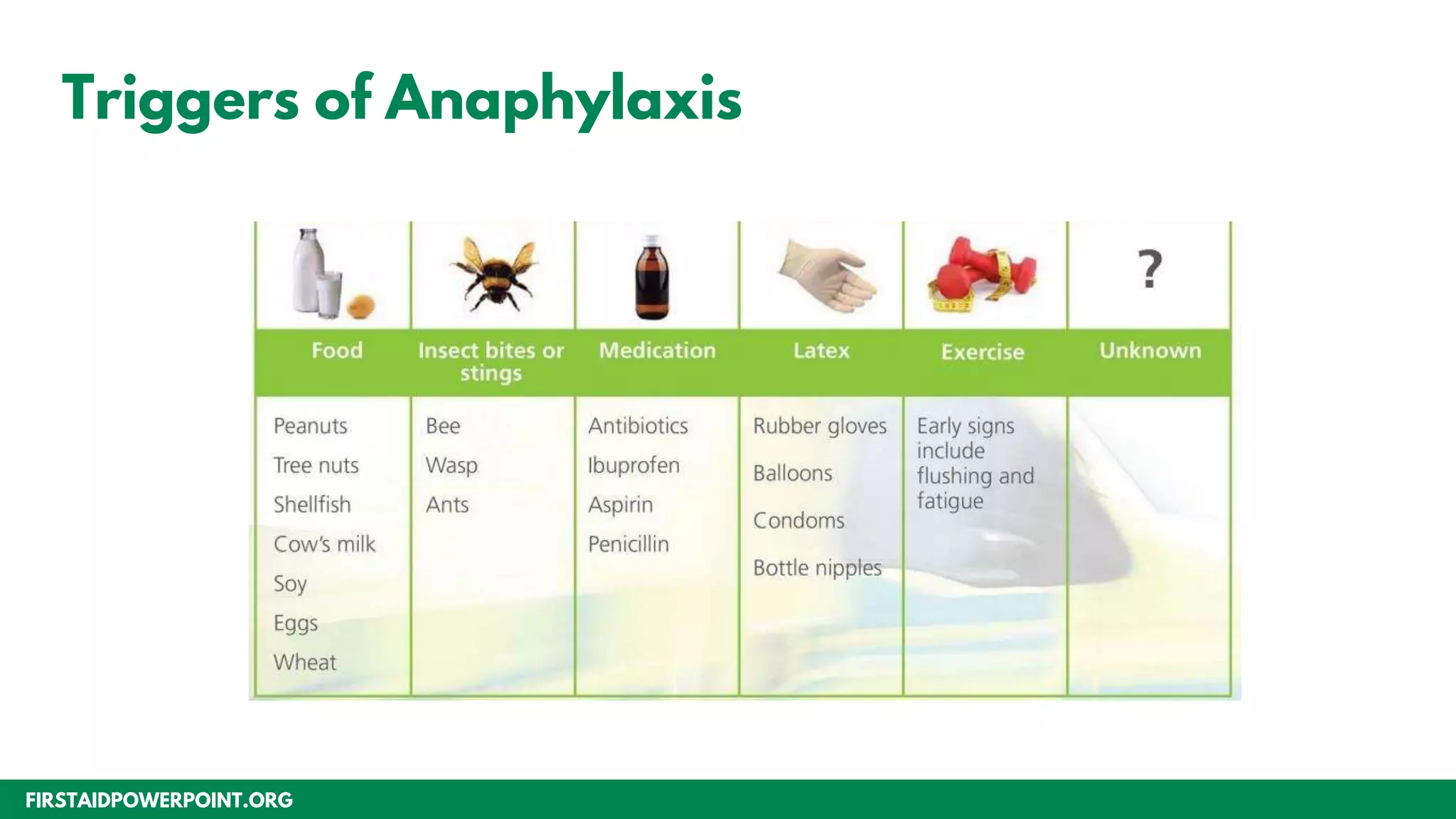
Triggers of Anaphylaxis
FIRSTAIDPOWERPOINT.ORG
Signs and Symptoms
● Sudden swelling of the face, tongue, lips, neck and eyes
● Hoarse voice, ‘lump in the throat’, developing into loud pitched noisy breathing
(which may stop altogether).
● Difficult, wheezy breathing, tight chest (the patient may have the equivalent of an
asthma attack as well as a swollen airway).
● Rapid weak pulse.
● Nausea, vomiting, stomach cramps and diarrhea.
● Itchy skin.
● Red, blotchy skin eruption – urticaria
● Anxiety – a feeling of ‘impending doom
FIRSTAIDPOWERPOINT.ORG
Signs and Symptoms
FIRSTAIDPOWERPOINT.ORG
First Aid Management
● Call for emergency medical help. Do not delay in calling for help as time is critical.
● Lay the victim in a comfortable position:
● If the victim has Airway or Breathing problems they may prefer to sit up as this will make breathing
easier
● If the victim feels faint, do not sit them up. Lay them down immediately. Raise the legs if they still feel
faint. They may go into shock.
● The patient may carry an auto-injector of Epinephrine (Adrenaline). This can save the
casualty’s life if it’s given promptly.
● If the patient becomes unconscious – check to see if they are breathing normally. If they are
not breathing, immediately update the emergency services and commence Cardiopulmonary
Resuscitation (CPR).
FIRSTAIDPOWERPOINT.ORG
Using an Epinephrine Autoinjector

Medical Emergencies - Anaphylaxis

  • 1.
  • 2.
    From minor cutsand burns, to heart attacks and strokes, this handy, take-anywhere guide gives you the knowledge and advice you need to recognize and respond to any medical emergency. Be prepared for any medical emergency and handle it safely and efficiently with The Complete First Aid Pocket Guide. Quickly identify signs and symptoms of a wide range of medical conditions and learn how to recognize the difference between a minor injury or illness, and those that are more serious with this essential handbook.
  • 3.
    FIRSTAIDPOWERPOINT.ORG What is Anaphylaxis? Anaphylaxisis a severe, life-threatening, allergic reaction. As with mild allergic reactions there can be a whole range of triggers such as peanuts, shellfish, latex, bee stings etc. When the body detects this allergen, it reacts by releasing a large amount of inflammatory substances such as histamine. These substances cause blood vessels throughout the body to widen, leading to a drop in blood pressure, and airways in the lungs to constrict and secrete mucus causing severe difficulty in breathing. This often happens very quickly, possibly even seconds after coming into contact with the allergen. However the reaction can in rare cases be delayed up to 24 hours after the initial contact.
  • 4.
  • 5.
    FIRSTAIDPOWERPOINT.ORG Signs and Symptoms ●Sudden swelling of the face, tongue, lips, neck and eyes ● Hoarse voice, ‘lump in the throat’, developing into loud pitched noisy breathing (which may stop altogether). ● Difficult, wheezy breathing, tight chest (the patient may have the equivalent of an asthma attack as well as a swollen airway). ● Rapid weak pulse. ● Nausea, vomiting, stomach cramps and diarrhea. ● Itchy skin. ● Red, blotchy skin eruption – urticaria ● Anxiety – a feeling of ‘impending doom
  • 6.
  • 7.
    FIRSTAIDPOWERPOINT.ORG First Aid Management ●Call for emergency medical help. Do not delay in calling for help as time is critical. ● Lay the victim in a comfortable position: ● If the victim has Airway or Breathing problems they may prefer to sit up as this will make breathing easier ● If the victim feels faint, do not sit them up. Lay them down immediately. Raise the legs if they still feel faint. They may go into shock. ● The patient may carry an auto-injector of Epinephrine (Adrenaline). This can save the casualty’s life if it’s given promptly. ● If the patient becomes unconscious – check to see if they are breathing normally. If they are not breathing, immediately update the emergency services and commence Cardiopulmonary Resuscitation (CPR).
  • 8.