Medical Device Single Audit Program (MDSAP)
Introduction
In 2012, the International Medical Device Regulators Forum (IMDRF) developed the Medical
Device Single Audit Program (MDSAP) to implement a harmonized and a global approach to
audit medical device manufacturers. The program allows for MDSAP recognized organizations
to conduct a single audit that satisfies the regulatory requirements of the countries participating
in the program.1
From January 1, 2014 to December 31, 2016, the FDA and the other members of the MDSAP,
participated in a pilot program. The program saw more than 100 participating manufacturers that
sell in Canada and internationally. A report generated on June 29, 2017 summarized the results
of this 3-year pilot program. Based on the outcome of this report, the MDSAP Regulatory
Authority Council determined that the pilot program was a success.1
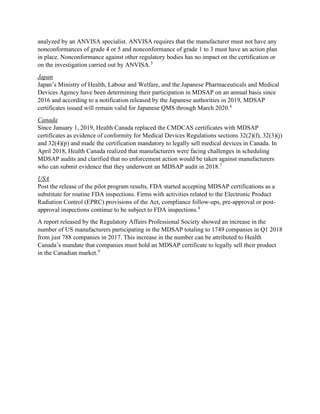
Currently, five countries are participating in the program, they are:
• Therapeutic Goods Administration of Australia
• Brazil’s Agência Nacional de Vigilância Sanitária
• Japan’s Ministry of Health, Labour and Welfare, and the Japanese Pharmaceuticals and
Medical Devices Agency
• U.S. Food and Drug Administration
• Health Canada
The World Health Organization (WHO) Prequalification of In Vitro Diagnostics (IVDs) Program
and the European Union are official observers of the MDSAP program.1
Manufacturers who are audited under the MDSAP program may avoid routine inspections from
the participating regulatory bodies. However, the regulatory authorities still have the right to
audit the manufacturing facility even when the manufacturer participates in the MDSAP. The
decision of whether to participate in the MDSAP audits is influenced by the markets the
manufacturer would like to sell in. This allows the manufacturer to comply with the country-
specific regulations that they intend to sell in, and ISO 13485 since ISO 13485 remains one of
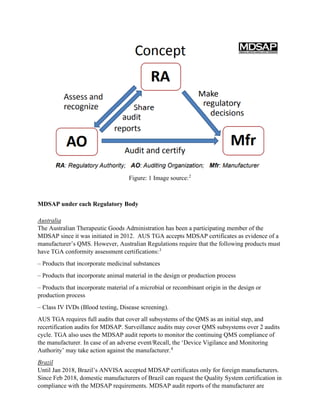
the foundations of the MDSAP requirements. Figure 1 shows the MDSAP regulatory framework.
Figure: 1 Image source:2
MDSAP under each Regulatory Body
Australia
The Australian Therapeutic Goods Administration has been a participating member of the
MDSAP since it was initiated in 2012. AUS TGA accepts MDSAP certificates as evidence of a
manufacturer’s QMS. However, Australian Regulations require that the following products must
have TGA conformity assessment certifications:3
– Products that incorporate medicinal substances
– Products that incorporate animal material in the design or production process
– Products that incorporate material of a microbial or recombinant origin in the design or
production process
– Class IV IVDs (Blood testing, Disease screening).
AUS TGA requires full audits that cover all subsystems of the QMS as an initial step, and
recertification audits for MDSAP. Surveillance audits may cover QMS subsystems over 2 audits
cycle. TGA also uses the MDSAP audit reports to monitor the continuing QMS compliance of
the manufacturer. In case of an adverse event/Recall, the ‘Device Vigilance and Monitoring
Authority’ may take action against the manufacturer.4
Brazil
Until Jan 2018, Brazil’s ANVISA accepted MDSAP certificates only for foreign manufacturers.
Since Feb 2018, domestic manufacturers of Brazil can request the Quality System certification in
compliance with the MDSAP requirements. MDSAP audit reports of the manufacturer are
analyzed by an ANVISA specialist. ANVISA requires that the manufacturer must not have any
nonconformances of grade 4 or 5 and nonconformance of grade 1 to 3 must have an action plan
in place. Nonconformance against other regulatory bodies has no impact on the certification or
on the investigation carried out by ANVISA.5
Japan
Japan’s Ministry of Health, Labour and Welfare, and the Japanese Pharmaceuticals and Medical
Devices Agency have been determining their participation in MDSAP on an annual basis since
2016 and according to a notification released by the Japanese authorities in 2019, MDSAP
certificates issued will remain valid for Japanese QMS through March 2020.6
Canada
Since January 1, 2019, Health Canada replaced the CMDCAS certificates with MDSAP
certificates as evidence of conformity for Medical Devices Regulations sections 32(2)(f), 32(3)(j)
and 32(4)(p) and made the certification mandatory to legally sell medical devices in Canada. In
April 2018, Health Canada realized that manufacturers were facing challenges in scheduling
MDSAP audits and clarified that no enforcement action would be taken against manufacturers
who can submit evidence that they underwent an MDSAP audit in 2018.7
USA
Post the release of the pilot program results, FDA started accepting MDSAP certifications as a
substitute for routine FDA inspections. Firms with activities related to the Electronic Product
Radiation Control (EPRC) provisions of the Act, compliance follow-ups, pre-approval or post-
approval inspections continue to be subject to FDA inspections.8
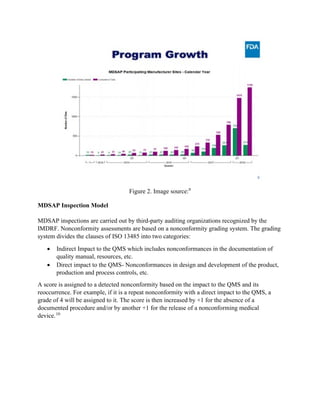
A report released by the Regulatory Affairs Professional Society showed an increase in the
number of US manufacturers participating in the MDSAP totaling to 1749 companies in Q1 2018
from just 788 companies in 2017. This increase in the number can be attributed to Health
Canada’s mandate that companies must hold an MDSAP certificate to legally sell their product
in the Canadian market.9
Figure 2. Image source:9
MDSAP Inspection Model
MDSAP inspections are carried out by third-party auditing organizations recognized by the
IMDRF. Nonconformity assessments are based on a nonconformity grading system. The grading
system divides the clauses of ISO 13485 into two categories:
• Indirect Impact to the QMS which includes nonconformances in the documentation of
quality manual, resources, etc.
• Direct impact to the QMS- Nonconformances in design and development of the product,
production and process controls, etc.
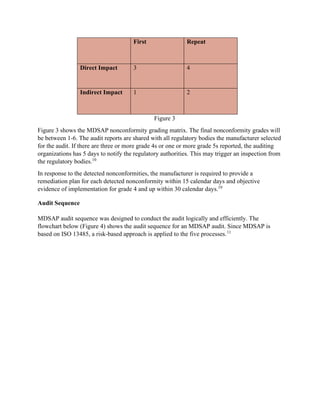
A score is assigned to a detected nonconformity based on the impact to the QMS and its
reoccurrence. For example, if it is a repeat nonconformity with a direct impact to the QMS, a
grade of 4 will be assigned to it. The score is then increased by +1 for the absence of a
documented procedure and/or by another +1 for the release of a nonconforming medical
device.10
First Repeat
Direct Impact 3 4
Indirect Impact 1 2
Figure 3
Figure 3 shows the MDSAP nonconformity grading matrix. The final nonconformity grades will
be between 1-6. The audit reports are shared with all regulatory bodies the manufacturer selected
for the audit. If there are three or more grade 4s or one or more grade 5s reported, the auditing
organizations has 5 days to notify the regulatory authorities. This may trigger an inspection from
the regulatory bodies.10
In response to the detected nonconformities, the manufacturer is required to provide a
remediation plan for each detected nonconformity within 15 calendar days and objective
evidence of implementation for grade 4 and up within 30 calendar days.10
Audit Sequence
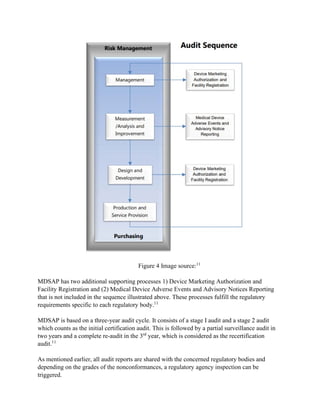
MDSAP audit sequence was designed to conduct the audit logically and efficiently. The
flowchart below (Figure 4) shows the audit sequence for an MDSAP audit. Since MDSAP is
based on ISO 13485, a risk-based approach is applied to the five processes.11
Figure 4 Image source:11
MDSAP has two additional supporting processes 1) Device Marketing Authorization and
Facility Registration and (2) Medical Device Adverse Events and Advisory Notices Reporting
that is not included in the sequence illustrated above. These processes fulfill the regulatory
requirements specific to each regulatory body.11
MDSAP is based on a three-year audit cycle. It consists of a stage I audit and a stage 2 audit
which counts as the initial certification audit. This is followed by a partial surveillance audit in
two years and a complete re-audit in the 3rd
year, which is considered as the recertification
audit.11
As mentioned earlier, all audit reports are shared with the concerned regulatory bodies and
depending on the grades of the nonconformances, a regulatory agency inspection can be
triggered.
Conclusion
While participating in the MDSAP has many advantages such as going through a single audit to
be able to market in 5 countries, it also has some disadvantages. Regulatory bodies may still
conduct unannounced audits on the basis of any issues that they may have noticed. If you ever
decide to drop out of the program, you can expect an inspection from the regulatory bodies
sooner rather than later.
Thus, the decision to pursue MDSAP certification must be based on the readiness of your QMS
to comply with all the country-specific regulations, as well as ISO 13485.
EMMA International has the right expertise to help you transition to MDSAP requirements
strategically and in a cost-effective manner. Call us today at 248-987-4497 or email us at
info@emmainternational.com to find out how we can help.
Bibliography
1
FDA- Medical Device Single Audit Program (MDSAP) retrieved on 03/07/2020 from
https://www.fda.gov/medical-devices/cdrh-international-programs/medical-device-single-audit-
program-mdsap
2
FDA(March 2017)- Medical Device Single Audit Program Update – March 2017 retrieved on
03/07/2020 from
https://www.fdanews.com/ext/resources/files/Conference2/MDQC17Presentations/Winter-
Medical-Device-Single-Audit-Program.pdf
3
AUS TGA (Sept 2019) Medical Device Single Audit Program (MDSAP) retrieved on
03/07/2020 from https://www.tga.gov.au/medical-device-single-audit-program-mdsap
4
FDA (May 2018) How the TGA uses MDSAP retrieved on 03/14/2020 from
https://www.fda.gov/media/113469/download
5
FDA (May 2018) How the Regulatory Authorities use MDSAP? #Brazil retrieved on
03/14/2020 from https://www.fda.gov/media/113312/download
6
FDA (May 2018) How the Regulatory Authorities use MDSAP (PMDA/ Japan) retrieved on
03/14/2020 from https://www.fda.gov/media/113324/download
7
FDA (May 2018) How Health Canada uses MDSAP retrieved on 03/14/2020 from
https://www.fda.gov/media/113299/download
8
FDA- FDA’s Utilization of MDSAP Audits retrieved on 03/14/2020 from
https://www.fda.gov/media/113318/download
9
RAPS (May 2018) MDSAP Sees Site Participation Increase retrieved on 03/14/2020 from
https://www.raps.org/news-and-articles/news-articles/2018/5/mdsap-sees-site-participation-
increase
10
The FDA group (January 2019) A Quick Guide to MDSAP's New Nonconformity Grading
System retrieved on 03/14/2020 from https://www.thefdagroup.com/blog/a-quick-guide-to-
mdsaps-new-nonconformity-grading-system
11
FDA (January 2017) MEDICAL DEVICE SINGLE AUDIT PROGRAM Audit Model -
Version 4 MDSAP AU P0002.004 retrieved on 03/14/2020 from
https://www.fda.gov/media/87544/download

Medical Device Single Audit Program (MDSAP)

  • 2.
    Medical Device SingleAudit Program (MDSAP) Introduction In 2012, the International Medical Device Regulators Forum (IMDRF) developed the Medical Device Single Audit Program (MDSAP) to implement a harmonized and a global approach to audit medical device manufacturers. The program allows for MDSAP recognized organizations to conduct a single audit that satisfies the regulatory requirements of the countries participating in the program.1 From January 1, 2014 to December 31, 2016, the FDA and the other members of the MDSAP, participated in a pilot program. The program saw more than 100 participating manufacturers that sell in Canada and internationally. A report generated on June 29, 2017 summarized the results of this 3-year pilot program. Based on the outcome of this report, the MDSAP Regulatory Authority Council determined that the pilot program was a success.1 Currently, five countries are participating in the program, they are: • Therapeutic Goods Administration of Australia • Brazil’s Agência Nacional de Vigilância Sanitária • Japan’s Ministry of Health, Labour and Welfare, and the Japanese Pharmaceuticals and Medical Devices Agency • U.S. Food and Drug Administration • Health Canada The World Health Organization (WHO) Prequalification of In Vitro Diagnostics (IVDs) Program and the European Union are official observers of the MDSAP program.1 Manufacturers who are audited under the MDSAP program may avoid routine inspections from the participating regulatory bodies. However, the regulatory authorities still have the right to audit the manufacturing facility even when the manufacturer participates in the MDSAP. The decision of whether to participate in the MDSAP audits is influenced by the markets the manufacturer would like to sell in. This allows the manufacturer to comply with the country- specific regulations that they intend to sell in, and ISO 13485 since ISO 13485 remains one of the foundations of the MDSAP requirements. Figure 1 shows the MDSAP regulatory framework.
  • 3.
    Figure: 1 Imagesource:2 MDSAP under each Regulatory Body Australia The Australian Therapeutic Goods Administration has been a participating member of the MDSAP since it was initiated in 2012. AUS TGA accepts MDSAP certificates as evidence of a manufacturer’s QMS. However, Australian Regulations require that the following products must have TGA conformity assessment certifications:3 – Products that incorporate medicinal substances – Products that incorporate animal material in the design or production process – Products that incorporate material of a microbial or recombinant origin in the design or production process – Class IV IVDs (Blood testing, Disease screening). AUS TGA requires full audits that cover all subsystems of the QMS as an initial step, and recertification audits for MDSAP. Surveillance audits may cover QMS subsystems over 2 audits cycle. TGA also uses the MDSAP audit reports to monitor the continuing QMS compliance of the manufacturer. In case of an adverse event/Recall, the ‘Device Vigilance and Monitoring Authority’ may take action against the manufacturer.4 Brazil Until Jan 2018, Brazil’s ANVISA accepted MDSAP certificates only for foreign manufacturers. Since Feb 2018, domestic manufacturers of Brazil can request the Quality System certification in compliance with the MDSAP requirements. MDSAP audit reports of the manufacturer are
  • 4.
    analyzed by anANVISA specialist. ANVISA requires that the manufacturer must not have any nonconformances of grade 4 or 5 and nonconformance of grade 1 to 3 must have an action plan in place. Nonconformance against other regulatory bodies has no impact on the certification or on the investigation carried out by ANVISA.5 Japan Japan’s Ministry of Health, Labour and Welfare, and the Japanese Pharmaceuticals and Medical Devices Agency have been determining their participation in MDSAP on an annual basis since 2016 and according to a notification released by the Japanese authorities in 2019, MDSAP certificates issued will remain valid for Japanese QMS through March 2020.6 Canada Since January 1, 2019, Health Canada replaced the CMDCAS certificates with MDSAP certificates as evidence of conformity for Medical Devices Regulations sections 32(2)(f), 32(3)(j) and 32(4)(p) and made the certification mandatory to legally sell medical devices in Canada. In April 2018, Health Canada realized that manufacturers were facing challenges in scheduling MDSAP audits and clarified that no enforcement action would be taken against manufacturers who can submit evidence that they underwent an MDSAP audit in 2018.7 USA Post the release of the pilot program results, FDA started accepting MDSAP certifications as a substitute for routine FDA inspections. Firms with activities related to the Electronic Product Radiation Control (EPRC) provisions of the Act, compliance follow-ups, pre-approval or post- approval inspections continue to be subject to FDA inspections.8 A report released by the Regulatory Affairs Professional Society showed an increase in the number of US manufacturers participating in the MDSAP totaling to 1749 companies in Q1 2018 from just 788 companies in 2017. This increase in the number can be attributed to Health Canada’s mandate that companies must hold an MDSAP certificate to legally sell their product in the Canadian market.9
  • 5.
    Figure 2. Imagesource:9 MDSAP Inspection Model MDSAP inspections are carried out by third-party auditing organizations recognized by the IMDRF. Nonconformity assessments are based on a nonconformity grading system. The grading system divides the clauses of ISO 13485 into two categories: • Indirect Impact to the QMS which includes nonconformances in the documentation of quality manual, resources, etc. • Direct impact to the QMS- Nonconformances in design and development of the product, production and process controls, etc. A score is assigned to a detected nonconformity based on the impact to the QMS and its reoccurrence. For example, if it is a repeat nonconformity with a direct impact to the QMS, a grade of 4 will be assigned to it. The score is then increased by +1 for the absence of a documented procedure and/or by another +1 for the release of a nonconforming medical device.10
  • 6.
    First Repeat Direct Impact3 4 Indirect Impact 1 2 Figure 3 Figure 3 shows the MDSAP nonconformity grading matrix. The final nonconformity grades will be between 1-6. The audit reports are shared with all regulatory bodies the manufacturer selected for the audit. If there are three or more grade 4s or one or more grade 5s reported, the auditing organizations has 5 days to notify the regulatory authorities. This may trigger an inspection from the regulatory bodies.10 In response to the detected nonconformities, the manufacturer is required to provide a remediation plan for each detected nonconformity within 15 calendar days and objective evidence of implementation for grade 4 and up within 30 calendar days.10 Audit Sequence MDSAP audit sequence was designed to conduct the audit logically and efficiently. The flowchart below (Figure 4) shows the audit sequence for an MDSAP audit. Since MDSAP is based on ISO 13485, a risk-based approach is applied to the five processes.11
  • 7.
    Figure 4 Imagesource:11 MDSAP has two additional supporting processes 1) Device Marketing Authorization and Facility Registration and (2) Medical Device Adverse Events and Advisory Notices Reporting that is not included in the sequence illustrated above. These processes fulfill the regulatory requirements specific to each regulatory body.11 MDSAP is based on a three-year audit cycle. It consists of a stage I audit and a stage 2 audit which counts as the initial certification audit. This is followed by a partial surveillance audit in two years and a complete re-audit in the 3rd year, which is considered as the recertification audit.11 As mentioned earlier, all audit reports are shared with the concerned regulatory bodies and depending on the grades of the nonconformances, a regulatory agency inspection can be triggered.
  • 8.
    Conclusion While participating inthe MDSAP has many advantages such as going through a single audit to be able to market in 5 countries, it also has some disadvantages. Regulatory bodies may still conduct unannounced audits on the basis of any issues that they may have noticed. If you ever decide to drop out of the program, you can expect an inspection from the regulatory bodies sooner rather than later. Thus, the decision to pursue MDSAP certification must be based on the readiness of your QMS to comply with all the country-specific regulations, as well as ISO 13485. EMMA International has the right expertise to help you transition to MDSAP requirements strategically and in a cost-effective manner. Call us today at 248-987-4497 or email us at info@emmainternational.com to find out how we can help.
  • 9.
    Bibliography 1 FDA- Medical DeviceSingle Audit Program (MDSAP) retrieved on 03/07/2020 from https://www.fda.gov/medical-devices/cdrh-international-programs/medical-device-single-audit- program-mdsap 2 FDA(March 2017)- Medical Device Single Audit Program Update – March 2017 retrieved on 03/07/2020 from https://www.fdanews.com/ext/resources/files/Conference2/MDQC17Presentations/Winter- Medical-Device-Single-Audit-Program.pdf 3 AUS TGA (Sept 2019) Medical Device Single Audit Program (MDSAP) retrieved on 03/07/2020 from https://www.tga.gov.au/medical-device-single-audit-program-mdsap 4 FDA (May 2018) How the TGA uses MDSAP retrieved on 03/14/2020 from https://www.fda.gov/media/113469/download 5 FDA (May 2018) How the Regulatory Authorities use MDSAP? #Brazil retrieved on 03/14/2020 from https://www.fda.gov/media/113312/download 6 FDA (May 2018) How the Regulatory Authorities use MDSAP (PMDA/ Japan) retrieved on 03/14/2020 from https://www.fda.gov/media/113324/download 7 FDA (May 2018) How Health Canada uses MDSAP retrieved on 03/14/2020 from https://www.fda.gov/media/113299/download 8 FDA- FDA’s Utilization of MDSAP Audits retrieved on 03/14/2020 from https://www.fda.gov/media/113318/download 9 RAPS (May 2018) MDSAP Sees Site Participation Increase retrieved on 03/14/2020 from https://www.raps.org/news-and-articles/news-articles/2018/5/mdsap-sees-site-participation- increase 10 The FDA group (January 2019) A Quick Guide to MDSAP's New Nonconformity Grading System retrieved on 03/14/2020 from https://www.thefdagroup.com/blog/a-quick-guide-to- mdsaps-new-nonconformity-grading-system 11 FDA (January 2017) MEDICAL DEVICE SINGLE AUDIT PROGRAM Audit Model - Version 4 MDSAP AU P0002.004 retrieved on 03/14/2020 from https://www.fda.gov/media/87544/download