FLUID, ELECTROLYTE
IMBALANCE AND ABG
INTERPRETATION
BY: HEMESHWARY
SUPERVISOR: DR LIANG
outline
 Electrolyte imbalance
 Hypernatremia
 Hyponatremia
 Hyperkalemia
 Hypokalemia
 Hypercalcemia
 Hypocalcemia
 Arterial blood gas
Electrolyte imbalances: Sodium
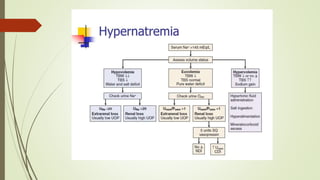
Hypernatremia (high levels of sodium)
Plasma Na+ > 145 mmol / L
water loss or excess sodium intake
Water moves from ICF → ECF
Cells dehydrate
Hypernatremia Due to:
Hypertonic IV soln.
Oversecretion of aldosterone
Loss of pure water
• Long term sweating with chronic fever
• Respiratory infection → water vapor loss
• Diabetes – polyuria
• Diuretics
Insufficient intake of water (hypodipsia)
5
Clinical manifestations
of Hypernatremia
Thirst
Lethargy
Neurological dysfunction due to dehydration of brain
cells (irritability, spasticity,ataxia, confusion,coma)
Decreased vascular volume
6
7
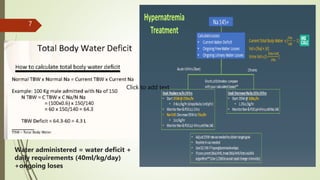
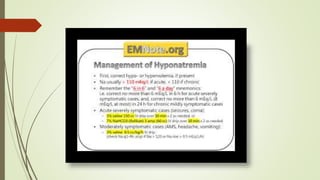
Water administered = water deficit +
daily requirements (40ml/kg/day)
+ongoing loses
Click to add text
Hyponatremia
 Overall decrease in Na+ in ECF
 Two types: depletional and dilutional
 Depletional Hyponatremia
Na+ loss:
 diuretics, chronic vomiting
 Chronic diarrhea
 Decreased aldosterone
 Decreased Na+ intake
8
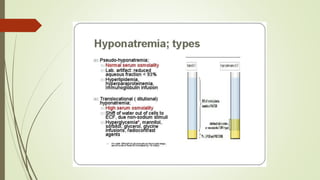
 Dilutional Hyponatremia:
Renal dysfunction with ↑ intake of hypotonic fluids
Excessive sweating→ increased thirst → intake of
excessive amounts of pure water
Syndrome of Inappropriate ADH (SIADH) or oliguric
renal failure, severe congestive heart failure, cirrhosis
all lead to:
Impaired renal excretion of water
Hyperglycemia – attracts water
9
Clinical manifestations of Hyponatremia
 Neurological symptoms
 Lethargy, headache, confusion, apprehension, depressed reflexes,
seizures and coma
Muscle symptoms
 Cramps, weakness, fatigue
 Gastrointestinal symptoms
 Nausea, vomiting, abdominal cramps, and diarrhea
10
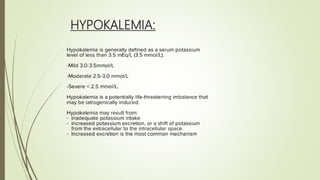
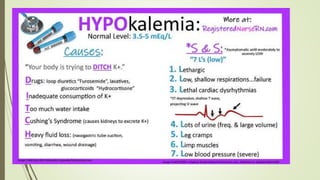
HYPOKALEMIA:
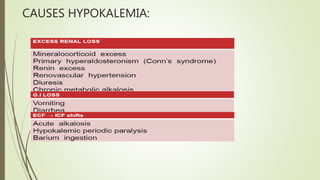
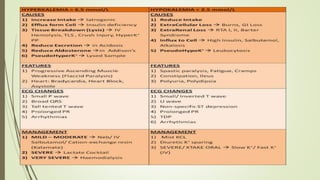
CAUSES HYPOKALEMIA:
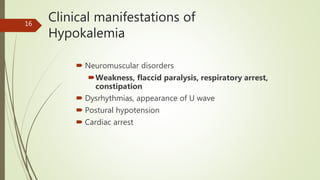
Clinical manifestations of
Hypokalemia
 Neuromuscular disorders
Weakness, flaccid paralysis, respiratory arrest,
constipation
 Dysrhythmias, appearance of U wave
 Postural hypotension
 Cardiac arrest
16
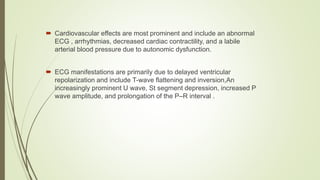
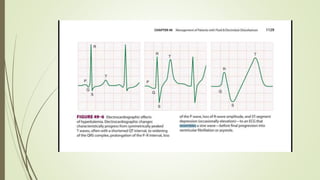
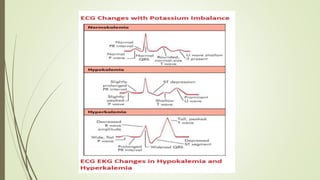
 Cardiovascular effects are most prominent and include an abnormal
ECG , arrhythmias, decreased cardiac contractility, and a labile
arterial blood pressure due to autonomic dysfunction.
 ECG manifestations are primarily due to delayed ventricular
repolarization and include T-wave flattening and inversion,An
increasingly prominent U wave, St segment depression, increased P
wave amplitude, and prolongation of the P–R interval .
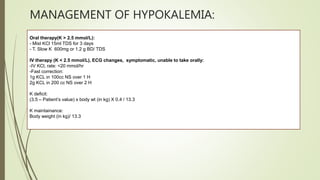
MANAGEMENT OF HYPOKALEMIA:
Oral therapy(K > 2.5 mmol/L):
- Mist KCl 15ml TDS for 3 days
- T. Slow K 600mg or 1.2 g BD/ TDS
IV therapy (K < 2.5 mmol/L), ECG changes, symptomatic, unable to take orally:
-IV KCl, rate: <20 mmol/hr
-Fast correction:
1g KCL in 100cc NS over 1 H
2g KCL in 200 cc NS over 2 H
K deficit:
(3.5 – Patient’s value) x body wt (in kg) X 0.4 / 13.3
K maintainance:
Body weight (in kg)/ 13.3
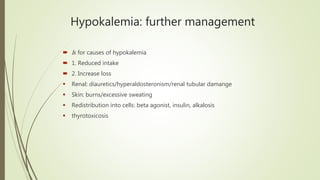
Hypokalemia: further management
 Ix for causes of hypokalemia
 1. Reduced intake
 2. Increase loss
 Renal: diauretics/hyperaldosteronism/renal tubular damange
 Skin: burns/excessive sweating
 Redistribution into cells: beta agonist, insulin, alkalosis
 thyrotoxicosis
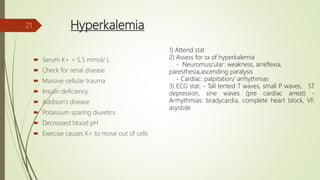
Hyperkalemia
 Serum K+ > 5.5 mmol/ L
 Check for renal disease
 Massive cellular trauma
 Insulin deficiency
 Addison’s disease
 Potassium sparing diuretics
 Decreased blood pH
 Exercise causes K+ to move out of cells
21
1) Attend stat
2) Assess for sx of hyperkalemia
- Neuromuscular: weakness, arreflexia,
paresthesia,ascending paralysis
- Cardiac: palpitation/ arrhythmias
3) ECG stat: - Tall tented T waves, small P waves, ST
depression, sine waves (pre cardiac arrest) -
Arrhythmias: bradycardia, complete heart block, VF,
asystole
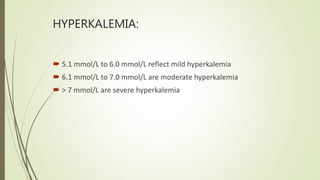
HYPERKALEMIA:
 5.1 mmol/L to 6.0 mmol/L reflect mild hyperkalemia
 6.1 mmol/L to 7.0 mmol/L are moderate hyperkalemia
 > 7 mmol/L are severe hyperkalemia
CLINICAL MANIFESTATION
 The most important effects of hyperkalemia are on skeletal and cardiac
muscle.
 Skeletal muscle weakness is generally not seen until plasma [K +] is
greater than 8 mmol/L,
 Cardiac manifestations are primarily due to delayed depolarization,
and are consistently present when plasma [K +] is greater than 7
mmol/L.
TREATMENT
 Hyperkalemia exceeding 6 mmol/L should always be corrected.
Triple regime (lytic cocktail)
-Iv calcium gluconate 10% 10cc 3-5 mins
-s/c actrapid 10U
-50cc 50% dextrose 30-60mins
 Treatment is directed to reversal of cardiac manifestations and skeletal muscle weakness, and to
restoration of normal plasma [K+]
 CONTINUOUS CARDIAC MONITORING, REPEAT RP in ½ hour
 If persistent: HD
 If <6.5: – Kalimate 5-10g TDS
– Resonium 15-30g TDS
– Neb 10g salbutamol – HTZ/loop diuretics
Calcium Imbalances
 Most in ECF
 Regulated by:
Parathyroid hormone
↑Blood Ca++ by stimulating
osteoclasts
↑GI absorption and renal retention
Calcitonin from the thyroid gland
Promotes bone formation
↑ renal excretion
28
Hypercalcemia
 Results from:
 Hyperparathyroidism
 Hypothyroid states
 Renal disease
 Excessive intake of vitamin D
 Milk-alkali syndrome
 Certain drugs
 Malignant tumors – hypercalcemia of malignancy
Tumor products promote bone breakdown
Tumor growth in bone causing Ca++ release
29
Hypercalcemia
 Usually also see hypophosphatemia
 Effects:
 Many nonspecific – fatigue, weakness, lethargy
 Increases formation of kidney stones and pancreatic stones
 Muscle cramps
 Bradycardia, cardiac arrest
 Pain
 GI activity also common
Nausea, abdominal cramps
Diarrhea / constipation
 Metastatic calcification
30
Hypocalcemia
 Hyperactive neuromuscular reflexes and tetany differentiate
it from hypercalcemia
 Convulsions in severe cases
 Caused by:
 Renal failure
 Lack of vitamin D
 Suppression of parathyroid function
 Hypersecretion of calcitonin
 Malabsorption states
 Abnormal intestinal acidity and acid/ base bal.
 Widespread infection or peritoneal inflammation
31
Hypocalcemia
Diagnosis:
Chvostek’s sign
Trousseau’s sign
Treatment
IV calcium for acute
Oral calcium and vitamin D for chronic
32
ARTERIAL
BLOOD
GASES
 Blood gas analysis, also called Arterial Blood Gas (ABG)
analysis, is an invasive test which measures the amount of
oxygen (O2) and carbon dioxide (CO2) in the blood, as well
as the acidity (pH) of the blood
 Site-
(Ideally) Radial Artery
Brachial Artery
Femoral Artery.
ABG COMPONENT :
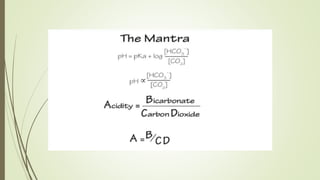
PH:
 measures hydrogen ion concentration in the blood, it shows blood’ acidity or alkalinity
PCO2 :
 It is the partial pressure of CO2 that is carried by the blood for excretion by the lungs, known as
respiratory parameter. assess effectiveness of ventilation
PO2:
 It is the partial pressure of O2 that is binding to haemoglobin, it reflects the body ability to pick up
oxygen from the lungs
HCO3 :
■ known as the metabolic parameter, it reflects the kidney’s ability to retain and excrete
bicarbonate. IT IS A buffer that keep blood normal ph
Base excess
■ Negative indicates metabolic acidosis. positive indicate Metabolic alkalosis
NORMAL VALUES:
 PH = 7.35 – 7.45
 PCO2 = 35 – 45 mmhg
 PO2 = 80 – 100 mmhg
 HCO3 = 22 – 28 meq/L
 BE = -2 to +3
Rules of compensation
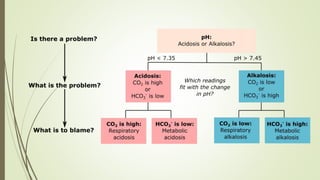
The body always tries to normalize the pH So :
• CO2 and HCO3 should rise and fall together in simple disorders
• Compensation never overcorrects the pH
• Lack of compensation in an appropriate time interval defines a secondary
disorder
• Compensatory responses require normally functioning lungs and kidneys
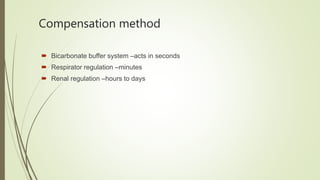
Compensation method
 Bicarbonate buffer system –acts in seconds
 Respirator regulation –minutes
 Renal regulation –hours to days
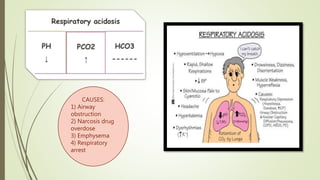
CAUSES:
1) Airway
obstruction
2) Narcosis drug
overdose
3) Emphysema
4) Respiratory
arrest
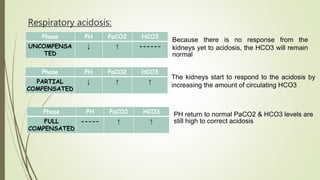
Respiratory acidosis:
Phase PH PaCO2 HCO3
UNCOMPENSA
TED
↓ ↑ ------
Because there is no response from the
kidneys yet to acidosis, the HCO3 will remain
normal
The kidneys start to respond to the acidosis by
increasing the amount of circulating HCO3
PH return to normal PaCO2 & HCO3 levels are
still high to correct acidosis
Phase PH PaCO2 HCO3
PARTIAL
COMPENSATED
↓ ↑ ↑
Phase PH PaCO2 HCO3
FULL
COMPENSATED
----- ↑ ↑
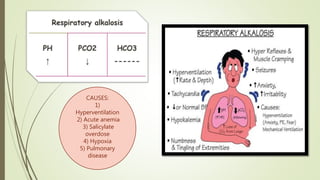
CAUSES:
1)
Hyperventilation
2) Acute anemia
3) Salicylate
overdose
4) Hypoxia
5) Pulmonary
disease
RESPIRATORY ALKALOSIS:
Because there is no response from the
kidneys yet to acidosis the HCO3 will remain
normal
The kidneys start to respond to the alkalosis
by decreasing the amount of circulating
HCO3
PH return to normal PaCO2 & HCO3 levels
are still low to correct alkalosis
Phase PH PaCO2 HCO3
UNCOMPENSATED ↑ ↓ -----
Phase PH PaCO2 HCO3
FULL
COMPENSATED
----- ↓ ↓
Phase PH PaCO2 HCO3
PARTIAL
COMPENSATED
↑ ↓ ↓
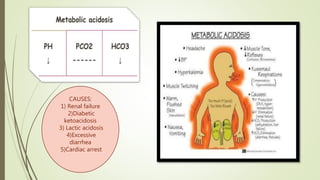
CAUSES:
1) Renal failure
2)Diabetic
ketoacidosis
3) Lactic acidosis
4)Excessive
diarrhea
5)Cardiac arrest
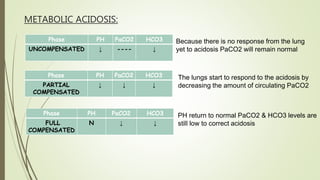
METABOLIC ACIDOSIS:
Phase PH PaCO2 HCO3
FULL
COMPENSATED
N ↓ ↓
The lungs start to respond to the acidosis by
decreasing the amount of circulating PaCO2
Because there is no response from the lung
yet to acidosis PaCO2 will remain normal
PH return to normal PaCO2 & HCO3 levels are
still low to correct acidosis
Phase PH PaCO2 HCO3
PARTIAL
COMPENSATED
↓ ↓ ↓
Phase PH PaCO2 HCO3
UNCOMPENSATED ↓ ---- ↓
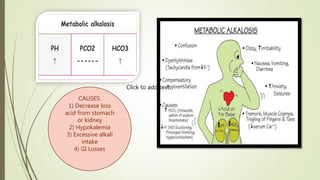
CAUSES:
1) Decrease loss
acid from stomach
or kidney
2) Hypokalemia
3) Excessive alkali
intake
4) GI Losses
Click to add text
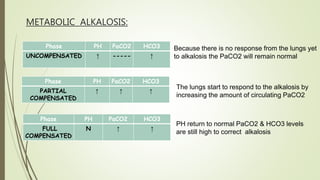
METABOLIC ALKALOSIS:
Because there is no response from the lungs yet
to alkalosis the PaCO2 will remain normal
Phase PH PaCO2 HCO3
PARTIAL
COMPENSATED
↑ ↑ ↑
The lungs start to respond to the alkalosis by
increasing the amount of circulating PaCO2
Phase PH PaCO2 HCO3
FULL
COMPENSATED
N ↑ ↑
PH return to normal PaCO2 & HCO3 levels
are still high to correct alkalosis
Phase PH PaCO2 HCO3
UNCOMPENSATED ↑ ----- ↑
Quick quiz
 Mrs. A is a 55-year-old, Presented to the ED in the early morning with
shortness of breath.
 She has cyanosis of the lips. She had a productive cough for 2 weeks.
 Her temperature is 38.3, blood pressure 110/76, heart rate 108, respiratory rate
32, rapid and shallow.
 Breath sounds are diminished in both bases, with coarse crepitation in the
upper lobes.
 Chest X-ray indicates bilateral pneumonia.
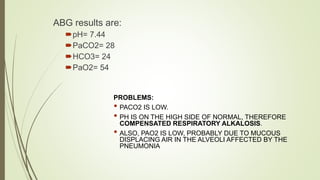
ABG results are:
pH= 7.44
PaCO2= 28
HCO3= 24
PaO2= 54
PROBLEMS:
• PACO2 IS LOW.
• PH IS ON THE HIGH SIDE OF NORMAL, THEREFORE
COMPENSATED RESPIRATORY ALKALOSIS.
• ALSO, PAO2 IS LOW, PROBABLY DUE TO MUCOUS
DISPLACING AIR IN THE ALVEOLI AFFECTED BY THE
PNEUMONIA
Mr B is a 52-year-old. He is retired and living alone. He enters the ED
complaining of shortness of breath and tingling in fingers.
His breathing is shallow and rapid. He denies diabetes; blood sugar is
normal.
There are no ECG changes. He has no significant respiratory or cardiac
history.
He takes several anti-anxiety medications. He says he has had anxiety
attacks before.
While being worked up for chest pain an ABG is done:
ABG results are:
pH= 7.48
PaCO2= 28
HCO3= 22
PaO2= 85
PROBLEMS:
• PH IS HIGH,
• PACO2 IS LOW
• RESPIRATORY ALKALOSIS
• IF HE IS HYPERVENTILATING FROM AN ANXIETY ATTACK, THE SIMPLEST
SOLUTION IS TO HAVE HIM BREATHE INTO A PAPER BAG. HE WILL RE-
BREATHE SOME EXHALED CO2.THIS WILL INCREASE PACO2 AND TRIGGER
THE NORMAL RESPIRATORY DRIVE TO TAKE OVER BREATHING CONTROL.
References
 Journal of the American Society of Nephrology J Am Soc Nephrol 28: 1340–1349, 2017
 http://hwmaint.clsjournal.ascls.org/
 sarawak-handbook-of-medical-emergencies-4th-edition
 Clinical practice guideline on diagnosis and treatment of hyponatraemia, European Journal of
Endocrinology, 170(3), G1-G47. Retrieved May 30, 2022,
from https://eje.bioscientifica.com/view/journals/eje/170/3/G1.xml
THANK YOU

Medical cme final (2).pptx

  • 1.
    FLUID, ELECTROLYTE IMBALANCE ANDABG INTERPRETATION BY: HEMESHWARY SUPERVISOR: DR LIANG
  • 2.
    outline  Electrolyte imbalance Hypernatremia  Hyponatremia  Hyperkalemia  Hypokalemia  Hypercalcemia  Hypocalcemia  Arterial blood gas
  • 3.
    Electrolyte imbalances: Sodium Hypernatremia(high levels of sodium) Plasma Na+ > 145 mmol / L water loss or excess sodium intake Water moves from ICF → ECF Cells dehydrate
  • 5.
    Hypernatremia Due to: HypertonicIV soln. Oversecretion of aldosterone Loss of pure water • Long term sweating with chronic fever • Respiratory infection → water vapor loss • Diabetes – polyuria • Diuretics Insufficient intake of water (hypodipsia) 5
  • 6.
    Clinical manifestations of Hypernatremia Thirst Lethargy Neurologicaldysfunction due to dehydration of brain cells (irritability, spasticity,ataxia, confusion,coma) Decreased vascular volume 6
  • 7.
    7 Water administered =water deficit + daily requirements (40ml/kg/day) +ongoing loses Click to add text
  • 8.
    Hyponatremia  Overall decreasein Na+ in ECF  Two types: depletional and dilutional  Depletional Hyponatremia Na+ loss:  diuretics, chronic vomiting  Chronic diarrhea  Decreased aldosterone  Decreased Na+ intake 8
  • 9.
     Dilutional Hyponatremia: Renaldysfunction with ↑ intake of hypotonic fluids Excessive sweating→ increased thirst → intake of excessive amounts of pure water Syndrome of Inappropriate ADH (SIADH) or oliguric renal failure, severe congestive heart failure, cirrhosis all lead to: Impaired renal excretion of water Hyperglycemia – attracts water 9
  • 10.
    Clinical manifestations ofHyponatremia  Neurological symptoms  Lethargy, headache, confusion, apprehension, depressed reflexes, seizures and coma Muscle symptoms  Cramps, weakness, fatigue  Gastrointestinal symptoms  Nausea, vomiting, abdominal cramps, and diarrhea 10
  • 13.
  • 14.
  • 16.
    Clinical manifestations of Hypokalemia Neuromuscular disorders Weakness, flaccid paralysis, respiratory arrest, constipation  Dysrhythmias, appearance of U wave  Postural hypotension  Cardiac arrest 16
  • 17.
     Cardiovascular effectsare most prominent and include an abnormal ECG , arrhythmias, decreased cardiac contractility, and a labile arterial blood pressure due to autonomic dysfunction.  ECG manifestations are primarily due to delayed ventricular repolarization and include T-wave flattening and inversion,An increasingly prominent U wave, St segment depression, increased P wave amplitude, and prolongation of the P–R interval .
  • 19.
    MANAGEMENT OF HYPOKALEMIA: Oraltherapy(K > 2.5 mmol/L): - Mist KCl 15ml TDS for 3 days - T. Slow K 600mg or 1.2 g BD/ TDS IV therapy (K < 2.5 mmol/L), ECG changes, symptomatic, unable to take orally: -IV KCl, rate: <20 mmol/hr -Fast correction: 1g KCL in 100cc NS over 1 H 2g KCL in 200 cc NS over 2 H K deficit: (3.5 – Patient’s value) x body wt (in kg) X 0.4 / 13.3 K maintainance: Body weight (in kg)/ 13.3
  • 20.
    Hypokalemia: further management Ix for causes of hypokalemia  1. Reduced intake  2. Increase loss  Renal: diauretics/hyperaldosteronism/renal tubular damange  Skin: burns/excessive sweating  Redistribution into cells: beta agonist, insulin, alkalosis  thyrotoxicosis
  • 21.
    Hyperkalemia  Serum K+> 5.5 mmol/ L  Check for renal disease  Massive cellular trauma  Insulin deficiency  Addison’s disease  Potassium sparing diuretics  Decreased blood pH  Exercise causes K+ to move out of cells 21 1) Attend stat 2) Assess for sx of hyperkalemia - Neuromuscular: weakness, arreflexia, paresthesia,ascending paralysis - Cardiac: palpitation/ arrhythmias 3) ECG stat: - Tall tented T waves, small P waves, ST depression, sine waves (pre cardiac arrest) - Arrhythmias: bradycardia, complete heart block, VF, asystole
  • 22.
    HYPERKALEMIA:  5.1 mmol/Lto 6.0 mmol/L reflect mild hyperkalemia  6.1 mmol/L to 7.0 mmol/L are moderate hyperkalemia  > 7 mmol/L are severe hyperkalemia
  • 23.
    CLINICAL MANIFESTATION  Themost important effects of hyperkalemia are on skeletal and cardiac muscle.  Skeletal muscle weakness is generally not seen until plasma [K +] is greater than 8 mmol/L,  Cardiac manifestations are primarily due to delayed depolarization, and are consistently present when plasma [K +] is greater than 7 mmol/L.
  • 25.
    TREATMENT  Hyperkalemia exceeding6 mmol/L should always be corrected. Triple regime (lytic cocktail) -Iv calcium gluconate 10% 10cc 3-5 mins -s/c actrapid 10U -50cc 50% dextrose 30-60mins  Treatment is directed to reversal of cardiac manifestations and skeletal muscle weakness, and to restoration of normal plasma [K+]  CONTINUOUS CARDIAC MONITORING, REPEAT RP in ½ hour  If persistent: HD  If <6.5: – Kalimate 5-10g TDS – Resonium 15-30g TDS – Neb 10g salbutamol – HTZ/loop diuretics
  • 28.
    Calcium Imbalances  Mostin ECF  Regulated by: Parathyroid hormone ↑Blood Ca++ by stimulating osteoclasts ↑GI absorption and renal retention Calcitonin from the thyroid gland Promotes bone formation ↑ renal excretion 28
  • 29.
    Hypercalcemia  Results from: Hyperparathyroidism  Hypothyroid states  Renal disease  Excessive intake of vitamin D  Milk-alkali syndrome  Certain drugs  Malignant tumors – hypercalcemia of malignancy Tumor products promote bone breakdown Tumor growth in bone causing Ca++ release 29
  • 30.
    Hypercalcemia  Usually alsosee hypophosphatemia  Effects:  Many nonspecific – fatigue, weakness, lethargy  Increases formation of kidney stones and pancreatic stones  Muscle cramps  Bradycardia, cardiac arrest  Pain  GI activity also common Nausea, abdominal cramps Diarrhea / constipation  Metastatic calcification 30
  • 31.
    Hypocalcemia  Hyperactive neuromuscularreflexes and tetany differentiate it from hypercalcemia  Convulsions in severe cases  Caused by:  Renal failure  Lack of vitamin D  Suppression of parathyroid function  Hypersecretion of calcitonin  Malabsorption states  Abnormal intestinal acidity and acid/ base bal.  Widespread infection or peritoneal inflammation 31
  • 32.
    Hypocalcemia Diagnosis: Chvostek’s sign Trousseau’s sign Treatment IVcalcium for acute Oral calcium and vitamin D for chronic 32
  • 33.
  • 34.
     Blood gasanalysis, also called Arterial Blood Gas (ABG) analysis, is an invasive test which measures the amount of oxygen (O2) and carbon dioxide (CO2) in the blood, as well as the acidity (pH) of the blood  Site- (Ideally) Radial Artery Brachial Artery Femoral Artery.
  • 35.
    ABG COMPONENT : PH: measures hydrogen ion concentration in the blood, it shows blood’ acidity or alkalinity PCO2 :  It is the partial pressure of CO2 that is carried by the blood for excretion by the lungs, known as respiratory parameter. assess effectiveness of ventilation PO2:  It is the partial pressure of O2 that is binding to haemoglobin, it reflects the body ability to pick up oxygen from the lungs HCO3 : ■ known as the metabolic parameter, it reflects the kidney’s ability to retain and excrete bicarbonate. IT IS A buffer that keep blood normal ph Base excess ■ Negative indicates metabolic acidosis. positive indicate Metabolic alkalosis
  • 36.
    NORMAL VALUES:  PH= 7.35 – 7.45  PCO2 = 35 – 45 mmhg  PO2 = 80 – 100 mmhg  HCO3 = 22 – 28 meq/L  BE = -2 to +3
  • 37.
    Rules of compensation Thebody always tries to normalize the pH So : • CO2 and HCO3 should rise and fall together in simple disorders • Compensation never overcorrects the pH • Lack of compensation in an appropriate time interval defines a secondary disorder • Compensatory responses require normally functioning lungs and kidneys
  • 38.
    Compensation method  Bicarbonatebuffer system –acts in seconds  Respirator regulation –minutes  Renal regulation –hours to days
  • 41.
    CAUSES: 1) Airway obstruction 2) Narcosisdrug overdose 3) Emphysema 4) Respiratory arrest
  • 42.
    Respiratory acidosis: Phase PHPaCO2 HCO3 UNCOMPENSA TED ↓ ↑ ------ Because there is no response from the kidneys yet to acidosis, the HCO3 will remain normal The kidneys start to respond to the acidosis by increasing the amount of circulating HCO3 PH return to normal PaCO2 & HCO3 levels are still high to correct acidosis Phase PH PaCO2 HCO3 PARTIAL COMPENSATED ↓ ↑ ↑ Phase PH PaCO2 HCO3 FULL COMPENSATED ----- ↑ ↑
  • 43.
    CAUSES: 1) Hyperventilation 2) Acute anemia 3)Salicylate overdose 4) Hypoxia 5) Pulmonary disease
  • 44.
    RESPIRATORY ALKALOSIS: Because thereis no response from the kidneys yet to acidosis the HCO3 will remain normal The kidneys start to respond to the alkalosis by decreasing the amount of circulating HCO3 PH return to normal PaCO2 & HCO3 levels are still low to correct alkalosis Phase PH PaCO2 HCO3 UNCOMPENSATED ↑ ↓ ----- Phase PH PaCO2 HCO3 FULL COMPENSATED ----- ↓ ↓ Phase PH PaCO2 HCO3 PARTIAL COMPENSATED ↑ ↓ ↓
  • 45.
    CAUSES: 1) Renal failure 2)Diabetic ketoacidosis 3)Lactic acidosis 4)Excessive diarrhea 5)Cardiac arrest
  • 46.
    METABOLIC ACIDOSIS: Phase PHPaCO2 HCO3 FULL COMPENSATED N ↓ ↓ The lungs start to respond to the acidosis by decreasing the amount of circulating PaCO2 Because there is no response from the lung yet to acidosis PaCO2 will remain normal PH return to normal PaCO2 & HCO3 levels are still low to correct acidosis Phase PH PaCO2 HCO3 PARTIAL COMPENSATED ↓ ↓ ↓ Phase PH PaCO2 HCO3 UNCOMPENSATED ↓ ---- ↓
  • 47.
    CAUSES: 1) Decrease loss acidfrom stomach or kidney 2) Hypokalemia 3) Excessive alkali intake 4) GI Losses Click to add text
  • 48.
    METABOLIC ALKALOSIS: Because thereis no response from the lungs yet to alkalosis the PaCO2 will remain normal Phase PH PaCO2 HCO3 PARTIAL COMPENSATED ↑ ↑ ↑ The lungs start to respond to the alkalosis by increasing the amount of circulating PaCO2 Phase PH PaCO2 HCO3 FULL COMPENSATED N ↑ ↑ PH return to normal PaCO2 & HCO3 levels are still high to correct alkalosis Phase PH PaCO2 HCO3 UNCOMPENSATED ↑ ----- ↑
  • 49.
    Quick quiz  Mrs.A is a 55-year-old, Presented to the ED in the early morning with shortness of breath.  She has cyanosis of the lips. She had a productive cough for 2 weeks.  Her temperature is 38.3, blood pressure 110/76, heart rate 108, respiratory rate 32, rapid and shallow.  Breath sounds are diminished in both bases, with coarse crepitation in the upper lobes.  Chest X-ray indicates bilateral pneumonia.
  • 50.
    ABG results are: pH=7.44 PaCO2= 28 HCO3= 24 PaO2= 54 PROBLEMS: • PACO2 IS LOW. • PH IS ON THE HIGH SIDE OF NORMAL, THEREFORE COMPENSATED RESPIRATORY ALKALOSIS. • ALSO, PAO2 IS LOW, PROBABLY DUE TO MUCOUS DISPLACING AIR IN THE ALVEOLI AFFECTED BY THE PNEUMONIA
  • 51.
    Mr B isa 52-year-old. He is retired and living alone. He enters the ED complaining of shortness of breath and tingling in fingers. His breathing is shallow and rapid. He denies diabetes; blood sugar is normal. There are no ECG changes. He has no significant respiratory or cardiac history. He takes several anti-anxiety medications. He says he has had anxiety attacks before. While being worked up for chest pain an ABG is done:
  • 52.
    ABG results are: pH=7.48 PaCO2= 28 HCO3= 22 PaO2= 85 PROBLEMS: • PH IS HIGH, • PACO2 IS LOW • RESPIRATORY ALKALOSIS • IF HE IS HYPERVENTILATING FROM AN ANXIETY ATTACK, THE SIMPLEST SOLUTION IS TO HAVE HIM BREATHE INTO A PAPER BAG. HE WILL RE- BREATHE SOME EXHALED CO2.THIS WILL INCREASE PACO2 AND TRIGGER THE NORMAL RESPIRATORY DRIVE TO TAKE OVER BREATHING CONTROL.
  • 53.
    References  Journal ofthe American Society of Nephrology J Am Soc Nephrol 28: 1340–1349, 2017  http://hwmaint.clsjournal.ascls.org/  sarawak-handbook-of-medical-emergencies-4th-edition  Clinical practice guideline on diagnosis and treatment of hyponatraemia, European Journal of Endocrinology, 170(3), G1-G47. Retrieved May 30, 2022, from https://eje.bioscientifica.com/view/journals/eje/170/3/G1.xml
  • 54.

Editor's Notes

  • #4 Na + (Sodium)  90 % of total ECF cations  136 -145 mEq / L Pairs with Cl- , HCO3- to neutralize charge Low in ICF  Most important ion in regulating water balance Important in nerve and muscle function
  • #8 Lower serum Na+ Isotonic salt-free IV fluid Oral solutions preferable  Most guidelines suggest hypotonic fluid replacement (D5W, 0.2% or 0.45% NaCl) unless signs of frank circulatory collapse are noted (in which case 0.9% saline is the better options) The recommended correction rate for acute hypernatremia is 1 mmol/L/h while a lower correction rate of 0.5 mmol/L/h is preferred
  • #14 Serum K+ < 3.5 mEq /L Beware if diabetic Insulin gets K+ into cell Ketoacidosis – H+ replaces K+, which is lost in urine β – adrenergic drugs or epinephrine
  • #35  Technical Errors 1. Excessive Heparin  Ideally : Pre-heparinised ABG syringes  Syringe FLUSHED with 0.5ml 1:1000 Heparin & emptied DO NOT LEAVE EXCESSIVE HEPARIN IN THE SYRINGE          HEPARIN               DILUTIONAL EFFECT       HCO3                pCO2