1
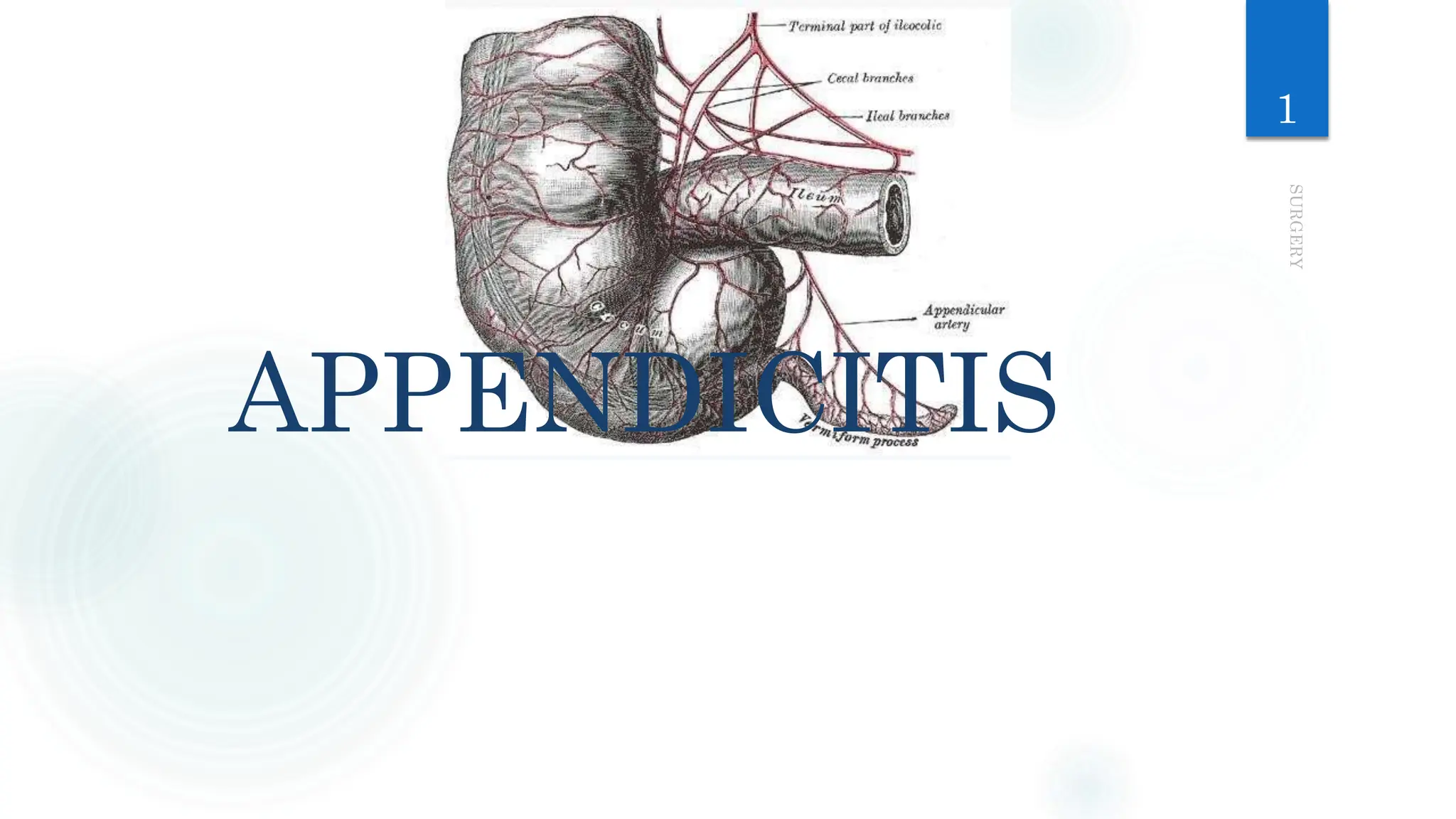
APPENDICITIS
PRESENTATION OUTLINE
 INTRODUCTION EPIDEMIOLOGY
 ETIOLOGY
 PATHOPHYSIOLOGY
INTRODUCTION
 SYMPTOMS AND SIGNS
 DIAGNOSIS
 PROGNOSIS
 TREATMENT
 CASE STUDY IN SOAPO
FORMAT
 REFERNCES
2
 Appendicitis is acute
inflammation of the
vermiform appendix, typically
resulting in abdominal anorexia, and
abdominal
tenderness.
 Diagnosis is
clinical, often supplemented by CT or
ultrasonography .
 Definitive
appendix.
pain ,
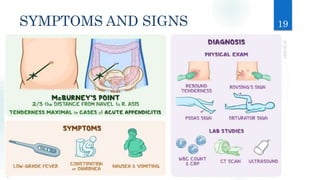
3
INTRODUCTION
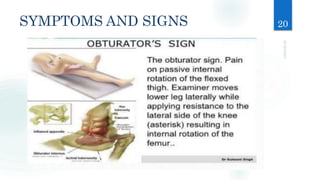
treatment is surgical removal of the
INTRODUCTION
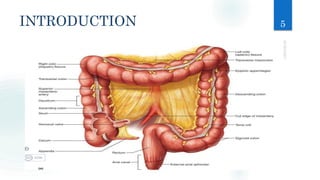
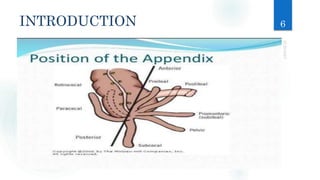
 Attached to the posteromedial
surface of the cecum is the blind,
wormlike appendix.
Roles of the Appendix
1. The appendix contains masses of
lymphoid tissue, and as part of MALT it plays an
important role in body immunity.
4
INTRODUCTION
2. Additionally, it serves as a storehouse of bacteria that
recolonize the gut when needed.
INTRODUCTION 5
INTRODUCTION 6
INTRODUCTION 7
EPIDEMIOLOGY
Study: Incidence of acute appendicitis in Kumasi,
Ghana (Ohene-Yeboah and Abatanga, 2009)
ETIOLOGY
Conclusion
 In Kumasi acute appendicitis
occurs in all age groups of both sexes.
 Males are more affected than females.
 Admission rates from the disease are
rising in both sexes most likely due
to increasing hospital attendance.
RISK FACTORS
1. Low fibre diet and high intake of refined foods.
8
bowel
diseases- Crohn
Intake
of indigestible seeds such
as guava seeds.
2. Inflammatory
Ulcerative colitis .
3. Constipation.
4.
Disease and
9
ETIOLOGY 10
 Appendicitis is thought to result from: obstructive causes
(mainly) and non-obstructive causes.
 Obstruction of the appendiceal lumen- typically by
lymphoid hyperplasia but occasionally by a fecalith, foreign
body, stricture, or even worms (pinworm).
 The obstruction leads to distention, bacterial
overgrowth, ischemia, and inflammation.
 If untreated, necrosis, gangrene, and
perforation occur.
ETIOLOGY
Fecalith: A hard stony mass of feces in
the intestinal tract Composition of
2. Calcium phosphate
3. Epithelial debris
4. Inspissated fecal matter
5. Foreign bodies (rarely)
11
the fecalith:
1. Bacteria
ETIOLOGY
Other obstructive causes
include: carcinoma caecum.
 Non-obstructive
Disease .
of the
diseases,
12
causes include: autoimmune
and conditions such as Ulcerative colitis and Crohn
ETIOLOGY
PATHOLOGY
 Obstructive-Primarily
 Mucocele of the appendix
 Rupture of the appendix
13
 Acute Appendicitis
 Phlegmonous mass/ Paracecal abscess
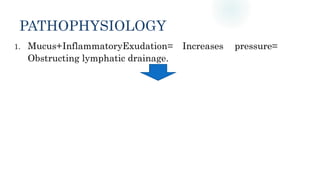
PATHOPHYSIOLOGY
1. Mucus+InflammatoryExudation= Increases pressure=
Obstructing lymphatic drainage.
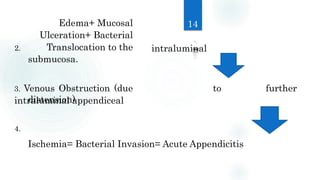
2.
submucosa.
distension)
4.
Edema+ Mucosal
Ulceration+ Bacterial
Translocation to the
3. Venous Obstruction (due to further
intraluminal appendiceal
Ischemia= Bacterial Invasion= Acute Appendicitis
intraluminal
14
SYMPTOMS AND SIGNS
PATHOPHYSIOLOGY
15
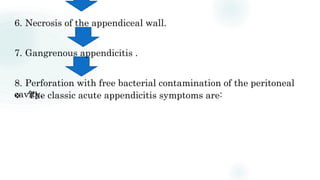
cavity.
6. Necrosis of the appendiceal wall.
7. Gangrenous appendicitis .
8. Perforation with free bacterial contamination of the peritoneal
The classic acute appendicitis symptoms are:
SYMPTOMS AND SIGNS
Epigastric or periumbilical pain followed by
brief nausea,
the pain shifts
to the
Pain increases with cough and motion
(Dunphy’s Sign).
1.
vomiting, and anorexia
2. After a few hours,
quadrant .
3.
right lower
16
SYMPTOMS AND SIGNS
Classic signs of appendicitis are:
1. Right lower quadrant direct and rebound
located at the McBurney point (junction of
the middle and outer thirds of the line
joining the umbilicus to the anterior
superior iliac spine).
tenderness
17
SYMPTOMS AND SIGNS
18
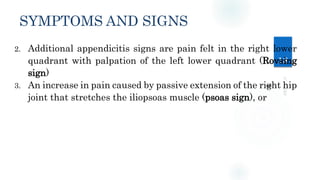
2. Additional appendicitis signs are pain felt in the right lower
quadrant with palpation of the left lower quadrant (Rovsing
sign)
3. An increase in pain caused by passive extension of the right hip
joint that stretches the iliopsoas muscle (psoas sign), or
SYMPTOMS AND SIGNS
4. Pain caused by passive internal rotation of the flexed thigh
5. Low-grade fever (rectal temperature
37.7 to 38.3° C [100 to
(obturator sign) .
101° F]) is common.
SYMPTOMS AND SIGNS 19
SYMPTOMS AND SIGNS 20
DIAGNOSIS
1. Clinical evaluation
2. Abdominal CT if necessary
3. Ultrasonography an option to CT
21
DIAGNOSIS
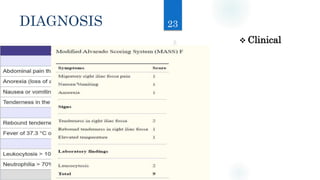
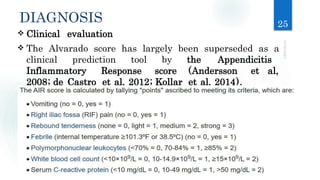
 Clinical evaluation
 The Alvarado score is a clinical scoring
system used in the diagnosis of
appendicitis.
 The score has 6 clinical
itemsand 2 measurements
with a total 10 points.
22
laboratory
DIAGNOSIS
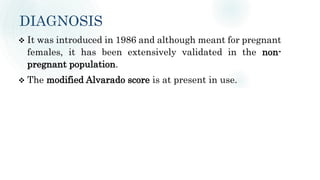
 It was introduced in 1986 and although meant for pregnant
females, it has been extensively validated in the non-
pregnant population.
 The modified Alvarado score is at present in use.
DIAGNOSIS
 Clinical
23
DIAGNOSIS
evaluation
DIAGNOSIS
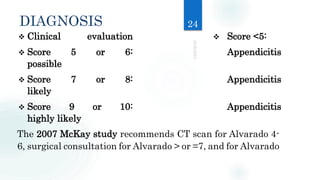
 Clinical evaluation Score <5:
 Score 5 or 6: Appendicitis
possible
 Score 7 or 8: Appendicitis
likely
 Score 9 or 10: Appendicitis
highly likely
The 2007 McKay study recommends CT scan for Alvarado 4-
6, surgical consultation for Alvarado > or =7, and for Alvarado
24
< or = 3, no CT for diagnosing appendicitis, as
appendicitis is unlikely.
DIAGNOSIS 25
 Clinical evaluation
 The Alvarado score has largely been superseded as a
clinical prediction tool by the Appendicitis
Inflammatory Response score Andersson
( et al,
2008; de Castro et al, 2012; Kollar et al, 2014).
DIAGNOSIS 26
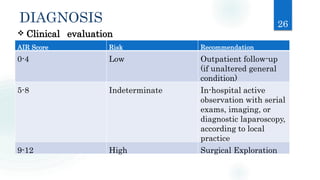
 Clinical evaluation
AIR Score Risk Recommendation
0-4 Low Outpatient follow-up
(if unaltered general
condition)
5-8 Indeterminate In-hospital active
observation with serial
exams, imaging, or
diagnostic laparoscopy,
according to local
practice
9-12 High Surgical Exploration
DIAGNOSIS
 Laparoscopy canbe used for
diagnosis definitive treatment of
appendicitis; especially helpful in
women with lower abdominal pain
of unclear etiology.
 Laboratory studies typically show
leukocytosis (12,000 to 15,000/mcL [12.00 to 15.00 ×
109/L]), but this finding is highly variable.
27
as well as
it may be
28
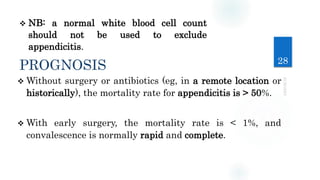
 NB: a normal white blood cell count
should not be used to exclude
appendicitis.
PROGNOSIS
 Without surgery or antibiotics (eg, in a remote location or
historically), the mortality rate for appendicitis is > 50%.
 With early surgery, the mortality rate is < 1%, and
convalescence is normally rapid and complete.
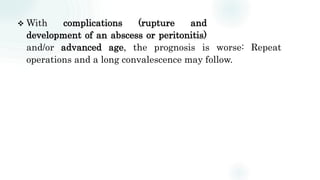
 With complications (rupture and
development of an abscess or peritonitis)
and/or advanced age, the prognosis is worse: Repeat
operations and a long convalescence may follow.
 Surgical removal of the
appendix
 IV fluids and antibiotics
 Treatment of acute appendicitis is
open or laparoscopic appendectomy;
because treatment delay mortality.
 The surgeon can usually remove the
appendix even if perforated. Occasionally, the appendix is
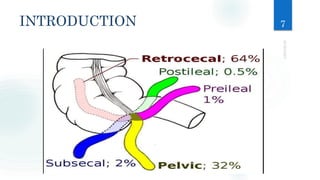
difficult to locate: In these cases, it usually lies behind the
cecum or the ileum and mesentery of the right colon.
29
increases
TREATMENT
TREATMENT
 A contraindicationto
appendectomy inflammatory
bowel disease involving
and/or terminal ileum.
 However, in cases of terminal ileitis
and a normal cecum, the appendix should be removed.
30
is
the cecum
31
(Merck
not
 Appendectomy should be preceded by IV
antibiotics. Third-generation
cephalosporins are preferred (Merck Manual, 2018).
 For nonperforated appendicitis, no further antibiotics are
required.
 If the appendix is perforated,
antibiotics should be continued until the
patient’s temperature and white blood
cell count have normalized or continued
for a fixed course, according the
surgeon’s preference
to
Manual, 2018).
 If surgery is
TREATMENT
impossible, antibiotics—although
curative— markedly improve the survival rate.
TREATMENT 32
 Although several studies of nonoperative management of
appendicitis (ie, using antibiotics alone) have shown high
rates of resolution during the initial hospitalization, a
significant number of patients have a recurrence and
require appendectomy during the following year (Poon et
al., 2017).
 Thus appendectomy is still recommended.
TREATMENT 33
formed, the
ultrasound -guided
 When a large inflammatory mass is found involving the
appendix, terminal ileum, and cecum, resection of the
entire mass and ileocolostomy are preferable.
 In late cases in which a pericolic abscess has already
abscess is drained either by an percutaneouscatheteror
by
open operation (with appendectomy to follow
at a later date).- interval appendectomy.
CASE STUDY ON
RUPTURED APPENDIX
TREATMENT
WITH
SOAPO FORMAT
34
PERIAPPENDICEAL
ABSCESS
PATIENT INFORMATION
NAME OR LOGO 53
○Patient initials: D. O. A. ○Ward: C3 (General
○Admission Date: 10/06/2021 surgery Female)
○Admission time: 4:15pm ○Ethnicity: Akan
○Sex: Female ○Place of Residence:
SURGERY
PATIENT
INFORMATION
NAME OR LOGO 54
SURGERY
○Age: 15 yearsAbuakwa, Kumasi Presenting
complaints:
○ Abdominal pain-4/7.
PATIENT
INFORMATION
NAME OR LOGO 55
SURGERY
History of presenting complaints:
Patient was well until about 4 days prior to
presentation when she started having abdominal pain
after eating food bought from outside home. She
described her pain as a sudden-onset one emanating
from the right lumbar and iliac fossa,
PATIENT
INFORMATION
NAME OR LOGO 56
SURGERY
characteristically stabbing, radiating to the left iliac
fossa and with a pain severity score of 8/10. She was
sent to a peripheral hospital where she was given
some injection and medications (could not identify
injection and medications by their names). An
abdominopelvic ultrasound scan was taken which was
suggestive of bowel obstruction and appendiceal
PATIENT
INFORMATION
NAME OR LOGO 57
SURGERY
mass. She was then referred to KATH for further
management.
On Direct Questioning of the patient on 10/06/2021 :
○ Vomiting + (once),
○ Nausea (-),
PATIENT
INFORMATION
NAME OR LOGO 58
SURGERY
○ Fever (-),
○ Dysuria (-), diarrhea (-),
○ Constipation (-),Last menstrual period date
(08/06/2021) ○Social history: Patient is a JHS 3
student who lives with her parents and siblings.
PATIENT
INFORMATION
NAME OR LOGO 59
SURGERY
Patient neither smokes cigarette nor drinks alcohol.
Patient stays at Abuakwa, Kumasi, with her parents.
○Family history: Parents of patient do not have
any chronic disease. Her siblings also do not
have any chronic disease.
PATIENT
INFORMATION
NAME OR LOGO 60
SURGERY
○Past medical/surgical history: Patient does not
have any chronic disease. Patient has not
undergone any major or
minor surgery since birth.
PATIENT
INFORMATION
NAME OR LOGO 61
SURGERY
○Drug history: Patient could not recollect the
names of the medications that were given to her
at the peripheral hospital. Her referral form did
PATIENT
INFORMATION
NAME OR LOGO 62
SURGERY
not contain the names of the medications given
to her.
Relevant signs upon presentation at C3 ward
PATIENT
INFORMATION
NAME OR LOGO 63
SURGERY
○ On Examination: Patient is a female adolescent,
not warm to touch (body temperature of
36.5degrees
PATIENT
INFORMATION
NAME OR LOGO 64
SURGERY
celsius), not pale, and anicteric. Her hydration
status was good.
Relevant signs upon presentation
PATIENT
INFORMATION
NAME OR LOGO 65
SURGERY
Respiratory system:
○ Airway: Patent.
○ Breathing: Respiratory Rate (22cpm), SpO2
(100% on
PATIENT
INFORMATION
NAME OR LOGO 66
SURGERY
room air), chest clinically clear, no abrasions
on chest, no chest compression or tenderness
Relevant signs upon presentation
Cardiovascular system
PATIENT
INFORMATION
NAME OR LOGO 67
SURGERY
○ Circulation: BP (131/78mmHg); Pulse
(120bpm);
s1+s2+0
Relevant signs upon presentation Gastrointestinal
System o Abdomen- Abdomen was full, moves with
PATIENT
INFORMATION
NAME OR LOGO 68
SURGERY
respiration. Umbilicus was flat. There was tenderness at
the right iliac fossa with guarding and rebound
tenderness. There was also a mass at the right iliac
PATIENT
INFORMATION
NAME OR LOGO 69
SURGERY
fossa however, other features of the mass could not be
appreciated because of the tenderness.
Relevant signs upon presentation
Central Nervous System
PATIENT
INFORMATION
NAME OR LOGO 70
SURGERY
○ GCS-15/15, PERRL (+)
○ Patient had a normal gait.
NAME OR LOGO 71
SURGERY
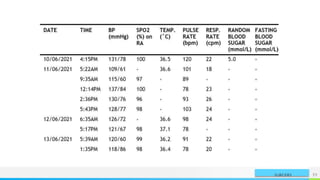
VITAL SIGNS
NAME OR LOGO 72
SURGERY
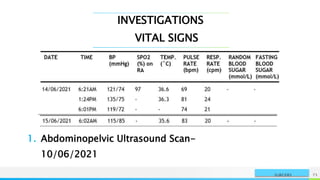
INVESTIGATIONS
NAME OR LOGO 73
SURGERY
VITAL SIGNS
1. Abdominopelvic Ultrasound Scan-
10/06/2021
NAME OR LOGO 74
SURGERY
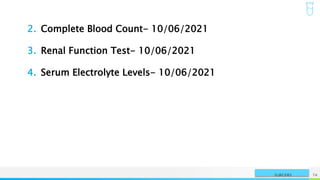
2. Complete Blood Count- 10/06/2021
3. Renal Function Test- 10/06/2021
4. Serum Electrolyte Levels- 10/06/2021
INVESTIGATIONS
NAME OR LOGO 75
SURGERY
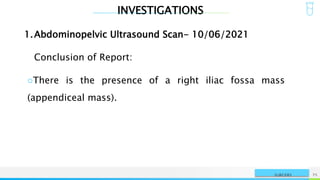
1.Abdominopelvic Ultrasound Scan- 10/06/2021
Conclusion of Report:
○There is the presence of a right iliac fossa mass
(appendiceal mass).
INVESTIGATIONS
NAME OR LOGO 76
SURGERY
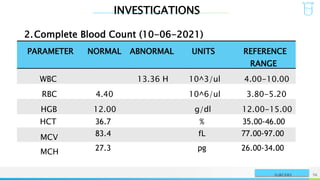
2.Complete Blood Count (10-06-2021)
PARAMETER NORMAL ABNORMAL UNITS REFERENCE
RANGE
WBC 13.36 H 10^3/ul 4.00-10.00
RBC 4.40 10^6/ul 3.80-5.20
HGB 12.00 g/dl 12.00-15.00
HCT 36.7 % 35.00-46.00
MCV 83.4 fL 77.00-97.00
MCH 27.3 pg 26.00-34.00
INVESTIGATIONS
NAME OR LOGO 77
SURGERY
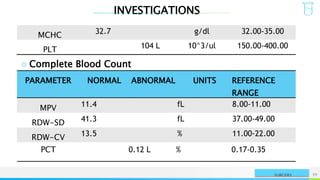
MCHC 32.7 g/dl 32.00-35.00
PLT 104 L 10^3/ul 150.00-400.00
○ Complete Blood Count
PARAMETER NORMAL ABNORMAL UNITS REFERENCE
RANGE
MPV 11.4 fL 8.00-11.00
RDW-SD 41.3 fL 37.00-49.00
RDW-CV 13.5 % 11.00-22.00
PCT 0.12 L % 0.17-0.35
INVESTIGATIONS
NAME OR LOGO 78
SURGERY
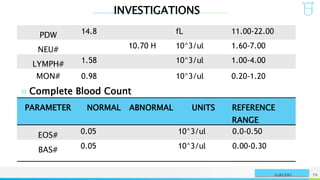
PDW 14.8 fL 11.00-22.00
NEU# 10.70 H 10^3/ul 1.60-7.00
LYMPH# 1.58 10^3/ul 1.00-4.00
MON# 0.98 10^3/ul 0.20-1.20
○ Complete Blood Count
PARAMETER NORMAL ABNORMAL UNITS REFERENCE
RANGE
EOS# 0.05 10^3/ul 0.0-0.50
BAS# 0.05 10^3/ul 0.00-0.30
INVESTIGATIONS
NAME OR LOGO 79
SURGERY
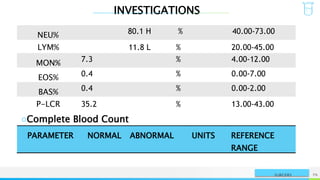
NEU% 80.1 H % 40.00-73.00
LYM% 11.8 L % 20.00-45.00
MON% 7.3 % 4.00-12.00
EOS% 0.4 % 0.00-7.00
BAS% 0.4 % 0.00-2.00
P-LCR 35.2 % 13.00-43.00
○Complete Blood Count
PARAMETER NORMAL ABNORMAL UNITS REFERENCE
RANGE
INVESTIGATIONS
NAME OR LOGO 80
SURGERY
MicroR 1.2 % 0.00-100.00
MacroR 4.90 % 0.00-100.00
IG# 0.05 H 10^3/ul 0.00-0.04
IG% 0.4 % 0.0-0.6
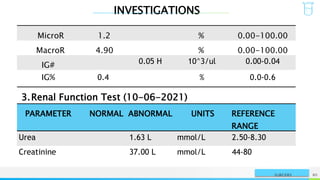
3.Renal Function Test (10-06-2021)
PARAMETER NORMAL ABNORMAL UNITS REFERENCE
RANGE
Urea 1.63 L mmol/L 2.50-8.30
Creatinine 37.00 L mmol/L 44-80
INVESTIGATIONS
NAME OR LOGO 81
SURGERY
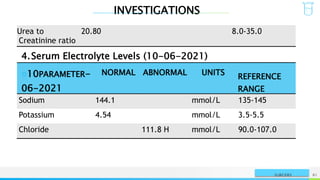
Urea to 20.80
Creatinine ratio
8.0-35.0
4.Serum Electrolyte Levels (10-06-2021)
○10PARAMETER-
06-2021
NORMAL ABNORMAL UNITS
REFERENCE
RANGE
Sodium 144.1 mmol/L 135-145
Potassium 4.54 mmol/L 3.5-5.5
Chloride 111.8 H mmol/L 90.0-107.0
CURRENT MEDICATIONS
82
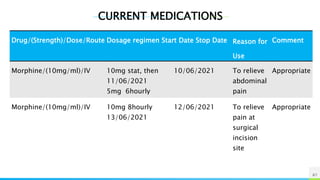
Drug/(Strength)/Dose/Route Dosage regimen Start Date Stop Date Reason for
Use
Comment
Morphine/(10mg/ml)/IV 10mg stat, then 10/06/2021
11/06/2021
5mg 6hourly
To relieve
abdominal
pain
Appropriate
Morphine/(10mg/ml)/IV 10mg 8hourly 12/06/2021
13/06/2021
To relieve
pain at
surgical
incision
site
Appropriate
CURRENT MEDICATIONS
NAME OR LOGO 83
SURGERY
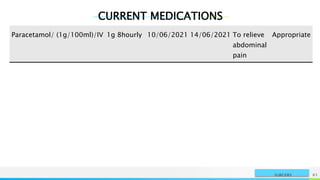
Paracetamol/ (1g/100ml)/IV 1g 8hourly 10/06/2021 14/06/2021 To relieve
abdominal
pain
Appropriate
CURRENT MEDICATIONS
84
NAME OR LOGO
SURGERY
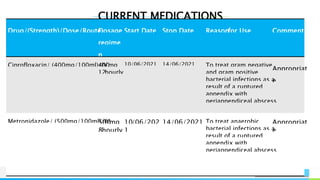
Drug/(Strength)/Dose/Route
Dosage
regime
n
Start Date Stop Date Reasonfor Use Comment
Ciprofloxacin/ (400mg/100ml)/IV
400
mg
12hourly
10/06/2021 14/06/2021 To treat gram negative
and gram positive
bacterial infections as a
result of a ruptured
appendix with
periappendiceal abscess
Appropriat
e
Metronidazole/ (500mg/100ml)/IV
500
mg
8hourly
10/06/202
1
14/06/2021 To treat anaerobic
bacterial infections as a
result of a ruptured
appendix with
periappendiceal abscess
Appropriat
e
CURRENT MEDICATIONS
NAME OR LOGO 85
SURGERY
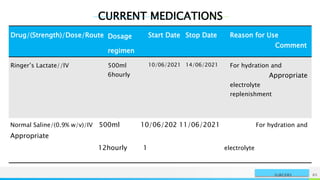
Drug/(Strength)/Dose/Route Dosage
regimen
Start Date Stop Date Reason for Use
Comment
Ringer’s Lactate//IV 500ml
6hourly
10/06/2021 14/06/2021 For hydration and
Appropriate
electrolyte
replenishment
Normal Saline/(0.9% w/v)/IV 500ml 10/06/202 11/06/2021 For hydration and
Appropriate
12hourly 1 electrolyte
CURRENT MEDICATIONS
86
replenishment
CURRENT MEDICATIONS
NAME OR LOGO 87
SURGERY
Drug/(Strength)/Dose/Route Dosage
regimen
Start Date Stop Date Reason for Use
Comment
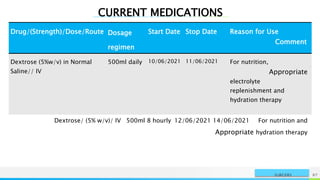
Dextrose (5%w/v) in Normal
Saline// IV
500ml daily 10/06/2021 11/06/2021 For nutrition,
Appropriate
electrolyte
replenishment and
hydration therapy
Dextrose/ (5% w/v)/ IV 500ml 8 hourly 12/06/2021 14/06/2021 For nutrition and
Appropriate hydration therapy
SURGERY DETAILS
NAME OR LOGO 88
SURGERY
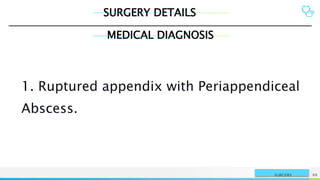
MEDICAL DIAGNOSIS
1. Ruptured appendix with Periappendiceal
Abscess.
NAME OR LOGO 89
SURGERY
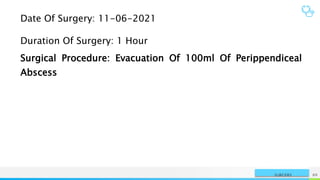
Date Of Surgery: 11-06-2021
Duration Of Surgery: 1 Hour
Surgical Procedure: Evacuation Of 100ml Of Perippendiceal
Abscess
SURGERY DETAILS
NAME OR LOGO 90
SURGERY
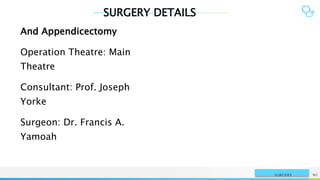
And Appendicectomy
Operation Theatre: Main
Theatre
Consultant: Prof. Joseph
Yorke
Surgeon: Dr. Francis A.
Yamoah
NAME OR LOGO 91
SURGERY
Assistant: Dr. Rawuf
Mohammed
Anaesthesiologist: Dr.
Tweneboah
Intra-opFindings: Ruptured Appendix With About 100ml Of
Perippendiceal Abscess
SURGERY DETAILS
NAME OR LOGO 92
SURGERY
PROCEDURE DETAILS:
Under aseptic conditions and general endotracheal
anaesthesia, the patient was placed in the supine position with
her arms abducted at 90degrees. Her abdomen was cleaned
and draped. A lower midline incision was made to access the
peritoneal cavity and the findings were as stated above. The
abscess was evacuated. The mesoappendix was ligated at the
SURGERY DETAILS
NAME OR LOGO 93
SURGERY
base followed by clamping, ligation and excision of the
appendix at the base. The cavity was washed with 2L of warm
normal saline. The abdominal incisions were closed in layers.
The incised skin was sutured with Vicryl 2-0.
The patient’s post-operative condition was satisfactory.
POST-OPERATIVE MANAGEMENT:
SURGERY DETAILS
NAME OR LOGO 94
SURGERY
○MONITOR VITALS EVERY 15MINUTES UNTIL FULL RECOVERY FROM
ANAESTHESIA. INTRAVENOUS FLUID MAINTENANCE SHOULD BE CONTINUED.
CONTINUE IV ANTIBIOTICS AND ANALGESICS. PROVIDE PATIENT
SUPPLEMENTAL OXYGEN AND TRANS OUT TO C3 WARD WHEN SHE HAS
FULLY RECOVERED FROM ANAESTHESIA.
SURGERY DETAILS
NAME OR LOGO 95
SURGERY
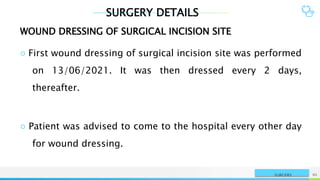
WOUND DRESSING OF SURGICAL INCISION SITE
○ First wound dressing of surgical incision site was performed
on 13/06/2021. It was then dressed every 2 days,
thereafter.
○ Patient was advised to come to the hospital every other day
for wound dressing.
SURGERY DETAILS
NAME OR LOGO 96
SURGERY
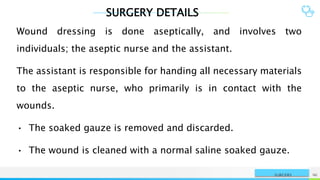
Wound dressing is done aseptically, and involves two
individuals; the aseptic nurse and the assistant.
The assistant is responsible for handing all necessary materials
to the aseptic nurse, who primarily is in contact with the
wounds.
• The soaked gauze is removed and discarded.
• The wound is cleaned with a normal saline soaked gauze.
SURGERY DETAILS
NAME OR LOGO 97
SURGERY
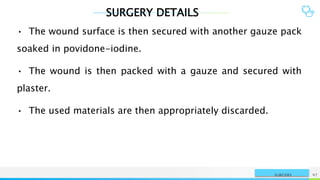
• The wound surface is then secured with another gauze pack
soaked in povidone-iodine.
• The wound is then packed with a gauze and secured with
plaster.
• The used materials are then appropriately discarded.
NAME OR LOGO 98
SURGERY
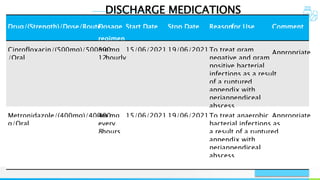
DISCHARGE MEDICATIONS
Drug/(Strength)/Dose/Route
Dosage
regimen
Start Date Stop Date Reasonfor Use Comment
Ciprofloxacin/(500mg)/500mg
/Oral
500
mg
12hourly
15/06/2021 19/06/2021To treat gram
negative and gram
positive bacterial
infections as a result
of a ruptured
appendix with
periappendiceal
abscess
Appropriate
Metronidazole/(400mg)/400m
g/Oral
400
mg
every
8hours
15/06/2021 19/06/2021To treat anaerobic
bacterial infections as
a result of a ruptured
appendix with
periappendiceal
abscess
Appropriate
NAME OR LOGO 99
SURGERY
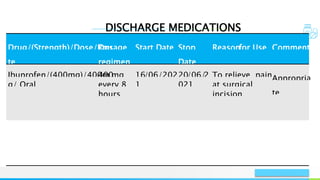
DISCHARGE MEDICATIONS
Drug/(Strength)/Dose/Rou
te
Dosage
regimen
Start Date Stop
Date
Reasonfor Use Comment
Ibuprofen/(400mg)/400m
g/ Oral
mg
400
every 8
hours
16 06/202
/
1
20/06/
2
021
To relieve pain
at surgical
incision
Appropria
te
NAME OR LOGO 10
SURGERY
PHARMACEUTICAL CARE ISSUE
NAME OR LOGO 10
SURGERY
○ An oral analgesic was not initially provided in
addition to the oral antibiotic therapy for the
NAME OR LOGO 10
SURGERY
patient upon hospital discharge.
10
OPTIMIZING THE MANAGEMENT
OF
RUPTURED APPENDIX WITH
PERIAPPENDICEAL ABSCESS
SURGERY
NAME OR LOGO 10
SURGERY
SUBJECTIVE DATA
○Abdominal pain with a pain severity score of
8/10 - 4/7.
○Patient described her abdominal pain as
radiating from the right iliac fossa.
NAME OR LOGO 10
SURGERY
○Patient vomited (once) before presenting to the
Hospital.
OBJECTIVE DATA
NAME OR LOGO 10
SURGERY
• Abdominopelvic ultrasound scan conducted on 10-
06-2021 indicated the presence of right iliac fossa
mass
(appendiceal mass).
• Also, the Complete Blood Count conducted on 10-
06-2021, indicated the presence of elevated white
blood cell count of
NAME OR LOGO 10
SURGERY
13.36x10^3cells/ul, with a differential neutrophil
count of 10.7x10^3cells/ul, indicating the
presence of ongoing inflammation or
uncontrolled bacterial proliferation in the
appendix.
NAME OR LOGO 10
SURGERY
• Intra-operative findings revealed a ruptured
appendix with about 100ml of periappendiceal
abscess.
ASSESSMENT
CONFIRMATION OF DIAGNOSIS
NAME OR LOGO 10
SURGERY
○According to the Merck Manual (2018), Appendicitis is defined
as an acute inflammation of the vermiform appendix,
characteristically resulting in anorexia, abdominal pain, and
abdominal tenderness. Diagnosis is usually clinical, that is,
based on patient’s medical history and clinical examinations
and findings. Diagnosis is also often supplemented by
abdominopelvic CT or ultrasonography.
ASSESSMENT
CONFIRMATION OF DIAGNOSIS
NAME OR LOGO 11
SURGERY
○Definitive treatment is surgical removal of the appendix (Kumar
and Clark, 2017).
○Appendicitis can lead further lead to rupturing of the appendix,
periappendiceal abscess (es) or peritonitis, if not identified
earlier for medical management (Merck Manual, 2018).
ASSESSMENT
CONFIRMATION OF DIAGNOSIS
NAME OR LOGO 11
SURGERY
○ According to the Centre for Disease Control and Prevention
(CDC), a ruptured appendix with periappendiceal abscess is
classified as a dirtyinfected (class IV) wound. Thus, it is highly
probable that gut bacteria present in the ruptured appendix
are responsible for the pus formed.
○ The subjective data of the patient indicated therein, Abdominal
pain with a pain severity score of 8/10 for 4 days. She
ASSESSMENT
CONFIRMATION OF DIAGNOSIS
NAME OR LOGO 11
SURGERY
described that her abdominal pain was radiating from the
right iliac fossa. She vomited (once) before presenting to the
Hospital.
○ The objective data of the patient indicated therein that an
Abdominopelvic ultrasound scan conducted on 10-06-2021
indicated the presence of right iliac fossa mass (appendiceal
mass).
ASSESSMENT
CONFIRMATION OF DIAGNOSIS
NAME OR LOGO 11
SURGERY
○ Also, the Complete Blood Count conducted on 10-06-2021,
indicated the presence of elevated white blood cell count of
13.36x10^3cells/ul, with a differential neutrophil count of
10.7x10^3cells/ul, indicating the presence of ongoing
inflammation or uncontrolled bacterial proliferation in the
appendix.
ASSESSMENT
CONFIRMATION OF DIAGNOSIS
NAME OR LOGO 11
SURGERY
○ Intra-operative findings revealed a ruptured appendix with
about 100ml of periappendiceal abscess.
○ Thus, based on the aforementioned subjective and objective
data, the diagnosis of Ruptured Appendix with
Periappendiceal Abscess is appropriate in this patient.
ASSESSMENT
NAME OR LOGO 11
SURGERY
APPROPRIATENESS OF MEDICATIONS
TREATMENT OBJECTIVES
1. To provide adequate analgesia due to the abdominal pains.
2. To provide effective antibiotic treatment for ruptured appendix with
periappendiceal abscess.
3. To prevent the occurrence the complications of ruptured appendix, such
as, peritonitis, in this patient.
ASSESSMENT
APPROPRIATENESS OF MEDICATIONS
NAME OR LOGO 11
SURGERY
4. To prepare patient adequately for surgical intervention(s) as timely as
possible.
4. To adequately rehydrate the patient and provide nutrition for the patient
with the use of
IV fluids.
5. To improve upon the quality of life of the patient.
ASSESSMENT
APPROPRIATENESS OF MEDICATIONS
NAME OR LOGO 11
SURGERY
Morphine IV 10mg stat, then 5mg 6hourly for 2 days followed
by 10mg 8hourly 3days
○ Opioids are usually the backbone of severe acute pain
management. Morphine acts on a number of receptors
including the Mu1, Mu2, kappa and delta to exert its
analgesic effects (Flower et al, 2012).
ASSESSMENT
APPROPRIATENESS OF MEDICATIONS
NAME OR LOGO 11
SURGERY
○ According to the World Health Organization Analgesic
Ladder, strong opioids such as morphine are indicated for
moderate to severe postoperative pain (Wilkinson et al,
2017).
Morphine IV 10mg stat, then 5mg 6hourly for 2 days followed
by 10mg 8hourly 3days
ASSESSMENT
APPROPRIATENESS OF MEDICATIONS
NAME OR LOGO 11
SURGERY
○ Thus, the use of IV morphine for the management of
moderate to severe postoperative abdominal pain is
appropriate in this patient. The doses and frequencies of IV
Morphine are appropriate in this patient (British National
Formulary, 80th Edition).
Ciprofloxacin IV 400mg every 12 hours for 5 days, followed by
Ciprofloxacin Oral 500mg every 12hours for 5 days
ASSESSMENT
APPROPRIATENESS OF MEDICATIONS
NAME OR LOGO 12
SURGERY
○ Antibiotics for lower gastrointestinal infections due to
periappendiceal abscess should have coverage against
gram-negative organisms and anaerobes, and the choice of
a specific agent should be determined by local susceptibility
and availability (Jackson and Raiji, 2011).
○ Ciprofloxacin is a potent bactericidal agent against gram-
negative bacteria such as Proteus mirabilis, E. coli,
ASSESSMENT
APPROPRIATENESS OF MEDICATIONS
NAME OR LOGO 12
SURGERY
Klebsiella spp., and various species of Salmonella, Shigella,
Enterobacter, and Campylobacter which are most
commonly implicated in lower gastrointestinal infections
(Brunton et al, 2018).
Ciprofloxacin IV 400mg every 12 hours for 5 days, followed by
Ciprofloxacin Oral 500mg every 12hours for 5 days
ASSESSMENT
APPROPRIATENESS OF MEDICATIONS
NAME OR LOGO 12
SURGERY
○ The elimination half-life of ciprofloxacin is 5hours and so it
is typically dosed 12hourly, with the exception of an
extended-release formulation, which can be dosed once
daily (Merck Manual, 2018).
○ Thus, IV Ciprofloxacin 500mg administered as a slow IV
infusion (60minutes) 12hourly for the treatment of a lower
gastrointestinal infection due to ruptured appendix with
ASSESSMENT
APPROPRIATENESS OF MEDICATIONS
NAME OR LOGO 12
SURGERY
periappendiceal abscess is appropriate (British National
Formulary, 80th Edition; Gahart et al, 2018).
Ciprofloxacin IV 400mg every 12 hours for 5 days, followed by
Ciprofloxacin Oral 500mg every 12hours for 5 days
○ Also, the duration of therapies (for both IV and oral) are
appropriate for the treatment of a lower gastrointestinal
ASSESSMENT
APPROPRIATENESS OF MEDICATIONS
NAME OR LOGO 12
SURGERY
infection caused by gramnegative bacteria due to ruptured
appendix with periappendiceal abscess (Gahart et al, 2018).
ASSESSMENT
NAME OR LOGO 12
SURGERY
APPROPRIATENESS OF MEDICATIONS
Metronidazole IV 500mg every 8 hours for 5 days, followed
by Metronidazole Oral 400mg every 8 hours for 5 days
○ Metronidazole manifests antibacterial activity against all
anaerobic cocci; anaerobic gram-negative bacilli, including
Bacteroides spp.; anaerobic spore-forming, gram-positive
bacilli such as Clostridium; and microaerophilic bacteria
ASSESSMENT
NAME OR LOGO 12
SURGERY
such as Helicobacter and Campylobacter spp. (Lofmark et
al, 2010).
○ Thus, Metronidazole is appropriate for the treatment lower
gastrointestinal tract infections due to ruptured appendix
with periappendiceal abscess (Jackson and Raiji, 2011).
APPROPRIATENESS OF MEDICATIONS
ASSESSMENT
NAME OR LOGO 12
SURGERY
Metronidazole IV 500mg every 8 hours for 5 days, followed
by Metronidazole Oral 400mg every 8 hours for 5 days
○ Thus, IV Metronidazole 500mg administered as a slow IV
infusion (30minutes) 8hourly is appropriate for the
treatment of a lower gastrointestinal infection due to
ruptured appendix with periappendiceal abscess (British
National Formulary, 80th Edition; Gahart et al, 2018).
ASSESSMENT
NAME OR LOGO 12
SURGERY
○ Also, the duration of therapies (for both IV and oral) are
appropriate (Gahart et al, 2018).
APPROPRIATENESS OF MEDICATIONS
Paracetamol Oral 1g every 8 hours for 5 days
○ Paracetamol is a nonselective COX inhibitor, which acts at the peroxide
site of the enzyme and is thus distinct from NSAIDs. Thus, the
presence of high concentrations of peroxides, as occur at sites of
ASSESSMENT
NAME OR LOGO 12
SURGERY
inflammation, reduces its COX-inhibitory activity (Brunton et al.,
2018).
○ According to the Standard Treatment Guidelines (STG) 2017 and the
World Health Organization Analgesic ladder, paracetamol is indicated
for mild-to-moderate pain.
○ Thus, the use of Paracetamol IV at a dose of 1g every 8 hours for 5
days for the management of abdominal pain associated due to
ASSESSMENT
NAME OR LOGO 13
SURGERY
ruptured appendix with periappendiceal abscess is appropriate in this
patient (Standard Treatment Guidelines, 2017).
APPROPRIATENESS OF MEDICATIONS
Normal Saline IV 500ml every 12hours for 5days
○Normal saline is a cornerstone of intravenous solutions
commonly employed in clinical settings. It is a crystalloid
fluid. It is administered as an intravenous solution. Its
ASSESSMENT
NAME OR LOGO 13
SURGERY
indications include both adult and pediatric populations as
sources of hydration and electrolyte disturbances (Tonog
and Lakhkar, 2020).
○Intravenous Normal saline is an essential method of
hydration of patients who are especially booked for
gastrointestinal tract surgery. This is because, such patients
are normally kept nil per os.
ASSESSMENT
APPROPRIATENESS OF MEDICATIONS
NAME OR LOGO 13
SURGERY
Normal Saline IV 500ml every 12hours for 5days
○Thus, the only means to hydrate such patients is by the
intravenous route. Also, it is essential to replace lost body
fluids after surgery.
○However, because it may take some time for patients to start
oral fluid intake after surgeries (more particularly, surgeries
involving the gastrointestinal tract), it is important that
ASSESSMENT
APPROPRIATENESS OF MEDICATIONS
NAME OR LOGO 13
SURGERY
intravenous fluid therapy is provided for such patients until
they begin to take fluids orally.
○Thus, crystalloid solutions remain the fluid of choice for
replacement and maintenance fluid therapy following surgery
(Merck Manual, 2018; Martin et al, 2020).
Normal Saline IV 500ml every 12hours for 5days
ASSESSMENT
APPROPRIATENESS OF MEDICATIONS
NAME OR LOGO 13
SURGERY
○Thus, the use of Normal saline at a volume of 500ml every 12
hours for 5 days, in addition to other intravenous fluids (1 day
before and 4 days after surgery) is appropriate for hydration
in this patient (Merck Manual, 2018).
Ringer’s lactate IV 500ml every 12hours for 1day.
ASSESSMENT
APPROPRIATENESS OF MEDICATIONS
NAME OR LOGO 13
SURGERY
○Ringer's lactate solution is very often used for fluid
resuscitation after a blood loss due to trauma, surgery, or a
burn injury (Tonog and Lakhkar, 2020).
○Also, it is used for the replacement of electrolyte loss and
maintenance of normal electrolyte balance in patients,
especially, for those who cannot take fluids orally, such as
patients who are about to undergo surgery or have undergone
ASSESSMENT
APPROPRIATENESS OF MEDICATIONS
NAME OR LOGO 13
SURGERY
surgery, and those who are vomiting (Tonog and Lakhkar,
2020).
Ringer’s lactate IV 500ml every 12hours for 1day.
○Ringer's lactate has an osmolarity of 273 mOsm L−1 and a pH
of 6.5. Unlike Normal Saline, Ringer’s lactate provides
potassium, calcium and lactate which are vital for the
metabolic processes of the body (Gahart et al, 2018).
ASSESSMENT
APPROPRIATENESS OF MEDICATIONS
NAME OR LOGO 13
SURGERY
○Thus, the use of Ringer’s lactate at a volume of 500ml, 6 hourly
for 5 day in addition to other intravenous fluids (1 day before
and 4 days after surgery) is appropriate for hydration in this
patient (Gahart et al, 2018).
○Thus, based on the clinical presentation of the patient, Ringer’s
lactate is appropriate for electrolyte maintenance and
ASSESSMENT
APPROPRIATENESS OF MEDICATIONS
NAME OR LOGO 13
SURGERY
hydration of the patient (British National Formulary, 80th
Edition).
Dextrose (5%) in Normal Saline IV 500ml every 8hours for
2days.
○Dextrose (5%) in Normal Saline provides calories and fluid
replacement by peripheral infusion when calories and fluid are
ASSESSMENT
APPROPRIATENESS OF MEDICATIONS
NAME OR LOGO 13
SURGERY
required, especially in dehydrated patients and in patients who
have had recent frequent vomits (Gahart et al, 2018).
○It acts as a fluid and nutrient replenisher. Thus, it is an
important source of nutrition for patients who are kept nil per
os because of a planned surgery.
ASSESSMENT
APPROPRIATENESS OF MEDICATIONS
NAME OR LOGO 14
SURGERY
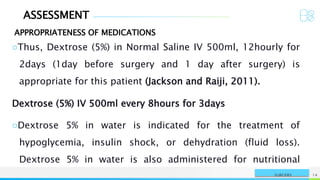
○Thus, Dextrose (5%) in Normal Saline IV 500ml, 12hourly for
2days (1day before surgery and 1 day after surgery) is
appropriate for this patient (Jackson and Raiji, 2011).
Dextrose (5%) IV 500ml every 8hours for 3days
○Dextrose 5% in water is indicated for the treatment of
hypoglycemia, insulin shock, or dehydration (fluid loss).
Dextrose 5% in water is also administered for nutritional
ASSESSMENT
APPROPRIATENESS OF MEDICATIONS
NAME OR LOGO 14
SURGERY
support to patients who are not able to eat because of illness,
injury, or other medical condition such as surgery. Because,
patients who have undergone gastrointestinal surgery are
usually kept nil per os, it is vital that they are provided with
adequate nutritional support via the intravenous route until
they begin to accommodate oral nutrition (Tonog and Lakhkar,
2020).
ASSESSMENT
APPROPRIATENESS OF MEDICATIONS
NAME OR LOGO 14
SURGERY
○Thus, Dextrose (5%) in Normal Saline IV 500ml, 8hourly for
3days after surgery is appropriate for this patient (British
National Formulary, 80th Edition).
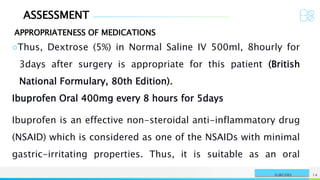
Ibuprofen Oral 400mg every 8 hours for 5days
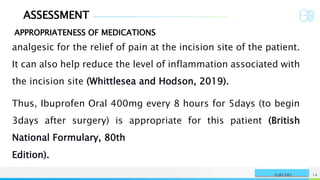
Ibuprofen is an effective non-steroidal anti-inflammatory drug
(NSAID) which is considered as one of the NSAIDs with minimal
gastric-irritating properties. Thus, it is suitable as an oral
ASSESSMENT
APPROPRIATENESS OF MEDICATIONS
NAME OR LOGO 14
SURGERY
analgesic for the relief of pain at the incision site of the patient.
It can also help reduce the level of inflammation associated with
the incision site (Whittlesea and Hodson, 2019).
Thus, Ibuprofen Oral 400mg every 8 hours for 5days (to begin
3days after surgery) is appropriate for this patient (British
National Formulary, 80th
Edition).
PLAN
NAME OR LOGO 14
SURGERY
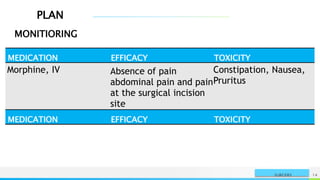
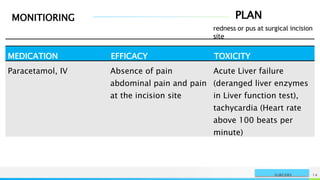
MONITIORING
MEDICATION EFFICACY TOXICITY
Morphine, IV Absence of pain
abdominal pain and pain
at the surgical incision
site
Constipation, Nausea,
Pruritus
MEDICATION EFFICACY TOXICITY
PLAN
MONITIORING
NAME OR LOGO 14
SURGERY
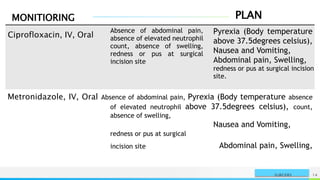
Ciprofloxacin, IV, Oral
Absence of abdominal pain,
absence of elevated neutrophil
count, absence of swelling,
redness or pus at surgical
incision site
Pyrexia (Body temperature
above 37.5degrees celsius),
Nausea and Vomiting,
Abdominal pain, Swelling,
redness or pus at surgical incision
site.
Metronidazole, IV, Oral Absence of abdominal pain, Pyrexia (Body temperature absence
of elevated neutrophil above 37.5degrees celsius), count,
absence of swelling,
Nausea and Vomiting,
redness or pus at surgical
incision site Abdominal pain, Swelling,
PLAN
MONITIORING
NAME OR LOGO 14
SURGERY
redness or pus at surgical incision
site
MEDICATION EFFICACY TOXICITY
Paracetamol, IV Absence of pain
abdominal pain and pain
at the incision site
Acute Liver failure
(deranged liver enzymes
in Liver function test),
tachycardia (Heart rate
above 100 beats per
minute)
PLAN
MONITIORING
NAME OR LOGO 14
SURGERY
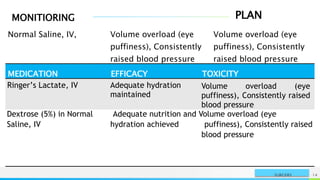
Normal Saline, IV, Volume overload (eye
puffiness), Consistently
raised blood pressure
Volume overload (eye
puffiness), Consistently
raised blood pressure
MEDICATION EFFICACY TOXICITY
Ringer’s Lactate, IV Adequate hydration
maintained
Volume overload (eye
puffiness), Consistently raised
blood pressure
Dextrose (5%) in Normal Adequate nutrition and Volume overload (eye
Saline, IV hydration achieved puffiness), Consistently raised
blood pressure
PLAN
MONITIORING
NAME OR LOGO 14
SURGERY
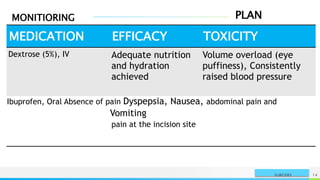
MEDICATION EFFICACY TOXICITY
Dextrose (5%), IV Adequate nutrition
and hydration
achieved
Volume overload (eye
puffiness), Consistently
raised blood pressure
Ibuprofen, Oral Absence of pain Dyspepsia, Nausea, abdominal pain and
Vomiting
pain at the incision site
PLAN
NAME OR LOGO 14
SURGERY
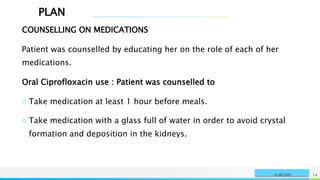
COUNSELLING ON MEDICATIONS
Patient was counselled by educating her on the role of each of her
medications.
Oral Ciprofloxacin use : Patient was counselled to
○ Take medication at least 1 hour before meals.
○ Take medication with a glass full of water in order to avoid crystal
formation and deposition in the kidneys.
PLAN
NAME OR LOGO 15
SURGERY
○ Avoid milk, or dairy products (foods that contain milk), antacids or
medicines containing iron or zinc, 2 hours before or after taking this
medicine.
○ Keep taking this medicine until the course is finished.
○ Space doses evenly throughout the day.
○ Report any serious side-effects to the doctor who prescribed the
medication for her
PLAN
NAME OR LOGO 15
SURGERY
Oral Metronidazole use : Patient was counselled to
○ Avoid alcohol whilst on antibiotic therapy with
medication.
○ Space doses evenly throughout the day.
○ Keep taking this medicine until the course is finished.
○ Take with or just after food, or a meal.
PLAN
NAME OR LOGO 15
SURGERY
○ Take medication with a glass full of water in order to avoid
crystal formation and deposition in the kidneys.
○ Report any serious side-effects to the doctor who prescribed
the medication for her.
Oral Ibuprofen use : Patient was counselled to
○Take with or just after food, or a meal
○Space doses evenly throughout the day.
PLAN
NAME OR LOGO 15
SURGERY
○Report any serious side-effects to the doctor who prescribed
the medication for her.
COUNSELLING ON NON-PHARMACOLOGICAL MOETHODS OF
MANAGING MEDICAL CONDITION
○ Patient was counselled to eat a well-balanced diet every day. Patient was
counselled to take meals rich in proteins like beans, eggs, and red meat
in order to speed up her wound healing process.
PLAN
NAME OR LOGO 15
SURGERY
○ Patient was counselled to increase her daily intake of fluids to at least 3
litres a day in order to prevent constipation which will impede her wound’s
healing progress.
○ Patient was counselled on the maintenance of personal hygiene in order to
prevent her wound from getting infected by microbes.
○ The patient was advised to incorporate food products with high fibre such
as oats and beans in her diet to prevent further incidences of constipating.
PLAN
NAME OR LOGO 15
SURGERY
○ The patient was counselled on safe practices to keep the surgical site clean,
such as careful dry bathing around the surgical incision site.
NAME OR LOGO 15
SURGERY
OUTCOME
RECOMMENDATIONS/INTERVENTION
○The recommendation made was accepted. Oral ibuprofen
400mg 8 hourly for 5days was added to the oral antibiotic
therapy (discharge medications) of the patient.
NAME OR LOGO 15
SURGERY
OUTCOME
○The patient’s abdominal pain started resolving after the
surgery (evacuation of the periappendiceal abscess and
appendicectomy), though she had moderate pain of intensity
of 5/10 at the surgical incision site. The patient was
discharged on 15th June, 2021.
NAME OR LOGO 15
SURGERY
○The patient was informed to
attend to the hospital every other day for wound dressing since
she lived quite close to the hospital.
○The patient was healthy and well-looking upon discharge from
the hospital.
ROLE OF THE PHARMACIST
NAME OR LOGO 15
SURGERY
○ Provided adequate Information to the patient about her conditions, the
important nonpharmacological treatments (diet) to perform and the
essence of adherence to medication therapy in order to prevent
complications to her.
○ Made contributions to the medical team with regards to the selection of
appropriate medications required to manage optimum antimicrobial
therapy for the patient with considerations for safety of the drugs of choice.
NAME OR LOGO 16
SURGERY
○ Assisted in keeping to right
timing of administration of medications with emphasis on not increasing
doses should a particular dose of medication is missed. Timing schedules
were made flexible to the advantage of the patient.
○ Monitored the potential adverse effects such as volume overload as a result
of IV hydration (medical) therapy.
NAME OR LOGO 16
SURGERY
ROLE OF THE PHARMACIST
○ Performed medication review every day to make sure prescribed
medications were administered correctly and patient was compliant with
therapy.
○ Performed discharge counselling on medications as well as need for
outpatient monitoring of any signs and symptoms.
REFERENCES
SURGERY NAME OR LOGO 162
○ Counselled the patient to visit the health facility should prognosis of her
medical conditions worsen in spite of adherence to therapy
○ Advised the patient to report any side effect(s) of medication therapy.
British National Formulary, 80th Edition, Pharmaceutical Press,
London, U.K. Pages 572, 590 and 1198.
REFERENCES
SURGERY NAME OR LOGO 163
Brunton L.L. et al (ed.) (2018) Goodman & Gilman’s: The
Pharmacological basis of Therapeutics (13th Edition). McGraw-Hill
Education. New York, USA. Pages 1015-1017 and 1068.
McLatchie et al., (2013) Oxford Handbook of Surgery (4th Edition).
Oxford University Press. Great Clarendon Street, Oxford, OX2 6DP,
United Kingdom. Pages 298 and 299.
REFERENCES
SURGERY NAME OR LOGO 164
Porter, R. S. et al, (ed.) (2018). The Merck Manual of Diagnosis and
Therapy.
20th Edition. Whitehouse Station, N.J.: Merck Sharp & Dohme Corp.
USA. Pages 88 and 89.
Whittlesea C. and Hodson K. (ed.), (2019), Clinical Pharmacy and
Therapeutics, 6th Edition. Churchill Livingstone Elsevier. London,
United Kingdom. Pages 176 and 177.
REFERENCES
SURGERY NAME OR LOGO 165
Gahart B.L. et al (2018), Gahart's 2018 Intravenous Medications: A
Handbook for Nurses and Health Professionals (34th Edition)
Elsevier Inc. London, United Kingdom. Pages 445-447.
Tonog P., Lakhkar A.D., Normal Saline. [Updated 2020 May 24]. In:
StatPearls [Internet]. Treasure Island (FL): StatPearls Publishing;
2020 Jan-. Available from:
https://www.ncbi.nlm.nih.gov/books/NBK545210/.
REFERENCES
SURGERY NAME OR LOGO 166
Martin G.S. et al, (2020) Perioperative Quality Initiative (POQI) consensus
statement on fundamental concepts in perioperative fluid management: fluid
responsiveness and venous capacitance. Perioper Med (Lond). 2020; 9:12.
Epub 2020 Apr 21.
Poon SHT, Lee JWY, Ng KM, et al: The current management of acute
uncomplicated appendicitis: Should there be a change in paradigm? A
systematic review of the literatures and analysis of treatment performance.
World J Emerg Surg 12:46, 2017. doi: 10.1186/s13017-017-0157-y.
REFERENCES
SURGERY NAME OR LOGO 167
Standard Treatment Guidelines (STG), (2017), Ministry of Health; Ghana
National Drugs Policy (GNDP),7th Edition, Yamens Printing Press, Accra,
Ghana. Pages 630-632.
McKay R., and Shepherd J., (2007) The use of the clinical scoring system by
Alvarado in the decision to perform computed tomography for acute
appendicitis in the ED. AM J Emerg Med.
Jun; 25(5):489-93.PMID: 17543650.
REFERENCES
SURGERY NAME OR LOGO 168
Andersson, Manne; Andersson, Roland E. (August 2008). "The appendicitis
inflammatory response score: a tool for the diagnosis of acute appendicitis
that outperforms the Alvarado score". World Journal of Surgery. 32 (8): 1843–
1849. doi:10.1007/s00268-008-9649-y. ISSN 0364-2313. PMID 18553045.
de Castro, S. M. M.; Ünlü, Ç.; Steller, E. Ph.; van Wagensveld, B. A.;
Vrouenraets, B. C. (July 2012). "Evaluation of the Appendicitis Inflammatory
Response Score for Patients with Acute Appendicitis". World Journal of
REFERENCES
SURGERY NAME OR LOGO 169
Surgery. 36 (7): 1540–1545. doi:10.1007/s00268-0121521-4. ISSN 0364-
2313. PMC 3368113. PMID 22447205.
Kollár, D.; McCartan, D. P.; Bourke, M.; Cross, K. S.; Dowdall, J. (2014-09-
23). "Predicting Acute Appendicitis? A comparison of the Alvarado Score, the
Appendicitis Inflammatory Response Score and Clinical Assessment". World
Journal of Surgery. 39 (1): 104–109. doi:10.1007/s00268-014-2794-6. ISSN
0364-2313. PMID 25245432.
THANK YOU

Appendicitis Presentation By Danso Jephthah Kwasi

  • 1.
  • 2.
    PRESENTATION OUTLINE  INTRODUCTIONEPIDEMIOLOGY  ETIOLOGY  PATHOPHYSIOLOGY
  • 3.
    INTRODUCTION  SYMPTOMS ANDSIGNS  DIAGNOSIS  PROGNOSIS  TREATMENT  CASE STUDY IN SOAPO FORMAT  REFERNCES 2
  • 4.
     Appendicitis isacute inflammation of the vermiform appendix, typically resulting in abdominal anorexia, and abdominal tenderness.  Diagnosis is clinical, often supplemented by CT or ultrasonography .  Definitive appendix. pain , 3
  • 5.
  • 6.
    INTRODUCTION  Attached tothe posteromedial surface of the cecum is the blind, wormlike appendix. Roles of the Appendix 1. The appendix contains masses of lymphoid tissue, and as part of MALT it plays an important role in body immunity. 4
  • 7.
    INTRODUCTION 2. Additionally, itserves as a storehouse of bacteria that recolonize the gut when needed.
  • 8.
  • 9.
  • 10.
  • 11.
    EPIDEMIOLOGY Study: Incidence ofacute appendicitis in Kumasi, Ghana (Ohene-Yeboah and Abatanga, 2009)
  • 12.
    ETIOLOGY Conclusion  In Kumasiacute appendicitis occurs in all age groups of both sexes.  Males are more affected than females.  Admission rates from the disease are rising in both sexes most likely due to increasing hospital attendance. RISK FACTORS 1. Low fibre diet and high intake of refined foods. 8
  • 13.
    bowel diseases- Crohn Intake of indigestibleseeds such as guava seeds. 2. Inflammatory Ulcerative colitis . 3. Constipation. 4. Disease and 9
  • 14.
    ETIOLOGY 10  Appendicitisis thought to result from: obstructive causes (mainly) and non-obstructive causes.  Obstruction of the appendiceal lumen- typically by lymphoid hyperplasia but occasionally by a fecalith, foreign body, stricture, or even worms (pinworm).  The obstruction leads to distention, bacterial overgrowth, ischemia, and inflammation.
  • 15.
     If untreated,necrosis, gangrene, and perforation occur.
  • 16.
    ETIOLOGY Fecalith: A hardstony mass of feces in the intestinal tract Composition of 2. Calcium phosphate 3. Epithelial debris 4. Inspissated fecal matter 5. Foreign bodies (rarely) 11
  • 17.
  • 18.
    ETIOLOGY Other obstructive causes include:carcinoma caecum.  Non-obstructive Disease . of the diseases, 12
  • 19.
    causes include: autoimmune andconditions such as Ulcerative colitis and Crohn
  • 20.
    ETIOLOGY PATHOLOGY  Obstructive-Primarily  Mucoceleof the appendix  Rupture of the appendix 13
  • 21.
     Acute Appendicitis Phlegmonous mass/ Paracecal abscess
  • 22.
    PATHOPHYSIOLOGY 1. Mucus+InflammatoryExudation= Increasespressure= Obstructing lymphatic drainage.
  • 23.
    2. submucosa. distension) 4. Edema+ Mucosal Ulceration+ Bacterial Translocationto the 3. Venous Obstruction (due to further intraluminal appendiceal Ischemia= Bacterial Invasion= Acute Appendicitis intraluminal 14
  • 24.
  • 25.
    cavity. 6. Necrosis ofthe appendiceal wall. 7. Gangrenous appendicitis . 8. Perforation with free bacterial contamination of the peritoneal The classic acute appendicitis symptoms are:
  • 26.
    SYMPTOMS AND SIGNS Epigastricor periumbilical pain followed by brief nausea, the pain shifts to the Pain increases with cough and motion (Dunphy’s Sign). 1. vomiting, and anorexia 2. After a few hours, quadrant . 3. right lower 16
  • 27.
    SYMPTOMS AND SIGNS Classicsigns of appendicitis are: 1. Right lower quadrant direct and rebound located at the McBurney point (junction of the middle and outer thirds of the line joining the umbilicus to the anterior superior iliac spine). tenderness 17
  • 28.
    SYMPTOMS AND SIGNS 18 2.Additional appendicitis signs are pain felt in the right lower quadrant with palpation of the left lower quadrant (Rovsing sign) 3. An increase in pain caused by passive extension of the right hip joint that stretches the iliopsoas muscle (psoas sign), or
  • 29.
    SYMPTOMS AND SIGNS 4.Pain caused by passive internal rotation of the flexed thigh 5. Low-grade fever (rectal temperature 37.7 to 38.3° C [100 to (obturator sign) . 101° F]) is common.
  • 30.
  • 31.
  • 32.
    DIAGNOSIS 1. Clinical evaluation 2.Abdominal CT if necessary 3. Ultrasonography an option to CT 21
  • 33.
    DIAGNOSIS  Clinical evaluation The Alvarado score is a clinical scoring system used in the diagnosis of appendicitis.  The score has 6 clinical itemsand 2 measurements with a total 10 points. 22 laboratory
  • 34.
    DIAGNOSIS  It wasintroduced in 1986 and although meant for pregnant females, it has been extensively validated in the non- pregnant population.  The modified Alvarado score is at present in use.
  • 35.
  • 36.
  • 37.
    DIAGNOSIS  Clinical evaluationScore <5:  Score 5 or 6: Appendicitis possible  Score 7 or 8: Appendicitis likely  Score 9 or 10: Appendicitis highly likely The 2007 McKay study recommends CT scan for Alvarado 4- 6, surgical consultation for Alvarado > or =7, and for Alvarado 24
  • 38.
    < or =3, no CT for diagnosing appendicitis, as appendicitis is unlikely.
  • 39.
    DIAGNOSIS 25  Clinicalevaluation  The Alvarado score has largely been superseded as a clinical prediction tool by the Appendicitis Inflammatory Response score Andersson ( et al, 2008; de Castro et al, 2012; Kollar et al, 2014).
  • 40.
    DIAGNOSIS 26  Clinicalevaluation AIR Score Risk Recommendation 0-4 Low Outpatient follow-up (if unaltered general condition) 5-8 Indeterminate In-hospital active observation with serial exams, imaging, or diagnostic laparoscopy, according to local practice 9-12 High Surgical Exploration
  • 41.
    DIAGNOSIS  Laparoscopy canbeused for diagnosis definitive treatment of appendicitis; especially helpful in women with lower abdominal pain of unclear etiology.  Laboratory studies typically show leukocytosis (12,000 to 15,000/mcL [12.00 to 15.00 × 10⁹/L]), but this finding is highly variable. 27 as well as it may be
  • 42.
    28  NB: anormal white blood cell count should not be used to exclude appendicitis. PROGNOSIS  Without surgery or antibiotics (eg, in a remote location or historically), the mortality rate for appendicitis is > 50%.  With early surgery, the mortality rate is < 1%, and convalescence is normally rapid and complete.
  • 43.
     With complications(rupture and development of an abscess or peritonitis) and/or advanced age, the prognosis is worse: Repeat operations and a long convalescence may follow.
  • 44.
     Surgical removalof the appendix  IV fluids and antibiotics  Treatment of acute appendicitis is open or laparoscopic appendectomy; because treatment delay mortality.  The surgeon can usually remove the appendix even if perforated. Occasionally, the appendix is difficult to locate: In these cases, it usually lies behind the cecum or the ileum and mesentery of the right colon. 29 increases
  • 45.
    TREATMENT TREATMENT  A contraindicationto appendectomyinflammatory bowel disease involving and/or terminal ileum.  However, in cases of terminal ileitis and a normal cecum, the appendix should be removed. 30 is the cecum
  • 46.
    31 (Merck not  Appendectomy shouldbe preceded by IV antibiotics. Third-generation cephalosporins are preferred (Merck Manual, 2018).  For nonperforated appendicitis, no further antibiotics are required.  If the appendix is perforated, antibiotics should be continued until the patient’s temperature and white blood cell count have normalized or continued for a fixed course, according the surgeon’s preference to Manual, 2018).  If surgery is

  • 47.
  • 48.
    TREATMENT 32  Althoughseveral studies of nonoperative management of appendicitis (ie, using antibiotics alone) have shown high rates of resolution during the initial hospitalization, a significant number of patients have a recurrence and require appendectomy during the following year (Poon et al., 2017).  Thus appendectomy is still recommended.
  • 49.
    TREATMENT 33 formed, the ultrasound-guided  When a large inflammatory mass is found involving the appendix, terminal ileum, and cecum, resection of the entire mass and ileocolostomy are preferable.  In late cases in which a pericolic abscess has already abscess is drained either by an percutaneouscatheteror by
  • 50.
    open operation (withappendectomy to follow at a later date).- interval appendectomy. CASE STUDY ON RUPTURED APPENDIX
  • 51.
  • 52.
  • 53.
    PATIENT INFORMATION NAME ORLOGO 53 ○Patient initials: D. O. A. ○Ward: C3 (General ○Admission Date: 10/06/2021 surgery Female) ○Admission time: 4:15pm ○Ethnicity: Akan ○Sex: Female ○Place of Residence: SURGERY
  • 54.
    PATIENT INFORMATION NAME OR LOGO54 SURGERY ○Age: 15 yearsAbuakwa, Kumasi Presenting complaints: ○ Abdominal pain-4/7.
  • 55.
    PATIENT INFORMATION NAME OR LOGO55 SURGERY History of presenting complaints: Patient was well until about 4 days prior to presentation when she started having abdominal pain after eating food bought from outside home. She described her pain as a sudden-onset one emanating from the right lumbar and iliac fossa,
  • 56.
    PATIENT INFORMATION NAME OR LOGO56 SURGERY characteristically stabbing, radiating to the left iliac fossa and with a pain severity score of 8/10. She was sent to a peripheral hospital where she was given some injection and medications (could not identify injection and medications by their names). An abdominopelvic ultrasound scan was taken which was suggestive of bowel obstruction and appendiceal
  • 57.
    PATIENT INFORMATION NAME OR LOGO57 SURGERY mass. She was then referred to KATH for further management. On Direct Questioning of the patient on 10/06/2021 : ○ Vomiting + (once), ○ Nausea (-),
  • 58.
    PATIENT INFORMATION NAME OR LOGO58 SURGERY ○ Fever (-), ○ Dysuria (-), diarrhea (-), ○ Constipation (-),Last menstrual period date (08/06/2021) ○Social history: Patient is a JHS 3 student who lives with her parents and siblings.
  • 59.
    PATIENT INFORMATION NAME OR LOGO59 SURGERY Patient neither smokes cigarette nor drinks alcohol. Patient stays at Abuakwa, Kumasi, with her parents. ○Family history: Parents of patient do not have any chronic disease. Her siblings also do not have any chronic disease.
  • 60.
    PATIENT INFORMATION NAME OR LOGO60 SURGERY ○Past medical/surgical history: Patient does not have any chronic disease. Patient has not undergone any major or minor surgery since birth.
  • 61.
    PATIENT INFORMATION NAME OR LOGO61 SURGERY ○Drug history: Patient could not recollect the names of the medications that were given to her at the peripheral hospital. Her referral form did
  • 62.
    PATIENT INFORMATION NAME OR LOGO62 SURGERY not contain the names of the medications given to her. Relevant signs upon presentation at C3 ward
  • 63.
    PATIENT INFORMATION NAME OR LOGO63 SURGERY ○ On Examination: Patient is a female adolescent, not warm to touch (body temperature of 36.5degrees
  • 64.
    PATIENT INFORMATION NAME OR LOGO64 SURGERY celsius), not pale, and anicteric. Her hydration status was good. Relevant signs upon presentation
  • 65.
    PATIENT INFORMATION NAME OR LOGO65 SURGERY Respiratory system: ○ Airway: Patent. ○ Breathing: Respiratory Rate (22cpm), SpO2 (100% on
  • 66.
    PATIENT INFORMATION NAME OR LOGO66 SURGERY room air), chest clinically clear, no abrasions on chest, no chest compression or tenderness Relevant signs upon presentation Cardiovascular system
  • 67.
    PATIENT INFORMATION NAME OR LOGO67 SURGERY ○ Circulation: BP (131/78mmHg); Pulse (120bpm); s1+s2+0 Relevant signs upon presentation Gastrointestinal System o Abdomen- Abdomen was full, moves with
  • 68.
    PATIENT INFORMATION NAME OR LOGO68 SURGERY respiration. Umbilicus was flat. There was tenderness at the right iliac fossa with guarding and rebound tenderness. There was also a mass at the right iliac
  • 69.
    PATIENT INFORMATION NAME OR LOGO69 SURGERY fossa however, other features of the mass could not be appreciated because of the tenderness. Relevant signs upon presentation Central Nervous System
  • 70.
    PATIENT INFORMATION NAME OR LOGO70 SURGERY ○ GCS-15/15, PERRL (+) ○ Patient had a normal gait.
  • 71.
    NAME OR LOGO71 SURGERY VITAL SIGNS
  • 72.
    NAME OR LOGO72 SURGERY
  • 73.
    INVESTIGATIONS NAME OR LOGO73 SURGERY VITAL SIGNS 1. Abdominopelvic Ultrasound Scan- 10/06/2021
  • 74.
    NAME OR LOGO74 SURGERY 2. Complete Blood Count- 10/06/2021 3. Renal Function Test- 10/06/2021 4. Serum Electrolyte Levels- 10/06/2021
  • 75.
    INVESTIGATIONS NAME OR LOGO75 SURGERY 1.Abdominopelvic Ultrasound Scan- 10/06/2021 Conclusion of Report: ○There is the presence of a right iliac fossa mass (appendiceal mass).
  • 76.
    INVESTIGATIONS NAME OR LOGO76 SURGERY 2.Complete Blood Count (10-06-2021) PARAMETER NORMAL ABNORMAL UNITS REFERENCE RANGE WBC 13.36 H 10^3/ul 4.00-10.00 RBC 4.40 10^6/ul 3.80-5.20 HGB 12.00 g/dl 12.00-15.00 HCT 36.7 % 35.00-46.00 MCV 83.4 fL 77.00-97.00 MCH 27.3 pg 26.00-34.00
  • 77.
    INVESTIGATIONS NAME OR LOGO77 SURGERY MCHC 32.7 g/dl 32.00-35.00 PLT 104 L 10^3/ul 150.00-400.00 ○ Complete Blood Count PARAMETER NORMAL ABNORMAL UNITS REFERENCE RANGE MPV 11.4 fL 8.00-11.00 RDW-SD 41.3 fL 37.00-49.00 RDW-CV 13.5 % 11.00-22.00 PCT 0.12 L % 0.17-0.35
  • 78.
    INVESTIGATIONS NAME OR LOGO78 SURGERY PDW 14.8 fL 11.00-22.00 NEU# 10.70 H 10^3/ul 1.60-7.00 LYMPH# 1.58 10^3/ul 1.00-4.00 MON# 0.98 10^3/ul 0.20-1.20 ○ Complete Blood Count PARAMETER NORMAL ABNORMAL UNITS REFERENCE RANGE EOS# 0.05 10^3/ul 0.0-0.50 BAS# 0.05 10^3/ul 0.00-0.30
  • 79.
    INVESTIGATIONS NAME OR LOGO79 SURGERY NEU% 80.1 H % 40.00-73.00 LYM% 11.8 L % 20.00-45.00 MON% 7.3 % 4.00-12.00 EOS% 0.4 % 0.00-7.00 BAS% 0.4 % 0.00-2.00 P-LCR 35.2 % 13.00-43.00 ○Complete Blood Count PARAMETER NORMAL ABNORMAL UNITS REFERENCE RANGE
  • 80.
    INVESTIGATIONS NAME OR LOGO80 SURGERY MicroR 1.2 % 0.00-100.00 MacroR 4.90 % 0.00-100.00 IG# 0.05 H 10^3/ul 0.00-0.04 IG% 0.4 % 0.0-0.6 3.Renal Function Test (10-06-2021) PARAMETER NORMAL ABNORMAL UNITS REFERENCE RANGE Urea 1.63 L mmol/L 2.50-8.30 Creatinine 37.00 L mmol/L 44-80
  • 81.
    INVESTIGATIONS NAME OR LOGO81 SURGERY Urea to 20.80 Creatinine ratio 8.0-35.0 4.Serum Electrolyte Levels (10-06-2021) ○10PARAMETER- 06-2021 NORMAL ABNORMAL UNITS REFERENCE RANGE Sodium 144.1 mmol/L 135-145 Potassium 4.54 mmol/L 3.5-5.5 Chloride 111.8 H mmol/L 90.0-107.0
  • 82.
    CURRENT MEDICATIONS 82 Drug/(Strength)/Dose/Route Dosageregimen Start Date Stop Date Reason for Use Comment Morphine/(10mg/ml)/IV 10mg stat, then 10/06/2021 11/06/2021 5mg 6hourly To relieve abdominal pain Appropriate Morphine/(10mg/ml)/IV 10mg 8hourly 12/06/2021 13/06/2021 To relieve pain at surgical incision site Appropriate
  • 83.
    CURRENT MEDICATIONS NAME ORLOGO 83 SURGERY Paracetamol/ (1g/100ml)/IV 1g 8hourly 10/06/2021 14/06/2021 To relieve abdominal pain Appropriate
  • 84.
    CURRENT MEDICATIONS 84 NAME ORLOGO SURGERY Drug/(Strength)/Dose/Route Dosage regime n Start Date Stop Date Reasonfor Use Comment Ciprofloxacin/ (400mg/100ml)/IV 400 mg 12hourly 10/06/2021 14/06/2021 To treat gram negative and gram positive bacterial infections as a result of a ruptured appendix with periappendiceal abscess Appropriat e Metronidazole/ (500mg/100ml)/IV 500 mg 8hourly 10/06/202 1 14/06/2021 To treat anaerobic bacterial infections as a result of a ruptured appendix with periappendiceal abscess Appropriat e
  • 85.
    CURRENT MEDICATIONS NAME ORLOGO 85 SURGERY Drug/(Strength)/Dose/Route Dosage regimen Start Date Stop Date Reason for Use Comment Ringer’s Lactate//IV 500ml 6hourly 10/06/2021 14/06/2021 For hydration and Appropriate electrolyte replenishment Normal Saline/(0.9% w/v)/IV 500ml 10/06/202 11/06/2021 For hydration and Appropriate 12hourly 1 electrolyte
  • 86.
  • 87.
    CURRENT MEDICATIONS NAME ORLOGO 87 SURGERY Drug/(Strength)/Dose/Route Dosage regimen Start Date Stop Date Reason for Use Comment Dextrose (5%w/v) in Normal Saline// IV 500ml daily 10/06/2021 11/06/2021 For nutrition, Appropriate electrolyte replenishment and hydration therapy Dextrose/ (5% w/v)/ IV 500ml 8 hourly 12/06/2021 14/06/2021 For nutrition and Appropriate hydration therapy
  • 88.
    SURGERY DETAILS NAME ORLOGO 88 SURGERY MEDICAL DIAGNOSIS 1. Ruptured appendix with Periappendiceal Abscess.
  • 89.
    NAME OR LOGO89 SURGERY Date Of Surgery: 11-06-2021 Duration Of Surgery: 1 Hour Surgical Procedure: Evacuation Of 100ml Of Perippendiceal Abscess
  • 90.
    SURGERY DETAILS NAME ORLOGO 90 SURGERY And Appendicectomy Operation Theatre: Main Theatre Consultant: Prof. Joseph Yorke Surgeon: Dr. Francis A. Yamoah
  • 91.
    NAME OR LOGO91 SURGERY Assistant: Dr. Rawuf Mohammed Anaesthesiologist: Dr. Tweneboah Intra-opFindings: Ruptured Appendix With About 100ml Of Perippendiceal Abscess
  • 92.
    SURGERY DETAILS NAME ORLOGO 92 SURGERY PROCEDURE DETAILS: Under aseptic conditions and general endotracheal anaesthesia, the patient was placed in the supine position with her arms abducted at 90degrees. Her abdomen was cleaned and draped. A lower midline incision was made to access the peritoneal cavity and the findings were as stated above. The abscess was evacuated. The mesoappendix was ligated at the
  • 93.
    SURGERY DETAILS NAME ORLOGO 93 SURGERY base followed by clamping, ligation and excision of the appendix at the base. The cavity was washed with 2L of warm normal saline. The abdominal incisions were closed in layers. The incised skin was sutured with Vicryl 2-0. The patient’s post-operative condition was satisfactory. POST-OPERATIVE MANAGEMENT:
  • 94.
    SURGERY DETAILS NAME ORLOGO 94 SURGERY ○MONITOR VITALS EVERY 15MINUTES UNTIL FULL RECOVERY FROM ANAESTHESIA. INTRAVENOUS FLUID MAINTENANCE SHOULD BE CONTINUED. CONTINUE IV ANTIBIOTICS AND ANALGESICS. PROVIDE PATIENT SUPPLEMENTAL OXYGEN AND TRANS OUT TO C3 WARD WHEN SHE HAS FULLY RECOVERED FROM ANAESTHESIA.
  • 95.
    SURGERY DETAILS NAME ORLOGO 95 SURGERY WOUND DRESSING OF SURGICAL INCISION SITE ○ First wound dressing of surgical incision site was performed on 13/06/2021. It was then dressed every 2 days, thereafter. ○ Patient was advised to come to the hospital every other day for wound dressing.
  • 96.
    SURGERY DETAILS NAME ORLOGO 96 SURGERY Wound dressing is done aseptically, and involves two individuals; the aseptic nurse and the assistant. The assistant is responsible for handing all necessary materials to the aseptic nurse, who primarily is in contact with the wounds. • The soaked gauze is removed and discarded. • The wound is cleaned with a normal saline soaked gauze.
  • 97.
    SURGERY DETAILS NAME ORLOGO 97 SURGERY • The wound surface is then secured with another gauze pack soaked in povidone-iodine. • The wound is then packed with a gauze and secured with plaster. • The used materials are then appropriately discarded.
  • 98.
    NAME OR LOGO98 SURGERY DISCHARGE MEDICATIONS Drug/(Strength)/Dose/Route Dosage regimen Start Date Stop Date Reasonfor Use Comment Ciprofloxacin/(500mg)/500mg /Oral 500 mg 12hourly 15/06/2021 19/06/2021To treat gram negative and gram positive bacterial infections as a result of a ruptured appendix with periappendiceal abscess Appropriate Metronidazole/(400mg)/400m g/Oral 400 mg every 8hours 15/06/2021 19/06/2021To treat anaerobic bacterial infections as a result of a ruptured appendix with periappendiceal abscess Appropriate
  • 99.
    NAME OR LOGO99 SURGERY DISCHARGE MEDICATIONS Drug/(Strength)/Dose/Rou te Dosage regimen Start Date Stop Date Reasonfor Use Comment Ibuprofen/(400mg)/400m g/ Oral mg 400 every 8 hours 16 06/202 / 1 20/06/ 2 021 To relieve pain at surgical incision Appropria te
  • 100.
    NAME OR LOGO10 SURGERY PHARMACEUTICAL CARE ISSUE
  • 101.
    NAME OR LOGO10 SURGERY ○ An oral analgesic was not initially provided in addition to the oral antibiotic therapy for the
  • 102.
    NAME OR LOGO10 SURGERY patient upon hospital discharge.
  • 103.
    10 OPTIMIZING THE MANAGEMENT OF RUPTUREDAPPENDIX WITH PERIAPPENDICEAL ABSCESS SURGERY
  • 104.
    NAME OR LOGO10 SURGERY SUBJECTIVE DATA ○Abdominal pain with a pain severity score of 8/10 - 4/7. ○Patient described her abdominal pain as radiating from the right iliac fossa.
  • 105.
    NAME OR LOGO10 SURGERY ○Patient vomited (once) before presenting to the Hospital. OBJECTIVE DATA
  • 106.
    NAME OR LOGO10 SURGERY • Abdominopelvic ultrasound scan conducted on 10- 06-2021 indicated the presence of right iliac fossa mass (appendiceal mass). • Also, the Complete Blood Count conducted on 10- 06-2021, indicated the presence of elevated white blood cell count of
  • 107.
    NAME OR LOGO10 SURGERY 13.36x10^3cells/ul, with a differential neutrophil count of 10.7x10^3cells/ul, indicating the presence of ongoing inflammation or uncontrolled bacterial proliferation in the appendix.
  • 108.
    NAME OR LOGO10 SURGERY • Intra-operative findings revealed a ruptured appendix with about 100ml of periappendiceal abscess.
  • 109.
    ASSESSMENT CONFIRMATION OF DIAGNOSIS NAMEOR LOGO 10 SURGERY ○According to the Merck Manual (2018), Appendicitis is defined as an acute inflammation of the vermiform appendix, characteristically resulting in anorexia, abdominal pain, and abdominal tenderness. Diagnosis is usually clinical, that is, based on patient’s medical history and clinical examinations and findings. Diagnosis is also often supplemented by abdominopelvic CT or ultrasonography.
  • 110.
    ASSESSMENT CONFIRMATION OF DIAGNOSIS NAMEOR LOGO 11 SURGERY ○Definitive treatment is surgical removal of the appendix (Kumar and Clark, 2017). ○Appendicitis can lead further lead to rupturing of the appendix, periappendiceal abscess (es) or peritonitis, if not identified earlier for medical management (Merck Manual, 2018).
  • 111.
    ASSESSMENT CONFIRMATION OF DIAGNOSIS NAMEOR LOGO 11 SURGERY ○ According to the Centre for Disease Control and Prevention (CDC), a ruptured appendix with periappendiceal abscess is classified as a dirtyinfected (class IV) wound. Thus, it is highly probable that gut bacteria present in the ruptured appendix are responsible for the pus formed. ○ The subjective data of the patient indicated therein, Abdominal pain with a pain severity score of 8/10 for 4 days. She
  • 112.
    ASSESSMENT CONFIRMATION OF DIAGNOSIS NAMEOR LOGO 11 SURGERY described that her abdominal pain was radiating from the right iliac fossa. She vomited (once) before presenting to the Hospital. ○ The objective data of the patient indicated therein that an Abdominopelvic ultrasound scan conducted on 10-06-2021 indicated the presence of right iliac fossa mass (appendiceal mass).
  • 113.
    ASSESSMENT CONFIRMATION OF DIAGNOSIS NAMEOR LOGO 11 SURGERY ○ Also, the Complete Blood Count conducted on 10-06-2021, indicated the presence of elevated white blood cell count of 13.36x10^3cells/ul, with a differential neutrophil count of 10.7x10^3cells/ul, indicating the presence of ongoing inflammation or uncontrolled bacterial proliferation in the appendix.
  • 114.
    ASSESSMENT CONFIRMATION OF DIAGNOSIS NAMEOR LOGO 11 SURGERY ○ Intra-operative findings revealed a ruptured appendix with about 100ml of periappendiceal abscess. ○ Thus, based on the aforementioned subjective and objective data, the diagnosis of Ruptured Appendix with Periappendiceal Abscess is appropriate in this patient.
  • 115.
    ASSESSMENT NAME OR LOGO11 SURGERY APPROPRIATENESS OF MEDICATIONS TREATMENT OBJECTIVES 1. To provide adequate analgesia due to the abdominal pains. 2. To provide effective antibiotic treatment for ruptured appendix with periappendiceal abscess. 3. To prevent the occurrence the complications of ruptured appendix, such as, peritonitis, in this patient.
  • 116.
    ASSESSMENT APPROPRIATENESS OF MEDICATIONS NAMEOR LOGO 11 SURGERY 4. To prepare patient adequately for surgical intervention(s) as timely as possible. 4. To adequately rehydrate the patient and provide nutrition for the patient with the use of IV fluids. 5. To improve upon the quality of life of the patient.
  • 117.
    ASSESSMENT APPROPRIATENESS OF MEDICATIONS NAMEOR LOGO 11 SURGERY Morphine IV 10mg stat, then 5mg 6hourly for 2 days followed by 10mg 8hourly 3days ○ Opioids are usually the backbone of severe acute pain management. Morphine acts on a number of receptors including the Mu1, Mu2, kappa and delta to exert its analgesic effects (Flower et al, 2012).
  • 118.
    ASSESSMENT APPROPRIATENESS OF MEDICATIONS NAMEOR LOGO 11 SURGERY ○ According to the World Health Organization Analgesic Ladder, strong opioids such as morphine are indicated for moderate to severe postoperative pain (Wilkinson et al, 2017). Morphine IV 10mg stat, then 5mg 6hourly for 2 days followed by 10mg 8hourly 3days
  • 119.
    ASSESSMENT APPROPRIATENESS OF MEDICATIONS NAMEOR LOGO 11 SURGERY ○ Thus, the use of IV morphine for the management of moderate to severe postoperative abdominal pain is appropriate in this patient. The doses and frequencies of IV Morphine are appropriate in this patient (British National Formulary, 80th Edition). Ciprofloxacin IV 400mg every 12 hours for 5 days, followed by Ciprofloxacin Oral 500mg every 12hours for 5 days
  • 120.
    ASSESSMENT APPROPRIATENESS OF MEDICATIONS NAMEOR LOGO 12 SURGERY ○ Antibiotics for lower gastrointestinal infections due to periappendiceal abscess should have coverage against gram-negative organisms and anaerobes, and the choice of a specific agent should be determined by local susceptibility and availability (Jackson and Raiji, 2011). ○ Ciprofloxacin is a potent bactericidal agent against gram- negative bacteria such as Proteus mirabilis, E. coli,
  • 121.
    ASSESSMENT APPROPRIATENESS OF MEDICATIONS NAMEOR LOGO 12 SURGERY Klebsiella spp., and various species of Salmonella, Shigella, Enterobacter, and Campylobacter which are most commonly implicated in lower gastrointestinal infections (Brunton et al, 2018). Ciprofloxacin IV 400mg every 12 hours for 5 days, followed by Ciprofloxacin Oral 500mg every 12hours for 5 days
  • 122.
    ASSESSMENT APPROPRIATENESS OF MEDICATIONS NAMEOR LOGO 12 SURGERY ○ The elimination half-life of ciprofloxacin is 5hours and so it is typically dosed 12hourly, with the exception of an extended-release formulation, which can be dosed once daily (Merck Manual, 2018). ○ Thus, IV Ciprofloxacin 500mg administered as a slow IV infusion (60minutes) 12hourly for the treatment of a lower gastrointestinal infection due to ruptured appendix with
  • 123.
    ASSESSMENT APPROPRIATENESS OF MEDICATIONS NAMEOR LOGO 12 SURGERY periappendiceal abscess is appropriate (British National Formulary, 80th Edition; Gahart et al, 2018). Ciprofloxacin IV 400mg every 12 hours for 5 days, followed by Ciprofloxacin Oral 500mg every 12hours for 5 days ○ Also, the duration of therapies (for both IV and oral) are appropriate for the treatment of a lower gastrointestinal
  • 124.
    ASSESSMENT APPROPRIATENESS OF MEDICATIONS NAMEOR LOGO 12 SURGERY infection caused by gramnegative bacteria due to ruptured appendix with periappendiceal abscess (Gahart et al, 2018).
  • 125.
    ASSESSMENT NAME OR LOGO12 SURGERY APPROPRIATENESS OF MEDICATIONS Metronidazole IV 500mg every 8 hours for 5 days, followed by Metronidazole Oral 400mg every 8 hours for 5 days ○ Metronidazole manifests antibacterial activity against all anaerobic cocci; anaerobic gram-negative bacilli, including Bacteroides spp.; anaerobic spore-forming, gram-positive bacilli such as Clostridium; and microaerophilic bacteria
  • 126.
    ASSESSMENT NAME OR LOGO12 SURGERY such as Helicobacter and Campylobacter spp. (Lofmark et al, 2010). ○ Thus, Metronidazole is appropriate for the treatment lower gastrointestinal tract infections due to ruptured appendix with periappendiceal abscess (Jackson and Raiji, 2011). APPROPRIATENESS OF MEDICATIONS
  • 127.
    ASSESSMENT NAME OR LOGO12 SURGERY Metronidazole IV 500mg every 8 hours for 5 days, followed by Metronidazole Oral 400mg every 8 hours for 5 days ○ Thus, IV Metronidazole 500mg administered as a slow IV infusion (30minutes) 8hourly is appropriate for the treatment of a lower gastrointestinal infection due to ruptured appendix with periappendiceal abscess (British National Formulary, 80th Edition; Gahart et al, 2018).
  • 128.
    ASSESSMENT NAME OR LOGO12 SURGERY ○ Also, the duration of therapies (for both IV and oral) are appropriate (Gahart et al, 2018). APPROPRIATENESS OF MEDICATIONS Paracetamol Oral 1g every 8 hours for 5 days ○ Paracetamol is a nonselective COX inhibitor, which acts at the peroxide site of the enzyme and is thus distinct from NSAIDs. Thus, the presence of high concentrations of peroxides, as occur at sites of
  • 129.
    ASSESSMENT NAME OR LOGO12 SURGERY inflammation, reduces its COX-inhibitory activity (Brunton et al., 2018). ○ According to the Standard Treatment Guidelines (STG) 2017 and the World Health Organization Analgesic ladder, paracetamol is indicated for mild-to-moderate pain. ○ Thus, the use of Paracetamol IV at a dose of 1g every 8 hours for 5 days for the management of abdominal pain associated due to
  • 130.
    ASSESSMENT NAME OR LOGO13 SURGERY ruptured appendix with periappendiceal abscess is appropriate in this patient (Standard Treatment Guidelines, 2017). APPROPRIATENESS OF MEDICATIONS Normal Saline IV 500ml every 12hours for 5days ○Normal saline is a cornerstone of intravenous solutions commonly employed in clinical settings. It is a crystalloid fluid. It is administered as an intravenous solution. Its
  • 131.
    ASSESSMENT NAME OR LOGO13 SURGERY indications include both adult and pediatric populations as sources of hydration and electrolyte disturbances (Tonog and Lakhkar, 2020). ○Intravenous Normal saline is an essential method of hydration of patients who are especially booked for gastrointestinal tract surgery. This is because, such patients are normally kept nil per os.
  • 132.
    ASSESSMENT APPROPRIATENESS OF MEDICATIONS NAMEOR LOGO 13 SURGERY Normal Saline IV 500ml every 12hours for 5days ○Thus, the only means to hydrate such patients is by the intravenous route. Also, it is essential to replace lost body fluids after surgery. ○However, because it may take some time for patients to start oral fluid intake after surgeries (more particularly, surgeries involving the gastrointestinal tract), it is important that
  • 133.
    ASSESSMENT APPROPRIATENESS OF MEDICATIONS NAMEOR LOGO 13 SURGERY intravenous fluid therapy is provided for such patients until they begin to take fluids orally. ○Thus, crystalloid solutions remain the fluid of choice for replacement and maintenance fluid therapy following surgery (Merck Manual, 2018; Martin et al, 2020). Normal Saline IV 500ml every 12hours for 5days
  • 134.
    ASSESSMENT APPROPRIATENESS OF MEDICATIONS NAMEOR LOGO 13 SURGERY ○Thus, the use of Normal saline at a volume of 500ml every 12 hours for 5 days, in addition to other intravenous fluids (1 day before and 4 days after surgery) is appropriate for hydration in this patient (Merck Manual, 2018). Ringer’s lactate IV 500ml every 12hours for 1day.
  • 135.
    ASSESSMENT APPROPRIATENESS OF MEDICATIONS NAMEOR LOGO 13 SURGERY ○Ringer's lactate solution is very often used for fluid resuscitation after a blood loss due to trauma, surgery, or a burn injury (Tonog and Lakhkar, 2020). ○Also, it is used for the replacement of electrolyte loss and maintenance of normal electrolyte balance in patients, especially, for those who cannot take fluids orally, such as patients who are about to undergo surgery or have undergone
  • 136.
    ASSESSMENT APPROPRIATENESS OF MEDICATIONS NAMEOR LOGO 13 SURGERY surgery, and those who are vomiting (Tonog and Lakhkar, 2020). Ringer’s lactate IV 500ml every 12hours for 1day. ○Ringer's lactate has an osmolarity of 273 mOsm L−1 and a pH of 6.5. Unlike Normal Saline, Ringer’s lactate provides potassium, calcium and lactate which are vital for the metabolic processes of the body (Gahart et al, 2018).
  • 137.
    ASSESSMENT APPROPRIATENESS OF MEDICATIONS NAMEOR LOGO 13 SURGERY ○Thus, the use of Ringer’s lactate at a volume of 500ml, 6 hourly for 5 day in addition to other intravenous fluids (1 day before and 4 days after surgery) is appropriate for hydration in this patient (Gahart et al, 2018). ○Thus, based on the clinical presentation of the patient, Ringer’s lactate is appropriate for electrolyte maintenance and
  • 138.
    ASSESSMENT APPROPRIATENESS OF MEDICATIONS NAMEOR LOGO 13 SURGERY hydration of the patient (British National Formulary, 80th Edition). Dextrose (5%) in Normal Saline IV 500ml every 8hours for 2days. ○Dextrose (5%) in Normal Saline provides calories and fluid replacement by peripheral infusion when calories and fluid are
  • 139.
    ASSESSMENT APPROPRIATENESS OF MEDICATIONS NAMEOR LOGO 13 SURGERY required, especially in dehydrated patients and in patients who have had recent frequent vomits (Gahart et al, 2018). ○It acts as a fluid and nutrient replenisher. Thus, it is an important source of nutrition for patients who are kept nil per os because of a planned surgery.
  • 140.
    ASSESSMENT APPROPRIATENESS OF MEDICATIONS NAMEOR LOGO 14 SURGERY ○Thus, Dextrose (5%) in Normal Saline IV 500ml, 12hourly for 2days (1day before surgery and 1 day after surgery) is appropriate for this patient (Jackson and Raiji, 2011). Dextrose (5%) IV 500ml every 8hours for 3days ○Dextrose 5% in water is indicated for the treatment of hypoglycemia, insulin shock, or dehydration (fluid loss). Dextrose 5% in water is also administered for nutritional
  • 141.
    ASSESSMENT APPROPRIATENESS OF MEDICATIONS NAMEOR LOGO 14 SURGERY support to patients who are not able to eat because of illness, injury, or other medical condition such as surgery. Because, patients who have undergone gastrointestinal surgery are usually kept nil per os, it is vital that they are provided with adequate nutritional support via the intravenous route until they begin to accommodate oral nutrition (Tonog and Lakhkar, 2020).
  • 142.
    ASSESSMENT APPROPRIATENESS OF MEDICATIONS NAMEOR LOGO 14 SURGERY ○Thus, Dextrose (5%) in Normal Saline IV 500ml, 8hourly for 3days after surgery is appropriate for this patient (British National Formulary, 80th Edition). Ibuprofen Oral 400mg every 8 hours for 5days Ibuprofen is an effective non-steroidal anti-inflammatory drug (NSAID) which is considered as one of the NSAIDs with minimal gastric-irritating properties. Thus, it is suitable as an oral
  • 143.
    ASSESSMENT APPROPRIATENESS OF MEDICATIONS NAMEOR LOGO 14 SURGERY analgesic for the relief of pain at the incision site of the patient. It can also help reduce the level of inflammation associated with the incision site (Whittlesea and Hodson, 2019). Thus, Ibuprofen Oral 400mg every 8 hours for 5days (to begin 3days after surgery) is appropriate for this patient (British National Formulary, 80th Edition).
  • 144.
    PLAN NAME OR LOGO14 SURGERY MONITIORING MEDICATION EFFICACY TOXICITY Morphine, IV Absence of pain abdominal pain and pain at the surgical incision site Constipation, Nausea, Pruritus MEDICATION EFFICACY TOXICITY
  • 145.
    PLAN MONITIORING NAME OR LOGO14 SURGERY Ciprofloxacin, IV, Oral Absence of abdominal pain, absence of elevated neutrophil count, absence of swelling, redness or pus at surgical incision site Pyrexia (Body temperature above 37.5degrees celsius), Nausea and Vomiting, Abdominal pain, Swelling, redness or pus at surgical incision site. Metronidazole, IV, Oral Absence of abdominal pain, Pyrexia (Body temperature absence of elevated neutrophil above 37.5degrees celsius), count, absence of swelling, Nausea and Vomiting, redness or pus at surgical incision site Abdominal pain, Swelling,
  • 146.
    PLAN MONITIORING NAME OR LOGO14 SURGERY redness or pus at surgical incision site MEDICATION EFFICACY TOXICITY Paracetamol, IV Absence of pain abdominal pain and pain at the incision site Acute Liver failure (deranged liver enzymes in Liver function test), tachycardia (Heart rate above 100 beats per minute)
  • 147.
    PLAN MONITIORING NAME OR LOGO14 SURGERY Normal Saline, IV, Volume overload (eye puffiness), Consistently raised blood pressure Volume overload (eye puffiness), Consistently raised blood pressure MEDICATION EFFICACY TOXICITY Ringer’s Lactate, IV Adequate hydration maintained Volume overload (eye puffiness), Consistently raised blood pressure Dextrose (5%) in Normal Adequate nutrition and Volume overload (eye Saline, IV hydration achieved puffiness), Consistently raised blood pressure
  • 148.
    PLAN MONITIORING NAME OR LOGO14 SURGERY MEDICATION EFFICACY TOXICITY Dextrose (5%), IV Adequate nutrition and hydration achieved Volume overload (eye puffiness), Consistently raised blood pressure Ibuprofen, Oral Absence of pain Dyspepsia, Nausea, abdominal pain and Vomiting pain at the incision site
  • 149.
    PLAN NAME OR LOGO14 SURGERY COUNSELLING ON MEDICATIONS Patient was counselled by educating her on the role of each of her medications. Oral Ciprofloxacin use : Patient was counselled to ○ Take medication at least 1 hour before meals. ○ Take medication with a glass full of water in order to avoid crystal formation and deposition in the kidneys.
  • 150.
    PLAN NAME OR LOGO15 SURGERY ○ Avoid milk, or dairy products (foods that contain milk), antacids or medicines containing iron or zinc, 2 hours before or after taking this medicine. ○ Keep taking this medicine until the course is finished. ○ Space doses evenly throughout the day. ○ Report any serious side-effects to the doctor who prescribed the medication for her
  • 151.
    PLAN NAME OR LOGO15 SURGERY Oral Metronidazole use : Patient was counselled to ○ Avoid alcohol whilst on antibiotic therapy with medication. ○ Space doses evenly throughout the day. ○ Keep taking this medicine until the course is finished. ○ Take with or just after food, or a meal.
  • 152.
    PLAN NAME OR LOGO15 SURGERY ○ Take medication with a glass full of water in order to avoid crystal formation and deposition in the kidneys. ○ Report any serious side-effects to the doctor who prescribed the medication for her. Oral Ibuprofen use : Patient was counselled to ○Take with or just after food, or a meal ○Space doses evenly throughout the day.
  • 153.
    PLAN NAME OR LOGO15 SURGERY ○Report any serious side-effects to the doctor who prescribed the medication for her. COUNSELLING ON NON-PHARMACOLOGICAL MOETHODS OF MANAGING MEDICAL CONDITION ○ Patient was counselled to eat a well-balanced diet every day. Patient was counselled to take meals rich in proteins like beans, eggs, and red meat in order to speed up her wound healing process.
  • 154.
    PLAN NAME OR LOGO15 SURGERY ○ Patient was counselled to increase her daily intake of fluids to at least 3 litres a day in order to prevent constipation which will impede her wound’s healing progress. ○ Patient was counselled on the maintenance of personal hygiene in order to prevent her wound from getting infected by microbes. ○ The patient was advised to incorporate food products with high fibre such as oats and beans in her diet to prevent further incidences of constipating.
  • 155.
    PLAN NAME OR LOGO15 SURGERY ○ The patient was counselled on safe practices to keep the surgical site clean, such as careful dry bathing around the surgical incision site.
  • 156.
    NAME OR LOGO15 SURGERY OUTCOME RECOMMENDATIONS/INTERVENTION ○The recommendation made was accepted. Oral ibuprofen 400mg 8 hourly for 5days was added to the oral antibiotic therapy (discharge medications) of the patient.
  • 157.
    NAME OR LOGO15 SURGERY OUTCOME ○The patient’s abdominal pain started resolving after the surgery (evacuation of the periappendiceal abscess and appendicectomy), though she had moderate pain of intensity of 5/10 at the surgical incision site. The patient was discharged on 15th June, 2021.
  • 158.
    NAME OR LOGO15 SURGERY ○The patient was informed to attend to the hospital every other day for wound dressing since she lived quite close to the hospital. ○The patient was healthy and well-looking upon discharge from the hospital. ROLE OF THE PHARMACIST
  • 159.
    NAME OR LOGO15 SURGERY ○ Provided adequate Information to the patient about her conditions, the important nonpharmacological treatments (diet) to perform and the essence of adherence to medication therapy in order to prevent complications to her. ○ Made contributions to the medical team with regards to the selection of appropriate medications required to manage optimum antimicrobial therapy for the patient with considerations for safety of the drugs of choice.
  • 160.
    NAME OR LOGO16 SURGERY ○ Assisted in keeping to right timing of administration of medications with emphasis on not increasing doses should a particular dose of medication is missed. Timing schedules were made flexible to the advantage of the patient. ○ Monitored the potential adverse effects such as volume overload as a result of IV hydration (medical) therapy.
  • 161.
    NAME OR LOGO16 SURGERY ROLE OF THE PHARMACIST ○ Performed medication review every day to make sure prescribed medications were administered correctly and patient was compliant with therapy. ○ Performed discharge counselling on medications as well as need for outpatient monitoring of any signs and symptoms.
  • 162.
    REFERENCES SURGERY NAME ORLOGO 162 ○ Counselled the patient to visit the health facility should prognosis of her medical conditions worsen in spite of adherence to therapy ○ Advised the patient to report any side effect(s) of medication therapy. British National Formulary, 80th Edition, Pharmaceutical Press, London, U.K. Pages 572, 590 and 1198.
  • 163.
    REFERENCES SURGERY NAME ORLOGO 163 Brunton L.L. et al (ed.) (2018) Goodman & Gilman’s: The Pharmacological basis of Therapeutics (13th Edition). McGraw-Hill Education. New York, USA. Pages 1015-1017 and 1068. McLatchie et al., (2013) Oxford Handbook of Surgery (4th Edition). Oxford University Press. Great Clarendon Street, Oxford, OX2 6DP, United Kingdom. Pages 298 and 299.
  • 164.
    REFERENCES SURGERY NAME ORLOGO 164 Porter, R. S. et al, (ed.) (2018). The Merck Manual of Diagnosis and Therapy. 20th Edition. Whitehouse Station, N.J.: Merck Sharp & Dohme Corp. USA. Pages 88 and 89. Whittlesea C. and Hodson K. (ed.), (2019), Clinical Pharmacy and Therapeutics, 6th Edition. Churchill Livingstone Elsevier. London, United Kingdom. Pages 176 and 177.
  • 165.
    REFERENCES SURGERY NAME ORLOGO 165 Gahart B.L. et al (2018), Gahart's 2018 Intravenous Medications: A Handbook for Nurses and Health Professionals (34th Edition) Elsevier Inc. London, United Kingdom. Pages 445-447. Tonog P., Lakhkar A.D., Normal Saline. [Updated 2020 May 24]. In: StatPearls [Internet]. Treasure Island (FL): StatPearls Publishing; 2020 Jan-. Available from: https://www.ncbi.nlm.nih.gov/books/NBK545210/.
  • 166.
    REFERENCES SURGERY NAME ORLOGO 166 Martin G.S. et al, (2020) Perioperative Quality Initiative (POQI) consensus statement on fundamental concepts in perioperative fluid management: fluid responsiveness and venous capacitance. Perioper Med (Lond). 2020; 9:12. Epub 2020 Apr 21. Poon SHT, Lee JWY, Ng KM, et al: The current management of acute uncomplicated appendicitis: Should there be a change in paradigm? A systematic review of the literatures and analysis of treatment performance. World J Emerg Surg 12:46, 2017. doi: 10.1186/s13017-017-0157-y.
  • 167.
    REFERENCES SURGERY NAME ORLOGO 167 Standard Treatment Guidelines (STG), (2017), Ministry of Health; Ghana National Drugs Policy (GNDP),7th Edition, Yamens Printing Press, Accra, Ghana. Pages 630-632. McKay R., and Shepherd J., (2007) The use of the clinical scoring system by Alvarado in the decision to perform computed tomography for acute appendicitis in the ED. AM J Emerg Med. Jun; 25(5):489-93.PMID: 17543650.
  • 168.
    REFERENCES SURGERY NAME ORLOGO 168 Andersson, Manne; Andersson, Roland E. (August 2008). "The appendicitis inflammatory response score: a tool for the diagnosis of acute appendicitis that outperforms the Alvarado score". World Journal of Surgery. 32 (8): 1843– 1849. doi:10.1007/s00268-008-9649-y. ISSN 0364-2313. PMID 18553045. de Castro, S. M. M.; Ünlü, Ç.; Steller, E. Ph.; van Wagensveld, B. A.; Vrouenraets, B. C. (July 2012). "Evaluation of the Appendicitis Inflammatory Response Score for Patients with Acute Appendicitis". World Journal of
  • 169.
    REFERENCES SURGERY NAME ORLOGO 169 Surgery. 36 (7): 1540–1545. doi:10.1007/s00268-0121521-4. ISSN 0364- 2313. PMC 3368113. PMID 22447205. Kollár, D.; McCartan, D. P.; Bourke, M.; Cross, K. S.; Dowdall, J. (2014-09- 23). "Predicting Acute Appendicitis? A comparison of the Alvarado Score, the Appendicitis Inflammatory Response Score and Clinical Assessment". World Journal of Surgery. 39 (1): 104–109. doi:10.1007/s00268-014-2794-6. ISSN 0364-2313. PMID 25245432.
  • 170.