MEDIAN NERVE
BY
SYEDA NUSRATH FATIMA (MPT)
INTRODUCTION
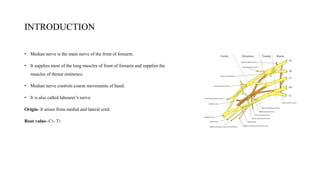
• Median nerve is the main nerve of the front of forearm.
• It supplies most of the long muscles of front of forearm and supplies the
muscles of thenar eminence.
• Median nerve controls coarse movements of hand.
• It is also called labourer’s nerve.
Origin- It arises from medial and lateral cord
Root value- C5- T1
COURSE OF THE NERVE
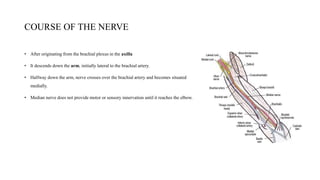
• After originating from the brachial plexus in the axilla
• It descends down the arm, initially lateral to the brachial artery.
• Halfway down the arm, nerve crosses over the brachial artery and becomes situated
medially.
• Median nerve does not provide motor or sensory innervation until it reaches the elbow.
It reaches the elbow
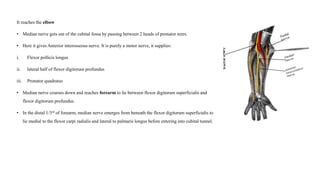
• Median nerve gets out of the cubital fossa by passing between 2 heads of pronator teres.
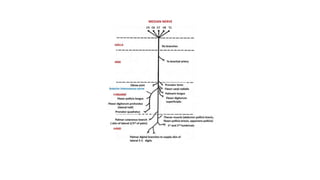
• Here it gives Anterior interosseous nerve. It is purely a motor nerve, it supplies:
i. Flexor pollicis longus
ii. lateral half of flexor digitorum profundus
iii. Pronator quadratus
• Median nerve courses down and reaches forearm to lie between flexor digitorum superficialis and
flexor digitorum profundus.
• In the distal 1/3rd of forearm, median nerve emerges from beneath the flexor digitorum superficialis to
lie medial to the flexor carpi radialis and lateral to palmaris longus before entering into cubital tunnel.
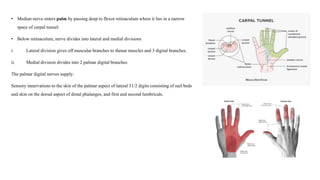
• Median nerve enters palm by passing deep to flexor retinaculum where it lies in a narrow
space of carpal tunnel.
• Below retinaculum, nerve divides into lateral and medial divisions
i. Lateral division gives off muscular branches to thenar muscles and 3 digital branches.
ii. Medial division divides into 2 palmar digital branches
The palmar digital nerves supply:
Sensory innervations to the skin of the palmar aspect of lateral 31/2 digits consisting of nail beds
and skin on the dorsal aspect of distal phalanges, and first and second lumbricals.
BRANCHES
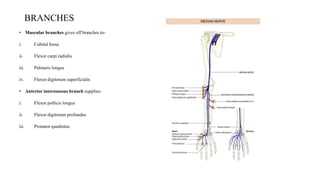
• Muscular branches gives off branches to-
i. Cubital fossa
ii. Flexor carpi radialis
iii. Palmaris longus
iv. Flexor digitorum superficialis
• Anterior interosseous branch supplies-
i. Flexor pollicis longus
ii. Flexor digitorum profundus
iii. Pronator quadratus
MEDIAN NERVE COMPRESSION
Compression of median nerve leads to 3 important syndromes:
i. Carpal tunnel syndrome
ii. Anterior interosseous syndrome
iii. Pronator teres syndrome
Carpal tunnel syndrome-
Carpal tunnel syndrome (CTS) is a common condition, which causes pain, numbness, and tingling in the hand and arm of the affected individual.
CTS occurs when the median nerve is squeezed or compressed as it travels through the wrist.
The syndrome is characterized by pain in the hand, numbness, and tingling in the distribution of the median nerve. These sensations may be felt in
the thumb, index finger, middle finger, and the radial side of the ring finger.
Anterior interosseous syndrome
AIN syndrome is a pure motor neuropathy which is an isolated palsy of three muscles (flexor pollicus longus, flexor digitorum profundus, and
pronator quadratus)
It manifests mostly as pain in the forearm accompanied frequently by a characteristic weakness of the index and thumb finger pincer movement.
Pronator teres syndrome-
The median nerve passes between 2 heads of pronator teres.
Manifested as- weakness of flexor pollicis and abductor pollicis brevis.

MEDIAN NERVE.pptx

  • 1.
  • 2.
    INTRODUCTION • Median nerveis the main nerve of the front of forearm. • It supplies most of the long muscles of front of forearm and supplies the muscles of thenar eminence. • Median nerve controls coarse movements of hand. • It is also called labourer’s nerve. Origin- It arises from medial and lateral cord Root value- C5- T1
  • 3.
    COURSE OF THENERVE • After originating from the brachial plexus in the axilla • It descends down the arm, initially lateral to the brachial artery. • Halfway down the arm, nerve crosses over the brachial artery and becomes situated medially. • Median nerve does not provide motor or sensory innervation until it reaches the elbow.
  • 4.
    It reaches theelbow • Median nerve gets out of the cubital fossa by passing between 2 heads of pronator teres. • Here it gives Anterior interosseous nerve. It is purely a motor nerve, it supplies: i. Flexor pollicis longus ii. lateral half of flexor digitorum profundus iii. Pronator quadratus • Median nerve courses down and reaches forearm to lie between flexor digitorum superficialis and flexor digitorum profundus. • In the distal 1/3rd of forearm, median nerve emerges from beneath the flexor digitorum superficialis to lie medial to the flexor carpi radialis and lateral to palmaris longus before entering into cubital tunnel.
  • 5.
    • Median nerveenters palm by passing deep to flexor retinaculum where it lies in a narrow space of carpal tunnel. • Below retinaculum, nerve divides into lateral and medial divisions i. Lateral division gives off muscular branches to thenar muscles and 3 digital branches. ii. Medial division divides into 2 palmar digital branches The palmar digital nerves supply: Sensory innervations to the skin of the palmar aspect of lateral 31/2 digits consisting of nail beds and skin on the dorsal aspect of distal phalanges, and first and second lumbricals.
  • 6.
    BRANCHES • Muscular branchesgives off branches to- i. Cubital fossa ii. Flexor carpi radialis iii. Palmaris longus iv. Flexor digitorum superficialis • Anterior interosseous branch supplies- i. Flexor pollicis longus ii. Flexor digitorum profundus iii. Pronator quadratus
  • 8.
    MEDIAN NERVE COMPRESSION Compressionof median nerve leads to 3 important syndromes: i. Carpal tunnel syndrome ii. Anterior interosseous syndrome iii. Pronator teres syndrome
  • 9.
    Carpal tunnel syndrome- Carpaltunnel syndrome (CTS) is a common condition, which causes pain, numbness, and tingling in the hand and arm of the affected individual. CTS occurs when the median nerve is squeezed or compressed as it travels through the wrist. The syndrome is characterized by pain in the hand, numbness, and tingling in the distribution of the median nerve. These sensations may be felt in the thumb, index finger, middle finger, and the radial side of the ring finger. Anterior interosseous syndrome AIN syndrome is a pure motor neuropathy which is an isolated palsy of three muscles (flexor pollicus longus, flexor digitorum profundus, and pronator quadratus) It manifests mostly as pain in the forearm accompanied frequently by a characteristic weakness of the index and thumb finger pincer movement. Pronator teres syndrome- The median nerve passes between 2 heads of pronator teres. Manifested as- weakness of flexor pollicis and abductor pollicis brevis.