Presentation Template
(name)Magazine Case Study (can be used
for both the chosen magazine and the sample – the NME)
Magazine
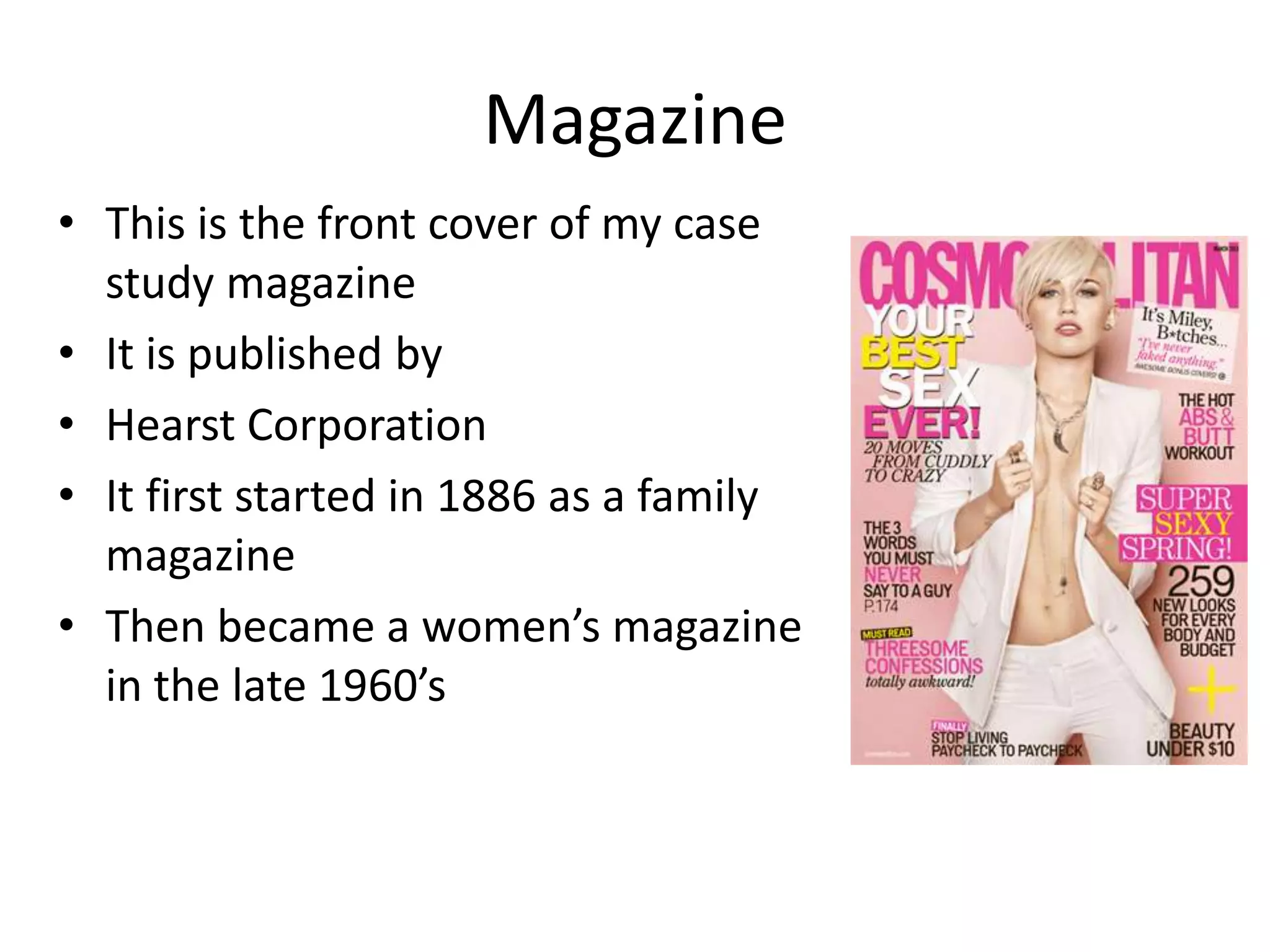
• This is the front cover of my case
study magazine
• It is published by
• Hearst Corporation
• It first started in 1886 as a family
magazine
• Then became a women’s magazine
in the late 1960’s
The Past
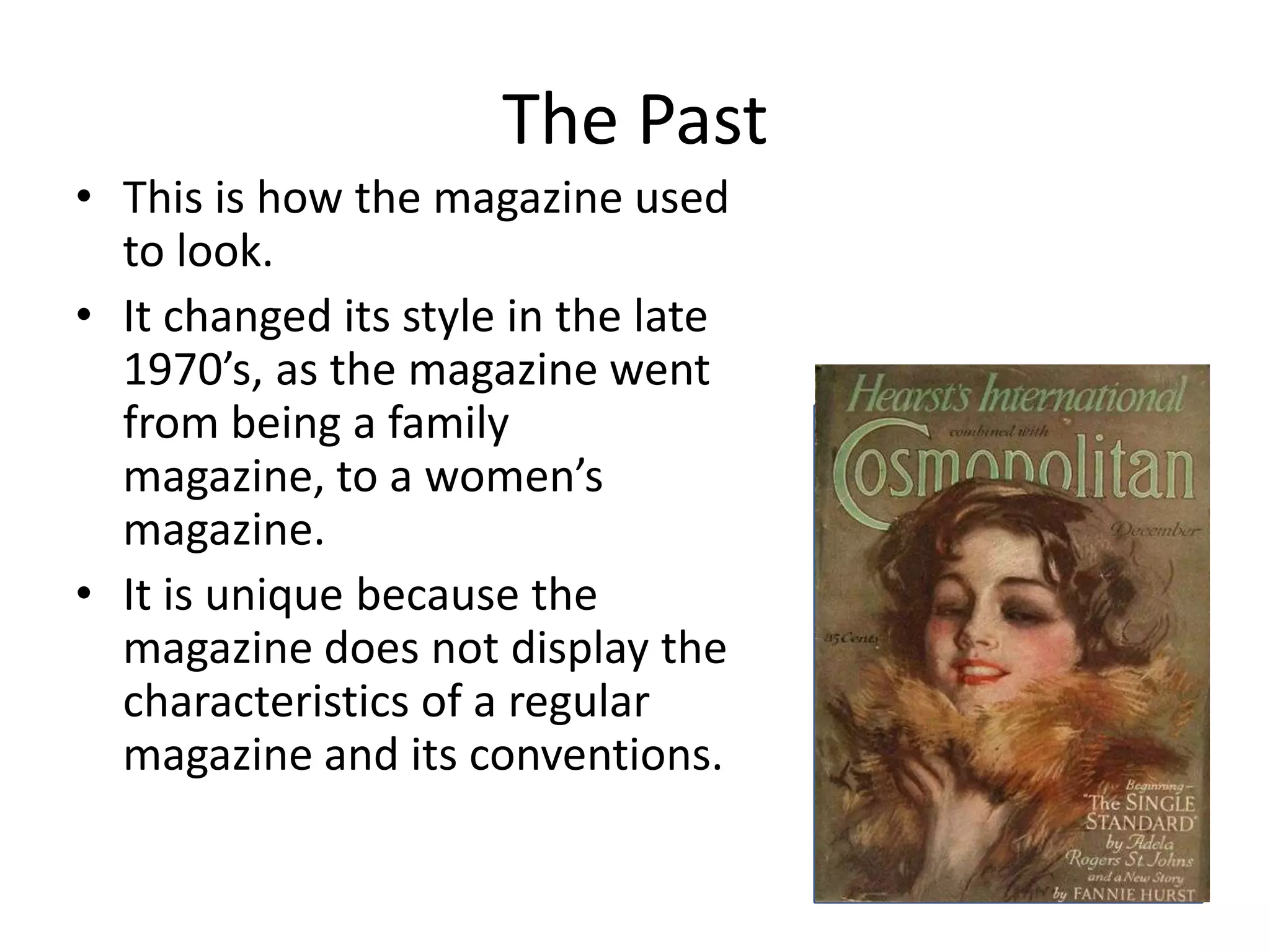
• This is how the magazine used
to look.
• It changed its style in the late
1970’s, as the magazine went
from being a family
magazine, to a women’s
magazine.
• It is unique because the
magazine does not display the
characteristics of a regular
magazine and its conventions.
History in General
• The magazine began in 1886 and is still going.
• Major changes in its history include the overall
cover and style of the magazine, as the
magazine went from being a family and home
magazine to focusing more towards women
and what they would want to see.
Biggest Rival
•
•
•
•
•
•

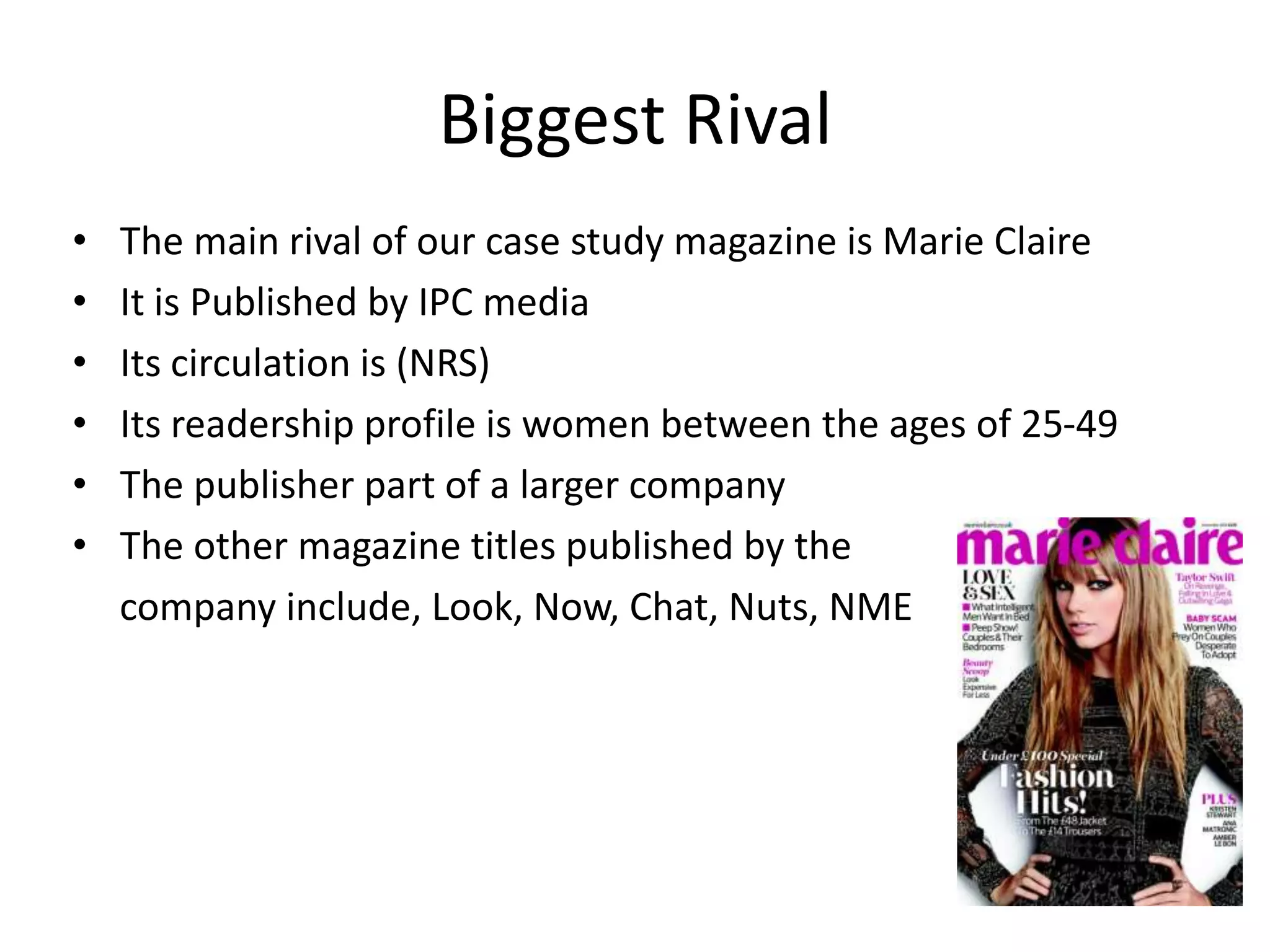
The main rival of our case study magazine is Marie Claire
It is Published by IPC media
Its circulation is (NRS)
Its readership profile is women between the ages of 25-49
The publisher part of a larger company
The other magazine titles published by the
company include, Look, Now, Chat, Nuts, NME
Publisher
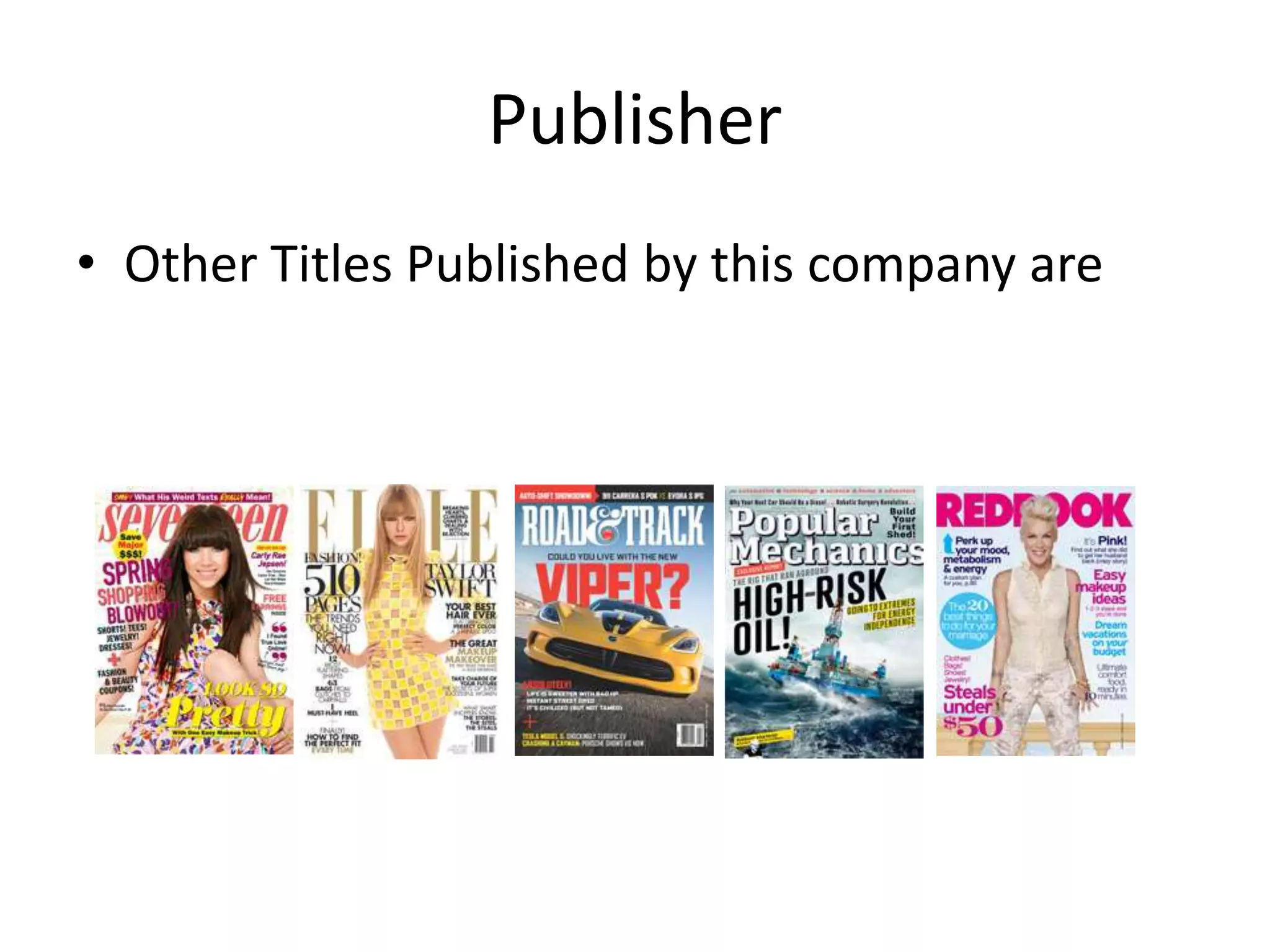
• Other Titles Published by this company are
Ownership
• The Publishing company is independent.
• These are some of the other companies owned by the
same publisher, ESPN, A+E Networks, Elle, The News-Times.
• The company began March 4th 1887, when William
Randolph Hearst placed his name on the masthead of a
newspaper, the company is still running now.
• A documentary was made called ‘Citizen Hearst’ about the
company, and premiered at the Hamptons International
Film Festival.
• Walt Disney company is the biggest media conglomerate.
It’s revenue in 2010 was $38 billion.
• Time Warner are now the second largest media
conglomerate with $28-29 billion.
• Reputation is effected by scandal
Globalisation
• Globalisation – When a company expands to
operate internationally.
• Aggregation – Being in charge of the searches
through a search facility.
• The Google Takeover Model describes that
Google will eventually take over the world, as
it becomes more powerful day to day, with
more people desiring it a search engine, and
for the use of their emails etc.
Globalisation
• The ‘brand / logo’ of my magazine is
• The magazine has 64 international editions, is printed in 35
languages and is distributed in more than 100 countries
• Magazines usually make profit from advertisements,
subscriptions, and the general sale of the magazine from
newsstands
• The survival of the magazine depends greatly on the
attraction of the intended audience, if the magazine keeps
the intended audience interested, they are more likely to
stay faithful with purchasing the magazine. If it strays from
the original idea, audiences will be lost, losing sales.
• Consider the questions on slide 13 of lesson 3
Theory Notes Section
Week One Institutions and
Globalisation

• The Walt Disney Company, News
Corp, and Time Warner are all examples
of media conglomerate.
• Cross Media Ownership – When one
company owns media outlets from
different types of media. For example
News Corp own television companies
like Sky, newspapers like The Sun, and
websites like Myspace.
• ‘The Big Six’
• Pluralism – Most of the major media
outlets are owned by a small number of
companies rather than a large number.
• Media Mogul – A very important person
that owns a media company
Audience
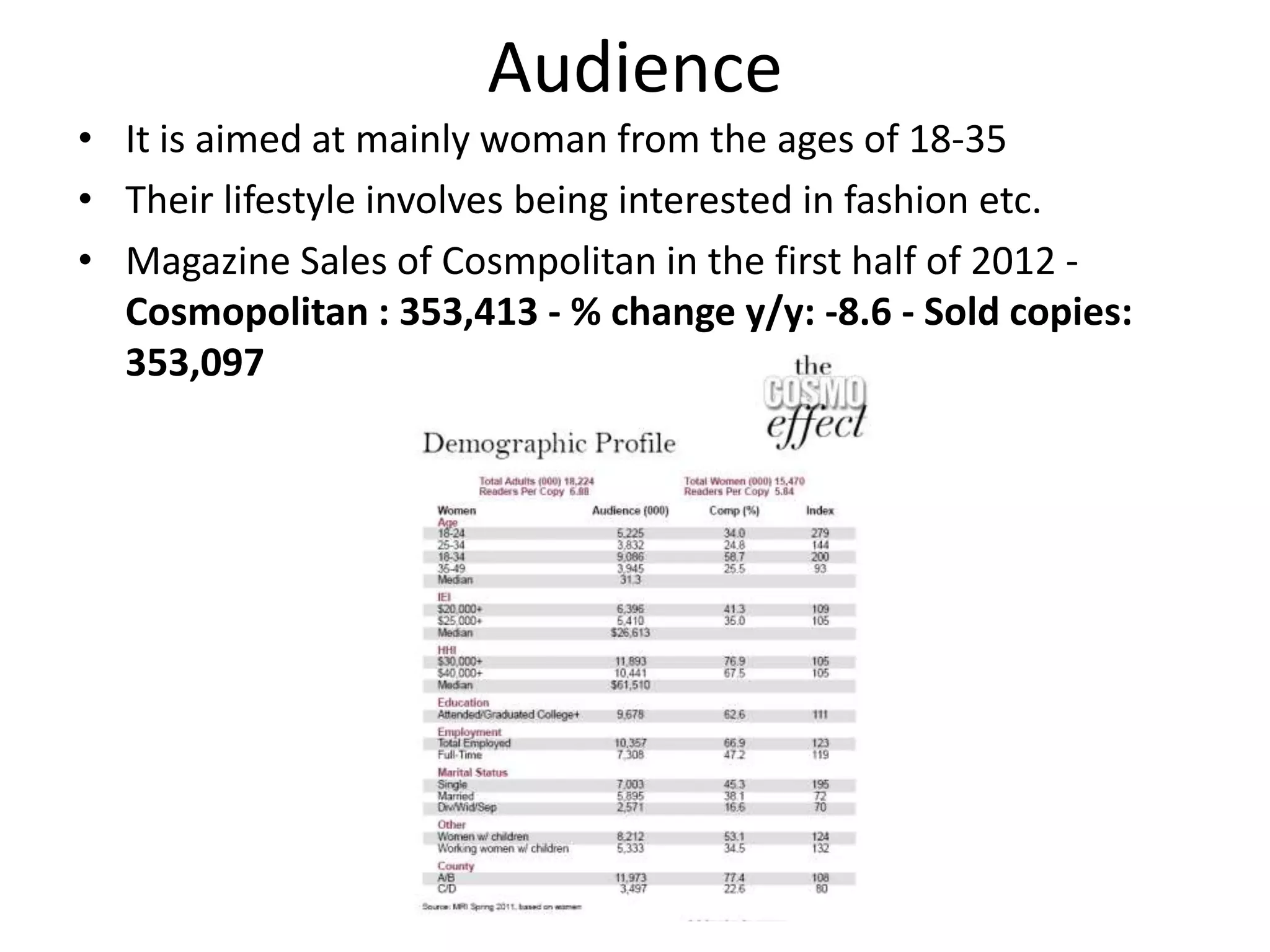
• It is aimed at mainly woman from the ages of 18-35
• Their lifestyle involves being interested in fashion etc.
• Magazine Sales of Cosmpolitan in the first half of 2012 Cosmopolitan : 353,413 - % change y/y: -8.6 - Sold copies:
353,097
The
magazine
had a
circulation of
25,000

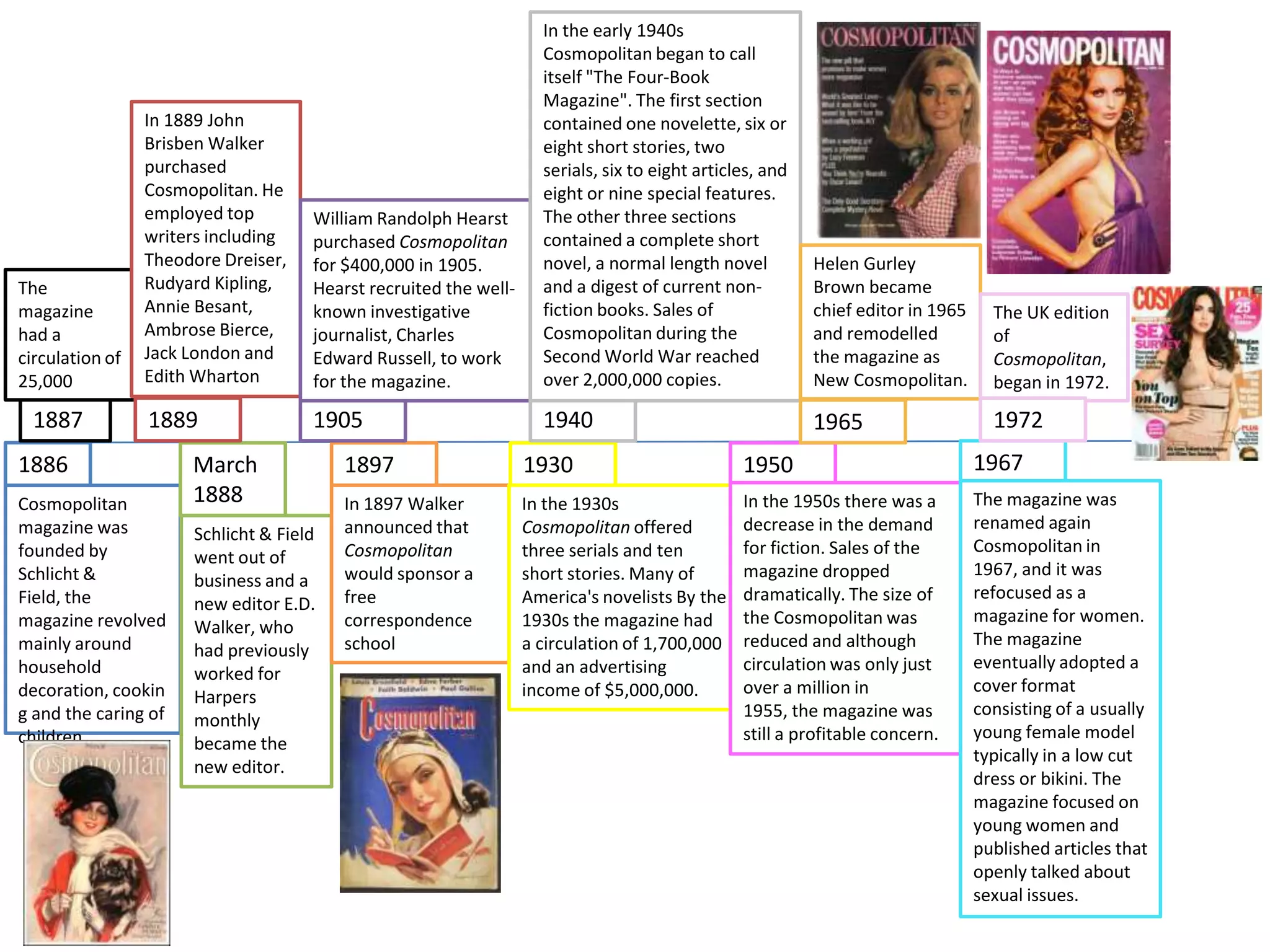
1887

In 1889 John
Brisben Walker
purchased
Cosmopolitan. He
employed top
writers including
Theodore Dreiser,
Rudyard Kipling,
Annie Besant,
Ambrose Bierce,
Jack London and
Edith Wharton

William Randolph Hearst
purchased Cosmopolitan
for $400,000 in 1905.
Hearst recruited the wellknown investigative
journalist, Charles
Edward Russell, to work
for the magazine.

In the early 1940s
Cosmopolitan began to call
itself "The Four-Book
Magazine". The first section
contained one novelette, six or
eight short stories, two
serials, six to eight articles, and
eight or nine special features.
The other three sections
contained a complete short
novel, a normal length novel
and a digest of current nonfiction books. Sales of
Cosmopolitan during the
Second World War reached
over 2,000,000 copies.

1889

1905

1940

1886
Cosmopolitan
magazine was
founded by
Schlicht &
Field, the
magazine revolved
mainly around
household
decoration, cookin
g and the caring of
children

March
1888
Schlicht & Field
went out of
business and a
new editor E.D.
Walker, who
had previously
worked for
Harpers
monthly
became the
new editor.

Helen Gurley
Brown became
chief editor in 1965
and remodelled
the magazine as
New Cosmopolitan.

The UK edition
of
Cosmopolitan,
began in 1972.

1965

1972

1897

1930

1950

1967

In 1897 Walker
announced that
Cosmopolitan
would sponsor a
free
correspondence
school

In the 1930s
Cosmopolitan offered
three serials and ten
short stories. Many of
America's novelists By the
1930s the magazine had
a circulation of 1,700,000
and an advertising
income of $5,000,000.

In the 1950s there was a
decrease in the demand
for fiction. Sales of the
magazine dropped
dramatically. The size of
the Cosmopolitan was
reduced and although
circulation was only just
over a million in
1955, the magazine was
still a profitable concern.

The magazine was
renamed again
Cosmopolitan in
1967, and it was
refocused as a
magazine for women.
The magazine
eventually adopted a
cover format
consisting of a usually
young female model
typically in a low cut
dress or bikini. The
magazine focused on
young women and
published articles that
openly talked about
sexual issues.
Content & Style
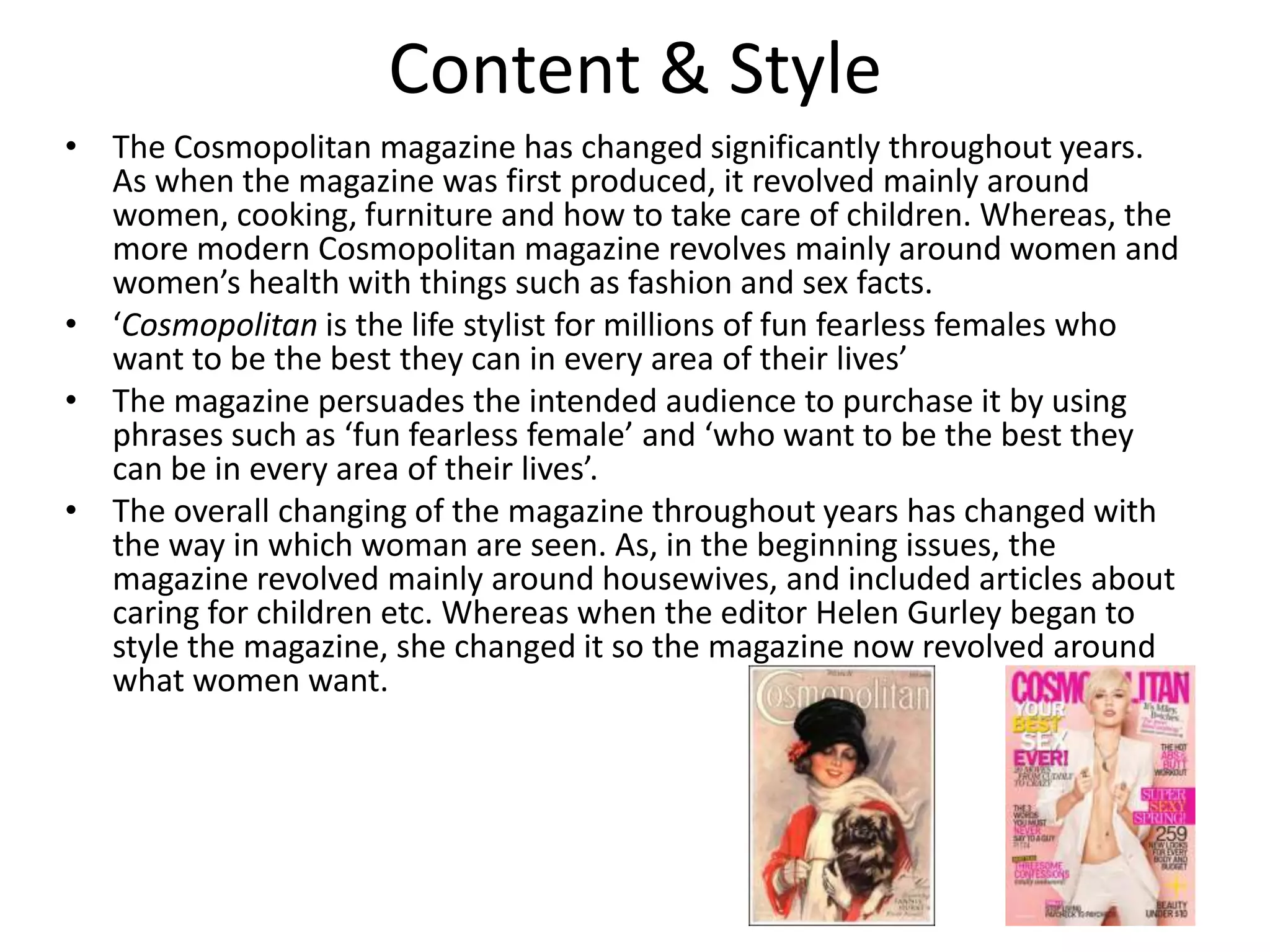
• The Cosmopolitan magazine has changed significantly throughout years.
As when the magazine was first produced, it revolved mainly around
women, cooking, furniture and how to take care of children. Whereas, the
more modern Cosmopolitan magazine revolves mainly around women and
women’s health with things such as fashion and sex facts.
• ‘Cosmopolitan is the life stylist for millions of fun fearless females who
want to be the best they can in every area of their lives’
• The magazine persuades the intended audience to purchase it by using
phrases such as ‘fun fearless female’ and ‘who want to be the best they
can be in every area of their lives’.
• The overall changing of the magazine throughout years has changed with
the way in which woman are seen. As, in the beginning issues, the
magazine revolved mainly around housewives, and included articles about
caring for children etc. Whereas when the editor Helen Gurley began to
style the magazine, she changed it so the magazine now revolved around
what women want.
Audience: History & Traditions
Find or cut / paste:
• Changes in the subject matter of the magazine
• Examples of language use and register
• Links to press releases from the publisher and
newspaper or blog articles about the magazine
including any major stories / controversies
surrounding it (use Media Guardian)
• Evidence of sales and web hits increasing or
decreasing and any reasons or ideas why
Evolution of the Web
• Insert pictures of how, if at all, the printed
magazine looks now along with samples of how
the website looks
• What is available in each form (printed / online)?
• Which types of content and service is offered and
which appears most popular?
• What form would some of the web content take
if it were printed? Is any of it impossible to do in
printed form?
• In what ways has the magazine become more
than ‘just a magazine’?
Evolution of magazines
• Here are some more facts about e-technology
and the evolution of magazines and the issues
related to it…..
Web 3.0 & the Future
• What the internet offers for the future of
magazines in general includes...
• If you were the editor of the magazine what
would you do to ensure survival and success
of the title?
• How do you see the title developing in the
next 5 years?
• Web 1.0 static webpages
you can’t edit them or
search for them.
Week Two –
Audience, Content, • Web 2.0 social networking
History & Tradition
sites such as Myspace &
Facebook, Youtube and
Google
• Web 3.0 personalisation
and accessibility, artificial
intelligence helps
personalise your searches

Theory Notes Section
Synergy in the Media
In media economics, synergy is the promotion and sale of a
product (and all its versions) throughout the various subsidiaries
of a media conglomerate e.g. films, soundtracks or video games.
Walt Disney pioneered synergistic marketing techniques in the
1930s by granting dozens of firms the right to use his Mickey
Mouse character in products and ads, and continued to market
Disney media through licensing arrangements. These products
can help advertise the film itself and thus help to increase the
film's sales. For example, the Spider-Man films had toys of web
shooters and figures of the characters made, as well as posters
and games. The NBC sitcom 30 Rock often shows the power of
synergy, while also poking fun at the use of the term in the
corporate world.
What is a brand and why is it important?
• A brand is a type of product manufactured by a company under a
particular name.
• In marketing terms, the definition of branding is the sum total of a
company’s value, including
products, services, people, advertising, positioning and culture.
• Branding is important, as it simplifies the ability of distinguishing a
certain product from a range of several other similar products.
• Brands give potential clients a firm idea of what they are buying
before they buy it, making the purchasing decision easier.
• Customers trust strong brands because they know what to expect.
Convergence
•
•
•
•

Convergence – Coming together
All of the media is coming together as one
Multi media involves being multi skilled
The Digital Threat – Trust and reliability with
magazines, unlike the internet, e.g. Twitter.
• Aggregation – All of the sources that you use, and
sorting through things so you have all of the best
sources.
• http://stevesmags.blogspot.co.uk/2011/03/futur
e-of-print-industry-lecture-notes.html
Synergy and the Online Age
• The use of the internet and being able to find things immediately.
• The internet updates immediately where as you have to wait
weeks/months for the publish of a magazine. (Twitter)
• Competition from bloggers
• Audience interaction
• New technical standards
• Piracy and intellectual copyright
• Free creativity – the idea that you can use somebody else’s work
and make something new
• Piracy has a serious affect on the music industry. How the subject
matter of my magazines is affected by the online age includes….
Advertising/Sponsorship
• Examples of advertising, sponsorship and
promotions in case study title include……..
• Convergence has or could enhance this in the
following ways……….
• An example of synergy is………
Synergy
• What other companies do your owners own?
• What other companies is your magazine
associated with in some way?
Why magazines die
• In the past, the following magazines have disappeared
Nickelodeon "Nick" Magazine, Modern
Bride, Television Week and Official Playstation
Magazine.
• This is because the magazines may not be generating
enough profit due to competitor magazines or a
decrease in the fan base.
• The biggest threat to my magazines’ survival is
competitor magazine Marie Claire, as both of these
magazines display the same material.
• Ways it can survive might be to entice the fan base
more with certain articles.
Theory Notes Section
Week Three –
Technology &
Convergence
Online Magazines
• Proliferation – ‘growth’. The internet has seen all kinds of
new media emerge with new trends being born and dying
off in a short space of time.
• The original aim of the internet was to have free
information on everything.
• Due to nobody owning anything on the internet, piracy is a
lot stronger and more likely in existing. This is as nobody
can stop this from happening or control it happening.
How the Web Changes Print
• Facebook can be seen as revolutionary as it involves the
audience it has achieved, with the ability to create
events and partake in them.
• Journalists need to be good at generating content.
• Journalists work with television as they generate the
content, and then try to provide information for the
news channels to show. Enabling a stronger future.
• As long as people can recognise where the information
comes from the industry will go on.
Webzine Case Study
• Examples of webzines in • I have chosen to focus
the same genre as my
on...........
case study are.....
• (screen shot??)
Description of Webzine
• Content..specialist or
broad ranging
• Examples of
articles/features
• Target audience is....
• Look/style
• Ease of use/navigation
• What services /uses are
on offer?

• Who advertises on the
site?
• Any specific offers
sponsorship/promotion
Webzine Study Conclusions
•
•
•
•

The webzine is independent or part of..........
The owner is.........
Subscriptions cost
How does this compare to Case Study magazine
in terms of cost value for money?
• Could you see this taking off?
• Pros and Cons of Print vs. Webzine
(Vfm, services, spinoffs, style, articles, reports, ease of
use, accessibility, interactivity, aggregation)
Rivals and Webzines
• Compare any rival publications or rival
webzines with either of your magazines (use
the list in the last bullet point of the last slide)
• Which is likely to be the most successful?
Theory Notes Section
Week Four –
Synergy, Productio
n & Distribution
How Magazines Use Their
Audience
Print on Demand – The idea that you
have an internet enabled photocopier
in news agents, you can request the
magazine you want and it will be
printed out for you there and then.
Flash Crowds
Virals
Social Networking Events such as
festivals
Perfect Storm

• Long tail theory – Where all
of the main stream
products are worth as
much as the proliferation
of all of the free online
content put together.
• Symbiosis – Benefits two
things that come together.

Media presentation template

  • 1.
    Presentation Template (name)Magazine CaseStudy (can be used for both the chosen magazine and the sample – the NME)
  • 2.
    Magazine • This isthe front cover of my case study magazine • It is published by • Hearst Corporation • It first started in 1886 as a family magazine • Then became a women’s magazine in the late 1960’s
  • 3.
    The Past • Thisis how the magazine used to look. • It changed its style in the late 1970’s, as the magazine went from being a family magazine, to a women’s magazine. • It is unique because the magazine does not display the characteristics of a regular magazine and its conventions.
  • 4.
    History in General •The magazine began in 1886 and is still going. • Major changes in its history include the overall cover and style of the magazine, as the magazine went from being a family and home magazine to focusing more towards women and what they would want to see.
  • 5.
    Biggest Rival • • • • • • The mainrival of our case study magazine is Marie Claire It is Published by IPC media Its circulation is (NRS) Its readership profile is women between the ages of 25-49 The publisher part of a larger company The other magazine titles published by the company include, Look, Now, Chat, Nuts, NME
  • 6.
    Publisher • Other TitlesPublished by this company are
  • 7.
    Ownership • The Publishingcompany is independent. • These are some of the other companies owned by the same publisher, ESPN, A+E Networks, Elle, The News-Times. • The company began March 4th 1887, when William Randolph Hearst placed his name on the masthead of a newspaper, the company is still running now. • A documentary was made called ‘Citizen Hearst’ about the company, and premiered at the Hamptons International Film Festival. • Walt Disney company is the biggest media conglomerate. It’s revenue in 2010 was $38 billion. • Time Warner are now the second largest media conglomerate with $28-29 billion. • Reputation is effected by scandal
  • 8.
    Globalisation • Globalisation –When a company expands to operate internationally. • Aggregation – Being in charge of the searches through a search facility. • The Google Takeover Model describes that Google will eventually take over the world, as it becomes more powerful day to day, with more people desiring it a search engine, and for the use of their emails etc.
  • 9.
    Globalisation • The ‘brand/ logo’ of my magazine is • The magazine has 64 international editions, is printed in 35 languages and is distributed in more than 100 countries • Magazines usually make profit from advertisements, subscriptions, and the general sale of the magazine from newsstands • The survival of the magazine depends greatly on the attraction of the intended audience, if the magazine keeps the intended audience interested, they are more likely to stay faithful with purchasing the magazine. If it strays from the original idea, audiences will be lost, losing sales. • Consider the questions on slide 13 of lesson 3
  • 10.
    Theory Notes Section WeekOne Institutions and Globalisation • The Walt Disney Company, News Corp, and Time Warner are all examples of media conglomerate. • Cross Media Ownership – When one company owns media outlets from different types of media. For example News Corp own television companies like Sky, newspapers like The Sun, and websites like Myspace. • ‘The Big Six’ • Pluralism – Most of the major media outlets are owned by a small number of companies rather than a large number. • Media Mogul – A very important person that owns a media company
  • 11.
    Audience • It isaimed at mainly woman from the ages of 18-35 • Their lifestyle involves being interested in fashion etc. • Magazine Sales of Cosmpolitan in the first half of 2012 Cosmopolitan : 353,413 - % change y/y: -8.6 - Sold copies: 353,097
  • 12.
    The magazine had a circulation of 25,000 1887 In1889 John Brisben Walker purchased Cosmopolitan. He employed top writers including Theodore Dreiser, Rudyard Kipling, Annie Besant, Ambrose Bierce, Jack London and Edith Wharton William Randolph Hearst purchased Cosmopolitan for $400,000 in 1905. Hearst recruited the wellknown investigative journalist, Charles Edward Russell, to work for the magazine. In the early 1940s Cosmopolitan began to call itself "The Four-Book Magazine". The first section contained one novelette, six or eight short stories, two serials, six to eight articles, and eight or nine special features. The other three sections contained a complete short novel, a normal length novel and a digest of current nonfiction books. Sales of Cosmopolitan during the Second World War reached over 2,000,000 copies. 1889 1905 1940 1886 Cosmopolitan magazine was founded by Schlicht & Field, the magazine revolved mainly around household decoration, cookin g and the caring of children March 1888 Schlicht & Field went out of business and a new editor E.D. Walker, who had previously worked for Harpers monthly became the new editor. Helen Gurley Brown became chief editor in 1965 and remodelled the magazine as New Cosmopolitan. The UK edition of Cosmopolitan, began in 1972. 1965 1972 1897 1930 1950 1967 In 1897 Walker announced that Cosmopolitan would sponsor a free correspondence school In the 1930s Cosmopolitan offered three serials and ten short stories. Many of America's novelists By the 1930s the magazine had a circulation of 1,700,000 and an advertising income of $5,000,000. In the 1950s there was a decrease in the demand for fiction. Sales of the magazine dropped dramatically. The size of the Cosmopolitan was reduced and although circulation was only just over a million in 1955, the magazine was still a profitable concern. The magazine was renamed again Cosmopolitan in 1967, and it was refocused as a magazine for women. The magazine eventually adopted a cover format consisting of a usually young female model typically in a low cut dress or bikini. The magazine focused on young women and published articles that openly talked about sexual issues.
  • 13.
    Content & Style •The Cosmopolitan magazine has changed significantly throughout years. As when the magazine was first produced, it revolved mainly around women, cooking, furniture and how to take care of children. Whereas, the more modern Cosmopolitan magazine revolves mainly around women and women’s health with things such as fashion and sex facts. • ‘Cosmopolitan is the life stylist for millions of fun fearless females who want to be the best they can in every area of their lives’ • The magazine persuades the intended audience to purchase it by using phrases such as ‘fun fearless female’ and ‘who want to be the best they can be in every area of their lives’. • The overall changing of the magazine throughout years has changed with the way in which woman are seen. As, in the beginning issues, the magazine revolved mainly around housewives, and included articles about caring for children etc. Whereas when the editor Helen Gurley began to style the magazine, she changed it so the magazine now revolved around what women want.
  • 14.
    Audience: History &Traditions Find or cut / paste: • Changes in the subject matter of the magazine • Examples of language use and register • Links to press releases from the publisher and newspaper or blog articles about the magazine including any major stories / controversies surrounding it (use Media Guardian) • Evidence of sales and web hits increasing or decreasing and any reasons or ideas why
  • 15.
    Evolution of theWeb • Insert pictures of how, if at all, the printed magazine looks now along with samples of how the website looks • What is available in each form (printed / online)? • Which types of content and service is offered and which appears most popular? • What form would some of the web content take if it were printed? Is any of it impossible to do in printed form? • In what ways has the magazine become more than ‘just a magazine’?
  • 16.
    Evolution of magazines •Here are some more facts about e-technology and the evolution of magazines and the issues related to it…..
  • 17.
    Web 3.0 &the Future • What the internet offers for the future of magazines in general includes... • If you were the editor of the magazine what would you do to ensure survival and success of the title? • How do you see the title developing in the next 5 years?
  • 18.
    • Web 1.0static webpages you can’t edit them or search for them. Week Two – Audience, Content, • Web 2.0 social networking History & Tradition sites such as Myspace & Facebook, Youtube and Google • Web 3.0 personalisation and accessibility, artificial intelligence helps personalise your searches Theory Notes Section
  • 19.
    Synergy in theMedia In media economics, synergy is the promotion and sale of a product (and all its versions) throughout the various subsidiaries of a media conglomerate e.g. films, soundtracks or video games. Walt Disney pioneered synergistic marketing techniques in the 1930s by granting dozens of firms the right to use his Mickey Mouse character in products and ads, and continued to market Disney media through licensing arrangements. These products can help advertise the film itself and thus help to increase the film's sales. For example, the Spider-Man films had toys of web shooters and figures of the characters made, as well as posters and games. The NBC sitcom 30 Rock often shows the power of synergy, while also poking fun at the use of the term in the corporate world.
  • 20.
    What is abrand and why is it important? • A brand is a type of product manufactured by a company under a particular name. • In marketing terms, the definition of branding is the sum total of a company’s value, including products, services, people, advertising, positioning and culture. • Branding is important, as it simplifies the ability of distinguishing a certain product from a range of several other similar products. • Brands give potential clients a firm idea of what they are buying before they buy it, making the purchasing decision easier. • Customers trust strong brands because they know what to expect.
  • 21.
    Convergence • • • • Convergence – Comingtogether All of the media is coming together as one Multi media involves being multi skilled The Digital Threat – Trust and reliability with magazines, unlike the internet, e.g. Twitter. • Aggregation – All of the sources that you use, and sorting through things so you have all of the best sources. • http://stevesmags.blogspot.co.uk/2011/03/futur e-of-print-industry-lecture-notes.html
  • 22.
    Synergy and theOnline Age • The use of the internet and being able to find things immediately. • The internet updates immediately where as you have to wait weeks/months for the publish of a magazine. (Twitter) • Competition from bloggers • Audience interaction • New technical standards • Piracy and intellectual copyright • Free creativity – the idea that you can use somebody else’s work and make something new • Piracy has a serious affect on the music industry. How the subject matter of my magazines is affected by the online age includes….
  • 23.
    Advertising/Sponsorship • Examples ofadvertising, sponsorship and promotions in case study title include…….. • Convergence has or could enhance this in the following ways………. • An example of synergy is………
  • 24.
    Synergy • What othercompanies do your owners own? • What other companies is your magazine associated with in some way?
  • 25.
    Why magazines die •In the past, the following magazines have disappeared Nickelodeon "Nick" Magazine, Modern Bride, Television Week and Official Playstation Magazine. • This is because the magazines may not be generating enough profit due to competitor magazines or a decrease in the fan base. • The biggest threat to my magazines’ survival is competitor magazine Marie Claire, as both of these magazines display the same material. • Ways it can survive might be to entice the fan base more with certain articles.
  • 26.
    Theory Notes Section WeekThree – Technology & Convergence
  • 27.
    Online Magazines • Proliferation– ‘growth’. The internet has seen all kinds of new media emerge with new trends being born and dying off in a short space of time. • The original aim of the internet was to have free information on everything. • Due to nobody owning anything on the internet, piracy is a lot stronger and more likely in existing. This is as nobody can stop this from happening or control it happening.
  • 28.
    How the WebChanges Print • Facebook can be seen as revolutionary as it involves the audience it has achieved, with the ability to create events and partake in them. • Journalists need to be good at generating content. • Journalists work with television as they generate the content, and then try to provide information for the news channels to show. Enabling a stronger future. • As long as people can recognise where the information comes from the industry will go on.
  • 29.
    Webzine Case Study •Examples of webzines in • I have chosen to focus the same genre as my on........... case study are..... • (screen shot??)
  • 30.
    Description of Webzine •Content..specialist or broad ranging • Examples of articles/features • Target audience is.... • Look/style • Ease of use/navigation • What services /uses are on offer? • Who advertises on the site? • Any specific offers sponsorship/promotion
  • 31.
    Webzine Study Conclusions • • • • Thewebzine is independent or part of.......... The owner is......... Subscriptions cost How does this compare to Case Study magazine in terms of cost value for money? • Could you see this taking off? • Pros and Cons of Print vs. Webzine (Vfm, services, spinoffs, style, articles, reports, ease of use, accessibility, interactivity, aggregation)
  • 32.
    Rivals and Webzines •Compare any rival publications or rival webzines with either of your magazines (use the list in the last bullet point of the last slide) • Which is likely to be the most successful?
  • 33.
    Theory Notes Section WeekFour – Synergy, Productio n & Distribution
  • 34.
    How Magazines UseTheir Audience Print on Demand – The idea that you have an internet enabled photocopier in news agents, you can request the magazine you want and it will be printed out for you there and then. Flash Crowds Virals Social Networking Events such as festivals Perfect Storm • Long tail theory – Where all of the main stream products are worth as much as the proliferation of all of the free online content put together. • Symbiosis – Benefits two things that come together.

Editor's Notes

  • #3 WARNING: DO NOT confuse the publisher with the owner!
  • #11 Aim to include information from the ‘questions to answer’ sections of the powerpoints.
  • #19 Aim to include information from the ‘questions to answer’ sections of the powerpoints.
  • #27 Aim to include information from the ‘questions to answer’ sections of the powerpoints.
  • #34 Aim to include information from the ‘questions to answer’ sections of the powerpoints.