Prelim Task Evaluation
By Tyra Chuck
1.
Who did you work with and how did you manage the tasks between you? Explain how you organised your time and
schedules. What issues came up with time management? What problems did you come up against? How did you deal with
these? What were your strengths and weaknesses in this area? What would you do differently next time?
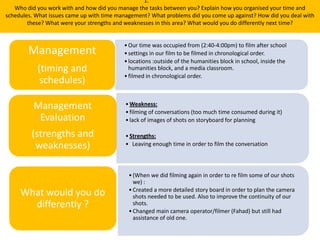
•Our time was occupied from (2:40-4:00pm) to film after school
•settings in our film to be filmed in chronological order.
•locations :outside of the humanities block in school, inside the
humanities block, and a media classroom.
•filmed in chronological order.
Management
(timing and
schedules)
•Weakness:
•filming of conversations (too much time consumed during it)
•lack of images of shots on storyboard for planning
•Strengths:
• Leaving enough time in order to film the conversation
Management
Evaluation
(strengths and
weaknesses)
What would you do
differently ?
•(When we did filming again in order to re film some of our shots
we) :
•Created a more detailed story board in order to plan the camera
shots needed to be used. Also to improve the continuity of our
shots.
•Changed main camera operator/filmer (Fahad) but still had
assistance of old one.
How did you plan your sequence? What process did you use?
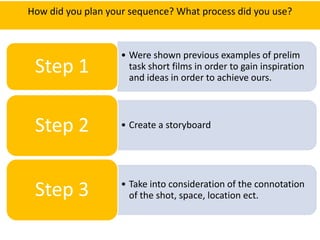
• Were shown previous examples of prelim
task short films in order to gain inspiration
and ideas in order to achieve ours.
Step 1
• Create a storyboardStep 2
• Take into consideration of the connotation
of the shot, space, location ect.Step 3
What technology did you use to complete the task, and how did you use it? What did you learn
about using the cameras? Here you can also refer to the discussions we have had in class
recently about digital cameras.
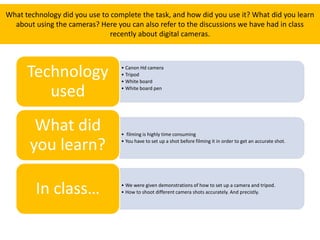
• Canon Hd camera
• Tripod
• White board
• White board pen
Technology
used
• filming is highly time consuming
• You have to set up a shot before filming it in order to get an accurate shot.
What did
you learn?
• We were given demonstrations of how to set up a camera and tripod.
• How to shoot different camera shots accurately. And precistly.In class…
4. What factors did you have to take into account when planning, shooting and
editing?
•Brainstorm different types of shots for various areas in the sequence
of the prelim sequence.
•Created a storyboardPlanning
•Improving continuity of shots ; leaving 4/5 second intervals before
and after shot.
•Space within the shot had to be significant enough that there was not
too much space behind out around individuals or objects in the shot.
Shooting
• Time: working efficiently in order to complete editing as we had to
complete it in a set time. Also carefully editing the clips shortening it
in order to continuity of clip to be effective.
•We used Adode premiere for editing
Editing
5. How successful was your sequence? Please identify what worked well, and
with hindsight, what would you improve/do differently?
•Overall our sequence was successful and of a better standard as we
took into account previous mistakes on other shots we had taken in
order to make out sequence of a higher quality.
How successful was
your sequence?
•Using support from other members of the group in order to get a
diverse and audience representative viewpoint of how the shot looks.
(Changing roles slightly).
What worked well?
•In one of our shots (med shot pan) we had too much space behind the
individual in the shot. So, to improve the sequence we would do this
shot differently by creating more space in order for the subject to walk
into so that the audience is following the individual and not catching up
with them. This improves continuity of the shot.
What would you do
differently to improve
your sequence ?
6. What have you learnt from completing the task? Discuss time
management skills, group work skills, organisational skills and technical
skills of production
•Members of group have to be cooperative and all preform to the task
they have been given. Their views and perspectives have to be taken
into consideration also. Equal views.
Group work
skills
•Plan out what you are willing to do before, during and after the
sequence in order to reduce the amount of time taken on the task
and make everything easier and smoother process wise.
Organisation
skills
•Spirit level of camera and other technical areas of camera should be
checked such as the level and structure of the tripod the camera is on.
•All things taught in lesson about filming and camera should be used to
full extent.
Technical
skills
From completing the task I have learned that shooting a sequence, even though short, takes up a lot of time and focus
and there are various things you have to focus on before, during and after shooting the sequence in order for the
overall product to be successful.
7. Post production - What did you learn about the editing process? How did you make
decisions while editing? How did you plan your time to complete the editing task? What were
your strengths and weaknesses in this area? What would you do differently next time?
• Time consuming
• Have to be precise in the timing of the shots in order to fit it in with
others.
• Different tools used for editing : cut
What did you
learn?
• STRENGTH: using all members of the group in order to form different ways
of how the clip and sequence should look/ be like.
• WEAKNESS: not everyone in the group had the same level of skill and
knowledge on editing, so the editing had to be mainly by one person with
input from others in the group.
Strengths/
Weaknesses
• Have all people in the group have more time editing certain areas of the
sequence. Switching roles more in order to gain different contributions as
well as gaining skills in editing too.
What would you
do differently?

Media prelim task evaluation 2

  • 1.
  • 2.
    1. Who did youwork with and how did you manage the tasks between you? Explain how you organised your time and schedules. What issues came up with time management? What problems did you come up against? How did you deal with these? What were your strengths and weaknesses in this area? What would you do differently next time? •Our time was occupied from (2:40-4:00pm) to film after school •settings in our film to be filmed in chronological order. •locations :outside of the humanities block in school, inside the humanities block, and a media classroom. •filmed in chronological order. Management (timing and schedules) •Weakness: •filming of conversations (too much time consumed during it) •lack of images of shots on storyboard for planning •Strengths: • Leaving enough time in order to film the conversation Management Evaluation (strengths and weaknesses) What would you do differently ? •(When we did filming again in order to re film some of our shots we) : •Created a more detailed story board in order to plan the camera shots needed to be used. Also to improve the continuity of our shots. •Changed main camera operator/filmer (Fahad) but still had assistance of old one.
  • 3.
    How did youplan your sequence? What process did you use? • Were shown previous examples of prelim task short films in order to gain inspiration and ideas in order to achieve ours. Step 1 • Create a storyboardStep 2 • Take into consideration of the connotation of the shot, space, location ect.Step 3
  • 4.
    What technology didyou use to complete the task, and how did you use it? What did you learn about using the cameras? Here you can also refer to the discussions we have had in class recently about digital cameras. • Canon Hd camera • Tripod • White board • White board pen Technology used • filming is highly time consuming • You have to set up a shot before filming it in order to get an accurate shot. What did you learn? • We were given demonstrations of how to set up a camera and tripod. • How to shoot different camera shots accurately. And precistly.In class…
  • 5.
    4. What factorsdid you have to take into account when planning, shooting and editing? •Brainstorm different types of shots for various areas in the sequence of the prelim sequence. •Created a storyboardPlanning •Improving continuity of shots ; leaving 4/5 second intervals before and after shot. •Space within the shot had to be significant enough that there was not too much space behind out around individuals or objects in the shot. Shooting • Time: working efficiently in order to complete editing as we had to complete it in a set time. Also carefully editing the clips shortening it in order to continuity of clip to be effective. •We used Adode premiere for editing Editing
  • 6.
    5. How successfulwas your sequence? Please identify what worked well, and with hindsight, what would you improve/do differently? •Overall our sequence was successful and of a better standard as we took into account previous mistakes on other shots we had taken in order to make out sequence of a higher quality. How successful was your sequence? •Using support from other members of the group in order to get a diverse and audience representative viewpoint of how the shot looks. (Changing roles slightly). What worked well? •In one of our shots (med shot pan) we had too much space behind the individual in the shot. So, to improve the sequence we would do this shot differently by creating more space in order for the subject to walk into so that the audience is following the individual and not catching up with them. This improves continuity of the shot. What would you do differently to improve your sequence ?
  • 7.
    6. What haveyou learnt from completing the task? Discuss time management skills, group work skills, organisational skills and technical skills of production •Members of group have to be cooperative and all preform to the task they have been given. Their views and perspectives have to be taken into consideration also. Equal views. Group work skills •Plan out what you are willing to do before, during and after the sequence in order to reduce the amount of time taken on the task and make everything easier and smoother process wise. Organisation skills •Spirit level of camera and other technical areas of camera should be checked such as the level and structure of the tripod the camera is on. •All things taught in lesson about filming and camera should be used to full extent. Technical skills From completing the task I have learned that shooting a sequence, even though short, takes up a lot of time and focus and there are various things you have to focus on before, during and after shooting the sequence in order for the overall product to be successful.
  • 8.
    7. Post production- What did you learn about the editing process? How did you make decisions while editing? How did you plan your time to complete the editing task? What were your strengths and weaknesses in this area? What would you do differently next time? • Time consuming • Have to be precise in the timing of the shots in order to fit it in with others. • Different tools used for editing : cut What did you learn? • STRENGTH: using all members of the group in order to form different ways of how the clip and sequence should look/ be like. • WEAKNESS: not everyone in the group had the same level of skill and knowledge on editing, so the editing had to be mainly by one person with input from others in the group. Strengths/ Weaknesses • Have all people in the group have more time editing certain areas of the sequence. Switching roles more in order to gain different contributions as well as gaining skills in editing too. What would you do differently?

Editor's Notes

  • #3 For the prelim task we were put into a group of three, consisting of Fahad, Monikaand myself to which we were all designated tasks to do such as: acting, filming and using the whiteboard indicating the what type of shot it was as well as what take it was. Two of us were used in order to complete the conversation that was inflicted into our prelim task film. This being an individual inviting someone to a party they were having, to which an invitation was given to person two. Our time was occupied from (2:40-4:00pm) to film after school. By using a Canon Hd camera we persisted film for out prelim task, by firstly scheduling for our two main settings in our film to be filmed in chronological order. This being locations such as outside of the humanities block in school, inside the humanities block, and a media classroom. By working in this order we were able to film various different camera shots to which were indicated on our listing. It also allowed us to effectively designate time to getting persistent shots outside but primarily we spent the most time inside of the humanities block and media room as there were more different technical shots and set up that we had to do such as over the shoulder shots during conversation between two actors. Some issues that were underlined during time management was during the conversation between two individuals while filming. This is due to having to film each shot with the conversation starting from a certain point or part in the dialogue. In order to deal with this we cut out some dialogue we prepared. In addition, some weaknesses in this are would be that we should have prepared a sufficient story board that showed more images and set up of the shots we needed instead of having mainly a list of shots. This was done when we attempted to re-film shots to which continuity and standard of time management were improved. It made everything quicker as we knew what shots we mainly needed. On the other hand, a strength of our management was leaving enough time in order to film the main section of out film (conversation) for set up and variation of shots. Due to too many issues of our filmed shots eg space within shot, timing of shot, and set up/shaking of camera we decided to re film shots to which we made various improvements such as creating a more detailed story board. Changing the camera operator (to fahad) however still having the previous camera operator to look over and assist (myself) to the shots being taken.
  • #4 In order to plan our sequence we were shown previous examples of prelim tasks in order to get inspiration and ideas of filming our sequence. By creating a story board of the different names of shots as well as visual image, we were able to keep track of what shots we were to be doing at certain areas of our short film. When thinking of these shots we took into consideration to connotation to which it would have on the audience and in the shot.
  • #5 To compete the prelim task we used a Canon Hd camera, tripod , white board and white board pen. The canon was to used to film our prelim task where as the tripod was used in order to the camera to be supported and stable. These were often adjusted in height positioning and levels. These all give various affects and enables for the shot to be manipulated. Before hand we were given tasks to experiment and take different shots using a camera by a experienced filmer and editor. I learnt that there are different and complex ways of filming using a camera and there is different aspects that you have to take into consideration when filming and setting up. For example, different levels of the tripod. I also learnt that filming is very time consuming as you don’t just take one take of a shot, you take many in order to get the perfect shot.
  • #6 When doing our prelim task we had to take different factors into consideration when concentrating on different tasks such as; planning, shooting and editing. One of these factors was continuity. In order do make sure this was sufficient when planning we had to plan a storyboard to give a step by step guide line for ourselves in order to know what order our shots would be in the sequence. This helped us achieve continuity as we had a layout of how our shots would play out/how it looks. In addition, we took our planning of brainstorming of different types of shots that represented curtain areas in our prelim task clip. Successfully, the combination of both this and the planning of a storyboard it helped improve time management and continuity of our film, which mad it easier for out shots to be edited. When wanting to edit we had to make sure the shot was as clear, focused and correct as possible to make editing easier. Moreover, when shooting we left second intervals before and after each shot in order to give longevity or a cushion of timing if we needed it to improve the flow of the shot. Lastly, when editing we had to take timing and continuity into consideration for factors. This due to only having a set time to edit so we had to work efficiently, making sure we had the clips were cut to the right time in order to improve continuity.
  • #7 Overall I think that our sequence was successful as we took into account the constructive feedback from previous shots filmed (space within the shot). We took this into consideration one refilling in order for our sequence to look cleaner and more professional. Also having support of other members in the group improved the shot as different people were able to represent an audience viewpoint to how the shot may come across.
  • #8 From completing the task I have learned that shooting a sequence, even though short, takes up a lot of time and focus and there are various things you have to focus on before, during and after shooting the sequence in order for the overall product to be successful. Firstly, for group work skills individuals of the group have to be cooperative of ideas and views in order to improve the appearance of shot. Take into consideration of other peoples ways in order to improve the shot to get them to elaborate.