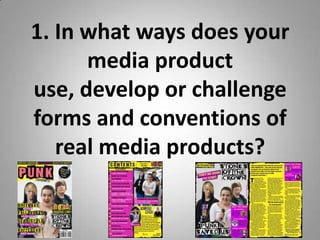
1. In what ways does your
      media product
use, develop or challenge
forms and conventions of
   real media products?
Layout
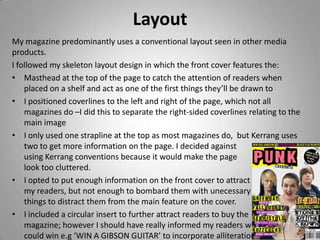
My magazine predominantly uses a conventional layout seen in other media
products.
I followed my skeleton layout design in which the front cover features the:
• Masthead at the top of the page to catch the attention of readers when
    placed on a shelf and act as one of the first things they’ll be drawn to
• I positioned coverlines to the left and right of the page, which not all
    magazines do –I did this to separate the right-sided coverlines relating to the
    main image
• I only used one strapline at the top as most magazines do, but Kerrang uses
    two to get more information on the page. I decided against
    using Kerrang conventions because it would make the page
    look too cluttered.
• I opted to put enough information on the front cover to attract
    my readers, but not enough to bombard them with unecessary
    things to distract them from the main feature on the cover.
• I included a circular insert to further attract readers to buy the
    magazine; however I should have really informed my readers what they
    could win e.g ‘WIN A GIBSON GUITAR’ to incorporate alliteration to
Main Photo
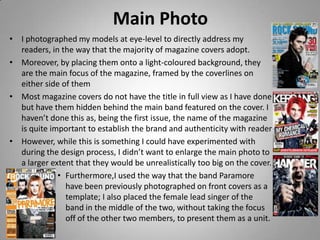
• I photographed my models at eye-level to directly address my
  readers, in the way that the majority of magazine covers adopt.
• Moreover, by placing them onto a light-coloured background, they
  are the main focus of the magazine, framed by the coverlines on
  either side of them
• Most magazine covers do not have the title in full view as I have done
  but have them hidden behind the main band featured on the cover. I
  haven’t done this as, being the first issue, the name of the magazine
  is quite important to establish the brand and authenticity with reader
• However, while this is something I could have experimented with
  during the design process, I didn’t want to enlarge the main photo to
  a larger extent that they would be unrealistically too big on the cover.
             • Furthermore,I used the way that the band Paramore
               have been previously photographed on front covers as a
               template; I also placed the female lead singer of the
               band in the middle of the two, without taking the focus
               off of the other two members, to present them as a unit.
House Style
As a genre convention, magazine brands tend to have their own design that they
have to conform to as part of continuity
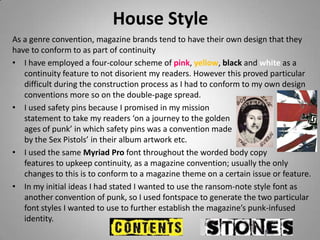
• I have employed a four-colour scheme of pink, yellow, black and white as a
   continuity feature to not disorient my readers. However this proved particular
   difficult during the construction process as I had to conform to my own design
   conventions more so on the double-page spread.
• I used safety pins because I promised in my mission
   statement to take my readers ‘on a journey to the golden
   ages of punk’ in which safety pins was a convention made
   by the Sex Pistols’ in their album artwork etc.
• I used the same Myriad Pro font throughout the worded body copy
   features to upkeep continuity, as a magazine convention; usually the only
   changes to this is to conform to a magazine theme on a certain issue or feature.
• In my initial ideas I had stated I wanted to use the ransom-note style font as
   another convention of punk, so I used fontspace to generate the two particular
   font styles I wanted to use to further establish the magazine’s punk-infused
   identity.
Writing Style
• I wanted to give readers an insight into the lives of a band that had ‘made
  it’ to exploit the Uses and Gratifications theory by Blumler and Katz
  (1974), as my target audience could use the media text for suggestions on
  personal identity and relationships.
• I used taboo language to make my readers feel like they belong and
  alienate readers that do not belong to this particular ‘group’. I wanted to
  reflect the style of language associated with the punk subculture without
  over-doing it and put off my older demographic of readers.
• I portrayed them as passionate through the pull-quote magazine
  convention; as people readers can relate to through portraying a band
  who started from nothing by describing the garage and using technical
  musical terms such as the name of the ‘Jackson King V’ guitar to further
  alienate certain groups, but subsequently welcoming those from similar
  readerships of magazines such as Kerrang!, Rock Sound and Metal
  Hammer who use similar writing styles.
Overall
• I decided to predominantly stick to magazine genre conventions to not
  disorientate readers from what they’re used to seeing on shelves; however I
  wanted to make sure my new magazine would grab their attention, so made
  use of my unique colour scheme to draw them in, as each cover would be
  seen for one month at a time alongside all of the others.
• I wanted to use Maslow’s Hierarchy of Needs (1954) to make my readers feel
  as though they belonged to an exclusive ‘group’ through the house style
  continuity to set it apart from other magazine.
• I placed coverlines on the left-side of the page because McKay (2000) suggests
  to put the emphasis there ‘as this is the part that will show when the
  magazine is on the average newsagent’s shelf’ and made sure they were large
  enough to be legible from 2-3 metres away to grab readers’ attention.
• McKay (2000) also argues to make strong links to the contents page as
  ‘readers are irritated if the fascinating story heralded on the cover is
  impossible to find in the contents list [especially so] if it is given a different
  title in the contents list. I could have possibly improved this if I had changed
  the font of ‘Stones of the Crown’ to the same one used on the front cover and
  double-page spread.

Media powerpoint yasmin

  • 1.
    1. In whatways does your media product use, develop or challenge forms and conventions of real media products?
  • 2.
    Layout My magazine predominantlyuses a conventional layout seen in other media products. I followed my skeleton layout design in which the front cover features the: • Masthead at the top of the page to catch the attention of readers when placed on a shelf and act as one of the first things they’ll be drawn to • I positioned coverlines to the left and right of the page, which not all magazines do –I did this to separate the right-sided coverlines relating to the main image • I only used one strapline at the top as most magazines do, but Kerrang uses two to get more information on the page. I decided against using Kerrang conventions because it would make the page look too cluttered. • I opted to put enough information on the front cover to attract my readers, but not enough to bombard them with unecessary things to distract them from the main feature on the cover. • I included a circular insert to further attract readers to buy the magazine; however I should have really informed my readers what they could win e.g ‘WIN A GIBSON GUITAR’ to incorporate alliteration to
  • 3.
    Main Photo • Iphotographed my models at eye-level to directly address my readers, in the way that the majority of magazine covers adopt. • Moreover, by placing them onto a light-coloured background, they are the main focus of the magazine, framed by the coverlines on either side of them • Most magazine covers do not have the title in full view as I have done but have them hidden behind the main band featured on the cover. I haven’t done this as, being the first issue, the name of the magazine is quite important to establish the brand and authenticity with reader • However, while this is something I could have experimented with during the design process, I didn’t want to enlarge the main photo to a larger extent that they would be unrealistically too big on the cover. • Furthermore,I used the way that the band Paramore have been previously photographed on front covers as a template; I also placed the female lead singer of the band in the middle of the two, without taking the focus off of the other two members, to present them as a unit.
  • 4.
    House Style As agenre convention, magazine brands tend to have their own design that they have to conform to as part of continuity • I have employed a four-colour scheme of pink, yellow, black and white as a continuity feature to not disorient my readers. However this proved particular difficult during the construction process as I had to conform to my own design conventions more so on the double-page spread. • I used safety pins because I promised in my mission statement to take my readers ‘on a journey to the golden ages of punk’ in which safety pins was a convention made by the Sex Pistols’ in their album artwork etc. • I used the same Myriad Pro font throughout the worded body copy features to upkeep continuity, as a magazine convention; usually the only changes to this is to conform to a magazine theme on a certain issue or feature. • In my initial ideas I had stated I wanted to use the ransom-note style font as another convention of punk, so I used fontspace to generate the two particular font styles I wanted to use to further establish the magazine’s punk-infused identity.
  • 5.
    Writing Style • Iwanted to give readers an insight into the lives of a band that had ‘made it’ to exploit the Uses and Gratifications theory by Blumler and Katz (1974), as my target audience could use the media text for suggestions on personal identity and relationships. • I used taboo language to make my readers feel like they belong and alienate readers that do not belong to this particular ‘group’. I wanted to reflect the style of language associated with the punk subculture without over-doing it and put off my older demographic of readers. • I portrayed them as passionate through the pull-quote magazine convention; as people readers can relate to through portraying a band who started from nothing by describing the garage and using technical musical terms such as the name of the ‘Jackson King V’ guitar to further alienate certain groups, but subsequently welcoming those from similar readerships of magazines such as Kerrang!, Rock Sound and Metal Hammer who use similar writing styles.
  • 6.
    Overall • I decidedto predominantly stick to magazine genre conventions to not disorientate readers from what they’re used to seeing on shelves; however I wanted to make sure my new magazine would grab their attention, so made use of my unique colour scheme to draw them in, as each cover would be seen for one month at a time alongside all of the others. • I wanted to use Maslow’s Hierarchy of Needs (1954) to make my readers feel as though they belonged to an exclusive ‘group’ through the house style continuity to set it apart from other magazine. • I placed coverlines on the left-side of the page because McKay (2000) suggests to put the emphasis there ‘as this is the part that will show when the magazine is on the average newsagent’s shelf’ and made sure they were large enough to be legible from 2-3 metres away to grab readers’ attention. • McKay (2000) also argues to make strong links to the contents page as ‘readers are irritated if the fascinating story heralded on the cover is impossible to find in the contents list [especially so] if it is given a different title in the contents list. I could have possibly improved this if I had changed the font of ‘Stones of the Crown’ to the same one used on the front cover and double-page spread.