Media Objectives
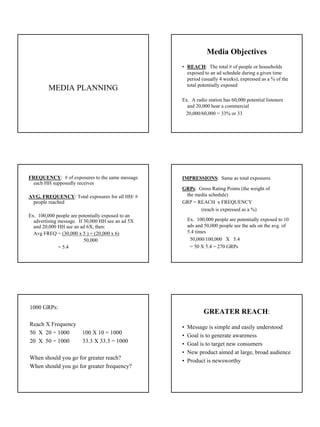
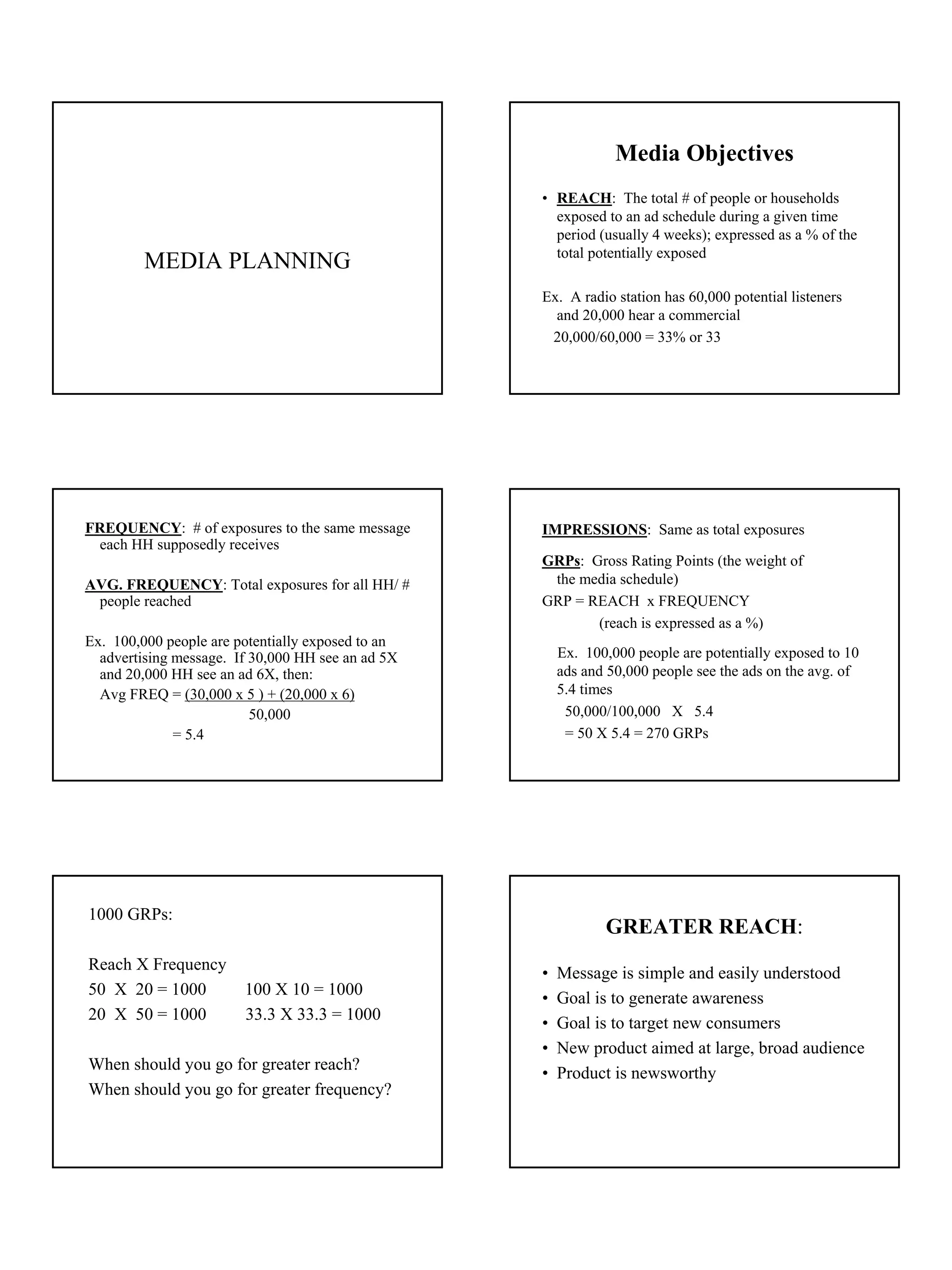
                                                   • REACH: The total # of people or households
                                                     exposed to an ad schedule during a given time
                                                     period (usually 4 weeks); expressed as a % of the
                                                     total potentially exposed
         MEDIA PLANNING
                                                   Ex. A radio station has 60,000 potential listeners
                                                     and 20,000 hear a commercial
                                                    20,000/60,000 = 33% or 33


FREQUENCY: # of exposures to the same message      IMPRESSIONS: Same as total exposures
 each HH supposedly receives
                                                   GRPs: Gross Rating Points (the weight of
AVG. FREQUENCY: Total exposures for all HH/ #       the media schedule)
 people reached                                    GRP = REACH x FREQUENCY
                                                          (reach is expressed as a %)
Ex. 100,000 people are potentially exposed to an
  advertising message. If 30,000 HH see an ad 5X       Ex. 100,000 people are potentially exposed to 10
  and 20,000 HH see an ad 6X, then:                    ads and 50,000 people see the ads on the avg. of
  Avg FREQ = (30,000 x 5 ) + (20,000 x 6)              5.4 times
                          50,000                        50,000/100,000 X 5.4
              = 5.4                                     = 50 X 5.4 = 270 GRPs


1000 GRPs:
                                                              GREATER REACH:
Reach X Frequency
                                                   •   Message is simple and easily understood
50 X 20 = 1000          100 X 10 = 1000
                                                   •   Goal is to generate awareness
20 X 50 = 1000          33.3 X 33.3 = 1000
                                                   •   Goal is to target new consumers
                                                   •   New product aimed at large, broad audience
When should you go for greater reach?
                                                   •   Product is newsworthy
When should you go for greater frequency?


                                                                                                          1
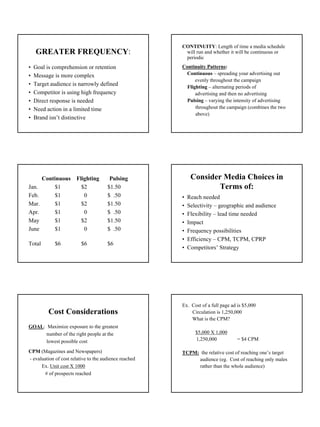
CONTINUITY: Length of time a media schedule
    GREATER FREQUENCY:                                   will run and whether it will be continuous or
                                                         periodic
•   Goal is comprehension or retention                  Continuity Patterns:
•   Message is more complex                              Continuous – spreading your advertising out
                                                              evenly throughout the campaign
•   Target audience is narrowly defined                   Flighting – alternating periods of
•   Competitor is using high frequency                        advertising and then no advertising
•   Direct response is needed                             Pulsing – varying the intensity of advertising
•   Need action in a limited time                             throughout the campaign (combines the two
                                                              above)
•   Brand isn’t distinctive


        Continuous     Flighting        Pulsing              Consider Media Choices in
Jan.         $1          $2            $1.50                         Terms of:
Feb.         $1           0            $ .50            •   Reach needed
Mar.         $1          $2            $1.50            •   Selectivity – geographic and audience
Apr.         $1           0            $ .50            •   Flexibility – lead time needed
May          $1          $2            $1.50            •   Impact
June         $1           0            $ .50            •   Frequency possibilities
                                                        •   Efficiency – CPM, TCPM, CPRP
Total        $6           $6           $6
                                                        •   Competitors’ Strategy


                                                        Ex. Cost of a full page ad is $5,000
          Cost Considerations                               Circulation is 1,250,000
                                                            What is the CPM?
GOAL: Maximize exposure to the greatest
      number of the right people at the                        $5,000 X 1,000
      lowest possible cost                                     1,250,000          = $4 CPM

CPM (Magazines and Newspapers)                          TCPM: the relative cost of reaching one’s target
- evaluation of cost relative to the audience reached        audience (eg. Cost of reaching only males
      Ex. Unit cost X 1000                                   rather than the whole audience)
        # of prospects reached


                                                                                                           2
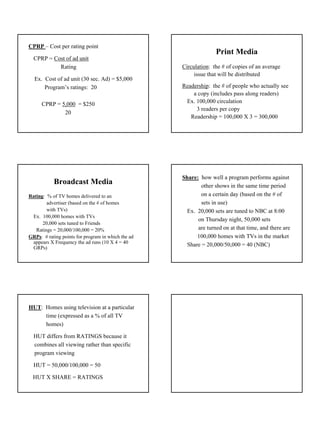
CPRP – Cost per rating point
                                                                  Print Media
  CPRP = Cost of ad unit
           Rating                                   Circulation: the # of copies of an average
                                                         issue that will be distributed
  Ex. Cost of ad unit (30 sec. Ad) = $5,000
      Program’s ratings: 20                         Readership: the # of people who actually see
                                                        a copy (includes pass along readers)
      CPRP = 5,000 = $250                            Ex. 100,000 circulation
                                                         3 readers per copy
              20
                                                       Readership = 100,000 X 3 = 300,000


                                                    Share: how well a program performs against
           Broadcast Media                                  other shows in the same time period
Rating: % of TV homes delivered to an                       on a certain day (based on the # of
        advertiser (based on the # of homes                 sets in use)
        with TVs)                                     Ex. 20,000 sets are tuned to NBC at 8:00
 Ex. 100,000 homes with TVs
                                                          on Thursday night, 50,000 sets
      20,000 sets tuned to Friends
   Ratings = 20,000/100,000 = 20%                         are turned on at that time, and there are
GRPs: # rating points for program in which the ad         100,000 homes with TVs in the market
 appears X Frequency the ad runs (10 X 4 = 40
                                                      Share = 20,000/50,000 = 40 (NBC)
 GRPs)


HUT: Homes using television at a particular
     time (expressed as a % of all TV
     homes)

  HUT differs from RATINGS because it
  combines all viewing rather than specific
  program viewing

  HUT = 50,000/100,000 = 50

  HUT X SHARE = RATINGS


                                                                                                      3

Media terminology

  • 1.
    Media Objectives • REACH: The total # of people or households exposed to an ad schedule during a given time period (usually 4 weeks); expressed as a % of the total potentially exposed MEDIA PLANNING Ex. A radio station has 60,000 potential listeners and 20,000 hear a commercial 20,000/60,000 = 33% or 33 FREQUENCY: # of exposures to the same message IMPRESSIONS: Same as total exposures each HH supposedly receives GRPs: Gross Rating Points (the weight of AVG. FREQUENCY: Total exposures for all HH/ # the media schedule) people reached GRP = REACH x FREQUENCY (reach is expressed as a %) Ex. 100,000 people are potentially exposed to an advertising message. If 30,000 HH see an ad 5X Ex. 100,000 people are potentially exposed to 10 and 20,000 HH see an ad 6X, then: ads and 50,000 people see the ads on the avg. of Avg FREQ = (30,000 x 5 ) + (20,000 x 6) 5.4 times 50,000 50,000/100,000 X 5.4 = 5.4 = 50 X 5.4 = 270 GRPs 1000 GRPs: GREATER REACH: Reach X Frequency • Message is simple and easily understood 50 X 20 = 1000 100 X 10 = 1000 • Goal is to generate awareness 20 X 50 = 1000 33.3 X 33.3 = 1000 • Goal is to target new consumers • New product aimed at large, broad audience When should you go for greater reach? • Product is newsworthy When should you go for greater frequency? 1
  • 2.
    CONTINUITY: Length oftime a media schedule GREATER FREQUENCY: will run and whether it will be continuous or periodic • Goal is comprehension or retention Continuity Patterns: • Message is more complex Continuous – spreading your advertising out evenly throughout the campaign • Target audience is narrowly defined Flighting – alternating periods of • Competitor is using high frequency advertising and then no advertising • Direct response is needed Pulsing – varying the intensity of advertising • Need action in a limited time throughout the campaign (combines the two above) • Brand isn’t distinctive Continuous Flighting Pulsing Consider Media Choices in Jan. $1 $2 $1.50 Terms of: Feb. $1 0 $ .50 • Reach needed Mar. $1 $2 $1.50 • Selectivity – geographic and audience Apr. $1 0 $ .50 • Flexibility – lead time needed May $1 $2 $1.50 • Impact June $1 0 $ .50 • Frequency possibilities • Efficiency – CPM, TCPM, CPRP Total $6 $6 $6 • Competitors’ Strategy Ex. Cost of a full page ad is $5,000 Cost Considerations Circulation is 1,250,000 What is the CPM? GOAL: Maximize exposure to the greatest number of the right people at the $5,000 X 1,000 lowest possible cost 1,250,000 = $4 CPM CPM (Magazines and Newspapers) TCPM: the relative cost of reaching one’s target - evaluation of cost relative to the audience reached audience (eg. Cost of reaching only males Ex. Unit cost X 1000 rather than the whole audience) # of prospects reached 2
  • 3.
    CPRP – Costper rating point Print Media CPRP = Cost of ad unit Rating Circulation: the # of copies of an average issue that will be distributed Ex. Cost of ad unit (30 sec. Ad) = $5,000 Program’s ratings: 20 Readership: the # of people who actually see a copy (includes pass along readers) CPRP = 5,000 = $250 Ex. 100,000 circulation 3 readers per copy 20 Readership = 100,000 X 3 = 300,000 Share: how well a program performs against Broadcast Media other shows in the same time period Rating: % of TV homes delivered to an on a certain day (based on the # of advertiser (based on the # of homes sets in use) with TVs) Ex. 20,000 sets are tuned to NBC at 8:00 Ex. 100,000 homes with TVs on Thursday night, 50,000 sets 20,000 sets tuned to Friends Ratings = 20,000/100,000 = 20% are turned on at that time, and there are GRPs: # rating points for program in which the ad 100,000 homes with TVs in the market appears X Frequency the ad runs (10 X 4 = 40 Share = 20,000/50,000 = 40 (NBC) GRPs) HUT: Homes using television at a particular time (expressed as a % of all TV homes) HUT differs from RATINGS because it combines all viewing rather than specific program viewing HUT = 50,000/100,000 = 50 HUT X SHARE = RATINGS 3