Magazine codes and
conventions
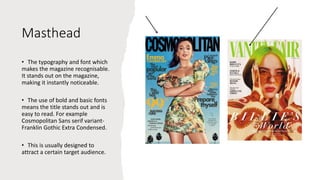
Masthead
• The typography and font which
makes the magazine recognisable.
It stands out on the magazine,
making it instantly noticeable.
• The use of bold and basic fonts
means the title stands out and is
easy to read. For example
Cosmopolitan Sans serif variant-
Franklin Gothic Extra Condensed.
• This is usually designed to
attract a certain target audience.
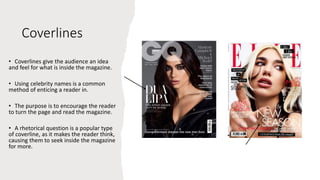
Coverlines
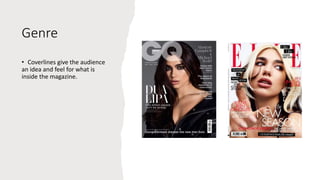
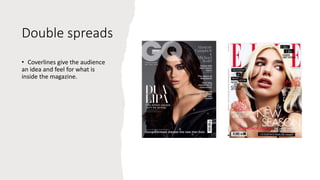
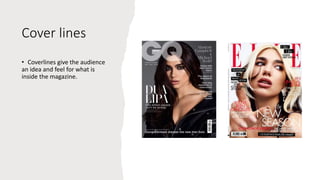
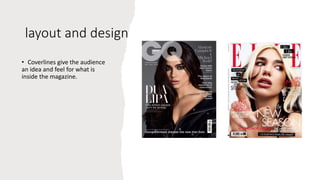
• Coverlines give the audience an idea
and feel for what is inside the magazine.
• Using celebrity names is a common
method of enticing a reader in.
• The purpose is to encourage the reader
to turn the page and read the magazine.
• A rhetorical question is a popular type
of coverline, as it makes the reader think,
causing them to seek inside the magazine
for more.
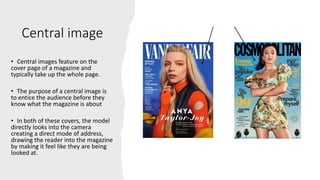
Central image
• Central images feature on the
cover page of a magazine and
typically take up the whole page.
• The purpose of a central image is
to entice the audience before they
know what the magazine is about
• In both of these covers, the model
directly looks into the camera
creating a direct mode of address,
drawing the reader into the magazine
by making it feel like they are being
looked at.
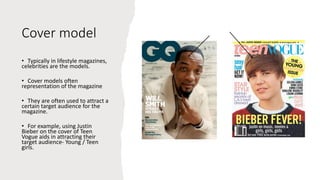
Cover model
• Typically in lifestyle magazines,
celebrities are the models.
• Cover models often
representation of the magazine
• They are often used to attract a
certain target audience for the
magazine.
• For example, using Justin
Bieber on the cover of Teen
Vogue aids in attracting their
target audience- Young / Teen
girls.
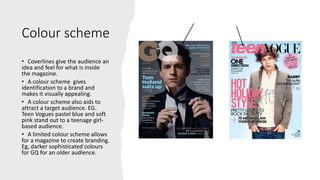
Colour scheme
• Coverlines give the audience an
idea and feel for what is inside
the magazine.
• A colour scheme gives
identification to a brand and
makes it visually appealing.
• A colour scheme also aids to
attract a target audience. EG.
Teen Vogues pastel blue and soft
pink stand out to a teenage girl-
based audience.
• A limited colour scheme allows
for a magazine to create branding.
Eg, darker sophisticated colours
for GQ for an older audience.
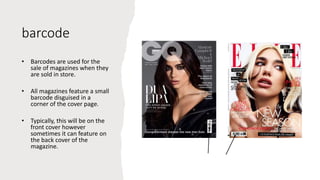
barcode
• Barcodes are used for the
sale of magazines when they
are sold in store.
• All magazines feature a small
barcode disguised in a
corner of the cover page.
• Typically, this will be on the
front cover however
sometimes it can feature on
the back cover of the
magazine.
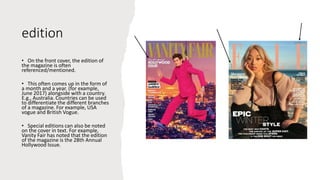
edition
• On the front cover, the edition of
the magazine is often
referenced/mentioned.
• This often comes up in the form of
a month and a year. (for example,
June 2017) alongside with a country.
E.g., Australia. Countries can be used
to differentiate the different branches
of a magazine. For example, USA
vogue and British Vogue.
• Special editions can also be noted
on the cover in text. For example,
Vanity Fair has noted that the edition
of the magazine is the 28th Annual
Hollywood Issue.
House style
• A house style is a company’s
standard way of presenting a
magazine. This typically controls
the layout of the magazine.
• It keeps every issue looking the
same. This makes it identifiable
and maintains branding.
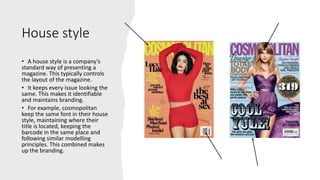
• For example, cosmopolitan
keep the same font in their house
style, maintaining where their
title is located, keeping the
barcode in the same place and
following similar modelling
principles. This combined makes
up the branding.
Mise en scene
• Mise en scene accounts for the models
and their positioning and expressions, the
costumes, the lighting of the shot, the
colour scheme of the cover, any props
involved and the setting of the cover.
• It can be used by an audience to gather a
general feel about the mood and the tone
of the magazine, and can also help identify
genre and convey moods.
• For example in the Vanity Fair cover,
Johnny Depp is conveyed via a close up
featuring a serious look. The colours and
lighting are cool and dim. This conveys a
more serious and sophisticated look,
compared to the cosmopolitan cover where
emma chamberlain is in colourful clothes
against a tropical setting.
Cinematography
• The cinematography of a
magazine includes the camera
angle and shot type, lens choices,
depth of field, the exposure,
focus, and any special effects or
filters.
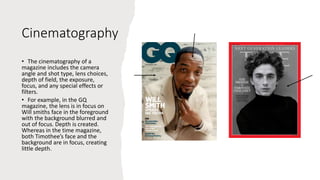
• For example, in the GQ
magazine, the lens is in focus on
Will smiths face in the foreground
with the background blurred and
out of focus. Depth is created.
Whereas in the time magazine,
both Timothee’s face and the
background are in focus, creating
little depth.
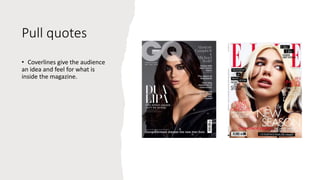
Pull quotes
• Pull quotes are made up of
quotes from inside the
magazine, or quotes that
summarise a topic inside.
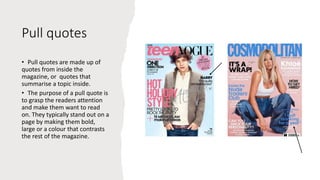
• The purpose of a pull quote is
to grasp the readers attention
and make them want to read
on. They typically stand out on a
page by making them bold,
large or a colour that contrasts
the rest of the magazine.
Iconography
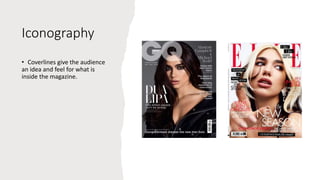
• Coverlines give the audience
an idea and feel for what is
inside the magazine.
Genre
• Coverlines give the audience
an idea and feel for what is
inside the magazine.
Double spreads
• Coverlines give the audience
an idea and feel for what is
inside the magazine.
Cover lines
• Coverlines give the audience
an idea and feel for what is
inside the magazine.
layout and design
• Coverlines give the audience
an idea and feel for what is
inside the magazine.
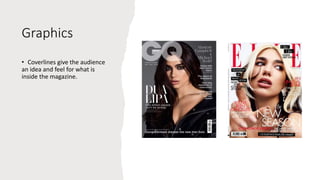
Graphics
• Coverlines give the audience
an idea and feel for what is
inside the magazine.
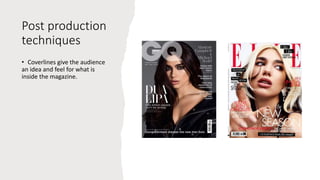
Post production
techniques
• Coverlines give the audience
an idea and feel for what is
inside the magazine.
Pull quotes
• Coverlines give the audience
an idea and feel for what is
inside the magazine.
Pull quotes
• Coverlines give the audience
an idea and feel for what is
inside the magazine.
Website links
• https://www.slideshare.net/J
ordanLiddell/codes-and-
conventions-of-magazines-
61504976
• https://riddlesdownmedia.wo
rdpress.com/year-11-
gcse/codes-and-conventions/
• http://dlsa-ms-year12-
2016.blogspot.com/2016/01/co
des-and-conventions-of-
magazine.html
magazines

media magazines analysis

  • 1.
  • 2.
    Masthead • The typographyand font which makes the magazine recognisable. It stands out on the magazine, making it instantly noticeable. • The use of bold and basic fonts means the title stands out and is easy to read. For example Cosmopolitan Sans serif variant- Franklin Gothic Extra Condensed. • This is usually designed to attract a certain target audience.
  • 3.
    Coverlines • Coverlines givethe audience an idea and feel for what is inside the magazine. • Using celebrity names is a common method of enticing a reader in. • The purpose is to encourage the reader to turn the page and read the magazine. • A rhetorical question is a popular type of coverline, as it makes the reader think, causing them to seek inside the magazine for more.
  • 4.
    Central image • Centralimages feature on the cover page of a magazine and typically take up the whole page. • The purpose of a central image is to entice the audience before they know what the magazine is about • In both of these covers, the model directly looks into the camera creating a direct mode of address, drawing the reader into the magazine by making it feel like they are being looked at.
  • 5.
    Cover model • Typicallyin lifestyle magazines, celebrities are the models. • Cover models often representation of the magazine • They are often used to attract a certain target audience for the magazine. • For example, using Justin Bieber on the cover of Teen Vogue aids in attracting their target audience- Young / Teen girls.
  • 6.
    Colour scheme • Coverlinesgive the audience an idea and feel for what is inside the magazine. • A colour scheme gives identification to a brand and makes it visually appealing. • A colour scheme also aids to attract a target audience. EG. Teen Vogues pastel blue and soft pink stand out to a teenage girl- based audience. • A limited colour scheme allows for a magazine to create branding. Eg, darker sophisticated colours for GQ for an older audience.
  • 7.
    barcode • Barcodes areused for the sale of magazines when they are sold in store. • All magazines feature a small barcode disguised in a corner of the cover page. • Typically, this will be on the front cover however sometimes it can feature on the back cover of the magazine.
  • 8.
    edition • On thefront cover, the edition of the magazine is often referenced/mentioned. • This often comes up in the form of a month and a year. (for example, June 2017) alongside with a country. E.g., Australia. Countries can be used to differentiate the different branches of a magazine. For example, USA vogue and British Vogue. • Special editions can also be noted on the cover in text. For example, Vanity Fair has noted that the edition of the magazine is the 28th Annual Hollywood Issue.
  • 9.
    House style • Ahouse style is a company’s standard way of presenting a magazine. This typically controls the layout of the magazine. • It keeps every issue looking the same. This makes it identifiable and maintains branding. • For example, cosmopolitan keep the same font in their house style, maintaining where their title is located, keeping the barcode in the same place and following similar modelling principles. This combined makes up the branding.
  • 10.
    Mise en scene •Mise en scene accounts for the models and their positioning and expressions, the costumes, the lighting of the shot, the colour scheme of the cover, any props involved and the setting of the cover. • It can be used by an audience to gather a general feel about the mood and the tone of the magazine, and can also help identify genre and convey moods. • For example in the Vanity Fair cover, Johnny Depp is conveyed via a close up featuring a serious look. The colours and lighting are cool and dim. This conveys a more serious and sophisticated look, compared to the cosmopolitan cover where emma chamberlain is in colourful clothes against a tropical setting.
  • 11.
    Cinematography • The cinematographyof a magazine includes the camera angle and shot type, lens choices, depth of field, the exposure, focus, and any special effects or filters. • For example, in the GQ magazine, the lens is in focus on Will smiths face in the foreground with the background blurred and out of focus. Depth is created. Whereas in the time magazine, both Timothee’s face and the background are in focus, creating little depth.
  • 12.
    Pull quotes • Pullquotes are made up of quotes from inside the magazine, or quotes that summarise a topic inside. • The purpose of a pull quote is to grasp the readers attention and make them want to read on. They typically stand out on a page by making them bold, large or a colour that contrasts the rest of the magazine.
  • 13.
    Iconography • Coverlines givethe audience an idea and feel for what is inside the magazine.
  • 14.
    Genre • Coverlines givethe audience an idea and feel for what is inside the magazine.
  • 15.
    Double spreads • Coverlinesgive the audience an idea and feel for what is inside the magazine.
  • 16.
    Cover lines • Coverlinesgive the audience an idea and feel for what is inside the magazine.
  • 17.
    layout and design •Coverlines give the audience an idea and feel for what is inside the magazine.
  • 18.
    Graphics • Coverlines givethe audience an idea and feel for what is inside the magazine.
  • 19.
    Post production techniques • Coverlinesgive the audience an idea and feel for what is inside the magazine.
  • 20.
    Pull quotes • Coverlinesgive the audience an idea and feel for what is inside the magazine.
  • 21.
    Pull quotes • Coverlinesgive the audience an idea and feel for what is inside the magazine.
  • 22.
    Website links • https://www.slideshare.net/J ordanLiddell/codes-and- conventions-of-magazines- 61504976 •https://riddlesdownmedia.wo rdpress.com/year-11- gcse/codes-and-conventions/ • http://dlsa-ms-year12- 2016.blogspot.com/2016/01/co des-and-conventions-of- magazine.html
  • 23.