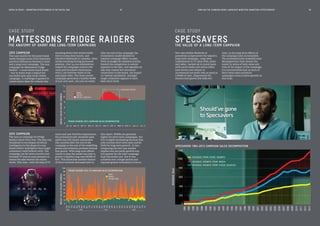
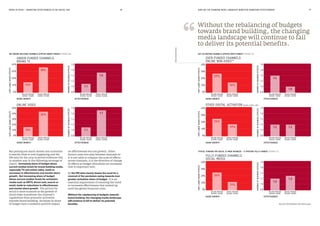
In association with
LES BINET ADAM & EVE DDB
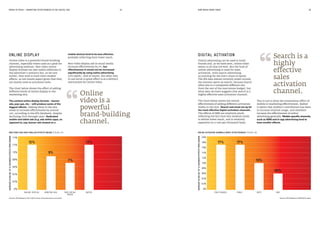
PETER FIELD PETER FIELD CONSULTING
NEW LEARNINGS FROM THE IPA DATABANK
MARKETING EFFECTIVENESS
IN THE DIGITAL ERA
IN F CUS
CONTENTS
01
The IPA Databank continues to provide a rich evidence base from
which to find answers to the most challenging questions facing
marketing communications.
This new publication takes the changing media landscape as its
focus and addresses, among others, the issues of: Does mass
marketing still work? Is tight targeting now the most efficient
approach? Is unpaid making paid media redundant?
It also investigates the broader issues of budgeting, planning and
reporting, and challenges the industry to reconsider approaches
to efficiency, ROMI and measurement strategy.
This publication is the first part of a new series about Marketing
Effectiveness in the Digital Era, made possible through the
generous support of Google and Thinkbox.
It is also the first publication to carry the new EffWorks livery; a
new branding device and trust mark to represent the IPA’s wider
effectiveness initiative and annual Effectiveness Week (EffWeek).
Led by a CMO advisory board, the IPA is facilitating an
industry-wide collaboration to promote evidence-based
decision-making for marketing and a culture of effectiveness in
the everyday interactions between clients and agencies.
At the heart of our‘back to basics’ approach
lies the quest for continuous professional
development, upon which the IPA reputation
is built.
FOREWORD / JANET HULL
FOREWORD
Janet Hull
Jonny Protheroe
Matt Hill
ABOUT THE AUTHORS
IN A NUTSHELL
1.0 INTRODUCTION
Aims
Data
Measures of effectiveness
Measures of growth
Measures of efficiency
Measures of campaign duration
Measures of brand strengthening
2.0 PREVIOUS FINDINGS
Long versus short-term effects
Implications for channel strategy
The importance of reach
The importance of budget and share of voice
3.0 THE NEW MEDIA LANDSCAPE
4.0 DOES MASS MARKETING STILL WORK?
Is tight targeting now the most efficient approach?
Loyalty marketing
View: The importance of penetration
View: Online loyalty research can be misleading
View: Web visitors are less loyal
Data-driven real-time marketing
Is unpaid making paid media redundant?
Case study: John Lewis
Case study: Wall’s Ice Cream
Are activation strategies now the best way to
drive growth rather than brand-building ones?
Summary thoughts from section 4.0
01
01
02
03
04
05
07
07
08
08
09
09
09
09
10
11
13
14
16
17
24
26
26
28
30
31
32
35
36
39
41
44
5.0 HOW MEDIA WORK TODAY
TV advertising
Video on demand
Online video
The synergy between TV and online video
Press advertising
Radio advertising
Out of home advertising
Online display
Digital activation
Summary thoughts from section 5.0
6.0 HOW HAS THE CHANGING MEDIA LANDSCAPE
BENEFITED MARKETING EFFECTIVENESS?
Destructive trends in effectiveness have emerged
Short-termism
Case study: Mattessons
Case study: Specsavers
The impact of short-termism on channel choice
Broader impacts of short-termism
Focussing on return on marketing investment (ROMI)
Excessive weighting to activation versus brand building
View: The relentless growth of Activation
Summary thoughts from section 6.0
CONCLUSIONS AND RECOMMENDATIONS
MORE ABOUT EFFWORKS
45
46
47
48
49
50
52
53
54
55
56
57
58
61
62
63
64
69
70
73
75
78
79
80
JANET HULL OBE IPA DIRECTOR OF MARKETING STRATEGY
MEDIA IN FOCUS — MARKETING EFFECTIVENESS IN THE DIGITAL ERA 02 03FOREWORD
This analysis is required reading for any marketer who wants to
understand what makes effective advertising. It is enlightening
and reassuring – but also worrying. It shows the path to success
for marketers but also that some have strayed from it. The following
pages are a much-needed wake-up call.
Thinkbox is proud to support the IPA’s effectiveness work – its
awards and its research. We have done so since the day we began.
It was the first partnership we made because nothing is more
important in advertising than proving it works, proving that
brands’ investment is worth it. Marketers need robust,
independent research they can trust so they can make informed
decisions and not simply be swayed by rhetoric or fashion.
This is what the IPA provides time and time again, and Les Binet
and Peter Field’s latest analysis comes at a crucial time. With an
uncertain economic outlook, understanding how media perform
in the digital age is vital for making the best marketing decisions.
There is much in this analysis to get to grips with: the importance
of mass media; the worrying effects of a creeping short-termism
that is damaging overall advertising effectiveness; the fact that
effectiveness does not come for free.
And I would have to fire myself if I didn’t point you towards the
many insights into TV advertising, not least that it remains
the most effective advertising and is getting more effective, in
large part due to its blossoming relationship with different
online forms of marketing,
particularly online video.
Video – with TV at its heart –
emerges as the epicentre of
effectiveness.
A striking finding from this latest analysis of the IPA Databank is
that the Internet has increased the effectiveness of most
traditional media, and the potential effectiveness of most forms
of marketing. So whilst the rapidly changing media landscape
may have added complexity for marketers, it also presents a huge
opportunity to those who make well informed investment decisions.
Google is proud to support the IPA’s Effectiveness agenda as a
means of highlighting best practice and providing expert guidance
to the industry. Les and Peter’s latest work helps marketers to
navigate the changing landscape, making a compelling case for
increased overall levels of media investment, as well as advocating
a balance of sales activation and brand building communications.
For consumers the line between online and offline media is
becoming increasingly blurred, and in some cases indistinguishable.
So the core distinction between activation and brand building
is a useful one, capturing the intended role of a piece of
communication rather than the mechanism by which it was
delivered. As the authors note, sales activation is not equivalent
nor restricted to online – offline media can be great for activation
too. Likewise online media can be great for brand building.
In that context, and consistent with our own research, the authors
find clear synergies between TV and online video, with the most
effective campaigns using TV and online video together.
Measuring effectiveness is complex, and we
look forward to continued collaboration with
the IPA and the broader UK industry in
developing best practice approaches to
effectiveness measurement over all time
horizons.
MATT HILLJONNY PROTHEROE
MATT HILL RESEARCH AND PLANNING DIRECTOR, THINKBOXJONNY PROTHEROE HEAD OF UK MARKET INSIGHTS, GOOGLE
MEDIA IN FOCUS — MARKETING EFFECTIVENESS IN THE DIGITAL ERA 04 05
ABOUT THE AUTHORS
Having studied Physics and Artificial
Intelligence at university, Les joined
the agency in 1987, and has devoted
his career to measuring and
improving the effectiveness of the
agency’s advertising.
Les is recognised as an expert in
econometrics (aka market mix
modelling), and has written
extensively on how advertising
works, how to make it work better,
and how to evaluate it.
Les has long been closely involved
with the IPA Effectiveness Awards,
having won more prizes than any
other author, including two Grand
Prix.
In 2014, the IPA (the body that
represents the UK advertising
industry) awarded him its President’s
Medal, the highest honour it can
bestow, in recognition of his
achievements.
Peter spent 15 years as a strategic planner in
advertising and has been a marketing
consultant for the last 20 years.
Effectiveness case study analysis underpins
much of his work, which includes a number
of important marketing and advertising
texts and his pioneering work on the link
between creativity and effectiveness.
He has a global reputation as an
effectiveness expert and communicator and
speaks and consults regularly around the
world about effectiveness issues.
He is a contributor to the
Wharton Future of Advertising Project.
LES BINET HEAD OF EFFECTIVENESS, ADAM&EVE DDB
PETER FIELD PETER FIELD CONSULTING
IN A NUTSHELL
The commercialisation of the internet, the spread of mobile telephony,
and many other related digital technologies have dramatically changed
our world. Even though this revolution has been going on for over
twenty years, most of us are still trying to understand what it means
for marketing.
The evidence from this IPA Databank study suggests that marketing is
still primarily a numbers game. The main way brands grow is still by
increasing penetration, not loyalty.
01 Broad-reach campaigns are still the best way to drive market share,
which is in turn a key driver of profit.
02 The good news is that the digital revolution has increased the
potential effectiveness of most forms of marketing, including
traditional media.
03 So, for firms that invest at the right level, and in the right way,
mass marketing is working better than ever.
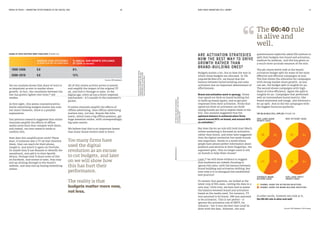
04 Balancing long-term brand building and short-term activation is
crucial. Around 60% brand and 40% activation is still the best
combination.
05 Video advertising, both on and offline, is the most effective
brand-building form. TV is still the most effective medium, but online
video makes it work even harder.
06 Paid search and email emerge as the most effective activation
channels.
But the IPA data also suggests that actual effectiveness has declined
since the global financial crisis, and argues that marketers need to strike
a better balance between short and long term if they want to exploit the
full potential of marketing in today’s media landscape.
MEDIA IN FOCUS — MARKETING EFFECTIVENESS IN THE DIGITAL ERA
INTRODUCTION
1.0
AIMS
The objective of this report is to update the
media-related findings of our two previous analyses
of the IPA Databank: Marketing in the Era of Accountability
(WARC 2007) and The Long and the Short of It (IPA 2013).
It has often been suggested in recent years that the
rules of effectiveness discussed in these reports are
now out of date; that the growth of online
communications channels in particular have
changed some of the fundamentals of marketing.
So this report sets out to test some of the hypotheses
of change and to examine to what extent the
media-related fundamentals have actually altered.
It is intended to be the first of four reports examining
other facets of digital-driven change, including
consumer buying behaviour, Big Data impacts and
broader marketing rules.
06 07
In association with
The Long and the
Short of It
Balancing Short and Long-Term Marketing Strategies
Les Binet, Head of Effectiveness, adam&eve DDB
Peter Field, Marketing Consultant
CHIEF MARKETING AND COMMUNICATIONS OFFICER
UNILEVER
KEITH WEED
Les and Peter have made
a huge contribution to our
understanding of how
marketing drives growth
and profit for brands.
Marketers everywhere
should pay close attention.
FOUNDER EATBIGFISH
ADAM MORGAN
Simply put, it is one of the
most important books ever
written about marketing. It
should be the foundation of
knowledge and practice for
everyone working in marketing
and communications.
Without exception.
MEDIA IN FOCUS — MARKETING EFFECTIVENESS IN THE DIGITAL ERA
As with the earlier reports, the data source
is the IPA Databank – the confidential data
submitted alongside entries to the biennial
IPA Effectiveness Awards competition. The
data captured includes a comprehensive
range of campaign inputs (such as strategy,
media choices and brand circumstances) and
campaign outcomes (such as business
effectiveness measures, efficiency, ROMI,
and brand measures). Our analysis in
essence examines how inputs, especially
media choices, affect outcomes.
With very few exceptions all the data used
in this report is from the digital era, 1998
onwards. In some instances we have split
the sample into two time periods. The first
(1998-2006) might be described as‘Web 1.0’.
At that time, online marketing was rapidly
expanding, but online video and social
media had yet to play a significant role. The
second period (2007-2016), which one might
call‘Web 2.0’, saw early online marketing
techniques coming to maturity, and a big
expansion in the use of video and social.
And much of the analysis is for the two
competition years 2014 and 2016, covering
campaigns that typically ran during the
period 2012 to 2015. This period represents
the new data captured since The Long and the
Short of It was published and includes
campaigns devised and executed in an
increasingly mature digital landscape with a
firmly established social media presence.
98% of 2014-16 cases made use of online
channels as an integrated part of the campaign,
with 79% using social media.
Analysed in this report are 497 for-profit
cases submitted since 1998 and 118 submitted
in 2014 and 2016. The authority of the data
comes as much from the rigour and vetting
of the evaluations they are associated with as
from the number of cases: 58% of the cases
submitted in 2014 and 2016 were supported
by full econometric models.
In addition to the sales and share growth
standardised metrics discussed above, the
data also records the absolute level of share
growth reported. As well as being used to
determine ESOV efficiency (see below), this
metric is sometimes used as a quantified
measure of growth.
When comparing subgroups of campaigns
with differing relative budget levels, it is
clearly important to take budget into
account. Previous research has shown that
share of voice (SOV) is a more relevant
measure than absolute spend. An even
better measure is the difference between
SOV and market share, referred to in this
report as‘extra share of voice’(ESOV).ESOV
is an important determinant of how fast a
brand can grow. In this report it will be
shown that this relationship between share
growth and ESOV is still important.
The primary efficiency metric used here is
the annualised share growth per 10 points of
ESOV. This eliminates the cumulative
effects of long-term campaigns, providing
a level playing field on which to compare
campaigns with different durations.
Also used is ROMI (return on marketing
investment), which reports the incremental
profit net of marketing costs expressed as a
ratio of those marketing costs. The dangers
of this metric as a KPI are discussed at
length later in this report, but the metric is
nevertheless useful as a financial efficiency
metric.
INTRODUCTION08 09
The most frequently used measures of
effectiveness in
this report are the various
business effects: profit, sales, market share,
penetration, loyalty and price sensitivity.
Case study authors assess these measures on
a four-point scale of magnitude: only
top-box scores (i.e.‘very large’) are used to
identify high performers. These metrics are
mostly measured over a period of at least a
year and are therefore more indicative of
long-term success. In our analysis they are
often coalesced into one metric – the number
of business effects, which represents a broad
measure of effectiveness that is relatively
independent of the particular objectives of
the campaign. This metric correlates closely
with reported profit growth, making it a
particularly useful measure of effectiveness.
It also correlates with the extra share of
voice (ESOV) efficiency, so this metric has a
very broad usefulness.
The most important measure of effectiveness
in the
short term is ‘activation’ effects:
typically, in recent years, these are online
direct responses (transactional or
intermediate) and their telephone or coupon
equivalents in earlier periods.
Again, only
top-box scores are used to identify
high performers. This metric is contrasted
in this report with measures of long-term
success to reveal factors that are short term
or long term in nature.
Campaign duration is a key factor in the
nature and scale of campaign outcomes,
so it is an important metric in this report.
Long-term cases are those that were
evaluated over periods of longer than six
months. This is not an arbitrary period:
analysis reported in The Long and the Short of It
demonstrated how long-term advertising
effects on sales uplifts only start to
dominate short-term effects after six months.
That is to say brand building takes over as
the primary driver of growth from sales
activation after six months. This is discussed
more in the next section of this report.
These consist of seven different metrics:
awareness
image
differentiation
fame
commitment
trust
esteem
These are reported by campaign authors
using the same scale as for business metrics.
Again in our analysis, they are often coalesced
into one metric – the number of brand
effects – which represents a broad measure
of brand strengthening that is relatively
independent of the particular objectives of
the campaign.
MEASURES OF
GROWTH
MEASURES OF CAMPAIGN
DURATION
MEASURES OF BRAND
STRENGTHENING
MEASURES OF
EFFECTIVENESS
DATA
MEASURES OF
EFFICIENCY
Of cases submitted in 2014 and
2016,58% were supported by full
econometric models.
PREVIOUS FINDINGS
2.0
In the next sections we will look at channel strategy,
examining the interactions between paid, owned
and earned media, and what these mean for budgets
today. We revisit the relationship between brand
and activation, and the roles of individual media
within it. We discuss the trade-off between targeting
and reach, and how patterns of media consumption
affect these things. We look at how the effects of
individual media are changing. And finally we look
at how developments in marketing are undoing the
benefits the changing media landscape can offer.
To begin with though, it’s worth recapping some of
the findings from our previous research. It is these
findings we will be testing, in the light of the latest
data, to see whether they still hold true in the mature
digital era.
PREVIOUS FINDINGS10 11
In 2013, in The Long and the Short of It, we
highlighted two very different ways in which
marketing communications can work.
On the one hand, communications can be
used for brand building. Brand building
means creating mental structures
(associations, memories, beliefs, etc.) that
will pre-dispose potential customers to
choose one brand over another. This is a
long-term job involving conditioning
consumers through repeated exposure, so it
takes time; talking to people long before
they come to buy. It requires broad-reach
media, because the aim is to prime everyone
in the market, regardless of whether or not
they are shopping right now. And because
most of the audience are not in the market
at the time they are exposed, it cannot
assume close attention. So it relies heavily
on emotional priming, since that cuts
through regardless of whether people are
interested in the product, and it helps
create long-term memory structures. For
this reason, emotions tend to have more
impact than messages (which mostly get
screened out). And brand-building
campaigns work best when they get people
talking and sharing, because brands are
partly social constructs. Classic examples
might be a feel-good TV ad or online video.
On the other hand, communications can
also be used for sales activation. Sales
activation is different. The aim here is to
focus on people who are likely to buy in the
very near future. That means exploiting
existing brand equity to generate sales right
now. Tight targeting is the order of the day,
and rational persuasion has much more
traction, because these people are more
interested in what you have to say. This
favours information-rich media, and if a
response mechanism can be included, even
better. This is a short-term job, and requires
relatively few exposures. More generally,
everything should be designed so as to make
the customer journey as frictionless as
possible. Classic examples might be a piece
of direct marketing perhaps with an offer,
a seasonal reminder, or a search-driven
retargeted online ad.
Brand building is, in many ways, the
harder yet more important of the two jobs,
which is why it requires more investment
and different kinds of media.
LONG VERSUS SHORT-TERM
EFFECTS
Brand building takes over as the
primary driver of growth from
sales activation after six months.
THE DIFFERENCES BETWEEN BRAND BUILDING AND SALES ACTIVATION (FIGURE 01)
CREATES MENTAL BRAND EQUITY EXPLOITS MENTAL BRAND EQUITY
INFLUENCES FUTURE SALES GENERATES SALES NOW
BROAD REACH TIGHTLY TARGETED
LONG TERM SHORT TERM
EMOTIONAL PRIMING PERSUASIVE MESSAGES
BRAND BUILDING SALES ACTIVATION
MEDIA IN FOCUS — MARKETING EFFECTIVENESS IN THE DIGITAL ERA PREVIOUS FINDINGS12 13
Brand building and activation work in synergy,
each enhancing the other. Strong brands
get much higher response rates from their
activation channels. Firms that exploit
activation media well make more money
from their brands.
The challenge for marketers is finding the
right balance between brand and activation.
This is made more difficult by the fact that
each works in different ways, and over
different timescales.
Activation effects are relatively easy to
measure, because they tend to be big,
immediate and direct. In the short term
(six months or less) they tend to produce
the biggest sales responses.
However, these tend to decay away quickly,
and don’t tend to build much over time.
Rather, activation tends to produce a series
of sales spikes.
Brand effects are harder to measure,
because they are smaller in the short term,
and there is usually no direct link to sales.
But brand effects decay away more slowly,
and so repeated exposures can cause the
base level of sales to rise. In the long run,
brand effects are the main driver of growth.
Because the effects of brand building only
become apparent over the long term,
short-termism is dangerous. It can lead to
excessive activation (which is inefficient),
and under-investment in the brand (which
can lead to long-term decline).
A balanced approach to evaluation therefore,
looking at both long and short-term marketing
effects, can lead to a more balanced
marketing mix. On average, effectiveness
seems to be optimised when around 60% of
the communications budget is devoted to
brand building, and around 40% to activation.
In The Long and the Short of It, we christened
this the‘60:40 rule’.
Our previous publications looked at the implications of all of
these findings for channel strategy. In summary, we found:
BRAND-BUILDING AND SALES ACTIVATION GOALS REQUIRE DIFFERENT MEDIA (FIGURE 03)
PHYSICAL
AVAILABILITY
INFORMATION
TARGETING
BRAND BUILDING SALES ACTIVATION
SALES ACTIVATION / SHORT-TERM SALES UPLIFTS BRAND BUILDING / LONG-TERM SALES GROWTH
BRAND BUILDING AND SALES ACTIVATION WORK OVER DIFFERENT TIMESCALES (FIGURE 02)
TIME
SALESUPLIFTOVERBASE
IMPLICATIONS FOR CHANNEL STRATEGY
01 Budget is one of the most
important determinants of
campaign effectiveness
(second only to the creative
work in importance).
02 Share of voice is an
important metric. The rate
at which a brand gains
market share tends to be
proportional its“extra”
share of voice defined as the
difference between share of
voice and market share.
03 The balance between
brand and activation also
matters. A 60:40 ratio of
brand to activation spend is
typically optimal.
04 Sales activation works
best when focussed on
people who are likely to buy
now or very soon. Tightly
targeted media work best for
activation.
05 Brand building takes more
time, and requires repeated
exposures, often over months
or years. The target audience
may not be buying for some
time, and are not necessarily
interested in the category
right now.
06 Brand effects are enhanced
by social amplification and
herd behaviour.‘Fame’
strategies that get everyone
talking about a brand are
extremely powerful and
efficient, despite the
seeming ‘wastage’ involved.
07 The long-term, social
nature of brand building
favours broad-reach media,
rather than tight targeting.
08 For sales activation,
rational messages tend to
work best, so
information-rich media are
useful (ideally with a direct
response mechanism).
09 For brand building,
emotional priming works
better. Audio-visual channels
excel here (and music can
play a surprisingly big role).
10 Online channels make
offline media more effective,
and vice versa.
In the long run,brand effects are
the main driver of growth.
Sources: Binet and Field 2013
BROAD REACH
EMOTION MENTAL
AVAILABILITY
MEDIA IN FOCUS — MARKETING EFFECTIVENESS IN THE DIGITAL ERA PREVIOUS FINDINGS14 15
Our previous reports discussed the
importance for marketers of talking to
everyone in their market on a regular basis.
We suggested that therefore they need
media that can reach as many people in
their category as possible as often as possible.
This, in turn, suggests that scale is likely
to be an important influence on media
effectiveness. The historical IPA data
confirms that this is indeed the case.
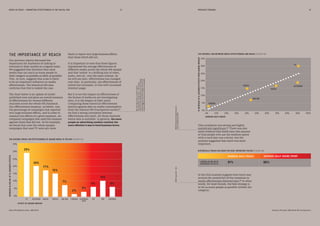
The chart below is an update of earlier
published ones and gives an overall measure
of effectiveness for various different
channels across the whole IPA Databank.
Our effectiveness measure, as before, was
the percentage of campaigns that reported
very large business effects, and in order to
measure the effects of a given medium, we
compared campaigns that used this measure
against those that did not. So for example,
we found that (over the whole sample)
campaigns that used TV were 29% more
THE IMPORTANCE OF REACH likely to report very large business effects
than those which did not.
It is important to note that these figures
represented the average effectiveness of
different media across the whole IPA sample
and that‘online’ is a shifting mix of video,
audio, text etc. over the years covered. As
we will see later, effectiveness has changed
over time. In particular, the effectiveness of
online has increased, in line with increased
internet usage.
But it is not the impact on effectiveness of
the format of media we are investigating
here; it is the impact of their reach.
Comparing these historical effectiveness
metrics against data on media consumption
from the relevant IPA Touchpoints survey,01
we find a strong correlation between
effectiveness and reach, for those channels
where data is available. In general, the more
people an advertising medium reached, the
more effective it was in hard business terms.
01Thedatahereisdrawnfrom
Touchpoints2(Sep2007–Feb2008),
whichistheclosestpointtothemedian
daterangefortheIPAsampleforwhich
mediaeffectivenesshasbeenestimated.35%
30%
25%
20%
15%
10%
5%
0%
TV OUTDOOR RADIO PRESS ONLINE CINEMA SPONSOR
SHIP
PR DM PROMOS
THE HISTORIC IMPACT ON EFFECTIVENESS OF ADDING MEDIA TO THE MIX (FIGURE 04)
29%
20%
17%
7%
2%
3%
6% 6%
10%
15%
INCREASEINAVGNO.OFVLBUSINESSEFFECTS
EFFECT OF ADDING MEDIUM
Base: IPA Databank cases, 1980-2016 Sources: IPA cases 1980-2016, IPA Touchpoints 2
02Statisticallysignificantat
99%confidencelevel.
03R-squared=83%
This correlation was strong and highly
statistically significant.02
There was also
some evidence that dwell time (the amount
of time people who use the medium spend
with it each day) was a factor, but the
analysis suggested that reach was more
important.
In fact this analysis suggests that reach may
account for around 83% of the variations in
media effectiveness observed here.03
In other
words, for most brands, the best strategy is
to hit as many people as possible (within the
category).
HISTORICALLY REACH HAS BEEN THE MOST IMPORTANT FACTOR (FIGURE 06)
CORRELATION WITH
BUSINESS EFFECTS
AVERAGE DAILY REACH AVERAGE DAILY HOURS SPENT
91% 86%
35%
30%
25%
20%
15%
10%
5%
0%
0% 10% 20% 30% 40% 50% 60% 70% 80% 90% 100%
%INCREASEINVLBUSINESSEFFECTSFROMADDINGMEDIUM
AVERAGE DAILY REACH
THE HISTORIC LINK BETWEEN MEDIA EFFECTIVENESS AND REACH (FIGURE 05)
OUTDOOR
RADIO
PRESS
ONLINE
CINEMA
TV
MEDIA IN FOCUS — MARKETING EFFECTIVENESS IN THE DIGITAL ERA
3.0
Much has changed since we published Marketing in
the Era of Accountability in 2007. That analysis was
largely based on data from the period from 1998 to
2006, when online marketing was rapidly
establishing itself, but not fully mature. Only 39%
of IPA cases included online channels within the
mix, and they only accounted for 3% of the budget
on average. YouTube and Facebook were both very
new, and their potential as marketing channels
had yet to be evaluated properly.
THE NEW MEDIA
LANDSCAPE
16 17
Our previous reports demonstrated how
brand owners needed paid media advertising
to reach people. Influence was largely a
matter of who shouted loudest. The key
metric was SOV, usually measured in terms
of a brand’s share of category media spend.
Research regularly showed that brands with a
high SOV relative to their size tended to grow,
while those with low SOV tended to shrink.04
Our previous analyses suggested that
advertising budget (and in particular share
of voice) was one of the most important
determinants of campaign effectiveness,
second only to the creative work itself.05
THE IMPORTANCE OF BUDGET
AND SHARE OF VOICE
05Econometric
analysestendto
reportsimilar
findings.For
example,see‘The
Top10Driversof
Advertising
Profitability’by
KarlWeaver,Admap
September2014.
04Formoredetail,see
TheLongandtheShortofIt,
Section2.1andMarketing
intheEraofAccountability
Chapter3.
12%
10%
8%
6%
4%
2%
0%
0% 2% 4% 6% 8% 10% 12% 14%
SHAREOFVOICE
SHARE OF MARKET
HISTORICALLY SHARE OF VOICE HAS DRIVEN SHARE OF MARKET (FIGURE 07)
Source: Binet and Field 2013
Since then, online budgets have exploded
from around 16% of total spend to over
40%,06
and the range of online touchpoints
has expanded massively. The internet has
evolved into a complex ecosystem, which
includes early online media like email,
websites and search; newer activities like
social media and online video; and media
like video-on-demand and web radio,
which seem to blur the distinction between
online and offline. Almost all campaigns
include online marketing now.
The arrival of the internet, and new
technology in general, has posed challenges
for the owners of older media and the
brands that have traditionally advertised in
them. Today it is easier for viewers to skip
TV ads, or watch video content in places
where there is no advertising at all. People
are less reliant on the printed word for their
news, forcing newsbrands to evolve. Radio
now has to compete with streaming services
like Spotify.
06Source:IAB/PwCDigitalAdspend
H12015andWARC.
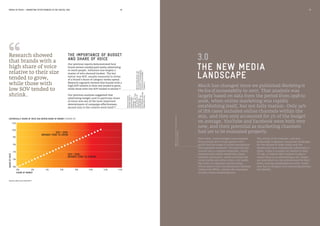
Research showed
that brands with a
high share of voice
relative to their size
tended to grow,
while those with
low SOV tended to
shrink.
SOV < SOM:
BRANDS TEND TO SHRINK
SOV > SOM:
BRANDS TEND TO GROW
MEDIA IN FOCUS — MARKETING EFFECTIVENESS IN THE DIGITAL ERA
As online media have matured, so they too
have faced challenges. Bombarded with ever
more messages, consumers have become
more resistant to online marketing, as
evidenced by declining response rates for
emails and banner ads and the widespread
growth of adblocking. Simplistic online
metrics, such as‘clicks’,‘likes’ and‘shares’
are coming under more critical scrutiny, as
are many of the more opaque exposure
metrics in use.
Here we will attempt to provide an objective
data-supported point-of-view, to help
readers navigate the often conflicting and
confusing information in the marketplace.
The IPA Touchpoints database is an
invaluable guide here, since it is the only
widely available survey that measures reach
and dwell time across all media on a
like-for-like basis. The chart below shows
reach and time spent with each of the main
media for 2016.
18 19THE NEW MEDIA LANDSCAPE
So what are the
important features of
the new media
landscape from a
marketing effectiveness
point of view?
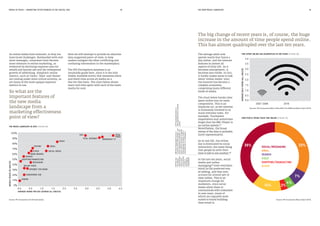
The big change of recent years is, of course, the huge
increase in the amount of time people spend online.
This has almost quadrupled over the last ten years.
Source: IPA Touchpoints UK 2016 (all adults)
THE MEDIA LANDSCAPE IN 2016 (FIGURE 08)
WEEKLYREACH(%ADULTS)
AVERAGE HOURS PER DAY (ACROSS ALL ADULTS)
0%
10%
20%
30%
40%
50%
60%
70%
80%
90%
100%
0.0 0.5 1.0 1.5 2.0 2.5 3.0 3.5 4.0 4.5
CINEMA
SUBSCRIBER VOD
INTERNET FOR WORK
ONLINE VIDEO
MESSAGING
SHOPPING/TRANSACTING
SEARCH
NEWS BRANDS
OTHER
TEXTING
SOCIAL MEDIA
EMAIL
RADIO
BROADCAST TV
OOH TOTAL
VIDEO
TOTAL INTERNET
The average adult now
spends nearly four hours a
day online, and the internet
features in almost all
aspects of daily life. As it
becomes omnipresent, it
becomes less visible. In fact,
it hardly makes sense to talk
about‘online media’ now;
the internet has become a
complex ecosystem,
comprising many different
kinds of media.
The chart below breaks time
spent online into its main
components. This is an
imprecise art, as the internet
is intimately involved in so
many everyday tasks. For
example, Touchpoint
respondents may sometimes
forget that the BBC iPlayer is
an online system.07
Nevertheless, the broad
sweep of the data is probably
fairly representative.
As in real life, the online
day is dominated by social
interaction; the main thing
that people do with their
time is talk to one another.08
In the last ten years, social
media and online
messaging09
have overtaken
email as the preferred way
of talking, and they now
account for around 39% of
time online. This is an
important change for
marketers, since social
media allow them to
communicate with consumers
in new ways, many of
which are arguably more
suited to brand building
than email is.
07Touchpointsdatais
self-reportedfromamobile
panel.
08Notethatpeoplewantto
conversewithotherpeople,not
withcompaniesorbrands.For
most,lifeistooshorttospend
timegettingintimatewitha
chocolatebaroradetergent.
09Thetwo
aredeeply
intertwined,
sincemost
socialmedia
includea
messaging
component.
HOW PEOPLE SPEND THEIR TIME ONLINE (FIGURE 10)
Source: IPA Touchpoints Wave 6 (April 2016)
SOCIAL/MESSAGING
EMAIL
SEARCH
VIDEO
SHOPPING/TRANSACTING
OTHER
39%
14%
33%
7%
4%
3%
Sources: IPA Touchpoints Wave 2 (Sep 2007-Feb 2008) and Wave 6 (April 2016)
TIME SPENT ONLINE HAS QUADRUPLED IN TEN YEARS (FIGURE 09)
2007-2008
AVERAGEDAILYHOURS(ALLADULTS)
2016
0.5
0.0
1.0
1.5
2.0
2.5
3.0
3.5
4.0
MEDIA IN FOCUS — MARKETING EFFECTIVENESS IN THE DIGITAL ERA 20 21THE NEW MEDIA LANDSCAPE
VIDEO CONSUMPTION IN 2016 (FIGURE 11)
Source: Thinkbox 2016 BARB / comScore / Broadcaster stream data
/ OFCOM digital day / IPA Touchpoints 6 / Rentrak
YOUTUBE
CINEMA
FACEBOOK
OTHER ONLINE
ONLINE ‘ADULT’ XXX VIDEO
••••• LIVE TV
SUBSCRIPTION VoD
BROADCASTER VoD
PLAYBACK TV
DVD
•••••
Social media are now increasingly used for
paid advertising. As social has evolved, it
has increasingly become a source of news
and entertainment, and so social advertising
has begun to look a little like a hybrid of
press and TV ads.
Video is an increasingly important feature
of social, and of internet time generally.
YouTube launched in 2005, dramatically
expanding the range of video content
available online, and increasing
consumption correspondingly. Today, most
social media have a video component, with
features like autoplay making it almost
omnipresent.
It’s perhaps not surprising that video is an
important component of internet time
because, considered as a whole, it remains
the dominant entertainment medium.
Apart from chatting to one another, it’s the
main thing people do with their spare time.
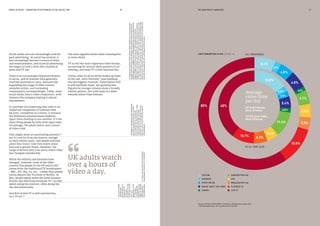
On average, UK adults watch over 4 hours
of video a day.
That might seem an astonishing amount,10
but it’s not far from the historic average.
Go back twenty years, and people watched
about four hours; now they watch about
four and a quarter hours. However, the
range of devices they now use to watch video
has changed considerably.
While the delivery mechanisms have
changed, however, most of the video
content that people in the UK watch still
comes from the traditional TV broadcasters
– BBC, ITV, Sky, C4, etc. – rather than purely
online players like YouTube or Netflix. In
fact, people spend about the same amount
of their day watching broadcast TV11
as they
spend using the internet, often doing the
two simultaneously.
And 82% of that TV is still watched live,
on a TV set.12
The chart opposite shows video consumption
in more detail.
TV is still the most important video format,
accounting for around three quarters of all
viewing, and most TV is still watched live.
Online video in all its forms makes up most
of the rest, with YouTube13
and Facebook
the two biggest channels. Subscription VoD
is still relatively small, but growing fast.
Figures for younger viewers show a broadly
similar pattern, but with more of a skew
towards online video formats.
10Peopleinmarketingandadvertising
areoftensurprisedbythesenumbers.
Thisispartlyduetotheskewed
natureoftheviewingbehaviour,with
somepeoplewatchingimmense
amounts.Butitisalsopartlybecause
theyareoutoftouchwiththerestof
thepopulation.
11Videocontentfromthetraditional
broadcasters,howeveritiswatched.
12Source:BARB
/Broadcaster
streamdata2017.
Proportionof
viewingto
broadcastTVthat
isliveandviaTV
sets,asa
proportionofall
TVviewing,
includingPVR
playbackandall
video-on-demand
offeringsfrom
thebroadcasters.
13DatafromcomScoreVideoMetrixMulti-Platform,whichmeasures
unduplicatedviewingacrossdesktopandmobileandisawaitingfull
UKOMapproval,suggeststhatviewingfiguresforonlinevideomaybe
slightlyhigherthanthischartshows.Thepreliminarydatafor
SeptembertoDecember2016suggeststhatadultsconsume25minutes
ofYouTubeaday(someofwhichisaudioonly)whereasthischartonly
records18minutes.25minutesperdaywascalculatedbydividing152bn
minutesof18+YouTubeviewingmeasuredbycomScoreby122daysand
thetotalUKpopulation18+accordingtoONSCensus.
UK adults watch
over 4 hours of
video a day.
60%
10.8%
3.9%
3.8%
4.1%
4.9%
4.0%
1.7%
0.4%
6.4%
ALL INDIVIDUALS
40%
15.6%
2.5%
0.8%
2.5%
5.4%
5.4%
6.3%
11.4%
10.1%
16-24 YEAR OLDS
All individuals:
4hrs 37mins
16-24 year olds:
3hrs 27mins
Average
video time
per day
MEDIA IN FOCUS — MARKETING EFFECTIVENESS IN THE DIGITAL ERA 22 23
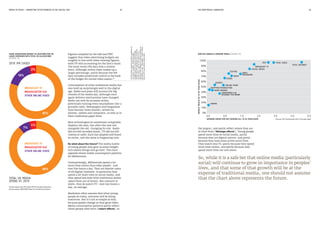
HOW MILLENNIALS CONSUME MEDIA (FIGURE 13)
WEEKLYREACH(%15-34YEAROLDS)
AVERAGE HOURS PER DAY (ACROSS ALL 15-34 YEAR OLDS)
0%
10%
20%
30%
40%
50%
60%
70%
80%
90%
100%
0.0 0.5 1.5 2.5 3.5 4.5 5.5
CINEMA
SUBSCRIBER VoD
INTERNET FOR WORK
ONLINE VIDEO
SHOPPING/TRANSACTING
SEARCH
NEWS BRANDS
OTHER
TEXTING
SOCIAL MEDIA
EMAIL
MESSAGING
RADIO
BROADCAST TV
OOH TOTAL VIDEO
TOTAL INTERNET
Figures compiled by the IAB and PWC
suggest that video advertising budgets are
roughly in line with video viewing figures,
with TV still accounting for the lion’s share.
The most recent IPA data tells a similar
story, although online video makes up a
larger percentage, partly because the IPA
data includes production (which is the bulk
of the budget for owned video assets).14
Consumption of other traditional media has
also held up surprisingly well in the digital
age. Radio and press still account for big
chunks of the media day, although once
again delivery mechanisms have changed.
Radio can now be accessed online,
potentially turning every smartphone into a
portable radio. Newspapers and magazines
have become‘news brands’, served via
phones, tablets and computers, as well as in
their traditional paper form.
New technologies do sometimes completely
displace old ones, but often the new sits
alongside the old, changing its role. Radio
did not kill recorded music, TV did not kill
cinema or radio. Each has adapted and found
its niche, and the same is happening now.
So what about the future? The media habits
of young people may give us some insight
into where things will go next. The chart
opposite shows media consumption patterns
for Millennials.
Unsurprisingly, Millennials spend a lot
more time online than older people – just
over five hours a day. They are heavier users
of all digital channels: in particular they
spend a lot more time on social media, and
they spend less time with traditional media
(apart from out of home). But contrary to
myth, they do watch TV – over two hours a
day, on average.
Marketers often assume that what young
people do today, everyone will be doing
tomorrow. But it’s not as simple as that,
because people change as they grow older.
Media consumption patterns partly reflect
when people were born (‘cohort effects’, in
14Theotherimportantvideomediumis,
ofcourse,cinema.Unfortunately,
samplesizesforcinemaadvertising
withintheIPADatabankaresmallfor
recentyears,anddonotallowusto
measuretheeffectsofcinemareliablyin
theWeb2.0era.Therefore,‘video’refers
heretoTVandonlinevideoonly.
BROADCAST TV
BROADCASTER VoD
OTHER ONLINE VIDEO
16%
2%
82%
VIDEO ADVERTISING BUDGET ALLOCATIONS FOR IPA
CASES COMPARED WITH TOTAL UK ALLOCATIONS
(FIGURE 12)
7%
4%
89%
BROADCAST TV
BROADCASTER VoD
OTHER ONLINE VIDEO
Source above: IAB/PWC does not include production
Source above top: IPA cases 2016 includes production
Source: IPA Touchpoints UK (15-34 year olds)
So, while it is a safe bet that online media (particularly
social) will continue to grow in importance in peoples’
lives, and that some of that growth will be at the
expense of traditional media, one should not assume
that the chart above represents the future.
THE NEW MEDIA LANDSCAPE
the jargon), and partly reflect where they are
in their lives (‘lifestage effects’). Young people
spend more time on social media, partly
because they are digital natives, and partly
because they have more active social lives.
They watch less TV, partly because they spend
more time online, and partly because they
spend more time out and about.
2016 IPA CASES
TOTAL UK MEDIA
SPEND H1 2015
DOES MASS MARKETING STILL WORK?24 25
01 As consumers devote
more time and attention to
these new digital media,
they become more important
for marketing. As the old
saying goes,‘If you want to
catch a fish, fish where the
fish are’.
02 The new channels have
some obvious efficiencies.
They can often be more
precisely targeted; it is easy
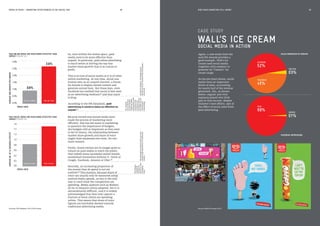
to include direct response
mechanisms that close the
gap between advertising and
purchase; and marginal
costs are often very low.
03 Digital channels allow
marketers to have a more
active relationship with
their customers, because
they tend to be more
interactive, and yield more
data about them.
However, there are three things that almost all
marketers would agree on:
In this section we will examine recent IPA data to
explore how valid these assertions really are.
As a result, marketers have naturally shifted
much of their attention and expenditure
away from traditional broadcast and
print-based media and towards the newer
digital channels.
Some have gone even further, arguing that
the old model of marketing is
fundamentally broken. As one eminent
academic put it a few years ago: “Brands need
to move away from mass marketing to having more
direct, personal relationships with their buyers”. The
most radical have questioned the whole idea
of spending money on media at all. Joseph
Jaffe and Maarten Albarda, for example,
argued in their book Z.E.R.O. that brands
should abandon paid media altogether,
focussing all their attention on owned and
earned.
So do the old rules still apply in this brave
new world? Does mass marketing still work?
The continued validity of the mass
marketing model is being challenged
particularly by three assertions:
01 Tight targeting is now the most efficient
approach.
02 Unpaid (i.e. owned and earned media) is
making paid media redundant.
03 Activation strategies are now the best
way to drive growth, rather than brand
building ones.
DOES MASS MARKETING
STILL WORK?
4.0
The commercialisation of the internet, the spread
of mobile telephony, and many other related
digital technologies have dramatically changed our
world. Even though this revolution has been going
on for over twenty years, most of us are still trying
to understand what it means for marketing.
MEDIA IN FOCUS — MARKETING EFFECTIVENESS IN THE DIGITAL ERA DOES MASS MARKETING STILL WORK?26 27
The historic argument for why brands need
mass marketing is that they constantly need
to recruit new customers. Brands lose
customers all the time, so they need a steady
stream of new ones in order to survive, let
alone grow. And that tends to require broad
reach media, and adequate budgets.
But some marketers have always felt that
this was inefficient. Surely a more targeted
approach, which aimed to foster strong
brand loyalty, would be a better use of scarce
marketing resources, and deliver a higher
ROI? In this section we will examine two
models of tight targeting:
— Loyalty marketing
— Data-driven real-time marketing
users. Googling ‘Increasing brand loyalty’
immediately suggests ‘Increasing brand
loyalty through social media’ as the most
likely method, and delivers over 6 million
articles on the subject. The prospect of
building loyalty at low cost has encouraged
brand owners to invest heavily in social
media, and in some cases use it to replace
more traditional media.
So is mass advertising still relevant in this
brave new world? Or is it more efficient for
brands to use tightly targeted communications
to form stronger, more personal relationships
with their customers? Are we entering a new
golden age of brand loyalty?
As in previous analyses, the latest IPA data
shows that the most effective campaigns
still tend to be those that talk to both new
customers and existing customers together
– i.e. those that address the whole market.
Broad-reach campaigns are much the best for
driving top-line growth,15
which is crucial for
increasing profits.
This is in line with copious research
from the Ehrenberg-Bass Institute.
(see page 28).16
IS TIGHT TARGETING NOW THE
MOST EFFICIENT APPROACH?
LOYALTY MARKETING
The digital revolution has made loyalty
marketing seem even more appealing. For a
start, it has dramatically reduced some of
the costs involved. In the old days, the one
obvious drawback of CRM was that it
required channels like telemarketing and
direct mail, where the cost per contact was
much higher. But email and social media
allow brands to communicate with their
customers at very low cost.
At the same time, the tools of traditional
loyalty marketing have all been streamlined
for the digital age. Direct response
mechanisms are easier, faster and more
directly linked to sales, with one-click
ordering the paradigm of efficiency. Loyalty
schemes and promotional mechanics can be
delivered via mobile apps. Websites, apps
and social media allow fans to engage more
deeply with their brands, and to share brand
content with their families and friends.
Social media, in particular, seem perfect for
building loyalty. Social allows brand fans to
form communities, and makes a genuine
dialogue possible between brands and their
15Forevidenceoftheimportanceofmarketshareforprofitability,see:
Buzzell,RDandBTGale(1987),ThePIMSPrinciples:LinkingStrategytoPerformance,
TheFreePress,NewYork;Kohli,AjayK,NVenkatraman,andJohnHGrant
(1990),‘ExploringtheRelationshipBetweenMarketShareandBusiness
Profitability’,ResearchinMarketing,10,113-133;Szymanski,DavidM,SundarG
BharadwajandPRajanVaradarajan(1993),‘AnAnalysisoftheMarket
Share-ProfitabilityRelationship’,JournalofMarketing,57(July),1-18.
AswewillseeinPart6ofthisreport,ourownanalysissuggeststhatmarket
sharegrowthisimportantforbrandsthatwanttoincreaseprofits.
16Alsosee“How
BrandsGrow”,
SharpB,OUP
2010and
“HowBrands
Grow–Part2”,
RomaniukJ&
SharpB,
OUP2016
Unfortunately not.
ANNUALMARKETSHAREGROWTH
CAMPAIGN TARGET
0.2%
0.0%
0.4%
0.6%
0.8%
1.0%
1.2%
1.4%
1.6%
BROAD-REACH CAMPAIGNS THAT TARGET NEW CUSTOMERS
ARE BEST FOR TOP-LINE GROWTH (FIGURE 14)
1.8%
BOTHEXISTING
CUSTOMERS
NEW
CUSTOMERS
Source: IPA Databank, 2008-2016 cases
01The target consumer
numbers are smaller.Marketing
effectiveness is to a large
extent a numbers game – the
more people you expose to your
activity, the bigger the effects.
For most brands, existing
customers represent a small
proportion of the market, so
the effects of loyalty marketing
are correspondingly small.
02 Marketing
communications play a
smaller role in shaping the
perceptions of brand users.
People who have never used
a brand may form their
opinions partly based on
impressions gained from
advertising, but users are
more likely to go by their
actual experiences.
03 It is much harder to get
someone to increase their
consumption of a product,
or to pay more for it, than
it is to get them to try
another brand.
Loyalty campaigns (i.e. to existing customers)
tend to under-perform for three main reasons:
With these three factors working against
them, loyalty campaigns struggle to produce
decent results. Indeed,“loyalty” campaigns
are not even particularly good at increasing
brand loyalty. When they do work, they tend
to do so by increasing penetration, not loyalty.
So, unsurprisingly, the IPA data reveals that
the proportion of campaigns targeting only
existing customers has been in long-term
decline. On a ten-year rolling basis the
proportion of IPA campaigns that were pure
loyalty ones has almost halved in 8 years to 6%.
Over the 2014-16 case study years pure
loyalty campaigns have declined further to
just 3% of IPA campaigns: proof, if it were
still needed that an exclusive focus on
loyalty is a dead end. And loyalty effects
were observed by a mere 13% of cases, mostly
as a side-effect of penetration growth.
The data does also show, however, that the
loyalty-driven model still has some followers:
over the 2014-16 period, 15% of cases still
included loyalty as a primary objective.
Moreover, amongst the 2016 cases17
17%
included a dedicated loyalty-building
element to the campaign. Although this is
over-shadowed by the 53% that included a
dedicated customer acquisition element and
the 95% that included a brand-building
element, it does make abundantly clear that
the report of its death is an exaggeration.
17Theonlyperiodforwhichthisnew
dataonthecompositionofcampaigns
isavailable.
Source: IPA Databank, 1998-2016 cases
INCIDENCEOFCAMPAIGNSONLY
TARGETINGLOYALTY
10 YEARS ENDING
0%
2008 2010 2012 2014 2016
12%
10%
8%
6%
4%
2%
PURE LOYALTY CAMPAIGNS HAVE BEEN IN LONG-TERM DECLINE (FIGURE 15)
Market share is a key driver of profitability, and as Byron Sharp,
Director of the Ehrenberg-Bass Institute has shown, the primary
driver of market share is penetration. The main way brands grow
is by selling to more people: so the main way marketing
communications drive growth is by increasing penetration, and the
biggest gains come from customer acquisition.
Brand loyalty is less important, and is to a large extent a side effect
of penetration. Brands with high penetration tend to have better
loyalty rates, as measured by things like share of category
requirement and customer retention. This is what Sharp calls the
‘double jeopardy’ effect.
Our data confirms his model. Communications that target existing
customers with the aim of improving loyalty or retention tend to
have much smaller effects and these are short term. However, the
most effective campaigns talk to everyone in the market. They talk
to customers and non-customers; they increase penetration and
loyalty.
Sharp argues that, in most cases, the target market is in fact all
buyers of the category. Markets are much less segmented than most
marketers believe, and successful niche brands (in the true sense
of the word) are relatively rare.
So successful brands talk to all buyers of the category, customers
and non-customers, on a regular basis. Most of these people have
encountered the brand before at some point, so the main job is
usually just to remind them about it, and to ensure that it has
higher‘mental availability’ than its rivals.
That means marketing really is a numbers game; the most
successful brands tend to be those that have the most customers,
and they tend to be the brands that talk to the most people in
the market, most often.
MEDIA IN FOCUS — MARKETING EFFECTIVENESS IN THE DIGITAL ERA DOES MASS MARKETING STILL WORK?28 29
THE IMPORTANCE OF PENETRATION
A VIEW FROM THE EHRENBERG-BASS INSTITUTE
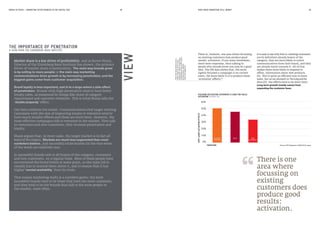
There is, however, one area where focussing
on existing customers does produce good
results: activation. If you want immediate,
short-term responses, then talking to
people who already know you may be a good
idea. The IPA data shows that, the more
tightly focussed a campaign is on current
users, the more likely it is to produce these
‘activation’ effects.18
It is easy to see why this is: existing customers
are by definition already buyers of the
category, they are more likely to notice
communications from their brand, and they
are already warm towards it. All of that
makes them more likely to respond to
offers, information about new products,
etc. This is quite an efficient way to boost
sales, but as we showed in The Long and the
Short of It, the effects tend to be short term.
Long-term growth mostly comes from
expanding the customer base.
18Inthedatathesecovera
widerangeofshort-term
responses:directresponses,
immediateshort-termsales,
promotionaluplifts,
click-throughsetc.
VIEW
VERYLARGEACTIVATIONEFFECTS
TARGETING
FOCUSING ON EXISTING CUSTOMERS IS GOOD FOR SALES
ACTIVATION (FIGURE 16)
Source: IPA Databank, 2008-2016 cases
0%
60%
50%
40%
30%
20%
10%
NEW
CUSTOMERS
EXISTING
CUSTOMERS
BOTH
There is one
area where
focussing on
existing
customers does
produce good
results:
activation.
MEDIA IN FOCUS — MARKETING EFFECTIVENESS IN THE DIGITAL ERA DOES MASS MARKETING STILL WORK?30 31
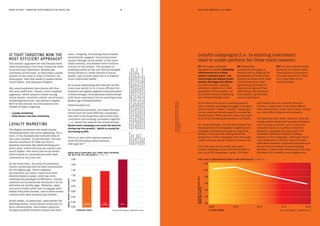
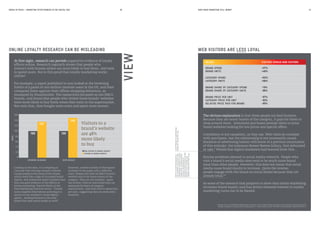
At first sight, research can provide supportive evidence of loyalty
effects online. Research regularly shows that people who
interact with brands online are more likely to buy them, and tend
to spend more. But is this proof that loyalty marketing works
online?
For example, a report published in 2012 looked at the browsing
habits of a panel of one million internet users in the US, and then
compared them against their offline shopping behaviour, as
measured by Dunnhumby. The researchers focussed on ten FMCG
brands, and found that people who visited those brands’ websites
were more likely to buy them when they went to the supermarket.
Not only that, they bought more units and spent more money:
The obvious explanation is that these people are deal hunters.
Because they are heavy buyers of the category, it pays for them to
shop around more. Imminent purchases prompt them to scour
brand websites looking for low prices and special offers.
Correlation is not causation, as they say. Web visits do correlate
with purchases, but the relationship is not necessarily causal.
Students of advertising history will know of a previous incarnation
of this mistake: the infamous Rosser Reeves fallacy, first debunked
in 1961.* Would that digital marketers had learned from this…
Similar problems abound in social media research. People who
visit a brand’s social media sites tend to be much more brand
loyal than other people. However, this does not mean that social
media cause brand loyalty to increase. Quite the reverse:
people engage with the brand on social media because they are
already loyal.**
So some of the research that purports to show that online marketing
increases brand loyalty (and has driven renewed interest in loyalty
marketing) turns out to be flawed.
ONLINE LOYALTY RESEARCH CAN BE MISLEADING WEB VISITORS ARE LESS LOYAL
Looking at this data, it is tempting to
conclude that visiting a brand’s website
causes people to buy more of the brand,
which looks like a sign of increased brand
loyalty. And indeed led some to believe that
this was good evidence of the effects of
online marketing. Patrick Walsh of the
Food Marketing Institute wrote: “Finally
some tangible observations pointing to a
return on our members’ brand digital
spend… looking forward to the next
phase that adds social media as well!”
However, careful scrutiny of the figures
included in the paper tells a different
story. People who visit an FMCG brand’s
website tend to be heavy buyers of the
category. They are not loyalists – quite
the reverse; they are less brand loyal (as
measured by share of category
requirement). And they tend to spend less
per unit, suggesting they are more price
sensitive.
0
20
40
60
80
100
120
140
160
SPENDING ON BRAND
INDEX
UNITS BOUGHT
137
148
Visitors to a
brand’s website
are 48%
more likely
to buy
NON-VISITORS TO BRAND’S WEBSITE
VISITORS TO BRAND’S WEBSITE
100 100
See‘RealityinAdvertising’,
ReevesR,KnopfNY,1961
Forafullerdiscussionof
theproblemsassociatedwith
identifyingcausalityinsocial
mediadata,seeMeasuringNot
Counting–EvaluatingSocial
MarketingCommunicationsbyRay
Poynter,FranCassidyand
SimeonDuckworth(IPA2014).
BRAND SPEND
BRAND UNITS
CATEGORY SPEND
CATEGORY UNITS
BRAND SHARE OF CATEGORY SPEND
BRAND SHARE OF CATEGORY UNITS
BRAND PRICE PER UNIT
CATEGORY PRICE PER UNIT
RELATIVE PRICE PAID FOR BRAND
+37%
+48%
+53%
+58%
-10%
-06%
-07%
-03%
-05%
METRIC VISITORS VERSUS NON-VISITORS
Sources: Are Your CPG Brands Maximising the Return on Your Digital Investment? Accenture, Comscore, Dunnhumby 2012,
Sample: Integrated Comscore/Dunnhumby panel of 1 million internet users, 10 FMCG brand websites, Sep 2010-Feb 2011
VIEW
MEDIA IN FOCUS — MARKETING EFFECTIVENESS IN THE DIGITAL ERA DOES MASS MARKETING STILL WORK?32 33
Advocates of tight targeting might argue at
this point that, in the era of Big Data, tight
targeting does not have to mean targeting
existing customers. These days online
advertising is increasingly targeted at
consumers whose digital trail reveals an
intention to purchase the category, not
usually just the brand being advertised. This
theory asserts that it is better to target new
customers only at the very moment when
their digital trail suggests they are about to
buy imminently. Surely this must be a better
reincarnation of tight targeting than
hammering away at existing customers?
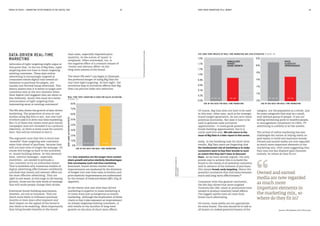
The IPA data shows the growth of data-driven
marketing. The proportion of 2014-16 case
studies using Big Data is 42%, just over half
of which used it to drive real-time marketing.
But 7% of these real-timers were pure loyalty
campaigns (and 20% included it as a primary
objective), so there is some cause for concern
here: this will be revisited in Part 6.
The argument runs that this is much less
‘wasteful’ than targeting new customers
some time ahead of purchase, because they
will not have time to forget the message. Of
course this brings us back to the activation
vs. brand-building debate. At this eleventh
hour, rational messages – especially
incentives – are needed to persuade a
non-customer to try an unfamiliar brand.
That is doubtless why numerous studies of
digital advertising effectiveness confidently
conclude that timely and relevant offers are
the most effective advertising. They are
right in one sense; at this stage in the buying
process, those are the only kinds of message
that will make people change their minds.
Emotional brand-building associations,
however, are not so transient. They are
much more likely to influence purchase
months or even years after exposure and
their impact on the appeal of the brand is
also likely to be enduring. More importantly
they bring broader benefits to the brand
DATA-DRIVEN REAL-TIME
MARKETING
than sales, especially improved price
elasticity. So the notion of‘waste’ is
misplaced. Often overlooked, too, is
the negative effect of a constant stream of
‘timely and relevant offers’ on the
long-term esteem of the brand.
The latest IPA data19
can begin to illustrate
the profound danger of using Big Data for
real-time tight targeting. At first sight, the
enormous leap in activation effects that Big
Data can procure looks very seductive.
Of course, Big Data does not have to be used
in this way: other uses, such as for strategic
brand insight generation, do not carry these
potential downsides. Nor does it have to be
used to generate sales activation
opportunities – it could guide powerful
brand-building opportunities, but it is
rarely used this way. We will return to the
issue of Big Data in a later report in this series.
Sadly, in the headlong rush for short-term
results, Big Data users are forgetting that
the fundamental role of marketing is to make
consumers want to buy their brands to such
an extent that they don’t have to discount
them. As we have already argued, the only
proven way to achieve this is to build the
brand in the minds of all potential customers
well in advance of the moment of purchase:
this means broad, early targeting. Hence the
powerful correlation that still exists between
reach and long-term effectiveness.20
Consistent with this general conclusion,
the IPA data shows that more targeted
channels like DM, email or promotions have
tended to produce relatively small effects.
The biggest uplifts have all come from
broad-reach advertising.
Of course, mass media are not appropriate
for every brand. The aim should be to talk to
all buyers (or indeed potential buyers) of the
But less seductive are the longer-term market
share growth and price elasticity disadvantages
that accompany such real-time marketing.
Sustained, brand-driven market share
improvements are weakened by the diversion
of budget into real-time sales activation and
price elasticity improvements are undermined
by the stream of timely and relevant offers (Fig 18
opposite).
So the theory that real-time data-driven
marketing is superior to mass marketing is
in many ways just as dangerous as loyalty
marketing. Although the implication of these
charts is that it does represent an improvement
on simply targeting existing customers, it
still results in the sacrifice of long-term
growth on the altar of short-term effects.
19Onlyavailablefor2014-16cases.
Sources: IPA Databank, 2014-2016 cases
REAL-TIME TIGHT TARGETING IS GOOD FOR SALES ACTIVATION
(FIGURE 17)
USE OF BIG DATA FOR REAL-TIME MARKETING
VERYLARGEACTIVATIONEFFECTS
10%
0%
20%
30%
40%
50%
60%
70%
80%
DID NOT USE DID USE
0.0%
0.2%
0.4%
0.6%
0.8%
1.0%
1.2%
1.4%
1.6%
category, not the population as a whole, and
for some categories that may be a small,
well-defined group of people. If you are
selling swimming pools to wealthy people,
or management consultancy to CEOs, TV
advertising is unlikely to be the answer.
The arrival of online marketing has also
challenged the notion of relying solely on
paid media to build and maintain brands.
Owned and earned media are now regarded
as much more important elements in the
marketing mix, with some suggesting that
they may one day displace paid channels
entirely. So where do they fit in?
20Seefigure7earlierin
thisreport.
THE LONG-TERM IMPACTS OF REAL-TIME MARKETING ARE LESS ATTRACTIVE (FIGURE 18)
USE OF BIG DATA FOR REAL-TIME MARKETING USE OF BIG DATA FOR REAL-TIME MARKETING
DID NOT USE DID NOT USEDID USE DID USE
0%
2%
4%
6%
8%
10%
12%
Owned and earned
media are now regarded
as much more
important elements in
the marketing mix, so
where do they fit in?
ANNUALISED
MARKET
SHARE GROWTH
PRICE
ELASTICITY
IMPROVEMENTS
MEDIA IN FOCUS — MARKETING EFFECTIVENESS IN THE DIGITAL ERA DOES MASS MARKETING STILL WORK?34 35
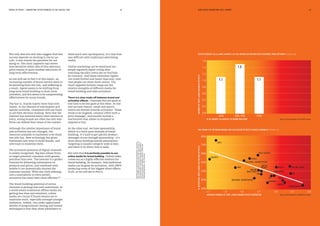
The IPA data has shown that scale, particularly
reach, is an important determinant of
media effectiveness. Broadly speaking, the
more people you reach within your target
market, the bigger the effects on sales and
profit tend to be. But paid media are not the
only way to reach people; brands can also
use owned and earned media.
These are not new phenomena. Brands have
been exploiting owned assets for a very long
time – shops, offices and packaging are
owned media of a kind – and word of mouth
is possibly the oldest medium of all. But the
internet has expanded the range of owned
and earned channels available (see opposite
top), and has undoubtedly increased their
importance.
It is now much easier for consumers to find
out about, and often buy, brands directly
from their owners. And it is far easier for
people to share that information with their
family and friends. This gives marketers
new ways to promote their products and
services without using paid media.
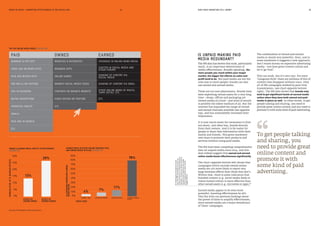
The IPA have been compiling comprehensive
data on unpaid media since 2014, and this
does indeed suggest that owned and earned
online media boost effectiveness significantly.
The chart (opposite bottom left) shows that
campaigns which include owned online
media are 13% more likely to report very
large business effects than those that don’t.
Within that, there is some indication that
branded content (e.g. social media feeds or
videos hosted online) is more effective than
other owned assets (e.g. microsites or apps).21
Earned media appear to be even more
powerful, boosting effectiveness by 26%.
This fits with our previous findings about
the power of fame to amplify effectiveness,
since earned media are a major beneficiary
of‘fame’ campaigns.
IS UNPAID MAKING PAID
MEDIA REDUNDANT?
The combination of owned and earned
media is clearly very powerful, then, and to
some marketers it suggests a new approach;
don’t waste money on expensive advertising
media – just host great content online and
let it‘go viral’.
This can work, but it’s very rare. For every
‘Gangnam Style’ there are millions of bits of
content that disappear without trace. Only
4% of IPA campaigns worked by pure viral
transmission, (see chart opposite bottom
right). The IPA data shows that brands only
tend to get significant levels of earned media
online when they have both owned and paid
media in place as well. In other words, to get
people talking and sharing, you need to
provide great online content and you need to
promote it with some kind of paid advertising.
21Althoughitshouldbenoted
thattheIPADatabankfocuseson
onlineassetsasacommunications
channel,itdoesnottendtolookat
transactionalwebsitesandapps,
whichpresumablyhavemuch
biggereffects.
To get people talking
and sharing, you
need to provide great
online content and
promote it with
some kind of paid
advertising.
Sources: IPA Databank, 2014-2016 cases
INCREASEINNO.OFVLBUSINESSEFFECTS
EFFECT OF
ADDING OWNED
OWNED & EARNED MEDIA AMPLIFY EFFECTIVENESS
(FIGURE 20)
0%
30%
25%
20%
15%
10%
5%
EFFECT OF
ADDING EARNED
26%
13%
%CAMPAIGNSGENERATINGEARNED
MEDIAONLINE
EARNED MEDIA SUCCESS ONLINE REQUIRES PAID
AND OWNED MEDIA IN PLACE (FIGURE 21)
0%
90%
80%
70%
60%
50%
40%
30%
20%
10%
MEDIA USED
7%
11%
78%
4%
EARNED ONLY EARNED &OWNED EARNED &PAID EARNED, OWNED
&PAID
THE POE ONLINE MEDIA MODEL (FIGURE 19)
PAID OWNED EARNED
BANNERS & POP-UPS WEBSITES & MICROSITES COVERAGE IN ONLINE NEWS MEDIA
VIDEO ADS ON NEWS SITES BRANDED APPS CHATTER IN SOCIAL MEDIA AND
OTHER FORUMS
PAID ADS WITHIN APPS ONLINE GAMES SHARING OF CONTENT VIA
SOCIAL MEDIA
PRE-ROLLS ON YOUTUBE BRAND’S SOCIAL MEDIA FEEDS SHARING OF CONTENT VIA EMAIL
ADS IN FACEBOOK CONTENTS ON BRAND’S WEBSITE OTHER ONLINE WORD OF MOUTH,
‘DARK SOCIAL’ ETC.
NATIVE ADVERTISING VIDEO HOSTED ON YOUTUBE ETC.
PROMOTED TWEETS ETC.
EMAILS
PAID ADS IN SEARCH
ETC.
MEDIA IN FOCUS — MARKETING EFFECTIVENESS IN THE DIGITAL ERA DOES MASS MARKETING STILL WORK?36 37
JOHN LEWIS VIEWING FIGURES: ON AND OFFLINE
CASE STUDY
A good example of how
paid, owned and earned
media work together is the
John Lewis case study,
which won the Grand Prix at
the 2016 IPA Awards as well
as at the Cannes Creative
Effectiveness Lions. In
recent years, John Lewis’s
Christmas ads have been
some of the most widely
shared in the world, and
online viewing figures have
risen steadily.
Between 2012 and 2015, John
Lewis’s Christmas ads got
79 million views online, an
astonishing achievement
(preliminary results suggest
that the 2016 campaign has
surpassed previous years).
And by far the bulk of those
online views were unpaid, a
result of the huge interest
that John Lewis’s advertising
has generated amongst the
British public in recent years.
However, as the figures
above show, this was not
achieved by just letting the
ads go viral. It was the result
of creating consistently great
creative content over several
years and promoting it
heavily through massive
exposure in paid advertising
media (in this case TV). In
fact, online views only
accounted for 3% of total
exposure; the rest came
from paid TV advertising.
The John Lewis paper argues
that paid media help generate
earned media, which then
amplify the effect of paid
media, creating a virtuous
circle of rising fame and
increasing effectiveness.
XMAS
2012
2013 426m 12m 437m £4.6m 1.1 pence
2014 371m 29m 400m £3.9m 1.0 pence
2015 1,175m
2,375m
35m
79m
1,210m
2,453m
£4.1m
£16.5m
0.3 pence
0.7 penceTOTAL
403m 3m 406m £3.9m 1.0 pence
ONLINE
VIEWS
TV
VIEWS
TOTAL
VIEWS
JOHN LEWIS
SPEND
COST PER
VIEW
Sources: John Lewis IPA paper 2016
ADS BECOME
A NATIONAL
EVENT
MEDIA
COVERAGEHUGE EXPOSURE
ADS THAT PEOPLE LOVE
SUPPLIERS
& CHARITIES
GOT
INVOLVED
OTHERS
JUMPED
ON THE
BANDWAGON
SHIFT FROM
‘PUSH’ TO ‘PULL’
WORD OF
MOUTH
FAME IS A VIRTUOUS CIRCLE
MEDIA IN FOCUS — MARKETING EFFECTIVENESS IN THE DIGITAL ERA DOES MASS MARKETING STILL WORK?38 39
So, even within the online space, paid
media tend to be more effective than
unpaid. In particular, paid online advertising
is much better at driving the top-line
market share growth that is so crucial to
profit.
This is as true of social media as it is of other
online marketing. At one time, social was
mainly seen as an unpaid channel, a forum
for brands to display owned content and
generate earned buzz. But these days, even
Facebook has realised that social is best seen
as an advertising medium,22
and that reach
is king.
According to the IPA Databank, paid
advertising in social is twice as effective as
unpaid.23
WALL’S ICE CREAM
CASE STUDY
SOCIAL MEDIA IN ACTION
Again, a case study from the
2016 IPA Awards provides a
good example. Wall’s Ice
Cream used social media
(together with outdoor) to
promote its“Classics” ice
cream range.
As the pie chart shows, social
media were an important
driver of sales, accounting
for nearly half of the revenue
generated. But, as shown
below, organic and viral
exposure played very little
part in that success, despite
Unilever’s best efforts. 99% of
the effect of social came from
paid advertising.
23‘Unpaid’
socialinvolves
nopaidmedia.
Thereareoften
substantialcosts
involvedwith
curatingand
hostingcontent,
butthesedonot
involvepaid
advertising.
22‘ReachMatters:DrivingBusiness
ResultsatScale’FacebookIQwhitepaper,
June2016.
PAID ONLINE MEDIA ARE MUCH MORE EFFECTIVE THAN
UNPAID (FIGURE 22)
SALES GENERATED BY MEDIUM
FACEBOOK IMPRESSIONS
PAID SOCIAL MEDIA ARE MUCH MORE EFFECTIVE THAN
UNPAID (FIGURE 23)
AVERAGESOMGROWTHPERANNUM
0.0%
0.9%
2.6%
0.5%
1.0%
1.5%
2.0%
2.5%
3.0%
MEDIA USED
ONLINE UNPAID ONLINE PAID
AVERAGENO.OFVLBUSINESSEFFECTS
0.2
0.0
0.4
0.6
0.8
1.0
1.2
1.4
1.6
UNPAID SOCIAL PAID SOCIAL
MEDIA USED
Sources: IPA Databank, 2014-2016 cases
OUTDOOR
TWITTER
UNPAID
Source: Wall’s IPA paper 2016
Because owned and earned media have
made the process of marketing more
efficient, this has led many in marketing
to question the importance of budgets.
Are budgets still as important as they used
to be? In theory, the relationship between
market share growth and share of voice
might have weakened over time, for two
main reasons.
Firstly, brand owners are no longer quite so
reliant on paid media to reach the public.
And indeed many successful online brands
established themselves without it: think of
Google, Facebook, Amazon or Uber.24
Secondly, an increasing proportion of
the money they do spend is not yet
audited.25
This matters, because share of
voice can usually only be measured using
audited media spends, as this is the only
way to track what the competition are
spending. Media auditors such as Nielsen
do try to measure online adspend, but it is
extraordinarily difficult, and it is widely
acknowledged that they only capture a
fraction of what clients are spending
online. This means that share of voice
figures are inevitably skewed towards
traditional advertising media.
25Though
hopefully
thingsare
abouttostart
changing
here.
24Althoughallthesebrandsarenow
advertisingextensivelyintraditional
media.
52%
45%
03%
01%
99%
PAID
FACEBOOK
MEDIA IN FOCUS — MARKETING EFFECTIVENESS IN THE DIGITAL ERA DOES MASS MARKETING STILL WORK?40 41
At first sight, this seems counterintuitive.
Surely advertising budgets matter less now,
not more? However, there is a possible
explanation.
Our previous research suggested that online
channels amplify the effects of offline
media more than they compete with them,
and indeed, our new research tends to
confirm this.
How does this amplification work? These
days, if someone sees a TV ad that interests
them, they can reach for their phone,
Google it, and watch it again on YouTube.
Or maybe they’ll use Shazam to identify the
soundtrack, and add it to their Spotify
library. Perhaps they’ll share some of this
on Facebook. And sooner or later, they may
end up clicking through to the brand’s
website, and may end up buying something
online.
Yet our analysis shows that share of voice is
as important as ever to market share
growth. In fact, the correlation between the
two has grown tighter over time,26
not
weaker.
Budgets matter a lot, but so does the way in
which those budgets are allocated. In The
Long and the Short of It, we found that the
balance between brand building and sales
activation was an important determinant of
effectiveness.
Brand and activation work in synergy. Firms
that spend too little on brand building fail
to build up brand equity, and so get poor
responses from their activation. Firms that
spend too little on activation can build
strong brands yet fail to exploit them to the
full. Our analysis suggested that the
optimum balance is achieved when firms
spend around 60% on brand, and around 40%
on activation.27
But does the 60:40 rule still hold true? Much
online marketing is focussed on activation,
rather than brand, and some have suggested
that the digital revolution has made brands
less important. Surely in a world where
people have almost perfect information about
products and services at their fingertips, the
argument goes, they no longer need to rely
on brands to help them choose?
Later,28
we will show evidence to suggest
that marketers are indeed choosing to
ignore this ratio, with the balance between
brand building and activation shifting.But
how wise is it to disregard this established
best practice?
To answer that question, we looked at the
latest crop of IPA cases, cutting the data in a
new way. Until now, we have had to assess
the balance between brand and activation
based on the media used. For instance, TV
was assumed to be brand, DM was assumed
to be activation. This is not perfect – it
ignores the activation role of DRTV, for
instance – but it was the best that could be
done with the data. However, the 2016
ARE ACTIVATION STRATEGIES
NOW THE BEST WAY TO DRIVE
GROWTH RATHER THAN
BRAND-BUILDING ONES?
questionnaire explicitly asked IPA authors to
split their budgets into brand and activation,
medium by medium, and this has given us
a much more accurate measure of the mix.
The pie charts below look at the brand/
activation budget split for some of the most
effective and efficient campaigns of 2016.
The first shows the allocation for campaigns
with strong market share growth. As you
can see, the budget split is roughly 60:40.
The second shows campaigns with high
share of voice efficiency. Again the split is
roughly 60:40. Campaigns that performed
well on intermediate brand metrics, like
brand awareness and image, also favoured a
60:40 split. And so did the campaigns with
the biggest financial paybacks.
In other words, however you look at it,
the 60:40 rule is alive and well.
All of this online activity serves to extend
and amplify the impact of the original TV
ad, and link it through to sales. In the
digital age, every ad has a direct response
mechanism – it’s usually in the consumer’s
pocket.
If online channels amplify the effects of
offline advertising, then offline advertising
matters more, not less. Brands like John
Lewis, which have a big offline presence, get
huge attention online, with correspondingly
big sales results.
We believe that this is an important lesson
that many brand owners need to learn.
28SeeSection6.27Thisratioalmostcertainly
variesbycategory,andmayvary
bymarkettoo.
26Wefirstidentifiedtherising
importanceofSOVinTheLong
andtheShortofIt,andthetrend
hascontinuedsincethen.
Too many firms have
used the digital
revolution as an excuse
to cut budgets, and later
on we will show how
this has hurt their
performance.
The reality is that
budgets matter more now,
not less.
SHARE OF VOICE MATTERS MORE THAN EVER (FIGURE 24)
1998-2006
AVERAGE ESOV EFFICIENCY
(% POINTS SOM PER 10% POINTS ESOV)
% ANNUAL SOM GROWTH EXPLAINED
BY ESOV (R–SQUARED)
0.6 6%
2008-2016 0.6 12%
Source: IPA Databank
The 60:40 rule
is alive and
well.
THE 60:40 RULE STILL APPLIES (FIGURE 25)
38 36
3642
62 64
6458
STRONGEST BRAND
BUILDING CASES
VERY LARGE PROFIT
GROWTH CASES
VERY LARGE SHARE
GROWTH CASES
MOST EFFICIENT CASES
CHANNEL SHARE FOR ACTIVATION OBJECTIVES
CHANNEL SHARE FOR BRAND-BUILDING OBJECTIVES
Source: IPA Databank, 2016 cases
MEDIA IN FOCUS — MARKETING EFFECTIVENESS IN THE DIGITAL ERA DOES MASS MARKETING STILL WORK?42 43
Not only does the new data suggest that best
success depends on sticking to the 60:40
rule, it also reveals the penalties for not
doing so. The chart (opposite top) shows
how deviation either side of this optimum
point results in quite marked reductions in
long-term effectiveness.
As you will see in Part 6 of this report, an
increasing number of brand owners seem to
be deviating from the rule, and suffering as
a result. Spend seems to be shifting from
long-term brand building to short-term
activation, and this seems to be compromising
effectiveness for many brands.
The fact is, brands matter more than ever
online. In the blizzard of information and
options available, consumers still use them
to aid their decision-making. Now that the
internet has removed many other barriers to
entry, strong brands are often the only way
firms can defend their share of the market.
Although the relative importance of brand
and activation has not changed, the
resources available to marketers to do those
two jobs has. New technology has given
businesses new ways to build brands, and
new ways to monetise them.
The activation potential of digital channels
is widely recognised. Big data allows firms
to target potential customers with greater
precision than ever. The internet is a perfect
channel for delivering information on
products and prices, and combined with
mobile it can dramatically shorten the
customer journey. With one-click ordering,
and a smartphone in every pocket,
activation has never been more efficient.29
The brand-building potential of online
channels is perhaps less well understood. In
a world where traditional offline media are
getting less time and attention, online
media are crucial if brand owners are to
maximise reach, especially amongst younger
audiences. Indeed, one under-appreciated
benefit of programmatic buying and related
techniques is that they allow advertisers to
build reach and cap frequency, in a way that
was difficult with traditional advertising
media.
Online marketing can be emotional too –
people regularly report crying after
watching the John Lewis ads on YouTube,
for instance. And these emotional ripples
can travel further and faster than ever, now
that people can share them online. The
chart (opposite bottom) maps out the
relative strengths of different media for
brand building and sales activation.
There is a clear trade-off between brand and
activation effects. Channels that are good at
one tend to be less good at the other. At one
end we have inserts, email and search,
which are skewed towards activation. These
tends to be targeted, rational (often with a
price message), and usually include a
mechanism that allows to recipient to
respond or buy.
At the other end, we have sponsorship,
which is a fairly pure example of brand
building. It’s hard to get specific product
messages across through sponsorship – it’s
more about building mental associations.
Targeting is usually category-wide at best,
and there is no direct link to sales.
But note that it is perfectly possible to use
online media for brand building. Online video
comes out as a highly effective medium for
brand building, for instance. And traditional
media can be great for activation, with DRTV
producing some of the biggest direct effects
of all, as we will see in Part 6.
29Thoughitshouldberemembered,however,
thatonlinesalesaccountforonlyaround15%of
UKretailsales:mostpurchasingstillinvolves
bricksandmortaroutlets.Source:Officefor
NationalStatistics,UK,Feb2017
0.0
% OF BUDGET ALLOCATED TO BRAND BUILDING
1.1 1.1
1.5
NUMBEROFVERYLARGEBUSINESSEFFECTS
Source: IPA Databank, 2008-2016 cases
Source: IPA Databank, 2014-2016 cases
EFFECTIVENESS FALLS AWAY SHARPLY AS THE BRAND:ACTIVATION RATIO DIVERGES FROM OPTIMUM (FIGURE 26)
THE TRADE-OFF BETWEEN BRAND AND ACTIVATION EFFECTS ACROSS CHANNELS
%REPORTINGVERYLARGEACTIVATIONEFFECTS
AVERAGE NUMBER OF VERY LARGE BRAND EFFECTS REPORTED
25%
35%
45%
55%
65%
75%
85%
1.1 1.3 1.5 1.7 1.9 2.1 2.3
CINEMA
PROMOS
PR
ONLINE VIDEO
PAID SEARCH
SMS
INSERTS
EMAIL
RADIO
DRTV
OOHTV
DM
REGIONAL NEWSPAPERS
NATIONAL NEWSPAPERS
SPONSORSHIP
SOCIAL
MEDIA
MAGAZINES
ONLINE
NON-VIDEO
(FIGURE 27)
0.2
0.4
0.6
0.8
1.0
1.2
1.4
1.6
<50% 50%-70% >70%
HOW MEDIA WORK TODAY
5.0
Much has been written about how the changing
media landscape has made older channels
redundant and, in effectiveness terms, propelled
new ones into pole position. But, as we have
argued, some of the assumptions and arguments
underlying these opinions are questionable.
In this section, we examine the most recent IPA
data to explore what has really changed.
MEDIA IN FOCUS — MARKETING EFFECTIVENESS IN THE DIGITAL ERA
01 Marketing is still primarily
a numbers game. The main
way brands grow is still by
increasing penetration, not
loyalty.
02 Campaigns that target
existing customers tend to
under perform, except for
short-term activation.
03 The most effective
campaigns talk to all users of
the category, customers and
non-customers alike.
04 These broad-reach
campaigns are particularly
effective for driving market
share growth, which is in
turn a key driver of profit.
05 Media effectiveness is
thus primarily driven by
reach, with dwell time as a
secondary factor.
06 Owned and earned media
can amplify the effects of
marketing, but mass reach
still requires paid advertising
in most cases.
SUMMARY
THOUGHTS
FROM
SECTION
4.0
07 So budgets still matter,
and share of voice is as important
as ever.
08 The 60:40 rule still holds.
Effectiveness is maximised
when 60% of the budget is spent
on brand-building and 40% is
spent on sales activation. Note
that it is perfectly possible to use
online media for brand building,
and in the context of the 60:40
rule it is desirable that they are
increasingly used in this way.
09 For firms that invest at the
right level, and balance short
and long-term objectives, mass
marketing is working better
than ever.
10 Firms that cut brand budgets
and try to rely on short-term
activation only will continue to
under-perform.
44 45
MEDIA IN FOCUS — MARKETING EFFECTIVENESS IN THE DIGITAL ERA
Advertisers continue to spend heavily on
video, because that is the medium that
people spend most time with, and they still
devote the bulk of their budget to TV,
because TV still accounts for most viewing.
But there is another reason why they use
TV: because it works.
As we showed earlier, TV has historically
been the medium with the biggest effects
on hard business metrics like sales and
profit. But the extraordinary changes in
media habits over the last ten years or so
have led many to question whether TV can
still deliver.
The IPA data allows us to measure the
effectiveness of TV in recent years. The chart
below shows IPA data from 2008 to 2016, the
era of smartphones, social media and online
video. In the chart, we have compared our
standard metric of overall effectiveness (the
number of ‘very large’ business effects) for
campaigns that used TV against those that
didn’t.
The differences observed opposite do
probably reflect budgets to some extent, but
the chart below shows that different kinds
of TV advertising do have different kinds of
effects as well. DRTV is a highly effective
activation medium, but not so good for
building brands. Brand TV and sponsorships
are much better for brand building, but
have smaller activation effects.
Although video on demand (VoD) is
delivered via the internet, the distinction
between VoD and TV is becoming increasingly
blurred. Although viewers may realise that
the content is delivered through their
broadband connection when prompted,
they probably regard channels like the ITV
Hub33
and Netflix as ‘TV’ most of the time.
Some VoD viewing undoubtedly replaces
live TV, but not all. In many ways, VoD is
more like playback TV or DVD, and it seems
likely that some of the time people now spend
watching VoD has replaced those media.
Just over half of all VoD is paid for, the
HOW MEDIA WORK TODAY46 47
TV ADVERTISING
VIDEO ON DEMAND
Sources: IPA Databank, 2008-2016
WITHOUT TV
AVERAGENO.OFVLBUSINESSEFFECTS
WITH TV
0.0
0.2
0.4
0.6
0.8
1.0
1.2
1.4
1.6
1.8
TV IS STILL HIGHLY EFFECTIVE (FIGURE 28)
TV increases overall business
effectiveness by around 40%
As you can see, campaigns that use TV in
the Web 2.0 era are significantly30
more
effective than those that d0 not. In fact, the
data suggests that TV increases overall
business effectiveness by around 40%.
30Differencestatistically
significantat95%
confidencelevel.
The IPA data shows that TV advertising has a
particularly strong effect on market share.
Brands that use TV tend to gain market share
around twice as fast as brands that do not, and
again the difference is highly significant.31
This is not just a budget effect. Share of
voice analysis shows that campaigns that
used TV produce much bigger market share
gains for a given level of share of voice.
According to the IPA data, TV is still much
the best medium for driving market share,
and this matters because (as we will see in
Part 6) market share is the most important
business metric as far as profit is concerned.
The chart below shows the effects of different
kinds of TV advertising on market share.32
It
shows that brand TV advertising still
produces the biggest effects, followed by
DRTV, followed by sponsorship:
31Differencestatistically
significantat99%
confidencelevel.
32SeparatedataonDRTV,TV
sponsorshipandTVspotadsisonly
availablefrom2012onwards.
33FormerlyITVPlayer.
NO TV DRTV BRAND TV
AVERAGEMARKETSHAREPOINTSGAINEDPERANNUM
TV SPONSORSHIP
0.0%
0.5%
1.0%
1.5%
2.0%
2.5%
3.0%
TV IS BEST FOR MARKET SHARE GROWTH (FIGURE 29)
2.6%
2.1%
1.8%
1.1%
THE TRADE-OFF BETWEEN BRAND BUILDING AND ACTIVATION EFFECTS ACROSS TV FORMATS (FIGURE 30)
biggest players being Netflix, Amazon
Prime and iTunes. These channels offer
films and TV shows on demand, either for a
fixed fee, or on a pay-as-you-go basis.
The Touchpoints data shows that subscriber
VoD is still relatively small. In 2016, it only
accounted for 4% of total video hours, much
less than most people in advertising would
probably expect. As yet, the rise of subscriber
VoD has not significantly dented viewing
figures for conventional broadcast TV. But it
is more important for younger viewers, and
it is growing fast, so it may eventually pose
a threat. And because it carries no advertising,
it could reduce TV ad effectiveness, although
there is no sign of that at present.
Another reason why VoD has not hurt
broadcasters much yet is that they have
been exploiting it themselves. Just under
half of all VoD viewing is broadcaster VoD
services, like the ITV Hub and 4oD, or
‘catch-up TV’ as they are sometimes known.
Unlike subscriber VoD, broadcaster VoD does
carry advertising. Although the audiences
Source: IPA Databank, 2012-2016
%CAMPAIGNSWITHVLACTIVATIONEFFECTS
AVERAGE NO. OF VL BRAND EFFECTS
35%
40%
45%
50%
55%
60%
65%
70%
75%
80%
1.1 1.2 1.3 1.4 1.5 1.6 1.7 1.8 1.9
TV
SPONSORSHIP
BRAND TV
DRTV
MEDIA IN FOCUS — MARKETING EFFECTIVENESS IN THE DIGITAL ERA HOW MEDIA WORK TODAY48 49
tend to be smaller than for live TV, catch-up
TV does have two advantages. It delivers
extra reach, and the audience tend to be
paying close attention, since they have quite
deliberately chosen to watch this particular
programme above all others.And, unlike
playback TV, they can’t skip the ads.
The IPA data suggests that broadcaster VoD
is indeed a very useful addition to the TV
schedule. Sample sizes are smaller here, but
the data suggests that campaigns that include
catch-up TV tend to be more effective than
those that don’t, perhaps as much as a third
more. Given the relatively small percentage
of the TV budget that usually goes to this
channel, this suggests that VoD is an
efficient way to amplify TV effectiveness.
ONLINE VIDEO
Strictly speaking, VoD is delivered online,
but when people talk about ‘online video’,
they usually mean video that is accessed via
the web or social media, and we will stick
with this terminology. The two biggest
players in this space are YouTube and Facebook,
but there is a very long tail, all the way down
to videos hosted on individual brand websites.
Online video took a great leap forward with
the launch of YouTube in 2005, and has grown
hand-in-hand with the rise of social, smart-
phones, and high-bandwidth connections.
Online video allows brands to advertise
either through paid spots (e.g. pre-rolls on
YouTube, suggested posts on Facebook) or
through owned video content (e.g. videos
hosted on YouTube, on social, or on a
brand’s own website).
The IPA data shows that campaigns that
include online video in the mix tend to be more
effective than those that don’t. Indeed,
online video seems to be more effective than
other forms of online display. It seems that,
as in the offline world, video advertising has
much more impact than non-video formats.
And as we saw earlier, online video is
particularly good for brand building, just as
TV is in the offline world.
TV WITHOUT VoD
INCREASEINAVGNO.OFVLBUSINESSEFFECTSFROMADDING
TV WITH VoD
BROADCASTER VoD MAKES TV MORE EFFECTIVE (FIGURE 31)
5%
0%
10%
15%
20%
25%
30%
35%
40%
27%
36%
ONLINE NON-VIDEO
INCREASEINAVGNO.OFVLBUSINESSEFFECTSFROMADDING
ONLINE VIDEO
VIDEO IS MORE EFFECTIVE THAN OTHER ONLINE DISPLAY
(FIGURE 32)
5%
0%
10%
15%
20%
25%
30%
35%
40%
7%
21%
Sources: IPA Databank, 2014-2016
TV ONLY ONLINE VIDEO
ONLY
BOTH
%INCREASEINAVGNO.OFVLBUSINESSEFFECTSFROMADDING
TV AND ONLINE VIDEO WORK IN SYNERGY (FIGURE 34)
0%
10%
20%
30%
40%
50%
60%
32%
25%
54%
THE SYNERGY BETWEEN TV
AND ONLINE VIDEO
As we have seen, TV continues to work well,
while online video gives advertisers a new
way to present brand content to their
audiences. Both tools are highly effective,
but the IPA data shows that the most
effective campaigns use TV and online video
together.
The fact that online video achieves impressive
business results on relatively small budgets
suggests that it is highly efficient. Though it
should be pointed out that this finding is
still based on a small number of cases and
they are mostly not true mass-market
brands. We are not suggesting here that
online video is almost as effective as TV in
the general case. The huge scale that can be
achieved with TV makes it highly effective, as
can be seen by the effects on market share.
ONLINE VIDEO
UNPAID
ONLINE VIDEO
PAID
INCREASEINAVGNO.OFVLBUSINESSEFFECTSFROMADDING
ONLINE VIDEO WORKS BEST AS A PAID MEDIUM (FIGURE 33)
5%
0%
10%
15%
20%
25%
30%
35%
40%
18%
27%
The John Lewis case study shows that online
video can work well as an earned amplifier,
but, for most brands, it is hard to get
sufficient scale this way. The IPA data shows
that brands that use online video as a paid
advertising medium tend to do much better.
In particular, the IPA data suggests that this
is significantly34
more likely to result in
very large increases in profit.
34Statisticallysignificantat
95%confidencelevel.
The most
effective
campaigns
use TV and
online video
together.
MEDIA IN FOCUS — MARKETING EFFECTIVENESS IN THE DIGITAL ERA
TV ONLY ONLINE VIDEO
ONLY
BOTH
AVERAGEMARKETSHAREGAINPERANNUM
TV’S SCALE MAKES IT A HIGHLY EFFECTIVE VIDEO CHANNEL
(FIGURE 35)
0%
0.5%
1.0%
1.5%
2.0%
2.5%
3.0%
3.5%
2.6%
1.1%
3.1%
So there are clear synergies between TV and
online video. TV gets mass reach, and gets
people talking. Online extends reach to
light TV viewers (especially younger ones),
and allows them to see what everyone is
talking about. And the ease with which
online video can be shared takes it further,
faster. Again, the John Lewis case study is a
good example. By using TV and online video in
synergy, they achieved a profit ROMI of 8:1.35
In 2007, in Marketing in the Era of Accountability,
we observed that TV had become more
effective over time. We posited two main
reasons for this. Firstly, TV costs per
thousand had fallen substantially in real
terms over the years, as the TV market had
become more competitive. Secondly, we
speculated that the rise of the internet had
increased TV effectiveness, by providing
viewers with an easy way to respond to TV
ads. Campaigns that used TV and online
advertising together were particularly
effective, suggesting that there might be a
natural synergy between TV and online.
The latest IPA data is entirely consistent
with this theory. As internet usage has
increased, the effectiveness of TV has increased
further, and is now at an all-time high.
The synergies between TV and online video
have undoubtedly contributed to this shift,
but as we will see, similar patterns occur to
a lesser extent with other media. Far from
killing mass advertising, the internet seems
to be making it work even better.
HOW MEDIA WORK TODAY50 51
PRESS ADVERTISING
Press advertising might seem a particularly
antiquated medium in these digital times.
We all know that newspaper circulations are
in long-term decline, and that people
increasingly get their news online. However,
the IPA data shows that press advertising still
works. Campaigns that include press in the
schedule tend to be more effective than those
that don’t, and share of voice analysis confirms
this is not a mere budget effect –campaigns
that use press are more efficient too.36
All types of press appear to be effective, but
consumer magazines seem to produce
surprisingly big effects, given their share of the
budget. As with TV, different kinds of press
advertising yield different kinds of effect.
Unsurprisingly, inserts are good for
activation, while advertising in newspapers
and magazines is better for brand building.
Sources: IPA Databank, 2012-2016 (Inserts 2016 only)
%CAMPAIGNSWITHVLACTIVATIONEFFECTS
AVERAGE NO. OF VL BRAND EFFECTS
THE TRADE-OFF BETWEEN BRAND BUILDING AND ACTIVATION ACROSS DIFFERENT PRESS CHANNELS (FIGURE 38)
60%
55%
50%
45%
40%
35%
1.0 1.1 1.2 1.3 1.4 1.5 1.6 1.7
MAGAZINES
NEWSPAPERS
INSERTS35Andthelatestunpublished
econometricmodellingshowsthat
ROMIhasrisento10:1.
36Effectsignificantat99%
confidencelevel.
%INCREASEINAVGNO.OFVLBUSINESSEFFECTSFROMADDING
5%
0%
10%
15%
20%
25%
30%
35%
40%
1980-1996 2008-20161998-2006
TV HAS BECOME MORE EFFECTIVE AS INTERNET USAGE
HAS INCREASED (FIGURE 36)
12%
40%
27%
45%
Sources: IPA Databank, 2008-2016
0.0
0.2
0.4
0.6
0.8
1.0
1.2
1.4
1.6
1.8
2.0
NO PRESS NEWSPAPERS INSERTS BUSINESS MAGS
AVERAGENUMBEROFVLBUSINESSEFFECTS
CONSUMER MAGS
PRESS IS STILL AN EFFECTIVE MEDIUM (FIGURE 37)
1.1
1.9
1.5
1.25
1.4
Inserts are good for activation, while
advertising in newspapers and
magazines is better for brand building.
MEDIA IN FOCUS — MARKETING EFFECTIVENESS IN THE DIGITAL ERA HOW MEDIA WORK TODAY52 53
As with TV, the IPA data shows that press
advertising has become more effective over
the last 10 years. The increase is less
pronounced than it is for TV but, given what
has happened to circulation levels, one
might have expected effectiveness to have
actually fallen.
We suspect that the dynamics are probably
similar to those for TV. Just as catch-up TV
enhances the effect of traditional broadcast,
online editions of newspapers and
magazines boost the effect of press.37
Social media amplify the reach of press, just
as they do for TV ads. And search creates a
direct response mechanism for press, just as
it does for TV.
RADIO ADVERTISING
Radio listening has held up well over the last
decade, with mobile and online streaming
extending the reach of the medium. So it’s
perhaps not surprising to find that radio is
still an effective advertising medium, with
campaigns that use it producing better
results.
Once again, share of voice analysis shows
that this is not just a budget effect. Radio
significantly increases SOV efficiency,38
making budgets work harder.
As with press and TV, the effects of radio
have grown over time. Early on in the
digital revolution, research showed that
radio worked well with online, because
people often had it on in the background
while they used their computers. The chart
below suggests that this synergy continues
to benefit the medium.
TV, press and radio have all continued to
deliver good results over the last ten years.
The effects of out of home (OOH) have been
more modest over that period.
And unlike those other media, the
effectiveness of out of home seemed to be
declining until recently.39
37‘Pressadvertising’includes
significantamountsofadvertisingin
onlineeditionsintheIPADatabase
inrecentyears.
38Effectstatisticallysignificantat
99%confidencelevel.
WITHOUT RADIO
AVERAGENO.OFVLBUSINESSEFFECTS
WITH RADIO
0.0
0.2
0.4
0.6
0.8
1.0
1.2
1.4
1.6
RADIO ADVERTISING IS STILL EFFECTIVE (FIGURE 40)
WITHOUT OOH
AVERAGENO.OFVLBUSINESSEFFECTS
WITH OOH
0.0
0.2
0.4
0.6
0.8
1.0
1.2
1.4
1.6
1.8
THE EFFECTS OF OOH HAVE BEEN MODEST OVER THE LAST
DECADE (FIGURE 42)
%INCREASEINAVGNO.OFVLBUSINESS
EFFECTSFROMADDING
0%
1998-2006 2008-2016
PRESS HAS ALSO BECOME MORE EFFECTIVE AS INTERNET
USAGE HAS GROWN (FIGURE 39)
30%
25%
20%
15%
10%
5%
22%
27%
%INCREASEINAVGNO.OFVLBUSINESS
EFFECTSFROMADDING
0%
1998-2012 2014-2016
OOH HAS BECOME MORE EFFECTIVE RECENTLY (FIGURE 43)
30%
25%
20%
15%
10%
5%
%
14%
27%
%INCREASEINAVGNO.OFVLBUSINESS
EFFECTSFROMADDING
0%
1998-2006 2008-2016
RADIO HAS ALSO BECOME MORE EFFECTIVE AS INTERNET
USAGE HAS GROWN (FIGURE 41)
Sources: IPA Databank
25%
20%
15%
10%
5%
13%
22%
OUT OF HOME ADVERTISING
39Thismaybepartlybecauseofa
contractioninthenumberofposter
sitesintheUK.
This increase in effectiveness coincided with
the rise of digital outdoor. Campaigns that
use digital outdoor are much more effective
than those that rely on traditional posters,
despite the 6-way rotation of creative usually
used in the UK. It seems highly likely that
digital posters have helped revitalise the
medium, perhaps because they can use
video in some locations, as well as being
much more intrusive.
Sources: IPA Databank
However, from 2014
onwards, the effects
of out of home (OOH)
started rising.
DIGITAL HAS MADE OOH MORE EFFECTIVE (FIGURE 44)
OOH WITHOUT
DIGITAL
INCREASEINNO.OFVLBUSINESSEFFECTS
OOH WITH
DIGITAL
5%
0%
10%
15%
20%
25%
30%
35%
40%
15%
37%
EFFECT OF ADDING
MEDIA IN FOCUS — MARKETING EFFECTIVENESS IN THE DIGITAL ERA HOW MEDIA WORK TODAY54 55
ONLINE DISPLAY DIGITAL ACTIVATION
Online video is a powerful brand-building
channel, especially when used as a paid-for
advertising medium. Non-video online
display formats are also useful additions to
the advertiser’s armoury but, as we saw
earlier, they tend to have more modest
effects, as you would expect given that they
are mostly used as activation tools.
The chart below shows the effect of adding
different kinds of online display to the
marketing mix.
Online advertising can be used to build
brands and, as we have seen, online video
seems to do that job well. But the bulk of
online advertising is used for sales
activation, with search advertising
accounting for the lion’s share of spend.
The IPA data almost certainly under records
the amount spent on search, because search
often sits in a completely different silo
from the rest of the marcomms budget, but
what data we have suggests that search is a
highly effective sales activation channel.
The chart below shows the overall
effectiveness of adding different activation
media to the mix. Search and email are by far
the most effective digital activation channels.
The effects of SMS are relatively small,
reflecting the fact that this medium tends
to deliver lower reach, and is relatively
expensive on a cost-per-thousand basis.
The earliest online display formats – banner
ads, pop-ups, etc. – still produce some of the
biggest effects. Adding them to the mix
tends to increase effectiveness by around
12%, according to the IPA Databank, despite
declining click-through rates. Dedicated
mobile and tablet ads (e.g. ads within apps, as
opposed to, say, banner ads viewed on a
14%
12%
10%
08%
06%
04%
02%
0%
ONLINE DISPLAY PAID SOCIAL
MEDIA
NATIVEMOB/TAB ADS
NON-VIDEO ADS HAVE SMALLER EFFECTS ONLINE (FIGURE 45)
12%
9%
7%
12%
INCREASEINAVGNO.OFVLBUSINESSEFFECTSFROMADDING
0%
02%
04%
06%
08%
10%
12%
14%
16%
18%
20%
PAID SEARCH DRTV SMSEMAIL
ONLINE ACTIVATION CHANNELS BOOST EFFECTIVENESS (FIGURE 46)
17% 17%
10%
06%
INCREASEINAVGNO.OFVLBUSINESSEFFECTSFROMADDING
Search is a
highly
effective
sales
activation
channel.Online
video is a
powerful
brand-building
channel.
Source: IPA Databank, 2014-2016 cases. Excludes search and email Source: IPA Databank, 2008-2016 cases
This is not to deny the tremendous effect of
mobile to marketing effectiveness. Rather
it seems that mobile’s contribution has been
to increase internet usage, and therefore
increase the effectiveness of online
advertising generally. Mobile-specific channels,
such as SMS and in-app advertising tend to
have smaller effects.
mobile device) tend to be less effective,
probably reflecting their lower reach.
Non-video display ads in social media
increase effectiveness by 7%, but
effectiveness in social can be increased
significantly by using native advertising
(12% uplift). And of course, the other way
to use social to great effect is as a delivery
mechanism for online video.
MEDIA IN FOCUS — MARKETING EFFECTIVENESS IN THE DIGITAL ERA
01 Video advertising is the
most effective brand-building
form, on and offline.
02 TV is still the most
effective medium of all, and
is particularly good at driving
top-line market share growth.
TV’s primary strength is
brand building, but DRTV
shows that it can be used for
activation as well.
03 The rise of subscription
VoD has yet to reduce the
effectiveness of TV, and
Broadcaster VoD makes TV
work harder.
04 Online video is now a
powerful and efficient
brand-building medium, and
is more effective than other
forms of online display.
05 TV and online video work
in synergy, and best practice
is to combine them.
SUMMARY
THOUGHTS
FROM
SECTION
5.0
56 57
HOW HAS THE CHANGING
MEDIA LANDSCAPE
BENEFITED MARKETING
EFFECTIVENESS?
6.0
In the preceding parts of this report, we reprised
and updated the findings published in The Long
and the Short of It concerning the differences between
short and long-term marketing strategies.
In this part, we will argue that the conflict between
short-term objectives and long-term effectiveness
is at the heart of a number of damaging trends in
marketing.
We identified a number of disparities between best
practice for long-term business success and the
current orthodoxy prevalent in marketing circles.
We are going to revisit some of these because they
appear to lie behind a worrying decline in the
effectiveness of campaigns.
06 This synergy seems to be
making TV more effective,
not less.
07 Similar trends are
observed for other media:
radio, press and OOH have all
become more effective in
recent years. (In the case of
OOH, it looks as if digital
outdoor has boosted
effectiveness.)
08 So mass advertising is
far from dead. The internet
seems to have increased the
effectiveness of most
traditional media.
09 One way that online
amplifies offline is through
activation, a key role for
non-video formats.
10 Paid search and email
emerge as the most effective
activation channels.
MEDIA IN FOCUS — MARKETING EFFECTIVENESS IN THE DIGITAL ERA
More worryingly, amongst the business
metrics most strongly declining in recent years
are the two most closely associated with
long-term growth: market share and consumer
penetration effects. We showed earlier in
this report that penetration (i.e. customer
acquisition) remains the key driver of market
share growth, so the two metrics are closely
linked and highly important. These metrics
have on average each shed 7 percentage points
or around a fifth of their original levels.
This loss of business effectiveness appears
to fly in the face of our earlier findings
HOW HAS THE CHANGING MEDIA LANDSCAPE BENEFITED MARKETING EFFECTIVENESS?58 59
Chief amongst these disparities are that:
01 Tight targeting is believed to be more
effective but in fact is only associated with
short-term effectiveness.
02 Unpaid media are regarded as efficient
substitutes for paid media, but in fact paid
media are becoming more important to
effectiveness over time because so too is
budget.
03 Activation is increasingly believed to be
the most effective use of advertising so more
money is being put into activation channels
(e.g. paid search, promotional messages,
etc.). But this has now gone beyond the
optimum 40% of budget and so in fact is
reducing effectiveness and efficiency.
It is clear that many marketers are either
deluding themselves about their ability to
develop short-term strategies that can
deliver powerful long-term effects, or they
are unaware of the tension between the two.
Across a wide range of success metrics, even
the best-in-class cases of the IPA Databank
have been losing potency in recent years.
The average effectiveness of IPA case studies
(measured as the number of very large
business effects reported) had been rising
in the early years of the millennium but has
now fallen to its lowest ever level on a
ten-year rolling basis.
Because this data is aggregated over ten
years for statistical reliability, the point at
which effectiveness actually started to fall
was around the onset of the global financial
crisis (GFC) in 2007/8. As this report will
argue, the GFC appears to have triggered
or amplified a number of practices that
undermine long-term effectiveness.
DESTRUCTIVE TRENDS IN
EFFECTIVENESS HAVE EMERGED
04 The belief that mass marketing is inefficient
is leading clients to allocate a smaller percentage
of their budgets to TV and other mass media,
when in fact this undermines long-term
effectiveness and efficiency.
05 ‘Timely and relevant offers’ delivered online
are widely thought to be the most effective
strategy, but in fact are no substitute in the long
term for the power of emotionally engaging video
content, ideally communicated through a
combination of TV advertising (including VoD)
and online video.
The fact that these tensions are evident in the IPA
Databank demonstrates that many advertisers
have been misled into marketing practices that are
not aligned with business success, especially over
the long term.
Sources: IPA Databank, 1998-2016 cases
Source: IPA Databank, 1998-2016 cases
1.2
1.3
1.4
1.5
1.6
1.7
1.8
1.9
2.0
10 YEARS ENDING
NUMBEROFVERYLARGEBUSINESSEFFECTS
CAMPAIGN EFFECTIVENESS HAS FALLEN (FIGURE 47)
2006 2008 2010 2012 2014 2016
showing that the potential effectiveness
levels of many media have been growing.
We can see the first clue about why marketing
is not reaping these benefits of the changing
media landscape if we look at intermediate
metrics. There has been a general plateauing
or tailing off of most brand metrics
(especially brand awareness shifts, which
have shed 8 percentage points from peak).
But indicatively, the one metric that has
shown any growth in recent years (albeit
modest) is short-term activation effects.
LOSS OF EFFECTIVENESS HAS BEEN LED BY WEAKENING SHARE
AND PENETRATION GROWTH (FIGURE 48)
25%
27%
29%
31%
33%
35%
37%
39%
10 YEARS ENDING
%REPORTINGVERYLARGEEFFECTS
2006 2008 2010 2012 2014 2016
PENETRATION EFFECTS
SHARE EFFECTS
LIMITED ACTIVATION GROWTH HAS BEEN ACHIEVED AT THE
EXPENSE OF BRAND HEALTH (FIGURE 49)
10%
15%
20%
25%
30%
35%
40%
45%
10 YEARS ENDING
%CASESREPORTINGVERYLARGEEFFECTS
2006 2008 2010 2012 2014 2016
ACTIVATION EFFECTS
BRAND AWARENESS GROWTH
MEDIA IN FOCUS — MARKETING EFFECTIVENESS IN THE DIGITAL ERA HOW HAS THE CHANGING MEDIA LANDSCAPE BENEFITED MARKETING EFFECTIVENESS?60 61
Clearly the increasing efforts to drive sales
activation are being achieved at the expense of
maintaining the health of brands.
The neglect of brand is clearly evidenced in the
average number of very large brand effects
achieved by case studies. This is a broad
measure across a basket of seven brand metrics
including awareness, differentiation and
image and is arguably an indicator of‘mental
availability’ and hence a leading indicator of
growth.40
As with the trends in effectiveness,
brand-building results peaked around the
onset of the global financial crisis and have
fallen since, though not yet by as much.
40SeeHowBrandsGrow,SharpB,
OUP,2010andHowBrandsGrowPart2
RomaniukJ&SharpB,OUP,2016.
The observed focus on short-term sales
activation effects is consistent with the
primary factor that, we will argue, is
responsible for the reported loss of
effectiveness: a very considerable growth
in recent years of short-termism.
This is defined as the percentage of IPA case
studies that were evaluated over periods of
less than six months (these campaigns
almost always ran for periods less than
this). The following chart shows how
short-termism has risen from its long-term
average of 8% of cases to around 25% in the
latest ten-year rolling period. This is despite
renewed efforts by the IPA in recent years to
encourage long-term evaluations and
suggests that the picture amongst ordinary
campaigns not entered into the awards may
be even more strongly short-term oriented.
Fig 3 in Part 2 presented the theoretical basis
for why short-term campaigns might
underperform in the long term, but, so far
in this report, we have not demonstrated
just how damaging short-termism is to
growth. Our next chart shows how very
large market share effects are reported by
just 3% of short-term cases whereas, in
cases more than 30 months long (3+ years in
rounded terms), this rises to 38%. In
absolute terms, long-term cases (more than
6 months) drive 4.6 times as much market
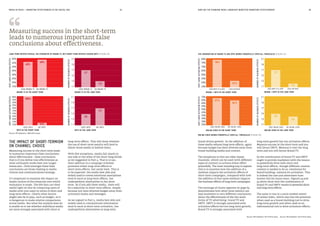
share growth as short-term cases.
The chart also shows why so many marketers
turn a blind eye to this glaring weakness of
short-term campaigns: because they
out-achieve long-term cases in terms of
activation effects. 65% of short-term cases
generated very large activation effects
whereas only 33% of 3+ year cases did so.
If you measure success in the short term
by activation effects, it appears that
short-term‘disposable’ campaigns are
highly effective. Only when viewed over the
long term are they revealed to be highly
ineffective.
SHORT-TERMISMAs with trend in
effectiveness,
brand-building
results peaked
around the onset
of the global
financial crisis
and have fallen
since.
This pattern is in fact highly symptomatic of
what has been happening in marketing in
recent years: a shift away from brand building
for long-term growth towards activation for
short-term sales. This is evidenced in
campaign objectives data for IPA case studies.
The proportion of campaigns with activation
objectives rose from 47% prior to the global
financial crisis to 55% subsequently, but over
the 4 years to 2016 has reached 72% of cases.
The reasons for this clearly go beyond the
direct impacts of the global financial crisis and
are discussed later in this report.
SHORT-TERMISM HAS BEEN RISING (FIGURE 51)
0%
5%
10%
15%
20%
25%
30%
10 YEARS ENDING
%CASESSHORTTERM
2006
Source: IPA Databank, 1998-2016 cases
BRAND-BUILDING EFFECTS HAVE FALLEN (FIGURE 50)
1.0
1.2
1.4
1.6
1.8
2.0
2.2
06 YEARS ENDING
NUMBEROFVERYLARGEBRANDEFFECTS
2004 2006 2008 2010 2012 2014 2016
THE CONFLICT BETWEEN LONG AND SHORT-TERM METRICS
(FIGURE 52)
0%
10%
20%
30%
40%
50%
60%
70%
CAMPAIGN DURATION IN MONTHS
%REPORTINGVERYLARGEEFFECTS
0-6 7-18 19-30 >30
ACTIVATION EFFECTS
MARKET SHARE EFFECTS
2008 2010 2012 2014 2016
HOW HAS THE CHANGING MEDIA LANDSCAPE BENEFITED MARKETING EFFECTIVENESS?62 63
MATTESSONS FRIDGE RAIDERSTHE ANATOMY OF SHORT AND LONG-TERM CAMPAIGNS
CASE STUDY
2013 CAMPAIGN
Two case studies for the same brand
neatly illustrate some of the important
practical differences between a short
and a long-term campaign. The 2013
campaign for Mattessons Fridge
Raiders – a meat-based snack brand
– was in many ways a typical but
successful pure-play social media
campaign. A challenge to gamers to
crowd-source ideas for a hands-free
2015 CAMPAIGN
The 2014-15 campaign for Fridge
Raiders learnt from this. The idea was
broadened to encompass Artificial
Intelligence in the shape of a real
brand robotic intelligence that target
consumers could interact with. The
campaign ran for seven months and
included TV and on-pack presence to
extend the idea beyond the online
world. This time, with the help of TV
SPECSAVERSTHE VALUE OF A LONG-TERM CAMPAIGN
CASE STUDY
Few case studies illustrate as
powerfully as Specsavers the value of a
long-term campaign. Long-term
commitment to TV (plus OOH, print
and radio), backed up in recent years
with social media and online video,
have driven over £600m in
incremental net profit over 20 years at
a ROMI of 129%. Importantly the
returns have grown five-fold over
time, as the long-term effects of
the campaign have accumulated.
The econometrically modelled sales
decomposition chart reveals the
extent in terms of both value and
time of the impact of the campaign.
It is inconceivable that 20 years of
short-term sales activation
campaigns could achieve growth on
this scale.
snacking device that would enable
them to keep their hands, and
therefore keyboards or consoles, clean
whilst snacking during protracted
sessions. Over 15,000 submissions
helped the campaign achieve over
120m paid Facebook impressions,
with 3.2m YouTube views of the
associated video. The three month
campaign generated a healthy ROMI
of just over 100%, but just six weeks
after the end of the campaign the
econometric model showed no
residual campaign effect on sales.
With no budget for collateral activity
beyond the competition to extend
exposure to the idea, and arguably an
idea that created few emotional
connections to the brand, the impact
on‘mental availability’ amongst
target consumers appears to have
been short-lived.
FRIDGE RAIDERS 2014-15 CAMPAIGN SALES DECOMPOSITION
0
100
WEEKLYSALESVOLUME(TONNES)
BASE
MEDIA
PROMOTIONS
AUG
SEP
OCT
NOV
DEC
JAN
MAR
APR
MAY
JUN
JUL
AUG
SEP
NOV
DEC
JAN
FEB
MAR
APR
MAY
JUL
AUG
SEP
OCT
NOV
DEC
JAN
MAR
APR
MAY
JUN
JUL
2012 20152013 2014
SPECSAVERS 1994-2013 CAMPAIGN SALES DECOMPOSITION
REVENUE(£m)
REVENUE FROM STORE GROWTH
REVENUE GROWTH FROM MEDIA
REVENUE GROWTH FROM OTHER SOURCES
1984
1985
1986
1987
1988
1989
1990
1991
1992
1993
1994
1995
1996
1997
1998
1999
2000
2001
2002
2003
2004
2005
2006
2007
2008
2009
2010
2011
2012
2013
reach and 14m YouTube impressions,
the econometrically modelled sales
uplift was still clearly measurable
four months after the end of the
campaign at the end of the modelling
period and evidently persisted beyond
this period. With long-term effects
clearly in play the model was able to
project a healthy long-term ROMI of
87%. This illustrates another feature
of short-termism discussed later in
this report: ROMIs are generally
higher for short-term campaigns, but
this is highly misleading because they
only activate short-term sales and do
little for long-term growth. In fact
comparing the two case studies
implies that net profit growth was
70% greater for the later campaign
than the earlier one. But it was
achieved over a longer period and
required greater investment to do so.
0
200
400
600
800
1000
1200
10
20
30
40
50
60
70
80
90
MEDIA IN FOCUS — MARKETING EFFECTIVENESS IN THE DIGITAL ERA
0
WEEKLYSALESVOLUME(TONNES)
JUL–12
CAMPAIGN PERIOD
AUG–12 SEP–12 NOV–12 DEC–12 JAN–13 FEB–13 MAR–13 APR–13 JUN–13 JUL–13
BASE
SOCIAL
SOCIAL (FORECAST)
FRIDGE RAIDERS 2013 CAMPAIGN SALES DECOMPOSITION
2
4
6
8
10
12
14
MEDIA IN FOCUS — MARKETING EFFECTIVENESS IN THE DIGITAL ERA HOW HAS THE CHANGING MEDIA LANDSCAPE BENEFITED MARKETING EFFECTIVENESS?64 65
Measuring success in the short term leads
to numerous important false conclusions
about effectiveness – false conclusions
that is if you define true effectiveness as
what ultimately works best over longer
timescales. Chief amongst these false
conclusions are those relating to media
choices and communications strategy.
It’s important to examine the impact on
media choices of the timescale over which
evaluation is made. The IPA data can shed
useful light on this by comparing users of
media with non-users in terms of short and
long-term effects. Clearly other factors
might also be in play, such as budget, so it
is dangerous to make relative comparisons
across media. But what the analysis does do
is enable us to see whether individual media
are more strongly associated with short or
THE IMPACT OF SHORT-TERMISM
ON CHANNEL CHOICE
long-term effects. That will show whether
the use of short-term metrics will tend to
flatter those media or belittle them.
With few exceptions, media fall clearly to
one side or the other of the short-long divide
as we suggested in Part 4. That is to say,
their addition to a campaign schedule
promotes either long-term effects or
short-term effects, but rarely both. This is
to be expected: the media best able and
widely used to convey emotional associations
tend to excel at long-term effects, but
underperform alternatives in the short
term. So if you add these media, there will
be a reduction in short-term effects, simply
because you have diverted budget away from
activation media and messages.
As we argued in Part 5, media best able and
widely used to communicate information
tend to excel at short-term activation, but
underperform alternatives at long-term
LONG-TERM METRICS REVEAL THE STRENGTHS OF BRAND TV, BUT SHORT-TERM METRICS FAVOUR DRTV (FIGURE 53)
USED BRAND TV
VERYLARGEACTIVATIONEFFECTS
NO BRAND TV
15%
BRAND TV IN THE SHORT TERM
THE COMBINATION OF BRAND TV AND DRTV WORKS POWERFULLY OVER ALL TIMESCALES (FIGURE 54)
USED BOTH TV & DRTV
VERYLARGEACTIVATIONEFFECTS
USED NEITHER
45%
80%
BRAND + DRTV IN THE SHORT TERM
NUMBEROFBUSINESSEFFECTS
1.1
BRAND TV IN THE LONG TERM
NUMBEROFBUSINESSEFFECTS
BRAND + DRTV IN THE LONG TERM
USED DRTV
VERYLARGEACTIVATIONEFFECTS
NO DRTV
DRTV IN THE SHORT TERM
50%
55%
60%
65%
70%
75%
80%
85%
90%
95%
USED DRTV
NUMBEROFBUSINESSEFFECTS
NO DRTV
DRTV IN THE LONG TERM
1.1
100%
Source: IPA Databank, 2012-2016 casesSource: IPA Databank, 2014-2016 cases
USED BOTH TV & DRTV USED NEITHER
NUMBEROFBUSINESSEFFECTS
ONLINE VIDEO IN THE LONG TERM
USED ONLINE VIDEO NO ONLINE VIDEO
VERYLARGEACTIVATIONEFFECTS
ONLINE VIDEO IN THE SHORT TERM
25%
USED ONLINE VIDEO NO ONLINE VIDEO
ONLINE VIDEO WORKS POWERFULLY OVER ALL TIMESCALES (FIGURE 55)
brand-driven growth. So the addition of
these media reduces long-term effects, again
because budget has been diverted away from
brand-building media and content.
The exceptions to this are video-based
channels, which can be used (with different
types of content) to achieve either effect
powerfully. The most revealing way to explore
this is to examine how the addition of a
medium impacts the activation effects of
short-term campaigns, compared with how
the addition of that same medium impacts
the business effects of long-term campaigns.
The montage of charts opposite on page 64
demonstrates how short-term metrics can
lead marketers to very different conclusions
about the effectiveness of the two main
forms of TV advertising: brand TV and
DRTV. DRTV is strongly associated with
activation effects but not long-term growth.
Brand TV is strongly associated with
long-term growth but not activation effects.
Measure success in the short term and you
will favour DRTV. Measure it over the long
term and you will favour Brand TV.
So the combination of brand TV and DRTV
ought to provide marketers with the means
to powerfully drive both short and
long-term effects, though different creative
content is needed to do so: emotional for
brand building, rational for activation. This
is indeed the case and advertisers have
known this for many years. Figures 54 and
55 above show how the combination of
brand TV and DRTV results in powerful short
and long-term effects.
The same is true to a more modest extent
of online video, which also has the potential
when used as a brand-building tool to drive
long-term growth and when used as an
informational tool to drive activation effects.
1.3
1.5
1.7
1.9
2.1
Source: IPA Databank, 1998-2016 cases
Measuring success in the short-term
leads to numerous important false
conclusions about effectiveness.
USED BRAND TV NO BRAND TV
20%
25%
30%
35%
40%
45%
50%
46%
100%
1.7
1.5
48%
53%
1.3
1.7
1.3
1.5
1.7
1.9
2.1
1.3
1.5
1.7
1.9
2.1
1.1
1.3
1.5
1.7
1.9
2.1
1.1
1.7
1.5
1.2
1.4
50%
55%
60%
65%
70%
75% 78%
67%
52%
64%
30%
35%
40%
45%
50%
55%
60%
65%
70%
MEDIA IN FOCUS — MARKETING EFFECTIVENESS IN THE DIGITAL ERA HOW HAS THE CHANGING MEDIA LANDSCAPE BENEFITED MARKETING EFFECTIVENESS?66 67
MOST ESTABLISHED OFFLINE MEDIA WORK BEST IN THE LONG TERM (FIGURE 56) MOST ONLINE NON-VIDEO CHANNELS WORK BEST IN THE SHORT TERM (FIGURE 57)
So one of the many strengths of video as a
communications format is its ability to play
strongly across the brand-activation divide,
but the metrics used to evaluate it must be
appropriate for the strategic intent. The
relentless shift towards short-term metrics in
recent times promotes only the activation use
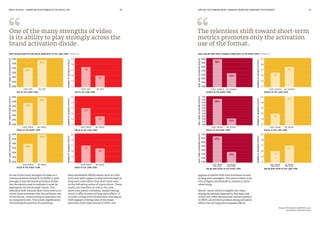
of the format, undermining its potential role
as a long-term tool. This is now significantly
influencing the practice of marketing.
Most established offline media (such as OOH,
print and radio) appear to play most strongly as
long-term tools rather than short-term ones,
as the following series of charts show. These
media are therefore at risk in the new
short-term metric orthodoxy, despite having
much to offer in terms of long-term effects. It
is worth noting (with limited data) that digital
OOH appears to bring some of the broad
potential of the video format to OOH, and
appears to imbue OOH with activation as well
as long-term strengths. The same is likely to be
true of digital newsbrands in relation to print
advertising.
Search, social (which is largely non-video
during the periods observed by this data) and
online non-video demonstrate similar patterns
to DRTV, all of which produce strong activation
effects but not long-term business effects.
USED OOH
VERYLARGEACTIVATIONEFFECTS
NO OOH
OOH IN THE SHORT TERM
USED SEARCH
VERYLARGEACTIVATIONEFFECTS
NO SEARCH
SEARCH IN THE SHORT TERM
USED OOH
NUMBEROFBUSINESSEFFECTS
NO OOH
OOH IN THE LONG TERM
USED SEARCH
NUMBEROFBUSINESSEFFECTS
NO SEARCH
SEARCH IN THE LONG TERM
USED PRESS USED SOCIAL
USED RADIO USED ONLINE
NON-VIDEO
USED ONLINE
NON-VIDEO
NO ONLINE
NON-VIDEO
NO ONLINE
NON-VIDEO
VERYLARGEACTIVATIONEFFECTS
NO PRESS NO SOCIAL
NO RADIO
PRESS IN THE SHORT TERM SOCIAL IN THE SHORT TERM
RADIO IN THE SHORT TERM
ONLINE NON-VIDEO IN THE SHORT TERM ONLINE NON-VIDEO IN THE LONG TERM
25%
30%
35%
40%
45%
50%
55%
60%
35%
40%
45%
50%
55%
60%
65%
70%
USED PRESS USED SOCIAL
USED RADIO
NUMBEROFBUSINESSEFFECTS
NO PRESS NO SOCIAL
NO RADIO
PRESS IN THE LONG TERM SOCIAL IN THE LONG TERM
RADIO IN THE LONG TERM
20%
25%
30%
35%
40%
45%
50%
20%
25%
30%
35%
40%
45%
50%
20%
25%
30%
35%
40%
45%
50%
Sources: IPA Databank, 2008-2016 cases
IPA Databank, 2010-2016 cases
One of the many strengths of video
is its ability to play strongly across the
brand activation divide.
The relentless shift toward short-term
metrics promotes only the activation
use of the format.
40%
43%
48%
48%
1.5
1.3
1.5
1.7
1.9
2.1
1.1
1.3
1.5
1.7
1.9
2.1
1.1
1.3
1.5
1.7
1.9
2.1
1.1
1.3
1.5
1.7
1.9
2.1
1.1
1.3
1.5
1.7
1.9
2.1
1.1
1.3
1.5
1.7
1.9
2.1
1.1
58%
66%
67%
43%
31%
47%
20%
25%
30%
35%
40%
45%
50%
55%
60%
65%
70%
1.8
1.7
1.7
1.4
1.6
39%
49%
1.8
2.1
1.7
1.6
1.5
1.5
MEDIA IN FOCUS — MARKETING EFFECTIVENESS IN THE DIGITAL ERA HOW HAS THE CHANGING MEDIA LANDSCAPE BENEFITED MARKETING EFFECTIVENESS?68 69
We should point out that short-term
campaigns are sometimes‘fillers’ intended
to create a low-cost activation presence for
brands during otherwise dark periods between
longer-term activities. This means they tend to
make greater use of unpaid media (figure 59).
The data already presented suggests that
this stand-alone campaign approach may
not be the most effective use of budget.
Instead, an approach more integrated with
the long-term activity is likely to yield
greater results over the long term. It is also
misguided in its overdependence on unpaid
media, which, as we argued in Part 4,
requires adequate paid media to yield best
results. The limited data from 2014-16
suggests that effectiveness peaks at around
6% of budget for unpaid media41
– quite close
to typical long-term campaigns’ allocation
of 4%, but a long way from that of
short-term campaigns’ allocation of 12%.
So short-term metrics result in short-term
media planning and the drift to
short-termism is reinforced despite the
damaging impact on long-term effectiveness.
In this analysis, social media emerges as an
activation channel, which might surprise
some people. This may be linked to the rise
of paid ads in recent years together with the
growing use of social on mobiles. The Walls
Ice Cream case study referred to in Part 4
worked in that way – social ads prompted
people to buy an ice cream when they were
out and about on sunny days – a classic
activation use. But the growth of video on
the platform will strengthen its potential
role as brand builder in future.
Because video-based advertising is most
strongly associated with long-term effects,
whereas many non-video tools (especially
online display and search) are strongly
associated with short-term effects,
considerable differences arise in the use of
these tools between long and short-term
campaigns. The two pie charts above top
show that short-term campaigns allocate
just below 40% of their budgets to video-based
advertising whereas long-term campaigns
allocate almost 60% to video.
Communications strategy is also strongly
influenced by the use of short-term
activation metrics. Focussing on short-term
activation effects creates the illusion that
rational advertising is more effective, when in
fact emotional advertising is more effective
over the long term. And even more damaging
to long-term effectiveness, a short-term
focus undermines the case for creativity. This
is despite the considerable effectiveness
advantages that highly creative advertising
delivers over the long term.42
Creatively
awarded campaigns underperform
non-awarded ones in terms of short-term
effects, but not in any other sense.
So the growing use of short-term metrics and
the development of campaigns aligned to
them are extremely damaging developments
in marketing. They cause marketers to make
strategy and media decisions that are, almost
without exception, not in the interests of the
long-term success of brands.
62 38 42 58
SHORT-TERMISM BIASES MARKETING AGAINST VIDEO (FIGURE 58)
SHORT-TERMISM BIASES MARKETING TOWARDS UNPAID MEDIA (FIGURE 59)
Source: IPA cases,1998-2016
41With
unpaidmedia
thistypically
represents
content
production
andrelated
costs.
42SeeSellingCreativityShort,
IPA,2016,foramoredetailed
discussionofthisissue.
BROADER IMPACTS OF
SHORT-TERMISM
LONG TERM
LONG TERM
SHORT TERM
SHORT TERM
Source: IPA Databank, 2014-2016 cases
SHORT-TERMISM BIASES MARKETING TOWARDS RATIONAL
AND NON-CREATIVE ADVERTISING (FIGURE 60)
12 88 04 96
VIDEO-BASED
NON-VIDEO
••
SHARE OF BUDGET %
PAID
UNPAID
••
SHARE OF BUDGET %
SHORT-TERMACTIVATIONEFFECTS
EMOTIONAL RATIONAL CREATIVELY
AWARDED
NOT CREATIVELY
AWARDED
20%
22%
24%
26%
28%
30%
32%
34%
36%
38%
40%
MEDIA IN FOCUS — MARKETING EFFECTIVENESS IN THE DIGITAL ERA HOW HAS THE CHANGING MEDIA LANDSCAPE BENEFITED MARKETING EFFECTIVENESS?70 71
The current vogue for brand dashboards fed
with real-time data is therefore also a
dangerous one: the metrics are strongly
oriented to the short term and attempts to
‘project forward’ those effects to long-term
growth shows an alarming misunderstanding
of the very different nature of long-term
advertising effects.
This is not a theoretical concern: real-time
data is fuelling short-termism. Short-term
campaigns are 40% more likely to use Big
Data for real-time marketing than
long-term campaigns: the dangers of this
were discussed in Part 4. And loyalty
campaigns are two-and-a-half times more
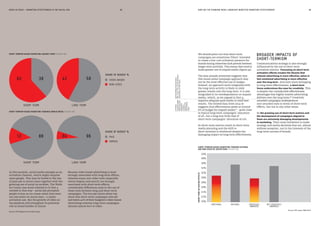
likely to use Big Data in this way than other
campaigns. As you sow, so shall you reap.
Unfortunately short-termism per se is not the
only damaging development in recent years.
The IPA data reveals two other related
‘smoking guns’ that have been driving down
effectiveness, despite the widespread belief
that they are both good for effectiveness. The
first of these is the close focus on ROMI
(often referred to as ROI). It has been known
for many years that a danger of targeting an
efficiency metric such as ROMI is that it leads
marketing to cut advertising budgets and reach
only for ‘low-hanging fruit’ in the quest for
growth.43
Such campaigns typically target
consumers with established affiliations to
the brand and with imminent purchase
intentions i.e. low budget activation campaigns
(see Part 4). The task of recruiting new
customers for long-term growth is ignored,
so base sales will fall over time along with
margins and ROMI. For limited periods of
time however, this approach can yield
attractive ROMIs with modest budgets. Even
over longer periods of time, the residual
strength of a well-established brand can help
to boost activation ROMIs, but this is a
dangerous deception. In time ROMI is likely
to fall to category norms, at which point the
brand enjoys no competitive marketing
advantage.
FOCUSSING ON RETURN ON
MARKETING INVESTMENT (ROMI)
44Thecorrelationsinthetablewere
testedatboththe95%and99%
confidencelevels.While95%confidence
isstandardformoststatisticaltests,a
higherconfidencelevelismore
appropriatewhenrepeatedtestsare
involved,asinthistable.
43See‘ROIisdead,nowburyit’,
T.Ambler,AdmapSeptember2004.
Long-term campaigns, by contrast, invest
in attracting future customers at a cost to
ROMI in the shorter term. The table
opposite top reveals how the drivers of profit
growth (an absolute measure taken over the
long term) differ widely from the drivers of
ROMI. Profit growth correlates most closely
with broad improvements across the range of
long-term business metrics, especially sales
and market share growth (all at the 99%
confidence level).44
It also correlates with
improvements to brand strength. Correlation
with ROMI is much weaker and not
significant with 99% confidence.
In marked contrast to this, ROMI correlates
most closely with very large activation
effects: this is the only metric with which
it correlates at 99% confidence. A weaker
correlation exists with profit growth (as
already observed), but no other long-term
business or brand metrics correlate
significantly with ROMI. Of most concern
to those with long-term growth objectives,
ROMI appears to correlate negatively with
penetration growth. As the work of the
Ehrenberg-Bass Institute shows, penetration
growth is key to brand growth. Unfortunately
maximising ROMI will discourage marketers
from building penetration.
The growth of Big Data and real-time
dashboards has, unfortunately, brought
about an obsession of marketing with ROMI.
ROMI is now the most common campaign
response metric used amongst IPA case
studies. The extent to which this is a
dangerous development is made very clear
in the chart opposite bottom. Whereas
short-term campaigns comfortably exceed
long-term ones in terms of ROMI, they
under perform to a similar degree in terms
of impact on profit growth.
So a destructive cycle is building, in which
ROMI as the key metric rewards
short-termism, which in turn promotes the
use of the metric over more important
long-term metrics.
Some readers will find it difficult to accept
the idea that pursuing ROMI could conflict
with maximising profit growth, so it is
perhaps worth demonstrating how the
maths works with two real case studies
(anonymised for confidentiality).
ROMI is the ratio of profit increase to
marketing spend, so there are two ways to
increase its value: increase the profit
growth or reduce the marketing spend. The
easiest to do is the latter, but this will not
improve profits. Campaign A is in many
ways a typical short-term case focussed on
activation with a very respectable ROMI of
103%. Campaign B is a fairly typical
long-term campaign, mostly focussed on
driving growth through brand building: it
has a lower but still healthy ROMI of 65%.
Of course, A’s ROMI is actually only that
healthy because it is able to spend less driving
short-term sales, so its ROMI will not sustain
over longer periods: low hanging fruit has a
habit of disappearing quickly. Meanwhile,
B’s long-term strategy requires greater
investment, but will continue to drivegrowth
long after A’s campaign has stopped. A
superficial assessment of ROMI’s would lead
one to conclude that campaign A was the
NO.VL BUSINESS EFFECTS
VL SALES GAIN
VL MARKET SHARE
NO.BRAND EFFECTS
VL PENETRATION
VL PRICE
VL LOYALTY
VL ACTIVATION EFFECTS
ROMI
VL ACTIVATION EFFECTS
VL PROFIT
NO.BRAND EFFECTS
VL SALES GAIN
NO.VL BUSINESS EFFECTS
VL PRICE
VL MARKET SHARE
VL LOYALTY
VL PENETRATION
64%
40%
23%
23%
21%
18%
17%
15%
15%
-
-
SIGNIFICANT AT 99% CONFIDENCE
SIGNIFICANT AT 95% CONFIDENCE
NOT SIGNIFICANT
TOP DRIVERS OF PROFIT TOP DRIVERS OF ROMI
THE DRIVERS OF ROMI ARE NOT THE DRIVERS OF PROFIT (FIGURE 61)
CORRELATION
WITH PROFIT
CORRELATION
WITH ROMI
23%
15%
08%
08%
07%
04%
01%
01%
03%
Source: IPA cases 2008-2016
The growing use of short-term metrics and
the development of campaigns aligned to
them are extremely damaging developments
in marketing.
ROMI
VERY LARGE PROFIT GROWTH
SHORT-TERMISM BOOSTS ROMI BUT NOT PROFIT (FIGURE 62)
0% 0%
100% 05%
200% 10%
300% 15%
400% 20%
500% 25%
600% 30%
SHORT TERM LONG TERM
AVERAGEROMI
VERYLARGEPROFITGROWTH
IPA Databank, 2014-2016 cases
MEDIA IN FOCUS — MARKETING EFFECTIVENESS IN THE DIGITAL ERA HOW HAS THE CHANGING MEDIA LANDSCAPE BENEFITED MARKETING EFFECTIVENESS?72 73
greater business success. But if you do the
maths, and multiply ROMI by budget you
see the actual net profit each campaign
generated: 45% higher for campaign B, but
of course over a longer period. The
consequent impact that the pursuit of ROMI
has on budgets is illustrated below.
So far we have identified two factors in the
observed loss of campaign effectiveness:
01 The growth of short-termism and its
impact on communications strategy and
media choices.
02 The consequent focus on ROMI and its
impact on budget and communications
strategy.
But we now know that there must be a
third, related, smoking gun responsible for
the loss of average campaign effectiveness
in recent years because when we use analysis
to eliminate the effects of these two factors,
the problems still don’t go away. If we use a
metric that is largely unaffected by budget
levels i.e. ESOV efficiency,45
and we examine
only long-term cases (those that do not
reflect the trend to short-termism), we can
see that there is still another destructive
pressure at work. Over the last two ten-year
rolling periods, long-term campaigns have
shed all the efficiency advantages accrued
during the early part of the digital revolution.
The third smoking gun is in fact a direct
consequence of the other two: it is a
growing over-weighting of all campaigns,
whether short or long-term, towards
activation expenditure. In Part 4 of this
report, we re-examined the optimum
balance of brand and activation expenditure
four years on from The Long and the Short of It
and found it still to be around 60:40. We
also observed that deviation either side of
this optimum point results in quite marked
reductions in long-term effectiveness.
So any trend towards greater weighting of
activation beyond 40% is likely to undermine
long-term effectiveness. The growth of
short-termism inevitably feeds a trend to
activation because short-term campaigns
make much greater use of it. The following
pie charts show that the activation budget
allocation for short-term campaigns in 2016
was 54% – well above the optimum level.
Worryingly, even long-term campaigns
exceeded the optimum at 43% activation.
EXCESSIVE WEIGHTING
TO ACTIVATION VERSUS
BRAND BUILDING
45Annualisedmarket
sharegrowthperunitofESOV
invested.
TWO REAL IPA CASES ILLUSTRATE THE TENSION BETWEEN ROMI AND PROFIT (FIGURE 63)
A
ROMI BUDGET
103% £426,000 £439,000
B 65% £980,000 £637,000
NET PROFIT GENERATEDCASE STUDY
Campaigns with larger budgets relative to
their size (measured as above median ESOV)
on average report significantly lower ROMI’s
than campaigns with smaller budgets
(below median): 312% vs. 386%. Focussing on
ROMI encourages budget reductions through
the pursuit of short-term sales.
This is likely to be an important factor in the
reductions in budget (measured as ESOV)
widely reported by case studies in recent years.
A post-recession cautiousness by general
management may also be a factor here, as
well as the misconception that budget is no
longer important in the evolving media
landscape. But we showed in Part 4 that
budget is actually becoming more important
over time, so this average ESOV reduction of
almost 10 percentage points in recent years
must be a factor in the observed loss of
effectiveness shown earlier in Figure 47.
Unfortunately Figure 64 also reveals that
budget reductions are not confined to
short-term campaigns and therefore simply
a consequence of their growth. Long-term
campaigns entered into the IPA awards
competition exhibit a near identical loss of
ESOV. Perhaps the brands entering the IPA
awards, by their very nature – big and best
in class – pressure themselves to rely less on
sheer budget for growth. Instead, they
reach for efficiency, but effectiveness
actually requires both efficiency and budget.
So the correlation between ESOV and share
growth is the marketing equivalent of the
law of gravity: you need to expend effort if
you want to climb. The fact that the
correlation is strengthening shows that this
is inescapable and, in a competitive market
economy, this will inevitably continue.
FOCUSSING ON ROMI LEADS TO BUDGET CUTS (FIGURE 64)
ESOV > MEDIAN ESOV < MEDIAN
AVERAGEROMI
0%
LARGER BUDGETS SMALLER BUDGETS
50%
100%
150%
200%
250%
300%
350%
400%
450%
386%
312%
Sources: IPA Databank, 2014-2016 cases Figure 64
IPA Databank, 1998-2016 cases Figure 65
EVEN LONG-TERM CASES HAVE LOST EFFICIENCY (FIGURE 66)
0.0
0.2
0.4
0.6
0.8
1.0
1.2
10 YEARS ENDING
SOVEFFICIENCY(CASES>6M)
2006 2008 2010 2012 2014 2016
Focussing on ROMI encourages
budget reductions through the
pursuit of short-term sales.
BUDGETS (ESOV) HAVE BEEN FALLING ACROSS THE BOARD
(FIGURE 65)
0%
10 YEARS ENDING
AVERAGEESOV
2006 2008 2010 2012 2014 2016
ESOV ALL
ESOV LONG CASES
2%
4%
6%
8%
10%
12%
14%
16%
MEDIA IN FOCUS — MARKETING EFFECTIVENESS IN THE DIGITAL ERA HOW HAS THE CHANGING MEDIA LANDSCAPE BENEFITED MARKETING EFFECTIVENESS?74 75
SHORT-TERMISM FAVOURS ACTIVATION WEIGHTING OF
BUDGETS (FIGURE 67)
43 57
LONG TERM
54 46
SHORT TERM
We should reiterate here that these activation
percentages are likely to be underestimates of
the true level of current activation spend.
Routine search and PPC activation spend is
increasingly not managed by marketing
departments and is not necessarily known by
case study authors. It is under reported in the
IPA data compared to IAB data.46
So activation
spend may have risen even higher than is
suggested by the following chart – currently
reported as 45% of budget.
Part of the considerable growth in activation
expenditure implied by this chart may be due
to more accurate reporting of data by case
study authors in 2016. The method of data
collection for budget allocation was improved
in that year. However data from Enders
Analysis (see opposite) suggests that there has
been significant growth in activation share of
budget in recent years and that the 2016 IPA
data underestimates the true level slightly.
There is a bigger long-term problem with the
growth of activation expenditure. As Enders
Analysis identifies,activation spend is not
filling the consideration funnel – it operates at
the bottom of the funnel. Putting too much
money into activation becomes self-defeating
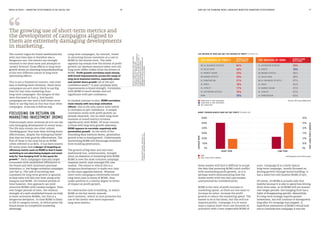
– a bidding war for the last-minute
pre-purchase attention of a limited number of
prospects. It will become less effective and
efficient unless brand-building activity is
feeding sufficient prospects into the top of the
funnel. As was shown in the last section,
brand building enhances activation effects
over time, but not immediately.
Both are needed, but in balance.
Data from Enders Analysis using Advertising Association data
(‘Advertising effectiveness-marketing and long-term business
benefits’ to be published in May 2017) reports the growth of
activation expenditure from average 39% of total budget in 2000 to
49% in 2016. This is broadly consistent with recent IPA data, but less
likely to be an underestimate, hence the higher percentages. Enders
rightly attribute this growth to the metrics served with online
channels. As they observed in their 2016 report47
‘What is often
under-rated is the degree to which digital marketing expenditure
has to date been driven by direct response: click-through rates,
transactions and short term performance measures.’
VIEW
46ThoughIABdatawillincludethe
extensiveactivationspendby
non-brandedbusinessese.g.SMEs,
whichdonotgenerallyformpartof
theIPAcasestudybase.
THE RELENTLESS GROWTH OF ACTIVATION
A VIEW FROM ENDERS ANALYSIS
39% 61% 49% 51%
ADVERTISING SPEND SPLIT 2000 ADVERTISING SPEND SPLIT 2016
47Marketingandmeasurementin
thedigitalera,EndersAnalysis,
Nov2016.
CHANNEL SHARE
FOR
BRAND-BUILDING
OBJECTIVES
CHANNEL SHARE
FOR
ACTIVATION
OBJECTIVES
SHARE OF BUDGET %
0
CASE STUDY YEAR
AVERAGE%OFCOMMSBUDGETSPENTONACTIVATION
Source: IPA Databank, 2014-2016 cases
ACTIVATION LEVELS HAVE EXCEEDED OPTIMUM (FIGURE 68)
5
10
15
20
25
30
35
40
45
50
45%
31%
2014 2016
SHARE OF DIRECT RESPONSE
Source: IPA Databank, 2016 cases
Source: Enders Analysis estimates based on AA/WARC
SHARE OF DISPLAY
MEDIA IN FOCUS — MARKETING EFFECTIVENESS IN THE DIGITAL ERA HOW HAS THE CHANGING MEDIA LANDSCAPE BENEFITED MARKETING EFFECTIVENESS?76 77
But putting too much money into activation
is exactly what is now happening and the
IPA data for the 2014-16 period evidences this
in another way in the following montage of
charts. Increasing share of budget above
current median levels for brand-building media,
especially TV and online video, leads to
increases in effectiveness and market share
growth. But increasing share of budget
above current median levels for activation
media such as DRTV, direct mail, search or
email, leads to reductions in effectiveness
and market share growth. The picture for
social is more nuanced as the growth of
social video transforms the channel’s
capabilities from primarily activation
towards brand building: increases in share
of budget have a modestly positive impact
on effectiveness but not growth. Other
factors come into play between channels so
it is not valid to compare the scale of effects
across channels; it is the direction of change
in effects as budget allocations are increased
that is important here.
So the IPA data clearly shows the need for a
reversal of the pendulum swing towards ever
greater activation share of budget. It is an
essential requirement of restoring the trend
to increased effectiveness that existed up
until the global financial crisis.
Without the rebalancing of budgets towards
brand building, the changing media landscape
will continue to fail to deliver its potential
benefits.
KEY BRAND-BUILDING CHANNELS APPEAR UNDER FUNDED (FIGURE 69) KEY ACTIVATION CHANNELS APPEAR OVER-FUNDED (FIGURE 70)
BELOW MEDIAN
BUDGET SHARE
BELOW MEDIAN
BUDGET SHARE
BELOW MEDIAN
BUDGET SHARE
BELOW MEDIAN
BUDGET SHARE
ABOVE MEDIAN
BUDGET SHARE
ABOVE MEDIAN
BUDGET SHARE
ABOVE MEDIAN
BUDGET SHARE
ABOVE MEDIAN
BUDGET SHARE
VERYLARGESHAREEFFECTS
0%
10%
20%
30%
40%
SHARE GROWTH
SHARE GROWTH
EFFECTIVENESS
EFFECTIVENESS
NUMBEROFBUSINESSEFFECTSNUMBEROFBUSINESSEFFECTS
VERYLARGESHAREEFFECTS
UNDER-FUNDED CHANNELS:
ONLINE VIDEO
BRAND TV
35%
14%
BELOW MEDIAN
BUDGET SHARE
ABOVE MEDIAN
BUDGET SHARE
VERYLARGESHAREEFFECTS
SHARE GROWTH
OVER-FUNDED CHANNELS:
ONLINE NON-VIDEO
BELOW MEDIAN
BUDGET SHARE
ABOVE MEDIAN
BUDGET SHARE
EFFECTIVENESS
NUMBEROFBUSINESSEFFECTS
0%
10%
20%
30%
40%
50%
15%
42%
BELOW MEDIAN
BUDGET SHARE
ABOVE MEDIAN
BUDGET SHARE
SHARE GROWTH
VERYLARGESHAREEFFECTS
OTHER DIGITAL ACTIVATION SEARCH, EMAIL, SMS
BELOW MEDIAN
BUDGET SHARE
ABOVE MEDIAN
BUDGET SHARE
EFFECTIVENESS
NUMBEROFBUSINESSEFFECTS
1.2 1.2
0.8
1.0
1.2
1.4
1.6
1.8
0.8
1.0
1.2
1.4
1.6
1.8
0%
10%
20%
30%
40%
0%
10%
20%
30%
40%
0.8
1.0
1.2
1.4
1.6
1.8
0.8
1.0
1.2
1.4
1.6
1.8
Without the rebalancing of budgets
towards brand building, the changing
media landscape will continue to fail
to deliver its potential benefits.
48IncludesSocial.
48
Sources: IPA Databank, 2014-2016 cases
1.5
1.1
1.7
1.0
1.4
TYPICAL FUNDING FOR SOCIAL IS MORE NUANCED – IT APPEARS FULLY FUNDED (FIGURE 71)
FULLY-FUNDED CHANNELS:
SOCIAL MEDIA
BELOW MEDIAN
BUDGET SHARE
ABOVE MEDIAN
BUDGET SHARE
SHARE GROWTH
VERYLARGESHAREEFFECTS
BELOW MEDIAN
BUDGET SHARE
ABOVE MEDIAN
BUDGET SHARE
EFFECTIVENESS
NUMBEROFBUSINESSEFFECTS
0%
10%
20%
30%
40%
0.8
1.0
1.2
1.4
1.6
1.8
1.3
1.2
11%
24%
24%
17%
14%
27%
1.1
MEDIA IN FOCUS — MARKETING EFFECTIVENESS IN THE DIGITAL ERA HOW HAS THE CHANGING MEDIA LANDSCAPE BENEFITED MARKETING EFFECTIVENESS?78 79
01 The digital revolution has
increased the potential
effectiveness of most forms of
marketing. But the IPA data
suggests that actual
effectiveness has declined
since the global financial crisis.
02 In particular, we see
smaller gains in penetration
and market share, the key
drivers of long-term business
success.
03 The data suggests three
closely related reasons for this
decline in effectiveness:
● Short-termism
● An increasing focus on ROMI
(ROI), which is an efficiency
metric, rather than growth or
indeed profit, which are
measures of effectiveness.
● A shift towards activation, at
the expense of brand building
SUMMARY
THOUGHTS
FROM
SECTION
6.0
04 These trends all reinforce one
another, and have in turn led to:
● Inefficient media mixes
● Unbalanced communications
budgets
● Under-investment in
marketing communications
● Less effective creative strategies
● Slower growth
● Smaller profits
05 Marketers need to strike a
better balance between short and
long term if they want to exploit
the full potential of marketing in
today’s media landscape.
Mass marketing is more effective than ever.
Despite the huge changes in the media
landscape in recent years, it seems that
some of the key principles of marketing
remain unchanged. Successful, profitable
brands tend to have high market share and
lots of customers, and the main way they
grow is by increasing penetration, not
loyalty. Brand building is still the most
important driver of that growth, and it still
requires broad reach, paid-for advertising.
The huge increase in internet usage that
we have seen over the last ten years has
given advertisers new ways to do that job.
In particular, online video seems to be a
particularly powerful brand-building tool.
But more traditional advertising media have
adapted well to the changes, and continue
to deliver sales and profit. Indeed, the
digital revolution seems to have made most
of these traditional media more effective,
not less. TV, press and radio are working
better than ever, and out-of-home
effectiveness has begun to increase recently,
probably due to the advent of digital outdoor.
TV remains the most effective medium,
although these days it works best when used
in concert with VoD and other forms of online
video. There is a natural synergy between
these offline and online video formats. TV
drives traffic to online video assets; online
sharing amplifies the effect of TV.
The other important synergy is between
brand and activation. Online media are
highly efficient for sales activation, with
paid search and email being particularly
effective. Offline advertising makes online
activation work harder – TV ads drive Google
search queries, for instance. And online
activation makes all other advertising more
efficient by creating a fulfilment mechanism.
As internet usage has increased, these
synergies have got bigger, increasing
marketing effectiveness across the board.
CONCLUSIONS AND RECOMMENDATIONS
Mass marketing is working better than ever,
for those firms that use it to its full effect.
But, in order to exploit the full potential of
marketing in the digital age, firms still need
to invest. Budgets still matter – indeed our
analysis suggests that share of voice has
become more important, not less. And budget
allocation matters too; firms that focus too
narrowly on short-term sales suffer the long-term
consequences. Observing the 60:40 rule
remains essential to get the most out of the
synergies between brand building and activation.
But as we have seen, there is worrying
evidence that many businesses are learning
the wrong lessons from the digital revolution.
By ignoring the enduring effectiveness truths
of the changing media landscape they are
undermining the tremendous potential of the
new tools at the marketer’s disposal.
To remedy this wasted potential, marketers
should return to a more balanced perspective
on long vs. short-term objectives and
recognise that they pull campaigns in
different directions. Short-term effects cannot
reliably be projected forward to long-term ones.
Brand owners need to recognise that the
brand-building/activation pendulum has swung
too far from the optimum 60:40 ratio towards
activation and they need to rebalance campaigns.
This requires that campaign media planning
dials-up brand-building allocations instead of
activation, especially with newer channels.
And it means valuing video channels over
non-video ones.
It also requires a parallel rebalancing of
campaign strategy and evaluation, which
should be designed to ensure long-term effects
– marketers should look for emotional
brand-building effects and ensure there is
sufficient paid-for advertising to keep campaigns
in-market long enough to create these effects.
Finally, brand owners should monitor and
seek to restore ESOV at least to positive levels
– growth will continue to falter without this,
because the link between ESOV and growth is
getting stronger.
80MEDIA IN FOCUS — MARKETING EFFECTIVENESS IN THE DIGITAL ERA
MORE ABOUT EFFWORKS
The IPA’s new Marketing Effectiveness
initiative seeks to create a global industry
movement, to promote a marketing
effectiveness culture in client and agency
organisations, and improve our day-to-day
working practices in three key areas:
01 marketing marketing: developing the
case for marketing and brand investment
in the short, medium and long term, and
promoting the benefits to internal and
external stakeholders
02 managing marketing: providing
awareness and understanding of how
marketing works, and how to write the best
brief, develop the best process for planning
and executing marketing programmes, and
motivating marketing and agency teams
03 monitoring marketing: delivering the
best models, and guidance on tools and
techniques, to plan, monitor, direct and
measure the impact of marketing activity,
using holistic approaches to return on
investment.
This takes the IPA’s effectiveness programme
to a new level; working in collaboration
with client advisors and association partners
to showcase best in class, evidence based
decision-making across the marketing
function. By bringing together the best people
in the industry Effectiveness Week (EffWeek)
provides a trusted source of new thinking to
address the issues that matter, and an
invaluable learning resource, under the
umbrella of Effectiveness Works (EffWorks),
our online hub.
Find out more at www.effworks.co.uk
For more information contact
Janet Hull OBE
janet@ipa.co.uk
PROFESSOR OF MARKETING SCIENCE, UNIVERSITY OF SOUTH AUSTRALIA
AND DIRECTOR, EHRENBERG-BASS INSTITUTE FOR MARKETING SCIENCE
BYRON SHARP
There are those that say‘everything has
changed in the digital marketing era’,
while those in the opposing camp say
‘nothing important has changed’. Most
of us think the truth probably lies
somewhere in between, but there is a
great deal of room in between – evidence
is needed.
Les Binet and Peter Field shed some light
by mining the IPA database of digital era
advertising effectiveness award entries.
There are findings here that will surprise,
regardless of which of the three camps
you belong to.
Institute of Practitioners in Advertising
44 Belgrave Square
London SW1X 8QS
T 020 7235 7020
www.ipa.co.uk
ISBN 978-0-85294-141-6
Copyright © IPA June 2017
This report updates the media-related findings of our
two previous analyses of the IPA Databank: Marketing
in the Era of Accountability (WARC 2007) and The Long and
the Short of It (IPA 2013). It is the first part of a new series
about Marketing Effectiveness in the Digital Era, to
coincide with the launch of the IPA’s cross-industry
EffWorks initiative (www.effworks.co.uk).
£25 members
£50 non-members
@The_IPA
@IPAScotland
facebook.com/theipa
youtube.com/theipa
Linkedin.com/company/theIPA
flickr.com/theipa
DesignMorrisonDalley

Media in Focus

  • 1.
    In association with LESBINET ADAM & EVE DDB PETER FIELD PETER FIELD CONSULTING NEW LEARNINGS FROM THE IPA DATABANK MARKETING EFFECTIVENESS IN THE DIGITAL ERA IN F CUS
  • 2.
    CONTENTS 01 The IPA Databankcontinues to provide a rich evidence base from which to find answers to the most challenging questions facing marketing communications. This new publication takes the changing media landscape as its focus and addresses, among others, the issues of: Does mass marketing still work? Is tight targeting now the most efficient approach? Is unpaid making paid media redundant? It also investigates the broader issues of budgeting, planning and reporting, and challenges the industry to reconsider approaches to efficiency, ROMI and measurement strategy. This publication is the first part of a new series about Marketing Effectiveness in the Digital Era, made possible through the generous support of Google and Thinkbox. It is also the first publication to carry the new EffWorks livery; a new branding device and trust mark to represent the IPA’s wider effectiveness initiative and annual Effectiveness Week (EffWeek). Led by a CMO advisory board, the IPA is facilitating an industry-wide collaboration to promote evidence-based decision-making for marketing and a culture of effectiveness in the everyday interactions between clients and agencies. At the heart of our‘back to basics’ approach lies the quest for continuous professional development, upon which the IPA reputation is built. FOREWORD / JANET HULL FOREWORD Janet Hull Jonny Protheroe Matt Hill ABOUT THE AUTHORS IN A NUTSHELL 1.0 INTRODUCTION Aims Data Measures of effectiveness Measures of growth Measures of efficiency Measures of campaign duration Measures of brand strengthening 2.0 PREVIOUS FINDINGS Long versus short-term effects Implications for channel strategy The importance of reach The importance of budget and share of voice 3.0 THE NEW MEDIA LANDSCAPE 4.0 DOES MASS MARKETING STILL WORK? Is tight targeting now the most efficient approach? Loyalty marketing View: The importance of penetration View: Online loyalty research can be misleading View: Web visitors are less loyal Data-driven real-time marketing Is unpaid making paid media redundant? Case study: John Lewis Case study: Wall’s Ice Cream Are activation strategies now the best way to drive growth rather than brand-building ones? Summary thoughts from section 4.0 01 01 02 03 04 05 07 07 08 08 09 09 09 09 10 11 13 14 16 17 24 26 26 28 30 31 32 35 36 39 41 44 5.0 HOW MEDIA WORK TODAY TV advertising Video on demand Online video The synergy between TV and online video Press advertising Radio advertising Out of home advertising Online display Digital activation Summary thoughts from section 5.0 6.0 HOW HAS THE CHANGING MEDIA LANDSCAPE BENEFITED MARKETING EFFECTIVENESS? Destructive trends in effectiveness have emerged Short-termism Case study: Mattessons Case study: Specsavers The impact of short-termism on channel choice Broader impacts of short-termism Focussing on return on marketing investment (ROMI) Excessive weighting to activation versus brand building View: The relentless growth of Activation Summary thoughts from section 6.0 CONCLUSIONS AND RECOMMENDATIONS MORE ABOUT EFFWORKS 45 46 47 48 49 50 52 53 54 55 56 57 58 61 62 63 64 69 70 73 75 78 79 80 JANET HULL OBE IPA DIRECTOR OF MARKETING STRATEGY
  • 3.
    MEDIA IN FOCUS— MARKETING EFFECTIVENESS IN THE DIGITAL ERA 02 03FOREWORD This analysis is required reading for any marketer who wants to understand what makes effective advertising. It is enlightening and reassuring – but also worrying. It shows the path to success for marketers but also that some have strayed from it. The following pages are a much-needed wake-up call. Thinkbox is proud to support the IPA’s effectiveness work – its awards and its research. We have done so since the day we began. It was the first partnership we made because nothing is more important in advertising than proving it works, proving that brands’ investment is worth it. Marketers need robust, independent research they can trust so they can make informed decisions and not simply be swayed by rhetoric or fashion. This is what the IPA provides time and time again, and Les Binet and Peter Field’s latest analysis comes at a crucial time. With an uncertain economic outlook, understanding how media perform in the digital age is vital for making the best marketing decisions. There is much in this analysis to get to grips with: the importance of mass media; the worrying effects of a creeping short-termism that is damaging overall advertising effectiveness; the fact that effectiveness does not come for free. And I would have to fire myself if I didn’t point you towards the many insights into TV advertising, not least that it remains the most effective advertising and is getting more effective, in large part due to its blossoming relationship with different online forms of marketing, particularly online video. Video – with TV at its heart – emerges as the epicentre of effectiveness. A striking finding from this latest analysis of the IPA Databank is that the Internet has increased the effectiveness of most traditional media, and the potential effectiveness of most forms of marketing. So whilst the rapidly changing media landscape may have added complexity for marketers, it also presents a huge opportunity to those who make well informed investment decisions. Google is proud to support the IPA’s Effectiveness agenda as a means of highlighting best practice and providing expert guidance to the industry. Les and Peter’s latest work helps marketers to navigate the changing landscape, making a compelling case for increased overall levels of media investment, as well as advocating a balance of sales activation and brand building communications. For consumers the line between online and offline media is becoming increasingly blurred, and in some cases indistinguishable. So the core distinction between activation and brand building is a useful one, capturing the intended role of a piece of communication rather than the mechanism by which it was delivered. As the authors note, sales activation is not equivalent nor restricted to online – offline media can be great for activation too. Likewise online media can be great for brand building. In that context, and consistent with our own research, the authors find clear synergies between TV and online video, with the most effective campaigns using TV and online video together. Measuring effectiveness is complex, and we look forward to continued collaboration with the IPA and the broader UK industry in developing best practice approaches to effectiveness measurement over all time horizons. MATT HILLJONNY PROTHEROE MATT HILL RESEARCH AND PLANNING DIRECTOR, THINKBOXJONNY PROTHEROE HEAD OF UK MARKET INSIGHTS, GOOGLE
  • 4.
    MEDIA IN FOCUS— MARKETING EFFECTIVENESS IN THE DIGITAL ERA 04 05 ABOUT THE AUTHORS Having studied Physics and Artificial Intelligence at university, Les joined the agency in 1987, and has devoted his career to measuring and improving the effectiveness of the agency’s advertising. Les is recognised as an expert in econometrics (aka market mix modelling), and has written extensively on how advertising works, how to make it work better, and how to evaluate it. Les has long been closely involved with the IPA Effectiveness Awards, having won more prizes than any other author, including two Grand Prix. In 2014, the IPA (the body that represents the UK advertising industry) awarded him its President’s Medal, the highest honour it can bestow, in recognition of his achievements. Peter spent 15 years as a strategic planner in advertising and has been a marketing consultant for the last 20 years. Effectiveness case study analysis underpins much of his work, which includes a number of important marketing and advertising texts and his pioneering work on the link between creativity and effectiveness. He has a global reputation as an effectiveness expert and communicator and speaks and consults regularly around the world about effectiveness issues. He is a contributor to the Wharton Future of Advertising Project. LES BINET HEAD OF EFFECTIVENESS, ADAM&EVE DDB PETER FIELD PETER FIELD CONSULTING IN A NUTSHELL The commercialisation of the internet, the spread of mobile telephony, and many other related digital technologies have dramatically changed our world. Even though this revolution has been going on for over twenty years, most of us are still trying to understand what it means for marketing. The evidence from this IPA Databank study suggests that marketing is still primarily a numbers game. The main way brands grow is still by increasing penetration, not loyalty. 01 Broad-reach campaigns are still the best way to drive market share, which is in turn a key driver of profit. 02 The good news is that the digital revolution has increased the potential effectiveness of most forms of marketing, including traditional media. 03 So, for firms that invest at the right level, and in the right way, mass marketing is working better than ever. 04 Balancing long-term brand building and short-term activation is crucial. Around 60% brand and 40% activation is still the best combination. 05 Video advertising, both on and offline, is the most effective brand-building form. TV is still the most effective medium, but online video makes it work even harder. 06 Paid search and email emerge as the most effective activation channels. But the IPA data also suggests that actual effectiveness has declined since the global financial crisis, and argues that marketers need to strike a better balance between short and long term if they want to exploit the full potential of marketing in today’s media landscape.
  • 5.
    MEDIA IN FOCUS— MARKETING EFFECTIVENESS IN THE DIGITAL ERA INTRODUCTION 1.0 AIMS The objective of this report is to update the media-related findings of our two previous analyses of the IPA Databank: Marketing in the Era of Accountability (WARC 2007) and The Long and the Short of It (IPA 2013). It has often been suggested in recent years that the rules of effectiveness discussed in these reports are now out of date; that the growth of online communications channels in particular have changed some of the fundamentals of marketing. So this report sets out to test some of the hypotheses of change and to examine to what extent the media-related fundamentals have actually altered. It is intended to be the first of four reports examining other facets of digital-driven change, including consumer buying behaviour, Big Data impacts and broader marketing rules. 06 07 In association with The Long and the Short of It Balancing Short and Long-Term Marketing Strategies Les Binet, Head of Effectiveness, adam&eve DDB Peter Field, Marketing Consultant CHIEF MARKETING AND COMMUNICATIONS OFFICER UNILEVER KEITH WEED Les and Peter have made a huge contribution to our understanding of how marketing drives growth and profit for brands. Marketers everywhere should pay close attention. FOUNDER EATBIGFISH ADAM MORGAN Simply put, it is one of the most important books ever written about marketing. It should be the foundation of knowledge and practice for everyone working in marketing and communications. Without exception.
  • 6.
    MEDIA IN FOCUS— MARKETING EFFECTIVENESS IN THE DIGITAL ERA As with the earlier reports, the data source is the IPA Databank – the confidential data submitted alongside entries to the biennial IPA Effectiveness Awards competition. The data captured includes a comprehensive range of campaign inputs (such as strategy, media choices and brand circumstances) and campaign outcomes (such as business effectiveness measures, efficiency, ROMI, and brand measures). Our analysis in essence examines how inputs, especially media choices, affect outcomes. With very few exceptions all the data used in this report is from the digital era, 1998 onwards. In some instances we have split the sample into two time periods. The first (1998-2006) might be described as‘Web 1.0’. At that time, online marketing was rapidly expanding, but online video and social media had yet to play a significant role. The second period (2007-2016), which one might call‘Web 2.0’, saw early online marketing techniques coming to maturity, and a big expansion in the use of video and social. And much of the analysis is for the two competition years 2014 and 2016, covering campaigns that typically ran during the period 2012 to 2015. This period represents the new data captured since The Long and the Short of It was published and includes campaigns devised and executed in an increasingly mature digital landscape with a firmly established social media presence. 98% of 2014-16 cases made use of online channels as an integrated part of the campaign, with 79% using social media. Analysed in this report are 497 for-profit cases submitted since 1998 and 118 submitted in 2014 and 2016. The authority of the data comes as much from the rigour and vetting of the evaluations they are associated with as from the number of cases: 58% of the cases submitted in 2014 and 2016 were supported by full econometric models. In addition to the sales and share growth standardised metrics discussed above, the data also records the absolute level of share growth reported. As well as being used to determine ESOV efficiency (see below), this metric is sometimes used as a quantified measure of growth. When comparing subgroups of campaigns with differing relative budget levels, it is clearly important to take budget into account. Previous research has shown that share of voice (SOV) is a more relevant measure than absolute spend. An even better measure is the difference between SOV and market share, referred to in this report as‘extra share of voice’(ESOV).ESOV is an important determinant of how fast a brand can grow. In this report it will be shown that this relationship between share growth and ESOV is still important. The primary efficiency metric used here is the annualised share growth per 10 points of ESOV. This eliminates the cumulative effects of long-term campaigns, providing a level playing field on which to compare campaigns with different durations. Also used is ROMI (return on marketing investment), which reports the incremental profit net of marketing costs expressed as a ratio of those marketing costs. The dangers of this metric as a KPI are discussed at length later in this report, but the metric is nevertheless useful as a financial efficiency metric. INTRODUCTION08 09 The most frequently used measures of effectiveness in
this report are the various business effects: profit, sales, market share, penetration, loyalty and price sensitivity. Case study authors assess these measures on a four-point scale of magnitude: only top-box scores (i.e.‘very large’) are used to identify high performers. These metrics are mostly measured over a period of at least a year and are therefore more indicative of long-term success. In our analysis they are often coalesced into one metric – the number of business effects, which represents a broad measure of effectiveness that is relatively independent of the particular objectives of the campaign. This metric correlates closely with reported profit growth, making it a particularly useful measure of effectiveness. It also correlates with the extra share of voice (ESOV) efficiency, so this metric has a very broad usefulness. The most important measure of effectiveness in the
short term is ‘activation’ effects: typically, in recent years, these are online direct responses (transactional or intermediate) and their telephone or coupon equivalents in earlier periods.
Again, only top-box scores are used to identify high performers. This metric is contrasted in this report with measures of long-term success to reveal factors that are short term or long term in nature. Campaign duration is a key factor in the nature and scale of campaign outcomes, so it is an important metric in this report. Long-term cases are those that were evaluated over periods of longer than six months. This is not an arbitrary period: analysis reported in The Long and the Short of It demonstrated how long-term advertising effects on sales uplifts only start to dominate short-term effects after six months. That is to say brand building takes over as the primary driver of growth from sales activation after six months. This is discussed more in the next section of this report. These consist of seven different metrics: awareness image differentiation fame commitment trust esteem These are reported by campaign authors using the same scale as for business metrics. Again in our analysis, they are often coalesced into one metric – the number of brand effects – which represents a broad measure of brand strengthening that is relatively independent of the particular objectives of the campaign. MEASURES OF GROWTH MEASURES OF CAMPAIGN DURATION MEASURES OF BRAND STRENGTHENING MEASURES OF EFFECTIVENESS DATA MEASURES OF EFFICIENCY Of cases submitted in 2014 and 2016,58% were supported by full econometric models.
  • 7.
    PREVIOUS FINDINGS 2.0 In thenext sections we will look at channel strategy, examining the interactions between paid, owned and earned media, and what these mean for budgets today. We revisit the relationship between brand and activation, and the roles of individual media within it. We discuss the trade-off between targeting and reach, and how patterns of media consumption affect these things. We look at how the effects of individual media are changing. And finally we look at how developments in marketing are undoing the benefits the changing media landscape can offer. To begin with though, it’s worth recapping some of the findings from our previous research. It is these findings we will be testing, in the light of the latest data, to see whether they still hold true in the mature digital era. PREVIOUS FINDINGS10 11 In 2013, in The Long and the Short of It, we highlighted two very different ways in which marketing communications can work. On the one hand, communications can be used for brand building. Brand building means creating mental structures (associations, memories, beliefs, etc.) that will pre-dispose potential customers to choose one brand over another. This is a long-term job involving conditioning consumers through repeated exposure, so it takes time; talking to people long before they come to buy. It requires broad-reach media, because the aim is to prime everyone in the market, regardless of whether or not they are shopping right now. And because most of the audience are not in the market at the time they are exposed, it cannot assume close attention. So it relies heavily on emotional priming, since that cuts through regardless of whether people are interested in the product, and it helps create long-term memory structures. For this reason, emotions tend to have more impact than messages (which mostly get screened out). And brand-building campaigns work best when they get people talking and sharing, because brands are partly social constructs. Classic examples might be a feel-good TV ad or online video. On the other hand, communications can also be used for sales activation. Sales activation is different. The aim here is to focus on people who are likely to buy in the very near future. That means exploiting existing brand equity to generate sales right now. Tight targeting is the order of the day, and rational persuasion has much more traction, because these people are more interested in what you have to say. This favours information-rich media, and if a response mechanism can be included, even better. This is a short-term job, and requires relatively few exposures. More generally, everything should be designed so as to make the customer journey as frictionless as possible. Classic examples might be a piece of direct marketing perhaps with an offer, a seasonal reminder, or a search-driven retargeted online ad. Brand building is, in many ways, the harder yet more important of the two jobs, which is why it requires more investment and different kinds of media. LONG VERSUS SHORT-TERM EFFECTS Brand building takes over as the primary driver of growth from sales activation after six months. THE DIFFERENCES BETWEEN BRAND BUILDING AND SALES ACTIVATION (FIGURE 01) CREATES MENTAL BRAND EQUITY EXPLOITS MENTAL BRAND EQUITY INFLUENCES FUTURE SALES GENERATES SALES NOW BROAD REACH TIGHTLY TARGETED LONG TERM SHORT TERM EMOTIONAL PRIMING PERSUASIVE MESSAGES BRAND BUILDING SALES ACTIVATION
  • 8.
    MEDIA IN FOCUS— MARKETING EFFECTIVENESS IN THE DIGITAL ERA PREVIOUS FINDINGS12 13 Brand building and activation work in synergy, each enhancing the other. Strong brands get much higher response rates from their activation channels. Firms that exploit activation media well make more money from their brands. The challenge for marketers is finding the right balance between brand and activation. This is made more difficult by the fact that each works in different ways, and over different timescales. Activation effects are relatively easy to measure, because they tend to be big, immediate and direct. In the short term (six months or less) they tend to produce the biggest sales responses. However, these tend to decay away quickly, and don’t tend to build much over time. Rather, activation tends to produce a series of sales spikes. Brand effects are harder to measure, because they are smaller in the short term, and there is usually no direct link to sales. But brand effects decay away more slowly, and so repeated exposures can cause the base level of sales to rise. In the long run, brand effects are the main driver of growth. Because the effects of brand building only become apparent over the long term, short-termism is dangerous. It can lead to excessive activation (which is inefficient), and under-investment in the brand (which can lead to long-term decline). A balanced approach to evaluation therefore, looking at both long and short-term marketing effects, can lead to a more balanced marketing mix. On average, effectiveness seems to be optimised when around 60% of the communications budget is devoted to brand building, and around 40% to activation. In The Long and the Short of It, we christened this the‘60:40 rule’. Our previous publications looked at the implications of all of these findings for channel strategy. In summary, we found: BRAND-BUILDING AND SALES ACTIVATION GOALS REQUIRE DIFFERENT MEDIA (FIGURE 03) PHYSICAL AVAILABILITY INFORMATION TARGETING BRAND BUILDING SALES ACTIVATION SALES ACTIVATION / SHORT-TERM SALES UPLIFTS BRAND BUILDING / LONG-TERM SALES GROWTH BRAND BUILDING AND SALES ACTIVATION WORK OVER DIFFERENT TIMESCALES (FIGURE 02) TIME SALESUPLIFTOVERBASE IMPLICATIONS FOR CHANNEL STRATEGY 01 Budget is one of the most important determinants of campaign effectiveness (second only to the creative work in importance). 02 Share of voice is an important metric. The rate at which a brand gains market share tends to be proportional its“extra” share of voice defined as the difference between share of voice and market share. 03 The balance between brand and activation also matters. A 60:40 ratio of brand to activation spend is typically optimal. 04 Sales activation works best when focussed on people who are likely to buy now or very soon. Tightly targeted media work best for activation. 05 Brand building takes more time, and requires repeated exposures, often over months or years. The target audience may not be buying for some time, and are not necessarily interested in the category right now. 06 Brand effects are enhanced by social amplification and herd behaviour.‘Fame’ strategies that get everyone talking about a brand are extremely powerful and efficient, despite the seeming ‘wastage’ involved. 07 The long-term, social nature of brand building favours broad-reach media, rather than tight targeting. 08 For sales activation, rational messages tend to work best, so information-rich media are useful (ideally with a direct response mechanism). 09 For brand building, emotional priming works better. Audio-visual channels excel here (and music can play a surprisingly big role). 10 Online channels make offline media more effective, and vice versa. In the long run,brand effects are the main driver of growth. Sources: Binet and Field 2013 BROAD REACH EMOTION MENTAL AVAILABILITY
  • 9.
    MEDIA IN FOCUS— MARKETING EFFECTIVENESS IN THE DIGITAL ERA PREVIOUS FINDINGS14 15 Our previous reports discussed the importance for marketers of talking to everyone in their market on a regular basis. We suggested that therefore they need media that can reach as many people in their category as possible as often as possible. This, in turn, suggests that scale is likely to be an important influence on media effectiveness. The historical IPA data confirms that this is indeed the case. The chart below is an update of earlier published ones and gives an overall measure of effectiveness for various different channels across the whole IPA Databank. Our effectiveness measure, as before, was the percentage of campaigns that reported very large business effects, and in order to measure the effects of a given medium, we compared campaigns that used this measure against those that did not. So for example, we found that (over the whole sample) campaigns that used TV were 29% more THE IMPORTANCE OF REACH likely to report very large business effects than those which did not. It is important to note that these figures represented the average effectiveness of different media across the whole IPA sample and that‘online’ is a shifting mix of video, audio, text etc. over the years covered. As we will see later, effectiveness has changed over time. In particular, the effectiveness of online has increased, in line with increased internet usage. But it is not the impact on effectiveness of the format of media we are investigating here; it is the impact of their reach. Comparing these historical effectiveness metrics against data on media consumption from the relevant IPA Touchpoints survey,01 we find a strong correlation between effectiveness and reach, for those channels where data is available. In general, the more people an advertising medium reached, the more effective it was in hard business terms. 01Thedatahereisdrawnfrom Touchpoints2(Sep2007–Feb2008), whichistheclosestpointtothemedian daterangefortheIPAsampleforwhich mediaeffectivenesshasbeenestimated.35% 30% 25% 20% 15% 10% 5% 0% TV OUTDOOR RADIO PRESS ONLINE CINEMA SPONSOR SHIP PR DM PROMOS THE HISTORIC IMPACT ON EFFECTIVENESS OF ADDING MEDIA TO THE MIX (FIGURE 04) 29% 20% 17% 7% 2% 3% 6% 6% 10% 15% INCREASEINAVGNO.OFVLBUSINESSEFFECTS EFFECT OF ADDING MEDIUM Base: IPA Databank cases, 1980-2016 Sources: IPA cases 1980-2016, IPA Touchpoints 2 02Statisticallysignificantat 99%confidencelevel. 03R-squared=83% This correlation was strong and highly statistically significant.02 There was also some evidence that dwell time (the amount of time people who use the medium spend with it each day) was a factor, but the analysis suggested that reach was more important. In fact this analysis suggests that reach may account for around 83% of the variations in media effectiveness observed here.03 In other words, for most brands, the best strategy is to hit as many people as possible (within the category). HISTORICALLY REACH HAS BEEN THE MOST IMPORTANT FACTOR (FIGURE 06) CORRELATION WITH BUSINESS EFFECTS AVERAGE DAILY REACH AVERAGE DAILY HOURS SPENT 91% 86% 35% 30% 25% 20% 15% 10% 5% 0% 0% 10% 20% 30% 40% 50% 60% 70% 80% 90% 100% %INCREASEINVLBUSINESSEFFECTSFROMADDINGMEDIUM AVERAGE DAILY REACH THE HISTORIC LINK BETWEEN MEDIA EFFECTIVENESS AND REACH (FIGURE 05) OUTDOOR RADIO PRESS ONLINE CINEMA TV
  • 10.
    MEDIA IN FOCUS— MARKETING EFFECTIVENESS IN THE DIGITAL ERA 3.0 Much has changed since we published Marketing in the Era of Accountability in 2007. That analysis was largely based on data from the period from 1998 to 2006, when online marketing was rapidly establishing itself, but not fully mature. Only 39% of IPA cases included online channels within the mix, and they only accounted for 3% of the budget on average. YouTube and Facebook were both very new, and their potential as marketing channels had yet to be evaluated properly. THE NEW MEDIA LANDSCAPE 16 17 Our previous reports demonstrated how brand owners needed paid media advertising to reach people. Influence was largely a matter of who shouted loudest. The key metric was SOV, usually measured in terms of a brand’s share of category media spend. Research regularly showed that brands with a high SOV relative to their size tended to grow, while those with low SOV tended to shrink.04 Our previous analyses suggested that advertising budget (and in particular share of voice) was one of the most important determinants of campaign effectiveness, second only to the creative work itself.05 THE IMPORTANCE OF BUDGET AND SHARE OF VOICE 05Econometric analysestendto reportsimilar findings.For example,see‘The Top10Driversof Advertising Profitability’by KarlWeaver,Admap September2014. 04Formoredetail,see TheLongandtheShortofIt, Section2.1andMarketing intheEraofAccountability Chapter3. 12% 10% 8% 6% 4% 2% 0% 0% 2% 4% 6% 8% 10% 12% 14% SHAREOFVOICE SHARE OF MARKET HISTORICALLY SHARE OF VOICE HAS DRIVEN SHARE OF MARKET (FIGURE 07) Source: Binet and Field 2013 Since then, online budgets have exploded from around 16% of total spend to over 40%,06 and the range of online touchpoints has expanded massively. The internet has evolved into a complex ecosystem, which includes early online media like email, websites and search; newer activities like social media and online video; and media like video-on-demand and web radio, which seem to blur the distinction between online and offline. Almost all campaigns include online marketing now. The arrival of the internet, and new technology in general, has posed challenges for the owners of older media and the brands that have traditionally advertised in them. Today it is easier for viewers to skip TV ads, or watch video content in places where there is no advertising at all. People are less reliant on the printed word for their news, forcing newsbrands to evolve. Radio now has to compete with streaming services like Spotify. 06Source:IAB/PwCDigitalAdspend H12015andWARC. Research showed that brands with a high share of voice relative to their size tended to grow, while those with low SOV tended to shrink. SOV < SOM: BRANDS TEND TO SHRINK SOV > SOM: BRANDS TEND TO GROW
  • 11.
    MEDIA IN FOCUS— MARKETING EFFECTIVENESS IN THE DIGITAL ERA As online media have matured, so they too have faced challenges. Bombarded with ever more messages, consumers have become more resistant to online marketing, as evidenced by declining response rates for emails and banner ads and the widespread growth of adblocking. Simplistic online metrics, such as‘clicks’,‘likes’ and‘shares’ are coming under more critical scrutiny, as are many of the more opaque exposure metrics in use. Here we will attempt to provide an objective data-supported point-of-view, to help readers navigate the often conflicting and confusing information in the marketplace. The IPA Touchpoints database is an invaluable guide here, since it is the only widely available survey that measures reach and dwell time across all media on a like-for-like basis. The chart below shows reach and time spent with each of the main media for 2016. 18 19THE NEW MEDIA LANDSCAPE So what are the important features of the new media landscape from a marketing effectiveness point of view? The big change of recent years is, of course, the huge increase in the amount of time people spend online. This has almost quadrupled over the last ten years. Source: IPA Touchpoints UK 2016 (all adults) THE MEDIA LANDSCAPE IN 2016 (FIGURE 08) WEEKLYREACH(%ADULTS) AVERAGE HOURS PER DAY (ACROSS ALL ADULTS) 0% 10% 20% 30% 40% 50% 60% 70% 80% 90% 100% 0.0 0.5 1.0 1.5 2.0 2.5 3.0 3.5 4.0 4.5 CINEMA SUBSCRIBER VOD INTERNET FOR WORK ONLINE VIDEO MESSAGING SHOPPING/TRANSACTING SEARCH NEWS BRANDS OTHER TEXTING SOCIAL MEDIA EMAIL RADIO BROADCAST TV OOH TOTAL VIDEO TOTAL INTERNET The average adult now spends nearly four hours a day online, and the internet features in almost all aspects of daily life. As it becomes omnipresent, it becomes less visible. In fact, it hardly makes sense to talk about‘online media’ now; the internet has become a complex ecosystem, comprising many different kinds of media. The chart below breaks time spent online into its main components. This is an imprecise art, as the internet is intimately involved in so many everyday tasks. For example, Touchpoint respondents may sometimes forget that the BBC iPlayer is an online system.07 Nevertheless, the broad sweep of the data is probably fairly representative. As in real life, the online day is dominated by social interaction; the main thing that people do with their time is talk to one another.08 In the last ten years, social media and online messaging09 have overtaken email as the preferred way of talking, and they now account for around 39% of time online. This is an important change for marketers, since social media allow them to communicate with consumers in new ways, many of which are arguably more suited to brand building than email is. 07Touchpointsdatais self-reportedfromamobile panel. 08Notethatpeoplewantto conversewithotherpeople,not withcompaniesorbrands.For most,lifeistooshorttospend timegettingintimatewitha chocolatebaroradetergent. 09Thetwo aredeeply intertwined, sincemost socialmedia includea messaging component. HOW PEOPLE SPEND THEIR TIME ONLINE (FIGURE 10) Source: IPA Touchpoints Wave 6 (April 2016) SOCIAL/MESSAGING EMAIL SEARCH VIDEO SHOPPING/TRANSACTING OTHER 39% 14% 33% 7% 4% 3% Sources: IPA Touchpoints Wave 2 (Sep 2007-Feb 2008) and Wave 6 (April 2016) TIME SPENT ONLINE HAS QUADRUPLED IN TEN YEARS (FIGURE 09) 2007-2008 AVERAGEDAILYHOURS(ALLADULTS) 2016 0.5 0.0 1.0 1.5 2.0 2.5 3.0 3.5 4.0
  • 12.
    MEDIA IN FOCUS— MARKETING EFFECTIVENESS IN THE DIGITAL ERA 20 21THE NEW MEDIA LANDSCAPE VIDEO CONSUMPTION IN 2016 (FIGURE 11) Source: Thinkbox 2016 BARB / comScore / Broadcaster stream data / OFCOM digital day / IPA Touchpoints 6 / Rentrak YOUTUBE CINEMA FACEBOOK OTHER ONLINE ONLINE ‘ADULT’ XXX VIDEO ••••• LIVE TV SUBSCRIPTION VoD BROADCASTER VoD PLAYBACK TV DVD ••••• Social media are now increasingly used for paid advertising. As social has evolved, it has increasingly become a source of news and entertainment, and so social advertising has begun to look a little like a hybrid of press and TV ads. Video is an increasingly important feature of social, and of internet time generally. YouTube launched in 2005, dramatically expanding the range of video content available online, and increasing consumption correspondingly. Today, most social media have a video component, with features like autoplay making it almost omnipresent. It’s perhaps not surprising that video is an important component of internet time because, considered as a whole, it remains the dominant entertainment medium. Apart from chatting to one another, it’s the main thing people do with their spare time. On average, UK adults watch over 4 hours of video a day. That might seem an astonishing amount,10 but it’s not far from the historic average. Go back twenty years, and people watched about four hours; now they watch about four and a quarter hours. However, the range of devices they now use to watch video has changed considerably. While the delivery mechanisms have changed, however, most of the video content that people in the UK watch still comes from the traditional TV broadcasters – BBC, ITV, Sky, C4, etc. – rather than purely online players like YouTube or Netflix. In fact, people spend about the same amount of their day watching broadcast TV11 as they spend using the internet, often doing the two simultaneously. And 82% of that TV is still watched live, on a TV set.12 The chart opposite shows video consumption in more detail. TV is still the most important video format, accounting for around three quarters of all viewing, and most TV is still watched live. Online video in all its forms makes up most of the rest, with YouTube13 and Facebook the two biggest channels. Subscription VoD is still relatively small, but growing fast. Figures for younger viewers show a broadly similar pattern, but with more of a skew towards online video formats. 10Peopleinmarketingandadvertising areoftensurprisedbythesenumbers. Thisispartlyduetotheskewed natureoftheviewingbehaviour,with somepeoplewatchingimmense amounts.Butitisalsopartlybecause theyareoutoftouchwiththerestof thepopulation. 11Videocontentfromthetraditional broadcasters,howeveritiswatched. 12Source:BARB /Broadcaster streamdata2017. Proportionof viewingto broadcastTVthat isliveandviaTV sets,asa proportionofall TVviewing, includingPVR playbackandall video-on-demand offeringsfrom thebroadcasters. 13DatafromcomScoreVideoMetrixMulti-Platform,whichmeasures unduplicatedviewingacrossdesktopandmobileandisawaitingfull UKOMapproval,suggeststhatviewingfiguresforonlinevideomaybe slightlyhigherthanthischartshows.Thepreliminarydatafor SeptembertoDecember2016suggeststhatadultsconsume25minutes ofYouTubeaday(someofwhichisaudioonly)whereasthischartonly records18minutes.25minutesperdaywascalculatedbydividing152bn minutesof18+YouTubeviewingmeasuredbycomScoreby122daysand thetotalUKpopulation18+accordingtoONSCensus. UK adults watch over 4 hours of video a day. 60% 10.8% 3.9% 3.8% 4.1% 4.9% 4.0% 1.7% 0.4% 6.4% ALL INDIVIDUALS 40% 15.6% 2.5% 0.8% 2.5% 5.4% 5.4% 6.3% 11.4% 10.1% 16-24 YEAR OLDS All individuals: 4hrs 37mins 16-24 year olds: 3hrs 27mins Average video time per day
  • 13.
    MEDIA IN FOCUS— MARKETING EFFECTIVENESS IN THE DIGITAL ERA 22 23 HOW MILLENNIALS CONSUME MEDIA (FIGURE 13) WEEKLYREACH(%15-34YEAROLDS) AVERAGE HOURS PER DAY (ACROSS ALL 15-34 YEAR OLDS) 0% 10% 20% 30% 40% 50% 60% 70% 80% 90% 100% 0.0 0.5 1.5 2.5 3.5 4.5 5.5 CINEMA SUBSCRIBER VoD INTERNET FOR WORK ONLINE VIDEO SHOPPING/TRANSACTING SEARCH NEWS BRANDS OTHER TEXTING SOCIAL MEDIA EMAIL MESSAGING RADIO BROADCAST TV OOH TOTAL VIDEO TOTAL INTERNET Figures compiled by the IAB and PWC suggest that video advertising budgets are roughly in line with video viewing figures, with TV still accounting for the lion’s share. The most recent IPA data tells a similar story, although online video makes up a larger percentage, partly because the IPA data includes production (which is the bulk of the budget for owned video assets).14 Consumption of other traditional media has also held up surprisingly well in the digital age. Radio and press still account for big chunks of the media day, although once again delivery mechanisms have changed. Radio can now be accessed online, potentially turning every smartphone into a portable radio. Newspapers and magazines have become‘news brands’, served via phones, tablets and computers, as well as in their traditional paper form. New technologies do sometimes completely displace old ones, but often the new sits alongside the old, changing its role. Radio did not kill recorded music, TV did not kill cinema or radio. Each has adapted and found its niche, and the same is happening now. So what about the future? The media habits of young people may give us some insight into where things will go next. The chart opposite shows media consumption patterns for Millennials. Unsurprisingly, Millennials spend a lot more time online than older people – just over five hours a day. They are heavier users of all digital channels: in particular they spend a lot more time on social media, and they spend less time with traditional media (apart from out of home). But contrary to myth, they do watch TV – over two hours a day, on average. Marketers often assume that what young people do today, everyone will be doing tomorrow. But it’s not as simple as that, because people change as they grow older. Media consumption patterns partly reflect when people were born (‘cohort effects’, in 14Theotherimportantvideomediumis, ofcourse,cinema.Unfortunately, samplesizesforcinemaadvertising withintheIPADatabankaresmallfor recentyears,anddonotallowusto measuretheeffectsofcinemareliablyin theWeb2.0era.Therefore,‘video’refers heretoTVandonlinevideoonly. BROADCAST TV BROADCASTER VoD OTHER ONLINE VIDEO 16% 2% 82% VIDEO ADVERTISING BUDGET ALLOCATIONS FOR IPA CASES COMPARED WITH TOTAL UK ALLOCATIONS (FIGURE 12) 7% 4% 89% BROADCAST TV BROADCASTER VoD OTHER ONLINE VIDEO Source above: IAB/PWC does not include production Source above top: IPA cases 2016 includes production Source: IPA Touchpoints UK (15-34 year olds) So, while it is a safe bet that online media (particularly social) will continue to grow in importance in peoples’ lives, and that some of that growth will be at the expense of traditional media, one should not assume that the chart above represents the future. THE NEW MEDIA LANDSCAPE the jargon), and partly reflect where they are in their lives (‘lifestage effects’). Young people spend more time on social media, partly because they are digital natives, and partly because they have more active social lives. They watch less TV, partly because they spend more time online, and partly because they spend more time out and about. 2016 IPA CASES TOTAL UK MEDIA SPEND H1 2015
  • 14.
    DOES MASS MARKETINGSTILL WORK?24 25 01 As consumers devote more time and attention to these new digital media, they become more important for marketing. As the old saying goes,‘If you want to catch a fish, fish where the fish are’. 02 The new channels have some obvious efficiencies. They can often be more precisely targeted; it is easy to include direct response mechanisms that close the gap between advertising and purchase; and marginal costs are often very low. 03 Digital channels allow marketers to have a more active relationship with their customers, because they tend to be more interactive, and yield more data about them. However, there are three things that almost all marketers would agree on: In this section we will examine recent IPA data to explore how valid these assertions really are. As a result, marketers have naturally shifted much of their attention and expenditure away from traditional broadcast and print-based media and towards the newer digital channels. Some have gone even further, arguing that the old model of marketing is fundamentally broken. As one eminent academic put it a few years ago: “Brands need to move away from mass marketing to having more direct, personal relationships with their buyers”. The most radical have questioned the whole idea of spending money on media at all. Joseph Jaffe and Maarten Albarda, for example, argued in their book Z.E.R.O. that brands should abandon paid media altogether, focussing all their attention on owned and earned. So do the old rules still apply in this brave new world? Does mass marketing still work? The continued validity of the mass marketing model is being challenged particularly by three assertions: 01 Tight targeting is now the most efficient approach. 02 Unpaid (i.e. owned and earned media) is making paid media redundant. 03 Activation strategies are now the best way to drive growth, rather than brand building ones. DOES MASS MARKETING STILL WORK? 4.0 The commercialisation of the internet, the spread of mobile telephony, and many other related digital technologies have dramatically changed our world. Even though this revolution has been going on for over twenty years, most of us are still trying to understand what it means for marketing.
  • 15.
    MEDIA IN FOCUS— MARKETING EFFECTIVENESS IN THE DIGITAL ERA DOES MASS MARKETING STILL WORK?26 27 The historic argument for why brands need mass marketing is that they constantly need to recruit new customers. Brands lose customers all the time, so they need a steady stream of new ones in order to survive, let alone grow. And that tends to require broad reach media, and adequate budgets. But some marketers have always felt that this was inefficient. Surely a more targeted approach, which aimed to foster strong brand loyalty, would be a better use of scarce marketing resources, and deliver a higher ROI? In this section we will examine two models of tight targeting: — Loyalty marketing — Data-driven real-time marketing users. Googling ‘Increasing brand loyalty’ immediately suggests ‘Increasing brand loyalty through social media’ as the most likely method, and delivers over 6 million articles on the subject. The prospect of building loyalty at low cost has encouraged brand owners to invest heavily in social media, and in some cases use it to replace more traditional media. So is mass advertising still relevant in this brave new world? Or is it more efficient for brands to use tightly targeted communications to form stronger, more personal relationships with their customers? Are we entering a new golden age of brand loyalty? As in previous analyses, the latest IPA data shows that the most effective campaigns still tend to be those that talk to both new customers and existing customers together – i.e. those that address the whole market. Broad-reach campaigns are much the best for driving top-line growth,15 which is crucial for increasing profits. This is in line with copious research from the Ehrenberg-Bass Institute. (see page 28).16 IS TIGHT TARGETING NOW THE MOST EFFICIENT APPROACH? LOYALTY MARKETING The digital revolution has made loyalty marketing seem even more appealing. For a start, it has dramatically reduced some of the costs involved. In the old days, the one obvious drawback of CRM was that it required channels like telemarketing and direct mail, where the cost per contact was much higher. But email and social media allow brands to communicate with their customers at very low cost. At the same time, the tools of traditional loyalty marketing have all been streamlined for the digital age. Direct response mechanisms are easier, faster and more directly linked to sales, with one-click ordering the paradigm of efficiency. Loyalty schemes and promotional mechanics can be delivered via mobile apps. Websites, apps and social media allow fans to engage more deeply with their brands, and to share brand content with their families and friends. Social media, in particular, seem perfect for building loyalty. Social allows brand fans to form communities, and makes a genuine dialogue possible between brands and their 15Forevidenceoftheimportanceofmarketshareforprofitability,see: Buzzell,RDandBTGale(1987),ThePIMSPrinciples:LinkingStrategytoPerformance, TheFreePress,NewYork;Kohli,AjayK,NVenkatraman,andJohnHGrant (1990),‘ExploringtheRelationshipBetweenMarketShareandBusiness Profitability’,ResearchinMarketing,10,113-133;Szymanski,DavidM,SundarG BharadwajandPRajanVaradarajan(1993),‘AnAnalysisoftheMarket Share-ProfitabilityRelationship’,JournalofMarketing,57(July),1-18. AswewillseeinPart6ofthisreport,ourownanalysissuggeststhatmarket sharegrowthisimportantforbrandsthatwanttoincreaseprofits. 16Alsosee“How BrandsGrow”, SharpB,OUP 2010and “HowBrands Grow–Part2”, RomaniukJ& SharpB, OUP2016 Unfortunately not. ANNUALMARKETSHAREGROWTH CAMPAIGN TARGET 0.2% 0.0% 0.4% 0.6% 0.8% 1.0% 1.2% 1.4% 1.6% BROAD-REACH CAMPAIGNS THAT TARGET NEW CUSTOMERS ARE BEST FOR TOP-LINE GROWTH (FIGURE 14) 1.8% BOTHEXISTING CUSTOMERS NEW CUSTOMERS Source: IPA Databank, 2008-2016 cases 01The target consumer numbers are smaller.Marketing effectiveness is to a large extent a numbers game – the more people you expose to your activity, the bigger the effects. For most brands, existing customers represent a small proportion of the market, so the effects of loyalty marketing are correspondingly small. 02 Marketing communications play a smaller role in shaping the perceptions of brand users. People who have never used a brand may form their opinions partly based on impressions gained from advertising, but users are more likely to go by their actual experiences. 03 It is much harder to get someone to increase their consumption of a product, or to pay more for it, than it is to get them to try another brand. Loyalty campaigns (i.e. to existing customers) tend to under-perform for three main reasons: With these three factors working against them, loyalty campaigns struggle to produce decent results. Indeed,“loyalty” campaigns are not even particularly good at increasing brand loyalty. When they do work, they tend to do so by increasing penetration, not loyalty. So, unsurprisingly, the IPA data reveals that the proportion of campaigns targeting only existing customers has been in long-term decline. On a ten-year rolling basis the proportion of IPA campaigns that were pure loyalty ones has almost halved in 8 years to 6%. Over the 2014-16 case study years pure loyalty campaigns have declined further to just 3% of IPA campaigns: proof, if it were still needed that an exclusive focus on loyalty is a dead end. And loyalty effects were observed by a mere 13% of cases, mostly as a side-effect of penetration growth. The data does also show, however, that the loyalty-driven model still has some followers: over the 2014-16 period, 15% of cases still included loyalty as a primary objective. Moreover, amongst the 2016 cases17 17% included a dedicated loyalty-building element to the campaign. Although this is over-shadowed by the 53% that included a dedicated customer acquisition element and the 95% that included a brand-building element, it does make abundantly clear that the report of its death is an exaggeration. 17Theonlyperiodforwhichthisnew dataonthecompositionofcampaigns isavailable. Source: IPA Databank, 1998-2016 cases INCIDENCEOFCAMPAIGNSONLY TARGETINGLOYALTY 10 YEARS ENDING 0% 2008 2010 2012 2014 2016 12% 10% 8% 6% 4% 2% PURE LOYALTY CAMPAIGNS HAVE BEEN IN LONG-TERM DECLINE (FIGURE 15)
  • 16.
    Market share isa key driver of profitability, and as Byron Sharp, Director of the Ehrenberg-Bass Institute has shown, the primary driver of market share is penetration. The main way brands grow is by selling to more people: so the main way marketing communications drive growth is by increasing penetration, and the biggest gains come from customer acquisition. Brand loyalty is less important, and is to a large extent a side effect of penetration. Brands with high penetration tend to have better loyalty rates, as measured by things like share of category requirement and customer retention. This is what Sharp calls the ‘double jeopardy’ effect. Our data confirms his model. Communications that target existing customers with the aim of improving loyalty or retention tend to have much smaller effects and these are short term. However, the most effective campaigns talk to everyone in the market. They talk to customers and non-customers; they increase penetration and loyalty. Sharp argues that, in most cases, the target market is in fact all buyers of the category. Markets are much less segmented than most marketers believe, and successful niche brands (in the true sense of the word) are relatively rare. So successful brands talk to all buyers of the category, customers and non-customers, on a regular basis. Most of these people have encountered the brand before at some point, so the main job is usually just to remind them about it, and to ensure that it has higher‘mental availability’ than its rivals. That means marketing really is a numbers game; the most successful brands tend to be those that have the most customers, and they tend to be the brands that talk to the most people in the market, most often. MEDIA IN FOCUS — MARKETING EFFECTIVENESS IN THE DIGITAL ERA DOES MASS MARKETING STILL WORK?28 29 THE IMPORTANCE OF PENETRATION A VIEW FROM THE EHRENBERG-BASS INSTITUTE There is, however, one area where focussing on existing customers does produce good results: activation. If you want immediate, short-term responses, then talking to people who already know you may be a good idea. The IPA data shows that, the more tightly focussed a campaign is on current users, the more likely it is to produce these ‘activation’ effects.18 It is easy to see why this is: existing customers are by definition already buyers of the category, they are more likely to notice communications from their brand, and they are already warm towards it. All of that makes them more likely to respond to offers, information about new products, etc. This is quite an efficient way to boost sales, but as we showed in The Long and the Short of It, the effects tend to be short term. Long-term growth mostly comes from expanding the customer base. 18Inthedatathesecovera widerangeofshort-term responses:directresponses, immediateshort-termsales, promotionaluplifts, click-throughsetc. VIEW VERYLARGEACTIVATIONEFFECTS TARGETING FOCUSING ON EXISTING CUSTOMERS IS GOOD FOR SALES ACTIVATION (FIGURE 16) Source: IPA Databank, 2008-2016 cases 0% 60% 50% 40% 30% 20% 10% NEW CUSTOMERS EXISTING CUSTOMERS BOTH There is one area where focussing on existing customers does produce good results: activation.
  • 17.
    MEDIA IN FOCUS— MARKETING EFFECTIVENESS IN THE DIGITAL ERA DOES MASS MARKETING STILL WORK?30 31 At first sight, research can provide supportive evidence of loyalty effects online. Research regularly shows that people who interact with brands online are more likely to buy them, and tend to spend more. But is this proof that loyalty marketing works online? For example, a report published in 2012 looked at the browsing habits of a panel of one million internet users in the US, and then compared them against their offline shopping behaviour, as measured by Dunnhumby. The researchers focussed on ten FMCG brands, and found that people who visited those brands’ websites were more likely to buy them when they went to the supermarket. Not only that, they bought more units and spent more money: The obvious explanation is that these people are deal hunters. Because they are heavy buyers of the category, it pays for them to shop around more. Imminent purchases prompt them to scour brand websites looking for low prices and special offers. Correlation is not causation, as they say. Web visits do correlate with purchases, but the relationship is not necessarily causal. Students of advertising history will know of a previous incarnation of this mistake: the infamous Rosser Reeves fallacy, first debunked in 1961.* Would that digital marketers had learned from this… Similar problems abound in social media research. People who visit a brand’s social media sites tend to be much more brand loyal than other people. However, this does not mean that social media cause brand loyalty to increase. Quite the reverse: people engage with the brand on social media because they are already loyal.** So some of the research that purports to show that online marketing increases brand loyalty (and has driven renewed interest in loyalty marketing) turns out to be flawed. ONLINE LOYALTY RESEARCH CAN BE MISLEADING WEB VISITORS ARE LESS LOYAL Looking at this data, it is tempting to conclude that visiting a brand’s website causes people to buy more of the brand, which looks like a sign of increased brand loyalty. And indeed led some to believe that this was good evidence of the effects of online marketing. Patrick Walsh of the Food Marketing Institute wrote: “Finally some tangible observations pointing to a return on our members’ brand digital spend… looking forward to the next phase that adds social media as well!” However, careful scrutiny of the figures included in the paper tells a different story. People who visit an FMCG brand’s website tend to be heavy buyers of the category. They are not loyalists – quite the reverse; they are less brand loyal (as measured by share of category requirement). And they tend to spend less per unit, suggesting they are more price sensitive. 0 20 40 60 80 100 120 140 160 SPENDING ON BRAND INDEX UNITS BOUGHT 137 148 Visitors to a brand’s website are 48% more likely to buy NON-VISITORS TO BRAND’S WEBSITE VISITORS TO BRAND’S WEBSITE 100 100 See‘RealityinAdvertising’, ReevesR,KnopfNY,1961 Forafullerdiscussionof theproblemsassociatedwith identifyingcausalityinsocial mediadata,seeMeasuringNot Counting–EvaluatingSocial MarketingCommunicationsbyRay Poynter,FranCassidyand SimeonDuckworth(IPA2014). BRAND SPEND BRAND UNITS CATEGORY SPEND CATEGORY UNITS BRAND SHARE OF CATEGORY SPEND BRAND SHARE OF CATEGORY UNITS BRAND PRICE PER UNIT CATEGORY PRICE PER UNIT RELATIVE PRICE PAID FOR BRAND +37% +48% +53% +58% -10% -06% -07% -03% -05% METRIC VISITORS VERSUS NON-VISITORS Sources: Are Your CPG Brands Maximising the Return on Your Digital Investment? Accenture, Comscore, Dunnhumby 2012, Sample: Integrated Comscore/Dunnhumby panel of 1 million internet users, 10 FMCG brand websites, Sep 2010-Feb 2011 VIEW
  • 18.
    MEDIA IN FOCUS— MARKETING EFFECTIVENESS IN THE DIGITAL ERA DOES MASS MARKETING STILL WORK?32 33 Advocates of tight targeting might argue at this point that, in the era of Big Data, tight targeting does not have to mean targeting existing customers. These days online advertising is increasingly targeted at consumers whose digital trail reveals an intention to purchase the category, not usually just the brand being advertised. This theory asserts that it is better to target new customers only at the very moment when their digital trail suggests they are about to buy imminently. Surely this must be a better reincarnation of tight targeting than hammering away at existing customers? The IPA data shows the growth of data-driven marketing. The proportion of 2014-16 case studies using Big Data is 42%, just over half of which used it to drive real-time marketing. But 7% of these real-timers were pure loyalty campaigns (and 20% included it as a primary objective), so there is some cause for concern here: this will be revisited in Part 6. The argument runs that this is much less ‘wasteful’ than targeting new customers some time ahead of purchase, because they will not have time to forget the message. Of course this brings us back to the activation vs. brand-building debate. At this eleventh hour, rational messages – especially incentives – are needed to persuade a non-customer to try an unfamiliar brand. That is doubtless why numerous studies of digital advertising effectiveness confidently conclude that timely and relevant offers are the most effective advertising. They are right in one sense; at this stage in the buying process, those are the only kinds of message that will make people change their minds. Emotional brand-building associations, however, are not so transient. They are much more likely to influence purchase months or even years after exposure and their impact on the appeal of the brand is also likely to be enduring. More importantly they bring broader benefits to the brand DATA-DRIVEN REAL-TIME MARKETING than sales, especially improved price elasticity. So the notion of‘waste’ is misplaced. Often overlooked, too, is the negative effect of a constant stream of ‘timely and relevant offers’ on the long-term esteem of the brand. The latest IPA data19 can begin to illustrate the profound danger of using Big Data for real-time tight targeting. At first sight, the enormous leap in activation effects that Big Data can procure looks very seductive. Of course, Big Data does not have to be used in this way: other uses, such as for strategic brand insight generation, do not carry these potential downsides. Nor does it have to be used to generate sales activation opportunities – it could guide powerful brand-building opportunities, but it is rarely used this way. We will return to the issue of Big Data in a later report in this series. Sadly, in the headlong rush for short-term results, Big Data users are forgetting that the fundamental role of marketing is to make consumers want to buy their brands to such an extent that they don’t have to discount them. As we have already argued, the only proven way to achieve this is to build the brand in the minds of all potential customers well in advance of the moment of purchase: this means broad, early targeting. Hence the powerful correlation that still exists between reach and long-term effectiveness.20 Consistent with this general conclusion, the IPA data shows that more targeted channels like DM, email or promotions have tended to produce relatively small effects. The biggest uplifts have all come from broad-reach advertising. Of course, mass media are not appropriate for every brand. The aim should be to talk to all buyers (or indeed potential buyers) of the But less seductive are the longer-term market share growth and price elasticity disadvantages that accompany such real-time marketing. Sustained, brand-driven market share improvements are weakened by the diversion of budget into real-time sales activation and price elasticity improvements are undermined by the stream of timely and relevant offers (Fig 18 opposite). So the theory that real-time data-driven marketing is superior to mass marketing is in many ways just as dangerous as loyalty marketing. Although the implication of these charts is that it does represent an improvement on simply targeting existing customers, it still results in the sacrifice of long-term growth on the altar of short-term effects. 19Onlyavailablefor2014-16cases. Sources: IPA Databank, 2014-2016 cases REAL-TIME TIGHT TARGETING IS GOOD FOR SALES ACTIVATION (FIGURE 17) USE OF BIG DATA FOR REAL-TIME MARKETING VERYLARGEACTIVATIONEFFECTS 10% 0% 20% 30% 40% 50% 60% 70% 80% DID NOT USE DID USE 0.0% 0.2% 0.4% 0.6% 0.8% 1.0% 1.2% 1.4% 1.6% category, not the population as a whole, and for some categories that may be a small, well-defined group of people. If you are selling swimming pools to wealthy people, or management consultancy to CEOs, TV advertising is unlikely to be the answer. The arrival of online marketing has also challenged the notion of relying solely on paid media to build and maintain brands. Owned and earned media are now regarded as much more important elements in the marketing mix, with some suggesting that they may one day displace paid channels entirely. So where do they fit in? 20Seefigure7earlierin thisreport. THE LONG-TERM IMPACTS OF REAL-TIME MARKETING ARE LESS ATTRACTIVE (FIGURE 18) USE OF BIG DATA FOR REAL-TIME MARKETING USE OF BIG DATA FOR REAL-TIME MARKETING DID NOT USE DID NOT USEDID USE DID USE 0% 2% 4% 6% 8% 10% 12% Owned and earned media are now regarded as much more important elements in the marketing mix, so where do they fit in? ANNUALISED MARKET SHARE GROWTH PRICE ELASTICITY IMPROVEMENTS
  • 19.
    MEDIA IN FOCUS— MARKETING EFFECTIVENESS IN THE DIGITAL ERA DOES MASS MARKETING STILL WORK?34 35 The IPA data has shown that scale, particularly reach, is an important determinant of media effectiveness. Broadly speaking, the more people you reach within your target market, the bigger the effects on sales and profit tend to be. But paid media are not the only way to reach people; brands can also use owned and earned media. These are not new phenomena. Brands have been exploiting owned assets for a very long time – shops, offices and packaging are owned media of a kind – and word of mouth is possibly the oldest medium of all. But the internet has expanded the range of owned and earned channels available (see opposite top), and has undoubtedly increased their importance. It is now much easier for consumers to find out about, and often buy, brands directly from their owners. And it is far easier for people to share that information with their family and friends. This gives marketers new ways to promote their products and services without using paid media. The IPA have been compiling comprehensive data on unpaid media since 2014, and this does indeed suggest that owned and earned online media boost effectiveness significantly. The chart (opposite bottom left) shows that campaigns which include owned online media are 13% more likely to report very large business effects than those that don’t. Within that, there is some indication that branded content (e.g. social media feeds or videos hosted online) is more effective than other owned assets (e.g. microsites or apps).21 Earned media appear to be even more powerful, boosting effectiveness by 26%. This fits with our previous findings about the power of fame to amplify effectiveness, since earned media are a major beneficiary of‘fame’ campaigns. IS UNPAID MAKING PAID MEDIA REDUNDANT? The combination of owned and earned media is clearly very powerful, then, and to some marketers it suggests a new approach; don’t waste money on expensive advertising media – just host great content online and let it‘go viral’. This can work, but it’s very rare. For every ‘Gangnam Style’ there are millions of bits of content that disappear without trace. Only 4% of IPA campaigns worked by pure viral transmission, (see chart opposite bottom right). The IPA data shows that brands only tend to get significant levels of earned media online when they have both owned and paid media in place as well. In other words, to get people talking and sharing, you need to provide great online content and you need to promote it with some kind of paid advertising. 21Althoughitshouldbenoted thattheIPADatabankfocuseson onlineassetsasacommunications channel,itdoesnottendtolookat transactionalwebsitesandapps, whichpresumablyhavemuch biggereffects. To get people talking and sharing, you need to provide great online content and promote it with some kind of paid advertising. Sources: IPA Databank, 2014-2016 cases INCREASEINNO.OFVLBUSINESSEFFECTS EFFECT OF ADDING OWNED OWNED & EARNED MEDIA AMPLIFY EFFECTIVENESS (FIGURE 20) 0% 30% 25% 20% 15% 10% 5% EFFECT OF ADDING EARNED 26% 13% %CAMPAIGNSGENERATINGEARNED MEDIAONLINE EARNED MEDIA SUCCESS ONLINE REQUIRES PAID AND OWNED MEDIA IN PLACE (FIGURE 21) 0% 90% 80% 70% 60% 50% 40% 30% 20% 10% MEDIA USED 7% 11% 78% 4% EARNED ONLY EARNED &OWNED EARNED &PAID EARNED, OWNED &PAID THE POE ONLINE MEDIA MODEL (FIGURE 19) PAID OWNED EARNED BANNERS & POP-UPS WEBSITES & MICROSITES COVERAGE IN ONLINE NEWS MEDIA VIDEO ADS ON NEWS SITES BRANDED APPS CHATTER IN SOCIAL MEDIA AND OTHER FORUMS PAID ADS WITHIN APPS ONLINE GAMES SHARING OF CONTENT VIA SOCIAL MEDIA PRE-ROLLS ON YOUTUBE BRAND’S SOCIAL MEDIA FEEDS SHARING OF CONTENT VIA EMAIL ADS IN FACEBOOK CONTENTS ON BRAND’S WEBSITE OTHER ONLINE WORD OF MOUTH, ‘DARK SOCIAL’ ETC. NATIVE ADVERTISING VIDEO HOSTED ON YOUTUBE ETC. PROMOTED TWEETS ETC. EMAILS PAID ADS IN SEARCH ETC.
  • 20.
    MEDIA IN FOCUS— MARKETING EFFECTIVENESS IN THE DIGITAL ERA DOES MASS MARKETING STILL WORK?36 37 JOHN LEWIS VIEWING FIGURES: ON AND OFFLINE CASE STUDY A good example of how paid, owned and earned media work together is the John Lewis case study, which won the Grand Prix at the 2016 IPA Awards as well as at the Cannes Creative Effectiveness Lions. In recent years, John Lewis’s Christmas ads have been some of the most widely shared in the world, and online viewing figures have risen steadily. Between 2012 and 2015, John Lewis’s Christmas ads got 79 million views online, an astonishing achievement (preliminary results suggest that the 2016 campaign has surpassed previous years). And by far the bulk of those online views were unpaid, a result of the huge interest that John Lewis’s advertising has generated amongst the British public in recent years. However, as the figures above show, this was not achieved by just letting the ads go viral. It was the result of creating consistently great creative content over several years and promoting it heavily through massive exposure in paid advertising media (in this case TV). In fact, online views only accounted for 3% of total exposure; the rest came from paid TV advertising. The John Lewis paper argues that paid media help generate earned media, which then amplify the effect of paid media, creating a virtuous circle of rising fame and increasing effectiveness. XMAS 2012 2013 426m 12m 437m £4.6m 1.1 pence 2014 371m 29m 400m £3.9m 1.0 pence 2015 1,175m 2,375m 35m 79m 1,210m 2,453m £4.1m £16.5m 0.3 pence 0.7 penceTOTAL 403m 3m 406m £3.9m 1.0 pence ONLINE VIEWS TV VIEWS TOTAL VIEWS JOHN LEWIS SPEND COST PER VIEW Sources: John Lewis IPA paper 2016 ADS BECOME A NATIONAL EVENT MEDIA COVERAGEHUGE EXPOSURE ADS THAT PEOPLE LOVE SUPPLIERS & CHARITIES GOT INVOLVED OTHERS JUMPED ON THE BANDWAGON SHIFT FROM ‘PUSH’ TO ‘PULL’ WORD OF MOUTH FAME IS A VIRTUOUS CIRCLE
  • 21.
    MEDIA IN FOCUS— MARKETING EFFECTIVENESS IN THE DIGITAL ERA DOES MASS MARKETING STILL WORK?38 39 So, even within the online space, paid media tend to be more effective than unpaid. In particular, paid online advertising is much better at driving the top-line market share growth that is so crucial to profit. This is as true of social media as it is of other online marketing. At one time, social was mainly seen as an unpaid channel, a forum for brands to display owned content and generate earned buzz. But these days, even Facebook has realised that social is best seen as an advertising medium,22 and that reach is king. According to the IPA Databank, paid advertising in social is twice as effective as unpaid.23 WALL’S ICE CREAM CASE STUDY SOCIAL MEDIA IN ACTION Again, a case study from the 2016 IPA Awards provides a good example. Wall’s Ice Cream used social media (together with outdoor) to promote its“Classics” ice cream range. As the pie chart shows, social media were an important driver of sales, accounting for nearly half of the revenue generated. But, as shown below, organic and viral exposure played very little part in that success, despite Unilever’s best efforts. 99% of the effect of social came from paid advertising. 23‘Unpaid’ socialinvolves nopaidmedia. Thereareoften substantialcosts involvedwith curatingand hostingcontent, butthesedonot involvepaid advertising. 22‘ReachMatters:DrivingBusiness ResultsatScale’FacebookIQwhitepaper, June2016. PAID ONLINE MEDIA ARE MUCH MORE EFFECTIVE THAN UNPAID (FIGURE 22) SALES GENERATED BY MEDIUM FACEBOOK IMPRESSIONS PAID SOCIAL MEDIA ARE MUCH MORE EFFECTIVE THAN UNPAID (FIGURE 23) AVERAGESOMGROWTHPERANNUM 0.0% 0.9% 2.6% 0.5% 1.0% 1.5% 2.0% 2.5% 3.0% MEDIA USED ONLINE UNPAID ONLINE PAID AVERAGENO.OFVLBUSINESSEFFECTS 0.2 0.0 0.4 0.6 0.8 1.0 1.2 1.4 1.6 UNPAID SOCIAL PAID SOCIAL MEDIA USED Sources: IPA Databank, 2014-2016 cases OUTDOOR TWITTER UNPAID Source: Wall’s IPA paper 2016 Because owned and earned media have made the process of marketing more efficient, this has led many in marketing to question the importance of budgets. Are budgets still as important as they used to be? In theory, the relationship between market share growth and share of voice might have weakened over time, for two main reasons. Firstly, brand owners are no longer quite so reliant on paid media to reach the public. And indeed many successful online brands established themselves without it: think of Google, Facebook, Amazon or Uber.24 Secondly, an increasing proportion of the money they do spend is not yet audited.25 This matters, because share of voice can usually only be measured using audited media spends, as this is the only way to track what the competition are spending. Media auditors such as Nielsen do try to measure online adspend, but it is extraordinarily difficult, and it is widely acknowledged that they only capture a fraction of what clients are spending online. This means that share of voice figures are inevitably skewed towards traditional advertising media. 25Though hopefully thingsare abouttostart changing here. 24Althoughallthesebrandsarenow advertisingextensivelyintraditional media. 52% 45% 03% 01% 99% PAID FACEBOOK
  • 22.
    MEDIA IN FOCUS— MARKETING EFFECTIVENESS IN THE DIGITAL ERA DOES MASS MARKETING STILL WORK?40 41 At first sight, this seems counterintuitive. Surely advertising budgets matter less now, not more? However, there is a possible explanation. Our previous research suggested that online channels amplify the effects of offline media more than they compete with them, and indeed, our new research tends to confirm this. How does this amplification work? These days, if someone sees a TV ad that interests them, they can reach for their phone, Google it, and watch it again on YouTube. Or maybe they’ll use Shazam to identify the soundtrack, and add it to their Spotify library. Perhaps they’ll share some of this on Facebook. And sooner or later, they may end up clicking through to the brand’s website, and may end up buying something online. Yet our analysis shows that share of voice is as important as ever to market share growth. In fact, the correlation between the two has grown tighter over time,26 not weaker. Budgets matter a lot, but so does the way in which those budgets are allocated. In The Long and the Short of It, we found that the balance between brand building and sales activation was an important determinant of effectiveness. Brand and activation work in synergy. Firms that spend too little on brand building fail to build up brand equity, and so get poor responses from their activation. Firms that spend too little on activation can build strong brands yet fail to exploit them to the full. Our analysis suggested that the optimum balance is achieved when firms spend around 60% on brand, and around 40% on activation.27 But does the 60:40 rule still hold true? Much online marketing is focussed on activation, rather than brand, and some have suggested that the digital revolution has made brands less important. Surely in a world where people have almost perfect information about products and services at their fingertips, the argument goes, they no longer need to rely on brands to help them choose? Later,28 we will show evidence to suggest that marketers are indeed choosing to ignore this ratio, with the balance between brand building and activation shifting.But how wise is it to disregard this established best practice? To answer that question, we looked at the latest crop of IPA cases, cutting the data in a new way. Until now, we have had to assess the balance between brand and activation based on the media used. For instance, TV was assumed to be brand, DM was assumed to be activation. This is not perfect – it ignores the activation role of DRTV, for instance – but it was the best that could be done with the data. However, the 2016 ARE ACTIVATION STRATEGIES NOW THE BEST WAY TO DRIVE GROWTH RATHER THAN BRAND-BUILDING ONES? questionnaire explicitly asked IPA authors to split their budgets into brand and activation, medium by medium, and this has given us a much more accurate measure of the mix. The pie charts below look at the brand/ activation budget split for some of the most effective and efficient campaigns of 2016. The first shows the allocation for campaigns with strong market share growth. As you can see, the budget split is roughly 60:40. The second shows campaigns with high share of voice efficiency. Again the split is roughly 60:40. Campaigns that performed well on intermediate brand metrics, like brand awareness and image, also favoured a 60:40 split. And so did the campaigns with the biggest financial paybacks. In other words, however you look at it, the 60:40 rule is alive and well. All of this online activity serves to extend and amplify the impact of the original TV ad, and link it through to sales. In the digital age, every ad has a direct response mechanism – it’s usually in the consumer’s pocket. If online channels amplify the effects of offline advertising, then offline advertising matters more, not less. Brands like John Lewis, which have a big offline presence, get huge attention online, with correspondingly big sales results. We believe that this is an important lesson that many brand owners need to learn. 28SeeSection6.27Thisratioalmostcertainly variesbycategory,andmayvary bymarkettoo. 26Wefirstidentifiedtherising importanceofSOVinTheLong andtheShortofIt,andthetrend hascontinuedsincethen. Too many firms have used the digital revolution as an excuse to cut budgets, and later on we will show how this has hurt their performance. The reality is that budgets matter more now, not less. SHARE OF VOICE MATTERS MORE THAN EVER (FIGURE 24) 1998-2006 AVERAGE ESOV EFFICIENCY (% POINTS SOM PER 10% POINTS ESOV) % ANNUAL SOM GROWTH EXPLAINED BY ESOV (R–SQUARED) 0.6 6% 2008-2016 0.6 12% Source: IPA Databank The 60:40 rule is alive and well. THE 60:40 RULE STILL APPLIES (FIGURE 25) 38 36 3642 62 64 6458 STRONGEST BRAND BUILDING CASES VERY LARGE PROFIT GROWTH CASES VERY LARGE SHARE GROWTH CASES MOST EFFICIENT CASES CHANNEL SHARE FOR ACTIVATION OBJECTIVES CHANNEL SHARE FOR BRAND-BUILDING OBJECTIVES Source: IPA Databank, 2016 cases
  • 23.
    MEDIA IN FOCUS— MARKETING EFFECTIVENESS IN THE DIGITAL ERA DOES MASS MARKETING STILL WORK?42 43 Not only does the new data suggest that best success depends on sticking to the 60:40 rule, it also reveals the penalties for not doing so. The chart (opposite top) shows how deviation either side of this optimum point results in quite marked reductions in long-term effectiveness. As you will see in Part 6 of this report, an increasing number of brand owners seem to be deviating from the rule, and suffering as a result. Spend seems to be shifting from long-term brand building to short-term activation, and this seems to be compromising effectiveness for many brands. The fact is, brands matter more than ever online. In the blizzard of information and options available, consumers still use them to aid their decision-making. Now that the internet has removed many other barriers to entry, strong brands are often the only way firms can defend their share of the market. Although the relative importance of brand and activation has not changed, the resources available to marketers to do those two jobs has. New technology has given businesses new ways to build brands, and new ways to monetise them. The activation potential of digital channels is widely recognised. Big data allows firms to target potential customers with greater precision than ever. The internet is a perfect channel for delivering information on products and prices, and combined with mobile it can dramatically shorten the customer journey. With one-click ordering, and a smartphone in every pocket, activation has never been more efficient.29 The brand-building potential of online channels is perhaps less well understood. In a world where traditional offline media are getting less time and attention, online media are crucial if brand owners are to maximise reach, especially amongst younger audiences. Indeed, one under-appreciated benefit of programmatic buying and related techniques is that they allow advertisers to build reach and cap frequency, in a way that was difficult with traditional advertising media. Online marketing can be emotional too – people regularly report crying after watching the John Lewis ads on YouTube, for instance. And these emotional ripples can travel further and faster than ever, now that people can share them online. The chart (opposite bottom) maps out the relative strengths of different media for brand building and sales activation. There is a clear trade-off between brand and activation effects. Channels that are good at one tend to be less good at the other. At one end we have inserts, email and search, which are skewed towards activation. These tends to be targeted, rational (often with a price message), and usually include a mechanism that allows to recipient to respond or buy. At the other end, we have sponsorship, which is a fairly pure example of brand building. It’s hard to get specific product messages across through sponsorship – it’s more about building mental associations. Targeting is usually category-wide at best, and there is no direct link to sales. But note that it is perfectly possible to use online media for brand building. Online video comes out as a highly effective medium for brand building, for instance. And traditional media can be great for activation, with DRTV producing some of the biggest direct effects of all, as we will see in Part 6. 29Thoughitshouldberemembered,however, thatonlinesalesaccountforonlyaround15%of UKretailsales:mostpurchasingstillinvolves bricksandmortaroutlets.Source:Officefor NationalStatistics,UK,Feb2017 0.0 % OF BUDGET ALLOCATED TO BRAND BUILDING 1.1 1.1 1.5 NUMBEROFVERYLARGEBUSINESSEFFECTS Source: IPA Databank, 2008-2016 cases Source: IPA Databank, 2014-2016 cases EFFECTIVENESS FALLS AWAY SHARPLY AS THE BRAND:ACTIVATION RATIO DIVERGES FROM OPTIMUM (FIGURE 26) THE TRADE-OFF BETWEEN BRAND AND ACTIVATION EFFECTS ACROSS CHANNELS %REPORTINGVERYLARGEACTIVATIONEFFECTS AVERAGE NUMBER OF VERY LARGE BRAND EFFECTS REPORTED 25% 35% 45% 55% 65% 75% 85% 1.1 1.3 1.5 1.7 1.9 2.1 2.3 CINEMA PROMOS PR ONLINE VIDEO PAID SEARCH SMS INSERTS EMAIL RADIO DRTV OOHTV DM REGIONAL NEWSPAPERS NATIONAL NEWSPAPERS SPONSORSHIP SOCIAL MEDIA MAGAZINES ONLINE NON-VIDEO (FIGURE 27) 0.2 0.4 0.6 0.8 1.0 1.2 1.4 1.6 <50% 50%-70% >70%
  • 24.
    HOW MEDIA WORKTODAY 5.0 Much has been written about how the changing media landscape has made older channels redundant and, in effectiveness terms, propelled new ones into pole position. But, as we have argued, some of the assumptions and arguments underlying these opinions are questionable. In this section, we examine the most recent IPA data to explore what has really changed. MEDIA IN FOCUS — MARKETING EFFECTIVENESS IN THE DIGITAL ERA 01 Marketing is still primarily a numbers game. The main way brands grow is still by increasing penetration, not loyalty. 02 Campaigns that target existing customers tend to under perform, except for short-term activation. 03 The most effective campaigns talk to all users of the category, customers and non-customers alike. 04 These broad-reach campaigns are particularly effective for driving market share growth, which is in turn a key driver of profit. 05 Media effectiveness is thus primarily driven by reach, with dwell time as a secondary factor. 06 Owned and earned media can amplify the effects of marketing, but mass reach still requires paid advertising in most cases. SUMMARY THOUGHTS FROM SECTION 4.0 07 So budgets still matter, and share of voice is as important as ever. 08 The 60:40 rule still holds. Effectiveness is maximised when 60% of the budget is spent on brand-building and 40% is spent on sales activation. Note that it is perfectly possible to use online media for brand building, and in the context of the 60:40 rule it is desirable that they are increasingly used in this way. 09 For firms that invest at the right level, and balance short and long-term objectives, mass marketing is working better than ever. 10 Firms that cut brand budgets and try to rely on short-term activation only will continue to under-perform. 44 45
  • 25.
    MEDIA IN FOCUS— MARKETING EFFECTIVENESS IN THE DIGITAL ERA Advertisers continue to spend heavily on video, because that is the medium that people spend most time with, and they still devote the bulk of their budget to TV, because TV still accounts for most viewing. But there is another reason why they use TV: because it works. As we showed earlier, TV has historically been the medium with the biggest effects on hard business metrics like sales and profit. But the extraordinary changes in media habits over the last ten years or so have led many to question whether TV can still deliver. The IPA data allows us to measure the effectiveness of TV in recent years. The chart below shows IPA data from 2008 to 2016, the era of smartphones, social media and online video. In the chart, we have compared our standard metric of overall effectiveness (the number of ‘very large’ business effects) for campaigns that used TV against those that didn’t. The differences observed opposite do probably reflect budgets to some extent, but the chart below shows that different kinds of TV advertising do have different kinds of effects as well. DRTV is a highly effective activation medium, but not so good for building brands. Brand TV and sponsorships are much better for brand building, but have smaller activation effects. Although video on demand (VoD) is delivered via the internet, the distinction between VoD and TV is becoming increasingly blurred. Although viewers may realise that the content is delivered through their broadband connection when prompted, they probably regard channels like the ITV Hub33 and Netflix as ‘TV’ most of the time. Some VoD viewing undoubtedly replaces live TV, but not all. In many ways, VoD is more like playback TV or DVD, and it seems likely that some of the time people now spend watching VoD has replaced those media. Just over half of all VoD is paid for, the HOW MEDIA WORK TODAY46 47 TV ADVERTISING VIDEO ON DEMAND Sources: IPA Databank, 2008-2016 WITHOUT TV AVERAGENO.OFVLBUSINESSEFFECTS WITH TV 0.0 0.2 0.4 0.6 0.8 1.0 1.2 1.4 1.6 1.8 TV IS STILL HIGHLY EFFECTIVE (FIGURE 28) TV increases overall business effectiveness by around 40% As you can see, campaigns that use TV in the Web 2.0 era are significantly30 more effective than those that d0 not. In fact, the data suggests that TV increases overall business effectiveness by around 40%. 30Differencestatistically significantat95% confidencelevel. The IPA data shows that TV advertising has a particularly strong effect on market share. Brands that use TV tend to gain market share around twice as fast as brands that do not, and again the difference is highly significant.31 This is not just a budget effect. Share of voice analysis shows that campaigns that used TV produce much bigger market share gains for a given level of share of voice. According to the IPA data, TV is still much the best medium for driving market share, and this matters because (as we will see in Part 6) market share is the most important business metric as far as profit is concerned. The chart below shows the effects of different kinds of TV advertising on market share.32 It shows that brand TV advertising still produces the biggest effects, followed by DRTV, followed by sponsorship: 31Differencestatistically significantat99% confidencelevel. 32SeparatedataonDRTV,TV sponsorshipandTVspotadsisonly availablefrom2012onwards. 33FormerlyITVPlayer. NO TV DRTV BRAND TV AVERAGEMARKETSHAREPOINTSGAINEDPERANNUM TV SPONSORSHIP 0.0% 0.5% 1.0% 1.5% 2.0% 2.5% 3.0% TV IS BEST FOR MARKET SHARE GROWTH (FIGURE 29) 2.6% 2.1% 1.8% 1.1% THE TRADE-OFF BETWEEN BRAND BUILDING AND ACTIVATION EFFECTS ACROSS TV FORMATS (FIGURE 30) biggest players being Netflix, Amazon Prime and iTunes. These channels offer films and TV shows on demand, either for a fixed fee, or on a pay-as-you-go basis. The Touchpoints data shows that subscriber VoD is still relatively small. In 2016, it only accounted for 4% of total video hours, much less than most people in advertising would probably expect. As yet, the rise of subscriber VoD has not significantly dented viewing figures for conventional broadcast TV. But it is more important for younger viewers, and it is growing fast, so it may eventually pose a threat. And because it carries no advertising, it could reduce TV ad effectiveness, although there is no sign of that at present. Another reason why VoD has not hurt broadcasters much yet is that they have been exploiting it themselves. Just under half of all VoD viewing is broadcaster VoD services, like the ITV Hub and 4oD, or ‘catch-up TV’ as they are sometimes known. Unlike subscriber VoD, broadcaster VoD does carry advertising. Although the audiences Source: IPA Databank, 2012-2016 %CAMPAIGNSWITHVLACTIVATIONEFFECTS AVERAGE NO. OF VL BRAND EFFECTS 35% 40% 45% 50% 55% 60% 65% 70% 75% 80% 1.1 1.2 1.3 1.4 1.5 1.6 1.7 1.8 1.9 TV SPONSORSHIP BRAND TV DRTV
  • 26.
    MEDIA IN FOCUS— MARKETING EFFECTIVENESS IN THE DIGITAL ERA HOW MEDIA WORK TODAY48 49 tend to be smaller than for live TV, catch-up TV does have two advantages. It delivers extra reach, and the audience tend to be paying close attention, since they have quite deliberately chosen to watch this particular programme above all others.And, unlike playback TV, they can’t skip the ads. The IPA data suggests that broadcaster VoD is indeed a very useful addition to the TV schedule. Sample sizes are smaller here, but the data suggests that campaigns that include catch-up TV tend to be more effective than those that don’t, perhaps as much as a third more. Given the relatively small percentage of the TV budget that usually goes to this channel, this suggests that VoD is an efficient way to amplify TV effectiveness. ONLINE VIDEO Strictly speaking, VoD is delivered online, but when people talk about ‘online video’, they usually mean video that is accessed via the web or social media, and we will stick with this terminology. The two biggest players in this space are YouTube and Facebook, but there is a very long tail, all the way down to videos hosted on individual brand websites. Online video took a great leap forward with the launch of YouTube in 2005, and has grown hand-in-hand with the rise of social, smart- phones, and high-bandwidth connections. Online video allows brands to advertise either through paid spots (e.g. pre-rolls on YouTube, suggested posts on Facebook) or through owned video content (e.g. videos hosted on YouTube, on social, or on a brand’s own website). The IPA data shows that campaigns that include online video in the mix tend to be more effective than those that don’t. Indeed, online video seems to be more effective than other forms of online display. It seems that, as in the offline world, video advertising has much more impact than non-video formats. And as we saw earlier, online video is particularly good for brand building, just as TV is in the offline world. TV WITHOUT VoD INCREASEINAVGNO.OFVLBUSINESSEFFECTSFROMADDING TV WITH VoD BROADCASTER VoD MAKES TV MORE EFFECTIVE (FIGURE 31) 5% 0% 10% 15% 20% 25% 30% 35% 40% 27% 36% ONLINE NON-VIDEO INCREASEINAVGNO.OFVLBUSINESSEFFECTSFROMADDING ONLINE VIDEO VIDEO IS MORE EFFECTIVE THAN OTHER ONLINE DISPLAY (FIGURE 32) 5% 0% 10% 15% 20% 25% 30% 35% 40% 7% 21% Sources: IPA Databank, 2014-2016 TV ONLY ONLINE VIDEO ONLY BOTH %INCREASEINAVGNO.OFVLBUSINESSEFFECTSFROMADDING TV AND ONLINE VIDEO WORK IN SYNERGY (FIGURE 34) 0% 10% 20% 30% 40% 50% 60% 32% 25% 54% THE SYNERGY BETWEEN TV AND ONLINE VIDEO As we have seen, TV continues to work well, while online video gives advertisers a new way to present brand content to their audiences. Both tools are highly effective, but the IPA data shows that the most effective campaigns use TV and online video together. The fact that online video achieves impressive business results on relatively small budgets suggests that it is highly efficient. Though it should be pointed out that this finding is still based on a small number of cases and they are mostly not true mass-market brands. We are not suggesting here that online video is almost as effective as TV in the general case. The huge scale that can be achieved with TV makes it highly effective, as can be seen by the effects on market share. ONLINE VIDEO UNPAID ONLINE VIDEO PAID INCREASEINAVGNO.OFVLBUSINESSEFFECTSFROMADDING ONLINE VIDEO WORKS BEST AS A PAID MEDIUM (FIGURE 33) 5% 0% 10% 15% 20% 25% 30% 35% 40% 18% 27% The John Lewis case study shows that online video can work well as an earned amplifier, but, for most brands, it is hard to get sufficient scale this way. The IPA data shows that brands that use online video as a paid advertising medium tend to do much better. In particular, the IPA data suggests that this is significantly34 more likely to result in very large increases in profit. 34Statisticallysignificantat 95%confidencelevel. The most effective campaigns use TV and online video together.
  • 27.
    MEDIA IN FOCUS— MARKETING EFFECTIVENESS IN THE DIGITAL ERA TV ONLY ONLINE VIDEO ONLY BOTH AVERAGEMARKETSHAREGAINPERANNUM TV’S SCALE MAKES IT A HIGHLY EFFECTIVE VIDEO CHANNEL (FIGURE 35) 0% 0.5% 1.0% 1.5% 2.0% 2.5% 3.0% 3.5% 2.6% 1.1% 3.1% So there are clear synergies between TV and online video. TV gets mass reach, and gets people talking. Online extends reach to light TV viewers (especially younger ones), and allows them to see what everyone is talking about. And the ease with which online video can be shared takes it further, faster. Again, the John Lewis case study is a good example. By using TV and online video in synergy, they achieved a profit ROMI of 8:1.35 In 2007, in Marketing in the Era of Accountability, we observed that TV had become more effective over time. We posited two main reasons for this. Firstly, TV costs per thousand had fallen substantially in real terms over the years, as the TV market had become more competitive. Secondly, we speculated that the rise of the internet had increased TV effectiveness, by providing viewers with an easy way to respond to TV ads. Campaigns that used TV and online advertising together were particularly effective, suggesting that there might be a natural synergy between TV and online. The latest IPA data is entirely consistent with this theory. As internet usage has increased, the effectiveness of TV has increased further, and is now at an all-time high. The synergies between TV and online video have undoubtedly contributed to this shift, but as we will see, similar patterns occur to a lesser extent with other media. Far from killing mass advertising, the internet seems to be making it work even better. HOW MEDIA WORK TODAY50 51 PRESS ADVERTISING Press advertising might seem a particularly antiquated medium in these digital times. We all know that newspaper circulations are in long-term decline, and that people increasingly get their news online. However, the IPA data shows that press advertising still works. Campaigns that include press in the schedule tend to be more effective than those that don’t, and share of voice analysis confirms this is not a mere budget effect –campaigns that use press are more efficient too.36 All types of press appear to be effective, but consumer magazines seem to produce surprisingly big effects, given their share of the budget. As with TV, different kinds of press advertising yield different kinds of effect. Unsurprisingly, inserts are good for activation, while advertising in newspapers and magazines is better for brand building. Sources: IPA Databank, 2012-2016 (Inserts 2016 only) %CAMPAIGNSWITHVLACTIVATIONEFFECTS AVERAGE NO. OF VL BRAND EFFECTS THE TRADE-OFF BETWEEN BRAND BUILDING AND ACTIVATION ACROSS DIFFERENT PRESS CHANNELS (FIGURE 38) 60% 55% 50% 45% 40% 35% 1.0 1.1 1.2 1.3 1.4 1.5 1.6 1.7 MAGAZINES NEWSPAPERS INSERTS35Andthelatestunpublished econometricmodellingshowsthat ROMIhasrisento10:1. 36Effectsignificantat99% confidencelevel. %INCREASEINAVGNO.OFVLBUSINESSEFFECTSFROMADDING 5% 0% 10% 15% 20% 25% 30% 35% 40% 1980-1996 2008-20161998-2006 TV HAS BECOME MORE EFFECTIVE AS INTERNET USAGE HAS INCREASED (FIGURE 36) 12% 40% 27% 45% Sources: IPA Databank, 2008-2016 0.0 0.2 0.4 0.6 0.8 1.0 1.2 1.4 1.6 1.8 2.0 NO PRESS NEWSPAPERS INSERTS BUSINESS MAGS AVERAGENUMBEROFVLBUSINESSEFFECTS CONSUMER MAGS PRESS IS STILL AN EFFECTIVE MEDIUM (FIGURE 37) 1.1 1.9 1.5 1.25 1.4 Inserts are good for activation, while advertising in newspapers and magazines is better for brand building.
  • 28.
    MEDIA IN FOCUS— MARKETING EFFECTIVENESS IN THE DIGITAL ERA HOW MEDIA WORK TODAY52 53 As with TV, the IPA data shows that press advertising has become more effective over the last 10 years. The increase is less pronounced than it is for TV but, given what has happened to circulation levels, one might have expected effectiveness to have actually fallen. We suspect that the dynamics are probably similar to those for TV. Just as catch-up TV enhances the effect of traditional broadcast, online editions of newspapers and magazines boost the effect of press.37 Social media amplify the reach of press, just as they do for TV ads. And search creates a direct response mechanism for press, just as it does for TV. RADIO ADVERTISING Radio listening has held up well over the last decade, with mobile and online streaming extending the reach of the medium. So it’s perhaps not surprising to find that radio is still an effective advertising medium, with campaigns that use it producing better results. Once again, share of voice analysis shows that this is not just a budget effect. Radio significantly increases SOV efficiency,38 making budgets work harder. As with press and TV, the effects of radio have grown over time. Early on in the digital revolution, research showed that radio worked well with online, because people often had it on in the background while they used their computers. The chart below suggests that this synergy continues to benefit the medium. TV, press and radio have all continued to deliver good results over the last ten years. The effects of out of home (OOH) have been more modest over that period. And unlike those other media, the effectiveness of out of home seemed to be declining until recently.39 37‘Pressadvertising’includes significantamountsofadvertisingin onlineeditionsintheIPADatabase inrecentyears. 38Effectstatisticallysignificantat 99%confidencelevel. WITHOUT RADIO AVERAGENO.OFVLBUSINESSEFFECTS WITH RADIO 0.0 0.2 0.4 0.6 0.8 1.0 1.2 1.4 1.6 RADIO ADVERTISING IS STILL EFFECTIVE (FIGURE 40) WITHOUT OOH AVERAGENO.OFVLBUSINESSEFFECTS WITH OOH 0.0 0.2 0.4 0.6 0.8 1.0 1.2 1.4 1.6 1.8 THE EFFECTS OF OOH HAVE BEEN MODEST OVER THE LAST DECADE (FIGURE 42) %INCREASEINAVGNO.OFVLBUSINESS EFFECTSFROMADDING 0% 1998-2006 2008-2016 PRESS HAS ALSO BECOME MORE EFFECTIVE AS INTERNET USAGE HAS GROWN (FIGURE 39) 30% 25% 20% 15% 10% 5% 22% 27% %INCREASEINAVGNO.OFVLBUSINESS EFFECTSFROMADDING 0% 1998-2012 2014-2016 OOH HAS BECOME MORE EFFECTIVE RECENTLY (FIGURE 43) 30% 25% 20% 15% 10% 5% % 14% 27% %INCREASEINAVGNO.OFVLBUSINESS EFFECTSFROMADDING 0% 1998-2006 2008-2016 RADIO HAS ALSO BECOME MORE EFFECTIVE AS INTERNET USAGE HAS GROWN (FIGURE 41) Sources: IPA Databank 25% 20% 15% 10% 5% 13% 22% OUT OF HOME ADVERTISING 39Thismaybepartlybecauseofa contractioninthenumberofposter sitesintheUK. This increase in effectiveness coincided with the rise of digital outdoor. Campaigns that use digital outdoor are much more effective than those that rely on traditional posters, despite the 6-way rotation of creative usually used in the UK. It seems highly likely that digital posters have helped revitalise the medium, perhaps because they can use video in some locations, as well as being much more intrusive. Sources: IPA Databank However, from 2014 onwards, the effects of out of home (OOH) started rising. DIGITAL HAS MADE OOH MORE EFFECTIVE (FIGURE 44) OOH WITHOUT DIGITAL INCREASEINNO.OFVLBUSINESSEFFECTS OOH WITH DIGITAL 5% 0% 10% 15% 20% 25% 30% 35% 40% 15% 37% EFFECT OF ADDING
  • 29.
    MEDIA IN FOCUS— MARKETING EFFECTIVENESS IN THE DIGITAL ERA HOW MEDIA WORK TODAY54 55 ONLINE DISPLAY DIGITAL ACTIVATION Online video is a powerful brand-building channel, especially when used as a paid-for advertising medium. Non-video online display formats are also useful additions to the advertiser’s armoury but, as we saw earlier, they tend to have more modest effects, as you would expect given that they are mostly used as activation tools. The chart below shows the effect of adding different kinds of online display to the marketing mix. Online advertising can be used to build brands and, as we have seen, online video seems to do that job well. But the bulk of online advertising is used for sales activation, with search advertising accounting for the lion’s share of spend. The IPA data almost certainly under records the amount spent on search, because search often sits in a completely different silo from the rest of the marcomms budget, but what data we have suggests that search is a highly effective sales activation channel. The chart below shows the overall effectiveness of adding different activation media to the mix. Search and email are by far the most effective digital activation channels. The effects of SMS are relatively small, reflecting the fact that this medium tends to deliver lower reach, and is relatively expensive on a cost-per-thousand basis. The earliest online display formats – banner ads, pop-ups, etc. – still produce some of the biggest effects. Adding them to the mix tends to increase effectiveness by around 12%, according to the IPA Databank, despite declining click-through rates. Dedicated mobile and tablet ads (e.g. ads within apps, as opposed to, say, banner ads viewed on a 14% 12% 10% 08% 06% 04% 02% 0% ONLINE DISPLAY PAID SOCIAL MEDIA NATIVEMOB/TAB ADS NON-VIDEO ADS HAVE SMALLER EFFECTS ONLINE (FIGURE 45) 12% 9% 7% 12% INCREASEINAVGNO.OFVLBUSINESSEFFECTSFROMADDING 0% 02% 04% 06% 08% 10% 12% 14% 16% 18% 20% PAID SEARCH DRTV SMSEMAIL ONLINE ACTIVATION CHANNELS BOOST EFFECTIVENESS (FIGURE 46) 17% 17% 10% 06% INCREASEINAVGNO.OFVLBUSINESSEFFECTSFROMADDING Search is a highly effective sales activation channel.Online video is a powerful brand-building channel. Source: IPA Databank, 2014-2016 cases. Excludes search and email Source: IPA Databank, 2008-2016 cases This is not to deny the tremendous effect of mobile to marketing effectiveness. Rather it seems that mobile’s contribution has been to increase internet usage, and therefore increase the effectiveness of online advertising generally. Mobile-specific channels, such as SMS and in-app advertising tend to have smaller effects. mobile device) tend to be less effective, probably reflecting their lower reach. Non-video display ads in social media increase effectiveness by 7%, but effectiveness in social can be increased significantly by using native advertising (12% uplift). And of course, the other way to use social to great effect is as a delivery mechanism for online video.
  • 30.
    MEDIA IN FOCUS— MARKETING EFFECTIVENESS IN THE DIGITAL ERA 01 Video advertising is the most effective brand-building form, on and offline. 02 TV is still the most effective medium of all, and is particularly good at driving top-line market share growth. TV’s primary strength is brand building, but DRTV shows that it can be used for activation as well. 03 The rise of subscription VoD has yet to reduce the effectiveness of TV, and Broadcaster VoD makes TV work harder. 04 Online video is now a powerful and efficient brand-building medium, and is more effective than other forms of online display. 05 TV and online video work in synergy, and best practice is to combine them. SUMMARY THOUGHTS FROM SECTION 5.0 56 57 HOW HAS THE CHANGING MEDIA LANDSCAPE BENEFITED MARKETING EFFECTIVENESS? 6.0 In the preceding parts of this report, we reprised and updated the findings published in The Long and the Short of It concerning the differences between short and long-term marketing strategies. In this part, we will argue that the conflict between short-term objectives and long-term effectiveness is at the heart of a number of damaging trends in marketing. We identified a number of disparities between best practice for long-term business success and the current orthodoxy prevalent in marketing circles. We are going to revisit some of these because they appear to lie behind a worrying decline in the effectiveness of campaigns. 06 This synergy seems to be making TV more effective, not less. 07 Similar trends are observed for other media: radio, press and OOH have all become more effective in recent years. (In the case of OOH, it looks as if digital outdoor has boosted effectiveness.) 08 So mass advertising is far from dead. The internet seems to have increased the effectiveness of most traditional media. 09 One way that online amplifies offline is through activation, a key role for non-video formats. 10 Paid search and email emerge as the most effective activation channels.
  • 31.
    MEDIA IN FOCUS— MARKETING EFFECTIVENESS IN THE DIGITAL ERA More worryingly, amongst the business metrics most strongly declining in recent years are the two most closely associated with long-term growth: market share and consumer penetration effects. We showed earlier in this report that penetration (i.e. customer acquisition) remains the key driver of market share growth, so the two metrics are closely linked and highly important. These metrics have on average each shed 7 percentage points or around a fifth of their original levels. This loss of business effectiveness appears to fly in the face of our earlier findings HOW HAS THE CHANGING MEDIA LANDSCAPE BENEFITED MARKETING EFFECTIVENESS?58 59 Chief amongst these disparities are that: 01 Tight targeting is believed to be more effective but in fact is only associated with short-term effectiveness. 02 Unpaid media are regarded as efficient substitutes for paid media, but in fact paid media are becoming more important to effectiveness over time because so too is budget. 03 Activation is increasingly believed to be the most effective use of advertising so more money is being put into activation channels (e.g. paid search, promotional messages, etc.). But this has now gone beyond the optimum 40% of budget and so in fact is reducing effectiveness and efficiency. It is clear that many marketers are either deluding themselves about their ability to develop short-term strategies that can deliver powerful long-term effects, or they are unaware of the tension between the two. Across a wide range of success metrics, even the best-in-class cases of the IPA Databank have been losing potency in recent years. The average effectiveness of IPA case studies (measured as the number of very large business effects reported) had been rising in the early years of the millennium but has now fallen to its lowest ever level on a ten-year rolling basis. Because this data is aggregated over ten years for statistical reliability, the point at which effectiveness actually started to fall was around the onset of the global financial crisis (GFC) in 2007/8. As this report will argue, the GFC appears to have triggered or amplified a number of practices that undermine long-term effectiveness. DESTRUCTIVE TRENDS IN EFFECTIVENESS HAVE EMERGED 04 The belief that mass marketing is inefficient is leading clients to allocate a smaller percentage of their budgets to TV and other mass media, when in fact this undermines long-term effectiveness and efficiency. 05 ‘Timely and relevant offers’ delivered online are widely thought to be the most effective strategy, but in fact are no substitute in the long term for the power of emotionally engaging video content, ideally communicated through a combination of TV advertising (including VoD) and online video. The fact that these tensions are evident in the IPA Databank demonstrates that many advertisers have been misled into marketing practices that are not aligned with business success, especially over the long term. Sources: IPA Databank, 1998-2016 cases Source: IPA Databank, 1998-2016 cases 1.2 1.3 1.4 1.5 1.6 1.7 1.8 1.9 2.0 10 YEARS ENDING NUMBEROFVERYLARGEBUSINESSEFFECTS CAMPAIGN EFFECTIVENESS HAS FALLEN (FIGURE 47) 2006 2008 2010 2012 2014 2016 showing that the potential effectiveness levels of many media have been growing. We can see the first clue about why marketing is not reaping these benefits of the changing media landscape if we look at intermediate metrics. There has been a general plateauing or tailing off of most brand metrics (especially brand awareness shifts, which have shed 8 percentage points from peak). But indicatively, the one metric that has shown any growth in recent years (albeit modest) is short-term activation effects. LOSS OF EFFECTIVENESS HAS BEEN LED BY WEAKENING SHARE AND PENETRATION GROWTH (FIGURE 48) 25% 27% 29% 31% 33% 35% 37% 39% 10 YEARS ENDING %REPORTINGVERYLARGEEFFECTS 2006 2008 2010 2012 2014 2016 PENETRATION EFFECTS SHARE EFFECTS LIMITED ACTIVATION GROWTH HAS BEEN ACHIEVED AT THE EXPENSE OF BRAND HEALTH (FIGURE 49) 10% 15% 20% 25% 30% 35% 40% 45% 10 YEARS ENDING %CASESREPORTINGVERYLARGEEFFECTS 2006 2008 2010 2012 2014 2016 ACTIVATION EFFECTS BRAND AWARENESS GROWTH
  • 32.
    MEDIA IN FOCUS— MARKETING EFFECTIVENESS IN THE DIGITAL ERA HOW HAS THE CHANGING MEDIA LANDSCAPE BENEFITED MARKETING EFFECTIVENESS?60 61 Clearly the increasing efforts to drive sales activation are being achieved at the expense of maintaining the health of brands. The neglect of brand is clearly evidenced in the average number of very large brand effects achieved by case studies. This is a broad measure across a basket of seven brand metrics including awareness, differentiation and image and is arguably an indicator of‘mental availability’ and hence a leading indicator of growth.40 As with the trends in effectiveness, brand-building results peaked around the onset of the global financial crisis and have fallen since, though not yet by as much. 40SeeHowBrandsGrow,SharpB, OUP,2010andHowBrandsGrowPart2 RomaniukJ&SharpB,OUP,2016. The observed focus on short-term sales activation effects is consistent with the primary factor that, we will argue, is responsible for the reported loss of effectiveness: a very considerable growth in recent years of short-termism. This is defined as the percentage of IPA case studies that were evaluated over periods of less than six months (these campaigns almost always ran for periods less than this). The following chart shows how short-termism has risen from its long-term average of 8% of cases to around 25% in the latest ten-year rolling period. This is despite renewed efforts by the IPA in recent years to encourage long-term evaluations and suggests that the picture amongst ordinary campaigns not entered into the awards may be even more strongly short-term oriented. Fig 3 in Part 2 presented the theoretical basis for why short-term campaigns might underperform in the long term, but, so far in this report, we have not demonstrated just how damaging short-termism is to growth. Our next chart shows how very large market share effects are reported by just 3% of short-term cases whereas, in cases more than 30 months long (3+ years in rounded terms), this rises to 38%. In absolute terms, long-term cases (more than 6 months) drive 4.6 times as much market share growth as short-term cases. The chart also shows why so many marketers turn a blind eye to this glaring weakness of short-term campaigns: because they out-achieve long-term cases in terms of activation effects. 65% of short-term cases generated very large activation effects whereas only 33% of 3+ year cases did so. If you measure success in the short term by activation effects, it appears that short-term‘disposable’ campaigns are highly effective. Only when viewed over the long term are they revealed to be highly ineffective. SHORT-TERMISMAs with trend in effectiveness, brand-building results peaked around the onset of the global financial crisis and have fallen since. This pattern is in fact highly symptomatic of what has been happening in marketing in recent years: a shift away from brand building for long-term growth towards activation for short-term sales. This is evidenced in campaign objectives data for IPA case studies. The proportion of campaigns with activation objectives rose from 47% prior to the global financial crisis to 55% subsequently, but over the 4 years to 2016 has reached 72% of cases. The reasons for this clearly go beyond the direct impacts of the global financial crisis and are discussed later in this report. SHORT-TERMISM HAS BEEN RISING (FIGURE 51) 0% 5% 10% 15% 20% 25% 30% 10 YEARS ENDING %CASESSHORTTERM 2006 Source: IPA Databank, 1998-2016 cases BRAND-BUILDING EFFECTS HAVE FALLEN (FIGURE 50) 1.0 1.2 1.4 1.6 1.8 2.0 2.2 06 YEARS ENDING NUMBEROFVERYLARGEBRANDEFFECTS 2004 2006 2008 2010 2012 2014 2016 THE CONFLICT BETWEEN LONG AND SHORT-TERM METRICS (FIGURE 52) 0% 10% 20% 30% 40% 50% 60% 70% CAMPAIGN DURATION IN MONTHS %REPORTINGVERYLARGEEFFECTS 0-6 7-18 19-30 >30 ACTIVATION EFFECTS MARKET SHARE EFFECTS 2008 2010 2012 2014 2016
  • 33.
    HOW HAS THECHANGING MEDIA LANDSCAPE BENEFITED MARKETING EFFECTIVENESS?62 63 MATTESSONS FRIDGE RAIDERSTHE ANATOMY OF SHORT AND LONG-TERM CAMPAIGNS CASE STUDY 2013 CAMPAIGN Two case studies for the same brand neatly illustrate some of the important practical differences between a short and a long-term campaign. The 2013 campaign for Mattessons Fridge Raiders – a meat-based snack brand – was in many ways a typical but successful pure-play social media campaign. A challenge to gamers to crowd-source ideas for a hands-free 2015 CAMPAIGN The 2014-15 campaign for Fridge Raiders learnt from this. The idea was broadened to encompass Artificial Intelligence in the shape of a real brand robotic intelligence that target consumers could interact with. The campaign ran for seven months and included TV and on-pack presence to extend the idea beyond the online world. This time, with the help of TV SPECSAVERSTHE VALUE OF A LONG-TERM CAMPAIGN CASE STUDY Few case studies illustrate as powerfully as Specsavers the value of a long-term campaign. Long-term commitment to TV (plus OOH, print and radio), backed up in recent years with social media and online video, have driven over £600m in incremental net profit over 20 years at a ROMI of 129%. Importantly the returns have grown five-fold over time, as the long-term effects of the campaign have accumulated. The econometrically modelled sales decomposition chart reveals the extent in terms of both value and time of the impact of the campaign. It is inconceivable that 20 years of short-term sales activation campaigns could achieve growth on this scale. snacking device that would enable them to keep their hands, and therefore keyboards or consoles, clean whilst snacking during protracted sessions. Over 15,000 submissions helped the campaign achieve over 120m paid Facebook impressions, with 3.2m YouTube views of the associated video. The three month campaign generated a healthy ROMI of just over 100%, but just six weeks after the end of the campaign the econometric model showed no residual campaign effect on sales. With no budget for collateral activity beyond the competition to extend exposure to the idea, and arguably an idea that created few emotional connections to the brand, the impact on‘mental availability’ amongst target consumers appears to have been short-lived. FRIDGE RAIDERS 2014-15 CAMPAIGN SALES DECOMPOSITION 0 100 WEEKLYSALESVOLUME(TONNES) BASE MEDIA PROMOTIONS AUG SEP OCT NOV DEC JAN MAR APR MAY JUN JUL AUG SEP NOV DEC JAN FEB MAR APR MAY JUL AUG SEP OCT NOV DEC JAN MAR APR MAY JUN JUL 2012 20152013 2014 SPECSAVERS 1994-2013 CAMPAIGN SALES DECOMPOSITION REVENUE(£m) REVENUE FROM STORE GROWTH REVENUE GROWTH FROM MEDIA REVENUE GROWTH FROM OTHER SOURCES 1984 1985 1986 1987 1988 1989 1990 1991 1992 1993 1994 1995 1996 1997 1998 1999 2000 2001 2002 2003 2004 2005 2006 2007 2008 2009 2010 2011 2012 2013 reach and 14m YouTube impressions, the econometrically modelled sales uplift was still clearly measurable four months after the end of the campaign at the end of the modelling period and evidently persisted beyond this period. With long-term effects clearly in play the model was able to project a healthy long-term ROMI of 87%. This illustrates another feature of short-termism discussed later in this report: ROMIs are generally higher for short-term campaigns, but this is highly misleading because they only activate short-term sales and do little for long-term growth. In fact comparing the two case studies implies that net profit growth was 70% greater for the later campaign than the earlier one. But it was achieved over a longer period and required greater investment to do so. 0 200 400 600 800 1000 1200 10 20 30 40 50 60 70 80 90 MEDIA IN FOCUS — MARKETING EFFECTIVENESS IN THE DIGITAL ERA 0 WEEKLYSALESVOLUME(TONNES) JUL–12 CAMPAIGN PERIOD AUG–12 SEP–12 NOV–12 DEC–12 JAN–13 FEB–13 MAR–13 APR–13 JUN–13 JUL–13 BASE SOCIAL SOCIAL (FORECAST) FRIDGE RAIDERS 2013 CAMPAIGN SALES DECOMPOSITION 2 4 6 8 10 12 14
  • 34.
    MEDIA IN FOCUS— MARKETING EFFECTIVENESS IN THE DIGITAL ERA HOW HAS THE CHANGING MEDIA LANDSCAPE BENEFITED MARKETING EFFECTIVENESS?64 65 Measuring success in the short term leads to numerous important false conclusions about effectiveness – false conclusions that is if you define true effectiveness as what ultimately works best over longer timescales. Chief amongst these false conclusions are those relating to media choices and communications strategy. It’s important to examine the impact on media choices of the timescale over which evaluation is made. The IPA data can shed useful light on this by comparing users of media with non-users in terms of short and long-term effects. Clearly other factors might also be in play, such as budget, so it is dangerous to make relative comparisons across media. But what the analysis does do is enable us to see whether individual media are more strongly associated with short or THE IMPACT OF SHORT-TERMISM ON CHANNEL CHOICE long-term effects. That will show whether the use of short-term metrics will tend to flatter those media or belittle them. With few exceptions, media fall clearly to one side or the other of the short-long divide as we suggested in Part 4. That is to say, their addition to a campaign schedule promotes either long-term effects or short-term effects, but rarely both. This is to be expected: the media best able and widely used to convey emotional associations tend to excel at long-term effects, but underperform alternatives in the short term. So if you add these media, there will be a reduction in short-term effects, simply because you have diverted budget away from activation media and messages. As we argued in Part 5, media best able and widely used to communicate information tend to excel at short-term activation, but underperform alternatives at long-term LONG-TERM METRICS REVEAL THE STRENGTHS OF BRAND TV, BUT SHORT-TERM METRICS FAVOUR DRTV (FIGURE 53) USED BRAND TV VERYLARGEACTIVATIONEFFECTS NO BRAND TV 15% BRAND TV IN THE SHORT TERM THE COMBINATION OF BRAND TV AND DRTV WORKS POWERFULLY OVER ALL TIMESCALES (FIGURE 54) USED BOTH TV & DRTV VERYLARGEACTIVATIONEFFECTS USED NEITHER 45% 80% BRAND + DRTV IN THE SHORT TERM NUMBEROFBUSINESSEFFECTS 1.1 BRAND TV IN THE LONG TERM NUMBEROFBUSINESSEFFECTS BRAND + DRTV IN THE LONG TERM USED DRTV VERYLARGEACTIVATIONEFFECTS NO DRTV DRTV IN THE SHORT TERM 50% 55% 60% 65% 70% 75% 80% 85% 90% 95% USED DRTV NUMBEROFBUSINESSEFFECTS NO DRTV DRTV IN THE LONG TERM 1.1 100% Source: IPA Databank, 2012-2016 casesSource: IPA Databank, 2014-2016 cases USED BOTH TV & DRTV USED NEITHER NUMBEROFBUSINESSEFFECTS ONLINE VIDEO IN THE LONG TERM USED ONLINE VIDEO NO ONLINE VIDEO VERYLARGEACTIVATIONEFFECTS ONLINE VIDEO IN THE SHORT TERM 25% USED ONLINE VIDEO NO ONLINE VIDEO ONLINE VIDEO WORKS POWERFULLY OVER ALL TIMESCALES (FIGURE 55) brand-driven growth. So the addition of these media reduces long-term effects, again because budget has been diverted away from brand-building media and content. The exceptions to this are video-based channels, which can be used (with different types of content) to achieve either effect powerfully. The most revealing way to explore this is to examine how the addition of a medium impacts the activation effects of short-term campaigns, compared with how the addition of that same medium impacts the business effects of long-term campaigns. The montage of charts opposite on page 64 demonstrates how short-term metrics can lead marketers to very different conclusions about the effectiveness of the two main forms of TV advertising: brand TV and DRTV. DRTV is strongly associated with activation effects but not long-term growth. Brand TV is strongly associated with long-term growth but not activation effects. Measure success in the short term and you will favour DRTV. Measure it over the long term and you will favour Brand TV. So the combination of brand TV and DRTV ought to provide marketers with the means to powerfully drive both short and long-term effects, though different creative content is needed to do so: emotional for brand building, rational for activation. This is indeed the case and advertisers have known this for many years. Figures 54 and 55 above show how the combination of brand TV and DRTV results in powerful short and long-term effects. The same is true to a more modest extent of online video, which also has the potential when used as a brand-building tool to drive long-term growth and when used as an informational tool to drive activation effects. 1.3 1.5 1.7 1.9 2.1 Source: IPA Databank, 1998-2016 cases Measuring success in the short-term leads to numerous important false conclusions about effectiveness. USED BRAND TV NO BRAND TV 20% 25% 30% 35% 40% 45% 50% 46% 100% 1.7 1.5 48% 53% 1.3 1.7 1.3 1.5 1.7 1.9 2.1 1.3 1.5 1.7 1.9 2.1 1.1 1.3 1.5 1.7 1.9 2.1 1.1 1.7 1.5 1.2 1.4 50% 55% 60% 65% 70% 75% 78% 67% 52% 64% 30% 35% 40% 45% 50% 55% 60% 65% 70%
  • 35.
    MEDIA IN FOCUS— MARKETING EFFECTIVENESS IN THE DIGITAL ERA HOW HAS THE CHANGING MEDIA LANDSCAPE BENEFITED MARKETING EFFECTIVENESS?66 67 MOST ESTABLISHED OFFLINE MEDIA WORK BEST IN THE LONG TERM (FIGURE 56) MOST ONLINE NON-VIDEO CHANNELS WORK BEST IN THE SHORT TERM (FIGURE 57) So one of the many strengths of video as a communications format is its ability to play strongly across the brand-activation divide, but the metrics used to evaluate it must be appropriate for the strategic intent. The relentless shift towards short-term metrics in recent times promotes only the activation use of the format, undermining its potential role as a long-term tool. This is now significantly influencing the practice of marketing. Most established offline media (such as OOH, print and radio) appear to play most strongly as long-term tools rather than short-term ones, as the following series of charts show. These media are therefore at risk in the new short-term metric orthodoxy, despite having much to offer in terms of long-term effects. It is worth noting (with limited data) that digital OOH appears to bring some of the broad potential of the video format to OOH, and appears to imbue OOH with activation as well as long-term strengths. The same is likely to be true of digital newsbrands in relation to print advertising. Search, social (which is largely non-video during the periods observed by this data) and online non-video demonstrate similar patterns to DRTV, all of which produce strong activation effects but not long-term business effects. USED OOH VERYLARGEACTIVATIONEFFECTS NO OOH OOH IN THE SHORT TERM USED SEARCH VERYLARGEACTIVATIONEFFECTS NO SEARCH SEARCH IN THE SHORT TERM USED OOH NUMBEROFBUSINESSEFFECTS NO OOH OOH IN THE LONG TERM USED SEARCH NUMBEROFBUSINESSEFFECTS NO SEARCH SEARCH IN THE LONG TERM USED PRESS USED SOCIAL USED RADIO USED ONLINE NON-VIDEO USED ONLINE NON-VIDEO NO ONLINE NON-VIDEO NO ONLINE NON-VIDEO VERYLARGEACTIVATIONEFFECTS VERYLARGEACTIVATIONEFFECTS VERYLARGEACTIVATIONEFFECTS VERYLARGEACTIVATIONEFFECTS NO PRESS NO SOCIAL NO RADIO PRESS IN THE SHORT TERM SOCIAL IN THE SHORT TERM RADIO IN THE SHORT TERM ONLINE NON-VIDEO IN THE SHORT TERM ONLINE NON-VIDEO IN THE LONG TERM 25% 30% 35% 40% 45% 50% 55% 60% 35% 40% 45% 50% 55% 60% 65% 70% USED PRESS USED SOCIAL USED RADIO NUMBEROFBUSINESSEFFECTS NUMBEROFBUSINESSEFFECTS NUMBEROFBUSINESSEFFECTS NUMBEROFBUSINESSEFFECTS NO PRESS NO SOCIAL NO RADIO PRESS IN THE LONG TERM SOCIAL IN THE LONG TERM RADIO IN THE LONG TERM 20% 25% 30% 35% 40% 45% 50% 20% 25% 30% 35% 40% 45% 50% 20% 25% 30% 35% 40% 45% 50% Sources: IPA Databank, 2008-2016 cases IPA Databank, 2010-2016 cases One of the many strengths of video is its ability to play strongly across the brand activation divide. The relentless shift toward short-term metrics promotes only the activation use of the format. 40% 43% 48% 48% 1.5 1.3 1.5 1.7 1.9 2.1 1.1 1.3 1.5 1.7 1.9 2.1 1.1 1.3 1.5 1.7 1.9 2.1 1.1 1.3 1.5 1.7 1.9 2.1 1.1 1.3 1.5 1.7 1.9 2.1 1.1 1.3 1.5 1.7 1.9 2.1 1.1 58% 66% 67% 43% 31% 47% 20% 25% 30% 35% 40% 45% 50% 55% 60% 65% 70% 1.8 1.7 1.7 1.4 1.6 39% 49% 1.8 2.1 1.7 1.6 1.5 1.5
  • 36.
    MEDIA IN FOCUS— MARKETING EFFECTIVENESS IN THE DIGITAL ERA HOW HAS THE CHANGING MEDIA LANDSCAPE BENEFITED MARKETING EFFECTIVENESS?68 69 We should point out that short-term campaigns are sometimes‘fillers’ intended to create a low-cost activation presence for brands during otherwise dark periods between longer-term activities. This means they tend to make greater use of unpaid media (figure 59). The data already presented suggests that this stand-alone campaign approach may not be the most effective use of budget. Instead, an approach more integrated with the long-term activity is likely to yield greater results over the long term. It is also misguided in its overdependence on unpaid media, which, as we argued in Part 4, requires adequate paid media to yield best results. The limited data from 2014-16 suggests that effectiveness peaks at around 6% of budget for unpaid media41 – quite close to typical long-term campaigns’ allocation of 4%, but a long way from that of short-term campaigns’ allocation of 12%. So short-term metrics result in short-term media planning and the drift to short-termism is reinforced despite the damaging impact on long-term effectiveness. In this analysis, social media emerges as an activation channel, which might surprise some people. This may be linked to the rise of paid ads in recent years together with the growing use of social on mobiles. The Walls Ice Cream case study referred to in Part 4 worked in that way – social ads prompted people to buy an ice cream when they were out and about on sunny days – a classic activation use. But the growth of video on the platform will strengthen its potential role as brand builder in future. Because video-based advertising is most strongly associated with long-term effects, whereas many non-video tools (especially online display and search) are strongly associated with short-term effects, considerable differences arise in the use of these tools between long and short-term campaigns. The two pie charts above top show that short-term campaigns allocate just below 40% of their budgets to video-based advertising whereas long-term campaigns allocate almost 60% to video. Communications strategy is also strongly influenced by the use of short-term activation metrics. Focussing on short-term activation effects creates the illusion that rational advertising is more effective, when in fact emotional advertising is more effective over the long term. And even more damaging to long-term effectiveness, a short-term focus undermines the case for creativity. This is despite the considerable effectiveness advantages that highly creative advertising delivers over the long term.42 Creatively awarded campaigns underperform non-awarded ones in terms of short-term effects, but not in any other sense. So the growing use of short-term metrics and the development of campaigns aligned to them are extremely damaging developments in marketing. They cause marketers to make strategy and media decisions that are, almost without exception, not in the interests of the long-term success of brands. 62 38 42 58 SHORT-TERMISM BIASES MARKETING AGAINST VIDEO (FIGURE 58) SHORT-TERMISM BIASES MARKETING TOWARDS UNPAID MEDIA (FIGURE 59) Source: IPA cases,1998-2016 41With unpaidmedia thistypically represents content production andrelated costs. 42SeeSellingCreativityShort, IPA,2016,foramoredetailed discussionofthisissue. BROADER IMPACTS OF SHORT-TERMISM LONG TERM LONG TERM SHORT TERM SHORT TERM Source: IPA Databank, 2014-2016 cases SHORT-TERMISM BIASES MARKETING TOWARDS RATIONAL AND NON-CREATIVE ADVERTISING (FIGURE 60) 12 88 04 96 VIDEO-BASED NON-VIDEO •• SHARE OF BUDGET % PAID UNPAID •• SHARE OF BUDGET % SHORT-TERMACTIVATIONEFFECTS EMOTIONAL RATIONAL CREATIVELY AWARDED NOT CREATIVELY AWARDED 20% 22% 24% 26% 28% 30% 32% 34% 36% 38% 40%
  • 37.
    MEDIA IN FOCUS— MARKETING EFFECTIVENESS IN THE DIGITAL ERA HOW HAS THE CHANGING MEDIA LANDSCAPE BENEFITED MARKETING EFFECTIVENESS?70 71 The current vogue for brand dashboards fed with real-time data is therefore also a dangerous one: the metrics are strongly oriented to the short term and attempts to ‘project forward’ those effects to long-term growth shows an alarming misunderstanding of the very different nature of long-term advertising effects. This is not a theoretical concern: real-time data is fuelling short-termism. Short-term campaigns are 40% more likely to use Big Data for real-time marketing than long-term campaigns: the dangers of this were discussed in Part 4. And loyalty campaigns are two-and-a-half times more likely to use Big Data in this way than other campaigns. As you sow, so shall you reap. Unfortunately short-termism per se is not the only damaging development in recent years. The IPA data reveals two other related ‘smoking guns’ that have been driving down effectiveness, despite the widespread belief that they are both good for effectiveness. The first of these is the close focus on ROMI (often referred to as ROI). It has been known for many years that a danger of targeting an efficiency metric such as ROMI is that it leads marketing to cut advertising budgets and reach only for ‘low-hanging fruit’ in the quest for growth.43 Such campaigns typically target consumers with established affiliations to the brand and with imminent purchase intentions i.e. low budget activation campaigns (see Part 4). The task of recruiting new customers for long-term growth is ignored, so base sales will fall over time along with margins and ROMI. For limited periods of time however, this approach can yield attractive ROMIs with modest budgets. Even over longer periods of time, the residual strength of a well-established brand can help to boost activation ROMIs, but this is a dangerous deception. In time ROMI is likely to fall to category norms, at which point the brand enjoys no competitive marketing advantage. FOCUSSING ON RETURN ON MARKETING INVESTMENT (ROMI) 44Thecorrelationsinthetablewere testedatboththe95%and99% confidencelevels.While95%confidence isstandardformoststatisticaltests,a higherconfidencelevelismore appropriatewhenrepeatedtestsare involved,asinthistable. 43See‘ROIisdead,nowburyit’, T.Ambler,AdmapSeptember2004. Long-term campaigns, by contrast, invest in attracting future customers at a cost to ROMI in the shorter term. The table opposite top reveals how the drivers of profit growth (an absolute measure taken over the long term) differ widely from the drivers of ROMI. Profit growth correlates most closely with broad improvements across the range of long-term business metrics, especially sales and market share growth (all at the 99% confidence level).44 It also correlates with improvements to brand strength. Correlation with ROMI is much weaker and not significant with 99% confidence. In marked contrast to this, ROMI correlates most closely with very large activation effects: this is the only metric with which it correlates at 99% confidence. A weaker correlation exists with profit growth (as already observed), but no other long-term business or brand metrics correlate significantly with ROMI. Of most concern to those with long-term growth objectives, ROMI appears to correlate negatively with penetration growth. As the work of the Ehrenberg-Bass Institute shows, penetration growth is key to brand growth. Unfortunately maximising ROMI will discourage marketers from building penetration. The growth of Big Data and real-time dashboards has, unfortunately, brought about an obsession of marketing with ROMI. ROMI is now the most common campaign response metric used amongst IPA case studies. The extent to which this is a dangerous development is made very clear in the chart opposite bottom. Whereas short-term campaigns comfortably exceed long-term ones in terms of ROMI, they under perform to a similar degree in terms of impact on profit growth. So a destructive cycle is building, in which ROMI as the key metric rewards short-termism, which in turn promotes the use of the metric over more important long-term metrics. Some readers will find it difficult to accept the idea that pursuing ROMI could conflict with maximising profit growth, so it is perhaps worth demonstrating how the maths works with two real case studies (anonymised for confidentiality). ROMI is the ratio of profit increase to marketing spend, so there are two ways to increase its value: increase the profit growth or reduce the marketing spend. The easiest to do is the latter, but this will not improve profits. Campaign A is in many ways a typical short-term case focussed on activation with a very respectable ROMI of 103%. Campaign B is a fairly typical long-term campaign, mostly focussed on driving growth through brand building: it has a lower but still healthy ROMI of 65%. Of course, A’s ROMI is actually only that healthy because it is able to spend less driving short-term sales, so its ROMI will not sustain over longer periods: low hanging fruit has a habit of disappearing quickly. Meanwhile, B’s long-term strategy requires greater investment, but will continue to drivegrowth long after A’s campaign has stopped. A superficial assessment of ROMI’s would lead one to conclude that campaign A was the NO.VL BUSINESS EFFECTS VL SALES GAIN VL MARKET SHARE NO.BRAND EFFECTS VL PENETRATION VL PRICE VL LOYALTY VL ACTIVATION EFFECTS ROMI VL ACTIVATION EFFECTS VL PROFIT NO.BRAND EFFECTS VL SALES GAIN NO.VL BUSINESS EFFECTS VL PRICE VL MARKET SHARE VL LOYALTY VL PENETRATION 64% 40% 23% 23% 21% 18% 17% 15% 15% - - SIGNIFICANT AT 99% CONFIDENCE SIGNIFICANT AT 95% CONFIDENCE NOT SIGNIFICANT TOP DRIVERS OF PROFIT TOP DRIVERS OF ROMI THE DRIVERS OF ROMI ARE NOT THE DRIVERS OF PROFIT (FIGURE 61) CORRELATION WITH PROFIT CORRELATION WITH ROMI 23% 15% 08% 08% 07% 04% 01% 01% 03% Source: IPA cases 2008-2016 The growing use of short-term metrics and the development of campaigns aligned to them are extremely damaging developments in marketing. ROMI VERY LARGE PROFIT GROWTH SHORT-TERMISM BOOSTS ROMI BUT NOT PROFIT (FIGURE 62) 0% 0% 100% 05% 200% 10% 300% 15% 400% 20% 500% 25% 600% 30% SHORT TERM LONG TERM AVERAGEROMI VERYLARGEPROFITGROWTH IPA Databank, 2014-2016 cases
  • 38.
    MEDIA IN FOCUS— MARKETING EFFECTIVENESS IN THE DIGITAL ERA HOW HAS THE CHANGING MEDIA LANDSCAPE BENEFITED MARKETING EFFECTIVENESS?72 73 greater business success. But if you do the maths, and multiply ROMI by budget you see the actual net profit each campaign generated: 45% higher for campaign B, but of course over a longer period. The consequent impact that the pursuit of ROMI has on budgets is illustrated below. So far we have identified two factors in the observed loss of campaign effectiveness: 01 The growth of short-termism and its impact on communications strategy and media choices. 02 The consequent focus on ROMI and its impact on budget and communications strategy. But we now know that there must be a third, related, smoking gun responsible for the loss of average campaign effectiveness in recent years because when we use analysis to eliminate the effects of these two factors, the problems still don’t go away. If we use a metric that is largely unaffected by budget levels i.e. ESOV efficiency,45 and we examine only long-term cases (those that do not reflect the trend to short-termism), we can see that there is still another destructive pressure at work. Over the last two ten-year rolling periods, long-term campaigns have shed all the efficiency advantages accrued during the early part of the digital revolution. The third smoking gun is in fact a direct consequence of the other two: it is a growing over-weighting of all campaigns, whether short or long-term, towards activation expenditure. In Part 4 of this report, we re-examined the optimum balance of brand and activation expenditure four years on from The Long and the Short of It and found it still to be around 60:40. We also observed that deviation either side of this optimum point results in quite marked reductions in long-term effectiveness. So any trend towards greater weighting of activation beyond 40% is likely to undermine long-term effectiveness. The growth of short-termism inevitably feeds a trend to activation because short-term campaigns make much greater use of it. The following pie charts show that the activation budget allocation for short-term campaigns in 2016 was 54% – well above the optimum level. Worryingly, even long-term campaigns exceeded the optimum at 43% activation. EXCESSIVE WEIGHTING TO ACTIVATION VERSUS BRAND BUILDING 45Annualisedmarket sharegrowthperunitofESOV invested. TWO REAL IPA CASES ILLUSTRATE THE TENSION BETWEEN ROMI AND PROFIT (FIGURE 63) A ROMI BUDGET 103% £426,000 £439,000 B 65% £980,000 £637,000 NET PROFIT GENERATEDCASE STUDY Campaigns with larger budgets relative to their size (measured as above median ESOV) on average report significantly lower ROMI’s than campaigns with smaller budgets (below median): 312% vs. 386%. Focussing on ROMI encourages budget reductions through the pursuit of short-term sales. This is likely to be an important factor in the reductions in budget (measured as ESOV) widely reported by case studies in recent years. A post-recession cautiousness by general management may also be a factor here, as well as the misconception that budget is no longer important in the evolving media landscape. But we showed in Part 4 that budget is actually becoming more important over time, so this average ESOV reduction of almost 10 percentage points in recent years must be a factor in the observed loss of effectiveness shown earlier in Figure 47. Unfortunately Figure 64 also reveals that budget reductions are not confined to short-term campaigns and therefore simply a consequence of their growth. Long-term campaigns entered into the IPA awards competition exhibit a near identical loss of ESOV. Perhaps the brands entering the IPA awards, by their very nature – big and best in class – pressure themselves to rely less on sheer budget for growth. Instead, they reach for efficiency, but effectiveness actually requires both efficiency and budget. So the correlation between ESOV and share growth is the marketing equivalent of the law of gravity: you need to expend effort if you want to climb. The fact that the correlation is strengthening shows that this is inescapable and, in a competitive market economy, this will inevitably continue. FOCUSSING ON ROMI LEADS TO BUDGET CUTS (FIGURE 64) ESOV > MEDIAN ESOV < MEDIAN AVERAGEROMI 0% LARGER BUDGETS SMALLER BUDGETS 50% 100% 150% 200% 250% 300% 350% 400% 450% 386% 312% Sources: IPA Databank, 2014-2016 cases Figure 64 IPA Databank, 1998-2016 cases Figure 65 EVEN LONG-TERM CASES HAVE LOST EFFICIENCY (FIGURE 66) 0.0 0.2 0.4 0.6 0.8 1.0 1.2 10 YEARS ENDING SOVEFFICIENCY(CASES>6M) 2006 2008 2010 2012 2014 2016 Focussing on ROMI encourages budget reductions through the pursuit of short-term sales. BUDGETS (ESOV) HAVE BEEN FALLING ACROSS THE BOARD (FIGURE 65) 0% 10 YEARS ENDING AVERAGEESOV 2006 2008 2010 2012 2014 2016 ESOV ALL ESOV LONG CASES 2% 4% 6% 8% 10% 12% 14% 16%
  • 39.
    MEDIA IN FOCUS— MARKETING EFFECTIVENESS IN THE DIGITAL ERA HOW HAS THE CHANGING MEDIA LANDSCAPE BENEFITED MARKETING EFFECTIVENESS?74 75 SHORT-TERMISM FAVOURS ACTIVATION WEIGHTING OF BUDGETS (FIGURE 67) 43 57 LONG TERM 54 46 SHORT TERM We should reiterate here that these activation percentages are likely to be underestimates of the true level of current activation spend. Routine search and PPC activation spend is increasingly not managed by marketing departments and is not necessarily known by case study authors. It is under reported in the IPA data compared to IAB data.46 So activation spend may have risen even higher than is suggested by the following chart – currently reported as 45% of budget. Part of the considerable growth in activation expenditure implied by this chart may be due to more accurate reporting of data by case study authors in 2016. The method of data collection for budget allocation was improved in that year. However data from Enders Analysis (see opposite) suggests that there has been significant growth in activation share of budget in recent years and that the 2016 IPA data underestimates the true level slightly. There is a bigger long-term problem with the growth of activation expenditure. As Enders Analysis identifies,activation spend is not filling the consideration funnel – it operates at the bottom of the funnel. Putting too much money into activation becomes self-defeating – a bidding war for the last-minute pre-purchase attention of a limited number of prospects. It will become less effective and efficient unless brand-building activity is feeding sufficient prospects into the top of the funnel. As was shown in the last section, brand building enhances activation effects over time, but not immediately. Both are needed, but in balance. Data from Enders Analysis using Advertising Association data (‘Advertising effectiveness-marketing and long-term business benefits’ to be published in May 2017) reports the growth of activation expenditure from average 39% of total budget in 2000 to 49% in 2016. This is broadly consistent with recent IPA data, but less likely to be an underestimate, hence the higher percentages. Enders rightly attribute this growth to the metrics served with online channels. As they observed in their 2016 report47 ‘What is often under-rated is the degree to which digital marketing expenditure has to date been driven by direct response: click-through rates, transactions and short term performance measures.’ VIEW 46ThoughIABdatawillincludethe extensiveactivationspendby non-brandedbusinessese.g.SMEs, whichdonotgenerallyformpartof theIPAcasestudybase. THE RELENTLESS GROWTH OF ACTIVATION A VIEW FROM ENDERS ANALYSIS 39% 61% 49% 51% ADVERTISING SPEND SPLIT 2000 ADVERTISING SPEND SPLIT 2016 47Marketingandmeasurementin thedigitalera,EndersAnalysis, Nov2016. CHANNEL SHARE FOR BRAND-BUILDING OBJECTIVES CHANNEL SHARE FOR ACTIVATION OBJECTIVES SHARE OF BUDGET % 0 CASE STUDY YEAR AVERAGE%OFCOMMSBUDGETSPENTONACTIVATION Source: IPA Databank, 2014-2016 cases ACTIVATION LEVELS HAVE EXCEEDED OPTIMUM (FIGURE 68) 5 10 15 20 25 30 35 40 45 50 45% 31% 2014 2016 SHARE OF DIRECT RESPONSE Source: IPA Databank, 2016 cases Source: Enders Analysis estimates based on AA/WARC SHARE OF DISPLAY
  • 40.
    MEDIA IN FOCUS— MARKETING EFFECTIVENESS IN THE DIGITAL ERA HOW HAS THE CHANGING MEDIA LANDSCAPE BENEFITED MARKETING EFFECTIVENESS?76 77 But putting too much money into activation is exactly what is now happening and the IPA data for the 2014-16 period evidences this in another way in the following montage of charts. Increasing share of budget above current median levels for brand-building media, especially TV and online video, leads to increases in effectiveness and market share growth. But increasing share of budget above current median levels for activation media such as DRTV, direct mail, search or email, leads to reductions in effectiveness and market share growth. The picture for social is more nuanced as the growth of social video transforms the channel’s capabilities from primarily activation towards brand building: increases in share of budget have a modestly positive impact on effectiveness but not growth. Other factors come into play between channels so it is not valid to compare the scale of effects across channels; it is the direction of change in effects as budget allocations are increased that is important here. So the IPA data clearly shows the need for a reversal of the pendulum swing towards ever greater activation share of budget. It is an essential requirement of restoring the trend to increased effectiveness that existed up until the global financial crisis. Without the rebalancing of budgets towards brand building, the changing media landscape will continue to fail to deliver its potential benefits. KEY BRAND-BUILDING CHANNELS APPEAR UNDER FUNDED (FIGURE 69) KEY ACTIVATION CHANNELS APPEAR OVER-FUNDED (FIGURE 70) BELOW MEDIAN BUDGET SHARE BELOW MEDIAN BUDGET SHARE BELOW MEDIAN BUDGET SHARE BELOW MEDIAN BUDGET SHARE ABOVE MEDIAN BUDGET SHARE ABOVE MEDIAN BUDGET SHARE ABOVE MEDIAN BUDGET SHARE ABOVE MEDIAN BUDGET SHARE VERYLARGESHAREEFFECTS 0% 10% 20% 30% 40% SHARE GROWTH SHARE GROWTH EFFECTIVENESS EFFECTIVENESS NUMBEROFBUSINESSEFFECTSNUMBEROFBUSINESSEFFECTS VERYLARGESHAREEFFECTS UNDER-FUNDED CHANNELS: ONLINE VIDEO BRAND TV 35% 14% BELOW MEDIAN BUDGET SHARE ABOVE MEDIAN BUDGET SHARE VERYLARGESHAREEFFECTS SHARE GROWTH OVER-FUNDED CHANNELS: ONLINE NON-VIDEO BELOW MEDIAN BUDGET SHARE ABOVE MEDIAN BUDGET SHARE EFFECTIVENESS NUMBEROFBUSINESSEFFECTS 0% 10% 20% 30% 40% 50% 15% 42% BELOW MEDIAN BUDGET SHARE ABOVE MEDIAN BUDGET SHARE SHARE GROWTH VERYLARGESHAREEFFECTS OTHER DIGITAL ACTIVATION SEARCH, EMAIL, SMS BELOW MEDIAN BUDGET SHARE ABOVE MEDIAN BUDGET SHARE EFFECTIVENESS NUMBEROFBUSINESSEFFECTS 1.2 1.2 0.8 1.0 1.2 1.4 1.6 1.8 0.8 1.0 1.2 1.4 1.6 1.8 0% 10% 20% 30% 40% 0% 10% 20% 30% 40% 0.8 1.0 1.2 1.4 1.6 1.8 0.8 1.0 1.2 1.4 1.6 1.8 Without the rebalancing of budgets towards brand building, the changing media landscape will continue to fail to deliver its potential benefits. 48IncludesSocial. 48 Sources: IPA Databank, 2014-2016 cases 1.5 1.1 1.7 1.0 1.4 TYPICAL FUNDING FOR SOCIAL IS MORE NUANCED – IT APPEARS FULLY FUNDED (FIGURE 71) FULLY-FUNDED CHANNELS: SOCIAL MEDIA BELOW MEDIAN BUDGET SHARE ABOVE MEDIAN BUDGET SHARE SHARE GROWTH VERYLARGESHAREEFFECTS BELOW MEDIAN BUDGET SHARE ABOVE MEDIAN BUDGET SHARE EFFECTIVENESS NUMBEROFBUSINESSEFFECTS 0% 10% 20% 30% 40% 0.8 1.0 1.2 1.4 1.6 1.8 1.3 1.2 11% 24% 24% 17% 14% 27% 1.1
  • 41.
    MEDIA IN FOCUS— MARKETING EFFECTIVENESS IN THE DIGITAL ERA HOW HAS THE CHANGING MEDIA LANDSCAPE BENEFITED MARKETING EFFECTIVENESS?78 79 01 The digital revolution has increased the potential effectiveness of most forms of marketing. But the IPA data suggests that actual effectiveness has declined since the global financial crisis. 02 In particular, we see smaller gains in penetration and market share, the key drivers of long-term business success. 03 The data suggests three closely related reasons for this decline in effectiveness: ● Short-termism ● An increasing focus on ROMI (ROI), which is an efficiency metric, rather than growth or indeed profit, which are measures of effectiveness. ● A shift towards activation, at the expense of brand building SUMMARY THOUGHTS FROM SECTION 6.0 04 These trends all reinforce one another, and have in turn led to: ● Inefficient media mixes ● Unbalanced communications budgets ● Under-investment in marketing communications ● Less effective creative strategies ● Slower growth ● Smaller profits 05 Marketers need to strike a better balance between short and long term if they want to exploit the full potential of marketing in today’s media landscape. Mass marketing is more effective than ever. Despite the huge changes in the media landscape in recent years, it seems that some of the key principles of marketing remain unchanged. Successful, profitable brands tend to have high market share and lots of customers, and the main way they grow is by increasing penetration, not loyalty. Brand building is still the most important driver of that growth, and it still requires broad reach, paid-for advertising. The huge increase in internet usage that we have seen over the last ten years has given advertisers new ways to do that job. In particular, online video seems to be a particularly powerful brand-building tool. But more traditional advertising media have adapted well to the changes, and continue to deliver sales and profit. Indeed, the digital revolution seems to have made most of these traditional media more effective, not less. TV, press and radio are working better than ever, and out-of-home effectiveness has begun to increase recently, probably due to the advent of digital outdoor. TV remains the most effective medium, although these days it works best when used in concert with VoD and other forms of online video. There is a natural synergy between these offline and online video formats. TV drives traffic to online video assets; online sharing amplifies the effect of TV. The other important synergy is between brand and activation. Online media are highly efficient for sales activation, with paid search and email being particularly effective. Offline advertising makes online activation work harder – TV ads drive Google search queries, for instance. And online activation makes all other advertising more efficient by creating a fulfilment mechanism. As internet usage has increased, these synergies have got bigger, increasing marketing effectiveness across the board. CONCLUSIONS AND RECOMMENDATIONS Mass marketing is working better than ever, for those firms that use it to its full effect. But, in order to exploit the full potential of marketing in the digital age, firms still need to invest. Budgets still matter – indeed our analysis suggests that share of voice has become more important, not less. And budget allocation matters too; firms that focus too narrowly on short-term sales suffer the long-term consequences. Observing the 60:40 rule remains essential to get the most out of the synergies between brand building and activation. But as we have seen, there is worrying evidence that many businesses are learning the wrong lessons from the digital revolution. By ignoring the enduring effectiveness truths of the changing media landscape they are undermining the tremendous potential of the new tools at the marketer’s disposal. To remedy this wasted potential, marketers should return to a more balanced perspective on long vs. short-term objectives and recognise that they pull campaigns in different directions. Short-term effects cannot reliably be projected forward to long-term ones. Brand owners need to recognise that the brand-building/activation pendulum has swung too far from the optimum 60:40 ratio towards activation and they need to rebalance campaigns. This requires that campaign media planning dials-up brand-building allocations instead of activation, especially with newer channels. And it means valuing video channels over non-video ones. It also requires a parallel rebalancing of campaign strategy and evaluation, which should be designed to ensure long-term effects – marketers should look for emotional brand-building effects and ensure there is sufficient paid-for advertising to keep campaigns in-market long enough to create these effects. Finally, brand owners should monitor and seek to restore ESOV at least to positive levels – growth will continue to falter without this, because the link between ESOV and growth is getting stronger.
  • 42.
    80MEDIA IN FOCUS— MARKETING EFFECTIVENESS IN THE DIGITAL ERA MORE ABOUT EFFWORKS The IPA’s new Marketing Effectiveness initiative seeks to create a global industry movement, to promote a marketing effectiveness culture in client and agency organisations, and improve our day-to-day working practices in three key areas: 01 marketing marketing: developing the case for marketing and brand investment in the short, medium and long term, and promoting the benefits to internal and external stakeholders 02 managing marketing: providing awareness and understanding of how marketing works, and how to write the best brief, develop the best process for planning and executing marketing programmes, and motivating marketing and agency teams 03 monitoring marketing: delivering the best models, and guidance on tools and techniques, to plan, monitor, direct and measure the impact of marketing activity, using holistic approaches to return on investment. This takes the IPA’s effectiveness programme to a new level; working in collaboration with client advisors and association partners to showcase best in class, evidence based decision-making across the marketing function. By bringing together the best people in the industry Effectiveness Week (EffWeek) provides a trusted source of new thinking to address the issues that matter, and an invaluable learning resource, under the umbrella of Effectiveness Works (EffWorks), our online hub. Find out more at www.effworks.co.uk For more information contact Janet Hull OBE janet@ipa.co.uk PROFESSOR OF MARKETING SCIENCE, UNIVERSITY OF SOUTH AUSTRALIA AND DIRECTOR, EHRENBERG-BASS INSTITUTE FOR MARKETING SCIENCE BYRON SHARP There are those that say‘everything has changed in the digital marketing era’, while those in the opposing camp say ‘nothing important has changed’. Most of us think the truth probably lies somewhere in between, but there is a great deal of room in between – evidence is needed. Les Binet and Peter Field shed some light by mining the IPA database of digital era advertising effectiveness award entries. There are findings here that will surprise, regardless of which of the three camps you belong to.
  • 43.
    Institute of Practitionersin Advertising 44 Belgrave Square London SW1X 8QS T 020 7235 7020 www.ipa.co.uk ISBN 978-0-85294-141-6 Copyright © IPA June 2017 This report updates the media-related findings of our two previous analyses of the IPA Databank: Marketing in the Era of Accountability (WARC 2007) and The Long and the Short of It (IPA 2013). It is the first part of a new series about Marketing Effectiveness in the Digital Era, to coincide with the launch of the IPA’s cross-industry EffWorks initiative (www.effworks.co.uk). £25 members £50 non-members @The_IPA @IPAScotland facebook.com/theipa youtube.com/theipa Linkedin.com/company/theIPA flickr.com/theipa DesignMorrisonDalley