IN WHAT WAYS DOES YOUR MEDIA
       PRODUCT, USE, DEVELOP OR CHALLENGE
       FORMS AND CONVENTIONS OF REAL MEDIA
       PRODUCTS?
My main influence for my teaser trailer was
‘Hitman’ as my own trailer could relate to this
film. My film had the same kind of narrative and
my media product could relate to it. It
represented the ‘hero’ in which everyone favours
and the main storyline of him ‘saving the day’, so
therefore, I didn’t challenge the conventions of
my narrative. I just kept them in parallel to
‘Hitman’.


                                         I did challenge the usual conventions such as:
                                         - Main character looking directly into camera to show
                                         rebellion. The audience feel unsure of his character.
                                         - Less shots to therefore reveal the whole plot of my
                                             film again keeps the audience unsure of my main
                                             character. Is he the bad or the good guy?
DEVELOPING CONVENTIONS OF TEASER TRAILER:
  I further developed the
  conventions of teaser trailers after   I have developed the usual conventions of
  looking at my target audience. My      ‘Total Film’ in that the background image of my
  audience is certified at 15 as it      front cover links in with the theme, film, and
  contains violence and strong           the main image featuring on the front cover.
  language. Therefore my audience
  has to have some maturity to           I further developed the
  understand the themes in the           conventions of the
  films. I challenged some of the        magazine by adding the
  genuine codes and conventions          film title in it original form
  on my magazine to attract my           onto the magazine. The ‘S’
  audience.                              fades to reflect time which
                                         links in with the whole
  My character is looking away from      theme of ‘time.’
  the character again to give a sense
  of rebellion. This insinuate that he
  is either the hero or villain in my
  film.
  I had his head overlap the ‘Total
  Film’ title to give his character a
  link within the magazine and to
  give him a sense of fame.
-   I used a lot of close up’s in my trailer which is a
    convention of all teaser trailers. They are included to
    create a lot of emotion without giving a lot of the
    narrative away.

-   I also had fast paced shots to create a sense of danger
    to make my audience feel on edge which again is
    another common convention of teaser trailers.

-   Music was also another convention that I kept the
    same throughout my trailer. The music was eerie which
    commonly features in trailers. The music fitted in with
    the close ups and created a deep sense of emotion.

-   I used titles to also indicate things about the film but
    again not to give much away. The font was kept the
    same throughout.
WHAT HAVE YOU LEARNED FROM YOUR AUDIENCE
FEEDBACK?


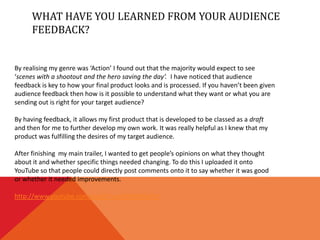
                          This is my first draft from my
                          questionnaire. This was to gain a
                          quick understanding of what
                          kind of audience I would like to
                          aim my media product at. I
                          would prefer to aim it at my age
                          range as I could have some
                          knowledge into the kind of
                          factors I could include.
WHAT HAVE YOU LEARNED FROM YOUR AUDIENCE
      FEEDBACK?


By realising my genre was ‘Action’ I found out that the majority would expect to see
‘scenes with a shootout and the hero saving the day’. I have noticed that audience
feedback is key to how your final product looks and is processed. If you haven’t been given
audience feedback then how is it possible to understand what they want or what you are
sending out is right for your target audience?

By having feedback, it allows my first product that is developed to be classed as a draft
and then for me to further develop my own work. It was really helpful as I knew that my
product was fulfilling the desires of my target audience.

After finishing my main trailer, I wanted to get people’s opinions on what they thought
about it and whether specific things needed changing. To do this I uploaded it onto
YouTube so that people could directly post comments onto it to say whether it was good
or whether it needed improvements.

http://www.youtube.com/watch?v=gSYH6WfwTyY
I could also gain feedback from my audience by uploading mock ups of my ancillary
products onto my blog. This was people could see the development stage of my media
products and could again post comments under to say if it was going good or not so
good.

http://ohheymate.blogspot.co.uk/2012/01/ancillary-magazine-basic-mock-up.html

That is my very first basic mock up of my front cover. From that to my final piece you can
see a massive difference as my audience have given me feedback to help me improve.
From this I learnt that feedback is like a journey and once you get feedback things only
improve and develop.

I also gained audience feedback to help me improve my teaser trailer before it was
nearly finished. The feedback I was given was very helpful and I took every bit of it on
board. I included the changes that were suggested and it is seen through the final
product. It was vital I got feedback on my trailer at this point as the deadline was near
and my product wasn’t reaching the desired effect that I wanted it to. Whatever my
audience thought would make it better was good as I could change things easily. This is
the feedback I received from my audience/peers:

http://ohheymate.blogspot.co.uk/2012/02/peer-feedback.html
WHAT HAVE YOU LEARNED FROM YOUR AUDIENCE
FEEDBACK?


Overall, I have learnt from audience feedback that:

-   You get a greater understanding of whether your work is going good or bad.
-   It is helpful to know when you are doing things right or wrong.
-   It gives you a sense of achievement to know that you have understood
    feedback and put it into practice.
-   It gives you a good sense of interpretation as you interpret the feedback how
    you want to. How ever way you do, it will more than likely be an improvement
    on your previous efforts.
HOW EFFECTIVE IS THE COMBINATION OF YOUR
MAIN PRODUCT AND THE ANCILLARY TEXTS?


         http://www.youtube.com/watch?v=gSYH6WfwTyY
HOW EFFECTIVE IS THE COMBINATION OF YOUR
MAIN PRODUCT AND THE ANCILLARY TEXTS?


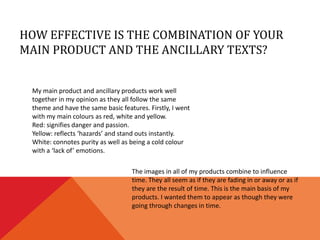
 My main product and ancillary products work well
 together in my opinion as they all follow the same
 theme and have the same basic features. Firstly, I went
 with my main colours as red, white and yellow.
 Red: signifies danger and passion.
 Yellow: reflects ‘hazards’ and stand outs instantly.
 White: connotes purity as well as being a cold colour
 with a ‘lack of’ emotions.

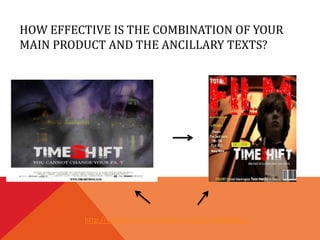
                                   The images in all of my products combine to influence
                                   time. They all seem as if they are fading in or away or as if
                                   they are the result of time. This is the main basis of my
                                   products. I wanted them to appear as though they were
                                   going through changes in time.
HOW EFFECTIVE IS THE COMBINATION OF YOUR
MAIN PRODUCT AND THE ANCILLARY TEXTS?


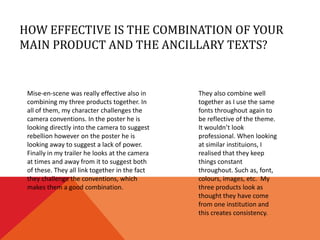
 Mise-en-scene was really effective also in     They also combine well
 combining my three products together. In       together as I use the same
 all of them, my character challenges the       fonts throughout again to
 camera conventions. In the poster he is        be reflective of the theme.
 looking directly into the camera to suggest    It wouldn’t look
 rebellion however on the poster he is          professional. When looking
 looking away to suggest a lack of power.       at similar instituions, I
 Finally in my trailer he looks at the camera   realised that they keep
 at times and away from it to suggest both      things constant
 of these. They all link together in the fact   throughout. Such as, font,
 they challenge the conventions, which          colours, images, etc. My
 makes them a good combination.                 three products look as
                                                thought they have come
                                                from one institution and
                                                this creates consistency.
HOW DID YOU USE TECHNOLOGIES IN THE
CONSTRUCTION AND RESEARCH, PLANNING AND
EVALUATION STAGES?


 In the construction stage of my product, I used ‘paint.net’ and ‘Adobe’ to create
 my trailer and two ancillary products. I found them pretty easy to use and there
 were no real complications to using these except programs going slow on some
 occasions.
 ‘Paint.net’ was used really to add effects to images rather than moving images. I
 could make things look old or new or bigger or smaller. It was about making things
 look different than they first appear.
 I looked at simple tutorials on how to use the program however most of it was
 mainly picked up once using the program. This is the basic tutorial I used:
 http://www.youtube.com/watch?v=uOQ2KLVFXRA

                 I used ‘paint.net’ to create the image on my poster of
                 the face fading into the background. I wanted this to
                 represent him fading away in time and it was very easy. I
                 got the idea from a poster I had previously seen:
                 http://www.horror-movies.ca/wp-
                 content/uploads/2011/08/Kill-List-Poster-610x462.jpg
HOW DID YOU USE TECHNOLOGIES IN THE
          CONSTRUCTION AND RESEARCH, PLANNING AND
          EVALUATION STAGES?

In the planning stages I used ‘adobe’. It helped me plan how I was going to
create my teaser trailer. As it was all set out in front of you, you could see
how things were going to pan out. For example, I could see when specific
ting were going to happen in my film. This is basically it. It is very easy to
use.
I had to plan when certain shots would come in and how others would exit
so I had to use the strip only the middle to construct this. By doing this
plan, it gave me a rough Idea on how my trailer would run.
Next I planned where the music would enter to create effect at specific
moments. It was easier than it sounded as you could play the music exactly
where you wanted and you could cut it up so you could have specific parts
of the sound in the trailer.
I also used this program to add text into parts in my trailer. It was harder
because sometimes you would lose where you wanted to put it or it
wouldn’t go in the right position but mainly it was okay and worked well on
the whole.
HOW DID YOU USE TECHNOLOGIES IN THE
CONSTRUCTION AND RESEARCH, PLANNING AND
EVALUATION STAGES?


In the evaluation stage, I just used simple word processor’s and power points. It is very basic
and understand how to use them . The easier the program you use is, then the better the
outcome will be in my opinion. If you find something really easy to use, then you can utilise all
of its abilities to their maximum and get the best out of them.
The best parts about using these are:
- Quick and easy to use.
- Guides to help you if needed.
- Reliable
- Easy to save work

Media Evaluation.

  • 2.
    IN WHAT WAYSDOES YOUR MEDIA PRODUCT, USE, DEVELOP OR CHALLENGE FORMS AND CONVENTIONS OF REAL MEDIA PRODUCTS? My main influence for my teaser trailer was ‘Hitman’ as my own trailer could relate to this film. My film had the same kind of narrative and my media product could relate to it. It represented the ‘hero’ in which everyone favours and the main storyline of him ‘saving the day’, so therefore, I didn’t challenge the conventions of my narrative. I just kept them in parallel to ‘Hitman’. I did challenge the usual conventions such as: - Main character looking directly into camera to show rebellion. The audience feel unsure of his character. - Less shots to therefore reveal the whole plot of my film again keeps the audience unsure of my main character. Is he the bad or the good guy?
  • 3.
    DEVELOPING CONVENTIONS OFTEASER TRAILER: I further developed the conventions of teaser trailers after I have developed the usual conventions of looking at my target audience. My ‘Total Film’ in that the background image of my audience is certified at 15 as it front cover links in with the theme, film, and contains violence and strong the main image featuring on the front cover. language. Therefore my audience has to have some maturity to I further developed the understand the themes in the conventions of the films. I challenged some of the magazine by adding the genuine codes and conventions film title in it original form on my magazine to attract my onto the magazine. The ‘S’ audience. fades to reflect time which links in with the whole My character is looking away from theme of ‘time.’ the character again to give a sense of rebellion. This insinuate that he is either the hero or villain in my film. I had his head overlap the ‘Total Film’ title to give his character a link within the magazine and to give him a sense of fame.
  • 4.
    - I used a lot of close up’s in my trailer which is a convention of all teaser trailers. They are included to create a lot of emotion without giving a lot of the narrative away. - I also had fast paced shots to create a sense of danger to make my audience feel on edge which again is another common convention of teaser trailers. - Music was also another convention that I kept the same throughout my trailer. The music was eerie which commonly features in trailers. The music fitted in with the close ups and created a deep sense of emotion. - I used titles to also indicate things about the film but again not to give much away. The font was kept the same throughout.
  • 5.
    WHAT HAVE YOULEARNED FROM YOUR AUDIENCE FEEDBACK? This is my first draft from my questionnaire. This was to gain a quick understanding of what kind of audience I would like to aim my media product at. I would prefer to aim it at my age range as I could have some knowledge into the kind of factors I could include.
  • 6.
    WHAT HAVE YOULEARNED FROM YOUR AUDIENCE FEEDBACK? By realising my genre was ‘Action’ I found out that the majority would expect to see ‘scenes with a shootout and the hero saving the day’. I have noticed that audience feedback is key to how your final product looks and is processed. If you haven’t been given audience feedback then how is it possible to understand what they want or what you are sending out is right for your target audience? By having feedback, it allows my first product that is developed to be classed as a draft and then for me to further develop my own work. It was really helpful as I knew that my product was fulfilling the desires of my target audience. After finishing my main trailer, I wanted to get people’s opinions on what they thought about it and whether specific things needed changing. To do this I uploaded it onto YouTube so that people could directly post comments onto it to say whether it was good or whether it needed improvements. http://www.youtube.com/watch?v=gSYH6WfwTyY
  • 7.
    I could alsogain feedback from my audience by uploading mock ups of my ancillary products onto my blog. This was people could see the development stage of my media products and could again post comments under to say if it was going good or not so good. http://ohheymate.blogspot.co.uk/2012/01/ancillary-magazine-basic-mock-up.html That is my very first basic mock up of my front cover. From that to my final piece you can see a massive difference as my audience have given me feedback to help me improve. From this I learnt that feedback is like a journey and once you get feedback things only improve and develop. I also gained audience feedback to help me improve my teaser trailer before it was nearly finished. The feedback I was given was very helpful and I took every bit of it on board. I included the changes that were suggested and it is seen through the final product. It was vital I got feedback on my trailer at this point as the deadline was near and my product wasn’t reaching the desired effect that I wanted it to. Whatever my audience thought would make it better was good as I could change things easily. This is the feedback I received from my audience/peers: http://ohheymate.blogspot.co.uk/2012/02/peer-feedback.html
  • 8.
    WHAT HAVE YOULEARNED FROM YOUR AUDIENCE FEEDBACK? Overall, I have learnt from audience feedback that: - You get a greater understanding of whether your work is going good or bad. - It is helpful to know when you are doing things right or wrong. - It gives you a sense of achievement to know that you have understood feedback and put it into practice. - It gives you a good sense of interpretation as you interpret the feedback how you want to. How ever way you do, it will more than likely be an improvement on your previous efforts.
  • 9.
    HOW EFFECTIVE ISTHE COMBINATION OF YOUR MAIN PRODUCT AND THE ANCILLARY TEXTS? http://www.youtube.com/watch?v=gSYH6WfwTyY
  • 10.
    HOW EFFECTIVE ISTHE COMBINATION OF YOUR MAIN PRODUCT AND THE ANCILLARY TEXTS? My main product and ancillary products work well together in my opinion as they all follow the same theme and have the same basic features. Firstly, I went with my main colours as red, white and yellow. Red: signifies danger and passion. Yellow: reflects ‘hazards’ and stand outs instantly. White: connotes purity as well as being a cold colour with a ‘lack of’ emotions. The images in all of my products combine to influence time. They all seem as if they are fading in or away or as if they are the result of time. This is the main basis of my products. I wanted them to appear as though they were going through changes in time.
  • 11.
    HOW EFFECTIVE ISTHE COMBINATION OF YOUR MAIN PRODUCT AND THE ANCILLARY TEXTS? Mise-en-scene was really effective also in They also combine well combining my three products together. In together as I use the same all of them, my character challenges the fonts throughout again to camera conventions. In the poster he is be reflective of the theme. looking directly into the camera to suggest It wouldn’t look rebellion however on the poster he is professional. When looking looking away to suggest a lack of power. at similar instituions, I Finally in my trailer he looks at the camera realised that they keep at times and away from it to suggest both things constant of these. They all link together in the fact throughout. Such as, font, they challenge the conventions, which colours, images, etc. My makes them a good combination. three products look as thought they have come from one institution and this creates consistency.
  • 12.
    HOW DID YOUUSE TECHNOLOGIES IN THE CONSTRUCTION AND RESEARCH, PLANNING AND EVALUATION STAGES? In the construction stage of my product, I used ‘paint.net’ and ‘Adobe’ to create my trailer and two ancillary products. I found them pretty easy to use and there were no real complications to using these except programs going slow on some occasions. ‘Paint.net’ was used really to add effects to images rather than moving images. I could make things look old or new or bigger or smaller. It was about making things look different than they first appear. I looked at simple tutorials on how to use the program however most of it was mainly picked up once using the program. This is the basic tutorial I used: http://www.youtube.com/watch?v=uOQ2KLVFXRA I used ‘paint.net’ to create the image on my poster of the face fading into the background. I wanted this to represent him fading away in time and it was very easy. I got the idea from a poster I had previously seen: http://www.horror-movies.ca/wp- content/uploads/2011/08/Kill-List-Poster-610x462.jpg
  • 13.
    HOW DID YOUUSE TECHNOLOGIES IN THE CONSTRUCTION AND RESEARCH, PLANNING AND EVALUATION STAGES? In the planning stages I used ‘adobe’. It helped me plan how I was going to create my teaser trailer. As it was all set out in front of you, you could see how things were going to pan out. For example, I could see when specific ting were going to happen in my film. This is basically it. It is very easy to use. I had to plan when certain shots would come in and how others would exit so I had to use the strip only the middle to construct this. By doing this plan, it gave me a rough Idea on how my trailer would run. Next I planned where the music would enter to create effect at specific moments. It was easier than it sounded as you could play the music exactly where you wanted and you could cut it up so you could have specific parts of the sound in the trailer. I also used this program to add text into parts in my trailer. It was harder because sometimes you would lose where you wanted to put it or it wouldn’t go in the right position but mainly it was okay and worked well on the whole.
  • 14.
    HOW DID YOUUSE TECHNOLOGIES IN THE CONSTRUCTION AND RESEARCH, PLANNING AND EVALUATION STAGES? In the evaluation stage, I just used simple word processor’s and power points. It is very basic and understand how to use them . The easier the program you use is, then the better the outcome will be in my opinion. If you find something really easy to use, then you can utilise all of its abilities to their maximum and get the best out of them. The best parts about using these are: - Quick and easy to use. - Guides to help you if needed. - Reliable - Easy to save work