Marketing in the New Conversational Age A Mediabistro Social Media Boot Camp  Webinar session Summer, 2011
Part 1  What has Happened?
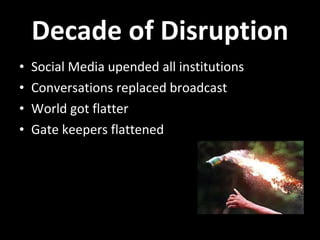
Decade of Disruption Social Media upended all institutions Conversations replaced broadcast World got flatter Gate keepers flattened
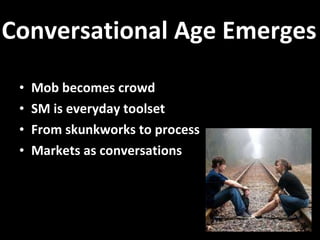
Mob becomes crowd SM is everyday toolset From skunkworks to process Markets as conversations Conversational Age Emerges
Part 2  How we got here
Fire Starters of Conversational Age
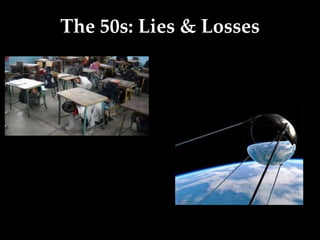
The 50s: Lies & Losses
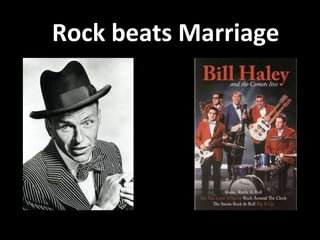
Rock beats Marriage
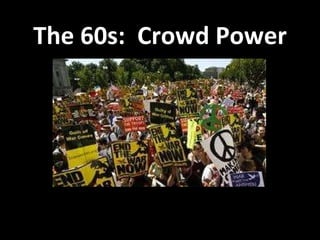
The 60s:  Crowd Power
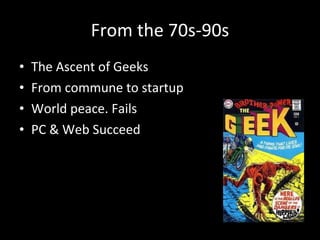
From the 70s-90s The Ascent of Geeks From commune to startup World peace. Fails PC & Web Succeed
Causes for Disruption Distrust of institutions Contempt for marketing messages Frustrated by shouting at TV  Tools of recourse
Part 3  Marketing’s Full Circle
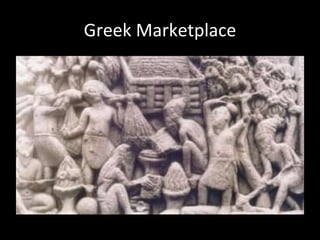
Greek Marketplace
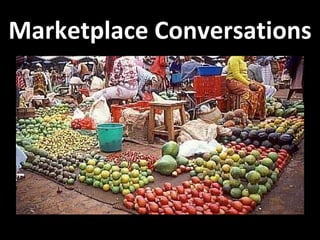
Marketplace Conversations
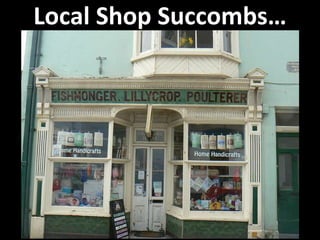
Local Shop Succombs…
…  To Big Blocks
2000 Years of Slow Change Face-to-face  Word-of-mouth reputation Localization > gentrification Personal > general Dialog > monologue
Then 10 Years of Disruption Conversation scales Control erodes ‘ Eyeballs’ grow humans Institution adapt or die People move to center of org chart
Part 4  The Customer-centric Enterprise
Customer at the Center Lou Gerstner at IBM: ‘Don’t ask me’ SAP Communities ‘We’ll stay’ Self-support Reduce time-to-market Bands of Champions
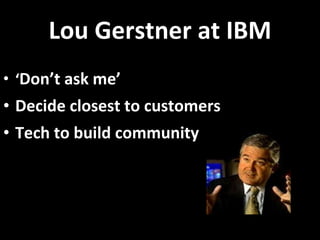
Lou Gerstner at IBM ‘ Don ’ t ask me ’ Decide closest to customers Tech to build community
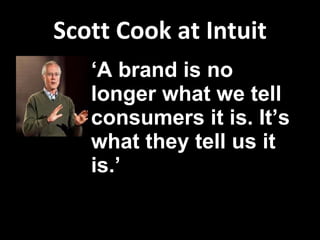
Scott Cook at Intuit ‘ A brand is no longer what we tell consumers it is. It’s what they tell us it is.’
 
SAP: ‘We’re Staying 2 million in communities Part of ecosystem $80 billion ecosystem SAP Hosts business Bands of champions
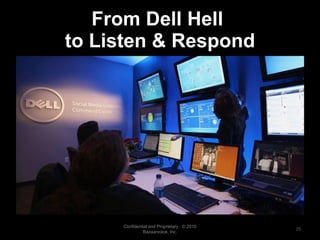
From Dell Hell  to Listen & Respond Confidential and Proprietary.  © 2010 Bazaarvoice, Inc.
Kraft & Cutting Remarks Confidential and Proprietary.  © 2010 Bazaarvoice, Inc.
L.L.Bean’s Itchy Twitchy Feeling
Customer-centric advantages Improved products & services Faster response to problems Reduced time-to-market Improve loyalty Increase profits Confidential and Proprietary.  © 2010 Bazaarvoice, Inc.
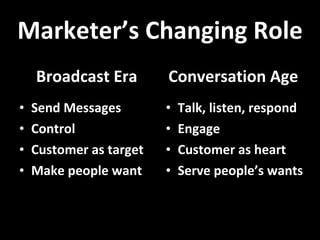
Marketer’s Changing Role Broadcast Era Send Messages Control Customer as target Make people want Conversation Age Talk, listen, respond Engage Customer as heart Serve people’s wants
Shel Israel [email_address] @ShelIsrael GlobalNeighbourhoods.net

Media bistro

Editor's Notes

  • #7 Personally, I have lots of interest in what the disruptors have done. They started the fires that have changed communications between people and institutions. I call them fire starters. I’m writing a book about them. One interesting aspect is that radio is one of the seeds that grew the revolution now coming to a close.
  • #8 But there was something else going on in the 50s. The Cold War included policies that scared Hell out of us kids. We were schooled that in case of nuclear attack, we should jump under our desks and cover our heads with our hands. After the blast, the next thing we were supposed to do was turn on our radios to Conelrad—the Civil Defense network. Civilization as we knew it might disappear, but radio would be there to give us the information we needed to start over again. A few years later we realized that all this was both macabre and silly. We began not to trust authorities at their word. But somehow the voices on the radio, maintained and expanded their credibility.
  • #9 My generation fomented this Conversational Revolution. It is, in part, a result of the culture that shaped us as we grew up. An example: In 1955, Rock Around Clock beat out Love & Marriage for most popular song. Rock would become the music of a generation a music filled with rebellious notes, a music hated by many of our parents but embraced by our children and now grandkids. Rock set the rhythm for much revolution and radio fed it to us.
  • #10 The rebellion, cultivated silently in the 50s exploded when my generation went off to college in the 60s. TV may have presented dramatic visuals. But radio was with us as we marched. In this photo here, there are probably scores, perhaps hundreds of people with portables. We learned about our demonstrations as we marched from the radio. Radio told us how many we were, and if somewhere, we had turned violent. It often told us what police planned to do about us.. Radio in the 60s played the same role as Twitter did in Egypt as a source of information for people on the streets.
  • #26 Dec. 10 22K convos a day Operationalizelistening,” Manish Mehta Distribute by relevancy Trained 5K
  • #27 Case #1 Kraft Salad Dressing SM talk of bottle tampering foil causing cuts Redesigned bottle Joined conversation Outreach program
  • #29 Customer Intelligence results Better products & services Improved loyalty Increased profits Makes managers heroes