1
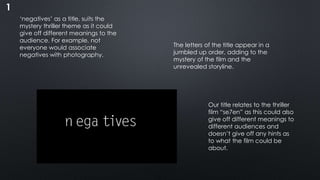
‘negatives’ as a title, suits the
mystery thriller theme as it could
give off different meanings to the
audience. For example, not
everyone would associate
negatives with photography.
The letters of the title appear in a
jumbled up order, adding to the
mystery of the film and the
unrevealed storyline.
Our title relates to the thriller
film “se7en” as this could also
give off different meanings to
different audiences and
doesn’t give off any hints as
to what the film could be
about.
2
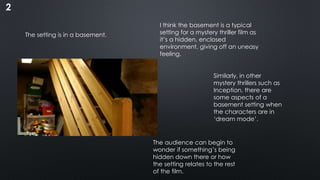
The setting is in a basement.
I think the basement is a typical
setting for a mystery thriller film as
it’s a hidden, enclosed
environment, giving off an uneasy
feeling.
Similarly, in other
mystery thrillers such as
Inception, there are
some aspects of a
basement setting when
the characters are in
‘dream mode’.
The audience can begin to
wonder if something’s being
hidden down there or how
the setting relates to the rest
of the film.
3
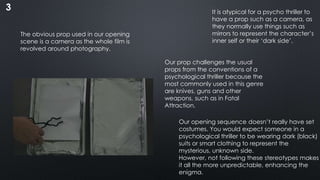
The obvious prop used in our opening
scene is a camera as the whole film is
revolved around photography.
It is atypical for a psycho thriller to
have a prop such as a camera, as
they normally use things such as
mirrors to represent the character’s
inner self or their ‘dark side’.
Our opening sequence doesn’t really have set
costumes. You would expect someone in a
psychological thriller to be wearing dark (black)
suits or smart clothing to represent the
mysterious, unknown side.
However, not following these stereotypes makes
it all the more unpredictable, enhancing the
enigma.
Our prop challenges the usual
props from the conventions of a
psychological thriller because the
most commonly used in this genre
are knives, guns and other
weapons, such as in Fatal
Attraction.
4
We mostly used fast cut shots from
one scene to the next, to build up
a fast pace, creating suspense.
We used a wide range of camera
angles. For example, like in the
picture, we used a high angle shot,
quickly switching to an eye level
shot (to the right) of the character
writing.
Our opening is
similar to se7en in
the way that the
camera angles
used are close-ups
of the character’s
book and shows
different shots of
the character
working on
something.
Our shots are typically used
in this genre of film because
of the pace. It creates
suspense for the audience
as they are left wanting to
find out more.
5 For the scene of the character
getting strangled/attacked, the
editing used was the black and
white effect.
Black and white makes the whole
scene more dark and mysterious.
It’s supposed to show that it isn’t
set in present time – that it’s in the
future.
It was used to help
distinguish between the
good and the bad. It can
show the mystery of the
scene as what is going on
and why, is unclear.
In Memento, the scenes
alternate from black and
white, back to colour. The
black and white scenes
show things happening in
chronological order and
the colour scenes
proceed in reverse
chronological order.
6
The title colour suits the genre of the film
because it’s bold standing against the
black background. The neutral white
connotes a more serious mood (if it was
yellow, it could connote happiness, red
being love/danger etc.)
The typewriter effect on the titles
gives a more mysterious mood as
well. We chose to do this as we
thought it would be simple but
effective.
None of the opening sequence
includes particularly bright
colours, so it would make sense
to keep the titles as subtle as
possible, too.
Memento also uses the same idea
of smaller and simpler font,
appearing first in a dark blue but
then fading to white, suiting the
genre.
7
The only clues to the narrative from the
opening is that there is some sort of photo
shoot, maybe revealing something.
This is shown through the woman with the
camera taking photos of another
character, who is smiling and is then seen
to be getting attacked.
This begins to make the
audience question what
the photographer is
actually doing, creating a
theme of mystery.
The opening sets up the narrative through
the way it focuses mainly on the camera
throughout the whole sequence, giving
clues that the main part of the film will be
revolved around a camera.
8
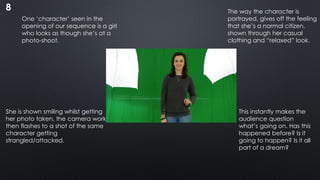
One ‘character’ seen in the
opening of our sequence is a girl
who looks as though she’s at a
photo-shoot.
She is shown smiling whilst getting
her photo taken, the camera work
then flashes to a shot of the same
character getting
strangled/attacked.
This instantly makes the
audience question
what’s going on. Has this
happened before? Is it
going to happen? Is it all
part of a dream?
The way the character is
portrayed, gives off the feeling
that she’s a normal citizen,
shown through her casual
clothing and “relaxed” look.
9
The only real special effects we included
was the fuzzier effect on the camera. This
links well as a camera lens is constantly
focusing in and out.
The only real special effects we
included was the fuzzier effect on
the camera. This links well as a
camera lens is constantly focusing
in and out.
A camera flash was included when the
character was at her photo shoot, making
the distinguish between the photographer
and the character clearer.

Media

  • 2.
    1 ‘negatives’ as atitle, suits the mystery thriller theme as it could give off different meanings to the audience. For example, not everyone would associate negatives with photography. The letters of the title appear in a jumbled up order, adding to the mystery of the film and the unrevealed storyline. Our title relates to the thriller film “se7en” as this could also give off different meanings to different audiences and doesn’t give off any hints as to what the film could be about.
  • 3.
    2 The setting isin a basement. I think the basement is a typical setting for a mystery thriller film as it’s a hidden, enclosed environment, giving off an uneasy feeling. Similarly, in other mystery thrillers such as Inception, there are some aspects of a basement setting when the characters are in ‘dream mode’. The audience can begin to wonder if something’s being hidden down there or how the setting relates to the rest of the film.
  • 4.
    3 The obvious propused in our opening scene is a camera as the whole film is revolved around photography. It is atypical for a psycho thriller to have a prop such as a camera, as they normally use things such as mirrors to represent the character’s inner self or their ‘dark side’. Our opening sequence doesn’t really have set costumes. You would expect someone in a psychological thriller to be wearing dark (black) suits or smart clothing to represent the mysterious, unknown side. However, not following these stereotypes makes it all the more unpredictable, enhancing the enigma. Our prop challenges the usual props from the conventions of a psychological thriller because the most commonly used in this genre are knives, guns and other weapons, such as in Fatal Attraction.
  • 5.
    4 We mostly usedfast cut shots from one scene to the next, to build up a fast pace, creating suspense. We used a wide range of camera angles. For example, like in the picture, we used a high angle shot, quickly switching to an eye level shot (to the right) of the character writing. Our opening is similar to se7en in the way that the camera angles used are close-ups of the character’s book and shows different shots of the character working on something. Our shots are typically used in this genre of film because of the pace. It creates suspense for the audience as they are left wanting to find out more.
  • 6.
    5 For thescene of the character getting strangled/attacked, the editing used was the black and white effect. Black and white makes the whole scene more dark and mysterious. It’s supposed to show that it isn’t set in present time – that it’s in the future. It was used to help distinguish between the good and the bad. It can show the mystery of the scene as what is going on and why, is unclear. In Memento, the scenes alternate from black and white, back to colour. The black and white scenes show things happening in chronological order and the colour scenes proceed in reverse chronological order.
  • 7.
    6 The title coloursuits the genre of the film because it’s bold standing against the black background. The neutral white connotes a more serious mood (if it was yellow, it could connote happiness, red being love/danger etc.) The typewriter effect on the titles gives a more mysterious mood as well. We chose to do this as we thought it would be simple but effective. None of the opening sequence includes particularly bright colours, so it would make sense to keep the titles as subtle as possible, too. Memento also uses the same idea of smaller and simpler font, appearing first in a dark blue but then fading to white, suiting the genre.
  • 8.
    7 The only cluesto the narrative from the opening is that there is some sort of photo shoot, maybe revealing something. This is shown through the woman with the camera taking photos of another character, who is smiling and is then seen to be getting attacked. This begins to make the audience question what the photographer is actually doing, creating a theme of mystery. The opening sets up the narrative through the way it focuses mainly on the camera throughout the whole sequence, giving clues that the main part of the film will be revolved around a camera.
  • 9.
    8 One ‘character’ seenin the opening of our sequence is a girl who looks as though she’s at a photo-shoot. She is shown smiling whilst getting her photo taken, the camera work then flashes to a shot of the same character getting strangled/attacked. This instantly makes the audience question what’s going on. Has this happened before? Is it going to happen? Is it all part of a dream? The way the character is portrayed, gives off the feeling that she’s a normal citizen, shown through her casual clothing and “relaxed” look.
  • 10.
    9 The only realspecial effects we included was the fuzzier effect on the camera. This links well as a camera lens is constantly focusing in and out. The only real special effects we included was the fuzzier effect on the camera. This links well as a camera lens is constantly focusing in and out. A camera flash was included when the character was at her photo shoot, making the distinguish between the photographer and the character clearer.