Jump to firstpage
1
dA
dF
A
F
A
0
lim
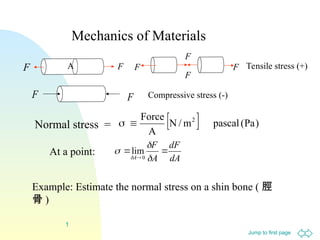
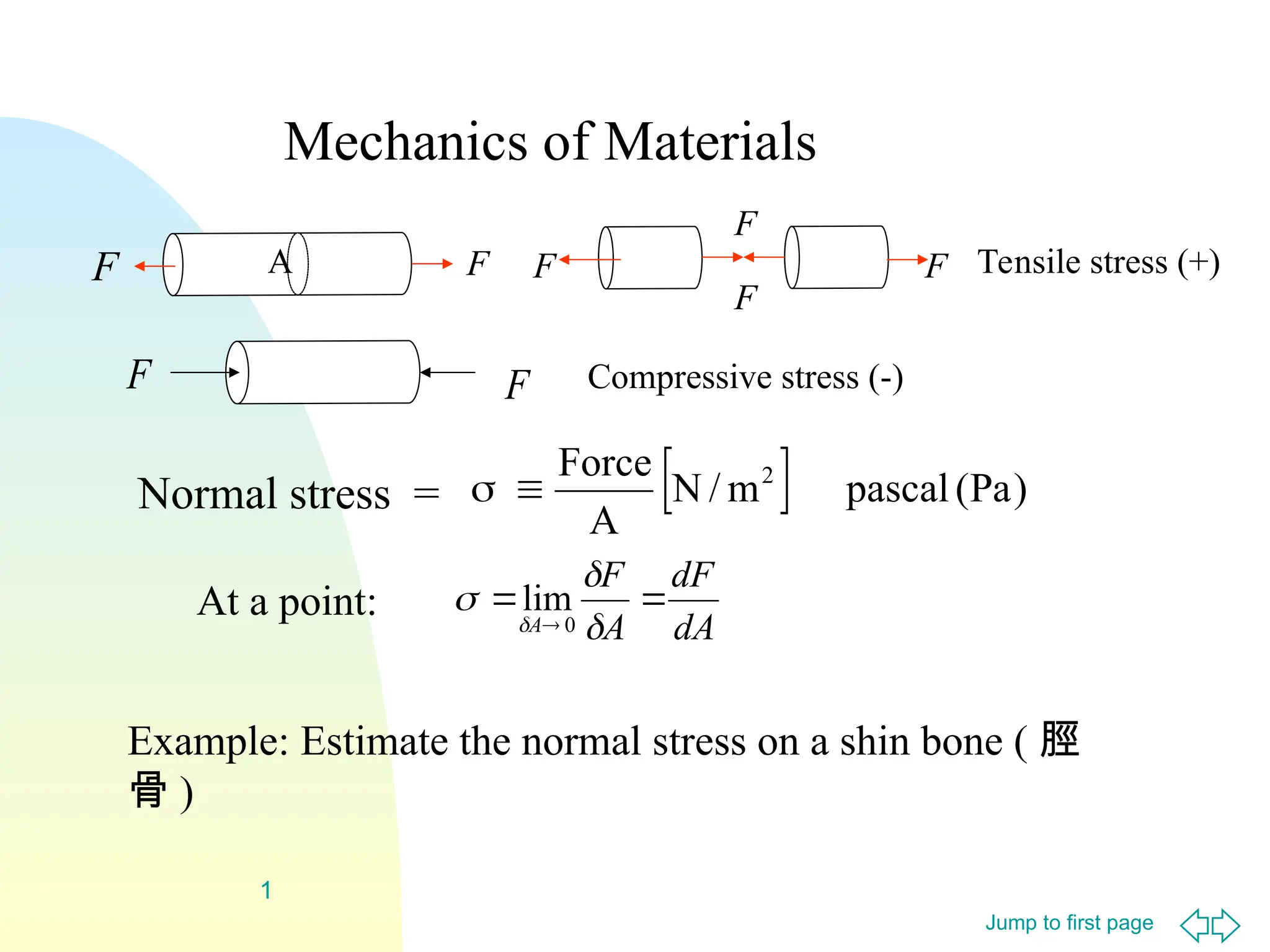
Normal stress = )
Pa
(
pascal
m
/
N
A
Force 2
Mechanics of Materials
Example: Estimate the normal stress on a shin bone ( 脛
骨 )
A
F
F
F
F
F
F
Tensile stress (+)
F
F
Compressive stress (-)
At a point:
2.
Jump to firstpage
2
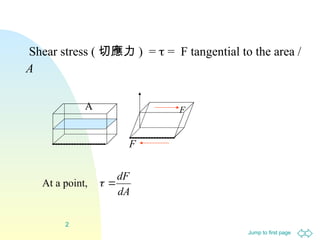
Shear stress ( 切應力 ) = = F tangential to the area /
A
A F
F
dA
dF
At a point,
3.
Jump to firstpage
3
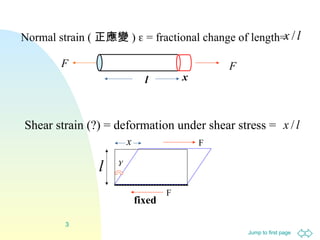
Normal strain ( 正應變 ) = fractional change of length= l
x /
x
l
F
F
fixed
l
x /
Shear strain (?) = deformation under shear stress =
F
F
l x
4.
Jump to firstpage
4
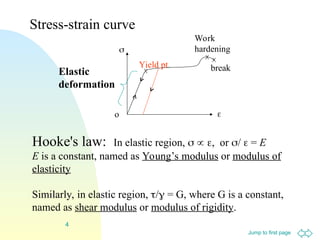
Stress-strain curve
o
Yield pt.
Work
hardening
break
Elastic
deformation
Hooke's law: In elastic region, , or / = E
E is a constant, named as Young’s modulus or modulus of
elasticity
Similarly, in elastic region, / = G, where G is a constant,
named as shear modulus or modulus of rigidity.
5.
Jump to firstpage
5
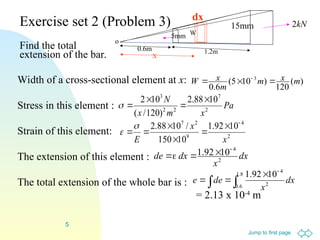
Exercise set 2 (Problem 3)
Find the total
extension of the bar.
dx
x
dx
de 2
4
10
92
.
1
)
(
120
)
10
5
(
6
.
0
3
m
x
m
m
x
W
Pa
x
m
x
N
2
7
2
2
3
10
88
.
2
)
120
/
(
10
2
X
15mm
W
5mm
1.2m
0.6m
o
kN
2
dx
2
4
9
2
7
10
92
.
1
10
150
/
10
88
.
2
x
x
E
Width of a cross-sectional element at x:
Stress in this element :
Strain of this element:
The extension of this element :
The total extension of the whole bar is :
= 2.13 x 10⁻⁴
m
8
.
1
6
.
0 2
4
10
92
.
1
dx
x
de
e
6.
Jump to firstpage
6
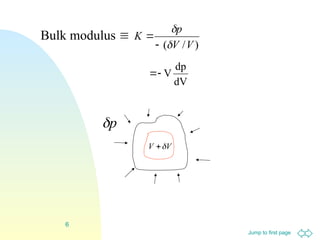
Bulk modulus
)
/
( V
V
p
K
V
V
p
dV
dp
V
7.
Jump to firstpage
7
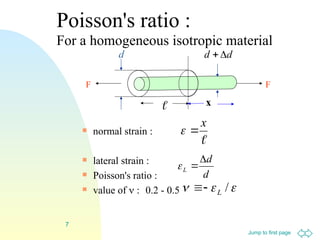
Poisson's ratio :
For a homogeneous isotropic material
normal strain :
lateral strain :
Poisson's ratio :
value of : 0.2 - 0.5
d
d
L
/
L
x
F F
d
d
x
d
8.
Jump to firstpage
8
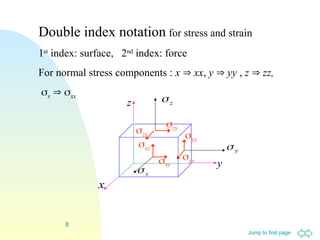
Double index notation for stress and strain
1st
index: surface, 2nd
index: force
For normal stress components : x xx, y yy , z zz,
x xx
z
x
y
x
y
z
zx
zy
yz
xz
xy
yx
9.
Jump to firstpage
9
E
E
E
E
E
E
E
E
E
yy
xx
zz
zz
zz
xx
yy
yy
zz
yy
xx
xx
z
x
y
x
y
z
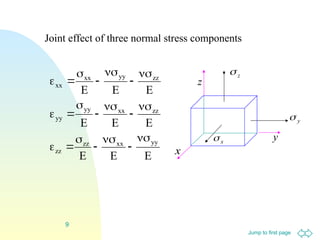
Joint effect of three normal stress components
10.
Jump to firstpage
10
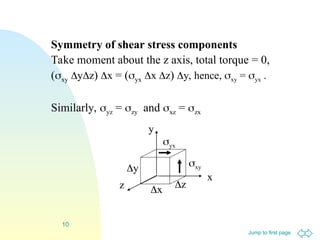
Symmetry of shear stress components
Take moment about the z axis, total torque = 0,
(xy yz) x = (yx x z) y, hence, xy = yx .
Similarly, yz = zy and xz = zx
z
y
x
xy
yx
x
y
z
11.
Jump to firstpage
11
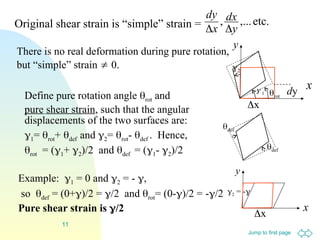
Define pure rotation angle rot and
pure shear strain, such that the angular
displacements of the two surfaces are:
1= rot+ def and 2= rot- def . Hence,
rot = (1+ 2)/2 and def = (1- 2)/2
Original shear strain is “simple” strain = etc.
,...
,
y
dx
x
dy
There is no real deformation during pure rotation,
but “simple” strain 0.
x
y
x
2 = -
Example: 1 = 0 and 2 = - ,
so def = (0+)/2 = /2 and rot= (0-)/2 = -/2
Pure shear strain is /2
x
y
x
dy
1
rot
2
def
def
12.
Jump to firstpage
12
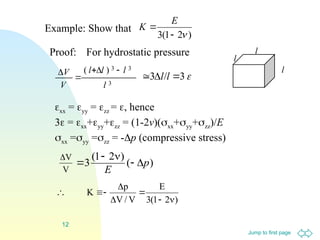
Example: Show that
)
2
1
(
3
E
K
)
2
1
(
3
E
V
/
V
p
K
3
3
3
)
(
l
l
l
l
V
V
3
/
3
l
l
Proof:
xx = yy = zz = , hence
3 = xx+yy+zz = (1-2v)(xx+yy+zz)/E
xx =yy =zz = -p (compressive stress)
)
(
)
2
1
(
3 p
E
V
V
For hydrostatic pressure
l
l
l
13.
Jump to firstpage
13
Point C moves further along x- and y-direction by distances
of AD(/2) and AD(/2) respectively.
nn = [(AD /2)2
+ (AD /2)2
]1/2
/ [(AD)2
+ (AD)2
]1/2
= /2
True shear strain: yx = /2
Therefore, the normal component of strain is equal to the
shear component of strain:
nn = yx and nn = /2
Example : Show that nn = /2
2
/
x
y
A
C’
C
D
D’
2
14.
Jump to firstpage
14
yx (lW) sin 45o
x2 = 2 (l cos 45o
) W nn
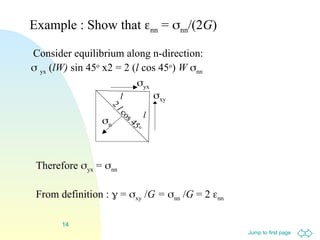
Example : Show that nn = nn/(2G)
Consider equilibrium along n-direction:
Therefore yx = nn
From definition : = xy /G = nn /G = 2 nn
l
l
n
yx
xy
2
l
c
o
s
4
5
o
15.
Jump to firstpage
15
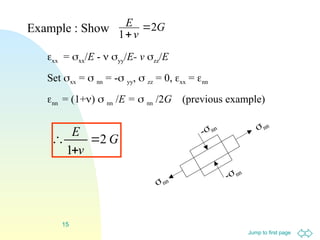
G
v
E
2
1
nn
nn
-nn
-nn
xx = xx/E - yy/E- v zz/E
Set xx = nn = - yy, zz = 0, xx = nn
nn = (1+) nn /E = nn /2G (previous example)
Example : Show G
v
E 2
1
16.
Jump to firstpage
16
Ex. 12 kN forces are applied to the top
& bottom of a cube (20 mm edges), E
= 60 GPa, = 0.3. Find (i) the force
exerted by the walls, (ii) yy
z
y
12kN
x
(i) xx = 0, yy = 0 and
zz= -12103
N/(2010-3
m)2
= 3107
Pa
xx = (xx- v yy- v zz) /E
0 = [xx- 0 – 0.3(- 3107
)]/60109
xx = -9106
Pa (compressive)
Force = Axx = (2010-3
m)2
(-9106
Pa) = -3.6 103
N
(ii) yy = (yy- v zz- v xx) /E
= [0 – 0.3(- 3107
) – 0.3(- 9106
)]/60109
= 1.9510-4
17.
Jump to firstpage
17
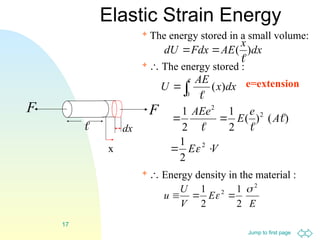
Elastic Strain Energy
The energy stored in a small volume:
The energy stored :
Energy density in the material :
dx
x
AE
Fdx
dU )
(
V
E
A
e
E
AEe
dx
x
AE
U
e
2
2
2
0
2
1
)
(
)
(
2
1
2
1
)
(
E
E
V
U
u
2
2
2
1
2
1
e=extension
dx
F F
x
18.
Jump to firstpage
18
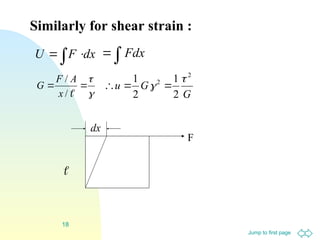
Similarly for shear strain :
F
dx
x
d
F
U
Fdx
/
/
x
A
F
G
G
G
u
2
2
2
1
2
1
![Jump to first page
13
Point C moves further along x- and y-direction by distances
of AD(/2) and AD(/2) respectively.
nn = [(AD /2)2
+ (AD /2)2
]1/2
/ [(AD)2
+ (AD)2
]1/2
= /2
True shear strain: yx = /2
Therefore, the normal component of strain is equal to the
shear component of strain:
nn = yx and nn = /2
Example : Show that nn = /2
2
/
x
y
A
C’
C
D
D’
2
](https://image.slidesharecdn.com/6-som-250409074143-cb2045d6/85/Mechanics-of-materials-analysis-with-examples-ppt-13-320.jpg)
![Jump to first page
16
Ex. 12 kN forces are applied to the top
& bottom of a cube (20 mm edges), E
= 60 GPa, = 0.3. Find (i) the force
exerted by the walls, (ii) yy
z
y
12kN
x
(i) xx = 0, yy = 0 and
zz= -12103
N/(2010-3
m)2
= 3107
Pa
xx = (xx- v yy- v zz) /E
0 = [xx- 0 – 0.3(- 3107
)]/60109
xx = -9106
Pa (compressive)
Force = Axx = (2010-3
m)2
(-9106
Pa) = -3.6 103
N
(ii) yy = (yy- v zz- v xx) /E
= [0 – 0.3(- 3107
) – 0.3(- 9106
)]/60109
= 1.9510-4](https://image.slidesharecdn.com/6-som-250409074143-cb2045d6/85/Mechanics-of-materials-analysis-with-examples-ppt-16-320.jpg)