Mechanical Ventilator
Settings and Basic Modes
Common indications for mechanical
ventilation include the following:
• Bradypnea or apnea with respiratory arrest
• Acute lung injury and the acute respiratory distress syndrome
• Tachypnea (respiratory rate >30 breaths per minute)
• Vital capacity less than 15 mL/kg
• Minute ventilation greater than 10 L/min
• Arterial partial pressure of oxygen (PaO2) with a supplemental fraction of inspired oxygen (FIO2) of less
than 55 mm Hg
• Alveolar-arterial gradient of oxygen tension (A-a DO2) with 100% oxygenation of greater than 450 mm Hg
• Clinical deterioration
• Respiratory muscle fatigue
• Obtundation or coma
• Hypotension
• Acute partial pressure of carbon dioxide (PaCO2) greater than 50 mm Hg with an arterial pH less than 7.25
• Neuromuscular disease
The initial
ventilator
settings
are as
follows:
The initial mode is usually assist-control mode,
except in ARDS patient
Tidal volume setting is dependent of the lung
status
Respiratory Rate is set to 10-12 breaths per
minute
Fraction of inspired oxygen (FIO2) is set at
100%
A Sigh is not necessary
PEEP setting is dependent of the first arterial
blood gas,
Initial setting
Usually the initial mode of ventilation is the assist-
control mode
In this mode, the tidal volume and rate are preset and
guaranteed to be delivered to the patient
The frequency and timing of the breaths is then
affected by the patient
If the patient does not initiate inspiration, the ventilator
automatically delivers the preset rate and tidal volume
This is to ensure minimum minute ventilation is
achieved
common
ventilator
settings
Some ventilator settings are common between
conventional modes of ventilation
These common ventilator settings are :
Fraction of inspired oxygen
Positive end expiratory pressure
Trigger sensitivity
FiO2
A fraction of inspired oxygen (FIO2) is the amount of oxygen being delivered to
the patient. The minimum setting for FiO2 can only be set as low as 21% which
is equal to the normal fraction of oxygen in the atmosphere
The aim of mechanical ventilation is to provide effective oxygenation to the
patient
The FIO2 should always be set at 100% until adequate arterial oxygenation is
achieved and for the patient's safety after intubation
Setting an FIO2 of 100% usually protects the patient from hypoxemia incase
any difficulty or problem occur as a result of the intubation procedure.
An FIO2 of 100% together with PaO2 helps to easily calculate the next desired
FIO2 and estimate the shunt fraction
The FiO2 should then be quickly reduced to the minimal level required to
maintain adequate oxygenation
PEEP
• Positive End Expiratory Pressure (PEEP) is defined as the pressure
maintained in the respiratory system at the end of exhalation. This
pressure serves a purpose of trying and maintaining the lungs open by
preventing atelectasis. PEEP is generally in at a minimum level of 5
centimeters of water.
• PEEP therapy is effective when it is used in patients with a diffuse lung
disease resulting in an acute reduction in functional residual capacity
(FRC). A functional residual capacity is the volume of gas that remains in
the lung at the end of a expiration. A reduction of FRC is because of the
collapse of the unstable alveoli.
• Applying PEEP increases alveolar pressure and alveolar volume
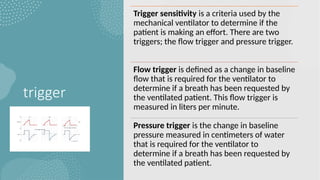
trigger
Trigger sensitivity is a criteria used by the
mechanical ventilator to determine if the
patient is making an effort. There are two
triggers; the flow trigger and pressure trigger.
Flow trigger is defined as a change in baseline
flow that is required for the ventilator to
determine if a breath has been requested by
the ventilated patient. This flow trigger is
measured in liters per minute.
Pressure trigger is the change in baseline
pressure measured in centimeters of water
that is required for the ventilator to
determine if a breath has been requested by
the ventilated patient.
Tidal
volume
and rate
• Patients having an acute respiratory distress
syndrome receive a lower tidal volume of 6-8ml/kg
ideal body weight for their lungs to function well
and avoid volutrauma. This strategy is known as
lung-protective ventilation
• An ideal body weight is the patient's predicted
weight that is based on height and birth gender but
not their actual body weight.
• When using assist control modes, the respiratory
rate should be set at least high enough so as to
achieve a minute ventilation that is predicted for
the patient. The respiratory rate can be set even
higher if the patient has a known acid base
imbalance during the time of intubation
• When using a low tidal volume, sighs are set at 1.5-
2 times the tidal volume and are delivered 6-8 times
an hour if the peak preasure and plateau pressures
are within the normal limit. This is to prevent
development of microatelectasis
How do you calculate an ideal body
weight?
Men: Ideal Body Weight (kg) = [Height (cm) - 100] - ([Height (cm) - 100] x
10%)
Women: Ideal Body Weight (kg) = [Height (cm) - 100] + ([Height (cm) - 100] x
15%)
The reason behind using an ideal body weight instead of an actual body
weight is because. An actual body weight will overestimate the tidal volume
required.
Patients are required to be ventilated with a lower tidal volume of 6-8ml/kg
How do you determine
predicted minute ventilation?
Predicted minute ventilation
is determined by multiplying
ideal body weight of the
patient by 100 milliliters per
minute.
Take an example, you have a
patient with ideal body
weight of 60 kgs, the minute
ventilation for this patient is
60*100= 6000 milliliters per
minute (6L/minute)
What are the common modes
of ventilation?
There are three
most commonly
used modes in
mechanical
ventilation
Pressure assist
control
Volume assist
control and
Pressure support
Pressure
assist
control
Pressure assist control and volume assist control
modes are usually used in acute phase of mechanical
ventilation or when the patient has minimal or no
drive to breath.
These modes are classified as control modes because
they do 100% of the work for the patients while on
the ventilator. Therefore they are the most efficient
for the patient in complete respiratory failure.
On the other hand, pressure support is used in
patients who have an intact respiratory drive
Volume Assist Control (AC-VC)
• This mode requires a frequency of respirations per minute to be set. Patients who are attached to
the ventilator then can trigger additional breaths that are greater than the set respirations per
minute. If these patients cannot meet the trigger criteria, then the machine takes over and triggers
all of the breaths.
• Assist control modes share the common setting of requiring a frequency, which is a respiration per
minute. And patients can trigger some of the breaths or more breaths than what is set by the
ventilator if they would like.
• If the trigger sensitivity criteria is met, the ventilator will deliver a breath to the patient, and if
there is no trigger criteria being met, the ventilator will deliver a breath at the set frequency.
• In volume assist control, the trigger sensitivity is flow, and it is set at 2 liters per minute.
• When patients begin to actively interact with the ventilator, a trial of a spontaneous mode, such as
pressure support, should be considered.
• One of the setting that needs to be set is tidal volume. The normal tidal volume is 6-8ml/kg of an
idea l body weight.
Another setting is the flow.
• Flow is the speed to deliver the required tidal volume. Flow is given in litres
per minute. And once the target volume is reached, the breath delivery has
ended
• A normal inspiratory flow is set between 50-60 Litres per minute is set to
minimize discomfort when a patient starts to make an effort
• The frequency is set to 14 breaths per minute. And this gives us a minute
ventilation, which commonly has the label VE
• A positive expiratory pressure (PEEP) is set at 5cmH2O so as to reduce
atelectasis or collapse of the lung alveoli.
Inspiratory: Expiratory ratio
• I:E Ratio is also affected by respiratory rate
• The normal set I:E ratio is 1:1.5 and 1:2
• A normal person has an inspiratory time between 0.75 second to 1 second. But in some
respiratory diseases such as asthma, the airway is usually obstructed
• In these patients it is usually beneficial to allow more time for exhalation to occur by
increasing the inspiratory flow or decreasing the I:E ratio to about 1:3 or 1:4
• The inspiratory-to-expiratory ratio is actually the simplest parameter to determine whether
there is sufficient time to exhale
• In general, if inspiratory time is less than one second or used, the IE ratio is not a concern
until the respiratory rate is greater than 20 b/min.
• When the respiratory rate is greater than 20 breaths per minute, ensure that the resulting
IE ratio is at least 1:2 or higher to allow sufficient time to exhale the delivered tidal volume.
resistive pressure or an elastic
pressure
• The patient’s respiratory system may be having either a resistive pressure or an elastic pressure.
Resistive pressure is a kind of pressure due to the endotracheal tube and airways whereas elastic
pressure is as a result of the stiffness of the lung and/or chest wall.
• For one to distinguish if the patient has a resistive pressure or an elastic pressure or compliance of
the respiratory system, an inspiratory pause is used to helps distinguish these.
• An inspiratory pause setting is commonly found in the volume assist control modes and it allows for
a short pause to be set at the end of inspiration.
• This inspiratory pause allows the ventilator to display the plateau pressure, helping to monitor the
patient’s respiratory system mechanics
• An inspiratory pause also prolongs the inspiratory time to the common time of between 0.75-1
seconds.
• And there are a few ways to lengthen the inspiratory time when using volume assist control
1. lowering the flow rate.
2. Increase inspiratory time
Pressure assist control (AC-PC)
• Pressure controlled ventilation is when a patient has a pressure setting on the ventilator
and when the ventilator cycles a breath the pressure will continue to rise on the ventilator
until the pre-set pressure limit is reached then the ventilator will cycle off and the patient
will then exhale.
• How much the patient’s tidal volume is determined on how high the pressure limit is set.
• If the lungs are stiff or non-compliant, it means that the pressure will build more slowly
and the inspiratory time will have to be adjusted to accommodate the need of the patient.
• For pressure control settings, the frequency is the same as with volume assist control.
• On some ventilators, this is the absolute pressure that will be reached with each breath.
• The pressure is typically set at a level that will deliver a tidal volume to the patient based
on their ideal body weight.
Pressure support (PS)
Pressure Support (PS) is distinguished from AC-PC because breaths
are cycled or by a percentage of peak flow, as opposed to time.
It is important to adjust the default settings for the percentage of
peak flow to initiate the cycling of each breath, as it depends highly
on the resistance and elastance of the lungs
CPAP is Continuous Positive Airway
Pressure
Continuous Positive Airway Pressure mode of ventilation uses pressure support and PEEP to allow the patient to
spontaneously breathe on his own without any mechanical breaths being given.
Consider this mode similar to PEEP, relating to its purpose to maintain end-expiratory lung volume.
Many ventilators do not have a specific mode called CPAP. Rather, it is delivered by simply turning the pressure support level
and pressure support ventilation down to zero. The remainder is a constant pressure in the system based on your PEEP
setting.
The flow is delivered to the patient by the machine in order to maintain the set pressure.
This mode does not directly provide support to reduce inspiratory workload. But if it maintains end-expiratory lung volume,
it can help to minimize workload due to atelectasis
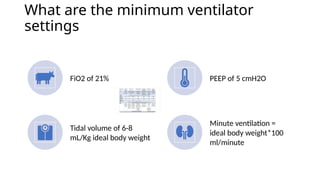
What are the minimum ventilator
settings
FiO2 of 21% PEEP of 5 cmH2O
Tidal volume of 6-8
mL/Kg ideal body weight
Minute ventilation =
ideal body weight*100
ml/minute
Summary of important mechanical
ventilator settings
In volume assist control; the volume and the flow is controlled while pressure
is determined by the patient’s respiratory system. The cycle is controlled by
volume or time.
In pressure assist control: the volume is determined by the patient’s
respiratory system as the pressure is the controlled setting. The flow is
variable and the cycle is determined by time.
In pressure support: the volume is determined by the patient’s respiratory
and the patient’s demand. The flow is variable and pressure is controlled.
The cycle trigger is the percentage of the peak

Mechanical Ventilator Settings and Basic Modes.pptx

  • 1.
  • 2.
    Common indications formechanical ventilation include the following: • Bradypnea or apnea with respiratory arrest • Acute lung injury and the acute respiratory distress syndrome • Tachypnea (respiratory rate >30 breaths per minute) • Vital capacity less than 15 mL/kg • Minute ventilation greater than 10 L/min • Arterial partial pressure of oxygen (PaO2) with a supplemental fraction of inspired oxygen (FIO2) of less than 55 mm Hg • Alveolar-arterial gradient of oxygen tension (A-a DO2) with 100% oxygenation of greater than 450 mm Hg • Clinical deterioration • Respiratory muscle fatigue • Obtundation or coma • Hypotension • Acute partial pressure of carbon dioxide (PaCO2) greater than 50 mm Hg with an arterial pH less than 7.25 • Neuromuscular disease
  • 3.
    The initial ventilator settings are as follows: Theinitial mode is usually assist-control mode, except in ARDS patient Tidal volume setting is dependent of the lung status Respiratory Rate is set to 10-12 breaths per minute Fraction of inspired oxygen (FIO2) is set at 100% A Sigh is not necessary PEEP setting is dependent of the first arterial blood gas,
  • 4.
    Initial setting Usually theinitial mode of ventilation is the assist- control mode In this mode, the tidal volume and rate are preset and guaranteed to be delivered to the patient The frequency and timing of the breaths is then affected by the patient If the patient does not initiate inspiration, the ventilator automatically delivers the preset rate and tidal volume This is to ensure minimum minute ventilation is achieved
  • 5.
    common ventilator settings Some ventilator settingsare common between conventional modes of ventilation These common ventilator settings are : Fraction of inspired oxygen Positive end expiratory pressure Trigger sensitivity
  • 6.
    FiO2 A fraction ofinspired oxygen (FIO2) is the amount of oxygen being delivered to the patient. The minimum setting for FiO2 can only be set as low as 21% which is equal to the normal fraction of oxygen in the atmosphere The aim of mechanical ventilation is to provide effective oxygenation to the patient The FIO2 should always be set at 100% until adequate arterial oxygenation is achieved and for the patient's safety after intubation Setting an FIO2 of 100% usually protects the patient from hypoxemia incase any difficulty or problem occur as a result of the intubation procedure. An FIO2 of 100% together with PaO2 helps to easily calculate the next desired FIO2 and estimate the shunt fraction The FiO2 should then be quickly reduced to the minimal level required to maintain adequate oxygenation
  • 7.
    PEEP • Positive EndExpiratory Pressure (PEEP) is defined as the pressure maintained in the respiratory system at the end of exhalation. This pressure serves a purpose of trying and maintaining the lungs open by preventing atelectasis. PEEP is generally in at a minimum level of 5 centimeters of water. • PEEP therapy is effective when it is used in patients with a diffuse lung disease resulting in an acute reduction in functional residual capacity (FRC). A functional residual capacity is the volume of gas that remains in the lung at the end of a expiration. A reduction of FRC is because of the collapse of the unstable alveoli. • Applying PEEP increases alveolar pressure and alveolar volume
  • 8.
    trigger Trigger sensitivity isa criteria used by the mechanical ventilator to determine if the patient is making an effort. There are two triggers; the flow trigger and pressure trigger. Flow trigger is defined as a change in baseline flow that is required for the ventilator to determine if a breath has been requested by the ventilated patient. This flow trigger is measured in liters per minute. Pressure trigger is the change in baseline pressure measured in centimeters of water that is required for the ventilator to determine if a breath has been requested by the ventilated patient.
  • 10.
    Tidal volume and rate • Patientshaving an acute respiratory distress syndrome receive a lower tidal volume of 6-8ml/kg ideal body weight for their lungs to function well and avoid volutrauma. This strategy is known as lung-protective ventilation • An ideal body weight is the patient's predicted weight that is based on height and birth gender but not their actual body weight. • When using assist control modes, the respiratory rate should be set at least high enough so as to achieve a minute ventilation that is predicted for the patient. The respiratory rate can be set even higher if the patient has a known acid base imbalance during the time of intubation • When using a low tidal volume, sighs are set at 1.5- 2 times the tidal volume and are delivered 6-8 times an hour if the peak preasure and plateau pressures are within the normal limit. This is to prevent development of microatelectasis
  • 11.
    How do youcalculate an ideal body weight? Men: Ideal Body Weight (kg) = [Height (cm) - 100] - ([Height (cm) - 100] x 10%) Women: Ideal Body Weight (kg) = [Height (cm) - 100] + ([Height (cm) - 100] x 15%) The reason behind using an ideal body weight instead of an actual body weight is because. An actual body weight will overestimate the tidal volume required. Patients are required to be ventilated with a lower tidal volume of 6-8ml/kg
  • 12.
    How do youdetermine predicted minute ventilation? Predicted minute ventilation is determined by multiplying ideal body weight of the patient by 100 milliliters per minute. Take an example, you have a patient with ideal body weight of 60 kgs, the minute ventilation for this patient is 60*100= 6000 milliliters per minute (6L/minute)
  • 13.
    What are thecommon modes of ventilation? There are three most commonly used modes in mechanical ventilation Pressure assist control Volume assist control and Pressure support
  • 14.
    Pressure assist control Pressure assist controland volume assist control modes are usually used in acute phase of mechanical ventilation or when the patient has minimal or no drive to breath. These modes are classified as control modes because they do 100% of the work for the patients while on the ventilator. Therefore they are the most efficient for the patient in complete respiratory failure. On the other hand, pressure support is used in patients who have an intact respiratory drive
  • 15.
    Volume Assist Control(AC-VC) • This mode requires a frequency of respirations per minute to be set. Patients who are attached to the ventilator then can trigger additional breaths that are greater than the set respirations per minute. If these patients cannot meet the trigger criteria, then the machine takes over and triggers all of the breaths. • Assist control modes share the common setting of requiring a frequency, which is a respiration per minute. And patients can trigger some of the breaths or more breaths than what is set by the ventilator if they would like. • If the trigger sensitivity criteria is met, the ventilator will deliver a breath to the patient, and if there is no trigger criteria being met, the ventilator will deliver a breath at the set frequency. • In volume assist control, the trigger sensitivity is flow, and it is set at 2 liters per minute. • When patients begin to actively interact with the ventilator, a trial of a spontaneous mode, such as pressure support, should be considered. • One of the setting that needs to be set is tidal volume. The normal tidal volume is 6-8ml/kg of an idea l body weight.
  • 16.
    Another setting isthe flow. • Flow is the speed to deliver the required tidal volume. Flow is given in litres per minute. And once the target volume is reached, the breath delivery has ended • A normal inspiratory flow is set between 50-60 Litres per minute is set to minimize discomfort when a patient starts to make an effort • The frequency is set to 14 breaths per minute. And this gives us a minute ventilation, which commonly has the label VE • A positive expiratory pressure (PEEP) is set at 5cmH2O so as to reduce atelectasis or collapse of the lung alveoli.
  • 17.
    Inspiratory: Expiratory ratio •I:E Ratio is also affected by respiratory rate • The normal set I:E ratio is 1:1.5 and 1:2 • A normal person has an inspiratory time between 0.75 second to 1 second. But in some respiratory diseases such as asthma, the airway is usually obstructed • In these patients it is usually beneficial to allow more time for exhalation to occur by increasing the inspiratory flow or decreasing the I:E ratio to about 1:3 or 1:4 • The inspiratory-to-expiratory ratio is actually the simplest parameter to determine whether there is sufficient time to exhale • In general, if inspiratory time is less than one second or used, the IE ratio is not a concern until the respiratory rate is greater than 20 b/min. • When the respiratory rate is greater than 20 breaths per minute, ensure that the resulting IE ratio is at least 1:2 or higher to allow sufficient time to exhale the delivered tidal volume.
  • 19.
    resistive pressure oran elastic pressure • The patient’s respiratory system may be having either a resistive pressure or an elastic pressure. Resistive pressure is a kind of pressure due to the endotracheal tube and airways whereas elastic pressure is as a result of the stiffness of the lung and/or chest wall. • For one to distinguish if the patient has a resistive pressure or an elastic pressure or compliance of the respiratory system, an inspiratory pause is used to helps distinguish these. • An inspiratory pause setting is commonly found in the volume assist control modes and it allows for a short pause to be set at the end of inspiration. • This inspiratory pause allows the ventilator to display the plateau pressure, helping to monitor the patient’s respiratory system mechanics • An inspiratory pause also prolongs the inspiratory time to the common time of between 0.75-1 seconds. • And there are a few ways to lengthen the inspiratory time when using volume assist control 1. lowering the flow rate. 2. Increase inspiratory time
  • 21.
    Pressure assist control(AC-PC) • Pressure controlled ventilation is when a patient has a pressure setting on the ventilator and when the ventilator cycles a breath the pressure will continue to rise on the ventilator until the pre-set pressure limit is reached then the ventilator will cycle off and the patient will then exhale. • How much the patient’s tidal volume is determined on how high the pressure limit is set. • If the lungs are stiff or non-compliant, it means that the pressure will build more slowly and the inspiratory time will have to be adjusted to accommodate the need of the patient. • For pressure control settings, the frequency is the same as with volume assist control. • On some ventilators, this is the absolute pressure that will be reached with each breath. • The pressure is typically set at a level that will deliver a tidal volume to the patient based on their ideal body weight.
  • 22.
    Pressure support (PS) PressureSupport (PS) is distinguished from AC-PC because breaths are cycled or by a percentage of peak flow, as opposed to time. It is important to adjust the default settings for the percentage of peak flow to initiate the cycling of each breath, as it depends highly on the resistance and elastance of the lungs
  • 23.
    CPAP is ContinuousPositive Airway Pressure Continuous Positive Airway Pressure mode of ventilation uses pressure support and PEEP to allow the patient to spontaneously breathe on his own without any mechanical breaths being given. Consider this mode similar to PEEP, relating to its purpose to maintain end-expiratory lung volume. Many ventilators do not have a specific mode called CPAP. Rather, it is delivered by simply turning the pressure support level and pressure support ventilation down to zero. The remainder is a constant pressure in the system based on your PEEP setting. The flow is delivered to the patient by the machine in order to maintain the set pressure. This mode does not directly provide support to reduce inspiratory workload. But if it maintains end-expiratory lung volume, it can help to minimize workload due to atelectasis
  • 24.
    What are theminimum ventilator settings FiO2 of 21% PEEP of 5 cmH2O Tidal volume of 6-8 mL/Kg ideal body weight Minute ventilation = ideal body weight*100 ml/minute
  • 26.
    Summary of importantmechanical ventilator settings In volume assist control; the volume and the flow is controlled while pressure is determined by the patient’s respiratory system. The cycle is controlled by volume or time. In pressure assist control: the volume is determined by the patient’s respiratory system as the pressure is the controlled setting. The flow is variable and the cycle is determined by time. In pressure support: the volume is determined by the patient’s respiratory and the patient’s demand. The flow is variable and pressure is controlled. The cycle trigger is the percentage of the peak