Siddhant College of Engineering Diploma
Sudumbare, Pune -412109
Instructors: Mr. Nitin B. Watode
e-mail: watodenitin1@gmail.com
Textbook and Reference Materials:
 K.L. Narayana, P. Kannaiah, and K. Venkata Reddy, "Machine Drawing", Third Edition, NEW
AGE INTERNATIONAL (P) Ltd., New Delhi - 110002, 2006.
Class notes handouts
Mechanical Working Drawing
(22341)
Intended Outcomes
Knowledge and Understanding:
You will learn how to;
 Understand the basic methods for machine assembly
 Distinguish between the data and instructions used for both working and assembly drawings
 Professionally deduce and sketches both working and assembly drawings according to the
international standards
Intellectual
You will learn how to;
 Motivate your intellectual abilities to imagine and deduce machine parts and a whole machine
from the drawings views.
 Motivate your imagination for producing new ideas and methods in machine drawings.
 Create new concepts for the design of machine components and also for assembly of them.
Professional Skills
You will learn how to;
 Practice the standard drawing methods to generate both working and assembly mechanical
drawings.
 Write and specify correctly and according to standards the instructions and machining marks
and the dimensions on mechanical drawings.
General
You will learn how to;
 Cooperate to work in groups through small scale projects
 Work coherently and successfully as a part of a team.
Course Outline
Topic Weeks
1. Revision Chapters (1-4) 1
2. Reading A Drawing Chapter (17) 1
3. Free Hand Sketching Chapter (13) 1
4. Assembly Drawings Chapter (18) 1
5. Fits and Dimensional Tolerances Chapter (15) 1
6. Geometrical Tolerances Chapter (20) 2
7. Engineering Materials Collections 1
8. Working Drawings Chapter (19-20) 1
9. Mechanical Joints (1- Threaded Joints) Chapter (5) 3
10. Machine Parts Collections 2
Total 14
 Problems Sheets will be handed in the class after discussed in the lecture
 An extra class will be given to students with Mark “C” every next Saturday
 A term project will be given by Dr. Wael and will be submitted at the end of
the term
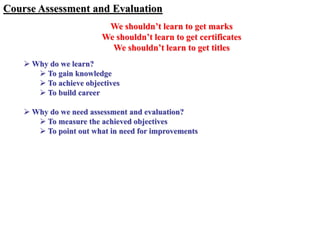
Course Assessment and Evaluation
 Why do we learn?
 To gain knowledge
 To achieve objectives
 To build career
 Why do we need assessment and evaluation?
 To measure the achieved objectives
 To point out what in need for improvements
We shouldn’t learn to get marks
We shouldn’t learn to get certificates
We shouldn’t learn to get titles
Revision
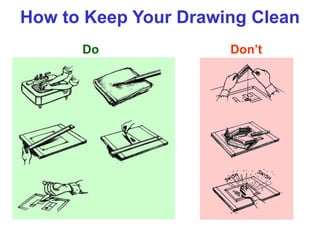
How to Keep Your Drawing Clean
Do Don’t
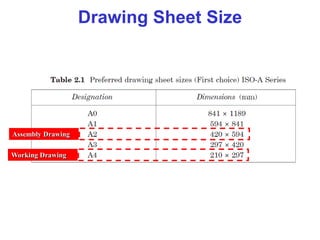
Drawing Sheet Size
Assembly Drawing
Working Drawing
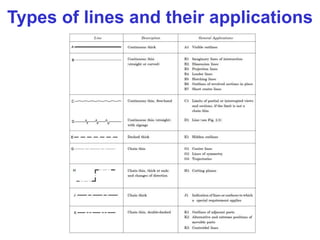
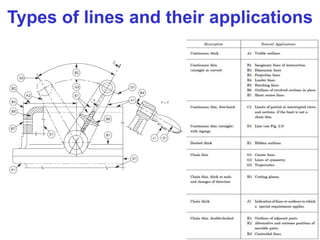
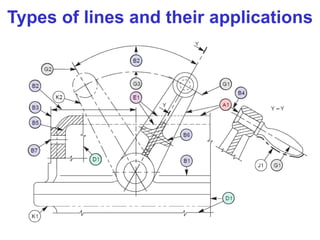
Types of lines and their applications
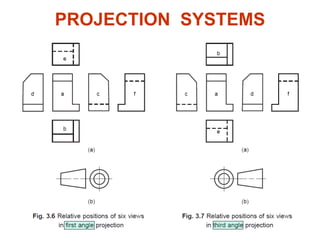
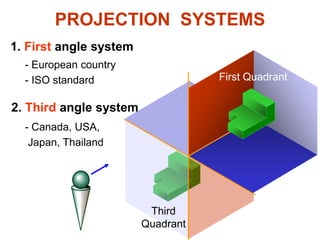
PROJECTION SYSTEMS
PROJECTION SYSTEMS
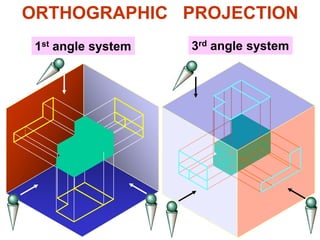
1. First angle system
2. Third angle system
First Quadrant
Third
Quadrant
- European country
- ISO standard
- Canada, USA,
Japan, Thailand
ORTHOGRAPHIC PROJECTION
1st angle system 3rd angle system
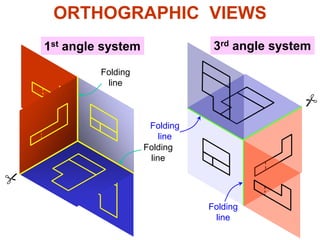
ORTHOGRAPHIC VIEWS
1st angle system 3rd angle system
Folding
line
Folding
line
Folding
line
Folding
line
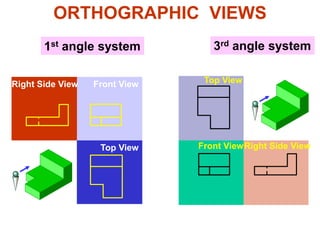
ORTHOGRAPHIC VIEWS
1st angle system 3rd angle system
Front View
Front View
Right Side View
Right Side View
Top View
Top View
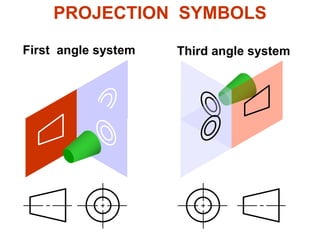
First angle system Third angle system
PROJECTION SYMBOLS
Quick Quiz
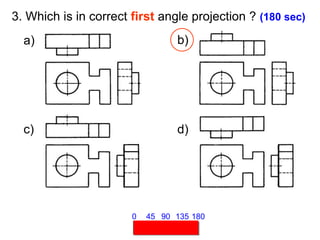
3. Which is in correct first angle projection ? (180 sec)
a) b)
c) d)
45 90 135 180
0
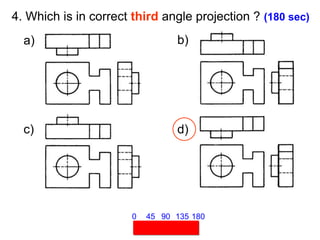
4. Which is in correct third angle projection ? (180 sec)
a) b)
c) d)
45 90 135 180
0
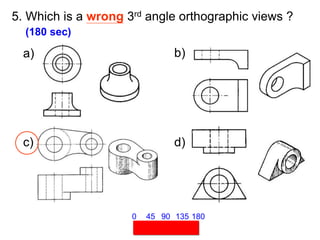
5. Which is a wrong 3rd angle orthographic views ?
(180 sec)
45 90 135 180
0
a) b)
c) d)
VIEW SELECTION STEPS
1. Orient the object to the best position
relative to a glass box.
2. Select the front view.
3. Select adjacent views.
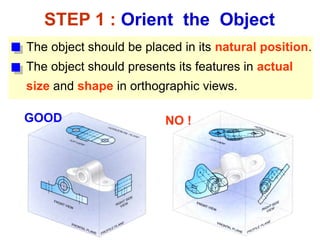
STEP 1 : Orient the Object
The object should be placed in its natural position.
NO !
The object should presents its features in actual
size and shape in orthographic views.
GOOD
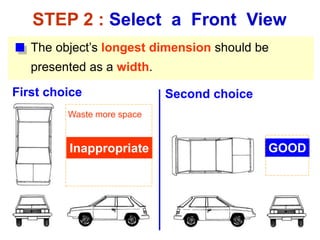
STEP 2 : Select a Front View
The object’s longest dimension should be
presented as a width.
Inappropriate
First choice
GOOD
Second choice
Waste more space
Inappropriate
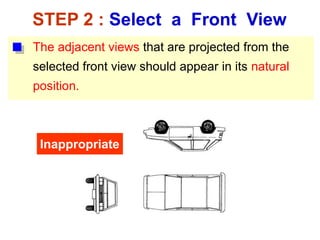
The adjacent views that are projected from the
selected front view should appear in its natural
position.
STEP 2 : Select a Front View
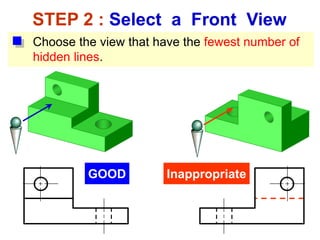
Choose the view that have the fewest number of
hidden lines.
GOOD Inappropriate
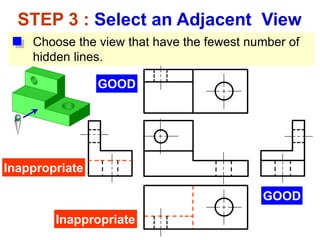
STEP 3 : Select an Adjacent View
GOOD
Inappropriate
Inappropriate
GOOD
Choose the view that have the fewest number of
hidden lines.
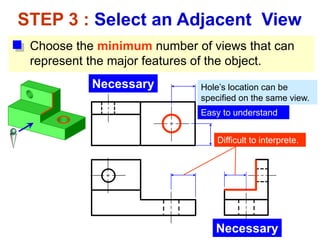
Choose the minimum number of views that can
represent the major features of the object.
STEP 3 : Select an Adjacent View
Necessary
Necessary
Hole’s location can be
specified on the same view.
Difficult to interprete.
Easy to understand
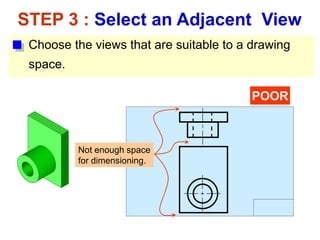
Choose the views that are suitable to a drawing
space.
STEP 3 : Select an Adjacent View
POOR
Not enough space
for dimensioning.
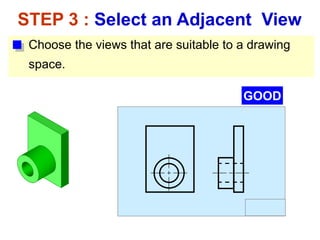
Choose the views that are suitable to a drawing
space.
STEP 3 : Select an Adjacent View
GOOD
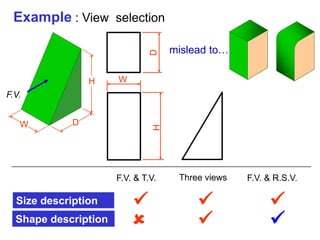
Example : View selection
Shape description
Size description
F.V.
W D

W
H

D
mislead to…




F.V. & T.V. Three views F.V. & R.S.V.
H
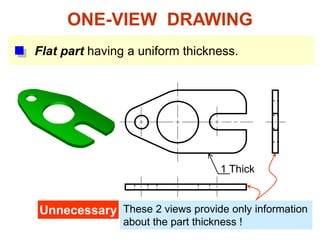
ONE-VIEW DRAWING
Flat part having a uniform thickness.
Unnecessary These 2 views provide only information
about the part thickness !
1 Thick
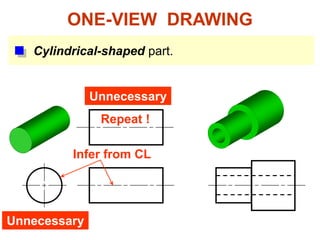
ONE-VIEW DRAWING
Cylindrical-shaped part.
Unnecessary
Repeat !
Infer from CL
Unnecessary
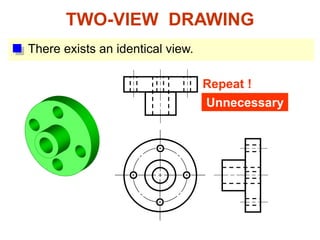
TWO-VIEW DRAWING
There exists an identical view.
Repeat !
Unnecessary
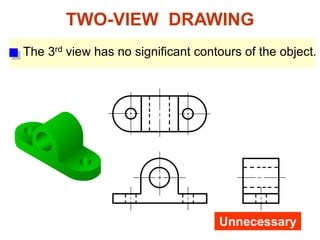
The 3rd view has no significant contours of the object.
TWO-VIEW DRAWING
Unnecessary
TWO-VIEW DRAWING
Unnecessary
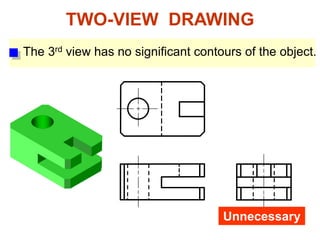
The 3rd view has no significant contours of the object.
Quick Quiz
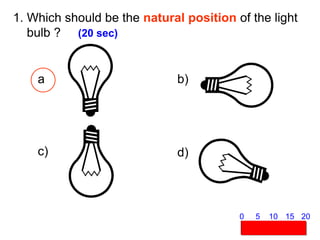
1. Which should be the natural position of the light
bulb ? (20 sec)
c)
b)
a
d)
5 10 15 20
0
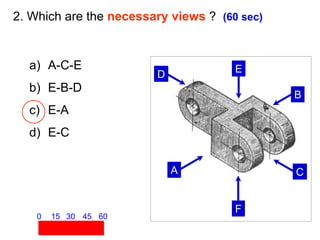
A
B
C
D E
F
2. Which are the necessary views ? (60 sec)
a) A-C-E
b) E-B-D
c) E-A
d) E-C
15 30 45 60
0
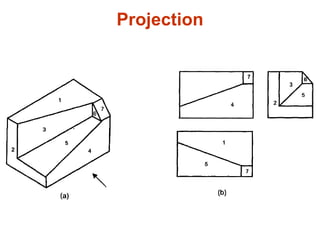
Projection
Projection
Projection
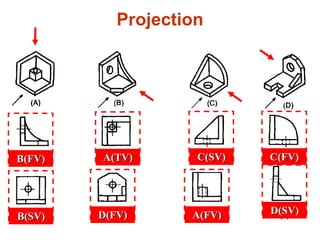
Quick Quiz
Projection
A(FV)
B(FV) C(FV)
D(FV)
A(TV)
B(SV)
C(SV)
D(SV)
Drawing Reading
Drawing Reading
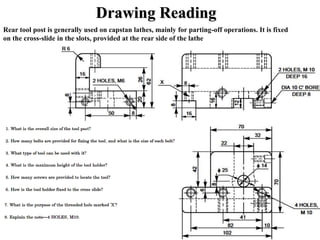
Rear tool post is generally used on capstan lathes, mainly for parting-off operations. It is fixed
on the cross-slide in the slots, provided at the rear side of the lathe

Mechancial Engineering Drawings Subjects

  • 1.
    Siddhant College ofEngineering Diploma Sudumbare, Pune -412109 Instructors: Mr. Nitin B. Watode e-mail: watodenitin1@gmail.com Textbook and Reference Materials:  K.L. Narayana, P. Kannaiah, and K. Venkata Reddy, "Machine Drawing", Third Edition, NEW AGE INTERNATIONAL (P) Ltd., New Delhi - 110002, 2006. Class notes handouts Mechanical Working Drawing (22341)
  • 2.
    Intended Outcomes Knowledge andUnderstanding: You will learn how to;  Understand the basic methods for machine assembly  Distinguish between the data and instructions used for both working and assembly drawings  Professionally deduce and sketches both working and assembly drawings according to the international standards Intellectual You will learn how to;  Motivate your intellectual abilities to imagine and deduce machine parts and a whole machine from the drawings views.  Motivate your imagination for producing new ideas and methods in machine drawings.  Create new concepts for the design of machine components and also for assembly of them. Professional Skills You will learn how to;  Practice the standard drawing methods to generate both working and assembly mechanical drawings.  Write and specify correctly and according to standards the instructions and machining marks and the dimensions on mechanical drawings. General You will learn how to;  Cooperate to work in groups through small scale projects  Work coherently and successfully as a part of a team.
  • 3.
    Course Outline Topic Weeks 1.Revision Chapters (1-4) 1 2. Reading A Drawing Chapter (17) 1 3. Free Hand Sketching Chapter (13) 1 4. Assembly Drawings Chapter (18) 1 5. Fits and Dimensional Tolerances Chapter (15) 1 6. Geometrical Tolerances Chapter (20) 2 7. Engineering Materials Collections 1 8. Working Drawings Chapter (19-20) 1 9. Mechanical Joints (1- Threaded Joints) Chapter (5) 3 10. Machine Parts Collections 2 Total 14  Problems Sheets will be handed in the class after discussed in the lecture  An extra class will be given to students with Mark “C” every next Saturday  A term project will be given by Dr. Wael and will be submitted at the end of the term
  • 4.
    Course Assessment andEvaluation  Why do we learn?  To gain knowledge  To achieve objectives  To build career  Why do we need assessment and evaluation?  To measure the achieved objectives  To point out what in need for improvements We shouldn’t learn to get marks We shouldn’t learn to get certificates We shouldn’t learn to get titles
  • 5.
  • 6.
    How to KeepYour Drawing Clean Do Don’t
  • 7.
    Drawing Sheet Size AssemblyDrawing Working Drawing
  • 8.
    Types of linesand their applications
  • 9.
    Types of linesand their applications
  • 10.
    Types of linesand their applications
  • 11.
  • 12.
    PROJECTION SYSTEMS 1. Firstangle system 2. Third angle system First Quadrant Third Quadrant - European country - ISO standard - Canada, USA, Japan, Thailand
  • 13.
    ORTHOGRAPHIC PROJECTION 1st anglesystem 3rd angle system
  • 14.
    ORTHOGRAPHIC VIEWS 1st anglesystem 3rd angle system Folding line Folding line Folding line Folding line
  • 15.
    ORTHOGRAPHIC VIEWS 1st anglesystem 3rd angle system Front View Front View Right Side View Right Side View Top View Top View
  • 16.
    First angle systemThird angle system PROJECTION SYMBOLS
  • 17.
  • 18.
    3. Which isin correct first angle projection ? (180 sec) a) b) c) d) 45 90 135 180 0
  • 19.
    4. Which isin correct third angle projection ? (180 sec) a) b) c) d) 45 90 135 180 0
  • 20.
    5. Which isa wrong 3rd angle orthographic views ? (180 sec) 45 90 135 180 0 a) b) c) d)
  • 21.
    VIEW SELECTION STEPS 1.Orient the object to the best position relative to a glass box. 2. Select the front view. 3. Select adjacent views.
  • 22.
    STEP 1 :Orient the Object The object should be placed in its natural position. NO ! The object should presents its features in actual size and shape in orthographic views. GOOD
  • 23.
    STEP 2 :Select a Front View The object’s longest dimension should be presented as a width. Inappropriate First choice GOOD Second choice Waste more space
  • 24.
    Inappropriate The adjacent viewsthat are projected from the selected front view should appear in its natural position. STEP 2 : Select a Front View
  • 25.
    STEP 2 :Select a Front View Choose the view that have the fewest number of hidden lines. GOOD Inappropriate
  • 26.
    STEP 3 :Select an Adjacent View GOOD Inappropriate Inappropriate GOOD Choose the view that have the fewest number of hidden lines.
  • 27.
    Choose the minimumnumber of views that can represent the major features of the object. STEP 3 : Select an Adjacent View Necessary Necessary Hole’s location can be specified on the same view. Difficult to interprete. Easy to understand
  • 28.
    Choose the viewsthat are suitable to a drawing space. STEP 3 : Select an Adjacent View POOR Not enough space for dimensioning.
  • 29.
    Choose the viewsthat are suitable to a drawing space. STEP 3 : Select an Adjacent View GOOD
  • 30.
    Example : Viewselection Shape description Size description F.V. W D  W H  D mislead to…     F.V. & T.V. Three views F.V. & R.S.V. H
  • 31.
    ONE-VIEW DRAWING Flat parthaving a uniform thickness. Unnecessary These 2 views provide only information about the part thickness ! 1 Thick
  • 32.
  • 33.
    TWO-VIEW DRAWING There existsan identical view. Repeat ! Unnecessary
  • 34.
    The 3rd viewhas no significant contours of the object. TWO-VIEW DRAWING Unnecessary
  • 35.
    TWO-VIEW DRAWING Unnecessary The 3rdview has no significant contours of the object.
  • 36.
  • 37.
    1. Which shouldbe the natural position of the light bulb ? (20 sec) c) b) a d) 5 10 15 20 0
  • 38.
    A B C D E F 2. Whichare the necessary views ? (60 sec) a) A-C-E b) E-B-D c) E-A d) E-C 15 30 45 60 0
  • 39.
  • 40.
  • 41.
  • 42.
  • 43.
  • 44.
  • 45.
    Drawing Reading Rear toolpost is generally used on capstan lathes, mainly for parting-off operations. It is fixed on the cross-slide in the slots, provided at the rear side of the lathe