
Measuring the Subscription
Economy
Dimensional Modeling/Analytics
Angel Abundez, Lead BI Consultant, DesignMind

April 10-12 | Chicago, IL
Please silence
cell phones
April 10-12 | Chicago, IL
Familiar Subscription models
Content Subscriptions

3
Familiar Subscription models
Service and Product Subscriptions

4
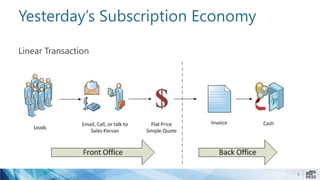
Yesterday’s Subscription Economy
Linear Transaction

5
Business models have changed
Technology and Innovation
•
•
•
•
•
•
•

Cloud Computing
Digital Media
Mobile Devices
Social Media
Software as a Service (SaaS)
Internet Access and Broadband speeds
Startups, Apps, Innovative Entreprenuers

6
New Content Subscriptions

7
Software as a Service (Saas)
Infrastructure/Platform

Productivity Software

8
Today’s Subscription Economy

9
The Key Metrics
Recurring Revenue
•

Annual Recurring Revenue (ARR)

Churn
•

Percentage of members lost

New Business
•

Annual Contract Value (ACV)

10
The Key Metrics

ARRn
What Recurring
Revenue can we
anticipate for the year?

Churn
What percentage
of customers
are leaving you?

ACV
How many new
customers do we
need to sign up?

ARRn+1
How many new
customers do we
need to sign up?

11
Subscription Economy Difficulties
Insufficient Funds
Invalid Credit Card number
Or Expired Card

Rapidly Changing
Marketing Campaigns

System loop-holes
Refunds

Freemium

Credits

Charges

12
Assemble the Team

Operations

Sales and
Marketing

Business
Analysts *

Finance

IT

13
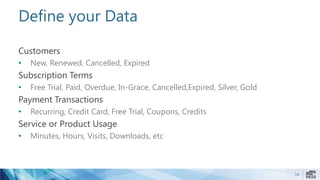
Define your Data
Customers
•

New, Renewed, Cancelled, Expired

Subscription Terms
•

Free Trial, Paid, Overdue, In-Grace, Cancelled,Expired, Silver, Gold

Payment Transactions
•

Recurring, Credit Card, Free Trial, Coupons, Credits

Service or Product Usage
•

Minutes, Hours, Visits, Downloads, etc

14
Data Profile Subscriptions, Products
1.
2.
3.

Subscriptions
Products
Customers

APIs Available at:

15
Demo
Subscription Data Profile

April 10-12 | Chicago, IL
The Key Metrics

ARRn

Churn

What percentage of
customers
are leaving you?

ACV

ARRn+
1

17
Key Metrics - Churn
From your data definition
meetings, you have the following
customers:
•
•
•
•

Active Customers
Overdue Customers
Cancelled Customers
Expired Customers

• What type of Facts are these?
1. Additive
2. Semi-additive
3. Factless
4. Text

18
Key Metrics - Churn
For Churn percentage, you need
total Active Membership. This
requires moment-in-time views of
how many members were active
on a given date.

• What type of Fact table is
needed?
1. Transactional
2. Periodic Snapshot
3. Accumulating Snapshot

19
Key Metrics - Churn
Ask the right questions:
What events lead up to an active customer?
What events lead up to a cancelled customer?
Do we want to trend active membership over time?

Dimensional Modeling lessons learned:
Don’t even think about aggregating Slowly Changing Dimensions.
Subscriptions could be modeled as a Slowly Changing Dimension, but
will people use it in the data model?
20
Timeline Scenarios

21
Demo
Membership Facts for calculating Churn

April 10-12 | Chicago, IL
The Key Metrics

ARRn

Churn

ACV

ARRn+
1

What Recurring
Revenue can we
anticipate for the year ?

23
Key Metrics – Recurring Revenue
Goal: Spread out a payment transactions into equal interval units

What T-SQL function can do this the best?
1.
2.
3.
4.

CROSS JOIN
UNPIVOT
OUTER APPLY
CROSS APPLY

24
Key Metrics – Recurring Revenue
Ask the right questions

What if payment transactions occur before, during, or after the subscription
period?
Do we want to add discount amounts?
How should refunds be treated?

Dimensional Modeling lessons learned:

Use transaction date, not effective date.
Draw up scenarios for how to handle +/- transactions, when they could
occur, and handle the grain carefully.
Use the CROSS APPLY function as it scales for variable-length subscriptions.
25
Demo
Recurring Revenue Facts

April 10-12 | Chicago, IL
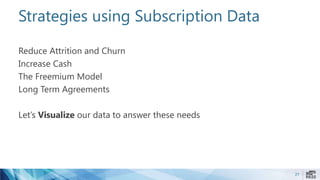
Strategies using Subscription Data
Reduce Attrition and Churn
Increase Cash
The Freemium Model
Long Term Agreements
Let’s Visualize our data to answer these needs

27
Demo
Visualizations

April 10-12 | Chicago, IL
Summing it all Up –
Subscription Economy is vital in todays economy. There are no
publications out there that tell you how to dimensionally model this
lucrative business model, so we thought we’d show you how we were
to successfully implement this for our clients.

For further questions, feel free to contact us:
•
•

Angel Abundez: angel@designmind.com; @angelstreamline or at
www.angelstreamline.com
Mark Ginnebaugh: mark@designmind.com; @markginnebaugh or at
designmind.com/blog
29
Win a Microsoft Surface Pro!
Complete an online SESSION EVALUATION
to be entered into the draw.
Draw closes April 12, 11:59pm CT
Winners will be announced on the PASS BA
Conference website and on Twitter.
Go to passbaconference.com/evals or follow the QR code link displayed on
session signage throughout the conference venue.

Your feedback is important and valuable. All feedback will be used to improve
and select sessions for future events.
Thank you!
Diamond Sponsor

Platinum Sponsor

April 10-12, Chicago, IL

Measuring the Subscription Economy

  • 1.
    Measuring the Subscription Economy DimensionalModeling/Analytics Angel Abundez, Lead BI Consultant, DesignMind April 10-12 | Chicago, IL
  • 2.
  • 3.
  • 4.
    Familiar Subscription models Serviceand Product Subscriptions 4
  • 5.
  • 6.
    Business models havechanged Technology and Innovation • • • • • • • Cloud Computing Digital Media Mobile Devices Social Media Software as a Service (SaaS) Internet Access and Broadband speeds Startups, Apps, Innovative Entreprenuers 6
  • 7.
  • 8.
    Software as aService (Saas) Infrastructure/Platform Productivity Software 8
  • 9.
  • 10.
    The Key Metrics RecurringRevenue • Annual Recurring Revenue (ARR) Churn • Percentage of members lost New Business • Annual Contract Value (ACV) 10
  • 11.
    The Key Metrics ARRn WhatRecurring Revenue can we anticipate for the year? Churn What percentage of customers are leaving you? ACV How many new customers do we need to sign up? ARRn+1 How many new customers do we need to sign up? 11
  • 12.
    Subscription Economy Difficulties InsufficientFunds Invalid Credit Card number Or Expired Card Rapidly Changing Marketing Campaigns System loop-holes Refunds Freemium Credits Charges 12
  • 13.
    Assemble the Team Operations Salesand Marketing Business Analysts * Finance IT 13
  • 14.
    Define your Data Customers • New,Renewed, Cancelled, Expired Subscription Terms • Free Trial, Paid, Overdue, In-Grace, Cancelled,Expired, Silver, Gold Payment Transactions • Recurring, Credit Card, Free Trial, Coupons, Credits Service or Product Usage • Minutes, Hours, Visits, Downloads, etc 14
  • 15.
    Data Profile Subscriptions,Products 1. 2. 3. Subscriptions Products Customers APIs Available at: 15
  • 16.
  • 17.
    The Key Metrics ARRn Churn Whatpercentage of customers are leaving you? ACV ARRn+ 1 17
  • 18.
    Key Metrics -Churn From your data definition meetings, you have the following customers: • • • • Active Customers Overdue Customers Cancelled Customers Expired Customers • What type of Facts are these? 1. Additive 2. Semi-additive 3. Factless 4. Text 18
  • 19.
    Key Metrics -Churn For Churn percentage, you need total Active Membership. This requires moment-in-time views of how many members were active on a given date. • What type of Fact table is needed? 1. Transactional 2. Periodic Snapshot 3. Accumulating Snapshot 19
  • 20.
    Key Metrics -Churn Ask the right questions: What events lead up to an active customer? What events lead up to a cancelled customer? Do we want to trend active membership over time? Dimensional Modeling lessons learned: Don’t even think about aggregating Slowly Changing Dimensions. Subscriptions could be modeled as a Slowly Changing Dimension, but will people use it in the data model? 20
  • 21.
  • 22.
    Demo Membership Facts forcalculating Churn April 10-12 | Chicago, IL
  • 23.
    The Key Metrics ARRn Churn ACV ARRn+ 1 WhatRecurring Revenue can we anticipate for the year ? 23
  • 24.
    Key Metrics –Recurring Revenue Goal: Spread out a payment transactions into equal interval units What T-SQL function can do this the best? 1. 2. 3. 4. CROSS JOIN UNPIVOT OUTER APPLY CROSS APPLY 24
  • 25.
    Key Metrics –Recurring Revenue Ask the right questions What if payment transactions occur before, during, or after the subscription period? Do we want to add discount amounts? How should refunds be treated? Dimensional Modeling lessons learned: Use transaction date, not effective date. Draw up scenarios for how to handle +/- transactions, when they could occur, and handle the grain carefully. Use the CROSS APPLY function as it scales for variable-length subscriptions. 25
  • 26.
  • 27.
    Strategies using SubscriptionData Reduce Attrition and Churn Increase Cash The Freemium Model Long Term Agreements Let’s Visualize our data to answer these needs 27
  • 28.
  • 29.
    Summing it allUp – Subscription Economy is vital in todays economy. There are no publications out there that tell you how to dimensionally model this lucrative business model, so we thought we’d show you how we were to successfully implement this for our clients. For further questions, feel free to contact us: • • Angel Abundez: angel@designmind.com; @angelstreamline or at www.angelstreamline.com Mark Ginnebaugh: mark@designmind.com; @markginnebaugh or at designmind.com/blog 29
  • 30.
    Win a MicrosoftSurface Pro! Complete an online SESSION EVALUATION to be entered into the draw. Draw closes April 12, 11:59pm CT Winners will be announced on the PASS BA Conference website and on Twitter. Go to passbaconference.com/evals or follow the QR code link displayed on session signage throughout the conference venue. Your feedback is important and valuable. All feedback will be used to improve and select sessions for future events.
  • 31.
    Thank you! Diamond Sponsor PlatinumSponsor April 10-12, Chicago, IL

Editor's Notes

  • #3 Please silence cell phones
  • #4 Looking back, we can find a few examples of subscription economies that have worked for years. Magazines and newspaper publications have been around a long time. The subscription process started with word of mouth or advertising. There was usually a printed form you filled out and sent in the mail with payment to receive the printed publication or have the newspaper delivered to your door.Newspaper carriers collected cash door-to-door and submitted the newspaper’s portion to the main office while newspaper carriers held a small percentage of the revenues plus any tips. This subscription model is prevelant today as shown in the New York Times article “Hardy Survivor of a Vanishing Print Era Is Still Delivering the Newspaper at 93”. http://www.nytimes.com/2013/03/03/us/a-93-year-old-paperboy-still-making-the-rounds.html?_r=1&
  • #5 Some other examples of subscription-based companies:Regular telephone service or cell phone service where you pay for monthly for limited minutes and geographic calls within the U.S. or International. Cable service in some homes across the U.S. is absolutely critical.  Now with the added benefit of Digital Video Recorders (DVR) being built into the cable top boxes allows cable providers to charge for DVR separately or as part of a higher tier bundle. They also have the same fine print at the bottom of their advertisements as any other subscription service: “Terms are subject to change.” So we have to be able to develop a model that will stand the test of rapidly changing bundles, products, and services.Lease vehicles are not as obvious, but they are a subscription model as well. You pay a lower monthly payment for limited use of a vehicle for a specified number of years and mileage.
  • #6 Printed publications, phone service, and leased vehicles in the old subscription economy were much like software purchases. Word of mouth or advertising would get the attention of leads. Processing these leads to cash was a linear process of getting them to agree on the quote and pay an invoice for the subscription. Although this has worked for years and continues to work today, modern technology has made the subscription economy a lot more about customer needs than about the company itself. Businesses work a lot harder at establishing good relationships with customers by diversifying their services and offering free-trial subscriptions to let people get a taste of their service. Many technology advances have allowed communication between business to customers be much more real-time, buzz worthy, and collaborative that didn’t exist 5-10 years ago.
  • #16 Chargify API: http://docs.chargify.com/api-introductionRecurly API: http://docs.recurly.com/api/recurlyjs/reference_v20
  • #25 My colleague Brad Shultz has a great post on the power of CROSS APPLY:http://bradsruminations.blogspot.com/2009/07/cool-cross-apply-tricks-part-1.htmlFor more T-SQL fun, check out Brad’s posts on UNPIVOT, and how he ultimately came up with more exciting approaches using the APPLY function:http://bradsruminations.blogspot.com/2010/02/spotlight-on-unpivot-part-1.htmlhttp://bradsruminations.blogspot.com/2010/02/spotlight-on-unpivot-part-2.html