MEASLES
Uzzi Precious O.
Outline
• Introduction
• Historical perspective
• Epidemiology
• Pathogenesis
• Clinical features
• Complications
• Management
• Prevention
• Conclusion
Introduction
• Measles (rubeola) is an acute, highly contagious viral disease
characterized by classic features such as high grade fever,
maculopapular rash, cough, coryza and conjunctivitis
• Cause: single-stranded negative sense RNA virus,
Paramyxoviridae family transmitted airborne
• Causes profound immune suppression and amnesia
• Despite vaccine since 1963, it remans a major cause of childhood
morbidity & mortality, especially in developing nations.
Historical Perspective
• 9th century: First described by a Persian physician
Rhazes
• Pre-vaccine era: ~2.6 million deaths/year worldwide
• 1963: Live-attenuated vaccine by John Enders &
Thomas Peebles
• Present: Still endemic in Nigeria despite vaccination
efforts
Epidemiology
• 10.3 million infections globally in 2023, with ~107,500 deaths
(down from 800,000 in 2000)
• Countries with the highest burden: Yemen, Pakistan, India,
Kyrgyzstan, Afghanistan, Ethiopa, Romania, Nigeria, Canada, and
Russia
• Nigeria (Jan 2025): 627 suspected cases (71% decrease from Jan
2024); 20,000 in 2023, 15,000 in 2020, 30,000 in 2019
• Most affected states: Borno, Katsina, Adamawa, Bayelsa, Ogun,
Oyo
• 73–81% of cases: children ≤2 years
• Case fatality rate: 0.1–0.3% (developed) vs >6% (resource-
limited settings)
Epidemiology…
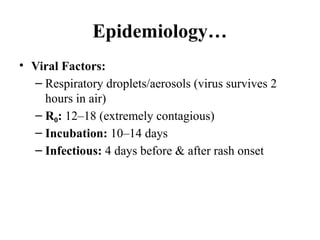
• Viral Factors:
– Respiratory droplets/aerosols (virus survives 2
hours in air)
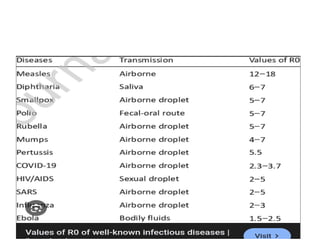
– R :
₀ 12–18 (extremely contagious)
– Incubation: 10–14 days
– Infectious: 4 days before & after rash onset
Epidemiology…
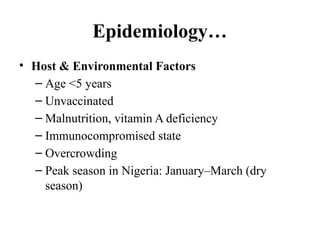
• Host & Environmental Factors
– Age <5 years
– Unvaccinated
– Malnutrition, vitamin A deficiency
– Immunocompromised state
– Overcrowding
– Peak season in Nigeria: January–March (dry
season)
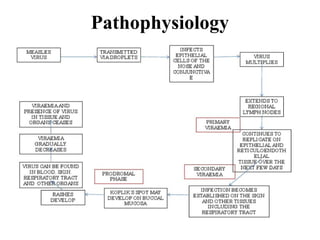
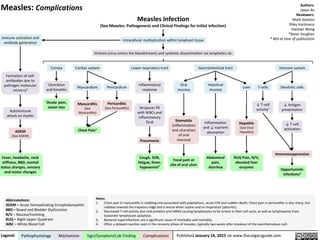
Pathophysiology
Pathophysiology…
Pathophysiology…
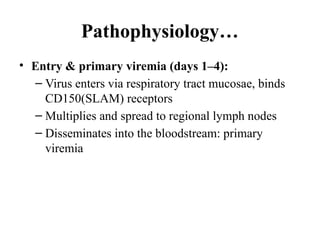
• Entry & primary viremia (days 1–4):
– Virus enters via respiratory tract mucosae, binds
CD150(SLAM) receptors
– Multiplies and spread to regional lymph nodes
– Disseminates into the bloodstream: primary
viremia
Pathophysiology…
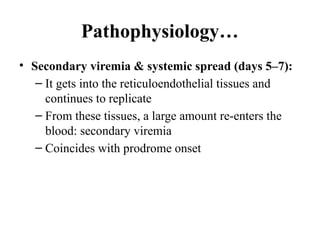
• Secondary viremia & systemic spread (days 5–7):
– It gets into the reticuloendothelial tissues and
continues to replicate
– From these tissues, a large amount re-enters the
blood: secondary viremia
– Coincides with prodrome onset
Pathophysiology…
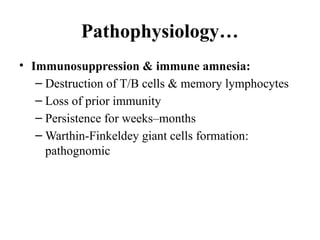
• Immunosuppression & immune amnesia:
– Destruction of T/B cells & memory lymphocytes
– Loss of prior immunity
– Persistence for weeks–months
– Warthin-Finkeldey giant cells formation:
pathognomic
Clinical Features
• Incubation period:
– 7-14days after exposure
• Prodromal Phase:
– High grade fever: 39–40°C
– 3 C's: cough (harsh/brassy), coryza (nasal
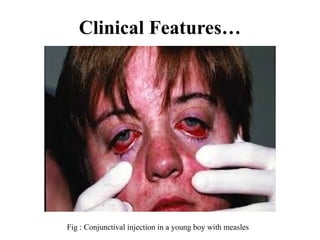
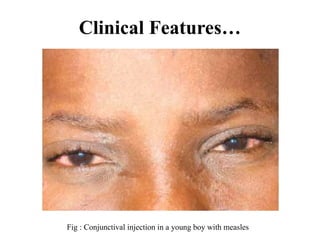
discharge), conjunctivitis (red eyes, watery,
photophobia)
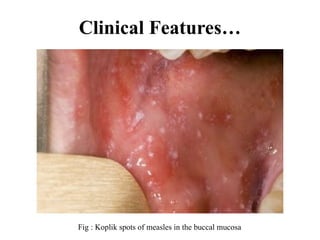
– Koplik spots: white or bluish-white spots on
buccal mucosa, appear 1–2 days before rash
Clinical Features…
Fig : Conjunctival injection in a young boy with measles
Clinical Features…
Fig : Conjunctival injection in a young boy with measles
Clinical Features…
Fig : Koplik spots of measles in the buccal mucosa
Clinical Features…
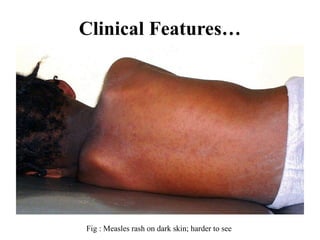
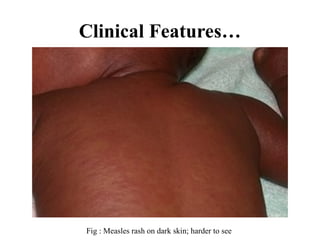
• Exanthem Phase:
– Onset: 3–7 days after prodrome
– Head-to-toe spread over 3 days; Day 1: hairline,
behind ears; Day 2: neck, trunk, arms; Day 3:
lower trunk, legs
– Erythematous macules → maculopapular →
confluent on face/trunk, discrete on extremities
• Recovery Phase:
– Resolves in same order; fine desquamation
Clinical Features…
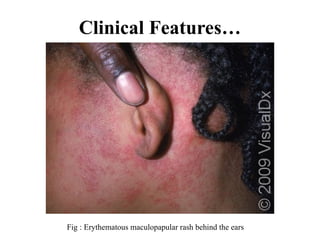
Fig : Erythematous maculopapular rash behind the ears
Clinical Features…
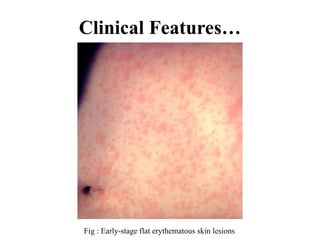
Fig : Early-stage flat erythematous skin lesions
Clinical Features…
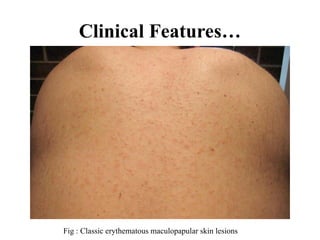
Fig : Classic erythematous maculopapular skin lesions
Clinical Features…
Fig : Measles rash on dark skin; harder to see
Clinical Features…
Fig : Measles rash on dark skin; harder to see
Management
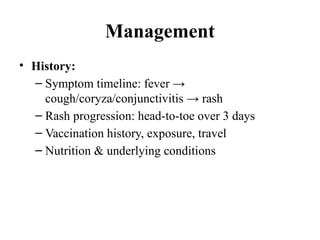
• History:
– Symptom timeline: fever →
cough/coryza/conjunctivitis → rash
– Rash progression: head-to-toe over 3 days
– Vaccination history, exposure, travel
– Nutrition & underlying conditions
Management…
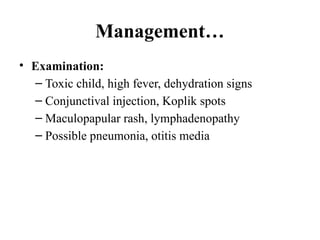
• Examination:
– Toxic child, high fever, dehydration signs
– Conjunctival injection, Koplik spots
– Maculopapular rash, lymphadenopathy
– Possible pneumonia, otitis media
Management…
• Investigations:
– FBC: leukopenia, lymphopenia
– Serology (IgM ELISA): positive from day 3 of
rash to 4–6 weeks
– RT-PCR: detects viral RNA early
– Viral culture & paired IgG rarely used
Management…
• Clinical Criteria/Case Definition:
– Fever ≥38.3°C, maculopapular rash, plus
cough/coryza/conjunctivitis
– Lab confirmation where possible
– Challenges: limited lab capacity, delayed
presentation, cold chain needs
Differential Diagnosis
• Rubella: milder rash, different pattern
• Roseola: fever followed by rash
• Scarlet fever: sandpaper rash, strawberry tongue
• Drug eruptions, Kawasaki disease
Complications
• Respiratory
– Pneumonia (viral/bacterial): main cause of death
– Croup
– Giant cell pneumonia (immunocompromised)
• Gastrointestinal
– Diarrhea (8%), stomatitis, cancrum oris
Complications…
• Neurological
– Febrile seizures
– Encephalitis (1/1000)
– SSPE (1/100,000)
– Others
Otitis media (7–9%), keratitis, corneal ulceration
Treatment
• Supportive:
– Fever: paracetamol/ibuprofen
– Dehydration: ORS, IV fluids
– Nutrition: continued feeding, soft diet
– Oxygen, bronchodilators if needed
Treatment…
• Specific:
– Vitamin A: reduces mortality by 50%; <6m:
50,000 IU ×2; 6–12m: 100,000 IU ×2; ≥12m:
200,000 IU ×2
– Antibiotics for bacterial infections
– Isolation: up to 4 days after rash
• Complications:
– Treat pneumonia, diarrhea, seizures as needed
Prevention
• Vaccination & PEP
– Monovalent, MR, MMR
– Efficacy: single dose 93–95%, two doses 97%
– Nigerian schedule: 9 & 15 months
– PEP: MMR within 72h; immunoglobulin within 6
days
Prevention…
• Challenges:
– Coverage gaps, geographic barriers, insecurity,
hesitancy, cold chain
– AI tools, integrated health services, mobile teams,
community leader engagement
Conclusion
• Measles remains a challenge despite interventions
• 71% reduction in Jan 2025 cases shows progress
• >60% complication rate in Nigerian studies
• Vitamin A reduces mortality by 50%
• Need 95% coverage & integrated approach
• Nigeria’s success can guide other countries
References
• Augusta, U.E., (2016) ‘Common Tropical Viral Infections’, in Azubuike, J.C. &
Nkanginieme, K.E.O. (eds.), Paediatrics and Child Health in a Tropical Region, 3rd
edn. Lagos: Educational Printing and Publishing, pp. 550–552.
• CDC (2024) Measles Videos and Clinical Overviews. CDC Division of Viral
Diseases (multiple entries, including DrDan Filardo’s clinical overview)
Cadmore Media+9CDC+9YouTube+9.
• Dong, T.Q. & Wakefield, J. (2020) ‘Modeling and presentation of vaccination
coverage estimates using data from household surveys’, arXiv preprint
arXiv+1arXiv+1.
• Dong, T.Q. & Wakefield, J. (2020) ‘Space time smoothing models for sub national
‑ ‑
measles routine immunization coverage estimation’, arXiv preprint.
• Filardo, T.(2024) Clinical Overview of Measles: Diagnosis, Laboratory Testing and
Outbreak Response. Webinar hosted by CDC/IDSA/AMA. Published 23 May 2024
EdHub+2CDC+2YouTube+2.
References…
• Filardo, T.(2024) Measles Clinical Presentation, Epidemiology, and Prevention. MeRC
(Measles, Rubella, and CMV) Team, Division of Viral Diseases, National Center for
Immunization and Respiratory Diseases (NCIRD), CDC. Available at: Emory University
Infectious Diseases PDF repository (Accessed: 13 July 2025) UCSF Health
Epidemiology+11Emory School of Medicine+11American Medical Association+11.
• Filardo, T.(2024) Measles: Stories from the Frontlines. CDC/AMA Project Firstline
Forum, 27 June 2024 American Medical Association+2EdHub+2Cadmore Media+2.
• Mathis, A.et al.(2023) ‘We Must Maintain Measles Elimination in the United States:
Measles Clinical Presentation, Diagnosis, and Prevention’, COCA Call, 17August 2023
Cadmore Media+11CDC Stacks+11Infectious Diseases Society of America+11.
• Thakkar, N., Jindal, S. & Rosenfeld, K. (2024) ‘Seasonality and susceptibility from
measles time series’, arXiv preprint arXiv.
• Van den Berg, G.J., von Hinke, S. & Vitt, N. (2023) ‘Early life exposure to measles and
later life outcomes: Evidence from the introduction of a vaccine’,
‑ arXiv preprint arXiv.
THANK YOU!

Measles presentation paediatrics001.pptx

  • 1.
  • 2.
    Outline • Introduction • Historicalperspective • Epidemiology • Pathogenesis • Clinical features • Complications • Management • Prevention • Conclusion
  • 3.
    Introduction • Measles (rubeola)is an acute, highly contagious viral disease characterized by classic features such as high grade fever, maculopapular rash, cough, coryza and conjunctivitis • Cause: single-stranded negative sense RNA virus, Paramyxoviridae family transmitted airborne • Causes profound immune suppression and amnesia • Despite vaccine since 1963, it remans a major cause of childhood morbidity & mortality, especially in developing nations.
  • 4.
    Historical Perspective • 9thcentury: First described by a Persian physician Rhazes • Pre-vaccine era: ~2.6 million deaths/year worldwide • 1963: Live-attenuated vaccine by John Enders & Thomas Peebles • Present: Still endemic in Nigeria despite vaccination efforts
  • 5.
    Epidemiology • 10.3 millioninfections globally in 2023, with ~107,500 deaths (down from 800,000 in 2000) • Countries with the highest burden: Yemen, Pakistan, India, Kyrgyzstan, Afghanistan, Ethiopa, Romania, Nigeria, Canada, and Russia • Nigeria (Jan 2025): 627 suspected cases (71% decrease from Jan 2024); 20,000 in 2023, 15,000 in 2020, 30,000 in 2019 • Most affected states: Borno, Katsina, Adamawa, Bayelsa, Ogun, Oyo • 73–81% of cases: children ≤2 years • Case fatality rate: 0.1–0.3% (developed) vs >6% (resource- limited settings)
  • 6.
    Epidemiology… • Viral Factors: –Respiratory droplets/aerosols (virus survives 2 hours in air) – R : ₀ 12–18 (extremely contagious) – Incubation: 10–14 days – Infectious: 4 days before & after rash onset
  • 8.
    Epidemiology… • Host &Environmental Factors – Age <5 years – Unvaccinated – Malnutrition, vitamin A deficiency – Immunocompromised state – Overcrowding – Peak season in Nigeria: January–March (dry season)
  • 9.
  • 10.
  • 11.
    Pathophysiology… • Entry &primary viremia (days 1–4): – Virus enters via respiratory tract mucosae, binds CD150(SLAM) receptors – Multiplies and spread to regional lymph nodes – Disseminates into the bloodstream: primary viremia
  • 12.
    Pathophysiology… • Secondary viremia& systemic spread (days 5–7): – It gets into the reticuloendothelial tissues and continues to replicate – From these tissues, a large amount re-enters the blood: secondary viremia – Coincides with prodrome onset
  • 13.
    Pathophysiology… • Immunosuppression &immune amnesia: – Destruction of T/B cells & memory lymphocytes – Loss of prior immunity – Persistence for weeks–months – Warthin-Finkeldey giant cells formation: pathognomic
  • 14.
    Clinical Features • Incubationperiod: – 7-14days after exposure • Prodromal Phase: – High grade fever: 39–40°C – 3 C's: cough (harsh/brassy), coryza (nasal discharge), conjunctivitis (red eyes, watery, photophobia) – Koplik spots: white or bluish-white spots on buccal mucosa, appear 1–2 days before rash
  • 15.
    Clinical Features… Fig :Conjunctival injection in a young boy with measles
  • 16.
    Clinical Features… Fig :Conjunctival injection in a young boy with measles
  • 17.
    Clinical Features… Fig :Koplik spots of measles in the buccal mucosa
  • 18.
    Clinical Features… • ExanthemPhase: – Onset: 3–7 days after prodrome – Head-to-toe spread over 3 days; Day 1: hairline, behind ears; Day 2: neck, trunk, arms; Day 3: lower trunk, legs – Erythematous macules → maculopapular → confluent on face/trunk, discrete on extremities • Recovery Phase: – Resolves in same order; fine desquamation
  • 19.
    Clinical Features… Fig :Erythematous maculopapular rash behind the ears
  • 20.
    Clinical Features… Fig :Early-stage flat erythematous skin lesions
  • 21.
    Clinical Features… Fig :Classic erythematous maculopapular skin lesions
  • 22.
    Clinical Features… Fig :Measles rash on dark skin; harder to see
  • 23.
    Clinical Features… Fig :Measles rash on dark skin; harder to see
  • 24.
    Management • History: – Symptomtimeline: fever → cough/coryza/conjunctivitis → rash – Rash progression: head-to-toe over 3 days – Vaccination history, exposure, travel – Nutrition & underlying conditions
  • 25.
    Management… • Examination: – Toxicchild, high fever, dehydration signs – Conjunctival injection, Koplik spots – Maculopapular rash, lymphadenopathy – Possible pneumonia, otitis media
  • 26.
    Management… • Investigations: – FBC:leukopenia, lymphopenia – Serology (IgM ELISA): positive from day 3 of rash to 4–6 weeks – RT-PCR: detects viral RNA early – Viral culture & paired IgG rarely used
  • 27.
    Management… • Clinical Criteria/CaseDefinition: – Fever ≥38.3°C, maculopapular rash, plus cough/coryza/conjunctivitis – Lab confirmation where possible – Challenges: limited lab capacity, delayed presentation, cold chain needs
  • 28.
    Differential Diagnosis • Rubella:milder rash, different pattern • Roseola: fever followed by rash • Scarlet fever: sandpaper rash, strawberry tongue • Drug eruptions, Kawasaki disease
  • 29.
    Complications • Respiratory – Pneumonia(viral/bacterial): main cause of death – Croup – Giant cell pneumonia (immunocompromised) • Gastrointestinal – Diarrhea (8%), stomatitis, cancrum oris
  • 30.
    Complications… • Neurological – Febrileseizures – Encephalitis (1/1000) – SSPE (1/100,000) – Others Otitis media (7–9%), keratitis, corneal ulceration
  • 31.
    Treatment • Supportive: – Fever:paracetamol/ibuprofen – Dehydration: ORS, IV fluids – Nutrition: continued feeding, soft diet – Oxygen, bronchodilators if needed
  • 32.
    Treatment… • Specific: – VitaminA: reduces mortality by 50%; <6m: 50,000 IU ×2; 6–12m: 100,000 IU ×2; ≥12m: 200,000 IU ×2 – Antibiotics for bacterial infections – Isolation: up to 4 days after rash • Complications: – Treat pneumonia, diarrhea, seizures as needed
  • 33.
    Prevention • Vaccination &PEP – Monovalent, MR, MMR – Efficacy: single dose 93–95%, two doses 97% – Nigerian schedule: 9 & 15 months – PEP: MMR within 72h; immunoglobulin within 6 days
  • 34.
    Prevention… • Challenges: – Coveragegaps, geographic barriers, insecurity, hesitancy, cold chain – AI tools, integrated health services, mobile teams, community leader engagement
  • 35.
    Conclusion • Measles remainsa challenge despite interventions • 71% reduction in Jan 2025 cases shows progress • >60% complication rate in Nigerian studies • Vitamin A reduces mortality by 50% • Need 95% coverage & integrated approach • Nigeria’s success can guide other countries
  • 36.
    References • Augusta, U.E.,(2016) ‘Common Tropical Viral Infections’, in Azubuike, J.C. & Nkanginieme, K.E.O. (eds.), Paediatrics and Child Health in a Tropical Region, 3rd edn. Lagos: Educational Printing and Publishing, pp. 550–552. • CDC (2024) Measles Videos and Clinical Overviews. CDC Division of Viral Diseases (multiple entries, including DrDan Filardo’s clinical overview) Cadmore Media+9CDC+9YouTube+9. • Dong, T.Q. & Wakefield, J. (2020) ‘Modeling and presentation of vaccination coverage estimates using data from household surveys’, arXiv preprint arXiv+1arXiv+1. • Dong, T.Q. & Wakefield, J. (2020) ‘Space time smoothing models for sub national ‑ ‑ measles routine immunization coverage estimation’, arXiv preprint. • Filardo, T.(2024) Clinical Overview of Measles: Diagnosis, Laboratory Testing and Outbreak Response. Webinar hosted by CDC/IDSA/AMA. Published 23 May 2024 EdHub+2CDC+2YouTube+2.
  • 37.
    References… • Filardo, T.(2024)Measles Clinical Presentation, Epidemiology, and Prevention. MeRC (Measles, Rubella, and CMV) Team, Division of Viral Diseases, National Center for Immunization and Respiratory Diseases (NCIRD), CDC. Available at: Emory University Infectious Diseases PDF repository (Accessed: 13 July 2025) UCSF Health Epidemiology+11Emory School of Medicine+11American Medical Association+11. • Filardo, T.(2024) Measles: Stories from the Frontlines. CDC/AMA Project Firstline Forum, 27 June 2024 American Medical Association+2EdHub+2Cadmore Media+2. • Mathis, A.et al.(2023) ‘We Must Maintain Measles Elimination in the United States: Measles Clinical Presentation, Diagnosis, and Prevention’, COCA Call, 17August 2023 Cadmore Media+11CDC Stacks+11Infectious Diseases Society of America+11. • Thakkar, N., Jindal, S. & Rosenfeld, K. (2024) ‘Seasonality and susceptibility from measles time series’, arXiv preprint arXiv. • Van den Berg, G.J., von Hinke, S. & Vitt, N. (2023) ‘Early life exposure to measles and later life outcomes: Evidence from the introduction of a vaccine’, ‑ arXiv preprint arXiv.
  • 38.