Meaningful Use Stage 1

     Core Requirements


               Taino Consultants Inc.
               Dr. Jose I. Delgado
               www.TainoConsultants.com
Meaningful Use (MU)

• Health Information Technology for Economic and Clinical Health
  (HITECH) Act
   – Authorized financial incentives to Eligible Providers (EP)
   – Financial Incentives require the use and implementation of a
     certified electronic health record (EHR)
      • Owning a certified EHR is not enough
           – EHRs have tools designed to assist EPs meet MU
      • EHR must be used in a way that positively affects patient
        care
      • Meaningful Use describes the objectives needed to be met
        in order to receive financial incentives
Meaningful Use Measures

• EP’s must meet 25 Objectives and their corresponding measures
  in order to meet Meaningful Use
   – Core Objectives.
       • 15 objectives that everyone must meet
       • Must report on all 15 and meet thresholds
   – Menu Objectives
       • 10 objectives
       • EPs must choose 5 of those and meet thresholds
   – Clinical Quality Measures also covered as a Core Objective
       • Additional reporting requirement
       • No thresholds to meet
Core Measure 1

• Computerized provider order entry (CPOE)
   – Eligible Provider (EP) must enter medication orders from a
     computer or mobile device into the patient record
   – The order must be documented in a digital, structured, and
     computable format
   – Action must take place when the order first becomes part of
     the patient’s medical record and before any action can be
     taken on the order
   – EP must have more than 30 percent of patients with at least
     one medication entered using CPOE

Exception: EP writes less than 100 prescriptions during reporting
  period
Core Measure 2

• Drug Interaction Check
   – EHR must automatically check for potentially adverse drug-
     drug or drug-allergy interactions
   – Functionality enabled for the entire EHR reporting period

Exception: None
Core Measure 3

• Maintain Problem List
   – Up-to-date problem list of current and active diagnoses
   – More than 80 percent of all unique patients seen must have at
     least one entry or an indication that no problems are known as
     structured data

Exception: None
Core Measure 4

• E-prescribing (e-Rx)
   – Generate and transmit permissible prescriptions electronically
     (eRx)
   – More than 40 percent of all permissible prescriptions
     transmitted electronically using certified EHR technology
   – Authorizations for items such as durable medical equipment,
     or other items and services that may require EP authorization
     before the patient could receive them, are not included in the
     definition of prescriptions

Exception: EP writes less than 100 prescriptions during reporting
  period
Core Measure 5

• Active Medication List
   – Maintain active medication list
   – More than 80 percent of all patients have at least one entry (or
     an indication that the patient is not currently prescribed any
     medication) recorded as structured data

Exception: None
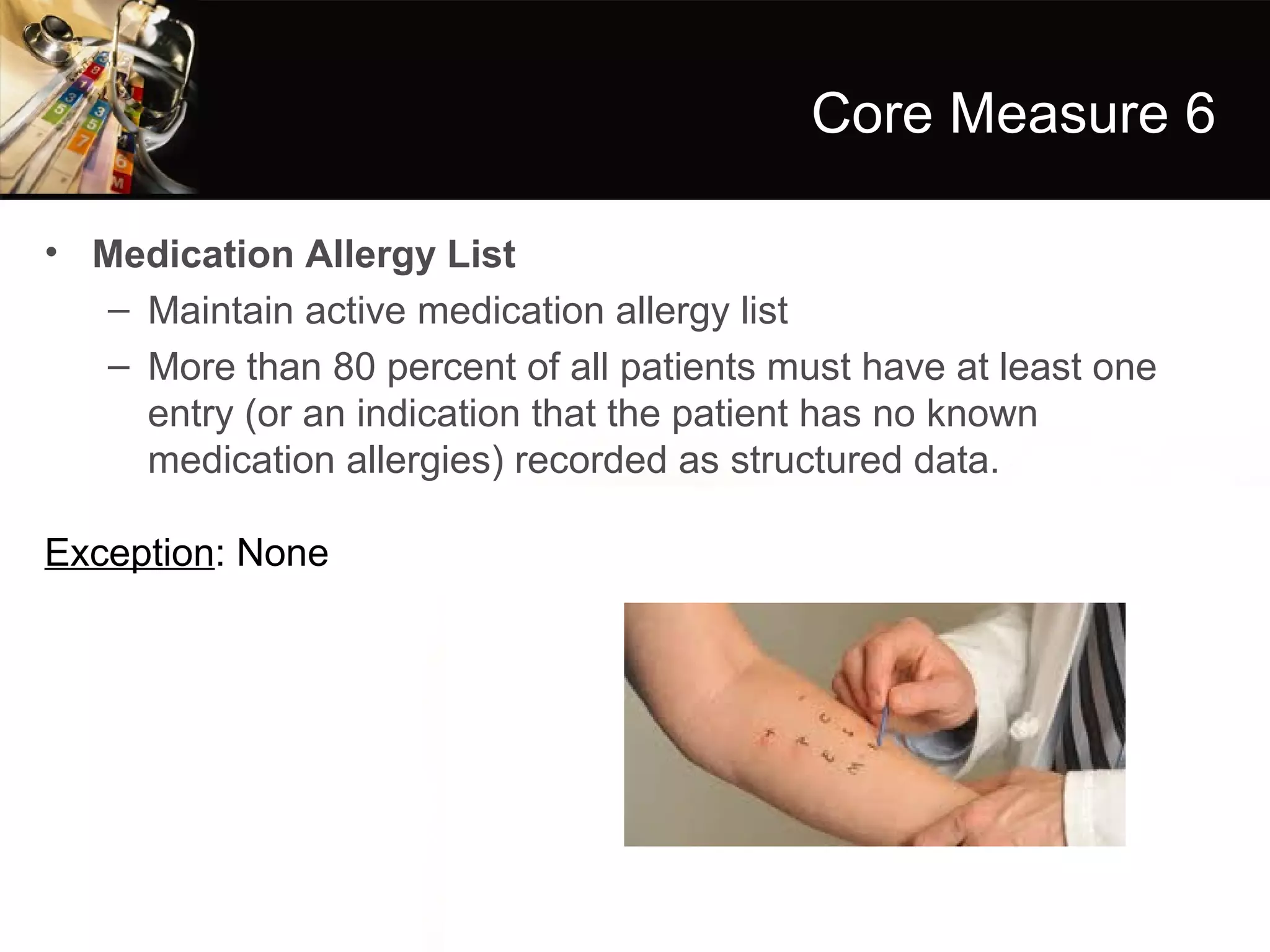
Core Measure 6

• Medication Allergy List
  – Maintain active medication allergy list
  – More than 80 percent of all patients must have at least one
    entry (or an indication that the patient has no known
    medication allergies) recorded as structured data.

Exception: None
Core Measure 7

• Record Demographics
   – Record all of the following demographics:
       • Preferred language
       • Gender
       • Race
       • Ethnicity
       • Date of birth
   – More than 50 percent of all patients must have demographics
     recorded as structured data

   Exception: None
Core Measure 8

• Record Vital Signs
   – Record and chart changes in the following vital signs:
      • Height
      • Weight
      • Blood pressure
      • Calculate and display body mass index (BMI)
      • Plot and display growth charts for children 2-20 years, including
        BMI
   – For more than 50 percent of all patients age 2 and over
   – Measures must be recorded as structured data

Exception: EP only sees patients below 2 years old, or who believes that all
  three vital signs of height, weight, and blood pressure have no relevance
  to their scope of practice
Core Measure 9

• Record Smoking Status
   – Smoking status of patients 13 yrs and older must be recorded
     as structured data
   – More than 50 percent of all patients 13 years old or older

Exception: EP doesn’t see patients 13 years or older
Core Measure 10

• Clinical Quality Measures
   – Report ambulatory clinical quality measures to CMS
   – Successfully report to CMS ambulatory clinical quality
     measures selected by CMS in the manner specified by CMS
   – EPs must report on:
       • 3 core clinical quality measures AND
       • 3 clinical quality measures that EPs select from a list

   Exception: None
Clinical Quality Measures

• Tools that help CMS measure and track the quality of services
• Required as a core meaningful use objective under Meaningful
  Use Stage 1
• Not a core objective under Meaningful Use Stage 2; however, a
  requirement in order to successfully participate in the program
• Beginning in 2014, all providers will be required to report

Note: Additional information to be provided under another presentation
Core Measure 11

• Clinical Decision Support (CDS) Rule
   – Implement one clinical decision support rule relevant to
     specialty or high clinical priority along with the ability to track
     compliance with that rule
   – Certified EHRs have the ability to program clinical decision
     support that can trigger alerts or clinical information for
     providers when they encounter patients with certain diagnoses
     or treatments
   – No specific CDS provided as guide

Exception: None
Core Measure 12

• Electronic Copy of Health Information
   – Provide patients with an electronic copy of their health
     information (including diagnostic test results, problem list,
     medication lists, medication allergies) upon request.
   – More than 50 percent of all patients who request an electronic
     copy of their health information are provided it within 3
     business days.

Exclusion: No patient’s request during reporting period
Core Measure 13

• Clinical Summaries
   – Clinical summaries are provided to patients for each office visit
   – Must provide copies to more than 50% of all patients after
     each office visit within 3 business days
   – The clinical summary can be provided through a portal on the
     web site, secure e-mail, or other electronic media
       • EPs must provide the patient a paper copy upon request
   – Providers should not charge patients a fee to provide this
     information

Exclusion: EP didn’t have any office visit during reporting period
Core Measure 14

• Electronic Exchange of Clinical Information
   – Capability to exchange key clinical information (for example,
     problem list, medication list, medication allergies, and
     diagnostic test results), among providers of care
   – Perform at least one test of EHR's ability to electronically
     transfer information to another provider

Exception: None
Core Measure 15

• Protect Electronic Health Information
   – Conduct or review a security risk analysis in accordance with
     the requirements under 45 CFR 164.308(a)(1)
   – Implement Security Updates as necessary
   – Correct identified security deficiencies

Exception: None
Risk Analysis

• HIPAA Security Rule (45
  C.F.R. §§ 164.302 – 318.)
  covers the guidance as it
  relates to a risk analysis
• Risk analysis requirement is
  covered in § 164.308(a)(1)(ii)
  (A)
• Risk analysis is an ongoing
  process that should provide
  the organization with a
  detailed understanding of the
  risks to the confidentiality,
  integrity, and availability of e-
  PHI
Reminders

• With the exception of Core measure 15 all other measures may
  be achieved thru the use of Certified EHRs
   – A risk analysis is a process and not a one time event
   – Core Measure 15 directly relates to HIPAA Security
   – Consider hiring outside assistance to meet this requirement
   – Document and implement recommendations
• Be aware of other requirements in addition to the obvious
  measures
Summary

• Meaningful use is directly related to the HITECH ACT and
  financial incentives to Medicare and/or Medicaid Providers
• Meaningful Use Stage 1 encompasses 25 Objectives
    – Only Core Objectives covered on this presentation
    – Some objectives provide exclusions
• Meaningful Use Stage 2 requirements are not the same as
  Meaningful Use stage 1
• Core objectives do not change regardless of program (Medicare
  or Medicaid)

Meaningful Use Stage 1 core

  • 1.
    Meaningful Use Stage1 Core Requirements Taino Consultants Inc. Dr. Jose I. Delgado www.TainoConsultants.com
  • 2.
    Meaningful Use (MU) •Health Information Technology for Economic and Clinical Health (HITECH) Act – Authorized financial incentives to Eligible Providers (EP) – Financial Incentives require the use and implementation of a certified electronic health record (EHR) • Owning a certified EHR is not enough – EHRs have tools designed to assist EPs meet MU • EHR must be used in a way that positively affects patient care • Meaningful Use describes the objectives needed to be met in order to receive financial incentives
  • 3.
    Meaningful Use Measures •EP’s must meet 25 Objectives and their corresponding measures in order to meet Meaningful Use – Core Objectives. • 15 objectives that everyone must meet • Must report on all 15 and meet thresholds – Menu Objectives • 10 objectives • EPs must choose 5 of those and meet thresholds – Clinical Quality Measures also covered as a Core Objective • Additional reporting requirement • No thresholds to meet
  • 4.
    Core Measure 1 •Computerized provider order entry (CPOE) – Eligible Provider (EP) must enter medication orders from a computer or mobile device into the patient record – The order must be documented in a digital, structured, and computable format – Action must take place when the order first becomes part of the patient’s medical record and before any action can be taken on the order – EP must have more than 30 percent of patients with at least one medication entered using CPOE Exception: EP writes less than 100 prescriptions during reporting period
  • 5.
    Core Measure 2 •Drug Interaction Check – EHR must automatically check for potentially adverse drug- drug or drug-allergy interactions – Functionality enabled for the entire EHR reporting period Exception: None
  • 6.
    Core Measure 3 •Maintain Problem List – Up-to-date problem list of current and active diagnoses – More than 80 percent of all unique patients seen must have at least one entry or an indication that no problems are known as structured data Exception: None
  • 7.
    Core Measure 4 •E-prescribing (e-Rx) – Generate and transmit permissible prescriptions electronically (eRx) – More than 40 percent of all permissible prescriptions transmitted electronically using certified EHR technology – Authorizations for items such as durable medical equipment, or other items and services that may require EP authorization before the patient could receive them, are not included in the definition of prescriptions Exception: EP writes less than 100 prescriptions during reporting period
  • 8.
    Core Measure 5 •Active Medication List – Maintain active medication list – More than 80 percent of all patients have at least one entry (or an indication that the patient is not currently prescribed any medication) recorded as structured data Exception: None
  • 9.
    Core Measure 6 •Medication Allergy List – Maintain active medication allergy list – More than 80 percent of all patients must have at least one entry (or an indication that the patient has no known medication allergies) recorded as structured data. Exception: None
  • 10.
    Core Measure 7 •Record Demographics – Record all of the following demographics: • Preferred language • Gender • Race • Ethnicity • Date of birth – More than 50 percent of all patients must have demographics recorded as structured data Exception: None
  • 11.
    Core Measure 8 •Record Vital Signs – Record and chart changes in the following vital signs: • Height • Weight • Blood pressure • Calculate and display body mass index (BMI) • Plot and display growth charts for children 2-20 years, including BMI – For more than 50 percent of all patients age 2 and over – Measures must be recorded as structured data Exception: EP only sees patients below 2 years old, or who believes that all three vital signs of height, weight, and blood pressure have no relevance to their scope of practice
  • 12.
    Core Measure 9 •Record Smoking Status – Smoking status of patients 13 yrs and older must be recorded as structured data – More than 50 percent of all patients 13 years old or older Exception: EP doesn’t see patients 13 years or older
  • 13.
    Core Measure 10 •Clinical Quality Measures – Report ambulatory clinical quality measures to CMS – Successfully report to CMS ambulatory clinical quality measures selected by CMS in the manner specified by CMS – EPs must report on: • 3 core clinical quality measures AND • 3 clinical quality measures that EPs select from a list Exception: None
  • 14.
    Clinical Quality Measures •Tools that help CMS measure and track the quality of services • Required as a core meaningful use objective under Meaningful Use Stage 1 • Not a core objective under Meaningful Use Stage 2; however, a requirement in order to successfully participate in the program • Beginning in 2014, all providers will be required to report Note: Additional information to be provided under another presentation
  • 15.
    Core Measure 11 •Clinical Decision Support (CDS) Rule – Implement one clinical decision support rule relevant to specialty or high clinical priority along with the ability to track compliance with that rule – Certified EHRs have the ability to program clinical decision support that can trigger alerts or clinical information for providers when they encounter patients with certain diagnoses or treatments – No specific CDS provided as guide Exception: None
  • 16.
    Core Measure 12 •Electronic Copy of Health Information – Provide patients with an electronic copy of their health information (including diagnostic test results, problem list, medication lists, medication allergies) upon request. – More than 50 percent of all patients who request an electronic copy of their health information are provided it within 3 business days. Exclusion: No patient’s request during reporting period
  • 17.
    Core Measure 13 •Clinical Summaries – Clinical summaries are provided to patients for each office visit – Must provide copies to more than 50% of all patients after each office visit within 3 business days – The clinical summary can be provided through a portal on the web site, secure e-mail, or other electronic media • EPs must provide the patient a paper copy upon request – Providers should not charge patients a fee to provide this information Exclusion: EP didn’t have any office visit during reporting period
  • 18.
    Core Measure 14 •Electronic Exchange of Clinical Information – Capability to exchange key clinical information (for example, problem list, medication list, medication allergies, and diagnostic test results), among providers of care – Perform at least one test of EHR's ability to electronically transfer information to another provider Exception: None
  • 19.
    Core Measure 15 •Protect Electronic Health Information – Conduct or review a security risk analysis in accordance with the requirements under 45 CFR 164.308(a)(1) – Implement Security Updates as necessary – Correct identified security deficiencies Exception: None
  • 20.
    Risk Analysis • HIPAASecurity Rule (45 C.F.R. §§ 164.302 – 318.) covers the guidance as it relates to a risk analysis • Risk analysis requirement is covered in § 164.308(a)(1)(ii) (A) • Risk analysis is an ongoing process that should provide the organization with a detailed understanding of the risks to the confidentiality, integrity, and availability of e- PHI
  • 21.
    Reminders • With theexception of Core measure 15 all other measures may be achieved thru the use of Certified EHRs – A risk analysis is a process and not a one time event – Core Measure 15 directly relates to HIPAA Security – Consider hiring outside assistance to meet this requirement – Document and implement recommendations • Be aware of other requirements in addition to the obvious measures
  • 22.
    Summary • Meaningful useis directly related to the HITECH ACT and financial incentives to Medicare and/or Medicaid Providers • Meaningful Use Stage 1 encompasses 25 Objectives – Only Core Objectives covered on this presentation – Some objectives provide exclusions • Meaningful Use Stage 2 requirements are not the same as Meaningful Use stage 1 • Core objectives do not change regardless of program (Medicare or Medicaid)

Editor's Notes

  • #16 CDS Examples For diabetic patients, an alert which allows the physician to order a hemoglobin A1c test if there is no hemoglobin A1c result in the past six months. For a patient with a history of ischemic vascular disease without contraindications for aspirin use, and who does not have aspirin on his medication list, an alert which asks the provider if the patient is currently taking aspirin and if not, allows the provider to order it. For women age 40-69 with no mammogram in the past year, an alert and/or an order set to facilitate ordering of this diagnostic study. 1. A best practice alert (BPA), triggered by evidence-based practice guidelines, alerting physicians that a pneumoccocal vaccination is recommended for their patients. [Note, Institute for Family Health, 2006 HIMSS Davies Public Health Award winner demonstrated an 18-fold increase in the rate of pneumococcal vaccines, and a BPA for at-risk diabetic patients resulted in a 55% increase in the rates of referrals for ophthalmology appointments. Visit www.himss.org/content/files/davies/2007/ph/InstituteFamilyHealth.pdf for additional information.] 2. For diabetes patients – alert, when the patient arrives in the office, if the most recent HbA1c > 9.0% − in a timely way to facilitate patient education and intervention. 3. For CHF patients, alert if LVEF <40% AND no documentation of ARB or ACE in active med list and facilitates the ordering of it or the documentation of why it is not on the list. 4. In an office visit, when the reason for visit is depression, it makes available a depression diagnosis guideline and a PHQ-9. 5. For diabetes patients – alert if no LDL has been drawn in past 6 months; and if one has been drawn, alert if LDL > 100 mg/dl and facilitating the ordering of the lab. 6. For patients with CAD – alert if no anti-platelet therapy in active medication list. 7. For patients 18 and older – alert if have NOT received smoking cessation counseling. 8. For adults – automatic calculation of BMI – and if it is outside or range, alert reminding clinician to arrange for follow-up. 9. For patients with A Fib as diagnosis – alert if warfarin is NOT on active medication list and that there is no contraindication. 10. For children – alert reminding clinician of immunizations that are due at that visit. 11. A template that is loaded for patients with cardiovascular disease that guides the provider to order aspirin – if no contraindications to aspirin exist. 12. If a patient is being seen by a provider for depression, a depression management guideline, PHQ-9, and/or management guidance can be provided as components of templates/forms or order sets that are triggered by the patient’s diagnosis. http://www.himss.org/content/files/CDS_MU_FAQ.pdf
  • #18 If the EP's certified EHR technology cannot populate all of these fields, then at a minimum the EP must provide in a clinical summary the data elements for which all EHR technology is certified for the purposes of this program (according to §170.304(h)): o Problem List o Diagnostic Test Results o Medication List o Medication Allergy List