ARTIFICIALARTIFICIAL
INTELLIGENCEINTELLIGENCE
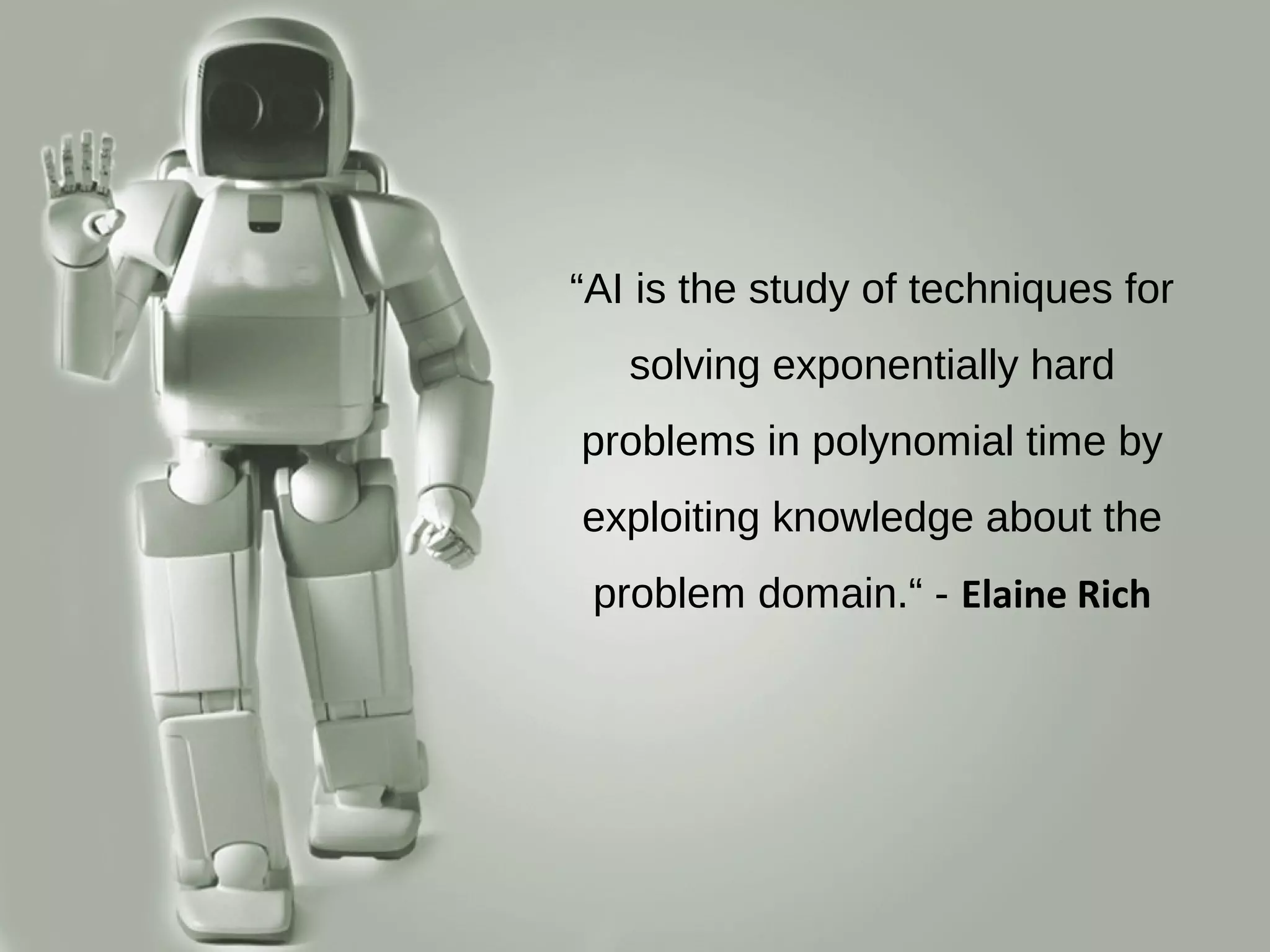
“AI is the study of techniques for
solving exponentially hard
problems in polynomial time by
exploiting knowledge about the
problem domain.“ - Elaine Rich
Although artificial intelligence as an independent field of study
is relatively new, it has some roots in the past. We can say that
it started 2,400 years ago when the Greek philosopher Aristotle
invented the concept of logical reasoning. The effort to finalize
the language of logic continued with Leibniz and Newton.
George Boole developed Boolean algebra in the nineteenth
century (Appendix E) that laid the foundation of computer
circuits. However, the main idea of a thinking machine came
from Alan Turing, who proposed the Turing test. The term
“artificial intelligence” was first coined by John McCarthy in
1956.
Hi st ory of art i f i ci al i nt el l i gence
ApplicatioApplicatio
ns of AI :ns of AI :
•Game playing
•Automated
Reasoning &
Theorem Proving
•Expert Systems
•Natural
Language
Understanding &
Semantic
Modeling
•Planning &
Robotics
ARTIFICIALARTIFICIAL
INTELLIGENCEINTELLIGENCE
advantagesadvantages
andand
disadvantagesdisadvantages
ADVANTAGES OF ARTIFICIAL INTELLIGENCEADVANTAGES OF ARTIFICIAL INTELLIGENCE
 Can take on stressful and complex work that humans may
struggle/can not do.
 Can complete task faster than a human can most likely
 To discover unexplored things. i.e. outer space
 Less errors and defects
 Function is infinite
DISADVANTAGES OF ARTIFICIAL INTELLIGENCEDISADVANTAGES OF ARTIFICIAL INTELLIGENCE
 Lacks the "human touch"
 Has the ability to replace human jobs
 Can malfunction and do the opposite of
what they are programmed to do
 Can be misused leading to mass scale
destruction
 May corrupt younger generation
We end up with four possible goals:
Systems that think like humans (focus on reasoning and human framework)
Systems that think rationally (focus on reasoning and a general concept of intelligence)
Systems that act like humans (focus on behavior and human framework)
Systems that act rationally (focus on behavior and a general concept of intelligence)
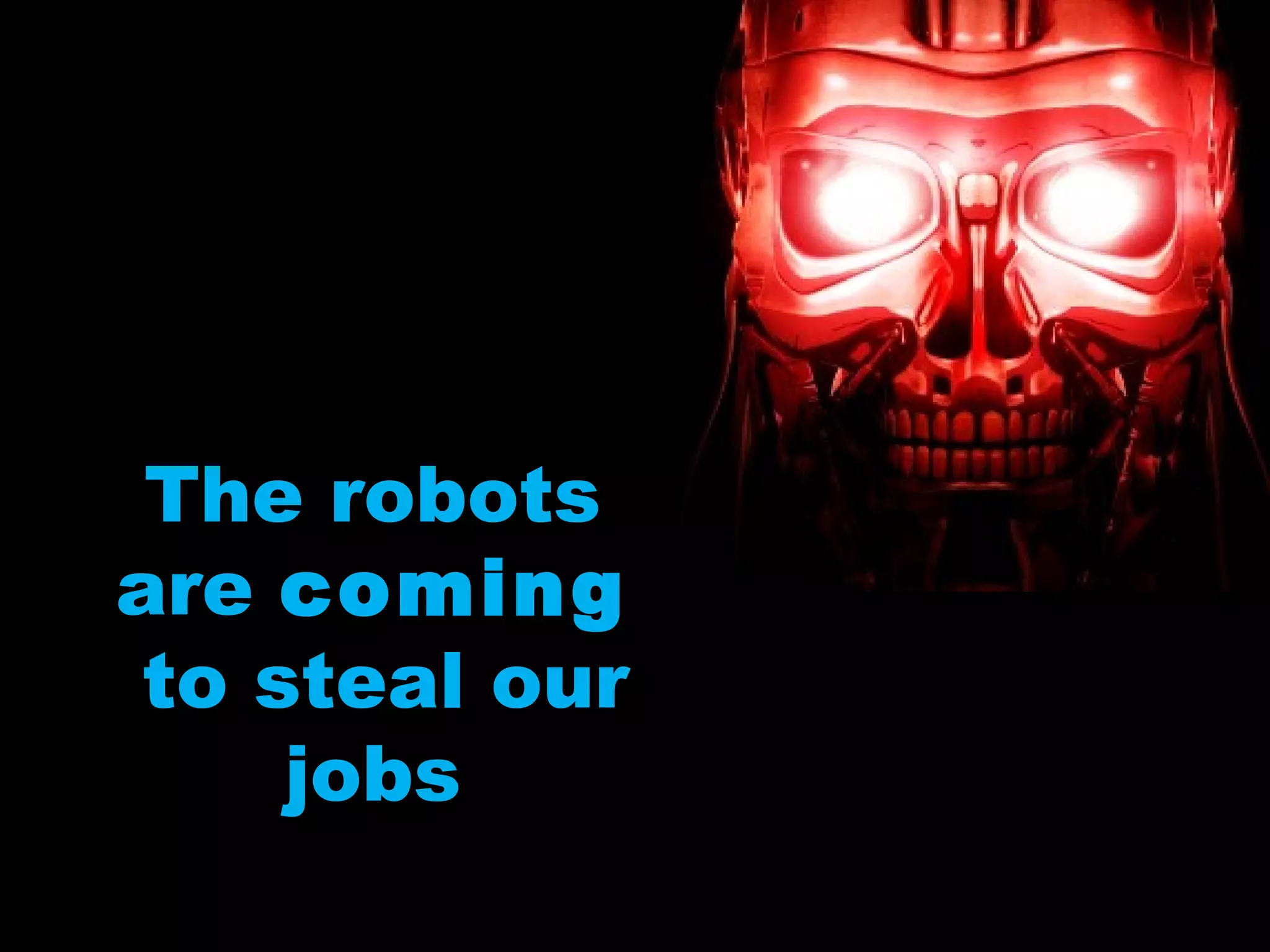
The robots
are coming
 to steal our
jobs
Thank You

artificial-intelligence

  • 1.
  • 2.
    “AI is thestudy of techniques for solving exponentially hard problems in polynomial time by exploiting knowledge about the problem domain.“ - Elaine Rich
  • 3.
    Although artificial intelligenceas an independent field of study is relatively new, it has some roots in the past. We can say that it started 2,400 years ago when the Greek philosopher Aristotle invented the concept of logical reasoning. The effort to finalize the language of logic continued with Leibniz and Newton. George Boole developed Boolean algebra in the nineteenth century (Appendix E) that laid the foundation of computer circuits. However, the main idea of a thinking machine came from Alan Turing, who proposed the Turing test. The term “artificial intelligence” was first coined by John McCarthy in 1956. Hi st ory of art i f i ci al i nt el l i gence
  • 4.
    ApplicatioApplicatio ns of AI:ns of AI : •Game playing •Automated Reasoning & Theorem Proving •Expert Systems •Natural Language Understanding & Semantic Modeling •Planning & Robotics
  • 5.
  • 6.
    ADVANTAGES OF ARTIFICIALINTELLIGENCEADVANTAGES OF ARTIFICIAL INTELLIGENCE  Can take on stressful and complex work that humans may struggle/can not do.  Can complete task faster than a human can most likely  To discover unexplored things. i.e. outer space  Less errors and defects  Function is infinite
  • 7.
    DISADVANTAGES OF ARTIFICIALINTELLIGENCEDISADVANTAGES OF ARTIFICIAL INTELLIGENCE  Lacks the "human touch"  Has the ability to replace human jobs  Can malfunction and do the opposite of what they are programmed to do  Can be misused leading to mass scale destruction  May corrupt younger generation
  • 8.
    We end upwith four possible goals: Systems that think like humans (focus on reasoning and human framework) Systems that think rationally (focus on reasoning and a general concept of intelligence) Systems that act like humans (focus on behavior and human framework) Systems that act rationally (focus on behavior and a general concept of intelligence)
  • 9.
  • 10.