SOCIAL MEDIA, POLITICAL
CHANGE, AND HUMAN RIGHTS
        Sarah Joseph
           (2012)
So what’s it about?
   The role of social media in progressive political
                 change is examined
•“Does social media deserve the plaudits it has
received?” (p146)

•Arab Spring Uprisings 2011 – “Twitter Revolutions”
??
   – Was Twitter’s role in the uprisings THAT instrumental
     to their success?
               *IT WAS A CATALYST FOR ACTION*
         http://www.youtube.com/watch?v=y6S8iQ5KSkU
Malcolm Gladwell & The Skeptics
• “SLACTIVISM” (p150)

• “Facebook activism succeeds not by motivating
  people to make a real sacrifice but by motivating
  them to do the things people do when they’re not
  motivated enough to make a real sacrifice” (p150)

• It distracts people from “real” activism > DELUSION
     http://www.youtube.com/watch?v=Y4MnpzG5Sqc
A QUICK MOMENT ON KONY 2012
              (and social media)
• We like to make fun of KONY. And Facebook.
  And Twitter.
             A lot.
• WE are sitting in a world renowned,
  democratically free educational institution
• It is my democratic right to tell you this
• It is your democratic right to listen (or not)
• Do we take this for granted?
Clay Shirky & The Believers
• FORMATION OF WELL-CONSIDERED POLITICAL THOUGHT:
         1. ACCESS TO INFORMATION
         2. USE OF THAT INFORMATION IN CONVERSTAION AND DEBATE


•   “Social media has revolutionized how people form political opinions and
    has made information so widely accessible that more people than ever
    are able to develop considered points of view” (p152)


•   EYEWITNESS ACOUNTS: “Reporting is no longer confined to traditional sources like
    journalism”
     – “Information is spreading faster and farther… [it has] allowed us to see into
        many parts of the world that were previously shrouded by oppressive
        governments or geographical boundaries” (p153)
• “Anyone in the vicinity of an event with audacity
  and a camera can document brutality and spread
  it on the internet” (p153)


 http://www.youtube.com/watch?v=5MgCziE-Qxg
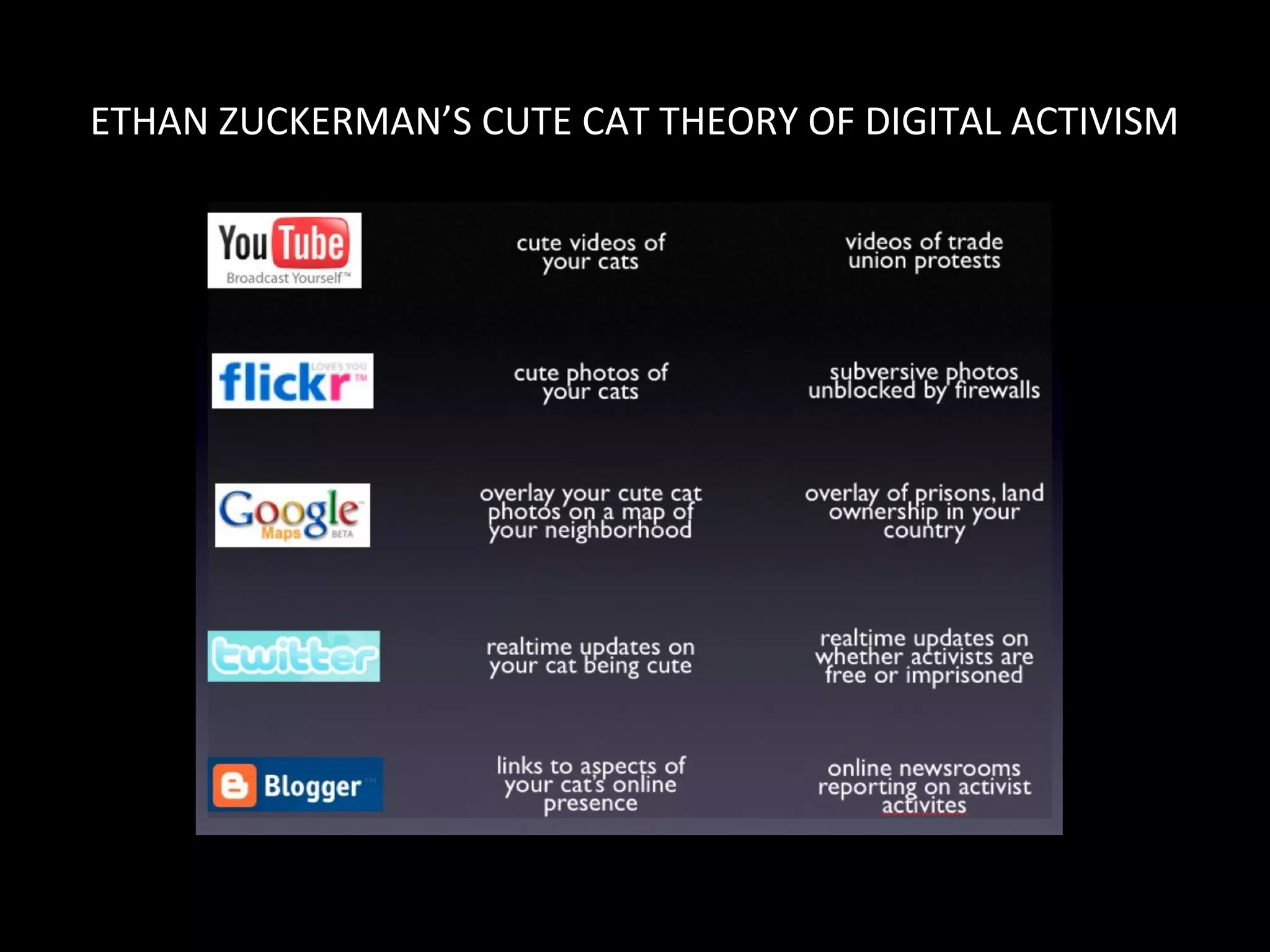
ETHAN ZUCKERMAN’S CUTE CAT THEORY OF DIGITAL ACTIVISM
THE FORCES OF LIGHT AND DARKNESS
            (Morozov)
             A facilitator of pro-democratic revolution?
                                   or
                         A tool of oppression?

•GPS systems on internet used to track dissidents in Iran and Belarus
•‘Friend’ connections can unravel entire dissident networks rather than just
one person
•Data-mining sensitive keywords
•Facial Recognition
•“Personalization” (p169)
PLEASE WAKE UP.
• Log onto Facebook
• Grab a pen and paper

• Write down 3 to 5 people you ‘stalk’
• Write down 3 to 5 ‘things’ you do on the
  internet (online shopping, health and fitness blogs,
  travel/accomodation, celebrity gossip, music)


             NOTICE ANYTHING INTERESTING?
CENSORSHIP
                   it’s a fine line..
    “Even violence is sometimes legitimate, as in the case of
proportionate self-defense against a government crackdown, as
         may have occurred in Libya and Syria” (p181)

                         QUESTION:

In such situations, should social media companies remove pages
      that advocate fighting back against a violent regime?

        Where and when can we make this exception?
“Just because you can mobilize a hundred
million people on Twitter… does not mean that
         you should” (Morozov, p187)

“Just as social media can coordinate legitimate
   and profound political mobilization, it can
undoubtedly play a role in provoking mayhem”
                      (p174)
               http://www.youtube.com/watch?
                v=k7H02HSip_c&feature=fvwrel
CONCLUSIONS
“Perhaps Gladwell’s skepticism over the
revolutionary potential of social media is correct
with regard to the developed world” (p186)
                       BUT
“The increase of unfiltered connections
between people of different cultural, political,
and economic outlooks is likely to have some
unprecedented and beneficial consequences
for…global activism” (p186)

MDIA5003 Presentation

  • 1.
    SOCIAL MEDIA, POLITICAL CHANGE,AND HUMAN RIGHTS Sarah Joseph (2012)
  • 2.
    So what’s itabout? The role of social media in progressive political change is examined •“Does social media deserve the plaudits it has received?” (p146) •Arab Spring Uprisings 2011 – “Twitter Revolutions” ?? – Was Twitter’s role in the uprisings THAT instrumental to their success? *IT WAS A CATALYST FOR ACTION* http://www.youtube.com/watch?v=y6S8iQ5KSkU
  • 3.
    Malcolm Gladwell &The Skeptics • “SLACTIVISM” (p150) • “Facebook activism succeeds not by motivating people to make a real sacrifice but by motivating them to do the things people do when they’re not motivated enough to make a real sacrifice” (p150) • It distracts people from “real” activism > DELUSION http://www.youtube.com/watch?v=Y4MnpzG5Sqc
  • 4.
    A QUICK MOMENTON KONY 2012 (and social media) • We like to make fun of KONY. And Facebook. And Twitter. A lot. • WE are sitting in a world renowned, democratically free educational institution • It is my democratic right to tell you this • It is your democratic right to listen (or not) • Do we take this for granted?
  • 5.
    Clay Shirky &The Believers • FORMATION OF WELL-CONSIDERED POLITICAL THOUGHT: 1. ACCESS TO INFORMATION 2. USE OF THAT INFORMATION IN CONVERSTAION AND DEBATE • “Social media has revolutionized how people form political opinions and has made information so widely accessible that more people than ever are able to develop considered points of view” (p152) • EYEWITNESS ACOUNTS: “Reporting is no longer confined to traditional sources like journalism” – “Information is spreading faster and farther… [it has] allowed us to see into many parts of the world that were previously shrouded by oppressive governments or geographical boundaries” (p153)
  • 6.
    • “Anyone inthe vicinity of an event with audacity and a camera can document brutality and spread it on the internet” (p153) http://www.youtube.com/watch?v=5MgCziE-Qxg
  • 7.
    ETHAN ZUCKERMAN’S CUTECAT THEORY OF DIGITAL ACTIVISM
  • 8.
    THE FORCES OFLIGHT AND DARKNESS (Morozov) A facilitator of pro-democratic revolution? or A tool of oppression? •GPS systems on internet used to track dissidents in Iran and Belarus •‘Friend’ connections can unravel entire dissident networks rather than just one person •Data-mining sensitive keywords •Facial Recognition •“Personalization” (p169)
  • 9.
    PLEASE WAKE UP. •Log onto Facebook • Grab a pen and paper • Write down 3 to 5 people you ‘stalk’ • Write down 3 to 5 ‘things’ you do on the internet (online shopping, health and fitness blogs, travel/accomodation, celebrity gossip, music) NOTICE ANYTHING INTERESTING?
  • 10.
    CENSORSHIP it’s a fine line.. “Even violence is sometimes legitimate, as in the case of proportionate self-defense against a government crackdown, as may have occurred in Libya and Syria” (p181) QUESTION: In such situations, should social media companies remove pages that advocate fighting back against a violent regime? Where and when can we make this exception?
  • 11.
    “Just because youcan mobilize a hundred million people on Twitter… does not mean that you should” (Morozov, p187) “Just as social media can coordinate legitimate and profound political mobilization, it can undoubtedly play a role in provoking mayhem” (p174) http://www.youtube.com/watch? v=k7H02HSip_c&feature=fvwrel
  • 12.
    CONCLUSIONS “Perhaps Gladwell’s skepticismover the revolutionary potential of social media is correct with regard to the developed world” (p186) BUT “The increase of unfiltered connections between people of different cultural, political, and economic outlooks is likely to have some unprecedented and beneficial consequences for…global activism” (p186)