

WHAT IS
EXCHANGE
HYBRID?
Thomas Stensitzki
Enterprise Consultant | Owner
Granikos GmbH & Co. KG
MVP | Office Apps & Services
MCT Regional Lead
Email thomas.stensitzki@granikos.eu
Twitter @Stensitzki
LinkedIn https://linkedin.com/in/thomasstensitzki
Blog http://JustCantGetEnough.Granikos.eu
Web https://www.stensitzki.de
What is Exchange Hybrid?
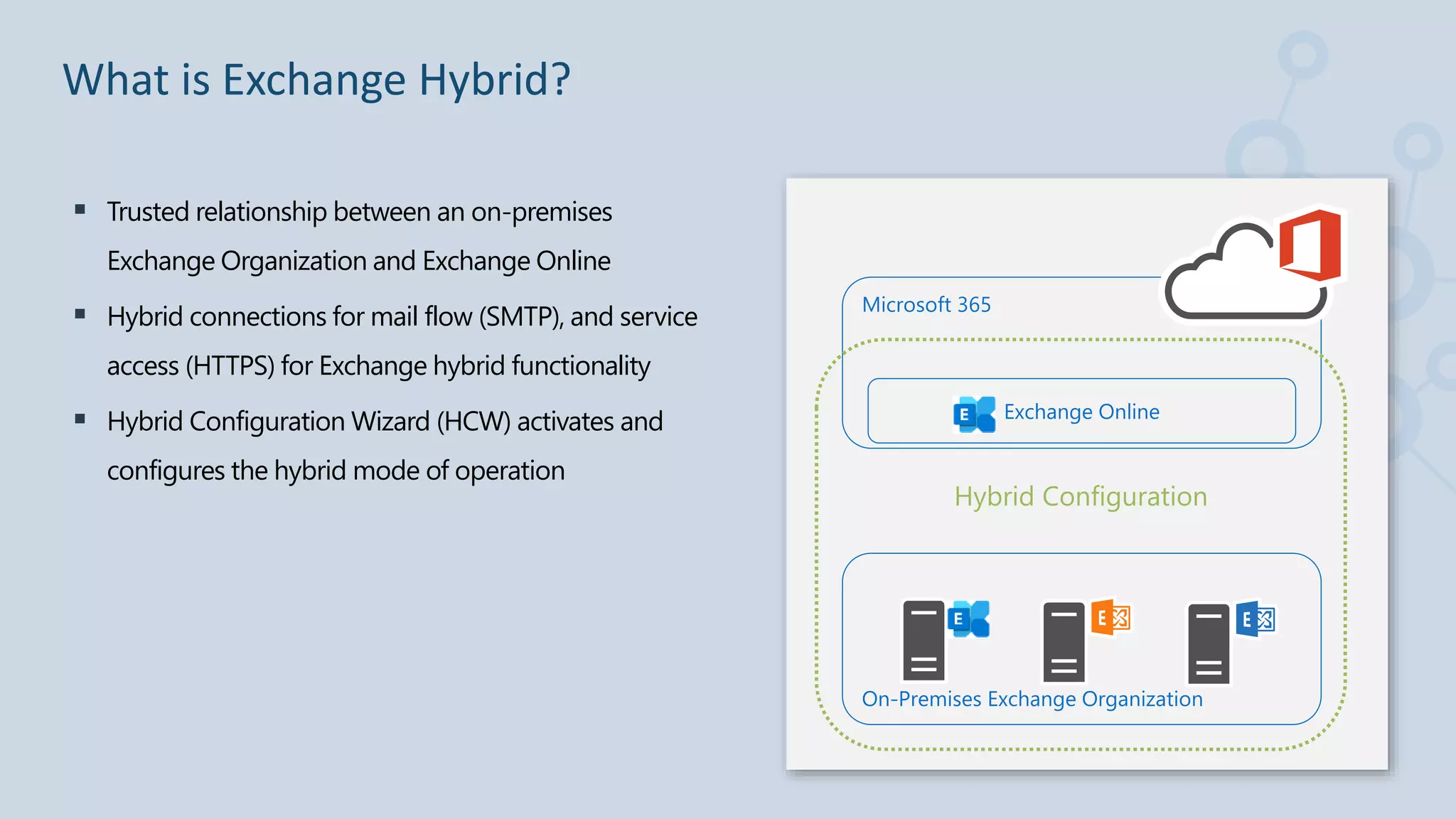
On-Premises Exchange Organization
Microsoft 365
Exchange Online
Hybrid Configuration
 Trusted relationship between an on-premises
Exchange Organization and Exchange Online
 Hybrid connections for mail flow (SMTP), and service
access (HTTPS) for Exchange hybrid functionality
 Hybrid Configuration Wizard (HCW) activates and
configures the hybrid mode of operation
What is Exchange Hybrid?
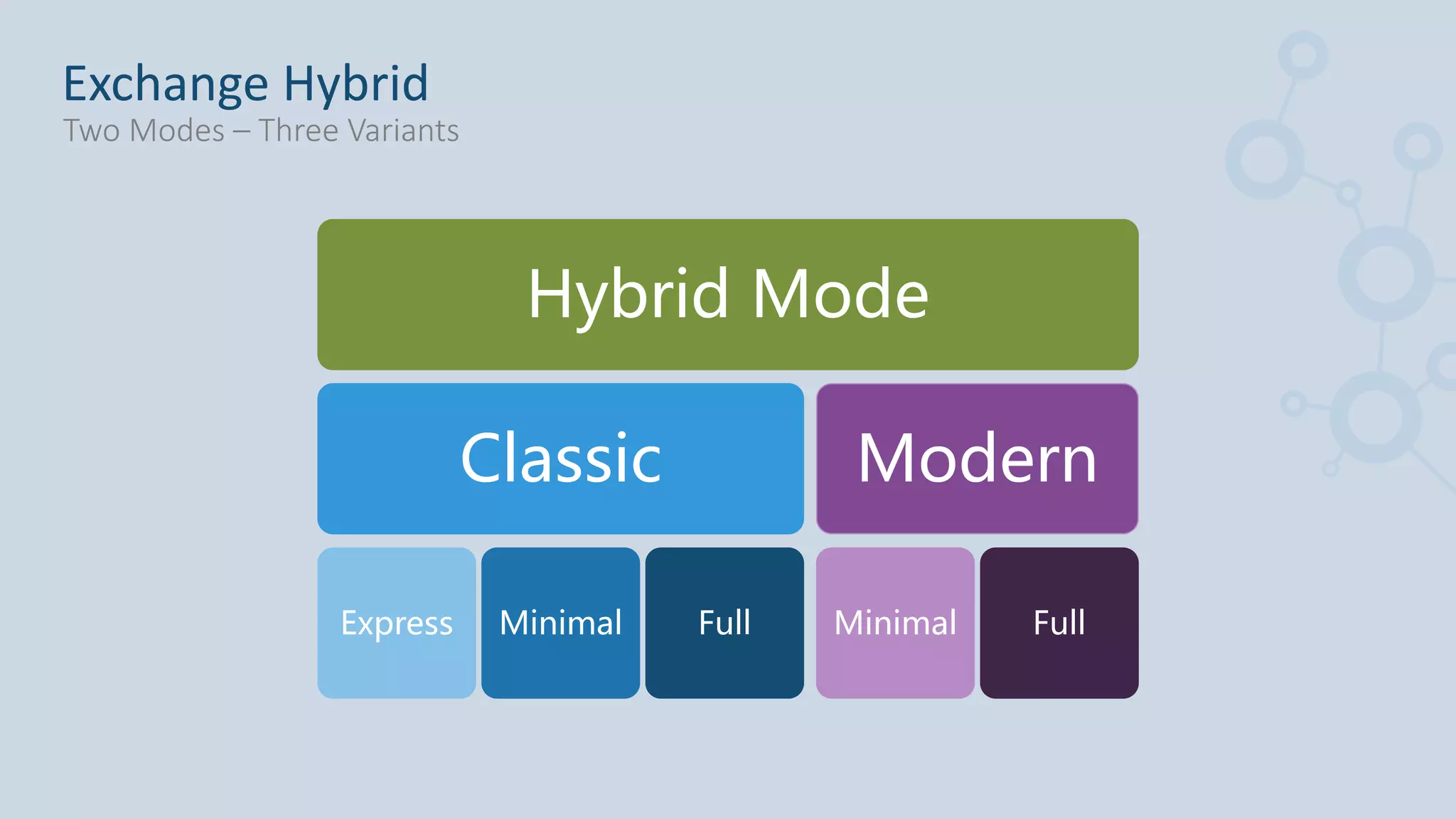
Hybrid Mode
Classic
Express Minimal Full
Modern
Minimal Full
Exchange Hybrid
Two Modes – Three Variants
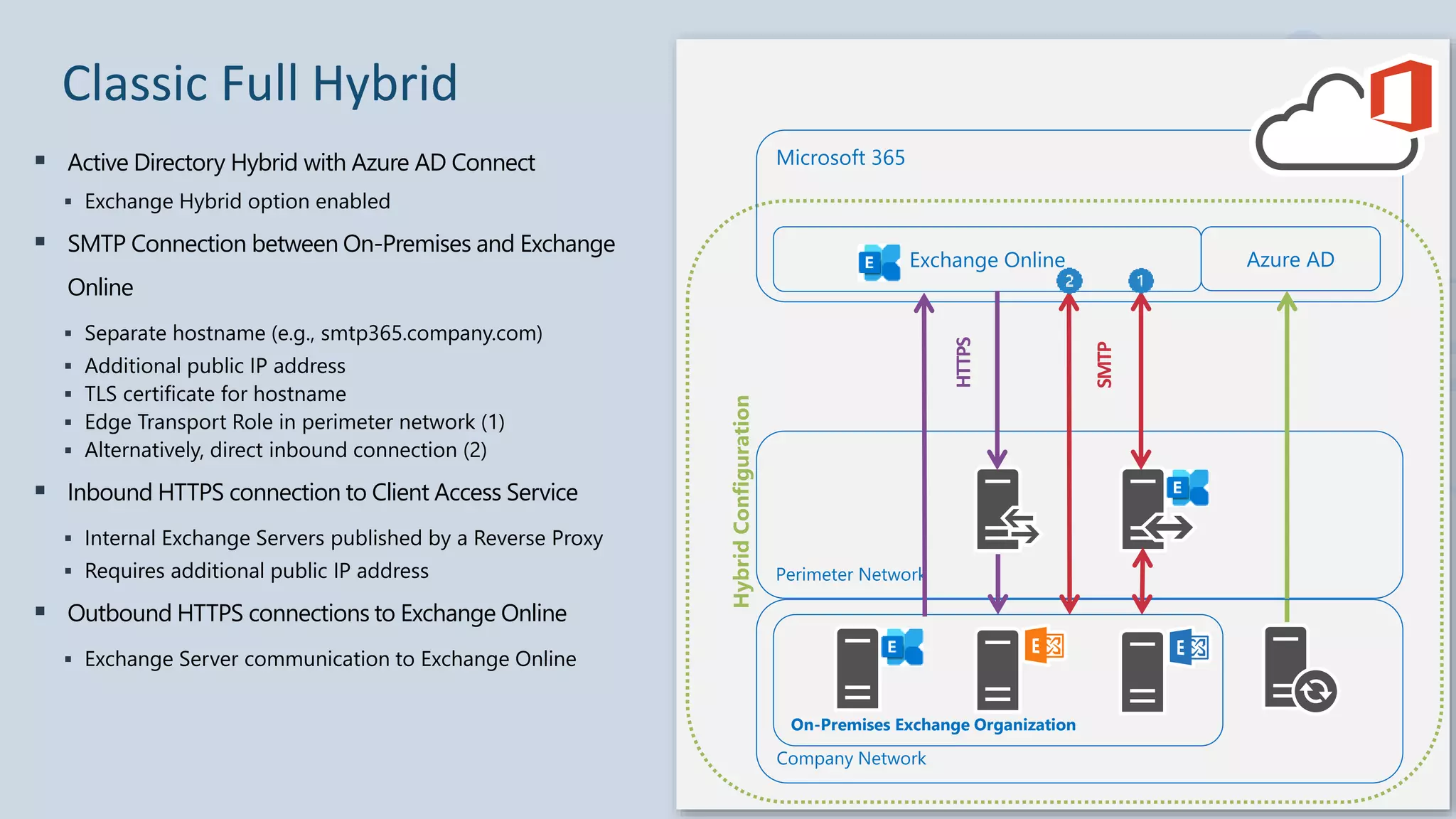
On-Premises Exchange Organization
Hybrid
Configuration
Perimeter Network
Microsoft 365
Exchange Online Azure AD
Company Network
SMTP
HTTPS
 Active Directory Hybrid with Azure AD Connect
 Exchange Hybrid option enabled
 SMTP Connection between On-Premises and Exchange
Online
 Separate hostname (e.g., smtp365.company.com)
 Additional public IP address
 TLS certificate for hostname
 Edge Transport Role in perimeter network (1)
 Alternatively, direct inbound connection (2)
 Inbound HTTPS connection to Client Access Service
 Internal Exchange Servers published by a Reverse Proxy
 Requires additional public IP address
 Outbound HTTPS connections to Exchange Online
 Exchange Server communication to Exchange Online
Classic Full Hybrid
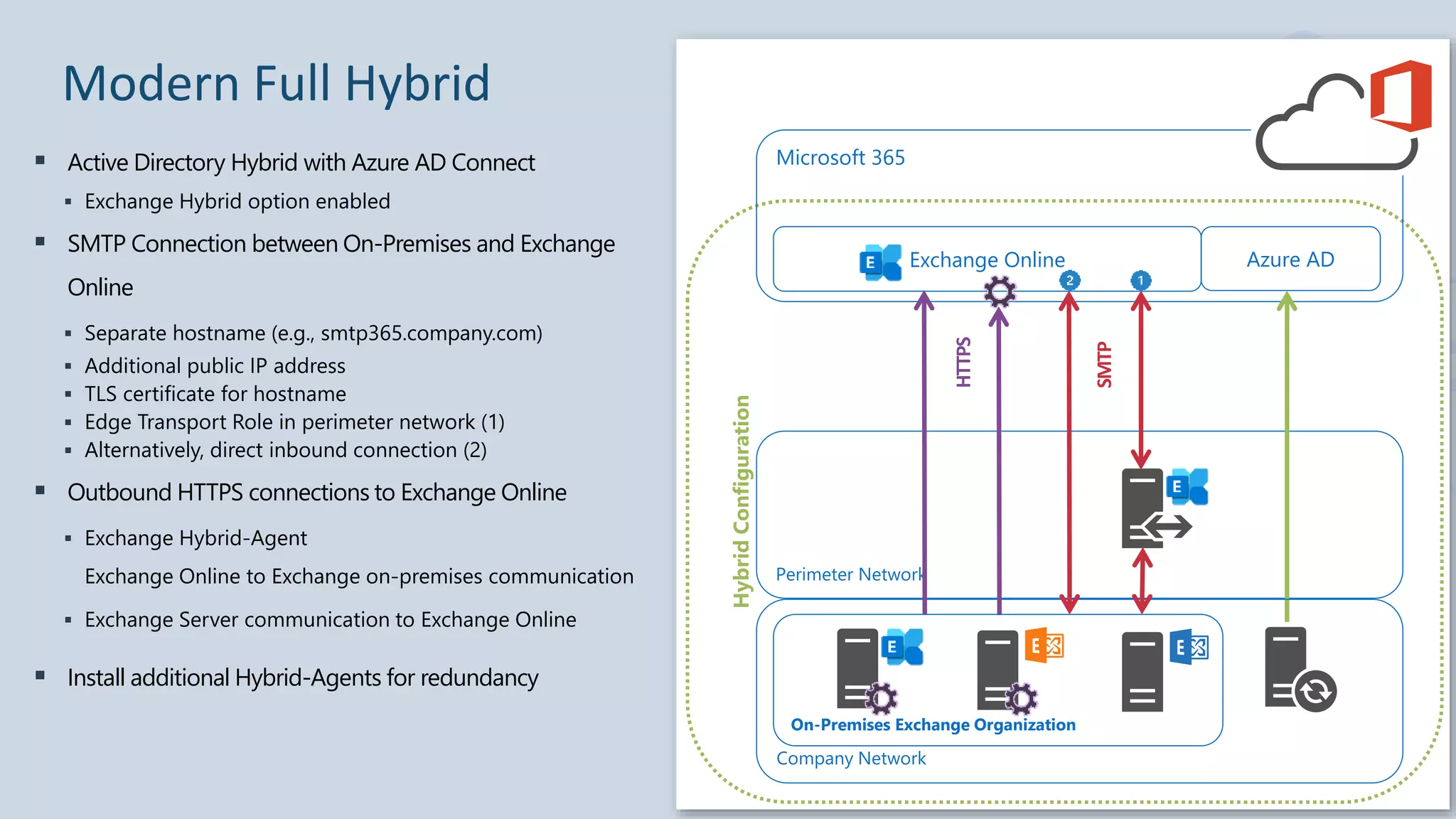
 Active Directory Hybrid with Azure AD Connect
 Exchange Hybrid option enabled
 SMTP Connection between On-Premises and Exchange
Online
 Separate hostname (e.g., smtp365.company.com)
 Additional public IP address
 TLS certificate for hostname
 Edge Transport Role in perimeter network (1)
 Alternatively, direct inbound connection (2)
 Outbound HTTPS connections to Exchange Online
 Exchange Hybrid-Agent
Exchange Online to Exchange on-premises communication
 Exchange Server communication to Exchange Online
 Install additional Hybrid-Agents for redundancy
Hybrid
Configuration
Perimeter Network
Microsoft 365
Exchange Online Azure AD
Company Network
On-Premises Exchange Organization
HTTPS
SMTP
Modern Full Hybrid
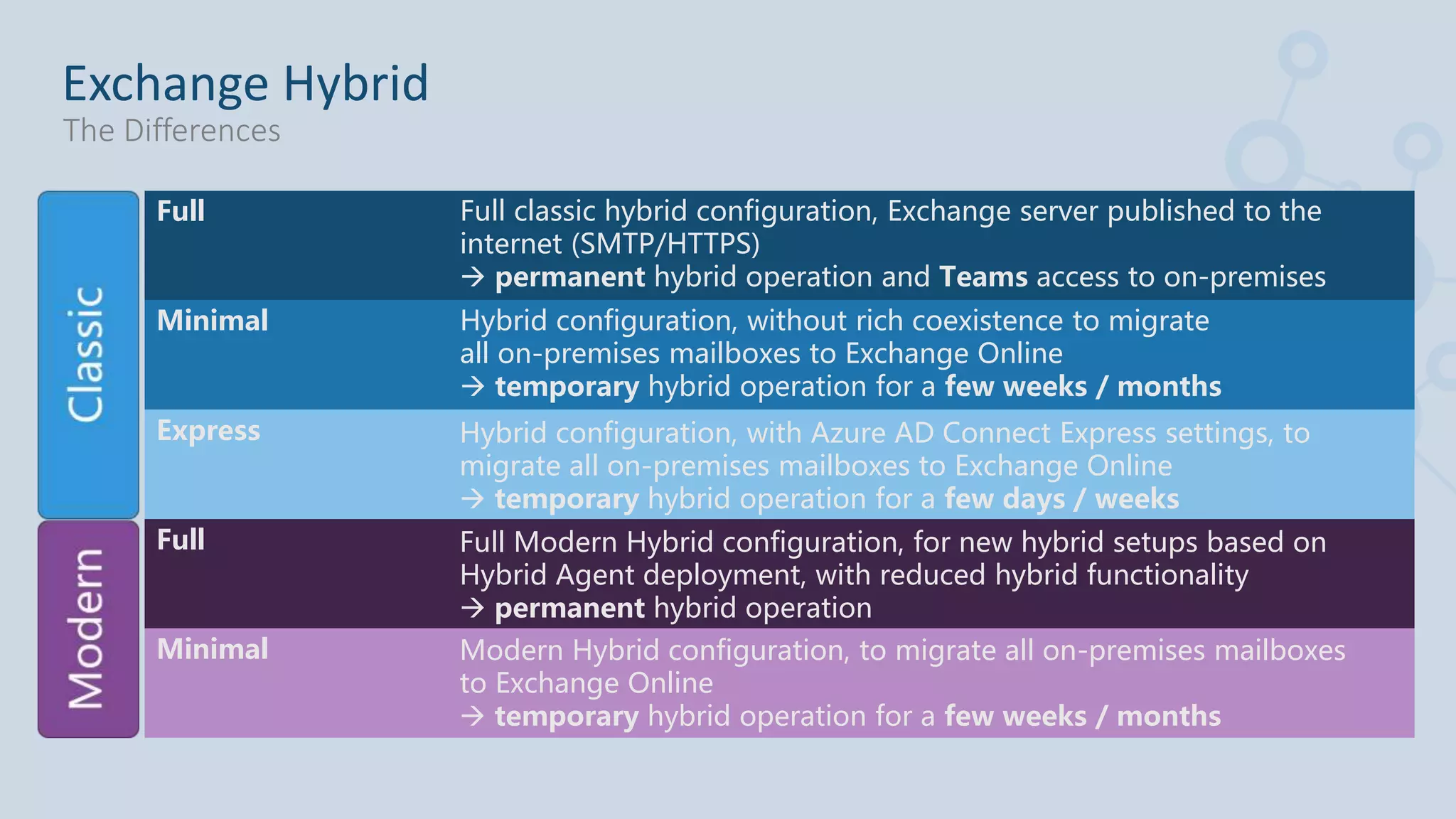
Full Full classic hybrid configuration, Exchange server published to the
internet (SMTP/HTTPS)
 permanent hybrid operation and Teams access to on-premises
Minimal Hybrid configuration, without rich coexistence to migrate
all on-premises mailboxes to Exchange Online
 temporary hybrid operation for a few weeks / months
Express Hybrid configuration, with Azure AD Connect Express settings, to
migrate all on-premises mailboxes to Exchange Online
 temporary hybrid operation for a few days / weeks
Full Full Modern Hybrid configuration, for new hybrid setups based on
Hybrid Agent deployment, with reduced hybrid functionality
 permanent hybrid operation
Minimal Modern Hybrid configuration, to migrate all on-premises mailboxes
to Exchange Online
 temporary hybrid operation for a few weeks / months
Exchange Hybrid
The Differences
Why do you need Exchange
Hybrid?
 Coexistence between your on-premises Exchange Organization and Exchange Online
 Mailbox migration to and from Exchange Online
 Seamless public folder migration to Exchange Online
 Microsoft Teams with on-premises mailboxes (calendar access)
 Transition from an on-premises Exchange Organization to Exchange Online
 Optimal migration experience for end users
 Centralized mail flow for use of on-premises email solutions with user mailboxes in Exchange Online
 Gateway-based S/MIME decryption/encryption, email disclaimer, archiving, journaling, …
 Hybrid mail flow providing email relay functionality for on-premises legacy applications and devices with
 No access to the internet
 No support for TLS protocols 1.0 or 1.1
 No support for SMTPAUTH user authentication
 No support for SMTP modern authentication
Why do you need Exchange Hybrid?
 On-Premises Exchange Server 2019 hybrid endpoint
 Microsoft Teams backend services use AutoDiscover v2 to discover on-premises EWS and REST endpoints
 Client Access Endpoint accessible for Microsoft Teams backend services
 Always use latest Exchange Server cumulative update
 In-Place upgrade capability for Exchange Server vNEXT (H2 2021)
 Use Third-Party TLS-certificate with all required subject alternate names (SAN) for incoming HTTPS connections
 AutoDiscover
 Exchange namespace  Exchange Virtual Directory’s external URL-Settings
 Use a dedicated Third-Party TLS-certificate for SMTP when using centralized mail flow
 Enable and configure OAUTH authentication using Hybrid Configuration Wizard
 Exchange team provides detailed information on how to configure OAUTH manually
 AutoDiscover DNS resource records for SMTP domains used for primary email addresses
 Use Exchange Server 2016 if you need a coexistence server only
Exchange Hybrid Recommendations
How to implement
Exchange Hybrid?
 Know the differences of the Exchange hybrid variants and modes of operation available
 Know the mode of operation for your Exchange Organization and hybrid requirements
 Have your on-premises Exchange organization ready for hybrid configuration
 Install latest Exchange Server Cumulative Updates on all Exchange Servers, including Edge Transport
 Have required IP addresses & DNS hostnames for the Exchange namespace set up
 Verify inbound connectivity to your Exchange organization using Remote Connectivity Analyzer (RCA)
 When your firewall policy is restricted for inbound traffic, add the RCA IP addresses to that policy  RCA release notes
 Have Edge Transport TLS certificates installed on internal an Exchange Server for selection by HCW, when using Edge
 Do NOT enable this certificate for any Exchange service
 Enable Exchange Hybrid option in Azure AD Connect first
Exchange Hybrid Requirtements
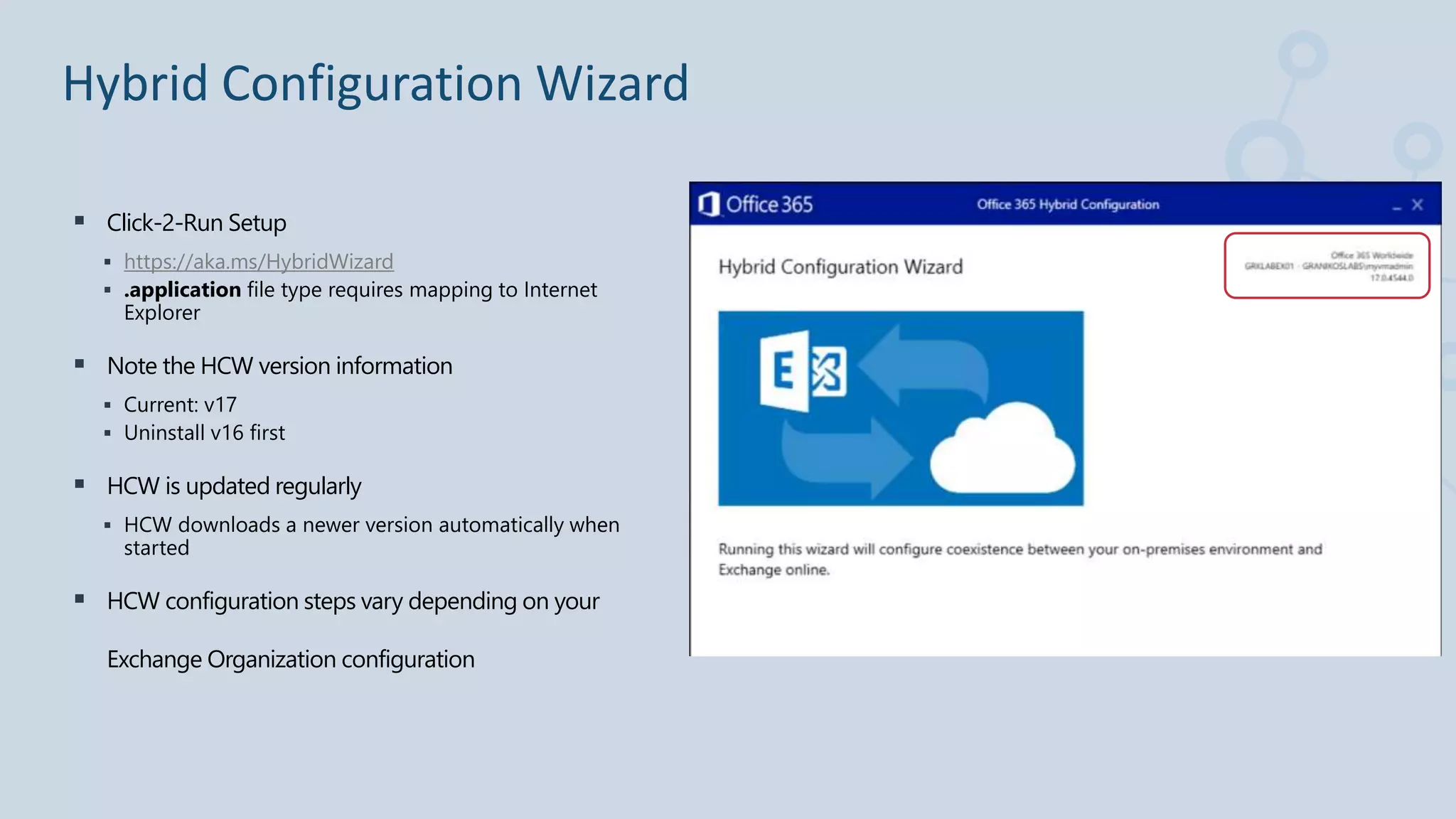
 Click-2-Run Setup
 https://aka.ms/HybridWizard
 .application file type requires mapping to Internet
Explorer
 Note the HCW version information
 Current: v17
 Uninstall v16 first
 HCW is updated regularly
 HCW downloads a newer version automatically when
started
 HCW configuration steps vary depending on your
Exchange Organization configuration
Hybrid Configuration Wizard
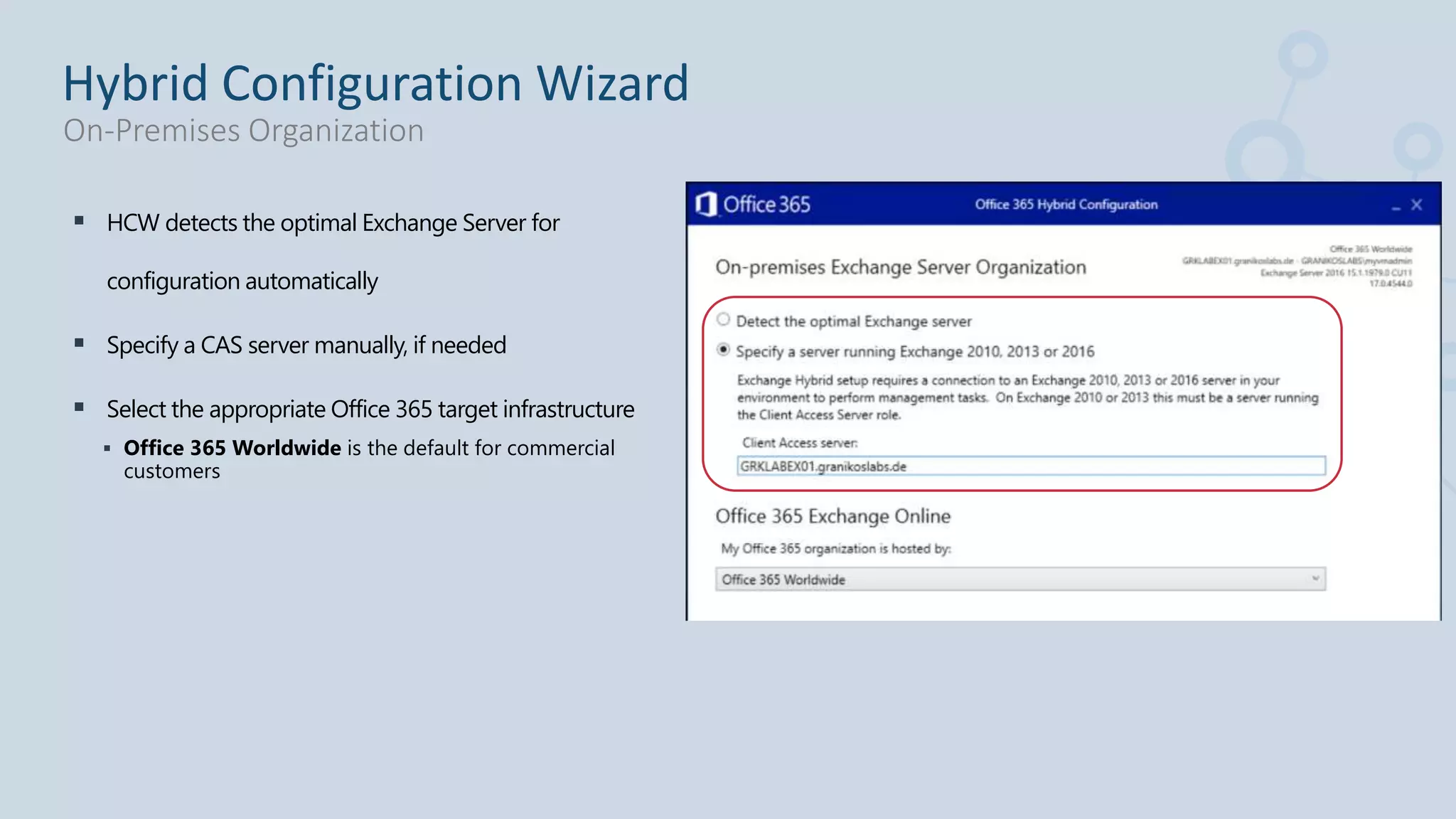
 HCW detects the optimal Exchange Server for
configuration automatically
 Specify a CAS server manually, if needed
 Select the appropriate Office 365 target infrastructure
 Office 365 Worldwide is the default for commercial
customers
Hybrid Configuration Wizard
On-Premises Organization
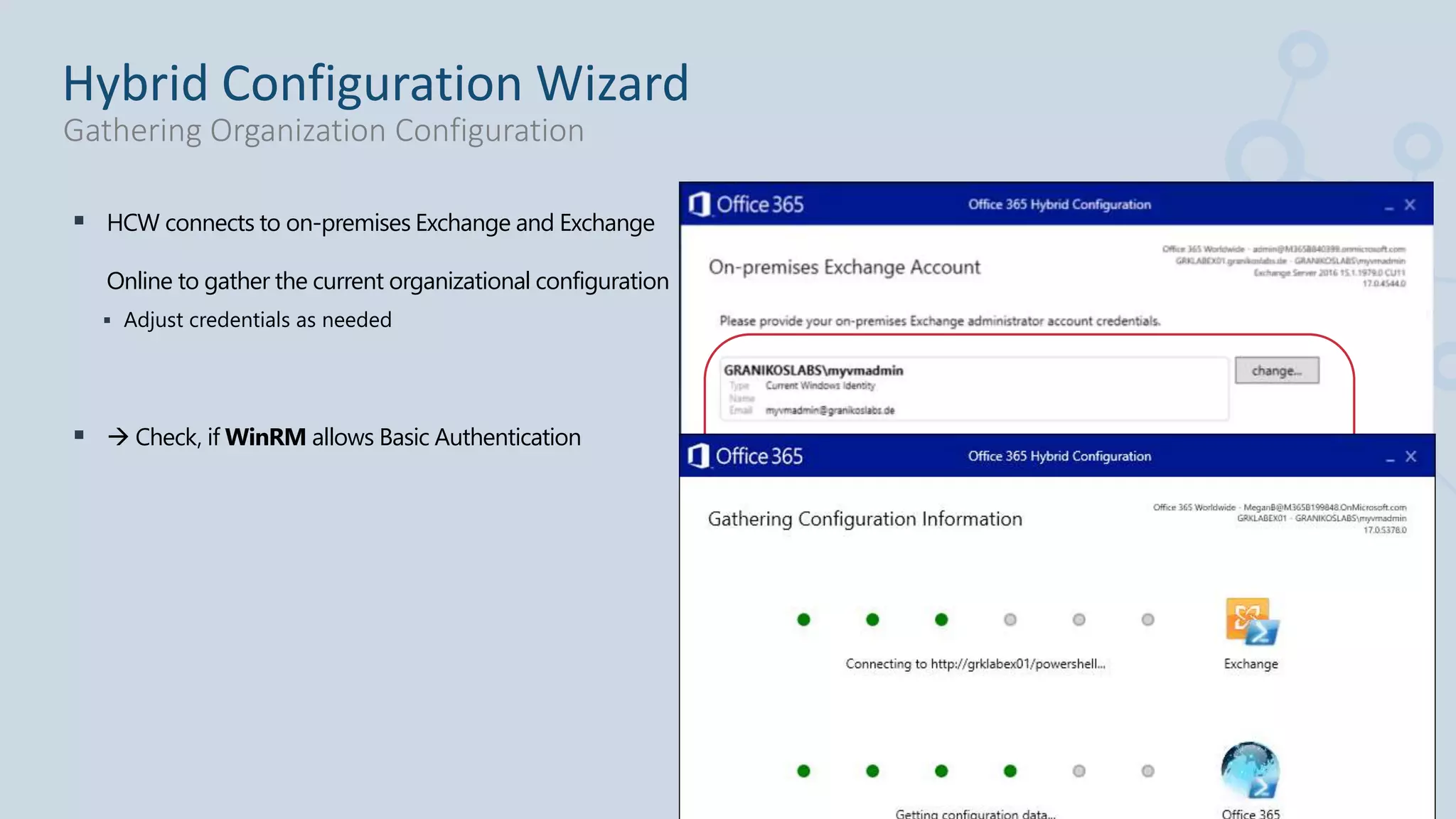
 HCW connects to on-premises Exchange and Exchange
Online to gather the current organizational configuration
 Adjust credentials as needed
  Check, if WinRM allows Basic Authentication
Hybrid Configuration Wizard
Gathering Organization Configuration
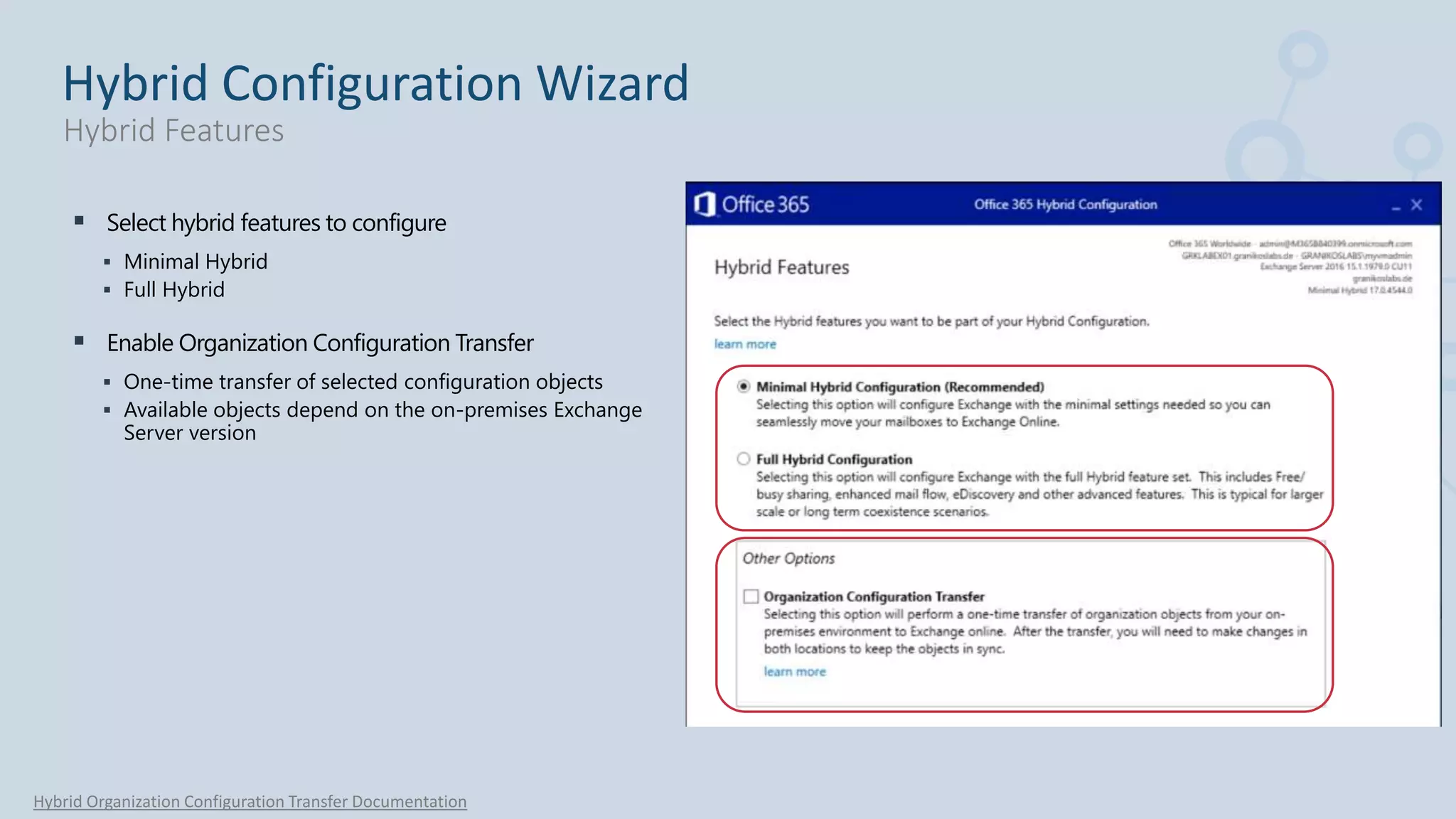
 Select hybrid features to configure
 Minimal Hybrid
 Full Hybrid
 Enable Organization Configuration Transfer
 One-time transfer of selected configuration objects
 Available objects depend on the on-premises Exchange
Server version
Hybrid Organization Configuration Transfer Documentation
Hybrid Configuration Wizard
Hybrid Features
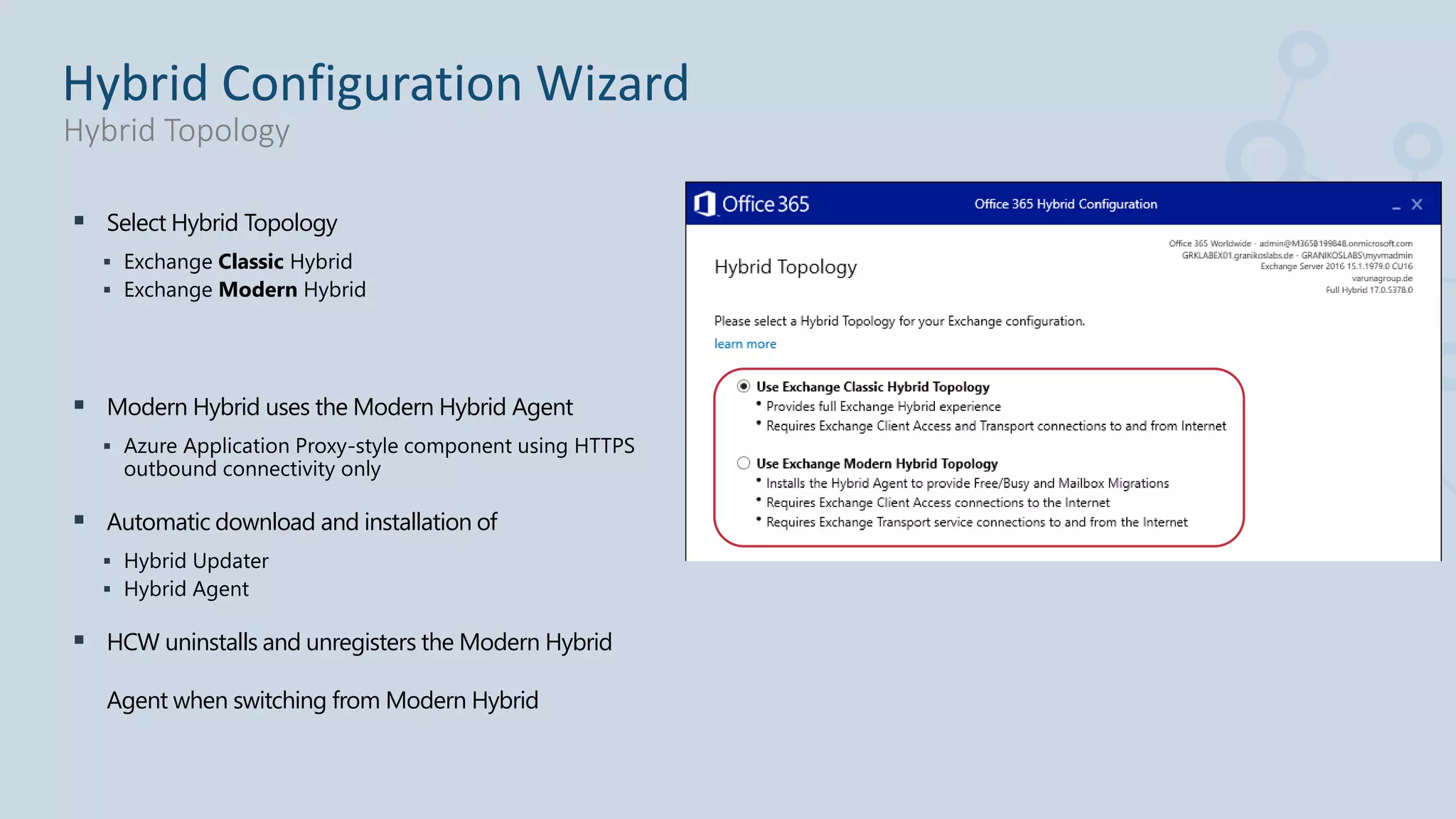
 Select Hybrid Topology
 Exchange Classic Hybrid
 Exchange Modern Hybrid
 Modern Hybrid uses the Modern Hybrid Agent
 Azure Application Proxy-style component using HTTPS
outbound connectivity only
 Automatic download and installation of
 Hybrid Updater
 Hybrid Agent
 HCW uninstalls and unregisters the Modern Hybrid
Agent when switching from Modern Hybrid
Hybrid Configuration Wizard
Hybrid Topology
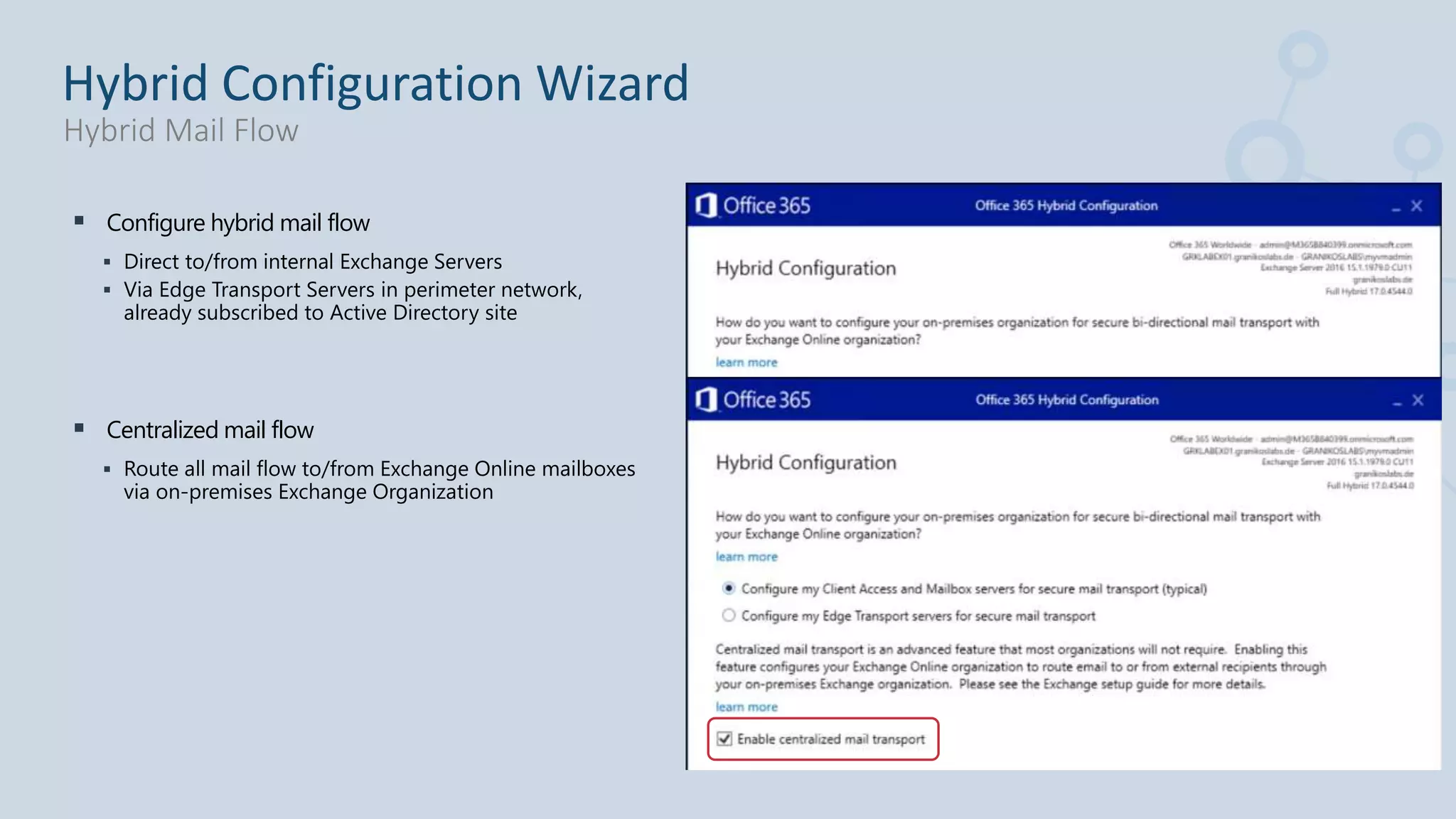
 Configure hybrid mail flow
 Direct to/from internal Exchange Servers
 Via Edge Transport Servers in perimeter network,
already subscribed to Active Directory site
 Centralized mail flow
 Route all mail flow to/from Exchange Online mailboxes
via on-premises Exchange Organization
Hybrid Configuration Wizard
Hybrid Mail Flow
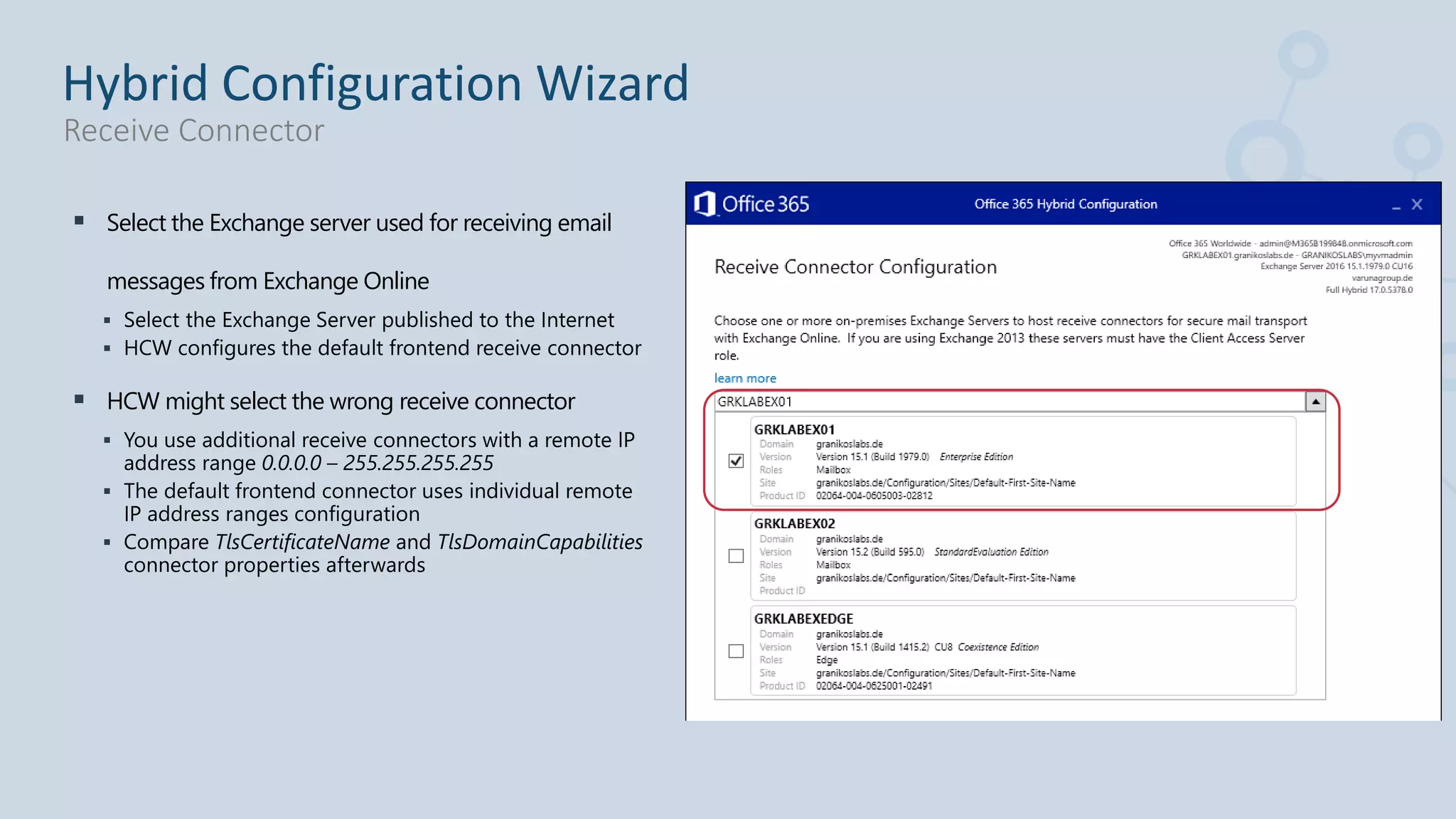
 Select the Exchange server used for receiving email
messages from Exchange Online
 Select the Exchange Server published to the Internet
 HCW configures the default frontend receive connector
 HCW might select the wrong receive connector
 You use additional receive connectors with a remote IP
address range 0.0.0.0 – 255.255.255.255
 The default frontend connector uses individual remote
IP address ranges configuration
 Compare TlsCertificateName and TlsDomainCapabilities
connector properties afterwards
Hybrid Configuration Wizard
Receive Connector
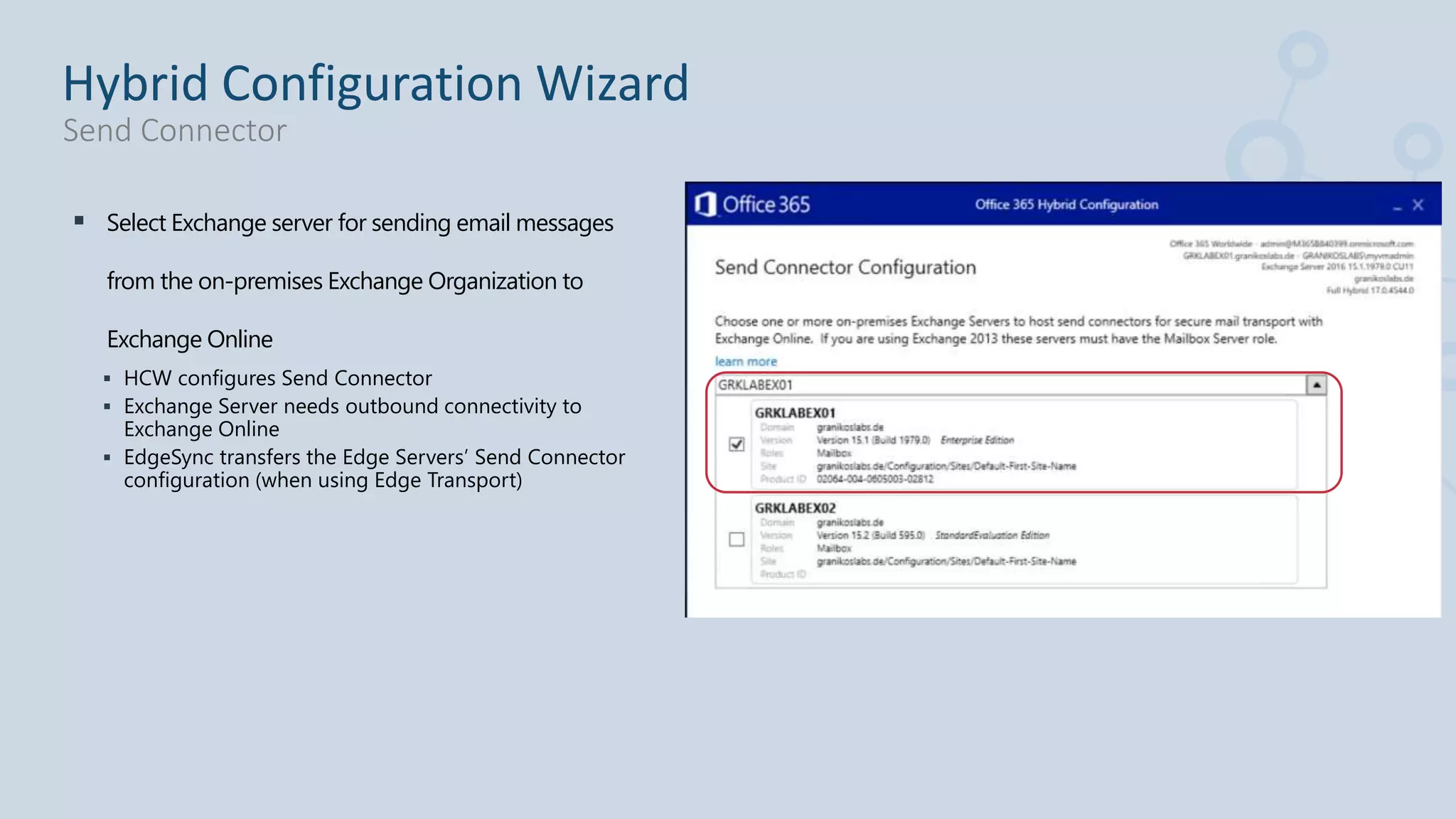
 Select Exchange server for sending email messages
from the on-premises Exchange Organization to
Exchange Online
 HCW configures Send Connector
 Exchange Server needs outbound connectivity to
Exchange Online
 EdgeSync transfers the Edge Servers’ Send Connector
configuration (when using Edge Transport)
Hybrid Configuration Wizard
Send Connector
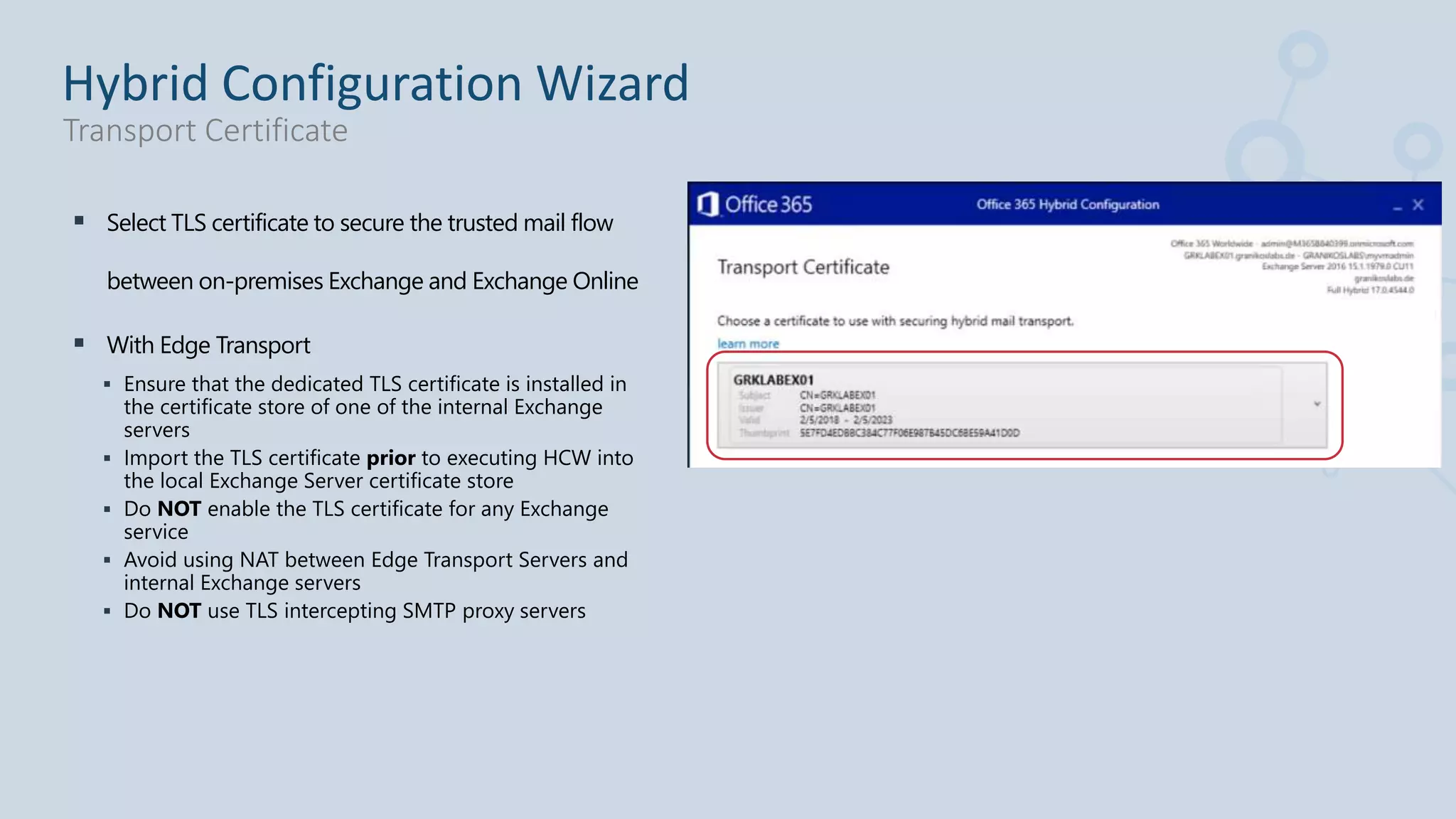
 Select TLS certificate to secure the trusted mail flow
between on-premises Exchange and Exchange Online
 With Edge Transport
 Ensure that the dedicated TLS certificate is installed in
the certificate store of one of the internal Exchange
servers
 Import the TLS certificate prior to executing HCW into
the local Exchange Server certificate store
 Do NOT enable the TLS certificate for any Exchange
service
 Avoid using NAT between Edge Transport Servers and
internal Exchange servers
 Do NOT use TLS intercepting SMTP proxy servers
Hybrid Configuration Wizard
Transport Certificate
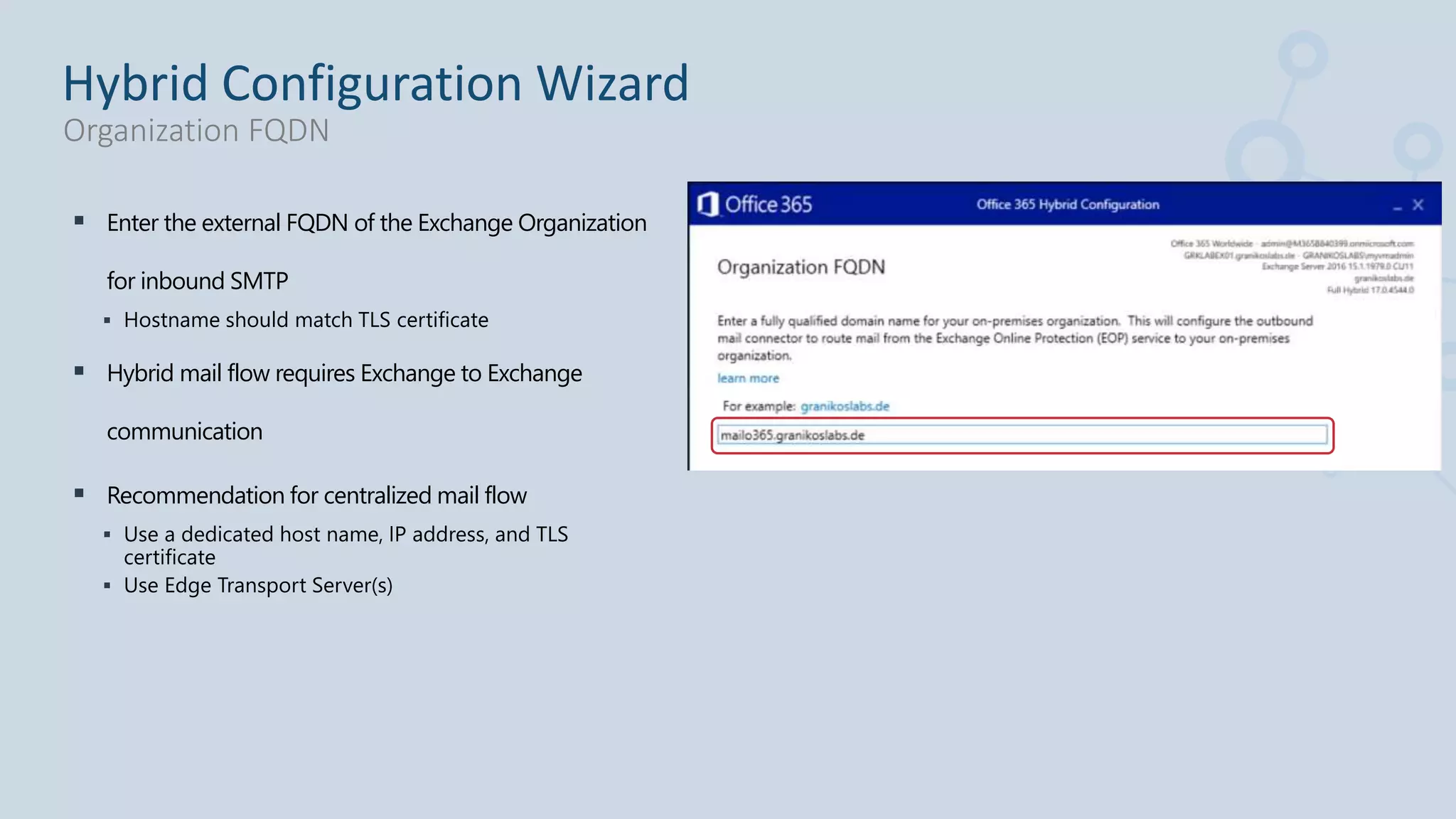
 Enter the external FQDN of the Exchange Organization
for inbound SMTP
 Hostname should match TLS certificate
 Hybrid mail flow requires Exchange to Exchange
communication
 Recommendation for centralized mail flow
 Use a dedicated host name, IP address, and TLS
certificate
 Use Edge Transport Server(s)
Hybrid Configuration Wizard
Organization FQDN
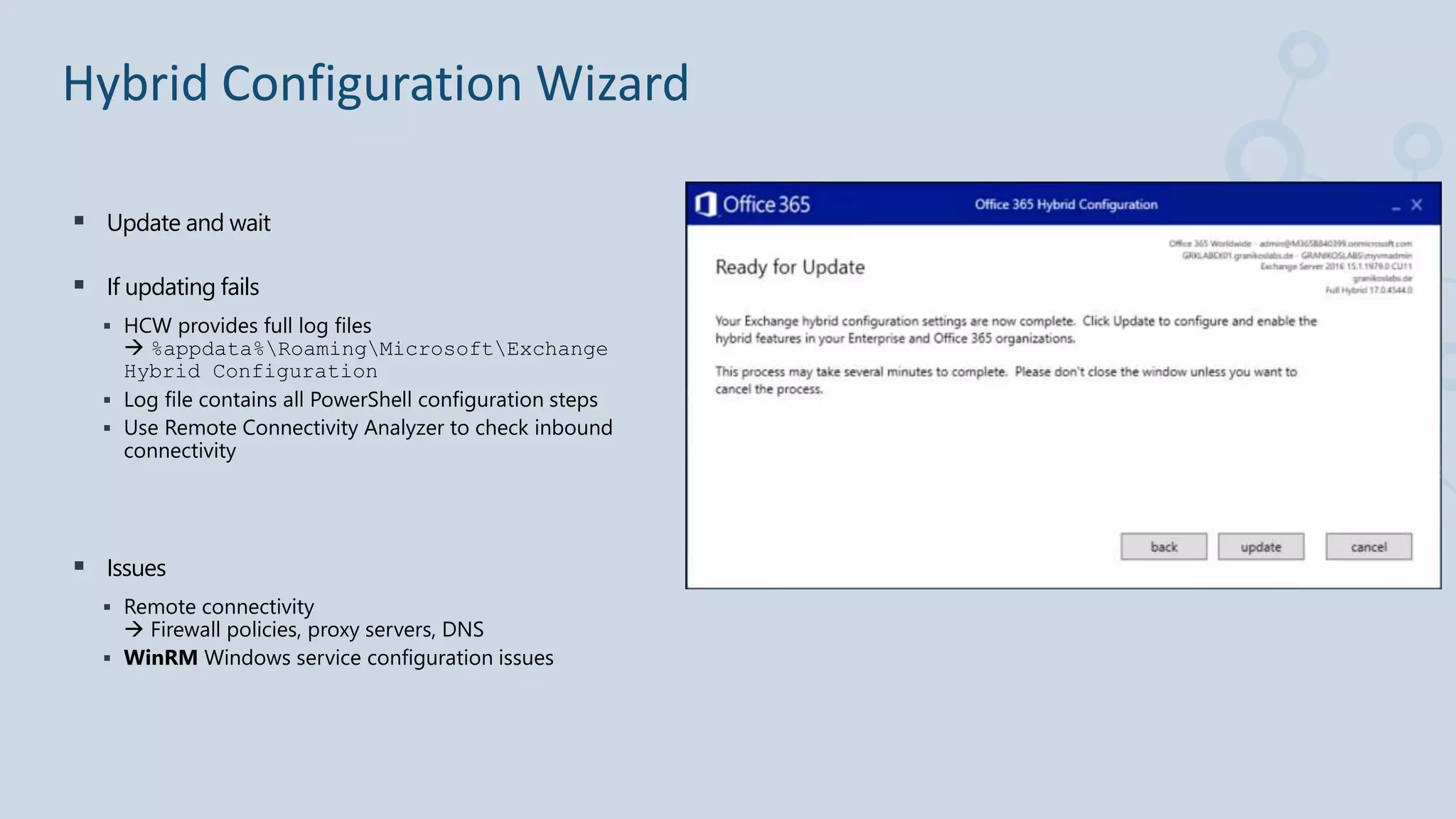
 Update and wait
 If updating fails
 HCW provides full log files
 %appdata%RoamingMicrosoftExchange
Hybrid Configuration
 Log file contains all PowerShell configuration steps
 Use Remote Connectivity Analyzer to check inbound
connectivity
 Issues
 Remote connectivity
 Firewall policies, proxy servers, DNS
 WinRM Windows service configuration issues
Hybrid Configuration Wizard
Microsoft Teams and
Exchange Server
 Microsoft Teams Client communicates with Teams Middle-Tier, not with Exchange directly
 Microsoft Teams Middle-Tier contacts Exchange Online first
 If user mailbox is not in Exchange Online, the Teams Backend receives an HTTP 302 Redirect to On-Premises
 On-premises endpoint is always discovered using AutoDiscover v2
 Exchange Redirect requires AAD Connect synchronization with Exchange Hybrid option enabled
 Authentication requires OAuth between Exchange Server and Exchange Online / Azure AD
 Use Hybrid Configuration Wizard to configure OAuth (preferred)
 Microsoft Teams Backend requires communication with AutoDiscover, EWS, and REST endpoints
Microsoft Teams and Exchange Server
 When using many different SMTP domain names, you need a dedicated AutoDiscover v2 endpoint for each domain
 Microsoft Teams backend services do not handle an on-premises HTTP 302 redirect correctly
 Publish an AutoDiscover endpoint for each SMTP domain
 Use an edge router if you cannot add all domains to a single SAN certificate, e.g., Traeffic
 Check Microsoft Teams Coexistence mode with Skype for Business Online
 Only Island, Teams Only, or Skype for Business with Teams Collaboration and Meeting support the calendar tab
 Verify that the calendar tab is enabled in Teams App Policy
 Ensure that Exchange Hybrid is enabled in Azure AD Connect
Microsoft Teams and Exchange Server
Thomas Stensitzki
Enterprise Consultant | Owner
Granikos GmbH & Co. KG
MVP | Office Apps & Services
Email thomas.stensitzki@granikos.eu
Twitter @Stensitzki
LinkedIn https://linkedin.com/in/thomasstensitzki
Blog http://JustCantGetEnough.Granikos.eu
Web https://www.stensitzki.de

MCT Summit Middle East 2021 - Exchange Hybrid - What, Why, and How

  • 1.
  • 2.
    Thomas Stensitzki Enterprise Consultant| Owner Granikos GmbH & Co. KG MVP | Office Apps & Services MCT Regional Lead Email thomas.stensitzki@granikos.eu Twitter @Stensitzki LinkedIn https://linkedin.com/in/thomasstensitzki Blog http://JustCantGetEnough.Granikos.eu Web https://www.stensitzki.de
  • 3.
  • 4.
    On-Premises Exchange Organization Microsoft365 Exchange Online Hybrid Configuration  Trusted relationship between an on-premises Exchange Organization and Exchange Online  Hybrid connections for mail flow (SMTP), and service access (HTTPS) for Exchange hybrid functionality  Hybrid Configuration Wizard (HCW) activates and configures the hybrid mode of operation What is Exchange Hybrid?
  • 5.
    Hybrid Mode Classic Express MinimalFull Modern Minimal Full Exchange Hybrid Two Modes – Three Variants
  • 6.
    On-Premises Exchange Organization Hybrid Configuration PerimeterNetwork Microsoft 365 Exchange Online Azure AD Company Network SMTP HTTPS  Active Directory Hybrid with Azure AD Connect  Exchange Hybrid option enabled  SMTP Connection between On-Premises and Exchange Online  Separate hostname (e.g., smtp365.company.com)  Additional public IP address  TLS certificate for hostname  Edge Transport Role in perimeter network (1)  Alternatively, direct inbound connection (2)  Inbound HTTPS connection to Client Access Service  Internal Exchange Servers published by a Reverse Proxy  Requires additional public IP address  Outbound HTTPS connections to Exchange Online  Exchange Server communication to Exchange Online Classic Full Hybrid
  • 7.
     Active DirectoryHybrid with Azure AD Connect  Exchange Hybrid option enabled  SMTP Connection between On-Premises and Exchange Online  Separate hostname (e.g., smtp365.company.com)  Additional public IP address  TLS certificate for hostname  Edge Transport Role in perimeter network (1)  Alternatively, direct inbound connection (2)  Outbound HTTPS connections to Exchange Online  Exchange Hybrid-Agent Exchange Online to Exchange on-premises communication  Exchange Server communication to Exchange Online  Install additional Hybrid-Agents for redundancy Hybrid Configuration Perimeter Network Microsoft 365 Exchange Online Azure AD Company Network On-Premises Exchange Organization HTTPS SMTP Modern Full Hybrid
  • 8.
    Full Full classichybrid configuration, Exchange server published to the internet (SMTP/HTTPS)  permanent hybrid operation and Teams access to on-premises Minimal Hybrid configuration, without rich coexistence to migrate all on-premises mailboxes to Exchange Online  temporary hybrid operation for a few weeks / months Express Hybrid configuration, with Azure AD Connect Express settings, to migrate all on-premises mailboxes to Exchange Online  temporary hybrid operation for a few days / weeks Full Full Modern Hybrid configuration, for new hybrid setups based on Hybrid Agent deployment, with reduced hybrid functionality  permanent hybrid operation Minimal Modern Hybrid configuration, to migrate all on-premises mailboxes to Exchange Online  temporary hybrid operation for a few weeks / months Exchange Hybrid The Differences
  • 9.
    Why do youneed Exchange Hybrid?
  • 10.
     Coexistence betweenyour on-premises Exchange Organization and Exchange Online  Mailbox migration to and from Exchange Online  Seamless public folder migration to Exchange Online  Microsoft Teams with on-premises mailboxes (calendar access)  Transition from an on-premises Exchange Organization to Exchange Online  Optimal migration experience for end users  Centralized mail flow for use of on-premises email solutions with user mailboxes in Exchange Online  Gateway-based S/MIME decryption/encryption, email disclaimer, archiving, journaling, …  Hybrid mail flow providing email relay functionality for on-premises legacy applications and devices with  No access to the internet  No support for TLS protocols 1.0 or 1.1  No support for SMTPAUTH user authentication  No support for SMTP modern authentication Why do you need Exchange Hybrid?
  • 11.
     On-Premises ExchangeServer 2019 hybrid endpoint  Microsoft Teams backend services use AutoDiscover v2 to discover on-premises EWS and REST endpoints  Client Access Endpoint accessible for Microsoft Teams backend services  Always use latest Exchange Server cumulative update  In-Place upgrade capability for Exchange Server vNEXT (H2 2021)  Use Third-Party TLS-certificate with all required subject alternate names (SAN) for incoming HTTPS connections  AutoDiscover  Exchange namespace  Exchange Virtual Directory’s external URL-Settings  Use a dedicated Third-Party TLS-certificate for SMTP when using centralized mail flow  Enable and configure OAUTH authentication using Hybrid Configuration Wizard  Exchange team provides detailed information on how to configure OAUTH manually  AutoDiscover DNS resource records for SMTP domains used for primary email addresses  Use Exchange Server 2016 if you need a coexistence server only Exchange Hybrid Recommendations
  • 12.
  • 13.
     Know thedifferences of the Exchange hybrid variants and modes of operation available  Know the mode of operation for your Exchange Organization and hybrid requirements  Have your on-premises Exchange organization ready for hybrid configuration  Install latest Exchange Server Cumulative Updates on all Exchange Servers, including Edge Transport  Have required IP addresses & DNS hostnames for the Exchange namespace set up  Verify inbound connectivity to your Exchange organization using Remote Connectivity Analyzer (RCA)  When your firewall policy is restricted for inbound traffic, add the RCA IP addresses to that policy  RCA release notes  Have Edge Transport TLS certificates installed on internal an Exchange Server for selection by HCW, when using Edge  Do NOT enable this certificate for any Exchange service  Enable Exchange Hybrid option in Azure AD Connect first Exchange Hybrid Requirtements
  • 14.
     Click-2-Run Setup https://aka.ms/HybridWizard  .application file type requires mapping to Internet Explorer  Note the HCW version information  Current: v17  Uninstall v16 first  HCW is updated regularly  HCW downloads a newer version automatically when started  HCW configuration steps vary depending on your Exchange Organization configuration Hybrid Configuration Wizard
  • 15.
     HCW detectsthe optimal Exchange Server for configuration automatically  Specify a CAS server manually, if needed  Select the appropriate Office 365 target infrastructure  Office 365 Worldwide is the default for commercial customers Hybrid Configuration Wizard On-Premises Organization
  • 16.
     HCW connectsto on-premises Exchange and Exchange Online to gather the current organizational configuration  Adjust credentials as needed   Check, if WinRM allows Basic Authentication Hybrid Configuration Wizard Gathering Organization Configuration
  • 17.
     Select hybridfeatures to configure  Minimal Hybrid  Full Hybrid  Enable Organization Configuration Transfer  One-time transfer of selected configuration objects  Available objects depend on the on-premises Exchange Server version Hybrid Organization Configuration Transfer Documentation Hybrid Configuration Wizard Hybrid Features
  • 18.
     Select HybridTopology  Exchange Classic Hybrid  Exchange Modern Hybrid  Modern Hybrid uses the Modern Hybrid Agent  Azure Application Proxy-style component using HTTPS outbound connectivity only  Automatic download and installation of  Hybrid Updater  Hybrid Agent  HCW uninstalls and unregisters the Modern Hybrid Agent when switching from Modern Hybrid Hybrid Configuration Wizard Hybrid Topology
  • 19.
     Configure hybridmail flow  Direct to/from internal Exchange Servers  Via Edge Transport Servers in perimeter network, already subscribed to Active Directory site  Centralized mail flow  Route all mail flow to/from Exchange Online mailboxes via on-premises Exchange Organization Hybrid Configuration Wizard Hybrid Mail Flow
  • 20.
     Select theExchange server used for receiving email messages from Exchange Online  Select the Exchange Server published to the Internet  HCW configures the default frontend receive connector  HCW might select the wrong receive connector  You use additional receive connectors with a remote IP address range 0.0.0.0 – 255.255.255.255  The default frontend connector uses individual remote IP address ranges configuration  Compare TlsCertificateName and TlsDomainCapabilities connector properties afterwards Hybrid Configuration Wizard Receive Connector
  • 21.
     Select Exchangeserver for sending email messages from the on-premises Exchange Organization to Exchange Online  HCW configures Send Connector  Exchange Server needs outbound connectivity to Exchange Online  EdgeSync transfers the Edge Servers’ Send Connector configuration (when using Edge Transport) Hybrid Configuration Wizard Send Connector
  • 22.
     Select TLScertificate to secure the trusted mail flow between on-premises Exchange and Exchange Online  With Edge Transport  Ensure that the dedicated TLS certificate is installed in the certificate store of one of the internal Exchange servers  Import the TLS certificate prior to executing HCW into the local Exchange Server certificate store  Do NOT enable the TLS certificate for any Exchange service  Avoid using NAT between Edge Transport Servers and internal Exchange servers  Do NOT use TLS intercepting SMTP proxy servers Hybrid Configuration Wizard Transport Certificate
  • 23.
     Enter theexternal FQDN of the Exchange Organization for inbound SMTP  Hostname should match TLS certificate  Hybrid mail flow requires Exchange to Exchange communication  Recommendation for centralized mail flow  Use a dedicated host name, IP address, and TLS certificate  Use Edge Transport Server(s) Hybrid Configuration Wizard Organization FQDN
  • 24.
     Update andwait  If updating fails  HCW provides full log files  %appdata%RoamingMicrosoftExchange Hybrid Configuration  Log file contains all PowerShell configuration steps  Use Remote Connectivity Analyzer to check inbound connectivity  Issues  Remote connectivity  Firewall policies, proxy servers, DNS  WinRM Windows service configuration issues Hybrid Configuration Wizard
  • 25.
  • 26.
     Microsoft TeamsClient communicates with Teams Middle-Tier, not with Exchange directly  Microsoft Teams Middle-Tier contacts Exchange Online first  If user mailbox is not in Exchange Online, the Teams Backend receives an HTTP 302 Redirect to On-Premises  On-premises endpoint is always discovered using AutoDiscover v2  Exchange Redirect requires AAD Connect synchronization with Exchange Hybrid option enabled  Authentication requires OAuth between Exchange Server and Exchange Online / Azure AD  Use Hybrid Configuration Wizard to configure OAuth (preferred)  Microsoft Teams Backend requires communication with AutoDiscover, EWS, and REST endpoints Microsoft Teams and Exchange Server
  • 27.
     When usingmany different SMTP domain names, you need a dedicated AutoDiscover v2 endpoint for each domain  Microsoft Teams backend services do not handle an on-premises HTTP 302 redirect correctly  Publish an AutoDiscover endpoint for each SMTP domain  Use an edge router if you cannot add all domains to a single SAN certificate, e.g., Traeffic  Check Microsoft Teams Coexistence mode with Skype for Business Online  Only Island, Teams Only, or Skype for Business with Teams Collaboration and Meeting support the calendar tab  Verify that the calendar tab is enabled in Teams App Policy  Ensure that Exchange Hybrid is enabled in Azure AD Connect Microsoft Teams and Exchange Server
  • 28.
    Thomas Stensitzki Enterprise Consultant| Owner Granikos GmbH & Co. KG MVP | Office Apps & Services Email thomas.stensitzki@granikos.eu Twitter @Stensitzki LinkedIn https://linkedin.com/in/thomasstensitzki Blog http://JustCantGetEnough.Granikos.eu Web https://www.stensitzki.de