Microeconomics
McConnell and Brue
Consumer
Behavior
Chapter 06
Elasticity
Prof. Dr. Musarrat Adnan
Learning Objectives
 Discuss price elasticity of demand and
how it is calculated.
 Explain the usefulness of the total-
revenue test for price elasticity of demand.
 List the factors that affect price elasticity
of demand and describe some
applications of price elasticity of demand.
 Describe price elasticity of supply and
how it can be applied.
 Apply cross elasticity of demand and
income elasticity of demand.
Topics
 Price Elasticity of Demand
 Price Elasticity of Supply
 Cross Elasticity & Income
Elasticity of Demand
 Elasticity & Taxes
 Government-Set Prices
Price Elasticity of Demand
Think About It.........
THE LAW OF DEMAND SAYS.…
An increase in price causes
a decrease in quantity demanded
(& vice versa).
But HOW MUCH does quantity demanded
change in response to a change in price?
Elasticity gives us a measure of
RESPONSIVENESS
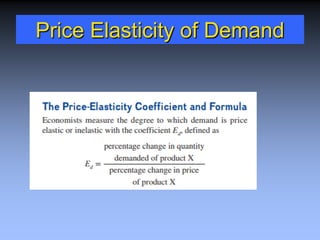
Price Elasticity of Demand
 The responsiveness (or sensitivity)
of consumers to a price change is
measured by a product’s price
elasticity of demand.
 When QD responds STRONGLY to a
change in P, demand is ELASTIC
 When QD responds WEAKLY to a
change in P, demand is INELASTIC
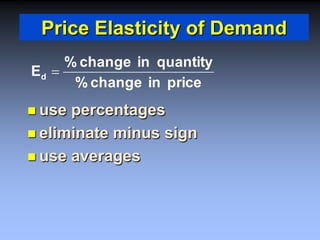
Price Elasticity of Demand
price
in
change
%
quantity
in
change
%
Ed =
Price Elasticity of Demand
 use percentages
 eliminate minus sign
 use averages
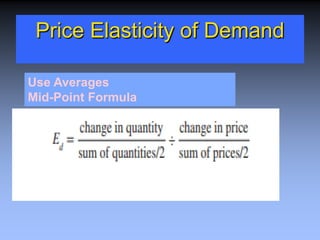
Price Elasticity of Demand
Use Averages
Mid-Point Formula
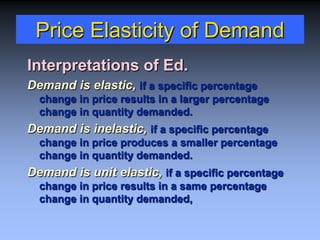
Price Elasticity of Demand
Interpretations of Ed.
Demand is elastic, if a specific percentage
change in price results in a larger percentage
change in quantity demanded.
Demand is inelastic, if a specific percentage
change in price produces a smaller percentage
change in quantity demanded.
Demand is unit elastic, if a specific percentage
change in price results in a same percentage
change in quantity demanded,
Price Elasticity of Demand
Interpretations of Ed
Extreme Cases:
Demand is perfectly inelastic, if a price change
results in no change whatsoever in the quantity
demanded.
Demand is perfectly elastic, if an infinitely
small price reduction causes buyers to increase
their purchases to an infinite level, and the
elasticity coefficient is infinite (= ∞)
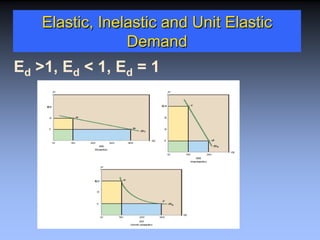
Elastic, Inelastic and Unit Elastic
Demand
Ed >1, Ed < 1, Ed = 1
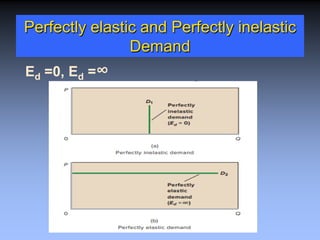
Perfectly elastic and Perfectly inelastic
Demand
Ed =0, Ed =∞
Price Elasticity and the Total-Revenue
Curve
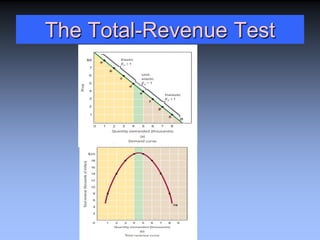
Total Revenue
Total Revenue (TR) is the total amount the seller
receives from the sale of a product in a particular
time period (TR= PxQ).
Marginal Revenue along a Linear Demand Curve
Marginal revenue curve is downward sloping straight
line whose slope is double the slope of demand curve
and lies on the horizontal axis at half way to the
demand curve
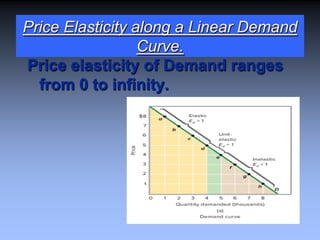
Price Elasticity along a Linear Demand
Curve.
Price elasticity of Demand ranges
from 0 to infinity.
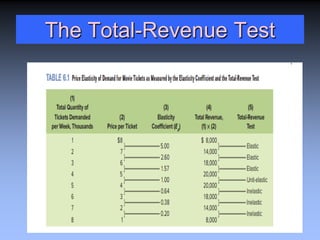
The Total-Revenue Test
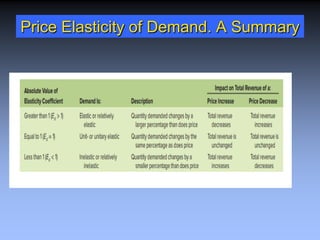
Price Elasticity of Demand. A Summary
Determinants of Price Elasticity of
Demand
Substitutability
Proportion of income
Luxuries versus necessities
Time /Short run versus long run
demand.
Determinants of Price Elasticity of
Demand
Substitutability
The larger the number of substitute goods that
are available, the greater the price elasticity of
demand.
The elasticity of demand for a product depends
on how narrowly the product is defined
Determinants of Price Elasticity of
Demand
Proportion of income.
Other things equal, the higher the proportion of
income spent on a commodity the higher the
demand elasticity.
Luxuries versus necessities.
The more that a good is considered to be a
“luxury” rather than a “necessity,” the greater is
the price elasticity of demand
Determinants of Price Elasticity of
Demand
Time / Short run versus long run demand.
Short run demand is inelastic and long run
demand is elastic
Consumers often need time to adjust to
changes in prices
Applications of Price Elasticity of
Demand
Large Crop yields/ Bumper Crops
Sales / Excise Taxes
Decriminalization of Illegal Drugs
Applications of Price Elasticity of
Demand
Large Crop yields/ Bumper Crops
The demand for most farm products is highly
inelastic. As a result, increases in the supply of
farm products arising from a good growing
season or from increased productivity tend to
depress both the prices of farm products and the
total revenues (incomes) of farmers.
Sales / Excise Taxes
A higher tax on a product with elastic demand will
bring in less tax revenue.
The government pays attention to elasticity of
demand when it selects goods and services on
which to levy excise taxes.
Applications of Price Elasticity of
Demand
Decriminalization of Illegal Drugs.
The demand for drugs is inelastic. Therefore, a proper
Legalization would allegedly reduce drug trafficking
significantly by taking the profit out of it.
As the demand of addicts is highly inelastic, the
amounts consumed at the lower prices would
increase only modestly. Addicts’ total expenditures
for cocaine and heroin would decline, and so would
the street crime that finances those expenditures.
Applications of Price Elasticity of
Demand
Minimum Wage????
Price Elasticity of Supply
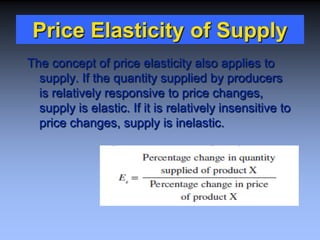
The concept of price elasticity also applies to
supply. If the quantity supplied by producers
is relatively responsive to price changes,
supply is elastic. If it is relatively insensitive to
price changes, supply is inelastic.
Price Elasticity of Supply
if the coefficient of price-elasticity (Es) is:
Less than 1, Supply is inelastic ,
Greater than 1, Supply is elastic,
Equal to 1, Supply is unit-elastic,
Equal to 0, Supply is perfectly inelastic,
Equal to ∞, Supply is perfectly elastic.
Es is never negative, since price and quantity
supplied are directly related. Thus, there are no
minus signs to drop, as was necessary
 with elasticity of demand.
Determinants of Price Elasticity of
Supply
Resource substitution possibilities.
The ease with which the resources can be
substituted with each other—and therefore quick
shift of resources between alternative uses
makes the supply elastic.
Time /Short run and long run supply.
Immediate time period.
Short run
Long run
Very long run
Determinants of Price Elasticity of
Supply
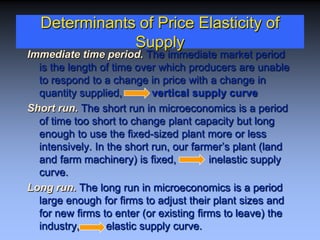
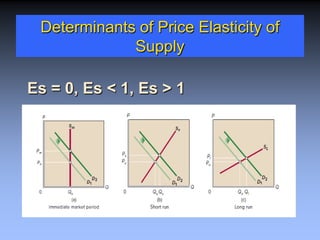
Immediate time period. The immediate market period
is the length of time over which producers are unable
to respond to a change in price with a change in
quantity supplied, vertical supply curve
Short run. The short run in microeconomics is a period
of time too short to change plant capacity but long
enough to use the fixed-sized plant more or less
intensively. In the short run, our farmer’s plant (land
and farm machinery) is fixed, inelastic supply
curve.
Long run. The long run in microeconomics is a period
large enough for firms to adjust their plant sizes and
for new firms to enter (or existing firms to leave) the
industry, elastic supply curve.
Determinants of Price Elasticity of
Supply
Es = 0, Es ˂ 1, Es ˃ 1
Applications of Price Elasticity of
Supply
Antiques and Reproductions (perfectly
inelastic supply)
Volatile gold prices (inelastic supply)
Mobile phone technology (elastic supply)
Cross Elasticity of Demand
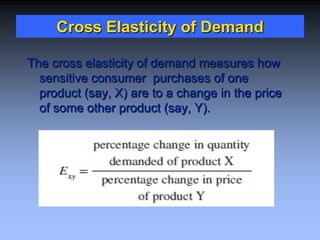
The cross elasticity of demand measures how
sensitive consumer purchases of one
product (say, X) are to a change in the price
of some other product (say, Y).
Cross Elasticity of Demand
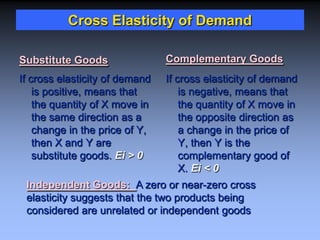
Substitute Goods
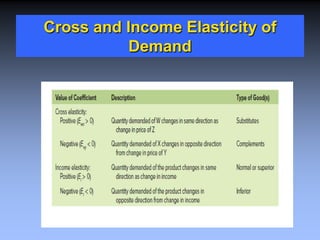
If cross elasticity of demand
is positive, means that
the quantity of X move in
the same direction as a
change in the price of Y,
then X and Y are
substitute goods. Ei ˃ 0
Complementary Goods
If cross elasticity of demand
is negative, means that
the quantity of X move in
the opposite direction as
a change in the price of
Y, then Y is the
complementary good of
X. Ei ˂ 0
Independent Goods: A zero or near-zero cross
elasticity suggests that the two products being
considered are unrelated or independent goods
Income Elasticity of Demand
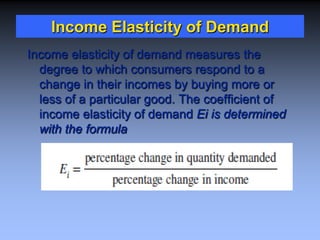
Income elasticity of demand measures the
degree to which consumers respond to a
change in their incomes by buying more or
less of a particular good. The coefficient of
income elasticity of demand Ei is determined
with the formula
Income Elasticity of Demand
Normal Goods
Income-elasticity
coefficient, Ei is
positive, for normal
goods, means more of
them are demanded as
incomes rise. Ei ˃ 0
Inferior Goods
Income-elasticity
coefficient, Ei is
negative, for inferior
goods, means less of
them are demanded as
incomes rise. Ei ˂ 0
Application.
When recessions (business downturns) occur
and incomes fall, income elasticity of demand
helps predict which products will decline in
demand more rapidly than others.
Cross and Income Elasticity of
Demand
Quick Questions
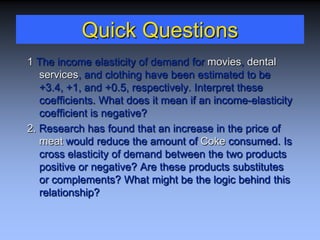
1 The income elasticity of demand for movies, dental
services, and clothing have been estimated to be
+3.4, +1, and +0.5, respectively. Interpret these
coefficients. What does it mean if an income-elasticity
coefficient is negative?
2. Research has found that an increase in the price of
meat would reduce the amount of Coke consumed. Is
cross elasticity of demand between the two products
positive or negative? Are these products substitutes
or complements? What might be the logic behind this
relationship?
Quick Questions
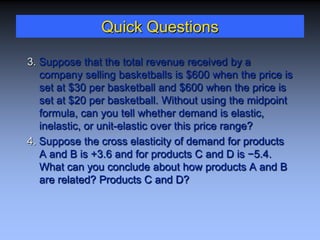
3. Suppose that the total revenue received by a
company selling basketballs is $600 when the price is
set at $30 per basketball and $600 when the price is
set at $20 per basketball. Without using the midpoint
formula, can you tell whether demand is elastic,
inelastic, or unit-elastic over this price range?
4. Suppose the cross elasticity of demand for products
A and B is +3.6 and for products C and D is −5.4.
What can you conclude about how products A and B
are related? Products C and D?
Quick Questions
5. If 5% increase in the price of meat decreases the
consumption of meat by 5 % and increases the
consumption of chicken by 10%. Find price
elasticity of demand for meat and cross elasticity
for chicken.
6. If income rises in an economy by 3% and
quantity demanded for bus ride on a certain route
decreases from 15,000 passengers to 12,000
passengers per day, and demand for Uber ride
increases by 600 rides to 900 rides on the same
route per day. Find income elasticity of bus ride
and Uber ride. What can you say about the two
commodities.
Quick Questions
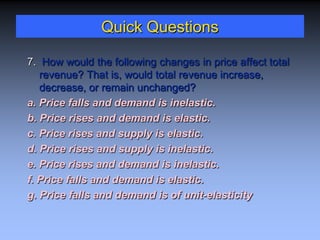
7. How would the following changes in price affect total
revenue? That is, would total revenue increase,
decrease, or remain unchanged?
a. Price falls and demand is inelastic.
b. Price rises and demand is elastic.
c. Price rises and supply is elastic.
d. Price rises and supply is inelastic.
e. Price rises and demand is inelastic.
f. Price falls and demand is elastic.
g. Price falls and demand is of unit-elasticity

McConnel and Brue-Chapter-6.Elasticity pdf

  • 1.
  • 2.
    Learning Objectives  Discussprice elasticity of demand and how it is calculated.  Explain the usefulness of the total- revenue test for price elasticity of demand.  List the factors that affect price elasticity of demand and describe some applications of price elasticity of demand.  Describe price elasticity of supply and how it can be applied.  Apply cross elasticity of demand and income elasticity of demand.
  • 3.
    Topics  Price Elasticityof Demand  Price Elasticity of Supply  Cross Elasticity & Income Elasticity of Demand  Elasticity & Taxes  Government-Set Prices
  • 4.
    Price Elasticity ofDemand Think About It......... THE LAW OF DEMAND SAYS.… An increase in price causes a decrease in quantity demanded (& vice versa). But HOW MUCH does quantity demanded change in response to a change in price? Elasticity gives us a measure of RESPONSIVENESS
  • 5.
    Price Elasticity ofDemand  The responsiveness (or sensitivity) of consumers to a price change is measured by a product’s price elasticity of demand.  When QD responds STRONGLY to a change in P, demand is ELASTIC  When QD responds WEAKLY to a change in P, demand is INELASTIC
  • 6.
  • 7.
    price in change % quantity in change % Ed = Price Elasticityof Demand  use percentages  eliminate minus sign  use averages
  • 8.
    Price Elasticity ofDemand Use Averages Mid-Point Formula
  • 9.
    Price Elasticity ofDemand Interpretations of Ed. Demand is elastic, if a specific percentage change in price results in a larger percentage change in quantity demanded. Demand is inelastic, if a specific percentage change in price produces a smaller percentage change in quantity demanded. Demand is unit elastic, if a specific percentage change in price results in a same percentage change in quantity demanded,
  • 10.
    Price Elasticity ofDemand Interpretations of Ed Extreme Cases: Demand is perfectly inelastic, if a price change results in no change whatsoever in the quantity demanded. Demand is perfectly elastic, if an infinitely small price reduction causes buyers to increase their purchases to an infinite level, and the elasticity coefficient is infinite (= ∞)
  • 11.
    Elastic, Inelastic andUnit Elastic Demand Ed >1, Ed < 1, Ed = 1
  • 12.
    Perfectly elastic andPerfectly inelastic Demand Ed =0, Ed =∞
  • 13.
    Price Elasticity andthe Total-Revenue Curve Total Revenue Total Revenue (TR) is the total amount the seller receives from the sale of a product in a particular time period (TR= PxQ). Marginal Revenue along a Linear Demand Curve Marginal revenue curve is downward sloping straight line whose slope is double the slope of demand curve and lies on the horizontal axis at half way to the demand curve
  • 14.
    Price Elasticity alonga Linear Demand Curve. Price elasticity of Demand ranges from 0 to infinity.
  • 15.
  • 16.
  • 17.
    Price Elasticity ofDemand. A Summary
  • 18.
    Determinants of PriceElasticity of Demand Substitutability Proportion of income Luxuries versus necessities Time /Short run versus long run demand.
  • 19.
    Determinants of PriceElasticity of Demand Substitutability The larger the number of substitute goods that are available, the greater the price elasticity of demand. The elasticity of demand for a product depends on how narrowly the product is defined
  • 20.
    Determinants of PriceElasticity of Demand Proportion of income. Other things equal, the higher the proportion of income spent on a commodity the higher the demand elasticity. Luxuries versus necessities. The more that a good is considered to be a “luxury” rather than a “necessity,” the greater is the price elasticity of demand
  • 21.
    Determinants of PriceElasticity of Demand Time / Short run versus long run demand. Short run demand is inelastic and long run demand is elastic Consumers often need time to adjust to changes in prices
  • 22.
    Applications of PriceElasticity of Demand Large Crop yields/ Bumper Crops Sales / Excise Taxes Decriminalization of Illegal Drugs
  • 23.
    Applications of PriceElasticity of Demand Large Crop yields/ Bumper Crops The demand for most farm products is highly inelastic. As a result, increases in the supply of farm products arising from a good growing season or from increased productivity tend to depress both the prices of farm products and the total revenues (incomes) of farmers. Sales / Excise Taxes A higher tax on a product with elastic demand will bring in less tax revenue. The government pays attention to elasticity of demand when it selects goods and services on which to levy excise taxes.
  • 24.
    Applications of PriceElasticity of Demand Decriminalization of Illegal Drugs. The demand for drugs is inelastic. Therefore, a proper Legalization would allegedly reduce drug trafficking significantly by taking the profit out of it. As the demand of addicts is highly inelastic, the amounts consumed at the lower prices would increase only modestly. Addicts’ total expenditures for cocaine and heroin would decline, and so would the street crime that finances those expenditures.
  • 25.
    Applications of PriceElasticity of Demand Minimum Wage????
  • 26.
    Price Elasticity ofSupply The concept of price elasticity also applies to supply. If the quantity supplied by producers is relatively responsive to price changes, supply is elastic. If it is relatively insensitive to price changes, supply is inelastic.
  • 27.
    Price Elasticity ofSupply if the coefficient of price-elasticity (Es) is: Less than 1, Supply is inelastic , Greater than 1, Supply is elastic, Equal to 1, Supply is unit-elastic, Equal to 0, Supply is perfectly inelastic, Equal to ∞, Supply is perfectly elastic. Es is never negative, since price and quantity supplied are directly related. Thus, there are no minus signs to drop, as was necessary  with elasticity of demand.
  • 28.
    Determinants of PriceElasticity of Supply Resource substitution possibilities. The ease with which the resources can be substituted with each other—and therefore quick shift of resources between alternative uses makes the supply elastic. Time /Short run and long run supply. Immediate time period. Short run Long run Very long run
  • 29.
    Determinants of PriceElasticity of Supply Immediate time period. The immediate market period is the length of time over which producers are unable to respond to a change in price with a change in quantity supplied, vertical supply curve Short run. The short run in microeconomics is a period of time too short to change plant capacity but long enough to use the fixed-sized plant more or less intensively. In the short run, our farmer’s plant (land and farm machinery) is fixed, inelastic supply curve. Long run. The long run in microeconomics is a period large enough for firms to adjust their plant sizes and for new firms to enter (or existing firms to leave) the industry, elastic supply curve.
  • 30.
    Determinants of PriceElasticity of Supply Es = 0, Es ˂ 1, Es ˃ 1
  • 31.
    Applications of PriceElasticity of Supply Antiques and Reproductions (perfectly inelastic supply) Volatile gold prices (inelastic supply) Mobile phone technology (elastic supply)
  • 32.
    Cross Elasticity ofDemand The cross elasticity of demand measures how sensitive consumer purchases of one product (say, X) are to a change in the price of some other product (say, Y).
  • 33.
    Cross Elasticity ofDemand Substitute Goods If cross elasticity of demand is positive, means that the quantity of X move in the same direction as a change in the price of Y, then X and Y are substitute goods. Ei ˃ 0 Complementary Goods If cross elasticity of demand is negative, means that the quantity of X move in the opposite direction as a change in the price of Y, then Y is the complementary good of X. Ei ˂ 0 Independent Goods: A zero or near-zero cross elasticity suggests that the two products being considered are unrelated or independent goods
  • 34.
    Income Elasticity ofDemand Income elasticity of demand measures the degree to which consumers respond to a change in their incomes by buying more or less of a particular good. The coefficient of income elasticity of demand Ei is determined with the formula
  • 35.
    Income Elasticity ofDemand Normal Goods Income-elasticity coefficient, Ei is positive, for normal goods, means more of them are demanded as incomes rise. Ei ˃ 0 Inferior Goods Income-elasticity coefficient, Ei is negative, for inferior goods, means less of them are demanded as incomes rise. Ei ˂ 0 Application. When recessions (business downturns) occur and incomes fall, income elasticity of demand helps predict which products will decline in demand more rapidly than others.
  • 36.
    Cross and IncomeElasticity of Demand
  • 37.
    Quick Questions 1 Theincome elasticity of demand for movies, dental services, and clothing have been estimated to be +3.4, +1, and +0.5, respectively. Interpret these coefficients. What does it mean if an income-elasticity coefficient is negative? 2. Research has found that an increase in the price of meat would reduce the amount of Coke consumed. Is cross elasticity of demand between the two products positive or negative? Are these products substitutes or complements? What might be the logic behind this relationship?
  • 38.
    Quick Questions 3. Supposethat the total revenue received by a company selling basketballs is $600 when the price is set at $30 per basketball and $600 when the price is set at $20 per basketball. Without using the midpoint formula, can you tell whether demand is elastic, inelastic, or unit-elastic over this price range? 4. Suppose the cross elasticity of demand for products A and B is +3.6 and for products C and D is −5.4. What can you conclude about how products A and B are related? Products C and D?
  • 39.
    Quick Questions 5. If5% increase in the price of meat decreases the consumption of meat by 5 % and increases the consumption of chicken by 10%. Find price elasticity of demand for meat and cross elasticity for chicken. 6. If income rises in an economy by 3% and quantity demanded for bus ride on a certain route decreases from 15,000 passengers to 12,000 passengers per day, and demand for Uber ride increases by 600 rides to 900 rides on the same route per day. Find income elasticity of bus ride and Uber ride. What can you say about the two commodities.
  • 40.
    Quick Questions 7. Howwould the following changes in price affect total revenue? That is, would total revenue increase, decrease, or remain unchanged? a. Price falls and demand is inelastic. b. Price rises and demand is elastic. c. Price rises and supply is elastic. d. Price rises and supply is inelastic. e. Price rises and demand is inelastic. f. Price falls and demand is elastic. g. Price falls and demand is of unit-elasticity