Making and Moving Metadata:
Two Library of Congress Initiatives
Sally McCallum
NDMSO, Library of Congress
smcc@loc.gov
NISO/BISG Forum - June 22, 2012
Contents
 Cataloging in Publication (CIP)
 CIP data for E-books
 Pilot project
 MARC records for E-books
 Next steps
 Bibliographic Framework Initiative (BFI)
 Genesis
 Goals
 Approach
Cataloging in Publication (CIP)
 Metadata for printing in books and for
electronic distribution for 41 years
 Expansion to electronic books
 Initially, e-books that are also print books
 “Usual” CIP program requirements - plus
Cataloging in Publication (CIP)
CIP data for E-books pilot
 Pilot
 October 2011 – July 2012
 Different publisher types
 Wiley-Blackwell (Wiley and Jossey-Bass
imprints)
 University Press of Mississippi
 RAND Corporation
 World Bank
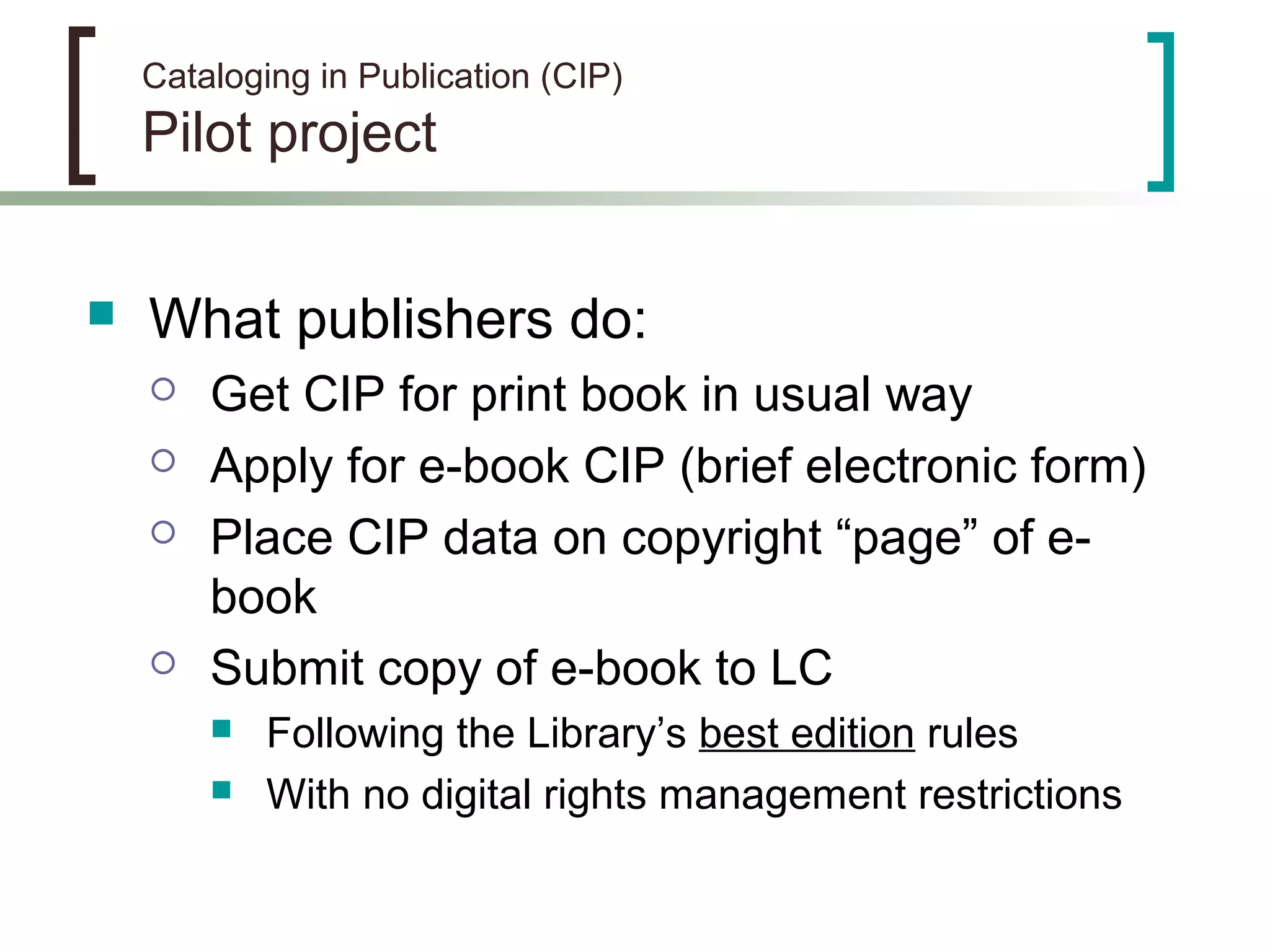
Cataloging in Publication (CIP)
Pilot project
 What publishers do:
 Get CIP for print book in usual way
 Apply for e-book CIP (brief electronic form)
 Place CIP data on copyright “page” of e-
book
 Submit copy of e-book to LC
 Following the Library’s best edition rules
 With no digital rights management restrictions
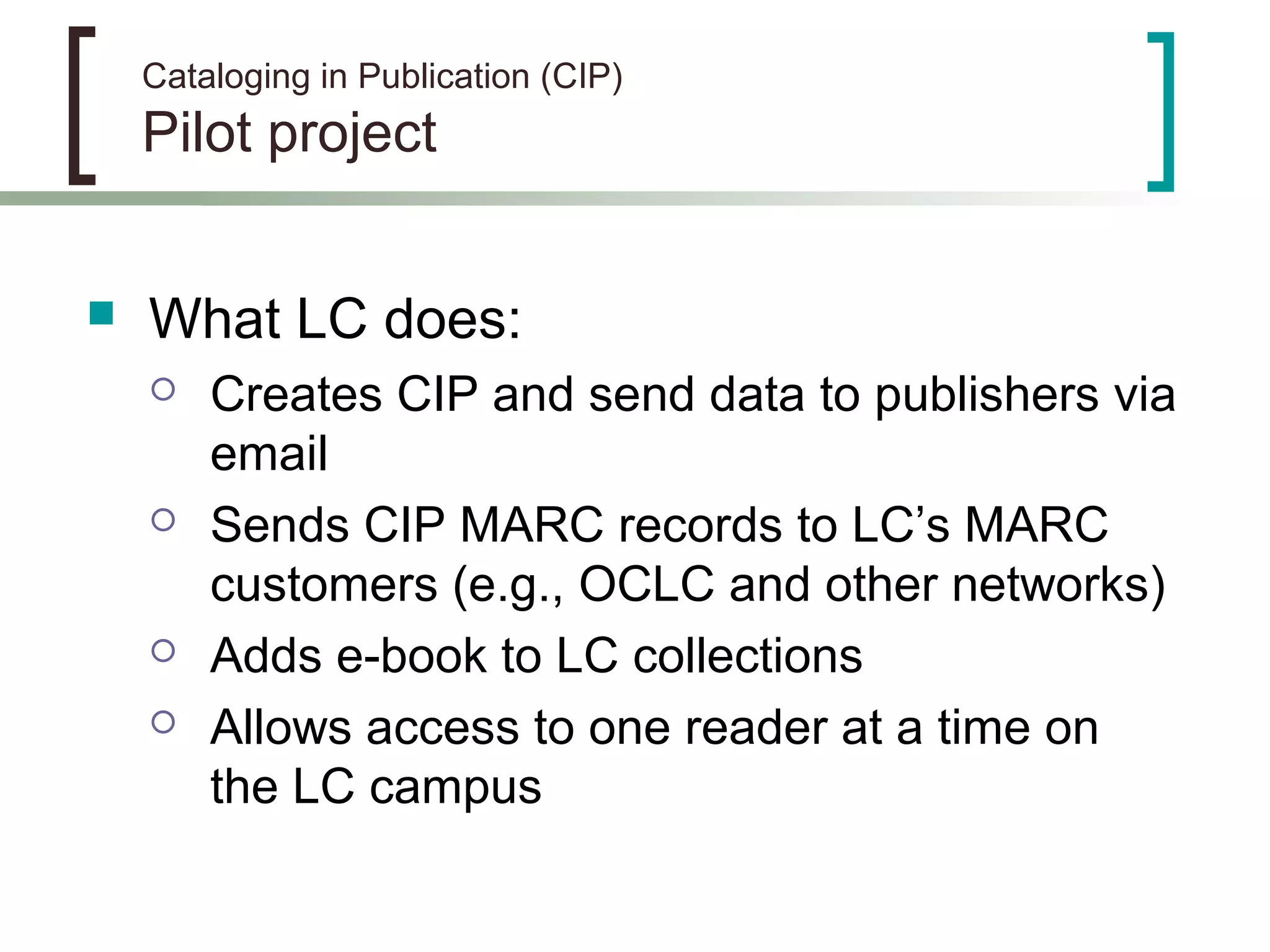
Cataloging in Publication (CIP)
Pilot project
 What LC does:
 Creates CIP and send data to publishers via
email
 Sends CIP MARC records to LC’s MARC
customers (e.g., OCLC and other networks)
 Adds e-book to LC collections
 Allows access to one reader at a time on
the LC campus
Cataloging in Publication (CIP)
MARC records for e-books
 Basis is the CIP record for the print book
 Differences:
 New LCCN
 Add e-book ISBNs if not in print book record
 LC classification reduced to classification part (050 $a only)
 Add [electronic resource] in title field (245 $h)
 Change field 300 to “1 online resource”
 Add e-book series, if applicable
 Add field 588 with CIP data source and review notes
 Add field 776 with print citation and LCCN/ISBN links to print
record
 Coded data: 008/23 = o (online); 007/00 = c (electronic
resource); 007/01 = r (remote)
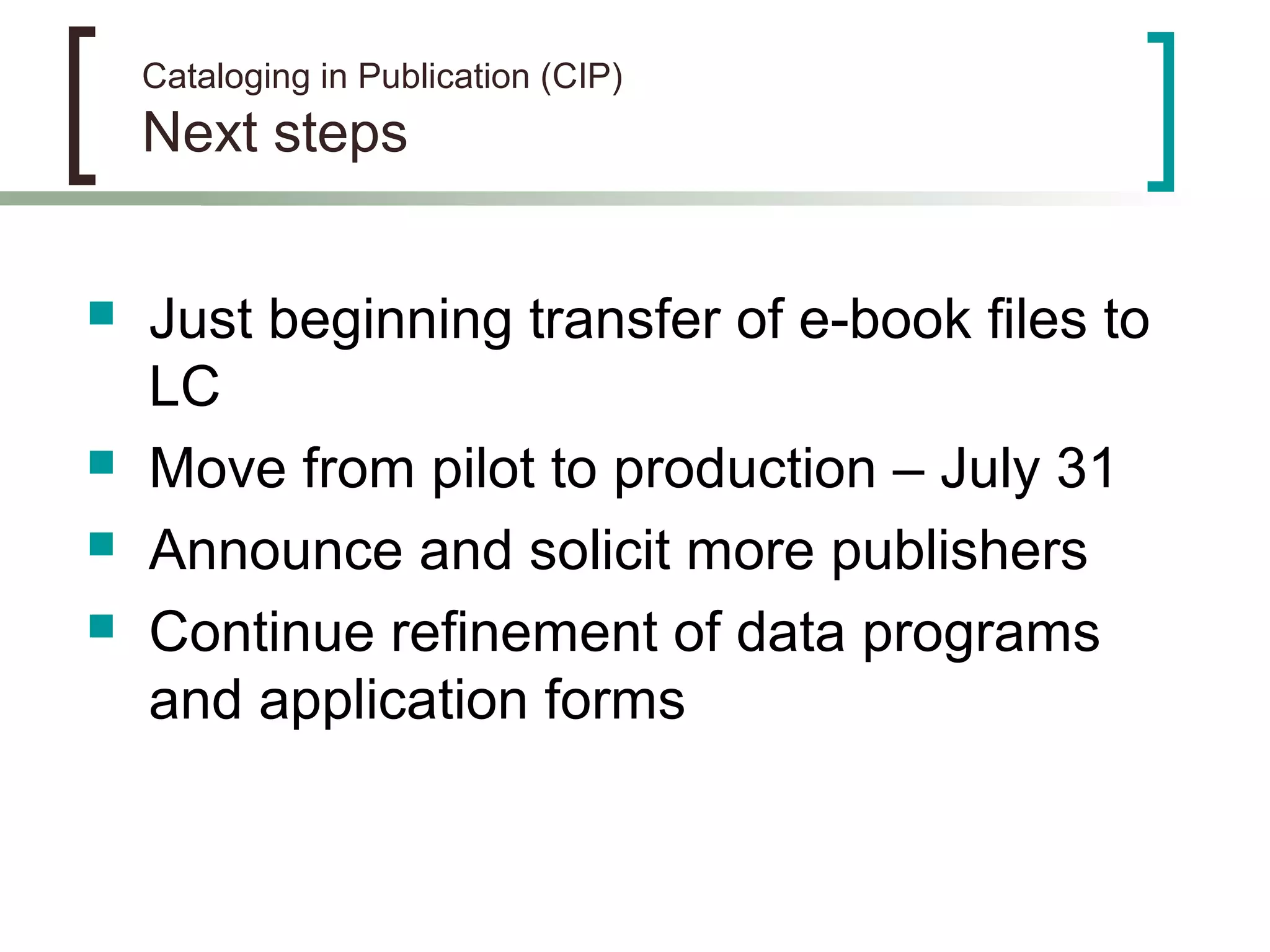
Cataloging in Publication (CIP)
Next steps
 Just beginning transfer of e-book files to
LC
 Move from pilot to production – July 31
 Announce and solicit more publishers
 Continue refinement of data programs
and application forms
Cataloging in Publication (CIP)
Questions
 Questions?
 Project staff
 Program questions
 Karl Debus-Lopez (kdeb@loc.gov),
 Diane Barber (dbarber@loc.gov)
 Technical questions
 David Williamson (dawi@loc.gov)
 Camilla Williams (cewi@loc.gov)
Bibliographic Framework Initiative (BFI)
Genesis
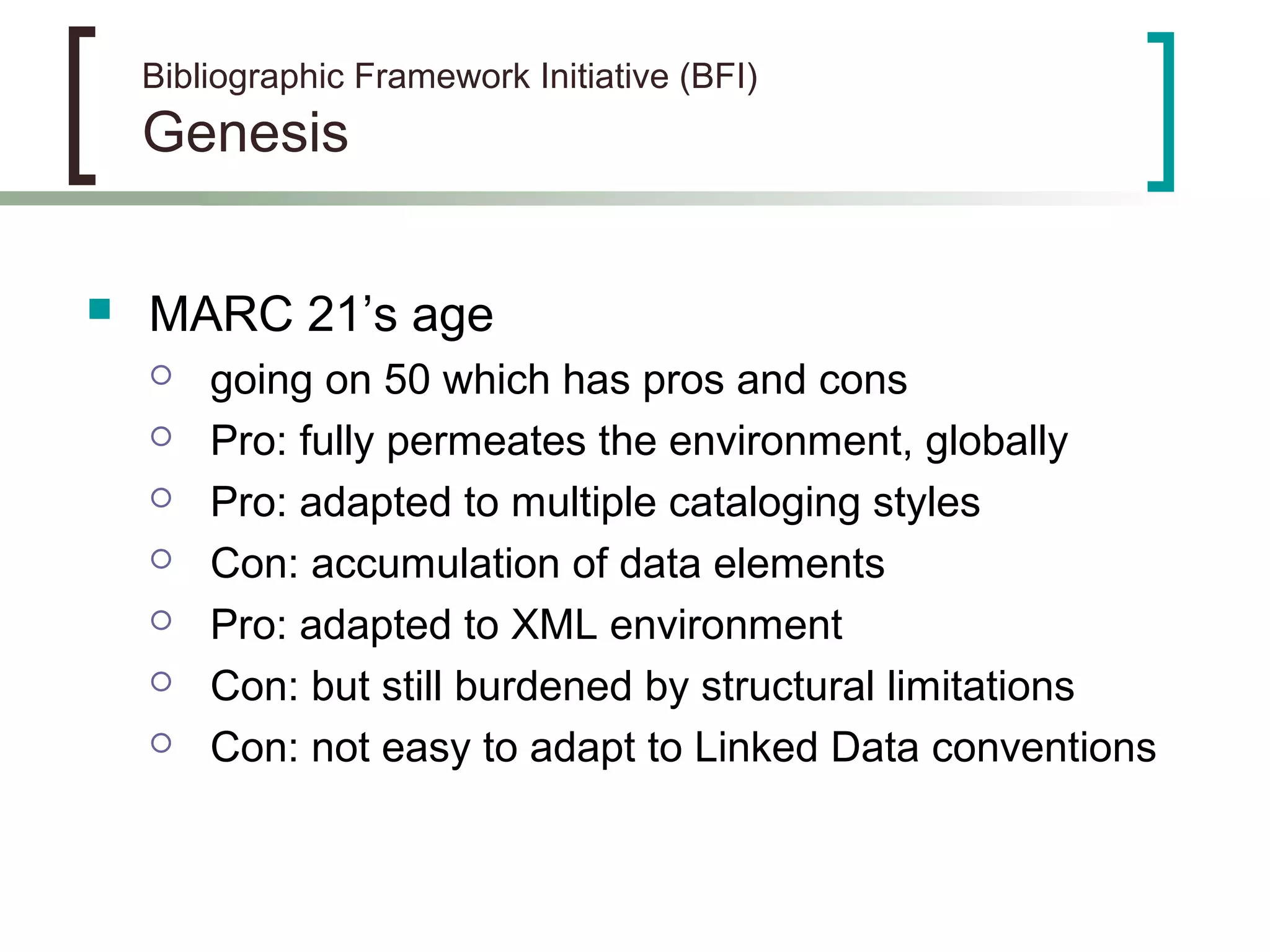
 MARC 21’s age
 going on 50 which has pros and cons
 Pro: fully permeates the environment, globally
 Pro: adapted to multiple cataloging styles
 Con: accumulation of data elements
 Pro: adapted to XML environment
 Con: but still burdened by structural limitations
 Con: not easy to adapt to Linked Data conventions
Bibliographic Framework Initiative (BFI)
Genesis
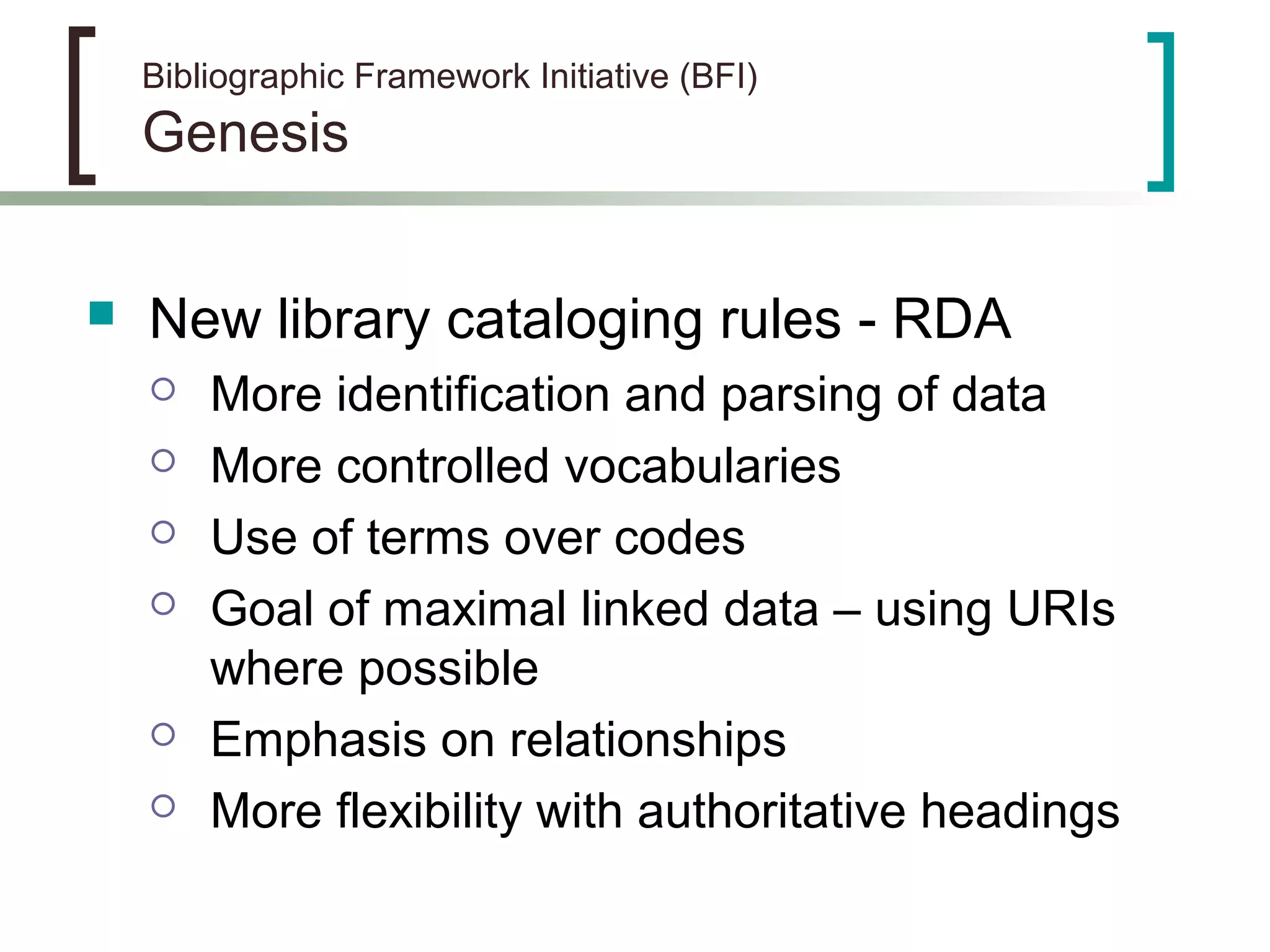
 New library cataloging rules - RDA
 More identification and parsing of data
 More controlled vocabularies
 Use of terms over codes
 Goal of maximal linked data – using URIs
where possible
 Emphasis on relationships
 More flexibility with authoritative headings
Bibliographic Framework Initiative (BFI)
Goals
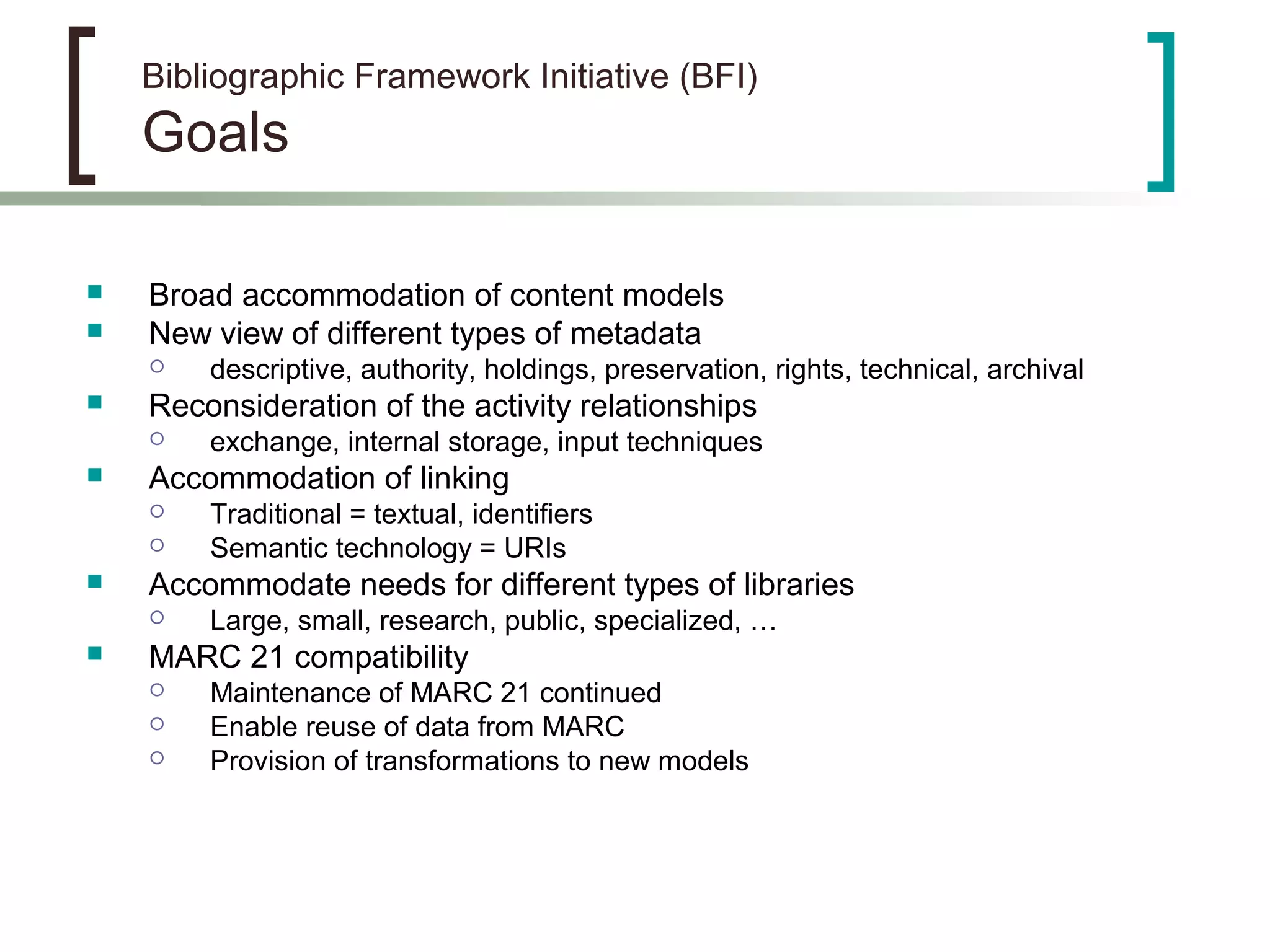
 Broad accommodation of content models
 New view of different types of metadata
 descriptive, authority, holdings, preservation, rights, technical, archival
 Reconsideration of the activity relationships
 exchange, internal storage, input techniques
 Accommodation of linking
 Traditional = textual, identifiers
 Semantic technology = URIs
 Accommodate needs for different types of libraries
 Large, small, research, public, specialized, …
 MARC 21 compatibility
 Maintenance of MARC 21 continued
 Enable reuse of data from MARC
 Provision of transformations to new models
Bibliographic Framework Initiative (BFI)
Approach
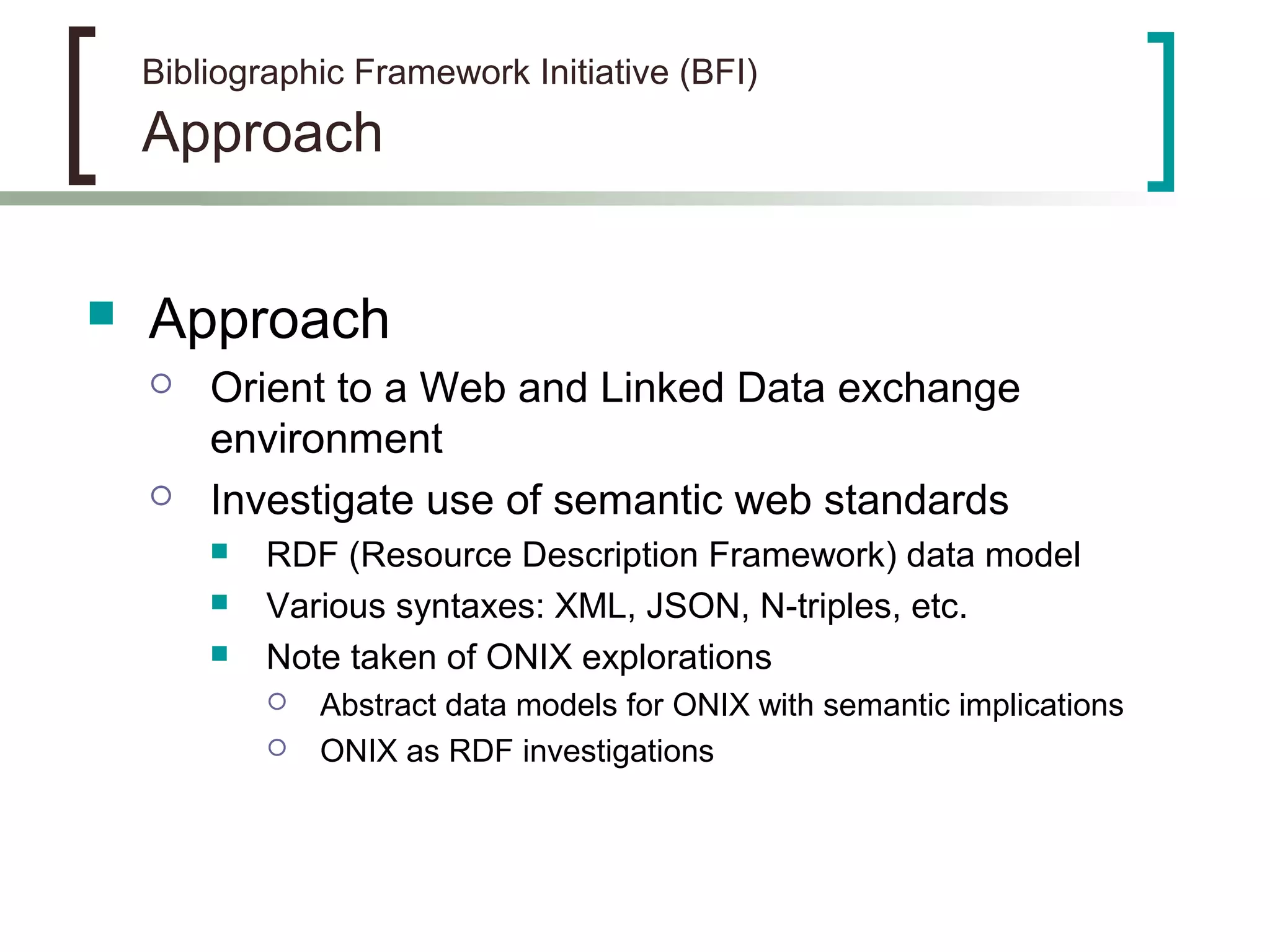
 Approach
 Orient to a Web and Linked Data exchange
environment
 Investigate use of semantic web standards
 RDF (Resource Description Framework) data model
 Various syntaxes: XML, JSON, N-triples, etc.
 Note taken of ONIX explorations
 Abstract data models for ONIX with semantic implications
 ONIX as RDF investigations
Bibliographic Framework Initiative (BFI)
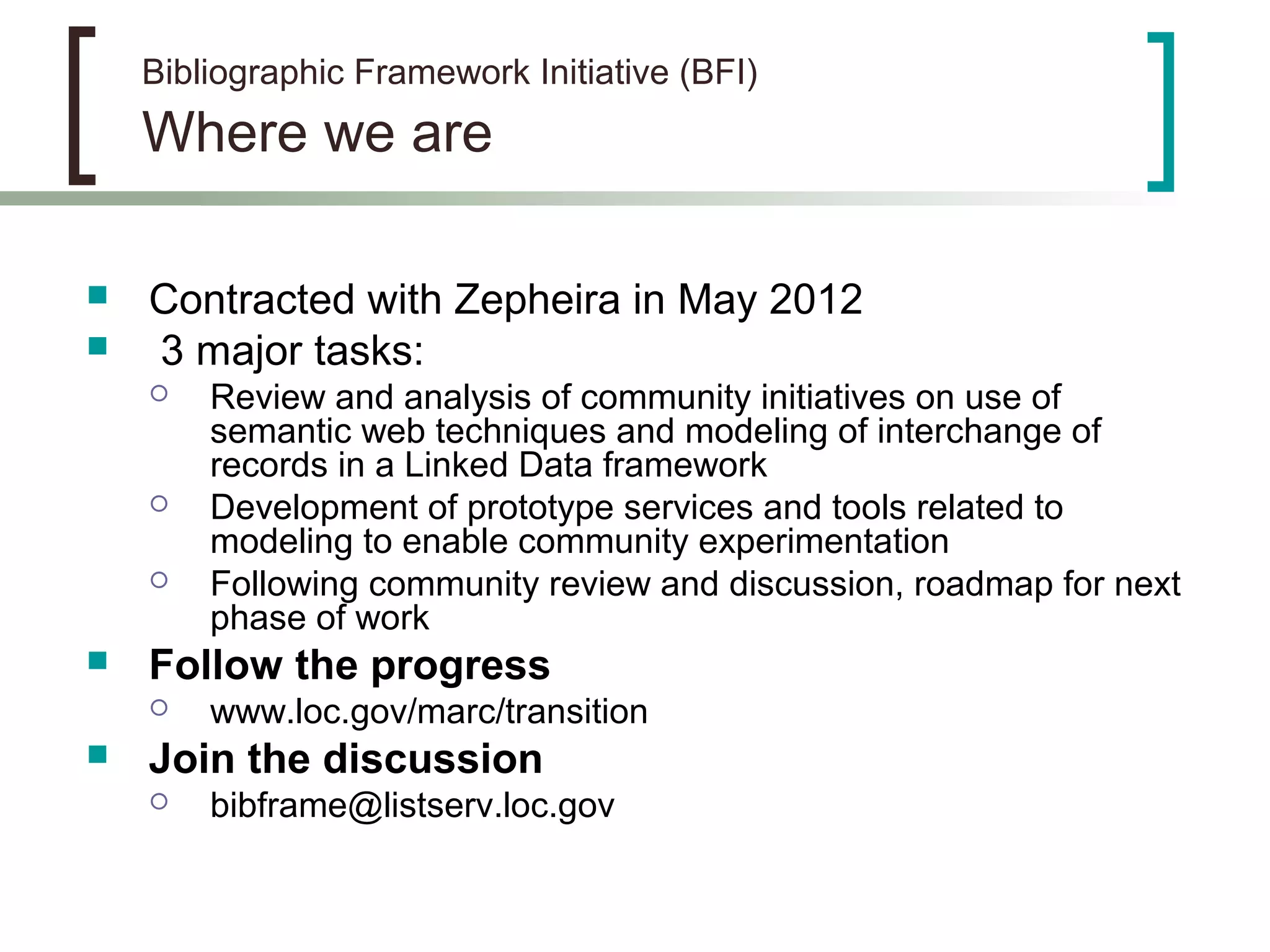
Where we are
 Contracted with Zepheira in May 2012
 3 major tasks:
 Review and analysis of community initiatives on use of
semantic web techniques and modeling of interchange of
records in a Linked Data framework
 Development of prototype services and tools related to
modeling to enable community experimentation
 Following community review and discussion, roadmap for next
phase of work
 Follow the progress
 www.loc.gov/marc/transition
 Join the discussion
 bibframe@listserv.loc.gov
Thanks!

McCallum, Making and Moving Metadata: Two Library of Congress Initiatives

  • 1.
    Making and MovingMetadata: Two Library of Congress Initiatives Sally McCallum NDMSO, Library of Congress smcc@loc.gov NISO/BISG Forum - June 22, 2012
  • 2.
    Contents  Cataloging inPublication (CIP)  CIP data for E-books  Pilot project  MARC records for E-books  Next steps  Bibliographic Framework Initiative (BFI)  Genesis  Goals  Approach
  • 3.
    Cataloging in Publication(CIP)  Metadata for printing in books and for electronic distribution for 41 years  Expansion to electronic books  Initially, e-books that are also print books  “Usual” CIP program requirements - plus
  • 4.
    Cataloging in Publication(CIP) CIP data for E-books pilot  Pilot  October 2011 – July 2012  Different publisher types  Wiley-Blackwell (Wiley and Jossey-Bass imprints)  University Press of Mississippi  RAND Corporation  World Bank
  • 5.
    Cataloging in Publication(CIP) Pilot project  What publishers do:  Get CIP for print book in usual way  Apply for e-book CIP (brief electronic form)  Place CIP data on copyright “page” of e- book  Submit copy of e-book to LC  Following the Library’s best edition rules  With no digital rights management restrictions
  • 6.
    Cataloging in Publication(CIP) Pilot project  What LC does:  Creates CIP and send data to publishers via email  Sends CIP MARC records to LC’s MARC customers (e.g., OCLC and other networks)  Adds e-book to LC collections  Allows access to one reader at a time on the LC campus
  • 7.
    Cataloging in Publication(CIP) MARC records for e-books  Basis is the CIP record for the print book  Differences:  New LCCN  Add e-book ISBNs if not in print book record  LC classification reduced to classification part (050 $a only)  Add [electronic resource] in title field (245 $h)  Change field 300 to “1 online resource”  Add e-book series, if applicable  Add field 588 with CIP data source and review notes  Add field 776 with print citation and LCCN/ISBN links to print record  Coded data: 008/23 = o (online); 007/00 = c (electronic resource); 007/01 = r (remote)
  • 8.
    Cataloging in Publication(CIP) Next steps  Just beginning transfer of e-book files to LC  Move from pilot to production – July 31  Announce and solicit more publishers  Continue refinement of data programs and application forms
  • 9.
    Cataloging in Publication(CIP) Questions  Questions?  Project staff  Program questions  Karl Debus-Lopez (kdeb@loc.gov),  Diane Barber (dbarber@loc.gov)  Technical questions  David Williamson (dawi@loc.gov)  Camilla Williams (cewi@loc.gov)
  • 10.
    Bibliographic Framework Initiative(BFI) Genesis  MARC 21’s age  going on 50 which has pros and cons  Pro: fully permeates the environment, globally  Pro: adapted to multiple cataloging styles  Con: accumulation of data elements  Pro: adapted to XML environment  Con: but still burdened by structural limitations  Con: not easy to adapt to Linked Data conventions
  • 11.
    Bibliographic Framework Initiative(BFI) Genesis  New library cataloging rules - RDA  More identification and parsing of data  More controlled vocabularies  Use of terms over codes  Goal of maximal linked data – using URIs where possible  Emphasis on relationships  More flexibility with authoritative headings
  • 12.
    Bibliographic Framework Initiative(BFI) Goals  Broad accommodation of content models  New view of different types of metadata  descriptive, authority, holdings, preservation, rights, technical, archival  Reconsideration of the activity relationships  exchange, internal storage, input techniques  Accommodation of linking  Traditional = textual, identifiers  Semantic technology = URIs  Accommodate needs for different types of libraries  Large, small, research, public, specialized, …  MARC 21 compatibility  Maintenance of MARC 21 continued  Enable reuse of data from MARC  Provision of transformations to new models
  • 13.
    Bibliographic Framework Initiative(BFI) Approach  Approach  Orient to a Web and Linked Data exchange environment  Investigate use of semantic web standards  RDF (Resource Description Framework) data model  Various syntaxes: XML, JSON, N-triples, etc.  Note taken of ONIX explorations  Abstract data models for ONIX with semantic implications  ONIX as RDF investigations
  • 14.
    Bibliographic Framework Initiative(BFI) Where we are  Contracted with Zepheira in May 2012  3 major tasks:  Review and analysis of community initiatives on use of semantic web techniques and modeling of interchange of records in a Linked Data framework  Development of prototype services and tools related to modeling to enable community experimentation  Following community review and discussion, roadmap for next phase of work  Follow the progress  www.loc.gov/marc/transition  Join the discussion  bibframe@listserv.loc.gov
  • 15.