Myers-Briggs Type Indicator
What is personality?
• The totality of an individual's behavioral and emotional
  characteristics (Webster’s).
• A dynamic and organized set of characteristics possessed by a
  person that uniquely influences his or her cognitions,
  motivations, and behaviors in various situations
  (Ryckman 2004).
• The word "personality" originates from the Latin persona,
  which means mask. Significantly, in the theatre of the ancient
  Latin speaking world, the mask was not used as a plot device
  to disguise the identity of a character, but rather was a
  convention employed to represent or typify that character
  (www.wikipedia.com).
Myers-Briggs Type Indicator

• Carl Jung (Theory of Personality Type)

• Myers-Briggs (Mother-Daughter) Assessment
Myers-Briggs Type Indicator

• The purpose of the Myers-Briggs Type Indicator® is
  to make the theory of psychological types described
  by C. G. Jung understandable and useful in people’s
  lives.
• The essence of the theory is what seems to be
  random variation in behavior is actually quite orderly
  and consistent, being due to basic differences in the
  ways individuals prefer to use their perception and
  judgment (www.myersbriggs.org).
What is the MBTI®?
• Most widely utilized personality preference
  instrument in the world
• Based on Jung’s theory of personality types
• Benefits:
   – Evaluate strengths and areas of development
   – Helps to understand personality differences in
     others and to use them constructively
   – Supports our learning about how to be more
     effective
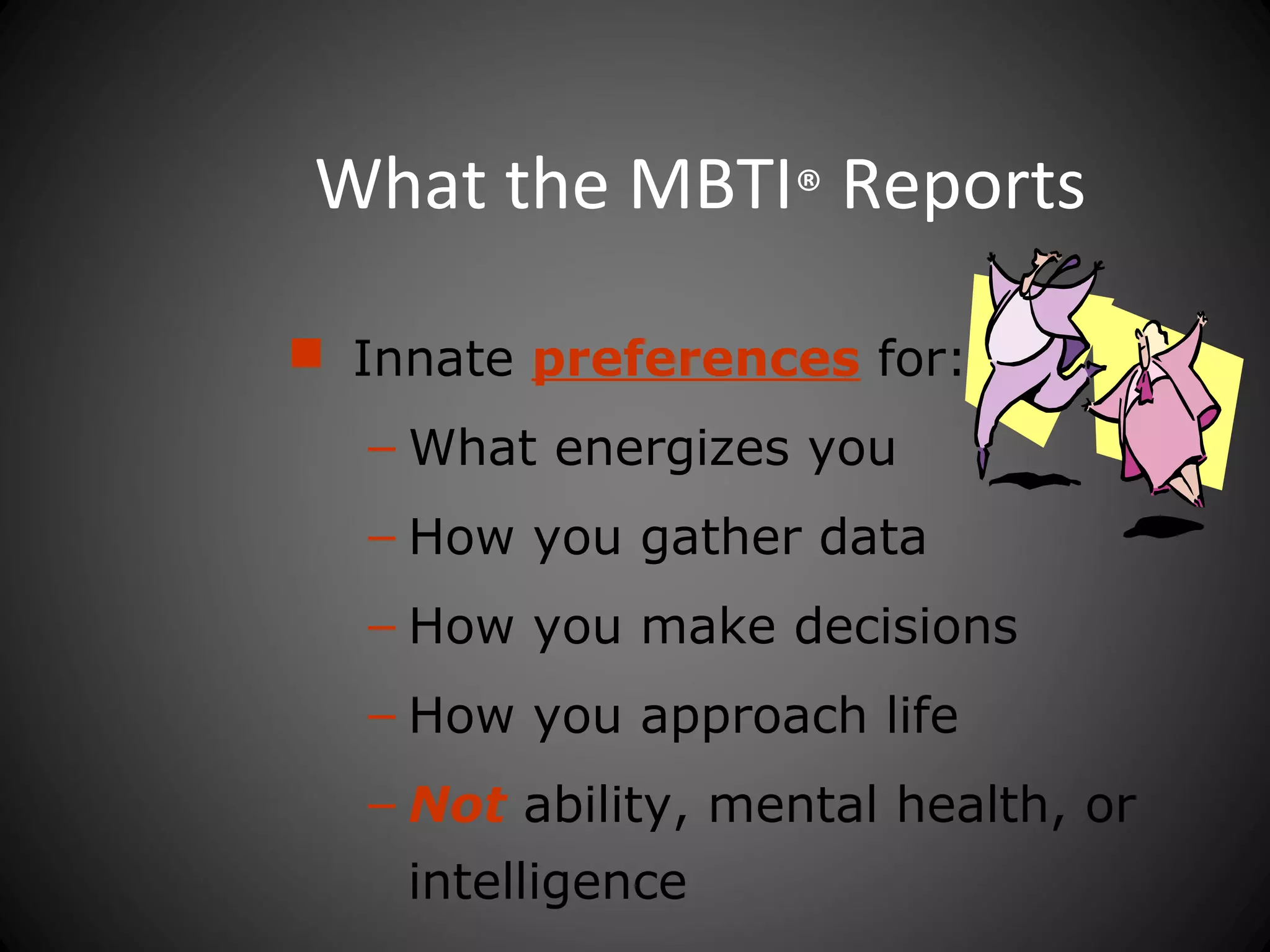
What the MBTI® Reports

 Innate preferences for:
  – What energizes you
  – How you gather data
  – How you make decisions
  – How you approach life
  – Not ability, mental health, or
    intelligence
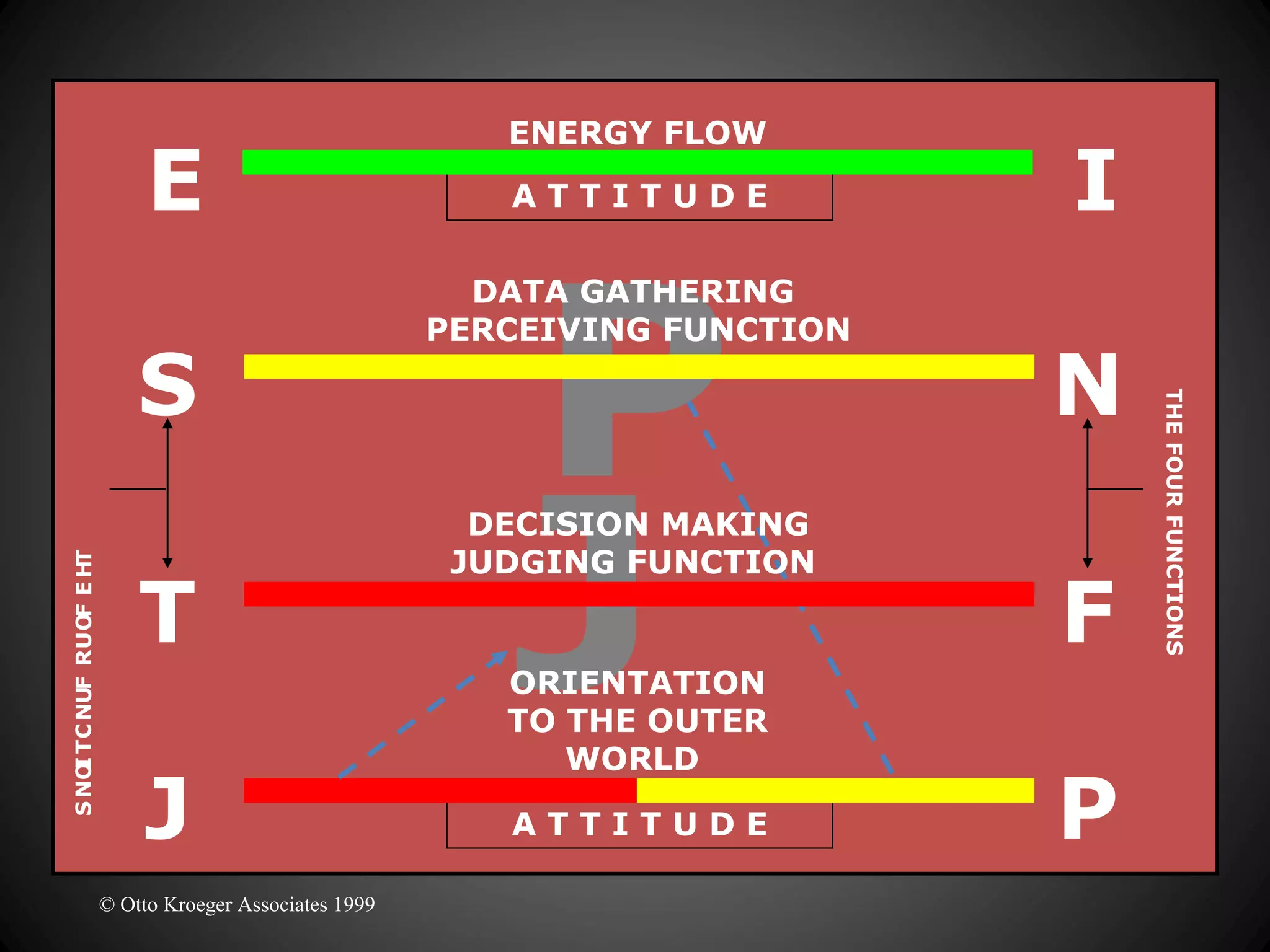
ENERGY FLOW

                               E                              ATTITUDE           I


                                                              P
                                                             DATA GATHERING
                                                           PERCEIVING FUNCTION

                              S                                                  N


                                                                                     THE FOUR FUNCTIONS
                                                              J
                                                             DECISION MAKING
                                                            JUDGING FUNCTION
S NO T C NUF RU OF E HT


                              T                                                  F
                                                              ORIENTATION
                                                              TO THE OUTER
                                                                 WORLD

                              J                                                  P
    I


                                                              ATTITUDE

                          © Otto Kroeger Associates 1999
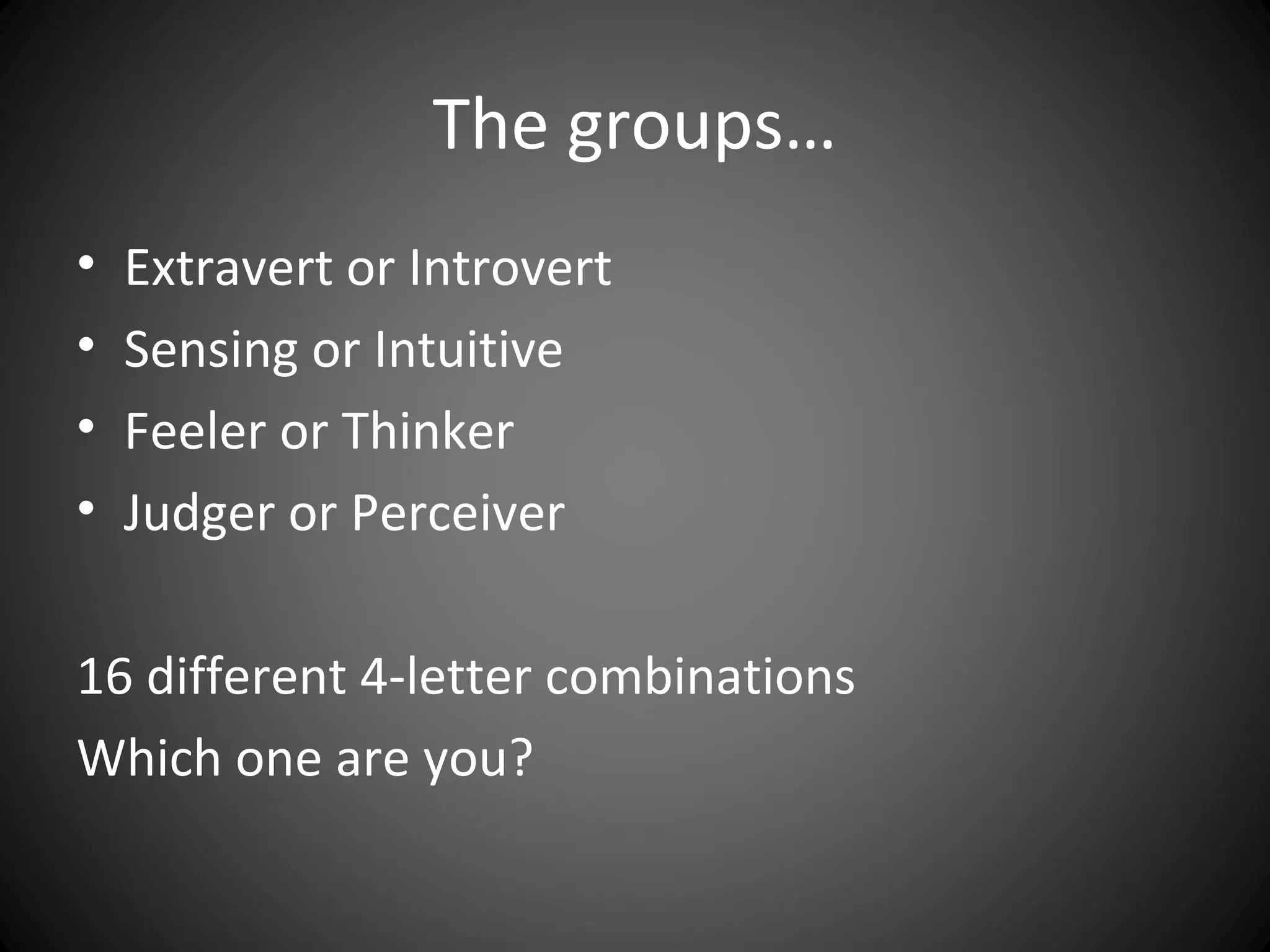
The groups…
•   Extravert or Introvert
•   Sensing or Intuitive
•   Feeler or Thinker
•   Judger or Perceiver

16 different 4-letter combinations
Which one are you?
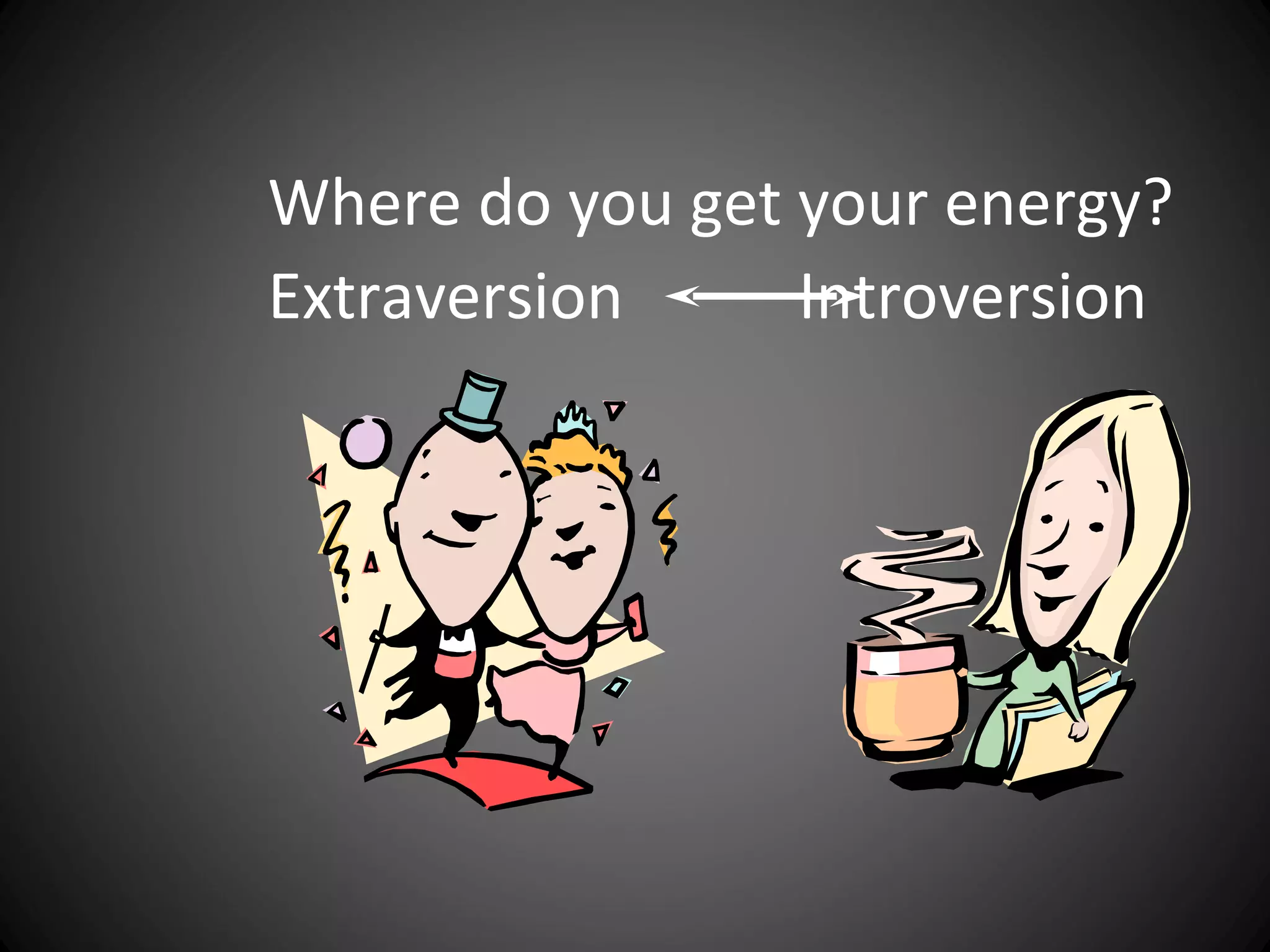
Where do you get your energy?
Extraversion     Introversion
Extraverts versus Introverts
                           Extravert and Introvert
                           How do you get energy?

Extraverts
   –   energy flow is outward
   –   preferred focus is on other people & things
   –   prefer talking to communicate
   –   use expression to work through things


Introverts
   –   energy flow is inward
   –   preferred focus is on one's own thoughts, ideas & impressions
   –   prefer writing to communicate
   –   use thinking, imagining & reflecting to work through things
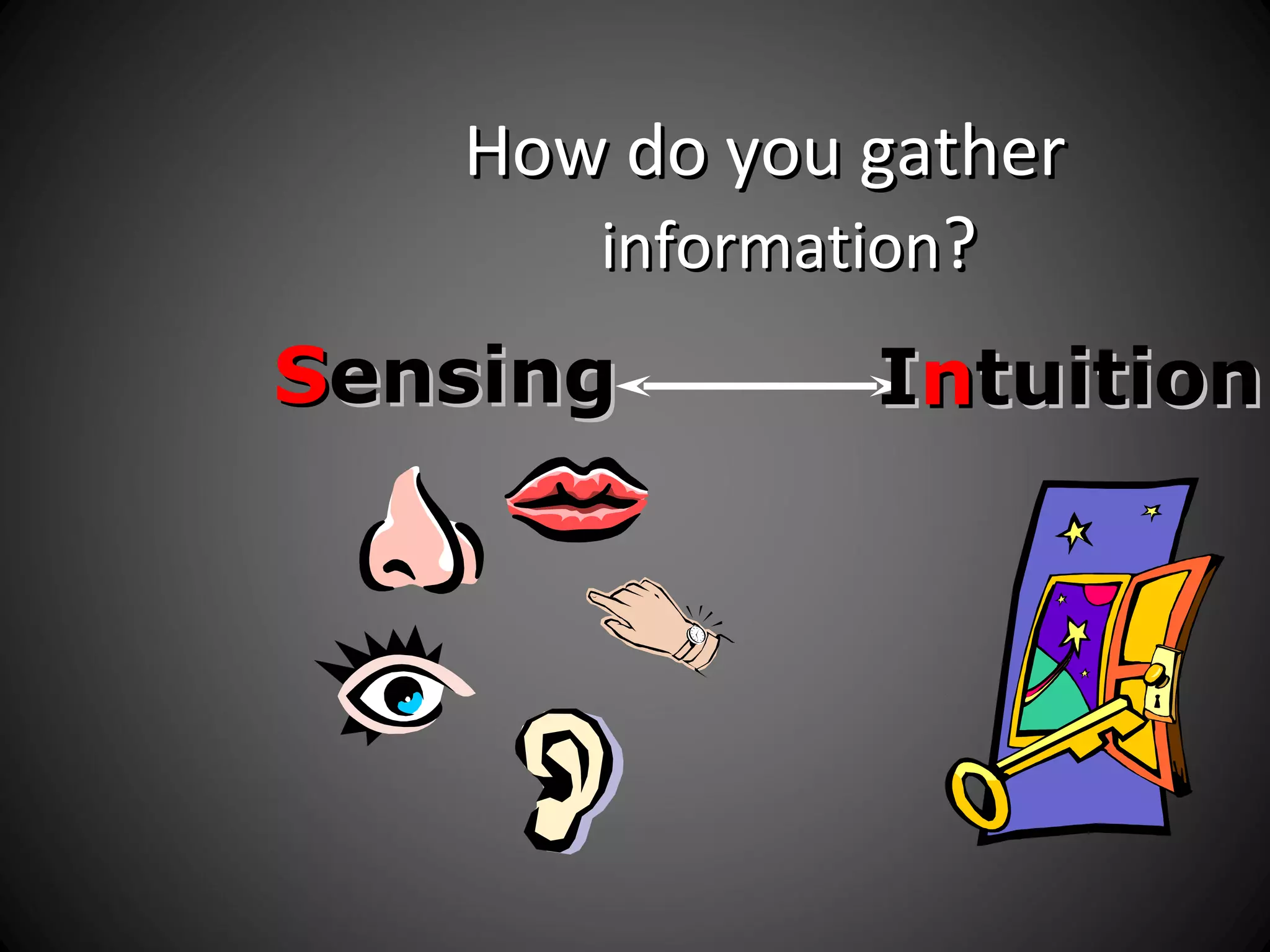
How do you gather
      information?
Sensing       Intuition
Sensing versus INtuition
                        Sensing and INtuition
                How do you prefer to take in information?

Sensing
   –   tend to focus on the present
   –   prefer concrete, tangible information
   –   prefer to receive data primarily from the five senses
   –   like the details

Intuitives
   – tend to focus on the future
   – view towards patterns and possibilities
   – prefer to receive data from the subconscious, or seeing relationships via
     insights
   – big picture people
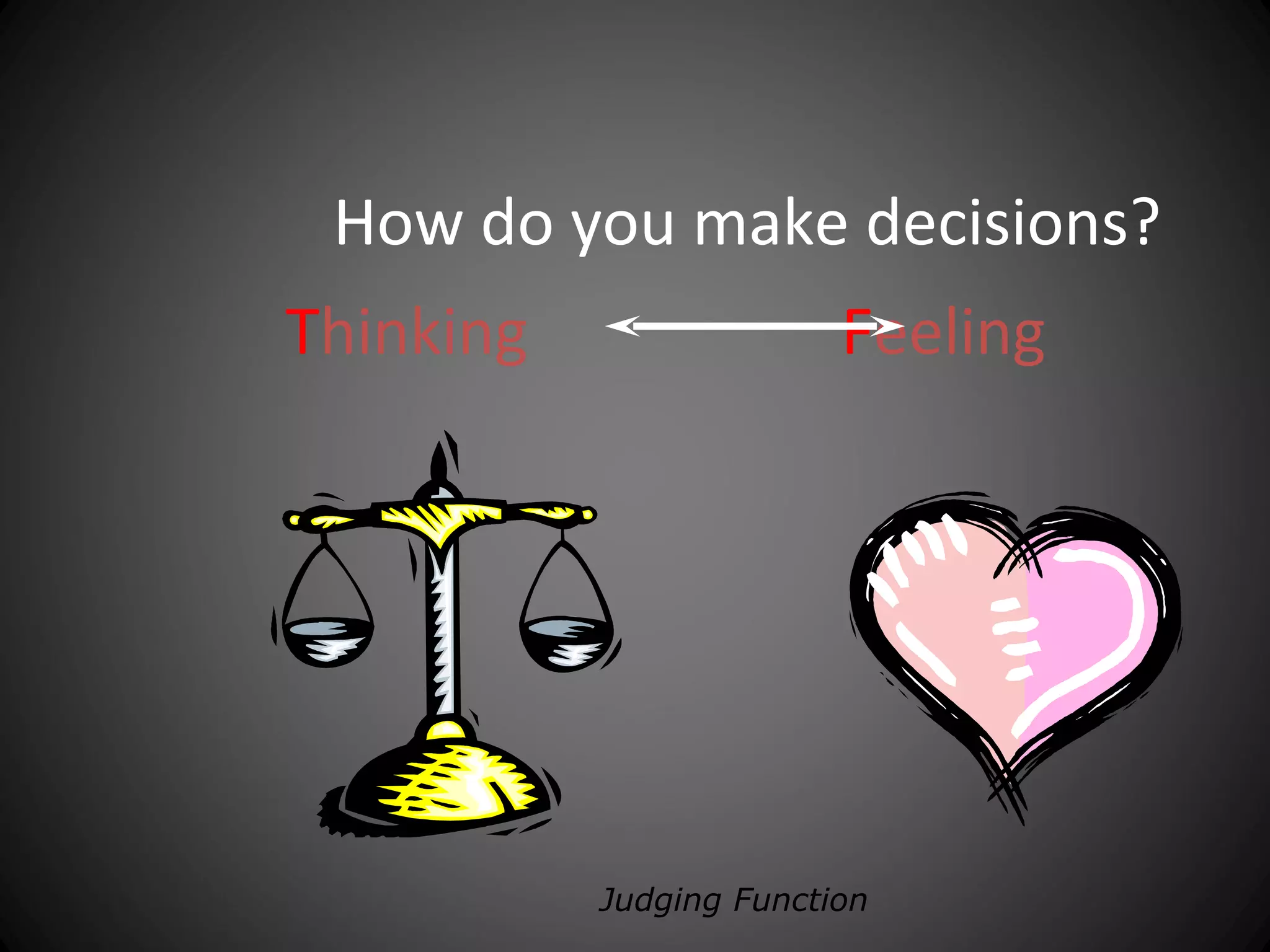
How do you make decisions?
Thinking                 Feeling


           Judging Function
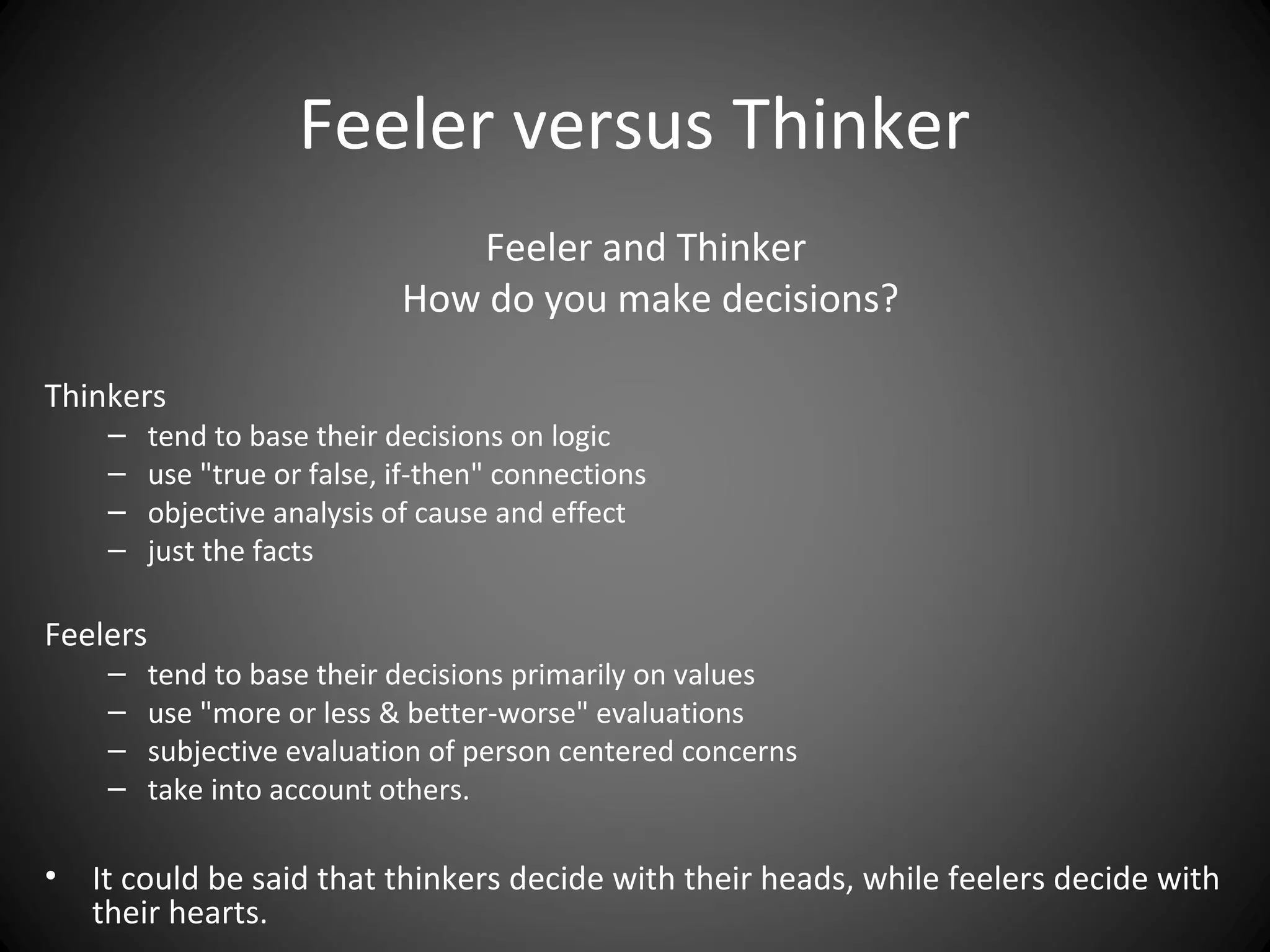
Feeler versus Thinker
                                 Feeler and Thinker
                              How do you make decisions?

Thinkers
     –    tend to base their decisions on logic
     –    use "true or false, if-then" connections
     –    objective analysis of cause and effect
     –    just the facts

Feelers
     –    tend to base their decisions primarily on values
     –    use "more or less & better-worse" evaluations
     –    subjective evaluation of person centered concerns
     –    take into account others.

•   It could be said that thinkers decide with their heads, while feelers decide with
    their hearts.
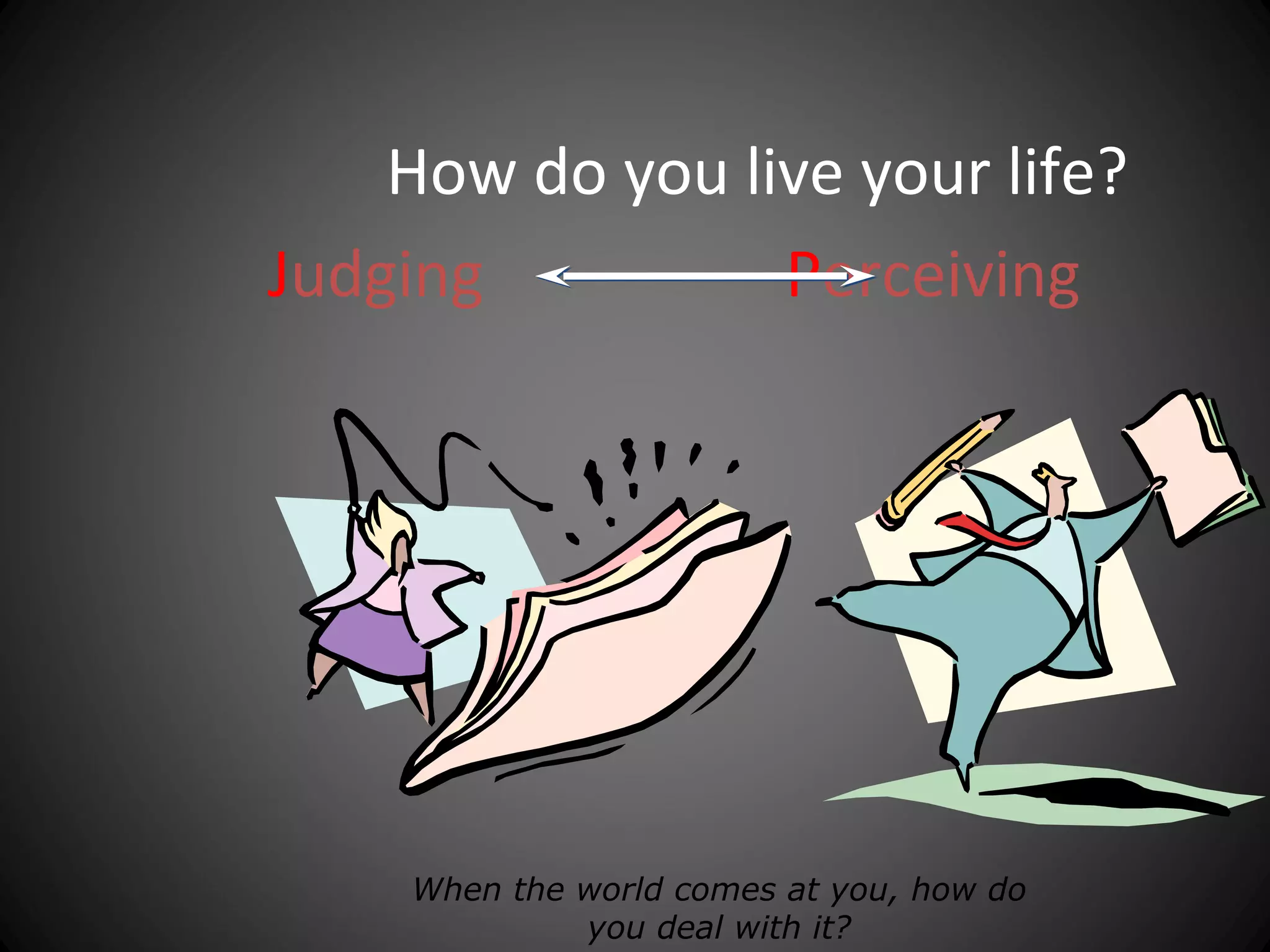
How do you live your life?
Judging          Perceiving


     When the world comes at you, how do
              you deal with it?
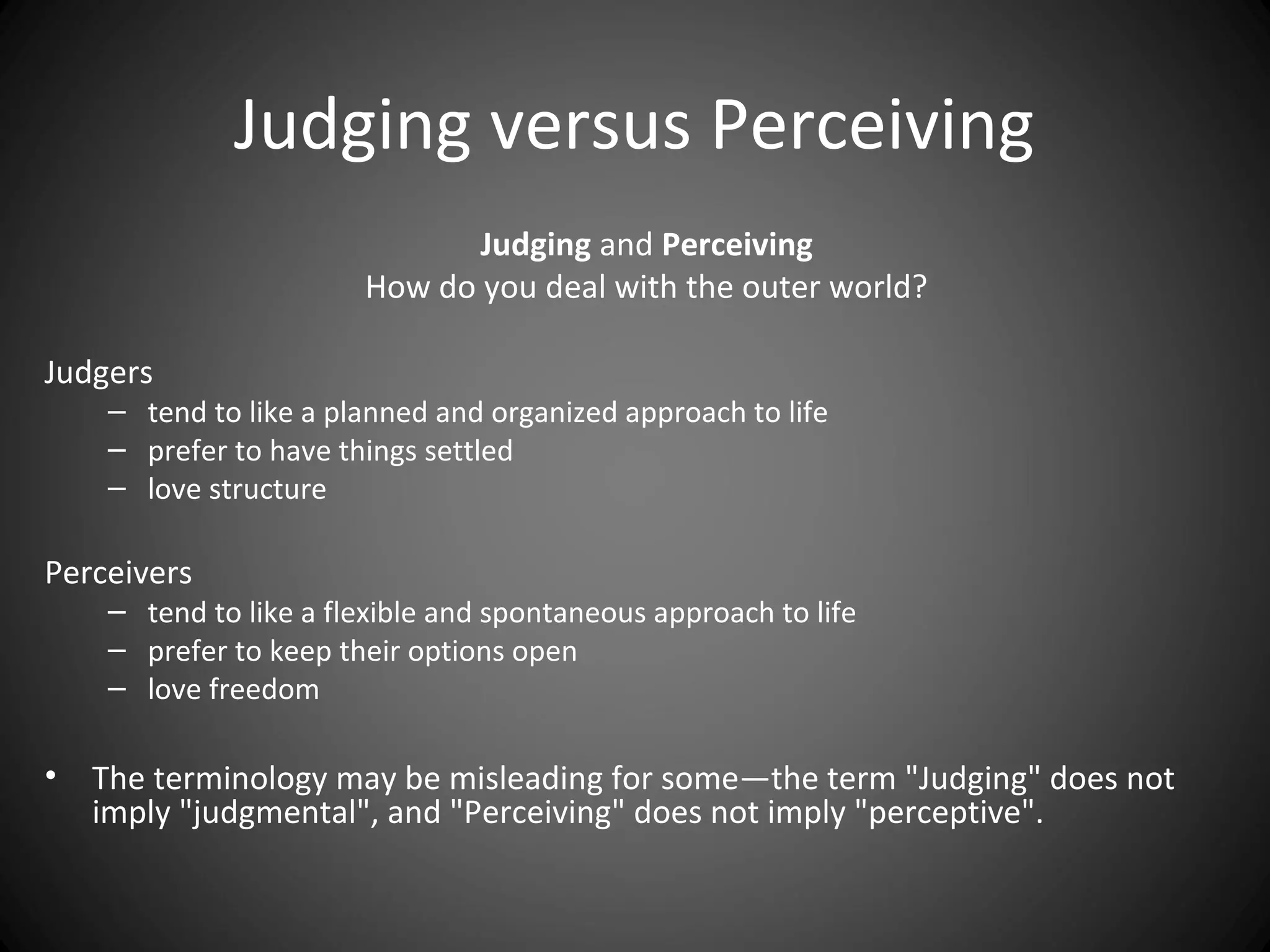
Judging versus Perceiving
                               Judging and Perceiving
                        How do you deal with the outer world?

Judgers
     – tend to like a planned and organized approach to life
     – prefer to have things settled
     – love structure

Perceivers
     – tend to like a flexible and spontaneous approach to life
     – prefer to keep their options open
     – love freedom

•   The terminology may be misleading for some—the term "Judging" does not
    imply "judgmental", and "Perceiving" does not imply "perceptive".
Estimate of the preferences found
       in the US population
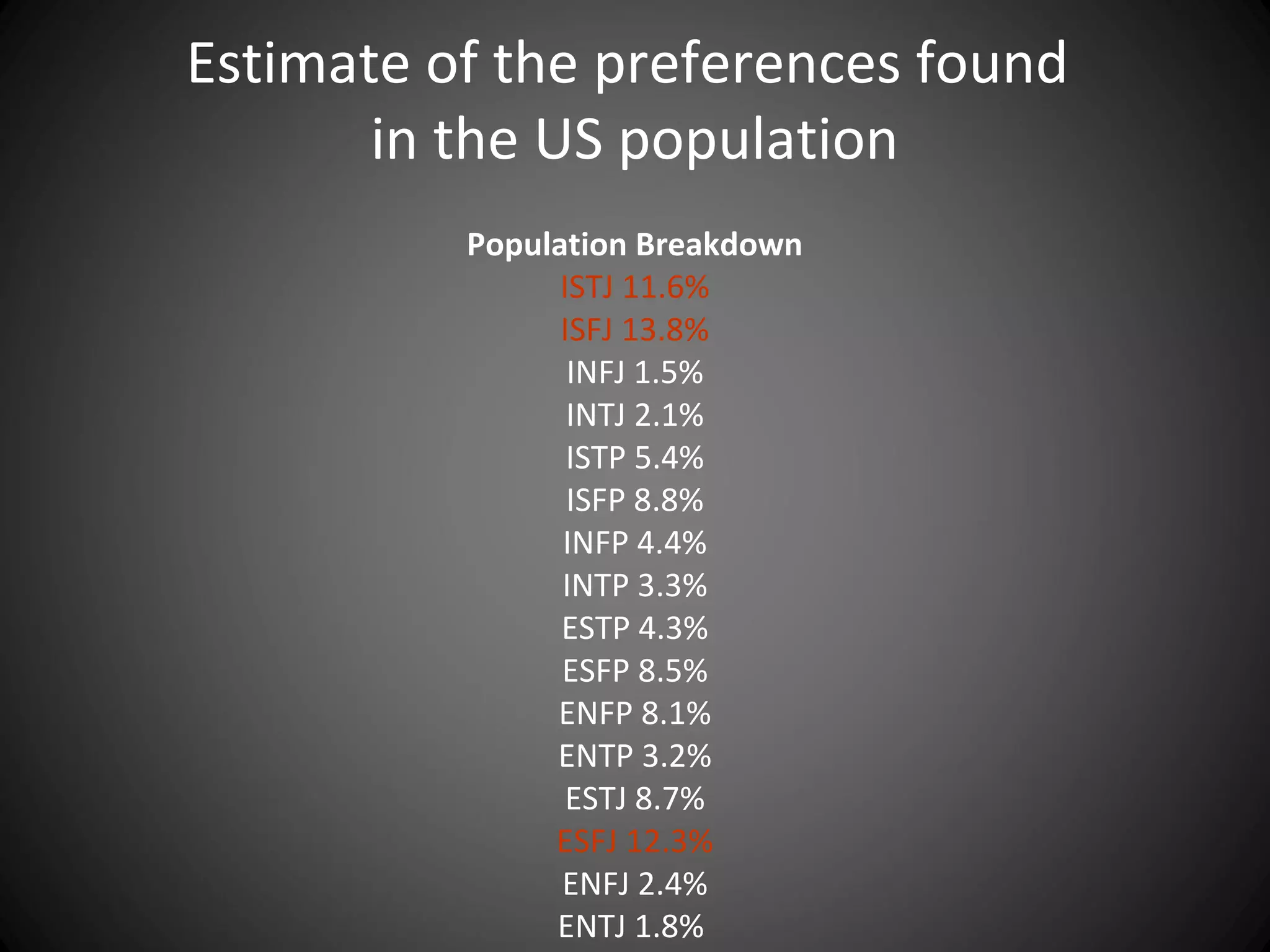
          Population Breakdown
                ISTJ 11.6%
                ISFJ 13.8%
                 INFJ 1.5%
                 INTJ 2.1%
                 ISTP 5.4%
                 ISFP 8.8%
                INFP 4.4%
                INTP 3.3%
                ESTP 4.3%
                ESFP 8.5%
               ENFP 8.1%
               ENTP 3.2%
                 ESTJ 8.7%
               ESFJ 12.3%
                ENFJ 2.4%
               ENTJ 1.8%
Interpreting Results
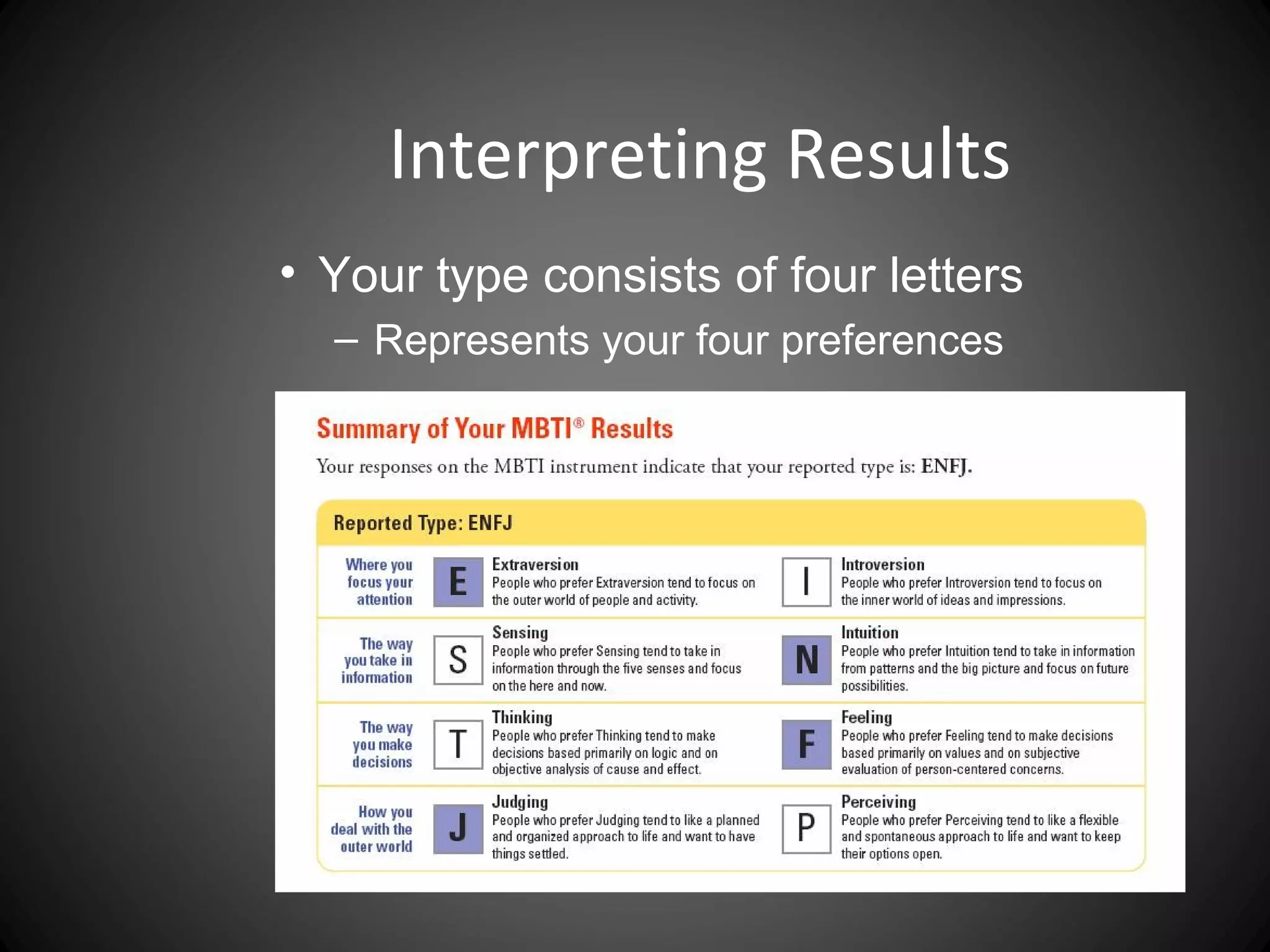
• Your type consists of four letters
  – Represents your four preferences
Interpreting Results
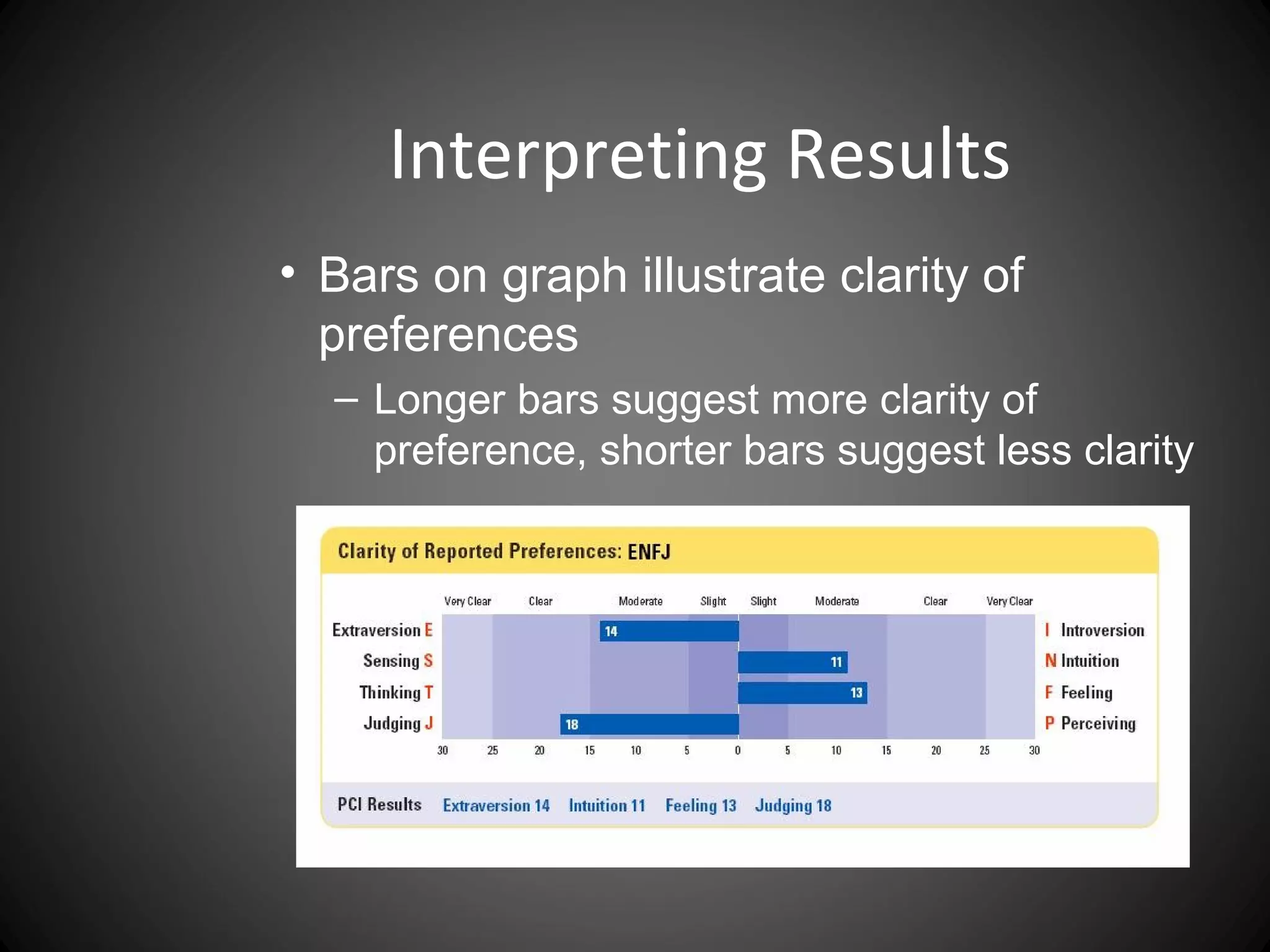
• Bars on graph illustrate clarity of
  preferences
  – Longer bars suggest more clarity of
    preference, shorter bars suggest less clarity
Does your type description sound
            like you?

 TONIGHT: Reflect in 200 WP blog
  post about your MBTI & how it
does/does not reflect who you are.

MBTI

  • 1.
  • 2.
    What is personality? •The totality of an individual's behavioral and emotional characteristics (Webster’s). • A dynamic and organized set of characteristics possessed by a person that uniquely influences his or her cognitions, motivations, and behaviors in various situations (Ryckman 2004). • The word "personality" originates from the Latin persona, which means mask. Significantly, in the theatre of the ancient Latin speaking world, the mask was not used as a plot device to disguise the identity of a character, but rather was a convention employed to represent or typify that character (www.wikipedia.com).
  • 3.
    Myers-Briggs Type Indicator •Carl Jung (Theory of Personality Type) • Myers-Briggs (Mother-Daughter) Assessment
  • 4.
    Myers-Briggs Type Indicator •The purpose of the Myers-Briggs Type Indicator® is to make the theory of psychological types described by C. G. Jung understandable and useful in people’s lives. • The essence of the theory is what seems to be random variation in behavior is actually quite orderly and consistent, being due to basic differences in the ways individuals prefer to use their perception and judgment (www.myersbriggs.org).
  • 5.
    What is theMBTI®? • Most widely utilized personality preference instrument in the world • Based on Jung’s theory of personality types • Benefits: – Evaluate strengths and areas of development – Helps to understand personality differences in others and to use them constructively – Supports our learning about how to be more effective
  • 6.
    What the MBTI®Reports  Innate preferences for: – What energizes you – How you gather data – How you make decisions – How you approach life – Not ability, mental health, or intelligence
  • 7.
    ENERGY FLOW E ATTITUDE I P DATA GATHERING PERCEIVING FUNCTION S N THE FOUR FUNCTIONS J DECISION MAKING JUDGING FUNCTION S NO T C NUF RU OF E HT T F ORIENTATION TO THE OUTER WORLD J P I ATTITUDE © Otto Kroeger Associates 1999
  • 8.
    The groups… • Extravert or Introvert • Sensing or Intuitive • Feeler or Thinker • Judger or Perceiver 16 different 4-letter combinations Which one are you?
  • 9.
    Where do youget your energy? Extraversion Introversion
  • 10.
    Extraverts versus Introverts Extravert and Introvert How do you get energy? Extraverts – energy flow is outward – preferred focus is on other people & things – prefer talking to communicate – use expression to work through things Introverts – energy flow is inward – preferred focus is on one's own thoughts, ideas & impressions – prefer writing to communicate – use thinking, imagining & reflecting to work through things
  • 11.
    How do yougather information? Sensing Intuition
  • 12.
    Sensing versus INtuition Sensing and INtuition How do you prefer to take in information? Sensing – tend to focus on the present – prefer concrete, tangible information – prefer to receive data primarily from the five senses – like the details Intuitives – tend to focus on the future – view towards patterns and possibilities – prefer to receive data from the subconscious, or seeing relationships via insights – big picture people
  • 13.
    How do youmake decisions? Thinking Feeling Judging Function
  • 14.
    Feeler versus Thinker Feeler and Thinker How do you make decisions? Thinkers – tend to base their decisions on logic – use "true or false, if-then" connections – objective analysis of cause and effect – just the facts Feelers – tend to base their decisions primarily on values – use "more or less & better-worse" evaluations – subjective evaluation of person centered concerns – take into account others. • It could be said that thinkers decide with their heads, while feelers decide with their hearts.
  • 15.
    How do youlive your life? Judging Perceiving When the world comes at you, how do you deal with it?
  • 16.
    Judging versus Perceiving Judging and Perceiving How do you deal with the outer world? Judgers – tend to like a planned and organized approach to life – prefer to have things settled – love structure Perceivers – tend to like a flexible and spontaneous approach to life – prefer to keep their options open – love freedom • The terminology may be misleading for some—the term "Judging" does not imply "judgmental", and "Perceiving" does not imply "perceptive".
  • 17.
    Estimate of thepreferences found in the US population Population Breakdown ISTJ 11.6% ISFJ 13.8% INFJ 1.5% INTJ 2.1% ISTP 5.4% ISFP 8.8% INFP 4.4% INTP 3.3% ESTP 4.3% ESFP 8.5% ENFP 8.1% ENTP 3.2% ESTJ 8.7% ESFJ 12.3% ENFJ 2.4% ENTJ 1.8%
  • 18.
    Interpreting Results • Yourtype consists of four letters – Represents your four preferences
  • 19.
    Interpreting Results • Barson graph illustrate clarity of preferences – Longer bars suggest more clarity of preference, shorter bars suggest less clarity
  • 20.
    Does your typedescription sound like you? TONIGHT: Reflect in 200 WP blog post about your MBTI & how it does/does not reflect who you are.

Editor's Notes