Mobile Banking :
Overview of Regulatory frameworks
                in
        emerging markets


           Rasheda Sultana
          Grameenphone Ltd.
           Action on Access
              CPRSouth4
           8 December,2009
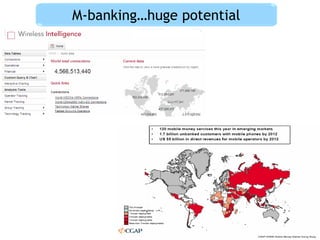
M-banking…huge potential
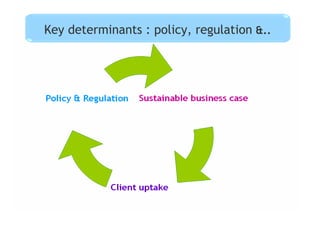
Key determinants :are now ?
     Where we policy, regulation &..
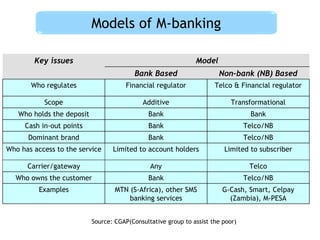
Models of M-banking

        Key issues                                             Model
                                          Bank Based                   Non-bank (NB) Based
       Who regulates                   Financial regulator            Telco & Financial regulator

           Scope                             Additive                       Transformational
   Who holds the deposit                      Bank                                Bank
     Cash in-out points                       Bank                               Telco/NB
      Dominant brand                          Bank                               Telco/NB
Who has access to the service     Limited to account holders             Limited to subscriber

      Carrier/gateway                          Any                                Telco
  Who owns the customer                       Bank                               Telco/NB
         Examples                  MTN (S-Africa), other SMS             G-Cash, Smart, Celpay
                                       banking services                    (Zambia), M-PESA


                           Source: CGAP(Consultative group to assist the poor)
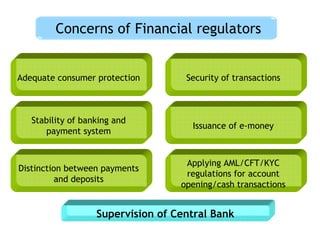
Concerns of Financial regulators


Adequate consumer protection        Security of transactions


   Stability of banking and
                                     Issuance of e-money
      payment system


                                    Applying AML/CFT/KYC
Distinction between payments
                                    regulations for account
          and deposits
                                   opening/cash transactions


                   Supervision of Central Bank
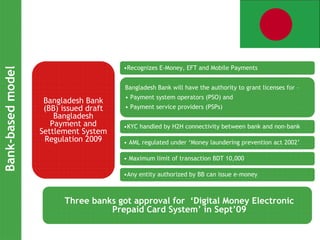
•Recognizes E-Money, EFT and Mobile Payments
Bank-based model


                                        Bangladesh Bank will have the authority to grant licenses for –
                                        • Payment system operators (PSO) and
                    Bangladesh Bank
                    (BB) issued draft   • Payment service providers (PSPs)
                       Bangladesh
                      Payment and       •KYC handled by H2H connectivity between bank and non-bank
                   Settlement System
                    Regulation 2009     • AML regulated under ‘Money laundering prevention act 2002’

                                        • Maximum limit of transaction BDT 10,000

                                        •Any entity authorized by BB can issue e-money


                         Three banks got approval for ‘Digital Money Electronic
                                   Prepaid Card System’ in Sept’09
Bank-based model


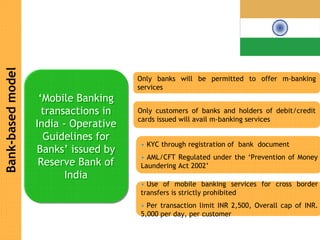
                                       Only banks will be permitted to offer m-banking
                                       services
                    ‘Mobile Banking
                     transactions in   Only customers of banks and holders of debit/credit
                                       cards issued will avail m-banking services
                   India - Operative
                     Guidelines for
                                       • KYC through registration of bank document
                   Banks’ issued by
                                       • AML/CFT Regulated under the ‘Prevention of Money
                    Reserve Bank of    Laundering Act 2002’
                          India
                                       • Use of mobile banking services for cross border
                                       transfers is strictly prohibited
                                       • Per transaction limit INR 2,500, Overall cap of INR.
                                       5,000 per day, per customer
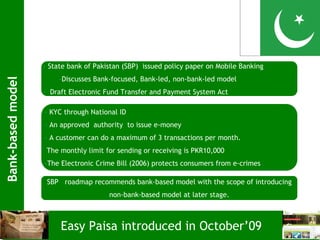
– State bank of Pakistan (SBP) issued policy paper on Mobile Banking
                       –Discusses Bank-focused, Bank-led, non-bank-led model
Bank-based model


                   – Draft Electronic Fund Transfer and Payment System Act

                   – KYC through National ID
                   – An approved authority to issue e-money
                   – A customer can do a maximum of 3 transactions per month.
                    The monthly limit for sending or receiving is PKR10,000
                   –The Electronic Crime Bill (2006) protects consumers from e-crimes

                    SBP roadmap recommends bank-based model with the scope of introducing
                                       non-bank-based model at later stage.


                        Easy Paisa introduced in October’09
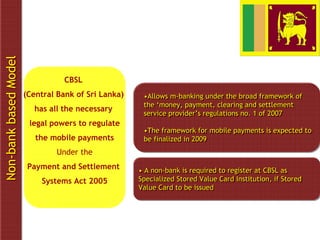
Non-bank based Model


                                  CBSL
                       (Central Bank of Sri Lanka)    •Allows m-banking under the broad framework of
                                                      •Allows m-banking under the broad framework of
                                                      the ‘money, payment, clearing and settlement
                                                      the ‘money, payment, clearing and settlement
                          has all the necessary
                                                      service provider’s regulations no. 1 of 2007
                                                      service provider’s regulations no. 1 of 2007
                        legal powers to regulate
                                                      •The framework for mobile payments is expected to
                                                      •The framework for mobile payments is expected to
                          the mobile payments         be finalized in 2009
                                                      be finalized in 2009
                               Under the
                        Payment and Settlement       • A non-bank is required to register at CBSL as
                                                     • A non-bank is required to register at CBSL as
                           Systems Act 2005          Specialized Stored Value Card Institution, if Stored
                                                     Specialized Stored Value Card Institution, if Stored
                                                     Value Card to be issued
                                                     Value Card to be issued
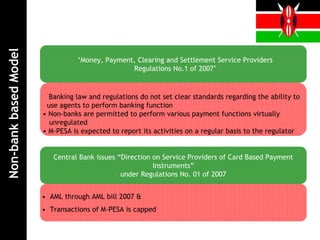
Non-bank based Model


                                  ‘Money, Payment, Clearing and Settlement Service Providers
                                                 Regulations No.1 of 2007’


                         Banking law and regulations do not set clear standards regarding the ability to
                        use agents to perform banking function
                       • Non-banks are permitted to perform various payment functions virtually
                         unregulated
                       • M-PESA is expected to report its activities on a regular basis to the regulator


                          Central Bank issues “Direction on Service Providers of Card Based Payment
                                                         Instruments”
                                               under Regulations No. 01 of 2007


                       • AML through AML bill 2007 &
                       • Transactions of M-PESA is capped
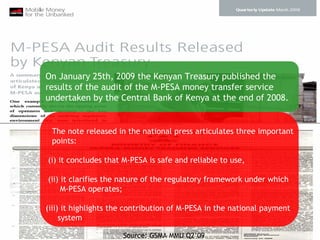
On January 25th, 2009 the Kenyan Treasury published the
results of the audit of the M-PESA money transfer service
undertaken by the Central Bank of Kenya at the end of 2008.


 The note released in the national press articulates three important
 points:

(i) it concludes that M-PESA is safe and reliable to use,

(ii) it clarifies the nature of the regulatory framework under which
     M-PESA operates;

(iii) it highlights the contribution of M-PESA in the national payment
     system

                      Source: GSMA MMU Q2’09
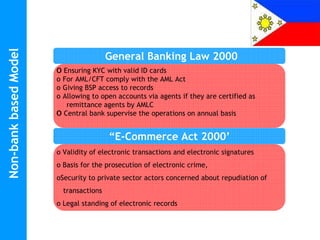
Non-bank based Model


                                        General Banking Law 2000
                       o Ensuring KYC with valid ID cards
                       o For AML/CFT comply with the AML Act
                       o Giving BSP access to records
                       o Allowing to open accounts via agents if they are certified as
                          remittance agents by AMLC
                       o Central bank supervise the operations on annual basis

                                        “E-Commerce Act 2000’
                       o Validity of electronic transactions and electronic signatures
                       o Basis for the prosecution of electronic crime,
                       oSecurity to private sector actors concerned about repudiation of
                         transactions
                       o Legal standing of electronic records
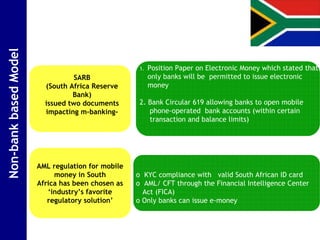
Non-bank based Model


                                                    1.   Position Paper on Electronic Money which stated that
                                  SARB                   only banks will be permitted to issue electronic
                         (South Africa Reserve           money
                                 Bank)
                         issued two documents       2. Bank Circular 619 allowing banks to open mobile
                         impacting m-banking-          phone-operated bank accounts (within certain
                                                       transaction and balance limits)


                       AML regulation for mobile
                            money in South         o KYC compliance with valid South African ID card
                       Africa has been chosen as   o AML/ CFT through the Financial Intelligence Center
                          ‘industry’s favorite       Act (FICA)
                          regulatory solution’     o Only banks can issue e-money
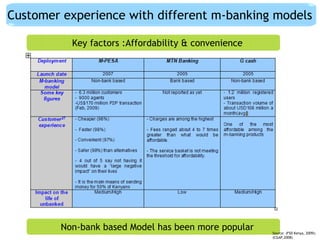
Customer experience with different m-banking models

          Key factors :Affordability & convenience


        Non-bank based Model has been more popular   Source: (FSD Kenya, 2009);
                                                     (CGAP,2008)
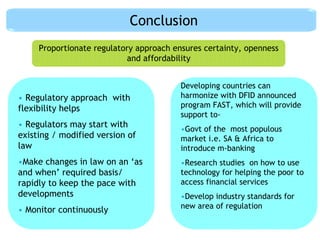
Conclusion
     Proportionate regulatory approach ensures certainty, openness
                           and affordability


                                         Developing countries can
• Regulatory approach with               harmonize with DFID announced
flexibility helps                        program FAST, which will provide
                                         support to-
• Regulators may start with              •Govt of the most populous
existing / modified version of           market i.e. SA & Africa to
law                                      introduce m-banking
•Make changes in law on an ‘as           •Research studies on how to use
and when’ required basis/                technology for helping the poor to
rapidly to keep the pace with            access financial services
developments                             •Develop industry standards for
                                         new area of regulation
• Monitor continuously
Thank You

M-banking

  • 1.
    Mobile Banking : Overviewof Regulatory frameworks in emerging markets Rasheda Sultana Grameenphone Ltd. Action on Access CPRSouth4 8 December,2009
  • 2.
  • 3.
    Key determinants :arenow ? Where we policy, regulation &..
  • 4.
    Models of M-banking Key issues Model Bank Based Non-bank (NB) Based Who regulates Financial regulator Telco & Financial regulator Scope Additive Transformational Who holds the deposit Bank Bank Cash in-out points Bank Telco/NB Dominant brand Bank Telco/NB Who has access to the service Limited to account holders Limited to subscriber Carrier/gateway Any Telco Who owns the customer Bank Telco/NB Examples MTN (S-Africa), other SMS G-Cash, Smart, Celpay banking services (Zambia), M-PESA Source: CGAP(Consultative group to assist the poor)
  • 5.
    Concerns of Financialregulators Adequate consumer protection Security of transactions Stability of banking and Issuance of e-money payment system Applying AML/CFT/KYC Distinction between payments regulations for account and deposits opening/cash transactions Supervision of Central Bank
  • 6.
    •Recognizes E-Money, EFTand Mobile Payments Bank-based model Bangladesh Bank will have the authority to grant licenses for – • Payment system operators (PSO) and Bangladesh Bank (BB) issued draft • Payment service providers (PSPs) Bangladesh Payment and •KYC handled by H2H connectivity between bank and non-bank Settlement System Regulation 2009 • AML regulated under ‘Money laundering prevention act 2002’ • Maximum limit of transaction BDT 10,000 •Any entity authorized by BB can issue e-money Three banks got approval for ‘Digital Money Electronic Prepaid Card System’ in Sept’09
  • 7.
    Bank-based model Only banks will be permitted to offer m-banking services ‘Mobile Banking transactions in Only customers of banks and holders of debit/credit cards issued will avail m-banking services India - Operative Guidelines for • KYC through registration of bank document Banks’ issued by • AML/CFT Regulated under the ‘Prevention of Money Reserve Bank of Laundering Act 2002’ India • Use of mobile banking services for cross border transfers is strictly prohibited • Per transaction limit INR 2,500, Overall cap of INR. 5,000 per day, per customer
  • 8.
    – State bankof Pakistan (SBP) issued policy paper on Mobile Banking –Discusses Bank-focused, Bank-led, non-bank-led model Bank-based model – Draft Electronic Fund Transfer and Payment System Act – KYC through National ID – An approved authority to issue e-money – A customer can do a maximum of 3 transactions per month. The monthly limit for sending or receiving is PKR10,000 –The Electronic Crime Bill (2006) protects consumers from e-crimes SBP roadmap recommends bank-based model with the scope of introducing non-bank-based model at later stage. Easy Paisa introduced in October’09
  • 9.
    Non-bank based Model CBSL (Central Bank of Sri Lanka) •Allows m-banking under the broad framework of •Allows m-banking under the broad framework of the ‘money, payment, clearing and settlement the ‘money, payment, clearing and settlement has all the necessary service provider’s regulations no. 1 of 2007 service provider’s regulations no. 1 of 2007 legal powers to regulate •The framework for mobile payments is expected to •The framework for mobile payments is expected to the mobile payments be finalized in 2009 be finalized in 2009 Under the Payment and Settlement • A non-bank is required to register at CBSL as • A non-bank is required to register at CBSL as Systems Act 2005 Specialized Stored Value Card Institution, if Stored Specialized Stored Value Card Institution, if Stored Value Card to be issued Value Card to be issued
  • 10.
    Non-bank based Model ‘Money, Payment, Clearing and Settlement Service Providers Regulations No.1 of 2007’ Banking law and regulations do not set clear standards regarding the ability to use agents to perform banking function • Non-banks are permitted to perform various payment functions virtually unregulated • M-PESA is expected to report its activities on a regular basis to the regulator Central Bank issues “Direction on Service Providers of Card Based Payment Instruments” under Regulations No. 01 of 2007 • AML through AML bill 2007 & • Transactions of M-PESA is capped
  • 11.
    On January 25th,2009 the Kenyan Treasury published the results of the audit of the M-PESA money transfer service undertaken by the Central Bank of Kenya at the end of 2008. The note released in the national press articulates three important points: (i) it concludes that M-PESA is safe and reliable to use, (ii) it clarifies the nature of the regulatory framework under which M-PESA operates; (iii) it highlights the contribution of M-PESA in the national payment system Source: GSMA MMU Q2’09
  • 12.
    Non-bank based Model General Banking Law 2000 o Ensuring KYC with valid ID cards o For AML/CFT comply with the AML Act o Giving BSP access to records o Allowing to open accounts via agents if they are certified as remittance agents by AMLC o Central bank supervise the operations on annual basis “E-Commerce Act 2000’ o Validity of electronic transactions and electronic signatures o Basis for the prosecution of electronic crime, oSecurity to private sector actors concerned about repudiation of transactions o Legal standing of electronic records
  • 13.
    Non-bank based Model 1. Position Paper on Electronic Money which stated that SARB only banks will be permitted to issue electronic (South Africa Reserve money Bank) issued two documents 2. Bank Circular 619 allowing banks to open mobile impacting m-banking- phone-operated bank accounts (within certain transaction and balance limits) AML regulation for mobile money in South o KYC compliance with valid South African ID card Africa has been chosen as o AML/ CFT through the Financial Intelligence Center ‘industry’s favorite Act (FICA) regulatory solution’ o Only banks can issue e-money
  • 14.
    Customer experience withdifferent m-banking models Key factors :Affordability & convenience Non-bank based Model has been more popular Source: (FSD Kenya, 2009); (CGAP,2008)
  • 15.
    Conclusion Proportionate regulatory approach ensures certainty, openness and affordability Developing countries can • Regulatory approach with harmonize with DFID announced flexibility helps program FAST, which will provide support to- • Regulators may start with •Govt of the most populous existing / modified version of market i.e. SA & Africa to law introduce m-banking •Make changes in law on an ‘as •Research studies on how to use and when’ required basis/ technology for helping the poor to rapidly to keep the pace with access financial services developments •Develop industry standards for new area of regulation • Monitor continuously
  • 16.