Top school in IndiaTop school in India
By:By:
school.edhole.comschool.edhole.com
Chapter 4: AddressingChapter 4: Addressing
AudiencesAudiences
Dr. Alan HaffaDr. Alan Haffa
Please Silence Cell PhonesPlease Silence Cell Phones
school.edhole.com
Assess Your AudienceAssess Your Audience
 Cultural backgroundCultural background
 Educational backgroundEducational background
 Religious experienceReligious experience
 Practical experiencePractical experience
 Political IdeologyPolitical Ideology
 AgeAge
 GenderGender
 ProfessionProfession
school.edhole.com
How Knowing your Audience canHow Knowing your Audience can
help you Present your Casehelp you Present your Case
 Language you useLanguage you use
 Writing StyleWriting Style
 SlantSlant
 ToneTone
 Types of argumentsTypes of arguments
 EvidenceEvidence
 Kinds of authorities citedKinds of authorities cited
school.edhole.com
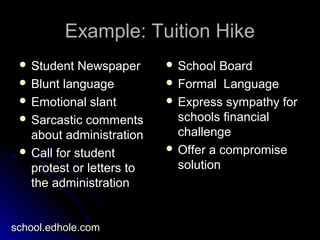
Example: Tuition HikeExample: Tuition Hike
 Student NewspaperStudent Newspaper
 Blunt languageBlunt language
 Emotional slantEmotional slant
 Sarcastic commentsSarcastic comments
about administrationabout administration
 Call for studentCall for student
protest or letters toprotest or letters to
the administrationthe administration
 School BoardSchool Board
 Formal LanguageFormal Language
 Express sympathy forExpress sympathy for
schools financialschools financial
challengechallenge
 Offer a compromiseOffer a compromise
solutionsolution
school.edhole.com
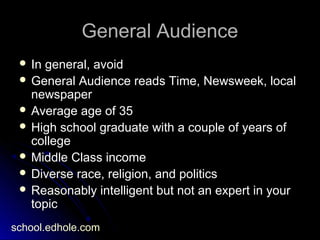
General AudienceGeneral Audience
 In general, avoidIn general, avoid
 General Audience reads Time, Newsweek, localGeneral Audience reads Time, Newsweek, local
newspapernewspaper
 Average age of 35Average age of 35
 High school graduate with a couple of years ofHigh school graduate with a couple of years of
collegecollege
 Middle Class incomeMiddle Class income
 Diverse race, religion, and politicsDiverse race, religion, and politics
 Reasonably intelligent but not an expert in yourReasonably intelligent but not an expert in your
topictopic
school.edhole.com
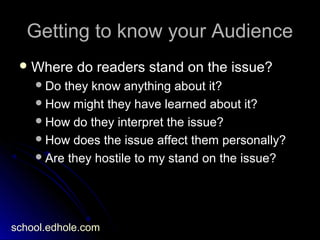
Getting to know your AudienceGetting to know your Audience
 Where do readers stand on the issue?Where do readers stand on the issue?
Do they know anything about it?Do they know anything about it?
How might they have learned about it?How might they have learned about it?
How do they interpret the issue?How do they interpret the issue?
How does the issue affect them personally?How does the issue affect them personally?
Are they hostile to my stand on the issue?Are they hostile to my stand on the issue?
school.edhole.com
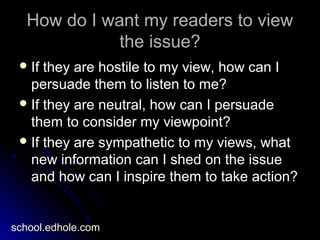
How do I want my readers to viewHow do I want my readers to view
the issue?the issue?
 If they are hostile to my view, how can IIf they are hostile to my view, how can I
persuade them to listen to me?persuade them to listen to me?
 If they are neutral, how can I persuadeIf they are neutral, how can I persuade
them to consider my viewpoint?them to consider my viewpoint?
 If they are sympathetic to my views, whatIf they are sympathetic to my views, what
new information can I shed on the issuenew information can I shed on the issue
and how can I inspire them to take action?and how can I inspire them to take action?
school.edhole.com
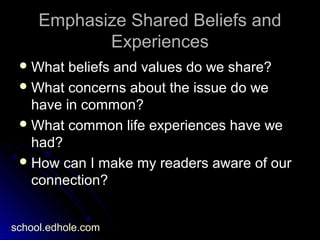
Emphasize Shared Beliefs andEmphasize Shared Beliefs and
ExperiencesExperiences
 What beliefs and values do we share?What beliefs and values do we share?
 What concerns about the issue do weWhat concerns about the issue do we
have in common?have in common?
 What common life experiences have weWhat common life experiences have we
had?had?
 How can I make my readers aware of ourHow can I make my readers aware of our
connection?connection?
school.edhole.com
Use Dialogue to Gain InsightUse Dialogue to Gain Insight
 Dialogue with people who fit your targetDialogue with people who fit your target
demographicdemographic
 Yes, but conversations useful in identifyingYes, but conversations useful in identifying
their concerns so you can try to addresstheir concerns so you can try to address
them in essaythem in essay
 Dialogue also useful to identify sharedDialogue also useful to identify shared
values and beliefs that can bevalues and beliefs that can be
emphasizedemphasized
school.edhole.com
Adapting to your Readers’ AttitudesAdapting to your Readers’ Attitudes
if Neutralif Neutral
 Fill in the backgroundFill in the background
 Present a Balanced PicturePresent a Balanced Picture
 Personalize the Issues; how the problemPersonalize the Issues; how the problem
will affect them personallywill affect them personally
 Show respectShow respect
 Avoid appeal to pity and oversimplicationAvoid appeal to pity and oversimplication
or false dilemmaor false dilemma
school.edhole.com
Addressing a Friendly AudienceAddressing a Friendly Audience
 Avoid appealing to prejudicesAvoid appealing to prejudices
 Avoid ad hominem or ad populumAvoid ad hominem or ad populum
 Offer new information about the issue;Offer new information about the issue;
they may share your view but may notthey may share your view but may not
know the most up-to-date informationknow the most up-to-date information
school.edhole.com
Addressing an Unfriendly AudienceAddressing an Unfriendly Audience
 Seek Common Ground and remind audience of itSeek Common Ground and remind audience of it
repeatedlyrepeatedly
 Example: Sr. citizens and higher taxes for schoolsExample: Sr. citizens and higher taxes for schools
 Acknowledge the legitimacy of audience’sAcknowledge the legitimacy of audience’s
concerns; don’t belittle or minimize them.concerns; don’t belittle or minimize them.
 Convey a positive attitudeConvey a positive attitude
 Treat them with respectTreat them with respect
 Use good sources of information and authoritiesUse good sources of information and authorities
that will be respected by everyone, not justthat will be respected by everyone, not just
partisanspartisans
school.edhole.com
Importance of ClearImportance of Clear
Communication: Word ChoiceCommunication: Word Choice
 Denotative and Connotative MeaningDenotative and Connotative Meaning
 A “jihad against smoking”A “jihad against smoking”
school.edhole.com
Word Choice: Be SpecificWord Choice: Be Specific
 Denotative scale of specificity: page 111Denotative scale of specificity: page 111
 General words are useful in commonGeneral words are useful in common
conversationconversation
 Writing, however, requires greaterWriting, however, requires greater
specificity because audience cannot askspecificity because audience cannot ask
you to clarifyyou to clarify
school.edhole.com
Figurative LanguageFigurative Language
 ““Yesterday, it was 96 degrees and veryYesterday, it was 96 degrees and very
humid.”humid.”
 Or, “Yesterday the air was like warm glue.”Or, “Yesterday the air was like warm glue.”
 Figurative language equates one thingFigurative language equates one thing
with another.with another.
 Simile: use of “like” “as” “than”: A school ofSimile: use of “like” “as” “than”: A school of
minnows shot by me like pelting rain.”minnows shot by me like pelting rain.”
 ““His arms are as big as hams.”His arms are as big as hams.”
 ““They’re meaner than junkyard dogs.”They’re meaner than junkyard dogs.”
school.edhole.com
MetaphorMetaphor
 Omitting the word “like, as, than” makes itOmitting the word “like, as, than” makes it
a metaphor.a metaphor.
 ““This calculus problem is a real pain in theThis calculus problem is a real pain in the
neck.”neck.”
 ““The crime in this city is a cancer out ofThe crime in this city is a cancer out of
control.”control.”
school.edhole.com
Cautions using FigurativeCautions using Figurative
LanguageLanguage
 Avoid cliches: these are figures that are soAvoid cliches: these are figures that are so
common they have lost their freshness and theycommon they have lost their freshness and they
sound unimaginativesound unimaginative
 Mixed Metaphors: combining differentMixed Metaphors: combining different
metaphors that don’t go together well.metaphors that don’t go together well.
 ““The heat of his expression froze them in theirThe heat of his expression froze them in their
tracks.”tracks.”
 ““The experience left a bad taste in her eyes.”The experience left a bad taste in her eyes.”
 ““The arm of the law has two strikes against it.”The arm of the law has two strikes against it.”
school.edhole.com
EuphemismsEuphemisms
 Using a nice sounding word to say something harshUsing a nice sounding word to say something harsh
and biting and criticaland biting and critical
 Downsizing or Restructuring for massive layoffsDownsizing or Restructuring for massive layoffs
and firingsand firings
 Revenue enhancement for raising taxesRevenue enhancement for raising taxes
 Gaming Industry for gamblingGaming Industry for gambling
 Passed away—diedPassed away—died
 Socially disadvantaged—poorSocially disadvantaged—poor
 Be sure that the reader can understand what youBe sure that the reader can understand what you
are sayingare saying
 Be sure that they don’t sanitize your writing soBe sure that they don’t sanitize your writing so
much that it loses its impactmuch that it loses its impact
school.edhole.com
Definitions and Technical TermsDefinitions and Technical Terms
 Be sure to offer a clear definition of anyBe sure to offer a clear definition of any
technical terms to key wordstechnical terms to key words
 What is “legal marriage” and how is itWhat is “legal marriage” and how is it
defined differently than “civil union”?defined differently than “civil union”?
 Don’t spend too much time defining wordsDon’t spend too much time defining words
your audience would know.your audience would know.
school.edhole.com
Use of Humor or SarcasmUse of Humor or Sarcasm
 Be wary of creating a negative, hostile toneBe wary of creating a negative, hostile tone
by using sarcasmby using sarcasm
 It can be done with a sympathetic audience,It can be done with a sympathetic audience,
but again, be sure that it isn’t over the topbut again, be sure that it isn’t over the top
and that it doesn’t take the place of facts andand that it doesn’t take the place of facts and
arguments. As a way to get attention it mayarguments. As a way to get attention it may
be appropriate.be appropriate.
 If writing to a neutral audience or contraryIf writing to a neutral audience or contrary
one, humor that makes fun of yourself is theone, humor that makes fun of yourself is the
best and sarcasm must be avoided at allbest and sarcasm must be avoided at all
costs.costs.school.edhole.com
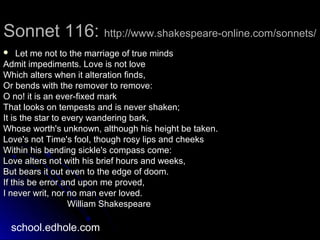
Sonnet 116:Sonnet 116: http://www.shakespeare-online.com/sonnets/http://www.shakespeare-online.com/sonnets/
 Let me not to the marriage of true mindsLet me not to the marriage of true minds
Admit impediments. Love is not loveAdmit impediments. Love is not love
Which alters when it alteration finds,Which alters when it alteration finds,
Or bends with the remover to remove:Or bends with the remover to remove:
O no! it is an ever-fixed markO no! it is an ever-fixed mark
That looks on tempests and is never shaken;That looks on tempests and is never shaken;
It is the star to every wandering bark,It is the star to every wandering bark,
Whose worth's unknown, although his height be taken.Whose worth's unknown, although his height be taken.
Love's not Time's fool, though rosy lips and cheeksLove's not Time's fool, though rosy lips and cheeks
Within his bending sickle's compass come:Within his bending sickle's compass come:
Love alters not with his brief hours and weeks,Love alters not with his brief hours and weeks,
But bears it out even to the edge of doom.But bears it out even to the edge of doom.
If this be error and upon me proved,If this be error and upon me proved,
I never writ, nor no man ever loved.I never writ, nor no man ever loved.
William ShakespeareWilliam Shakespeare
school.edhole.com

Mba top schools in india

  • 1.
    Top school inIndiaTop school in India By:By: school.edhole.comschool.edhole.com
  • 2.
    Chapter 4: AddressingChapter4: Addressing AudiencesAudiences Dr. Alan HaffaDr. Alan Haffa Please Silence Cell PhonesPlease Silence Cell Phones school.edhole.com
  • 3.
    Assess Your AudienceAssessYour Audience  Cultural backgroundCultural background  Educational backgroundEducational background  Religious experienceReligious experience  Practical experiencePractical experience  Political IdeologyPolitical Ideology  AgeAge  GenderGender  ProfessionProfession school.edhole.com
  • 4.
    How Knowing yourAudience canHow Knowing your Audience can help you Present your Casehelp you Present your Case  Language you useLanguage you use  Writing StyleWriting Style  SlantSlant  ToneTone  Types of argumentsTypes of arguments  EvidenceEvidence  Kinds of authorities citedKinds of authorities cited school.edhole.com
  • 5.
    Example: Tuition HikeExample:Tuition Hike  Student NewspaperStudent Newspaper  Blunt languageBlunt language  Emotional slantEmotional slant  Sarcastic commentsSarcastic comments about administrationabout administration  Call for studentCall for student protest or letters toprotest or letters to the administrationthe administration  School BoardSchool Board  Formal LanguageFormal Language  Express sympathy forExpress sympathy for schools financialschools financial challengechallenge  Offer a compromiseOffer a compromise solutionsolution school.edhole.com
  • 6.
    General AudienceGeneral Audience In general, avoidIn general, avoid  General Audience reads Time, Newsweek, localGeneral Audience reads Time, Newsweek, local newspapernewspaper  Average age of 35Average age of 35  High school graduate with a couple of years ofHigh school graduate with a couple of years of collegecollege  Middle Class incomeMiddle Class income  Diverse race, religion, and politicsDiverse race, religion, and politics  Reasonably intelligent but not an expert in yourReasonably intelligent but not an expert in your topictopic school.edhole.com
  • 7.
    Getting to knowyour AudienceGetting to know your Audience  Where do readers stand on the issue?Where do readers stand on the issue? Do they know anything about it?Do they know anything about it? How might they have learned about it?How might they have learned about it? How do they interpret the issue?How do they interpret the issue? How does the issue affect them personally?How does the issue affect them personally? Are they hostile to my stand on the issue?Are they hostile to my stand on the issue? school.edhole.com
  • 8.
    How do Iwant my readers to viewHow do I want my readers to view the issue?the issue?  If they are hostile to my view, how can IIf they are hostile to my view, how can I persuade them to listen to me?persuade them to listen to me?  If they are neutral, how can I persuadeIf they are neutral, how can I persuade them to consider my viewpoint?them to consider my viewpoint?  If they are sympathetic to my views, whatIf they are sympathetic to my views, what new information can I shed on the issuenew information can I shed on the issue and how can I inspire them to take action?and how can I inspire them to take action? school.edhole.com
  • 9.
    Emphasize Shared BeliefsandEmphasize Shared Beliefs and ExperiencesExperiences  What beliefs and values do we share?What beliefs and values do we share?  What concerns about the issue do weWhat concerns about the issue do we have in common?have in common?  What common life experiences have weWhat common life experiences have we had?had?  How can I make my readers aware of ourHow can I make my readers aware of our connection?connection? school.edhole.com
  • 10.
    Use Dialogue toGain InsightUse Dialogue to Gain Insight  Dialogue with people who fit your targetDialogue with people who fit your target demographicdemographic  Yes, but conversations useful in identifyingYes, but conversations useful in identifying their concerns so you can try to addresstheir concerns so you can try to address them in essaythem in essay  Dialogue also useful to identify sharedDialogue also useful to identify shared values and beliefs that can bevalues and beliefs that can be emphasizedemphasized school.edhole.com
  • 11.
    Adapting to yourReaders’ AttitudesAdapting to your Readers’ Attitudes if Neutralif Neutral  Fill in the backgroundFill in the background  Present a Balanced PicturePresent a Balanced Picture  Personalize the Issues; how the problemPersonalize the Issues; how the problem will affect them personallywill affect them personally  Show respectShow respect  Avoid appeal to pity and oversimplicationAvoid appeal to pity and oversimplication or false dilemmaor false dilemma school.edhole.com
  • 12.
    Addressing a FriendlyAudienceAddressing a Friendly Audience  Avoid appealing to prejudicesAvoid appealing to prejudices  Avoid ad hominem or ad populumAvoid ad hominem or ad populum  Offer new information about the issue;Offer new information about the issue; they may share your view but may notthey may share your view but may not know the most up-to-date informationknow the most up-to-date information school.edhole.com
  • 13.
    Addressing an UnfriendlyAudienceAddressing an Unfriendly Audience  Seek Common Ground and remind audience of itSeek Common Ground and remind audience of it repeatedlyrepeatedly  Example: Sr. citizens and higher taxes for schoolsExample: Sr. citizens and higher taxes for schools  Acknowledge the legitimacy of audience’sAcknowledge the legitimacy of audience’s concerns; don’t belittle or minimize them.concerns; don’t belittle or minimize them.  Convey a positive attitudeConvey a positive attitude  Treat them with respectTreat them with respect  Use good sources of information and authoritiesUse good sources of information and authorities that will be respected by everyone, not justthat will be respected by everyone, not just partisanspartisans school.edhole.com
  • 14.
    Importance of ClearImportanceof Clear Communication: Word ChoiceCommunication: Word Choice  Denotative and Connotative MeaningDenotative and Connotative Meaning  A “jihad against smoking”A “jihad against smoking” school.edhole.com
  • 15.
    Word Choice: BeSpecificWord Choice: Be Specific  Denotative scale of specificity: page 111Denotative scale of specificity: page 111  General words are useful in commonGeneral words are useful in common conversationconversation  Writing, however, requires greaterWriting, however, requires greater specificity because audience cannot askspecificity because audience cannot ask you to clarifyyou to clarify school.edhole.com
  • 16.
    Figurative LanguageFigurative Language ““Yesterday, it was 96 degrees and veryYesterday, it was 96 degrees and very humid.”humid.”  Or, “Yesterday the air was like warm glue.”Or, “Yesterday the air was like warm glue.”  Figurative language equates one thingFigurative language equates one thing with another.with another.  Simile: use of “like” “as” “than”: A school ofSimile: use of “like” “as” “than”: A school of minnows shot by me like pelting rain.”minnows shot by me like pelting rain.”  ““His arms are as big as hams.”His arms are as big as hams.”  ““They’re meaner than junkyard dogs.”They’re meaner than junkyard dogs.” school.edhole.com
  • 17.
    MetaphorMetaphor  Omitting theword “like, as, than” makes itOmitting the word “like, as, than” makes it a metaphor.a metaphor.  ““This calculus problem is a real pain in theThis calculus problem is a real pain in the neck.”neck.”  ““The crime in this city is a cancer out ofThe crime in this city is a cancer out of control.”control.” school.edhole.com
  • 18.
    Cautions using FigurativeCautionsusing Figurative LanguageLanguage  Avoid cliches: these are figures that are soAvoid cliches: these are figures that are so common they have lost their freshness and theycommon they have lost their freshness and they sound unimaginativesound unimaginative  Mixed Metaphors: combining differentMixed Metaphors: combining different metaphors that don’t go together well.metaphors that don’t go together well.  ““The heat of his expression froze them in theirThe heat of his expression froze them in their tracks.”tracks.”  ““The experience left a bad taste in her eyes.”The experience left a bad taste in her eyes.”  ““The arm of the law has two strikes against it.”The arm of the law has two strikes against it.” school.edhole.com
  • 19.
    EuphemismsEuphemisms  Using anice sounding word to say something harshUsing a nice sounding word to say something harsh and biting and criticaland biting and critical  Downsizing or Restructuring for massive layoffsDownsizing or Restructuring for massive layoffs and firingsand firings  Revenue enhancement for raising taxesRevenue enhancement for raising taxes  Gaming Industry for gamblingGaming Industry for gambling  Passed away—diedPassed away—died  Socially disadvantaged—poorSocially disadvantaged—poor  Be sure that the reader can understand what youBe sure that the reader can understand what you are sayingare saying  Be sure that they don’t sanitize your writing soBe sure that they don’t sanitize your writing so much that it loses its impactmuch that it loses its impact school.edhole.com
  • 20.
    Definitions and TechnicalTermsDefinitions and Technical Terms  Be sure to offer a clear definition of anyBe sure to offer a clear definition of any technical terms to key wordstechnical terms to key words  What is “legal marriage” and how is itWhat is “legal marriage” and how is it defined differently than “civil union”?defined differently than “civil union”?  Don’t spend too much time defining wordsDon’t spend too much time defining words your audience would know.your audience would know. school.edhole.com
  • 21.
    Use of Humoror SarcasmUse of Humor or Sarcasm  Be wary of creating a negative, hostile toneBe wary of creating a negative, hostile tone by using sarcasmby using sarcasm  It can be done with a sympathetic audience,It can be done with a sympathetic audience, but again, be sure that it isn’t over the topbut again, be sure that it isn’t over the top and that it doesn’t take the place of facts andand that it doesn’t take the place of facts and arguments. As a way to get attention it mayarguments. As a way to get attention it may be appropriate.be appropriate.  If writing to a neutral audience or contraryIf writing to a neutral audience or contrary one, humor that makes fun of yourself is theone, humor that makes fun of yourself is the best and sarcasm must be avoided at allbest and sarcasm must be avoided at all costs.costs.school.edhole.com
  • 22.
    Sonnet 116:Sonnet 116:http://www.shakespeare-online.com/sonnets/http://www.shakespeare-online.com/sonnets/  Let me not to the marriage of true mindsLet me not to the marriage of true minds Admit impediments. Love is not loveAdmit impediments. Love is not love Which alters when it alteration finds,Which alters when it alteration finds, Or bends with the remover to remove:Or bends with the remover to remove: O no! it is an ever-fixed markO no! it is an ever-fixed mark That looks on tempests and is never shaken;That looks on tempests and is never shaken; It is the star to every wandering bark,It is the star to every wandering bark, Whose worth's unknown, although his height be taken.Whose worth's unknown, although his height be taken. Love's not Time's fool, though rosy lips and cheeksLove's not Time's fool, though rosy lips and cheeks Within his bending sickle's compass come:Within his bending sickle's compass come: Love alters not with his brief hours and weeks,Love alters not with his brief hours and weeks, But bears it out even to the edge of doom.But bears it out even to the edge of doom. If this be error and upon me proved,If this be error and upon me proved, I never writ, nor no man ever loved.I never writ, nor no man ever loved. William ShakespeareWilliam Shakespeare school.edhole.com