Financial Management
Lecture 3
Time Value of
Money
Dr. Kwame Oduro Amoako1/5/2020
At the end of Lecture 3, you should be able to:
1. Understand what is meant by "the time value of
money."
2. Understand the relationship between present and
future value.
3. Describe how the interest rate can be used to adjust
the value of cash flows – both forward and backward
– to a single point in time.
4. Calculate both the future and present value of: (a) an
amount invested today; (b) a stream of equal cash
flows (an annuity); and (c) a stream of mixed cash
flows.
Dr. Kwame Oduro Amoako1/5/2020
At the end of Lecture 3, you should be able to:
5. Distinguish between an “ordinary annuity” and an “annuity due.”
6. Use interest factor tables and understand how they provide a
shortcut to calculating present and future values.
7. Use interest factor tables to find an unknown interest rate or
growth rate when the number of time periods and future and
present values are known.
8. Build an “amortization schedule” for an installment-style loan.
1/5/2020 Dr. Kwame Oduro Amoako
The Time Value of Money
• The Interest Rate
• Simple Interest
• Compound Interest
• Amortizing a Loan
• Compounding More Than Once per Year
Dr. Kwame Oduro Amoako1/5/2020
Obviously, ¢10,000 today.
You already recognize that there is TIME
VALUE TO MONEY!!
The Interest Rate
Which would you prefer -- ¢10,000 today
or ¢10,000 in 5 years?
Dr. Kwame Oduro Amoako1/5/2020
TIME allows you the opportunity to
postpone consumption and earn INTEREST.
Why TIME?
Why is TIME such an important element
in your decision?
Dr. Kwame Oduro Amoako1/5/2020
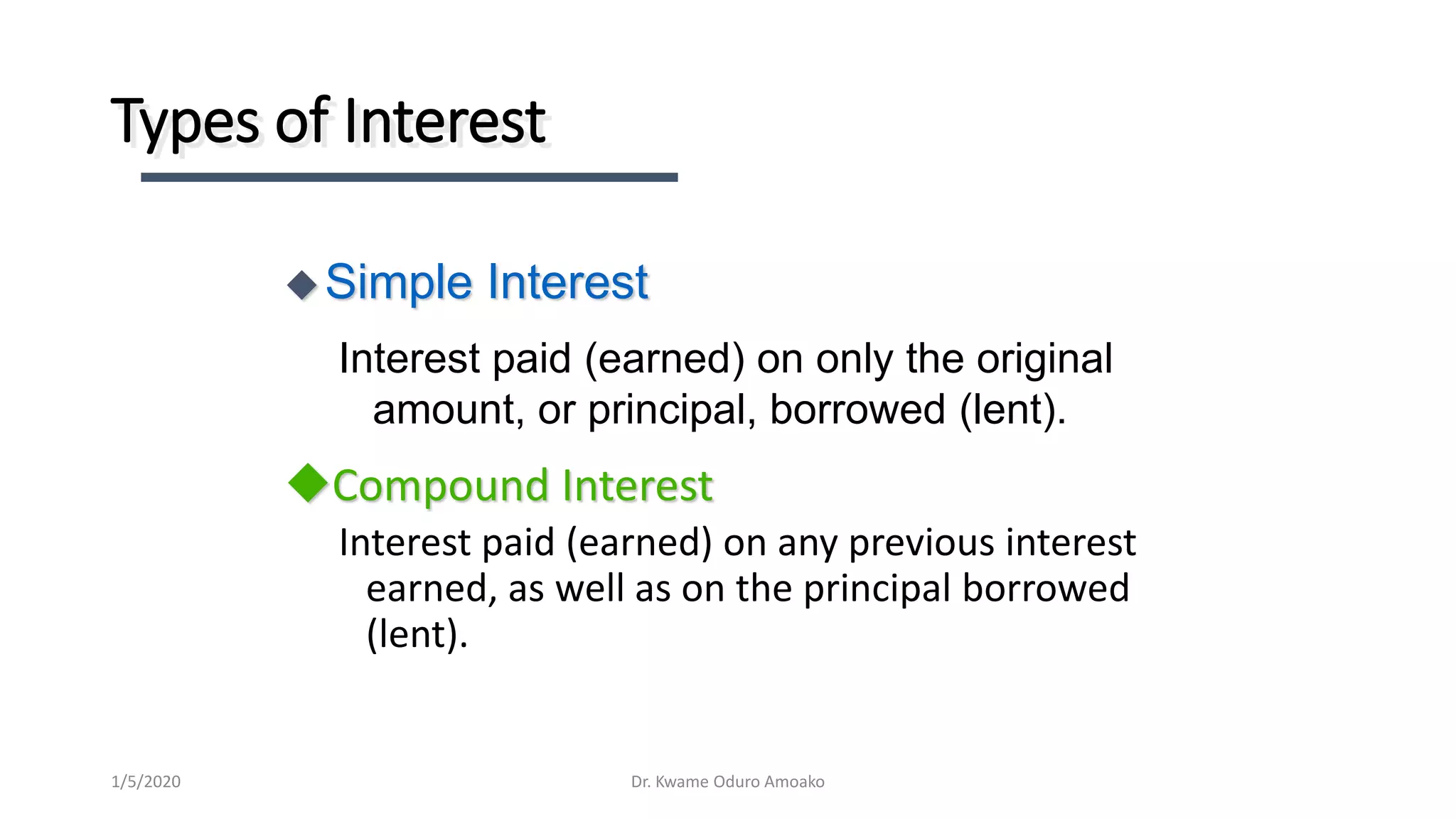
Types of Interest
Compound Interest
Interest paid (earned) on any previous interest
earned, as well as on the principal borrowed
(lent).
Simple Interest
Interest paid (earned) on only the original
amount, or principal, borrowed (lent).
Dr. Kwame Oduro Amoako1/5/2020
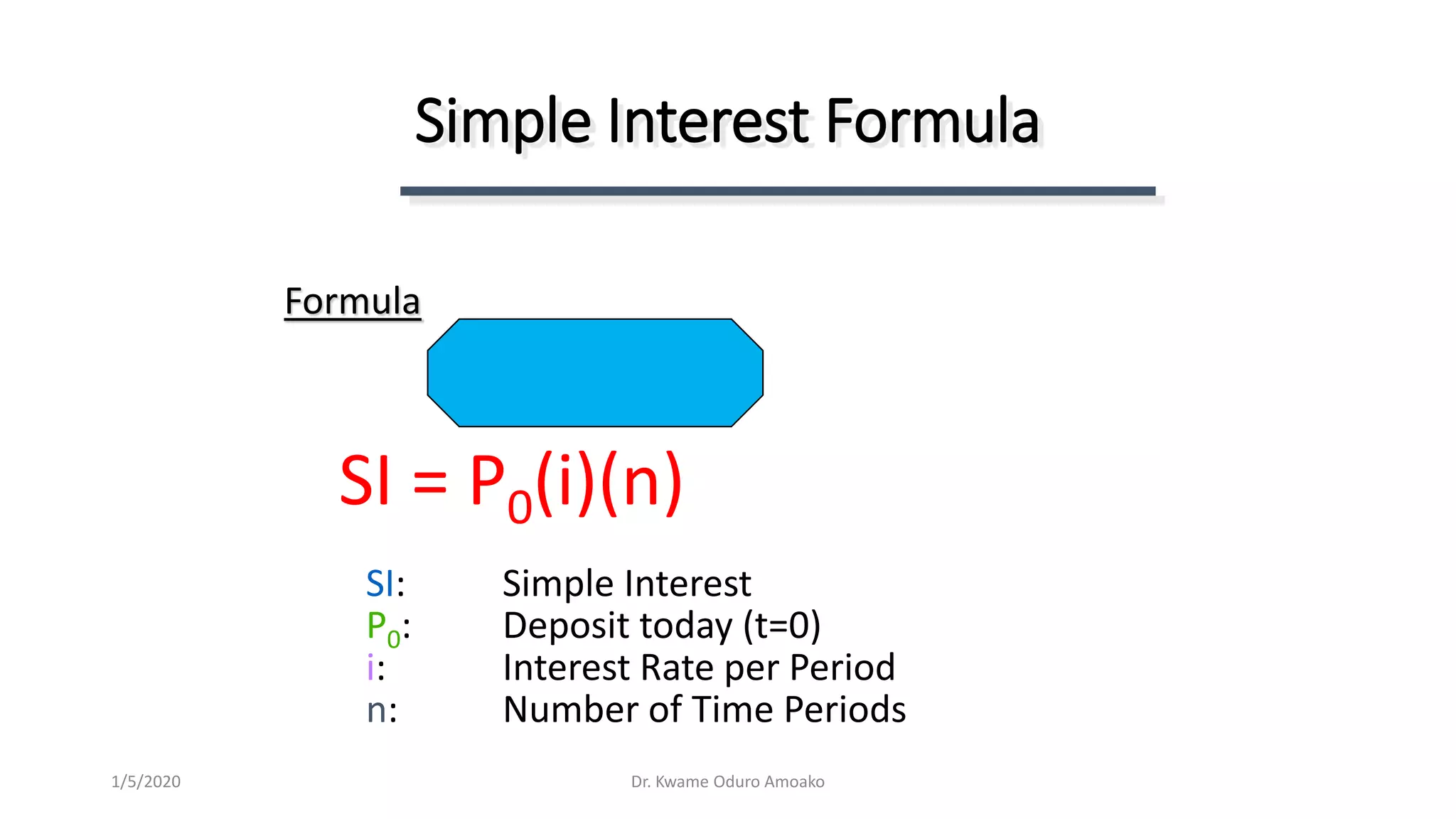
Simple Interest Formula
Formula
SI = P0(i)(n)
SI: Simple Interest
P0: Deposit today (t=0)
i: Interest Rate per Period
n: Number of Time Periods
Dr. Kwame Oduro Amoako1/5/2020
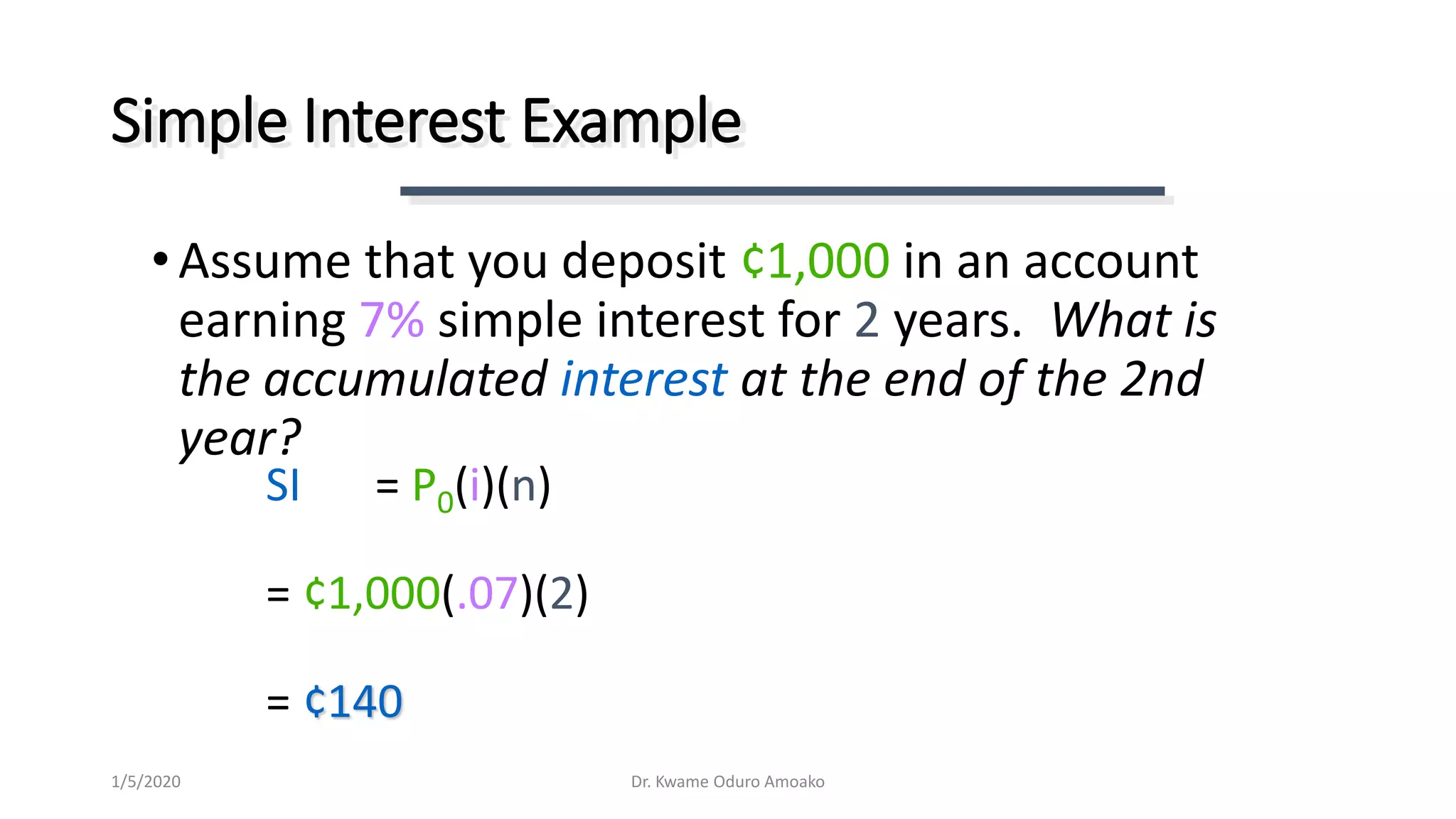
SI = P0(i)(n)
= ¢1,000(.07)(2)
= ¢140
Simple Interest Example
•Assume that you deposit ¢1,000 in an account
earning 7% simple interest for 2 years. What is
the accumulated interest at the end of the 2nd
year?
Dr. Kwame Oduro Amoako1/5/2020
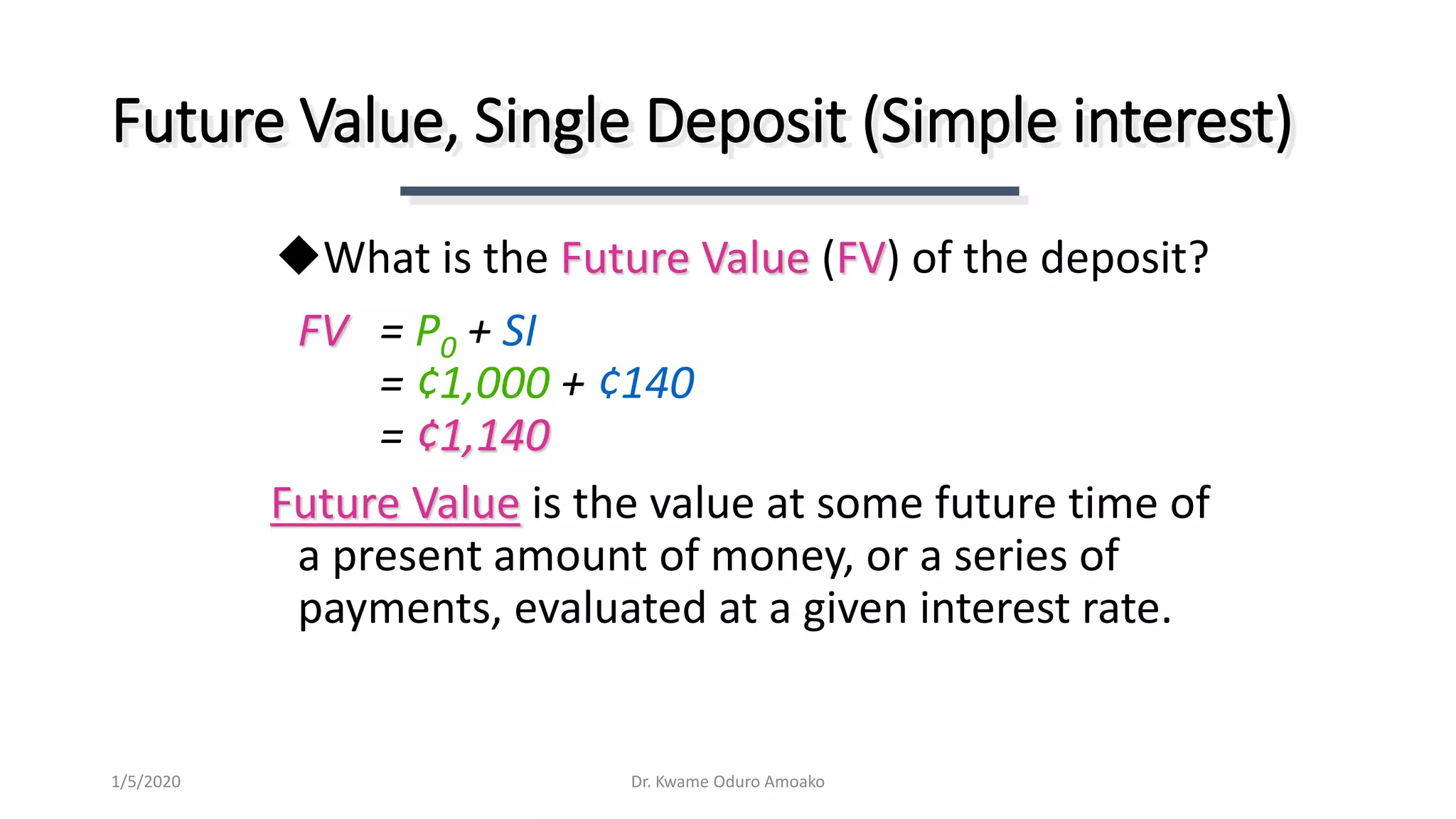
FV = P0 + SI
= ¢1,000 + ¢140
= ¢1,140
Future Value is the value at some future time of
a present amount of money, or a series of
payments, evaluated at a given interest rate.
Future Value, Single Deposit (Simple interest)
What is the Future Value (FV) of the deposit?
Dr. Kwame Oduro Amoako1/5/2020
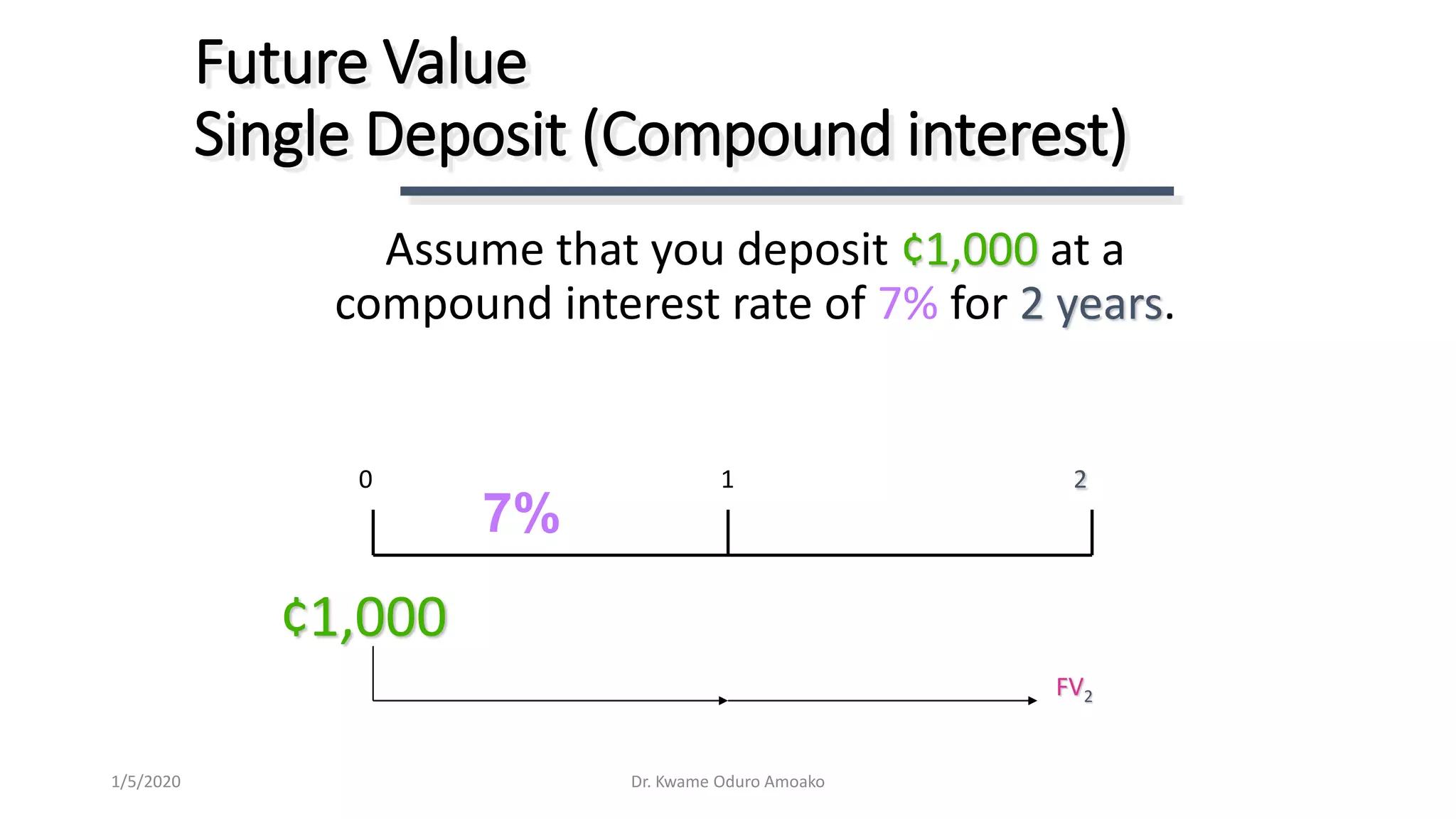
Assume that you deposit ¢1,000 at a
compound interest rate of 7% for 2 years.
Future Value
Single Deposit (Compound interest)
0 1 2
¢1,000
FV2
7%
Dr. Kwame Oduro Amoako1/5/2020
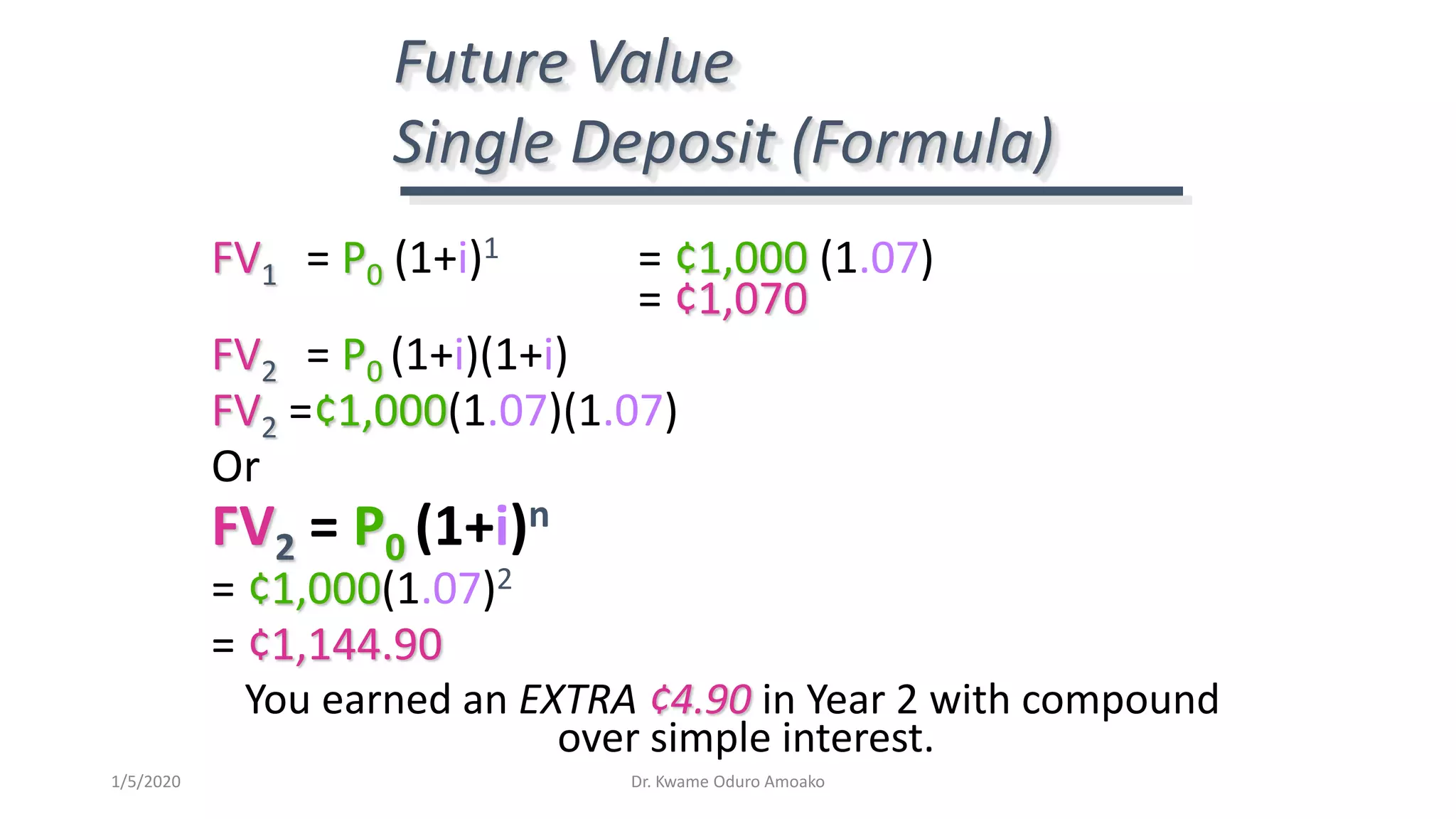
FV1 = P0 (1+i)1 = ¢1,000 (1.07)
= ¢1,070
FV2 = P0 (1+i)(1+i)
FV2 =¢1,000(1.07)(1.07)
Or
FV2 = P0 (1+i)n
= ¢1,000(1.07)2
= ¢1,144.90
You earned an EXTRA ¢4.90 in Year 2 with compound
over simple interest.
Future Value
Single Deposit (Formula)
Dr. Kwame Oduro Amoako1/5/2020
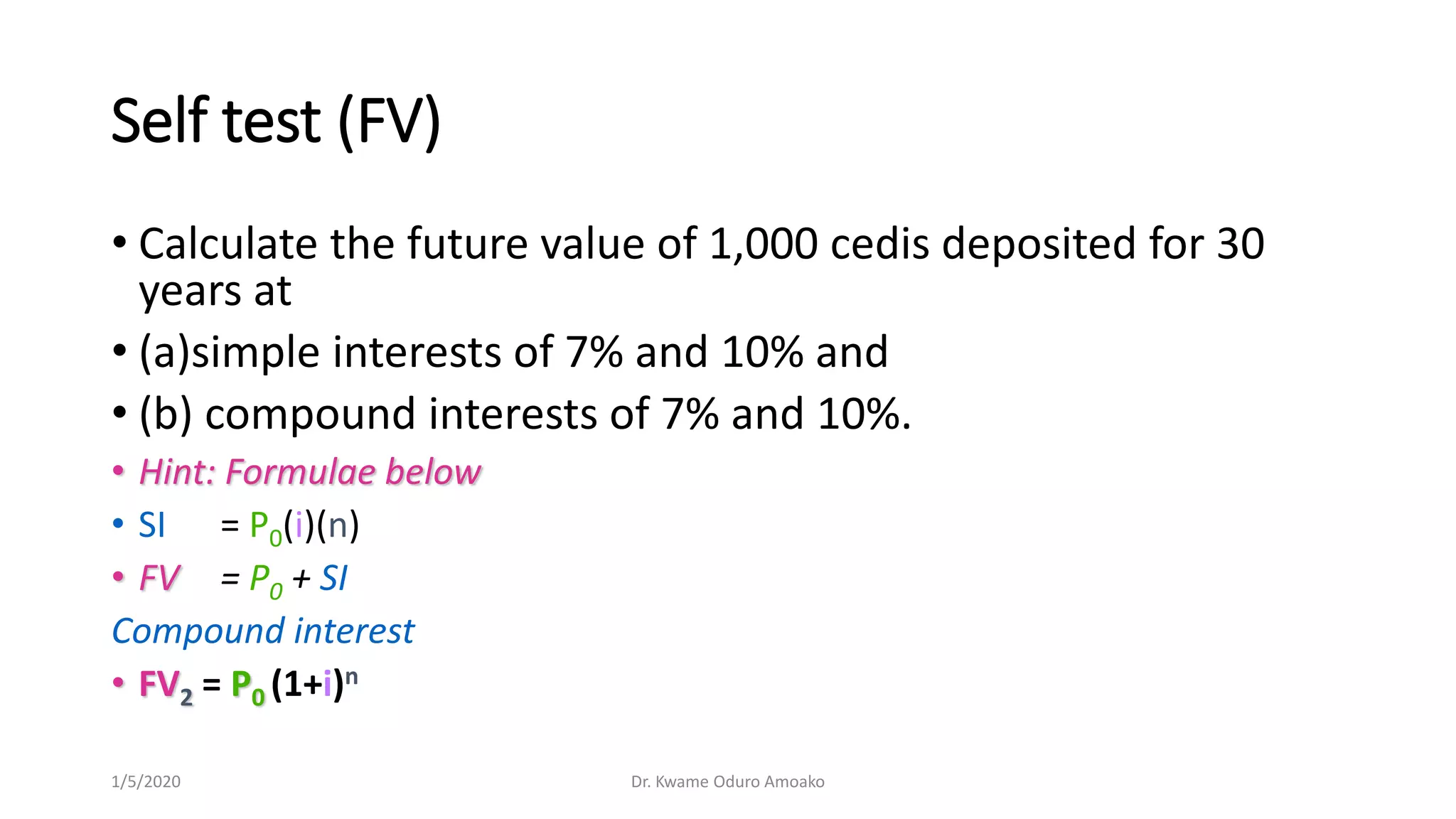
Self test (FV)
• Calculate the future value of 1,000 cedis deposited for 30
years at
• (a)simple interests of 7% and 10% and
• (b) compound interests of 7% and 10%.
• Hint: Formulae below
• SI = P0(i)(n)
• FV = P0 + SI
Compound interest
• FV2 = P0 (1+i)n
1/5/2020 Dr. Kwame Oduro Amoako
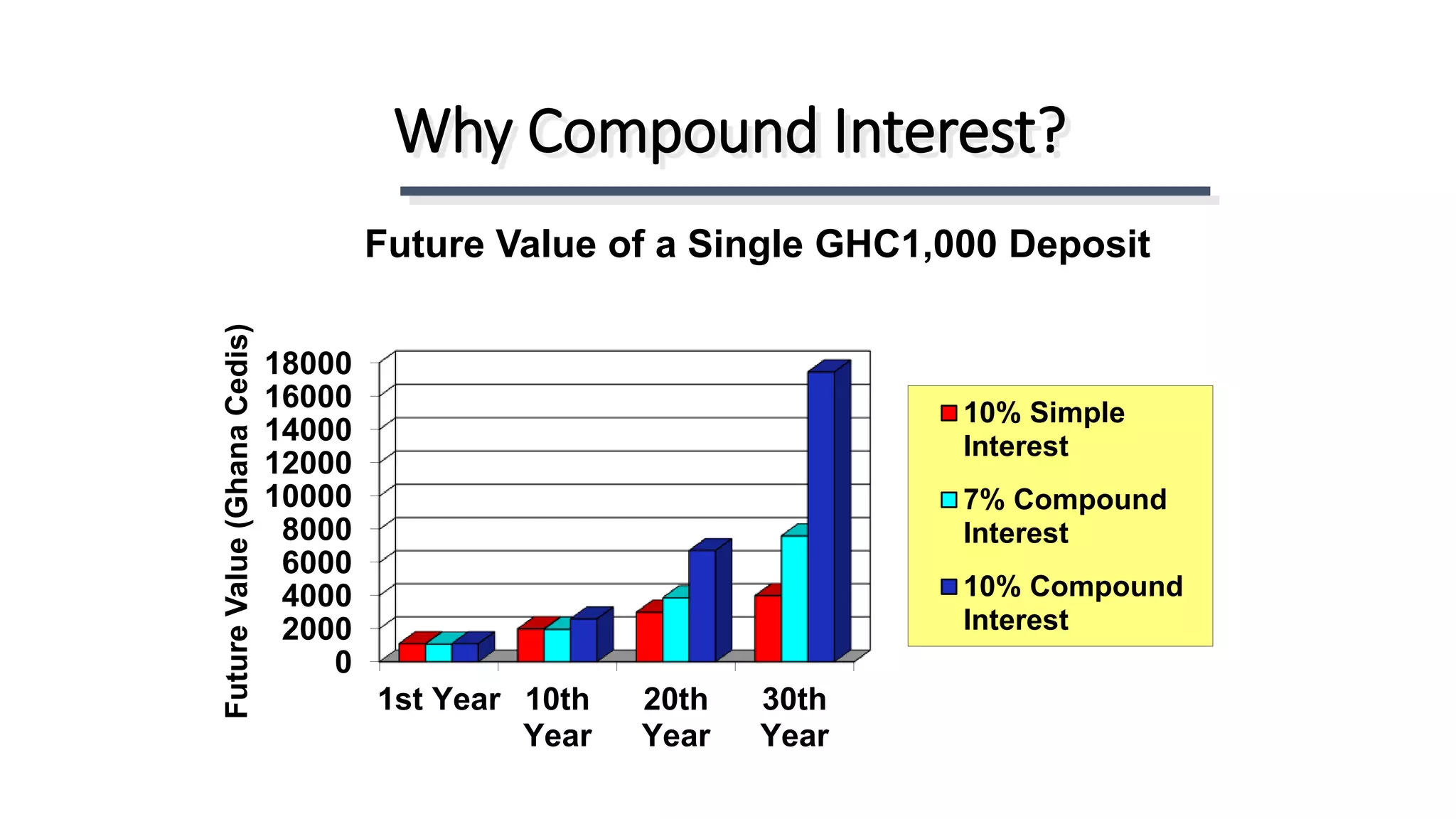
0
2000
4000
6000
8000
10000
12000
14000
16000
18000
1st Year 10th
Year
20th
Year
30th
Year
Future Value of a Single GHC1,000 Deposit
10% Simple
Interest
7% Compound
Interest
10% Compound
Interest
Why Compound Interest?
FutureValue(GhanaCedis)
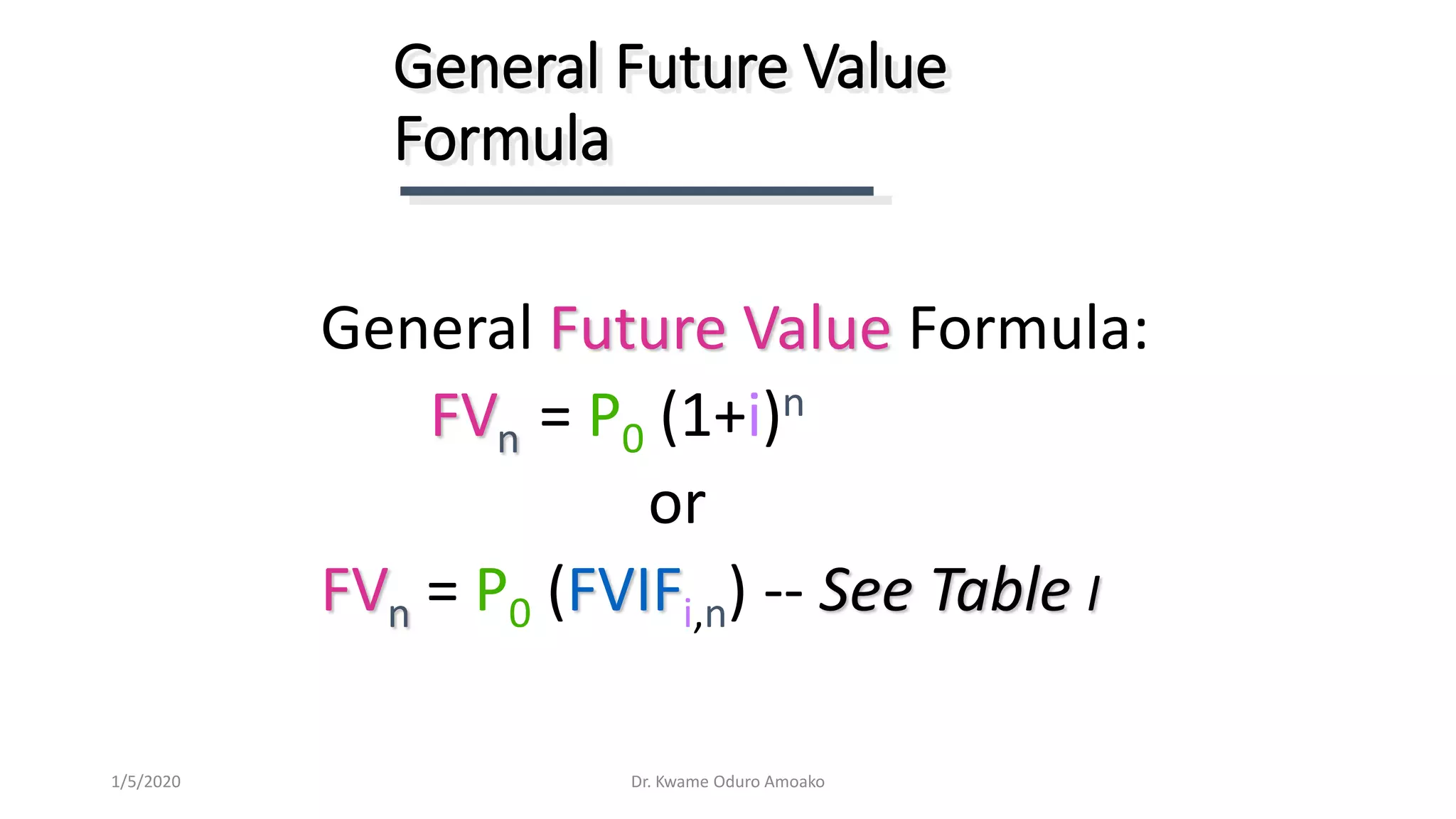
General Future Value Formula:
FVn = P0 (1+i)n
or
FVn = P0 (FVIFi,n) -- See Table I
General Future Value
Formula
Dr. Kwame Oduro Amoako1/5/2020
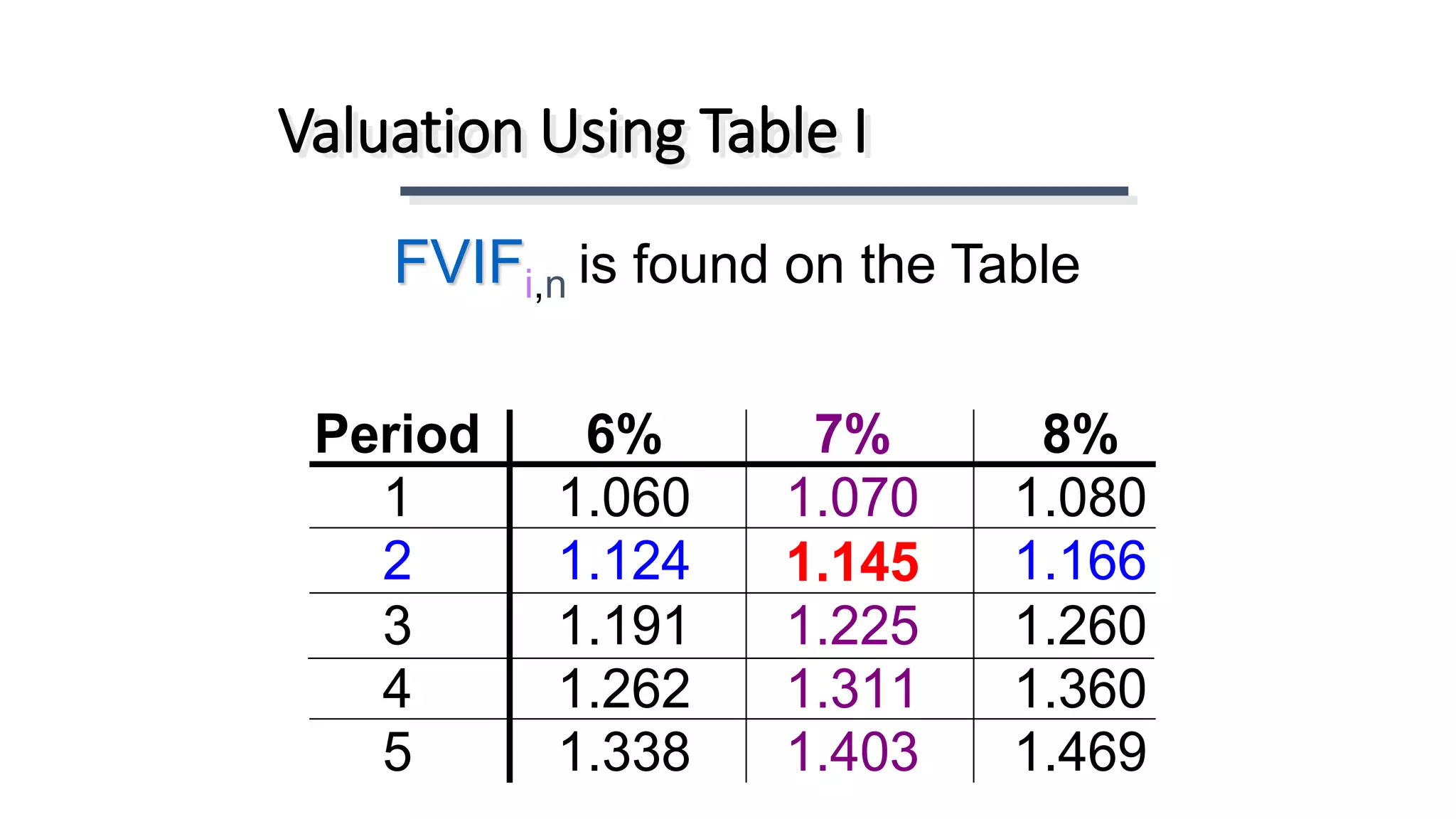
FVIFi,n is found on the Table
Valuation Using Table I
Period 6% 7% 8%
1 1.060 1.070 1.080
2 1.124 1.145 1.166
3 1.191 1.225 1.260
4 1.262 1.311 1.360
5 1.338 1.403 1.469
FV2 = ¢1,000 (FVIF7%,2)
= ¢1,000 (1.145)
= ¢1,145 [Due to Rounding]
Using Future Value Tables
Period 6% 7% 8%
1 1.060 1.070 1.080
2 1.124 1.145 1.166
3 1.191 1.225 1.260
4 1.262 1.311 1.360
5 1.338 1.403 1.469
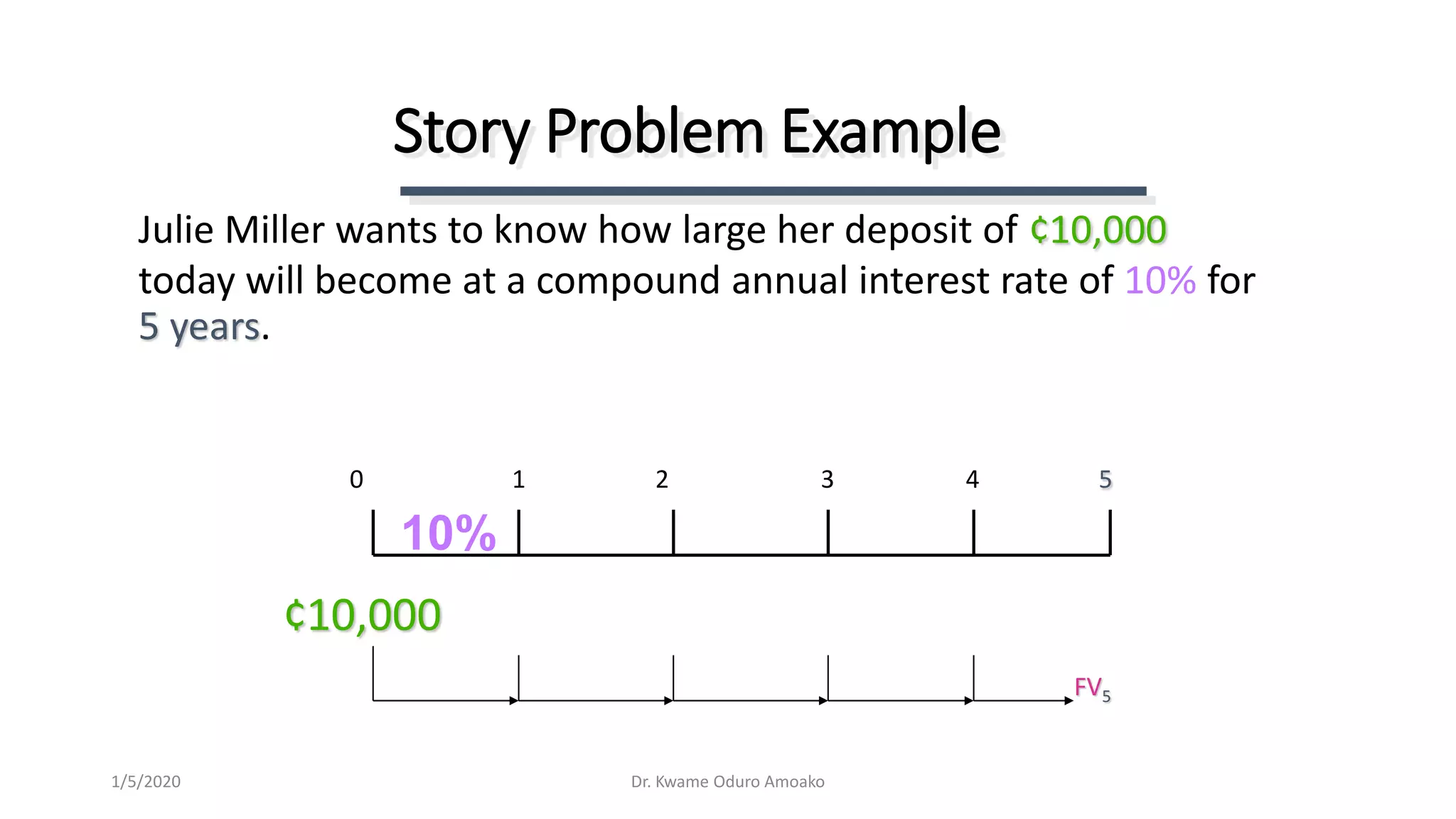
Julie Miller wants to know how large her deposit of ¢10,000
today will become at a compound annual interest rate of 10% for
5 years.
Story Problem Example
0 1 2 3 4 5
¢10,000
FV5
10%
Dr. Kwame Oduro Amoako1/5/2020
Story Problem Solution
Calculation based on general formula:
FVn = P0 (1+i)n
FV5 = ¢10,000 (1+ 0.10)5
= ¢16,105.10
Calculation based on Table I:
FV5 = ¢10,000 (FVIF10%, 5)
= ¢10,000 (1.611)
= ¢16,110 [Due to Rounding]
1/5/2020 Dr. Kwame Oduro Amoako
That is the value today!
What is the Present Value (PV) of the previous
problem?
•The Present Value is simply the ¢1,000 you
originally deposited.
Present value (PV)
Present Value is the current value of a future amount of
money, or a series of payments, evaluated at a given
interest rate.
Dr. Kwame Oduro Amoako1/5/2020
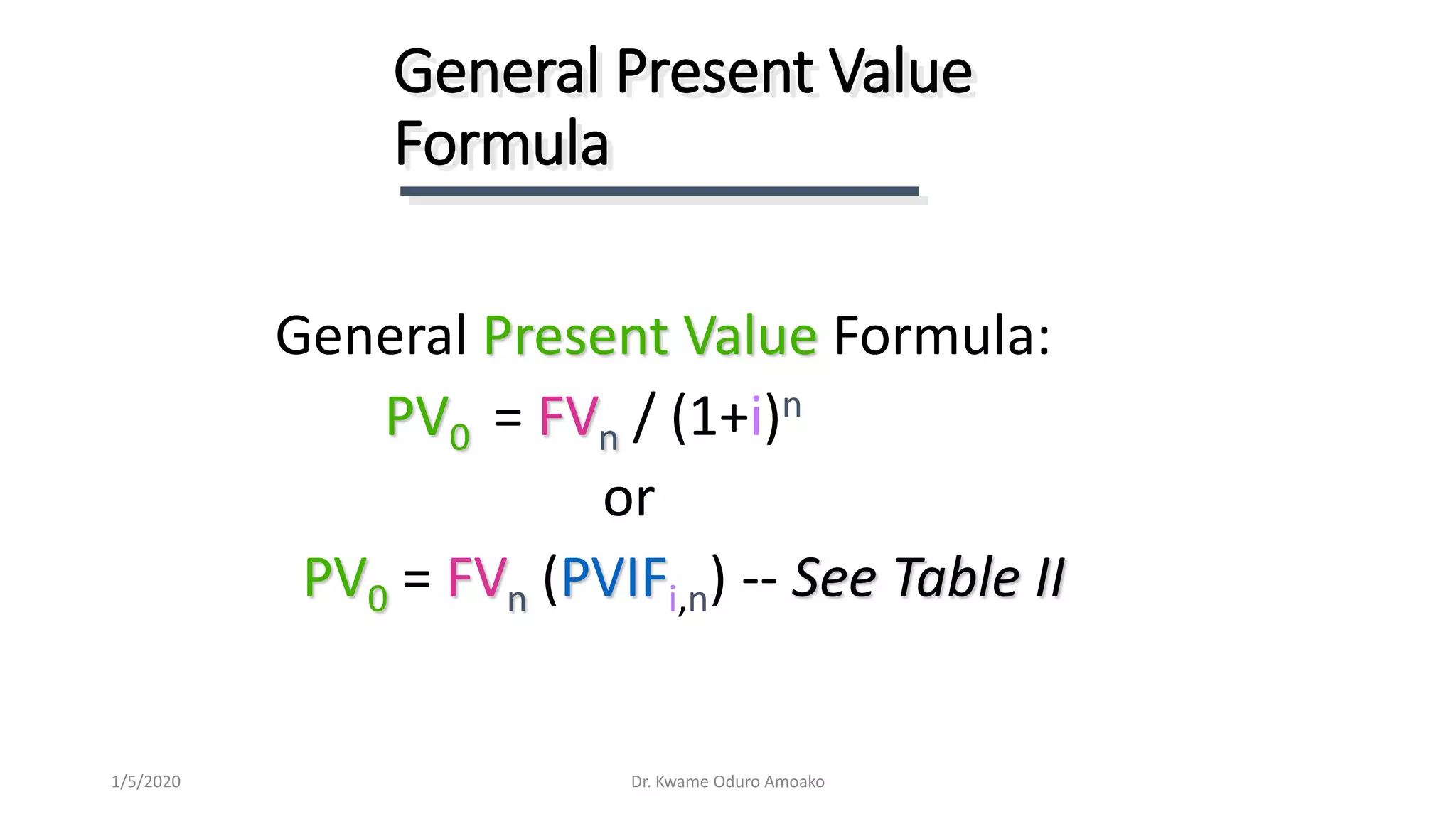
General Present Value Formula:
PV0 = FVn / (1+i)n
or
PV0 = FVn (PVIFi,n) -- See Table II
General Present Value
Formula
Dr. Kwame Oduro Amoako1/5/2020
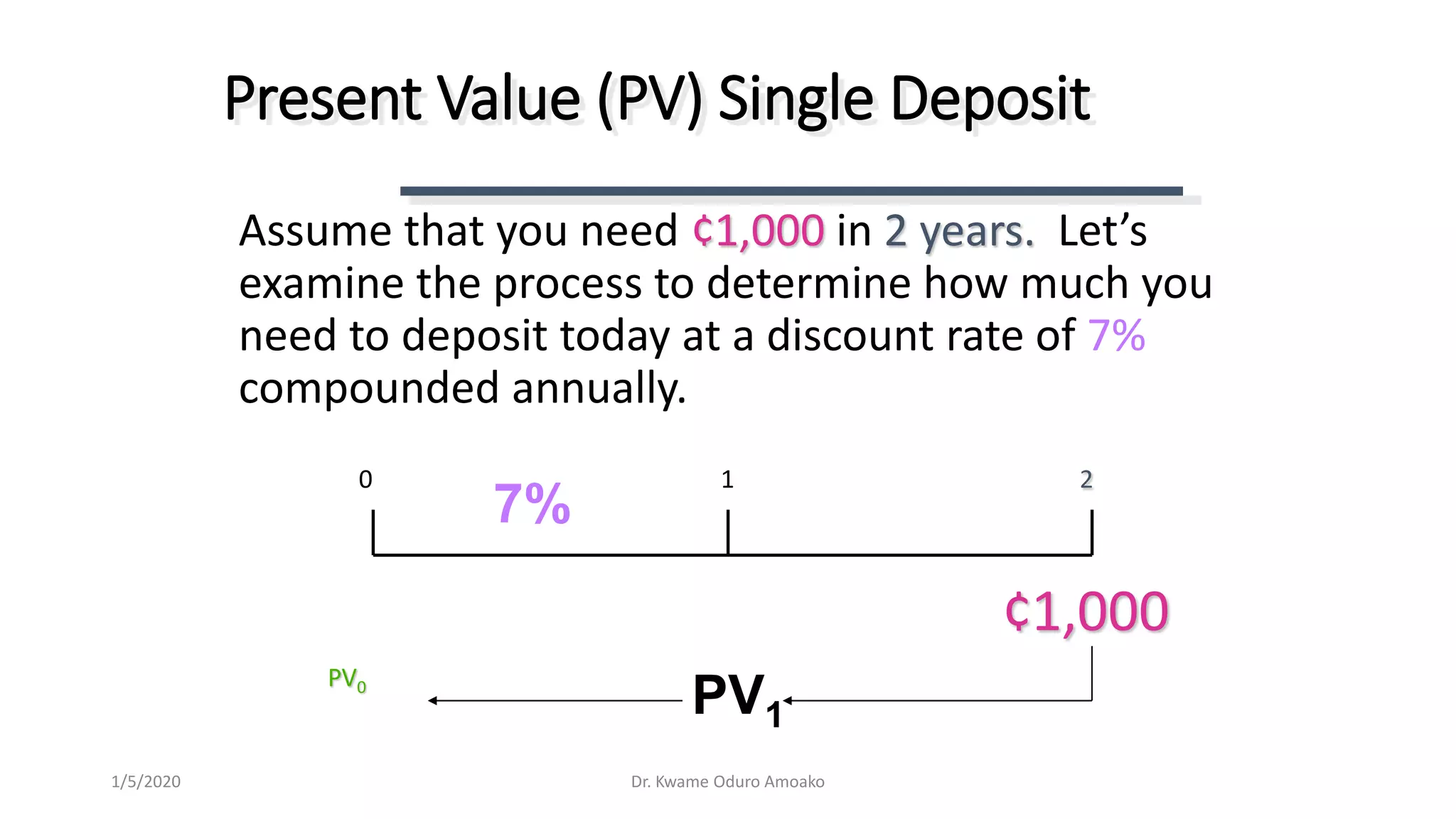
Assume that you need ¢1,000 in 2 years. Let’s
examine the process to determine how much you
need to deposit today at a discount rate of 7%
compounded annually.
0 1 2
¢1,000
7%
PV1
PV0
Present Value (PV) Single Deposit
Dr. Kwame Oduro Amoako1/5/2020
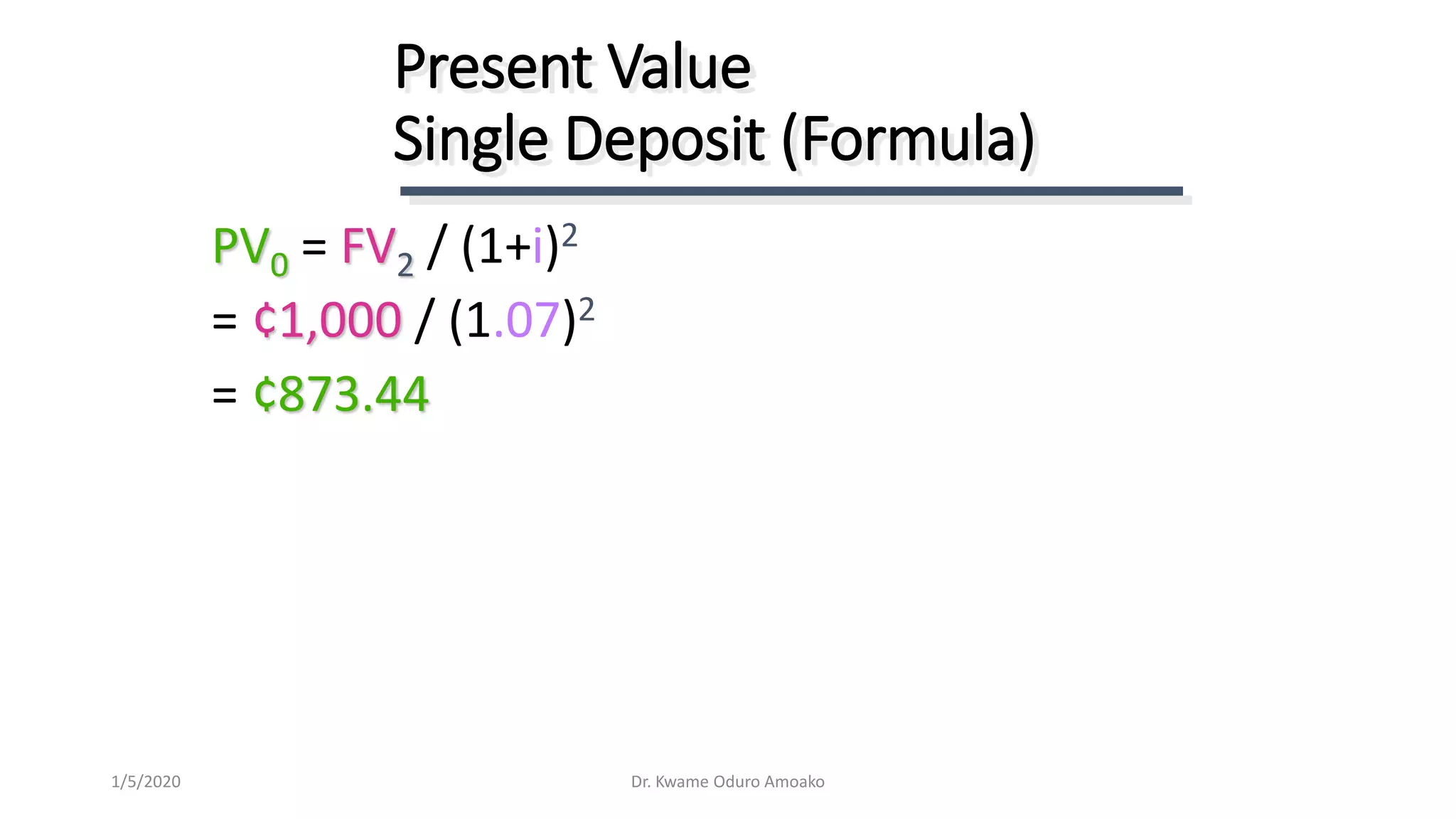
PV0 = FV2 / (1+i)2
= ¢1,000 / (1.07)2
= ¢873.44
Present Value
Single Deposit (Formula)
Dr. Kwame Oduro Amoako1/5/2020
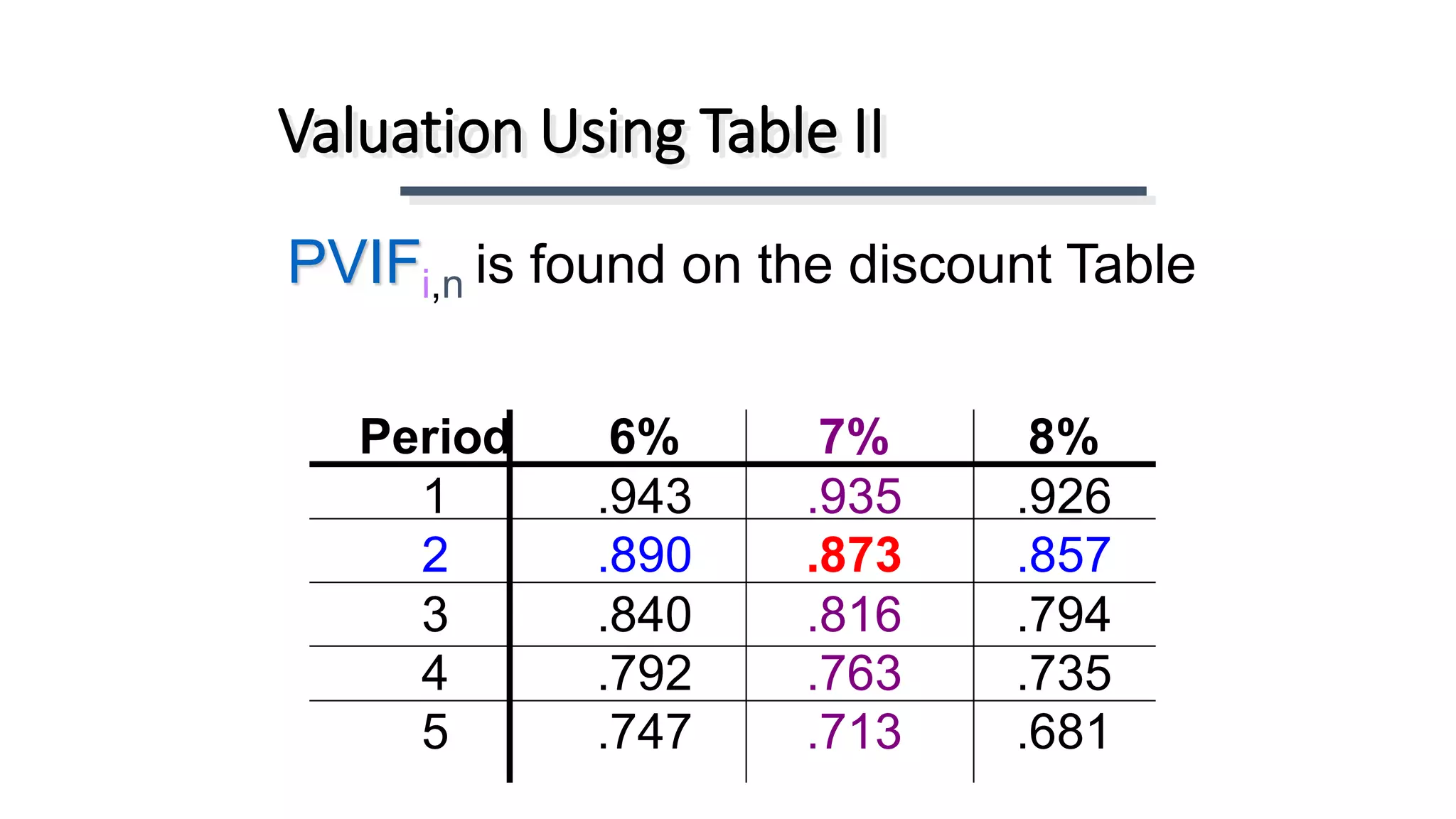
PVIFi,n is found on the discount Table
Valuation Using Table II
Period 6% 7% 8%
1 .943 .935 .926
2 .890 .873 .857
3 .840 .816 .794
4 .792 .763 .735
5 .747 .713 .681
PV2 = ¢1,000 (PVIF7%,2)
= ¢1,000 (.873)
= ¢873 [Due to Rounding]
Using Present Value Tables
Period 6% 7% 8%
1 .943 .935 .926
2 .890 .873 .857
3 .840 .816 .794
4 .792 .763 .735
5 .747 .713 .681
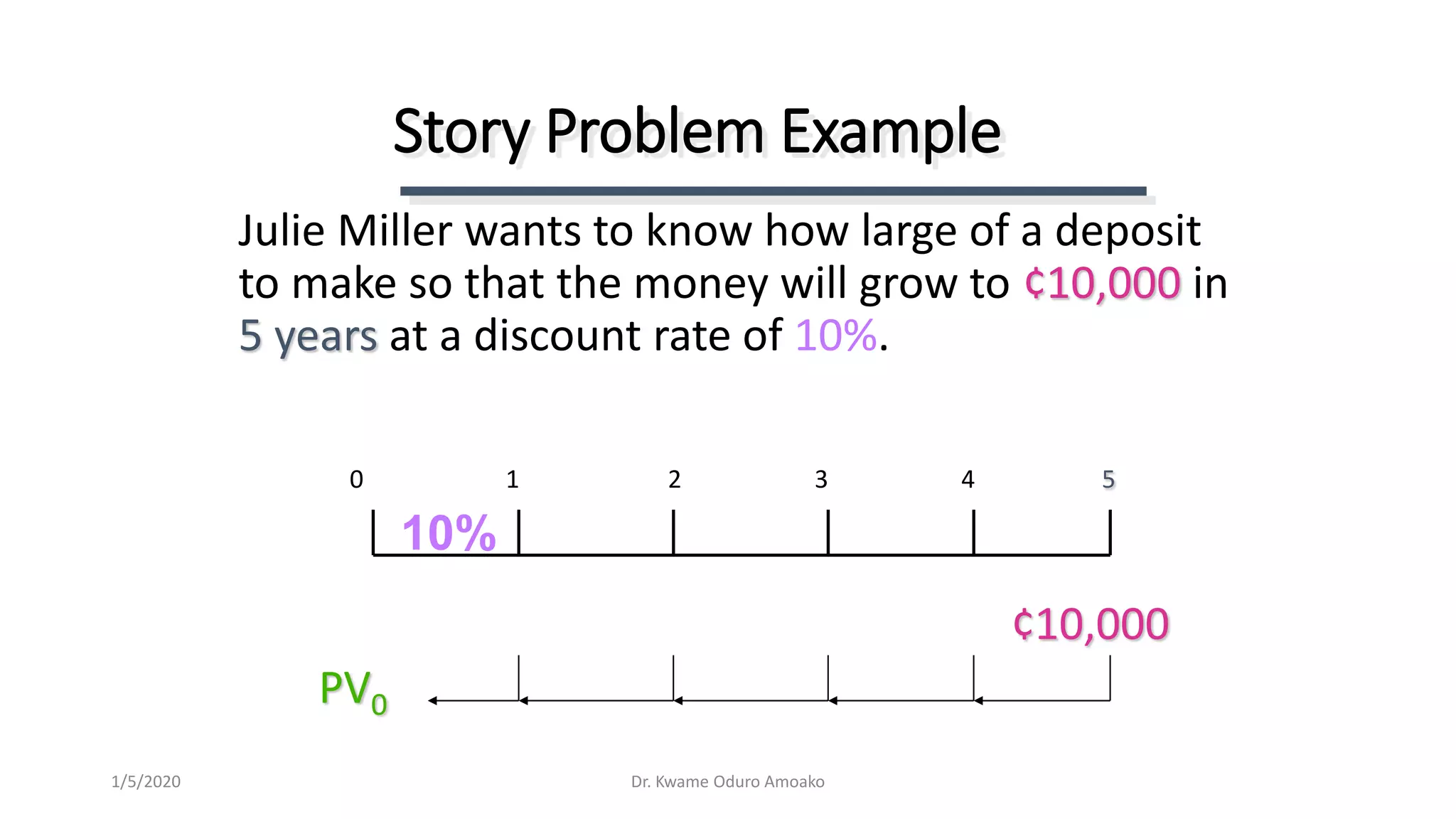
Julie Miller wants to know how large of a deposit
to make so that the money will grow to ¢10,000 in
5 years at a discount rate of 10%.
Story Problem Example
0 1 2 3 4 5
¢10,000
PV0
10%
Dr. Kwame Oduro Amoako1/5/2020
 Calculation based on general formula:
PV0 = FVn / (1+i)n
PV0 = ¢10,000 / (1+ 0.10)5
= ¢6,209.21
 Calculation based on Table I:
PV0 = ¢10,000 (PVIF10%, 5)
= ¢10,000 (.621)
=¢6,210.00 [Due to Rounding]
Story Problem Solution
Dr. Kwame Oduro Amoako1/5/2020
What is the relationship between Present Value
and Future Value
Future value
•A future value equals a present value plus
the interest that can be earned by having
ownership of the money;
•it is the amount that the present value will
grow to over some stated period of time.
1/5/2020 Dr. Kwame Oduro Amoako
What is the relationship between Present
Value and Future Value
Present Value
•Present value equals the future value minus the
interest that comes from ownership of the
money;
•it is today's value of a future amount to be
received at some specified time in the future.
1/5/2020 Dr. Kwame Oduro Amoako
Annuities
Types of annuities:
Ordinary Annuity: Payments or receipts occur
at the end of each period.
Annuity Due: Payments or receipts occur at the
beginning of each period.
 An Annuity represents a series of equal
payments (or receipts) occurring over a
specified number of equidistant periods.
Dr. Kwame Oduro Amoako1/5/2020
Examples of Annuities
• Student Loan Payments
• Car Loan Payments
• Insurance Premiums
• Mortgage Payments
• Retirement Savings
Dr. Kwame Oduro Amoako1/5/2020
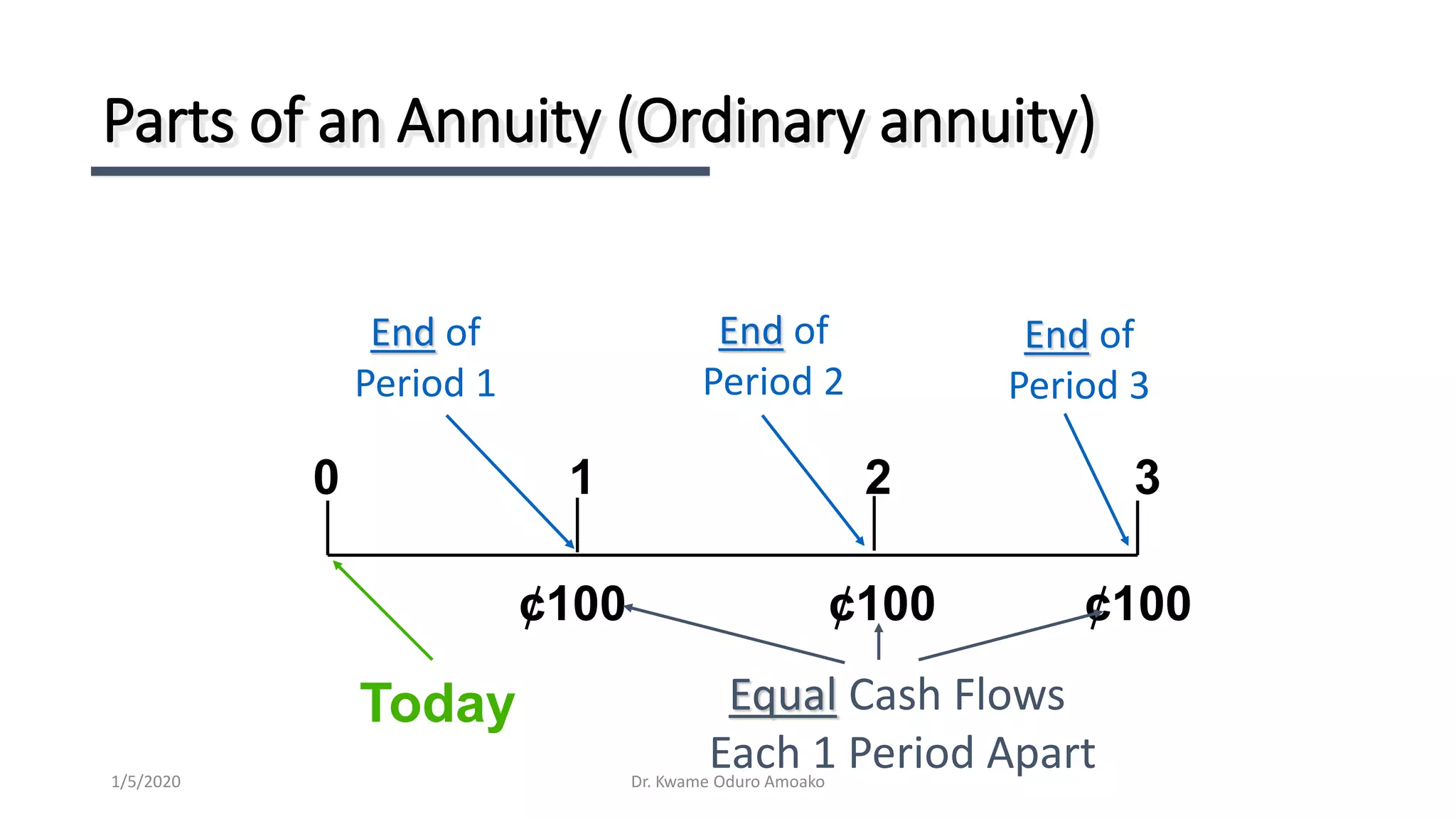
Parts of an Annuity (Ordinary annuity)
0 1 2 3
¢100 ¢100 ¢100
End of
Period 1
End of
Period 2
Today Equal Cash Flows
Each 1 Period Apart
End of
Period 3
Dr. Kwame Oduro Amoako1/5/2020
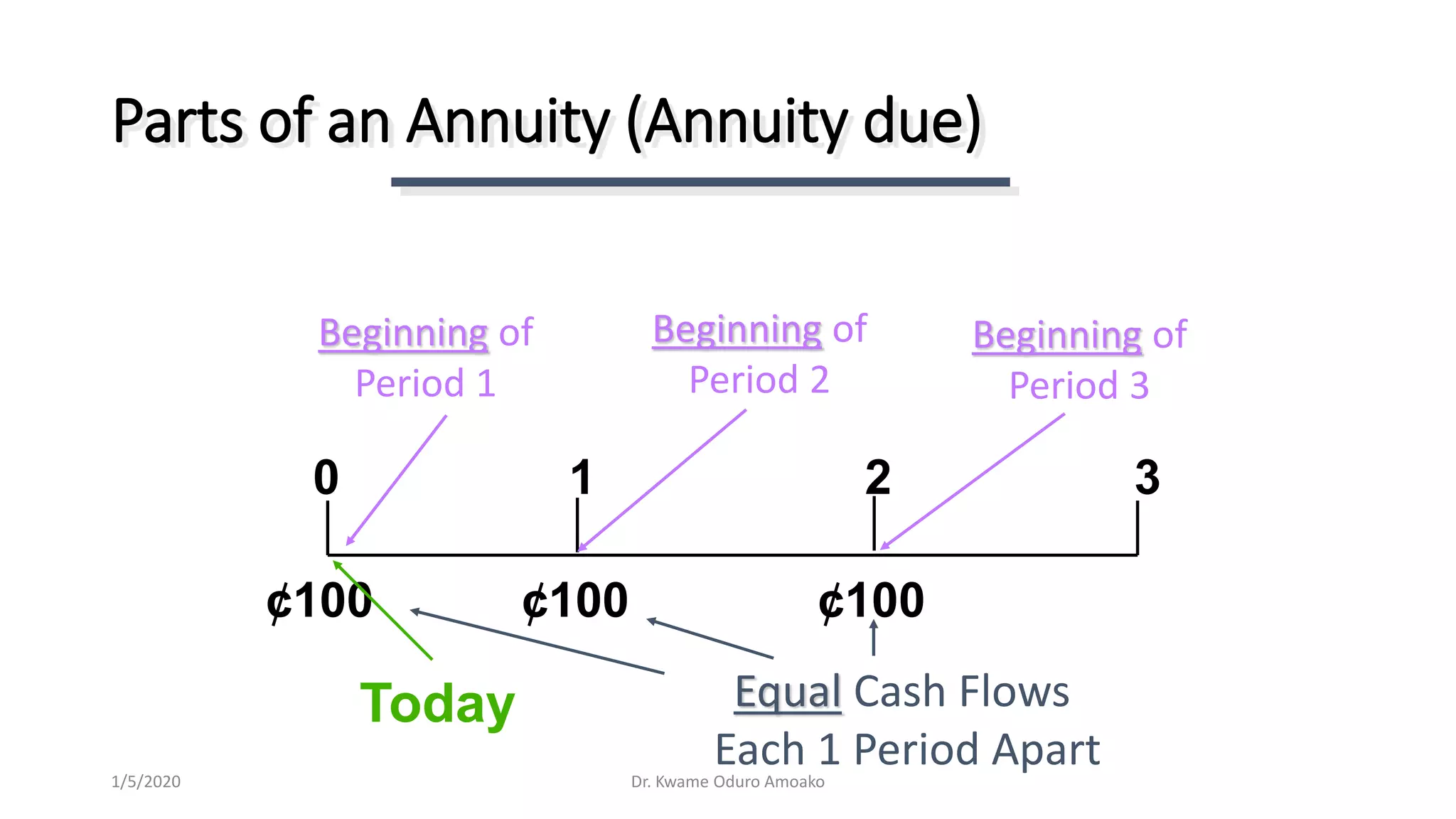
Parts of an Annuity (Annuity due)
0 1 2 3
¢100 ¢100 ¢100
Beginning of
Period 1
Beginning of
Period 2
Today Equal Cash Flows
Each 1 Period Apart
Beginning of
Period 3
Dr. Kwame Oduro Amoako1/5/2020
FVAn = CF(1+i)3 + CF(1+i)2………
or FVAn = PV/k [(1 + k) n – 1]
Overview of an
Ordinary Annuity -- FVA
CF CF CF
0 1 2 n n+1
FVAn
CF = Periodic
Cash Flow
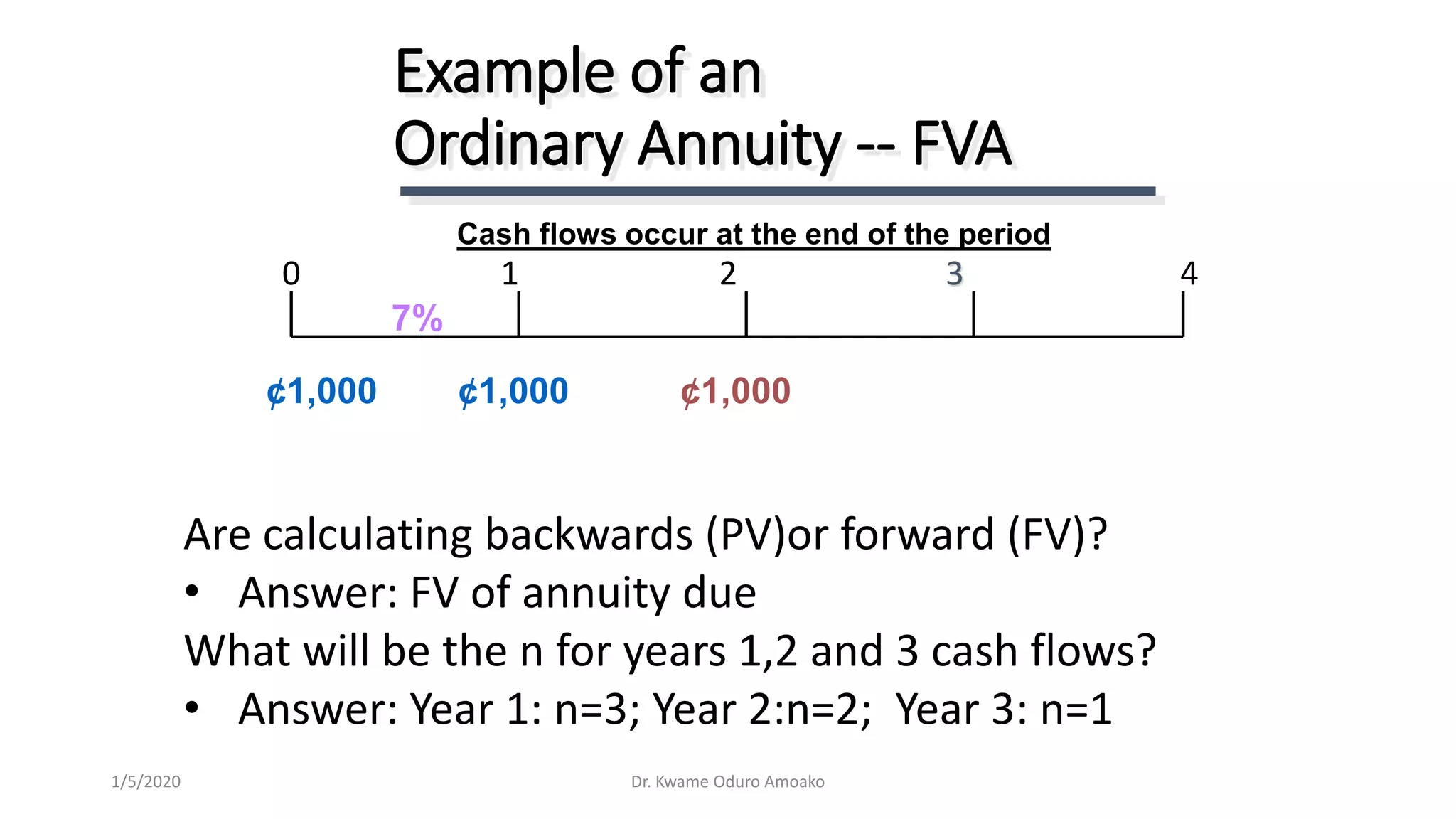
Cash flows occur at the end of the period
i% . . .
Dr. Kwame Oduro Amoako1/5/2020
Example of an
Ordinary Annuity -- FVA
Mr. Osei Agyei Bonsu is planning his child
university education . He has therefore decided to
make periodic contribution towards that. If he
deposits GH¢1,000 at the end of every year into a
special account for three years which grows at 7%
per anum, what will be the value of his deposit by
the end of the third year?
1/5/2020 Dr. Kwame Oduro Amoako
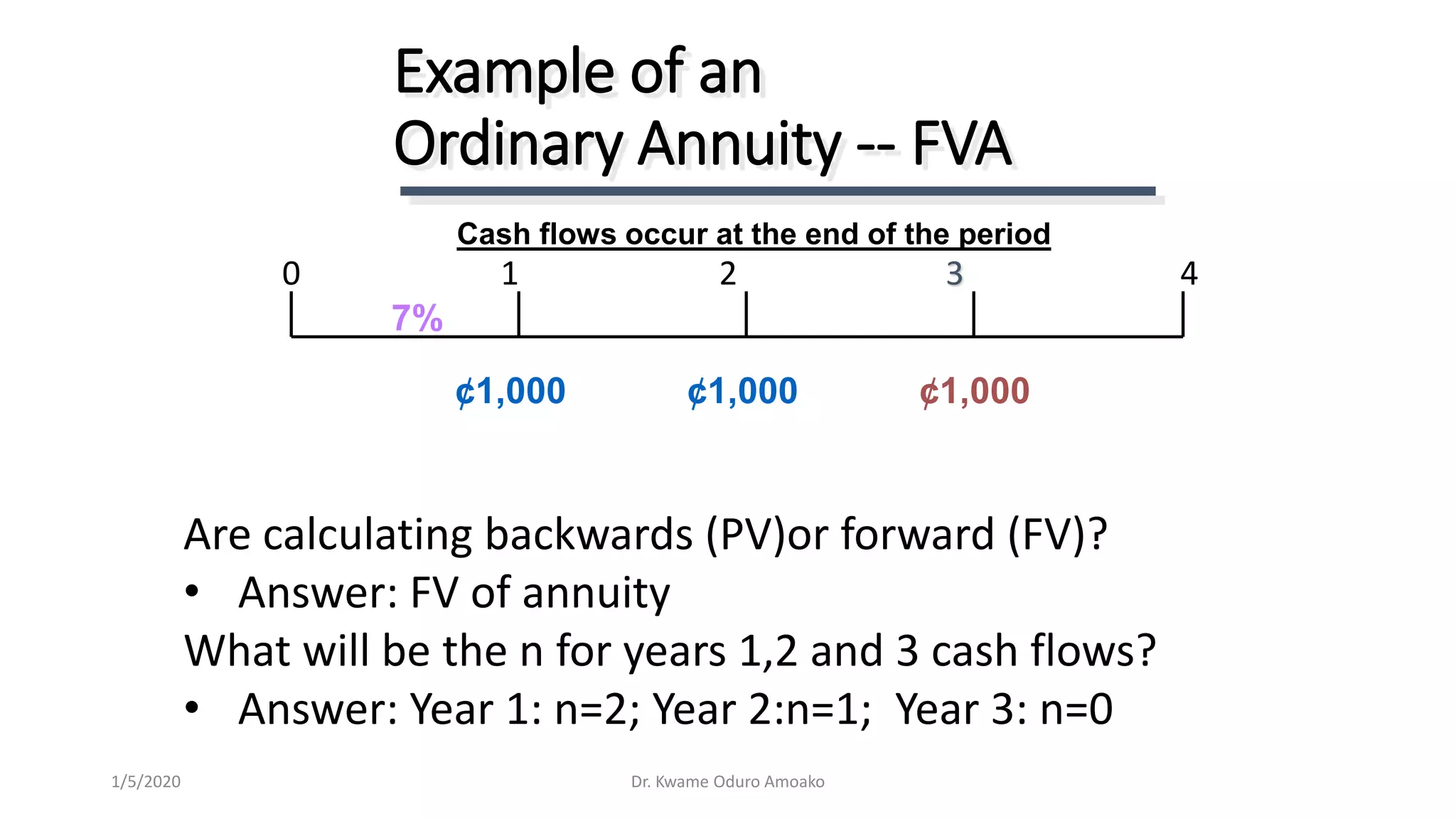
Example of an
Ordinary Annuity -- FVA
¢1,000 ¢1,000 ¢1,000
0 1 2 3 4
7%
Cash flows occur at the end of the period
Dr. Kwame Oduro Amoako1/5/2020
Are calculating backwards (PV)or forward (FV)?
• Answer: FV of annuity
What will be the n for years 1,2 and 3 cash flows?
• Answer: Year 1: n=2; Year 2:n=1; Year 3: n=0
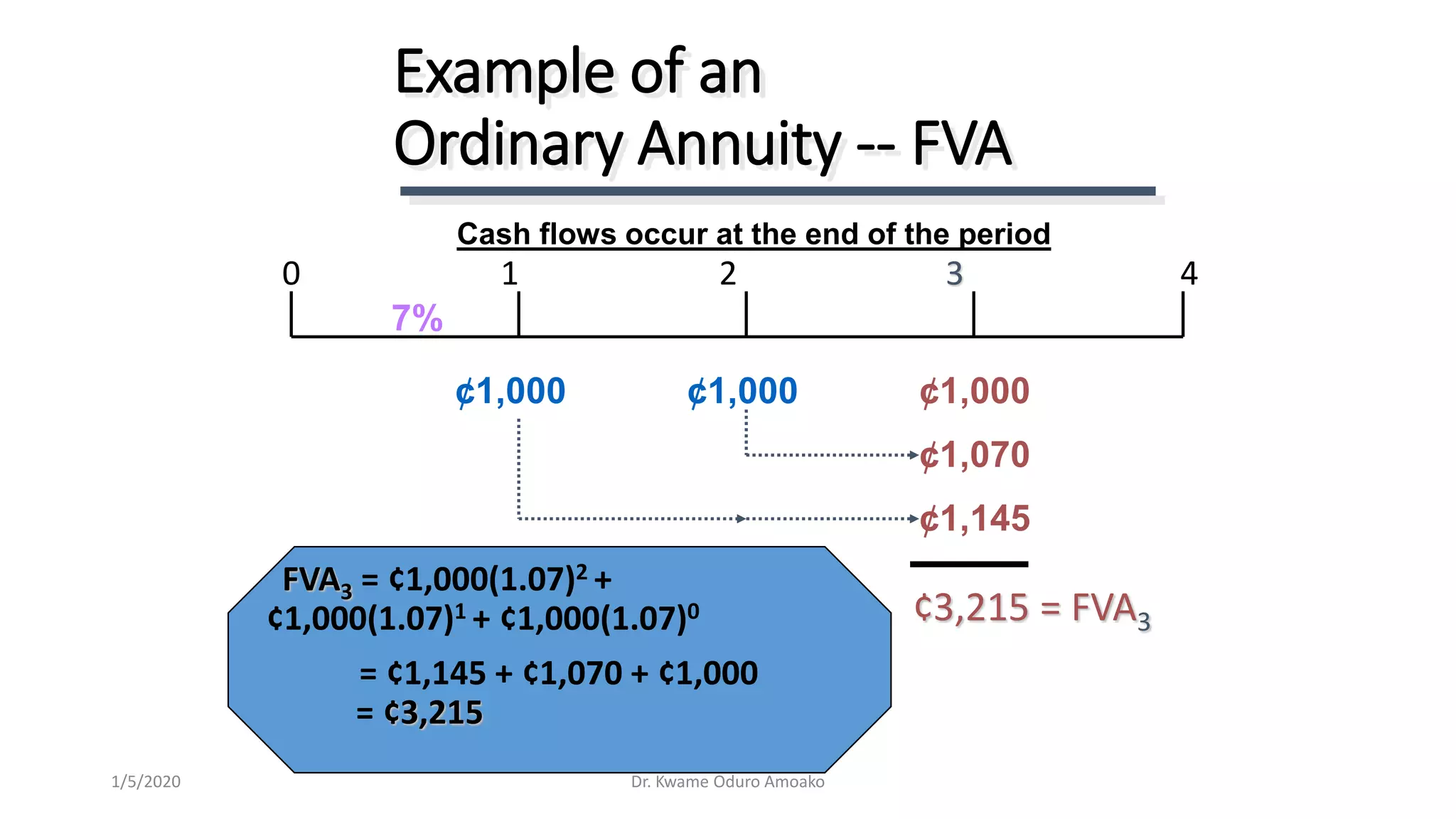
FVA3 = ¢1,000(1.07)2 +
¢1,000(1.07)1 + ¢1,000(1.07)0
= ¢1,145 + ¢1,070 + ¢1,000
= ¢3,215
Example of an
Ordinary Annuity -- FVA
¢1,000 ¢1,000 ¢1,000
0 1 2 3 4
¢3,215 = FVA3
7%
¢1,070
¢1,145
Cash flows occur at the end of the period
Dr. Kwame Oduro Amoako1/5/2020
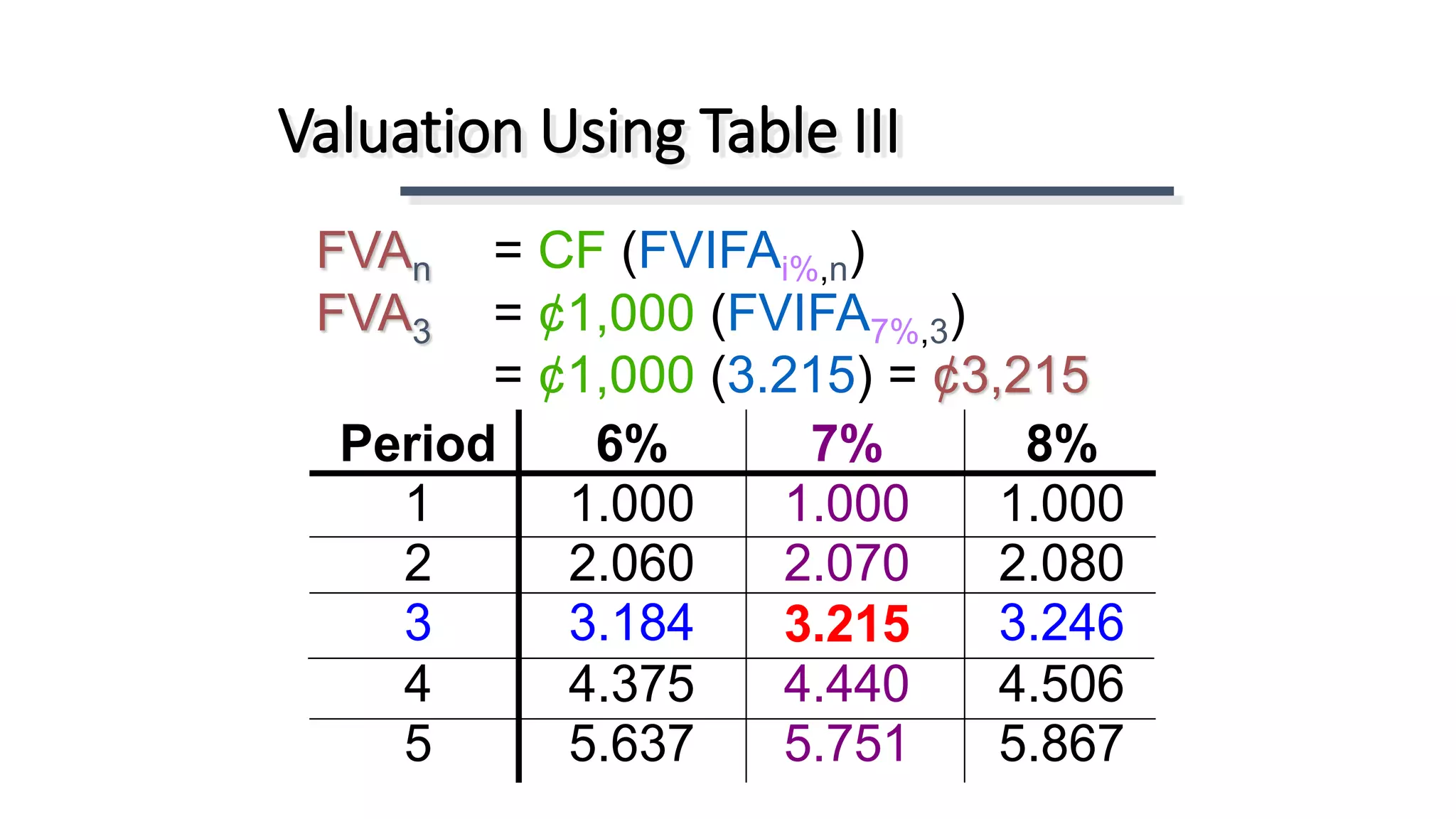
FVAn = CF (FVIFAi%,n)
FVA3 = ¢1,000 (FVIFA7%,3)
= ¢1,000 (3.215) = ¢3,215
Valuation Using Table III
Period 6% 7% 8%
1 1.000 1.000 1.000
2 2.060 2.070 2.080
3 3.184 3.215 3.246
4 4.375 4.440 4.506
5 5.637 5.751 5.867
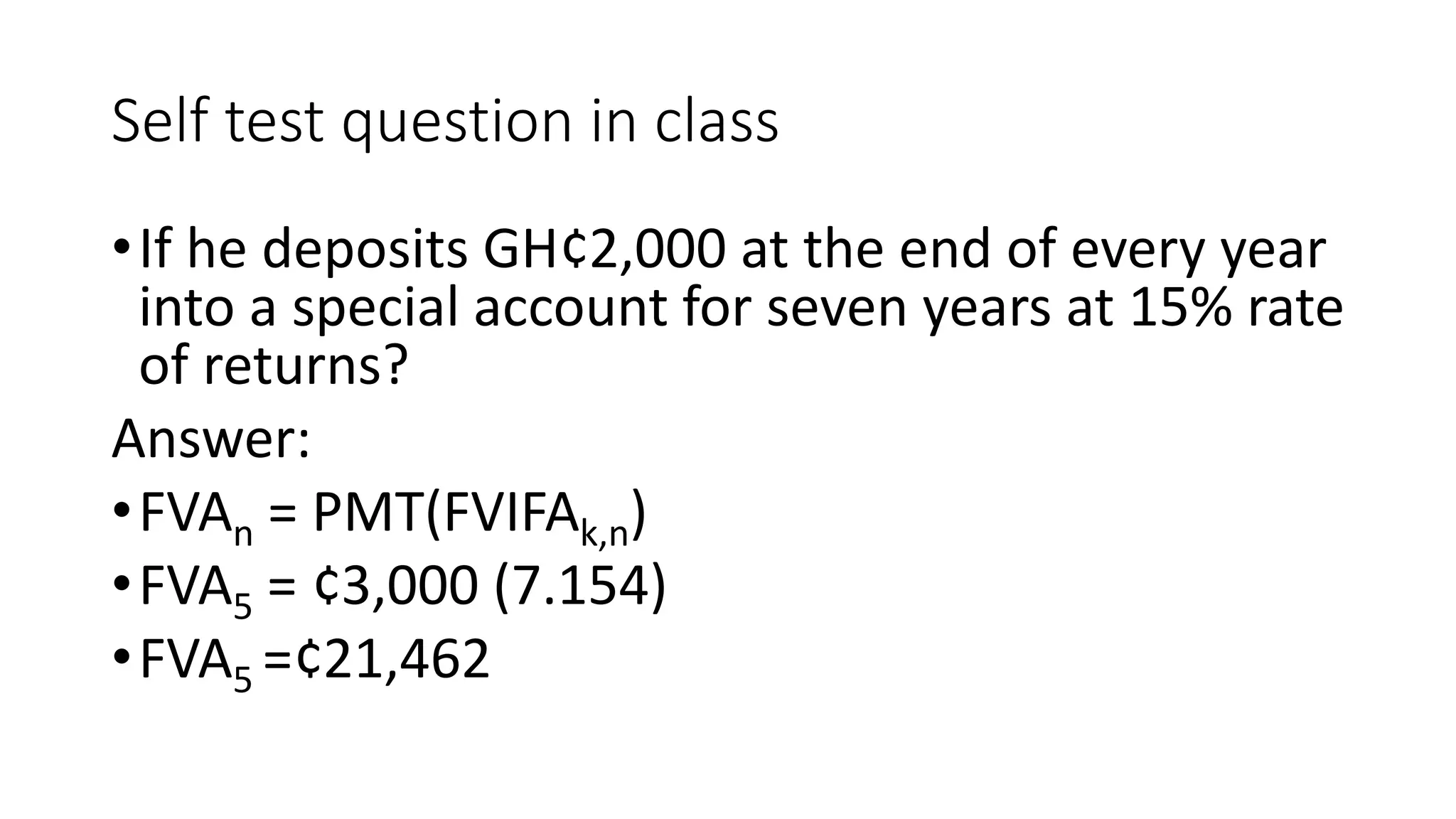
Self test question in class
•If he deposits GH¢2,000 at the end of every year
into a special account for seven years at 15% rate
of returns?
Answer:
•FVAn = PMT(FVIFAk,n)
•FVA5 = ¢3,000 (7.154)
•FVA5 =¢21,462
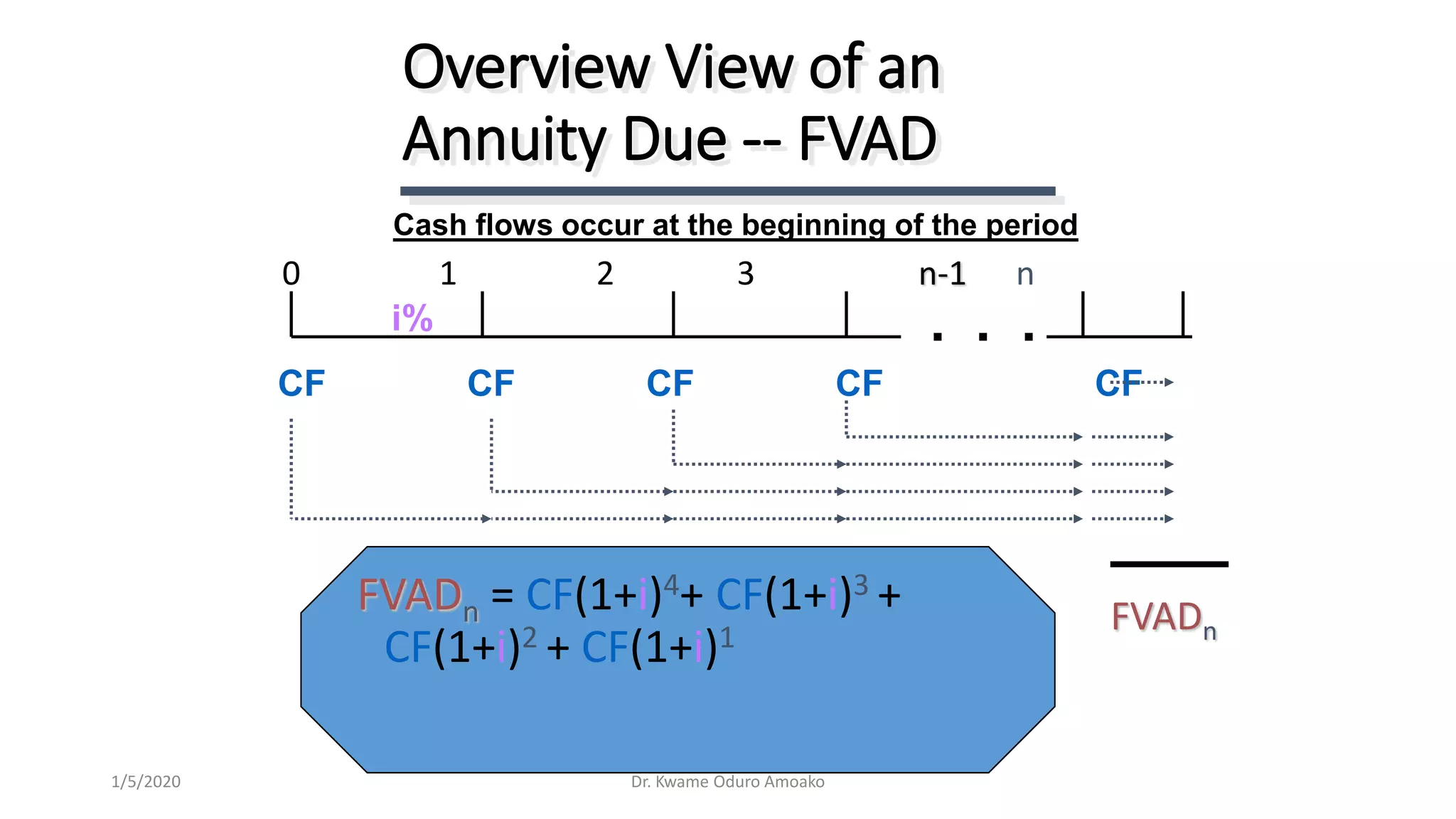
FVADn = CF(1+i)4+ CF(1+i)3 +
CF(1+i)2 + CF(1+i)1
Overview View of an
Annuity Due -- FVAD
CF CF CF CF CF
0 1 2 3 n-1 n
FVADn
i% . . .
Cash flows occur at the beginning of the period
Dr. Kwame Oduro Amoako1/5/2020
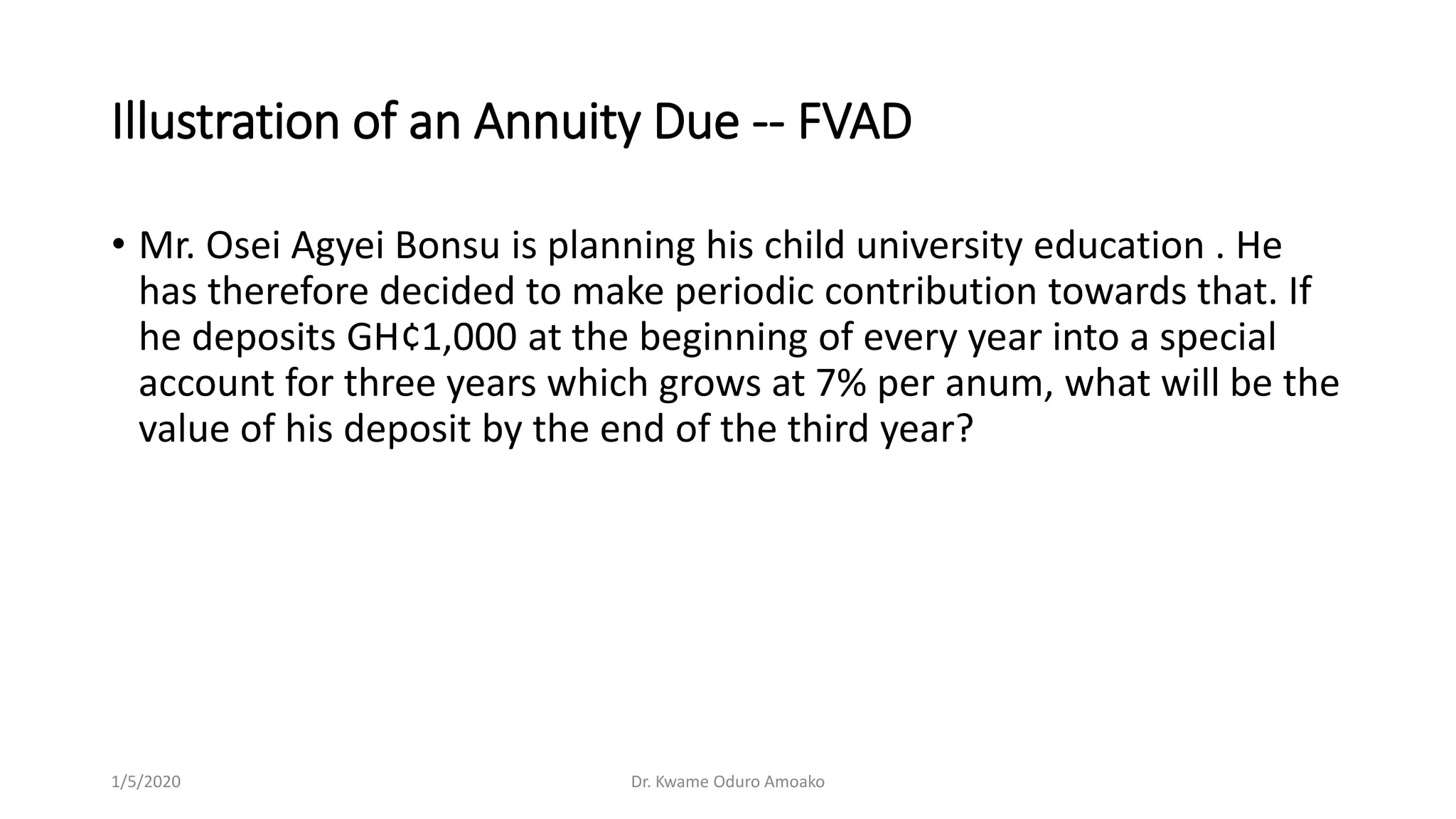
Illustration of an Annuity Due -- FVAD
• Mr. Osei Agyei Bonsu is planning his child university education . He
has therefore decided to make periodic contribution towards that. If
he deposits GH¢1,000 at the beginning of every year into a special
account for three years which grows at 7% per anum, what will be the
value of his deposit by the end of the third year?
1/5/2020 Dr. Kwame Oduro Amoako
Example of an
Ordinary Annuity -- FVA
¢1,000 ¢1,000 ¢1,000
0 1 2 3 4
7%
Cash flows occur at the end of the period
Dr. Kwame Oduro Amoako1/5/2020
Are calculating backwards (PV)or forward (FV)?
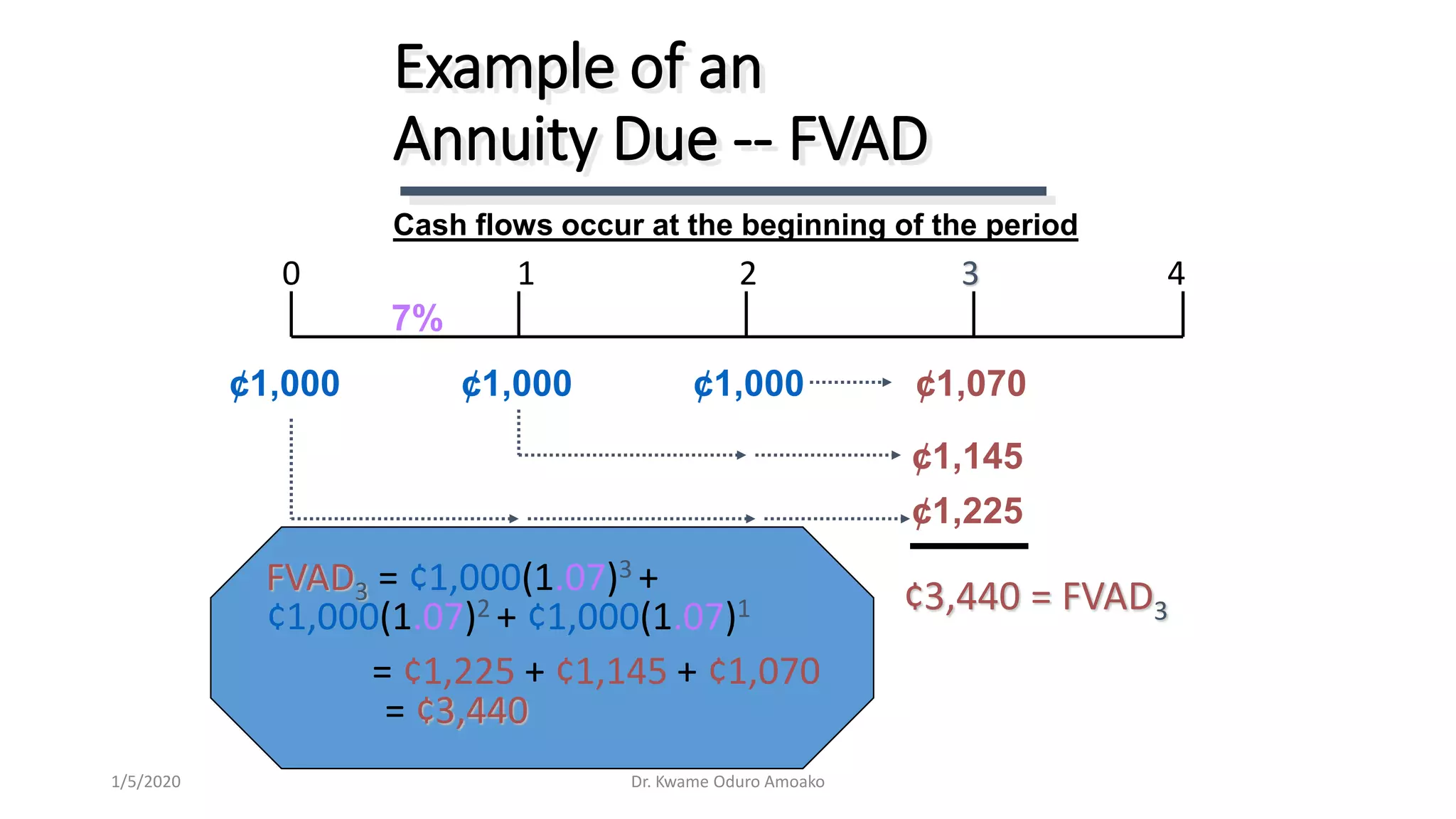
• Answer: FV of annuity due
What will be the n for years 1,2 and 3 cash flows?
• Answer: Year 1: n=3; Year 2:n=2; Year 3: n=1
FVAD3 = ¢1,000(1.07)3 +
¢1,000(1.07)2 + ¢1,000(1.07)1
= ¢1,225 + ¢1,145 + ¢1,070
= ¢3,440
Example of an
Annuity Due -- FVAD
¢1,000 ¢1,000 ¢1,000 ¢1,070
0 1 2 3 4
¢3,440 = FVAD3
7%
¢1,225
¢1,145
Cash flows occur at the beginning of the period
Dr. Kwame Oduro Amoako1/5/2020
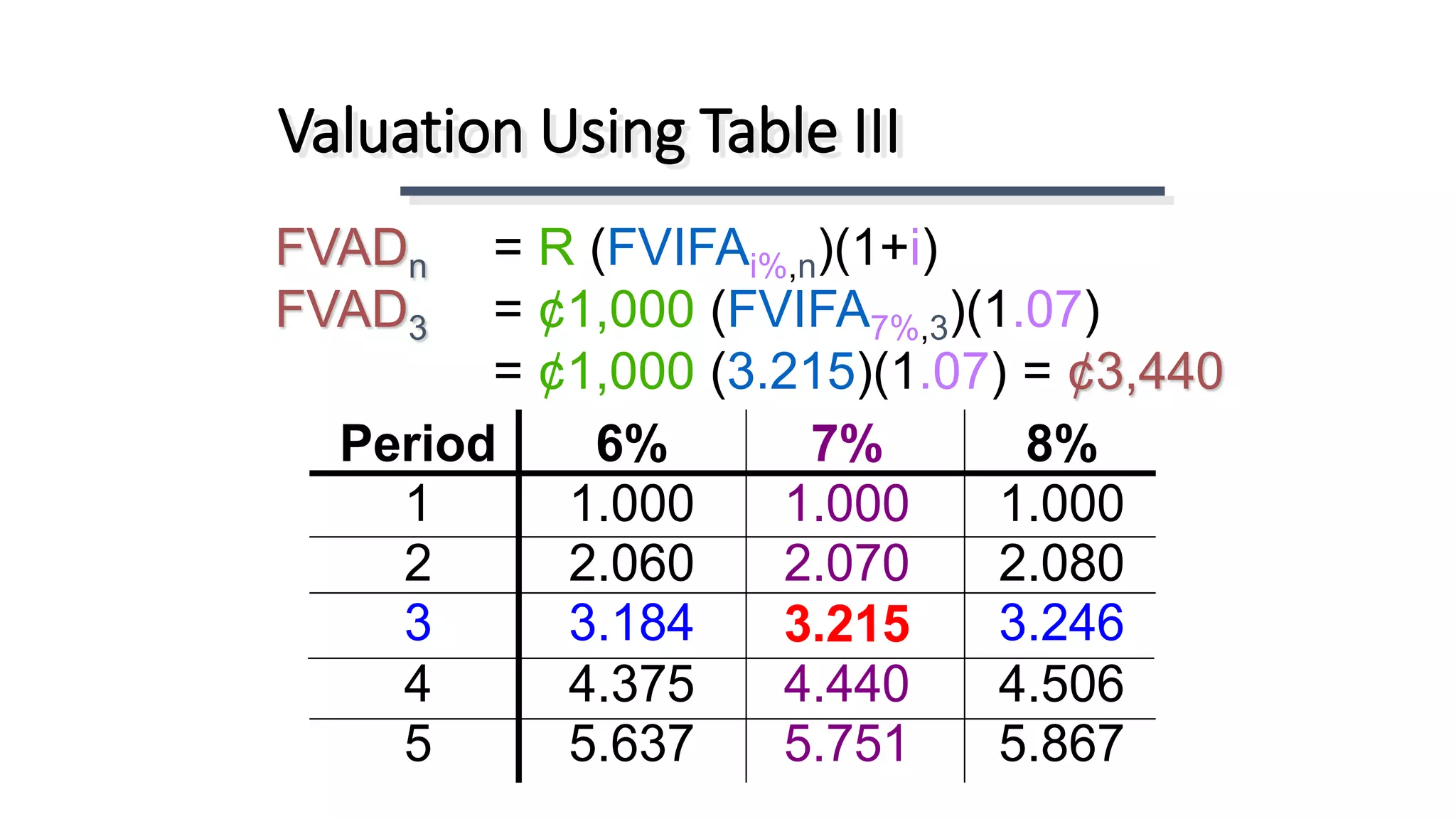
FVADn = R (FVIFAi%,n)(1+i)
FVAD3 = ¢1,000 (FVIFA7%,3)(1.07)
= ¢1,000 (3.215)(1.07) = ¢3,440
Valuation Using Table III
Period 6% 7% 8%
1 1.000 1.000 1.000
2 2.060 2.070 2.080
3 3.184 3.215 3.246
4 4.375 4.440 4.506
5 5.637 5.751 5.867
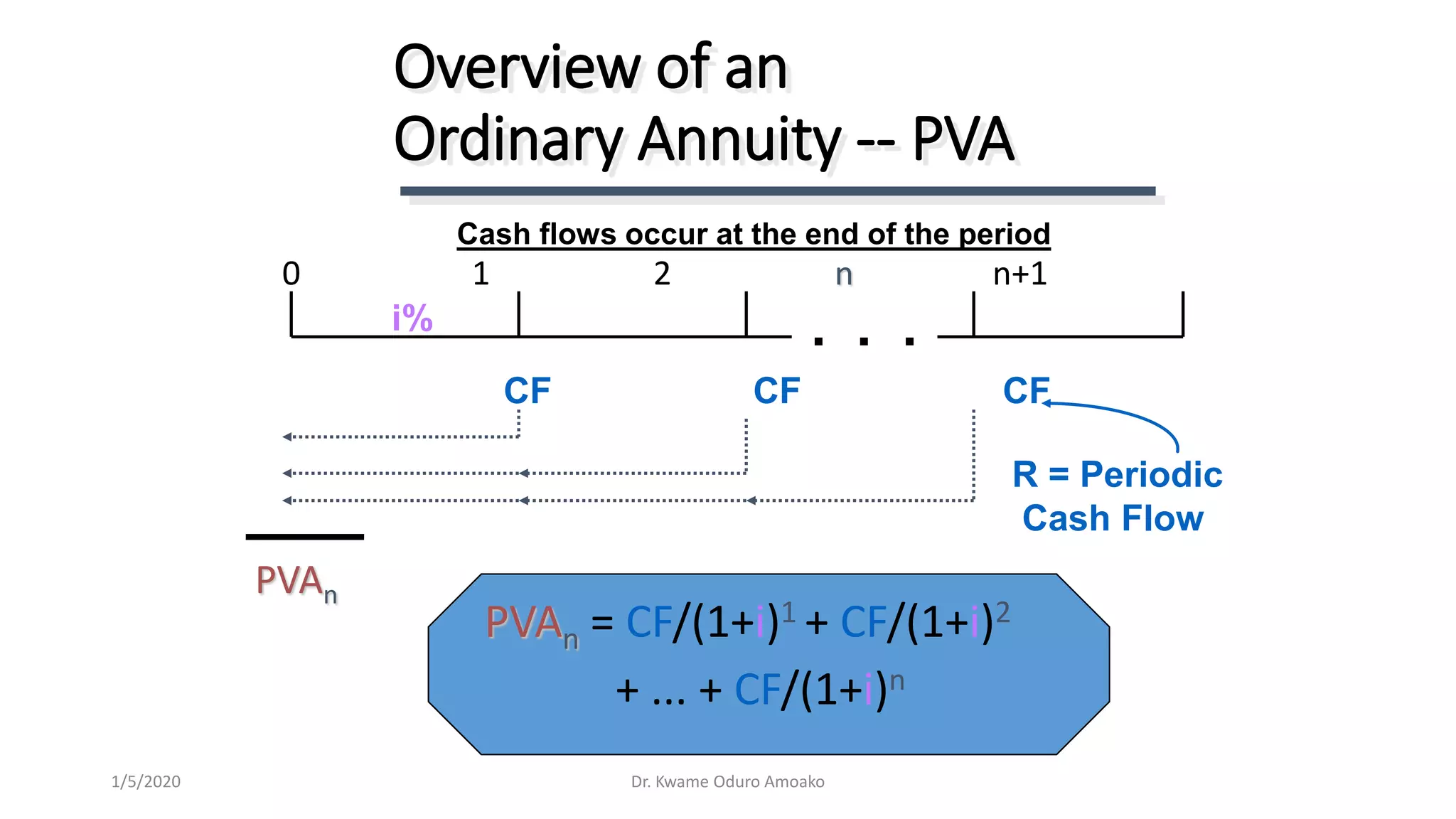
PVAn = CF/(1+i)1 + CF/(1+i)2
+ ... + CF/(1+i)n
Overview of an
Ordinary Annuity -- PVA
CF CF CF
0 1 2 n n+1
PVAn
R = Periodic
Cash Flow
i% . . .
Cash flows occur at the end of the period
Dr. Kwame Oduro Amoako1/5/2020
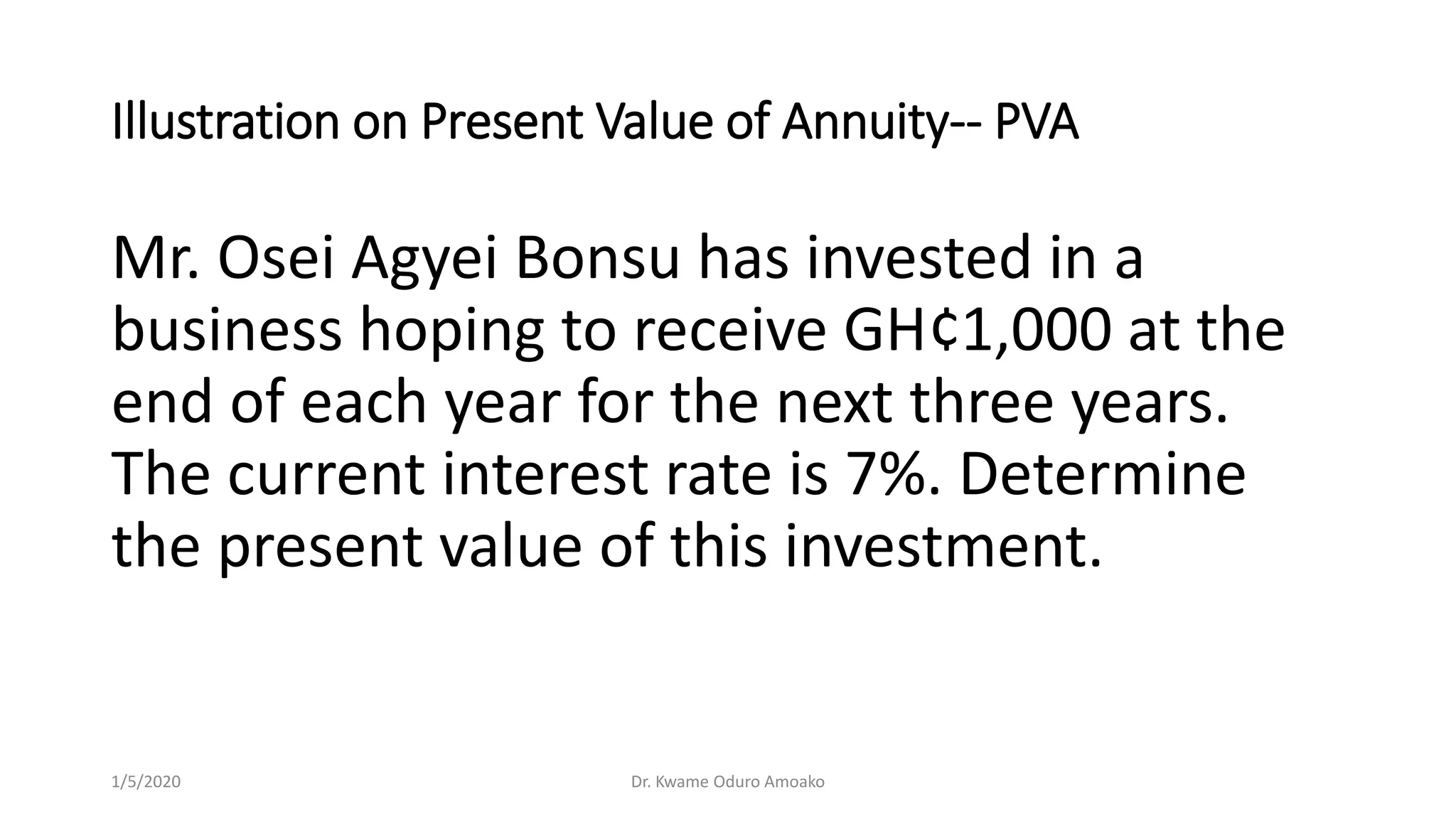
Illustration on Present Value of Annuity-- PVA
Mr. Osei Agyei Bonsu has invested in a
business hoping to receive GH¢1,000 at the
end of each year for the next three years.
The current interest rate is 7%. Determine
the present value of this investment.
1/5/2020 Dr. Kwame Oduro Amoako
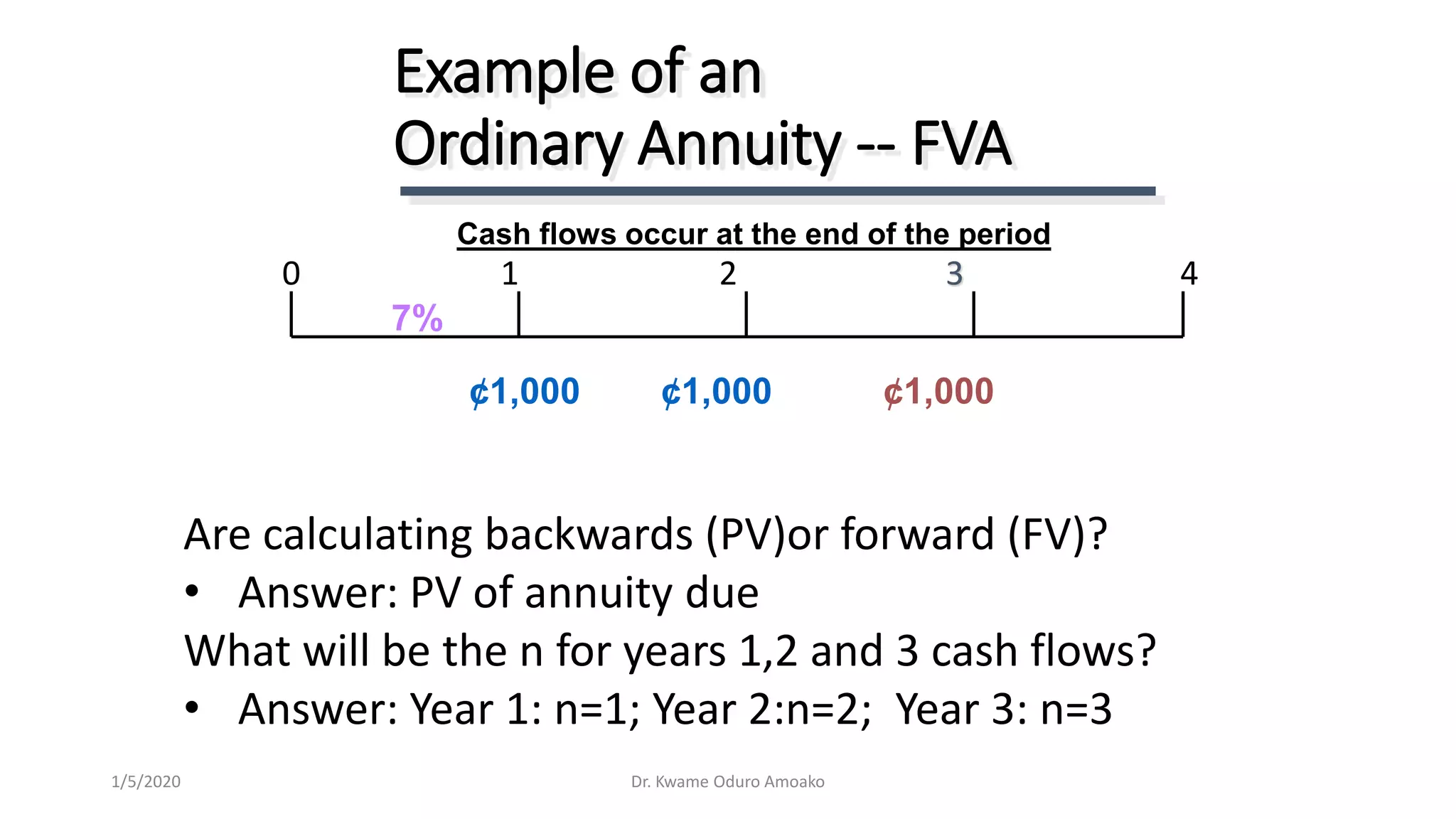
Example of an
Ordinary Annuity -- FVA
¢1,000 ¢1,000 ¢1,000
0 1 2 3 4
7%
Cash flows occur at the end of the period
Dr. Kwame Oduro Amoako1/5/2020
Are calculating backwards (PV)or forward (FV)?
• Answer: PV of annuity due
What will be the n for years 1,2 and 3 cash flows?
• Answer: Year 1: n=1; Year 2:n=2; Year 3: n=3
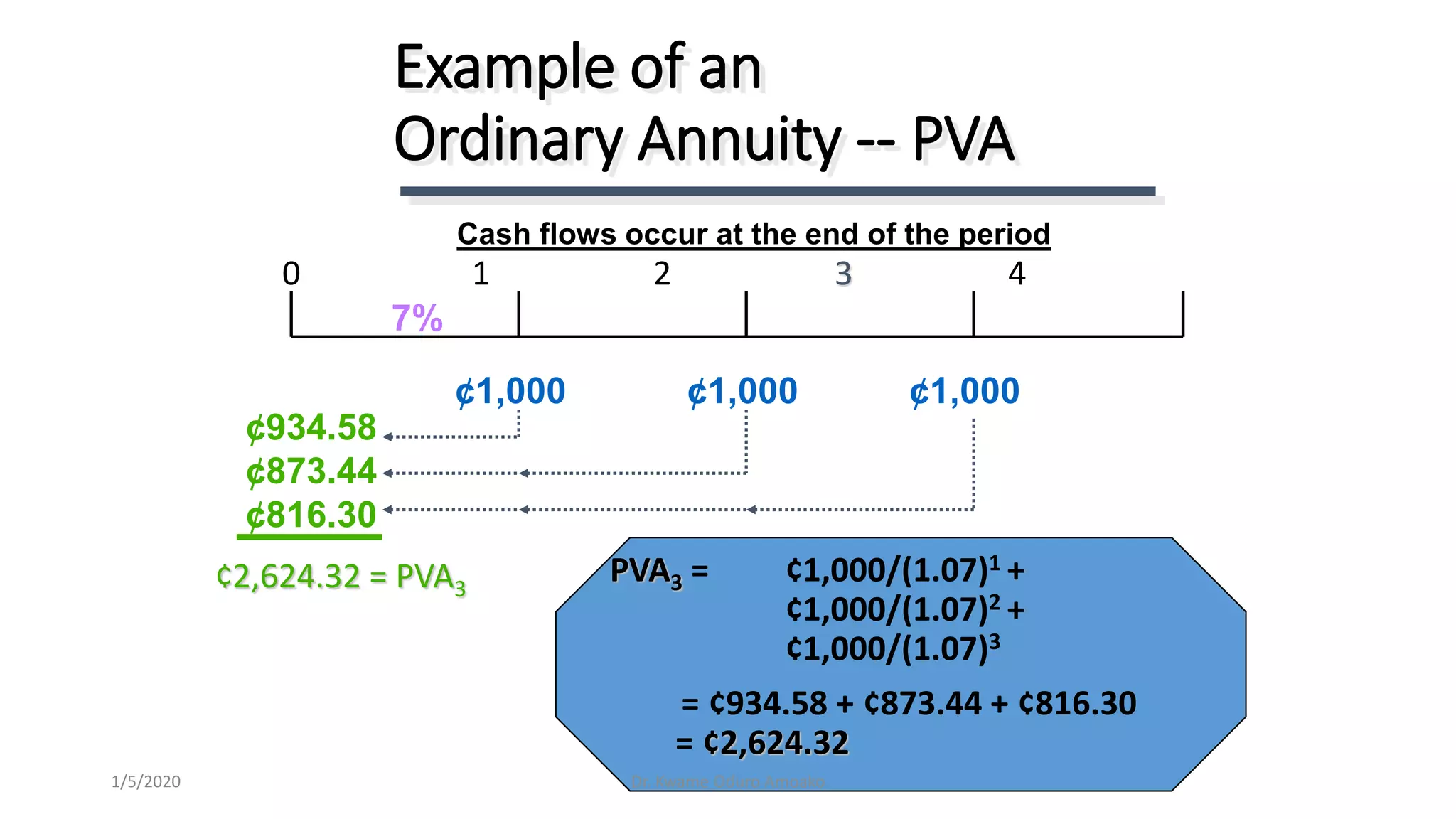
PVA3 = ¢1,000/(1.07)1 +
¢1,000/(1.07)2 +
¢1,000/(1.07)3
= ¢934.58 + ¢873.44 + ¢816.30
= ¢2,624.32
Example of an
Ordinary Annuity -- PVA
¢1,000 ¢1,000 ¢1,000
0 1 2 3 4
¢2,624.32 = PVA3
7%
¢934.58
¢873.44
¢816.30
Cash flows occur at the end of the period
Dr. Kwame Oduro Amoako1/5/2020
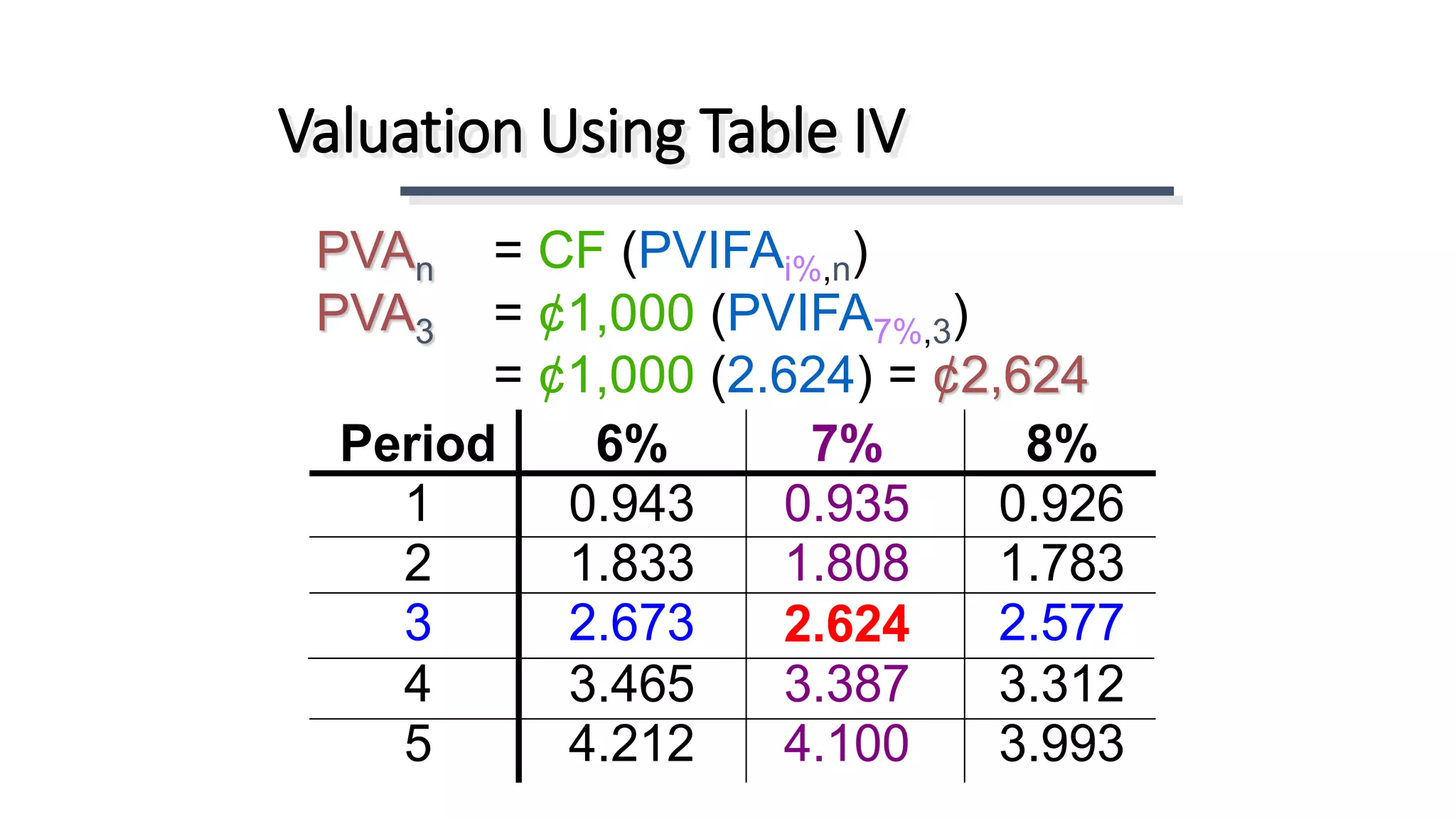
PVAn = CF (PVIFAi%,n)
PVA3 = ¢1,000 (PVIFA7%,3)
= ¢1,000 (2.624) = ¢2,624
Valuation Using Table IV
Period 6% 7% 8%
1 0.943 0.935 0.926
2 1.833 1.808 1.783
3 2.673 2.624 2.577
4 3.465 3.387 3.312
5 4.212 4.100 3.993
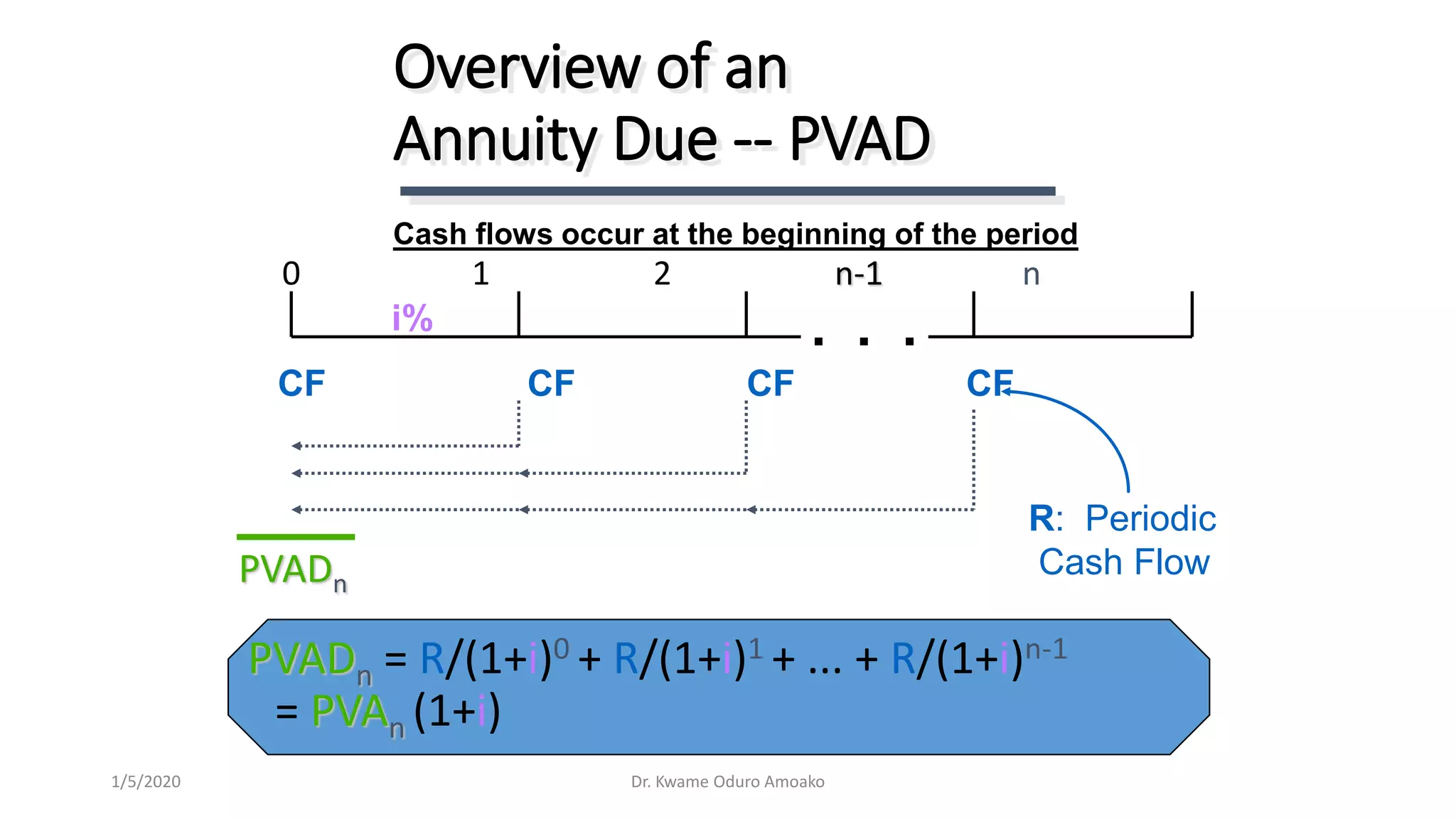
PVADn = R/(1+i)0 + R/(1+i)1 + ... + R/(1+i)n-1
= PVAn (1+i)
Overview of an
Annuity Due -- PVAD
CF CF CF CF
0 1 2 n-1 n
PVADn
R: Periodic
Cash Flow
i% . . .
Cash flows occur at the beginning of the period
Dr. Kwame Oduro Amoako1/5/2020
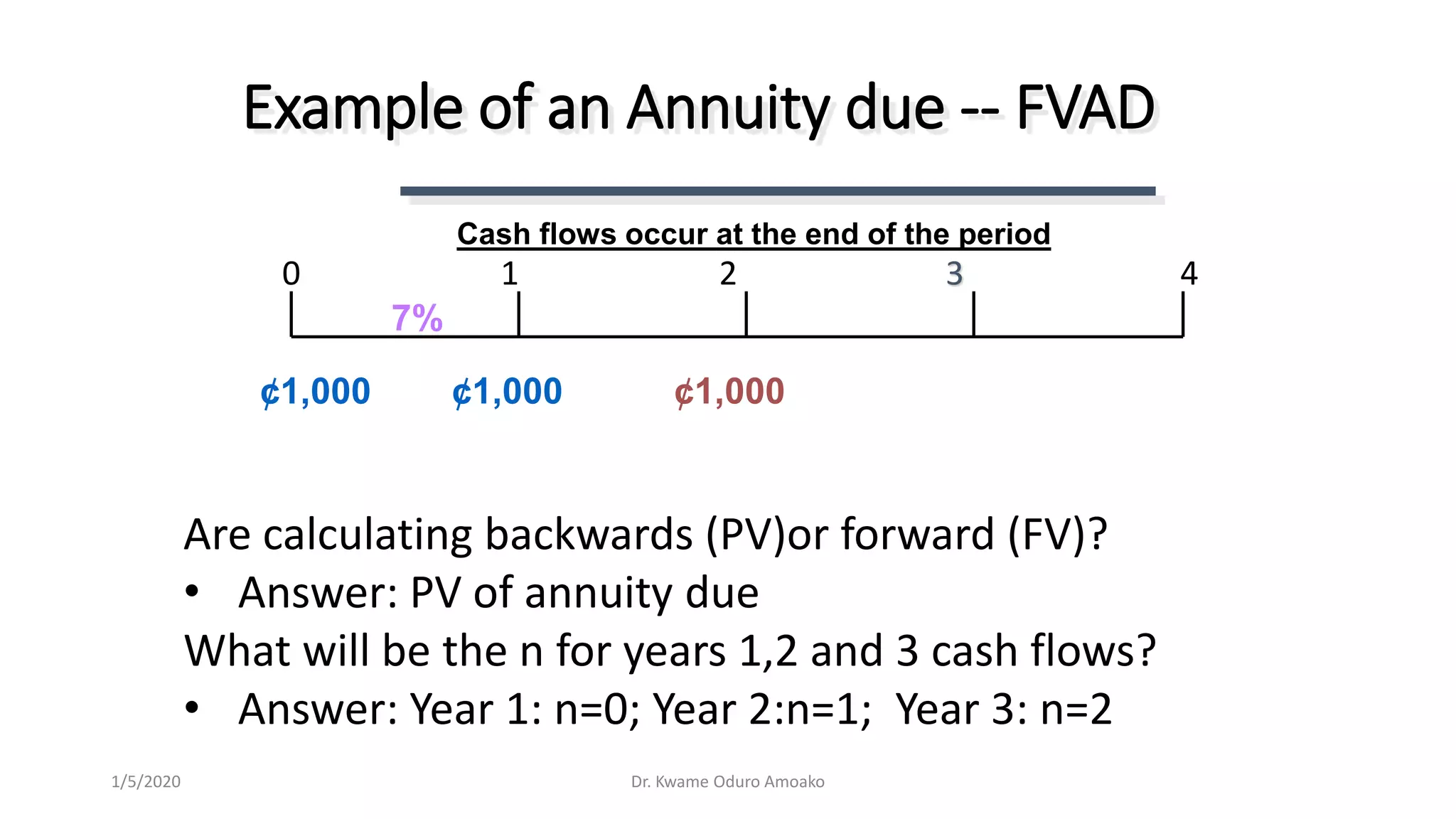
Example of an Annuity due -- FVAD
¢1,000 ¢1,000 ¢1,000
0 1 2 3 4
7%
Cash flows occur at the end of the period
Dr. Kwame Oduro Amoako1/5/2020
Are calculating backwards (PV)or forward (FV)?
• Answer: PV of annuity due
What will be the n for years 1,2 and 3 cash flows?
• Answer: Year 1: n=0; Year 2:n=1; Year 3: n=2
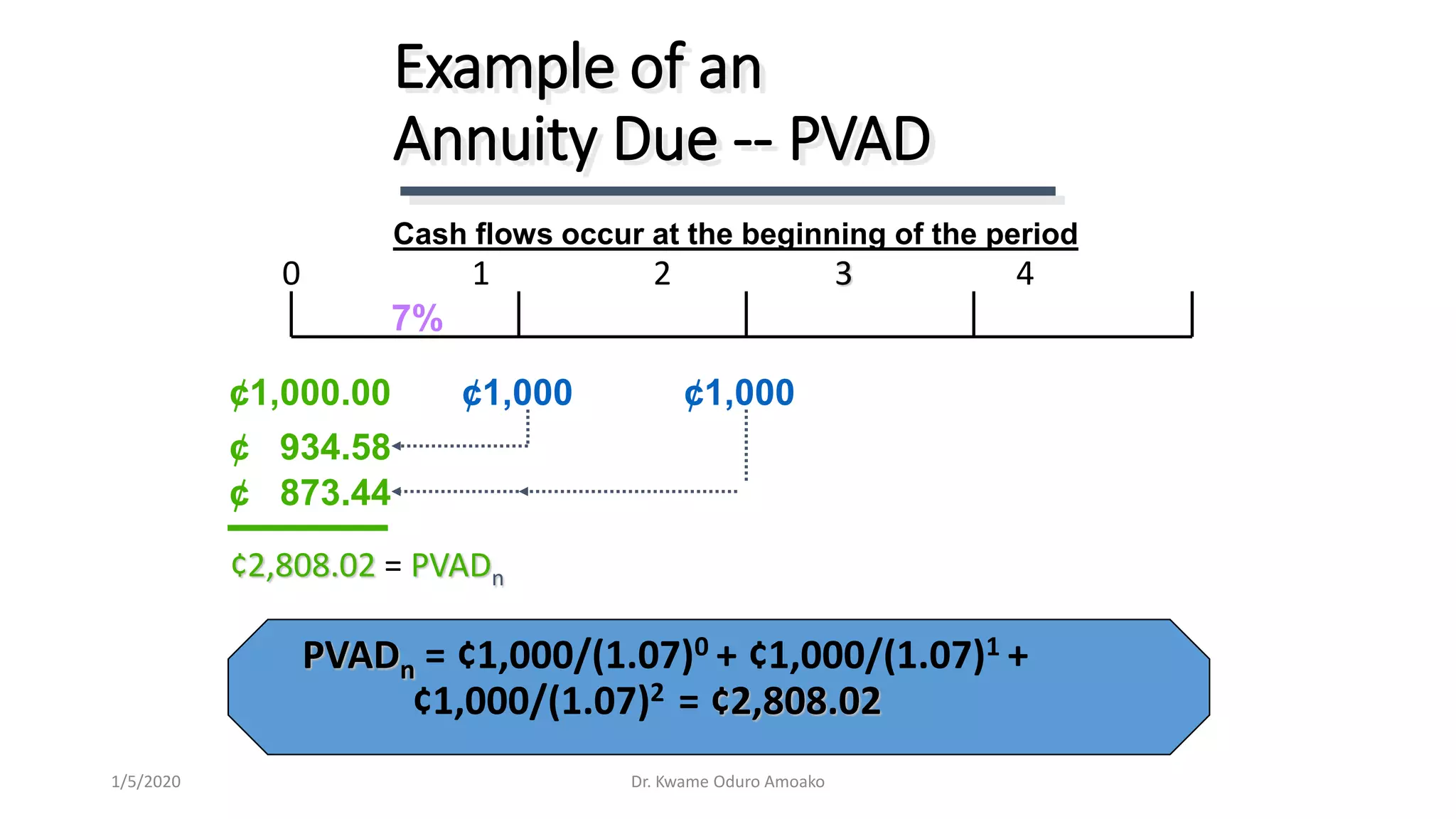
PVADn = ¢1,000/(1.07)0 + ¢1,000/(1.07)1 +
¢1,000/(1.07)2 = ¢2,808.02
Example of an
Annuity Due -- PVAD
¢1,000.00 ¢1,000 ¢1,000
0 1 2 3 4
¢2,808.02 = PVADn
7%
¢ 934.58
¢ 873.44
Cash flows occur at the beginning of the period
Dr. Kwame Oduro Amoako1/5/2020
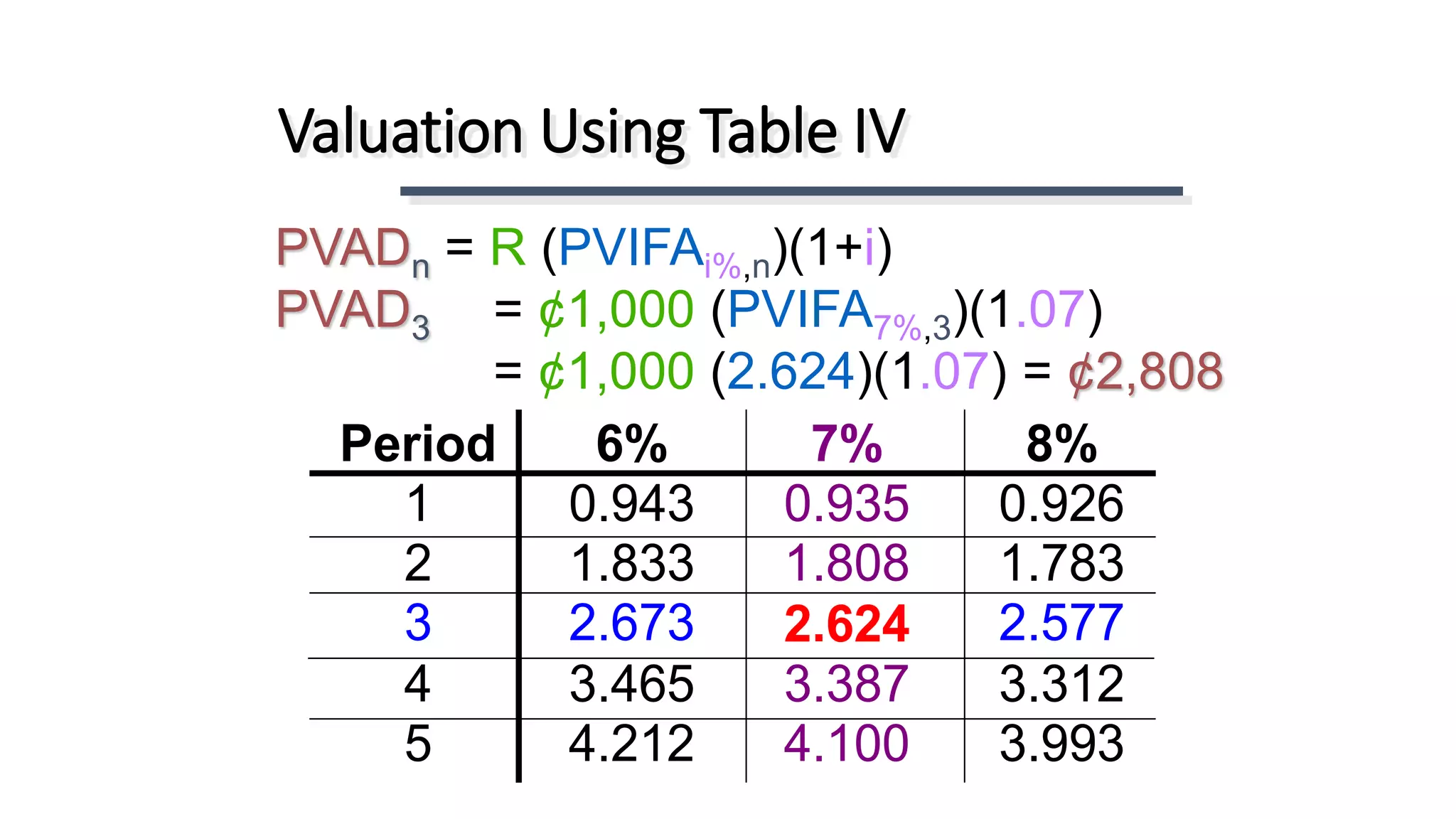
PVADn = R (PVIFAi%,n)(1+i)
PVAD3 = ¢1,000 (PVIFA7%,3)(1.07)
= ¢1,000 (2.624)(1.07) = ¢2,808
Valuation Using Table IV
Period 6% 7% 8%
1 0.943 0.935 0.926
2 1.833 1.808 1.783
3 2.673 2.624 2.577
4 3.465 3.387 3.312
5 4.212 4.100 3.993
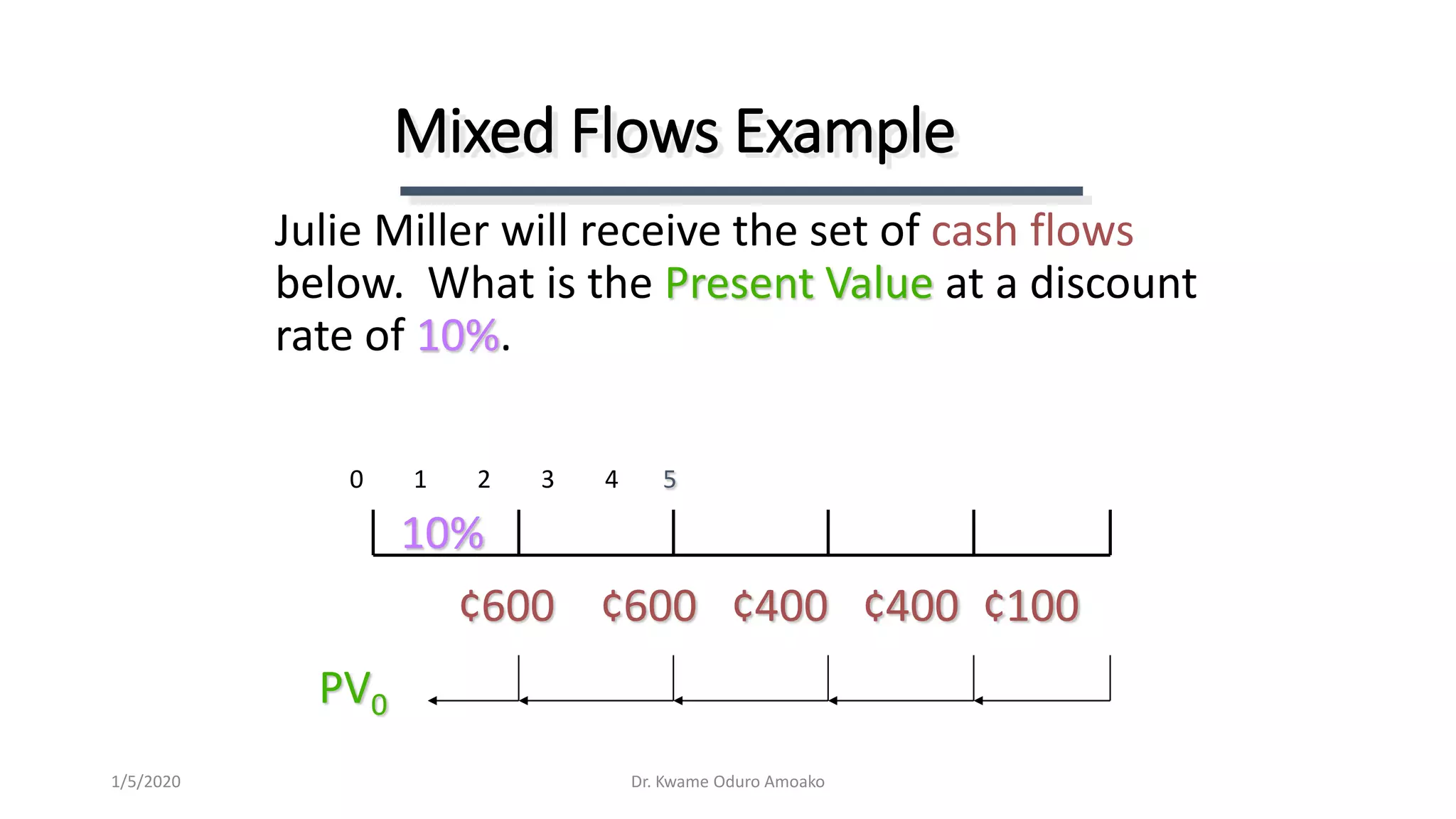
Julie Miller will receive the set of cash flows
below. What is the Present Value at a discount
rate of 10%.
Mixed Flows Example
0 1 2 3 4 5
¢600 ¢600 ¢400 ¢400 ¢100
PV0
10%
Dr. Kwame Oduro Amoako1/5/2020
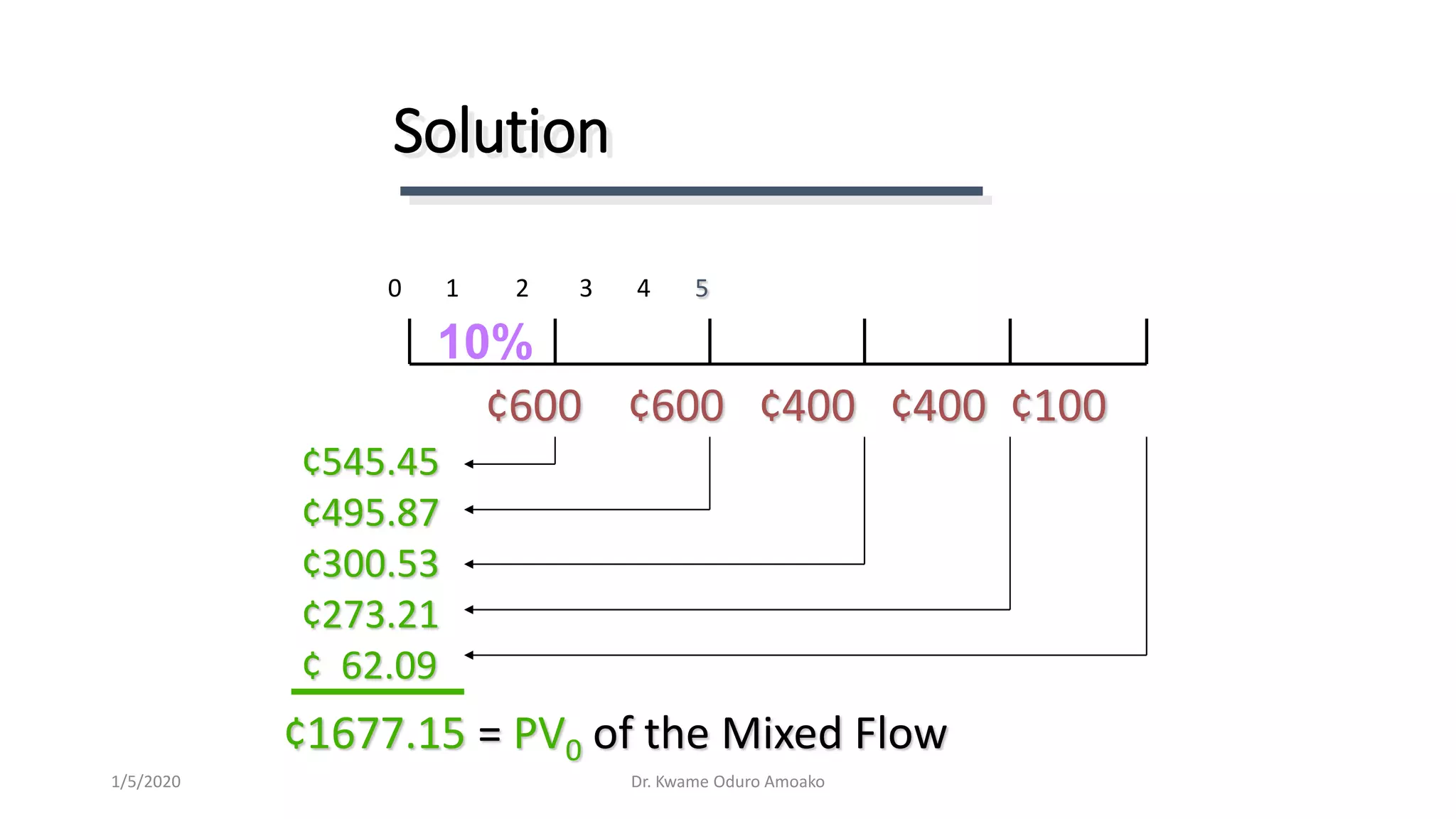
Solution
0 1 2 3 4 5
¢600 ¢600 ¢400 ¢400 ¢100
10%
¢545.45
¢495.87
¢300.53
¢273.21
¢ 62.09
¢1677.15 = PV0 of the Mixed Flow
Dr. Kwame Oduro Amoako1/5/2020
General Formula:
FVn = PV0(1 + [i/m])mn
n: Number of Years
m: Compounding Periods per Yeari:
Annual Interest Rate FVn,m: FV at
the end of Year n
PV0: PV of the Cash Flow today
Frequency of
Compounding
Dr. Kwame Oduro Amoako1/5/2020
Julie Miller has ¢1,000 to invest for 2 Years at an annual
interest rate of 12%.
Annual FV2 = 1,000(1+ [.12/1])(1)(2)
= 1,254.40
Julie Miller has ¢1,000 to invest for 2 Years at a semi-
annual interest rate of 12%.
Semi FV2 = 1,000(1+ [.12/2])(2)(2)
= 1,262.48
Impact of Frequency
Dr. Kwame Oduro Amoako1/5/2020
Qrtly FV2 = 1,000(1+ [.12/4])(4)(2) =
=1,266.77
Monthly FV2 = 1,000(1+ [.12/12])(12)(2)
= 1,269.73
Daily FV2 = 1,000(1+[.12/365])(365)(2)
= 1,271.20
Impact of Frequency
Dr. Kwame Oduro Amoako1/5/2020
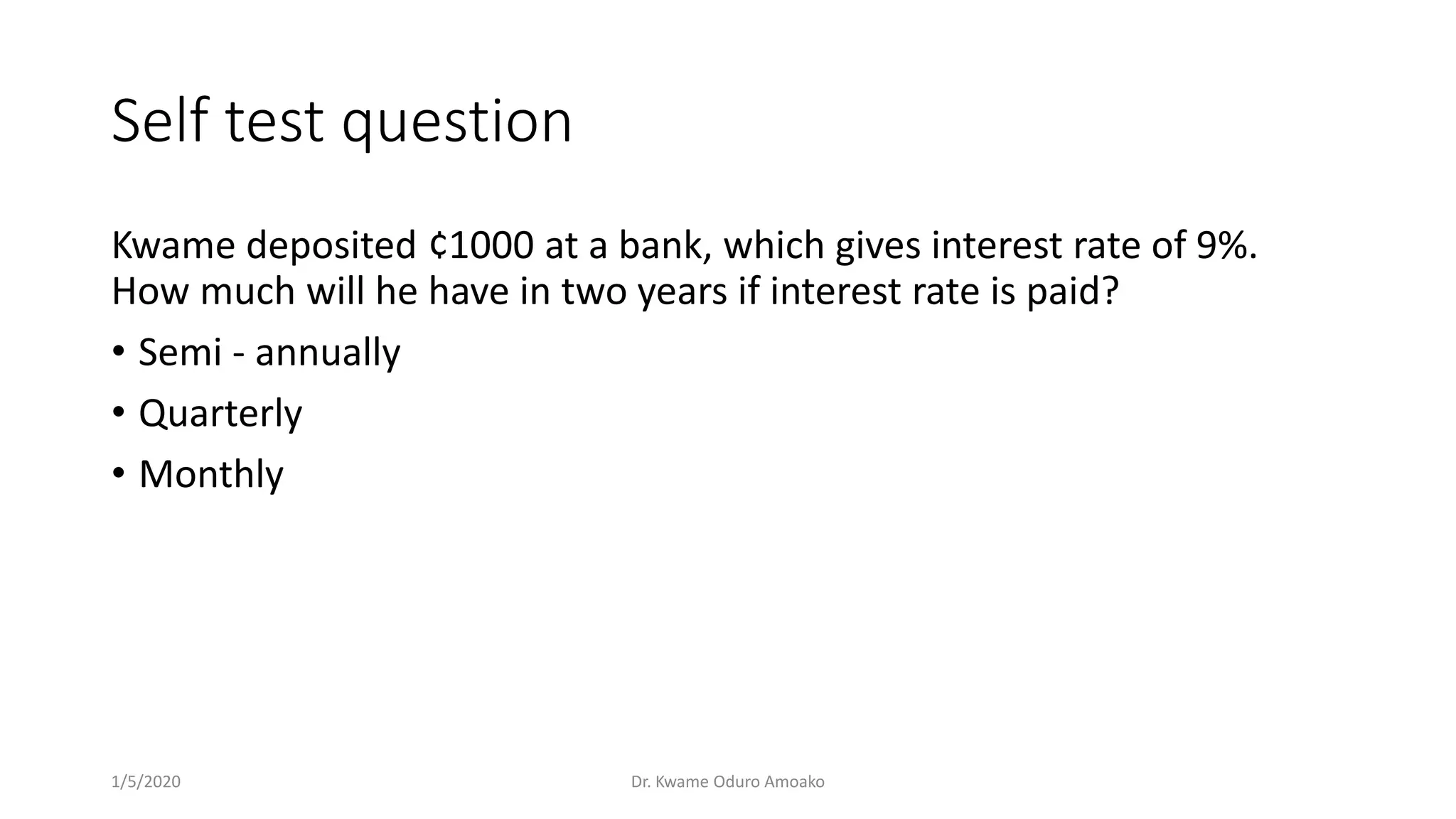
Self test question
Kwame deposited ¢1000 at a bank, which gives interest rate of 9%.
How much will he have in two years if interest rate is paid?
• Semi - annually
• Quarterly
• Monthly
1/5/2020 Dr. Kwame Oduro Amoako
The actual rate of interest earned (paid) after
adjusting the nominal rate for factors such as
the number of compounding periods per year.
(1 + [ i / n ] )n – 1
Where n= number of compounding
periods per year
Effective Annual
Interest Rate
Dr. Kwame Oduro Amoako1/5/2020
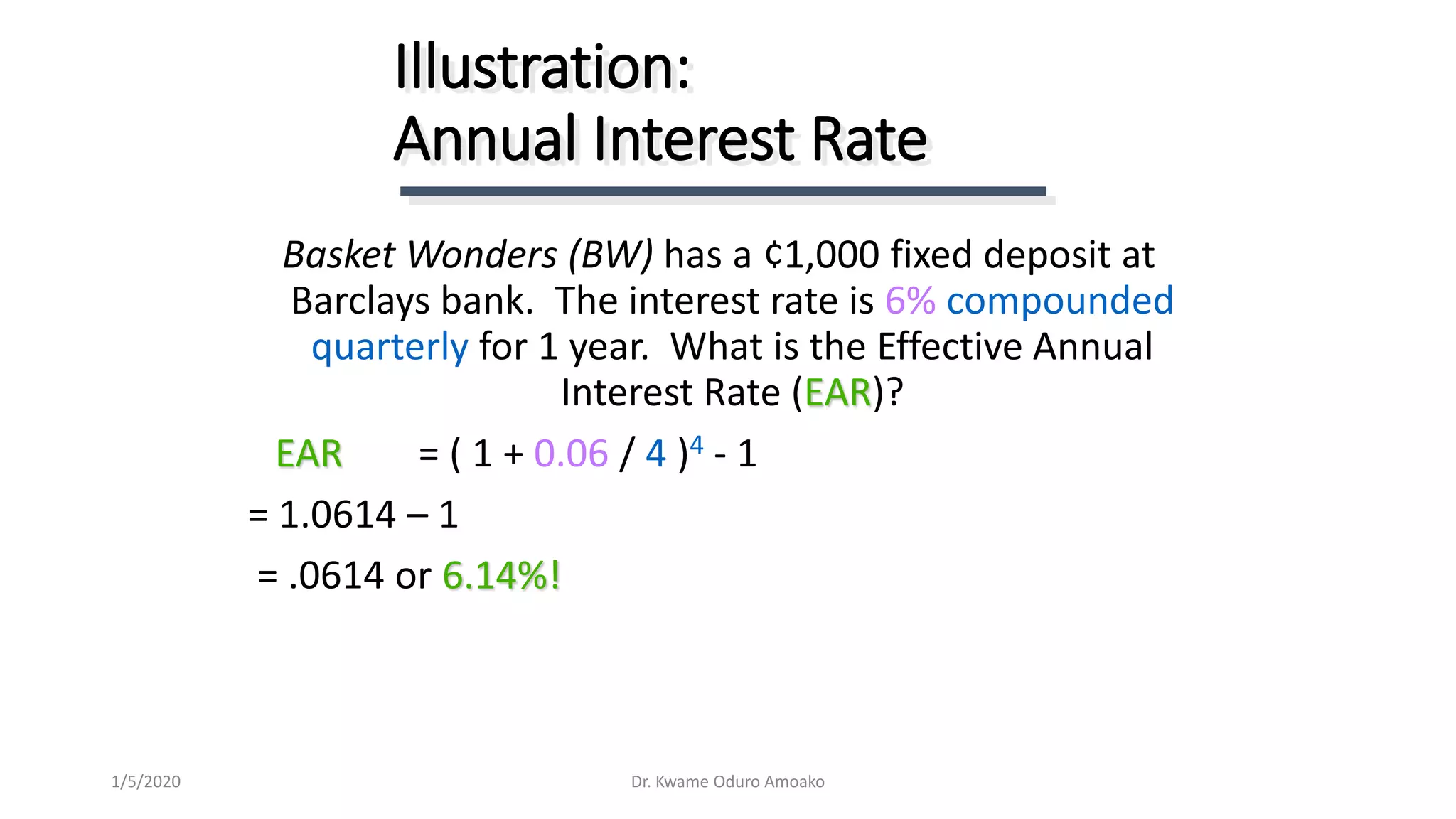
Basket Wonders (BW) has a ¢1,000 fixed deposit at
Barclays bank. The interest rate is 6% compounded
quarterly for 1 year. What is the Effective Annual
Interest Rate (EAR)?
EAR = ( 1 + 0.06 / 4 )4 - 1
= 1.0614 – 1
= .0614 or 6.14%!
Illustration:
Annual Interest Rate
Dr. Kwame Oduro Amoako1/5/2020
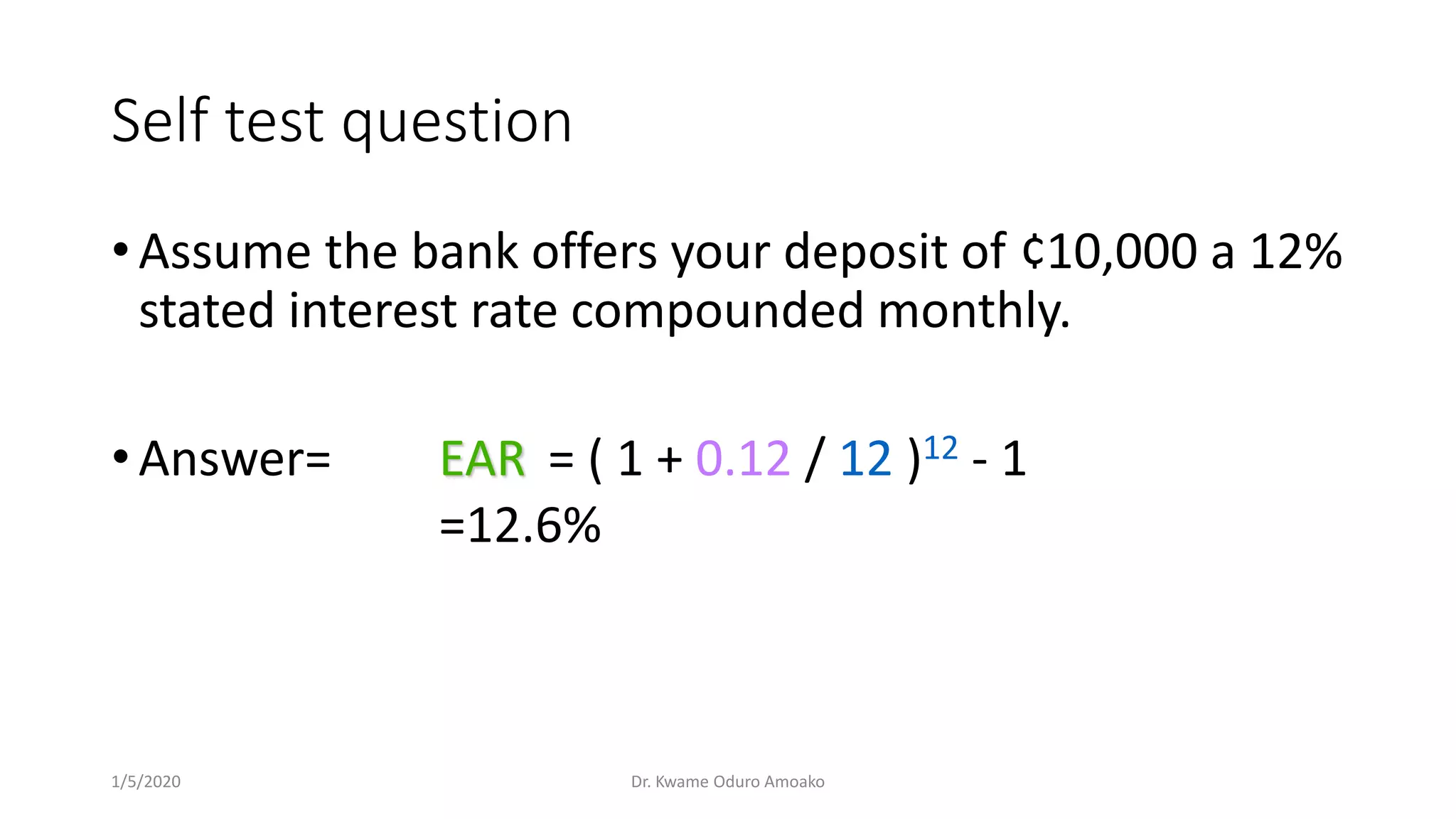
Self test question
• Assume the bank offers your deposit of ¢10,000 a 12%
stated interest rate compounded monthly.
• Answer= EAR = ( 1 + 0.12 / 12 )12 - 1
=12.6%
1/5/2020 Dr. Kwame Oduro Amoako
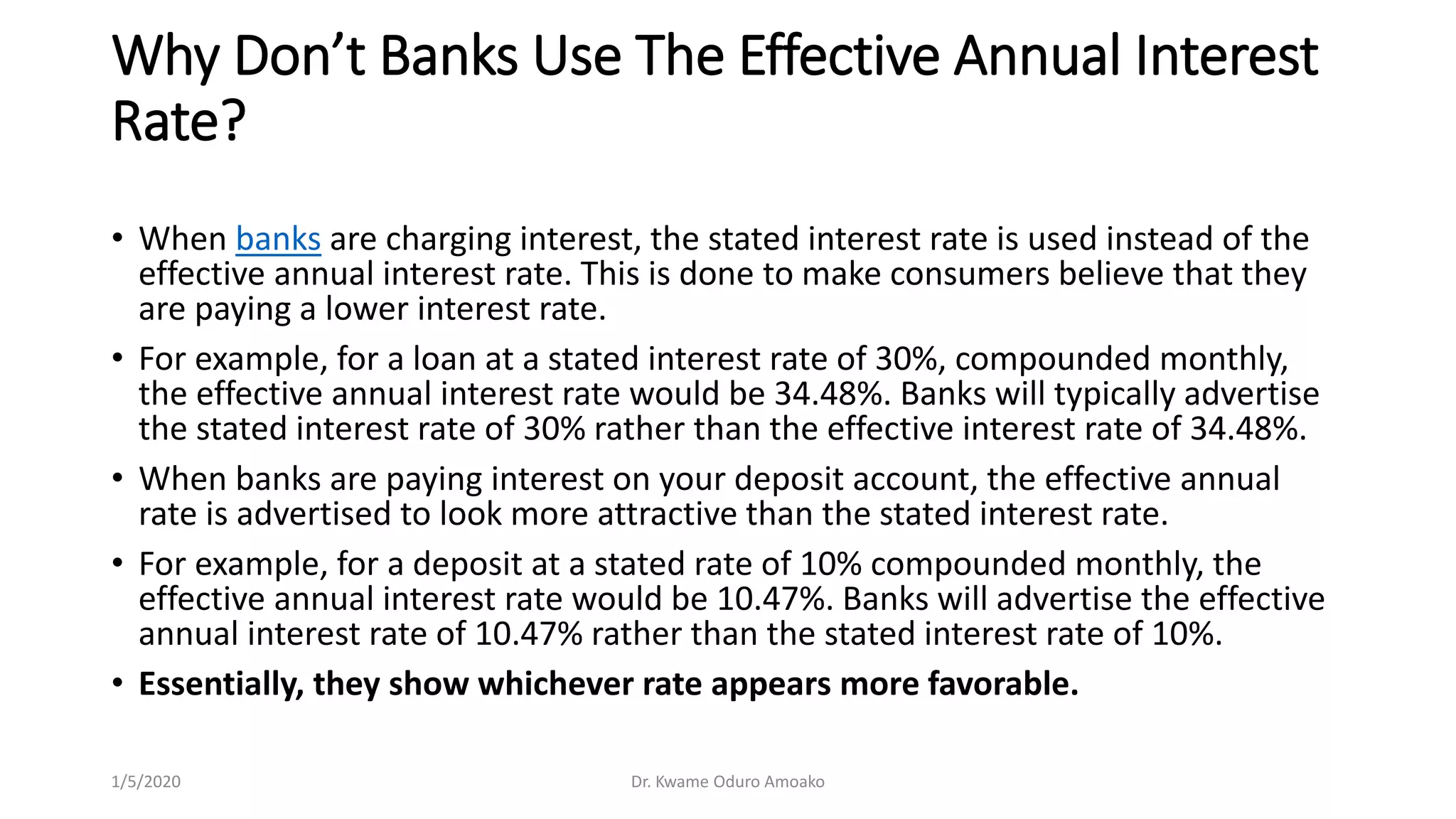
Why Don’t Banks Use The Effective Annual Interest
Rate?
• When banks are charging interest, the stated interest rate is used instead of the
effective annual interest rate. This is done to make consumers believe that they
are paying a lower interest rate.
• For example, for a loan at a stated interest rate of 30%, compounded monthly,
the effective annual interest rate would be 34.48%. Banks will typically advertise
the stated interest rate of 30% rather than the effective interest rate of 34.48%.
• When banks are paying interest on your deposit account, the effective annual
rate is advertised to look more attractive than the stated interest rate.
• For example, for a deposit at a stated rate of 10% compounded monthly, the
effective annual interest rate would be 10.47%. Banks will advertise the effective
annual interest rate of 10.47% rather than the stated interest rate of 10%.
• Essentially, they show whichever rate appears more favorable.
1/5/2020 Dr. Kwame Oduro Amoako
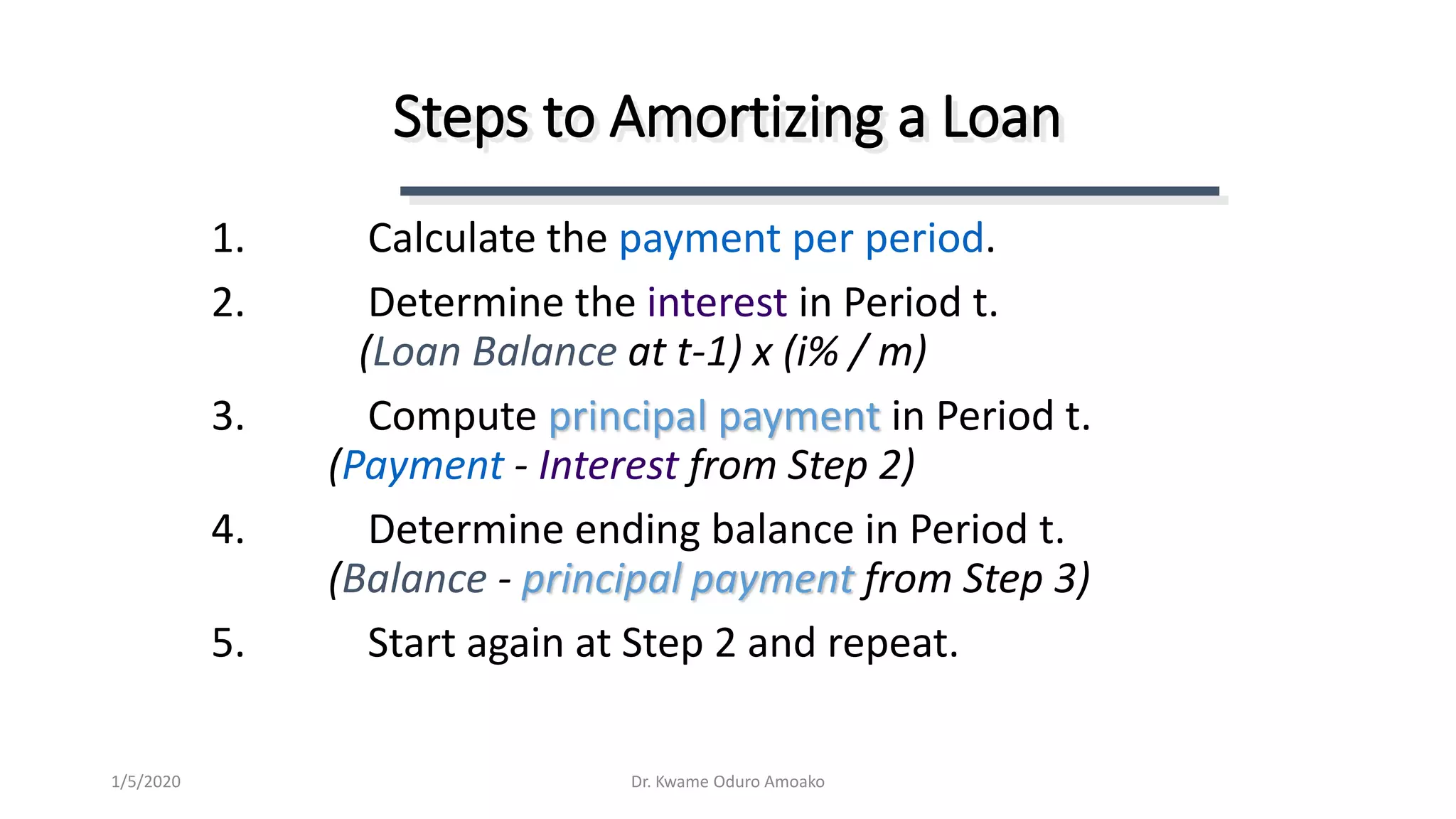
1. Calculate the payment per period.
2. Determine the interest in Period t.
(Loan Balance at t-1) x (i% / m)
3. Compute principal payment in Period t.
(Payment - Interest from Step 2)
4. Determine ending balance in Period t.
(Balance - principal payment from Step 3)
5. Start again at Step 2 and repeat.
Steps to Amortizing a Loan
Dr. Kwame Oduro Amoako1/5/2020
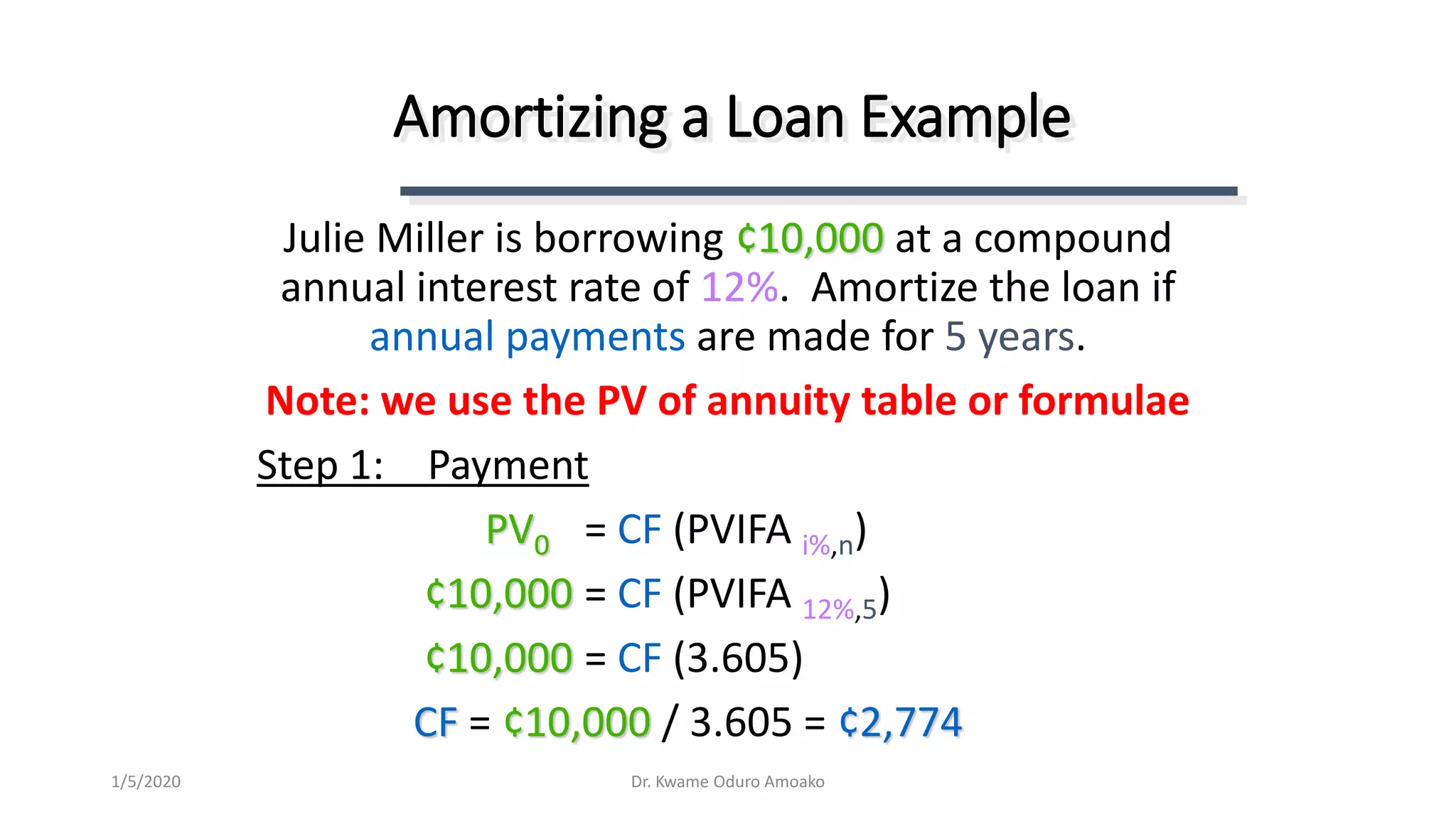
Julie Miller is borrowing ¢10,000 at a compound
annual interest rate of 12%. Amortize the loan if
annual payments are made for 5 years.
Note: we use the PV of annuity table or formulae
Step 1: Payment
PV0 = CF (PVIFA i%,n)
¢10,000 = CF (PVIFA 12%,5)
¢10,000 = CF (3.605)
CF = ¢10,000 / 3.605 = ¢2,774
Amortizing a Loan Example
Dr. Kwame Oduro Amoako1/5/2020
Amortizing a Loan Example
End of
Year
Payment Interest Principal Ending
Balance
0 --- --- --- $10,000
1 $2,774 $1,200 $1,574 8,426
2 2,774 1,011 1,763 6,663
3 2,774 800 1,974 4,689
4 2,774 563 2,211 2,478
5 2,775 297 2,478 0
$13,871 $3,871 $10,000
[Last Payment Slightly Higher Due to Rounding]

Mba fin mgt lecture 3 time value of money

  • 1.
    Financial Management Lecture 3 TimeValue of Money Dr. Kwame Oduro Amoako1/5/2020
  • 2.
    At the endof Lecture 3, you should be able to: 1. Understand what is meant by "the time value of money." 2. Understand the relationship between present and future value. 3. Describe how the interest rate can be used to adjust the value of cash flows – both forward and backward – to a single point in time. 4. Calculate both the future and present value of: (a) an amount invested today; (b) a stream of equal cash flows (an annuity); and (c) a stream of mixed cash flows. Dr. Kwame Oduro Amoako1/5/2020
  • 3.
    At the endof Lecture 3, you should be able to: 5. Distinguish between an “ordinary annuity” and an “annuity due.” 6. Use interest factor tables and understand how they provide a shortcut to calculating present and future values. 7. Use interest factor tables to find an unknown interest rate or growth rate when the number of time periods and future and present values are known. 8. Build an “amortization schedule” for an installment-style loan. 1/5/2020 Dr. Kwame Oduro Amoako
  • 4.
    The Time Valueof Money • The Interest Rate • Simple Interest • Compound Interest • Amortizing a Loan • Compounding More Than Once per Year Dr. Kwame Oduro Amoako1/5/2020
  • 5.
    Obviously, ¢10,000 today. Youalready recognize that there is TIME VALUE TO MONEY!! The Interest Rate Which would you prefer -- ¢10,000 today or ¢10,000 in 5 years? Dr. Kwame Oduro Amoako1/5/2020
  • 6.
    TIME allows youthe opportunity to postpone consumption and earn INTEREST. Why TIME? Why is TIME such an important element in your decision? Dr. Kwame Oduro Amoako1/5/2020
  • 7.
    Types of Interest CompoundInterest Interest paid (earned) on any previous interest earned, as well as on the principal borrowed (lent). Simple Interest Interest paid (earned) on only the original amount, or principal, borrowed (lent). Dr. Kwame Oduro Amoako1/5/2020
  • 8.
    Simple Interest Formula Formula SI= P0(i)(n) SI: Simple Interest P0: Deposit today (t=0) i: Interest Rate per Period n: Number of Time Periods Dr. Kwame Oduro Amoako1/5/2020
  • 9.
    SI = P0(i)(n) =¢1,000(.07)(2) = ¢140 Simple Interest Example •Assume that you deposit ¢1,000 in an account earning 7% simple interest for 2 years. What is the accumulated interest at the end of the 2nd year? Dr. Kwame Oduro Amoako1/5/2020
  • 10.
    FV = P0+ SI = ¢1,000 + ¢140 = ¢1,140 Future Value is the value at some future time of a present amount of money, or a series of payments, evaluated at a given interest rate. Future Value, Single Deposit (Simple interest) What is the Future Value (FV) of the deposit? Dr. Kwame Oduro Amoako1/5/2020
  • 11.
    Assume that youdeposit ¢1,000 at a compound interest rate of 7% for 2 years. Future Value Single Deposit (Compound interest) 0 1 2 ¢1,000 FV2 7% Dr. Kwame Oduro Amoako1/5/2020
  • 12.
    FV1 = P0(1+i)1 = ¢1,000 (1.07) = ¢1,070 FV2 = P0 (1+i)(1+i) FV2 =¢1,000(1.07)(1.07) Or FV2 = P0 (1+i)n = ¢1,000(1.07)2 = ¢1,144.90 You earned an EXTRA ¢4.90 in Year 2 with compound over simple interest. Future Value Single Deposit (Formula) Dr. Kwame Oduro Amoako1/5/2020
  • 13.
    Self test (FV) •Calculate the future value of 1,000 cedis deposited for 30 years at • (a)simple interests of 7% and 10% and • (b) compound interests of 7% and 10%. • Hint: Formulae below • SI = P0(i)(n) • FV = P0 + SI Compound interest • FV2 = P0 (1+i)n 1/5/2020 Dr. Kwame Oduro Amoako
  • 14.
    0 2000 4000 6000 8000 10000 12000 14000 16000 18000 1st Year 10th Year 20th Year 30th Year FutureValue of a Single GHC1,000 Deposit 10% Simple Interest 7% Compound Interest 10% Compound Interest Why Compound Interest? FutureValue(GhanaCedis)
  • 15.
    General Future ValueFormula: FVn = P0 (1+i)n or FVn = P0 (FVIFi,n) -- See Table I General Future Value Formula Dr. Kwame Oduro Amoako1/5/2020
  • 16.
    FVIFi,n is foundon the Table Valuation Using Table I Period 6% 7% 8% 1 1.060 1.070 1.080 2 1.124 1.145 1.166 3 1.191 1.225 1.260 4 1.262 1.311 1.360 5 1.338 1.403 1.469
  • 17.
    FV2 = ¢1,000(FVIF7%,2) = ¢1,000 (1.145) = ¢1,145 [Due to Rounding] Using Future Value Tables Period 6% 7% 8% 1 1.060 1.070 1.080 2 1.124 1.145 1.166 3 1.191 1.225 1.260 4 1.262 1.311 1.360 5 1.338 1.403 1.469
  • 18.
    Julie Miller wantsto know how large her deposit of ¢10,000 today will become at a compound annual interest rate of 10% for 5 years. Story Problem Example 0 1 2 3 4 5 ¢10,000 FV5 10% Dr. Kwame Oduro Amoako1/5/2020
  • 19.
    Story Problem Solution Calculationbased on general formula: FVn = P0 (1+i)n FV5 = ¢10,000 (1+ 0.10)5 = ¢16,105.10 Calculation based on Table I: FV5 = ¢10,000 (FVIF10%, 5) = ¢10,000 (1.611) = ¢16,110 [Due to Rounding] 1/5/2020 Dr. Kwame Oduro Amoako
  • 20.
    That is thevalue today! What is the Present Value (PV) of the previous problem? •The Present Value is simply the ¢1,000 you originally deposited. Present value (PV) Present Value is the current value of a future amount of money, or a series of payments, evaluated at a given interest rate. Dr. Kwame Oduro Amoako1/5/2020
  • 21.
    General Present ValueFormula: PV0 = FVn / (1+i)n or PV0 = FVn (PVIFi,n) -- See Table II General Present Value Formula Dr. Kwame Oduro Amoako1/5/2020
  • 22.
    Assume that youneed ¢1,000 in 2 years. Let’s examine the process to determine how much you need to deposit today at a discount rate of 7% compounded annually. 0 1 2 ¢1,000 7% PV1 PV0 Present Value (PV) Single Deposit Dr. Kwame Oduro Amoako1/5/2020
  • 23.
    PV0 = FV2/ (1+i)2 = ¢1,000 / (1.07)2 = ¢873.44 Present Value Single Deposit (Formula) Dr. Kwame Oduro Amoako1/5/2020
  • 24.
    PVIFi,n is foundon the discount Table Valuation Using Table II Period 6% 7% 8% 1 .943 .935 .926 2 .890 .873 .857 3 .840 .816 .794 4 .792 .763 .735 5 .747 .713 .681
  • 25.
    PV2 = ¢1,000(PVIF7%,2) = ¢1,000 (.873) = ¢873 [Due to Rounding] Using Present Value Tables Period 6% 7% 8% 1 .943 .935 .926 2 .890 .873 .857 3 .840 .816 .794 4 .792 .763 .735 5 .747 .713 .681
  • 26.
    Julie Miller wantsto know how large of a deposit to make so that the money will grow to ¢10,000 in 5 years at a discount rate of 10%. Story Problem Example 0 1 2 3 4 5 ¢10,000 PV0 10% Dr. Kwame Oduro Amoako1/5/2020
  • 27.
     Calculation basedon general formula: PV0 = FVn / (1+i)n PV0 = ¢10,000 / (1+ 0.10)5 = ¢6,209.21  Calculation based on Table I: PV0 = ¢10,000 (PVIF10%, 5) = ¢10,000 (.621) =¢6,210.00 [Due to Rounding] Story Problem Solution Dr. Kwame Oduro Amoako1/5/2020
  • 28.
    What is therelationship between Present Value and Future Value Future value •A future value equals a present value plus the interest that can be earned by having ownership of the money; •it is the amount that the present value will grow to over some stated period of time. 1/5/2020 Dr. Kwame Oduro Amoako
  • 29.
    What is therelationship between Present Value and Future Value Present Value •Present value equals the future value minus the interest that comes from ownership of the money; •it is today's value of a future amount to be received at some specified time in the future. 1/5/2020 Dr. Kwame Oduro Amoako
  • 30.
    Annuities Types of annuities: OrdinaryAnnuity: Payments or receipts occur at the end of each period. Annuity Due: Payments or receipts occur at the beginning of each period.  An Annuity represents a series of equal payments (or receipts) occurring over a specified number of equidistant periods. Dr. Kwame Oduro Amoako1/5/2020
  • 31.
    Examples of Annuities •Student Loan Payments • Car Loan Payments • Insurance Premiums • Mortgage Payments • Retirement Savings Dr. Kwame Oduro Amoako1/5/2020
  • 32.
    Parts of anAnnuity (Ordinary annuity) 0 1 2 3 ¢100 ¢100 ¢100 End of Period 1 End of Period 2 Today Equal Cash Flows Each 1 Period Apart End of Period 3 Dr. Kwame Oduro Amoako1/5/2020
  • 33.
    Parts of anAnnuity (Annuity due) 0 1 2 3 ¢100 ¢100 ¢100 Beginning of Period 1 Beginning of Period 2 Today Equal Cash Flows Each 1 Period Apart Beginning of Period 3 Dr. Kwame Oduro Amoako1/5/2020
  • 34.
    FVAn = CF(1+i)3+ CF(1+i)2……… or FVAn = PV/k [(1 + k) n – 1] Overview of an Ordinary Annuity -- FVA CF CF CF 0 1 2 n n+1 FVAn CF = Periodic Cash Flow Cash flows occur at the end of the period i% . . . Dr. Kwame Oduro Amoako1/5/2020
  • 35.
    Example of an OrdinaryAnnuity -- FVA Mr. Osei Agyei Bonsu is planning his child university education . He has therefore decided to make periodic contribution towards that. If he deposits GH¢1,000 at the end of every year into a special account for three years which grows at 7% per anum, what will be the value of his deposit by the end of the third year? 1/5/2020 Dr. Kwame Oduro Amoako
  • 36.
    Example of an OrdinaryAnnuity -- FVA ¢1,000 ¢1,000 ¢1,000 0 1 2 3 4 7% Cash flows occur at the end of the period Dr. Kwame Oduro Amoako1/5/2020 Are calculating backwards (PV)or forward (FV)? • Answer: FV of annuity What will be the n for years 1,2 and 3 cash flows? • Answer: Year 1: n=2; Year 2:n=1; Year 3: n=0
  • 37.
    FVA3 = ¢1,000(1.07)2+ ¢1,000(1.07)1 + ¢1,000(1.07)0 = ¢1,145 + ¢1,070 + ¢1,000 = ¢3,215 Example of an Ordinary Annuity -- FVA ¢1,000 ¢1,000 ¢1,000 0 1 2 3 4 ¢3,215 = FVA3 7% ¢1,070 ¢1,145 Cash flows occur at the end of the period Dr. Kwame Oduro Amoako1/5/2020
  • 38.
    FVAn = CF(FVIFAi%,n) FVA3 = ¢1,000 (FVIFA7%,3) = ¢1,000 (3.215) = ¢3,215 Valuation Using Table III Period 6% 7% 8% 1 1.000 1.000 1.000 2 2.060 2.070 2.080 3 3.184 3.215 3.246 4 4.375 4.440 4.506 5 5.637 5.751 5.867
  • 39.
    Self test questionin class •If he deposits GH¢2,000 at the end of every year into a special account for seven years at 15% rate of returns? Answer: •FVAn = PMT(FVIFAk,n) •FVA5 = ¢3,000 (7.154) •FVA5 =¢21,462
  • 40.
    FVADn = CF(1+i)4+CF(1+i)3 + CF(1+i)2 + CF(1+i)1 Overview View of an Annuity Due -- FVAD CF CF CF CF CF 0 1 2 3 n-1 n FVADn i% . . . Cash flows occur at the beginning of the period Dr. Kwame Oduro Amoako1/5/2020
  • 41.
    Illustration of anAnnuity Due -- FVAD • Mr. Osei Agyei Bonsu is planning his child university education . He has therefore decided to make periodic contribution towards that. If he deposits GH¢1,000 at the beginning of every year into a special account for three years which grows at 7% per anum, what will be the value of his deposit by the end of the third year? 1/5/2020 Dr. Kwame Oduro Amoako
  • 42.
    Example of an OrdinaryAnnuity -- FVA ¢1,000 ¢1,000 ¢1,000 0 1 2 3 4 7% Cash flows occur at the end of the period Dr. Kwame Oduro Amoako1/5/2020 Are calculating backwards (PV)or forward (FV)? • Answer: FV of annuity due What will be the n for years 1,2 and 3 cash flows? • Answer: Year 1: n=3; Year 2:n=2; Year 3: n=1
  • 43.
    FVAD3 = ¢1,000(1.07)3+ ¢1,000(1.07)2 + ¢1,000(1.07)1 = ¢1,225 + ¢1,145 + ¢1,070 = ¢3,440 Example of an Annuity Due -- FVAD ¢1,000 ¢1,000 ¢1,000 ¢1,070 0 1 2 3 4 ¢3,440 = FVAD3 7% ¢1,225 ¢1,145 Cash flows occur at the beginning of the period Dr. Kwame Oduro Amoako1/5/2020
  • 44.
    FVADn = R(FVIFAi%,n)(1+i) FVAD3 = ¢1,000 (FVIFA7%,3)(1.07) = ¢1,000 (3.215)(1.07) = ¢3,440 Valuation Using Table III Period 6% 7% 8% 1 1.000 1.000 1.000 2 2.060 2.070 2.080 3 3.184 3.215 3.246 4 4.375 4.440 4.506 5 5.637 5.751 5.867
  • 45.
    PVAn = CF/(1+i)1+ CF/(1+i)2 + ... + CF/(1+i)n Overview of an Ordinary Annuity -- PVA CF CF CF 0 1 2 n n+1 PVAn R = Periodic Cash Flow i% . . . Cash flows occur at the end of the period Dr. Kwame Oduro Amoako1/5/2020
  • 46.
    Illustration on PresentValue of Annuity-- PVA Mr. Osei Agyei Bonsu has invested in a business hoping to receive GH¢1,000 at the end of each year for the next three years. The current interest rate is 7%. Determine the present value of this investment. 1/5/2020 Dr. Kwame Oduro Amoako
  • 47.
    Example of an OrdinaryAnnuity -- FVA ¢1,000 ¢1,000 ¢1,000 0 1 2 3 4 7% Cash flows occur at the end of the period Dr. Kwame Oduro Amoako1/5/2020 Are calculating backwards (PV)or forward (FV)? • Answer: PV of annuity due What will be the n for years 1,2 and 3 cash flows? • Answer: Year 1: n=1; Year 2:n=2; Year 3: n=3
  • 48.
    PVA3 = ¢1,000/(1.07)1+ ¢1,000/(1.07)2 + ¢1,000/(1.07)3 = ¢934.58 + ¢873.44 + ¢816.30 = ¢2,624.32 Example of an Ordinary Annuity -- PVA ¢1,000 ¢1,000 ¢1,000 0 1 2 3 4 ¢2,624.32 = PVA3 7% ¢934.58 ¢873.44 ¢816.30 Cash flows occur at the end of the period Dr. Kwame Oduro Amoako1/5/2020
  • 49.
    PVAn = CF(PVIFAi%,n) PVA3 = ¢1,000 (PVIFA7%,3) = ¢1,000 (2.624) = ¢2,624 Valuation Using Table IV Period 6% 7% 8% 1 0.943 0.935 0.926 2 1.833 1.808 1.783 3 2.673 2.624 2.577 4 3.465 3.387 3.312 5 4.212 4.100 3.993
  • 50.
    PVADn = R/(1+i)0+ R/(1+i)1 + ... + R/(1+i)n-1 = PVAn (1+i) Overview of an Annuity Due -- PVAD CF CF CF CF 0 1 2 n-1 n PVADn R: Periodic Cash Flow i% . . . Cash flows occur at the beginning of the period Dr. Kwame Oduro Amoako1/5/2020
  • 51.
    Example of anAnnuity due -- FVAD ¢1,000 ¢1,000 ¢1,000 0 1 2 3 4 7% Cash flows occur at the end of the period Dr. Kwame Oduro Amoako1/5/2020 Are calculating backwards (PV)or forward (FV)? • Answer: PV of annuity due What will be the n for years 1,2 and 3 cash flows? • Answer: Year 1: n=0; Year 2:n=1; Year 3: n=2
  • 52.
    PVADn = ¢1,000/(1.07)0+ ¢1,000/(1.07)1 + ¢1,000/(1.07)2 = ¢2,808.02 Example of an Annuity Due -- PVAD ¢1,000.00 ¢1,000 ¢1,000 0 1 2 3 4 ¢2,808.02 = PVADn 7% ¢ 934.58 ¢ 873.44 Cash flows occur at the beginning of the period Dr. Kwame Oduro Amoako1/5/2020
  • 53.
    PVADn = R(PVIFAi%,n)(1+i) PVAD3 = ¢1,000 (PVIFA7%,3)(1.07) = ¢1,000 (2.624)(1.07) = ¢2,808 Valuation Using Table IV Period 6% 7% 8% 1 0.943 0.935 0.926 2 1.833 1.808 1.783 3 2.673 2.624 2.577 4 3.465 3.387 3.312 5 4.212 4.100 3.993
  • 54.
    Julie Miller willreceive the set of cash flows below. What is the Present Value at a discount rate of 10%. Mixed Flows Example 0 1 2 3 4 5 ¢600 ¢600 ¢400 ¢400 ¢100 PV0 10% Dr. Kwame Oduro Amoako1/5/2020
  • 55.
    Solution 0 1 23 4 5 ¢600 ¢600 ¢400 ¢400 ¢100 10% ¢545.45 ¢495.87 ¢300.53 ¢273.21 ¢ 62.09 ¢1677.15 = PV0 of the Mixed Flow Dr. Kwame Oduro Amoako1/5/2020
  • 56.
    General Formula: FVn =PV0(1 + [i/m])mn n: Number of Years m: Compounding Periods per Yeari: Annual Interest Rate FVn,m: FV at the end of Year n PV0: PV of the Cash Flow today Frequency of Compounding Dr. Kwame Oduro Amoako1/5/2020
  • 57.
    Julie Miller has¢1,000 to invest for 2 Years at an annual interest rate of 12%. Annual FV2 = 1,000(1+ [.12/1])(1)(2) = 1,254.40 Julie Miller has ¢1,000 to invest for 2 Years at a semi- annual interest rate of 12%. Semi FV2 = 1,000(1+ [.12/2])(2)(2) = 1,262.48 Impact of Frequency Dr. Kwame Oduro Amoako1/5/2020
  • 58.
    Qrtly FV2 =1,000(1+ [.12/4])(4)(2) = =1,266.77 Monthly FV2 = 1,000(1+ [.12/12])(12)(2) = 1,269.73 Daily FV2 = 1,000(1+[.12/365])(365)(2) = 1,271.20 Impact of Frequency Dr. Kwame Oduro Amoako1/5/2020
  • 59.
    Self test question Kwamedeposited ¢1000 at a bank, which gives interest rate of 9%. How much will he have in two years if interest rate is paid? • Semi - annually • Quarterly • Monthly 1/5/2020 Dr. Kwame Oduro Amoako
  • 60.
    The actual rateof interest earned (paid) after adjusting the nominal rate for factors such as the number of compounding periods per year. (1 + [ i / n ] )n – 1 Where n= number of compounding periods per year Effective Annual Interest Rate Dr. Kwame Oduro Amoako1/5/2020
  • 61.
    Basket Wonders (BW)has a ¢1,000 fixed deposit at Barclays bank. The interest rate is 6% compounded quarterly for 1 year. What is the Effective Annual Interest Rate (EAR)? EAR = ( 1 + 0.06 / 4 )4 - 1 = 1.0614 – 1 = .0614 or 6.14%! Illustration: Annual Interest Rate Dr. Kwame Oduro Amoako1/5/2020
  • 62.
    Self test question •Assume the bank offers your deposit of ¢10,000 a 12% stated interest rate compounded monthly. • Answer= EAR = ( 1 + 0.12 / 12 )12 - 1 =12.6% 1/5/2020 Dr. Kwame Oduro Amoako
  • 63.
    Why Don’t BanksUse The Effective Annual Interest Rate? • When banks are charging interest, the stated interest rate is used instead of the effective annual interest rate. This is done to make consumers believe that they are paying a lower interest rate. • For example, for a loan at a stated interest rate of 30%, compounded monthly, the effective annual interest rate would be 34.48%. Banks will typically advertise the stated interest rate of 30% rather than the effective interest rate of 34.48%. • When banks are paying interest on your deposit account, the effective annual rate is advertised to look more attractive than the stated interest rate. • For example, for a deposit at a stated rate of 10% compounded monthly, the effective annual interest rate would be 10.47%. Banks will advertise the effective annual interest rate of 10.47% rather than the stated interest rate of 10%. • Essentially, they show whichever rate appears more favorable. 1/5/2020 Dr. Kwame Oduro Amoako
  • 64.
    1. Calculate thepayment per period. 2. Determine the interest in Period t. (Loan Balance at t-1) x (i% / m) 3. Compute principal payment in Period t. (Payment - Interest from Step 2) 4. Determine ending balance in Period t. (Balance - principal payment from Step 3) 5. Start again at Step 2 and repeat. Steps to Amortizing a Loan Dr. Kwame Oduro Amoako1/5/2020
  • 65.
    Julie Miller isborrowing ¢10,000 at a compound annual interest rate of 12%. Amortize the loan if annual payments are made for 5 years. Note: we use the PV of annuity table or formulae Step 1: Payment PV0 = CF (PVIFA i%,n) ¢10,000 = CF (PVIFA 12%,5) ¢10,000 = CF (3.605) CF = ¢10,000 / 3.605 = ¢2,774 Amortizing a Loan Example Dr. Kwame Oduro Amoako1/5/2020
  • 66.
    Amortizing a LoanExample End of Year Payment Interest Principal Ending Balance 0 --- --- --- $10,000 1 $2,774 $1,200 $1,574 8,426 2 2,774 1,011 1,763 6,663 3 2,774 800 1,974 4,689 4 2,774 563 2,211 2,478 5 2,775 297 2,478 0 $13,871 $3,871 $10,000 [Last Payment Slightly Higher Due to Rounding]