

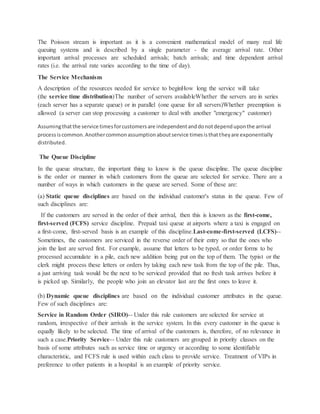
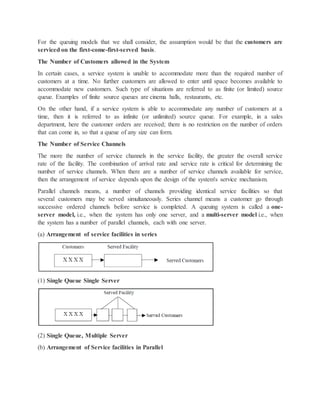
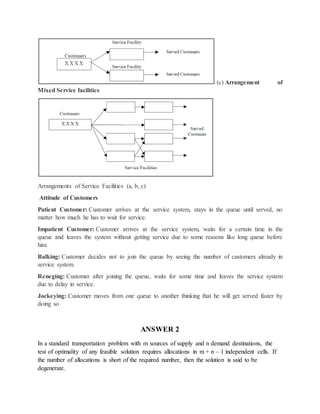
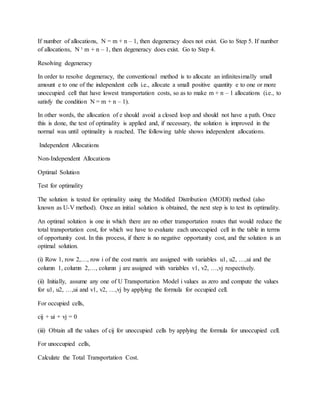


MASTER OF BUSINESS ADMINISTRATION
ASSIGNMENT
SEM-2
READ INSTRUCTIONS CAREFULLY:
.
-outs) by students on A4
Size-plan
papers on one-Side only.
one file having collection of all assignments of individual students should be submitted.
be
given zero marks. And no second chance will be given.
NOTE: All questions are compulsory.
MBA 201 (BUSINESS ENVIRONMENT)
Q-1. What is public debt? Describe its role in the economy.
Q-2. What is corporate intelligence?
Q-3. Define the role of the RBI in enforcing FEMA.
Q-4. Describe the social responsibility of business.
Q-5. Explain the economic role of government in business environment.
MBA 202 (RESEARCH METHODOLOGY)
Q-1. What do you mean by research? Explain its significance in modern times.
Q-2. Explain in detail techniques involved in defining a research problem.
Q-3. What is questionnaire? What are different types of questionnaire?
Q-4. What are the precautions one should take while administering “Data Collection”.
Q-5. Write short note on methods of business forecasting.
MBA 203 (FINANCIAL MANAGEMENT)
Q-1. What is “Return on capital employees?”
Q-2. What are the factors on which risk involved in investment depends?
Q-3. What are the advantages of cash planning? How does cash budget help in planning the
firms cash flows?
Q-4. Explain the various approaches for computing the cost of equity capital.
Q-5. Explain various method of financial statement analysis.
MBA 204 (CORPORATE & BUSINESS LAWS)
Q-1. Explain how a case is brought before the courts, and describe the court process.
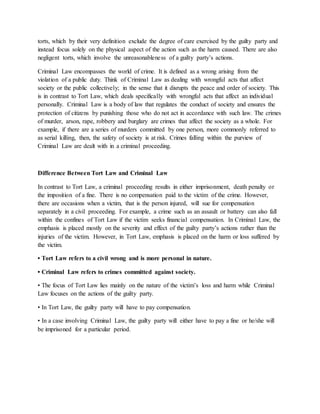
Q-2. Describe tort law and compare it to criminal law.
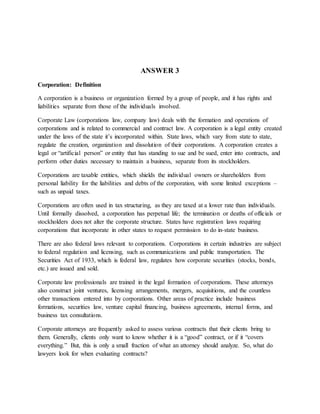
Q-3. What do you understand by Corporate & Business Laws? Explain.
Q-4. What is a non-profit corporation?
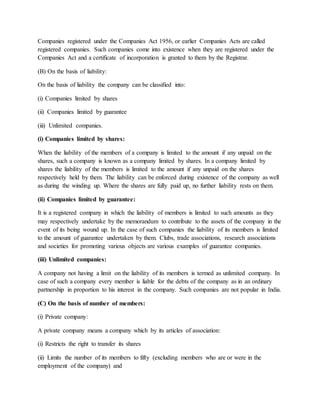
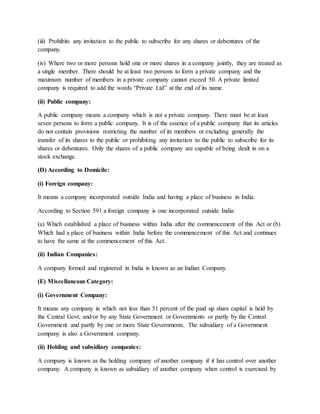
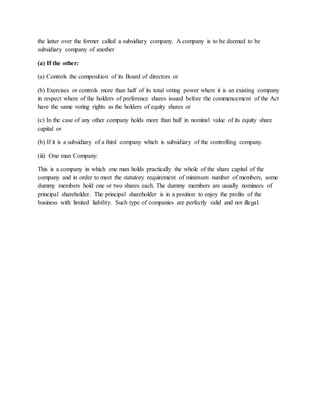
Q-5. State the various classes of companies that can be formed under the act. Explain the
characteristics of each.
MBA 205 (OPERATIONS RESEARCH)
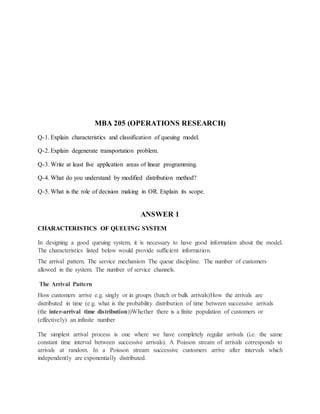
Q-1. Explain characteristics and classification of queuing model.
Q-2. Explain degenerate transportation problem.
Q-3. Write at least five application areas of linear programming.
Q-4. What do you understand by modified distribution method?
Q-5. What is the role of decision making in OR. Explain its scope.
MBA 206 (MANAGERIAL EFFECTIVENESS)
Q-1. “Decision-making is a critical activity in the lives of managers”. Define
Q-2. What are the requirements of an effective control system?
Q-3. Risk can always be associated with loss. Analyse the statement.
Q-4. Time management is more than just managing our time. Comment.
Q-5. Managers should concentrate on results, not on being busy. Describe.
MBA 201 (BUSINESS ENVIRONMENT)
Q-1. What is public debt? Describe its role in the economy.
Q-2. What is corporate intelligence?
Q-3. Define the role of the RBI in enforcing FEMA.
Q-4. Describe the social responsibility of business.
Q-5. Explain the economic role of government in business environment.
Answer 1
Definition of 'Public Debt'
Definition: Public debt receipts and public debt disbursals are borrowings and repayments
during the year, respectively, by the government.
Description: The difference between receipts and disbursals is the net accretion to the public
debt. Public debt can be split into internal (money borrowed within the country) and external
(funds borrowed from non-Indian sources).
Internal debt comprises treasury bills, market stabilisation schemes, ways and means advance,
and securities against small savings.
Role of public debt in Economic development A developing economy has to tap all possible
sources to mobilize sufficient financial resources for the implementation of its economic
development plans. It has to utilize revenue surplus for the purpose, seek external aid, and pitch
up its level of taxation and resort to public borrowing in addition. But taxation and public
borrowing are the two major instruments of resource mobilization.
Role of public debt in Economic development
A developing economy has to tap all possible sources to mobilize sufficient financial resources
for the implementation of its economic development plans. It has to utilize revenue surplus for
the purpose, seek external aid, and pitch up its level of taxation and resort to public borrowing in
addition. But taxation and public borrowing are the two major instruments of resource
mobilization.
Public borrowing has an important advantage over taxation. Taxation beyond a certain limit
tends to affect economic activity adversely owing to its disincentive effect. There is no such
danger in public borrowing. It does not have any unfavorable repercussions on economic activity
by being disincentive, partly because of its voluntary nature and partly because of expectation of
return and repayment.
The classical theory frowned upon public borrowing. It was thought that the government use of
resources was less productive than in private hands. But the classical reasoning was based on the
assumptions of full employment, inelasticity of money supply and unproductiveness of public
expenditure. These assumptions, we know, are not valid.
Public borrowing for financing fruitful investment produces supplementary, creative
capability in the financial systemwhich or else would not have been achievable. It is utilized
as a device to organize reserves which, in an under-developed economy, would otherwise have
gone into hoards or invested in jewellery or real estate. Public debt would divert the flow of
resources into the right channels. Thus, in an under-developed economy, public borrowing, if
prudently managed and skillfully operated, can become a powerful instrument of economic
development.
Growth and composition of public debt provide the monetary authorities with assets which they
can manipulate to give effect to a monetary policy considered desirable in the context of
economic development. Thus, monetary policy, which is considered essential for achieving
objectives of economic policy, becomes virtually related to public debt management.
There are two significant ways in which the regimes of underdeveloped nations raise reserves via
public loans; (a) market borrowing, and (b) non-market borrowing.
The loans may be voluntary or forced. Most of the types of public loans are voluntary. But if the
voluntary loans do not prove sufficient for the purpose, forced loans become necessary and are
resorted to: Important examples of forced loans familiar in India are Compulsory Deposit
Scheme and Annuity Deposit Scheme.
Compulsory loans have a special advantage in the context of an inflationary situation and are
superior to voluntary public borrowing. They sterilize funds, whereas voluntary public loans
result in the creation of readily cashable bonds which would be monetized to increase liquid
assets in the community which produce an inflationary effect. Also, lower rate of interest can be
paid on compulsory loans thus reducing the cost of public debt. But a continuous policy of
compulsory borrowing may arouse public resentment. Compulsory loans may be more suitable
for financing specific projects which benefit specific regions or specific groups who may,
therefore, be called upon to subscribe. Normally, it is the voluntary public borrowing programme
which should be chiefly relied upon.
Answer2
Corporate intelligence is an invaluable aid to sound business decision making. It provides vital
information on current and future business partners and other matters when organisations want to
reduce risk, enter new markets, solve corporate problems, undertake investigations and enhance
business opportunities.
Companies often seek corporate intelligence prior to entering into investments, joint ventures
and acquisitions.
It can be crucial in doing business in emerging offshore markets where reliable information on
individuals and organisations can be scarce. It complements and augments the financial and legal
due diligence undertaken by mainstream advisers.
"The diverse skills and experience of our practitioners combined with their networks and
access to global resources provides you with invaluable corporate intelligence to support
your business agenda."
– David Luijerink
KPMG's Corporate Intelligence services include:
 integrity due diligence
 investigation support
 litigation support.
Our global network of corporate intelligence practitioners locate, collect and analyse information
from public and confidential sources around the world.
They come from a range of backgrounds, including investigative journalism, political risk
analysis, forensic accounting, private investigation and police intelligence. They undertake
sensitive assignments in both established and emerging markets. They combine years of practical
experience with robust quality assurance procedures.
Answer 3
ForeignExchange ManagementAct1999
Introduction of the Act
The Foreign Exchange Management Act, 1999 (FEMA) has been in force from 2000, thus
replacing the old Foreign Exchange Regulation Act (FERA) 1973.
Objective of the Act
The main objective of FERA was conservation and proper utilization of the foreign exchange
resources of the country. It also sought to control certain aspects of the conduct of business
outside the country by Indian companies and in India by foreign companies.When a business
enterprise imports goods from other countries, exports its products to them or makes investments
abroad, it deals in foreign exchange. Foreign exchange means 'foreign currency' and includes
deposits, credits and balances payable in any foreign currency and secondly drafts, travelers,
cheques, letters of credit or bills of exchange, expressed or drawn in Indian currency but payable
in any foreign currency.
Purpose ofthe Act
The preamble to FEMA lays down the purpose of the Act is to consolidate and amend the law
relating to foreign exchange with the objective of facilitating external trade and payments and for
promoting the orderly development and maintenance of foreign exchange market in
India.Rationale for strict regulations under FERA 1973. After Independence India was left with
little forex reserves and during the oil Crisis of seventies ballooning oil import bills further
drained foreign exchange reserves.
Broadly, the objectives of FEMA are to facilitate external trade and payments and to promote the
orderly development and maintenance of foreign exchange market. The Act has assigned an
important role to the Reserve Bank of India (RBI) in the administration of FEMA. The rules,
regulations and norms pertaining to several sections of the Act are laid down by the Reserve
Bank of India, in consultation with the Central Government. The Act requires the Central
Government to appoint as many officers of the Central Government as Adjudicating Authorities
for holding inquiries pertaining to contravention of the Act. There is also a provision for
appointing one or more Special Directors (Appeals) to hear appeals against the order of the
Adjudicating authorities. The Central Government also establishes an Appellate Tribunal for
Foreign Exchange to hear appeals against the orders of the Adjudicating Authorities and the
Special Director (Appeals). The FEMA provides for the establishment, by the Central
Government, of a Director of Enforcement with a Director and such other officers or class of
officers as it thinks fit for taking up for investigation of the contraventions under this Act.
Benefits of the Act
FERA was to control everything that was specified, relating to foreign exchange whereas FEMA
lay down that ‘everything other than what is expressly covered is not controlled'. The overriding
objective of FERA was to regulate and minimize dealings in foreign exchange and foreign
securities while FEMA on the other hand aims to aid in creation of a liberal foreign exchange
market in India.
This difference in terminology reflects seriousness of government towards deregulation of
foreign exchange and promotion of free flow of international trade. To facilitate external trade is
concerned; section 5 of the Act removes restrictions on withdrawal of foreign exchange for the
purpose of current account transactions. As external trade i.e. imports / export of goods &
services involve transactions on current account, there is no need for seeking RBI permissions in
connection with remittances involving external trade.
FEMA permits only authorized person to deal in foreign exchange or foreign security. Such an
authorized person, under the Act, means authorizeddealer, money changer, off-shore banking
unit or any other person for the time being authorized by Reserve Bank. The Act thus prohibits
any person who deal in or transfer any foreign exchange or foreign security to any person not
being an authorized person. Make any payment to or for the credit of any person resident outside
India in any manner. Receive otherwise through an authorized person, any payment by order or
on behalf of any person resident outside India in any manner.
Enter into any financial transaction in India as consideration for or in association with acquisition
or creation or transfer of a right to acquire, any asset outside India by any person is resident in
India which acquires, hold, own, possess or transfer any foreign exchange, foreign security or
any immovable property situated outside India.
Answer 4
Social responsibility of business
The social responsibility of business means various obligations or responsibilities or duties that
a business-organization has towards the society within which it exists and operates from.
Generally, the social responsibility of business comprises of certain duties towards entities,
which are depicted and listed below. Social responsibility of business Shareholders or investors
who contribute funds for business. Employees and others that make up its personnel.
Consumers or customers who consumes and/or uses its outputs (products and/or services).
Government and local administrative bodies that regulate its commercial activities in their
jurisdictions.Members of a local community who are either directly or indirectly influenced by
its activities in their area.
Surrounding environment of a location from it operates. The general public that makes up a big
part of society. The social responsibility of business comprises of the following obligations:
A business must give a proper dividend to its shareholders or investors.
It must provide fair wages and salaries with good working conditions.
It must provide a regular supply of good quality goods and/or services to its
consumers/customers at reasonable prices.
It must abide by all government rules and regulations, supports its business-related policies and
should pay fair taxes without keeping any delays or dues.
It must also contribute in betterment of a local community by doing generous activities like
building schools, colleges, hospitals, etc.
It must take immense care to see that its activities neither directly nor indirectly create a havoc
on the vitality of its surrounding environment.
It should maintain a stringent policy to curb or control pollution in regard to contamination of
air, water, land, sound and radiation leakages. Here, to do so, it must hire experienced
professional individuals who are experts in their respective fields.
It should also offer social-welfare services to the general public.
The core objectives of social responsibility of business are as follows:
It is a concept that implies a business must operate (function) with a firm mindset to protect
and promote the interest and welfare of society.
Profit (earned through any means) must not be its only highest objective else contributions
made for betterment and progress of a society must also be given a prime importance.
It must honestly fulfill its social responsibilities in regard to the welfare of society in which it
operates and whose resources & infrastructures it makes use of to earn huge profits.
It should never neglect (avoid) its responsibilities towards society in which it flourishes.
Now let's discuss, how the survival, growth and success of business are linked and dependent
on sincere execution of its social responsibilities.
Note: Refer above figure and try to co-relate articles given in this image with following points
of justification.
1. Shareholders or investors
Social responsibility of business towards its shareholders or investors is most important of all
other obligations.
If a business satisfies its funders, they are likely to invest more money in a project. As a result,
more funds will flow in and the same can be utilized to modernize, expand and diversify the
existing activities on a larger scale. Happy financiers can fulfill the rising demand of funds
needed for its growth and expansion.
2. Personnel
Social responsibility of business towards its personnel is important because they are the wheels
of an organization. Without their support, the commercial institution simply can't function or
operate.
If a business takes care of the needs of its human resource (for e.g. of office staff, employees,
workers, etc.) wisely, it will boost the motivation and working spirit within an organization. A
happy employee usually gives his best to the organization in terms of quality labor and timely
output than an unsatisfied one. A pleasant working environment helps in improving the
efficiency and productivity of working people. A good remuneration policy attracts new
talented professionals who can further contribute in its growth and expansion.
Thus, if personnel is satisfied, then they will work together very hard and aid in increasing the
production, sales and profit.
3. Consumers or customers
Social responsibility of business towards its consumers or customers matters a lot from sales
and profit point of view. Its success is directly dependents on their level of satisfaction. Higher
their rate of satisfaction greater are the chances to succeed.
If a business rolls out good-quality products and/or delivers better quality services that too at
reasonable prices, then it is natural to attract lots of customers. If the quality-price ratio is
maintained well and consumers get worth for their money spend, this will surely satisfy them.
In a long run, customer loyalty and retention will grow, and this will ultimately lead to
profitability.
4. Government
Social responsibility of business towards government's regulatory bodies or agencies is quite
sensitive from the license's point of view. If permission is not granted or revoked abruptly, it
can result in huge losses to an organization. Therefore, compliance in this regard is necessary.
Furthermore, a business must also function within the demarcation of rules and policies as
formulated from time to time by the government of state or nation. It should respect laws and
abide by all established regulations while performing within the jurisdiction of state.
Some examples of activities a business can do in this regard:
Licensing an organization,
Seeking permissions wherever necessary,
Paying fair taxes on time, Following labor, environmental and other laws, etc.
If laws are respected and followed, it creates a goodwill of business in eyes of authorities.
Overall, if a government is satisfied it will make favorable commercial policies, which will
ultimately open new opportunities and finally benefit the organization sooner or later.
Therefore, satisfaction of government and local administrative bodies is equally important for
legal continuation of business.
5. Local community
Social responsibility of business towards the local community of its established area is
significant. This is essential for smooth functioning of its activities without any agitations or
hindrances.
A business has a responsibility towards the local community besides which it is established
and operates from. Industrial activities carried out in a local-area affect the lives of many
people who reside in and around it. So, as a compensation for their hardship, an organization
must do something or other to alleviate the intensity of suffering.
As a service to the local community, a business can build:
A trust-run hospital or health center for local patients,
A primary and secondary school for local children,
A diploma and degree college for local students,An employment center for recruiting skilled
local people, etc.
Such activities to some-extend may satisfy the people that make local community and hence
their changes of agitations against an establishment are greatly reduced. This will ensure the
longevity of a business in a long run.
6. Environment
Social responsibility of business with respect to its surrounding environment can't be sidelined
at any cost. It must show a keen interest to safeguard and not harm the vitality of the nature.
A business must take enough care to check that its activities don't create a negative impact on
the environment. For example, dumping of industrial wastes without proper treatment must be
strictly avoided. Guidelines as stipulated in the environmental laws must be sincerely followed.
Lives of all living beings are impacted either positively or negatively depending on how well
their surrounding environment is maintained (naturally or artificially). Humans also are no
exception to this. In other words, health of an environment influences the health of our society.
Hence, environmental safety must not be an option else a top priority of every business.
7. Public
Finally, social responsibility of business in general can also contribute to make the lives of
people a little better.
Some examples of services towards public include:
Building and maintaining devotional or spiritual places and gardens for people,
Sponsoring the education of poor meritorious students,Organizing events for a social cause,
etc.
Such philanthropic actions create a goodwill or fame for the business-organization in the
psyche of general public, which though slowly but ultimately pay off in a due course of time.
The world is recognizing the importance of social responsibility of business.
Answer 5
Government is a very powerful institution which can create a favourable business environment.
We can study its role under the following heads:
Role
1. Government: Regulator of Business:
The entire regulatory legislations and policies stand covered under this segment. On the one
hand, there is a very large indirect area of government control over the functioning of private
sector business through budgetary and monetary policies.
But against this there is also a fast expanding area of direct administrative or physical controls
through which the government seeks to ensure that private investment and production in industry
and the use of scarce resources conform to government’s basic socio-economic objectives.
They have become necessary tools in a system which seeks to avoid total nationalisation of
resources.
Government’s regulatory functions with regard to trade, business and industry aim at laying
down the limits for the private enterprise. The regulatory functions of the Government include (i)
restraints on private activities, (ii) control of monopoly and big business, (iii) development of
public enterprises as an alternative to private enterprises to ensure competitive dualism, (iv)
maintenance of a proper socio-economic infrastructure.
2. Government: Promoter of Business:
The promotional role of the government in relation to industries can be seen as providing finance
to industry, in granting various incentives and in creating infrastructure facilities for industrial
growth and investment.
For example, our government has identified certain backward areas as ‘No Industry Districts’.
To promote development of such areas, Government provides subsidies and tax holiday to attract
investment in backward areas.
In this way the government will help the process of balanced development and thereby remove
regional disparities. The government is assisting the development of small scale industries.
The District Industrial Centers are assisting the development of small industries. The government
is actively helping the industrial development of the country by providing finance to them
through the development banks.
3. Government as an Entrepreneur:
The impressive growth of the public sector in India from a small beginning bears testimony to
the role of the government as an entrepreneur.
Private investors are solely guided by private profit motive and hence they are not interested in
developing products of common public use and social services which yield relatively lower
returns. But as a “social entrepreneur” the government does not hesitate to take them up.
4. Government as the Planner:
In its role as a planner, the government indicates various priorities in the Five Year Plans and
also the sectoral allocation of resources. Mixed economies are democratically planned
economies.
The government tries to manage the economy and its business activities through the exercise of
planning. Planning is the most important activity in a modern mixed economy. The idea of
economic planning can be traced to three different sources: Rationalism, Socialism and
Nationalism.
Economists advocate a planned economy on the ground that it can be a rational economy which
can utilise the available resources in an optimal manner.
In other words, the planned economy is a rational economy which attempts to secure the
maximum return with minimum wastage of productive resources.
The socialists advocate a planned economy because it helps to achieve some desirable social
ends like economic equality. An unplanned economy, left to it, is incapable of attaining the
social ends.
The nationalists advocate a planned economy because a planned economy is a powerful
economy.
The nationalists want to use planning as a weapon to strengthen the military power of the
country. Hitler in Germany and Mussolini in Italy resorted to planning to achieve political
motive.
Planning operation involves a number of steps. The first stage in planning is the formulation of
socio-economic objectives of the plan and their definition in quantitative terms.
Such objectives include growth, justice, eradication of poverty, price stability etc. In the second
stage, the plan lays down the physical and financial targets.
The third stage is concerned with execution. The Planning Commission is only an advisory body
and it has no power to execute the plan.
The various government departments take necessary measures to execute the plan. Executing a
plan is more difficult than making it.
The execution of our Five Year Plans is not satisfactory. Prof. Lewis has observed that Indians
are better planners than doers. The gap between promise and performance has got to be narrowed
down.
Typically, businessmen have held that national planning is incompatible with free enterprise and
that a “free economy” is the antithesis of a planned economy.
Planning by business is good but planning by government for the whole society is, in the eyes of
most businessmen, ‘bad’ (perhaps because government planning has come to be identified with
communist countries).
MBA 202 (RESEARCH METHODOLOGY)
Q-1. What do you mean by research? Explain its significance in modern times.
Q-2. Explain in detail techniques involved in defining a research problem.
Q-3. What is questionnaire? What are different types of questionnaire?
Q-4. What are the precautions one should take while administering “Data Collection”.
Q-5. Write short note on methods of business forecasting.
ANSWER 1
The significance of research in a number of fields of applied economics, whether associated with
business, industry, commerce, trade, services or to the economy in general, has tremendously
increased these days. The extremely complex character of business, its size, fast changes in
technology etc, has focused attention on the utilization of research in managing operational
problems.
New Knowledge: The fascination and desire for new knowledge, new facts for business cycles,
environment analysis and technological upgradation are the primary reasons of research.
Solution of Operational and Planning Problems of Business: Operational research, marketing
research and motivational research are deemed essential and their outcomes help in many
different ways, in taking business decisions.
Market research is the study of the structure and development of a market with the intention of
forming effective policies for purchasing, production, and sales.
Operational research means the use of mathematical, logical and analytical methods to the
solution of business difficulties of cost minimization or of profit maximization or what can be
referred to as optimisation problems.
Motivational research is worried about market characteristics and figuring out why individuals
behave as they do. Put simply, it is focused on the determination of motives underlying the
consumer behavior.
Research pertaining to demand and market factors has good utility in operating a business.
Provided information about future demand, it is easy for an organization or for an industry to
alter its supply plan within the boundaries of its estimated capacity. Market analysis has grown to
be an intrinsic tool of business policy nowadays.
Business projecting which eventually provides an estimated profit and loss account relies
primarily on sales estimates which in turn is determined by business research. Once sales
forecasting is completed, efficient production and investment programmes could be put in place
around which are arranged the buying and financial plans. Thus research replaces intuitive
business decisions by more logical and scientific decisions.
Research assists the company to find the right supplier at the right price and at the right time. An
appropriate supplier choice makes it possible for the company to obtain or acquire top quality
raw materials which result into production of good quality items which are consumed by the end
user. Additionally trustworthy and efficient suppliers help a company to perform effectively as
supplies will be available on time.
Research aids the business enterprise to enhance the productivity, reduce the cost, save time and
maintain expertise of their core competencies through research discovery of latest technology
which contributes to development of innovation management system for future growth.
Importance of Research in Business Management
Research creates benchmarks and helps a business measure its progress – If you don’t measure
you may not be able to evaluate how well your business is performing. Early research may
identify glaring holes in the service or issues in the product, regular research will indicate if
advancements can be made and, if positive, may help inspire a team.
Research is a crucial part of any business which wishes to provide goods and services which are
focused and well targeted. Business decisions which are according to good research can reduce
risk and pay dividends in long run.
You cannot ignore the significance of research in business decision making and every
organization needs to conduct research to be successful.
SIGNIFICANCE OF RESEARCH
According to Hudson Maxim Significance as, “All progress is born of inquiry. Doubt is often
better than overconfidence, for it leads to inquiry and inquiry leads to investigation” Research
inculcates scientific and inductive thinking and it promotes the development of logical habits of
thinking and organization.
The role of research in several fields of applied economics, whether related to business or to the
economy as a whole, has greatly increased in modern times.
Research provides the basic for nearly all government policies in our economic system.
ANSWER 2
Techniques of Defining a ResearchProblem
Problem definition demands the task of setting up boundaries within which an investigator
should study the problem with a pre-determined goal in mind. The best way to define the
problem is unquestionably a tough job. Having said that, it is a task that needs to be handled
smartly in order to prevent the perplexity experienced in a research procedure.
The technique involved in defining research problem has following steps:
Statement of the problem in a general way: The research problem needs to deal with either a
particular practical operational issue or some scientific discovery. It may also be related to
satisfaction or widening of a certain intellectual curiosity. No matter what the subject of research,
the problem definition should in general be at a logical level. For this reason, the investigator
should involve himself thoroughly in the topic relating to which he wants to pose a problem. In
the case of social research, it is considered a good idea to do some field observation and as such
the investigator may take on some type of preliminary survey or what is known as pilot survey.
The problem mentioned in a broad general way could have numerous ambiguities that need to be
fixed by cool thinking and rethinking about the issue. While doing so the feasibility of a specific
alternative must be considered and the same should be kept in view while stating the problem.
Understand the nature of the problem: The next step in defining the problem is that the
investigator should be aware of the cause and character of the problem in clear terms via
discussions and study of the environment within which problem is to be solved.
Literature Survey: All accessible literature in connection with the issue at hand must necessarily
be surveyed and examined before a definition of the research problem is provided. It helps a
professional to take a look at current dimensions in that specific area and results in enhancement
of knowledge. The researcher will have to dedicate adequate time in examining of research
previously carried out on relevant problems. It is performed to discover what data and other
materials, if any, are readily available for operational purposes. Being aware of what data can be
obtained often acts to narrow the problem itself in addition to the technique that may be
employed.
Techniques of Defining a ResearchProblem
Experiential Advice: Discussion related to a difficulty usually produces valuable information.
People who have understanding or have rich experience in the area of research have turned out to
be excellent sounding board for an investigator. Their suggestions and comment on research
proposal help a researcher to get greater clarity and focus on his research topic. Chats with such
people should not just be limited to the formulation of the particular problem at hand, but should
also be related to the overall approach to the specific issue, techniques that could be used,
feasible solutions, etc.
Rephrase the research problem: Quite often, a problem redefinition takes place when the steps
mentioned above are carried out. Researcher often redefines the problem in a fashion that is more
practical and logical for the conduct of the research in hand. This effort will also help with
defining hypothesis.
Necessity of Defining a ResearchProblem
In addition to what has been stated above about the techniques of defining a research problem.
The following points should also be observed in the procedure of defining the problem:
(a) The researcher must clearly define the Technical terms, words, phrases, etc.
(b) Basic assumptions concerning the research problem must be clearly mentioned.
(c) The criteria for the selection of the problem needs to be clearly specified.
(d) The researcher should also consider suitability of the time-period and the sources of data
available.
(e) The scope of the study or the boundaries within which the problem is to be studied needs to
be stated clearly.
ANSWER 3
Questionnaires are commonly used to gather first-hand information from a large audience, in the
form of a survey. There are different types of questionnaires in practice and the type of
questionnaire to be used usually depends on the purpose of the survey and the type of data that
has to be collected.
Questionnaires are highly practical and can be carried out by any number of people, and the
results can be quickly quantified as well. Over the years, this form of conducting research has
also been proven to be more scientifically accurate, as compared to other quantitative research
tools.
Let's examine the various types of questionnaires.
Questionnaire Formats
Depending upon the nature of the questions in a questionnaire, there can be different types of
questions in questionnaire
Questions in Open Ended Format
Questions that allow the target audience to voice their feelings and notions freely are called
open-format questions or open-ended questions. These questions are not based on pre-
determined responses, giving respondents an opportunity to express what they feel is right, and
often provide real, perceptional, and at times, startling proposals. Open-ended questions placed at
the end of a questionnaire tend to draw accurate feedback and suggestions from respondents as
well.
Questions in Open Ended Format
Questions in Closed Ended Format
Questions which have multiple options as answers and allow respondents to select a single
option from amongst them are called closed-format or closed-ended questions. This type of
questionnaire is especially useful when conducting preliminary analysis. As a fixed answer set is
provided, these are ideal for calculation of statistical information and percentages of various
types. Closed-ended questions help to arrive at opinions about a product or service, and
sometimes, about a company, in a more efficient manner.
7 Types of Closed Format Questions
Closed-ended questions which are aimed at collecting accurate statistical data can be classified
into the following seven types:
Leading Questions
A question forcing the target audience to opt for a specific kind of answer is called a leading
question. All answers for a leading question are almost similar. Leading questions are usually
prepared to derive audience opinion within a set of limited words.
Leading Questions
Importance Questions
Questions which ask respondents to rate the importance of some specific matter on a rating scale
of 1 to 5 are called importance questions. Such questions facilitate drawing what respondents
consider significant - enabling vital business decision-making.
Closed Format Questions
Likert Questions
The degree to which respondents agree to a specific statement can be ascertained using Likert
questions. Customers' feelings about a topic, product or service can be easily gauged by asking
them these questions.
Likert Questions
Dichotomous Questions
Questions that make respondents answer with a simple "yes" or "no" are called dichotomous
questions. These questions carry one disadvantage-there is no other way of analyzing the answer
between a "yes" and "no". A middle perspective is not possible.
Dichotomous Questions
Bipolar Questions
Questions that have two answers with different levels of extremities, written at opposite ends of a
scale, are called bipolar questions. Respondents have to mark their response anywhere between
these two extremities, showing their opinion.
Bipolar Questions
Rating Scale Questions
Questions that ask respondents to provide a rating on a specific matter on a scale of 1 to 10 or on
a scale of "poor" to "good" are called rating scale questions. Normally, these questions have an
even number of choices, so as to prevent respondents to choose a middle way out.
Importance Questions
Buying Propensity Questions
These are aimed at assessing customers' future intentions, determining their propensity toward
buying a specific product or service. Buying propensity questions help marketers to understand
the needs of customers and the probability of their buying a certain product or a service.
Buying Propensity Questions
Other Types of Questionnaires
Apart from the above-mentioned two broad classifications there are two more types which are
rarely used in practice, namely; Mixed Questionnaire and Pictorial Questionnaire.
Mixed questionnaires consist of closed as well as open-ended questions. These are normally used
in the field of social research
Other Types of Questionnaires
Pictorial questionnaire on the other hand is used in promotion of interest to answer questions.
These are mostly used as study material for children
Questions in Open Ended Format
Questions to Avoid in a Questionnaire
It is advisable to avoid certain types of questions while preparing a questionnaire, such as:
Hypothetical Questions: Questions with misleading speculation and fantasy should be avoided
Embarrassing Questions: Making respondents feel uncomfortable by asking details about
personal or private issues which in turn can lead to losing trust
Extreme Positive / Negative Questions: Care must be taken in designing a question to avoid hard
positive or negative overtones
ANSWER 4
Data are those which have been collected by some other person for his purpose and published.
So a researcher is said to use secondary data if he makes use of data already compiled by some
other person. They are usually in the shape of finished products.
Published data are available in:
Various publications of central, state and local government.
Technical and trade journals
Books, magazines and news papers
Repots prepared by research scholars, universities, economist etc
Example
When the agriculture department collects data for the study of yield obtained in respect of
various agriculture products in a locality, it is primary for them.
When they publish their data in the journals and if a researcher makes use of those information
for his purpose, he can be said to be using secondary data.
Precautions to be taken for primary data collection
Nature and scope of enquiry
Availability of financial resources
Availability of time
Degree of accuracy desired
Education level of the respondents
Precautions to be taken for data collection
Reliability of data
It can be tested by finding out
Who collected the data
What where the sources of data
Were they collected by using proper methods
At what time were they collected
Suitability of data
ANSWER 5
Definition:
Business forecasting is an act of predicting the future economic conditions on the basis of past
and present information. It refers to the technique of taking a prospective view of things likely to
shape the turn of things in foreseeable future. As future is always uncertain, there is a need of
organised system of forecasting in a business.
Thus, scientific business forecasting involves:
(i) Analysis of the past economic conditions and
(ii) Analysis of the present economic conditions; so as to predict the future course of events
accurately.
In this regard, business forecasting refers to the analysis of the past and present economic
conditions with the object of drawing inferences about the future business conditions. In the
words of Allen, “Forecasting is a systematic attempt to probe the future by inference from known
facts. The purpose is to provide management with information on which it can base planning
decisions.
Leo Barnes observes, “Business Forecasting is the calculation of reasonable probabilities about
the future, based on the analysis of all the latest relevant information by tested and logically
sound statistical econometric techniques, as interpreted, modified and applied in terms of an
executive’s personal judgment and social knowledge of his own business and his own industry or
trade”.
In the words of C.E. Sulton, “Business Forecasting is the calculation of probable events, to
provide against the future. It therefore, involves a ‘look ahead’ in business and an idea of
predetermination of events and their financial implications as in the case of budgeting.”
According to John G. Glover, “Business Forecasting is the research procedure to discover those
economic, social and financial influences governing business activity, so as to predict or estimate
current and future trends or forces which may have a bearing on company policies or future
financial, production and marketing operations.
The essence of all the above definitions is that business forecasting is a technique to analyse the
economic, social and financial forces affecting the business with an object of predicting future
events on the basis of past and present information.
Steps of Forecasting
The process of forecasting consists of the following steps, also described as elements of
forecasting:
1. Developing the Basis:
The first step involved in forecasting is developing the basis of systematic investigation of
economic situation, position of industry and products. The future estimates of sales and general
business operations have to be based on the results of such investigation. The general economic
forecast marks as the primary step in the forecasting process.
2. Estimating Future Business Operations:
The second step involves the estimation of conditions and course of future events within the
industry. On the basis of information/data collected through investigation, future business
operations are estimated. The quantitative estimates for future scale of operations are made on
the basis of certain assumptions.
3. Regulating Forecasts:
The forecasts are compared with actual results so as to determine any deviations. The reasons for
his variations are ascertained so that corrective action is taken in future.
4. Reviewing the Forecasting Process:
Once the deviations in forecasts and actual performance are found then improvements can be
made in the process of forecasting. The refining of forecasting process will improve forecasts in
future.
Sources of Data UsedIn Business Forecasting:
Collection of data is a first step in any statistical investigation. It is the basis for any analysis and
interpretations. Before collection of data, many questions shall occupy the mind of the manager.
The manager must be able to answer these questions before task of collection is started.
Planning for data collection refers to thinking or preparing before doing the actual task of data
collection. The purpose or object of data collection, the scope of the data, the unit of data
collection, the technique and sources of data are the important consideration in planning the data
collection.
Data may be collected from primary or secondary sources depending upon the time, resources,
and purpose of the investigation.
(i) Primary Sources:
It is a first-hand data collected personally by the investigator. It is costly and time consuming.
Primary data is collected if secondary data is not available. It is collected by personal interviews,
questionnaires or observations.
(ii) Secondary Sources:
These sources of data refer to already published data or data collected by other agencies. It is a
secondhand data. Here task is more of a compilation of data.
The sources of secondary data are:
(a) Official reports of the government.
(b) Publications of Reserve Bank of India, Financial institutions etc.
(c) Annual reports of companies.
(d) Journals, Newspapers, Magazines etc.
Lot of care and caution is necessary before using the secondary data. Such data is cheaper,
quicker and easily available.
Limitations of Business Forecasting:
Inspite of many advantages, some people regard business forecasting “as an unnecessary mental
gymnastics and reject it as a sheer waste of time, money and energy.”
The reason for the same lies in the fact that despite all precautions, an element of error is bound
to creep in the forecasts and we cannot eliminate guesswork in forecasts. It is also felt that
forecasting is influenced by the pessimistic or optimistic attitude of the forecaster.
It may not be possible to make forecasts with a pin-point accuracy. But, it still cannot undermine
the importance of business forecasting. The management should first make use of statistical and
econometric models in making forecasts and then apply collective experience, skill and objective
judgement in evaluating the forecasts.
Further, the forecasts should be constantly monitored and revised with the changed
circumstances.
MBA 203 (FINANCIAL MANAGEMENT)
Q-1. What is “Return on capital employees?”
Q-2. What are the factors on which risk involved in investment depends?
Q-3. What are the advantages of cash planning? How does cash budget help in planning the
firms cash flows?
Q-4. Explain the various approaches for computing the cost of equity capital.
Q-5. Explain various method of financial statement analysis
ANSWER 1
Return on capital employed (ROCE) is a financial ratio that measures a company's profitability
and the efficiency with which its capital is employed. ROCE is calculated as:
ROCE = Earnings Before Interest and Tax (EBIT) / Capital Employed
“Capital Employed” as shown in the denominator is the sum of shareholders' equity and debt
liabilities; it can be simplified as (Total Assets – Current Liabilities). Instead of using capital
employed at an arbitrary point in time, analysts and investors often calculate ROCE based on
“Average Capital Employed,” which takes the average of opening and closing capital employed
for the time period.
A higher ROCE indicates more efficient use of capital. ROCE should be higher than the
company’s capital cost; otherwise it indicates that the company is not employing its capital
effectively and is not generating shareholder value.
BREAKING DOWN 'Return On Capital Employed (ROCE)'
ROCE is a useful metric for comparing profitability across companies based on the amount of
capital they use. Consider two companies, Alpha and Beta, which operate in the same industry
sector. Alpha has EBIT of 5 million on sales of 100 million in a given year, while Beta has EBIT
of 7.5 million on sales of 100 million in the same year. On the face, it may appear that Beta
should be the superior investment, since it has an EBIT margin of 7.5% compared with 5% for
Alpha. But before making an investment decision, look at the capital employed by both
companies. Let’s assume that Alpha has total capital of 25 million and Beta has total capital of
50 million. In this case, Alpha’s ROCE of 20% is superior to Beta’s ROCE of 15%, which means
that Alpha does a better job of deploying its capital than Beta.
ROCE is especially useful when comparing the performance of companies in capital-intensive
sectors such as utilities and telecoms. This is because unlike return on equity (ROE), which only
analyzes profitability related to a company’s common equity, ROCE considers debt and other
liabilities as well. This provides a better indication of financial performance for companies with
significant debt.
Adjustments may sometimes be required to get a truer depiction of ROCE. A company may
occasionally have an inordinate amount of cash on hand, but since such cash is not actively
employed in the business, it may need to be subtracted from the “Capital Employed” figure to
get a more accurate measure of ROCE.
ANSWER 2
Investing comes with risks. Sometimes those risks are minimal, as is the case with treasury
bonds, but other times, such as with stocks, options and commodities, the risk can be substantial.
The more risk the investor is willing to take, the more potential for high returns. But great
investors know that managing risk is more important than making a profit, and proper risk
management is what leads to profitable investing.
Each investment product has certain risks that come with it, while some risks are inherent in
every investment. Here are a few to consider.
Measuring And Managing Investment Risk
Business Risk
Business risk may be the best known and most feared investment risk. It's the risk that something
will happen with the company, causing the investment to lose value. These risks could include a
disappointing earnings report, changes in leadership, outdated products or wrongdoing within the
company. Because of the large amount of possible risks that come with owning stock in a
company, investors know that forecasting these risks is nearly impossible.
Purchasing a put option to guard against a large decline or setting automatic stops are the best
ways to guard against business risk.
Call Risk
Some bonds have a provision that allows the company to call back or repay a bond early. They
will often exercise this right if they have to pay a higher coupon on an existing bond than what
they would have to pay at today's interest rates. Although this will not represent a loss of
principal, for investors who rely on a certain coupon rate for their monthly living expenses, this
can represent a substantial loss of income.
For those who rely on coupon income for immediate living expenses, investing in noncallable
bonds, bond funds or exchange traded funds is a solid diversification strategy.
Allocation Risk
Have you looked at your 401(k) lately? You've likely heard that keeping the appropriate asset
allocation is essential to managing risk as you move closer to retirement. Moreover, this summer,
federal disclosure rules are requiring 401(k) providers to disclose fees associated with investment
products.
The younger you are, the more of your portfolio should be allocated to stocks and as you age,
bonds will slowly become the dominant investment type. Manage your allocation risk and fees
related to investing in your retirement account by investing in a low-fee target date fund.
Additionally, ask for the help of a trusted financial adviser if you don't have the knowledge or
experience to manage your own portfolio.
A Strategy For Optimal Stock And Bond Allocation
Political Risk
Investors in commodities like oil understand political risk. When Iran threatened to block the
Strait of Hormuz, investors were concerned that the price of oil would become more volatile,
putting their investment at risk. The Haiti conflict and terrorist attacks on oil pipelines have
caused artificial volatility to enter oil and other commodity markets. Moreover, issues arising in
South East Asia pertaining to land claims, as well as the tensions between North and South
Korea, have shaken markets in that region.
Socio-political risk is difficult to avoid since most events happen without warning, but having
hard and fast exit points as well as hedges are the best way to weather socio-political storms.
Dividend Risk
Dividend risk is the risk that a company will cut or reduce its dividend. This is not only a
problem for those who rely on stock dividends to live on during retirement, but when a company
cuts its dividend, it often causes the stock to lose value, as those who were holding it for the
dividend move to other dividend-paying names.
Reduce the effects of dividend risk by holding a well-diversified portfolio with multiple
dividend-paying stocks. If the dividend is the only reason you're holding the stock, sell as soon
as is practical after the announcement of the change.
The Bottom Line
Every investing strategy will have risks and managing those risks is how to gain the best
performance from your money. Don't reach for higher rewards without first evaluating the risks
involved. Seasoned investors know that it's a lot easier to lose money than it is to gain it.
ANSWER 3
Cash planning and control of cash is the central point of finance functions. Maintenance of
adequate cash is one of the prime responsibilities of the financial manager. It is possible only
through the preparation of cash planning. Cash control is also included in cash planning. Since
planning and control are the twins of management. Cash planning is a technique to plan and
control the use of cash. A projected cash flow statement prepared based on expected cash
receipts and payments, is the anticipation of the financial condition of the firm. Cash planning
may be prepared on the daily, weekly, monthly or quarterly basis. The period for which the cash
planning is prepared depends on the size of the firms and management’s philosophy. Large firms
prepare daily and weekly forecasts. Medium size firms prepare weekly and monthly forecasts.
Small firms may not prepare cash forecasts due to non-availability of data and less scale of
operations. But in a short period they may service but over a long period, they have to prepare
cash planning for the success of the firm.
Cash Budget
Cash Forecasting and Budgeting
Cash forecast is used as a method to predict future cash flow because it deals with the estimation
of cash flows (i.e., cash inflows and cash outflows) at different stages and offers the management
an advance notice to take appropriate and timely action. The cash budget is an important tool for
the flow of cash in any firm over a future period of time. In other words, it is a statement
showing the estimated cash inflows and cash outflows over a planning period. It pinpoints the
surplus or deficit cash of a firm as it moves from one period to another period. The surplus of
deficit data helps the financial manager to determine the future cash needs of the firm, plan for
the financing of those needs and exercise control over the cash and liquidity of the firm. The cash
budget is also known as short-term cash forecasting.
Purpose of Cash Budget
Cash budget has proved to be of great help and benefit in the following areas:
1. Estimating cash requirements
2. Planning short-term finance planning
3. Scheduling payments, in respect of acquiring capital goods
4. Planning and phasing the purchase of raw materials
5. Evolving and implementing credit policies
6. Checking and verifying the accuracy of long-term cash forecasting.
Preparation of Cash Budget or Elements of Cash Budget
The above benefit areas clear that the main aim of preparing cash budget is to predict the cash
flows over a given period of time and to determine whether at any point of time there is likely to
be surplus or deficit of cash. Preparation of cash budget involves the following steps:
Step 1: Selection of period of time (planning horizon). The planning horizon is that period for
which cash budget is prepared. There are no fixed rules for cash budget preparation. The
planning horizon of a cash budget may differ from firm to firm, depending upon the size of the
firm. Cash budget period should not be too short or too long. If it is too short many important
events may come out in the planning period and cannot be accounted for the preparation of cash
budget, which becomes expensive. On the other hand, if it is too long the estimates will be
inaccurate. Then how to determine planning horizon? It is determined on the basis of the
situation and the necessity of a particular case. A firm whose business is affected by seasonal
variations may prepare monthly cash budgets. If the cash flow fluctuates, daily or weekly cash
budgets should be prepared. Longer period cash budgets may be prepared when the cash flows
are stable in nature.
Step 2: Selection of factor that has bearing on cash flows. The factors that generate cash flows
are divided into two broad categories: (a) Operating, and (b) Financial.
1. Operating Cash Flows: Operating cash inflows are cash sales, a collection of accounts
receivables and disposal of fixed assets and the operating cash outflows are billed payables,
purchase of raw materials, wages, factory expenses, administrative expenses, maintenance
expenses and purchase of fixed assets.
2. Financial Cash Flows: Loans and borrowings, the sale of securities, dividend received, refund
of tax, rent received, interest received and the issue of new shares and debentures cash outflows
are a redemption of the loan, repurchase of shares, income tax payments, interest paid and
dividend paid.
ANSWER 4
The following are the approaches to computation of cost of equity capital:
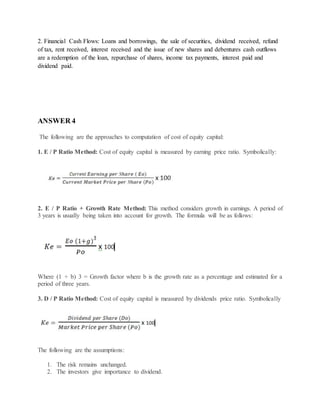
1. E / P Ratio Method: Cost of equity capital is measured by earning price ratio. Symbolically:
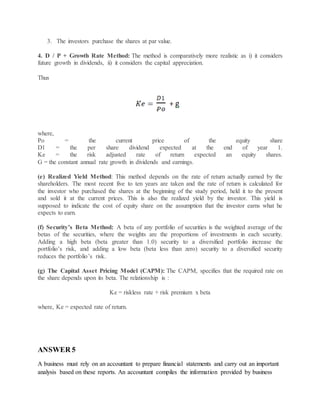
2. E / P Ratio + Growth Rate Method: This method considers growth in earnings. A period of
3 years is usually being taken into account for growth. The formula will be as follows:
Where (1 + b) 3 = Growth factor where b is the growth rate as a percentage and estimated for a
period of three years.
3. D / P Ratio Method: Cost of equity capital is measured by dividends price ratio. Symbolically
The following are the assumptions:
1. The risk remains unchanged.
2. The investors give importance to dividend.
3. The investors purchase the shares at par value.
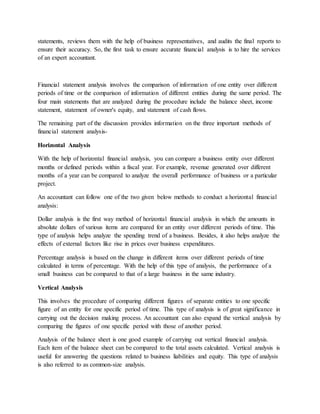
4. D / P + Growth Rate Method: The method is comparatively more realistic as i) it considers
future growth in dividends, ii) it considers the capital appreciation.
Thus
where,
Po = the current price of the equity share
D1 = the per share dividend expected at the end of year 1.
Ke = the risk adjusted rate of return expected an equity shares.
G = the constant annual rate growth in dividends and earnings.
(e) Realized Yield Method: This method depends on the rate of return actually earned by the
shareholders. The most recent five to ten years are taken and the rate of return is calculated for
the investor who purchased the shares at the beginning of the study period, held it to the present
and sold it at the current prices. This is also the realized yield by the investor. This yield is
supposed to indicate the cost of equity share on the assumption that the investor earns what he
expects to earn.
(f) Security’s Beta Method: A beta of any portfolio of securities is the weighted average of the
betas of the securities, where the weights are the proportions of investments in each security.
Adding a high beta (beta greater than 1.0) security to a diversified portfolio increase the
portfolio’s risk, and adding a low beta (beta less than zero) security to a diversified security
reduces the portfolio’s risk.
(g) The Capital Asset Pricing Model (CAPM): The CAPM, specifies that the required rate on
the share depends upon its beta. The relationship is :
Ke = riskless rate + risk premium x beta
where, Ke = expected rate of return.
ANSWER 5
A business must rely on an accountant to prepare financial statements and carry out an important
analysis based on these reports. An accountant compiles the information provided by business
statements, reviews them with the help of business representatives, and audits the final reports to
ensure their accuracy. So, the first task to ensure accurate financial analysis is to hire the services
of an expert accountant.
Financial statement analysis involves the comparison of information of one entity over different
periods of time or the comparison of information of different entities during the same period. The
four main statements that are analyzed during the procedure include the balance sheet, income
statement, statement of owner's equity, and statement of cash flows.
The remaining part of the discussion provides information on the three important methods of
financial statement analysis-
Horizontal Analysis
With the help of horizontal financial analysis, you can compare a business entity over different
months or defined periods within a fiscal year. For example, revenue generated over different
months of a year can be compared to analyze the overall performance of business or a particular
project.
An accountant can follow one of the two given below methods to conduct a horizontal financial
analysis:
Dollar analysis is the first way method of horizontal financial analysis in which the amounts in
absolute dollars of various items are compared for an entity over different periods of time. This
type of analysis helps analyze the spending trend of a business. Besides, it also helps analyze the
effects of external factors like rise in prices over business expenditures.
Percentage analysis is based on the change in different items over different periods of time
calculated in terms of percentage. With the help of this type of analysis, the performance of a
small business can be compared to that of a large business in the same industry.
Vertical Analysis
This involves the procedure of comparing different figures of separate entities to one specific
figure of an entity for one specific period of time. This type of analysis is of great significance in
carrying out the decision making process. An accountant can also expand the vertical analysis by
comparing the figures of one specific period with those of another period.
Analysis of the balance sheet is one good example of carrying out vertical financial analysis.
Each item of the balance sheet can be compared to the total assets calculated. Vertical analysis is
useful for answering the questions related to business liabilities and equity. This type of analysis
is also referred to as common-size analysis.
Ratio Analysis
This is the method in which the ratio between two or more variables related to the business is
compared.
There are many ratios used to analyze financial statements:
Liquidity Analysis Ratio: For example, the net working capital ratio is calculated between net
working capital and total assets.
Profitability Analysis Ratio: For example, return on assets ratio is calculated between net income
and average total assets. Profit margin ratio is calculated between net income and sales. Earning
per share is calculated between net income and number of outstanding shares.
Activity Analysis Ratio: For example, asset turnover ratio is calculated between sales and
average total assets. Inventory turnover ratio is calculated between cost of goods sold and
average inventories.
Capital Structure Analysis Ratio: The most important ratio is debt to equity ratio, which is
calculated between total liabilities and total stockholder's equity.
Capital Market Analysis Ratio: For example, dividend ratio is calculated between annual
dividends per common share and market price of common stock per share.
All these ratios are collectively used to carry out the financial analysis of business to assess
growth, profitability, and solvency of a business. Remember that ratio analysis is as important as
horizontal and vertical analysis and must not be overlooked.
MBA 204 (CORPORATE & BUSINESS LAWS)
Q-1. Explain how a case is brought before the courts, and describe the court process.
Q-2. Describe tort law and compare it to criminal law.
Q-3. What do you understand by Corporate & Business Laws? Explain.
Q-4. What is a non-profit corporation?
Q-5. State the various classes of companies that can be formed under the act. Explain the
characteristics of each.
ANSWER 1
In the case outlines that follow, each party is represented by an attorney. But this often is not the
case, especially in limited jurisdiction courts. People may represent themselves in court without
an attorney as long as they follow court rules. They often are called pro per, pro se, or self-
represented litigants.
While this guide is intended to give a general overview of the Arizona court system and its
procedures, not all cases proceed as outlined here.
Case Processing in Limited Jurisdiction Courts
Limited jurisdiction courts usually process criminal cases as follows:
1. Initial Appearance – This is the defendant’s first appearance in court, and the defendant is
advised of the charges. The judge appoints an attorney if the defendant cannot afford one.
2. Arraignment – The defendant appears in court to enter a plea of guilty or not guilty. Many
limited jurisdiction courts combine the initial appearance and the arraignment.
3. Trial – If the defendant pleads not guilty, a trial is held. The judge—or at the defendant’s
request, a jury—can hear evidence on the charges and find the defendant guilty or not guilty.
4. Sentencing – If the defendant is found guilty, the court imposes the appropriate
punishment (sentence).
5. Appeals – Appeals from decisions of limited jurisdiction courts go to superior court. An
appeal may be heard as a new trial (a trial de novo), or the superior court judge may review
records of trial proceedings if records have been kept. Decisions made in small claims court
cannot be appealed.
Superior Court Case Processing
In superior court, the two major types of court cases are criminal and civil. Trials in criminal and
civil cases are generally conducted the same way. After all the evidence has been presented and
the judge has explained the law related to the case to a jury, the jurors decide the facts in the case
and render a verdict. If there is no jury, the judge makes a decision on the case.
Criminal Cases
Criminal cases involve the commission of acts that are prohibited by law and are punishable by
probation, fines, imprisonment—or even death. The attorney representing the state, county or
municipal government that formally accuses a person of committing a crime is the prosecutor.
The person charged with the crime is the defendant. The judge not only ensures that the rights of
defendant are respected, but also the Constitutional provision and the statutorily required rights
afforded to victims of crime.
1. Arrest – A person is arrested by a law enforcement officer who either sees a crime happen or
has a warrant for arrest when probable cause exists that a person committed a crime. When a
person is arrested, the person must be brought before a judge for an initial appearance within 24
hours of being arrested or else be released.
2. Initial Appearance – At the initial appearance, the judge determines the defendant’s name
and address, informs the defendant of the charges and of the right to remain silent and to have an
attorney. The judge appoints an attorney if the defendant cannot afford one and sets the
conditions for release from jail.
3. Preliminary Hearing – If a preliminary hearing is held, the judge hears evidence and
testimony from witnesses called by the prosecuting attorney and the defendant’s attorney. If the
judge determines there is enough evidence to believe the defendant probably committed the
crime, the defendant is held for trial in superior court, and an arraignment date is set.
4. Arraignment – At the arraignment, the defendant enters a plea of guilty, not guilty, or no
contest (nolo contendere). If the defendant enters a not guilty plea, the judge will set a trial date.
If the defendant enters a guilty plea or declares no contest to the charges, the judge will set a date
to sentence the defendant for the crime.
5. Trial
Opening Statements – The defendant has the right to a trial in which either a jury or the judge
determines guilt. When the court is ready for the trial to begin, each side can make an opening
statement. In a criminal case, the prosecuting attorney speaks first.
To begin, the prosecuting attorney gives an overview of the facts that will be presented. The
defense attorney may present the same type of opening comment or may save the opening
statement until later in the trial when that side of the case begins. Either attorney may decide not
to give an opening statement.
Witnesses – The prosecuting attorney begins the case by calling witnesses and asking them
questions. This is direct examination.
Witnesses in all trials take an oath or an affirmation that what they say in court is true. All trial
evidence, including testimony and physical evidence, such as documents, weapons, or articles of
clothing, must be acceptable as defined by the Arizona Rules of Evidence before it can be
admitted into evidence and shown to the jury. The judge decides what evidence and testimony
are admissible under the rules.
In a criminal trial, the prosecuting attorney presents evidence and witness testimony to try to
prove beyond a reasonable doubt that the defendant committed the crime. The defendant’s
attorney may present evidence and witnesses to show that the defendant did not commit the
crime or to create a reasonable doubt as to the defendant’s guilt. The defendant is considered
innocent of the crime charged until proven guilty.
When the prosecution has finished questioning a witness, the defense is allowed to cross-
examine the witness on any relevant matter. After cross-examination, the attorney who first
called the witness may ask the witness more questions to clarify something touched on in the
cross-examination. This is redirect examination. The judge may allow an opportunity for the
opposing attorney to re-cross examine.
When the prosecution has called all the witnesses for its side of the case and presented all of its
evidence, it rests its case.
At this point, the defendant’s attorney may ask for a judgment of acquittal. This means that the
attorney is asking the court to decide the case in the defendant’s favor because the prosecuting
attorney did not present enough evidence to prove the case against the defendant. If the judge
agrees that there is not enough evidence to rule against the defendant, the judge rules in favor of
the defendant, and the case ends.
If a judgment of acquittal is not requested or if the request is denied, the defense may present
evidence for its side of the case. The defense attorney often waits until this point in the trial to
make an opening statement.
The defense may choose not to present evidence, as it is not required to do so. The defendant in a
criminal case is not required to prove innocence. The burden is on the prosecution to prove the
defendant’s guilt beyond a reasonable doubt.
If the defense does present a case and call witnesses, the same rules and procedures that
governed presentation of evidence by the prosecution now apply to evidence presented by the
defense including the opportunity for the prosecutor to cross-examine defense witnesses.
At the end of the defendant’s case, the prosecutor may present additional information to respond
to evidence offered by the defense. Following this, the defense is given another opportunity to
present more evidence on the defendant’s behalf.
Closing Arguments – After the prosecution and the defense have presented all of their evidence,
each side may make closing arguments. Closing arguments—similar to opening statements—
provide an opportunity for the attorneys to address the judge or the jury a final time. The
prosecutor speaks first, usually summarizing the evidence that has been presented and
highlighting items most beneficial to the prosecution. The defendant’s attorney speaks next. The
defense attorney usually summarizes the strongest points of the defendant’s case and points out
flaws in the prosecutor’s case. The prosecutor then has one last opportunity to speak.
Instructing the Jury – After closing arguments in a jury trial, the judge reads instructions to the
jurors, explaining the law that applies to the case. Jury members must follow these instructions in
reaching a verdict.
Jury Deliberations – The jury goes to a special jury room and elects a foreman to lead the
discussion. Jurors must consider all of the evidence presented, review the facts of the case, and
reach a verdict. When the jury makes its decision, the court is called back into session.
Verdict – The foreman presents a written verdict to the judge, and either the judge or the court
clerk reads the jury’s verdict to the court. The court then enters a judgment based on the verdict,
and the jury is released from service. If found not guilty, the defendant is released immediately.
If the defendant is found guilty, a date is set for sentencing. The defendant may be held in
custody or remain on release status until sentencing.
Sentencing – A sentencing hearing is scheduled to determine the punishment a convicted
defendant will receive. The judge hears testimony from the prosecution and the defense
regarding the punishment that each side feels the convicted defendant should receive.
In Arizona, the Legislature has established a range of sentences for different crimes, and the
judge must impose a sentence within the range outlined by law. The options may include
probation, fines, imprisonment, or a combination of these punishments. In some cases, the death
penalty can be imposed. A jury rather than the judge is required to decide whether the defendant
will receive the death penalty.
Appeals – A convicted defendant may appeal. If the death penalty has been imposed, an
automatic appeal is filed with the Supreme Court. The Court of Appeals hears appeals in all
other criminal cases.
Civil Cases
Civil cases typically involve legal disagreements between individuals, businesses, corporations,
or partnerships. A person can also be involved in a civil lawsuit with a government entity, such
as a state, county, or city.
Most civil cases involve disputes related to breach of contract, debt collection, monetary
compensation for personal injuries, property damage, or family law issues such as divorce.
The party suing in a civil case is the plaintiff, and the party being sued is the defendant.
Steps in a Civil Lawsuit:
1.The plaintiff files a document (a complaint or a petition) with the clerk of the court stating
the reasons why the plaintiff is suing the defendant and what action the plaintiff wants the court
to take.
2.The plaintiff must state whether the case is eligible for arbitration according to court rule.
3.A copy of the complaint and a summons are delivered to (served on) the defendant.
4.The defendant has a limited time (usually 20 days) to file a written answer admitting or
denying the statements in the complaint.
5.The plaintiff and the defendant exchange information about the case. This is called
discovery.
6.The case is tried before a jury or a judge. Civil trial procedure is similar to criminal
procedure, with each side having the opportunity for opening and closing statements, direct
examination and cross examination of witnesses, and introduction of other evidence.
7.The judge makes a decision or the jury gives its verdict, based on the testimony and other
evidence presented during trial.
8.The losing party may appeal the decision to the next higher level of the court.
Court of Appeals Case Processing
When an appeal is filed, the trial court sends the official case records to the Court of Appeals.
When the records and the attorneys’ written arguments (briefs) have been received by the court,
the case is said to be at issue and is assigned to a three-judge panel for consideration. All cases
filed in the Court of Appeals must be accepted for review and decided by the court.
The brief of the person filing the appeal (the appellant) contains legal and factual arguments as to
why the decision of the trial court should be reversed. The person against whom the appeal is
made (the appellee) has the right to respond to these arguments.
An appellate court does not conduct trials. It reviews papers, exhibits, and transcripts from the
trial court. These items are the record on appeal and are used to determine whether the trial court
correctly followed the law in making its decision.
After they have reviewed the record, Court of Appeals judges may hear oral arguments from the
attorneys before deciding the case and issuing an opinion. A majority vote (at least two out of
three judges in agreement) decides the case.
Court of Appeals judges have three choices when making a decision:
•affirm (agree with) the trial court’s decision;
•reverse the decision (disagree), or
•remand the case (send the case back to the trial court for further action or a new trial).
Supreme Court Case Processing
When a party wants the Supreme Court to hear a case, the party files a petition for review. The
record then is transferred to the Supreme Court. After examining the petition for review and
supporting materials, the court decides whether to grant or deny review.
In almost all cases, the Supreme Court’s review is discretionary. This means the court may
decide not to accept the case. In that event, the last decision from a lower court is final.
When the Supreme Court decides to review a lower court decision, the justices study the record
and the questions or points of law it raises. In most cases, the court will hear oral arguments from
the attorneys involved in the appeal.
During oral argument, the attorney for the appellant (the party making the appeal) highlights and
clarifies the client’s side of the case. Then the attorney for the appellee (the party responding to
the appeal) presents the other side. The justices often question the attorneys about the issues and
about the case law cited in support of their position.
After reviewing the parties’ briefs and hearing the parties’ oral argument, the justices meet
privately to deliberate and vote on how the case should be resolved. A majority vote (three out of
five votes) decides the case, and the Chief Justice assigns a justice to write the court’s majority
opinion.
Decisions of the court must be in writing. When issuing a written decision or opinion, the court
may:
•Affirm (agree with) the judgment of the lower court, which means that judgment is final;
•Reverse (disagree with) the decision of the lower court, meaning the Supreme Court’s
decision must be carried out, or
•Remand the case (send it back to the trial court for further action and possible retrial).
ANSWER 2
Tort Law vs Criminal Law
Difference between tort law and criminal law is not hard to understand. Many of us have a
somewhat fair knowledge of what constitutes Tort Law and what constitutes Criminal Law. At
first glance, we know that they both involve an act of wrongdoing. Tort is derived from the Latin
word ‘Tortus’, which means wrong. A crime, on the other hand, also denotes a wrong, a very
serious one. Despite the fact that both recognise and declare certain acts as wrongful and
therefore unacceptable, there is a difference. It lies in the types of wrongful acts that fall within
the purview of each body of law
A Tort refers to a civil wrong. This means that Tort Law is dealt with in a civil proceeding. Tort
Law encompasses situations in which harm has been caused to a person or property. Typically,
the person who suffered harm initiates an action in a civil court against the person who caused
the harm. Further, in a case involving Tort Law, the person who suffered injury sues the party at
faul t in order to obtain relief or compensation for the injury. Compensation under Tort Law is
typically awarded in the form of damages. Damages can include damages for loss of earnings,
property, pain or suffering, financial or medical expenses.
Think of Tort Law as an avenue through which the aggrieved party seeks compensation of a
financial nature for the loss he/she suffered. Examples of Torts include negligence, defamation,
liability for defects in products, nuisance or economic torts. Negligence revolves around the duty
of care and the failure to exercise a duty of care in a particular instance; for example, causing a
motor accident.
Keep in mind that Tort Law typically constitutes three categories of Torts: Intentional torts, such
as when a person had fair knowledge that his/her action would cause the harm, strict liability
torts, which by their very definition exclude the degree of care exercised by the guilty party and
instead focus solely on the physical aspect of the action such as the harm caused. There are also
negligent torts, which involve the unreasonableness of a guilty party’s actions.
Criminal Law encompasses the world of crime. It is defined as a wrong arising from the
violation of a public duty. Think of Criminal Law as dealing with wrongful acts that affect
society or the public collectively; in the sense that it disrupts the peace and order of society. This
is in contrast to Tort Law, which deals specifically with wrongful acts that affect an individual
personally. Criminal Law is a body of law that regulates the conduct of society and ensures the
protection of citizens by punishing those who do not act in accordance with such law. The crimes
of murder, arson, rape, robbery and burglary are crimes that affect the society as a whole. For
example, if there are a series of murders committed by one person, more commonly referred to
as serial killing, then, the safety of society is at risk. Crimes falling within the purview of
Criminal Law are dealt with in a criminal proceeding.
Difference Between Tort Law and Criminal Law
In contrast to Tort Law, a criminal proceeding results in either imprisonment, death penalty or
the imposition of a fine. There is no compensation paid to the victim of the crime. However,
there are occasions when a victim, that is the person injured, will sue for compensation
separately in a civil proceeding. For example, a crime such as an assault or battery can also fall
within the confines of Tort Law if the victim seeks financial compensation. In Criminal Law, the
emphasis is placed mostly on the severity and effect of the guilty party’s actions rather than the
injuries of the victim. However, in Tort Law, emphasis is placed on the harm or loss suffered by
the victim.
• Tort Law refers to a civil wrong and is more personal in nature.
• Criminal Law refers to crimes committed against society.
• The focus of Tort Law lies mainly on the nature of the victim’s loss and harm while Criminal
Law focuses on the actions of the guilty party.
• In Tort Law, the guilty party will have to pay compensation.
• In a case involving Criminal Law, the guilty party will either have to pay a fine or he/she will
be imprisoned for a particular period.
ANSWER 3
Corporation: Definition
A corporation is a business or organization formed by a group of people, and it has rights and
liabilities separate from those of the individuals involved.
Corporate Law (corporations law, company law) deals with the formation and operations of
corporations and is related to commercial and contract law. A corporation is a legal entity created
under the laws of the state it’s incorporated within. State laws, which vary from state to state,
regulate the creation, organization and dissolution of their corporations. A corporation creates a
legal or “artificial person” or entity that has standing to sue and be sued, enter into contracts, and
perform other duties necessary to maintain a business, separate from its stockholders.
Corporations are taxable entities, which shields the individual owners or shareholders from
personal liability for the liabilities and debts of the corporation, with some limited exceptions –
such as unpaid taxes.
Corporations are often used in tax structuring, as they are taxed at a lower rate than individuals.
Until formally dissolved, a corporation has perpetual life; the termination or deaths of officials or
stockholders does not alter the corporate structure. States have registration laws requiring
corporations that incorporate in other states to request permission to do in-state business.
There are also federal laws relevant to corporations. Corporations in certain industries are subject
to federal regulation and licensing, such as communications and public transportation. The
Securities Act of 1933, which is federal law, regulates how corporate securities (stocks, bonds,
etc.) are issued and sold.
Corporate law professionals are trained in the legal formation of corporations. These attorneys
also construct joint ventures, licensing arrangements, mergers, acquisitions, and the countless
other transactions entered into by corporations. Other areas of practice include business
formations, securities law, venture capital financing, business agreements, internal forms, and
business tax consultations.
Corporate attorneys are frequently asked to assess various contracts that their clients bring to
them. Generally, clients only want to know whether it is a “good” contract, or if it “covers
everything.” But, this is only a small fraction of what an attorney should analyze. So, what do
lawyers look for when evaluating contracts?
A common question among small business owners is who will be responsible for debts and other
obligations if a business entity folds or reorganizes. Many things can happen in the life of a
business entity, whether a corporation, LLC, partnership, or sole proprietorship, and this can lead
to questions about who will be left holding the bag.
Articles on HG.org Related to Corporate Law
Federal and State Agency Hearing Defense for San Diego Employers
Employers in San Diego and across California face an ever-increasing landscape of employee
based claims and litigation. Federal cases with the U.S. Department of Labor or U.S. Equal
Opportunity Commission are often based upon violations of the Fair Labor Standards Act or
FLSA or violations such as discrimination or wage discrimination in lower income jobs.
Ins and Outs of Buy Sell Agreements
Buy-sell agreements establish important rules regarding when co-owners are able to buy each
other out, when an owner can sell an interest, when an owner can buy another owner’s interest
and what price is ultimately required to be paid. Carefully preparing a buy sell agreement can
protect business owners’ interests for years to come. The agreement guides the buyout process.
Using a Transactional Law Expert Witness to Get Ahead in Litigation
Transactional law experts may be utilized for litigation through disputes, class actions with
securities, intellectual property violations and family law through a variety of documents and
interactions between parties. Those with a strong background in the field of disputes and similar
matters may be experts in transactional law cases.
Outsourcing Innovation and Ideas: Legal Considerations for Crowdsourcing and Freelancing
Commerce that involves knowledge is rapidly growing, along with new models for businesses
that are emerging as thought leaders in their fields. New vocabulary describing these knowledge
workers and thought leaders, and new models of knowledge acquisition for business use are
becoming more common.
Potential Liabilities When Purchasing a Business
Purchasing a business poses several risks to the person buying. There are various liabilities that
could affect the new owner based on certain actions, but the purchase itself could have negative
consequences such as equity over asset buyouts and if there debts that must be satisfied by the
previous owner.
All Business and Industry Law Articles
Articles written by attorneys and experts worldwide discussing legal aspects related to Business
and Industry including: agency and distributorship, agency law, business and industry, business
formation, business law, commercial law, contracts, corporate governance, corporate law, e-
commerce, food and beverages law, franchising, industrial and manufacturing, joint ventures,
legal economics, marketing law, mergers and acquisitions, offshore services, privatization law,
retail, shareholders rights and utilities.
Business law is sometimes called mercantile law or commercial law and refers to the laws that
govern the dealings between people and commercial matters. There are two distinct areas of
business law; regulation of commercial entities through laws of partnership, company,
bankruptcy, and agency and the second is regulation of the commercial transactions through the
laws of contract. The history of these types of laws dates back several centuries and can be seen
in the peace-guilds where members would pledge to stand by each other for protection.
A lot of business law involves trying to prevent problems that can hurt the business or cause
legal disputes. Business law may include any of the following
Business formation
Business law starts with setting up a business. In the eyes of the law, each business is their own
legal entity. Starting a new business typically starts with filing the paperwork that makes the
business formally exist in the government’s eyes.
Many types of business entities are similar throughout the country. However, the exact entities
that a new business can choose from vary by state. The process to file the paperwork to establish
the business also varies from state to state.
Business lawyers help decision makers weigh the pros and cons of each entity when they’re
starting a business. They help educate the business founders in the law in order to help them
choose the entity that’s in their best interests. Then, they help them file the paperwork to
formally start the business.
Employment considerations
Once a business is up and running, they might need employees. Businesses need legal advice to
help them understand how to hire and fire employees. They need to know how to handle
employee disputes and discipline. Businesses need to know what they need to offer employees in
terms of pay and benefits. There are also mandatory payroll taxes and deductions. Business
lawyers educate their clients on the rules and best practices for managing employees.
Immigration law
Business law and immigration law often intersect. Businesses may want employees from other
countries. They may want international employees on a full-time basis, they may need temporary
workers, or they may need to bring in a worker just for a short period of time for a special event.
Knowing how to navigate federal immigration laws is an important aspect of business law that
helps companies get the manpower they need to succeed.
Sales of consumer goods
Buying and selling isn’t as easy as it sounds. There are regulations that govern how companies
can make products and how they can sell them. From working conditions in a factory to
distribution requirements to price controls, there are all kinds of laws and rules that might
regulate how a company makes and sells its products.
One of the most influential documents for business operations is the Uniform Commercial Code.
It’s a model code that outlines recommendations for commercial transactions. It covers topics
such as the statute of frauds, contracts, leases, sales, credit, bulk sales and secured transactions.
Business lawyers help their clients identify the laws that a business needs to follow, and they
help ensure the company’s compliance with the laws.
Contract drafting and negotiations
A lot of business has to do with preparing and negotiating contracts. A contract can be anything
from a lease agreement to a purchasing agreement to an agreement with a third-party vendor to
sell a product. A lot of contract law comes from common law. Common law isn’t written down
anywhere. Instead, it’s principles of law and rules that have developed through the courts over
time. Lawyers in business law have to not only understand the elements of contract law from
both statutes and common law, but they must also appreciate the nuances that might impact
enforcement of a contract. They must work with their clients in order to skillfully negotiate and
draft contracts that work to the client’s best interests.
Anti-trust
Most businesses want to control a large share of the market. They want to grow and expand.
Companies who want to increase their profits and their market share need to make sure that they
go about it in legal ways. Companies that employ deceptive or unfair practices in order to cut out
competitors or avoid competition might find themselves the subject of allegations of anti-trust
violations. Business attorneys help their clients identify conduct that might amount to anti-trust
before the behavior has the chance to create problems for the business.
Intellectual Property
When a business invents a new product, they need to make sure they protect their ability to profit
from their invention. Making sure a business gets to exclusively keep and use their own products
falls under intellectual property and copyright law. Intellectual property is technical and
complicated. Lawyers need to have a scientific background in order to formally practice before
the U.S. Patent and Trademark Office. Intellectual property work is critical to helping companies
profit from their novel work.
Similarly, copyright laws help companies profit from their creative work. Business lawyers help
companies register copyrights and enforce them. This process is critical to making sure that a
business retains control of its work in order to commercialize it for a profit.
Taxes
Businesses pay taxes. There are estimated taxes, employee taxes and deductions to be aware of.
In addition to helping a business comply with tax requirements, a business lawyer helps their
client take legal steps to minimize their tax burden. They may help the business apply for special
tax forgiveness or waivers that might be available in a certain location or for certain industries.
Bankruptcy
Lawyers help businesses in both good times and bad. When businesses go through financial
difficulties, they need lawyers to help them determine their options. Filing bankruptcy might be
the only option or the best option for a struggling business.
Making the decision to file for bankruptcy is just the beginning. There are many different types
of bankruptcy filings available to businesses. They have different requirements, and there might
be a reason that a business should choose one type of filing over another. Business lawyers can
give their clients advice on the pros and cons of different actions. Once the business makes a
plan, lawyers can help the company complete the filing accurately and stay in compliance with
the associated requirements.
Because business law focuses on transactions, it’s a great choice for lawyers who don’t care for
high-pressure courtroom situations. With business law, a lawyer can have a full and complete
practice without ever setting foot in the courtroom for an adversarial proceeding. Lawyers who
pay attention to detail thrive in business law. Helping a company make policy, complete a filing,
make a contract or come to terms on a business transaction often comes down to minute details.
Lawyers who can focus on details flourish in a business law setting.
In house counsel or law firm
Some attorneys work as employees of the companies they serve. Large corporations tend to
employ their own team of attorneys. The word for these types of business lawyers is in-house
counsel. They help their companies with all aspects of business law as the company’s needs
might require.
Other business lawyers run their own law firms. They exist to serve businesses that may not be
large enough to have their own in-house legal team. A law firm might also serve businesses in a
niche area of business law. For example, a law firm might exist to help businesses only with
intellectual property needs. Another firm might help a business set up a corporate entity and file
the appropriate documents with the state.
ANSWER 4
Definition: A business organization that serves some public purpose and therefore enjoys special
treatment under the law. Nonprofit corporations, contrary to their name, can make a profit but
can't be designed primarily for profit-making. .
When it comes to your business structure, have you thought about organizing your venture as a
nonprofit corporation? Unlike a for-profit business, a nonprofit may be eligible for certain
benefits, such as sales, property and income tax exemptions at the state level. The IRS points out
that while most federal tax-exempt organizations are nonprofit organizations, organizing as a
nonprofit at the state level doesn't automatically grant you an exemption from federal income
tax.
Another major difference between a profit and nonprofit business deals with the treatment of the
profits. With a for-profit business, the owners and shareholders generally receive the profits.
With a nonprofit, any money that's left after the organization has paid its bills is put back into the
organization. Some types of nonprofits can receive contributions that are tax deductible to the
individual who contributes to the organization. Keep in mind that nonprofits are organized to
provide some benefit to the public.
Nonprofits are incorporated under the laws of the state in which they are established. To receive
federal tax-exempt status, the organization must apply with the IRS. Two applications are
required. First, you must request an Employer Identification Number (EIN) and then apply for
recognition of exemption by filing Form 1023 (Charitable Organizations) or 1024 (Other Tax-
Exempt Organizations), with the necessary filing fee.
The IRS identifies the different types of nonprofit organizations by the tax code by which they
qualify for exempt status. One of the most common forms is 501(c)(3), which is set up to do
charitable, educational, scientific, religious and literary work. This includes a wide range of
organizations, from continuing education centers to outpatient clinics and hospitals.
The IRS also mandates that there are certain activities tax-exempt organizations can't engage in if
they want to keep their exempt status. For example, a section 50l(c)(3) organization cannot
intervene in political campaigns.
Remember, nonprofits still have to pay employment taxes, but in some states they may be
exempt from paying sales tax. Check with your state to make sure you understand how nonprofit
status is treated in your area. In addition, nonprofits may be hit with unrelated business income
tax. This is regular income from a trade or business that is not substantially related to the
charitable purpose. An exempt organization with 1,000 or more of gross income from an
unrelated business must file Form 990-T and pay tax on the income.If your nonprofit has
revenues of more than 25,000 a year, you must file an annual report (Form 990) with the IRS.
Form 990-EZ is a shortened version of 990 and is designed for use by small exempt
organizations with total assets at the end of the year of less than 25,000. Form 990 asks you to
provide information on the organization's income, expenses and staff salaries that exceed 50,000.
You also may have to comply with a similar state requirement.
ANSWER 5
On the basis of incorporation, companies can be classified as:
(i) Chartered companies
(ii) Statutory companies
(iii) Registered companies
(i) Chartered companies:
The crown in exercise of the royal prerogative has power to create a corporation by the grant of a
charter to persons assenting to be incorporated. Such companies or corporations are known as
chartered companies. Examples of this type of companies are Bank of England (1694), East India
Company (1600). The powers and the nature of business of a chartered company are defined by
the charter which incorporates it. After the country attained independence, these types of
companies do not exist in India.
(ii) Statutory companies:
A company may be incorporated by means of a special Act of the Parliament or any state
legislature. Such companies are called statutory companies, Instances of statutory companies in
India are Reserve Bank of India, the Life Insurance Corporation of India, the Food Corporation
of India etc. The provisions of the Companies Act 1956 apply to statutory companies except
where the said provisions are inconsistent with the provisions of the Act creating them. Statutory
companies are mostly invested with compulsory powers.
(iii) Registered companies:
Companies registered under the Companies Act 1956, or earlier Companies Acts are called
registered companies. Such companies come into existence when they are registered under the
Companies Act and a certificate of incorporation is granted to them by the Registrar.
(B) On the basis of liability:
On the basis of liability the company can be classified into:
(i) Companies limited by shares
(ii) Companies limited by guarantee
(iii) Unlimited companies.
(i) Companies limited by shares:
When the liability of the members of a company is limited to the amount if any unpaid on the
shares, such a company is known as a company limited by shares. In a company limited by
shares the liability of the members is limited to the amount if any unpaid on the shares
respectively held by them. The liability can be enforced during existence of the company as well
as during the winding up. Where the shares are fully paid up, no further liability rests on them.
(ii) Companies limited by guarantee:
It is a registered company in which the liability of members is limited to such amounts as they
may respectively undertake by the memorandum to contribute to the assets of the company in the
event of its being wound up. In the case of such companies the liability of its members is limited
to the amount of guarantee undertaken by them. Clubs, trade associations, research associations
and societies for promoting various objects are various examples of guarantee companies.
(iii) Unlimited companies:
A company not having a limit on the liability of its members is termed as unlimited company. In
case of such a company every member is liable for the debts of the company as in an ordinary
partnership in proportion to his interest in the company. Such companies are not popular in India.
(C) On the basis of number of members:
(i) Private company:
A private company means a company which by its articles of association:
(i) Restricts the right to transfer its shares
(ii) Limits the number of its members to fifty (excluding members who are or were in the
employment of the company) and
(iii) Prohibits any invitation to the public to subscribe for any shares or debentures of the
company.
(iv) Where two or more persons hold one or more shares in a company jointly, they are treated as
a single member. There should be at least two persons to form a private company and the
maximum number of members in a private company cannot exceed 50. A private limited
company is required to add the words “Private Ltd” at the end of its name.
(ii) Public company:
A public company means a company which is not a private company. There must be at least
seven persons to form a public company. It is of the essence of a public company that its articles
do not contain provisions restricting the number of its members or excluding generally the
transfer of its shares to the public or prohibiting any invitation to the public to subscribe for its
shares or debentures. Only the shares of a public company are capable of being dealt in on a
stock exchange.
(D) According to Domicile:
(i) Foreign company:
It means a company incorporated outside India and having a place of business in India.
According to Section 591 a foreign company is one incorporated outside India:
(a) Which established a place of business within India after the commencement of this Act or (b)
Which had a place of business within India before the commencement of this Act and continues
to have the same at the commencement of this Act.
(ii) Indian Companies:
A company formed and registered in India is known as an Indian Company.
(E) Miscellaneous Category:
(i) Government Company:
It means any company in which not less than 51 percent of the paid up share capital is held by
the Central Govt, and/or by any State Government or Governments or partly by the Central
Government and partly by one or more State Governments. The subsidiary of a Government
company is also a Government company.
(ii) Holding and subsidiary companies:
A company is known as the holding company of another company if it has control over another
company. A company is known as subsidiary of another company when control is exercised by
the latter over the former called a subsidiary company. A company is to be deemed to be
subsidiary company of another
(a) If the other:
(a) Controls the composition of its Board of directors or
(b) Exercises or controls more than half of its total voting power where it is an existing company
in respect where of the holders of preference shares issued before the commencement of the Act
have the same voting rights as the holders of equity shares or
(c) In the case of any other company holds more than half in nominal value of its equity share
capital or
(b) If it is a subsidiary of a third company which is subsidiary of the controlling company.
(iii) One man Company:
This is a company in which one man holds practically the whole of the share capital of the
company and in order to meet the statutory requirement of minimum number of members, some
dummy members hold one or two shares each. The dummy members are usually nominees of
principal shareholder. The principal shareholder is in a position to enjoy the profits of the
business with limited liability. Such type of companies are perfectly valid and not illegal.
MBA 205 (OPERATIONS RESEARCH)
Q-1. Explain characteristics and classification of queuing model.
Q-2. Explain degenerate transportation problem.
Q-3. Write at least five application areas of linear programming.
Q-4. What do you understand by modified distribution method?
Q-5. What is the role of decision making in OR. Explain its scope.
ANSWER 1
CHARACTERISTICS OF QUEUING SYSTEM
In designing a good queuing system, it is necessary to have good information about the model.
The characteristics listed below would provide sufficient information.
The arrival pattern. The service mechanism The queue discipline. The number of customers
allowed in the system. The number of service channels.
The Arrival Pattern
How customers arrive e.g. singly or in groups (batch or bulk arrivals)How the arrivals are
distributed in time (e.g. what is the probability distribution of time between successive arrivals
(the inter-arrival time distribution))Whether there is a finite population of customers or
(effectively) an infinite number
The simplest arrival process is one where we have completely regular arrivals (i.e. the same
constant time interval between successive arrivals). A Poisson stream of arrivals corresponds to
arrivals at random. In a Poisson stream successive customers arrive after intervals which
independently are exponentially distributed.
The Poisson stream is important as it is a convenient mathematical model of many real life
queuing systems and is described by a single parameter - the average arrival rate. Other
important arrival processes are scheduled arrivals; batch arrivals; and time dependent arrival
rates (i.e. the arrival rate varies according to the time of day).
The Service Mechanism
A description of the resources needed for service to beginHow long the service will take
(the service time distribution)The number of servers availableWhether the servers are in series
(each server has a separate queue) or in parallel (one queue for all servers)Whether preemption is
allowed (a server can stop processing a customer to deal with another "emergency" customer)
Assumingthatthe service timesforcustomersare independentanddonotdependuponthe arrival
processiscommon.Anothercommonassumptionaboutservice timesisthattheyare exponentially
distributed.
The Queue Discipline
In the queue structure, the important thing to know is the queue discipline. The queue discipline
is the order or manner in which customers from the queue are selected for service. There are a
number of ways in which customers in the queue are served. Some of these are:
(a) Static queue disciplines are based on the individual customer's status in the queue. Few of
such disciplines are:
If the customers are served in the order of their arrival, then this is known as the first-come,
first-served (FCFS) service discipline. Prepaid taxi queue at airports where a taxi is engaged on
a first-come, first-served basis is an example of this discipline.Last-come-first-served (LCFS)--
Sometimes, the customers are serviced in the reverse order of their entry so that the ones who
join the last are served first. For example, assume that letters to be typed, or order forms to be
processed accumulate in a pile, each new addition being put on the top of them. The typist or the
clerk might process these letters or orders by taking each new task from the top of the pile. Thus,
a just arriving task would be the next to be serviced provided that no fresh task arrives before it
is picked up. Similarly, the people who join an elevator last are the first ones to leave it.
(b) Dynamic queue disciplines are based on the individual customer attributes in the queue.
Few of such disciplines are:
Service in Random Order (SIRO)-- Under this rule customers are selected for service at
random, irrespective of their arrivals in the service system. In this every customer in the queue is
equally likely to be selected. The time of arrival of the customers is, therefore, of no relevance in
such a case.Priority Service-- Under this rule customers are grouped in priority classes on the
basis of some attributes such as service time or urgency or according to some identifiable
characteristic, and FCFS rule is used within each class to provide service. Treatment of VIPs in
preference to other patients in a hospital is an example of priority service.
For the queuing models that we shall consider, the assumption would be that the customers are
serviced on the first-come-first-served basis.
The Number of Customers allowed in the System
In certain cases, a service system is unable to accommodate more than the required number of
customers at a time. No further customers are allowed to enter until space becomes available to
accommodate new customers. Such type of situations are referred to as finite (or limited) source
queue. Examples of finite source queues are cinema halls, restaurants, etc.
On the other hand, if a service system is able to accommodate any number of customers at a
time, then it is referred to as infinite (or unlimited) source queue. For example, in a sales
department, here the customer orders are received; there is no restriction on the number of orders
that can come in, so that a queue of any size can form.
The Number of Service Channels
The more the number of service channels in the service facility, the greater the overall service
rate of the facility. The combination of arrival rate and service rate is critical for determining the
number of service channels. When there are a number of service channels available for service,
then the arrangement of service depends upon the design of the system's service mechanism.
Parallel channels means, a number of channels providing identical service facilities so that
several customers may be served simultaneously. Series channel means a customer go through
successive ordered channels before service is completed. A queuing system is called a one-
server model, i.e., when the system has only one server, and a multi-server model i.e., when
the system has a number of parallel channels, each with one server.
(a) Arrangement of service facilities in series
(1) Single Queue Single Server
(2) Single Queue, Multiple Server
(b) Arrangement of Service facilities in Parallel
(c) Arrangement of
Mixed Service facilities
Arrangements of Service Facilities (a, b, c)
Attitude of Customers
Patient Customer: Customer arrives at the service system, stays in the queue until served, no
matter how much he has to wait for service.
Impatient Customer: Customer arrives at the service system, waits for a certain time in the
queue and leaves the system without getting service due to some reasons like long queue before
him.
Balking: Customer decides not to join the queue by seeing the number of customers already in
service system.
Reneging: Customer after joining the queue, waits for some time and leaves the service system
due to delay in service.
Jockeying: Customer moves from one queue to another thinking that he will get served faster by
doing so
ANSWER 2
In a standard transportation problem with m sources of supply and n demand destinations, the
test of optimality of any feasible solution requires allocations in m + n – 1 independent cells. If
the number of allocations is short of the required number, then the solution is said to be
degenerate.
If number of allocations, N = m + n – 1, then degeneracy does not exist. Go to Step 5. If number
of allocations, N ¹ m + n – 1, then degeneracy does exist. Go to Step 4.
Resolving degeneracy
In order to resolve degeneracy, the conventional method is to allocate an infinitesimally small
amount e to one of the independent cells i.e., allocate a small positive quantity e to one or more
unoccupied cell that have lowest transportation costs, so as to make m + n – 1 allocations (i.e., to
satisfy the condition N = m + n – 1).
In other words, the allocation of e should avoid a closed loop and should not have a path. Once
this is done, the test of optimality is applied and, if necessary, the solution is improved in the
normal was until optimality is reached. The following table shows independent allocations.
Independent Allocations
Non-Independent Allocations
Optimal Solution
Test for optimality
The solution is tested for optimality using the Modified Distribution (MODI) method (also
known as U-V method). Once an initial solution is obtained, the next step is to test its optimality.
An optimal solution is one in which there are no other transportation routes that would reduce the
total transportation cost, for which we have to evaluate each unoccupied cell in the table in terms
of opportunity cost. In this process, if there is no negative opportunity cost, and the solution is an
optimal solution.
(i) Row 1, row 2,…, row i of the cost matrix are assigned with variables u1, u2, …,ui and the
column 1, column 2,…, column j are assigned with variables v1, v2, …,vj respectively.
(ii) Initially, assume any one of U Transportation Model i values as zero and compute the values
for u1, u2, …,ui and v1, v2, …,vj by applying the formula for occupied cell.
For occupied cells,
cij + ui + vj = 0
(iii) Obtain all the values of cij for unoccupied cells by applying the formula for unoccupied cell.
For unoccupied cells,
Calculate the Total Transportation Cost.
Since all the C ij values are positive, optimality is reached and hence the present allocations are
the optimum allocations. Calculate the total transportation cost by summing the product of
allocated units and unit costs.
Example: The cost of transportation per unit from three sources and four destinations are given
in the following table Obtain the initial basic feasible solutions using the following methods.
(i) North-west corner method (ii) Least cost method (iii) Vogel’s approximation method
Transportation Model
Solution: The problem given in Table is a balanced one as the total sum of supply is equal to the
total sum of demand. The problem can be solved by all the three methods.
North-West Corner Method: In the given matrix, select the North-West corner cell. The North-
West corner cell is (1,1) and the supply and demand values corresponding to cell (1,1) are 250
and 200 respectively. Allocate the maximum possible value to satisfy the demand from the
supply. Here the demand and supply are 200 and 250 respectively. Hence allocate 200 to the cell
(1,1) as shown in Table.
Conditions for forming a loop
(i) The start and end points of a loop must be the same. (ii) The lines connecting the cells must
be horizontal and vertical. (iii) The turns must be taken at occupied cells only. (iv) Take a
shortest path possible (for easy calculations).
Remarks on forming a loop
(i) Every loop has an even number of cells and at least four cells (ii) Each row or column should
have only one ‘+’ and ‘–’ sign. (iii) Closed loop may or may not be square in shape. It can also
be a rectangle or a stepped shape. (iv) It doesn’t matter whether the loop is traced in a clockwise
or anticlockwise direction.
Least Cost Method
Select the minimum cost cell from the entire table, the least cell is (3,4). The corresponding
supply and demand values are 500 and 300 respectively. Allocate the maximum possible units.
The allocation is shown in Table.
ANSWER 3
Linear programming is a mathematical technique used in a variety of practical fields to maximize
the useful output of a process for a given input. This output can be profit, crop yield or the speed
of a company's response to a customer's query.
Railroads
Some railroad companies that also own freight train carriages use linear programming techniques
to decide how many carriages to store at a particular location. This is so the supply of carriages
matches the demand.
Agriculture
The classic example of the use of linear programming is in agriculture. Here the thing to be
maximized is usually profit and the inputs are constraints like the cost of fertilizer for different
crops, the amount of land available, the profit margin per unit of a particular crop,and the amount
of a particular crop that can be grown per area of land
Warfare
Linear programming was originally developed during World War II to plan spending on military
activities, so as to reduce the army's costs and increase losses for the enemy. Linear
programming remains one of many operational research techniques used by armed forces
worldwide.
Telecommunications
Another application of linear algebra lies in telecommunications. If there are many telephone
calls being transmitted across a multipoint phone line network, linear programming provides a
technique to find where it is necessary to build extra capacity.
Microchips
The design of very large scale integration (VLSI) integrated circuits requires the laying of tracks
on a printed circuit board. These tracks must not cross and must be as short as possible. Linear
programming is used by VLSI design software to find the optimum layout of conductive tracks.
ANSWER 4
Definition: The Modified Distribution Method or MODI is an efficient method of checking
the optimality of the initial feasible solution.
The concept of MODI can be further comprehended through an illustration given below:
1. Initial basic feasible solution is given below:
2. Now, calculate the values of ui and vj by using the equation:
ui+vj = Cij
Substituting the value of u1 as 0
U1+V1 = C11, 0+V1 = 6 or V1 = 6
U1 +V2 = C12, 0+V2 = 4 or V2 = 4
U2+V2 = C22, U2+4 = 8 or U2 = 4
U3+ V2 = C32, U3+4 = 4 or U3 = 0
U3+V3 = C33, 0+V3 = 2 or V3 =2
3. Next step is to calculate the opportunity cost of the unoccupied cells (AF, BD, BF, CD) by using
the following formula:
Cij – (ui+Vi)
AF = C13 – (U1+V3), 1- (0+2) = -1 or 1
BD = C21 – (U2+v1), 3- (4+6) = -7 or 7
BF = C23 – (U2+V3), 7- (4+2) = 1 or -1
CD = C31- (U3+V1), 4- (0+6) = -2 or 2
4. Choose the largest positive opportunity cost, which is 7 and draw a closed path, as shown in the
matrix below. Start from the unoccupied cell and assign “+” or “–“sign alternatively. Therefore,
The most favored cell is BD, assign as many units as possible.
5. The matrix below shows the maximum allocation to the cell BD, and that number of units are
added to the cell with a positive sign and subtracted from the cell with a negative sign.
6. Again, repeat the steps from 1 to 4 i.e. find out the opportunity costs for each unoccupied cell
and assign the maximum possible units to the cell having the largest opportunity cost. This
process will go on until the optimum solution is reached.
The Modified distribution method is an improvement over the stepping stone method since; it
can be applied more efficiently when a large number of sources and destinations are involved,
which becomes quite difficult or tedious in case of stepping stone method.
Modified distribution method reduces the number of steps involved in the evaluation of empty
cells, thereby minimizes the complexity and gives a straightforward computational scheme
through which the opportunity cost of each empty cell can be determined.
ANSWER 5
Every organization needs to make decisions at one point or other as part of managerial process.
Decisions are made in the best interest of the organization. For that matter, decisions made by the
organization are to lighten the way forward. Be it strategic, business activities or HR matters,
processes of making decisions is complex, involves professionals of different genre. While small
organization involves all levels of managers, complex organizations largely depend on a team of
professionals specially trained to make all sorts of decisions. But remember, such a body alone
cannot come out with final decisions. Here, the point is, decision making process is cumulative
and consultative process. The process, on the whole, bears its pros and cons and would by and
large emanate results and consequences in the organizations’ overall growth and prospects.
Decisions are taken to support organizational growth. The whole fabric of management, i.e. its
day to day operation is rightly built on managerial decisions. Top notch companies, as evidenced
by their functions, effective communication tools are utilized in addition to normal consultation
process to make decisions that would have large scale implications on the company’s prospects.
Discussions and consultations are two main tools that support and eventually bring out decisions.
For instance to take a decision on how to embark on new business activity suggested by strategic
management team must have developed through series of consultative process, which is now
available with implementation team. Here we see the cumulative effect of decision taken at one
point by a different body of affairs. Decision taken by strategic managers is to push new and
innovative business line or initiative. At this point the decision taken by such team becomes
consultative point for discussion for implementation professionals. There is lot to debate,
research and finalize. Is the new proposal viable ? Is it innovative enough ? Can there be growth
stimulant in the strategies proposed ? Handle-ful of such questions evolved from the decision
taken by strategic group has reflective influence on the next level of managerial consultations
and meetings. Let us accept, at this point of discussion, that proposals submitted by business
development team would largely depend on another set of deliberations in the board room.
Thus, the final decision to roll out a product or service is through cumulative interim decisions
taken by various internal and external parties. And also the final decision is reflective and
founded on researches and consultations. Whole process is a chain affair where one decision
taken at one point and at one level shall have far reaching implications in the way an
organization moves forward.
As a matter of fact, capable of taking critical decisions is one of the many attributes that every
manager should have, be it top level or middle or entry level. By nature a human being during his
existence and by virtue of his instinct makes decisions for his survival, as social psychologists
put it. By and large, managers are polished individuals to take decisions to affect others, ie the
organization’s existence and growth thus is annotative with human endeavor to live and succeed.
Success succeeds on the decisions taken, be it by an individual or an organization.
Decision-making is an integral part of modern management. Essentially, Rational or sound
decision making is taken as primary function of management. Every manager takes hundreds and
hundreds of decisions subconsciously or consciously making it as the key component in the role
of a manager. Decisions play important roles as they determine both organizational and
managerial activities. A decision can be defined as a course of action purposely chosen from a
set of alternatives to achieve organizational or managerial objectives or goals. Decision making
process is continuous and indispensable component of managing any organization or business
activities. Decisions are made to sustain the activities of all business activities and organizational
functioning.
Decisions are made at every level of management to ensure organizational or business goals are
achieved. Further, the decisions make up one of core functional values that every organization
adopts and implements to ensure optimum growth and drivability in terms of services and or
products offered.
As such, decision making process can be further exemplified in the backdrop of the following
definitions.
Definition of Decision Making
According to the Oxford Advanced Learner’s Dictionary the term decision making means - the
process of deciding about something important, especially in a group of people or in an
organization.
Trewatha & Newport defines decision making process as follows:, “Decision-making involves
the selection of a course of action from among two or more possible alternatives in order to
arrive at a solution for a given problem”.
As evidenced by the foregone definitions, decision making process is a consultative affair done
by a comity of professionals to drive better functioning of any organization. Thereby, it is a
continuous and dynamic activity that pervades all other activities pertaining to the organization.
Since it is an ongoing activity, decision making process plays vital importance in the functioning
of an organization. Since intellectual minds are involved in the process of decision making, it
requires solid scientific knowledge coupled with skills and experience in addition to mental
maturity.
Further, decision making process can be regarded as check and balance system that keeps the
organisation growing both in vertical and linear directions. It means that decision making process
seeks a goal. The goals are pre-set business objectives, company missions and its vision. To
achieve these goals, company may face lot of obstacles in administrative, operational, marketing
wings and operational domains. Such problems are sorted out through comprehensive decision
making process. No decision comes as end in itself, since in may evolve new problems to solve.
When one problem is solved another arises and so on, such that decision making process, as said
earlier, is a continuous and dynamic.
A lot of time is consumed while decisions are taken. In a management setting, decision cannot be
taken abruptly. It should follow the steps such as
Defining the problem
Gathering information and collecting data
Developing and weighing the options
Choosing best possible option
Plan and execute
Take follow up action
Since decision making process follows the above sequential steps, a lot of time is spent in this
process. This is the case with every decision taken to solve management and administrative
problems in a business setting. Though the whole process is time consuming, the result of such
process in a professional organization is magnanimous.
MBA 206 (MANAGERIAL EFFECTIVENESS)
Q-1. “Decision-making is a critical activity in the lives of managers”. Define
Q-2. What are the requirements of an effective control system?
Q-3. Risk can always be associated with loss. Analyse the statement.
Q-4. Time management is more than just managing our time. Comment.
Q-5. Managers should concentrate on results, not on being busy. Describe.
ANSWER 1
The Decision‐Making Process
Quite literally, organizations operate by people making decisions. A manager plans, organizes,
staffs, leads, and controls her team by executing decisions. The effectiveness and quality of those
decisions determine how successful a manager will be.
Managers are constantly called upon to make decisions in order to solve problems. Decision
making and problem solving are ongoing processes of evaluating situations or problems,
considering alternatives, making choices, and following them up with the necessary actions.
Sometimes the decision‐making process is extremely short, and mental reflection is essentially
instantaneous. In other situations, the process can drag on for weeks or even months. The entire
decision‐making process is dependent upon the right information being available to the right
people at the right times.
The decision‐making process involves the following steps:
1.Define the problem.
2.Identify limiting factors.
3.Develop potential alternatives.
4.Analyze the alternatives.
5.Select the best alternative.
6.Implement the decision.
7.Establish a control and evaluation system.
Define the problem
The decision‐making process begins when a manager identifies the real problem. The accurate
definition of the problem affects all the steps that follow; if the problem is inaccurately defined,
every step in the decision‐making process will be based on an incorrect starting point. One way
that a manager can help determine the true problem in a situation is by identifying the problem
separately from its symptoms.
The most obviously troubling situations found in an organization can usually be identified as
symptoms of underlying problems. (See Table for some examples of symptoms.) These
symptoms all indicate that something is wrong with an organization, but they don't identify root
causes. A successful manager doesn't just attack symptoms; he works to uncover the factors that
cause these symptoms.
All managers want to make the best decisions. To do so, managers need to have the ideal
resources — information, time, personnel, equipment, and supplies — and identify any limiting
factors. Realistically, managers operate in an environment that normally doesn't provide ideal
resources. For example, they may lack the proper budget or may not have the most accurate
information or any extra time. So, they must choose to satisfice — to make the best decision
possible with the information, resources, and time available.
Time pressures frequently cause a manager to move forward after considering only the first or
most obvious answers. However, successful problem solving requires thorough examination of
the challenge, and a quick answer may not result in a permanent solution. Thus, a manager
should think through and investigate several alternative solutions to a single problem before
making a quick decision.
One of the best known methods for developing alternatives is through brainstorming, where a
group works together to generate ideas and alternative solutions. The assumption behind
brainstorming is that the group dynamic stimulates thinking — one person's ideas, no matter how
outrageous, can generate ideas from the others in the group. Ideally, this spawning of ideas is
contagious, and before long, lots of suggestions and ideas flow. Brainstorming usually requires
30 minutes to an hour. The following specific rules should be followed during brainstorming
sessions:
Concentrate on the problem at hand. This rule keeps the discussion very specific and avoids the
group's tendency to address the events leading up to the current problem.
Entertain all ideas. In fact, the more ideas that come up, the better. In other words, there are no
bad ideas. Encouragement of the group to freely offer all thoughts on the subject is important.
Participants should be encouraged to present ideas no matter how ridiculous they seem, because
such ideas may spark a creative thought on the part of someone else.
Refrain from allowing members to evaluate others' ideas on the spot. All judgments should be
deferred until all thoughts are presented, and the group concurs on the best ideas.
Although brainstorming is the most common technique to develop alternative solutions,
managers can use several other ways to help develop solutions. Here are some examples:
Nominal group technique. This method involves the use of a highly structured meeting, complete
with an agenda, and restricts discussion or interpersonal communication during the decision‐
making process. This technique is useful because it ensures that every group member has equal
input in the decision‐making process. It also avoids some of the pitfalls, such as pressure to
conform, group dominance, hostility, and conflict, that can plague a more interactive,
spontaneous, unstructured forum such as brainstorming.
Delphi technique. With this technique, participants never meet, but a group leader uses written
questionnaires to conduct the decision making.
No matter what technique is used, group decision making has clear advantages and
disadvantages when compared with individual decision making. The following are among the
advantages:
Groups provide a broader perspective.Employees are more likely to be satisfied and to support
the final decision.
Opportunities for discussion help to answer questions and reduce uncertainties for the decision
makers
These points are among the disadvantages:
This method can be more time‐consuming than one individual making the decision on his own.
The decision reached could be a compromise rather than the optimal solution.
Individuals become guilty of groupthink — the tendency of members of a group to conform to
the prevailing opinions of the group.
Groups may have difficulty performing tasks because the group, rather than a single individual,
makes the decision, resulting in confusion when it comes time to implement and evaluate the
decision.
The results of dozens of individual‐versus‐group performance studies indicate that groups not
only tend to make better decisions than a person acting alone, but also that groups tend to inspire
star performers to even higher levels of productivity.
So, are two (or more) heads better than one? The answer depends on several factors, such as the
nature of the task, the abilities of the group members, and the form of interaction. Because a
manager often has a choice between making a decision independently or including others in the
decision making, she needs to understand the advantages and disadvantages of group decision
making.
The purpose of this step is to decide the relative merits of each idea. Managers must identify the
advantages and disadvantages of each alternative solution before making a final decision.
Evaluating the alternatives can be done in numerous ways. Here are a few possibilities:
Determine the pros and cons of each alternative.
Perform a cost‐benefit analysis for each alternative.
Weight each factor important in the decision, ranking each alternative relative to its ability to
meet each factor, and then multiply by a probability factor to provide a final value for each
alternative.
Regardless of the method used, a manager needs to evaluate each alternative in terms of its
Feasibility — Can it be done?
Effectiveness — How well does it resolve the problem situation?
Consequences — What will be its costs (financial and nonfinancial) to the organization?
After a manager has analyzed all the alternatives, she must decide on the best one. The best
alternative is the one that produces the most advantages and the fewest serious disadvantages.
Sometimes, the selection process can be fairly straightforward, such as the alternative with the
most pros and fewest cons. Other times, the optimal solution is a combination of several
alternatives.
Sometimes, though, the best alternative may not be obvious. That's when a manager must decide
which alternative is the most feasible and effective, coupled with which carries the lowest costs
to the organization. (See the preceding section.) Probability estimates, where analysis of each
alternative's chances of success takes place, often come into play at this point in the decision‐
making process. In those cases, a manager simply selects the alternative with the highest
probability of success.
Managers are paid to make decisions, but they are also paid to get results from these decisions.
Positive results must follow decisions. Everyone involved with the decision must know his or her
role in ensuring a successful outcome. To make certain that employees understand their roles,
managers must thoughtfully devise programs, procedures, rules, or policies to help aid them in
the problem‐solving process.
ANSWER 2
The following are the essential or basic requirements of an effective management control
system:
1. Suitable: The control system must be suitable for the kind of activity intended to serve. Apart
from differences in the systems of control in different business, they also vary from
department to department and from one level in the organization to the other. A system of
control useful at a higher level of management will be different in scope and nature from that
in use at the operative level. Several techniques are available for control purposes such
as budgets, break-even points, financial ratios and so on. The manager must be sure that he is
using the technique appropriate for control of the specific activity involved. The tool
appropriate are not necessarily the same as between different departments or between two
different organizations. For example, the sales department and production department may use
different tools of control. Again, a small business will not have as elaborate a control system
as a large organization.
2. Understandable: The system must be understandable, i.e., the control information supplied
should be capable of being understood by those who use it. A control system that a manager
cannot understand is bound to remain ineffective. The control information supplied should be
such as will be used by the managers concerned. What may be considered valuable and
understandable to one manager may not be so to another. It is, therefore, the duty of the
manager concerned to make sure that the control information supplied to him is of a nature
that will serve his purpose. As an illustration, it is quite possible that top managers may
understand a complicated system of control based on statistical break-even charts and
mathematical formula whilst to the lower level manager such information would be of very
doubtful utility, being beyond their powers of comprehension. In this sense, the data supplied
as information must be understandable and helpful.
3. Economical: The system must be economical in operation, i.e., the cost of a control system
should not exceed the possible savings from its use. The extent of control necessary should be
decided by the standard of accuracy or quality required. A very high degree or standard of
accuracy or quality may not really be-necessary. Undue complexity of the control system
should be avoided to keep a check on the costs of control. It, therefore, becomes necessary to
concentrate the control system on factors, which are strategic to keep the costs down and the
system economical.
4. Flexible: The system of control must be flexible, i.e. workable even if the plans have to be
changed. In case the control systems can work only on the basis of one specific plan, it
becomes useless if the plan breaks down and another has to be substituted. However
thoroughly the plans may have been formed or the planning premises established, unforeseen
circumstances can upset the best-laid plans. A good control system would be sufficiently
flexible to permit the changes so necessitated. It was possible that some particulars within the
managerial plan might fail. The control system should report such failures and should contain
sufficient elements of flexibility to maintain managerial control of operations in spite of such
failures.
5. Expeditious: Nothing can be done to correct deviations, which have already occurred. It is,
therefore, important that the control system should report deviations from plans expeditious.
No useful purpose can be served by a deviation detected months after its occurrence. The
objective of the control system should be to correct deviations in the immediate future. This
requires that the lime-lag between the occurrence of a deviation and its reporting be kept at the
minimum possible.
6. Forward Looking: The control system must, therefore, be forward looking, as the manager
canno1 control the past. In fact, the control system can at times be so devised as to anticipate
possible deviations, or problems. Thus deviations can be forecast so that corrections can be
incorporated even before the problem occurs. Cash forecasts and cash control is an example in
point where a financial manager can forecast the future cash requirements and provide for
them in advance.
7. Organizational Conformity: Since people carry on activities, and events must be controlled
through people, it is necessary that the control data and system must conform to the
organizational pattern. The control data must be so prepared that it is possible to fix
responsibility for the deviations within the areas of accountability. For example, where factory
costs are accumulated in a manner other than on me basis of areas of responsibility, they may
lose much of their values as an instrument of control. In this case, the actual costs in a
department may be out of line with the standards set without the department knowing whether
the deviation has been caused by something within its control. In this sense, organization and
control are difficult to separate, being dependent on one another for effective management.
8. Indicative of Exceptions at Critical Points: The management principle of exception should
be used to show up not only deviations but the critical areas must also be fixed for most
effective control.
9. Objectivity: As far as possible, the measurements used must have objectivity. While
appraising a subordinate’s performance, the subjective element cannot be entirely removed.
Here the personality of both the manager as well as his subordinate would be reflected in the
final judgment.The use of indefinite terms can frustrate the subordinate like being told that he
is not doing a good job.
10. Suggestive of Corrective Action: Finally, an adequate control system should not only detect
failures must also disclose where they are occurring, is responsible for them and what should
be done to correct them. Overall summary information can cover up certain fault areas. For
instance, it is insufficient to show merely a decline in the profits. The reason for such declined
or which also be indicated, such drop in the sales volume or an increase in the costs. Even this
is insufficient. The information should also disclose in which market areas the sales decline
which specific costs had increased. Where a system merely detects deviations but does not
indicate corrective action, the control system becomes an exercise in futility.
ANSWER 3
Risk of loss is a term used in the law of contracts to determine which party should bear the
burden of risk for damage occurring to goods after the sale has been completed, but before
delivery has occurred. Such considerations generally come into play after the contract is formed
but before buyer receives goods, something bad happens.
Under the Uniform Commercial Code (UCC), there are four risk of loss rules, in order of
application:
Agreement - the agreement of the parties controls
Breach - the breaching party is liable for any uninsured loss even though breach is unrelated to
the problem. Hence, if the breach is the time of delivery, and the goods show up broken, then the
breaching rule applies risk of loss on the seller.
Delivery by common carrier other than by seller.
Risk of loss shifts from seller to buyer at the time that seller completes its delivery obligations
If it is a destination contract (FOB (buyer's city)), then risk of loss is on the seller.
If it is a delivery contract (standard, or FOB (seller's city)), then the risk of loss is on the buyer.
In cases not covered by the foregoing rules, if the seller is a merchant, then the risk of loss shifts
to the buyer upon buyer's "receipt" of the goods. If the buyer never takes possession, then the
seller still has the risk of loss. [1]
In bankruptcy law, the risk of loss rule under a contract can be abrogated by a secured interest.
ANSWER 4
Time management is so important; when you think about it, time is your most precious
commodity in life, so it's really life management. Manage your time and you truly are managing
your life in a positive direction. Time management is a grand idea when dealing with the things
in your life. It's all about organization, efficiency and getting things done. Time management is
equal to wise usage of time. This may be the difference between fame and failure.
Time Management is not doing the wrong things quicker. That just gets us nowhere faster. Time
Management is more than just managing our time; it is managing ourselves in relation to time. It
is setting priorities and taking charge of your situation and time utilization. Time management is
MANAGING YOURSELF when following some basic time management principles.
Time management is one of the most important skills needed for success in education. How
students use time has a major impact on their academic accomplishments, satisfaction, and stress
level. Time Management is a critical issue and millions of people ask the question "How do I get
it all done?".
Time management is the key to keeping everything together. It is commonly defined as the
various means by which people effectively use their time and other closely related resources in
order to make the most out of it. Time management strategies are often associated with the
recommendation to set goals.
Time management is so important for students that many Freshman Experience classes focus on
the subject. It is an essential skill for successful study. It is a matter of choice how we use the
time we have.
Time management is easy as long as you commit to action. The key to successful time
management is planning and then protecting the planned time, which often involves re-
conditioning your environment, and particularly the re-conditioning the expectations of others.
Plan your day each morning or the night before and set priorities for yourself. If you have
morning calls, look up the numbers the night before and leave them by the phone. Planning will
help the student to juggle the demands of study, work and social life. The first step could be
drawing up a plan of your semester, when you have classes and when assessments are due.
Planning allows you to pace yourself. It allows you the time to take advantage of the many
resources which could make your work easier and more productive.
Planning tomorrow's schedule today is a great way to get ahead. At the end of each workday, jot
down a to-do list of things you want to accomplish tomorrow, in order of priority. Planning for
that waiting time can mean accomplishing more tasks - rather than complaining about the wait.
If there is a file ready to be picked up for just such times, the wait seems to go faster and more is
accomplished. Planning your time allows you to spread your work over a Semester, avoid a
'traffic jam' of work, and cope with study stress. Many deadlines for university work occur at the
same time, and unless you plan ahead, you'll find it impossible to manage.
Tasks with an "urgent" designation are those that have deadlines. The "vital" designation is for
items that are important to your career or personal life. Prioritize the items on your list.
Prioritizing enables to plan the amount of time you spend on work. Schedule your time-sensitive
actions and tasks for the day first, and then fill in the gaps with actions that have looser
deadlines. Make a point of doing at least three non-critical actions a day, and at least one "I don't
want to do it" action a day. Schedule 10 to 15 minutes each week to clear your work area of junk
mail, old papers, and other accumulated clutter. Change habits that lead to messes. Schedule time
for breaks. It can be hard to stay focused when you're tired or hungry.
ANSWER 5
Everyone is busy, but not everyone is applying effective time management tips. If they did,
they’d still be busy, of course, but they’d also be more productive.
Wouldn’t you like to learn some time management strategies you could use to better handle your
workload?
Of course you would!
The following are five time management techniques that will get your head above water and give
you a glimpse at the shoreline of project success.
Daily To-Do Lists
That’s right, another list. One more thing to do. Because part of having effective time
management is doing the due diligence. That means managing your own tasks as well as your
team’s.
So, first thing in the morning you should make a list, whether on paper or with your task
management tool, and collect all the tasks that you want to accomplish that day. It sounds overly
simplistic, but you have to start somewhere. So, first thing is the morning you should make a list,
whether on paper or with your online project management tool, and collect all the tasks that you
want to accomplish that day.
Now, look over those tasks and begin to separate them by priority. Are there some that are urgent
and have to be completed by day’s end? Are there others that could wait until the end of the
week to get done? Make those determinations and then list the tasks accordingly.
What you have is an agenda for the day, a framework to give you an idea of what must be
finished before you can hit the showers and sleep a few hours. Sometimes you may be surprised
at how accomplishable these tasks are. Other days, well, there’ll still be a ton of work to do.
Either way, you have a realistic picture of what is crucial and what can wait that day, which
means that you can be place your resources where they’ll be most useful.
Don’t Neglect to Delegate
Nobody likes a micromanager, someone who is constantly on your back telling what to do every
step of the way to the point that you have no time to do anything. But that’s not what delegating
is.
The flipside of delegating is taking everything on your shoulders. Whatever the reason for you
choosing to do all the tasks yourselfs, whether it’s not trusting your team to do the work right or
needing to control every aspect of the job, it both’s detrimental to the work and not even feasible.
If you don’t delegate you’re sending a strong signal to your workforce that you don’t believe
they have the skills and experience to do the job you hired them for. That’s a surefire way to
erode loyalty and lose talent. And you’re still going to be overwhelmed with work.
Your team has been assembled to take care of certain tasks. While you need them to report back
to you, and communicate clearly what they’re responsible for, you also have to give them
autonomy. There will also be busy work that can be passed on to someone while you concentrate
on the bigger picture.
It’s not that you’ll be sitting there idle, just twiddling your thumbs—if only!—but now you can
focus on what your job description is and be more efficient and productive at those tasks, and
your employee time management will also show results. It might not be natural for you, but
you’ll get more work done, and done better, and in no time you’ll be delegating like a pro.
Effective Communications
You’re a busy professional, what does communications mean to you? You’re not here to learn
about employee time management. You want to become more efficient managing your time.
True, but communications is how effective leaders lead.
You can almost add communications to anything, from self-help to business, because it’s that
fundamental. If you cannot clearly get your ideas across there are going to be problems and
conflicts. Being understood is a lot more difficult than it would appear. But if you’re not, then
you’re definitely going to have more work, unnecessary work.
The first thing you need to do is have a system of communications in place to disseminate
information and, equally important, for team members to use as a means of dialogue, chat, one-
on-one talks, whatever necessary to respond, confirm and even collaborate. It’s not only the
team, but also clients and stakeholders that are part of your communications loop.
Not only do clear communications make for smoother running projects, but they save you time
and effort, which is the whole point of these time management tips. A good online project
management tool will have features that allow you to automate much of your communications,
get notifications and work collaboratively on problems.
For example, instead of having to seek out a team member to see if they’ve completed a task,
you will get a status update indicating where they are in that process. Or if you have a file you
want to share, or need to see, it’s only a click away when it’s been attached to the
communications tool, especially when you can add attachments right at the task level.

MBA 2nd sem

  • 1.
    MASTER OF BUSINESSADMINISTRATION ASSIGNMENT SEM-2 READ INSTRUCTIONS CAREFULLY: . -outs) by students on A4 Size-plan papers on one-Side only. one file having collection of all assignments of individual students should be submitted. be given zero marks. And no second chance will be given. NOTE: All questions are compulsory. MBA 201 (BUSINESS ENVIRONMENT) Q-1. What is public debt? Describe its role in the economy. Q-2. What is corporate intelligence? Q-3. Define the role of the RBI in enforcing FEMA. Q-4. Describe the social responsibility of business. Q-5. Explain the economic role of government in business environment. MBA 202 (RESEARCH METHODOLOGY) Q-1. What do you mean by research? Explain its significance in modern times. Q-2. Explain in detail techniques involved in defining a research problem. Q-3. What is questionnaire? What are different types of questionnaire? Q-4. What are the precautions one should take while administering “Data Collection”.
  • 2.
    Q-5. Write shortnote on methods of business forecasting. MBA 203 (FINANCIAL MANAGEMENT) Q-1. What is “Return on capital employees?” Q-2. What are the factors on which risk involved in investment depends? Q-3. What are the advantages of cash planning? How does cash budget help in planning the firms cash flows? Q-4. Explain the various approaches for computing the cost of equity capital. Q-5. Explain various method of financial statement analysis. MBA 204 (CORPORATE & BUSINESS LAWS) Q-1. Explain how a case is brought before the courts, and describe the court process. Q-2. Describe tort law and compare it to criminal law. Q-3. What do you understand by Corporate & Business Laws? Explain. Q-4. What is a non-profit corporation? Q-5. State the various classes of companies that can be formed under the act. Explain the characteristics of each. MBA 205 (OPERATIONS RESEARCH) Q-1. Explain characteristics and classification of queuing model. Q-2. Explain degenerate transportation problem. Q-3. Write at least five application areas of linear programming. Q-4. What do you understand by modified distribution method? Q-5. What is the role of decision making in OR. Explain its scope. MBA 206 (MANAGERIAL EFFECTIVENESS) Q-1. “Decision-making is a critical activity in the lives of managers”. Define Q-2. What are the requirements of an effective control system? Q-3. Risk can always be associated with loss. Analyse the statement. Q-4. Time management is more than just managing our time. Comment.
  • 3.
    Q-5. Managers shouldconcentrate on results, not on being busy. Describe. MBA 201 (BUSINESS ENVIRONMENT) Q-1. What is public debt? Describe its role in the economy. Q-2. What is corporate intelligence? Q-3. Define the role of the RBI in enforcing FEMA. Q-4. Describe the social responsibility of business. Q-5. Explain the economic role of government in business environment. Answer 1 Definition of 'Public Debt' Definition: Public debt receipts and public debt disbursals are borrowings and repayments during the year, respectively, by the government. Description: The difference between receipts and disbursals is the net accretion to the public debt. Public debt can be split into internal (money borrowed within the country) and external (funds borrowed from non-Indian sources). Internal debt comprises treasury bills, market stabilisation schemes, ways and means advance, and securities against small savings. Role of public debt in Economic development A developing economy has to tap all possible sources to mobilize sufficient financial resources for the implementation of its economic development plans. It has to utilize revenue surplus for the purpose, seek external aid, and pitch up its level of taxation and resort to public borrowing in addition. But taxation and public borrowing are the two major instruments of resource mobilization. Role of public debt in Economic development A developing economy has to tap all possible sources to mobilize sufficient financial resources for the implementation of its economic development plans. It has to utilize revenue surplus for the purpose, seek external aid, and pitch up its level of taxation and resort to public borrowing in
  • 4.
    addition. But taxationand public borrowing are the two major instruments of resource mobilization. Public borrowing has an important advantage over taxation. Taxation beyond a certain limit tends to affect economic activity adversely owing to its disincentive effect. There is no such danger in public borrowing. It does not have any unfavorable repercussions on economic activity by being disincentive, partly because of its voluntary nature and partly because of expectation of return and repayment. The classical theory frowned upon public borrowing. It was thought that the government use of resources was less productive than in private hands. But the classical reasoning was based on the assumptions of full employment, inelasticity of money supply and unproductiveness of public expenditure. These assumptions, we know, are not valid. Public borrowing for financing fruitful investment produces supplementary, creative capability in the financial systemwhich or else would not have been achievable. It is utilized as a device to organize reserves which, in an under-developed economy, would otherwise have gone into hoards or invested in jewellery or real estate. Public debt would divert the flow of resources into the right channels. Thus, in an under-developed economy, public borrowing, if prudently managed and skillfully operated, can become a powerful instrument of economic development. Growth and composition of public debt provide the monetary authorities with assets which they can manipulate to give effect to a monetary policy considered desirable in the context of economic development. Thus, monetary policy, which is considered essential for achieving objectives of economic policy, becomes virtually related to public debt management. There are two significant ways in which the regimes of underdeveloped nations raise reserves via public loans; (a) market borrowing, and (b) non-market borrowing. The loans may be voluntary or forced. Most of the types of public loans are voluntary. But if the voluntary loans do not prove sufficient for the purpose, forced loans become necessary and are resorted to: Important examples of forced loans familiar in India are Compulsory Deposit Scheme and Annuity Deposit Scheme. Compulsory loans have a special advantage in the context of an inflationary situation and are superior to voluntary public borrowing. They sterilize funds, whereas voluntary public loans result in the creation of readily cashable bonds which would be monetized to increase liquid assets in the community which produce an inflationary effect. Also, lower rate of interest can be paid on compulsory loans thus reducing the cost of public debt. But a continuous policy of compulsory borrowing may arouse public resentment. Compulsory loans may be more suitable for financing specific projects which benefit specific regions or specific groups who may, therefore, be called upon to subscribe. Normally, it is the voluntary public borrowing programme which should be chiefly relied upon.
  • 5.
    Answer2 Corporate intelligence isan invaluable aid to sound business decision making. It provides vital information on current and future business partners and other matters when organisations want to reduce risk, enter new markets, solve corporate problems, undertake investigations and enhance business opportunities. Companies often seek corporate intelligence prior to entering into investments, joint ventures and acquisitions. It can be crucial in doing business in emerging offshore markets where reliable information on individuals and organisations can be scarce. It complements and augments the financial and legal due diligence undertaken by mainstream advisers. "The diverse skills and experience of our practitioners combined with their networks and access to global resources provides you with invaluable corporate intelligence to support your business agenda." – David Luijerink KPMG's Corporate Intelligence services include:  integrity due diligence  investigation support  litigation support. Our global network of corporate intelligence practitioners locate, collect and analyse information from public and confidential sources around the world. They come from a range of backgrounds, including investigative journalism, political risk analysis, forensic accounting, private investigation and police intelligence. They undertake sensitive assignments in both established and emerging markets. They combine years of practical experience with robust quality assurance procedures. Answer 3 ForeignExchange ManagementAct1999 Introduction of the Act The Foreign Exchange Management Act, 1999 (FEMA) has been in force from 2000, thus replacing the old Foreign Exchange Regulation Act (FERA) 1973. Objective of the Act The main objective of FERA was conservation and proper utilization of the foreign exchange resources of the country. It also sought to control certain aspects of the conduct of business
  • 6.
    outside the countryby Indian companies and in India by foreign companies.When a business enterprise imports goods from other countries, exports its products to them or makes investments abroad, it deals in foreign exchange. Foreign exchange means 'foreign currency' and includes deposits, credits and balances payable in any foreign currency and secondly drafts, travelers, cheques, letters of credit or bills of exchange, expressed or drawn in Indian currency but payable in any foreign currency. Purpose ofthe Act The preamble to FEMA lays down the purpose of the Act is to consolidate and amend the law relating to foreign exchange with the objective of facilitating external trade and payments and for promoting the orderly development and maintenance of foreign exchange market in India.Rationale for strict regulations under FERA 1973. After Independence India was left with little forex reserves and during the oil Crisis of seventies ballooning oil import bills further drained foreign exchange reserves. Broadly, the objectives of FEMA are to facilitate external trade and payments and to promote the orderly development and maintenance of foreign exchange market. The Act has assigned an important role to the Reserve Bank of India (RBI) in the administration of FEMA. The rules, regulations and norms pertaining to several sections of the Act are laid down by the Reserve Bank of India, in consultation with the Central Government. The Act requires the Central Government to appoint as many officers of the Central Government as Adjudicating Authorities for holding inquiries pertaining to contravention of the Act. There is also a provision for appointing one or more Special Directors (Appeals) to hear appeals against the order of the Adjudicating authorities. The Central Government also establishes an Appellate Tribunal for Foreign Exchange to hear appeals against the orders of the Adjudicating Authorities and the Special Director (Appeals). The FEMA provides for the establishment, by the Central Government, of a Director of Enforcement with a Director and such other officers or class of officers as it thinks fit for taking up for investigation of the contraventions under this Act. Benefits of the Act FERA was to control everything that was specified, relating to foreign exchange whereas FEMA lay down that ‘everything other than what is expressly covered is not controlled'. The overriding objective of FERA was to regulate and minimize dealings in foreign exchange and foreign securities while FEMA on the other hand aims to aid in creation of a liberal foreign exchange market in India. This difference in terminology reflects seriousness of government towards deregulation of foreign exchange and promotion of free flow of international trade. To facilitate external trade is concerned; section 5 of the Act removes restrictions on withdrawal of foreign exchange for the purpose of current account transactions. As external trade i.e. imports / export of goods &
  • 7.
    services involve transactionson current account, there is no need for seeking RBI permissions in connection with remittances involving external trade. FEMA permits only authorized person to deal in foreign exchange or foreign security. Such an authorized person, under the Act, means authorizeddealer, money changer, off-shore banking unit or any other person for the time being authorized by Reserve Bank. The Act thus prohibits any person who deal in or transfer any foreign exchange or foreign security to any person not being an authorized person. Make any payment to or for the credit of any person resident outside India in any manner. Receive otherwise through an authorized person, any payment by order or on behalf of any person resident outside India in any manner. Enter into any financial transaction in India as consideration for or in association with acquisition or creation or transfer of a right to acquire, any asset outside India by any person is resident in India which acquires, hold, own, possess or transfer any foreign exchange, foreign security or any immovable property situated outside India. Answer 4 Social responsibility of business The social responsibility of business means various obligations or responsibilities or duties that a business-organization has towards the society within which it exists and operates from. Generally, the social responsibility of business comprises of certain duties towards entities, which are depicted and listed below. Social responsibility of business Shareholders or investors who contribute funds for business. Employees and others that make up its personnel. Consumers or customers who consumes and/or uses its outputs (products and/or services). Government and local administrative bodies that regulate its commercial activities in their jurisdictions.Members of a local community who are either directly or indirectly influenced by its activities in their area. Surrounding environment of a location from it operates. The general public that makes up a big part of society. The social responsibility of business comprises of the following obligations: A business must give a proper dividend to its shareholders or investors. It must provide fair wages and salaries with good working conditions.
  • 8.
    It must providea regular supply of good quality goods and/or services to its consumers/customers at reasonable prices. It must abide by all government rules and regulations, supports its business-related policies and should pay fair taxes without keeping any delays or dues. It must also contribute in betterment of a local community by doing generous activities like building schools, colleges, hospitals, etc. It must take immense care to see that its activities neither directly nor indirectly create a havoc on the vitality of its surrounding environment. It should maintain a stringent policy to curb or control pollution in regard to contamination of air, water, land, sound and radiation leakages. Here, to do so, it must hire experienced professional individuals who are experts in their respective fields. It should also offer social-welfare services to the general public. The core objectives of social responsibility of business are as follows: It is a concept that implies a business must operate (function) with a firm mindset to protect and promote the interest and welfare of society. Profit (earned through any means) must not be its only highest objective else contributions made for betterment and progress of a society must also be given a prime importance. It must honestly fulfill its social responsibilities in regard to the welfare of society in which it operates and whose resources & infrastructures it makes use of to earn huge profits. It should never neglect (avoid) its responsibilities towards society in which it flourishes. Now let's discuss, how the survival, growth and success of business are linked and dependent on sincere execution of its social responsibilities. Note: Refer above figure and try to co-relate articles given in this image with following points of justification. 1. Shareholders or investors Social responsibility of business towards its shareholders or investors is most important of all other obligations.
  • 9.
    If a businesssatisfies its funders, they are likely to invest more money in a project. As a result, more funds will flow in and the same can be utilized to modernize, expand and diversify the existing activities on a larger scale. Happy financiers can fulfill the rising demand of funds needed for its growth and expansion. 2. Personnel Social responsibility of business towards its personnel is important because they are the wheels of an organization. Without their support, the commercial institution simply can't function or operate. If a business takes care of the needs of its human resource (for e.g. of office staff, employees, workers, etc.) wisely, it will boost the motivation and working spirit within an organization. A happy employee usually gives his best to the organization in terms of quality labor and timely output than an unsatisfied one. A pleasant working environment helps in improving the efficiency and productivity of working people. A good remuneration policy attracts new talented professionals who can further contribute in its growth and expansion. Thus, if personnel is satisfied, then they will work together very hard and aid in increasing the production, sales and profit. 3. Consumers or customers Social responsibility of business towards its consumers or customers matters a lot from sales and profit point of view. Its success is directly dependents on their level of satisfaction. Higher their rate of satisfaction greater are the chances to succeed. If a business rolls out good-quality products and/or delivers better quality services that too at reasonable prices, then it is natural to attract lots of customers. If the quality-price ratio is maintained well and consumers get worth for their money spend, this will surely satisfy them. In a long run, customer loyalty and retention will grow, and this will ultimately lead to profitability. 4. Government Social responsibility of business towards government's regulatory bodies or agencies is quite sensitive from the license's point of view. If permission is not granted or revoked abruptly, it can result in huge losses to an organization. Therefore, compliance in this regard is necessary. Furthermore, a business must also function within the demarcation of rules and policies as formulated from time to time by the government of state or nation. It should respect laws and abide by all established regulations while performing within the jurisdiction of state.
  • 10.
    Some examples ofactivities a business can do in this regard: Licensing an organization, Seeking permissions wherever necessary, Paying fair taxes on time, Following labor, environmental and other laws, etc. If laws are respected and followed, it creates a goodwill of business in eyes of authorities. Overall, if a government is satisfied it will make favorable commercial policies, which will ultimately open new opportunities and finally benefit the organization sooner or later. Therefore, satisfaction of government and local administrative bodies is equally important for legal continuation of business. 5. Local community Social responsibility of business towards the local community of its established area is significant. This is essential for smooth functioning of its activities without any agitations or hindrances. A business has a responsibility towards the local community besides which it is established and operates from. Industrial activities carried out in a local-area affect the lives of many people who reside in and around it. So, as a compensation for their hardship, an organization must do something or other to alleviate the intensity of suffering. As a service to the local community, a business can build: A trust-run hospital or health center for local patients, A primary and secondary school for local children, A diploma and degree college for local students,An employment center for recruiting skilled local people, etc. Such activities to some-extend may satisfy the people that make local community and hence their changes of agitations against an establishment are greatly reduced. This will ensure the longevity of a business in a long run. 6. Environment Social responsibility of business with respect to its surrounding environment can't be sidelined at any cost. It must show a keen interest to safeguard and not harm the vitality of the nature.
  • 11.
    A business musttake enough care to check that its activities don't create a negative impact on the environment. For example, dumping of industrial wastes without proper treatment must be strictly avoided. Guidelines as stipulated in the environmental laws must be sincerely followed. Lives of all living beings are impacted either positively or negatively depending on how well their surrounding environment is maintained (naturally or artificially). Humans also are no exception to this. In other words, health of an environment influences the health of our society. Hence, environmental safety must not be an option else a top priority of every business. 7. Public Finally, social responsibility of business in general can also contribute to make the lives of people a little better. Some examples of services towards public include: Building and maintaining devotional or spiritual places and gardens for people, Sponsoring the education of poor meritorious students,Organizing events for a social cause, etc. Such philanthropic actions create a goodwill or fame for the business-organization in the psyche of general public, which though slowly but ultimately pay off in a due course of time. The world is recognizing the importance of social responsibility of business. Answer 5 Government is a very powerful institution which can create a favourable business environment. We can study its role under the following heads: Role 1. Government: Regulator of Business: The entire regulatory legislations and policies stand covered under this segment. On the one hand, there is a very large indirect area of government control over the functioning of private sector business through budgetary and monetary policies.
  • 12.
    But against thisthere is also a fast expanding area of direct administrative or physical controls through which the government seeks to ensure that private investment and production in industry and the use of scarce resources conform to government’s basic socio-economic objectives. They have become necessary tools in a system which seeks to avoid total nationalisation of resources. Government’s regulatory functions with regard to trade, business and industry aim at laying down the limits for the private enterprise. The regulatory functions of the Government include (i) restraints on private activities, (ii) control of monopoly and big business, (iii) development of public enterprises as an alternative to private enterprises to ensure competitive dualism, (iv) maintenance of a proper socio-economic infrastructure. 2. Government: Promoter of Business: The promotional role of the government in relation to industries can be seen as providing finance to industry, in granting various incentives and in creating infrastructure facilities for industrial growth and investment. For example, our government has identified certain backward areas as ‘No Industry Districts’. To promote development of such areas, Government provides subsidies and tax holiday to attract investment in backward areas. In this way the government will help the process of balanced development and thereby remove regional disparities. The government is assisting the development of small scale industries. The District Industrial Centers are assisting the development of small industries. The government is actively helping the industrial development of the country by providing finance to them through the development banks. 3. Government as an Entrepreneur: The impressive growth of the public sector in India from a small beginning bears testimony to the role of the government as an entrepreneur. Private investors are solely guided by private profit motive and hence they are not interested in developing products of common public use and social services which yield relatively lower returns. But as a “social entrepreneur” the government does not hesitate to take them up. 4. Government as the Planner: In its role as a planner, the government indicates various priorities in the Five Year Plans and also the sectoral allocation of resources. Mixed economies are democratically planned economies.
  • 13.
    The government triesto manage the economy and its business activities through the exercise of planning. Planning is the most important activity in a modern mixed economy. The idea of economic planning can be traced to three different sources: Rationalism, Socialism and Nationalism. Economists advocate a planned economy on the ground that it can be a rational economy which can utilise the available resources in an optimal manner. In other words, the planned economy is a rational economy which attempts to secure the maximum return with minimum wastage of productive resources. The socialists advocate a planned economy because it helps to achieve some desirable social ends like economic equality. An unplanned economy, left to it, is incapable of attaining the social ends. The nationalists advocate a planned economy because a planned economy is a powerful economy. The nationalists want to use planning as a weapon to strengthen the military power of the country. Hitler in Germany and Mussolini in Italy resorted to planning to achieve political motive. Planning operation involves a number of steps. The first stage in planning is the formulation of socio-economic objectives of the plan and their definition in quantitative terms. Such objectives include growth, justice, eradication of poverty, price stability etc. In the second stage, the plan lays down the physical and financial targets. The third stage is concerned with execution. The Planning Commission is only an advisory body and it has no power to execute the plan. The various government departments take necessary measures to execute the plan. Executing a plan is more difficult than making it. The execution of our Five Year Plans is not satisfactory. Prof. Lewis has observed that Indians are better planners than doers. The gap between promise and performance has got to be narrowed down. Typically, businessmen have held that national planning is incompatible with free enterprise and that a “free economy” is the antithesis of a planned economy. Planning by business is good but planning by government for the whole society is, in the eyes of most businessmen, ‘bad’ (perhaps because government planning has come to be identified with communist countries).
  • 14.
    MBA 202 (RESEARCHMETHODOLOGY) Q-1. What do you mean by research? Explain its significance in modern times. Q-2. Explain in detail techniques involved in defining a research problem. Q-3. What is questionnaire? What are different types of questionnaire? Q-4. What are the precautions one should take while administering “Data Collection”. Q-5. Write short note on methods of business forecasting. ANSWER 1 The significance of research in a number of fields of applied economics, whether associated with business, industry, commerce, trade, services or to the economy in general, has tremendously increased these days. The extremely complex character of business, its size, fast changes in technology etc, has focused attention on the utilization of research in managing operational problems. New Knowledge: The fascination and desire for new knowledge, new facts for business cycles, environment analysis and technological upgradation are the primary reasons of research. Solution of Operational and Planning Problems of Business: Operational research, marketing research and motivational research are deemed essential and their outcomes help in many different ways, in taking business decisions. Market research is the study of the structure and development of a market with the intention of forming effective policies for purchasing, production, and sales. Operational research means the use of mathematical, logical and analytical methods to the solution of business difficulties of cost minimization or of profit maximization or what can be referred to as optimisation problems.
  • 15.
    Motivational research isworried about market characteristics and figuring out why individuals behave as they do. Put simply, it is focused on the determination of motives underlying the consumer behavior. Research pertaining to demand and market factors has good utility in operating a business. Provided information about future demand, it is easy for an organization or for an industry to alter its supply plan within the boundaries of its estimated capacity. Market analysis has grown to be an intrinsic tool of business policy nowadays. Business projecting which eventually provides an estimated profit and loss account relies primarily on sales estimates which in turn is determined by business research. Once sales forecasting is completed, efficient production and investment programmes could be put in place around which are arranged the buying and financial plans. Thus research replaces intuitive business decisions by more logical and scientific decisions. Research assists the company to find the right supplier at the right price and at the right time. An appropriate supplier choice makes it possible for the company to obtain or acquire top quality raw materials which result into production of good quality items which are consumed by the end user. Additionally trustworthy and efficient suppliers help a company to perform effectively as supplies will be available on time. Research aids the business enterprise to enhance the productivity, reduce the cost, save time and maintain expertise of their core competencies through research discovery of latest technology which contributes to development of innovation management system for future growth. Importance of Research in Business Management Research creates benchmarks and helps a business measure its progress – If you don’t measure you may not be able to evaluate how well your business is performing. Early research may identify glaring holes in the service or issues in the product, regular research will indicate if advancements can be made and, if positive, may help inspire a team. Research is a crucial part of any business which wishes to provide goods and services which are focused and well targeted. Business decisions which are according to good research can reduce risk and pay dividends in long run. You cannot ignore the significance of research in business decision making and every organization needs to conduct research to be successful. SIGNIFICANCE OF RESEARCH According to Hudson Maxim Significance as, “All progress is born of inquiry. Doubt is often better than overconfidence, for it leads to inquiry and inquiry leads to investigation” Research
  • 16.
    inculcates scientific andinductive thinking and it promotes the development of logical habits of thinking and organization. The role of research in several fields of applied economics, whether related to business or to the economy as a whole, has greatly increased in modern times. Research provides the basic for nearly all government policies in our economic system. ANSWER 2 Techniques of Defining a ResearchProblem Problem definition demands the task of setting up boundaries within which an investigator should study the problem with a pre-determined goal in mind. The best way to define the problem is unquestionably a tough job. Having said that, it is a task that needs to be handled smartly in order to prevent the perplexity experienced in a research procedure. The technique involved in defining research problem has following steps: Statement of the problem in a general way: The research problem needs to deal with either a particular practical operational issue or some scientific discovery. It may also be related to satisfaction or widening of a certain intellectual curiosity. No matter what the subject of research, the problem definition should in general be at a logical level. For this reason, the investigator should involve himself thoroughly in the topic relating to which he wants to pose a problem. In the case of social research, it is considered a good idea to do some field observation and as such the investigator may take on some type of preliminary survey or what is known as pilot survey. The problem mentioned in a broad general way could have numerous ambiguities that need to be fixed by cool thinking and rethinking about the issue. While doing so the feasibility of a specific alternative must be considered and the same should be kept in view while stating the problem. Understand the nature of the problem: The next step in defining the problem is that the investigator should be aware of the cause and character of the problem in clear terms via discussions and study of the environment within which problem is to be solved. Literature Survey: All accessible literature in connection with the issue at hand must necessarily be surveyed and examined before a definition of the research problem is provided. It helps a professional to take a look at current dimensions in that specific area and results in enhancement of knowledge. The researcher will have to dedicate adequate time in examining of research previously carried out on relevant problems. It is performed to discover what data and other materials, if any, are readily available for operational purposes. Being aware of what data can be
  • 17.
    obtained often actsto narrow the problem itself in addition to the technique that may be employed. Techniques of Defining a ResearchProblem Experiential Advice: Discussion related to a difficulty usually produces valuable information. People who have understanding or have rich experience in the area of research have turned out to be excellent sounding board for an investigator. Their suggestions and comment on research proposal help a researcher to get greater clarity and focus on his research topic. Chats with such people should not just be limited to the formulation of the particular problem at hand, but should also be related to the overall approach to the specific issue, techniques that could be used, feasible solutions, etc. Rephrase the research problem: Quite often, a problem redefinition takes place when the steps mentioned above are carried out. Researcher often redefines the problem in a fashion that is more practical and logical for the conduct of the research in hand. This effort will also help with defining hypothesis. Necessity of Defining a ResearchProblem In addition to what has been stated above about the techniques of defining a research problem. The following points should also be observed in the procedure of defining the problem: (a) The researcher must clearly define the Technical terms, words, phrases, etc. (b) Basic assumptions concerning the research problem must be clearly mentioned. (c) The criteria for the selection of the problem needs to be clearly specified. (d) The researcher should also consider suitability of the time-period and the sources of data available. (e) The scope of the study or the boundaries within which the problem is to be studied needs to be stated clearly. ANSWER 3 Questionnaires are commonly used to gather first-hand information from a large audience, in the form of a survey. There are different types of questionnaires in practice and the type of questionnaire to be used usually depends on the purpose of the survey and the type of data that has to be collected.
  • 18.
    Questionnaires are highlypractical and can be carried out by any number of people, and the results can be quickly quantified as well. Over the years, this form of conducting research has also been proven to be more scientifically accurate, as compared to other quantitative research tools. Let's examine the various types of questionnaires. Questionnaire Formats Depending upon the nature of the questions in a questionnaire, there can be different types of questions in questionnaire Questions in Open Ended Format Questions that allow the target audience to voice their feelings and notions freely are called open-format questions or open-ended questions. These questions are not based on pre- determined responses, giving respondents an opportunity to express what they feel is right, and often provide real, perceptional, and at times, startling proposals. Open-ended questions placed at the end of a questionnaire tend to draw accurate feedback and suggestions from respondents as well. Questions in Open Ended Format Questions in Closed Ended Format Questions which have multiple options as answers and allow respondents to select a single option from amongst them are called closed-format or closed-ended questions. This type of questionnaire is especially useful when conducting preliminary analysis. As a fixed answer set is provided, these are ideal for calculation of statistical information and percentages of various types. Closed-ended questions help to arrive at opinions about a product or service, and sometimes, about a company, in a more efficient manner. 7 Types of Closed Format Questions Closed-ended questions which are aimed at collecting accurate statistical data can be classified into the following seven types: Leading Questions A question forcing the target audience to opt for a specific kind of answer is called a leading question. All answers for a leading question are almost similar. Leading questions are usually prepared to derive audience opinion within a set of limited words.
  • 19.
    Leading Questions Importance Questions Questionswhich ask respondents to rate the importance of some specific matter on a rating scale of 1 to 5 are called importance questions. Such questions facilitate drawing what respondents consider significant - enabling vital business decision-making. Closed Format Questions Likert Questions The degree to which respondents agree to a specific statement can be ascertained using Likert questions. Customers' feelings about a topic, product or service can be easily gauged by asking them these questions. Likert Questions Dichotomous Questions Questions that make respondents answer with a simple "yes" or "no" are called dichotomous questions. These questions carry one disadvantage-there is no other way of analyzing the answer between a "yes" and "no". A middle perspective is not possible. Dichotomous Questions Bipolar Questions Questions that have two answers with different levels of extremities, written at opposite ends of a scale, are called bipolar questions. Respondents have to mark their response anywhere between these two extremities, showing their opinion. Bipolar Questions Rating Scale Questions Questions that ask respondents to provide a rating on a specific matter on a scale of 1 to 10 or on a scale of "poor" to "good" are called rating scale questions. Normally, these questions have an even number of choices, so as to prevent respondents to choose a middle way out. Importance Questions Buying Propensity Questions These are aimed at assessing customers' future intentions, determining their propensity toward buying a specific product or service. Buying propensity questions help marketers to understand the needs of customers and the probability of their buying a certain product or a service.
  • 20.
    Buying Propensity Questions OtherTypes of Questionnaires Apart from the above-mentioned two broad classifications there are two more types which are rarely used in practice, namely; Mixed Questionnaire and Pictorial Questionnaire. Mixed questionnaires consist of closed as well as open-ended questions. These are normally used in the field of social research Other Types of Questionnaires Pictorial questionnaire on the other hand is used in promotion of interest to answer questions. These are mostly used as study material for children Questions in Open Ended Format Questions to Avoid in a Questionnaire It is advisable to avoid certain types of questions while preparing a questionnaire, such as: Hypothetical Questions: Questions with misleading speculation and fantasy should be avoided Embarrassing Questions: Making respondents feel uncomfortable by asking details about personal or private issues which in turn can lead to losing trust Extreme Positive / Negative Questions: Care must be taken in designing a question to avoid hard positive or negative overtones ANSWER 4 Data are those which have been collected by some other person for his purpose and published. So a researcher is said to use secondary data if he makes use of data already compiled by some other person. They are usually in the shape of finished products. Published data are available in: Various publications of central, state and local government. Technical and trade journals Books, magazines and news papers
  • 21.
    Repots prepared byresearch scholars, universities, economist etc Example When the agriculture department collects data for the study of yield obtained in respect of various agriculture products in a locality, it is primary for them. When they publish their data in the journals and if a researcher makes use of those information for his purpose, he can be said to be using secondary data. Precautions to be taken for primary data collection Nature and scope of enquiry Availability of financial resources Availability of time Degree of accuracy desired Education level of the respondents Precautions to be taken for data collection Reliability of data It can be tested by finding out Who collected the data What where the sources of data Were they collected by using proper methods At what time were they collected Suitability of data ANSWER 5 Definition: Business forecasting is an act of predicting the future economic conditions on the basis of past and present information. It refers to the technique of taking a prospective view of things likely to shape the turn of things in foreseeable future. As future is always uncertain, there is a need of organised system of forecasting in a business.
  • 22.
    Thus, scientific businessforecasting involves: (i) Analysis of the past economic conditions and (ii) Analysis of the present economic conditions; so as to predict the future course of events accurately. In this regard, business forecasting refers to the analysis of the past and present economic conditions with the object of drawing inferences about the future business conditions. In the words of Allen, “Forecasting is a systematic attempt to probe the future by inference from known facts. The purpose is to provide management with information on which it can base planning decisions. Leo Barnes observes, “Business Forecasting is the calculation of reasonable probabilities about the future, based on the analysis of all the latest relevant information by tested and logically sound statistical econometric techniques, as interpreted, modified and applied in terms of an executive’s personal judgment and social knowledge of his own business and his own industry or trade”. In the words of C.E. Sulton, “Business Forecasting is the calculation of probable events, to provide against the future. It therefore, involves a ‘look ahead’ in business and an idea of predetermination of events and their financial implications as in the case of budgeting.” According to John G. Glover, “Business Forecasting is the research procedure to discover those economic, social and financial influences governing business activity, so as to predict or estimate current and future trends or forces which may have a bearing on company policies or future financial, production and marketing operations. The essence of all the above definitions is that business forecasting is a technique to analyse the economic, social and financial forces affecting the business with an object of predicting future events on the basis of past and present information. Steps of Forecasting The process of forecasting consists of the following steps, also described as elements of forecasting: 1. Developing the Basis: The first step involved in forecasting is developing the basis of systematic investigation of economic situation, position of industry and products. The future estimates of sales and general business operations have to be based on the results of such investigation. The general economic forecast marks as the primary step in the forecasting process. 2. Estimating Future Business Operations:
  • 23.
    The second stepinvolves the estimation of conditions and course of future events within the industry. On the basis of information/data collected through investigation, future business operations are estimated. The quantitative estimates for future scale of operations are made on the basis of certain assumptions. 3. Regulating Forecasts: The forecasts are compared with actual results so as to determine any deviations. The reasons for his variations are ascertained so that corrective action is taken in future. 4. Reviewing the Forecasting Process: Once the deviations in forecasts and actual performance are found then improvements can be made in the process of forecasting. The refining of forecasting process will improve forecasts in future. Sources of Data UsedIn Business Forecasting: Collection of data is a first step in any statistical investigation. It is the basis for any analysis and interpretations. Before collection of data, many questions shall occupy the mind of the manager. The manager must be able to answer these questions before task of collection is started. Planning for data collection refers to thinking or preparing before doing the actual task of data collection. The purpose or object of data collection, the scope of the data, the unit of data collection, the technique and sources of data are the important consideration in planning the data collection. Data may be collected from primary or secondary sources depending upon the time, resources, and purpose of the investigation. (i) Primary Sources: It is a first-hand data collected personally by the investigator. It is costly and time consuming. Primary data is collected if secondary data is not available. It is collected by personal interviews, questionnaires or observations. (ii) Secondary Sources: These sources of data refer to already published data or data collected by other agencies. It is a secondhand data. Here task is more of a compilation of data. The sources of secondary data are: (a) Official reports of the government. (b) Publications of Reserve Bank of India, Financial institutions etc.
  • 24.
    (c) Annual reportsof companies. (d) Journals, Newspapers, Magazines etc. Lot of care and caution is necessary before using the secondary data. Such data is cheaper, quicker and easily available. Limitations of Business Forecasting: Inspite of many advantages, some people regard business forecasting “as an unnecessary mental gymnastics and reject it as a sheer waste of time, money and energy.” The reason for the same lies in the fact that despite all precautions, an element of error is bound to creep in the forecasts and we cannot eliminate guesswork in forecasts. It is also felt that forecasting is influenced by the pessimistic or optimistic attitude of the forecaster. It may not be possible to make forecasts with a pin-point accuracy. But, it still cannot undermine the importance of business forecasting. The management should first make use of statistical and econometric models in making forecasts and then apply collective experience, skill and objective judgement in evaluating the forecasts. Further, the forecasts should be constantly monitored and revised with the changed circumstances.
  • 25.
    MBA 203 (FINANCIALMANAGEMENT) Q-1. What is “Return on capital employees?” Q-2. What are the factors on which risk involved in investment depends? Q-3. What are the advantages of cash planning? How does cash budget help in planning the firms cash flows? Q-4. Explain the various approaches for computing the cost of equity capital. Q-5. Explain various method of financial statement analysis ANSWER 1 Return on capital employed (ROCE) is a financial ratio that measures a company's profitability and the efficiency with which its capital is employed. ROCE is calculated as: ROCE = Earnings Before Interest and Tax (EBIT) / Capital Employed “Capital Employed” as shown in the denominator is the sum of shareholders' equity and debt liabilities; it can be simplified as (Total Assets – Current Liabilities). Instead of using capital employed at an arbitrary point in time, analysts and investors often calculate ROCE based on “Average Capital Employed,” which takes the average of opening and closing capital employed for the time period. A higher ROCE indicates more efficient use of capital. ROCE should be higher than the company’s capital cost; otherwise it indicates that the company is not employing its capital effectively and is not generating shareholder value. BREAKING DOWN 'Return On Capital Employed (ROCE)'
  • 26.
    ROCE is auseful metric for comparing profitability across companies based on the amount of capital they use. Consider two companies, Alpha and Beta, which operate in the same industry sector. Alpha has EBIT of 5 million on sales of 100 million in a given year, while Beta has EBIT of 7.5 million on sales of 100 million in the same year. On the face, it may appear that Beta should be the superior investment, since it has an EBIT margin of 7.5% compared with 5% for Alpha. But before making an investment decision, look at the capital employed by both companies. Let’s assume that Alpha has total capital of 25 million and Beta has total capital of 50 million. In this case, Alpha’s ROCE of 20% is superior to Beta’s ROCE of 15%, which means that Alpha does a better job of deploying its capital than Beta. ROCE is especially useful when comparing the performance of companies in capital-intensive sectors such as utilities and telecoms. This is because unlike return on equity (ROE), which only analyzes profitability related to a company’s common equity, ROCE considers debt and other liabilities as well. This provides a better indication of financial performance for companies with significant debt. Adjustments may sometimes be required to get a truer depiction of ROCE. A company may occasionally have an inordinate amount of cash on hand, but since such cash is not actively employed in the business, it may need to be subtracted from the “Capital Employed” figure to get a more accurate measure of ROCE. ANSWER 2 Investing comes with risks. Sometimes those risks are minimal, as is the case with treasury bonds, but other times, such as with stocks, options and commodities, the risk can be substantial. The more risk the investor is willing to take, the more potential for high returns. But great investors know that managing risk is more important than making a profit, and proper risk management is what leads to profitable investing. Each investment product has certain risks that come with it, while some risks are inherent in every investment. Here are a few to consider. Measuring And Managing Investment Risk Business Risk Business risk may be the best known and most feared investment risk. It's the risk that something will happen with the company, causing the investment to lose value. These risks could include a disappointing earnings report, changes in leadership, outdated products or wrongdoing within the company. Because of the large amount of possible risks that come with owning stock in a company, investors know that forecasting these risks is nearly impossible.
  • 27.
    Purchasing a putoption to guard against a large decline or setting automatic stops are the best ways to guard against business risk. Call Risk Some bonds have a provision that allows the company to call back or repay a bond early. They will often exercise this right if they have to pay a higher coupon on an existing bond than what they would have to pay at today's interest rates. Although this will not represent a loss of principal, for investors who rely on a certain coupon rate for their monthly living expenses, this can represent a substantial loss of income. For those who rely on coupon income for immediate living expenses, investing in noncallable bonds, bond funds or exchange traded funds is a solid diversification strategy. Allocation Risk Have you looked at your 401(k) lately? You've likely heard that keeping the appropriate asset allocation is essential to managing risk as you move closer to retirement. Moreover, this summer, federal disclosure rules are requiring 401(k) providers to disclose fees associated with investment products. The younger you are, the more of your portfolio should be allocated to stocks and as you age, bonds will slowly become the dominant investment type. Manage your allocation risk and fees related to investing in your retirement account by investing in a low-fee target date fund. Additionally, ask for the help of a trusted financial adviser if you don't have the knowledge or experience to manage your own portfolio. A Strategy For Optimal Stock And Bond Allocation Political Risk Investors in commodities like oil understand political risk. When Iran threatened to block the Strait of Hormuz, investors were concerned that the price of oil would become more volatile, putting their investment at risk. The Haiti conflict and terrorist attacks on oil pipelines have caused artificial volatility to enter oil and other commodity markets. Moreover, issues arising in South East Asia pertaining to land claims, as well as the tensions between North and South Korea, have shaken markets in that region. Socio-political risk is difficult to avoid since most events happen without warning, but having hard and fast exit points as well as hedges are the best way to weather socio-political storms. Dividend Risk Dividend risk is the risk that a company will cut or reduce its dividend. This is not only a problem for those who rely on stock dividends to live on during retirement, but when a company
  • 28.
    cuts its dividend,it often causes the stock to lose value, as those who were holding it for the dividend move to other dividend-paying names. Reduce the effects of dividend risk by holding a well-diversified portfolio with multiple dividend-paying stocks. If the dividend is the only reason you're holding the stock, sell as soon as is practical after the announcement of the change. The Bottom Line Every investing strategy will have risks and managing those risks is how to gain the best performance from your money. Don't reach for higher rewards without first evaluating the risks involved. Seasoned investors know that it's a lot easier to lose money than it is to gain it. ANSWER 3 Cash planning and control of cash is the central point of finance functions. Maintenance of adequate cash is one of the prime responsibilities of the financial manager. It is possible only through the preparation of cash planning. Cash control is also included in cash planning. Since planning and control are the twins of management. Cash planning is a technique to plan and control the use of cash. A projected cash flow statement prepared based on expected cash receipts and payments, is the anticipation of the financial condition of the firm. Cash planning may be prepared on the daily, weekly, monthly or quarterly basis. The period for which the cash planning is prepared depends on the size of the firms and management’s philosophy. Large firms prepare daily and weekly forecasts. Medium size firms prepare weekly and monthly forecasts. Small firms may not prepare cash forecasts due to non-availability of data and less scale of operations. But in a short period they may service but over a long period, they have to prepare cash planning for the success of the firm. Cash Budget Cash Forecasting and Budgeting Cash forecast is used as a method to predict future cash flow because it deals with the estimation of cash flows (i.e., cash inflows and cash outflows) at different stages and offers the management an advance notice to take appropriate and timely action. The cash budget is an important tool for the flow of cash in any firm over a future period of time. In other words, it is a statement showing the estimated cash inflows and cash outflows over a planning period. It pinpoints the surplus or deficit cash of a firm as it moves from one period to another period. The surplus of deficit data helps the financial manager to determine the future cash needs of the firm, plan for
  • 29.
    the financing ofthose needs and exercise control over the cash and liquidity of the firm. The cash budget is also known as short-term cash forecasting. Purpose of Cash Budget Cash budget has proved to be of great help and benefit in the following areas: 1. Estimating cash requirements 2. Planning short-term finance planning 3. Scheduling payments, in respect of acquiring capital goods 4. Planning and phasing the purchase of raw materials 5. Evolving and implementing credit policies 6. Checking and verifying the accuracy of long-term cash forecasting. Preparation of Cash Budget or Elements of Cash Budget The above benefit areas clear that the main aim of preparing cash budget is to predict the cash flows over a given period of time and to determine whether at any point of time there is likely to be surplus or deficit of cash. Preparation of cash budget involves the following steps: Step 1: Selection of period of time (planning horizon). The planning horizon is that period for which cash budget is prepared. There are no fixed rules for cash budget preparation. The planning horizon of a cash budget may differ from firm to firm, depending upon the size of the firm. Cash budget period should not be too short or too long. If it is too short many important events may come out in the planning period and cannot be accounted for the preparation of cash budget, which becomes expensive. On the other hand, if it is too long the estimates will be inaccurate. Then how to determine planning horizon? It is determined on the basis of the situation and the necessity of a particular case. A firm whose business is affected by seasonal variations may prepare monthly cash budgets. If the cash flow fluctuates, daily or weekly cash budgets should be prepared. Longer period cash budgets may be prepared when the cash flows are stable in nature. Step 2: Selection of factor that has bearing on cash flows. The factors that generate cash flows are divided into two broad categories: (a) Operating, and (b) Financial. 1. Operating Cash Flows: Operating cash inflows are cash sales, a collection of accounts receivables and disposal of fixed assets and the operating cash outflows are billed payables, purchase of raw materials, wages, factory expenses, administrative expenses, maintenance expenses and purchase of fixed assets.
  • 30.
    2. Financial CashFlows: Loans and borrowings, the sale of securities, dividend received, refund of tax, rent received, interest received and the issue of new shares and debentures cash outflows are a redemption of the loan, repurchase of shares, income tax payments, interest paid and dividend paid. ANSWER 4 The following are the approaches to computation of cost of equity capital: 1. E / P Ratio Method: Cost of equity capital is measured by earning price ratio. Symbolically: 2. E / P Ratio + Growth Rate Method: This method considers growth in earnings. A period of 3 years is usually being taken into account for growth. The formula will be as follows: Where (1 + b) 3 = Growth factor where b is the growth rate as a percentage and estimated for a period of three years. 3. D / P Ratio Method: Cost of equity capital is measured by dividends price ratio. Symbolically The following are the assumptions: 1. The risk remains unchanged. 2. The investors give importance to dividend.
  • 31.
    3. The investorspurchase the shares at par value. 4. D / P + Growth Rate Method: The method is comparatively more realistic as i) it considers future growth in dividends, ii) it considers the capital appreciation. Thus where, Po = the current price of the equity share D1 = the per share dividend expected at the end of year 1. Ke = the risk adjusted rate of return expected an equity shares. G = the constant annual rate growth in dividends and earnings. (e) Realized Yield Method: This method depends on the rate of return actually earned by the shareholders. The most recent five to ten years are taken and the rate of return is calculated for the investor who purchased the shares at the beginning of the study period, held it to the present and sold it at the current prices. This is also the realized yield by the investor. This yield is supposed to indicate the cost of equity share on the assumption that the investor earns what he expects to earn. (f) Security’s Beta Method: A beta of any portfolio of securities is the weighted average of the betas of the securities, where the weights are the proportions of investments in each security. Adding a high beta (beta greater than 1.0) security to a diversified portfolio increase the portfolio’s risk, and adding a low beta (beta less than zero) security to a diversified security reduces the portfolio’s risk. (g) The Capital Asset Pricing Model (CAPM): The CAPM, specifies that the required rate on the share depends upon its beta. The relationship is : Ke = riskless rate + risk premium x beta where, Ke = expected rate of return. ANSWER 5 A business must rely on an accountant to prepare financial statements and carry out an important analysis based on these reports. An accountant compiles the information provided by business
  • 32.
    statements, reviews themwith the help of business representatives, and audits the final reports to ensure their accuracy. So, the first task to ensure accurate financial analysis is to hire the services of an expert accountant. Financial statement analysis involves the comparison of information of one entity over different periods of time or the comparison of information of different entities during the same period. The four main statements that are analyzed during the procedure include the balance sheet, income statement, statement of owner's equity, and statement of cash flows. The remaining part of the discussion provides information on the three important methods of financial statement analysis- Horizontal Analysis With the help of horizontal financial analysis, you can compare a business entity over different months or defined periods within a fiscal year. For example, revenue generated over different months of a year can be compared to analyze the overall performance of business or a particular project. An accountant can follow one of the two given below methods to conduct a horizontal financial analysis: Dollar analysis is the first way method of horizontal financial analysis in which the amounts in absolute dollars of various items are compared for an entity over different periods of time. This type of analysis helps analyze the spending trend of a business. Besides, it also helps analyze the effects of external factors like rise in prices over business expenditures. Percentage analysis is based on the change in different items over different periods of time calculated in terms of percentage. With the help of this type of analysis, the performance of a small business can be compared to that of a large business in the same industry. Vertical Analysis This involves the procedure of comparing different figures of separate entities to one specific figure of an entity for one specific period of time. This type of analysis is of great significance in carrying out the decision making process. An accountant can also expand the vertical analysis by comparing the figures of one specific period with those of another period. Analysis of the balance sheet is one good example of carrying out vertical financial analysis. Each item of the balance sheet can be compared to the total assets calculated. Vertical analysis is useful for answering the questions related to business liabilities and equity. This type of analysis is also referred to as common-size analysis.
  • 33.
    Ratio Analysis This isthe method in which the ratio between two or more variables related to the business is compared. There are many ratios used to analyze financial statements: Liquidity Analysis Ratio: For example, the net working capital ratio is calculated between net working capital and total assets. Profitability Analysis Ratio: For example, return on assets ratio is calculated between net income and average total assets. Profit margin ratio is calculated between net income and sales. Earning per share is calculated between net income and number of outstanding shares. Activity Analysis Ratio: For example, asset turnover ratio is calculated between sales and average total assets. Inventory turnover ratio is calculated between cost of goods sold and average inventories. Capital Structure Analysis Ratio: The most important ratio is debt to equity ratio, which is calculated between total liabilities and total stockholder's equity. Capital Market Analysis Ratio: For example, dividend ratio is calculated between annual dividends per common share and market price of common stock per share. All these ratios are collectively used to carry out the financial analysis of business to assess growth, profitability, and solvency of a business. Remember that ratio analysis is as important as horizontal and vertical analysis and must not be overlooked.
  • 34.
    MBA 204 (CORPORATE& BUSINESS LAWS) Q-1. Explain how a case is brought before the courts, and describe the court process. Q-2. Describe tort law and compare it to criminal law. Q-3. What do you understand by Corporate & Business Laws? Explain. Q-4. What is a non-profit corporation? Q-5. State the various classes of companies that can be formed under the act. Explain the characteristics of each. ANSWER 1 In the case outlines that follow, each party is represented by an attorney. But this often is not the case, especially in limited jurisdiction courts. People may represent themselves in court without an attorney as long as they follow court rules. They often are called pro per, pro se, or self- represented litigants. While this guide is intended to give a general overview of the Arizona court system and its procedures, not all cases proceed as outlined here. Case Processing in Limited Jurisdiction Courts Limited jurisdiction courts usually process criminal cases as follows: 1. Initial Appearance – This is the defendant’s first appearance in court, and the defendant is advised of the charges. The judge appoints an attorney if the defendant cannot afford one. 2. Arraignment – The defendant appears in court to enter a plea of guilty or not guilty. Many limited jurisdiction courts combine the initial appearance and the arraignment. 3. Trial – If the defendant pleads not guilty, a trial is held. The judge—or at the defendant’s request, a jury—can hear evidence on the charges and find the defendant guilty or not guilty. 4. Sentencing – If the defendant is found guilty, the court imposes the appropriate punishment (sentence).
  • 35.
    5. Appeals –Appeals from decisions of limited jurisdiction courts go to superior court. An appeal may be heard as a new trial (a trial de novo), or the superior court judge may review records of trial proceedings if records have been kept. Decisions made in small claims court cannot be appealed. Superior Court Case Processing In superior court, the two major types of court cases are criminal and civil. Trials in criminal and civil cases are generally conducted the same way. After all the evidence has been presented and the judge has explained the law related to the case to a jury, the jurors decide the facts in the case and render a verdict. If there is no jury, the judge makes a decision on the case. Criminal Cases Criminal cases involve the commission of acts that are prohibited by law and are punishable by probation, fines, imprisonment—or even death. The attorney representing the state, county or municipal government that formally accuses a person of committing a crime is the prosecutor. The person charged with the crime is the defendant. The judge not only ensures that the rights of defendant are respected, but also the Constitutional provision and the statutorily required rights afforded to victims of crime. 1. Arrest – A person is arrested by a law enforcement officer who either sees a crime happen or has a warrant for arrest when probable cause exists that a person committed a crime. When a person is arrested, the person must be brought before a judge for an initial appearance within 24 hours of being arrested or else be released. 2. Initial Appearance – At the initial appearance, the judge determines the defendant’s name and address, informs the defendant of the charges and of the right to remain silent and to have an attorney. The judge appoints an attorney if the defendant cannot afford one and sets the conditions for release from jail. 3. Preliminary Hearing – If a preliminary hearing is held, the judge hears evidence and testimony from witnesses called by the prosecuting attorney and the defendant’s attorney. If the judge determines there is enough evidence to believe the defendant probably committed the crime, the defendant is held for trial in superior court, and an arraignment date is set. 4. Arraignment – At the arraignment, the defendant enters a plea of guilty, not guilty, or no contest (nolo contendere). If the defendant enters a not guilty plea, the judge will set a trial date. If the defendant enters a guilty plea or declares no contest to the charges, the judge will set a date to sentence the defendant for the crime. 5. Trial
  • 36.
    Opening Statements –The defendant has the right to a trial in which either a jury or the judge determines guilt. When the court is ready for the trial to begin, each side can make an opening statement. In a criminal case, the prosecuting attorney speaks first. To begin, the prosecuting attorney gives an overview of the facts that will be presented. The defense attorney may present the same type of opening comment or may save the opening statement until later in the trial when that side of the case begins. Either attorney may decide not to give an opening statement. Witnesses – The prosecuting attorney begins the case by calling witnesses and asking them questions. This is direct examination. Witnesses in all trials take an oath or an affirmation that what they say in court is true. All trial evidence, including testimony and physical evidence, such as documents, weapons, or articles of clothing, must be acceptable as defined by the Arizona Rules of Evidence before it can be admitted into evidence and shown to the jury. The judge decides what evidence and testimony are admissible under the rules. In a criminal trial, the prosecuting attorney presents evidence and witness testimony to try to prove beyond a reasonable doubt that the defendant committed the crime. The defendant’s attorney may present evidence and witnesses to show that the defendant did not commit the crime or to create a reasonable doubt as to the defendant’s guilt. The defendant is considered innocent of the crime charged until proven guilty. When the prosecution has finished questioning a witness, the defense is allowed to cross- examine the witness on any relevant matter. After cross-examination, the attorney who first called the witness may ask the witness more questions to clarify something touched on in the cross-examination. This is redirect examination. The judge may allow an opportunity for the opposing attorney to re-cross examine. When the prosecution has called all the witnesses for its side of the case and presented all of its evidence, it rests its case. At this point, the defendant’s attorney may ask for a judgment of acquittal. This means that the attorney is asking the court to decide the case in the defendant’s favor because the prosecuting attorney did not present enough evidence to prove the case against the defendant. If the judge agrees that there is not enough evidence to rule against the defendant, the judge rules in favor of the defendant, and the case ends. If a judgment of acquittal is not requested or if the request is denied, the defense may present evidence for its side of the case. The defense attorney often waits until this point in the trial to make an opening statement.
  • 37.
    The defense maychoose not to present evidence, as it is not required to do so. The defendant in a criminal case is not required to prove innocence. The burden is on the prosecution to prove the defendant’s guilt beyond a reasonable doubt. If the defense does present a case and call witnesses, the same rules and procedures that governed presentation of evidence by the prosecution now apply to evidence presented by the defense including the opportunity for the prosecutor to cross-examine defense witnesses. At the end of the defendant’s case, the prosecutor may present additional information to respond to evidence offered by the defense. Following this, the defense is given another opportunity to present more evidence on the defendant’s behalf. Closing Arguments – After the prosecution and the defense have presented all of their evidence, each side may make closing arguments. Closing arguments—similar to opening statements— provide an opportunity for the attorneys to address the judge or the jury a final time. The prosecutor speaks first, usually summarizing the evidence that has been presented and highlighting items most beneficial to the prosecution. The defendant’s attorney speaks next. The defense attorney usually summarizes the strongest points of the defendant’s case and points out flaws in the prosecutor’s case. The prosecutor then has one last opportunity to speak. Instructing the Jury – After closing arguments in a jury trial, the judge reads instructions to the jurors, explaining the law that applies to the case. Jury members must follow these instructions in reaching a verdict. Jury Deliberations – The jury goes to a special jury room and elects a foreman to lead the discussion. Jurors must consider all of the evidence presented, review the facts of the case, and reach a verdict. When the jury makes its decision, the court is called back into session. Verdict – The foreman presents a written verdict to the judge, and either the judge or the court clerk reads the jury’s verdict to the court. The court then enters a judgment based on the verdict, and the jury is released from service. If found not guilty, the defendant is released immediately. If the defendant is found guilty, a date is set for sentencing. The defendant may be held in custody or remain on release status until sentencing. Sentencing – A sentencing hearing is scheduled to determine the punishment a convicted defendant will receive. The judge hears testimony from the prosecution and the defense regarding the punishment that each side feels the convicted defendant should receive. In Arizona, the Legislature has established a range of sentences for different crimes, and the judge must impose a sentence within the range outlined by law. The options may include probation, fines, imprisonment, or a combination of these punishments. In some cases, the death
  • 38.
    penalty can beimposed. A jury rather than the judge is required to decide whether the defendant will receive the death penalty. Appeals – A convicted defendant may appeal. If the death penalty has been imposed, an automatic appeal is filed with the Supreme Court. The Court of Appeals hears appeals in all other criminal cases. Civil Cases Civil cases typically involve legal disagreements between individuals, businesses, corporations, or partnerships. A person can also be involved in a civil lawsuit with a government entity, such as a state, county, or city. Most civil cases involve disputes related to breach of contract, debt collection, monetary compensation for personal injuries, property damage, or family law issues such as divorce. The party suing in a civil case is the plaintiff, and the party being sued is the defendant. Steps in a Civil Lawsuit: 1.The plaintiff files a document (a complaint or a petition) with the clerk of the court stating the reasons why the plaintiff is suing the defendant and what action the plaintiff wants the court to take. 2.The plaintiff must state whether the case is eligible for arbitration according to court rule. 3.A copy of the complaint and a summons are delivered to (served on) the defendant. 4.The defendant has a limited time (usually 20 days) to file a written answer admitting or denying the statements in the complaint. 5.The plaintiff and the defendant exchange information about the case. This is called discovery. 6.The case is tried before a jury or a judge. Civil trial procedure is similar to criminal procedure, with each side having the opportunity for opening and closing statements, direct examination and cross examination of witnesses, and introduction of other evidence. 7.The judge makes a decision or the jury gives its verdict, based on the testimony and other evidence presented during trial. 8.The losing party may appeal the decision to the next higher level of the court. Court of Appeals Case Processing
  • 39.
    When an appealis filed, the trial court sends the official case records to the Court of Appeals. When the records and the attorneys’ written arguments (briefs) have been received by the court, the case is said to be at issue and is assigned to a three-judge panel for consideration. All cases filed in the Court of Appeals must be accepted for review and decided by the court. The brief of the person filing the appeal (the appellant) contains legal and factual arguments as to why the decision of the trial court should be reversed. The person against whom the appeal is made (the appellee) has the right to respond to these arguments. An appellate court does not conduct trials. It reviews papers, exhibits, and transcripts from the trial court. These items are the record on appeal and are used to determine whether the trial court correctly followed the law in making its decision. After they have reviewed the record, Court of Appeals judges may hear oral arguments from the attorneys before deciding the case and issuing an opinion. A majority vote (at least two out of three judges in agreement) decides the case. Court of Appeals judges have three choices when making a decision: •affirm (agree with) the trial court’s decision; •reverse the decision (disagree), or •remand the case (send the case back to the trial court for further action or a new trial). Supreme Court Case Processing When a party wants the Supreme Court to hear a case, the party files a petition for review. The record then is transferred to the Supreme Court. After examining the petition for review and supporting materials, the court decides whether to grant or deny review. In almost all cases, the Supreme Court’s review is discretionary. This means the court may decide not to accept the case. In that event, the last decision from a lower court is final. When the Supreme Court decides to review a lower court decision, the justices study the record and the questions or points of law it raises. In most cases, the court will hear oral arguments from the attorneys involved in the appeal. During oral argument, the attorney for the appellant (the party making the appeal) highlights and clarifies the client’s side of the case. Then the attorney for the appellee (the party responding to the appeal) presents the other side. The justices often question the attorneys about the issues and about the case law cited in support of their position. After reviewing the parties’ briefs and hearing the parties’ oral argument, the justices meet privately to deliberate and vote on how the case should be resolved. A majority vote (three out of
  • 40.
    five votes) decidesthe case, and the Chief Justice assigns a justice to write the court’s majority opinion. Decisions of the court must be in writing. When issuing a written decision or opinion, the court may: •Affirm (agree with) the judgment of the lower court, which means that judgment is final; •Reverse (disagree with) the decision of the lower court, meaning the Supreme Court’s decision must be carried out, or •Remand the case (send it back to the trial court for further action and possible retrial). ANSWER 2 Tort Law vs Criminal Law Difference between tort law and criminal law is not hard to understand. Many of us have a somewhat fair knowledge of what constitutes Tort Law and what constitutes Criminal Law. At first glance, we know that they both involve an act of wrongdoing. Tort is derived from the Latin word ‘Tortus’, which means wrong. A crime, on the other hand, also denotes a wrong, a very serious one. Despite the fact that both recognise and declare certain acts as wrongful and therefore unacceptable, there is a difference. It lies in the types of wrongful acts that fall within the purview of each body of law A Tort refers to a civil wrong. This means that Tort Law is dealt with in a civil proceeding. Tort Law encompasses situations in which harm has been caused to a person or property. Typically, the person who suffered harm initiates an action in a civil court against the person who caused the harm. Further, in a case involving Tort Law, the person who suffered injury sues the party at faul t in order to obtain relief or compensation for the injury. Compensation under Tort Law is typically awarded in the form of damages. Damages can include damages for loss of earnings, property, pain or suffering, financial or medical expenses. Think of Tort Law as an avenue through which the aggrieved party seeks compensation of a financial nature for the loss he/she suffered. Examples of Torts include negligence, defamation, liability for defects in products, nuisance or economic torts. Negligence revolves around the duty of care and the failure to exercise a duty of care in a particular instance; for example, causing a motor accident. Keep in mind that Tort Law typically constitutes three categories of Torts: Intentional torts, such as when a person had fair knowledge that his/her action would cause the harm, strict liability
  • 41.
    torts, which bytheir very definition exclude the degree of care exercised by the guilty party and instead focus solely on the physical aspect of the action such as the harm caused. There are also negligent torts, which involve the unreasonableness of a guilty party’s actions. Criminal Law encompasses the world of crime. It is defined as a wrong arising from the violation of a public duty. Think of Criminal Law as dealing with wrongful acts that affect society or the public collectively; in the sense that it disrupts the peace and order of society. This is in contrast to Tort Law, which deals specifically with wrongful acts that affect an individual personally. Criminal Law is a body of law that regulates the conduct of society and ensures the protection of citizens by punishing those who do not act in accordance with such law. The crimes of murder, arson, rape, robbery and burglary are crimes that affect the society as a whole. For example, if there are a series of murders committed by one person, more commonly referred to as serial killing, then, the safety of society is at risk. Crimes falling within the purview of Criminal Law are dealt with in a criminal proceeding. Difference Between Tort Law and Criminal Law In contrast to Tort Law, a criminal proceeding results in either imprisonment, death penalty or the imposition of a fine. There is no compensation paid to the victim of the crime. However, there are occasions when a victim, that is the person injured, will sue for compensation separately in a civil proceeding. For example, a crime such as an assault or battery can also fall within the confines of Tort Law if the victim seeks financial compensation. In Criminal Law, the emphasis is placed mostly on the severity and effect of the guilty party’s actions rather than the injuries of the victim. However, in Tort Law, emphasis is placed on the harm or loss suffered by the victim. • Tort Law refers to a civil wrong and is more personal in nature. • Criminal Law refers to crimes committed against society. • The focus of Tort Law lies mainly on the nature of the victim’s loss and harm while Criminal Law focuses on the actions of the guilty party. • In Tort Law, the guilty party will have to pay compensation. • In a case involving Criminal Law, the guilty party will either have to pay a fine or he/she will be imprisoned for a particular period.
  • 42.
    ANSWER 3 Corporation: Definition Acorporation is a business or organization formed by a group of people, and it has rights and liabilities separate from those of the individuals involved. Corporate Law (corporations law, company law) deals with the formation and operations of corporations and is related to commercial and contract law. A corporation is a legal entity created under the laws of the state it’s incorporated within. State laws, which vary from state to state, regulate the creation, organization and dissolution of their corporations. A corporation creates a legal or “artificial person” or entity that has standing to sue and be sued, enter into contracts, and perform other duties necessary to maintain a business, separate from its stockholders. Corporations are taxable entities, which shields the individual owners or shareholders from personal liability for the liabilities and debts of the corporation, with some limited exceptions – such as unpaid taxes. Corporations are often used in tax structuring, as they are taxed at a lower rate than individuals. Until formally dissolved, a corporation has perpetual life; the termination or deaths of officials or stockholders does not alter the corporate structure. States have registration laws requiring corporations that incorporate in other states to request permission to do in-state business. There are also federal laws relevant to corporations. Corporations in certain industries are subject to federal regulation and licensing, such as communications and public transportation. The Securities Act of 1933, which is federal law, regulates how corporate securities (stocks, bonds, etc.) are issued and sold. Corporate law professionals are trained in the legal formation of corporations. These attorneys also construct joint ventures, licensing arrangements, mergers, acquisitions, and the countless other transactions entered into by corporations. Other areas of practice include business formations, securities law, venture capital financing, business agreements, internal forms, and business tax consultations. Corporate attorneys are frequently asked to assess various contracts that their clients bring to them. Generally, clients only want to know whether it is a “good” contract, or if it “covers everything.” But, this is only a small fraction of what an attorney should analyze. So, what do lawyers look for when evaluating contracts?
  • 43.
    A common questionamong small business owners is who will be responsible for debts and other obligations if a business entity folds or reorganizes. Many things can happen in the life of a business entity, whether a corporation, LLC, partnership, or sole proprietorship, and this can lead to questions about who will be left holding the bag. Articles on HG.org Related to Corporate Law Federal and State Agency Hearing Defense for San Diego Employers Employers in San Diego and across California face an ever-increasing landscape of employee based claims and litigation. Federal cases with the U.S. Department of Labor or U.S. Equal Opportunity Commission are often based upon violations of the Fair Labor Standards Act or FLSA or violations such as discrimination or wage discrimination in lower income jobs. Ins and Outs of Buy Sell Agreements Buy-sell agreements establish important rules regarding when co-owners are able to buy each other out, when an owner can sell an interest, when an owner can buy another owner’s interest and what price is ultimately required to be paid. Carefully preparing a buy sell agreement can protect business owners’ interests for years to come. The agreement guides the buyout process. Using a Transactional Law Expert Witness to Get Ahead in Litigation Transactional law experts may be utilized for litigation through disputes, class actions with securities, intellectual property violations and family law through a variety of documents and interactions between parties. Those with a strong background in the field of disputes and similar matters may be experts in transactional law cases. Outsourcing Innovation and Ideas: Legal Considerations for Crowdsourcing and Freelancing Commerce that involves knowledge is rapidly growing, along with new models for businesses that are emerging as thought leaders in their fields. New vocabulary describing these knowledge workers and thought leaders, and new models of knowledge acquisition for business use are becoming more common. Potential Liabilities When Purchasing a Business Purchasing a business poses several risks to the person buying. There are various liabilities that could affect the new owner based on certain actions, but the purchase itself could have negative consequences such as equity over asset buyouts and if there debts that must be satisfied by the previous owner. All Business and Industry Law Articles
  • 44.
    Articles written byattorneys and experts worldwide discussing legal aspects related to Business and Industry including: agency and distributorship, agency law, business and industry, business formation, business law, commercial law, contracts, corporate governance, corporate law, e- commerce, food and beverages law, franchising, industrial and manufacturing, joint ventures, legal economics, marketing law, mergers and acquisitions, offshore services, privatization law, retail, shareholders rights and utilities. Business law is sometimes called mercantile law or commercial law and refers to the laws that govern the dealings between people and commercial matters. There are two distinct areas of business law; regulation of commercial entities through laws of partnership, company, bankruptcy, and agency and the second is regulation of the commercial transactions through the laws of contract. The history of these types of laws dates back several centuries and can be seen in the peace-guilds where members would pledge to stand by each other for protection. A lot of business law involves trying to prevent problems that can hurt the business or cause legal disputes. Business law may include any of the following Business formation Business law starts with setting up a business. In the eyes of the law, each business is their own legal entity. Starting a new business typically starts with filing the paperwork that makes the business formally exist in the government’s eyes. Many types of business entities are similar throughout the country. However, the exact entities that a new business can choose from vary by state. The process to file the paperwork to establish the business also varies from state to state. Business lawyers help decision makers weigh the pros and cons of each entity when they’re starting a business. They help educate the business founders in the law in order to help them choose the entity that’s in their best interests. Then, they help them file the paperwork to formally start the business. Employment considerations Once a business is up and running, they might need employees. Businesses need legal advice to help them understand how to hire and fire employees. They need to know how to handle employee disputes and discipline. Businesses need to know what they need to offer employees in terms of pay and benefits. There are also mandatory payroll taxes and deductions. Business lawyers educate their clients on the rules and best practices for managing employees. Immigration law Business law and immigration law often intersect. Businesses may want employees from other countries. They may want international employees on a full-time basis, they may need temporary
  • 45.
    workers, or theymay need to bring in a worker just for a short period of time for a special event. Knowing how to navigate federal immigration laws is an important aspect of business law that helps companies get the manpower they need to succeed. Sales of consumer goods Buying and selling isn’t as easy as it sounds. There are regulations that govern how companies can make products and how they can sell them. From working conditions in a factory to distribution requirements to price controls, there are all kinds of laws and rules that might regulate how a company makes and sells its products. One of the most influential documents for business operations is the Uniform Commercial Code. It’s a model code that outlines recommendations for commercial transactions. It covers topics such as the statute of frauds, contracts, leases, sales, credit, bulk sales and secured transactions. Business lawyers help their clients identify the laws that a business needs to follow, and they help ensure the company’s compliance with the laws. Contract drafting and negotiations A lot of business has to do with preparing and negotiating contracts. A contract can be anything from a lease agreement to a purchasing agreement to an agreement with a third-party vendor to sell a product. A lot of contract law comes from common law. Common law isn’t written down anywhere. Instead, it’s principles of law and rules that have developed through the courts over time. Lawyers in business law have to not only understand the elements of contract law from both statutes and common law, but they must also appreciate the nuances that might impact enforcement of a contract. They must work with their clients in order to skillfully negotiate and draft contracts that work to the client’s best interests. Anti-trust Most businesses want to control a large share of the market. They want to grow and expand. Companies who want to increase their profits and their market share need to make sure that they go about it in legal ways. Companies that employ deceptive or unfair practices in order to cut out competitors or avoid competition might find themselves the subject of allegations of anti-trust violations. Business attorneys help their clients identify conduct that might amount to anti-trust before the behavior has the chance to create problems for the business. Intellectual Property When a business invents a new product, they need to make sure they protect their ability to profit from their invention. Making sure a business gets to exclusively keep and use their own products falls under intellectual property and copyright law. Intellectual property is technical and
  • 46.
    complicated. Lawyers needto have a scientific background in order to formally practice before the U.S. Patent and Trademark Office. Intellectual property work is critical to helping companies profit from their novel work. Similarly, copyright laws help companies profit from their creative work. Business lawyers help companies register copyrights and enforce them. This process is critical to making sure that a business retains control of its work in order to commercialize it for a profit. Taxes Businesses pay taxes. There are estimated taxes, employee taxes and deductions to be aware of. In addition to helping a business comply with tax requirements, a business lawyer helps their client take legal steps to minimize their tax burden. They may help the business apply for special tax forgiveness or waivers that might be available in a certain location or for certain industries. Bankruptcy Lawyers help businesses in both good times and bad. When businesses go through financial difficulties, they need lawyers to help them determine their options. Filing bankruptcy might be the only option or the best option for a struggling business. Making the decision to file for bankruptcy is just the beginning. There are many different types of bankruptcy filings available to businesses. They have different requirements, and there might be a reason that a business should choose one type of filing over another. Business lawyers can give their clients advice on the pros and cons of different actions. Once the business makes a plan, lawyers can help the company complete the filing accurately and stay in compliance with the associated requirements. Because business law focuses on transactions, it’s a great choice for lawyers who don’t care for high-pressure courtroom situations. With business law, a lawyer can have a full and complete practice without ever setting foot in the courtroom for an adversarial proceeding. Lawyers who pay attention to detail thrive in business law. Helping a company make policy, complete a filing, make a contract or come to terms on a business transaction often comes down to minute details. Lawyers who can focus on details flourish in a business law setting. In house counsel or law firm Some attorneys work as employees of the companies they serve. Large corporations tend to employ their own team of attorneys. The word for these types of business lawyers is in-house counsel. They help their companies with all aspects of business law as the company’s needs might require. Other business lawyers run their own law firms. They exist to serve businesses that may not be large enough to have their own in-house legal team. A law firm might also serve businesses in a
  • 47.
    niche area ofbusiness law. For example, a law firm might exist to help businesses only with intellectual property needs. Another firm might help a business set up a corporate entity and file the appropriate documents with the state. ANSWER 4 Definition: A business organization that serves some public purpose and therefore enjoys special treatment under the law. Nonprofit corporations, contrary to their name, can make a profit but can't be designed primarily for profit-making. . When it comes to your business structure, have you thought about organizing your venture as a nonprofit corporation? Unlike a for-profit business, a nonprofit may be eligible for certain benefits, such as sales, property and income tax exemptions at the state level. The IRS points out that while most federal tax-exempt organizations are nonprofit organizations, organizing as a nonprofit at the state level doesn't automatically grant you an exemption from federal income tax. Another major difference between a profit and nonprofit business deals with the treatment of the profits. With a for-profit business, the owners and shareholders generally receive the profits. With a nonprofit, any money that's left after the organization has paid its bills is put back into the organization. Some types of nonprofits can receive contributions that are tax deductible to the individual who contributes to the organization. Keep in mind that nonprofits are organized to provide some benefit to the public. Nonprofits are incorporated under the laws of the state in which they are established. To receive federal tax-exempt status, the organization must apply with the IRS. Two applications are required. First, you must request an Employer Identification Number (EIN) and then apply for recognition of exemption by filing Form 1023 (Charitable Organizations) or 1024 (Other Tax- Exempt Organizations), with the necessary filing fee. The IRS identifies the different types of nonprofit organizations by the tax code by which they qualify for exempt status. One of the most common forms is 501(c)(3), which is set up to do charitable, educational, scientific, religious and literary work. This includes a wide range of organizations, from continuing education centers to outpatient clinics and hospitals. The IRS also mandates that there are certain activities tax-exempt organizations can't engage in if they want to keep their exempt status. For example, a section 50l(c)(3) organization cannot intervene in political campaigns.
  • 48.
    Remember, nonprofits stillhave to pay employment taxes, but in some states they may be exempt from paying sales tax. Check with your state to make sure you understand how nonprofit status is treated in your area. In addition, nonprofits may be hit with unrelated business income tax. This is regular income from a trade or business that is not substantially related to the charitable purpose. An exempt organization with 1,000 or more of gross income from an unrelated business must file Form 990-T and pay tax on the income.If your nonprofit has revenues of more than 25,000 a year, you must file an annual report (Form 990) with the IRS. Form 990-EZ is a shortened version of 990 and is designed for use by small exempt organizations with total assets at the end of the year of less than 25,000. Form 990 asks you to provide information on the organization's income, expenses and staff salaries that exceed 50,000. You also may have to comply with a similar state requirement. ANSWER 5 On the basis of incorporation, companies can be classified as: (i) Chartered companies (ii) Statutory companies (iii) Registered companies (i) Chartered companies: The crown in exercise of the royal prerogative has power to create a corporation by the grant of a charter to persons assenting to be incorporated. Such companies or corporations are known as chartered companies. Examples of this type of companies are Bank of England (1694), East India Company (1600). The powers and the nature of business of a chartered company are defined by the charter which incorporates it. After the country attained independence, these types of companies do not exist in India. (ii) Statutory companies: A company may be incorporated by means of a special Act of the Parliament or any state legislature. Such companies are called statutory companies, Instances of statutory companies in India are Reserve Bank of India, the Life Insurance Corporation of India, the Food Corporation of India etc. The provisions of the Companies Act 1956 apply to statutory companies except where the said provisions are inconsistent with the provisions of the Act creating them. Statutory companies are mostly invested with compulsory powers. (iii) Registered companies:
  • 49.
    Companies registered underthe Companies Act 1956, or earlier Companies Acts are called registered companies. Such companies come into existence when they are registered under the Companies Act and a certificate of incorporation is granted to them by the Registrar. (B) On the basis of liability: On the basis of liability the company can be classified into: (i) Companies limited by shares (ii) Companies limited by guarantee (iii) Unlimited companies. (i) Companies limited by shares: When the liability of the members of a company is limited to the amount if any unpaid on the shares, such a company is known as a company limited by shares. In a company limited by shares the liability of the members is limited to the amount if any unpaid on the shares respectively held by them. The liability can be enforced during existence of the company as well as during the winding up. Where the shares are fully paid up, no further liability rests on them. (ii) Companies limited by guarantee: It is a registered company in which the liability of members is limited to such amounts as they may respectively undertake by the memorandum to contribute to the assets of the company in the event of its being wound up. In the case of such companies the liability of its members is limited to the amount of guarantee undertaken by them. Clubs, trade associations, research associations and societies for promoting various objects are various examples of guarantee companies. (iii) Unlimited companies: A company not having a limit on the liability of its members is termed as unlimited company. In case of such a company every member is liable for the debts of the company as in an ordinary partnership in proportion to his interest in the company. Such companies are not popular in India. (C) On the basis of number of members: (i) Private company: A private company means a company which by its articles of association: (i) Restricts the right to transfer its shares (ii) Limits the number of its members to fifty (excluding members who are or were in the employment of the company) and
  • 50.
    (iii) Prohibits anyinvitation to the public to subscribe for any shares or debentures of the company. (iv) Where two or more persons hold one or more shares in a company jointly, they are treated as a single member. There should be at least two persons to form a private company and the maximum number of members in a private company cannot exceed 50. A private limited company is required to add the words “Private Ltd” at the end of its name. (ii) Public company: A public company means a company which is not a private company. There must be at least seven persons to form a public company. It is of the essence of a public company that its articles do not contain provisions restricting the number of its members or excluding generally the transfer of its shares to the public or prohibiting any invitation to the public to subscribe for its shares or debentures. Only the shares of a public company are capable of being dealt in on a stock exchange. (D) According to Domicile: (i) Foreign company: It means a company incorporated outside India and having a place of business in India. According to Section 591 a foreign company is one incorporated outside India: (a) Which established a place of business within India after the commencement of this Act or (b) Which had a place of business within India before the commencement of this Act and continues to have the same at the commencement of this Act. (ii) Indian Companies: A company formed and registered in India is known as an Indian Company. (E) Miscellaneous Category: (i) Government Company: It means any company in which not less than 51 percent of the paid up share capital is held by the Central Govt, and/or by any State Government or Governments or partly by the Central Government and partly by one or more State Governments. The subsidiary of a Government company is also a Government company. (ii) Holding and subsidiary companies: A company is known as the holding company of another company if it has control over another company. A company is known as subsidiary of another company when control is exercised by
  • 51.
    the latter overthe former called a subsidiary company. A company is to be deemed to be subsidiary company of another (a) If the other: (a) Controls the composition of its Board of directors or (b) Exercises or controls more than half of its total voting power where it is an existing company in respect where of the holders of preference shares issued before the commencement of the Act have the same voting rights as the holders of equity shares or (c) In the case of any other company holds more than half in nominal value of its equity share capital or (b) If it is a subsidiary of a third company which is subsidiary of the controlling company. (iii) One man Company: This is a company in which one man holds practically the whole of the share capital of the company and in order to meet the statutory requirement of minimum number of members, some dummy members hold one or two shares each. The dummy members are usually nominees of principal shareholder. The principal shareholder is in a position to enjoy the profits of the business with limited liability. Such type of companies are perfectly valid and not illegal.
  • 52.
    MBA 205 (OPERATIONSRESEARCH) Q-1. Explain characteristics and classification of queuing model. Q-2. Explain degenerate transportation problem. Q-3. Write at least five application areas of linear programming. Q-4. What do you understand by modified distribution method? Q-5. What is the role of decision making in OR. Explain its scope. ANSWER 1 CHARACTERISTICS OF QUEUING SYSTEM In designing a good queuing system, it is necessary to have good information about the model. The characteristics listed below would provide sufficient information. The arrival pattern. The service mechanism The queue discipline. The number of customers allowed in the system. The number of service channels. The Arrival Pattern How customers arrive e.g. singly or in groups (batch or bulk arrivals)How the arrivals are distributed in time (e.g. what is the probability distribution of time between successive arrivals (the inter-arrival time distribution))Whether there is a finite population of customers or (effectively) an infinite number The simplest arrival process is one where we have completely regular arrivals (i.e. the same constant time interval between successive arrivals). A Poisson stream of arrivals corresponds to arrivals at random. In a Poisson stream successive customers arrive after intervals which independently are exponentially distributed.
  • 53.
    The Poisson streamis important as it is a convenient mathematical model of many real life queuing systems and is described by a single parameter - the average arrival rate. Other important arrival processes are scheduled arrivals; batch arrivals; and time dependent arrival rates (i.e. the arrival rate varies according to the time of day). The Service Mechanism A description of the resources needed for service to beginHow long the service will take (the service time distribution)The number of servers availableWhether the servers are in series (each server has a separate queue) or in parallel (one queue for all servers)Whether preemption is allowed (a server can stop processing a customer to deal with another "emergency" customer) Assumingthatthe service timesforcustomersare independentanddonotdependuponthe arrival processiscommon.Anothercommonassumptionaboutservice timesisthattheyare exponentially distributed. The Queue Discipline In the queue structure, the important thing to know is the queue discipline. The queue discipline is the order or manner in which customers from the queue are selected for service. There are a number of ways in which customers in the queue are served. Some of these are: (a) Static queue disciplines are based on the individual customer's status in the queue. Few of such disciplines are: If the customers are served in the order of their arrival, then this is known as the first-come, first-served (FCFS) service discipline. Prepaid taxi queue at airports where a taxi is engaged on a first-come, first-served basis is an example of this discipline.Last-come-first-served (LCFS)-- Sometimes, the customers are serviced in the reverse order of their entry so that the ones who join the last are served first. For example, assume that letters to be typed, or order forms to be processed accumulate in a pile, each new addition being put on the top of them. The typist or the clerk might process these letters or orders by taking each new task from the top of the pile. Thus, a just arriving task would be the next to be serviced provided that no fresh task arrives before it is picked up. Similarly, the people who join an elevator last are the first ones to leave it. (b) Dynamic queue disciplines are based on the individual customer attributes in the queue. Few of such disciplines are: Service in Random Order (SIRO)-- Under this rule customers are selected for service at random, irrespective of their arrivals in the service system. In this every customer in the queue is equally likely to be selected. The time of arrival of the customers is, therefore, of no relevance in such a case.Priority Service-- Under this rule customers are grouped in priority classes on the basis of some attributes such as service time or urgency or according to some identifiable characteristic, and FCFS rule is used within each class to provide service. Treatment of VIPs in preference to other patients in a hospital is an example of priority service.
  • 54.
    For the queuingmodels that we shall consider, the assumption would be that the customers are serviced on the first-come-first-served basis. The Number of Customers allowed in the System In certain cases, a service system is unable to accommodate more than the required number of customers at a time. No further customers are allowed to enter until space becomes available to accommodate new customers. Such type of situations are referred to as finite (or limited) source queue. Examples of finite source queues are cinema halls, restaurants, etc. On the other hand, if a service system is able to accommodate any number of customers at a time, then it is referred to as infinite (or unlimited) source queue. For example, in a sales department, here the customer orders are received; there is no restriction on the number of orders that can come in, so that a queue of any size can form. The Number of Service Channels The more the number of service channels in the service facility, the greater the overall service rate of the facility. The combination of arrival rate and service rate is critical for determining the number of service channels. When there are a number of service channels available for service, then the arrangement of service depends upon the design of the system's service mechanism. Parallel channels means, a number of channels providing identical service facilities so that several customers may be served simultaneously. Series channel means a customer go through successive ordered channels before service is completed. A queuing system is called a one- server model, i.e., when the system has only one server, and a multi-server model i.e., when the system has a number of parallel channels, each with one server. (a) Arrangement of service facilities in series (1) Single Queue Single Server (2) Single Queue, Multiple Server (b) Arrangement of Service facilities in Parallel
  • 55.
    (c) Arrangement of MixedService facilities Arrangements of Service Facilities (a, b, c) Attitude of Customers Patient Customer: Customer arrives at the service system, stays in the queue until served, no matter how much he has to wait for service. Impatient Customer: Customer arrives at the service system, waits for a certain time in the queue and leaves the system without getting service due to some reasons like long queue before him. Balking: Customer decides not to join the queue by seeing the number of customers already in service system. Reneging: Customer after joining the queue, waits for some time and leaves the service system due to delay in service. Jockeying: Customer moves from one queue to another thinking that he will get served faster by doing so ANSWER 2 In a standard transportation problem with m sources of supply and n demand destinations, the test of optimality of any feasible solution requires allocations in m + n – 1 independent cells. If the number of allocations is short of the required number, then the solution is said to be degenerate.
  • 56.
    If number ofallocations, N = m + n – 1, then degeneracy does not exist. Go to Step 5. If number of allocations, N ¹ m + n – 1, then degeneracy does exist. Go to Step 4. Resolving degeneracy In order to resolve degeneracy, the conventional method is to allocate an infinitesimally small amount e to one of the independent cells i.e., allocate a small positive quantity e to one or more unoccupied cell that have lowest transportation costs, so as to make m + n – 1 allocations (i.e., to satisfy the condition N = m + n – 1). In other words, the allocation of e should avoid a closed loop and should not have a path. Once this is done, the test of optimality is applied and, if necessary, the solution is improved in the normal was until optimality is reached. The following table shows independent allocations. Independent Allocations Non-Independent Allocations Optimal Solution Test for optimality The solution is tested for optimality using the Modified Distribution (MODI) method (also known as U-V method). Once an initial solution is obtained, the next step is to test its optimality. An optimal solution is one in which there are no other transportation routes that would reduce the total transportation cost, for which we have to evaluate each unoccupied cell in the table in terms of opportunity cost. In this process, if there is no negative opportunity cost, and the solution is an optimal solution. (i) Row 1, row 2,…, row i of the cost matrix are assigned with variables u1, u2, …,ui and the column 1, column 2,…, column j are assigned with variables v1, v2, …,vj respectively. (ii) Initially, assume any one of U Transportation Model i values as zero and compute the values for u1, u2, …,ui and v1, v2, …,vj by applying the formula for occupied cell. For occupied cells, cij + ui + vj = 0 (iii) Obtain all the values of cij for unoccupied cells by applying the formula for unoccupied cell. For unoccupied cells, Calculate the Total Transportation Cost.
  • 57.
    Since all theC ij values are positive, optimality is reached and hence the present allocations are the optimum allocations. Calculate the total transportation cost by summing the product of allocated units and unit costs. Example: The cost of transportation per unit from three sources and four destinations are given in the following table Obtain the initial basic feasible solutions using the following methods. (i) North-west corner method (ii) Least cost method (iii) Vogel’s approximation method Transportation Model Solution: The problem given in Table is a balanced one as the total sum of supply is equal to the total sum of demand. The problem can be solved by all the three methods. North-West Corner Method: In the given matrix, select the North-West corner cell. The North- West corner cell is (1,1) and the supply and demand values corresponding to cell (1,1) are 250 and 200 respectively. Allocate the maximum possible value to satisfy the demand from the supply. Here the demand and supply are 200 and 250 respectively. Hence allocate 200 to the cell (1,1) as shown in Table. Conditions for forming a loop (i) The start and end points of a loop must be the same. (ii) The lines connecting the cells must be horizontal and vertical. (iii) The turns must be taken at occupied cells only. (iv) Take a shortest path possible (for easy calculations). Remarks on forming a loop (i) Every loop has an even number of cells and at least four cells (ii) Each row or column should have only one ‘+’ and ‘–’ sign. (iii) Closed loop may or may not be square in shape. It can also be a rectangle or a stepped shape. (iv) It doesn’t matter whether the loop is traced in a clockwise or anticlockwise direction. Least Cost Method Select the minimum cost cell from the entire table, the least cell is (3,4). The corresponding supply and demand values are 500 and 300 respectively. Allocate the maximum possible units. The allocation is shown in Table. ANSWER 3
  • 58.
    Linear programming isa mathematical technique used in a variety of practical fields to maximize the useful output of a process for a given input. This output can be profit, crop yield or the speed of a company's response to a customer's query. Railroads Some railroad companies that also own freight train carriages use linear programming techniques to decide how many carriages to store at a particular location. This is so the supply of carriages matches the demand. Agriculture The classic example of the use of linear programming is in agriculture. Here the thing to be maximized is usually profit and the inputs are constraints like the cost of fertilizer for different crops, the amount of land available, the profit margin per unit of a particular crop,and the amount of a particular crop that can be grown per area of land Warfare Linear programming was originally developed during World War II to plan spending on military activities, so as to reduce the army's costs and increase losses for the enemy. Linear programming remains one of many operational research techniques used by armed forces worldwide. Telecommunications Another application of linear algebra lies in telecommunications. If there are many telephone calls being transmitted across a multipoint phone line network, linear programming provides a technique to find where it is necessary to build extra capacity. Microchips The design of very large scale integration (VLSI) integrated circuits requires the laying of tracks on a printed circuit board. These tracks must not cross and must be as short as possible. Linear programming is used by VLSI design software to find the optimum layout of conductive tracks.
  • 59.
    ANSWER 4 Definition: TheModified Distribution Method or MODI is an efficient method of checking the optimality of the initial feasible solution. The concept of MODI can be further comprehended through an illustration given below: 1. Initial basic feasible solution is given below: 2. Now, calculate the values of ui and vj by using the equation: ui+vj = Cij Substituting the value of u1 as 0 U1+V1 = C11, 0+V1 = 6 or V1 = 6 U1 +V2 = C12, 0+V2 = 4 or V2 = 4 U2+V2 = C22, U2+4 = 8 or U2 = 4 U3+ V2 = C32, U3+4 = 4 or U3 = 0
  • 60.
    U3+V3 = C33,0+V3 = 2 or V3 =2 3. Next step is to calculate the opportunity cost of the unoccupied cells (AF, BD, BF, CD) by using the following formula: Cij – (ui+Vi) AF = C13 – (U1+V3), 1- (0+2) = -1 or 1 BD = C21 – (U2+v1), 3- (4+6) = -7 or 7 BF = C23 – (U2+V3), 7- (4+2) = 1 or -1 CD = C31- (U3+V1), 4- (0+6) = -2 or 2 4. Choose the largest positive opportunity cost, which is 7 and draw a closed path, as shown in the matrix below. Start from the unoccupied cell and assign “+” or “–“sign alternatively. Therefore, The most favored cell is BD, assign as many units as possible.
  • 61.
    5. The matrixbelow shows the maximum allocation to the cell BD, and that number of units are added to the cell with a positive sign and subtracted from the cell with a negative sign. 6. Again, repeat the steps from 1 to 4 i.e. find out the opportunity costs for each unoccupied cell and assign the maximum possible units to the cell having the largest opportunity cost. This process will go on until the optimum solution is reached. The Modified distribution method is an improvement over the stepping stone method since; it can be applied more efficiently when a large number of sources and destinations are involved, which becomes quite difficult or tedious in case of stepping stone method. Modified distribution method reduces the number of steps involved in the evaluation of empty cells, thereby minimizes the complexity and gives a straightforward computational scheme through which the opportunity cost of each empty cell can be determined. ANSWER 5 Every organization needs to make decisions at one point or other as part of managerial process. Decisions are made in the best interest of the organization. For that matter, decisions made by the organization are to lighten the way forward. Be it strategic, business activities or HR matters, processes of making decisions is complex, involves professionals of different genre. While small organization involves all levels of managers, complex organizations largely depend on a team of professionals specially trained to make all sorts of decisions. But remember, such a body alone cannot come out with final decisions. Here, the point is, decision making process is cumulative and consultative process. The process, on the whole, bears its pros and cons and would by and large emanate results and consequences in the organizations’ overall growth and prospects. Decisions are taken to support organizational growth. The whole fabric of management, i.e. its day to day operation is rightly built on managerial decisions. Top notch companies, as evidenced
  • 62.
    by their functions,effective communication tools are utilized in addition to normal consultation process to make decisions that would have large scale implications on the company’s prospects. Discussions and consultations are two main tools that support and eventually bring out decisions. For instance to take a decision on how to embark on new business activity suggested by strategic management team must have developed through series of consultative process, which is now available with implementation team. Here we see the cumulative effect of decision taken at one point by a different body of affairs. Decision taken by strategic managers is to push new and innovative business line or initiative. At this point the decision taken by such team becomes consultative point for discussion for implementation professionals. There is lot to debate, research and finalize. Is the new proposal viable ? Is it innovative enough ? Can there be growth stimulant in the strategies proposed ? Handle-ful of such questions evolved from the decision taken by strategic group has reflective influence on the next level of managerial consultations and meetings. Let us accept, at this point of discussion, that proposals submitted by business development team would largely depend on another set of deliberations in the board room. Thus, the final decision to roll out a product or service is through cumulative interim decisions taken by various internal and external parties. And also the final decision is reflective and founded on researches and consultations. Whole process is a chain affair where one decision taken at one point and at one level shall have far reaching implications in the way an organization moves forward. As a matter of fact, capable of taking critical decisions is one of the many attributes that every manager should have, be it top level or middle or entry level. By nature a human being during his existence and by virtue of his instinct makes decisions for his survival, as social psychologists put it. By and large, managers are polished individuals to take decisions to affect others, ie the organization’s existence and growth thus is annotative with human endeavor to live and succeed. Success succeeds on the decisions taken, be it by an individual or an organization. Decision-making is an integral part of modern management. Essentially, Rational or sound decision making is taken as primary function of management. Every manager takes hundreds and hundreds of decisions subconsciously or consciously making it as the key component in the role of a manager. Decisions play important roles as they determine both organizational and managerial activities. A decision can be defined as a course of action purposely chosen from a set of alternatives to achieve organizational or managerial objectives or goals. Decision making process is continuous and indispensable component of managing any organization or business activities. Decisions are made to sustain the activities of all business activities and organizational functioning. Decisions are made at every level of management to ensure organizational or business goals are achieved. Further, the decisions make up one of core functional values that every organization adopts and implements to ensure optimum growth and drivability in terms of services and or products offered.
  • 63.
    As such, decisionmaking process can be further exemplified in the backdrop of the following definitions. Definition of Decision Making According to the Oxford Advanced Learner’s Dictionary the term decision making means - the process of deciding about something important, especially in a group of people or in an organization. Trewatha & Newport defines decision making process as follows:, “Decision-making involves the selection of a course of action from among two or more possible alternatives in order to arrive at a solution for a given problem”. As evidenced by the foregone definitions, decision making process is a consultative affair done by a comity of professionals to drive better functioning of any organization. Thereby, it is a continuous and dynamic activity that pervades all other activities pertaining to the organization. Since it is an ongoing activity, decision making process plays vital importance in the functioning of an organization. Since intellectual minds are involved in the process of decision making, it requires solid scientific knowledge coupled with skills and experience in addition to mental maturity. Further, decision making process can be regarded as check and balance system that keeps the organisation growing both in vertical and linear directions. It means that decision making process seeks a goal. The goals are pre-set business objectives, company missions and its vision. To achieve these goals, company may face lot of obstacles in administrative, operational, marketing wings and operational domains. Such problems are sorted out through comprehensive decision making process. No decision comes as end in itself, since in may evolve new problems to solve. When one problem is solved another arises and so on, such that decision making process, as said earlier, is a continuous and dynamic. A lot of time is consumed while decisions are taken. In a management setting, decision cannot be taken abruptly. It should follow the steps such as Defining the problem Gathering information and collecting data Developing and weighing the options Choosing best possible option
  • 64.
    Plan and execute Takefollow up action Since decision making process follows the above sequential steps, a lot of time is spent in this process. This is the case with every decision taken to solve management and administrative problems in a business setting. Though the whole process is time consuming, the result of such process in a professional organization is magnanimous. MBA 206 (MANAGERIAL EFFECTIVENESS) Q-1. “Decision-making is a critical activity in the lives of managers”. Define Q-2. What are the requirements of an effective control system? Q-3. Risk can always be associated with loss. Analyse the statement. Q-4. Time management is more than just managing our time. Comment. Q-5. Managers should concentrate on results, not on being busy. Describe. ANSWER 1 The Decision‐Making Process
  • 65.
    Quite literally, organizationsoperate by people making decisions. A manager plans, organizes, staffs, leads, and controls her team by executing decisions. The effectiveness and quality of those decisions determine how successful a manager will be. Managers are constantly called upon to make decisions in order to solve problems. Decision making and problem solving are ongoing processes of evaluating situations or problems, considering alternatives, making choices, and following them up with the necessary actions. Sometimes the decision‐making process is extremely short, and mental reflection is essentially instantaneous. In other situations, the process can drag on for weeks or even months. The entire decision‐making process is dependent upon the right information being available to the right people at the right times. The decision‐making process involves the following steps: 1.Define the problem. 2.Identify limiting factors. 3.Develop potential alternatives. 4.Analyze the alternatives. 5.Select the best alternative. 6.Implement the decision. 7.Establish a control and evaluation system. Define the problem The decision‐making process begins when a manager identifies the real problem. The accurate definition of the problem affects all the steps that follow; if the problem is inaccurately defined, every step in the decision‐making process will be based on an incorrect starting point. One way that a manager can help determine the true problem in a situation is by identifying the problem separately from its symptoms. The most obviously troubling situations found in an organization can usually be identified as symptoms of underlying problems. (See Table for some examples of symptoms.) These symptoms all indicate that something is wrong with an organization, but they don't identify root causes. A successful manager doesn't just attack symptoms; he works to uncover the factors that cause these symptoms.
  • 66.
    All managers wantto make the best decisions. To do so, managers need to have the ideal resources — information, time, personnel, equipment, and supplies — and identify any limiting factors. Realistically, managers operate in an environment that normally doesn't provide ideal resources. For example, they may lack the proper budget or may not have the most accurate information or any extra time. So, they must choose to satisfice — to make the best decision possible with the information, resources, and time available. Time pressures frequently cause a manager to move forward after considering only the first or most obvious answers. However, successful problem solving requires thorough examination of the challenge, and a quick answer may not result in a permanent solution. Thus, a manager should think through and investigate several alternative solutions to a single problem before making a quick decision. One of the best known methods for developing alternatives is through brainstorming, where a group works together to generate ideas and alternative solutions. The assumption behind brainstorming is that the group dynamic stimulates thinking — one person's ideas, no matter how outrageous, can generate ideas from the others in the group. Ideally, this spawning of ideas is contagious, and before long, lots of suggestions and ideas flow. Brainstorming usually requires 30 minutes to an hour. The following specific rules should be followed during brainstorming sessions: Concentrate on the problem at hand. This rule keeps the discussion very specific and avoids the group's tendency to address the events leading up to the current problem. Entertain all ideas. In fact, the more ideas that come up, the better. In other words, there are no bad ideas. Encouragement of the group to freely offer all thoughts on the subject is important. Participants should be encouraged to present ideas no matter how ridiculous they seem, because such ideas may spark a creative thought on the part of someone else. Refrain from allowing members to evaluate others' ideas on the spot. All judgments should be deferred until all thoughts are presented, and the group concurs on the best ideas. Although brainstorming is the most common technique to develop alternative solutions, managers can use several other ways to help develop solutions. Here are some examples: Nominal group technique. This method involves the use of a highly structured meeting, complete with an agenda, and restricts discussion or interpersonal communication during the decision‐ making process. This technique is useful because it ensures that every group member has equal input in the decision‐making process. It also avoids some of the pitfalls, such as pressure to conform, group dominance, hostility, and conflict, that can plague a more interactive, spontaneous, unstructured forum such as brainstorming. Delphi technique. With this technique, participants never meet, but a group leader uses written questionnaires to conduct the decision making.
  • 67.
    No matter whattechnique is used, group decision making has clear advantages and disadvantages when compared with individual decision making. The following are among the advantages: Groups provide a broader perspective.Employees are more likely to be satisfied and to support the final decision. Opportunities for discussion help to answer questions and reduce uncertainties for the decision makers These points are among the disadvantages: This method can be more time‐consuming than one individual making the decision on his own. The decision reached could be a compromise rather than the optimal solution. Individuals become guilty of groupthink — the tendency of members of a group to conform to the prevailing opinions of the group. Groups may have difficulty performing tasks because the group, rather than a single individual, makes the decision, resulting in confusion when it comes time to implement and evaluate the decision. The results of dozens of individual‐versus‐group performance studies indicate that groups not only tend to make better decisions than a person acting alone, but also that groups tend to inspire star performers to even higher levels of productivity. So, are two (or more) heads better than one? The answer depends on several factors, such as the nature of the task, the abilities of the group members, and the form of interaction. Because a manager often has a choice between making a decision independently or including others in the decision making, she needs to understand the advantages and disadvantages of group decision making. The purpose of this step is to decide the relative merits of each idea. Managers must identify the advantages and disadvantages of each alternative solution before making a final decision. Evaluating the alternatives can be done in numerous ways. Here are a few possibilities: Determine the pros and cons of each alternative. Perform a cost‐benefit analysis for each alternative.
  • 68.
    Weight each factorimportant in the decision, ranking each alternative relative to its ability to meet each factor, and then multiply by a probability factor to provide a final value for each alternative. Regardless of the method used, a manager needs to evaluate each alternative in terms of its Feasibility — Can it be done? Effectiveness — How well does it resolve the problem situation? Consequences — What will be its costs (financial and nonfinancial) to the organization? After a manager has analyzed all the alternatives, she must decide on the best one. The best alternative is the one that produces the most advantages and the fewest serious disadvantages. Sometimes, the selection process can be fairly straightforward, such as the alternative with the most pros and fewest cons. Other times, the optimal solution is a combination of several alternatives. Sometimes, though, the best alternative may not be obvious. That's when a manager must decide which alternative is the most feasible and effective, coupled with which carries the lowest costs to the organization. (See the preceding section.) Probability estimates, where analysis of each alternative's chances of success takes place, often come into play at this point in the decision‐ making process. In those cases, a manager simply selects the alternative with the highest probability of success. Managers are paid to make decisions, but they are also paid to get results from these decisions. Positive results must follow decisions. Everyone involved with the decision must know his or her role in ensuring a successful outcome. To make certain that employees understand their roles, managers must thoughtfully devise programs, procedures, rules, or policies to help aid them in the problem‐solving process. ANSWER 2 The following are the essential or basic requirements of an effective management control system: 1. Suitable: The control system must be suitable for the kind of activity intended to serve. Apart from differences in the systems of control in different business, they also vary from department to department and from one level in the organization to the other. A system of control useful at a higher level of management will be different in scope and nature from that in use at the operative level. Several techniques are available for control purposes such
  • 69.
    as budgets, break-evenpoints, financial ratios and so on. The manager must be sure that he is using the technique appropriate for control of the specific activity involved. The tool appropriate are not necessarily the same as between different departments or between two different organizations. For example, the sales department and production department may use different tools of control. Again, a small business will not have as elaborate a control system as a large organization. 2. Understandable: The system must be understandable, i.e., the control information supplied should be capable of being understood by those who use it. A control system that a manager cannot understand is bound to remain ineffective. The control information supplied should be such as will be used by the managers concerned. What may be considered valuable and understandable to one manager may not be so to another. It is, therefore, the duty of the manager concerned to make sure that the control information supplied to him is of a nature that will serve his purpose. As an illustration, it is quite possible that top managers may understand a complicated system of control based on statistical break-even charts and mathematical formula whilst to the lower level manager such information would be of very doubtful utility, being beyond their powers of comprehension. In this sense, the data supplied as information must be understandable and helpful. 3. Economical: The system must be economical in operation, i.e., the cost of a control system should not exceed the possible savings from its use. The extent of control necessary should be decided by the standard of accuracy or quality required. A very high degree or standard of accuracy or quality may not really be-necessary. Undue complexity of the control system should be avoided to keep a check on the costs of control. It, therefore, becomes necessary to concentrate the control system on factors, which are strategic to keep the costs down and the system economical. 4. Flexible: The system of control must be flexible, i.e. workable even if the plans have to be changed. In case the control systems can work only on the basis of one specific plan, it becomes useless if the plan breaks down and another has to be substituted. However thoroughly the plans may have been formed or the planning premises established, unforeseen circumstances can upset the best-laid plans. A good control system would be sufficiently flexible to permit the changes so necessitated. It was possible that some particulars within the managerial plan might fail. The control system should report such failures and should contain sufficient elements of flexibility to maintain managerial control of operations in spite of such failures. 5. Expeditious: Nothing can be done to correct deviations, which have already occurred. It is, therefore, important that the control system should report deviations from plans expeditious. No useful purpose can be served by a deviation detected months after its occurrence. The objective of the control system should be to correct deviations in the immediate future. This requires that the lime-lag between the occurrence of a deviation and its reporting be kept at the minimum possible. 6. Forward Looking: The control system must, therefore, be forward looking, as the manager canno1 control the past. In fact, the control system can at times be so devised as to anticipate possible deviations, or problems. Thus deviations can be forecast so that corrections can be incorporated even before the problem occurs. Cash forecasts and cash control is an example in point where a financial manager can forecast the future cash requirements and provide for them in advance.
  • 70.
    7. Organizational Conformity:Since people carry on activities, and events must be controlled through people, it is necessary that the control data and system must conform to the organizational pattern. The control data must be so prepared that it is possible to fix responsibility for the deviations within the areas of accountability. For example, where factory costs are accumulated in a manner other than on me basis of areas of responsibility, they may lose much of their values as an instrument of control. In this case, the actual costs in a department may be out of line with the standards set without the department knowing whether the deviation has been caused by something within its control. In this sense, organization and control are difficult to separate, being dependent on one another for effective management. 8. Indicative of Exceptions at Critical Points: The management principle of exception should be used to show up not only deviations but the critical areas must also be fixed for most effective control. 9. Objectivity: As far as possible, the measurements used must have objectivity. While appraising a subordinate’s performance, the subjective element cannot be entirely removed. Here the personality of both the manager as well as his subordinate would be reflected in the final judgment.The use of indefinite terms can frustrate the subordinate like being told that he is not doing a good job. 10. Suggestive of Corrective Action: Finally, an adequate control system should not only detect failures must also disclose where they are occurring, is responsible for them and what should be done to correct them. Overall summary information can cover up certain fault areas. For instance, it is insufficient to show merely a decline in the profits. The reason for such declined or which also be indicated, such drop in the sales volume or an increase in the costs. Even this is insufficient. The information should also disclose in which market areas the sales decline which specific costs had increased. Where a system merely detects deviations but does not indicate corrective action, the control system becomes an exercise in futility. ANSWER 3 Risk of loss is a term used in the law of contracts to determine which party should bear the burden of risk for damage occurring to goods after the sale has been completed, but before delivery has occurred. Such considerations generally come into play after the contract is formed but before buyer receives goods, something bad happens. Under the Uniform Commercial Code (UCC), there are four risk of loss rules, in order of application: Agreement - the agreement of the parties controls Breach - the breaching party is liable for any uninsured loss even though breach is unrelated to the problem. Hence, if the breach is the time of delivery, and the goods show up broken, then the breaching rule applies risk of loss on the seller. Delivery by common carrier other than by seller.
  • 71.
    Risk of lossshifts from seller to buyer at the time that seller completes its delivery obligations If it is a destination contract (FOB (buyer's city)), then risk of loss is on the seller. If it is a delivery contract (standard, or FOB (seller's city)), then the risk of loss is on the buyer. In cases not covered by the foregoing rules, if the seller is a merchant, then the risk of loss shifts to the buyer upon buyer's "receipt" of the goods. If the buyer never takes possession, then the seller still has the risk of loss. [1] In bankruptcy law, the risk of loss rule under a contract can be abrogated by a secured interest. ANSWER 4 Time management is so important; when you think about it, time is your most precious commodity in life, so it's really life management. Manage your time and you truly are managing your life in a positive direction. Time management is a grand idea when dealing with the things in your life. It's all about organization, efficiency and getting things done. Time management is equal to wise usage of time. This may be the difference between fame and failure. Time Management is not doing the wrong things quicker. That just gets us nowhere faster. Time Management is more than just managing our time; it is managing ourselves in relation to time. It is setting priorities and taking charge of your situation and time utilization. Time management is MANAGING YOURSELF when following some basic time management principles. Time management is one of the most important skills needed for success in education. How students use time has a major impact on their academic accomplishments, satisfaction, and stress level. Time Management is a critical issue and millions of people ask the question "How do I get it all done?". Time management is the key to keeping everything together. It is commonly defined as the various means by which people effectively use their time and other closely related resources in order to make the most out of it. Time management strategies are often associated with the recommendation to set goals. Time management is so important for students that many Freshman Experience classes focus on the subject. It is an essential skill for successful study. It is a matter of choice how we use the time we have.
  • 72.
    Time management iseasy as long as you commit to action. The key to successful time management is planning and then protecting the planned time, which often involves re- conditioning your environment, and particularly the re-conditioning the expectations of others. Plan your day each morning or the night before and set priorities for yourself. If you have morning calls, look up the numbers the night before and leave them by the phone. Planning will help the student to juggle the demands of study, work and social life. The first step could be drawing up a plan of your semester, when you have classes and when assessments are due. Planning allows you to pace yourself. It allows you the time to take advantage of the many resources which could make your work easier and more productive. Planning tomorrow's schedule today is a great way to get ahead. At the end of each workday, jot down a to-do list of things you want to accomplish tomorrow, in order of priority. Planning for that waiting time can mean accomplishing more tasks - rather than complaining about the wait. If there is a file ready to be picked up for just such times, the wait seems to go faster and more is accomplished. Planning your time allows you to spread your work over a Semester, avoid a 'traffic jam' of work, and cope with study stress. Many deadlines for university work occur at the same time, and unless you plan ahead, you'll find it impossible to manage. Tasks with an "urgent" designation are those that have deadlines. The "vital" designation is for items that are important to your career or personal life. Prioritize the items on your list. Prioritizing enables to plan the amount of time you spend on work. Schedule your time-sensitive actions and tasks for the day first, and then fill in the gaps with actions that have looser deadlines. Make a point of doing at least three non-critical actions a day, and at least one "I don't want to do it" action a day. Schedule 10 to 15 minutes each week to clear your work area of junk mail, old papers, and other accumulated clutter. Change habits that lead to messes. Schedule time for breaks. It can be hard to stay focused when you're tired or hungry. ANSWER 5 Everyone is busy, but not everyone is applying effective time management tips. If they did, they’d still be busy, of course, but they’d also be more productive. Wouldn’t you like to learn some time management strategies you could use to better handle your workload? Of course you would! The following are five time management techniques that will get your head above water and give you a glimpse at the shoreline of project success.
  • 73.
    Daily To-Do Lists That’sright, another list. One more thing to do. Because part of having effective time management is doing the due diligence. That means managing your own tasks as well as your team’s. So, first thing in the morning you should make a list, whether on paper or with your task management tool, and collect all the tasks that you want to accomplish that day. It sounds overly simplistic, but you have to start somewhere. So, first thing is the morning you should make a list, whether on paper or with your online project management tool, and collect all the tasks that you want to accomplish that day. Now, look over those tasks and begin to separate them by priority. Are there some that are urgent and have to be completed by day’s end? Are there others that could wait until the end of the week to get done? Make those determinations and then list the tasks accordingly. What you have is an agenda for the day, a framework to give you an idea of what must be finished before you can hit the showers and sleep a few hours. Sometimes you may be surprised at how accomplishable these tasks are. Other days, well, there’ll still be a ton of work to do. Either way, you have a realistic picture of what is crucial and what can wait that day, which means that you can be place your resources where they’ll be most useful. Don’t Neglect to Delegate Nobody likes a micromanager, someone who is constantly on your back telling what to do every step of the way to the point that you have no time to do anything. But that’s not what delegating is. The flipside of delegating is taking everything on your shoulders. Whatever the reason for you choosing to do all the tasks yourselfs, whether it’s not trusting your team to do the work right or needing to control every aspect of the job, it both’s detrimental to the work and not even feasible. If you don’t delegate you’re sending a strong signal to your workforce that you don’t believe they have the skills and experience to do the job you hired them for. That’s a surefire way to erode loyalty and lose talent. And you’re still going to be overwhelmed with work. Your team has been assembled to take care of certain tasks. While you need them to report back to you, and communicate clearly what they’re responsible for, you also have to give them autonomy. There will also be busy work that can be passed on to someone while you concentrate on the bigger picture.
  • 74.
    It’s not thatyou’ll be sitting there idle, just twiddling your thumbs—if only!—but now you can focus on what your job description is and be more efficient and productive at those tasks, and your employee time management will also show results. It might not be natural for you, but you’ll get more work done, and done better, and in no time you’ll be delegating like a pro. Effective Communications You’re a busy professional, what does communications mean to you? You’re not here to learn about employee time management. You want to become more efficient managing your time. True, but communications is how effective leaders lead. You can almost add communications to anything, from self-help to business, because it’s that fundamental. If you cannot clearly get your ideas across there are going to be problems and conflicts. Being understood is a lot more difficult than it would appear. But if you’re not, then you’re definitely going to have more work, unnecessary work. The first thing you need to do is have a system of communications in place to disseminate information and, equally important, for team members to use as a means of dialogue, chat, one- on-one talks, whatever necessary to respond, confirm and even collaborate. It’s not only the team, but also clients and stakeholders that are part of your communications loop. Not only do clear communications make for smoother running projects, but they save you time and effort, which is the whole point of these time management tips. A good online project management tool will have features that allow you to automate much of your communications, get notifications and work collaboratively on problems. For example, instead of having to seek out a team member to see if they’ve completed a task, you will get a status update indicating where they are in that process. Or if you have a file you want to share, or need to see, it’s only a click away when it’s been attached to the communications tool, especially when you can add attachments right at the task level.