AAMJAF Vol. 17, No. 2, 189–215, 2021
© Asian Academy of Management and Penerbit Universiti Sains Malaysia, 2021. This work is
licensed under the terms of the Creative Commons Attribution (CC BY) (http://creativecommons.
org/licenses/by/4.0/).
Asian Academy of
Management Journal
of Accounting
and Finance
CORPORATE LEVERAGE AND MONETARY POLICY
TRANSMISSION MECHANISM IN INDIA: A DYNAMIC
APPROACH
Aishwarya Nagpal1*
and Megha Jain1, 2
1
Faculty of Management Studies, Prof ND Kapoor Marg, University of Delhi,
New Delhi, Delhi-110007, India
2
Daulat Ram College, 4, Patel Nagar, Maurice Nagar, Roop Nagar,
Delhi-110007, India
*
Corresponding author: aishwarya.n_phd15@fms.edu
ABSTRACT
The macroeconomic policies of a nation have a major bearing on the financial
performance of the companies and their potential sustainability and growth. This study
investigates the impact of monetary policy on the corporate leverage adjustment through
microscopic monetary policy transmission channels, mainly the interest rate and credit
channels, using a sample of 422 manufacturing firms in India from 2011 to 2017 by
employing partial adjustment model. The findings suggest that contractionary monetary
policy cuts down overall corporate debt. The study further asserts that corporate debt
in Indian firms demonstrates target behaviour and the speed at which firms adjust their
actual debt ratios towards target debt ratios is a function of not only firm-specific
characteristics but also macroeconomic conditions prevailing in the country, proxied by
monetary policy indicators in our study. The study has critical policy implications as the
balance sheet situation of corporates is a crucial factor in the financial stability of the
economy.
Keywords: corporate finance, partial adjustment model, Indian firms, leverage, dynamic,
monetary policy
Publication date: 10 December2021
To cite this article: Nagpal, A., & Jain, M. (2021). Corporate leverage and monetary policy
transmission mechanism in India: A dynamic approach. Asian Academy of Management Journal of
Accounting and Finance, 17(2), 189–215. https://doi.org/10.21315/aamjaf2021.17.2.8
To link to this article: https://doi.org/10.21315/aamjaf2021.17.2.8
Aishwarya Nagpal and Megha Jain
190
INTRODUCTION
The existing literature on the corporate financial structure is ruled by two diverse
contentions. The first one is premised on the established Modigliani-Miller
(MM) proposition. The same postulates no linkage between capital structure
(i.e., finance-mix) and the firm’s cost of capital (Modigliani & Miller, 1958),
whereas the second one is grounded on a ‘pecking order’ in the selection of
sources of finance by the firms.1 The pecking order principle ranks the preferred
sources in a specific sequence, whereby firstly firms fully utilise all the existing
internal resources (i.e., retained earnings) and only in instances where their
financing requirements cannot be met through internal finance, they choose
an external finance, including debt and lastly equity (Myers & Majluf, 1984).
Information asymmetry lies at the heart of the Myers-Majluf proposition and
the asymmetric information prevailing in the financial markets bear serious
consequences for corporate finance. The emanating credit market imperfections
not only influence bank lending and firms’ financing decisions but are also pertinent
to the manner monetary policy affects firms (via the broad credit channel).
Although the monetary policy carried out by the central bank operates
exclusively in the financial markets, its real effects are actually observed in the
non-financial sector. The endless innovations and alterations in the financial and
capital markets have indeed given a push to explore the varying influence of
monetary policy on different categories of firms. The impact of monetary policy
on firms could be studied through a transmission mechanism2
that reflects the real
impact on an economy. The same initiates with Open Market Operations with
(OMOs) followed by different channels that it can take. The well-known channels
include credit view channel (narrow view as well as broad view), relationship
channel, interest rate channel, wealth channel (Ando & Modigliani, 1963) and
exchange rate channel.
The current study combines these different perspectives to investigate
the linkage between monetary policy indicators and corporate finance in India
in the context of non-financial manufacturing firms. In this area, much of the
empirical work is restricted to developed nations like the U.S. (Kashyap et al.,
1993; 1996) which later extends to some of the European countries as well
(De Haan & Sterken, 2000).
In the recent years, the ever-changing institutional landscape in the
developing nations especially has made this connection between monetary
policy and firms’ corporate financial structure to acquire more eminence. Many
such nations have instituted market-focused restructuring in the corporate
financial sub-division. Since 1990s, this arrangement has witnessed an extensive
Corporate Leverage and Monetary Policy Transmission Mechanism in India
191
conversion within the corporate communities (that were once regulated). This
allocation has further instilled the much-needed boost for the corporate houses
to identify their financing mix (capital structure) with corporate governance
practices.
The current study analyses the sensitivity of corporate debt structures of a
large group of 422 Indian manufacturing companies to changes in monetary policy
from 2011 to 2017 as major changes have occurred in the business environment
after the global financial crisis.
The key contribution of the study is that it engages the non-financial
firm-level data of manufacturing companies to provide testimony on different
capital mix selections by firms and the magnitude of the impact in reaction to
changes in the monetary policy. Additionally, this study differentiates between
the firms having diverse governance and ownership types to examine the effect
of monetary policy modifications. The study further finds its niche in ascertaining
how monetary policy affects the speed of adjustment of corporate leverage in
Indian manufacturing companies.
MONETARY POLICY TRANSMISSION MECHANISM AND BRIEF
REVIEW OFLITERATURE
The Credit View and Relationship Lending Channel
Modigliani and Miller (1958) challenged the role of credit in the economy by
underlining that the capital structure of the firm is largely irrelevant. However, the
robust correlation between money and real variables unearthed in the empirical
literature of the 1960s presented staunch support for the notion that the focal
transmission mechanism for monetary policy functions through variations in
the cost of capital and their influence on investment (the interest rate channel)
(Refer Friedman & Schwartz, 1963). In that sense, banks were essential only
because they generated money. In the 1970s, nonetheless, the novel theme of
the economics of information accentuated the significance of capital market
imperfections and the distinctiveness of bank loans against other types of debt
(Refer Akerlof, 1970). In this setting, the “credit view” surfaced as an innovative
way of comprehending the monetary policy transmission mechanism. Within
the credit view of monetary policy, the bank-lending channel (also known as
the narrow credit channel) and the balance sheet channel (also known as the
broad credit channel) have been advocated as the twin channels (Bernanke
& Gertler, 1995). Each channel is unique in its functioning; however, the two
are very analogous in their empirical predictions. The bank lending channel
Aishwarya Nagpal and Megha Jain
192
highlights the impact of monetary policy shocks on the credit supply and
corresponds closely to the balance sheets of the banks, where a monetary policy
contraction can drain reserves from the banking system, thus straining banks’
liquidity positions and forcing them to shrink the supply of loans (Bernanke
& Blinder, 1988). The balance sheet channel emphasises the possible impact
of monetary policy on the strength of the firm’s balance sheet, rendering the
firm less or more collateralised while acquiring external sources of finance.
It is consistent with the financial accelerator mechanism (Bernanke et al.,
1996), where monetary policy tightening may negatively impact firms’ balance
sheets and creditworthiness, hence making it tougher to seek external funds.
It envisages that banks reallocate their loans from small firms to large firms in
the situation of monetary policy tightening. Both the channels are expected
to operate in a different manner for firms that are informationally opaque
and for which intermediated credit is the sole accessible source of external
finance as compared to the firms that are widely known to investors and have
convenient access to the public capital market. In general, bank-dependent and
informationally opaque firms are likely to be affected more by a monetary policy
contraction.
The broad credit view concentrates on the impact of financial
imperfections on the monetary transmission mechanism (Gertler & Gilchrist,
1994). Explicit attention has been given to the bank lending channel in the
broader credit view literature. Here, a distinction is drawn between the two
lines of research. The first line is instigated by Kashyap et al. (1993), who for
the U.S. investigate the credit composition between bank and non-bank sources
at the macro level. They discover that under monetary policy tightening, bank
credit drops off more than the non-bank credit (commercial paper). Gertler and
Gilchrist (1994) and Oliner and Rudebusch (1996) in the contradiction claim
that the macro-data employed by Kashyap et al. (1993) may purely suggest that
small firms are more bank- dependent and more susceptible to the business cycle
unlike large firms and hence react more to a monetary contraction by curtailing
their demand for bank credit. Identifying the bank lending channel at the macro-
level is thus challenging and can best be ascertained by evaluating demand
models taking into account the heterogeneity between agents. The second line
of research therefore addresses the behaviour of individual banks and discover
that banks having strong balance sheet positions are in a better position to guard
their loan portfolios in response to monetary policy shocks (Kashyap & Stein,
2000; Angeloni et al., 2003). Van den Heuvel (2002) discusses the contribution
of capital adequacy requirements and establishes that banks having a low capital
demonstrate late but amplified reactions to monetary contractions.
Corporate Leverage and Monetary Policy Transmission Mechanism in India
193
Further, a more contemporary microeconomic outlook on bank–firm
relations, i.e., relationship lending needs to be discussed and its relevance for
monetary policy needs to be underscored. Relationship lending can be explained
as a long-term implicit contract between a bank and its borrower. The concept
of relationship lending is centred on the notion that close ties between the bank
and the borrower can lead to well-known economic benefits such as enhanced
credit availability, improvement in borrowers’ payoffs, intertemporal smoothing
etc. (Boot, 2000; Elsas, 2005). Relationship lending can be relatively important
in bank-based economies, where banks invest in long-term relationships with
their borrowers, hence mitigating the asymmetric information complications
by screening and monitoring. This could make bank-dependent, small or more
opaque firms benefit from relationship lending ties and become less sensitive to
loan supply shocks. Therefore, the above overview indicates that the two channels
of monetary transmission, i.e., the bank lending channel and the relationship
lending channel, work in reverse directions. The bank lending channel amplifies,
whereas the relationship lending channel mitigates or even neutralizes the effects
of monetary tightening. This is the central theme explored in the empirical part
of this study.
Brief Review of Literature
The empirical literature on monetary transmission has magnified rapidly in
recent years. Numerous critics have contended that the ‘black box’ of monetary
transmission opens gradually. It is commonly debated that whether different
monetary regimes have a major bearing on the real economy or not. Though, most
of the economists presume that monetary policy exerts quite a substantial effect
on the real economy (Friedman & Schwartz, 1963), the scale and the distinct
channels of monetary policy that may impact the real economy remain largely
debatable. For instance, a contractionary monetary policy may inflate the cost of
capital for a firm that could compel some of them to dispose of their real assets.
This may diminish the average asset prices to impact the value of collateral
adversely (Gertler & Gilchrist, 1993; Oliner & Rudebusch, 1996).
There is a paucity of recent literature that discusses the role of the
central bank’s monetary policy on the firm’s corporate, governance and financial
structures across the globe. Although different policy thinks tanks have dedicated
noteworthy attention to the various diffusion channels of monetary policy,
the most commonly talked about is the credit3 channel (of monetary policy)
that further represents the bank-lending channel and the balance sheet channel
(Bernanke & Gertler, 1995).
Aishwarya Nagpal and Megha Jain
194
There are different models that are developed based on the nature
and probable impact. The first class belongs to the microeconomic model that
discusses the effect of monetary advancement through a Vector Auto Regression
(VAR) structure (Bernanke & Blinder, 1992). The second class deals with the
behaviour of banks in response to monetary shocks. The same establishes that
there may be a problem for the smaller banks to attract external financing during
contractionary policy measures by the central banking system (Kashyap &
Stein, 1997), whereas the top 1% of the largest banks do not face such problem
even in the case of the stringent liquidity contractions. The third and final class
examines the feedback of a firm’s financial structure to alterations in monetary
policy. Primarily, such studies have mainly concentrated on the developed nations
like the U.S. (Kashyap et al., 1996; Oliner & Rudebusch, 1996). Kashyap et al.
(1993) empirically investigate the subsistence of a bank lending channel of
monetary policy transmission deploying trimestral data over the period from 1963
to 1989 for the U.S. economy. The key findings of the paper advocate that the
contractionary monetary policy induces firms to adopt a nonlinear combination
of external borrowing. The net impact is an overall drop in bank lending.
The current study centres on the third type of model. To be specific, the
present study highlights the differing effect of monetary policy on companies
having diverse ownership groups and governance characteristics. The literature
linking a company’s financial structure to variations in monetary regime is really
scarce. Long back, Dedola and Lippi (2000) have investigated this association
in a few of the European nations and the U.S. Further, sourcing through a
databank of 16,000 U.K. companies over the period from 1990 to 1999, Mizen
and Yalcin (2003) have established that new firms (high in debt portion) are more
prone to monetary contraction than the older ones (less on debt portion). Also,
Bougheas et al. (2006) argue that during monetary tightening condition, new
and younger firms generally decrease their borrowings. The same is supported
by Prasad and Ghosh (2005) based upon the firms’ corporate behaviour due
to their distinct ownership group, size and the borrowing period. Somewhat
contrary substantiation is established by De Haan and Sterken (2006) to confirm
that highly sensitive firms to monetary policy fluctuations (shocks) follow the
market-based systems over bank-based systems.
As far as India is concerned, there are quite a few papers on the impact
of monetary policy (Rangarajan, 1988; Reddy, 2002), the financing model
of corporates (Cobham & Subramaniam, 1998), along with the function of
big stakeholders in company governance (Sarkar & Sarkar, 2000; Khanna &
Palepu, 2000; Jalan, 2002). Further, the current study is the first of its kind to
Corporate Leverage and Monetary Policy Transmission Mechanism in India
195
investigate the monetary policy effect on corporate debt adjustment via partial
adjustment model. A similar study has been conducted in China to probe the
impact of different monetary policies on corporate investment behaviour of
the Chinese A-share listed firms over the period 2005–2012 (Fu & Liu, 2015).
It seems to be appealing to extend and update this model over manufacturing non-
financial set of companies, taking into account their distinct ownership group and
governance structures.
DATA AND RESEARCH METHODOLOGY
Data Sources
The dataset used in the study is gathered from the Prowess database (firm-
specific characteristics) and from the Handbook of Statistics on the Indian
Economy (monetary policy indicators).4–5
The Prowess database contains
comprehensive information on the financial performance of over 27,000 Indian
companies garnered from their financial and income statements, as well as
provides information relating to their legal form, ownership structure, etc. The
manufacturing sector is considered in our study for the period 2011–2017 as it
has an analogous business cycle to the overall economy. Originally, the data
set included over 17,000 manufacturing companies in total, however, due to
missing values in the sample, the elimination of non-active firms, to maintain
data consistency and also depending upon the positive value of corporate debt
for the period under study so as to rule out the likelihood of an undefined
dependent variable, the final sample includes 422 firms, in both the public and
private sectors. Moreover, the data of the firms are taken on a consolidated
level so as to avoid dual inclusion of firms with both unconsolidated and
consolidated data. A word is in order as regards to the selection of the sample
period as major changes have followed in the corporate business environment
after the global financial crisis.
Variables Used in the Study
Concerning the capital structure, the dependent variable, corporate debt is
modelled as a function of the four main ratios:
1.	 Total borrowing to total assets (DEBT). This is an overall measure for
total debt.
2.	 Long-term borrowing to total assets (LTDEBT).
Aishwarya Nagpal and Megha Jain
196
3.	 Short-term borrowing to total assets (STDEBT) so as to distinguish
between the dissimilarmaturity profile of short and long-term debt.
4.	 Bank borrowing to total assets (BKDEBT) since the key focus is on the
distinctive role of bank debt.
To control for huge differences in the size among firms, debt as a ratio of
total assets is employed as a dependent variable. For the same reason, even the
controlling variables are expressed as ratios to total assets excluding the size and
age variables.
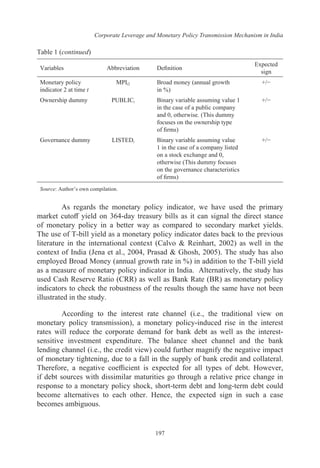
The set of explanatory variables with their definitions and the expected
signs of coefficients is depicted in Table 1.
Table 1
Variables used in the empirical investigation
Variables Abbreviation Definition
Expected
sign
Tangibility TAN Ratio of tangible assets to total
assets
+
Earnings EARN Ratio of operation income to
total assets
−
Firm size SIZE Natural logarithm of a firm’s
total assets
+
Depreciation DEPCN Ratio of depreciation to total
assets
−
Firm age AGE Number of years since the
incorporation of the firm
−
Growth GROW Ratio of capital expenditure to
total assets
+/−
Dividend payout DP Ratio of dividend paid to net
operating income
−
Research intensity RI Ratio of R&D expenses to total
sales
−
Interest INT Ratio of interest expense to total
assets
+/−
Interest (−1) INT_L Ratio of interest expense to total
assets (outstanding at the end of
previous period)
+/−
Monetary policy
indicator 1 at time t
MPIt1 Represented by the yield on
364-day treasury bills
+/−
(continue on next page)
Corporate Leverage and Monetary Policy Transmission Mechanism in India
197
Variables Abbreviation Definition
Expected
sign
Monetary policy
indicator 2 at time t
MPIt2 Broad money (annual growth
in %)
+/−
Ownership dummy PUBLICt Binary variable assuming value 1
in the case of a public company
and 0, otherwise. (This dummy
focuses on the ownership type
of firms)
+/−
Governance dummy LISTEDt Binary variable assuming value
1 in the case of a company listed
on a stock exchange and 0,
otherwise (This dummy focuses
on the governance characteristics
of firms)
+/−
Source: Author’s own compilation.
As regards the monetary policy indicator, we have used the primary
market cutoff yield on 364-day treasury bills as it can signal the direct stance
of monetary policy in a better way as compared to secondary market yields.
The use of T-bill yield as a monetary policy indicator dates back to the previous
literature in the international context (Calvo & Reinhart, 2002) as well in the
context of India (Jena et al., 2004, Prasad & Ghosh, 2005). The study has also
employed Broad Money (annual growth rate in %) in addition to the T-bill yield
as a measure of monetary policy indicator in India. Alternatively, the study has
used Cash Reserve Ratio (CRR) as well as Bank Rate (BR) as monetary policy
indicators to check the robustness of the results though the same have not been
illustrated in the study.
According to the interest rate channel (i.e., the traditional view on
monetary policy transmission), a monetary policy-induced rise in the interest
rates will reduce the corporate demand for bank debt as well as the interest-
sensitive investment expenditure. The balance sheet channel and the bank
lending channel (i.e., the credit view) could further magnify the negative impact
of monetary tightening, due to a fall in the supply of bank credit and collateral.
Therefore, a negative coefficient is expected for all types of debt. However,
if debt sources with dissimilar maturities go through a relative price change in
response to a monetary policy shock, short-term debt and long-term debt could
become alternatives to each other. Hence, the expected sign in such a case
becomes ambiguous.
Table 1 (continued)
Aishwarya Nagpal and Megha Jain
198
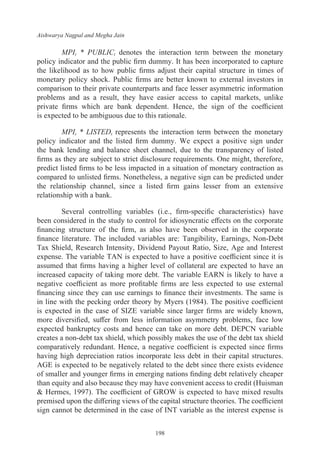
MPIt * PUBLICt denotes the interaction term between the monetary
policy indicator and the public firm dummy. It has been incorporated to capture
the likelihood as to how public firms adjust their capital structure in times of
monetary policy shock. Public firms are better known to external investors in
comparison to their private counterparts and face lesser asymmetric information
problems and as a result, they have easier access to capital markets, unlike
private firms which are bank dependent. Hence, the sign of the coefficient
is expected to be ambiguous due to this rationale.
MPIt * LISTEDt represents the interaction term between the monetary
policy indicator and the listed firm dummy. We expect a positive sign under
the bank lending and balance sheet channel, due to the transparency of listed
firms as they are subject to strict disclosure requirements. One might, therefore,
predict listed firms to be less impacted in a situation of monetary contraction as
compared to unlisted firms. Nonetheless, a negative sign can be predicted under
the relationship channel, since a listed firm gains lesser from an extensive
relationship with a bank.
Several controlling variables (i.e., firm-specific characteristics) have
been considered in the study to control for idiosyncratic effects on the corporate
financing structure of the firm, as also have been observed in the corporate
finance literature. The included variables are: Tangibility, Earnings, Non-Debt
Tax Shield, Research Intensity, Dividend Payout Ratio, Size, Age and Interest
expense. The variable TAN is expected to have a positive coefficient since it is
assumed that firms having a higher level of collateral are expected to have an
increased capacity of taking more debt. The variable EARN is likely to have a
negative coefficient as more profitable firms are less expected to use external
financing since they can use earnings to finance their investments. The same is
in line with the pecking order theory by Myers (1984). The positive coefficient
is expected in the case of SIZE variable since larger firms are widely known,
more diversified, suffer from less information asymmetry problems, face low
expected bankruptcy costs and hence can take on more debt. DEPCN variable
creates a non-debt tax shield, which possibly makes the use of the debt tax shield
comparatively redundant. Hence, a negative coefficient is expected since firms
having high depreciation ratios incorporate less debt in their capital structures.
AGE is expected to be negatively related to the debt since there exists evidence
of smaller and younger firms in emerging nations finding debt relatively cheaper
than equity and also because they may have convenient access to credit (Huisman
& Hermes, 1997). The coefficient of GROW is expected to have mixed results
premised upon the differing views of the capital structure theories. The coefficient
sign cannot be determined in the case of INT variable as the interest expense is
Corporate Leverage and Monetary Policy Transmission Mechanism in India
199
suspected to be endogenous. Higher interest expense can be a sign of possible
financial distress as well as it can suggest the presence of a large debt shield.
Both these explanations result in the probability of a negative coefficient of
interest expenses. However, there is also a notion that higher debt ratios cause
interest payments to be higher. Hence for the same reason, the explanatory
variable interest is not considered directly and is instrumented by its lagged
term (denoted as INT_L) in the econometric model. The coefficient of dividend
payout ratio is expected to be negatively associated with the company’s debt
structure as the dividend payment and debt issuance are widely believed to act
as alternates while addressing the issue of agency problem. Similarly, research
intensity too is expected to have a negative relationship with corporate debt since
companies spending more on R&D are supposed to be having a USP wherein
they may believe in self-financing as per the ‘pecking order’ theory and hence
are less likely to be leveraged (Prasad & Ghosh, 2005).
Methodology
The main theme of the study is to examine the impact of monetary policy on
the financing behaviour of firms and its association with corporate governance
characteristics. The data used in this study is unbalanced panel data. Since
the study focuses predominantly on the corporate debt of individual firms,
we estimate such a relationship using a more sophisticated methodology
(Flannery & Rangan, 2006), popularly known as ‘partial adjustment model’ in
the stream of corporate finance. In the case of perfect markets, it is commonly
witnessed that firms have a tendency to resort back quickly to their target level
because of the absence of any adjustment costs. Whereas the same remains
partially adjusted in the case of presence of adjustment costs and therefore firms
may partially adjust back to their estimated level of debt over multiple periods.
We have hence employed dynamic panel modelling (using system GMM by
Blundell and Bond, 1998) to estimate the speed of adjustment towards the target
leverage ratio and to explore the factors which impact the adjustment speed in
the perspective of Indian manufacturing firms.
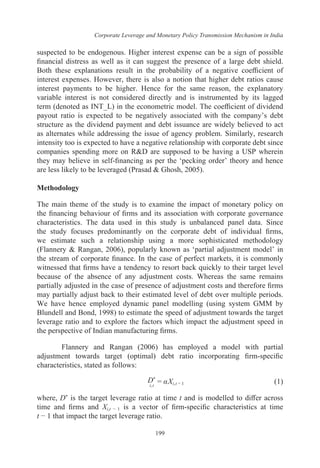
Flannery and Rangan (2006) has employed a model with partial
adjustment towards target (optimal) debt ratio incorporating firm-specific
characteristics, stated as follows:
i,t
D*
= αXi,t − 1	 (1)
where, D* is the target leverage ratio at time t and is modelled to differ across
time and firms and Xi,t − 1 is a vector of firm-specific characteristics at time
t − 1 that impact the target leverage ratio.
Aishwarya Nagpal and Megha Jain
200
The standard partial adjustment model of corporate debt structure is as follows:
Di,t – Di,t – 1 = λi,t (D*
– Di,t – 1) + ϕi,t	 (2)
Where Di,t and Di,t – 1 denote the observed (actual) leverage levels for firm i in
periods t and t – 1, respectively. λ is the proportion that a firm seals the distance
between its actual (observed) and its desired leverage ratios from period t – 1
to period t, popularly known as the speed of adjustment where λ value lies
between 0 and 1 with ‘1’ indicating full adjustment and ‘0’ indicating no
adjustment.
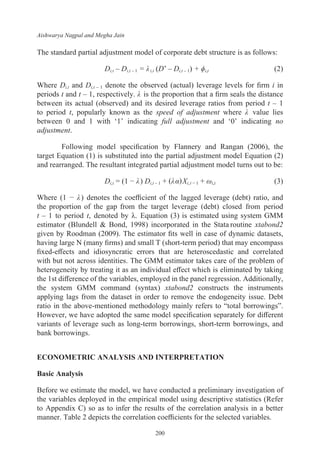
Following model specification by Flannery and Rangan (2006), the
target Equation (1) is substituted into the partial adjustment model Equation (2)
and rearranged. The resultant integrated partial adjustment model turns out to be:
Di,t = (1 − λ) Di,t – 1 + (λα)Xi,t − 1 + ωi,t	 (3)
Where (1 − λ) denotes the coefficient of the lagged leverage (debt) ratio, and
the proportion of the gap from the target leverage (debt) closed from period
t – 1 to period t, denoted by λ. Equation (3) is estimated using system GMM
estimator (Blundell & Bond, 1998) incorporated in the Stata routine xtabond2
given by Roodman (2009). The estimator fits well in case of dynamic datasets,
having large N (many firms) and small T (short-term period) that may encompass
fixed-effects and idiosyncratic errors that are heteroscedastic and correlated
with but not across identities. The GMM estimator takes care of the problem of
heterogeneity by treating it as an individual effect which is eliminated by taking
the 1st difference of the variables, employed in the panel regression. Additionally,
the system GMM command (syntax) xtabond2 constructs the instruments
applying lags from the dataset in order to remove the endogeneity issue. Debt
ratio in the above-mentioned methodology mainly refers to “total borrowings”.
However, we have adopted the same model specification separately for different
variants of leverage such as long-term borrowings, short-term borrowings, and
bank borrowings.
ECONOMETRIC ANALYSIS AND INTERPRETATION
Basic Analysis
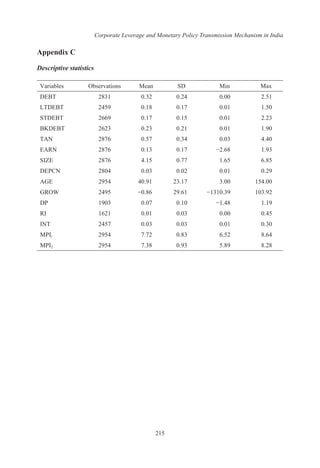
Before we estimate the model, we have conducted a preliminary investigation of
the variables deployed in the empirical model using descriptive statistics (Refer
to Appendix C) so as to infer the results of the correlation analysis in a better
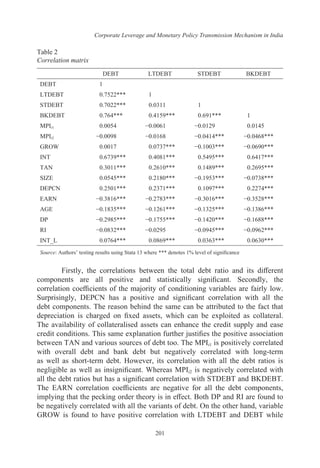
manner. Table 2 depicts the correlation coefficients for the selected variables.
Corporate Leverage and Monetary Policy Transmission Mechanism in India
201
Table 2
Correlation matrix
DEBT LTDEBT STDEBT BKDEBT
DEBT 1
LTDEBT 0.7522*** 1
STDEBT 0.7022*** 0.0311 1
BKDEBT 0.764*** 0.4159*** 0.691*** 1
MPIt1 0.0054 −0.0061 −0.0129 0.0145
MPIt2 −0.0098 −0.0168 −0.0414*** −0.0468***
GROW 0.0017 0.0737*** −0.1003*** −0.0690***
INT 0.6739*** 0.4081*** 0.5495*** 0.6417***
TAN 0.3011*** 0.2610*** 0.1489*** 0.2695***
SIZE 0.0545*** 0.2180*** −0.1953*** −0.0738***
DEPCN 0.2501*** 0.2371*** 0.1097*** 0.2274***
EARN −0.3816*** −0.2783*** −0.3016*** −0.3528***
AGE −0.1835*** −0.1261*** −0.1325*** −0.1386***
DP −0.2985*** −0.1755*** −0.1420*** −0.1688***
RI −0.0832*** −0.0295 −0.0945*** −0.0962***
INT_L 0.0764*** 0.0869*** 0.0363*** 0.0630***
Source: Authors’ testing results using Stata 13 where *** denotes 1% level of significance
Firstly, the correlations between the total debt ratio and its different
components are all positive and statistically significant. Secondly, the
correlation coefficients of the majority of conditioning variables are fairly low.
Surprisingly, DEPCN has a positive and significant correlation with all the
debt components. The reason behind the same can be attributed to the fact that
depreciation is charged on fixed assets, which can be exploited as collateral.
The availability of collateralised assets can enhance the credit supply and ease
credit conditions. This same explanation further justifies the positive association
between TAN and various sources of debt too. The MPIt1 is positively correlated
with overall debt and bank debt but negatively correlated with long-term
as well as short-term debt. However, its correlation with all the debt ratios is
negligible as well as insignificant. Whereas MPIt2 is negatively correlated with
all the debt ratios but has a significant correlation with STDEBT and BKDEBT.
The EARN correlation coefficients are negative for all the debt components,
implying that the pecking order theory is in effect. Both DP and RI are found to
be negatively correlated with all the variants of debt. On the other hand, variable
GROW is found to have positive correlation with LTDEBT and DEBT while
Aishwarya Nagpal and Megha Jain
202
negative and significant association with STDEBT and BKDEBT. Finally, INT
is highly and significantly correlated with the various debt sources as expected.
For this reason, its lagged term is used as an instrument in the system GMM
modelling. INT_L has a quite low correlation with all the debt components,
which greatly justifies its use as a valid instrument for estimation purposes.
Estimation Results
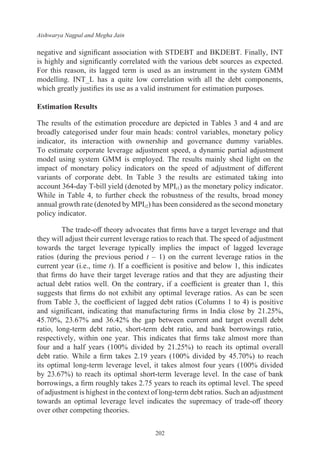
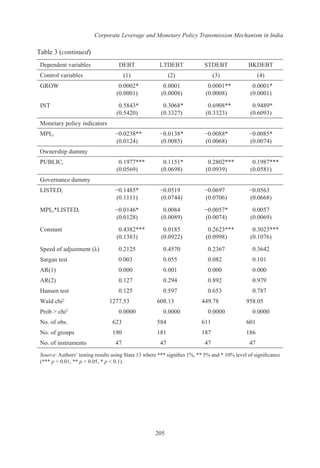
The results of the estimation procedure are depicted in Tables 3 and 4 and are
broadly categorised under four main heads: control variables, monetary policy
indicator, its interaction with ownership and governance dummy variables.
To estimate corporate leverage adjustment speed, a dynamic partial adjustment
model using system GMM is employed. The results mainly shed light on the
impact of monetary policy indicators on the speed of adjustment of different
variants of corporate debt. In Table 3 the results are estimated taking into
account 364-day T-bill yield (denoted by MPIt1) as the monetary policy indicator.
While in Table 4, to further check the robustness of the results, broad money
annual growth rate (denoted by MPIt2) has been considered as the second monetary
policy indicator.
The trade-off theory advocates that firms have a target leverage and that
they will adjust their current leverage ratios to reach that. The speed of adjustment
towards the target leverage typically implies the impact of lagged leverage
ratios (during the previous period t – 1) on the current leverage ratios in the
current year (i.e., time t). If a coefficient is positive and below 1, this indicates
that firms do have their target leverage ratios and that they are adjusting their
actual debt ratios well. On the contrary, if a coefficient is greater than 1, this
suggests that firms do not exhibit any optimal leverage ratios. As can be seen
from Table 3, the coefficient of lagged debt ratios (Columns 1 to 4) is positive
and significant, indicating that manufacturing firms in India close by 21.25%,
45.70%, 23.67% and 36.42% the gap between current and target overall debt
ratio, long-term debt ratio, short-term debt ratio, and bank borrowings ratio,
respectively, within one year. This indicates that firms take almost more than
four and a half years (100% divided by 21.25%) to reach its optimal overall
debt ratio. While a firm takes 2.19  years (100% divided by 45.70%) to reach
its optimal long-term leverage level, it takes almost four years (100% divided
by 23.67%) to reach its optimal short-term leverage level. In the case of bank
borrowings, a firm roughly takes 2.75 years to reach its optimal level. The speed
of adjustment is highest in the context of long-term debt ratios. Such an adjustment
towards an optimal leverage level indicates the supremacy of trade-off theory
over other competing theories.
Corporate Leverage and Monetary Policy Transmission Mechanism in India
203
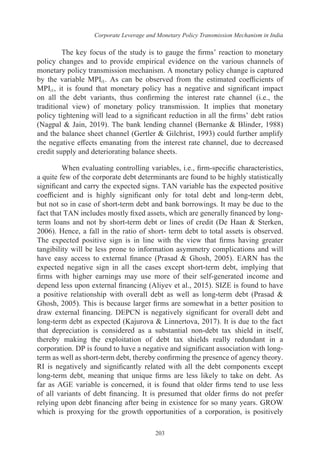
The key focus of the study is to gauge the firms’ reaction to monetary
policy changes and to provide empirical evidence on the various channels of
monetary policy transmission mechanism. A monetary policy change is captured
by the variable MPIt1. As can be observed from the estimated coefficients of
MPIt1, it is found that monetary policy has a negative and significant impact
on all the debt variants, thus confirming the interest rate channel (i.e., the
traditional view) of monetary policy transmission. It implies that monetary
policy tightening will lead to a significant reduction in all the firms’ debt ratios
(Nagpal & Jain, 2019). The bank lending channel (Bernanke & Blinder, 1988)
and the balance sheet channel (Gertler & Gilchrist, 1993) could further amplify
the negative effects emanating from the interest rate channel, due to decreased
credit supply and deteriorating balance sheets.
When evaluating controlling variables, i.e., firm-specific characteristics,
a quite few of the corporate debt determinants are found to be highly statistically
significant and carry the expected signs. TAN variable has the expected positive
coefficient and is highly significant only for total debt and long-term debt,
but not so in case of short-term debt and bank borrowings. It may be due to the
fact that TAN includes mostly fixed assets, which are generally financed by long-
term loans and not by short-term debt or lines of credit (De Haan & Sterken,
2006). Hence, a fall in the ratio of short- term debt to total assets is observed.
The expected positive sign is in line with the view that firms having greater
tangibility will be less prone to information asymmetry complications and will
have easy access to external finance (Prasad & Ghosh, 2005). EARN has the
expected negative sign in all the cases except short-term debt, implying that
firms with higher earnings may use more of their self-generated income and
depend less upon external financing (Aliyev et al., 2015). SIZE is found to have
a positive relationship with overall debt as well as long-term debt (Prasad &
Ghosh, 2005). This is because larger firms are somewhat in a better position to
draw external financing. DEPCN is negatively significant for overall debt and
long-term debt as expected (Kajurova & Linnertova, 2017). It is due to the fact
that depreciation is considered as a substantial non-debt tax shield in itself,
thereby making the exploitation of debt tax shields really redundant in a
corporation. DP is found to have a negative and significant association with long-
term as well as short-term debt, thereby confirming the presence of agency theory.
RI is negatively and significantly related with all the debt components except
long-term debt, meaning that unique firms are less likely to take on debt. As
far as AGE variable is concerned, it is found that older firms tend to use less
of all variants of debt financing. It is presumed that older firms do not prefer
relying upon debt financing after being in existence for so many years. GROW
which is proxying for the growth opportunities of a corporation, is positively
Aishwarya Nagpal and Megha Jain
204
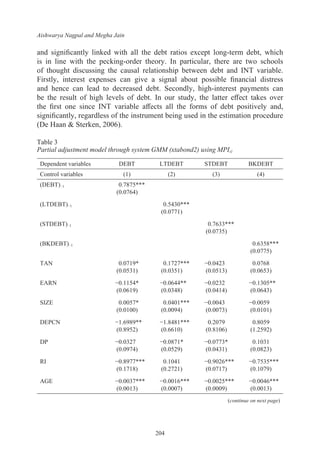
and significantly linked with all the debt ratios except long-term debt, which
is in line with the pecking-order theory. In particular, there are two schools
of thought discussing the causal relationship between debt and INT variable.
Firstly, interest expenses can give a signal about possible financial distress
and hence can lead to decreased debt. Secondly, high-interest payments can
be the result of high levels of debt. In our study, the latter effect takes over
the first one since INT variable affects all the forms of debt positively and,
significantly, regardless of the instrument being used in the estimation procedure
(De Haan & Sterken, 2006).
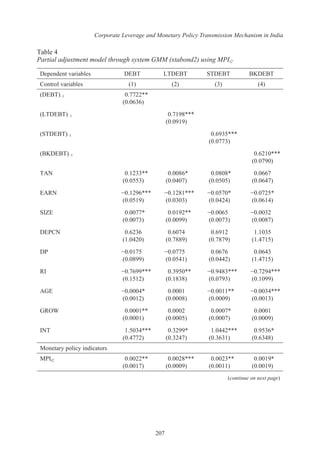
Table 3
Partial adjustment model through system GMM (xtabond2) using MPIt1
Dependent variables DEBT LTDEBT STDEBT BKDEBT
Control variables (1) (2) (3) (4)
(DEBT)−1 0.7875***
(0.0764)
(LTDEBT)−1 0.5430***
(0.0771)
(STDEBT)−1 0.7633***
(0.0735)
(BKDEBT)−1 0.6358***
(0.0775)
TAN 0.0719*
(0.0531)
0.1727***
(0.0351)
−0.0423
(0.0513)
0.0768
(0.0653)
EARN −0.1154*
(0.0619)
−0.0644**
(0.0348)
−0.0232
(0.0414)
−0.1305**
(0.0643)
SIZE 0.0057*
(0.0100)
0.0401***
(0.0094)
−0.0043
(0.0073)
−0.0059
(0.0101)
DEPCN −1.6989**
(0.8952)
−1.8481***
(0.6610)
0.2079
(0.8106)
0.8059
(1.2592)
DP −0.0327
(0.0974)
−0.0871*
(0.0529)
−0.0773*
(0.0431)
0.1031
(0.0823)
RI −0.8977***
(0.1718)
0.1041
(0.2721)
−0.9026***
(0.0717)
−0.7535***
(0.1079)
AGE −0.0037***
(0.0013)
−0.0016***
(0.0007)
−0.0025***
(0.0009)
−0.0046***
(0.0013)
(continue on next page)
Corporate Leverage and Monetary Policy Transmission Mechanism in India
205
Dependent variables DEBT LTDEBT STDEBT BKDEBT
Control variables (1) (2) (3) (4)
GROW 0.0002*
(0.0001)
0.0001
(0.0008)
0.0001**
(0.0008)
0.0001*
(0.0001)
INT 0.5843*
(0.5420)
0.3068*
(0.3327)
0.6908**
(0.3323)
0.9489*
(0.6093)
Monetary policy indicators
MPIt1 −0.0238**
(0.0124)
−0.0138*
(0.0085)
−0.0088*
(0.0068)
−0.0085*
(0.0074)
Ownership dummy
PUBLICt 0.1977***
(0.0569)
0.1151*
(0.0698)
0.2802***
(0.0939)
0.1987***
(0.0581)
Governance dummy
LISTEDt −0.1485*
(0.1111)
−0.0519
(0.0744)
−0.0697
(0.0706)
−0.0563
(0.0668)
MPIt1*LISTEDt −0.0146*
(0.0128)
0.0084
(0.0089)
−0.0057*
(0.0074)
0.0057
(0.0069)
Constant 0.4382***
(0.1383)
0.0185
(0.0922)
0.2623***
(0.0998)
0.3023***
(0.1076)
Speed of adjustment (λ) 0.2125 0.4570 0.2367 0.3642
Sargan test 0.003 0.055 0.082 0.101
AR(1) 0.000 0.001 0.000 0.000
AR(2) 0.127 0.294 0.892 0.979
Hansen test 0.125 0.597 0.653 0.787
Wald chi2 1277.53 608.13 449.78 958.05
Prob > chi2
0.0000 0.0000 0.0000 0.0000
No. of obs. 623 584 611 601
No. of groups 190 181 187 186
No. of instruments 47 47 47 47
Source: Authors’ testing results using Stata 13 where *** signifies 1%, ** 5% and * 10% level of significance
(*** p < 0.01, ** p < 0.05, * p < 0.1).
Table 3 (continued)
Aishwarya Nagpal and Megha Jain
206
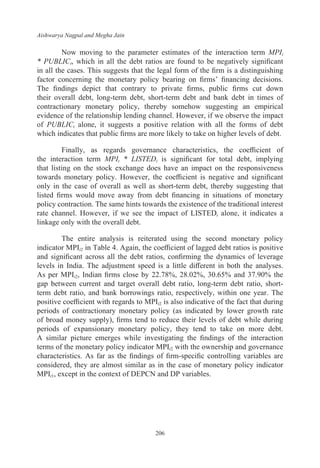
Now moving to the parameter estimates of the interaction term MPIt
* PUBLICt, which in all the debt ratios are found to be negatively significant
in all the cases. This suggests that the legal form of the firm is a distinguishing
factor concerning the monetary policy bearing on firms’ financing decisions.
The findings depict that contrary to private firms, public firms cut down
their overall debt, long-term debt, short-term debt and bank debt in times of
contractionary monetary policy, thereby somehow suggesting an empirical
evidence of the relationship lending channel. However, if we observe the impact
of PUBLICt alone, it suggests a positive relation with all the forms of debt
which indicates that public firms are more likely to take on higher levels of debt.
Finally, as regards governance characteristics, the coefficient of
the interaction term MPIt * LISTEDt is significant for total debt, implying
that listing on the stock exchange does have an impact on the responsiveness
towards monetary policy. However, the coefficient is negative and significant
only in the case of overall as well as short-term debt, thereby suggesting that
listed firms would move away from debt financing in situations of monetary
policy contraction. The same hints towards the existence of the traditional interest
rate channel. However, if we see the impact of LISTEDt alone, it indicates a
linkage only with the overall debt.
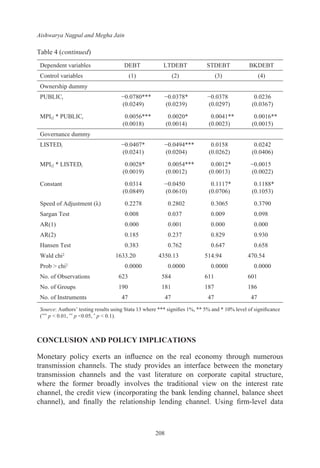
The entire analysis is reiterated using the second monetary policy
indicator MPIt2 in Table 4. Again, the coefficient of lagged debt ratios is positive
and significant across all the debt ratios, confirming the dynamics of leverage
levels in India. The adjustment speed is a little different in both the analyses.
As per MPIt2, Indian firms close by 22.78%, 28.02%, 30.65% and 37.90% the
gap between current and target overall debt ratio, long-term debt ratio, short-
term debt ratio, and bank borrowings ratio, respectively, within one year. The
positive coefficient with regards to MPIt2 is also indicative of the fact that during
periods of contractionary monetary policy (as indicated by lower growth rate
of broad money supply), firms tend to reduce their levels of debt while during
periods of expansionary monetary policy, they tend to take on more debt.
A similar picture emerges while investigating the findings of the interaction
terms of the monetary policy indicator MPIt2 with the ownership and governance
characteristics. As far as the findings of firm-specific controlling variables are
considered, they are almost similar as in the case of monetary policy indicator
MPIt1, except in the context of DEPCN and DP variables.
Corporate Leverage and Monetary Policy Transmission Mechanism in India
207
Table 4
Partial adjustment model through system GMM (xtabond2) using MPIt2
Dependent variables DEBT LTDEBT STDEBT BKDEBT
Control variables (1) (2) (3) (4)
(DEBT)−1 0.7722**
(0.0636)
(LTDEBT)−1 0.7198***
(0.0919)
(STDEBT)−1 0.6935***
(0.0773)
(BKDEBT)−1 0.6210***
(0.0790)
TAN 0.1233**
(0.0553)
0.0086*
(0.0407)
0.0808*
(0.0505)
0.0667
(0.0647)
EARN −0.1296***
(0.0519)
−0.1281***
(0.0303)
−0.0570*
(0.0424)
−0.0725*
(0.0614)
SIZE 0.0077*
(0.0073)
0.0192**
(0.0099)
−0.0065
(0.0073)
−0.0032
(0.0087)
DEPCN 0.6236
(1.0420)
0.6074
(0.7889)
0.6912
(0.7879)
1.1035
(1.4715)
DP −0.0175
(0.0899)
−0.0775
(0.0541)
0.0676
(0.0442)
0.0643
(1.4715)
RI −0.7699***
(0.1512)
0.3950**
(0.1838)
−0.9483***
(0.0793)
−0.7294***
(0.1099)
AGE −0.0004*
(0.0012)
0.0001
(0.0008)
−0.0011**
(0.0009)
−0.0034***
(0.0013)
GROW 0.0001**
(0.0001)
0.0002
(0.0005)
0.0007*
(0.0007)
0.0001
(0.0009)
INT 1.5034***
(0.4772)
0.3299*
(0.3247)
1.0442***
(0.3631)
0.9536*
(0.6348)
Monetary policy indicators
MPIt2 0.0022**
(0.0017)
0.0028***
(0.0009)
0.0023**
(0.0011)
0.0019*
(0.0019)
(continue on next page)
Aishwarya Nagpal and Megha Jain
208
Dependent variables DEBT LTDEBT STDEBT BKDEBT
Control variables (1) (2) (3) (4)
Ownership dummy
PUBLICt −0.0780***
(0.0249)
−0.0378*
(0.0239)
−0.0378
(0.0297)
0.0236
(0.0367)
MPIt2 * PUBLICt 0.0056***
(0.0018)
0.0020*
(0.0014)
0.0041**
(0.0023)
0.0016**
(0.0015)
Governance dummy
LISTEDt −0.0407*
(0.0241)
−0.0494***
(0.0204)
0.0158
(0.0262)
0.0242
(0.0406)
MPIt2 * LISTEDt 0.0028*
(0.0019)
0.0054***
(0.0012)
0.0012*
(0.0013)
−0.0015
(0.0022)
Constant 0.0314
(0.0849)
−0.0450
(0.0610)
0.1117*
(0.0706)
0.1188*
(0.1053)
Speed of Adjustment (λ) 0.2278 0.2802 0.3065 0.3790
Sargan Test 0.008 0.037 0.009 0.098
AR(1) 0.000 0.001 0.000 0.000
AR(2) 0.185 0.237 0.829 0.930
Hansen Test 0.383 0.762 0.647 0.658
Wald chi2
1633.20 4350.13 514.94 470.54
Prob > chi2 0.0000 0.0000 0.0000 0.0000
No. of Observations 623 584 611 601
No. of Groups 190 181 187 186
No. of Instruments 47 47 47 47
Source: Authors’ testing results using Stata 13 where *** signifies 1%, ** 5% and * 10% level of significance
(***
p < 0.01, **
p <0.05, *
p < 0.1).
CONCLUSION AND POLICY IMPLICATIONS
Monetary policy exerts an influence on the real economy through numerous
transmission channels. The study provides an interface between the monetary
transmission channels and the vast literature on corporate capital structure,
where the former broadly involves the traditional view on the interest rate
channel, the credit view (incorporating the bank lending channel, balance sheet
channel), and finally the relationship lending channel. Using firm-level data
Table 4 (continued)
Corporate Leverage and Monetary Policy Transmission Mechanism in India
209
on Indian manufacturing firms for the period 2011–2017, the study analyses
dynamic variations in the firms’ financing behaviour in reaction to the monetary
policy shocks, with a principal focus on the distinctive responses of public vs.
private firms and listed vs unlisted firms.
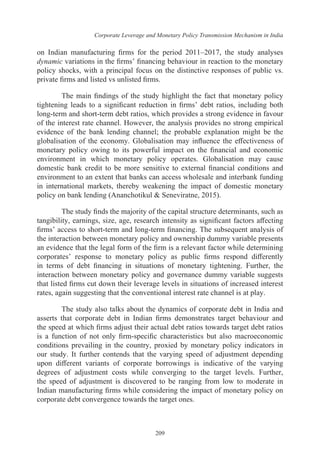
The main findings of the study highlight the fact that monetary policy
tightening leads to a significant reduction in firms’ debt ratios, including both
long-term and short-term debt ratios, which provides a strong evidence in favour
of the interest rate channel. However, the analysis provides no strong empirical
evidence of the bank lending channel; the probable explanation might be the
globalisation of the economy. Globalisation may influence the effectiveness of
monetary policy owing to its powerful impact on the financial and economic
environment in which monetary policy operates. Globalisation may cause
domestic bank credit to be more sensitive to external financial conditions and
environment to an extent that banks can access wholesale and interbank funding
in international markets, thereby weakening the impact of domestic monetary
policy on bank lending (Ananchotikul & Seneviratne, 2015).
The study finds the majority of the capital structure determinants, such as
tangibility, earnings, size, age, research intensity as significant factors affecting
firms’ access to short-term and long-term financing. The subsequent analysis of
the interaction between monetary policy and ownership dummy variable presents
an evidence that the legal form of the firm is a relevant factor while determining
corporates’ response to monetary policy as public firms respond differently
in terms of debt financing in situations of monetary tightening. Further, the
interaction between monetary policy and governance dummy variable suggests
that listed firms cut down their leverage levels in situations of increased interest
rates, again suggesting that the conventional interest rate channel is at play.
The study also talks about the dynamics of corporate debt in India and
asserts that corporate debt in Indian firms demonstrates target behaviour and
the speed at which firms adjust their actual debt ratios towards target debt ratios
is a function of not only firm-specific characteristics but also macroeconomic
conditions prevailing in the country, proxied by monetary policy indicators in
our study. It further contends that the varying speed of adjustment depending
upon different variants of corporate borrowings is indicative of the varying
degrees of adjustment costs while converging to the target levels. Further,
the speed of adjustment is discovered to be ranging from low to moderate in
Indian manufacturing firms while considering the impact of monetary policy on
corporate debt convergence towards the target ones.
Aishwarya Nagpal and Megha Jain
210
The findings have essential policy implications. It implies that the real
impact of a monetary shock actually differs among public versus private firms
and listed versus unlisted firms at the micro-level. This specifies that policy
authorities need to focus on the diverse ownership and governance features of
firms. Further, the balance sheet situation of corporate(s) is a crucial factor in the
financial stability of the economy. The worsening of their balance sheets can
aggravate both the adverse selection and moral hazard problems and, therefore,
investigation of financial system stability should take account of proper companies’
balance sheets (Davis & Stone, 2004). Also, monetary regulatory bodies need to
pay close attention to firms with elevated levels of leverage, particularly during
weak monetary policies to uncover financing intricacies.
From the point of view of corporate finance, the study suggests significant
policy implications. The degree to which company managers can put forth
their impact on firm-specific features, they can make a dent in corporate debt
adjustment speed and thus optimal cost of capital. Another, the magnitude to
which monetary policy authorities can exert their impact on the monetary policy
functioning, they can actually have an effect on the pace at which corporations
rebalance their leverage levels towards the optimal ones and, consequently their
cost of capital.
NOTES
1.	 It is based on default preference to internal finance over external finance by firms. And
in case at all the external finance is required,debt in general is selected over equity
(Myers & Majluf, 1984). The same is confirmed by Donaldson in 1961 with a specific
mention to the preferred option by managers.
2.	 The transmission mechanism is defined as ‘black box’ by Bernanke and Gertler
(1995).
3.	 The credit channel focuses on the impact of monetary policy on the intensity of the
company’s balance sheet to make the company collateralised in case of external
financing. Whereas the bank-lending channel concentrates on the influence of
monetary policy on the credit supply that goes in the form of the external financing
premium for them.
4.	 Prowess database is generated and maintained by the CMIE (Centre for Monitoring
the Indian Economy).
5.	 Handbook of Statistics on the Indian Economy is the annual publication of the
Reserve Bank of India.
Corporate Leverage and Monetary Policy Transmission Mechanism in India
211
REFERENCES
Akerlof, G. (1970). The market for lemons: Qualitative uncertainty and the market
mechanism. Quarterly Journal of Economics, 84(3), 488–500. https://doi.org/
10.2307/1879431
Aliyev, R., Hájková, D., & Kubicová, I. (2015). The impact of monetary policy on
financing of Czech Firms. Czech National Bank.
Ananchotikul, N., & Seneviratne, D. (2015). Monetary policy transmission in
emerging Asia: The role of banks and the effects of financial globalization
(IMF Working Paper No. 15/207). International Monetary Fund. https://doi.
org/10.5089/9781513516233.001
Ando, A., & Modigliani, F. (1963). The “life cycle” hypothesis of saving: Aggregate
implications and tests. The American Economic Review, 53(1), 55–84.
Angeloni, I., Kashyap, A. K., & Mojon, B. (2003). Monetary policy transmission in the
Euro area. Cambridge University Press. https://doi.org/10.1017/CBO97805
11492372
Bernanke, B. S., & Blinder, A. S. (1988). Is it money or credit, or both, or neither.
American Economic Review, 78(2), 435–439.
Bernanke, B. S., & Gertler, M. (1995). Inside the black box: The credit channel of
monetary policy transmission. Journal of Economic Perspectives, 9(1), 27–48.
https://doi.org/10.1257/jep.9.4.27
Bernanke, B. S., Gertler, M., & Gilchrist, S. (1996). The flight to quality and the financial
accelerator. Review of Economics and Statistics, 78(1), 1–15. https://doi.org/
10.2307/2109844
Blundell, R., & Bond, S. (1998) Initial conditions and moment restrictions in dynamic
panel data models. Journal of Econometrics, 87, 115–143. https://doi.org/10
.1016/S0304-4076(98)00009-8
Boot, A. W. (2000). Relationship banking: What do we know? Journal of Financial
Intermediation, 9(1), 7–25. https://doi.org/10.1006/jfin.2000.0282
Bougheas, S., Mizen, P., & Yalcin, C. (2006). Access to external finance: Theory and
evidence on the impact of monetary policy and firm-specific characteristics.
Journal of Banking & Finance, 30(1), 199–227. https://doi.org/10.1016/
j.jbankfin.2005.01.002
Calvo, G. A., & Reinhart, C. M. (2002). Fear of floating. The Quarterly Journal of
Economics, 117(2), 379–408. https://doi.org/10.1162/003355302753650274
Cobham, D., & Subramaniam, R. (1998). Corporate finance in developing countries:
new evidence for India. World Development, 26(6), 1033–1047. https://doi.org/
10.1016/S0305-750X(98)00025-4
Davis, E. P., & Stone, M. R. (2004). Corporate financial structure and financial
stability. Journal of Financial Stability, 1(1), 65–91. https://doi.org/10.1016/
j.jfs.2004.06.003
De Haan, L., & Sterken, E. (2000). Capital structure and corporate governance: Evidence
from Euro area (Unpublished). Antilles: De Nederlandes Bank.
Aishwarya Nagpal and Megha Jain
212
De Haan, L., & Sterken, E. (2006). The impact of monetary policy on the financial
behaviour of firms in the Euro area and the UK. European Journal of Finance,
12(5), 401–420. https://doi.org/10.1080/13518470500459840
Dedola, L., & Lippi, F. (2000). Other monetary transmission mechanism: Evidence from
the Industry Data of Five OECD Countries. CEPR Discussion Paper No. 2508.
Elsas, R. (2005). Empirical determinants of relationship lending. Journal of Financial
Intermediation, 14(1), 32–57. https://doi.org/10.1016/j.jfi.2003.11.004
Flannery, M. J., & Rangan, K. P. (2006). Partial adjustment toward target capital
structures. Journal of Financial Economics, 79, 469–506. https://doi.org/10
.1016/j.jfineco.2005.03.004
Friedman, M., & Schwartz, A. (1963). A monetary history of the United States, 1867–
1960. Princeton University Press.
Fu, Q., & Liu, X. (2015). Monetary policy and dynamic adjustment of corporate
investment: A policy transmission channel perspective. China Journal of
Accounting Research, 8(2), 91–109. https://doi.org/10.1016/j.cjar.2015.03.001
Gertler, M., & Gilchrist, S. (1993). The role of credit market imperfections in the
monetary transmission mechanism: Arguments and evidence. The Scandinavian
Journal of Economics, 95(1), 43–64. https://doi.org/10.2307/3440134
Gertler, M., & Gilchrist, S. (1994). Monetary policy, business cycles, and the behavior of
small manufacturing firms. The Quarterly Journal of Economics, 109(2), 309–
340. https://doi.org/10.2307/2118465
Huisman, J., & Hermes, N. (1997). Financial liberalization in India and the impact on
business investment. International Journal of Development Banking, 15(2),
3–14.
Jalan, B. (2002). Corporate governance and financial sector. Economic Developments in
India: Monthly Update, Volume-51 Analysis, Reports, Policy Documents, 35.
Jena, P. R., Murty, K. N., & Narasimhan, V. (2004). Integration of financial markets in
India: An empirical analysis. Indian Journal of Economics and Business, 3(1),
63–77.
Kajurova, V., & Linnertova, D. (2017). The effects of monetary policy on financial
position of firms in the Slovak Republic. SSRN: https://doi.org/10.2139/ssrn
.3021826
Kashyap, A. K., & Stein, J. C. (1997). The role of banks in monetary policy: A survey with
implications for the European monetary union. Economic Perspectives-Federal
Reserve Bank of Chicago, 21, 2–18.
Kashyap, A. K., & Stein, J. C. (2000). What do a million observations on banks say
about the transmission of monetary policy? American Economic Review, 90(3),
407–428. https://doi.org/10.1257/aer.90.3.407
Kashyap, A. K, Stein, J. C., & Wilcox, D. W. (1993). Monetary policy and credit
conditions: Evidence from the composition of external finance. American
Economic Review, 83(1), 73–98. https://doi.org/10.3386/w4015
Kashyap, A. K., Stein, J. C., & Wilcox, D. W. (1996). Monetary policy and credit
conditions: Evidence from the composition of external finance: Reply.
American Economic Review, 86(2), 310–314.
Corporate Leverage and Monetary Policy Transmission Mechanism in India
213
Khanna, T., & Palepu, K. (2000). Emerging market business groups, foreign
intermediaries, and corporate governance. In R. K. Morck (Ed.), Concentrated
corporate ownership (pp. 265–294). University of Chicago Press. https://doi
.org/10.3386/w6955
Mizen, P., & Yalcin, C. (2003). Corporate finance when monetary policy tightens.
University of Nottingham Working Paper No. 03-1.
Modigliani, F., & Miller, M. H. (1958). The cost of capital, corporation finance and the
theory of investment. American Economic Review, 48, 261–297.
Myers, S. C. (1984). Capital structure puzzle. NBER Working Paper No. 1393, National
Bureau of Economic Research Inc.
Myers, S. C., & Majluf, N. (1984). Corporate financing and investment decisions
when firms have information investors do not have. Journal of Financial
Economics, 13(1), 187–221. https://doi.org/10.1016/0304-405X(84)90023-0
Nagpal, A., & Jain, M. (2019). Monetary policy and corporate performance in India:
Inside the black box thinking. In R. Das (Ed.), The impacts of monetary
policy in the 21st century: Perspectives from emerging economies (pp. 325–
338). Emerald Publishing Limited. https://doi.org/10.1108/978-1-78973-319
-820191031
Oliner, S. D., & Rudebusch, G D. (1996). Is there a broad credit channel for monetary
policy? Federal Reserve Bank of San Francisco Economic Review, 1, 4–13.
Prasad, A., & Ghosh, S. (2005). Monetary policy and corporate behavior in India.
IMF Working Paper No. 25.
Rangarajan, C. (1988). Issues in monetary management, presidential address. Paper
presented at 71st Annual Conference of Indian Economic Association,
December.
Reddy, Y. V. (2002). Parameters of monetary policy in India. Lecture delivered at the
88th Annual Conference of The Indian Econometric Society, Madras School of
Economics, Chennai, 15 January.
Roodman, D. (2009). How to do xtabond2: An introduction to difference and
system GMM in Stata. The Stata Journal, 9(1), 86–136. https://doi.org/10
.1177/1536867X0900900106
Sarkar, J., & Sarkar, S. (2000). Large shareholder activism in corporate governance in
developing countries: Evidence from India. International Review of Finance,
1(3), 161–194. https://doi.org/10.1111/1468-2443.00010
Van den Heuvel, S. J. (2002). The bank capital channel of monetary policy. The Wharton
School, University of Pennsylvania, MIMEO, 2013–14.
Aishwarya Nagpal and Megha Jain
214
APPENDICES
Appendix A
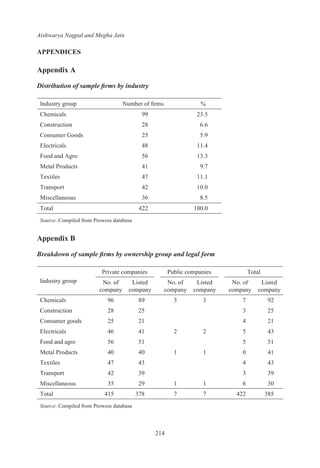
Distribution of sample firms by industry
Industry group Number of firms %
Chemicals 99 23.5
Construction 28 6.6
Consumer Goods 25 5.9
Electricals 48 11.4
Food and Agro 56 13.3
Metal Products 41 9.7
Textiles 47 11.1
Transport 42 10.0
Miscellaneous 36 8.5
Total 422 100.0
Source: Compiled from Prowess database
Appendix B
Breakdown of sample firms by ownership group and legal form
Industry group
Private companies Public companies Total
No. of
company
Listed
company
No. of
company
Listed
company
No. of
company
Listed
company
Chemicals 96 89 3 3 7 92
Construction 28 25 3 25
Consumer goods 25 21 4 21
Electricals 46 41 2 2 5 43
Food and agro 56 51 5 51
Metal Products 40 40 1 1 0 41
Textiles 47 43 4 43
Transport 42 39 3 39
Miscellaneous 35 29 1 1 6 30
Total 415 378 7 7 422 385
Source: Compiled from Prowess database
Corporate Leverage and Monetary Policy Transmission Mechanism in India
215
Appendix C
Descriptive statistics
Variables Observations Mean SD Min Max
DEBT 2831 0.32 0.24 0.00 2.51
LTDEBT 2459 0.18 0.17 0.01 1.50
STDEBT 2669 0.17 0.15 0.01 2.23
BKDEBT 2623 0.23 0.21 0.01 1.90
TAN 2876 0.57 0.34 0.03 4.40
EARN 2876 0.13 0.17 −2.68 1.93
SIZE 2876 4.15 0.77 1.65 6.85
DEPCN 2804 0.03 0.02 0.01 0.29
AGE 2954 40.91 23.17 3.00 154.00
GROW 2495 −0.86 29.61 −1310.39 103.92
DP 1903 0.07 0.10 −1.48 1.19
RI 1621 0.01 0.03 0.00 0.45
INT 2457 0.03 0.03 0.01 0.30
MPIt 2954 7.72 0.83 6.52 8.64
MPI2 2954 7.38 0.93 5.89 8.28

Corporate leverage and_monetary_policy_transmission

  • 1.
    AAMJAF Vol. 17,No. 2, 189–215, 2021 © Asian Academy of Management and Penerbit Universiti Sains Malaysia, 2021. This work is licensed under the terms of the Creative Commons Attribution (CC BY) (http://creativecommons. org/licenses/by/4.0/). Asian Academy of Management Journal of Accounting and Finance CORPORATE LEVERAGE AND MONETARY POLICY TRANSMISSION MECHANISM IN INDIA: A DYNAMIC APPROACH Aishwarya Nagpal1* and Megha Jain1, 2 1 Faculty of Management Studies, Prof ND Kapoor Marg, University of Delhi, New Delhi, Delhi-110007, India 2 Daulat Ram College, 4, Patel Nagar, Maurice Nagar, Roop Nagar, Delhi-110007, India * Corresponding author: aishwarya.n_phd15@fms.edu ABSTRACT The macroeconomic policies of a nation have a major bearing on the financial performance of the companies and their potential sustainability and growth. This study investigates the impact of monetary policy on the corporate leverage adjustment through microscopic monetary policy transmission channels, mainly the interest rate and credit channels, using a sample of 422 manufacturing firms in India from 2011 to 2017 by employing partial adjustment model. The findings suggest that contractionary monetary policy cuts down overall corporate debt. The study further asserts that corporate debt in Indian firms demonstrates target behaviour and the speed at which firms adjust their actual debt ratios towards target debt ratios is a function of not only firm-specific characteristics but also macroeconomic conditions prevailing in the country, proxied by monetary policy indicators in our study. The study has critical policy implications as the balance sheet situation of corporates is a crucial factor in the financial stability of the economy. Keywords: corporate finance, partial adjustment model, Indian firms, leverage, dynamic, monetary policy Publication date: 10 December2021 To cite this article: Nagpal, A., & Jain, M. (2021). Corporate leverage and monetary policy transmission mechanism in India: A dynamic approach. Asian Academy of Management Journal of Accounting and Finance, 17(2), 189–215. https://doi.org/10.21315/aamjaf2021.17.2.8 To link to this article: https://doi.org/10.21315/aamjaf2021.17.2.8
  • 2.
    Aishwarya Nagpal andMegha Jain 190 INTRODUCTION The existing literature on the corporate financial structure is ruled by two diverse contentions. The first one is premised on the established Modigliani-Miller (MM) proposition. The same postulates no linkage between capital structure (i.e., finance-mix) and the firm’s cost of capital (Modigliani & Miller, 1958), whereas the second one is grounded on a ‘pecking order’ in the selection of sources of finance by the firms.1 The pecking order principle ranks the preferred sources in a specific sequence, whereby firstly firms fully utilise all the existing internal resources (i.e., retained earnings) and only in instances where their financing requirements cannot be met through internal finance, they choose an external finance, including debt and lastly equity (Myers & Majluf, 1984). Information asymmetry lies at the heart of the Myers-Majluf proposition and the asymmetric information prevailing in the financial markets bear serious consequences for corporate finance. The emanating credit market imperfections not only influence bank lending and firms’ financing decisions but are also pertinent to the manner monetary policy affects firms (via the broad credit channel). Although the monetary policy carried out by the central bank operates exclusively in the financial markets, its real effects are actually observed in the non-financial sector. The endless innovations and alterations in the financial and capital markets have indeed given a push to explore the varying influence of monetary policy on different categories of firms. The impact of monetary policy on firms could be studied through a transmission mechanism2 that reflects the real impact on an economy. The same initiates with Open Market Operations with (OMOs) followed by different channels that it can take. The well-known channels include credit view channel (narrow view as well as broad view), relationship channel, interest rate channel, wealth channel (Ando & Modigliani, 1963) and exchange rate channel. The current study combines these different perspectives to investigate the linkage between monetary policy indicators and corporate finance in India in the context of non-financial manufacturing firms. In this area, much of the empirical work is restricted to developed nations like the U.S. (Kashyap et al., 1993; 1996) which later extends to some of the European countries as well (De Haan & Sterken, 2000). In the recent years, the ever-changing institutional landscape in the developing nations especially has made this connection between monetary policy and firms’ corporate financial structure to acquire more eminence. Many such nations have instituted market-focused restructuring in the corporate financial sub-division. Since 1990s, this arrangement has witnessed an extensive
  • 3.
    Corporate Leverage andMonetary Policy Transmission Mechanism in India 191 conversion within the corporate communities (that were once regulated). This allocation has further instilled the much-needed boost for the corporate houses to identify their financing mix (capital structure) with corporate governance practices. The current study analyses the sensitivity of corporate debt structures of a large group of 422 Indian manufacturing companies to changes in monetary policy from 2011 to 2017 as major changes have occurred in the business environment after the global financial crisis. The key contribution of the study is that it engages the non-financial firm-level data of manufacturing companies to provide testimony on different capital mix selections by firms and the magnitude of the impact in reaction to changes in the monetary policy. Additionally, this study differentiates between the firms having diverse governance and ownership types to examine the effect of monetary policy modifications. The study further finds its niche in ascertaining how monetary policy affects the speed of adjustment of corporate leverage in Indian manufacturing companies. MONETARY POLICY TRANSMISSION MECHANISM AND BRIEF REVIEW OFLITERATURE The Credit View and Relationship Lending Channel Modigliani and Miller (1958) challenged the role of credit in the economy by underlining that the capital structure of the firm is largely irrelevant. However, the robust correlation between money and real variables unearthed in the empirical literature of the 1960s presented staunch support for the notion that the focal transmission mechanism for monetary policy functions through variations in the cost of capital and their influence on investment (the interest rate channel) (Refer Friedman & Schwartz, 1963). In that sense, banks were essential only because they generated money. In the 1970s, nonetheless, the novel theme of the economics of information accentuated the significance of capital market imperfections and the distinctiveness of bank loans against other types of debt (Refer Akerlof, 1970). In this setting, the “credit view” surfaced as an innovative way of comprehending the monetary policy transmission mechanism. Within the credit view of monetary policy, the bank-lending channel (also known as the narrow credit channel) and the balance sheet channel (also known as the broad credit channel) have been advocated as the twin channels (Bernanke & Gertler, 1995). Each channel is unique in its functioning; however, the two are very analogous in their empirical predictions. The bank lending channel
  • 4.
    Aishwarya Nagpal andMegha Jain 192 highlights the impact of monetary policy shocks on the credit supply and corresponds closely to the balance sheets of the banks, where a monetary policy contraction can drain reserves from the banking system, thus straining banks’ liquidity positions and forcing them to shrink the supply of loans (Bernanke & Blinder, 1988). The balance sheet channel emphasises the possible impact of monetary policy on the strength of the firm’s balance sheet, rendering the firm less or more collateralised while acquiring external sources of finance. It is consistent with the financial accelerator mechanism (Bernanke et al., 1996), where monetary policy tightening may negatively impact firms’ balance sheets and creditworthiness, hence making it tougher to seek external funds. It envisages that banks reallocate their loans from small firms to large firms in the situation of monetary policy tightening. Both the channels are expected to operate in a different manner for firms that are informationally opaque and for which intermediated credit is the sole accessible source of external finance as compared to the firms that are widely known to investors and have convenient access to the public capital market. In general, bank-dependent and informationally opaque firms are likely to be affected more by a monetary policy contraction. The broad credit view concentrates on the impact of financial imperfections on the monetary transmission mechanism (Gertler & Gilchrist, 1994). Explicit attention has been given to the bank lending channel in the broader credit view literature. Here, a distinction is drawn between the two lines of research. The first line is instigated by Kashyap et al. (1993), who for the U.S. investigate the credit composition between bank and non-bank sources at the macro level. They discover that under monetary policy tightening, bank credit drops off more than the non-bank credit (commercial paper). Gertler and Gilchrist (1994) and Oliner and Rudebusch (1996) in the contradiction claim that the macro-data employed by Kashyap et al. (1993) may purely suggest that small firms are more bank- dependent and more susceptible to the business cycle unlike large firms and hence react more to a monetary contraction by curtailing their demand for bank credit. Identifying the bank lending channel at the macro- level is thus challenging and can best be ascertained by evaluating demand models taking into account the heterogeneity between agents. The second line of research therefore addresses the behaviour of individual banks and discover that banks having strong balance sheet positions are in a better position to guard their loan portfolios in response to monetary policy shocks (Kashyap & Stein, 2000; Angeloni et al., 2003). Van den Heuvel (2002) discusses the contribution of capital adequacy requirements and establishes that banks having a low capital demonstrate late but amplified reactions to monetary contractions.
  • 5.
    Corporate Leverage andMonetary Policy Transmission Mechanism in India 193 Further, a more contemporary microeconomic outlook on bank–firm relations, i.e., relationship lending needs to be discussed and its relevance for monetary policy needs to be underscored. Relationship lending can be explained as a long-term implicit contract between a bank and its borrower. The concept of relationship lending is centred on the notion that close ties between the bank and the borrower can lead to well-known economic benefits such as enhanced credit availability, improvement in borrowers’ payoffs, intertemporal smoothing etc. (Boot, 2000; Elsas, 2005). Relationship lending can be relatively important in bank-based economies, where banks invest in long-term relationships with their borrowers, hence mitigating the asymmetric information complications by screening and monitoring. This could make bank-dependent, small or more opaque firms benefit from relationship lending ties and become less sensitive to loan supply shocks. Therefore, the above overview indicates that the two channels of monetary transmission, i.e., the bank lending channel and the relationship lending channel, work in reverse directions. The bank lending channel amplifies, whereas the relationship lending channel mitigates or even neutralizes the effects of monetary tightening. This is the central theme explored in the empirical part of this study. Brief Review of Literature The empirical literature on monetary transmission has magnified rapidly in recent years. Numerous critics have contended that the ‘black box’ of monetary transmission opens gradually. It is commonly debated that whether different monetary regimes have a major bearing on the real economy or not. Though, most of the economists presume that monetary policy exerts quite a substantial effect on the real economy (Friedman & Schwartz, 1963), the scale and the distinct channels of monetary policy that may impact the real economy remain largely debatable. For instance, a contractionary monetary policy may inflate the cost of capital for a firm that could compel some of them to dispose of their real assets. This may diminish the average asset prices to impact the value of collateral adversely (Gertler & Gilchrist, 1993; Oliner & Rudebusch, 1996). There is a paucity of recent literature that discusses the role of the central bank’s monetary policy on the firm’s corporate, governance and financial structures across the globe. Although different policy thinks tanks have dedicated noteworthy attention to the various diffusion channels of monetary policy, the most commonly talked about is the credit3 channel (of monetary policy) that further represents the bank-lending channel and the balance sheet channel (Bernanke & Gertler, 1995).
  • 6.
    Aishwarya Nagpal andMegha Jain 194 There are different models that are developed based on the nature and probable impact. The first class belongs to the microeconomic model that discusses the effect of monetary advancement through a Vector Auto Regression (VAR) structure (Bernanke & Blinder, 1992). The second class deals with the behaviour of banks in response to monetary shocks. The same establishes that there may be a problem for the smaller banks to attract external financing during contractionary policy measures by the central banking system (Kashyap & Stein, 1997), whereas the top 1% of the largest banks do not face such problem even in the case of the stringent liquidity contractions. The third and final class examines the feedback of a firm’s financial structure to alterations in monetary policy. Primarily, such studies have mainly concentrated on the developed nations like the U.S. (Kashyap et al., 1996; Oliner & Rudebusch, 1996). Kashyap et al. (1993) empirically investigate the subsistence of a bank lending channel of monetary policy transmission deploying trimestral data over the period from 1963 to 1989 for the U.S. economy. The key findings of the paper advocate that the contractionary monetary policy induces firms to adopt a nonlinear combination of external borrowing. The net impact is an overall drop in bank lending. The current study centres on the third type of model. To be specific, the present study highlights the differing effect of monetary policy on companies having diverse ownership groups and governance characteristics. The literature linking a company’s financial structure to variations in monetary regime is really scarce. Long back, Dedola and Lippi (2000) have investigated this association in a few of the European nations and the U.S. Further, sourcing through a databank of 16,000 U.K. companies over the period from 1990 to 1999, Mizen and Yalcin (2003) have established that new firms (high in debt portion) are more prone to monetary contraction than the older ones (less on debt portion). Also, Bougheas et al. (2006) argue that during monetary tightening condition, new and younger firms generally decrease their borrowings. The same is supported by Prasad and Ghosh (2005) based upon the firms’ corporate behaviour due to their distinct ownership group, size and the borrowing period. Somewhat contrary substantiation is established by De Haan and Sterken (2006) to confirm that highly sensitive firms to monetary policy fluctuations (shocks) follow the market-based systems over bank-based systems. As far as India is concerned, there are quite a few papers on the impact of monetary policy (Rangarajan, 1988; Reddy, 2002), the financing model of corporates (Cobham & Subramaniam, 1998), along with the function of big stakeholders in company governance (Sarkar & Sarkar, 2000; Khanna & Palepu, 2000; Jalan, 2002). Further, the current study is the first of its kind to
  • 7.
    Corporate Leverage andMonetary Policy Transmission Mechanism in India 195 investigate the monetary policy effect on corporate debt adjustment via partial adjustment model. A similar study has been conducted in China to probe the impact of different monetary policies on corporate investment behaviour of the Chinese A-share listed firms over the period 2005–2012 (Fu & Liu, 2015). It seems to be appealing to extend and update this model over manufacturing non- financial set of companies, taking into account their distinct ownership group and governance structures. DATA AND RESEARCH METHODOLOGY Data Sources The dataset used in the study is gathered from the Prowess database (firm- specific characteristics) and from the Handbook of Statistics on the Indian Economy (monetary policy indicators).4–5 The Prowess database contains comprehensive information on the financial performance of over 27,000 Indian companies garnered from their financial and income statements, as well as provides information relating to their legal form, ownership structure, etc. The manufacturing sector is considered in our study for the period 2011–2017 as it has an analogous business cycle to the overall economy. Originally, the data set included over 17,000 manufacturing companies in total, however, due to missing values in the sample, the elimination of non-active firms, to maintain data consistency and also depending upon the positive value of corporate debt for the period under study so as to rule out the likelihood of an undefined dependent variable, the final sample includes 422 firms, in both the public and private sectors. Moreover, the data of the firms are taken on a consolidated level so as to avoid dual inclusion of firms with both unconsolidated and consolidated data. A word is in order as regards to the selection of the sample period as major changes have followed in the corporate business environment after the global financial crisis. Variables Used in the Study Concerning the capital structure, the dependent variable, corporate debt is modelled as a function of the four main ratios: 1. Total borrowing to total assets (DEBT). This is an overall measure for total debt. 2. Long-term borrowing to total assets (LTDEBT).
  • 8.
    Aishwarya Nagpal andMegha Jain 196 3. Short-term borrowing to total assets (STDEBT) so as to distinguish between the dissimilarmaturity profile of short and long-term debt. 4. Bank borrowing to total assets (BKDEBT) since the key focus is on the distinctive role of bank debt. To control for huge differences in the size among firms, debt as a ratio of total assets is employed as a dependent variable. For the same reason, even the controlling variables are expressed as ratios to total assets excluding the size and age variables. The set of explanatory variables with their definitions and the expected signs of coefficients is depicted in Table 1. Table 1 Variables used in the empirical investigation Variables Abbreviation Definition Expected sign Tangibility TAN Ratio of tangible assets to total assets + Earnings EARN Ratio of operation income to total assets − Firm size SIZE Natural logarithm of a firm’s total assets + Depreciation DEPCN Ratio of depreciation to total assets − Firm age AGE Number of years since the incorporation of the firm − Growth GROW Ratio of capital expenditure to total assets +/− Dividend payout DP Ratio of dividend paid to net operating income − Research intensity RI Ratio of R&D expenses to total sales − Interest INT Ratio of interest expense to total assets +/− Interest (−1) INT_L Ratio of interest expense to total assets (outstanding at the end of previous period) +/− Monetary policy indicator 1 at time t MPIt1 Represented by the yield on 364-day treasury bills +/− (continue on next page)
  • 9.
    Corporate Leverage andMonetary Policy Transmission Mechanism in India 197 Variables Abbreviation Definition Expected sign Monetary policy indicator 2 at time t MPIt2 Broad money (annual growth in %) +/− Ownership dummy PUBLICt Binary variable assuming value 1 in the case of a public company and 0, otherwise. (This dummy focuses on the ownership type of firms) +/− Governance dummy LISTEDt Binary variable assuming value 1 in the case of a company listed on a stock exchange and 0, otherwise (This dummy focuses on the governance characteristics of firms) +/− Source: Author’s own compilation. As regards the monetary policy indicator, we have used the primary market cutoff yield on 364-day treasury bills as it can signal the direct stance of monetary policy in a better way as compared to secondary market yields. The use of T-bill yield as a monetary policy indicator dates back to the previous literature in the international context (Calvo & Reinhart, 2002) as well in the context of India (Jena et al., 2004, Prasad & Ghosh, 2005). The study has also employed Broad Money (annual growth rate in %) in addition to the T-bill yield as a measure of monetary policy indicator in India. Alternatively, the study has used Cash Reserve Ratio (CRR) as well as Bank Rate (BR) as monetary policy indicators to check the robustness of the results though the same have not been illustrated in the study. According to the interest rate channel (i.e., the traditional view on monetary policy transmission), a monetary policy-induced rise in the interest rates will reduce the corporate demand for bank debt as well as the interest- sensitive investment expenditure. The balance sheet channel and the bank lending channel (i.e., the credit view) could further magnify the negative impact of monetary tightening, due to a fall in the supply of bank credit and collateral. Therefore, a negative coefficient is expected for all types of debt. However, if debt sources with dissimilar maturities go through a relative price change in response to a monetary policy shock, short-term debt and long-term debt could become alternatives to each other. Hence, the expected sign in such a case becomes ambiguous. Table 1 (continued)
  • 10.
    Aishwarya Nagpal andMegha Jain 198 MPIt * PUBLICt denotes the interaction term between the monetary policy indicator and the public firm dummy. It has been incorporated to capture the likelihood as to how public firms adjust their capital structure in times of monetary policy shock. Public firms are better known to external investors in comparison to their private counterparts and face lesser asymmetric information problems and as a result, they have easier access to capital markets, unlike private firms which are bank dependent. Hence, the sign of the coefficient is expected to be ambiguous due to this rationale. MPIt * LISTEDt represents the interaction term between the monetary policy indicator and the listed firm dummy. We expect a positive sign under the bank lending and balance sheet channel, due to the transparency of listed firms as they are subject to strict disclosure requirements. One might, therefore, predict listed firms to be less impacted in a situation of monetary contraction as compared to unlisted firms. Nonetheless, a negative sign can be predicted under the relationship channel, since a listed firm gains lesser from an extensive relationship with a bank. Several controlling variables (i.e., firm-specific characteristics) have been considered in the study to control for idiosyncratic effects on the corporate financing structure of the firm, as also have been observed in the corporate finance literature. The included variables are: Tangibility, Earnings, Non-Debt Tax Shield, Research Intensity, Dividend Payout Ratio, Size, Age and Interest expense. The variable TAN is expected to have a positive coefficient since it is assumed that firms having a higher level of collateral are expected to have an increased capacity of taking more debt. The variable EARN is likely to have a negative coefficient as more profitable firms are less expected to use external financing since they can use earnings to finance their investments. The same is in line with the pecking order theory by Myers (1984). The positive coefficient is expected in the case of SIZE variable since larger firms are widely known, more diversified, suffer from less information asymmetry problems, face low expected bankruptcy costs and hence can take on more debt. DEPCN variable creates a non-debt tax shield, which possibly makes the use of the debt tax shield comparatively redundant. Hence, a negative coefficient is expected since firms having high depreciation ratios incorporate less debt in their capital structures. AGE is expected to be negatively related to the debt since there exists evidence of smaller and younger firms in emerging nations finding debt relatively cheaper than equity and also because they may have convenient access to credit (Huisman & Hermes, 1997). The coefficient of GROW is expected to have mixed results premised upon the differing views of the capital structure theories. The coefficient sign cannot be determined in the case of INT variable as the interest expense is
  • 11.
    Corporate Leverage andMonetary Policy Transmission Mechanism in India 199 suspected to be endogenous. Higher interest expense can be a sign of possible financial distress as well as it can suggest the presence of a large debt shield. Both these explanations result in the probability of a negative coefficient of interest expenses. However, there is also a notion that higher debt ratios cause interest payments to be higher. Hence for the same reason, the explanatory variable interest is not considered directly and is instrumented by its lagged term (denoted as INT_L) in the econometric model. The coefficient of dividend payout ratio is expected to be negatively associated with the company’s debt structure as the dividend payment and debt issuance are widely believed to act as alternates while addressing the issue of agency problem. Similarly, research intensity too is expected to have a negative relationship with corporate debt since companies spending more on R&D are supposed to be having a USP wherein they may believe in self-financing as per the ‘pecking order’ theory and hence are less likely to be leveraged (Prasad & Ghosh, 2005). Methodology The main theme of the study is to examine the impact of monetary policy on the financing behaviour of firms and its association with corporate governance characteristics. The data used in this study is unbalanced panel data. Since the study focuses predominantly on the corporate debt of individual firms, we estimate such a relationship using a more sophisticated methodology (Flannery & Rangan, 2006), popularly known as ‘partial adjustment model’ in the stream of corporate finance. In the case of perfect markets, it is commonly witnessed that firms have a tendency to resort back quickly to their target level because of the absence of any adjustment costs. Whereas the same remains partially adjusted in the case of presence of adjustment costs and therefore firms may partially adjust back to their estimated level of debt over multiple periods. We have hence employed dynamic panel modelling (using system GMM by Blundell and Bond, 1998) to estimate the speed of adjustment towards the target leverage ratio and to explore the factors which impact the adjustment speed in the perspective of Indian manufacturing firms. Flannery and Rangan (2006) has employed a model with partial adjustment towards target (optimal) debt ratio incorporating firm-specific characteristics, stated as follows: i,t D* = αXi,t − 1 (1) where, D* is the target leverage ratio at time t and is modelled to differ across time and firms and Xi,t − 1 is a vector of firm-specific characteristics at time t − 1 that impact the target leverage ratio.
  • 12.
    Aishwarya Nagpal andMegha Jain 200 The standard partial adjustment model of corporate debt structure is as follows: Di,t – Di,t – 1 = λi,t (D* – Di,t – 1) + ϕi,t (2) Where Di,t and Di,t – 1 denote the observed (actual) leverage levels for firm i in periods t and t – 1, respectively. λ is the proportion that a firm seals the distance between its actual (observed) and its desired leverage ratios from period t – 1 to period t, popularly known as the speed of adjustment where λ value lies between 0 and 1 with ‘1’ indicating full adjustment and ‘0’ indicating no adjustment. Following model specification by Flannery and Rangan (2006), the target Equation (1) is substituted into the partial adjustment model Equation (2) and rearranged. The resultant integrated partial adjustment model turns out to be: Di,t = (1 − λ) Di,t – 1 + (λα)Xi,t − 1 + ωi,t (3) Where (1 − λ) denotes the coefficient of the lagged leverage (debt) ratio, and the proportion of the gap from the target leverage (debt) closed from period t – 1 to period t, denoted by λ. Equation (3) is estimated using system GMM estimator (Blundell & Bond, 1998) incorporated in the Stata routine xtabond2 given by Roodman (2009). The estimator fits well in case of dynamic datasets, having large N (many firms) and small T (short-term period) that may encompass fixed-effects and idiosyncratic errors that are heteroscedastic and correlated with but not across identities. The GMM estimator takes care of the problem of heterogeneity by treating it as an individual effect which is eliminated by taking the 1st difference of the variables, employed in the panel regression. Additionally, the system GMM command (syntax) xtabond2 constructs the instruments applying lags from the dataset in order to remove the endogeneity issue. Debt ratio in the above-mentioned methodology mainly refers to “total borrowings”. However, we have adopted the same model specification separately for different variants of leverage such as long-term borrowings, short-term borrowings, and bank borrowings. ECONOMETRIC ANALYSIS AND INTERPRETATION Basic Analysis Before we estimate the model, we have conducted a preliminary investigation of the variables deployed in the empirical model using descriptive statistics (Refer to Appendix C) so as to infer the results of the correlation analysis in a better manner. Table 2 depicts the correlation coefficients for the selected variables.
  • 13.
    Corporate Leverage andMonetary Policy Transmission Mechanism in India 201 Table 2 Correlation matrix DEBT LTDEBT STDEBT BKDEBT DEBT 1 LTDEBT 0.7522*** 1 STDEBT 0.7022*** 0.0311 1 BKDEBT 0.764*** 0.4159*** 0.691*** 1 MPIt1 0.0054 −0.0061 −0.0129 0.0145 MPIt2 −0.0098 −0.0168 −0.0414*** −0.0468*** GROW 0.0017 0.0737*** −0.1003*** −0.0690*** INT 0.6739*** 0.4081*** 0.5495*** 0.6417*** TAN 0.3011*** 0.2610*** 0.1489*** 0.2695*** SIZE 0.0545*** 0.2180*** −0.1953*** −0.0738*** DEPCN 0.2501*** 0.2371*** 0.1097*** 0.2274*** EARN −0.3816*** −0.2783*** −0.3016*** −0.3528*** AGE −0.1835*** −0.1261*** −0.1325*** −0.1386*** DP −0.2985*** −0.1755*** −0.1420*** −0.1688*** RI −0.0832*** −0.0295 −0.0945*** −0.0962*** INT_L 0.0764*** 0.0869*** 0.0363*** 0.0630*** Source: Authors’ testing results using Stata 13 where *** denotes 1% level of significance Firstly, the correlations between the total debt ratio and its different components are all positive and statistically significant. Secondly, the correlation coefficients of the majority of conditioning variables are fairly low. Surprisingly, DEPCN has a positive and significant correlation with all the debt components. The reason behind the same can be attributed to the fact that depreciation is charged on fixed assets, which can be exploited as collateral. The availability of collateralised assets can enhance the credit supply and ease credit conditions. This same explanation further justifies the positive association between TAN and various sources of debt too. The MPIt1 is positively correlated with overall debt and bank debt but negatively correlated with long-term as well as short-term debt. However, its correlation with all the debt ratios is negligible as well as insignificant. Whereas MPIt2 is negatively correlated with all the debt ratios but has a significant correlation with STDEBT and BKDEBT. The EARN correlation coefficients are negative for all the debt components, implying that the pecking order theory is in effect. Both DP and RI are found to be negatively correlated with all the variants of debt. On the other hand, variable GROW is found to have positive correlation with LTDEBT and DEBT while
  • 14.
    Aishwarya Nagpal andMegha Jain 202 negative and significant association with STDEBT and BKDEBT. Finally, INT is highly and significantly correlated with the various debt sources as expected. For this reason, its lagged term is used as an instrument in the system GMM modelling. INT_L has a quite low correlation with all the debt components, which greatly justifies its use as a valid instrument for estimation purposes. Estimation Results The results of the estimation procedure are depicted in Tables 3 and 4 and are broadly categorised under four main heads: control variables, monetary policy indicator, its interaction with ownership and governance dummy variables. To estimate corporate leverage adjustment speed, a dynamic partial adjustment model using system GMM is employed. The results mainly shed light on the impact of monetary policy indicators on the speed of adjustment of different variants of corporate debt. In Table 3 the results are estimated taking into account 364-day T-bill yield (denoted by MPIt1) as the monetary policy indicator. While in Table 4, to further check the robustness of the results, broad money annual growth rate (denoted by MPIt2) has been considered as the second monetary policy indicator. The trade-off theory advocates that firms have a target leverage and that they will adjust their current leverage ratios to reach that. The speed of adjustment towards the target leverage typically implies the impact of lagged leverage ratios (during the previous period t – 1) on the current leverage ratios in the current year (i.e., time t). If a coefficient is positive and below 1, this indicates that firms do have their target leverage ratios and that they are adjusting their actual debt ratios well. On the contrary, if a coefficient is greater than 1, this suggests that firms do not exhibit any optimal leverage ratios. As can be seen from Table 3, the coefficient of lagged debt ratios (Columns 1 to 4) is positive and significant, indicating that manufacturing firms in India close by 21.25%, 45.70%, 23.67% and 36.42% the gap between current and target overall debt ratio, long-term debt ratio, short-term debt ratio, and bank borrowings ratio, respectively, within one year. This indicates that firms take almost more than four and a half years (100% divided by 21.25%) to reach its optimal overall debt ratio. While a firm takes 2.19  years (100% divided by 45.70%) to reach its optimal long-term leverage level, it takes almost four years (100% divided by 23.67%) to reach its optimal short-term leverage level. In the case of bank borrowings, a firm roughly takes 2.75 years to reach its optimal level. The speed of adjustment is highest in the context of long-term debt ratios. Such an adjustment towards an optimal leverage level indicates the supremacy of trade-off theory over other competing theories.
  • 15.
    Corporate Leverage andMonetary Policy Transmission Mechanism in India 203 The key focus of the study is to gauge the firms’ reaction to monetary policy changes and to provide empirical evidence on the various channels of monetary policy transmission mechanism. A monetary policy change is captured by the variable MPIt1. As can be observed from the estimated coefficients of MPIt1, it is found that monetary policy has a negative and significant impact on all the debt variants, thus confirming the interest rate channel (i.e., the traditional view) of monetary policy transmission. It implies that monetary policy tightening will lead to a significant reduction in all the firms’ debt ratios (Nagpal & Jain, 2019). The bank lending channel (Bernanke & Blinder, 1988) and the balance sheet channel (Gertler & Gilchrist, 1993) could further amplify the negative effects emanating from the interest rate channel, due to decreased credit supply and deteriorating balance sheets. When evaluating controlling variables, i.e., firm-specific characteristics, a quite few of the corporate debt determinants are found to be highly statistically significant and carry the expected signs. TAN variable has the expected positive coefficient and is highly significant only for total debt and long-term debt, but not so in case of short-term debt and bank borrowings. It may be due to the fact that TAN includes mostly fixed assets, which are generally financed by long- term loans and not by short-term debt or lines of credit (De Haan & Sterken, 2006). Hence, a fall in the ratio of short- term debt to total assets is observed. The expected positive sign is in line with the view that firms having greater tangibility will be less prone to information asymmetry complications and will have easy access to external finance (Prasad & Ghosh, 2005). EARN has the expected negative sign in all the cases except short-term debt, implying that firms with higher earnings may use more of their self-generated income and depend less upon external financing (Aliyev et al., 2015). SIZE is found to have a positive relationship with overall debt as well as long-term debt (Prasad & Ghosh, 2005). This is because larger firms are somewhat in a better position to draw external financing. DEPCN is negatively significant for overall debt and long-term debt as expected (Kajurova & Linnertova, 2017). It is due to the fact that depreciation is considered as a substantial non-debt tax shield in itself, thereby making the exploitation of debt tax shields really redundant in a corporation. DP is found to have a negative and significant association with long- term as well as short-term debt, thereby confirming the presence of agency theory. RI is negatively and significantly related with all the debt components except long-term debt, meaning that unique firms are less likely to take on debt. As far as AGE variable is concerned, it is found that older firms tend to use less of all variants of debt financing. It is presumed that older firms do not prefer relying upon debt financing after being in existence for so many years. GROW which is proxying for the growth opportunities of a corporation, is positively
  • 16.
    Aishwarya Nagpal andMegha Jain 204 and significantly linked with all the debt ratios except long-term debt, which is in line with the pecking-order theory. In particular, there are two schools of thought discussing the causal relationship between debt and INT variable. Firstly, interest expenses can give a signal about possible financial distress and hence can lead to decreased debt. Secondly, high-interest payments can be the result of high levels of debt. In our study, the latter effect takes over the first one since INT variable affects all the forms of debt positively and, significantly, regardless of the instrument being used in the estimation procedure (De Haan & Sterken, 2006). Table 3 Partial adjustment model through system GMM (xtabond2) using MPIt1 Dependent variables DEBT LTDEBT STDEBT BKDEBT Control variables (1) (2) (3) (4) (DEBT)−1 0.7875*** (0.0764) (LTDEBT)−1 0.5430*** (0.0771) (STDEBT)−1 0.7633*** (0.0735) (BKDEBT)−1 0.6358*** (0.0775) TAN 0.0719* (0.0531) 0.1727*** (0.0351) −0.0423 (0.0513) 0.0768 (0.0653) EARN −0.1154* (0.0619) −0.0644** (0.0348) −0.0232 (0.0414) −0.1305** (0.0643) SIZE 0.0057* (0.0100) 0.0401*** (0.0094) −0.0043 (0.0073) −0.0059 (0.0101) DEPCN −1.6989** (0.8952) −1.8481*** (0.6610) 0.2079 (0.8106) 0.8059 (1.2592) DP −0.0327 (0.0974) −0.0871* (0.0529) −0.0773* (0.0431) 0.1031 (0.0823) RI −0.8977*** (0.1718) 0.1041 (0.2721) −0.9026*** (0.0717) −0.7535*** (0.1079) AGE −0.0037*** (0.0013) −0.0016*** (0.0007) −0.0025*** (0.0009) −0.0046*** (0.0013) (continue on next page)
  • 17.
    Corporate Leverage andMonetary Policy Transmission Mechanism in India 205 Dependent variables DEBT LTDEBT STDEBT BKDEBT Control variables (1) (2) (3) (4) GROW 0.0002* (0.0001) 0.0001 (0.0008) 0.0001** (0.0008) 0.0001* (0.0001) INT 0.5843* (0.5420) 0.3068* (0.3327) 0.6908** (0.3323) 0.9489* (0.6093) Monetary policy indicators MPIt1 −0.0238** (0.0124) −0.0138* (0.0085) −0.0088* (0.0068) −0.0085* (0.0074) Ownership dummy PUBLICt 0.1977*** (0.0569) 0.1151* (0.0698) 0.2802*** (0.0939) 0.1987*** (0.0581) Governance dummy LISTEDt −0.1485* (0.1111) −0.0519 (0.0744) −0.0697 (0.0706) −0.0563 (0.0668) MPIt1*LISTEDt −0.0146* (0.0128) 0.0084 (0.0089) −0.0057* (0.0074) 0.0057 (0.0069) Constant 0.4382*** (0.1383) 0.0185 (0.0922) 0.2623*** (0.0998) 0.3023*** (0.1076) Speed of adjustment (λ) 0.2125 0.4570 0.2367 0.3642 Sargan test 0.003 0.055 0.082 0.101 AR(1) 0.000 0.001 0.000 0.000 AR(2) 0.127 0.294 0.892 0.979 Hansen test 0.125 0.597 0.653 0.787 Wald chi2 1277.53 608.13 449.78 958.05 Prob > chi2 0.0000 0.0000 0.0000 0.0000 No. of obs. 623 584 611 601 No. of groups 190 181 187 186 No. of instruments 47 47 47 47 Source: Authors’ testing results using Stata 13 where *** signifies 1%, ** 5% and * 10% level of significance (*** p < 0.01, ** p < 0.05, * p < 0.1). Table 3 (continued)
  • 18.
    Aishwarya Nagpal andMegha Jain 206 Now moving to the parameter estimates of the interaction term MPIt * PUBLICt, which in all the debt ratios are found to be negatively significant in all the cases. This suggests that the legal form of the firm is a distinguishing factor concerning the monetary policy bearing on firms’ financing decisions. The findings depict that contrary to private firms, public firms cut down their overall debt, long-term debt, short-term debt and bank debt in times of contractionary monetary policy, thereby somehow suggesting an empirical evidence of the relationship lending channel. However, if we observe the impact of PUBLICt alone, it suggests a positive relation with all the forms of debt which indicates that public firms are more likely to take on higher levels of debt. Finally, as regards governance characteristics, the coefficient of the interaction term MPIt * LISTEDt is significant for total debt, implying that listing on the stock exchange does have an impact on the responsiveness towards monetary policy. However, the coefficient is negative and significant only in the case of overall as well as short-term debt, thereby suggesting that listed firms would move away from debt financing in situations of monetary policy contraction. The same hints towards the existence of the traditional interest rate channel. However, if we see the impact of LISTEDt alone, it indicates a linkage only with the overall debt. The entire analysis is reiterated using the second monetary policy indicator MPIt2 in Table 4. Again, the coefficient of lagged debt ratios is positive and significant across all the debt ratios, confirming the dynamics of leverage levels in India. The adjustment speed is a little different in both the analyses. As per MPIt2, Indian firms close by 22.78%, 28.02%, 30.65% and 37.90% the gap between current and target overall debt ratio, long-term debt ratio, short- term debt ratio, and bank borrowings ratio, respectively, within one year. The positive coefficient with regards to MPIt2 is also indicative of the fact that during periods of contractionary monetary policy (as indicated by lower growth rate of broad money supply), firms tend to reduce their levels of debt while during periods of expansionary monetary policy, they tend to take on more debt. A similar picture emerges while investigating the findings of the interaction terms of the monetary policy indicator MPIt2 with the ownership and governance characteristics. As far as the findings of firm-specific controlling variables are considered, they are almost similar as in the case of monetary policy indicator MPIt1, except in the context of DEPCN and DP variables.
  • 19.
    Corporate Leverage andMonetary Policy Transmission Mechanism in India 207 Table 4 Partial adjustment model through system GMM (xtabond2) using MPIt2 Dependent variables DEBT LTDEBT STDEBT BKDEBT Control variables (1) (2) (3) (4) (DEBT)−1 0.7722** (0.0636) (LTDEBT)−1 0.7198*** (0.0919) (STDEBT)−1 0.6935*** (0.0773) (BKDEBT)−1 0.6210*** (0.0790) TAN 0.1233** (0.0553) 0.0086* (0.0407) 0.0808* (0.0505) 0.0667 (0.0647) EARN −0.1296*** (0.0519) −0.1281*** (0.0303) −0.0570* (0.0424) −0.0725* (0.0614) SIZE 0.0077* (0.0073) 0.0192** (0.0099) −0.0065 (0.0073) −0.0032 (0.0087) DEPCN 0.6236 (1.0420) 0.6074 (0.7889) 0.6912 (0.7879) 1.1035 (1.4715) DP −0.0175 (0.0899) −0.0775 (0.0541) 0.0676 (0.0442) 0.0643 (1.4715) RI −0.7699*** (0.1512) 0.3950** (0.1838) −0.9483*** (0.0793) −0.7294*** (0.1099) AGE −0.0004* (0.0012) 0.0001 (0.0008) −0.0011** (0.0009) −0.0034*** (0.0013) GROW 0.0001** (0.0001) 0.0002 (0.0005) 0.0007* (0.0007) 0.0001 (0.0009) INT 1.5034*** (0.4772) 0.3299* (0.3247) 1.0442*** (0.3631) 0.9536* (0.6348) Monetary policy indicators MPIt2 0.0022** (0.0017) 0.0028*** (0.0009) 0.0023** (0.0011) 0.0019* (0.0019) (continue on next page)
  • 20.
    Aishwarya Nagpal andMegha Jain 208 Dependent variables DEBT LTDEBT STDEBT BKDEBT Control variables (1) (2) (3) (4) Ownership dummy PUBLICt −0.0780*** (0.0249) −0.0378* (0.0239) −0.0378 (0.0297) 0.0236 (0.0367) MPIt2 * PUBLICt 0.0056*** (0.0018) 0.0020* (0.0014) 0.0041** (0.0023) 0.0016** (0.0015) Governance dummy LISTEDt −0.0407* (0.0241) −0.0494*** (0.0204) 0.0158 (0.0262) 0.0242 (0.0406) MPIt2 * LISTEDt 0.0028* (0.0019) 0.0054*** (0.0012) 0.0012* (0.0013) −0.0015 (0.0022) Constant 0.0314 (0.0849) −0.0450 (0.0610) 0.1117* (0.0706) 0.1188* (0.1053) Speed of Adjustment (λ) 0.2278 0.2802 0.3065 0.3790 Sargan Test 0.008 0.037 0.009 0.098 AR(1) 0.000 0.001 0.000 0.000 AR(2) 0.185 0.237 0.829 0.930 Hansen Test 0.383 0.762 0.647 0.658 Wald chi2 1633.20 4350.13 514.94 470.54 Prob > chi2 0.0000 0.0000 0.0000 0.0000 No. of Observations 623 584 611 601 No. of Groups 190 181 187 186 No. of Instruments 47 47 47 47 Source: Authors’ testing results using Stata 13 where *** signifies 1%, ** 5% and * 10% level of significance (*** p < 0.01, ** p <0.05, * p < 0.1). CONCLUSION AND POLICY IMPLICATIONS Monetary policy exerts an influence on the real economy through numerous transmission channels. The study provides an interface between the monetary transmission channels and the vast literature on corporate capital structure, where the former broadly involves the traditional view on the interest rate channel, the credit view (incorporating the bank lending channel, balance sheet channel), and finally the relationship lending channel. Using firm-level data Table 4 (continued)
  • 21.
    Corporate Leverage andMonetary Policy Transmission Mechanism in India 209 on Indian manufacturing firms for the period 2011–2017, the study analyses dynamic variations in the firms’ financing behaviour in reaction to the monetary policy shocks, with a principal focus on the distinctive responses of public vs. private firms and listed vs unlisted firms. The main findings of the study highlight the fact that monetary policy tightening leads to a significant reduction in firms’ debt ratios, including both long-term and short-term debt ratios, which provides a strong evidence in favour of the interest rate channel. However, the analysis provides no strong empirical evidence of the bank lending channel; the probable explanation might be the globalisation of the economy. Globalisation may influence the effectiveness of monetary policy owing to its powerful impact on the financial and economic environment in which monetary policy operates. Globalisation may cause domestic bank credit to be more sensitive to external financial conditions and environment to an extent that banks can access wholesale and interbank funding in international markets, thereby weakening the impact of domestic monetary policy on bank lending (Ananchotikul & Seneviratne, 2015). The study finds the majority of the capital structure determinants, such as tangibility, earnings, size, age, research intensity as significant factors affecting firms’ access to short-term and long-term financing. The subsequent analysis of the interaction between monetary policy and ownership dummy variable presents an evidence that the legal form of the firm is a relevant factor while determining corporates’ response to monetary policy as public firms respond differently in terms of debt financing in situations of monetary tightening. Further, the interaction between monetary policy and governance dummy variable suggests that listed firms cut down their leverage levels in situations of increased interest rates, again suggesting that the conventional interest rate channel is at play. The study also talks about the dynamics of corporate debt in India and asserts that corporate debt in Indian firms demonstrates target behaviour and the speed at which firms adjust their actual debt ratios towards target debt ratios is a function of not only firm-specific characteristics but also macroeconomic conditions prevailing in the country, proxied by monetary policy indicators in our study. It further contends that the varying speed of adjustment depending upon different variants of corporate borrowings is indicative of the varying degrees of adjustment costs while converging to the target levels. Further, the speed of adjustment is discovered to be ranging from low to moderate in Indian manufacturing firms while considering the impact of monetary policy on corporate debt convergence towards the target ones.
  • 22.
    Aishwarya Nagpal andMegha Jain 210 The findings have essential policy implications. It implies that the real impact of a monetary shock actually differs among public versus private firms and listed versus unlisted firms at the micro-level. This specifies that policy authorities need to focus on the diverse ownership and governance features of firms. Further, the balance sheet situation of corporate(s) is a crucial factor in the financial stability of the economy. The worsening of their balance sheets can aggravate both the adverse selection and moral hazard problems and, therefore, investigation of financial system stability should take account of proper companies’ balance sheets (Davis & Stone, 2004). Also, monetary regulatory bodies need to pay close attention to firms with elevated levels of leverage, particularly during weak monetary policies to uncover financing intricacies. From the point of view of corporate finance, the study suggests significant policy implications. The degree to which company managers can put forth their impact on firm-specific features, they can make a dent in corporate debt adjustment speed and thus optimal cost of capital. Another, the magnitude to which monetary policy authorities can exert their impact on the monetary policy functioning, they can actually have an effect on the pace at which corporations rebalance their leverage levels towards the optimal ones and, consequently their cost of capital. NOTES 1. It is based on default preference to internal finance over external finance by firms. And in case at all the external finance is required,debt in general is selected over equity (Myers & Majluf, 1984). The same is confirmed by Donaldson in 1961 with a specific mention to the preferred option by managers. 2. The transmission mechanism is defined as ‘black box’ by Bernanke and Gertler (1995). 3. The credit channel focuses on the impact of monetary policy on the intensity of the company’s balance sheet to make the company collateralised in case of external financing. Whereas the bank-lending channel concentrates on the influence of monetary policy on the credit supply that goes in the form of the external financing premium for them. 4. Prowess database is generated and maintained by the CMIE (Centre for Monitoring the Indian Economy). 5. Handbook of Statistics on the Indian Economy is the annual publication of the Reserve Bank of India.
  • 23.
    Corporate Leverage andMonetary Policy Transmission Mechanism in India 211 REFERENCES Akerlof, G. (1970). The market for lemons: Qualitative uncertainty and the market mechanism. Quarterly Journal of Economics, 84(3), 488–500. https://doi.org/ 10.2307/1879431 Aliyev, R., Hájková, D., & Kubicová, I. (2015). The impact of monetary policy on financing of Czech Firms. Czech National Bank. Ananchotikul, N., & Seneviratne, D. (2015). Monetary policy transmission in emerging Asia: The role of banks and the effects of financial globalization (IMF Working Paper No. 15/207). International Monetary Fund. https://doi. org/10.5089/9781513516233.001 Ando, A., & Modigliani, F. (1963). The “life cycle” hypothesis of saving: Aggregate implications and tests. The American Economic Review, 53(1), 55–84. Angeloni, I., Kashyap, A. K., & Mojon, B. (2003). Monetary policy transmission in the Euro area. Cambridge University Press. https://doi.org/10.1017/CBO97805 11492372 Bernanke, B. S., & Blinder, A. S. (1988). Is it money or credit, or both, or neither. American Economic Review, 78(2), 435–439. Bernanke, B. S., & Gertler, M. (1995). Inside the black box: The credit channel of monetary policy transmission. Journal of Economic Perspectives, 9(1), 27–48. https://doi.org/10.1257/jep.9.4.27 Bernanke, B. S., Gertler, M., & Gilchrist, S. (1996). The flight to quality and the financial accelerator. Review of Economics and Statistics, 78(1), 1–15. https://doi.org/ 10.2307/2109844 Blundell, R., & Bond, S. (1998) Initial conditions and moment restrictions in dynamic panel data models. Journal of Econometrics, 87, 115–143. https://doi.org/10 .1016/S0304-4076(98)00009-8 Boot, A. W. (2000). Relationship banking: What do we know? Journal of Financial Intermediation, 9(1), 7–25. https://doi.org/10.1006/jfin.2000.0282 Bougheas, S., Mizen, P., & Yalcin, C. (2006). Access to external finance: Theory and evidence on the impact of monetary policy and firm-specific characteristics. Journal of Banking & Finance, 30(1), 199–227. https://doi.org/10.1016/ j.jbankfin.2005.01.002 Calvo, G. A., & Reinhart, C. M. (2002). Fear of floating. The Quarterly Journal of Economics, 117(2), 379–408. https://doi.org/10.1162/003355302753650274 Cobham, D., & Subramaniam, R. (1998). Corporate finance in developing countries: new evidence for India. World Development, 26(6), 1033–1047. https://doi.org/ 10.1016/S0305-750X(98)00025-4 Davis, E. P., & Stone, M. R. (2004). Corporate financial structure and financial stability. Journal of Financial Stability, 1(1), 65–91. https://doi.org/10.1016/ j.jfs.2004.06.003 De Haan, L., & Sterken, E. (2000). Capital structure and corporate governance: Evidence from Euro area (Unpublished). Antilles: De Nederlandes Bank.
  • 24.
    Aishwarya Nagpal andMegha Jain 212 De Haan, L., & Sterken, E. (2006). The impact of monetary policy on the financial behaviour of firms in the Euro area and the UK. European Journal of Finance, 12(5), 401–420. https://doi.org/10.1080/13518470500459840 Dedola, L., & Lippi, F. (2000). Other monetary transmission mechanism: Evidence from the Industry Data of Five OECD Countries. CEPR Discussion Paper No. 2508. Elsas, R. (2005). Empirical determinants of relationship lending. Journal of Financial Intermediation, 14(1), 32–57. https://doi.org/10.1016/j.jfi.2003.11.004 Flannery, M. J., & Rangan, K. P. (2006). Partial adjustment toward target capital structures. Journal of Financial Economics, 79, 469–506. https://doi.org/10 .1016/j.jfineco.2005.03.004 Friedman, M., & Schwartz, A. (1963). A monetary history of the United States, 1867– 1960. Princeton University Press. Fu, Q., & Liu, X. (2015). Monetary policy and dynamic adjustment of corporate investment: A policy transmission channel perspective. China Journal of Accounting Research, 8(2), 91–109. https://doi.org/10.1016/j.cjar.2015.03.001 Gertler, M., & Gilchrist, S. (1993). The role of credit market imperfections in the monetary transmission mechanism: Arguments and evidence. The Scandinavian Journal of Economics, 95(1), 43–64. https://doi.org/10.2307/3440134 Gertler, M., & Gilchrist, S. (1994). Monetary policy, business cycles, and the behavior of small manufacturing firms. The Quarterly Journal of Economics, 109(2), 309– 340. https://doi.org/10.2307/2118465 Huisman, J., & Hermes, N. (1997). Financial liberalization in India and the impact on business investment. International Journal of Development Banking, 15(2), 3–14. Jalan, B. (2002). Corporate governance and financial sector. Economic Developments in India: Monthly Update, Volume-51 Analysis, Reports, Policy Documents, 35. Jena, P. R., Murty, K. N., & Narasimhan, V. (2004). Integration of financial markets in India: An empirical analysis. Indian Journal of Economics and Business, 3(1), 63–77. Kajurova, V., & Linnertova, D. (2017). The effects of monetary policy on financial position of firms in the Slovak Republic. SSRN: https://doi.org/10.2139/ssrn .3021826 Kashyap, A. K., & Stein, J. C. (1997). The role of banks in monetary policy: A survey with implications for the European monetary union. Economic Perspectives-Federal Reserve Bank of Chicago, 21, 2–18. Kashyap, A. K., & Stein, J. C. (2000). What do a million observations on banks say about the transmission of monetary policy? American Economic Review, 90(3), 407–428. https://doi.org/10.1257/aer.90.3.407 Kashyap, A. K, Stein, J. C., & Wilcox, D. W. (1993). Monetary policy and credit conditions: Evidence from the composition of external finance. American Economic Review, 83(1), 73–98. https://doi.org/10.3386/w4015 Kashyap, A. K., Stein, J. C., & Wilcox, D. W. (1996). Monetary policy and credit conditions: Evidence from the composition of external finance: Reply. American Economic Review, 86(2), 310–314.
  • 25.
    Corporate Leverage andMonetary Policy Transmission Mechanism in India 213 Khanna, T., & Palepu, K. (2000). Emerging market business groups, foreign intermediaries, and corporate governance. In R. K. Morck (Ed.), Concentrated corporate ownership (pp. 265–294). University of Chicago Press. https://doi .org/10.3386/w6955 Mizen, P., & Yalcin, C. (2003). Corporate finance when monetary policy tightens. University of Nottingham Working Paper No. 03-1. Modigliani, F., & Miller, M. H. (1958). The cost of capital, corporation finance and the theory of investment. American Economic Review, 48, 261–297. Myers, S. C. (1984). Capital structure puzzle. NBER Working Paper No. 1393, National Bureau of Economic Research Inc. Myers, S. C., & Majluf, N. (1984). Corporate financing and investment decisions when firms have information investors do not have. Journal of Financial Economics, 13(1), 187–221. https://doi.org/10.1016/0304-405X(84)90023-0 Nagpal, A., & Jain, M. (2019). Monetary policy and corporate performance in India: Inside the black box thinking. In R. Das (Ed.), The impacts of monetary policy in the 21st century: Perspectives from emerging economies (pp. 325– 338). Emerald Publishing Limited. https://doi.org/10.1108/978-1-78973-319 -820191031 Oliner, S. D., & Rudebusch, G D. (1996). Is there a broad credit channel for monetary policy? Federal Reserve Bank of San Francisco Economic Review, 1, 4–13. Prasad, A., & Ghosh, S. (2005). Monetary policy and corporate behavior in India. IMF Working Paper No. 25. Rangarajan, C. (1988). Issues in monetary management, presidential address. Paper presented at 71st Annual Conference of Indian Economic Association, December. Reddy, Y. V. (2002). Parameters of monetary policy in India. Lecture delivered at the 88th Annual Conference of The Indian Econometric Society, Madras School of Economics, Chennai, 15 January. Roodman, D. (2009). How to do xtabond2: An introduction to difference and system GMM in Stata. The Stata Journal, 9(1), 86–136. https://doi.org/10 .1177/1536867X0900900106 Sarkar, J., & Sarkar, S. (2000). Large shareholder activism in corporate governance in developing countries: Evidence from India. International Review of Finance, 1(3), 161–194. https://doi.org/10.1111/1468-2443.00010 Van den Heuvel, S. J. (2002). The bank capital channel of monetary policy. The Wharton School, University of Pennsylvania, MIMEO, 2013–14.
  • 26.
    Aishwarya Nagpal andMegha Jain 214 APPENDICES Appendix A Distribution of sample firms by industry Industry group Number of firms % Chemicals 99 23.5 Construction 28 6.6 Consumer Goods 25 5.9 Electricals 48 11.4 Food and Agro 56 13.3 Metal Products 41 9.7 Textiles 47 11.1 Transport 42 10.0 Miscellaneous 36 8.5 Total 422 100.0 Source: Compiled from Prowess database Appendix B Breakdown of sample firms by ownership group and legal form Industry group Private companies Public companies Total No. of company Listed company No. of company Listed company No. of company Listed company Chemicals 96 89 3 3 7 92 Construction 28 25 3 25 Consumer goods 25 21 4 21 Electricals 46 41 2 2 5 43 Food and agro 56 51 5 51 Metal Products 40 40 1 1 0 41 Textiles 47 43 4 43 Transport 42 39 3 39 Miscellaneous 35 29 1 1 6 30 Total 415 378 7 7 422 385 Source: Compiled from Prowess database
  • 27.
    Corporate Leverage andMonetary Policy Transmission Mechanism in India 215 Appendix C Descriptive statistics Variables Observations Mean SD Min Max DEBT 2831 0.32 0.24 0.00 2.51 LTDEBT 2459 0.18 0.17 0.01 1.50 STDEBT 2669 0.17 0.15 0.01 2.23 BKDEBT 2623 0.23 0.21 0.01 1.90 TAN 2876 0.57 0.34 0.03 4.40 EARN 2876 0.13 0.17 −2.68 1.93 SIZE 2876 4.15 0.77 1.65 6.85 DEPCN 2804 0.03 0.02 0.01 0.29 AGE 2954 40.91 23.17 3.00 154.00 GROW 2495 −0.86 29.61 −1310.39 103.92 DP 1903 0.07 0.10 −1.48 1.19 RI 1621 0.01 0.03 0.00 0.45 INT 2457 0.03 0.03 0.01 0.30 MPIt 2954 7.72 0.83 6.52 8.64 MPI2 2954 7.38 0.93 5.89 8.28