







Health Care Reform – An Overviewpresented by Kristy Britsch2011 Ohio Healthcare SummitMay 12, 2011
GINATitle I of GINA Prohibits discrimination in health coverage based on genetic information as well as the collection of such information in certain circumstances Prohibits group health plans and group health insurance issuers from:Increasing premiums or contribution amounts based on genetic informationRequiring an individual or family to undergo genetic testingRequesting or requiring genetic information prior to or in connection with enrollment for underwriting purposes
GINATitle II final regulations became effective January 10, 2011Prohibits an employer from using genetic information to make employment related decisions, from requesting or requiring genetic information, with limited exceptions, from retaliating against individuals based on genetic information and from disclosing genetic information
GINAProvided certain requirements are met, an employer will NOT be liable under Title II of GINA for acquiring genetic information if it is:Acquired inadvertently;Acquired as part of health or genetic services provided on a voluntary basis, including a voluntary wellness program;Family medical history acquired to comply with FMLA certification; Acquired through commercially or publicly available sources;Acquired by an employer that conducts DNA testing for law enforcement purposes (forensic lab, identification of human remains).
Extended Effective Dates Under PPACA Nondiscrimination Requirements Was effective for plan years on or after September 23, 2010 Effective date has been delayed until regulations are issuedComments on new rules are due by March 11, 2011A non-grandfathered fully-insured plan is prohibited from discriminating as to eligibility or benefits in favor of highly compensated employeesPenalties for Noncompliance$100 per individual per day for as long as violation continuesCompare to self-insured penalty, which is the loss of tax benefits for the HCE who benefited from the discrimination
Extended Effective Dates Under PPACA Employer W-2 Reporting (Delayed until 2012)Employers must calculate and report the aggregate cost of applicable employer sponsored health insurance coverage on the employee’s W-2
Extended Effective Dates Under PPACA60-day Notice for Material Modifications effective for plan years on or after March 23, 2012Clarified by DOL; originally believed to have been March 23, 2010However, until federal agencies provide standards on benefits and coverage explanations, employers are not required to comply with this requirement
Extended Effective Dates Under PPACAAutomatic EnrollmentEffective January 1, 2014, employers with 200 or more full-time employees offering health coverage must enroll new full-time employees with the opportunity to opt-out In a FAQ in December 2010, DOL indicated that until EBSA issues regulations, employers will not be required to comply with this rule
PPACA Impact on ALL Health Plans:September 23, 2010No rescission of coverage except for fraud or intentional misrepresentation of a material fact Elimination of lifetime limits for “essential health benefits” Elimination of pre-existing conditions for children under age 19This prohibition will be extended to ALL individuals effective January 1, 2014
PPACA Impact on ALL Health Plans:September 23, 2010Medicare Part D donut hole will be eliminatedRetiree Reinsurance Program Effective June 1, 2010Only available to early retirees defined as individuals between the ages of 55 and 64 who are not eligible for Medicare and who are not active employees of the employer who maintains the plan
PPACA Impact on ALL Health Plans:September 23, 2010Extend dependent coverage to age 26Coverage is required even if dependent is marriedCoverage must be provided even if dependent does not otherwise qualify as the employee’s dependent for tax purposes Children who were previously dropped because of age from dependent coverage will also be able to re-enrollRe-enrollment option only applies to plans that already offer dependent coverage
PPACA Impact on ALL Health Plans:September 23, 2010Extend dependent coverage to age 26 (continued)For non-grandfathered plans, coverage must be offered to dependent even if eligible to enroll in another employer group health plan Grandfathered plans need not offer coverage to adult children who are eligible to enroll in another employer group health plan until January 1, 2014Cost of employer-provided health coverage with respect to an adult child is tax-free until end of calendar year in which the child turns age 27Ohio dependent coverage is extended to age 28
PPACA Impact on ALL Health Plans:September 23, 2010Group health plans can only impose annual limits on the coverage for “essential health benefits” that exceed a restricted annual limit as determined by HHS
$750,000 limit per individual for plan year on or after September 23, 2010. Increases to $1,250,000 on or after September 23, 2011PPACA Impact on ALL Health Plans:September 23, 2010Effective June 23, 2010, establishment of high-risk pool for individuals to obtain coverage due to health status. Remains in effect until Exchanges are created in 2014
PPACA Impact on ALL Health Plans:September 23, 2010Nursing Mothers:  Affects employers with 50 or more full-time (at least 30 hours per week) employees New provision added to the Fair Labor Standards Act (the “FLSA”)Employers covered by FLSA must provide “reasonable” breaks to mothers to express milk for their infants up to one (1) year oldEmployers must provide a private location, other than a restroom
PPACA Impact on ALL Health Plans:September 23, 2010Preventative Health Services and Cost-SharingEffective for plan years on or after September 23, 2010, a non-grandfathered plan may not impose cost-sharing requirements (such as co-pays, co-insurance, or deductibles) for certain preventative services
PPACA Impact on ALL Health Plans:September 23, 2010Preventative Health Services and Cost-Sharing (continued)Four types of preventative services will be covered at no charge to the individual, including:Screenings such as colon cancer tests, breast cancer screenings, screening of pregnant women for vitamin deficiencies, smoking cessation services, tests for diabetes, high cholesterol and high blood pressure tests Routine vaccines, including child immunizations and tetanus boosters Well-child visits, vision and hearing tests for children and weight counseling Preventative care for women (breast cancer screenings)
PPACA Impact on ALL Health Plans:September 23, 2010A non-grandfathered plan may not impose a pre-authorization requirement for a person seeking obstetrical or gynecological careA non-grandfathered plan that covers emergency department services:May not impose a pre-authorization requirementMust cover services regardless of whether the health care professional is a participating providerMay not impose greater coverage restrictions for non-participating provider services than are imposed for participating providersMay not impose greater cost-sharing requirements for out-of-network services than are imposed for in-network emergency room services
PPACA Impact on ALL Health Plans:September 23, 2010Choice of Primary Care ProviderA non-grandfathered plan that requires or provides for an individual’s designation of a health care provider as “primary,” must  permit an individual to designate any participating primary care provider who is available to accept that individualPlan must permit the designation of a pediatric physician as the child’s primary care provider
PPACA Impact on ALL Health Plans:September 23, 2010Internal Claims and Appeals:
Expanded definition of “adverse benefit determination”
Notice of benefit determinations for urgent care claims must be provided within 24 hours of receipt of claim
Avoid conflicts of interest
Upon review of a claim denial, claimants must be allowed to review their file and present evidence/testimony.  Plans/insurers must provide, free of charge, any new or additional evidence considered, relied upon or generated by the plan or insurer in connection with the claim, and a reasonable opportunity for claimant to respondPPACA Impact on ALL Health Plans:September 23, 2010Internal Claims and Appeals (continued):
Notices regarding claims and appeals must be provided in a culturally and linguistically appropriate manner
Detailed notices of adverse benefit determinations and the availability of internal and external appeals
Coverage must be provided pending outcome of an internal appeal
Strict adherence to the internal claims and appeals process is required (claimant will be deemed to have exhausted the internal claims and appeals process if plan/insurer fails to comply) PPACA Impact on ALL Health Plans:September 23, 2010External Review ProcessIf an individual’s internal claim is denied, the individual will have the right to appeal to an independent reviewer pursuant to the standards established by the National Association of Insurance Commissioners (“NAIC”) States should adopt the NAIC standards before July 1, 2011Self-funded plans must comply with claims and appeals process consistent with the federal external review procedures
PPACA Impact on ALL Health Plans:September 23, 2010Federal External Review Process:  DOL Technical Release 2010-01 provides a safe-harbor and outlines the procedures for the federal external review process (standard and expedited external review)
PPACA Impact on ALL Health Plans:September 23, 2010Standard External Review ProcessRequests for external review must be allowed under the plan and a claimant must file the request within 4 months after notice of an adverse determination of final internal adverse determinationA preliminary review must be conducted by the plan within 5 days of receiving an external review requestWithin 1 day after completion of the preliminary review, the plan must issue notification in writing to the claimantPlan must assign an accredited Independent Review Organization (“IRO”) to conduct the external review.  The IROs decision is binding except for other remedies available under state or federal law. IRO will review claim de novo (i.e., will not be bound by previous decision of plan sponsor). IRO will make final decision within 45 days.Upon receipt of notice of a final external review reversing an adverse benefit determination or final internal adverse benefit determination, the plan must immediately provide coverage or payment
PPACA Impact on ALL Health Plans:September 23, 2010Transparency in Coverage DisclosuresEffective for plan years on or after September 23, 2010, a non-grandfathered plan will be required to submit to the HHS information regarding the following:The plan’s claims payment policies and practices; Periodic financial disclosures;Data on enrollment; Data on disenrollment; Data on the number of claims that are denied; 	Data on rating practices; Information on cost-sharing and payments with respect to any out-of-network coverage; Information on enrollee and participant rights.
PPACA Impact on ALL Health Plans:September 23, 2010Uniform Explanation of Coverage (Mini-SPDs)Must be written in culturally and linguistically appropriate manner to explain health benefits under the plan Must include uniform set of definitions and medical terms and must describe cost-sharing requirements and plan term limits and exclusionsMust be provided to participants at time of enrollmentUniform Explanation of Coverage is in addition to the SPD Distribution deadline of 24 months after the enactment of healthcare reform (i.e., March 23, 2012)HHS is to issue guidance addressing the Mini-SPDs by March 23, 2011
PPACA Impact on ALL Health Plans:January 1, 2011HSAs, FSAs, HRAs:  Expenses for over-the-counter medications will no longer be eligible for reimbursementHSAs, FSAs, HRAs:  Eligible medical expense = prescription or insulinPlans must be amended by June 30, 2011Simple Cafeteria Plans: Effective for tax years after December 31, 2010, small employers may adopt a new type of cafeteria plan
PPACA Impact on ALL Health Plans:January 1, 2013Medicare Payroll Tax IncreaseIncrease in Medicare Part A tax from 1.45% to 2.35% applicable to single individuals earning more than $200,000 and married individuals earning more than $250,000Small Business Tax CreditEligible employers (less than 25 full-time employees) will get a tax credit equal to a portion of its health insurance premiums Phase I: 2010 – 2013: May claim a credit of up to 35% of health insurance premiums for each tax year if employer contributes at least 50% of total premium costPhase II: After 2013:  May claim tax credit of up to 50% of employer’s contribution toward employees’ premiums if employer contributes at least 50% of total premium
PPACA Impact on ALL Health Plans:January 1, 2013FSAs: Salary reduction contributions to a health FSA are limited to $2,500 per yearContributions to dependent care FSAs remain at $5,000 per year
PPACA Impact on ALL Health Plans:January 1, 2014Elimination of pre-existing conditions for all individualsNo annual limits on dollar value of coverage on essential health benefitsGrandfathered plans that offer dependent coverage must offer coverage to adult children until age 26 regardless of whether or not the child is eligible to enroll in another employer health plan
PPACA Impact on ALL Health Plans:January 1, 2014Waiting PeriodsCannot impose coverage waiting period that exceeds 90 daysOut-of-Pocket LimitsEffective January 1, 2014, a non-grandfathered group health plan cannot impose a total cost sharing for a year that exceeds the out-of-pocket limits that are applicable to high-deductible health plansCurrently, these limits are $5,950 for individual coverage and $11,900 for family coverage
PPACA Impact on ALL Health Plans:January 1, 2014Mandate to Provide Health InsuranceEmployers with 50 or more full-time employees are required to offer health coverage or pay a penaltyPenalty for failure to provide coverage is $2,000 per full-time employee (applicable if at least one full-time employee receives insurance on the Exchange) Penalty for failure to provide affordable coverage is $3,000 for each employee enrolled in Exchange coveragePart-time employees are included and calculated as full-time employees
PPACA Impact on ALL Health Plans:January 1, 2014Health Insurance Exchanges
States must establish “Health Insurance Exchanges” to offer qualified health benefit plans
Exchanges are initially limited to individual markets and to employers with 100 employees or less
Effective January 1, 2017, States may allow employers with over 100 employees to access coverage through Exchanges
Individuals must purchase insurance for the minimum essential health coverage or pay penalty of the greater of $95, or up to 1% of income (penalty will increase each year)PPACA Impact on ALL Health Plans:January 1, 2014Vouchers: Employers must provide free choice vouchers for lower income employees who qualify for an affordability exemptionEmployers who offer minimum essential coverage and who pay a portion of coverage must also provide “qualified employees” with a voucher that can be applied to the purchase of insurance through an ExchangeVoucher must equal the amount the employer would have paid to provide coverage for the employee under its group health plan
PPACA Impact on ALL Health Plans:January 1, 2014Vouchers (continued): A “Qualified Employee” is an individual:who does not participate in the employer’s group health plan; whose required contribution for the employer sponsored minimum essential coverage exceeds 8% (but is less than 9.8%) of his/her household income;whose household income does not exceed 400% of the poverty level
PPACA Impact on ALL Health Plans:January 1, 2018Excise tax on Cadillac Plans Insurers (employer if self-insured) will pay 40% excise tax on high value Cadillac Plans with values exceeding $10,200 limit for individual coverage and $27,500 for family coverage
PPACA Impact on Non-Profit HospitalsIf a non-profit hospital fails to meet any of the following requirements, its tax-exempt status under Code Section 501(c)(3) will be revokedCommunity health needs assessment requirements; Financial assistance policy requirements;Limitations on charges requirements;Billing and collection requirements.
Grandfathered Plans Under PPACA A “grandfathered plan” is any group health plan or health insurance coverage in effect as of March 23, 2010Grandfathered plans are not required to comply with all of the requirements under PPACATo maintain grandfathered status, a plan must include a statement in any plan materials to be provided to participants that describes plan benefits and must include a statement
Grandfathered Plans Under PPACA (continued)Plan sponsors must retain all plan documents in effect on March 23, 2010 to prove terms of plan at this timeA grandfathered plan will lose its exemption from some of PPACA’s requirements if a plan significantly reduces benefits or increases employee premium contributions by more than 5% points
How to Lose Grandfathered Status Elimination of benefits (elimination of all or substantially all benefits to diagnose/treat a particular condition);Increase in co-insurance (i.e., increase in cost-sharing);Increase in co-payment (increase in a co-payment for any service by more than the greater of (a) $5.00 or (b) medical inflation plus 15%);Increase in deductible or out-of-pocket maximum;Decrease in employer contribution rate;(….continued)
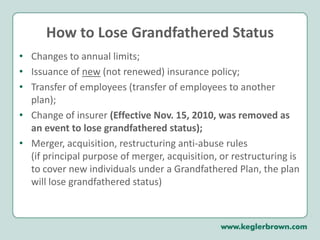
How to Lose Grandfathered Status Changes to annual limits;Issuance of new (not renewed) insurance policy;Transfer of employees (transfer of employees to another plan);Change of insurer (Effective Nov. 15, 2010, was removed as an event to lose grandfathered status);Merger, acquisition, restructuring anti-abuse rules (if principal purpose of merger, acquisition, or restructuring is to cover new individuals under a Grandfathered Plan, the plan will lose grandfathered status)
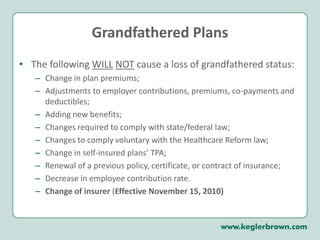
Grandfathered Plans The following WILLNOT cause a loss of grandfathered status:Change in plan premiums;Adjustments to employer contributions, premiums, co-payments and deductibles;Adding new benefits; Changes required to comply with state/federal law;Changes to comply voluntary with the Healthcare Reform law;Change in self-insured plans’ TPA;Renewal of a previous policy, certificate, or contract of insurance;Decrease in employee contribution rate. Change of insurer (Effective November 15, 2010)
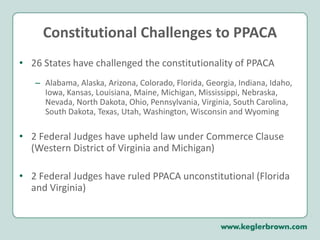
Constitutional Challenges to PPACA 26 States have challenged the constitutionality of PPACAAlabama, Alaska, Arizona, Colorado, Florida, Georgia, Indiana, Idaho, Iowa, Kansas, Louisiana, Maine, Michigan, Mississippi, Nebraska, Nevada, North Dakota, Ohio, Pennsylvania, Virginia, South Carolina, South Dakota, Texas, Utah, Washington, Wisconsin and Wyoming 2 Federal Judges have upheld law under Commerce Clause (Western District of Virginia and Michigan) 2 Federal Judges have ruled PPACA unconstitutional (Florida and Virginia)
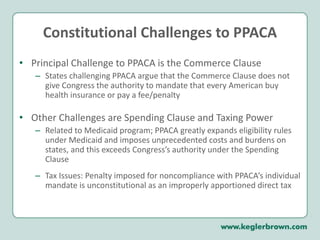
Constitutional Challenges to PPACAPrincipal Challenge to PPACA is the Commerce ClauseStates challenging PPACA argue that the Commerce Clause does not give Congress the authority to mandate that every American buy health insurance or pay a fee/penaltyOther Challenges are Spending Clause and Taxing PowerRelated to Medicaid program; PPACA greatly expands eligibility rules under Medicaid and imposes unprecedented costs and burdens on states, and this exceeds Congress’s authority under the Spending Clause Tax Issues: Penalty imposed for noncompliance with PPACA’s individual mandate is unconstitutional as an improperly apportioned direct tax
Constitutional Challenges to PPACAFederal District Judge, Judge Vinson, in Florida ruled on February 1, 2010, that the individual mandate and the entirety of PPACA was unconstitutionalFederal government cannot regulate inactivity through the Commerce Clause and refusing to buy health insurance is inactivityThe individual mandate is so thoroughly interwoven into PPACA as a whole that the FL court could not sever that provision and rule only to its constitutionality
Constitutional Challenges to PPACAFirst time a federal court has ruled the entirety of PPACA to violate the Constitution Federal government has already filed its appeal from the Florida ruling by Judge Vinson with the Court of Appeals for the 11th CircuitOral arguments begin in June
Constitutional Challenges to PPACAThe matter will eventually reach the U.S. Supreme CourtNot sure when, but before 2012 elections? There has been no injunction against the implementation of PPACA so nothing practical has changed for employers, insurers and individualsRemains to be seen whether states will put the brakes on the implementation of PPACA, particularly on states’ preparation for the creation of Exchanges
Thank You!Kristy N. BritschKegler Brown Associatekbritsch@keglerbrown.com	(614) 462-541265 East State St., Suite 1800, Columbus OH 43215
2011 Ohio Healthcare SummitState of Healthcare Reform in OhioThursday, May 12, 2011Élise SpriggsDirector of Government Affairs
Medicaid is Ohio’s Largest Health PayerProvides health coverage for low-income children, parents, seniors, and people with disabilities
Covers 2.2 million Ohioans (1 in 5) including 2 in 5 births1
Spends $18+ billion annually all agencies, all funds (SFY 2011) 1
Accounts for 4.0% of Ohio’s total economy and is growing2
Funds are federal (63.69%) and state (36.31%)3SOURCES: (1) Ohio Department of Job and Family Services, (2) SFY 2011 estimate based on $18.0 billion in Medicaid spending per ODJFS and $498 billion Ohio gross domestic product per the State of Ohio Office of Budget and Management, and (3)  Federal Register Vol. 76 No. 22 page 5811.
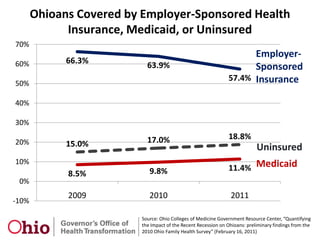
Ohioans Covered by Employer-Sponsored Health Insurance, Medicaid, or UninsuredEmployer-Sponsored InsuranceUninsuredMedicaidSource: Ohio Colleges of Medicine Government Resource Center, “Quantifying the Impact of the Recent Recession on Ohioans: preliminary findings from the 2010 Ohio Family Health Survey” (February 16, 2011)
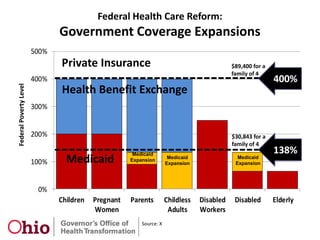
Federal Health Care Reform:Government Coverage ExpansionsPrivate Insurance$89,400 for a family of 4400%Health Benefit ExchangeFederal Poverty Level$30,843 for a family of 4138%Medicaid ExpansionMedicaidMedicaid ExpansionMedicaid ExpansionSource: X
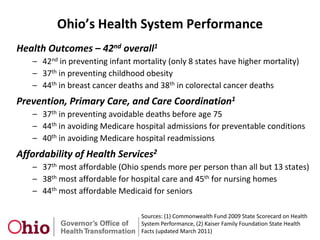
Ohio’s Health System PerformanceHealth Outcomes – 42nd overall142nd in preventing infant mortality (only 8 states have higher mortality)37th in preventing childhood obesity44th in breast cancer deaths and 38th in colorectal cancer deathsPrevention, Primary Care, and Care Coordination137th in preventing avoidable deaths before age 7544th in avoiding Medicare hospital admissions for preventable conditions40th in avoiding Medicare hospital readmissionsAffordability of Health Services237th most affordable (Ohio spends more per person than all but 13 states)38thmost affordable for hospital care and 45thfor nursing homes44thmost affordable Medicaid for seniorsSources: (1) Commonwealth Fund 2009 State Scorecard on Health System Performance, (2) Kaiser Family Foundation State Health Facts (updated March 2011)
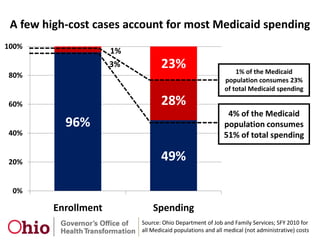
A few high-cost cases account for most Medicaid spending3%1% of the Medicaid population consumes 23% of total Medicaid spending4% of the Medicaid population consumes 51% of total spendingSource: Ohio Department of Job and Family Services; SFY 2010 for all Medicaid populations and all medical (not administrative) costs
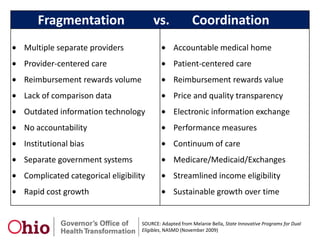
SOURCE: Adapted from Melanie Bella, State Innovative Programs for Dual Eligibles, NASMD (November 2009)
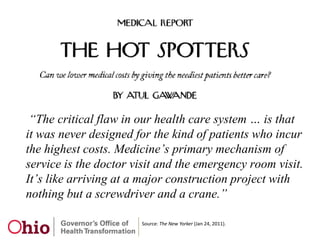
“The critical flaw in our health care system … is that it was never designed for the kind of patients who incur the highest costs. Medicine’s primary mechanism of service is the doctor visit and the emergency room visit. It’s like arriving at a major construction project with nothing but a screwdriver and a crane.”Source: The New Yorker (Jan 24, 2011).
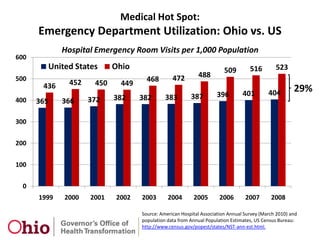
Medical Hot Spot:Emergency Department Utilization: Ohio vs. USHospital Emergency Room Visits per 1,000 Population29%Source: American Hospital Association Annual Survey (March 2010) and population data from Annual Population Estimates, US Census Bureau: http://www.census.gov/popest/states/NST-ann-est.html.
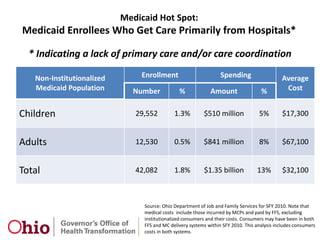
Medicaid Hot Spot:Medicaid Enrollees Who Get Care Primarily from Hospitals** Indicating a lack of primary care and/or care coordinationSource: Ohio Department of Job and Family Services for SFY 2010. Note that medical costs  include those incurred by MCPs and paid by FFS, excluding institutionalized consumers and their costs. Consumers may have been in both FFS and MC delivery systems within SFY 2010. This analysis includes consumers costs in both systems.
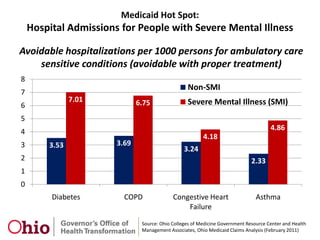
Medicaid Hot Spot:Hospital Admissions for People with Severe Mental IllnessAvoidable hospitalizations per 1000 persons for ambulatory care sensitive conditions (avoidable with proper treatment)Source: Ohio Colleges of Medicine Government Resource Center and Health Management Associates, Ohio Medicaid Claims Analysis (February 2011)
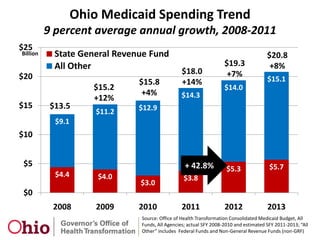
Ohio Medicaid Spending Trend9 percent average annual growth, 2008-2011$20.8+8%Billion$19.3+7%$18.0+14%$15.8+4%$15.2+12%$13.5+ 42.8%Source: Office of Health Transformation Consolidated Medicaid Budget, All Funds, All Agencies; actual SFY 2008-2010 and estimated SFY 2011-2013; “All Other” includes  Federal Funds and Non-General Revenue Funds (non-GRF)
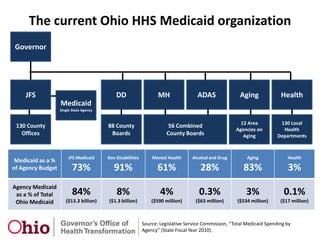
The current Ohio HHS Medicaid organizationGovernorHealthAgingADASMHDDJFSMedicaid Single State Agency56 CombinedCounty Boards130 County Offices88 County Boards12 Area Agencies on Aging130 Local Health DepartmentsSource: Legislative Service Commission, “Total Medicaid Spending by Agency” (State Fiscal Year 2010).
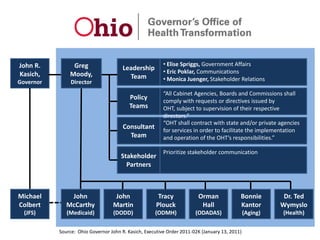
John R. Kasich, GovernorLeadership Team Elise Spriggs, Government Affairs
 Eric Poklar, Communications
 Monica Juenger, Stakeholder RelationsGreg Moody, DirectorPolicy Teams“All Cabinet Agencies, Boards and Commissions shall comply with requests or directives issued by OHT, subject to supervision of their respective directors.”Consultant Team“OHT shall contract with state and/or private agencies for services in order to facilitate the implementation and operation of the OHT’s responsibilities.”Stakeholder PartnersPrioritize stakeholder communicationDr. Ted Wymyslo(Health)Bonnie Kantor (Aging)OrmanHall(ODADAS)Tracy Plouck(ODMH)John Martin (DODD)Michael Colbert (JFS)John McCarthy (Medicaid)Source:  Ohio Governor John R. Kasich, Executive Order 2011-02K (January 13, 2011)
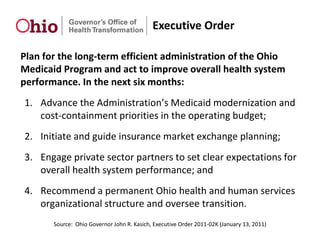
Executive Order	Plan for the long-term efficient administration of the Ohio Medicaid Program and act to improve overall health system performance. In the next six months:Advance the Administration’s Medicaid modernization and cost-containment priorities in the operating budget;Initiate and guide insurance market exchange planning;Engage private sector partners to set clear expectations for overall health system performance; andRecommend a permanent Ohio health and human services organizational structure and oversee transition.Source:  Ohio Governor John R. Kasich, Executive Order 2011-02K (January 13, 2011)
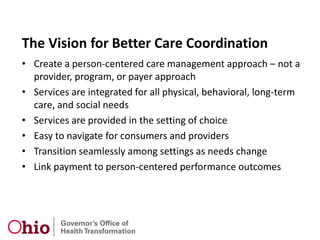
The Vision for Better Care CoordinationCreate a person-centered care management approach – not a provider, program, or payer approach
Services are integrated for all physical, behavioral, long-term care, and social needs
Services are provided in the setting of choice
Easy to navigate for consumers and providers
Transition seamlessly among settings as needs change
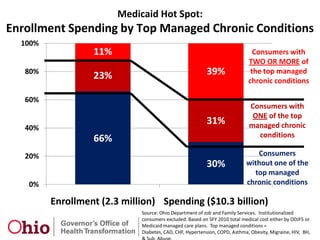
Link payment to person-centered performance outcomesMedicaid Hot Spot:Enrollment Spending by Top Managed Chronic ConditionsConsumers with TWO OR MORE of the top managed chronic conditionsConsumers with ONE of the top managed chronic conditionsConsumers without one of the top managed chronic conditionsSource: Ohio Department of Job and Family Services.  Institutionalized consumers excluded. Based on SFY 2010 total medical cost either by ODJFS or Medicaid managed care plans.  Top managed conditions = Diabetes, CAD, CHF, Hypertension, COPD, Asthma, Obesity, Migraine, HIV,  BH,  & Sub. Abuse.
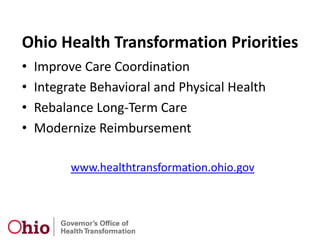
Ohio Health Transformation PrioritiesImprove Care Coordination Integrate Behavioral and Physical HealthRebalance Long-Term CareModernize Reimbursementwww.healthtransformation.ohio.gov
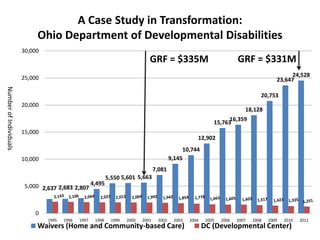
A Case Study in Transformation:Ohio Department of Developmental Disabilities
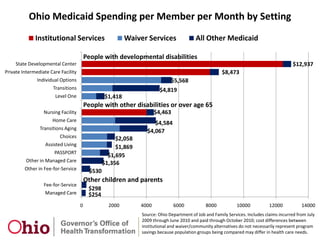
Ohio Medicaid Spending per Member per Month by SettingPeople with developmental disabilities$12,937$8,473$5,568$4,819$1,418People with other disabilities or over age 65$4,463$4,584$4,067$2,058$1,869$1,695$1,356$530Other children and parents$298$254Source: Ohio Department of Job and Family Services. Includes claims incurred from July 2009 through June 2010 and paid through October 2010; cost differences between institutional and waiver/community alternatives do not necessarily represent program savings because population groups being compared may differ in health care needs.
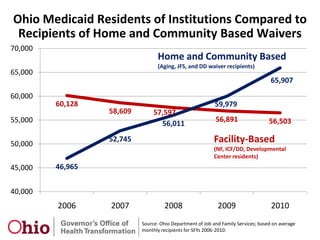
Ohio Medicaid Residents of Institutions Compared to Recipients of Home and Community Based WaiversHome and Community Based (Aging, JFS, and DD waiver recipients)Facility-Based(NF, ICF/DD, Developmental Center residents)Source: Ohio Department of Job and Family Services; based on average monthly recipients for SFYs 2006-2010.
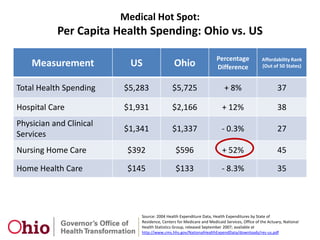
Medical Hot Spot:Per Capita Health Spending: Ohio vs. USSource: 2004 Health Expenditure Data, Health Expenditures by State of Residence, Centers for Medicare and Medicaid Services, Office of the Actuary, National Health Statistics Group, released September 2007; available at http://www.cms.hhs.gov/NationalHealthExpendData/downloads/res-us.pdf
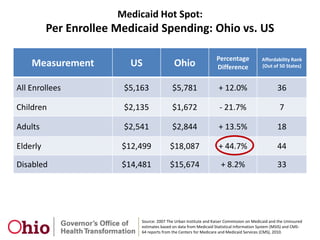
Medicaid Hot Spot:Per Enrollee Medicaid Spending: Ohio vs. USSource: 2007 The Urban Institute and Kaiser Commission on Medicaid and the Uninsured estimates based on data from Medicaid Statistical Information System (MSIS) and CMS-64 reports from the Centers for Medicare and Medicaid Services (CMS), 2010.
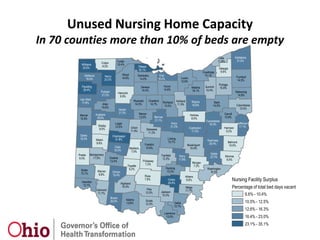
Unused Nursing Home CapacityIn 70 counties more than 10% of beds are emptyAshtabulaLake21.0%Lucas11.8%Fulton15.4%Williams9.2%Ottawa25.6%Geauga35.1%6.6%CuyahogaWood14.1%SanduskyErieDefianceHenryTrumbullLorain14.6%14.0%16.4%19.4%23.2%14.5%13.6%PortageHuronPauldingSummitSenecaMedina10.8%14.6%29.4%10.4%14.4%16.1%PutnamMahoningHancock21.2%14.8%9.9%Van WertWyandotCrawfordAshlandWayneStarkRichland17.8%Allen14.5%14.7%11.9%16.6%Columbiana14.5%13.5%15.6%12.0%Hardin21.3%MarionCarrollAuglaizeHolmesMercerMorrow13.0%13.8%18.6%8.0%15.9%21.1%TuscarawasKnoxJeffersonLogan16.3%Shelby21.2%17.1%12.5%UnionHarrisonCoshocton8.0%Delaware11.9%9.2%17.2%11.2%DarkeChampaignLicking18.5%31.8%MiamiGuernsey15.7%Belmont9.6%20.4%FranklinMuskingum10.0%Clark12.6%Madison10.4%16.5%7.0%NobleMontgomeryPrebleFairfieldPerryMonroe22.3%Greene11.5%9.5%12.3%17.8%8.5%Pickaway13.4%Morgan7.2%Fayette7.2%HockingWashington9.2%ButlerWarren13.3%Clinton10.5%15.1%9.8%19.4%RossAthens7.8%Vinton6.6%Hamilton25.4%Highland12.7%10.5%MeigsNursing Facility SurplusPikeClermont11.7%Jackson12.0%11.7%Percentage of total bed days vacant10.5%BrownAdamsScioto20.0%6.6% - 10.4%Gallia13.6%12.3%13.7%10.5% - 12.5%Lawrence12.6% - 16.3%13.5%16.4% - 23.0%23.1% - 35.1%
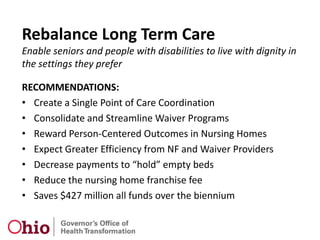
Rebalance Long Term CareEnable seniors and people with disabilities to live with dignity in the settings they preferRECOMMENDATIONS:Create a Single Point of Care Coordination
Consolidate and Streamline Waiver Programs
Reward Person-Centered Outcomes in Nursing Homes
Expect Greater Efficiency from NF and Waiver Providers
Decrease payments to “hold” empty beds
Reduce the nursing home franchise fee
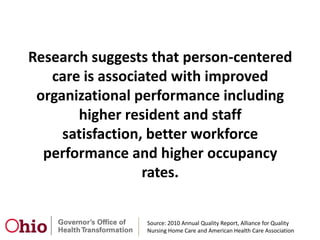
Saves $427 million all funds over the bienniumResearch suggests that person-centered care is associated with improved organizational performance including higher resident and staff satisfaction, better workforce performance and higher occupancy rates. Source: 2010 Annual Quality Report, Alliance for Quality Nursing Home Care and American Health Care Association
Ohio Health Transformation PrioritiesImprove Care Coordination Integrate Behavioral and Physical HealthRebalance Long-Term CareModernize Reimbursementwww.healthtransformation.ohio.gov
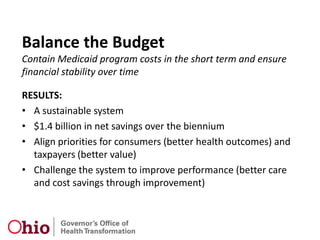
Balance the BudgetContain Medicaid program costs in the short term and ensure financial stability over timeRESULTS:A sustainable system
$1.4 billion in net savings over the biennium
Align priorities for consumers (better health outcomes) and taxpayers (better value)
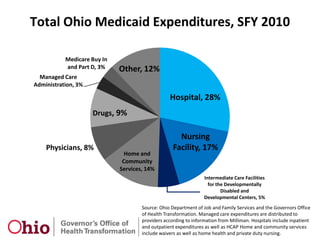
Challenge the system to improve performance (better care and cost savings through improvement)Total Ohio Medicaid Expenditures, SFY 2010Source: Ohio Department of Job and Family Services and the Governors Office of Health Transformation. Managed care expenditures are distributed to providers according to information from Milliman. Hospitals include inpatient and outpatient expenditures as well as HCAP Home and community services include waivers as well as home health and private duty nursing.
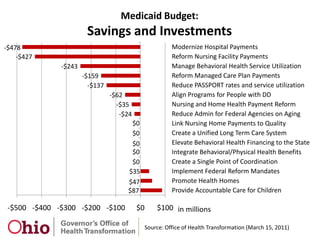
Medicaid Budget:Savings and Investmentsin millionsSource: Office of Health Transformation (March 15, 2011)
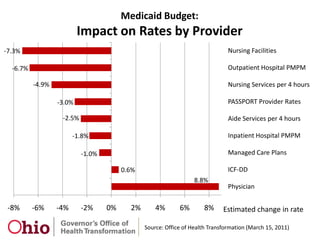
Medicaid Budget:Impact on Rates by ProviderEstimated change in rateSource: Office of Health Transformation (March 15, 2011)
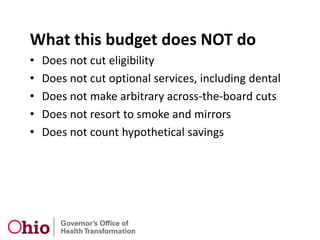
What this budget does NOT doDoes not cut eligibilityDoes not cut optional services, including dentalDoes not make arbitrary across-the-board cutsDoes not resort to smoke and mirrorsDoes not count hypothetical savings
Thank you.Élise Spriggs, Director of Government AffairsGovernor's Office of Health Transformation 77 South High Street, 30th Floor Columbus, Ohio 43215 Phone: 614-752-2784Email: elise.spriggs@governor.ohio.gov
The View From DCPresented by Jennifer Covich, Chief Executive Officer, eHealth Initiative
eHealth InitiativeSince 2001, only national, non-partisan group that represents all the stakeholders in health careeHI counts over 200 of the most influential organizations amongst its membersIn 2005, eHI launched Connecting Communities, coalition representing more than 250 HIE initiatives eHI advocates for the use of health IT that is practical, sustainable and addresses stakeholder needs, particularly those of patients.
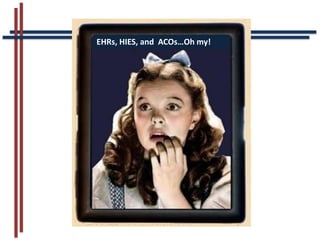
EHRs, HIES, and  ACOs…Oh my!
Agenda TodayCurrent State of the FieldElectronic Health RecordsHealth Information ExchangeWhat does the advent of Accountable Care Organizations (ACOs) mean?The Government’s Big Plan
Enactment of Two Laws87Stimulus Package-The American Recovery and Reinvestment Act (ARRA- 2009): $20B to support adoption of health IT.Health Care Reform-The Patient Protection and Affordable Care Act (PACCA) creates a national, voluntary shared savings program for accountable care organizations (ACOs), strengthens primary care (Medical Homes) and incentivizes care coordination
Trends in Health Care ReformPayers: Transfer risk to delivery system and consumersPay for performance & outcomes, not volumeProvides array of health services (information, DM, Case Management)“We are a health services company that happens to sell health insurance”ProvidersMedical Homes  ACOs HIT enabledWorkforce shortages, especially in primary care and ancillariesPatients/consumersGreater  financial stake and purchasing discretion Self-reliance: new consumer models emerging. Role of social networks88
EHR Adoption
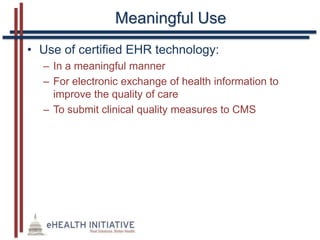
Meaningful UseUse of certified EHR technology:In a meaningful mannerFor electronic exchange of health information to improve the quality of care To submit clinical quality measures to CMS
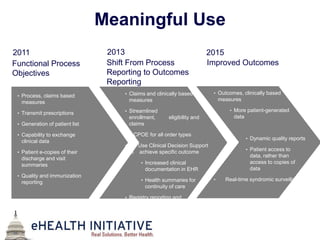
Meaningful Use201320112015Shift From Process Reporting to Outcomes ReportingImproved OutcomesFunctional Process ObjectivesOutcomes, clinically based  measures
More patient-generated       data
Dynamic quality reports
Patient access to data, rather than access to copies of data
     Real-time syndromic surveillance
Claims and clinically based measures
Streamlined enrollment,         eligibility and claims
   CPOE for all order types
      Use Clinical Decision Support to    achieve specific outcome
Increased clinical documentation in EHR
Health summaries for continuity of care
Registry reporting and            reporting to public health
Process, claims based measures
Transmit prescriptions
Generation of patient list
Capability to exchange clinical data
Patient e-copies of their discharge and visit summaries
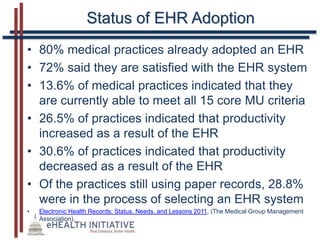
Quality and immunization reportingStatus of EHR Adoption80% medical practices already adopted an EHR 72% said they are satisfied with the EHR system13.6% of medical practices indicated that they are currently able to meet all 15 core MU criteria26.5% of practices indicated that productivity increased as a result of the EHR 30.6% of practices indicated that productivity decreased as a result of the EHR Of the practices still using paper records, 28.8% were in the process of selecting an EHR system Electronic Health Records: Status, Needs, and Lessons 2011, (The Medical Group Management Association).
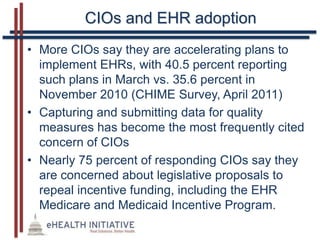
CIOs and EHR adoptionMore CIOs say they are accelerating plans to implement EHRs, with 40.5 percent reporting such plans in March vs. 35.6 percent in November 2010 (CHIME Survey, April 2011)Capturing and submitting data for quality measures has become the most frequently cited concern of CIOsNearly 75 percent of responding CIOs say they are concerned about legislative proposals to repeal incentive funding, including the EHR Medicare and Medicaid Incentive Program.
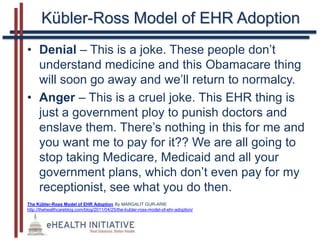
Kübler-Ross Model of EHR Adoption Denial – This is a joke. These people don’t understand medicine and this Obamacarething will soon go away and we’ll return to normalcy.Anger – This is a cruel joke. This EHR thing is just a government ploy to punish doctors and enslave them. There’s nothing in this for me and you want me to pay for it?? We are all going to stop taking Medicare, Medicaid and all your government plans, which don’t even pay for my receptionist, see what you do then.The Kübler-Ross Model of EHR AdoptionBy MARGALIT GUR-ARIE http://thehealthcareblog.com/blog/2011/04/25/the-kubler-ross-model-of-ehr-adoption/
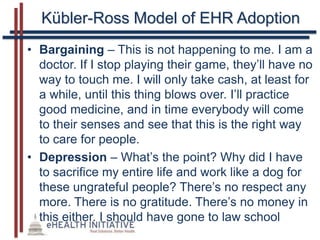
Kübler-Ross Model of EHR Adoption Bargaining – This is not happening to me. I am a doctor. If I stop playing their game, they’ll have no way to touch me. I will only take cash, at least for a while, until this thing blows over. I’ll practice good medicine, and in time everybody will come to their senses and see that this is the right way to care for people. Depression – What’s the point? Why did I have to sacrifice my entire life and work like a dog for these ungrateful people? There’s no respect any more. There is no gratitude. There’s no money in this either. I should have gone to law school
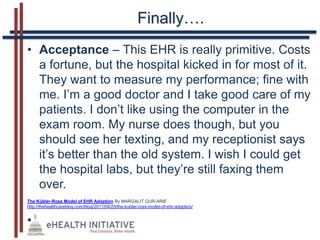
Finally….Acceptance – This EHR is really primitive. Costs a fortune, but the hospital kicked in for most of it. They want to measure my performance; fine with me. I’m a good doctor and I take good care of my patients. I don’t like using the computer in the exam room. My nurse does though, but you should see her texting, and my receptionist says it’s better than the old system. I wish I could get the hospital labs, but they’re still faxing them over.The Kübler-Ross Model of EHR AdoptionBy MARGALIT GUR-ARIE http://thehealthcareblog.com/blog/2011/04/25/the-kubler-ross-model-of-ehr-adoption/
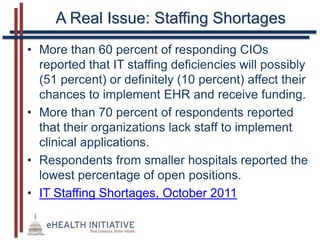
A Real Issue: Staffing ShortagesMore than 60 percent of responding CIOs reported that IT staffing deficiencies will possibly (51 percent) or definitely (10 percent) affect their chances to implement EHR and receive funding.More than 70 percent of respondents reported that their organizations lack staff to implement clinical applications.Respondents from smaller hospitals reported the lowest percentage of open positions. IT Staffing Shortages, October 2011
The National Landscape on HIE
eHI on HIESince 2004, eHealth Initiative (eHI) has tracked the progress of organizations and initiatives across the country working in this area.
Health information exchange is the act of transferring health information electronically between two or more entities.
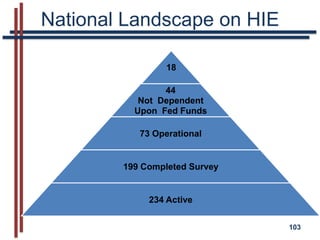
eHI has identified and collected information on 234 active health information exchange initiatives (HIEs) in the country.
eHI and its membership support HIEs through research, education and advocacy for HIEs. 99
100Why It Won’t Work	“That it will ever come into general use,  notwithstanding its value, is extremely doubtful because its beneficial application requires much time and gives a good bit of trouble, both to the patient and to the practitioner because its hue and character are foreign and opposed to all our habits and associations.”
101	“That it will ever come into general use,  notwithstanding its value, is extremely doubtful because its beneficial application requires much time and gives a good bit of trouble, both to the patient and to the practitioner because its hue and character are foreign and opposed to all our habits and associations.”from The London Times in 1834Commenting on ...the “stethoscope”
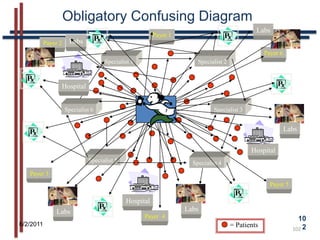
102Obligatory Confusing DiagramLabsPayer 1LabsPayer 2Payer 6Specialist 1Specialist 2HospitalSpecialist 6Specialist 3LabsHospitalSpecialist 5Specialist 4Payer 3Payer 5HospitalLabsLabsPayer  45/12/11= Patients102
103National Landscape on HIE
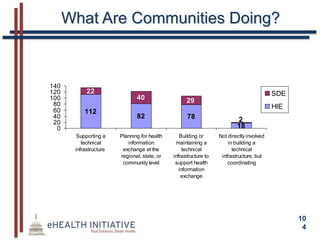
What Are Communities Doing?104
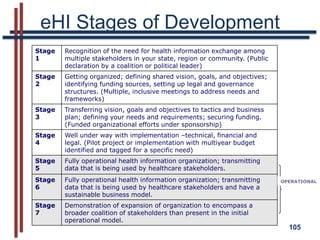
eHI Stages of Development OPERATIONAL105
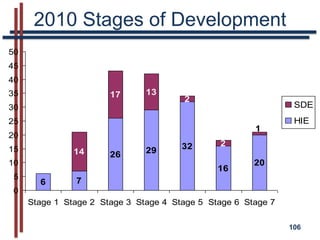
1062010 Stages of Development
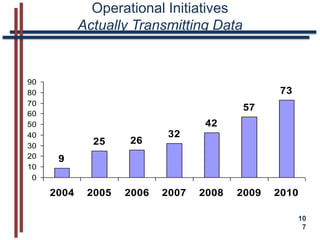
107Operational InitiativesActually Transmitting Data
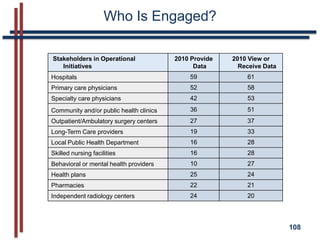
108Who Is Engaged?
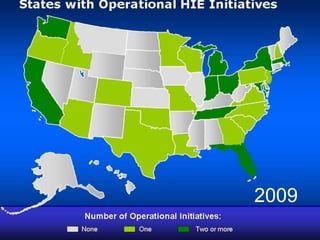
2009109
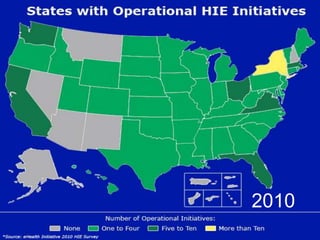
1102010
Why is this so hard?Public GoodDemonstrating Value and ROIContinuing to Offer Valuable Services
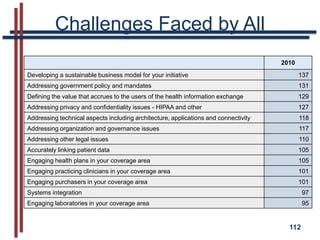
112Challenges Faced by All
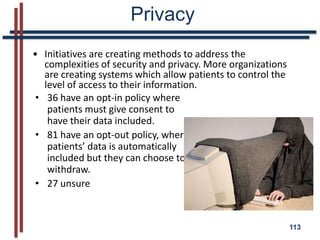
PrivacyInitiatives are creating methods to address the complexities of security and privacy. More organizations are creating systems which allow patients to control the level of access to their information.36 have an opt-in policy where patients must give consent to have their data included.  81 have an opt-out policy, where patients’ data is automatically included but they can choose to withdraw. 27 unsure113
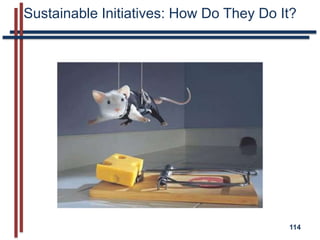
Sustainable Initiatives: How Do They Do It?114
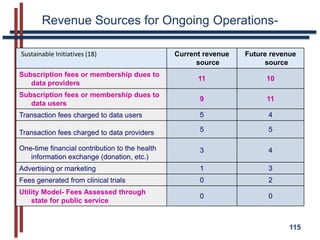
115Revenue Sources for Ongoing Operations-
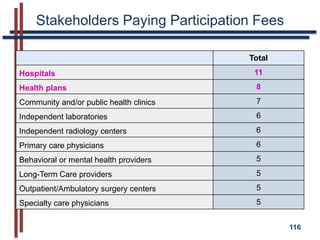
116Stakeholders Paying Participation Fees
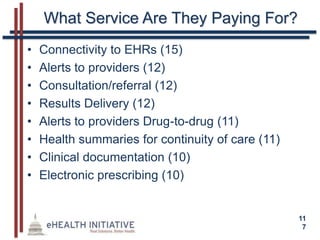
What Service Are They Paying For?Connectivity to EHRs (15)Alerts to providers (12)Consultation/referral (12)Results Delivery (12)Alerts to providers Drug-to-drug (11)Health summaries for continuity of care (11)Clinical documentation (10)Electronic prescribing (10)117
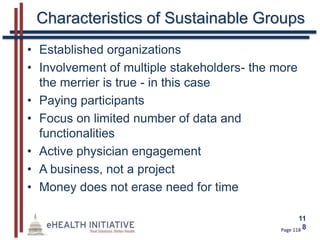
Characteristics of Sustainable GroupsEstablished organizationsInvolvement of multiple stakeholders- the more the merrier is true - in this casePaying participantsFocus on limited number of data and functionalitiesActive physician engagementA business, not a projectMoney does not erase need for time118Page 118
Value from HIE
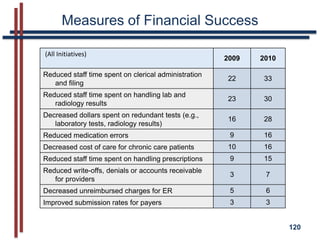
120Measures of Financial Success
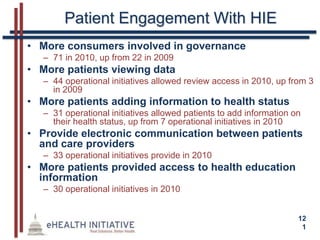
Patient Engagement With HIEMore consumers involved in governance71 in 2010, up from 22 in 2009More patients viewing data44 operational initiatives allowed review access in 2010, up from 3 in 2009More patients adding information to health status31 operational initiatives allowed patients to add information on their health status, up from 7 operational initiatives in 2010 Provide electronic communication between patients and care providers33 operational initiatives provide in 2010More patients provided access to health education information30 operational initiatives in 2010121
Accountable Care Organizations
Creation of ACOsNetworks of providers within Medicare system includes physicians, hospitals and health systems. Aim is to improve the quality of care, save money, with any savings to be shared by the government and the ACOsCenters for Medicare and Medicaid Services (CMS) released a proposed rule at the end of March, how the program will work, how much financial risk medical providers will face, and what type of data the organization need to collect.
General Thoughts on ACO RuleHIEs are essential for the success of ACOs Example: The underlying assumption is that ACO will access patient records from providers not participating in the ACO via HIECMS is increasing the demands for exchange of information among providers and individualsThis will support the demand for robust HIE CMS is offering flexibility the ACOs to determine the strategy for information exchange that best meets their needs
ACO NPRM Specific CommentsQuality measure reporting in the ACO NPRM should align with meaningful use quality measure reporting yet recognize that all measures in MU are not applicable to all providers participating in the ACO Retrospective Assignment of BeneficiariesBeneficiary assignment in ACOs that relies on retroactive claims data will require interoperable EHRs and standards that may not currently exist
CommentsMeaningful Use Requirement for PCPs:The 50 percent threshold requirement for certified EHR use among PCPs is high and could hinder participation in the ACO.The certified EHR use requirement is not extended beyond PCPs. Is this a challenge to care coordination with non-PCPs participating in the ACO, and providers offering care to the beneficiary outside of the ACO?
Concerns About ACO ProgramSome key groups reluctant to participate unless changes madeCollege of Healthcare Information Management Executives argues that allowing patients to limit access to their medical data could impede efforts to provide accountable care
The Government’s Plan
Federal Health IT Strategic Plan5 Goals, 15 Objectives, 50 Strategies for 2011 - 2015Achieve adoption and information exchange through meaningful use of Health ITImprove care and population health, and reduce health care costs through use of Health ITInspire confidence and trust in Health ITEmpower individuals with Health IT to improve their health and the health care systemAchieve rapid learning and technological achievement
eHI Comments on Federal HIT PlanThe Strategic Plan must be inclusive of healthcare settings and providersThe objectives and strategies should clearly articulate the expectation that HIT and HIE will support empowerment of individuals as participants in the healthcare systemThink expansively about the ability of HIE to support the Strategic Plan goalsThe Strategic Plan should support connectivity and exchange between the healthcare delivery system and the public health system
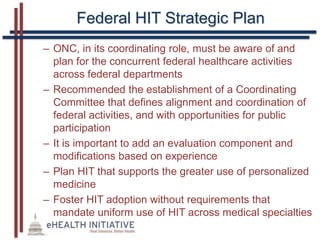
Federal HIT Strategic PlanONC, in its coordinating role, must be aware of and plan for the concurrent federal healthcare activities across federal departments Recommended the establishment of a Coordinating Committee that defines alignment and coordination of federal activities, and with opportunities for public participationIt is important to add an evaluation component and modifications based on experiencePlan HIT that supports the greater use of personalized medicine Foster HIT adoption without requirements that mandate uniform use of HIT across medical specialties
Big discrepancy in EHR adoption in small practices, rural communities, etc.Web-based solutionsDefining and sharing sustainable business models continues to be focusFocus is not on the Government funded SDEs, RECs, etc. for the experience factorSignificant gap with staffing and expertise in HIE—organizations with experience133Final Thoughts
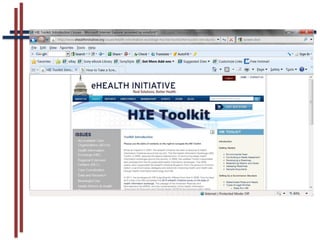
Where to Find More Info
135Contact Information Jennifer.Covich@ehealthinitiative.org135
Legal Challenges to PPACA and the Current Regulatory Environment Surrounding HIT and Meaningful Usepresented by Jeff Porter2011 Ohio Healthcare SummitMay 12, 2011
Meaningful Use
Update on Meaningful Use
In July of 2010, the Department of Health and Human Services released the proposed final rule for Stage 1 meaningful use of EHR.
Since that time, the HIT Policy Committee has been engaged in public hearings and soliciting testimony regarding the future stages of meaningful use.
Stage 2 recommendations are likely to be issued in the summer of 2011.
The HIT Policy Committee released proposed meaningful use objectives and measures for stages 2 and 3. The Committee received comments until February 25, 2011.
During the comment period, 422 organizations submitted comments regarding the proposed objectives and measures
Among the comments there was support for several new objectives:Electronic prescribing for discharge prescriptionsElectronic clinical progress notesPatient-provider secured messaging
There was less support for objectives such as:List of care team membersAdvanced directives for EPs
Many hospitals, Physicians and EHR vendors generally supported slowing down timeline for meaningful use.
You can find a copy of the HIT Policy Committee’s Proposed Objectives and Measures here:http://healthit.hhs.gov/portal/server.pt?open=512&objID=1269&parentname=CommunityPage&parentid=5&mode=2Or contact me at jporter@keglerbrown.com
Shared Savings Program or Accountable Care Organizations
Medicare Shared Savings Program or Accountable Care OrganizationsMedicare Shared Savings Program proposed regulations were released March 31, 2011 by:CMS, Centers for Medicare and Medicaid ServicesOffice of Inspector GeneralIRSFTCOfficial proposed regulations were in April 7 Federal Register
Comment Period on RegulationsComments due by May 31st (FTC/IRS) and June 6th (CMS/OIG) to various organizations involved.Program set to begin January 1, 2012 (maybe).Regulations were over 400 pages long.
General Facts Regarding Medicare Shared Savings ProgramProviders who are eligible to form ACOs:ACO professionals in group practice arrangementsHospitals employing ACO professionalsNetworks of individual practices of ACO professionalsCritical Access HospitalsPartnerships or joint venture arrangements between hospitals and ACO professionalsOther providers and suppliers may participate in ACOs.
General Facts Regarding ACO’sMust create a legal entity (e.g., corporation, partnership, LLC) that is recognized by the state, has a Tax Identification Number (TIN) for purposes of:Receiving and distributing funds;Repaying shared losses;Establishing, reporting, and ensuring ACO participant and ACO provider/supplier compliance with program requirements, including quality performance standards; andPerforming other functions as identified in statute.Must provide for a shared governance model that provides all participants with appropriate proportionate control over decision-making process.
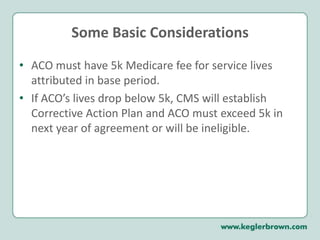
Some Basic ConsiderationsACO must have 5k Medicare fee for service lives attributed in base period.If ACO’s lives drop below 5k, CMS will establish Corrective Action Plan and ACO must exceed 5k in next year of agreement or will be ineligible.
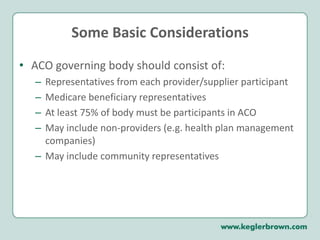
Some Basic ConsiderationsACO governing body should consist of:Representatives from each provider/supplier participantMedicare beneficiary representativesAt least 75% of body must be participants in ACOMay include non-providers (e.g. health plan management companies)May include community representatives
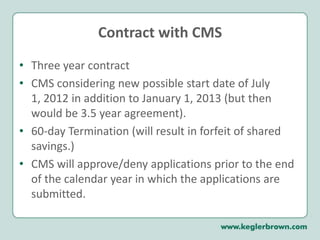
Contract with CMSThree year contractCMS considering new possible start date of July 1, 2012 in addition to January 1, 2013 (but then would be 3.5 year agreement).60-day Termination (will result in forfeit of shared savings.)CMS will approve/deny applications prior to the end of the calendar year in which the applications are submitted.
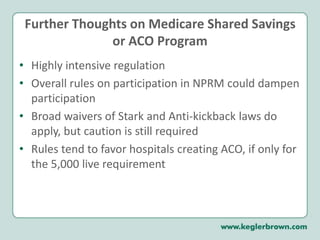
Further Thoughts on Medicare Shared Savings or ACO ProgramHighly intensive regulation Overall rules on participation in NPRM could dampen participationBroad waivers of Stark and Anti-kickback laws do apply, but caution is still requiredRules tend to favor hospitals creating ACO, if only for the 5,000 live requirement
Further Thoughts on Medicare Shared Savings or ACO ProgramTwo-sided savings/loss model poses some risks, especially considering that quality measures must be met to obtain shared savingsAdditional costs in running ACO need to be consideredNeed to have a compliance office on staff who reports to the board and is not legal counsel to ACOCMS expects that at least 50% of physicians in an ACO to achieve Stage 1 meaningful use
Thank You!Jeff PorterKegler Brown Director, Health Care Regulation & HIT Practice co-chairjporter@keglerbrown.com	(614) 462-541865 East State St., Suite 1800, Columbus OH 43215
Healthcare Regulation and the Implications for Healthcare Providerspresented by Ralph Breitfeller2011 Ohio Healthcare SummitMay 12, 2011
Stark: Self ReportingDifferent from reporting non-Stark issues to OIG.Voluntary Self-Referral Disclosure Protocol (SRDP) posted 9/23/10.Reduced penalties for self reporting of overpayment.Statute requires reporting by the later of: (1) within 60 days after overpayment identified; OR, (2) the date the cost report is due.SRPD allows additional time to investigate complicated issues.
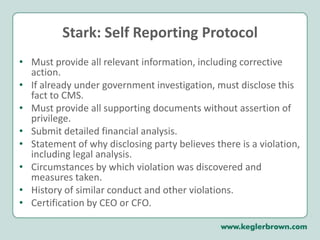
Stark: Self Reporting ProtocolMust provide all relevant information, including corrective action.If already under government investigation, must disclose this fact to CMS.Must provide all supporting documents without assertion of privilege.Submit detailed financial analysis.Statement of why disclosing party believes there is a violation, including legal analysis.Circumstances by which violation was discovered and measures taken.History of similar conduct and other violations.Certification by CEO or CFO.
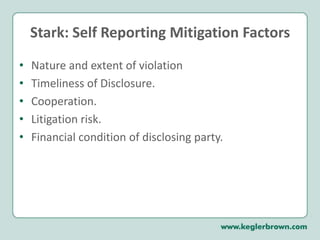
Stark: Self Reporting Mitigation FactorsNature and extent of violationTimeliness of Disclosure.Cooperation.Litigation risk.Financial condition of disclosing party.
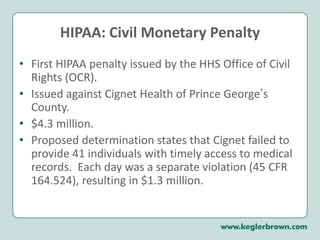
HIPAA: Civil Monetary PenaltyFirst HIPAA penalty issued by the HHS Office of Civil Rights (OCR).Issued against Cignet Health of Prince George’s County.$4.3 million.Proposed determination states that Cignet failed to provide 41 individuals with timely access to medical records.  Each day was a separate violation (45 CFR 164.524), resulting in $1.3 million.
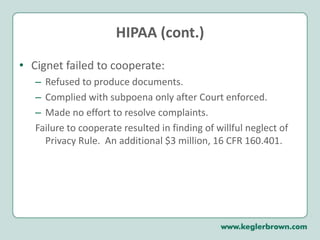
HIPAA (cont.)Cignet failed to cooperate:Refused to produce documents.Complied with subpoena only after Court enforced.Made no effort to resolve complaints.Failure to cooperate resulted in finding of willful neglect of Privacy Rule.  An additional $3 million, 16 CFR 160.401.

May 2011 Ohio Healthcare Summit Presentation

  • 2.
    Health Care Reform– An Overviewpresented by Kristy Britsch2011 Ohio Healthcare SummitMay 12, 2011
  • 3.
    GINATitle I ofGINA Prohibits discrimination in health coverage based on genetic information as well as the collection of such information in certain circumstances Prohibits group health plans and group health insurance issuers from:Increasing premiums or contribution amounts based on genetic informationRequiring an individual or family to undergo genetic testingRequesting or requiring genetic information prior to or in connection with enrollment for underwriting purposes
  • 4.
    GINATitle II finalregulations became effective January 10, 2011Prohibits an employer from using genetic information to make employment related decisions, from requesting or requiring genetic information, with limited exceptions, from retaliating against individuals based on genetic information and from disclosing genetic information
  • 5.
    GINAProvided certain requirementsare met, an employer will NOT be liable under Title II of GINA for acquiring genetic information if it is:Acquired inadvertently;Acquired as part of health or genetic services provided on a voluntary basis, including a voluntary wellness program;Family medical history acquired to comply with FMLA certification; Acquired through commercially or publicly available sources;Acquired by an employer that conducts DNA testing for law enforcement purposes (forensic lab, identification of human remains).
  • 6.
    Extended Effective DatesUnder PPACA Nondiscrimination Requirements Was effective for plan years on or after September 23, 2010 Effective date has been delayed until regulations are issuedComments on new rules are due by March 11, 2011A non-grandfathered fully-insured plan is prohibited from discriminating as to eligibility or benefits in favor of highly compensated employeesPenalties for Noncompliance$100 per individual per day for as long as violation continuesCompare to self-insured penalty, which is the loss of tax benefits for the HCE who benefited from the discrimination
  • 7.
    Extended Effective DatesUnder PPACA Employer W-2 Reporting (Delayed until 2012)Employers must calculate and report the aggregate cost of applicable employer sponsored health insurance coverage on the employee’s W-2
  • 8.
    Extended Effective DatesUnder PPACA60-day Notice for Material Modifications effective for plan years on or after March 23, 2012Clarified by DOL; originally believed to have been March 23, 2010However, until federal agencies provide standards on benefits and coverage explanations, employers are not required to comply with this requirement
  • 9.
    Extended Effective DatesUnder PPACAAutomatic EnrollmentEffective January 1, 2014, employers with 200 or more full-time employees offering health coverage must enroll new full-time employees with the opportunity to opt-out In a FAQ in December 2010, DOL indicated that until EBSA issues regulations, employers will not be required to comply with this rule
  • 10.
    PPACA Impact onALL Health Plans:September 23, 2010No rescission of coverage except for fraud or intentional misrepresentation of a material fact Elimination of lifetime limits for “essential health benefits” Elimination of pre-existing conditions for children under age 19This prohibition will be extended to ALL individuals effective January 1, 2014
  • 11.
    PPACA Impact onALL Health Plans:September 23, 2010Medicare Part D donut hole will be eliminatedRetiree Reinsurance Program Effective June 1, 2010Only available to early retirees defined as individuals between the ages of 55 and 64 who are not eligible for Medicare and who are not active employees of the employer who maintains the plan
  • 12.
    PPACA Impact onALL Health Plans:September 23, 2010Extend dependent coverage to age 26Coverage is required even if dependent is marriedCoverage must be provided even if dependent does not otherwise qualify as the employee’s dependent for tax purposes Children who were previously dropped because of age from dependent coverage will also be able to re-enrollRe-enrollment option only applies to plans that already offer dependent coverage
  • 13.
    PPACA Impact onALL Health Plans:September 23, 2010Extend dependent coverage to age 26 (continued)For non-grandfathered plans, coverage must be offered to dependent even if eligible to enroll in another employer group health plan Grandfathered plans need not offer coverage to adult children who are eligible to enroll in another employer group health plan until January 1, 2014Cost of employer-provided health coverage with respect to an adult child is tax-free until end of calendar year in which the child turns age 27Ohio dependent coverage is extended to age 28
  • 14.
    PPACA Impact onALL Health Plans:September 23, 2010Group health plans can only impose annual limits on the coverage for “essential health benefits” that exceed a restricted annual limit as determined by HHS
  • 15.
    $750,000 limit perindividual for plan year on or after September 23, 2010. Increases to $1,250,000 on or after September 23, 2011PPACA Impact on ALL Health Plans:September 23, 2010Effective June 23, 2010, establishment of high-risk pool for individuals to obtain coverage due to health status. Remains in effect until Exchanges are created in 2014
  • 16.
    PPACA Impact onALL Health Plans:September 23, 2010Nursing Mothers: Affects employers with 50 or more full-time (at least 30 hours per week) employees New provision added to the Fair Labor Standards Act (the “FLSA”)Employers covered by FLSA must provide “reasonable” breaks to mothers to express milk for their infants up to one (1) year oldEmployers must provide a private location, other than a restroom
  • 17.
    PPACA Impact onALL Health Plans:September 23, 2010Preventative Health Services and Cost-SharingEffective for plan years on or after September 23, 2010, a non-grandfathered plan may not impose cost-sharing requirements (such as co-pays, co-insurance, or deductibles) for certain preventative services
  • 18.
    PPACA Impact onALL Health Plans:September 23, 2010Preventative Health Services and Cost-Sharing (continued)Four types of preventative services will be covered at no charge to the individual, including:Screenings such as colon cancer tests, breast cancer screenings, screening of pregnant women for vitamin deficiencies, smoking cessation services, tests for diabetes, high cholesterol and high blood pressure tests Routine vaccines, including child immunizations and tetanus boosters Well-child visits, vision and hearing tests for children and weight counseling Preventative care for women (breast cancer screenings)
  • 19.
    PPACA Impact onALL Health Plans:September 23, 2010A non-grandfathered plan may not impose a pre-authorization requirement for a person seeking obstetrical or gynecological careA non-grandfathered plan that covers emergency department services:May not impose a pre-authorization requirementMust cover services regardless of whether the health care professional is a participating providerMay not impose greater coverage restrictions for non-participating provider services than are imposed for participating providersMay not impose greater cost-sharing requirements for out-of-network services than are imposed for in-network emergency room services
  • 20.
    PPACA Impact onALL Health Plans:September 23, 2010Choice of Primary Care ProviderA non-grandfathered plan that requires or provides for an individual’s designation of a health care provider as “primary,” must permit an individual to designate any participating primary care provider who is available to accept that individualPlan must permit the designation of a pediatric physician as the child’s primary care provider
  • 21.
    PPACA Impact onALL Health Plans:September 23, 2010Internal Claims and Appeals:
  • 22.
    Expanded definition of“adverse benefit determination”
  • 23.
    Notice of benefitdeterminations for urgent care claims must be provided within 24 hours of receipt of claim
  • 24.
  • 25.
    Upon review ofa claim denial, claimants must be allowed to review their file and present evidence/testimony. Plans/insurers must provide, free of charge, any new or additional evidence considered, relied upon or generated by the plan or insurer in connection with the claim, and a reasonable opportunity for claimant to respondPPACA Impact on ALL Health Plans:September 23, 2010Internal Claims and Appeals (continued):
  • 26.
    Notices regarding claimsand appeals must be provided in a culturally and linguistically appropriate manner
  • 27.
    Detailed notices ofadverse benefit determinations and the availability of internal and external appeals
  • 28.
    Coverage must beprovided pending outcome of an internal appeal
  • 29.
    Strict adherence tothe internal claims and appeals process is required (claimant will be deemed to have exhausted the internal claims and appeals process if plan/insurer fails to comply) PPACA Impact on ALL Health Plans:September 23, 2010External Review ProcessIf an individual’s internal claim is denied, the individual will have the right to appeal to an independent reviewer pursuant to the standards established by the National Association of Insurance Commissioners (“NAIC”) States should adopt the NAIC standards before July 1, 2011Self-funded plans must comply with claims and appeals process consistent with the federal external review procedures
  • 30.
    PPACA Impact onALL Health Plans:September 23, 2010Federal External Review Process: DOL Technical Release 2010-01 provides a safe-harbor and outlines the procedures for the federal external review process (standard and expedited external review)
  • 31.
    PPACA Impact onALL Health Plans:September 23, 2010Standard External Review ProcessRequests for external review must be allowed under the plan and a claimant must file the request within 4 months after notice of an adverse determination of final internal adverse determinationA preliminary review must be conducted by the plan within 5 days of receiving an external review requestWithin 1 day after completion of the preliminary review, the plan must issue notification in writing to the claimantPlan must assign an accredited Independent Review Organization (“IRO”) to conduct the external review. The IROs decision is binding except for other remedies available under state or federal law. IRO will review claim de novo (i.e., will not be bound by previous decision of plan sponsor). IRO will make final decision within 45 days.Upon receipt of notice of a final external review reversing an adverse benefit determination or final internal adverse benefit determination, the plan must immediately provide coverage or payment
  • 32.
    PPACA Impact onALL Health Plans:September 23, 2010Transparency in Coverage DisclosuresEffective for plan years on or after September 23, 2010, a non-grandfathered plan will be required to submit to the HHS information regarding the following:The plan’s claims payment policies and practices; Periodic financial disclosures;Data on enrollment; Data on disenrollment; Data on the number of claims that are denied; Data on rating practices; Information on cost-sharing and payments with respect to any out-of-network coverage; Information on enrollee and participant rights.
  • 33.
    PPACA Impact onALL Health Plans:September 23, 2010Uniform Explanation of Coverage (Mini-SPDs)Must be written in culturally and linguistically appropriate manner to explain health benefits under the plan Must include uniform set of definitions and medical terms and must describe cost-sharing requirements and plan term limits and exclusionsMust be provided to participants at time of enrollmentUniform Explanation of Coverage is in addition to the SPD Distribution deadline of 24 months after the enactment of healthcare reform (i.e., March 23, 2012)HHS is to issue guidance addressing the Mini-SPDs by March 23, 2011
  • 34.
    PPACA Impact onALL Health Plans:January 1, 2011HSAs, FSAs, HRAs: Expenses for over-the-counter medications will no longer be eligible for reimbursementHSAs, FSAs, HRAs: Eligible medical expense = prescription or insulinPlans must be amended by June 30, 2011Simple Cafeteria Plans: Effective for tax years after December 31, 2010, small employers may adopt a new type of cafeteria plan
  • 35.
    PPACA Impact onALL Health Plans:January 1, 2013Medicare Payroll Tax IncreaseIncrease in Medicare Part A tax from 1.45% to 2.35% applicable to single individuals earning more than $200,000 and married individuals earning more than $250,000Small Business Tax CreditEligible employers (less than 25 full-time employees) will get a tax credit equal to a portion of its health insurance premiums Phase I: 2010 – 2013: May claim a credit of up to 35% of health insurance premiums for each tax year if employer contributes at least 50% of total premium costPhase II: After 2013: May claim tax credit of up to 50% of employer’s contribution toward employees’ premiums if employer contributes at least 50% of total premium
  • 36.
    PPACA Impact onALL Health Plans:January 1, 2013FSAs: Salary reduction contributions to a health FSA are limited to $2,500 per yearContributions to dependent care FSAs remain at $5,000 per year
  • 37.
    PPACA Impact onALL Health Plans:January 1, 2014Elimination of pre-existing conditions for all individualsNo annual limits on dollar value of coverage on essential health benefitsGrandfathered plans that offer dependent coverage must offer coverage to adult children until age 26 regardless of whether or not the child is eligible to enroll in another employer health plan
  • 38.
    PPACA Impact onALL Health Plans:January 1, 2014Waiting PeriodsCannot impose coverage waiting period that exceeds 90 daysOut-of-Pocket LimitsEffective January 1, 2014, a non-grandfathered group health plan cannot impose a total cost sharing for a year that exceeds the out-of-pocket limits that are applicable to high-deductible health plansCurrently, these limits are $5,950 for individual coverage and $11,900 for family coverage
  • 39.
    PPACA Impact onALL Health Plans:January 1, 2014Mandate to Provide Health InsuranceEmployers with 50 or more full-time employees are required to offer health coverage or pay a penaltyPenalty for failure to provide coverage is $2,000 per full-time employee (applicable if at least one full-time employee receives insurance on the Exchange) Penalty for failure to provide affordable coverage is $3,000 for each employee enrolled in Exchange coveragePart-time employees are included and calculated as full-time employees
  • 40.
    PPACA Impact onALL Health Plans:January 1, 2014Health Insurance Exchanges
  • 41.
    States must establish“Health Insurance Exchanges” to offer qualified health benefit plans
  • 42.
    Exchanges are initiallylimited to individual markets and to employers with 100 employees or less
  • 43.
    Effective January 1,2017, States may allow employers with over 100 employees to access coverage through Exchanges
  • 44.
    Individuals must purchaseinsurance for the minimum essential health coverage or pay penalty of the greater of $95, or up to 1% of income (penalty will increase each year)PPACA Impact on ALL Health Plans:January 1, 2014Vouchers: Employers must provide free choice vouchers for lower income employees who qualify for an affordability exemptionEmployers who offer minimum essential coverage and who pay a portion of coverage must also provide “qualified employees” with a voucher that can be applied to the purchase of insurance through an ExchangeVoucher must equal the amount the employer would have paid to provide coverage for the employee under its group health plan
  • 45.
    PPACA Impact onALL Health Plans:January 1, 2014Vouchers (continued): A “Qualified Employee” is an individual:who does not participate in the employer’s group health plan; whose required contribution for the employer sponsored minimum essential coverage exceeds 8% (but is less than 9.8%) of his/her household income;whose household income does not exceed 400% of the poverty level
  • 46.
    PPACA Impact onALL Health Plans:January 1, 2018Excise tax on Cadillac Plans Insurers (employer if self-insured) will pay 40% excise tax on high value Cadillac Plans with values exceeding $10,200 limit for individual coverage and $27,500 for family coverage
  • 47.
    PPACA Impact onNon-Profit HospitalsIf a non-profit hospital fails to meet any of the following requirements, its tax-exempt status under Code Section 501(c)(3) will be revokedCommunity health needs assessment requirements; Financial assistance policy requirements;Limitations on charges requirements;Billing and collection requirements.
  • 48.
    Grandfathered Plans UnderPPACA A “grandfathered plan” is any group health plan or health insurance coverage in effect as of March 23, 2010Grandfathered plans are not required to comply with all of the requirements under PPACATo maintain grandfathered status, a plan must include a statement in any plan materials to be provided to participants that describes plan benefits and must include a statement
  • 49.
    Grandfathered Plans UnderPPACA (continued)Plan sponsors must retain all plan documents in effect on March 23, 2010 to prove terms of plan at this timeA grandfathered plan will lose its exemption from some of PPACA’s requirements if a plan significantly reduces benefits or increases employee premium contributions by more than 5% points
  • 50.
    How to LoseGrandfathered Status Elimination of benefits (elimination of all or substantially all benefits to diagnose/treat a particular condition);Increase in co-insurance (i.e., increase in cost-sharing);Increase in co-payment (increase in a co-payment for any service by more than the greater of (a) $5.00 or (b) medical inflation plus 15%);Increase in deductible or out-of-pocket maximum;Decrease in employer contribution rate;(….continued)
  • 51.
    How to LoseGrandfathered Status Changes to annual limits;Issuance of new (not renewed) insurance policy;Transfer of employees (transfer of employees to another plan);Change of insurer (Effective Nov. 15, 2010, was removed as an event to lose grandfathered status);Merger, acquisition, restructuring anti-abuse rules (if principal purpose of merger, acquisition, or restructuring is to cover new individuals under a Grandfathered Plan, the plan will lose grandfathered status)
  • 52.
    Grandfathered Plans Thefollowing WILLNOT cause a loss of grandfathered status:Change in plan premiums;Adjustments to employer contributions, premiums, co-payments and deductibles;Adding new benefits; Changes required to comply with state/federal law;Changes to comply voluntary with the Healthcare Reform law;Change in self-insured plans’ TPA;Renewal of a previous policy, certificate, or contract of insurance;Decrease in employee contribution rate. Change of insurer (Effective November 15, 2010)
  • 53.
    Constitutional Challenges toPPACA 26 States have challenged the constitutionality of PPACAAlabama, Alaska, Arizona, Colorado, Florida, Georgia, Indiana, Idaho, Iowa, Kansas, Louisiana, Maine, Michigan, Mississippi, Nebraska, Nevada, North Dakota, Ohio, Pennsylvania, Virginia, South Carolina, South Dakota, Texas, Utah, Washington, Wisconsin and Wyoming 2 Federal Judges have upheld law under Commerce Clause (Western District of Virginia and Michigan) 2 Federal Judges have ruled PPACA unconstitutional (Florida and Virginia)
  • 54.
    Constitutional Challenges toPPACAPrincipal Challenge to PPACA is the Commerce ClauseStates challenging PPACA argue that the Commerce Clause does not give Congress the authority to mandate that every American buy health insurance or pay a fee/penaltyOther Challenges are Spending Clause and Taxing PowerRelated to Medicaid program; PPACA greatly expands eligibility rules under Medicaid and imposes unprecedented costs and burdens on states, and this exceeds Congress’s authority under the Spending Clause Tax Issues: Penalty imposed for noncompliance with PPACA’s individual mandate is unconstitutional as an improperly apportioned direct tax
  • 55.
    Constitutional Challenges toPPACAFederal District Judge, Judge Vinson, in Florida ruled on February 1, 2010, that the individual mandate and the entirety of PPACA was unconstitutionalFederal government cannot regulate inactivity through the Commerce Clause and refusing to buy health insurance is inactivityThe individual mandate is so thoroughly interwoven into PPACA as a whole that the FL court could not sever that provision and rule only to its constitutionality
  • 56.
    Constitutional Challenges toPPACAFirst time a federal court has ruled the entirety of PPACA to violate the Constitution Federal government has already filed its appeal from the Florida ruling by Judge Vinson with the Court of Appeals for the 11th CircuitOral arguments begin in June
  • 57.
    Constitutional Challenges toPPACAThe matter will eventually reach the U.S. Supreme CourtNot sure when, but before 2012 elections? There has been no injunction against the implementation of PPACA so nothing practical has changed for employers, insurers and individualsRemains to be seen whether states will put the brakes on the implementation of PPACA, particularly on states’ preparation for the creation of Exchanges
  • 58.
    Thank You!Kristy N.BritschKegler Brown Associatekbritsch@keglerbrown.com (614) 462-541265 East State St., Suite 1800, Columbus OH 43215
  • 59.
    2011 Ohio HealthcareSummitState of Healthcare Reform in OhioThursday, May 12, 2011Élise SpriggsDirector of Government Affairs
  • 60.
    Medicaid is Ohio’sLargest Health PayerProvides health coverage for low-income children, parents, seniors, and people with disabilities
  • 61.
    Covers 2.2 millionOhioans (1 in 5) including 2 in 5 births1
  • 62.
    Spends $18+ billionannually all agencies, all funds (SFY 2011) 1
  • 63.
    Accounts for 4.0%of Ohio’s total economy and is growing2
  • 64.
    Funds are federal(63.69%) and state (36.31%)3SOURCES: (1) Ohio Department of Job and Family Services, (2) SFY 2011 estimate based on $18.0 billion in Medicaid spending per ODJFS and $498 billion Ohio gross domestic product per the State of Ohio Office of Budget and Management, and (3) Federal Register Vol. 76 No. 22 page 5811.
  • 65.
    Ohioans Covered byEmployer-Sponsored Health Insurance, Medicaid, or UninsuredEmployer-Sponsored InsuranceUninsuredMedicaidSource: Ohio Colleges of Medicine Government Resource Center, “Quantifying the Impact of the Recent Recession on Ohioans: preliminary findings from the 2010 Ohio Family Health Survey” (February 16, 2011)
  • 66.
    Federal Health CareReform:Government Coverage ExpansionsPrivate Insurance$89,400 for a family of 4400%Health Benefit ExchangeFederal Poverty Level$30,843 for a family of 4138%Medicaid ExpansionMedicaidMedicaid ExpansionMedicaid ExpansionSource: X
  • 67.
    Ohio’s Health SystemPerformanceHealth Outcomes – 42nd overall142nd in preventing infant mortality (only 8 states have higher mortality)37th in preventing childhood obesity44th in breast cancer deaths and 38th in colorectal cancer deathsPrevention, Primary Care, and Care Coordination137th in preventing avoidable deaths before age 7544th in avoiding Medicare hospital admissions for preventable conditions40th in avoiding Medicare hospital readmissionsAffordability of Health Services237th most affordable (Ohio spends more per person than all but 13 states)38thmost affordable for hospital care and 45thfor nursing homes44thmost affordable Medicaid for seniorsSources: (1) Commonwealth Fund 2009 State Scorecard on Health System Performance, (2) Kaiser Family Foundation State Health Facts (updated March 2011)
  • 68.
    A few high-costcases account for most Medicaid spending3%1% of the Medicaid population consumes 23% of total Medicaid spending4% of the Medicaid population consumes 51% of total spendingSource: Ohio Department of Job and Family Services; SFY 2010 for all Medicaid populations and all medical (not administrative) costs
  • 69.
    SOURCE: Adapted fromMelanie Bella, State Innovative Programs for Dual Eligibles, NASMD (November 2009)
  • 70.
    “The critical flawin our health care system … is that it was never designed for the kind of patients who incur the highest costs. Medicine’s primary mechanism of service is the doctor visit and the emergency room visit. It’s like arriving at a major construction project with nothing but a screwdriver and a crane.”Source: The New Yorker (Jan 24, 2011).
  • 71.
    Medical Hot Spot:EmergencyDepartment Utilization: Ohio vs. USHospital Emergency Room Visits per 1,000 Population29%Source: American Hospital Association Annual Survey (March 2010) and population data from Annual Population Estimates, US Census Bureau: http://www.census.gov/popest/states/NST-ann-est.html.
  • 72.
    Medicaid Hot Spot:MedicaidEnrollees Who Get Care Primarily from Hospitals** Indicating a lack of primary care and/or care coordinationSource: Ohio Department of Job and Family Services for SFY 2010. Note that medical costs include those incurred by MCPs and paid by FFS, excluding institutionalized consumers and their costs. Consumers may have been in both FFS and MC delivery systems within SFY 2010. This analysis includes consumers costs in both systems.
  • 73.
    Medicaid Hot Spot:HospitalAdmissions for People with Severe Mental IllnessAvoidable hospitalizations per 1000 persons for ambulatory care sensitive conditions (avoidable with proper treatment)Source: Ohio Colleges of Medicine Government Resource Center and Health Management Associates, Ohio Medicaid Claims Analysis (February 2011)
  • 74.
    Ohio Medicaid SpendingTrend9 percent average annual growth, 2008-2011$20.8+8%Billion$19.3+7%$18.0+14%$15.8+4%$15.2+12%$13.5+ 42.8%Source: Office of Health Transformation Consolidated Medicaid Budget, All Funds, All Agencies; actual SFY 2008-2010 and estimated SFY 2011-2013; “All Other” includes Federal Funds and Non-General Revenue Funds (non-GRF)
  • 75.
    The current OhioHHS Medicaid organizationGovernorHealthAgingADASMHDDJFSMedicaid Single State Agency56 CombinedCounty Boards130 County Offices88 County Boards12 Area Agencies on Aging130 Local Health DepartmentsSource: Legislative Service Commission, “Total Medicaid Spending by Agency” (State Fiscal Year 2010).
  • 76.
    John R. Kasich,GovernorLeadership Team Elise Spriggs, Government Affairs
  • 77.
    Eric Poklar,Communications
  • 78.
    Monica Juenger,Stakeholder RelationsGreg Moody, DirectorPolicy Teams“All Cabinet Agencies, Boards and Commissions shall comply with requests or directives issued by OHT, subject to supervision of their respective directors.”Consultant Team“OHT shall contract with state and/or private agencies for services in order to facilitate the implementation and operation of the OHT’s responsibilities.”Stakeholder PartnersPrioritize stakeholder communicationDr. Ted Wymyslo(Health)Bonnie Kantor (Aging)OrmanHall(ODADAS)Tracy Plouck(ODMH)John Martin (DODD)Michael Colbert (JFS)John McCarthy (Medicaid)Source: Ohio Governor John R. Kasich, Executive Order 2011-02K (January 13, 2011)
  • 79.
    Executive Order Plan forthe long-term efficient administration of the Ohio Medicaid Program and act to improve overall health system performance. In the next six months:Advance the Administration’s Medicaid modernization and cost-containment priorities in the operating budget;Initiate and guide insurance market exchange planning;Engage private sector partners to set clear expectations for overall health system performance; andRecommend a permanent Ohio health and human services organizational structure and oversee transition.Source: Ohio Governor John R. Kasich, Executive Order 2011-02K (January 13, 2011)
  • 80.
    The Vision forBetter Care CoordinationCreate a person-centered care management approach – not a provider, program, or payer approach
  • 81.
    Services are integratedfor all physical, behavioral, long-term care, and social needs
  • 82.
    Services are providedin the setting of choice
  • 83.
    Easy to navigatefor consumers and providers
  • 84.
    Transition seamlessly amongsettings as needs change
  • 85.
    Link payment toperson-centered performance outcomesMedicaid Hot Spot:Enrollment Spending by Top Managed Chronic ConditionsConsumers with TWO OR MORE of the top managed chronic conditionsConsumers with ONE of the top managed chronic conditionsConsumers without one of the top managed chronic conditionsSource: Ohio Department of Job and Family Services. Institutionalized consumers excluded. Based on SFY 2010 total medical cost either by ODJFS or Medicaid managed care plans. Top managed conditions = Diabetes, CAD, CHF, Hypertension, COPD, Asthma, Obesity, Migraine, HIV, BH, & Sub. Abuse.
  • 86.
    Ohio Health TransformationPrioritiesImprove Care Coordination Integrate Behavioral and Physical HealthRebalance Long-Term CareModernize Reimbursementwww.healthtransformation.ohio.gov
  • 87.
    A Case Studyin Transformation:Ohio Department of Developmental Disabilities
  • 88.
    Ohio Medicaid Spendingper Member per Month by SettingPeople with developmental disabilities$12,937$8,473$5,568$4,819$1,418People with other disabilities or over age 65$4,463$4,584$4,067$2,058$1,869$1,695$1,356$530Other children and parents$298$254Source: Ohio Department of Job and Family Services. Includes claims incurred from July 2009 through June 2010 and paid through October 2010; cost differences between institutional and waiver/community alternatives do not necessarily represent program savings because population groups being compared may differ in health care needs.
  • 89.
    Ohio Medicaid Residentsof Institutions Compared to Recipients of Home and Community Based WaiversHome and Community Based (Aging, JFS, and DD waiver recipients)Facility-Based(NF, ICF/DD, Developmental Center residents)Source: Ohio Department of Job and Family Services; based on average monthly recipients for SFYs 2006-2010.
  • 90.
    Medical Hot Spot:PerCapita Health Spending: Ohio vs. USSource: 2004 Health Expenditure Data, Health Expenditures by State of Residence, Centers for Medicare and Medicaid Services, Office of the Actuary, National Health Statistics Group, released September 2007; available at http://www.cms.hhs.gov/NationalHealthExpendData/downloads/res-us.pdf
  • 91.
    Medicaid Hot Spot:PerEnrollee Medicaid Spending: Ohio vs. USSource: 2007 The Urban Institute and Kaiser Commission on Medicaid and the Uninsured estimates based on data from Medicaid Statistical Information System (MSIS) and CMS-64 reports from the Centers for Medicare and Medicaid Services (CMS), 2010.
  • 92.
    Unused Nursing HomeCapacityIn 70 counties more than 10% of beds are emptyAshtabulaLake21.0%Lucas11.8%Fulton15.4%Williams9.2%Ottawa25.6%Geauga35.1%6.6%CuyahogaWood14.1%SanduskyErieDefianceHenryTrumbullLorain14.6%14.0%16.4%19.4%23.2%14.5%13.6%PortageHuronPauldingSummitSenecaMedina10.8%14.6%29.4%10.4%14.4%16.1%PutnamMahoningHancock21.2%14.8%9.9%Van WertWyandotCrawfordAshlandWayneStarkRichland17.8%Allen14.5%14.7%11.9%16.6%Columbiana14.5%13.5%15.6%12.0%Hardin21.3%MarionCarrollAuglaizeHolmesMercerMorrow13.0%13.8%18.6%8.0%15.9%21.1%TuscarawasKnoxJeffersonLogan16.3%Shelby21.2%17.1%12.5%UnionHarrisonCoshocton8.0%Delaware11.9%9.2%17.2%11.2%DarkeChampaignLicking18.5%31.8%MiamiGuernsey15.7%Belmont9.6%20.4%FranklinMuskingum10.0%Clark12.6%Madison10.4%16.5%7.0%NobleMontgomeryPrebleFairfieldPerryMonroe22.3%Greene11.5%9.5%12.3%17.8%8.5%Pickaway13.4%Morgan7.2%Fayette7.2%HockingWashington9.2%ButlerWarren13.3%Clinton10.5%15.1%9.8%19.4%RossAthens7.8%Vinton6.6%Hamilton25.4%Highland12.7%10.5%MeigsNursing Facility SurplusPikeClermont11.7%Jackson12.0%11.7%Percentage of total bed days vacant10.5%BrownAdamsScioto20.0%6.6% - 10.4%Gallia13.6%12.3%13.7%10.5% - 12.5%Lawrence12.6% - 16.3%13.5%16.4% - 23.0%23.1% - 35.1%
  • 93.
    Rebalance Long TermCareEnable seniors and people with disabilities to live with dignity in the settings they preferRECOMMENDATIONS:Create a Single Point of Care Coordination
  • 94.
  • 95.
  • 96.
    Expect Greater Efficiencyfrom NF and Waiver Providers
  • 97.
    Decrease payments to“hold” empty beds
  • 98.
    Reduce the nursinghome franchise fee
  • 99.
    Saves $427 millionall funds over the bienniumResearch suggests that person-centered care is associated with improved organizational performance including higher resident and staff satisfaction, better workforce performance and higher occupancy rates. Source: 2010 Annual Quality Report, Alliance for Quality Nursing Home Care and American Health Care Association
  • 100.
    Ohio Health TransformationPrioritiesImprove Care Coordination Integrate Behavioral and Physical HealthRebalance Long-Term CareModernize Reimbursementwww.healthtransformation.ohio.gov
  • 101.
    Balance the BudgetContainMedicaid program costs in the short term and ensure financial stability over timeRESULTS:A sustainable system
  • 102.
    $1.4 billion innet savings over the biennium
  • 103.
    Align priorities forconsumers (better health outcomes) and taxpayers (better value)
  • 104.
    Challenge the systemto improve performance (better care and cost savings through improvement)Total Ohio Medicaid Expenditures, SFY 2010Source: Ohio Department of Job and Family Services and the Governors Office of Health Transformation. Managed care expenditures are distributed to providers according to information from Milliman. Hospitals include inpatient and outpatient expenditures as well as HCAP Home and community services include waivers as well as home health and private duty nursing.
  • 105.
    Medicaid Budget:Savings andInvestmentsin millionsSource: Office of Health Transformation (March 15, 2011)
  • 106.
    Medicaid Budget:Impact onRates by ProviderEstimated change in rateSource: Office of Health Transformation (March 15, 2011)
  • 107.
    What this budgetdoes NOT doDoes not cut eligibilityDoes not cut optional services, including dentalDoes not make arbitrary across-the-board cutsDoes not resort to smoke and mirrorsDoes not count hypothetical savings
  • 108.
    Thank you.Élise Spriggs,Director of Government AffairsGovernor's Office of Health Transformation 77 South High Street, 30th Floor Columbus, Ohio 43215 Phone: 614-752-2784Email: elise.spriggs@governor.ohio.gov
  • 109.
    The View FromDCPresented by Jennifer Covich, Chief Executive Officer, eHealth Initiative
  • 110.
    eHealth InitiativeSince 2001,only national, non-partisan group that represents all the stakeholders in health careeHI counts over 200 of the most influential organizations amongst its membersIn 2005, eHI launched Connecting Communities, coalition representing more than 250 HIE initiatives eHI advocates for the use of health IT that is practical, sustainable and addresses stakeholder needs, particularly those of patients.
  • 111.
    EHRs, HIES, and ACOs…Oh my!
  • 112.
    Agenda TodayCurrent Stateof the FieldElectronic Health RecordsHealth Information ExchangeWhat does the advent of Accountable Care Organizations (ACOs) mean?The Government’s Big Plan
  • 113.
    Enactment of TwoLaws87Stimulus Package-The American Recovery and Reinvestment Act (ARRA- 2009): $20B to support adoption of health IT.Health Care Reform-The Patient Protection and Affordable Care Act (PACCA) creates a national, voluntary shared savings program for accountable care organizations (ACOs), strengthens primary care (Medical Homes) and incentivizes care coordination
  • 114.
    Trends in HealthCare ReformPayers: Transfer risk to delivery system and consumersPay for performance & outcomes, not volumeProvides array of health services (information, DM, Case Management)“We are a health services company that happens to sell health insurance”ProvidersMedical Homes  ACOs HIT enabledWorkforce shortages, especially in primary care and ancillariesPatients/consumersGreater financial stake and purchasing discretion Self-reliance: new consumer models emerging. Role of social networks88
  • 115.
  • 116.
    Meaningful UseUse ofcertified EHR technology:In a meaningful mannerFor electronic exchange of health information to improve the quality of care To submit clinical quality measures to CMS
  • 117.
    Meaningful Use201320112015Shift FromProcess Reporting to Outcomes ReportingImproved OutcomesFunctional Process ObjectivesOutcomes, clinically based measures
  • 118.
  • 119.
  • 120.
    Patient access todata, rather than access to copies of data
  • 121.
    Real-time syndromic surveillance
  • 122.
    Claims and clinicallybased measures
  • 123.
    Streamlined enrollment, eligibility and claims
  • 124.
    CPOE for all order types
  • 125.
    Use Clinical Decision Support to achieve specific outcome
  • 126.
  • 127.
    Health summaries forcontinuity of care
  • 128.
    Registry reporting and reporting to public health
  • 129.
  • 130.
  • 131.
  • 132.
  • 133.
    Patient e-copies oftheir discharge and visit summaries
  • 134.
    Quality and immunizationreportingStatus of EHR Adoption80% medical practices already adopted an EHR 72% said they are satisfied with the EHR system13.6% of medical practices indicated that they are currently able to meet all 15 core MU criteria26.5% of practices indicated that productivity increased as a result of the EHR 30.6% of practices indicated that productivity decreased as a result of the EHR Of the practices still using paper records, 28.8% were in the process of selecting an EHR system Electronic Health Records: Status, Needs, and Lessons 2011, (The Medical Group Management Association).
  • 135.
    CIOs and EHRadoptionMore CIOs say they are accelerating plans to implement EHRs, with 40.5 percent reporting such plans in March vs. 35.6 percent in November 2010 (CHIME Survey, April 2011)Capturing and submitting data for quality measures has become the most frequently cited concern of CIOsNearly 75 percent of responding CIOs say they are concerned about legislative proposals to repeal incentive funding, including the EHR Medicare and Medicaid Incentive Program.
  • 136.
    Kübler-Ross Model ofEHR Adoption Denial – This is a joke. These people don’t understand medicine and this Obamacarething will soon go away and we’ll return to normalcy.Anger – This is a cruel joke. This EHR thing is just a government ploy to punish doctors and enslave them. There’s nothing in this for me and you want me to pay for it?? We are all going to stop taking Medicare, Medicaid and all your government plans, which don’t even pay for my receptionist, see what you do then.The Kübler-Ross Model of EHR AdoptionBy MARGALIT GUR-ARIE http://thehealthcareblog.com/blog/2011/04/25/the-kubler-ross-model-of-ehr-adoption/
  • 137.
    Kübler-Ross Model ofEHR Adoption Bargaining – This is not happening to me. I am a doctor. If I stop playing their game, they’ll have no way to touch me. I will only take cash, at least for a while, until this thing blows over. I’ll practice good medicine, and in time everybody will come to their senses and see that this is the right way to care for people. Depression – What’s the point? Why did I have to sacrifice my entire life and work like a dog for these ungrateful people? There’s no respect any more. There is no gratitude. There’s no money in this either. I should have gone to law school
  • 138.
    Finally….Acceptance – ThisEHR is really primitive. Costs a fortune, but the hospital kicked in for most of it. They want to measure my performance; fine with me. I’m a good doctor and I take good care of my patients. I don’t like using the computer in the exam room. My nurse does though, but you should see her texting, and my receptionist says it’s better than the old system. I wish I could get the hospital labs, but they’re still faxing them over.The Kübler-Ross Model of EHR AdoptionBy MARGALIT GUR-ARIE http://thehealthcareblog.com/blog/2011/04/25/the-kubler-ross-model-of-ehr-adoption/
  • 139.
    A Real Issue:Staffing ShortagesMore than 60 percent of responding CIOs reported that IT staffing deficiencies will possibly (51 percent) or definitely (10 percent) affect their chances to implement EHR and receive funding.More than 70 percent of respondents reported that their organizations lack staff to implement clinical applications.Respondents from smaller hospitals reported the lowest percentage of open positions. IT Staffing Shortages, October 2011
  • 140.
  • 141.
    eHI on HIESince2004, eHealth Initiative (eHI) has tracked the progress of organizations and initiatives across the country working in this area.
  • 142.
    Health information exchangeis the act of transferring health information electronically between two or more entities.
  • 143.
    eHI has identifiedand collected information on 234 active health information exchange initiatives (HIEs) in the country.
  • 144.
    eHI and itsmembership support HIEs through research, education and advocacy for HIEs. 99
  • 145.
    100Why It Won’tWork “That it will ever come into general use, notwithstanding its value, is extremely doubtful because its beneficial application requires much time and gives a good bit of trouble, both to the patient and to the practitioner because its hue and character are foreign and opposed to all our habits and associations.”
  • 146.
    101 “That it willever come into general use, notwithstanding its value, is extremely doubtful because its beneficial application requires much time and gives a good bit of trouble, both to the patient and to the practitioner because its hue and character are foreign and opposed to all our habits and associations.”from The London Times in 1834Commenting on ...the “stethoscope”
  • 147.
    102Obligatory Confusing DiagramLabsPayer1LabsPayer 2Payer 6Specialist 1Specialist 2HospitalSpecialist 6Specialist 3LabsHospitalSpecialist 5Specialist 4Payer 3Payer 5HospitalLabsLabsPayer 45/12/11= Patients102
  • 148.
  • 149.
  • 150.
    eHI Stages ofDevelopment OPERATIONAL105
  • 151.
  • 152.
  • 153.
  • 154.
  • 155.
  • 156.
    Why is thisso hard?Public GoodDemonstrating Value and ROIContinuing to Offer Valuable Services
  • 157.
  • 158.
    PrivacyInitiatives are creatingmethods to address the complexities of security and privacy. More organizations are creating systems which allow patients to control the level of access to their information.36 have an opt-in policy where patients must give consent to have their data included. 81 have an opt-out policy, where patients’ data is automatically included but they can choose to withdraw. 27 unsure113
  • 159.
  • 160.
    115Revenue Sources forOngoing Operations-
  • 161.
  • 162.
    What Service AreThey Paying For?Connectivity to EHRs (15)Alerts to providers (12)Consultation/referral (12)Results Delivery (12)Alerts to providers Drug-to-drug (11)Health summaries for continuity of care (11)Clinical documentation (10)Electronic prescribing (10)117
  • 163.
    Characteristics of SustainableGroupsEstablished organizationsInvolvement of multiple stakeholders- the more the merrier is true - in this casePaying participantsFocus on limited number of data and functionalitiesActive physician engagementA business, not a projectMoney does not erase need for time118Page 118
  • 164.
  • 165.
  • 166.
    Patient Engagement WithHIEMore consumers involved in governance71 in 2010, up from 22 in 2009More patients viewing data44 operational initiatives allowed review access in 2010, up from 3 in 2009More patients adding information to health status31 operational initiatives allowed patients to add information on their health status, up from 7 operational initiatives in 2010 Provide electronic communication between patients and care providers33 operational initiatives provide in 2010More patients provided access to health education information30 operational initiatives in 2010121
  • 168.
  • 169.
    Creation of ACOsNetworksof providers within Medicare system includes physicians, hospitals and health systems. Aim is to improve the quality of care, save money, with any savings to be shared by the government and the ACOsCenters for Medicare and Medicaid Services (CMS) released a proposed rule at the end of March, how the program will work, how much financial risk medical providers will face, and what type of data the organization need to collect.
  • 170.
    General Thoughts onACO RuleHIEs are essential for the success of ACOs Example: The underlying assumption is that ACO will access patient records from providers not participating in the ACO via HIECMS is increasing the demands for exchange of information among providers and individualsThis will support the demand for robust HIE CMS is offering flexibility the ACOs to determine the strategy for information exchange that best meets their needs
  • 171.
    ACO NPRM SpecificCommentsQuality measure reporting in the ACO NPRM should align with meaningful use quality measure reporting yet recognize that all measures in MU are not applicable to all providers participating in the ACO Retrospective Assignment of BeneficiariesBeneficiary assignment in ACOs that relies on retroactive claims data will require interoperable EHRs and standards that may not currently exist
  • 172.
    CommentsMeaningful Use Requirementfor PCPs:The 50 percent threshold requirement for certified EHR use among PCPs is high and could hinder participation in the ACO.The certified EHR use requirement is not extended beyond PCPs. Is this a challenge to care coordination with non-PCPs participating in the ACO, and providers offering care to the beneficiary outside of the ACO?
  • 173.
    Concerns About ACOProgramSome key groups reluctant to participate unless changes madeCollege of Healthcare Information Management Executives argues that allowing patients to limit access to their medical data could impede efforts to provide accountable care
  • 174.
  • 175.
    Federal Health ITStrategic Plan5 Goals, 15 Objectives, 50 Strategies for 2011 - 2015Achieve adoption and information exchange through meaningful use of Health ITImprove care and population health, and reduce health care costs through use of Health ITInspire confidence and trust in Health ITEmpower individuals with Health IT to improve their health and the health care systemAchieve rapid learning and technological achievement
  • 176.
    eHI Comments onFederal HIT PlanThe Strategic Plan must be inclusive of healthcare settings and providersThe objectives and strategies should clearly articulate the expectation that HIT and HIE will support empowerment of individuals as participants in the healthcare systemThink expansively about the ability of HIE to support the Strategic Plan goalsThe Strategic Plan should support connectivity and exchange between the healthcare delivery system and the public health system
  • 177.
    Federal HIT StrategicPlanONC, in its coordinating role, must be aware of and plan for the concurrent federal healthcare activities across federal departments Recommended the establishment of a Coordinating Committee that defines alignment and coordination of federal activities, and with opportunities for public participationIt is important to add an evaluation component and modifications based on experiencePlan HIT that supports the greater use of personalized medicine Foster HIT adoption without requirements that mandate uniform use of HIT across medical specialties
  • 178.
    Big discrepancy inEHR adoption in small practices, rural communities, etc.Web-based solutionsDefining and sharing sustainable business models continues to be focusFocus is not on the Government funded SDEs, RECs, etc. for the experience factorSignificant gap with staffing and expertise in HIE—organizations with experience133Final Thoughts
  • 179.
    Where to FindMore Info
  • 180.
  • 182.
    Legal Challenges toPPACA and the Current Regulatory Environment Surrounding HIT and Meaningful Usepresented by Jeff Porter2011 Ohio Healthcare SummitMay 12, 2011
  • 188.
  • 189.
  • 190.
    In July of2010, the Department of Health and Human Services released the proposed final rule for Stage 1 meaningful use of EHR.
  • 191.
    Since that time,the HIT Policy Committee has been engaged in public hearings and soliciting testimony regarding the future stages of meaningful use.
  • 192.
    Stage 2 recommendationsare likely to be issued in the summer of 2011.
  • 193.
    The HIT PolicyCommittee released proposed meaningful use objectives and measures for stages 2 and 3. The Committee received comments until February 25, 2011.
  • 194.
    During the commentperiod, 422 organizations submitted comments regarding the proposed objectives and measures
  • 195.
    Among the commentsthere was support for several new objectives:Electronic prescribing for discharge prescriptionsElectronic clinical progress notesPatient-provider secured messaging
  • 196.
    There was lesssupport for objectives such as:List of care team membersAdvanced directives for EPs
  • 197.
    Many hospitals, Physiciansand EHR vendors generally supported slowing down timeline for meaningful use.
  • 198.
    You can finda copy of the HIT Policy Committee’s Proposed Objectives and Measures here:http://healthit.hhs.gov/portal/server.pt?open=512&objID=1269&parentname=CommunityPage&parentid=5&mode=2Or contact me at jporter@keglerbrown.com
  • 199.
    Shared Savings Programor Accountable Care Organizations
  • 200.
    Medicare Shared SavingsProgram or Accountable Care OrganizationsMedicare Shared Savings Program proposed regulations were released March 31, 2011 by:CMS, Centers for Medicare and Medicaid ServicesOffice of Inspector GeneralIRSFTCOfficial proposed regulations were in April 7 Federal Register
  • 201.
    Comment Period onRegulationsComments due by May 31st (FTC/IRS) and June 6th (CMS/OIG) to various organizations involved.Program set to begin January 1, 2012 (maybe).Regulations were over 400 pages long.
  • 202.
    General Facts RegardingMedicare Shared Savings ProgramProviders who are eligible to form ACOs:ACO professionals in group practice arrangementsHospitals employing ACO professionalsNetworks of individual practices of ACO professionalsCritical Access HospitalsPartnerships or joint venture arrangements between hospitals and ACO professionalsOther providers and suppliers may participate in ACOs.
  • 203.
    General Facts RegardingACO’sMust create a legal entity (e.g., corporation, partnership, LLC) that is recognized by the state, has a Tax Identification Number (TIN) for purposes of:Receiving and distributing funds;Repaying shared losses;Establishing, reporting, and ensuring ACO participant and ACO provider/supplier compliance with program requirements, including quality performance standards; andPerforming other functions as identified in statute.Must provide for a shared governance model that provides all participants with appropriate proportionate control over decision-making process.
  • 204.
    Some Basic ConsiderationsACOmust have 5k Medicare fee for service lives attributed in base period.If ACO’s lives drop below 5k, CMS will establish Corrective Action Plan and ACO must exceed 5k in next year of agreement or will be ineligible.
  • 205.
    Some Basic ConsiderationsACOgoverning body should consist of:Representatives from each provider/supplier participantMedicare beneficiary representativesAt least 75% of body must be participants in ACOMay include non-providers (e.g. health plan management companies)May include community representatives
  • 206.
    Contract with CMSThreeyear contractCMS considering new possible start date of July 1, 2012 in addition to January 1, 2013 (but then would be 3.5 year agreement).60-day Termination (will result in forfeit of shared savings.)CMS will approve/deny applications prior to the end of the calendar year in which the applications are submitted.
  • 207.
    Further Thoughts onMedicare Shared Savings or ACO ProgramHighly intensive regulation Overall rules on participation in NPRM could dampen participationBroad waivers of Stark and Anti-kickback laws do apply, but caution is still requiredRules tend to favor hospitals creating ACO, if only for the 5,000 live requirement
  • 208.
    Further Thoughts onMedicare Shared Savings or ACO ProgramTwo-sided savings/loss model poses some risks, especially considering that quality measures must be met to obtain shared savingsAdditional costs in running ACO need to be consideredNeed to have a compliance office on staff who reports to the board and is not legal counsel to ACOCMS expects that at least 50% of physicians in an ACO to achieve Stage 1 meaningful use
  • 209.
    Thank You!Jeff PorterKeglerBrown Director, Health Care Regulation & HIT Practice co-chairjporter@keglerbrown.com (614) 462-541865 East State St., Suite 1800, Columbus OH 43215
  • 210.
    Healthcare Regulation andthe Implications for Healthcare Providerspresented by Ralph Breitfeller2011 Ohio Healthcare SummitMay 12, 2011
  • 211.
    Stark: Self ReportingDifferentfrom reporting non-Stark issues to OIG.Voluntary Self-Referral Disclosure Protocol (SRDP) posted 9/23/10.Reduced penalties for self reporting of overpayment.Statute requires reporting by the later of: (1) within 60 days after overpayment identified; OR, (2) the date the cost report is due.SRPD allows additional time to investigate complicated issues.
  • 212.
    Stark: Self ReportingProtocolMust provide all relevant information, including corrective action.If already under government investigation, must disclose this fact to CMS.Must provide all supporting documents without assertion of privilege.Submit detailed financial analysis.Statement of why disclosing party believes there is a violation, including legal analysis.Circumstances by which violation was discovered and measures taken.History of similar conduct and other violations.Certification by CEO or CFO.
  • 213.
    Stark: Self ReportingMitigation FactorsNature and extent of violationTimeliness of Disclosure.Cooperation.Litigation risk.Financial condition of disclosing party.
  • 214.
    HIPAA: Civil MonetaryPenaltyFirst HIPAA penalty issued by the HHS Office of Civil Rights (OCR).Issued against Cignet Health of Prince George’s County.$4.3 million.Proposed determination states that Cignet failed to provide 41 individuals with timely access to medical records. Each day was a separate violation (45 CFR 164.524), resulting in $1.3 million.
  • 215.
    HIPAA (cont.)Cignet failedto cooperate:Refused to produce documents.Complied with subpoena only after Court enforced.Made no effort to resolve complaints.Failure to cooperate resulted in finding of willful neglect of Privacy Rule. An additional $3 million, 16 CFR 160.401.

Editor's Notes

  • #56 This is not new, but it is always surprising – 5% of us consumes about half of total health care spendingIf you can improve the value of care for that complicated, high-cost group – both in terms of improving quality and controlling costs – then you can start to have a real impact on health system performance overallBoth of these ideas – integrated not fragmented care, and focusing first on high-risk populations – are themes in national reform
  • #57 Here is one of two ideas I hope stick with you after today: a fragmented health care system is expensive and dangerousOur system today is very fragmented, very expensive, and very dangerousIt is organized around providers, not patients, and it rewards volume not valueBut you can imagine transforming the current system over time into something that is more integrated and focused on patient needs, where: providers work together, reimbursement rewards value, not volume information is available to improve care, and the focus is on getting the right care in the right place at the right timeBut where do we begin?Here is the second idea: we need to focus first on the complicated cases that have the most to gain from integrated care
  • #64 Governor Kasich created this organizational structure through executive order.OHT reports to the Governor – I will be working closely with Governor Kasich and his Policy Director, Wayne Stuble.We have a core team to provide leadership across agencies: I will focus on policy Elise Spriggs is our Director of Government Affairs Eric Poklar is our Director of Communications and Monica Juenger is our Director of Stakeholder RelationsOur role is to support and align work in your departments. We do not want to disrupt the processes that are working well, or distract talent from the task at hand – but we do want to take issues that for whatever reason have been stuck in the mud and move them forward. We want to make decisions.It’s a challenge – but I have no fear, mainly because of the team of excellent directors Governor Kasich recruited into the health and human services cluster.I want to introduce you to them now: Tracy Plouck, ODMH, and John Martin, DODD, who you know Bonnie Kantor, ODA, Orman Hall, ODADAS, and Dr. Ted Wymyslo, DOH (2/15) and John McCarthy, Medicaid director, who I will ask to say a few words in a minute.
  • #66 John McCarthy
  • #68 Greg – overview of topics
  • #69 John Martin – DODD success story
  • #75 GREG
  • #76 Aging-BKB - keep
  • #77 Greg – overview of topics
  • #78 Greg
  • #80 Dr. Wymyslo
  • #81 Dr. Wymyslo
  • #82 Greg – Team Introduction
  • #88 Enactment of two laws
  • #89 External Context:
  • #93 38.4% of practices indicated that operating costs increased as a result of the EHR 25.9% of practices indicated that operating costs decreased as a result of the EHR
  • #126 eHI approach to the ACO NPRM:Comments focused on areas where EHRs, HIT and HIE are specifically referencesAddition comments on areas where EHRs, HIT and HIE are not specifically referenced but we determine a nexus to our interest in driving improvement in the quality, safety and efficiency of healthcare through information and technology
  • #129 Cleveland Clinic, the Mayo Clinic, Intermountain Healthcare or the Geisinger Health System—are the models for the Obama administration's accountable care organization (ACO) proposalinstitutions that were the inspiration for the program are reluctant to participate unless big changes