MAXILLARY SINUS
[EXAMINATION ,RADIOGRAPHIC
INVESTIGATION AND PATHOLOIES ]
PRESENTED BY –ZAREESH .S.AKHTAR
1 MDS IN ORAL MEDICINE AND RADIOLOGY
Contents
• Examination
• Radiographic investigation
• Pathologies of maxillary sinus
EXAMINATION OF THE SINUS
Extraoral Examination
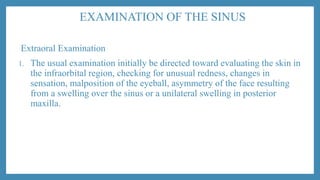
1. The usual examination initially be directed toward evaluating the skin in
the infraorbital region, checking for unusual redness, changes in
sensation, malposition of the eyeball, asymmetry of the face resulting
from a swelling over the sinus or a unilateral swelling in posterior
maxilla.
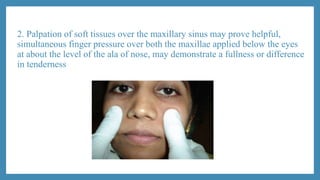
2. Palpation of soft tissues over the maxillary sinus may prove helpful,
simultaneous finger pressure over both the maxillae applied below the eyes
at about the level of the ala of nose, may demonstrate a fullness or difference
in tenderness
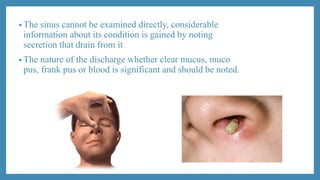
• The sinus cannot be examined directly, considerable
information about its condition is gained by noting
secretion that drain from it
• The nature of the discharge whether clear mucus, muco
pus, frank pus or blood is significant and should be noted.
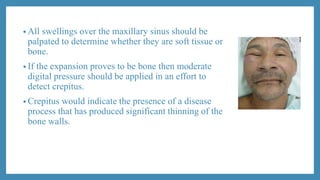
• All swellings over the maxillary sinus should be
palpated to determine whether they are soft tissue or
bone.
• If the expansion proves to be bone then moderate
digital pressure should be applied in an effort to
detect crepitus.
• Crepitus would indicate the presence of a disease
process that has produced significant thinning of the
bone walls.
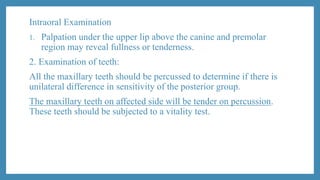
Intraoral Examination
1. Palpation under the upper lip above the canine and premolar
region may reveal fullness or tenderness.
2. Examination of teeth:
All the maxillary teeth should be percussed to determine if there is
unilateral difference in sensitivity of the posterior group.
The maxillary teeth on affected side will be tender on percussion.
These teeth should be subjected to a vitality test.
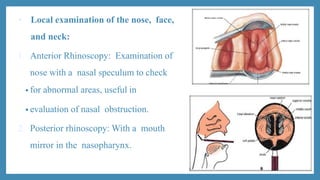
• Local examination of the nose, face,
and neck:
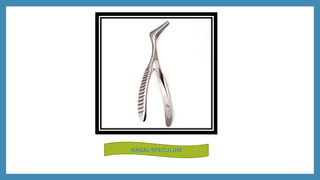
1. Anterior Rhinoscopy: Examination of
nose with a nasal speculum to check
• for abnormal areas, useful in
• evaluation of nasal obstruction.
2. Posterior rhinoscopy: With a mouth
mirror in the nasopharynx.
NASAL SPECULUM
Transillumination of the Maxillary Sinus
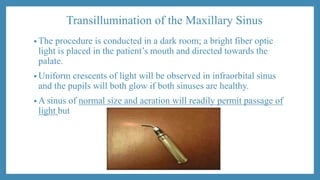
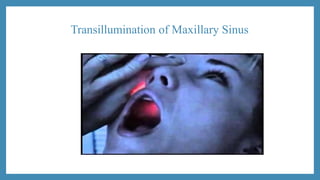
• The procedure is conducted in a dark room; a bright fiber optic
light is placed in the patient’s mouth and directed towards the
palate.
• Uniform crescents of light will be observed in infraorbital sinus
and the pupils will both glow if both sinuses are healthy.
• A sinus of normal size and aeration will readily permit passage of
light but
Transillumination of Maxillary Sinus
• If pathosis is present in the form of a soft tissue mass, calcified material, or
fluid such as pus or blood then the transmitted light will be duller or
opaque on the affected side.
• As serous cyst consists of thin fluid and cholesterol crystals, will permit
passage of light and will not be detected by transillumination.
• Transillumination normal = no sinusitis
• Transillumination absent = sinus filled with pus
• Transillumination dull = equivocal result
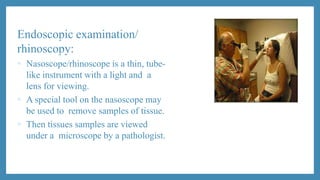
Endoscopic examination/
rhinoscopy:
 Nasoscope/rhinoscope is a thin, tube-
like instrument with a light and a
lens for viewing.
 A special tool on the nasoscope may
be used to remove samples of tissue.
 Then tissues samples are viewed
under a microscope by a pathologist.
RADIOGRAPHIC INVESTIGATION OF MAXILLARY
SINUS
Extraoral views
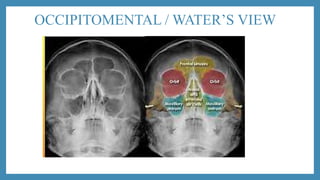
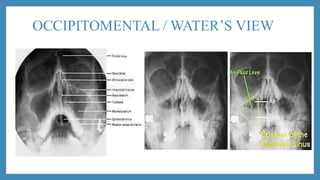
• Occipitomental / water’s view
• Lateral cephalometry [lateral
skull ]view
• Submentovertex view
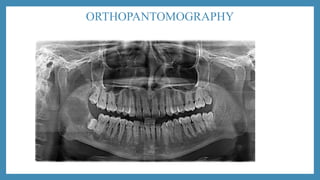
• Orthopantomography
• CT scan
• MRI
Intraoral view
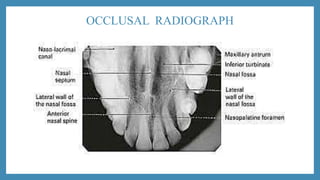
• Occlusal
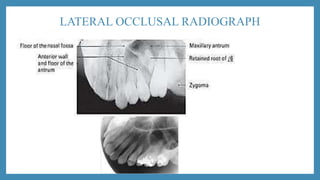
• Lateral occlusal
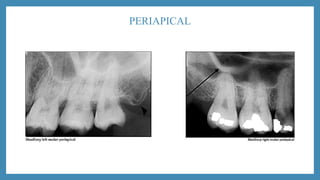
• Periapical
OCCLUSAL RADIOGRAPH
LATERAL OCCLUSAL RADIOGRAPH
PERIAPICAL
OCCIPITOMENTAL / WATER’S VIEW
LATERAL CEPHALOMETRY [LATERAL SKULL ]VIEW
ORTHOPANTOMOGRAPHY
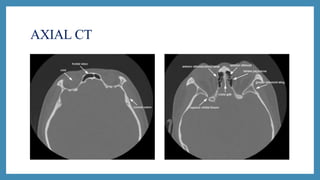
CT scan
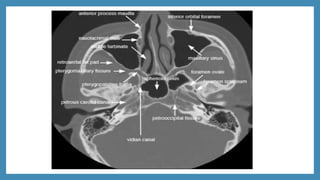
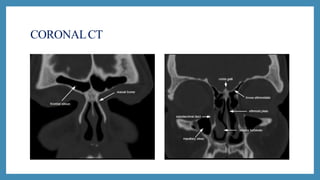
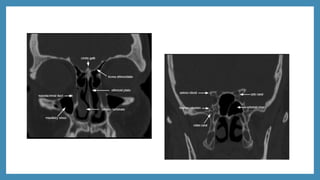
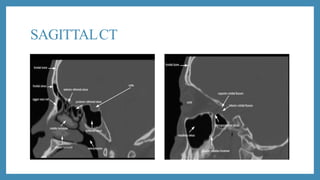
 CT scans: Excellent views of the sinuses, best for osteomeatal
complex and ethmoidal disease
 “Limited CT Evaluation” – slice 3-4 mm
 CT navigation:
 A computer is used to identify the 3- dimensional location of a
probe tip placed within the patient's nose or sinuses..
 Improves anatomical identification and avoid damage to vital
neighbouring structures such as the brain and eyes.
AXIAL CT
CORONALCT
SAGITTALCT
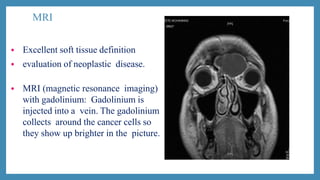
MRI
• Excellent soft tissue definition
• evaluation of neoplastic disease.
• MRI (magnetic resonance imaging)
with gadolinium: Gadolinium is
injected into a vein. The gadolinium
collects around the cancer cells so
they show up brighter in the picture.
COMMON DISEASES AFFECTING THE
MAXILLARY SINUS
• The pathologic conditions of the maxillary sinus may be conveniently
characterized as
1. Inflammatory
a. Acute sinusitis
b. Chronic sinusitis
c. Osteomyelitis
2. Cysts
a. Intrinsic
b. Extrinsic
3. Tumours
a. Odontogenic
b. Nonodontogenic
4. Trauma
a. Fractures
b. Foreign bodies
5. Other local osseous pathoses.
6. Systemic diseases
MAXILLARY SINUSITIS
Classification Based On Duration
• Acute Sinusitis (Few Days To 3 Weeks)
• Subacute Sinusitis (3 Weeks To 3 Months)
• Chronic Sinusitis (Months To Years In Duration).
Acute Maxillary Sinusitis
• Clinical Findings
• a. Heaviness in the face
• b. Throbbing pain over the region of maxillary sinus that
aggravates on bending the head
• c. The pain is usually severe in the morning and evening
• d. Foul smelling discharge from the nose
• e. Nasal obstruction on the affected side
• f. Patient may have a productive cough in the night due to
collection of pus in the pharynx
• Examination will reveal tenderness over the region of the
maxillary sinus
• Patient may occasionally have anesthesia over the cheek
• Maxillary posterior teeth may be tender on percussion
Chronic Maxillary Sinusitis
Clinical Findings
• a. Heaviness over the forehead and maxillary sinus region
• b. Reduced sense of smell and foul breath
• c. Nasal congestion and obstruction
• d. Yellowish discharge
• e. Chronic cough
• f. Postnasal drip (which may cause sore throat)
• g. Facial tenderness or pressure
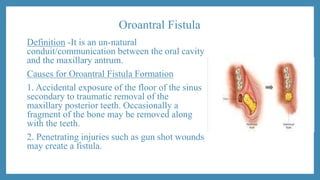
Oroantral Fistula
Definition -It is an un-natural
conduit/communication between the oral cavity
and the maxillary antrum.
Causes for Oroantral Fistula Formation
1. Accidental exposure of the floor of the sinus
secondary to traumatic removal of the
maxillary posterior teeth. Occasionally a
fragment of the bone may be removed along
with the teeth.
2. Penetrating injuries such as gun shot wounds
may create a fistula.
• 3. Malignant tumors: Maxillary sinus neoplasms may erode the bony
walls of the sinus. On occasions when the floor of the sinus is eroded the
neoplasm invades the oral cavity forming an oroantral communication.
• 4. Syphilitic gumma: palatal involvement in syphilis causes destruction
of the palatal bone thereby giving rise to a fistula.
• 5. In rare instances patients with maxillary implant denture prosthesis
may develop an oroantral fistula.
Signs and Symptoms
• 1. Regurgitation of the fluids from the mouth into the nose
• 2. Unilateral epistaxis
• 3. Change in vocal resonance
• 4. Inability to blow and hold air in the cheeks
• 5. Individuals with a smoking habit find it difficult to draw on a
cigarette
• 6. Unilateral foul smelling discharge
Identifying an Oroantral Communication
• 1. Large oroantral communications are readily evident on inspection.
• 2. The patient can be instructed to pinch his nostrils and gently blow down
the nose (keeping his/her mouth open). A whistling sound may be
appreciated as the air passes down the fistula.
• 3. Alternatively a thin strand of cotton can be placed under the suspected
fistula and inspected for any deviation caused by the air passing down the
oroantral communication.
• 4.The suspected fistulous tract should never be probed as unnecessary
probing may dislodge any wound seal and establish a frank
communication.
Management
• An oroantral fistula present for over 2 weeks should be
considered as a chronic oroantral communication and best
managed with surgical closure
Antrolith
• They are also called rhinoliths, antral stones or
antral calculi.
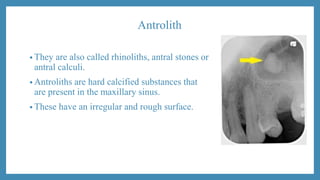
• Antroliths are hard calcified substances that
are present in the maxillary sinus.
• These have an irregular and rough surface.
Etiology
• Rhinoliths are formed as a result of mineral salt deposition
such as calcium carbonate, calcium phosphate and magnesium
over a foreign body, which acts as the nidus.
• The foreign body could either be endogenous such as blood
clot, piece of root or bone fragment or exogenous such as a
piece of paper or cotton wool.
Clinical Findings
• Antroliths are uncommon and are usually asymptomatic. They are
usually diagnosed as an incidental finding on routine radiography
• Antroliths may be rarely associated with acute or chronic sinusitis,
blood tinged nasal discharge and rarely facial pain.
Radiographic Findings
• Antroliths are seen radiographically as well defined radiopaque foci
generally having a smooth outline.
• Intraoral periapical radiographs can show rhinoliths situated close to
the floor of the antrum.
• Waters view and orthopantomographs can show the radiopaque
rhinoliths situated in the antral cavity
Management
• Antroliths can be removed surgically using the Caldwell- luc approach.
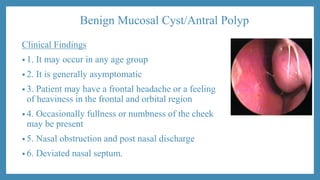
Benign Mucosal Cyst/Antral Polyp
Clinical Findings
• 1. It may occur in any age group
• 2. It is generally asymptomatic
• 3. Patient may have a frontal headache or a feeling
of heaviness in the frontal and orbital region
• 4. Occasionally fullness or numbness of the cheek
may be present
• 5. Nasal obstruction and post nasal discharge
• 6. Deviated nasal septum.
Radiographic Findings
• A rounded dome-shaped homogeneous radiopaque shadow
arising from the floor of the sinus.
• In some cases there may be more than one dome-shaped
radiopacity within the sinus.
• Very rarely the polyps can be seen arising from the lateral
walls of the sinus.
Malignant Diseases Affecting the Maxillary Sinus
• Occur twice as often in males than females
• Diagnosed in the 6th and 7th decade of life
• Majority of these tumors are squamous cell carcinoma
• Variety of other malignancies including sarcoma, adenoid cystic
carcinoma, burkitt’s lymphoma, melanoma and basal cell
carcinoma may occur.
Etiology
• The reasons for malignancy to occur in the maxillary sinus are
multifactorial.
• it is more commonly associated with snuff dipping habit
• History of exposure to the wood dust, nickel dust, isopropyl oil,
chromium, or dichlorodiethyl sulfide.
• These products are widely used in the furniture, leather and the textile
industries.
• In the initial stages the condition is asymptomatic. Patients occasionally
complain of pain, unilateral nasal obstruction and a purulent or
serosanguineous discharge.
• The clinical presentation of the malignancy depends on the direction of
extension and the region of involvement.
• 1. Involvement of the orbit
a. Patient may present with proptosis, diplopia, strabismus and amaurosis.
b. If the infra orbital nerve is damaged, patient can present with anaesthesia
of the cheek on the affected side.
• 2. Involvement of the lateral wall of the nose
a. Unilateral nasal obstruction
b. Epiphora secondary to blockage of nasolacrimal duct
c. Bleeding from the nose, purulent or serosanguineous nasal discharge
d. External facial swelling around the ala of the nose
e. Hemorrhagic and friable mass within the nostril
• 3. Involvement of the cheek
a. Facial swelling involving the cheek (resembles dentoalveolar abscess)
b. Paresthesia or anesthesia over course of the infra-orbital nerve.
• 4. Involvement of the infratemporal fossa
• a. Involvement of the sphenopalatine ganglion results in
anesthesia/paresthesia of the palate
• b. Involvement of the maxillary nerve produces numbness of the upper
part of the face and lip
• c. Involvement of the medial pterygoid muscle causes trismus
• 5. Involvement of the floor of the sinus
• a. Painful/painless swelling in the buccal sulcus in relation to the
maxillary premolars and molars.
• b. Occasionally when a freshly extracted tooth (maxillary
premolar/molar) socket is present, a proliferative mass of tissue may
be seen protruding from it.
• c. Tooth mobility in relation to the fungating mass.
Maxillary sinus part 2

Maxillary sinus part 2

  • 2.
    MAXILLARY SINUS [EXAMINATION ,RADIOGRAPHIC INVESTIGATIONAND PATHOLOIES ] PRESENTED BY –ZAREESH .S.AKHTAR 1 MDS IN ORAL MEDICINE AND RADIOLOGY
  • 3.
    Contents • Examination • Radiographicinvestigation • Pathologies of maxillary sinus
  • 4.
    EXAMINATION OF THESINUS Extraoral Examination 1. The usual examination initially be directed toward evaluating the skin in the infraorbital region, checking for unusual redness, changes in sensation, malposition of the eyeball, asymmetry of the face resulting from a swelling over the sinus or a unilateral swelling in posterior maxilla.
  • 5.
    2. Palpation ofsoft tissues over the maxillary sinus may prove helpful, simultaneous finger pressure over both the maxillae applied below the eyes at about the level of the ala of nose, may demonstrate a fullness or difference in tenderness
  • 6.
    • The sinuscannot be examined directly, considerable information about its condition is gained by noting secretion that drain from it • The nature of the discharge whether clear mucus, muco pus, frank pus or blood is significant and should be noted.
  • 7.
    • All swellingsover the maxillary sinus should be palpated to determine whether they are soft tissue or bone. • If the expansion proves to be bone then moderate digital pressure should be applied in an effort to detect crepitus. • Crepitus would indicate the presence of a disease process that has produced significant thinning of the bone walls.
  • 8.
    Intraoral Examination 1. Palpationunder the upper lip above the canine and premolar region may reveal fullness or tenderness. 2. Examination of teeth: All the maxillary teeth should be percussed to determine if there is unilateral difference in sensitivity of the posterior group. The maxillary teeth on affected side will be tender on percussion. These teeth should be subjected to a vitality test.
  • 9.
    • Local examinationof the nose, face, and neck: 1. Anterior Rhinoscopy: Examination of nose with a nasal speculum to check • for abnormal areas, useful in • evaluation of nasal obstruction. 2. Posterior rhinoscopy: With a mouth mirror in the nasopharynx.
  • 10.
  • 11.
    Transillumination of theMaxillary Sinus • The procedure is conducted in a dark room; a bright fiber optic light is placed in the patient’s mouth and directed towards the palate. • Uniform crescents of light will be observed in infraorbital sinus and the pupils will both glow if both sinuses are healthy. • A sinus of normal size and aeration will readily permit passage of light but
  • 12.
  • 13.
    • If pathosisis present in the form of a soft tissue mass, calcified material, or fluid such as pus or blood then the transmitted light will be duller or opaque on the affected side. • As serous cyst consists of thin fluid and cholesterol crystals, will permit passage of light and will not be detected by transillumination. • Transillumination normal = no sinusitis • Transillumination absent = sinus filled with pus • Transillumination dull = equivocal result
  • 14.
    Endoscopic examination/ rhinoscopy:  Nasoscope/rhinoscopeis a thin, tube- like instrument with a light and a lens for viewing.  A special tool on the nasoscope may be used to remove samples of tissue.  Then tissues samples are viewed under a microscope by a pathologist.
  • 15.
    RADIOGRAPHIC INVESTIGATION OFMAXILLARY SINUS Extraoral views • Occipitomental / water’s view • Lateral cephalometry [lateral skull ]view • Submentovertex view • Orthopantomography • CT scan • MRI Intraoral view • Occlusal • Lateral occlusal • Periapical
  • 16.
  • 17.
  • 18.
  • 19.
  • 20.
  • 21.
  • 22.
  • 23.
    CT scan  CTscans: Excellent views of the sinuses, best for osteomeatal complex and ethmoidal disease  “Limited CT Evaluation” – slice 3-4 mm  CT navigation:  A computer is used to identify the 3- dimensional location of a probe tip placed within the patient's nose or sinuses..  Improves anatomical identification and avoid damage to vital neighbouring structures such as the brain and eyes.
  • 24.
  • 26.
  • 28.
  • 29.
    MRI • Excellent softtissue definition • evaluation of neoplastic disease. • MRI (magnetic resonance imaging) with gadolinium: Gadolinium is injected into a vein. The gadolinium collects around the cancer cells so they show up brighter in the picture.
  • 30.
    COMMON DISEASES AFFECTINGTHE MAXILLARY SINUS • The pathologic conditions of the maxillary sinus may be conveniently characterized as 1. Inflammatory a. Acute sinusitis b. Chronic sinusitis c. Osteomyelitis 2. Cysts a. Intrinsic b. Extrinsic 3. Tumours a. Odontogenic b. Nonodontogenic 4. Trauma a. Fractures b. Foreign bodies 5. Other local osseous pathoses. 6. Systemic diseases
  • 31.
    MAXILLARY SINUSITIS Classification BasedOn Duration • Acute Sinusitis (Few Days To 3 Weeks) • Subacute Sinusitis (3 Weeks To 3 Months) • Chronic Sinusitis (Months To Years In Duration).
  • 32.
    Acute Maxillary Sinusitis •Clinical Findings • a. Heaviness in the face • b. Throbbing pain over the region of maxillary sinus that aggravates on bending the head • c. The pain is usually severe in the morning and evening • d. Foul smelling discharge from the nose • e. Nasal obstruction on the affected side • f. Patient may have a productive cough in the night due to collection of pus in the pharynx
  • 33.
    • Examination willreveal tenderness over the region of the maxillary sinus • Patient may occasionally have anesthesia over the cheek • Maxillary posterior teeth may be tender on percussion
  • 34.
    Chronic Maxillary Sinusitis ClinicalFindings • a. Heaviness over the forehead and maxillary sinus region • b. Reduced sense of smell and foul breath • c. Nasal congestion and obstruction • d. Yellowish discharge • e. Chronic cough • f. Postnasal drip (which may cause sore throat) • g. Facial tenderness or pressure
  • 35.
    Oroantral Fistula Definition -Itis an un-natural conduit/communication between the oral cavity and the maxillary antrum. Causes for Oroantral Fistula Formation 1. Accidental exposure of the floor of the sinus secondary to traumatic removal of the maxillary posterior teeth. Occasionally a fragment of the bone may be removed along with the teeth. 2. Penetrating injuries such as gun shot wounds may create a fistula.
  • 36.
    • 3. Malignanttumors: Maxillary sinus neoplasms may erode the bony walls of the sinus. On occasions when the floor of the sinus is eroded the neoplasm invades the oral cavity forming an oroantral communication. • 4. Syphilitic gumma: palatal involvement in syphilis causes destruction of the palatal bone thereby giving rise to a fistula. • 5. In rare instances patients with maxillary implant denture prosthesis may develop an oroantral fistula.
  • 37.
    Signs and Symptoms •1. Regurgitation of the fluids from the mouth into the nose • 2. Unilateral epistaxis • 3. Change in vocal resonance • 4. Inability to blow and hold air in the cheeks • 5. Individuals with a smoking habit find it difficult to draw on a cigarette • 6. Unilateral foul smelling discharge
  • 38.
    Identifying an OroantralCommunication • 1. Large oroantral communications are readily evident on inspection. • 2. The patient can be instructed to pinch his nostrils and gently blow down the nose (keeping his/her mouth open). A whistling sound may be appreciated as the air passes down the fistula. • 3. Alternatively a thin strand of cotton can be placed under the suspected fistula and inspected for any deviation caused by the air passing down the oroantral communication. • 4.The suspected fistulous tract should never be probed as unnecessary probing may dislodge any wound seal and establish a frank communication.
  • 39.
    Management • An oroantralfistula present for over 2 weeks should be considered as a chronic oroantral communication and best managed with surgical closure
  • 40.
    Antrolith • They arealso called rhinoliths, antral stones or antral calculi. • Antroliths are hard calcified substances that are present in the maxillary sinus. • These have an irregular and rough surface.
  • 41.
    Etiology • Rhinoliths areformed as a result of mineral salt deposition such as calcium carbonate, calcium phosphate and magnesium over a foreign body, which acts as the nidus. • The foreign body could either be endogenous such as blood clot, piece of root or bone fragment or exogenous such as a piece of paper or cotton wool.
  • 42.
    Clinical Findings • Antrolithsare uncommon and are usually asymptomatic. They are usually diagnosed as an incidental finding on routine radiography • Antroliths may be rarely associated with acute or chronic sinusitis, blood tinged nasal discharge and rarely facial pain.
  • 43.
    Radiographic Findings • Antrolithsare seen radiographically as well defined radiopaque foci generally having a smooth outline. • Intraoral periapical radiographs can show rhinoliths situated close to the floor of the antrum. • Waters view and orthopantomographs can show the radiopaque rhinoliths situated in the antral cavity Management • Antroliths can be removed surgically using the Caldwell- luc approach.
  • 44.
    Benign Mucosal Cyst/AntralPolyp Clinical Findings • 1. It may occur in any age group • 2. It is generally asymptomatic • 3. Patient may have a frontal headache or a feeling of heaviness in the frontal and orbital region • 4. Occasionally fullness or numbness of the cheek may be present • 5. Nasal obstruction and post nasal discharge • 6. Deviated nasal septum.
  • 45.
    Radiographic Findings • Arounded dome-shaped homogeneous radiopaque shadow arising from the floor of the sinus. • In some cases there may be more than one dome-shaped radiopacity within the sinus. • Very rarely the polyps can be seen arising from the lateral walls of the sinus.
  • 46.
    Malignant Diseases Affectingthe Maxillary Sinus • Occur twice as often in males than females • Diagnosed in the 6th and 7th decade of life • Majority of these tumors are squamous cell carcinoma • Variety of other malignancies including sarcoma, adenoid cystic carcinoma, burkitt’s lymphoma, melanoma and basal cell carcinoma may occur.
  • 47.
    Etiology • The reasonsfor malignancy to occur in the maxillary sinus are multifactorial. • it is more commonly associated with snuff dipping habit • History of exposure to the wood dust, nickel dust, isopropyl oil, chromium, or dichlorodiethyl sulfide. • These products are widely used in the furniture, leather and the textile industries.
  • 48.
    • In theinitial stages the condition is asymptomatic. Patients occasionally complain of pain, unilateral nasal obstruction and a purulent or serosanguineous discharge. • The clinical presentation of the malignancy depends on the direction of extension and the region of involvement. • 1. Involvement of the orbit a. Patient may present with proptosis, diplopia, strabismus and amaurosis. b. If the infra orbital nerve is damaged, patient can present with anaesthesia of the cheek on the affected side.
  • 49.
    • 2. Involvementof the lateral wall of the nose a. Unilateral nasal obstruction b. Epiphora secondary to blockage of nasolacrimal duct c. Bleeding from the nose, purulent or serosanguineous nasal discharge d. External facial swelling around the ala of the nose e. Hemorrhagic and friable mass within the nostril • 3. Involvement of the cheek a. Facial swelling involving the cheek (resembles dentoalveolar abscess) b. Paresthesia or anesthesia over course of the infra-orbital nerve.
  • 50.
    • 4. Involvementof the infratemporal fossa • a. Involvement of the sphenopalatine ganglion results in anesthesia/paresthesia of the palate • b. Involvement of the maxillary nerve produces numbness of the upper part of the face and lip • c. Involvement of the medial pterygoid muscle causes trismus
  • 51.
    • 5. Involvementof the floor of the sinus • a. Painful/painless swelling in the buccal sulcus in relation to the maxillary premolars and molars. • b. Occasionally when a freshly extracted tooth (maxillary premolar/molar) socket is present, a proliferative mass of tissue may be seen protruding from it. • c. Tooth mobility in relation to the fungating mass.

Editor's Notes

  • #12 Transillumination of Maxillary sinus is usually not diagnostic but may yield useful ancillary information
  • #13 The fiber optic light is placed directly on palate intraorally or placed over the face extraorally
  • #21  Water’s view: chin-nose” or “occipito- mental” view for evaluation of the paranasal sinuses. submento-vertical” view to evaluate the sphenoid, the posterior ethmoids, the maxillary and frontal sinuses
  • #45 The benign mucosal cyst of the maxillary sinus can have various clinical presentations. In most individuals it is found incidentally on routine radiographic examination. It may present with nonspecific signs and symptoms or a well defined fluctuant mass in the nasal/oral cavity may be seen
  • #46 Antral puncture can be used to confirm the presence of mucosal cysts. A wide bore needle can be used intraorally to access the antrum through its lateral wall. Mucosal cysts will yield straw or amber colored clear fluid that has a tendency to coagulate once aspirated.