MATTHEW 1 COMME TARY
EDITED BY GLENN PEASE
The Genealogy of Jesus the Messiah
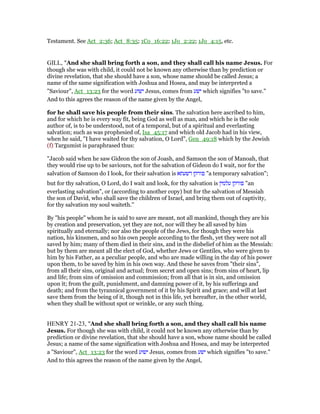
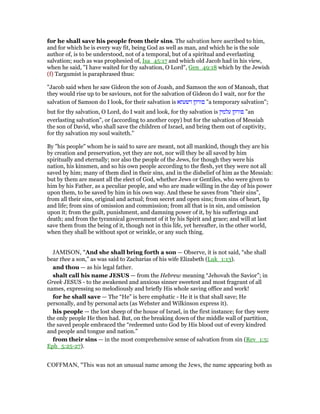
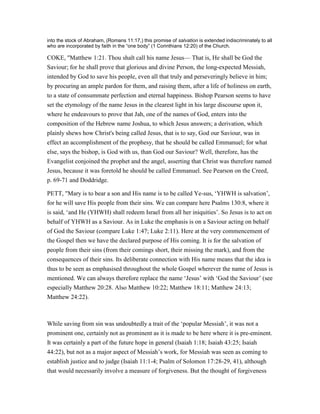
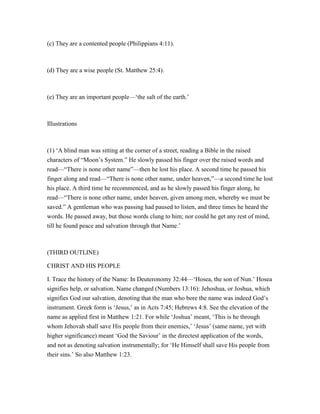
1 This is the genealogy[a] of Jesus the Messiah
[b] the son of David, the son of Abraham:
BARNES, "The book of the generation - This is the proper title of the chapter. It
is the same as to say, “the account of the ancestry or family, or the genealogical table of
Jesus Christ.” The phrase is common in Jewish writings. Compare Gen_5:1. “This is the
book of the generations of Adam,” i. e., the genealogical table of the family or
descendants of Adam. See also Gen_6:9. The Jews, moreover, as we do, kept such tables
of their own families. and it is probable that this was copied from the record of the
family of Joseph.
Jesus - See the notes at Mat_1:21.
Christ - The word “Christ” is a Greek word, Χριστός Christos, signifying “anointed.”
The Hebrew word, ‫משׁיח‬ mâshı̂yach, signifying the same is “Messiah.” Hence, Jesus is
called either the Messiah, or the Christ, meaning the same thing. The Jews speak of the
Messiah; Christians speak of him as the Christ. In ancient times, when kings and priests
were set apart to their office, they were anointed with oil, Lev_4:3; Lev_6:20; Exo_
28:41; Exo_29:7; 1Sa_9:16; 1Sa_15:1; 2Sa_23:1. To anoint, therefore, means often the
same as to consecrate, or to set apart to an office. Hence, those thus set apart are said to
be anointed, or to be the anointed of God. It is for this reason that the name is given to
the Lord Jesus. Compare the notes at Dan_9:24. He was set apart by God to be the King,
and High Priest, and Prophet of his people. Anointing with oil was, moreover, supposed
to be emblematic of the influences of the Holy Spirit; and since God gave him the Spirit
without measure Joh_3:34, so he is especially called “the Anointed of God.”
The Son of David - The word “son” among the Jews had a great variety of
significations. It means literally a son; then a grandson; a descendant: an adopted son; a
disciple, or one who is an object of tender affection one who is to us as a son. In this
place it means a descendant of David; or one who was of the family of David. It was
important to trace the genealogy of Jesus up to David, because the promise had been
made that the Messiah should be of his family, and all the Jews expected that it would be
so. It would be impossible, therefore, to convince a Jew that Jesus was the Messiah,
unless it could be shown that he was descended from David. See Jer_23:5; Psa_132:10-
11, compared with Act_13:23, and Joh_7:42.
The son of Abraham - The descendant of Abraham. The promise was made to
Abraham also. See Gen_12:3; Gen_21:12; compare Heb_11:13; Gal_3:16. The Jews
expected that the Messiah would be descended from him; and it was important,
therefore, to trace the genealogy up to him also. Though Jesus was of humble birth, yet
he was descended from most illustrious ancestors. Abraham, the father of the faithful -
“the beauteous model of an Eastern prince,” and David, the sweet psalmist of Israel, the
conqueror, the magnificent and victorious leader of the people of God, were both among
his ancestors. From these two persons, the most eminent for piety, and the most
renowned for their excellencies of all the people of antiquity, sacred or profane, the Lord
Jesus was descended; and though his birth and life were humble, yet they who regard an
illustrious descent as of value, may find here all that is to be admired in piety, purity,
patriotism, splendor, dignity, and renown.
CLARKE, "The book of the generation - This is the proper title of the chapter. It
is the same as to say, “the account of the ancestry or family, or the genealogical table of
Jesus Christ.” The phrase is common in Jewish writings. Compare Gen_5:1. “This is the
book of the generations of Adam,” i. e., the genealogical table of the family or
descendants of Adam. See also Gen_6:9. The Jews, moreover, as we do, kept such tables
of their own families. and it is probable that this was copied from the record of the
family of Joseph.
Jesus - See the notes at Mat_1:21.
Christ - The word “Christ” is a Greek word, Χριστός Christos, signifying “anointed.”
The Hebrew word, ‫משׁיח‬ mâshı̂yach, signifying the same is “Messiah.” Hence, Jesus is
called either the Messiah, or the Christ, meaning the same thing. The Jews speak of the
Messiah; Christians speak of him as the Christ. In ancient times, when kings and priests
were set apart to their office, they were anointed with oil, Lev_4:3; Lev_6:20; Exo_
28:41; Exo_29:7; 1Sa_9:16; 1Sa_15:1; 2Sa_23:1. To anoint, therefore, means often the
same as to consecrate, or to set apart to an office. Hence, those thus set apart are said to
be anointed, or to be the anointed of God. It is for this reason that the name is given to
the Lord Jesus. Compare the notes at Dan_9:24. He was set apart by God to be the King,
and High Priest, and Prophet of his people. Anointing with oil was, moreover, supposed
to be emblematic of the influences of the Holy Spirit; and since God gave him the Spirit
without measure Joh_3:34, so he is especially called “the Anointed of God.”
The Son of David - The word “son” among the Jews had a great variety of
significations. It means literally a son; then a grandson; a descendant: an adopted son; a
disciple, or one who is an object of tender affection one who is to us as a son. In this
place it means a descendant of David; or one who was of the family of David. It was
important to trace the genealogy of Jesus up to David, because the promise had been
made that the Messiah should be of his family, and all the Jews expected that it would be
so. It would be impossible, therefore, to convince a Jew that Jesus was the Messiah,
unless it could be shown that he was descended from David. See Jer_23:5; Psa_132:10-
11, compared with Act_13:23, and Joh_7:42.
The son of Abraham - The descendant of Abraham. The promise was made to
Abraham also. See Gen_12:3; Gen_21:12; compare Heb_11:13; Gal_3:16. The Jews
expected that the Messiah would be descended from him; and it was important,
therefore, to trace the genealogy up to him also. Though Jesus was of humble birth, yet
he was descended from most illustrious ancestors. Abraham, the father of the faithful -
“the beauteous model of an Eastern prince,” and David, the sweet psalmist of Israel, the
conqueror, the magnificent and victorious leader of the people of God, were both among
his ancestors. From these two persons, the most eminent for piety, and the most
renowned for their excellencies of all the people of antiquity, sacred or profane, the Lord
Jesus was descended; and though his birth and life were humble, yet they who regard an
illustrious descent as of value, may find here all that is to be admired in piety, purity,
patriotism, splendor, dignity, and renown.
GILL, "The book of the generation of Jesus Christ,.... This is the genuine title of
the book, which was put to it by the Evangelist himself; for the former seems to be done
by another hand. This book is an account, not of the divine, but human generation of
Christ; and not merely of his birth, which lies in a very little compass; nor of his
genealogy, which is contained in this chapter; but also of his whole life and actions, of
what was said, done, and suffered by him. It is an Hebrew way of speaking, much like
that in Gen_5:1 and which the Septuagint render by the same phrase as here; and as that
was the book of the generation of the first Adam; this is the book of the generation of the
second Adam. The Jews call their blasphemous history of the life of Jesus, ‫ספר‬‫תולדות‬‫ישו‬
"The book of the generations of Jesus" (o). This account of Christ begins with the name
of the Messiah, well known to the Jews,
the son of David; not only to the Scribes and Pharisees, the more learned part of the
nation, but to the common people, even to persons of the meanest rank and figure
among them. See Mat_9:27. Nothing is more common in the Jewish writings, than for ‫בן‬
‫דוד‬ "the son of David" to stand alone for the Messiah; it would be endless to cite or refer
to all the testimonies of this kind; only take the following (p),
"R. Jochanan says, in the generation in which ‫בן‬‫דוד‬ "the son of David" comes, the
disciples of the wise men shall be lessened, and the rest, their eyes shall fail with grief
and sorrow, and many calamities and severe decrees shall be renewed; when the first
visitation is gone, a second will hasten to come. It is a tradition of the Rabbins (about)
the week (of years) in which ‫בן‬‫דוד‬ "the son of David" comes, that in the first year this
scripture will be fulfilled, Amo_4:7. "I will rain upon one city", &c. in the second, arrows
of famine will be sent forth; in the third there will be a great famine, and men, women
and children, holy men and men of business will die, and the law will be forgotten by
those who learn it; in the fourth there will be plenty and not plenty; in the fifth there will
be great plenty, and they shall eat and drink and rejoice, and the law shall return to them
that learn it; in the sixth there will be voices (or thunders;) in the seventh there will be
wars; and in the going out of the seventh ‫בן‬‫דוד‬ the "son of David" comes. The tradition of
R. Judah says, In the generation in which ‫בן‬‫דוד‬ "the son of David" comes, the house of
the congregation (the school or synagogue) shall become a brothel house, Galilee shall
be destroyed, and Gabalene shall become desolate; and the men of Gabul (or the border)
shall go about from city to city, and shall find no mercy; and the wisdom of the scribes
shall stink; and they that are afraid to sin shall be despised; and the face of that
generation shall be as the face of a dog, and truth shall fail, as it is said, Isa_59:15 --The
tradition of R. Nehorai says, In the generation in which ‫בן‬‫דוד‬ "the son of David" comes,
young men shall make ashamed the faces of old men, and old men shall stand before
young men, the daughter shall rise up against her mother, and the daughter-in-law
against her mother-in-law; nor will a son reverence his father. The tradition of R.
Nehemiah says, In the generation in which ‫בן‬‫דוד‬ "the son of David" comes, impudence
will increase, and the honourable will deal wickedly, and the whole kingdom will return
to the opinion of the Sadducees, and there will be no reproof. --It is a tradition of the
Rabbins, that ‫בן‬‫דוד‬ "the son of David" will not come, until traitorous practices are
increased, or the disciples are lessened or until the smallest piece of money fails from the
purse, or until redemption is despaired of.''
In which passage, besides the proof for which it is cited, may be observed, how exactly
the description of the age of the Messiah, as given by the Jews themselves, agrees with
the generation in which Jesus the true Messiah came; who as he was promised to David,
and it was expected he should descend from him, so he did according to the flesh; God
raised him up of his seed, Rom_1:3 it follows,
The son of Abraham. Abraham was the first to whom a particular promise was made,
that the Messiah should spring from, Gen_22:18. The first promise in Gen_3:15 only
signified that he should be the seed of the woman; and it would have been sufficient for
the fulfilment of it, if he had been born of any woman, in whatsoever nation, tribe, or
family; but by the promise made to Abraham he was to descend from him, as Jesus did;
who took upon him the seed of Abraham, Heb_2:16 or assumed an human nature which
sprung from him, and is therefore truly the son of Abraham. The reason why Christ is
first called the son of David, and then the son of Abraham, is partly because the former
was a more known name of the Messiah; and partly that the transition to the genealogy
of Christ might be more easy and natural, beginning with Abraham, whom the Jews call
(q) ‫ראש‬‫היחס‬ the "head of the genealogy", and the root and foundation of it, as Matthew
here makes him to be; wherefore a Jew cannot be displeased with the Evangelist for
beginning the genealogy of our Lord at, Abraham.
HENRY, "Concerning this genealogy of our Saviour, observe,
I. The title of it. It is the book (or the account, as the Hebrew word sepher, a book,
sometimes signifies) of the generation of Jesus Christ, of his ancestors according to the
flesh; or, It is the narrative of his birth. It is Biblos Geneseōs - a book of Genesis. The Old
Testament begins with the book of the generation of the world, and it is its glory that it
does so; but the glory of the New Testament herein excelleth, that it begins with the book
of the generation of him that made the world. As God, his outgoings were of old, from
everlasting (Mic_5:2), and none can declare that generation; but, as man, he was sent
forth in the fulness of time, born of a woman, and it is that generation which is here
declared.
II. The principal intention of it. It is not an endless or needless genealogy; it is not a
vain-glorious one, as those of great men commonly are. Stemmata, quid faciunt? - Of
what avail are ancient pedigrees? It is like a pedigree given in evidence, to prove a title,
and make out a claim; the design is to prove that our Lord Jesus is the son of David, and
the son of Abraham, and therefore of that nation and family out of which the Messiah
was to arise. Abraham and David were, in their day, the great trustees of the promise
relating to the Messiah. The promise of the blessing was made to Abraham and his
seed, of the dominion to David and his seed; and they who would have an interest in
Christ, as the son of Abraham, in whom all the families of the earth are to be blessed,
must be faithful, loyal subjects to him as the son of David, by whom all the families of
the earth are to be ruled. It was promised to Abraham that Christ should descend from
him (Gen_12:3; Gen_22:18), and to David that he should descend from him (2Sa_7:12;
Psa_89:3, etc.; Psa_132:11); and therefore, unless it can be proved that Jesus is a son of
David, and a son of Abraham, we cannot admit him to be the Messiah. Now this is here
proved from the authentic records of the heralds' offices. The Jews were very exact in
preserving their pedigrees, and there was a providence in it, for the clearing up of the
descent of the Messiah from the fathers; and since his coming that nation is so dispersed
and confounded that it is a question whether any person in the world can legally prove
himself to be a son of Abraham; however, it is certain that none can prove himself to
either a son of Aaron or a son of David, so that the priestly and kingly office must either
be given up, as lost for ever, or be lodged in the hands of our Lord Jesus. Christ is here
first called the son of David, because under that title he was commonly spoken of, and
expected, among the Jews. They who owned him to be the Christ, called him the son of
David, Mat_15:22; Mat_20:31; Mat_21:15. Thus, therefore, the evangelist undertakes to
make out, that he is not only a son of David, but that son of David on whose shoulders
the government was to be; not only a son of Abraham, but that son of Abraham who
was to be the father of many nations.
In calling Christ the son of David, and the son of Abraham, he shows that God is faithful
to his promise, and will make good every word that he has spoken; and this. 1. Though
the performance be long deferred. When God promised Abraham a son, who should be
the great blessing of the world, perhaps he expected it should be his immediate son; but
it proved to be one at the distance of forty-two generations, and about 2000 years: so
long before can God foretel what shall be done, and so long after, sometimes, does God
fulfil what has been promised. Note, Delays of promised mercies, though they exercise
our patience, do not weaken God's promise. 2. Though it begin to be despaired of. This
son of David, and son of Abraham, who was to be the glory of his Father's house, was
born when the seed of Abraham was a despised people, recently become tributary to the
Roman yoke, and when the house of David was buried in obscurity; for Christ was to be
a root out of a dry ground. Note, God's time for the performance of his promises is
when it labours under the greatest improbabilities.
JAMISON, "Mat_1:1-17. Genealogy of Christ. ( = Luk_3:23-38).
The book of the generation — an expression purely Jewish; meaning, “table of the
genealogy.” In Gen_5:1 the same expression occurs in this sense. We have here, then, the
title, not of this whole Gospel of Matthew, but only of the first seventeen verses.
of Jesus Christ — For the meaning of these glorious words, see on Mat_1:16; see on
Mat_1:21. “Jesus,” the name given to our Lord at His circumcision (Luk_2:21), was that
by which He was familiarly known while on earth. The word “Christ” - though applied to
Him as a proper name by the angel who announced His birth to the shepherds (Luk_
2:11), and once or twice used in this sense by our Lord Himself (Mat_23:8, Mat_23:10;
Mar_9:41) - only began to be so used by others about the very close of His earthly career
(Mat_26:68; Mat_27:17). The full form, “Jesus Christ,” though once used by Himself in
His Intercessory Prayer (Joh_17:3), was never used by others till after His ascension and
the formation of churches in His name. Its use, then, in the opening words of this Gospel
(and in Mat_1:17, Mat_1:18) is in the style of the late period when our Evangelist wrote,
rather than of the events he was going to record.
the son of David, the son of Abraham — As Abraham was the first from whose
family it was predicted that Messiah should spring (Gen_22:18), so David was the last.
To a Jewish reader, accordingly, these behooved to be the two great starting-points of
any true genealogy of the promised Messiah; and thus this opening verse, as it stamps
the first Gospel as one peculiarly Jewish, would at once tend to conciliate the writer’s
people. From the nearest of those two fathers came that familiar name of the promised
Messiah, “the son of David” (Luk_20:41), which was applied to Jesus, either in devout
acknowledgment of His rightful claim to it (Mat_9:27; Mat_20:31), or in the way of
insinuating inquiry whether such were the case (see on Joh_4:29; Mat_12:23).
HAWKER, "The Gospel opens with the relation of the genealogy of Christ after the
flesh. We have an account of the miraculous conception: CHRIST’S birth and name.
Mat_1:1 The book of the generation of Jesus Christ, the son of David, the son of
Abraham.
There is somewhat very striking and particular in this opening of the Gospel. The Old
Testament begins with the account of the Creation. The New Testament begins with the
account of Him, by whom all things were created. Heb_1:1-2. The great design of this
pedigree concerning CHRIST after the flesh, is to prove Christ’s lineal descent from
Abraham. For unless this be proved, the evidence that Christ is the promised seed,
would be wanting. For to Abraham and his seed were the promises made. He saith not to
seeds as of many, but as of one, and to thy seed which is CHRIST. Compare Gal_3:16
with Gen_12:3 and Gen_22:18. Hence, therefore, the importance of this pedigree is
evident. And the correctness of the one here given, is striking. I beg the Reader to
observe it with a suitableness equal to its consequence. Perhaps it were a thing
impossible in any other instance, but in the genealogy of Christ, to find among all the
pedigrees of the Jews, from the days of our LORD to this hour, a correct genealogy of
any one house, or tribe, or family, even for fourteen generations together: whereas in
this of CHRIST, we have three times fourteen. What can more decidedly manifest the
overruling providence and watchfulness of God!
SBC, "Note some points in the genealogy of our Lord.
I. Amongst those whom St. Matthew records as the ancestors of Christ according to the
flesh, there are only four female names introduced, and they are precisely those four
which a merely human historian, anxious to throw in everything which might seem to be
to the honour of Christ, and to omit everything which might seem to detract from that
honour, would have been desirous to have passed over in silence. The persons whose
names are given are Thamar, Rahab, Ruth (a Moabitess), and Bathsheba. One thing is
clear, that there was no thought in St. Matthew’s mind of throwing any false lights upon
his Lord’s history and character; and another thought might have been in his mind,
which led him to set down these names,—the wonderful manner in which God brings
His own purposes about by means which seem at first sight to be as little conducive to
them as possible, how through the apparent confusion of history, blotted by human sin,
the thread of His providence remained unbroken, and connected him to whom the
promises were made with Him who was the promised seed.
II. Jesus is declared by St. Matthew to be the Son of David, and therefore a member of
the royal tribe of Judah, not of the priestly tribe of Levi. Christ came as a priest, but
more particularly He came as a king; that which He preached from the first was a
kingdom.
III. The genealogies both of St. Matthew and St. Luke trace the descent of our Lord, not
through Mary His mother, but through Joseph, His reputed father. The lineage of
Joseph would be legally the lineage of Jesus, his reputed Son, and on that account the
Evangelists could not well have done otherwise than give his pedigree and not that of
Mary; and yet it cannot but appear remarkable, that the lineage of our Lord should be in
fact no lineage at all, that, like His type Melchisedec, He should be without descent. The
great fact in the lineage of Christ is not that He was the Son of David, but that He was
the Son of man.
Bishop Harvey Goodwin, Parish Sermons, 3rd series, p. 183.
EBC, "THE COMING OF THE CHRIST
THE New Testament opens appropriately with the four Gospels; for, though in their
present form they are all later in date than some of the Epistles, their substance was the
basis of all apostolic preaching and writing. As the Pentateuch to the Old Testament, so
is the fourfold Evangel to the New.
That there should be a manifold presentation of the great facts which lie at the
foundation of our faith and hope, was both to be expected and desired. The Gospel of
Jesus Christ, as proclaimed by the first preachers of it, while in substance always the
same, would be varied in form, and in number and in variety of details, according to the
individuality of the speaker, the kind of audience before him, and the special object he
might have in view at the time. Before any form of presentation had been crystallised,
there would therefore be an indefinite number of Gospels, each "according to" the
individual preacher of "Christ and Him crucified." It is, therefore a marvellous proof of
the guidance and control of the Divine Spirit that out of these numerous oral Gospels
there should emerge four, each perfect in itself, and together affording, as with the all-
round completeness of sculpture, a life-like representation of the Lord Jesus Christ. It is
manifestly of great advantage to have these several portraits of our Lord, permitting us
to see Him from different points of view, and with varying arrangements of light and
shade; all the more that, while three of them set forth in abundant variety of detail that
which is more external, -the face, the features, the form, all the expression of that
wondrous Life, -the fourth, appropriately called on that account "the Gospel of the heart
of Jesus," unveils more especially the hidden riches of His inner Life. But, besides this, a
manifold Gospel was needed, in order to meet the wants of man in the many-sidedness
of his development. As the heavenly "city lieth four square," with gates on the east, and
the west, and the north, and the south, to admit strangers coming from all points of the
compass; so must there be in the presentation of the Gospel an open door for all
mankind. How this great purpose is attained by the fourfold Gospel with which the New
Testament opens can be readily shown; and even a brief statement of it may serve a
useful purpose as introductory to our study of that which is known as the First Gospel.
The inscription over the cross was in three languages: Hebrew, Latin, and Greek. These
languages represented the three great civilizations which were the final outcome of
ancient history-the Jewish, the Roman, the Greek. These three were not like so many
nations selected at random, but stood for three leading types of humanity. The Jew was
the man of the past. He could claim Moses and the prophets; he had Abraham for his
father; his records went back to the Genesis of all things. He represented ancient
prerogative and privilege, the conservatism of the East. The Roman was the man of the
present. He was master of the world. He represented power, prowess, and. victory; and
while serving himself heir to the culture which came from the shores of the Aegean Sea,
he had combined with it the rude strength and restless activity of the barbarian and
Scythian of the North. The Greek was the man of the future. He had lost his political
empire, but still retained an empire in the world of thought. He represented humanity,
and the ideal, and all the promise which was afterwards to be realised in the culture of
the nations of the West. The Jew was the man of tradition, the Roman the man of
energy, the Greek the man of thought. Turning now to the Gospels, we find the wants of
each of these three types provided for in a wondrous way. St. Matthew addresses himself
especially to the Jew with his Gospel of fulfillment, St. Mark to the Roman with "his brief
and terse narrative of a three years’ campaign," St. Luke to the Greek with that all-
pervading spirit of humanity and catholicity which is so characteristic of his Evangel;
while for those who have been gathered from among the Jews and Romans and Greeks-a
people who are now no longer Jews or Greeks, but are "all one in Christ Jesus," prepared
to receive and appreciate the deeper things of Christ-there is a fourth Gospel, issued at a
later date, with characteristics specially adapted to them the mature work of the then
venerable John, the apostle of the Christian.
It is manifest that for every reason the Gospel of St. Matthew should occupy the
foremost place. "To the Jew first" is the natural order, whether we consider the claims of
"the fathers," or the necessity of making it clear that the new covenant was closely linked
to the old. "Salvation is of the Jews"; the Christ of God, though the Saviour of the world,
had been in a very special sense "the Hope of Israel," and therefore it is appropriate that
He should be represented first from the standpoint of that nation. We have, accordingly,
in this Gospel, a faithful setting forth of Christ as He presented Himself to the mind and
heart of a devout Jew, "an Israelite indeed, in whom was no guile," rejoicing to find in
Him One who fulfilled ancient prophecy and promise, realised the true ideal of the
kingdom of God, and substantiated His claim to be Himself the divine Saviour-King for
whom the nation and the world had waited long.
The opening words of this Gospel suggest that we are at the genesis of the New
Testament, the genesis not of the heavens and the earth, but of Him who was to make for
us "new heavens and a new earth, wherein dwelleth righteousness." The Old Testament
opens with the thought, "Behold I make all things"; the New Testament with that which
amounts to the promise, "Behold I make all things new." It begins with the advent of
"the Second Man, the Lord from Heaven." That He was indeed a "Second Man," and not
merely one of the many that have sprung from the first man, will presently appear; but
first it must be made clear that He is man indeed, "bone of our bone, flesh of our flesh";
and therefore the inspired historian begins with His historic genealogy. True to his
object, however, he does not trace back our Lord’s descent, as does St. Luke, to the first
man, but contents himself with that which is especially interesting to the Jew, setting
Him forth as "the son of David, the son of Abraham." There is another difference
between the genealogies, of a more serious kind, which has been the occasion of much
difficulty; but which also seems to find readiest explanation in the different object each
Evangelist had in view. St. Luke, writing for the Gentile, is careful to give the natural
descent, while St. Matthew, writing for the Jew, sets forth that line of descent-diverging
from the other after the time of David-which made it clear to the Jew that He was the
rightful heir to the kingdom. The object of the one is to set Him forth as the Son of Man;
of the other to proclaim Him King of Israel.
St. Matthew gives the genealogy in three great epochs or stages, which, veiled in the
Authorised Version by the verse division, are clearly exhibited to the eye in the
paragraphs of the Revised Version, and which are summed up and made emphatic at the
close of the genealogical tree. (Mat_1:17) The first is from Abraham to David; the second
from David to the captivity in Babylon; the third from the captivity to Christ. If we
glance at these, we shall find that they represent three great stages in the development of
the Old Testament promises which find their fulfillment in the Messiah.
"To Abraham and to his seed were the promises made." As given to Abraham himself,
the promise ran thus: "In thy seed shall all the nations of the earth be blessed." As made
to David, it indicated that the blessing to the nations should come through a king of his
line. These were the two great promises to Israel. There were many others; but these
stand out from the rest as constituting the mission and the hope of Israel. Now, after
long waiting, both are to be fulfilled in Christ. He is the chosen Seed in Whom all nations
shall be blessed. He is the Son of David, who is to sit upon His throne for ever, and reign,
not over Israel alone, but over men, as "Prince of Peace" and "King of Glory." But what
has the captivity in Babylon to do with it? Very much; as a little reflection will show.
The captivity in Babylon, as is well known, was followed by two great results:
(1) it cured the people of idolatry for ever, so that, while politically the kingdom had
passed away, in reality, and according to the spirit, it was then for the first time
constituted as a kingdom of God. Till then, though politically separate from the Gentile
nations, spiritually Israel had become as one of them; for what else than a heathen
nation was the northern kingdom in the days of Ahab or the southern kingdom in the
time of Ahaz? But after the captivity, though as a nation shattered into fragments,
spiritually Israel became and continued to be one.
(2) The other great result of the captivity was the Dispersion. Only a small remnant of
the people came back to Palestine. Ten of the tribes passed out of sight, and but a
fraction of the other two returned. The rest remained in Babylon, or were scattered
abroad among the nations of the earth. Thus the Jews in their dispersion formed, as it
were, a Church throughout the ancient world, -their eyes ever turned in love and longing
to the Temple at Jerusalem, while their homes and their business were among the
Gentiles-in the world, but not of it; the prototype of the future Church of Christ, and the
soil out of which it should afterwards spring. Thus out of the captivity in Babylon
sprang, first, the spiritual as distinguished from the political kingdom, and, next, the
world-wide as distinguished from the merely national Church. Clearly, then, the
Babylonish captivity was not only a most important historical event, but also a stage in
the grand preparation for the Advent of the Messiah. The original promise made to
Abraham, that in his seed should all the nations of the earth be blessed, was shown in
the time of David to be a promise which should find its fulfillment in the coming of a
king; and as the king after God’s heart was foreshadowed in David, so the kingdom after
the Divine purpose was foreshadowed in the condition of the people of God after the
captivity in Babylon, purified from idolatry, scattered abroad among the nations, with
their innumerable synagogues (prototypes of our churches) and their peculiarities of
faith and life and worship. Abraham was called out of Babylon to be a witness for God
and the coming Christ; and, after the long training of centuries, his descendants were
taken back to Babylon, to scatter from that world-centre the seed of the coming kingdom
of God. Thus it comes to pass that in Christ and His kingdom we see the culmination of
that wonderful history which has for its great stages of progress Abraham, David, the
Captivity, Christ.
So much for the earthly origin of the Man Christ Jesus; but His heavenly descent must
also be told; and with what exquisite simplicity and delicacy is this done. There is no
attempt to make the words correspond with the greatness of the facts. As simple and
transparent as clear glass, they allow the facts to speak for themselves. So it is all the way
through this Evangel. What a contrast here to the spurious Gospels afterwards
produced, when men had nothing to tell, and so must put in their own poor fictions,
piously intending sometimes to add lustre to the too simple story of the Infancy, but only
with the effect of degrading it in the eyes of all men of taste and judgment. But here there
is no need of fiction, no need even of rhetoric or sentiment. The fact itself is so great that
the more simply it is told the better. The Holy One of Israel came into the world with no
tinsel of earthly pomp; and in strict harmony with His mode of entrance, the story of His
birth is told with like simplicity. The Sun of Righteousness rises like the natural sun, in
silence; and in this Gospel, as in all the others, passes on to its setting through the
heaven of the Evangelist’s thought, which stands, like that other heaven, "majestic in its
own simplicity."
The story of the Incarnation is often represented as incredible; but if those who so
regard it would only reflect on that doctrine of heredity which the science of recent years
has brought into such prominence, if they would only consider what is involved in the
obvious truth that, "that which is born of the flesh is flesh," they would see that it was
not only natural but necessary that the birth of Jesus Christ should be "on this wise."
Inasmuch as "the first man is of the earth, earthy," "the Second Man" must be "of
heaven," or He will be no Second Man at all; He will be sinful and earthy like all the
others. But all that is needful is met in the manner so chastely and beautifully set forth
by our Evangelist, in words which, angelic in their tone and like the blue of heaven in
their purity, so well become the angel of the Lord.
Some wonder that nothing is said here of Nazareth and what took place there, and of the
journey to Bethlehem; and there are those who are fain even to find some inconsistency,
with the third Gospel in this omission, as if there were any need to wonder at omissions
in a story which tells of the first year on one page and the thirtieth on the next! These
Gospels are not biographies. They are memorials, put together for a special purpose, to
set forth this Jesus as the Son of God and Saviour of the world. And the special object, as
we have seen, of St. Matthew is to set Him forth as the Messiah of Israel. In accordance
with this object we have His birth told in such a way as to bring into prominence those
facts only in which the Evangelist specially recognised a fulfillment of Old Testament
prophecy. Here again the names give us the main thoughts. Just as Abraham, David,
Babylon, suggest the main object of the genealogy, so the names Emmanuel, Jesus,
suggest the main object of the record of His birth. "All this was done that it might be
fulfilled which was spoken by the prophet."
The first name mentioned is "Jesus." To understand it as St. Matthew did, we must bear
in mind that it is the old historic name Joshua, and that the first thought of the Hebrew
mind would be, Here is One who shall fulfil all that was typified in the life and work of
the two Old Testament heroes who bore that name, so full of hopeful significance. The
first Joshua was Israel’s captain on the occasion of their first settlement in the Land of
Promise after the bondage in Egypt; the second Joshua was Israel’s high priest at their
second settlement in the land after the bondage in Babylon. Both were thus associated
with great deliverances; but neither the one nor the other had given the rest of full
salvation to the people of God; (see Heb_4:8) what they had done had only been to
procure for them political freedom and a land they could call their own, - a picture in the
earthly sphere of what the Coming One was to accomplish in the spiritual sphere. The
salvation from Egypt and from Babylon were both but types of the great salvation from
sin which was to come through the Christ of God. These or such as these must have been
the thoughts in the mind of Joseph when he heard the angel’s words: "Thou shalt call
His name Joshua; for it is He that shall save His people from their sins."
Joseph, though a poor carpenter of Nazareth, was a true son of David, one of those who
waited for the salvation of Israel, who had welcomed the truth set forth by Daniel, that
the coming kingdom was to be a kingdom of the saints of the Most High, -not of political
adventurers, as was the idea of the corrupt Judaism of the time; so he was prepared to
welcome the truth that the coming Saviour was One who should deliver, not from the
rule of Rome, but from the guilt and power and death of Sin.
As the name Joshua, or Jesus, came from the earliest times of Israel’s national history,
the name Emmanuel came from its latest, even out of the dark days of King Ahaz, when
the hope of the people was directed to the birth of a Child who should bear this name.
Some have thought it enough to show that there was a fulfillment of this hope in the
time of Ahaz, to make it evident that St. Matthew was mistaken in finding its fulfillment
in Christ; but this idea, like so many others of the same kind, is founded on ignorance of
the relation of the Old Testament history to the New Testament times. We have seen that
though Joshua of the early times and his successor of the same name did each a work of
his own, yet both of them were in relation to the future but prototypes of the Great
Joshua who was to come. In the same way exactly, if there was, as we believe, a
deliverance in the time of Ahaz, to which the prophet primarily referred, it was, as in so
many other cases, but a picture of the greater one in which the gracious purpose of God,
manifested in all these partial deliverances, was to be "fulfilled," i.e., filled to the full. The
idea in the name "Emmanuel" was not a new one even in the time of King Ahaz. "I will be
with you"; "Certainly I will be with you"; "Fear not, for I am with you,"-such words of
gracious promise had been echoed and re-echoed all down the course of the history of
the people of God, before they were enshrined in the name prophetically used by Isaiah
in the days of King Ahaz; and they were finally embodied, incarnated, in the Child born
at Bethlehem in the fulness of the time, to Whom especially belongs that name of highest
hope, "Emmanuel," "God with us."
If, now, we look at these two names, we shall see that they not only point to a fulfillment,
in the largest sense, of Old Testament prophecy, but to the fulfillment of that which we
all need most-the satisfaction of our deepest wants and longings. "God is light"; sin is
darkness. With God is the fountain of life; "sin when it is finished bringeth forth death."
Here shines the star of hope; there lies the abyss of despair. Now, without Christ we are
tied to sin, separated from God. Sin is near; God is far. That is our curse. Therefore what
we need is God brought near and sin taken away-the very blessings guaranteed in these
two precious names of our Lord. As Emmanuel, He brings God near to us, near in His
own incarnate person, near in His loving life, near in His perfect sympathy, near in His
perpetual presence, according to the promise, "Lo, I am with you alway, even unto the
end of the world." As Jesus, He saves us from our sins. How he does it is set forth in the
sequel of the Gospel, culminating in the sacrifice of the cross, "to finish the
transgression, and to make an end of sins, and to make reconciliation for iniquity, and to
bring in everlasting righteousness." For He has not only to bring God down to us, but
also to lift us up to God; and while the incarnation effects the one, the atonement,
followed by the work of the Holy Spirit, is necessary to secure the other. He touches
man, the creature, at his cradle; He reaches down to man, the sinner, at His cross-the
end of His descent to us, the beginning of our ascent with Him to God. There we meet
Him and, saved from sin, we know Him as our Jesus; and reconciled to God, we have
Him with us as Emmanuel, God with us, always with us, with us throughout all life’s
changes, with us in death’s agony, with us in the life to come, to guide us into all its
wisdom and honour and riches and glory and blessing.
BARCLAY 1-17, "It might seem to a modern reader that Matthew chose an extraordinary
way in which to begin his gospel; and it might seem daunting to present right at the
beginning a long list of names to wade through. But to a Jew this was the most natural,
and the most interesting, and indeed the most essential way to begin the story of any
man's life.
The Jews were exceedingly interested in genealogies. Matthew calls this the book of the
generation (biblos - Greek #976; geneseos - Greek #1078) of Jesus Christ. That to the
Jews was a common phrase; and it means the record of a man's lineage, with a few
explanatory sentences, where such comment was necessary. In the Old Testament we
frequently find lists of the generations of famous men (Genesis 5:1; Genesis 10:1;
Genesis 11:10; Genesis 11:27). When Josephus, the great Jewish historian, wrote his own
autobiography, he began it with his own pedigree, which, he tells us, he found in the
public records.
The reason for this interest in pedigrees was that the Jews set the greatest possible store
on purity of lineage. If in any man there was the slightest admixture of foreign blood, he
lost his right to be called a Jew, and a member of the people of God. A priest, for
instance, was bound to produce an unbroken record of his pedigree stretching back to
Aaron; and, if he married, the woman he married must produce her pedigree for at least
five generations back. When Ezra was reorganizing the worship of God, after the people
returned from exile, and was setting the priesthood to function again, the children of
Habaiah, the children of Koz, and the children of Barzillai were debarred from office,
and were labelled as polluted because "These sought their registration among those
enrolled in the genealogies, but they were not found there" (Ezra 2:62).
These genealogical records were actually kept by the Sanhedrin. Herod the Great was
always despised by the pure-blooded Jews because he was half an Edomite; and we can
see the importance that even Herod attached to these genealogies from the fact that he
had the official registers destroyed, so that no one could prove a purer pedigree than his
own. This may seem to us an uninteresting passage, but to the Jew it would be a most
impressive matter that the pedigree of Jesus could be traced back to Abraham.
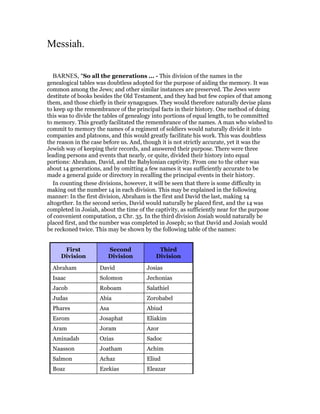
It is further to be noted that this pedigree is most carefully arranged. It is arranged in
three groups of fourteen people each. It is in fact what is technically known as a
mnemonic, that is to say a thing so arranged that it is easy to memorize. It is always to be
remembered that the gospels were written hundreds of years before there was any such
thing as a printed book. Very few people would be able to own actual copies of them; and
so, if they wished to possess them, they would be compelled to memorize them. This
pedigree, therefore, is arranged in such a way that it is easy to memorize. It is meant to
prove that Jesus was the son of David, and is so arranged as to make it easy for people to
carry it in their memories.
THE THREE STAGES (Matthew 1:1-17 continued)
There is something symbolic of the whole of human life in the way in which this pedigree
is arranged. It is arranged in three sections, and the three sections are based on three
great stages in Jewish history.
The first section takes the history down to David. David was the man who welded Israel
into a nation, and made the Jews a power in the world. The first section takes the story
down to the rise of Israel's greatest king.
The second section takes the story down to the exile to Babylon. It is the section which
tells of the nation's shame, and tragedy, and disaster.
The third section takes the story down to Jesus Christ. Jesus Christ was the person who
liberated men from their slavery, who rescued them from their disaster, and in whom
the tragedy was turned into triumph.
These three sections stand for three stages in the spiritual history of mankind.
(i) Man was born for greatness. "God created man in His own image, in the image of God
He created him" (Genesis 1:27). God said: "Let us make man in our image, after our
likeness" (Genesis 1:26). Man was created in the image of God. God's dream for man was
a dream of greatness. Man was designed for fellowship with God. He was created that he
might be nothing less than kin to God. As Cicero, the Roman thinker, saw it, "The only
difference between man and God is in point of time." Man was essentially man born to
be king.
(ii) Man lost his greatness. Instead of being the servant of God, man became the slave of
sin. As G. K. Chesterton said, 6. whatever else is true of man, man is not what he was
meant to be." He used his free-will to defy and to disobey God, rather than to enter into
friendship and fellowship with him. Left to himself man had frustrated the design and
plan of God in His creation.
(iii) Man can regain his greatness. Even then God did not abandon man to himself and to
his own devices. God did not allow man to be destroyed by his own folly. The end of the
story was not left to be tragedy. Into this world God sent his Son, Jesus Christ, that he
might rescue man from the morass of sin in which he had lost himself, and liberate him
from the chains of sin with which he had bound himself so that through him man might
regain the fellowship with God which he had lost.
In his genealogy Matthew shows us the royalty of kingship gained; the tragedy of
freedom lost; the glory of liberty restored. And that, in the mercy of God, is the story of
mankind, and of each individual man.
THE REALIZATION OF MEN'S DREAMS (Matthew 1:1-17 continued)
This passage stresses two special things about Jesus.
(i) It stresses the fact that he was the son of David. It was, indeed, mainly to prove this
that the genealogy was composed. The New Testament stresses this again and again.
Peter states it in the first recorded sermon of the Christian Church (Acts 2:29-36). Paul
speaks of Jesus Christ descended from David according to the flesh (Romans 1:3). The
writer of the Pastoral Epistles urges men to remember that Jesus Christ, descended from
David, was raised from the dead (2 Timothy 2:8). The writer of the Revelation hears the
Risen Christ say: "I am the root and the offspring of David" (Revelation 22:16).
Repeatedly Jesus is so addressed in the gospel story. After the healing of the blind and
dumb man, the people exclaim, "Can this be the son of David?" (Matthew 12:23). The
woman of Tyre and Sidon, who wished for Jesus' help for her daughter, calls him: "Son
of David" (Matthew 15:22). The blind men cry out to Jesus as son of David (Matthew
20:30-31). It is as son of David that the crowds greet Jesus when he enters Jerusalem for
the last time (Matthew 21:9; Matthew 21:15).
There is something of great significance here. It is clear that it was the crowd, the
common people, the ordinary folk, who addressed Jesus as son of David. The Jews were
a waiting people. They never forgot, and never could forget, that they were the chosen
people of God. Although their history was one long series of disasters, although at this
very time they were a subject people, they never forgot their destiny. And it was the
dream of the common people that into this world would come a descendant of David
who would lead them to the glory which they believed to be theirs by right.
That is to say, Jesus is the answer to the dreams of men. It is true that so often men do
not see it so. They see the answer to their dreams in power, in wealth, in material plenty,
and in the realization of the ambitions which they cherish. But if ever men's dreams of
peace and loveliness, and greatness and satisfaction, are to be realized, they can find
their realization only in Jesus Christ.
Jesus Christ and the life he offers is the answer to the dreams of men. In the old Joseph
story there is a text which goes far beyond the story itself. When Joseph was in prison,
Pharaoh's chief butler and chief baker were prisoners along with him. They had their
dreams, and their dreams troubled them, and their bewildered cry is, "We have had
dreams, and there is no one to interpret them" (Genesis 40:8). Because man is man,
because he is a child of eternity, man is always haunted by his dream; and the only way
to the realization of it lies in Jesus Christ.
(ii) This passage also stresses that Jesus was the fulfillment of prophecy. In him the
message of the prophets came true. We tend nowadays to make very little of prophecy.
We are not really interested, for the most part, in searching for sayings in the Old
Testament which are fulfilled in the New Testament. But prophecy does contain this
great and eternal truth, that in this universe there is purpose and design and that God is
meaning and willing certain things to happen.
J. H. Withers quotes a saying from Gerald Healy's play, The Black Stranger. The scene is
in Ireland, in the terrible days of famine in the mid-nineteenth century. For want of
something better to do, and for lack of some other solution, the government had set men
to digging roads to no purpose and to no destination. Michael finds out about this and
comes home one day, and says in poignant wonder to his father, "They're makin' roads
that lead to nowhere."
If we believe in prophecy that is what we can never say. History can never be a road that
leads to nowhere. We may not use prophecy in the same way as our fathers did, but at
the back of the fact of prophecy lies the eternal fact that life and the world are not on the
way to nowhere, but on the way to the goal of God.
NOT THE RIGHTEOUS, BUT SINNERS (Matthew 1:1-17 continued)
By far the most amazing thing about this pedigree is the names of the women who
appear in it.
It is not normal to find the names of women in Jewish pedigrees at all. The woman had
no legal rights; she was regarded, not as a person, but as a thing. She was merely the
possession of her father or of her husband, and in his disposal to do with as he liked. In
the regular form of morning prayer the Jew thanked God that he had not made him a
Gentile, a slave, or a woman. The very existence of these names in any pedigree at all is a
most surprising and extraordinary phenomenon.
But when we look at who these women were, and at what they did, the matter becomes
even more amazing. Rachab, or as the Old Testament calls her, Rahab, was a harlot of
Jericho (Joshua 2:1-7). Ruth was not even a Jewess; she was a Moabitess (Ruth 1:4), and
does not the law itself lay it down, "No Ammonite or Moabite shall enter the assembly of
the Lord; even to the tenth generation none belonging to them shall enter the assembly
of the Lord for ever" (Deuteronomy 23:3)? Ruth belonged to an alien and a hated people.
Tamar was a deliberate seducer and an adulteress (Genesis 38:1-30 ). Bathsheba, the
mother of Solomon, was the woman whom David seduced from Uriah, her husband,
with an unforgivable cruelty (2 Samuel 11:1-27; 2 Samuel 12:1-31). If Matthew had
ransacked the pages of the Old Testament for improbable candidates he could not have
discovered four more incredible ancestors for Jesus Christ. But, surely, there is
something very lovely in this. Here, at the very beginning, Matthew shows us in symbol
the essence of the gospel of God in Jesus Christ, for here he shows us the barriers going
down.
(i) The barrier between Jew and Gentile is down. Rahab, the woman of Jericho, and
Ruth, the woman of Moab, find their place within the pedigree of Jesus Christ. Already
the great truth is there that in Christ there is neither Jew nor Greek. Here, at the very
beginning, there is the universalism of the gospel and of the love of God.
(ii) The barriers between male and female are down. In no ordinary pedigree would the
name of any woman be found; but such names are found in Jesus' pedigree. The old
contempt is gone; and men and women stand equally dear to God, and equally important
to his purposes.
(iii) The barrier between saint and sinner is down. Somehow God can use for his
purposes, and fit into his scheme of things, those who have sinned greatly. "I came" said
Jesus, "not to call the righteous, but sinners" (Matthew 9:13).
Here at the very beginning of the gospel we are given a hint of the all-embracing width of
the love of God. God can find his servants amongst those from whom the respectable
orthodox would shudder away in horror.
BIBLICAL ILLUSTRATOR 1-15, "The book of the generation.
The lessons of Christ’s genealogy
1. It is a proof of the reality of Christ’s humanity.
2. It suggests the relation of Christ’s work to the whole human race.
3. It marks the importance of the birth of Christ as a historical epoch. Let it remind
us also
(1) Of the shortness of human life;
(2) Of the subserviency of persons of every class and character to the purposes of
God’s moral government. (G. Brooks.)
The double use of genealogies
1. A profane use for ostentation.
2. A holy use
(1) For the observing of judicial laws;
(2) For the distinguishing the church from those without;
(3) For the setting forth the pedigree of the Messiah, lest it should be thought
that he were some obscure or secret person. (R. Ward.)
The old and new in Jesus
The first record is the book of the generation of Jesus Christ. What does this signify?
1. A man’s beginnings, a man’s ancestors, have something to do with both his
character and his life.
2. Christ was the sacred heir of all the ancient world.
3. The genealogy reminds us how all the past was preparing for Jesus.
4. But more than all, the generations of Jesus Christ show us the birth of the new
world, and the new time, and the new institutions, which are to end in the perfect
glory of the Father and the perfect blessedness of the race. (W. H. Davison.)
The genealogy of Christ
1. There is much in good lineage.
2. Sin has tainted the blood of the best races of men, and frequently makes itself
manifest.
3. God’s grace can flow through very crooked human channels.
4. No man stands alone.
Lessons of Christ’s genealogy
1. This table of our Lord’s genealogy, inserted in the beginning of the gospel, invests
the book with an air of naturalness and reality, which probably nothing else could
have done so well. No man writing fiction would have ventured to preface it with a
dry list of obscure names.
2. It connects Jesus and His teachings with all God’s revelations and promises which
had been given before. It binds up, as in one sheaf, all generations of the church in
one uniform moral system.
3. The Lord’s ancestral roll serves to identify Him in closer connection and sympathy
with the race whom, as their God, lie came to redeem.
4. The account of those who were Christ’s ancestry before His first advent suggest
the anxious inquiry, whether our names are written in the Book of Life as members
of His spiritual family. (J. B. Owen, M. A.)
Very man
1. He is a man.
2. He is a Jew.
3. He is a king.
(1) God’s purpose is to bless by a man;
(2) To teach by a man;
(3) To judge by a man;
(4) To rule by a man;
(5) To link earth and heaven together by a man. (Dr. Bonar.)
The text appears at first sight like a valley of dry bones without any life or fertility, or a
rugged pass that leads to green pastures. Nevertheless, there are important lessons in it
respecting the human race and its relation to the Lord Jesus Christ.
I. It shows the common origin of the race. St. Luke traces the ancestry of Jesus to Adam-
the head of the race.
II. The physical connection of the race. Having sprung from a common head, there must
be a physical connection between the various members.
(1) War seems doubly barbarous and unnatural.
(2) Men ought to sympathize with and promote one another’s welfare apart from
Christianity, etc.
III. The common saviour of the race
IV. The moral distinction of the race. What a mixture of good and bad there is in the
genealogy! (W. Edwards.)
ELLICOTT, “(1) Nothing can be inferred directly from St. Matthew’s phrase “till she had brought
forth” as to what followed after the birth. The writer’s purpose is obviously to emphasise the absence of
all that might interfere with the absolutely supernatural character of the birth itself. (2) Nothing can be
inferred with certainty from the mention of our Lord’s “brethren” in Matthew 12:46 (see Note there), and
elsewhere. They may have been children of Joseph by a former marriage, or by what was known as a
levirate marriage with the widow of a deceased brother, under the law of Deuteronomy 25:5,Matthew
22:24, or children by adoption, or cousins included under the general name of brethren. (3) The fact
that the mother of our Lord found a home with the beloved disciple (John 19:27) and not with any of
the “brethren” points, as far as it goes, to their not being her own children, but it does not go far
enough to warrant any positive assertion. Scripture therefore supplies no data for any decision on
either side, nor does any tradition that can really be called primitive. The reverence for virginity as
compared with marriage in the patristic and mediæval Church made the “ever-virgin” to be one of the
received titles of the mother of the Lord. The reaction of natural feeling against that reverence led men
in earlier and later times to assert the opposite. Every commentator is influenced consciously or
unconsciously by his leanings in this or that direction. And so the matter must rest.
BENSON,” . The book — That is, This is the book, the verb being elegantly omitted, according to the
custom of the Hebrews, and also of the Greeks and Romans; of the generation — Or, as the Syriac
expresses it, The writing, narrative, or account of the generation, or birth of Jesus, &c. The
word γενεσις, indeed, here rendered generation, sometimes signifies the history of a person’s life, yet
it is much more frequently used for genealogy,or birth; and it seems to be intended to be taken in this
restrained sense here. Dr. Macknight renders the phrase, The table of the genealogy of
Jesus: observing that the word βιβλος, book, is used in this limited senseMark 10:4, where a bill of
divorce is so called: and Jeremiah 32:12, where a deed of conveyance is termed ‫ספר‬, a book. Indeed,
the Jews, and also the Greeks, called all writings books, whether short or long. Of Jesus Christ —
Jesus is his proper name, given him by God, his true Father, Matthew 1:21 ;Luke 1:31; Luke
2:21. Christ is, as it were, a surname, descriptive of his unction to the prophetic, priestly, and kingly
offices. To the name Christ, that of Jesus is often superadded in the New Testament, not only that
Christ might be pointed out for the Saviour, as the word Jesus signifies, but that Jesus might be shown
to be the true Messiah, or Christ, in opposition to the unbelief of the Jews. The son of David, the son of
Abraham — i.e., a descendant of David and Abraham; the word son, in the language of the Hebrews,
being put for any descendant, however remote. Here the evangelist proposes what he is going to
prove; viz, that Jesus Christ, whose history he is about to give, was the son of David and Abraham,
which it was necessary he should show because the grand prophetical character of the Messiah was,
that he was to spring from Abraham and David. The sense of the latter clause, indeed, the son of
Abraham, is ambiguous: it may mean either that David was the son of Abraham, or, which seems the
more probable sense, that Christ, who was the son of David, was also the son of Abraham. This sense
accords better both with the following words, and with the design of the evangelist, which was to show,
that Christ was descended from both these renowned patriarchs, and that in him was fulfilled the
promises made to both. David is first named, 1. That the catalogue, to begin from Abraham, might
proceed regularly, without the repetition of his name; 2. Because the memory of David was more fresh
upon the minds of the Jews, and his name in greater repute than that of Abraham, especially when the
discourse related to the Messiah, John 7:42; more plain and explicit promises of him being made to
David, and the prophets having spoken of Christ under the name of David. Add to this, that David was
both a prophet and a king, and therefore a more manifest type of the Messiah, who sustains both of
these offices, as well as that of a priest. Hence those who had entertained higher conceptions of Christ
than others, termed him the son of David, as appears from many passages in the gospels.
CALVIN, "As all are not agreed about these two genealogies, which are given by Matthew and
Luke, we must first see whether both trace the genealogy of Christ from Joseph, or whether
Matthew only traces it from Joseph, and Luke from Mary. Those who are of this latter opinion
have a plausible ground for their distinction in the diversity of the names: and certainly, at first
sight, nothing seems more improbable than that Matthew and Luke, who differ so widely from
each other, give one and the same genealogy. For from David to Salathiel, and again from
Zerubbabel till Joseph, the names are totally different.
Again, it is alleged, that it would have been idle to bestow so great pains on a thing of no use, in
relating a second time the genealogy of Joseph, who after all was not the father of Christ. “Why
this repetition,” say they, “which proves nothing that contributes much to the edification of faith? If
nothing more be known than this, that Joseph was one of the descendants and family of David,
the genealogy of Christ will still remain doubtful.” In their opinion, therefore, it would have been
superfluous that two Evangelists should apply themselves to this subject. They excuse Matthew
for laying down the ancestry of Joseph, on the ground, that he did it for the sake of many persons,
who were still of opinion that he was the father of Christ. But it would have been foolish to hold out
such an encouragement to a dangerous error: and what follows is at total variance with the
supposition. For as soon as he comes to the close of the genealogy, Matthew points out that
Christ was conceived in the womb of the virgin, not from the seed of Joseph, but by the secret
power of the Spirit. If their argument were good, Matthew might be charged with folly or
inadvertence, in laboring to no purpose to establish the genealogy of Joseph.
But we have not yet replied to their objection, that the ancestry of Joseph has nothing to do with
Christ. The common and well-known reply is, that in the person of Joseph the genealogy of Mary
also is included, because the law enjoined every man to marry from his own tribe. It is objected,
on the other hand, that at almost no period had that law been observed: but the arguments on
which that assertion rests are frivolous. They quote the instance of the eleven tribes binding
themselves by an oath, that they would not give a wife to the Benjamites, (Jude 21:1.) If this
matter, say they, had been settled by law, there would have been no need for a new enactment. I
reply, this extraordinary occurrence is erroneously and ignorantly converted by them into a general
rule: for if one tribe had been cut off, the body of the people must have been incomplete if some
remedy had not been applied to a case of extreme necessity. We must not, therefore, look to this
passage for ascertaining the common law.
Again, it is objected, that Mary, the mother of Christ, was Elisabeth’s cousin, though Luke has
formerly stated that she was of the daughters of Aaron, (Luke 1:5.) The reply is easy. The
daughters of the tribe of Judah, or of any other tribe, were at liberty to marry into the tribe of the
priesthood: for they were not prevented by that reason, which is expressed in the law, that no
woman should “remove her inheritance” to those who were of a different tribe from her own,
(Numbers 36:6.) Thus, the wife of Jehoiada, the high priest, is declared by the sacred historian to
have belonged to the royal family, —
“Jehoshabeath, the daughter of Jehoram,
the wife of Jehoiada the priest,”
(2 Chronicles 22:11.)
It was, therefore, nothing wonderful or uncommon, if the mother of Elisabeth were married to a
priest. Should any one allege, that this does not enable us to decide, with perfect certainty, that
Mary was of the same tribe with Joseph, because she was his wife, I grant that the bare narrative,
as it stands, would not prove it without the aid of other circumstances.
But, in the first place, we must observe, that the Evangelists do not speak of events known in their
own age. When the ancestry of Joseph had been carried up as far as David, every one could
easily make out the ancestry of Mary. The Evangelists, trusting to what was generally understood
in their own day, were, no doubt, less solicitous on that point: for, if any one entertained doubts,
the research was neither difficult nor tedious. (85) Besides, they took for granted, that Joseph, as
a man of good character and behavior, had obeyed the injunction of the law in marrying a wife
from his own tribe. That general rule would not, indeed, be sufficient to prove Mary’s royal
descent; for she might have belonged to the tribe of Judah, and yet not have been a descendant
of the family of David.
My opinion is this. The Evangelists had in their eye godly persons, who entered into no obstinate
dispute, but in the person of Joseph acknowledged the descent of Mary; particularly since, as we
have said, no doubt was entertained about it in that age. One matter, however, might appear
incredible, that this very poor and despised couple belonged to the posterity of David, and to that
royal seed, from which the Redeemer was to spring. If any one inquire whether or not the
genealogy traced by Matthew and Luke proves clearly and beyond controversy that Mary was
descended from the family of David, I own that it cannot be inferred with certainty; but as the
relationship between Mary and Joseph was at that time well known, the Evangelists were more at
ease on that subject. Meanwhile, it was the design of both Evangelists to remove the stumbling-
block arising from the fact, that both Joseph and Mary were unknown, and despised, and poor,
and gave not the slightest indication of royalty.
Again, the supposition that Luke passes by the descent of Joseph, and relates that of Mary, is
easily refuted; for he expressly says, that Jesus was supposed to be the son of Joseph,
etc. Certainly, neither the father nor the grandfather of Christ is mentioned, but the ancestry of
Joseph himself is carefully explained. I am well aware of the manner in which they attempt to
solve this difficulty. The word son, they allege, is put for son-in-law, and the interpretation they
give to Joseph being called the son of Heli is, that he had married Heli’s daughter. But this does
not agree with the order of nature, and is nowhere countenanced by any example in Scripture.
If Solomon is struck out of Mary’s genealogy, Christ will no longer be Christ; for all inquiry as to his
descent is founded on that solemn promise,
“I will set up thy seed after thee; I will establish the throne of his kingdom for ever. I will be his
father, and he shall be my son,”
(2 Samuel 7:12.)
“The Lord hath sworn in truth unto David; he will not turn from it; Of the fruit of thy body will I
set upon thy throne,”
(Psalms 132:11.)
Solomon was, beyond controversy, the type of this eternal King who was promised to David; nor
can the promise be applied to Christ, except in so far as its truth was shadowed out in Solomon,
(1 Chronicles 28:5.) Now if the descent is not traced to him, how, or by what argument, shall he be
proved to be “the son of David”? Whoever expunges Solomon from Christ’s genealogy does at
the same time, obliterate and destroy those promises by which he must be acknowledged to be
the son of David. In what way Luke, tracing the line of descent from Nathan, does not exclude
Solomon, will afterwards be seen at the proper place.
Not to be too tedious, those two genealogies agree substantially with each other, but we must
attend to four points of difference. The first is; Luke ascends by a retrograde order, from the last
to the first, while Matthew begins with the source of the genealogy. The second is; Matthew does
not carry his narrative beyond the holy and elect race of Abraham, (86) while Luke proceeds as far
as Adam. The third is; Matthew treats of his legal descent, and allows himself to make some
omissions in the line of ancestors, choosing to assist the reader’s memory by arranging them
under three fourteens; while Luke follows the natural descent with greater exactness. The fourth
and last is; when they are speaking of the same persons, they sometimes give them different
names.
It would be superfluous to say more about the first point of difference, for it presents no difficulty.
Thesecond is not without a very good reason: for, as God had chosen for himself the family of
Abraham, from which the Redeemer of the world would be born, and as the promise of salvation
had been, in some sort, shut up in that family till the coming of Christ, Matthew does not pass
beyond the limits which God had prescribed. We must attend to what Paul says,
“that Jesus Christ was a minister of the circumcision for the truth of God, to confirm the
promises made unto the fathers,”
(Romans 15:8)
with which agrees that saying of Christ, “Salvation is of the Jews,” (John 4:22.) Matthew,
therefore, presents him to our contemplation as belonging to that holy race, to which he had been
expressly appointed. In Matthew’s catalogue we must look at the covenant of God, by which he
adopted the seed of Abraham as his people, separating them, by a “middle wall of partition,”
(Ephesians 2:14,) from the rest of the nations. Luke directed his view to a higher point; for though,
from the time that God had made his covenant with Abraham, a Redeemer was promised, in a
peculiar manner, to his seed, yet we know that, since the transgression of the first man, all
needed a Redeemer, and he was accordingly appointed for the whole world. It was by a wonderful
purpose of God, that Luke exhibited Christ to us as the son of Adam, while Matthew confined him
within the single family of Abraham. For it would be of no advantage to us, that Christ was given
by the Father as “the author of eternal salvations” (Hebrews 5:9,) unless he had been given
indiscriminately to all. Besides, that saying of the Apostle would not be true, that “Jesus Christ is
the same yesterday, and to-day, and for ever,” (Hebrews 13:8,) if his power and grace had not
reached to all ages from the very creation of the world. Let us know; therefore, that to the whole
human race there has been manifested and exhibited salvation through Christ; for not without
reason is he called the son of Noah, and the son of Adam. But as we must seek him in the word
of God, the Spirit wisely directs us, through another Evangelist, to the holy race of Abraham, to
whose hands the treasure of eternal life, along with Christ, was committed for a time, (Romans
3:1.)
We come now to the third point of difference. Matthew and Luke unquestionably do not observe
the same order; for immediately after David the one puts Solomon, and the other, Nathan; which
makes it perfectly clear that they follow different lines. This sort of contradiction is reconciled by
good and learned interpreters in the following manner. Matthew, departing from the natural
lineage, which is followed by Luke, reckons up the legal genealogy. I call it the legal genealogy,
because the right to the throne passed into the hands of Salathiel. Eusebius, in the first book of
his Ecclesiastical History, adopting the opinion of Africanus, prefers applying the epithet legal to
the genealogy which is traced by Luke. But it amounts to the same thing: for he means nothing
more than this, that the kingdom, which had been established in the person of Solomon, passed
in a lawful manner to Salathiel. But it is more correct and appropriate to say, that Matthew has
exhibited the legal order: because, by naming Solomon immediately after David, he attends, not to
the persons from whom in a regular line, according to the flesh, Christ derived his birth, but to the
manner in which he was descended from Solomon and other kings, so as to be their lawful
successor, in whose hand God would “stablish the throne of his kingdom for ever,” (2 Samuel
7:13.)
There is probability in the opinion that, at the death of Ahaziah, the lineal descent from Solomon
was closed. As to the command given by David — for which some persons quote the authority of
Jewish Commentators — that should the line from Solomon fail, the royal power would pass to the
descendants of Nathan, I leave it undetermined; holding this only for certain, that the succession
to the kingdom was not confused, but regulated by fixed degrees of kindred. Now, as the sacred
history relates that, after the murder of Ahaziah, the throne was occupied, and all the seed-royal
destroyed “by his mother Athaliah, (2 Kings 11:1,) it is more than probable that this woman, from
an eager desire of power, had perpetrated those wicked and horrible murders that she might not
be reduced to a private rank, and see the throne transferred to another. If there had been a son of
Ahaziah still alive, the grandmother would willingly have been allowed to reign in peace, without
envy or danger, under the mask of being his tutor. When she proceeds to such enormous crimes
as to draw upon herself infamy and hatred, it is a proof of desperation arising from her being
unable any longer to keep the royal authority in her house.
As to Joash being called “the son of Ahaziah,” (2 Chronicles 22:11,) the reason is, that he was the
nearest relative, and was justly considered to be the true and direct heir of the crown. Not to
mention that Athaliah (if we shall suppose her to be his grandmother) would gladly have availed
herself of her relation to the child, will any person of ordinary understanding think it probable, that
an actual son of the king could be so concealed by “Jehoiada the priest,” as not to excite the
grandmother to more diligent search? If all is carefully weighed, there will be no hesitation in
concluding, that the next heir of the crown belonged to a different line. And this is the meaning of
Jehoiada’s words,
“ Behold, the king’s son shall reign, as the Lord hath said of the sons of David,”
(2 Chronicles 23:3.)
He considered it to be shameful and intolerable, that a woman, who was a stranger by blood,
should violently seize the scepter, which God had commanded to remain in the family of David.
There is no absurdity in supposing, that Luke traces the descent of Christ from Nathan: for it is
possible that the line of Solomon, so far as relates to the succession of the throne, may have
been broken off. It may be objected, that Jesus cannot be acknowledged as the promised
Messiah, if he be not a descendant of Solomon, who was an undoubted type of Christ But the
answer is easy. Though he was not naturally descended from Solomon, yet he was reckoned his
son by legal succession, because he was descended from kings.
The fourth point of difference is the great diversity of the names. Many look upon this as a great
difficulty: for from David till Joseph, with the exception of Salathiel and Zerubbabel, none of the
names are alike in the two Evangelists. The excuse commonly offered, that the diversity arose
from its being very customary among the Jews to have two names, appears to many persons not
quite satisfactory. But as we are now unacquainted with the method, which was followed by
Matthew in drawing up and arranging the genealogy, there is no reason to wonder, if we are
unable to determine how far both of them agree or differ as to individual names. It cannot be
doubted that, after the Babylonish captivity, the same persons are mentioned under different
names. In the case of Salathiel and Zerubbabel, the same names, I think, were purposely
retained, on account of the change which had taken place in the nation: because the royal
authority was then extinguished. Even while a feeble shadow of power remained, a striking
change was visible, which warned believers, that they ought to expect another and more excellent
kingdom than that of Solomon, which had flourished but for a short time.
It is also worthy of remark, that the additional number in Luke’s catalogue to that of Matthew is
nothing strange; for the number of persons in the natural line of descent is usually greater than in
the legal line. Besides, Matthew chose to divide the genealogy of Christ into three departments,
and to make each department to contain fourteen persons. In this way, he felt himself at liberty to
pass by some names, which Luke could not with propriety omit, not having restricted himself by
that rule.
Thus have I discussed the genealogy of Christ, as far as it appeared to be generally useful. If any
one is tickled (87) by a keener curiosity, I remember Paul’s admonition, and prefer sobriety and
modesty to trifling and useless disputes. It is a noted passage, in which he enjoins us to avoid
excessive keenness in disputing about “genealogies, as unprofitable and vain,” (Titus 3:9.)
It now remains to inquire, lastly, why Matthew included the whole genealogy of Christ in three
classes, and assigned to each class fourteen persons. Those who think that he did so, in order to
aid the memory of his readers, state a part of the reason, but not the whole. It is true, indeed, that
a catalogue, divided into three equal numbers, is more easily remembered. But it is also evident
that this division is intended to point out a threefold condition of the nation, from the time when
Christ was promised to Abraham, to “the fullness of the time” (Galatians 4:4) when he was
“manifested in the flesh,” (1 Timothy 3:16.) Previous to the time of David, the tribe of Judah,
though it occupied a higher rank than the other tribes, held no power. In David the royal authority
burst upon the eyes of all with unexpected splendor, and remained till the time of Jeconiah. After
that period, there still lingered in the tribe of Judah a portion of rank and government, which
sustained the expectations of the godly till the coming of the Messiah.
1.The book of the generation Some commentators give themselves unnecessary trouble, in order
to excuse Matthew for giving to his whole history this title, which applies only to the half of a single
chapter. For this ἐπιγραφή, or title, does not extend to the whole book of Matthew: but the
word βίβλος , book,is put for catalogue: as if he had said, “Here follows the catalogue of the
generation of Christ.” It is with reference to the promise, that Christ is called the son of David, the
son of Abraham: for God had promised to Abraham that he would give him a seed, “in whom all
the families of the earth should be blessed,” (Genesis 12:3.) David received a still clearer promise,
that God would “stablish the throne of his kingdom for ever,” (2 Samuel 7:13;) that one of his
posterity would be king “as long as the sun and moon endure,” (Psalms 72:5;) and that “his throne
should be as the days of heaven,” (Psalms 89:29.) And so it became a customary way of
speaking among the Jews to call Christ the son of David
COFFMAN, "Matthew 1:1-17
This genealogy is quite unlike that in Luke 3. Labored efforts to reconcile the two generally lead to
suppositions concerning Levirate marriages in which the issue had two fathers (the legal and the
actual), and also to various renditions of the same name, and other devices pressed into service
for the purpose of achieving a "harmony"! Perhaps the best, and certainly the simplest,
reconciliation of these two lists is to view Matthew's account as the ancestry of Joseph, and
Luke's genealogy as the record of Mary's ancestry. Two separate genealogies of Jesus Christ are
absolutely necessary in the establishment of the Christ, first as the blood descendant of David,
and secondly, as the legal heir to the royal throne of the Hebrews. Matthew shows Christ as the
legal heir to the throne by tracing his ancestry down through the royal line of the kings of Israel.
Luke's genealogy is utterly different, because it is not concerned with title to a throne but with the
blood ancestry of Jesus. The only real difficulty in this view is the statement in Luke 3:23 that
Joseph is the "son of Heli." R. A. Torrey stated that "Joseph's name is introduced into this place
instead of Mary's, he being Mary's husband. Heli was Joseph's father-in-law; and so Joseph was
called "the son of Heli." While Joseph was son-in-law of Heli, he was, according to the flesh,
actually the son of Jacob (Matthew 1:16).[11] This type of double entry was not confusing to the
Jews, for a woman's name did not usually stand in the tables of genealogy. The term "son" as
used in such tables actually had three different meanings: (1) son by actual birth; (2) son-in-law;
and (3) son by creation, as in the case of Adam (Luke 3:38).
There is no evidence that the names Shealtiel and Zerubbabel in the two lists refer to the same
individuals. It would be just as reasonable to suppose that the two Eliakims refer to the same
man. The Jews, as do all peoples, used the same names over and over. There are two each of
the following names in the Luke account of the 76 generations from Christ to Adam: Cainan,
Matthat, Melchi, Levi, Joseph, Mattathias, and Jesus!
The two genealogies of Jesus also clear up another point. The prophecy in Jeremiah 22:30
forbade any descendant of Jechoniah ever to sit upon the throne of David. Therefore, if Jesus had
actually been the literal fleshly descendant of "Coniah," as he was called, it would have
countermanded his claim upon the throne due to the prophecy, Joseph, Jesus' foster father,
however, could lawfully transfer his right to the throne to his legal son, Jesus Christ! Thus, Jesus
was the legal son with right to the throne of David through Jechoniah, and he was the literal blood-
son of David through Nathan, the ancestor of Mary, Jesus' mother. How marvelous are the ways
of the Lord. Again, from Torrey, "As we study these two genealogies, we find that so far from
constituting a reason for doubting the accuracy of the Bible, they are rather a confirmation of the
minutest accuracy of that Book ... We need no longer stumble over the fact of there being two
genealogies, but discover and rejoice in the deep meaning of the fact that there are two."[12]
[11] R. A. Torrey, Difficulties in the Bible (Westwood, New Jersey: Fleming H. Revell Company,
1907), p. 102.
[12] Ibid., p. 103.
The book of the generation of Jesus Christ, the son of David, the son of Abraham. (Matthew 1:1)
The book of the generation. The true meaning of this appears in a glance at various renditions in
some of the versions and translations: "The book of the origin of Jesus Christ"[13] (Catholic); "The
book of the genealogy of Jesus Christ" (RSV);[14] "Register of the lineage of Jesus Christ"
(Emphatic Diaglott);[15] "The ancestry of Jesus Christ" (Goodspeed);[16] "The family tree of
Jesus Christ" (Williams);[17] "The birth roll of Christ" (Moffatt).[18]
The son of David. Jesus was the literal son of David through Mary, a descendant of Nathan, one
of David's sons, as in Luke's genealogy. Jesus was the legal son and heir of David through King
Solomon as in Matthew's genealogy. He was also the antitypical son of David in that many
parallels exist between the life of our Lord and that of King David. Both were born in Bethlehem.
David's struggle with Goliath answers to Christ's struggle with Satan. In both cases, it was the
enemy's own weapon which was used to destroy him (Hebrews 2:14). Both David and Christ were
sent by their father with a message to the brethren. Both were rejected. David was, in a sense, a
mediator between the lines of Israel and the Philistines; Christ is the one Mediator between God
and man (1 Timothy 2:5). Matthew considered it of great importance to identify Jesus Christ as
the Son of David, a popular designation for the Messiah; and he does so in the very first verse of
his gospel.
The son of Abraham. Jesus was the "son of Abraham" in the following senses: (1) He was the
"seed" of promise (Galatians 3:16). (2) He was the legal son and heir through Isaac, son of the
free woman, as distinguished from Ishmael, son of the slave woman. (3) He was literally
descended from Abraham through Mary and her ancestors. (4) He was the antitype of Isaac. As in
the case of David, there are also sharp contrasts between the life of Abraham and that of Christ.
Abraham gave up his wife to Abimelech in order to procure his own safety, or so he thought; but
Jesus gave himself up to die for his bride, the church (Genesis 20:2 and Ephesians 5:25).
[13] Roman Catholic Testament.
[14] Revised Standard Version.
[15] Emphatic Diaglott.
[16] Goodspeed, New Testament in Modern Speech.
[17] Williams, The New Testament.
[18] Moffatt, The New Testament.
LIGHTFOOT, "[The book of the generation of Jesus Christ.] Ten stocks came out of Babylon: 1.
Priests. 2. Levites. 3. Israelites. 4. Common persons, as to the priesthood: such whose fathers,
indeed, were sprung from priests, but their mothers unfit to be admitted to the priests' marriage-
bed. 5. Proselytes. 6. Liberti, or servants set free. 7. Nothi: such as were born in wedlock; but that
which was unlawful. 8. Nethinims. 9. Bastards: such as came of a certain mother, but of an
uncertain father. 10. Such as were gathered up out of the streets, whose fathers and mothers
were uncertain.
A defiled generation indeed! and, therefore, brought up out of Babylon in this common sink,
according to the opinion of the Hebrews, that the whole Jewish seed still remaining there might
not be polluted by it. For Ezra went not up out of Babylon, until he had rendered it pure as flour.
They are the words of the Babylonian Gemara, which the Gloss explains thus; "He left not any
there that were illegitimate in any respect, but the priests and Levites only, and Israelites of a pure
and undefiled stock. Therefore, he brought up with him these ten kinds of pedigrees, that these
might not be mingled with those, when there remained now no more a Sanhedrim there, which
might take care of that matter. Therefore he brought them to Jerusalem, where care might be
taken by the Sanhedrim fixed there, that the legitimate might not marry with the illegitimate."
Let us think of these things a little while we are upon our entrance into the Gospel-history:
I. How great a cloud of obscurity could not but arise to the people concerning the original of Christ,
even from the very return out of Babylon, when they either certainly saw, or certainly believed that
they saw, a purer spring of Jewish blood there than in the land of Israel itself!
II. How great a care ought there to be in the families of pure blood, to preserve themselves
untouched and clean from this impure sink; and to lay up among themselves genealogical scrolls
from generation to generation as faithful witnesses and lasting monuments of their legitimate
stock and free blood!
Hear a complaint and a story in this case: "R. Jochanan said, By the Temple, it is in our hand to
discover who are not of pure blood in the land of Israel: but what shall I do, when the chief men of
this generation lie hid?" (that is, when they are not of pure blood, and yet we must not declare so
much openly concerning them). "He was of the same opinion with R. Isaac, who said, A family (of
the polluted blood) that lies hid, let it lie hid. Abai also saith, We have learned this also by tradition,
That there was a certain family called the family of Beth-zeripha, beyond Jordan, and a son of
Zion removed it away." (The Gloss is, Some eminent man, by a public proclamation, declared it
impure.) "But he caused another which was such" [that is, impure] "to come near. and there was
another which the wise men would not manifest."
III. When it especially lay upon the Sanhedrim, settled at Jerusalem to preserve pure families, as
much as in them lay, pure still; and when they prescribed canons of preserving the legitimation of
the people (which you may see in those things that follow at the place alleged), there was some
necessity to lay up public records of pedigrees with them: whence it might be known what family
was pure, and what defiled. Hence that of Simon Ben Azzai deserves our notice: "I saw (saith he)
a genealogical scroll in Jerusalem, in which it was thus written; 'N., a bastard of a strange wife.'"
Observe, that even a bastard was written in their public books of genealogy, that he might be
known to be a bastard, and that the purer families might take heed of the defilement of his seed.
Let that also be noted: "They found a book of genealogy at Jerusalem, in which it was thus written;
'Hillel was sprung from David. Ben Jatsaph from Asaph. Ben Tsitsith Hacceseth from Abner. Ben
Cobisin from Achab,'" &c. And the records of the genealogies smell of those things which are
mentioned in the text of the Misna concerning 'wood-carrying': "The priests' and people's times of
wood-carrying were nine: on the first day of the month Nisan, for the sons of Erach, the sons of
Judah: the twentieth day of Tammuz, for the sons of David, the son of Judah: the fifth day of Ab,
for the sons of Parosh, the son of Judah: the seventh of the same month for the sons of Jonadab
the son of Rechab: the tenth of the same for the sons of Senaah, the son of Benjamin," &c.
It is, therefore, easy to guess whence Matthew took the last fourteen generations of this
genealogy, and Luke the first forty names of his; namely, from the genealogical scrolls at that time
well enough known, and laid up in the public repositories, and in the private also. And it was
necessary, indeed, in so noble and sublime a subject, and a thing that would be so much inquired
into by the Jewish people as the lineage of the Messiah would be, that the evangelists should
deliver a truth, not only that could not be gainsaid, but also that might be proved and established
from certain and undoubted rolls of ancestors.
[Of Jesus Christ.] That the name of Jesus is so often added to the name of Christ in the New
Testament, is not only that thereby Christ might be pointed out for the Saviour, which the name
Jesus signifies; but also, that Jesus might be pointed out for true Christ: against the unbelief of the
Jews, who though they acknowledged a certain Messiah, or Christ, yet they stiffly denied that
Jesus of Nazareth was he. This observation takes place in numberless places of the New
Testament; Acts 2:36, 8:35; 1 Corinthians 16:22; 1 John 2:22, 4:15, &c.
[The Son of David.] That is, "the true Messias." For by no more ordinary and more proper name
did the Jewish nation point out the Messiah than by The Son of David. See Matthew 12:23, 21:9,
22:42; Luke 18:38; and everywhere in the Talmudic writings, but especially in Bab. Sanhedrim:
where it is also discussed, What kind of times those should be when the Son of David should
come.
The things which are devised by the Jews concerning Messiah Ben Joseph (which the Targum
upon Canticles 4:5 calls 'Messiah Ben Ephraim') are therefore devised, to comply with their
giddiness and loss of judgment in their opinion of the Messiah. For, since they despised the true
Messiah, who came in the time fore-allotted by the prophets, and crucified him; they still expect I
know not what chimerical one, concerning whom they have no certain opinion: whether he shall
be one, or two; whether he shall arise from among the living, or from the dead; whether he shall
come in the clouds of heaven, or sitting upon an ass, &c.: they expect a Son of David; but they
know not whom, they know not when.
COKE, "Matthew 1:1. The book of the generation— The lineage of Jesus Christ, son of David, son
of Abraham. Campbell. Commentators are divided with regard to this phrase; some supposing
that it means, and should be rendered, the history of the life of Jesus Christ; and that it is a
general preface to St. Matthew's Gospel; while others, and, I think, with greater probability, render
it, An account of the lineage or genealogy, and conceive it merely as the introduction to the
genealogy following. See the note on Genesis 5:1. As St. Matthew wrote for the Jews, he deduces
the genealogy of Christ only from Abraham, and brings it down from him through David, to shew
his title to the kingdom of Israel; while St. Luke, who wrote for the use of the Gentile converts,
deduces the genealogy from Adam. See Genesis 22:18. Psalms 2 : But concerning these
genealogies, and the variations in them, we will speak when we come to St. Luke, Luke 3:23. St.
Matthew gives to Jesus the name of Christ, which signifies anointed, and marks out the royal,
sacerdotal, and prophetical offices; answering to the name of Messiah, by which the Redeemer
was always known and spoken of by the Jews. One right way of estimating things, says Dr.
Heylin, (in nearly these words,) is by our want of them. If we look into ourselves, we shall find a
want of Christ in all his offices; for, before some considerable proficiency is made in religion
through the grace of God, men are at a distance from God, alienated from him, and incapacitated
for that free access to the Creator, which, it should seem, an intelligent being might naturally hope
for. Hence we want a mediator, an intercessor; in a word, a Christ, in his priestly functions. This
regards our situation with respect to God. With respect to ourselves, we find a total darkness,
blindness, ignorance of God, and the things of God: here we want a Christ in his prophetic office,
to enlighten our minds, and teach us the whole will of God. We also find within us a strong misrule
of appetites and passions, and discordant interests, blindly espoused: for these we want a Christ,
in his regal office, to govern our hearts, and establish his kingdom within us. Calmet observes,
that as the Jewish converts, for whom this Gospel was principally written, had no doubt of the
Divinity of the Messiah, St. Matthew did not judge it necessary to dwell here upon that subject. He
contents himself with giving an account of his incarnation and birth, of a virgin; not that these
truths were disputed by the faithful, but because they had been gain-said by the credulous and
hardened Jews. St. John, on the contrary, who wrote among the Gentiles, applied himself to set
forth and make known the Divinity of the Saviour; for this was the point to which they made the
strongest objections.
BURKITT, "That is, the descent of Jesus Christ, who was, according to the flesh, the Son of David
and the Son of Abraham, is on this wise. And his genealogy from Abraham down to his reputed
father, was thus:
Here note, That our Evangelist designing to write a narrative of our Savior's life, begins with his
pedigree and genealogy, and shews whom he descended from, namely, from David and
Abraham.
Where Observe, 1. That David is named before Abraham, because he being a king, an illustrious
type of the Messiah, the Jews expected, and do to this day expect, that the son of David shall
reign over them; and that they should enjoy a temporal kingdom by him.
Observe 2. The names given to our blessed Savior, Jesus and Christ; Jesus is his Hebrew name,
and signifies a Savior; Christ is his Greek name, and signifies anointed: from whence some do
infer an intimation and encouragement, that both Hebrews and Greeks, both Jews and Gentiles,
may alike come unto Christ for life and Salvation, he being the common Savior of both; according
to that of He is the propitiation for our sins, and not for ours only, but also for the sins of the whole
world. 1 John 2:2
CONSTABLE, "This verse is obviously a title, but is it a title of the whole Gospel, a title for the
prologue (chs. 1-2), or a title for the genealogy that follows (Matthew 1:1-17)? Probably it refers to
the genealogy. There is no other ancient Near Eastern book-length document extant that uses the
expression biblos geneseos (book or record of the generation) as its title. [Note: Carson,
"Matthew," p. 61.] While the noun genesis (birth) occurs again in Matthew 1:18, there it introduces
the birth narrative of Jesus. In the Septuagint the same phrase, biblos geneseos, occurs in
Genesis 2:4; Genesis 5:1 where in each case a narrative follows it, as here. Genealogies are
quite common in the Old Testament, of course, and the presence of one here introduces a Jewish
flavor to Matthew's Gospel immediately.
"Each use of the formula [in the Bible] introduces a new stage in the development of God's
purpose in the propagation of the Seed through which He planned to effect redemption." [Note:
Merrill C. Tenney, The Genius of the Gospels, p. 52.]
The last Old Testament messianic use of this phrase is in Ruth 4:18, where the genealogy ends
with David. Matthew reviewed David's genealogy and extended it to Jesus.
"The plan which God inaugurated in the creation of man is to be completed by the Man, Christ
Jesus." [Note: Toussaint, p. 36.]
This is the genealogy of Jesus Christ. The name Jesus is the Greek form of the Hebrew name
Joshua, and it means "Yahweh is salvation" (yehoshua, the long form) or "Yahweh saves"
(Yeshua, the short form). The two major Joshuas in the Old Testament both anticipated Jesus
Christ by providing salvation (cf. Hebrews 3-4; Zechariah 6:11-13).
"Jesus" occurs no fewer than 150 times in Matthew, but human characters never use it when
addressing Jesus Himself in this book. Matthew evidently reserved the use of this name for
himself to establish the closest possible association between himself as the narrator and Jesus so
his point of view might coincide with that of Jesus. [Note: Kingsbury, pp. 45-46.]
The name Christ is the rough equivalent of the Hebrew "Messiah" or "Anointed One." In the Old
Testament it refers generally to people anointed for a special purpose including priests, kings, the
patriarchs (metaphorically), and even the pagan king Cyrus. It came to have particular reference
to the King whom God would provide from David's line who would rule over Israel and the nations
eventually (cf. 2 Samuel 7:12-16; Psalms 2:2; Psalms 105:15; et al.). The early Christians
believed that Jesus of Nazareth was the Christ of the Old Testament. Because they used both
names together, "Christ" became a virtual name for Jesus, a titulary (title turned name). Paul, for
example, used it this way frequently in his writings.
Matthew introduced Jesus Christ as the descendant of David and Abraham. Why did he select
these two ancestors for special mention, and why did he name David before Abraham?
Abraham and David are important because God gave each of them a covenant. God vowed that
He would unconditionally provide seed, land, and blessing to Abraham and his descendants
(Genesis 12:1-3; Genesis 12:7; Genesis 15; et al.). Abraham would not only receive blessing from
God, but he would also be a source of blessing to the whole world. God's covenant with David
guaranteed that his descendants would rule over the kingdom of Israel forever. The house or
dynasty of David would always have the right to rule, symbolized by the throne (2 Samuel 7:12-
16). Thus Matthew's reference to these two men should remind the reader of God's promises
regarding a King who would rule over Israel and the universal blessing that He would bring (cf.
Isaiah 11:1). [Note: See J. Dwight Pentecost, "The Biblical Covenants and the Birth Narratives," in
Walvoord: A Tribute, p. 262.]
"What is emphasized is the fact that the Messiah has His historical roots in Abraham and that He
has come as a Davidic king in response to the promises to the patriarchs." [Note: Eugene H.
Merrill, "The Book of Ruth: Narration and Shared Themes," Bibliotheca Sacra 142:566 (April-June
1985):137.]
"He is the Son of Abraham both because it is in him that the entire history of Israel, which had its
beginning in Abraham, attains its goal (Matthew 1:17) and because he is the one through whom
God will extend to the nations his blessing of salvation (Matthew 8:11; Matthew 28:18-20)....
"Just as the title 'Son of Abraham' characterizes Jesus as the one in whom the Gentiles will find
blessing, so the title 'Son of David' characterizes Jesus as the One in whom Israel will find
blessing." [Note: Kingsbury, pp. 47-48.]
The non-chronological order of David and then Abraham indicates that Matthew had more in mind
than a simple chronological list of Jesus' ancestors. As the Gospel unfolds, it becomes clear that
the Jews needed to accept Jesus as the promised Son of David before He would bring the
blessings promised to Abraham (cf. Matthew 9:27; Matthew 12:23; Matthew 15:22; Matthew
20:30-31; Matthew 21:9; Matthew 21:15; Matthew 22:42; Matthew 22:45). Jesus presented
Himself to the Jews first. When they rejected Him, He turned to the Gentiles. Yet He explained
that their rejection was only temporary. When He returns, the Jews will acknowledge Him as their
Messiah, and then He will rule on the earth and bless all humankind (cf. Zechariah 12:10-14;
Zechariah 14:4; Zechariah 14:9-11; Romans 11:26).
"Christ came with all the reality of the kingdom promised to David's Son. But if He were refused as
the Son of David, still, as the Son of Abraham, there was blessing not merely for the Jew, but for
the Gentile. He is indeed the Messiah; but if Israel will not have Him, God will during their unbelief
bring the nations to taste of His mercy." [Note: William Kelly, Lectures on the Gospel of Matthew,
p. 14.]
"By this brief superscription Matthew discloses the theme of his book. Jesus is the One who shall
consummate God's program." [Note: Toussaint, p. 37.]
"First He is Sovereign, then Savior [in Matthew]." [Note: S. Lewis Johnson Jr., "The Argument of
Matthew," Bibliotheca Sacra 112:446 (April-June 1955):143.]
"This introduction clearly demonstrates that Matthew's purpose in writing the gospel is to provide
adequate proof for the investigator that the claims of Christ to be King and Saviour are justified.
For this reason, the gospel of Matthew was considered by the early church one of the most
important books of the New Testament and was given more prominence than the other three
gospels." [Note: Walvoord, p. 17.]
The Old Testament prophets predicted that the Messiah would be born of a woman (Genesis
3:15), of the seed of Abraham (Genesis 22:18), through the tribe of Judah (Genesis 49:10), and of
the family of David (2 Samuel 7:12-13). Jesus qualified in every respect.
Verses 1-11
I. THE INTRODUCTION OF THE KING 1:1-4:11
"Fundamentally, the purpose of this first part is to introduce the reader to Jesus on the one hand
and to the religious leaders on the other." [Note: Jack Dean Kingsbury, Matthew as Story, p. 5. He
believed the first major section of the book ends with 4:16.]
The first two chapters of this section prepare the reader for Jesus' ministry. Consequently they
serve as a prologue to the Gospel.
Verses 1-17
A. The King's genealogy 1:1-17 (cf. Luke 3:23-38)
Matthew began his Gospel with a record of Jesus' genealogy because the Christians claimed that
Jesus was the Messiah promised in the Old Testament. To qualify as such He had to be a Jew
from the royal line of David (Isaiah 9:6-7). Matthew's genealogy proves that Jesus descended not
only from Abraham, the father of the Israelite nation, but also from David, the founder of Israel's
royal dynasty.
PETT, "The Opening Declaration (Matthew 1:1).
‘The book of the generation of Jesus Messiah (Christ), the son of David, the son of Abraham.’
This may be seen as the heading of the whole book, or as the heading of the genealogical
introduction, or indeed as the heading of both. Compare for this Mark 1:1 where there is a similar
opening. Its emphasis is on Jesus Christ, on where He came from, and on Who and What He is.
As the son of Abraham He is a pure bred Jew and heir to the promises given to Abraham
(Genesis 12:2-3 and often), as the son of David He is the Expected Coming One (2 Samuel 7:12-
13; 2 Samuel 7:16; Isaiah 9:6-7; Isaiah 11:1-4; Ezekiel 37:24-28; Daniel 7:13-14), as the Messiah
He is the fulfilment of both, with the expectation therefore of being a blessing to the world
(Genesis 12:3), and of bringing about deliverance for His own people resulting in worldwide rule
(Isaiah 9:7; Isaiah 11:1-4; Psalms 2:8-10; Daniel 7:14). Both these terms, ‘son of Abraham’ and
‘son of David’, are used Messianically in other Jewish literature, but not on a regular basis.
‘The book of the generation of Jesus Messiah (Christ).’ Almost the exact phrase, apart from the
name, can be found in Genesis 2:4; Genesis 5:1, ‘the book of the generation of --’ (although LXX
translates with the definite article, while Matthew does not have the article). There, in the case of
Genesis 5:1, it could indicate either the ‘family history’ of Adam which has preceded it, as a
tailpiece or colophon to it, or it could signify the following genealogy. Which Matthew read it as we
do not know.
The Hebrew for ‘generations’ (Hebrew - toledoth; Greek - geneseows) can mean simply ‘family
history’ (see Genesis 37:2). Thus here in Matthew also ‘geneseows’ may refer to the whole
Gospel as signifying the ‘historical record’ of Jesus Christ, or it may specifically have in mind the
genealogy. Some, however, see ‘geneseows’ here as signifying ‘origin’ or ‘birth’ (as with ‘genesis’
in Matthew 1:18), thus seeing it as describing the book of the origins, or birth and subsequent life,
of Jesus Christ, and thus as indicating the new Genesis.
Alternately relating the use of the phrase here with Genesis 2:4 it might be seen as indicating that
in Jesus Christ a new creation was seen as beginning (Galatians 6:15; 2 Corinthians 2:17),
replacing the old. This would fit in with John the Baptist’s cry that God (as Creator) is able from
the stones to raise up children to Abraham, and with the fact that the result of Jesus’ coming is to
be a ‘regeneration’ (palin-genesia - Matthew 19:28). There may also be a deliberate contrast of
‘the beginnings (geneseows)’ here in Matthew 1:1 with the coming of ‘the end’ (sunteleias) in
Matthew 28:20.
Another possibility is that the connection of the phrase with Adam in Genesis 5:1 might indicate
that Jesus is to be seen as ‘the last Adam’, the ‘second Man’ (compare Romans 5:12; Romans
5:17-19; 1 Corinthians 15:45-49), which would again link with the idea of a new creation, or
‘beginning’. But this idea appears nowhere else in Matthew and must therefore probably be
discounted. Matthew’s concentration is on Jesus’ royalty, not on His relationship with Adam. As
the Son of Abraham (the progenitor of royalty) He is the final ‘King Who will come from him’
(Genesis 17:6 compare Genesis 35:11) and as the Son of David He is the promised Davidic King
(2 Samuel 7:13; 2 Samuel 7:16; Psalms 2; Isaiah 9:6-7; Isaiah 11:1-4 and often).
(Luke in his introductory chapters also looks back to Abraham and the promises related to him
(Luke 1:55; Luke 1:73; Luke 3:8; Luke 3:34), and even more to the Davidic Kingship (Luke 1:27;
Luke 1:32-33; Luke 1:69; Luke 2:4; Luke 2:11), and he sees the source of Jesus’ coming as firmly
rooted in Israel. But in Luke the mention of Abraham is secondary to the great project from Adam
as the source of mankind (Luke 3:38). To him Jesus is connected with the source of all men.
Mark’s Gospel emphasises His coming as being directly from God. John takes us even further
back into eternity. It is these emphases which reveal why we needed four Gospels revealing
Jesus as the Son of Abraham, the Son of Adam, the Son of God, and the eternal Word).
Verses 1-17
SECTION 1. INTRODUCTION TO JESUS THE CHRIST (1:1-17).
The introduction to the Gospel is in the form of a genealogy which indicates that Jesus is ‘the son
of David’ and ‘the son of Abraham’. This description reveals His descent from, and intimate
connection with, two of the greatest figures in salvation history. Indeed we might even say the two
figures around whom salvation history pivots. For great though others like Moses may have been,
they were never the foundations on whom the promises were laid.
Abraham was the man who was called by God in the midst of a dark world to commence the
process of building up a new community of God, (which was to become the ‘congregation (or
church/ekklesia) of Israel’ - Deuteronomy 4:10; Deuteronomy 9:10; Deuteronomy 18:16;
Deuteronomy 23:3; Deuteronomy 23:8; etc. LXX Psalms 22:22; Psalms 22:25 and often; Joel
2:16), and was counted as righteous because he believed God (Genesis 15:6). He was the one to
whom God gave promises of blessing which would come to the whole world through his
descendants (Genesis 12:3). He was the rock from which Israel was hewn (Isaiah 51:1-2). He
was to be the springboard of all God’s purposes. David on the other hand was the archetypal
ruler, the man after God’s own heart, who because of his faithfulness to God was to be the
precursor to the everlasting king (2 Samuel 7:16; Psalms 2:7-9; Isaiah 11:1-4) as he ruled over
God’s community, and was its life (Lamentations 4:20).
Both mirror their great Descendant who has come to pick up and restore that
community/congregation (Jeremiah 30:20; Psalms 22:25), cutting out the dead wood, and building
a new community from the ashes of the old, on the basis of His Messiahship (Matthew 16:16;
Matthew 16:18; Matthew 21:43), repurchasing it as it had once been purchased of old (Matthew
20:28; Psalms 74:2). He was to ‘gather the people and sanctify the church/congregation (of
Israel)’ (Joel 2:16 LXX). He was to be the greater David, and the greater Abraham.
His direct descent from Abraham also revealed Him as a pure bred Israelite (Jew), Who was to
inherit and fulfil the promises given to Abraham, and His descent in the line of David revealed Him
as heir to the throne of Israel, and indicated that He was the final inheritor of the promises given
concerning the Davidic house, and was thus the Messiah.
The themes of this introduction will then be directly taken up in the following narrative in Matthew
1:18 to Matthew 3:17, and be expanded throughout the remainder of the Gospel.
Analysis of Matthew 1:1-17.
a The book of the generation of Jesus Christ, the son of David, the son of Abraham (Matthew
1:1).
b Genealogy from Abraham (whose descendants were to be kings - Genesis 17:6) to ‘Judah and
his brothers’ (Matthew 1:2).
c Genealogy from Judah (who was promised the kingship - Genesis 49:10) to ‘David the King’
(Matthew 1:3-6 a), who was guaranteed the everlasting Kingship for his seed (2 Samuel 7:16).
c Genealogy from David to ‘Jeconiah and his brothers (who lost the kingship) at the time of the
carrying away into Babylon’ (Matthew 1:6-11).
b Genealogy from Jeconiah (and his brothers) to ‘Joseph the husband of Mary, of whom was born
Jesus who is called the Christ (Messiah, Anointed One)’ and thus regains the Kingship (Matthew
1:12-16).
a So all the generations from Abraham to David are fourteen generations; and from David to the
carrying away to Babylon fourteen generations; and from the carrying away to Babylon to the
Christ fourteen generations (Matthew 1:17).
Note that in ‘a’ the sources of Jesus’ line are described, and in the parallel ‘a’ they are described
in the reverse order. In ‘b’ we have Abraham, the rock from which Israel is hewn, and in the
parallel we have the Son of Abraham, Who is the rock on which the new Israel will be built, and
from Whom it springs (John 15:1-6). In ‘c’ we have the gradual growth towards Kingship,
culminating in David, and in the parallel we have the history of that kingship as it deteriorate and
collapses The whole of Israel’s history and its kingship is thus seen to be summed up in Jesus,
including the promises to Abraham, the promises in respect of the house of David, and the
experience of Israel as it went into Exile. All are themes that will be taken up in the ensuing
narrative. He will be:
a Born as the Son of David and Saviour and receive homage from the Gentiles (Matthew 1:18 to
Matthew 2:12).
b Suffer exile in Egypt (Matthew 2:13-18).
c Be brought forth by God to humble surroundings (Matthew 2:19-23).
d And finally be proclaimed as Messiah in the power of the Holy Spirit (Matthew 3:1-17).
And in the end it will be:
a As the Davidic Messiah and Saviour that He will be put to death receiving homage from a
Gentile (Matthew 20:28; Matthew 27:17; Matthew 27:22; Matthew 27:29; Matthew 27:37; Matthew
27:54).
b As the suffering Messiah that He will be exiled from God (Matthew 27:46).
c As the triumphant Messiah that He will rise again and be brought forth by God (Matthew 28:5-6).
d As the glorious Messiah that He will be given all authority in Heaven and earth (Matthew 28:18-
20).
The idea of ‘the Anointed One’ (Messiah in Hebrew, Christ in Greek) arises early in the Old
Testament. Quite apart from its application to priests and kings in general, to the patriarchs
(Psalms 105:15), and at least once to a prophet taking over the mantle of another prophet (1
Kings 19:16), it came to indicate the one specially chosen of YHWH (1 Samuel 2:10; 1 Samuel
24:6; 1 Samuel 24:10; 1 Samuel 26:9; 1 Samuel 26:11; 1 Samuel 26:16; 1 Samuel 26:23; Psalms
2:2; Lamentations 4:20; Daniel 9:25-26 compare Isaiah 45:1 where it is used figuratively of one
who unconsciously was taken up in God’s purposes), and was later a special expression applied
to the expected Coming King of the house of David as ‘the Messiah’.
The opening verse is then followed by a full history of salvation, expressed genealogically, from
Abraham to Jesus the Messiah (Matthew 1:2-15). We can divide these verses up in terms of the
indications given in them. Thus the phrase ‘and his brothers’ occurs twice, each paralleling the
other, and indicating on the one hand the establishment of the twelve tribes (Matthew 1:2), and on
the other the chaos in the house of David at the Exile (Matthew 1:11); while ‘David the King’
(Matthew 1:6) and ‘Jesus Who is called the Messiah’ (Matthew 1:16) parallel each other,
indicating the bud and the flowering. These expressions provide us with natural divisions.
Surrounding Matthew 1:2-16 are the opening and closing paragraphs (1 & 17) which introduce
Jesus’ ancestry in summary form in one order, and then provide a final summary in reverse order.
So the account is succint and beautifully planned. The fourteenfold patterns into which it is divided
then also reveal a special emphasis on Abraham, David the King, the Exile, and Jesus the Christ.
We should thus note that this fourfold division indicates Jesus descent from Abraham, His
descent from the twelve tribes of Israel (Judah and his brothers), His descent from David the King,
and His descent from the suffering ones of the exile (Jechoniah and his brothers/relatives). The
whole of Israel’s experience was summed up in Him.
2 Abraham was the father of Isaac,
Isaac the father of Jacob,
Jacob the father of Judah and his brothers,
BARNES 2-16, "These verses contain the genealogy of Jesus. Luke also Luke 3 gives a
genealogy of the Messiah. No two passages of Scripture have caused more difficulty than
these, and various attempts have been made to explain them. There are two sources of
difficulty in these catalogues.
1. Many names that are found in the Old Testament are here omitted; and,
2. The tables of Matthew and Luke appear in many points to be different.
From Adam to Abraham Matthew has mentioned no names, and Luke only has given
the record. From Abraham to David the two tables are alike. Of course there is no
difficulty in reconciling these two parts of the tables. The difficulty lies in that part of the
genealogy from David to Christ. There they are entirely different. They are manifestly
different lines. Not only are the names different, but Luke has mentioned, in this part of
the genealogy, no less than 42 names, while Matthew has recorded only 27 names.
Various ways have been proposed to explain this difficulty, but it must be admitted
that none of them is perfectly satisfactory. It does not comport with the design of these
notes to enter minutely into an explanation of the perplexities of these passages. All that
can be done is to suggest the various ways in which attempts have been made to explain
them.
1. It is remarked that in nothing are mistakes more likely to occur than in such tables.
From the similarity of names, and the different names by which the same person is often
called, and from many other causes, errors would be more likely to creep into
genealogical tables than in other writings. Some of the difficulties may have possibly
occurred from this cause.
2. Most interpreters have supposed that Matthew gives the genealogy of Joseph, and
Luke that of Mary. They were both descended from David, but in different lines. This
solution derives some plausibility from the fact that the promise was made to David, and
as Jesus was not the son of Joseph, it was important to show that Mary was also
descended from him. But though this solution is plausible, and may be true, yet it wants
evidence. It cannot, however, be proved that this was not the design of Luke.
3. It has been said also that Joseph was the legal son and heir of Heli, though the real
son of Jacob, and that thus the two lines terminated in him. This was the explanation
suggested by most of the Christian fathers, and on the whole is the most satisfactory. It
was a law of the Jews that if a man died without children, his brother should marry his
widow. Thus the two lines might have been intermingled, According to this solution,
which was first proposed by Africanus, Matthan, descended from Solomon, married
Estha, of whom was born Jacob. After Matthan’s death, Matthat being of the same tribe,
but of another family, married his widow, and of this marriage Heli was born. Jacob and
Heli were therefore children of the same mother. Heli dying without children, his
brother Jacob married his widow, and begat Joseph, who was thus the legal son of Heli.
This is agreeable to the account in the two evangelists. Matthew says that Jacob begat
Joseph; Luke says that Joseph was the son of Heli, i. e., was his legal heir, or was
reckoned in law to be his son. This can be seen by the plan on the next page, showing the
nature of the connection.
Though these solutions may not seem to be entirely satisfactory, yet there are two
additional considerations which should set the matter at rest, and lead to the conclusion
that the narratives are not really inconsistent.
1. No difficulty was ever found, or alleged, in regard to them, by any of the early
enemies of Christianity. There is no evidence that they ever adduced them as containing
a contradiction. Many of those enemies were acute, learned, and able; and they show by
their writings that they were not indisposed to detect all the errors that could possibly be
found in the sacred narrative. Now it is to be remembered that the Jews were fully
competent to show that these tables were incorrect, if they were really so; and it is clear
that they were fully disposed, if possible, to do it. The fact, therefore, that it is not done,
is clear evidence that they thought it to be correct. The same may be said of the acute
pagans who wrote against Christianity. None of them have called in question the
correctness of these tables. This is full proof that, in a time when it was easy to
understand these tables, they were believed to be correct.
2. The evangelists are not responsible for the correctness of these tables. They are
responsible only for what was their real and professed object to do. What was that
object? It was to prove to the satisfaction of the Jews that Jesus was descended from
David, and therefore that there was no argument from his ancestry that he was not the
promised Messiah. Now to make this out, it was not necessary, nor would it have
conduced to their argument, to have formed a new table of genealogy. All that could be
done was to go to the family records - to the public tables, and copy them as they were
actually kept, and show that, according to the records of the nation, Jesus was
descended from David. This, among the Jews, would be full and decided testimony in
the case. And this was doubtless done. In the same way, the records of a family among
us, as they are kept by the family, are proof in courts of justice now of the birth, names,
etc., of individuals. Nor is it necessary or proper for a court to call them in question or to
attempt to correct them. So, the tables here are good evidence to the only point that the
writers wished to establish: that is, to show to the Jews that Jesus of Nazareth was
descended from David. The only inquiry which can now be fairly made is whether they
copied those tables correctly. It is clear that no man can prove that they did not so copy
them, and therefore that no one can adduce them as an argument against the correctness
of the New Testament.
CLARKE, "Abraham begat Isaac - In this genealogy, those persons only, among
the ancestors of Christ, which formed the direct line, as specified: hence no mention is
made of Ishmael, the son of Abraham, nor of Esau, the son of Isaac; and of all the twelve
patriarchs, or sons of Jacob, Judah alone is mentioned.
GILL, "Abraham begat Isaac,.... The descent of Christ from Abraham is in the line of
Isaac; Abraham begat Ishmael before Isaac, and others after him, but they are not
mentioned; because the Messiah was not to spring from any of them, but from Isaac, of
whom it is said, "in Isaac shall thy seed be called", Gen_21:12 and who, as he was a
progenitor, so an eminent type of Christ; being Abraham's only beloved son; and
particularly in the binding, sacrifice and deliverance of him.
Isaac begat Jacob. The genealogy of Christ proceeds from Isaac, in the line of Jacob.
Isaac begat Esau, as well as Jacob, and they two were twins, but one was loved, and the
other hated; wherefore no mention is made of Esau, he had no concern in the Messiah,
nor was he to spring from him, but from Jacob, or Israel, by whose name he is
sometimes called, Isa_49:3
Jacob begat Judas and his brethren. The lineage of Christ is carried on from Jacob
in the line of Judah; the reason of which is, because it was particularly prophesied that
the Messiah, Shiloh, the prince and chief ruler, should be of him, Gen_49:10 1Ch_5:2.
And it is evident beyond all contradiction, that our Lord sprung from his tribe, Heb_
7:14. The reason why the brethren of Judah, who were eleven in number, are mentioned,
when the brethren of Isaac and Jacob are not, is, because though the Messiah did not
spring from them, yet the promise of him was made to the twelve tribes, who all
expected him, and to whom he was sent, and came. These made but one body of men,
and therefore, though the Messiah came from the tribe of Judah, yet he is said to be of
them all, Rom_9:4.
HENRY 2-6, "III. The particular series of it, drawn in the direct line from Abraham
downward, according to the genealogies recorded in the beginning of the books of
Chronicles (as far as those go), and which here we see the use of.
Some particulars we may observe in the genealogy.
1. Among the ancestors of Christ who had brethren, generally he descended from a
younger brother; such Abraham himself was, and Jacob, and Judah, and David, and
Nathan, and Rhesa; to show that the pre-eminence of Christ came not, as that of earthly
princes, from the primogeniture of his ancestors, but from the will of God, who,
according to the method of his providence, exalteth them of low degree, and puts more
abundant honour upon that part which lacked.
2. Among the sons of Jacob, besides Judah, from whom Shiloh came, notice is here
taken of his brethren: Judas and his brethren. No mention is made of Ishmael the son of
Abraham, or of Esau the son of Isaac, because they were shut out of the church; whereas
all the children of Jacob were taken in, and, though not fathers of Christ, were yet
patriarchs of the church (Act_7:8), and therefore are mentioned in the genealogy, for the
encouragement of the twelve tribes that were scattered abroad, intimating to them that
they have an interest in Christ, and stand in relation to him as well as Judah.
3. Phares and Zara, the twin-sons of Judah, are likewise both named, though Phares
only was Christ's ancestor, for the same reason that the brethren of Judah are taken
notice of; and some think because the birth of Phares and Zara had something of an
allegory in it. Zara put out his hand first, as the first-born, but, drawing it in, Phares got
the birth-right. The Jewish church, like Zara, reached first at the birthright, but through
unbelief, withdrawing the hand, the Gentile church, like Phares, broke forth and went
away with the birthright; and thus blindness is in part happened unto Israel, till the
fulness of the Gentiles become in, and then Zara shall be born - all Israel shall be saved,
Rom_11:25, Rom_11:26.
4. There are four women, and but four, named in this genealogy; two of them were
originally strangers to the commonwealth of Israel, Rachab a Canaanitess, and a harlot
besides, and Ruth the Moabitess; for in Jesus Christ there is neither Greek, nor Jew;
those that are strangers and foreigners are welcome, in Christ, to the citizenship of the
saints. The other two were adulteresses, Tamar and Bathsheba; which was a further
mark of humiliation put upon our Lord Jesus, that not only he descended from such, but
that is decent from them is particularly remarked in his genealogy, and no veil drawn
over it. He took upon him the likeness of sinful flesh (Rom_8:3), and takes even great
sinners, upon their repentance, into the nearest relation to himself. Note, We ought not
to upbraid people with the scandals of their ancestors; it is what they cannot help, and
has been the lot of the best, even of our Master himself. David's begetting Solomon of
her that had been the wife of Urias is taken notice of (says Dr. Whitby) to show that the
crime of David, being repented to, was so far from hindering the promise made to him,
that it pleased God by this very woman to fulfil it.
5. Though divers kings are here named, yet none is expressly called a king but David
(Mat_1:6), David the king; because with him the covenant of royalty was made, and to
him the promise of the kingdom of the Messiah was given, who is therefore said to
inherit the throne of his father David, Luk_1:32.
JAMISON, "Abraham begat Isaac; and Isaac begat Jacob; and Jacob begat
Judas and his brethren — Only the fourth son of Jacob is here named, as it was from
his loins that Messiah was to spring (Gen_49:10).
HAWKER 2-16, "And Jacob begat Joseph the husband of Mary, of whom was born
Jesus, who is called Christ.
There would be nothing particularly necessary for me to detain the Reader with in going
over this pedigree of names, more than to mark the correctness, if the mere pedigree was
all. But there is somewhat more worth noticing in this genealogy: and I venture to
believe, that God the Holy Ghost did intend that the Church should make other
observations upon the record here given, and therefore I beg to point them out as they
strike me.
In the first place, I desire the Reader not to overlook the pointed reference in every name
here mentioned to the Lord Jesus Christ. Abraham had many sons beside Isaac, but
none are noticed but him. And the reason is plain. The promise in the charter of grace
was, in Isaac shall thy seed be called. And hence to all the other Sons of Abraham; the
Ishmaels, and the Esaus, of every generation, there is no respect. Amo_3:2.
Secondly, In this pedigree we find many of the characters whose lives gave evident proof,
that though by nature they were in the ancestry of CHRIST, yet in grace they had no
relation to him. Not to enter into many particular proofs, it may be observed, that
Roboam, (or Rehoboam,) Abia, and Jechonias, are marked in Scripture under peculiar
tokens of divine displeasure. 1Ki_12:15; 1Ki_15:3; 2Ki_24:9; Jer_22:24, etc. Now the
Reader ought to make due remarks upon these circumstances, in proof that grace is not
hereditary. It descends not from father to son. Yea, on the contrary we are told, that they
which are sons of God, are born not of blood, nor of the will of the flesh, nor of the will of
man, but of God. Joh_1:12-13. And what a sweet thought to a child of God is the
consideration, that from our union with CHRIST, as it was with the LORD JESUS when
upon earth; so will it be with his people in heaven: Whosoever (said Jesus) shall do the
will of my FATHER which is in heaven, the same is my brother, and sister, and mother!
Mat_12:50.
Thirdly. It is remarkable in this pedigree of the Lord Jesus that there are four names
recorded in the female line; and three of them, in point of moral characters, are spoken
of as exceptionable. Thamar is she with whom Judas committed incest. Gen_38:13-30.
Rachab (or Rahab) the harlot. Jos_2:1; Heb_11:31; Jas_2:25. And Bathsheba, with
whom David committed adultery. 2Sa_11:3-4. Let the Reader pause over this view. We
know that CHRIST was made sin for us, who knew no sin. And he was also made a curse
for us. And he was made in the likeness of sinful flesh. See 2Co_5:21; Gal_3:13; Rom_
8:3. All these things are explained to us in the Causes and reasons for the wonderful
appointment. But was it needful also, that his holy, spotless nature should come through
such channels of sin, and uncleanness? Was it absolutely necessary that He who was
separate from sinners, and. made higher than the heavens, should be thus manifested to
his Church by such ancestry? Reader! Ponder well the subject! And do not overlook in it
the unequalled humility of the SON of God!
Fourthly. I beg to detain the Reader with one observation more on this pedigree of
JESUS. We find Rahab and Ruth, in this genealogy of CHRIST. Now both these women
were Gentiles. Rahab, of Jericho; and Ruth, of Moab. And yet are here incorporated with
Israel, and from this union after the flesh CHRIST came. Was this to show, that though
with Israel was deposited the promises, yet the Church of JESUS should be made of both
Jew and Gentile? And, as in after ages, when redemption-work was finished, and the
middle wall of partition taken down, both should be brought into one fold; yet before all
this, yea, before the coming of Christ, the alliance of JESUS with his Gentile Church, as
well as with the Jewish, should be shown and proved by such an union as CHRIST after
the flesh, arising out of both? Reader! Ponder this well also, for it is blessed. See Isa_
49:6; Gal_3:28.
BENSON,” Matthew 1:2. Abraham begat Isaac — “The evangelist here opens his history with our
Lord’s genealogy by Joseph, his supposed father. Luke gives another genealogy of him, thought by
many to be Joseph’s also, but without foundation; for the two genealogies are entirely different, from
David and downward. It is true, some have attempted to reconcile them by alleging, that they exhibit
Joseph’s pedigree, the one by his natural, the other by his legal father. But, had that been the case,
the natural and legal fathers would have been brothers, which it is plain they were
not, Jacob, Joseph’s father in Matthew, being the son of Matthan, the son of Eleazar; whereas Eli, the
father supposed to be assigned him by Luke, was the son of Matthat, a different person from Matthan,
because the son of Levi.” Besides, on this supposition, we should be altogether uncertain whether our
Lord’s mother, from whom alone he sprang, was a daughter of David, and consequently could not
prove that he had any other relation to David than that his mother was married to one of the
descendants of that prince. Let the reader judge whether this would come up to the import of the
passages of Scripture, which tell us he was made of the seed of David. See Romans 1:3; Acts 2:30.
But this important difficulty is easily removed by supposing that Matthew gives Joseph’s pedigree, and
Luke, Mary’s. See Macknight. But, taking it for granted that Luke gives us our Lord’s real pedigree, and
Matthew that of Joseph, his supposed father, it may reasonably be inquired why Matthew has done
so? To this it may be answered, that he intended to remove the scruples of those who knew that the
Messiah was to be the heir of David’s crown; a reason which appears the stronger, if we suppose, with
the learned writer last quoted, that Matthew wrote posterior to Luke, who has given the real pedigree.
For, “though Joseph was not Christ’s real father, it was directly for the evangelist’s purpose to derive
his pedigree from David, and show that he was the eldest surviving branch of the posterity of that
prince, because, this point established, it was well enough understood that Joseph, by marrying our
Lord’s mother, after he knew that she was with child of him, adopted him for his son, and raised him
both to the dignity and privileges of David’s heir. Accordingly, the genealogy is concluded in terms
which imply this: Jacob begat Joseph, the husband of Mary, of whom was born Jesus. Joseph is not
here called the father of Jesus, but the husband of his mother, Mary; and the privileges following this
adoption will appear to be more essentially connected with it, if, as is probable, Joseph never had any
child. For thus the regal line of David’s descendants by Solomon, failing in Joseph, his rights were
properly transferred to Joseph’s adopted son, who, indeed, was of the same family, though by another
branch. Matthew, therefore, has deduced our Lord’s political and royal pedigree, with a view to prove
his title to the kingdom of Israel, by virtue of the rights which he acquired through his adoption;
whereas Luke explains his natural descent, in the several successions of those from whom he derived
his human nature. That the genealogy, not only of our Lord’s mother, but of his reputed father, should
be given by the sacred historians, was wisely ordered; because the two taken together prove him to be
descended of David and Abraham in every respect, and consequently that one of the most remarkable
characters of the Messiah was fulfilled in him; the principal promises concerning the great personage,
in whom all the families of the earth were to be blessed, having been made to those patriarchs, in
quality of his progenitors; first to Abraham, Genesis 22:18, then to David, Psalms 132:11-12.” And
accordingly Matthew begins this genealogy with a plain allusion to these promises: for he evidently
intended it, not so much as an introduction to his history of Christ, as to show that, according to the
flesh, he was the son of David and the son of Abraham, as it was often foretold the Messiah should
be. If it be inquired whence Matthew had this genealogy, there being nothing of it to be found in
Scripture, Dr. Whitby answers, “From the authentic genealogical tables kept by the Jews, of the line of
David: for, it appears from the taxation, mentioned Luke 2., that they had genealogies of all their
families and tribes, since all went to be taxed, every one to his own city, Matthew 1:3, and Joseph
went to Bethlehem, the city of David, because he was of the house and lineage of David. And this is
certain, touching the tribe of Levi, because their whole temple service, the effect of their sacrifices and
expiations, depended on it. And, therefore, Josephus, being a priest, not only confidently depends on
these genealogical tables for the proof of his descent,ανωθεν εξ ιερεων, in a long series from
priests; but adds, that all their priests were obliged to prove, εκ των αρχαιων την
διαδοχην, their succession from an ancient line; and if they could not do it, they were to be excluded
from officiating as priests, and that, in whatsoever part of the world they were, they used this diligence.
And again, Christ being promised as one who was to proceed out of the loins of David, and therefore
called the son of David, it was absolutely necessary that the genealogy of the house and lineage of
David should be preserved, that they might know that their Messiah was of the seed of David,
according to the promise. Hence the apostle says to Timothy, Remember that Jesus Christ, of the
seed of David, was raised from the dead, 2 Timothy 2:8. And Eusebius, (Eccl. Hist., lib. 1. cap. 6,) from
Africanus, says, according to the version of Ruffinus, ‘That all the successions of the Hebrews were
kept in the secret archives of the temple, and thence they were described, εκ της βιβλου των
εµερων, from their ephemerides, by the kinsmen of our Saviour.’ It therefore, doubtless, was from
these authentic records that Matthew had his genealogy, for otherwise he would have exposed himself
to the cavils of the Jews. And hence the author of the epistle to the Hebrews represents it as a thing
evident to the Jews, that our Lord sprang out of Judah, Hebrews 7:14.”
As to some difficulties which occur upon comparing this genealogy with that of Luke, the reader is
referred to the notes on them both. We must observe, however, that if we could not satisfactorily
remove some, or even any of those difficulties, it would not affect the credit of the evangelists, for it
would be a sufficient vindication of them to say, that they gave Christ’s pedigree as they found it in the
authentic tables, preserved among the Jews in the temple registers. Upon this subject Bishop Burnet
observes, that had not this genealogy been taken with exactness out of those registers, the bare
showing of them would have served to have confuted the whole. For, if those registers were clear and
uncontroverted in any one thing, they were so with respect to the genealogies; since these proved both
that the Jews were Abraham’s seed, and likewise ascertained their title to the lands, which, from the
days of Joshua, were to pass down either to immediate descendants, or, as they failed, to collateral
degrees. Now, this shows plainly, that there was a double office kept of their pedigrees; one
natural, which might probably be taken when the rolls of circumcision were made up; and the
other, relating to the division of the land; in which, when the collateral line came instead of the natural,
then the last was dropped, as extinct, and the other remained. It being thus plain, from their
constitution, that they had these two orders of tables, we are not at all concerned in the diversity of the
two evangelists on this head; since they both might have copied them out from those two offices at the
temple; and if they had not done it faithfully, the Jews could easily have demonstrated their error in
endeavouring to prove that Jesus was entitled to that well-known character of the Messiah, that he
was to be the son of David, by a false pedigree. Now since no exceptions were made at the time when
the sight of the rolls must have ended the inquiry, it is plain they were faithfully copied out; nor are we
now bound to answer such difficulties as seem to arise out of them, since they were not questioned at
the time in which only an appeal could be made to the public registers themselves. See Burnet’s Four
Discourses, p. 16.
Abraham begat Isaac, &c. — Matthew, being a Jew, brings Christ’s genealogy down from Abraham,
for the comfort of the Jews, who deduced all their genealogies from him, because God had taken him
and his seed into a peculiar covenant; Luke, a Gentile, and a companion of the apostle of the Gentiles,
carries Christ’s pedigree upward unto Adam, for the comfort of the Gentiles, who were not lineally of
the seed of Abraham. Jacob begat Judas and his brethren — The words, his brethren, are added,
probably, because they were patriarchs and heads of the people from whom the Messiah was to
proceed, and to show that he was related to all the tribes as well as to that of Judah, and to comfort
those of the dispersion, (many of whom were not returned out of captivity, as Judah was,) in their
equal interest in the blessings of the seed of Abraham. Judah is particularly named in preference to
any of them, both because it was from him our Lord came, and because to him the extraordinary
promise was made, that his brethren should praise andbow down to him, and that his descendants
should continue a distinct tribe, with some form of government among them, till Shiloh, who was to
spring from his loins, should come.
BURKITT, "Both the Evangelists, St. Matthew and St. Luke, make mention of our
Savior's pedigree; the former by his reputed father's side, the latter by his mother's side:
the design of both was to present us with a general draught of our Lord's pedigree and
descent, and not to be strict and accurate in enumerating every individual person. This
should teach us, not to be over curious in scanning the parts of this genealogy, much less
capaciously to object against it. For if the evangelists were not critical and exact in
composing this genealogy, why should we show ourselves so in examining of it?
Rather let us attend to the design of the Holy Ghost in writing of it, which was twofold;
first, For the honor of our Savior, as man, showing who were his noble and royal
progenitors according to the flesh.
Secondly, For the confirmation of our faith, touching the reality of our Redeemer's
incarnation. The scripture making mention of all his progenitors, from the first man
Adam to his reputed father Joseph, will not suffer us to doubt either of the truth of his
human nature, or of the certainty of his being the promised Messiah.
Learn hence, That he wisdom of God hath taken all necessary care, and used all needful
means for satisfying the minds of all unprejudiced persons, touching the reality of Christ's
human nature, and the certainty of his being the promised Messiah; for both these ends is
our Savior's genealogy and descent recorded in the holy scriptures.
CALVIN, "2.Jacob begat Judah and his brethren While Matthew passes by in silence Ishmael,
Abraham’s first-born, and Esau, who was Jacob’s elder brother, he properly assigns a place in the
genealogy to the Twelve Patriarchs, on all of whom God had bestowed a similar favor of adoption.
He therefore intimates, that the blessing promised in Christ does not refer to the tribe of Judah
alone, but belongs equally to all the children of Jacob, whom God gathered into his Church, while
Ishmael and Esau were treated as strangers.
CONSTABLE, "In tracing Jesus' genealogy, why did Matthew begin with Abraham rather
than with Adam, as Luke did? Matthew wanted to show Jesus' Jewish heritage, and to do
this he only needed to go back as far as Abraham, the father of the Jewish race.
Significantly, Matthew called him Abraham rather than Abram. The longer name
connotes the covenant privileges that God made to Abraham when He changed his name.
The writer separated Judah and his brothers (Matthew 1:2) because the messianic promise
of rulership went to Judah alone (Genesis 49:10). This allusion to the 12 tribes of Israel
provides another clue that Matthew's interests were strongly royal (cf. Matthew 8:11;
Matthew 19:28).
Matthew also mentioned Perez's brother (Matthew 1:3) perhaps because he was his twin.
But he probably did so because Perez was a key figure in both the Old Testament
genealogies (Ruth 4; 1 Chronicles 4) and in Jewish tradition.
"Jewish tradition traced the royal line to Perez (Ruth iv. 12, 18ff.), and 'son of Perez' is a
Rabb[inic]. expression for the Messiah." [Note: A. H. M'Neile, The Gospel According to
St. Matthew, p. 1.]
The inclusion of Tamar (Matthew 1:3), Rahab (v.5), and Ruth (Matthew 1:5) as well as
Bathsheba (Matthew 1:6 b) is unusual because the Jews traced their heritage through their
male ancestors (until the Middle Ages). Matthew's mention of each of these women
reveals his emphases.
"Of the four mentioned two-Rahab and Ruth-are foreigners, and three-Tamar, Rahab and
Bathsheba-were stained with sin." [Note: A. Carr, The Gospel According To St. Matthew,
p. 81.]
"Of these four, two (Tamar and Rahab) were Canaanites, one (Ruth) a Moabite, and one
(Bathsheba) presumably a Hittite. Surely they exemplify the principle of the sovereign
grace of God, who not only is able to use the foreign (and perhaps even the disreputable)
to accomplish his eternal purposes, but even seems to delight in doing so." [Note: Eugene
H. Merrill, Kingdom of Priests: A History of Old Testament Israel, p. 188. See also idem,
"The Book . . .," p. 138.]
The writer had several purposes for including these women. First, he showed that Jesus
came to include sinners in the family of God by seeking and saving the lost (cf. Matthew
1:21). [Note: A Dictionary of Christ and the Gospels, s.v. "Genealogies of Jesus Christ,"
by P. M. Barnard, 1:638.] Second, their inclusion shows the universal character of Jesus'
ministry and kingdom. [Note: Edwin D. Freed, "The Women in Matthew's Genealogy,"
Journal for the Study of the New Testament 29 (1987):3-19.] After the Jews rejected
Jesus as their Messiah, God opened the doors of the church to Gentiles equally with Jews.
Matthew's Gospel records the beginning of this change. Third, reference to these women
prepares the reader for the significant role Mary will play in the messianic line though, of
course, she was neither a great sinner nor a foreigner. [Note: Raymond Brown, The Birth
of the Messiah, pp. 64-74.] All five women became partakers in the messianic line
through strange and unexpected divine providence. Matthew may have mentioned these
women to disarm criticism by showing that God countenanced irregular marital unions in
Messiah's legal ancestry. [Note: M'Neile, p. 5; M. D. Johnson, The Purpose of Biblical
Genealogies, pp. 176-79.]
"The word 'King' with 'David' [Matthew 1:6 a] would evoke profound nostalgia and
arouse eschatological hope in first-century Jews. Matthew thus makes the royal theme
explicit: King Messiah has appeared. David's royal authority, lost at the Exile, has now
been regained and surpassed by 'great David's greater son' ..." [Note: Carson, "Matthew,"
p. 66.]
"The addition of the title, the king, marks the end of this period of waiting, and points
forward to Jesus, the Son of David, the Christ, the King of the Jews." [Note: J. C. Fenton,
Saint Matthew, p. 38.]
A fourth reason was apparently to highlight four Old Testament stories that illustrate a
common point. That point is that in each case a Gentile showed extraordinary faith in
contrast to Jews, who were greatly lacking in their faith. [Note: John C. Hutchison,
"Women, Gentiles, and the Messianic Mission in Matthew's Genealogy," Bibliotheca
Sacra 158:630 (April-June 2001):152-64.]
"The allusions to these stories accomplish four theological purposes.
"First, they demonstrate God's providential hand in preserving Messiah's line, even in
apostate times. This naturally led to Matthew's account of the virgin conception, through
which God brought the Messiah into the world.
"Second, they demonstrate God's heart for godly Gentiles and the significant role of their
faith at crucial times in Israel's history.
"Third, they demonstrate the importance of the Abrahamic and Davidic covenants in
understanding Messiah's mission, with a focus on faith and obedience, not a racial line.
"Fourth, they call Matthew's readers to repentance and humility, and to accepting Gentiles
into the body of Christ, thereby affirming an important theme of Matthew's Gospel."
[Note: Ibid., p. 164.]
PETT, "Matthew then begins his seemingly long and detailed genealogy, but before we
switch off we should notice that for Israel each name, especially here and in the middle
section, was pregnant with history. These were not just names in a list but leaders and
kings of the past who had had their own effect on Israel’s history for good or bad, a
history which is revealed throughout the Old Testament. Every name would have a
meaning. Indeed in this very verse we have the names of those who led to the founding of
God’s people Israel. And yet their being in the list, and not at the end of it, is the
indication that they did not finally achieve the hope of Israel, the establishing of God’s
everlasting Kingly Rule. Abraham is the source, but otherwise they are but steps on the
way.
Having commenced with Abraham, in whom the new purposes of God began after man’s
opening rebellions against God (Genesis 1-11), the genealogy follows with the major
patriarchs, and the first indication of an important stage in the list is indicated by Judah
‘and his brothers’. Thus we have an emphasis, first on Jesus’ begetting by Abraham, with
whom it all began, and then an emphasis on His begetting directly from the tribe of
Judah, while at the same time being linked with the whole twelve tribes of Israel. It was
to the tribe of Judah that the sceptre and ruler’s rod was promised, and it was from the
tribe of Judah that the mysterious ‘Shiloh’ was to come to whom the peoples would
gather (Genesis 49:10-12). Thus Jesus was in line to fulfil the promises. But there is also
an emphasis here on His being a true son of Israel as descended from the joint patriarchs
of the twelve tribes.
‘And his brothers.’ This connects Jesus with all the tribes of Israel. He is related to them
all and has come on behalf of all, for they are all the seed of Abraham through the chosen
line (Genesis 17:16; Genesis 17:19; Genesis 17:21). ‘The twelve tribes’ are later stressed
in Matthew (Matthew 19:28; compare also Luke 22:30; Acts 26:7; James 1:1; Revelation
21:12). That is why there are to be twelve Apostles (Matthew 19:28). It is a reminder that
the Messiah does not stand alone. He comes on behalf of His people, through whom His
purposes will achieved. We can compare how both the coming Servant in Isaiah, and the
coming Son of Man in Daniel are both individual and corporate figures. Jesus and His
true people are one. And even the King is seen as in a sense the very ‘centre of being’ of
His people (Lamentations 4:20).
The genealogy that follows contains known gaps. This is because names have been
deliberately omitted. This was not unusual in a genealogy. It was quite normal to omit
names which were not seen as important, especially when, in this case, there was a special
reason for it, the making up of fourteen names. The same is probably true of the lists of
names in Genesis 5, 11, although in that case the names were limited to ten in order to
indicate a full span.
PETT 2-16, "The Pre-History (Genealogy) Of Jesus The Messiah (1:2-16).
The genealogy of Jesus now follows being in reverse order to Matthew 1:1. Matthew 1:1
refers from Jesus the Messiah back to His sources in David and Abraham, while Matthew
1:2-16 are in chronological order, referring forward from Abraham and revealing the
onflowing of sacred history. Abraham is followed by Judah, from whom the sceptre will
come (Genesis 49:10), is followed by David ‘the King’, is followed by ‘Jesus the Messiah
(Christ)’, but with the Exile introduced as another focal point. This comes in with a
jarring note emphasising to us that not all goes smoothly, because of man’s waywardness.
And all this will then be amplified in what follows, for:
· Matthew 1:18 to Matthew 2:8 refers to a miraculous birth to the house of David of
the heir to the Davidic throne, from the house of Judah (Matthew 2:6).
· Matthew 2:1-12 introduces the King of the Jews (Matthew 2:2) from the house of
‘David the King’ to whom the nations come to pay homage in the form of the Magi
(Matthew 2:11).
· Matthew 2:13-23 parallels the previous going into Exile, and speaks of the exile
of Jesus (Matthew 2:13-15), and His subsequent return from Egypt (Matthew 2:19-23),
from which, in His Son, God will now give the final deliverance that has been awaited by
the faithful for so long.
· Matthew 3:1-17 parallels the mention of the coming of Jesus the Messiah, God’s
beloved Son, in chapter 1, Who as Messiah receives the Holy Spirit on behalf of His
people, so that He might drench them with the Holy Spirit in accordance with the words
of the prophets (Isaiah 44:1-5; Joel 2:28-29).
Without chapter 3 the full significance of His coming as described in Matthew 1:1-17,
and amplified in what follows, would tail off without being completed. The introductory
explanation of the genealogy would be incomplete. Thus the three chapters are clearly to
be seen as a unity.
Chapter 4 then reveals the commencement of the career of the Anointed One. As such He
goes into the wilderness, as Israel had before Him, and there He too, like Israel, is tested
as to whether He will prove faithful to God and His word. And there too He is called on
to determine what His choices must be for the future (Matthew 4:1-11). Having
triumphed from both viewpoints, this then results in His emerging as God’s true light in
preparation for His revelation as the Coming One Who is to have worldwide dominion
(Matthew 4:12-17 with Isaiah 6:2-7), and the nature of how this will be achieved is
indicated in terms of His coming as a light in the darkness (Matthew 4:16), a light which
will come through the proclamation of the Good News. It results initially in a call to
Israel to repent (Matthew 4:17), in a calling of disciples who are to become ‘fishers of
men’ in order to win men to Him (Matthew 4:17-22) and by the commencement of His
own powerful preaching and healing ministry (Matthew 4:23-25). He is revealed by this
as having come, not in order to conquer by force of arms or by crude politics, nor as
having come to succeed by compromising with the world, but as having come in order to
both succeed and conquer by proclaiming God’s truth to the nations and calling men to
the Kingly Rule of Heaven. This Kingly Rule of Heaven, God’s present transforming
Rule over the hearts of His true people, which will culminate in the everlasting glorious
Kingdom, will take a prominent place from now on.
So having commenced with Abraham, and having connected Jesus firmly with Israel’s
past, Matthew sets Him firmly on the road to the fulfilment of His purpose, which is to
bring back Israel to Him; to be a light to both Israel and the Gentiles (Genesis 12:3; Isaiah
42:6; Isaiah 49:6); and to establish the Kingly Rule of Heaven, through His word (and
through the words of His disciples).
3 Judah the father of Perez and Zerah, whose mother
was Tamar,
Perez the father of Hezron,
Hezron the father of Ram,
CLARKE, "Phares and Zara - The remarkable history of these twins may be seen,
Genesis 38: Some of the ancients were of opinion, that the evangelist refers to the
mystery of the youngest being preferred to the eldest, as prefiguring the exaltation of the
Christian Church over the synagogue. Concerning the women whose names are recorded
in this genealogy, see the note at the end of the chapter, (Mat_1:25 (note)).
GILL, "And Judas begat Phares and Zara of Thamar,.... The genealogical account
of Christ goes on from Judah in the line of Phares, with whom Zara is mentioned; not
because they were twins, for so were Jacob and Esau, and yet the latter is taken no notice
of; but it may be because of what happened at their birth, see Gen_38:28. But the line of
the Messiah was in Phares, and very rightly is he put in the genealogy of Christ, the Jews
themselves being witnesses; who expressly say, that "the Messiah comes from him."
These two are said to be begotten of Thamar, daughter-in-law to Judah; who, though she
was a Canaanitish woman, has the honour to be named in the genealogy of Christ, who
came to save Gentiles as well as Jews: nor can the Jews reproach our Evangelist for
putting her into the account; since they themselves frequently acknowledge that the
Messiah was to spring from her: they say, (r).
"there are two women from whom come David the king, and Solomon, and the king
Messiah; and these two are Thamar and Ruth.''
Jonathan Ben Uzziel on Gen_38:6 says, that Thamar was the daughter of Shem the
great.
And Phares begat Esrom; called Hezron, Rth_4:18 where the same phrase is used as
here. He had another son called Hamul, 1Ch_2:5 but the account proceeds from Phares,
in the line of Esrom.
And Esrom begat Aram; called Ram in Rth_4:18 where the same way of speaking is
used as here. Esrom also besides him begat Jerahmeel, Chelubai, or Caleb, and Segub,
1Ch_2:9 but these are not in the line. Elihu, who conversed with Job, is said to be of the
kindred of Ram, Job_32:2 whether the same with Ram or Aram, may be inquired.
JAMISON 3-6, "And Judas begat Phares and Zara of Thamar; and Phares
begat Esrom; and Esrom begat Aram; 4. And Aram begat Aminadab; and
Aminadab begat Naasson; and Naasson begat Salmon; 5. And Salmon begat
Booz of Rachab; and Booz begat Obed of Ruth; and Obed begat Jesse; 6. And
Jesse begat David the king; and David the king begat Solomon of her of
Urias — Four women are here introduced; two of them Gentiles by birth - Rachab and
Ruth; and three of them with a blot at their names in the Old Testament - Thamar,
Rachab, and Bath-sheba. This feature in the present genealogy - herein differing from
that given by Luke - comes well from him who styles himself in his list of the Twelve,
what none of the other lists do, “Matthew the publican”; as if thereby to hold forth, at
the very outset, the unsearchable riches of that grace which could not only fetch in “them
that are afar off,” but teach down even to “publicans and harlots,” and raise them to “sit
with the princes of his people.” David is here twice emphatically styled “David the king,”
as not only the first of that royal line from which Messiah was to descend, but the one
king of all that line from which the throne that Messiah was to occupy took its name -
“the throne of David.” The angel Gabriel, in announcing Him to His virgin-mother, calls
it “the throne of David His father,” sinking all the intermediate kings of that line, as
having no importance save as links to connect the first and the last king of Israel as
father and son. It will be observed that Rachab is here represented as the great-
grandmother of David (see Rth_4:20-22; 1Ch_2:11-15) - a thing not beyond possibility
indeed, but extremely improbable, there being about four centuries between them. There
can hardly be a doubt that one or two intermediate links are omitted.
COFFMAN, "Of Tamar. Tamar's name in the Old Testament (Genesis 38) is remembered
for her having been twice the daughter-in-law of Judah, and later, by means of a
deception, his wife also. It was with reference to her that Onan refused to raise up seed
to his brother; and the Roman Catholic superstition concerning birth control is founded
on this incident in the life of Onan and Tamar. Paul Blanchard's comment on this is:
Onan, not wishing to give his brother credit for paternity under the system of Jewish
law, "spilled" his seed on the ground, whereupon "God slew him also." If this story has
any moral, it is that all men who refuse to marry their brothers' widows should be killed.
Indeed, that was the moral of the original story, since the Levirate law laid down the rule
for the Jews that a man inheriting his brother's cattle and lands should also cohabit with
his deceased brother's wife or wives and raise a direct heir for his brother's property.
Onan's primary sin was the defiance of a property law of ancient Jews, a law that was
abandoned at least 2,000 years ago! ... Catholic theologians, lacking any Scriptural
authority for their extreme position on birth control, have taken this ancient story of
Onan, distorted its meaning by declaring that Jehovah slew Onan for his "coitus
interruptus," and inflated this "interpretation" into a whole system of social hygiene for
the 20th Century.[19]
ENDNOTE:
[19] Paul Blanchard, American Freedom and Catholic Power (Boston, Massachusetts:
Beacon Press), pp. 138-139.
BENSON,” Matthew 1:3. And Judas begat Phares and Zara — Some have observed that these sons
of Judah are mentioned together because they were twins born at the same time: but if this had been a
reason for assigning Zara the honour of being named in this genealogy, Esau, the twin brother of
Jacob, ought to have obtained it likewise. He seems rather to be mentioned to prevent any mistake.
For if he had not, considering the infamy of Pharez’s birth, we might have been apt to imagine that not
the Pharez whom Judah begat in incest, but another son of Judah, called Pharez, was our Lord’s
progenitor, it being no uncommon thing among the Jews to have several children of the same name.
Wherefore, to put the matter beyond doubt, Thamar, as well as Zara, is mentioned in the genealogy, if
her name be not rather added because she was remarkable in the sacred history. This reason
certainly must be assigned why three other women are named in this catalogue, viz., Rahab,
Ruth, and Bathsheba. They were all remarkable characters, and their story is particularly related in the
Old Testament. This seems much more probable than the opinion of those who think they are
mentioned, either because they were great sinners, to teach us that Christ came to save such, or with
a view to obviate the cavils of the Jews against the mean condition of the mother of our Lord; their
renowned ancestors, such as even David and Solomon, being descended of women whose quality
rendered them much meaner than she was. It was, however, one degree of our Saviour’s humiliation,
that he would be born of such sinners, and it certainly may encourage the vilest to come unto him, and
expect salvation from him. Nor shall they be disappointed, if, in true repentance and lively faith, they
turn from their sins to God.
CALVIN, "3.Judeah begat Pharez and Zarah by Tamar This was a prelude to that emptying of
himself, (89) of which Paul speaks, (Philippians 2:7). The Son of God might have kept his descent
unspotted and pure from every reproach or mark of infamy. But he came into the world to
“empty himself, and take upon him the form of a servant,”
(Philippians 2:7)
to be
“a worm, and no man; a reproach of men, and despised of the people,”
(Psalms 22:6)
and at length to undergo the accursed death of the cross. He therefore did not refuse to admit a
stain into his genealogy, arising from incestuous intercourse which took place among his
ancestors. Though Tamar was not impelled by lust to seek connection with her father-in-law, yet it
was in an unlawful manner that she attempted to revenge the injury which she had received.
Judah again intended to commit fornication, and unknowingly to himself, met with his daughter-in-
law. (90) But the astonishing goodness of God strove with the sin of both; so that, nevertheless,
this adulterous seed came to possess the scepter. (91)
COKE, "Matthew 1:3. Judeas begat Phares and Zara of Thamar— It is remarkable, that only four
women are mentioned in this genealogy,and all of them branded in the sacred history with a mark
of infamy; Thamar for incest, Rachab forfornication, Ruth for heathenism, and Bathsheba for
adultery. Perhaps the Holy Spirit designed to obviate the cavils of the Jews, who entertained low
thoughts of Christ, because he was born of so mean a mother; for they could not but see the
absurdity of such a prejudice, when they considered that their most illustrious heroes sprang from
women, whose actions rendered them infinitely meaner than the mother of our Lord: her spotless
character, and unaffected piety, were nobler ornaments than all the boasted gifts of fortune. We
may just observe, that the Hebrews do not commonly mention women in their genealogies, except
as here, when some particular reason obliges. He who came into the world to save sinners, and to
call all men, the just and unjust, to partake of his salvation, did not disdain to have sinners
numbered among his ancestors; and therefore no sinner should despair of his mercy. See
Macknight and Calmet.
PETT 3-6, "This next group leads down from Judah to ‘David the King’. As the ones who follow
David are also kings, this specific designation of David as ‘the king’ is clearly intended to highlight
David and to reveal him as the fountainhead of kingship. It is also to bring out the contrast of
‘David the King’ with ‘Jesus the Messiah’ (Matthew 1:16, compare Matthew 22:42-45). A greater
than David was to be seen as then having come, finally arising in the name of David’s house.
Furthermore ‘David the King’ is in great contrast to ‘Jehoiachin’ who heads up in the next section,
but is given no title. He had lost his kingship. This was only to be restored at the coming of Jesus
the Messiah.
Note the mention of Tamar (Genesis 38:1-30), Rahab (Joshua 2:1 ff) and Ruth. This is unusual
because women’s names do not usually appear in a genealogy. It is possibly significant that
Rahab and Ruth were both Gentiles (and even more significantly a Canaanite and a Moabite, both
‘rejected’ races), and Tamar might well also have been, while Rahab and Tamar were also both
connected with doubtful sexual behaviour. But each of them, who were not so originally, did
became true Israelites by adoption, and all of them revealed their fierce loyalty to God’s people.
Thus it may be intended that David be seen as having come of combined Israelite/Gentile blood
(but truly converted blood), and as having a ‘tainted’ ancestry, illustrating the fact that Jesus had
come to save His people from their sins (Matthew 1:21; Matthew 1:24), and that that included
David. David was not the perfect man that Jesus was. Yet David could be declared to be a man
whose heart was acceptable to God (1 Samuel 16:7), demonstrating by this a welcome within the
purposes of a merciful God of both Jews and Gentiles, and of the tainted and forgiven, once their
hearts are right before Him, for they too were summed up in David.
However the significance of these names must surely also be seen as including the fact that they
expressed the faithfulness of their bearers. Tamar went to extreme lengths in order to produce an
heir for her dead husband, which was her right and her duty (Judah admits that his was the
greater sin). Rahab sacrificed everything in order to help Israel in their battle against Jericho,
establishing her life among them (Joshua 6:25). Ruth’s faithfulness to Naomi was proverbial so as
to produce seed to her deceased husband. Each was concerned with the preservation of Israel.
Thus the mention of them together in the first section (the threefoldness indicating completeness)
may very much have had this faithfulness to God’s purposes in mind, and there can be no doubt
that most Jews would have honoured these names. They would have seen them as only adding
distinction to the list. A further distinction is that they reveal the particular and unique activity of
God at work in producing David the King.
The ‘wife of Uriah’ stands alone and unnamed in the second section. Her mention is not seen as
adding distinction to the list. Her unfaithfulness resulted in the murder of her husband, and
because of her sin her name is seen as ‘cut off’. Her presence in the genealogy helps to explain
why the Exile finally followed. It was in fact her son who began the deterioration which resulted in
the final collapse of the monarchy. Those in this second section are not noted for their faithfulness
to God. Some stood out but even the best failed in the end.
But womanhood is restored in the third section in the mention of Mary of whom was born Jesus.
Here pure womanhood is central in the production of the Messiah.
So the idea in the end is that God can take all kinds of materials in the bringing about of His
purposes, and can in the process bring about His will. After all, apart from Jesus, every person in
the list was a sinner, but it reveals that a gracious God can bring about His purposes through
sinners, especially forgiven sinners.
However, probably the main purpose of the inclusion of the women is to remind us that God
brings about His purposes in unusual ways. It indicates that we need not therefore be surprised
when the Messiah Himself is born in an unusual way. Matthew may have been intending to
counter the suggestion that Jesus’ inheritance from Joseph was irregular in view of the unusual
birth, by indicating that it would not be the only irregularity in the lineage of David, which abounded
in such irregularities, including the presence of Canaanites, and a Moabitess (see Deuteronomy
23:3). It is stressing that in spiritual matters nothing is straightforward.
For details of the genealogy as a whole see Ruth 4:18-22; 1 Chronicles 2:3-15. We have shown
the names here as ‘modernised’, not as shown in the Greek text where they are ‘Hellenised’, but
thereby less discernible to us. Greek transliterations were in fact varied (as often were Hebrew
originals. Names were flexible and altered freely in order to convey ideas). Nahshon is described
as ‘a prince of the sons of Judah’ in 1 Chronicles 2:10, suggesting his outstanding prominence
and importance, and was the prince who led forward the tribe of Judah at the Exodus (Numbers
1:7). Salmon married Rahab, while Boaz, who is mentioned in Ruth 2:1 as a ‘prominent’ man,
later married Ruth. Unimportant names have been omitted as is common in genealogies.
4 Ram the father of Amminadab,
Amminadab the father of Nahshon,
Nahshon the father of Salmon,
GILL, "And Aram begat Aminadab,.... Which, with what follows in this verse,
exactly agrees with the genealogical account in Rth_4:19.
BENSON, "Matthew 1:4. And Aram begat Aminadab — Of these, to Jesse, little is said in Scripture,
for either they lived in slavery in Egypt, or in trouble in the wilderness, or in obscurity in Canaan before
the kingdom was settled. Naasson, as we learn Numbers 1:7, was head of the house of Judah, not, as
some through mistake have affirmed, when the Israelites entered Canaan, but when they were
numbered and marshalled in the wilderness of Sinai, in the second year after they were come out of
Egypt. Accordingly, in the catalogue given 1 Chronicles 2:10, he is termed prince of the children of
Judah, where Salmon his son is called Salma.
COFFMAN, "Ram. This is the same as "Arni" (Luke 3:33). Also, it should be noted that
several names are possibly omitted from this list of generations from Abraham to David.
McGarvey pointed out that from the appearance of Rahab in the line, "There are 366
years for the time between this event and the birth of David?[20] Obviously, therefore,
only the most noted of intervening ancestors are given in the tables. This was, of course, a
procedure well known to the Jews and fully acceptable to them in every way. Even the
enemies of Christianity never disputed these genealogies during the times when they were
available as public records of the Jews.
ENDNOTE:
[20] J. W. McGarvey, Commentary on Matthew and Mark (Nashville, Tennessee: The
Gospel Advocate Company), p. 16.
5 Salmon the father of Boaz, whose mother was
Rahab,
Boaz the father of Obed, whose mother was Ruth,
Obed the father of Jesse,
GILL, "And Salmon begat Booz of Rachab,.... That Salmon begat Boaz, is affirmed
in Rth_4:21 but it is not there said, nor any where else in the Old Testament, as here,
that he begat him of Rahab, that is, of Rahab the harlot. This the Evangelist had from
tradition, or from the Jewish records. That the Messiah was to spring from Boaz is
asserted by the Jewish writers (s); and they also own that Rahab was married to a prince
in Israel, which some say (t) was Joshua: they pretend that she was ten years of age
when the Israelites came out of Egypt; that she played the harlot all the forty years they
were in the wilderness, and was married to Joshua upon the destruction of Jericho. To
excuse this marriage with a Canaanitish woman, they tell us, she was not of the seven
nations with whom marriage was forbid; and moreover, that she became a proselyte
when the spies were received by her: they own that some very great persons of their
nation sprung from her, as Jeremiah, Maaseiah, Hanameel, Shallum, Baruch, Ezekiel,
Neriah, Seraiah, and Huldah the prophetess. The truth of the matter is, she became the
wife of Salmon, or Salma, as he is called, 1Ch_2:11. And in the Targum on Rth_4:20 is
said to be of Bethlehem; he was the son of Nahshon or Naasson, a famous prince in
Judah, and the head and captain of the tribe, Num_1:7 Num_7:12. And from Rahab
sprung the Messiah, another instance of a Gentile in the genealogy of Christ; and a third
follows.
And Booz begat Obed of Ruth; who was a Moabitess. It is a notion that generally
obtains among the Jews (u), that she was the daughter of Eglon, grandson of Balak, king
of Moab; and it is often taken notice of by them (w), that the king Messiah should
descend from her; and also other persons of note, as David, Hezekiah, Josiah, Hananiah,
Mishael, Azariah, and Daniel; wherefore the mentioning of her in this genealogy, cannot
be said by them to be impertinent.
And Obed begat Jesse. Jesse is thought to be, not the immediate son of Obed, but to
be of the fourth generation from him; though no others are mentioned between them in
Ruth, any more than here. A Jewish writer observes (x), that
"the wise men of the Gentiles say, that there were other generations between them;
perhaps, says he, they have taken this from the wise men of Israel, and so it is thought.''
Now notwithstanding this, Jesse may be said to be begotten by Obed, as Hezekiah's
posterity, who were carried captive into Babylon, are said to be begotten by him, Isa_
39:7 though they were a remove of several generations from him. However, Jesse is
rightly put among the progenitors of Christ, since the Messiah was to be a rod of his
stem, and the branch of his roots, and is called the root of Jesse, Isa_11:1 which words
are interpreted of the Messiah, by many of the Jewish writers (y); and to this day the
Jews pray for him in their synagogues under the name of ‫בן‬‫ישי‬ , "the son of Jesse" (z).
BENSON, "Matthew 1:5. Salmon begat Booz of Rachab — Viz., after their settlement in Canaan. It
is not exact said that this woman was Rahab of Jericho, commonly called the harlot, but it is highly
probable she was; for that Rahab was contemporary with Salmon, and a remarkable person, and there
was no other of that name, especially of that age, of whom the compiler of the table could possibly
suppose his reader to have any knowledge. It is true she was of one of those idolatrous nations with
which the Israelites were forbidden to marry. But as the reason of that prohibition was only lest they
should be tempted to idolatry, it could have no force in the case of Rahab, who, before her marriage
with Salmon, undoubtedly acknowledged the God of Israel for the true God, and became a proselyte of
righteousness. And Booz begat Obed of Ruth — Although the son of a Moabite by an Israelitish
woman was forbidden to enter into the congregation of the Lord; that is, at least was rendered
incapable of being a prince in Israel, and perhaps even of being naturalized by circumcision; yet it
evidently appears from this celebrated instance, Ruth being a Moabitess, that this precept was not
understood as excluding the descendants of an Israelite by a Moabitish woman from any hereditary
honours and privileges, otherwise the kinsman of Booz would not have wanted a much better reason
than any he assigned, (Ruth 4:6,) for refusing to marry Ruth, when she became a widow. And Obed
begat Jesse — Inasmuch as there were at least 300 years between Salmon and David, and only three
persons are here named as intervening to fill up that space of time, viz.,Booz, Obed, and Jesse, they
must each of them have been about 100 years old at the birth of his son, here named, which is not to
be wondered at, considering the age in which they lived. Moses, a little before their time, had lived 120
years, when his natural strength was not abated. And Caleb, at 85, was strong and fit for war. Add to
this, that they were persons of eminent piety, and therefore, probably, God vouchsafed to each of them
a longer life than ordinary, and continued their strength to a late period thereof.
LIGHTFOOT, "[Booz of Rachab.] So far the Jewish writers agree with Matthew, that they confess
Rachab was married to some prince of Israel, but mistaking concerning the person: whether they do
this out of ignorance, or wilfully, let themselves look to that. Concerning this matter, the Babylonian
Gemara hath these words: "Eight prophets and those priests sprung from Rachab, and they are these,
Neriah, Baruch, Seraiah, Maaseiah, Jeremiah, Hilkiah, Hanameel, and Shallum. R. Judah saith,
Huldah also was of the posterity of Rachab." And a little after, "There is a tradition, that she, being
made a proselytess, was married to Joshua": which Kimchi also produceth in Joshua 6. Here the
Gloss casts in a scruple: "It sounds somewhat harshly (saith it), that Joshua married one that was
made a proselyte, when it was not lawful to contract marriage with the Canaanites, though they
became proselytes. Therefore we must say that she was not of the seven nations of the Canaanites,
but of some other nation, and sojourned there. But others say that that prohibition took not place
before the entrance into the promised land," &c.
COKE, "Matthew 1:5. Rachab— See the note on Joshua 2:1. Dr. Doddridge observes,
that though it is not expressly said that this person was Rahab of Jericho, commonly
called the harlot; yet there can be no room to doubt, as we know that she was
contemporary with Salmon, and may conclude that she, as all the other women mentioned
in this list, was a remarkable person. Now there was no other of that name, especially of
this age, of whom the Evangelist could, so far as we can judge, suppose his reader to have
any knowledge.
BURKITT, "Observe, Here are several women mentioned in our Savior's genealogy, and
all, or most of them, have a brand of infamy upon them. Thamar was one, with whom her
father-in-law, Judah, committed incest; Rahab is called an harlot; Ruth came of Moab,
whom Lot begat of his own daughter; and Bathsheba, the wife of Uriah, was one with
whom David had committed adultery.
Now the wisdom of God has thought fit to leave all this upon record for several ends and
purposes.
1. To denote the freeness of God's grace, which extends itself in the saving effects and
benefits of it to them that are most unworthy and ill-derserving.
2. To encourage the greatest sinners to unto Christ by faith, and seek to be ingrafted into
him: for as Christ, by the power of his godhead, did purify our nature from all the
pollution of our ancestors, so he can, by the power of his grace and spirit, sanctify our
persons and natures, how foul and impure soever they either are or have been.
3. Hereby our Lord gives us to understand, That he came to save the most notorious
sinners, as well as those lives have been less scandalous.
4. This is recorded for the support of such as are illegitimate and base-born, how vile
soever their parents' sin has rendered them in the eyes of men, it is their own sin only
which exposes them to contempt in the sight of God. It is not illegitimacy, but
unregeneracy, that makes us objects of God's wrath.
6 and Jesse the father of King David.
David was the father of Solomon, whose mother had
been Uriah’s wife,
GILL, "And Jesse begat David the king,.... The descent of the Messiah runs in the
line of David, the youngest of Jesse's sons, who was despised by his brethren, and
overlooked and neglected by his father; but God chose him, and anointed him to be king,
and set him on the throne of Israel; hence he is called "David the king"; as also because
he was the first king that was of the tribe of Judah, and in the genealogy of Christ, and
was an eminent type of the king Messiah, who is sometimes called by the same name,
Eze_34:24 and who was to be his son, as Jesus is, and also right heir to his throne and
kingdom.
And David the king begat Solomon of her that had been the wife of Urias;
which was Bathsheba, though not named; either because she was well known, or because
of the sin she had been guilty of, which would easily be revived by mentioning her name:
our translators have rightly supplied, "that had been", and not as the Vulgate Latin,
which supplies it, "that was the wife of Urias", for Solomon was begotten of her, not
while she was the wife of Uriah, but when she was the wife of David.
BENSON,” Matthew 1:6. And Jesse begat David the king — David has the title of king given him in
this genealogy, because he was the first king of his family, and because he had the kingdom entailed
upon his children; in which respect he had greatly the advantage of Saul, from whose family the
kingdom was taken away almost as soon as it was conferred. It is true, ten of the twelve tribes revolted
from David’s grandson. Nevertheless, the promise of God remained sure, for whereas an end was
soon put to the kingdom of the ten tribes, the empire of the two which adhered to David’s family was of
much longer duration, not to mention that the tribe of Judah, out of which the Messiah was to spring,
was one of those two that continued in their allegiance to his house. This kingdom also was a type of
the kingdom of Christ, which indeed might be said to be begun by him. For to him the promise of the
Messiah was made, and of his seed the Messiah was to be raised up, to possess his throne, and
establish it for ever. Ezekiel 37:25. And David begat Solomon of her that had been the wife, &c. — In
the original it is, of her of Urias; εκ της του ουριου. Though David, in this unhappy affair, acted in a
way most unworthy of his character, yet God, on his deep repentance, not only graciously forgave him,
but entailed the promise on his seed by this very woman. An amazing instance this of his boundless
mercy!
CALVIN, "6.Begat David the King In this genealogy, the designation of King is bestowed on
David alone, because in his person God exhibited a type of the future leader of his people, the
Messiah. The kingly office had been formerly held by Saul; but, as he reached it through tumult
and the ungodly wishes of the people, the lawful possession of the office is supposed to have
commenced with David, more especially in reference to the covenant of God, who promised that
“his throne should be established for ever,” (2 Samuel 7:16.) When the people shook off the yoke
of God, and unhappily and wickedly asked a king, saying, “Give us a king to judge us,” (1 Samuel
8:5,) Saul was granted for short time. But his kingdom was shortly afterwards established by God,
as a pledge of true prosperity, in the hand of David. Let this expression, David the King, be
understood by us as pointing out the prosperous condition of the people, which the Lord had
appointed.
Meanwhile, the Evangelist adds a human disgrace, which might almost bring a stain on the glory
of this divine blessing. David the King begat Solomon by her that had been the wife of Uriah; by
Bathsheba, whom he wickedly tore from her husband, and for the sake of enjoying whom, he
basely surrendered an innocent man to be murdered by the swords of the enemy, (2 Samuel
11:15.) This taint, at the commencement of the kingdom, ought to have taught the Jews not to
glory in the flesh. It was the design of God to show that, in establishing this kingdom, nothing
depended on human merits.
Comparing the inspired history with the succession described by Matthew, it is evident that he has
omitted three kings. (92) Those who say that he did so through forgetfulness, cannot be listened
to for a moment. Nor is it probable that they were thrown out, because they were unworthy to
occupy a place in the genealogy of Christ; for the same reason would equally apply to many
others, who are indiscriminately brought forward by Matthew, along with pious and holy persons. A
more correct account is, that he resolved to confine the list of each class to fourteen kings, and
gave himself little concern in making the selection, because he had an adequate succession of
the genealogy to place before the eyes of his readers, down to the close of the kingdom. As to
there being only thirteen in the list, it probably arose from the blunders and carelessness of
transcribers. Epiphanius, in his First Book against Heresies, assigns this reason, that the name of
Jeconiah had been twice put down, and unlearned (93) persons ventured to strike out the
repetition of it as superfluous; which, he tells us, ought not to have been done, because
Jehoiakim, the father of king Jehoiakim, had the name Jeconiah, in common with his son, (1
Chronicles 3:17; 2 Kings 24:15; Jeremiah 27:20.) Robert Stephens quotes a Greek manuscript, in
which the name of Jehoiakim is introduced. (94)
CONSTABLE, "Matthew did not refer to Solomon or the other kings of Israel as kings. Probably he
wanted to focus attention on David and on Jesus as the fulfillment of the promises God gave to
David. Solomon did not fulfill these promises.
The writer's reference to Bathsheba is unusual (Matthew 1:6 b). It draws attention to the
heinousness of David's sin. Perhaps he wanted to stress that Uriah was not an Israelite but a
Hittite (2 Samuel 11:3; 2 Samuel 23:39). Evidently Bathsheba was the daughter of an Israelite (cf.
1 Chronicles 3:5), but the Jews would have regarded her as a Hittite since she married Uriah.
Five kings do not appear where we would expect to find them. Three are absent between Joram
and Uzziah: Ahaziah, Joash, and Amaziah (Matthew 1:8), and two are lacking between Josiah and
Jehoiachin, namely, Jehoahaz and Jehoiakim. As we shall note below (Matthew 1:17), Matthew
deliberately constructed his genealogy in three groups of 14 names. Why did he omit reference to
these five kings? The first three were especially wicked. They all had connections with Ahab,
Jezebel, and Athaliah. Moreover all of them experienced violent deaths. The second two were
also evil, and Jehoiakim's reign was very short, only three months. Matthew did not sanitize his
genealogy completely, however, as his references to Tamar, Rahab, and David's sin indicate.
"This man [Jehoiachin] is called Coniah in Jeremiah 22:24-30, where a curse is pronounced upon
him. There it is predicted that none of his seed should prosper sitting upon David's throne. Had
our Lord been the natural son of Joseph, who was descended from Jeconiah, He could never
reign in power and righteousness because of the curse. But Christ came through Mary's line, not
Joseph's. As the adopted son of Joseph, the curse upon Coniah's seed did not affect Him." [Note:
The New Scofield Reference Bible, pp. 991-92.]
Jehoiachin's brothers (Matthew 1:11), Jehoiakim and Zedekiah, also ruled over Judah. Zedekiah's
reign lasted 11 years, but he was a puppet of the Babylonians. The royal line passed through
Jehoiachin.
"There is pathos in this second allusion to brotherhood [cf. Matthew 1:2]. 'Judah and his brethren,'
partakers in the promise (also in the sojourn in Egypt); 'Jeconiah and his brethren,' the generation
of the promise eclipsed." [Note: A. B. Bruce, "The Synoptic Gospels," in The Expositor's Greek
Testament, 1:64.]
PETT 6-11, "Matthew 1:6-11 ‘And David begat Solomon of her that had been the wife of Uriah;
and Solomon begat Rehoboam; and Rehoboam begat Abijah; and Abijah begat Asa; and Asa
begat Jehoshaphat; and Jehoshaphat begat Joram; and Joram begat Uzziah; and Uzziah begat
Jotham; and Jotham begat Ahaz; and Ahaz begat Hezekiah; and Hezekiah begat Manasseh; and
Manasseh begat Amon; and Amon begat Josiah; and Josiah begat Jechoniah and his brothers, at
the time of the carrying away to Babylon.’
This next section of the genealogy shows the royal line from David to Jechoniah, with omissions
(see 1 Chronicles 3). Their lives are described in some detail in the books of Kings and
Chronicles. Some think that the omissions of Ahaziah, Joash, and Amaziah arise from the curse
placed on the house of Ahab in 1 Kings 21:21-24; 1 Kings 21:29, with it being seen as covering
three generations until it was purged, for the house of Judah were associated with the house of
Ahab at that time by marriage. Ahaziah was the son of Ahab’s daughter, and followed in Ahab’s
ways (2 Kings 8:26-27) and was therefore implicated in the curse. All three kings who are omitted
(both good and bad) met a violent end and were slain by conspirators. The kings that are,
however, mentioned in the list also make up both good and bad, so that there is no distinction on
those grounds. The connection with Ahab seems to be the significant factor.
When we come to the time of Jehoiakim and Jehoiachin the name ‘Yoakim’ (Jechoniah) was used
in Greek and in LXX for both Jehoiakim and Jehoiachin. ‘And his brothers’ may suggest that the
former is intended, but Matthew may in fact have intended both kings to be read in here, with the
description ‘brothers’ indicating ‘relatives’ and intended to cover Jehoiakim’s different relatives
who were associated with the throne over the period (thus including Jehoiachin his son and
Zedekiah his brother, who both reigned, the latter at the same time as the former who was then in
exile), and thus covering the final complicated situation of kingship over that period of three
progressive exiles, with the new Jechoniah then seen as taking up from the old in the third part of
the genealogy, for the name(s) ‘Jechoniah’ is/are needed in both lists to make up the fourteen,
and he would not want to say ‘Jechoniah begat Jechoniah’ (i.e. that Jechoniah was Jechoniah’s
heir). This would explain the mention of ‘his brothers’ in this case, for, unlike in the case of Judah,
there is no real reason otherwise for mentioning Jehoiakim’s ‘brothers’. We should note that here
in this middle section of the list there is the clear indication that this is a genealogy depicting heirs
to the throne rather than actual direct descent.
Note the mention of ‘the wife of Uriah’, and the deliberate non-mention of her name (which
differentiates her to some extent from the other three). The non-mention of her name, plus the link
with her murdered husband, may suggest here a disapproving reference. Omission of names
often indicates disapproval (compare the omission of Simon in Deuteronomy 33 after the sin at
Baal-peor). The line was thus to be seen as not whiter than white. And yet she had no doubt
sought and found forgiveness, as David also had (Psalms 51). We are reminded by this that the
descent includes those who had been involved in deep sin. In the end even David was to be seen
as marred, something which the mention of his adulterous wife and the man he murdered
emphasises. This was indeed one reason why Jesus had to be born of a virgin. It is doubtful if the
fact that Uriah was a Hittite is in mind here, otherwise Matthew would have mentioned the fact.
Indeed it seems probable that Uriah was seen as a fully acclimatised proselyte, along with many
of David’s mighty men, and was also possibly descended from one. But ‘the wife of Uriah’ was
both the cause of David’s partial decline, and the mother of the king who started so promisingly
and ended up totally discredited, something which led on to the division of Israel into two parts,
and the final decline of both of those parts which resulted finally in the Exile.
7 Solomon the father of Rehoboam,
Rehoboam the father of Abijah,
Abijah the father of Asa,
GILL, "And Solomon begat Roboam,.... Called Rehoboam, 1Ki_11:43 of Naamah an
Ammonitess, 1Ki_14:21.
And Roboam begat Abia, sometimes called Abijam, as in 1Ki_14:31, sometimes
Abijah, 2Ch_12:16 and sometimes, as here, Abia, 1Ch_3:10. Him Rehoboam begat of
Maachah, the daughter of Abishalom, 1Ki_15:2 called Michaiah, the daughter of Uriel,
2Ch_13:2. Maachah and Michaiah being the same name; or else she went by two names,
as her father did.
And Abia begat Asa, who was a good king; his mother's name is the same with the
name of his father's mother; and perhaps it is not his proper mother, but his
grandmother who is meant in 1Ki_15:10. He is wrongly called Asaph in the Persic and
Ethiopic versions, and in one copy.
JAMISON 7-8, "And Solomon begat Roboam; and Roboam begat Abia; and
Abia begat Asa; 8. And Asa begat Josaphat; and Josaphat begat Joram; and
Joram begat Ozias — or Uzziah. Three kings are here omitted - Ahaziah, Joash, and
Amaziah (1Ch_3:11, 1Ch_3:12). Some omissions behooved to be made, to compress the
whole into three fourteens (Mat_1:17). The reason why these, rather than other names,
are omitted, must be sought in religious considerations - either in the connection of
those kings with the house of Ahab (as Lightfoot, Ebrard, and Alford view it); in their
slender right to be regarded as true links in the theocratic chain (as Lange takes it); or in
some similar disqualification.
8 Asa the father of Jehoshaphat,
Jehoshaphat the father of Jehoram,
Jehoram the father of Uzziah,
CLARKE, "Joram begat Ozias - This is the Uzziah, king of Judah, who was struck
with the leprosy for his presumption in entering the temple to offer incense before the
Lord. See 2Ch_26:16, etc. Ozias was not the immediate son of Joram: there were three
kings between them, Ahaziah, Joash, and Amaziah, which swell the fourteen generations
to seventeen: but it is observed that omissions of this kind are not uncommon in the
Jewish genealogies. In Ezr_7:3, Azariah is called the son of Meraioth, although it is
evident, from 1Ch_6:7-9, that there were six descendants between them. This
circumstance the evangelist was probably aware of; but did not see it proper to attempt
to correct what he found in the public accredited genealogical tables; as he knew it to be
of no consequence to his argument, which was merely to show that Jesus Christ as surely
descended, in an uninterrupted line from David, as David did from Abraham. And this
he has done in the most satisfactory manner; nor did any person in those days pretend
to detect any inaccuracy in his statement; though the account was published among
those very people whose interest it was to expose the fallacy, in vindication of their own
obstinate rejection of the Messiah, if any such fallacy could have been proved. But as
they were silent, modern and comparatively modern unbelievers may for ever hold their
peace. The objections raised on this head are worthy of no regard; yet the following
statement deserves notice.
St. Matthew took up the genealogies just as he found them in the public Jewish
records, which, though they were in the main correct, yet were deficient in many
particulars. The Jews themselves give us sufficient proof of this. The Talmud, title
Kiddushim, mentions ten classes of persons who returned from the Babylonish captivity:
I. ‫כהני‬ Cohaney, priests.
II. ‫לוי‬ Levey, Levites.
III. ‫ישראל‬ Yishrael, Israelites.
IV. ‫חלולי‬ Chululey, common persons, as to the priesthood; such whose fathers were
priests, but their mothers were such as the priests should not marry.
V. ‫גירי‬ Girey, proselytes.
VI. ‫חרורי‬ Charurey, freed-men, or servants who had been liberated by their masters.
VII. ‫ממזירי‬ Mamzirey, spurious, such as were born in unlawful wedlock.
VIII. ‫נתיני‬ Nethiney, Nethinim.
IX. ‫שתוקי‬ Shetukey, bastards, persons whose mothers, though well known, could not
ascertain the fathers of their children, because of their connections with different
men.
X. ‫אסופי‬ Asuphey, such as were gathered up out of the streets, whose fathers and
mothers were utterly unknown.
Such was the heterogeneous mass brought up from Babylon to Jerusalem; and
although we learn from the Jews, that great care was taken to separate the spurious from
the true-born Israelites, and canons were made for that purpose, yet it so happened, that
sometimes a spurious family had got into high authority, and therefore must not be
meddled with. See several cases in Lightfoot. On this account, a faithful genealogist
would insert in his roll such only as were indisputable. “It is therefore easy to guess,”
says Dr. Lightfoot, “whence Matthew took the last fourteen generations of this
genealogy, and Luke the first forty names of his: namely, from the genealogical rolls, at
that time well known, and laid up in the public κειµηλια, repositories, and in the private
also. And it was necessary indeed, in so noble and sublime a subject, and a thing that
would be so much inquired into by the Jewish people, as the lineage of the Messiah
would be, that the evangelists should deliver a truth, not only that could not be
gainsayed, but also might be proved and established from certain and undoubted rolls of
ancestors.” See Horae Talmudicae.
GILL, "And Asa begat Josaphat,.... Called Jehoshaphat, 1Ki_15:24 whom Asa begat
of Azubah, the daughter of Shilhi, 1Ki_22:42. He also was a very good prince.
And Josaphat begat Joram; called Jehoram, 1Ki_22:50 to whom his father gave the
kingdom, because he was the firstborn, 2Ch_21:3.
And Joram begat Ozias; called Uzziah, 2Ch_26:1 and Azariah, 2Ki_15:1. He was not
the immediate son of Joram; there were three kings between them, Ahaziah, Joash, and
Amaziah, which are here omitted; either because of the curse denounced on Ahab's
family, into which Joram married, whose idolatry was punished to the third or fourth
generation; or because these were princes of no good character; or because their names
were not in the Jewish registers. Nor does this omission at all affect the design of the
Evangelist, which is to show that Jesus, the true Messiah, is of the house of David; nor
ought the Jews to complain of it, as they do (a) since such omissions are to be met with
in the Old Testament, particularly in Ezr_7:2 where six generations are omitted at once;
and which is taken notice of by one of their own genealogical writers, whose words are
these (b);
"we see in the genealogy of Ezra that he hath skipped over seven generations (perhaps it
should be ‫ו‬ "six" and not ‫ז‬ "seven", since six are only omitted) from Ahitub to Ahitub.''
Nor is it any objection that Joram is said to beget Ozias, which he may be said to do in
the like sense, as has been before observed of Hezekiah, Isa_39:7.
HENRY, "6. In the pedigree of the kings of Judah, between Joram and Ozias (Mat_
1:8), there are three left out, namely, Ahaziah, Joash, and Amaziah; and therefore when
it is said, Joram begat Ozias, it is meant, according to the usage of the Hebrew tongue,
that Ozias was lineally descended from him, as it is said to Hezekiah that the sons which
he should beget should be carried to Babylon, whereas they were removed several
generations from him. It was not through mistake or forgetfulness that these three were
omitted, but, probably, they were omitted in the genealogical tables that the evangelist
consulted, which yet were admitted as authentic. Some give this reason for it: - It being
Matthew's design, for the sake of memory, to reduce the number of Christ's ancestors to
three fourteens, it was requisite that in this period three should be left out, and none
more fit than they who were the immediate progeny of cursed Athaliah, who introduced
the idolatry of Ahab into the house of David, for which this brand is set upon the family
and the iniquity thus visited to the third and fourth generation. Two of these three were
apostates; and such God commonly sets a mark of his displeasure upon in this world:
they all three had their heads brought to the grave with blood.
7. Some observe what a mixture there was of good and bad in the succession of these
kings; as for instance (Mat_1:7, Mat_1:8), wicked Roboam begat wicked Abia; wicked
Abia begat good Asa; good Asa begat good Josaphat; good Josaphat begat wicked
Joram. Grace does not run in the blood, neither does reigning sin. God's grace is his
own, and he gives or withholds it as he pleases.
COKE, "Matthew 1:8. Joram begat Ozias— It is undeniably evident, from 2 Chron. chap.
22: and following, that three princes are here omitted. There are instances of the like
omissions in other genealogies. See Ezra 7 where, by comparing that chapter with 1
Chronicles 6 it is found that five generations were left out. We may well suppose that it
was by some peculiar divine direction, that the sin of Jehoram is thus animadverted
upon even to the fourth generation; his intermediate descendants being thus blotted out
of the records of Christ's family, and overlooked as if they had never been. See
Doddridge, Beausobre and Lenfant
LIGHTFOOT, "[And Joram begat Ozias.] The names of Ahazias, Joash, and Amazias, are
struck out. See the history in the books of the Kings, and 1 Chronicles 3:11, 12.
I. The promise that "the throne of David should not be empty," passed over, after a
manner, for some time into the family of Jehu, the overthrower of Joram's family. For
when he had razed the house of Ahab, and had slain Ahaziah, sprung, on the mother's
side, of the family of Ahab, the Lord promiseth him that his sons should reign unto the
fourth generation, 2 Kings 10:30. Therefore however the mean time the throne of David
was not empty, and that Joash and Amazias sat during the space between, yet their
names are not unfitly omitted by our evangelist, both because they were sometimes not
very unlike Joram in their manners; and because their kingdom was very much eclipsed
by the kingdom of Israel, when Ahazias was slain by Jehu, and his cousin Amazias taken
and basely subdued by his cousin Joash, 2 Chronicles 25:23.
II. "The seed of the wicked shall be cut off," Psalm 37:28. Let the studious reader observe
that, in the original, in this very place, the letter Ain, which is the last letter of wicked,
and of seed, is cut off, and is not expressed; when, by the rule of acrostic verse
(according to which this Psalm is composed), that letter ought to begin the next
following verse.
III. "Thou shalt not make to thyself any graven image, &c. For I the Lord thy God am a
jealous God; visiting the iniquity of the fathers upon the children, unto the third and
fourth generation," (Exodus 20:5).
Joram walked in the idolatrous ways of the kings of Israel, according to the manner of
the family of Ahab, 2 Kings 8:18. Which horrid violation of the second command God
visits upon his posterity, according to the threatening of that command; and therefore
the names of his sons are dashed out unto the fourth generation.
IV. The Old Testament also stigmatizeth that idolatry of Joram in a way not unlike this
of the New; and shows that family unworthy to be numbered among David's progeny, 2
Chronicles 22:2: Ahazias, the son of two and forty years: that is, not of his age (for he
was not above two-and-twenty, 2 Kings 8:26), but of the duration of the family of Omri,
of which stock Ahazias was, on the mother's side; as will sufficiently appear to him that
computes the years. A fatal thing surely! that the years of a king of Judah should be
reckoned by the account of the house of Omri.
V. Let a genealogical style not much different be observed, 1 Chronicles 4:1; where
Shobal, born in the fifth or sixth generation from Judah, is reckoned as if he were an
immediate son of Judah. Compare chapter 2:50.
In the like manner, Ezra 7, in the genealogy of Ezra, five or six generations are erased.
[Please see Genealogies of the Bible: A Neglected Subject (111k) etc. at the Arthur
Custance, Doorway Papers Library site regarding these lists and the "missing" names.]
9 Uzziah the father of Jotham,
Jotham the father of Ahaz,
Ahaz the father of Hezekiah,
GILL, "And Ozias begat Joatham,.... Called Jotham, 2Ki_15:7 him Ozias begat of
Jerushah, the daughter of Zadok, 2Ki_15:33.
And Joatham begat Achaz, or Ahaz, 2Ki_15:38 to him the sign was given, and the
famous prophecy of the Messiah, Isa_7:14.
And Achaz begat Ezekias, or Hezekiah, 2Ki_16:20 him Ahaz begat of Abi, the
daughter of Zachariah, 2Ki_18:2. He was a very religious king, and had that singular
favour from God to have fifteen years added to his days, Isa_38:5.
10 Hezekiah the father of Manasseh,
Manasseh the father of Amon,
Amon the father of Josiah,
GILL, "And Ezekias begat Manasses,.... Or Manasseh, 2Ki_20:21. Him Hezekiah
begat of Hephzibah, 2Ki_21:1. He was very remarkable both for his sins, and for his
humiliation on account of them.
And Manasses begat Amon, of Meshullemeth, the daughter of Haruz of Jotbah, 2Ki_
21:19. He was a very wicked prince.
And Amon begat Josias, or Josiah of Jedidah, the daughter of Adaiah of Boscath,
2Ki_22:1. He was a very pious king, and was prophesied of by name some hundreds of
years before he was born, 1Ki_13:2.
11 and Josiah the father of Jeconiah[c] and his
brothers at the time of the exile to Babylon.
CLARKE, "Josias begat Jechonias, etc. - There are three considerable difficulties
in this verse.
1. Josias was not the father of Jechonias; he was only the grandfather of that prince:
1Ch_3:14-16.
2. Jechonias had no brethren; at least, none are on record.
3. Josias died 20 years before the Babylonish captivity took place, and therefore
Jechonias and his brethren could not have been begotten about the time they were
carried away to Babylon.
To this may be added a fourth difficulty, viz. there are only thirteen in this 2nd class of
generations; or forty-one, instead of forty-two, in the whole. But all these difficulties
disappear, by adopting a reading found in many MSS. Ιωσιας δε εγεννησε τον Ιωακειµ·
Ιωακειµ δε εγεννησε τον Ιεχονιαν. And Josias begat Jehoiakim, or Joakim, and Joakim
begat Jechonias. For this reading, see the authorities in Griesbach. Josiah was the
immediate father of Jehoiakim (called also Eliakeim and Joakim) and his brethren, who
were Johanan, Zedekiah, and Shallum: see 1Ch_3:15. Joakim was the father of Joachin
or Jechonias, about the time of the first Babylonish captivity: for we may reckon three
Babylonish captivities. The first happened in the fourth year of Joakim, son of Josiah,
about A. M. 3398. In this year, Nebuchadnezzar, having taken Jerusalem, led a great
number of captives to Babylon. The second captivity happened under Jechoniah, son of
Joakim; who, having reigned three months, was taken prisoner in 3405, and was carried
to Babylon, with a great number of the Jewish nobility. The third captivity took place
under Zedekiah, A. M. 3416. And thus, says Calmet, Mat_1:11 should be read: Josias
begat Joakim and his brethren: and Joakim begat Jechonias about the time of the first
Babylonish captivity; and Jechonias begat Salathiel, after they were brought to Babylon.
Thus, with the necessary addition of Joakim, the three classes, each containing fourteen
generations, are complete. And to make this the more evident, I shall set down each of
these three generations in a separate column, with the additional Joakim, that the reader
may have them all at one view.
1 Abraham 1 Solomon 1 Jechonias
2 Isaac 2 Rehoboam 2 Salathiel
3 Jacob 3 Abia 3 Zorobabel
4 Judah 4 Asa 4 Abiud
5 Pharez 5 Josaphat 5 Eliakim
6 Esrom 6 Joram 6 Azor
7 Aram 7 Ozias 7 Sadoc
8 Aminadab 8 Joatham 8 Achim
9 Naason 9 Achaz 9 Eliud
10 Salmon 10 Ezekias 10 Eleazar
11 Booz 11 Manasses 11 Matthan
12 Obed 12 Amon 12 Jacob
13 Jesse 13 Josias 13 Joseph
14 david 14 joachim 14 jesus
In all forty-two generations.
GILL, "And Josias begat Jechonias,.... This Jechonias is the same with Jehoiakim,
the son of Josias, called so by Pharaohnecho, when he made him king, whose name
before was Eliakim, 2Ki_23:34 begat of Zebudah, the daughter of Pedaiah of Rumah,
2Ki_23:36.
and his brethren. These were Johanan, Zedekiah, and Shallum. Two of them were
kings, one reigned before him, viz. Shallum, who is called Jehoahaz, 2Ki_23:30
compared with Jer_22:11, the other, viz. Zedekiah, called before Mattaniah, reigned
after his son Jehoiakim: these being both kings, is the reason why his brethren are
mentioned; as well as to distinguish him from Jechonias in the next verse; who does not
appear to have had any brethren: these were
about the time they were carried away to Babylon, which is not to be connected
with the word "begat": for Josiah did not beget Jeconiah and his brethren at that time,
for he had been dead some years before; nor with Jechonias, for he never was carried
away into Babylon, but died in Judea, and slept with his fathers, 2Ki_24:6 but with the
phrase "his brethren": and may be rendered thus, supposing τους understood, "which
were at", or "about the carrying away to Babylon", or the Babylonish captivity.
HENRY, "8. The captivity of Babylon is mentioned as a remarkable period in this line,
Mat_1:11, Mat_1:12. All things considered, it was a wonder that the Jews were not lost in
that captivity, as other nations have been; but this intimates the reason why the streams
of that people were kept to run pure through that dead sea, because from them, as
concerning the flesh, Christ was to come. Destroy it not, for a blessing is in it, even that
blessing of blessings, Christ himself, Isa_65:8, Isa_65:9. It was with an eye to him that
they were restored, and the desolations of the sanctuary were looked upon with favour
for the Lord's sake, Dan_9:17.
9. Josias is said to beget Jechonias and his brethren (Mat_1:11); by Jechonias here is
meant Jehoiakim, who was the first-born of Josias; but, when it is said (Mat_1:12) that
Jechonias begat Salathiel, that Jechonias was the son of that Jehoiakim who was carried
into Babylon, and there begat Salathiel (as Dr. Whitby shows), and, when Jechonias is
said to have been written childless (Jer_22:30), it is explained thus: No man of his seed
shall prosper. Salathiel is here said to beget Zorobabel, whereas Salathiel begat Pedaiah,
and he begat Zorobabel (1Ch_3:19): but, as before, the grandson is often called the son;
Pedaiah, it is likely, died in his father's lifetime, and so his son Zorobabel was called the
son of Salathiel.
JAMISON, "And Josias begat Jechonias and his brethren — Jeconiah was
Josiah’s grandson, being the son of Jehoiakim, Josiah’s second son (1Ch_3:15); but
Jehoiakim might well be sunk in such a catalogue, being a mere puppet in the hands of
the king of Egypt (2Ch_36:4). The “brethren” of Jechonias here evidently mean his
uncles - the chief of whom, Mattaniah or Zedekiah, who came to the throne (2Ki_24:17),
is, in 2Ch_36:10, as well as here, called “his brother.”
about the time they were carried away to Babylon — literally, “of their
migration,” for the Jews avoided the word “captivity” as too bitter a recollection, and our
Evangelist studiously respects the national feeling.
COKE, "Matthew 1:11. Josias begat Jechonias, &c.— Dr. Doddridge renders this verse
thus, after the reading of the Bodleian and other manuscripts, notice of which is taken in
the margin of our English bibles; And Josiah begat Jehoiachim and his brethren; and
about the time of the Bablyonish captivity Jehoiahim begat Jechoniah: a reading, which
seems absolutely necessary to keep up the number of fourteen generations. Instead of
the time they were carried away, &c. in this and the next verse, we may read, the time of
the trans-migration, or carrying away: and so Matthew 1:17.
LIGHTFOOT, "[And Josias begat Jechonias.] The sons of Josias were these: the first-
born, Jochanan; the second, Joachim; the third, Zedekiah; the fourth, Shallum, 1
Chronicles 3:15. Who this Shallum was, the Jerusalem Talmudists do dispute: "R.
Jochanan saith, Jochanan and Jehoachaz were the same. And when it is written,
Jochanan the first-born, it means this; that he was the first-born to the kingdom: that is,
he first reigned. And R. Jochanan saith, Shallum and Zedekias are the same. And when it
is written, Zedekias the third Shallum the fourth; he was the third in birth, but he
reigned fourth." The same things are produced in the tract Sotah. But R. Kimchi much
more correctly: "Shallum (saith he) is Jechonias, who had two names, and was reckoned
for the son of Josias, when he was his grandchild" (or the son of his son); "For the sons
of sons are reputed for sons." Compare Jeremiah 22:11 with 24; and the thing itself
speaks it. And that which the Gemarists now quoted say, Zedekiah was also called
Shallum, because in his days 'Shalmah,' 'an end was put to' the kingdom of the family of
David: this also agrees very fitly to Jechonias, Jeremiah 22:28-30.
12 After the exile to Babylon:
Jeconiah was the father of Shealtiel,
Shealtiel the father of Zerubbabel,
CLARKE, "Jechonias begat Salathiel - After Jechonias was brought to Babylon,
he was put in prison by Nebuchadnezzar, where he continued till the death of this
prince, and the accession of Evilmerodach, who brought him out of prison, in which he
had been detained thirty-seven years, and restored him to such favor that his throne
(seat) was exalted above all the kings which were with him in Babylon: Jer_52:31, Jer_
52:32. But though he thus became a royal favorite, he was never restored to his
kingdom. And, according to the prophecy of Jeremiah, Jer_22:30, no man of his seed
sat upon the throne of David; yet the regal line was continued through his son Salathiel,
who died in Babylon: but Zorobabel, his son, returned from captivity, and by him the
race of David was continued, according to Matthew, by Abiud; and, according to Luke,
by Rhesa. See on Luk_3:23 (note), etc.
The term carrying away to Babylon, µετοικεσια, from µετοικεω, to change a habitation,
or place of residence, would be more properly translated by the word transportation,
which is here peculiarly appropriate: the change was not voluntary; they were forced
away.
GILL, "And after they were brought to Babylon,.... Not Jechonias, but the father
of Jechonias, and the Jews.
Jechonias begat Salathiel. Not Jechonias mentioned in the former verse, but his son,
called Jehoiachin, 2Ki_24:6 and Coniah, Jer_22:24 both which are rendered Jechonias
by the Septuagint in 2Ch_36:8 and he is so called, 1Ch_3:16. Abulpharagius (c) calls him
Junachir, and says he is the same who in Matthew is called Juchonia; and he asserts him
to be the father of Daniel the Prophet. But here a considerable difficulty arises, how he
can be said to beget Salathiel, called Shealtiel, Hag_1:1 when he was pronounced
"childless", Jer_22:30. To remove which, it may be observed, that the sentence
pronounced may be considered with this tacit condition or proviso, if he repented not.
Now the Jews have a tradition (d) that he did repent in prison, upon which the sentence
was revoked; but there is no need to suppose this, though it is not an unreasonable
supposition; for the sentence does not imply that he should have no children, but rather
that he should, as will appear upon reading the whole; "thus saith the Lord, write ye this
man childless, a man that shall not prosper in his days; for no man of his seed shall
prosper, sitting on the throne of David, and ruling any more in Judah". Besides, the
Hebrew word ‫,ערירי‬ rendered "childless", comes from ‫,ערה‬ which signifies "to make
naked" or "bare" and so denotes not only such as have no children, or are bereft of them,
but such as are by any providence stripped of the blessings of life, and are left bare,
destitute, and unhappy, as Jechonias and his posterity were: however, the Jews have no
reason to find fault with our Evangelist, since Salathiel is expressly called Jechonias's
son, 1Ch_3:17 either he was his proper natural son, or, to use their way of speaking, ‫בן‬
‫מלכות‬ "the son of the kingdom" (e), that is, his heir and successor in the kingdom, as
some have thought; since it looks as if he was the son of Neri, Luk_3:27 though the
chronicle of Jedidaeus of Alexandria (f), or Philo the Jew, says, that Jechonias was called
Neri, because Ner, or the lamp of David, shined in him, which had been almost
extinguished.
And Salathiel begat Zorobabel. This account perfectly agrees with many passages in
the Old Testament, where Zorobabel is called the son of Shealtiel or Salathiel, Ezr_3:2
Hag_1:1 which is sufficient to justify the Evangelist in this assertion. There is indeed a
difficulty which as much presses the Jews as the Christians, and that is, that Zorobabel is
reckoned as the son of Pedaiah, 1Ch_3:19 for the solution of which a noted Jewish
commentator (g) observes, that
"in Haggai, Zachariah and Ezra, Zorobabel is called the son of Shealtiel, because he was
his son's son; for Pedaiah was the son of Shealtiel, and Zorobabel the son of Pedaiah;
and do not you observe (adds he) that in many places children's children are mentioned
as children?''
No doubt there are many instances of this; but to me it seems that Pedaiah was not the
son of Shealtiel, but his brother, 1Ch_3:17. And I greatly suspect that Shealtiel had no
children of his own, since none are mentioned; and that he adopted his brother
Pedaiah's son Zorobabel, and made him his heir and successor in the government of
Judah. However, it is certain, as a genealogical writer (h) among the Jews observes, that
he was of the son's sons of Jechonias, king of Judah, from whom our Evangelist makes
him to descend.
CALVIN, "12.After the Babylonish exile That is, after the Jews were carried into captivity: for the
Evangelist means, that the descendants of David, from being kings, then became exiles and
slaves. As that captivity was a sort of destruction, it came to be wonderfully arranged by Divine
providence, not only that the Jews again united in one body, but even that some vestiges of
dominion remained in the family of David. For those who returned home submitted, of their own
accord, to the authority of Zerubbabel. In this manner, the fragments of the royal
scepter (95) lasted till the coming of Christ was at hand, agreeably to the prediction of Jacob, “The
scepter shall not depart from Judah, nor a lawgiver from between his feet, until Shiloh come,”
(Genesis 49:10.) And even during that wretched and melancholy dispersion, the nation never
ceased to be illuminated by some rays of the grace of God. The Greek word µετοικεσία, which
the old translator renders transmigration, and Erasmus renders exile, literally signifies a change of
habitation. The meaning is, that the Jews were compelled to leave their country, and to dwell as
“strangers in a land that was not theirs,” (Genesis 15:13.)
LIGHTFOOT, "[Jechonias begat Salathiel.] That is, "a son of the kingdom," or successor
in that dignity of the house of David, whatsoever it was, which was altogether withered in
the rest of the sons of Josiah, but did somewhat flourish again in him, 2 Kings 25:27. And
hence it is, that of all the posterity of Josiah, Jechonias only is named by St. Matthew.
Jechonias, in truth, was without children, Jeremiah 22:30; and Salathiel, properly
speaking, was the son of Neri, Luke 3:27: but yet Jechonias is said to beget him; not that
he was truly his father, but that the other was his successor; not, indeed, in his kingly
dignity, for that was now perished, but in that which now was the chief dignity among the
Jews. So 1 Chronicles 3:16, Zedekias is called the son, either of Jehoiakim, whose
brother indeed he was, or of Jechonias, whose uncle he was; because he succeeded him in
the kingly dignity.
The Lord had declared, and that not without an oath, that Jechonias should be without
children. The Talmudists do so interpret "R. Judah saith, All they of whom it is said,
These shall be without children; they shall have no children. And those of whom it is
said, They shall die without children; they bury their children." [Lev 20:2021.]
So Kimchi also upon the place; "The word (saith he) means this; That his sons shall die in
his life, if he shall now have sons: but if he shall not now have sons, he never shall. But
our Rabbins of blessed memory say, That he repented in prison. And they say moreover,
Oh! how much doth repentance avail, which evacuates a penal edict! for it is said, 'Write
ye this man childless': but, he repenting, this edict turned to his good," &c. "R. Jochanan
saith, His carrying away expiated. For when it is said, 'Write this man childless,' after the
carrying away it is said, 'The sons of Coniah, Assir his son, Shealtiel his son.'" These
things are in Babyl. Sanhedrim, where these words are added, "Assir his son, because his
mother conceived him in prison."
But the words in the original (1 Chron 3:17) are these...Now the sons of Jechonias bound
[or imprisoned] were Shealtiel his son. Which version both the accents and the order of
the words confirm...
CONSTABLE, "Most of the names in this section occur nowhere else in the Bible.
Matthew probably knew them from oral tradition and or written sources.
"While no twentieth-century Jew could prove he was from the tribe of Judah, let alone
from the house of David, that does not appear to have been a problem in the first century,
when lineage was important in gaining access to temple worship." [Note: Carson,
"Matthew," p. 63.]
Matthew 1:16 contains careful and unusual wording. Matthew was preparing for what he
later explained, the virgin birth of Jesus (Matthew 1:23). The phrase "who is called" (ho
legomenos) does not imply doubt about Jesus' messiahship. It just identifies the Jesus
whose genealogy preceded. This is one of Matthew's favorite expressions in this Gospel.
It announces the names of persons or places 12 times (cf. Matthew 1:16; Matthew 2:23;
Matthew 4:18; Matthew 10:2; Matthew 13:55; Matthew 26:3; Matthew 26:14; Matthew
26:36; Matthew 27:16-17; Matthew 27:22; Matthew 27:33). As this verse shows, Jesus
was legally Joseph's son even though He was virgin born by Mary.
PETT 12-16, "We now have the final list of fourteen names from the Exile to Jesus the
Christ. Israel had descended to its lowest point in the Exile and the way could now begin
for the raising up of the Messiah. But apart from a brief flurry under Zerubbabel
(Zechariah 4:6-7; Haggai 2:21-23) the names now descend into insignificance. Time
passes them by. It is a time of waiting, and of hoping.
Jechoniah is required in the list in order to make up fourteen names. Alternately Matthew
may have intended us to ignore Jechoniah and distinguish between Jesus while on earth,
and Jesus risen as the Christ. His idea may have been to draw attention to Jesus the man,
and then to the eschatological nature of the Christ. On the other hand Matthew may in
fact not have been too concerned about the mathematics and the consistency as long as
there were fourteen names on the list. He was more interested in getting over his point,
which the fact that there were fourteen names in the list achieves whether the names were
mentioned before or not. Perhaps he was not as pedantic as we can sometimes be. He
understood what illustrations were all about. This last list disagrees with that in Luke
3:23-31, but that is probably because Luke shows the line of actual blood descent, while
Matthew shows the line of royal descent in terms of the heirs to the throne, the latter
including switches to other relatives when there was no direct heir. Thus there could have
been a movement from Jacob to Heli’s son, with Heli’s son Joseph having become the
heir of a sonless Jacob. We must also take into account the possible effect of Levirate
marriages where a brother produced an heir for his dead brother, the latter being the heir
to the throne. ‘Begat’ did not necessarily indicate blood relationship. This wider use of
‘begat’ is well attested by archaeology.
But there is no reason to doubt the genuineness of the genealogies, whatever problems we
might have with them. All ancient and important Jewish families who were proud of their
purity of descent maintained the genealogies of their families, and many were kept on
public record. Indeed it was regularly necessary for descent to be proved in order to enjoy
certain privileges, such as that of providing the wood for the altar. Josephus mentions
such records and Herod the Great in fact tried to destroy some of them through jealousy
because he was not a true-born Israelite. There is therefore no need to doubt that the
genealogies of the house of David were carefully preserved (and there is in fact also
external evidence of the fact that the genealogy of the house of David was claimed to be
known by some who cited it to prove their own claims).
The names here in Matthew cover a period of over four hundred years. It must thus be
seen as very probable, indeed certain, that Matthew omits some names in order to achieve
his fourteen names, doing it in line with normal practise at the time. Compare the much
larger number of names in Luke over the same period.
(With regard to genealogies, we may incidentally note here how the genealogical line to
the throne of Scotland was remembered orally over hundreds of years in a much more
primitive country than Israel, and was repeated at every coronation, because of their pride
in the ancestry of their kings. It is even more likely then that this would occur in a country
famed for its interest in genealogies and in its history. To ancient peoples genealogy was
considered important).
‘Jacob begat Joseph the husband of Mary, of whom was born Jesus, who is called Christ.’
Jacob begat Joseph, that is, Joseph succeeded to the royal line through Jacob, who may
not have been his father but an heirless relative. Note that Joseph is deliberately not said
to have ‘begotten’ Jesus, Who is rather said to be born of Mary. In fact as he had adopted
Jesus as his heir ‘begat’ could have been used, (someone who was adopted could be
described as ‘begotten’), but Matthew clearly wanted to avoid any possibility of
misunderstanding. The emphasis is being laid here on His unusual birth, a ‘virgin
conception and birth’ through Mary as Matthew 1:19-20; Matthew 1:23; Matthew 1:25
demonstrate.
(The suggestion that Mary had been raped is untenable. In those days, had she been raped
Joseph, in view of his position and status, would not have married her, for we know that,
while revealed as a compassionate man, his original purpose, even when he thought that
she had committed adultery, is made clear (Matthew 1:19). Rape would actually have
been seen as even worse. So the honour of his house would have demanded at the very
minimum a quiet withdrawal. There was no way in which he would have overlooked it).
13 Zerubbabel the father of Abihud,
Abihud the father of Eliakim,
Eliakim the father of Azor,
GILL 13-15, "And Zorobabel begat Abiud,.... The children of Zorobabel are said in
1Ch_3:19, to be Meshullam, and Hananiah, and Shelomith their sister, but no mention is
made of Abiud: he seems to be the same with Meshullam the eldest son, who might have
two names; nor is this unlikely, since it was usual, especially about the time of the
Babylonish captivity, for men to have more names than one, as may be observed in
Daniel and others, Dan_1:7 where they went by one, and in Judea by another.
And Abiud begat Eliakim, &c. From hence to the 16th verse the genealogy is carried
down to Joseph, the husband of Mary; which account must be taken from the
genealogical tables of the Jews, to which recourse might be had, and with which it
agrees; or otherwise the Jews would have cavilled at it; but I do not find any objections
made by them to it. That there were genealogical books or tables kept by the Jews is
certain, from the following instances (i);
"Simeon ben Azzai says, I found in Jerusalem, ‫מגלת‬‫יוחסין‬ , "a volume of genealogies", and
there was written in it, &c.''
Again (k), says R. Levi,
"they found a "volume of genealogies" in Jerusalem, and there was written in it that
Hillell came from David; Ben Jarzaph from Asaph; Ben Tzitzith Hacceseth from Abner;
Ben Cobesin from Ahab; Ben Calba Shebuah from Caleb; R. Jannai from Eli; R. Chayah
Rabba from the children of Shephatiah, the son of Abital; R. Jose be Rabbi Chelphetha
from the children of Jonadab, the son of Rechab; and R. Nehemiah from Nehemiah the
Tirshathite.''
Once more (l), says R. Chana bar Chanma, when the holy blessed God causes his
"Shechinah to dwell, he does not cause it to dwell but upon families, ‫,מיוחסות‬ "which are
genealogized" in Israel.''
Now if Matthew's account had not been true, it might easily have been refuted by these
records. The author of the old (m) Nizzachon takes notice of the close of this genealogy,
but finds no fault with it; only that it is carried down to Joseph, and not to Mary; which
may be accounted for by a rule of their own (n), ‫משפחת‬‫אם‬‫אינה‬‫קרויה‬‫משפחת‬ "the mother's
family is not called a family", whereas the father's is. It is very remarkable that the
Jewish Targum (o) traces the descent of the Messiah from the family of David in the line
of Zorobabel, as Matthew does; and reckons the same number of generations, wanting
one, from Zorobabel to the Messiah, as the Evangelist does, from Zorobabel to Jesus;
according to Matthew, the genealogy stands thus, Zorobabel, Abiud, Eliakim, Azor,
Sadoc, Achim, Eliud, Eleazar, Matthan, Jacob, Joseph, Jesus; and according to the
Targum the order is this,
"Zorobabel, Hananiah, Jesaiah, Rephaiah, Arnon, Obadiah, Shecaniah, Shemnigh,
Neariah, Elioenai, Anani; this is the king Messiah, who is to be revealed.''
The difference of names may be accounted for by their having two names, as before
observed. This is a full proof, that, according to the Jews own account, and expectation,
the Messiah must be come many years and ages ago.
JAMISON 13-15, "And Zorobabel begat Abiud, etc. — None of these names are
found in the Old Testament; but they were doubtless taken from the public or family
registers, which the Jews carefully kept, and their accuracy was never challenged.
COKE, "Matthew 1:13. And Zorobabel begat Abiud— Among the sons of Zorobabel
(which signifies a stranger in Babylon), reckoned up 1 Chronicles 3 there is no mention of
Abiud, or his posterity; but as the Jews were very careful to keep genealogical tables of
their families, St. Matthew had, in all likelihood, what he mentions here, out of some
authentic genealogies preserved in the family of Joseph, whose ancestors, from
Zorobabel, are likewise omitted in the genealogies extant in the Chronicles, because, in
all probability, their condition was but mean and obscure.
14 Azor the father of Zadok,
Zadok the father of Akim,
Akim the father of Elihud,
CALVIN, "
15 Elihud the father of Eleazar,
Eleazar the father of Matthan,
Matthan the father of Jacob,
CALVIN, "
16 and Jacob the father of Joseph, the husband of
Mary, and Mary was the mother of Jesus who is
called the Messiah.
CLARKE, "Jesus, who is called Christ - As the word Χριστος Christ, signifies the
anointed or anointer, from χριω, to anoint, it answers exactly to the Hebrew ‫משיח‬
mashiach, which we pronounce Messiah or Messias; this word comes from the root ‫משח‬
mashac, signifying the same thing. As the same person is intended by both the Hebrew
and Greek appellation, it should be regularly translated The Messiah, or The Christ;
whichever is preferred, the demonstrative article should never be omitted.
Priests, prophets, and kings, among the Jews, were anointed in order to the legitimate
exercise of their respective offices. Hence the word Χριστος Christ, or ‫משיח‬ Mashiach,
became a name of dignity, and often signified the same as king. See Isa_45:1; Psa_
105:15; Lev_4:3; Lev_6:20; 1Sa_2:10. The words ‫משיח‬ Mashiach and ‫מלך‬ melec, Χριστος
and βασιλευς, Christ and king, are frequently interchanged. 1Sa_2:10; Psa_2:2, Psa_2:6;
Luk_23:2; and see the Scholia of Rosenmuller on this place. The reason of this may be
seen in the following note, which I extract from the comment on Exo_29:7.
“It appears from Isa_61:1, that anointing with oil, in consecrating a person to any
important office, whether civil or religious, was considered as an emblem of the
communication of the gifts and graces of the Holy Spirit. This ceremony was used on
three occasions, viz. the installation of prophets, priests, and kings, into their respective
offices. But why should such an anointing be deemed necessary? Because the common
sense of men taught them that all good, whether spiritual or secular, must come from
God, its origin and cause. Hence it was taken for granted,
1. That no man could foretell events, unless inspired by the Spirit of God. And
therefore the prophet was anointed, to signify the communication of the Spirit of
wisdom and knowledge.
2. That no person could offer an acceptable sacrifice to God for the sins of men, or
profitably minister in holy things, unless enlightened, influenced, and directed, by
the Spirit of grace and holiness. Hence the priest was anointed, to signify his being
divinely qualified for the due performance of his sacred functions.
3. That no man could enact just and equitable laws, which should have the prosperity
of the community and the welfare of the individual continually in view, or could
use the power confided to him only for the suppression of vice and the
encouragement of virtue, but that man who was ever under the inspiration of the
Almighty.
Hence kings were inaugurated by anointing with oil. Two of these offices only exist in
all civilized nations, the sacerdotal and regal; and, in some countries, the priest and king
are still consecrated by anointing. In the Hebrew language ‫משח‬ mashach signifies to
anoint; and ‫משיח‬ mashiach, the anointed person. But as no man was ever dignified by
holding the three offices, so no person ever had the title Mashiach, the anointed one, but
Jesus, The Christ. He alone is King of kings, and Lord of lords: the king who governs the
universe, and rules in the hearts of his followers; the prophet, to instruct men in the way
wherein they should go; and the great high priest, to make atonement for their sins.
Hence he is called the Messias, a corruption of the word ‫המשיח‬ ha-mashiach, The anointed
One, in Hebrew; which gave birth to ᆇ Χριστος ho Christos, which has precisely the same
signification in Greek: of him, Melchisedeck, Abraham, Aaron, David, and others, were
illustrious types. But none of these had the title of The Messiah, or The Anointed of God.
This does, and ever will, belong exclusively to Jesus, The Christ.”
GILL, "And Jacob begat Joseph,.... According to an old tradition mentioned by (p)
Epiphanins, this Jacob, the father of Joseph, was named Panther, and which name
perhaps is originally Jewish; and it may be observed, that Joseph is sometimes called by
the Jewish writers Pandera (q), and Jesus ‫בן‬‫פנדירא‬ , the son of Pandira (r). It has created
some difficulty with interpreters that Jacob should be here said to beget Joseph, when
Joseph in Luke is said to be the son of Eli. Some have thought Joseph's father had two
names, one was Jacob, and the other Eli; others take them to be two different persons,
and suppose that Joseph was the natural son of the one, and the legal son of the other,
either by marriage, or by adoption, or by the law of the brother's wife, Deu_25:5. But the
truth of the matter is, that not Joseph, but Jesus, is by Luke called the son of Eli, as will
be made to appear in its proper place. Joseph, who is here called the husband of Mary,
because he not only espoused her, but, upon the advice and encouragement of the Angel,
took her to be his wife, was, as is evident by this genealogy, of the house and lineage of
David; though a mean and obscure person, and by trade a carpenter. Mary, which is the
same name with Miriam in Hebrew, was a poor virgin that dwelt at Nazareth, a city of
Galilee; yet also of the family of David, and belonged to the city of Bethlehem;
of whom was born Jesus who is called Christ, or Messiah; being that illustrious
person, who was spoken of by the Prophets of the Old Testament under that name, and
whom the Jews expected. We may learn from hence, what a low condition the family of
David was in, when the true Messiah came; according to ancient prophecy, it was like a
stump of a tree, or like to a tree cut down to the root, Isa_11:1 and Christ who sprung
from it was like a root out of a dry ground, Isa_53:2. From the whole of this genealogy it
appears, that Jesus was of the seed of Abraham, of the tribe of Judah, and of the family
of David; whereby several ancient prophecies have their accomplishment, and therefore
he ought to be acknowledged as the true Messiah: and also that he was of the blood
royal, and had his descent from the kings of Judah, and was heir apparent to the throne
and kingdom of his father David. The Talmudic Jews own that Jesus, or Jesu, as they
call him, was put to death because he (s), ‫קרוב‬‫למלכות‬‫היה‬ "was nigh to the kingdom", or
nearly related to it. Yea, even in that malicious book (t) they have written of his life, they
represent him as akin to queen Helena, who they say, on that account, would have saved
his life. And this was so clear a point, and their forefathers were so thoroughly convinced
of this matter, that they would have took him by force and made him a king, Joh_6:15
but his kingdom was to be of another kind, a spiritual, and not a temporal one.
HENRY, "10. The line is brought down, not to Mary the mother of our Lord, but to
Joseph the husband of Mary (Mat_1:16); for the Jews always reckoned their genealogies
by the males: yet Mary was of the same tribe and family with Joseph, so that, both by his
mother and by his supposed father, he was of the house of David; yet his interest in that
dignity is derived by Joseph, to whom really according to the flesh he had no relation, to
show that the kingdom of the Messiah is not founded in a natural descent from David.
11. The centre in whom all these lines meet is Jesus, who is called Christ, Mat_1:16.
This is he that was so importunately desired, so impatiently expected, and to whom the
patriarchs had an eye when they were so desirous of children, that they might have the
honour of coming into the sacred line. Blessed be God, we are not now in such a dark
and cloudy state of expectation as they were then in, but see clearly what these prophets
and kings saw as through a glass darkly. And we may have, if it be not our own fault, a
greater honour than that of which they were so ambitious: for they who do the will of
God are in a more honourable relation to Christ than those who were akin to him
according to the flesh, Mat_12:50. Jesus is called Christ, that is, the Anointed, the same
with the Hebrew name Messiah. He is called Messiah the Prince (Dan_9:25), and often
God's Anointed (Psa_2:2). Under this character he was expected: Art thou the Christ -
the anointed one? David, the king, was anointed (1Sa_16:13); so was Aaron, the priest
(Lev_8:12), and Elisha, the prophet (1Ki_19:16), and Isaiah, the prophet (Isa_61:1).
Christ, being appointed to, and qualified for, all these offices, is therefore called the
Anointed - anointed with the oil of gladness above his fellows; and from this name of
his, which is as ointment poured forth, all his followers are called Christians, for they
also have received the anointing.
JAMISON, "And Jacob begat Joseph, the husband of Mary, of whom was
born Jesus — From this it is clear that the genealogy here given is not that of Mary, but
of Joseph; nor has this ever been questioned. And yet it is here studiously proclaimed
that Joseph was not the natural, but only the legal father of our Lord. His birth of a
virgin was known only to a few; but the acknowledged descent of his legal father from
David secured that the descent of Jesus Himself from David should never be questioned.
See on Mat_1:20.
who is called Christ — signifying “anointed.” It is applied in the Old Testament to
the kings (1Sa_24:6, 1Sa_24:10); to the priests (Lev_4:5, Lev_4:16, etc.); and to the
prophets (1Ki_19:16) - these all being anointed with oil, the symbol of the needful
spiritual gifts to consecrate them to their respective offices; and it was applied, in its
most sublime and comprehensive sense, to the promised Deliverer, inasmuch as He was
to be consecrated to an office embracing all three by the immeasurable anointing of the
Holy Ghost (Isa_61:1; compare Joh_3:34).
SBC, "I. We are reminded here that our Blessed Lord has a human ancestry.
II. Our Lord’s ancestry was both Jewish and Gentile.
III. Our Lord’s ancestry was lowly.
IV. Our Lord had a royal ancestry.
V. The Saviour has an immortal ancestry.
J. N. Norton, Golden Truths, p. 46.
COKE, "Matthew 1:16. Jacob begat Joseph— It is a maxim among the Jews, that the
family of the mother is not called a family; all their pedigrees are reckoned and deduced
from the father. This is the reason why St. Matthew has here set down the genealogy of
Joseph. It is also very probable, that Mary was an only daughter, and, in some degree, an
heiress, and consequently obliged to marry in her own family. See Numbers 7:9. So that
by giving the genealogy of Joseph, St. Matthew gives at the same time that of Mary. He is
called the husband of Mary; for the names of husband and wife were given bythe Jews to
persons who were only betrothed. See Genesis 29:21. Deuteronomy 22:24. Some copies,
however, read, Joseph, to whom the virgin Mary was betrothed. It is added at the end of
this verse, who is called Christ; that is to say, who is known by that name, and is really
the Christ, or the Messiah. Compare Luke 1:32; Luke 1:35. For to be called is a frequent
Hebraism, to express that the person spoken of shall really and effectually be what he is
there called, and actually fulfil that title. So, Matthew 1:23 it is said, They shall call his
name Emmanuel; which is no common appellation of Christ, but indicates his nature
and office; the Deity incarnate, who by his Spirit dwells in the hearts of the faithful. See
Beausobre and Lenfant, and Heylin.
Who is called Christ— What first gave rise to this term was, the ceremony of anointing,
bywhich the kings and the high-priests of God's people, and sometimes the prophets,
were consecrated and admitted to the exercise of their holy functions: for all these
functions were accounted holy among the Israelites. As this consecration was considered
as adding a sacredness to their person, it served as a guard against violence, from the
respect had to religion. Its efficacy this way was remarkably exemplified in David. By this
consideration principally, as he acknowledges, he was restrained from avenging himself
on Saul his enemy, who sought his life, when he had it in his power to kill him. The Lord
forbid, said he, that I should do this thing unto my master, the Lord's anointed, to
stretch forth mine hand against, him, seeing he is the anointed of the Lord. 1 Samuel
24:6. The word here translated anointed is, as in other places, in Hebrew Messiah, and
in the Greek of the Seventy, Christ. It was a term, therefore, in its original use, applicable
to all the succession of kings and high-priests, good and bad, of the people of Israel.
But the most eminent use and application of the word is, when it is employed as the title
of that Divine Personage typified and predicted from the beginning, who was to prove, in
the most exalted sense, the Redeemer and Lord of God's people. He is spoken of by the
prophets under several characters, and, amongst others, under this of God's anointed,
the Messiah or the Christ. Those of the prophets, who seem more especiallyto have
appropriated this title, formerly more common, to the Mediator of the New Covenant,
were the royal prophet David, Isaiah, and Daniel. The first represents him as anointed of
God King of God's heritage, the second as set apart and consecrated to be the Messenger
of good tidings to the inhabitants of the earth, the third as appointed to make expiation
for the sins of the people. See Psalms 2:2; Psalms 105:15. 1 Chronicles 16:22. Isaiah 61:1;
Isaiah 61:11. Daniel 9:25-26.
LIGHTFOOT, "[And Jacob begat Joseph the husband of Mary.] The mother's family is
not to be called a family. Hence the reason may very easily be given, why Matthew brings
down the generation to Joseph, Mary's husband; but Luke to Eli, Mary's father. These
two frame the genealogy two ways, according to the double notion of the promise of
Christ. For he is promised, as the 'seed of the woman,' and as the 'Son of David'; that, as
a man, this, as a king. It was therefore needful, in setting down his genealogy, that
satisfaction should be given concerning both. Therefore Luke declareth him the
promised seed of the woman, deducing his mother's stock, from whence man was born,
from Adam; Matthew exhibits his royal original, deriving his pedigree along through the
royal family of David to Joseph, his (reputed) father.
CALVIN, "16.Jesus, who is called Christ By the surname Christ, Anointed, Matthew points out
his office, to inform the readers that this was not a private person, but one divinely anointed to
perform the office of Redeemer. What that anointing was, and to what it referred, I shall not now
illustrate at great length. As to the word itself, it is only necessary to say that, after the royal
authority was abolished, it began to be applied exclusively to Him, from whom they were taught to
expect a full recovery of the lost salvation. So long as any splendor of royalty continued in the
family of David, the kings were wont to be called χριστοί,anointed. (96) But that the fearful
desolation which followed might not throw the minds of the godly into despair, it pleased God to
appropriate the name of Messiah, Anointed, to the Redeemer alone: as is evident from Daniel,
(Daniel 9:25.) The evangelical history everywhere shows that this was an ordinary way of
speaking, at the time when the Son of God was “manifested in the flesh,” (1 Timothy 3:16.)
BIBLICAL ILLUSTRATOR 16-17, "Joseph the husband of Mary.
Jesus the seed of the woman
1. Jesus is the Christ.
2. He has a human ancestry.
3. He has a Jewish ancestry.
4. He has a Gentile ancestry.
5. He has a royal ancestry.
6. He has a lowly ancestry.
7. He has a holy ancestry.
8. He has an imperfect ancestry.
9. He has a mortal ancestry.
10. He has an immortal. (Dr. Bonar.)
Joseph and Mary were one thing by right of inheritance, another by present condition.
They were successors to the kingdom of Israel, but were poor. Why does God permit the
righteous to be deprived of their right and to be brought to poverty?
1. Because thus He will prove them.
2. Because worldly abundance is not so fit for them.
3. That He may crown them with future blessedness more abundantly.
4. That He may let us see how careful He is of us when we are in need.
5. How content were Joseph and Mary in their low estate.
6. The way to heaven is by adversity. (R. Ward.)
17 Thus there were fourteen generations in all from
Abraham to David, fourteen from David to the exile
to Babylon, and fourteen from the exile to the
Messiah.
BARNES, "So all the generations ... - This division of the names in the
genealogical tables was doubtless adopted for the purpose of aiding the memory. It was
common among the Jews; and other similar instances are preserved. The Jews were
destitute of books besides the Old Testament, and they had but few copies of that among
them, and those chiefly in their synagogues. They would therefore naturally devise plans
to keep up the remembrance of the principal facts in their history. One method of doing
this was to divide the tables of genealogy into portions of equal length, to be committed
to memory. This greatly facilitated the remembrance of the names. A man who wished to
commit to memory the names of a regiment of soldiers would naturally divide it into
companies and platoons, and this would greatly facilitate his work. This was doubtless
the reason in the case before us. And, though it is not strictly accurate, yet it was the
Jewish way of keeping their records, and answered their purpose. There were three
leading persons and events that nearly, or quite, divided their history into equal
portions: Abraham, David, and the Babylonian captivity. From one to the other was
about 14 generations, and by omitting a few names it was sufficiently accurate to be
made a general guide or directory in recalling the principal events in their history.
In counting these divisions, however, it will be seen that there is some difficulty in
making out the number 14 in each division. This may be explained in the following
manner: In the first division, Abraham is the first and David the last, making 14
altogether. In the second series, David would naturally be placed first, and the 14 was
completed in Josiah, about the time of the captivity, as sufficiently near for the purpose
of convenient computation, 2 Chr. 35. In the third division Josiah would naturally be
placed first, and the number was completed in Joseph; so that David and Josiah would
be reckoned twice. This may be shown by the following table of the names:
First
Division
Second
Division
Third
Division
Abraham David Josias
Isaac Solomon Jechonias
Jacob Roboam Salathiel
Judas Abia Zorobabel
Phares Asa Abiud
Esrom Josaphat Eliakim
Aram Joram Azor
Aminadab Ozias Sadoc
Naasson Joatham Achim
Salmon Achaz Eliud
Boaz Ezekias Eleazar
Obed Manasses Matthan
Jesse Amon Jacob
David Josias Joseph
14 14 14
Carrying away into Babylon - This refers to the captivity of Jerusalem, and the
removal of the Jews to Babylon by Nebuchadnezzar, 588 years before Christ. See 2 Chr.
36. Josiah was king when these calamities began to come upon the Jews, but the exact
time of the 70 years of captivity did not commence until the 11th year of Zedekiah’s
reign, or 32 years after the death of Josiah. Babylon was situated on the Euphrates, and
was encompassed with walls which were about 60 miles in circuit, 87 feet broad, and
350 feet high, and the city was entered by 100 brass gates - 25 on each side. It was the
capital of a vast empire, and the Jews remained there for 70 years. See Barnes’ notes at
Isa. 13.
CLARKE, "Fourteen generations - See the note on Mat_1:11. The Jews had a sort
of technical method of summing up generations in this way. In Synopsis Sohar, p. 132, n.
18, we have the following words; “From Abraham to Solomon were fifteen generations;
and then the moon was at the full. From Solomon to Zedekiah were other fifteen
generations; the moon was then in the wane, and Zedekiah’s eyes were put out.” That is,
the regal state came to its zenith of light and glory in the time of Solomon; but decreased
gradually, till it became nearly extinct in the days of Zedekiah. See Schoetgen.
GILL, "So all the generations from Abraham,.... The Evangelist having traced the
genealogy of Christ from Abraham, which he divides into "three" parts, because of the
threefold state of the Jews, "first" under Patriarchs, Prophets, and Judges, "next" under
Kings, and "then" under Princes and Priests, gives the sum of each part under its distinct
head; "so all the generations", that is, the degrees of generation, or the persons
generated from Abraham to David, both being included, "are fourteen generations"; as
there were, and no more, and are as follow, Abraham, Isaac, Jacob, Judah, Phares,
Esrom, Aram, Amminadab, Naasson, Salmon, Boaz, Obed, Jesse, David.
And from David until the carrying away into Babylon are fourteen
generations. Here David who closed the first division must be excluded this, and it
must be observed, that the Evangelist does not say as before, that "all" the generations
from David to the captivity were fourteen, for there were seventeen, three kings being
omitted by him at once; but, the generations he thought fit to mention, in order to
reduce them to a like number as before, and which were sufficient for his purpose, were
fourteen; and may be reckoned in this order, Solomon, Roboam, Abia, Asa, Josaphat,
Joram, Ozias, Joatham, Achaz, Ezekias, Manasses, Amon, Josias, Jechonias, or
Jehoiachin.
And from the carrying away into Babylon unto Christ are fourteen
generations. This must be understood as before; for there might be more generations
in this interval, but these were enough to answer the design of the Evangelist; and which
he thought proper to mention, and may be numbered in this manner; Jechonias, or
Jehoiachin, Salathiel, Zorobabel, Abiud, Ehakim, Azor, Sadoc, Achim, Eliud, Eleazar,
Matthan, Jacob, Joseph, Christ. This way of reckoning by generations was used by other
nations as well as the Jews (u), particularly the Grecians; so (w) Pausanias says,
"From Tharypus to Pyrrhus the son of Achilles, πεντε ανδρων και δεκα εισι γενεαι, were
fifteen generations of men.''
And Herodotus (x) speaking of those who had reigned in Babylon, says, among them
were two women, one whose name was Semiramis, who reigned before the other γενεησι
πεντε, five generations; many other instances of the like kind might be given.
JAMISON, "So all the generations from Abraham to David are fourteen
generations; and from David until the carrying away — or migration.
into Babylon are fourteen generations; and from the carrying away into
Babylon — the migration of Babylon.
unto Christ are fourteen generations — that is, the whole may be conveniently
divided into three fourteens, each embracing one marked era, and each ending with a
notable event, in the Israelitish annals. Such artificial aids to memory were familiar to
the Jews, and much larger gaps than those here are found in some of the Old Testament
genealogies. In Ezr_7:1-5 no fewer than six generations of the priesthood are omitted, as
will appear by comparing it with 1Ch_6:3-15. It will be observed that the last of the three
divisions of fourteen appears to contain only thirteen distinct names, including Jesus as
the last. Lange thinks that this was meant as a tacit hint that Mary was to be supplied, as
the thirteenth link of the last chain, as it is impossible to conceive that the Evangelist
could have made any mistake in the matter. But there is a simpler way of accounting for
it. As the Evangelist himself (Mat_1:17) reckons David twice - as the last of the first
fourteen and the first of the second - so, if we reckon the second fourteen to end with
Josiah, who was coeval with the “carrying away into captivity” (Mat_1:11), and third to
begin with Jeconiah, it will be found that the last division, as well as the other two,
embraces fourteen names, including that of our Lord.
LIGHTFOOT, "[Fourteen generations.] Although all things do not square exactly in this
threefold number of fourteen generations, yet there is no reason why this should be
charged as a fault upon Matthew, when in the Jewish schools themselves it obtained for
a custom, yea, almost for an axiom, to reduce things and numbers to the very same,
when they were near alike. The thing will be plain by an example or two, when a hundred
almost might be produced.
Five calamitous things are ascribed to the same day, that is, to the ninth day of the
month Ab. "For that day (say they) it was decreed, That the people should not go into the
promised land: the same day, the first Temple was laid waste, and the second also: the
city Bitter was destroyed, and the city Jerusalem ploughed up." Not that they believed all
these things fell out precisely the same day of the month; but, as the Babylonian Gemara
notes upon it, That they might reduce a fortunate thing to a holy day, and an unfortunate
to an unlucky day.
The Jerusalem Gemara, in the same tract, examines the reason why the daily prayers
consist of the number of eighteen, and among other things hath these words; "The daily
prayers are eighteen, according to the number of the eighteen Psalms, from the
beginning of the Book of Psalms to that Psalm whose beginning is, 'The Lord hear thee
in the day of trouble,'" [which Psalm, indeed, is the twentieth Psalm]. "But if any object,
that nineteen Psalms reach thither, you may answer, The Psalm which begins, 'Why did
the heathen rage,' is not of them," a distinct Psalm. Behold, with what liberty they fit
numbers to their own case.
Inquiry is made, whence the number of the thirty-nine more principal servile works, to
be avoided on the sabbath-day, may be proved. Among other, we meet with these words;
"R. Chaninah of Zippor saith, in the name of R. Abhu, Aleph denotes one, Lamed thirty,
He five, Dabar one, Debarim two. Hence are the forty works, save one, concerning which
it is written in the law. The Rabbins of Caesarea say, Not any thing is wanting out of his
place: Aleph one, Lamed thirty, Cheth eight: our profound doctors do not distinguish
between He and Cheth": that they may fit number to their case...
"R. Joshua Ben Levi saith, In all my whole life I have not looked into the [mystical] book
of Agada but once; and then I looked into it, and found it thus written, A hundred and
seventy-five sections of the law; where it is written, He spake, he said, he commanded,
they are for the number of the years of our father Abraham." And a little after; "A
hundred and forty and seven Psalms, which are written in the Book of the Psalms [note
this number], are for the number of the years of our father Jacob. Whence this is hinted,
that all the praises wherewith the Israelites praise God are according to the years of
Jacob. Those hundred and twenty and three times, wherein the Israelites answer
Hallelujah, are according to the number of the years of Aaron," &c.
They do so very much delight in such kind of concents, that they oftentimes screw up the
strings beyond the due measure, and stretch them till they crack. So that if a Jew carps
at thee, O divine Matthew, for the unevenness of thy fourteens, out of their own schools
and writings thou hast that, not only whereby thou mayest defend thyself, but retort
upon them.
COFFMAN, "Fourteen generations. This is an artificial grouping of the names to make
possible their easier retention by the memory. It will be noted that Jechoniah is counted
twice, being the end of the second grouping and also the beginning of the third and final
grouping. McGarvey's view is typical of many. He said, "Matthew, seeing there were just
14 names in the preceding division, desired for the sake of aiding the memory, to have
the same number in the next one."[21] Matthew had Scriptural precedent for this, to say
nothing of his inspiration. Ezra, in giving his own genealogy, omits six names in a single
group. This will appear in a comparison of Ezra 7:1,2 with 1 Chronicles 6:6-11.
ENDNOTE:
[21] Ibid., p. 16.
HAWKER, "So all the generations from Abraham to David are fourteen generations;
and from David until the carrying away into Babylon are fourteen generations; and from
the carrying away into Babylon unto Christ are fourteen generations.
I think it more than probable, that the HOLY GHOST had some object in view in the
division made of the three equal proportions of fourteen generations, in this genealogy
of CHRIST. But though I am inclined to this opinion, yet I am free to confess I cannot
explain it. But surely God the SPIRIT must have watched over those records with
peculiar regard, or they could not but have been lost during the wars of Canaan, and the
captivity in Babylon, which followed. And the correctness of this genealogy by Matthew,
is striking. For the Targum is in perfect correspondence with it, only with this difference,
and which is yet worthy of more particular regard, for that difference; namely, that while
both the Targum, and Matthew, make the number of the generations from Zerubbabel
fourteen: the Targum call the last Anani, saying at the same time, ``this is the King
Messiah, who is to be revealed.’’ And this is worthy of the greater attention, in that as the
Targum is supposed to have began in the days of Ezra; therefore the Messiah, according
to their own tradition, must have been long since. So that here is an additional evidence,
(if it were needed,) to all the cloud of witnesses with which. we are encompassed, to the
truth as it is in JESUS.
COKE, "Matthew 1:17. So all the generations, &c.— St. Matthew, designing to shew that
Jesus was the Messiah, begun his genealogy at Abraham, to whom the promise was
originally made that in his seed all the families of the earth should be blessed: but the
succession of Christ's ancestors downward naturally resolves itself into three classes;
namely, first, of private persons, from Abraham to David; next of kings, from David to
Jehoiachim; and then of private persons again, from the Babylonish captivity, when an
end was put to the royal dignity of our Lord's progenitors in the person of Jehoiachim;
who, though he was born twenty-six years before the captivity, and really swayed the
sceptre, is properly enough reckoned among the private persons, from the captivity to
Christ; because the Babylonians stripped him of his dignity, and reduced him to the
condition of a private man. It is observable, that in the second clause the sacred writer
does not say, all the generations, as knowing that for good reasons he had omitted three
belonging to that interval; but only that the whole number of those which he had named
was fourteen, as they really were. See Macknight, and Whitby.
CONSTABLE, "Clearly the three groups of 14 generations Matthew recorded do not
represent a complete genealogy from Abraham to Jesus (cf. Matthew 1:8). Luke recorded
several names from the exile to Jesus' birth that Matthew omitted (Luke 3:23-27). "All
the generations" (NASB) then must mean all the generations that Matthew listed. The
Greek text literally says "all the generations from Abraham to David ... to Christ."
Matthew's summary statement does not constitute an error in the Bible. Jewish writers
frequently arranged genealogies so their readers could remember them easily. Perhaps
Matthew chose his arrangement because the numerical equivalent of the Hebrew
consonants in David's name total 14. In Hebrew the letter equivalent to "d" also stands
for the number "4," and "v" represents "6." Matthew did not need to present an
unbroken genealogy to establish Jesus' right to the Davidic throne.
Before leaving this genealogy, note that each of the three sections ends with a significant
person or event connected with the Davidic dynasty.
"In David the family [of Abraham] rose to royal power ... At the captivity it lost it again.
In Christ it regained it." [Note: Allen, p. 2.]
Moreover in each period covered by each section, God gave Israel an important
covenant: the Abrahamic (Genesis 15), the Davidic (2 Samuel 7), and the New (Jeremiah
31). [Note: Johnson, cited by Toussaint, p. 41.] All came to fruition in the person and
work of Jesus Christ.
Generally Matthew's genealogy shows that Jesus had the right to rule over Israel since
He was a descendant of David through Joseph. Legally he was Joseph's son. Specifically
this section of the Gospel strongly implies that Jesus was the promised Messiah.
The differences with Jesus' genealogy in Luke 3:23-38 are a problem that no one has
been able to solve adequately. The problem is that Joseph's ancestors in Matthew's
genealogy are different from his ancestors in Luke's genealogy, especially from Joseph to
King David. The theory that many scholars subscribe to now is that Matthew gave the
legal line of descent from David, stating who was the heir to the throne in each case, and
Luke gave the actual descendants of David in the branch of David's family to which
Joseph belonged. [Note: See I. Howard Marshall, The Gospel of Luke: A Commentary on
the Greek Text, pp. 157-65, for further discussion and advocates of this and other views.]
PETT, "The pattern of ‘fourteen’, deliberately brought about by omitting names, is now
emphasised. The idea is probably of ‘seven intensified’, indicating here divine perfection
(compare the ‘fourteen’ made up of two seven year periods in Genesis 31:41). The further
threefoldness would then indicate further perfection. The idea of six sevens (three
fourteens) may be intended to indicate that they are followed by a seventh seven, either
the tumultuous ‘seven’ which is to sum up the period leading up to the end (Daniel 9:27),
or a seven which expresses the ultimate perfection of the Messianic age, as summed up
in the Messiah (note the sevenfold attributes of the coming King in Isaiah 11:2). Note
here that the carrying away into Babylon is now emphasised along with Abraham and
David. It is to have a significant part to play in what follows.
Others have seen in the fourteen either a reference to ‘David’, for the letters of his name
in gematria (dwd = 4 + 6 + 4) add up to fourteen, or as being patterned on the number of
high priests from Aaron to the establishment of the Temple (Aaron to Azariah - 1
Chronicles 6:6-10), followed by the fourteen named priests, leading up to Jaddua (1
Chronicles 6:11-15; Nehemiah 12:10-11), the last high priest mentioned in the Old
Testament. In either case the significance would still be of the divine perfection of the
number. Thus the explanation in terms of ‘seven intensified’ multiplied three times is the
more likely emphasis. It would be seen as indicating the divine perfection of God’s
working. Such numbers were regularly seen as having an emphatic significance.
The device of splitting the genealogy by the means of mentioning important happenings
in Israel’s history is paralleled in 1 Chronicles 6:6-15, and is as old as the ancient
Sumerian king lists.
Joseph Accepts Jesus as His Son
18 This is how the birth of Jesus the Messiah came
about[d]: His mother Mary was pledged to be married
to Joseph, but before they came together, she was
found to be pregnant through the Holy Spirit.
BARNES, "Now the birth of Jesus Christ - The circumstances attending his birth.
Was on this wise - In this manner.
Espoused - Betrothed, or engaged to be married. There was commonly an interval of
ten or twevle months, among the Jews, between the contract of marriage and the
celebration of the nuptials (see Gen_24:55; Jdg_14:8; Deu_20:7), yet such was the
nature of this engagement, that unfaithfulness to each other was deemed adultery. See
Deu_22:25, Deu_22:28.
With child by the Holy Ghost - See the note at Luk_1:35.
CLARKE, "Espoused to Joseph - The word µνηστευθεισης, from µνηστευω, to
contract, or betroth, refers to the previous marriage agreement, in which the parties
mutually bound themselves to each other; without which, no woman was ever married
among the Jews. Among the Hindoos, a woman is espoused often a whole year, and even
longer before the marriage takes place.
Before they came together - The woman was espoused at her own, or her father’s
house; and, generally, some time elapsed before she was taken home to the house of her
husband: Deu_20:7; Jdg_14:7, Jdg_14:8. This custom has been immemorially observed
among the inhabitants of Ireland, who have not only this, but many Asiatic customs,
which, added to various authentic historic proofs, are collateral evidences that they
received the Christian religion, not from the popes of Rome, but through the means of
Asiatic missionaries.
Among the Jews, the espousal, though the marriage had not been consummated, was
considered as perfectly legal and binding on both sides; and hence a breach of this
contract was considered as a case of adultery, and punished exactly in the same way. See
Deu_22:25, Deu_22:28. Nor could a contract of this kind, though there was no
cohabitation, be broken but by a regular divorce, as Mr. Selden, in his Uxor Hebraica,
has proved at large from the Jewish rabbins.
She was found with child - Her situation was the most distressing and humiliating
that can be conceived. Nothing but the fullest consciousness of her own integrity, and
the strongest confidence in God, could have supported her in such trying circumstances,
where her reputation, her honor, and her life were at stake. What conversation passed
between her and Joseph, on this discovery, we are not informed; but the issue proves
that it was not satisfactory to him: nor could he resolve to consider her as his wife, till
God had sent his angel to bear the most unequivocal testimony to the virgin’s innocence.
His whole conduct, on this occasion, was exceedingly benevolent and humane. He might
at once have taken the advantage of the law, Deu_22:23, Deu_22:24, and had her stoned
to death.
GILL, "Now the birth of Jesus Christ,.... The Evangelist having finished the
genealogy of Christ, proceeds to give an account of his birth, which includes both his
conception and bringing forth; and which he says
was on this wise, ουτως so, "after this manner", and which was very wonderful and
astonishing;
when as, γαρ, for his mother Mary was found with child, not of man, no, not of Joseph
her husband; Christ had no real father as man, Joseph was only, as was supposed, his
father; but
of the Holy Ghost, according to Luk_1:35. "The Holy Ghost shall come upon thee", &c.
and this was done that the human nature of Christ might be clear of original pollution;
that so being the immediate produce of the Holy Ghost and without sin, it might be fit
for union with the Son of God, and for the office of Mediator he had undertook. When
Mary is said to be
found with child, the meaning is, it appeared by evident signs, it was observed by
Joseph particularly, who might know not only that she was with child, but with child of
the Holy Ghost; by conversation with her, who might relate to him what passed between
the Angel and her, Luk_1:28 though it looks as if as yet he did not know this, or at least
was not fully satisfied about it; since he had a mind to have put her away, before he was
assured of the truth of it, by the appearance of an angel to him. Now Mary's being with
child, and its being known, were facts, at the time when she was
espoused to Joseph, and thereby the outward credit both of Mary and Jesus were
secured; for had this appeared before the espousals, the Jews would have fixed a brand
of infamy on them both; and both the espousals and her being found with child, were
before they came together; that is, before they cohabited together as man and wife,
before he brought her home to his own house and bed. The espousals were before they
thus came together. It was usual with the Jews first to espouse or betroth, and then to
marry, or rather consummate the marriage, by bringing the woman home to her
husband's house, between which there was some space of time. The account and manner
of betrothing is given by Maimonides (y) in the following words.
"Before the giving of the law, if a man met a woman in the street, if he would, he might
take her, and bring her into his house and marry her between him and herself, and she
became his wife; but when the law was given, the Israelites were commanded, that if a
man would take a woman he should obtain her before witnesses, and after that she
should be his wife, according to Deu_22:13 and these takings are an affirmative
command of the law, and are called ‫או‬‫אירוסין‬ ‫קידושין‬ "espousals" or "betrothings" in every
place; and a woman who is obtained in such a way is called ‫או‬‫מאורסת‬ ‫מקודשת‬ "espoused"
or "betrothed"; and when a woman is obtained, and becomes ‫מקודשת‬ "espoused",
although she is not yet ‫נבעלה‬ "married, nor has entered into her husband's house", yet
she is a man's wife.''
And such a distinction between a married woman and a betrothed virgin, which was
Mary's case, may be observed in Deu_22:22 moreover, her being found or appearing to
be with child, was "before they came together"; which it is likely, as Dr. Lightfoot (z)
observes, was about three months from her conception, when she was returned from her
cousin Elizabeth. It is probable that as soon as she was espoused to Joseph, or quickly
after, she went and paid her visit to Elizabeth, with whom she stayed about three
months, and then returned home, Luk_1:56. Upon her return home, she appears to be
with child, with which she had gone three months, a proper time for the discovery of
such a matter, Gen_38:24 and which is assigned by the Jewish doctors for this purpose.
In the Misna (a) such a case as this is put,
"If two men should espouse two women, and at the time of their entrance into the bride
chamber, the one should be taken for the other--they separate them for three months,
because they may prove with child;''
that is, as Bartenora observes upon it,
"they separate them that they may not return to their husbands; and that if they should
be with child, they may distinguish between a legitimate and an illegitimate offspring;
and that the children which they may bring forth may not be ascribed to the wrong
persons.''
Now Mary being gone three months from the time of her espousals to Joseph, and he
and she not being yet come together, it was a clear case, that the child she was gone three
months with, was none of his; hence it follows,
HENRY, "The mystery of Christ's incarnation is to be adored, not pried into. If we
know not the way of the Spirit in the formation of common persons, nor how the bones
are formed in the womb of any one that is with child (Ecc_11:5), much less do we know
how the blessed Jesus was formed in the womb of the blessed virgin. When David
admires how he himself was made in secret, and curiously wrought (Psa_139:13-16),
perhaps he speaks in the spirit of Christ's incarnation. Some circumstances attending
the birth of Christ we find here which are not in Luke, though it is more largely recorded
here. Here we have,
I. Mary's espousal to Joseph. Mary, the mother of our Lord, was espoused to Joseph,
not completely married, but contracted; a purpose of marriage solemnly declared in
words de futuro - that regarding the future, and a promise of it made if God permit. We
read of a man who has betrothed a wife and has not taken her, Deu_20:7. Christ was
born of a virgin, but a betrothed virgin, 1. To put respect upon the marriage state, and to
recommend it as honourable among all, against that doctrine of devils which forbids to
marry, and places perfection in the single state. Who more highly favoured than Mary
was in her espousals? 2. To save the credit of the blessed virgin, which otherwise would
have been exposed. It was fit that her conception should be protected by a marriage, and
so justified in the eye of the world. One of the ancients says, It was better it should be
asked, Is not this the son of a carpenter? than, Is not this the son of a harlot? 3. That the
blessed virgin might have one to be the guide of her youth, the companion of her
solitude and travels, a partner in her cares, and a help meet for her. Some think that
Joseph was now a widower, and that those who are called the brethren of Christ (Mat_
13:55), were Joseph's children by a former wife. This is the conjecture of many of the
ancients. Joseph was just man, she a virtuous woman. Those who are believers should
not be unequally yoked with unbelievers: but let those who are religious choose to
marry with those who are so, as they expect the comfort of the relation, and God's
blessing upon them in it. We may also learn, from this example, that it is good to enter
into the married state with deliberation, and not hastily - to preface the nuptials with a
contract. It is better to take time to consider before than to find time to repent after.
II. Her pregnancy of the promised seed; before they came together, she was found
with child, which really was of the Holy Ghost. The marriage was deferred so long after
the contract that she appeared to be with child before the time came for the solemnizing
of the marriage, though she was contracted before she conceived. Probably, it was after
her return from her cousin Elizabeth, with whom she continued three months (Luk_
1:56), that she was perceived by Joseph to be with child, and did not herself deny it.
Note, Those in whom Christ is formed will show it: it will be found to be a work of God
which he will own. Now we may well imagine, what a perplexity this might justly
occasion to the blessed virgin. She herself knew the divine original of this conception;
but how could she prove it? She would be dealt with as a harlot. Note, After great and
high advancements, lest we should be puffed up with them, we must expect something
or other to humble us, some reproach, as a thorn in the flesh, nay, as a sword in the
bones. Never was any daughter of Eve so dignified as the Virgin Mary was, and yet in
danger of falling under the imputation of one of the worse crimes; yet we do not find that
she tormented herself about it; but, being conscious of her own innocence, she kept her
mind calm and easy, and committed her cause to him that judgeth righteously. Note,
those who take care to keep a good conscience may cheerfully trust God with the keeping
of their good names, and have reason to hope that he will clear up, not only their
integrity, but their honour, as the sun at noon day.
JAMISON, "Mat_1:18-25. Birth of Christ.
Now the birth of Jesus Christ was on this wise — or, “thus.”
When as his mother Mary was espoused — rather, “betrothed.”
to Joseph, before they came together, she was found — discovered to be.
with child of the Holy Ghost — It was, of course, the fact only that was discovered;
the explanation of the fact here given is the Evangelist’s own. That the Holy Ghost is a
living conscious Person is plainly implied here, and is elsewhere clearly taught (Act_5:3,
Act_5:4, etc.): and that, in the unity of the Godhead, He is distinct both from the Father
and the Son, is taught with equal distinctness (Mat_28:19; 2Co_13:14). On the
miraculous conception of our Lord, see on Luk_1:35.
HAWKER, "Now the birth of Jesus Christ was on this wise: When as his mother Mary
was espoused to Joseph, before they came together, she was found with child of the Holy
Ghost.
The subject of the miraculous conception, here intimated, being in itself so highly
momentous, I would beg the Reader to attend to it with an affection equal to its vast
importance. For this once admitted, brings up after it the glorious doctrine of the
Atonement, with all the blessings connected with redemption. Let us consider therefore
the subject particularly.
The expression here, used respecting the miraculous conception, is most striking indeed.
The birth of JESUS CHRIST was on this wise: Mary was found with child of the HOLY
GHOST. And the parallel passage in Luke is to the same amount. The HOLY GHOST
shall come upon thee, and the power of the Highest shall overshadow thee. Luk_1:35.
Hence it must undeniably follow, that the conception was without the intervention of an
human father, and wrought by the express work of God the Holy GHOST. And, as if to
confirm this still more, the Angel further declared, that what was conceived in the womb
of the, Virgin Mary, was of the HOLY GHOST. (Mat_1:20) So much then in proof of the
agency of GOD the HOLY GHOST.
Let us next enquire, what Scripture speaketh further of divine agency on this wonderful
subject. That God the FATHER had an hand in this great work, is as plainly declared by
CHRIST himself under the spirit of prophecy. For, speaking to the FATHER of the
inefficacy in all sacrifices to take away sin, and making a voluntary offer of himself,
JESUS saith, A body hast thou prepared me. Compare Psa_40:6 with Heb_10:5. And
elsewhere, speaking still in the spirit of prophecy, CHRIST saith, Thou hast covered me
In my mother’s womb. I am fearfully and wonderfully made: when I was made in secret,
and curiously wrought on the lowest parts of the earth; that is, the dark chamber of his
mother’s womb. Psa_139:13-15.
Hence, therefore, in the agency of God the FATHER, which is here most plainly shewn,
added to what we before noticed of the work of GOD the HOLY GHOST, everything most
decidedly proves, that the conception was wholly miraculous.
Let us next call into our view what the Scriptures relate concerning Mary. That she was
what the Jews called Almah, that is, a pure virgin, will never be questioned by those who
believe the word of God. And therefore I shall not think it at all necessary to dwell upon
it. But, what I wish chiefly to have impressed upon the Reader’s mind, respecting the
part Mary bore in the miraculous conception, is this, that no taint of our corrupt nature
was taken into the act. The promise at the fall was, the seed of the woman should bruise
the serpent’s head. And therefore CHRIST, to fulfil this promise, must be of the seed of
the woman. By his incarnation in her womb, He fully proved this. But then this
incarnation being without an human, father, And accomplished wholly by the work of
both God the FATHER and God the HOLY GHOST; the mere act of conception was all
which Mary bore in the great deed. And as this conception was not by generation, in the
ordinary way, so there was nothing in it that could pollute or defile. The angel’s message
to Joseph, most clearly shews this: fear not, said he, to take unto thee Mary thy wife, for
that which is conceived in her is of the HOLY Ghost.
And I desire the Reader to consider the subject yet further, for it is a point never to be
lost sight of on this occasion. CHRIST is nowhere said in the scripture to be begotten of
a woman, but made of a woman. God sent forth his Son, made of a woman. Gal_4:4. And
who was the maker but GOD the FATHER? A body hast thou prepared me. And who
wrought upon the body of the Virgin Mary but GOD the HOLY Ghost? The HOLY
GHOST shall come upon thee, and the power of the Highest shall overshadow thee. Now
mark what follows. Therefore also that HOLY THING which shalt be born of thee, shall
be called the SON of GOD. So that it was not man generating, but God the HOLY Ghost
overshadowing. Had Mary’s conception been by the act of generation by man, no doubt
but the same taint of sin must have followed, as follows all the generations of our race.
Then, (as David said of his mother, and we may all say of ours,) in sin did my mother
conceive me. Psa_51:5. But the Virgin’s womb became only the sacred chamber of
formation; whereas CHRIST saith, he was fearfully and wonderfully made. And her
conception was of that pure and holy Thing as the angel called CHRIST, being wrought
by the HOLY Ghost, which was holy, harmless, undefiled; separate from sinners, and
made higher than the heavens. And hence was fulfilled that which the Prophet was
appointed to foretell. The LORD hath created a new thing in the earth, a woman shall
compass a man Jer_31:22. Hence Christ also is called the second man, the LORD from
heaven. 1Co_15:47.
If I have succeeded in stating the scripture account of this most sublime subject, in
terms sufficiently plain to be understood by the Reader of my Poor Man’s Commentary;
I shall hope, under divine teaching, that the Reader will not only henceforth be led to
form proper and just apprehensions of the miraculous conception; but also be taught to
connect with it the great and glorious doctrine of the atonement, which immediately
follows. For wherefore was this miraculous conception of Mary, and this holy
incarnation of CHRIST, but for the express purpose to make his soul an offering for sin?
And wherefore this Offering for sin, but to do away sin by the sacrifice of himself? And
now the Lord Jesus CHRIST, having by that one offering of himself, once offered,
finished transgression, made an end of sin, made reconciliation for iniquity, and brought
in an everlasting righteousness: this righteousness is to all, and upon all, that believe: or
by that one offering of himself once offered, he hath perfected forever them that are
sanctified. See Dan_9:24; Rom_3:21-22; Heb_10:14.
LIGHTFOOT, "[When as his mother was espoused] No woman of Israel was married, unless she
had been first espoused. "Before the giving of the law (saith Maimonides), if the man and the
woman had agreed about marriage, he brought her into his house, and privately married her. But
after the giving of the law, the Israelites were commanded, that, if any were minded to take a
woman for his wife, he should receive her, first, before witnesses; and thenceforth let her be to
him a wife, as it is written, If any one take a wife. This taking is one of the affirmative precepts
of the law, and is called espousing." Of the manner and form of espousing, you may read till you
are weary, in that tractate, and in the Talmudic tract, Kiddushin.
[Before they came together.] "In many places the man espouseth the woman; but doth not bring
her home to him, but after some space of time." So the Gloss upon Maimonides.
Distinction is made by the Jewish canons, and that justly and openly, between private society or
discourse between the espouser and the espoused, and the bringing of the espoused into the
husband's house. Of either of the two may those words be understood, before they came together,
or, rather, of them both. He had not only not brought her home to him, but he had no manner of
society with her alone, beyond the canonical limits of discourse, that were allowed to unmarried
persons; and yet she was found with child.
[She was found with child.] Namely, after the space of three months from her conception, when
she was now returned home from her cousin Elizabeth. See Luke 1:56, and compare Genesis
38:24.
The masters of the traditions assign this space to discover a thing of that nature. "A woman (say
they) who is either put away from her husband, or become a widow, neither marrieth, nor is
espoused, but after ninety days: namely, that it may be known, whether she be big with child or
no; and that distinction may be made between the offspring of the first husband and of the
second. In like manner, a husband and wife, being made proselytes, are parted from one another
for ninety days, that judgment may be made between children begotten in holiness," (that is,
within the true religion; see 1 Cor 7:14) "And children begotten out of holiness."
COFFMAN, "The Virgin Birth: Christ was born of Mary without the aid of the natural processes
of generation. This is a prominent and essential teaching of the Christian religion. To give up the
doctrine of the virgin birth is to sacrifice the integrity of the gospel authors, the convictions of
the apostolic church, and the entire premise of supernatural religion as revealed in the Holy
Bible. Apart from Jesus Christ, the virgin birth seems difficult to believe; however, considered
with reference to his own blessed Person, the miracle of his birth appears less as a marvel and
more as a necessity. The great miracle of the New Testament is not the virgin birth, or walking
on the water, or the resurrection of Christ, but JESUS CHRIST HIMSELF! The phenomenon of
Jesus Christ, the Son of God, not only admits but demands just such an entry into this world of
human life as that revealed in the virgin birth. "The Word" (John 1:1) has existed from all
eternity, but the marvel is that he should consent to become a man at all, not that he should pass
through the processes of conception and birth as well. Furthermore, in normal procreation, the
union of a man and a woman always produces a NEW LIFE. Christ's life was not new but had
existed from before the beginning of the creation. In truth, it can hardly be imagined just HOW
God could enter the world of human life in any other way than that depicted in the virgin birth of
Jesus Christ. Jesus' conception in the womb of the virgin Mary is not more wonderful, really,
than any other conception; it is merely different. In fact, it is unique; but it was not more difficult
on the part of God for this to happen than for any other baby to he born. Wonderful benefits
accrue to mankind as a result of the virgin birth. His birth accomplished the following: (1) It
honored and elevated womanhood to a place of dignity, honor, and respect, hitherto unknown on
earth. (2) It virtually destroyed infanticide by revealing the sanctity of embryonic life. (3) It has
emphasized absolute chastity as one of the highest virtues in both men and women. (4) It has
glorified motherhood as a state of purity and honor every whit as righteous and desirable as
virginity. Concerning the infancy of Jesus Christ, Spurgeon said:
Is he not rightly called Wonderful? Infinite and an infant! Eternal, yet born of a woman!
Almighty, and yet hanging on a woman's breast! Supporting the universe, yet needing to be
carried on a mother's arm! King of Angels, and yet the reputed son of Joseph! Heir of all things,
and yet the carpenter's despised son! Wonderful art thou, O Jesus! And that shall be thy name
forever?[22]
Betrothed ... before they came together. In those times, betrothal was legally equivalent to
marriage, and adultery during the period of waiting was punishable by death by stoning
(Deuteronomy 22:23,24). That this law was still practiced in the day of Christ is shown by John
8:5.
By the Holy Spirit. Matthew leaves no room for misunderstanding of this important point. Mary's
conception was the work of the Holy Spirit of God and must therefore be understood as the most
holy and sacred occurrence that can possibly be imagined!
ENDNOTE:
[22] Charles Haddon Spurgeon, Sermons, Volume 5 (New York: Funk and Wagnalls Company),
p. 20.
BURKITT, "This is, the birth of Christ was not in the ordinary and natural way, but his mother
Mary was found to be with child by the extraordinary and miraculous operation of the Holy
Ghost.
Here note, That the espousal of Mary to Joseph was for the safety of Christ, and for the credit
and reputation of the virgin. It was for our Savior's safety, because being to fly into Egypt, he has
Joseph his reputed father to take care of him; and it was for the virgin's reputation, lest she
should have been accounted unclean.
Learn hence, What a special regard Almighty God has to the fame and reputation of his children;
he would have them free from the least suspicion of evil and dishonesty. Mary being espoused to
an husband, frees herself from the suspicion of naughtiness, and her son from the imputation of
an illegitimate birth.
Observe further, The miraculous conception of the holy Jesus; the Holy Ghost overshadowed the
virgin, and did miraculously cause her conception without the help of an human father. Thus
Christ was the Son of God as well in his human as in his divine nature; he must needs be a
perfect, holy person, who was conceived purely by the Holy Spirit's operation.
CONSTABLE, "Jewish law regarded an engaged couple as virtually married. Usually women
married at about 13 or 14 years of age, [Note: France, p. 50.] and their husbands were often
several years older. Normally a one-year period of waiting followed the betrothal before the
consummation of the marriage. During that year the couple could only break their engagement
with a divorce.
". . . a betrothed girl was a widow if her fiance died (Kethub. i.2), and this whether the man had
'taken' her into his house or not. After betrothal, therefore, but before marriage, the man was
legally 'husband' ..." [Note: M'Neile, pp. 6-7.]
Joseph, being a "righteous" (Gr. dikaios) man, could hardly let his fiancée's pregnancy pass
without action since it implied that she had been unfaithful and had violated the Mosaic Law.
Joseph had three choices concerning how to proceed. First, he could expose Mary publicly as
unfaithful. In this case she might suffer stoning, though that was rare in the first century. [Note:
Carson, "Matthew," p. 75.] Probably she would have suffered the shame of a public divorce
(Deuteronomy 22:23-24). A second option was to grant her a private divorce in which case
Joseph needed only to hand her a written certificate in the presence of two witnesses (cf.
Numbers 5:11-31). [Note: Edersheim, 1:154.] His third option was to remain engaged and not
divorce Mary, but this alternative appeared to Joseph to require him to break the Mosaic Law
(Leviticus 20:10). He decided to divorce her privately. This preserved his righteousness (i.e., his
conformity to the Law) and allowed him to demonstrate compassion.
PETT 18-19, "‘Now the birth of Jesus Christ came about in this way. When his mother Mary had
been betrothed to Joseph, before they came together she was found with child of the Holy Spirit,
and Joseph her husband, being a righteous man, and not willing to make her a public example,
was minded to put her away privately.’
The verse opens with what almost seems to be a public announcement. This is what we would
expect for the birth is of Jesus the Messiah, and how it came about is thus to be seen as
important. Note that Mary is not seen as doing anything positive towards the child’s conception.
It is simply seen as something that happens to her. She was ‘found with child’. All is of God’s
activity through the Holy Spirit, and she remains secondary. After that Joseph takes over. Unlike
the ancient myths where gods mated with earthly women there is no suggestion here of any kind
of sexual activity, even spiritual sexual activity. Indeed in Jesus’ eyes (and Matthew’s eyes)
heavenly beings do not engage in such activity, for that is very much an earthly phenomenon
(Matthew 22:30), while what happens here is heavenly.
This lack of sexual activity is confirmed by the phrase ‘ek Pneumatos Hagiou’ which, apart from
its being without the article, parallels the description of the four women in the genealogy (ek tes
Thamar; etc). The Holy Spirit is thus seen as cooperating with Mary in the conception and birth,
not as impregnating her.
Note Matthew’s great emphasis on Joseph’s side of things, and this to such an extent that he puts
Mary deliberately into the background, and plays down her part in things. This being his aim it is
not surprising that he tells us nothing about the Annunciation and other activities in which Mary
was involved. It would have placed too much attention on her and diverted his readers’ thoughts
away from his main purpose, which was that of establishing Jesus as the heir of Joseph, and thus
the titular son of David, even though at the same time he was emphasising His birth through a
virgin.
Mary was at the time betrothed to Joseph, who was the heir to the throne of David, and thus a
man of high honour from a proud family. Betrothal was a binding state from which it was only
possible to be released by divorce or death. It was at betrothal that the marriage covenant was
signed and sealed, and all settlements agreed on. The wedding was only the final confirmation.
But it would not have been seen as acceptable in the best families that sexual intercourse take
place during this period. She would still be living at her father’s house, awaiting the marriage.
Indeed Joseph and Mary may well have had little to do with each other. Their marriage would
have been arranged.
It is apparent that she had given him no notification of the pregnancy, but eventually the fact
would have to come out, and the expression ‘she was found with child’ may possibly express this
idea. Once this was clear her parents no doubt contacted Joseph and informed him of the
situation. Recognising the situation as he saw it, and being a ‘righteous man’, that is, one who
would do the right thing, he then determined to divorce her. It was not a matter of having an
option. For him not to do so would bring disgrace on his name and on his family, and would be to
be in breach of the Law and of public decency.
It would have been a very ‘liberal’ minded man who would not have done so, and it would have
revealed one who would not have been respected in the best circles, for it would have been to go
against the very principles of the Law which was that she now ‘belonged’ to the man who had
‘known her’. She had been made one with him. (See 1 Corinthians 6:15-16. This is also
confirmed in the Mishnah). Love would thus not have come into it for a man in Joseph’s
position. It would have been even more so if she had been raped.
But being also genuinely righteous in a godly fashion, in a way exceeding the righteousness of
the Scribes and Pharisees (Matthew 5:20), he did not wish to bring her into total and open
disrepute by a public investigation (compare Numbers 5:11-31 for such an investigation,
although that was where a child was not involved), so he decided to come to an arrangement for
the divorce to proceed privately. This would involve the granting of a certificate of divorce
before two witnesses and her then remaining at home in her father’s house until a suitable
marriage could be arranged with someone else. He would probably by this forego his right to
recover marriage settlements and confiscate her dowry, but he was a compassionate man and did
not consider such things. In view of the fact that he knew that the child was not his, which
emphasises the fact that he had not had sexual relations with her, no trial was necessary unless he
wanted one. The matter could thus be quietly resolved, with as little public shame as possible to
Mary. She would then be able to accept any offer that she might receive, probably from an older
close relative looking for a nubile second wife who would recognise her place. That would be the
best that she could hope for.
PETT, 18-25, "Verses 18-25
SECTION 2. THE BIRTH AND RISE OF JESUS THE MESSIAH (THE CHRIST) (1:18-4:25).
In this section, following the introduction, Matthew reveals the greatness of Jesus the Christ. He
will now describe the unique birth of Jesus, the homage paid to Him by important Gentiles, His
exile and protection in Egypt followed by His subsequent bringing forth out of Egypt to reside in
lowly Nazareth, His being drenched with the Holy Spirit as God’s beloved Son and Servant, His
temptations in the wilderness which would then determine how He was to fulfil His role, and His
coming forth to begin His task by the spreading of the Good News of the Kingly Rule of Heaven,
to be entered by repentance and by looking to Him as the One Who is over that Kingly Rule. To
this end He appoints disciples who are to become ‘fishers of men’, and begins His ministry of
preaching and of ‘Messianic’ works in order to demonstrate the nature of the Kingly Rule.
The section (Matthew 1:18 to Matthew 4:25) may be analysed as follows:
a Jesus the Christ is born of a virgin as ‘the son of Joseph’ and revealed as the Messianic Saviour
by the miraculous working of the Holy Spirit which accomplishes His birth and by His being
named by God (Matthew 1:18-25).
b Gentile Magi come seeking him bringing Him expensive gifts and paying Him homage
(Matthew 2:1-12).
c Jesus goes into exile in Egypt and escapes the Bethlehem massacre at the hands of the earthly
king Herod, and then returns and takes up His abode in lowly Nazareth in Galilee, choosing the
way of humility (Matthew 2:13-23).
d Jesus is introduced by John and drenched with the Holy Spirit on behalf of His people, being
declared to be God’s beloved Son and unblemished Servant (Matthew 3:1-17).
c Jesus goes into the wilderness and is tempted by Satan, who tries to persuade Him to reveal His
Sonship by misusing His powers, and by achieving an earthly worldwide kingship, with all its
glory, by false means, rejecting the way of humility (Matthew 4:1-11).
b Jesus demonstrates the way that He will take by coming as a light into Galilee of the Gentiles
and proclaiming the need to repent, and the nearness of the Kingly Rule of Heaven, seeking out
four disciples who are to pay Him homage, surrender everything and become fishers of men
(Matthew 4:18-22).
a Jesus proclaims the Good News of His Kingly Rule, and reveals His Messiahship by His
miraculous and wonderful works, which reveal the working of the Holy Spirit (Matthew 4:23-25,
compare Matthew 12:28).
Note how in ‘a’ the miraculous working of the Holy Spirit reveals His true sonship, and in the
parallel similar miraculous working of the Holy Spirit reveals Him for Who He is. In ‘b’ men
who are Gentiles seek Him with expensive gifts to pay Him homage, and in the parallel He seeks
men in Galilee of the Gentiles and demands from them the yielding of full homage to Him, and
the giving of the most expensive gift of all, their whole lives. In ‘c’ He goes into exile from the
earthly king Herod, and returns taking the way of humility, and in the parallel is Himself offered
an earthly kingship and is tempted not to take the way of humility. In ‘d’ and centrally He
receives the Holy Spirit on behalf of His people and is declared to be God’s beloved Son and
blameless Servant.
BIBLICAL ILLUSTRATOR 18-20, "A just man.
An honest man’s dilemma
I. That troubles are irrespective of character.
II. That the mental perplexities of the good arise often from the want of insight into the
divine movements. The cycles of God’s providence are too vast for our limited capacities.
III. That God graciously removes the honest scruples of the righteous. Joseph’s mental
difficulties were removed
(1) By an angelic communication;
(2) By revealing the dignity of Christ’s birth;
(3) By showing the nature of His mission. Jesus was the only man born with
special mission in reference to sin.
IV. That this mysterious conception and noble birth came to pass in accordance with
prophetic prediction (Isa_7:14-16).
V. Joseph’s belief in the angelic communication, and obedience to the divine command.
Faith essential to willing and unreserved obedience, and to the removal of mental
difficulties. (W. Edwards.)
Joseph
1. His natural suspicion.
2. His merciful determination.
3. We need the tempering of justice with mercy, and mercy with justice. (R. Ward.)
Nothing so clearly discovers a spiritual man as his treatment of an erring brother.
(Augustine.)
CALVIN, "18.Now the birth of Jesus Christ Matthew does not as yet relate the place or manner
of Christ’s birth, but the way in which his heavenly generation was made known to Joseph. First,
he says that Mary was found to be with child by the Holy Spirit Not that this secret work of God
was generally known: but the historian mixes up, with the knowledge of men, (97) the power of the
Spirit, which was still unknown. He points out the time: When she was espoused to
Joseph, and before they came together So far as respects conjugal fidelity, from the time that a
young woman was betrothed to a man, she was regarded by the Jews as his lawful wife. When a
“damsel betrothed to an husband” was convicted of being unchaste, the law condemned both of
the guilty parties as adulterers:
“the damsel, because she cried not, being in the city;
and the man, because he hath humbled his neighbor’s wife,”
(Deuteronomy 22:23.)
The phrase employed by the Evangelist, before they came together, is either a modest appellation
for conjugal intercourse, or simply means, “before they came to dwell together as husband and
wife, and to make one home and family.” The meaning will thus be, that the virgin had not yet
been delivered by her parents into the hands of her husband, but still remained under their roof.
BARCLAY 18-25, "To our western ways of thinking the relationships in this passage are very
bewildering. First, Joseph is said to be betrothed to Mary; then he is said to be planning quietly to
divorce her; and then she is called his wife. But the relationships represent normal Jewish
marriage procedure, in which there were three steps.
(i) There was the engagement. The engagement was often made when the couple were only
children. It was usually made through the parents, or through a professional match-maker. And it
was often made without the couple involved ever having seen each other. Marriage was held to be
far too serious a step to be left to the dictates of the human heart.
(ii) There was the betrothal. The betrothal was what we might call the ratification of the
engagement into which the couple had previously entered. At this point the engagement, entered
into by the parents or the match-maker, could be broken if the girl was unwilling to go on with it.
But once the betrothal was entered into, it was absolutely binding. It lasted for one year. During
that year the couple were known as man and wife, although they had not the rights of man and
wife. It could not be terminated in any other way than by divorce. In the Jewish law we frequently
find what is to us a curious phrase. A girl whose fiance had died during the year of betrothal is
called "a virgin who is a widow". It was at this stage that Joseph and Mary were. They were
betrothed, and if Joseph wished to end the betrothal, he could do so in no other way than by
divorce; and in that year of betrothal Mary was legally known as his wife.
(iii) The third stage was the marriage proper, which took place at the end of the year of betrothal.
If we remember the normal Jewish wedding customs, then the relationships in this passage are
perfectly usual and perfectly clear.
So at this stage it was told to Joseph that Mary was to bear a child, that that child had been
begotten by the Holy Spirit, and that he must call the child by the name Jesus. Jesus is the Greek
form of the Jewish name Joshua, and Joshua means Jehovah is salvation. Long ago the Psalmist
had heard God say, "He will redeem Israel from all his iniquities'" (Psalms 130:8). And Joseph
was told that the child to be born would grow into the Saviour who would save God's people from
their sins. Jesus was not so much The Man born to be King as The Man born to be Saviour. He
came to this world, not for his own sake, but for men and for our salvation.
BORN OF THE HOLY SPIRIT (Matthew 1:18-25 continued)
This passage tells us how Jesus was born by the action of the Holy Spirit. It tells us of what we
call the Virgin Birth. This is a doctrine which presents us with many difficulties; and our Church
does not compel us to accept it in the literal and the physical sense. This is one of the doctrines
on which the Church says that we have full liberty to come to our own conclusion. At the moment
we are concerned only to find out what this means for us.
If we come to this passage with fresh eyes, and read it as if we were reading it for the first time,
we will find that what it stresses is not so much that Jesus was born of a woman who was a virgin,
as that the birth of Jesus is the work of the Holy Spirit. "Mary was found to be with child of the Holy
Spirit." "That which is conceived in her is of the Holy Spirit." It is as if these sentences were
underlined, and printed large. That is what Matthew wishes to say to us in this passage. What
then does it mean to say that in the birth of Jesus the Holy Spirit of God was specially operative?
Let us leave aside all the doubtful and debatable things, and concentrate on that great truth, as
Matthew would wish us to do.
In Jewish thought the Holy Spirit had certain very definite functions. We cannot bring to this
passage the Christian idea of the Holy Spirit in all its fullness, because Joseph would know
nothing about that. We must interpret it in the light of the Jewish idea of the Holy Spirit, for it is that
idea that Joseph would inevitably bring to this message, for that was all he knew.
(i) According to the Jewish idea, the Holy Spirit was the person who brought God's truth to men. It
was the Holy Spirit who taught the prophets what to say; it was the Holy Spirit who taught men of
God what to do; it was the Holy Spirit who, throughout the ages and the generations, brought
God's truth to men. So then, Jesus is the one person who brings God's truth to men.
Let us put it in another way. Jesus is the one person who can tell us what God is like, add what
God means us to be. In him alone we see what God is and what man ought to be. Before Jesus
came men had only vague and shadowy, and often quite wrong, ideas about God; they could only
at best guess and grope; but Jesus could say, "He who has seen me has seen the Father" (John
14:9). In Jesus we see the love, the compassion, the mercy, the seeking heart, the purity of God
as nowhere else in all this world. With the coming of Jesus the time of guessing is gone, and the
time of certainty is come. Before Jesus came men did not really know what goodness was. In
Jesus alone we see true manhood, true goodness, true obedience to the will of God. Jesus came
to tell us the truth about God and the truth about ourselves.
(ii) The Jews believed that the Holy Spirit not only brought God's truth to men, but also enabled
men to recognize that truth when they saw it. So then Jesus opens men's eyes to the truth. Men
are blinded by their own ignorance; they are led astray by their own prejudices; their minds and
eyes are darkened by their own sins and their own passions. Jesus can open our eyes until we
are able to see the truth.
In one of William J. Locke's novels there is a picture of a woman who has any amount of money,
and who has spent half a lifetime on a tour of the sights and picture galleries of the world. She is
weary and bored. Then she meets a Frenchman who has little of this world's goods, but who has
a wide knowledge and a great love of beauty. He comes with her, and in his company things are
completely different. "I never knew what things were like," she said to him, "until you taught me
how to look at them."
Life is quite different when Jesus teaches us how to look at things. When Jesus comes into our
hearts, he opens our eyes to see things truly.
CREATION AND RE-CREATION (Matthew 1:18-25 continued)
(iii) The Jews specially connected the Spirit of God with the work of creation. It was through his
Spirit that God performed his creating work. In the beginning the Spirit of God moved upon the
face of the waters and chaos became a world (Genesis 1:2). "By the word of the Lord the heavens
were made," said the Psalmist, "and all their host by the breath of his mouth" (Psalms 33:6). (Both
in Hebrew: ruwach (Hebrew #7307), and in Greek: pneuma (Greek #4151), the word for breath
and spirit is the same word.) "When thou sendest forth thy Spirit, they are created" (Psalms
104:30). "The Spirit of God has made me," said Job, "and the breath of the Almighty gives me life"
(Job 33:4).
The Spirit is the Creator of the World and the Giver of Life. So, then, in Jesus there came into the
world God's life-giving and creating power. That power, which reduced the primal chaos to order,
is come to bring order to our disordered life. That power, which breathed life into that in which
there was no life, is come to breathe life into our weaknesses and frustrations. We could put it this
way--we are not really alive until Jesus enters into our lives.
(iv) The Jews specially connected the Spirit, not only with the work of creation, but with the work of
re-creation. Ezekiel draws his grim picture of the valley of dry bones. He goes on to tell how the
dry bones came alive; and then he hears God say, "I will cause breath to enter you, and you shall
live" (Ezekiel 37:1-14). The Rabbis had a saying, "God said to Israel: 'In this world my Spirit has
put wisdom in you, but in the future my Spirit will make you to live again'." When men are dead in
sin and in lethargy, it is the Spirit of God which can waken them to life anew.
So then, in Jesus there came to this world the power which can re-create life. He can bring to life
again the soul which is dead in sin; he can revive again the ideals which have died; he can make
strong again the will to goodness which has perished. He can renew life, when men have lost all
that life means.
There is much more in this chapter than the crude fact that Jesus Christ was born of a virgin
mother. The essence of Matthew's story is that in the birth of Jesus the Spirit of God was
operative as never before in this world. It is the Spirit who brings God's truth to men; it is the Spirit
who enables men to recognize that truth when they see it; it is the Spirit who was God's agent in
the creation of the world; it is the Spirit who alone can re-create the human soul when it has lost
the life it ought to have.
Jesus enables us to see what God is and what man ought to be; Jesus opens the eyes of our
minds so that we can see the truth of God for us; Jesus is the creating power come amongst men;
Jesus is the re-creating power which can release the souls of men from the death of sin.
COKE, "Matthew 1:18. Now the birth of Jesus Christ, &c.— Now the birth of Jesus Christ was in
this manner; literally, was thus; not only the birth, but the conception of Christ, and what preceded
it, are here included, in the word γεννησις, which we translate birth, and which some critics have
unwarily confused with the word γενεσις, generation, used in the first verse of this chapter. Among
the Jews there was a considerable space of time (generally a year, or six months) between the
betrothing or wedding; and during this space of time it was that Mary was found with child by the
power of the Holy Ghost. See Luke 1:26. The last clause of the verse is better rendered by some,
She was found to be pregnant, or with child, by the Holy Ghost.
NISBET, "‘Now the birth of Jesus Christ was on this wise He called His Name Jesus.’
Matthew 1:18-25
The verses (18 to 25) begin by telling us two great truths. They tell us how the Lord Jesus Christ
took our nature upon Him, and became man. They tell us also that His birth was miraculous: His
mother Mary was a virgin.
I. A great mystery.—These are very mysterious subjects. They are depths which we have no line
to fathom: they are truths which we have not mind enough to comprehend. Let us not attempt to
explain things which are above our feeble reason: let us be content to believe with reverence, and
let us not speculate about matters which we cannot understand. Enough for us to know that with
Him who made the world nothing is impossible. We may safely rest in the words of the Apostles’
Creed: ‘Jesus Christ was conceived by the Holy Ghost, and born of the Virgin Mary.’
II. The conduct of Joseph.—It is a beautiful example of godly wisdom, and tender consideration
for others. He did nothing rashly: he waited patiently to have the line of duty made clear. In all
probability he laid the matter before God in prayer. The patience of Joseph was graciously
rewarded. He received a direct message from God upon the subject of his anxiety, and was at
once relieved from all his fears.
III. The two names.—One is ‘Jesus’: the other ‘Emmanuel.’ One describes His office: the other
His nature. Both are deeply interesting.
(a) Jesus means ‘Saviour.’—This is His special office. He saves them from the guilt of sin, by
washing them in His own atoning blood; He saves them from the dominion of sin, by putting in
their hearts the sanctifying Spirit; He saves them from the presence of sin, when He takes them
out of this world to rest with Him: He will save them from all the consequences of sin, when He
shall give them a glorious body at the last day.
(b) ‘Emmanuel’ signifies ‘God with us.’—There was a union of two natures, the divine and human,
in the person of our Lord Jesus Christ. That is a point of the deepest importance. We should settle
it firmly in our minds that our Saviour is perfect man as well as perfect God, and perfect God as
well as perfect man. If we once lose sight of this great foundation truth we may run into fearful
heresies. The name Emmanuel takes in the whole mystery. Jesus is ‘God with us.’
IV. The two natures.—If we would have a strong foundation for our faith and hope we must keep
constantly in view our Saviour’s divinity. He in whose blood we are invited to trust is the Almighty
God; all power is His in heaven and earth. None can pluck us out of His hand. If we are true
believers in Jesus our heart need not be troubled or afraid. If we would have sweet comfort in
suffering and trial we must keep constantly in view our Saviour’s humanity. He is the Man Christ
Jesus, who lay on the bosom of the Virgin Mary as a little infant, and knows the heart of a man.
He can be touched with the feeling of our infirmities.
—Bishop J. C. Ryle.
Illustration
‘More than seven hundred years before Christ’s birth, the prophet Isaiah had announced that a
Saviour should be born, and that His name should be called Emmanuel. Of course the prophet’s
knowledge came to him from God. But is it not very wonderful that all this should have been
known and spoken of so many years before it happened? In the middle of the seventh chapter of
Isaiah we find it all plainly written down. Not much notice probably was taken of it, at the time.
Ahaz, the King of Judah, to whom the words were spoken, could not have understood their
meaning. The prophet who spoke them passed away from earth, without any sign of the coming
Messiah. Hundreds of years rolled by until the prophecy itself must have been almost forgotten.
And then at last God’s Word came true. The hour for its fulfilment had arrived. Christ was born at
Bethlehem, of a Virgin Mother. Now here we see how true the Bible is. God’s Word cannot fail.
Generations lived and died, the seasons came and went, and at length in God’s good time that
promise was performed. His revealed Word can stand against time and change. “The grass
withereth, the flower fadeth, but the Word of our God shall stand for ever.”’
19 Because Joseph her husband was faithful to the
law, and yet[e] did not want to expose her to public
disgrace, he had in mind to divorce her quietly.
BARNES, "Her husband - The word in the original does not imply that they were
married. It means here the man to whom she was espoused.
A just man - Justice consists in rendering to every man his own. Yet this is evidently
not the character intended to be given here of Joseph. The meaning is that he was kind,
tender, merciful; that he was so attached to Mary that he was not willing that she should
be exposed to public shame. He sought, therefore, secretly to dissolve the connection,
and to restore her to her friends without the punishment commonly inflicted on
adultery. The word just has not unfrequently this meaning of mildness, or mercy. See
1Jo_1:9; compare Cicero, De Fin. 5, 23.
A public example - To expose her to public shame or infamy. Adultery has always
been considered a crime of a very heinous nature. In Egypt, it was punished by cutting
off the nose of the adulteress; in Persia, the nose and ears were cut off; in Judea, the
punishment was death by stoning, Lev_20:10; Eze_16:38, Eze_16:40; Joh_8:5. This
punishment was also inflicted where the person was not married, but betrothed, Deu_
21:23-24. In this case, therefore, the regular punishment would have been death in this
painful and ignominious manner. Yet Joseph was a religious man - mild and tender; and
he was not willing to complain of her to the magistrate, and expose her to death, but
sought to avoid the shame, and to put her away privately.
Put her away privily - The law of Moses gave the husband the power of divorce,
Deu_24:1. It was customary in a bill of divorce to specify the causes for which the
divorce was made, and witnesses were also present to testify to the divorce. But in this
case, it seems, Joseph resolved to put her away without specifying the cause; for he was
not willing to make her a public example. This is the meaning here of “privily.” Both to
Joseph and Mary this must have been a great trial. Joseph was ardently attached to her,
but her character was likely to be ruined, and he deemed it proper to separate her from
him. Mary was innocent, but Joseph was not yet satisfied of her innocence. We may
learn from this to put our trust in God. He will defend the innocent. Mary was in danger
of being exposed to shame. Had she been connected with a cruel, passionate, and violent
man, she would have died in disgrace. But God had so ordered it that she was betrothed
to a man mild, amiable, and tender: and in due time Joseph was apprised of the truth in
the case, and took his faithful and beloved wife to his bosom. Thus, our only aim should
be to preserve a conscience void of offence, and God will guard our reputation. We may
be assailed by slander; circumstances may be against us; but in due time God will take
care to vindicate our character and save us from ruin. See Psa_37:5-6.
CLARKE, "To make her a public example - Παραδειγµατισαι, to expose her to
public infamy; from παρα, near, and δεικνυµαι, I show, or expose; what is oddly, though
emphatically, called in England, showing up - exposing a character to public view.
Though Joseph was a righteous man, δικαιος, and knew that the law required that such
persons as he supposed his wife to be should be put to death, yet, as righteousness is
ever directed by mercy, he determined to put her away or divorce her privately, i.e.
without assigning any cause, that her life might be saved; and, as the offense was against
himself, he had a right to pass it by if he chose. Some have supposed that the term
δικαιος should be translated merciful, and it certainly often has this signification; but
here it is not necessary.
GILL, "Then Joseph her husband,.... To whom she had been betrothed, and who
was her husband, and she his wife according to the Jewish law, Deu_22:23 though not
yet come together,
being a just man, observant of the law of God, particularly that which respected
adultery, being wholly good and chaste, like the Patriarch of the same name; a character
just the reverse of that which the Jews give him, in their scandalous (b) book of the life
of Jesus; where, in the most malicious manner, they represent him as an unchaste and
an unrighteous person:
and not willing to make her a public example, or to deliver her, i.e. to the civil
magistrate, according to Munster's Hebrew edition. The Greek word signifies to punish
by way of example to others, to deter them from sinning; and with the ancients it (c)
denoted the greatest and severest punishment. Here it means either bringing her before
the civil magistrate, in order to her being punished according to the law in Deu_22:23
which requires the person to be brought out to the gate of the city and stoned with
stones, which was making a public example indeed; or divorcing her in a very public
manner, and thereby expose her to open shame and disgrace. To prevent which, he being
tender and compassionate, though strictly just and good,
was minded to put her away privily: he deliberately consulted and determined
within himself to dismiss her, or put her away by giving her a bill of divorce, in a very
private manner; which was sometimes done by putting it into the woman's hand or
bosom, see Deu_24:1. In Munster's Hebrew Gospel it is rendered, "it was in his heart to
forsake her privately."
HENRY, "III. Joseph's perplexity, and his care what to do in this case. We may well
imagine what a great trouble and disappointment it was to him to find one he had such
an opinion of, and value for, come under the suspicion of such a heinous crime. Is this
Mary? He began to think, “How may we be deceived in those we think best of! How may
we be disappointed in what we expect most from!” He is loth to believe so ill a thing of
one whom he believed to be so good a woman; and yet the matter, as it is too bad to be
excused, is also too plain to be denied. What a struggle does this occasion in his breast
between that jealousy which is the rage of man, and is cruel as the grave, on the one
hand, and that affection which he has for Mary on the other!
Observe, 1. The extremity which he studied to avoid. He was not willing to make her a
public example. He might have done so; for, by the law, a betrothed virgin, if she played
the harlot, was to be stoned to death, Deu_22:23, Deu_22:24. But he was not willing to
take the advantage of the law against her; if she be guilty, yet it is not known, nor shall it
be known from him. How different was the spirit which Joseph displayed from that of
Judah, who in a similar case hastily passed that severe sentence, Bring her forth and let
her be burnt! Gen_38:24. How good it is to think on things, as Joseph did here! Were
there more of deliberation in our censures and judgments, there would be more of mercy
and moderation in them. Bringing her to punishment is here called making her a public
example; which shows what is the end to be aimed at in punishment - the giving of
warning to others: it is in terrorem - that all about may hear and fear. Smite the
scorner, and the simple will beware.
Some persons of a rigorous temper would blame Joseph for his clemency: but it is
here spoken of to his praise; because he was a just man, therefore he was not willing to
expose her. He was a religious, good man; and therefore inclined to be merciful as God
is, and to forgive as one that was forgiven. In the case of the betrothed damsel, if she
were defiled in the field, the law charitably supposed that she cried out (Deu_22:26),
and she was not to be punished. Some charitable construction or other Joseph will put
upon this matter; and herein he is a just man, tender of the good name of one who never
before had done anything to blemish it. Note, It becomes us, in many cases, to be gentle
towards those that come under suspicion of having offended, to hope the best
concerning them, and make the best of that which at first appears bad, in hopes that it
may prove better. Summum just summa injuria - The rigour of the law is (sometimes)
the height of injustice. That court of conscience which moderates the rigour of the law
we call a court of equity. Those who are found faulty were perhaps overtaken in the
fault, and are therefore to be restored with the spirit of meekness; and threatening, even
when just, must be moderated.
2. The expedient he found out for avoiding this extremity. He was minded to put her
away privily, that is, to give a bill of divorce into her hand before two witnesses, and so
to hush up the matter among themselves. Being a just man, that is, a strict observer of
the law, he would not proceed to marry her, but resolved to put her away; and yet, in
tenderness for her, determined to do it as privately as possible. Note, The necessary
censures of those who have offended ought to be managed without noise. The words of
the wise are heard in quiet. Christ himself shall not strive nor cry. Christian love and
Christian prudence will hide a multitude of sins, and great ones, as far as may be done
without having fellowship with them.
JAMISON, "Then Joseph her husband — Compare Mat_1:20, “Mary, thy wife.”
Betrothal was, in Jewish law, valid marriage. In giving Mary up, therefore, Joseph had to
take legal steps to effect the separation.
being a just man, and not willing to make her a public example — to expose
her (see Deu_22:23, Deu_22:24)
was minded to put her away privily — that is, privately by giving her the required
writing of divorcement (Deu_24:1), in presence of only two or three witnesses, and
without cause assigned, instead of having her before a magistrate. That some
communication had passed between him and his betrothed, directly or indirectly, on the
subject, after she returned from her three months’ visit to Elizabeth, can hardly be
doubted. Nor does the purpose to divorce her necessarily imply disbelief, on Joseph’s
part, of the explanation given him. Even supposing him to have yielded to it some
reverential assent - and the Evangelist seems to convey as much, by ascribing the
proposal to screen her to the justice of his character - he might think it altogether
unsuitable and incongruous in such circumstances to follow out the marriage.
HAWKER, "Then Joseph her husband, being a just man, and not willing to make her a
publick example, was minded to put her away privily.
For the better apprehension of what is here said, it should be remembered, that it was
the custom among the Jews to betroth, or make engagements for future marriages,
before that any intention was formed of the time when the nuptials were to be
consummated. sometimes those betrothings were made years before the parties came
together Yea, Jewish parents sometimes contracted for their children, before, the young
persons had any knowledge of, and much less a predilection for, each other. Hence, in
case afterwards matters arose of difference, there was a law made for disannulling. See
Deu_22:23-24, and Deu_24:1, etc. Such was the case of Joseph and Mary. They were but
betrothed to each other, though Mary is here called His wife. So that the miraculous
conception took place before that they came together. Joseph is here represented as
deliberating how to act on the Occasion. And it must be confessed, that it affords an
amiable picture of his mind.
COFFMAN, "As Joseph thought on these things, his desire was to show mercy to one
who appeared, in his eyes, to be guilty of sin. The noble character of Joseph who desired
to shield Mary under those circumstances is most commendable. He was of a different
kind from those in the present day who delight to expose what they fancy to be the sins
of others. In Joseph was fulfilled the word of the Lord which declares that "He that is of
a faithful spirit concealeth the matter" (Proverbs 11:13).
CALVIN, "19.As he was a just man Some commentators explain this to mean, that
Joseph, because he was a just man, determined to spare his wife: (98) taking justice to be only
another name for humanity, or, a gentle and merciful disposition. But others more correctly read
the two clauses as contrasted with each other: that Joseph was a just man, but yet that he was
anxious about the reputation of his wife. That justice, on which a commendation is here bestowed,
consisted in hatred and abhorrence of crime. Suspecting his wife of adultery, and even convinced
that she was an adulterer, he was unwilling to hold out the encouragement of lenity to such a
crime. (99) And certainly he is but a pander (100) to his wife, who connives at her unchastity. Not
only is such wickedness regarded with abhorrence by good and honorable minds, but that winking
at crime which I have mentioned is marked by the laws with infamy.
Joseph, therefore, moved by an ardent love of justice, condemned the crime of which he
supposed his wife to have been guilty; while the gentleness of his disposition prevented him from
going to the utmost rigor of law. It was a moderate and calmer method to depart privately, and
remove to a distant place. (101)Hence we infer, that he was not of so soft and effeminate a
disposition, as to screen and promote uncleanness under the pretense of merciful dealing: he only
made some abatement from stern justice, so as not to expose his wife to evil report. Nor ought we
to have any hesitation in believing, that his mind was restrained by a secret inspiration of the
Spirit. We know how weak jealousy is, and to what violence it hurries its possessor. Though
Joseph did not proceed to rash and headlong conduct, yet he was wonderfully preserved from
many imminent dangers, which would have sprung out of his resolution to depart.
The same remark is applicable to Mary’s silence. Granting that modest reserve prevented her
from venturing to tell her husband, that she was with child by the Holy Spirit, it was not so much
by her own choice, as by the providence of God that she was restrained. Let us suppose her to
have spoken. The nature of the case made it little short of incredible. Joseph would have thought
himself ridiculed, and everybody would have treated the matter as a laughing-stock: after which
the Divine announcement, if it had followed, would have been of less importance. The Lord
permitted his servant Joseph to be betrayed by ignorance into an erroneous conclusion, that, by
his own voice, he might bring him back to the right path.
Yet it is proper for us to know, that this was done more on our account than for his personal
advantage: for every necessary method was adopted by God, to prevent unfavorable suspicion
from falling on the heavenly message. When the angel approaches Joseph, who is still
unacquainted with the whole matter, wicked men have no reason to charge him with being
influenced by prejudice to listen to the voice of God. He was not overcome by the insinuating
address of his wife. His previously formed opinion was not shaken by entreaties. He was not
induced by human arguments to take the opposite side. But, while the groundless accusation of
his wife was still rankling in his mind, God interposed between them, that we might regard Joseph
as a more competent witness, and possessing greater authority, as a messenger sent to us from
heaven. We see how God chose to employ an angel in informing his servant Joseph, that to
others he might be a heavenly herald, and that the intelligence which he conveyed might not be
borrowed from his wife, or from any mortal.
The reason why this mystery was not immediately made known to a greater number of persons
appears to be this. It was proper that this inestimable treasure should remain concealed, and that
the knowledge of it should be imparted to none but the children of God. Nor is it absurd to say,
that the Lord intended, as he frequently does, to put the faith and obedience of his own people to
the trial. Most certainly, if any man shall maliciously refuse to believe and obey God in this matter,
he will have abundant reason to be satisfied with the proofs by which this article of our faith is
supported. For the same reason, the Lord permitted Mary to enter into the married state, that
under the veil of marriage, till the full time for revealing it, the heavenly conception of the virgin
might be concealed. Meanwhile, the knowledge of it was withheld from unbelievers, as their
ingratitude and malice deserved.
LIGHTFOOT, "[But Joseph, being a just man, &c.] There is no need to rack the word just, to fetch
out thence the sense of gentleness or mercy, which many do; for, construing the clauses of the
verse separately, the sense will appear clear and soft enough, Joseph, being a just man, could
not, would not, endure an adulteress: but yet not willing to make her a public example, being a
merciful man, and loving his wife, was minded to put her away privily.
[To make her a public example.] This doth not imply death, but rather public disgrace, to make her
public. For it may, not without reason, be inquired, whether she would have been brought to
capital punishment, if it had been true that she had conceived by adultery. For although there was
a law promulged of punishing adultery with death, Leviticus 10:10, Deuteronomy 22:22, and, in
this case, she that was espoused, would be dealt withal after the same manner as it was with her
who was become a wife; yet so far was that law modified, that I say not weakened, by the law of
giving a bill of divorce, Deuteronomy 24:1, &c., that the husband might not only pardon his
adulterous wife, and not compel her to appear before the Sanhedrim, but scarcely could, if he
would, put her to death. For why otherwise was the bill of divorce indulged?
Joseph, therefore, endeavours to do nothing here, but what he might, with the full consent both of
the law and nation. The adulteress might be put away; she that was espoused could not be put
away without a bill of divorce; concerning which thus the Jewish laws: "A woman is espoused
three ways; by money, or by a writing, or by being lain with. And being thus espoused, though she
were not yet married, nor conducted into the man's house, yet she is his wife. And if any shall lie
with her beside him, he is to be punished with death by the Sanhedrim. And if he himself will put
her away, he must have a bill of divorce."
[Put her away privily.] Let the Talmudic tract 'Gittin' be looked upon, where they are treating of the
manner of delivering a bill of divorce to a wife to be put away: among other things, it might be
given privately, if the husband so pleased, either into the woman's hand or bosom, two witnesses
only present.
COKE, "Matthew 1:19. Being a just man— Dr. Doddridge observes very well, that it is without any
good reason that this text is often assigned as an instance, that the word is used to signify
merciful or good-natured. If we consider the information which Joseph might have received from
persons of such an extraordinary character as Zecharias and Elizabeth, who would certainly think
themselves obliged to interpose on such an occasion, and whose account so remarkably carried
its own evidence with it; besides the intimationgivenbytheprophesyof Isaiah, and the satisfaction
he undoubtedly had in the virtuous character of Mary herself;—we must conclude, that he would
have acted a very severe and unrighteous part, had he proceeded to extremities without serious
deliberation; and that putting her away privately would, in these circumstances, have been the
hardest measure which justice would have suffered him to take. He was therefore determined not
to make her a public example; παραδειγµατισαι, which possibly refers to that exemplary
punishment inflicted by the lawon those who had violated the faith of their espousals, before the
marriage was completed. See Deuteronomy 22:23-24 where it is expressly ordered, that a
betrothed virgin, if she polluted herself with another man, should be stoned. We may suppose,
however, that the infamy of a public divorce, though she had not been stoned, may also be
expressed by this same word. But then there was a private kind of divorce, in the bill for which,
delivered before two witnesses only, no reason for the divorce was assigned; the dowry was not
forfeited as in the former case, and the woman consequently was not so much defamed. Joseph
thought upon this last method of proceeding: ignorant as he then was of the divine conception in
Mary, there was doubtless a conflict in his breast from opposite considerations. Justice shewed,
on the one hand, what was due to himself; on the other, what was due to one of Mary's character.
In justice to himself, he would not cohabit with one whom he ignorantly thought to be defiled; in
justice to Mary, he would not give up to the rigour of the law a person hitherto so blameless. His
purity must not consort with supposed pollution; therefore he would put her away: her character
was in all other respects such, that she ought not to be exposed to public infamy; therefore he
would put her away privately. While he was thus deliberating within himself, and innocently in
danger of doing wrong, to give us a remarkable instance of the care which God takes of good
men, both in affording them direction, and keeping them from sin, God graciously interposed for
the direction of Joseph, and associated him with Mary in the most glorious charge that ever
creature was dignified with; even the tuition and care of the Saviour. See Heylin and Wetstein.
BURKITT, "That is, being an holy person, and a strict observer of the rites of his nation, he was
unwilling to accompany with a defiled woman, and therefore minded to put her away, by giving a
bill of divorce into her hand before two witnesses; but being kind and gentle, he intended to put
her away privily, lest she should have be exposed and stoned to death.
Observe here, How early our dear Lord's sufferings began; he and his mother are designed to be
put away, even when he was but an embryo in the womb.
Observe further, from the great clemency of Joseph towards the suspected virgin, that kind and
merciful men always presume the best, and prosecute with gentleness, especially where life is
concerned. Meek Joseph doth resolve upon the milder course, and chooses rather to put her
away privily, than publicly to expose her. Leviticus 19:20; Genesis 6:9; Genesis 38:24;
Deuteronomy 24:1-4
20 But after he had considered this, an angel of the
Lord appeared to him in a dream and said, “Joseph
son of David, do not be afraid to take Mary home as
your wife, because what is conceived in her is from
the Holy Spirit.
BARNES, "He thought on these things - He did not act hastily. He did not take
the course which the law would have permitted him to do, if he had been hasty, violent,
or unjust. It was a case deeply affecting his happiness, his character, and the reputation
and character of his chosen companion. God will guide the thoughtful and the anxious.
And when we have looked patiently at a perplexed subject, and know not what to do,
then God, as in the case of Joseph, will interpose to lead us and direct our way. Psa_
25:9.
The angel of the Lord - The word “angel” literally means a messenger. It is applied
chiefly in the Scriptures to those invisible holy beings who have not fallen into sin: who
live in heaven (1Ti_5:21; compare Jud_1:6); and who are sent forth to minister to those
who shall be heirs of salvation. See the Heb_1:13-14 notes, and Dan_9:21 note. The word
is sometimes applied to men, as messengers Luk_7:24; Luk_9:52; Jam_2:25; to the
winds Psa_104:4; to the pestilence Psa_78:49; or to whatever is appointed to make
known or to execute the will of God. It is commonly applied, however, to the unfallen,
happy spirits that are in heaven, whose dignity and pleasure it is to do the will of God.
Various ways were employed by them in making known the will of God, by dreams,
visions, assuming a human appearance, etc.
In a dream - This was a common way of making known the will of God to the ancient
prophets and people of God, Gen_20:3; Gen_30:1, Gen_30:11, Gen_30:24; Gen_37:5;
Gen_41:1; 1Ki_3:5; Dan_7:1; Job_4:13-15; compare my notes at Isaiah. In what way it
was ascertained that these dreams were from God cannot now be ascertained, It is
sufficient for us to know that in this way many of the prophecies were communicated,
and to remark that there is no evidence that we are to put reliance on our dreams.
Dreams are wild, irregular movements of the mind when it is unshackled by reason, and
it is mere superstition to suppose that God now makes known His will in this way.
Son of David - Descendant of David. See Mat_1:1. The angel put him in mind of his
relation to David perhaps to prepare him for the intelligence that Mary was to be the
mother of the Messiah - the promised heir of David.
Fear not - Do not hesitate, or have any apprehensions about her virtue and purity.
Do not fear that she will be unworthy of you, or will disgrace you.
To take unto thee Mary thy wife - To take her as thy wife; to recognize her as
such, and to treat her as such.
For that which is conceived in her is of the Holy Ghost - Is the direct creation
of divine power. A body was thus prepared pure and holy, and free from the corruption
of sin, in order that he might be qualified for his great work the offering of a pure
sacrifice to God. As this was necessary in order to the great work which he came to
perform, Joseph is directed by an angel to receive her as pure and virtuous, and as every
way worthy of his love. Compare the notes at Heb_10:5.
CLARKE, "That which is conceived (or formed) in her - So I think γεννηθεν
should be translated in this place: as it appears that the human nature of Jesus Christ
was a real creation in the womb of the virgin, by the power of the Holy Spirit. The angel
of the Lord mentioned here was probably the angel Gabriel, who, six months before, bad
been sent to Zacharias and Elisabeth, to announce the birth of Christ’s forerunner, John
the Baptist. See Luk_1:36.
GILL, "But while he thought on these things,.... While he was revolving them in his
mind, considering what was most fit and proper to be done, whether to dismiss her
publicly or privately; while he was consulting within himself the glory of God, the peace
of his own conscience, and the credit of Mary,
behold the Angel of the Lord appeared to him in a dream; probably the same
Angel which appeared to Zacharias, and brought him tidings that his wife should have a
son, and who also appeared to Mary, and acquainted her that she should conceive, and
bring forth the Messiah, Whose name was Gabriel, Luk_1:11. If we will believe the Jews,
this Angel must be Gabriel, since he is the Angel who they say (d) ‫דממנא‬‫על‬‫חלמא‬ "is
appointed over dreams"; for he appeared to
Joseph in a dream, which is one of the ways and methods in which the Lord, or an
Angel of his, has appeared to the saints formerly, and has answered them, see Gen_31:11
and is reckoned by the Jews (e) one of the degrees or kinds of prophecy: and so the
Angel here not only encourages Joseph to take to him his wife,
saying Joseph, thou son of David; which is said partly to attest his being of the
house and lineage of David, and partly to raise his expectations and confirm his faith,
that his wife should bring forth the promised son of David; and chiefly to engage his
attention to what he was about to say,
fear not to take unto thee Mary thy wife; do not be afraid either that thou shalt
offend the Lord, or bring any reproach or scandal upon thyself as if thou didst connive at
an adulteress; but as she is thine espoused wife, solemnly betrothed to thee, take her
home to thyself, live with her as thy wife, and openly avow her as such. To which he is
encouraged by the following reason or argument,
for that which is conceived in her is of the Holy Ghost; she has not been guilty of
any criminal conversation with men; this conception of her's is of the Holy Ghost, and
entirely owing to his coming upon her, and overshadowing her in a wonderful and
miraculous manner. I say, the Angel not only encourages Joseph after this manner, but
delivers something to him by way of prophecy, in the following verse.
HENRY, "IV. Joseph's discharge from this perplexity by an express sent from heaven,
Mat_1:20, Mat_1:21. While he thought on these things and knew not what to determine,
God graciously directed him what to do, and made him easy. Note, Those who would
have direction from God must think on things themselves, and consult with themselves.
It is the thoughtful, not the unthinking, whom God will guide. When he was at a loss,
and had carried the matter as far as he could in his own thoughts, then God came in with
advice. Note, God's time to come in with instruction to his people is when they are
nonplussed and at a stand. God's comforts most delight the soul in the multitude of its
perplexed thoughts. The message was sent to Joseph by an angel of the Lord, probably
the same angel that brought Mary the tidings of the conception - the angel Gabriel. Now
the intercourse with heaven, by angels, with which the patriarchs had been dignified, but
which had been long disused, begins to be revived; for, when the First-begotten is to be
brought into the world, the angels are ordered to attend his motions. How far God may
now, in an invisible way, make use of the ministration of angels, for extricating his
people out of their straits, we cannot say; but this we are sure of, they are all ministering
spirits for their good. This angel appeared to Joseph in a dream when he was asleep, as
God sometimes spoke unto the fathers. When we are most quiet and composed we are in
the best frame to receive the notices of the divine will. The Spirit moves on the calm
waters. This dream, no doubt, carried its own evidence along with it that it was of God,
and not the production of a vain fancy. Now,
1. Joseph is here directed to proceed in his intended marriage. The angel calls him,
Joseph, thou son of David; he puts him in mind of his relation to David, that he might be
prepared to receive this surprising intelligence of his relation to the Messiah, who, every
one knew, was to be a descendant from David. Sometimes, when great honours devolve
upon those who have small estates, they care not for accepting them, but are willing to
drop them; it was therefore requisite to put this poor carpenter in mind of his high birth:
“Value thyself. Joseph, thou art that son of David through whom the line of the Messiah
is to be drawn.” We may thus say to every true believer, “Fear not, thou son of Abraham,
thou child of God; forget not the dignity of thy birth, thy new birth.” Fear not to take
Mary for thy wife; so it may be read. Joseph, suspecting she was with child by
whoredom, was afraid of taking her, lest he should bring upon himself either guilt or
reproach. No, saith God, Fear not; the matter is not so. Perhaps Mary had told him that
she was with child by the Holy Ghost, and he might have heard what Elizabeth said to
her (Luk_1:43), when she called her the mother of her Lord; and, if so, he was afraid of
presumption in marrying one so much above him. But, from whatever cause his fears
arose, they were all silenced with this word, Fear not to take unto thee Mary thy wife.
Note, It is a great mercy to be delivered from our fears, and to have our doubts resolved,
so as to proceed in our affairs with satisfaction.
2. He is here informed concerning that holy thing with which his espoused wife was
now pregnant. That which is conceived in her is of a divine original. He is so far from
being in danger of sharing in an impurity by marrying her, that he will thereby share in
the highest dignity he is capable of. Two things he is told,
(1.) That she had conceived by the power of the Holy Ghost; not by the power of
nature. The Holy Spirit, who produced the world, now produced the Saviour of the
world, and prepared him a body, as was promised him, when he said, Lo, I come, Heb_
10:5. Hence he is said to be made of a woman (Gal_4:4), and yet to be that second
Adam that is the Lord from heaven, 1Co_15:47. He is the Son of God, and yet so far
partakes of the substance of his mother as to be called the fruit of her womb, Luk_1:42.
It was requisite that is conception should be otherwise than by ordinary generation, that
so, so though he partook of the human nature, yet he might escape the corruption and
pollution of it, and not be conceived and shapen in iniquity. Histories tell us of some
who vainly pretended to have conceived by a divine power, as the mother of Alexander;
but none ever really did so, except the mother of our Lord. His name in this, as in other
things, is Wonderful. We do not read that the virgin Mary did herself proclaim the
honour done to her; but she hid it in her heart, and therefore God sent an angel to attest
it. Those who seek not their own glory shall have the honour that comes from God; it is
reserved for the humble.
JAMISON, "But while he thought on these things — Who would not feel for him
after receiving such intelligence, and before receiving any light from above? As he
brooded over the matter alone, in the stillness of the night, his domestic prospects
darkened and his happiness blasted for life, his mind slowly making itself up to the
painful step, yet planning how to do it in the way least offensive - at the last extremity
the Lord Himself interposes.
behold, the angel of the Lord appeared to him in a dream, saying, Joseph
thou son of David — This style of address was doubtless advisedly chosen to remind
him of what all the families of David’s line so early coveted, and thus it would prepare
him for the marvelous announcement which was to follow.
fear not to take unto thee Mary thy wife, for that which is conceived in her
is of the Holy Ghost — Though a dark cloud now overhangs this relationship, it is
unsullied still.
HAWKER 20-21, "And she shall bring forth a son, and thou shalt call his name JESUS:
for he shall save his people from their sins.
It is very probable that this was the same angel which announced to Mary the first
tidings of her miraculous impregnation. And the Church hath found cause to bless the
LORD for his ministry. For without it we should not have had ability to have formed
suitable and becoming conceptions, equal to what, under grace, we are now enabled to
do, of an event in which we are so highly concerned. See Luk_1:26, etc.
I detain the Reader at this scripture, while observing the name of our adorable Lord, and
the reason assigned by the angel, wherefore He is called JESUS, just to remark, what a
precious name it hath been in all ages of the Church; it still is, and will be through all
eternity. It is the same name, in point of significancy, as that of Joshua, or Hoshea, both
meaning a Savior. One of the old writers hath made a very sweet and comprehensive
sense of it, where he said, ``In the name of JESUS, the whole of the Gospel is hid: for it
is the light, the food, the medicine, yea, the very life of the soul.’’ And if the Reader also
makes his full remark upon the angel’s words, he will say the same. Thou shalt call his
name Jesus! Wherefore? It is immediately answered. For he shall save his people from
their sins. Now observe the beauty and blessedness of those expressions. Jesus. had a
people then, even before his incarnation. And it was known, that this people would be
sinners. And a provision was therefore made, in the grace of God, for their recovery,
even before they had a being. And the very office of JESUS, is to save them from their
sins. Yea, the very reason why he is called JESUS, is on this account. Precious LORD
JESUS! I would say, Oh give thy people grace to see thee, and to know thee, in this most
blessed name, and never to hear this sweet name, or to call upon thee by it, without
connecting with it the angel’s words. Thou shalt call his name JESUS; for He shall save
his people from their sins, See Gen_22:8-18; Psa_72:17; Isa_7:14; Jer_23:6; Dan_9:24;
Act_4:12; Heb_7:25.
COFFMAN, "An angel of the Lord This is perhaps the same angel whose name is given in Luke
1:19,26; if so, he is Gabriel. The existence of angels affords no difficulty for Christians. The
Scriptures abound with the deeds of angels. Angels announced the birth of Christ, ministered to
Jesus in the wilderness of temptations, strengthened him in the garden of Gethsemane, and
escorted him to glory. Angels appeared and spoke at his resurrection (Matthew 28:5), at his
ascension (Acts 1:11), to Cornelius (Acts 10:3), to Philip (Acts 8:26), and to Peter (Acts 12:7).
The scholarly Robert Milligan summarizes the functions of angels as follows: (1) to frustrate the
wiles of Satan (Jude 1:1:6); (2) to punish wicked men (Genesis 19:1-26; 2 Kings 19:35; Acts
12:23); (3) to preside over the councils of princes and governments (Daniel 10:20,21; 11:1;
12:1); (4) to aid providentially in bringing men to repentance (Acts 10:1-8); (5) to take care of
living saints (Hebrews 1:14; 2 Kings 6:15-23; Psalms 34:7; 91:11; Daniel 3:25-28; 6:22;
Matthew 18:10; Acts 5:19; 12:7); (6) to comfort dying saints and to bear their souls home to
glory (Luke 16:22).[23] To Milligan's six works assigned to angels, we may add a seventh if we
include the work of angels in keeping God's "little book," the New Testament, available or
"open" to humanity (Revelation 10).
ENDNOTE:
[23] Robert Milligan, Commentary on Hebrews (Nashville: World Vision Publishing Company),
pp. 73-74.
CALVIN, "20.And while he was considering these things We see here how seasonably, and, as we
would say, at the very point, the Lord usually aids his people. Hence too we infer that, when he
appears not to observe our cares and distresses, we are still under his eye. He may, indeed, hide
himself, and remain silent; but, when our patience has been subjected to the trial, he will aid us at the
time which his own wisdom has selected. How slow or late soever his assistance may be thought to
be, it is for our advantage that it is thus delayed.
The angel of the Lord appeared to him in a dream This is one of two ordinary kinds of revelations
mentioned in the book of Numbers, where the Lord thus speaks:
“If there be a prophet among you, I the Lord will make myself known unto him in a vision, and will
speak unto him in a dream. My servant Moses is not so. With him will I speak mouth to mouth, even
apparently, and not in dark speechess,”
(Numbers 12:6.)
But we must understand that dreams of this sort differ widely from natural dreams; for they have a
character of certainty engraven on them, and are impressed with a divine seal, so that there is not the
slightest doubt of their truth. The dreams which men commonly have, arise either from the thoughts of
theday, or from their natural temperament, or from bodily indisposition, or from similar causes: while
the dreams which come from God are accompanied by the testimony of the Spirit, which puts beyond
a doubt that it is God who speaks.
Son of David, fear not This exhortation shows, that Joseph was perplexed with the fear of sharing in
the criminality of his wife, by enduring her adultery. The angel removes his suspicion of guilt, with the
view of enabling him to dwell with his wife with a safe conscience. The appellation, Son of David, was
employed on the present occasion, in order to elevate his mind to that lofty mystery; for he belonged to
that family, and was one of the surviving few, (102) from whom the salvation promised to the world
could proceed. When he heard the name of David, from whom he was descended, Joseph ought to
have remembered that remarkable promise of God which related to the establishment of the kingdom,
so as to acknowledge that there was nothing new in what was now told him. The predictions of the
prophets were, in effect, brought forward by the angel, to prepare the mind of Joseph for receiving the
present favor.
COKE, "Matthew 1:20. The angel of the Lord— Probably Gabriel, who had been sent to Zecharias and
Mary. That Joseph's scruple did not proceed, as some of the fathers suppose, merely from veneration,
appears from the reason given why he should take Mary, which in that case would have been the only
reason against it. Some read the next clause, Scruple not the taking of Mary thy wife. The last phrase,
is of the Holy Ghost, means, "Hath been formed by the Holy Ghost." See Psalms 118:23. It is
observable, that the angel reminds Joseph of his descent from David, as it were to awaken his hopes,
and to raise his thoughts to the great event which was now about to open to his view.
BURKITT, "Two things here are observable; namely, the care that Almighty God takes; 1. For Joseph's
satisfaction.
2. For vindicating the virgin's reputation. For Joseph's satisfaction, an angel is dispatched to give him
assurance that the virgin was not defiled by a man, but overshadowed by the Holy Ghost.
Whence note, that Almighty God will certainly find out ways and means for his peoples' satisfaction,
when they are willing and desirous above all things to come to the knowledge and right understanding
of their duty.
Observe, 2. How the angel clears the virgin's innocency, as well as satisfies Joseph's doubtings, by
assuring, that what was conceived in her, was by the Holy Ghost.
Learn hence, that God will, in his own time, clear the innocency of such as suffer in their name and
reputation for the sake of Christ, through for the present they may lie under the burden of disgrace and
shame.
CONSTABLE, "Verse 20-21
The appearance of an angel of the Lord in a dream would have impressed Matthew's
original Jewish readers that this revelation was indeed from God (cf. Genesis 16:7-14;
Genesis 22:11-18; Exodus 3:2 to Exo_4:16; et al). The writer stressed the divine nature of
this intervention four times in the prologue (Matthew 1:20; Matthew 1:24; Matthew 2:13;
Matthew 2:19).
The angel's address, "Joseph, son of David" (Matthew 1:20), gave Joseph a clue
concerning the significance of the announcement he was about to receive. It connects
with Matthew 1:1 and the genealogy in the narrative. The theme of the Davidic Messiah
continues. Joseph was probably afraid of the consequences of his decision to divorce
Mary.
The virgin birth is technically the virgin conception. Mary was not just a virgin when she
bore Jesus, but she was one when she conceived Him. The idea that Mary remained a
virgin for the rest of her life, the Roman Catholic doctrine of the perpetual virginity of
Mary, has no support in the text. Nothing in Scripture suggests that Mary bore Jesus' half
brothers and sisters supernaturally. This doctrine has gained credence because it
contributes to the veneration of Mary.
The angel announced God's sovereign prerogative in naming the child (Matthew 1:21).
God named His Son. Joseph simply carried out the will of God by giving Jesus His name
at the appropriate time (Matthew 1:25). As mentioned above, the name "Jesus" means
"Yahweh saves" or "Yahweh is salvation." "Jesus" was one of the most common names in
Israel at this time, so Jesus was often described more specifically as "Jesus of Nazareth."
[Note: France, p. 34.] The angel explained the appropriateness of this name, Jesus (cf.
Psalms 130:8). The Jews anticipated a Messiah who would be a political savior and a
redeemer from sin. [Note: Gustaf Dalman, The Words of Jesus, p. 297.]
"There was much Jewish expectation of a Messiah who would 'redeem' Israel from
Roman tyranny and even purify his people, whether by fiat or appeal to law (e.g., Pss Sol
17). But there was no expectation that the Davidic Messiah would give his own life as a
ransom (Matthew 20:28) to save his people from their sins. The verb 'save' can refer to
deliverance from physical danger (Matthew 8:25), disease (Matthew 9:21-22), or even
death (Matthew 24:22); in the NT it commonly refers to the comprehensive salvation
inaugurated by Jesus that will be consummated at his return. Here it focuses on what is
central, viz., salvation from sins; for in the biblical perspective sin is the basic (if not
always the immediate) cause of all other calamities. This verse therefore orients the
reader to the fundamental purpose of Jesus' coming and the essential nature of the reign
he inaugurates as King Messiah, heir of David's throne ..." [Note: Carson, "Matthew," p.
76.]
"The single most fundamental character trait ascribed to Jesus is the power to save ..."
[Note: Kingsbury, p. 12.]
PETT, "Joseph dropped off to sleep thinking over how he would go about the arrangements, and
probably deeply grieved over it. How natural this sounds. And then while he was asleep he had a
dream. Such dreams were not common in the New Testament. Note that none of Luke’s accounts
indicate such a dream situation, for Luke almost ignores Joseph at this stage, while here in Matthew
there was no prophecy by Joseph and thus a dream was sufficient. This was taking place away from
the centre of things in the house of Joseph. There is nothing of the excitement of Luke, only grief. It is
a private situation between him and the Lord. And there is no imitation of Luke (or vice-versa).
And in the dream he is addressed by ‘an angel of the Lord’. This situation is unique. The angel of the
Lord appears in the service of God regularly in the Old and New Testaments, but never, apart from to
Joseph, in a dream (see Matthew 1:20; Matthew 1:24. Matthew 2:13; Matthew 2:19). Usually the angel
only appears where there is a face-to-face confrontation. Furthermore in the Old Testament the ‘angel
of the Lord’ is usually, but not always, synonymous with God. Thus this situation is unique. This is
further demonstration that Matthew is describing it as it was, not inventing it on the basis of Old
Testament ideas. Furthermore of the evangelists only Matthew ever speaks of ‘the angel of the Lord’, a
further sign of his own Jewishness, and the fact that he has Jews very much in mind. Note also that
there is no physical ‘appearance’ of an angel described. It is all in Joseph’s dream.
Some may not be happy with information received in a dream. But history (even recent history)
contains many examples of accurate information received through dreams and premonitions, too many
to be totally discounted, for it is a way by which God sometimes chooses to speak (Genesis 23:6;
Genesis 28:12; Genesis 31:24; 1 Kings 3:5). Drugs can also speak through dreams too, but not
reliably. However this was no drug induced dream. The Israelites in fact seem to have expected that
information would sometimes come through dreams (Numbers 12:6; Deuteronomy 13:1; 1 Samuel
28:6). But it was very much a secondary method of revelation (Numbers 12:6-8).
On the other hand Scripture has also warned against over-reliance on dreams, and against the danger
of ‘dreamers of dreams’ (Deuteronomy 13:1-5). Thus in the New Testament, in spite of God’s words
through Joel (Acts 2:18) mentioned at Pentecost, dreams are a rarity. Both Jewish and Gentile
believers receive information from God through visions rather than dreams (Acts 9:10; Acts 10:3; Acts
16:9; Acts 18:9). A vision of the night was not necessarily a dream. Paul may well have been
consciously engaged in prayer. It must be seen as more than a coincidence then that Joseph alone is
seen as receiving all his messages, usually from the angel of the Lord, in dreams, and that over a
period (see also Matthew 2:13; Matthew 2:19; Matthew 2:22). This suggests that Joseph was in fact
unusually susceptible to dreams, and had the gift mentioned in Acts 2:18, which would explain their
unusual prominence in this account. That the Magi (Matthew 2:12) and Pilate’s wife (Matthew 27:19)
also received their messages through dreams is explicable by the fact that they were not strictly
‘believers’, even though the Magi may have been well on the way to being so. Unbelievers did not
receive direct visions, unless with the purpose of making them believers. Warnings to unbelievers thus
necessarily came through dreams, as they had to people like Laban of old (Genesis 31:29).
In his dream the angel of the Lord tells Joseph not to be afraid of finalising his marriage to Mary his
(betrothed) wife, because what is conceived in her is ‘born of the Holy Spirit’, ‘ek Pneumatos Hagiou’
(see on Matthew 1:18). What is happening is the work of God and Him alone. ‘The Holy Spirit’ (or
‘Spirit of God’) is a term which is always used to describe God in invisible action where the results are
outwardly apparent, and in the Old Testament it is very closely associated with the idea of God
Himself. The Holy Spirit is never thought of as having a form. He is pure Spirit. (There is only one
remarkable exception to this in the whole of Scripture, and that a unique one for a unique purpose, as
found in Matthew 3:16).
‘Do not be afraid.’ Normally to take someone as a wife who was bearing someone else’s child would
be seen as degrading and disobedient to the Law. It would be the equivalent of adultery. Under normal
circumstances Joseph would not even have considered it. It went against everything in which he
believed. Thus it is clear that Joseph certainly came to believe in the virginal conception of Jesus, and
he would have taken some convincing! Those who do not accept the virgin birth have to explain how
Joseph, the Son of the Davidic house, was persuaded to go against all his breeding at a time when
such things were seen as all important (he could hardly have been in doubt about whether the child
was his or not). However, by saying nothing at the time he at least kept their shame in the eyes of
others down to the thought that they had had sexual relations when only betrothed, something not
really satisfactory in the most righteous circles, but certainly understandable and something which in
some ways would be sympathised with. The Mishnah sees sexual relations as sometimes bringing
about a betrothal, and never specifically frowns on the idea.
The Holy Spirit is sometimes connected with the birth process in the Old Testament (see Job 33:4;
Psalms 104:30), but here it is different. He takes it over completely in His creative power. Mary is
merely a passive instrument. This is unquestionably totally different from anything that has happened
before.
(It is completely different from the so-called virgin births of Greek mythology where they were not really
virgin births at all but the result of gods having sexual relations with the woman in question).
21 She will give birth to a son, and you are to give
him the name Jesus,[f] because he will save his
people from their sins.”
BARNES, "His name Jesus - The name Jesus is the same as Saviour. It is derived
from the verb signifying to save, In Hebrew it is the same as Joshua. In two places in the
New Testament it is used where it means Joshua, the leader of the Jews into Canaan,
and in our translation the name Joshua should have been retained, Act_7:45; Heb_4:8.
It was a very common name among the Jews.
He shall save - This expresses the same as the name, and on this account the name
was given to him. He saves people by dying to redeem them; by giving the Holy Spirit to
renew them Joh_16:7-8; by His power in enabling them to overcome their spiritual
enemies, in defending them from danger, in guiding them in the path of duty, in
sustaining them in trials and in death; and He will raise them up at the last day, and
exalt them to a world of purity and love.
His people - Those whom the Father has given to him. The Jews were called the
people of God because he had chosen them to himself, and regarded them as His special
and beloved people, separate from all the nations of the earth. Christians are called the
people of Christ because it was the purpose of the Father to give them to him Isa_53:11;
Joh_6:37; and because in due time he came to redeem them to himself, Tit_2:14; 1Pe_
1:2.
From their sins - This was the great business of Jesus in coming and dying. It was
not to save people in their sins, but from their sins. Sinners could not be happy in
heaven. It would be a place of wretchedness to the guilty. The design of Jesus was,
therefore, to save them from sin; and from this we may learn:
1. That Jesus had a design in coming into the world. He came to save his people; and
that design will surely be accomplished. It is impossible that in any part of it he should
fail.
2. We have no evidence that we are his people unless we are saved from the power and
dominion of sin. A mere profession of being His people will not answer. Unless we give
up our sins; unless we renounce the pride, pomp, and pleasure of the world, we have no
evidence that we are the children of God. It is impossible that we should be Christians if
we indulge in sin and live in the practice of any known iniquity. See 1Jo_3:7-8.
3. That all professing Christians should feel that there is no salvation unless it is from
sin, and that they can never be admitted to a holy heaven hereafter unless they are made
pure, by the blood of Jesus, here.
CLARKE, "Jesus - The same as Joshua, ‫יהושע‬ Yehoshua, from ‫ישע‬ yasha, he saved,
delivered, put in a state of safety. See on Exo_13:9 (note); Num_13:16 (note), and in the
preface to Joshua.
He shall save his people from their sins - This shall be his great business in the
world: the great errand on which he is come, viz. to make an atonement for, and to
destroy, sin: deliverance from all the power, guilt, and pollution of sin, is the privilege of
every believer in Christ Jesus. Less than this is not spoken of in the Gospel; and less than
this would be unbecoming the Gospel. The perfection of the Gospel system is not that it
makes allowances for sin, but that it makes an atonement for it: not that it tolerates sin,
but that it destroys it. In Mat_1:1, he is called Jesus Christ, on which Dr. Lightfoot
properly remarks, “That the name of Jesus, so often added to the name of Christ in the
New Testament, is not only that Christ might be thereby pointed out as the Savior, but
also that Jesus might be pointed out as the true Christ or Messiah, against the unbelief
of the Jews.” This observation will be of great use in numberless places of the New
Testament. See Act_2:36; Act_8:35; 1Co_16:22; 1Jo_2:22; 1Jo_4:15, etc.
GILL, "And she shall bring forth a son, and they shall call his name Jesus. For
though she was with child, it could not be known any otherwise than by prediction or
divine revelation, that she should have a son, whose name should be called Jesus; a
name of the same signification with Joshua and Hosea, and may be interpreted a
"Saviour", Act_13:23 for the word ‫ישוע‬ Jesus, comes from ‫ישע‬ which signifies "to save."
And to this agrees the reason of the name given by the Angel,
for he shall save his people from their sins. The salvation here ascribed to him,
and for which he is every way fit, being God as well as man, and which he is the sole
author of, is to be understood, not of a temporal, but of a spiritual and everlasting
salvation; such as was prophesied of, Isa_45:17 and which old Jacob had in his view,
when he said, "I have waited for thy salvation, O Lord", Gen_49:18 which by the Jewish
(f) Targumist is paraphrased thus:
"Jacob said when he saw Gideon the son of Joash, and Samson the son of Manoah, that
they would rise up to be saviours, not for the salvation of Gideon do I wait, nor for the
salvation of Samson do I look, for their salvation is ‫דשעתא‬ ‫פורקן‬ "a temporary salvation";
but for thy salvation, O Lord, do I wait and look, for thy salvation is ‫פורקן‬‫עלמין‬ "an
everlasting salvation", or (according to another copy) but for the salvation of Messiah
the son of David, who shall save the children of Israel, and bring them out of captivity,
for thy salvation my soul waiteth.''
By "his people" whom he is said to save are meant, not all mankind, though they are his
by creation and preservation, yet they are not, nor will they be all saved by him
spiritually and eternally; nor also the people of the Jews, for though they were his
nation, his kinsmen, and so his own people according to the flesh, yet they were not all
saved by him; many of them died in their sins, and in the disbelief of him as the Messiah:
but by them are meant all the elect of God, whether Jews or Gentiles, who were given to
him by his Father, as a peculiar people, and who are made willing in the day of his power
upon them, to be saved by him in his own way. And these he saves from "their sins",
from all their sins, original and actual; from secret and open sins; from sins of heart, lip
and life; from sins of omission and commission; from all that is in sin, and omission
upon it; from the guilt, punishment, and damning power of it, by his sufferings and
death; and from the tyrannical government of it by his Spirit and grace; and will at last
save them from the being of it, though not in this life, yet hereafter, in the other world,
when they shall be without spot or wrinkle, or any such thing.
HENRY 21-23, "And she shall bring forth a son, and they shall call his name
Jesus. For though she was with child, it could not be known any otherwise than by
prediction or divine revelation, that she should have a son, whose name should be called
Jesus; a name of the same signification with Joshua and Hosea, and may be interpreted
a "Saviour", Act_13:23 for the word ‫ישוע‬ Jesus, comes from ‫ישע‬ which signifies "to save."
And to this agrees the reason of the name given by the Angel,
for he shall save his people from their sins. The salvation here ascribed to him,
and for which he is every way fit, being God as well as man, and which he is the sole
author of, is to be understood, not of a temporal, but of a spiritual and everlasting
salvation; such as was prophesied of, Isa_45:17 and which old Jacob had in his view,
when he said, "I have waited for thy salvation, O Lord", Gen_49:18 which by the Jewish
(f) Targumist is paraphrased thus:
"Jacob said when he saw Gideon the son of Joash, and Samson the son of Manoah, that
they would rise up to be saviours, not for the salvation of Gideon do I wait, nor for the
salvation of Samson do I look, for their salvation is ‫דשעתא‬ ‫פורקן‬ "a temporary salvation";
but for thy salvation, O Lord, do I wait and look, for thy salvation is ‫פורקן‬‫עלמין‬ "an
everlasting salvation", or (according to another copy) but for the salvation of Messiah
the son of David, who shall save the children of Israel, and bring them out of captivity,
for thy salvation my soul waiteth.''
By "his people" whom he is said to save are meant, not all mankind, though they are his
by creation and preservation, yet they are not, nor will they be all saved by him
spiritually and eternally; nor also the people of the Jews, for though they were his
nation, his kinsmen, and so his own people according to the flesh, yet they were not all
saved by him; many of them died in their sins, and in the disbelief of him as the Messiah:
but by them are meant all the elect of God, whether Jews or Gentiles, who were given to
him by his Father, as a peculiar people, and who are made willing in the day of his power
upon them, to be saved by him in his own way. And these he saves from "their sins",
from all their sins, original and actual; from secret and open sins; from sins of heart, lip
and life; from sins of omission and commission; from all that is in sin, and omission
upon it; from the guilt, punishment, and damning power of it, by his sufferings and
death; and from the tyrannical government of it by his Spirit and grace; and will at last
save them from the being of it, though not in this life, yet hereafter, in the other world,
when they shall be without spot or wrinkle, or any such thing.
JAMISON, "And she shall bring forth a son — Observe, it is not said, “she shall
bear thee a son,” as was said to Zacharias of his wife Elizabeth (Luk_1:13).
and thou — as his legal father.
shalt call his name JESUS — from the Hebrew meaning “Jehovah the Savior”; in
Greek JESUS - to the awakened and anxious sinner sweetest and most fragrant of all
names, expressing so melodiously and briefly His whole saving office and work!
for he shall save — The “He” is here emphatic - He it is that shall save; He
personally, and by personal acts (as Webster and Wilkinson express it).
his people — the lost sheep of the house of Israel, in the first instance; for they were
the only people He then had. But, on the breaking down of the middle wall of partition,
the saved people embraced the “redeemed unto God by His blood out of every kindred
and people and tongue and nation.”
from their sins — in the most comprehensive sense of salvation from sin (Rev_1:5;
Eph_5:25-27).
COFFMAN, "This was not an unusual name among the Jews, the name appearing both as
Jesus and as Joshua. The word "Christ" means Messiah; hence, in the confession of faith,
the believer affirms that he believes that "Jesus is the Christ, the son of the living God,"
as did Peter in Matthew 16:16. In all ordinary cases, parents do not name their children
before they are born, seeing that the question of their sex is not determined until after
birth; however, an angel of the Lord announced Jesus' name along with the news of his
conception!
CALVIN, "21.And thou shalt call his name JESUS. I have already explained briefly, but as far as
was necessary, the meaning of that word. At present I shall only add, that the words of the angel set
aside the dream of those who derive it from the essential name of God, Jehovah; for the angel
expresses the reason why the Son of God is so called, Because he shall SAVE his people; which
suggests quite a different etymology from what they have contrived. It is justly and appropriately
added, they tell us, that Christ will be the author of salvation, because he is the Eternal God. But in
vain do they attempt to escape by this subterfuge; for the nature of the blessing which God bestows
upon us is not all that is here stated. This office was conferred upon his Son from the fact, from the
command which had been given to him by the Father, from the office with which he was invested when
he came down to us from heaven. Besides, the two words ᾿Ιησοῦς and‫יהוה‬ ,
Jesus and Jehovah, agree but in two letters, and differ in all the rest; which makes it exceedingly
absurd to allege any affinity whatever between them, as if they were but one name. Such mixtures I
leave to the alchymists, or to those who closely resemble them, the Cabalists who contrive for us
those trifling and affected refinements.
When the Son of God came to us clothed in flesh, he received from the Father a name which plainly
told for what purpose he came, what was his power, and what we had a right to expect from him. for
the nameJesus is derived from the Hebrew verb, in the Hiphil conjugation, ‫הושיע‬, which signifies to
save In Hebrew it is pronounced differently, Jehoshua; but the Evangelists, who wrote in Greek,
followed the customary mode of pronunciation; for in the writings of Moses, and in the other books of
the Old Testament, the Hebrew word ‫יהושוע‬, Jehoshua, or Joshua, is rendered by the Greek
translators ᾿Ιησοῦς, Jesus But I must mention another instance of the ignorance of those who derive
— or, I would rather say, who forcibly tear — the name Jesus from Jehovah They hold it to be in the
highest degree improper that any mortal man should share this name in common with the Son of God,
and make a strange outcry that Christ would never allow his name to be so profaned. As if the reply
were not at hand, that the name Jesus was quite as commonly used in those days as the
name Joshua Now, as it is sufficiently clear that the name Jesuspresents to us the Son of God as the
Author of salvation, let us examine more closely the words of the angel.
He shall save his people from their sins The first truth taught us by these words is, that those whom
Christ is sent to save are in themselves lost. But he is expressly called the Savior of the Church. If
those whom God admits to fellowship with himself were sunk in death and ruin till they were restored
to life by Christ, what shall we say of “strangers” (Ephesians 2:12) who have never been illuminated by
the hope of life? When salvation is declared to be shut up in Christ, it clearly implies that the whole
human race is devoted to destruction. The cause of this destruction ought also to be observed; for it is
not unjustly, or without good reason, that the Heavenly Judge pronounces us to be accursed. The
angel declares that we have perished, and are overwhelmed by an awful condemnation, because we
stand excluded from life by our sins. Thus we obtain a view of our corruption and depravity; for if any
man lived a perfectly holy life, he might do without Christ as a Redeemer. But all to a man need his
grace; and, therefore, it follows that they are the slaves of sin, and are destitute of true righteousness.
Hence, too, we learn in what way or manner Christ saves; he delivers us from sins This deliverance
consists of two parts. Having made a complete atonement, he brings us a free pardon, which delivers
us from condemnation to death, and reconciles us to God. Again, by the sanctifying influences of his
Spirit, he frees us from the tyranny of Satan, that we may live “unto righteousness,” (1 Peter 2:24.)
Christ is not truly acknowledged as a Savior, till, on the one hand, we learn to receive a free pardon of
our sins, and know that we are accounted righteous before God, because we are free from guilt; and
till, on the other hand, we ask from him the Spirit of righteousness and holiness, having no confidence
whatever in our own works or power. By Christ’s people the angel unquestionably means the Jews, to
whom he was appointed as Head and King; but as the Gentiles were shortly afterwards to be ingrafted
into the stock of Abraham, (Romans 11:17,) this promise of salvation is extended indiscriminately to all
who are incorporated by faith in the “one body” (1 Corinthians 12:20) of the Church.
COKE, "Matthew 1:21. Thou shalt call his name Jesus— That is, He shall be God the
Saviour; for he shall prove that glorious and divine Person, the long-expected Messiah,
intended by God to save his people, even all that truly and perseveringly believe in him;
by procuring an ample pardon for them, and raising them, after a life of holiness on earth,
to a state of consummate perfection and eternal happiness. Bishop Pearson seems to have
set the etymology of the name Jesus in the clearest light in his large discourse upon it,
where he endeavours to prove that Jah, one of the names of God, enters into the
composition of the Hebrew name Joshua, to which Jesus answers; a derivation, which
plainly shews how Christ's being called Jesus, that is to say, God our Saviour, was in
effect an accomplishment of the prophesy, that he should be called Emmanuel; for what
else, says the bishop, is God with us, than God our Saviour? Well, therefore, has the
Evangelist conjoined the prophet and the angel, asserting that Christ was therefore named
Jesus, because it was foretold he should be called Emmanuel. See Pearson on the Creed,
p. 69-71 and Doddridge.
PETT, "Mary is to bear a son and His name is to be called Ye-sus, ‘YHWH is salvation’,
for he will save His people from their sins. We can compare here Psalms 130:8, where it
is said, ‘and He (YHWH) shall redeem Israel from all her iniquities’. So Jesus is to act on
behalf of YHWH as a Saviour. As in Luke the emphasis is on a Saviour acting on behalf
of God the Saviour (compare Luke 1:47; Luke 2:11). Here at the very commencement of
the Gospel then we have the declared purpose of His coming. It is for the salvation of
people from their sins (from their comings short, their missing the mark), and from the
consequences of their sins. Its deliberate connection with His name means that the idea is
thus to be seen as emphasised throughout the whole Gospel wherever the name of Jesus is
mentioned. We can always therefore replace the name ‘Jesus’ with ‘God the Saviour’ (see
especially Matthew 20:28. Also Matthew 10:22; Matthew 18:11; Matthew 24:13;
Matthew 24:22).
While saving from sin was undoubtedly a trait of the ‘popular Messiah’, it was not a
prominent one, certainly not as prominent as it is made to be here where it is pre-eminent.
It was certainly a part of the future hope in general (Isaiah 1:18; Isaiah 43:25; Isaiah
44:22), but not as a major aspect of Messiah’s work, for Messiah was seen as coming to
establish justice and to judge (Isaiah 11:1-4; Psalm of Solomon 17:28-29, 41), although
that would necessarily involve a measure of forgiveness. But the thought of forgiveness
was not prominent, and that is why Jesus had to emphasise that as the Son of Man He had
the right on earth to forgive sins (Matthew 9:6). Thus it is made clear that this was to be a
different form of Messiah from the One Who was usually expected, One Who would
equate with the Servant, Who would suffer on behalf of His own. Compare Matthew 9:2;
Matthew 9:5-6; Matthew 26:28; and see Isaiah 53; Jeremiah 31:31-34; Ezekiel 36:24-31.
We note from the Lord’s prayer (Matthew 6:12; Matthew 6:14-15; see also Matthew
18:21-35) how central forgiveness was to the ministry of Jesus. Forgiving and being
forgiven were both essential aspects of the Kingly Rule of Heaven.
NISBET, "PENALTY PAID, POWER CRUSHED
‘Thou shalt call His name Jesus; for He shall save His people from their sins.’
Matthew 1:21
The name above every name—‘Jesus,’ Saviour; a name sounding like music in our ears,
and of the deepest significance.
I. Who are ‘His people’?—His people are those who are given to Him of the Father, or
those who are willing to be saved from their sins. Or again, those who, having come to
Him by faith, are made one with Him by the possession of a common Spirit.
II. What does Christ save from?—From the penalty of sin, and from its power. From the
penalty. Yet not altogether. The spendthrift does not regain his lost property when he
becomes a Christian. The converted drunkard suffers from the shaking hand and unstrung
nerves, of his former excess. Men who have been brought to God late in life find the
shadow of the past pursuing and darkening their souls. But there is one thing from which
Christ saves His people, and that is what is commonly called ‘Hell.’ The essence of hell
consists in alienation from the Divine nature in antagonism to God, in hatred of His
name. Hell is, therefore, an impossibility to those who have been reconciled to God
through Jesus Christ, and who have been brought to love what God loves and to hate
what God hates. To them, suffering becomes disciplinary. From the power of sin. If a
man is in Christ, he cannot indeed be said to have entirely done with sin: sin is in him,
though he is not in sin: he has been removed out of the element, but not as yet out of the
reach of sin. ‘The infection of nature,’ says our Ninth Article, ‘doth remain, yea, in them
that are regenerated.’ We may compare sin, as far as the Christian is concerned, to a
monster, slain by a deadly wound, whose dying struggles are indeed much to be dreaded,
but who cannot slay his antagonist. Christ hath killed the monster. ‘Sin hath no more
dominion over you.’
III. How does Christ save?—As to the penalty, Christ hath put away sin by the sacrifice of
Himself. He Himself bore our sins in His own body on the tree. He hath obtained eternal
redemption for us. As to the power, when He saves His people from the power perhaps
we may say that the Christian conflict of which Scripture speaks, and of which we are all
conscious in ourselves,—that conflict which the Spirit of God enables us to maintain
successfully—is, when we closely examine it, a Spirit-inspired inclination and effort to
resist our own natural inclination to save ourselves. To a man struggling in deep water,
and drowning, an expert swimmer approaches. He says, ‘Keep quiet, and let me save you.
That’s your best chance.’ And it is in the effort to keep quiet and let oneself be saved that
the conflict consists. We do not save ourselves from the power of sin by our own
resolution or force of will; it is Christ who saves us; and the Christian’s struggle is—we
say again—to let Him do it.
Prebendary Gordon Calthrop.
(SECOND OUTLINE)
THE FULNESS OF SALVATION
The Lord Jesus Christ has many glorious names. But there is no name like the name of
Jesus. It is the name which is above every name (Philippians 2:9). Salvation is ascribed to
Jesus, and to Him only. This is the foundation truth of the Gospel.
I. How He saves His people.
(a) By dying for them (Romans 5:8). Unless He had died none could have obtained life.
(b) By sending His Holy Spirit as the fruit of His death (Psalms 68:18).
(c) By protecting them. They have many enemies (Psalms 31:2-3).
(d) By bringing them to glory (St. John 17:24; Hebrews 2:10). To present glory in
enjoying the glorious privileges of the Gospel. To future glory in heaven—justified,
sanctified, glorified (Romans 8:30).
II. From what He saves His people?—From their sins.
(a) From the power of sin. Sin has great power over men. But ‘Sin shall not have
dominion’ (Romans 6:14; Romans 5:20-21).
(b) From the love of sin. Love of sin is overcome by love to the Saviour.
(c) From the practice of sin (Hebrews 12:1-2).
(d) From the punishment of sin (Romans 6:23; Ezekiel 18:4).
III. The marks of ‘His people.’
(a) They are a holy people (Isaiah 60:21; Hebrews 12:14). Their bodies are the temples of
the Holy Ghost (2 Corinthians 6:16; also Ephesians 1:4).
(b) They are a happy people (Hebrews 11:25; Psalms 144:15; Hebrews 4:9; Isaiah 40:1-
2).
(c) They are a contented people (Philippians 4:11).
(d) They are a wise people (St. Matthew 25:4).
(e) They are an important people—‘the salt of the earth.’
Illustrations
(1) ‘A blind man was sitting at the corner of a street, reading a Bible in the raised
characters of “Moon’s System.” He slowly passed his finger over the raised words and
read—“There is none other name”—then he lost his place. A second time he passed his
finger along and read—“There is none other name, under heaven,”—a second time he lost
his place. A third time he recommenced, and as he slowly passed his finger along, he
read—“There is none other name, under heaven, given among men, whereby we must be
saved.” A gentleman who was passing had paused to listen, and three times he heard the
words. He passed away, but those words clung to him; nor could he get any rest of mind,
till he found peace and salvation through that Name.’
(THIRD OUTLINE)
CHRIST AND HIS PEOPLE
I. Trace the history of the Name: In Deuteronomy 32:44—‘Hosea, the son of Nun.’ Hosea
signifies help, or salvation. Name changed (Numbers 13:16): Jehoshua, or Joshua, which
signifies God our salvation, denoting that the man who bore the name was indeed God’s
instrument. Greek form is ‘Jesus,’ as in Acts 7:45; Hebrews 4:8. See the elevation of the
name as applied first in Matthew 1:21. For while ‘Joshua’ meant, ‘This is he through
whom Jehovah shall save His people from their enemies,’ ‘Jesus’ (same name, yet with
higher significance) meant ‘God the Saviour’ in the directest application of the words,
and not as denoting salvation instrumentally; for ‘He Himself shall save His people from
their sins.’ So also Matthew 1:23.
II. His people.—How Joseph would understand it, we know: the people of God’s choice.
So Mary (Luke 1:54); Zacharias (Luke 1:68; Luke 1:77); the announcement of the angel:
Luke 2:10 (R.V.). Consider why the chosen people: to constitute a channel for the
communication of God’s saving truth to the world. Concentration first; diffusion
afterwards. Is not this the way of God’s working always: the fountain-head, the river-
course, then the wide sea? The process of concentration was not complete when our Lord
Himself was born (see St. Matthew 10:5-6; Matthew 15:24). But the expansion came.
The very rejection of Christ by the Jews was overruled to further the acceptance of His
salvation by the world. So John 12:32; Romans 11:11-12; Romans 11:15; and so the great
work began (Acts 13:46; see also Matthew 14:27). And now, who are ‘His people’? See
Galatians 3:9; Romans 4:9-18. Yes, a people, not of natural descent, but of spiritual
sympathy. And these ‘a peculiar people,’ or rather, His very own. By the claims which He
has upon us, truly (1 Corinthians 6:20). But by actual response to those claims also
(Ephesians 1:13). Yes, His people, in virtue of the great redemption; His people, by the
attachment of a spiritual loyalty through faith!
III. He shall save.—As regards the Jewish race; what is its ‘salvation’ now? Alas, it did
not know its real evil! Looking for gains and glory in this present world, it has found
destruction! So terribly have those words been fulfilled (St. Matthew 16:25). But may
there not be a future of true salvation for the ‘salvation-people’? (2 Corinthians 3:16;
Romans 11:26). As regards the larger world, Christ is the world’s hope; He alone can
smite the sin, and heal the world’s griefs and woes (see 1 Corinthians 1:8-31).
Illustrations
(1) ‘God has given this Name, given it in writing to be read, given it by preaching to be
heard, given it Himself that it may never be forgotten, and that it may be above every
name, given it among men, that men may read and hear it, learn and repeat it, incorporate
it with their prayers and their songs, and that it may become as familiar in their mouths as
any household word, as the words mother and father.’
(2) ‘Apropos of the naming of the newly-arrived infant, it may not be out of place to
recall a few curious customs which prevail in some countries in regard to selecting a
name for the baby. A Hindoo baby is named when twelve days old, and usually by the
mother. Sometimes the father wishes for another name than that selected by the mother;
in that case two lamps are placed over the two names, and the name over which the lamp
burns the brightest is the one given to the child. In the Egyptian family the parents choose
a name for their baby by lighting three wax candles; to each of these they give a name,
one of the three always belonging to some deified personage. The candle that burns the
longest bestows the name upon the baby. The Mohammedans sometimes write desirable
names on five slips of paper, and these they place in the Koran. The name upon the first
slip drawn out is given to the child. The children of the Ainos, a people living in Northern
Japan, do not receive their names until they are five years old. It is the father who then
chooses the name by which the child is afterwards to be called. The Chinese give their
boy babies a name in addition to their surname, and they must call themselves by these
names until they are twenty years old. At that age the father gives his son a new name.
The Chinese care so little for their girl babies that they do not give them a baby name, but
just call them Number One, Number Two, Number Three, Number Four, and so on,
according to their birth. Boys are thought so much more of in China than girls are, that if
you ask a Chinese father who has both a boy and a girl how many children he has, he will
reply, “Only one child.” German parents sometimes change the name of their baby if it is
ill; and the Japanese are said to change the name of their children four times.’
BIBLICAL ILLUSTRATOR 21-33, "Jesus.
The design of our Saviour’s coming
I. Consider this as an enemy.
1. Behold sin with regard to God.
2. Behold sin in its names.
3. Behold the effects of sin.
4. That Christ derives from this work His highest title.
II. Consider in what manner he saves his people from their sins.
1. He redeems them by price.
2. He saves them by power.
3. He saves from the guilt of sin.
4. He saves from the love of sin. (W. Jay.)
In old times God was known by names of power, of nature, of majesty; but His name of
mercy was reserved till now. (Bishop J. Taylor.)
The name and work of Jesus
I. His name.
II. His work.
1. Whom He saves-“His people.”
2. From what He saves-“their sins.”
3. How He saves. By His atonement He saves them virtually; by His spirit, vitally; by
His grace, constantly; by His power, eternally. Remarks:
(1) Jesus as a suitable Saviour;
(2) a willing Saviour;
(3) an all-sufficient Saviour. (E. Oakes.)
Christ a Saviour
I. The work he is to accomplish is a most great, glorious, and blessed one. “He shall
save.” Another Scripture says, He shall destroy. “For this purpose the Son of God was
manifested, that He might destroy the works of the devil.” These characters are
consistent. He demolishes the works of Satan because they stand in His way as Saviour.
1. He eaves His people from the penalty of their sins.
2. From the dominion and practice of sin.
3. In the end He saves from the very existence of sin.
4. And from the painful remembrance of their sins.
II. The name our Lord is to bear in consequence of this work of salvation. Learn from
this-
1. The character in which God most delights to regard His Son.
2. It shows us that He would have us regard Him chiefly as a Saviour.
3. This name may have been given to Christ to endear Him the more to our hearts.
4. We see here beyond all dispute the real nature and design of Christ’s religion. (C.
Bradley.)
The name of Jesus
I. The name of Jesus.
1. The signification of the name.
2. The appointment of the name. Not left to men’s choice.
II. The reason for the name. Some would rather that He had come to save them from
poverty, pains, death; not knowing that to save from sins is to save from all these. (J.
Bennet, D. D.)
I. A work of most blessed purpose.
1. Sin is itself the greatest of all miseries. It is
(1) deeper;
(2) vaster;
(3) more abiding;
(4) the source of all other miseries.
II. A work of vast magnitude. Its magnitude realized by dwelling-
1. On the multitudes of the saved.
2. On the nature of the salvation.
3. On the fact that this salvation is wrought by Jesus personally. (U. R. Thomas.)
Jesus the Saviour
I. What the gospel shall, bring-Salvation from sins.
II. Jesus is the saviour and his work constitutes our salvation.
1. This word teaches us that salvation is Divine. Because Divine it is
(1) sufficient;
(2) unchangeable;
(3) infinite. It is illimitable, as the air to the bird.
2. He who gives this salvation stands in solitary grandeur-”He.” Nowhere else can we
find salvation.
3. The name gives an immutable pledge that we shall be saved.
III. The text informs us of what this salvation consists. “From their sins.” Not from the
wrath of God primarily.
1. From the guilt, curse, condemnation of sin.
2. From our love, habit, practice of sin.
3. It is not salvation from an abstraction, but from selfishness and self-will.
IV. The character of the people of God. His people; peculiar, chosen, royal. Are you
saved from sins? (J. Donovan.)
Jesus the Saviour
I. Jesus is an omnipotent Saviour.
1. The presumption of the fact from the infinite wisdom and goodness of God, who
never provides a cause unequal to the effect.
2. The declaration of the fact, “He is able to save them to the uttermost,” etc.
II. Jesus is a willing Saviour.
III. Jesus is a living Saviour.
IV. Jesus is a present Saviour.
V. Jesus is a personal Saviour.
VI. Jesus is a sympathizing Saviour.” (G. H. Smyth.)
I. Let me call your attention to the Saviour. Jesus is Divine; He saves His people from
their sins. Not the word, not the ordinances, but Jesus Himself saves.
II. Look at the salvation.
1. Jesus saves from sin by bestowing forgiveness-full forgiveness, free, immediate.
2. Jesus saves His people from the pollution of sin; not in their sins, but from their
sins.
III. Let us look at the saved. “He shall save His people.” Who are His people? They must
have been at one time in their sins. Therefore no one need despair. (W. M. Taylor, D. D.)
Jesus only worthy of trust as a Saviour.
A Christian Hindoo was dying, and his heathen comrades came around him and tried to
comfort him by reading some of the pages of their theology; but he waved his hand, as
much as to say, “I don’t want to hear it.” Then they called in a heathen priest, and he
said, “If you will only recite the Numtra it will deliver you from hell.” He waved his
hand, as much as to say, “I don’t want to hear that.” Then they said, “Call on
Juggernaut.” He shook his head, as much as to say, “I can’t do that.” Then they thought
perhaps he was too weary to speak, and they said, “Now if you can’t say ‘ Juggernaut,’
think of that god.” He shook his head again, as much as to say, “No, no, no.” Then they
bent down to his pillow, and they said, “In what will you trust?” His face lighted up with
the very glories of the celestial sphere as he cried out, rallying all his dying energies,
“Jesus!”
The name of Jesus.-“
This name Jesus,” said St. Bernard, “it is honey in the mouth, harmony in the ear,
melody in the heart.” “This name Jesus,” saith St. Anselm, “it is a name of comfort to
sinners when they call upon Him; “ therefore he himself saith, “Jesus, be my Jesus.” This
name is above all names: first, for that it was consecrated from everlasting; secondly, for
that it was given of God; thirdly, for that it was desired of the Patriarchs; fourthly, for
that it was foretold of the Prophets; fifthly, for that it was accomplished in the time of
grace, magnified in the Apostles, witnessed of Martyrs, acknowledged and honoured
shall it be of all believers unto the world’s end. This name Jesus, it is compared to “oil
poured out; “ oil being kept close, it sendeth not forth such a savour, as it doth being
poured out; and oil hath these properties, it suppleth, it cherisheth, it maketh look
cheerfully; so doth this name of Jesus, it suppleth the hardness of our hearts, it
cherisheth the weakness of our faith, enlighteneth the darkness of our soul, and maketh
man look with a cheerful countenance towards the throne of grace. (Christopher
Sutton.)
Salvation from sin
You must be saved from sin not in sin as some seem to imagine. The latter is like saving
a man from drowning by keeping him under the water which is destroying him; or like
recovering a man from sickness by leaving him under the malady which constitutes the
complaint. (W. Jay.)
BURKITT, "Observe here, 1. A prediction of our Savior's birth; the virgin shall bring
forth a son.
2. A precept for the imposition of his name; Thou shalt call his name Jesus, that is, a
Savior.
3. The reason why that name was given him; because he should save his people, not
temporarily, as Joshua did the Israelites from their enemies, but spiritually and
externally from their sins; not in their sins but from them; that is, from the guilt and
punishment, from the power and dominion, of them.
Observe, 4. The peculiar subjects of this privilege; his people: He shall save his people
from their sins.
Learn, 1. That sin is the evil of evils; or that sin considered in itself, is comparatively the
greatest and worst of evils.
2. That the great end of Christ's coming into the world, was to be a Savior from this evil.
3. That Christ's own people do want and stand in need of a Savior as well as others; if he
does not save them from their sins, they must die in and for their sins, as well as others.
Therefore he saves them from sin in three ways;
1. By obtaining pardon for sin, and in reconciling us to God. 2. By weakening the
reigning power of sin, and implanting a new principle of holiness in the heart. 3. By
perfecting and accomplishing all these happy beginnings at the end of this life in heaven.
Dr. Hammond's Pract. Catech.
SIMEON, "THE IMPORT OF THE NAMES GIVEN TO CHRIST
Matthew 1:21-23. Thou shalt call his name Jesus: for He shall save his people from their
sins. Now all this was done that it might be fulfilled which was spoken of the Lord by the
prophet, saying, Behold, a virgin shall be with child, and shall bring forth a son, and they
shall call his name Emmanuel, which being interpreted is, God with us.
THE dispensations of Providence are extremely dark and intricate: the things which
appear most afflictive often prove to be the richest mercies that could have been
vouchsafed to us. This was remarkably verified in the history before us. Joseph was
espoused to a virgin of consummate piety; but, before their nuptials, she proved to be in
a state which gave him reason to suspect her fidelity. Desiring to exercise all the lenity
which the case would admit of, he determined to put her away privily. How distressing
must such an event have been to this holy man! But God sent an angel to unfold to him
the mystery, to declare the ends for which the child should be born, and to impose on the
infant a name, that should mark his office in the world.
I. The appointment of the name—
God had often condescended to assign names to men—
[Sometimes he had made an alteration in their names [Note: Abram and Sarai to
Abraham and Sarah.]; and sometimes totally changed them [Note: Jacob to Israel.].
Sometimes he had assigned a name before the child was conceived [Note: John, Luke
1:13.]. In these things he always acted with unerring wisdom. When men have attempted
to give significant appellations, they have only manifested how ignorant they were of
futurity [Note: Eve named her first child “Cain,” which signifies getting: thinking
perhaps that she had now gotten the promised Seed: having probably soon discovered
her mistake, she called her second son “Abel,” which signifies vanity. But how misnamed
were both! This proved a martyr for his God; and that, a murderer of his own brother.].
But God sees all things from the beginning to the end. And his designation of Christ’s
name was a prognostic of his character.]
The appellation given to the Virgin’s son was peculiarly suitable—
[“Jesus” simply means a Saviour [Note: Acts 13:23.]; and was a common name among
the Jews. It was sometimes assigned to those who were great deliverers [Note:
Nehemiah 9:27.]. It had been given in a peculiar manner to the son of Nun [Note:
Numbers 13:16. Which name is precisely the same with “Jesus” and is so translated, Acts
7:45 and Hebrews 4:8.]. He was eminently a Saviour, as leading the Israelites into the
promised land, which Moses was not permitted to do [Note: Deuteronomy 1:37-38.]. But
Christ, whom he typified, is a far greater deliverer. He “does that for us which the law
could not do [Note: Romans 8:3. Acts 13:39.].” He leads the true Israel of God into the
heavenly Canaan.]
So remarkable an event may justly lead us to inquire into,
II. The reason of that appointment—
Waving all other reasons, we notice two before us:
1. To fulfil a prophecy—
[Isaiah had foretold that the Messiah should be called Emmanuel [Note: Isaiah 7:14.].
From the event it appears, that God did not intend this prophecy to have a literal
accomplishment. We may expect however that the spirit of it should be accomplished.
Now the name “Jesus” was in fact equivalent to Emmanuel. “Jesus” means “Divine
Saviour;” and Emmanuel, God with us [Note: See Bishop Pearson on the Creed, p. 70,
71.]. And the Evangelist himself tells us, that the imposition of that name was in order to
the fulfilment of this prophecy [Note: Matthew 1:22-23.].]
2. To declare the infant’s office and character—
[The virgin’s child was to be the Saviour of the world. He was to save his people by price,
and by power. They were under sentence of eternal condemnation. His life was the
ransom to be paid for their souls [Note: Matthew 20:28.]. Hence they are called his
purchased possession [Note: Ephesians 1:14. See also 1 Corinthians 6:20 and 1 Peter
1:18-19.]. They were also in bondage to sin and Satan [Note: Luke 11:21. 2 Timothy
2:26.]. And he was to make them a peculiar people, zealous of good works [Note: Titus
2:14.]. Yea, he was ultimately to place them beyond the reach of all the penalties and
pollutions of sin. It was of importance that this great work should he represented in his
very name. And the text informs us that the name was given him for this very purpose.]
III. The interest we should take in it—
[Surely most precious should the name of Jesus be to all his followers. What benefit can
be bestowed like salvation from sin? A deliverance from its dominion is an unspeakable
blessing. The godly desire it no less than deliverance from hell itself. Deliverance too
from its penalties is an inconceivable mercy. O, how delightful is pardon to a burthened
conscience How sweet is a sense of God’s favour in a dying hour! What joy must the
glorified soul possess in the day of judgment! Yet Jesus has bought it all for us with his
own most precious blood, and has bestowed it freely on all his faithful followers. He will
impart it liberally to all who will believe on him. Is there not reason then for that divine
anathema [Note: 1 Corinthians 16:22.]—? Will not the very stones cry out against those
who refuse to praise him? Let Jesus then be precious to us all. Let us adopt the grateful
strains of that sweet Psalmist of Israel [Note: Psalms 103:1-4.]—.]
I cannot conclude without a short address, to those who make this a season of carnal
mirth—
[The great majority of Christians seem to think that the incarnation of Christ gives them
a greater licence to commit sin. And this impious thought greatly aggravates their guilt.
But what madness is it to imagine that they can ever be saved in such a state. If they
could, the angel should have assigned a very different reason for the appointment of
Jesus’ name [Note: He should rather have said, “He shall save his people in their sins.].
In that case, Christ would have been a minister of sin. But who must not, with the
Apostle, express his abhorrence of such a thought [Note: Galatians 2:17.]? Our Lord has
plainly told us what shall ere long be his address to self-deceiving sinners [Note:
Matthew 7:23.]—. Let us then improve the incarnation of Christ for the ends for which
he came; and tremble lest we provoke the Saviour himself to become our inexorable
destroyer.]
22 All this took place to fulfill what the Lord had
said through the prophet:
BARNES, "Now all this was done - The prophecy here quoted is recorded in Isa_
7:14. See the notes at that passage. The prophecy was delivered about 740 years before
Christ, in the reign of Ahaz, king of Judah. The land of Judea was threatened with an
invasion by the united armies of Syria and Israel, under the command of Rezin and
Pekah. Ahaz was alarmed, and seems to have contemplated calling in aid from Assyria to
defend him. Isaiah was directed, in his consternation, to go to Ahaz, and tell him to ask a
sign from God Isa_7:10-11; that is, to look to God rather than to Assyria for aid. This he
refused to do. He had not confidence in God, but feared that the land would be overrun
by the armies of Syria Mat_1:12, and relied only on the aid which he hoped to receive
from Assyria. Isaiah answered that, in these circumstances, the Lord would himself give
a sign, or a pledge, that the land should be delivered. The sign was, that a virgin should
have a son, and that before that son would arrive to years of discretion, the land would
be forsaken by these hostile kings. The prophecy was therefore designed originally to
signify to Ahaz that the land would certainly be delivered from its calamities and
dangers, and that the deliverance would not be long delayed. The land of Syria and
Israel, united now in confederation, would be deprived of both their kings, and thus the
land of Judah would be freed from the threatening danger. This appears to be the literal
fulfillment of the passage in Isaiah.
Might be fulfilled - It is more difficult to know in what sense this could be said to be
fulfilled in the birth of Christ. To understand this, it may be remarked that the word
“fulfilled” is used in the Scriptures and in other writings in many senses, of which the
following are some:
1. When a thing is clearly predicted, and comes to pass, as the destruction of Babylon,
foretold in Isa_13:19-22; and of Jerusalem, in Matt. 24.
2. When one thing is typified or shadowed forth by another, and when the event
occurs, the type is said to be fulfilled. This was the case in regard to the types and
sacrifices in the Old Testament, which were fulfilled by the coming of Christ. See Heb. 9.
3. When prophecies of future events are expressed in language more elevated and full
than the particular thing, at first denoted, demands. Or, in other words, when the
language, though it may express one event, is also so full and rich as appropriately to
express other events in similar circumstances and of similar import, they may be said to
be fulfilled. Thus, for example, the last chapters of Isaiah, from Isa. 40 onward, foretell
the return of the Jews into Babylon, and every circumstance mentioned occurred in their
return. But the language is more expanded and sublime than was necessary to express
their return. It will also express appropriately a much more important and magnificent
deliverance that of the redeemed under the Messiah; and the return of the people of God
to him, and the universal spread of the gospel: and therefore it may be said to be fulfilled
in the coming of Jesus and the spread of the gospel. So, if there were any other
magnificent and glorious events, still, in similar circumstances, and of like character, it
might be said also that these prophecies were fulfilled in all of them. The language is so
full and rich, and the promises are so grand, that they may appropriately express all
these deliverances. This may be the sense in which the prophecy now under
consideration may be said to have been fulfilled.
4. Language is said to be fulfilled when, though it was used to express one event, it
may be used also to express another. Thus, a fable may be said to be fulfilled when an
event occurs similar to the one concerning which it was first spoken. A parable has its
fulfillment in all the cases to which it is applicable; and the same remark applies to a
proverb, or to a declaration respecting human nature. The statement that “there is none
that doeth good” Psa_14:3 was at first spoken of a particular race of wicked men.” Yet it
is applicable to others, and in this sense may be said to have been fulfilled. See Rom_
3:10. In this use of the word fulfilled, it means, not that the passage was at first intended
to apply to this particular thing, but that the words aptly or appropriately express the
thing spoken of, and way be applied to it. We may say the same of this which was said of
another thing, and thus the words express both, or are fulfilled. The writers of the New
Testament seem occasionally to have used the word in this sense.
CLARKE, "By the prophet - Isaiah is added here by several MSS., versions, and
fathers. The prophecy is taken from Isa_7:14.
GILL, "Now all this was done,.... These are not the words of the Angel, but of the
Evangelist; observing that Mary's being with child of the Holy Ghost, and her conception
in such an extraordinary manner, whilst a pure virgin, before she and Joseph came
together, who though espoused to him, was untouched by him, were all brought about in
this way, and with such circumstances,
that it might be fulfilled which was spoken of the Lord by the Prophet; that is,
the Prophet Isaiah, and so some copies read. The passage referred to is in Isa_7:14 what
is there spoken was by divine inspiration; it was spoken of the Lord by the Prophet; the
Spirit of the Lord spake by him. Prophets and holy men formerly, spake as they were
moved by the Holy Ghost; so that what they said is to be looked upon as the word of
God. Now between the prophecy of Isaiah referred to, and the fact here recorded by the
Evangelist, is an entire agreement: the prophecy shows the will, counsel, and
determination of God about this matter; the accomplishment of it, the faithfulness and
veracity of God in his word; the prediction declares that the thing would be, and the
thing itself was done, that what was spoken might be fulfilled; not merely by way of
accommodation, or in a typical and mystical, but in a strict, proper and literal sense.
JAMISON, "Now all this was done, that it might be fulfilled which was
spoken of the Lord by the prophet — (Isa_7:14).
saying — as follows.
COFFMAN, "The question of whether Isaiah (Isaiah 7:14) fully understood this as
applying to the virgin birth of Christ is irrelevant. God's great prophets did not always
know the true meaning of the words God gave them. Peter did not know the full meaning
of what he prophesied on Pentecost (Acts 2:38,39); and a miracle was required later (Acts
10) to convince Peter that the Gentiles should be permitted entry into the church. See 1
Peter 1:11,12. In this verse, Matthew uses for the first time an expression found ten times
in his gospel and nowhere else in the New Testament, "that it might be fulfilled, etc."
That the virgin birth is clearly included in Isaiah's prophecy is certain. Matthew declares it
IN. The fact that the rabbis and Pharisees had overlooked it is only an indication of
spiritual blindness on their part. This beautiful prophecy not only reveals the virgin birth
but also sets forth the dual nature of Christ. His name means "God with us!" but his diet
is that of a man, "butter and honey"; Here, then, is the GOD-MAN in prophecy!
CALVIN, "22.Now all this was done It is ignorant and childish trifling to argue, that the
name Jesus is given to the Son of God, because he is called Immanuel For Matthew does not confine
this assertion to the single fact of the name, but includes whatever is heavenly and divine in the
conception of Christ; and that is the reason why he employs the general term all We must now see
how appropriately the prediction of Isaiah is applied. It is a well-known and remarkable passage,
(Isaiah 7:14,) but perverted by the Jews with their accustomed malice; though the hatred of Christ and
of truth, which they thus discover, is as blind and foolish as it is wicked. To such a pitch of impudence
have many of their Rabbins proceeded, as to explain it in reference to King Hezekiah, who was then
about fifteen years of age. And what, I ask, must be their rage for lying, when, in order to prevent the
admission of clear light, they invert the order of nature, and shut up a youth in his mother’s womb, that
he may be born sixteen years old? But the enemies of Christ deserve that God should strike them with
a spirit of giddiness and insensibility, should
“pour out upon them a spirit of deep sleep and close their eyes,”
(Isaiah 29:10.)
Others apply it to a creature of their own fancy, some unknown son of Ahaz, whose birth Isaiah
predicted. But with what propriety was he called Immanuel, or the land subjected to his sway, who
closed his life in a private station and without honor? for shortly afterwards the prophet tells us that this
child, whoever he was, would be ruler of the land. Equally absurd is the notion that this passage
relates to the prophet’s son. On this subject we may remark, that Christian writers have very strangely
misapprehended the prediction contained in the next chapter, by applying it to Christ. The prophet
there says, that, instructed by a vision, he “went unto the prophetess; and she conceived, and bare a
son,” and that the child whom she bore was named by Divine command, ”Maher-shalal-hash-baz,”
“Making speed to the spoil, hasten the prey,” (Isaiah 8:3.) All that is there described is approaching
war, accompanied by fearful desolation; which makes it very manifest that the subjects are totally
different.
Let us now, therefore, investigate the true meaning of this passage. The city of Jerusalem is besieged.
Ahaz trembles, and is almost dead with terror. The prophet is sent to assure him that God will protect
the city. But a simple promise is not sufficient to compose his agitated mind. The prophet is sent to
him, saying,
“Ask thee a sign of the Lord thy God;
ask it either in the depth, or in the height above,”
(Isaiah 7:11.)
That wicked hypocrite, concealing his unbelief, disdains to ask a sign. The prophet rebukes him
sharply, and at length adds,
“The Lord himself shall give you a sign; Behold, a virgin shall conceive, and bear a son, and shall call
his name Immanuel,”
(Isaiah 7:14.)
We expound this as relating to Christ in the following manner: “You, the whole posterity of David, as
far as lies in your power, endeavor to nullify the grace which is promised to you;” (for the prophet
expressly calls them, by way of disgrace, the house of David, Isaiah 7:13;) “but your base infidelity will
never prevent the truth of God from proving to be victorious. God promises that the city will be
preserved safe and unhurt from its enemies. If his word is not enough, he is ready to give you the
confirmation of such a sign as you may demand. You reject both favors, and spurn them from you; but
God will remain steady to his engagement. For the promised Redeemer will come, in whom God will
show himself to be fully present to his people.”
The Jews reply, that Isaiah would have been at variance with everything like reason or probability, if he
had given to the men of that age a sign, which was not to be exhibited till after the lapse of nearly eight
hundred years. And then they assume the airs of haughty triumph, (103) as if this objection of the
Christians had originated in ignorance or thoughtlessness, and were now forgotten and buried. But the
solution, I think, is easy; provided we keep in view that a covenant of adoption was given to the Jews,
on which the other acts of the divine kindness depended. There was then a general promise, by which
God adopted the children of Abraham as a nation, and on which were founded all the special
promises. Again, the foundation of this covenant was the Messiah. Now we hold, that the reason for
delivering the city was, that it was the sanctuary of God, and out of it the Redeemer would come. But
for this, Jerusalem would a hundred times have perished.
Let pious readers now consider, when the royal family had openly rejected the sign which God had
offered to them, if it was not suitable that the prophet should pass all at once to the Messiah, and
address them in this manner: “Though this age is unworthy of the deliverance of which God has given
me a promise, yet God is mindful of his covenant, and will rescue this city from its enemies. While he
grants no particular sign to testify his grace, this one sign ought to be deemed more than sufficient to
meet your wishes. from the stock of David the Messiah will arise.” Yet it must be observed that, when
the prophet reminds unbelievers of the general covenant, it is a sort of reproof, because they did not
accept of a particular sign. I have now, I think, proved that, when the door was shut against every kind
of miracle, the prophet made an appropriate transition to Christ, for the purpose of leading unbelievers
to reflect, that the only cause of the deliverance was the covenant that had been made with their
fathers. And by this remarkable example has God been pleased to testify to all ages, that he followed
with uninterrupted kindness the children of Abraham, only because in Christ, and not through their own
merits, he had made with them a gracious covenant.
There is another piece of sophistry by which the Jews endeavor to parry our argument. Immediately
after the words in question, the prophet adds:
“Before the child shall know to refuse the evil and choose the good, the land that thou abhorrest
shall be forsaken of both her kings,”
(Isaiah 7:16.)
Hence they infer, that the promised birth of the child would be delayed for a very short time; otherwise,
it would not agree with the rapidly approaching change of the kingdoms, which, the prophet
announeed, would take place before that child should have passed half the period of infancy. I reply,
when Isaiah has given a sign of the future Savior, and declared that a child will be born, who is the
true Immanuel, or — to use Paul’s language —God manifest in the flesh, (1 Timothy 3:16,) he
proceeds to speak, in general terms, of all the children of his own time. A strong proof of this readily
presents itself; for, after having spoken of the general promise of God, he returns to the special
promise, which he had been commissioned to declare. The former passage, which relates to a final
and complete redemption, describes one particular child, to whom alone belongs the name of God;
while the latter passage, which relates to a special benefit then close at hand, determines the time by
the childhood of those who were recently born, or would be born shortly afterwards.
Hitherto, if I mistake not, I have refuted, by strong and conclusive arguments, the calumnies of the
Jews, by which they endeavor to prevent the glory of Christ from appearing, with resplendent luster, in
this prediction. It now remains for us to refute their sophistical reasoning about the Hebrew
word ‫עלמה‬ , virgin(104) They wantonly persecute Matthew for proving that Christ was born of a
virgin, (105) while the Hebrew noun merely signifies a young woman; and ridicule us for being led
astray by the wrong translation(106) of a word, to believe that he was born by the Holy Spirit, of whom
the prophet asserts no more than that he would be the son of a young woman. And, first, they display
an excessive eagerness for disputation, by laboring (107) to prove that a word, which is uniformly
applied in Scripture to virgins,denotes here a young woman who had known a man. The etymology too
agrees with Matthew’s translation of the word: for it means hiding, (108) which expresses the modesty
that becomes a virgin.(109) They produce a passage from the book of Proverbs, “the way of a man
with a maids,” ‫בעלמה‬, (Proverbs 30:19.) But it does not at all support their views. Solomon speaks
there of a young woman who has obtained the affections of a young man: but it does not follow as a
matter of course, that the young man has seduced the object of his regard; or rather, the probability
leans much more strongly to the other side. (110)
But granting all that they ask as to the meaning of the word, the subject demonstrates, and compels
the acknowledgment, that the prophet is speaking of a miraculous and extraordinary birth. He exclaims
that he is bringing a sign from the Lord, and not an ordinary sign, but one superior to every other.
The Lord himself shall give you a sign.
Behold, a virgin shall conceive,
(Isaiah 7:14.)
If he were only to say, that a woman would bear a child, how ridiculous would that magnificent preface
have been? Thus we see, that the insolence of the Jews exposes not only themselves, but the sacred
mysteries of God, to scorn.
Besides, a powerful argument may be drawn from the whole strain of the passage. Behold, a virgin
shall conceive Why is no mention made of a man? It is because the prophet draws our attention to
something very uncommon. Again, the virgin is commanded to name the child. Thou shalt call his
name Immanuel In this respect, also, the prophet expresses something extraordinary: for, though it is
frequently related in Scripture, that the names were given to children by their mothers, yet it was done
by the authority of the fathers. When the prophet addresses his discourse to the virgin, he takes away
from men, in respect to this child, that authority which is conferred upon them by the order of nature.
Let this, therefore, be regarded as an established truth, that the prophet here refers to a remarkable
miracle of God, and recommends it to the attentive and devout consideration of all the godly, — a
miracle which is basely profaned by the Jews, who apply to the ordinary method of conception what is
said in reference to the secret power of the Spirit.
COKE, "Matthew 1:22. Now all this was done, &c.— In all this, what was spoken by the prophet was
verified. Campbell. The original words found as if the prophesy was the cause of the event predicted;
but, generally speaking, things do not come to pass because they are foretold, but are foretold
because they certainly will come to pass. The difficulty here lies in the particle that, put for the Greek
ινα, which does not always signify the cause, but sometimes the event or consequence. The
Evangelists so often use it in this latter sense, that there will be frequent occasion to have recourse to
it; and therefore the reader will do well to bear this remark in mind. It may be proper just to observe,
that the phrase, it might be fulfilled, and the like, were frequentlydesigned and understood to mean no
more than that something answered alike in both cases. There was an aptness or suitableness in the
cause, the parts, or circumstances, of one event to the other. Even to this day the Jews in their
comments say, That is it which was spoken; and use the term to fulfil, upon relating a similar fact, and
not the same referred to in the prophet which they cite; so that we must not always understand this
phrase as applicable to immediate prophesies only. See Wetstein, Hammond, and Heylin.
BURKITT, "Of all the prophets of the Old Testament, the Prophet Isaiah has the honor to be the first
recited in the New. Here the Evangelist quotes his prophecy of Christ's incarnation, Behold, a virgin
shall be with child.
Learn thence, That the great mystery of our Savior's wonderful incarnation was, (though darkly)
revealed to the Church of God under the Old Testament.
Observe further, the name given to our Savior under the Old Testament, Emmanual, that is, God with
us; God manifest in our flesh, God appearing in nature; God reconciling man to himself.
O happy and blessed union of two natures in one person! Christ is God and man united, that God and
man may be reconciled.
CONSTABLE, "The phrase plerothe to hrethen ("what was spoken . . . fulfilled" [NASB] or "to fulfill
what ... had said" [NIV]) occurs often in Matthew's Gospel (Matthew 2:15; Matthew 2:17; Matthew 2:23;
Matthew 4:14; Matthew 8:17; Matthew 12:17; Matthew 13:35; Matthew 21:4; Matthew 27:9; cf.
Matthew 26:56). It indicates a fulfillment of Old Testament prophecy.
Matthew worded this verse very carefully. He distinguished the source of the prophecy, God, from the
instrument through whom He gave it, the prophet. For Matthew, the prophecy of Isaiah was God's
Word (cf. 2 Peter 1:21). The New Testament writers consistently shared this high view of inspiration
(cf. 2 Timothy 3:16).
The prophecy Matthew said Jesus fulfilled comes from Isaiah 7:14 (Matthew 1:23). It is a difficult one
to understand. [Note: See Homer A. Kent Jr., "Matthew's Use of the Old Testament," Bibliotheca Sacra
121:481 (January-March 1964):34-43; and Donald A. Hagner, Matthew 1-13, pp. 20-21.]
The first problem concerns the meaning of "virgin" (Gr. parthenos). This noun usually refers to a literal
virgin in the Greek Bible. [Note: M'Neile, p. 9; Carson, "Matthew," p. 78. ] One exception occurs in
Genesis 34:3 in the Septuagint. It always has this meaning in the Greek New Testament. That
Matthew intended it to mean virgin appears clear for two reasons. First, virgin is the standard meaning
of the word and, second, the context supports this meaning (Matthew 1:18; Matthew 1:20; Matthew
1:25).
A second problem is the meaning of the Hebrew word translated "virgin" ('alma) in Isaiah 7:14. It
means an unmarried young woman of marriageable age. Thus the Hebrew word has overtones of
virginity. Every use of this word in the Hebrew Old Testament either requires or permits the meaning
"virgin" (Genesis 24:43; Exodus 2:8; Psalms 68:25 (26); Proverbs 30:19; Song of Solomon 1:3; Song
of Solomon 6:8; Isaiah 7:14). [Note: Willis J. Beecher, The Prophets and the Promise, p. 334, footnote;
Toussaint, p. 45. This is a complete list of its occurrences in the Old Testament.] That is why the
Septuagint translators rendered 'alma "virgin" in Isaiah 7:14. Matthew's interpretation of this word as
virgin harmonizes with the Septuagint translators' understanding.
A third problem is, what did this prophecy mean in Isaiah's day? At the risk of oversimplification there
are three basic solutions to this problem.
First, Isaiah predicted that an unmarried woman of marriageable age at the time of the prophecy would
bare a child whom she would name Immanuel. This happened in Isaiah's day. Jesus fulfilled this
prophecy in the sense that a real virgin bore Him, and He was "God with us." This is a typological view,
in which the child born in Isaiah's day was a sign or type (a divinely intended illustration) of the child
born in Joseph's day. I prefer this view. [Note: See also Toussaint, p. 46, and many commentaries on
Isaiah.]
A second interpretation sees Isaiah predicting the virgin birth of a boy named Immanuel in his day. A
virgin did bear a son named Immanuel in Isaiah's day, advocates of this view claim. Jesus fulfilled the
prophecy since His mother was a virgin when she bore Him, and He was "God with us." This is a
double fulfillment view. The problem with it is that it requires two virgin births, one in Isaiah's day and
Jesus' birth.
A third view is that Isaiah predicted the birth of Jesus exclusively. He meant nothing about any woman
in his day giving birth. Jesus alone fulfilled this prophecy. There was no fulfillment in Isaiah's day. This
is a single fulfillment view. The main problem with it is that according to this view Ahaz received no
sign but only a prophecy. Signs in Scripture were fairly immediate visible assurances that what God
had predicted would indeed happen. [Note: For further discussion, see Carson, "Matthew," pp. 78-80.
There are also many books on the subject of the virgin birth. One of the best of these is J. Gresham
Machen, The Virgin Birth of Christ.]
Some question exists about the sense in which "Immanuel" was Jesus' name (and the name of a son
born in Isaiah's day) since the New Testament writers never referred to Him as such. There is also no
record of a son born in Isaiah's day of that name. Even though it was not one of Jesus' proper names,
it accurately described who He was (cf. John 1:14; John 1:18; Matthew 28:20). The same may be true
of the son born in Isaiah's day. Some believe this person was one of Isaiah's sons, or the son of King
Ahaz, who could have been King Hezekiah, or someone else. My guess is that Isaiah's son Maher-
shalal-hash-baz was the initial fulfillment and that "Immanuel" may have been his secondary name.
"He [Jesus] is Emmanuel, and as such Jehovah the Saviour, so that in reality both names have the
same meaning." [Note: Arno C. Gaebelein, The Gospel of Matthew, An Exposition, 1:37.]
"The key passages Matthew 1:23 and Matthew 28:20 ... stand in a reciprocal relationship to each other
.... Strategically located at the beginning and the end of Matthew's story, these two passages 'enclose'
it. In combination, they reveal the message of Matthew's story: In the person of Jesus Messiah, his
Son, God has drawn near to abide to the end of time with his people, the church, thus inaugurating the
eschatological age of salvation." [Note: Kingsbury, pp. 41-42. Italics his.]
The angel's instructions caused Joseph to change his mind. He decided not to divorce Mary privately
but to continue their engagement and eventually consummate it (Matthew 1:24). Matthew left no doubt
about the virginal conception of Jesus by adding that Joseph did not have sexual relations with Mary
until after Jesus' birth (Matthew 1:25). [Note: See James P. Sweeney, "Modern and Ancient
Controversies over the Virgin Birth of Jesus," Bibliotheca Sacra 160:638 (April-June 2003):142-58.]
When Joseph called the child "Jesus," as the angel had commanded him to do (Matthew 1:20-21), he
was taking Jesus as his son.
"In other words, Jesus, born of Mary but not fathered by Joseph, is legitimately Son of David because
Joseph son of David adopts him into his line." [Note: Kingsbury, p. 47.]
Adoption in Israel was informal rather than formal (cf. Genesis 15:2; Genesis 17:12-13; Genesis 48:5;
Exodus 2:10; 1 Kings 11:20; Esther 2:7; Luke 2:23).
Was Jesus' virgin birth theologically necessary, or was it only a fulfillment of prophecy? If parents
(specifically fathers) transmit sinfulness to their children in some literal, physical way (i.e., genetically,
hereditarily, etc.), the virgin birth was necessary to guard Jesus from transmitted sin. However, there is
no clear revelation that fathers pass down their sinfulness as they pass down other characteristics.
Theologians debate the subject of whether God imputes sin to every individual at birth or whether our
parents pass it on to us (creationism vs. traducianism). My view is that fathers do not pass down
sinfulness physically. Human nature is not necessarily sinful, though every human being except Jesus
has a sinful human nature that in some way connects to our parents.
In this first chapter the writer stressed the person of Jesus Christ as being both human (Matthew 1:1-
17) and divine (Matthew 1:18-25).
"If Matthew 1:1-17 were all that could be said of His birth, He might then have had a legal right to the
throne, but He could never have been He who was to redeem and save from sin. But the second half
before us shows Him to be truly the long promised One, the One of whom Moses and the prophets
spake, to whom all the past manifestations of God in the earth and the types, pointed." [Note:
Gaebelein, 1:27.]
Matthew presented three proofs that Jesus was the Christ in chapter 1: His genealogy, His virgin birth,
and His fulfillment of prophecy.
PETT, "Here we have the first prophetic formula, and yet this one shares its uniqueness with one
other, for it is only here and in Matthew 2:15 that it is said to be ‘spoken by the Lord’. Matthew is very
careful in his use of formulae (see introduction), and while he is quoting Isaiah here he does not
mention his name. The mention of Isaiah’s name is reserved for a special section of Matthew which is
openly based on the fulfilment of Isaianic prophecy (Matthew 3:3; Matthew 4:14; Matthew 8:17;
Matthew 12:17; Matthew 13:14; Matthew 15:7) in which is revealed the coming of the Messiah
(Matthew 4:14) and Servant (Matthew 8:17; Matthew 12:17), and which is preparing for the revelation
and reinterpretation of His Messiahship in Matthew 16:16; Matthew 16:21, His revelation in glory in
Matthew 17:1-8, and the confirmation of His Redemptive Servanthood in Matthew 20:28.
The reason for the emphasis on ‘the Lord’ here and in Matthew 2:15 is that what is being described is
God’s direct action through His Son. The point is that He Himself is bringing His Son into the world,
and in Him He will bring His people out of ‘Egypt’ (Matthew 2:15), that is out of the tyranny of darkness
and of the world and under His own heavenly Kingship. The word ‘fulfilled’ means ‘fill to the full, bring
to completion, bring to its destined end’. It is never to be read in Matthew as though it was just a glib
‘fulfilment of prophecy’. It always means more than that, indicating the bringing about of a greater
purpose.
23 “The virgin will conceive and give birth to a son,
and they will call him Immanuel”[g] (which means
“God with us”).
BARNES, "Behold, a virgin shall be with child - Matthew clearly understands
this as applying literally to a virgin. Compare Luk_1:34. It thus implies that the
conception of Christ was miraculous, or that the body of the Messiah was created
directly by the power of God, agreeably to the declaration in Heb_10:5; “Wherefore,
when he cometh into the world, he saith, Sacrifice and offering thou wouldest not, but a
body hast thou prepared me.”
And they shall call his name Emmanuel - That is, his name shall be so called.
See the notes at Isa_7:14. The word “Immanuel” is a Hebrew word, ‫צמנוּאל‬ ‛immânû'êl; cf.
ᅠµµανουήλ Emmanouēl, and literally means “God with us.” Matthew doubtless
understands it as denoting that the Messiah was really “God with us,” or that the divine
nature was united with the human. He does not affirm that this was its meaning when
used in reference to the child to whom it was first applied, but this is its signification as
applicable to the Messiah. It was suitably expressive of his character; and in this sense it
was fulfilled. When first used by Isaiah, it denoted simply that the birth of the child was
a sign that God was with the Jews to deliver them. The Hebrews often incorporated the
name of Yahweh, or God, into their proper names. Thus, Isaiah means “the salvation of
Yah;” Eleazer, “help of God:” Eli, “my God,” etc. But Matthew evidently intends more
than was denoted by the simple use of such names. He had just given an account of the
miraculous conception of Jesus: of his being begotten by the Holy Spirit. God was
therefore his Father. He was divine as well as human. His appropriate name, therefore,
was “God with us.” And though the mere use of such a name would not prove that he had
a divine nature, yet as Matthew uses it, and meant evidently to apply it, it does prove
that Jesus was more than a man; that he was God as well as man. And it is this which
gives glory to the plan of redemption. It is this which is the wonder of angels. It is this
which makes the plan so vast, so grand, so full of instruction and comfort to Christians.
See Phi_2:6-8. It is this which sheds such peace and joy into the sinner’s heart; which
gives him such security of salvation, and which renders the condescension of God in the
work of redemption so great and his character so lovely.
“Till God in human flesh I see,
My thoughts no comfort find,
The holy, just, and sacred Three
Are terror to my mind.
But if immanuel’s face appears,
My hope, my joy, begins.
His grace removes my slavish fears.
His blood removes my sins.”
For a full examination of the passage, see Barnes’ notes at Isa_7:14.
CLARKE, "Behold, a virgin shall be with child - We have already seen, from the
preceding verse, that this prophecy is taken from Isa_7:14; but it may be necessary to
consider the circumstances of the original promise more particularly. At the time
referred to, the kingdom of Judah, under the government of Ahaz, was reduced very low.
Pekah, king of Israel, had slain in Judea 120,000 persons in one day, and carried away
captives 200,000, including women and children, together with much spoil. To add to
their distress, Rezin, king of Syria, being confederate with Pekah, had taken Elath, a
fortified city of Judah, and carried the inhabitants away captive to Damascus. In this
critical conjuncture, need we wonder that Ahaz was afraid that the enemies who were
now united against him must prevail, destroy Jerusalem, and the kingdom of Judah, and
annihilate the family of David! To meet and remove this fear, apparently well grounded,
Isaiah is sent from the Lord to Ahaz, swallowed up now both by sorrow and by unbelief,
in order to assure him that the counsels of his enemies should not stand; and that they
should be utterly discomfited. To encourage Ahaz, he commands him to ask a sign or
miracle, which should be a pledge in hand, that God should, in due time, fulfill the
predictions of his servant, as related in the context. On Ahaz humbly refusing to ask any
sign, it is immediately added, Therefore the Lord himself shall give you a sign: Behold a
virgin shall conceive and bear a son; and shall call his name Immanuel. Butter and honey
shall he eat, etc. Both the Divine and human nature of our Lord, as well as the
miraculous conception, appear to be pointed out in the prophecy quoted here by the
evangelist: - He shall be called ‫עמנו־אל‬ IM-MENU-EL; literally, The Strong God with Us:
similar to those words in the New Testament: - The Word which was God - was made
flesh, and dwelt among us, full of grace and truth: Joh_1:1, Joh_1:14. And, God was
manifested in the flesh: 1Ti_3:16. So that we are to understand, God with us, to imply
God incarnated - God in human nature. This seems farther evident from the words of the
prophet, Isa_7:15. Butter and honey shall he eat - he shall be truly man, grow up and be
nourished in a human, natural way; which refers to his being With Us, i.e. incarnated. To
which the prophet adds, That he may know to refuse the evil and choose the good: - or
rather, According to his knowledge, ‫לדעתו‬ le-daato, reprobating the evil, and choosing the
good. This refers to him as God; and is the same idea given by this prophet, Isa_53:11 :
By (or in) his knowledge (the knowledge of Christ crucified, ‫בדעתו‬ be-daato) shall my
righteous servant sanctify many; for he shall bear their offenses. Now this union of the
Divine and human nature is termed a sign or miracle, ‫אות‬ oth, i.e. something which
exceeds the power of nature to produce. And this miraculous union was to be brought
about in a miraculous way: Behold a Virgin shall conceive: the word is very emphatic,
‫העלמה‬ ha-almah, The virgin; the only one that ever was, or ever shall be, a mother in this
way. But the Jews, and some called Christians, who have espoused their desperate cause,
assert, that “the word ‫עלמה‬ almah does not signify a Virgin only; for it is applied, Pro_
30:19, to signify a young married woman.” I answer, that this latter text is no proof of
the contrary doctrine: the words ‫דרך‬‫גבר‬‫בעלמה‬ derec geber be-almah, the way of a man
with a maid, cannot be proved to mean that for which it is produced: beside, one of De
Rossi’s MSS. reads ‫בעלמיו‬ be-almaiu, the way of a strong, or stout, man (‫גבר‬ geber) In His
Youth; and in this reading the Syriac, Septuagint, Vulgate, and Arabic agree, which are
followed by the first version in the English language, as it stands in a MS. in my own
possession - the weie of a man in his waring youthe; so that this place, the only one that
can with any probability of success be produced, were the interpretation contended for
correct, which I am by no means disposed to admit, proves nothing. Beside, the consent
of so many versions in the opposite meaning deprives it of much of its influence in this
question.
The word ‫עלמה‬ almah, comes from ‫עלם‬ alam, to lie hid, be concealed; and we are told
that “virgins were so called, because they were concealed or closely kept up in their
fathers’ houses, till the time of their marriage.” This is not correct: see the case of
Rebecca, Gen_24:43 (note), and my note there: that of Rachel, Gen_29:6, Gen_29:9,
and the note there also: and see the case of Miriam, the sister of Moses, Exo_2:8, and
also the Chaldee paraphrase on Lam_1:4, where the virgins are represented as going out
in the dance. And see also the whole history of Ruth. This being concealed, or kept at
home, on which so much stress is laid, is purely fanciful; for we find that young
unmarried women drew water, kept sheep, gleaned publicly in the fields, etc., etc., and
the same works they perform among the Turcomans to the present day. This reason,
therefore, does not account for the radical meaning of the word; and we must seek it
elsewhere. Another well known and often used root in the Hebrew tongue will cast light
on this subject. This is ‫גלה‬ galah, which signifies to reveal, make manifest, or uncover,
and is often applied to matrimonial connections, in different parts of the Mosaic law: ‫עלם‬
alam, therefore, may be considered as implying the concealment of the virgin, as such,
till lawful marriage had taken place. A virgin was not called ‫עלמה‬ almah, because she was
concealed by being kept at home in her father’s house, which is not true, but literally and
physically, because, as a woman, she had not been uncovered - she had not known man.
This fully applies to the blessed virgin: see Luk_1:34. “How can this be, seeing I know no
man?” and this text throws much light on the subject before us. This also is in perfect
agreement with the ancient prophecy, “The seed of the woman shall bruise the head of
the serpent,” Gen_3:15; for the person who was to destroy the work of the devil was to
be the progeny of the woman, without any concurrence of the man. And, hence, the text
in Genesis speaks as fully of the virgin state of the person, from whom Christ, according
to the flesh, should come, as that in the prophet, or this in the evangelist. According to
the original promise, there was to be a seed, a human being, who should destroy sin; but
this seed or human being must come from the woman Alone; and no woman Alone,
could produce such a human being, without being a virgin. Hence, A virgin shall bear a
son, is the very spirit and meaning of the original text, independently of the illustration
given by the prophet; and the fact recorded by the evangelist is the proof of the whole.
But how could that be a sign to Ahaz, which was to take place so many hundreds of years
after? I answer, the meaning of the prophet is plain: not only Rezin and Pekah should be
unsuccessful against Jerusalem at that time, which was the fact; but Jerusalem, Judea,
and the house of David, should be both preserved, notwithstanding their depressed
state, and the multitude of their adversaries, till the time should come when a Virgin
should bear a son. This is a most remarkable circumstance - the house of David could
never fail, till a virgin should conceive and bear a son - nor did it: but when that
incredible and miraculous fact did take place, the kingdom and house of David became
extinct! This is an irrefragable confutation of every argument a Jew can offer in
vindication of his opposition to the Gospel of Christ. Either the prophecy in Isaiah has
been fulfilled, or the kingdom and house of David are yet standing. But the kingdom of
David, we know, is destroyed: and where is the man, Jew or Gentile, that can show us a
single descendant of David on the face of the earth? The prophecy could not fail - the
kingdom and house of David have failed; the virgin, therefore, must have brought forth
her son - and this son is Jesus, the Christ. Thus Moses, Isaiah, and Matthew concur; and
facts, the most unequivocal, have confirmed the whole! Behold the wisdom and
providence of God!
Notwithstanding what has been said above, it may be asked, In what sense could this
name Immanuel be applied to Jesus Christ, if he be not truly and properly God? Could
the Spirit of truth ever design that Christians should receive him as an angel or a mere
man, and yet, in the very beginning of the Gospel history, apply a character to him which
belongs only to the most high God? Surely no. In what sense, then, is Christ God With
Us? Jesus is called Immanuel, or God with us, in his incarnation. - God united to our
nature - God with man - God in man. - God with us, by his continual protection. - God
with us, by the influences of his Holy Spirit - in the holy sacrament - in the preaching of
his word - in private prayer. And God with us, through every action of our life, that we
begin, continue, and end in his name. He is God with us, to comfort, enlighten, protect,
and defend us in every time of temptation and trial, in the hour of death, in the day of
judgment; and God with us, and in us, and we with and in him, to all eternity.
GILL, "Behold, a virgin shall be with child,.... These words are rightly applied to
the virgin Mary and her son Jesus, for of no other can they be understood; not of Ahaz's
wife and his son Hezekiah, who was already born, and must be eleven or twelve years of
age when these words were spoken; nor of any other son of Ahaz by her or any other
person since no other was Lord of Judea; nor of the wife of Isaiah, and any son of his,
who never had any that was king of Judah. The prophecy is introduced here as in Isaiah
with a "behold!" not only to raise and fix the attention, but to denote that it was
something wonderful and extraordinary which was about to be related; and is therefore
called ‫אות‬ a "sign", wonder, or miracle; which lay not, as some Jewish writers (g) affirm,
in this, that the person spoken of was unfit for conception at the time of the prophecy,
since no such thing is intimated; or in this, that it should be a son and not a daughter
(h), which is foretold; for the wonder lies not in the truth of the prediction, but in the
extraordinariness of the thing predicted; much less in this (i), that the child should eat
butter and honey as soon as born; since nothing is more natural and common with new
born infants, than to take in any sort of liquids which are sweet and pleasant. But the
sign or wonder lay in this, that a "virgin" should "conceive" or "be with child"; for the
Evangelist is to be justified in rendering, ‫עלמה‬ by παρθενος "a virgin"; by the Septuagint
having so rendered it some hundreds of years before him, by the sense of the word,
which comes from ‫עלם‬ and which signifies to "hide" or "cover"; virgins being such who
are unknown to, and not uncovered by men, and in the Eastern countries were kept
recluse from the company and conversation of men; and by the use of the word in all
other places, Gen_24:43. The last of these texts the Jews triumph in, as making for
them, and against us, but without any reason; since it does not appear that the "maid"
and the "adulterous woman" are one and the same person; and if they were, the vitiated
woman might be called a maid or virgin, according to her own account of herself, or in
the esteem of others who knew her not, or as antecedent to her defilement; see Deu_
22:28. Besides, could this be understood of any young woman married or unmarried,
that had known a man, it would be no wonder, no surprising thing that she should
"conceive" or "be with child", and "bring forth a son". It is added,
and they shall call his name Emmanuel. The difference between Isaiah and
Matthew is very inconsiderable, it being in the one "thou shalt call", that is, thou virgin
shalt call him by this name; and in the other "they shall call", that is, Joseph, Mary, and
others; for, besides that some copies read the text in Matthew χαλεσεις "thou shalt call",
the words both in the one and the other may be rendered impersonally, "and shall be
called"; and the meaning is, not that he should be commonly known and called by such a
name, any more than by any, or all of those mentioned in Isa_9:6, but only that he
should be so, which is a frequent use of the word; or he should be that, and so accounted
by others, which answers to the signification of this name, which the Evangelist says,
being interpreted is God with us: for it is a compound word of ‫אל‬ "God" and ‫עמנו‬
"with us", and well agrees with Jesus, who is God in our nature, the word that was made
flesh and dwelt among us. Joh_1:14, and is the one and only Mediator between God and
us, 1Ti_2:5 (k). So the Septuagint interpret the word in Isa_8:8.
JAMISON, "Behold, a virgin — It should be “the virgin” meaning that particular
virgin destined to this unparalleled distinction.
shall be with child, and shall bring forth a son, and they shall call his
name Emmanuel, which, being interpreted, is, God with us — Not that He was
to have this for a proper name (like “Jesus”), but that He should come to be known in
this character, as God manifested in the flesh, and the living bond of holy and most
intimate fellowship between God and men from henceforth and for ever.
HAWKER, "Behold, a virgin shall be with child, and shall bring forth a son, and they
shall call his name Emmanuel, which being interpreted is, God with us.
It is always blessed when we are enabled by the Spirit’s teaching, to find out the beautiful
correspondence between one scripture and another, upon the same subject; for then we
behold how one explains the other. Thus, as in this instance. The Prophet Isaiah, more
than seven hundred years before the coming of Christ, declared the miraculous
impregnation of a virgin: and at the same time told what the name of the son she should
conceive and bring forth, should be called, in proof of the mysterious union of his
nature, of GOD and man, in one person. See Isa_7:14. Now here the event is
accomplished, and the Evangelist refers back to that scripture in proof. Think, Reader, of
the wonderful correspondence! Who but GOD could have foretold? What power less
than God, could have brought it to pass? And I beg the Reader to remark yet further;
everything in the prediction was mysterious. That a virgin should conceive; and that a
virgin should bring forth a Son. For the mysterious part was that she continued in both
still a virgin. For there would have been nothing mysterious or uncommon, that a virgin
should conceive, if the ordinary means for conception had been used. But the very
prophecy implied what the fact proved, that it was without human means the virgin
conceived; and when she brought forth her son, still she remained a virgin. And hence
the grand infinite importance of the whole design; to accomplish redemption. And here I
beg the Reader to ponder well the subject, and then let him with me humbly enquire,
(for I do not presume to speak decidedly upon the subject) was not all this preached by
the Holy GHOST to the Church, in that law of Moses: Whatsoever openeth the womb
among the children of Israel, both of man and beast, it is mine. Exo_13:2. I humbly ask
this question; was not this preaching CHRIST, at every birth of the first-born? And was
not this law enjoined wholly on CHRIST’s account? See then, Reader, if so, how
JEHOVAH had an eye all along to this one great and glorious event. And then think, how
precious the event of CHRIST’S incarnation ought to be in our eye! But I beg to make
one observation more on this interesting passage. Though the LORD commanded the
first-born, both of man and beast, to be sanctified to him, as a type of Jesus; yet, strictly
and properly speaking, the opening of the womb at the birth cannot be called the first
opening, either in man or beast. This must have taken place before. But, in the instance
of Christ, and him only, it was strictly and properly so. He, and he alone, opened the
womb. So that here, as in all other points, Jesus must have the pre-eminence. The types
of Him could come no nearer in resemblance, than what is said of them. But CHRIST,
miraculously conceived and miraculously born, truly and properly, in both acts,
conception and birth, opened the womb of the virgin; as in the great work of redemption
afterwards by his resurrection, he opened the womb of the earth. So that it was CHRIST,
and CHRIST only, of whom JEHOVAH spake in all those scriptures, which declared,
that whatsoever opened the womb, should be sanctified to the Lord. Hence He, and He
only, became the true Nazarite to GOD. Oh! what beauties are there in the scriptures of
our GOD! And what sweet, soul satisfying evidences do they bring with them, at the
same time of the truth of our most holy faith. Reader! I pray you to be very cheery of
them, in the present day of rebuke and blasphemy; and beg of GOD the HOLY GHOST,
to enable you to bind them as frontlets between your eyes. They are always precious to a
believer. And they will be eminently so, if I greatly mistake not, to the rising generation,
in proportion as those glorious truths, in this land, will be less and less regarded. See
Joh_17:19; Luk_1:35; Lev_27:26; Num_3:13; Luk_2:23, etc. Luk_18:8.
CALVIN, "23.His name Immanuel The phrase, God is with us, is no doubt frequently employed in
Scripture to denote, that he is present with us by his assistance and grace, and displays the power of
his hand in our defense. But here we are instructed as to the manner in which God communicates with
men. For out of Christ we are alienated from him; but through Christ we are not only received into his
favor, but are made one with him. When Paul says, that the Jews under the law were nigh to God,
(Ephesians 2:17,) and that a deadly enmity (Ephesians 2:15) subsisted between him and the Gentiles,
he means only that, by shadows and figures, God then gave to the people whom he had adopted the
tokens of his presence. That promise was still in force, “The Lord thy God is among you,”
(Deuteronomy 7:21,) and, “This is my rest for ever,” (Psalms 132:14.) But while the familiar intercourse
between God and the people depended on a Mediator, what had not yet fully taken place was
shadowed out by symbols. His seat and residence is placed “between the Cherubim,” (Psalms 80:1,)
because the ark was the figure and visible pledge of his glory.
But in Christ the actual presence of God with his people, and not, as before, his shadowy presence,
has been exhibited. (111) This is the reason, why Paul says, that “in him dwelleth all the fullness of the
Godhead bodily,” (Colossians 2:9.) And certainly he would not be a properly qualified Mediator, if he
did not unite both natures in his person, and thus bring men into an alliance with God. Nor is there any
force in the objection, about which the Jews make a good deal of noise, that the name of God is
frequently applied to those memorials, by which he testified that he was present with believers.
For it cannot be denied, that this name, Immanuel, contains an implied contrast between the presence
of God, as exhibited in Christ, with every other kind of presence, which was manifested to the ancient
people before his coming. If the reason of this name began to be actually true, when Christ appeared
in the flesh, it follows that it was not completely, but only in part, that God was formerly united with the
Fathers.
Hence arises another proof, that Christ is God manifested in the flesh, (1 Timothy 3:16.) He
discharged, indeed, the office of Mediator from the beginning of the world; but as this depended wholly
on the latest revelation, he is justly called Immanuel at that time, when clothed, as it were, with a new
character, he appears in public as a Priest, to atone for the sins of men by the sacrifice of his body, to
reconcile them to the Father by the price of his blood, and, in a word, to fulfill every part of the
salvation of men. (112) The first thing which we ought to consider in this name is the divine majesty of
Christ, so as to yield to him the reverence which is due to the only and eternal God. But we must not,
at the same time, forget the fruit which God intended that we should collect and receive from this
name. For whenever we contemplate the one person of Christ as God-man, we ought to hold it for
certain that, if we are united to Christ by faith, we possess God.
In the words, they shall call, there is a change of the number. But this is not at all at variance with what
I have already said. True, the prophet addresses the virgin alone, and therefore uses the second
person,Thou shalt call But from the time that this name was published, all the godly have an equal
right to make this confession, that God has given himself to us to be enjoyed in Christ. (113)
LIGHTFOOT, "[Behold, a virgin shall be with child.] That the word virgin, in the
prophet, denotes an untouched virgin, sufficiently appears from the sense of the place,
Isaiah 7:14. King Ahaz there was afraid, lest the enemies that were now upon him might
destroy Jerusalem, and utterly consume the house of David. The Lord meets this fear by a
signal and most remarkable promise, namely, 'that sooner should a pure virgin bring forth
a child, than the family of David perish.' And the promise yields a double comfort:
namely, of Christ hereafter to be born of a virgin; and of their security from the imminent
danger of the city and house of David. So that, although that prophecy, of a virgin's
bringing forth a son, should not be fulfilled till many hundreds of years after, yet, at that
present time, when the prophecy was made, Ahaz had a certain and notable sign, that the
house of David should be safe and secure from the danger that hung over it. As much as if
the prophet had said, "Be no so troubled, O Ahaz; does it not seem an impossible thing to
thee, and that never will happen, that a pure virgin should become a mother? But I tell
thee, a pure virgin shall bring forth a son, before the house of David perish."
Hear this, O unbelieving Jew! and shew us now some remainders of the house of David:
or confess this prophecy fulfilled in the Virgin's bringing forth: or deny that a sign was
given, when a sign is given.
In what language Matthew wrote his Gospel.
[Which is, being interpreted.] I. All confess that the Syriac language was the mother-
tongue to the Jewish nation dwelling in Judea; and that the Hebrew was not at all
understood by the common people may especially appear from two things:
1. That, in the synagogues, when the law and the prophets were read in the original
Hebrew, an interpreter was always present to the reader, who rendered into the mother-
tongue that which was read, that it might be understood by the common people. Hence
those rules of the office of an interpreter, and of some places which were not to be
rendered into the mother-tongue.
2. That Jonathan the son of Uzziel, a scholar of Hillel, about the time of Christ's birth,
rendered all the prophets (that is, as the Jews number them, Joshua, Judges, Samuel, the
Books of the Kings, Isaiah, Jeremiah, Ezekiel, and the twelve lesser prophets) into the
Chaldee language; that is, into a language much more known to the people than the
Hebrew, and more acceptable than the mother-tongue. For if it be asked why he translated
them at all, and why he translated not rather into the mother-tongue, which was known to
all? and if it be objected concerning St. Matthew and St. Paul, that, writing to the Jews,
one his Gospel, the other his Epistle (to the Hebrews), they must have written in the
Syriac tongue (if so be they wrote not in Hebrew), that they might be understood by all:--
we answer,
First, It was not without reason that the paraphrast Jonathan translated out of the Hebrew
original into the Chaldee tongue, because this tongue was much more known and familiar
to all the people than the Hebrew. The holy text had need of an interpreter into a more
known tongue, because it was now in a tongue not known at all to the vulgar. For none
knew the Hebrew but such as learned it by study. However, therefore, all the Jews
inhabiting the land of Canaan, did not so readily understand the Chaldee language as the
Syriac, which was their mother-language, yet they much more readily understood that
than the Hebrew, which, to the unlearned, was not known at all. Hence it was not without
necessity that the prophets were turned into the Chaldee language by Jonathan, and the
law, not much after, by Onkelos, that they might a little be understood by the common
people, by whom the Hebrew original was not understood at all. We read also that the
Book of Job had its Targum in the time of Gamaliel the Elder; that is, Paul's master.
Secondly, it is no impertinent question, Why Jonathan and Onkelos did not rather
translate into the Syriac language, which was the mother-language to all the people, when
both they themselves were in Judea, while they were employed about this work, and
laboured in it for the use of the Jews that dwelt there? To which we give this double
answer; 1. That, by turning it into the Chaldee language, they did a thing that might be of
use to both them that dwelt in Judea, and in Babylon also. 2. The Syriac language was not
so grateful unto the Jews, who used it for their mother-tongue, as the Chaldee was; as
being a language more neat and polite, and the mother-tongue to the brethren in Babylon,
and which they that came up out of Babylon, carried thence with them into Judea. You
may wonder, reader, when you hear that canon which permits a single man "to say his
prayers in any language, when he asks those things that are needful for him, except only
the Syriac: While he asketh necessaries for himself, let him use any language but the
Syriac." But you will laugh when you hear the reason: "Therefore, by all means, because
the angels do not understand the Syriac language."
Whether they distinguish the Syriac language here from the pure Chaldee, is not of great
moment solicitously to inquire: we shall only produce these things of the Glosser upon
Beracoth, which make to our purpose:--"There are some (saith he) who say, that that
prayer which begins 'sermon,' is therefore to be made in the Syriac language, because it is
a noble prayer, and that deserves the highest praise; and therefore it is framed in the
Targumistical language, that the angels may not understand it, and envy it to us," &c. And
a little after; "It was the custom to recite that prayer after sermon: and the common people
were there present, who understood not the Hebrew language at all; and therefore they
appointed it to be framed in the Targumistical language, that it might be understood by
all; for this is their tongue."
Mark, the Hebrew was altogether unknown to the common people: no wonder, therefore,
if the evangelists and apostles wrote not in Hebrew when there were none who
understood things so written, but learned men only.
That also must not be passed over, which, at first sight, seems to hint that the Syriac
language was not understood even by learned men. "Samuel the Little, at the point of
death, said, Simeon and Ismael to the sword; and all the other people to the spoil: and
there shall be very great calamities." And because he spoke these things in the Syriac
language, they understood not what he had said. This story you have repeated in the
Babylonian Gemara, where the words of the dying man are thus related; Let the Glosser
upon the place be the interpreter: "Simeon and Ismael to the sword [that is, Rabban
Simeon the prince, and R. Ismael Ben Elisha the high-priest, were slain with the sword],
and his fellows to slaughter [that is, R. Akibah and R. Chananiah Ben Teradion were slain
by other deaths; namely R. Akibah by iron teeth, and R. Chananiah by burning alive
before idols]; and the other people for a prey: and very many calamities shall fall upon the
world."
Now where it is said that, "They understood not what he said, because he spake in the
Syrian tongue," we also do not easily understand. What! for the Jerusalem doctors not to
understand the Chaldee language! For Samuel the Little died before the destruction of the
city; and he spake of the death of Rabban Simeon, who perished in the siege of the city;
and he spake these things when some of the learnedest Rabbins were by: and yet that they
understood not these words, which even a smatterer in the oriental tongues would very
easily understand!
Therefore, perhaps, you may beat out the sense of the matter from the words of the author
of Juchasin, who saith, He prophesied in the Syriac language, But now, when prophecies
were spoken only in the Hebrew language, however they understood the sense of the
words, yet they reputed it not for a prophecy, because it was not uttered in the language
that was proper for prophetical predictions. But we tarry not here. That which we would
have is this, that Matthew wrote not in Hebrew (which is proved sufficiently by what is
spoken before), if so be we suppose him to have written in a language vulgarly known
and understood; which, certainly, we ought to suppose: not that he, or the other writers of
the New Testament, wrote in the Syriac language, unless we suppose them to have written
in the ungrateful language of an ungrateful nation, which, certainly, we ought not to
suppose. For when the Jewish people were now to be cast off, and to be doomed to
eternal cursing, it was very improper, certainly, to extol their language, whether it were
the Syriac mother-tongue, or the Chaldee, its cousin language, unto that degree of honour;
that it should be the original language of the New Testament. Improper, certainly, it was,
to write the Gospel in their tongue, who, above all the inhabitants of the world, most
despised and opposed it.
II. Since, therefore, the Gentiles were to be called to the faith, and to embrace the Gospel
by the preaching of it, the New Testament was written very congruously in the Gentile
language, and in that which, among the Gentile languages, was the most noble; viz. the
Greek. Let us see what the Jews say of this language, envious enough against all
languages besides their own.
"Rabban Simeon Ben Gamaliel saith, Even concerning the holy books, the wise men
permitted not that they should be written in any other language than Greek. R. Abhu saith
that R. Jochanan said, The tradition is according to Rabban Simeon; that R. Jochanan
said, moreover, Whence is that of Rabban Simeon proved? From thence, that the
Scripture saith, 'The Lord shall persuade Japhet, and he shall dwell in the tents of Sem':
the words of Japhet shall be in the tents of Sem": and a little after, God shall persuade
Japhet; i.e. The grace of Japhet shall be in the tents of Sem." Where the Gloss speaks
thus; "'The grace of Japhet' is the Greek language; the fairest of those tongues which
belonged to the sons of Japhet."
"Rabban Simeon Ben Gamaliel saith, Even concerning the sacred books, they permitted
not that they should be written in any other language than Greek. They searched seriously,
and found, that the law could not be translated according to what was needful for it, but in
Greek." You have this latter clause cut off in Massecheth Sopherim, where this story also
is added: "The five elders wrote the law in Greek for Ptolemy the king: and that day was
bitter to Israel, as the day wherein the golden calf was made, because the law could not be
translated according to what was needful for it." This story of the 'five interpreters' of the
law is worthy of consideration, which you find seldom mentioned, or scarce anywhere
else. The tradition next following after this, in the place cited, recites the story of the
Seventy. Look at it.
When, therefore, the common use of the Hebrew language had perished, and when the
mother Syriac or Chaldee tongue of a cursed nation could not be blessed, our very
enemies being judges, no other language could be found, which might be fit to write the
(new) divine law, besides the Greek tongue. That this language was scattered, and in use
among all the eastern nations almost, and was in a manner the mother tongue, and that it
was planted every where by the conquests of Alexander, and the empire of the Greeks, we
need not many words to prove; since it is every where to be seen in the historians. The
Jews do well near acknowledge it for their mother-tongue even in Judea.
"R. Jochanan of Beth Gubrin said, There are four noble languages which the world useth;
the mother-tongue, for singing; the Roman, for war; the Syriac, for mourning; and the
Hebrew, for elocution: and there are some who say, the Assyrian for writing." What is
that which he calls the mother-tongue? It is very easily answered, the Greek, from those
encomiums added to it, mentioned before: and that may more confidently be affirmed
from the words of Midras Tillin, respecting this saying of R. Jochanan, and mentioning
the Greek language by name. "R. Jochanan said, There are three languages; the Roman,
for war; the Greek, for speech; the Assyrian, for prayer." To this also belongs that, that
occurs once and again in Bab. Megillah, In the Greek mother tongue. You have an
instance of the thing; "R. Levi, coming to Caesarea, heard some reciting the phylacteries
in the Hellenistical language." This is worthy to be marked. At Caesarea flourished the
famous schools of the Rabbins. The Rabbins of Caesarea are mentioned in both Talmuds
most frequently, and with great praise, but especially in that of Jerusalem. But yet among
these, the Greek is used as the mother-tongue, and that in reciting the phylacteries, which,
you may well think, above all other things, in Judea were to be said in Hebrew.
In that very Caesarea, Jerome mentions the Hebrew Gospel of St. Matthew, to be laid up
in the library of Pamphilus, in these words: "Matthew, who was also called Levi, from a
publican made an apostle, first of all in Judea composed the Gospel of Christ in Hebrew
letters and words, for their sakes, who were of the circumcision and believed. Which
Gospel, who he was that afterward translated it into Greek, it is not sufficiently know.
Moreover, that very Hebrew Gospel is reserved to this day in the library at Caesarea,
which Pamphilus the martyr, with much care, collected. I also had leave given me by the
Nazarenes, who use this book in Berea, a city of Syria, to write it out."
It is not at all to be doubted, that this Gospel was found in Hebrew; but that which
deceived the good man was not the very handwriting of Matthew, nor, indeed, did
Matthew write the Gospel in that language: but it was turned by somebody out of the
original Greek into Hebrew, that so, if possible, the learned Jews might read it. For since
they had little kindness for foreign books, that is, heathen books, or such as were written
in a language different from their own, which might be illustrated from various canons,
concerning this matter; some person converted to the gospel, excited with a good zeal,
seems to have translated this Gospel of St. Matthew out of the Greek original into the
Hebrew language, that learned men among the Jews, who as yet believed not, might
perhaps read it, being now published in their language: which was rejected by them while
it remained in a foreign speech. Thus, I suppose, this gospel was written in Greek by St.
Matthew, for the sake of those that believed in Judea, and turned into Hebrew by
somebody else, for the sake of those that did not believe.
The same is to be resolved concerning the original language of the Epistle to the
Hebrews. That Epistle was written to the Jews inhabiting Judea, to whom the Syriac was
the mother-tongue; but yet it was writ in Greek, for the reasons above named. For the
same reasons, also, the same apostle writ in Greek to the Romans, although in that church
there were Romans, to whom it might seem more agreeable to have written in Latin; and
there were Jews, to whom it might seem more proepr to have written in Syriac.
BIBLICAL ILLUSTRATOR 23-25, "Child.
I. We remember that God came to us in that child. “God with us.” This should remove all
dread of God.
II. That God can come to us in -the smallest things.
III. That the whole of life is sacred, and should be consecrated to God.
IV. That great endings have little beginnings. (B. Preece.)
Emmanuel.
Emmanuel
I. Christ came as god with man.
1. To live with man.
2. With man, to die for him.
3. With man, to rise from the dead for him.
4. With man, to ascend and intercede for him.
II. God is with his people.
1. He is with them in their lives.
2. In their labours.
3. In their trials and afflictions.
4. In their worship. In death and in glory. (C. H. Wetherbe.)
The birth of Christ
1. The importance of the event to which Isaiah looks forward, and which the
evangelist describes as fulfilled.
1. The occurrence was of a preternatural character. To raise us from degradation
Christ Himself must be sinless. Evil had descended. How was this fatal entail to be
cut off? The virgin birth was the answer.
2. Christ’s birth marked the entrance into the sphere of sense and time of One who
had existed from eternity.
3. No other birth has ever involved such important consequences to the human race.
II. The contrast between the real and the apparent importance of Christ’s birth. The
kingdom of God had entered into history without observation. Caesar’s palace seemed to
be more important to the world than the manger. The apparent is not always the real.
III. What is the practical meaning of this birth to us, and what relation have we to Him
who, for the love of us, was born of the virgin? (Canon Liddon.)
Jesus Christ the centre of history
I. The world expected an Emmanuel.
II. God was preparing the world for the coming of Emmanuel.
III. The world could not produce the Emmanuel.
IV. As the Emmanuel was the goal of ancient, so He is the starting-point of modern
history. (J. C. Jones)
At an earlier age the Incarnation would have been meaningless
The mariner’s compass has been known in China for thousands of years; nevertheless,
for the most part of that time it was but little better than a toy-the Chinese mind was not
educated enough to estimate its value. Only a few centuries ago the compass became a
blessing to mankind, because only a few centuries ago we attained the intellectual state
requisite to apprehend its usefulness. And did the Incarnation take place in the days of
Abraham, or of Moses, or of David, it would have been an idle, purposeless miracle, so
far as its human aspect is concerned, and Christ would have died in vain. (J. C. Jones.)
The Man Christ Jesus
1. Humanity needed a Saviour.
2. The Mediator was to come in the purity and the power of sinless human character.
3. We, as a part of the human world, must join in this longing of human hearts for a
Christ.
4. When this yearning of mankind was taken up into the guidance and inspiration of
God it became prophecy.
5. These things are a declaration of the one fact which lies, central and life-giving, at
the heart of all our Christian thoughts and hopes.
6. We come short of the full grandeur of the gospel when we take the clause, “God
with us,” as signifying only one among us-a Deity moving among individuals, outside
of them all, and, however friendly and gracious, still an external Person, saving them
only by a work wrought all above them.
7. Then, too, it will begin to appear what Christ’s own people may be, acknowledging
their membership, confirmed and alive in His body. (Bishop Huntingdon,.)
Let Him be one of us, that we may be one in Him. (J. C. Jones.)
Emmanuel, God with us
I. We know, in consequence of the revelations made by Christ, that God is so with us, so
near to us, that our very existence is every moment upheld by him. We exist not by
chance, etc.; but whatever subordinate causes may be employed, they all derive their
efficacy from Him.
II. We know, too, from the incarnation and doctrine of Christ, that God is with us, not as
individuals merely, but with our world, and that also in the way of special grace. He is in
the world, not to exhibit His power merely, but that the world of men may be redeemed,
etc.
III. In Christ we see that God was with us, in our very nature, to accomplish our
redemption.
IV. Though ascended into heaven, he is still “god with us,” by the invisible but mighty
influence which He exerts.
V. God is with us, in condescension and special grace, during the whole course of
discipline to which He subjects us. Is Christ our Emmanuel? (R. Watson.)
Influence gained by oneness of condition
A Moravian missionary once went to the West Indies, to preach to the slaves. He found it
impossible for him to carry out his design so long as he bore to them the relation of a
mere missionary. They were driven into the field very early in the morning, and returned
late at night with scarcely strength to roll themselves into their cabins, and in no
condition to be profited by instruction. They were savage toward all of the race and rank
of their masters. He determined to reach the slaves by becoming himself a slave. He was
sold, that he might have the privilege of working by their side, and preaching to them as
he worked with them. Do you suppose the master or the pastor could have touched the
hearts of those miserable slaves as did that man who placed himself in their condition,
and went among them, and lived as they lived, suffered as they suffered, toiled as they
toiled, that he might carry the gospel to them? This missionary was but following the
example of the Lord Jesus Christ, who took on Him the nature of men, came among
them, and lived as they lived, that He might save them from their sins. (Beecher.)
In what sense is Christ God with us? In His incarnation united to our nature-God with
man-God in man. He is God with us to comfort, enlighten, protect, and defend us in time
of temptation and trial, and in the hour of death, and God with us, and in us, and we
with and in Him to all eternity. (A. Clarke. LL. D.)
Behold at once the deepest mystery and the richest mercy. By the light of nature we see
the eternal as a God above us: by the light of the law we see Him as a God against us;
but, by the light of the gospel, we see Him as a God with us, reconciled to us, at peace
with us, interested for us, interceding in our behalf. Thanks be to God for His
unspeakable gift! (Dr. Hughes.)
COKE, "Matthew 1:23. Behold, a virgin, &c.— To what we have said on this prophesy in
its proper place, Isaiah 7:14 may now be added, that it is not possible to understand it of
any other persons than of the Lord Jesus Christ and the Blessed Virgin, in whom alone it
is completely and literally fulfilled: but Bishop Chandler has, with so much learning and
ability, explained this text to the satisfaction of all rational persons, that I have nothing
more to do than to refer my readers to the 237th and following pages of his Defence of
Christianity. See also Green's fourth letter to Mr. Collins, and Usher's Annals, A.M.
3262. The last clause of this verse seems to supply us with a full proof that St. Matthew
wrote his Gospel in Greek, and not in Hebrew or Syriac, as many writers have supposed.
NISBET, "THE DIVINE PRESENCE
‘They shall call His Name Emmanuel, which being interpreted is, God with us.’
Matthew 1:23
This glorious statement is made on the basis of a glorious prophecy which Isaiah uttered
at an important era in Jewish history (Isaiah 7:14). The name of Jesus was exceedingly
wonderful—‘Emmanuel,’ ‘God with us.’
I. With us in human form.—This is a mystery which no created mind can explain; yet it is
no myth soever: it is a fact as sublime as it is mysterious. ‘Without controversy great is
the mystery of godliness: He was manifested in the flesh.’ And there was absolute
necessity for this. Man naturally craves for a God. In Emmanuel there is all that man
yearns for (Exodus 33:18; St. John 14:8-9). Thus the infinite Jehovah has subjected
Himself to finite laws for this essential purpose. ‘This is life eternal, to know Thee the
only true God, and Jesus Christ, Whom Thou hast sent.’
II. With us in Divine sympathy.—And sympathy is that which man needs next to God
Himself. This also is to be found in Jesus; indeed, this was one prime reason why He
became incarnate (Hebrews 2:16-18). His path in life was accordingly made as rough as
ours; His foes were as many as ours; His temptations were as fierce as ours; and for
three-and-thirty years His cup of sorrow was as full and bitter as ours. All this became
Him (Hebrews 2:10-13).
III. With us in redeeming love.—All men are sinners, and no man can redeem his own
soul. God must provide Himself a lamb for a burnt-offering; and He did this by sending
Jesus, and Jesus was willing to do His Father’s will.
IV. With us in Heavenly glory.—His own words overflow with consolation and hope:
‘Father, I will that they also, whom Thou hast given Me, be with Me where I am; that
they may behold My glory, which Thou hast given Me; for Thou lovedst Me before the
foundation of the world.’ Whatever He is in person, and whatever in bliss, His redeemed
will share with Him.
Illustrations
(1) ‘In Legh Richmond’s story of “The Young Cottager,” in his Annals of the Poor, he tells
how, when he visited the dying girl, he said to her: “My child … Where is your hope?”
She lifted up her finger, pointed to heaven, and then directed the same downward to her
own heart, saying successively as she did so, “Christ there, and Christ here.” These
words, accompanied by the action, spoke her meaning more solemnly than can easily be
conceived. She realised the abiding Presence of Christ.’
(2) ‘Simonides, a heathen poet, being asked by Hiero, King of Syracuse, “What is God?”
desired a day to think upon it. At its end, he desired two. Then begged for four. The king
inquired the reason. The poet replied, “The more I think of God, He is still the more
unknown to me.” But Christ is Emmanuel, God with us.’
(SECOND OUTLINE)
A NAME OF COMFORT
If we know anything of Jesus and His love, it is not by chance such knowledge has come.
When we were enrolled under Christ’s banner at the Font, it was God’s hand that led us
there. When we knelt at a mother’s knee, and lisped our earliest petitions to the throne
of grace, it was God’s voice that prompted those prayers. In the hour of Confirmation—
or the sacred season of our first Communion—it was not chance, but God who was
leading us on. And it is the same all through life. The word Emmanuel is a Hebrew one,
and expresses the double nature of Christ. What a comforting word! An ever-present
God always with us.
I. In poverty and obscurity.—When Jesus was born in Bethlehem, what humble
surroundings were His! Christ’s coming down to earth has sanctified poverty and
obscurity. ‘Though He was rich yet for our sakes He became poor,’ and He has thus
taught us that earthly position and wealth are as nothing in His sight, unless there be
true goodness as well.
II. In our work and labour.—When Jesus lived on earth, His was a hard and busy life.
Christ’s coming has also sanctified toil. He is with us in our labour, whatever it may be.
And there is no disgrace in being a working-man—whether we toil with our hands or our
head. The busiest workers are always the happiest.
III. In our joys and sorrows.—When Jesus dwelt among us, we know how ready He was
to rejoice with mankind in their happiness, and to weep with them in their sorrow. The
Saviour’s life on earth teaches us that religion need not make us grave and gloomy. There
is such a thing as innocent Christian enjoyment, and Christ has given the sanction of His
presence to every pleasure and happiness that is without sin. There are enough dark
days in life without increasing their number, and Christ meant His followers to get all
the sunshine and brightness possible.
IV. In our Christian warfare.—As a man Jesus knew what temptation meant. Now—as
God—He looks down from above, and ‘ever liveth to make intercession’ for us. How
cheering this is, to have ‘God with us’ in all our struggles and difficulties.
Rev. Philip Neale.
Illustrations
(1) ‘There is a touching incident recorded of a Highland chief who was fighting bravely in
the battle of Prestonpans. In the midst of the struggle he fell mortally wounded. And
when his soldiers saw what had happened and that their chief had fallen, the clan began
to waver and gave the enemy an advantage. Badly wounded though he was, the old
chieftain noticed this, and raising himself up, exclaimed, “I am not dead, but looking on
to see my warriors do their duty.” And these stirring words from the dying man revived
the sinking courage of the brave Highlanders. There is a more powerful charm than this
on the great battlefield of life. It is Emmanuel, “God with us,” an ever-present Saviour,
watching over us as we fight under His banner, looking on to see His warriors do their
duty.’
(2) ‘The fact of our Lord’s abiding presence ought to make us good to each other. Look
on your fellow-men, and learn from the Incarnation to respect man, every man, as
wearing the flesh which Jesus wears. Learn to look upon all men as brethren, who have a
claim upon us in their need. There is a noble family in Italy whose name of Frangipanni
means breakers of bread, that is, for the poor. We who are bound together in one family
with Him who gives us our daily bread, not only bread for the body, but bread for the
soul, should all be breakers of bread with our brethren, helping those who have need to a
share of our blessings; for thus alone can we give something to Him who freely giveth all
things—our Emmanuel, God with us.’
(THIRD OUTLINE)
TRUTH STATED AND APPLIED
I. The truth stated.—The word ‘God’—what does it mean? God is; He exists, and God is
good; His power is good, His righteousness is good, all He does is good—supremely
good. Even when He gives sorrows His chastisements are blessings in disguise. Let men
say what they will, there is a God; and we are not mistaken about it. It is ‘the fool’ who
pleads the contrary. Everything that God has made speaks and says there is a God. At
night, looking at the awful lightnings flashing and at all the heavenly host, can you in
your hearts say there is no God? And this ‘God is with us.’ It does not simply mean that
God is present with us; it means more than that: it means God is with us to share with
us, to partake with us in the closest way. Strength is with us, love is with us, happiness is
with us, for God is with us. To bring out the full meaning and truth of these words we
need to look at the prophecy (Isaiah 7). ‘Butter and honey shall He eat, that He may
know to refuse the evil, and choose the good.’ That expression is intended to point out
the fact that it shall be a real, human Child, not a child of an angel’s nature, not a child
that can live on angels’ food, but a Child that shall be fed on butter and honey. All this
was fulfilled when Jesus Christ was born. What a wonderful illustration of God’s
condescending grace that He should come thus to live with us!
II. The truth applied.—It is a truth that will apply to seekers, if they really seek and want
to understand with all their heart. They have this truth for their own. They have been
seeking for years, and yet they have not found it. How strange it is! There are some
whom God loves with an everlasting love and who love Christ; but they do not feel as if
they can grasp such a wonderful truth as this—that God is with us. The two disciples on
the road to Emmaus wept and lamented that Jesus Christ was gone, and all the while He
was talking to them. You say, ‘Where is God?’ He is with us. ‘Open, O God, the eyes of
Thy blind children! Let every one believe and take hold of the fact that God is with us.’
The same truth of the abiding Presence of Christ can be applied to all missionary
workers, whether (a) in the foreign field or (b) amongst the slums of our own homeland.
Illustrations
(1) ‘When Napoleon was on one of his voyages to Egypt, as he was pacing up and down
the deck one night, he overheard two men discussing about God’s existence. One
affirmed that there was a God; the other denied it. Napoleon addressed them and,
pointing to the firmament of heaven, said, “Who made that?” John Duncan, one of the
most original thinkers the world ever saw, at one time thought there was no God,
thinking that which was, to be a mystery. Ah, this thought takes away all the meaning
from history, from creation, from man, and even from morality. When a man feels that
sin offends nobody, that there is no Being above him called God, that he is answerable to
no human tribunal about it, then that man will not think much about sin. Oh, it is a
dismal creed, but even John Duncan had it. Sometimes God makes men pray before they
believe in a God! And so John Duncan prayed and prayed, and suddenly the thought
came like a flash of electricity, and he tells us that on the night when he thus thought he
danced with delight. He said, “There is a God! There is a God! There is a God!”’
(2) ‘There is a passage in Livingstone’s journal about the doctrine of Christ and God’s
presence with missionaries. “How soon I shall be called before God I know not.… O
Jesus, grant me resignation to Thy will. On Thy word I lean. Wilt Thou permit me to
plead for Africa, because it is Thine? See, O God, how the heathen rise up against me as
they used to do against Thy Son. I trust in Thee. Thou givest wisdom to all who ask; give
it to me, my Father! Oh, be gracious, and all our sins do Thou blot out. I cast myself and
all my cares down at Thy feet. They will not furnish me with more than two guns.… I
leave all my friends in the hands of Christ.—Evening: Felt much turmoil of spirit in
having all my plans knocked on the head by savages; but I know that Jesus came and
spoke to His disciples, saying, ‘All power is given unto Me, in heaven and in earth; go ye,
therefore, and teach all nations. Teaching them to observe all things whatsoever I have
commanded you; and, lo, I am with you alway, even unto the end of the world. Amen.’ ‘I
am with you’—it is the word of a gentleman.… I will not cross furtively by night; it will
appear like flight, and shall I fly? I will take observations of longitude and latitude.… I
feel calm in the Lord God.” Could we find a grander statement in the whole annals of
Christian heroism than this statement, which he never knew anybody would read?’
PETT, "“Behold, the virgin will be with child, and will bring forth a son, and they will call
his name Immanuel,” which is, being interpreted, God with us.’
This quotation is taken from Isaiah 7:14. There the birth of an heir to the throne of David
(Isaiah 9:6-7) was to be by a virgin (in LXX, translating ‘almah - an unmarried woman of
marriageable age who can be assumed to be a virgin (see Excursus below)). The reason
for this was that God had rejected the house of David in His rejection of Ahaz because of
his refusal to ask for the miraculous sign that God had offered him, which was simply
because he did not want to have to do what God required. Ahaz wanted rather to trust in
Assyria (with no real conception of what it would involve). Thus because of his refusal a
miraculous sign was thrust on him, one that he did not want, and one which would
signal the doom of his house. And that was that he must now recognise that the future
hopes of the house of David would no longer rest in his seed, because the Coming One
would be born of a virgin. God would by-pass the then current house of David.
(‘God Himself will give you a sign’ (Isaiah 7:14) meant,‘God will now give you a sign
which is expressed in the words that He now declares to you concerning a great wonder
to occur in the future, a wonder which will indicate your rejection. It will be a wonder
greater even than any you could ask for in Heaven and earth, and it will later be
accomplished as a result of His miraculous power and be the end of the hopes of your
house, for by it the Coming King will be born of no seed of man’.It was not intended to
be a sign like the one that God had originally promised. Ahaz had forfeited that).
The virgin would bear a son without human father, thus supplanting the house of Ahaz,
and this son would then be called ‘GOD WITH US’, a reminder to Ahaz that, while God
had by Him come among His people, He would no longer be with him. The child would
bring about what by his unbelief he had lost. So the point behind the sign is not as
something from which Ahaz could take hope, something for Ahaz to believe in, but as
something by which he would be made to recognise his own failure and rejection. When
it actually took place would therefore not be important. What mattered was Gods’
emphasis on the fact that it would take place on the basis of His word, and that it could
feasibly be sufficiently imminent for lessons to be drawn from it.
Now, says Matthew, we see that prophecy being filled to the full. It is being brought to
completion in that now a virgin will produce a child who will truly be the indication that
‘God is with us’ in a unique sense.
‘They will call.’ When ‘they’ is used as a vague subject, as it is here in Matthew’s version
of the quotation, it is a regular Semitic generalisation indicating ‘Many will call Him’.
(MT has ‘she will call’. LXX has ‘you will call’).
The names applied to the coming babe are important in Matthew, and are emphasised.
Here He is Immanu-el, an indication of ‘God with us’. This is His prophetic name, a
prophetic declaration of what He is. His given name, given by both God and man, will be
‘Jesus’, an indication that He is the Saviour from sin. In these two names are summed up
the Christian message. He is God, He is with us, He is our Saviour.
EXCURSUS on Isaiah 7:14.
This is a prophecy concerning Immanuel, the expected Chosen One of God. The
‘prophecy’ (forth-telling) which is cited here in Matthew is, “Behold a virgin will be with
child and will bring forth a son, and they will call His name Immanuel” which is being
interpreted, ‘God with us’. As we have seen this is especially emphasised by Matthew as
having been spoken by ‘the Lord’ and it is taken from Isaiah 7:14. It need hardly be
pointed out that huge discussions have resulted from a study of this verse. To examine
all those views is, however, beyond the scope of what we are trying to do here and we
must therefore limit ourselves to what we see as the main points that come out of it.
The first is that the verse in Matthew refers to a ‘virgin’ (parthenos) who will bring forth
a son, ‘conceived by the Holy Spirit’ (Matthew 1:20). And we should note in this regard
that Matthew 1:24-25 in Matthew certainly affirm that Mary had had no sexual
intercourse with her husband until after the birth. So however sceptical some readers
might be about his conclusion, there is no doubt that Matthew is indicating by this a
‘virgin conception and birth’, and moreover is indicating by it a supernatural birth in
which only one party has been involved. This last fact is important. It demonstrates that
it bears no resemblance to other so-called ‘virgin births’ in extant literature which are
often cited as parallels. In those cases a god in the form of a man had had intercourse
with a human maiden. But that idea is excluded here. It has therefore to be considered as
coming from a totally different sphere and environment. Here this unique birth is seen
to be the result of the working of the Holy Spirit producing a child ‘miraculously’ without
any hint of sexual activity whether human or divine. It is not modelled on a pagan myth.
More likely parallels than pagan myths are ‘and the Lord visited Sarah as He had said’
(Genesis 21:1); and ‘and it came about that Hannah conceived and bore a son’ (1 Samuel
1:20), in both cases with divine assistance. But these are more parallel with the birth of
John the Baptiser than with that of Jesus, for in those cases intercourse is assumed to
have taken place.
But how then can the birth of Jesus be seen as the ‘fulfilment’ or ‘filling full’ or ‘bringing
to completion’ of the words taken from Isaiah, which are seen as specifically the words of
YHWH?
In Isaiah the promise was of an unmarried young woman of marriageable age (‘almah in
Hebrew, parthenos in LXX) who would bear a child which would reveal to Israel that
God was with them, and would be a sign to Ahaz that God had rejected him and his
house.
The Hebrew word used for young woman in Isaiah 7:14 (‘almah) is never, as far as is
known, used of a non-virgin or a married woman. It refers to a young woman of
marriageable age, with growing sexual desires, who is not yet married, and thus is
assumed to be a virgin. The use of ‘almah in Song of Solomon 6:8-9 especially confirms
this. There it is contrasted with queens and concubines and clearly describes those who
are in the same situation as the loved one also being described, unmarried and virginal,
and in Matthew 1:9 is associated with ‘the daughters’ of their mothers, (they have not yet
left their own households), the many compared with the one. It is a word containing the
idea of sexual purity, without the taint that had come on the often cited word bethulah
(often translated ‘virgin’). Bethulah was specifically linked with pagan deities of doubtful
morality at Ugarit, and could be used to describe fertility goddesses, who were certainly
not virgins. It did not strictly mean a pure virgin at the time of the prophecy, whatever it
came to mean later. Compare Joel 1:8 where a bethulah mourning the husband of her
youth is described where there are no grounds at all for considering that they had only
been betrothed.
Some have used Proverbs 30:19 as an example of ‘almah being used of a non-virgin,
when it speaks of ‘the way of a man with a maid’. But there are no real grounds at all for
suggesting that that indicates sexual activity. Indeed it is the opposite that is more
clearly indicated. There the writer is dealing with the movements of different creatures.
Using sexual movements as an example of someone’s movements, as being watched by
others, would, with an innocent couple in view, have been heavily frowned on. And we
only have to look at what it is being compared with to recognise that it is being paralleled
with flight and directional movement which is watched by others. The thought is thus
more of a couple on the move in their flirtatious activity, or even of the man’s behaviour
of which the young woman is not so much aware, the observers being the amused
onlookers as he trails her and tries to be noticed by her. It thus rather supports the use
of ‘almah for an unmarried maiden than the opposite.
We can therefore understand why here the LXX translators translated ‘almah by the
word ‘virgin’ (parthenos), just as they did in Genesis 24:43. They recognised the
emphasis that Isaiah was placing on this woman as being unmarried and pure.
It is true that the word used for ‘virgin’ (parthenos) does not always refer to what is
today indicated by the term virgin, an intact virgin who has not had relations with a
man, but there is nevertheless always behind it the thought of a kind of underlying
purity. The term could, for example, be applied to sacred prostitutes in Greek temples,
who were by no means intact virgins. But these were seen as having their own kind of
‘purity’ by those who wrote of them, for they were seen as daughters of the temples and
of the gods, not as common prostitutes. They were ‘holy’. On the other hand, they were
certainly not technically virgins. Furthermore after Dinah had been raped in Genesis
34:2 she was still called a parthenos in Matthew 1:3 (LXX). She was seen as pure at heart
even though she had been violated and was no longer an intact virgin. And in Isaiah 47
the ‘virgin daughter of Babylon’ could lose her children and be brought to widowhood
(Isaiah 47:1; Isaiah 47:9). In none of these cases then are parthenoi seen as intact
virgins. On the other hand, the idea of purity might be seen as lying behind them all.
Nor did Hebrew at this time have a word for ‘intact virgin’. Virginity was assumed for all
unmarried young women, unless there was reason to think otherwise, and then it was a
shame to speak of it. The often cited ‘bethulah’ did not indicate that at that time. Nor did
it necessarily indicate purity. As we have seen above it was specifically linked with pagan
deities of doubtful morality at Ugarit, and could be used to describe fertility goddesses,
who were certainly not virgins, or even pure. They were far more lascivious and lustful
than human beings. And in Joel 1:8 a bethulah mourning the husband of her youth is
described. There are no grounds for thinking that she was a virgin. Indeed if she had had
a husband for even one night she would not have been. (It is true that a betrothed man
could be called a husband, but in a general statement like that in Joel it would not be the
obvious meaning). Furthermore the word bethulah sometimes has to be accompanied by
the words, ‘neither had any man known her’ (Genesis 24:16; compare also Leviticus
21:3; Judges 11:39; Judges 21:12). That comparison would have been unnecessary if
bethulah had specifically indicated a virgin. So a bethulah is a young woman, whether
married or not, with no indication of her virginal state. An ‘alma is an unmarried young
woman of marriageable age, who if pure (which she would be assumed to be) could in
Israel be called a parthenos, a pure woman.
The next thing we note is that this unmarried and pure woman who is to bring forth a
child is to be a sign to Ahaz of the rejection of him and his house (demonstrated by the
coming of Assyria on them - Isaiah 7:17), and an indication that he will shortly see that
God can really do what He says and can empty the lands of both his enemies, something
which will also be a warning to him, for what can be done to them can also be done to
him.
Who then was this son who would act as a sign in this way? A number of suggestions
have been made of which we will select the three most prominent.
1) It was a child to be born of the royal house, or of Isaiah’s wife, whose very birth and
weaning would act as a sign.
2) It was any child born at the time, the emphasis being on the fact that before it was
weaned what God had said would happen.
3) It was the child described in Matthew 9:6-7, the coming One Who would be greater
than David, Who would be called Wonderful, Counsellor, Mighty God, Everlasting
Father, Prince of Peace, and would rule over the whole world.
In order to decide which one was meant we must consider the context. In context God
had offered to keep Ahaz safe under his protection, and in order to give him assurance in
the face of what lay before him, had offered to give him a sign ofmiraculous proportions
(an example of which we find later on when the sun goes back ten degrees under
Hezekiah - Isaiah 38:5-8). God says, ‘Ask a sign of YHWH, whether it be as high as
Heaven or as deep as Sheol’ (Isaiah 7:11). This was an offer which Ahaz suavely rejected,
because he preferred to look to the King of Assyria. But if only he had accepted it in faith
this sign once given would have been the sign that Ahaz would be ‘established’. It was
thus related not only to the deliverance from the current problem, but also to the
guaranteeing of the future establishment of the house of David through the line of Ahaz,
protecting him from all comers.
And it is on his refusal to respond to God’s offer that God says that He will nevertheless
give him a sign, but that this time it will be a sign that he will not like. Rather than being
a sign of God’s help and protection, it will be the sign of the king of Assyria coming on
him, (thus he will not be established). And the sign will be ‘that the coming child will be
born of an ‘almah’.
The first thing that must be said about these words is that it suggests in context that God
intends to bring before him a sign that will indeed be one of miraculous proportions, ‘as
high as Heaven or as deep as Sheol’, in accordance with what He has previously
described, even though it is one which will not be of benefit to him at all. For only such a
sign could demonstrate the certainty that the future of the house of Ahaz was no longer
ensured. And if that was to be so then only a virgin birth would fit the bill. It was the
virgin birth of the Coming One that guaranteed that He would not be of Ahaz’ house, and
that, instead of that being so, God Himself would have stepped in, in the production of a
royal child.
1) The suggestion that it refers to a child to be born of the royal house, or of Isaiah’s wife,
whose very birth would act as a sign.
The birth of a son to the royal house in the normal course of events (Hezekiah had
already been born) or to the prophetess could hardly have been such a sign as the Lord
has described above. For one thing no one would have believed that the child was born
of a virgin. And indeed it was not possible for the prophetess who was no longer a
‘virgin’ to produce a child in this way. It is true the prophetess bears two sons, both of
whom by their names will be signs to Judah/Israel, as would their father (Isaiah 8:18),
but note that while the prophetess was mentioned earlier in respect of one of the sons
(Isaiah 8:3), she is not mentioned in Isaiah 8:18 where we have the mention of the ‘signs
and portents’ referring to both sons and their father. There is therefore no emphasis on
it being the prophetess who bears both sons who were ‘signs and portents in Israel’
(along with their father) even though she had in fact done so. The emphasis here is on
the father.
However, the argument is often that that is the point. The emphasis is in fact on her
bearing one of the sons, Maher-shalal-hash-baz (Isaiah 8:3), who will be a sign of the
devastation of the two kings, something which in Isaiah 7:16 was to be gathered from the
sign of the ‘almah with child. But here we should note that in Isaiah 8:3 this is not in fact
specifically described as a sign. It is rather seen as a prophetic acting out of what was to
be, which is not quite the same thing. Of course we may accept that it was an indication
of what was to be, and in that sense a sign. But it was equally certainly not the kind of
sign that the Lord had originally spoken of, a sign of startling proportions. Nor is it said
to relate to the now greater matters that were involved, that Ahaz’s house would no
longer be established, and that the king of Assyria was about to descend on him and his
land because he had forfeited the Lord’s protection.
We may therefore justifiably see the birth of Maher-shalal-hash-baz as a partial sign, but
not as the great sign. The child’s birth, through the name given to him, was indeed a sign
that the kings would be destroyed from their lands within a short while, but that was all
that he is described as being. But he was not born of an ‘almah, and he is not said to be a
sign of the larger matter in hand, the rejection of the house of Ahaz as manifested by the
coming of Assyria and devastation of Judah. Nor is he said to be the sign of the coming
of a king who would achieve what Ahaz has failed to achieve (Isaiah 9:7), that is, of the
fulfilment of the promises to the house of David. (A fact that will later be made even
clearer by the rejection of his son Hezekiah and his seed - Isaiah 39:5-7). The same
problems as these lie with any attempt to relate the birth of the child to the birth of any
child in the house of Ahaz. The birth of such a child would hardly rank as an unusual
sign, and would be even less significant than that born to the prophetess. For we must
remember that the heir, Hezekiah, had already been born before this happened.
2) The suggestion that it refers to any child born at the time the emphasis being on the
fact that before it was weaned what God had said would happen.
This suffers from even more disadvantages than the first, for it does not even have the
partial support in context that the first interpretation has when related to the
prophetess. It is fine as an evidence of how short a time it will be before both of Ahaz’s
opponents are devastated, but it has nothing to say about the non-establishment of the
house of Ahaz or of the coming of the king of Assyria, nor could it possibly be seen as in
any way parallel with the kind of sign that the Lord had spoken about. For the truth is
that if the Lord made His great declaration about ‘a sign almost as beyond the
conception of man as it could possibly be’, and then gave one which was merely a birth
in the usual run of things, it would appear to all that all that He had offered was a damp
squib.
And this is especially so because in the past He had specialised in special births in that a
number of past ‘greats’ had been born miraculously (even though not from an ‘almah),
and almost with the same words. Thus Isaac was born ‘miraculously’ (Genesis 18:10-11;
Genesis 18:14; Genesis 21:2 - ‘conceived and bore a son’), Samson was born
‘miraculously’ (Judges 13:3 - ‘will conceive and bear a son’), Samuel was born
‘miraculously’ (1 Samuel 1:5; 1 Samuel 1:20 - ‘conceived and bore a son’). And all these
births would be engraved on Israelite hearts. But there is no suggestion that they were
born of ‘almah’s, nor was the child of the prophetess in fact born ‘miraculously’, even
though she ‘conceived and bore a son’. Indeed she had already previously had another
son. It will be noted that the only exact parallel to ‘willconceive and bear a son’ in the
whole of the Old Testament is Judges 13:3; Judges 13:5; Judges 13:7, and that of a birth
that was certainly unusual and unexpected.
3) The suggestion that it refers to the child described in Isaiah 9:6-7, the coming One
Who would be greater than David, Who would be called Wonderful, Counsellor, Mighty
God, Everlasting Father, Prince of Peace, and would rule over the whole world, thus
indicating that He would be miraculously born of an ‘almah (parthenos, virgin).
There can be no question that this suggestion of the virgin birth of the coming hope of
the house of David has the most going for it from an Israelite’s point of view and from
the point of view of the context. It would tie in with the past history of conceiving and
bearing a ‘miraculous child’ as being signs to Israel. It would tie in with the Lord’s
promise that He would give a remarkable miraculous sign. It would tie in with the
following description of the ‘birth of a child’ in Isaiah 9:6. It would give full weight to the
use of ‘almah. It would explain why it demonstrated that ‘God is with us’. It would
confirm that the hope of the house of David was indeed coming, in spite of present
appearances, even though Ahaz’ house would be excluded. And in the context of
Matthew it would explain why He would be able to save His people from their sins.
And as no one knew when the child would be born (it could be at any time) the
indication that both kings would be devastated before the child could possibly grow to
boyhood was a sufficient indicator of time, especially when associated with the actual
example of the birth of the son to the prophetess. Indeed the only question that it might
raise is, how could such a birth in the future possibly be a sign to Ahaz?
The answer to this question lies in the nature of the sign. It should be noted that it was
no longer intended to be a sign to Ahaz that he was to be established (Isaiah 7:9). But
what it certainly was, was a sign of the fact that he would not be established, and while
that did not really require a great present miracle at the time then current, God was
determined that the one who had refused a miraculous sign would be given a miraculous
sign which would demonstrate the fact in an inescapable way. Ahaz lived at a time when
all hopes were on the coming of the future triumphant son of David, who would be of the
line of David, and who would rule the world (Psalms 2). And Ahaz would pride himself
in the fact that it would be of his seed. Thus to inform Ahaz that he was now receiving
God’s words as a sign that this coming David would actually in fact be born of a virgin,
and not be of his seed, was indeed a sign that he would not be established, and was an
unwelcome sign indeed. It was an indication vouchsafed by the word of YHWH that the
future throne would go to one not born of Ahaz’s seed. The sign was thus now not a
matter of when the child would be born, but of what his birth would signify as regards
the hopes for the future. Furthermore we have a good example in the past of precisely
such an idea of a sign that was given as a sign to its recipient, with the actual working out
of the sign being a future event. For such an example see Exodus 3:12. There the sign
that Moses had been sent would be the fact that the people to whom he went would one
day ‘serve God on this mountain’. The sign was a promise of a better future that had to
be believed in, and that they could hold on to, and in which they had to continue to
believe. It was a sign that had to be accepted on the basis of God’s promise. It was a sign
of a future which would actually be the result of their response of faith, just as this sign
in Isaiah 7:14 was a similar promise of a better future in which the people were called on
to believe, in contrast to Ahaz (Isaiah 7:9).
Strictly speaking in fact Ahaz did not want or merit a sign. He had refused it. He had
already made up his mind to look to Assyria. Thus the point here is that he was now to
receive a verbal sign that he did not want, which demonstrated the very opposite of what
the original promised sign would have indicated. And that sign was God’s own word that
the Coming One would now be born of a virgin, and not of the seed of Ahaz. It
demonstrated his rejection by God. Meanwhile Israel could indeed be confident that one
day it would receive its promised king Whose coming would prove that God was with
them, but they would now know that He would not be born of the seed of Ahaz, but
would rather be born of a virgin. We should also note that while this might cause
problems to our scientific age, it would have caused no problems to Israelites, nor
indeed to Matthew. They would not be looking for some interpretation that avoided the
‘miraculous’. They would have seen no difficulty in the idea of the Creator bringing about
a virgin birth.
This being so it is quite reasonable to see that to Matthew Isaiah was seen as promising
that the great Son of David would be born of a virgin, and that it therefore directly
related to what had happened in the case of Jesus, Who, as that Son of David had indeed
been born of a virgin. He thus saw His birth from a virgin as ‘filling in full’ the prophecy
which had only partly been fulfilled by Maher-shalal-hash-baz.
End of EXCURSUS.
24 When Joseph woke up, he did what the angel of
the Lord had commanded him and took Mary home
as his wife.
BARNES, "Being raised from sleep - Having fully awoke.
Did as the angel of the Lord had bidden him - That is, he took Mary to wife.
Probably this was done immediately, since he was now convinced of her innocence, and,
by delay, he would not leave any ground of suspicion that he had not confidence in her.
GILL, "Then Joseph being raised from sleep,.... That is, being awaked out of sleep,
του υπνου "that sleep", into which he either naturally fell, whilst he was meditating on the
affair of Mary's being with child; or rather into which he was cast by the Lord, on
purpose that he might have a revelation of the will of God to him in a dream; and rising
up from his bed or place where he was, immediately and without any delay,
did as the angel of the Lord had bidden him; firmly believing that it was a
messenger of God that was sent to him, and that this matter was of the Lord. Wherefore
he
took unto him his wife, that is, he publicly married her, whom he had before
espoused, took her to his house, or continued her there, lived with her as his wife, and
owned her to be such, and henceforwards had no more thoughts of putting her away.
HENRY, "VI. Joseph's obedience to the divine precept (Mat_1:24). Being raised from
sleep by the impression which the dream made upon him, he did as the angel of the
Lord had bidden him, though it was contrary to his former sentiments and intentions;
he took unto him his wife; he did is speedily, without delay, and cheerfully, without
dispute; he was not disobedient to the heavenly vision. Extraordinary direction like this
we are not now to expect; but God has still ways of making known his mind in doubtful
cases, by hints of providence, debates of conscience, and advice of faithful friends; by
each of these, applying the general rules of the written word, we should, therefore, in all
the steps of our life, particularly the great turns of it, such as this of Joseph's, take
direction from God, and we shall find it safe and comfortable to do as he bids us.
JAMISON, "Then Joseph, being raised from sleep — and all his difficulties now
removed.
did as the angel of the Lord had bidden him, and took unto him his wife —
With what deep and reverential joy would this now be done on his part; and what balm
would this minister to his betrothed one, who had till now lain under suspicions of all
others the most trying to a chaste and holy woman - suspicions, too, arising from what,
though to her an honor unparalleled, was to all around her wholly unknown!
HAWKER, "And knew her not till she had brought forth her firstborn son: and he called
his name JESUS.
There is a great sweetness and modesty in the original word, for knowing her not. And
the chastity of scripture language, is ever to be admired and esteemed. How much it
teacheth a chastity of conversation among the people of God; even, when necessity at
any time constrains us to speak of what relates to the present infirmities of our poor
fallen nature. When it is said, that Mary continued in the single state unto the birth of
Christ; it saith no more than what the prophecy declared. A virgin was to conceive, and a
virgin bring forth a son. This was literally accomplished. So that no question should
arise concerning the chastity of the virgin, until the birth of CHRIST was accomplished.
Very much hath been both said and written, in respect to the cohabitation of Mary with
Joseph, after the birth of CHRIST. But the scriptures are wholly silent upon the subject.
And therefore it becomes the Church of GOD to be silent also. Whether Mary did, or did
not, continue in a single state, is no article of faith. All the after events of her life were to
herself; and not to the Church. And it should seem, from the words of the Lord Jesus to
her, at the marriage feast in Cana of Galilee, as if the Lord would discourage his people
from ascribing unsuitable honors to the virgin. Though she was declared by the angel to
be highly favored and blessed among women, in being singled out for the high honor in
the miraculous conception; yet, in all other points, Mary stood upon the same footing
with every child of GOD in the Covenant. And that Mary herself considered it as such,
and looked for salvation, as all others of the redeemed do, in and by CHRIST, is evident
from the song she sung upon the occasion: Mary said, My soul doth magnify the LORD,
and my spirit hath rejoiced in God my SAVIOR. Luk_1:46-47, etc.
REFLECTIONS
PAUSE, Reader! at this opening of the Gospel of Jesus Christ, the SON of GOD; and
while beholding the relation of the pedigree of CHRIST, after the flesh, who was made
not after time genealogy of a carnal commandment, but after the power of an endless
life; well may we both cry out, with the astonishment of the Prophet, Who shall declare
his generation? Oh! for grace to discover the wonderful relationship between Christ and
his people; and to exult with the Church, in the glorious truth: Unto us a child is born:
unto us a son is given: and the government shall be upon his shoulder: and he shall be
called Wonderful, Counsellor; the Mighty GOD; the Everlasting Father, the Prince of
Peace!
And, Reader! as we have both such abundant cause, so let us seek from the Lord all
suited grace, to bless him for the discovery here made; how the human nature of Christ
was produced, by the body which GOD the FATHER prepared him; and by the
overshadowing power of GOD the Holy Ghost, by which. he was conceived in the womb
of the virgin. Let us both bless God for the gracious revelations of this stupendous event;
whereby the necessity of atonement, and the infinite importance of it, is most fully
shewn. And oh! thou dear Lord Jesus; never, never, may any of the children lose sight of
thine infinite condescension, who, though in the form of God, and with whom it was no
robbery to be equal with GOD: yet didst thou make thyself of no reputation, and took
upon thee the form of a servant, and was found in fashion as a man, and didst humble
thyself even to the death of the cross!
Lord Jesus! give us to know thee, to love thee, to delight in thee, by every endearing
name, and office, and character, in which thou standest revealed to thy people. Thou art
indeed Emmanuel; GOD with us; God in us; GOD for us! Thou art JEHOVAH our
righteousness. Thou art indeed JESUS, for in that sweet name is comprehended every
other. And what endears it yet more to our hearts, thou hast commanded us to call thee
so; For in this blessed scripture it is said, Thou shalt call his name JESUS; for He shall
save his people from their sins. Amen.
SBC, "I. No man that we read of in Scripture was so highly favoured as St. Joseph, in
respect of being constantly near the person of our Saviour. From Christ’s birth to His
own death, which was at least more than twelve years, and very likely a good deal longer,
Joseph was the entrusted guardian of our Lord, the minister of God, especially called
and raised up to watch over that holiest childhood and youth, and to protect His blessed
mother. Judging from God’s ordinary dealings, we cannot but suppose that he must have
been, more than almost any one, prepared and made meet for God’s Kingdom, who was
permitted for so long a time to exercise a ministry so near to God Himself.
II. The life and death of the nursing father of Jesus Christ teaches us this lesson—never
to put by God’s warnings, but to act on them, in dutiful faith, immediately; even as
Joseph, being raised from sleep, lost no time, but at once did as the Angel of the Lord
had bidden him. Had he doubted and delayed, he would have forfeited the blessing, the
great blessing, of abiding continually with Christ. Let us, then, lose no time, but at once
begin to practise the holy purposes which the Spirit of God may have put into our hearts,
and which our good angel is waiting to encourage. There is no time like the time present.
Plain Sermons by Contributors to "Tracts for the Times," vol. viii., p. 285; see also J.
Keble, Sermons for Christmas and Epiphany, p. 149.
CALVIN, "24.Joseph, being raised from sleep The ready performance, which is here described,
serves not less to attest the certainty of Joseph’s faith, than to commend his obedience. For, if every
scruple had not been removed, and his conscience fully pacified, he would never have proceeded so
cheerfully, on a sudden change of opinion, to take unto him his wife, whose society, he lately thought,
would pollute him. (114) The dream must have carried some mark of Divinity, which did not allow his
mind to hesitate. Next followed the effect of faith. Having learned the will of God, he instantly prepared
himself to obey.
COFFMAN, "This verse has a bearing on the so-called doctrine of Mary's perpetual
virginity. Mary's virginity BEFORE the birth of Christ is a valid Christian doctrine,
bearing the seal of the Holy Spirit, the testimony of the apostles, and Christ, and
commending itself to the redeemed of all ages; but her so-called virginity AFTER the
birth of Christ is a monstrous superstition, without Scriptural sanction, indeed opposed to
the New Testament, and refuted by several urgent considerations both practical and
theological. It is here stated that Joseph knew her not "till" she had brought forth a son.
This implies that the relationship of Joseph to his wife Mary, after the birth of Christ, was
altogether that of any normal husband and wife. Indeed, how else should the other sons of
Mary have been born? Matthew 13:55 gives the names of four of Jesus' brothers and even
mentions his sisters. It is no refutation of these facts to quibble about other possible uses
of the word "till" or the word "brothers"! The mere fact that a word CAN have other
meanings does not prove that it DOES have any other meaning than the obvious and
ordinary meaning implicit in the terse language of Matthew's gospel. Catholic
commentaries, and even the footnotes in their New Testament, cast eager reflections
against the ordinary meaning of these passages; but, concerning all such insinuations
against the truth, men need only to remember that God's word is not vitiated by such
quibbles.
As reflecting further light on the question of Mary's virginity, whether perpetual or not,
the statement in Luke 2:7 is also pertinent. "She brought forth her FIRSTBORN son, etc."
This terminology also suggests that Mary bore other sons, otherwise Christ should have
been called her "only" son. The sacred Scriptures make the truth quite plain. Christ is
called the "only begotten Son of God" (John 3:18) and the "firstborn son" of Mary! (Luke
2:7). It takes a very unskilled and naive student of the Bible to suppose that the Holy
Spirit actually meant that Christ was the "only begotten son of Mary" as well as the "only
begotten of the Father"; and that the Holy Spirit merely used the wrong word in referring
to him as the "firstborn" of Mary!
The entire superstition regarding the perpetual virginity of Mary is actually founded on a
misunderstanding, a groundless assumption, namely, that the perpetual virginity of Mary,
even if it could be proved, would add the slightest luster to the crown of Mary's glory. It
would do no such thing. The Bible does not elevate virginity as a state above Christian
motherhood. To suppose Mary's virginity throughout her life would be to suppose that
she defrauded Joseph her husband, contrary to the conjugal duty owed to him (1
Corinthians 7:2,3). We cannot believe that Mary did this. A Christian mother is every
whit as holy as any virgin, perpetual or not. For holiness, no celibate, male or female, can
compare with Christian parents. As Paul expressed it, "Marriage is honorable in all, and
the bed undefiled" (Hebrews 13:4 KJV). Then why pretend that the marriage bed IS
defiled and strive to "protect" the virgin Mary from such man-imputed defilement?
BURKITT, "Joseph is no sooner assured that Mary is with child by the overshadowing
power of the Holy Ghost, but he instantly obeys the Lord's command, and takes Mary to
him, without further disputing or delaying.
Learn thence, That a gracious person,when once satisfied in God's word of command,
disputes no further, but instantly complies with the will of God, even in the most
hazardous and difficult duties.
PETT, "Note how it is made clear that this was a genuine dream. There is no suggestion
that the angel had actually been present, except in his thoughts. Thus far from so-called
‘legendary accretions’ the opposite is the truth. On the other hand Joseph had no doubt
that a messenger from the Lord had spoken to him, and the result was that he altered his
plans and invited Mary to be wedded to him and come to live with him. ‘He took to
himself his wife’. But what he did not do was ‘know’ her, that is, have sexual relations
with her. And he did not do so ‘until she had brought forth a son’. The Greek construction
used here clearly indicates that after that he did so. Had there been any truth in the idea of
her perpetual virginity this would have been the point at which it would have been
emphasised.
‘Called His name Jesus.’ Joseph’s naming of Jesus was important. It was his final act by
which he acknowledged Him as his son. From then on no one could deny it. Compare
Isaiah 43:1, ‘I have called you by name, you are Mine’. Jesus was now the acknowledged
heir to the throne of David. Passing on the heirdom through an adopted son was perfectly
acceptable.
NISBET, "THE ANGEL AND THE GUARDIAN
‘Then Joseph being raised from sleep did as the angel of the Lord had bidden him.’
Matthew 1:24
I. The Divine Child.—If to a person of tolerably good nature any little child is an
interesting object, how much more, when we are invited devoutly to consider the cradle
and swaddling bands of our Lord, to watch Him growing ‘in wisdom and stature and in
favour with God and man,’ and to pray that by God’s infinite mercy it may not yet be too
late, even for such as we are, to become so far like that little child that we may not be cast
out of the kingdom of Heaven.
II. The entrusted guardian.—The same Gospels which show us Jesus Christ in His cradle
show us also certain holy persons waiting round that cradle, and all those persons are
intended to be our examples. The first is the blessed Virgin; another is Joseph, who, from
Christ’s birth to his own death, which was at least more than twelve years, and very likely
a good deal longer, was the entrusted guardian of our Lord: the minister of God,
especially called and raised up to watch over that holiest childhood and youth, and to
protect His blessed mother. He must have been, more than almost any one, prepared and
made meet for God’s Kingdom, who was permitted for so long a time to exercise a
ministry so near to God Himself.
III. The lesson of obedience.—Poor as Joseph and Mary were, they managed to afford one
journey every year—and not a very short one—to Jerusalem, to the Feast of the Passover.
It was the law of Moses, and they knew that obedience is blessed: therefore they
contrived somehow to keep that law. Obedience to the Divine will was the keynote of
Joseph’s character. From the very first ‘he did as the angel of the Lord bade him.’
The Rev. John Keble.
Illustration
‘A lesson in obedience may be drawn from an incident of the war in Egypt. The enemy
was strongly encamped at Tel-el-Kebir. Lord Wolseley determined to attack them by
night, and entrusted to a young naval officer, Lieutenant Rawson, the important duty of
leading the Highland Brigade to a certain point in the enemy’s entrenchment, directing
the line of march by the stars. The plan was successful, but not without a fearful struggle.
One of the first to fall mortally wounded was the noble-hearted young Rawson. Lord
Wolseley galloped to the place where he was lying, and took his hand. “General, I hope
you are satisfied; I did my best to lead them straight?” said the dying man. “Nothing
could have been done better,” was the reply, and poor young Rawson passed away.’
25 But he did not consummate their marriage until
she gave birth to a son. And he gave him the name
Jesus.
BARNES, "Knew her not - The doctrine of the virginity of Mary before the birth of
Jesus is a doctrine of the Scriptures, and is very important to be believed. But the Bible
does not affirm that she had no children afterward. Indeed, all the accounts in the New
Testament lead us to suppose that she did have them. See the notes at Mat_13:55-56.
The language here evidently implies that she lived as the wife of Joseph after the birth of
Jesus.
Her first-born son - Her oldest son, or the one who had the privilege of birthright
by the law. This does not of necessity imply that she had other children, though it seems
probable. It was the name given to the son which was born first, whether there were
others or not.
His name Jesus - This was given by divine appointment, Mat_1:21. It was conferred
upon him on the eighth day, at the time of his circumcision, Luk_2:21.
CLARKE, "Her first - born son - Τον υιον αυτης τον πρω-οτοκον. Literally, That son
of hers, the first-born one. That Mary might have had other children, any person may
reasonably and piously believe; that she had others, many think exceedingly probable,
and that this text is at least an indirect proof of it. However this may be, the perpetual
virginity of Mary should not be made an article of faith. God has not made it one: indeed
it can hardly bear the light of several texts in the Gospels.
He knew her not - Had no matrimonial intercourse with her - Till she had brought
forth that son of hers, of whom the evangelist had been just speaking, the first-born, the
eldest of the family, to whom the birthright belonged, and who was miraculously born
before she knew any man, being yet in a state of virginity. See on Mat_13:55 (note). The
virginity of Mary, previously to the birth of Christ, is an article of the utmost
consequence to the Christian system; and therefore it is an article of faith: her perpetual
virginity is of no consequence; and the learned labor spent to prove it has produced a
mere castle in the air. The thing is possible; but it never has been, and never can be
proved.
He called his name Jesus - This name was given by the command of God, see
Mat_1:16, and was imposed on Christ when eight days old; for then, according to the
Jewish law, he was circumcised: thus he had the name of Savior given when he first
began to shed that blood without which there could be no remission of sins.
The goodness of God is manifested, not only in his giving his Son to save a lost world,
but also in the choice of the persons who were his progenitors: among whom we find,
First, Saints, to excite our courage: Abraham, remarkable for his faith; Isaac, for his
obedience; and Jacob, for his fervor and constancy.
Secondly, Penitent Sinners, to excite our confidence: such as David, Manasses, etc.
Thirdly, Sinners, of whose repentance and salvation we hear nothing; to put us on our
guard. Who can read the account of idolatrous Solomon, who, from the whole evidence
of the sacred history, died In his sins, without trembling?
Four Women are mentioned in this genealogy: two of these were adulteresses, Tamar
and Bathsheba; and two were Gentiles, Rahab and Ruth, and strangers to the covenant
of promise; to teach us that Jesus Christ came to save sinners, and that, though
strangers to his people, we are not on that account excluded from a salvation which God
has designed for all men. He is not the God of the Jews only; he is also the God of the
Gentiles.
The state of the royal family of David, the circumstances of the holy virgin and her
spouse Joseph, the very remarkable prophecy of Isaiah, the literal and circumstantial
fulfillment of it, the names given to our blessed Lord, the genealogical scroll of the
family, etc., etc., are all so many proofs of the wisdom, goodness, and providence of God.
Every occurrence seems, at first view, to be abandoned to fortuitous influence, and yet
the result of each shows that God managed the whole. These circumstances are of the
greatest importance; nor can the Christian reader reflect on them without an increase of
his faith and his piety.
GILL, "And knew her not,.... Or "but he knew her not", και answering to the Hebrew ‫ו‬
that is, had carnal knowledge of her, or copulation with her, though his wife. The words
are an euphemism, or a modest way of expressing the conjugal act, and is a very ancient
one, see Gen_4:1 and what has been used in nations and languages. And this conduct of
his was necessary,
till she had brought forth her firstborn; that it might be manifest not only that she
conceived, being a virgin, but also that she brought forth, being a virgin: for both are
signified in the prophecy before related, "a virgin shall conceive and bring forth a son";
which is all one as if it had been said, a virgin shall conceive, and "a virgin" shall bring
forth a son. The "firstborn" is that which first opens the womb of its mother, whether
any follows after or not, Exo_13:12. Christ is called Mary's firstborn, because she had
none before him, whether she had any after him or not; for her perpetual virginity seems
to be no necessary article of faith: for when it is said,
Joseph knew her not till she had brought forth, the meaning is certain that he
knew her not before. But whether he afterwards did or not, is not so manifest, nor is it a
matter of any great importance; the word "until" may be so understood as referring to
the time preceding, that the contrary cannot be affirmed of the time following, 2Sa_6:23
and which may be the case here, and is indeed generally understood so; and it also may
be considered as only expressive of the intermediate time, as in Mat_5:26 as Beza
observes. Christ was "her firstborn" as he was man, and the firstborn of God, or his first
and only begotten, as the Son of God. It is further observed, that she "called his name
Jesus", as was foretold to her, or ordered her by the Angel, Luk_1:31 and to Joseph,
Mat_1:21.
HENRY, "VII. The accomplishment of the divine promise (Mat_1:25). She brought
forth her first-born son. The circumstances of it are more largely related, Luk_2:1, etc.
Note, That which is conceived of the Holy Ghost never proves abortive, but will certainly
be brought forth in its season. What is of the will of the flesh, and of the will of man,
often miscarries; but, if Christ be formed in the soul, God himself has begun the good
work which he will perform; what is conceived in grace will no doubt be brought forth in
glory.
It is here further observed, 1. That Joseph, though he solemnized the marriage with
Mary, his espoused wife, kept at a distance from her while she was with child of this
Holy thing; he knew her not till she had brought him forth. Much has been said
concerning the perpetual virginity of our Lord: Jerome was very angry with Helvidius for
denying it. It is certain that it cannot be proved from scripture. Dr. Whitby inclines to
think that when it is said, Joseph knew her not till she had brought forth her first-born,
it is intimated that, afterwards, the reason ceasing, he lived with her, according to the
law, Exo_21:10. 2. That Christ was the first-born; and so he might be called though his
mother had not any other children after him, according to the language of scripture. Nor
is it without a mystery that Christ is called her first-born, for he is the first-born of every
creature, that is, the Heir of all things; and he is the first-born among many brethren,
that in all things he may have the pre-eminence. 3. That Joseph called his name Jesus,
according to the direction given him. God having appointed him to be the Saviour,
which was intimated in his giving him the name Jesus, we must accept of him to be our
Saviour, and, in concurrence with that appointment, we must call him Jesus, our
Saviour.
JAMISON, "And knew her not till she had brought forth her first-born son:
and he called his name JESUS — The word “till” does not necessarily imply that
they lived on a different footing afterwards (as will be evident from the use of the same
word in 1Sa_15:35; 2Sa_6:23; Mat_12:20); nor does the word “first-born” decide the
much-disputed question, whether Mary had any children to Joseph after the birth of
Christ; for, as Lightfoot says, “The law, in speaking of the first-born, regarded not
whether any were born after or no, but only that none were born before.” (See on Mat_
13:55, Mat_13:56).
BURKITT, "It is piously believed, though not positively in scripture asserted,that the
Virgin had no other child but our Savior: it is a very probable opinion, though not an
infallible article of faith, as the Church of Rome would make it: for the word until
signifies in scripture as much as never.
So Genesis 28:15. I will not leave thee, until I have done that which I have promised; that
is, I will never leave thee.
So the words following, Her first-born son, do not imply that she had any child after, but
that she had none before. That child which first opened the womb, is usually in scripture
called the first-born, though there was no other born after.
Thus Joshua 18 Machir is called the first-born of Manasseh, though he had no more
children. So that Christ, not only as God, but as also he was man, was the first-born and
only son. St. Austin expounds and applies Ezekiel 44:2 to the virgin Mary; This gate shall
be shut, it shall not be opened, and no man shall enter by it; because the Lord God of
Israel hath entered in by it; therefore it shall be shut. And others of the ancients say, that
as Christ lay in a tomb, in which none lay before or after himself. But he said, Quid post
partum secutum erat curiose none est quarendum. What the Virgin was afterwards, is of
small concern to the mystery, therefore not to be inquired after. And yet it is now passed
by some into a matter of faith, that the Virgin Mary was ever a virgin, and it has been
styled a heresy to hold the contrary; but how is it consistent with good divinity, to make
that an article of divine faith, which is founded on no divine revelation. Or to make that
necessary to be believed, which confessedly is not contained in the Holy scripture, let the
Church of Rome answer.
Editor's Note: it would benefit the reader to cross-reference Mark 6:3; Galatians 1:19,
etc., to put this matter to rest.
CALVIN, "25.And knew her not This passage afforded the pretext for great disturbances, which
were introduced into the Church, at a former period, by Helvidius. The inference he drew from it was,
that Mary remained a virgin no longer than till her first birth, and that afterwards she had other children
by her husband. Jerome, on the other hand, earnestly and copiously defended Mary’s perpetual
virginity. Let us rest satisfied with this, that no just and well-grounded inference can be drawn from
these words of the Evangelist, as to what took place after the birth of Christ. He is called first-born; but
it is for the sole purpose of informing us that he was born of a virgin. (115) It is said that Joseph knew
her not till she had brought forth her first-born son: but this is limited to that very time. What took place
afterwards, the historian does not inform us. Such is well known to have been the practice of the
inspired writers. Certainly, no man will ever raise a question on this subject, except from curiosity; and
no man will obstinately keep up the argument, except from an extreme fondness for disputation.
COKE, "Matthew 1:25. And knew her not till, &c.— Some may infer from this passage,
that Mary had other children afterwards; but the original here only excludes the time
preceding the birth, without any consequence as to the future. Thus Michal had no child
until the day of her death; 2 Samuel 6:23 where the LXX has the Greek word εως, as in
the text. Nor do the words which follow in the Evangelist alter the case; her first-born
son; for there may be a firstborn without a second; and the commentators abound with
instances where the term first-born is used, though there are no subsequent children. On
what terms Joseph and Mary afterwards lived, is of so little consequence to us, that I
cannot but wonder, says Dr. Doddridge, it should have been the subject of so much
debate among Christians. The present passage surely is clear enough, wherein the
Evangelist, in the plainest manner, asserts that Joseph cohabited not with Mary till she
was delivered of her wonderful Son, who is truly the first-born among his brethren, and
which alone was of consequence for Christians to kn
Inferences.—As all our hopes depend upon the salvation purchased by the Lord Jesus
Christ, it is most satisfactory to observe how convincing the evidence is, that he is the
true Messiah, the Son of God, and the son of man, in whom the prophesies of the Old
Testament and the promises made to the fathers were fulfilled.
When we survey such a series of generations as this before us, it is obvious to reflect,
how, like the leaves of a tree, one passeth away, and another cometh; yet the earth still
abideth, and with it the goodness of the Lord; which runs on from generation to
generation, the common hope of parents and children. Of those who formerly lived upon
the earth, and perhaps made the most conspicuous figure, how many are there whose
names have perished with them; how many, of whom only the name is remaining! Thus
are we passing away, and thus shall we shortly be forgotten: happy if, while we are
forgotten of men, we are remembered by God: happy, if our names, lost on earth, are at
length found written in the book of life.
Never was any daughter of Eve so dignified as the Virgin Mary; yet was she in danger of
falling under the imputation of one of the worst of crimes. We find not, however, that she
tormented herself about it; but, conscious of her own innocency, she kept her mind calm
and easy, and committed her cause to him who judgeth righteously; and, like her, those
who are careful to keep a good conscience, may cheerfully trust God with the keeping of
their good name.
We have in Joseph an excellent pattern of gentleness and prudence (Matthew 1:19.). In an
affair which appeared dubious, he chose, as we should always do, rather to err on the
favourable than on the severe extreme; he was careful to avoid any precipitate steps; and
in the moments of deliberation God interposed, to guide and determine his resolves. It is
good for us to think, to reflect on things, as Joseph did. Were there more of deliberation
in our censures and judgments, there would be more of mercy and moderation in them.
The angel appeared to Joseph in a dream (Matthew 1:20). When we are most quiet and
composed, we are in the best frame to receive the notices of the divine will. Extraordinary
direction, like the present, is not to be expected by us; but God has still methods of
making known his mind in doubtful cases, by hints of Providence, debates of conscience,
advice of faithful friends, and by the study of, and light thrown upon, his sacred word. We
should therefore from each of these (still applying the general rules of the written word)
take direction from God in all the steps of our life, and more particularly in the great
concerns of it.
With what wonder and pleasure must Joseph have received the glad tidings, so
honourable to Mary, so satisfactory to himself! With what pleasure should we also
receive them! For we too are informed of Jesus, who came to save his people from their
sins. How important and glorious a salvation! Blessed JESUS! answer thy character, in
delivering us not only from sin's condemning, but from its reigning and existing power.
May our souls bow to EMMANUEL, our incarnate God, and gratefully adore that
wonderful condescension,—God and man united in one Christ, that God and man may be
for ever reconciled!
REFLECTIONS.—1st, As the Old Testament opened with the generation of the heaven
and the earth, the New begins with the generation of Him who, in the fulness of time,
became incarnate for man's redemption from the curse he had brought upon himself, and
under which the whole creation groaned. We have here his genealogy from authentic
records, to prove the accomplishment of the prophesies which went before concerning
him, as sprung, according to the flesh, from David and Abraham, Genesis 12:3. 2 Samuel
7:12 for which purpose these genealogical tables are produced, abundantly sufficient for
the conviction of those in that day, that Jesus was descended from these patriarchs,
whatever cavils have since been raised, or difficulties started against them.
In this genealogy we may observe, (1.) That the line of descent is not always through the
first-born, but in many, as Abraham, Jacob, Judah, David, &c. from the younger sons. (2.)
That of the four women mentioned, we have two Gentiles and two adulteresses, who
would seem to add no honour to their descendants; but herein we have an intimation, that
Christ's salvation was not designed to be confined to the Jewish people, but to be
extended to the Gentiles also; and that the most guilty need not despair, when they see
that our Lord, in taking the likeness of sinful flesh, humbles himself to derive his descent
from such as these. (3.) In the genealogy there are several persons passed over; for what
reason, it is difficult, and of little import, to resolve; and the lineal descendant, though at
the distance of three generations, is said to be the son of his remote ancestor, as in the
case of Ozias. (4.) The generations are divided into three fourteens, not that there were no
more persons really in the descent, but that the Evangelist thought fit to mention no more.
In the first, we see the family of David rising to the throne; in the second, a race of kings
descend from him; in the last, the royal family declines even to a poor carpenter; so
fading is this world's greatness. Yet then, when to human view all prospect of the
kingdom's being restored to David's house seemed desperate, Jesus arose to sit on his
father's throne, Luke 1:32.: when God promises, we never need despair. (5.) Jesus is
called Christ, or Messiah, the Anointed One, uniting in his person the threefold offices, to
which men were anointed under the law, of prophet, priest, and king; and all his followers
are called Christians, an honourable title, and most applicable to those who have indeed
received an unction from the holy One, and are consecrated to God as kings and priests
through their exalted Head.
2nd, The account of the birth of Jesus follows his genealogy. And we have,
1. His miraculous conception. His mother Mary had been betrothed to Joseph; but before
the marriage was consummated she was found with child, through the wondrous
operation of the Holy Ghost, who formed Christ's human nature, that it might be pure
from every spot of that corruption which naturally descends to every son of Adam with
his being; and that he might thus be a Lamb without blemish, fit for God's altar.
2. Joseph's prudent resolve. Probably Mary herself communicated to him the
circumstances of her case; and though a thousand suggestions might rise up to question
her veracity; (and to take her to his bed in such a situation he could not think of, being a
just man;) yet was he unwilling withal to make her a public example, and have her
punished with death as an adulteress: her artless relation and unaffected simplicity,
though wonderful, might well have caused him to hesitate; and where the shadow of a
doubt remains, a just man will ever lean to the side of mercy and charity: therefore he
resolved to put her away privily, as little as possible to wound her character, while duty
bade him preserve his own. Note; (1.) Though apparently the greatest injuries may be
done us, it is wise to suppress rash anger, and deliberate before we punish. (2.) In very
dark cases, where any circumstances appear which will admit of a favourable
interpretation, love, which thinketh no evil, will gladly entertain them.
3. The Lord relieves Joseph from his perplexity: while he deliberates what was fit to be
done for God's glory and his own peace in Mary's case, the angel of the Lord in a dream
directs him how to act. For, when we are in doubt, yet in simplicity desire to know and
follow the will of God, we shall be directed, if not by an angel or a dream, yet by some
word of God, or intimation of Providence. Joseph is now diverted from his purpose, and
bidden, without hesitation, to take to him his wife, since her conception is not the fruit of
adultery, but of the Holy Ghost; and the angel calls him Joseph, thou son of David, to
lead his thoughts from this extraordinary circumstance to the Messiah who should
descend from him; assuring him, that this child now conceived is designed to be the very
person, as the name given him imports; he shall be called Jesus, or the Saviour; this being
the great end of his appearing, to save his people from their sins, from the punishment,
the power, and the nature of them. Note; They to whom Jesus is become a Saviour, are
distinguished from others by their holiness; every one who nameth the name of Christ
must depart from iniquity, or they are none of his; yet it is by his grace that they are
enabled so to do.
4. The accomplishment of the Scriptures herein is observed by the Evangelist. The
prophesy of Isaiah, Isaiah 7:14 had foretold, a virgin should conceive, and bring forth a
son, and his name be called Immanuel, that is, God with us; which was now fulfilled;
Mary being that virgin, and God himself by the incarnation uniting the human nature to
the divine. Jesus Christ was thus enabled to execute the office of a Saviour, having the
humanity thus united to his godhead, to offer for the sins of men: infinite worth was
therefore annexed to this sacrifice, arising from the dignity of his person; by which means
God became reconciled to us, and we who were far off were brought nigh unto God. How
mysterious this union! Let us wonder, love, and adore!
5. Joseph no sooner awaked, than he obeyed the heavenly vision, which carried
undoubted evidence to his mind of its original; and in obedience to the angel's command,
he called the child's name Jesus. Note; (1.) When God commands, we must obey without
hesitation. (2.) Since Jesus is now come into the world, we are called upon to accept of
his salvation: for, if we neglect or despise it, how shall we escape?

Matthew 1 commentary

  • 1.
    MATTHEW 1 COMMETARY EDITED BY GLENN PEASE The Genealogy of Jesus the Messiah 1 This is the genealogy[a] of Jesus the Messiah [b] the son of David, the son of Abraham: BARNES, "The book of the generation - This is the proper title of the chapter. It is the same as to say, “the account of the ancestry or family, or the genealogical table of Jesus Christ.” The phrase is common in Jewish writings. Compare Gen_5:1. “This is the book of the generations of Adam,” i. e., the genealogical table of the family or descendants of Adam. See also Gen_6:9. The Jews, moreover, as we do, kept such tables of their own families. and it is probable that this was copied from the record of the family of Joseph. Jesus - See the notes at Mat_1:21. Christ - The word “Christ” is a Greek word, Χριστός Christos, signifying “anointed.” The Hebrew word, ‫משׁיח‬ mâshı̂yach, signifying the same is “Messiah.” Hence, Jesus is called either the Messiah, or the Christ, meaning the same thing. The Jews speak of the Messiah; Christians speak of him as the Christ. In ancient times, when kings and priests were set apart to their office, they were anointed with oil, Lev_4:3; Lev_6:20; Exo_ 28:41; Exo_29:7; 1Sa_9:16; 1Sa_15:1; 2Sa_23:1. To anoint, therefore, means often the same as to consecrate, or to set apart to an office. Hence, those thus set apart are said to be anointed, or to be the anointed of God. It is for this reason that the name is given to the Lord Jesus. Compare the notes at Dan_9:24. He was set apart by God to be the King, and High Priest, and Prophet of his people. Anointing with oil was, moreover, supposed to be emblematic of the influences of the Holy Spirit; and since God gave him the Spirit without measure Joh_3:34, so he is especially called “the Anointed of God.” The Son of David - The word “son” among the Jews had a great variety of significations. It means literally a son; then a grandson; a descendant: an adopted son; a disciple, or one who is an object of tender affection one who is to us as a son. In this place it means a descendant of David; or one who was of the family of David. It was important to trace the genealogy of Jesus up to David, because the promise had been made that the Messiah should be of his family, and all the Jews expected that it would be so. It would be impossible, therefore, to convince a Jew that Jesus was the Messiah, unless it could be shown that he was descended from David. See Jer_23:5; Psa_132:10- 11, compared with Act_13:23, and Joh_7:42. The son of Abraham - The descendant of Abraham. The promise was made to Abraham also. See Gen_12:3; Gen_21:12; compare Heb_11:13; Gal_3:16. The Jews expected that the Messiah would be descended from him; and it was important, therefore, to trace the genealogy up to him also. Though Jesus was of humble birth, yet
  • 2.
    he was descendedfrom most illustrious ancestors. Abraham, the father of the faithful - “the beauteous model of an Eastern prince,” and David, the sweet psalmist of Israel, the conqueror, the magnificent and victorious leader of the people of God, were both among his ancestors. From these two persons, the most eminent for piety, and the most renowned for their excellencies of all the people of antiquity, sacred or profane, the Lord Jesus was descended; and though his birth and life were humble, yet they who regard an illustrious descent as of value, may find here all that is to be admired in piety, purity, patriotism, splendor, dignity, and renown. CLARKE, "The book of the generation - This is the proper title of the chapter. It is the same as to say, “the account of the ancestry or family, or the genealogical table of Jesus Christ.” The phrase is common in Jewish writings. Compare Gen_5:1. “This is the book of the generations of Adam,” i. e., the genealogical table of the family or descendants of Adam. See also Gen_6:9. The Jews, moreover, as we do, kept such tables of their own families. and it is probable that this was copied from the record of the family of Joseph. Jesus - See the notes at Mat_1:21. Christ - The word “Christ” is a Greek word, Χριστός Christos, signifying “anointed.” The Hebrew word, ‫משׁיח‬ mâshı̂yach, signifying the same is “Messiah.” Hence, Jesus is called either the Messiah, or the Christ, meaning the same thing. The Jews speak of the Messiah; Christians speak of him as the Christ. In ancient times, when kings and priests were set apart to their office, they were anointed with oil, Lev_4:3; Lev_6:20; Exo_ 28:41; Exo_29:7; 1Sa_9:16; 1Sa_15:1; 2Sa_23:1. To anoint, therefore, means often the same as to consecrate, or to set apart to an office. Hence, those thus set apart are said to be anointed, or to be the anointed of God. It is for this reason that the name is given to the Lord Jesus. Compare the notes at Dan_9:24. He was set apart by God to be the King, and High Priest, and Prophet of his people. Anointing with oil was, moreover, supposed to be emblematic of the influences of the Holy Spirit; and since God gave him the Spirit without measure Joh_3:34, so he is especially called “the Anointed of God.” The Son of David - The word “son” among the Jews had a great variety of significations. It means literally a son; then a grandson; a descendant: an adopted son; a disciple, or one who is an object of tender affection one who is to us as a son. In this place it means a descendant of David; or one who was of the family of David. It was important to trace the genealogy of Jesus up to David, because the promise had been made that the Messiah should be of his family, and all the Jews expected that it would be so. It would be impossible, therefore, to convince a Jew that Jesus was the Messiah, unless it could be shown that he was descended from David. See Jer_23:5; Psa_132:10- 11, compared with Act_13:23, and Joh_7:42. The son of Abraham - The descendant of Abraham. The promise was made to Abraham also. See Gen_12:3; Gen_21:12; compare Heb_11:13; Gal_3:16. The Jews expected that the Messiah would be descended from him; and it was important, therefore, to trace the genealogy up to him also. Though Jesus was of humble birth, yet he was descended from most illustrious ancestors. Abraham, the father of the faithful - “the beauteous model of an Eastern prince,” and David, the sweet psalmist of Israel, the conqueror, the magnificent and victorious leader of the people of God, were both among his ancestors. From these two persons, the most eminent for piety, and the most
  • 3.
    renowned for theirexcellencies of all the people of antiquity, sacred or profane, the Lord Jesus was descended; and though his birth and life were humble, yet they who regard an illustrious descent as of value, may find here all that is to be admired in piety, purity, patriotism, splendor, dignity, and renown. GILL, "The book of the generation of Jesus Christ,.... This is the genuine title of the book, which was put to it by the Evangelist himself; for the former seems to be done by another hand. This book is an account, not of the divine, but human generation of Christ; and not merely of his birth, which lies in a very little compass; nor of his genealogy, which is contained in this chapter; but also of his whole life and actions, of what was said, done, and suffered by him. It is an Hebrew way of speaking, much like that in Gen_5:1 and which the Septuagint render by the same phrase as here; and as that was the book of the generation of the first Adam; this is the book of the generation of the second Adam. The Jews call their blasphemous history of the life of Jesus, ‫ספר‬‫תולדות‬‫ישו‬ "The book of the generations of Jesus" (o). This account of Christ begins with the name of the Messiah, well known to the Jews, the son of David; not only to the Scribes and Pharisees, the more learned part of the nation, but to the common people, even to persons of the meanest rank and figure among them. See Mat_9:27. Nothing is more common in the Jewish writings, than for ‫בן‬ ‫דוד‬ "the son of David" to stand alone for the Messiah; it would be endless to cite or refer to all the testimonies of this kind; only take the following (p), "R. Jochanan says, in the generation in which ‫בן‬‫דוד‬ "the son of David" comes, the disciples of the wise men shall be lessened, and the rest, their eyes shall fail with grief and sorrow, and many calamities and severe decrees shall be renewed; when the first visitation is gone, a second will hasten to come. It is a tradition of the Rabbins (about) the week (of years) in which ‫בן‬‫דוד‬ "the son of David" comes, that in the first year this scripture will be fulfilled, Amo_4:7. "I will rain upon one city", &c. in the second, arrows of famine will be sent forth; in the third there will be a great famine, and men, women and children, holy men and men of business will die, and the law will be forgotten by those who learn it; in the fourth there will be plenty and not plenty; in the fifth there will be great plenty, and they shall eat and drink and rejoice, and the law shall return to them that learn it; in the sixth there will be voices (or thunders;) in the seventh there will be wars; and in the going out of the seventh ‫בן‬‫דוד‬ the "son of David" comes. The tradition of R. Judah says, In the generation in which ‫בן‬‫דוד‬ "the son of David" comes, the house of the congregation (the school or synagogue) shall become a brothel house, Galilee shall be destroyed, and Gabalene shall become desolate; and the men of Gabul (or the border) shall go about from city to city, and shall find no mercy; and the wisdom of the scribes shall stink; and they that are afraid to sin shall be despised; and the face of that generation shall be as the face of a dog, and truth shall fail, as it is said, Isa_59:15 --The tradition of R. Nehorai says, In the generation in which ‫בן‬‫דוד‬ "the son of David" comes, young men shall make ashamed the faces of old men, and old men shall stand before young men, the daughter shall rise up against her mother, and the daughter-in-law
  • 4.
    against her mother-in-law;nor will a son reverence his father. The tradition of R. Nehemiah says, In the generation in which ‫בן‬‫דוד‬ "the son of David" comes, impudence will increase, and the honourable will deal wickedly, and the whole kingdom will return to the opinion of the Sadducees, and there will be no reproof. --It is a tradition of the Rabbins, that ‫בן‬‫דוד‬ "the son of David" will not come, until traitorous practices are increased, or the disciples are lessened or until the smallest piece of money fails from the purse, or until redemption is despaired of.'' In which passage, besides the proof for which it is cited, may be observed, how exactly the description of the age of the Messiah, as given by the Jews themselves, agrees with the generation in which Jesus the true Messiah came; who as he was promised to David, and it was expected he should descend from him, so he did according to the flesh; God raised him up of his seed, Rom_1:3 it follows, The son of Abraham. Abraham was the first to whom a particular promise was made, that the Messiah should spring from, Gen_22:18. The first promise in Gen_3:15 only signified that he should be the seed of the woman; and it would have been sufficient for the fulfilment of it, if he had been born of any woman, in whatsoever nation, tribe, or family; but by the promise made to Abraham he was to descend from him, as Jesus did; who took upon him the seed of Abraham, Heb_2:16 or assumed an human nature which sprung from him, and is therefore truly the son of Abraham. The reason why Christ is first called the son of David, and then the son of Abraham, is partly because the former was a more known name of the Messiah; and partly that the transition to the genealogy of Christ might be more easy and natural, beginning with Abraham, whom the Jews call (q) ‫ראש‬‫היחס‬ the "head of the genealogy", and the root and foundation of it, as Matthew here makes him to be; wherefore a Jew cannot be displeased with the Evangelist for beginning the genealogy of our Lord at, Abraham. HENRY, "Concerning this genealogy of our Saviour, observe, I. The title of it. It is the book (or the account, as the Hebrew word sepher, a book, sometimes signifies) of the generation of Jesus Christ, of his ancestors according to the flesh; or, It is the narrative of his birth. It is Biblos Geneseōs - a book of Genesis. The Old Testament begins with the book of the generation of the world, and it is its glory that it does so; but the glory of the New Testament herein excelleth, that it begins with the book of the generation of him that made the world. As God, his outgoings were of old, from everlasting (Mic_5:2), and none can declare that generation; but, as man, he was sent forth in the fulness of time, born of a woman, and it is that generation which is here declared. II. The principal intention of it. It is not an endless or needless genealogy; it is not a vain-glorious one, as those of great men commonly are. Stemmata, quid faciunt? - Of what avail are ancient pedigrees? It is like a pedigree given in evidence, to prove a title, and make out a claim; the design is to prove that our Lord Jesus is the son of David, and the son of Abraham, and therefore of that nation and family out of which the Messiah was to arise. Abraham and David were, in their day, the great trustees of the promise relating to the Messiah. The promise of the blessing was made to Abraham and his seed, of the dominion to David and his seed; and they who would have an interest in Christ, as the son of Abraham, in whom all the families of the earth are to be blessed,
  • 5.
    must be faithful,loyal subjects to him as the son of David, by whom all the families of the earth are to be ruled. It was promised to Abraham that Christ should descend from him (Gen_12:3; Gen_22:18), and to David that he should descend from him (2Sa_7:12; Psa_89:3, etc.; Psa_132:11); and therefore, unless it can be proved that Jesus is a son of David, and a son of Abraham, we cannot admit him to be the Messiah. Now this is here proved from the authentic records of the heralds' offices. The Jews were very exact in preserving their pedigrees, and there was a providence in it, for the clearing up of the descent of the Messiah from the fathers; and since his coming that nation is so dispersed and confounded that it is a question whether any person in the world can legally prove himself to be a son of Abraham; however, it is certain that none can prove himself to either a son of Aaron or a son of David, so that the priestly and kingly office must either be given up, as lost for ever, or be lodged in the hands of our Lord Jesus. Christ is here first called the son of David, because under that title he was commonly spoken of, and expected, among the Jews. They who owned him to be the Christ, called him the son of David, Mat_15:22; Mat_20:31; Mat_21:15. Thus, therefore, the evangelist undertakes to make out, that he is not only a son of David, but that son of David on whose shoulders the government was to be; not only a son of Abraham, but that son of Abraham who was to be the father of many nations. In calling Christ the son of David, and the son of Abraham, he shows that God is faithful to his promise, and will make good every word that he has spoken; and this. 1. Though the performance be long deferred. When God promised Abraham a son, who should be the great blessing of the world, perhaps he expected it should be his immediate son; but it proved to be one at the distance of forty-two generations, and about 2000 years: so long before can God foretel what shall be done, and so long after, sometimes, does God fulfil what has been promised. Note, Delays of promised mercies, though they exercise our patience, do not weaken God's promise. 2. Though it begin to be despaired of. This son of David, and son of Abraham, who was to be the glory of his Father's house, was born when the seed of Abraham was a despised people, recently become tributary to the Roman yoke, and when the house of David was buried in obscurity; for Christ was to be a root out of a dry ground. Note, God's time for the performance of his promises is when it labours under the greatest improbabilities. JAMISON, "Mat_1:1-17. Genealogy of Christ. ( = Luk_3:23-38). The book of the generation — an expression purely Jewish; meaning, “table of the genealogy.” In Gen_5:1 the same expression occurs in this sense. We have here, then, the title, not of this whole Gospel of Matthew, but only of the first seventeen verses. of Jesus Christ — For the meaning of these glorious words, see on Mat_1:16; see on Mat_1:21. “Jesus,” the name given to our Lord at His circumcision (Luk_2:21), was that by which He was familiarly known while on earth. The word “Christ” - though applied to Him as a proper name by the angel who announced His birth to the shepherds (Luk_ 2:11), and once or twice used in this sense by our Lord Himself (Mat_23:8, Mat_23:10; Mar_9:41) - only began to be so used by others about the very close of His earthly career (Mat_26:68; Mat_27:17). The full form, “Jesus Christ,” though once used by Himself in His Intercessory Prayer (Joh_17:3), was never used by others till after His ascension and the formation of churches in His name. Its use, then, in the opening words of this Gospel
  • 6.
    (and in Mat_1:17,Mat_1:18) is in the style of the late period when our Evangelist wrote, rather than of the events he was going to record. the son of David, the son of Abraham — As Abraham was the first from whose family it was predicted that Messiah should spring (Gen_22:18), so David was the last. To a Jewish reader, accordingly, these behooved to be the two great starting-points of any true genealogy of the promised Messiah; and thus this opening verse, as it stamps the first Gospel as one peculiarly Jewish, would at once tend to conciliate the writer’s people. From the nearest of those two fathers came that familiar name of the promised Messiah, “the son of David” (Luk_20:41), which was applied to Jesus, either in devout acknowledgment of His rightful claim to it (Mat_9:27; Mat_20:31), or in the way of insinuating inquiry whether such were the case (see on Joh_4:29; Mat_12:23). HAWKER, "The Gospel opens with the relation of the genealogy of Christ after the flesh. We have an account of the miraculous conception: CHRIST’S birth and name. Mat_1:1 The book of the generation of Jesus Christ, the son of David, the son of Abraham. There is somewhat very striking and particular in this opening of the Gospel. The Old Testament begins with the account of the Creation. The New Testament begins with the account of Him, by whom all things were created. Heb_1:1-2. The great design of this pedigree concerning CHRIST after the flesh, is to prove Christ’s lineal descent from Abraham. For unless this be proved, the evidence that Christ is the promised seed, would be wanting. For to Abraham and his seed were the promises made. He saith not to seeds as of many, but as of one, and to thy seed which is CHRIST. Compare Gal_3:16 with Gen_12:3 and Gen_22:18. Hence, therefore, the importance of this pedigree is evident. And the correctness of the one here given, is striking. I beg the Reader to observe it with a suitableness equal to its consequence. Perhaps it were a thing impossible in any other instance, but in the genealogy of Christ, to find among all the pedigrees of the Jews, from the days of our LORD to this hour, a correct genealogy of any one house, or tribe, or family, even for fourteen generations together: whereas in this of CHRIST, we have three times fourteen. What can more decidedly manifest the overruling providence and watchfulness of God! SBC, "Note some points in the genealogy of our Lord. I. Amongst those whom St. Matthew records as the ancestors of Christ according to the flesh, there are only four female names introduced, and they are precisely those four which a merely human historian, anxious to throw in everything which might seem to be to the honour of Christ, and to omit everything which might seem to detract from that honour, would have been desirous to have passed over in silence. The persons whose names are given are Thamar, Rahab, Ruth (a Moabitess), and Bathsheba. One thing is clear, that there was no thought in St. Matthew’s mind of throwing any false lights upon his Lord’s history and character; and another thought might have been in his mind, which led him to set down these names,—the wonderful manner in which God brings His own purposes about by means which seem at first sight to be as little conducive to them as possible, how through the apparent confusion of history, blotted by human sin, the thread of His providence remained unbroken, and connected him to whom the promises were made with Him who was the promised seed. II. Jesus is declared by St. Matthew to be the Son of David, and therefore a member of the royal tribe of Judah, not of the priestly tribe of Levi. Christ came as a priest, but
  • 7.
    more particularly Hecame as a king; that which He preached from the first was a kingdom. III. The genealogies both of St. Matthew and St. Luke trace the descent of our Lord, not through Mary His mother, but through Joseph, His reputed father. The lineage of Joseph would be legally the lineage of Jesus, his reputed Son, and on that account the Evangelists could not well have done otherwise than give his pedigree and not that of Mary; and yet it cannot but appear remarkable, that the lineage of our Lord should be in fact no lineage at all, that, like His type Melchisedec, He should be without descent. The great fact in the lineage of Christ is not that He was the Son of David, but that He was the Son of man. Bishop Harvey Goodwin, Parish Sermons, 3rd series, p. 183. EBC, "THE COMING OF THE CHRIST THE New Testament opens appropriately with the four Gospels; for, though in their present form they are all later in date than some of the Epistles, their substance was the basis of all apostolic preaching and writing. As the Pentateuch to the Old Testament, so is the fourfold Evangel to the New. That there should be a manifold presentation of the great facts which lie at the foundation of our faith and hope, was both to be expected and desired. The Gospel of Jesus Christ, as proclaimed by the first preachers of it, while in substance always the same, would be varied in form, and in number and in variety of details, according to the individuality of the speaker, the kind of audience before him, and the special object he might have in view at the time. Before any form of presentation had been crystallised, there would therefore be an indefinite number of Gospels, each "according to" the individual preacher of "Christ and Him crucified." It is, therefore a marvellous proof of the guidance and control of the Divine Spirit that out of these numerous oral Gospels there should emerge four, each perfect in itself, and together affording, as with the all- round completeness of sculpture, a life-like representation of the Lord Jesus Christ. It is manifestly of great advantage to have these several portraits of our Lord, permitting us to see Him from different points of view, and with varying arrangements of light and shade; all the more that, while three of them set forth in abundant variety of detail that which is more external, -the face, the features, the form, all the expression of that wondrous Life, -the fourth, appropriately called on that account "the Gospel of the heart of Jesus," unveils more especially the hidden riches of His inner Life. But, besides this, a manifold Gospel was needed, in order to meet the wants of man in the many-sidedness of his development. As the heavenly "city lieth four square," with gates on the east, and the west, and the north, and the south, to admit strangers coming from all points of the compass; so must there be in the presentation of the Gospel an open door for all mankind. How this great purpose is attained by the fourfold Gospel with which the New Testament opens can be readily shown; and even a brief statement of it may serve a useful purpose as introductory to our study of that which is known as the First Gospel. The inscription over the cross was in three languages: Hebrew, Latin, and Greek. These languages represented the three great civilizations which were the final outcome of ancient history-the Jewish, the Roman, the Greek. These three were not like so many nations selected at random, but stood for three leading types of humanity. The Jew was the man of the past. He could claim Moses and the prophets; he had Abraham for his father; his records went back to the Genesis of all things. He represented ancient
  • 8.
    prerogative and privilege,the conservatism of the East. The Roman was the man of the present. He was master of the world. He represented power, prowess, and. victory; and while serving himself heir to the culture which came from the shores of the Aegean Sea, he had combined with it the rude strength and restless activity of the barbarian and Scythian of the North. The Greek was the man of the future. He had lost his political empire, but still retained an empire in the world of thought. He represented humanity, and the ideal, and all the promise which was afterwards to be realised in the culture of the nations of the West. The Jew was the man of tradition, the Roman the man of energy, the Greek the man of thought. Turning now to the Gospels, we find the wants of each of these three types provided for in a wondrous way. St. Matthew addresses himself especially to the Jew with his Gospel of fulfillment, St. Mark to the Roman with "his brief and terse narrative of a three years’ campaign," St. Luke to the Greek with that all- pervading spirit of humanity and catholicity which is so characteristic of his Evangel; while for those who have been gathered from among the Jews and Romans and Greeks-a people who are now no longer Jews or Greeks, but are "all one in Christ Jesus," prepared to receive and appreciate the deeper things of Christ-there is a fourth Gospel, issued at a later date, with characteristics specially adapted to them the mature work of the then venerable John, the apostle of the Christian. It is manifest that for every reason the Gospel of St. Matthew should occupy the foremost place. "To the Jew first" is the natural order, whether we consider the claims of "the fathers," or the necessity of making it clear that the new covenant was closely linked to the old. "Salvation is of the Jews"; the Christ of God, though the Saviour of the world, had been in a very special sense "the Hope of Israel," and therefore it is appropriate that He should be represented first from the standpoint of that nation. We have, accordingly, in this Gospel, a faithful setting forth of Christ as He presented Himself to the mind and heart of a devout Jew, "an Israelite indeed, in whom was no guile," rejoicing to find in Him One who fulfilled ancient prophecy and promise, realised the true ideal of the kingdom of God, and substantiated His claim to be Himself the divine Saviour-King for whom the nation and the world had waited long. The opening words of this Gospel suggest that we are at the genesis of the New Testament, the genesis not of the heavens and the earth, but of Him who was to make for us "new heavens and a new earth, wherein dwelleth righteousness." The Old Testament opens with the thought, "Behold I make all things"; the New Testament with that which amounts to the promise, "Behold I make all things new." It begins with the advent of "the Second Man, the Lord from Heaven." That He was indeed a "Second Man," and not merely one of the many that have sprung from the first man, will presently appear; but first it must be made clear that He is man indeed, "bone of our bone, flesh of our flesh"; and therefore the inspired historian begins with His historic genealogy. True to his object, however, he does not trace back our Lord’s descent, as does St. Luke, to the first man, but contents himself with that which is especially interesting to the Jew, setting Him forth as "the son of David, the son of Abraham." There is another difference between the genealogies, of a more serious kind, which has been the occasion of much difficulty; but which also seems to find readiest explanation in the different object each Evangelist had in view. St. Luke, writing for the Gentile, is careful to give the natural descent, while St. Matthew, writing for the Jew, sets forth that line of descent-diverging from the other after the time of David-which made it clear to the Jew that He was the rightful heir to the kingdom. The object of the one is to set Him forth as the Son of Man; of the other to proclaim Him King of Israel. St. Matthew gives the genealogy in three great epochs or stages, which, veiled in the Authorised Version by the verse division, are clearly exhibited to the eye in the
  • 9.
    paragraphs of theRevised Version, and which are summed up and made emphatic at the close of the genealogical tree. (Mat_1:17) The first is from Abraham to David; the second from David to the captivity in Babylon; the third from the captivity to Christ. If we glance at these, we shall find that they represent three great stages in the development of the Old Testament promises which find their fulfillment in the Messiah. "To Abraham and to his seed were the promises made." As given to Abraham himself, the promise ran thus: "In thy seed shall all the nations of the earth be blessed." As made to David, it indicated that the blessing to the nations should come through a king of his line. These were the two great promises to Israel. There were many others; but these stand out from the rest as constituting the mission and the hope of Israel. Now, after long waiting, both are to be fulfilled in Christ. He is the chosen Seed in Whom all nations shall be blessed. He is the Son of David, who is to sit upon His throne for ever, and reign, not over Israel alone, but over men, as "Prince of Peace" and "King of Glory." But what has the captivity in Babylon to do with it? Very much; as a little reflection will show. The captivity in Babylon, as is well known, was followed by two great results: (1) it cured the people of idolatry for ever, so that, while politically the kingdom had passed away, in reality, and according to the spirit, it was then for the first time constituted as a kingdom of God. Till then, though politically separate from the Gentile nations, spiritually Israel had become as one of them; for what else than a heathen nation was the northern kingdom in the days of Ahab or the southern kingdom in the time of Ahaz? But after the captivity, though as a nation shattered into fragments, spiritually Israel became and continued to be one. (2) The other great result of the captivity was the Dispersion. Only a small remnant of the people came back to Palestine. Ten of the tribes passed out of sight, and but a fraction of the other two returned. The rest remained in Babylon, or were scattered abroad among the nations of the earth. Thus the Jews in their dispersion formed, as it were, a Church throughout the ancient world, -their eyes ever turned in love and longing to the Temple at Jerusalem, while their homes and their business were among the Gentiles-in the world, but not of it; the prototype of the future Church of Christ, and the soil out of which it should afterwards spring. Thus out of the captivity in Babylon sprang, first, the spiritual as distinguished from the political kingdom, and, next, the world-wide as distinguished from the merely national Church. Clearly, then, the Babylonish captivity was not only a most important historical event, but also a stage in the grand preparation for the Advent of the Messiah. The original promise made to Abraham, that in his seed should all the nations of the earth be blessed, was shown in the time of David to be a promise which should find its fulfillment in the coming of a king; and as the king after God’s heart was foreshadowed in David, so the kingdom after the Divine purpose was foreshadowed in the condition of the people of God after the captivity in Babylon, purified from idolatry, scattered abroad among the nations, with their innumerable synagogues (prototypes of our churches) and their peculiarities of faith and life and worship. Abraham was called out of Babylon to be a witness for God and the coming Christ; and, after the long training of centuries, his descendants were taken back to Babylon, to scatter from that world-centre the seed of the coming kingdom of God. Thus it comes to pass that in Christ and His kingdom we see the culmination of that wonderful history which has for its great stages of progress Abraham, David, the Captivity, Christ. So much for the earthly origin of the Man Christ Jesus; but His heavenly descent must also be told; and with what exquisite simplicity and delicacy is this done. There is no attempt to make the words correspond with the greatness of the facts. As simple and
  • 10.
    transparent as clearglass, they allow the facts to speak for themselves. So it is all the way through this Evangel. What a contrast here to the spurious Gospels afterwards produced, when men had nothing to tell, and so must put in their own poor fictions, piously intending sometimes to add lustre to the too simple story of the Infancy, but only with the effect of degrading it in the eyes of all men of taste and judgment. But here there is no need of fiction, no need even of rhetoric or sentiment. The fact itself is so great that the more simply it is told the better. The Holy One of Israel came into the world with no tinsel of earthly pomp; and in strict harmony with His mode of entrance, the story of His birth is told with like simplicity. The Sun of Righteousness rises like the natural sun, in silence; and in this Gospel, as in all the others, passes on to its setting through the heaven of the Evangelist’s thought, which stands, like that other heaven, "majestic in its own simplicity." The story of the Incarnation is often represented as incredible; but if those who so regard it would only reflect on that doctrine of heredity which the science of recent years has brought into such prominence, if they would only consider what is involved in the obvious truth that, "that which is born of the flesh is flesh," they would see that it was not only natural but necessary that the birth of Jesus Christ should be "on this wise." Inasmuch as "the first man is of the earth, earthy," "the Second Man" must be "of heaven," or He will be no Second Man at all; He will be sinful and earthy like all the others. But all that is needful is met in the manner so chastely and beautifully set forth by our Evangelist, in words which, angelic in their tone and like the blue of heaven in their purity, so well become the angel of the Lord. Some wonder that nothing is said here of Nazareth and what took place there, and of the journey to Bethlehem; and there are those who are fain even to find some inconsistency, with the third Gospel in this omission, as if there were any need to wonder at omissions in a story which tells of the first year on one page and the thirtieth on the next! These Gospels are not biographies. They are memorials, put together for a special purpose, to set forth this Jesus as the Son of God and Saviour of the world. And the special object, as we have seen, of St. Matthew is to set Him forth as the Messiah of Israel. In accordance with this object we have His birth told in such a way as to bring into prominence those facts only in which the Evangelist specially recognised a fulfillment of Old Testament prophecy. Here again the names give us the main thoughts. Just as Abraham, David, Babylon, suggest the main object of the genealogy, so the names Emmanuel, Jesus, suggest the main object of the record of His birth. "All this was done that it might be fulfilled which was spoken by the prophet." The first name mentioned is "Jesus." To understand it as St. Matthew did, we must bear in mind that it is the old historic name Joshua, and that the first thought of the Hebrew mind would be, Here is One who shall fulfil all that was typified in the life and work of the two Old Testament heroes who bore that name, so full of hopeful significance. The first Joshua was Israel’s captain on the occasion of their first settlement in the Land of Promise after the bondage in Egypt; the second Joshua was Israel’s high priest at their second settlement in the land after the bondage in Babylon. Both were thus associated with great deliverances; but neither the one nor the other had given the rest of full salvation to the people of God; (see Heb_4:8) what they had done had only been to procure for them political freedom and a land they could call their own, - a picture in the earthly sphere of what the Coming One was to accomplish in the spiritual sphere. The salvation from Egypt and from Babylon were both but types of the great salvation from sin which was to come through the Christ of God. These or such as these must have been the thoughts in the mind of Joseph when he heard the angel’s words: "Thou shalt call
  • 11.
    His name Joshua;for it is He that shall save His people from their sins." Joseph, though a poor carpenter of Nazareth, was a true son of David, one of those who waited for the salvation of Israel, who had welcomed the truth set forth by Daniel, that the coming kingdom was to be a kingdom of the saints of the Most High, -not of political adventurers, as was the idea of the corrupt Judaism of the time; so he was prepared to welcome the truth that the coming Saviour was One who should deliver, not from the rule of Rome, but from the guilt and power and death of Sin. As the name Joshua, or Jesus, came from the earliest times of Israel’s national history, the name Emmanuel came from its latest, even out of the dark days of King Ahaz, when the hope of the people was directed to the birth of a Child who should bear this name. Some have thought it enough to show that there was a fulfillment of this hope in the time of Ahaz, to make it evident that St. Matthew was mistaken in finding its fulfillment in Christ; but this idea, like so many others of the same kind, is founded on ignorance of the relation of the Old Testament history to the New Testament times. We have seen that though Joshua of the early times and his successor of the same name did each a work of his own, yet both of them were in relation to the future but prototypes of the Great Joshua who was to come. In the same way exactly, if there was, as we believe, a deliverance in the time of Ahaz, to which the prophet primarily referred, it was, as in so many other cases, but a picture of the greater one in which the gracious purpose of God, manifested in all these partial deliverances, was to be "fulfilled," i.e., filled to the full. The idea in the name "Emmanuel" was not a new one even in the time of King Ahaz. "I will be with you"; "Certainly I will be with you"; "Fear not, for I am with you,"-such words of gracious promise had been echoed and re-echoed all down the course of the history of the people of God, before they were enshrined in the name prophetically used by Isaiah in the days of King Ahaz; and they were finally embodied, incarnated, in the Child born at Bethlehem in the fulness of the time, to Whom especially belongs that name of highest hope, "Emmanuel," "God with us." If, now, we look at these two names, we shall see that they not only point to a fulfillment, in the largest sense, of Old Testament prophecy, but to the fulfillment of that which we all need most-the satisfaction of our deepest wants and longings. "God is light"; sin is darkness. With God is the fountain of life; "sin when it is finished bringeth forth death." Here shines the star of hope; there lies the abyss of despair. Now, without Christ we are tied to sin, separated from God. Sin is near; God is far. That is our curse. Therefore what we need is God brought near and sin taken away-the very blessings guaranteed in these two precious names of our Lord. As Emmanuel, He brings God near to us, near in His own incarnate person, near in His loving life, near in His perfect sympathy, near in His perpetual presence, according to the promise, "Lo, I am with you alway, even unto the end of the world." As Jesus, He saves us from our sins. How he does it is set forth in the sequel of the Gospel, culminating in the sacrifice of the cross, "to finish the transgression, and to make an end of sins, and to make reconciliation for iniquity, and to bring in everlasting righteousness." For He has not only to bring God down to us, but also to lift us up to God; and while the incarnation effects the one, the atonement, followed by the work of the Holy Spirit, is necessary to secure the other. He touches man, the creature, at his cradle; He reaches down to man, the sinner, at His cross-the end of His descent to us, the beginning of our ascent with Him to God. There we meet Him and, saved from sin, we know Him as our Jesus; and reconciled to God, we have Him with us as Emmanuel, God with us, always with us, with us throughout all life’s changes, with us in death’s agony, with us in the life to come, to guide us into all its wisdom and honour and riches and glory and blessing.
  • 12.
    BARCLAY 1-17, "Itmight seem to a modern reader that Matthew chose an extraordinary way in which to begin his gospel; and it might seem daunting to present right at the beginning a long list of names to wade through. But to a Jew this was the most natural, and the most interesting, and indeed the most essential way to begin the story of any man's life. The Jews were exceedingly interested in genealogies. Matthew calls this the book of the generation (biblos - Greek #976; geneseos - Greek #1078) of Jesus Christ. That to the Jews was a common phrase; and it means the record of a man's lineage, with a few explanatory sentences, where such comment was necessary. In the Old Testament we frequently find lists of the generations of famous men (Genesis 5:1; Genesis 10:1; Genesis 11:10; Genesis 11:27). When Josephus, the great Jewish historian, wrote his own autobiography, he began it with his own pedigree, which, he tells us, he found in the public records. The reason for this interest in pedigrees was that the Jews set the greatest possible store on purity of lineage. If in any man there was the slightest admixture of foreign blood, he lost his right to be called a Jew, and a member of the people of God. A priest, for instance, was bound to produce an unbroken record of his pedigree stretching back to Aaron; and, if he married, the woman he married must produce her pedigree for at least five generations back. When Ezra was reorganizing the worship of God, after the people returned from exile, and was setting the priesthood to function again, the children of Habaiah, the children of Koz, and the children of Barzillai were debarred from office, and were labelled as polluted because "These sought their registration among those enrolled in the genealogies, but they were not found there" (Ezra 2:62). These genealogical records were actually kept by the Sanhedrin. Herod the Great was always despised by the pure-blooded Jews because he was half an Edomite; and we can see the importance that even Herod attached to these genealogies from the fact that he had the official registers destroyed, so that no one could prove a purer pedigree than his own. This may seem to us an uninteresting passage, but to the Jew it would be a most impressive matter that the pedigree of Jesus could be traced back to Abraham. It is further to be noted that this pedigree is most carefully arranged. It is arranged in three groups of fourteen people each. It is in fact what is technically known as a mnemonic, that is to say a thing so arranged that it is easy to memorize. It is always to be remembered that the gospels were written hundreds of years before there was any such thing as a printed book. Very few people would be able to own actual copies of them; and so, if they wished to possess them, they would be compelled to memorize them. This pedigree, therefore, is arranged in such a way that it is easy to memorize. It is meant to prove that Jesus was the son of David, and is so arranged as to make it easy for people to carry it in their memories. THE THREE STAGES (Matthew 1:1-17 continued)
  • 13.
    There is somethingsymbolic of the whole of human life in the way in which this pedigree is arranged. It is arranged in three sections, and the three sections are based on three great stages in Jewish history. The first section takes the history down to David. David was the man who welded Israel into a nation, and made the Jews a power in the world. The first section takes the story down to the rise of Israel's greatest king. The second section takes the story down to the exile to Babylon. It is the section which tells of the nation's shame, and tragedy, and disaster. The third section takes the story down to Jesus Christ. Jesus Christ was the person who liberated men from their slavery, who rescued them from their disaster, and in whom the tragedy was turned into triumph. These three sections stand for three stages in the spiritual history of mankind. (i) Man was born for greatness. "God created man in His own image, in the image of God He created him" (Genesis 1:27). God said: "Let us make man in our image, after our likeness" (Genesis 1:26). Man was created in the image of God. God's dream for man was a dream of greatness. Man was designed for fellowship with God. He was created that he might be nothing less than kin to God. As Cicero, the Roman thinker, saw it, "The only difference between man and God is in point of time." Man was essentially man born to be king. (ii) Man lost his greatness. Instead of being the servant of God, man became the slave of sin. As G. K. Chesterton said, 6. whatever else is true of man, man is not what he was meant to be." He used his free-will to defy and to disobey God, rather than to enter into friendship and fellowship with him. Left to himself man had frustrated the design and plan of God in His creation. (iii) Man can regain his greatness. Even then God did not abandon man to himself and to his own devices. God did not allow man to be destroyed by his own folly. The end of the story was not left to be tragedy. Into this world God sent his Son, Jesus Christ, that he might rescue man from the morass of sin in which he had lost himself, and liberate him from the chains of sin with which he had bound himself so that through him man might regain the fellowship with God which he had lost. In his genealogy Matthew shows us the royalty of kingship gained; the tragedy of freedom lost; the glory of liberty restored. And that, in the mercy of God, is the story of mankind, and of each individual man.
  • 14.
    THE REALIZATION OFMEN'S DREAMS (Matthew 1:1-17 continued) This passage stresses two special things about Jesus. (i) It stresses the fact that he was the son of David. It was, indeed, mainly to prove this that the genealogy was composed. The New Testament stresses this again and again. Peter states it in the first recorded sermon of the Christian Church (Acts 2:29-36). Paul speaks of Jesus Christ descended from David according to the flesh (Romans 1:3). The writer of the Pastoral Epistles urges men to remember that Jesus Christ, descended from David, was raised from the dead (2 Timothy 2:8). The writer of the Revelation hears the Risen Christ say: "I am the root and the offspring of David" (Revelation 22:16). Repeatedly Jesus is so addressed in the gospel story. After the healing of the blind and dumb man, the people exclaim, "Can this be the son of David?" (Matthew 12:23). The woman of Tyre and Sidon, who wished for Jesus' help for her daughter, calls him: "Son of David" (Matthew 15:22). The blind men cry out to Jesus as son of David (Matthew 20:30-31). It is as son of David that the crowds greet Jesus when he enters Jerusalem for the last time (Matthew 21:9; Matthew 21:15). There is something of great significance here. It is clear that it was the crowd, the common people, the ordinary folk, who addressed Jesus as son of David. The Jews were a waiting people. They never forgot, and never could forget, that they were the chosen people of God. Although their history was one long series of disasters, although at this very time they were a subject people, they never forgot their destiny. And it was the dream of the common people that into this world would come a descendant of David who would lead them to the glory which they believed to be theirs by right. That is to say, Jesus is the answer to the dreams of men. It is true that so often men do not see it so. They see the answer to their dreams in power, in wealth, in material plenty, and in the realization of the ambitions which they cherish. But if ever men's dreams of peace and loveliness, and greatness and satisfaction, are to be realized, they can find their realization only in Jesus Christ. Jesus Christ and the life he offers is the answer to the dreams of men. In the old Joseph story there is a text which goes far beyond the story itself. When Joseph was in prison, Pharaoh's chief butler and chief baker were prisoners along with him. They had their dreams, and their dreams troubled them, and their bewildered cry is, "We have had dreams, and there is no one to interpret them" (Genesis 40:8). Because man is man, because he is a child of eternity, man is always haunted by his dream; and the only way to the realization of it lies in Jesus Christ. (ii) This passage also stresses that Jesus was the fulfillment of prophecy. In him the message of the prophets came true. We tend nowadays to make very little of prophecy. We are not really interested, for the most part, in searching for sayings in the Old
  • 15.
    Testament which arefulfilled in the New Testament. But prophecy does contain this great and eternal truth, that in this universe there is purpose and design and that God is meaning and willing certain things to happen. J. H. Withers quotes a saying from Gerald Healy's play, The Black Stranger. The scene is in Ireland, in the terrible days of famine in the mid-nineteenth century. For want of something better to do, and for lack of some other solution, the government had set men to digging roads to no purpose and to no destination. Michael finds out about this and comes home one day, and says in poignant wonder to his father, "They're makin' roads that lead to nowhere." If we believe in prophecy that is what we can never say. History can never be a road that leads to nowhere. We may not use prophecy in the same way as our fathers did, but at the back of the fact of prophecy lies the eternal fact that life and the world are not on the way to nowhere, but on the way to the goal of God. NOT THE RIGHTEOUS, BUT SINNERS (Matthew 1:1-17 continued) By far the most amazing thing about this pedigree is the names of the women who appear in it. It is not normal to find the names of women in Jewish pedigrees at all. The woman had no legal rights; she was regarded, not as a person, but as a thing. She was merely the possession of her father or of her husband, and in his disposal to do with as he liked. In the regular form of morning prayer the Jew thanked God that he had not made him a Gentile, a slave, or a woman. The very existence of these names in any pedigree at all is a most surprising and extraordinary phenomenon. But when we look at who these women were, and at what they did, the matter becomes even more amazing. Rachab, or as the Old Testament calls her, Rahab, was a harlot of Jericho (Joshua 2:1-7). Ruth was not even a Jewess; she was a Moabitess (Ruth 1:4), and does not the law itself lay it down, "No Ammonite or Moabite shall enter the assembly of the Lord; even to the tenth generation none belonging to them shall enter the assembly of the Lord for ever" (Deuteronomy 23:3)? Ruth belonged to an alien and a hated people. Tamar was a deliberate seducer and an adulteress (Genesis 38:1-30 ). Bathsheba, the mother of Solomon, was the woman whom David seduced from Uriah, her husband, with an unforgivable cruelty (2 Samuel 11:1-27; 2 Samuel 12:1-31). If Matthew had ransacked the pages of the Old Testament for improbable candidates he could not have discovered four more incredible ancestors for Jesus Christ. But, surely, there is something very lovely in this. Here, at the very beginning, Matthew shows us in symbol the essence of the gospel of God in Jesus Christ, for here he shows us the barriers going down. (i) The barrier between Jew and Gentile is down. Rahab, the woman of Jericho, and Ruth, the woman of Moab, find their place within the pedigree of Jesus Christ. Already the great truth is there that in Christ there is neither Jew nor Greek. Here, at the very
  • 16.
    beginning, there isthe universalism of the gospel and of the love of God. (ii) The barriers between male and female are down. In no ordinary pedigree would the name of any woman be found; but such names are found in Jesus' pedigree. The old contempt is gone; and men and women stand equally dear to God, and equally important to his purposes. (iii) The barrier between saint and sinner is down. Somehow God can use for his purposes, and fit into his scheme of things, those who have sinned greatly. "I came" said Jesus, "not to call the righteous, but sinners" (Matthew 9:13). Here at the very beginning of the gospel we are given a hint of the all-embracing width of the love of God. God can find his servants amongst those from whom the respectable orthodox would shudder away in horror. BIBLICAL ILLUSTRATOR 1-15, "The book of the generation. The lessons of Christ’s genealogy 1. It is a proof of the reality of Christ’s humanity. 2. It suggests the relation of Christ’s work to the whole human race. 3. It marks the importance of the birth of Christ as a historical epoch. Let it remind us also (1) Of the shortness of human life; (2) Of the subserviency of persons of every class and character to the purposes of God’s moral government. (G. Brooks.) The double use of genealogies 1. A profane use for ostentation. 2. A holy use (1) For the observing of judicial laws; (2) For the distinguishing the church from those without; (3) For the setting forth the pedigree of the Messiah, lest it should be thought that he were some obscure or secret person. (R. Ward.) The old and new in Jesus The first record is the book of the generation of Jesus Christ. What does this signify? 1. A man’s beginnings, a man’s ancestors, have something to do with both his character and his life.
  • 17.
    2. Christ wasthe sacred heir of all the ancient world. 3. The genealogy reminds us how all the past was preparing for Jesus. 4. But more than all, the generations of Jesus Christ show us the birth of the new world, and the new time, and the new institutions, which are to end in the perfect glory of the Father and the perfect blessedness of the race. (W. H. Davison.) The genealogy of Christ 1. There is much in good lineage. 2. Sin has tainted the blood of the best races of men, and frequently makes itself manifest. 3. God’s grace can flow through very crooked human channels. 4. No man stands alone. Lessons of Christ’s genealogy 1. This table of our Lord’s genealogy, inserted in the beginning of the gospel, invests the book with an air of naturalness and reality, which probably nothing else could have done so well. No man writing fiction would have ventured to preface it with a dry list of obscure names. 2. It connects Jesus and His teachings with all God’s revelations and promises which had been given before. It binds up, as in one sheaf, all generations of the church in one uniform moral system. 3. The Lord’s ancestral roll serves to identify Him in closer connection and sympathy with the race whom, as their God, lie came to redeem. 4. The account of those who were Christ’s ancestry before His first advent suggest the anxious inquiry, whether our names are written in the Book of Life as members of His spiritual family. (J. B. Owen, M. A.) Very man 1. He is a man. 2. He is a Jew. 3. He is a king. (1) God’s purpose is to bless by a man; (2) To teach by a man; (3) To judge by a man; (4) To rule by a man; (5) To link earth and heaven together by a man. (Dr. Bonar.) The text appears at first sight like a valley of dry bones without any life or fertility, or a
  • 18.
    rugged pass thatleads to green pastures. Nevertheless, there are important lessons in it respecting the human race and its relation to the Lord Jesus Christ. I. It shows the common origin of the race. St. Luke traces the ancestry of Jesus to Adam- the head of the race. II. The physical connection of the race. Having sprung from a common head, there must be a physical connection between the various members. (1) War seems doubly barbarous and unnatural. (2) Men ought to sympathize with and promote one another’s welfare apart from Christianity, etc. III. The common saviour of the race IV. The moral distinction of the race. What a mixture of good and bad there is in the genealogy! (W. Edwards.) ELLICOTT, “(1) Nothing can be inferred directly from St. Matthew’s phrase “till she had brought forth” as to what followed after the birth. The writer’s purpose is obviously to emphasise the absence of all that might interfere with the absolutely supernatural character of the birth itself. (2) Nothing can be inferred with certainty from the mention of our Lord’s “brethren” in Matthew 12:46 (see Note there), and elsewhere. They may have been children of Joseph by a former marriage, or by what was known as a levirate marriage with the widow of a deceased brother, under the law of Deuteronomy 25:5,Matthew 22:24, or children by adoption, or cousins included under the general name of brethren. (3) The fact that the mother of our Lord found a home with the beloved disciple (John 19:27) and not with any of the “brethren” points, as far as it goes, to their not being her own children, but it does not go far enough to warrant any positive assertion. Scripture therefore supplies no data for any decision on either side, nor does any tradition that can really be called primitive. The reverence for virginity as compared with marriage in the patristic and mediæval Church made the “ever-virgin” to be one of the received titles of the mother of the Lord. The reaction of natural feeling against that reverence led men in earlier and later times to assert the opposite. Every commentator is influenced consciously or unconsciously by his leanings in this or that direction. And so the matter must rest. BENSON,” . The book — That is, This is the book, the verb being elegantly omitted, according to the custom of the Hebrews, and also of the Greeks and Romans; of the generation — Or, as the Syriac expresses it, The writing, narrative, or account of the generation, or birth of Jesus, &c. The word γενεσις, indeed, here rendered generation, sometimes signifies the history of a person’s life, yet it is much more frequently used for genealogy,or birth; and it seems to be intended to be taken in this restrained sense here. Dr. Macknight renders the phrase, The table of the genealogy of Jesus: observing that the word βιβλος, book, is used in this limited senseMark 10:4, where a bill of divorce is so called: and Jeremiah 32:12, where a deed of conveyance is termed ‫ספר‬, a book. Indeed, the Jews, and also the Greeks, called all writings books, whether short or long. Of Jesus Christ — Jesus is his proper name, given him by God, his true Father, Matthew 1:21 ;Luke 1:31; Luke 2:21. Christ is, as it were, a surname, descriptive of his unction to the prophetic, priestly, and kingly offices. To the name Christ, that of Jesus is often superadded in the New Testament, not only that Christ might be pointed out for the Saviour, as the word Jesus signifies, but that Jesus might be shown to be the true Messiah, or Christ, in opposition to the unbelief of the Jews. The son of David, the son of Abraham — i.e., a descendant of David and Abraham; the word son, in the language of the Hebrews, being put for any descendant, however remote. Here the evangelist proposes what he is going to prove; viz, that Jesus Christ, whose history he is about to give, was the son of David and Abraham, which it was necessary he should show because the grand prophetical character of the Messiah was, that he was to spring from Abraham and David. The sense of the latter clause, indeed, the son of Abraham, is ambiguous: it may mean either that David was the son of Abraham, or, which seems the more probable sense, that Christ, who was the son of David, was also the son of Abraham. This sense accords better both with the following words, and with the design of the evangelist, which was to show, that Christ was descended from both these renowned patriarchs, and that in him was fulfilled the promises made to both. David is first named, 1. That the catalogue, to begin from Abraham, might
  • 19.
    proceed regularly, withoutthe repetition of his name; 2. Because the memory of David was more fresh upon the minds of the Jews, and his name in greater repute than that of Abraham, especially when the discourse related to the Messiah, John 7:42; more plain and explicit promises of him being made to David, and the prophets having spoken of Christ under the name of David. Add to this, that David was both a prophet and a king, and therefore a more manifest type of the Messiah, who sustains both of these offices, as well as that of a priest. Hence those who had entertained higher conceptions of Christ than others, termed him the son of David, as appears from many passages in the gospels. CALVIN, "As all are not agreed about these two genealogies, which are given by Matthew and Luke, we must first see whether both trace the genealogy of Christ from Joseph, or whether Matthew only traces it from Joseph, and Luke from Mary. Those who are of this latter opinion have a plausible ground for their distinction in the diversity of the names: and certainly, at first sight, nothing seems more improbable than that Matthew and Luke, who differ so widely from each other, give one and the same genealogy. For from David to Salathiel, and again from Zerubbabel till Joseph, the names are totally different. Again, it is alleged, that it would have been idle to bestow so great pains on a thing of no use, in relating a second time the genealogy of Joseph, who after all was not the father of Christ. “Why this repetition,” say they, “which proves nothing that contributes much to the edification of faith? If nothing more be known than this, that Joseph was one of the descendants and family of David, the genealogy of Christ will still remain doubtful.” In their opinion, therefore, it would have been superfluous that two Evangelists should apply themselves to this subject. They excuse Matthew for laying down the ancestry of Joseph, on the ground, that he did it for the sake of many persons, who were still of opinion that he was the father of Christ. But it would have been foolish to hold out such an encouragement to a dangerous error: and what follows is at total variance with the supposition. For as soon as he comes to the close of the genealogy, Matthew points out that Christ was conceived in the womb of the virgin, not from the seed of Joseph, but by the secret power of the Spirit. If their argument were good, Matthew might be charged with folly or inadvertence, in laboring to no purpose to establish the genealogy of Joseph. But we have not yet replied to their objection, that the ancestry of Joseph has nothing to do with Christ. The common and well-known reply is, that in the person of Joseph the genealogy of Mary also is included, because the law enjoined every man to marry from his own tribe. It is objected, on the other hand, that at almost no period had that law been observed: but the arguments on which that assertion rests are frivolous. They quote the instance of the eleven tribes binding themselves by an oath, that they would not give a wife to the Benjamites, (Jude 21:1.) If this matter, say they, had been settled by law, there would have been no need for a new enactment. I reply, this extraordinary occurrence is erroneously and ignorantly converted by them into a general rule: for if one tribe had been cut off, the body of the people must have been incomplete if some remedy had not been applied to a case of extreme necessity. We must not, therefore, look to this passage for ascertaining the common law. Again, it is objected, that Mary, the mother of Christ, was Elisabeth’s cousin, though Luke has formerly stated that she was of the daughters of Aaron, (Luke 1:5.) The reply is easy. The daughters of the tribe of Judah, or of any other tribe, were at liberty to marry into the tribe of the priesthood: for they were not prevented by that reason, which is expressed in the law, that no woman should “remove her inheritance” to those who were of a different tribe from her own, (Numbers 36:6.) Thus, the wife of Jehoiada, the high priest, is declared by the sacred historian to have belonged to the royal family, — “Jehoshabeath, the daughter of Jehoram, the wife of Jehoiada the priest,” (2 Chronicles 22:11.) It was, therefore, nothing wonderful or uncommon, if the mother of Elisabeth were married to a priest. Should any one allege, that this does not enable us to decide, with perfect certainty, that Mary was of the same tribe with Joseph, because she was his wife, I grant that the bare narrative, as it stands, would not prove it without the aid of other circumstances. But, in the first place, we must observe, that the Evangelists do not speak of events known in their
  • 20.
    own age. Whenthe ancestry of Joseph had been carried up as far as David, every one could easily make out the ancestry of Mary. The Evangelists, trusting to what was generally understood in their own day, were, no doubt, less solicitous on that point: for, if any one entertained doubts, the research was neither difficult nor tedious. (85) Besides, they took for granted, that Joseph, as a man of good character and behavior, had obeyed the injunction of the law in marrying a wife from his own tribe. That general rule would not, indeed, be sufficient to prove Mary’s royal descent; for she might have belonged to the tribe of Judah, and yet not have been a descendant of the family of David. My opinion is this. The Evangelists had in their eye godly persons, who entered into no obstinate dispute, but in the person of Joseph acknowledged the descent of Mary; particularly since, as we have said, no doubt was entertained about it in that age. One matter, however, might appear incredible, that this very poor and despised couple belonged to the posterity of David, and to that royal seed, from which the Redeemer was to spring. If any one inquire whether or not the genealogy traced by Matthew and Luke proves clearly and beyond controversy that Mary was descended from the family of David, I own that it cannot be inferred with certainty; but as the relationship between Mary and Joseph was at that time well known, the Evangelists were more at ease on that subject. Meanwhile, it was the design of both Evangelists to remove the stumbling- block arising from the fact, that both Joseph and Mary were unknown, and despised, and poor, and gave not the slightest indication of royalty. Again, the supposition that Luke passes by the descent of Joseph, and relates that of Mary, is easily refuted; for he expressly says, that Jesus was supposed to be the son of Joseph, etc. Certainly, neither the father nor the grandfather of Christ is mentioned, but the ancestry of Joseph himself is carefully explained. I am well aware of the manner in which they attempt to solve this difficulty. The word son, they allege, is put for son-in-law, and the interpretation they give to Joseph being called the son of Heli is, that he had married Heli’s daughter. But this does not agree with the order of nature, and is nowhere countenanced by any example in Scripture. If Solomon is struck out of Mary’s genealogy, Christ will no longer be Christ; for all inquiry as to his descent is founded on that solemn promise, “I will set up thy seed after thee; I will establish the throne of his kingdom for ever. I will be his father, and he shall be my son,” (2 Samuel 7:12.) “The Lord hath sworn in truth unto David; he will not turn from it; Of the fruit of thy body will I set upon thy throne,” (Psalms 132:11.) Solomon was, beyond controversy, the type of this eternal King who was promised to David; nor can the promise be applied to Christ, except in so far as its truth was shadowed out in Solomon, (1 Chronicles 28:5.) Now if the descent is not traced to him, how, or by what argument, shall he be proved to be “the son of David”? Whoever expunges Solomon from Christ’s genealogy does at the same time, obliterate and destroy those promises by which he must be acknowledged to be the son of David. In what way Luke, tracing the line of descent from Nathan, does not exclude Solomon, will afterwards be seen at the proper place. Not to be too tedious, those two genealogies agree substantially with each other, but we must attend to four points of difference. The first is; Luke ascends by a retrograde order, from the last to the first, while Matthew begins with the source of the genealogy. The second is; Matthew does not carry his narrative beyond the holy and elect race of Abraham, (86) while Luke proceeds as far as Adam. The third is; Matthew treats of his legal descent, and allows himself to make some omissions in the line of ancestors, choosing to assist the reader’s memory by arranging them under three fourteens; while Luke follows the natural descent with greater exactness. The fourth and last is; when they are speaking of the same persons, they sometimes give them different names. It would be superfluous to say more about the first point of difference, for it presents no difficulty. Thesecond is not without a very good reason: for, as God had chosen for himself the family of Abraham, from which the Redeemer of the world would be born, and as the promise of salvation
  • 21.
    had been, insome sort, shut up in that family till the coming of Christ, Matthew does not pass beyond the limits which God had prescribed. We must attend to what Paul says, “that Jesus Christ was a minister of the circumcision for the truth of God, to confirm the promises made unto the fathers,” (Romans 15:8) with which agrees that saying of Christ, “Salvation is of the Jews,” (John 4:22.) Matthew, therefore, presents him to our contemplation as belonging to that holy race, to which he had been expressly appointed. In Matthew’s catalogue we must look at the covenant of God, by which he adopted the seed of Abraham as his people, separating them, by a “middle wall of partition,” (Ephesians 2:14,) from the rest of the nations. Luke directed his view to a higher point; for though, from the time that God had made his covenant with Abraham, a Redeemer was promised, in a peculiar manner, to his seed, yet we know that, since the transgression of the first man, all needed a Redeemer, and he was accordingly appointed for the whole world. It was by a wonderful purpose of God, that Luke exhibited Christ to us as the son of Adam, while Matthew confined him within the single family of Abraham. For it would be of no advantage to us, that Christ was given by the Father as “the author of eternal salvations” (Hebrews 5:9,) unless he had been given indiscriminately to all. Besides, that saying of the Apostle would not be true, that “Jesus Christ is the same yesterday, and to-day, and for ever,” (Hebrews 13:8,) if his power and grace had not reached to all ages from the very creation of the world. Let us know; therefore, that to the whole human race there has been manifested and exhibited salvation through Christ; for not without reason is he called the son of Noah, and the son of Adam. But as we must seek him in the word of God, the Spirit wisely directs us, through another Evangelist, to the holy race of Abraham, to whose hands the treasure of eternal life, along with Christ, was committed for a time, (Romans 3:1.) We come now to the third point of difference. Matthew and Luke unquestionably do not observe the same order; for immediately after David the one puts Solomon, and the other, Nathan; which makes it perfectly clear that they follow different lines. This sort of contradiction is reconciled by good and learned interpreters in the following manner. Matthew, departing from the natural lineage, which is followed by Luke, reckons up the legal genealogy. I call it the legal genealogy, because the right to the throne passed into the hands of Salathiel. Eusebius, in the first book of his Ecclesiastical History, adopting the opinion of Africanus, prefers applying the epithet legal to the genealogy which is traced by Luke. But it amounts to the same thing: for he means nothing more than this, that the kingdom, which had been established in the person of Solomon, passed in a lawful manner to Salathiel. But it is more correct and appropriate to say, that Matthew has exhibited the legal order: because, by naming Solomon immediately after David, he attends, not to the persons from whom in a regular line, according to the flesh, Christ derived his birth, but to the manner in which he was descended from Solomon and other kings, so as to be their lawful successor, in whose hand God would “stablish the throne of his kingdom for ever,” (2 Samuel 7:13.) There is probability in the opinion that, at the death of Ahaziah, the lineal descent from Solomon was closed. As to the command given by David — for which some persons quote the authority of Jewish Commentators — that should the line from Solomon fail, the royal power would pass to the descendants of Nathan, I leave it undetermined; holding this only for certain, that the succession to the kingdom was not confused, but regulated by fixed degrees of kindred. Now, as the sacred history relates that, after the murder of Ahaziah, the throne was occupied, and all the seed-royal destroyed “by his mother Athaliah, (2 Kings 11:1,) it is more than probable that this woman, from an eager desire of power, had perpetrated those wicked and horrible murders that she might not be reduced to a private rank, and see the throne transferred to another. If there had been a son of Ahaziah still alive, the grandmother would willingly have been allowed to reign in peace, without envy or danger, under the mask of being his tutor. When she proceeds to such enormous crimes as to draw upon herself infamy and hatred, it is a proof of desperation arising from her being unable any longer to keep the royal authority in her house. As to Joash being called “the son of Ahaziah,” (2 Chronicles 22:11,) the reason is, that he was the nearest relative, and was justly considered to be the true and direct heir of the crown. Not to mention that Athaliah (if we shall suppose her to be his grandmother) would gladly have availed
  • 22.
    herself of herrelation to the child, will any person of ordinary understanding think it probable, that an actual son of the king could be so concealed by “Jehoiada the priest,” as not to excite the grandmother to more diligent search? If all is carefully weighed, there will be no hesitation in concluding, that the next heir of the crown belonged to a different line. And this is the meaning of Jehoiada’s words, “ Behold, the king’s son shall reign, as the Lord hath said of the sons of David,” (2 Chronicles 23:3.) He considered it to be shameful and intolerable, that a woman, who was a stranger by blood, should violently seize the scepter, which God had commanded to remain in the family of David. There is no absurdity in supposing, that Luke traces the descent of Christ from Nathan: for it is possible that the line of Solomon, so far as relates to the succession of the throne, may have been broken off. It may be objected, that Jesus cannot be acknowledged as the promised Messiah, if he be not a descendant of Solomon, who was an undoubted type of Christ But the answer is easy. Though he was not naturally descended from Solomon, yet he was reckoned his son by legal succession, because he was descended from kings. The fourth point of difference is the great diversity of the names. Many look upon this as a great difficulty: for from David till Joseph, with the exception of Salathiel and Zerubbabel, none of the names are alike in the two Evangelists. The excuse commonly offered, that the diversity arose from its being very customary among the Jews to have two names, appears to many persons not quite satisfactory. But as we are now unacquainted with the method, which was followed by Matthew in drawing up and arranging the genealogy, there is no reason to wonder, if we are unable to determine how far both of them agree or differ as to individual names. It cannot be doubted that, after the Babylonish captivity, the same persons are mentioned under different names. In the case of Salathiel and Zerubbabel, the same names, I think, were purposely retained, on account of the change which had taken place in the nation: because the royal authority was then extinguished. Even while a feeble shadow of power remained, a striking change was visible, which warned believers, that they ought to expect another and more excellent kingdom than that of Solomon, which had flourished but for a short time. It is also worthy of remark, that the additional number in Luke’s catalogue to that of Matthew is nothing strange; for the number of persons in the natural line of descent is usually greater than in the legal line. Besides, Matthew chose to divide the genealogy of Christ into three departments, and to make each department to contain fourteen persons. In this way, he felt himself at liberty to pass by some names, which Luke could not with propriety omit, not having restricted himself by that rule. Thus have I discussed the genealogy of Christ, as far as it appeared to be generally useful. If any one is tickled (87) by a keener curiosity, I remember Paul’s admonition, and prefer sobriety and modesty to trifling and useless disputes. It is a noted passage, in which he enjoins us to avoid excessive keenness in disputing about “genealogies, as unprofitable and vain,” (Titus 3:9.) It now remains to inquire, lastly, why Matthew included the whole genealogy of Christ in three classes, and assigned to each class fourteen persons. Those who think that he did so, in order to aid the memory of his readers, state a part of the reason, but not the whole. It is true, indeed, that a catalogue, divided into three equal numbers, is more easily remembered. But it is also evident that this division is intended to point out a threefold condition of the nation, from the time when Christ was promised to Abraham, to “the fullness of the time” (Galatians 4:4) when he was “manifested in the flesh,” (1 Timothy 3:16.) Previous to the time of David, the tribe of Judah, though it occupied a higher rank than the other tribes, held no power. In David the royal authority burst upon the eyes of all with unexpected splendor, and remained till the time of Jeconiah. After that period, there still lingered in the tribe of Judah a portion of rank and government, which sustained the expectations of the godly till the coming of the Messiah. 1.The book of the generation Some commentators give themselves unnecessary trouble, in order to excuse Matthew for giving to his whole history this title, which applies only to the half of a single chapter. For this ἐπιγραφή, or title, does not extend to the whole book of Matthew: but the word βίβλος , book,is put for catalogue: as if he had said, “Here follows the catalogue of the
  • 23.
    generation of Christ.”It is with reference to the promise, that Christ is called the son of David, the son of Abraham: for God had promised to Abraham that he would give him a seed, “in whom all the families of the earth should be blessed,” (Genesis 12:3.) David received a still clearer promise, that God would “stablish the throne of his kingdom for ever,” (2 Samuel 7:13;) that one of his posterity would be king “as long as the sun and moon endure,” (Psalms 72:5;) and that “his throne should be as the days of heaven,” (Psalms 89:29.) And so it became a customary way of speaking among the Jews to call Christ the son of David COFFMAN, "Matthew 1:1-17 This genealogy is quite unlike that in Luke 3. Labored efforts to reconcile the two generally lead to suppositions concerning Levirate marriages in which the issue had two fathers (the legal and the actual), and also to various renditions of the same name, and other devices pressed into service for the purpose of achieving a "harmony"! Perhaps the best, and certainly the simplest, reconciliation of these two lists is to view Matthew's account as the ancestry of Joseph, and Luke's genealogy as the record of Mary's ancestry. Two separate genealogies of Jesus Christ are absolutely necessary in the establishment of the Christ, first as the blood descendant of David, and secondly, as the legal heir to the royal throne of the Hebrews. Matthew shows Christ as the legal heir to the throne by tracing his ancestry down through the royal line of the kings of Israel. Luke's genealogy is utterly different, because it is not concerned with title to a throne but with the blood ancestry of Jesus. The only real difficulty in this view is the statement in Luke 3:23 that Joseph is the "son of Heli." R. A. Torrey stated that "Joseph's name is introduced into this place instead of Mary's, he being Mary's husband. Heli was Joseph's father-in-law; and so Joseph was called "the son of Heli." While Joseph was son-in-law of Heli, he was, according to the flesh, actually the son of Jacob (Matthew 1:16).[11] This type of double entry was not confusing to the Jews, for a woman's name did not usually stand in the tables of genealogy. The term "son" as used in such tables actually had three different meanings: (1) son by actual birth; (2) son-in-law; and (3) son by creation, as in the case of Adam (Luke 3:38). There is no evidence that the names Shealtiel and Zerubbabel in the two lists refer to the same individuals. It would be just as reasonable to suppose that the two Eliakims refer to the same man. The Jews, as do all peoples, used the same names over and over. There are two each of the following names in the Luke account of the 76 generations from Christ to Adam: Cainan, Matthat, Melchi, Levi, Joseph, Mattathias, and Jesus! The two genealogies of Jesus also clear up another point. The prophecy in Jeremiah 22:30 forbade any descendant of Jechoniah ever to sit upon the throne of David. Therefore, if Jesus had actually been the literal fleshly descendant of "Coniah," as he was called, it would have countermanded his claim upon the throne due to the prophecy, Joseph, Jesus' foster father, however, could lawfully transfer his right to the throne to his legal son, Jesus Christ! Thus, Jesus was the legal son with right to the throne of David through Jechoniah, and he was the literal blood- son of David through Nathan, the ancestor of Mary, Jesus' mother. How marvelous are the ways of the Lord. Again, from Torrey, "As we study these two genealogies, we find that so far from constituting a reason for doubting the accuracy of the Bible, they are rather a confirmation of the minutest accuracy of that Book ... We need no longer stumble over the fact of there being two genealogies, but discover and rejoice in the deep meaning of the fact that there are two."[12] [11] R. A. Torrey, Difficulties in the Bible (Westwood, New Jersey: Fleming H. Revell Company, 1907), p. 102.
  • 24.
    [12] Ibid., p.103. The book of the generation of Jesus Christ, the son of David, the son of Abraham. (Matthew 1:1) The book of the generation. The true meaning of this appears in a glance at various renditions in some of the versions and translations: "The book of the origin of Jesus Christ"[13] (Catholic); "The book of the genealogy of Jesus Christ" (RSV);[14] "Register of the lineage of Jesus Christ" (Emphatic Diaglott);[15] "The ancestry of Jesus Christ" (Goodspeed);[16] "The family tree of Jesus Christ" (Williams);[17] "The birth roll of Christ" (Moffatt).[18] The son of David. Jesus was the literal son of David through Mary, a descendant of Nathan, one of David's sons, as in Luke's genealogy. Jesus was the legal son and heir of David through King Solomon as in Matthew's genealogy. He was also the antitypical son of David in that many parallels exist between the life of our Lord and that of King David. Both were born in Bethlehem. David's struggle with Goliath answers to Christ's struggle with Satan. In both cases, it was the enemy's own weapon which was used to destroy him (Hebrews 2:14). Both David and Christ were sent by their father with a message to the brethren. Both were rejected. David was, in a sense, a mediator between the lines of Israel and the Philistines; Christ is the one Mediator between God and man (1 Timothy 2:5). Matthew considered it of great importance to identify Jesus Christ as the Son of David, a popular designation for the Messiah; and he does so in the very first verse of his gospel. The son of Abraham. Jesus was the "son of Abraham" in the following senses: (1) He was the "seed" of promise (Galatians 3:16). (2) He was the legal son and heir through Isaac, son of the free woman, as distinguished from Ishmael, son of the slave woman. (3) He was literally descended from Abraham through Mary and her ancestors. (4) He was the antitype of Isaac. As in the case of David, there are also sharp contrasts between the life of Abraham and that of Christ. Abraham gave up his wife to Abimelech in order to procure his own safety, or so he thought; but Jesus gave himself up to die for his bride, the church (Genesis 20:2 and Ephesians 5:25). [13] Roman Catholic Testament. [14] Revised Standard Version. [15] Emphatic Diaglott. [16] Goodspeed, New Testament in Modern Speech. [17] Williams, The New Testament. [18] Moffatt, The New Testament. LIGHTFOOT, "[The book of the generation of Jesus Christ.] Ten stocks came out of Babylon: 1. Priests. 2. Levites. 3. Israelites. 4. Common persons, as to the priesthood: such whose fathers, indeed, were sprung from priests, but their mothers unfit to be admitted to the priests' marriage- bed. 5. Proselytes. 6. Liberti, or servants set free. 7. Nothi: such as were born in wedlock; but that
  • 25.
    which was unlawful.8. Nethinims. 9. Bastards: such as came of a certain mother, but of an uncertain father. 10. Such as were gathered up out of the streets, whose fathers and mothers were uncertain. A defiled generation indeed! and, therefore, brought up out of Babylon in this common sink, according to the opinion of the Hebrews, that the whole Jewish seed still remaining there might not be polluted by it. For Ezra went not up out of Babylon, until he had rendered it pure as flour. They are the words of the Babylonian Gemara, which the Gloss explains thus; "He left not any there that were illegitimate in any respect, but the priests and Levites only, and Israelites of a pure and undefiled stock. Therefore, he brought up with him these ten kinds of pedigrees, that these might not be mingled with those, when there remained now no more a Sanhedrim there, which might take care of that matter. Therefore he brought them to Jerusalem, where care might be taken by the Sanhedrim fixed there, that the legitimate might not marry with the illegitimate." Let us think of these things a little while we are upon our entrance into the Gospel-history: I. How great a cloud of obscurity could not but arise to the people concerning the original of Christ, even from the very return out of Babylon, when they either certainly saw, or certainly believed that they saw, a purer spring of Jewish blood there than in the land of Israel itself! II. How great a care ought there to be in the families of pure blood, to preserve themselves untouched and clean from this impure sink; and to lay up among themselves genealogical scrolls from generation to generation as faithful witnesses and lasting monuments of their legitimate stock and free blood! Hear a complaint and a story in this case: "R. Jochanan said, By the Temple, it is in our hand to discover who are not of pure blood in the land of Israel: but what shall I do, when the chief men of this generation lie hid?" (that is, when they are not of pure blood, and yet we must not declare so much openly concerning them). "He was of the same opinion with R. Isaac, who said, A family (of the polluted blood) that lies hid, let it lie hid. Abai also saith, We have learned this also by tradition, That there was a certain family called the family of Beth-zeripha, beyond Jordan, and a son of Zion removed it away." (The Gloss is, Some eminent man, by a public proclamation, declared it impure.) "But he caused another which was such" [that is, impure] "to come near. and there was another which the wise men would not manifest." III. When it especially lay upon the Sanhedrim, settled at Jerusalem to preserve pure families, as much as in them lay, pure still; and when they prescribed canons of preserving the legitimation of the people (which you may see in those things that follow at the place alleged), there was some necessity to lay up public records of pedigrees with them: whence it might be known what family was pure, and what defiled. Hence that of Simon Ben Azzai deserves our notice: "I saw (saith he) a genealogical scroll in Jerusalem, in which it was thus written; 'N., a bastard of a strange wife.'" Observe, that even a bastard was written in their public books of genealogy, that he might be known to be a bastard, and that the purer families might take heed of the defilement of his seed. Let that also be noted: "They found a book of genealogy at Jerusalem, in which it was thus written; 'Hillel was sprung from David. Ben Jatsaph from Asaph. Ben Tsitsith Hacceseth from Abner. Ben Cobisin from Achab,'" &c. And the records of the genealogies smell of those things which are mentioned in the text of the Misna concerning 'wood-carrying': "The priests' and people's times of wood-carrying were nine: on the first day of the month Nisan, for the sons of Erach, the sons of Judah: the twentieth day of Tammuz, for the sons of David, the son of Judah: the fifth day of Ab, for the sons of Parosh, the son of Judah: the seventh of the same month for the sons of Jonadab the son of Rechab: the tenth of the same for the sons of Senaah, the son of Benjamin," &c.
  • 26.
    It is, therefore,easy to guess whence Matthew took the last fourteen generations of this genealogy, and Luke the first forty names of his; namely, from the genealogical scrolls at that time well enough known, and laid up in the public repositories, and in the private also. And it was necessary, indeed, in so noble and sublime a subject, and a thing that would be so much inquired into by the Jewish people as the lineage of the Messiah would be, that the evangelists should deliver a truth, not only that could not be gainsaid, but also that might be proved and established from certain and undoubted rolls of ancestors. [Of Jesus Christ.] That the name of Jesus is so often added to the name of Christ in the New Testament, is not only that thereby Christ might be pointed out for the Saviour, which the name Jesus signifies; but also, that Jesus might be pointed out for true Christ: against the unbelief of the Jews, who though they acknowledged a certain Messiah, or Christ, yet they stiffly denied that Jesus of Nazareth was he. This observation takes place in numberless places of the New Testament; Acts 2:36, 8:35; 1 Corinthians 16:22; 1 John 2:22, 4:15, &c. [The Son of David.] That is, "the true Messias." For by no more ordinary and more proper name did the Jewish nation point out the Messiah than by The Son of David. See Matthew 12:23, 21:9, 22:42; Luke 18:38; and everywhere in the Talmudic writings, but especially in Bab. Sanhedrim: where it is also discussed, What kind of times those should be when the Son of David should come. The things which are devised by the Jews concerning Messiah Ben Joseph (which the Targum upon Canticles 4:5 calls 'Messiah Ben Ephraim') are therefore devised, to comply with their giddiness and loss of judgment in their opinion of the Messiah. For, since they despised the true Messiah, who came in the time fore-allotted by the prophets, and crucified him; they still expect I know not what chimerical one, concerning whom they have no certain opinion: whether he shall be one, or two; whether he shall arise from among the living, or from the dead; whether he shall come in the clouds of heaven, or sitting upon an ass, &c.: they expect a Son of David; but they know not whom, they know not when. COKE, "Matthew 1:1. The book of the generation— The lineage of Jesus Christ, son of David, son of Abraham. Campbell. Commentators are divided with regard to this phrase; some supposing that it means, and should be rendered, the history of the life of Jesus Christ; and that it is a general preface to St. Matthew's Gospel; while others, and, I think, with greater probability, render it, An account of the lineage or genealogy, and conceive it merely as the introduction to the genealogy following. See the note on Genesis 5:1. As St. Matthew wrote for the Jews, he deduces the genealogy of Christ only from Abraham, and brings it down from him through David, to shew his title to the kingdom of Israel; while St. Luke, who wrote for the use of the Gentile converts, deduces the genealogy from Adam. See Genesis 22:18. Psalms 2 : But concerning these genealogies, and the variations in them, we will speak when we come to St. Luke, Luke 3:23. St. Matthew gives to Jesus the name of Christ, which signifies anointed, and marks out the royal, sacerdotal, and prophetical offices; answering to the name of Messiah, by which the Redeemer was always known and spoken of by the Jews. One right way of estimating things, says Dr. Heylin, (in nearly these words,) is by our want of them. If we look into ourselves, we shall find a want of Christ in all his offices; for, before some considerable proficiency is made in religion through the grace of God, men are at a distance from God, alienated from him, and incapacitated for that free access to the Creator, which, it should seem, an intelligent being might naturally hope for. Hence we want a mediator, an intercessor; in a word, a Christ, in his priestly functions. This regards our situation with respect to God. With respect to ourselves, we find a total darkness, blindness, ignorance of God, and the things of God: here we want a Christ in his prophetic office, to enlighten our minds, and teach us the whole will of God. We also find within us a strong misrule of appetites and passions, and discordant interests, blindly espoused: for these we want a Christ,
  • 27.
    in his regaloffice, to govern our hearts, and establish his kingdom within us. Calmet observes, that as the Jewish converts, for whom this Gospel was principally written, had no doubt of the Divinity of the Messiah, St. Matthew did not judge it necessary to dwell here upon that subject. He contents himself with giving an account of his incarnation and birth, of a virgin; not that these truths were disputed by the faithful, but because they had been gain-said by the credulous and hardened Jews. St. John, on the contrary, who wrote among the Gentiles, applied himself to set forth and make known the Divinity of the Saviour; for this was the point to which they made the strongest objections. BURKITT, "That is, the descent of Jesus Christ, who was, according to the flesh, the Son of David and the Son of Abraham, is on this wise. And his genealogy from Abraham down to his reputed father, was thus: Here note, That our Evangelist designing to write a narrative of our Savior's life, begins with his pedigree and genealogy, and shews whom he descended from, namely, from David and Abraham. Where Observe, 1. That David is named before Abraham, because he being a king, an illustrious type of the Messiah, the Jews expected, and do to this day expect, that the son of David shall reign over them; and that they should enjoy a temporal kingdom by him. Observe 2. The names given to our blessed Savior, Jesus and Christ; Jesus is his Hebrew name, and signifies a Savior; Christ is his Greek name, and signifies anointed: from whence some do infer an intimation and encouragement, that both Hebrews and Greeks, both Jews and Gentiles, may alike come unto Christ for life and Salvation, he being the common Savior of both; according to that of He is the propitiation for our sins, and not for ours only, but also for the sins of the whole world. 1 John 2:2 CONSTABLE, "This verse is obviously a title, but is it a title of the whole Gospel, a title for the prologue (chs. 1-2), or a title for the genealogy that follows (Matthew 1:1-17)? Probably it refers to the genealogy. There is no other ancient Near Eastern book-length document extant that uses the expression biblos geneseos (book or record of the generation) as its title. [Note: Carson, "Matthew," p. 61.] While the noun genesis (birth) occurs again in Matthew 1:18, there it introduces the birth narrative of Jesus. In the Septuagint the same phrase, biblos geneseos, occurs in Genesis 2:4; Genesis 5:1 where in each case a narrative follows it, as here. Genealogies are quite common in the Old Testament, of course, and the presence of one here introduces a Jewish flavor to Matthew's Gospel immediately. "Each use of the formula [in the Bible] introduces a new stage in the development of God's purpose in the propagation of the Seed through which He planned to effect redemption." [Note: Merrill C. Tenney, The Genius of the Gospels, p. 52.] The last Old Testament messianic use of this phrase is in Ruth 4:18, where the genealogy ends with David. Matthew reviewed David's genealogy and extended it to Jesus. "The plan which God inaugurated in the creation of man is to be completed by the Man, Christ Jesus." [Note: Toussaint, p. 36.] This is the genealogy of Jesus Christ. The name Jesus is the Greek form of the Hebrew name Joshua, and it means "Yahweh is salvation" (yehoshua, the long form) or "Yahweh saves" (Yeshua, the short form). The two major Joshuas in the Old Testament both anticipated Jesus
  • 28.
    Christ by providingsalvation (cf. Hebrews 3-4; Zechariah 6:11-13). "Jesus" occurs no fewer than 150 times in Matthew, but human characters never use it when addressing Jesus Himself in this book. Matthew evidently reserved the use of this name for himself to establish the closest possible association between himself as the narrator and Jesus so his point of view might coincide with that of Jesus. [Note: Kingsbury, pp. 45-46.] The name Christ is the rough equivalent of the Hebrew "Messiah" or "Anointed One." In the Old Testament it refers generally to people anointed for a special purpose including priests, kings, the patriarchs (metaphorically), and even the pagan king Cyrus. It came to have particular reference to the King whom God would provide from David's line who would rule over Israel and the nations eventually (cf. 2 Samuel 7:12-16; Psalms 2:2; Psalms 105:15; et al.). The early Christians believed that Jesus of Nazareth was the Christ of the Old Testament. Because they used both names together, "Christ" became a virtual name for Jesus, a titulary (title turned name). Paul, for example, used it this way frequently in his writings. Matthew introduced Jesus Christ as the descendant of David and Abraham. Why did he select these two ancestors for special mention, and why did he name David before Abraham? Abraham and David are important because God gave each of them a covenant. God vowed that He would unconditionally provide seed, land, and blessing to Abraham and his descendants (Genesis 12:1-3; Genesis 12:7; Genesis 15; et al.). Abraham would not only receive blessing from God, but he would also be a source of blessing to the whole world. God's covenant with David guaranteed that his descendants would rule over the kingdom of Israel forever. The house or dynasty of David would always have the right to rule, symbolized by the throne (2 Samuel 7:12- 16). Thus Matthew's reference to these two men should remind the reader of God's promises regarding a King who would rule over Israel and the universal blessing that He would bring (cf. Isaiah 11:1). [Note: See J. Dwight Pentecost, "The Biblical Covenants and the Birth Narratives," in Walvoord: A Tribute, p. 262.] "What is emphasized is the fact that the Messiah has His historical roots in Abraham and that He has come as a Davidic king in response to the promises to the patriarchs." [Note: Eugene H. Merrill, "The Book of Ruth: Narration and Shared Themes," Bibliotheca Sacra 142:566 (April-June 1985):137.] "He is the Son of Abraham both because it is in him that the entire history of Israel, which had its beginning in Abraham, attains its goal (Matthew 1:17) and because he is the one through whom God will extend to the nations his blessing of salvation (Matthew 8:11; Matthew 28:18-20).... "Just as the title 'Son of Abraham' characterizes Jesus as the one in whom the Gentiles will find blessing, so the title 'Son of David' characterizes Jesus as the One in whom Israel will find blessing." [Note: Kingsbury, pp. 47-48.] The non-chronological order of David and then Abraham indicates that Matthew had more in mind than a simple chronological list of Jesus' ancestors. As the Gospel unfolds, it becomes clear that the Jews needed to accept Jesus as the promised Son of David before He would bring the blessings promised to Abraham (cf. Matthew 9:27; Matthew 12:23; Matthew 15:22; Matthew 20:30-31; Matthew 21:9; Matthew 21:15; Matthew 22:42; Matthew 22:45). Jesus presented Himself to the Jews first. When they rejected Him, He turned to the Gentiles. Yet He explained that their rejection was only temporary. When He returns, the Jews will acknowledge Him as their Messiah, and then He will rule on the earth and bless all humankind (cf. Zechariah 12:10-14; Zechariah 14:4; Zechariah 14:9-11; Romans 11:26).
  • 29.
    "Christ came withall the reality of the kingdom promised to David's Son. But if He were refused as the Son of David, still, as the Son of Abraham, there was blessing not merely for the Jew, but for the Gentile. He is indeed the Messiah; but if Israel will not have Him, God will during their unbelief bring the nations to taste of His mercy." [Note: William Kelly, Lectures on the Gospel of Matthew, p. 14.] "By this brief superscription Matthew discloses the theme of his book. Jesus is the One who shall consummate God's program." [Note: Toussaint, p. 37.] "First He is Sovereign, then Savior [in Matthew]." [Note: S. Lewis Johnson Jr., "The Argument of Matthew," Bibliotheca Sacra 112:446 (April-June 1955):143.] "This introduction clearly demonstrates that Matthew's purpose in writing the gospel is to provide adequate proof for the investigator that the claims of Christ to be King and Saviour are justified. For this reason, the gospel of Matthew was considered by the early church one of the most important books of the New Testament and was given more prominence than the other three gospels." [Note: Walvoord, p. 17.] The Old Testament prophets predicted that the Messiah would be born of a woman (Genesis 3:15), of the seed of Abraham (Genesis 22:18), through the tribe of Judah (Genesis 49:10), and of the family of David (2 Samuel 7:12-13). Jesus qualified in every respect. Verses 1-11 I. THE INTRODUCTION OF THE KING 1:1-4:11 "Fundamentally, the purpose of this first part is to introduce the reader to Jesus on the one hand and to the religious leaders on the other." [Note: Jack Dean Kingsbury, Matthew as Story, p. 5. He believed the first major section of the book ends with 4:16.] The first two chapters of this section prepare the reader for Jesus' ministry. Consequently they serve as a prologue to the Gospel. Verses 1-17 A. The King's genealogy 1:1-17 (cf. Luke 3:23-38) Matthew began his Gospel with a record of Jesus' genealogy because the Christians claimed that Jesus was the Messiah promised in the Old Testament. To qualify as such He had to be a Jew from the royal line of David (Isaiah 9:6-7). Matthew's genealogy proves that Jesus descended not only from Abraham, the father of the Israelite nation, but also from David, the founder of Israel's royal dynasty. PETT, "The Opening Declaration (Matthew 1:1). ‘The book of the generation of Jesus Messiah (Christ), the son of David, the son of Abraham.’ This may be seen as the heading of the whole book, or as the heading of the genealogical introduction, or indeed as the heading of both. Compare for this Mark 1:1 where there is a similar opening. Its emphasis is on Jesus Christ, on where He came from, and on Who and What He is. As the son of Abraham He is a pure bred Jew and heir to the promises given to Abraham (Genesis 12:2-3 and often), as the son of David He is the Expected Coming One (2 Samuel 7:12- 13; 2 Samuel 7:16; Isaiah 9:6-7; Isaiah 11:1-4; Ezekiel 37:24-28; Daniel 7:13-14), as the Messiah He is the fulfilment of both, with the expectation therefore of being a blessing to the world
  • 30.
    (Genesis 12:3), andof bringing about deliverance for His own people resulting in worldwide rule (Isaiah 9:7; Isaiah 11:1-4; Psalms 2:8-10; Daniel 7:14). Both these terms, ‘son of Abraham’ and ‘son of David’, are used Messianically in other Jewish literature, but not on a regular basis. ‘The book of the generation of Jesus Messiah (Christ).’ Almost the exact phrase, apart from the name, can be found in Genesis 2:4; Genesis 5:1, ‘the book of the generation of --’ (although LXX translates with the definite article, while Matthew does not have the article). There, in the case of Genesis 5:1, it could indicate either the ‘family history’ of Adam which has preceded it, as a tailpiece or colophon to it, or it could signify the following genealogy. Which Matthew read it as we do not know. The Hebrew for ‘generations’ (Hebrew - toledoth; Greek - geneseows) can mean simply ‘family history’ (see Genesis 37:2). Thus here in Matthew also ‘geneseows’ may refer to the whole Gospel as signifying the ‘historical record’ of Jesus Christ, or it may specifically have in mind the genealogy. Some, however, see ‘geneseows’ here as signifying ‘origin’ or ‘birth’ (as with ‘genesis’ in Matthew 1:18), thus seeing it as describing the book of the origins, or birth and subsequent life, of Jesus Christ, and thus as indicating the new Genesis. Alternately relating the use of the phrase here with Genesis 2:4 it might be seen as indicating that in Jesus Christ a new creation was seen as beginning (Galatians 6:15; 2 Corinthians 2:17), replacing the old. This would fit in with John the Baptist’s cry that God (as Creator) is able from the stones to raise up children to Abraham, and with the fact that the result of Jesus’ coming is to be a ‘regeneration’ (palin-genesia - Matthew 19:28). There may also be a deliberate contrast of ‘the beginnings (geneseows)’ here in Matthew 1:1 with the coming of ‘the end’ (sunteleias) in Matthew 28:20. Another possibility is that the connection of the phrase with Adam in Genesis 5:1 might indicate that Jesus is to be seen as ‘the last Adam’, the ‘second Man’ (compare Romans 5:12; Romans 5:17-19; 1 Corinthians 15:45-49), which would again link with the idea of a new creation, or ‘beginning’. But this idea appears nowhere else in Matthew and must therefore probably be discounted. Matthew’s concentration is on Jesus’ royalty, not on His relationship with Adam. As the Son of Abraham (the progenitor of royalty) He is the final ‘King Who will come from him’ (Genesis 17:6 compare Genesis 35:11) and as the Son of David He is the promised Davidic King (2 Samuel 7:13; 2 Samuel 7:16; Psalms 2; Isaiah 9:6-7; Isaiah 11:1-4 and often). (Luke in his introductory chapters also looks back to Abraham and the promises related to him (Luke 1:55; Luke 1:73; Luke 3:8; Luke 3:34), and even more to the Davidic Kingship (Luke 1:27; Luke 1:32-33; Luke 1:69; Luke 2:4; Luke 2:11), and he sees the source of Jesus’ coming as firmly rooted in Israel. But in Luke the mention of Abraham is secondary to the great project from Adam as the source of mankind (Luke 3:38). To him Jesus is connected with the source of all men. Mark’s Gospel emphasises His coming as being directly from God. John takes us even further back into eternity. It is these emphases which reveal why we needed four Gospels revealing Jesus as the Son of Abraham, the Son of Adam, the Son of God, and the eternal Word). Verses 1-17 SECTION 1. INTRODUCTION TO JESUS THE CHRIST (1:1-17). The introduction to the Gospel is in the form of a genealogy which indicates that Jesus is ‘the son of David’ and ‘the son of Abraham’. This description reveals His descent from, and intimate connection with, two of the greatest figures in salvation history. Indeed we might even say the two
  • 31.
    figures around whomsalvation history pivots. For great though others like Moses may have been, they were never the foundations on whom the promises were laid. Abraham was the man who was called by God in the midst of a dark world to commence the process of building up a new community of God, (which was to become the ‘congregation (or church/ekklesia) of Israel’ - Deuteronomy 4:10; Deuteronomy 9:10; Deuteronomy 18:16; Deuteronomy 23:3; Deuteronomy 23:8; etc. LXX Psalms 22:22; Psalms 22:25 and often; Joel 2:16), and was counted as righteous because he believed God (Genesis 15:6). He was the one to whom God gave promises of blessing which would come to the whole world through his descendants (Genesis 12:3). He was the rock from which Israel was hewn (Isaiah 51:1-2). He was to be the springboard of all God’s purposes. David on the other hand was the archetypal ruler, the man after God’s own heart, who because of his faithfulness to God was to be the precursor to the everlasting king (2 Samuel 7:16; Psalms 2:7-9; Isaiah 11:1-4) as he ruled over God’s community, and was its life (Lamentations 4:20). Both mirror their great Descendant who has come to pick up and restore that community/congregation (Jeremiah 30:20; Psalms 22:25), cutting out the dead wood, and building a new community from the ashes of the old, on the basis of His Messiahship (Matthew 16:16; Matthew 16:18; Matthew 21:43), repurchasing it as it had once been purchased of old (Matthew 20:28; Psalms 74:2). He was to ‘gather the people and sanctify the church/congregation (of Israel)’ (Joel 2:16 LXX). He was to be the greater David, and the greater Abraham. His direct descent from Abraham also revealed Him as a pure bred Israelite (Jew), Who was to inherit and fulfil the promises given to Abraham, and His descent in the line of David revealed Him as heir to the throne of Israel, and indicated that He was the final inheritor of the promises given concerning the Davidic house, and was thus the Messiah. The themes of this introduction will then be directly taken up in the following narrative in Matthew 1:18 to Matthew 3:17, and be expanded throughout the remainder of the Gospel. Analysis of Matthew 1:1-17. a The book of the generation of Jesus Christ, the son of David, the son of Abraham (Matthew 1:1). b Genealogy from Abraham (whose descendants were to be kings - Genesis 17:6) to ‘Judah and his brothers’ (Matthew 1:2). c Genealogy from Judah (who was promised the kingship - Genesis 49:10) to ‘David the King’ (Matthew 1:3-6 a), who was guaranteed the everlasting Kingship for his seed (2 Samuel 7:16). c Genealogy from David to ‘Jeconiah and his brothers (who lost the kingship) at the time of the carrying away into Babylon’ (Matthew 1:6-11). b Genealogy from Jeconiah (and his brothers) to ‘Joseph the husband of Mary, of whom was born Jesus who is called the Christ (Messiah, Anointed One)’ and thus regains the Kingship (Matthew 1:12-16). a So all the generations from Abraham to David are fourteen generations; and from David to the carrying away to Babylon fourteen generations; and from the carrying away to Babylon to the Christ fourteen generations (Matthew 1:17). Note that in ‘a’ the sources of Jesus’ line are described, and in the parallel ‘a’ they are described in the reverse order. In ‘b’ we have Abraham, the rock from which Israel is hewn, and in the
  • 32.
    parallel we havethe Son of Abraham, Who is the rock on which the new Israel will be built, and from Whom it springs (John 15:1-6). In ‘c’ we have the gradual growth towards Kingship, culminating in David, and in the parallel we have the history of that kingship as it deteriorate and collapses The whole of Israel’s history and its kingship is thus seen to be summed up in Jesus, including the promises to Abraham, the promises in respect of the house of David, and the experience of Israel as it went into Exile. All are themes that will be taken up in the ensuing narrative. He will be: a Born as the Son of David and Saviour and receive homage from the Gentiles (Matthew 1:18 to Matthew 2:12). b Suffer exile in Egypt (Matthew 2:13-18). c Be brought forth by God to humble surroundings (Matthew 2:19-23). d And finally be proclaimed as Messiah in the power of the Holy Spirit (Matthew 3:1-17). And in the end it will be: a As the Davidic Messiah and Saviour that He will be put to death receiving homage from a Gentile (Matthew 20:28; Matthew 27:17; Matthew 27:22; Matthew 27:29; Matthew 27:37; Matthew 27:54). b As the suffering Messiah that He will be exiled from God (Matthew 27:46). c As the triumphant Messiah that He will rise again and be brought forth by God (Matthew 28:5-6). d As the glorious Messiah that He will be given all authority in Heaven and earth (Matthew 28:18- 20). The idea of ‘the Anointed One’ (Messiah in Hebrew, Christ in Greek) arises early in the Old Testament. Quite apart from its application to priests and kings in general, to the patriarchs (Psalms 105:15), and at least once to a prophet taking over the mantle of another prophet (1 Kings 19:16), it came to indicate the one specially chosen of YHWH (1 Samuel 2:10; 1 Samuel 24:6; 1 Samuel 24:10; 1 Samuel 26:9; 1 Samuel 26:11; 1 Samuel 26:16; 1 Samuel 26:23; Psalms 2:2; Lamentations 4:20; Daniel 9:25-26 compare Isaiah 45:1 where it is used figuratively of one who unconsciously was taken up in God’s purposes), and was later a special expression applied to the expected Coming King of the house of David as ‘the Messiah’. The opening verse is then followed by a full history of salvation, expressed genealogically, from Abraham to Jesus the Messiah (Matthew 1:2-15). We can divide these verses up in terms of the indications given in them. Thus the phrase ‘and his brothers’ occurs twice, each paralleling the other, and indicating on the one hand the establishment of the twelve tribes (Matthew 1:2), and on the other the chaos in the house of David at the Exile (Matthew 1:11); while ‘David the King’ (Matthew 1:6) and ‘Jesus Who is called the Messiah’ (Matthew 1:16) parallel each other, indicating the bud and the flowering. These expressions provide us with natural divisions. Surrounding Matthew 1:2-16 are the opening and closing paragraphs (1 & 17) which introduce Jesus’ ancestry in summary form in one order, and then provide a final summary in reverse order. So the account is succint and beautifully planned. The fourteenfold patterns into which it is divided then also reveal a special emphasis on Abraham, David the King, the Exile, and Jesus the Christ. We should thus note that this fourfold division indicates Jesus descent from Abraham, His descent from the twelve tribes of Israel (Judah and his brothers), His descent from David the King, and His descent from the suffering ones of the exile (Jechoniah and his brothers/relatives). The whole of Israel’s experience was summed up in Him.
  • 33.
    2 Abraham wasthe father of Isaac, Isaac the father of Jacob, Jacob the father of Judah and his brothers, BARNES 2-16, "These verses contain the genealogy of Jesus. Luke also Luke 3 gives a genealogy of the Messiah. No two passages of Scripture have caused more difficulty than these, and various attempts have been made to explain them. There are two sources of difficulty in these catalogues. 1. Many names that are found in the Old Testament are here omitted; and, 2. The tables of Matthew and Luke appear in many points to be different. From Adam to Abraham Matthew has mentioned no names, and Luke only has given the record. From Abraham to David the two tables are alike. Of course there is no difficulty in reconciling these two parts of the tables. The difficulty lies in that part of the genealogy from David to Christ. There they are entirely different. They are manifestly different lines. Not only are the names different, but Luke has mentioned, in this part of the genealogy, no less than 42 names, while Matthew has recorded only 27 names. Various ways have been proposed to explain this difficulty, but it must be admitted that none of them is perfectly satisfactory. It does not comport with the design of these notes to enter minutely into an explanation of the perplexities of these passages. All that can be done is to suggest the various ways in which attempts have been made to explain them. 1. It is remarked that in nothing are mistakes more likely to occur than in such tables. From the similarity of names, and the different names by which the same person is often called, and from many other causes, errors would be more likely to creep into genealogical tables than in other writings. Some of the difficulties may have possibly occurred from this cause. 2. Most interpreters have supposed that Matthew gives the genealogy of Joseph, and Luke that of Mary. They were both descended from David, but in different lines. This solution derives some plausibility from the fact that the promise was made to David, and as Jesus was not the son of Joseph, it was important to show that Mary was also descended from him. But though this solution is plausible, and may be true, yet it wants evidence. It cannot, however, be proved that this was not the design of Luke. 3. It has been said also that Joseph was the legal son and heir of Heli, though the real son of Jacob, and that thus the two lines terminated in him. This was the explanation suggested by most of the Christian fathers, and on the whole is the most satisfactory. It was a law of the Jews that if a man died without children, his brother should marry his widow. Thus the two lines might have been intermingled, According to this solution, which was first proposed by Africanus, Matthan, descended from Solomon, married Estha, of whom was born Jacob. After Matthan’s death, Matthat being of the same tribe, but of another family, married his widow, and of this marriage Heli was born. Jacob and Heli were therefore children of the same mother. Heli dying without children, his
  • 34.
    brother Jacob marriedhis widow, and begat Joseph, who was thus the legal son of Heli. This is agreeable to the account in the two evangelists. Matthew says that Jacob begat Joseph; Luke says that Joseph was the son of Heli, i. e., was his legal heir, or was reckoned in law to be his son. This can be seen by the plan on the next page, showing the nature of the connection. Though these solutions may not seem to be entirely satisfactory, yet there are two additional considerations which should set the matter at rest, and lead to the conclusion that the narratives are not really inconsistent. 1. No difficulty was ever found, or alleged, in regard to them, by any of the early enemies of Christianity. There is no evidence that they ever adduced them as containing a contradiction. Many of those enemies were acute, learned, and able; and they show by their writings that they were not indisposed to detect all the errors that could possibly be found in the sacred narrative. Now it is to be remembered that the Jews were fully competent to show that these tables were incorrect, if they were really so; and it is clear that they were fully disposed, if possible, to do it. The fact, therefore, that it is not done, is clear evidence that they thought it to be correct. The same may be said of the acute pagans who wrote against Christianity. None of them have called in question the correctness of these tables. This is full proof that, in a time when it was easy to understand these tables, they were believed to be correct. 2. The evangelists are not responsible for the correctness of these tables. They are responsible only for what was their real and professed object to do. What was that object? It was to prove to the satisfaction of the Jews that Jesus was descended from David, and therefore that there was no argument from his ancestry that he was not the promised Messiah. Now to make this out, it was not necessary, nor would it have conduced to their argument, to have formed a new table of genealogy. All that could be done was to go to the family records - to the public tables, and copy them as they were actually kept, and show that, according to the records of the nation, Jesus was descended from David. This, among the Jews, would be full and decided testimony in the case. And this was doubtless done. In the same way, the records of a family among us, as they are kept by the family, are proof in courts of justice now of the birth, names, etc., of individuals. Nor is it necessary or proper for a court to call them in question or to attempt to correct them. So, the tables here are good evidence to the only point that the writers wished to establish: that is, to show to the Jews that Jesus of Nazareth was descended from David. The only inquiry which can now be fairly made is whether they copied those tables correctly. It is clear that no man can prove that they did not so copy them, and therefore that no one can adduce them as an argument against the correctness of the New Testament. CLARKE, "Abraham begat Isaac - In this genealogy, those persons only, among the ancestors of Christ, which formed the direct line, as specified: hence no mention is made of Ishmael, the son of Abraham, nor of Esau, the son of Isaac; and of all the twelve patriarchs, or sons of Jacob, Judah alone is mentioned. GILL, "Abraham begat Isaac,.... The descent of Christ from Abraham is in the line of Isaac; Abraham begat Ishmael before Isaac, and others after him, but they are not mentioned; because the Messiah was not to spring from any of them, but from Isaac, of
  • 35.
    whom it issaid, "in Isaac shall thy seed be called", Gen_21:12 and who, as he was a progenitor, so an eminent type of Christ; being Abraham's only beloved son; and particularly in the binding, sacrifice and deliverance of him. Isaac begat Jacob. The genealogy of Christ proceeds from Isaac, in the line of Jacob. Isaac begat Esau, as well as Jacob, and they two were twins, but one was loved, and the other hated; wherefore no mention is made of Esau, he had no concern in the Messiah, nor was he to spring from him, but from Jacob, or Israel, by whose name he is sometimes called, Isa_49:3 Jacob begat Judas and his brethren. The lineage of Christ is carried on from Jacob in the line of Judah; the reason of which is, because it was particularly prophesied that the Messiah, Shiloh, the prince and chief ruler, should be of him, Gen_49:10 1Ch_5:2. And it is evident beyond all contradiction, that our Lord sprung from his tribe, Heb_ 7:14. The reason why the brethren of Judah, who were eleven in number, are mentioned, when the brethren of Isaac and Jacob are not, is, because though the Messiah did not spring from them, yet the promise of him was made to the twelve tribes, who all expected him, and to whom he was sent, and came. These made but one body of men, and therefore, though the Messiah came from the tribe of Judah, yet he is said to be of them all, Rom_9:4. HENRY 2-6, "III. The particular series of it, drawn in the direct line from Abraham downward, according to the genealogies recorded in the beginning of the books of Chronicles (as far as those go), and which here we see the use of. Some particulars we may observe in the genealogy. 1. Among the ancestors of Christ who had brethren, generally he descended from a younger brother; such Abraham himself was, and Jacob, and Judah, and David, and Nathan, and Rhesa; to show that the pre-eminence of Christ came not, as that of earthly princes, from the primogeniture of his ancestors, but from the will of God, who, according to the method of his providence, exalteth them of low degree, and puts more abundant honour upon that part which lacked. 2. Among the sons of Jacob, besides Judah, from whom Shiloh came, notice is here taken of his brethren: Judas and his brethren. No mention is made of Ishmael the son of Abraham, or of Esau the son of Isaac, because they were shut out of the church; whereas all the children of Jacob were taken in, and, though not fathers of Christ, were yet patriarchs of the church (Act_7:8), and therefore are mentioned in the genealogy, for the encouragement of the twelve tribes that were scattered abroad, intimating to them that they have an interest in Christ, and stand in relation to him as well as Judah. 3. Phares and Zara, the twin-sons of Judah, are likewise both named, though Phares only was Christ's ancestor, for the same reason that the brethren of Judah are taken notice of; and some think because the birth of Phares and Zara had something of an allegory in it. Zara put out his hand first, as the first-born, but, drawing it in, Phares got the birth-right. The Jewish church, like Zara, reached first at the birthright, but through unbelief, withdrawing the hand, the Gentile church, like Phares, broke forth and went away with the birthright; and thus blindness is in part happened unto Israel, till the fulness of the Gentiles become in, and then Zara shall be born - all Israel shall be saved, Rom_11:25, Rom_11:26. 4. There are four women, and but four, named in this genealogy; two of them were originally strangers to the commonwealth of Israel, Rachab a Canaanitess, and a harlot
  • 36.
    besides, and Ruththe Moabitess; for in Jesus Christ there is neither Greek, nor Jew; those that are strangers and foreigners are welcome, in Christ, to the citizenship of the saints. The other two were adulteresses, Tamar and Bathsheba; which was a further mark of humiliation put upon our Lord Jesus, that not only he descended from such, but that is decent from them is particularly remarked in his genealogy, and no veil drawn over it. He took upon him the likeness of sinful flesh (Rom_8:3), and takes even great sinners, upon their repentance, into the nearest relation to himself. Note, We ought not to upbraid people with the scandals of their ancestors; it is what they cannot help, and has been the lot of the best, even of our Master himself. David's begetting Solomon of her that had been the wife of Urias is taken notice of (says Dr. Whitby) to show that the crime of David, being repented to, was so far from hindering the promise made to him, that it pleased God by this very woman to fulfil it. 5. Though divers kings are here named, yet none is expressly called a king but David (Mat_1:6), David the king; because with him the covenant of royalty was made, and to him the promise of the kingdom of the Messiah was given, who is therefore said to inherit the throne of his father David, Luk_1:32. JAMISON, "Abraham begat Isaac; and Isaac begat Jacob; and Jacob begat Judas and his brethren — Only the fourth son of Jacob is here named, as it was from his loins that Messiah was to spring (Gen_49:10). HAWKER 2-16, "And Jacob begat Joseph the husband of Mary, of whom was born Jesus, who is called Christ. There would be nothing particularly necessary for me to detain the Reader with in going over this pedigree of names, more than to mark the correctness, if the mere pedigree was all. But there is somewhat more worth noticing in this genealogy: and I venture to believe, that God the Holy Ghost did intend that the Church should make other observations upon the record here given, and therefore I beg to point them out as they strike me. In the first place, I desire the Reader not to overlook the pointed reference in every name here mentioned to the Lord Jesus Christ. Abraham had many sons beside Isaac, but none are noticed but him. And the reason is plain. The promise in the charter of grace was, in Isaac shall thy seed be called. And hence to all the other Sons of Abraham; the Ishmaels, and the Esaus, of every generation, there is no respect. Amo_3:2. Secondly, In this pedigree we find many of the characters whose lives gave evident proof, that though by nature they were in the ancestry of CHRIST, yet in grace they had no relation to him. Not to enter into many particular proofs, it may be observed, that Roboam, (or Rehoboam,) Abia, and Jechonias, are marked in Scripture under peculiar tokens of divine displeasure. 1Ki_12:15; 1Ki_15:3; 2Ki_24:9; Jer_22:24, etc. Now the Reader ought to make due remarks upon these circumstances, in proof that grace is not hereditary. It descends not from father to son. Yea, on the contrary we are told, that they which are sons of God, are born not of blood, nor of the will of the flesh, nor of the will of man, but of God. Joh_1:12-13. And what a sweet thought to a child of God is the consideration, that from our union with CHRIST, as it was with the LORD JESUS when upon earth; so will it be with his people in heaven: Whosoever (said Jesus) shall do the will of my FATHER which is in heaven, the same is my brother, and sister, and mother! Mat_12:50.
  • 37.
    Thirdly. It isremarkable in this pedigree of the Lord Jesus that there are four names recorded in the female line; and three of them, in point of moral characters, are spoken of as exceptionable. Thamar is she with whom Judas committed incest. Gen_38:13-30. Rachab (or Rahab) the harlot. Jos_2:1; Heb_11:31; Jas_2:25. And Bathsheba, with whom David committed adultery. 2Sa_11:3-4. Let the Reader pause over this view. We know that CHRIST was made sin for us, who knew no sin. And he was also made a curse for us. And he was made in the likeness of sinful flesh. See 2Co_5:21; Gal_3:13; Rom_ 8:3. All these things are explained to us in the Causes and reasons for the wonderful appointment. But was it needful also, that his holy, spotless nature should come through such channels of sin, and uncleanness? Was it absolutely necessary that He who was separate from sinners, and. made higher than the heavens, should be thus manifested to his Church by such ancestry? Reader! Ponder well the subject! And do not overlook in it the unequalled humility of the SON of God! Fourthly. I beg to detain the Reader with one observation more on this pedigree of JESUS. We find Rahab and Ruth, in this genealogy of CHRIST. Now both these women were Gentiles. Rahab, of Jericho; and Ruth, of Moab. And yet are here incorporated with Israel, and from this union after the flesh CHRIST came. Was this to show, that though with Israel was deposited the promises, yet the Church of JESUS should be made of both Jew and Gentile? And, as in after ages, when redemption-work was finished, and the middle wall of partition taken down, both should be brought into one fold; yet before all this, yea, before the coming of Christ, the alliance of JESUS with his Gentile Church, as well as with the Jewish, should be shown and proved by such an union as CHRIST after the flesh, arising out of both? Reader! Ponder this well also, for it is blessed. See Isa_ 49:6; Gal_3:28. BENSON,” Matthew 1:2. Abraham begat Isaac — “The evangelist here opens his history with our Lord’s genealogy by Joseph, his supposed father. Luke gives another genealogy of him, thought by many to be Joseph’s also, but without foundation; for the two genealogies are entirely different, from David and downward. It is true, some have attempted to reconcile them by alleging, that they exhibit Joseph’s pedigree, the one by his natural, the other by his legal father. But, had that been the case, the natural and legal fathers would have been brothers, which it is plain they were not, Jacob, Joseph’s father in Matthew, being the son of Matthan, the son of Eleazar; whereas Eli, the father supposed to be assigned him by Luke, was the son of Matthat, a different person from Matthan, because the son of Levi.” Besides, on this supposition, we should be altogether uncertain whether our Lord’s mother, from whom alone he sprang, was a daughter of David, and consequently could not prove that he had any other relation to David than that his mother was married to one of the descendants of that prince. Let the reader judge whether this would come up to the import of the passages of Scripture, which tell us he was made of the seed of David. See Romans 1:3; Acts 2:30. But this important difficulty is easily removed by supposing that Matthew gives Joseph’s pedigree, and Luke, Mary’s. See Macknight. But, taking it for granted that Luke gives us our Lord’s real pedigree, and Matthew that of Joseph, his supposed father, it may reasonably be inquired why Matthew has done so? To this it may be answered, that he intended to remove the scruples of those who knew that the Messiah was to be the heir of David’s crown; a reason which appears the stronger, if we suppose, with the learned writer last quoted, that Matthew wrote posterior to Luke, who has given the real pedigree. For, “though Joseph was not Christ’s real father, it was directly for the evangelist’s purpose to derive his pedigree from David, and show that he was the eldest surviving branch of the posterity of that prince, because, this point established, it was well enough understood that Joseph, by marrying our Lord’s mother, after he knew that she was with child of him, adopted him for his son, and raised him both to the dignity and privileges of David’s heir. Accordingly, the genealogy is concluded in terms which imply this: Jacob begat Joseph, the husband of Mary, of whom was born Jesus. Joseph is not here called the father of Jesus, but the husband of his mother, Mary; and the privileges following this adoption will appear to be more essentially connected with it, if, as is probable, Joseph never had any child. For thus the regal line of David’s descendants by Solomon, failing in Joseph, his rights were properly transferred to Joseph’s adopted son, who, indeed, was of the same family, though by another
  • 38.
    branch. Matthew, therefore,has deduced our Lord’s political and royal pedigree, with a view to prove his title to the kingdom of Israel, by virtue of the rights which he acquired through his adoption; whereas Luke explains his natural descent, in the several successions of those from whom he derived his human nature. That the genealogy, not only of our Lord’s mother, but of his reputed father, should be given by the sacred historians, was wisely ordered; because the two taken together prove him to be descended of David and Abraham in every respect, and consequently that one of the most remarkable characters of the Messiah was fulfilled in him; the principal promises concerning the great personage, in whom all the families of the earth were to be blessed, having been made to those patriarchs, in quality of his progenitors; first to Abraham, Genesis 22:18, then to David, Psalms 132:11-12.” And accordingly Matthew begins this genealogy with a plain allusion to these promises: for he evidently intended it, not so much as an introduction to his history of Christ, as to show that, according to the flesh, he was the son of David and the son of Abraham, as it was often foretold the Messiah should be. If it be inquired whence Matthew had this genealogy, there being nothing of it to be found in Scripture, Dr. Whitby answers, “From the authentic genealogical tables kept by the Jews, of the line of David: for, it appears from the taxation, mentioned Luke 2., that they had genealogies of all their families and tribes, since all went to be taxed, every one to his own city, Matthew 1:3, and Joseph went to Bethlehem, the city of David, because he was of the house and lineage of David. And this is certain, touching the tribe of Levi, because their whole temple service, the effect of their sacrifices and expiations, depended on it. And, therefore, Josephus, being a priest, not only confidently depends on these genealogical tables for the proof of his descent,ανωθεν εξ ιερεων, in a long series from priests; but adds, that all their priests were obliged to prove, εκ των αρχαιων την διαδοχην, their succession from an ancient line; and if they could not do it, they were to be excluded from officiating as priests, and that, in whatsoever part of the world they were, they used this diligence. And again, Christ being promised as one who was to proceed out of the loins of David, and therefore called the son of David, it was absolutely necessary that the genealogy of the house and lineage of David should be preserved, that they might know that their Messiah was of the seed of David, according to the promise. Hence the apostle says to Timothy, Remember that Jesus Christ, of the seed of David, was raised from the dead, 2 Timothy 2:8. And Eusebius, (Eccl. Hist., lib. 1. cap. 6,) from Africanus, says, according to the version of Ruffinus, ‘That all the successions of the Hebrews were kept in the secret archives of the temple, and thence they were described, εκ της βιβλου των εµερων, from their ephemerides, by the kinsmen of our Saviour.’ It therefore, doubtless, was from these authentic records that Matthew had his genealogy, for otherwise he would have exposed himself to the cavils of the Jews. And hence the author of the epistle to the Hebrews represents it as a thing evident to the Jews, that our Lord sprang out of Judah, Hebrews 7:14.” As to some difficulties which occur upon comparing this genealogy with that of Luke, the reader is referred to the notes on them both. We must observe, however, that if we could not satisfactorily remove some, or even any of those difficulties, it would not affect the credit of the evangelists, for it would be a sufficient vindication of them to say, that they gave Christ’s pedigree as they found it in the authentic tables, preserved among the Jews in the temple registers. Upon this subject Bishop Burnet observes, that had not this genealogy been taken with exactness out of those registers, the bare showing of them would have served to have confuted the whole. For, if those registers were clear and uncontroverted in any one thing, they were so with respect to the genealogies; since these proved both that the Jews were Abraham’s seed, and likewise ascertained their title to the lands, which, from the days of Joshua, were to pass down either to immediate descendants, or, as they failed, to collateral degrees. Now, this shows plainly, that there was a double office kept of their pedigrees; one natural, which might probably be taken when the rolls of circumcision were made up; and the other, relating to the division of the land; in which, when the collateral line came instead of the natural, then the last was dropped, as extinct, and the other remained. It being thus plain, from their constitution, that they had these two orders of tables, we are not at all concerned in the diversity of the two evangelists on this head; since they both might have copied them out from those two offices at the temple; and if they had not done it faithfully, the Jews could easily have demonstrated their error in endeavouring to prove that Jesus was entitled to that well-known character of the Messiah, that he was to be the son of David, by a false pedigree. Now since no exceptions were made at the time when the sight of the rolls must have ended the inquiry, it is plain they were faithfully copied out; nor are we now bound to answer such difficulties as seem to arise out of them, since they were not questioned at the time in which only an appeal could be made to the public registers themselves. See Burnet’s Four Discourses, p. 16. Abraham begat Isaac, &c. — Matthew, being a Jew, brings Christ’s genealogy down from Abraham, for the comfort of the Jews, who deduced all their genealogies from him, because God had taken him and his seed into a peculiar covenant; Luke, a Gentile, and a companion of the apostle of the Gentiles,
  • 39.
    carries Christ’s pedigreeupward unto Adam, for the comfort of the Gentiles, who were not lineally of the seed of Abraham. Jacob begat Judas and his brethren — The words, his brethren, are added, probably, because they were patriarchs and heads of the people from whom the Messiah was to proceed, and to show that he was related to all the tribes as well as to that of Judah, and to comfort those of the dispersion, (many of whom were not returned out of captivity, as Judah was,) in their equal interest in the blessings of the seed of Abraham. Judah is particularly named in preference to any of them, both because it was from him our Lord came, and because to him the extraordinary promise was made, that his brethren should praise andbow down to him, and that his descendants should continue a distinct tribe, with some form of government among them, till Shiloh, who was to spring from his loins, should come. BURKITT, "Both the Evangelists, St. Matthew and St. Luke, make mention of our Savior's pedigree; the former by his reputed father's side, the latter by his mother's side: the design of both was to present us with a general draught of our Lord's pedigree and descent, and not to be strict and accurate in enumerating every individual person. This should teach us, not to be over curious in scanning the parts of this genealogy, much less capaciously to object against it. For if the evangelists were not critical and exact in composing this genealogy, why should we show ourselves so in examining of it? Rather let us attend to the design of the Holy Ghost in writing of it, which was twofold; first, For the honor of our Savior, as man, showing who were his noble and royal progenitors according to the flesh. Secondly, For the confirmation of our faith, touching the reality of our Redeemer's incarnation. The scripture making mention of all his progenitors, from the first man Adam to his reputed father Joseph, will not suffer us to doubt either of the truth of his human nature, or of the certainty of his being the promised Messiah. Learn hence, That he wisdom of God hath taken all necessary care, and used all needful means for satisfying the minds of all unprejudiced persons, touching the reality of Christ's human nature, and the certainty of his being the promised Messiah; for both these ends is our Savior's genealogy and descent recorded in the holy scriptures. CALVIN, "2.Jacob begat Judah and his brethren While Matthew passes by in silence Ishmael, Abraham’s first-born, and Esau, who was Jacob’s elder brother, he properly assigns a place in the genealogy to the Twelve Patriarchs, on all of whom God had bestowed a similar favor of adoption. He therefore intimates, that the blessing promised in Christ does not refer to the tribe of Judah alone, but belongs equally to all the children of Jacob, whom God gathered into his Church, while
  • 40.
    Ishmael and Esauwere treated as strangers. CONSTABLE, "In tracing Jesus' genealogy, why did Matthew begin with Abraham rather than with Adam, as Luke did? Matthew wanted to show Jesus' Jewish heritage, and to do this he only needed to go back as far as Abraham, the father of the Jewish race. Significantly, Matthew called him Abraham rather than Abram. The longer name connotes the covenant privileges that God made to Abraham when He changed his name. The writer separated Judah and his brothers (Matthew 1:2) because the messianic promise of rulership went to Judah alone (Genesis 49:10). This allusion to the 12 tribes of Israel provides another clue that Matthew's interests were strongly royal (cf. Matthew 8:11; Matthew 19:28). Matthew also mentioned Perez's brother (Matthew 1:3) perhaps because he was his twin. But he probably did so because Perez was a key figure in both the Old Testament genealogies (Ruth 4; 1 Chronicles 4) and in Jewish tradition. "Jewish tradition traced the royal line to Perez (Ruth iv. 12, 18ff.), and 'son of Perez' is a Rabb[inic]. expression for the Messiah." [Note: A. H. M'Neile, The Gospel According to St. Matthew, p. 1.] The inclusion of Tamar (Matthew 1:3), Rahab (v.5), and Ruth (Matthew 1:5) as well as Bathsheba (Matthew 1:6 b) is unusual because the Jews traced their heritage through their male ancestors (until the Middle Ages). Matthew's mention of each of these women reveals his emphases. "Of the four mentioned two-Rahab and Ruth-are foreigners, and three-Tamar, Rahab and Bathsheba-were stained with sin." [Note: A. Carr, The Gospel According To St. Matthew, p. 81.] "Of these four, two (Tamar and Rahab) were Canaanites, one (Ruth) a Moabite, and one (Bathsheba) presumably a Hittite. Surely they exemplify the principle of the sovereign grace of God, who not only is able to use the foreign (and perhaps even the disreputable) to accomplish his eternal purposes, but even seems to delight in doing so." [Note: Eugene H. Merrill, Kingdom of Priests: A History of Old Testament Israel, p. 188. See also idem, "The Book . . .," p. 138.] The writer had several purposes for including these women. First, he showed that Jesus
  • 41.
    came to includesinners in the family of God by seeking and saving the lost (cf. Matthew 1:21). [Note: A Dictionary of Christ and the Gospels, s.v. "Genealogies of Jesus Christ," by P. M. Barnard, 1:638.] Second, their inclusion shows the universal character of Jesus' ministry and kingdom. [Note: Edwin D. Freed, "The Women in Matthew's Genealogy," Journal for the Study of the New Testament 29 (1987):3-19.] After the Jews rejected Jesus as their Messiah, God opened the doors of the church to Gentiles equally with Jews. Matthew's Gospel records the beginning of this change. Third, reference to these women prepares the reader for the significant role Mary will play in the messianic line though, of course, she was neither a great sinner nor a foreigner. [Note: Raymond Brown, The Birth of the Messiah, pp. 64-74.] All five women became partakers in the messianic line through strange and unexpected divine providence. Matthew may have mentioned these women to disarm criticism by showing that God countenanced irregular marital unions in Messiah's legal ancestry. [Note: M'Neile, p. 5; M. D. Johnson, The Purpose of Biblical Genealogies, pp. 176-79.] "The word 'King' with 'David' [Matthew 1:6 a] would evoke profound nostalgia and arouse eschatological hope in first-century Jews. Matthew thus makes the royal theme explicit: King Messiah has appeared. David's royal authority, lost at the Exile, has now been regained and surpassed by 'great David's greater son' ..." [Note: Carson, "Matthew," p. 66.] "The addition of the title, the king, marks the end of this period of waiting, and points forward to Jesus, the Son of David, the Christ, the King of the Jews." [Note: J. C. Fenton, Saint Matthew, p. 38.] A fourth reason was apparently to highlight four Old Testament stories that illustrate a common point. That point is that in each case a Gentile showed extraordinary faith in contrast to Jews, who were greatly lacking in their faith. [Note: John C. Hutchison, "Women, Gentiles, and the Messianic Mission in Matthew's Genealogy," Bibliotheca Sacra 158:630 (April-June 2001):152-64.] "The allusions to these stories accomplish four theological purposes. "First, they demonstrate God's providential hand in preserving Messiah's line, even in apostate times. This naturally led to Matthew's account of the virgin conception, through which God brought the Messiah into the world. "Second, they demonstrate God's heart for godly Gentiles and the significant role of their faith at crucial times in Israel's history. "Third, they demonstrate the importance of the Abrahamic and Davidic covenants in
  • 42.
    understanding Messiah's mission,with a focus on faith and obedience, not a racial line. "Fourth, they call Matthew's readers to repentance and humility, and to accepting Gentiles into the body of Christ, thereby affirming an important theme of Matthew's Gospel." [Note: Ibid., p. 164.] PETT, "Matthew then begins his seemingly long and detailed genealogy, but before we switch off we should notice that for Israel each name, especially here and in the middle section, was pregnant with history. These were not just names in a list but leaders and kings of the past who had had their own effect on Israel’s history for good or bad, a history which is revealed throughout the Old Testament. Every name would have a meaning. Indeed in this very verse we have the names of those who led to the founding of God’s people Israel. And yet their being in the list, and not at the end of it, is the indication that they did not finally achieve the hope of Israel, the establishing of God’s everlasting Kingly Rule. Abraham is the source, but otherwise they are but steps on the way. Having commenced with Abraham, in whom the new purposes of God began after man’s opening rebellions against God (Genesis 1-11), the genealogy follows with the major patriarchs, and the first indication of an important stage in the list is indicated by Judah ‘and his brothers’. Thus we have an emphasis, first on Jesus’ begetting by Abraham, with whom it all began, and then an emphasis on His begetting directly from the tribe of Judah, while at the same time being linked with the whole twelve tribes of Israel. It was to the tribe of Judah that the sceptre and ruler’s rod was promised, and it was from the tribe of Judah that the mysterious ‘Shiloh’ was to come to whom the peoples would gather (Genesis 49:10-12). Thus Jesus was in line to fulfil the promises. But there is also an emphasis here on His being a true son of Israel as descended from the joint patriarchs of the twelve tribes. ‘And his brothers.’ This connects Jesus with all the tribes of Israel. He is related to them all and has come on behalf of all, for they are all the seed of Abraham through the chosen line (Genesis 17:16; Genesis 17:19; Genesis 17:21). ‘The twelve tribes’ are later stressed in Matthew (Matthew 19:28; compare also Luke 22:30; Acts 26:7; James 1:1; Revelation 21:12). That is why there are to be twelve Apostles (Matthew 19:28). It is a reminder that the Messiah does not stand alone. He comes on behalf of His people, through whom His purposes will achieved. We can compare how both the coming Servant in Isaiah, and the
  • 43.
    coming Son ofMan in Daniel are both individual and corporate figures. Jesus and His true people are one. And even the King is seen as in a sense the very ‘centre of being’ of His people (Lamentations 4:20). The genealogy that follows contains known gaps. This is because names have been deliberately omitted. This was not unusual in a genealogy. It was quite normal to omit names which were not seen as important, especially when, in this case, there was a special reason for it, the making up of fourteen names. The same is probably true of the lists of names in Genesis 5, 11, although in that case the names were limited to ten in order to indicate a full span. PETT 2-16, "The Pre-History (Genealogy) Of Jesus The Messiah (1:2-16). The genealogy of Jesus now follows being in reverse order to Matthew 1:1. Matthew 1:1 refers from Jesus the Messiah back to His sources in David and Abraham, while Matthew 1:2-16 are in chronological order, referring forward from Abraham and revealing the onflowing of sacred history. Abraham is followed by Judah, from whom the sceptre will come (Genesis 49:10), is followed by David ‘the King’, is followed by ‘Jesus the Messiah (Christ)’, but with the Exile introduced as another focal point. This comes in with a jarring note emphasising to us that not all goes smoothly, because of man’s waywardness. And all this will then be amplified in what follows, for: · Matthew 1:18 to Matthew 2:8 refers to a miraculous birth to the house of David of the heir to the Davidic throne, from the house of Judah (Matthew 2:6). · Matthew 2:1-12 introduces the King of the Jews (Matthew 2:2) from the house of ‘David the King’ to whom the nations come to pay homage in the form of the Magi (Matthew 2:11). · Matthew 2:13-23 parallels the previous going into Exile, and speaks of the exile of Jesus (Matthew 2:13-15), and His subsequent return from Egypt (Matthew 2:19-23), from which, in His Son, God will now give the final deliverance that has been awaited by the faithful for so long. · Matthew 3:1-17 parallels the mention of the coming of Jesus the Messiah, God’s beloved Son, in chapter 1, Who as Messiah receives the Holy Spirit on behalf of His people, so that He might drench them with the Holy Spirit in accordance with the words of the prophets (Isaiah 44:1-5; Joel 2:28-29).
  • 44.
    Without chapter 3the full significance of His coming as described in Matthew 1:1-17, and amplified in what follows, would tail off without being completed. The introductory explanation of the genealogy would be incomplete. Thus the three chapters are clearly to be seen as a unity. Chapter 4 then reveals the commencement of the career of the Anointed One. As such He goes into the wilderness, as Israel had before Him, and there He too, like Israel, is tested as to whether He will prove faithful to God and His word. And there too He is called on to determine what His choices must be for the future (Matthew 4:1-11). Having triumphed from both viewpoints, this then results in His emerging as God’s true light in preparation for His revelation as the Coming One Who is to have worldwide dominion (Matthew 4:12-17 with Isaiah 6:2-7), and the nature of how this will be achieved is indicated in terms of His coming as a light in the darkness (Matthew 4:16), a light which will come through the proclamation of the Good News. It results initially in a call to Israel to repent (Matthew 4:17), in a calling of disciples who are to become ‘fishers of men’ in order to win men to Him (Matthew 4:17-22) and by the commencement of His own powerful preaching and healing ministry (Matthew 4:23-25). He is revealed by this as having come, not in order to conquer by force of arms or by crude politics, nor as having come to succeed by compromising with the world, but as having come in order to both succeed and conquer by proclaiming God’s truth to the nations and calling men to the Kingly Rule of Heaven. This Kingly Rule of Heaven, God’s present transforming Rule over the hearts of His true people, which will culminate in the everlasting glorious Kingdom, will take a prominent place from now on. So having commenced with Abraham, and having connected Jesus firmly with Israel’s past, Matthew sets Him firmly on the road to the fulfilment of His purpose, which is to bring back Israel to Him; to be a light to both Israel and the Gentiles (Genesis 12:3; Isaiah 42:6; Isaiah 49:6); and to establish the Kingly Rule of Heaven, through His word (and through the words of His disciples). 3 Judah the father of Perez and Zerah, whose mother was Tamar, Perez the father of Hezron,
  • 45.
    Hezron the fatherof Ram, CLARKE, "Phares and Zara - The remarkable history of these twins may be seen, Genesis 38: Some of the ancients were of opinion, that the evangelist refers to the mystery of the youngest being preferred to the eldest, as prefiguring the exaltation of the Christian Church over the synagogue. Concerning the women whose names are recorded in this genealogy, see the note at the end of the chapter, (Mat_1:25 (note)). GILL, "And Judas begat Phares and Zara of Thamar,.... The genealogical account of Christ goes on from Judah in the line of Phares, with whom Zara is mentioned; not because they were twins, for so were Jacob and Esau, and yet the latter is taken no notice of; but it may be because of what happened at their birth, see Gen_38:28. But the line of the Messiah was in Phares, and very rightly is he put in the genealogy of Christ, the Jews themselves being witnesses; who expressly say, that "the Messiah comes from him." These two are said to be begotten of Thamar, daughter-in-law to Judah; who, though she was a Canaanitish woman, has the honour to be named in the genealogy of Christ, who came to save Gentiles as well as Jews: nor can the Jews reproach our Evangelist for putting her into the account; since they themselves frequently acknowledge that the Messiah was to spring from her: they say, (r). "there are two women from whom come David the king, and Solomon, and the king Messiah; and these two are Thamar and Ruth.'' Jonathan Ben Uzziel on Gen_38:6 says, that Thamar was the daughter of Shem the great. And Phares begat Esrom; called Hezron, Rth_4:18 where the same phrase is used as here. He had another son called Hamul, 1Ch_2:5 but the account proceeds from Phares, in the line of Esrom. And Esrom begat Aram; called Ram in Rth_4:18 where the same way of speaking is used as here. Esrom also besides him begat Jerahmeel, Chelubai, or Caleb, and Segub, 1Ch_2:9 but these are not in the line. Elihu, who conversed with Job, is said to be of the kindred of Ram, Job_32:2 whether the same with Ram or Aram, may be inquired. JAMISON 3-6, "And Judas begat Phares and Zara of Thamar; and Phares begat Esrom; and Esrom begat Aram; 4. And Aram begat Aminadab; and Aminadab begat Naasson; and Naasson begat Salmon; 5. And Salmon begat Booz of Rachab; and Booz begat Obed of Ruth; and Obed begat Jesse; 6. And Jesse begat David the king; and David the king begat Solomon of her of Urias — Four women are here introduced; two of them Gentiles by birth - Rachab and Ruth; and three of them with a blot at their names in the Old Testament - Thamar,
  • 46.
    Rachab, and Bath-sheba.This feature in the present genealogy - herein differing from that given by Luke - comes well from him who styles himself in his list of the Twelve, what none of the other lists do, “Matthew the publican”; as if thereby to hold forth, at the very outset, the unsearchable riches of that grace which could not only fetch in “them that are afar off,” but teach down even to “publicans and harlots,” and raise them to “sit with the princes of his people.” David is here twice emphatically styled “David the king,” as not only the first of that royal line from which Messiah was to descend, but the one king of all that line from which the throne that Messiah was to occupy took its name - “the throne of David.” The angel Gabriel, in announcing Him to His virgin-mother, calls it “the throne of David His father,” sinking all the intermediate kings of that line, as having no importance save as links to connect the first and the last king of Israel as father and son. It will be observed that Rachab is here represented as the great- grandmother of David (see Rth_4:20-22; 1Ch_2:11-15) - a thing not beyond possibility indeed, but extremely improbable, there being about four centuries between them. There can hardly be a doubt that one or two intermediate links are omitted. COFFMAN, "Of Tamar. Tamar's name in the Old Testament (Genesis 38) is remembered for her having been twice the daughter-in-law of Judah, and later, by means of a deception, his wife also. It was with reference to her that Onan refused to raise up seed to his brother; and the Roman Catholic superstition concerning birth control is founded on this incident in the life of Onan and Tamar. Paul Blanchard's comment on this is: Onan, not wishing to give his brother credit for paternity under the system of Jewish law, "spilled" his seed on the ground, whereupon "God slew him also." If this story has any moral, it is that all men who refuse to marry their brothers' widows should be killed. Indeed, that was the moral of the original story, since the Levirate law laid down the rule for the Jews that a man inheriting his brother's cattle and lands should also cohabit with his deceased brother's wife or wives and raise a direct heir for his brother's property. Onan's primary sin was the defiance of a property law of ancient Jews, a law that was abandoned at least 2,000 years ago! ... Catholic theologians, lacking any Scriptural authority for their extreme position on birth control, have taken this ancient story of Onan, distorted its meaning by declaring that Jehovah slew Onan for his "coitus interruptus," and inflated this "interpretation" into a whole system of social hygiene for the 20th Century.[19] ENDNOTE: [19] Paul Blanchard, American Freedom and Catholic Power (Boston, Massachusetts: Beacon Press), pp. 138-139. BENSON,” Matthew 1:3. And Judas begat Phares and Zara — Some have observed that these sons of Judah are mentioned together because they were twins born at the same time: but if this had been a reason for assigning Zara the honour of being named in this genealogy, Esau, the twin brother of Jacob, ought to have obtained it likewise. He seems rather to be mentioned to prevent any mistake. For if he had not, considering the infamy of Pharez’s birth, we might have been apt to imagine that not the Pharez whom Judah begat in incest, but another son of Judah, called Pharez, was our Lord’s progenitor, it being no uncommon thing among the Jews to have several children of the same name. Wherefore, to put the matter beyond doubt, Thamar, as well as Zara, is mentioned in the genealogy, if her name be not rather added because she was remarkable in the sacred history. This reason certainly must be assigned why three other women are named in this catalogue, viz., Rahab, Ruth, and Bathsheba. They were all remarkable characters, and their story is particularly related in the Old Testament. This seems much more probable than the opinion of those who think they are mentioned, either because they were great sinners, to teach us that Christ came to save such, or with
  • 47.
    a view toobviate the cavils of the Jews against the mean condition of the mother of our Lord; their renowned ancestors, such as even David and Solomon, being descended of women whose quality rendered them much meaner than she was. It was, however, one degree of our Saviour’s humiliation, that he would be born of such sinners, and it certainly may encourage the vilest to come unto him, and expect salvation from him. Nor shall they be disappointed, if, in true repentance and lively faith, they turn from their sins to God. CALVIN, "3.Judeah begat Pharez and Zarah by Tamar This was a prelude to that emptying of himself, (89) of which Paul speaks, (Philippians 2:7). The Son of God might have kept his descent unspotted and pure from every reproach or mark of infamy. But he came into the world to “empty himself, and take upon him the form of a servant,” (Philippians 2:7) to be “a worm, and no man; a reproach of men, and despised of the people,” (Psalms 22:6) and at length to undergo the accursed death of the cross. He therefore did not refuse to admit a stain into his genealogy, arising from incestuous intercourse which took place among his ancestors. Though Tamar was not impelled by lust to seek connection with her father-in-law, yet it was in an unlawful manner that she attempted to revenge the injury which she had received. Judah again intended to commit fornication, and unknowingly to himself, met with his daughter-in- law. (90) But the astonishing goodness of God strove with the sin of both; so that, nevertheless, this adulterous seed came to possess the scepter. (91) COKE, "Matthew 1:3. Judeas begat Phares and Zara of Thamar— It is remarkable, that only four women are mentioned in this genealogy,and all of them branded in the sacred history with a mark of infamy; Thamar for incest, Rachab forfornication, Ruth for heathenism, and Bathsheba for adultery. Perhaps the Holy Spirit designed to obviate the cavils of the Jews, who entertained low thoughts of Christ, because he was born of so mean a mother; for they could not but see the absurdity of such a prejudice, when they considered that their most illustrious heroes sprang from women, whose actions rendered them infinitely meaner than the mother of our Lord: her spotless character, and unaffected piety, were nobler ornaments than all the boasted gifts of fortune. We may just observe, that the Hebrews do not commonly mention women in their genealogies, except as here, when some particular reason obliges. He who came into the world to save sinners, and to call all men, the just and unjust, to partake of his salvation, did not disdain to have sinners numbered among his ancestors; and therefore no sinner should despair of his mercy. See Macknight and Calmet. PETT 3-6, "This next group leads down from Judah to ‘David the King’. As the ones who follow David are also kings, this specific designation of David as ‘the king’ is clearly intended to highlight David and to reveal him as the fountainhead of kingship. It is also to bring out the contrast of ‘David the King’ with ‘Jesus the Messiah’ (Matthew 1:16, compare Matthew 22:42-45). A greater than David was to be seen as then having come, finally arising in the name of David’s house. Furthermore ‘David the King’ is in great contrast to ‘Jehoiachin’ who heads up in the next section, but is given no title. He had lost his kingship. This was only to be restored at the coming of Jesus the Messiah. Note the mention of Tamar (Genesis 38:1-30), Rahab (Joshua 2:1 ff) and Ruth. This is unusual because women’s names do not usually appear in a genealogy. It is possibly significant that Rahab and Ruth were both Gentiles (and even more significantly a Canaanite and a Moabite, both ‘rejected’ races), and Tamar might well also have been, while Rahab and Tamar were also both connected with doubtful sexual behaviour. But each of them, who were not so originally, did
  • 48.
    became true Israelitesby adoption, and all of them revealed their fierce loyalty to God’s people. Thus it may be intended that David be seen as having come of combined Israelite/Gentile blood (but truly converted blood), and as having a ‘tainted’ ancestry, illustrating the fact that Jesus had come to save His people from their sins (Matthew 1:21; Matthew 1:24), and that that included David. David was not the perfect man that Jesus was. Yet David could be declared to be a man whose heart was acceptable to God (1 Samuel 16:7), demonstrating by this a welcome within the purposes of a merciful God of both Jews and Gentiles, and of the tainted and forgiven, once their hearts are right before Him, for they too were summed up in David. However the significance of these names must surely also be seen as including the fact that they expressed the faithfulness of their bearers. Tamar went to extreme lengths in order to produce an heir for her dead husband, which was her right and her duty (Judah admits that his was the greater sin). Rahab sacrificed everything in order to help Israel in their battle against Jericho, establishing her life among them (Joshua 6:25). Ruth’s faithfulness to Naomi was proverbial so as to produce seed to her deceased husband. Each was concerned with the preservation of Israel. Thus the mention of them together in the first section (the threefoldness indicating completeness) may very much have had this faithfulness to God’s purposes in mind, and there can be no doubt that most Jews would have honoured these names. They would have seen them as only adding distinction to the list. A further distinction is that they reveal the particular and unique activity of God at work in producing David the King. The ‘wife of Uriah’ stands alone and unnamed in the second section. Her mention is not seen as adding distinction to the list. Her unfaithfulness resulted in the murder of her husband, and because of her sin her name is seen as ‘cut off’. Her presence in the genealogy helps to explain why the Exile finally followed. It was in fact her son who began the deterioration which resulted in the final collapse of the monarchy. Those in this second section are not noted for their faithfulness to God. Some stood out but even the best failed in the end. But womanhood is restored in the third section in the mention of Mary of whom was born Jesus. Here pure womanhood is central in the production of the Messiah. So the idea in the end is that God can take all kinds of materials in the bringing about of His purposes, and can in the process bring about His will. After all, apart from Jesus, every person in the list was a sinner, but it reveals that a gracious God can bring about His purposes through sinners, especially forgiven sinners. However, probably the main purpose of the inclusion of the women is to remind us that God brings about His purposes in unusual ways. It indicates that we need not therefore be surprised when the Messiah Himself is born in an unusual way. Matthew may have been intending to counter the suggestion that Jesus’ inheritance from Joseph was irregular in view of the unusual birth, by indicating that it would not be the only irregularity in the lineage of David, which abounded in such irregularities, including the presence of Canaanites, and a Moabitess (see Deuteronomy 23:3). It is stressing that in spiritual matters nothing is straightforward. For details of the genealogy as a whole see Ruth 4:18-22; 1 Chronicles 2:3-15. We have shown the names here as ‘modernised’, not as shown in the Greek text where they are ‘Hellenised’, but thereby less discernible to us. Greek transliterations were in fact varied (as often were Hebrew originals. Names were flexible and altered freely in order to convey ideas). Nahshon is described as ‘a prince of the sons of Judah’ in 1 Chronicles 2:10, suggesting his outstanding prominence and importance, and was the prince who led forward the tribe of Judah at the Exodus (Numbers 1:7). Salmon married Rahab, while Boaz, who is mentioned in Ruth 2:1 as a ‘prominent’ man,
  • 49.
    later married Ruth.Unimportant names have been omitted as is common in genealogies. 4 Ram the father of Amminadab, Amminadab the father of Nahshon, Nahshon the father of Salmon, GILL, "And Aram begat Aminadab,.... Which, with what follows in this verse, exactly agrees with the genealogical account in Rth_4:19. BENSON, "Matthew 1:4. And Aram begat Aminadab — Of these, to Jesse, little is said in Scripture, for either they lived in slavery in Egypt, or in trouble in the wilderness, or in obscurity in Canaan before the kingdom was settled. Naasson, as we learn Numbers 1:7, was head of the house of Judah, not, as some through mistake have affirmed, when the Israelites entered Canaan, but when they were numbered and marshalled in the wilderness of Sinai, in the second year after they were come out of Egypt. Accordingly, in the catalogue given 1 Chronicles 2:10, he is termed prince of the children of Judah, where Salmon his son is called Salma. COFFMAN, "Ram. This is the same as "Arni" (Luke 3:33). Also, it should be noted that several names are possibly omitted from this list of generations from Abraham to David. McGarvey pointed out that from the appearance of Rahab in the line, "There are 366 years for the time between this event and the birth of David?[20] Obviously, therefore, only the most noted of intervening ancestors are given in the tables. This was, of course, a procedure well known to the Jews and fully acceptable to them in every way. Even the enemies of Christianity never disputed these genealogies during the times when they were available as public records of the Jews. ENDNOTE: [20] J. W. McGarvey, Commentary on Matthew and Mark (Nashville, Tennessee: The Gospel Advocate Company), p. 16. 5 Salmon the father of Boaz, whose mother was Rahab, Boaz the father of Obed, whose mother was Ruth,
  • 50.
    Obed the fatherof Jesse, GILL, "And Salmon begat Booz of Rachab,.... That Salmon begat Boaz, is affirmed in Rth_4:21 but it is not there said, nor any where else in the Old Testament, as here, that he begat him of Rahab, that is, of Rahab the harlot. This the Evangelist had from tradition, or from the Jewish records. That the Messiah was to spring from Boaz is asserted by the Jewish writers (s); and they also own that Rahab was married to a prince in Israel, which some say (t) was Joshua: they pretend that she was ten years of age when the Israelites came out of Egypt; that she played the harlot all the forty years they were in the wilderness, and was married to Joshua upon the destruction of Jericho. To excuse this marriage with a Canaanitish woman, they tell us, she was not of the seven nations with whom marriage was forbid; and moreover, that she became a proselyte when the spies were received by her: they own that some very great persons of their nation sprung from her, as Jeremiah, Maaseiah, Hanameel, Shallum, Baruch, Ezekiel, Neriah, Seraiah, and Huldah the prophetess. The truth of the matter is, she became the wife of Salmon, or Salma, as he is called, 1Ch_2:11. And in the Targum on Rth_4:20 is said to be of Bethlehem; he was the son of Nahshon or Naasson, a famous prince in Judah, and the head and captain of the tribe, Num_1:7 Num_7:12. And from Rahab sprung the Messiah, another instance of a Gentile in the genealogy of Christ; and a third follows. And Booz begat Obed of Ruth; who was a Moabitess. It is a notion that generally obtains among the Jews (u), that she was the daughter of Eglon, grandson of Balak, king of Moab; and it is often taken notice of by them (w), that the king Messiah should descend from her; and also other persons of note, as David, Hezekiah, Josiah, Hananiah, Mishael, Azariah, and Daniel; wherefore the mentioning of her in this genealogy, cannot be said by them to be impertinent. And Obed begat Jesse. Jesse is thought to be, not the immediate son of Obed, but to be of the fourth generation from him; though no others are mentioned between them in Ruth, any more than here. A Jewish writer observes (x), that "the wise men of the Gentiles say, that there were other generations between them; perhaps, says he, they have taken this from the wise men of Israel, and so it is thought.'' Now notwithstanding this, Jesse may be said to be begotten by Obed, as Hezekiah's posterity, who were carried captive into Babylon, are said to be begotten by him, Isa_ 39:7 though they were a remove of several generations from him. However, Jesse is rightly put among the progenitors of Christ, since the Messiah was to be a rod of his stem, and the branch of his roots, and is called the root of Jesse, Isa_11:1 which words are interpreted of the Messiah, by many of the Jewish writers (y); and to this day the Jews pray for him in their synagogues under the name of ‫בן‬‫ישי‬ , "the son of Jesse" (z).
  • 51.
    BENSON, "Matthew 1:5.Salmon begat Booz of Rachab — Viz., after their settlement in Canaan. It is not exact said that this woman was Rahab of Jericho, commonly called the harlot, but it is highly probable she was; for that Rahab was contemporary with Salmon, and a remarkable person, and there was no other of that name, especially of that age, of whom the compiler of the table could possibly suppose his reader to have any knowledge. It is true she was of one of those idolatrous nations with which the Israelites were forbidden to marry. But as the reason of that prohibition was only lest they should be tempted to idolatry, it could have no force in the case of Rahab, who, before her marriage with Salmon, undoubtedly acknowledged the God of Israel for the true God, and became a proselyte of righteousness. And Booz begat Obed of Ruth — Although the son of a Moabite by an Israelitish woman was forbidden to enter into the congregation of the Lord; that is, at least was rendered incapable of being a prince in Israel, and perhaps even of being naturalized by circumcision; yet it evidently appears from this celebrated instance, Ruth being a Moabitess, that this precept was not understood as excluding the descendants of an Israelite by a Moabitish woman from any hereditary honours and privileges, otherwise the kinsman of Booz would not have wanted a much better reason than any he assigned, (Ruth 4:6,) for refusing to marry Ruth, when she became a widow. And Obed begat Jesse — Inasmuch as there were at least 300 years between Salmon and David, and only three persons are here named as intervening to fill up that space of time, viz.,Booz, Obed, and Jesse, they must each of them have been about 100 years old at the birth of his son, here named, which is not to be wondered at, considering the age in which they lived. Moses, a little before their time, had lived 120 years, when his natural strength was not abated. And Caleb, at 85, was strong and fit for war. Add to this, that they were persons of eminent piety, and therefore, probably, God vouchsafed to each of them a longer life than ordinary, and continued their strength to a late period thereof. LIGHTFOOT, "[Booz of Rachab.] So far the Jewish writers agree with Matthew, that they confess Rachab was married to some prince of Israel, but mistaking concerning the person: whether they do this out of ignorance, or wilfully, let themselves look to that. Concerning this matter, the Babylonian Gemara hath these words: "Eight prophets and those priests sprung from Rachab, and they are these, Neriah, Baruch, Seraiah, Maaseiah, Jeremiah, Hilkiah, Hanameel, and Shallum. R. Judah saith, Huldah also was of the posterity of Rachab." And a little after, "There is a tradition, that she, being made a proselytess, was married to Joshua": which Kimchi also produceth in Joshua 6. Here the Gloss casts in a scruple: "It sounds somewhat harshly (saith it), that Joshua married one that was made a proselyte, when it was not lawful to contract marriage with the Canaanites, though they became proselytes. Therefore we must say that she was not of the seven nations of the Canaanites, but of some other nation, and sojourned there. But others say that that prohibition took not place before the entrance into the promised land," &c. COKE, "Matthew 1:5. Rachab— See the note on Joshua 2:1. Dr. Doddridge observes, that though it is not expressly said that this person was Rahab of Jericho, commonly called the harlot; yet there can be no room to doubt, as we know that she was contemporary with Salmon, and may conclude that she, as all the other women mentioned in this list, was a remarkable person. Now there was no other of that name, especially of this age, of whom the Evangelist could, so far as we can judge, suppose his reader to have any knowledge. BURKITT, "Observe, Here are several women mentioned in our Savior's genealogy, and all, or most of them, have a brand of infamy upon them. Thamar was one, with whom her father-in-law, Judah, committed incest; Rahab is called an harlot; Ruth came of Moab, whom Lot begat of his own daughter; and Bathsheba, the wife of Uriah, was one with whom David had committed adultery.
  • 52.
    Now the wisdomof God has thought fit to leave all this upon record for several ends and purposes. 1. To denote the freeness of God's grace, which extends itself in the saving effects and benefits of it to them that are most unworthy and ill-derserving. 2. To encourage the greatest sinners to unto Christ by faith, and seek to be ingrafted into him: for as Christ, by the power of his godhead, did purify our nature from all the pollution of our ancestors, so he can, by the power of his grace and spirit, sanctify our persons and natures, how foul and impure soever they either are or have been. 3. Hereby our Lord gives us to understand, That he came to save the most notorious sinners, as well as those lives have been less scandalous. 4. This is recorded for the support of such as are illegitimate and base-born, how vile soever their parents' sin has rendered them in the eyes of men, it is their own sin only which exposes them to contempt in the sight of God. It is not illegitimacy, but unregeneracy, that makes us objects of God's wrath. 6 and Jesse the father of King David. David was the father of Solomon, whose mother had been Uriah’s wife, GILL, "And Jesse begat David the king,.... The descent of the Messiah runs in the line of David, the youngest of Jesse's sons, who was despised by his brethren, and overlooked and neglected by his father; but God chose him, and anointed him to be king, and set him on the throne of Israel; hence he is called "David the king"; as also because he was the first king that was of the tribe of Judah, and in the genealogy of Christ, and was an eminent type of the king Messiah, who is sometimes called by the same name, Eze_34:24 and who was to be his son, as Jesus is, and also right heir to his throne and kingdom. And David the king begat Solomon of her that had been the wife of Urias; which was Bathsheba, though not named; either because she was well known, or because of the sin she had been guilty of, which would easily be revived by mentioning her name: our translators have rightly supplied, "that had been", and not as the Vulgate Latin, which supplies it, "that was the wife of Urias", for Solomon was begotten of her, not while she was the wife of Uriah, but when she was the wife of David. BENSON,” Matthew 1:6. And Jesse begat David the king — David has the title of king given him in
  • 53.
    this genealogy, becausehe was the first king of his family, and because he had the kingdom entailed upon his children; in which respect he had greatly the advantage of Saul, from whose family the kingdom was taken away almost as soon as it was conferred. It is true, ten of the twelve tribes revolted from David’s grandson. Nevertheless, the promise of God remained sure, for whereas an end was soon put to the kingdom of the ten tribes, the empire of the two which adhered to David’s family was of much longer duration, not to mention that the tribe of Judah, out of which the Messiah was to spring, was one of those two that continued in their allegiance to his house. This kingdom also was a type of the kingdom of Christ, which indeed might be said to be begun by him. For to him the promise of the Messiah was made, and of his seed the Messiah was to be raised up, to possess his throne, and establish it for ever. Ezekiel 37:25. And David begat Solomon of her that had been the wife, &c. — In the original it is, of her of Urias; εκ της του ουριου. Though David, in this unhappy affair, acted in a way most unworthy of his character, yet God, on his deep repentance, not only graciously forgave him, but entailed the promise on his seed by this very woman. An amazing instance this of his boundless mercy! CALVIN, "6.Begat David the King In this genealogy, the designation of King is bestowed on David alone, because in his person God exhibited a type of the future leader of his people, the Messiah. The kingly office had been formerly held by Saul; but, as he reached it through tumult and the ungodly wishes of the people, the lawful possession of the office is supposed to have commenced with David, more especially in reference to the covenant of God, who promised that “his throne should be established for ever,” (2 Samuel 7:16.) When the people shook off the yoke of God, and unhappily and wickedly asked a king, saying, “Give us a king to judge us,” (1 Samuel 8:5,) Saul was granted for short time. But his kingdom was shortly afterwards established by God, as a pledge of true prosperity, in the hand of David. Let this expression, David the King, be understood by us as pointing out the prosperous condition of the people, which the Lord had appointed. Meanwhile, the Evangelist adds a human disgrace, which might almost bring a stain on the glory of this divine blessing. David the King begat Solomon by her that had been the wife of Uriah; by Bathsheba, whom he wickedly tore from her husband, and for the sake of enjoying whom, he basely surrendered an innocent man to be murdered by the swords of the enemy, (2 Samuel 11:15.) This taint, at the commencement of the kingdom, ought to have taught the Jews not to glory in the flesh. It was the design of God to show that, in establishing this kingdom, nothing depended on human merits. Comparing the inspired history with the succession described by Matthew, it is evident that he has omitted three kings. (92) Those who say that he did so through forgetfulness, cannot be listened to for a moment. Nor is it probable that they were thrown out, because they were unworthy to occupy a place in the genealogy of Christ; for the same reason would equally apply to many others, who are indiscriminately brought forward by Matthew, along with pious and holy persons. A more correct account is, that he resolved to confine the list of each class to fourteen kings, and gave himself little concern in making the selection, because he had an adequate succession of the genealogy to place before the eyes of his readers, down to the close of the kingdom. As to there being only thirteen in the list, it probably arose from the blunders and carelessness of transcribers. Epiphanius, in his First Book against Heresies, assigns this reason, that the name of Jeconiah had been twice put down, and unlearned (93) persons ventured to strike out the repetition of it as superfluous; which, he tells us, ought not to have been done, because Jehoiakim, the father of king Jehoiakim, had the name Jeconiah, in common with his son, (1 Chronicles 3:17; 2 Kings 24:15; Jeremiah 27:20.) Robert Stephens quotes a Greek manuscript, in which the name of Jehoiakim is introduced. (94) CONSTABLE, "Matthew did not refer to Solomon or the other kings of Israel as kings. Probably he wanted to focus attention on David and on Jesus as the fulfillment of the promises God gave to David. Solomon did not fulfill these promises. The writer's reference to Bathsheba is unusual (Matthew 1:6 b). It draws attention to the
  • 54.
    heinousness of David'ssin. Perhaps he wanted to stress that Uriah was not an Israelite but a Hittite (2 Samuel 11:3; 2 Samuel 23:39). Evidently Bathsheba was the daughter of an Israelite (cf. 1 Chronicles 3:5), but the Jews would have regarded her as a Hittite since she married Uriah. Five kings do not appear where we would expect to find them. Three are absent between Joram and Uzziah: Ahaziah, Joash, and Amaziah (Matthew 1:8), and two are lacking between Josiah and Jehoiachin, namely, Jehoahaz and Jehoiakim. As we shall note below (Matthew 1:17), Matthew deliberately constructed his genealogy in three groups of 14 names. Why did he omit reference to these five kings? The first three were especially wicked. They all had connections with Ahab, Jezebel, and Athaliah. Moreover all of them experienced violent deaths. The second two were also evil, and Jehoiakim's reign was very short, only three months. Matthew did not sanitize his genealogy completely, however, as his references to Tamar, Rahab, and David's sin indicate. "This man [Jehoiachin] is called Coniah in Jeremiah 22:24-30, where a curse is pronounced upon him. There it is predicted that none of his seed should prosper sitting upon David's throne. Had our Lord been the natural son of Joseph, who was descended from Jeconiah, He could never reign in power and righteousness because of the curse. But Christ came through Mary's line, not Joseph's. As the adopted son of Joseph, the curse upon Coniah's seed did not affect Him." [Note: The New Scofield Reference Bible, pp. 991-92.] Jehoiachin's brothers (Matthew 1:11), Jehoiakim and Zedekiah, also ruled over Judah. Zedekiah's reign lasted 11 years, but he was a puppet of the Babylonians. The royal line passed through Jehoiachin. "There is pathos in this second allusion to brotherhood [cf. Matthew 1:2]. 'Judah and his brethren,' partakers in the promise (also in the sojourn in Egypt); 'Jeconiah and his brethren,' the generation of the promise eclipsed." [Note: A. B. Bruce, "The Synoptic Gospels," in The Expositor's Greek Testament, 1:64.] PETT 6-11, "Matthew 1:6-11 ‘And David begat Solomon of her that had been the wife of Uriah; and Solomon begat Rehoboam; and Rehoboam begat Abijah; and Abijah begat Asa; and Asa begat Jehoshaphat; and Jehoshaphat begat Joram; and Joram begat Uzziah; and Uzziah begat Jotham; and Jotham begat Ahaz; and Ahaz begat Hezekiah; and Hezekiah begat Manasseh; and Manasseh begat Amon; and Amon begat Josiah; and Josiah begat Jechoniah and his brothers, at the time of the carrying away to Babylon.’ This next section of the genealogy shows the royal line from David to Jechoniah, with omissions (see 1 Chronicles 3). Their lives are described in some detail in the books of Kings and Chronicles. Some think that the omissions of Ahaziah, Joash, and Amaziah arise from the curse placed on the house of Ahab in 1 Kings 21:21-24; 1 Kings 21:29, with it being seen as covering three generations until it was purged, for the house of Judah were associated with the house of Ahab at that time by marriage. Ahaziah was the son of Ahab’s daughter, and followed in Ahab’s ways (2 Kings 8:26-27) and was therefore implicated in the curse. All three kings who are omitted (both good and bad) met a violent end and were slain by conspirators. The kings that are, however, mentioned in the list also make up both good and bad, so that there is no distinction on those grounds. The connection with Ahab seems to be the significant factor. When we come to the time of Jehoiakim and Jehoiachin the name ‘Yoakim’ (Jechoniah) was used in Greek and in LXX for both Jehoiakim and Jehoiachin. ‘And his brothers’ may suggest that the former is intended, but Matthew may in fact have intended both kings to be read in here, with the description ‘brothers’ indicating ‘relatives’ and intended to cover Jehoiakim’s different relatives who were associated with the throne over the period (thus including Jehoiachin his son and
  • 55.
    Zedekiah his brother,who both reigned, the latter at the same time as the former who was then in exile), and thus covering the final complicated situation of kingship over that period of three progressive exiles, with the new Jechoniah then seen as taking up from the old in the third part of the genealogy, for the name(s) ‘Jechoniah’ is/are needed in both lists to make up the fourteen, and he would not want to say ‘Jechoniah begat Jechoniah’ (i.e. that Jechoniah was Jechoniah’s heir). This would explain the mention of ‘his brothers’ in this case, for, unlike in the case of Judah, there is no real reason otherwise for mentioning Jehoiakim’s ‘brothers’. We should note that here in this middle section of the list there is the clear indication that this is a genealogy depicting heirs to the throne rather than actual direct descent. Note the mention of ‘the wife of Uriah’, and the deliberate non-mention of her name (which differentiates her to some extent from the other three). The non-mention of her name, plus the link with her murdered husband, may suggest here a disapproving reference. Omission of names often indicates disapproval (compare the omission of Simon in Deuteronomy 33 after the sin at Baal-peor). The line was thus to be seen as not whiter than white. And yet she had no doubt sought and found forgiveness, as David also had (Psalms 51). We are reminded by this that the descent includes those who had been involved in deep sin. In the end even David was to be seen as marred, something which the mention of his adulterous wife and the man he murdered emphasises. This was indeed one reason why Jesus had to be born of a virgin. It is doubtful if the fact that Uriah was a Hittite is in mind here, otherwise Matthew would have mentioned the fact. Indeed it seems probable that Uriah was seen as a fully acclimatised proselyte, along with many of David’s mighty men, and was also possibly descended from one. But ‘the wife of Uriah’ was both the cause of David’s partial decline, and the mother of the king who started so promisingly and ended up totally discredited, something which led on to the division of Israel into two parts, and the final decline of both of those parts which resulted finally in the Exile. 7 Solomon the father of Rehoboam, Rehoboam the father of Abijah, Abijah the father of Asa, GILL, "And Solomon begat Roboam,.... Called Rehoboam, 1Ki_11:43 of Naamah an Ammonitess, 1Ki_14:21. And Roboam begat Abia, sometimes called Abijam, as in 1Ki_14:31, sometimes Abijah, 2Ch_12:16 and sometimes, as here, Abia, 1Ch_3:10. Him Rehoboam begat of Maachah, the daughter of Abishalom, 1Ki_15:2 called Michaiah, the daughter of Uriel, 2Ch_13:2. Maachah and Michaiah being the same name; or else she went by two names, as her father did. And Abia begat Asa, who was a good king; his mother's name is the same with the name of his father's mother; and perhaps it is not his proper mother, but his grandmother who is meant in 1Ki_15:10. He is wrongly called Asaph in the Persic and Ethiopic versions, and in one copy.
  • 56.
    JAMISON 7-8, "AndSolomon begat Roboam; and Roboam begat Abia; and Abia begat Asa; 8. And Asa begat Josaphat; and Josaphat begat Joram; and Joram begat Ozias — or Uzziah. Three kings are here omitted - Ahaziah, Joash, and Amaziah (1Ch_3:11, 1Ch_3:12). Some omissions behooved to be made, to compress the whole into three fourteens (Mat_1:17). The reason why these, rather than other names, are omitted, must be sought in religious considerations - either in the connection of those kings with the house of Ahab (as Lightfoot, Ebrard, and Alford view it); in their slender right to be regarded as true links in the theocratic chain (as Lange takes it); or in some similar disqualification. 8 Asa the father of Jehoshaphat, Jehoshaphat the father of Jehoram, Jehoram the father of Uzziah, CLARKE, "Joram begat Ozias - This is the Uzziah, king of Judah, who was struck with the leprosy for his presumption in entering the temple to offer incense before the Lord. See 2Ch_26:16, etc. Ozias was not the immediate son of Joram: there were three kings between them, Ahaziah, Joash, and Amaziah, which swell the fourteen generations to seventeen: but it is observed that omissions of this kind are not uncommon in the Jewish genealogies. In Ezr_7:3, Azariah is called the son of Meraioth, although it is evident, from 1Ch_6:7-9, that there were six descendants between them. This circumstance the evangelist was probably aware of; but did not see it proper to attempt to correct what he found in the public accredited genealogical tables; as he knew it to be of no consequence to his argument, which was merely to show that Jesus Christ as surely descended, in an uninterrupted line from David, as David did from Abraham. And this he has done in the most satisfactory manner; nor did any person in those days pretend to detect any inaccuracy in his statement; though the account was published among those very people whose interest it was to expose the fallacy, in vindication of their own obstinate rejection of the Messiah, if any such fallacy could have been proved. But as they were silent, modern and comparatively modern unbelievers may for ever hold their peace. The objections raised on this head are worthy of no regard; yet the following statement deserves notice. St. Matthew took up the genealogies just as he found them in the public Jewish records, which, though they were in the main correct, yet were deficient in many particulars. The Jews themselves give us sufficient proof of this. The Talmud, title Kiddushim, mentions ten classes of persons who returned from the Babylonish captivity:
  • 57.
    I. ‫כהני‬ Cohaney,priests. II. ‫לוי‬ Levey, Levites. III. ‫ישראל‬ Yishrael, Israelites. IV. ‫חלולי‬ Chululey, common persons, as to the priesthood; such whose fathers were priests, but their mothers were such as the priests should not marry. V. ‫גירי‬ Girey, proselytes. VI. ‫חרורי‬ Charurey, freed-men, or servants who had been liberated by their masters. VII. ‫ממזירי‬ Mamzirey, spurious, such as were born in unlawful wedlock. VIII. ‫נתיני‬ Nethiney, Nethinim. IX. ‫שתוקי‬ Shetukey, bastards, persons whose mothers, though well known, could not ascertain the fathers of their children, because of their connections with different men. X. ‫אסופי‬ Asuphey, such as were gathered up out of the streets, whose fathers and mothers were utterly unknown. Such was the heterogeneous mass brought up from Babylon to Jerusalem; and although we learn from the Jews, that great care was taken to separate the spurious from the true-born Israelites, and canons were made for that purpose, yet it so happened, that sometimes a spurious family had got into high authority, and therefore must not be meddled with. See several cases in Lightfoot. On this account, a faithful genealogist would insert in his roll such only as were indisputable. “It is therefore easy to guess,” says Dr. Lightfoot, “whence Matthew took the last fourteen generations of this genealogy, and Luke the first forty names of his: namely, from the genealogical rolls, at that time well known, and laid up in the public κειµηλια, repositories, and in the private also. And it was necessary indeed, in so noble and sublime a subject, and a thing that would be so much inquired into by the Jewish people, as the lineage of the Messiah would be, that the evangelists should deliver a truth, not only that could not be gainsayed, but also might be proved and established from certain and undoubted rolls of ancestors.” See Horae Talmudicae. GILL, "And Asa begat Josaphat,.... Called Jehoshaphat, 1Ki_15:24 whom Asa begat of Azubah, the daughter of Shilhi, 1Ki_22:42. He also was a very good prince. And Josaphat begat Joram; called Jehoram, 1Ki_22:50 to whom his father gave the kingdom, because he was the firstborn, 2Ch_21:3. And Joram begat Ozias; called Uzziah, 2Ch_26:1 and Azariah, 2Ki_15:1. He was not the immediate son of Joram; there were three kings between them, Ahaziah, Joash, and Amaziah, which are here omitted; either because of the curse denounced on Ahab's family, into which Joram married, whose idolatry was punished to the third or fourth
  • 58.
    generation; or becausethese were princes of no good character; or because their names were not in the Jewish registers. Nor does this omission at all affect the design of the Evangelist, which is to show that Jesus, the true Messiah, is of the house of David; nor ought the Jews to complain of it, as they do (a) since such omissions are to be met with in the Old Testament, particularly in Ezr_7:2 where six generations are omitted at once; and which is taken notice of by one of their own genealogical writers, whose words are these (b); "we see in the genealogy of Ezra that he hath skipped over seven generations (perhaps it should be ‫ו‬ "six" and not ‫ז‬ "seven", since six are only omitted) from Ahitub to Ahitub.'' Nor is it any objection that Joram is said to beget Ozias, which he may be said to do in the like sense, as has been before observed of Hezekiah, Isa_39:7. HENRY, "6. In the pedigree of the kings of Judah, between Joram and Ozias (Mat_ 1:8), there are three left out, namely, Ahaziah, Joash, and Amaziah; and therefore when it is said, Joram begat Ozias, it is meant, according to the usage of the Hebrew tongue, that Ozias was lineally descended from him, as it is said to Hezekiah that the sons which he should beget should be carried to Babylon, whereas they were removed several generations from him. It was not through mistake or forgetfulness that these three were omitted, but, probably, they were omitted in the genealogical tables that the evangelist consulted, which yet were admitted as authentic. Some give this reason for it: - It being Matthew's design, for the sake of memory, to reduce the number of Christ's ancestors to three fourteens, it was requisite that in this period three should be left out, and none more fit than they who were the immediate progeny of cursed Athaliah, who introduced the idolatry of Ahab into the house of David, for which this brand is set upon the family and the iniquity thus visited to the third and fourth generation. Two of these three were apostates; and such God commonly sets a mark of his displeasure upon in this world: they all three had their heads brought to the grave with blood. 7. Some observe what a mixture there was of good and bad in the succession of these kings; as for instance (Mat_1:7, Mat_1:8), wicked Roboam begat wicked Abia; wicked Abia begat good Asa; good Asa begat good Josaphat; good Josaphat begat wicked Joram. Grace does not run in the blood, neither does reigning sin. God's grace is his own, and he gives or withholds it as he pleases. COKE, "Matthew 1:8. Joram begat Ozias— It is undeniably evident, from 2 Chron. chap. 22: and following, that three princes are here omitted. There are instances of the like omissions in other genealogies. See Ezra 7 where, by comparing that chapter with 1 Chronicles 6 it is found that five generations were left out. We may well suppose that it was by some peculiar divine direction, that the sin of Jehoram is thus animadverted upon even to the fourth generation; his intermediate descendants being thus blotted out of the records of Christ's family, and overlooked as if they had never been. See Doddridge, Beausobre and Lenfant LIGHTFOOT, "[And Joram begat Ozias.] The names of Ahazias, Joash, and Amazias, are struck out. See the history in the books of the Kings, and 1 Chronicles 3:11, 12. I. The promise that "the throne of David should not be empty," passed over, after a
  • 59.
    manner, for sometime into the family of Jehu, the overthrower of Joram's family. For when he had razed the house of Ahab, and had slain Ahaziah, sprung, on the mother's side, of the family of Ahab, the Lord promiseth him that his sons should reign unto the fourth generation, 2 Kings 10:30. Therefore however the mean time the throne of David was not empty, and that Joash and Amazias sat during the space between, yet their names are not unfitly omitted by our evangelist, both because they were sometimes not very unlike Joram in their manners; and because their kingdom was very much eclipsed by the kingdom of Israel, when Ahazias was slain by Jehu, and his cousin Amazias taken and basely subdued by his cousin Joash, 2 Chronicles 25:23. II. "The seed of the wicked shall be cut off," Psalm 37:28. Let the studious reader observe that, in the original, in this very place, the letter Ain, which is the last letter of wicked, and of seed, is cut off, and is not expressed; when, by the rule of acrostic verse (according to which this Psalm is composed), that letter ought to begin the next following verse. III. "Thou shalt not make to thyself any graven image, &c. For I the Lord thy God am a jealous God; visiting the iniquity of the fathers upon the children, unto the third and fourth generation," (Exodus 20:5). Joram walked in the idolatrous ways of the kings of Israel, according to the manner of the family of Ahab, 2 Kings 8:18. Which horrid violation of the second command God visits upon his posterity, according to the threatening of that command; and therefore the names of his sons are dashed out unto the fourth generation. IV. The Old Testament also stigmatizeth that idolatry of Joram in a way not unlike this of the New; and shows that family unworthy to be numbered among David's progeny, 2 Chronicles 22:2: Ahazias, the son of two and forty years: that is, not of his age (for he was not above two-and-twenty, 2 Kings 8:26), but of the duration of the family of Omri, of which stock Ahazias was, on the mother's side; as will sufficiently appear to him that computes the years. A fatal thing surely! that the years of a king of Judah should be reckoned by the account of the house of Omri. V. Let a genealogical style not much different be observed, 1 Chronicles 4:1; where Shobal, born in the fifth or sixth generation from Judah, is reckoned as if he were an immediate son of Judah. Compare chapter 2:50. In the like manner, Ezra 7, in the genealogy of Ezra, five or six generations are erased. [Please see Genealogies of the Bible: A Neglected Subject (111k) etc. at the Arthur Custance, Doorway Papers Library site regarding these lists and the "missing" names.]
  • 60.
    9 Uzziah thefather of Jotham, Jotham the father of Ahaz, Ahaz the father of Hezekiah, GILL, "And Ozias begat Joatham,.... Called Jotham, 2Ki_15:7 him Ozias begat of Jerushah, the daughter of Zadok, 2Ki_15:33. And Joatham begat Achaz, or Ahaz, 2Ki_15:38 to him the sign was given, and the famous prophecy of the Messiah, Isa_7:14. And Achaz begat Ezekias, or Hezekiah, 2Ki_16:20 him Ahaz begat of Abi, the daughter of Zachariah, 2Ki_18:2. He was a very religious king, and had that singular favour from God to have fifteen years added to his days, Isa_38:5. 10 Hezekiah the father of Manasseh, Manasseh the father of Amon, Amon the father of Josiah, GILL, "And Ezekias begat Manasses,.... Or Manasseh, 2Ki_20:21. Him Hezekiah begat of Hephzibah, 2Ki_21:1. He was very remarkable both for his sins, and for his humiliation on account of them. And Manasses begat Amon, of Meshullemeth, the daughter of Haruz of Jotbah, 2Ki_ 21:19. He was a very wicked prince. And Amon begat Josias, or Josiah of Jedidah, the daughter of Adaiah of Boscath, 2Ki_22:1. He was a very pious king, and was prophesied of by name some hundreds of years before he was born, 1Ki_13:2.
  • 61.
    11 and Josiahthe father of Jeconiah[c] and his brothers at the time of the exile to Babylon. CLARKE, "Josias begat Jechonias, etc. - There are three considerable difficulties in this verse. 1. Josias was not the father of Jechonias; he was only the grandfather of that prince: 1Ch_3:14-16. 2. Jechonias had no brethren; at least, none are on record. 3. Josias died 20 years before the Babylonish captivity took place, and therefore Jechonias and his brethren could not have been begotten about the time they were carried away to Babylon. To this may be added a fourth difficulty, viz. there are only thirteen in this 2nd class of generations; or forty-one, instead of forty-two, in the whole. But all these difficulties disappear, by adopting a reading found in many MSS. Ιωσιας δε εγεννησε τον Ιωακειµ· Ιωακειµ δε εγεννησε τον Ιεχονιαν. And Josias begat Jehoiakim, or Joakim, and Joakim begat Jechonias. For this reading, see the authorities in Griesbach. Josiah was the immediate father of Jehoiakim (called also Eliakeim and Joakim) and his brethren, who were Johanan, Zedekiah, and Shallum: see 1Ch_3:15. Joakim was the father of Joachin or Jechonias, about the time of the first Babylonish captivity: for we may reckon three Babylonish captivities. The first happened in the fourth year of Joakim, son of Josiah, about A. M. 3398. In this year, Nebuchadnezzar, having taken Jerusalem, led a great number of captives to Babylon. The second captivity happened under Jechoniah, son of Joakim; who, having reigned three months, was taken prisoner in 3405, and was carried to Babylon, with a great number of the Jewish nobility. The third captivity took place under Zedekiah, A. M. 3416. And thus, says Calmet, Mat_1:11 should be read: Josias begat Joakim and his brethren: and Joakim begat Jechonias about the time of the first Babylonish captivity; and Jechonias begat Salathiel, after they were brought to Babylon. Thus, with the necessary addition of Joakim, the three classes, each containing fourteen generations, are complete. And to make this the more evident, I shall set down each of these three generations in a separate column, with the additional Joakim, that the reader may have them all at one view. 1 Abraham 1 Solomon 1 Jechonias
  • 62.
    2 Isaac 2Rehoboam 2 Salathiel 3 Jacob 3 Abia 3 Zorobabel 4 Judah 4 Asa 4 Abiud 5 Pharez 5 Josaphat 5 Eliakim 6 Esrom 6 Joram 6 Azor 7 Aram 7 Ozias 7 Sadoc 8 Aminadab 8 Joatham 8 Achim 9 Naason 9 Achaz 9 Eliud 10 Salmon 10 Ezekias 10 Eleazar 11 Booz 11 Manasses 11 Matthan 12 Obed 12 Amon 12 Jacob 13 Jesse 13 Josias 13 Joseph 14 david 14 joachim 14 jesus In all forty-two generations. GILL, "And Josias begat Jechonias,.... This Jechonias is the same with Jehoiakim, the son of Josias, called so by Pharaohnecho, when he made him king, whose name before was Eliakim, 2Ki_23:34 begat of Zebudah, the daughter of Pedaiah of Rumah, 2Ki_23:36. and his brethren. These were Johanan, Zedekiah, and Shallum. Two of them were kings, one reigned before him, viz. Shallum, who is called Jehoahaz, 2Ki_23:30 compared with Jer_22:11, the other, viz. Zedekiah, called before Mattaniah, reigned after his son Jehoiakim: these being both kings, is the reason why his brethren are mentioned; as well as to distinguish him from Jechonias in the next verse; who does not appear to have had any brethren: these were about the time they were carried away to Babylon, which is not to be connected with the word "begat": for Josiah did not beget Jeconiah and his brethren at that time, for he had been dead some years before; nor with Jechonias, for he never was carried away into Babylon, but died in Judea, and slept with his fathers, 2Ki_24:6 but with the phrase "his brethren": and may be rendered thus, supposing τους understood, "which were at", or "about the carrying away to Babylon", or the Babylonish captivity. HENRY, "8. The captivity of Babylon is mentioned as a remarkable period in this line, Mat_1:11, Mat_1:12. All things considered, it was a wonder that the Jews were not lost in that captivity, as other nations have been; but this intimates the reason why the streams of that people were kept to run pure through that dead sea, because from them, as concerning the flesh, Christ was to come. Destroy it not, for a blessing is in it, even that blessing of blessings, Christ himself, Isa_65:8, Isa_65:9. It was with an eye to him that they were restored, and the desolations of the sanctuary were looked upon with favour for the Lord's sake, Dan_9:17.
  • 63.
    9. Josias issaid to beget Jechonias and his brethren (Mat_1:11); by Jechonias here is meant Jehoiakim, who was the first-born of Josias; but, when it is said (Mat_1:12) that Jechonias begat Salathiel, that Jechonias was the son of that Jehoiakim who was carried into Babylon, and there begat Salathiel (as Dr. Whitby shows), and, when Jechonias is said to have been written childless (Jer_22:30), it is explained thus: No man of his seed shall prosper. Salathiel is here said to beget Zorobabel, whereas Salathiel begat Pedaiah, and he begat Zorobabel (1Ch_3:19): but, as before, the grandson is often called the son; Pedaiah, it is likely, died in his father's lifetime, and so his son Zorobabel was called the son of Salathiel. JAMISON, "And Josias begat Jechonias and his brethren — Jeconiah was Josiah’s grandson, being the son of Jehoiakim, Josiah’s second son (1Ch_3:15); but Jehoiakim might well be sunk in such a catalogue, being a mere puppet in the hands of the king of Egypt (2Ch_36:4). The “brethren” of Jechonias here evidently mean his uncles - the chief of whom, Mattaniah or Zedekiah, who came to the throne (2Ki_24:17), is, in 2Ch_36:10, as well as here, called “his brother.” about the time they were carried away to Babylon — literally, “of their migration,” for the Jews avoided the word “captivity” as too bitter a recollection, and our Evangelist studiously respects the national feeling. COKE, "Matthew 1:11. Josias begat Jechonias, &c.— Dr. Doddridge renders this verse thus, after the reading of the Bodleian and other manuscripts, notice of which is taken in the margin of our English bibles; And Josiah begat Jehoiachim and his brethren; and about the time of the Bablyonish captivity Jehoiahim begat Jechoniah: a reading, which seems absolutely necessary to keep up the number of fourteen generations. Instead of the time they were carried away, &c. in this and the next verse, we may read, the time of the trans-migration, or carrying away: and so Matthew 1:17. LIGHTFOOT, "[And Josias begat Jechonias.] The sons of Josias were these: the first- born, Jochanan; the second, Joachim; the third, Zedekiah; the fourth, Shallum, 1 Chronicles 3:15. Who this Shallum was, the Jerusalem Talmudists do dispute: "R. Jochanan saith, Jochanan and Jehoachaz were the same. And when it is written, Jochanan the first-born, it means this; that he was the first-born to the kingdom: that is, he first reigned. And R. Jochanan saith, Shallum and Zedekias are the same. And when it is written, Zedekias the third Shallum the fourth; he was the third in birth, but he reigned fourth." The same things are produced in the tract Sotah. But R. Kimchi much more correctly: "Shallum (saith he) is Jechonias, who had two names, and was reckoned for the son of Josias, when he was his grandchild" (or the son of his son); "For the sons of sons are reputed for sons." Compare Jeremiah 22:11 with 24; and the thing itself speaks it. And that which the Gemarists now quoted say, Zedekiah was also called Shallum, because in his days 'Shalmah,' 'an end was put to' the kingdom of the family of David: this also agrees very fitly to Jechonias, Jeremiah 22:28-30.
  • 64.
    12 After theexile to Babylon: Jeconiah was the father of Shealtiel, Shealtiel the father of Zerubbabel, CLARKE, "Jechonias begat Salathiel - After Jechonias was brought to Babylon, he was put in prison by Nebuchadnezzar, where he continued till the death of this prince, and the accession of Evilmerodach, who brought him out of prison, in which he had been detained thirty-seven years, and restored him to such favor that his throne (seat) was exalted above all the kings which were with him in Babylon: Jer_52:31, Jer_ 52:32. But though he thus became a royal favorite, he was never restored to his kingdom. And, according to the prophecy of Jeremiah, Jer_22:30, no man of his seed sat upon the throne of David; yet the regal line was continued through his son Salathiel, who died in Babylon: but Zorobabel, his son, returned from captivity, and by him the race of David was continued, according to Matthew, by Abiud; and, according to Luke, by Rhesa. See on Luk_3:23 (note), etc. The term carrying away to Babylon, µετοικεσια, from µετοικεω, to change a habitation, or place of residence, would be more properly translated by the word transportation, which is here peculiarly appropriate: the change was not voluntary; they were forced away. GILL, "And after they were brought to Babylon,.... Not Jechonias, but the father of Jechonias, and the Jews. Jechonias begat Salathiel. Not Jechonias mentioned in the former verse, but his son, called Jehoiachin, 2Ki_24:6 and Coniah, Jer_22:24 both which are rendered Jechonias by the Septuagint in 2Ch_36:8 and he is so called, 1Ch_3:16. Abulpharagius (c) calls him Junachir, and says he is the same who in Matthew is called Juchonia; and he asserts him to be the father of Daniel the Prophet. But here a considerable difficulty arises, how he can be said to beget Salathiel, called Shealtiel, Hag_1:1 when he was pronounced "childless", Jer_22:30. To remove which, it may be observed, that the sentence pronounced may be considered with this tacit condition or proviso, if he repented not. Now the Jews have a tradition (d) that he did repent in prison, upon which the sentence was revoked; but there is no need to suppose this, though it is not an unreasonable supposition; for the sentence does not imply that he should have no children, but rather that he should, as will appear upon reading the whole; "thus saith the Lord, write ye this man childless, a man that shall not prosper in his days; for no man of his seed shall prosper, sitting on the throne of David, and ruling any more in Judah". Besides, the Hebrew word ‫,ערירי‬ rendered "childless", comes from ‫,ערה‬ which signifies "to make naked" or "bare" and so denotes not only such as have no children, or are bereft of them,
  • 65.
    but such asare by any providence stripped of the blessings of life, and are left bare, destitute, and unhappy, as Jechonias and his posterity were: however, the Jews have no reason to find fault with our Evangelist, since Salathiel is expressly called Jechonias's son, 1Ch_3:17 either he was his proper natural son, or, to use their way of speaking, ‫בן‬ ‫מלכות‬ "the son of the kingdom" (e), that is, his heir and successor in the kingdom, as some have thought; since it looks as if he was the son of Neri, Luk_3:27 though the chronicle of Jedidaeus of Alexandria (f), or Philo the Jew, says, that Jechonias was called Neri, because Ner, or the lamp of David, shined in him, which had been almost extinguished. And Salathiel begat Zorobabel. This account perfectly agrees with many passages in the Old Testament, where Zorobabel is called the son of Shealtiel or Salathiel, Ezr_3:2 Hag_1:1 which is sufficient to justify the Evangelist in this assertion. There is indeed a difficulty which as much presses the Jews as the Christians, and that is, that Zorobabel is reckoned as the son of Pedaiah, 1Ch_3:19 for the solution of which a noted Jewish commentator (g) observes, that "in Haggai, Zachariah and Ezra, Zorobabel is called the son of Shealtiel, because he was his son's son; for Pedaiah was the son of Shealtiel, and Zorobabel the son of Pedaiah; and do not you observe (adds he) that in many places children's children are mentioned as children?'' No doubt there are many instances of this; but to me it seems that Pedaiah was not the son of Shealtiel, but his brother, 1Ch_3:17. And I greatly suspect that Shealtiel had no children of his own, since none are mentioned; and that he adopted his brother Pedaiah's son Zorobabel, and made him his heir and successor in the government of Judah. However, it is certain, as a genealogical writer (h) among the Jews observes, that he was of the son's sons of Jechonias, king of Judah, from whom our Evangelist makes him to descend. CALVIN, "12.After the Babylonish exile That is, after the Jews were carried into captivity: for the Evangelist means, that the descendants of David, from being kings, then became exiles and slaves. As that captivity was a sort of destruction, it came to be wonderfully arranged by Divine providence, not only that the Jews again united in one body, but even that some vestiges of dominion remained in the family of David. For those who returned home submitted, of their own accord, to the authority of Zerubbabel. In this manner, the fragments of the royal scepter (95) lasted till the coming of Christ was at hand, agreeably to the prediction of Jacob, “The scepter shall not depart from Judah, nor a lawgiver from between his feet, until Shiloh come,” (Genesis 49:10.) And even during that wretched and melancholy dispersion, the nation never ceased to be illuminated by some rays of the grace of God. The Greek word µετοικεσία, which the old translator renders transmigration, and Erasmus renders exile, literally signifies a change of habitation. The meaning is, that the Jews were compelled to leave their country, and to dwell as
  • 66.
    “strangers in aland that was not theirs,” (Genesis 15:13.) LIGHTFOOT, "[Jechonias begat Salathiel.] That is, "a son of the kingdom," or successor in that dignity of the house of David, whatsoever it was, which was altogether withered in the rest of the sons of Josiah, but did somewhat flourish again in him, 2 Kings 25:27. And hence it is, that of all the posterity of Josiah, Jechonias only is named by St. Matthew. Jechonias, in truth, was without children, Jeremiah 22:30; and Salathiel, properly speaking, was the son of Neri, Luke 3:27: but yet Jechonias is said to beget him; not that he was truly his father, but that the other was his successor; not, indeed, in his kingly dignity, for that was now perished, but in that which now was the chief dignity among the Jews. So 1 Chronicles 3:16, Zedekias is called the son, either of Jehoiakim, whose brother indeed he was, or of Jechonias, whose uncle he was; because he succeeded him in the kingly dignity. The Lord had declared, and that not without an oath, that Jechonias should be without children. The Talmudists do so interpret "R. Judah saith, All they of whom it is said, These shall be without children; they shall have no children. And those of whom it is said, They shall die without children; they bury their children." [Lev 20:2021.] So Kimchi also upon the place; "The word (saith he) means this; That his sons shall die in his life, if he shall now have sons: but if he shall not now have sons, he never shall. But our Rabbins of blessed memory say, That he repented in prison. And they say moreover, Oh! how much doth repentance avail, which evacuates a penal edict! for it is said, 'Write ye this man childless': but, he repenting, this edict turned to his good," &c. "R. Jochanan saith, His carrying away expiated. For when it is said, 'Write this man childless,' after the carrying away it is said, 'The sons of Coniah, Assir his son, Shealtiel his son.'" These things are in Babyl. Sanhedrim, where these words are added, "Assir his son, because his mother conceived him in prison." But the words in the original (1 Chron 3:17) are these...Now the sons of Jechonias bound [or imprisoned] were Shealtiel his son. Which version both the accents and the order of the words confirm... CONSTABLE, "Most of the names in this section occur nowhere else in the Bible.
  • 67.
    Matthew probably knewthem from oral tradition and or written sources. "While no twentieth-century Jew could prove he was from the tribe of Judah, let alone from the house of David, that does not appear to have been a problem in the first century, when lineage was important in gaining access to temple worship." [Note: Carson, "Matthew," p. 63.] Matthew 1:16 contains careful and unusual wording. Matthew was preparing for what he later explained, the virgin birth of Jesus (Matthew 1:23). The phrase "who is called" (ho legomenos) does not imply doubt about Jesus' messiahship. It just identifies the Jesus whose genealogy preceded. This is one of Matthew's favorite expressions in this Gospel. It announces the names of persons or places 12 times (cf. Matthew 1:16; Matthew 2:23; Matthew 4:18; Matthew 10:2; Matthew 13:55; Matthew 26:3; Matthew 26:14; Matthew 26:36; Matthew 27:16-17; Matthew 27:22; Matthew 27:33). As this verse shows, Jesus was legally Joseph's son even though He was virgin born by Mary. PETT 12-16, "We now have the final list of fourteen names from the Exile to Jesus the Christ. Israel had descended to its lowest point in the Exile and the way could now begin for the raising up of the Messiah. But apart from a brief flurry under Zerubbabel (Zechariah 4:6-7; Haggai 2:21-23) the names now descend into insignificance. Time passes them by. It is a time of waiting, and of hoping. Jechoniah is required in the list in order to make up fourteen names. Alternately Matthew may have intended us to ignore Jechoniah and distinguish between Jesus while on earth, and Jesus risen as the Christ. His idea may have been to draw attention to Jesus the man, and then to the eschatological nature of the Christ. On the other hand Matthew may in fact not have been too concerned about the mathematics and the consistency as long as there were fourteen names on the list. He was more interested in getting over his point, which the fact that there were fourteen names in the list achieves whether the names were mentioned before or not. Perhaps he was not as pedantic as we can sometimes be. He understood what illustrations were all about. This last list disagrees with that in Luke 3:23-31, but that is probably because Luke shows the line of actual blood descent, while Matthew shows the line of royal descent in terms of the heirs to the throne, the latter including switches to other relatives when there was no direct heir. Thus there could have been a movement from Jacob to Heli’s son, with Heli’s son Joseph having become the heir of a sonless Jacob. We must also take into account the possible effect of Levirate
  • 68.
    marriages where abrother produced an heir for his dead brother, the latter being the heir to the throne. ‘Begat’ did not necessarily indicate blood relationship. This wider use of ‘begat’ is well attested by archaeology. But there is no reason to doubt the genuineness of the genealogies, whatever problems we might have with them. All ancient and important Jewish families who were proud of their purity of descent maintained the genealogies of their families, and many were kept on public record. Indeed it was regularly necessary for descent to be proved in order to enjoy certain privileges, such as that of providing the wood for the altar. Josephus mentions such records and Herod the Great in fact tried to destroy some of them through jealousy because he was not a true-born Israelite. There is therefore no need to doubt that the genealogies of the house of David were carefully preserved (and there is in fact also external evidence of the fact that the genealogy of the house of David was claimed to be known by some who cited it to prove their own claims). The names here in Matthew cover a period of over four hundred years. It must thus be seen as very probable, indeed certain, that Matthew omits some names in order to achieve his fourteen names, doing it in line with normal practise at the time. Compare the much larger number of names in Luke over the same period. (With regard to genealogies, we may incidentally note here how the genealogical line to the throne of Scotland was remembered orally over hundreds of years in a much more primitive country than Israel, and was repeated at every coronation, because of their pride in the ancestry of their kings. It is even more likely then that this would occur in a country famed for its interest in genealogies and in its history. To ancient peoples genealogy was considered important). ‘Jacob begat Joseph the husband of Mary, of whom was born Jesus, who is called Christ.’ Jacob begat Joseph, that is, Joseph succeeded to the royal line through Jacob, who may not have been his father but an heirless relative. Note that Joseph is deliberately not said to have ‘begotten’ Jesus, Who is rather said to be born of Mary. In fact as he had adopted Jesus as his heir ‘begat’ could have been used, (someone who was adopted could be described as ‘begotten’), but Matthew clearly wanted to avoid any possibility of misunderstanding. The emphasis is being laid here on His unusual birth, a ‘virgin conception and birth’ through Mary as Matthew 1:19-20; Matthew 1:23; Matthew 1:25 demonstrate.
  • 69.
    (The suggestion thatMary had been raped is untenable. In those days, had she been raped Joseph, in view of his position and status, would not have married her, for we know that, while revealed as a compassionate man, his original purpose, even when he thought that she had committed adultery, is made clear (Matthew 1:19). Rape would actually have been seen as even worse. So the honour of his house would have demanded at the very minimum a quiet withdrawal. There was no way in which he would have overlooked it). 13 Zerubbabel the father of Abihud, Abihud the father of Eliakim, Eliakim the father of Azor, GILL 13-15, "And Zorobabel begat Abiud,.... The children of Zorobabel are said in 1Ch_3:19, to be Meshullam, and Hananiah, and Shelomith their sister, but no mention is made of Abiud: he seems to be the same with Meshullam the eldest son, who might have two names; nor is this unlikely, since it was usual, especially about the time of the Babylonish captivity, for men to have more names than one, as may be observed in Daniel and others, Dan_1:7 where they went by one, and in Judea by another. And Abiud begat Eliakim, &c. From hence to the 16th verse the genealogy is carried down to Joseph, the husband of Mary; which account must be taken from the genealogical tables of the Jews, to which recourse might be had, and with which it agrees; or otherwise the Jews would have cavilled at it; but I do not find any objections made by them to it. That there were genealogical books or tables kept by the Jews is certain, from the following instances (i); "Simeon ben Azzai says, I found in Jerusalem, ‫מגלת‬‫יוחסין‬ , "a volume of genealogies", and there was written in it, &c.'' Again (k), says R. Levi, "they found a "volume of genealogies" in Jerusalem, and there was written in it that Hillell came from David; Ben Jarzaph from Asaph; Ben Tzitzith Hacceseth from Abner; Ben Cobesin from Ahab; Ben Calba Shebuah from Caleb; R. Jannai from Eli; R. Chayah Rabba from the children of Shephatiah, the son of Abital; R. Jose be Rabbi Chelphetha from the children of Jonadab, the son of Rechab; and R. Nehemiah from Nehemiah the Tirshathite.''
  • 70.
    Once more (l),says R. Chana bar Chanma, when the holy blessed God causes his "Shechinah to dwell, he does not cause it to dwell but upon families, ‫,מיוחסות‬ "which are genealogized" in Israel.'' Now if Matthew's account had not been true, it might easily have been refuted by these records. The author of the old (m) Nizzachon takes notice of the close of this genealogy, but finds no fault with it; only that it is carried down to Joseph, and not to Mary; which may be accounted for by a rule of their own (n), ‫משפחת‬‫אם‬‫אינה‬‫קרויה‬‫משפחת‬ "the mother's family is not called a family", whereas the father's is. It is very remarkable that the Jewish Targum (o) traces the descent of the Messiah from the family of David in the line of Zorobabel, as Matthew does; and reckons the same number of generations, wanting one, from Zorobabel to the Messiah, as the Evangelist does, from Zorobabel to Jesus; according to Matthew, the genealogy stands thus, Zorobabel, Abiud, Eliakim, Azor, Sadoc, Achim, Eliud, Eleazar, Matthan, Jacob, Joseph, Jesus; and according to the Targum the order is this, "Zorobabel, Hananiah, Jesaiah, Rephaiah, Arnon, Obadiah, Shecaniah, Shemnigh, Neariah, Elioenai, Anani; this is the king Messiah, who is to be revealed.'' The difference of names may be accounted for by their having two names, as before observed. This is a full proof, that, according to the Jews own account, and expectation, the Messiah must be come many years and ages ago. JAMISON 13-15, "And Zorobabel begat Abiud, etc. — None of these names are found in the Old Testament; but they were doubtless taken from the public or family registers, which the Jews carefully kept, and their accuracy was never challenged. COKE, "Matthew 1:13. And Zorobabel begat Abiud— Among the sons of Zorobabel (which signifies a stranger in Babylon), reckoned up 1 Chronicles 3 there is no mention of Abiud, or his posterity; but as the Jews were very careful to keep genealogical tables of their families, St. Matthew had, in all likelihood, what he mentions here, out of some authentic genealogies preserved in the family of Joseph, whose ancestors, from Zorobabel, are likewise omitted in the genealogies extant in the Chronicles, because, in all probability, their condition was but mean and obscure. 14 Azor the father of Zadok, Zadok the father of Akim, Akim the father of Elihud,
  • 71.
    CALVIN, " 15 Elihudthe father of Eleazar, Eleazar the father of Matthan, Matthan the father of Jacob, CALVIN, " 16 and Jacob the father of Joseph, the husband of Mary, and Mary was the mother of Jesus who is called the Messiah. CLARKE, "Jesus, who is called Christ - As the word Χριστος Christ, signifies the anointed or anointer, from χριω, to anoint, it answers exactly to the Hebrew ‫משיח‬ mashiach, which we pronounce Messiah or Messias; this word comes from the root ‫משח‬ mashac, signifying the same thing. As the same person is intended by both the Hebrew and Greek appellation, it should be regularly translated The Messiah, or The Christ; whichever is preferred, the demonstrative article should never be omitted. Priests, prophets, and kings, among the Jews, were anointed in order to the legitimate exercise of their respective offices. Hence the word Χριστος Christ, or ‫משיח‬ Mashiach, became a name of dignity, and often signified the same as king. See Isa_45:1; Psa_ 105:15; Lev_4:3; Lev_6:20; 1Sa_2:10. The words ‫משיח‬ Mashiach and ‫מלך‬ melec, Χριστος
  • 72.
    and βασιλευς, Christand king, are frequently interchanged. 1Sa_2:10; Psa_2:2, Psa_2:6; Luk_23:2; and see the Scholia of Rosenmuller on this place. The reason of this may be seen in the following note, which I extract from the comment on Exo_29:7. “It appears from Isa_61:1, that anointing with oil, in consecrating a person to any important office, whether civil or religious, was considered as an emblem of the communication of the gifts and graces of the Holy Spirit. This ceremony was used on three occasions, viz. the installation of prophets, priests, and kings, into their respective offices. But why should such an anointing be deemed necessary? Because the common sense of men taught them that all good, whether spiritual or secular, must come from God, its origin and cause. Hence it was taken for granted, 1. That no man could foretell events, unless inspired by the Spirit of God. And therefore the prophet was anointed, to signify the communication of the Spirit of wisdom and knowledge. 2. That no person could offer an acceptable sacrifice to God for the sins of men, or profitably minister in holy things, unless enlightened, influenced, and directed, by the Spirit of grace and holiness. Hence the priest was anointed, to signify his being divinely qualified for the due performance of his sacred functions. 3. That no man could enact just and equitable laws, which should have the prosperity of the community and the welfare of the individual continually in view, or could use the power confided to him only for the suppression of vice and the encouragement of virtue, but that man who was ever under the inspiration of the Almighty. Hence kings were inaugurated by anointing with oil. Two of these offices only exist in all civilized nations, the sacerdotal and regal; and, in some countries, the priest and king are still consecrated by anointing. In the Hebrew language ‫משח‬ mashach signifies to anoint; and ‫משיח‬ mashiach, the anointed person. But as no man was ever dignified by holding the three offices, so no person ever had the title Mashiach, the anointed one, but Jesus, The Christ. He alone is King of kings, and Lord of lords: the king who governs the universe, and rules in the hearts of his followers; the prophet, to instruct men in the way wherein they should go; and the great high priest, to make atonement for their sins. Hence he is called the Messias, a corruption of the word ‫המשיח‬ ha-mashiach, The anointed One, in Hebrew; which gave birth to ᆇ Χριστος ho Christos, which has precisely the same signification in Greek: of him, Melchisedeck, Abraham, Aaron, David, and others, were illustrious types. But none of these had the title of The Messiah, or The Anointed of God. This does, and ever will, belong exclusively to Jesus, The Christ.” GILL, "And Jacob begat Joseph,.... According to an old tradition mentioned by (p) Epiphanins, this Jacob, the father of Joseph, was named Panther, and which name perhaps is originally Jewish; and it may be observed, that Joseph is sometimes called by the Jewish writers Pandera (q), and Jesus ‫בן‬‫פנדירא‬ , the son of Pandira (r). It has created some difficulty with interpreters that Jacob should be here said to beget Joseph, when Joseph in Luke is said to be the son of Eli. Some have thought Joseph's father had two names, one was Jacob, and the other Eli; others take them to be two different persons, and suppose that Joseph was the natural son of the one, and the legal son of the other,
  • 73.
    either by marriage,or by adoption, or by the law of the brother's wife, Deu_25:5. But the truth of the matter is, that not Joseph, but Jesus, is by Luke called the son of Eli, as will be made to appear in its proper place. Joseph, who is here called the husband of Mary, because he not only espoused her, but, upon the advice and encouragement of the Angel, took her to be his wife, was, as is evident by this genealogy, of the house and lineage of David; though a mean and obscure person, and by trade a carpenter. Mary, which is the same name with Miriam in Hebrew, was a poor virgin that dwelt at Nazareth, a city of Galilee; yet also of the family of David, and belonged to the city of Bethlehem; of whom was born Jesus who is called Christ, or Messiah; being that illustrious person, who was spoken of by the Prophets of the Old Testament under that name, and whom the Jews expected. We may learn from hence, what a low condition the family of David was in, when the true Messiah came; according to ancient prophecy, it was like a stump of a tree, or like to a tree cut down to the root, Isa_11:1 and Christ who sprung from it was like a root out of a dry ground, Isa_53:2. From the whole of this genealogy it appears, that Jesus was of the seed of Abraham, of the tribe of Judah, and of the family of David; whereby several ancient prophecies have their accomplishment, and therefore he ought to be acknowledged as the true Messiah: and also that he was of the blood royal, and had his descent from the kings of Judah, and was heir apparent to the throne and kingdom of his father David. The Talmudic Jews own that Jesus, or Jesu, as they call him, was put to death because he (s), ‫קרוב‬‫למלכות‬‫היה‬ "was nigh to the kingdom", or nearly related to it. Yea, even in that malicious book (t) they have written of his life, they represent him as akin to queen Helena, who they say, on that account, would have saved his life. And this was so clear a point, and their forefathers were so thoroughly convinced of this matter, that they would have took him by force and made him a king, Joh_6:15 but his kingdom was to be of another kind, a spiritual, and not a temporal one. HENRY, "10. The line is brought down, not to Mary the mother of our Lord, but to Joseph the husband of Mary (Mat_1:16); for the Jews always reckoned their genealogies by the males: yet Mary was of the same tribe and family with Joseph, so that, both by his mother and by his supposed father, he was of the house of David; yet his interest in that dignity is derived by Joseph, to whom really according to the flesh he had no relation, to show that the kingdom of the Messiah is not founded in a natural descent from David. 11. The centre in whom all these lines meet is Jesus, who is called Christ, Mat_1:16. This is he that was so importunately desired, so impatiently expected, and to whom the patriarchs had an eye when they were so desirous of children, that they might have the honour of coming into the sacred line. Blessed be God, we are not now in such a dark and cloudy state of expectation as they were then in, but see clearly what these prophets and kings saw as through a glass darkly. And we may have, if it be not our own fault, a greater honour than that of which they were so ambitious: for they who do the will of God are in a more honourable relation to Christ than those who were akin to him according to the flesh, Mat_12:50. Jesus is called Christ, that is, the Anointed, the same with the Hebrew name Messiah. He is called Messiah the Prince (Dan_9:25), and often God's Anointed (Psa_2:2). Under this character he was expected: Art thou the Christ - the anointed one? David, the king, was anointed (1Sa_16:13); so was Aaron, the priest (Lev_8:12), and Elisha, the prophet (1Ki_19:16), and Isaiah, the prophet (Isa_61:1). Christ, being appointed to, and qualified for, all these offices, is therefore called the Anointed - anointed with the oil of gladness above his fellows; and from this name of his, which is as ointment poured forth, all his followers are called Christians, for they
  • 74.
    also have receivedthe anointing. JAMISON, "And Jacob begat Joseph, the husband of Mary, of whom was born Jesus — From this it is clear that the genealogy here given is not that of Mary, but of Joseph; nor has this ever been questioned. And yet it is here studiously proclaimed that Joseph was not the natural, but only the legal father of our Lord. His birth of a virgin was known only to a few; but the acknowledged descent of his legal father from David secured that the descent of Jesus Himself from David should never be questioned. See on Mat_1:20. who is called Christ — signifying “anointed.” It is applied in the Old Testament to the kings (1Sa_24:6, 1Sa_24:10); to the priests (Lev_4:5, Lev_4:16, etc.); and to the prophets (1Ki_19:16) - these all being anointed with oil, the symbol of the needful spiritual gifts to consecrate them to their respective offices; and it was applied, in its most sublime and comprehensive sense, to the promised Deliverer, inasmuch as He was to be consecrated to an office embracing all three by the immeasurable anointing of the Holy Ghost (Isa_61:1; compare Joh_3:34). SBC, "I. We are reminded here that our Blessed Lord has a human ancestry. II. Our Lord’s ancestry was both Jewish and Gentile. III. Our Lord’s ancestry was lowly. IV. Our Lord had a royal ancestry. V. The Saviour has an immortal ancestry. J. N. Norton, Golden Truths, p. 46. COKE, "Matthew 1:16. Jacob begat Joseph— It is a maxim among the Jews, that the family of the mother is not called a family; all their pedigrees are reckoned and deduced from the father. This is the reason why St. Matthew has here set down the genealogy of Joseph. It is also very probable, that Mary was an only daughter, and, in some degree, an heiress, and consequently obliged to marry in her own family. See Numbers 7:9. So that by giving the genealogy of Joseph, St. Matthew gives at the same time that of Mary. He is called the husband of Mary; for the names of husband and wife were given bythe Jews to persons who were only betrothed. See Genesis 29:21. Deuteronomy 22:24. Some copies, however, read, Joseph, to whom the virgin Mary was betrothed. It is added at the end of this verse, who is called Christ; that is to say, who is known by that name, and is really the Christ, or the Messiah. Compare Luke 1:32; Luke 1:35. For to be called is a frequent Hebraism, to express that the person spoken of shall really and effectually be what he is there called, and actually fulfil that title. So, Matthew 1:23 it is said, They shall call his name Emmanuel; which is no common appellation of Christ, but indicates his nature and office; the Deity incarnate, who by his Spirit dwells in the hearts of the faithful. See Beausobre and Lenfant, and Heylin. Who is called Christ— What first gave rise to this term was, the ceremony of anointing, bywhich the kings and the high-priests of God's people, and sometimes the prophets, were consecrated and admitted to the exercise of their holy functions: for all these
  • 75.
    functions were accountedholy among the Israelites. As this consecration was considered as adding a sacredness to their person, it served as a guard against violence, from the respect had to religion. Its efficacy this way was remarkably exemplified in David. By this consideration principally, as he acknowledges, he was restrained from avenging himself on Saul his enemy, who sought his life, when he had it in his power to kill him. The Lord forbid, said he, that I should do this thing unto my master, the Lord's anointed, to stretch forth mine hand against, him, seeing he is the anointed of the Lord. 1 Samuel 24:6. The word here translated anointed is, as in other places, in Hebrew Messiah, and in the Greek of the Seventy, Christ. It was a term, therefore, in its original use, applicable to all the succession of kings and high-priests, good and bad, of the people of Israel. But the most eminent use and application of the word is, when it is employed as the title of that Divine Personage typified and predicted from the beginning, who was to prove, in the most exalted sense, the Redeemer and Lord of God's people. He is spoken of by the prophets under several characters, and, amongst others, under this of God's anointed, the Messiah or the Christ. Those of the prophets, who seem more especiallyto have appropriated this title, formerly more common, to the Mediator of the New Covenant, were the royal prophet David, Isaiah, and Daniel. The first represents him as anointed of God King of God's heritage, the second as set apart and consecrated to be the Messenger of good tidings to the inhabitants of the earth, the third as appointed to make expiation for the sins of the people. See Psalms 2:2; Psalms 105:15. 1 Chronicles 16:22. Isaiah 61:1; Isaiah 61:11. Daniel 9:25-26. LIGHTFOOT, "[And Jacob begat Joseph the husband of Mary.] The mother's family is not to be called a family. Hence the reason may very easily be given, why Matthew brings down the generation to Joseph, Mary's husband; but Luke to Eli, Mary's father. These two frame the genealogy two ways, according to the double notion of the promise of Christ. For he is promised, as the 'seed of the woman,' and as the 'Son of David'; that, as a man, this, as a king. It was therefore needful, in setting down his genealogy, that satisfaction should be given concerning both. Therefore Luke declareth him the promised seed of the woman, deducing his mother's stock, from whence man was born, from Adam; Matthew exhibits his royal original, deriving his pedigree along through the royal family of David to Joseph, his (reputed) father. CALVIN, "16.Jesus, who is called Christ By the surname Christ, Anointed, Matthew points out his office, to inform the readers that this was not a private person, but one divinely anointed to perform the office of Redeemer. What that anointing was, and to what it referred, I shall not now illustrate at great length. As to the word itself, it is only necessary to say that, after the royal authority was abolished, it began to be applied exclusively to Him, from whom they were taught to expect a full recovery of the lost salvation. So long as any splendor of royalty continued in the family of David, the kings were wont to be called χριστοί,anointed. (96) But that the fearful desolation which followed might not throw the minds of the godly into despair, it pleased God to appropriate the name of Messiah, Anointed, to the Redeemer alone: as is evident from Daniel,
  • 76.
    (Daniel 9:25.) Theevangelical history everywhere shows that this was an ordinary way of speaking, at the time when the Son of God was “manifested in the flesh,” (1 Timothy 3:16.) BIBLICAL ILLUSTRATOR 16-17, "Joseph the husband of Mary. Jesus the seed of the woman 1. Jesus is the Christ. 2. He has a human ancestry. 3. He has a Jewish ancestry. 4. He has a Gentile ancestry. 5. He has a royal ancestry. 6. He has a lowly ancestry. 7. He has a holy ancestry. 8. He has an imperfect ancestry. 9. He has a mortal ancestry. 10. He has an immortal. (Dr. Bonar.) Joseph and Mary were one thing by right of inheritance, another by present condition. They were successors to the kingdom of Israel, but were poor. Why does God permit the righteous to be deprived of their right and to be brought to poverty? 1. Because thus He will prove them. 2. Because worldly abundance is not so fit for them. 3. That He may crown them with future blessedness more abundantly. 4. That He may let us see how careful He is of us when we are in need. 5. How content were Joseph and Mary in their low estate. 6. The way to heaven is by adversity. (R. Ward.) 17 Thus there were fourteen generations in all from Abraham to David, fourteen from David to the exile to Babylon, and fourteen from the exile to the
  • 77.
    Messiah. BARNES, "So allthe generations ... - This division of the names in the genealogical tables was doubtless adopted for the purpose of aiding the memory. It was common among the Jews; and other similar instances are preserved. The Jews were destitute of books besides the Old Testament, and they had but few copies of that among them, and those chiefly in their synagogues. They would therefore naturally devise plans to keep up the remembrance of the principal facts in their history. One method of doing this was to divide the tables of genealogy into portions of equal length, to be committed to memory. This greatly facilitated the remembrance of the names. A man who wished to commit to memory the names of a regiment of soldiers would naturally divide it into companies and platoons, and this would greatly facilitate his work. This was doubtless the reason in the case before us. And, though it is not strictly accurate, yet it was the Jewish way of keeping their records, and answered their purpose. There were three leading persons and events that nearly, or quite, divided their history into equal portions: Abraham, David, and the Babylonian captivity. From one to the other was about 14 generations, and by omitting a few names it was sufficiently accurate to be made a general guide or directory in recalling the principal events in their history. In counting these divisions, however, it will be seen that there is some difficulty in making out the number 14 in each division. This may be explained in the following manner: In the first division, Abraham is the first and David the last, making 14 altogether. In the second series, David would naturally be placed first, and the 14 was completed in Josiah, about the time of the captivity, as sufficiently near for the purpose of convenient computation, 2 Chr. 35. In the third division Josiah would naturally be placed first, and the number was completed in Joseph; so that David and Josiah would be reckoned twice. This may be shown by the following table of the names: First Division Second Division Third Division Abraham David Josias Isaac Solomon Jechonias Jacob Roboam Salathiel Judas Abia Zorobabel Phares Asa Abiud Esrom Josaphat Eliakim Aram Joram Azor Aminadab Ozias Sadoc Naasson Joatham Achim Salmon Achaz Eliud Boaz Ezekias Eleazar
  • 78.
    Obed Manasses Matthan JesseAmon Jacob David Josias Joseph 14 14 14 Carrying away into Babylon - This refers to the captivity of Jerusalem, and the removal of the Jews to Babylon by Nebuchadnezzar, 588 years before Christ. See 2 Chr. 36. Josiah was king when these calamities began to come upon the Jews, but the exact time of the 70 years of captivity did not commence until the 11th year of Zedekiah’s reign, or 32 years after the death of Josiah. Babylon was situated on the Euphrates, and was encompassed with walls which were about 60 miles in circuit, 87 feet broad, and 350 feet high, and the city was entered by 100 brass gates - 25 on each side. It was the capital of a vast empire, and the Jews remained there for 70 years. See Barnes’ notes at Isa. 13. CLARKE, "Fourteen generations - See the note on Mat_1:11. The Jews had a sort of technical method of summing up generations in this way. In Synopsis Sohar, p. 132, n. 18, we have the following words; “From Abraham to Solomon were fifteen generations; and then the moon was at the full. From Solomon to Zedekiah were other fifteen generations; the moon was then in the wane, and Zedekiah’s eyes were put out.” That is, the regal state came to its zenith of light and glory in the time of Solomon; but decreased gradually, till it became nearly extinct in the days of Zedekiah. See Schoetgen. GILL, "So all the generations from Abraham,.... The Evangelist having traced the genealogy of Christ from Abraham, which he divides into "three" parts, because of the threefold state of the Jews, "first" under Patriarchs, Prophets, and Judges, "next" under Kings, and "then" under Princes and Priests, gives the sum of each part under its distinct head; "so all the generations", that is, the degrees of generation, or the persons generated from Abraham to David, both being included, "are fourteen generations"; as there were, and no more, and are as follow, Abraham, Isaac, Jacob, Judah, Phares, Esrom, Aram, Amminadab, Naasson, Salmon, Boaz, Obed, Jesse, David. And from David until the carrying away into Babylon are fourteen generations. Here David who closed the first division must be excluded this, and it must be observed, that the Evangelist does not say as before, that "all" the generations from David to the captivity were fourteen, for there were seventeen, three kings being omitted by him at once; but, the generations he thought fit to mention, in order to reduce them to a like number as before, and which were sufficient for his purpose, were fourteen; and may be reckoned in this order, Solomon, Roboam, Abia, Asa, Josaphat, Joram, Ozias, Joatham, Achaz, Ezekias, Manasses, Amon, Josias, Jechonias, or Jehoiachin. And from the carrying away into Babylon unto Christ are fourteen generations. This must be understood as before; for there might be more generations in this interval, but these were enough to answer the design of the Evangelist; and which he thought proper to mention, and may be numbered in this manner; Jechonias, or
  • 79.
    Jehoiachin, Salathiel, Zorobabel,Abiud, Ehakim, Azor, Sadoc, Achim, Eliud, Eleazar, Matthan, Jacob, Joseph, Christ. This way of reckoning by generations was used by other nations as well as the Jews (u), particularly the Grecians; so (w) Pausanias says, "From Tharypus to Pyrrhus the son of Achilles, πεντε ανδρων και δεκα εισι γενεαι, were fifteen generations of men.'' And Herodotus (x) speaking of those who had reigned in Babylon, says, among them were two women, one whose name was Semiramis, who reigned before the other γενεησι πεντε, five generations; many other instances of the like kind might be given. JAMISON, "So all the generations from Abraham to David are fourteen generations; and from David until the carrying away — or migration. into Babylon are fourteen generations; and from the carrying away into Babylon — the migration of Babylon. unto Christ are fourteen generations — that is, the whole may be conveniently divided into three fourteens, each embracing one marked era, and each ending with a notable event, in the Israelitish annals. Such artificial aids to memory were familiar to the Jews, and much larger gaps than those here are found in some of the Old Testament genealogies. In Ezr_7:1-5 no fewer than six generations of the priesthood are omitted, as will appear by comparing it with 1Ch_6:3-15. It will be observed that the last of the three divisions of fourteen appears to contain only thirteen distinct names, including Jesus as the last. Lange thinks that this was meant as a tacit hint that Mary was to be supplied, as the thirteenth link of the last chain, as it is impossible to conceive that the Evangelist could have made any mistake in the matter. But there is a simpler way of accounting for it. As the Evangelist himself (Mat_1:17) reckons David twice - as the last of the first fourteen and the first of the second - so, if we reckon the second fourteen to end with Josiah, who was coeval with the “carrying away into captivity” (Mat_1:11), and third to begin with Jeconiah, it will be found that the last division, as well as the other two, embraces fourteen names, including that of our Lord. LIGHTFOOT, "[Fourteen generations.] Although all things do not square exactly in this threefold number of fourteen generations, yet there is no reason why this should be charged as a fault upon Matthew, when in the Jewish schools themselves it obtained for a custom, yea, almost for an axiom, to reduce things and numbers to the very same, when they were near alike. The thing will be plain by an example or two, when a hundred almost might be produced. Five calamitous things are ascribed to the same day, that is, to the ninth day of the month Ab. "For that day (say they) it was decreed, That the people should not go into the promised land: the same day, the first Temple was laid waste, and the second also: the city Bitter was destroyed, and the city Jerusalem ploughed up." Not that they believed all these things fell out precisely the same day of the month; but, as the Babylonian Gemara notes upon it, That they might reduce a fortunate thing to a holy day, and an unfortunate to an unlucky day. The Jerusalem Gemara, in the same tract, examines the reason why the daily prayers
  • 80.
    consist of thenumber of eighteen, and among other things hath these words; "The daily prayers are eighteen, according to the number of the eighteen Psalms, from the beginning of the Book of Psalms to that Psalm whose beginning is, 'The Lord hear thee in the day of trouble,'" [which Psalm, indeed, is the twentieth Psalm]. "But if any object, that nineteen Psalms reach thither, you may answer, The Psalm which begins, 'Why did the heathen rage,' is not of them," a distinct Psalm. Behold, with what liberty they fit numbers to their own case. Inquiry is made, whence the number of the thirty-nine more principal servile works, to be avoided on the sabbath-day, may be proved. Among other, we meet with these words; "R. Chaninah of Zippor saith, in the name of R. Abhu, Aleph denotes one, Lamed thirty, He five, Dabar one, Debarim two. Hence are the forty works, save one, concerning which it is written in the law. The Rabbins of Caesarea say, Not any thing is wanting out of his place: Aleph one, Lamed thirty, Cheth eight: our profound doctors do not distinguish between He and Cheth": that they may fit number to their case... "R. Joshua Ben Levi saith, In all my whole life I have not looked into the [mystical] book of Agada but once; and then I looked into it, and found it thus written, A hundred and seventy-five sections of the law; where it is written, He spake, he said, he commanded, they are for the number of the years of our father Abraham." And a little after; "A hundred and forty and seven Psalms, which are written in the Book of the Psalms [note this number], are for the number of the years of our father Jacob. Whence this is hinted, that all the praises wherewith the Israelites praise God are according to the years of Jacob. Those hundred and twenty and three times, wherein the Israelites answer Hallelujah, are according to the number of the years of Aaron," &c. They do so very much delight in such kind of concents, that they oftentimes screw up the strings beyond the due measure, and stretch them till they crack. So that if a Jew carps at thee, O divine Matthew, for the unevenness of thy fourteens, out of their own schools and writings thou hast that, not only whereby thou mayest defend thyself, but retort upon them. COFFMAN, "Fourteen generations. This is an artificial grouping of the names to make possible their easier retention by the memory. It will be noted that Jechoniah is counted twice, being the end of the second grouping and also the beginning of the third and final grouping. McGarvey's view is typical of many. He said, "Matthew, seeing there were just 14 names in the preceding division, desired for the sake of aiding the memory, to have the same number in the next one."[21] Matthew had Scriptural precedent for this, to say nothing of his inspiration. Ezra, in giving his own genealogy, omits six names in a single group. This will appear in a comparison of Ezra 7:1,2 with 1 Chronicles 6:6-11. ENDNOTE: [21] Ibid., p. 16. HAWKER, "So all the generations from Abraham to David are fourteen generations; and from David until the carrying away into Babylon are fourteen generations; and from the carrying away into Babylon unto Christ are fourteen generations.
  • 81.
    I think itmore than probable, that the HOLY GHOST had some object in view in the division made of the three equal proportions of fourteen generations, in this genealogy of CHRIST. But though I am inclined to this opinion, yet I am free to confess I cannot explain it. But surely God the SPIRIT must have watched over those records with peculiar regard, or they could not but have been lost during the wars of Canaan, and the captivity in Babylon, which followed. And the correctness of this genealogy by Matthew, is striking. For the Targum is in perfect correspondence with it, only with this difference, and which is yet worthy of more particular regard, for that difference; namely, that while both the Targum, and Matthew, make the number of the generations from Zerubbabel fourteen: the Targum call the last Anani, saying at the same time, ``this is the King Messiah, who is to be revealed.’’ And this is worthy of the greater attention, in that as the Targum is supposed to have began in the days of Ezra; therefore the Messiah, according to their own tradition, must have been long since. So that here is an additional evidence, (if it were needed,) to all the cloud of witnesses with which. we are encompassed, to the truth as it is in JESUS. COKE, "Matthew 1:17. So all the generations, &c.— St. Matthew, designing to shew that Jesus was the Messiah, begun his genealogy at Abraham, to whom the promise was originally made that in his seed all the families of the earth should be blessed: but the succession of Christ's ancestors downward naturally resolves itself into three classes; namely, first, of private persons, from Abraham to David; next of kings, from David to Jehoiachim; and then of private persons again, from the Babylonish captivity, when an end was put to the royal dignity of our Lord's progenitors in the person of Jehoiachim; who, though he was born twenty-six years before the captivity, and really swayed the sceptre, is properly enough reckoned among the private persons, from the captivity to Christ; because the Babylonians stripped him of his dignity, and reduced him to the condition of a private man. It is observable, that in the second clause the sacred writer does not say, all the generations, as knowing that for good reasons he had omitted three belonging to that interval; but only that the whole number of those which he had named was fourteen, as they really were. See Macknight, and Whitby. CONSTABLE, "Clearly the three groups of 14 generations Matthew recorded do not represent a complete genealogy from Abraham to Jesus (cf. Matthew 1:8). Luke recorded several names from the exile to Jesus' birth that Matthew omitted (Luke 3:23-27). "All the generations" (NASB) then must mean all the generations that Matthew listed. The Greek text literally says "all the generations from Abraham to David ... to Christ." Matthew's summary statement does not constitute an error in the Bible. Jewish writers frequently arranged genealogies so their readers could remember them easily. Perhaps Matthew chose his arrangement because the numerical equivalent of the Hebrew consonants in David's name total 14. In Hebrew the letter equivalent to "d" also stands for the number "4," and "v" represents "6." Matthew did not need to present an unbroken genealogy to establish Jesus' right to the Davidic throne. Before leaving this genealogy, note that each of the three sections ends with a significant person or event connected with the Davidic dynasty. "In David the family [of Abraham] rose to royal power ... At the captivity it lost it again.
  • 82.
    In Christ itregained it." [Note: Allen, p. 2.] Moreover in each period covered by each section, God gave Israel an important covenant: the Abrahamic (Genesis 15), the Davidic (2 Samuel 7), and the New (Jeremiah 31). [Note: Johnson, cited by Toussaint, p. 41.] All came to fruition in the person and work of Jesus Christ. Generally Matthew's genealogy shows that Jesus had the right to rule over Israel since He was a descendant of David through Joseph. Legally he was Joseph's son. Specifically this section of the Gospel strongly implies that Jesus was the promised Messiah. The differences with Jesus' genealogy in Luke 3:23-38 are a problem that no one has been able to solve adequately. The problem is that Joseph's ancestors in Matthew's genealogy are different from his ancestors in Luke's genealogy, especially from Joseph to King David. The theory that many scholars subscribe to now is that Matthew gave the legal line of descent from David, stating who was the heir to the throne in each case, and Luke gave the actual descendants of David in the branch of David's family to which Joseph belonged. [Note: See I. Howard Marshall, The Gospel of Luke: A Commentary on the Greek Text, pp. 157-65, for further discussion and advocates of this and other views.] PETT, "The pattern of ‘fourteen’, deliberately brought about by omitting names, is now emphasised. The idea is probably of ‘seven intensified’, indicating here divine perfection (compare the ‘fourteen’ made up of two seven year periods in Genesis 31:41). The further threefoldness would then indicate further perfection. The idea of six sevens (three fourteens) may be intended to indicate that they are followed by a seventh seven, either the tumultuous ‘seven’ which is to sum up the period leading up to the end (Daniel 9:27), or a seven which expresses the ultimate perfection of the Messianic age, as summed up in the Messiah (note the sevenfold attributes of the coming King in Isaiah 11:2). Note here that the carrying away into Babylon is now emphasised along with Abraham and David. It is to have a significant part to play in what follows. Others have seen in the fourteen either a reference to ‘David’, for the letters of his name in gematria (dwd = 4 + 6 + 4) add up to fourteen, or as being patterned on the number of high priests from Aaron to the establishment of the Temple (Aaron to Azariah - 1 Chronicles 6:6-10), followed by the fourteen named priests, leading up to Jaddua (1 Chronicles 6:11-15; Nehemiah 12:10-11), the last high priest mentioned in the Old Testament. In either case the significance would still be of the divine perfection of the number. Thus the explanation in terms of ‘seven intensified’ multiplied three times is the more likely emphasis. It would be seen as indicating the divine perfection of God’s working. Such numbers were regularly seen as having an emphatic significance. The device of splitting the genealogy by the means of mentioning important happenings in Israel’s history is paralleled in 1 Chronicles 6:6-15, and is as old as the ancient Sumerian king lists.
  • 83.
    Joseph Accepts Jesusas His Son 18 This is how the birth of Jesus the Messiah came about[d]: His mother Mary was pledged to be married to Joseph, but before they came together, she was found to be pregnant through the Holy Spirit. BARNES, "Now the birth of Jesus Christ - The circumstances attending his birth. Was on this wise - In this manner. Espoused - Betrothed, or engaged to be married. There was commonly an interval of ten or twevle months, among the Jews, between the contract of marriage and the celebration of the nuptials (see Gen_24:55; Jdg_14:8; Deu_20:7), yet such was the nature of this engagement, that unfaithfulness to each other was deemed adultery. See Deu_22:25, Deu_22:28. With child by the Holy Ghost - See the note at Luk_1:35. CLARKE, "Espoused to Joseph - The word µνηστευθεισης, from µνηστευω, to contract, or betroth, refers to the previous marriage agreement, in which the parties mutually bound themselves to each other; without which, no woman was ever married among the Jews. Among the Hindoos, a woman is espoused often a whole year, and even longer before the marriage takes place. Before they came together - The woman was espoused at her own, or her father’s house; and, generally, some time elapsed before she was taken home to the house of her husband: Deu_20:7; Jdg_14:7, Jdg_14:8. This custom has been immemorially observed among the inhabitants of Ireland, who have not only this, but many Asiatic customs, which, added to various authentic historic proofs, are collateral evidences that they received the Christian religion, not from the popes of Rome, but through the means of Asiatic missionaries. Among the Jews, the espousal, though the marriage had not been consummated, was considered as perfectly legal and binding on both sides; and hence a breach of this contract was considered as a case of adultery, and punished exactly in the same way. See Deu_22:25, Deu_22:28. Nor could a contract of this kind, though there was no cohabitation, be broken but by a regular divorce, as Mr. Selden, in his Uxor Hebraica,
  • 84.
    has proved atlarge from the Jewish rabbins. She was found with child - Her situation was the most distressing and humiliating that can be conceived. Nothing but the fullest consciousness of her own integrity, and the strongest confidence in God, could have supported her in such trying circumstances, where her reputation, her honor, and her life were at stake. What conversation passed between her and Joseph, on this discovery, we are not informed; but the issue proves that it was not satisfactory to him: nor could he resolve to consider her as his wife, till God had sent his angel to bear the most unequivocal testimony to the virgin’s innocence. His whole conduct, on this occasion, was exceedingly benevolent and humane. He might at once have taken the advantage of the law, Deu_22:23, Deu_22:24, and had her stoned to death. GILL, "Now the birth of Jesus Christ,.... The Evangelist having finished the genealogy of Christ, proceeds to give an account of his birth, which includes both his conception and bringing forth; and which he says was on this wise, ουτως so, "after this manner", and which was very wonderful and astonishing; when as, γαρ, for his mother Mary was found with child, not of man, no, not of Joseph her husband; Christ had no real father as man, Joseph was only, as was supposed, his father; but of the Holy Ghost, according to Luk_1:35. "The Holy Ghost shall come upon thee", &c. and this was done that the human nature of Christ might be clear of original pollution; that so being the immediate produce of the Holy Ghost and without sin, it might be fit for union with the Son of God, and for the office of Mediator he had undertook. When Mary is said to be found with child, the meaning is, it appeared by evident signs, it was observed by Joseph particularly, who might know not only that she was with child, but with child of the Holy Ghost; by conversation with her, who might relate to him what passed between the Angel and her, Luk_1:28 though it looks as if as yet he did not know this, or at least was not fully satisfied about it; since he had a mind to have put her away, before he was assured of the truth of it, by the appearance of an angel to him. Now Mary's being with child, and its being known, were facts, at the time when she was espoused to Joseph, and thereby the outward credit both of Mary and Jesus were secured; for had this appeared before the espousals, the Jews would have fixed a brand of infamy on them both; and both the espousals and her being found with child, were before they came together; that is, before they cohabited together as man and wife, before he brought her home to his own house and bed. The espousals were before they thus came together. It was usual with the Jews first to espouse or betroth, and then to marry, or rather consummate the marriage, by bringing the woman home to her husband's house, between which there was some space of time. The account and manner of betrothing is given by Maimonides (y) in the following words.
  • 85.
    "Before the givingof the law, if a man met a woman in the street, if he would, he might take her, and bring her into his house and marry her between him and herself, and she became his wife; but when the law was given, the Israelites were commanded, that if a man would take a woman he should obtain her before witnesses, and after that she should be his wife, according to Deu_22:13 and these takings are an affirmative command of the law, and are called ‫או‬‫אירוסין‬ ‫קידושין‬ "espousals" or "betrothings" in every place; and a woman who is obtained in such a way is called ‫או‬‫מאורסת‬ ‫מקודשת‬ "espoused" or "betrothed"; and when a woman is obtained, and becomes ‫מקודשת‬ "espoused", although she is not yet ‫נבעלה‬ "married, nor has entered into her husband's house", yet she is a man's wife.'' And such a distinction between a married woman and a betrothed virgin, which was Mary's case, may be observed in Deu_22:22 moreover, her being found or appearing to be with child, was "before they came together"; which it is likely, as Dr. Lightfoot (z) observes, was about three months from her conception, when she was returned from her cousin Elizabeth. It is probable that as soon as she was espoused to Joseph, or quickly after, she went and paid her visit to Elizabeth, with whom she stayed about three months, and then returned home, Luk_1:56. Upon her return home, she appears to be with child, with which she had gone three months, a proper time for the discovery of such a matter, Gen_38:24 and which is assigned by the Jewish doctors for this purpose. In the Misna (a) such a case as this is put, "If two men should espouse two women, and at the time of their entrance into the bride chamber, the one should be taken for the other--they separate them for three months, because they may prove with child;'' that is, as Bartenora observes upon it, "they separate them that they may not return to their husbands; and that if they should be with child, they may distinguish between a legitimate and an illegitimate offspring; and that the children which they may bring forth may not be ascribed to the wrong persons.'' Now Mary being gone three months from the time of her espousals to Joseph, and he and she not being yet come together, it was a clear case, that the child she was gone three months with, was none of his; hence it follows, HENRY, "The mystery of Christ's incarnation is to be adored, not pried into. If we know not the way of the Spirit in the formation of common persons, nor how the bones are formed in the womb of any one that is with child (Ecc_11:5), much less do we know how the blessed Jesus was formed in the womb of the blessed virgin. When David admires how he himself was made in secret, and curiously wrought (Psa_139:13-16), perhaps he speaks in the spirit of Christ's incarnation. Some circumstances attending the birth of Christ we find here which are not in Luke, though it is more largely recorded here. Here we have, I. Mary's espousal to Joseph. Mary, the mother of our Lord, was espoused to Joseph, not completely married, but contracted; a purpose of marriage solemnly declared in words de futuro - that regarding the future, and a promise of it made if God permit. We
  • 86.
    read of aman who has betrothed a wife and has not taken her, Deu_20:7. Christ was born of a virgin, but a betrothed virgin, 1. To put respect upon the marriage state, and to recommend it as honourable among all, against that doctrine of devils which forbids to marry, and places perfection in the single state. Who more highly favoured than Mary was in her espousals? 2. To save the credit of the blessed virgin, which otherwise would have been exposed. It was fit that her conception should be protected by a marriage, and so justified in the eye of the world. One of the ancients says, It was better it should be asked, Is not this the son of a carpenter? than, Is not this the son of a harlot? 3. That the blessed virgin might have one to be the guide of her youth, the companion of her solitude and travels, a partner in her cares, and a help meet for her. Some think that Joseph was now a widower, and that those who are called the brethren of Christ (Mat_ 13:55), were Joseph's children by a former wife. This is the conjecture of many of the ancients. Joseph was just man, she a virtuous woman. Those who are believers should not be unequally yoked with unbelievers: but let those who are religious choose to marry with those who are so, as they expect the comfort of the relation, and God's blessing upon them in it. We may also learn, from this example, that it is good to enter into the married state with deliberation, and not hastily - to preface the nuptials with a contract. It is better to take time to consider before than to find time to repent after. II. Her pregnancy of the promised seed; before they came together, she was found with child, which really was of the Holy Ghost. The marriage was deferred so long after the contract that she appeared to be with child before the time came for the solemnizing of the marriage, though she was contracted before she conceived. Probably, it was after her return from her cousin Elizabeth, with whom she continued three months (Luk_ 1:56), that she was perceived by Joseph to be with child, and did not herself deny it. Note, Those in whom Christ is formed will show it: it will be found to be a work of God which he will own. Now we may well imagine, what a perplexity this might justly occasion to the blessed virgin. She herself knew the divine original of this conception; but how could she prove it? She would be dealt with as a harlot. Note, After great and high advancements, lest we should be puffed up with them, we must expect something or other to humble us, some reproach, as a thorn in the flesh, nay, as a sword in the bones. Never was any daughter of Eve so dignified as the Virgin Mary was, and yet in danger of falling under the imputation of one of the worse crimes; yet we do not find that she tormented herself about it; but, being conscious of her own innocence, she kept her mind calm and easy, and committed her cause to him that judgeth righteously. Note, those who take care to keep a good conscience may cheerfully trust God with the keeping of their good names, and have reason to hope that he will clear up, not only their integrity, but their honour, as the sun at noon day. JAMISON, "Mat_1:18-25. Birth of Christ. Now the birth of Jesus Christ was on this wise — or, “thus.” When as his mother Mary was espoused — rather, “betrothed.” to Joseph, before they came together, she was found — discovered to be. with child of the Holy Ghost — It was, of course, the fact only that was discovered; the explanation of the fact here given is the Evangelist’s own. That the Holy Ghost is a living conscious Person is plainly implied here, and is elsewhere clearly taught (Act_5:3, Act_5:4, etc.): and that, in the unity of the Godhead, He is distinct both from the Father and the Son, is taught with equal distinctness (Mat_28:19; 2Co_13:14). On the miraculous conception of our Lord, see on Luk_1:35.
  • 87.
    HAWKER, "Now thebirth of Jesus Christ was on this wise: When as his mother Mary was espoused to Joseph, before they came together, she was found with child of the Holy Ghost. The subject of the miraculous conception, here intimated, being in itself so highly momentous, I would beg the Reader to attend to it with an affection equal to its vast importance. For this once admitted, brings up after it the glorious doctrine of the Atonement, with all the blessings connected with redemption. Let us consider therefore the subject particularly. The expression here, used respecting the miraculous conception, is most striking indeed. The birth of JESUS CHRIST was on this wise: Mary was found with child of the HOLY GHOST. And the parallel passage in Luke is to the same amount. The HOLY GHOST shall come upon thee, and the power of the Highest shall overshadow thee. Luk_1:35. Hence it must undeniably follow, that the conception was without the intervention of an human father, and wrought by the express work of God the Holy GHOST. And, as if to confirm this still more, the Angel further declared, that what was conceived in the womb of the, Virgin Mary, was of the HOLY GHOST. (Mat_1:20) So much then in proof of the agency of GOD the HOLY GHOST. Let us next enquire, what Scripture speaketh further of divine agency on this wonderful subject. That God the FATHER had an hand in this great work, is as plainly declared by CHRIST himself under the spirit of prophecy. For, speaking to the FATHER of the inefficacy in all sacrifices to take away sin, and making a voluntary offer of himself, JESUS saith, A body hast thou prepared me. Compare Psa_40:6 with Heb_10:5. And elsewhere, speaking still in the spirit of prophecy, CHRIST saith, Thou hast covered me In my mother’s womb. I am fearfully and wonderfully made: when I was made in secret, and curiously wrought on the lowest parts of the earth; that is, the dark chamber of his mother’s womb. Psa_139:13-15. Hence, therefore, in the agency of God the FATHER, which is here most plainly shewn, added to what we before noticed of the work of GOD the HOLY GHOST, everything most decidedly proves, that the conception was wholly miraculous. Let us next call into our view what the Scriptures relate concerning Mary. That she was what the Jews called Almah, that is, a pure virgin, will never be questioned by those who believe the word of God. And therefore I shall not think it at all necessary to dwell upon it. But, what I wish chiefly to have impressed upon the Reader’s mind, respecting the part Mary bore in the miraculous conception, is this, that no taint of our corrupt nature was taken into the act. The promise at the fall was, the seed of the woman should bruise the serpent’s head. And therefore CHRIST, to fulfil this promise, must be of the seed of the woman. By his incarnation in her womb, He fully proved this. But then this incarnation being without an human, father, And accomplished wholly by the work of both God the FATHER and God the HOLY GHOST; the mere act of conception was all which Mary bore in the great deed. And as this conception was not by generation, in the ordinary way, so there was nothing in it that could pollute or defile. The angel’s message to Joseph, most clearly shews this: fear not, said he, to take unto thee Mary thy wife, for that which is conceived in her is of the HOLY Ghost. And I desire the Reader to consider the subject yet further, for it is a point never to be lost sight of on this occasion. CHRIST is nowhere said in the scripture to be begotten of a woman, but made of a woman. God sent forth his Son, made of a woman. Gal_4:4. And who was the maker but GOD the FATHER? A body hast thou prepared me. And who
  • 88.
    wrought upon thebody of the Virgin Mary but GOD the HOLY Ghost? The HOLY GHOST shall come upon thee, and the power of the Highest shall overshadow thee. Now mark what follows. Therefore also that HOLY THING which shalt be born of thee, shall be called the SON of GOD. So that it was not man generating, but God the HOLY Ghost overshadowing. Had Mary’s conception been by the act of generation by man, no doubt but the same taint of sin must have followed, as follows all the generations of our race. Then, (as David said of his mother, and we may all say of ours,) in sin did my mother conceive me. Psa_51:5. But the Virgin’s womb became only the sacred chamber of formation; whereas CHRIST saith, he was fearfully and wonderfully made. And her conception was of that pure and holy Thing as the angel called CHRIST, being wrought by the HOLY Ghost, which was holy, harmless, undefiled; separate from sinners, and made higher than the heavens. And hence was fulfilled that which the Prophet was appointed to foretell. The LORD hath created a new thing in the earth, a woman shall compass a man Jer_31:22. Hence Christ also is called the second man, the LORD from heaven. 1Co_15:47. If I have succeeded in stating the scripture account of this most sublime subject, in terms sufficiently plain to be understood by the Reader of my Poor Man’s Commentary; I shall hope, under divine teaching, that the Reader will not only henceforth be led to form proper and just apprehensions of the miraculous conception; but also be taught to connect with it the great and glorious doctrine of the atonement, which immediately follows. For wherefore was this miraculous conception of Mary, and this holy incarnation of CHRIST, but for the express purpose to make his soul an offering for sin? And wherefore this Offering for sin, but to do away sin by the sacrifice of himself? And now the Lord Jesus CHRIST, having by that one offering of himself, once offered, finished transgression, made an end of sin, made reconciliation for iniquity, and brought in an everlasting righteousness: this righteousness is to all, and upon all, that believe: or by that one offering of himself once offered, he hath perfected forever them that are sanctified. See Dan_9:24; Rom_3:21-22; Heb_10:14. LIGHTFOOT, "[When as his mother was espoused] No woman of Israel was married, unless she had been first espoused. "Before the giving of the law (saith Maimonides), if the man and the woman had agreed about marriage, he brought her into his house, and privately married her. But after the giving of the law, the Israelites were commanded, that, if any were minded to take a woman for his wife, he should receive her, first, before witnesses; and thenceforth let her be to him a wife, as it is written, If any one take a wife. This taking is one of the affirmative precepts of the law, and is called espousing." Of the manner and form of espousing, you may read till you are weary, in that tractate, and in the Talmudic tract, Kiddushin. [Before they came together.] "In many places the man espouseth the woman; but doth not bring her home to him, but after some space of time." So the Gloss upon Maimonides. Distinction is made by the Jewish canons, and that justly and openly, between private society or discourse between the espouser and the espoused, and the bringing of the espoused into the husband's house. Of either of the two may those words be understood, before they came together, or, rather, of them both. He had not only not brought her home to him, but he had no manner of society with her alone, beyond the canonical limits of discourse, that were allowed to unmarried persons; and yet she was found with child.
  • 89.
    [She was foundwith child.] Namely, after the space of three months from her conception, when she was now returned home from her cousin Elizabeth. See Luke 1:56, and compare Genesis 38:24. The masters of the traditions assign this space to discover a thing of that nature. "A woman (say they) who is either put away from her husband, or become a widow, neither marrieth, nor is espoused, but after ninety days: namely, that it may be known, whether she be big with child or no; and that distinction may be made between the offspring of the first husband and of the second. In like manner, a husband and wife, being made proselytes, are parted from one another for ninety days, that judgment may be made between children begotten in holiness," (that is, within the true religion; see 1 Cor 7:14) "And children begotten out of holiness." COFFMAN, "The Virgin Birth: Christ was born of Mary without the aid of the natural processes of generation. This is a prominent and essential teaching of the Christian religion. To give up the doctrine of the virgin birth is to sacrifice the integrity of the gospel authors, the convictions of the apostolic church, and the entire premise of supernatural religion as revealed in the Holy Bible. Apart from Jesus Christ, the virgin birth seems difficult to believe; however, considered with reference to his own blessed Person, the miracle of his birth appears less as a marvel and more as a necessity. The great miracle of the New Testament is not the virgin birth, or walking on the water, or the resurrection of Christ, but JESUS CHRIST HIMSELF! The phenomenon of Jesus Christ, the Son of God, not only admits but demands just such an entry into this world of human life as that revealed in the virgin birth. "The Word" (John 1:1) has existed from all eternity, but the marvel is that he should consent to become a man at all, not that he should pass through the processes of conception and birth as well. Furthermore, in normal procreation, the union of a man and a woman always produces a NEW LIFE. Christ's life was not new but had existed from before the beginning of the creation. In truth, it can hardly be imagined just HOW God could enter the world of human life in any other way than that depicted in the virgin birth of Jesus Christ. Jesus' conception in the womb of the virgin Mary is not more wonderful, really, than any other conception; it is merely different. In fact, it is unique; but it was not more difficult on the part of God for this to happen than for any other baby to he born. Wonderful benefits accrue to mankind as a result of the virgin birth. His birth accomplished the following: (1) It honored and elevated womanhood to a place of dignity, honor, and respect, hitherto unknown on earth. (2) It virtually destroyed infanticide by revealing the sanctity of embryonic life. (3) It has emphasized absolute chastity as one of the highest virtues in both men and women. (4) It has glorified motherhood as a state of purity and honor every whit as righteous and desirable as virginity. Concerning the infancy of Jesus Christ, Spurgeon said: Is he not rightly called Wonderful? Infinite and an infant! Eternal, yet born of a woman! Almighty, and yet hanging on a woman's breast! Supporting the universe, yet needing to be carried on a mother's arm! King of Angels, and yet the reputed son of Joseph! Heir of all things, and yet the carpenter's despised son! Wonderful art thou, O Jesus! And that shall be thy name forever?[22] Betrothed ... before they came together. In those times, betrothal was legally equivalent to marriage, and adultery during the period of waiting was punishable by death by stoning (Deuteronomy 22:23,24). That this law was still practiced in the day of Christ is shown by John 8:5.
  • 90.
    By the HolySpirit. Matthew leaves no room for misunderstanding of this important point. Mary's conception was the work of the Holy Spirit of God and must therefore be understood as the most holy and sacred occurrence that can possibly be imagined! ENDNOTE: [22] Charles Haddon Spurgeon, Sermons, Volume 5 (New York: Funk and Wagnalls Company), p. 20. BURKITT, "This is, the birth of Christ was not in the ordinary and natural way, but his mother Mary was found to be with child by the extraordinary and miraculous operation of the Holy Ghost. Here note, That the espousal of Mary to Joseph was for the safety of Christ, and for the credit and reputation of the virgin. It was for our Savior's safety, because being to fly into Egypt, he has Joseph his reputed father to take care of him; and it was for the virgin's reputation, lest she should have been accounted unclean. Learn hence, What a special regard Almighty God has to the fame and reputation of his children; he would have them free from the least suspicion of evil and dishonesty. Mary being espoused to an husband, frees herself from the suspicion of naughtiness, and her son from the imputation of an illegitimate birth. Observe further, The miraculous conception of the holy Jesus; the Holy Ghost overshadowed the virgin, and did miraculously cause her conception without the help of an human father. Thus Christ was the Son of God as well in his human as in his divine nature; he must needs be a perfect, holy person, who was conceived purely by the Holy Spirit's operation. CONSTABLE, "Jewish law regarded an engaged couple as virtually married. Usually women married at about 13 or 14 years of age, [Note: France, p. 50.] and their husbands were often several years older. Normally a one-year period of waiting followed the betrothal before the consummation of the marriage. During that year the couple could only break their engagement with a divorce. ". . . a betrothed girl was a widow if her fiance died (Kethub. i.2), and this whether the man had 'taken' her into his house or not. After betrothal, therefore, but before marriage, the man was legally 'husband' ..." [Note: M'Neile, pp. 6-7.] Joseph, being a "righteous" (Gr. dikaios) man, could hardly let his fiancée's pregnancy pass without action since it implied that she had been unfaithful and had violated the Mosaic Law. Joseph had three choices concerning how to proceed. First, he could expose Mary publicly as unfaithful. In this case she might suffer stoning, though that was rare in the first century. [Note: Carson, "Matthew," p. 75.] Probably she would have suffered the shame of a public divorce
  • 91.
    (Deuteronomy 22:23-24). Asecond option was to grant her a private divorce in which case Joseph needed only to hand her a written certificate in the presence of two witnesses (cf. Numbers 5:11-31). [Note: Edersheim, 1:154.] His third option was to remain engaged and not divorce Mary, but this alternative appeared to Joseph to require him to break the Mosaic Law (Leviticus 20:10). He decided to divorce her privately. This preserved his righteousness (i.e., his conformity to the Law) and allowed him to demonstrate compassion. PETT 18-19, "‘Now the birth of Jesus Christ came about in this way. When his mother Mary had been betrothed to Joseph, before they came together she was found with child of the Holy Spirit, and Joseph her husband, being a righteous man, and not willing to make her a public example, was minded to put her away privately.’ The verse opens with what almost seems to be a public announcement. This is what we would expect for the birth is of Jesus the Messiah, and how it came about is thus to be seen as important. Note that Mary is not seen as doing anything positive towards the child’s conception. It is simply seen as something that happens to her. She was ‘found with child’. All is of God’s activity through the Holy Spirit, and she remains secondary. After that Joseph takes over. Unlike the ancient myths where gods mated with earthly women there is no suggestion here of any kind of sexual activity, even spiritual sexual activity. Indeed in Jesus’ eyes (and Matthew’s eyes) heavenly beings do not engage in such activity, for that is very much an earthly phenomenon (Matthew 22:30), while what happens here is heavenly. This lack of sexual activity is confirmed by the phrase ‘ek Pneumatos Hagiou’ which, apart from its being without the article, parallels the description of the four women in the genealogy (ek tes Thamar; etc). The Holy Spirit is thus seen as cooperating with Mary in the conception and birth, not as impregnating her. Note Matthew’s great emphasis on Joseph’s side of things, and this to such an extent that he puts Mary deliberately into the background, and plays down her part in things. This being his aim it is not surprising that he tells us nothing about the Annunciation and other activities in which Mary was involved. It would have placed too much attention on her and diverted his readers’ thoughts away from his main purpose, which was that of establishing Jesus as the heir of Joseph, and thus the titular son of David, even though at the same time he was emphasising His birth through a virgin. Mary was at the time betrothed to Joseph, who was the heir to the throne of David, and thus a man of high honour from a proud family. Betrothal was a binding state from which it was only possible to be released by divorce or death. It was at betrothal that the marriage covenant was signed and sealed, and all settlements agreed on. The wedding was only the final confirmation. But it would not have been seen as acceptable in the best families that sexual intercourse take place during this period. She would still be living at her father’s house, awaiting the marriage. Indeed Joseph and Mary may well have had little to do with each other. Their marriage would have been arranged. It is apparent that she had given him no notification of the pregnancy, but eventually the fact would have to come out, and the expression ‘she was found with child’ may possibly express this
  • 92.
    idea. Once thiswas clear her parents no doubt contacted Joseph and informed him of the situation. Recognising the situation as he saw it, and being a ‘righteous man’, that is, one who would do the right thing, he then determined to divorce her. It was not a matter of having an option. For him not to do so would bring disgrace on his name and on his family, and would be to be in breach of the Law and of public decency. It would have been a very ‘liberal’ minded man who would not have done so, and it would have revealed one who would not have been respected in the best circles, for it would have been to go against the very principles of the Law which was that she now ‘belonged’ to the man who had ‘known her’. She had been made one with him. (See 1 Corinthians 6:15-16. This is also confirmed in the Mishnah). Love would thus not have come into it for a man in Joseph’s position. It would have been even more so if she had been raped. But being also genuinely righteous in a godly fashion, in a way exceeding the righteousness of the Scribes and Pharisees (Matthew 5:20), he did not wish to bring her into total and open disrepute by a public investigation (compare Numbers 5:11-31 for such an investigation, although that was where a child was not involved), so he decided to come to an arrangement for the divorce to proceed privately. This would involve the granting of a certificate of divorce before two witnesses and her then remaining at home in her father’s house until a suitable marriage could be arranged with someone else. He would probably by this forego his right to recover marriage settlements and confiscate her dowry, but he was a compassionate man and did not consider such things. In view of the fact that he knew that the child was not his, which emphasises the fact that he had not had sexual relations with her, no trial was necessary unless he wanted one. The matter could thus be quietly resolved, with as little public shame as possible to Mary. She would then be able to accept any offer that she might receive, probably from an older close relative looking for a nubile second wife who would recognise her place. That would be the best that she could hope for. PETT, 18-25, "Verses 18-25 SECTION 2. THE BIRTH AND RISE OF JESUS THE MESSIAH (THE CHRIST) (1:18-4:25). In this section, following the introduction, Matthew reveals the greatness of Jesus the Christ. He will now describe the unique birth of Jesus, the homage paid to Him by important Gentiles, His exile and protection in Egypt followed by His subsequent bringing forth out of Egypt to reside in lowly Nazareth, His being drenched with the Holy Spirit as God’s beloved Son and Servant, His temptations in the wilderness which would then determine how He was to fulfil His role, and His coming forth to begin His task by the spreading of the Good News of the Kingly Rule of Heaven, to be entered by repentance and by looking to Him as the One Who is over that Kingly Rule. To this end He appoints disciples who are to become ‘fishers of men’, and begins His ministry of preaching and of ‘Messianic’ works in order to demonstrate the nature of the Kingly Rule. The section (Matthew 1:18 to Matthew 4:25) may be analysed as follows: a Jesus the Christ is born of a virgin as ‘the son of Joseph’ and revealed as the Messianic Saviour by the miraculous working of the Holy Spirit which accomplishes His birth and by His being
  • 93.
    named by God(Matthew 1:18-25). b Gentile Magi come seeking him bringing Him expensive gifts and paying Him homage (Matthew 2:1-12). c Jesus goes into exile in Egypt and escapes the Bethlehem massacre at the hands of the earthly king Herod, and then returns and takes up His abode in lowly Nazareth in Galilee, choosing the way of humility (Matthew 2:13-23). d Jesus is introduced by John and drenched with the Holy Spirit on behalf of His people, being declared to be God’s beloved Son and unblemished Servant (Matthew 3:1-17). c Jesus goes into the wilderness and is tempted by Satan, who tries to persuade Him to reveal His Sonship by misusing His powers, and by achieving an earthly worldwide kingship, with all its glory, by false means, rejecting the way of humility (Matthew 4:1-11). b Jesus demonstrates the way that He will take by coming as a light into Galilee of the Gentiles and proclaiming the need to repent, and the nearness of the Kingly Rule of Heaven, seeking out four disciples who are to pay Him homage, surrender everything and become fishers of men (Matthew 4:18-22). a Jesus proclaims the Good News of His Kingly Rule, and reveals His Messiahship by His miraculous and wonderful works, which reveal the working of the Holy Spirit (Matthew 4:23-25, compare Matthew 12:28). Note how in ‘a’ the miraculous working of the Holy Spirit reveals His true sonship, and in the parallel similar miraculous working of the Holy Spirit reveals Him for Who He is. In ‘b’ men who are Gentiles seek Him with expensive gifts to pay Him homage, and in the parallel He seeks men in Galilee of the Gentiles and demands from them the yielding of full homage to Him, and the giving of the most expensive gift of all, their whole lives. In ‘c’ He goes into exile from the earthly king Herod, and returns taking the way of humility, and in the parallel is Himself offered an earthly kingship and is tempted not to take the way of humility. In ‘d’ and centrally He receives the Holy Spirit on behalf of His people and is declared to be God’s beloved Son and blameless Servant. BIBLICAL ILLUSTRATOR 18-20, "A just man. An honest man’s dilemma I. That troubles are irrespective of character. II. That the mental perplexities of the good arise often from the want of insight into the divine movements. The cycles of God’s providence are too vast for our limited capacities. III. That God graciously removes the honest scruples of the righteous. Joseph’s mental difficulties were removed (1) By an angelic communication; (2) By revealing the dignity of Christ’s birth; (3) By showing the nature of His mission. Jesus was the only man born with special mission in reference to sin. IV. That this mysterious conception and noble birth came to pass in accordance with prophetic prediction (Isa_7:14-16). V. Joseph’s belief in the angelic communication, and obedience to the divine command. Faith essential to willing and unreserved obedience, and to the removal of mental
  • 94.
    difficulties. (W. Edwards.) Joseph 1.His natural suspicion. 2. His merciful determination. 3. We need the tempering of justice with mercy, and mercy with justice. (R. Ward.) Nothing so clearly discovers a spiritual man as his treatment of an erring brother. (Augustine.) CALVIN, "18.Now the birth of Jesus Christ Matthew does not as yet relate the place or manner of Christ’s birth, but the way in which his heavenly generation was made known to Joseph. First, he says that Mary was found to be with child by the Holy Spirit Not that this secret work of God was generally known: but the historian mixes up, with the knowledge of men, (97) the power of the Spirit, which was still unknown. He points out the time: When she was espoused to Joseph, and before they came together So far as respects conjugal fidelity, from the time that a young woman was betrothed to a man, she was regarded by the Jews as his lawful wife. When a “damsel betrothed to an husband” was convicted of being unchaste, the law condemned both of the guilty parties as adulterers: “the damsel, because she cried not, being in the city; and the man, because he hath humbled his neighbor’s wife,” (Deuteronomy 22:23.) The phrase employed by the Evangelist, before they came together, is either a modest appellation for conjugal intercourse, or simply means, “before they came to dwell together as husband and wife, and to make one home and family.” The meaning will thus be, that the virgin had not yet been delivered by her parents into the hands of her husband, but still remained under their roof. BARCLAY 18-25, "To our western ways of thinking the relationships in this passage are very bewildering. First, Joseph is said to be betrothed to Mary; then he is said to be planning quietly to divorce her; and then she is called his wife. But the relationships represent normal Jewish marriage procedure, in which there were three steps. (i) There was the engagement. The engagement was often made when the couple were only children. It was usually made through the parents, or through a professional match-maker. And it was often made without the couple involved ever having seen each other. Marriage was held to be far too serious a step to be left to the dictates of the human heart. (ii) There was the betrothal. The betrothal was what we might call the ratification of the engagement into which the couple had previously entered. At this point the engagement, entered into by the parents or the match-maker, could be broken if the girl was unwilling to go on with it. But once the betrothal was entered into, it was absolutely binding. It lasted for one year. During that year the couple were known as man and wife, although they had not the rights of man and wife. It could not be terminated in any other way than by divorce. In the Jewish law we frequently find what is to us a curious phrase. A girl whose fiance had died during the year of betrothal is called "a virgin who is a widow". It was at this stage that Joseph and Mary were. They were
  • 95.
    betrothed, and ifJoseph wished to end the betrothal, he could do so in no other way than by divorce; and in that year of betrothal Mary was legally known as his wife. (iii) The third stage was the marriage proper, which took place at the end of the year of betrothal. If we remember the normal Jewish wedding customs, then the relationships in this passage are perfectly usual and perfectly clear. So at this stage it was told to Joseph that Mary was to bear a child, that that child had been begotten by the Holy Spirit, and that he must call the child by the name Jesus. Jesus is the Greek form of the Jewish name Joshua, and Joshua means Jehovah is salvation. Long ago the Psalmist had heard God say, "He will redeem Israel from all his iniquities'" (Psalms 130:8). And Joseph was told that the child to be born would grow into the Saviour who would save God's people from their sins. Jesus was not so much The Man born to be King as The Man born to be Saviour. He came to this world, not for his own sake, but for men and for our salvation. BORN OF THE HOLY SPIRIT (Matthew 1:18-25 continued) This passage tells us how Jesus was born by the action of the Holy Spirit. It tells us of what we call the Virgin Birth. This is a doctrine which presents us with many difficulties; and our Church does not compel us to accept it in the literal and the physical sense. This is one of the doctrines on which the Church says that we have full liberty to come to our own conclusion. At the moment we are concerned only to find out what this means for us. If we come to this passage with fresh eyes, and read it as if we were reading it for the first time, we will find that what it stresses is not so much that Jesus was born of a woman who was a virgin, as that the birth of Jesus is the work of the Holy Spirit. "Mary was found to be with child of the Holy Spirit." "That which is conceived in her is of the Holy Spirit." It is as if these sentences were underlined, and printed large. That is what Matthew wishes to say to us in this passage. What then does it mean to say that in the birth of Jesus the Holy Spirit of God was specially operative? Let us leave aside all the doubtful and debatable things, and concentrate on that great truth, as Matthew would wish us to do. In Jewish thought the Holy Spirit had certain very definite functions. We cannot bring to this passage the Christian idea of the Holy Spirit in all its fullness, because Joseph would know nothing about that. We must interpret it in the light of the Jewish idea of the Holy Spirit, for it is that idea that Joseph would inevitably bring to this message, for that was all he knew. (i) According to the Jewish idea, the Holy Spirit was the person who brought God's truth to men. It was the Holy Spirit who taught the prophets what to say; it was the Holy Spirit who taught men of God what to do; it was the Holy Spirit who, throughout the ages and the generations, brought God's truth to men. So then, Jesus is the one person who brings God's truth to men. Let us put it in another way. Jesus is the one person who can tell us what God is like, add what God means us to be. In him alone we see what God is and what man ought to be. Before Jesus came men had only vague and shadowy, and often quite wrong, ideas about God; they could only at best guess and grope; but Jesus could say, "He who has seen me has seen the Father" (John 14:9). In Jesus we see the love, the compassion, the mercy, the seeking heart, the purity of God as nowhere else in all this world. With the coming of Jesus the time of guessing is gone, and the time of certainty is come. Before Jesus came men did not really know what goodness was. In
  • 96.
    Jesus alone wesee true manhood, true goodness, true obedience to the will of God. Jesus came to tell us the truth about God and the truth about ourselves. (ii) The Jews believed that the Holy Spirit not only brought God's truth to men, but also enabled men to recognize that truth when they saw it. So then Jesus opens men's eyes to the truth. Men are blinded by their own ignorance; they are led astray by their own prejudices; their minds and eyes are darkened by their own sins and their own passions. Jesus can open our eyes until we are able to see the truth. In one of William J. Locke's novels there is a picture of a woman who has any amount of money, and who has spent half a lifetime on a tour of the sights and picture galleries of the world. She is weary and bored. Then she meets a Frenchman who has little of this world's goods, but who has a wide knowledge and a great love of beauty. He comes with her, and in his company things are completely different. "I never knew what things were like," she said to him, "until you taught me how to look at them." Life is quite different when Jesus teaches us how to look at things. When Jesus comes into our hearts, he opens our eyes to see things truly. CREATION AND RE-CREATION (Matthew 1:18-25 continued) (iii) The Jews specially connected the Spirit of God with the work of creation. It was through his Spirit that God performed his creating work. In the beginning the Spirit of God moved upon the face of the waters and chaos became a world (Genesis 1:2). "By the word of the Lord the heavens were made," said the Psalmist, "and all their host by the breath of his mouth" (Psalms 33:6). (Both in Hebrew: ruwach (Hebrew #7307), and in Greek: pneuma (Greek #4151), the word for breath and spirit is the same word.) "When thou sendest forth thy Spirit, they are created" (Psalms 104:30). "The Spirit of God has made me," said Job, "and the breath of the Almighty gives me life" (Job 33:4). The Spirit is the Creator of the World and the Giver of Life. So, then, in Jesus there came into the world God's life-giving and creating power. That power, which reduced the primal chaos to order, is come to bring order to our disordered life. That power, which breathed life into that in which there was no life, is come to breathe life into our weaknesses and frustrations. We could put it this way--we are not really alive until Jesus enters into our lives. (iv) The Jews specially connected the Spirit, not only with the work of creation, but with the work of re-creation. Ezekiel draws his grim picture of the valley of dry bones. He goes on to tell how the dry bones came alive; and then he hears God say, "I will cause breath to enter you, and you shall live" (Ezekiel 37:1-14). The Rabbis had a saying, "God said to Israel: 'In this world my Spirit has put wisdom in you, but in the future my Spirit will make you to live again'." When men are dead in sin and in lethargy, it is the Spirit of God which can waken them to life anew. So then, in Jesus there came to this world the power which can re-create life. He can bring to life again the soul which is dead in sin; he can revive again the ideals which have died; he can make strong again the will to goodness which has perished. He can renew life, when men have lost all that life means. There is much more in this chapter than the crude fact that Jesus Christ was born of a virgin mother. The essence of Matthew's story is that in the birth of Jesus the Spirit of God was
  • 97.
    operative as neverbefore in this world. It is the Spirit who brings God's truth to men; it is the Spirit who enables men to recognize that truth when they see it; it is the Spirit who was God's agent in the creation of the world; it is the Spirit who alone can re-create the human soul when it has lost the life it ought to have. Jesus enables us to see what God is and what man ought to be; Jesus opens the eyes of our minds so that we can see the truth of God for us; Jesus is the creating power come amongst men; Jesus is the re-creating power which can release the souls of men from the death of sin. COKE, "Matthew 1:18. Now the birth of Jesus Christ, &c.— Now the birth of Jesus Christ was in this manner; literally, was thus; not only the birth, but the conception of Christ, and what preceded it, are here included, in the word γεννησις, which we translate birth, and which some critics have unwarily confused with the word γενεσις, generation, used in the first verse of this chapter. Among the Jews there was a considerable space of time (generally a year, or six months) between the betrothing or wedding; and during this space of time it was that Mary was found with child by the power of the Holy Ghost. See Luke 1:26. The last clause of the verse is better rendered by some, She was found to be pregnant, or with child, by the Holy Ghost. NISBET, "‘Now the birth of Jesus Christ was on this wise He called His Name Jesus.’ Matthew 1:18-25 The verses (18 to 25) begin by telling us two great truths. They tell us how the Lord Jesus Christ took our nature upon Him, and became man. They tell us also that His birth was miraculous: His mother Mary was a virgin. I. A great mystery.—These are very mysterious subjects. They are depths which we have no line to fathom: they are truths which we have not mind enough to comprehend. Let us not attempt to explain things which are above our feeble reason: let us be content to believe with reverence, and let us not speculate about matters which we cannot understand. Enough for us to know that with Him who made the world nothing is impossible. We may safely rest in the words of the Apostles’ Creed: ‘Jesus Christ was conceived by the Holy Ghost, and born of the Virgin Mary.’ II. The conduct of Joseph.—It is a beautiful example of godly wisdom, and tender consideration for others. He did nothing rashly: he waited patiently to have the line of duty made clear. In all probability he laid the matter before God in prayer. The patience of Joseph was graciously rewarded. He received a direct message from God upon the subject of his anxiety, and was at once relieved from all his fears. III. The two names.—One is ‘Jesus’: the other ‘Emmanuel.’ One describes His office: the other His nature. Both are deeply interesting. (a) Jesus means ‘Saviour.’—This is His special office. He saves them from the guilt of sin, by washing them in His own atoning blood; He saves them from the dominion of sin, by putting in their hearts the sanctifying Spirit; He saves them from the presence of sin, when He takes them out of this world to rest with Him: He will save them from all the consequences of sin, when He shall give them a glorious body at the last day. (b) ‘Emmanuel’ signifies ‘God with us.’—There was a union of two natures, the divine and human, in the person of our Lord Jesus Christ. That is a point of the deepest importance. We should settle
  • 98.
    it firmly inour minds that our Saviour is perfect man as well as perfect God, and perfect God as well as perfect man. If we once lose sight of this great foundation truth we may run into fearful heresies. The name Emmanuel takes in the whole mystery. Jesus is ‘God with us.’ IV. The two natures.—If we would have a strong foundation for our faith and hope we must keep constantly in view our Saviour’s divinity. He in whose blood we are invited to trust is the Almighty God; all power is His in heaven and earth. None can pluck us out of His hand. If we are true believers in Jesus our heart need not be troubled or afraid. If we would have sweet comfort in suffering and trial we must keep constantly in view our Saviour’s humanity. He is the Man Christ Jesus, who lay on the bosom of the Virgin Mary as a little infant, and knows the heart of a man. He can be touched with the feeling of our infirmities. —Bishop J. C. Ryle. Illustration ‘More than seven hundred years before Christ’s birth, the prophet Isaiah had announced that a Saviour should be born, and that His name should be called Emmanuel. Of course the prophet’s knowledge came to him from God. But is it not very wonderful that all this should have been known and spoken of so many years before it happened? In the middle of the seventh chapter of Isaiah we find it all plainly written down. Not much notice probably was taken of it, at the time. Ahaz, the King of Judah, to whom the words were spoken, could not have understood their meaning. The prophet who spoke them passed away from earth, without any sign of the coming Messiah. Hundreds of years rolled by until the prophecy itself must have been almost forgotten. And then at last God’s Word came true. The hour for its fulfilment had arrived. Christ was born at Bethlehem, of a Virgin Mother. Now here we see how true the Bible is. God’s Word cannot fail. Generations lived and died, the seasons came and went, and at length in God’s good time that promise was performed. His revealed Word can stand against time and change. “The grass withereth, the flower fadeth, but the Word of our God shall stand for ever.”’ 19 Because Joseph her husband was faithful to the law, and yet[e] did not want to expose her to public disgrace, he had in mind to divorce her quietly. BARNES, "Her husband - The word in the original does not imply that they were married. It means here the man to whom she was espoused. A just man - Justice consists in rendering to every man his own. Yet this is evidently not the character intended to be given here of Joseph. The meaning is that he was kind, tender, merciful; that he was so attached to Mary that he was not willing that she should be exposed to public shame. He sought, therefore, secretly to dissolve the connection,
  • 99.
    and to restoreher to her friends without the punishment commonly inflicted on adultery. The word just has not unfrequently this meaning of mildness, or mercy. See 1Jo_1:9; compare Cicero, De Fin. 5, 23. A public example - To expose her to public shame or infamy. Adultery has always been considered a crime of a very heinous nature. In Egypt, it was punished by cutting off the nose of the adulteress; in Persia, the nose and ears were cut off; in Judea, the punishment was death by stoning, Lev_20:10; Eze_16:38, Eze_16:40; Joh_8:5. This punishment was also inflicted where the person was not married, but betrothed, Deu_ 21:23-24. In this case, therefore, the regular punishment would have been death in this painful and ignominious manner. Yet Joseph was a religious man - mild and tender; and he was not willing to complain of her to the magistrate, and expose her to death, but sought to avoid the shame, and to put her away privately. Put her away privily - The law of Moses gave the husband the power of divorce, Deu_24:1. It was customary in a bill of divorce to specify the causes for which the divorce was made, and witnesses were also present to testify to the divorce. But in this case, it seems, Joseph resolved to put her away without specifying the cause; for he was not willing to make her a public example. This is the meaning here of “privily.” Both to Joseph and Mary this must have been a great trial. Joseph was ardently attached to her, but her character was likely to be ruined, and he deemed it proper to separate her from him. Mary was innocent, but Joseph was not yet satisfied of her innocence. We may learn from this to put our trust in God. He will defend the innocent. Mary was in danger of being exposed to shame. Had she been connected with a cruel, passionate, and violent man, she would have died in disgrace. But God had so ordered it that she was betrothed to a man mild, amiable, and tender: and in due time Joseph was apprised of the truth in the case, and took his faithful and beloved wife to his bosom. Thus, our only aim should be to preserve a conscience void of offence, and God will guard our reputation. We may be assailed by slander; circumstances may be against us; but in due time God will take care to vindicate our character and save us from ruin. See Psa_37:5-6. CLARKE, "To make her a public example - Παραδειγµατισαι, to expose her to public infamy; from παρα, near, and δεικνυµαι, I show, or expose; what is oddly, though emphatically, called in England, showing up - exposing a character to public view. Though Joseph was a righteous man, δικαιος, and knew that the law required that such persons as he supposed his wife to be should be put to death, yet, as righteousness is ever directed by mercy, he determined to put her away or divorce her privately, i.e. without assigning any cause, that her life might be saved; and, as the offense was against himself, he had a right to pass it by if he chose. Some have supposed that the term δικαιος should be translated merciful, and it certainly often has this signification; but here it is not necessary. GILL, "Then Joseph her husband,.... To whom she had been betrothed, and who was her husband, and she his wife according to the Jewish law, Deu_22:23 though not yet come together, being a just man, observant of the law of God, particularly that which respected
  • 100.
    adultery, being whollygood and chaste, like the Patriarch of the same name; a character just the reverse of that which the Jews give him, in their scandalous (b) book of the life of Jesus; where, in the most malicious manner, they represent him as an unchaste and an unrighteous person: and not willing to make her a public example, or to deliver her, i.e. to the civil magistrate, according to Munster's Hebrew edition. The Greek word signifies to punish by way of example to others, to deter them from sinning; and with the ancients it (c) denoted the greatest and severest punishment. Here it means either bringing her before the civil magistrate, in order to her being punished according to the law in Deu_22:23 which requires the person to be brought out to the gate of the city and stoned with stones, which was making a public example indeed; or divorcing her in a very public manner, and thereby expose her to open shame and disgrace. To prevent which, he being tender and compassionate, though strictly just and good, was minded to put her away privily: he deliberately consulted and determined within himself to dismiss her, or put her away by giving her a bill of divorce, in a very private manner; which was sometimes done by putting it into the woman's hand or bosom, see Deu_24:1. In Munster's Hebrew Gospel it is rendered, "it was in his heart to forsake her privately." HENRY, "III. Joseph's perplexity, and his care what to do in this case. We may well imagine what a great trouble and disappointment it was to him to find one he had such an opinion of, and value for, come under the suspicion of such a heinous crime. Is this Mary? He began to think, “How may we be deceived in those we think best of! How may we be disappointed in what we expect most from!” He is loth to believe so ill a thing of one whom he believed to be so good a woman; and yet the matter, as it is too bad to be excused, is also too plain to be denied. What a struggle does this occasion in his breast between that jealousy which is the rage of man, and is cruel as the grave, on the one hand, and that affection which he has for Mary on the other! Observe, 1. The extremity which he studied to avoid. He was not willing to make her a public example. He might have done so; for, by the law, a betrothed virgin, if she played the harlot, was to be stoned to death, Deu_22:23, Deu_22:24. But he was not willing to take the advantage of the law against her; if she be guilty, yet it is not known, nor shall it be known from him. How different was the spirit which Joseph displayed from that of Judah, who in a similar case hastily passed that severe sentence, Bring her forth and let her be burnt! Gen_38:24. How good it is to think on things, as Joseph did here! Were there more of deliberation in our censures and judgments, there would be more of mercy and moderation in them. Bringing her to punishment is here called making her a public example; which shows what is the end to be aimed at in punishment - the giving of warning to others: it is in terrorem - that all about may hear and fear. Smite the scorner, and the simple will beware. Some persons of a rigorous temper would blame Joseph for his clemency: but it is here spoken of to his praise; because he was a just man, therefore he was not willing to expose her. He was a religious, good man; and therefore inclined to be merciful as God is, and to forgive as one that was forgiven. In the case of the betrothed damsel, if she were defiled in the field, the law charitably supposed that she cried out (Deu_22:26), and she was not to be punished. Some charitable construction or other Joseph will put upon this matter; and herein he is a just man, tender of the good name of one who never
  • 101.
    before had doneanything to blemish it. Note, It becomes us, in many cases, to be gentle towards those that come under suspicion of having offended, to hope the best concerning them, and make the best of that which at first appears bad, in hopes that it may prove better. Summum just summa injuria - The rigour of the law is (sometimes) the height of injustice. That court of conscience which moderates the rigour of the law we call a court of equity. Those who are found faulty were perhaps overtaken in the fault, and are therefore to be restored with the spirit of meekness; and threatening, even when just, must be moderated. 2. The expedient he found out for avoiding this extremity. He was minded to put her away privily, that is, to give a bill of divorce into her hand before two witnesses, and so to hush up the matter among themselves. Being a just man, that is, a strict observer of the law, he would not proceed to marry her, but resolved to put her away; and yet, in tenderness for her, determined to do it as privately as possible. Note, The necessary censures of those who have offended ought to be managed without noise. The words of the wise are heard in quiet. Christ himself shall not strive nor cry. Christian love and Christian prudence will hide a multitude of sins, and great ones, as far as may be done without having fellowship with them. JAMISON, "Then Joseph her husband — Compare Mat_1:20, “Mary, thy wife.” Betrothal was, in Jewish law, valid marriage. In giving Mary up, therefore, Joseph had to take legal steps to effect the separation. being a just man, and not willing to make her a public example — to expose her (see Deu_22:23, Deu_22:24) was minded to put her away privily — that is, privately by giving her the required writing of divorcement (Deu_24:1), in presence of only two or three witnesses, and without cause assigned, instead of having her before a magistrate. That some communication had passed between him and his betrothed, directly or indirectly, on the subject, after she returned from her three months’ visit to Elizabeth, can hardly be doubted. Nor does the purpose to divorce her necessarily imply disbelief, on Joseph’s part, of the explanation given him. Even supposing him to have yielded to it some reverential assent - and the Evangelist seems to convey as much, by ascribing the proposal to screen her to the justice of his character - he might think it altogether unsuitable and incongruous in such circumstances to follow out the marriage. HAWKER, "Then Joseph her husband, being a just man, and not willing to make her a publick example, was minded to put her away privily. For the better apprehension of what is here said, it should be remembered, that it was the custom among the Jews to betroth, or make engagements for future marriages, before that any intention was formed of the time when the nuptials were to be consummated. sometimes those betrothings were made years before the parties came together Yea, Jewish parents sometimes contracted for their children, before, the young persons had any knowledge of, and much less a predilection for, each other. Hence, in case afterwards matters arose of difference, there was a law made for disannulling. See Deu_22:23-24, and Deu_24:1, etc. Such was the case of Joseph and Mary. They were but betrothed to each other, though Mary is here called His wife. So that the miraculous conception took place before that they came together. Joseph is here represented as deliberating how to act on the Occasion. And it must be confessed, that it affords an
  • 102.
    amiable picture ofhis mind. COFFMAN, "As Joseph thought on these things, his desire was to show mercy to one who appeared, in his eyes, to be guilty of sin. The noble character of Joseph who desired to shield Mary under those circumstances is most commendable. He was of a different kind from those in the present day who delight to expose what they fancy to be the sins of others. In Joseph was fulfilled the word of the Lord which declares that "He that is of a faithful spirit concealeth the matter" (Proverbs 11:13). CALVIN, "19.As he was a just man Some commentators explain this to mean, that Joseph, because he was a just man, determined to spare his wife: (98) taking justice to be only another name for humanity, or, a gentle and merciful disposition. But others more correctly read the two clauses as contrasted with each other: that Joseph was a just man, but yet that he was anxious about the reputation of his wife. That justice, on which a commendation is here bestowed, consisted in hatred and abhorrence of crime. Suspecting his wife of adultery, and even convinced that she was an adulterer, he was unwilling to hold out the encouragement of lenity to such a crime. (99) And certainly he is but a pander (100) to his wife, who connives at her unchastity. Not only is such wickedness regarded with abhorrence by good and honorable minds, but that winking at crime which I have mentioned is marked by the laws with infamy. Joseph, therefore, moved by an ardent love of justice, condemned the crime of which he supposed his wife to have been guilty; while the gentleness of his disposition prevented him from going to the utmost rigor of law. It was a moderate and calmer method to depart privately, and remove to a distant place. (101)Hence we infer, that he was not of so soft and effeminate a disposition, as to screen and promote uncleanness under the pretense of merciful dealing: he only made some abatement from stern justice, so as not to expose his wife to evil report. Nor ought we to have any hesitation in believing, that his mind was restrained by a secret inspiration of the Spirit. We know how weak jealousy is, and to what violence it hurries its possessor. Though Joseph did not proceed to rash and headlong conduct, yet he was wonderfully preserved from many imminent dangers, which would have sprung out of his resolution to depart. The same remark is applicable to Mary’s silence. Granting that modest reserve prevented her from venturing to tell her husband, that she was with child by the Holy Spirit, it was not so much by her own choice, as by the providence of God that she was restrained. Let us suppose her to have spoken. The nature of the case made it little short of incredible. Joseph would have thought himself ridiculed, and everybody would have treated the matter as a laughing-stock: after which the Divine announcement, if it had followed, would have been of less importance. The Lord permitted his servant Joseph to be betrayed by ignorance into an erroneous conclusion, that, by his own voice, he might bring him back to the right path. Yet it is proper for us to know, that this was done more on our account than for his personal advantage: for every necessary method was adopted by God, to prevent unfavorable suspicion from falling on the heavenly message. When the angel approaches Joseph, who is still unacquainted with the whole matter, wicked men have no reason to charge him with being influenced by prejudice to listen to the voice of God. He was not overcome by the insinuating address of his wife. His previously formed opinion was not shaken by entreaties. He was not induced by human arguments to take the opposite side. But, while the groundless accusation of his wife was still rankling in his mind, God interposed between them, that we might regard Joseph as a more competent witness, and possessing greater authority, as a messenger sent to us from heaven. We see how God chose to employ an angel in informing his servant Joseph, that to others he might be a heavenly herald, and that the intelligence which he conveyed might not be borrowed from his wife, or from any mortal. The reason why this mystery was not immediately made known to a greater number of persons appears to be this. It was proper that this inestimable treasure should remain concealed, and that the knowledge of it should be imparted to none but the children of God. Nor is it absurd to say,
  • 103.
    that the Lordintended, as he frequently does, to put the faith and obedience of his own people to the trial. Most certainly, if any man shall maliciously refuse to believe and obey God in this matter, he will have abundant reason to be satisfied with the proofs by which this article of our faith is supported. For the same reason, the Lord permitted Mary to enter into the married state, that under the veil of marriage, till the full time for revealing it, the heavenly conception of the virgin might be concealed. Meanwhile, the knowledge of it was withheld from unbelievers, as their ingratitude and malice deserved. LIGHTFOOT, "[But Joseph, being a just man, &c.] There is no need to rack the word just, to fetch out thence the sense of gentleness or mercy, which many do; for, construing the clauses of the verse separately, the sense will appear clear and soft enough, Joseph, being a just man, could not, would not, endure an adulteress: but yet not willing to make her a public example, being a merciful man, and loving his wife, was minded to put her away privily. [To make her a public example.] This doth not imply death, but rather public disgrace, to make her public. For it may, not without reason, be inquired, whether she would have been brought to capital punishment, if it had been true that she had conceived by adultery. For although there was a law promulged of punishing adultery with death, Leviticus 10:10, Deuteronomy 22:22, and, in this case, she that was espoused, would be dealt withal after the same manner as it was with her who was become a wife; yet so far was that law modified, that I say not weakened, by the law of giving a bill of divorce, Deuteronomy 24:1, &c., that the husband might not only pardon his adulterous wife, and not compel her to appear before the Sanhedrim, but scarcely could, if he would, put her to death. For why otherwise was the bill of divorce indulged? Joseph, therefore, endeavours to do nothing here, but what he might, with the full consent both of the law and nation. The adulteress might be put away; she that was espoused could not be put away without a bill of divorce; concerning which thus the Jewish laws: "A woman is espoused three ways; by money, or by a writing, or by being lain with. And being thus espoused, though she were not yet married, nor conducted into the man's house, yet she is his wife. And if any shall lie with her beside him, he is to be punished with death by the Sanhedrim. And if he himself will put her away, he must have a bill of divorce." [Put her away privily.] Let the Talmudic tract 'Gittin' be looked upon, where they are treating of the manner of delivering a bill of divorce to a wife to be put away: among other things, it might be given privately, if the husband so pleased, either into the woman's hand or bosom, two witnesses only present. COKE, "Matthew 1:19. Being a just man— Dr. Doddridge observes very well, that it is without any good reason that this text is often assigned as an instance, that the word is used to signify merciful or good-natured. If we consider the information which Joseph might have received from persons of such an extraordinary character as Zecharias and Elizabeth, who would certainly think themselves obliged to interpose on such an occasion, and whose account so remarkably carried its own evidence with it; besides the intimationgivenbytheprophesyof Isaiah, and the satisfaction he undoubtedly had in the virtuous character of Mary herself;—we must conclude, that he would have acted a very severe and unrighteous part, had he proceeded to extremities without serious deliberation; and that putting her away privately would, in these circumstances, have been the hardest measure which justice would have suffered him to take. He was therefore determined not to make her a public example; παραδειγµατισαι, which possibly refers to that exemplary punishment inflicted by the lawon those who had violated the faith of their espousals, before the marriage was completed. See Deuteronomy 22:23-24 where it is expressly ordered, that a betrothed virgin, if she polluted herself with another man, should be stoned. We may suppose, however, that the infamy of a public divorce, though she had not been stoned, may also be expressed by this same word. But then there was a private kind of divorce, in the bill for which,
  • 104.
    delivered before twowitnesses only, no reason for the divorce was assigned; the dowry was not forfeited as in the former case, and the woman consequently was not so much defamed. Joseph thought upon this last method of proceeding: ignorant as he then was of the divine conception in Mary, there was doubtless a conflict in his breast from opposite considerations. Justice shewed, on the one hand, what was due to himself; on the other, what was due to one of Mary's character. In justice to himself, he would not cohabit with one whom he ignorantly thought to be defiled; in justice to Mary, he would not give up to the rigour of the law a person hitherto so blameless. His purity must not consort with supposed pollution; therefore he would put her away: her character was in all other respects such, that she ought not to be exposed to public infamy; therefore he would put her away privately. While he was thus deliberating within himself, and innocently in danger of doing wrong, to give us a remarkable instance of the care which God takes of good men, both in affording them direction, and keeping them from sin, God graciously interposed for the direction of Joseph, and associated him with Mary in the most glorious charge that ever creature was dignified with; even the tuition and care of the Saviour. See Heylin and Wetstein. BURKITT, "That is, being an holy person, and a strict observer of the rites of his nation, he was unwilling to accompany with a defiled woman, and therefore minded to put her away, by giving a bill of divorce into her hand before two witnesses; but being kind and gentle, he intended to put her away privily, lest she should have be exposed and stoned to death. Observe here, How early our dear Lord's sufferings began; he and his mother are designed to be put away, even when he was but an embryo in the womb. Observe further, from the great clemency of Joseph towards the suspected virgin, that kind and merciful men always presume the best, and prosecute with gentleness, especially where life is concerned. Meek Joseph doth resolve upon the milder course, and chooses rather to put her away privily, than publicly to expose her. Leviticus 19:20; Genesis 6:9; Genesis 38:24; Deuteronomy 24:1-4 20 But after he had considered this, an angel of the Lord appeared to him in a dream and said, “Joseph son of David, do not be afraid to take Mary home as your wife, because what is conceived in her is from the Holy Spirit. BARNES, "He thought on these things - He did not act hastily. He did not take
  • 105.
    the course whichthe law would have permitted him to do, if he had been hasty, violent, or unjust. It was a case deeply affecting his happiness, his character, and the reputation and character of his chosen companion. God will guide the thoughtful and the anxious. And when we have looked patiently at a perplexed subject, and know not what to do, then God, as in the case of Joseph, will interpose to lead us and direct our way. Psa_ 25:9. The angel of the Lord - The word “angel” literally means a messenger. It is applied chiefly in the Scriptures to those invisible holy beings who have not fallen into sin: who live in heaven (1Ti_5:21; compare Jud_1:6); and who are sent forth to minister to those who shall be heirs of salvation. See the Heb_1:13-14 notes, and Dan_9:21 note. The word is sometimes applied to men, as messengers Luk_7:24; Luk_9:52; Jam_2:25; to the winds Psa_104:4; to the pestilence Psa_78:49; or to whatever is appointed to make known or to execute the will of God. It is commonly applied, however, to the unfallen, happy spirits that are in heaven, whose dignity and pleasure it is to do the will of God. Various ways were employed by them in making known the will of God, by dreams, visions, assuming a human appearance, etc. In a dream - This was a common way of making known the will of God to the ancient prophets and people of God, Gen_20:3; Gen_30:1, Gen_30:11, Gen_30:24; Gen_37:5; Gen_41:1; 1Ki_3:5; Dan_7:1; Job_4:13-15; compare my notes at Isaiah. In what way it was ascertained that these dreams were from God cannot now be ascertained, It is sufficient for us to know that in this way many of the prophecies were communicated, and to remark that there is no evidence that we are to put reliance on our dreams. Dreams are wild, irregular movements of the mind when it is unshackled by reason, and it is mere superstition to suppose that God now makes known His will in this way. Son of David - Descendant of David. See Mat_1:1. The angel put him in mind of his relation to David perhaps to prepare him for the intelligence that Mary was to be the mother of the Messiah - the promised heir of David. Fear not - Do not hesitate, or have any apprehensions about her virtue and purity. Do not fear that she will be unworthy of you, or will disgrace you. To take unto thee Mary thy wife - To take her as thy wife; to recognize her as such, and to treat her as such. For that which is conceived in her is of the Holy Ghost - Is the direct creation of divine power. A body was thus prepared pure and holy, and free from the corruption of sin, in order that he might be qualified for his great work the offering of a pure sacrifice to God. As this was necessary in order to the great work which he came to perform, Joseph is directed by an angel to receive her as pure and virtuous, and as every way worthy of his love. Compare the notes at Heb_10:5. CLARKE, "That which is conceived (or formed) in her - So I think γεννηθεν should be translated in this place: as it appears that the human nature of Jesus Christ was a real creation in the womb of the virgin, by the power of the Holy Spirit. The angel of the Lord mentioned here was probably the angel Gabriel, who, six months before, bad been sent to Zacharias and Elisabeth, to announce the birth of Christ’s forerunner, John the Baptist. See Luk_1:36.
  • 106.
    GILL, "But whilehe thought on these things,.... While he was revolving them in his mind, considering what was most fit and proper to be done, whether to dismiss her publicly or privately; while he was consulting within himself the glory of God, the peace of his own conscience, and the credit of Mary, behold the Angel of the Lord appeared to him in a dream; probably the same Angel which appeared to Zacharias, and brought him tidings that his wife should have a son, and who also appeared to Mary, and acquainted her that she should conceive, and bring forth the Messiah, Whose name was Gabriel, Luk_1:11. If we will believe the Jews, this Angel must be Gabriel, since he is the Angel who they say (d) ‫דממנא‬‫על‬‫חלמא‬ "is appointed over dreams"; for he appeared to Joseph in a dream, which is one of the ways and methods in which the Lord, or an Angel of his, has appeared to the saints formerly, and has answered them, see Gen_31:11 and is reckoned by the Jews (e) one of the degrees or kinds of prophecy: and so the Angel here not only encourages Joseph to take to him his wife, saying Joseph, thou son of David; which is said partly to attest his being of the house and lineage of David, and partly to raise his expectations and confirm his faith, that his wife should bring forth the promised son of David; and chiefly to engage his attention to what he was about to say, fear not to take unto thee Mary thy wife; do not be afraid either that thou shalt offend the Lord, or bring any reproach or scandal upon thyself as if thou didst connive at an adulteress; but as she is thine espoused wife, solemnly betrothed to thee, take her home to thyself, live with her as thy wife, and openly avow her as such. To which he is encouraged by the following reason or argument, for that which is conceived in her is of the Holy Ghost; she has not been guilty of any criminal conversation with men; this conception of her's is of the Holy Ghost, and entirely owing to his coming upon her, and overshadowing her in a wonderful and miraculous manner. I say, the Angel not only encourages Joseph after this manner, but delivers something to him by way of prophecy, in the following verse. HENRY, "IV. Joseph's discharge from this perplexity by an express sent from heaven, Mat_1:20, Mat_1:21. While he thought on these things and knew not what to determine, God graciously directed him what to do, and made him easy. Note, Those who would have direction from God must think on things themselves, and consult with themselves. It is the thoughtful, not the unthinking, whom God will guide. When he was at a loss, and had carried the matter as far as he could in his own thoughts, then God came in with advice. Note, God's time to come in with instruction to his people is when they are nonplussed and at a stand. God's comforts most delight the soul in the multitude of its perplexed thoughts. The message was sent to Joseph by an angel of the Lord, probably the same angel that brought Mary the tidings of the conception - the angel Gabriel. Now the intercourse with heaven, by angels, with which the patriarchs had been dignified, but which had been long disused, begins to be revived; for, when the First-begotten is to be
  • 107.
    brought into theworld, the angels are ordered to attend his motions. How far God may now, in an invisible way, make use of the ministration of angels, for extricating his people out of their straits, we cannot say; but this we are sure of, they are all ministering spirits for their good. This angel appeared to Joseph in a dream when he was asleep, as God sometimes spoke unto the fathers. When we are most quiet and composed we are in the best frame to receive the notices of the divine will. The Spirit moves on the calm waters. This dream, no doubt, carried its own evidence along with it that it was of God, and not the production of a vain fancy. Now, 1. Joseph is here directed to proceed in his intended marriage. The angel calls him, Joseph, thou son of David; he puts him in mind of his relation to David, that he might be prepared to receive this surprising intelligence of his relation to the Messiah, who, every one knew, was to be a descendant from David. Sometimes, when great honours devolve upon those who have small estates, they care not for accepting them, but are willing to drop them; it was therefore requisite to put this poor carpenter in mind of his high birth: “Value thyself. Joseph, thou art that son of David through whom the line of the Messiah is to be drawn.” We may thus say to every true believer, “Fear not, thou son of Abraham, thou child of God; forget not the dignity of thy birth, thy new birth.” Fear not to take Mary for thy wife; so it may be read. Joseph, suspecting she was with child by whoredom, was afraid of taking her, lest he should bring upon himself either guilt or reproach. No, saith God, Fear not; the matter is not so. Perhaps Mary had told him that she was with child by the Holy Ghost, and he might have heard what Elizabeth said to her (Luk_1:43), when she called her the mother of her Lord; and, if so, he was afraid of presumption in marrying one so much above him. But, from whatever cause his fears arose, they were all silenced with this word, Fear not to take unto thee Mary thy wife. Note, It is a great mercy to be delivered from our fears, and to have our doubts resolved, so as to proceed in our affairs with satisfaction. 2. He is here informed concerning that holy thing with which his espoused wife was now pregnant. That which is conceived in her is of a divine original. He is so far from being in danger of sharing in an impurity by marrying her, that he will thereby share in the highest dignity he is capable of. Two things he is told, (1.) That she had conceived by the power of the Holy Ghost; not by the power of nature. The Holy Spirit, who produced the world, now produced the Saviour of the world, and prepared him a body, as was promised him, when he said, Lo, I come, Heb_ 10:5. Hence he is said to be made of a woman (Gal_4:4), and yet to be that second Adam that is the Lord from heaven, 1Co_15:47. He is the Son of God, and yet so far partakes of the substance of his mother as to be called the fruit of her womb, Luk_1:42. It was requisite that is conception should be otherwise than by ordinary generation, that so, so though he partook of the human nature, yet he might escape the corruption and pollution of it, and not be conceived and shapen in iniquity. Histories tell us of some who vainly pretended to have conceived by a divine power, as the mother of Alexander; but none ever really did so, except the mother of our Lord. His name in this, as in other things, is Wonderful. We do not read that the virgin Mary did herself proclaim the honour done to her; but she hid it in her heart, and therefore God sent an angel to attest it. Those who seek not their own glory shall have the honour that comes from God; it is reserved for the humble. JAMISON, "But while he thought on these things — Who would not feel for him after receiving such intelligence, and before receiving any light from above? As he brooded over the matter alone, in the stillness of the night, his domestic prospects
  • 108.
    darkened and hishappiness blasted for life, his mind slowly making itself up to the painful step, yet planning how to do it in the way least offensive - at the last extremity the Lord Himself interposes. behold, the angel of the Lord appeared to him in a dream, saying, Joseph thou son of David — This style of address was doubtless advisedly chosen to remind him of what all the families of David’s line so early coveted, and thus it would prepare him for the marvelous announcement which was to follow. fear not to take unto thee Mary thy wife, for that which is conceived in her is of the Holy Ghost — Though a dark cloud now overhangs this relationship, it is unsullied still. HAWKER 20-21, "And she shall bring forth a son, and thou shalt call his name JESUS: for he shall save his people from their sins. It is very probable that this was the same angel which announced to Mary the first tidings of her miraculous impregnation. And the Church hath found cause to bless the LORD for his ministry. For without it we should not have had ability to have formed suitable and becoming conceptions, equal to what, under grace, we are now enabled to do, of an event in which we are so highly concerned. See Luk_1:26, etc. I detain the Reader at this scripture, while observing the name of our adorable Lord, and the reason assigned by the angel, wherefore He is called JESUS, just to remark, what a precious name it hath been in all ages of the Church; it still is, and will be through all eternity. It is the same name, in point of significancy, as that of Joshua, or Hoshea, both meaning a Savior. One of the old writers hath made a very sweet and comprehensive sense of it, where he said, ``In the name of JESUS, the whole of the Gospel is hid: for it is the light, the food, the medicine, yea, the very life of the soul.’’ And if the Reader also makes his full remark upon the angel’s words, he will say the same. Thou shalt call his name Jesus! Wherefore? It is immediately answered. For he shall save his people from their sins. Now observe the beauty and blessedness of those expressions. Jesus. had a people then, even before his incarnation. And it was known, that this people would be sinners. And a provision was therefore made, in the grace of God, for their recovery, even before they had a being. And the very office of JESUS, is to save them from their sins. Yea, the very reason why he is called JESUS, is on this account. Precious LORD JESUS! I would say, Oh give thy people grace to see thee, and to know thee, in this most blessed name, and never to hear this sweet name, or to call upon thee by it, without connecting with it the angel’s words. Thou shalt call his name JESUS; for He shall save his people from their sins, See Gen_22:8-18; Psa_72:17; Isa_7:14; Jer_23:6; Dan_9:24; Act_4:12; Heb_7:25. COFFMAN, "An angel of the Lord This is perhaps the same angel whose name is given in Luke 1:19,26; if so, he is Gabriel. The existence of angels affords no difficulty for Christians. The Scriptures abound with the deeds of angels. Angels announced the birth of Christ, ministered to Jesus in the wilderness of temptations, strengthened him in the garden of Gethsemane, and escorted him to glory. Angels appeared and spoke at his resurrection (Matthew 28:5), at his ascension (Acts 1:11), to Cornelius (Acts 10:3), to Philip (Acts 8:26), and to Peter (Acts 12:7). The scholarly Robert Milligan summarizes the functions of angels as follows: (1) to frustrate the wiles of Satan (Jude 1:1:6); (2) to punish wicked men (Genesis 19:1-26; 2 Kings 19:35; Acts 12:23); (3) to preside over the councils of princes and governments (Daniel 10:20,21; 11:1; 12:1); (4) to aid providentially in bringing men to repentance (Acts 10:1-8); (5) to take care of
  • 109.
    living saints (Hebrews1:14; 2 Kings 6:15-23; Psalms 34:7; 91:11; Daniel 3:25-28; 6:22; Matthew 18:10; Acts 5:19; 12:7); (6) to comfort dying saints and to bear their souls home to glory (Luke 16:22).[23] To Milligan's six works assigned to angels, we may add a seventh if we include the work of angels in keeping God's "little book," the New Testament, available or "open" to humanity (Revelation 10). ENDNOTE: [23] Robert Milligan, Commentary on Hebrews (Nashville: World Vision Publishing Company), pp. 73-74. CALVIN, "20.And while he was considering these things We see here how seasonably, and, as we would say, at the very point, the Lord usually aids his people. Hence too we infer that, when he appears not to observe our cares and distresses, we are still under his eye. He may, indeed, hide himself, and remain silent; but, when our patience has been subjected to the trial, he will aid us at the time which his own wisdom has selected. How slow or late soever his assistance may be thought to be, it is for our advantage that it is thus delayed. The angel of the Lord appeared to him in a dream This is one of two ordinary kinds of revelations mentioned in the book of Numbers, where the Lord thus speaks: “If there be a prophet among you, I the Lord will make myself known unto him in a vision, and will speak unto him in a dream. My servant Moses is not so. With him will I speak mouth to mouth, even apparently, and not in dark speechess,” (Numbers 12:6.) But we must understand that dreams of this sort differ widely from natural dreams; for they have a character of certainty engraven on them, and are impressed with a divine seal, so that there is not the slightest doubt of their truth. The dreams which men commonly have, arise either from the thoughts of theday, or from their natural temperament, or from bodily indisposition, or from similar causes: while the dreams which come from God are accompanied by the testimony of the Spirit, which puts beyond a doubt that it is God who speaks. Son of David, fear not This exhortation shows, that Joseph was perplexed with the fear of sharing in the criminality of his wife, by enduring her adultery. The angel removes his suspicion of guilt, with the view of enabling him to dwell with his wife with a safe conscience. The appellation, Son of David, was employed on the present occasion, in order to elevate his mind to that lofty mystery; for he belonged to that family, and was one of the surviving few, (102) from whom the salvation promised to the world could proceed. When he heard the name of David, from whom he was descended, Joseph ought to have remembered that remarkable promise of God which related to the establishment of the kingdom, so as to acknowledge that there was nothing new in what was now told him. The predictions of the prophets were, in effect, brought forward by the angel, to prepare the mind of Joseph for receiving the present favor. COKE, "Matthew 1:20. The angel of the Lord— Probably Gabriel, who had been sent to Zecharias and Mary. That Joseph's scruple did not proceed, as some of the fathers suppose, merely from veneration, appears from the reason given why he should take Mary, which in that case would have been the only reason against it. Some read the next clause, Scruple not the taking of Mary thy wife. The last phrase, is of the Holy Ghost, means, "Hath been formed by the Holy Ghost." See Psalms 118:23. It is observable, that the angel reminds Joseph of his descent from David, as it were to awaken his hopes, and to raise his thoughts to the great event which was now about to open to his view. BURKITT, "Two things here are observable; namely, the care that Almighty God takes; 1. For Joseph's
  • 110.
    satisfaction. 2. For vindicatingthe virgin's reputation. For Joseph's satisfaction, an angel is dispatched to give him assurance that the virgin was not defiled by a man, but overshadowed by the Holy Ghost. Whence note, that Almighty God will certainly find out ways and means for his peoples' satisfaction, when they are willing and desirous above all things to come to the knowledge and right understanding of their duty. Observe, 2. How the angel clears the virgin's innocency, as well as satisfies Joseph's doubtings, by assuring, that what was conceived in her, was by the Holy Ghost. Learn hence, that God will, in his own time, clear the innocency of such as suffer in their name and reputation for the sake of Christ, through for the present they may lie under the burden of disgrace and shame. CONSTABLE, "Verse 20-21 The appearance of an angel of the Lord in a dream would have impressed Matthew's original Jewish readers that this revelation was indeed from God (cf. Genesis 16:7-14; Genesis 22:11-18; Exodus 3:2 to Exo_4:16; et al). The writer stressed the divine nature of this intervention four times in the prologue (Matthew 1:20; Matthew 1:24; Matthew 2:13; Matthew 2:19). The angel's address, "Joseph, son of David" (Matthew 1:20), gave Joseph a clue concerning the significance of the announcement he was about to receive. It connects with Matthew 1:1 and the genealogy in the narrative. The theme of the Davidic Messiah continues. Joseph was probably afraid of the consequences of his decision to divorce Mary. The virgin birth is technically the virgin conception. Mary was not just a virgin when she bore Jesus, but she was one when she conceived Him. The idea that Mary remained a virgin for the rest of her life, the Roman Catholic doctrine of the perpetual virginity of Mary, has no support in the text. Nothing in Scripture suggests that Mary bore Jesus' half brothers and sisters supernaturally. This doctrine has gained credence because it contributes to the veneration of Mary. The angel announced God's sovereign prerogative in naming the child (Matthew 1:21). God named His Son. Joseph simply carried out the will of God by giving Jesus His name at the appropriate time (Matthew 1:25). As mentioned above, the name "Jesus" means "Yahweh saves" or "Yahweh is salvation." "Jesus" was one of the most common names in Israel at this time, so Jesus was often described more specifically as "Jesus of Nazareth." [Note: France, p. 34.] The angel explained the appropriateness of this name, Jesus (cf. Psalms 130:8). The Jews anticipated a Messiah who would be a political savior and a
  • 111.
    redeemer from sin.[Note: Gustaf Dalman, The Words of Jesus, p. 297.] "There was much Jewish expectation of a Messiah who would 'redeem' Israel from Roman tyranny and even purify his people, whether by fiat or appeal to law (e.g., Pss Sol 17). But there was no expectation that the Davidic Messiah would give his own life as a ransom (Matthew 20:28) to save his people from their sins. The verb 'save' can refer to deliverance from physical danger (Matthew 8:25), disease (Matthew 9:21-22), or even death (Matthew 24:22); in the NT it commonly refers to the comprehensive salvation inaugurated by Jesus that will be consummated at his return. Here it focuses on what is central, viz., salvation from sins; for in the biblical perspective sin is the basic (if not always the immediate) cause of all other calamities. This verse therefore orients the reader to the fundamental purpose of Jesus' coming and the essential nature of the reign he inaugurates as King Messiah, heir of David's throne ..." [Note: Carson, "Matthew," p. 76.] "The single most fundamental character trait ascribed to Jesus is the power to save ..." [Note: Kingsbury, p. 12.] PETT, "Joseph dropped off to sleep thinking over how he would go about the arrangements, and probably deeply grieved over it. How natural this sounds. And then while he was asleep he had a dream. Such dreams were not common in the New Testament. Note that none of Luke’s accounts indicate such a dream situation, for Luke almost ignores Joseph at this stage, while here in Matthew there was no prophecy by Joseph and thus a dream was sufficient. This was taking place away from the centre of things in the house of Joseph. There is nothing of the excitement of Luke, only grief. It is a private situation between him and the Lord. And there is no imitation of Luke (or vice-versa). And in the dream he is addressed by ‘an angel of the Lord’. This situation is unique. The angel of the Lord appears in the service of God regularly in the Old and New Testaments, but never, apart from to Joseph, in a dream (see Matthew 1:20; Matthew 1:24. Matthew 2:13; Matthew 2:19). Usually the angel only appears where there is a face-to-face confrontation. Furthermore in the Old Testament the ‘angel of the Lord’ is usually, but not always, synonymous with God. Thus this situation is unique. This is further demonstration that Matthew is describing it as it was, not inventing it on the basis of Old Testament ideas. Furthermore of the evangelists only Matthew ever speaks of ‘the angel of the Lord’, a further sign of his own Jewishness, and the fact that he has Jews very much in mind. Note also that there is no physical ‘appearance’ of an angel described. It is all in Joseph’s dream. Some may not be happy with information received in a dream. But history (even recent history) contains many examples of accurate information received through dreams and premonitions, too many to be totally discounted, for it is a way by which God sometimes chooses to speak (Genesis 23:6; Genesis 28:12; Genesis 31:24; 1 Kings 3:5). Drugs can also speak through dreams too, but not reliably. However this was no drug induced dream. The Israelites in fact seem to have expected that information would sometimes come through dreams (Numbers 12:6; Deuteronomy 13:1; 1 Samuel 28:6). But it was very much a secondary method of revelation (Numbers 12:6-8). On the other hand Scripture has also warned against over-reliance on dreams, and against the danger of ‘dreamers of dreams’ (Deuteronomy 13:1-5). Thus in the New Testament, in spite of God’s words through Joel (Acts 2:18) mentioned at Pentecost, dreams are a rarity. Both Jewish and Gentile believers receive information from God through visions rather than dreams (Acts 9:10; Acts 10:3; Acts 16:9; Acts 18:9). A vision of the night was not necessarily a dream. Paul may well have been consciously engaged in prayer. It must be seen as more than a coincidence then that Joseph alone is seen as receiving all his messages, usually from the angel of the Lord, in dreams, and that over a
  • 112.
    period (see alsoMatthew 2:13; Matthew 2:19; Matthew 2:22). This suggests that Joseph was in fact unusually susceptible to dreams, and had the gift mentioned in Acts 2:18, which would explain their unusual prominence in this account. That the Magi (Matthew 2:12) and Pilate’s wife (Matthew 27:19) also received their messages through dreams is explicable by the fact that they were not strictly ‘believers’, even though the Magi may have been well on the way to being so. Unbelievers did not receive direct visions, unless with the purpose of making them believers. Warnings to unbelievers thus necessarily came through dreams, as they had to people like Laban of old (Genesis 31:29). In his dream the angel of the Lord tells Joseph not to be afraid of finalising his marriage to Mary his (betrothed) wife, because what is conceived in her is ‘born of the Holy Spirit’, ‘ek Pneumatos Hagiou’ (see on Matthew 1:18). What is happening is the work of God and Him alone. ‘The Holy Spirit’ (or ‘Spirit of God’) is a term which is always used to describe God in invisible action where the results are outwardly apparent, and in the Old Testament it is very closely associated with the idea of God Himself. The Holy Spirit is never thought of as having a form. He is pure Spirit. (There is only one remarkable exception to this in the whole of Scripture, and that a unique one for a unique purpose, as found in Matthew 3:16). ‘Do not be afraid.’ Normally to take someone as a wife who was bearing someone else’s child would be seen as degrading and disobedient to the Law. It would be the equivalent of adultery. Under normal circumstances Joseph would not even have considered it. It went against everything in which he believed. Thus it is clear that Joseph certainly came to believe in the virginal conception of Jesus, and he would have taken some convincing! Those who do not accept the virgin birth have to explain how Joseph, the Son of the Davidic house, was persuaded to go against all his breeding at a time when such things were seen as all important (he could hardly have been in doubt about whether the child was his or not). However, by saying nothing at the time he at least kept their shame in the eyes of others down to the thought that they had had sexual relations when only betrothed, something not really satisfactory in the most righteous circles, but certainly understandable and something which in some ways would be sympathised with. The Mishnah sees sexual relations as sometimes bringing about a betrothal, and never specifically frowns on the idea. The Holy Spirit is sometimes connected with the birth process in the Old Testament (see Job 33:4; Psalms 104:30), but here it is different. He takes it over completely in His creative power. Mary is merely a passive instrument. This is unquestionably totally different from anything that has happened before. (It is completely different from the so-called virgin births of Greek mythology where they were not really virgin births at all but the result of gods having sexual relations with the woman in question). 21 She will give birth to a son, and you are to give him the name Jesus,[f] because he will save his people from their sins.”
  • 113.
    BARNES, "His nameJesus - The name Jesus is the same as Saviour. It is derived from the verb signifying to save, In Hebrew it is the same as Joshua. In two places in the New Testament it is used where it means Joshua, the leader of the Jews into Canaan, and in our translation the name Joshua should have been retained, Act_7:45; Heb_4:8. It was a very common name among the Jews. He shall save - This expresses the same as the name, and on this account the name was given to him. He saves people by dying to redeem them; by giving the Holy Spirit to renew them Joh_16:7-8; by His power in enabling them to overcome their spiritual enemies, in defending them from danger, in guiding them in the path of duty, in sustaining them in trials and in death; and He will raise them up at the last day, and exalt them to a world of purity and love. His people - Those whom the Father has given to him. The Jews were called the people of God because he had chosen them to himself, and regarded them as His special and beloved people, separate from all the nations of the earth. Christians are called the people of Christ because it was the purpose of the Father to give them to him Isa_53:11; Joh_6:37; and because in due time he came to redeem them to himself, Tit_2:14; 1Pe_ 1:2. From their sins - This was the great business of Jesus in coming and dying. It was not to save people in their sins, but from their sins. Sinners could not be happy in heaven. It would be a place of wretchedness to the guilty. The design of Jesus was, therefore, to save them from sin; and from this we may learn: 1. That Jesus had a design in coming into the world. He came to save his people; and that design will surely be accomplished. It is impossible that in any part of it he should fail. 2. We have no evidence that we are his people unless we are saved from the power and dominion of sin. A mere profession of being His people will not answer. Unless we give up our sins; unless we renounce the pride, pomp, and pleasure of the world, we have no evidence that we are the children of God. It is impossible that we should be Christians if we indulge in sin and live in the practice of any known iniquity. See 1Jo_3:7-8. 3. That all professing Christians should feel that there is no salvation unless it is from sin, and that they can never be admitted to a holy heaven hereafter unless they are made pure, by the blood of Jesus, here. CLARKE, "Jesus - The same as Joshua, ‫יהושע‬ Yehoshua, from ‫ישע‬ yasha, he saved, delivered, put in a state of safety. See on Exo_13:9 (note); Num_13:16 (note), and in the preface to Joshua. He shall save his people from their sins - This shall be his great business in the world: the great errand on which he is come, viz. to make an atonement for, and to destroy, sin: deliverance from all the power, guilt, and pollution of sin, is the privilege of every believer in Christ Jesus. Less than this is not spoken of in the Gospel; and less than this would be unbecoming the Gospel. The perfection of the Gospel system is not that it makes allowances for sin, but that it makes an atonement for it: not that it tolerates sin, but that it destroys it. In Mat_1:1, he is called Jesus Christ, on which Dr. Lightfoot properly remarks, “That the name of Jesus, so often added to the name of Christ in the New Testament, is not only that Christ might be thereby pointed out as the Savior, but also that Jesus might be pointed out as the true Christ or Messiah, against the unbelief of the Jews.” This observation will be of great use in numberless places of the New
  • 114.
    Testament. See Act_2:36;Act_8:35; 1Co_16:22; 1Jo_2:22; 1Jo_4:15, etc. GILL, "And she shall bring forth a son, and they shall call his name Jesus. For though she was with child, it could not be known any otherwise than by prediction or divine revelation, that she should have a son, whose name should be called Jesus; a name of the same signification with Joshua and Hosea, and may be interpreted a "Saviour", Act_13:23 for the word ‫ישוע‬ Jesus, comes from ‫ישע‬ which signifies "to save." And to this agrees the reason of the name given by the Angel, for he shall save his people from their sins. The salvation here ascribed to him, and for which he is every way fit, being God as well as man, and which he is the sole author of, is to be understood, not of a temporal, but of a spiritual and everlasting salvation; such as was prophesied of, Isa_45:17 and which old Jacob had in his view, when he said, "I have waited for thy salvation, O Lord", Gen_49:18 which by the Jewish (f) Targumist is paraphrased thus: "Jacob said when he saw Gideon the son of Joash, and Samson the son of Manoah, that they would rise up to be saviours, not for the salvation of Gideon do I wait, nor for the salvation of Samson do I look, for their salvation is ‫דשעתא‬ ‫פורקן‬ "a temporary salvation"; but for thy salvation, O Lord, do I wait and look, for thy salvation is ‫פורקן‬‫עלמין‬ "an everlasting salvation", or (according to another copy) but for the salvation of Messiah the son of David, who shall save the children of Israel, and bring them out of captivity, for thy salvation my soul waiteth.'' By "his people" whom he is said to save are meant, not all mankind, though they are his by creation and preservation, yet they are not, nor will they be all saved by him spiritually and eternally; nor also the people of the Jews, for though they were his nation, his kinsmen, and so his own people according to the flesh, yet they were not all saved by him; many of them died in their sins, and in the disbelief of him as the Messiah: but by them are meant all the elect of God, whether Jews or Gentiles, who were given to him by his Father, as a peculiar people, and who are made willing in the day of his power upon them, to be saved by him in his own way. And these he saves from "their sins", from all their sins, original and actual; from secret and open sins; from sins of heart, lip and life; from sins of omission and commission; from all that is in sin, and omission upon it; from the guilt, punishment, and damning power of it, by his sufferings and death; and from the tyrannical government of it by his Spirit and grace; and will at last save them from the being of it, though not in this life, yet hereafter, in the other world, when they shall be without spot or wrinkle, or any such thing. HENRY 21-23, "And she shall bring forth a son, and they shall call his name Jesus. For though she was with child, it could not be known any otherwise than by prediction or divine revelation, that she should have a son, whose name should be called Jesus; a name of the same signification with Joshua and Hosea, and may be interpreted a "Saviour", Act_13:23 for the word ‫ישוע‬ Jesus, comes from ‫ישע‬ which signifies "to save." And to this agrees the reason of the name given by the Angel,
  • 115.
    for he shallsave his people from their sins. The salvation here ascribed to him, and for which he is every way fit, being God as well as man, and which he is the sole author of, is to be understood, not of a temporal, but of a spiritual and everlasting salvation; such as was prophesied of, Isa_45:17 and which old Jacob had in his view, when he said, "I have waited for thy salvation, O Lord", Gen_49:18 which by the Jewish (f) Targumist is paraphrased thus: "Jacob said when he saw Gideon the son of Joash, and Samson the son of Manoah, that they would rise up to be saviours, not for the salvation of Gideon do I wait, nor for the salvation of Samson do I look, for their salvation is ‫דשעתא‬ ‫פורקן‬ "a temporary salvation"; but for thy salvation, O Lord, do I wait and look, for thy salvation is ‫פורקן‬‫עלמין‬ "an everlasting salvation", or (according to another copy) but for the salvation of Messiah the son of David, who shall save the children of Israel, and bring them out of captivity, for thy salvation my soul waiteth.'' By "his people" whom he is said to save are meant, not all mankind, though they are his by creation and preservation, yet they are not, nor will they be all saved by him spiritually and eternally; nor also the people of the Jews, for though they were his nation, his kinsmen, and so his own people according to the flesh, yet they were not all saved by him; many of them died in their sins, and in the disbelief of him as the Messiah: but by them are meant all the elect of God, whether Jews or Gentiles, who were given to him by his Father, as a peculiar people, and who are made willing in the day of his power upon them, to be saved by him in his own way. And these he saves from "their sins", from all their sins, original and actual; from secret and open sins; from sins of heart, lip and life; from sins of omission and commission; from all that is in sin, and omission upon it; from the guilt, punishment, and damning power of it, by his sufferings and death; and from the tyrannical government of it by his Spirit and grace; and will at last save them from the being of it, though not in this life, yet hereafter, in the other world, when they shall be without spot or wrinkle, or any such thing. JAMISON, "And she shall bring forth a son — Observe, it is not said, “she shall bear thee a son,” as was said to Zacharias of his wife Elizabeth (Luk_1:13). and thou — as his legal father. shalt call his name JESUS — from the Hebrew meaning “Jehovah the Savior”; in Greek JESUS - to the awakened and anxious sinner sweetest and most fragrant of all names, expressing so melodiously and briefly His whole saving office and work! for he shall save — The “He” is here emphatic - He it is that shall save; He personally, and by personal acts (as Webster and Wilkinson express it). his people — the lost sheep of the house of Israel, in the first instance; for they were the only people He then had. But, on the breaking down of the middle wall of partition, the saved people embraced the “redeemed unto God by His blood out of every kindred and people and tongue and nation.” from their sins — in the most comprehensive sense of salvation from sin (Rev_1:5; Eph_5:25-27). COFFMAN, "This was not an unusual name among the Jews, the name appearing both as
  • 116.
    Jesus and asJoshua. The word "Christ" means Messiah; hence, in the confession of faith, the believer affirms that he believes that "Jesus is the Christ, the son of the living God," as did Peter in Matthew 16:16. In all ordinary cases, parents do not name their children before they are born, seeing that the question of their sex is not determined until after birth; however, an angel of the Lord announced Jesus' name along with the news of his conception! CALVIN, "21.And thou shalt call his name JESUS. I have already explained briefly, but as far as was necessary, the meaning of that word. At present I shall only add, that the words of the angel set aside the dream of those who derive it from the essential name of God, Jehovah; for the angel expresses the reason why the Son of God is so called, Because he shall SAVE his people; which suggests quite a different etymology from what they have contrived. It is justly and appropriately added, they tell us, that Christ will be the author of salvation, because he is the Eternal God. But in vain do they attempt to escape by this subterfuge; for the nature of the blessing which God bestows upon us is not all that is here stated. This office was conferred upon his Son from the fact, from the command which had been given to him by the Father, from the office with which he was invested when he came down to us from heaven. Besides, the two words ᾿Ιησοῦς and‫יהוה‬ , Jesus and Jehovah, agree but in two letters, and differ in all the rest; which makes it exceedingly absurd to allege any affinity whatever between them, as if they were but one name. Such mixtures I leave to the alchymists, or to those who closely resemble them, the Cabalists who contrive for us those trifling and affected refinements. When the Son of God came to us clothed in flesh, he received from the Father a name which plainly told for what purpose he came, what was his power, and what we had a right to expect from him. for the nameJesus is derived from the Hebrew verb, in the Hiphil conjugation, ‫הושיע‬, which signifies to save In Hebrew it is pronounced differently, Jehoshua; but the Evangelists, who wrote in Greek, followed the customary mode of pronunciation; for in the writings of Moses, and in the other books of the Old Testament, the Hebrew word ‫יהושוע‬, Jehoshua, or Joshua, is rendered by the Greek translators ᾿Ιησοῦς, Jesus But I must mention another instance of the ignorance of those who derive — or, I would rather say, who forcibly tear — the name Jesus from Jehovah They hold it to be in the highest degree improper that any mortal man should share this name in common with the Son of God, and make a strange outcry that Christ would never allow his name to be so profaned. As if the reply were not at hand, that the name Jesus was quite as commonly used in those days as the name Joshua Now, as it is sufficiently clear that the name Jesuspresents to us the Son of God as the Author of salvation, let us examine more closely the words of the angel. He shall save his people from their sins The first truth taught us by these words is, that those whom Christ is sent to save are in themselves lost. But he is expressly called the Savior of the Church. If those whom God admits to fellowship with himself were sunk in death and ruin till they were restored to life by Christ, what shall we say of “strangers” (Ephesians 2:12) who have never been illuminated by the hope of life? When salvation is declared to be shut up in Christ, it clearly implies that the whole human race is devoted to destruction. The cause of this destruction ought also to be observed; for it is not unjustly, or without good reason, that the Heavenly Judge pronounces us to be accursed. The angel declares that we have perished, and are overwhelmed by an awful condemnation, because we stand excluded from life by our sins. Thus we obtain a view of our corruption and depravity; for if any man lived a perfectly holy life, he might do without Christ as a Redeemer. But all to a man need his grace; and, therefore, it follows that they are the slaves of sin, and are destitute of true righteousness. Hence, too, we learn in what way or manner Christ saves; he delivers us from sins This deliverance consists of two parts. Having made a complete atonement, he brings us a free pardon, which delivers us from condemnation to death, and reconciles us to God. Again, by the sanctifying influences of his Spirit, he frees us from the tyranny of Satan, that we may live “unto righteousness,” (1 Peter 2:24.) Christ is not truly acknowledged as a Savior, till, on the one hand, we learn to receive a free pardon of our sins, and know that we are accounted righteous before God, because we are free from guilt; and till, on the other hand, we ask from him the Spirit of righteousness and holiness, having no confidence whatever in our own works or power. By Christ’s people the angel unquestionably means the Jews, to whom he was appointed as Head and King; but as the Gentiles were shortly afterwards to be ingrafted
  • 117.
    into the stockof Abraham, (Romans 11:17,) this promise of salvation is extended indiscriminately to all who are incorporated by faith in the “one body” (1 Corinthians 12:20) of the Church. COKE, "Matthew 1:21. Thou shalt call his name Jesus— That is, He shall be God the Saviour; for he shall prove that glorious and divine Person, the long-expected Messiah, intended by God to save his people, even all that truly and perseveringly believe in him; by procuring an ample pardon for them, and raising them, after a life of holiness on earth, to a state of consummate perfection and eternal happiness. Bishop Pearson seems to have set the etymology of the name Jesus in the clearest light in his large discourse upon it, where he endeavours to prove that Jah, one of the names of God, enters into the composition of the Hebrew name Joshua, to which Jesus answers; a derivation, which plainly shews how Christ's being called Jesus, that is to say, God our Saviour, was in effect an accomplishment of the prophesy, that he should be called Emmanuel; for what else, says the bishop, is God with us, than God our Saviour? Well, therefore, has the Evangelist conjoined the prophet and the angel, asserting that Christ was therefore named Jesus, because it was foretold he should be called Emmanuel. See Pearson on the Creed, p. 69-71 and Doddridge. PETT, "Mary is to bear a son and His name is to be called Ye-sus, ‘YHWH is salvation’, for he will save His people from their sins. We can compare here Psalms 130:8, where it is said, ‘and He (YHWH) shall redeem Israel from all her iniquities’. So Jesus is to act on behalf of YHWH as a Saviour. As in Luke the emphasis is on a Saviour acting on behalf of God the Saviour (compare Luke 1:47; Luke 2:11). Here at the very commencement of the Gospel then we have the declared purpose of His coming. It is for the salvation of people from their sins (from their comings short, their missing the mark), and from the consequences of their sins. Its deliberate connection with His name means that the idea is thus to be seen as emphasised throughout the whole Gospel wherever the name of Jesus is mentioned. We can always therefore replace the name ‘Jesus’ with ‘God the Saviour’ (see especially Matthew 20:28. Also Matthew 10:22; Matthew 18:11; Matthew 24:13; Matthew 24:22). While saving from sin was undoubtedly a trait of the ‘popular Messiah’, it was not a prominent one, certainly not as prominent as it is made to be here where it is pre-eminent. It was certainly a part of the future hope in general (Isaiah 1:18; Isaiah 43:25; Isaiah 44:22), but not as a major aspect of Messiah’s work, for Messiah was seen as coming to establish justice and to judge (Isaiah 11:1-4; Psalm of Solomon 17:28-29, 41), although that would necessarily involve a measure of forgiveness. But the thought of forgiveness
  • 118.
    was not prominent,and that is why Jesus had to emphasise that as the Son of Man He had the right on earth to forgive sins (Matthew 9:6). Thus it is made clear that this was to be a different form of Messiah from the One Who was usually expected, One Who would equate with the Servant, Who would suffer on behalf of His own. Compare Matthew 9:2; Matthew 9:5-6; Matthew 26:28; and see Isaiah 53; Jeremiah 31:31-34; Ezekiel 36:24-31. We note from the Lord’s prayer (Matthew 6:12; Matthew 6:14-15; see also Matthew 18:21-35) how central forgiveness was to the ministry of Jesus. Forgiving and being forgiven were both essential aspects of the Kingly Rule of Heaven. NISBET, "PENALTY PAID, POWER CRUSHED ‘Thou shalt call His name Jesus; for He shall save His people from their sins.’ Matthew 1:21 The name above every name—‘Jesus,’ Saviour; a name sounding like music in our ears, and of the deepest significance. I. Who are ‘His people’?—His people are those who are given to Him of the Father, or those who are willing to be saved from their sins. Or again, those who, having come to Him by faith, are made one with Him by the possession of a common Spirit. II. What does Christ save from?—From the penalty of sin, and from its power. From the penalty. Yet not altogether. The spendthrift does not regain his lost property when he becomes a Christian. The converted drunkard suffers from the shaking hand and unstrung nerves, of his former excess. Men who have been brought to God late in life find the shadow of the past pursuing and darkening their souls. But there is one thing from which Christ saves His people, and that is what is commonly called ‘Hell.’ The essence of hell consists in alienation from the Divine nature in antagonism to God, in hatred of His name. Hell is, therefore, an impossibility to those who have been reconciled to God through Jesus Christ, and who have been brought to love what God loves and to hate what God hates. To them, suffering becomes disciplinary. From the power of sin. If a man is in Christ, he cannot indeed be said to have entirely done with sin: sin is in him, though he is not in sin: he has been removed out of the element, but not as yet out of the
  • 119.
    reach of sin.‘The infection of nature,’ says our Ninth Article, ‘doth remain, yea, in them that are regenerated.’ We may compare sin, as far as the Christian is concerned, to a monster, slain by a deadly wound, whose dying struggles are indeed much to be dreaded, but who cannot slay his antagonist. Christ hath killed the monster. ‘Sin hath no more dominion over you.’ III. How does Christ save?—As to the penalty, Christ hath put away sin by the sacrifice of Himself. He Himself bore our sins in His own body on the tree. He hath obtained eternal redemption for us. As to the power, when He saves His people from the power perhaps we may say that the Christian conflict of which Scripture speaks, and of which we are all conscious in ourselves,—that conflict which the Spirit of God enables us to maintain successfully—is, when we closely examine it, a Spirit-inspired inclination and effort to resist our own natural inclination to save ourselves. To a man struggling in deep water, and drowning, an expert swimmer approaches. He says, ‘Keep quiet, and let me save you. That’s your best chance.’ And it is in the effort to keep quiet and let oneself be saved that the conflict consists. We do not save ourselves from the power of sin by our own resolution or force of will; it is Christ who saves us; and the Christian’s struggle is—we say again—to let Him do it. Prebendary Gordon Calthrop. (SECOND OUTLINE) THE FULNESS OF SALVATION The Lord Jesus Christ has many glorious names. But there is no name like the name of Jesus. It is the name which is above every name (Philippians 2:9). Salvation is ascribed to Jesus, and to Him only. This is the foundation truth of the Gospel. I. How He saves His people. (a) By dying for them (Romans 5:8). Unless He had died none could have obtained life. (b) By sending His Holy Spirit as the fruit of His death (Psalms 68:18).
  • 120.
    (c) By protectingthem. They have many enemies (Psalms 31:2-3). (d) By bringing them to glory (St. John 17:24; Hebrews 2:10). To present glory in enjoying the glorious privileges of the Gospel. To future glory in heaven—justified, sanctified, glorified (Romans 8:30). II. From what He saves His people?—From their sins. (a) From the power of sin. Sin has great power over men. But ‘Sin shall not have dominion’ (Romans 6:14; Romans 5:20-21). (b) From the love of sin. Love of sin is overcome by love to the Saviour. (c) From the practice of sin (Hebrews 12:1-2). (d) From the punishment of sin (Romans 6:23; Ezekiel 18:4). III. The marks of ‘His people.’ (a) They are a holy people (Isaiah 60:21; Hebrews 12:14). Their bodies are the temples of the Holy Ghost (2 Corinthians 6:16; also Ephesians 1:4). (b) They are a happy people (Hebrews 11:25; Psalms 144:15; Hebrews 4:9; Isaiah 40:1- 2).
  • 121.
    (c) They area contented people (Philippians 4:11). (d) They are a wise people (St. Matthew 25:4). (e) They are an important people—‘the salt of the earth.’ Illustrations (1) ‘A blind man was sitting at the corner of a street, reading a Bible in the raised characters of “Moon’s System.” He slowly passed his finger over the raised words and read—“There is none other name”—then he lost his place. A second time he passed his finger along and read—“There is none other name, under heaven,”—a second time he lost his place. A third time he recommenced, and as he slowly passed his finger along, he read—“There is none other name, under heaven, given among men, whereby we must be saved.” A gentleman who was passing had paused to listen, and three times he heard the words. He passed away, but those words clung to him; nor could he get any rest of mind, till he found peace and salvation through that Name.’ (THIRD OUTLINE) CHRIST AND HIS PEOPLE I. Trace the history of the Name: In Deuteronomy 32:44—‘Hosea, the son of Nun.’ Hosea signifies help, or salvation. Name changed (Numbers 13:16): Jehoshua, or Joshua, which signifies God our salvation, denoting that the man who bore the name was indeed God’s instrument. Greek form is ‘Jesus,’ as in Acts 7:45; Hebrews 4:8. See the elevation of the name as applied first in Matthew 1:21. For while ‘Joshua’ meant, ‘This is he through whom Jehovah shall save His people from their enemies,’ ‘Jesus’ (same name, yet with higher significance) meant ‘God the Saviour’ in the directest application of the words, and not as denoting salvation instrumentally; for ‘He Himself shall save His people from their sins.’ So also Matthew 1:23.
  • 122.
    II. His people.—HowJoseph would understand it, we know: the people of God’s choice. So Mary (Luke 1:54); Zacharias (Luke 1:68; Luke 1:77); the announcement of the angel: Luke 2:10 (R.V.). Consider why the chosen people: to constitute a channel for the communication of God’s saving truth to the world. Concentration first; diffusion afterwards. Is not this the way of God’s working always: the fountain-head, the river- course, then the wide sea? The process of concentration was not complete when our Lord Himself was born (see St. Matthew 10:5-6; Matthew 15:24). But the expansion came. The very rejection of Christ by the Jews was overruled to further the acceptance of His salvation by the world. So John 12:32; Romans 11:11-12; Romans 11:15; and so the great work began (Acts 13:46; see also Matthew 14:27). And now, who are ‘His people’? See Galatians 3:9; Romans 4:9-18. Yes, a people, not of natural descent, but of spiritual sympathy. And these ‘a peculiar people,’ or rather, His very own. By the claims which He has upon us, truly (1 Corinthians 6:20). But by actual response to those claims also (Ephesians 1:13). Yes, His people, in virtue of the great redemption; His people, by the attachment of a spiritual loyalty through faith! III. He shall save.—As regards the Jewish race; what is its ‘salvation’ now? Alas, it did not know its real evil! Looking for gains and glory in this present world, it has found destruction! So terribly have those words been fulfilled (St. Matthew 16:25). But may there not be a future of true salvation for the ‘salvation-people’? (2 Corinthians 3:16; Romans 11:26). As regards the larger world, Christ is the world’s hope; He alone can smite the sin, and heal the world’s griefs and woes (see 1 Corinthians 1:8-31). Illustrations (1) ‘God has given this Name, given it in writing to be read, given it by preaching to be heard, given it Himself that it may never be forgotten, and that it may be above every name, given it among men, that men may read and hear it, learn and repeat it, incorporate it with their prayers and their songs, and that it may become as familiar in their mouths as any household word, as the words mother and father.’ (2) ‘Apropos of the naming of the newly-arrived infant, it may not be out of place to
  • 123.
    recall a fewcurious customs which prevail in some countries in regard to selecting a name for the baby. A Hindoo baby is named when twelve days old, and usually by the mother. Sometimes the father wishes for another name than that selected by the mother; in that case two lamps are placed over the two names, and the name over which the lamp burns the brightest is the one given to the child. In the Egyptian family the parents choose a name for their baby by lighting three wax candles; to each of these they give a name, one of the three always belonging to some deified personage. The candle that burns the longest bestows the name upon the baby. The Mohammedans sometimes write desirable names on five slips of paper, and these they place in the Koran. The name upon the first slip drawn out is given to the child. The children of the Ainos, a people living in Northern Japan, do not receive their names until they are five years old. It is the father who then chooses the name by which the child is afterwards to be called. The Chinese give their boy babies a name in addition to their surname, and they must call themselves by these names until they are twenty years old. At that age the father gives his son a new name. The Chinese care so little for their girl babies that they do not give them a baby name, but just call them Number One, Number Two, Number Three, Number Four, and so on, according to their birth. Boys are thought so much more of in China than girls are, that if you ask a Chinese father who has both a boy and a girl how many children he has, he will reply, “Only one child.” German parents sometimes change the name of their baby if it is ill; and the Japanese are said to change the name of their children four times.’ BIBLICAL ILLUSTRATOR 21-33, "Jesus. The design of our Saviour’s coming I. Consider this as an enemy. 1. Behold sin with regard to God. 2. Behold sin in its names. 3. Behold the effects of sin. 4. That Christ derives from this work His highest title. II. Consider in what manner he saves his people from their sins. 1. He redeems them by price. 2. He saves them by power. 3. He saves from the guilt of sin. 4. He saves from the love of sin. (W. Jay.)
  • 124.
    In old timesGod was known by names of power, of nature, of majesty; but His name of mercy was reserved till now. (Bishop J. Taylor.) The name and work of Jesus I. His name. II. His work. 1. Whom He saves-“His people.” 2. From what He saves-“their sins.” 3. How He saves. By His atonement He saves them virtually; by His spirit, vitally; by His grace, constantly; by His power, eternally. Remarks: (1) Jesus as a suitable Saviour; (2) a willing Saviour; (3) an all-sufficient Saviour. (E. Oakes.) Christ a Saviour I. The work he is to accomplish is a most great, glorious, and blessed one. “He shall save.” Another Scripture says, He shall destroy. “For this purpose the Son of God was manifested, that He might destroy the works of the devil.” These characters are consistent. He demolishes the works of Satan because they stand in His way as Saviour. 1. He eaves His people from the penalty of their sins. 2. From the dominion and practice of sin. 3. In the end He saves from the very existence of sin. 4. And from the painful remembrance of their sins. II. The name our Lord is to bear in consequence of this work of salvation. Learn from this- 1. The character in which God most delights to regard His Son. 2. It shows us that He would have us regard Him chiefly as a Saviour. 3. This name may have been given to Christ to endear Him the more to our hearts. 4. We see here beyond all dispute the real nature and design of Christ’s religion. (C. Bradley.) The name of Jesus I. The name of Jesus. 1. The signification of the name. 2. The appointment of the name. Not left to men’s choice. II. The reason for the name. Some would rather that He had come to save them from
  • 125.
    poverty, pains, death;not knowing that to save from sins is to save from all these. (J. Bennet, D. D.) I. A work of most blessed purpose. 1. Sin is itself the greatest of all miseries. It is (1) deeper; (2) vaster; (3) more abiding; (4) the source of all other miseries. II. A work of vast magnitude. Its magnitude realized by dwelling- 1. On the multitudes of the saved. 2. On the nature of the salvation. 3. On the fact that this salvation is wrought by Jesus personally. (U. R. Thomas.) Jesus the Saviour I. What the gospel shall, bring-Salvation from sins. II. Jesus is the saviour and his work constitutes our salvation. 1. This word teaches us that salvation is Divine. Because Divine it is (1) sufficient; (2) unchangeable; (3) infinite. It is illimitable, as the air to the bird. 2. He who gives this salvation stands in solitary grandeur-”He.” Nowhere else can we find salvation. 3. The name gives an immutable pledge that we shall be saved. III. The text informs us of what this salvation consists. “From their sins.” Not from the wrath of God primarily. 1. From the guilt, curse, condemnation of sin. 2. From our love, habit, practice of sin. 3. It is not salvation from an abstraction, but from selfishness and self-will. IV. The character of the people of God. His people; peculiar, chosen, royal. Are you saved from sins? (J. Donovan.) Jesus the Saviour I. Jesus is an omnipotent Saviour. 1. The presumption of the fact from the infinite wisdom and goodness of God, who
  • 126.
    never provides acause unequal to the effect. 2. The declaration of the fact, “He is able to save them to the uttermost,” etc. II. Jesus is a willing Saviour. III. Jesus is a living Saviour. IV. Jesus is a present Saviour. V. Jesus is a personal Saviour. VI. Jesus is a sympathizing Saviour.” (G. H. Smyth.) I. Let me call your attention to the Saviour. Jesus is Divine; He saves His people from their sins. Not the word, not the ordinances, but Jesus Himself saves. II. Look at the salvation. 1. Jesus saves from sin by bestowing forgiveness-full forgiveness, free, immediate. 2. Jesus saves His people from the pollution of sin; not in their sins, but from their sins. III. Let us look at the saved. “He shall save His people.” Who are His people? They must have been at one time in their sins. Therefore no one need despair. (W. M. Taylor, D. D.) Jesus only worthy of trust as a Saviour. A Christian Hindoo was dying, and his heathen comrades came around him and tried to comfort him by reading some of the pages of their theology; but he waved his hand, as much as to say, “I don’t want to hear it.” Then they called in a heathen priest, and he said, “If you will only recite the Numtra it will deliver you from hell.” He waved his hand, as much as to say, “I don’t want to hear that.” Then they said, “Call on Juggernaut.” He shook his head, as much as to say, “I can’t do that.” Then they thought perhaps he was too weary to speak, and they said, “Now if you can’t say ‘ Juggernaut,’ think of that god.” He shook his head again, as much as to say, “No, no, no.” Then they bent down to his pillow, and they said, “In what will you trust?” His face lighted up with the very glories of the celestial sphere as he cried out, rallying all his dying energies, “Jesus!” The name of Jesus.-“ This name Jesus,” said St. Bernard, “it is honey in the mouth, harmony in the ear, melody in the heart.” “This name Jesus,” saith St. Anselm, “it is a name of comfort to sinners when they call upon Him; “ therefore he himself saith, “Jesus, be my Jesus.” This name is above all names: first, for that it was consecrated from everlasting; secondly, for that it was given of God; thirdly, for that it was desired of the Patriarchs; fourthly, for that it was foretold of the Prophets; fifthly, for that it was accomplished in the time of grace, magnified in the Apostles, witnessed of Martyrs, acknowledged and honoured shall it be of all believers unto the world’s end. This name Jesus, it is compared to “oil poured out; “ oil being kept close, it sendeth not forth such a savour, as it doth being poured out; and oil hath these properties, it suppleth, it cherisheth, it maketh look cheerfully; so doth this name of Jesus, it suppleth the hardness of our hearts, it cherisheth the weakness of our faith, enlighteneth the darkness of our soul, and maketh
  • 127.
    man look witha cheerful countenance towards the throne of grace. (Christopher Sutton.) Salvation from sin You must be saved from sin not in sin as some seem to imagine. The latter is like saving a man from drowning by keeping him under the water which is destroying him; or like recovering a man from sickness by leaving him under the malady which constitutes the complaint. (W. Jay.) BURKITT, "Observe here, 1. A prediction of our Savior's birth; the virgin shall bring forth a son. 2. A precept for the imposition of his name; Thou shalt call his name Jesus, that is, a Savior. 3. The reason why that name was given him; because he should save his people, not temporarily, as Joshua did the Israelites from their enemies, but spiritually and externally from their sins; not in their sins but from them; that is, from the guilt and punishment, from the power and dominion, of them. Observe, 4. The peculiar subjects of this privilege; his people: He shall save his people from their sins. Learn, 1. That sin is the evil of evils; or that sin considered in itself, is comparatively the greatest and worst of evils. 2. That the great end of Christ's coming into the world, was to be a Savior from this evil. 3. That Christ's own people do want and stand in need of a Savior as well as others; if he does not save them from their sins, they must die in and for their sins, as well as others. Therefore he saves them from sin in three ways; 1. By obtaining pardon for sin, and in reconciling us to God. 2. By weakening the reigning power of sin, and implanting a new principle of holiness in the heart. 3. By perfecting and accomplishing all these happy beginnings at the end of this life in heaven. Dr. Hammond's Pract. Catech.
  • 128.
    SIMEON, "THE IMPORTOF THE NAMES GIVEN TO CHRIST Matthew 1:21-23. Thou shalt call his name Jesus: for He shall save his people from their sins. Now all this was done that it might be fulfilled which was spoken of the Lord by the prophet, saying, Behold, a virgin shall be with child, and shall bring forth a son, and they shall call his name Emmanuel, which being interpreted is, God with us. THE dispensations of Providence are extremely dark and intricate: the things which appear most afflictive often prove to be the richest mercies that could have been vouchsafed to us. This was remarkably verified in the history before us. Joseph was espoused to a virgin of consummate piety; but, before their nuptials, she proved to be in a state which gave him reason to suspect her fidelity. Desiring to exercise all the lenity which the case would admit of, he determined to put her away privily. How distressing must such an event have been to this holy man! But God sent an angel to unfold to him the mystery, to declare the ends for which the child should be born, and to impose on the infant a name, that should mark his office in the world. I. The appointment of the name— God had often condescended to assign names to men— [Sometimes he had made an alteration in their names [Note: Abram and Sarai to Abraham and Sarah.]; and sometimes totally changed them [Note: Jacob to Israel.]. Sometimes he had assigned a name before the child was conceived [Note: John, Luke 1:13.]. In these things he always acted with unerring wisdom. When men have attempted to give significant appellations, they have only manifested how ignorant they were of futurity [Note: Eve named her first child “Cain,” which signifies getting: thinking perhaps that she had now gotten the promised Seed: having probably soon discovered her mistake, she called her second son “Abel,” which signifies vanity. But how misnamed were both! This proved a martyr for his God; and that, a murderer of his own brother.]. But God sees all things from the beginning to the end. And his designation of Christ’s name was a prognostic of his character.] The appellation given to the Virgin’s son was peculiarly suitable— [“Jesus” simply means a Saviour [Note: Acts 13:23.]; and was a common name among the Jews. It was sometimes assigned to those who were great deliverers [Note: Nehemiah 9:27.]. It had been given in a peculiar manner to the son of Nun [Note: Numbers 13:16. Which name is precisely the same with “Jesus” and is so translated, Acts 7:45 and Hebrews 4:8.]. He was eminently a Saviour, as leading the Israelites into the promised land, which Moses was not permitted to do [Note: Deuteronomy 1:37-38.]. But Christ, whom he typified, is a far greater deliverer. He “does that for us which the law could not do [Note: Romans 8:3. Acts 13:39.].” He leads the true Israel of God into the heavenly Canaan.]
  • 129.
    So remarkable anevent may justly lead us to inquire into, II. The reason of that appointment— Waving all other reasons, we notice two before us: 1. To fulfil a prophecy— [Isaiah had foretold that the Messiah should be called Emmanuel [Note: Isaiah 7:14.]. From the event it appears, that God did not intend this prophecy to have a literal accomplishment. We may expect however that the spirit of it should be accomplished. Now the name “Jesus” was in fact equivalent to Emmanuel. “Jesus” means “Divine Saviour;” and Emmanuel, God with us [Note: See Bishop Pearson on the Creed, p. 70, 71.]. And the Evangelist himself tells us, that the imposition of that name was in order to the fulfilment of this prophecy [Note: Matthew 1:22-23.].] 2. To declare the infant’s office and character— [The virgin’s child was to be the Saviour of the world. He was to save his people by price, and by power. They were under sentence of eternal condemnation. His life was the ransom to be paid for their souls [Note: Matthew 20:28.]. Hence they are called his purchased possession [Note: Ephesians 1:14. See also 1 Corinthians 6:20 and 1 Peter 1:18-19.]. They were also in bondage to sin and Satan [Note: Luke 11:21. 2 Timothy 2:26.]. And he was to make them a peculiar people, zealous of good works [Note: Titus 2:14.]. Yea, he was ultimately to place them beyond the reach of all the penalties and pollutions of sin. It was of importance that this great work should he represented in his very name. And the text informs us that the name was given him for this very purpose.] III. The interest we should take in it— [Surely most precious should the name of Jesus be to all his followers. What benefit can be bestowed like salvation from sin? A deliverance from its dominion is an unspeakable blessing. The godly desire it no less than deliverance from hell itself. Deliverance too from its penalties is an inconceivable mercy. O, how delightful is pardon to a burthened conscience How sweet is a sense of God’s favour in a dying hour! What joy must the glorified soul possess in the day of judgment! Yet Jesus has bought it all for us with his own most precious blood, and has bestowed it freely on all his faithful followers. He will impart it liberally to all who will believe on him. Is there not reason then for that divine anathema [Note: 1 Corinthians 16:22.]—? Will not the very stones cry out against those who refuse to praise him? Let Jesus then be precious to us all. Let us adopt the grateful strains of that sweet Psalmist of Israel [Note: Psalms 103:1-4.]—.]
  • 130.
    I cannot concludewithout a short address, to those who make this a season of carnal mirth— [The great majority of Christians seem to think that the incarnation of Christ gives them a greater licence to commit sin. And this impious thought greatly aggravates their guilt. But what madness is it to imagine that they can ever be saved in such a state. If they could, the angel should have assigned a very different reason for the appointment of Jesus’ name [Note: He should rather have said, “He shall save his people in their sins.]. In that case, Christ would have been a minister of sin. But who must not, with the Apostle, express his abhorrence of such a thought [Note: Galatians 2:17.]? Our Lord has plainly told us what shall ere long be his address to self-deceiving sinners [Note: Matthew 7:23.]—. Let us then improve the incarnation of Christ for the ends for which he came; and tremble lest we provoke the Saviour himself to become our inexorable destroyer.] 22 All this took place to fulfill what the Lord had said through the prophet: BARNES, "Now all this was done - The prophecy here quoted is recorded in Isa_ 7:14. See the notes at that passage. The prophecy was delivered about 740 years before Christ, in the reign of Ahaz, king of Judah. The land of Judea was threatened with an invasion by the united armies of Syria and Israel, under the command of Rezin and Pekah. Ahaz was alarmed, and seems to have contemplated calling in aid from Assyria to defend him. Isaiah was directed, in his consternation, to go to Ahaz, and tell him to ask a sign from God Isa_7:10-11; that is, to look to God rather than to Assyria for aid. This he refused to do. He had not confidence in God, but feared that the land would be overrun by the armies of Syria Mat_1:12, and relied only on the aid which he hoped to receive from Assyria. Isaiah answered that, in these circumstances, the Lord would himself give a sign, or a pledge, that the land should be delivered. The sign was, that a virgin should have a son, and that before that son would arrive to years of discretion, the land would be forsaken by these hostile kings. The prophecy was therefore designed originally to signify to Ahaz that the land would certainly be delivered from its calamities and dangers, and that the deliverance would not be long delayed. The land of Syria and Israel, united now in confederation, would be deprived of both their kings, and thus the land of Judah would be freed from the threatening danger. This appears to be the literal fulfillment of the passage in Isaiah. Might be fulfilled - It is more difficult to know in what sense this could be said to be fulfilled in the birth of Christ. To understand this, it may be remarked that the word
  • 131.
    “fulfilled” is usedin the Scriptures and in other writings in many senses, of which the following are some: 1. When a thing is clearly predicted, and comes to pass, as the destruction of Babylon, foretold in Isa_13:19-22; and of Jerusalem, in Matt. 24. 2. When one thing is typified or shadowed forth by another, and when the event occurs, the type is said to be fulfilled. This was the case in regard to the types and sacrifices in the Old Testament, which were fulfilled by the coming of Christ. See Heb. 9. 3. When prophecies of future events are expressed in language more elevated and full than the particular thing, at first denoted, demands. Or, in other words, when the language, though it may express one event, is also so full and rich as appropriately to express other events in similar circumstances and of similar import, they may be said to be fulfilled. Thus, for example, the last chapters of Isaiah, from Isa. 40 onward, foretell the return of the Jews into Babylon, and every circumstance mentioned occurred in their return. But the language is more expanded and sublime than was necessary to express their return. It will also express appropriately a much more important and magnificent deliverance that of the redeemed under the Messiah; and the return of the people of God to him, and the universal spread of the gospel: and therefore it may be said to be fulfilled in the coming of Jesus and the spread of the gospel. So, if there were any other magnificent and glorious events, still, in similar circumstances, and of like character, it might be said also that these prophecies were fulfilled in all of them. The language is so full and rich, and the promises are so grand, that they may appropriately express all these deliverances. This may be the sense in which the prophecy now under consideration may be said to have been fulfilled. 4. Language is said to be fulfilled when, though it was used to express one event, it may be used also to express another. Thus, a fable may be said to be fulfilled when an event occurs similar to the one concerning which it was first spoken. A parable has its fulfillment in all the cases to which it is applicable; and the same remark applies to a proverb, or to a declaration respecting human nature. The statement that “there is none that doeth good” Psa_14:3 was at first spoken of a particular race of wicked men.” Yet it is applicable to others, and in this sense may be said to have been fulfilled. See Rom_ 3:10. In this use of the word fulfilled, it means, not that the passage was at first intended to apply to this particular thing, but that the words aptly or appropriately express the thing spoken of, and way be applied to it. We may say the same of this which was said of another thing, and thus the words express both, or are fulfilled. The writers of the New Testament seem occasionally to have used the word in this sense. CLARKE, "By the prophet - Isaiah is added here by several MSS., versions, and fathers. The prophecy is taken from Isa_7:14. GILL, "Now all this was done,.... These are not the words of the Angel, but of the Evangelist; observing that Mary's being with child of the Holy Ghost, and her conception in such an extraordinary manner, whilst a pure virgin, before she and Joseph came together, who though espoused to him, was untouched by him, were all brought about in this way, and with such circumstances,
  • 132.
    that it mightbe fulfilled which was spoken of the Lord by the Prophet; that is, the Prophet Isaiah, and so some copies read. The passage referred to is in Isa_7:14 what is there spoken was by divine inspiration; it was spoken of the Lord by the Prophet; the Spirit of the Lord spake by him. Prophets and holy men formerly, spake as they were moved by the Holy Ghost; so that what they said is to be looked upon as the word of God. Now between the prophecy of Isaiah referred to, and the fact here recorded by the Evangelist, is an entire agreement: the prophecy shows the will, counsel, and determination of God about this matter; the accomplishment of it, the faithfulness and veracity of God in his word; the prediction declares that the thing would be, and the thing itself was done, that what was spoken might be fulfilled; not merely by way of accommodation, or in a typical and mystical, but in a strict, proper and literal sense. JAMISON, "Now all this was done, that it might be fulfilled which was spoken of the Lord by the prophet — (Isa_7:14). saying — as follows. COFFMAN, "The question of whether Isaiah (Isaiah 7:14) fully understood this as applying to the virgin birth of Christ is irrelevant. God's great prophets did not always know the true meaning of the words God gave them. Peter did not know the full meaning of what he prophesied on Pentecost (Acts 2:38,39); and a miracle was required later (Acts 10) to convince Peter that the Gentiles should be permitted entry into the church. See 1 Peter 1:11,12. In this verse, Matthew uses for the first time an expression found ten times in his gospel and nowhere else in the New Testament, "that it might be fulfilled, etc." That the virgin birth is clearly included in Isaiah's prophecy is certain. Matthew declares it IN. The fact that the rabbis and Pharisees had overlooked it is only an indication of spiritual blindness on their part. This beautiful prophecy not only reveals the virgin birth but also sets forth the dual nature of Christ. His name means "God with us!" but his diet is that of a man, "butter and honey"; Here, then, is the GOD-MAN in prophecy! CALVIN, "22.Now all this was done It is ignorant and childish trifling to argue, that the name Jesus is given to the Son of God, because he is called Immanuel For Matthew does not confine this assertion to the single fact of the name, but includes whatever is heavenly and divine in the conception of Christ; and that is the reason why he employs the general term all We must now see how appropriately the prediction of Isaiah is applied. It is a well-known and remarkable passage, (Isaiah 7:14,) but perverted by the Jews with their accustomed malice; though the hatred of Christ and of truth, which they thus discover, is as blind and foolish as it is wicked. To such a pitch of impudence have many of their Rabbins proceeded, as to explain it in reference to King Hezekiah, who was then about fifteen years of age. And what, I ask, must be their rage for lying, when, in order to prevent the admission of clear light, they invert the order of nature, and shut up a youth in his mother’s womb, that he may be born sixteen years old? But the enemies of Christ deserve that God should strike them with a spirit of giddiness and insensibility, should “pour out upon them a spirit of deep sleep and close their eyes,” (Isaiah 29:10.) Others apply it to a creature of their own fancy, some unknown son of Ahaz, whose birth Isaiah predicted. But with what propriety was he called Immanuel, or the land subjected to his sway, who closed his life in a private station and without honor? for shortly afterwards the prophet tells us that this
  • 133.
    child, whoever hewas, would be ruler of the land. Equally absurd is the notion that this passage relates to the prophet’s son. On this subject we may remark, that Christian writers have very strangely misapprehended the prediction contained in the next chapter, by applying it to Christ. The prophet there says, that, instructed by a vision, he “went unto the prophetess; and she conceived, and bare a son,” and that the child whom she bore was named by Divine command, ”Maher-shalal-hash-baz,” “Making speed to the spoil, hasten the prey,” (Isaiah 8:3.) All that is there described is approaching war, accompanied by fearful desolation; which makes it very manifest that the subjects are totally different. Let us now, therefore, investigate the true meaning of this passage. The city of Jerusalem is besieged. Ahaz trembles, and is almost dead with terror. The prophet is sent to assure him that God will protect the city. But a simple promise is not sufficient to compose his agitated mind. The prophet is sent to him, saying, “Ask thee a sign of the Lord thy God; ask it either in the depth, or in the height above,” (Isaiah 7:11.) That wicked hypocrite, concealing his unbelief, disdains to ask a sign. The prophet rebukes him sharply, and at length adds, “The Lord himself shall give you a sign; Behold, a virgin shall conceive, and bear a son, and shall call his name Immanuel,” (Isaiah 7:14.) We expound this as relating to Christ in the following manner: “You, the whole posterity of David, as far as lies in your power, endeavor to nullify the grace which is promised to you;” (for the prophet expressly calls them, by way of disgrace, the house of David, Isaiah 7:13;) “but your base infidelity will never prevent the truth of God from proving to be victorious. God promises that the city will be preserved safe and unhurt from its enemies. If his word is not enough, he is ready to give you the confirmation of such a sign as you may demand. You reject both favors, and spurn them from you; but God will remain steady to his engagement. For the promised Redeemer will come, in whom God will show himself to be fully present to his people.” The Jews reply, that Isaiah would have been at variance with everything like reason or probability, if he had given to the men of that age a sign, which was not to be exhibited till after the lapse of nearly eight hundred years. And then they assume the airs of haughty triumph, (103) as if this objection of the Christians had originated in ignorance or thoughtlessness, and were now forgotten and buried. But the solution, I think, is easy; provided we keep in view that a covenant of adoption was given to the Jews, on which the other acts of the divine kindness depended. There was then a general promise, by which God adopted the children of Abraham as a nation, and on which were founded all the special promises. Again, the foundation of this covenant was the Messiah. Now we hold, that the reason for delivering the city was, that it was the sanctuary of God, and out of it the Redeemer would come. But for this, Jerusalem would a hundred times have perished. Let pious readers now consider, when the royal family had openly rejected the sign which God had offered to them, if it was not suitable that the prophet should pass all at once to the Messiah, and address them in this manner: “Though this age is unworthy of the deliverance of which God has given me a promise, yet God is mindful of his covenant, and will rescue this city from its enemies. While he grants no particular sign to testify his grace, this one sign ought to be deemed more than sufficient to meet your wishes. from the stock of David the Messiah will arise.” Yet it must be observed that, when the prophet reminds unbelievers of the general covenant, it is a sort of reproof, because they did not accept of a particular sign. I have now, I think, proved that, when the door was shut against every kind of miracle, the prophet made an appropriate transition to Christ, for the purpose of leading unbelievers to reflect, that the only cause of the deliverance was the covenant that had been made with their fathers. And by this remarkable example has God been pleased to testify to all ages, that he followed with uninterrupted kindness the children of Abraham, only because in Christ, and not through their own merits, he had made with them a gracious covenant. There is another piece of sophistry by which the Jews endeavor to parry our argument. Immediately after the words in question, the prophet adds: “Before the child shall know to refuse the evil and choose the good, the land that thou abhorrest shall be forsaken of both her kings,”
  • 134.
    (Isaiah 7:16.) Hence theyinfer, that the promised birth of the child would be delayed for a very short time; otherwise, it would not agree with the rapidly approaching change of the kingdoms, which, the prophet announeed, would take place before that child should have passed half the period of infancy. I reply, when Isaiah has given a sign of the future Savior, and declared that a child will be born, who is the true Immanuel, or — to use Paul’s language —God manifest in the flesh, (1 Timothy 3:16,) he proceeds to speak, in general terms, of all the children of his own time. A strong proof of this readily presents itself; for, after having spoken of the general promise of God, he returns to the special promise, which he had been commissioned to declare. The former passage, which relates to a final and complete redemption, describes one particular child, to whom alone belongs the name of God; while the latter passage, which relates to a special benefit then close at hand, determines the time by the childhood of those who were recently born, or would be born shortly afterwards. Hitherto, if I mistake not, I have refuted, by strong and conclusive arguments, the calumnies of the Jews, by which they endeavor to prevent the glory of Christ from appearing, with resplendent luster, in this prediction. It now remains for us to refute their sophistical reasoning about the Hebrew word ‫עלמה‬ , virgin(104) They wantonly persecute Matthew for proving that Christ was born of a virgin, (105) while the Hebrew noun merely signifies a young woman; and ridicule us for being led astray by the wrong translation(106) of a word, to believe that he was born by the Holy Spirit, of whom the prophet asserts no more than that he would be the son of a young woman. And, first, they display an excessive eagerness for disputation, by laboring (107) to prove that a word, which is uniformly applied in Scripture to virgins,denotes here a young woman who had known a man. The etymology too agrees with Matthew’s translation of the word: for it means hiding, (108) which expresses the modesty that becomes a virgin.(109) They produce a passage from the book of Proverbs, “the way of a man with a maids,” ‫בעלמה‬, (Proverbs 30:19.) But it does not at all support their views. Solomon speaks there of a young woman who has obtained the affections of a young man: but it does not follow as a matter of course, that the young man has seduced the object of his regard; or rather, the probability leans much more strongly to the other side. (110) But granting all that they ask as to the meaning of the word, the subject demonstrates, and compels the acknowledgment, that the prophet is speaking of a miraculous and extraordinary birth. He exclaims that he is bringing a sign from the Lord, and not an ordinary sign, but one superior to every other. The Lord himself shall give you a sign. Behold, a virgin shall conceive, (Isaiah 7:14.) If he were only to say, that a woman would bear a child, how ridiculous would that magnificent preface have been? Thus we see, that the insolence of the Jews exposes not only themselves, but the sacred mysteries of God, to scorn. Besides, a powerful argument may be drawn from the whole strain of the passage. Behold, a virgin shall conceive Why is no mention made of a man? It is because the prophet draws our attention to something very uncommon. Again, the virgin is commanded to name the child. Thou shalt call his name Immanuel In this respect, also, the prophet expresses something extraordinary: for, though it is frequently related in Scripture, that the names were given to children by their mothers, yet it was done by the authority of the fathers. When the prophet addresses his discourse to the virgin, he takes away from men, in respect to this child, that authority which is conferred upon them by the order of nature. Let this, therefore, be regarded as an established truth, that the prophet here refers to a remarkable miracle of God, and recommends it to the attentive and devout consideration of all the godly, — a miracle which is basely profaned by the Jews, who apply to the ordinary method of conception what is said in reference to the secret power of the Spirit. COKE, "Matthew 1:22. Now all this was done, &c.— In all this, what was spoken by the prophet was verified. Campbell. The original words found as if the prophesy was the cause of the event predicted; but, generally speaking, things do not come to pass because they are foretold, but are foretold because they certainly will come to pass. The difficulty here lies in the particle that, put for the Greek ινα, which does not always signify the cause, but sometimes the event or consequence. The Evangelists so often use it in this latter sense, that there will be frequent occasion to have recourse to it; and therefore the reader will do well to bear this remark in mind. It may be proper just to observe,
  • 135.
    that the phrase,it might be fulfilled, and the like, were frequentlydesigned and understood to mean no more than that something answered alike in both cases. There was an aptness or suitableness in the cause, the parts, or circumstances, of one event to the other. Even to this day the Jews in their comments say, That is it which was spoken; and use the term to fulfil, upon relating a similar fact, and not the same referred to in the prophet which they cite; so that we must not always understand this phrase as applicable to immediate prophesies only. See Wetstein, Hammond, and Heylin. BURKITT, "Of all the prophets of the Old Testament, the Prophet Isaiah has the honor to be the first recited in the New. Here the Evangelist quotes his prophecy of Christ's incarnation, Behold, a virgin shall be with child. Learn thence, That the great mystery of our Savior's wonderful incarnation was, (though darkly) revealed to the Church of God under the Old Testament. Observe further, the name given to our Savior under the Old Testament, Emmanual, that is, God with us; God manifest in our flesh, God appearing in nature; God reconciling man to himself. O happy and blessed union of two natures in one person! Christ is God and man united, that God and man may be reconciled. CONSTABLE, "The phrase plerothe to hrethen ("what was spoken . . . fulfilled" [NASB] or "to fulfill what ... had said" [NIV]) occurs often in Matthew's Gospel (Matthew 2:15; Matthew 2:17; Matthew 2:23; Matthew 4:14; Matthew 8:17; Matthew 12:17; Matthew 13:35; Matthew 21:4; Matthew 27:9; cf. Matthew 26:56). It indicates a fulfillment of Old Testament prophecy. Matthew worded this verse very carefully. He distinguished the source of the prophecy, God, from the instrument through whom He gave it, the prophet. For Matthew, the prophecy of Isaiah was God's Word (cf. 2 Peter 1:21). The New Testament writers consistently shared this high view of inspiration (cf. 2 Timothy 3:16). The prophecy Matthew said Jesus fulfilled comes from Isaiah 7:14 (Matthew 1:23). It is a difficult one to understand. [Note: See Homer A. Kent Jr., "Matthew's Use of the Old Testament," Bibliotheca Sacra 121:481 (January-March 1964):34-43; and Donald A. Hagner, Matthew 1-13, pp. 20-21.] The first problem concerns the meaning of "virgin" (Gr. parthenos). This noun usually refers to a literal virgin in the Greek Bible. [Note: M'Neile, p. 9; Carson, "Matthew," p. 78. ] One exception occurs in Genesis 34:3 in the Septuagint. It always has this meaning in the Greek New Testament. That Matthew intended it to mean virgin appears clear for two reasons. First, virgin is the standard meaning of the word and, second, the context supports this meaning (Matthew 1:18; Matthew 1:20; Matthew 1:25). A second problem is the meaning of the Hebrew word translated "virgin" ('alma) in Isaiah 7:14. It means an unmarried young woman of marriageable age. Thus the Hebrew word has overtones of virginity. Every use of this word in the Hebrew Old Testament either requires or permits the meaning "virgin" (Genesis 24:43; Exodus 2:8; Psalms 68:25 (26); Proverbs 30:19; Song of Solomon 1:3; Song of Solomon 6:8; Isaiah 7:14). [Note: Willis J. Beecher, The Prophets and the Promise, p. 334, footnote; Toussaint, p. 45. This is a complete list of its occurrences in the Old Testament.] That is why the Septuagint translators rendered 'alma "virgin" in Isaiah 7:14. Matthew's interpretation of this word as virgin harmonizes with the Septuagint translators' understanding.
  • 136.
    A third problemis, what did this prophecy mean in Isaiah's day? At the risk of oversimplification there are three basic solutions to this problem. First, Isaiah predicted that an unmarried woman of marriageable age at the time of the prophecy would bare a child whom she would name Immanuel. This happened in Isaiah's day. Jesus fulfilled this prophecy in the sense that a real virgin bore Him, and He was "God with us." This is a typological view, in which the child born in Isaiah's day was a sign or type (a divinely intended illustration) of the child born in Joseph's day. I prefer this view. [Note: See also Toussaint, p. 46, and many commentaries on Isaiah.] A second interpretation sees Isaiah predicting the virgin birth of a boy named Immanuel in his day. A virgin did bear a son named Immanuel in Isaiah's day, advocates of this view claim. Jesus fulfilled the prophecy since His mother was a virgin when she bore Him, and He was "God with us." This is a double fulfillment view. The problem with it is that it requires two virgin births, one in Isaiah's day and Jesus' birth. A third view is that Isaiah predicted the birth of Jesus exclusively. He meant nothing about any woman in his day giving birth. Jesus alone fulfilled this prophecy. There was no fulfillment in Isaiah's day. This is a single fulfillment view. The main problem with it is that according to this view Ahaz received no sign but only a prophecy. Signs in Scripture were fairly immediate visible assurances that what God had predicted would indeed happen. [Note: For further discussion, see Carson, "Matthew," pp. 78-80. There are also many books on the subject of the virgin birth. One of the best of these is J. Gresham Machen, The Virgin Birth of Christ.] Some question exists about the sense in which "Immanuel" was Jesus' name (and the name of a son born in Isaiah's day) since the New Testament writers never referred to Him as such. There is also no record of a son born in Isaiah's day of that name. Even though it was not one of Jesus' proper names, it accurately described who He was (cf. John 1:14; John 1:18; Matthew 28:20). The same may be true of the son born in Isaiah's day. Some believe this person was one of Isaiah's sons, or the son of King Ahaz, who could have been King Hezekiah, or someone else. My guess is that Isaiah's son Maher- shalal-hash-baz was the initial fulfillment and that "Immanuel" may have been his secondary name. "He [Jesus] is Emmanuel, and as such Jehovah the Saviour, so that in reality both names have the same meaning." [Note: Arno C. Gaebelein, The Gospel of Matthew, An Exposition, 1:37.] "The key passages Matthew 1:23 and Matthew 28:20 ... stand in a reciprocal relationship to each other .... Strategically located at the beginning and the end of Matthew's story, these two passages 'enclose' it. In combination, they reveal the message of Matthew's story: In the person of Jesus Messiah, his Son, God has drawn near to abide to the end of time with his people, the church, thus inaugurating the eschatological age of salvation." [Note: Kingsbury, pp. 41-42. Italics his.] The angel's instructions caused Joseph to change his mind. He decided not to divorce Mary privately but to continue their engagement and eventually consummate it (Matthew 1:24). Matthew left no doubt about the virginal conception of Jesus by adding that Joseph did not have sexual relations with Mary until after Jesus' birth (Matthew 1:25). [Note: See James P. Sweeney, "Modern and Ancient Controversies over the Virgin Birth of Jesus," Bibliotheca Sacra 160:638 (April-June 2003):142-58.] When Joseph called the child "Jesus," as the angel had commanded him to do (Matthew 1:20-21), he was taking Jesus as his son. "In other words, Jesus, born of Mary but not fathered by Joseph, is legitimately Son of David because Joseph son of David adopts him into his line." [Note: Kingsbury, p. 47.] Adoption in Israel was informal rather than formal (cf. Genesis 15:2; Genesis 17:12-13; Genesis 48:5; Exodus 2:10; 1 Kings 11:20; Esther 2:7; Luke 2:23).
  • 137.
    Was Jesus' virginbirth theologically necessary, or was it only a fulfillment of prophecy? If parents (specifically fathers) transmit sinfulness to their children in some literal, physical way (i.e., genetically, hereditarily, etc.), the virgin birth was necessary to guard Jesus from transmitted sin. However, there is no clear revelation that fathers pass down their sinfulness as they pass down other characteristics. Theologians debate the subject of whether God imputes sin to every individual at birth or whether our parents pass it on to us (creationism vs. traducianism). My view is that fathers do not pass down sinfulness physically. Human nature is not necessarily sinful, though every human being except Jesus has a sinful human nature that in some way connects to our parents. In this first chapter the writer stressed the person of Jesus Christ as being both human (Matthew 1:1- 17) and divine (Matthew 1:18-25). "If Matthew 1:1-17 were all that could be said of His birth, He might then have had a legal right to the throne, but He could never have been He who was to redeem and save from sin. But the second half before us shows Him to be truly the long promised One, the One of whom Moses and the prophets spake, to whom all the past manifestations of God in the earth and the types, pointed." [Note: Gaebelein, 1:27.] Matthew presented three proofs that Jesus was the Christ in chapter 1: His genealogy, His virgin birth, and His fulfillment of prophecy. PETT, "Here we have the first prophetic formula, and yet this one shares its uniqueness with one other, for it is only here and in Matthew 2:15 that it is said to be ‘spoken by the Lord’. Matthew is very careful in his use of formulae (see introduction), and while he is quoting Isaiah here he does not mention his name. The mention of Isaiah’s name is reserved for a special section of Matthew which is openly based on the fulfilment of Isaianic prophecy (Matthew 3:3; Matthew 4:14; Matthew 8:17; Matthew 12:17; Matthew 13:14; Matthew 15:7) in which is revealed the coming of the Messiah (Matthew 4:14) and Servant (Matthew 8:17; Matthew 12:17), and which is preparing for the revelation and reinterpretation of His Messiahship in Matthew 16:16; Matthew 16:21, His revelation in glory in Matthew 17:1-8, and the confirmation of His Redemptive Servanthood in Matthew 20:28. The reason for the emphasis on ‘the Lord’ here and in Matthew 2:15 is that what is being described is God’s direct action through His Son. The point is that He Himself is bringing His Son into the world, and in Him He will bring His people out of ‘Egypt’ (Matthew 2:15), that is out of the tyranny of darkness and of the world and under His own heavenly Kingship. The word ‘fulfilled’ means ‘fill to the full, bring to completion, bring to its destined end’. It is never to be read in Matthew as though it was just a glib ‘fulfilment of prophecy’. It always means more than that, indicating the bringing about of a greater purpose. 23 “The virgin will conceive and give birth to a son, and they will call him Immanuel”[g] (which means “God with us”).
  • 138.
    BARNES, "Behold, avirgin shall be with child - Matthew clearly understands this as applying literally to a virgin. Compare Luk_1:34. It thus implies that the conception of Christ was miraculous, or that the body of the Messiah was created directly by the power of God, agreeably to the declaration in Heb_10:5; “Wherefore, when he cometh into the world, he saith, Sacrifice and offering thou wouldest not, but a body hast thou prepared me.” And they shall call his name Emmanuel - That is, his name shall be so called. See the notes at Isa_7:14. The word “Immanuel” is a Hebrew word, ‫צמנוּאל‬ ‛immânû'êl; cf. ᅠµµανουήλ Emmanouēl, and literally means “God with us.” Matthew doubtless understands it as denoting that the Messiah was really “God with us,” or that the divine nature was united with the human. He does not affirm that this was its meaning when used in reference to the child to whom it was first applied, but this is its signification as applicable to the Messiah. It was suitably expressive of his character; and in this sense it was fulfilled. When first used by Isaiah, it denoted simply that the birth of the child was a sign that God was with the Jews to deliver them. The Hebrews often incorporated the name of Yahweh, or God, into their proper names. Thus, Isaiah means “the salvation of Yah;” Eleazer, “help of God:” Eli, “my God,” etc. But Matthew evidently intends more than was denoted by the simple use of such names. He had just given an account of the miraculous conception of Jesus: of his being begotten by the Holy Spirit. God was therefore his Father. He was divine as well as human. His appropriate name, therefore, was “God with us.” And though the mere use of such a name would not prove that he had a divine nature, yet as Matthew uses it, and meant evidently to apply it, it does prove that Jesus was more than a man; that he was God as well as man. And it is this which gives glory to the plan of redemption. It is this which is the wonder of angels. It is this which makes the plan so vast, so grand, so full of instruction and comfort to Christians. See Phi_2:6-8. It is this which sheds such peace and joy into the sinner’s heart; which gives him such security of salvation, and which renders the condescension of God in the work of redemption so great and his character so lovely. “Till God in human flesh I see, My thoughts no comfort find, The holy, just, and sacred Three Are terror to my mind. But if immanuel’s face appears, My hope, my joy, begins. His grace removes my slavish fears. His blood removes my sins.” For a full examination of the passage, see Barnes’ notes at Isa_7:14. CLARKE, "Behold, a virgin shall be with child - We have already seen, from the preceding verse, that this prophecy is taken from Isa_7:14; but it may be necessary to consider the circumstances of the original promise more particularly. At the time referred to, the kingdom of Judah, under the government of Ahaz, was reduced very low.
  • 139.
    Pekah, king ofIsrael, had slain in Judea 120,000 persons in one day, and carried away captives 200,000, including women and children, together with much spoil. To add to their distress, Rezin, king of Syria, being confederate with Pekah, had taken Elath, a fortified city of Judah, and carried the inhabitants away captive to Damascus. In this critical conjuncture, need we wonder that Ahaz was afraid that the enemies who were now united against him must prevail, destroy Jerusalem, and the kingdom of Judah, and annihilate the family of David! To meet and remove this fear, apparently well grounded, Isaiah is sent from the Lord to Ahaz, swallowed up now both by sorrow and by unbelief, in order to assure him that the counsels of his enemies should not stand; and that they should be utterly discomfited. To encourage Ahaz, he commands him to ask a sign or miracle, which should be a pledge in hand, that God should, in due time, fulfill the predictions of his servant, as related in the context. On Ahaz humbly refusing to ask any sign, it is immediately added, Therefore the Lord himself shall give you a sign: Behold a virgin shall conceive and bear a son; and shall call his name Immanuel. Butter and honey shall he eat, etc. Both the Divine and human nature of our Lord, as well as the miraculous conception, appear to be pointed out in the prophecy quoted here by the evangelist: - He shall be called ‫עמנו־אל‬ IM-MENU-EL; literally, The Strong God with Us: similar to those words in the New Testament: - The Word which was God - was made flesh, and dwelt among us, full of grace and truth: Joh_1:1, Joh_1:14. And, God was manifested in the flesh: 1Ti_3:16. So that we are to understand, God with us, to imply God incarnated - God in human nature. This seems farther evident from the words of the prophet, Isa_7:15. Butter and honey shall he eat - he shall be truly man, grow up and be nourished in a human, natural way; which refers to his being With Us, i.e. incarnated. To which the prophet adds, That he may know to refuse the evil and choose the good: - or rather, According to his knowledge, ‫לדעתו‬ le-daato, reprobating the evil, and choosing the good. This refers to him as God; and is the same idea given by this prophet, Isa_53:11 : By (or in) his knowledge (the knowledge of Christ crucified, ‫בדעתו‬ be-daato) shall my righteous servant sanctify many; for he shall bear their offenses. Now this union of the Divine and human nature is termed a sign or miracle, ‫אות‬ oth, i.e. something which exceeds the power of nature to produce. And this miraculous union was to be brought about in a miraculous way: Behold a Virgin shall conceive: the word is very emphatic, ‫העלמה‬ ha-almah, The virgin; the only one that ever was, or ever shall be, a mother in this way. But the Jews, and some called Christians, who have espoused their desperate cause, assert, that “the word ‫עלמה‬ almah does not signify a Virgin only; for it is applied, Pro_ 30:19, to signify a young married woman.” I answer, that this latter text is no proof of the contrary doctrine: the words ‫דרך‬‫גבר‬‫בעלמה‬ derec geber be-almah, the way of a man with a maid, cannot be proved to mean that for which it is produced: beside, one of De Rossi’s MSS. reads ‫בעלמיו‬ be-almaiu, the way of a strong, or stout, man (‫גבר‬ geber) In His Youth; and in this reading the Syriac, Septuagint, Vulgate, and Arabic agree, which are followed by the first version in the English language, as it stands in a MS. in my own possession - the weie of a man in his waring youthe; so that this place, the only one that can with any probability of success be produced, were the interpretation contended for correct, which I am by no means disposed to admit, proves nothing. Beside, the consent of so many versions in the opposite meaning deprives it of much of its influence in this question. The word ‫עלמה‬ almah, comes from ‫עלם‬ alam, to lie hid, be concealed; and we are told
  • 140.
    that “virgins wereso called, because they were concealed or closely kept up in their fathers’ houses, till the time of their marriage.” This is not correct: see the case of Rebecca, Gen_24:43 (note), and my note there: that of Rachel, Gen_29:6, Gen_29:9, and the note there also: and see the case of Miriam, the sister of Moses, Exo_2:8, and also the Chaldee paraphrase on Lam_1:4, where the virgins are represented as going out in the dance. And see also the whole history of Ruth. This being concealed, or kept at home, on which so much stress is laid, is purely fanciful; for we find that young unmarried women drew water, kept sheep, gleaned publicly in the fields, etc., etc., and the same works they perform among the Turcomans to the present day. This reason, therefore, does not account for the radical meaning of the word; and we must seek it elsewhere. Another well known and often used root in the Hebrew tongue will cast light on this subject. This is ‫גלה‬ galah, which signifies to reveal, make manifest, or uncover, and is often applied to matrimonial connections, in different parts of the Mosaic law: ‫עלם‬ alam, therefore, may be considered as implying the concealment of the virgin, as such, till lawful marriage had taken place. A virgin was not called ‫עלמה‬ almah, because she was concealed by being kept at home in her father’s house, which is not true, but literally and physically, because, as a woman, she had not been uncovered - she had not known man. This fully applies to the blessed virgin: see Luk_1:34. “How can this be, seeing I know no man?” and this text throws much light on the subject before us. This also is in perfect agreement with the ancient prophecy, “The seed of the woman shall bruise the head of the serpent,” Gen_3:15; for the person who was to destroy the work of the devil was to be the progeny of the woman, without any concurrence of the man. And, hence, the text in Genesis speaks as fully of the virgin state of the person, from whom Christ, according to the flesh, should come, as that in the prophet, or this in the evangelist. According to the original promise, there was to be a seed, a human being, who should destroy sin; but this seed or human being must come from the woman Alone; and no woman Alone, could produce such a human being, without being a virgin. Hence, A virgin shall bear a son, is the very spirit and meaning of the original text, independently of the illustration given by the prophet; and the fact recorded by the evangelist is the proof of the whole. But how could that be a sign to Ahaz, which was to take place so many hundreds of years after? I answer, the meaning of the prophet is plain: not only Rezin and Pekah should be unsuccessful against Jerusalem at that time, which was the fact; but Jerusalem, Judea, and the house of David, should be both preserved, notwithstanding their depressed state, and the multitude of their adversaries, till the time should come when a Virgin should bear a son. This is a most remarkable circumstance - the house of David could never fail, till a virgin should conceive and bear a son - nor did it: but when that incredible and miraculous fact did take place, the kingdom and house of David became extinct! This is an irrefragable confutation of every argument a Jew can offer in vindication of his opposition to the Gospel of Christ. Either the prophecy in Isaiah has been fulfilled, or the kingdom and house of David are yet standing. But the kingdom of David, we know, is destroyed: and where is the man, Jew or Gentile, that can show us a single descendant of David on the face of the earth? The prophecy could not fail - the kingdom and house of David have failed; the virgin, therefore, must have brought forth her son - and this son is Jesus, the Christ. Thus Moses, Isaiah, and Matthew concur; and facts, the most unequivocal, have confirmed the whole! Behold the wisdom and providence of God! Notwithstanding what has been said above, it may be asked, In what sense could this name Immanuel be applied to Jesus Christ, if he be not truly and properly God? Could the Spirit of truth ever design that Christians should receive him as an angel or a mere
  • 141.
    man, and yet,in the very beginning of the Gospel history, apply a character to him which belongs only to the most high God? Surely no. In what sense, then, is Christ God With Us? Jesus is called Immanuel, or God with us, in his incarnation. - God united to our nature - God with man - God in man. - God with us, by his continual protection. - God with us, by the influences of his Holy Spirit - in the holy sacrament - in the preaching of his word - in private prayer. And God with us, through every action of our life, that we begin, continue, and end in his name. He is God with us, to comfort, enlighten, protect, and defend us in every time of temptation and trial, in the hour of death, in the day of judgment; and God with us, and in us, and we with and in him, to all eternity. GILL, "Behold, a virgin shall be with child,.... These words are rightly applied to the virgin Mary and her son Jesus, for of no other can they be understood; not of Ahaz's wife and his son Hezekiah, who was already born, and must be eleven or twelve years of age when these words were spoken; nor of any other son of Ahaz by her or any other person since no other was Lord of Judea; nor of the wife of Isaiah, and any son of his, who never had any that was king of Judah. The prophecy is introduced here as in Isaiah with a "behold!" not only to raise and fix the attention, but to denote that it was something wonderful and extraordinary which was about to be related; and is therefore called ‫אות‬ a "sign", wonder, or miracle; which lay not, as some Jewish writers (g) affirm, in this, that the person spoken of was unfit for conception at the time of the prophecy, since no such thing is intimated; or in this, that it should be a son and not a daughter (h), which is foretold; for the wonder lies not in the truth of the prediction, but in the extraordinariness of the thing predicted; much less in this (i), that the child should eat butter and honey as soon as born; since nothing is more natural and common with new born infants, than to take in any sort of liquids which are sweet and pleasant. But the sign or wonder lay in this, that a "virgin" should "conceive" or "be with child"; for the Evangelist is to be justified in rendering, ‫עלמה‬ by παρθενος "a virgin"; by the Septuagint having so rendered it some hundreds of years before him, by the sense of the word, which comes from ‫עלם‬ and which signifies to "hide" or "cover"; virgins being such who are unknown to, and not uncovered by men, and in the Eastern countries were kept recluse from the company and conversation of men; and by the use of the word in all other places, Gen_24:43. The last of these texts the Jews triumph in, as making for them, and against us, but without any reason; since it does not appear that the "maid" and the "adulterous woman" are one and the same person; and if they were, the vitiated woman might be called a maid or virgin, according to her own account of herself, or in the esteem of others who knew her not, or as antecedent to her defilement; see Deu_ 22:28. Besides, could this be understood of any young woman married or unmarried, that had known a man, it would be no wonder, no surprising thing that she should "conceive" or "be with child", and "bring forth a son". It is added, and they shall call his name Emmanuel. The difference between Isaiah and Matthew is very inconsiderable, it being in the one "thou shalt call", that is, thou virgin shalt call him by this name; and in the other "they shall call", that is, Joseph, Mary, and others; for, besides that some copies read the text in Matthew χαλεσεις "thou shalt call", the words both in the one and the other may be rendered impersonally, "and shall be called"; and the meaning is, not that he should be commonly known and called by such a
  • 142.
    name, any morethan by any, or all of those mentioned in Isa_9:6, but only that he should be so, which is a frequent use of the word; or he should be that, and so accounted by others, which answers to the signification of this name, which the Evangelist says, being interpreted is God with us: for it is a compound word of ‫אל‬ "God" and ‫עמנו‬ "with us", and well agrees with Jesus, who is God in our nature, the word that was made flesh and dwelt among us. Joh_1:14, and is the one and only Mediator between God and us, 1Ti_2:5 (k). So the Septuagint interpret the word in Isa_8:8. JAMISON, "Behold, a virgin — It should be “the virgin” meaning that particular virgin destined to this unparalleled distinction. shall be with child, and shall bring forth a son, and they shall call his name Emmanuel, which, being interpreted, is, God with us — Not that He was to have this for a proper name (like “Jesus”), but that He should come to be known in this character, as God manifested in the flesh, and the living bond of holy and most intimate fellowship between God and men from henceforth and for ever. HAWKER, "Behold, a virgin shall be with child, and shall bring forth a son, and they shall call his name Emmanuel, which being interpreted is, God with us. It is always blessed when we are enabled by the Spirit’s teaching, to find out the beautiful correspondence between one scripture and another, upon the same subject; for then we behold how one explains the other. Thus, as in this instance. The Prophet Isaiah, more than seven hundred years before the coming of Christ, declared the miraculous impregnation of a virgin: and at the same time told what the name of the son she should conceive and bring forth, should be called, in proof of the mysterious union of his nature, of GOD and man, in one person. See Isa_7:14. Now here the event is accomplished, and the Evangelist refers back to that scripture in proof. Think, Reader, of the wonderful correspondence! Who but GOD could have foretold? What power less than God, could have brought it to pass? And I beg the Reader to remark yet further; everything in the prediction was mysterious. That a virgin should conceive; and that a virgin should bring forth a Son. For the mysterious part was that she continued in both still a virgin. For there would have been nothing mysterious or uncommon, that a virgin should conceive, if the ordinary means for conception had been used. But the very prophecy implied what the fact proved, that it was without human means the virgin conceived; and when she brought forth her son, still she remained a virgin. And hence the grand infinite importance of the whole design; to accomplish redemption. And here I beg the Reader to ponder well the subject, and then let him with me humbly enquire, (for I do not presume to speak decidedly upon the subject) was not all this preached by the Holy GHOST to the Church, in that law of Moses: Whatsoever openeth the womb among the children of Israel, both of man and beast, it is mine. Exo_13:2. I humbly ask this question; was not this preaching CHRIST, at every birth of the first-born? And was not this law enjoined wholly on CHRIST’s account? See then, Reader, if so, how JEHOVAH had an eye all along to this one great and glorious event. And then think, how precious the event of CHRIST’S incarnation ought to be in our eye! But I beg to make one observation more on this interesting passage. Though the LORD commanded the first-born, both of man and beast, to be sanctified to him, as a type of Jesus; yet, strictly and properly speaking, the opening of the womb at the birth cannot be called the first opening, either in man or beast. This must have taken place before. But, in the instance
  • 143.
    of Christ, andhim only, it was strictly and properly so. He, and he alone, opened the womb. So that here, as in all other points, Jesus must have the pre-eminence. The types of Him could come no nearer in resemblance, than what is said of them. But CHRIST, miraculously conceived and miraculously born, truly and properly, in both acts, conception and birth, opened the womb of the virgin; as in the great work of redemption afterwards by his resurrection, he opened the womb of the earth. So that it was CHRIST, and CHRIST only, of whom JEHOVAH spake in all those scriptures, which declared, that whatsoever opened the womb, should be sanctified to the Lord. Hence He, and He only, became the true Nazarite to GOD. Oh! what beauties are there in the scriptures of our GOD! And what sweet, soul satisfying evidences do they bring with them, at the same time of the truth of our most holy faith. Reader! I pray you to be very cheery of them, in the present day of rebuke and blasphemy; and beg of GOD the HOLY GHOST, to enable you to bind them as frontlets between your eyes. They are always precious to a believer. And they will be eminently so, if I greatly mistake not, to the rising generation, in proportion as those glorious truths, in this land, will be less and less regarded. See Joh_17:19; Luk_1:35; Lev_27:26; Num_3:13; Luk_2:23, etc. Luk_18:8. CALVIN, "23.His name Immanuel The phrase, God is with us, is no doubt frequently employed in Scripture to denote, that he is present with us by his assistance and grace, and displays the power of his hand in our defense. But here we are instructed as to the manner in which God communicates with men. For out of Christ we are alienated from him; but through Christ we are not only received into his favor, but are made one with him. When Paul says, that the Jews under the law were nigh to God, (Ephesians 2:17,) and that a deadly enmity (Ephesians 2:15) subsisted between him and the Gentiles, he means only that, by shadows and figures, God then gave to the people whom he had adopted the tokens of his presence. That promise was still in force, “The Lord thy God is among you,” (Deuteronomy 7:21,) and, “This is my rest for ever,” (Psalms 132:14.) But while the familiar intercourse between God and the people depended on a Mediator, what had not yet fully taken place was shadowed out by symbols. His seat and residence is placed “between the Cherubim,” (Psalms 80:1,) because the ark was the figure and visible pledge of his glory. But in Christ the actual presence of God with his people, and not, as before, his shadowy presence, has been exhibited. (111) This is the reason, why Paul says, that “in him dwelleth all the fullness of the Godhead bodily,” (Colossians 2:9.) And certainly he would not be a properly qualified Mediator, if he did not unite both natures in his person, and thus bring men into an alliance with God. Nor is there any force in the objection, about which the Jews make a good deal of noise, that the name of God is frequently applied to those memorials, by which he testified that he was present with believers. For it cannot be denied, that this name, Immanuel, contains an implied contrast between the presence of God, as exhibited in Christ, with every other kind of presence, which was manifested to the ancient people before his coming. If the reason of this name began to be actually true, when Christ appeared in the flesh, it follows that it was not completely, but only in part, that God was formerly united with the Fathers. Hence arises another proof, that Christ is God manifested in the flesh, (1 Timothy 3:16.) He discharged, indeed, the office of Mediator from the beginning of the world; but as this depended wholly on the latest revelation, he is justly called Immanuel at that time, when clothed, as it were, with a new character, he appears in public as a Priest, to atone for the sins of men by the sacrifice of his body, to reconcile them to the Father by the price of his blood, and, in a word, to fulfill every part of the salvation of men. (112) The first thing which we ought to consider in this name is the divine majesty of Christ, so as to yield to him the reverence which is due to the only and eternal God. But we must not, at the same time, forget the fruit which God intended that we should collect and receive from this name. For whenever we contemplate the one person of Christ as God-man, we ought to hold it for certain that, if we are united to Christ by faith, we possess God. In the words, they shall call, there is a change of the number. But this is not at all at variance with what I have already said. True, the prophet addresses the virgin alone, and therefore uses the second person,Thou shalt call But from the time that this name was published, all the godly have an equal
  • 144.
    right to makethis confession, that God has given himself to us to be enjoyed in Christ. (113) LIGHTFOOT, "[Behold, a virgin shall be with child.] That the word virgin, in the prophet, denotes an untouched virgin, sufficiently appears from the sense of the place, Isaiah 7:14. King Ahaz there was afraid, lest the enemies that were now upon him might destroy Jerusalem, and utterly consume the house of David. The Lord meets this fear by a signal and most remarkable promise, namely, 'that sooner should a pure virgin bring forth a child, than the family of David perish.' And the promise yields a double comfort: namely, of Christ hereafter to be born of a virgin; and of their security from the imminent danger of the city and house of David. So that, although that prophecy, of a virgin's bringing forth a son, should not be fulfilled till many hundreds of years after, yet, at that present time, when the prophecy was made, Ahaz had a certain and notable sign, that the house of David should be safe and secure from the danger that hung over it. As much as if the prophet had said, "Be no so troubled, O Ahaz; does it not seem an impossible thing to thee, and that never will happen, that a pure virgin should become a mother? But I tell thee, a pure virgin shall bring forth a son, before the house of David perish." Hear this, O unbelieving Jew! and shew us now some remainders of the house of David: or confess this prophecy fulfilled in the Virgin's bringing forth: or deny that a sign was given, when a sign is given. In what language Matthew wrote his Gospel. [Which is, being interpreted.] I. All confess that the Syriac language was the mother- tongue to the Jewish nation dwelling in Judea; and that the Hebrew was not at all understood by the common people may especially appear from two things: 1. That, in the synagogues, when the law and the prophets were read in the original Hebrew, an interpreter was always present to the reader, who rendered into the mother- tongue that which was read, that it might be understood by the common people. Hence those rules of the office of an interpreter, and of some places which were not to be rendered into the mother-tongue.
  • 145.
    2. That Jonathanthe son of Uzziel, a scholar of Hillel, about the time of Christ's birth, rendered all the prophets (that is, as the Jews number them, Joshua, Judges, Samuel, the Books of the Kings, Isaiah, Jeremiah, Ezekiel, and the twelve lesser prophets) into the Chaldee language; that is, into a language much more known to the people than the Hebrew, and more acceptable than the mother-tongue. For if it be asked why he translated them at all, and why he translated not rather into the mother-tongue, which was known to all? and if it be objected concerning St. Matthew and St. Paul, that, writing to the Jews, one his Gospel, the other his Epistle (to the Hebrews), they must have written in the Syriac tongue (if so be they wrote not in Hebrew), that they might be understood by all:-- we answer, First, It was not without reason that the paraphrast Jonathan translated out of the Hebrew original into the Chaldee tongue, because this tongue was much more known and familiar to all the people than the Hebrew. The holy text had need of an interpreter into a more known tongue, because it was now in a tongue not known at all to the vulgar. For none knew the Hebrew but such as learned it by study. However, therefore, all the Jews inhabiting the land of Canaan, did not so readily understand the Chaldee language as the Syriac, which was their mother-language, yet they much more readily understood that than the Hebrew, which, to the unlearned, was not known at all. Hence it was not without necessity that the prophets were turned into the Chaldee language by Jonathan, and the law, not much after, by Onkelos, that they might a little be understood by the common people, by whom the Hebrew original was not understood at all. We read also that the Book of Job had its Targum in the time of Gamaliel the Elder; that is, Paul's master. Secondly, it is no impertinent question, Why Jonathan and Onkelos did not rather translate into the Syriac language, which was the mother-language to all the people, when both they themselves were in Judea, while they were employed about this work, and laboured in it for the use of the Jews that dwelt there? To which we give this double answer; 1. That, by turning it into the Chaldee language, they did a thing that might be of use to both them that dwelt in Judea, and in Babylon also. 2. The Syriac language was not so grateful unto the Jews, who used it for their mother-tongue, as the Chaldee was; as being a language more neat and polite, and the mother-tongue to the brethren in Babylon,
  • 146.
    and which theythat came up out of Babylon, carried thence with them into Judea. You may wonder, reader, when you hear that canon which permits a single man "to say his prayers in any language, when he asks those things that are needful for him, except only the Syriac: While he asketh necessaries for himself, let him use any language but the Syriac." But you will laugh when you hear the reason: "Therefore, by all means, because the angels do not understand the Syriac language." Whether they distinguish the Syriac language here from the pure Chaldee, is not of great moment solicitously to inquire: we shall only produce these things of the Glosser upon Beracoth, which make to our purpose:--"There are some (saith he) who say, that that prayer which begins 'sermon,' is therefore to be made in the Syriac language, because it is a noble prayer, and that deserves the highest praise; and therefore it is framed in the Targumistical language, that the angels may not understand it, and envy it to us," &c. And a little after; "It was the custom to recite that prayer after sermon: and the common people were there present, who understood not the Hebrew language at all; and therefore they appointed it to be framed in the Targumistical language, that it might be understood by all; for this is their tongue." Mark, the Hebrew was altogether unknown to the common people: no wonder, therefore, if the evangelists and apostles wrote not in Hebrew when there were none who understood things so written, but learned men only. That also must not be passed over, which, at first sight, seems to hint that the Syriac language was not understood even by learned men. "Samuel the Little, at the point of death, said, Simeon and Ismael to the sword; and all the other people to the spoil: and there shall be very great calamities." And because he spoke these things in the Syriac language, they understood not what he had said. This story you have repeated in the Babylonian Gemara, where the words of the dying man are thus related; Let the Glosser upon the place be the interpreter: "Simeon and Ismael to the sword [that is, Rabban Simeon the prince, and R. Ismael Ben Elisha the high-priest, were slain with the sword], and his fellows to slaughter [that is, R. Akibah and R. Chananiah Ben Teradion were slain by other deaths; namely R. Akibah by iron teeth, and R. Chananiah by burning alive before idols]; and the other people for a prey: and very many calamities shall fall upon the
  • 147.
    world." Now where itis said that, "They understood not what he said, because he spake in the Syrian tongue," we also do not easily understand. What! for the Jerusalem doctors not to understand the Chaldee language! For Samuel the Little died before the destruction of the city; and he spake of the death of Rabban Simeon, who perished in the siege of the city; and he spake these things when some of the learnedest Rabbins were by: and yet that they understood not these words, which even a smatterer in the oriental tongues would very easily understand! Therefore, perhaps, you may beat out the sense of the matter from the words of the author of Juchasin, who saith, He prophesied in the Syriac language, But now, when prophecies were spoken only in the Hebrew language, however they understood the sense of the words, yet they reputed it not for a prophecy, because it was not uttered in the language that was proper for prophetical predictions. But we tarry not here. That which we would have is this, that Matthew wrote not in Hebrew (which is proved sufficiently by what is spoken before), if so be we suppose him to have written in a language vulgarly known and understood; which, certainly, we ought to suppose: not that he, or the other writers of the New Testament, wrote in the Syriac language, unless we suppose them to have written in the ungrateful language of an ungrateful nation, which, certainly, we ought not to suppose. For when the Jewish people were now to be cast off, and to be doomed to eternal cursing, it was very improper, certainly, to extol their language, whether it were the Syriac mother-tongue, or the Chaldee, its cousin language, unto that degree of honour; that it should be the original language of the New Testament. Improper, certainly, it was, to write the Gospel in their tongue, who, above all the inhabitants of the world, most despised and opposed it. II. Since, therefore, the Gentiles were to be called to the faith, and to embrace the Gospel by the preaching of it, the New Testament was written very congruously in the Gentile language, and in that which, among the Gentile languages, was the most noble; viz. the Greek. Let us see what the Jews say of this language, envious enough against all languages besides their own.
  • 148.
    "Rabban Simeon BenGamaliel saith, Even concerning the holy books, the wise men permitted not that they should be written in any other language than Greek. R. Abhu saith that R. Jochanan said, The tradition is according to Rabban Simeon; that R. Jochanan said, moreover, Whence is that of Rabban Simeon proved? From thence, that the Scripture saith, 'The Lord shall persuade Japhet, and he shall dwell in the tents of Sem': the words of Japhet shall be in the tents of Sem": and a little after, God shall persuade Japhet; i.e. The grace of Japhet shall be in the tents of Sem." Where the Gloss speaks thus; "'The grace of Japhet' is the Greek language; the fairest of those tongues which belonged to the sons of Japhet." "Rabban Simeon Ben Gamaliel saith, Even concerning the sacred books, they permitted not that they should be written in any other language than Greek. They searched seriously, and found, that the law could not be translated according to what was needful for it, but in Greek." You have this latter clause cut off in Massecheth Sopherim, where this story also is added: "The five elders wrote the law in Greek for Ptolemy the king: and that day was bitter to Israel, as the day wherein the golden calf was made, because the law could not be translated according to what was needful for it." This story of the 'five interpreters' of the law is worthy of consideration, which you find seldom mentioned, or scarce anywhere else. The tradition next following after this, in the place cited, recites the story of the Seventy. Look at it. When, therefore, the common use of the Hebrew language had perished, and when the mother Syriac or Chaldee tongue of a cursed nation could not be blessed, our very enemies being judges, no other language could be found, which might be fit to write the (new) divine law, besides the Greek tongue. That this language was scattered, and in use among all the eastern nations almost, and was in a manner the mother tongue, and that it was planted every where by the conquests of Alexander, and the empire of the Greeks, we need not many words to prove; since it is every where to be seen in the historians. The Jews do well near acknowledge it for their mother-tongue even in Judea. "R. Jochanan of Beth Gubrin said, There are four noble languages which the world useth; the mother-tongue, for singing; the Roman, for war; the Syriac, for mourning; and the
  • 149.
    Hebrew, for elocution:and there are some who say, the Assyrian for writing." What is that which he calls the mother-tongue? It is very easily answered, the Greek, from those encomiums added to it, mentioned before: and that may more confidently be affirmed from the words of Midras Tillin, respecting this saying of R. Jochanan, and mentioning the Greek language by name. "R. Jochanan said, There are three languages; the Roman, for war; the Greek, for speech; the Assyrian, for prayer." To this also belongs that, that occurs once and again in Bab. Megillah, In the Greek mother tongue. You have an instance of the thing; "R. Levi, coming to Caesarea, heard some reciting the phylacteries in the Hellenistical language." This is worthy to be marked. At Caesarea flourished the famous schools of the Rabbins. The Rabbins of Caesarea are mentioned in both Talmuds most frequently, and with great praise, but especially in that of Jerusalem. But yet among these, the Greek is used as the mother-tongue, and that in reciting the phylacteries, which, you may well think, above all other things, in Judea were to be said in Hebrew. In that very Caesarea, Jerome mentions the Hebrew Gospel of St. Matthew, to be laid up in the library of Pamphilus, in these words: "Matthew, who was also called Levi, from a publican made an apostle, first of all in Judea composed the Gospel of Christ in Hebrew letters and words, for their sakes, who were of the circumcision and believed. Which Gospel, who he was that afterward translated it into Greek, it is not sufficiently know. Moreover, that very Hebrew Gospel is reserved to this day in the library at Caesarea, which Pamphilus the martyr, with much care, collected. I also had leave given me by the Nazarenes, who use this book in Berea, a city of Syria, to write it out." It is not at all to be doubted, that this Gospel was found in Hebrew; but that which deceived the good man was not the very handwriting of Matthew, nor, indeed, did Matthew write the Gospel in that language: but it was turned by somebody out of the original Greek into Hebrew, that so, if possible, the learned Jews might read it. For since they had little kindness for foreign books, that is, heathen books, or such as were written in a language different from their own, which might be illustrated from various canons, concerning this matter; some person converted to the gospel, excited with a good zeal, seems to have translated this Gospel of St. Matthew out of the Greek original into the Hebrew language, that learned men among the Jews, who as yet believed not, might perhaps read it, being now published in their language: which was rejected by them while it remained in a foreign speech. Thus, I suppose, this gospel was written in Greek by St.
  • 150.
    Matthew, for thesake of those that believed in Judea, and turned into Hebrew by somebody else, for the sake of those that did not believe. The same is to be resolved concerning the original language of the Epistle to the Hebrews. That Epistle was written to the Jews inhabiting Judea, to whom the Syriac was the mother-tongue; but yet it was writ in Greek, for the reasons above named. For the same reasons, also, the same apostle writ in Greek to the Romans, although in that church there were Romans, to whom it might seem more agreeable to have written in Latin; and there were Jews, to whom it might seem more proepr to have written in Syriac. BIBLICAL ILLUSTRATOR 23-25, "Child. I. We remember that God came to us in that child. “God with us.” This should remove all dread of God. II. That God can come to us in -the smallest things. III. That the whole of life is sacred, and should be consecrated to God. IV. That great endings have little beginnings. (B. Preece.) Emmanuel. Emmanuel I. Christ came as god with man. 1. To live with man. 2. With man, to die for him. 3. With man, to rise from the dead for him. 4. With man, to ascend and intercede for him. II. God is with his people. 1. He is with them in their lives. 2. In their labours. 3. In their trials and afflictions. 4. In their worship. In death and in glory. (C. H. Wetherbe.) The birth of Christ 1. The importance of the event to which Isaiah looks forward, and which the evangelist describes as fulfilled. 1. The occurrence was of a preternatural character. To raise us from degradation Christ Himself must be sinless. Evil had descended. How was this fatal entail to be
  • 151.
    cut off? Thevirgin birth was the answer. 2. Christ’s birth marked the entrance into the sphere of sense and time of One who had existed from eternity. 3. No other birth has ever involved such important consequences to the human race. II. The contrast between the real and the apparent importance of Christ’s birth. The kingdom of God had entered into history without observation. Caesar’s palace seemed to be more important to the world than the manger. The apparent is not always the real. III. What is the practical meaning of this birth to us, and what relation have we to Him who, for the love of us, was born of the virgin? (Canon Liddon.) Jesus Christ the centre of history I. The world expected an Emmanuel. II. God was preparing the world for the coming of Emmanuel. III. The world could not produce the Emmanuel. IV. As the Emmanuel was the goal of ancient, so He is the starting-point of modern history. (J. C. Jones) At an earlier age the Incarnation would have been meaningless The mariner’s compass has been known in China for thousands of years; nevertheless, for the most part of that time it was but little better than a toy-the Chinese mind was not educated enough to estimate its value. Only a few centuries ago the compass became a blessing to mankind, because only a few centuries ago we attained the intellectual state requisite to apprehend its usefulness. And did the Incarnation take place in the days of Abraham, or of Moses, or of David, it would have been an idle, purposeless miracle, so far as its human aspect is concerned, and Christ would have died in vain. (J. C. Jones.) The Man Christ Jesus 1. Humanity needed a Saviour. 2. The Mediator was to come in the purity and the power of sinless human character. 3. We, as a part of the human world, must join in this longing of human hearts for a Christ. 4. When this yearning of mankind was taken up into the guidance and inspiration of God it became prophecy. 5. These things are a declaration of the one fact which lies, central and life-giving, at the heart of all our Christian thoughts and hopes. 6. We come short of the full grandeur of the gospel when we take the clause, “God with us,” as signifying only one among us-a Deity moving among individuals, outside of them all, and, however friendly and gracious, still an external Person, saving them only by a work wrought all above them.
  • 152.
    7. Then, too,it will begin to appear what Christ’s own people may be, acknowledging their membership, confirmed and alive in His body. (Bishop Huntingdon,.) Let Him be one of us, that we may be one in Him. (J. C. Jones.) Emmanuel, God with us I. We know, in consequence of the revelations made by Christ, that God is so with us, so near to us, that our very existence is every moment upheld by him. We exist not by chance, etc.; but whatever subordinate causes may be employed, they all derive their efficacy from Him. II. We know, too, from the incarnation and doctrine of Christ, that God is with us, not as individuals merely, but with our world, and that also in the way of special grace. He is in the world, not to exhibit His power merely, but that the world of men may be redeemed, etc. III. In Christ we see that God was with us, in our very nature, to accomplish our redemption. IV. Though ascended into heaven, he is still “god with us,” by the invisible but mighty influence which He exerts. V. God is with us, in condescension and special grace, during the whole course of discipline to which He subjects us. Is Christ our Emmanuel? (R. Watson.) Influence gained by oneness of condition A Moravian missionary once went to the West Indies, to preach to the slaves. He found it impossible for him to carry out his design so long as he bore to them the relation of a mere missionary. They were driven into the field very early in the morning, and returned late at night with scarcely strength to roll themselves into their cabins, and in no condition to be profited by instruction. They were savage toward all of the race and rank of their masters. He determined to reach the slaves by becoming himself a slave. He was sold, that he might have the privilege of working by their side, and preaching to them as he worked with them. Do you suppose the master or the pastor could have touched the hearts of those miserable slaves as did that man who placed himself in their condition, and went among them, and lived as they lived, suffered as they suffered, toiled as they toiled, that he might carry the gospel to them? This missionary was but following the example of the Lord Jesus Christ, who took on Him the nature of men, came among them, and lived as they lived, that He might save them from their sins. (Beecher.) In what sense is Christ God with us? In His incarnation united to our nature-God with man-God in man. He is God with us to comfort, enlighten, protect, and defend us in time of temptation and trial, and in the hour of death, and God with us, and in us, and we with and in Him to all eternity. (A. Clarke. LL. D.)
  • 153.
    Behold at oncethe deepest mystery and the richest mercy. By the light of nature we see the eternal as a God above us: by the light of the law we see Him as a God against us; but, by the light of the gospel, we see Him as a God with us, reconciled to us, at peace with us, interested for us, interceding in our behalf. Thanks be to God for His unspeakable gift! (Dr. Hughes.) COKE, "Matthew 1:23. Behold, a virgin, &c.— To what we have said on this prophesy in its proper place, Isaiah 7:14 may now be added, that it is not possible to understand it of any other persons than of the Lord Jesus Christ and the Blessed Virgin, in whom alone it is completely and literally fulfilled: but Bishop Chandler has, with so much learning and ability, explained this text to the satisfaction of all rational persons, that I have nothing more to do than to refer my readers to the 237th and following pages of his Defence of Christianity. See also Green's fourth letter to Mr. Collins, and Usher's Annals, A.M. 3262. The last clause of this verse seems to supply us with a full proof that St. Matthew wrote his Gospel in Greek, and not in Hebrew or Syriac, as many writers have supposed. NISBET, "THE DIVINE PRESENCE ‘They shall call His Name Emmanuel, which being interpreted is, God with us.’ Matthew 1:23 This glorious statement is made on the basis of a glorious prophecy which Isaiah uttered at an important era in Jewish history (Isaiah 7:14). The name of Jesus was exceedingly wonderful—‘Emmanuel,’ ‘God with us.’ I. With us in human form.—This is a mystery which no created mind can explain; yet it is no myth soever: it is a fact as sublime as it is mysterious. ‘Without controversy great is the mystery of godliness: He was manifested in the flesh.’ And there was absolute necessity for this. Man naturally craves for a God. In Emmanuel there is all that man yearns for (Exodus 33:18; St. John 14:8-9). Thus the infinite Jehovah has subjected Himself to finite laws for this essential purpose. ‘This is life eternal, to know Thee the only true God, and Jesus Christ, Whom Thou hast sent.’ II. With us in Divine sympathy.—And sympathy is that which man needs next to God Himself. This also is to be found in Jesus; indeed, this was one prime reason why He became incarnate (Hebrews 2:16-18). His path in life was accordingly made as rough as ours; His foes were as many as ours; His temptations were as fierce as ours; and for three-and-thirty years His cup of sorrow was as full and bitter as ours. All this became Him (Hebrews 2:10-13). III. With us in redeeming love.—All men are sinners, and no man can redeem his own soul. God must provide Himself a lamb for a burnt-offering; and He did this by sending Jesus, and Jesus was willing to do His Father’s will. IV. With us in Heavenly glory.—His own words overflow with consolation and hope: ‘Father, I will that they also, whom Thou hast given Me, be with Me where I am; that
  • 154.
    they may beholdMy glory, which Thou hast given Me; for Thou lovedst Me before the foundation of the world.’ Whatever He is in person, and whatever in bliss, His redeemed will share with Him. Illustrations (1) ‘In Legh Richmond’s story of “The Young Cottager,” in his Annals of the Poor, he tells how, when he visited the dying girl, he said to her: “My child … Where is your hope?” She lifted up her finger, pointed to heaven, and then directed the same downward to her own heart, saying successively as she did so, “Christ there, and Christ here.” These words, accompanied by the action, spoke her meaning more solemnly than can easily be conceived. She realised the abiding Presence of Christ.’ (2) ‘Simonides, a heathen poet, being asked by Hiero, King of Syracuse, “What is God?” desired a day to think upon it. At its end, he desired two. Then begged for four. The king inquired the reason. The poet replied, “The more I think of God, He is still the more unknown to me.” But Christ is Emmanuel, God with us.’ (SECOND OUTLINE) A NAME OF COMFORT If we know anything of Jesus and His love, it is not by chance such knowledge has come. When we were enrolled under Christ’s banner at the Font, it was God’s hand that led us there. When we knelt at a mother’s knee, and lisped our earliest petitions to the throne of grace, it was God’s voice that prompted those prayers. In the hour of Confirmation— or the sacred season of our first Communion—it was not chance, but God who was leading us on. And it is the same all through life. The word Emmanuel is a Hebrew one, and expresses the double nature of Christ. What a comforting word! An ever-present God always with us. I. In poverty and obscurity.—When Jesus was born in Bethlehem, what humble surroundings were His! Christ’s coming down to earth has sanctified poverty and obscurity. ‘Though He was rich yet for our sakes He became poor,’ and He has thus taught us that earthly position and wealth are as nothing in His sight, unless there be true goodness as well. II. In our work and labour.—When Jesus lived on earth, His was a hard and busy life. Christ’s coming has also sanctified toil. He is with us in our labour, whatever it may be. And there is no disgrace in being a working-man—whether we toil with our hands or our head. The busiest workers are always the happiest. III. In our joys and sorrows.—When Jesus dwelt among us, we know how ready He was to rejoice with mankind in their happiness, and to weep with them in their sorrow. The Saviour’s life on earth teaches us that religion need not make us grave and gloomy. There
  • 155.
    is such athing as innocent Christian enjoyment, and Christ has given the sanction of His presence to every pleasure and happiness that is without sin. There are enough dark days in life without increasing their number, and Christ meant His followers to get all the sunshine and brightness possible. IV. In our Christian warfare.—As a man Jesus knew what temptation meant. Now—as God—He looks down from above, and ‘ever liveth to make intercession’ for us. How cheering this is, to have ‘God with us’ in all our struggles and difficulties. Rev. Philip Neale. Illustrations (1) ‘There is a touching incident recorded of a Highland chief who was fighting bravely in the battle of Prestonpans. In the midst of the struggle he fell mortally wounded. And when his soldiers saw what had happened and that their chief had fallen, the clan began to waver and gave the enemy an advantage. Badly wounded though he was, the old chieftain noticed this, and raising himself up, exclaimed, “I am not dead, but looking on to see my warriors do their duty.” And these stirring words from the dying man revived the sinking courage of the brave Highlanders. There is a more powerful charm than this on the great battlefield of life. It is Emmanuel, “God with us,” an ever-present Saviour, watching over us as we fight under His banner, looking on to see His warriors do their duty.’ (2) ‘The fact of our Lord’s abiding presence ought to make us good to each other. Look on your fellow-men, and learn from the Incarnation to respect man, every man, as wearing the flesh which Jesus wears. Learn to look upon all men as brethren, who have a claim upon us in their need. There is a noble family in Italy whose name of Frangipanni means breakers of bread, that is, for the poor. We who are bound together in one family with Him who gives us our daily bread, not only bread for the body, but bread for the soul, should all be breakers of bread with our brethren, helping those who have need to a share of our blessings; for thus alone can we give something to Him who freely giveth all things—our Emmanuel, God with us.’ (THIRD OUTLINE) TRUTH STATED AND APPLIED I. The truth stated.—The word ‘God’—what does it mean? God is; He exists, and God is good; His power is good, His righteousness is good, all He does is good—supremely good. Even when He gives sorrows His chastisements are blessings in disguise. Let men say what they will, there is a God; and we are not mistaken about it. It is ‘the fool’ who pleads the contrary. Everything that God has made speaks and says there is a God. At night, looking at the awful lightnings flashing and at all the heavenly host, can you in your hearts say there is no God? And this ‘God is with us.’ It does not simply mean that God is present with us; it means more than that: it means God is with us to share with us, to partake with us in the closest way. Strength is with us, love is with us, happiness is with us, for God is with us. To bring out the full meaning and truth of these words we
  • 156.
    need to lookat the prophecy (Isaiah 7). ‘Butter and honey shall He eat, that He may know to refuse the evil, and choose the good.’ That expression is intended to point out the fact that it shall be a real, human Child, not a child of an angel’s nature, not a child that can live on angels’ food, but a Child that shall be fed on butter and honey. All this was fulfilled when Jesus Christ was born. What a wonderful illustration of God’s condescending grace that He should come thus to live with us! II. The truth applied.—It is a truth that will apply to seekers, if they really seek and want to understand with all their heart. They have this truth for their own. They have been seeking for years, and yet they have not found it. How strange it is! There are some whom God loves with an everlasting love and who love Christ; but they do not feel as if they can grasp such a wonderful truth as this—that God is with us. The two disciples on the road to Emmaus wept and lamented that Jesus Christ was gone, and all the while He was talking to them. You say, ‘Where is God?’ He is with us. ‘Open, O God, the eyes of Thy blind children! Let every one believe and take hold of the fact that God is with us.’ The same truth of the abiding Presence of Christ can be applied to all missionary workers, whether (a) in the foreign field or (b) amongst the slums of our own homeland. Illustrations (1) ‘When Napoleon was on one of his voyages to Egypt, as he was pacing up and down the deck one night, he overheard two men discussing about God’s existence. One affirmed that there was a God; the other denied it. Napoleon addressed them and, pointing to the firmament of heaven, said, “Who made that?” John Duncan, one of the most original thinkers the world ever saw, at one time thought there was no God, thinking that which was, to be a mystery. Ah, this thought takes away all the meaning from history, from creation, from man, and even from morality. When a man feels that sin offends nobody, that there is no Being above him called God, that he is answerable to no human tribunal about it, then that man will not think much about sin. Oh, it is a dismal creed, but even John Duncan had it. Sometimes God makes men pray before they believe in a God! And so John Duncan prayed and prayed, and suddenly the thought came like a flash of electricity, and he tells us that on the night when he thus thought he danced with delight. He said, “There is a God! There is a God! There is a God!”’ (2) ‘There is a passage in Livingstone’s journal about the doctrine of Christ and God’s presence with missionaries. “How soon I shall be called before God I know not.… O Jesus, grant me resignation to Thy will. On Thy word I lean. Wilt Thou permit me to plead for Africa, because it is Thine? See, O God, how the heathen rise up against me as they used to do against Thy Son. I trust in Thee. Thou givest wisdom to all who ask; give it to me, my Father! Oh, be gracious, and all our sins do Thou blot out. I cast myself and all my cares down at Thy feet. They will not furnish me with more than two guns.… I leave all my friends in the hands of Christ.—Evening: Felt much turmoil of spirit in having all my plans knocked on the head by savages; but I know that Jesus came and spoke to His disciples, saying, ‘All power is given unto Me, in heaven and in earth; go ye, therefore, and teach all nations. Teaching them to observe all things whatsoever I have commanded you; and, lo, I am with you alway, even unto the end of the world. Amen.’ ‘I am with you’—it is the word of a gentleman.… I will not cross furtively by night; it will
  • 157.
    appear like flight,and shall I fly? I will take observations of longitude and latitude.… I feel calm in the Lord God.” Could we find a grander statement in the whole annals of Christian heroism than this statement, which he never knew anybody would read?’ PETT, "“Behold, the virgin will be with child, and will bring forth a son, and they will call his name Immanuel,” which is, being interpreted, God with us.’ This quotation is taken from Isaiah 7:14. There the birth of an heir to the throne of David (Isaiah 9:6-7) was to be by a virgin (in LXX, translating ‘almah - an unmarried woman of marriageable age who can be assumed to be a virgin (see Excursus below)). The reason for this was that God had rejected the house of David in His rejection of Ahaz because of his refusal to ask for the miraculous sign that God had offered him, which was simply because he did not want to have to do what God required. Ahaz wanted rather to trust in Assyria (with no real conception of what it would involve). Thus because of his refusal a miraculous sign was thrust on him, one that he did not want, and one which would signal the doom of his house. And that was that he must now recognise that the future hopes of the house of David would no longer rest in his seed, because the Coming One would be born of a virgin. God would by-pass the then current house of David. (‘God Himself will give you a sign’ (Isaiah 7:14) meant,‘God will now give you a sign which is expressed in the words that He now declares to you concerning a great wonder to occur in the future, a wonder which will indicate your rejection. It will be a wonder greater even than any you could ask for in Heaven and earth, and it will later be accomplished as a result of His miraculous power and be the end of the hopes of your house, for by it the Coming King will be born of no seed of man’.It was not intended to be a sign like the one that God had originally promised. Ahaz had forfeited that). The virgin would bear a son without human father, thus supplanting the house of Ahaz, and this son would then be called ‘GOD WITH US’, a reminder to Ahaz that, while God had by Him come among His people, He would no longer be with him. The child would bring about what by his unbelief he had lost. So the point behind the sign is not as something from which Ahaz could take hope, something for Ahaz to believe in, but as something by which he would be made to recognise his own failure and rejection. When it actually took place would therefore not be important. What mattered was Gods’ emphasis on the fact that it would take place on the basis of His word, and that it could feasibly be sufficiently imminent for lessons to be drawn from it. Now, says Matthew, we see that prophecy being filled to the full. It is being brought to completion in that now a virgin will produce a child who will truly be the indication that ‘God is with us’ in a unique sense. ‘They will call.’ When ‘they’ is used as a vague subject, as it is here in Matthew’s version of the quotation, it is a regular Semitic generalisation indicating ‘Many will call Him’. (MT has ‘she will call’. LXX has ‘you will call’).
  • 158.
    The names appliedto the coming babe are important in Matthew, and are emphasised. Here He is Immanu-el, an indication of ‘God with us’. This is His prophetic name, a prophetic declaration of what He is. His given name, given by both God and man, will be ‘Jesus’, an indication that He is the Saviour from sin. In these two names are summed up the Christian message. He is God, He is with us, He is our Saviour. EXCURSUS on Isaiah 7:14. This is a prophecy concerning Immanuel, the expected Chosen One of God. The ‘prophecy’ (forth-telling) which is cited here in Matthew is, “Behold a virgin will be with child and will bring forth a son, and they will call His name Immanuel” which is being interpreted, ‘God with us’. As we have seen this is especially emphasised by Matthew as having been spoken by ‘the Lord’ and it is taken from Isaiah 7:14. It need hardly be pointed out that huge discussions have resulted from a study of this verse. To examine all those views is, however, beyond the scope of what we are trying to do here and we must therefore limit ourselves to what we see as the main points that come out of it. The first is that the verse in Matthew refers to a ‘virgin’ (parthenos) who will bring forth a son, ‘conceived by the Holy Spirit’ (Matthew 1:20). And we should note in this regard that Matthew 1:24-25 in Matthew certainly affirm that Mary had had no sexual intercourse with her husband until after the birth. So however sceptical some readers might be about his conclusion, there is no doubt that Matthew is indicating by this a ‘virgin conception and birth’, and moreover is indicating by it a supernatural birth in which only one party has been involved. This last fact is important. It demonstrates that it bears no resemblance to other so-called ‘virgin births’ in extant literature which are often cited as parallels. In those cases a god in the form of a man had had intercourse with a human maiden. But that idea is excluded here. It has therefore to be considered as coming from a totally different sphere and environment. Here this unique birth is seen to be the result of the working of the Holy Spirit producing a child ‘miraculously’ without any hint of sexual activity whether human or divine. It is not modelled on a pagan myth. More likely parallels than pagan myths are ‘and the Lord visited Sarah as He had said’ (Genesis 21:1); and ‘and it came about that Hannah conceived and bore a son’ (1 Samuel 1:20), in both cases with divine assistance. But these are more parallel with the birth of John the Baptiser than with that of Jesus, for in those cases intercourse is assumed to have taken place. But how then can the birth of Jesus be seen as the ‘fulfilment’ or ‘filling full’ or ‘bringing to completion’ of the words taken from Isaiah, which are seen as specifically the words of YHWH? In Isaiah the promise was of an unmarried young woman of marriageable age (‘almah in Hebrew, parthenos in LXX) who would bear a child which would reveal to Israel that God was with them, and would be a sign to Ahaz that God had rejected him and his
  • 159.
    house. The Hebrew wordused for young woman in Isaiah 7:14 (‘almah) is never, as far as is known, used of a non-virgin or a married woman. It refers to a young woman of marriageable age, with growing sexual desires, who is not yet married, and thus is assumed to be a virgin. The use of ‘almah in Song of Solomon 6:8-9 especially confirms this. There it is contrasted with queens and concubines and clearly describes those who are in the same situation as the loved one also being described, unmarried and virginal, and in Matthew 1:9 is associated with ‘the daughters’ of their mothers, (they have not yet left their own households), the many compared with the one. It is a word containing the idea of sexual purity, without the taint that had come on the often cited word bethulah (often translated ‘virgin’). Bethulah was specifically linked with pagan deities of doubtful morality at Ugarit, and could be used to describe fertility goddesses, who were certainly not virgins. It did not strictly mean a pure virgin at the time of the prophecy, whatever it came to mean later. Compare Joel 1:8 where a bethulah mourning the husband of her youth is described where there are no grounds at all for considering that they had only been betrothed. Some have used Proverbs 30:19 as an example of ‘almah being used of a non-virgin, when it speaks of ‘the way of a man with a maid’. But there are no real grounds at all for suggesting that that indicates sexual activity. Indeed it is the opposite that is more clearly indicated. There the writer is dealing with the movements of different creatures. Using sexual movements as an example of someone’s movements, as being watched by others, would, with an innocent couple in view, have been heavily frowned on. And we only have to look at what it is being compared with to recognise that it is being paralleled with flight and directional movement which is watched by others. The thought is thus more of a couple on the move in their flirtatious activity, or even of the man’s behaviour of which the young woman is not so much aware, the observers being the amused onlookers as he trails her and tries to be noticed by her. It thus rather supports the use of ‘almah for an unmarried maiden than the opposite. We can therefore understand why here the LXX translators translated ‘almah by the word ‘virgin’ (parthenos), just as they did in Genesis 24:43. They recognised the emphasis that Isaiah was placing on this woman as being unmarried and pure. It is true that the word used for ‘virgin’ (parthenos) does not always refer to what is today indicated by the term virgin, an intact virgin who has not had relations with a man, but there is nevertheless always behind it the thought of a kind of underlying purity. The term could, for example, be applied to sacred prostitutes in Greek temples, who were by no means intact virgins. But these were seen as having their own kind of ‘purity’ by those who wrote of them, for they were seen as daughters of the temples and of the gods, not as common prostitutes. They were ‘holy’. On the other hand, they were certainly not technically virgins. Furthermore after Dinah had been raped in Genesis 34:2 she was still called a parthenos in Matthew 1:3 (LXX). She was seen as pure at heart even though she had been violated and was no longer an intact virgin. And in Isaiah 47 the ‘virgin daughter of Babylon’ could lose her children and be brought to widowhood (Isaiah 47:1; Isaiah 47:9). In none of these cases then are parthenoi seen as intact
  • 160.
    virgins. On theother hand, the idea of purity might be seen as lying behind them all. Nor did Hebrew at this time have a word for ‘intact virgin’. Virginity was assumed for all unmarried young women, unless there was reason to think otherwise, and then it was a shame to speak of it. The often cited ‘bethulah’ did not indicate that at that time. Nor did it necessarily indicate purity. As we have seen above it was specifically linked with pagan deities of doubtful morality at Ugarit, and could be used to describe fertility goddesses, who were certainly not virgins, or even pure. They were far more lascivious and lustful than human beings. And in Joel 1:8 a bethulah mourning the husband of her youth is described. There are no grounds for thinking that she was a virgin. Indeed if she had had a husband for even one night she would not have been. (It is true that a betrothed man could be called a husband, but in a general statement like that in Joel it would not be the obvious meaning). Furthermore the word bethulah sometimes has to be accompanied by the words, ‘neither had any man known her’ (Genesis 24:16; compare also Leviticus 21:3; Judges 11:39; Judges 21:12). That comparison would have been unnecessary if bethulah had specifically indicated a virgin. So a bethulah is a young woman, whether married or not, with no indication of her virginal state. An ‘alma is an unmarried young woman of marriageable age, who if pure (which she would be assumed to be) could in Israel be called a parthenos, a pure woman. The next thing we note is that this unmarried and pure woman who is to bring forth a child is to be a sign to Ahaz of the rejection of him and his house (demonstrated by the coming of Assyria on them - Isaiah 7:17), and an indication that he will shortly see that God can really do what He says and can empty the lands of both his enemies, something which will also be a warning to him, for what can be done to them can also be done to him. Who then was this son who would act as a sign in this way? A number of suggestions have been made of which we will select the three most prominent. 1) It was a child to be born of the royal house, or of Isaiah’s wife, whose very birth and weaning would act as a sign. 2) It was any child born at the time, the emphasis being on the fact that before it was weaned what God had said would happen. 3) It was the child described in Matthew 9:6-7, the coming One Who would be greater than David, Who would be called Wonderful, Counsellor, Mighty God, Everlasting Father, Prince of Peace, and would rule over the whole world. In order to decide which one was meant we must consider the context. In context God had offered to keep Ahaz safe under his protection, and in order to give him assurance in the face of what lay before him, had offered to give him a sign ofmiraculous proportions (an example of which we find later on when the sun goes back ten degrees under Hezekiah - Isaiah 38:5-8). God says, ‘Ask a sign of YHWH, whether it be as high as Heaven or as deep as Sheol’ (Isaiah 7:11). This was an offer which Ahaz suavely rejected, because he preferred to look to the King of Assyria. But if only he had accepted it in faith this sign once given would have been the sign that Ahaz would be ‘established’. It was thus related not only to the deliverance from the current problem, but also to the
  • 161.
    guaranteeing of thefuture establishment of the house of David through the line of Ahaz, protecting him from all comers. And it is on his refusal to respond to God’s offer that God says that He will nevertheless give him a sign, but that this time it will be a sign that he will not like. Rather than being a sign of God’s help and protection, it will be the sign of the king of Assyria coming on him, (thus he will not be established). And the sign will be ‘that the coming child will be born of an ‘almah’. The first thing that must be said about these words is that it suggests in context that God intends to bring before him a sign that will indeed be one of miraculous proportions, ‘as high as Heaven or as deep as Sheol’, in accordance with what He has previously described, even though it is one which will not be of benefit to him at all. For only such a sign could demonstrate the certainty that the future of the house of Ahaz was no longer ensured. And if that was to be so then only a virgin birth would fit the bill. It was the virgin birth of the Coming One that guaranteed that He would not be of Ahaz’ house, and that, instead of that being so, God Himself would have stepped in, in the production of a royal child. 1) The suggestion that it refers to a child to be born of the royal house, or of Isaiah’s wife, whose very birth would act as a sign. The birth of a son to the royal house in the normal course of events (Hezekiah had already been born) or to the prophetess could hardly have been such a sign as the Lord has described above. For one thing no one would have believed that the child was born of a virgin. And indeed it was not possible for the prophetess who was no longer a ‘virgin’ to produce a child in this way. It is true the prophetess bears two sons, both of whom by their names will be signs to Judah/Israel, as would their father (Isaiah 8:18), but note that while the prophetess was mentioned earlier in respect of one of the sons (Isaiah 8:3), she is not mentioned in Isaiah 8:18 where we have the mention of the ‘signs and portents’ referring to both sons and their father. There is therefore no emphasis on it being the prophetess who bears both sons who were ‘signs and portents in Israel’ (along with their father) even though she had in fact done so. The emphasis here is on the father. However, the argument is often that that is the point. The emphasis is in fact on her bearing one of the sons, Maher-shalal-hash-baz (Isaiah 8:3), who will be a sign of the devastation of the two kings, something which in Isaiah 7:16 was to be gathered from the sign of the ‘almah with child. But here we should note that in Isaiah 8:3 this is not in fact specifically described as a sign. It is rather seen as a prophetic acting out of what was to be, which is not quite the same thing. Of course we may accept that it was an indication of what was to be, and in that sense a sign. But it was equally certainly not the kind of sign that the Lord had originally spoken of, a sign of startling proportions. Nor is it said to relate to the now greater matters that were involved, that Ahaz’s house would no longer be established, and that the king of Assyria was about to descend on him and his land because he had forfeited the Lord’s protection.
  • 162.
    We may thereforejustifiably see the birth of Maher-shalal-hash-baz as a partial sign, but not as the great sign. The child’s birth, through the name given to him, was indeed a sign that the kings would be destroyed from their lands within a short while, but that was all that he is described as being. But he was not born of an ‘almah, and he is not said to be a sign of the larger matter in hand, the rejection of the house of Ahaz as manifested by the coming of Assyria and devastation of Judah. Nor is he said to be the sign of the coming of a king who would achieve what Ahaz has failed to achieve (Isaiah 9:7), that is, of the fulfilment of the promises to the house of David. (A fact that will later be made even clearer by the rejection of his son Hezekiah and his seed - Isaiah 39:5-7). The same problems as these lie with any attempt to relate the birth of the child to the birth of any child in the house of Ahaz. The birth of such a child would hardly rank as an unusual sign, and would be even less significant than that born to the prophetess. For we must remember that the heir, Hezekiah, had already been born before this happened. 2) The suggestion that it refers to any child born at the time the emphasis being on the fact that before it was weaned what God had said would happen. This suffers from even more disadvantages than the first, for it does not even have the partial support in context that the first interpretation has when related to the prophetess. It is fine as an evidence of how short a time it will be before both of Ahaz’s opponents are devastated, but it has nothing to say about the non-establishment of the house of Ahaz or of the coming of the king of Assyria, nor could it possibly be seen as in any way parallel with the kind of sign that the Lord had spoken about. For the truth is that if the Lord made His great declaration about ‘a sign almost as beyond the conception of man as it could possibly be’, and then gave one which was merely a birth in the usual run of things, it would appear to all that all that He had offered was a damp squib. And this is especially so because in the past He had specialised in special births in that a number of past ‘greats’ had been born miraculously (even though not from an ‘almah), and almost with the same words. Thus Isaac was born ‘miraculously’ (Genesis 18:10-11; Genesis 18:14; Genesis 21:2 - ‘conceived and bore a son’), Samson was born ‘miraculously’ (Judges 13:3 - ‘will conceive and bear a son’), Samuel was born ‘miraculously’ (1 Samuel 1:5; 1 Samuel 1:20 - ‘conceived and bore a son’). And all these births would be engraved on Israelite hearts. But there is no suggestion that they were born of ‘almah’s, nor was the child of the prophetess in fact born ‘miraculously’, even though she ‘conceived and bore a son’. Indeed she had already previously had another son. It will be noted that the only exact parallel to ‘willconceive and bear a son’ in the whole of the Old Testament is Judges 13:3; Judges 13:5; Judges 13:7, and that of a birth that was certainly unusual and unexpected. 3) The suggestion that it refers to the child described in Isaiah 9:6-7, the coming One Who would be greater than David, Who would be called Wonderful, Counsellor, Mighty God, Everlasting Father, Prince of Peace, and would rule over the whole world, thus indicating that He would be miraculously born of an ‘almah (parthenos, virgin).
  • 163.
    There can beno question that this suggestion of the virgin birth of the coming hope of the house of David has the most going for it from an Israelite’s point of view and from the point of view of the context. It would tie in with the past history of conceiving and bearing a ‘miraculous child’ as being signs to Israel. It would tie in with the Lord’s promise that He would give a remarkable miraculous sign. It would tie in with the following description of the ‘birth of a child’ in Isaiah 9:6. It would give full weight to the use of ‘almah. It would explain why it demonstrated that ‘God is with us’. It would confirm that the hope of the house of David was indeed coming, in spite of present appearances, even though Ahaz’ house would be excluded. And in the context of Matthew it would explain why He would be able to save His people from their sins. And as no one knew when the child would be born (it could be at any time) the indication that both kings would be devastated before the child could possibly grow to boyhood was a sufficient indicator of time, especially when associated with the actual example of the birth of the son to the prophetess. Indeed the only question that it might raise is, how could such a birth in the future possibly be a sign to Ahaz? The answer to this question lies in the nature of the sign. It should be noted that it was no longer intended to be a sign to Ahaz that he was to be established (Isaiah 7:9). But what it certainly was, was a sign of the fact that he would not be established, and while that did not really require a great present miracle at the time then current, God was determined that the one who had refused a miraculous sign would be given a miraculous sign which would demonstrate the fact in an inescapable way. Ahaz lived at a time when all hopes were on the coming of the future triumphant son of David, who would be of the line of David, and who would rule the world (Psalms 2). And Ahaz would pride himself in the fact that it would be of his seed. Thus to inform Ahaz that he was now receiving God’s words as a sign that this coming David would actually in fact be born of a virgin, and not be of his seed, was indeed a sign that he would not be established, and was an unwelcome sign indeed. It was an indication vouchsafed by the word of YHWH that the future throne would go to one not born of Ahaz’s seed. The sign was thus now not a matter of when the child would be born, but of what his birth would signify as regards the hopes for the future. Furthermore we have a good example in the past of precisely such an idea of a sign that was given as a sign to its recipient, with the actual working out of the sign being a future event. For such an example see Exodus 3:12. There the sign that Moses had been sent would be the fact that the people to whom he went would one day ‘serve God on this mountain’. The sign was a promise of a better future that had to be believed in, and that they could hold on to, and in which they had to continue to believe. It was a sign that had to be accepted on the basis of God’s promise. It was a sign of a future which would actually be the result of their response of faith, just as this sign in Isaiah 7:14 was a similar promise of a better future in which the people were called on to believe, in contrast to Ahaz (Isaiah 7:9). Strictly speaking in fact Ahaz did not want or merit a sign. He had refused it. He had already made up his mind to look to Assyria. Thus the point here is that he was now to receive a verbal sign that he did not want, which demonstrated the very opposite of what the original promised sign would have indicated. And that sign was God’s own word that the Coming One would now be born of a virgin, and not of the seed of Ahaz. It
  • 164.
    demonstrated his rejectionby God. Meanwhile Israel could indeed be confident that one day it would receive its promised king Whose coming would prove that God was with them, but they would now know that He would not be born of the seed of Ahaz, but would rather be born of a virgin. We should also note that while this might cause problems to our scientific age, it would have caused no problems to Israelites, nor indeed to Matthew. They would not be looking for some interpretation that avoided the ‘miraculous’. They would have seen no difficulty in the idea of the Creator bringing about a virgin birth. This being so it is quite reasonable to see that to Matthew Isaiah was seen as promising that the great Son of David would be born of a virgin, and that it therefore directly related to what had happened in the case of Jesus, Who, as that Son of David had indeed been born of a virgin. He thus saw His birth from a virgin as ‘filling in full’ the prophecy which had only partly been fulfilled by Maher-shalal-hash-baz. End of EXCURSUS. 24 When Joseph woke up, he did what the angel of the Lord had commanded him and took Mary home as his wife. BARNES, "Being raised from sleep - Having fully awoke. Did as the angel of the Lord had bidden him - That is, he took Mary to wife. Probably this was done immediately, since he was now convinced of her innocence, and, by delay, he would not leave any ground of suspicion that he had not confidence in her. GILL, "Then Joseph being raised from sleep,.... That is, being awaked out of sleep, του υπνου "that sleep", into which he either naturally fell, whilst he was meditating on the affair of Mary's being with child; or rather into which he was cast by the Lord, on purpose that he might have a revelation of the will of God to him in a dream; and rising up from his bed or place where he was, immediately and without any delay, did as the angel of the Lord had bidden him; firmly believing that it was a messenger of God that was sent to him, and that this matter was of the Lord. Wherefore he took unto him his wife, that is, he publicly married her, whom he had before espoused, took her to his house, or continued her there, lived with her as his wife, and
  • 165.
    owned her tobe such, and henceforwards had no more thoughts of putting her away. HENRY, "VI. Joseph's obedience to the divine precept (Mat_1:24). Being raised from sleep by the impression which the dream made upon him, he did as the angel of the Lord had bidden him, though it was contrary to his former sentiments and intentions; he took unto him his wife; he did is speedily, without delay, and cheerfully, without dispute; he was not disobedient to the heavenly vision. Extraordinary direction like this we are not now to expect; but God has still ways of making known his mind in doubtful cases, by hints of providence, debates of conscience, and advice of faithful friends; by each of these, applying the general rules of the written word, we should, therefore, in all the steps of our life, particularly the great turns of it, such as this of Joseph's, take direction from God, and we shall find it safe and comfortable to do as he bids us. JAMISON, "Then Joseph, being raised from sleep — and all his difficulties now removed. did as the angel of the Lord had bidden him, and took unto him his wife — With what deep and reverential joy would this now be done on his part; and what balm would this minister to his betrothed one, who had till now lain under suspicions of all others the most trying to a chaste and holy woman - suspicions, too, arising from what, though to her an honor unparalleled, was to all around her wholly unknown! HAWKER, "And knew her not till she had brought forth her firstborn son: and he called his name JESUS. There is a great sweetness and modesty in the original word, for knowing her not. And the chastity of scripture language, is ever to be admired and esteemed. How much it teacheth a chastity of conversation among the people of God; even, when necessity at any time constrains us to speak of what relates to the present infirmities of our poor fallen nature. When it is said, that Mary continued in the single state unto the birth of Christ; it saith no more than what the prophecy declared. A virgin was to conceive, and a virgin bring forth a son. This was literally accomplished. So that no question should arise concerning the chastity of the virgin, until the birth of CHRIST was accomplished. Very much hath been both said and written, in respect to the cohabitation of Mary with Joseph, after the birth of CHRIST. But the scriptures are wholly silent upon the subject. And therefore it becomes the Church of GOD to be silent also. Whether Mary did, or did not, continue in a single state, is no article of faith. All the after events of her life were to herself; and not to the Church. And it should seem, from the words of the Lord Jesus to her, at the marriage feast in Cana of Galilee, as if the Lord would discourage his people from ascribing unsuitable honors to the virgin. Though she was declared by the angel to be highly favored and blessed among women, in being singled out for the high honor in the miraculous conception; yet, in all other points, Mary stood upon the same footing with every child of GOD in the Covenant. And that Mary herself considered it as such, and looked for salvation, as all others of the redeemed do, in and by CHRIST, is evident from the song she sung upon the occasion: Mary said, My soul doth magnify the LORD, and my spirit hath rejoiced in God my SAVIOR. Luk_1:46-47, etc. REFLECTIONS PAUSE, Reader! at this opening of the Gospel of Jesus Christ, the SON of GOD; and
  • 166.
    while beholding therelation of the pedigree of CHRIST, after the flesh, who was made not after time genealogy of a carnal commandment, but after the power of an endless life; well may we both cry out, with the astonishment of the Prophet, Who shall declare his generation? Oh! for grace to discover the wonderful relationship between Christ and his people; and to exult with the Church, in the glorious truth: Unto us a child is born: unto us a son is given: and the government shall be upon his shoulder: and he shall be called Wonderful, Counsellor; the Mighty GOD; the Everlasting Father, the Prince of Peace! And, Reader! as we have both such abundant cause, so let us seek from the Lord all suited grace, to bless him for the discovery here made; how the human nature of Christ was produced, by the body which GOD the FATHER prepared him; and by the overshadowing power of GOD the Holy Ghost, by which. he was conceived in the womb of the virgin. Let us both bless God for the gracious revelations of this stupendous event; whereby the necessity of atonement, and the infinite importance of it, is most fully shewn. And oh! thou dear Lord Jesus; never, never, may any of the children lose sight of thine infinite condescension, who, though in the form of God, and with whom it was no robbery to be equal with GOD: yet didst thou make thyself of no reputation, and took upon thee the form of a servant, and was found in fashion as a man, and didst humble thyself even to the death of the cross! Lord Jesus! give us to know thee, to love thee, to delight in thee, by every endearing name, and office, and character, in which thou standest revealed to thy people. Thou art indeed Emmanuel; GOD with us; God in us; GOD for us! Thou art JEHOVAH our righteousness. Thou art indeed JESUS, for in that sweet name is comprehended every other. And what endears it yet more to our hearts, thou hast commanded us to call thee so; For in this blessed scripture it is said, Thou shalt call his name JESUS; for He shall save his people from their sins. Amen. SBC, "I. No man that we read of in Scripture was so highly favoured as St. Joseph, in respect of being constantly near the person of our Saviour. From Christ’s birth to His own death, which was at least more than twelve years, and very likely a good deal longer, Joseph was the entrusted guardian of our Lord, the minister of God, especially called and raised up to watch over that holiest childhood and youth, and to protect His blessed mother. Judging from God’s ordinary dealings, we cannot but suppose that he must have been, more than almost any one, prepared and made meet for God’s Kingdom, who was permitted for so long a time to exercise a ministry so near to God Himself. II. The life and death of the nursing father of Jesus Christ teaches us this lesson—never to put by God’s warnings, but to act on them, in dutiful faith, immediately; even as Joseph, being raised from sleep, lost no time, but at once did as the Angel of the Lord had bidden him. Had he doubted and delayed, he would have forfeited the blessing, the great blessing, of abiding continually with Christ. Let us, then, lose no time, but at once begin to practise the holy purposes which the Spirit of God may have put into our hearts, and which our good angel is waiting to encourage. There is no time like the time present. Plain Sermons by Contributors to "Tracts for the Times," vol. viii., p. 285; see also J. Keble, Sermons for Christmas and Epiphany, p. 149. CALVIN, "24.Joseph, being raised from sleep The ready performance, which is here described,
  • 167.
    serves not lessto attest the certainty of Joseph’s faith, than to commend his obedience. For, if every scruple had not been removed, and his conscience fully pacified, he would never have proceeded so cheerfully, on a sudden change of opinion, to take unto him his wife, whose society, he lately thought, would pollute him. (114) The dream must have carried some mark of Divinity, which did not allow his mind to hesitate. Next followed the effect of faith. Having learned the will of God, he instantly prepared himself to obey. COFFMAN, "This verse has a bearing on the so-called doctrine of Mary's perpetual virginity. Mary's virginity BEFORE the birth of Christ is a valid Christian doctrine, bearing the seal of the Holy Spirit, the testimony of the apostles, and Christ, and commending itself to the redeemed of all ages; but her so-called virginity AFTER the birth of Christ is a monstrous superstition, without Scriptural sanction, indeed opposed to the New Testament, and refuted by several urgent considerations both practical and theological. It is here stated that Joseph knew her not "till" she had brought forth a son. This implies that the relationship of Joseph to his wife Mary, after the birth of Christ, was altogether that of any normal husband and wife. Indeed, how else should the other sons of Mary have been born? Matthew 13:55 gives the names of four of Jesus' brothers and even mentions his sisters. It is no refutation of these facts to quibble about other possible uses of the word "till" or the word "brothers"! The mere fact that a word CAN have other meanings does not prove that it DOES have any other meaning than the obvious and ordinary meaning implicit in the terse language of Matthew's gospel. Catholic commentaries, and even the footnotes in their New Testament, cast eager reflections against the ordinary meaning of these passages; but, concerning all such insinuations against the truth, men need only to remember that God's word is not vitiated by such quibbles. As reflecting further light on the question of Mary's virginity, whether perpetual or not, the statement in Luke 2:7 is also pertinent. "She brought forth her FIRSTBORN son, etc." This terminology also suggests that Mary bore other sons, otherwise Christ should have been called her "only" son. The sacred Scriptures make the truth quite plain. Christ is called the "only begotten Son of God" (John 3:18) and the "firstborn son" of Mary! (Luke 2:7). It takes a very unskilled and naive student of the Bible to suppose that the Holy Spirit actually meant that Christ was the "only begotten son of Mary" as well as the "only begotten of the Father"; and that the Holy Spirit merely used the wrong word in referring
  • 168.
    to him asthe "firstborn" of Mary! The entire superstition regarding the perpetual virginity of Mary is actually founded on a misunderstanding, a groundless assumption, namely, that the perpetual virginity of Mary, even if it could be proved, would add the slightest luster to the crown of Mary's glory. It would do no such thing. The Bible does not elevate virginity as a state above Christian motherhood. To suppose Mary's virginity throughout her life would be to suppose that she defrauded Joseph her husband, contrary to the conjugal duty owed to him (1 Corinthians 7:2,3). We cannot believe that Mary did this. A Christian mother is every whit as holy as any virgin, perpetual or not. For holiness, no celibate, male or female, can compare with Christian parents. As Paul expressed it, "Marriage is honorable in all, and the bed undefiled" (Hebrews 13:4 KJV). Then why pretend that the marriage bed IS defiled and strive to "protect" the virgin Mary from such man-imputed defilement? BURKITT, "Joseph is no sooner assured that Mary is with child by the overshadowing power of the Holy Ghost, but he instantly obeys the Lord's command, and takes Mary to him, without further disputing or delaying. Learn thence, That a gracious person,when once satisfied in God's word of command, disputes no further, but instantly complies with the will of God, even in the most hazardous and difficult duties. PETT, "Note how it is made clear that this was a genuine dream. There is no suggestion that the angel had actually been present, except in his thoughts. Thus far from so-called ‘legendary accretions’ the opposite is the truth. On the other hand Joseph had no doubt that a messenger from the Lord had spoken to him, and the result was that he altered his plans and invited Mary to be wedded to him and come to live with him. ‘He took to himself his wife’. But what he did not do was ‘know’ her, that is, have sexual relations with her. And he did not do so ‘until she had brought forth a son’. The Greek construction used here clearly indicates that after that he did so. Had there been any truth in the idea of her perpetual virginity this would have been the point at which it would have been emphasised.
  • 169.
    ‘Called His nameJesus.’ Joseph’s naming of Jesus was important. It was his final act by which he acknowledged Him as his son. From then on no one could deny it. Compare Isaiah 43:1, ‘I have called you by name, you are Mine’. Jesus was now the acknowledged heir to the throne of David. Passing on the heirdom through an adopted son was perfectly acceptable. NISBET, "THE ANGEL AND THE GUARDIAN ‘Then Joseph being raised from sleep did as the angel of the Lord had bidden him.’ Matthew 1:24 I. The Divine Child.—If to a person of tolerably good nature any little child is an interesting object, how much more, when we are invited devoutly to consider the cradle and swaddling bands of our Lord, to watch Him growing ‘in wisdom and stature and in favour with God and man,’ and to pray that by God’s infinite mercy it may not yet be too late, even for such as we are, to become so far like that little child that we may not be cast out of the kingdom of Heaven. II. The entrusted guardian.—The same Gospels which show us Jesus Christ in His cradle show us also certain holy persons waiting round that cradle, and all those persons are intended to be our examples. The first is the blessed Virgin; another is Joseph, who, from Christ’s birth to his own death, which was at least more than twelve years, and very likely a good deal longer, was the entrusted guardian of our Lord: the minister of God, especially called and raised up to watch over that holiest childhood and youth, and to protect His blessed mother. He must have been, more than almost any one, prepared and made meet for God’s Kingdom, who was permitted for so long a time to exercise a ministry so near to God Himself. III. The lesson of obedience.—Poor as Joseph and Mary were, they managed to afford one journey every year—and not a very short one—to Jerusalem, to the Feast of the Passover. It was the law of Moses, and they knew that obedience is blessed: therefore they contrived somehow to keep that law. Obedience to the Divine will was the keynote of Joseph’s character. From the very first ‘he did as the angel of the Lord bade him.’
  • 170.
    The Rev. JohnKeble. Illustration ‘A lesson in obedience may be drawn from an incident of the war in Egypt. The enemy was strongly encamped at Tel-el-Kebir. Lord Wolseley determined to attack them by night, and entrusted to a young naval officer, Lieutenant Rawson, the important duty of leading the Highland Brigade to a certain point in the enemy’s entrenchment, directing the line of march by the stars. The plan was successful, but not without a fearful struggle. One of the first to fall mortally wounded was the noble-hearted young Rawson. Lord Wolseley galloped to the place where he was lying, and took his hand. “General, I hope you are satisfied; I did my best to lead them straight?” said the dying man. “Nothing could have been done better,” was the reply, and poor young Rawson passed away.’ 25 But he did not consummate their marriage until she gave birth to a son. And he gave him the name Jesus. BARNES, "Knew her not - The doctrine of the virginity of Mary before the birth of Jesus is a doctrine of the Scriptures, and is very important to be believed. But the Bible does not affirm that she had no children afterward. Indeed, all the accounts in the New Testament lead us to suppose that she did have them. See the notes at Mat_13:55-56. The language here evidently implies that she lived as the wife of Joseph after the birth of Jesus. Her first-born son - Her oldest son, or the one who had the privilege of birthright by the law. This does not of necessity imply that she had other children, though it seems probable. It was the name given to the son which was born first, whether there were others or not. His name Jesus - This was given by divine appointment, Mat_1:21. It was conferred upon him on the eighth day, at the time of his circumcision, Luk_2:21.
  • 171.
    CLARKE, "Her first- born son - Τον υιον αυτης τον πρω-οτοκον. Literally, That son of hers, the first-born one. That Mary might have had other children, any person may reasonably and piously believe; that she had others, many think exceedingly probable, and that this text is at least an indirect proof of it. However this may be, the perpetual virginity of Mary should not be made an article of faith. God has not made it one: indeed it can hardly bear the light of several texts in the Gospels. He knew her not - Had no matrimonial intercourse with her - Till she had brought forth that son of hers, of whom the evangelist had been just speaking, the first-born, the eldest of the family, to whom the birthright belonged, and who was miraculously born before she knew any man, being yet in a state of virginity. See on Mat_13:55 (note). The virginity of Mary, previously to the birth of Christ, is an article of the utmost consequence to the Christian system; and therefore it is an article of faith: her perpetual virginity is of no consequence; and the learned labor spent to prove it has produced a mere castle in the air. The thing is possible; but it never has been, and never can be proved. He called his name Jesus - This name was given by the command of God, see Mat_1:16, and was imposed on Christ when eight days old; for then, according to the Jewish law, he was circumcised: thus he had the name of Savior given when he first began to shed that blood without which there could be no remission of sins. The goodness of God is manifested, not only in his giving his Son to save a lost world, but also in the choice of the persons who were his progenitors: among whom we find, First, Saints, to excite our courage: Abraham, remarkable for his faith; Isaac, for his obedience; and Jacob, for his fervor and constancy. Secondly, Penitent Sinners, to excite our confidence: such as David, Manasses, etc. Thirdly, Sinners, of whose repentance and salvation we hear nothing; to put us on our guard. Who can read the account of idolatrous Solomon, who, from the whole evidence of the sacred history, died In his sins, without trembling? Four Women are mentioned in this genealogy: two of these were adulteresses, Tamar and Bathsheba; and two were Gentiles, Rahab and Ruth, and strangers to the covenant of promise; to teach us that Jesus Christ came to save sinners, and that, though strangers to his people, we are not on that account excluded from a salvation which God has designed for all men. He is not the God of the Jews only; he is also the God of the Gentiles. The state of the royal family of David, the circumstances of the holy virgin and her spouse Joseph, the very remarkable prophecy of Isaiah, the literal and circumstantial fulfillment of it, the names given to our blessed Lord, the genealogical scroll of the family, etc., etc., are all so many proofs of the wisdom, goodness, and providence of God. Every occurrence seems, at first view, to be abandoned to fortuitous influence, and yet the result of each shows that God managed the whole. These circumstances are of the greatest importance; nor can the Christian reader reflect on them without an increase of his faith and his piety. GILL, "And knew her not,.... Or "but he knew her not", και answering to the Hebrew ‫ו‬ that is, had carnal knowledge of her, or copulation with her, though his wife. The words are an euphemism, or a modest way of expressing the conjugal act, and is a very ancient one, see Gen_4:1 and what has been used in nations and languages. And this conduct of his was necessary,
  • 172.
    till she hadbrought forth her firstborn; that it might be manifest not only that she conceived, being a virgin, but also that she brought forth, being a virgin: for both are signified in the prophecy before related, "a virgin shall conceive and bring forth a son"; which is all one as if it had been said, a virgin shall conceive, and "a virgin" shall bring forth a son. The "firstborn" is that which first opens the womb of its mother, whether any follows after or not, Exo_13:12. Christ is called Mary's firstborn, because she had none before him, whether she had any after him or not; for her perpetual virginity seems to be no necessary article of faith: for when it is said, Joseph knew her not till she had brought forth, the meaning is certain that he knew her not before. But whether he afterwards did or not, is not so manifest, nor is it a matter of any great importance; the word "until" may be so understood as referring to the time preceding, that the contrary cannot be affirmed of the time following, 2Sa_6:23 and which may be the case here, and is indeed generally understood so; and it also may be considered as only expressive of the intermediate time, as in Mat_5:26 as Beza observes. Christ was "her firstborn" as he was man, and the firstborn of God, or his first and only begotten, as the Son of God. It is further observed, that she "called his name Jesus", as was foretold to her, or ordered her by the Angel, Luk_1:31 and to Joseph, Mat_1:21. HENRY, "VII. The accomplishment of the divine promise (Mat_1:25). She brought forth her first-born son. The circumstances of it are more largely related, Luk_2:1, etc. Note, That which is conceived of the Holy Ghost never proves abortive, but will certainly be brought forth in its season. What is of the will of the flesh, and of the will of man, often miscarries; but, if Christ be formed in the soul, God himself has begun the good work which he will perform; what is conceived in grace will no doubt be brought forth in glory. It is here further observed, 1. That Joseph, though he solemnized the marriage with Mary, his espoused wife, kept at a distance from her while she was with child of this Holy thing; he knew her not till she had brought him forth. Much has been said concerning the perpetual virginity of our Lord: Jerome was very angry with Helvidius for denying it. It is certain that it cannot be proved from scripture. Dr. Whitby inclines to think that when it is said, Joseph knew her not till she had brought forth her first-born, it is intimated that, afterwards, the reason ceasing, he lived with her, according to the law, Exo_21:10. 2. That Christ was the first-born; and so he might be called though his mother had not any other children after him, according to the language of scripture. Nor is it without a mystery that Christ is called her first-born, for he is the first-born of every creature, that is, the Heir of all things; and he is the first-born among many brethren, that in all things he may have the pre-eminence. 3. That Joseph called his name Jesus, according to the direction given him. God having appointed him to be the Saviour, which was intimated in his giving him the name Jesus, we must accept of him to be our Saviour, and, in concurrence with that appointment, we must call him Jesus, our Saviour. JAMISON, "And knew her not till she had brought forth her first-born son: and he called his name JESUS — The word “till” does not necessarily imply that they lived on a different footing afterwards (as will be evident from the use of the same
  • 173.
    word in 1Sa_15:35;2Sa_6:23; Mat_12:20); nor does the word “first-born” decide the much-disputed question, whether Mary had any children to Joseph after the birth of Christ; for, as Lightfoot says, “The law, in speaking of the first-born, regarded not whether any were born after or no, but only that none were born before.” (See on Mat_ 13:55, Mat_13:56). BURKITT, "It is piously believed, though not positively in scripture asserted,that the Virgin had no other child but our Savior: it is a very probable opinion, though not an infallible article of faith, as the Church of Rome would make it: for the word until signifies in scripture as much as never. So Genesis 28:15. I will not leave thee, until I have done that which I have promised; that is, I will never leave thee. So the words following, Her first-born son, do not imply that she had any child after, but that she had none before. That child which first opened the womb, is usually in scripture called the first-born, though there was no other born after. Thus Joshua 18 Machir is called the first-born of Manasseh, though he had no more children. So that Christ, not only as God, but as also he was man, was the first-born and only son. St. Austin expounds and applies Ezekiel 44:2 to the virgin Mary; This gate shall be shut, it shall not be opened, and no man shall enter by it; because the Lord God of Israel hath entered in by it; therefore it shall be shut. And others of the ancients say, that as Christ lay in a tomb, in which none lay before or after himself. But he said, Quid post partum secutum erat curiose none est quarendum. What the Virgin was afterwards, is of small concern to the mystery, therefore not to be inquired after. And yet it is now passed by some into a matter of faith, that the Virgin Mary was ever a virgin, and it has been styled a heresy to hold the contrary; but how is it consistent with good divinity, to make that an article of divine faith, which is founded on no divine revelation. Or to make that necessary to be believed, which confessedly is not contained in the Holy scripture, let the Church of Rome answer. Editor's Note: it would benefit the reader to cross-reference Mark 6:3; Galatians 1:19, etc., to put this matter to rest. CALVIN, "25.And knew her not This passage afforded the pretext for great disturbances, which were introduced into the Church, at a former period, by Helvidius. The inference he drew from it was, that Mary remained a virgin no longer than till her first birth, and that afterwards she had other children by her husband. Jerome, on the other hand, earnestly and copiously defended Mary’s perpetual virginity. Let us rest satisfied with this, that no just and well-grounded inference can be drawn from these words of the Evangelist, as to what took place after the birth of Christ. He is called first-born; but it is for the sole purpose of informing us that he was born of a virgin. (115) It is said that Joseph knew her not till she had brought forth her first-born son: but this is limited to that very time. What took place
  • 174.
    afterwards, the historiandoes not inform us. Such is well known to have been the practice of the inspired writers. Certainly, no man will ever raise a question on this subject, except from curiosity; and no man will obstinately keep up the argument, except from an extreme fondness for disputation. COKE, "Matthew 1:25. And knew her not till, &c.— Some may infer from this passage, that Mary had other children afterwards; but the original here only excludes the time preceding the birth, without any consequence as to the future. Thus Michal had no child until the day of her death; 2 Samuel 6:23 where the LXX has the Greek word εως, as in the text. Nor do the words which follow in the Evangelist alter the case; her first-born son; for there may be a firstborn without a second; and the commentators abound with instances where the term first-born is used, though there are no subsequent children. On what terms Joseph and Mary afterwards lived, is of so little consequence to us, that I cannot but wonder, says Dr. Doddridge, it should have been the subject of so much debate among Christians. The present passage surely is clear enough, wherein the Evangelist, in the plainest manner, asserts that Joseph cohabited not with Mary till she was delivered of her wonderful Son, who is truly the first-born among his brethren, and which alone was of consequence for Christians to kn Inferences.—As all our hopes depend upon the salvation purchased by the Lord Jesus Christ, it is most satisfactory to observe how convincing the evidence is, that he is the true Messiah, the Son of God, and the son of man, in whom the prophesies of the Old Testament and the promises made to the fathers were fulfilled. When we survey such a series of generations as this before us, it is obvious to reflect, how, like the leaves of a tree, one passeth away, and another cometh; yet the earth still abideth, and with it the goodness of the Lord; which runs on from generation to generation, the common hope of parents and children. Of those who formerly lived upon the earth, and perhaps made the most conspicuous figure, how many are there whose names have perished with them; how many, of whom only the name is remaining! Thus are we passing away, and thus shall we shortly be forgotten: happy if, while we are forgotten of men, we are remembered by God: happy, if our names, lost on earth, are at length found written in the book of life.
  • 175.
    Never was anydaughter of Eve so dignified as the Virgin Mary; yet was she in danger of falling under the imputation of one of the worst of crimes. We find not, however, that she tormented herself about it; but, conscious of her own innocency, she kept her mind calm and easy, and committed her cause to him who judgeth righteously; and, like her, those who are careful to keep a good conscience, may cheerfully trust God with the keeping of their good name. We have in Joseph an excellent pattern of gentleness and prudence (Matthew 1:19.). In an affair which appeared dubious, he chose, as we should always do, rather to err on the favourable than on the severe extreme; he was careful to avoid any precipitate steps; and in the moments of deliberation God interposed, to guide and determine his resolves. It is good for us to think, to reflect on things, as Joseph did. Were there more of deliberation in our censures and judgments, there would be more of mercy and moderation in them. The angel appeared to Joseph in a dream (Matthew 1:20). When we are most quiet and composed, we are in the best frame to receive the notices of the divine will. Extraordinary direction, like the present, is not to be expected by us; but God has still methods of making known his mind in doubtful cases, by hints of Providence, debates of conscience, advice of faithful friends, and by the study of, and light thrown upon, his sacred word. We should therefore from each of these (still applying the general rules of the written word) take direction from God in all the steps of our life, and more particularly in the great concerns of it. With what wonder and pleasure must Joseph have received the glad tidings, so honourable to Mary, so satisfactory to himself! With what pleasure should we also receive them! For we too are informed of Jesus, who came to save his people from their sins. How important and glorious a salvation! Blessed JESUS! answer thy character, in delivering us not only from sin's condemning, but from its reigning and existing power. May our souls bow to EMMANUEL, our incarnate God, and gratefully adore that wonderful condescension,—God and man united in one Christ, that God and man may be for ever reconciled!
  • 176.
    REFLECTIONS.—1st, As theOld Testament opened with the generation of the heaven and the earth, the New begins with the generation of Him who, in the fulness of time, became incarnate for man's redemption from the curse he had brought upon himself, and under which the whole creation groaned. We have here his genealogy from authentic records, to prove the accomplishment of the prophesies which went before concerning him, as sprung, according to the flesh, from David and Abraham, Genesis 12:3. 2 Samuel 7:12 for which purpose these genealogical tables are produced, abundantly sufficient for the conviction of those in that day, that Jesus was descended from these patriarchs, whatever cavils have since been raised, or difficulties started against them. In this genealogy we may observe, (1.) That the line of descent is not always through the first-born, but in many, as Abraham, Jacob, Judah, David, &c. from the younger sons. (2.) That of the four women mentioned, we have two Gentiles and two adulteresses, who would seem to add no honour to their descendants; but herein we have an intimation, that Christ's salvation was not designed to be confined to the Jewish people, but to be extended to the Gentiles also; and that the most guilty need not despair, when they see that our Lord, in taking the likeness of sinful flesh, humbles himself to derive his descent from such as these. (3.) In the genealogy there are several persons passed over; for what reason, it is difficult, and of little import, to resolve; and the lineal descendant, though at the distance of three generations, is said to be the son of his remote ancestor, as in the case of Ozias. (4.) The generations are divided into three fourteens, not that there were no more persons really in the descent, but that the Evangelist thought fit to mention no more. In the first, we see the family of David rising to the throne; in the second, a race of kings descend from him; in the last, the royal family declines even to a poor carpenter; so fading is this world's greatness. Yet then, when to human view all prospect of the kingdom's being restored to David's house seemed desperate, Jesus arose to sit on his father's throne, Luke 1:32.: when God promises, we never need despair. (5.) Jesus is called Christ, or Messiah, the Anointed One, uniting in his person the threefold offices, to which men were anointed under the law, of prophet, priest, and king; and all his followers are called Christians, an honourable title, and most applicable to those who have indeed received an unction from the holy One, and are consecrated to God as kings and priests through their exalted Head.
  • 177.
    2nd, The accountof the birth of Jesus follows his genealogy. And we have, 1. His miraculous conception. His mother Mary had been betrothed to Joseph; but before the marriage was consummated she was found with child, through the wondrous operation of the Holy Ghost, who formed Christ's human nature, that it might be pure from every spot of that corruption which naturally descends to every son of Adam with his being; and that he might thus be a Lamb without blemish, fit for God's altar. 2. Joseph's prudent resolve. Probably Mary herself communicated to him the circumstances of her case; and though a thousand suggestions might rise up to question her veracity; (and to take her to his bed in such a situation he could not think of, being a just man;) yet was he unwilling withal to make her a public example, and have her punished with death as an adulteress: her artless relation and unaffected simplicity, though wonderful, might well have caused him to hesitate; and where the shadow of a doubt remains, a just man will ever lean to the side of mercy and charity: therefore he resolved to put her away privily, as little as possible to wound her character, while duty bade him preserve his own. Note; (1.) Though apparently the greatest injuries may be done us, it is wise to suppress rash anger, and deliberate before we punish. (2.) In very dark cases, where any circumstances appear which will admit of a favourable interpretation, love, which thinketh no evil, will gladly entertain them. 3. The Lord relieves Joseph from his perplexity: while he deliberates what was fit to be done for God's glory and his own peace in Mary's case, the angel of the Lord in a dream directs him how to act. For, when we are in doubt, yet in simplicity desire to know and follow the will of God, we shall be directed, if not by an angel or a dream, yet by some word of God, or intimation of Providence. Joseph is now diverted from his purpose, and bidden, without hesitation, to take to him his wife, since her conception is not the fruit of adultery, but of the Holy Ghost; and the angel calls him Joseph, thou son of David, to lead his thoughts from this extraordinary circumstance to the Messiah who should descend from him; assuring him, that this child now conceived is designed to be the very person, as the name given him imports; he shall be called Jesus, or the Saviour; this being the great end of his appearing, to save his people from their sins, from the punishment,
  • 178.
    the power, andthe nature of them. Note; They to whom Jesus is become a Saviour, are distinguished from others by their holiness; every one who nameth the name of Christ must depart from iniquity, or they are none of his; yet it is by his grace that they are enabled so to do. 4. The accomplishment of the Scriptures herein is observed by the Evangelist. The prophesy of Isaiah, Isaiah 7:14 had foretold, a virgin should conceive, and bring forth a son, and his name be called Immanuel, that is, God with us; which was now fulfilled; Mary being that virgin, and God himself by the incarnation uniting the human nature to the divine. Jesus Christ was thus enabled to execute the office of a Saviour, having the humanity thus united to his godhead, to offer for the sins of men: infinite worth was therefore annexed to this sacrifice, arising from the dignity of his person; by which means God became reconciled to us, and we who were far off were brought nigh unto God. How mysterious this union! Let us wonder, love, and adore! 5. Joseph no sooner awaked, than he obeyed the heavenly vision, which carried undoubted evidence to his mind of its original; and in obedience to the angel's command, he called the child's name Jesus. Note; (1.) When God commands, we must obey without hesitation. (2.) Since Jesus is now come into the world, we are called upon to accept of his salvation: for, if we neglect or despise it, how shall we escape?