What is Matter
• Matter is anything that has volume and mass.
• Volume is the amount of space taken up, or occupied by an object.
• Mass is volume of matter that something is made of.
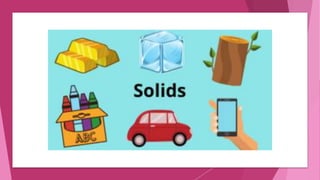
Solid
• A solid is defined as a state of matter with a definite shape and volume. In
contrast, liquids can change shapes, while gases can change both shape and
volume. The particles in a solid (atoms, molecules, ions) are tightly-packed
compared to liquids and gases.
Liquids
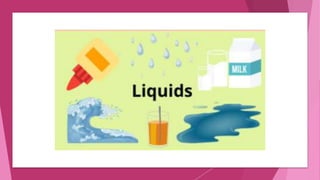
A liquid is a state of matter that has a definite volume, but no fixed shape. In
other words, a liquid takes the shape of its container. Liquids consist
of atoms or molecules that are loosely connected by intermolecular bonds. In
contrast, the atoms or molecules in a solid are fixed in a rigid shape, while the
particles in a gas are separated by great distances. Liquids have surface tension,
so they can wet surfaces.
Gases
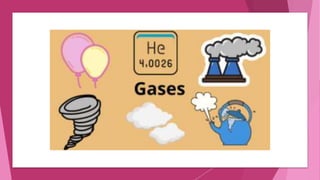
A gas is a state of matter that has no fixed volume or shape. In other words, a
gas takes the shape and volume of its container. Gases condense into liquids or
ionize into plasma. The particles in a gas are more distant from each other than
in liquids. Gas particles may be elements or compounds. Example oxygen,
helium, carbon dioxide.
Matter

Matter

  • 2.
    What is Matter •Matter is anything that has volume and mass. • Volume is the amount of space taken up, or occupied by an object. • Mass is volume of matter that something is made of.
  • 4.
    Solid • A solidis defined as a state of matter with a definite shape and volume. In contrast, liquids can change shapes, while gases can change both shape and volume. The particles in a solid (atoms, molecules, ions) are tightly-packed compared to liquids and gases.
  • 6.
    Liquids A liquid isa state of matter that has a definite volume, but no fixed shape. In other words, a liquid takes the shape of its container. Liquids consist of atoms or molecules that are loosely connected by intermolecular bonds. In contrast, the atoms or molecules in a solid are fixed in a rigid shape, while the particles in a gas are separated by great distances. Liquids have surface tension, so they can wet surfaces.
  • 8.
    Gases A gas isa state of matter that has no fixed volume or shape. In other words, a gas takes the shape and volume of its container. Gases condense into liquids or ionize into plasma. The particles in a gas are more distant from each other than in liquids. Gas particles may be elements or compounds. Example oxygen, helium, carbon dioxide.