PSO (Portale Scuola in Ospedale)
The collector for the experiences in the field
of the school in the hospital
and the domiciliary learning in Italy


Matteo Uggeri | Sheffield | VISCED
22.05.2012
Glossary

 Scuola in Ospedale: a national project funded by the
  Ministry of Education (MIUR) to allow the students of
  every school level to keep on studying while they’re
  ill.
 Sezione Ospedaliera (SO): Hospital section:
    a place/situation in a hospital where children/kids can
     study;
 Istruzione Domiciliare (ID): Domiciliary Learning:
    When teachers visit a children in home therapy to allow
     him to carry on the studies.
A didactical, cultural and social
value
 The system provides services oriented to
  guarantee the Right to Education to all those
  students admitted to Hospital, in Day hospital
  or Home Therapy.
What is PSO?

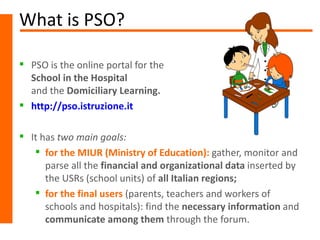
 PSO is the online portal for the
  School in the Hospital
  and the Domiciliary Learning.
 http://pso.istruzione.it

 It has two main goals:
    for the MIUR (Ministry of Education): gather, monitor and
      parse all the financial and organizational data inserted by
      the USRs (school units) of all Italian regions;
    for the final users (parents, teachers and workers of
      schools and hospitals): find the necessary information and
      communicate among them through the forum.
From loose excel files to an integrated system (CMS + database)

THE EVOLUTION OF THE SYSTEM
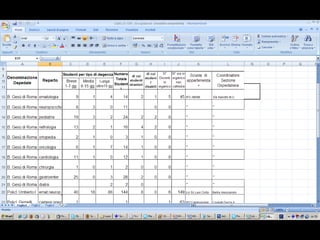
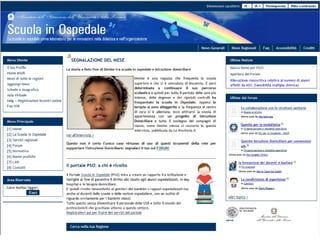
La situazione iniziale: fogli Excel


                                      METID – Politecnico di Milano
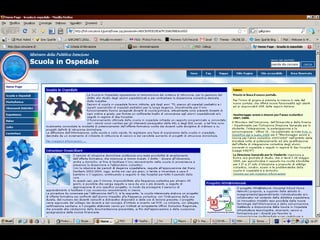
La prima versione informatica


                                METID – Politecnico di Milano
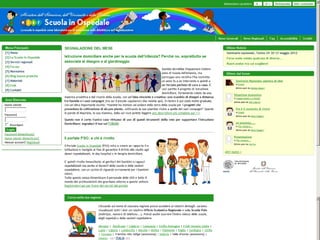
Oggi: un portale completamente nuovo, dinamico e costantemente aggiornato


                                                        METID – Politecnico di Milano
One step backward

THE EXPERIENCE OF THE ONLINE
PLATFORM: HSH
What we had:
 HSH (Hospital School Home)
 Learning project - http://hsh.istruzione.it
 mainly online
 aimed at teachers working in hospital - about 600 teachers
  involved in 2 years (?)
 Main focus: home teaching for patients in home therapy
 Developed in collaboration with the CNR in Genova.
 The project had also local developments:
      Molise - www.hshmolise.polimi.it
      Basilicata - http://hsh.metid.polimi.it
      Lombardy - www.hshlombardia.it
      Abruzzi – next June
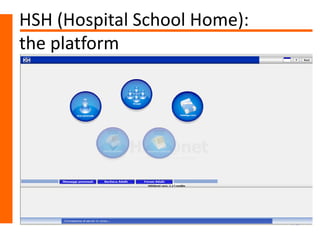
HSH (Hospital School Home):
the platform
What did not work with it

 Lack of promotion
 Complicated procedures for registration
     Problems related to the very young target
     Control paranoia
   Lack of participation
   No incentives
   Unclear aims
   Loose interface/system design
   Lack of compliance with the W3C standards
What we needed

 Save money
 Involve users
 Allow open and easy communication among
  them
 Improve the bottom up strategy through the
  dissemination of good practices
 Be 100% compliant with usability standards
  and PA limitations (i.e. IE).
 Improve the already existing PSO portal
A real answer to real needs

THE SUCCESS OF THE ONLINE
PORTAL AND ITS FORUM
Users

   Parents of hospitalized children/children in DL
   Teachers (involved or not in the SiH)
   Volunteers
   Workers [or operators?]
   Researchers
   USR responsibles
   MIUR
A slow step by step growth
Phase 1
 Design and creation of the database for the ministry
  (1 user) and the USRs (18 users)
 Provide:
       News
       Basic general static information
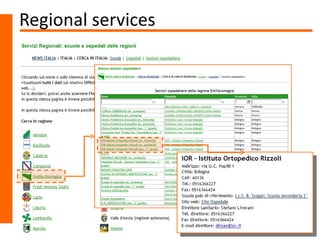
 Regional services [no login]
  providing data for all the regions with:
         Name, Tel. number, mail…
         All the involved hospitals
         All the involved schools
                                             Top hit: the regulation
         All the hospital sections          page 
The database

 It really helps the single USRs to provide data
  to the ministry (and the final users), which are:
   Detailed
   Updated
   Complete
The database
The database

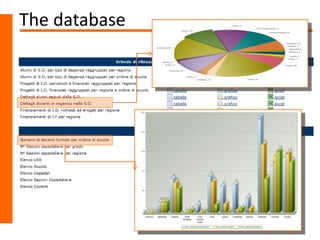
 It’s fundamental for the Ministry to:
 Collect data about all the:
      Teachers
      Schools
      Hospitals
      Hospitals sections
      Training courses (for teachers)
      Domiciliary learning actions/projects
      School in the hospital fluxes
 Check the balance between the investment in each region and
  the relative actions
 Define the next allocated budget
Regional services
A slow step by step growth
Phase 2
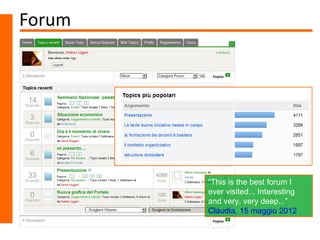
 Online forum for all registered users
 Main categories designed according to the
  ministry:
     Introduce yourself…
     Teachers and operators [or workers?]
     Parents
     Students
     Events
     Suggestions and troubles
Forum


        “This is the best forum I
        ever visited... Interesting
        and very, very deep...”
        Claudia, 15 maggio 2012
A slow step by step growth
Phase 3
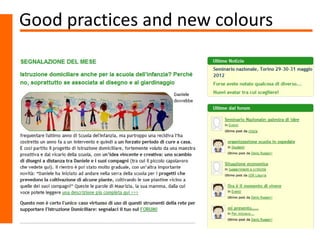
 Improved graphics:
    Change of colours from dark institutional blue to cute green and
     orange
    Specific drawings made by an external illustrator
    Rounded corners
 Good practices:
      Reading the forum discussion
      Selecting the good practices
      Contact the user
      Writing an article
      Putting it in homepage
      Re-contacting the user
Good practices and new colours
What made the portal so loved

   Nice and user friendly interface
   Quick bug fixing
   Test on small groups getting wider
   Daily check of the forum discussions by our
    PM and the ministry
The key factor of the success

 Real needs, as we said
 A good workteam
 A durable convention with the ministry (since 2007)
 Reciprocal trust between the developer and the funder
 No budget reports  No waste of time
 Denis (a real, motivated and well paid human being as a tutor
  and factotum for the ministry)
 A motivated PM (me, yes)

 Co-design in strict relationship with a real user and the
 Ministry
A further step:
Phase 4 : keep the interest alive
 Real F2F events (Turin end of May)
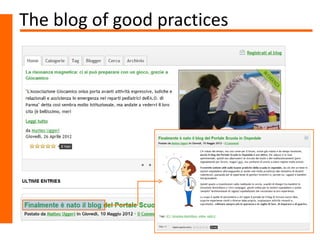
 Blog implementation and full integration
 Press promotion (Espresso)
 Connection with other international similar
  experiences (we’re so glad to be here)
 Arise the interest of the Minister of Education
 Contact other active operators in the field
  (associations, etc…)
The blog of good practices
Bottom up suggestions

 We can’t afford a tailor made online
  environment…
 …but we can help teachers, schools,
  volunteers to spread their experiences
 For instance to use web 2.0, social network
  tools or other ways to shorten the distance
  among hospitalized children with their
  buddies and teachers
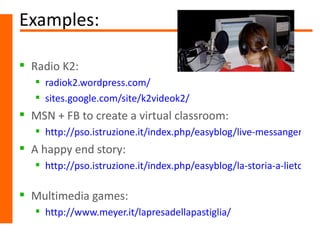
Examples:

 Radio K2:
    radiok2.wordpress.com/
    sites.google.com/site/k2videok2/
 MSN + FB to create a virtual classroom:
    http://pso.istruzione.it/index.php/easyblog/live-messanger-e-fa
 A happy end story:
    http://pso.istruzione.it/index.php/easyblog/la-storia-a-lieto-fine

 Multimedia games:
    http://www.meyer.it/lapresadellapastiglia/
The blockbuster of our projects

STATISTICS
Statistics - 1
Statistics - 2

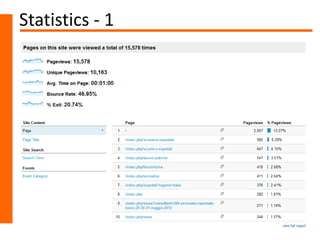
 Total visits [May 2010 – May 2012]: 58.693
 Users 549
  (about 100 new subscriber per month – even during Xmas holidays)
 Forum [Nov. 2011 - May2012]:
    Total visits 2.336
    Messages: 329
    Topics: 68
Credits

           MIUR - Ministero dell'Istruzione,
            dell'Università e della Ricerca
               Speranzina Ferraro (D. G. per lo Studente):
                Content and direction
               Denis Ruggeri:
                Consulting, forum tutoring

           Politecnico di Milano - METID
                 Susanna Sancassani: Direction
                 Matteo Uggeri: Project Management
                 Andrea Mauro: PHP programming
                 Andrea Parisi: Visual Design e accessibility
                 Bruno Aliprandi: Server management
                 Ruggero Pucci: Content check
Grazie

 Matteo Uggeri:
   Matteo.uggeri@polimi.it

 METID:
   www.metid.polimi.it


 PSO:
   http://pso.istruzione.it

Matteo Uggeri - METID - PSO

  • 1.
    PSO (Portale Scuolain Ospedale) The collector for the experiences in the field of the school in the hospital and the domiciliary learning in Italy Matteo Uggeri | Sheffield | VISCED 22.05.2012
  • 2.
    Glossary  Scuola inOspedale: a national project funded by the Ministry of Education (MIUR) to allow the students of every school level to keep on studying while they’re ill.  Sezione Ospedaliera (SO): Hospital section:  a place/situation in a hospital where children/kids can study;  Istruzione Domiciliare (ID): Domiciliary Learning:  When teachers visit a children in home therapy to allow him to carry on the studies.
  • 3.
    A didactical, culturaland social value  The system provides services oriented to guarantee the Right to Education to all those students admitted to Hospital, in Day hospital or Home Therapy.
  • 4.
    What is PSO? PSO is the online portal for the School in the Hospital and the Domiciliary Learning.  http://pso.istruzione.it  It has two main goals:  for the MIUR (Ministry of Education): gather, monitor and parse all the financial and organizational data inserted by the USRs (school units) of all Italian regions;  for the final users (parents, teachers and workers of schools and hospitals): find the necessary information and communicate among them through the forum.
  • 5.
    From loose excelfiles to an integrated system (CMS + database) THE EVOLUTION OF THE SYSTEM
  • 6.
    La situazione iniziale:fogli Excel METID – Politecnico di Milano
  • 7.
    La prima versioneinformatica METID – Politecnico di Milano
  • 8.
    Oggi: un portalecompletamente nuovo, dinamico e costantemente aggiornato METID – Politecnico di Milano
  • 10.
    One step backward THEEXPERIENCE OF THE ONLINE PLATFORM: HSH
  • 11.
    What we had: HSH (Hospital School Home)  Learning project - http://hsh.istruzione.it  mainly online  aimed at teachers working in hospital - about 600 teachers involved in 2 years (?)  Main focus: home teaching for patients in home therapy  Developed in collaboration with the CNR in Genova.  The project had also local developments:  Molise - www.hshmolise.polimi.it  Basilicata - http://hsh.metid.polimi.it  Lombardy - www.hshlombardia.it  Abruzzi – next June
  • 12.
    HSH (Hospital SchoolHome): the platform
  • 13.
    What did notwork with it  Lack of promotion  Complicated procedures for registration  Problems related to the very young target  Control paranoia  Lack of participation  No incentives  Unclear aims  Loose interface/system design  Lack of compliance with the W3C standards
  • 14.
    What we needed Save money  Involve users  Allow open and easy communication among them  Improve the bottom up strategy through the dissemination of good practices  Be 100% compliant with usability standards and PA limitations (i.e. IE).  Improve the already existing PSO portal
  • 15.
    A real answerto real needs THE SUCCESS OF THE ONLINE PORTAL AND ITS FORUM
  • 16.
    Users  Parents of hospitalized children/children in DL  Teachers (involved or not in the SiH)  Volunteers  Workers [or operators?]  Researchers  USR responsibles  MIUR
  • 17.
    A slow stepby step growth Phase 1  Design and creation of the database for the ministry (1 user) and the USRs (18 users)  Provide:  News  Basic general static information  Regional services [no login] providing data for all the regions with:  Name, Tel. number, mail…  All the involved hospitals  All the involved schools Top hit: the regulation  All the hospital sections page 
  • 18.
    The database  Itreally helps the single USRs to provide data to the ministry (and the final users), which are:  Detailed  Updated  Complete
  • 19.
  • 20.
    The database  It’sfundamental for the Ministry to:  Collect data about all the:  Teachers  Schools  Hospitals  Hospitals sections  Training courses (for teachers)  Domiciliary learning actions/projects  School in the hospital fluxes  Check the balance between the investment in each region and the relative actions  Define the next allocated budget
  • 21.
  • 22.
    A slow stepby step growth Phase 2  Online forum for all registered users  Main categories designed according to the ministry:  Introduce yourself…  Teachers and operators [or workers?]  Parents  Students  Events  Suggestions and troubles
  • 23.
    Forum “This is the best forum I ever visited... Interesting and very, very deep...” Claudia, 15 maggio 2012
  • 24.
    A slow stepby step growth Phase 3  Improved graphics:  Change of colours from dark institutional blue to cute green and orange  Specific drawings made by an external illustrator  Rounded corners  Good practices:  Reading the forum discussion  Selecting the good practices  Contact the user  Writing an article  Putting it in homepage  Re-contacting the user
  • 25.
    Good practices andnew colours
  • 26.
    What made theportal so loved  Nice and user friendly interface  Quick bug fixing  Test on small groups getting wider  Daily check of the forum discussions by our PM and the ministry
  • 27.
    The key factorof the success  Real needs, as we said  A good workteam  A durable convention with the ministry (since 2007)  Reciprocal trust between the developer and the funder  No budget reports  No waste of time  Denis (a real, motivated and well paid human being as a tutor and factotum for the ministry)  A motivated PM (me, yes)  Co-design in strict relationship with a real user and the Ministry
  • 28.
    A further step: Phase4 : keep the interest alive  Real F2F events (Turin end of May)  Blog implementation and full integration  Press promotion (Espresso)  Connection with other international similar experiences (we’re so glad to be here)  Arise the interest of the Minister of Education  Contact other active operators in the field (associations, etc…)
  • 29.
    The blog ofgood practices
  • 30.
    Bottom up suggestions We can’t afford a tailor made online environment…  …but we can help teachers, schools, volunteers to spread their experiences  For instance to use web 2.0, social network tools or other ways to shorten the distance among hospitalized children with their buddies and teachers
  • 31.
    Examples:  Radio K2:  radiok2.wordpress.com/  sites.google.com/site/k2videok2/  MSN + FB to create a virtual classroom:  http://pso.istruzione.it/index.php/easyblog/live-messanger-e-fa  A happy end story:  http://pso.istruzione.it/index.php/easyblog/la-storia-a-lieto-fine  Multimedia games:  http://www.meyer.it/lapresadellapastiglia/
  • 32.
    The blockbuster ofour projects STATISTICS
  • 33.
  • 34.
    Statistics - 2 Total visits [May 2010 – May 2012]: 58.693  Users 549 (about 100 new subscriber per month – even during Xmas holidays)  Forum [Nov. 2011 - May2012]:  Total visits 2.336  Messages: 329  Topics: 68
  • 35.
    Credits  MIUR - Ministero dell'Istruzione, dell'Università e della Ricerca  Speranzina Ferraro (D. G. per lo Studente): Content and direction  Denis Ruggeri: Consulting, forum tutoring  Politecnico di Milano - METID  Susanna Sancassani: Direction  Matteo Uggeri: Project Management  Andrea Mauro: PHP programming  Andrea Parisi: Visual Design e accessibility  Bruno Aliprandi: Server management  Ruggero Pucci: Content check
  • 36.
    Grazie  Matteo Uggeri:  Matteo.uggeri@polimi.it  METID:  www.metid.polimi.it  PSO:  http://pso.istruzione.it