MAA704: Matrix Analysis
Nonnegative Matrix Factorization
Presented by:
Filmon
Tarik
Tigabu
Matrix Factorization and its
applications
Outline
 Expression power of matrix
 Various matrix factorization methods
 Application of matrix factorization
Curse of Dimensinality
 In machine learning and others,
Dimension is a curse i.e., as they are
intensive computation, and if
dimension is high, this will worsen the
computation, that’s why we have
Different matrix factorization
methods
 LU decomposition
 Singular Value Decomposition(SVD)
 Probabilistic Matrix
Factorization(PMF)
 Non-negative Matrix
Factorization(NMF)
Application of matrix factorization
 LU decomposition
◦ Solving system of equations
 SVD decomposition
◦ Low rank matrix approximation
◦ Pseudo-inverse
Application of matrix factorization
 PMF
◦ Recommendation system
 NMF
◦ Learning the parts of objects
PMF
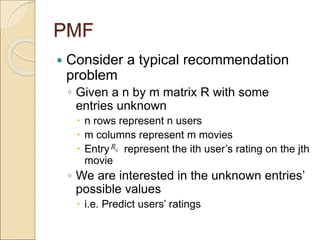
 Consider a typical recommendation
problem
◦ Given a n by m matrix R with some
entries unknown
 n rows represent n users
 m columns represent m movies
 Entry represent the ith user’s rating on the jth
movie
◦ We are interested in the unknown entries’
possible values
 i.e. Predict users’ ratings
ij
R
PMF
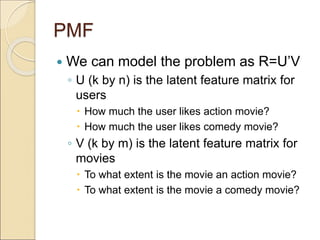
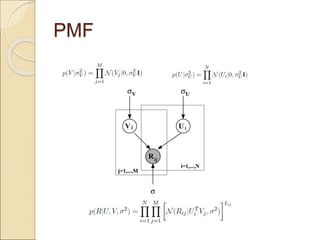
 We can model the problem as R=U’V
◦ U (k by n) is the latent feature matrix for
users
 How much the user likes action movie?
 How much the user likes comedy movie?
◦ V (k by m) is the latent feature matrix for
movies
 To what extent is the movie an action movie?
 To what extent is the movie a comedy movie?
PMF
 If we can learn U and V from existing
ratings, then we can compute
unknown entries by multiplying these
two matrices.
 Let’s consider a probabilistic
approach.
PMF
PMF
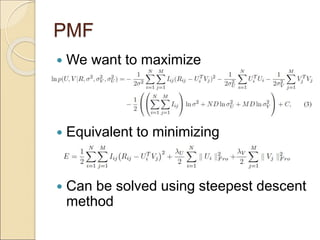
 We want to maximize
 Equivalent to minimizing
 Can be solved using steepest descent
method
Extension to PMF
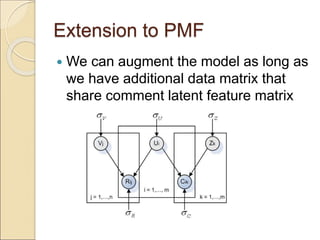
 We can augment the model as long as
we have additional data matrix that
share comment latent feature matrix
NMF
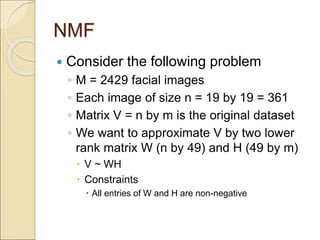
 Consider the following problem
◦ M = 2429 facial images
◦ Each image of size n = 19 by 19 = 361
◦ Matrix V = n by m is the original dataset
◦ We want to approximate V by two lower
rank matrix W (n by 49) and H (49 by m)
 V ~ WH
 Constraints
 All entries of W and H are non-negative
NMF
 How well can W and H approximate V
 How can we interpret the result
NMF
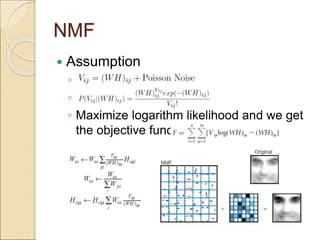
 Assumption
◦
◦
◦ Maximize logarithm likelihood and we get
the objective function
Criticize of NMF
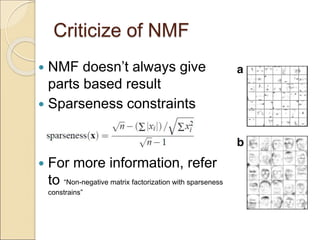
 NMF doesn’t always give
parts based result
 Sparseness constraints
 For more information, refer
to “Non-negative matrix factorization with sparseness
constrains”
Questions?
 Thank you

matrixfactorization.ppt

  • 1.
    MAA704: Matrix Analysis NonnegativeMatrix Factorization Presented by: Filmon Tarik Tigabu
  • 2.
    Matrix Factorization andits applications
  • 3.
    Outline  Expression powerof matrix  Various matrix factorization methods  Application of matrix factorization
  • 4.
    Curse of Dimensinality In machine learning and others, Dimension is a curse i.e., as they are intensive computation, and if dimension is high, this will worsen the computation, that’s why we have
  • 5.
    Different matrix factorization methods LU decomposition  Singular Value Decomposition(SVD)  Probabilistic Matrix Factorization(PMF)  Non-negative Matrix Factorization(NMF)
  • 6.
    Application of matrixfactorization  LU decomposition ◦ Solving system of equations  SVD decomposition ◦ Low rank matrix approximation ◦ Pseudo-inverse
  • 7.
    Application of matrixfactorization  PMF ◦ Recommendation system  NMF ◦ Learning the parts of objects
  • 8.
    PMF  Consider atypical recommendation problem ◦ Given a n by m matrix R with some entries unknown  n rows represent n users  m columns represent m movies  Entry represent the ith user’s rating on the jth movie ◦ We are interested in the unknown entries’ possible values  i.e. Predict users’ ratings ij R
  • 9.
    PMF  We canmodel the problem as R=U’V ◦ U (k by n) is the latent feature matrix for users  How much the user likes action movie?  How much the user likes comedy movie? ◦ V (k by m) is the latent feature matrix for movies  To what extent is the movie an action movie?  To what extent is the movie a comedy movie?
  • 10.
    PMF  If wecan learn U and V from existing ratings, then we can compute unknown entries by multiplying these two matrices.  Let’s consider a probabilistic approach.
  • 11.
  • 12.
    PMF  We wantto maximize  Equivalent to minimizing  Can be solved using steepest descent method
  • 13.
    Extension to PMF We can augment the model as long as we have additional data matrix that share comment latent feature matrix
  • 14.
    NMF  Consider thefollowing problem ◦ M = 2429 facial images ◦ Each image of size n = 19 by 19 = 361 ◦ Matrix V = n by m is the original dataset ◦ We want to approximate V by two lower rank matrix W (n by 49) and H (49 by m)  V ~ WH  Constraints  All entries of W and H are non-negative
  • 15.
    NMF  How wellcan W and H approximate V  How can we interpret the result
  • 16.
    NMF  Assumption ◦ ◦ ◦ Maximizelogarithm likelihood and we get the objective function
  • 17.
    Criticize of NMF NMF doesn’t always give parts based result  Sparseness constraints  For more information, refer to “Non-negative matrix factorization with sparseness constrains”
  • 18.