©MathsWatch www.mathswatch.com mathswatch@aol.co.uk
MathsWatch
Worksheets
HIGHER
Questions
© MathsWatch
Clip No Name of clip Tier Grades Pg No
44 Factors, Multiples and Primes F and H D 44
45 Evaluate powers F and H D 45
46 Understand squares, cubes, roots F and H D 45
47 Equivalent fractions F and H D 46
48 Simplification of fractions F and H D 46
49 Put fractions in order F and H D 46
50 Value for money F and H D 47
51 Percentage of an amount with a calculator F and H D 48
52 Percentage of an amount without a calculator F and H D 48
53 Change to a percentage with a calculator F and H D 49
54 Change to a percentage without a calculator F and H D 49
55 Find a fraction of an amount F and H D 50
56 Addition and subtraction of fractions F and H D 51
57 Multiply and divide fractions F and H D 52
58 Change fractions to decimals F and H D 53
59 BODMAS F and H D 54
60 Long Multiplication of Decimals F and H D 55
61 Ratio F and H D 56
62 Recipe type ratio questions F and H D 57
63 Hard calculator questions F and H D 58
64 Real-life money questions F and H D 59
65 Generate a sequence from the nth term F and H D 60
66 Substitution F and H D 61
67 Parallel lines F and H D 62
68 Angle sum of a triangle F and H D 63-64
69 Properties of special triangles F and H D 63-64
70 Finding angles of regular polygons F and H D 65
71 Area of circle F and H D 66
72 Circumference of circle F and H D 67
73 Area of compound shapes F and H D 68
74 Rotations F and H D 69
75 Reflections F and H D 70
76 Enlargements F and H D 71
77 Translations F and H D 72
78 Find the mid-point of a line F and H D 73
79 Measuring and drawing angles F and H D 74
80 Drawing triangles F and H D 75
81 Plans and elevations F and H D 76
82 Nets F and H D 77
83 Symmetries F and H D 78
84 Questionnaires and data collection F and H D 79
85 Two-way tables F and H D 80
86 Pie charts F and H D 81
87 Scatter graphs F and H D 82
88 Frequencydiagrams F and H D 83
89 Stem and leaf diagrams F and H D 84
90 Simple probability F and H D 85A
91 Mutually Exclusive Events F and H D 85B
© MathsWatch
Clip No Name of clip Tier Grades Pg No
92 Overview of percentages F and H C 86
93 Increase/decrease by a percentage F and H C 87
94 Ratio F and H C 88
95 Products of prime factors F and H C 89
96 LCM and HCF F and H C 89
97 Using place value F and H C 90
98 Recurring decimals into fractions F and H C 91
99 Four rules of negatives F and H C 92
100 Division by 2-digit decimals F and H C 92
101 Estimate answers F and H C 93
102 Algebraic simplification F and H C 94
103 Expanding & simplifying brackets F and H C 95
104 Factorisation F and H C 96
105 Solving equations F and H C 97
106 Forming equations F and H C 98
107 Changing the subject of a formula F and H C 99
108 Inequalities F and H C 100
109 Solving inequalities F and H C 101
110 Trial and improvement F and H C 102
111 Index Notation for Multiplication & Division F and H C 103
112 Find the Nth term F and H C 104
113 Drawing straight line graphs F and H C 105
114 Equation of a straight line F and H C 106
115 Simultaneous Equations Graphs F and H C 107
116 Drawing Quadratic Graphs F and H C 108
117 Real-life Graphs F and H C 109
118 Pythagoras' Theorem F and H C 110
119 Pythagoras - line on a graph F and H C 111
120 Surface area of cuboids F and H C 112
121 Surface area of triangular prisms F and H C 113
122 Volume of a prism F and H C 114
123 Similar shapes F and H C 115
124 Converting metric units F and H C 116
125 Bounds F and H C 117
126 Compound measures F and H C 118
127 Bisecting a line F and H C 119
128 Drawing a perpendicular to a line F and H C 120
129 Bisecting an angle F and H C 121
130 Loci F and H C 122-123
131 Bearings F and H C 124
132 Experimental probabilities F and H C 125
133 Averages from a table F and H C 126
134 Questionnaires F and H C 127
© MathsWatch
Clip No Name of clip Tier Grades Pg No
135 Standard form H B 128A-B
136 Percentage increase/decrease H B 129
137 Compound interest/depreciation H B 130
138 Reverse percentage H B 131
139 Four rules of fractions H B 132
140 Solving quadratics byfactorising H B 133
141 Difference of two squares H B 134
142 Simultaneous linear equations H B 135
143 Understanding y = mx + c H B 136
144 Regions H B 137
145 Graphs of cubic and reciprocal functions H B 138
146 Recognise the shapes of functions H B 139
147 Trigonometry H B 140A-B
148 3D coordinates H B 141
149 Similar shapes H B 142
150 Circle theorems H B 143A-D
151 Cumulative frequency H B 144
152 Boxplots H B 145
153 Simple tree diagrams H B 146
154 Harder tree diagrams H B 147
155 Recurring decimals H A to A* 148
156 Fractional and negative indices H A to A* 149
157 Surds H A to A* 150
158 Rationalising the denominator H A to A* 150
159 Direct and inverse proportion H A to A* 151
160 Upper and lower bounds H A to A* 152
161 Solving quadratics using the formula H A to A* 153
162 Solving quadratics bycompleting the square H A to A* 154
163 Algebraic fractions H A to A* 155
164 Rearranging difficult formulae H A to A* 156
165 Sim. equations involving a quadratic H A to A* 157
166 Gradients of parallel and perpendicular lines H A to A* 158
167 Transformation of functions H A to A* 159
168 Graphs of trigonometric functions H A to A* 160-161
169 Transformation of trigonometric functions H A to A* 162
170 Graphs of exponential functions H A to A* 163
171 Enlargement by negative scale factor H A to A* 164
172 Equations of circles and Loci H A to A* 165
173 Sine and Cosine rules H A to A* 166
174 Pythagoras in 3D H A to A* 167
175 Trigonometryin 3D H A to A* 168
176 Areas of triangles using ½ ab sin C H A to A* 169
177 Cones and Spheres H A to A* 170
178 Segments and Frustums H A to A* 171
179 Congruent triangles H A to A* 172
180 Vectors H A to A* 173-174
181 Histograms H A to A* 175
182 Probability ‘And’ and ‘Or’ questions H A to A* 176
183 Stratified sampling H A to A* 177
©Mathswatch
Page 44
Clip 44 Factors, Multiples and Primes
1) Write the factors of
a) 6 b) 16 c) 18 d) 30
2) In a pupil’s book the factors of 12 are listed as
1 2 3 4 5 12
The above list contains a mistake.
Cross it out from the list and replace it with the correct number.
3) The factors of 30 and 40 are listed
30: 1, 2, 3, 5, 6, 10, 15, 30
40: 1, 2, 4, 5, 8, 10, 20, 40
Write the common factors of 30 and 40 (the numbers that are factors of 30 and 40).
4) Writethefirstfourmultiplesof
a) 3 b) 5 c) 10 d) 15
5) In a pupil’s book the first 7 multiples of 8 are listed as
8 16 22 32 40 48 54
The above list contains 2 mistakes.
Cross them out and replace them with the correct numbers.
6) Thefirstfivemultiplesof4and10arelisted
4: 4, 8, 12, 16, 20
10: 10, 20, 30, 40, 50
From the two lists above, write the common multiple of 4 and 10.
7) Listthefirstfiveprimenumbers
8) Usingjustthislistofnumbers:
11 18 1 4 21 24 9 3 12 2 19
findthefollowing:
a)Theprimenumbers
b) The factors of 18
c)Themultiplesof3
©Mathswatch
Page 45
Clips 45, 46 Evaluate Powers, Squares, Cubes & Roots
1.Evaluate
a) 72
b) 24
c) 52
d) 33
e) 16
2. Work out the square of
a) 1 b) 2 c) 4 d) 6 e) 11
3. Work out
a) 32
b) 92
c) 102
d) 122
e) 1002
4. Work out the cube of
a) 1 b) 3 c) 5 d) 6 e) 100
5. Work out
a) 23
b) 43
c) 103
6. Work out the square root of
a) 1 b) 9 c) 81
7. Work out
a) b) c)
8. Work out the cube root of
a) 27 b) 1 c) 125
9.Fromthefollowingnumbers
4 27 8 64 16 19 100 360 45 3
Find
a) The square numbers
b) The cube numbers
c) The square root of 64
d) The cube root of 27
10. Match together cards with the same answer
25 49 121
92
81 53
25
125 32 3
9
©Mathswatch
Page 46
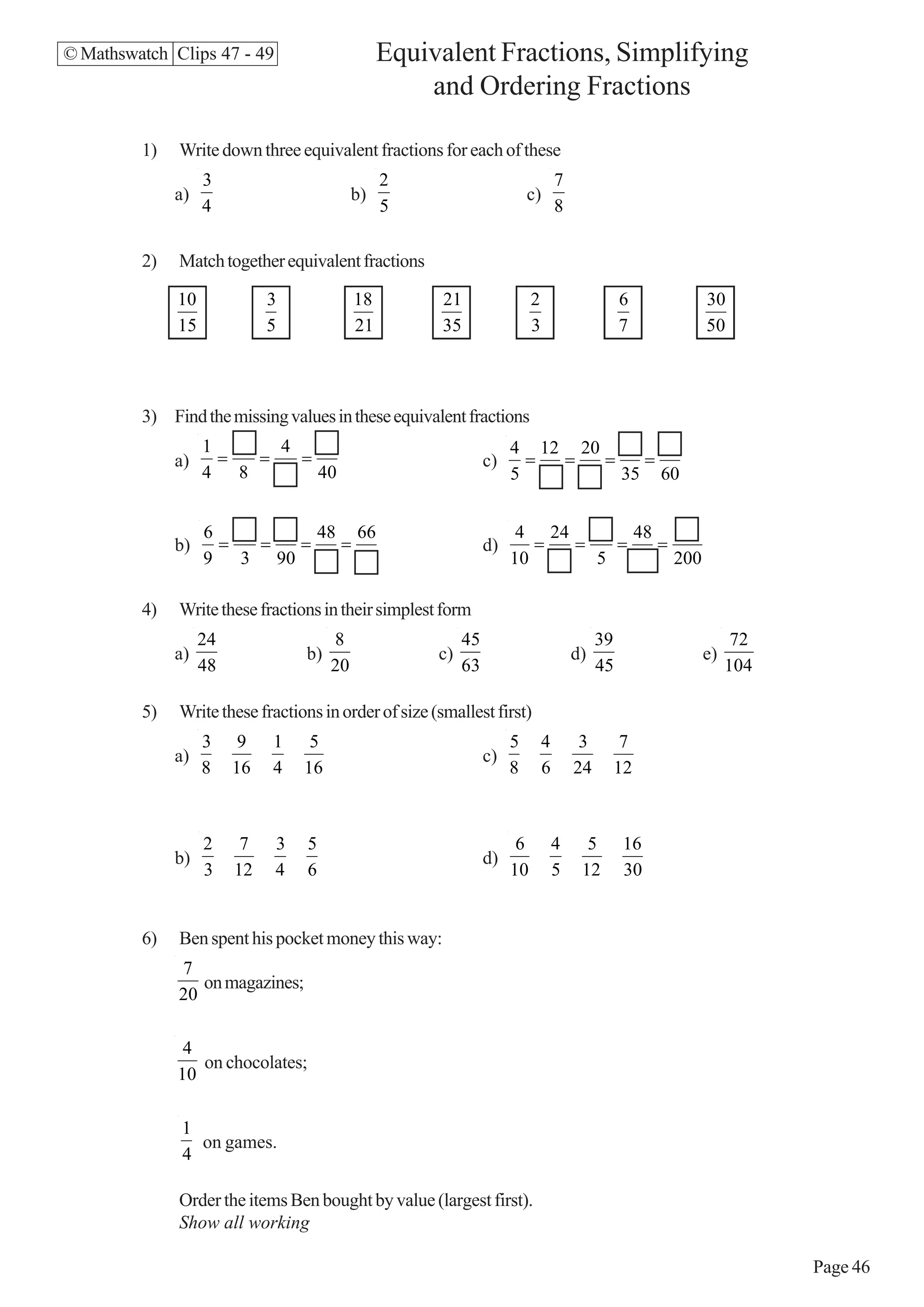
10
15
3
5
18
21
21
35
2
3
6
7
30
50
3) Findthemissingvaluesintheseequivalentfractions
a)
1
4 8
4
40
= = = c)
4
5
12 20
35 60
= = = =
b)
6
9 3 90
48 66
= = = = d)
4
10
24
5
48
200
= = = =
4) Writethesefractionsintheirsimplestform
a)
24
48
b)
8
20
c)
45
63
d)
39
45
e)
72
104
5) Writethesefractionsinorderofsize(smallestfirst)
a)
3
8
9
16
1
4
5
16
c)
5
8
4
6
3
24
7
12
b)
2
3
7
12
3
4
5
6
d)
6
10
4
5
5
12
16
30
6) Benspenthispocketmoneythisway:
7
20
onmagazines;
4
10
on chocolates;
4
1
on games.
OrdertheitemsBenboughtbyvalue(largestfirst).
Show all working
Clips 47 - 49 Equivalent Fractions, Simplifying
and Ordering Fractions
1) Write down three equivalent fractions for each of these
a)
3
4
b)
2
5
c)
7
8
2) Matchtogetherequivalentfractions
©Mathswatch
Page 47
Clip 50 Value for Money
1) Whichofthefollowingofferbettervalueformoney?
Working must be shown
a) 200ml of toothpaste for 50p or 400ml of toothpaste for 90p
b)600g of bananas for 70p or 200g of bananas for 22p
c) 2 litres of paint for £1.60 or 5 litres of paint for £3.50
d)60 teabags for £1.62 or 40 teabags for £0.96
2) Which of these is the best buy?
3) Hamza needs to buy 2 litres of paint.
At the shop he gets two choices:
500ml for £2.55 or 1 litre for £4.79.
a) Work out which of these would be the best buy for Hamza.
b)How much does he save if he buys the ‘best buy’ rather than the ‘worst buy’.
Youmustshowallyourworking.
4) Honey pots are sold in two sizes.
A small pot costs 45p and weighs 450g.
A large pot costs 80p and weighs 850g.
Which pot of honey is better value for money?
Youmustshowallyourworking.
20 exercise books
for £4.00
35 exercise books
for £7.80
Without a calculator,
please, for question 1.
Without a calculator,
please, for question 3.
Working must be shown
©Mathswatch
Page 48
Clip 51 Find a Percentage with a Calculator
1) Work out
a) 21% of 340 d) 3.5% of 78.6
b) 9% of 2700 e) 80.5% of 3200
c) 17.5% of 420 f) 117.5% of 35
2) Workoutthetotalcost(includingVAT)ofthefollowingitems.
3) 850 people attended a festival.
16% of the people were children.
Work out the number of children at the festival.
1) Work out (i) 10% and (ii) 5% and (iii) 15% of:
a) 200 b) 30 c) 450 d) 54
2) Work out
a) 30% of 280 d) 17.5% of 300
b) 80% of 3500 e) 55% of 700
c) 15% of 540 f) 17.5% of 180
3) Workoutthetotalcost(includingVAT)ofthefollowingitems.
4) There are 1300 students at MathsWatch College.
45% of these students are boys.
Work out the number of boys.
Trainers
£45.50
plus 17.5% VAT
Tennisracquet
£28.99
plus 17.5% VAT
Football boots
£57
plus 17.5% VAT
Find a Percentage Without a Calculator©Mathswatch Clip 52
Video recorder
£200 + 17.5% VAT
Tape player
£60 + 17.5%VAT
Laptop
£1200 + 17.5% VAT
©Mathswatch
Page 49
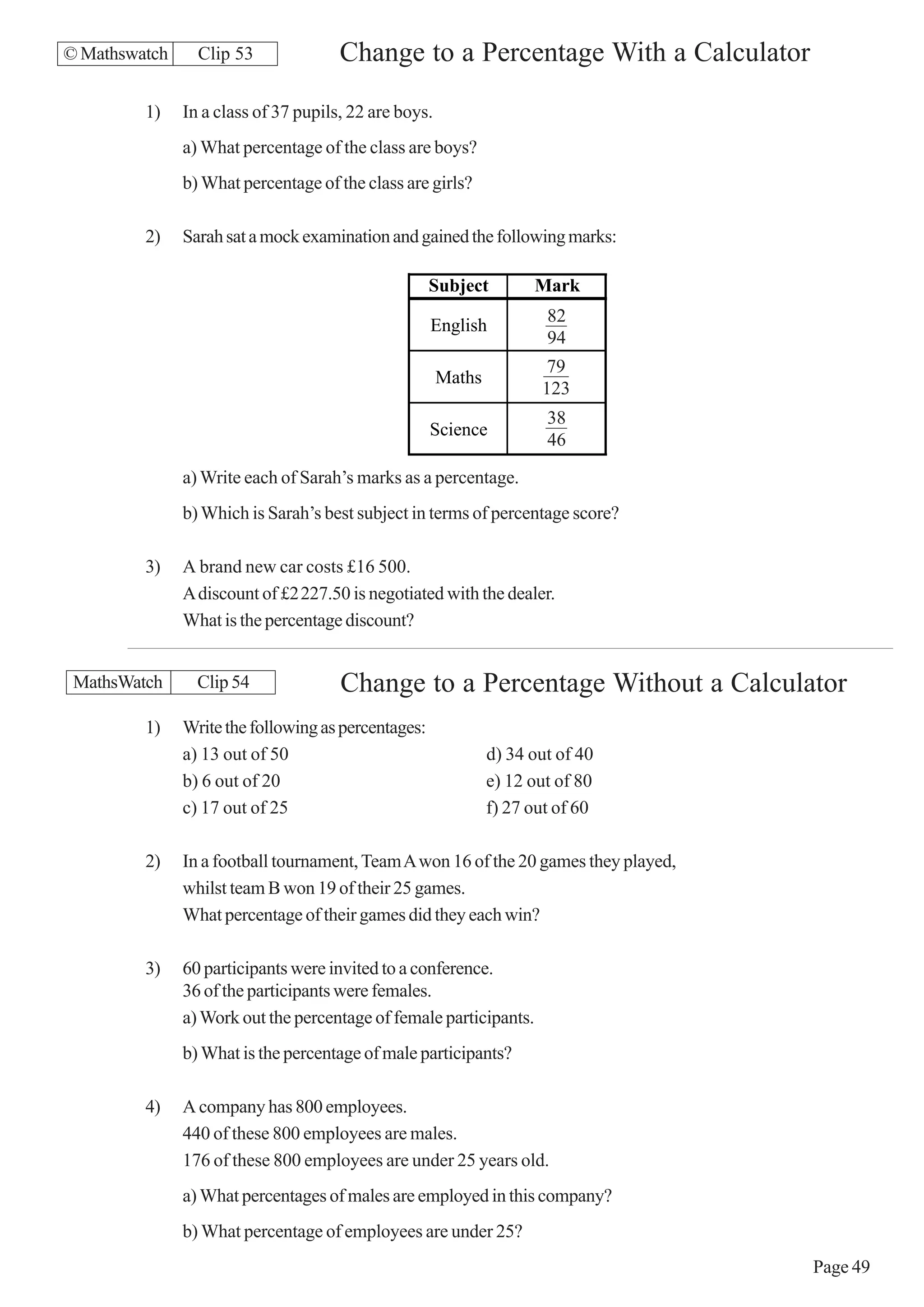
Clip 53 Change to a Percentage With a Calculator
1) In a class of 37 pupils, 22 are boys.
a) What percentage of the class are boys?
b) What percentage of the class are girls?
2) Sarahsatamockexaminationandgainedthefollowingmarks:
a) Write each of Sarah’s marks as a percentage.
b)Which is Sarah’s best subject in terms of percentage score?
3) A brand new car costs £16 500.
Adiscount of £2227.50 is negotiated with the dealer.
What is the percentage discount?
1) Writethefollowingaspercentages:
a) 13 out of 50 d) 34 out of 40
b) 6 out of 20 e) 12 out of 80
c) 17 out of 25 f) 27 out of 60
2) In a football tournament,TeamAwon 16 of the 20 games they played,
whilst team B won 19 of their 25 games.
What percentage of their games did they each win?
3) 60 participants were invited to a conference.
36 of the participants were females.
a)Work out the percentage of female participants.
b) What is the percentage of male participants?
4) A company has 800 employees.
440 of these 800 employees are males.
176 of these 800 employees are under 25 years old.
a) What percentages of males are employed in this company?
b) What percentage of employees are under 25?
Subject Mark
English
Maths
Science
Change to a Percentage Without a CalculatorMathsWatch Clip 54
79
123
38
46
82
94
©Mathswatch
Page 50
Clip 55 Find a Fraction of an Amount
1. Work out these amounts.
a)
3
4
of £20 b)
2
3
of 60 kg c)
3
8
× 24
d) 150 ×
2
3
e)
2
9
of 180 cm f) 49 ×
4
7
g) 60 ×
1
4
h)
5
8
of £48 i) 4000 ×
7
8
2. There are 600 apples on a tree and there are maggots in
3
5
of them.
Howmanyappleshavemaggotsinthem?
3. Liz and Lee are travelling in a car from Glasgow to Poole (770 km).
At midday they had already travelled
5
7
of the total distance.
What distance, in km, had they travelled by midday?
4. A digital camera that cost £49 was sold on eBay for
3
7
of the original price.
Whatwasthesellingprice?
5. YesterdayThomas travelled a total of 175 miles.
Hetravelled
2
5
ofthisdistanceinthemorning.
How many miles did he travel during the rest of the day?
6. Debra received her £15 pocket money on Saturday.
She spent of her pocket money on magazines.
She spent
2
5
of her pocket money on a necklace.
How much of the £15 did she have left?
1
3
©Mathswatch
Page 51
1. Work out the following giving your answer as a fraction in its simplest form
a)
3
5
1
5
+ b)
3
7
2
7
+ c)
5
8
3
8
− d)
7
13
4
13
−
2. Work out the following giving your answer as a fraction in its simplest form
a)
3
5
2
10
+ b)
1
3
2
9
+ c)
13
20
3
5
− d)
9
12
1
3
−
3. Changethefollowingtomixednumbers
a)
8
5
b)
14
3
c)
35
6
d)
17
5
4. Change the following to top heavy (or improper) fractions
a) 1
2
5 b) 3
1
4 c) 6
1
5 d) 2
5
9
5. Work out the following giving your answer as a fraction in its simplest form
a) 1 6
2
5
1
5+ b) 2 1
3
4
1
5+ c) 4 3
1
6
1
3− d) 7 2
4
9
5
9−
6. Work out the following giving your answer as a fraction in its simplest form
a)
3
4
1
5
− b)
5
11
3
11
+ c) 5
2
3
1
2 − d)
7
12
3
4
+
e) 2 9
4
5
2
5+ f)
2
7
1
2
+ g) 9 5
1
4
2
5− h)
12
15
7
15
−
7. Ted received his pocket money on Friday.
He spent
3
5
of his pocket money on games.
He spent
1
10
of his pocket money on magazines.
What fraction of his pocket money did he have left?
8. Maisie buys a bag of flour.
She uses
1
4
to bake a cake and
2
5
to make a loaf.
a) What fraction of the bag of flour was used?
b) What fraction of the bag of flour is left?
9. Work out the total length of this shape.
Give your answer as a mixed number.
3
1
4 inches 2
2
3 inches
Diagram NOT
accurately drawn
Clip 56 Addition and Subtraction of Fractions
©Mathswatch
Page 52
Clip 57 Multiplication and Division of Fractions
Workoutthefollowinggivingyouranswerasafractioninitssimplestform.
1)
4
5
1
3
× 11)
1
3
5
6
÷
2)
3
4
2
3
× 12)
2
7
10
21
÷
3)
3
10
4
9
× 13)
4
5
8÷
4)
3
7
5
6
× 14)
4
11
4
11
÷
5)
6
25
15
18
× 15)
4
5
8
9
÷
6)
4
15
3
16
× 16)
5
8
10
19
÷
7) 2 3
2
5
3
4× 17) 1 2
2
3
1
2÷
8) 1 3
2
3
3
10× 18) 3 2
1
5
2
3÷
9) 4
5
7
2
3 × 19) 25 2
1
7÷
10)
3
5
12
1
2× 20)
2
3
2
2
9÷
©Mathswatch
Page 53
Clip 58 Change a Fraction to a Decimal
Writethefollowingfractionsasdecimals
1)
3
10
2)
7
10
3)
9
100
4)
1
2
5)
3
4
6)
2
5
7)
7
20
8)
1
3
9)
1
8
10)
5
8
©Mathswatch
Page 54
Clip 59 BODMAS
Work out
1) 6 × 5 + 2
2) 2 + 6 × 5
3) 35 – 4 × 3
4) 48 ÷ (14 – 2)
5) 27 ÷ (3 + 6)
6) 27 ÷ 3 + 6
7) (9 + 2) × 2 + 5
8) 4 × (1 + 4) – 6
9) 6 × 4 – 3 × 5
10)
9 3
4 2
+
+
11)
23 9
7 3
+
−
12)
7 2
4 15
2
2
−
−
13)
5 3
2 7
2
+
×
14)
5 6 4
13
× −
15)
8 2 4
3 12
× −
+
16)
12 3 2
14 7
− ×
÷
17)
20 3
10 5 4
2
−
− +( )
18)
3 9 8
1 6 4
+ ×
+ ×
©Mathswatch
Page 55
Clip 60 Long Multiplication of Decimals
1. Work out
a) 7 × 4.3 b) 5 × 3.16 c) 2.3 × 1.2
d) 7.2 × 42.5 e) 12.5 × 0.59 f) 0.652 × 0.37
g) 5.62 × 9 h) 26.7 × 4.9 i) 1.56 × 0.059
2. David buys 5 books for £8.75 each.
How much does he pay?
3. A DVD costs £12.25.
Work out the cost of 9 of these DVDs.
4. John takes 27 boxes out of his van.
The weight of each box is 41.7 kg.
Work out the total weight of the 27 boxes.
5. Nina bought 43 teddy bears at £9.35 each.
Work out the total amount she paid.
6. Elliottgoesshopping.
Hebuys
0.5 kg of pears at £0.84 per kg.
2.5 kg of grapes at £1.89 per kg.
6 kg of potatoes at £0.25 per kg.
How much does he pay?
7. Brian hires a car for 3 days.
Tariffsare:
£44.80 for the first day and
£37.50 for each extra day.
How much does he pay?
©Mathswatch
Page 56
Clips 61, 94 Ratio
1. Writethefollowingratiosintheirsimplestform
a) 6 : 9 b) 10 : 5 c) 7 : 21 d) 4 : 24
e) 12 : 40 f) 18 : 27 g) 4 : 2 : 8 h) 18 : 63 : 9
2. Completethemissingvalueintheseequivalentratios
a) 3 : 5 = 12 : b) 4 : 9 = : 27 c) : 7 = 16 : 14 d) 2 : 3 = 3 :
3. Matchtogethercardswithequivalentratios:
3 : 4 10 : 5 50 : 100 2 : 1
5 : 2 15 : 20 15 : 6 1 : 2
4. The ratio of girls to boys in a class is 4 : 5.
a) What fraction of the class are girls?
b) Whatfractionoftheclassareboys?
5. A model of a plane is made using a scale of 1 : 5.
a) If the real length of the plane is 20m, what is the length of the model in metres?
b) If the wings of the model are 100cm long, what is the real length of the wings in metres?
6. Shareout£250inthefollowingratios:
a) 1 : 4 b) 2 : 3 c) 7 : 3 d) 9 : 12 : 4
7. Share out £80 between Tom and Jerry in the ratio 3 : 2.
8. A box of chocolates has 3 milk chocolates for every 2 white chocolates.
There are 60 chocolates in the box.
Work out how many white chocolates are in the box.
9. In a bracelet, the ratio of silver beads to gold beads is 5 : 2.
The bracelet has 25 silver beads.
How many gold beads are in the bracelet?
10.To make mortar you mix 1 shovel of cement with 5 shovels of sand.
How much sand do you need to make 30 shovels of mortar?
©Mathswatch
Page 57
Clip 62 Recipe Type Ratio Questions
1) Here are the ingredients for making a vegetable soup for 6 people:
2 carrots
1 onion
800ml stock
50g lentils
4g thyme
Work out the amount of each ingredient for
a) 12 people
b) 9 people
c) 30 people.
2) Here are the ingredients for making apple crumble for 4 people:
80g plain flour
60g ground almonds
90g sugar
60g butter
4 apples
Work out the amount of each ingredient for
a) 2 people
b) 6 people
c) 18 people.
3) Here are the ingredients for making 1500 ml of parsnip soup:
450g parsnips
300g leeks
150g bramley apples
3 onions
1 1
2
pints of chicken stock
Work out the amount of each ingredient for
a) 500 ml of soup
b) 1000 ml of soup
c) 2500 ml of soup.
©Mathswatch
Page 58
Clip 63 Hard Calculator Questions
1) Findthevalueofthefollowing:
(writedownallthefiguresonyourcalculatordisplay)
a) (0.3 + 2.8)2
b) 2.72
+ 3.92
c) 4 5 532
. − d) 6 37 4× ÷( )
2) Findthevalueofthefollowing:
(write your answers correct to 1 decimal place)
a) 2.116.5 3
+ b) 87 4 39 3. ( )÷ + c) 2
3.4
3412
d)
15 12
9 6 387
2 2
−
−. .
3) Work out
1675 1532
. .+
a) Writedownallthefiguresonyourcalculatordisplay.
b) Write your answer to part (a) correct to 1 decimal place.
4) Work out
( . . ) .2 4 19 2 03
2
× ×
Writedownallthefiguresonyourcalculatordisplay.
5) Use your calculator to work out the value of
7 34 4 71
563 1189
. .
. .
×
+
a) Writedownallthefiguresonyourcalculatordisplay.
b) Write your answer to part (a) to an appropriate degree of accuracy.
©Mathswatch
Page 59
Clip 64 Real-Life Money Questions
1) Lance goes on holiday to France.
The exchange rate is £1 = 1.40 Euros.
He changes £350 into Euros.
a) HowmanyEurosshouldheget?
In France, Lance buys a digital camera for 126 Euros.
b) Work out the cost of the camera in pounds.
2) WhilstonholidayinSpain,Gemmaboughtapairofsunglassesfor77Euros.
In England, an identical pair of sunglasses costs £59.99.
The exchange rate is £1 = 1.40 Euros.
In which country were the glasses the cheapest, and by how much?
Show all your working.
3) LukebuysapairoftrainersinSwitzerland.
He can pay either 86 Swiss Francs or 56 Euros.
The exchange rates are:
£1 = 2.10 Swiss Francs
£1 = 1.40 Euros
Which currency should he choose to get the best price, and how much would he save?
Give your answer in pounds (£).
4) The total cost of 5 kg of potatoes and 2 kg of carrots is £4.88.
3 kg of potatoes cost £1.98.
Work out the cost of 1 kg of carrots.
5) The cost of 4 kg of bananas is £5.80.
The total cost of 3 kg of bananas and 1.5 kg of pears is £5.61.
Work out the cost of 1 kg of pears.
©Mathswatch
Page 60
Clip 65, 112 Nth Term
1.Write down the first 5 terms and the 10th
term of the following sequences:
eg. 2n + 1 3, 5, 7, 9, 11.....21
a) 2n + 2 d) 7n
b) 3n + 1 e) 3n – 1
c) n + 3 f) 7n – 3
2. Find the nth
term of the following sequences:
a) 5, 10, 15, 20... d) 22, 18, 14, 10...
b) 5, 8, 11, 14... e) –3, 3, 9, 15...
c) 1, 8, 15, 22... f) 4, –1, –6, –11...
3. Here are some patterns made from sticks.
a) Draw pattern 4 in the space, below..
b) How many sticks are used in
(i) pattern 10
(ii) pattern 20
(iii) pattern 50
c) Find an expression, in terms of n, for the number of sticks in pattern number n.
d) Which pattern number can be made using 301 sticks?
Pattern 1 Pattern 2 Pattern 3
©Mathswatch
Page 61
Clip 66 Substitution
1) Work out the value of 5x when
a) x = 2 b) x = 6 c) x = 10
2) Work out the value of 3x when
a) x = –2 b) x = 10 c) x = –12
3) Work out the value of x2
when
a) x = 3 b) x = –4 c) x = –10
4) Work out the value of 2x2
when
a) x = 5 b) x = –4 c) x = 10
5) Work out the value of 3x + 5 when
a) x = 2 b) x = 6 c) x = –1
6) Work out the value of 4 + 2x when
a) x = 7 b) x = –1 c) x = –3
7) Work out the value of 3x + 2y when
a) x = 1 and y = 2 b) x = 4 and y = 3 c) x = 5 and y = –4
8) Work out the value of 6x – 3y when
a) x = 2 and y = 1 b) x = 1 and y = –2 c) x = –3 and y = 4
9) Work out the value of 3x2
+ 4y when
a) x = 1 and y = 5 b) x = –2 and y = 2 c) x = 3 and y = –2
10) Using the formula P = H × R, where P is the total pay, H is the number of hours worked,
and R is the hourly rate of pay.
Work out the total pay (P) of the following people:
a) Betty worked 10 hours at £7 per hour
b) John worked 15 hours and is paid £9 per hour
c) Mike worked for 90 minutes at £16 an hour.
11) The equation of a straight line is given as y = 3x + 2
a) Work out the value of y when
(i) x = 0
(ii) x = 1
(iii) x = 2
b) What is the value of x when y = 17?
©Mathswatch
Page 62
Clip 67 Parallel Lines
1) Line PQ is parallel to line RS
If angle PQR is equal to 36°
a) What is the size of angle QRS?
b) Give a reason for your answer.
P Q
R S
36
2) Line DCE is parallel to line AB
a) Find the size of angle ABC
b) Find the size of angle DCA
c) Calculate the size of angle ACB
A B
C
D E
68
33
3) a) Find the size of angle DBF
b) Find the size of angle HGC
B
C
D
E
F
G
54
136
H
©Mathswatch
Page 63
Clips 68, 69
1) Work out the size of the angles marked with letters.
2) Work out the size of the angles marked with letters.
3) Work out the size of the angles marked with letters.
30°
70° a 100°
b
40°
10°
c
30°
d
67°
75°
28° 34°
e
87°
f 46°
c
57°
55°
a
60°
d
e
35°
f
27°
g
45°
h
j j
120°
b
70°
i
a
80° 120° 140° 115°
b
c 70°
300°
150°
d
70°e
f
g
Angle Sum of Triangles - 1 of 2
©Mathswatch
Page 64
3) The diagram shows a 5-sided shape.
All the sides of the shape are equal in length.
a) (i) Find the value of x.
(ii) Give a reason for your answer.
b) (i) Work out the value of y.
(ii) Explainyouranswer.
Angle Sum of Triangles - 2 of 2
2) BCDisatriangle.
ABCisastraightline.
Angle CBD = 70°.
BD = CD.
a) (i) Work out the value of x.
(ii) Give a reason for your answer.
b) (i)Work out the value of y.
(ii) Give reasons for your answer.
y°
x° 70°
A B C
D
A
C
B
60°
60°
1) ABCis a triangle.
a) Find the size of angleA.
b) TriangleABCisequilateral.
Explainwhy.
DiagramNOT
accuratelydrawn
DiagramNOT
accuratelydrawn
DiagramNOT
accuratelydrawn
x°
y°
Clips 68, 69
©Mathswatch
Page 65
Clip 70 Angles of Regular Polygons
1)
a) Work out the size of an exterior angle of a regular hexagon.
b) Work out the size of an interior angle of a regular hexagon.
2)
a) Name the regular polygon, above.
b) Work out the size of an exterior angle and of an interior angle for this polygon.
3) The size of each exterior angle of a regular polygon is 90°.
Work out the number of sides of the regular polygon.
4) The size of each exterior angle of a regular polygon is 40°.
Work out the number of sides of the regular polygon.
5) The size of each interior angle of a regular polygon is 120°.
Work out the number of sides of the regular polygon.
6) The size of each interior angle of a regular polygon is 150°.
Work out the number of sides of the regular polygon.
©Mathswatch
Page 66
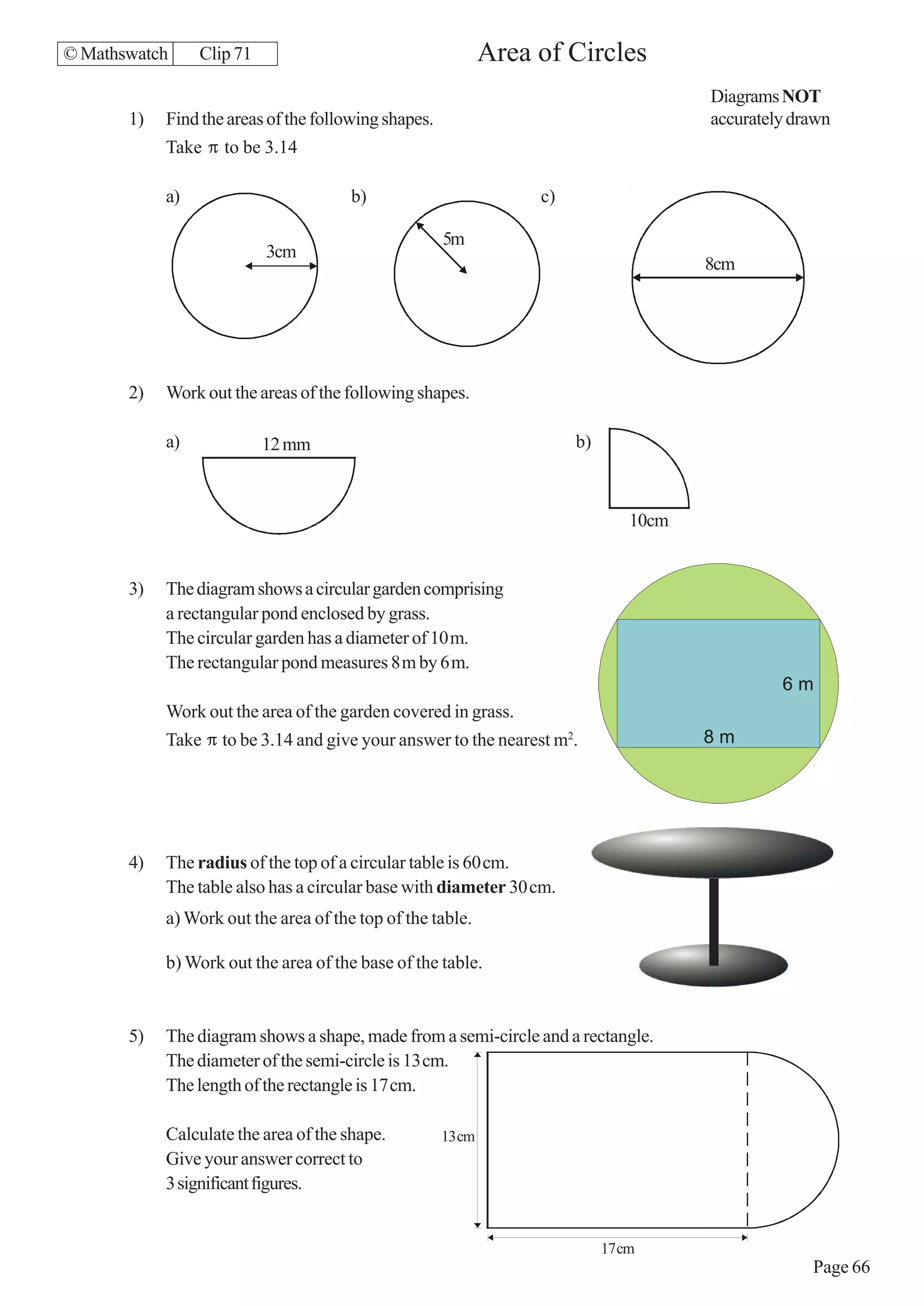
Clip 71 Area of Circles
1) Findtheareasofthefollowingshapes.
Take to be 3.14
a) b) c)
2) Work out the areas of the following shapes.
a) b)
3) Thediagramshowsacirculargardencomprising
a rectangular pond enclosed by grass.
The circular garden has a diameter of 10m.
The rectangular pond measures 8m by 6m.
Work out the area of the garden covered in grass.
Take to be 3.14 and give your answer to the nearest m2
.
4) The radius of the top of a circular table is 60cm.
The table also has a circular base with diameter 30cm.
a) Work out the area of the top of the table.
b) Work out the area of the base of the table.
5) The diagram shows a shape, made from a semi-circle and a rectangle.
The diameter of the semi-circle is 13cm.
Thelengthoftherectangleis17cm.
Calculate the area of the shape.
Give your answer correct to
3significantfigures.
10cm
3cm
5m
8cm
12mm
17cm
13cm
DiagramsNOT
accuratelydrawn
6 m
8 m
©Mathswatch
Page 67
1) Findthecircumferenceofthefollowingshapes.
Take to be 3.14.
a) b) c)
2) Work out the perimeter of the following shapes, taking to be 3.14.
a) b)
3) The radius of the top of a circular table is 60 cm.
The table also has a circular base with diameter 30 cm.
a) Work out the circumference of the top of the table.
Let be 3.14
b) Work out the circumference of the base of the table.
Let be 3.14
4) The diameter of a wheel on Kyle’s bicycle is 0.75 m.
a) Calculatethecircumferenceofthewheel.
Give your answer correct to 2 decimal places.
Kyle cycles 2000 metres.
b) Usingyouranswerin(a),calculatethenumber
of complete turns the wheel makes.
5) The diagram shows a shape, made from a semi-circle and a rectangle.
The diameter of the semi-circle is 12cm.
Thelengthoftherectangleis15cm.
Calculate the perimeter of the shape.
Give your answer correct to
3significantfigures.
10 cm
3 cm
5 m
8 cm
Clip 72 Circumference of Circles
12mm
15cm
12cm
DiagramsNOT
accuratelydrawn
©Mathswatch
Page 68
1) Find the area of each shape.
a) b)
c) d)
2) Find the shaded area of each shape.
a) b)
c) d)
10 cm
5mm
6mm 6mm
2mm
9mm
8 cm
13 cm
10 cm
6 cm
3 cm
2 cm
12 cm
7 cm
7 cm
4 cm
12 m
11m
Clip 73 Area of Compound Shapes
10 mm
6 mm
4 mm
2 mm
2 mm
2 mm
9 m
6 m
4 m
4 cm 2 cm 8 cm
10 cm
15 cm
25 cm
©Mathswatch
Page 69
Clip 74 Rotations
-5 -4 -3 -2 -1 O 1 2 3 4 5
-5
-4
-3
-2
-1
1
2
3
4
5
1) a) Rotate triangle T 90°
anti-clockwise about the
point (0, 0).
Label your new triangle U
b) Rotate triangle T 180°
about the point (2, 0).
Label your new triangle V
2) Describefullythesingle
transformationwhichmaps
triangle T to triangle U.
x
y
x
y
U
T
T
-5 -4 -3 -2 -1 O 1 2 3 4 5
-5
-4
-3
-2
-1
1
2
3
4
5
©Mathswatch
Page 70
Clip 75 Reflections
y = -x
1) a) Reflect triangle T in the x axis.
Label your new triangle U.
b) Reflect triangle T in the line with
equation y = -x.
Label your new triangle V. x
y
x
y
-5 -4 -3 -2 -1 O 1 2 3 4 5
-5
-4
-3
-2
-1
1
2
3
4
5
x
y
2) a) Describe fully the single
transformationwhichmaps
triangle T to triangle U.
b) Describe fully the single
transformation which maps
triangle T to triangle V.
T
T
U
V
-5 -4 -3 -2 -1 O 1 2 3 4 5
-5
-4
-3
-2
-1
1
2
3
4
5
©Mathswatch
Page 71
Clip 76 Enlargements
1) a) Enlarge triangle T by scale
factor 2 using point (-5, 2) as
the centre of enlargement.
Label your new triangle U.
b) Enlarge triangle V by scale
factor a half using the point
(-2, -3) as the centre of
enlargement.
Label your new triangle W.
y
x
x
y
2) DescribefullythesingletransformationwhichmapstriangleS totriangleT
O 1 2 3 4 5 6 7 8 9
1
2
3
4
5
6
7
8
9
V
T
T
S
-5 -4 -3 -2 -1 O 1 2 3 4 5
-5
-4
-3
-2
-1
1
2
3
4
5
©Mathswatch
Page 72
Clip 77 Translations
1) a) Translate triangle T by vector and label it U
b) Translate triangle T by vector and label it V
2) a) DescribefullythesingletransformationwhichmapstriangleAtotriangleB.
b) Describe fully the single transformation which maps triangle A to triangle C.
-6 -5 -4 -3 -2 -1 O 1 2 3 4 5 6
-6
-5
-4
-3
-2
-1
1
2
3
4
5
6
x
y
x
y
-4
2
3
-2
C
B
T
A
-6 -5 -4 -3 -2 -1 O 1 2 3 4 5 6
-3
-2
-1
1
2
3
4
5
6
©Mathswatch
Page 73
Clip 78 Find the Mid-Point of a Line
1) Find the midpoint ofAand B whereAhas coordinates (-2, 5) and
B has coordinates (4, -1).
y
-3 -2 -1 O 1 2 3 4 5
-2
-1
1
2
3
4
5
6
x
2) Find the midpoint ofAand B whereAhas coordinates (2, 0) and
B has coordinates (8, 6).
3) Find the midpoint ofAand B whereAhas coordinates (-4, -2) and
B has coordinates (2, 4).
4) Find the midpoint ofAand B whereAhas coordinates (-3, -2) and
B has coordinates (7, 5).
5) Find the midpoint ofAand B whereAhas coordinates (2, -5) and
B has coordinates (7, 4).
6) Find the midpoint ofAand B whereAhas coordinates (-7, -4) and
B has coordinates (-2, -1).
7) The midpoint ofAand B is at (1, 3).
The coordinates ofAare (-2, 4).
Work out the coordinates of B.
8) The midpoint ofAand B is at (3.5, 2.5).
The coordinates ofAare (2, 5).
Work out the coordinates of B.
©Mathswatch
Page 74
Clip 79 Measuring and DrawingAngles
1) Measure the following angles:
2) Draw the following angles:
a) angleABC = 60° b) angle PQR = 127° c) angle XYZ = 275°
AB
P
Q
X
Y
a b
c
d
e
f
©Mathswatch
Page 75
Clip 80 Drawing Triangles
1) The diagram shows the sketch of triangleABC.
BC = 7.4 cm
AC = 8.5 cm
Angle C = 38°
a) Make an accurate drawing of triangleABC.
b) Measure the size of angleAon your diagram.
2) Use ruler and compasses to construct an equilateral triangle with
sides of length 6 centimetres.
You must show all construction lines.
3) The diagram shows the sketch of triangle PQR.
a) Use ruler and compasses to make an accurate drawing of triangle PQR.
b) Measure angle P.
38
8.5 cm
7.4 cm
A
B
C
Diagram NOT
accurately drawn
P
Q
R
9 cm
10.5 cm 7.3 cm
Diagram NOT
accurately drawn
©Mathswatch
Page 76
Clip 81 Plans and Elevations
Front
The diagram shows a prism drawn on an isometric grid.
a) On the grid below, draw the front elevation of the prism from
the direction marked by the arrow.
b) On the grid below draw a plan of the prism.
©Mathswatch
Page 77
Clip 82
1) Sketch nets of these solids.
2) On squared paper draw accurate nets of these solids.
4 cm
4 cm
4 cm
6 cm
5 cm
8 cm
3 cm
4 cm
5 cm
7 cm
8 cm
3 cm
7 cm
5 cm
Cubea) b) Cuboid
Right-angled triangular prismc) d) Triangular prism
a) b)
Nets
3) The two nets, below, are folded to make cubes.
Two other vertices will meet at the the dot,A. Mark them withAs.
One other vertex will meet the dot B. Mark it with B.
A
B
a) b)
©Mathswatch
Page 78
Clip 83 Symmetries
1) Draw all the lines of symmetry on the triangle and the rectangle.
4) On each of the shapes below, draw one plane of symmetry.
3) The diagram below, shows part of a shape.
The shape has rotational symmetry of order 4 about point P.
Complete the shape.
P
2) What is the order of rotational symmetry of the two shapes below.
S
©Mathswatch
Page 79
Clip 84 Questionnaires and Data Collection
1) Claire wants to find how much time pupils spend on their homework.
She hands out a questionnaire with the question
How much time do you spend on your homework?
A lot Not much
a) Writedowntwothingsthatarewrongwiththisquestion
____________________________________________________________
____________________________________________________________
b) Designasuitablequestionshecoulduse.
Youshouldincluderesponseboxes.
2) Tonywantstoknowwhichtypeofprogrammepupilsinhisclasslike
watching on TV.
Design a suitable data collection sheet he could use to gather
the information.
3) Emma asked 20 people what was their favourite pet.
Here are their answers.
cat cat hamster cat
mouse hamster cat dog
dog dog snake hamster
cat cat hamster dog
cat hamster snake cat
Design and complete a suitable data collection sheet that Emma could have used
tocollectandshowthisinformation.
©Mathswatch
Page 80
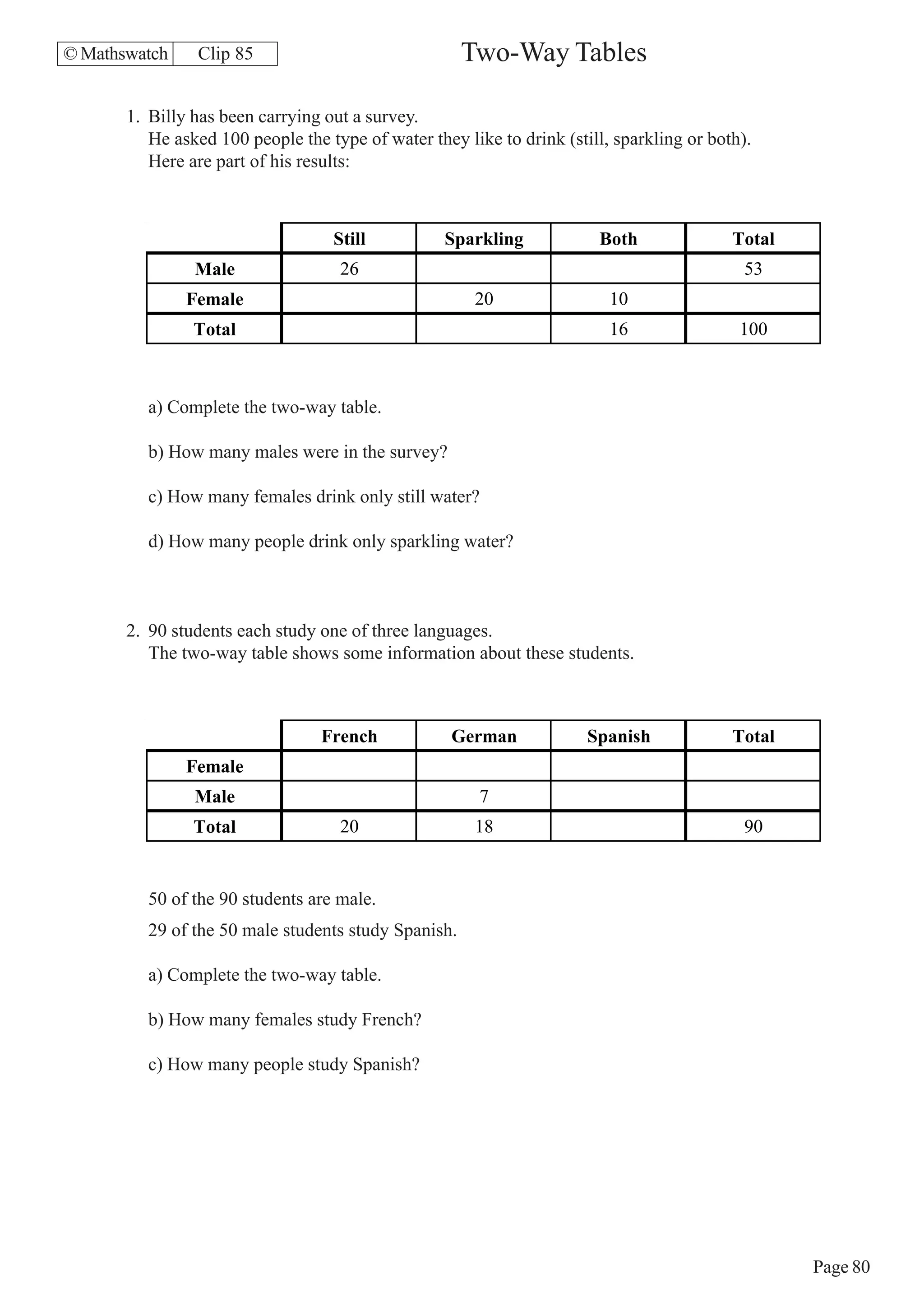
1. Billy has been carrying out a survey.
He asked 100 people the type of water they like to drink (still, sparkling or both).
Here are part of his results:
a) Complete the two-way table.
b) How many males were in the survey?
c) How many females drink only still water?
d) How many people drink only sparkling water?
2. 90 students each study one of three languages.
The two-way table shows some information about these students.
50 of the 90 students are male.
29 of the 50 male students study Spanish.
a) Complete the two-way table.
b) How many females study French?
c) How many people study Spanish?
Still Sparkling Both Total
Male 26 53
Female 20 10
Total 16 100
French German Spanish Total
Female
Male 7
Total 20 18 90
Clip 85 Two-Way Tables
©Mathswatch
Page 81
1) Patrickaskedsomeofhiscolleagueswhichwastheirfavouriteholidaydestination.
The table shows the results.
Draw a pie chart to illustrate the information.
2) Brianasked60peoplewhichregiontheirfavouriterugbyteamcamefrom.
The table shows the results.
Draw a pie chart to illustrate the information.
3) Sophie represents her monthly expenses using a pie chart.
Numbers from her table have been rubbed out
bymistake.
Use the pie chart to complete the table.
City Frequency
Alicante 8
Paris 7
Ibiza 15
St Lucia 1
Biarritz 9
Region Frequency
Southern England 9
London 23
Midland 16
Northern England 12
Total 60
Angle
Clothes £35
Eating out
Make up £17 34°
Magazines
Books
Total £180
Diagram
accurately
drawn Clothes
Eating outMake up
Magazines
Books
Clip 86 Pie Charts
s
©Mathswatch
Page 82
Clip 87 Scatter Graphs
1) The scatter graph shows some information
about the marks of six students.
It shows each student’s marks in Maths and
Science.
The table below shows the marks for four
more students.
a) On the scatter graph, plot the information
from the table.
b) Draw a line of best fit.
c) Describe the correlation between the marks
in Maths and the marks in Science.
Another student has a mark of 18 in Science.
d) Use the line of best fit to estimate the mark
in Maths of this student.
2) The table below shows the average daily number of hours sleep of 10 children.
The first five results have been
plotted on the scatter diagram.
a) Plot the next five points.
b) Draw a line of best fit.
c) Decribetherelationship
between the age of the
childrenandtheirnumber
of hours sleep per day.
d) Use your scatter graph to
estimatethenumberof
hours sleep for a 3 year
oldchild.
Maths 22 8 17 26
Science 30 12 24 24
0 10 20 30 40
0
10
20
30
40
0 2 4 6 8 10
8
10
12
14
16
Age (years) 4 2 5 1 9 6 8 7 10 1.5
Number of hours sleep 14 13 12.5 15 10 12.5 10.8 12 11 14
Science
Maths
Age (years)
Numberofhourssleep
©Mathswatch
Page 83
A class of pupils is asked to solve a puzzle.
The frequency table below shows the times taken by the pupils to solve the puzzle.
a)Drawafrequencydiagramtoshowthisinformation.
b)Drawafrequencypolygontoshowthisinformation.
Time (t ) in min Frequency
0 < t 5 3
5 < t 10 4
10 < t 15 5
15 < t 20 7
20 < t 25 5
Clip 88 Frequency Diagrams
©Mathswatch
Page 84
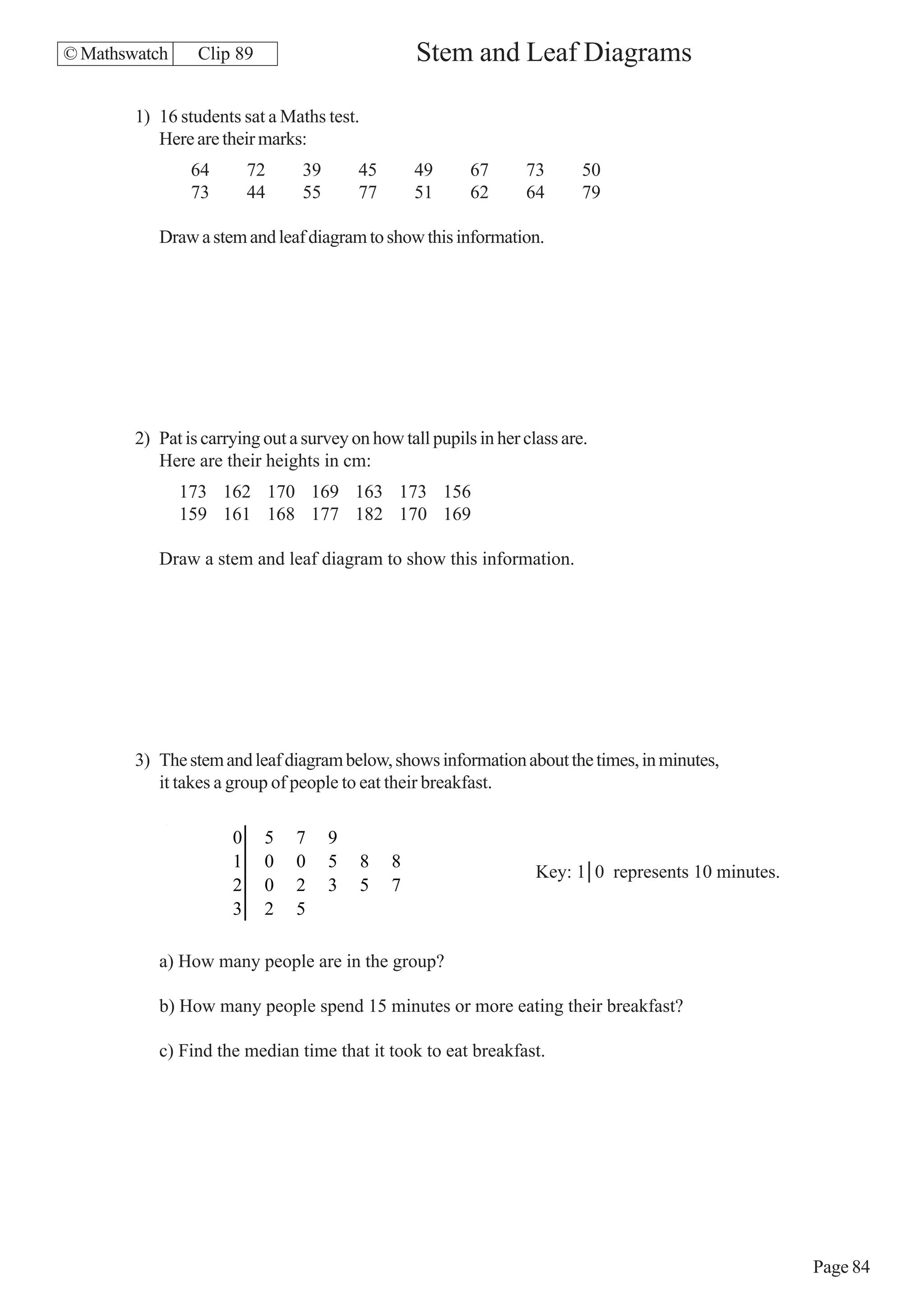
1) 16 students sat a Maths test.
Here are their marks:
64 72 39 45 49 67 73 50
73 44 55 77 51 62 64 79
Drawastemandleafdiagramtoshowthisinformation.
2) Pat is carrying out a survey on how tall pupils in her class are.
Here are their heights in cm:
173 162 170 169 163 173 156
159 161 168 177 182 170 169
Draw a stem and leaf diagram to show this information.
3) Thestemandleafdiagrambelow,showsinformationaboutthetimes,inminutes,
it takes a group of people to eat their breakfast.
Key: 1 0 represents 10 minutes.
a) How many people are in the group?
b) How many people spend 15 minutes or more eating their breakfast?
c) Find the median time that it took to eat breakfast.
0 5 7 9
1 0 0 5 8 8
2 0 2 3 5 7
3 2 5
Clip 89 Stem and Leaf Diagrams
© Mathswatch Clip 90a List of Outcomes
1) A 3-sided spinner with numbers 1 to 3 and a 4-sided spinner with
numbers 1 to 4 are both spun.
a) How many possible outcomes are there?
b) List all the possible outcomes.
2) Two coins are flipped and a 3-sided spinner with numbers 1 to 3 is spun.
a) How many possible outcomes are there?
b) List all the possible outcomes.
1) There are 3 blue counters, 5 red counters and 7 green counters in a bag.
A counter is taken from the bag at random.
a) What is the probability that a green counter will be chosen?
b) What is the probability that a blue or red counter will be chosen?
2) In a drawer there are 6 blue pairs of socks, 9 yellow pairs of socks, 4
black pairs of socks and 5 white pairs of socks.
A pair of socks is taken from the drawer at random.
a) What is the probability that the pair of socks chosen is white?
b) What is the probability that the pair of socks chosen is yellow?
c) What is the probability that the pair of socks chosen is blue or black?
3) In a class there are 12 boys and 15 girls.
A teacher chooses a student at random from the class.
Eric says that the probability a boy will be chosen is 0.5 because a
student can be either a boy or a girl.
Jenny says that Eric is wrong.
Decide who is correct - Eric or Jenny - giving reasons for your answer.
4) Spinner A has numbers 1 to 4 on it.
Spinner B has numbers 1 to 3 on it.
Both spinners are spun and the numbers on each are added together to
give a score.
What is the probability that the score will be
a) 7?
b) 5?
c) 3 or 4?
Working Out ProbabilitiesClip 90b© Mathswatch
Page 85A
© Mathswatch
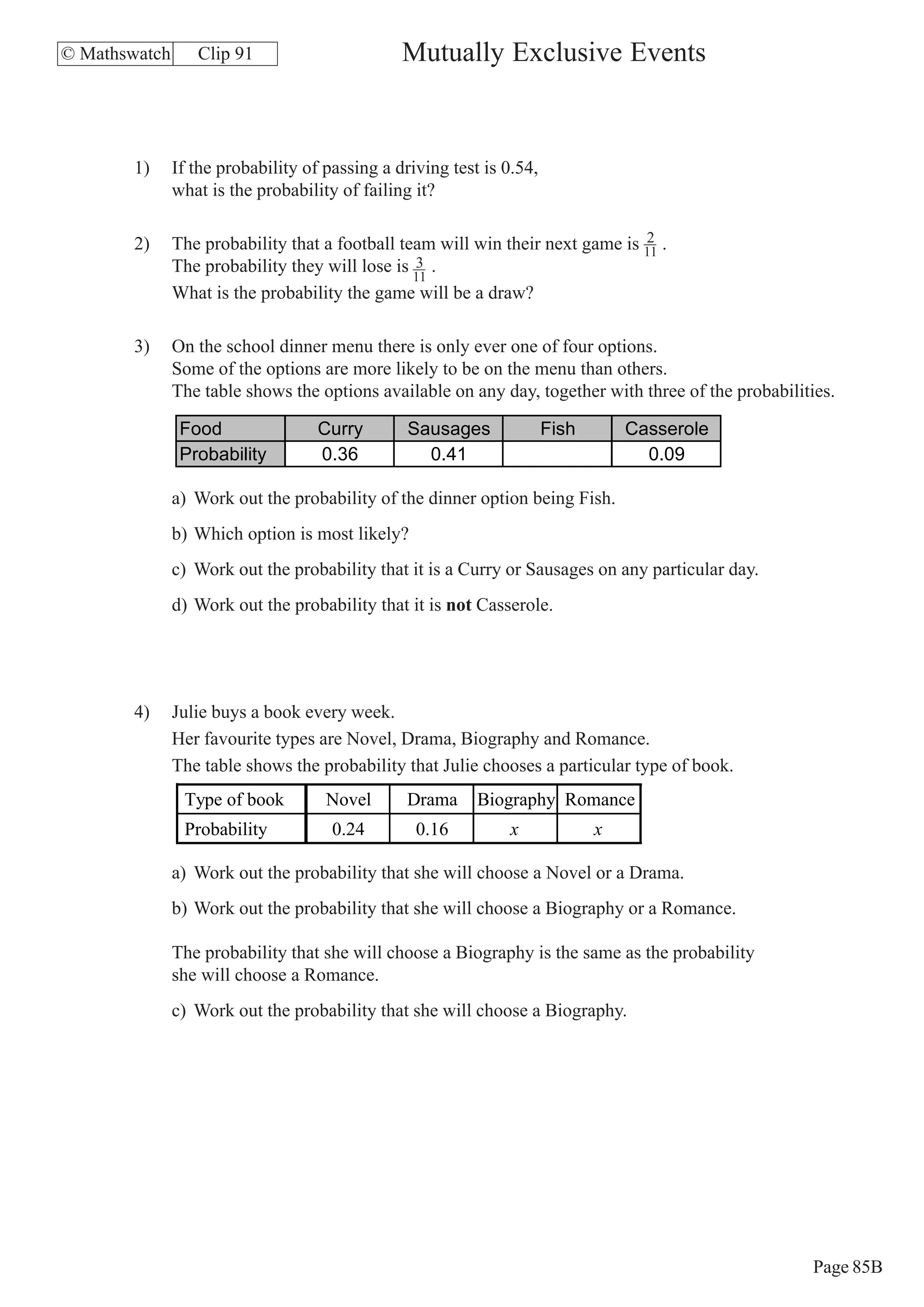
1) If the probability of passing a driving test is 0.54,
what is the probability of failing it?
2) The probability that a football team will win their next game is .
The probability they will lose is .
What is the probability the game will be a draw?
3) On the school dinner menu there is only ever one of four options.
Some of the options are more likely to be on the menu than others.
The table shows the options available on any day, together with three of the probabilities.
a) Work out the probability of the dinner option being Fish.
b) Which option is most likely?
c) Work out the probability that it is a Curry or Sausages on any particular day.
d) Work out the probability that it is not Casserole.
4) Julie buys a book every week.
Her favourite types are Novel, Drama, Biography and Romance.
The table shows the probability that Julie chooses a particular type of book.
a) Work out the probability that she will choose a Novel or a Drama.
b) Work out the probability that she will choose a Biography or a Romance.
The probability that she will choose a Biography is the same as the probability
she will choose a Romance.
c) Work out the probability that she will choose a Biography.
Type of book Novel Drama Biography Romance
Probability 0.24 0.16 x x
Food Curry Sausages Fish Casserole
Probability 0.36 0.41 0.09
Clip 91 Mutually Exclusive Events
2
11
3
11
Page 85B
©Mathswatch
Page 86
Clip 92 Overview of Percentages
1) Find the following to the
nearest penny:
a) 23% of £670
b) 12% of £580
c) 48% of £64
d) 13% of £7.50
e) 87% of £44
f) 15.7% of £7000
g) 23.8% of £980
h) 34% of £16.34
i) 48.6% of £971.26
j) 78.24% of £12.82
k) 42.15% of £7876.42
l) 0.57% of £60000
2) Find the following:
a) 10% of £700
b) 10% of £400
c) 10% of £350
d) 10% of £530
e) 10% of £68
f) 10% of £46
g) 10% of £6.50
h) 10% of £12.20
i) 20% of £600
j) 30% of £900
k) 60% of £800
l) 20% of £650
m) 40% of £320
n) 15% of £300
o) 15% of £360
p) 65% of £12000
q) 45% of £64
r) 85% of £96
s) 17.5% of £800
t) 17.5% of £40
u) 17.5% of £8.80
With a calculator
Without a calculator
With a calculator
4) Change the following to
percentages:
a) 46 out of 100
b) 18 out of 50
c) 7 out of 25
d) 23 out of 25
e) 9 out of 20
f) 16 out of 20
g) 7 out of 10
h) 9.5 out of 10
i) 10 out of 40
j) 16 out of 40
k) 30 out of 40
l) 12 out of 40
m) 28 out of 80
n) 32 out of 80
o) 60 out of 80
p) 3 out of 5
q) 4 out of 5
r) 15 out of 75
s) 24 out of 75
t) 30 out of 75
Without a calculator
5) A shop gives a discount of 20% on a
magazine that usually sells for £2.80.
Work out the discount in pence.
6) A television costs £595 plus VAT
at 17.5%.
Work out the cost of the television
including VAT.
7) Peter has 128 trees in his garden.
16 of the trees are pear trees.
What percentage of the trees in his
garden are pear trees?
8) A battery operated car travels for 10m
when it is first turned on.
Each time it is turned on it travels 90%
of the previous distance as the battery
starts to run out.
How many times does the car travel at
least 8 metres?
9) Jane scored 27 out of 42 in a Maths test
and 39 out of 61 in a Science test.
What were her percentages in both
subjects to 1 decimal place?
In class 7A there are 7 girls and 18 boys.
What percentage of the class are girls?
A shop decides to reduce all the prices
by 15%.
The original price of a pair of trainers
was £70. How much are they after the
reduction?
VAT at 17.5% is added to the price of a
car. Before the VAT is added it
cost £18000.
How much does it cost with the VAT?
No calculator
With a calculator
10)
11)
12)
No calculator
With a calculator
With a calculator
With a calculator
No calculator
No calculator
3) Change the following to
percentages:
a) 6 out of 28
b) 18 out of 37
c) 42 out of 83
d) 24 out of 96
e) 73 out of 403
f) 234 out of 659
g) 871 out of 903
h) 4.7 out of 23
i) 6.9 out of 79
j) 14.8 out of 23.6
k) 65.8 out of 203.7
l) 12 out of 2314
©Mathswatch
Page 87
Clip 93 Increase/Decrease by a Percentage
1) Increase:
a) 500 by 10% c) 80 by 15%
b) 320 by 10% d) 75 by 20%
2) Decrease:
a) 400 by 10% c) 140 by 15%
b) 380 by 10% d) 35 by 20%
3) The price of laptop is increased by 15%.
The old price of the laptop was £300.
Work out the new price.
4) The price of a £6800 car is reduced by 10%.
What is the new price?
5) Increase:
a) 65 by 12% c) 600 by 17.5%
b) 120 by 23% d) 370 by 17.5%
6) Decrease:
a) 42 by 15% c) 52 by 8.5%
b) 79 by 12% d) 8900 by 18%
7) The price of a mobile phone is £78.40 plusVAT.
VAT is charged at a rate of 17.5%.
What is the total price of the mobile phone?
8) In a sale, normal prices are reduced by 7%.
The normal price of a camera is £89.
Work out the sale price of the camera.
9) Acar dealer offers a discount of 20% off the normal price of a car, for cash.
Peter intends to buy a car which usually costs £6800.
He intends to pay by cash.
Work out how much he will pay.
10) A month ago, John weighed 97.5 kg.
He now weighs 4.5% more.
Work out how much John now weighs.
Give your answer to 1 decimal place.
CalculatorNon-Calculator
©Mathswatch
Page 88
Clips 61, 94 Ratio
1. Writethefollowingratiosintheirsimplestform
a) 6 : 9 b) 10 : 5 c) 7 : 21 d) 4 : 24
e) 12 : 40 f) 18 : 27 g) 4 : 2 : 8 h) 18 : 63 : 9
2. Completethemissingvalueintheseequivalentratios
a) 3 : 5 = 12 : b) 4 : 9 = : 27 c) : 7 = 16 : 14 d) 2 : 3 = 3 :
3. Matchtogethercardswithequivalentratios:
3 : 4 10 : 5 50 : 100 2 : 1
5 : 2 15 : 20 15 : 6 1 : 2
4. The ratio of girls to boys in a class is 4 : 5.
a) What fraction of the class are girls?
b) Whatfractionoftheclassareboys?
5. A model of a plane is made using a scale of 1 : 5.
a) If the real length of the plane is 20m, what is the length of the model in metres? 4m
b) If the wings of the model are 100cm long, what is the real length of the wings in metres? 5m
6. Shareout£250inthefollowingratios:
a) 1 : 4 b) 2 : 3 c) 7 : 3 d) 9 : 12 : 4
7. Share out £80 between Tom and Jerry in the ratio 3 : 2.
8. A box of chocolates has 3 milk chocolates for every 2 white chocolates.
There are 60 chocolates in the box.
Work out how many white chocolates are in the box.
9. In a bracelet, the ratio of silver beads to gold beads is 5 : 2.
The bracelet has 25 silver beads.
How many gold beads are in the bracelet?
10.To make mortar you mix 1 shovel of cement with 5 shovels of sand.
How much sand do you need to make 30 shovels of mortar?
©Mathswatch
Page 89
Clip 95 Product of Prime Factors
1) Listthefirstsevenprimenumbers.
2) Expressthefollowingnumberastheproductoftheirprimefactors:
a) 30 b) 60 c) 360 d) 220
3) Expressthefollowingnumberastheproductof powers oftheirprimefactors:
a) 24 b) 64 c) 192 d) 175
4) The number 96 can be written as 2m
× n , where m and n are prime numbers.
Find the value of m and the value of n.
5) The number 75 can be written as 5x
× y , where x and y are prime numbers.
Find the value of x and the value of y.
1) Find the Highest Common Factor (HCF) of each of these pairs of numbers.
a) 16 and 24 b) 21 and 28 c) 60 and 150 d) 96 and 108
2) Find the Least (or Lowest) Common Multiple (LCM) of each of these pairs of numbers.
a) 16 and 24 b) 21 and 28 c) 60 and 150 d) 96 and 108
3) a) Write 42 and 63 as products of their prime factors.
b) Work out the HCF of 42 and 63.
c) Work out the LCM of 42 and 63.
4) a) Write 240 and 1500 as products of their prime factors.
b) Work out the HCF of 240 and 1500.
c) Work out the LCM of 240 and 1500.
HCF and LCM©Mathswatch Clip 96
© Mathswatch Clip 97 Using Place Value
1) Use the information that
13 × 17 = 221
to write down the value of
(i) 1.3 × 1.7
(ii) 221 ÷ 1.7
2) Use the information that
253 × 48 = 12144
to write down the value of
(i) 2.53 × 4.8
(ii) 2530 × 480
(iii) 0.253 × 4800
(iv) 12144 ÷ 25.3
(v) 12144 ÷ 0.48
3) Use the information that
27.3 × 2.8 = 76.44
to write down the value of
(i) 273 × 28
(ii) 2.73 × 280
(iii) 0.273 × 28
(iv) 76.44 ÷ 28
(v) 7.644 ÷ 2.73
4) Use the information that
97.6 × 370 = 36112
to write down the value of
(i) 9.76 × 37
(ii) 9760 × 3700
(iii) 0.0976 × 3.7
(iv) 36.112 ÷ 3.7
(v) 361120 ÷ 9.76
Page 90
©Mathswatch
Page 91
Clip 98 Recurring Decimals into Fractions
1) Writeeachrecurringdecimalasanexactfraction,
initslowestterms.
a) 0 5.
•
b) 0 7.
•
c) 0 4.
•
d) 0 24.
• •
e) 0 75.
• •
f) 0 82.
• •
g) 0 617.
• •
h) 0 216.
• •
i) 0 714.
• •
j) 0 324.
• •
k) 0 72357.
• •
l) 0 65214.
• •
©Mathswatch
Page 92
Clip 99 Four Rules of Negatives
Workoutthefollowingwithoutacalculator
a) 6 – 9 = l) 5 + 9 – 3 =
b) 4 × -3 = m) -3 × -2 × 4 =
c) -10 ÷ -5 = n) -6 – -5 – 8 =
d) -7 – -6 = o) -5 × -6 × -2=
e) 25 ÷ -5 = p) 8 ÷ -4 × -5 =
f) -2 + -6 = q) 2 + -8 + -7 =
g) 7 – -3 = r) 13 + -13 =
h) 6 × -9 = s) 16 ÷ -2 × 4 =
i) 5 + -11 = t) 11 – 3 + -9 – -5 =
j) -8 × 4 = u) -7 × -2 × -3 =
k) 12 + -3 = v) -1 + -3 + 2 =
Clip 100 Division by Two-Digit Decimals
1) Workoutthefollowingwithoutacalculator
a) 350 ÷ 0.2 e) 30.66 ÷ 2.1
b) 2 ÷ 0.25 f) 5.886 ÷ 0.9
c) 0.45 ÷ 0.9 g) 38.08 ÷ 1.7
d) 2.42 ÷ 0.4 h) 98.8 ÷ 0.08
2) Samisfillingajugthatcanhold1.575litres,usingasmallglass.
Thesmallglassholds0.035litres.
Howmanyofthesmallglasseswillheneed?
Mathswatch
©Mathswatch
Page 93
Clip 101 EstimatingAnswers
1. Work out an estimate for the value of
a)
547
4 8 9 7. .×
b)
69 398
207
×
c)
7 5 2 79
2 71 319
. .
. .
×
+
d)
409 5814
019
× .
.
2. a) Work out an estimate for
19 6 317
7 9 52
. .
. .
×
×
b)Use your answer to part (a) to find an estimate for
196 317
79 52
×
×
3. a) Work out an estimate for
613 9 68
379 2 56
. .
. .
×
×
b)Use your answer to part (a) to find an estimate for
613 968
379 256
×
×
©Mathswatch
Page 94
Clip 102 Algebraic Simplification
2(p + p) 2p × p 3p + 2p 2 + 2p 2p + 2p
10) The table shows some expressions.
Two of the expressions always have the same value as 4p.
Tick the boxes underneath the two expressions.
5) a) Simplify pq + 2pq
b) Simplify 5x + 3y – x – 4y
6) a) Simplify 6a + 5b – 3b + a
b) Simplify x4
+ x4
7) a) Simplify x + y + x + y + x
b) Simplify t2
+ t2
+ t2
8) a) Simplify a3
× a3
b) Simplify 3x2
y × 4xy3
11) Expandandsimplify
(i) 4(x + 5) + 3(x – 6)
(ii) 3(2x – 1) – 2(x – 4)
(iii) 5(2y + 2) – (y + 3)
9) a) Simplify 3d + e – d + 4e
b) Simplify 3x2
– x2
c) Simplify 5t + 8d – 2t – 3d
d) Simplify 4t × 2q
1) Simplify
a) x + x
b) x × x
c) 3x + 2x
d) 3x × 2x
e) 2x2
y3
+ 4x2
y3
f) 2x2
y × 3xy3
2) Simplify
a) x + y + x + y
b) 3x + 2y + x + 5y
c) 6y + 2x – 2y – 3x
d) 5p – 3q + p + 2q
3) Expandandsimplify
a) 2(x + y) + 3(x + y)
b) 3(2x + y) + 2(5x + 3y)
c) 5(x + y) + 3(2x – y)
d) 3(2c + d) – 2(c + d)
e) 4(2p + q) – 3(2p – q)
f) 3(4x – 2y) + 2(x + 2y)
g) 6(x – 3y) – 2(2x – 5y)
4) Expandandsimplify
a) 5(3p + 2) – 2(4p – 3)
b) 4(2x + 3) – (x – 2)
©Mathswatch
Page 95
Clip 103 Expanding and Simplifying Brackets
1) Expand these brackets
a) 2(x + 3)
b) 3(2x + 4)
c) 5(3p – 2q)
d) 4(x2
+ 2y2
)
e) r(r – r2
)
2) Expandandsimplify
a) (x + 1)(x + 2)
b) (x + 3)(2x + 4)
c) (2x + 1)(3x + 2)
3) Expandandsimplify
a) (x + 3)(x – 2)
b) (x – 1)(x + 4)
c) (x – 3)(x – 2)
4) Expandandsimplify
a) (2p + 3)(p – 2)
b) (3t – 2)(2t + 3)
c) (2x – 5)(3x – 2)
5) Expandandsimplify
a) (x + 3y)(x + 4y)
b) (2p + q)(3p + 2q)
6) Expandandsimplify
a) (2x + 1)2
b) (3x – 2)2
c) (2p + q)2
©Mathswatch
Page 96
Clip 104 Factorisation
1) Factorise
a) 2x + 4
b) 2y + 10
c) 3x + 12
d) 3x – 6
e) 5x – 15
2) Factorise
a) p2
+ 7p
b) x2
+ 4x
c) y2
– 2y
d) p2
– 5p
e) x2
+ x
3) Factorise
a) 2x2
+ 6x
b) 2y2
– 8y
c) 5p2
+ 10p
d) 7c2
– 21c
e) 6x2
+ 9x
4) Factorise
a) 2x2
– 4xy
b) 2t2
+ 10tu
c) 6x2
– 8xy
d) 3x2
y2
+ 9xy
©Mathswatch
Page 97
10) 4y + 3 = 2y + 10
11) 2x + 17 = 5x – 4
12) 2x + 7 = 16 – 4x
13) 5(x + 3) = 2(x + 6)
14) 4(2y + 1) = 2(12 – y)
15) 7 – 3x = 2(x + 1)
16)
17)
18)
Clip 105 Solving Equations
Solvethefollowingequations
1) 2p – 1 = 13
2) 4y + 1 = 21
3) 6x – 7 = 32
4) x + x + x + x = 20
5) x + 3x = 40
6) 5(t – 1) = 20
7) 4(5y – 2) = 52
8) 4(y + 3) = 24
9) 20x – 15 = 18x – 7
= 5
x – 3
2x + 4
3
= 7
40 – x
3
= 4 + x
2
©Mathswatch
Page 98
2)
The sizes of the angles, in degrees, of the quadrilateral are
x + 10
2x
x + 80
x + 30
a) Use this information to write down an equation in terms ofx.
b) Use your answer to part (a) to work out the size of the smallest angle of
thequadrilateral.
3) Sarah buys 6 cups and 6 mugs
A cup costs £x
A mug costs £(x + 3)
a) Write down an expression, in terms of x, for the total cost, in pounds,
of 6 cups and 6 mugs.
b) If the total cost of 6 cups and 6 mugs is £48, write an equation in
terms of x.
c) Solve your equation to find the cost of a cup and the cost of a mug.
Clip 106 Forming Equations
1) The width of a rectangle is x centimetres.
The length of the rectangle is (x + 5) centimetres.
a) Find an expression, in terms of x, for the perimeter of the rectangle.
Give your answer in its simplest form.
The perimeter of the rectangle is 38 centimetres.
b) Work out the length of the rectangle.
x + 5
x
x + 80
x + 30
2x
x + 10 Diagram NOT
accurately drawn
©Mathswatch
Page 99
Clip 107 Changing the Subject of a Formula
1) Make c the subject of the formula.
a = b + cd
2) Make t the subject of the formula.
u = v + 2t
3) Make n the subject of the formula.
M = 3n +5
4) Make z the subject of the formula.
x = 3y + z
5) r = 5s + 3t
a) Make t the subject of the formula.
b) Make s the subject of the formula.
6) Rearrange y = 3x + 1 to make x the subject.
7) Rearrange y x= +
1
2
2 to make x the subject.
8) Rearrange y x= +
1
3
1 to make x the subject.
©Mathswatch
Page 100
Clip 108 Inequalities
-5 -4 -3 -2 -1 0 1 2 3 4 5 6
1) Represent this inequality on the number line
-3 < x < 2
-5 -4 -3 -2 -1 0 1 2 3 4 5 6
2) Represent this inequality on the number line
-1 < x < 5
3) Write down the inequality shown
-5 -4 -3 -2 -1 0 1 2 3 4 5 6
4) Write down the inequality shown
-5 -4 -3 -2 -1 0 1 2 3 4 5 6
5) If y is an integer, write down all the possible values of
-2 < y < 5
6) If x is an integer, write down all the possible values of
-9 < x < -5
©Mathswatch
Page 101
Clip 109 Solving Inequalities
1) Solve
a) 3 1 5x − >
b) 7 2 30y + ≤
c)
x
2
3 2− ≥
d) 5 2 7+ >x
e) 8 5 2< −p
f)
y
3
5 3+ ≥
g)
2
3
5 3
x
− ≥ −
h) 6 5 2 3x x− > +
i) 3 9 6 2p p− < −
j) 5 3 2 10− < −y y
2) a) Solvetheinequality
2 2 7z + ≥
b) Writedownthesmallestintegervalueofzwhichsatisfiestheinequality
2 2 7z + ≥
3) 5 2 10x y+ <
x and y are both integers.
Writedowntwopossiblepairsofvaluesthatsatisfythisinequality.
x = .........., y = ..........
and
x = .........., y = ..........
©Mathswatch
Page 102
Clip 110 Trial and Improvement
1) Theequation
x3
– x = 29
has a solution between 3 and 4
Useatrialandimprovementmethodtofind
thissolution.
Give your answer correct to 1 decimal place.
You must show all your working.
2) Theequation
x3
– 4x = 25
has a solution between 3 and 4
Useatrialandimprovementmethodtofind
thissolution.
Give your answer correct to 1 decimal place.
You must show all your working.
3) Theequation
x3
– 2x = 68
has a solution between 4 and 5
Useatrialandimprovementmethodtofind
thissolution.
Give your answer correct to 1 decimal place.
You must show all your working.
4) Theequation
x3
+ 4x = 101
hasonesolutionwhichisapositivenumber.
Useatrialandimprovementmethodtofind
thissolution.
Give your answer correct to 1 decimal place.
Youmustshow allyourworking.
©Mathswatch
Page 103
Clip 111 Index Notation for Multiplication and Division
1) Write as a power of 8
a) 84
× 83
b) 812
÷ 87
2) Write as a power of 3
a) 32
× 39
b) 310
÷ 33
3) Simplify
a) k5
× k2
b) x4
÷ x2
c)
k
k
11
6
d) (k8
)2
4) Simplify
eg. (2xy3
)4
= 2xy3
× 2xy3
× 2xy3
× 2xy3
= 16x4
y12
a) (2xy5
)3
b) (2x2
y2
)3
c) (4xy4
)2
d) (3xy2
)4
5) 2x
× 2y
= 210
and
2x
÷ 2y
= 22
Work out the value of x and the value of y.
6) 5x
× 5y
= 512
and
5x
÷ 5y
= 56
Work out the value of x and the value of y.
7) a = 2x
, b = 2y
Express in terms of a and b
a) 2x + y
b) 22x
c) 23y
d) 2x + 2y
©Mathswatch
Page 104
Clip 65, 112
1.Write down the first 5 terms and the 10th
term of the following sequences:
eg. 2n + 1 3, 5, 7, 9, 11.....21
a) 2n + 2 d) 7n
b) 3n + 1 e) 3n – 1
c) n + 3 f) 7n – 3
2. Find the nth
term of the following sequences:
a) 5, 10, 15, 20... d) 22, 18, 14, 10...
b) 5, 8, 11, 14... e) –3, 3, 9, 15...
c) 1, 8, 15, 22... f) 4, –1, –6, –11...
3. Here are some patterns made from sticks.
a) Draw pattern 4 in the space, below..
b) How many sticks are used in
(i) pattern 10
(ii) pattern 20
(iii) pattern 50
c) Find an expression, in terms of n, for the number of sticks in pattern number n.
d) Which pattern number can be made using 301 sticks?
Pattern 1 Pattern 2 Pattern 3
Nth Term
©Mathswatch
Page 105
Clip 113
1) a) Complete the table of values for y = 2x – 3
b) Using the axes on the right draw the
graph of y = 2x – 3
c) Use your graph to work out the value
of y when x = 2.5
d) Use your graph to work out the value
of x when y = 4.5
2) a) Complete the table of values for y = 2 – x
b) Using the axes on the right, again, draw
the graph of y = 2 – x
x -1 0 1 2 3 4
y 1
x
y
x -1 0 1 2 3 4
y -1
-1 O 1 2 3 4
-5
-4
-3
-2
-1
1
2
3
4
5
3) a) Complete the table of values for y = ½x – 1
b) Draw the graph of y = ½x – 1
c) Use your graph to find the value of y when x = 3.5
Drawing Straight Line Graphs
x -1 0 1 2 3 4
y 0
-1 O 1 2 3 4
-2
-1
1
2
x
y
©Mathswatch
Page 106
Clip 114 Finding the Equation of a Straight Line
1) Find the equations of linesA, B and C on the axes below
O 1 2 3 4 5 6 7 8
1
2
3
4
5
6
7
8
x
y
A
B
C
-6 -5 -4 -3 -2 -1 O 1 2 3 4 5 6
-6
-5
-4
-3
-2
-1
1
2
3
4
5
6
2) Find the equations of linesA, B and C on the axes below
x
y
ABC
©Mathswatch
Page 107
Clip 115 Solving Simultaneous Equations Graphically
O 1 2 3 4 5 6 7 8
1
2
3
4
5
6
7
8
1) On the axes below, the graphs of y = x + 2 and y = 6 – x have been drawn.
Use the graphs to solve the simultaneous equations y = x + 2 and y = 6 – x
y = x + 2
y = 6 – x
O 1 2 3 4 5 6 7 8
1
2
3
4
5
6
7
8
2) On the axes below draw the graphs of y = 2x + 1 and y = 7 – x
Use your graphs to solve the simultaneous equations y = 2x + 1 and y = 7 – x
x
y
x
y
©Mathswatch
Page 108
Clip 116 Drawing Quadratic Graphs
-2 -1 O 1 2 3
-5
5
10
15
20
x
y
1) a) Complete the table of values for y = 2x2
– 3x
b) On the grid, draw the graph of y = 2x2
– 3x for values of x from -2 to 3
c) Use the graph to find the value of y when x = -1.5
d) Use the graph to find the values of x when y = 4
x -2 -1 0 1 2 3
y 14 0 9
2) a) Complete the table of values for y = x2
– 2x
b) On the grid, draw the graph of y = x2
– 2x for values of x from -2 to 3
c) (i) On the same axes draw the straight line y = 2.5
(ii) Write down the values of x for which x2
– 2x = 2.5
x -2 -1 0 1 2 3
y 8 0
-2 -1 O 1 2 3
-5
5
10
x
y
©Mathswatch
Page 109
Clip 117 Real Life Graphs
1) Sarah travelled 20 km from home to her friend’s house.
She stayed at her friend’s house for some time before returning home.
Here is the travel graph for part of Sarah’s journey.
a) At what time did Sarah leave home?
b) How far was Sarah from home at 1030?
Sarah left her friend’s house at 1110 to return home.
c) Work out the time in minutes Sarah spent at her friend’s house.
Sarah returned home at a steady speed.
She arrived home at 1150
d) Complete the travel graph.
e) Work out Sarah’s average speed on her journey from her home to her friend’s house.
Give your answer in kilometres per hour.
f) Work out Sarah’s average speed on her journey home from her friend’s house.
Give your answer in kilometres per hour.
Time of day
0
5
10
15
20
25
1000 1020 1040 1100 1120 1140 1200
Distance
from
home
(km)
©Mathswatch
Page 110
Clip 118 Pythagoras’ Theorem
1) Find the length of sideAC.
Give your answer to 1 decimal place.
A
B C
12cm
7cm
2) Find the length of side QR
Give your answer to 1 decimal place.
PQ
R
7.6cm
4.8cm
3) FindthelengthofsideSU
Give your answer to 1 decimal place.
ST
U
14cm
23cm
4) Below is a picture of a doorway.
Find the size of the diagonal of the doorway.
Give your answer to 1 decimal place.
2.1m
0.8m
5) In the sketch of the rectangular field, below,
James wants to walk from B to D.
Whichofthefollowingroutesisshorterand
by howmuch?
From B to C to D or straight across the field
from B to D.
Give your answer to the nearest metre.
6) Fiona keeps her pencils in a cylindrical
beaker as shown below.
The beaker has a diameter of 8cm and
a height of 17cm.
Willapenciloflength19cmfitinthebeaker
without poking out of the top?
Allworkingsmustbeshown.
50mD
60m
A B
C
©Mathswatch
Page 111
Clip 119 Pythagoras - Line on a Graph
1) Points P and Q have coordinates (1, 4) and (5, 2).
Calculate the shortest distance between P and Q.
Give your answer correct to 1 decimal place.
-5 -4 -3 -2 -1 O 1 2 3 4 5
-5
-4
-3
-2
-1
1
2
3
4
5
O 1 2 3 4 5 6
1
2
3
4
5
6
x
y
P
Q
x
y
A
B
2) Points A and B have coordinates (-4, 3) and (3, -2).
Calculate the shortest distance betweenAand B.
Give your answer correct to 1 decimal place.
© Mathswatch Clip 120 Surface Area of Cuboids
1) Find the surface area of this cube and cuboid.
2) Find the surface area of this cuboid.
2.3 m
0.8 m
1.7 m
3) A water tank measures 2 m by 3 m by 4 m.
It has no top.
The outside of the tank, including the base,
has to be painted.
Calculate the surface area which will be painted.
3 m
4 m
2 m
5 m
6 m
2 m
4) A water tank measures 2 m by 5 m by 6 m.
It has no top.
The outside of the tank, including the base,
has to be painted.
A litre of paint will cover an area of 4.3 m2
.
Paint is sold in 5 litre tins and each tin costs £13.50.
How much will it cost to paint the tank?
You must show all your working.
6 cm
10 cm
5 cm
4 cm
4 cm
4 cm
Cube Cuboid
Page 112
© Mathswatch Clip 121 Surface Area of Triangular Prisms
3 cm
4 cm
5 cm
6 cm
1) Find the surface area of this triangular prism.
10 cm
12 cm 13 cm
15 cm
13 cm
2) Find the surface area of this triangular prism.
2.3 cm
4.6 cm
9.3 cm
3) With the aid of Pythagoras’ Theorem, find the surface area of this
triangular prism.
Give your answer correct to 2 significant figures.
Page 113
©Mathswatch
Page 114
Clip 122 Volume of a Prism
1) The diagram shows a cuboid.
Work out the volume of the cuboid.
2) Calculate the volume of this triangular
prism.
3 cm
4 cm
5 cm
9 cm
2.5 cm
3.8 cm
3) An ice hockey puck is in the shape of a
cylinder with a radius of 3.8 cm and a
thickness of 2.5 cm.
Take to be 3.14
Work out the volume of the puck.
4) A cuboid has: a volume of 80cm3
a length of 5 cm
a width of 2 cm
Work out the height of the cuboid.
5) Workoutthemaximumnumberof
boxes which can fit in the carton.
Box
Carton
100 cm
80 cm
200 cm
20 cm
10 cm50 cm
15 cm
50 cm
30 cm
©Mathswatch
Page 115
Clip 123 Similar Shapes
3) BE is parallel to CD.
ABC and AED are straight lines.
AB = 4 cm, BC = 6 cm, BE = 5 cm, AE = 4.4 cm
a) Calculate the length of CD.
b) Calculate the length of ED.
2) SV is parallel to TU.
RSTand RVU are straight lines.
RS = 9 cm, ST = 3 cm, TU = 7 cm, RV = 6 cm
Calculate the length of VU.
1) The diagram shows two quadrilaterals that are mathematically similar.
a) Calculate the length of AB
b) Calculate the length of PS
P
Q
RS
A
B
CD
4 cm
8 cm
14 cm
21 cm
R
S
T U
V
9 cm
3 cm
7cm
6 cm
A
B
C D
E
4 cm
6 cm 5 cm
4.4cm
© Mathswatch Clip 124 Converting Metric Units
1) Change 9 m2
into cm2
2) How many square metres are there in 5 square kilometres?
3) Change 4 cm2
into mm2
4) Convert 6.5 m2
into mm2
5) Change 2 m3
into cm3
6) How many cubic millimetres are there in 3 cubic centimetres?
7) Change 7 m3
into mm3
8) A tiler wants to tile a rectangular wall which measures 4 m by 2.5 m.
Each tile measures 16 cm by 10 cm.
How many tiles will he need for the wall?
9) A carpet-fitter is laying carpet tiles in a rectangular floor which
measures 7.5 m by 4.5 m.
Each carpet tile measures 50 cm by 50 cm.
How many carpet tiles will he need for the floor?
4 m
2.5 m 16 cm
10 cm
Tile
7.5 m
4.5 m 50 cm
50 cm
Carpet tile
Page 116
©Mathswatch
Page 117
1. A silver necklace has a mass of 123 grams, correct to the nearest gram.
a) Write down the least possible mass of the necklace.
b) Write down the greatest possible mass of the necklace.
2. Each of these measurements was made correct to one decimal place.
Writethemaximumandminimumpossiblemeasurementineachcase.
a) 4.6 cm b) 0.8 kg c) 12.5 litres d) 25.0 km/h
e) 10.3 s f) 36.1 m g) 136.7 m/s h) 0.1 g
3. Each side of a regular octagon has a length of 20.6 cm, correct to the nearest millimetre.
a) Write down the least possible length of each side.
b) Write down the greatest possible length of each side.
c) Write down the greatest possible perimeter of the octagon.
4. A girl has a pencil that is of length 12 cm, measured to the nearest centimetre.
Her pencil case has a diagonal of length 12.3 cm, measured to the nearest millimetre.
Explain why it might not be possible for her to fit the pen in the pencil case.
5. A square has sides of length 7 cm, correct to the nearest centimetre.
a) Calculate the lower bound for the perimeter of the square.
b) Calculate the upper bound for the area of the square.
Clip 125 Bounds
©Mathswatch
Page 118
Clip 126 Compound Measures
1) Jane runs 200 metres in 21.4 seconds.
Work out Jane’s average speed in metres per second.
Give your answer correct to 1 decimal place.
2) A car travels at a steady speed and takes five hours to travel
310miles.
Work out the average speed of the car in miles per hour.
3) A plane flies 1440 miles at a speed of 240 mph.
How long does it take?
4) A marathon runner runs at 7.6 mph for three and a half hours.
Howmanymileshasherun?
5) A car takes 15 minutes to travel 24 miles.
Finditsspeedinmph.
6) A cyclist takes 10 minutes to travel 2.4 miles.
Calculate the average speed in mph.
7) An ice hockey puck has a volume of 113 cm3
.
It is made out of rubber with a density of 1.5 grams per cm3
.
Work out the mass of the ice hockey puck.
8) An apple has a mass of 160 g and a volume of 100 cm3
.
Finditsdensitying/cm3
.
9) A steel ball has a volume of 1500 cm3
.
The density of the ball is 95 g/cm3
.
Find the mass of the ball in kg.
10) The mass of a bar of chocolate is 1800 g.
The density of the chocolate is 9 g/cm3
.
What is the volume of the bar of chocolate?
©Mathswatch
Page 119
Clip 127 Bisecting a Line
1) Using ruler and compasses, bisect line AB.
A
B
2) Using ruler and compasses
a) Bisect line AB
b) Bisect line BC
c) Bisect line AC
d) Place your compass point where your three lines cross*
Now open them out until your pencil is touching vertex A.
Draw a circle using this radius.
A
B
C
* If your three lines don’t cross at a point then
you have a mistake somewhere or just haven’t
been accurate enough.
©Mathswatch
Page 120
Clip 128 Drawing a Perpendicular to a Line
1) Use ruler and compasses to construct the perpendicular to the
line segment AB that passes through the point P.
You must show all construction lines.
P
A
B
C
D
P
2) Use ruler and compasses to construct the perpendicular to the
line segment CD that passes through the point P.
You must show all construction lines.
©Mathswatch
Page 121
Clip 129 Bisecting anAngle
1) Using ruler and compasses, bisect angle ABC.
A
B
C
2) The diagram below shows the plan of a park.
The border of the park is shown by the quadrilateral RSUV
There are two paths in the park. One is labelledTR and the other TV.
A man walks in the park so that he is always the same distance from both paths.
Using ruler and compasses show exactly where the man can walk.
R
S T U
V
©Mathswatch
Page 122
Clip 130 Loci - page 1 of 2
1)
ABCD is a rectangle.
Shade the set of points inside the rectangle which are both
more than 4 centimetres from the point D
and morethan1centimetrefromthelineAB.
D C
BA
2) Two radio transmitters,Aand B, are situated as below.
TransmitterAbroadcasts signals which can be heard up to 3 km fromA.
Transmitter B broadcasts signals which can be heard up to 6 km from B.
Shade in the area in which radio signals can be heard from both transmitters.
Use a scale of 1 cm = 1 km.
A
B
©Mathswatch
Page 123
Clip 130
×
×
×
A
B
C
1)
Point C is equidistant from points A and B.
Sarah rolls a ball from point C.
At any point on its path the ball is the same distance from pointAand point B.
a) On the diagram above draw accurately the path that the ball will take.
b) On the diagram shade the region that contains all the points that are no more
than 3cm from point B.
2) The map shows part of a lake.
In a competition for radio-controlled ducks, participants have to steer their ducksso that:
its path betweenAB and CD is a straight line
this path is always the same distance fromAas from B
a) On the map, draw the path the ducks should take.
There is a practice region for competitors.
This is the part of the lake which is less than 30 m from point E.
b) Shade the practice region on the map.
×
×
×
×
×
A
B C
D
E
Scale: 1 cm represents 10 m
Loci - page 2 of 2
©Mathswatch
Page 124
Clip 131 Bearings
1) School B is due east of school A.
C is another school.
The bearing of C from A is 065°
.
The bearing of C from B is 313°
.
Complete the scale drawing below.
Mark with a cross the position of C.
A B
2) In the diagram, point A marks the position of Middlewitch.
The position of Middlemarch is to be marked on the diagram as point B
On the diagram, mark with a cross the position of B given that:
B is on a bearing of 320°
from A and
B is 5 cm from A
N
N
A
3) Work out the bearing of
a) B from P
b) P from A
N
A
B
64
138 Diagram NOT
accurately drawn.
P
©Mathswatch
Page 125
Clip 132 Experimental Probabilities
1) Ahmaddoesastatisticalexperiment.
He throws a dice 600 times.
He scores one, 200 times.
Isthedicefair?Explainyouranswer
2) Chris has a biased coin.
The probability that the biased coin will land on a tail is 0.3
Chrisisgoingtoflipthecoin150times.
Work out an estimate for the number of times the coin will land on a tail.
3) On a biased dice, the probability of getting a six is
2
3
.
The dice is rolled 300 times.
Work out an estimate for the number of times the dice will land on a six.
4) On a biased dice, the probability of getting a three is 0.5
The dice is rolled 350 times.
Work out an estimate for the number of times the dice will land on a three.
5) Jenny throws a biased dice 100 times.
The table shows her results.
Score Frequency
1 15
2 17
3 10
4 24
5 18
6 16
a) She throws the dice once more.
Findanestimatefortheprobabilitythatshewillgetafour.
b) If the dice is rolled 250 times, how many times would you expect to get a five?
©Mathswatch
Page 126
Clip 133 Averages From a Table
1) The number of pens in each pupil’s pencil case in a classroom has been counted.
The results are displayed in a table.
a) Work out the total number of pens in the classroom.
b) Write down the modal number of pens in a pencil case.
c) Work out the mean number of pens in a pencil case.
d) Work out the range of the number of pens in a pencil case.
2) Thomasisanalysingthelocalfootballteam.
He records the number of goals scored in each
footballmatchinthepasttwelvemonths.
Thomas said that the mode is 7
Thomasiswrong.
a) Explainwhy.
b) Calculate the mean number of goals scored.
3) Tinarecordedhowlong,inminutes,shewatched
TV for each day during a month.
a) Findtheclassintervalinwhichthemedianlies.
b) Work out an estimate for the mean amount of
timeTina watchedTVeach day of this month.
Giveyouranswertothenearestminute.
Number of pens Number of pupils
0 4
1 6
2 7
3 5
4 3
5 1
Goals scored Frequency
0 7
1 5
2 3
3 6
4 2
5 1
6 1
Time (t in minutes) Frequency
10 < t < 20 5
20 < t < 30 9
30 < t < 45 8
45 < t < 60 6
60 < t < 90 3
©Mathswatch
Page 127
Clip 134 Questionnaires
1) A survey into how people communicate with each other is carried out.
Aquestionnaire is designed and two of the questions used are shown below.
The questions arenotsuitable.
For each question, write down a reason why.
a) Do you prefer to communicate with your friend by phone (voice call) or by text message?
Yes No
Reason .................................................................................................................
.................................................................................................................
b) How many text messages do you send?
1 2 3 4
Reason .................................................................................................................
.................................................................................................................
2) A restaurant owner has made some changes.
He wants to find out what customers think of these changes.
He uses this question on a questionnaire.
“What do you think of the changes in the restaurant?”
Excellent Very good Good
a) Writedownwhatiswrongwiththisquestion.
Thisisanotherquestiononthequestionnaire.
“How often do you come to the restaurant?”
Veryoften Not often
b) i) Writedownonethingthatiswrongwiththisquestion.
ii) Design a better question to use.
You should include some response boxes.
© Mathswatch Clip 135a Standard Form Basics
1) Change the following to normal (or ordinary) numbers.
a) 4.3 × 10⁴
c) 7.03 × 10³
e) 1.01 × 10⁴
b) 6.79 × 10⁶
d) 9.2034 × 10²
f) 4 × 10⁵
2) Change the following to normal (or ordinary) numbers.
a) 4.3 × 10⁻⁴
c) 7.03 × 10⁻³
e) 1.01 × 10⁻⁴
b) 6.79 × 10⁻⁶
d) 9.2034 × 10⁻²
f) 4 × 10⁻⁵
3) Change the following to standard form.
a) 360 c) 520 000 e) 1 003
b) 8 900 d) 62 835 f) 6 450 000
4) Change the following to standard form.
a) 0.71 c) 0.00076 e) 0.00009
b) 0.0008 d) 0.0928 f) 0.00000173
5) Work out the following, giving your answer in standard form.
a) 3 000 × 5 000 d) 5 × 4 × 103
g) 7 × 102
× 3 × 10-4
b) 240 × 0.0002 e) h) 2 × 3.6 × 10-5
c) 9 × 1.1 × 107
f) 9 × 102
× 2 × 10-5
i) 6 × 4.1 × 103
8 × 10⁴
4 × 10²
Page 128A
© Mathswatch Clip 135b Standard Form Calculation
1) Work out the following, giving your answer in standard form.
a) (6 × 10²
) × (8 × 10⁴
) c)
b) (2 × 10⁵
) + (3 × 10⁴
) d) (9.2 × 10⁵
) ÷ (2 × 10²
)
2) A spaceship travelled for 5 × 10³
hours at a speed of 9 × 10⁴
km/h.
a) Work out the distance travelled by the spaceship.
Give your answer in standard form.
Another spaceship travelled a distance of 2 × 10⁷
km, last month.
This month it has travelled 5 × 10⁶
km.
b) Work out the total distance travelled by the spaceship over these past two months.
Give your answer as a normal (or ordinary) number.
3) Work out the following, giving your answer in standard form,
correct to 2 significant figures.
a) 2.6 × 103
× 4.3 × 104
c)
b) (7.5 × 10⁵
) × (1.9 × 10⁻²
) d)
4) Work out the following, giving your answer in standard form
correct to 3 significant figures.
a) c)
b) d)
5) A microsecond is 0.000 001 seconds.
a) Write the number 0.000 001 in standard form.
A computer does a calculation in 3 microseconds.
b) How many of these calculations can the computer do in 1 second?
Give your answer in standard form, correct to 3 significant figures.
6) 340 000 tomato seeds weigh 1 gram.
Each tomato seed weighs the same.
a) Write the number 340 000 in standard form.
b) Calculate the weight, in grams, of one tomato seed.
Give your answer in standard form, correct to 2 significant figures.
3 × 10³
6 × 10⁻⁵
9.435 × 10⁵
3.28 × 10³
5.98 × 10⁸
6.14 × 10⁻²
5.76 × 10⁷
+ 3.89 × 10⁹
7.18 × 10⁻²
7.2 × 10⁻²
– 5.4 × 10⁻¹
9.25 × 10⁻⁷
3 × 108
× 2 × 107
3 × 10⁸
+ 2 × 10⁷
3 × 3.2 × 1012
× 1.5 × 1012
3.2 × 10¹²
– 1.5 × 10¹²
Page 128B
©Mathswatch
Page 129
Clip 136 Percentage Increase and Decrease
1) A car dealer is comparing his sales over the past two years.
In 2006, he sold 175 cars.
In 2007, he sold 196 cars.
Work out the percentage increase in the number of cars sold.
2) In September 2005, the number of pupils attending MathsWatch College was 1352.
In September 2006, the number of pupils attending MathsWatch College was 1014.
Work out the percentage decrease in the number of pupils attending MathsWatch College.
3) The usual price of a shirt is £32.50
In a sale, the shirt is reduced to £29.25
What is the percentage reduction?
4) Olivia opened an account with £750 at the MathsWatch Bank.
After one year, the bank paid her interest.
She then had £795 in her account.
Work out, as a percentage, MathsWatch Bank’s interest rate.
5) Ken buys a house for £270 000 and sells it two years later for £300 000.
Whatishispercentageprofit?
Giveyouranswerto2significantfigures.
6) Shelley bought some items at a car boot sale and then sold them on ebay.
Work out the percentage profit or loss she made on each of these items.
a) Trainers bought for £15, sold for £20
b) DVD recorder bought for £42, sold for £60.90
c) Gold necklace bought for £90, sold for £78.30
d) A DVD collection bought for £120, sold for £81.60
©Mathswatch
Page 130
Clip 137 Compound Interest/Depreciation
1) Henry places £6000 in an account which pays 4.6% compound
interest each year.
Calculate the amount in his account after 2 years.
2) Sarah puts £8600 in a bank. The bank pays compound interest of
3.8% per year.
Calculate the amount Sarah has in her account after 4 years.
3) Mary deposits £10000 in an account which pays 5.6% compound
interest per year.
How much will Mary have in her account after 5 years?
4) Susan places £7900 in an account which pays 2.4% compound
interest per year.
How much interest does she earn in 3 years?
5) Harry puts money into an account which pays 6% compound
interest per year.
If he puts £23000 in the account for 5 years how much interest
willheearnaltogether?
6) Laura buys a new car for £14600.
The annual rate of depreciation is 23%.
How much is the car worth after 3 years?
7) The rate of depreciation of a particular brand of computer is 65%
per year. If the cost of the computer when new is £650 how much
is it worth after 2 years?
8) Sharon pays £3500 for a secondhand car.
The annual rate of depreciation of the car is 24%
How much will it be worth four years after she has bought it?
9) Dave places £17000 in an account which pays 4% compound
interest per year.
How many years will it take before he has £19122.68 in
the bank?
10) A new motorbike costs £8900.
The annual rate of depreciation is 18% per year.
After how many years will it be worth £2705.66?
©Mathswatch
Page 131
Clip 138 Reverse Percentages
1) In a sale, normal prices are reduced by 20%.
The sale price of a shirt is £26
Calculatethenormalpriceoftheshirt.
4) A salesman gets a basic wage of £160 per week plus a commision of 30%
of the sales he makes that week.
In one week his total wage was £640
Work out the value of the sales he made that week.
2) A car dealer offers a discount of 15% off the normal price of a car for cash.
Emma pays £6120 cash for a car.
Calculate the normal price of the car.
3) In a sale, normal prices are reduced by 13%.
The sale price of a DVD recorder is £108.75
Calculate the normal price of the DVD recorder.
5) Jason opened an account at MathsWatch Bank.
MathsWatch Bank’s interest rate was 4%.
After one year, the bank paid him interest.
The total amount in his account was then £1976
Work out the amount with which Jason opened his account
6) Jonathan’s weekly pay this year is £960.
This is 20% more than his weekly pay last year.
Tess says “This means Jonathan’s weekly pay last year was £768”.
Tess is wrong.
a) Explainwhy
b) Work out Jonathan’s weekly pay last year.
7) The price of all rail season tickets to London increased by 4%.
a) The price of a rail season ticket from Oxford to London increased by £122.40
Work out the price before this increase.
b) After the increase, the price of a rail season ticket from Newport to London was £2932.80
Work out the price before this increase.
©Mathswatch
Page 132
Clip 139 Four Rules of Fractions
Work out
1)
2
3
1
5
+ 11)
2
3
3
4
× 21)
2
5
3
7
×
2) 1 2
2
3
3
4+ 12)
11
12
5
6
− 22) 5 2
2
3
3
4−
3)
2
5
3
8
+ 13) 2
3
5
1
4 ÷ 23) 2 1
1
2
2
3+
4)
3
4
1
6
+ 14) 2 1
2
3
1
4× 24) 1 2
2
5
3
7+
5) 3 1
2
5
3
4− 15)
1
3
3
5
+ 25) 3 11
3
4
1
2+
6)
4
5
2
9
× 16) 1
1
2
1
6
− +( ) 26) 12
5
8
1
2 ÷
7) 14 11
3
4
1
2− 17) 1
1
5
3
8
− +( ) 27) 1
3
10
3
5
− +( )
8)
9
10
3
7
− 18) 2 3
1
3
1
2× 28) 6
5
12
1
4 ÷
9)
4
9
12
18
÷ 19)
4
7
1
3
+ 29) 2
2
5
1
3 ×
10)
7
10
5
8
× 20) 3 2
1
3
3
4+ 30) 1
2
3
1
5
− +( )
©Mathswatch
Page 133
Clip 140 Solving Quadratic Equations by Factorising
1) Factoriseandsolvethefollowingequations:
a) x2
+ 5x + 6 = 0
b) x2
+ 9x + 20 = 0
c) x2
+ x – 6 = 0
d) x2
+ 5x – 24 = 0
e) x2
– 6x + 8 = 0
f) x2
– 3x – 28 = 0
g) 2x2
+ 7x + 3 = 0
h) 6x2
+ 11x + 3 = 0
i) 3x2
+ 13x – 10 = 0
j) 3x2
– 34x + 63 = 0
2) Lucy said that -1 is the only solution of x that satisfies the equation
x2
+ 2x + 1 = 0
Was Lucy correct?
Showworkingtojustifyyouranswer
3) Ben said that -5 is the only solution of x that satisfies the equation
x2
+ 10x + 25 = 0
Was Ben correct?
Showworkingtojustifyyouranswer
©Mathswatch
Page 134
Clip 141 Difference of Two Squares
x2
– y2
= (x – y)(x + y)
1) Factorise
a) x2
– 16 c) y2
– 9 e) x2
–
1
4
b) a2
– b2
d) x2
– 1 f) x2
–
1
9
2) Factorise
a) x2
– 4y2
c) 9x2
– 16y2
e) 4x2
– 25y2
b) 9a2
– b2
d)
1
4
x2
– y2
f) x2
–
1
9
y2
3) Simplify
a)
y
y y
2
4
2
5
5
−
+
×
+
b)
3
2 1
4 1
2
2
x
x
x+
×
−
−
c)
12 8
9 4
2
2
x x
x
+
−
d)
25 16
10 8
2 2
2
a b
ab b
−
−
4) Solve
a) 4x2
– 16 = 0 c) 49x2
= 121
b) 25x2
= 1 d) 9x2
– 9 = 7
©Mathswatch
Page 135
Clip 142 Simultaneous Linear Equations
1) Solve
4x + 3y = 6
5x – 3y = 21
2) Solve
4x + 3y = 19
3x – 5y = 7
3) Solve
3x + 5y = 13
2x + 3y = 8
4) Solve
x + 4y = 5
4x – 2y = 11
5) Solve
2a + b = 3
4a – 5b = 20
6) Solve
5x + 3y = 4
3x + 4y = 9
7) Solve
6x – 2y = 13
2x + 3y = -3
8) Solve
3a – 2b = 14
4a + 3b = 13
9) Solve
5x + 4y = 5
2x + 7y = 29
10) Solve
6x – 4y = 39
2x + y = 6
©Mathswatch
Page 136
Understand y = mx + c
gradient cuts the y-axis
1) a) Find the equation of lineA.
b) Draw the line B, with equation y = x – 1.
c) Draw the line C, with equation y = 1 – 2x.
A (-1, 2)
B (1, 6)
C (0, -1)
6) A is the point (-1, 2).
B is the point (1, 6).
C is the point (0, -1).
Find the equation of the line which passes through C
and is parallel to AB.
2) A straight line passes through points (0, 4) and (3, 13).
What is its equation?
3) A straight line passes through points (0, 7) and (2, -1).
What is its equation?
4) A straight line is parallel to y = 3x – 2 and goes
through (1, 8).
What is its equation?
5) A straight line is parallel to y = 2x + 5 and goes
through (5, 6).
What is its equation?
Clip 143
A
-1 -0.5 O 0.5 1 1.5 2
-2
-1
1
2
x
y
©Mathswatch
Page 137
Clip 144 Regions
O 1 2 3 4 5 6 7 8
1
2
3
4
5
6
7
8
x
y
1) On the grid below, draw straight lines and use shading to show the region R that
satisfies the inequalities x > 1 y > x x + y < 7
O 1 2 3 4 5 6 7 8
1
2
3
4
5
6
7
8
x
y
2) On the grid below, draw straight lines and use shading to show the region R that
satisfies the inequalities y > x + 1 y < 5 x > 1
©Mathswatch
Page 138
Clip 145 Cubic and Reciprocal Functions
-2 -1 O 1 2
-14
-12
-10
-8
-6
-4
-2
2
4
6
8
1) a) Complete this table of values for
y = x3
+ x – 4
b) On the grid, draw the graph of
y = x3
+ x – 4
c) Use the graph to find the value
of x when y = 2
x
y
–2
–14
–1 0 1
–2
2
x
y
-2 -1 O 1 2
-12
-8
-4
4
8
12
2) a) Complete this table of values for
y = x3
+ 2x
b) On the grid, draw the graph of
y = x3
+ 2x
c) Use the graph to find the value
of x when y = -6
x
y
–2
–12
–1 0 1
0
2
3) Sketch the graph of y = 1 +
in your book.
1
x
©Mathswatch
Page 139
Clip 146 Recognise the Shapes of Functions
Match each of the functions below, with the correct sketch of its graph.
y = 2x
y = -2
xy = 3x3
y = 2x2
+ 1
y = 3x – 1
y = 2
x y = -2x3y = 5x – x3
© Mathswatch Clip 147a/b Trigonometry
4.5 cm
P
Q
R11 cm
1) PQR is a right-angled triangle.
PR = 11 cm.
QR = 4.5 cm
Angle PRQ = 90°
Work out the value of x.
Give your answer correct to 1 decimal place.
4) AB = 23 cm.
Angle ABC = 90°
Angle ACB = 21°
Calculate the length of AC.
Give your answer correct to
3 significant figures.
A
B C
21
23 cm
34
A
B C
14 cm
2) AC = 14 cm.
Angle ABC = 90°
Angle ACB = 34°
Calculate the length of BC.
Give your answer correct to
3 significant figures.
3) PQR is a right-angled triangle.
PQ = 18 cm.
QR = 8.4 cm
Angle PRQ = 90°
Work out the value of x.
Give your answer correct to 1 decimal place.
8.4 cm
x°
P
Q
R
18 cm
N
N
S
L P
x
1.8 km
3.4 km
5) A lighthouse, L, is 3.4 km due West of a port, P.
A ship, S, is 1.8 km due North of the lighthouse, L.
Calculate the size of the angle marked x.
Give your answer correct to 3 significant figures.
°
°
°
x
Page 140A
© Mathswatch Clip 147c Bearings by Trigonometry
Diagram NOT
accurately drawn.
Appleby Brompton
Crowdace
9.8 km
7.6 km
N
1)
Appleby, Brompton and Crowdace are three towns.
Appleby is 9.8 km due west of Brompton.
Brompton is 7.6 km due south of Crowdace.
a) Calculate the bearing of Crowdace from Appleby.
Give your answer correct to 1 decimal place.
b) Calculate the bearing of Appleby from Crowdace.
Give your answer correct to 1 decimal place.
Diagram NOT
accurately drawn.
Denton Egleby
Froncham
12.3 km
2)
Denton, Egleby and Froncham are three towns.
Egleby is 12.3 km due East of Denton.
Froncham is due north of Denton and on a bearing of 320° from Egleby.
Calculate the distance between Froncham and Egleby.
Give your answer correct to 1 decimal place.
N
Page 140B
© Mathswatch Clip 148 3-D Coordinates
x
y
z
P
O
Q
R
S
T
U
1) A cuboid lies on the coordinate axes.
The point Q has coordinates (5, 3, 4)
a) Write down the coordinates of the point P
b) Write down the coordinates of the point T
c) Write down the coordinates of the point S
d) Write down the coordinates of the point R
e) Write down the coordinates of the point U
x
y
z
2) A cuboid lies on the coordinate axes.
Point P lies half way between A and B and has coordinates (3, 4, 5)
a) Write down the coordinates of B.
b) Write down the coordinates of C.
A BP
C
Page 141
©Mathswatch
Page 142
Clip 149 Similar Shapes
Diagram NOT
accurately drawn.
2)
Two prisms, A and B, are mathematically similar.
The volume of prism A is 36000 cm3
.
The volume of prism B is 383328 cm3
.
The total surface area of prism B is 40656 cm2
.
Calculate the total surface area of prism A.
3) P and Q are two geometrically similar solid shapes.
The total surface area of shape P is 540 cm2
.
The total surface area of shape Q is 960 cm2
.
The volume of shape P is 2700 cm3
.
Calculate the volume of shape Q.
12 cm
8 cm
3 cm
7 cm
B E
A
DC
1) BE is parallel to CD.
AB = 12 cm, BC = 3 cm, CD = 7 cm, AE = 8 cm.
a) Calculate the length of ED.
b) Calculate the length of BE.
Diagram NOT
accurately drawn.
A
B
© Mathswatch Clip 150 Circle Theorems
72°
B
C
A
PO
DiagramNOT
accuratelydrawn1) In the diagram,A, B and C are points
on the circumference of a circle, centre O.
PAand PB are tangents to the circle.
AngleACB = 72°
.
a) (i) Work out the size of angleAOB.
(ii) Give a reason for your answer.
b) Work out the size of angleAPB.
P
S
R
Q
b
32° a
2) P, Q, R and S are points on the circle.
PQ is a diameter of the circle.
Angle RPQ = 32°
.
a) (i) Work out the size of angle PQR.
(ii) Give reasons for your answer.
b) (i) Work out the size of angle PSR.
(ii) Give a reason for your answer.
DiagramNOT
accuratelydrawn
3) The diagram shows a circle, centre O.
AC is a diameter.
Angle BAC = 31°
.
D is a point onAC such that angle BDA
isarightangle.
a) Work out the size of angle BCA.
Give reasons for your answer.
b) CalculatethesizeofangleDBC.
c) CalculatethesizeofangleBOA.
31°
A
O D
C
B
DiagramNOT
accuratelydrawn
21°
58°
DiagramNOT
accuratelydrawn
4) A, B, C and D are four points on the circumference of a circle.
ABE and DCE are straight lines.
Angle BAC = 21°
. Angle EBC = 58°
.
a) Find the size of angleADC.
b) FindthesizeofangleADB.
Angle CAD = 69°
.
c) Is BD a diameter of the circle?
Youmustexplainyouranswer.
A
B
CD E
Page 143A
© Mathswatch
O O O
O O O
O O
O
O
O O
a
88°
b
46°
c
46°
d
23° e
39°
f
85°
g
41°
h
i
j
36°
k
m
100°
l
n
18°
q
102°
p
12°
54°
114°
s
r
1) a = ____ 2) b = ____ 3) c = ____
4) d = ____ 5) e = ____ f = ____ 6) g = ____
7) h = ____ 8) i = ____ 9) j = ____ k = ____
10) l = ____ m = ____ 11) n = ____ p = ____ q = ____ 12) r = ____ s = ____
Clip 150 Circle Theorems
Page 143B
© Mathswatch Clip 150 Circle Theorems
O O O
O O O
O
O
O
O O
O
a
88°
b
109°
d
113°
c
120°
f
125°
e
98°
g
100°
h
85°
i
102°
j
88°
l
m
k
34°
21°
p
n
q 40°
r
s
134°
110°
t
48°
30°u
25° 55°
v
w
1) a = ____ b = ____ 2) c = ____ d = ____ 3) e = ____ f = ____
4) g = ____ h = ____ 5) i = ____ 6) j = ____
7) k = ____ l = ____ m = ____ 8) n = ____ p = ____ q = ____ 9) r = ____ s = ____
10) t = ____ 11) u = ____ 12) v = ____ w = ____
Page 143C
© Mathswatch Clip 150 Circle Theorems
1) a = ____ 2) b = ____ c = ____
4) f = ____ g = ____ 5) h = ____ i = ____ 6) j = ____ k = ____ l = ____ m = ____
7) n = ____ 8) p = ____ q = ____
9) r = ____ s = ____ t = ____
10) u = ____ v = ____ w = ____
11) x = ____ y = ____ z = ____
3) d = ____ e = ____
O O O
O O O
O O O
O O
64°
a
b
51°
63° 88°
e 28°
g
78°
h 65°
50°
jk
l
m
40°
162°
n
q
p
76°
r
s
t40°
u
v
w
81°
34°
y
x
z
Page 143D
©Mathswatch
Page 144
Cumulative Frequency
The heights of 80 plants were measured and can be seen
in the table, below.
<0 h < 10 2
10 h < 20 5
20 h < 30 19
30 h < 40 38
40 h < 50 13
50 h < 60 3
<
<
<
<
<
Height(cm) Frequency
<0 h < 10 2
0 h < 20
0 h < 30
0 h < 40
0 h < 50
0 h < 60
<
<
<
<
<
Height(cm) Cumulative Frequency
0 10 20 30 40 50 60
0
10
20
30
40
50
60
70
80
CF
Height (cm)
b) Drawacumulativefrequency
graph for your table.
c) Use your graph to find an
estimatefor
(i)themedianheightofaplant.
(ii)theinterquartilerangeofthe
heightsoftheplants.
d) Use your graph to estimate
howmanyplantshadaheight
that was greater than 45cm.
Clip 151
a) Completethecumulative
frequencytablefortheplants.
©Mathswatch
Page 145
Box Plots
1) The ages of 20 teachers are listed below.
22, 22, 24, 25, 27, 27, 28, 29, 29, 29, 34, 35, 41, 43, 44, 49, 55, 57, 58, 58
a) On the grid below, draw a boxplot to show the information about the teachers.
b) What is the interquartile range of the ages of the teachers?
10 20 30 40 50 60 70
2) A warehouse has 60 employees working in it.
The age of the youngest employee is 16 years.
The age of the oldest employee is 55 years.
The median age is 37 years.
The lower quartile age is 29 years.
The upper quartile age is 43 years.
On the grid below, draw a boxplot to show information about the ages of the employees.
10 20 30 40 50 60
Clip 152
© Mathswatch Clip 153 Simple Tree Diagrams
1) Lucy throws a biased dice twice.
Complete the probability tree diagram to show the outcomes.
Label clearly the branches of the tree diagram.
2) A bag contains 10 coloured balls.
7 of the balls are blue and 3 of the balls are green.
Nathan is going to take a ball, replace it, and then take a second ball.
a) Complete the tree diagram.
b)Work out the probability that Nathan will take two blue balls.
c) Work out the probability that Nathan will take one of each coloured balls.
d)Work out the probability that Nathan will take two balls of the same colour.
Six
Not
Six
2
6
.....
1st Throw 2nd Throw
Blue
Green
Blue
Green
Blue
Green
.....
.....
.....
.....
.....
.....
1st Ball 2nd Ball
Page 146
© Mathswatch Clip 154 Harder Tree Diagrams
1) A bag contains 7 green and 3 yellow balls.
A ball is taken from the bag at random and replaced.
Another ball is taken from the bag at random.
a) Draw a tree diagram to show all the possibilities.
b) Whatistheprobabilitythatbothballsaredifferentcolours?
2) A bag contains 7 green and 3 yellow balls.
A ball is taken from the bag at random and not replaced.
Another ball is taken from the bag at random.
a) Draw a tree diagram to show all the possibilities.
b) Whatistheprobabilitythatbothballsaredifferentcolours?
3) A box contains 5 red counters and 3 blue counters.
A counter is taken from the box at random and not replaced.
Another counter is taken at random.
a) Draw a tree diagram to show all the possibilities.
b) What is the probability of choosing at least one blue counter?
c) What is the probability of choosing two counters of the
samecolour?
d) What is the probability of choosing two counters of
differentcolours?
4*) A box contains 4 red counters and 3 blue counters.
A counter is taken from the box at random and not replaced.
A second counter is taken from the box at random and not replaced.
A third counter is taken from the box.
a) Draw a tree diagram to show all the possibilities.
b) What is the probability that all three counters are the same colour?
c) What is the probability that exactly two of the counters are red?
*This is harder than a standard GCSE question.
Be very neat with your tree diagram.
Page 147
©Mathswatch
Page 148
Clip 155 Recurring Decimals
1) a) Converttherecurringdecimal 0 36.
• •
toafractioninitssimplestform.
b) Provethattherecurringdecimal 0 72
8
11
.
• •
=
2) a) Change
4
9
to a decimal.
b) Provethattherecurringdecimal 0 57
19
33
.
• •
=
3) a) Change
3
11
to a decimal.
b) Provethattherecurringdecimal 0 45
15
33
.
• •
=
4) a) Change
1
6
to a decimal.
b) Prove that the recurring decimal 0 135
5
37
.
• •
=
5) a) Converttherecurringdecimal 0 261.
• •
toafractioninitssimplestform.
b) Provethattherecurringdecimal 0 27
5
18
.
•
=
6) a) Converttherecurringdecimal 5 2.
•
toafractioninitssimplestform.
b) Prove that the recurring decimal 0136
3
22
.
• •
=
©Mathswatch
Page 149
Clip 156 Fractional and Negative Indices
ax
× ay
= ax+y
= ax–y
(ax
)y
= axy
a0
= 1 a-x
= a
x
y
= ( )a
y x
a
x
y
−
=
1) Simplify
a) (p5
)5
c) x5
÷ x2
e) (m-5
)-2
b) k3
× k2
d) (p2
)-3
f) (3xy2
)3
2) Withoutusingacalculator,findtheexactvalueofthefollowing.
a) 40
× 42
c) 75
÷ 73
e) (85
)0
b) 54
× 5-2
d) f) (23
)2
3) Work out each of these, leaving your answers as exact fractions when needed.
a) 4
0
e) 4
2−
i) 49
1
2 m) 49
1
2
−
b) 7
0
f) 8
1−
j) 32
2
5 n) 32
2
5
−
c) 25
0
g) 5
3−
k) 27
1
3 o) 27
1
3
−
d) 139
0
h) 10
5−
l) 16
3
2 p) 16
3
2
−
4) 5 5 can be written in the form 5
n
.
Find the value of n.
5) 2 8 2× = m
Find the value of m.
6) Find the value of x when
125 5= x
7) Find the value ofy when
128 2= y
8) a = 2x
, b = 2y
a) Express in terms of a and b
i) 2x + y
ii) 22x
iii) 2x + 2y
ab = 16 and 2ab2
= 16
b) Find the value of x and the value of y.
ax
ay
67
66
1
ax
1
( )a
y x
©Mathswatch
Page 150
3 is a surd because you can only ever
approximate the answer.
25 is not a surd because it is equal to
exactly 5.
1) Simplify the following:
a) 7 7×
b) 3 3×
c) 20
d) 24
e) 72
f) 200
g)
2
25
2) Simplify the following:
a) 2 18×
b) 8 32×
c) 99 22×
d) 45 20×
e) 18 128×
f) 28 175×
3) Expand and simplify where
possible:
a) 3 3 3( )−
b) 2 6 2 2( )+
c) 7 2 3 7( )+
d) 2 32 8( )−
4) Expand and simplify where
possble:
a) ( )( )1 2 1 2+ −
b) ( )( )3 5 2 5+ −
c)
d) ( )( )5 3 5 1− +
e) ( )( )2 7 2 7+ −
f) ( )6 3 2
−
We don’t like surds as denominators.
When we rationalise the denominator it means that we
transfer the surd expression to the numerator.
5) Rationalise the denominator,
simplifying where possible:
a)
3
2
b)
2
2
c)
3 2
7
d)
5
10
e)
1
4 8
f)
15
3
g)
1
27
9) Work out the following,
giving your answer in its
simplest form:
a)
( )( )5 3 5 3
22
+ −
b)
( )( )4 5 4 5
11
− +
c)
( )( )3 2 3 2
14
− +
d)
( )3 1
3
2
+
e)
( )5 3
20
2
+
f)
( )( )5 5 2 2 5
20
− +
6) 3 27 3× = n
Find the value of n
7) Express 8 8 in
the form m 2 where
m is an integer.
8) Rationalise the denominator
of
1
8 8
giving the answer in
the form
2
p
Clips 157, 158 Surds
( )( )3 2 3 4+ +
©Mathswatch
Page 151
Clip 159 Direct and Inverse Proportion
1) x is directly proportional to y.
When x = 21, then y = 3.
a) Express x in terms of y.
b) Find the value of x when y is equal to:
(i) 1 (ii)2 (iii)10
2) a is inversely proportional to b.
When a = 12, then b = 4.
a) Find a formula for a in terms of b.
b) Find the value of a when b is equal to:
(i) 1 (ii)8 (iii)10
c) Find the value of b when a is equal to:
(i) 4 (ii)24 (iii)3.2
3) The variables u and v are in inverse proportion to one another.
When u = 3, then v = 8.
Find the value of u when v = 12.
4) p is directly proportional to the square of q.
p = 75 when q = 5
a) Express p in terms q.
b) Work out the value of p when q = 7.
c) Work out the positive value of q when p = 27.
5) y is directly proportional to x2
.
When x = 3, then y = 36.
a) Express y in terms of x.
z is inversely proportional to x.
When x = 4, z = 2.
b) Show that z = c yn
, where c and n are numbers and c > 0.
You must find the values of c and n.
©Mathswatch
Page 152
Clip 160 Upper and Lower Bounds
2) Anestimateoftheaccelerationduetogravitycanbefoundusingtheformula:
g =
Using
T = 1.2 correct to 1 decimal place
L = 4.50 correct to 2 decimal places
x = 40 correct to the nearest integer
a) Calculate the lower bound for the value of g.
Give your answer correct to 3 decimal places.
b) Calculate the upper bound for the value of g.
Give your answer correct to 3 decimal places.
3) The diagram shows a triangle ABC.
AB=73mmcorrectto2significantfigures.
BC=80mmcorrectto1significantfigure.
(a) Write the upper and lower bounds of both AB and BC.
ABupper
= ................. BCupper
= ..................
ABlower
= ................ BClower
= ..................
(b) Calculate the upper bound for the area of the triangle ABC.
.........................mm2
Angle CAB = x°
(c) Calculate the lower bound for the value of tan x°.
A B
C
DiagramNOT
accuratelydrawn
2L
T2
sinx
1) A= 11.3 correct to 1 decimal place
B = 300 correct to 1 significant figure
C = 9 correct to the nearest integer
a) Calculate the upper bound forA+ B.
b) Calculate the lower bound for B ÷ C.
c) Calculate the least possible value ofAC.
d) Calculatethegreatestpossiblevalueof
A + B
B + C
©Mathswatch
Page 153
Clip 161 Solve Quadratics Using the Formula
ax2
+ bx + c = 0 x1,2
=
− ± −b b ac
a
2
4
2
1) Solve the equation x2
+ 4x + 1 = 0
Give your answers correct to 3 decimal places.
2) Solve the equation x2
+ 8x + 6 = 0
Giveyouranswerscorrectto3significantfigures.
3) Solve the equation x2
– 3x – 2 = 0
Giveyouranswerscorrectto3significantfigures.
4) Solve the equation x2
– 7x + 2 = 0
Giveyouranswerscorrectto3significantfigures.
5) Solve the equation 2x2
+ 6x – 1 = 0
Giveyouranswerscorrectto3significantfigures.
6) Solve the equation 3x2
– 2x – 20 = 0
Giveyouranswerscorrectto3significantfigures.
7) Solve the equation x2
– 14x – 161.25 = 0
8) Solve the equation 17x2
– 92x – 206 = 0
Giveyouranswerscorrectto3significantfigures.
9) x2
+ 10x = 300
Find the positive value of x.
Giveyouranswercorrectto3significantfigures.
10) (x + 2)(x – 3) = 1
a) Show that x2
– x – 7 = 0
b) Solve the equation x2
– x – 7 = 0
Giveyouranswerscorrectto3significantfigures.
©Mathswatch
Page 154
Clip 162 Completing the Square
1) Show that if y = x2
+ 8x – 3
then y ≥ −19 for all values of x.
2) Show that if y = x2
– 10x + 30
then y ≥ 5 for all values of x.
3) The expression x2
+ 4x + 10 can be written in the form
(x + p)2
+ q for all values of x.
Find the values of p and q.
4) Given that x2
– 6x + 17 = (x – p)2
+ q for all values of x,
find the value of p and the value of q.
5) For all values of x,
x2
+ 6x = (x + p)2
+ q
a) Find the values of p and q.
b) Find the minimum value of x2
+ 6x.
6) For all values of x,
x2
– 8x – 5 = (x – p)2
+ q
a) Find the value of p and the value of q.
b) On the axes, sketch the graph of y = x2
– 8x – 5.
c) Find the coordinate of the minimum point on the graph of y = x2
– 8x – 5.
7) The expression 10x – x2
can be written in the form p – (x – q)2
for all values of x.
a) Find the values of p and q.
b) The expression 10x – x2
has a maximum value.
(i) Find the maximum value of 10x – x2
.
(ii) Statethevalueofxforwhichthismaximumvalueoccurs.
x
y
O
©Mathswatch
Page 155
Clip 163 Algebraic Fractions
1) Simplify fully
a)
9
21
2
3
x
x
c)
18
2
3 2
2
a b
ab
e)
2 14
6
2 2 3
3 3
a b a b
a b
−
b)
10
5
3
2
xy
y
d)
4 12
10
2
x x
x
+
f)
5 5
10
2 2
2 2
x y xy
x y
+
2) Simplify fully
a)
x x
x x
2
2
6 5
+
+ +
c)
x x
x x
2
2
3
12
−
+ −
b)
x x
x x
2
2
6 8
2 8
− +
−
d)
x x
x x
2
2
7 10
5
+ +
+
3) a) Factorise 4 12 9
2
x x− +
b) Simplify
6 7 3
4 12 9
2
2
x x
x x
− −
− +
4) Write as single fractions in their simplest form
a)
3 3
2x x
+ c)
x x+
+
−2
5
1
2
b)
5
3
3
4x x
− d)
3
2
5
2 1x x+
−
+
5) a) Factorise 2 7 6
2
x x+ +
b) Writeasasinglefractioninitssimplestform
3
2
4
2 7 6
2
x
x
x x+
+
+ +
6) Solve
a)
1 1
3
2
x x
+ = c)
1
5
6
2
x x−
+ = e)
3
2
1
2
7
4
2
x x x+
+
−
=
−
b)
1
2
3
6
1
2x x−
+
+
= d)
7
2
1
1
4
x x+
+
−
= f)
x
x x2 1
2
2
1
−
+
+
=
©Mathswatch
Page 156
Clip 164 Rearranging Difficult Fomulae
1) Make c the subject of the formula.
v = 2a + 3b + c
2) Make t the subject of the formula.
A = π t + 5t
3) Make s the subject of the formula.
R = 3s + π s + 2t
4) k
l
m l
=
−
a) Make l the subject of the formula.
b) Make m the subject of the formula.
5) A
k x
=
+( )5
3
Make x the subject of the formula.
6) R
u v
u v
=
+
+
2
Make u the subject of the formula.
7)
3 2
5 10
x y
y
+
=
+
Make y the subject of the formula.
8)
a
b
−
=
3
5
4
Rearrange this formula to giveaintermsofb.
9) S d h d= +2 2 2
π
Rearrange this formula to makeh the subject.
©Mathswatch
Page 157
Clip 165 Simultaneous Equations With a Quadratic
6) Sarah said that the line y = 7 cuts the curve x2
+ y2
= 25 at two points.
a) By eliminating y show that Sarah is not correct.
b) By eliminating y, find the solutions to the simultaneous equations
x2
+ y2
= 25
y = 3x – 9
1) Solve these simultaneous equations.
y = x
y = x2
– 6
2) Solve these simultaneous equations.
y = x2
– 4
y = 3x
3) Solve these simultaneous equations.
y = x2
– x – 13
y = x + 2
4) Solve these simultaneous equations.
y = x2
– 35
x – y = 5
5) Solve these simultaneous equations.
x2
+ y2
= 26
y + 6 = x
©Mathswatch
Page 158
Clip 166 Gradients of Lines
x
y
×
×
B (10, 7)
A (0, 2)
0
Diagram NOT
accurately drawn
1)
A is the point (0, 2)
B is the point (10, 7)
The equation of the straight line through A and B is y = x + 2
a) Write down the equation of another straight line that is parallel to y = x + 2
b) Write down the equation of another straight line that passes through the point (0, 2).
c) Find the equation of the line perpendicular to AB passing through B.
1
2
1
2
2) A straight line has equation y = 2x – 5
The point P lies on the straight line.
The y coordinate of P is -6
a) Find the x coordinate of P.
A straight line L is parallel to y = 2x – 5 and passes through the point (3, 2).
b) Find the equation of line L.
c) Find the equation of the line that is perpendicular to line L and passes through point (3, 2).
-5 -4 -3 -2 -1 O 1 2
-3
-2
-1
1
2
3
3) In the diagram A is the point (0, -2)
B is the point (-4, 2)
C is the point (0, 2)
a) Findtheequationofthelinethatpassesthrough
C and is parallel to AB.
b) Findtheequationofthelinethatpassesthrough
C and is perpendicular to AB.
x
y
A
B C
©Mathswatch
Page 159
Clip 167
1) This is a sketch of the curve with equation y = f(x).
It passes through the origin O.
The only vertex of the curve is at A (1, -1)
a) Write down the coordinates of the vertex of the curve
with equation
(i) y = f(x – 3)
(ii) y = f(x) – 5
(iii) y = –f(x)
(iv) y = f(2x)
b) The curve y = x2
has been translated to give
the curve y = f(x).
Find f(x) in terms of x.
x
y
A (1, -1)
2) The graph of y = f(x) is shown on the grids.
a) On this grid, sketch the graph of y = f(x – 1) b) On this grid, sketch the graph of y = 2f(x)
3) Sketch the graph of y = (x – 2)2
+ 3
State the coordinates of the vertex.
4) Sketch the graph of y = x2
+ 4x – 1
State the coordinates of the vertex and
the points at which the curve crosses the
x - axis.
Transformations of Functions
©Mathswatch
Page 160
Clip 168 Graphs of Trigonometric Functions - 1 of 2
1) On the axes below below, draw a sketch-graph to show y = sin x
Given that sin 30° = 0.5, write down the value of:
(i) sin 150°
(ii) sin 330°
2) On the axes below, draw a sketch-graph to show y = cos x
Given that cos 60° = 0.5, write down the value of:
(i) cos 120°
(ii) cos 240°
36027018090
x
y
1
–1
y
36027018090
x
y
1
–1
y
©Mathswatch
Page 161
1
2
3
4
90 180 270
x
y
2) The diagram below shows the graph of y = cosax + b, for values of x between 0 and 300°
.
Work out the values of a and b.2) Here is the graph of the curve y = cos x for 0 < x < 360°
.
a) Use the graph to solve cos x = 0.75 for
b) Use the graph to solve cos x = -0.75 for
0 < x < 360°
0 < x < 360°
Clip 168
1) On the axes below, draw a sketch-graph to show y = tan x
36027018090
x
10
y
20
30
-30
-20
-10
0
Graphs of Trigonometric Functions - 2 of 2
©Mathswatch
Page 162
Clip 169 Transformation of Trig. Functions
y
xA
B
1) The diagram below shows the graph of y = 2sinx, for values of x between 0 and 360°
.
The curve cuts the x axis at the pointA.
The graph has a maximum at the point B.
a) (i) Write down the coordinates ofA.
(ii) Write down the coordinates of B.
b) On the same diagram, sketch the graph of y = 2sinx + 1 for values
of x between 0 and 360°
.
1
2
3
4
90 180 270
2) The diagram below shows the graph of y = cosax + b, for values of x between 0 and 300°
.
Work out the values of a and b.
x
y
©Mathswatch
Page 163
Clip 170 Graphs of Exponential Functions
1)
The sketch-graph shows a curve with equation y = pqx
.
The curve passes through the points (1, 3) and (4, 375).
Calculate the value of p and the value of q.
x
y
(1, 3)
(4, 375)
2) The graph shows the number of bacteria living in a petri dish.
The number N of bacteria at time t is given by the relation:
N = a × bt
The curve passes through the point (0, 400).
a) Use this information to show that a = 400.
The curve also passes through (2, 900).
b) Usethisinformationtofindthevalueofb.
c) Work out the number of bacteria in the dish at time t = 3.
t
NNumberofbacteria
Time (hours)
©Mathswatch
Page 164
Clip 171 Enlargement by Negative Scale Factor
1) Enlarge triangle T by scale factor -2 using coordinates (2, 2)
as the centre of enlargement.
x
y
2) Describe fully the single transformation which maps triangle T to triangle U.
-6 -5 -4 -3 -2 -1 O 1 2 3 4 5 6
-6
-5
-4
-3
-2
-1
1
2
3
4
5
6
x
y
T
T
U
×
-6 -5 -4 -3 -2 -1 O 1 2 3 4 5 6
-6
-5
-4
-3
-2
-1
1
2
3
4
5
6
©Mathswatch
Page 165
Clip 172 Equations of Circles and Loci
-4 -3 -2 -1 O 1 2 3 4
-4
-3
-2
-1
1
2
3
4
×
x
y
1) Show that any straight line which passes through the point (1, 1) must
intersect the curve with equation x2
+ y2
= 9 at two points.
2)
The diagram shows a sketch of a curve.
The point P(x, y) lies on the curve.
The locus of P has the following property:
The distance of the point P from the point (0, 3) is the
same as the distance of the point P from the x-axis.
Show that y =
x
y
3
0
×P
x2
+ 9
6
©Mathswatch
Page 166
Clip 173 Sine and Cosine rules
xxx
x 30°
11 cm 13 cm
1) Work out the size of the angle marked x.
Give your answer correct to one decimal place.
2) ABC is a triangle.
AC = 8 cm
BC = 9 cm
Angle ACB = 43°
Calculate the length of AB.
Give your answer correct to 3 significant figures.
43°
A B
C
8 cm 9 cm
3) The lengths of the sides of a triangle are 4.1 cm, 5.4 cm and 7.8 cm.
Calculate the size of the largest angle of the triangle.
Give your answer correct to 1 decimal place.
4.1 cm 5.4 cm
7.8 cm
71°
50°
12.6 cm
4) Find the missing lengths, x cm and y cm,
in this triangle.
Give your answers to 3 significant figures.
x y
©Mathswatch
Page 167
Clip 174 Pythagoras in 3 Dimensions
6cm
4cm
3cm
A B
CD
E F
GH1) The diagram shows a box in the
shape of a cuboid.
AB = 6cm, BC = 4cm, CG = 3cm
A string runs diagonally across the
box from A to G.
CalculatethelengthofthestringAG.
Give your answer correct
to 3 significant figures.
8cm
11cm
18cm
A B
CD
E F
GH2) The diagram shows a box in the shape
of a cuboid.
AB = 8cm, BC = 11cm
A string runs diagonally across the
box from D to F and is 18cm long.
CalculatethelengthAE.
Give your answer correct
to 3 significant figures.
3) The diagram shows a wedge in the shape
of a prism.
Angle BFC is a right angle.
String runs diagonally across the wedge
from A to C.
Calculate the length AC
Give your answer correct to
3 significant figures.
A B
CD
E F
17cm
8cm
20cm
x
y
z
4) Two points, P and Q, lie on coordinate axes.
Find the distance PQ to 1 decimal place.
P (2, 3, 1)
Q (7, 5, 2)
©Mathswatch
Page 168
Clip 175 Trigonometry in 3 Dimensions
1) The diagram shows a wedge.
The base of the wedge is a horizontal rectangle measuring 80 cm by 60 cm.
The sloping face ABRS makes an angle of 21°
to the horizontal.
CalculatetheanglethatARmakeswiththehorizontalplaneABCD.
Give your answer correct to 1 decimal place.
2) The diagram shows a box in the shape of a cuboid.
A string runs diagonally across the box from C to E.
a) Work out the length of the string CE.
Give your answer correct to 1 decimal place.
b) Work out the angle between the string CE and the horizontal plane ABCD.
Give your answer correct to 1 decimal place.
C
A B
D
E F
GH
30 cm
40 cm
25 cm
A B
CD
RS
21
60 cm
80 cm
©Mathswatch
Page 169
Clip 176 Area of Triangles Using ½abSinC
1)
ABC is a triangle.
AC = 8 cm.
BC = 10 cm
Angle ACB = 42°
Calculate the area of triangle ABC.
Give your answer correct to 3 significant figures.
2)
ABC is a triangle.
AB = 20 cm.
BC = 18 cm
Angle ABC = 144°
Calculate the area of triangle ABC.
Give your answer correct to 3 significant figures.
DiagramNOT
accurately drawn.
DiagramNOT
accurately drawn.
20 cm
18 cm
DiagramNOT
accurately drawn.
3)
ABC is a triangle.
AC = 23 cm.
BC = 31 cm
Angle BAC = 54°
Angle ABC = 39°
Calculate the area of triangle ABC.
Give your answer correct to 3 significant figures.
42°
A B
C
8 cm 10 cm
AB
C
144°
39°
A B
C
23 cm 31 cm
54°
©Mathswatch
Page 170
Clip 177 Cones and Spheres
8 cm
4 cm
1) A cone has a base radius of 4 cm and a vertical height of 8 cm.
a) Calculate the volume of the cone.
Give your answer correct to 3 significant figures.
b) Use Pythagoras’Theorem to find the slant height
of the cone.
Give your answer correct to 1 decimal place.
c) Find the curved surface area of the cone.
Give your answer correct to 3 significant figures.
2) A sphere has a radius of 12cm.
a) Calculate the volume of the sphere.
Give your answer correct to 3 significant figures.
b) Find the curved surface area of the sphere.
Give your answer correct to 3 significant figures.
12 cm
10 cm
8 cm
3) A cone has a base radius of 8 cm and a slant height of 10 cm.
Calculate the volume of the cone.
Leave your answer in terms of
©Mathswatch
Page 171
Clip 178 Segments and Frustums
1) Find the area of the segment shaded in the diagram below.
Give your answer to 3 significant figures.
2) The diagram shows a cone of height 40 cm and base radius 10 cm.
A smaller cone of height 8 cm is removed to form a frustum.
a) Work out the radius r of the base of the smaller cone.
Calculate, to the nearest cm3
b) The volume of the larger cone.
c) The volume of the smaller cone.
d) The volume of the frustum.
40 cm
10 cm
8 cm
r r
10 cm
100°
6 cm
6 cm
O
A
B
©Mathswatch
Page 172
Clip 179 Congruent triangles
P Q
RS
T
U
2)
PQRS is a square.
PTS and SUR are equilateral triangles.
a) ProvethattriangleUSPiscongruenttotriangleTSR.
X is the point such that RUXT is a parallelogram.
b) Prove that UP = UX
A B
CD
1) ABCDisaquadrilateral.
AB is parallel to DC.
DA is parallel to CB.
Prove that triangle ABD is congruent to triangle CDB.
©Mathswatch
Page 173
Clip 180 Vectors - page 1 of 2
1) The diagram shows a trapezium PQRS.
PQ = a and QR = b.
PS is three times the length of QR.
Find, in terms of a and b, expressions for
a) QP b) PR c) PS d) QS
P
Q R
S
a
b
2) In triangle ABC, P and Q are the midpoints of AB and AC.
a) Find, in terms of p and q, expressions for
(i) PQ (ii) AB (iii) AC (iv) BC
b) Use your results from (a) to prove that PQ is parallel to BC.
A
B C
P Q
p q
AP = p and AQ = q.
DiagramNOT
accuratelydrawn
DiagramNOT
accuratelydrawn
3)
OABisatriangle.
D is the midpoint of OB.
C is the midpoint ofAB.
OA = a and OB = b
(i) Find OC in terms of a and b.
(ii) Show that DC is parallel to OA.
a
b
O A
B
DiagramNOT
accuratelydrawn
CD
©Mathswatch
Page 174
Clip 180 Vectors - page 2 of 2
DiagramNOT
accuratelydrawn
1)
PQRSTU is a regular hexagon.
PQ = p QR = q PS = 2q
a) Find the vector PR in terms of p and q.
PR = RX
b) Prove that PQ is parallel to SX
P Q
R
ST
U
X
p
q
2q
2)
ABCD is a trapezium with BC parallel to AD.
AB = 3b BC = 3a AD = 9a
M is the midpoint of BC and N is the midpoint of AD.
a) Find the vector MN in terms of a and b.
X is the midpoint of MN and Y is the midpoint of CD.
b) Prove that XY is parallel to AD.
A
M
B C
D
N
DiagramNOT
accuratelydrawn
©Mathswatch
Page 175
1. The table gives information about the heights,
in centimetres, of some 18 year old students.
Use the table to draw a histogram.
2. The histogram shows the amount of time,
in hours, that students spend on their
homework per week.
Use the histogram to complete the table.
0 1 2 3 4 5
Height (h cm) Frequency
135 < h < 145 12
145 < h < 165 46
165 < h < 180 45
180 < h < 190 25
190 < h < 195 4
Time (t hours) Frequency
0 < t < ½
½ < t < 1
1 < t < 2
2 < t < 3 27
3 < t < 5
Clip 181 Histograms
©Mathswatch
Page 176
1) Jordan designs a game for a school fair.
He has two 8-sided spinners.
The spinners are equally likely to land on each of their sides.
One spinner has 3 blue sides, 2 yellow sides and 3 white sides.
The other spinner has 2 blue sides, 2 green sides and 4 white sides.
Calculatetheprobabilitythatthetwospinnerswilllandonthesamecolour.
2) The probability that it will snow in Paris on Christmas day is 0.06.
a) Work out the probability that it will snow in Paris on both Christmas day 2008
and Christmas day 2009.
b) Work out the probability that it will snow in Paris on either Christmas Day 2008
or Christmas Day 2009, but not on both.
3) A bag contains 2 black beads, 5 yellow beads and 3 red beads.
Natalie takes a bead at random from the bag, records its colour and replaces it.
She does this two more times.
Work out the probability that, of the three beads Natalie takes, exactly two are
the same colour.
Clip 182 And & Or Questions
©Mathswatch
Page 177
Clip 183 Stratified Sampling
1) The table below shows the number of employees in each section of a company.
A survey on job satisfaction is to be carried out.
a) Explainwhyasimplerandomsampleofemployeesisunsuitable.
b) A stratified random sample of 100 is used. Complete the table below to show how
manyemployeesfromeachdepartmentwillbeincluded.
2) MathsWatch High-School has 798 pupils.
The size of each year group is shown below.
Theheadteacherwantstofindouttheopinionsofthepupilsonchangingthe
timing of the school day.Astratified sample of 80 pupils is taken.
a) Complete the table below to show the numbers of pupils to be sampled.
The table below shows the number of pupils in the sample who answeredYES to a
changeinthetimingoftheschoolday.
b) Use the table to estimate the percentage of pupils in the school who would answer
YES to the question.
Sample size
Population size
× Stratum size
Department Managerial Sales Technical Production
Number of employees 18 45 288 549
Department Managerial Sales Technical Production
Number of employees
in sample
Year Group Boys Girls
7 77 72
8 74 79
9 72 74
10 93 107
11 85 65
Year Group Boys in Sample Girls in Sample
7
8
9
10
11
Boys in Sample Girls in Sample
who answered YES who answered YES
7 2 3
8 3 5
9 2 1
10 1 4
11 0 1
Year Group
A
Addition and subtraction of fractions 51
Algebraic fractions 155
Algebraic simplification 94, 95
Alternate angles 62
And & Or probability questions 176
Angle sum of triangles 63, 64
Angles - alternate 62
Angles measuring and drawing 74
Angles of regular polygons 65
Area of circles 66
Area of compound shapes 68
Area of triangles using ½abSinC 169
Averages from a table 126
B
Bearings 124
Bearings by trigonometry 140
Bisecting a line 119
Bisecting an angle 121
BODMAS 54
Bounds 117, 152
Box plots 145
C
Calculator questions 58
Change a fraction to a decimal 53
Change to a percentage with a calculator 49
Change to a percentage without a calculator 49
Changing the subject of a formula 99
Changing the subject of difficult formulae 156
Circle theorems 143
Circles - area of 66
Circles - circumference of 67
Circles and loci 165
Completing the square 154
Compound interest/depreciation 130
Compound measures 118
Compound shapes - area of 68
Cones and spheres 170
Congruent triangles 172
Constructions - bisecting a line 119
Constructions - bisecting an angle 121
Constructions - drawing angles 74
Constructions - drawing nets 77
Constructions - drawing triangles 75
Constructions - perpendicular to a line 120
Constructions - plans and elevations 76
Converting metric measures 116
Coordinates in 3D 141
Correlation 82
Cosine rule 166
Cube root 45
Cubic and reciprocal functions 138
Cuboids - surface area 112
Cumulative frequency 144
D
Data collection 79
Decimals - dividing by 92
Difference of two squares 134
Direct and inverse proportion 151
Division of fractions 52
Division with decimals 92
Division with negatives 92
Drawing a perpendicular to a line 120
Drawing angles 74
Drawing quadratic graphs 108
Drawing straight line graphs 105
Drawing triangles 75
E
Enlargement by negative scale factor 164
Enlargements 71
Equation of a straight line 106
Equations - forming and solving 98
Equations - solving 97
Equations of circles and loci 165
Equivalent fractions 46
Estimate of the mean 126
Estimation 93
Evaluate powers, squares, cubes & roots 45
Expanding and simplifying brackets 94, 95
Experimental probabilities 125
Exponential functions 163
F
Factorisation - simple 96
Factorisation of quadratics 133
Factors, multiples and primes 44
Find a percentage with a calculator 48
Find a percentage without a calculator 48
Find the mid-point of a line 73
Finding the equation of a straight line 106
Forming equations 98
Formulae - rearranging 99, 156
Four rules of fractions 132
Four rules of negatives 92
Fraction of an amount 50
Fractional and negative indices 149
Fractions - adding and subtracting 51
Fractions - algebraic 155
Fractions - change to a decimal 53
Fractions - four rules of 132
Fractions - multiply and divide 52
Fractions - ordering 46
Fractions - simplifying 46
Frequency diagrams 83
Frequency polygons 83
Frustums 171
G
Gradients of lines - grade A questions 158
Gradients of lines - grade B questions 136
Graphs - straight lines 105
INDEXnumbers refer to pages, not to clips
Graphs - travel graphs 109
Graphs of exponential functions 163
Graphs of trigonometric functions 160, 161
H
Hard calculator questions 58
Highest common factor 89
Histograms 175
I
Increase/decrease by a percentage 87
Index notation for mutiplication and division 103
Indices 45, 103
Inequalities - on a line 100
Inequalities - regions 137
Inequalities - solving 101
Inverse proportion 151
L
Limits of accuracy 117, 152
List of outcomes 85
Loci 122, 123
Loci - algebraically 165
Long multiplication of decimals 55
Lower and upper bounds 117, 152
Lowest common multiple 89
M
Mean 126
Measuring and drawing angles 74
Median 126
Metric measures 116
Mid-point of a line 73
Mixed numbers 51, 132
Mode 126
Money - value for 47
Money questions 59
Multiples 44
Multiplication & division with negatives 92
Multiplication and division of fractions 52, 132
Multiplication and division with decimals 92
Multiplication of decimals 55
Mutually exclusive events 85
N
Negative indices 149
Negatives - four rules of 92
Nets 77
Nth term 60, 104
Number sequences 60, 104
O
Or probability questions 176
Ordering fractions 46
Outcomes - listing 85
Overview of percentages 86
P
Patterns - find the nth term 60
Percentage increase and decrease 129
Percentages - change by a percentage 87
Percentages - change to, with calculator 49
Percentages - change to, without calculator 49
Percentages - compound interest 130
Percentages - find with calculator 48
Percentages - find without calculator 48
Percentages - mixture of questions 86
Perpendicular to a line 120
Pie charts 81
Place value when multiplying 90
Planes of symmetry 78
Plans and elevations 76
Polygons - interior and exterior angles 65
Powers 45, 103
Prime factors 89
Primes 44
Prisms 112, 113, 114
Probability - And & Or questions 176
Probability - experimental 125
Probability - mutually exclusive events 85
Product of prime factors 89
Proportion 151
Pythagoras 110
Pythagoras - line on a graph 111
Pythagoras in 3D 167
Q
Quadratic equations - completing the square 154
Quadratic equations - solve by factorising 133
Quadratic equations - solve with formula 153
Quadratic graphs 108
Questionnaires and data collection 79, 127
R
Range 126
Ratio 56, 88
Ratio - recipe questions 57
Rationalising the denominator 150
Real-life graphs 109
Real-life money questions 59
Rearranging fomulae 99, 156
Recipe-type ratio questions 57
Reciprocal functions 138
Recognise the shapes of functions 139
Recurring decimals 91, 148
Reflections 70
Regions 137
Reverse percentages 131
Roots 45
Rotational symmetry 78
Rotations 69
S
Sampling 177
Scatter graphs 82
INDEXnumbers refer to pages, not to clips
Segments and frustums 171
Sequences 60, 104
Shapes of functions 139
Similar shapes 115, 142
Simplifying algebraic expressions 94, 95
Simplifying algebraic fractions 155
Simplifying and ordering fractions 46
Simultaneous equations graphically 107
Simultaneous equations with a quadratic 157
Simultaneous linear equations 135
Sine and cosine rules 166
Solving quadratics by factorising 133
Solving quadratics by completing the square 154
Solve quadratics using the formula 153
Solving equations 97, 98
Solving inequalities 101
Spheres - finding volume of 170
Squares, cubes & roots 45
Standard form 90, 128
Stem and leaf diagrams 84
Straight line graphs - drawing 105
Straight line graphs - finding equation of 106, 136
Stratified sampling 177
Subject of a formula 99, 156
Substitution 61
Surds 150
Surface area of cuboids 112
Surface area of prisms 113
Symmetries 78
T
Transformation - enlargement 71
Transformation - reflection 70
Transformation - rotation 69
Transformation - translation 72
Transformation of functions 159
Transformation of trigonometric functions 162
Translations 72
Tree diagrams 146, 147
Trial and improvement 102
Trigonometric functions - graphs of 160, 161
Trigonometric functions - transformations 162
Trigonometry - finding sides and angles 140
Trigonometry - to find bearings 140
Trigonometry in 3D 168
Two-way tables 80
U
Understand y = mx + c 136
Units of measurement 116
Upper and lower bounds 117, 152
V
Value for money 47
Vectors 173, 174
Volume of a prism 114
Y
Y = mx + c 106, 136, 158
INDEXnumbers refer to pages, not to clips

Maths Higher worksheets

  • 1.
  • 2.
    © MathsWatch Clip NoName of clip Tier Grades Pg No 44 Factors, Multiples and Primes F and H D 44 45 Evaluate powers F and H D 45 46 Understand squares, cubes, roots F and H D 45 47 Equivalent fractions F and H D 46 48 Simplification of fractions F and H D 46 49 Put fractions in order F and H D 46 50 Value for money F and H D 47 51 Percentage of an amount with a calculator F and H D 48 52 Percentage of an amount without a calculator F and H D 48 53 Change to a percentage with a calculator F and H D 49 54 Change to a percentage without a calculator F and H D 49 55 Find a fraction of an amount F and H D 50 56 Addition and subtraction of fractions F and H D 51 57 Multiply and divide fractions F and H D 52 58 Change fractions to decimals F and H D 53 59 BODMAS F and H D 54 60 Long Multiplication of Decimals F and H D 55 61 Ratio F and H D 56 62 Recipe type ratio questions F and H D 57 63 Hard calculator questions F and H D 58 64 Real-life money questions F and H D 59 65 Generate a sequence from the nth term F and H D 60 66 Substitution F and H D 61 67 Parallel lines F and H D 62 68 Angle sum of a triangle F and H D 63-64 69 Properties of special triangles F and H D 63-64 70 Finding angles of regular polygons F and H D 65 71 Area of circle F and H D 66 72 Circumference of circle F and H D 67 73 Area of compound shapes F and H D 68 74 Rotations F and H D 69 75 Reflections F and H D 70 76 Enlargements F and H D 71 77 Translations F and H D 72 78 Find the mid-point of a line F and H D 73 79 Measuring and drawing angles F and H D 74 80 Drawing triangles F and H D 75 81 Plans and elevations F and H D 76 82 Nets F and H D 77 83 Symmetries F and H D 78 84 Questionnaires and data collection F and H D 79 85 Two-way tables F and H D 80 86 Pie charts F and H D 81 87 Scatter graphs F and H D 82 88 Frequencydiagrams F and H D 83 89 Stem and leaf diagrams F and H D 84 90 Simple probability F and H D 85A 91 Mutually Exclusive Events F and H D 85B
  • 3.
    © MathsWatch Clip NoName of clip Tier Grades Pg No 92 Overview of percentages F and H C 86 93 Increase/decrease by a percentage F and H C 87 94 Ratio F and H C 88 95 Products of prime factors F and H C 89 96 LCM and HCF F and H C 89 97 Using place value F and H C 90 98 Recurring decimals into fractions F and H C 91 99 Four rules of negatives F and H C 92 100 Division by 2-digit decimals F and H C 92 101 Estimate answers F and H C 93 102 Algebraic simplification F and H C 94 103 Expanding & simplifying brackets F and H C 95 104 Factorisation F and H C 96 105 Solving equations F and H C 97 106 Forming equations F and H C 98 107 Changing the subject of a formula F and H C 99 108 Inequalities F and H C 100 109 Solving inequalities F and H C 101 110 Trial and improvement F and H C 102 111 Index Notation for Multiplication & Division F and H C 103 112 Find the Nth term F and H C 104 113 Drawing straight line graphs F and H C 105 114 Equation of a straight line F and H C 106 115 Simultaneous Equations Graphs F and H C 107 116 Drawing Quadratic Graphs F and H C 108 117 Real-life Graphs F and H C 109 118 Pythagoras' Theorem F and H C 110 119 Pythagoras - line on a graph F and H C 111 120 Surface area of cuboids F and H C 112 121 Surface area of triangular prisms F and H C 113 122 Volume of a prism F and H C 114 123 Similar shapes F and H C 115 124 Converting metric units F and H C 116 125 Bounds F and H C 117 126 Compound measures F and H C 118 127 Bisecting a line F and H C 119 128 Drawing a perpendicular to a line F and H C 120 129 Bisecting an angle F and H C 121 130 Loci F and H C 122-123 131 Bearings F and H C 124 132 Experimental probabilities F and H C 125 133 Averages from a table F and H C 126 134 Questionnaires F and H C 127
  • 4.
    © MathsWatch Clip NoName of clip Tier Grades Pg No 135 Standard form H B 128A-B 136 Percentage increase/decrease H B 129 137 Compound interest/depreciation H B 130 138 Reverse percentage H B 131 139 Four rules of fractions H B 132 140 Solving quadratics byfactorising H B 133 141 Difference of two squares H B 134 142 Simultaneous linear equations H B 135 143 Understanding y = mx + c H B 136 144 Regions H B 137 145 Graphs of cubic and reciprocal functions H B 138 146 Recognise the shapes of functions H B 139 147 Trigonometry H B 140A-B 148 3D coordinates H B 141 149 Similar shapes H B 142 150 Circle theorems H B 143A-D 151 Cumulative frequency H B 144 152 Boxplots H B 145 153 Simple tree diagrams H B 146 154 Harder tree diagrams H B 147 155 Recurring decimals H A to A* 148 156 Fractional and negative indices H A to A* 149 157 Surds H A to A* 150 158 Rationalising the denominator H A to A* 150 159 Direct and inverse proportion H A to A* 151 160 Upper and lower bounds H A to A* 152 161 Solving quadratics using the formula H A to A* 153 162 Solving quadratics bycompleting the square H A to A* 154 163 Algebraic fractions H A to A* 155 164 Rearranging difficult formulae H A to A* 156 165 Sim. equations involving a quadratic H A to A* 157 166 Gradients of parallel and perpendicular lines H A to A* 158 167 Transformation of functions H A to A* 159 168 Graphs of trigonometric functions H A to A* 160-161 169 Transformation of trigonometric functions H A to A* 162 170 Graphs of exponential functions H A to A* 163 171 Enlargement by negative scale factor H A to A* 164 172 Equations of circles and Loci H A to A* 165 173 Sine and Cosine rules H A to A* 166 174 Pythagoras in 3D H A to A* 167 175 Trigonometryin 3D H A to A* 168 176 Areas of triangles using ½ ab sin C H A to A* 169 177 Cones and Spheres H A to A* 170 178 Segments and Frustums H A to A* 171 179 Congruent triangles H A to A* 172 180 Vectors H A to A* 173-174 181 Histograms H A to A* 175 182 Probability ‘And’ and ‘Or’ questions H A to A* 176 183 Stratified sampling H A to A* 177
  • 5.
    ©Mathswatch Page 44 Clip 44Factors, Multiples and Primes 1) Write the factors of a) 6 b) 16 c) 18 d) 30 2) In a pupil’s book the factors of 12 are listed as 1 2 3 4 5 12 The above list contains a mistake. Cross it out from the list and replace it with the correct number. 3) The factors of 30 and 40 are listed 30: 1, 2, 3, 5, 6, 10, 15, 30 40: 1, 2, 4, 5, 8, 10, 20, 40 Write the common factors of 30 and 40 (the numbers that are factors of 30 and 40). 4) Writethefirstfourmultiplesof a) 3 b) 5 c) 10 d) 15 5) In a pupil’s book the first 7 multiples of 8 are listed as 8 16 22 32 40 48 54 The above list contains 2 mistakes. Cross them out and replace them with the correct numbers. 6) Thefirstfivemultiplesof4and10arelisted 4: 4, 8, 12, 16, 20 10: 10, 20, 30, 40, 50 From the two lists above, write the common multiple of 4 and 10. 7) Listthefirstfiveprimenumbers 8) Usingjustthislistofnumbers: 11 18 1 4 21 24 9 3 12 2 19 findthefollowing: a)Theprimenumbers b) The factors of 18 c)Themultiplesof3
  • 6.
    ©Mathswatch Page 45 Clips 45,46 Evaluate Powers, Squares, Cubes & Roots 1.Evaluate a) 72 b) 24 c) 52 d) 33 e) 16 2. Work out the square of a) 1 b) 2 c) 4 d) 6 e) 11 3. Work out a) 32 b) 92 c) 102 d) 122 e) 1002 4. Work out the cube of a) 1 b) 3 c) 5 d) 6 e) 100 5. Work out a) 23 b) 43 c) 103 6. Work out the square root of a) 1 b) 9 c) 81 7. Work out a) b) c) 8. Work out the cube root of a) 27 b) 1 c) 125 9.Fromthefollowingnumbers 4 27 8 64 16 19 100 360 45 3 Find a) The square numbers b) The cube numbers c) The square root of 64 d) The cube root of 27 10. Match together cards with the same answer 25 49 121 92 81 53 25 125 32 3 9
  • 7.
    ©Mathswatch Page 46 10 15 3 5 18 21 21 35 2 3 6 7 30 50 3) Findthemissingvaluesintheseequivalentfractions a) 1 48 4 40 = = = c) 4 5 12 20 35 60 = = = = b) 6 9 3 90 48 66 = = = = d) 4 10 24 5 48 200 = = = = 4) Writethesefractionsintheirsimplestform a) 24 48 b) 8 20 c) 45 63 d) 39 45 e) 72 104 5) Writethesefractionsinorderofsize(smallestfirst) a) 3 8 9 16 1 4 5 16 c) 5 8 4 6 3 24 7 12 b) 2 3 7 12 3 4 5 6 d) 6 10 4 5 5 12 16 30 6) Benspenthispocketmoneythisway: 7 20 onmagazines; 4 10 on chocolates; 4 1 on games. OrdertheitemsBenboughtbyvalue(largestfirst). Show all working Clips 47 - 49 Equivalent Fractions, Simplifying and Ordering Fractions 1) Write down three equivalent fractions for each of these a) 3 4 b) 2 5 c) 7 8 2) Matchtogetherequivalentfractions
  • 8.
    ©Mathswatch Page 47 Clip 50Value for Money 1) Whichofthefollowingofferbettervalueformoney? Working must be shown a) 200ml of toothpaste for 50p or 400ml of toothpaste for 90p b)600g of bananas for 70p or 200g of bananas for 22p c) 2 litres of paint for £1.60 or 5 litres of paint for £3.50 d)60 teabags for £1.62 or 40 teabags for £0.96 2) Which of these is the best buy? 3) Hamza needs to buy 2 litres of paint. At the shop he gets two choices: 500ml for £2.55 or 1 litre for £4.79. a) Work out which of these would be the best buy for Hamza. b)How much does he save if he buys the ‘best buy’ rather than the ‘worst buy’. Youmustshowallyourworking. 4) Honey pots are sold in two sizes. A small pot costs 45p and weighs 450g. A large pot costs 80p and weighs 850g. Which pot of honey is better value for money? Youmustshowallyourworking. 20 exercise books for £4.00 35 exercise books for £7.80 Without a calculator, please, for question 1. Without a calculator, please, for question 3. Working must be shown
  • 9.
    ©Mathswatch Page 48 Clip 51Find a Percentage with a Calculator 1) Work out a) 21% of 340 d) 3.5% of 78.6 b) 9% of 2700 e) 80.5% of 3200 c) 17.5% of 420 f) 117.5% of 35 2) Workoutthetotalcost(includingVAT)ofthefollowingitems. 3) 850 people attended a festival. 16% of the people were children. Work out the number of children at the festival. 1) Work out (i) 10% and (ii) 5% and (iii) 15% of: a) 200 b) 30 c) 450 d) 54 2) Work out a) 30% of 280 d) 17.5% of 300 b) 80% of 3500 e) 55% of 700 c) 15% of 540 f) 17.5% of 180 3) Workoutthetotalcost(includingVAT)ofthefollowingitems. 4) There are 1300 students at MathsWatch College. 45% of these students are boys. Work out the number of boys. Trainers £45.50 plus 17.5% VAT Tennisracquet £28.99 plus 17.5% VAT Football boots £57 plus 17.5% VAT Find a Percentage Without a Calculator©Mathswatch Clip 52 Video recorder £200 + 17.5% VAT Tape player £60 + 17.5%VAT Laptop £1200 + 17.5% VAT
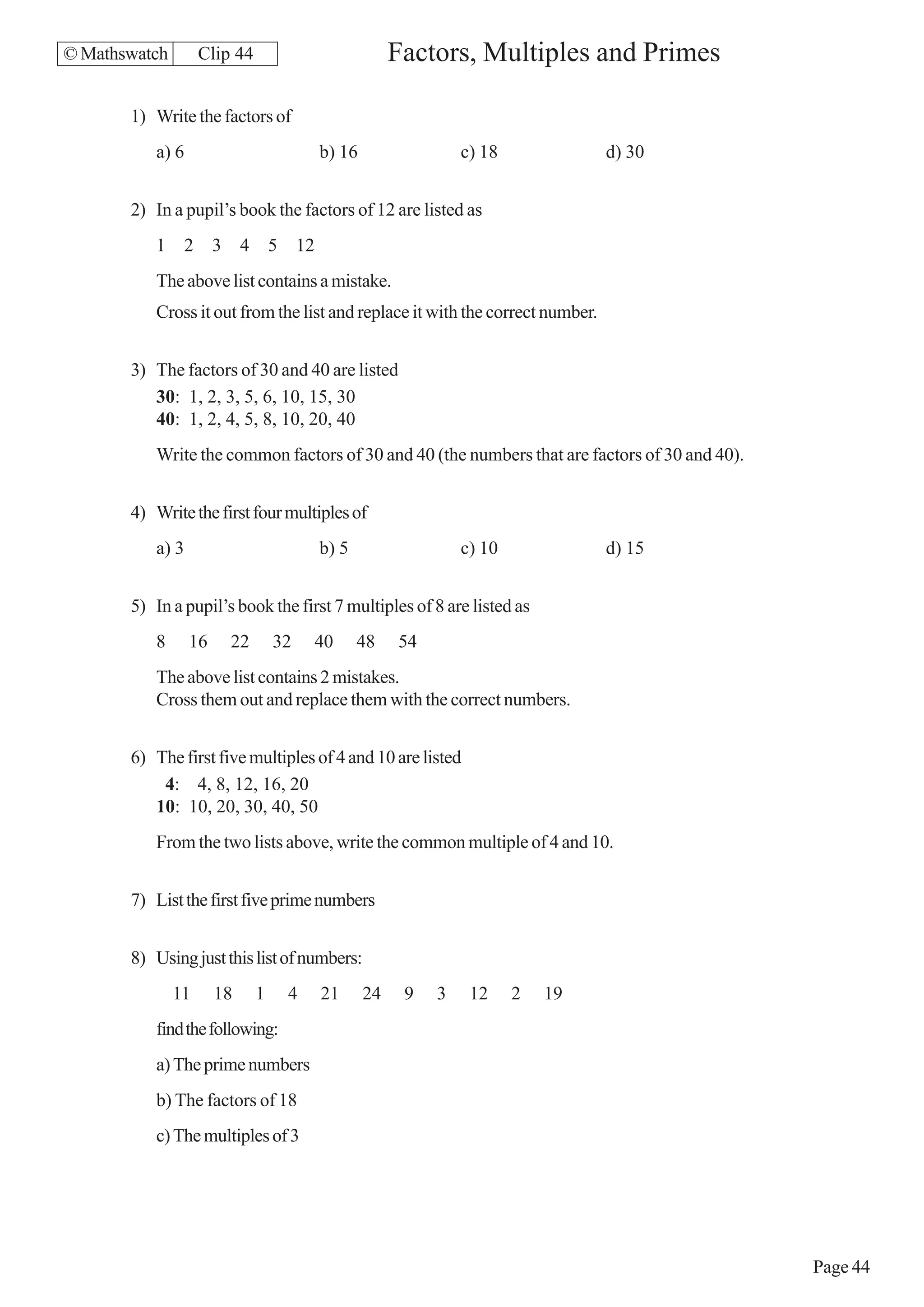
  • 10.
    ©Mathswatch Page 49 Clip 53Change to a Percentage With a Calculator 1) In a class of 37 pupils, 22 are boys. a) What percentage of the class are boys? b) What percentage of the class are girls? 2) Sarahsatamockexaminationandgainedthefollowingmarks: a) Write each of Sarah’s marks as a percentage. b)Which is Sarah’s best subject in terms of percentage score? 3) A brand new car costs £16 500. Adiscount of £2227.50 is negotiated with the dealer. What is the percentage discount? 1) Writethefollowingaspercentages: a) 13 out of 50 d) 34 out of 40 b) 6 out of 20 e) 12 out of 80 c) 17 out of 25 f) 27 out of 60 2) In a football tournament,TeamAwon 16 of the 20 games they played, whilst team B won 19 of their 25 games. What percentage of their games did they each win? 3) 60 participants were invited to a conference. 36 of the participants were females. a)Work out the percentage of female participants. b) What is the percentage of male participants? 4) A company has 800 employees. 440 of these 800 employees are males. 176 of these 800 employees are under 25 years old. a) What percentages of males are employed in this company? b) What percentage of employees are under 25? Subject Mark English Maths Science Change to a Percentage Without a CalculatorMathsWatch Clip 54 79 123 38 46 82 94
  • 11.
    ©Mathswatch Page 50 Clip 55Find a Fraction of an Amount 1. Work out these amounts. a) 3 4 of £20 b) 2 3 of 60 kg c) 3 8 × 24 d) 150 × 2 3 e) 2 9 of 180 cm f) 49 × 4 7 g) 60 × 1 4 h) 5 8 of £48 i) 4000 × 7 8 2. There are 600 apples on a tree and there are maggots in 3 5 of them. Howmanyappleshavemaggotsinthem? 3. Liz and Lee are travelling in a car from Glasgow to Poole (770 km). At midday they had already travelled 5 7 of the total distance. What distance, in km, had they travelled by midday? 4. A digital camera that cost £49 was sold on eBay for 3 7 of the original price. Whatwasthesellingprice? 5. YesterdayThomas travelled a total of 175 miles. Hetravelled 2 5 ofthisdistanceinthemorning. How many miles did he travel during the rest of the day? 6. Debra received her £15 pocket money on Saturday. She spent of her pocket money on magazines. She spent 2 5 of her pocket money on a necklace. How much of the £15 did she have left? 1 3
  • 12.
    ©Mathswatch Page 51 1. Workout the following giving your answer as a fraction in its simplest form a) 3 5 1 5 + b) 3 7 2 7 + c) 5 8 3 8 − d) 7 13 4 13 − 2. Work out the following giving your answer as a fraction in its simplest form a) 3 5 2 10 + b) 1 3 2 9 + c) 13 20 3 5 − d) 9 12 1 3 − 3. Changethefollowingtomixednumbers a) 8 5 b) 14 3 c) 35 6 d) 17 5 4. Change the following to top heavy (or improper) fractions a) 1 2 5 b) 3 1 4 c) 6 1 5 d) 2 5 9 5. Work out the following giving your answer as a fraction in its simplest form a) 1 6 2 5 1 5+ b) 2 1 3 4 1 5+ c) 4 3 1 6 1 3− d) 7 2 4 9 5 9− 6. Work out the following giving your answer as a fraction in its simplest form a) 3 4 1 5 − b) 5 11 3 11 + c) 5 2 3 1 2 − d) 7 12 3 4 + e) 2 9 4 5 2 5+ f) 2 7 1 2 + g) 9 5 1 4 2 5− h) 12 15 7 15 − 7. Ted received his pocket money on Friday. He spent 3 5 of his pocket money on games. He spent 1 10 of his pocket money on magazines. What fraction of his pocket money did he have left? 8. Maisie buys a bag of flour. She uses 1 4 to bake a cake and 2 5 to make a loaf. a) What fraction of the bag of flour was used? b) What fraction of the bag of flour is left? 9. Work out the total length of this shape. Give your answer as a mixed number. 3 1 4 inches 2 2 3 inches Diagram NOT accurately drawn Clip 56 Addition and Subtraction of Fractions
  • 13.
    ©Mathswatch Page 52 Clip 57Multiplication and Division of Fractions Workoutthefollowinggivingyouranswerasafractioninitssimplestform. 1) 4 5 1 3 × 11) 1 3 5 6 ÷ 2) 3 4 2 3 × 12) 2 7 10 21 ÷ 3) 3 10 4 9 × 13) 4 5 8÷ 4) 3 7 5 6 × 14) 4 11 4 11 ÷ 5) 6 25 15 18 × 15) 4 5 8 9 ÷ 6) 4 15 3 16 × 16) 5 8 10 19 ÷ 7) 2 3 2 5 3 4× 17) 1 2 2 3 1 2÷ 8) 1 3 2 3 3 10× 18) 3 2 1 5 2 3÷ 9) 4 5 7 2 3 × 19) 25 2 1 7÷ 10) 3 5 12 1 2× 20) 2 3 2 2 9÷
  • 14.
    ©Mathswatch Page 53 Clip 58Change a Fraction to a Decimal Writethefollowingfractionsasdecimals 1) 3 10 2) 7 10 3) 9 100 4) 1 2 5) 3 4 6) 2 5 7) 7 20 8) 1 3 9) 1 8 10) 5 8
  • 15.
    ©Mathswatch Page 54 Clip 59BODMAS Work out 1) 6 × 5 + 2 2) 2 + 6 × 5 3) 35 – 4 × 3 4) 48 ÷ (14 – 2) 5) 27 ÷ (3 + 6) 6) 27 ÷ 3 + 6 7) (9 + 2) × 2 + 5 8) 4 × (1 + 4) – 6 9) 6 × 4 – 3 × 5 10) 9 3 4 2 + + 11) 23 9 7 3 + − 12) 7 2 4 15 2 2 − − 13) 5 3 2 7 2 + × 14) 5 6 4 13 × − 15) 8 2 4 3 12 × − + 16) 12 3 2 14 7 − × ÷ 17) 20 3 10 5 4 2 − − +( ) 18) 3 9 8 1 6 4 + × + ×
  • 16.
    ©Mathswatch Page 55 Clip 60Long Multiplication of Decimals 1. Work out a) 7 × 4.3 b) 5 × 3.16 c) 2.3 × 1.2 d) 7.2 × 42.5 e) 12.5 × 0.59 f) 0.652 × 0.37 g) 5.62 × 9 h) 26.7 × 4.9 i) 1.56 × 0.059 2. David buys 5 books for £8.75 each. How much does he pay? 3. A DVD costs £12.25. Work out the cost of 9 of these DVDs. 4. John takes 27 boxes out of his van. The weight of each box is 41.7 kg. Work out the total weight of the 27 boxes. 5. Nina bought 43 teddy bears at £9.35 each. Work out the total amount she paid. 6. Elliottgoesshopping. Hebuys 0.5 kg of pears at £0.84 per kg. 2.5 kg of grapes at £1.89 per kg. 6 kg of potatoes at £0.25 per kg. How much does he pay? 7. Brian hires a car for 3 days. Tariffsare: £44.80 for the first day and £37.50 for each extra day. How much does he pay?
  • 17.
    ©Mathswatch Page 56 Clips 61,94 Ratio 1. Writethefollowingratiosintheirsimplestform a) 6 : 9 b) 10 : 5 c) 7 : 21 d) 4 : 24 e) 12 : 40 f) 18 : 27 g) 4 : 2 : 8 h) 18 : 63 : 9 2. Completethemissingvalueintheseequivalentratios a) 3 : 5 = 12 : b) 4 : 9 = : 27 c) : 7 = 16 : 14 d) 2 : 3 = 3 : 3. Matchtogethercardswithequivalentratios: 3 : 4 10 : 5 50 : 100 2 : 1 5 : 2 15 : 20 15 : 6 1 : 2 4. The ratio of girls to boys in a class is 4 : 5. a) What fraction of the class are girls? b) Whatfractionoftheclassareboys? 5. A model of a plane is made using a scale of 1 : 5. a) If the real length of the plane is 20m, what is the length of the model in metres? b) If the wings of the model are 100cm long, what is the real length of the wings in metres? 6. Shareout£250inthefollowingratios: a) 1 : 4 b) 2 : 3 c) 7 : 3 d) 9 : 12 : 4 7. Share out £80 between Tom and Jerry in the ratio 3 : 2. 8. A box of chocolates has 3 milk chocolates for every 2 white chocolates. There are 60 chocolates in the box. Work out how many white chocolates are in the box. 9. In a bracelet, the ratio of silver beads to gold beads is 5 : 2. The bracelet has 25 silver beads. How many gold beads are in the bracelet? 10.To make mortar you mix 1 shovel of cement with 5 shovels of sand. How much sand do you need to make 30 shovels of mortar?
  • 18.
    ©Mathswatch Page 57 Clip 62Recipe Type Ratio Questions 1) Here are the ingredients for making a vegetable soup for 6 people: 2 carrots 1 onion 800ml stock 50g lentils 4g thyme Work out the amount of each ingredient for a) 12 people b) 9 people c) 30 people. 2) Here are the ingredients for making apple crumble for 4 people: 80g plain flour 60g ground almonds 90g sugar 60g butter 4 apples Work out the amount of each ingredient for a) 2 people b) 6 people c) 18 people. 3) Here are the ingredients for making 1500 ml of parsnip soup: 450g parsnips 300g leeks 150g bramley apples 3 onions 1 1 2 pints of chicken stock Work out the amount of each ingredient for a) 500 ml of soup b) 1000 ml of soup c) 2500 ml of soup.
  • 19.
    ©Mathswatch Page 58 Clip 63Hard Calculator Questions 1) Findthevalueofthefollowing: (writedownallthefiguresonyourcalculatordisplay) a) (0.3 + 2.8)2 b) 2.72 + 3.92 c) 4 5 532 . − d) 6 37 4× ÷( ) 2) Findthevalueofthefollowing: (write your answers correct to 1 decimal place) a) 2.116.5 3 + b) 87 4 39 3. ( )÷ + c) 2 3.4 3412 d) 15 12 9 6 387 2 2 − −. . 3) Work out 1675 1532 . .+ a) Writedownallthefiguresonyourcalculatordisplay. b) Write your answer to part (a) correct to 1 decimal place. 4) Work out ( . . ) .2 4 19 2 03 2 × × Writedownallthefiguresonyourcalculatordisplay. 5) Use your calculator to work out the value of 7 34 4 71 563 1189 . . . . × + a) Writedownallthefiguresonyourcalculatordisplay. b) Write your answer to part (a) to an appropriate degree of accuracy.
  • 20.
    ©Mathswatch Page 59 Clip 64Real-Life Money Questions 1) Lance goes on holiday to France. The exchange rate is £1 = 1.40 Euros. He changes £350 into Euros. a) HowmanyEurosshouldheget? In France, Lance buys a digital camera for 126 Euros. b) Work out the cost of the camera in pounds. 2) WhilstonholidayinSpain,Gemmaboughtapairofsunglassesfor77Euros. In England, an identical pair of sunglasses costs £59.99. The exchange rate is £1 = 1.40 Euros. In which country were the glasses the cheapest, and by how much? Show all your working. 3) LukebuysapairoftrainersinSwitzerland. He can pay either 86 Swiss Francs or 56 Euros. The exchange rates are: £1 = 2.10 Swiss Francs £1 = 1.40 Euros Which currency should he choose to get the best price, and how much would he save? Give your answer in pounds (£). 4) The total cost of 5 kg of potatoes and 2 kg of carrots is £4.88. 3 kg of potatoes cost £1.98. Work out the cost of 1 kg of carrots. 5) The cost of 4 kg of bananas is £5.80. The total cost of 3 kg of bananas and 1.5 kg of pears is £5.61. Work out the cost of 1 kg of pears.
  • 21.
    ©Mathswatch Page 60 Clip 65,112 Nth Term 1.Write down the first 5 terms and the 10th term of the following sequences: eg. 2n + 1 3, 5, 7, 9, 11.....21 a) 2n + 2 d) 7n b) 3n + 1 e) 3n – 1 c) n + 3 f) 7n – 3 2. Find the nth term of the following sequences: a) 5, 10, 15, 20... d) 22, 18, 14, 10... b) 5, 8, 11, 14... e) –3, 3, 9, 15... c) 1, 8, 15, 22... f) 4, –1, –6, –11... 3. Here are some patterns made from sticks. a) Draw pattern 4 in the space, below.. b) How many sticks are used in (i) pattern 10 (ii) pattern 20 (iii) pattern 50 c) Find an expression, in terms of n, for the number of sticks in pattern number n. d) Which pattern number can be made using 301 sticks? Pattern 1 Pattern 2 Pattern 3
  • 22.
    ©Mathswatch Page 61 Clip 66Substitution 1) Work out the value of 5x when a) x = 2 b) x = 6 c) x = 10 2) Work out the value of 3x when a) x = –2 b) x = 10 c) x = –12 3) Work out the value of x2 when a) x = 3 b) x = –4 c) x = –10 4) Work out the value of 2x2 when a) x = 5 b) x = –4 c) x = 10 5) Work out the value of 3x + 5 when a) x = 2 b) x = 6 c) x = –1 6) Work out the value of 4 + 2x when a) x = 7 b) x = –1 c) x = –3 7) Work out the value of 3x + 2y when a) x = 1 and y = 2 b) x = 4 and y = 3 c) x = 5 and y = –4 8) Work out the value of 6x – 3y when a) x = 2 and y = 1 b) x = 1 and y = –2 c) x = –3 and y = 4 9) Work out the value of 3x2 + 4y when a) x = 1 and y = 5 b) x = –2 and y = 2 c) x = 3 and y = –2 10) Using the formula P = H × R, where P is the total pay, H is the number of hours worked, and R is the hourly rate of pay. Work out the total pay (P) of the following people: a) Betty worked 10 hours at £7 per hour b) John worked 15 hours and is paid £9 per hour c) Mike worked for 90 minutes at £16 an hour. 11) The equation of a straight line is given as y = 3x + 2 a) Work out the value of y when (i) x = 0 (ii) x = 1 (iii) x = 2 b) What is the value of x when y = 17?
  • 23.
    ©Mathswatch Page 62 Clip 67Parallel Lines 1) Line PQ is parallel to line RS If angle PQR is equal to 36° a) What is the size of angle QRS? b) Give a reason for your answer. P Q R S 36 2) Line DCE is parallel to line AB a) Find the size of angle ABC b) Find the size of angle DCA c) Calculate the size of angle ACB A B C D E 68 33 3) a) Find the size of angle DBF b) Find the size of angle HGC B C D E F G 54 136 H
  • 24.
    ©Mathswatch Page 63 Clips 68,69 1) Work out the size of the angles marked with letters. 2) Work out the size of the angles marked with letters. 3) Work out the size of the angles marked with letters. 30° 70° a 100° b 40° 10° c 30° d 67° 75° 28° 34° e 87° f 46° c 57° 55° a 60° d e 35° f 27° g 45° h j j 120° b 70° i a 80° 120° 140° 115° b c 70° 300° 150° d 70°e f g Angle Sum of Triangles - 1 of 2
  • 25.
    ©Mathswatch Page 64 3) Thediagram shows a 5-sided shape. All the sides of the shape are equal in length. a) (i) Find the value of x. (ii) Give a reason for your answer. b) (i) Work out the value of y. (ii) Explainyouranswer. Angle Sum of Triangles - 2 of 2 2) BCDisatriangle. ABCisastraightline. Angle CBD = 70°. BD = CD. a) (i) Work out the value of x. (ii) Give a reason for your answer. b) (i)Work out the value of y. (ii) Give reasons for your answer. y° x° 70° A B C D A C B 60° 60° 1) ABCis a triangle. a) Find the size of angleA. b) TriangleABCisequilateral. Explainwhy. DiagramNOT accuratelydrawn DiagramNOT accuratelydrawn DiagramNOT accuratelydrawn x° y° Clips 68, 69
  • 26.
    ©Mathswatch Page 65 Clip 70Angles of Regular Polygons 1) a) Work out the size of an exterior angle of a regular hexagon. b) Work out the size of an interior angle of a regular hexagon. 2) a) Name the regular polygon, above. b) Work out the size of an exterior angle and of an interior angle for this polygon. 3) The size of each exterior angle of a regular polygon is 90°. Work out the number of sides of the regular polygon. 4) The size of each exterior angle of a regular polygon is 40°. Work out the number of sides of the regular polygon. 5) The size of each interior angle of a regular polygon is 120°. Work out the number of sides of the regular polygon. 6) The size of each interior angle of a regular polygon is 150°. Work out the number of sides of the regular polygon.
  • 27.
    ©Mathswatch Page 66 Clip 71Area of Circles 1) Findtheareasofthefollowingshapes. Take to be 3.14 a) b) c) 2) Work out the areas of the following shapes. a) b) 3) Thediagramshowsacirculargardencomprising a rectangular pond enclosed by grass. The circular garden has a diameter of 10m. The rectangular pond measures 8m by 6m. Work out the area of the garden covered in grass. Take to be 3.14 and give your answer to the nearest m2 . 4) The radius of the top of a circular table is 60cm. The table also has a circular base with diameter 30cm. a) Work out the area of the top of the table. b) Work out the area of the base of the table. 5) The diagram shows a shape, made from a semi-circle and a rectangle. The diameter of the semi-circle is 13cm. Thelengthoftherectangleis17cm. Calculate the area of the shape. Give your answer correct to 3significantfigures. 10cm 3cm 5m 8cm 12mm 17cm 13cm DiagramsNOT accuratelydrawn 6 m 8 m
  • 28.
    ©Mathswatch Page 67 1) Findthecircumferenceofthefollowingshapes. Taketo be 3.14. a) b) c) 2) Work out the perimeter of the following shapes, taking to be 3.14. a) b) 3) The radius of the top of a circular table is 60 cm. The table also has a circular base with diameter 30 cm. a) Work out the circumference of the top of the table. Let be 3.14 b) Work out the circumference of the base of the table. Let be 3.14 4) The diameter of a wheel on Kyle’s bicycle is 0.75 m. a) Calculatethecircumferenceofthewheel. Give your answer correct to 2 decimal places. Kyle cycles 2000 metres. b) Usingyouranswerin(a),calculatethenumber of complete turns the wheel makes. 5) The diagram shows a shape, made from a semi-circle and a rectangle. The diameter of the semi-circle is 12cm. Thelengthoftherectangleis15cm. Calculate the perimeter of the shape. Give your answer correct to 3significantfigures. 10 cm 3 cm 5 m 8 cm Clip 72 Circumference of Circles 12mm 15cm 12cm DiagramsNOT accuratelydrawn
  • 29.
    ©Mathswatch Page 68 1) Findthe area of each shape. a) b) c) d) 2) Find the shaded area of each shape. a) b) c) d) 10 cm 5mm 6mm 6mm 2mm 9mm 8 cm 13 cm 10 cm 6 cm 3 cm 2 cm 12 cm 7 cm 7 cm 4 cm 12 m 11m Clip 73 Area of Compound Shapes 10 mm 6 mm 4 mm 2 mm 2 mm 2 mm 9 m 6 m 4 m 4 cm 2 cm 8 cm 10 cm 15 cm 25 cm
  • 30.
    ©Mathswatch Page 69 Clip 74Rotations -5 -4 -3 -2 -1 O 1 2 3 4 5 -5 -4 -3 -2 -1 1 2 3 4 5 1) a) Rotate triangle T 90° anti-clockwise about the point (0, 0). Label your new triangle U b) Rotate triangle T 180° about the point (2, 0). Label your new triangle V 2) Describefullythesingle transformationwhichmaps triangle T to triangle U. x y x y U T T -5 -4 -3 -2 -1 O 1 2 3 4 5 -5 -4 -3 -2 -1 1 2 3 4 5
  • 31.
    ©Mathswatch Page 70 Clip 75Reflections y = -x 1) a) Reflect triangle T in the x axis. Label your new triangle U. b) Reflect triangle T in the line with equation y = -x. Label your new triangle V. x y x y -5 -4 -3 -2 -1 O 1 2 3 4 5 -5 -4 -3 -2 -1 1 2 3 4 5 x y 2) a) Describe fully the single transformationwhichmaps triangle T to triangle U. b) Describe fully the single transformation which maps triangle T to triangle V. T T U V -5 -4 -3 -2 -1 O 1 2 3 4 5 -5 -4 -3 -2 -1 1 2 3 4 5
  • 32.
    ©Mathswatch Page 71 Clip 76Enlargements 1) a) Enlarge triangle T by scale factor 2 using point (-5, 2) as the centre of enlargement. Label your new triangle U. b) Enlarge triangle V by scale factor a half using the point (-2, -3) as the centre of enlargement. Label your new triangle W. y x x y 2) DescribefullythesingletransformationwhichmapstriangleS totriangleT O 1 2 3 4 5 6 7 8 9 1 2 3 4 5 6 7 8 9 V T T S -5 -4 -3 -2 -1 O 1 2 3 4 5 -5 -4 -3 -2 -1 1 2 3 4 5
  • 33.
    ©Mathswatch Page 72 Clip 77Translations 1) a) Translate triangle T by vector and label it U b) Translate triangle T by vector and label it V 2) a) DescribefullythesingletransformationwhichmapstriangleAtotriangleB. b) Describe fully the single transformation which maps triangle A to triangle C. -6 -5 -4 -3 -2 -1 O 1 2 3 4 5 6 -6 -5 -4 -3 -2 -1 1 2 3 4 5 6 x y x y -4 2 3 -2 C B T A -6 -5 -4 -3 -2 -1 O 1 2 3 4 5 6 -3 -2 -1 1 2 3 4 5 6
  • 34.
    ©Mathswatch Page 73 Clip 78Find the Mid-Point of a Line 1) Find the midpoint ofAand B whereAhas coordinates (-2, 5) and B has coordinates (4, -1). y -3 -2 -1 O 1 2 3 4 5 -2 -1 1 2 3 4 5 6 x 2) Find the midpoint ofAand B whereAhas coordinates (2, 0) and B has coordinates (8, 6). 3) Find the midpoint ofAand B whereAhas coordinates (-4, -2) and B has coordinates (2, 4). 4) Find the midpoint ofAand B whereAhas coordinates (-3, -2) and B has coordinates (7, 5). 5) Find the midpoint ofAand B whereAhas coordinates (2, -5) and B has coordinates (7, 4). 6) Find the midpoint ofAand B whereAhas coordinates (-7, -4) and B has coordinates (-2, -1). 7) The midpoint ofAand B is at (1, 3). The coordinates ofAare (-2, 4). Work out the coordinates of B. 8) The midpoint ofAand B is at (3.5, 2.5). The coordinates ofAare (2, 5). Work out the coordinates of B.
  • 35.
    ©Mathswatch Page 74 Clip 79Measuring and DrawingAngles 1) Measure the following angles: 2) Draw the following angles: a) angleABC = 60° b) angle PQR = 127° c) angle XYZ = 275° AB P Q X Y a b c d e f
  • 36.
    ©Mathswatch Page 75 Clip 80Drawing Triangles 1) The diagram shows the sketch of triangleABC. BC = 7.4 cm AC = 8.5 cm Angle C = 38° a) Make an accurate drawing of triangleABC. b) Measure the size of angleAon your diagram. 2) Use ruler and compasses to construct an equilateral triangle with sides of length 6 centimetres. You must show all construction lines. 3) The diagram shows the sketch of triangle PQR. a) Use ruler and compasses to make an accurate drawing of triangle PQR. b) Measure angle P. 38 8.5 cm 7.4 cm A B C Diagram NOT accurately drawn P Q R 9 cm 10.5 cm 7.3 cm Diagram NOT accurately drawn
  • 37.
    ©Mathswatch Page 76 Clip 81Plans and Elevations Front The diagram shows a prism drawn on an isometric grid. a) On the grid below, draw the front elevation of the prism from the direction marked by the arrow. b) On the grid below draw a plan of the prism.
  • 38.
    ©Mathswatch Page 77 Clip 82 1)Sketch nets of these solids. 2) On squared paper draw accurate nets of these solids. 4 cm 4 cm 4 cm 6 cm 5 cm 8 cm 3 cm 4 cm 5 cm 7 cm 8 cm 3 cm 7 cm 5 cm Cubea) b) Cuboid Right-angled triangular prismc) d) Triangular prism a) b) Nets 3) The two nets, below, are folded to make cubes. Two other vertices will meet at the the dot,A. Mark them withAs. One other vertex will meet the dot B. Mark it with B. A B a) b)
  • 39.
    ©Mathswatch Page 78 Clip 83Symmetries 1) Draw all the lines of symmetry on the triangle and the rectangle. 4) On each of the shapes below, draw one plane of symmetry. 3) The diagram below, shows part of a shape. The shape has rotational symmetry of order 4 about point P. Complete the shape. P 2) What is the order of rotational symmetry of the two shapes below. S
  • 40.
    ©Mathswatch Page 79 Clip 84Questionnaires and Data Collection 1) Claire wants to find how much time pupils spend on their homework. She hands out a questionnaire with the question How much time do you spend on your homework? A lot Not much a) Writedowntwothingsthatarewrongwiththisquestion ____________________________________________________________ ____________________________________________________________ b) Designasuitablequestionshecoulduse. Youshouldincluderesponseboxes. 2) Tonywantstoknowwhichtypeofprogrammepupilsinhisclasslike watching on TV. Design a suitable data collection sheet he could use to gather the information. 3) Emma asked 20 people what was their favourite pet. Here are their answers. cat cat hamster cat mouse hamster cat dog dog dog snake hamster cat cat hamster dog cat hamster snake cat Design and complete a suitable data collection sheet that Emma could have used tocollectandshowthisinformation.
  • 41.
    ©Mathswatch Page 80 1. Billyhas been carrying out a survey. He asked 100 people the type of water they like to drink (still, sparkling or both). Here are part of his results: a) Complete the two-way table. b) How many males were in the survey? c) How many females drink only still water? d) How many people drink only sparkling water? 2. 90 students each study one of three languages. The two-way table shows some information about these students. 50 of the 90 students are male. 29 of the 50 male students study Spanish. a) Complete the two-way table. b) How many females study French? c) How many people study Spanish? Still Sparkling Both Total Male 26 53 Female 20 10 Total 16 100 French German Spanish Total Female Male 7 Total 20 18 90 Clip 85 Two-Way Tables
  • 42.
    ©Mathswatch Page 81 1) Patrickaskedsomeofhiscolleagueswhichwastheirfavouriteholidaydestination. Thetable shows the results. Draw a pie chart to illustrate the information. 2) Brianasked60peoplewhichregiontheirfavouriterugbyteamcamefrom. The table shows the results. Draw a pie chart to illustrate the information. 3) Sophie represents her monthly expenses using a pie chart. Numbers from her table have been rubbed out bymistake. Use the pie chart to complete the table. City Frequency Alicante 8 Paris 7 Ibiza 15 St Lucia 1 Biarritz 9 Region Frequency Southern England 9 London 23 Midland 16 Northern England 12 Total 60 Angle Clothes £35 Eating out Make up £17 34° Magazines Books Total £180 Diagram accurately drawn Clothes Eating outMake up Magazines Books Clip 86 Pie Charts s
  • 43.
    ©Mathswatch Page 82 Clip 87Scatter Graphs 1) The scatter graph shows some information about the marks of six students. It shows each student’s marks in Maths and Science. The table below shows the marks for four more students. a) On the scatter graph, plot the information from the table. b) Draw a line of best fit. c) Describe the correlation between the marks in Maths and the marks in Science. Another student has a mark of 18 in Science. d) Use the line of best fit to estimate the mark in Maths of this student. 2) The table below shows the average daily number of hours sleep of 10 children. The first five results have been plotted on the scatter diagram. a) Plot the next five points. b) Draw a line of best fit. c) Decribetherelationship between the age of the childrenandtheirnumber of hours sleep per day. d) Use your scatter graph to estimatethenumberof hours sleep for a 3 year oldchild. Maths 22 8 17 26 Science 30 12 24 24 0 10 20 30 40 0 10 20 30 40 0 2 4 6 8 10 8 10 12 14 16 Age (years) 4 2 5 1 9 6 8 7 10 1.5 Number of hours sleep 14 13 12.5 15 10 12.5 10.8 12 11 14 Science Maths Age (years) Numberofhourssleep
  • 44.
    ©Mathswatch Page 83 A classof pupils is asked to solve a puzzle. The frequency table below shows the times taken by the pupils to solve the puzzle. a)Drawafrequencydiagramtoshowthisinformation. b)Drawafrequencypolygontoshowthisinformation. Time (t ) in min Frequency 0 < t 5 3 5 < t 10 4 10 < t 15 5 15 < t 20 7 20 < t 25 5 Clip 88 Frequency Diagrams
  • 45.
    ©Mathswatch Page 84 1) 16students sat a Maths test. Here are their marks: 64 72 39 45 49 67 73 50 73 44 55 77 51 62 64 79 Drawastemandleafdiagramtoshowthisinformation. 2) Pat is carrying out a survey on how tall pupils in her class are. Here are their heights in cm: 173 162 170 169 163 173 156 159 161 168 177 182 170 169 Draw a stem and leaf diagram to show this information. 3) Thestemandleafdiagrambelow,showsinformationaboutthetimes,inminutes, it takes a group of people to eat their breakfast. Key: 1 0 represents 10 minutes. a) How many people are in the group? b) How many people spend 15 minutes or more eating their breakfast? c) Find the median time that it took to eat breakfast. 0 5 7 9 1 0 0 5 8 8 2 0 2 3 5 7 3 2 5 Clip 89 Stem and Leaf Diagrams
  • 46.
    © Mathswatch Clip90a List of Outcomes 1) A 3-sided spinner with numbers 1 to 3 and a 4-sided spinner with numbers 1 to 4 are both spun. a) How many possible outcomes are there? b) List all the possible outcomes. 2) Two coins are flipped and a 3-sided spinner with numbers 1 to 3 is spun. a) How many possible outcomes are there? b) List all the possible outcomes. 1) There are 3 blue counters, 5 red counters and 7 green counters in a bag. A counter is taken from the bag at random. a) What is the probability that a green counter will be chosen? b) What is the probability that a blue or red counter will be chosen? 2) In a drawer there are 6 blue pairs of socks, 9 yellow pairs of socks, 4 black pairs of socks and 5 white pairs of socks. A pair of socks is taken from the drawer at random. a) What is the probability that the pair of socks chosen is white? b) What is the probability that the pair of socks chosen is yellow? c) What is the probability that the pair of socks chosen is blue or black? 3) In a class there are 12 boys and 15 girls. A teacher chooses a student at random from the class. Eric says that the probability a boy will be chosen is 0.5 because a student can be either a boy or a girl. Jenny says that Eric is wrong. Decide who is correct - Eric or Jenny - giving reasons for your answer. 4) Spinner A has numbers 1 to 4 on it. Spinner B has numbers 1 to 3 on it. Both spinners are spun and the numbers on each are added together to give a score. What is the probability that the score will be a) 7? b) 5? c) 3 or 4? Working Out ProbabilitiesClip 90b© Mathswatch Page 85A
  • 47.
    © Mathswatch 1) Ifthe probability of passing a driving test is 0.54, what is the probability of failing it? 2) The probability that a football team will win their next game is . The probability they will lose is . What is the probability the game will be a draw? 3) On the school dinner menu there is only ever one of four options. Some of the options are more likely to be on the menu than others. The table shows the options available on any day, together with three of the probabilities. a) Work out the probability of the dinner option being Fish. b) Which option is most likely? c) Work out the probability that it is a Curry or Sausages on any particular day. d) Work out the probability that it is not Casserole. 4) Julie buys a book every week. Her favourite types are Novel, Drama, Biography and Romance. The table shows the probability that Julie chooses a particular type of book. a) Work out the probability that she will choose a Novel or a Drama. b) Work out the probability that she will choose a Biography or a Romance. The probability that she will choose a Biography is the same as the probability she will choose a Romance. c) Work out the probability that she will choose a Biography. Type of book Novel Drama Biography Romance Probability 0.24 0.16 x x Food Curry Sausages Fish Casserole Probability 0.36 0.41 0.09 Clip 91 Mutually Exclusive Events 2 11 3 11 Page 85B
  • 48.
    ©Mathswatch Page 86 Clip 92Overview of Percentages 1) Find the following to the nearest penny: a) 23% of £670 b) 12% of £580 c) 48% of £64 d) 13% of £7.50 e) 87% of £44 f) 15.7% of £7000 g) 23.8% of £980 h) 34% of £16.34 i) 48.6% of £971.26 j) 78.24% of £12.82 k) 42.15% of £7876.42 l) 0.57% of £60000 2) Find the following: a) 10% of £700 b) 10% of £400 c) 10% of £350 d) 10% of £530 e) 10% of £68 f) 10% of £46 g) 10% of £6.50 h) 10% of £12.20 i) 20% of £600 j) 30% of £900 k) 60% of £800 l) 20% of £650 m) 40% of £320 n) 15% of £300 o) 15% of £360 p) 65% of £12000 q) 45% of £64 r) 85% of £96 s) 17.5% of £800 t) 17.5% of £40 u) 17.5% of £8.80 With a calculator Without a calculator With a calculator 4) Change the following to percentages: a) 46 out of 100 b) 18 out of 50 c) 7 out of 25 d) 23 out of 25 e) 9 out of 20 f) 16 out of 20 g) 7 out of 10 h) 9.5 out of 10 i) 10 out of 40 j) 16 out of 40 k) 30 out of 40 l) 12 out of 40 m) 28 out of 80 n) 32 out of 80 o) 60 out of 80 p) 3 out of 5 q) 4 out of 5 r) 15 out of 75 s) 24 out of 75 t) 30 out of 75 Without a calculator 5) A shop gives a discount of 20% on a magazine that usually sells for £2.80. Work out the discount in pence. 6) A television costs £595 plus VAT at 17.5%. Work out the cost of the television including VAT. 7) Peter has 128 trees in his garden. 16 of the trees are pear trees. What percentage of the trees in his garden are pear trees? 8) A battery operated car travels for 10m when it is first turned on. Each time it is turned on it travels 90% of the previous distance as the battery starts to run out. How many times does the car travel at least 8 metres? 9) Jane scored 27 out of 42 in a Maths test and 39 out of 61 in a Science test. What were her percentages in both subjects to 1 decimal place? In class 7A there are 7 girls and 18 boys. What percentage of the class are girls? A shop decides to reduce all the prices by 15%. The original price of a pair of trainers was £70. How much are they after the reduction? VAT at 17.5% is added to the price of a car. Before the VAT is added it cost £18000. How much does it cost with the VAT? No calculator With a calculator 10) 11) 12) No calculator With a calculator With a calculator With a calculator No calculator No calculator 3) Change the following to percentages: a) 6 out of 28 b) 18 out of 37 c) 42 out of 83 d) 24 out of 96 e) 73 out of 403 f) 234 out of 659 g) 871 out of 903 h) 4.7 out of 23 i) 6.9 out of 79 j) 14.8 out of 23.6 k) 65.8 out of 203.7 l) 12 out of 2314
  • 49.
    ©Mathswatch Page 87 Clip 93Increase/Decrease by a Percentage 1) Increase: a) 500 by 10% c) 80 by 15% b) 320 by 10% d) 75 by 20% 2) Decrease: a) 400 by 10% c) 140 by 15% b) 380 by 10% d) 35 by 20% 3) The price of laptop is increased by 15%. The old price of the laptop was £300. Work out the new price. 4) The price of a £6800 car is reduced by 10%. What is the new price? 5) Increase: a) 65 by 12% c) 600 by 17.5% b) 120 by 23% d) 370 by 17.5% 6) Decrease: a) 42 by 15% c) 52 by 8.5% b) 79 by 12% d) 8900 by 18% 7) The price of a mobile phone is £78.40 plusVAT. VAT is charged at a rate of 17.5%. What is the total price of the mobile phone? 8) In a sale, normal prices are reduced by 7%. The normal price of a camera is £89. Work out the sale price of the camera. 9) Acar dealer offers a discount of 20% off the normal price of a car, for cash. Peter intends to buy a car which usually costs £6800. He intends to pay by cash. Work out how much he will pay. 10) A month ago, John weighed 97.5 kg. He now weighs 4.5% more. Work out how much John now weighs. Give your answer to 1 decimal place. CalculatorNon-Calculator
  • 50.
    ©Mathswatch Page 88 Clips 61,94 Ratio 1. Writethefollowingratiosintheirsimplestform a) 6 : 9 b) 10 : 5 c) 7 : 21 d) 4 : 24 e) 12 : 40 f) 18 : 27 g) 4 : 2 : 8 h) 18 : 63 : 9 2. Completethemissingvalueintheseequivalentratios a) 3 : 5 = 12 : b) 4 : 9 = : 27 c) : 7 = 16 : 14 d) 2 : 3 = 3 : 3. Matchtogethercardswithequivalentratios: 3 : 4 10 : 5 50 : 100 2 : 1 5 : 2 15 : 20 15 : 6 1 : 2 4. The ratio of girls to boys in a class is 4 : 5. a) What fraction of the class are girls? b) Whatfractionoftheclassareboys? 5. A model of a plane is made using a scale of 1 : 5. a) If the real length of the plane is 20m, what is the length of the model in metres? 4m b) If the wings of the model are 100cm long, what is the real length of the wings in metres? 5m 6. Shareout£250inthefollowingratios: a) 1 : 4 b) 2 : 3 c) 7 : 3 d) 9 : 12 : 4 7. Share out £80 between Tom and Jerry in the ratio 3 : 2. 8. A box of chocolates has 3 milk chocolates for every 2 white chocolates. There are 60 chocolates in the box. Work out how many white chocolates are in the box. 9. In a bracelet, the ratio of silver beads to gold beads is 5 : 2. The bracelet has 25 silver beads. How many gold beads are in the bracelet? 10.To make mortar you mix 1 shovel of cement with 5 shovels of sand. How much sand do you need to make 30 shovels of mortar?
  • 51.
    ©Mathswatch Page 89 Clip 95Product of Prime Factors 1) Listthefirstsevenprimenumbers. 2) Expressthefollowingnumberastheproductoftheirprimefactors: a) 30 b) 60 c) 360 d) 220 3) Expressthefollowingnumberastheproductof powers oftheirprimefactors: a) 24 b) 64 c) 192 d) 175 4) The number 96 can be written as 2m × n , where m and n are prime numbers. Find the value of m and the value of n. 5) The number 75 can be written as 5x × y , where x and y are prime numbers. Find the value of x and the value of y. 1) Find the Highest Common Factor (HCF) of each of these pairs of numbers. a) 16 and 24 b) 21 and 28 c) 60 and 150 d) 96 and 108 2) Find the Least (or Lowest) Common Multiple (LCM) of each of these pairs of numbers. a) 16 and 24 b) 21 and 28 c) 60 and 150 d) 96 and 108 3) a) Write 42 and 63 as products of their prime factors. b) Work out the HCF of 42 and 63. c) Work out the LCM of 42 and 63. 4) a) Write 240 and 1500 as products of their prime factors. b) Work out the HCF of 240 and 1500. c) Work out the LCM of 240 and 1500. HCF and LCM©Mathswatch Clip 96
  • 52.
    © Mathswatch Clip97 Using Place Value 1) Use the information that 13 × 17 = 221 to write down the value of (i) 1.3 × 1.7 (ii) 221 ÷ 1.7 2) Use the information that 253 × 48 = 12144 to write down the value of (i) 2.53 × 4.8 (ii) 2530 × 480 (iii) 0.253 × 4800 (iv) 12144 ÷ 25.3 (v) 12144 ÷ 0.48 3) Use the information that 27.3 × 2.8 = 76.44 to write down the value of (i) 273 × 28 (ii) 2.73 × 280 (iii) 0.273 × 28 (iv) 76.44 ÷ 28 (v) 7.644 ÷ 2.73 4) Use the information that 97.6 × 370 = 36112 to write down the value of (i) 9.76 × 37 (ii) 9760 × 3700 (iii) 0.0976 × 3.7 (iv) 36.112 ÷ 3.7 (v) 361120 ÷ 9.76 Page 90
  • 53.
    ©Mathswatch Page 91 Clip 98Recurring Decimals into Fractions 1) Writeeachrecurringdecimalasanexactfraction, initslowestterms. a) 0 5. • b) 0 7. • c) 0 4. • d) 0 24. • • e) 0 75. • • f) 0 82. • • g) 0 617. • • h) 0 216. • • i) 0 714. • • j) 0 324. • • k) 0 72357. • • l) 0 65214. • •
  • 54.
    ©Mathswatch Page 92 Clip 99Four Rules of Negatives Workoutthefollowingwithoutacalculator a) 6 – 9 = l) 5 + 9 – 3 = b) 4 × -3 = m) -3 × -2 × 4 = c) -10 ÷ -5 = n) -6 – -5 – 8 = d) -7 – -6 = o) -5 × -6 × -2= e) 25 ÷ -5 = p) 8 ÷ -4 × -5 = f) -2 + -6 = q) 2 + -8 + -7 = g) 7 – -3 = r) 13 + -13 = h) 6 × -9 = s) 16 ÷ -2 × 4 = i) 5 + -11 = t) 11 – 3 + -9 – -5 = j) -8 × 4 = u) -7 × -2 × -3 = k) 12 + -3 = v) -1 + -3 + 2 = Clip 100 Division by Two-Digit Decimals 1) Workoutthefollowingwithoutacalculator a) 350 ÷ 0.2 e) 30.66 ÷ 2.1 b) 2 ÷ 0.25 f) 5.886 ÷ 0.9 c) 0.45 ÷ 0.9 g) 38.08 ÷ 1.7 d) 2.42 ÷ 0.4 h) 98.8 ÷ 0.08 2) Samisfillingajugthatcanhold1.575litres,usingasmallglass. Thesmallglassholds0.035litres. Howmanyofthesmallglasseswillheneed? Mathswatch
  • 55.
    ©Mathswatch Page 93 Clip 101EstimatingAnswers 1. Work out an estimate for the value of a) 547 4 8 9 7. .× b) 69 398 207 × c) 7 5 2 79 2 71 319 . . . . × + d) 409 5814 019 × . . 2. a) Work out an estimate for 19 6 317 7 9 52 . . . . × × b)Use your answer to part (a) to find an estimate for 196 317 79 52 × × 3. a) Work out an estimate for 613 9 68 379 2 56 . . . . × × b)Use your answer to part (a) to find an estimate for 613 968 379 256 × ×
  • 56.
    ©Mathswatch Page 94 Clip 102Algebraic Simplification 2(p + p) 2p × p 3p + 2p 2 + 2p 2p + 2p 10) The table shows some expressions. Two of the expressions always have the same value as 4p. Tick the boxes underneath the two expressions. 5) a) Simplify pq + 2pq b) Simplify 5x + 3y – x – 4y 6) a) Simplify 6a + 5b – 3b + a b) Simplify x4 + x4 7) a) Simplify x + y + x + y + x b) Simplify t2 + t2 + t2 8) a) Simplify a3 × a3 b) Simplify 3x2 y × 4xy3 11) Expandandsimplify (i) 4(x + 5) + 3(x – 6) (ii) 3(2x – 1) – 2(x – 4) (iii) 5(2y + 2) – (y + 3) 9) a) Simplify 3d + e – d + 4e b) Simplify 3x2 – x2 c) Simplify 5t + 8d – 2t – 3d d) Simplify 4t × 2q 1) Simplify a) x + x b) x × x c) 3x + 2x d) 3x × 2x e) 2x2 y3 + 4x2 y3 f) 2x2 y × 3xy3 2) Simplify a) x + y + x + y b) 3x + 2y + x + 5y c) 6y + 2x – 2y – 3x d) 5p – 3q + p + 2q 3) Expandandsimplify a) 2(x + y) + 3(x + y) b) 3(2x + y) + 2(5x + 3y) c) 5(x + y) + 3(2x – y) d) 3(2c + d) – 2(c + d) e) 4(2p + q) – 3(2p – q) f) 3(4x – 2y) + 2(x + 2y) g) 6(x – 3y) – 2(2x – 5y) 4) Expandandsimplify a) 5(3p + 2) – 2(4p – 3) b) 4(2x + 3) – (x – 2)
  • 57.
    ©Mathswatch Page 95 Clip 103Expanding and Simplifying Brackets 1) Expand these brackets a) 2(x + 3) b) 3(2x + 4) c) 5(3p – 2q) d) 4(x2 + 2y2 ) e) r(r – r2 ) 2) Expandandsimplify a) (x + 1)(x + 2) b) (x + 3)(2x + 4) c) (2x + 1)(3x + 2) 3) Expandandsimplify a) (x + 3)(x – 2) b) (x – 1)(x + 4) c) (x – 3)(x – 2) 4) Expandandsimplify a) (2p + 3)(p – 2) b) (3t – 2)(2t + 3) c) (2x – 5)(3x – 2) 5) Expandandsimplify a) (x + 3y)(x + 4y) b) (2p + q)(3p + 2q) 6) Expandandsimplify a) (2x + 1)2 b) (3x – 2)2 c) (2p + q)2
  • 58.
    ©Mathswatch Page 96 Clip 104Factorisation 1) Factorise a) 2x + 4 b) 2y + 10 c) 3x + 12 d) 3x – 6 e) 5x – 15 2) Factorise a) p2 + 7p b) x2 + 4x c) y2 – 2y d) p2 – 5p e) x2 + x 3) Factorise a) 2x2 + 6x b) 2y2 – 8y c) 5p2 + 10p d) 7c2 – 21c e) 6x2 + 9x 4) Factorise a) 2x2 – 4xy b) 2t2 + 10tu c) 6x2 – 8xy d) 3x2 y2 + 9xy
  • 59.
    ©Mathswatch Page 97 10) 4y+ 3 = 2y + 10 11) 2x + 17 = 5x – 4 12) 2x + 7 = 16 – 4x 13) 5(x + 3) = 2(x + 6) 14) 4(2y + 1) = 2(12 – y) 15) 7 – 3x = 2(x + 1) 16) 17) 18) Clip 105 Solving Equations Solvethefollowingequations 1) 2p – 1 = 13 2) 4y + 1 = 21 3) 6x – 7 = 32 4) x + x + x + x = 20 5) x + 3x = 40 6) 5(t – 1) = 20 7) 4(5y – 2) = 52 8) 4(y + 3) = 24 9) 20x – 15 = 18x – 7 = 5 x – 3 2x + 4 3 = 7 40 – x 3 = 4 + x 2
  • 60.
    ©Mathswatch Page 98 2) The sizesof the angles, in degrees, of the quadrilateral are x + 10 2x x + 80 x + 30 a) Use this information to write down an equation in terms ofx. b) Use your answer to part (a) to work out the size of the smallest angle of thequadrilateral. 3) Sarah buys 6 cups and 6 mugs A cup costs £x A mug costs £(x + 3) a) Write down an expression, in terms of x, for the total cost, in pounds, of 6 cups and 6 mugs. b) If the total cost of 6 cups and 6 mugs is £48, write an equation in terms of x. c) Solve your equation to find the cost of a cup and the cost of a mug. Clip 106 Forming Equations 1) The width of a rectangle is x centimetres. The length of the rectangle is (x + 5) centimetres. a) Find an expression, in terms of x, for the perimeter of the rectangle. Give your answer in its simplest form. The perimeter of the rectangle is 38 centimetres. b) Work out the length of the rectangle. x + 5 x x + 80 x + 30 2x x + 10 Diagram NOT accurately drawn
  • 61.
    ©Mathswatch Page 99 Clip 107Changing the Subject of a Formula 1) Make c the subject of the formula. a = b + cd 2) Make t the subject of the formula. u = v + 2t 3) Make n the subject of the formula. M = 3n +5 4) Make z the subject of the formula. x = 3y + z 5) r = 5s + 3t a) Make t the subject of the formula. b) Make s the subject of the formula. 6) Rearrange y = 3x + 1 to make x the subject. 7) Rearrange y x= + 1 2 2 to make x the subject. 8) Rearrange y x= + 1 3 1 to make x the subject.
  • 62.
    ©Mathswatch Page 100 Clip 108Inequalities -5 -4 -3 -2 -1 0 1 2 3 4 5 6 1) Represent this inequality on the number line -3 < x < 2 -5 -4 -3 -2 -1 0 1 2 3 4 5 6 2) Represent this inequality on the number line -1 < x < 5 3) Write down the inequality shown -5 -4 -3 -2 -1 0 1 2 3 4 5 6 4) Write down the inequality shown -5 -4 -3 -2 -1 0 1 2 3 4 5 6 5) If y is an integer, write down all the possible values of -2 < y < 5 6) If x is an integer, write down all the possible values of -9 < x < -5
  • 63.
    ©Mathswatch Page 101 Clip 109Solving Inequalities 1) Solve a) 3 1 5x − > b) 7 2 30y + ≤ c) x 2 3 2− ≥ d) 5 2 7+ >x e) 8 5 2< −p f) y 3 5 3+ ≥ g) 2 3 5 3 x − ≥ − h) 6 5 2 3x x− > + i) 3 9 6 2p p− < − j) 5 3 2 10− < −y y 2) a) Solvetheinequality 2 2 7z + ≥ b) Writedownthesmallestintegervalueofzwhichsatisfiestheinequality 2 2 7z + ≥ 3) 5 2 10x y+ < x and y are both integers. Writedowntwopossiblepairsofvaluesthatsatisfythisinequality. x = .........., y = .......... and x = .........., y = ..........
  • 64.
    ©Mathswatch Page 102 Clip 110Trial and Improvement 1) Theequation x3 – x = 29 has a solution between 3 and 4 Useatrialandimprovementmethodtofind thissolution. Give your answer correct to 1 decimal place. You must show all your working. 2) Theequation x3 – 4x = 25 has a solution between 3 and 4 Useatrialandimprovementmethodtofind thissolution. Give your answer correct to 1 decimal place. You must show all your working. 3) Theequation x3 – 2x = 68 has a solution between 4 and 5 Useatrialandimprovementmethodtofind thissolution. Give your answer correct to 1 decimal place. You must show all your working. 4) Theequation x3 + 4x = 101 hasonesolutionwhichisapositivenumber. Useatrialandimprovementmethodtofind thissolution. Give your answer correct to 1 decimal place. Youmustshow allyourworking.
  • 65.
    ©Mathswatch Page 103 Clip 111Index Notation for Multiplication and Division 1) Write as a power of 8 a) 84 × 83 b) 812 ÷ 87 2) Write as a power of 3 a) 32 × 39 b) 310 ÷ 33 3) Simplify a) k5 × k2 b) x4 ÷ x2 c) k k 11 6 d) (k8 )2 4) Simplify eg. (2xy3 )4 = 2xy3 × 2xy3 × 2xy3 × 2xy3 = 16x4 y12 a) (2xy5 )3 b) (2x2 y2 )3 c) (4xy4 )2 d) (3xy2 )4 5) 2x × 2y = 210 and 2x ÷ 2y = 22 Work out the value of x and the value of y. 6) 5x × 5y = 512 and 5x ÷ 5y = 56 Work out the value of x and the value of y. 7) a = 2x , b = 2y Express in terms of a and b a) 2x + y b) 22x c) 23y d) 2x + 2y
  • 66.
    ©Mathswatch Page 104 Clip 65,112 1.Write down the first 5 terms and the 10th term of the following sequences: eg. 2n + 1 3, 5, 7, 9, 11.....21 a) 2n + 2 d) 7n b) 3n + 1 e) 3n – 1 c) n + 3 f) 7n – 3 2. Find the nth term of the following sequences: a) 5, 10, 15, 20... d) 22, 18, 14, 10... b) 5, 8, 11, 14... e) –3, 3, 9, 15... c) 1, 8, 15, 22... f) 4, –1, –6, –11... 3. Here are some patterns made from sticks. a) Draw pattern 4 in the space, below.. b) How many sticks are used in (i) pattern 10 (ii) pattern 20 (iii) pattern 50 c) Find an expression, in terms of n, for the number of sticks in pattern number n. d) Which pattern number can be made using 301 sticks? Pattern 1 Pattern 2 Pattern 3 Nth Term
  • 67.
    ©Mathswatch Page 105 Clip 113 1)a) Complete the table of values for y = 2x – 3 b) Using the axes on the right draw the graph of y = 2x – 3 c) Use your graph to work out the value of y when x = 2.5 d) Use your graph to work out the value of x when y = 4.5 2) a) Complete the table of values for y = 2 – x b) Using the axes on the right, again, draw the graph of y = 2 – x x -1 0 1 2 3 4 y 1 x y x -1 0 1 2 3 4 y -1 -1 O 1 2 3 4 -5 -4 -3 -2 -1 1 2 3 4 5 3) a) Complete the table of values for y = ½x – 1 b) Draw the graph of y = ½x – 1 c) Use your graph to find the value of y when x = 3.5 Drawing Straight Line Graphs x -1 0 1 2 3 4 y 0 -1 O 1 2 3 4 -2 -1 1 2 x y
  • 68.
    ©Mathswatch Page 106 Clip 114Finding the Equation of a Straight Line 1) Find the equations of linesA, B and C on the axes below O 1 2 3 4 5 6 7 8 1 2 3 4 5 6 7 8 x y A B C -6 -5 -4 -3 -2 -1 O 1 2 3 4 5 6 -6 -5 -4 -3 -2 -1 1 2 3 4 5 6 2) Find the equations of linesA, B and C on the axes below x y ABC
  • 69.
    ©Mathswatch Page 107 Clip 115Solving Simultaneous Equations Graphically O 1 2 3 4 5 6 7 8 1 2 3 4 5 6 7 8 1) On the axes below, the graphs of y = x + 2 and y = 6 – x have been drawn. Use the graphs to solve the simultaneous equations y = x + 2 and y = 6 – x y = x + 2 y = 6 – x O 1 2 3 4 5 6 7 8 1 2 3 4 5 6 7 8 2) On the axes below draw the graphs of y = 2x + 1 and y = 7 – x Use your graphs to solve the simultaneous equations y = 2x + 1 and y = 7 – x x y x y
  • 70.
    ©Mathswatch Page 108 Clip 116Drawing Quadratic Graphs -2 -1 O 1 2 3 -5 5 10 15 20 x y 1) a) Complete the table of values for y = 2x2 – 3x b) On the grid, draw the graph of y = 2x2 – 3x for values of x from -2 to 3 c) Use the graph to find the value of y when x = -1.5 d) Use the graph to find the values of x when y = 4 x -2 -1 0 1 2 3 y 14 0 9 2) a) Complete the table of values for y = x2 – 2x b) On the grid, draw the graph of y = x2 – 2x for values of x from -2 to 3 c) (i) On the same axes draw the straight line y = 2.5 (ii) Write down the values of x for which x2 – 2x = 2.5 x -2 -1 0 1 2 3 y 8 0 -2 -1 O 1 2 3 -5 5 10 x y
  • 71.
    ©Mathswatch Page 109 Clip 117Real Life Graphs 1) Sarah travelled 20 km from home to her friend’s house. She stayed at her friend’s house for some time before returning home. Here is the travel graph for part of Sarah’s journey. a) At what time did Sarah leave home? b) How far was Sarah from home at 1030? Sarah left her friend’s house at 1110 to return home. c) Work out the time in minutes Sarah spent at her friend’s house. Sarah returned home at a steady speed. She arrived home at 1150 d) Complete the travel graph. e) Work out Sarah’s average speed on her journey from her home to her friend’s house. Give your answer in kilometres per hour. f) Work out Sarah’s average speed on her journey home from her friend’s house. Give your answer in kilometres per hour. Time of day 0 5 10 15 20 25 1000 1020 1040 1100 1120 1140 1200 Distance from home (km)
  • 72.
    ©Mathswatch Page 110 Clip 118Pythagoras’ Theorem 1) Find the length of sideAC. Give your answer to 1 decimal place. A B C 12cm 7cm 2) Find the length of side QR Give your answer to 1 decimal place. PQ R 7.6cm 4.8cm 3) FindthelengthofsideSU Give your answer to 1 decimal place. ST U 14cm 23cm 4) Below is a picture of a doorway. Find the size of the diagonal of the doorway. Give your answer to 1 decimal place. 2.1m 0.8m 5) In the sketch of the rectangular field, below, James wants to walk from B to D. Whichofthefollowingroutesisshorterand by howmuch? From B to C to D or straight across the field from B to D. Give your answer to the nearest metre. 6) Fiona keeps her pencils in a cylindrical beaker as shown below. The beaker has a diameter of 8cm and a height of 17cm. Willapenciloflength19cmfitinthebeaker without poking out of the top? Allworkingsmustbeshown. 50mD 60m A B C
  • 73.
    ©Mathswatch Page 111 Clip 119Pythagoras - Line on a Graph 1) Points P and Q have coordinates (1, 4) and (5, 2). Calculate the shortest distance between P and Q. Give your answer correct to 1 decimal place. -5 -4 -3 -2 -1 O 1 2 3 4 5 -5 -4 -3 -2 -1 1 2 3 4 5 O 1 2 3 4 5 6 1 2 3 4 5 6 x y P Q x y A B 2) Points A and B have coordinates (-4, 3) and (3, -2). Calculate the shortest distance betweenAand B. Give your answer correct to 1 decimal place.
  • 74.
    © Mathswatch Clip120 Surface Area of Cuboids 1) Find the surface area of this cube and cuboid. 2) Find the surface area of this cuboid. 2.3 m 0.8 m 1.7 m 3) A water tank measures 2 m by 3 m by 4 m. It has no top. The outside of the tank, including the base, has to be painted. Calculate the surface area which will be painted. 3 m 4 m 2 m 5 m 6 m 2 m 4) A water tank measures 2 m by 5 m by 6 m. It has no top. The outside of the tank, including the base, has to be painted. A litre of paint will cover an area of 4.3 m2 . Paint is sold in 5 litre tins and each tin costs £13.50. How much will it cost to paint the tank? You must show all your working. 6 cm 10 cm 5 cm 4 cm 4 cm 4 cm Cube Cuboid Page 112
  • 75.
    © Mathswatch Clip121 Surface Area of Triangular Prisms 3 cm 4 cm 5 cm 6 cm 1) Find the surface area of this triangular prism. 10 cm 12 cm 13 cm 15 cm 13 cm 2) Find the surface area of this triangular prism. 2.3 cm 4.6 cm 9.3 cm 3) With the aid of Pythagoras’ Theorem, find the surface area of this triangular prism. Give your answer correct to 2 significant figures. Page 113
  • 76.
    ©Mathswatch Page 114 Clip 122Volume of a Prism 1) The diagram shows a cuboid. Work out the volume of the cuboid. 2) Calculate the volume of this triangular prism. 3 cm 4 cm 5 cm 9 cm 2.5 cm 3.8 cm 3) An ice hockey puck is in the shape of a cylinder with a radius of 3.8 cm and a thickness of 2.5 cm. Take to be 3.14 Work out the volume of the puck. 4) A cuboid has: a volume of 80cm3 a length of 5 cm a width of 2 cm Work out the height of the cuboid. 5) Workoutthemaximumnumberof boxes which can fit in the carton. Box Carton 100 cm 80 cm 200 cm 20 cm 10 cm50 cm 15 cm 50 cm 30 cm
  • 77.
    ©Mathswatch Page 115 Clip 123Similar Shapes 3) BE is parallel to CD. ABC and AED are straight lines. AB = 4 cm, BC = 6 cm, BE = 5 cm, AE = 4.4 cm a) Calculate the length of CD. b) Calculate the length of ED. 2) SV is parallel to TU. RSTand RVU are straight lines. RS = 9 cm, ST = 3 cm, TU = 7 cm, RV = 6 cm Calculate the length of VU. 1) The diagram shows two quadrilaterals that are mathematically similar. a) Calculate the length of AB b) Calculate the length of PS P Q RS A B CD 4 cm 8 cm 14 cm 21 cm R S T U V 9 cm 3 cm 7cm 6 cm A B C D E 4 cm 6 cm 5 cm 4.4cm
  • 78.
    © Mathswatch Clip124 Converting Metric Units 1) Change 9 m2 into cm2 2) How many square metres are there in 5 square kilometres? 3) Change 4 cm2 into mm2 4) Convert 6.5 m2 into mm2 5) Change 2 m3 into cm3 6) How many cubic millimetres are there in 3 cubic centimetres? 7) Change 7 m3 into mm3 8) A tiler wants to tile a rectangular wall which measures 4 m by 2.5 m. Each tile measures 16 cm by 10 cm. How many tiles will he need for the wall? 9) A carpet-fitter is laying carpet tiles in a rectangular floor which measures 7.5 m by 4.5 m. Each carpet tile measures 50 cm by 50 cm. How many carpet tiles will he need for the floor? 4 m 2.5 m 16 cm 10 cm Tile 7.5 m 4.5 m 50 cm 50 cm Carpet tile Page 116
  • 79.
    ©Mathswatch Page 117 1. Asilver necklace has a mass of 123 grams, correct to the nearest gram. a) Write down the least possible mass of the necklace. b) Write down the greatest possible mass of the necklace. 2. Each of these measurements was made correct to one decimal place. Writethemaximumandminimumpossiblemeasurementineachcase. a) 4.6 cm b) 0.8 kg c) 12.5 litres d) 25.0 km/h e) 10.3 s f) 36.1 m g) 136.7 m/s h) 0.1 g 3. Each side of a regular octagon has a length of 20.6 cm, correct to the nearest millimetre. a) Write down the least possible length of each side. b) Write down the greatest possible length of each side. c) Write down the greatest possible perimeter of the octagon. 4. A girl has a pencil that is of length 12 cm, measured to the nearest centimetre. Her pencil case has a diagonal of length 12.3 cm, measured to the nearest millimetre. Explain why it might not be possible for her to fit the pen in the pencil case. 5. A square has sides of length 7 cm, correct to the nearest centimetre. a) Calculate the lower bound for the perimeter of the square. b) Calculate the upper bound for the area of the square. Clip 125 Bounds
  • 80.
    ©Mathswatch Page 118 Clip 126Compound Measures 1) Jane runs 200 metres in 21.4 seconds. Work out Jane’s average speed in metres per second. Give your answer correct to 1 decimal place. 2) A car travels at a steady speed and takes five hours to travel 310miles. Work out the average speed of the car in miles per hour. 3) A plane flies 1440 miles at a speed of 240 mph. How long does it take? 4) A marathon runner runs at 7.6 mph for three and a half hours. Howmanymileshasherun? 5) A car takes 15 minutes to travel 24 miles. Finditsspeedinmph. 6) A cyclist takes 10 minutes to travel 2.4 miles. Calculate the average speed in mph. 7) An ice hockey puck has a volume of 113 cm3 . It is made out of rubber with a density of 1.5 grams per cm3 . Work out the mass of the ice hockey puck. 8) An apple has a mass of 160 g and a volume of 100 cm3 . Finditsdensitying/cm3 . 9) A steel ball has a volume of 1500 cm3 . The density of the ball is 95 g/cm3 . Find the mass of the ball in kg. 10) The mass of a bar of chocolate is 1800 g. The density of the chocolate is 9 g/cm3 . What is the volume of the bar of chocolate?
  • 81.
    ©Mathswatch Page 119 Clip 127Bisecting a Line 1) Using ruler and compasses, bisect line AB. A B 2) Using ruler and compasses a) Bisect line AB b) Bisect line BC c) Bisect line AC d) Place your compass point where your three lines cross* Now open them out until your pencil is touching vertex A. Draw a circle using this radius. A B C * If your three lines don’t cross at a point then you have a mistake somewhere or just haven’t been accurate enough.
  • 82.
    ©Mathswatch Page 120 Clip 128Drawing a Perpendicular to a Line 1) Use ruler and compasses to construct the perpendicular to the line segment AB that passes through the point P. You must show all construction lines. P A B C D P 2) Use ruler and compasses to construct the perpendicular to the line segment CD that passes through the point P. You must show all construction lines.
  • 83.
    ©Mathswatch Page 121 Clip 129Bisecting anAngle 1) Using ruler and compasses, bisect angle ABC. A B C 2) The diagram below shows the plan of a park. The border of the park is shown by the quadrilateral RSUV There are two paths in the park. One is labelledTR and the other TV. A man walks in the park so that he is always the same distance from both paths. Using ruler and compasses show exactly where the man can walk. R S T U V
  • 84.
    ©Mathswatch Page 122 Clip 130Loci - page 1 of 2 1) ABCD is a rectangle. Shade the set of points inside the rectangle which are both more than 4 centimetres from the point D and morethan1centimetrefromthelineAB. D C BA 2) Two radio transmitters,Aand B, are situated as below. TransmitterAbroadcasts signals which can be heard up to 3 km fromA. Transmitter B broadcasts signals which can be heard up to 6 km from B. Shade in the area in which radio signals can be heard from both transmitters. Use a scale of 1 cm = 1 km. A B
  • 85.
    ©Mathswatch Page 123 Clip 130 × × × A B C 1) PointC is equidistant from points A and B. Sarah rolls a ball from point C. At any point on its path the ball is the same distance from pointAand point B. a) On the diagram above draw accurately the path that the ball will take. b) On the diagram shade the region that contains all the points that are no more than 3cm from point B. 2) The map shows part of a lake. In a competition for radio-controlled ducks, participants have to steer their ducksso that: its path betweenAB and CD is a straight line this path is always the same distance fromAas from B a) On the map, draw the path the ducks should take. There is a practice region for competitors. This is the part of the lake which is less than 30 m from point E. b) Shade the practice region on the map. × × × × × A B C D E Scale: 1 cm represents 10 m Loci - page 2 of 2
  • 86.
    ©Mathswatch Page 124 Clip 131Bearings 1) School B is due east of school A. C is another school. The bearing of C from A is 065° . The bearing of C from B is 313° . Complete the scale drawing below. Mark with a cross the position of C. A B 2) In the diagram, point A marks the position of Middlewitch. The position of Middlemarch is to be marked on the diagram as point B On the diagram, mark with a cross the position of B given that: B is on a bearing of 320° from A and B is 5 cm from A N N A 3) Work out the bearing of a) B from P b) P from A N A B 64 138 Diagram NOT accurately drawn. P
  • 87.
    ©Mathswatch Page 125 Clip 132Experimental Probabilities 1) Ahmaddoesastatisticalexperiment. He throws a dice 600 times. He scores one, 200 times. Isthedicefair?Explainyouranswer 2) Chris has a biased coin. The probability that the biased coin will land on a tail is 0.3 Chrisisgoingtoflipthecoin150times. Work out an estimate for the number of times the coin will land on a tail. 3) On a biased dice, the probability of getting a six is 2 3 . The dice is rolled 300 times. Work out an estimate for the number of times the dice will land on a six. 4) On a biased dice, the probability of getting a three is 0.5 The dice is rolled 350 times. Work out an estimate for the number of times the dice will land on a three. 5) Jenny throws a biased dice 100 times. The table shows her results. Score Frequency 1 15 2 17 3 10 4 24 5 18 6 16 a) She throws the dice once more. Findanestimatefortheprobabilitythatshewillgetafour. b) If the dice is rolled 250 times, how many times would you expect to get a five?
  • 88.
    ©Mathswatch Page 126 Clip 133Averages From a Table 1) The number of pens in each pupil’s pencil case in a classroom has been counted. The results are displayed in a table. a) Work out the total number of pens in the classroom. b) Write down the modal number of pens in a pencil case. c) Work out the mean number of pens in a pencil case. d) Work out the range of the number of pens in a pencil case. 2) Thomasisanalysingthelocalfootballteam. He records the number of goals scored in each footballmatchinthepasttwelvemonths. Thomas said that the mode is 7 Thomasiswrong. a) Explainwhy. b) Calculate the mean number of goals scored. 3) Tinarecordedhowlong,inminutes,shewatched TV for each day during a month. a) Findtheclassintervalinwhichthemedianlies. b) Work out an estimate for the mean amount of timeTina watchedTVeach day of this month. Giveyouranswertothenearestminute. Number of pens Number of pupils 0 4 1 6 2 7 3 5 4 3 5 1 Goals scored Frequency 0 7 1 5 2 3 3 6 4 2 5 1 6 1 Time (t in minutes) Frequency 10 < t < 20 5 20 < t < 30 9 30 < t < 45 8 45 < t < 60 6 60 < t < 90 3
  • 89.
    ©Mathswatch Page 127 Clip 134Questionnaires 1) A survey into how people communicate with each other is carried out. Aquestionnaire is designed and two of the questions used are shown below. The questions arenotsuitable. For each question, write down a reason why. a) Do you prefer to communicate with your friend by phone (voice call) or by text message? Yes No Reason ................................................................................................................. ................................................................................................................. b) How many text messages do you send? 1 2 3 4 Reason ................................................................................................................. ................................................................................................................. 2) A restaurant owner has made some changes. He wants to find out what customers think of these changes. He uses this question on a questionnaire. “What do you think of the changes in the restaurant?” Excellent Very good Good a) Writedownwhatiswrongwiththisquestion. Thisisanotherquestiononthequestionnaire. “How often do you come to the restaurant?” Veryoften Not often b) i) Writedownonethingthatiswrongwiththisquestion. ii) Design a better question to use. You should include some response boxes.
  • 90.
    © Mathswatch Clip135a Standard Form Basics 1) Change the following to normal (or ordinary) numbers. a) 4.3 × 10⁴ c) 7.03 × 10³ e) 1.01 × 10⁴ b) 6.79 × 10⁶ d) 9.2034 × 10² f) 4 × 10⁵ 2) Change the following to normal (or ordinary) numbers. a) 4.3 × 10⁻⁴ c) 7.03 × 10⁻³ e) 1.01 × 10⁻⁴ b) 6.79 × 10⁻⁶ d) 9.2034 × 10⁻² f) 4 × 10⁻⁵ 3) Change the following to standard form. a) 360 c) 520 000 e) 1 003 b) 8 900 d) 62 835 f) 6 450 000 4) Change the following to standard form. a) 0.71 c) 0.00076 e) 0.00009 b) 0.0008 d) 0.0928 f) 0.00000173 5) Work out the following, giving your answer in standard form. a) 3 000 × 5 000 d) 5 × 4 × 103 g) 7 × 102 × 3 × 10-4 b) 240 × 0.0002 e) h) 2 × 3.6 × 10-5 c) 9 × 1.1 × 107 f) 9 × 102 × 2 × 10-5 i) 6 × 4.1 × 103 8 × 10⁴ 4 × 10² Page 128A
  • 91.
    © Mathswatch Clip135b Standard Form Calculation 1) Work out the following, giving your answer in standard form. a) (6 × 10² ) × (8 × 10⁴ ) c) b) (2 × 10⁵ ) + (3 × 10⁴ ) d) (9.2 × 10⁵ ) ÷ (2 × 10² ) 2) A spaceship travelled for 5 × 10³ hours at a speed of 9 × 10⁴ km/h. a) Work out the distance travelled by the spaceship. Give your answer in standard form. Another spaceship travelled a distance of 2 × 10⁷ km, last month. This month it has travelled 5 × 10⁶ km. b) Work out the total distance travelled by the spaceship over these past two months. Give your answer as a normal (or ordinary) number. 3) Work out the following, giving your answer in standard form, correct to 2 significant figures. a) 2.6 × 103 × 4.3 × 104 c) b) (7.5 × 10⁵ ) × (1.9 × 10⁻² ) d) 4) Work out the following, giving your answer in standard form correct to 3 significant figures. a) c) b) d) 5) A microsecond is 0.000 001 seconds. a) Write the number 0.000 001 in standard form. A computer does a calculation in 3 microseconds. b) How many of these calculations can the computer do in 1 second? Give your answer in standard form, correct to 3 significant figures. 6) 340 000 tomato seeds weigh 1 gram. Each tomato seed weighs the same. a) Write the number 340 000 in standard form. b) Calculate the weight, in grams, of one tomato seed. Give your answer in standard form, correct to 2 significant figures. 3 × 10³ 6 × 10⁻⁵ 9.435 × 10⁵ 3.28 × 10³ 5.98 × 10⁸ 6.14 × 10⁻² 5.76 × 10⁷ + 3.89 × 10⁹ 7.18 × 10⁻² 7.2 × 10⁻² – 5.4 × 10⁻¹ 9.25 × 10⁻⁷ 3 × 108 × 2 × 107 3 × 10⁸ + 2 × 10⁷ 3 × 3.2 × 1012 × 1.5 × 1012 3.2 × 10¹² – 1.5 × 10¹² Page 128B
  • 92.
    ©Mathswatch Page 129 Clip 136Percentage Increase and Decrease 1) A car dealer is comparing his sales over the past two years. In 2006, he sold 175 cars. In 2007, he sold 196 cars. Work out the percentage increase in the number of cars sold. 2) In September 2005, the number of pupils attending MathsWatch College was 1352. In September 2006, the number of pupils attending MathsWatch College was 1014. Work out the percentage decrease in the number of pupils attending MathsWatch College. 3) The usual price of a shirt is £32.50 In a sale, the shirt is reduced to £29.25 What is the percentage reduction? 4) Olivia opened an account with £750 at the MathsWatch Bank. After one year, the bank paid her interest. She then had £795 in her account. Work out, as a percentage, MathsWatch Bank’s interest rate. 5) Ken buys a house for £270 000 and sells it two years later for £300 000. Whatishispercentageprofit? Giveyouranswerto2significantfigures. 6) Shelley bought some items at a car boot sale and then sold them on ebay. Work out the percentage profit or loss she made on each of these items. a) Trainers bought for £15, sold for £20 b) DVD recorder bought for £42, sold for £60.90 c) Gold necklace bought for £90, sold for £78.30 d) A DVD collection bought for £120, sold for £81.60
  • 93.
    ©Mathswatch Page 130 Clip 137Compound Interest/Depreciation 1) Henry places £6000 in an account which pays 4.6% compound interest each year. Calculate the amount in his account after 2 years. 2) Sarah puts £8600 in a bank. The bank pays compound interest of 3.8% per year. Calculate the amount Sarah has in her account after 4 years. 3) Mary deposits £10000 in an account which pays 5.6% compound interest per year. How much will Mary have in her account after 5 years? 4) Susan places £7900 in an account which pays 2.4% compound interest per year. How much interest does she earn in 3 years? 5) Harry puts money into an account which pays 6% compound interest per year. If he puts £23000 in the account for 5 years how much interest willheearnaltogether? 6) Laura buys a new car for £14600. The annual rate of depreciation is 23%. How much is the car worth after 3 years? 7) The rate of depreciation of a particular brand of computer is 65% per year. If the cost of the computer when new is £650 how much is it worth after 2 years? 8) Sharon pays £3500 for a secondhand car. The annual rate of depreciation of the car is 24% How much will it be worth four years after she has bought it? 9) Dave places £17000 in an account which pays 4% compound interest per year. How many years will it take before he has £19122.68 in the bank? 10) A new motorbike costs £8900. The annual rate of depreciation is 18% per year. After how many years will it be worth £2705.66?
  • 94.
    ©Mathswatch Page 131 Clip 138Reverse Percentages 1) In a sale, normal prices are reduced by 20%. The sale price of a shirt is £26 Calculatethenormalpriceoftheshirt. 4) A salesman gets a basic wage of £160 per week plus a commision of 30% of the sales he makes that week. In one week his total wage was £640 Work out the value of the sales he made that week. 2) A car dealer offers a discount of 15% off the normal price of a car for cash. Emma pays £6120 cash for a car. Calculate the normal price of the car. 3) In a sale, normal prices are reduced by 13%. The sale price of a DVD recorder is £108.75 Calculate the normal price of the DVD recorder. 5) Jason opened an account at MathsWatch Bank. MathsWatch Bank’s interest rate was 4%. After one year, the bank paid him interest. The total amount in his account was then £1976 Work out the amount with which Jason opened his account 6) Jonathan’s weekly pay this year is £960. This is 20% more than his weekly pay last year. Tess says “This means Jonathan’s weekly pay last year was £768”. Tess is wrong. a) Explainwhy b) Work out Jonathan’s weekly pay last year. 7) The price of all rail season tickets to London increased by 4%. a) The price of a rail season ticket from Oxford to London increased by £122.40 Work out the price before this increase. b) After the increase, the price of a rail season ticket from Newport to London was £2932.80 Work out the price before this increase.
  • 95.
    ©Mathswatch Page 132 Clip 139Four Rules of Fractions Work out 1) 2 3 1 5 + 11) 2 3 3 4 × 21) 2 5 3 7 × 2) 1 2 2 3 3 4+ 12) 11 12 5 6 − 22) 5 2 2 3 3 4− 3) 2 5 3 8 + 13) 2 3 5 1 4 ÷ 23) 2 1 1 2 2 3+ 4) 3 4 1 6 + 14) 2 1 2 3 1 4× 24) 1 2 2 5 3 7+ 5) 3 1 2 5 3 4− 15) 1 3 3 5 + 25) 3 11 3 4 1 2+ 6) 4 5 2 9 × 16) 1 1 2 1 6 − +( ) 26) 12 5 8 1 2 ÷ 7) 14 11 3 4 1 2− 17) 1 1 5 3 8 − +( ) 27) 1 3 10 3 5 − +( ) 8) 9 10 3 7 − 18) 2 3 1 3 1 2× 28) 6 5 12 1 4 ÷ 9) 4 9 12 18 ÷ 19) 4 7 1 3 + 29) 2 2 5 1 3 × 10) 7 10 5 8 × 20) 3 2 1 3 3 4+ 30) 1 2 3 1 5 − +( )
  • 96.
    ©Mathswatch Page 133 Clip 140Solving Quadratic Equations by Factorising 1) Factoriseandsolvethefollowingequations: a) x2 + 5x + 6 = 0 b) x2 + 9x + 20 = 0 c) x2 + x – 6 = 0 d) x2 + 5x – 24 = 0 e) x2 – 6x + 8 = 0 f) x2 – 3x – 28 = 0 g) 2x2 + 7x + 3 = 0 h) 6x2 + 11x + 3 = 0 i) 3x2 + 13x – 10 = 0 j) 3x2 – 34x + 63 = 0 2) Lucy said that -1 is the only solution of x that satisfies the equation x2 + 2x + 1 = 0 Was Lucy correct? Showworkingtojustifyyouranswer 3) Ben said that -5 is the only solution of x that satisfies the equation x2 + 10x + 25 = 0 Was Ben correct? Showworkingtojustifyyouranswer
  • 97.
    ©Mathswatch Page 134 Clip 141Difference of Two Squares x2 – y2 = (x – y)(x + y) 1) Factorise a) x2 – 16 c) y2 – 9 e) x2 – 1 4 b) a2 – b2 d) x2 – 1 f) x2 – 1 9 2) Factorise a) x2 – 4y2 c) 9x2 – 16y2 e) 4x2 – 25y2 b) 9a2 – b2 d) 1 4 x2 – y2 f) x2 – 1 9 y2 3) Simplify a) y y y 2 4 2 5 5 − + × + b) 3 2 1 4 1 2 2 x x x+ × − − c) 12 8 9 4 2 2 x x x + − d) 25 16 10 8 2 2 2 a b ab b − − 4) Solve a) 4x2 – 16 = 0 c) 49x2 = 121 b) 25x2 = 1 d) 9x2 – 9 = 7
  • 98.
    ©Mathswatch Page 135 Clip 142Simultaneous Linear Equations 1) Solve 4x + 3y = 6 5x – 3y = 21 2) Solve 4x + 3y = 19 3x – 5y = 7 3) Solve 3x + 5y = 13 2x + 3y = 8 4) Solve x + 4y = 5 4x – 2y = 11 5) Solve 2a + b = 3 4a – 5b = 20 6) Solve 5x + 3y = 4 3x + 4y = 9 7) Solve 6x – 2y = 13 2x + 3y = -3 8) Solve 3a – 2b = 14 4a + 3b = 13 9) Solve 5x + 4y = 5 2x + 7y = 29 10) Solve 6x – 4y = 39 2x + y = 6
  • 99.
    ©Mathswatch Page 136 Understand y= mx + c gradient cuts the y-axis 1) a) Find the equation of lineA. b) Draw the line B, with equation y = x – 1. c) Draw the line C, with equation y = 1 – 2x. A (-1, 2) B (1, 6) C (0, -1) 6) A is the point (-1, 2). B is the point (1, 6). C is the point (0, -1). Find the equation of the line which passes through C and is parallel to AB. 2) A straight line passes through points (0, 4) and (3, 13). What is its equation? 3) A straight line passes through points (0, 7) and (2, -1). What is its equation? 4) A straight line is parallel to y = 3x – 2 and goes through (1, 8). What is its equation? 5) A straight line is parallel to y = 2x + 5 and goes through (5, 6). What is its equation? Clip 143 A -1 -0.5 O 0.5 1 1.5 2 -2 -1 1 2 x y
  • 100.
    ©Mathswatch Page 137 Clip 144Regions O 1 2 3 4 5 6 7 8 1 2 3 4 5 6 7 8 x y 1) On the grid below, draw straight lines and use shading to show the region R that satisfies the inequalities x > 1 y > x x + y < 7 O 1 2 3 4 5 6 7 8 1 2 3 4 5 6 7 8 x y 2) On the grid below, draw straight lines and use shading to show the region R that satisfies the inequalities y > x + 1 y < 5 x > 1
  • 101.
    ©Mathswatch Page 138 Clip 145Cubic and Reciprocal Functions -2 -1 O 1 2 -14 -12 -10 -8 -6 -4 -2 2 4 6 8 1) a) Complete this table of values for y = x3 + x – 4 b) On the grid, draw the graph of y = x3 + x – 4 c) Use the graph to find the value of x when y = 2 x y –2 –14 –1 0 1 –2 2 x y -2 -1 O 1 2 -12 -8 -4 4 8 12 2) a) Complete this table of values for y = x3 + 2x b) On the grid, draw the graph of y = x3 + 2x c) Use the graph to find the value of x when y = -6 x y –2 –12 –1 0 1 0 2 3) Sketch the graph of y = 1 + in your book. 1 x
  • 102.
    ©Mathswatch Page 139 Clip 146Recognise the Shapes of Functions Match each of the functions below, with the correct sketch of its graph. y = 2x y = -2 xy = 3x3 y = 2x2 + 1 y = 3x – 1 y = 2 x y = -2x3y = 5x – x3
  • 103.
    © Mathswatch Clip147a/b Trigonometry 4.5 cm P Q R11 cm 1) PQR is a right-angled triangle. PR = 11 cm. QR = 4.5 cm Angle PRQ = 90° Work out the value of x. Give your answer correct to 1 decimal place. 4) AB = 23 cm. Angle ABC = 90° Angle ACB = 21° Calculate the length of AC. Give your answer correct to 3 significant figures. A B C 21 23 cm 34 A B C 14 cm 2) AC = 14 cm. Angle ABC = 90° Angle ACB = 34° Calculate the length of BC. Give your answer correct to 3 significant figures. 3) PQR is a right-angled triangle. PQ = 18 cm. QR = 8.4 cm Angle PRQ = 90° Work out the value of x. Give your answer correct to 1 decimal place. 8.4 cm x° P Q R 18 cm N N S L P x 1.8 km 3.4 km 5) A lighthouse, L, is 3.4 km due West of a port, P. A ship, S, is 1.8 km due North of the lighthouse, L. Calculate the size of the angle marked x. Give your answer correct to 3 significant figures. ° ° ° x Page 140A
  • 104.
    © Mathswatch Clip147c Bearings by Trigonometry Diagram NOT accurately drawn. Appleby Brompton Crowdace 9.8 km 7.6 km N 1) Appleby, Brompton and Crowdace are three towns. Appleby is 9.8 km due west of Brompton. Brompton is 7.6 km due south of Crowdace. a) Calculate the bearing of Crowdace from Appleby. Give your answer correct to 1 decimal place. b) Calculate the bearing of Appleby from Crowdace. Give your answer correct to 1 decimal place. Diagram NOT accurately drawn. Denton Egleby Froncham 12.3 km 2) Denton, Egleby and Froncham are three towns. Egleby is 12.3 km due East of Denton. Froncham is due north of Denton and on a bearing of 320° from Egleby. Calculate the distance between Froncham and Egleby. Give your answer correct to 1 decimal place. N Page 140B
  • 105.
    © Mathswatch Clip148 3-D Coordinates x y z P O Q R S T U 1) A cuboid lies on the coordinate axes. The point Q has coordinates (5, 3, 4) a) Write down the coordinates of the point P b) Write down the coordinates of the point T c) Write down the coordinates of the point S d) Write down the coordinates of the point R e) Write down the coordinates of the point U x y z 2) A cuboid lies on the coordinate axes. Point P lies half way between A and B and has coordinates (3, 4, 5) a) Write down the coordinates of B. b) Write down the coordinates of C. A BP C Page 141
  • 106.
    ©Mathswatch Page 142 Clip 149Similar Shapes Diagram NOT accurately drawn. 2) Two prisms, A and B, are mathematically similar. The volume of prism A is 36000 cm3 . The volume of prism B is 383328 cm3 . The total surface area of prism B is 40656 cm2 . Calculate the total surface area of prism A. 3) P and Q are two geometrically similar solid shapes. The total surface area of shape P is 540 cm2 . The total surface area of shape Q is 960 cm2 . The volume of shape P is 2700 cm3 . Calculate the volume of shape Q. 12 cm 8 cm 3 cm 7 cm B E A DC 1) BE is parallel to CD. AB = 12 cm, BC = 3 cm, CD = 7 cm, AE = 8 cm. a) Calculate the length of ED. b) Calculate the length of BE. Diagram NOT accurately drawn. A B
  • 107.
    © Mathswatch Clip150 Circle Theorems 72° B C A PO DiagramNOT accuratelydrawn1) In the diagram,A, B and C are points on the circumference of a circle, centre O. PAand PB are tangents to the circle. AngleACB = 72° . a) (i) Work out the size of angleAOB. (ii) Give a reason for your answer. b) Work out the size of angleAPB. P S R Q b 32° a 2) P, Q, R and S are points on the circle. PQ is a diameter of the circle. Angle RPQ = 32° . a) (i) Work out the size of angle PQR. (ii) Give reasons for your answer. b) (i) Work out the size of angle PSR. (ii) Give a reason for your answer. DiagramNOT accuratelydrawn 3) The diagram shows a circle, centre O. AC is a diameter. Angle BAC = 31° . D is a point onAC such that angle BDA isarightangle. a) Work out the size of angle BCA. Give reasons for your answer. b) CalculatethesizeofangleDBC. c) CalculatethesizeofangleBOA. 31° A O D C B DiagramNOT accuratelydrawn 21° 58° DiagramNOT accuratelydrawn 4) A, B, C and D are four points on the circumference of a circle. ABE and DCE are straight lines. Angle BAC = 21° . Angle EBC = 58° . a) Find the size of angleADC. b) FindthesizeofangleADB. Angle CAD = 69° . c) Is BD a diameter of the circle? Youmustexplainyouranswer. A B CD E Page 143A
  • 108.
    © Mathswatch O OO O O O O O O O O O a 88° b 46° c 46° d 23° e 39° f 85° g 41° h i j 36° k m 100° l n 18° q 102° p 12° 54° 114° s r 1) a = ____ 2) b = ____ 3) c = ____ 4) d = ____ 5) e = ____ f = ____ 6) g = ____ 7) h = ____ 8) i = ____ 9) j = ____ k = ____ 10) l = ____ m = ____ 11) n = ____ p = ____ q = ____ 12) r = ____ s = ____ Clip 150 Circle Theorems Page 143B
  • 109.
    © Mathswatch Clip150 Circle Theorems O O O O O O O O O O O O a 88° b 109° d 113° c 120° f 125° e 98° g 100° h 85° i 102° j 88° l m k 34° 21° p n q 40° r s 134° 110° t 48° 30°u 25° 55° v w 1) a = ____ b = ____ 2) c = ____ d = ____ 3) e = ____ f = ____ 4) g = ____ h = ____ 5) i = ____ 6) j = ____ 7) k = ____ l = ____ m = ____ 8) n = ____ p = ____ q = ____ 9) r = ____ s = ____ 10) t = ____ 11) u = ____ 12) v = ____ w = ____ Page 143C
  • 110.
    © Mathswatch Clip150 Circle Theorems 1) a = ____ 2) b = ____ c = ____ 4) f = ____ g = ____ 5) h = ____ i = ____ 6) j = ____ k = ____ l = ____ m = ____ 7) n = ____ 8) p = ____ q = ____ 9) r = ____ s = ____ t = ____ 10) u = ____ v = ____ w = ____ 11) x = ____ y = ____ z = ____ 3) d = ____ e = ____ O O O O O O O O O O O 64° a b 51° 63° 88° e 28° g 78° h 65° 50° jk l m 40° 162° n q p 76° r s t40° u v w 81° 34° y x z Page 143D
  • 111.
    ©Mathswatch Page 144 Cumulative Frequency Theheights of 80 plants were measured and can be seen in the table, below. <0 h < 10 2 10 h < 20 5 20 h < 30 19 30 h < 40 38 40 h < 50 13 50 h < 60 3 < < < < < Height(cm) Frequency <0 h < 10 2 0 h < 20 0 h < 30 0 h < 40 0 h < 50 0 h < 60 < < < < < Height(cm) Cumulative Frequency 0 10 20 30 40 50 60 0 10 20 30 40 50 60 70 80 CF Height (cm) b) Drawacumulativefrequency graph for your table. c) Use your graph to find an estimatefor (i)themedianheightofaplant. (ii)theinterquartilerangeofthe heightsoftheplants. d) Use your graph to estimate howmanyplantshadaheight that was greater than 45cm. Clip 151 a) Completethecumulative frequencytablefortheplants.
  • 112.
    ©Mathswatch Page 145 Box Plots 1)The ages of 20 teachers are listed below. 22, 22, 24, 25, 27, 27, 28, 29, 29, 29, 34, 35, 41, 43, 44, 49, 55, 57, 58, 58 a) On the grid below, draw a boxplot to show the information about the teachers. b) What is the interquartile range of the ages of the teachers? 10 20 30 40 50 60 70 2) A warehouse has 60 employees working in it. The age of the youngest employee is 16 years. The age of the oldest employee is 55 years. The median age is 37 years. The lower quartile age is 29 years. The upper quartile age is 43 years. On the grid below, draw a boxplot to show information about the ages of the employees. 10 20 30 40 50 60 Clip 152
  • 113.
    © Mathswatch Clip153 Simple Tree Diagrams 1) Lucy throws a biased dice twice. Complete the probability tree diagram to show the outcomes. Label clearly the branches of the tree diagram. 2) A bag contains 10 coloured balls. 7 of the balls are blue and 3 of the balls are green. Nathan is going to take a ball, replace it, and then take a second ball. a) Complete the tree diagram. b)Work out the probability that Nathan will take two blue balls. c) Work out the probability that Nathan will take one of each coloured balls. d)Work out the probability that Nathan will take two balls of the same colour. Six Not Six 2 6 ..... 1st Throw 2nd Throw Blue Green Blue Green Blue Green ..... ..... ..... ..... ..... ..... 1st Ball 2nd Ball Page 146
  • 114.
    © Mathswatch Clip154 Harder Tree Diagrams 1) A bag contains 7 green and 3 yellow balls. A ball is taken from the bag at random and replaced. Another ball is taken from the bag at random. a) Draw a tree diagram to show all the possibilities. b) Whatistheprobabilitythatbothballsaredifferentcolours? 2) A bag contains 7 green and 3 yellow balls. A ball is taken from the bag at random and not replaced. Another ball is taken from the bag at random. a) Draw a tree diagram to show all the possibilities. b) Whatistheprobabilitythatbothballsaredifferentcolours? 3) A box contains 5 red counters and 3 blue counters. A counter is taken from the box at random and not replaced. Another counter is taken at random. a) Draw a tree diagram to show all the possibilities. b) What is the probability of choosing at least one blue counter? c) What is the probability of choosing two counters of the samecolour? d) What is the probability of choosing two counters of differentcolours? 4*) A box contains 4 red counters and 3 blue counters. A counter is taken from the box at random and not replaced. A second counter is taken from the box at random and not replaced. A third counter is taken from the box. a) Draw a tree diagram to show all the possibilities. b) What is the probability that all three counters are the same colour? c) What is the probability that exactly two of the counters are red? *This is harder than a standard GCSE question. Be very neat with your tree diagram. Page 147
  • 115.
    ©Mathswatch Page 148 Clip 155Recurring Decimals 1) a) Converttherecurringdecimal 0 36. • • toafractioninitssimplestform. b) Provethattherecurringdecimal 0 72 8 11 . • • = 2) a) Change 4 9 to a decimal. b) Provethattherecurringdecimal 0 57 19 33 . • • = 3) a) Change 3 11 to a decimal. b) Provethattherecurringdecimal 0 45 15 33 . • • = 4) a) Change 1 6 to a decimal. b) Prove that the recurring decimal 0 135 5 37 . • • = 5) a) Converttherecurringdecimal 0 261. • • toafractioninitssimplestform. b) Provethattherecurringdecimal 0 27 5 18 . • = 6) a) Converttherecurringdecimal 5 2. • toafractioninitssimplestform. b) Prove that the recurring decimal 0136 3 22 . • • =
  • 116.
    ©Mathswatch Page 149 Clip 156Fractional and Negative Indices ax × ay = ax+y = ax–y (ax )y = axy a0 = 1 a-x = a x y = ( )a y x a x y − = 1) Simplify a) (p5 )5 c) x5 ÷ x2 e) (m-5 )-2 b) k3 × k2 d) (p2 )-3 f) (3xy2 )3 2) Withoutusingacalculator,findtheexactvalueofthefollowing. a) 40 × 42 c) 75 ÷ 73 e) (85 )0 b) 54 × 5-2 d) f) (23 )2 3) Work out each of these, leaving your answers as exact fractions when needed. a) 4 0 e) 4 2− i) 49 1 2 m) 49 1 2 − b) 7 0 f) 8 1− j) 32 2 5 n) 32 2 5 − c) 25 0 g) 5 3− k) 27 1 3 o) 27 1 3 − d) 139 0 h) 10 5− l) 16 3 2 p) 16 3 2 − 4) 5 5 can be written in the form 5 n . Find the value of n. 5) 2 8 2× = m Find the value of m. 6) Find the value of x when 125 5= x 7) Find the value ofy when 128 2= y 8) a = 2x , b = 2y a) Express in terms of a and b i) 2x + y ii) 22x iii) 2x + 2y ab = 16 and 2ab2 = 16 b) Find the value of x and the value of y. ax ay 67 66 1 ax 1 ( )a y x
  • 117.
    ©Mathswatch Page 150 3 isa surd because you can only ever approximate the answer. 25 is not a surd because it is equal to exactly 5. 1) Simplify the following: a) 7 7× b) 3 3× c) 20 d) 24 e) 72 f) 200 g) 2 25 2) Simplify the following: a) 2 18× b) 8 32× c) 99 22× d) 45 20× e) 18 128× f) 28 175× 3) Expand and simplify where possible: a) 3 3 3( )− b) 2 6 2 2( )+ c) 7 2 3 7( )+ d) 2 32 8( )− 4) Expand and simplify where possble: a) ( )( )1 2 1 2+ − b) ( )( )3 5 2 5+ − c) d) ( )( )5 3 5 1− + e) ( )( )2 7 2 7+ − f) ( )6 3 2 − We don’t like surds as denominators. When we rationalise the denominator it means that we transfer the surd expression to the numerator. 5) Rationalise the denominator, simplifying where possible: a) 3 2 b) 2 2 c) 3 2 7 d) 5 10 e) 1 4 8 f) 15 3 g) 1 27 9) Work out the following, giving your answer in its simplest form: a) ( )( )5 3 5 3 22 + − b) ( )( )4 5 4 5 11 − + c) ( )( )3 2 3 2 14 − + d) ( )3 1 3 2 + e) ( )5 3 20 2 + f) ( )( )5 5 2 2 5 20 − + 6) 3 27 3× = n Find the value of n 7) Express 8 8 in the form m 2 where m is an integer. 8) Rationalise the denominator of 1 8 8 giving the answer in the form 2 p Clips 157, 158 Surds ( )( )3 2 3 4+ +
  • 118.
    ©Mathswatch Page 151 Clip 159Direct and Inverse Proportion 1) x is directly proportional to y. When x = 21, then y = 3. a) Express x in terms of y. b) Find the value of x when y is equal to: (i) 1 (ii)2 (iii)10 2) a is inversely proportional to b. When a = 12, then b = 4. a) Find a formula for a in terms of b. b) Find the value of a when b is equal to: (i) 1 (ii)8 (iii)10 c) Find the value of b when a is equal to: (i) 4 (ii)24 (iii)3.2 3) The variables u and v are in inverse proportion to one another. When u = 3, then v = 8. Find the value of u when v = 12. 4) p is directly proportional to the square of q. p = 75 when q = 5 a) Express p in terms q. b) Work out the value of p when q = 7. c) Work out the positive value of q when p = 27. 5) y is directly proportional to x2 . When x = 3, then y = 36. a) Express y in terms of x. z is inversely proportional to x. When x = 4, z = 2. b) Show that z = c yn , where c and n are numbers and c > 0. You must find the values of c and n.
  • 119.
    ©Mathswatch Page 152 Clip 160Upper and Lower Bounds 2) Anestimateoftheaccelerationduetogravitycanbefoundusingtheformula: g = Using T = 1.2 correct to 1 decimal place L = 4.50 correct to 2 decimal places x = 40 correct to the nearest integer a) Calculate the lower bound for the value of g. Give your answer correct to 3 decimal places. b) Calculate the upper bound for the value of g. Give your answer correct to 3 decimal places. 3) The diagram shows a triangle ABC. AB=73mmcorrectto2significantfigures. BC=80mmcorrectto1significantfigure. (a) Write the upper and lower bounds of both AB and BC. ABupper = ................. BCupper = .................. ABlower = ................ BClower = .................. (b) Calculate the upper bound for the area of the triangle ABC. .........................mm2 Angle CAB = x° (c) Calculate the lower bound for the value of tan x°. A B C DiagramNOT accuratelydrawn 2L T2 sinx 1) A= 11.3 correct to 1 decimal place B = 300 correct to 1 significant figure C = 9 correct to the nearest integer a) Calculate the upper bound forA+ B. b) Calculate the lower bound for B ÷ C. c) Calculate the least possible value ofAC. d) Calculatethegreatestpossiblevalueof A + B B + C
  • 120.
    ©Mathswatch Page 153 Clip 161Solve Quadratics Using the Formula ax2 + bx + c = 0 x1,2 = − ± −b b ac a 2 4 2 1) Solve the equation x2 + 4x + 1 = 0 Give your answers correct to 3 decimal places. 2) Solve the equation x2 + 8x + 6 = 0 Giveyouranswerscorrectto3significantfigures. 3) Solve the equation x2 – 3x – 2 = 0 Giveyouranswerscorrectto3significantfigures. 4) Solve the equation x2 – 7x + 2 = 0 Giveyouranswerscorrectto3significantfigures. 5) Solve the equation 2x2 + 6x – 1 = 0 Giveyouranswerscorrectto3significantfigures. 6) Solve the equation 3x2 – 2x – 20 = 0 Giveyouranswerscorrectto3significantfigures. 7) Solve the equation x2 – 14x – 161.25 = 0 8) Solve the equation 17x2 – 92x – 206 = 0 Giveyouranswerscorrectto3significantfigures. 9) x2 + 10x = 300 Find the positive value of x. Giveyouranswercorrectto3significantfigures. 10) (x + 2)(x – 3) = 1 a) Show that x2 – x – 7 = 0 b) Solve the equation x2 – x – 7 = 0 Giveyouranswerscorrectto3significantfigures.
  • 121.
    ©Mathswatch Page 154 Clip 162Completing the Square 1) Show that if y = x2 + 8x – 3 then y ≥ −19 for all values of x. 2) Show that if y = x2 – 10x + 30 then y ≥ 5 for all values of x. 3) The expression x2 + 4x + 10 can be written in the form (x + p)2 + q for all values of x. Find the values of p and q. 4) Given that x2 – 6x + 17 = (x – p)2 + q for all values of x, find the value of p and the value of q. 5) For all values of x, x2 + 6x = (x + p)2 + q a) Find the values of p and q. b) Find the minimum value of x2 + 6x. 6) For all values of x, x2 – 8x – 5 = (x – p)2 + q a) Find the value of p and the value of q. b) On the axes, sketch the graph of y = x2 – 8x – 5. c) Find the coordinate of the minimum point on the graph of y = x2 – 8x – 5. 7) The expression 10x – x2 can be written in the form p – (x – q)2 for all values of x. a) Find the values of p and q. b) The expression 10x – x2 has a maximum value. (i) Find the maximum value of 10x – x2 . (ii) Statethevalueofxforwhichthismaximumvalueoccurs. x y O
  • 122.
    ©Mathswatch Page 155 Clip 163Algebraic Fractions 1) Simplify fully a) 9 21 2 3 x x c) 18 2 3 2 2 a b ab e) 2 14 6 2 2 3 3 3 a b a b a b − b) 10 5 3 2 xy y d) 4 12 10 2 x x x + f) 5 5 10 2 2 2 2 x y xy x y + 2) Simplify fully a) x x x x 2 2 6 5 + + + c) x x x x 2 2 3 12 − + − b) x x x x 2 2 6 8 2 8 − + − d) x x x x 2 2 7 10 5 + + + 3) a) Factorise 4 12 9 2 x x− + b) Simplify 6 7 3 4 12 9 2 2 x x x x − − − + 4) Write as single fractions in their simplest form a) 3 3 2x x + c) x x+ + −2 5 1 2 b) 5 3 3 4x x − d) 3 2 5 2 1x x+ − + 5) a) Factorise 2 7 6 2 x x+ + b) Writeasasinglefractioninitssimplestform 3 2 4 2 7 6 2 x x x x+ + + + 6) Solve a) 1 1 3 2 x x + = c) 1 5 6 2 x x− + = e) 3 2 1 2 7 4 2 x x x+ + − = − b) 1 2 3 6 1 2x x− + + = d) 7 2 1 1 4 x x+ + − = f) x x x2 1 2 2 1 − + + =
  • 123.
    ©Mathswatch Page 156 Clip 164Rearranging Difficult Fomulae 1) Make c the subject of the formula. v = 2a + 3b + c 2) Make t the subject of the formula. A = π t + 5t 3) Make s the subject of the formula. R = 3s + π s + 2t 4) k l m l = − a) Make l the subject of the formula. b) Make m the subject of the formula. 5) A k x = +( )5 3 Make x the subject of the formula. 6) R u v u v = + + 2 Make u the subject of the formula. 7) 3 2 5 10 x y y + = + Make y the subject of the formula. 8) a b − = 3 5 4 Rearrange this formula to giveaintermsofb. 9) S d h d= +2 2 2 π Rearrange this formula to makeh the subject.
  • 124.
    ©Mathswatch Page 157 Clip 165Simultaneous Equations With a Quadratic 6) Sarah said that the line y = 7 cuts the curve x2 + y2 = 25 at two points. a) By eliminating y show that Sarah is not correct. b) By eliminating y, find the solutions to the simultaneous equations x2 + y2 = 25 y = 3x – 9 1) Solve these simultaneous equations. y = x y = x2 – 6 2) Solve these simultaneous equations. y = x2 – 4 y = 3x 3) Solve these simultaneous equations. y = x2 – x – 13 y = x + 2 4) Solve these simultaneous equations. y = x2 – 35 x – y = 5 5) Solve these simultaneous equations. x2 + y2 = 26 y + 6 = x
  • 125.
    ©Mathswatch Page 158 Clip 166Gradients of Lines x y × × B (10, 7) A (0, 2) 0 Diagram NOT accurately drawn 1) A is the point (0, 2) B is the point (10, 7) The equation of the straight line through A and B is y = x + 2 a) Write down the equation of another straight line that is parallel to y = x + 2 b) Write down the equation of another straight line that passes through the point (0, 2). c) Find the equation of the line perpendicular to AB passing through B. 1 2 1 2 2) A straight line has equation y = 2x – 5 The point P lies on the straight line. The y coordinate of P is -6 a) Find the x coordinate of P. A straight line L is parallel to y = 2x – 5 and passes through the point (3, 2). b) Find the equation of line L. c) Find the equation of the line that is perpendicular to line L and passes through point (3, 2). -5 -4 -3 -2 -1 O 1 2 -3 -2 -1 1 2 3 3) In the diagram A is the point (0, -2) B is the point (-4, 2) C is the point (0, 2) a) Findtheequationofthelinethatpassesthrough C and is parallel to AB. b) Findtheequationofthelinethatpassesthrough C and is perpendicular to AB. x y A B C
  • 126.
    ©Mathswatch Page 159 Clip 167 1)This is a sketch of the curve with equation y = f(x). It passes through the origin O. The only vertex of the curve is at A (1, -1) a) Write down the coordinates of the vertex of the curve with equation (i) y = f(x – 3) (ii) y = f(x) – 5 (iii) y = –f(x) (iv) y = f(2x) b) The curve y = x2 has been translated to give the curve y = f(x). Find f(x) in terms of x. x y A (1, -1) 2) The graph of y = f(x) is shown on the grids. a) On this grid, sketch the graph of y = f(x – 1) b) On this grid, sketch the graph of y = 2f(x) 3) Sketch the graph of y = (x – 2)2 + 3 State the coordinates of the vertex. 4) Sketch the graph of y = x2 + 4x – 1 State the coordinates of the vertex and the points at which the curve crosses the x - axis. Transformations of Functions
  • 127.
    ©Mathswatch Page 160 Clip 168Graphs of Trigonometric Functions - 1 of 2 1) On the axes below below, draw a sketch-graph to show y = sin x Given that sin 30° = 0.5, write down the value of: (i) sin 150° (ii) sin 330° 2) On the axes below, draw a sketch-graph to show y = cos x Given that cos 60° = 0.5, write down the value of: (i) cos 120° (ii) cos 240° 36027018090 x y 1 –1 y 36027018090 x y 1 –1 y
  • 128.
    ©Mathswatch Page 161 1 2 3 4 90 180270 x y 2) The diagram below shows the graph of y = cosax + b, for values of x between 0 and 300° . Work out the values of a and b.2) Here is the graph of the curve y = cos x for 0 < x < 360° . a) Use the graph to solve cos x = 0.75 for b) Use the graph to solve cos x = -0.75 for 0 < x < 360° 0 < x < 360° Clip 168 1) On the axes below, draw a sketch-graph to show y = tan x 36027018090 x 10 y 20 30 -30 -20 -10 0 Graphs of Trigonometric Functions - 2 of 2
  • 129.
    ©Mathswatch Page 162 Clip 169Transformation of Trig. Functions y xA B 1) The diagram below shows the graph of y = 2sinx, for values of x between 0 and 360° . The curve cuts the x axis at the pointA. The graph has a maximum at the point B. a) (i) Write down the coordinates ofA. (ii) Write down the coordinates of B. b) On the same diagram, sketch the graph of y = 2sinx + 1 for values of x between 0 and 360° . 1 2 3 4 90 180 270 2) The diagram below shows the graph of y = cosax + b, for values of x between 0 and 300° . Work out the values of a and b. x y
  • 130.
    ©Mathswatch Page 163 Clip 170Graphs of Exponential Functions 1) The sketch-graph shows a curve with equation y = pqx . The curve passes through the points (1, 3) and (4, 375). Calculate the value of p and the value of q. x y (1, 3) (4, 375) 2) The graph shows the number of bacteria living in a petri dish. The number N of bacteria at time t is given by the relation: N = a × bt The curve passes through the point (0, 400). a) Use this information to show that a = 400. The curve also passes through (2, 900). b) Usethisinformationtofindthevalueofb. c) Work out the number of bacteria in the dish at time t = 3. t NNumberofbacteria Time (hours)
  • 131.
    ©Mathswatch Page 164 Clip 171Enlargement by Negative Scale Factor 1) Enlarge triangle T by scale factor -2 using coordinates (2, 2) as the centre of enlargement. x y 2) Describe fully the single transformation which maps triangle T to triangle U. -6 -5 -4 -3 -2 -1 O 1 2 3 4 5 6 -6 -5 -4 -3 -2 -1 1 2 3 4 5 6 x y T T U × -6 -5 -4 -3 -2 -1 O 1 2 3 4 5 6 -6 -5 -4 -3 -2 -1 1 2 3 4 5 6
  • 132.
    ©Mathswatch Page 165 Clip 172Equations of Circles and Loci -4 -3 -2 -1 O 1 2 3 4 -4 -3 -2 -1 1 2 3 4 × x y 1) Show that any straight line which passes through the point (1, 1) must intersect the curve with equation x2 + y2 = 9 at two points. 2) The diagram shows a sketch of a curve. The point P(x, y) lies on the curve. The locus of P has the following property: The distance of the point P from the point (0, 3) is the same as the distance of the point P from the x-axis. Show that y = x y 3 0 ×P x2 + 9 6
  • 133.
    ©Mathswatch Page 166 Clip 173Sine and Cosine rules xxx x 30° 11 cm 13 cm 1) Work out the size of the angle marked x. Give your answer correct to one decimal place. 2) ABC is a triangle. AC = 8 cm BC = 9 cm Angle ACB = 43° Calculate the length of AB. Give your answer correct to 3 significant figures. 43° A B C 8 cm 9 cm 3) The lengths of the sides of a triangle are 4.1 cm, 5.4 cm and 7.8 cm. Calculate the size of the largest angle of the triangle. Give your answer correct to 1 decimal place. 4.1 cm 5.4 cm 7.8 cm 71° 50° 12.6 cm 4) Find the missing lengths, x cm and y cm, in this triangle. Give your answers to 3 significant figures. x y
  • 134.
    ©Mathswatch Page 167 Clip 174Pythagoras in 3 Dimensions 6cm 4cm 3cm A B CD E F GH1) The diagram shows a box in the shape of a cuboid. AB = 6cm, BC = 4cm, CG = 3cm A string runs diagonally across the box from A to G. CalculatethelengthofthestringAG. Give your answer correct to 3 significant figures. 8cm 11cm 18cm A B CD E F GH2) The diagram shows a box in the shape of a cuboid. AB = 8cm, BC = 11cm A string runs diagonally across the box from D to F and is 18cm long. CalculatethelengthAE. Give your answer correct to 3 significant figures. 3) The diagram shows a wedge in the shape of a prism. Angle BFC is a right angle. String runs diagonally across the wedge from A to C. Calculate the length AC Give your answer correct to 3 significant figures. A B CD E F 17cm 8cm 20cm x y z 4) Two points, P and Q, lie on coordinate axes. Find the distance PQ to 1 decimal place. P (2, 3, 1) Q (7, 5, 2)
  • 135.
    ©Mathswatch Page 168 Clip 175Trigonometry in 3 Dimensions 1) The diagram shows a wedge. The base of the wedge is a horizontal rectangle measuring 80 cm by 60 cm. The sloping face ABRS makes an angle of 21° to the horizontal. CalculatetheanglethatARmakeswiththehorizontalplaneABCD. Give your answer correct to 1 decimal place. 2) The diagram shows a box in the shape of a cuboid. A string runs diagonally across the box from C to E. a) Work out the length of the string CE. Give your answer correct to 1 decimal place. b) Work out the angle between the string CE and the horizontal plane ABCD. Give your answer correct to 1 decimal place. C A B D E F GH 30 cm 40 cm 25 cm A B CD RS 21 60 cm 80 cm
  • 136.
    ©Mathswatch Page 169 Clip 176Area of Triangles Using ½abSinC 1) ABC is a triangle. AC = 8 cm. BC = 10 cm Angle ACB = 42° Calculate the area of triangle ABC. Give your answer correct to 3 significant figures. 2) ABC is a triangle. AB = 20 cm. BC = 18 cm Angle ABC = 144° Calculate the area of triangle ABC. Give your answer correct to 3 significant figures. DiagramNOT accurately drawn. DiagramNOT accurately drawn. 20 cm 18 cm DiagramNOT accurately drawn. 3) ABC is a triangle. AC = 23 cm. BC = 31 cm Angle BAC = 54° Angle ABC = 39° Calculate the area of triangle ABC. Give your answer correct to 3 significant figures. 42° A B C 8 cm 10 cm AB C 144° 39° A B C 23 cm 31 cm 54°
  • 137.
    ©Mathswatch Page 170 Clip 177Cones and Spheres 8 cm 4 cm 1) A cone has a base radius of 4 cm and a vertical height of 8 cm. a) Calculate the volume of the cone. Give your answer correct to 3 significant figures. b) Use Pythagoras’Theorem to find the slant height of the cone. Give your answer correct to 1 decimal place. c) Find the curved surface area of the cone. Give your answer correct to 3 significant figures. 2) A sphere has a radius of 12cm. a) Calculate the volume of the sphere. Give your answer correct to 3 significant figures. b) Find the curved surface area of the sphere. Give your answer correct to 3 significant figures. 12 cm 10 cm 8 cm 3) A cone has a base radius of 8 cm and a slant height of 10 cm. Calculate the volume of the cone. Leave your answer in terms of
  • 138.
    ©Mathswatch Page 171 Clip 178Segments and Frustums 1) Find the area of the segment shaded in the diagram below. Give your answer to 3 significant figures. 2) The diagram shows a cone of height 40 cm and base radius 10 cm. A smaller cone of height 8 cm is removed to form a frustum. a) Work out the radius r of the base of the smaller cone. Calculate, to the nearest cm3 b) The volume of the larger cone. c) The volume of the smaller cone. d) The volume of the frustum. 40 cm 10 cm 8 cm r r 10 cm 100° 6 cm 6 cm O A B
  • 139.
    ©Mathswatch Page 172 Clip 179Congruent triangles P Q RS T U 2) PQRS is a square. PTS and SUR are equilateral triangles. a) ProvethattriangleUSPiscongruenttotriangleTSR. X is the point such that RUXT is a parallelogram. b) Prove that UP = UX A B CD 1) ABCDisaquadrilateral. AB is parallel to DC. DA is parallel to CB. Prove that triangle ABD is congruent to triangle CDB.
  • 140.
    ©Mathswatch Page 173 Clip 180Vectors - page 1 of 2 1) The diagram shows a trapezium PQRS. PQ = a and QR = b. PS is three times the length of QR. Find, in terms of a and b, expressions for a) QP b) PR c) PS d) QS P Q R S a b 2) In triangle ABC, P and Q are the midpoints of AB and AC. a) Find, in terms of p and q, expressions for (i) PQ (ii) AB (iii) AC (iv) BC b) Use your results from (a) to prove that PQ is parallel to BC. A B C P Q p q AP = p and AQ = q. DiagramNOT accuratelydrawn DiagramNOT accuratelydrawn 3) OABisatriangle. D is the midpoint of OB. C is the midpoint ofAB. OA = a and OB = b (i) Find OC in terms of a and b. (ii) Show that DC is parallel to OA. a b O A B DiagramNOT accuratelydrawn CD
  • 141.
    ©Mathswatch Page 174 Clip 180Vectors - page 2 of 2 DiagramNOT accuratelydrawn 1) PQRSTU is a regular hexagon. PQ = p QR = q PS = 2q a) Find the vector PR in terms of p and q. PR = RX b) Prove that PQ is parallel to SX P Q R ST U X p q 2q 2) ABCD is a trapezium with BC parallel to AD. AB = 3b BC = 3a AD = 9a M is the midpoint of BC and N is the midpoint of AD. a) Find the vector MN in terms of a and b. X is the midpoint of MN and Y is the midpoint of CD. b) Prove that XY is parallel to AD. A M B C D N DiagramNOT accuratelydrawn
  • 142.
    ©Mathswatch Page 175 1. Thetable gives information about the heights, in centimetres, of some 18 year old students. Use the table to draw a histogram. 2. The histogram shows the amount of time, in hours, that students spend on their homework per week. Use the histogram to complete the table. 0 1 2 3 4 5 Height (h cm) Frequency 135 < h < 145 12 145 < h < 165 46 165 < h < 180 45 180 < h < 190 25 190 < h < 195 4 Time (t hours) Frequency 0 < t < ½ ½ < t < 1 1 < t < 2 2 < t < 3 27 3 < t < 5 Clip 181 Histograms
  • 143.
    ©Mathswatch Page 176 1) Jordandesigns a game for a school fair. He has two 8-sided spinners. The spinners are equally likely to land on each of their sides. One spinner has 3 blue sides, 2 yellow sides and 3 white sides. The other spinner has 2 blue sides, 2 green sides and 4 white sides. Calculatetheprobabilitythatthetwospinnerswilllandonthesamecolour. 2) The probability that it will snow in Paris on Christmas day is 0.06. a) Work out the probability that it will snow in Paris on both Christmas day 2008 and Christmas day 2009. b) Work out the probability that it will snow in Paris on either Christmas Day 2008 or Christmas Day 2009, but not on both. 3) A bag contains 2 black beads, 5 yellow beads and 3 red beads. Natalie takes a bead at random from the bag, records its colour and replaces it. She does this two more times. Work out the probability that, of the three beads Natalie takes, exactly two are the same colour. Clip 182 And & Or Questions
  • 144.
    ©Mathswatch Page 177 Clip 183Stratified Sampling 1) The table below shows the number of employees in each section of a company. A survey on job satisfaction is to be carried out. a) Explainwhyasimplerandomsampleofemployeesisunsuitable. b) A stratified random sample of 100 is used. Complete the table below to show how manyemployeesfromeachdepartmentwillbeincluded. 2) MathsWatch High-School has 798 pupils. The size of each year group is shown below. Theheadteacherwantstofindouttheopinionsofthepupilsonchangingthe timing of the school day.Astratified sample of 80 pupils is taken. a) Complete the table below to show the numbers of pupils to be sampled. The table below shows the number of pupils in the sample who answeredYES to a changeinthetimingoftheschoolday. b) Use the table to estimate the percentage of pupils in the school who would answer YES to the question. Sample size Population size × Stratum size Department Managerial Sales Technical Production Number of employees 18 45 288 549 Department Managerial Sales Technical Production Number of employees in sample Year Group Boys Girls 7 77 72 8 74 79 9 72 74 10 93 107 11 85 65 Year Group Boys in Sample Girls in Sample 7 8 9 10 11 Boys in Sample Girls in Sample who answered YES who answered YES 7 2 3 8 3 5 9 2 1 10 1 4 11 0 1 Year Group
  • 145.
    A Addition and subtractionof fractions 51 Algebraic fractions 155 Algebraic simplification 94, 95 Alternate angles 62 And & Or probability questions 176 Angle sum of triangles 63, 64 Angles - alternate 62 Angles measuring and drawing 74 Angles of regular polygons 65 Area of circles 66 Area of compound shapes 68 Area of triangles using ½abSinC 169 Averages from a table 126 B Bearings 124 Bearings by trigonometry 140 Bisecting a line 119 Bisecting an angle 121 BODMAS 54 Bounds 117, 152 Box plots 145 C Calculator questions 58 Change a fraction to a decimal 53 Change to a percentage with a calculator 49 Change to a percentage without a calculator 49 Changing the subject of a formula 99 Changing the subject of difficult formulae 156 Circle theorems 143 Circles - area of 66 Circles - circumference of 67 Circles and loci 165 Completing the square 154 Compound interest/depreciation 130 Compound measures 118 Compound shapes - area of 68 Cones and spheres 170 Congruent triangles 172 Constructions - bisecting a line 119 Constructions - bisecting an angle 121 Constructions - drawing angles 74 Constructions - drawing nets 77 Constructions - drawing triangles 75 Constructions - perpendicular to a line 120 Constructions - plans and elevations 76 Converting metric measures 116 Coordinates in 3D 141 Correlation 82 Cosine rule 166 Cube root 45 Cubic and reciprocal functions 138 Cuboids - surface area 112 Cumulative frequency 144 D Data collection 79 Decimals - dividing by 92 Difference of two squares 134 Direct and inverse proportion 151 Division of fractions 52 Division with decimals 92 Division with negatives 92 Drawing a perpendicular to a line 120 Drawing angles 74 Drawing quadratic graphs 108 Drawing straight line graphs 105 Drawing triangles 75 E Enlargement by negative scale factor 164 Enlargements 71 Equation of a straight line 106 Equations - forming and solving 98 Equations - solving 97 Equations of circles and loci 165 Equivalent fractions 46 Estimate of the mean 126 Estimation 93 Evaluate powers, squares, cubes & roots 45 Expanding and simplifying brackets 94, 95 Experimental probabilities 125 Exponential functions 163 F Factorisation - simple 96 Factorisation of quadratics 133 Factors, multiples and primes 44 Find a percentage with a calculator 48 Find a percentage without a calculator 48 Find the mid-point of a line 73 Finding the equation of a straight line 106 Forming equations 98 Formulae - rearranging 99, 156 Four rules of fractions 132 Four rules of negatives 92 Fraction of an amount 50 Fractional and negative indices 149 Fractions - adding and subtracting 51 Fractions - algebraic 155 Fractions - change to a decimal 53 Fractions - four rules of 132 Fractions - multiply and divide 52 Fractions - ordering 46 Fractions - simplifying 46 Frequency diagrams 83 Frequency polygons 83 Frustums 171 G Gradients of lines - grade A questions 158 Gradients of lines - grade B questions 136 Graphs - straight lines 105 INDEXnumbers refer to pages, not to clips
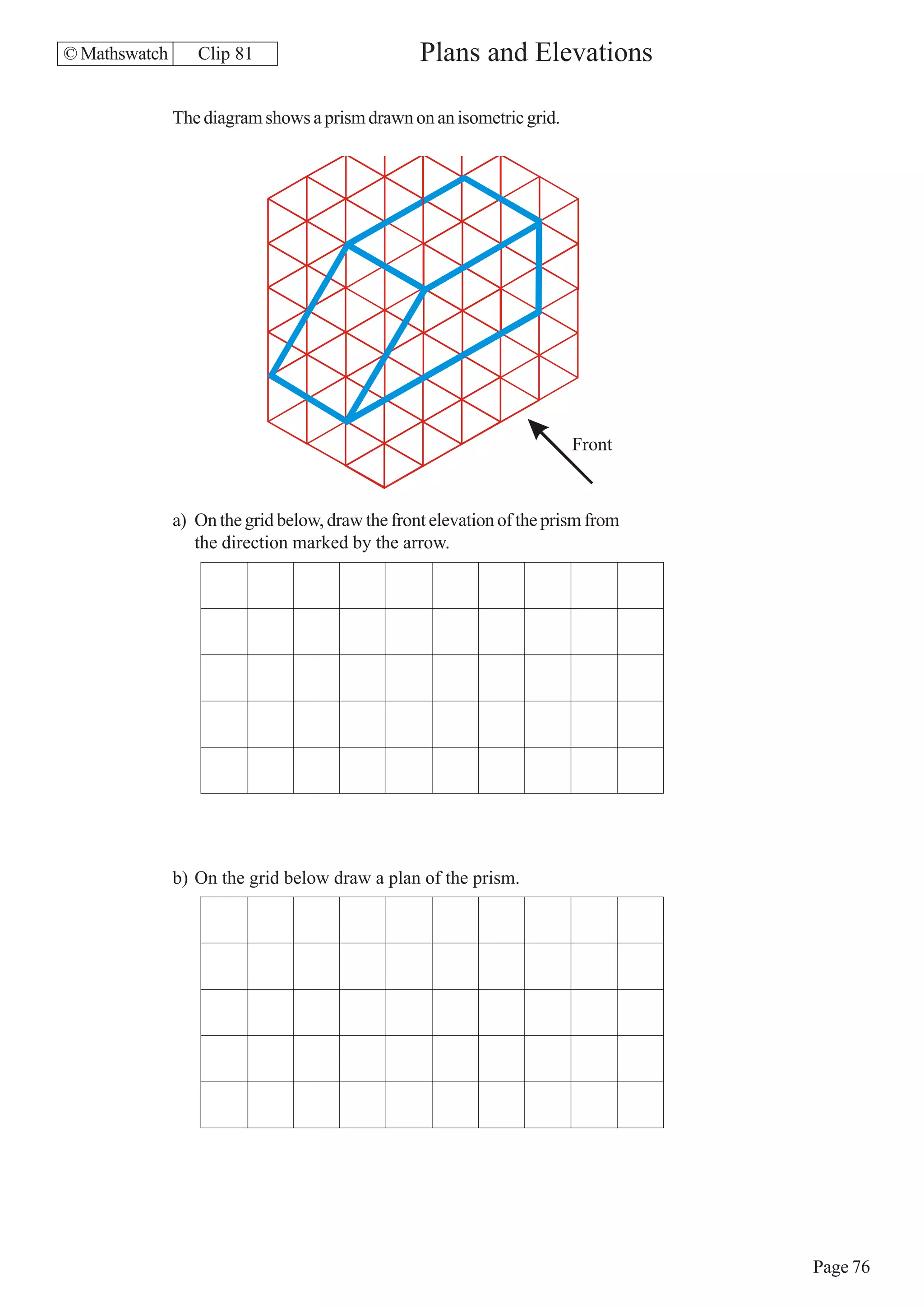
  • 146.
    Graphs - travelgraphs 109 Graphs of exponential functions 163 Graphs of trigonometric functions 160, 161 H Hard calculator questions 58 Highest common factor 89 Histograms 175 I Increase/decrease by a percentage 87 Index notation for mutiplication and division 103 Indices 45, 103 Inequalities - on a line 100 Inequalities - regions 137 Inequalities - solving 101 Inverse proportion 151 L Limits of accuracy 117, 152 List of outcomes 85 Loci 122, 123 Loci - algebraically 165 Long multiplication of decimals 55 Lower and upper bounds 117, 152 Lowest common multiple 89 M Mean 126 Measuring and drawing angles 74 Median 126 Metric measures 116 Mid-point of a line 73 Mixed numbers 51, 132 Mode 126 Money - value for 47 Money questions 59 Multiples 44 Multiplication & division with negatives 92 Multiplication and division of fractions 52, 132 Multiplication and division with decimals 92 Multiplication of decimals 55 Mutually exclusive events 85 N Negative indices 149 Negatives - four rules of 92 Nets 77 Nth term 60, 104 Number sequences 60, 104 O Or probability questions 176 Ordering fractions 46 Outcomes - listing 85 Overview of percentages 86 P Patterns - find the nth term 60 Percentage increase and decrease 129 Percentages - change by a percentage 87 Percentages - change to, with calculator 49 Percentages - change to, without calculator 49 Percentages - compound interest 130 Percentages - find with calculator 48 Percentages - find without calculator 48 Percentages - mixture of questions 86 Perpendicular to a line 120 Pie charts 81 Place value when multiplying 90 Planes of symmetry 78 Plans and elevations 76 Polygons - interior and exterior angles 65 Powers 45, 103 Prime factors 89 Primes 44 Prisms 112, 113, 114 Probability - And & Or questions 176 Probability - experimental 125 Probability - mutually exclusive events 85 Product of prime factors 89 Proportion 151 Pythagoras 110 Pythagoras - line on a graph 111 Pythagoras in 3D 167 Q Quadratic equations - completing the square 154 Quadratic equations - solve by factorising 133 Quadratic equations - solve with formula 153 Quadratic graphs 108 Questionnaires and data collection 79, 127 R Range 126 Ratio 56, 88 Ratio - recipe questions 57 Rationalising the denominator 150 Real-life graphs 109 Real-life money questions 59 Rearranging fomulae 99, 156 Recipe-type ratio questions 57 Reciprocal functions 138 Recognise the shapes of functions 139 Recurring decimals 91, 148 Reflections 70 Regions 137 Reverse percentages 131 Roots 45 Rotational symmetry 78 Rotations 69 S Sampling 177 Scatter graphs 82 INDEXnumbers refer to pages, not to clips
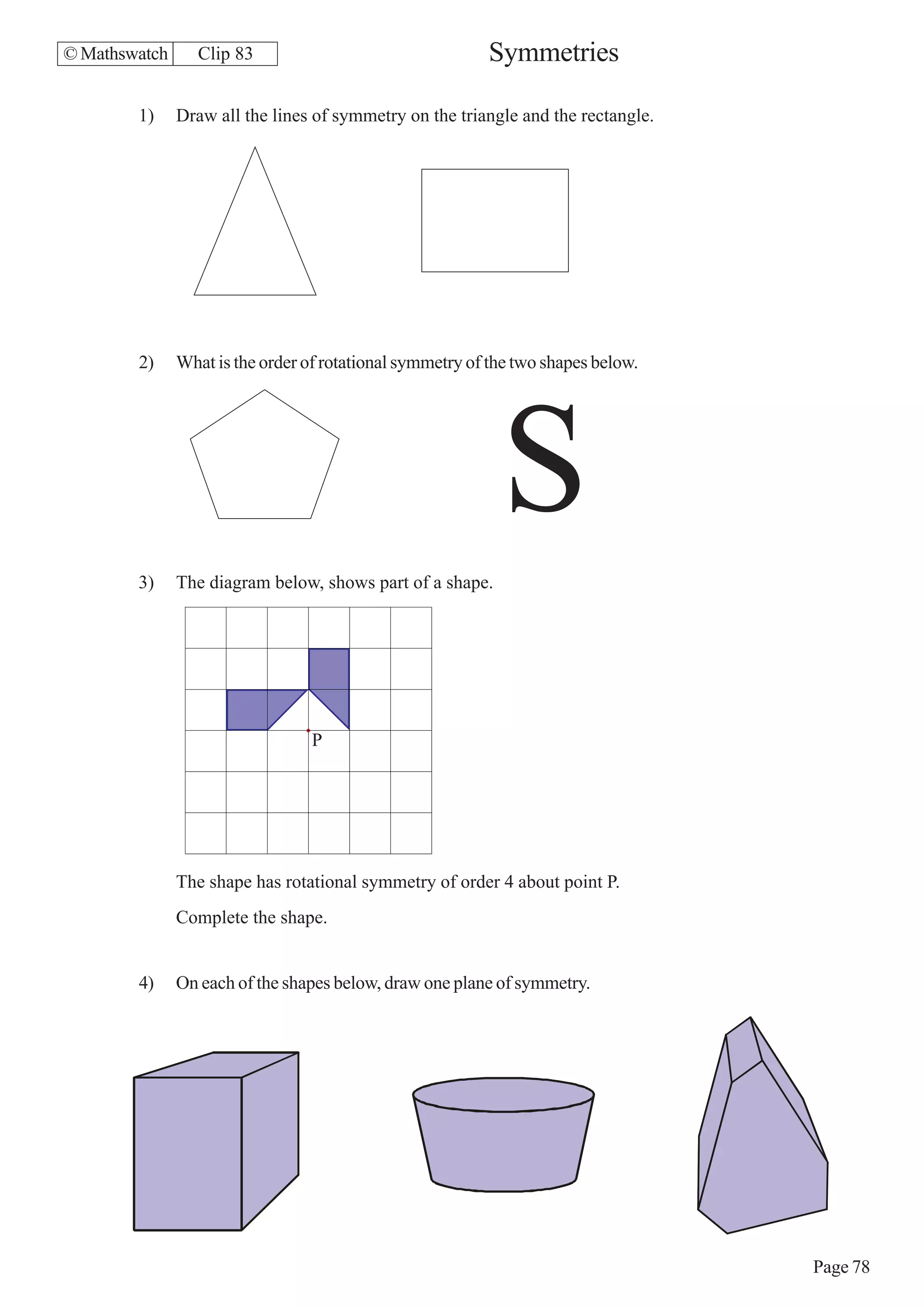
  • 147.
    Segments and frustums171 Sequences 60, 104 Shapes of functions 139 Similar shapes 115, 142 Simplifying algebraic expressions 94, 95 Simplifying algebraic fractions 155 Simplifying and ordering fractions 46 Simultaneous equations graphically 107 Simultaneous equations with a quadratic 157 Simultaneous linear equations 135 Sine and cosine rules 166 Solving quadratics by factorising 133 Solving quadratics by completing the square 154 Solve quadratics using the formula 153 Solving equations 97, 98 Solving inequalities 101 Spheres - finding volume of 170 Squares, cubes & roots 45 Standard form 90, 128 Stem and leaf diagrams 84 Straight line graphs - drawing 105 Straight line graphs - finding equation of 106, 136 Stratified sampling 177 Subject of a formula 99, 156 Substitution 61 Surds 150 Surface area of cuboids 112 Surface area of prisms 113 Symmetries 78 T Transformation - enlargement 71 Transformation - reflection 70 Transformation - rotation 69 Transformation - translation 72 Transformation of functions 159 Transformation of trigonometric functions 162 Translations 72 Tree diagrams 146, 147 Trial and improvement 102 Trigonometric functions - graphs of 160, 161 Trigonometric functions - transformations 162 Trigonometry - finding sides and angles 140 Trigonometry - to find bearings 140 Trigonometry in 3D 168 Two-way tables 80 U Understand y = mx + c 136 Units of measurement 116 Upper and lower bounds 117, 152 V Value for money 47 Vectors 173, 174 Volume of a prism 114 Y Y = mx + c 106, 136, 158 INDEXnumbers refer to pages, not to clips