MATHEMATICS
PRESENTATION
on
MATHEMATICS AND ENGENEERING
Submitted to :- Submitted By:-
Dr. Giriraj Gupta Saurabh Uniyal
Section : “F”
Roll No. : 16
Branch : (C.S)
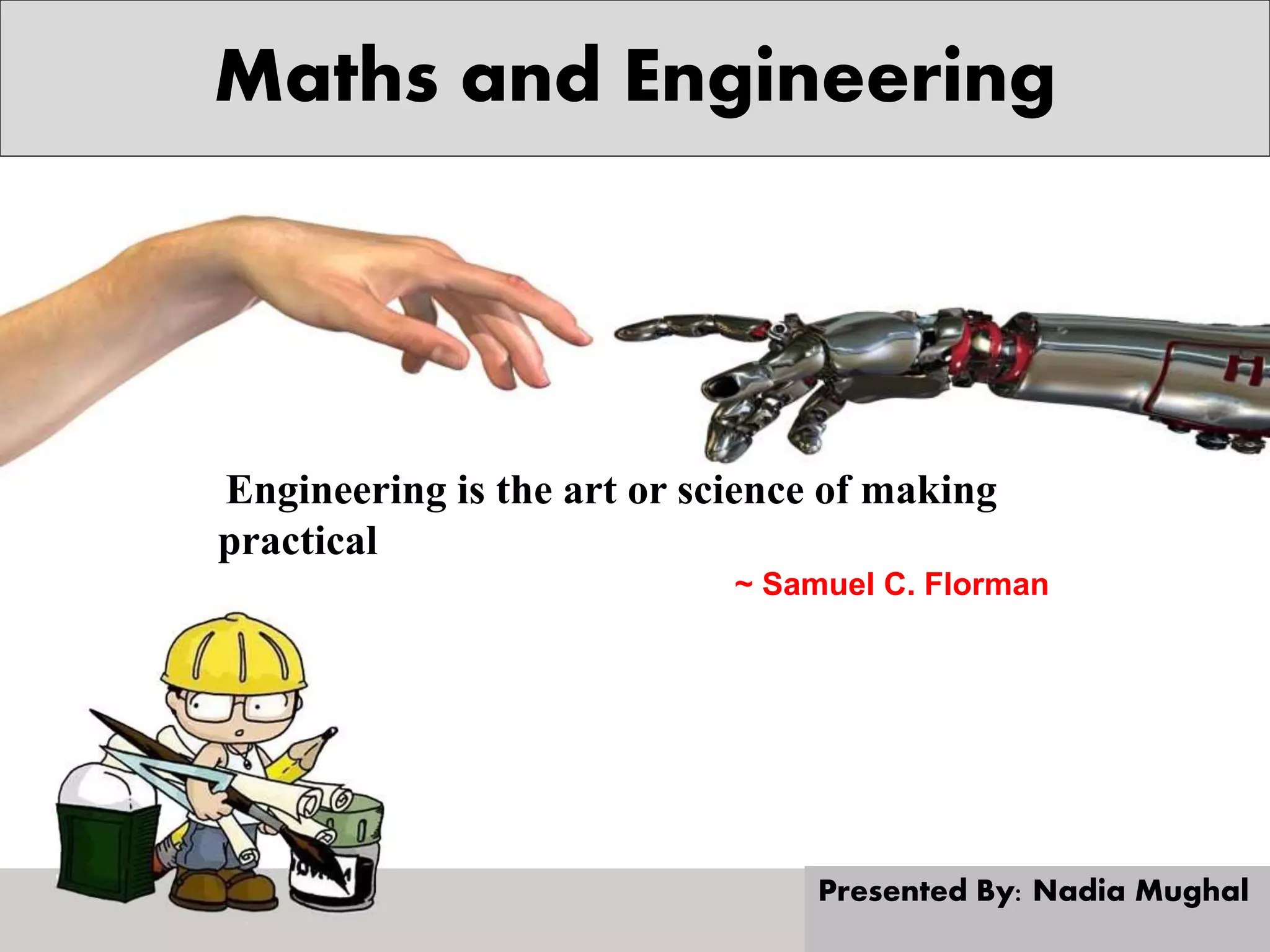
Maths and Engineering
Presented By: Nadia Mughal
Engineering is the art or science of making
practical
~ Samuel C. Florman
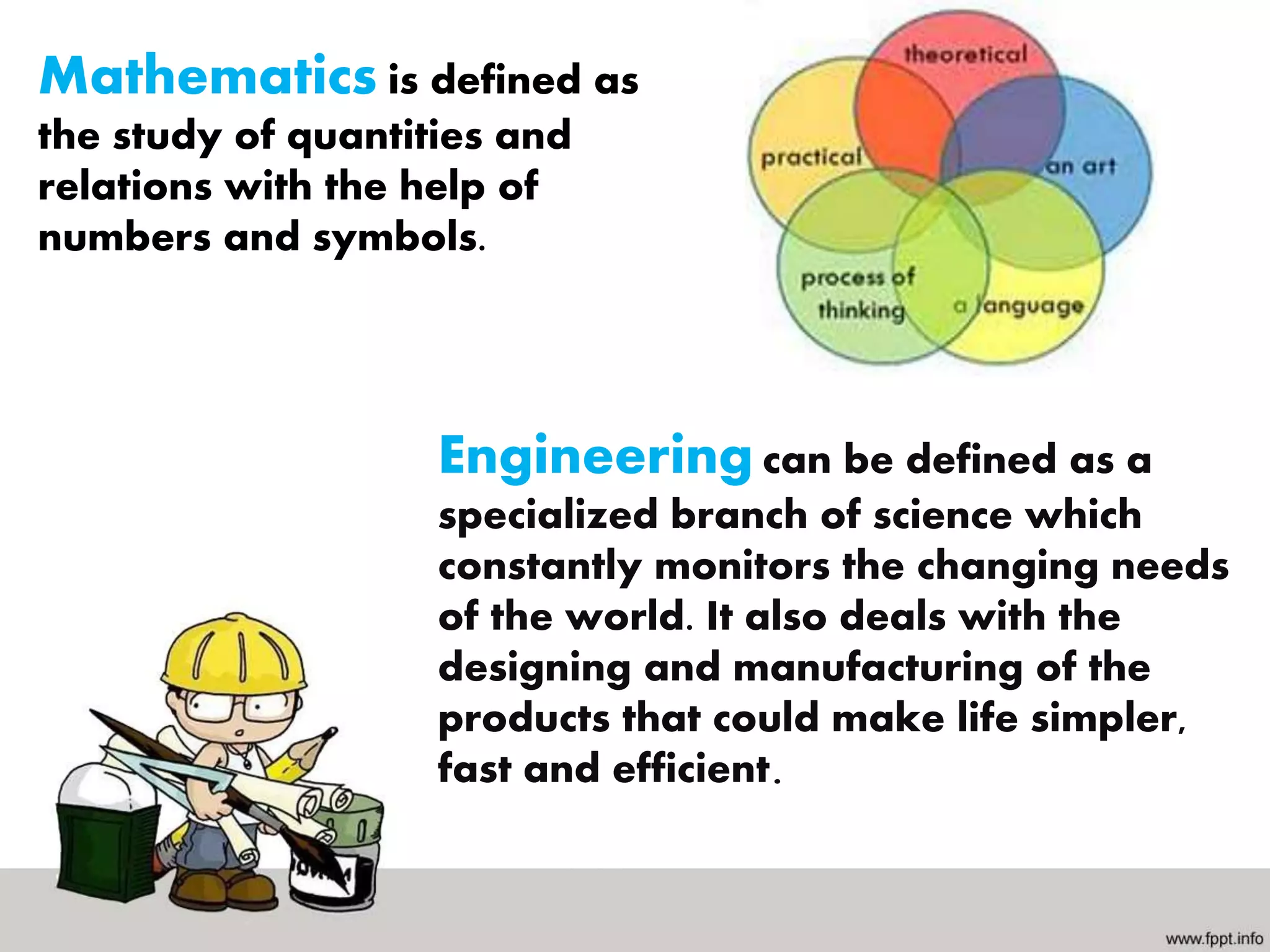
Mathematics is defined as
the study of quantities and
relations with the help of
numbers and symbols.
Engineering can be defined as a
specialized branch of science which
constantly monitors the changing needs
of the world. It also deals with the
designing and manufacturing of the
products that could make life simpler,
fast and efficient.
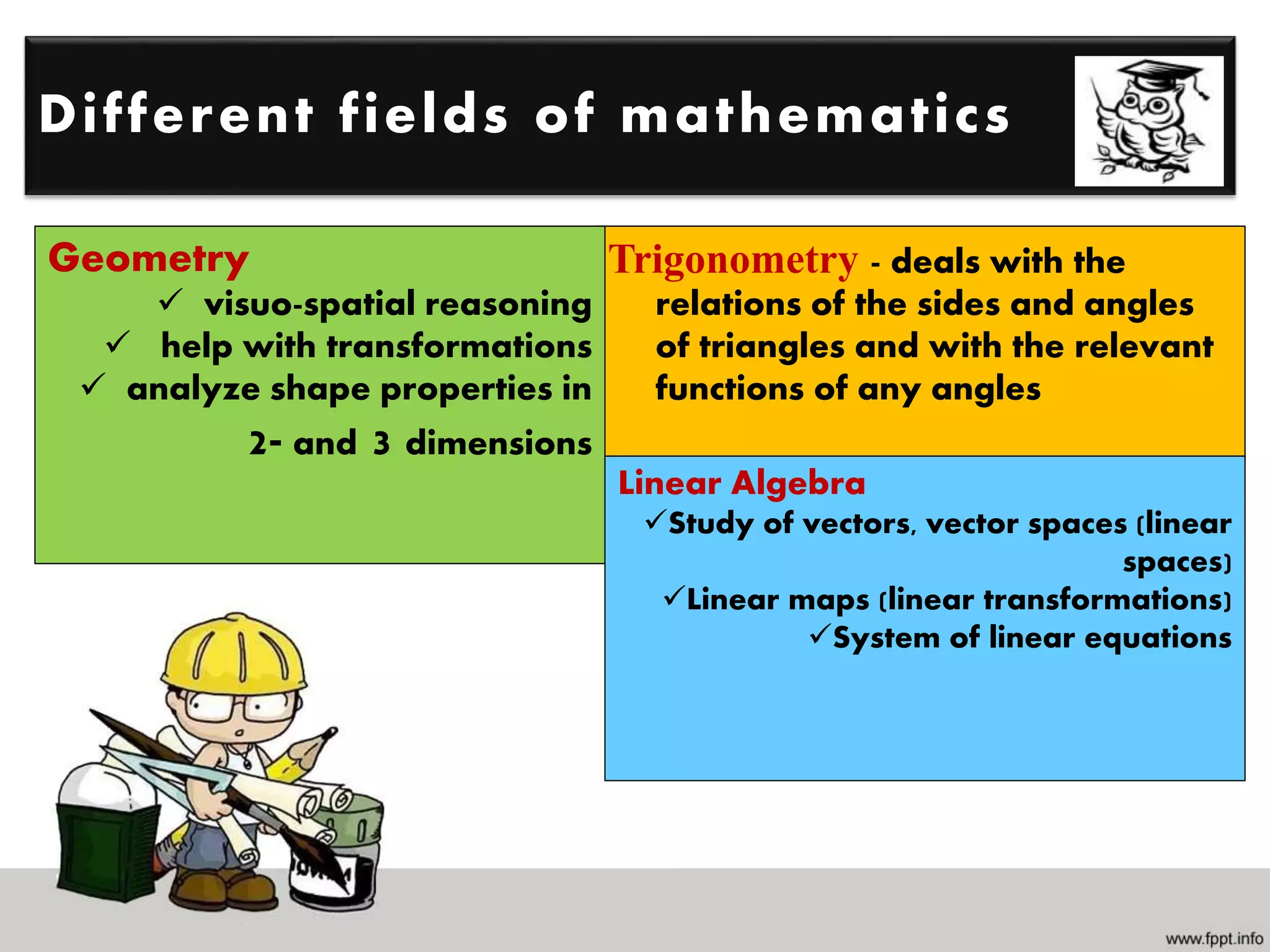
Different fields of mathematics
Trigonometry - deals with the
relations of the sides and angles
of triangles and with the relevant
functions of any angles
Geometry
 visuo-spatial reasoning
 help with transformations
 analyze shape properties in
2- and 3 dimensions
Linear Algebra
Study of vectors, vector spaces (linear
spaces)
Linear maps (linear transformations)
System of linear equations
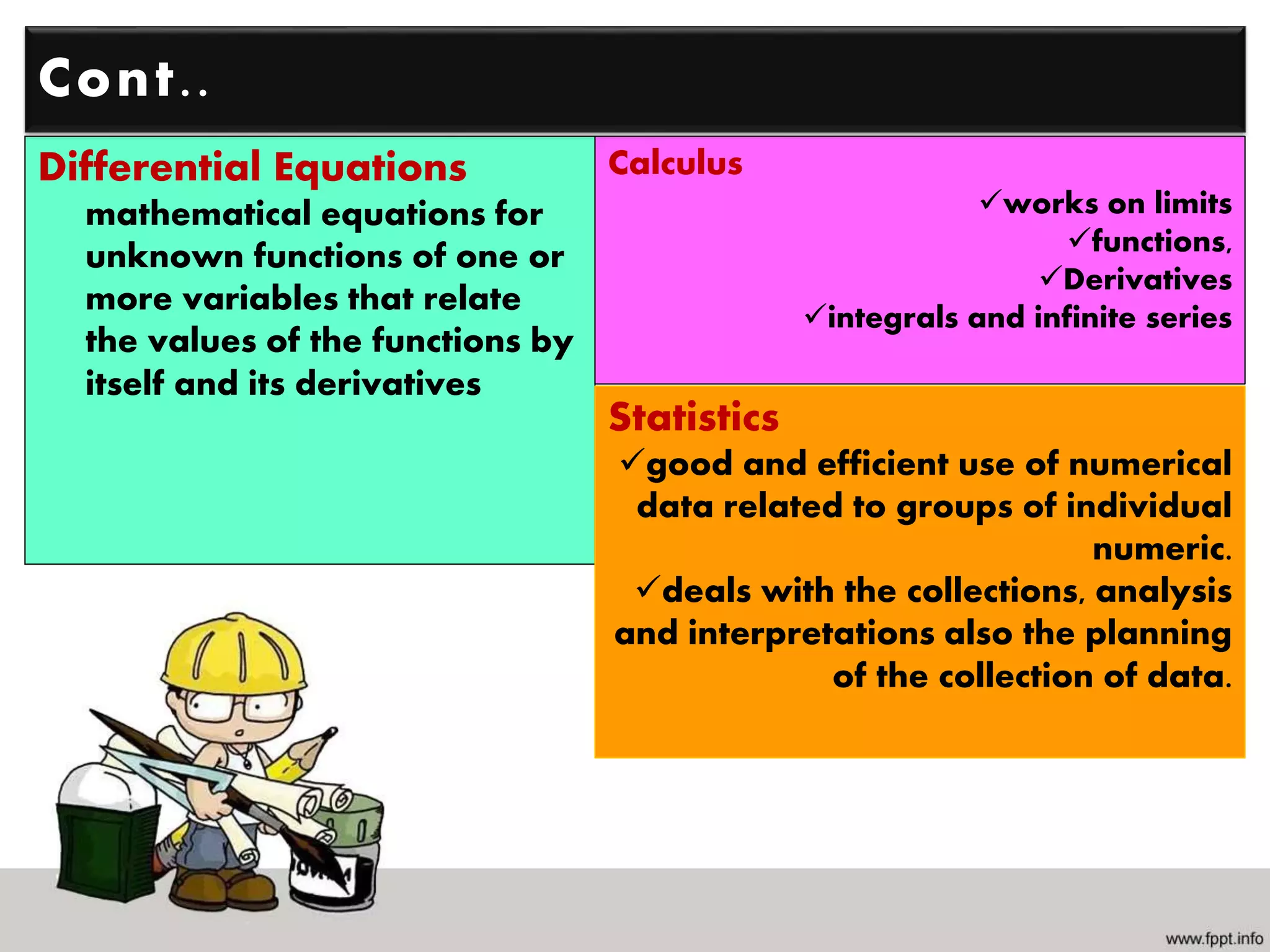
Differential Equations
mathematical equations for
unknown functions of one or
more variables that relate
the values of the functions by
itself and its derivatives
Calculus
works on limits
functions,
Derivatives
integrals and infinite series
Statistics
good and efficient use of numerical
data related to groups of individual
numeric.
deals with the collections, analysis
and interpretations also the planning
of the collection of data.
Cont..
• Computer science
engineering.
• Chemical engineering.
• Civil engineering.
• Mechanical engineering.
• Electrical engineering.
• Aerospace engineering.
Different fields of Engineering
•Electrochemical engineering.
•Nuclear engineering.
•Marine engineering.
•Architectural engineering.
•Environmental engineering.
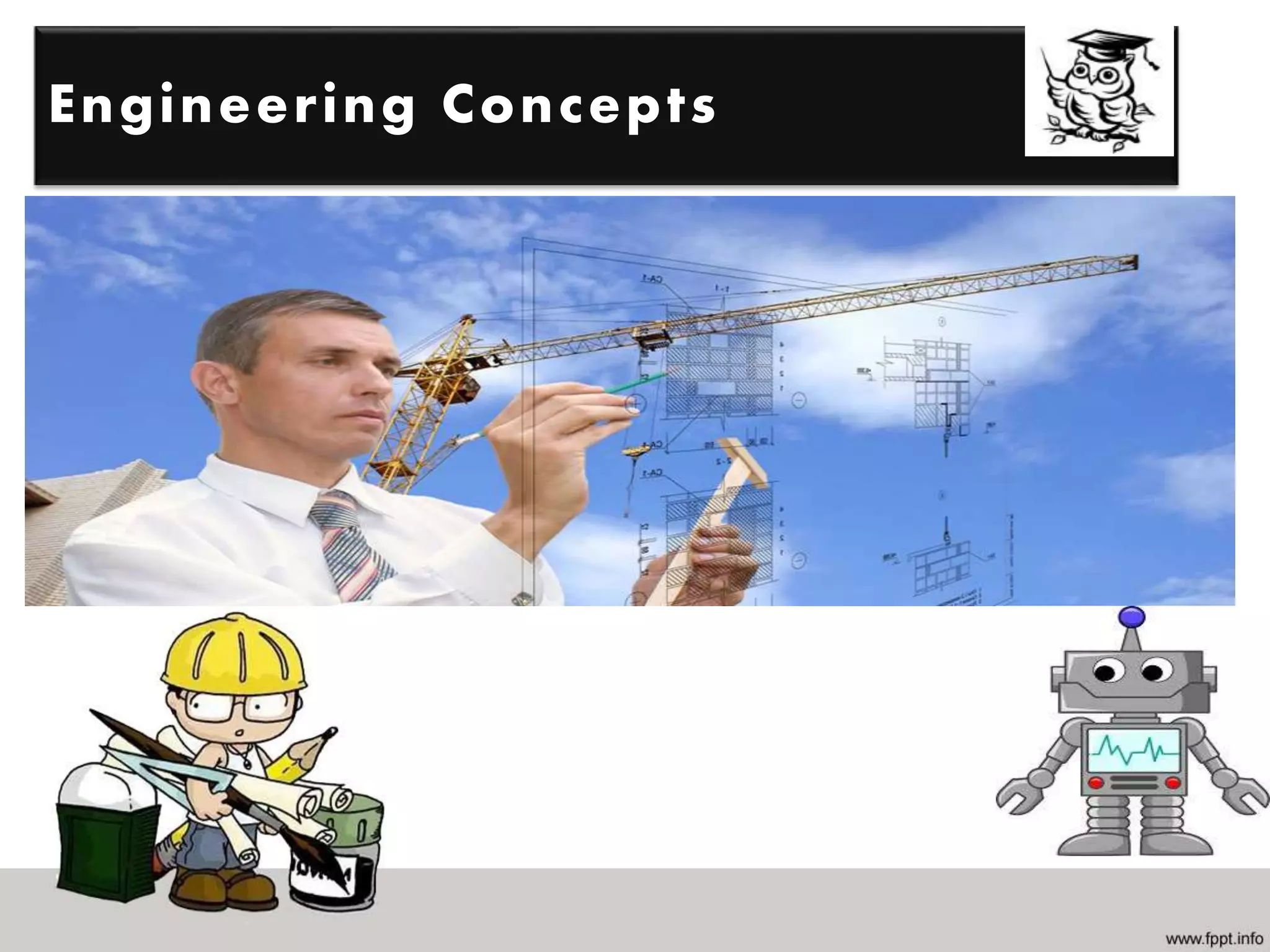
Engineering Concepts
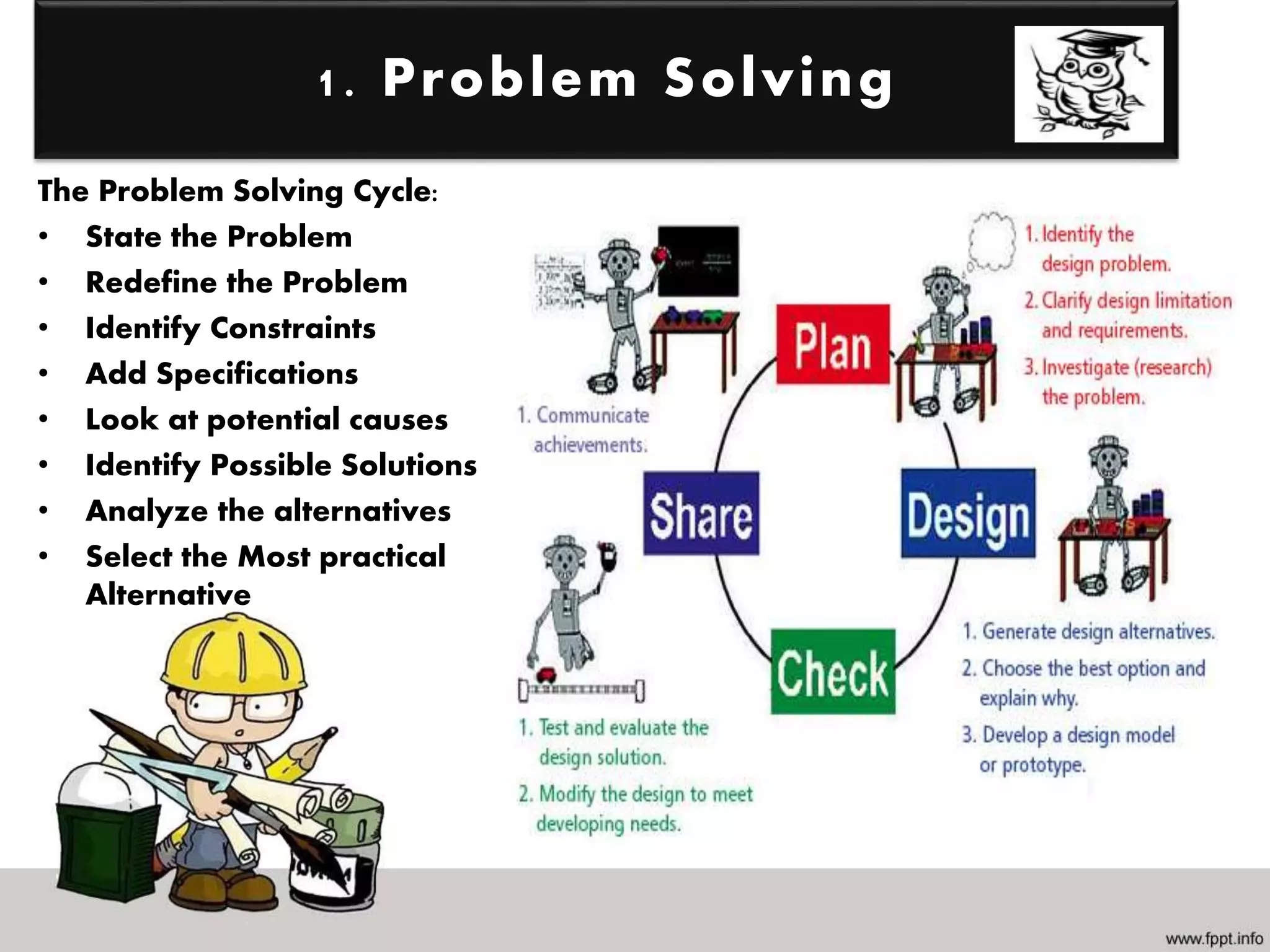
The Problem Solving Cycle:
• State the Problem
• Redefine the Problem
• Identify Constraints
• Add Specifications
• Look at potential causes
• Identify Possible Solutions
• Analyze the alternatives
• Select the Most practical
Alternative
1. Problem Solving
 Engineers use math to design machinery to carry out many different
tasks.
 Geometry is used to calculate the movements needed for a
machine to do its job.
 Algebra is used to determine the size and weight ratios for each
part of the machine.
 Calculus is used to determine how much work a machine can do
efficiently without breaking down.
Civil, mechanical, industrial, aerospace and electrical
engineering all use math to design machines.
2. Designing Machines
 Math is used to engineer structures like bridges, skyscrapers and
dams.
 Engineers use calculus to determine how much force a structure can
tolerate in order to ensure public safety.
 The materials needed to build a structure are determined by algebraic
formulas that take into consideration density, size, cost effectiveness
and durability.
 Trigonometry and geometry help engineers determine the overall
design and shape of a structure.
3. Creating Structures
Civil, industrial and environmental
engineers all use math to create structures.
 Part of being an engineer involves learning to solve
problems using math.
 Engineers use math to create simulations that attempt to
maximize safety, comfort, ease of use and profitability.
 Simulations use equations from calculus, algebra and
trigonometry to predict the outcomes of different scenarios.
4. Analyzing Simulations
Aerospace engineers use equations to measure how
much rocket fuel would be needed to make a trip to
the moon.
Environmental engineers use math to simulate the
effects of a flood on a community food supply.
Civil engineers analyze earthquake simulations to
develop safer buildings.
 Making models involves determining the structure of
things we cannot see or easily manipulate.
 Models physically represent abstract ideas.
5. Developing Models
Chemical engineers use calculus to model the atomic
structure of elements.
Computer engineers use algebra to model electronic
data within an operating system.
Audio engineers use trigonometry to model sound
waves. These models are used by engineers to
communicate with scientists in other disciplines and
illustrate concepts for clients.
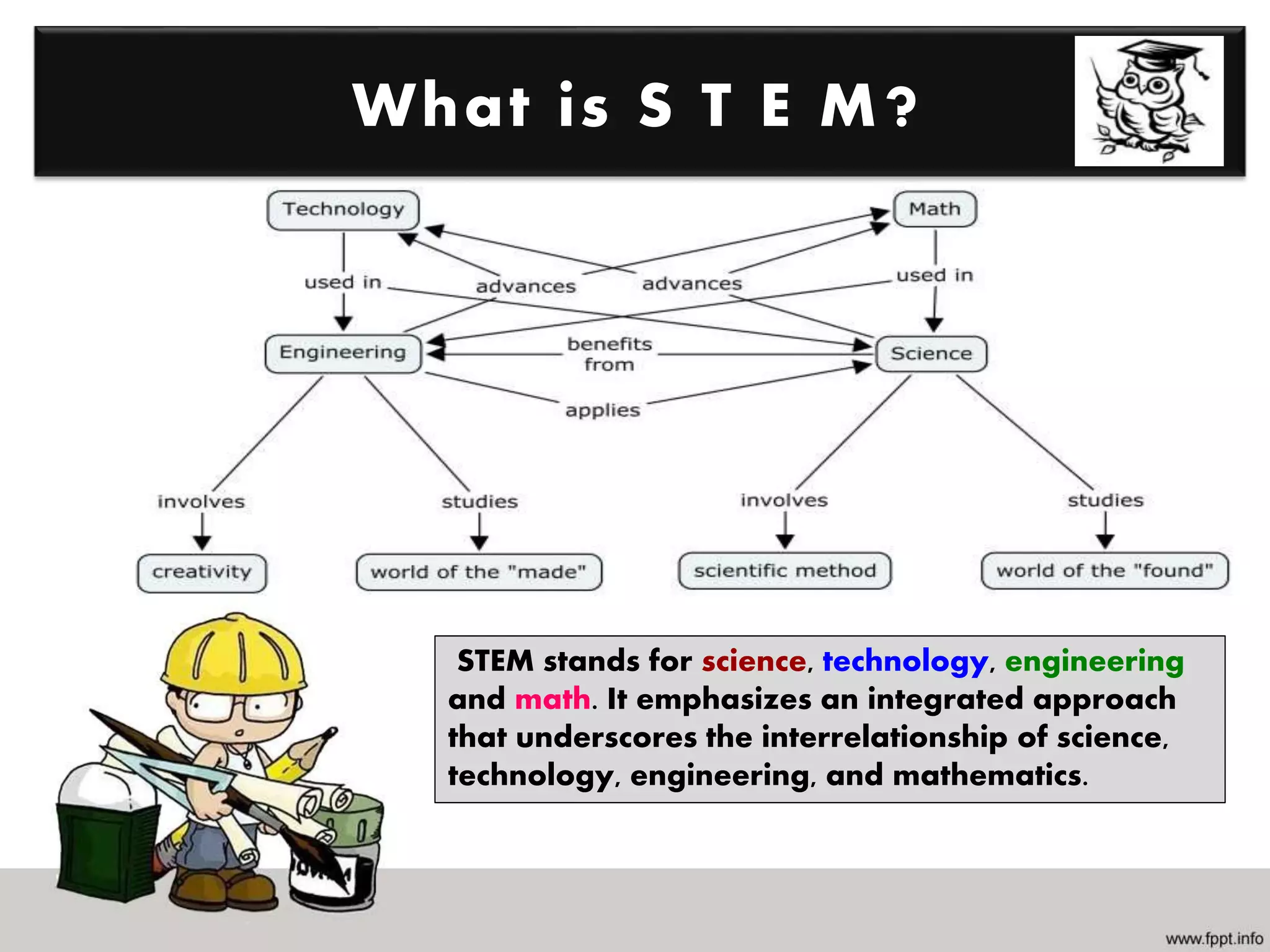
What is S T E M?
STEM stands for science, technology, engineering
and math. It emphasizes an integrated approach
that underscores the interrelationship of science,
technology, engineering, and mathematics.
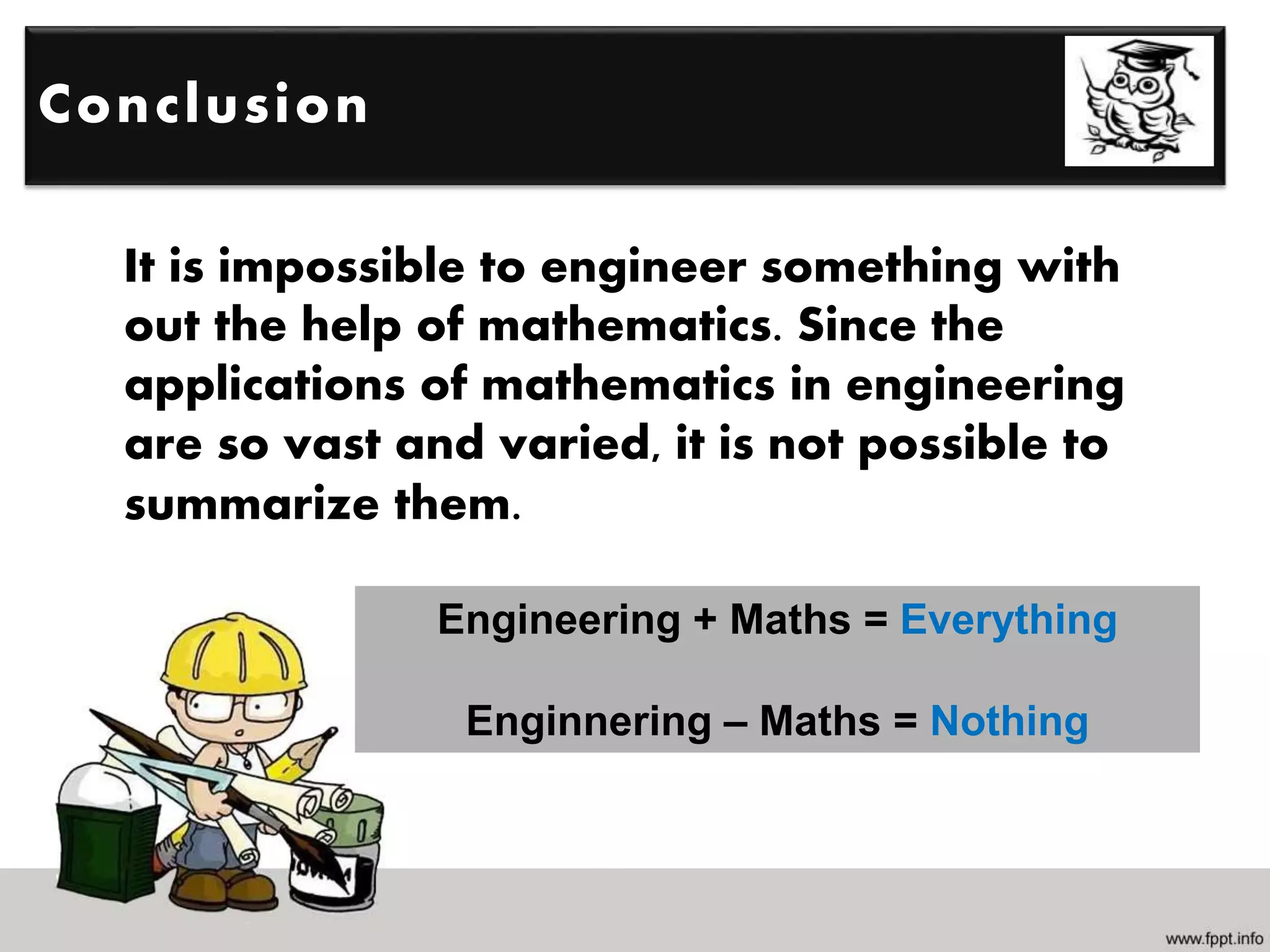
It is impossible to engineer something with
out the help of mathematics. Since the
applications of mathematics in engineering
are so vast and varied, it is not possible to
summarize them.
Conclusion
Engineering + Maths = Everything
Enginnering – Maths = Nothing
THANK YOU !

Maths engineeringrelationship-151127074210-lva1-app6891

  • 2.
    MATHEMATICS PRESENTATION on MATHEMATICS AND ENGENEERING Submittedto :- Submitted By:- Dr. Giriraj Gupta Saurabh Uniyal Section : “F” Roll No. : 16 Branch : (C.S)
  • 3.
    Maths and Engineering PresentedBy: Nadia Mughal Engineering is the art or science of making practical ~ Samuel C. Florman
  • 4.
    Mathematics is definedas the study of quantities and relations with the help of numbers and symbols. Engineering can be defined as a specialized branch of science which constantly monitors the changing needs of the world. It also deals with the designing and manufacturing of the products that could make life simpler, fast and efficient.
  • 5.
    Different fields ofmathematics Trigonometry - deals with the relations of the sides and angles of triangles and with the relevant functions of any angles Geometry  visuo-spatial reasoning  help with transformations  analyze shape properties in 2- and 3 dimensions Linear Algebra Study of vectors, vector spaces (linear spaces) Linear maps (linear transformations) System of linear equations
  • 6.
    Differential Equations mathematical equationsfor unknown functions of one or more variables that relate the values of the functions by itself and its derivatives Calculus works on limits functions, Derivatives integrals and infinite series Statistics good and efficient use of numerical data related to groups of individual numeric. deals with the collections, analysis and interpretations also the planning of the collection of data. Cont..
  • 7.
    • Computer science engineering. •Chemical engineering. • Civil engineering. • Mechanical engineering. • Electrical engineering. • Aerospace engineering. Different fields of Engineering •Electrochemical engineering. •Nuclear engineering. •Marine engineering. •Architectural engineering. •Environmental engineering.
  • 8.
  • 9.
    The Problem SolvingCycle: • State the Problem • Redefine the Problem • Identify Constraints • Add Specifications • Look at potential causes • Identify Possible Solutions • Analyze the alternatives • Select the Most practical Alternative 1. Problem Solving
  • 10.
     Engineers usemath to design machinery to carry out many different tasks.  Geometry is used to calculate the movements needed for a machine to do its job.  Algebra is used to determine the size and weight ratios for each part of the machine.  Calculus is used to determine how much work a machine can do efficiently without breaking down. Civil, mechanical, industrial, aerospace and electrical engineering all use math to design machines. 2. Designing Machines
  • 11.
     Math isused to engineer structures like bridges, skyscrapers and dams.  Engineers use calculus to determine how much force a structure can tolerate in order to ensure public safety.  The materials needed to build a structure are determined by algebraic formulas that take into consideration density, size, cost effectiveness and durability.  Trigonometry and geometry help engineers determine the overall design and shape of a structure. 3. Creating Structures Civil, industrial and environmental engineers all use math to create structures.
  • 12.
     Part ofbeing an engineer involves learning to solve problems using math.  Engineers use math to create simulations that attempt to maximize safety, comfort, ease of use and profitability.  Simulations use equations from calculus, algebra and trigonometry to predict the outcomes of different scenarios. 4. Analyzing Simulations Aerospace engineers use equations to measure how much rocket fuel would be needed to make a trip to the moon. Environmental engineers use math to simulate the effects of a flood on a community food supply. Civil engineers analyze earthquake simulations to develop safer buildings.
  • 13.
     Making modelsinvolves determining the structure of things we cannot see or easily manipulate.  Models physically represent abstract ideas. 5. Developing Models Chemical engineers use calculus to model the atomic structure of elements. Computer engineers use algebra to model electronic data within an operating system. Audio engineers use trigonometry to model sound waves. These models are used by engineers to communicate with scientists in other disciplines and illustrate concepts for clients.
  • 14.
    What is ST E M? STEM stands for science, technology, engineering and math. It emphasizes an integrated approach that underscores the interrelationship of science, technology, engineering, and mathematics.
  • 15.
    It is impossibleto engineer something with out the help of mathematics. Since the applications of mathematics in engineering are so vast and varied, it is not possible to summarize them. Conclusion Engineering + Maths = Everything Enginnering – Maths = Nothing
  • 16.