Contents to becovered
• Principal Component Analysis
• Linear Discriminant Analysis
• Least Squared Approximation
• Minimum Normed Solution
• Regression Analysis: Linear, Multiple, Logistic
3.
Principal Component Analysis(PCA)
• Aims to reduce dimensionality.
• Capture directions that explain maximum variance in data.
• Select top k eigen vectors corresponding to largest eigen values.
• Project data onto the selected eigen vectors (principal components).
• PCA is useful to visualize high dimensional data.
4.
Linear Discriminant Analysis(LDA)
• Reduce dimensionality
• Maximizing the separability of classes.
• Calculate the within-class scatter matrix ()
• Calculate the between-class scatter matrix ()
• Compute eigen values and eigen vectors of
• Select top k eigen vectors.
• Project data onto the selected eigen vectors.
5.
Linear Discriminant Analysis(LDA)
• LDA is method used for classification and dimensionality
reduction.
• It finds a linear combination of features
• Best separates two or more classes of data.
• LDA finds a line (or plane) that best separates the classes.
• It uses means and scatter matrices
• to compute the optimal projection.
• The projected data is used for classification.
6.
Least Squared Approximation
•Best-fit solution
• Overdetermined system of equations (more equations than
unknowns)
• Minimizes sum of squared differences (i.e., errors)
• Typically used in Regression Analysis
7.
Minimum Normed Solution
•Underdetermined systems of linear equations
• More unknowns than equations
• Infinite solutions possible
• Solution that has smallest “norm” (i.e., magnitude)
8.
Regression Analysis
• Relationshipbetween a dependent variable (target) and
one or more independent variables (predictors)
• Linear Regression:
Relationship between a dependent and one independent variable
Straight line model ()
e.g., house_price = m(size_sq_ft) + c
9.
Regression Analysis
• MultipleLinear Regression
Relationship between the dependent and two or more
independent variables
e.g.,
Regression Analysis
• LogisticRegression
dependent variable is categorical
e.g., binary classification such as "yes" or "no“
Model: ; p is the probability of outcome
13.
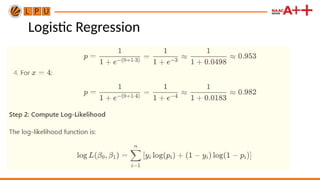
Logistic Regression
• LogisticRegression is a supervised machine learning algorithm
• used for binary classification tasks,
• the goal is to predict the probability of an input belonging to one of two classes
(e.g., 0 or 1).
• Unlike Linear Regression, which predicts continuous values,
• Logistic Regression predicts probabilities
• Classifies data points based on a threshold (e.g., 0.5).
14.
Logistic Regression
• LogisticRegression is a supervised machine learning algorithm
• used for binary classification tasks,
• the goal is to predict the probability of an input belonging to one of two classes
(e.g., 0 or 1).
• Unlike Linear Regression, which predicts continuous values,
• Logistic Regression predicts probabilities
• Classifies data points based on a threshold (e.g., 0.5).