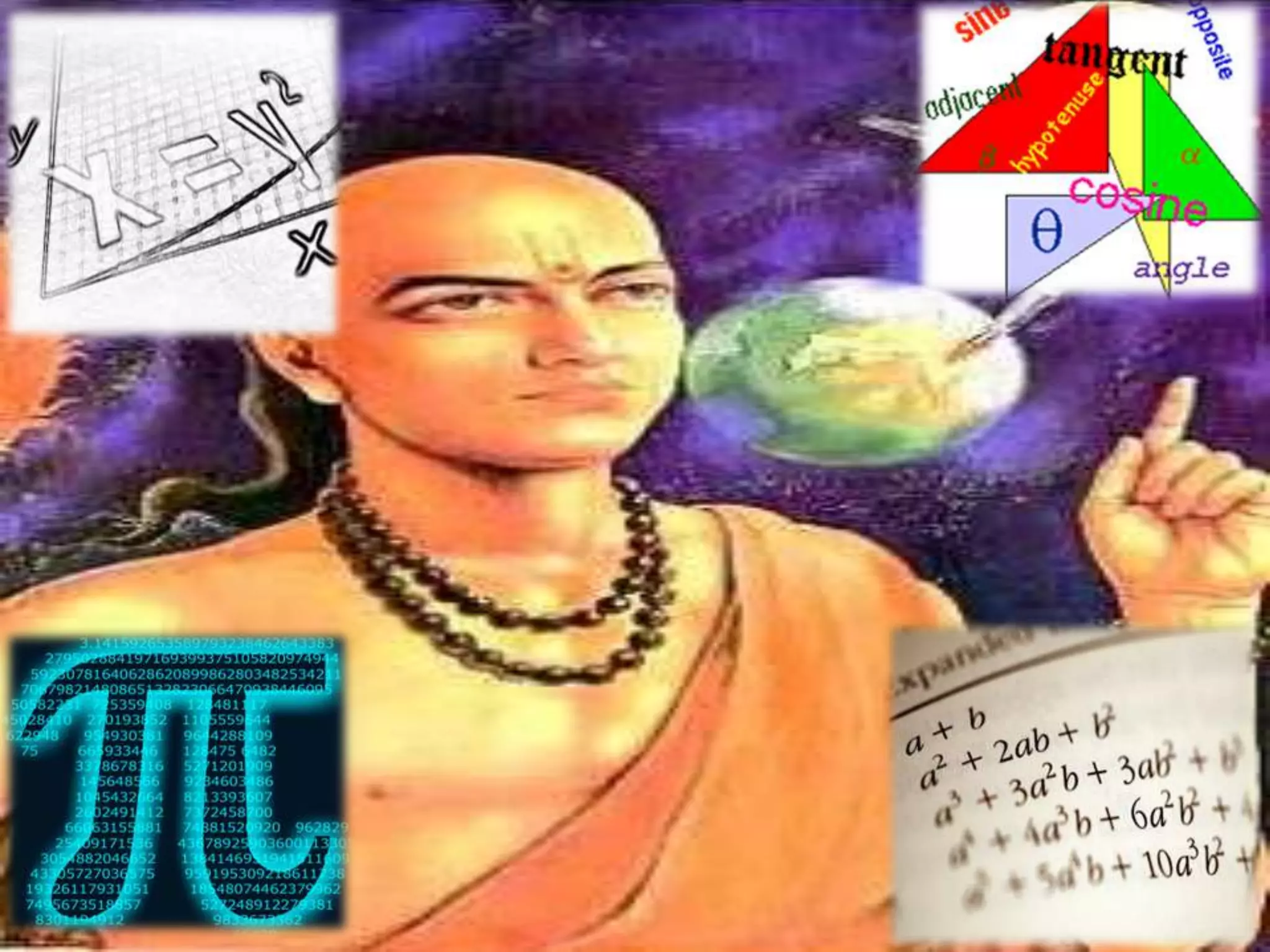
• India had a glorious past in every walks of
knowledge.
• However, the Indian contribution to the field of
mathematics are not so well known.
• Mathematics took its birth in India before 200
BC,ie the Shulba period.
• The sulba sutras were developed during Indus
valley civilization.
• There were seven famous Sulbakars
(mathematicians of indus valley civilization)
among which Baudhyana was the most famous.
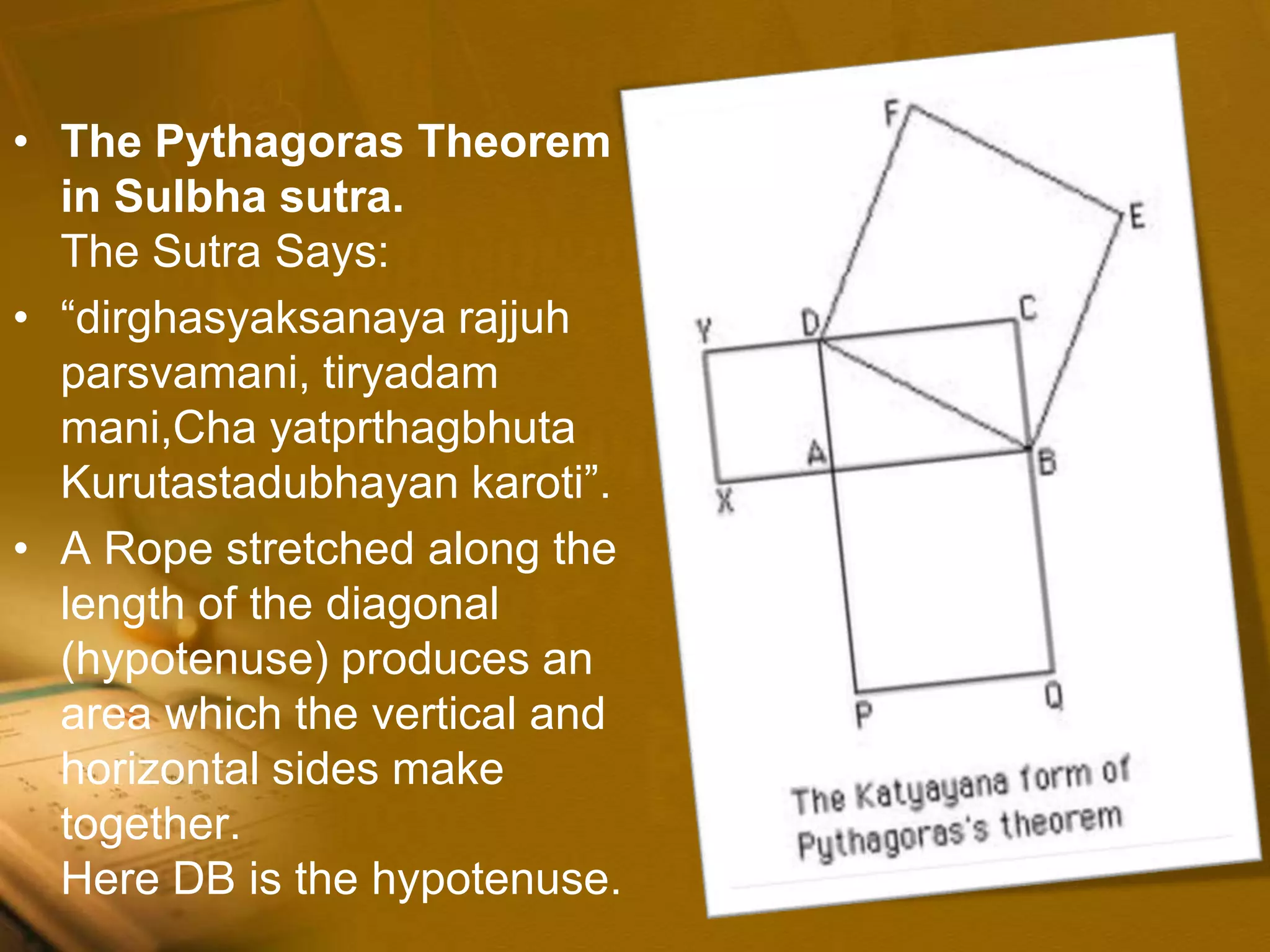
• The Pythagoras Theorem
in Sulbha sutra.
The Sutra Says:
• “dirghasyaksanaya rajjuh
parsvamani, tiryadam
mani,Cha yatprthagbhuta
Kurutastadubhayan karoti”.
• A Rope stretched along the
length of the diagonal
(hypotenuse) produces an
area which the vertical and
horizontal sides make
together.
Here DB is the hypotenuse.
• This period is often known as the golden age of
Indian Mathematics. This period saw
mathematicians such
as Aryabhata, Varahamihira, Brahmagupta, Bhas
kara I, Mahavira, and Bhaskara II give broader
and clearer shape to many branches of
mathematics. Their contributions would spread
to Asia, the Middle East, and eventually
to Europe.
• As explained earlier, the main texts were
composed in Sanskrit verse, and were followed by
prose commentaries.
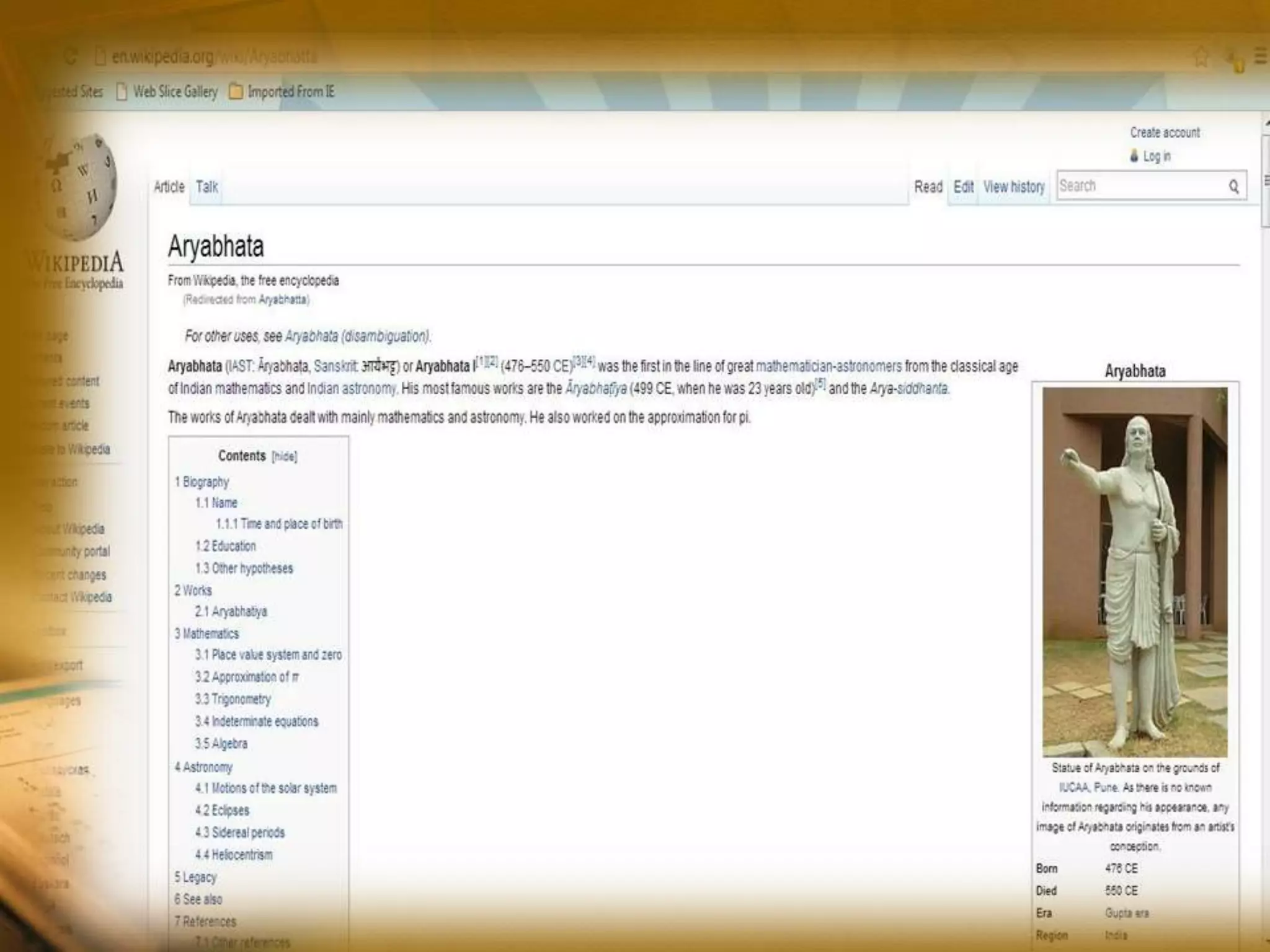
• The most celebrated mathematician during the
classic period.Many honours have been placed on
him and also he is the birthplace of many
mathematical theorems functions etc.
• He was born in 476 AD with many controversy over
his birth place;some say he was born in
Kodungallor,Kerala some atribute it to
Taregna,Bihar.
• He is known for his famous treatise Aryabhatiya
written in 499 AD when he was 23
• Credits confered to him include value of pi, earth’s
rotation time period,extraction of cube root of a
• Aryabhata worked on the approximation for pi , and
may have come to the conclusion that is irrational.
• caturadhikam satamastagunam
dvasastistathasahasranam
ayutadvayaviskambhasyasanno vrttaparinahah.
"Add four to 100, multiply by eight, and then add
62,000. By this rule the circumference of a circle
with a diameter of 20,000 can be approached." [15]
• This implies that the ratio of the circumference to
the diameter is ((4 + 100) 8 + 62000)/20000
= 62832/20000 = 3.1416, which is accurate to
five significant figures.
• Aryabhata gives the area of a triangle as
tribhujasya phalashariram samadalakoti
bhujardhasamvargahthat translates to: "for a
triangle, the reult of a perpendicular with the half-
side is the area”.
• Aryabhata discussed the concept of sine in his
work by the name of ardha-jya, which literally
means "half-chord”.
• Today known as diophantine equation; the
indeterminate equation was always discussed in
Aryabhatiya .
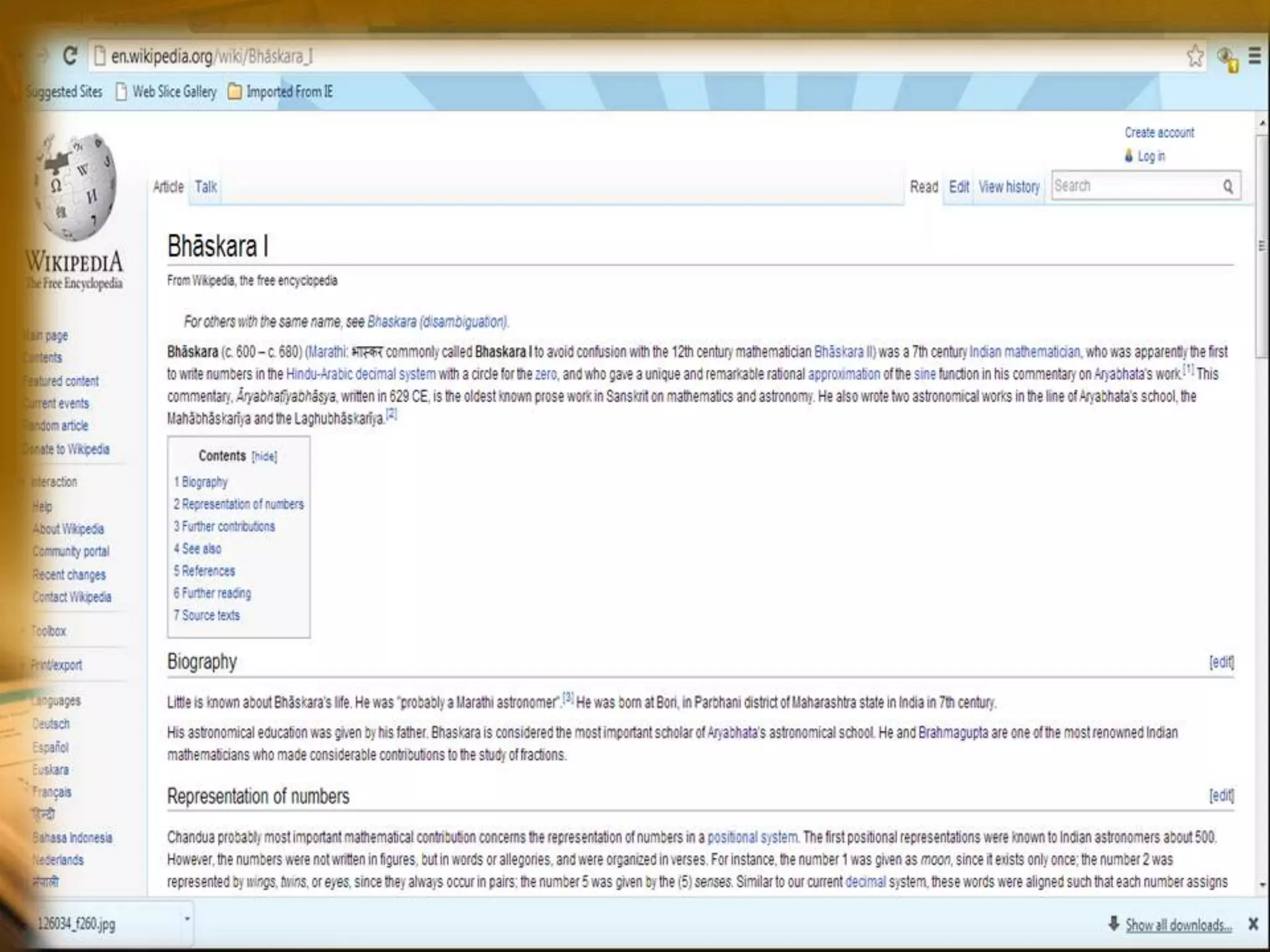
• He was born at Bori, in Parbhani district of
Maharashtra state in India in 7th century.
• He was the first to write Hindu-Arabic numerals
and with zero with a circle.
• He was an exponent of Aryabhatta, named
Aryabhatiyabhasya.
• He gave importance to sine function in
Aryabhatiyabhasya.
• He represented number using nonliving and living
thing
For eg:- 1 was for moon , 2 was for eyes,wings etc, 5
was for the senses of humans.
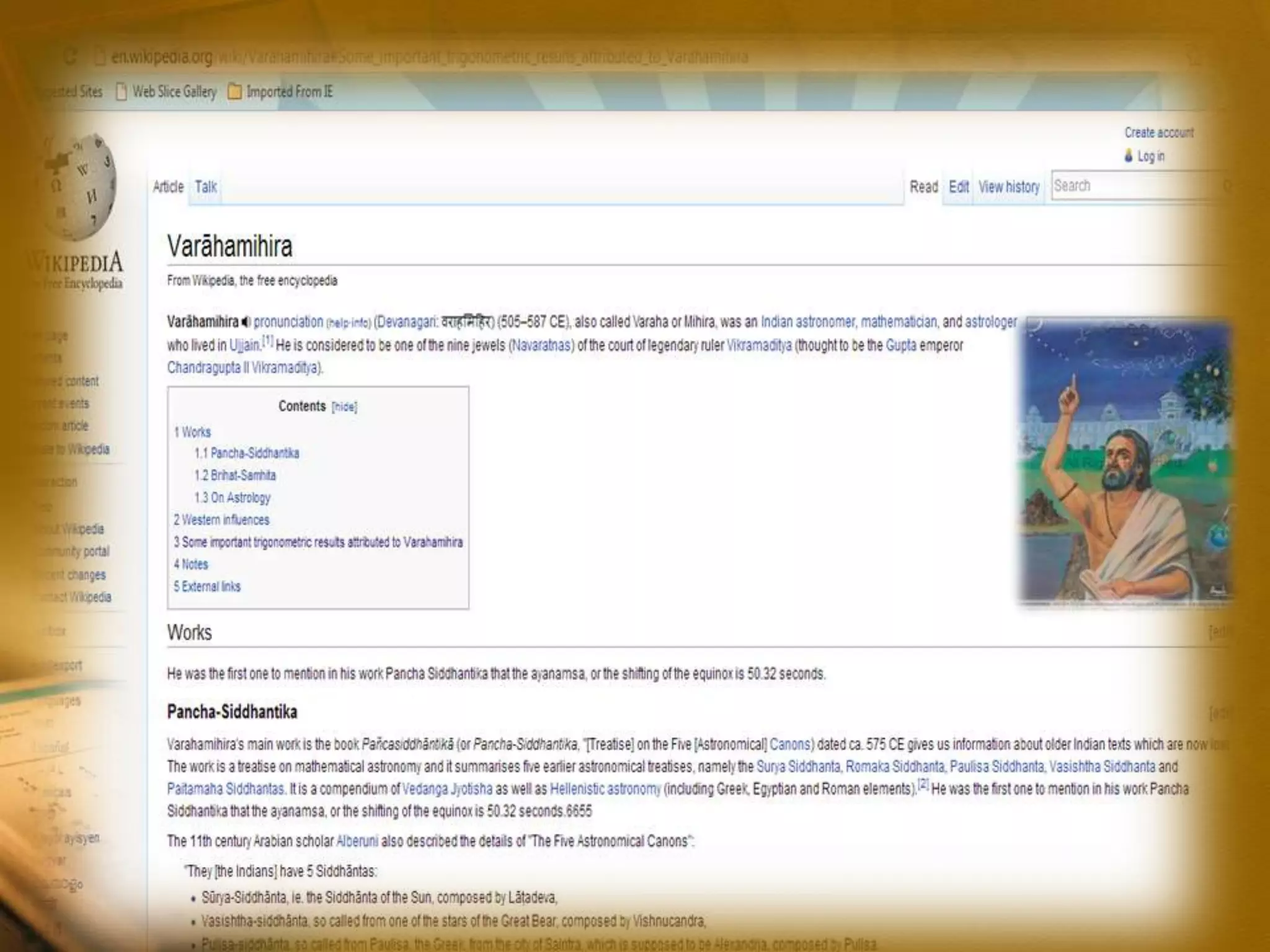
• He was an astrologer manly but was also a
mathematician.
• He was born in 6th centuary in Ujjain and
considered to be one of the nine jems of
Vikramaditya II
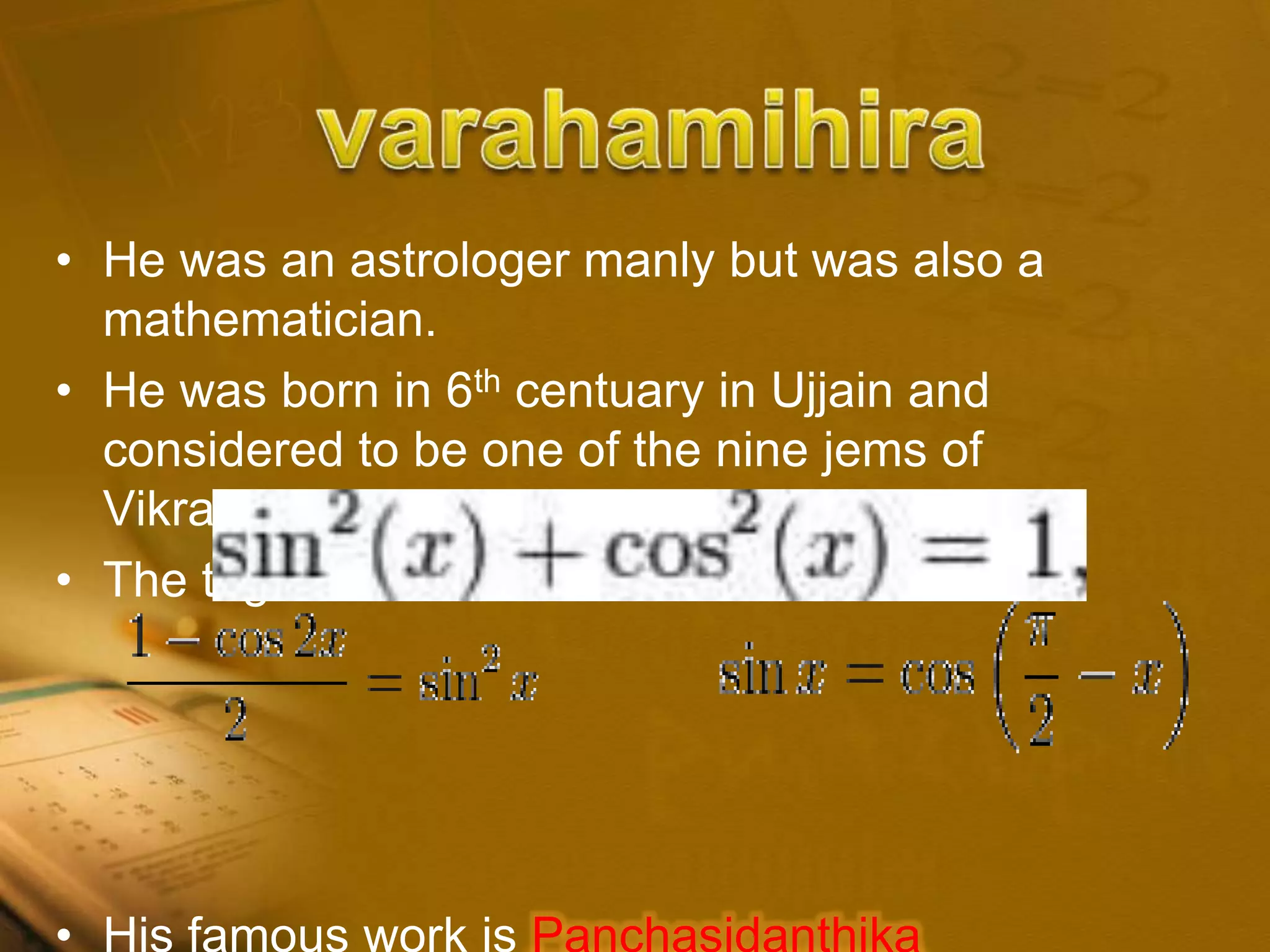
• The trigonometric formulas
• His famous work is Panchasidanthika
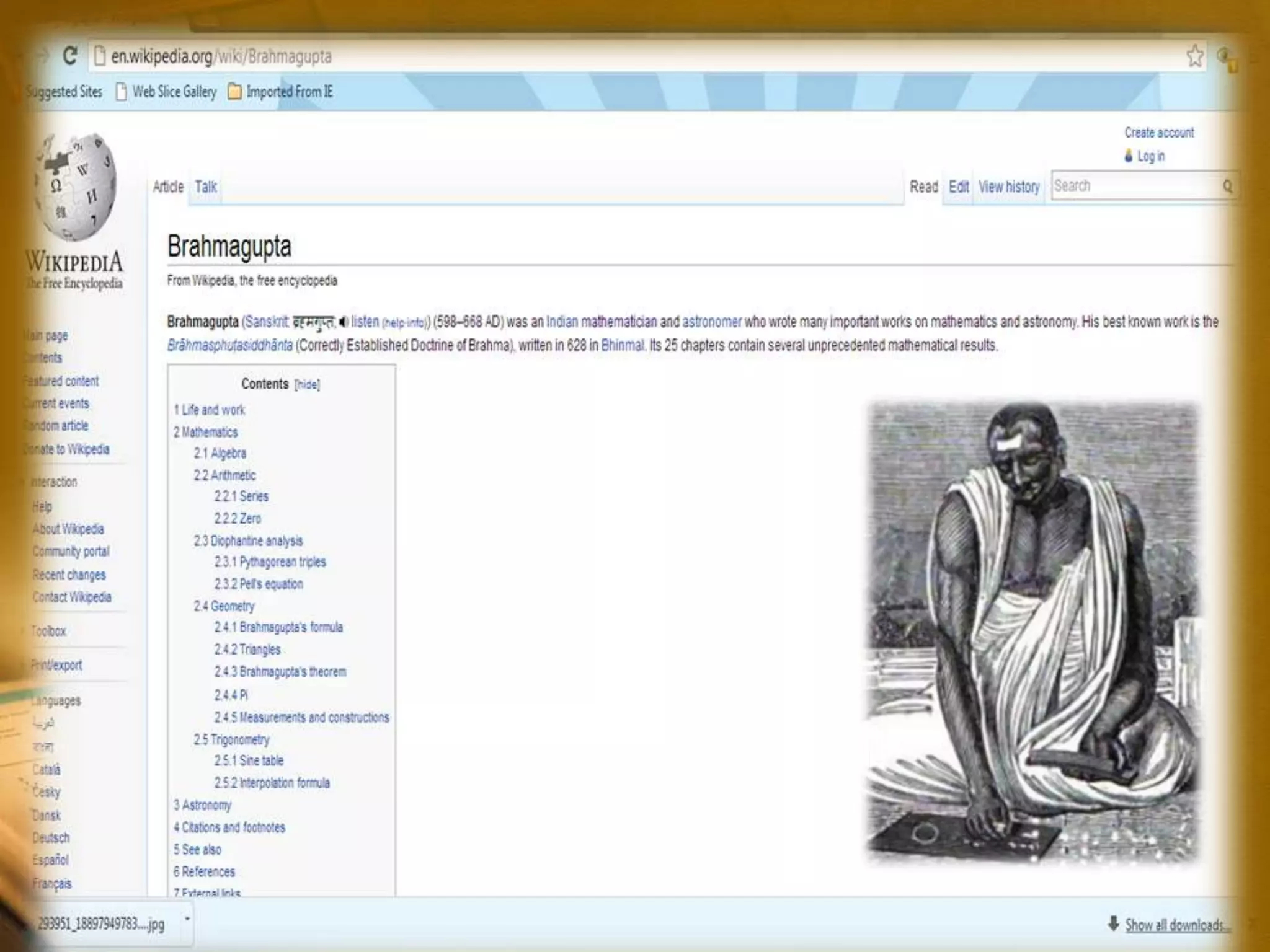
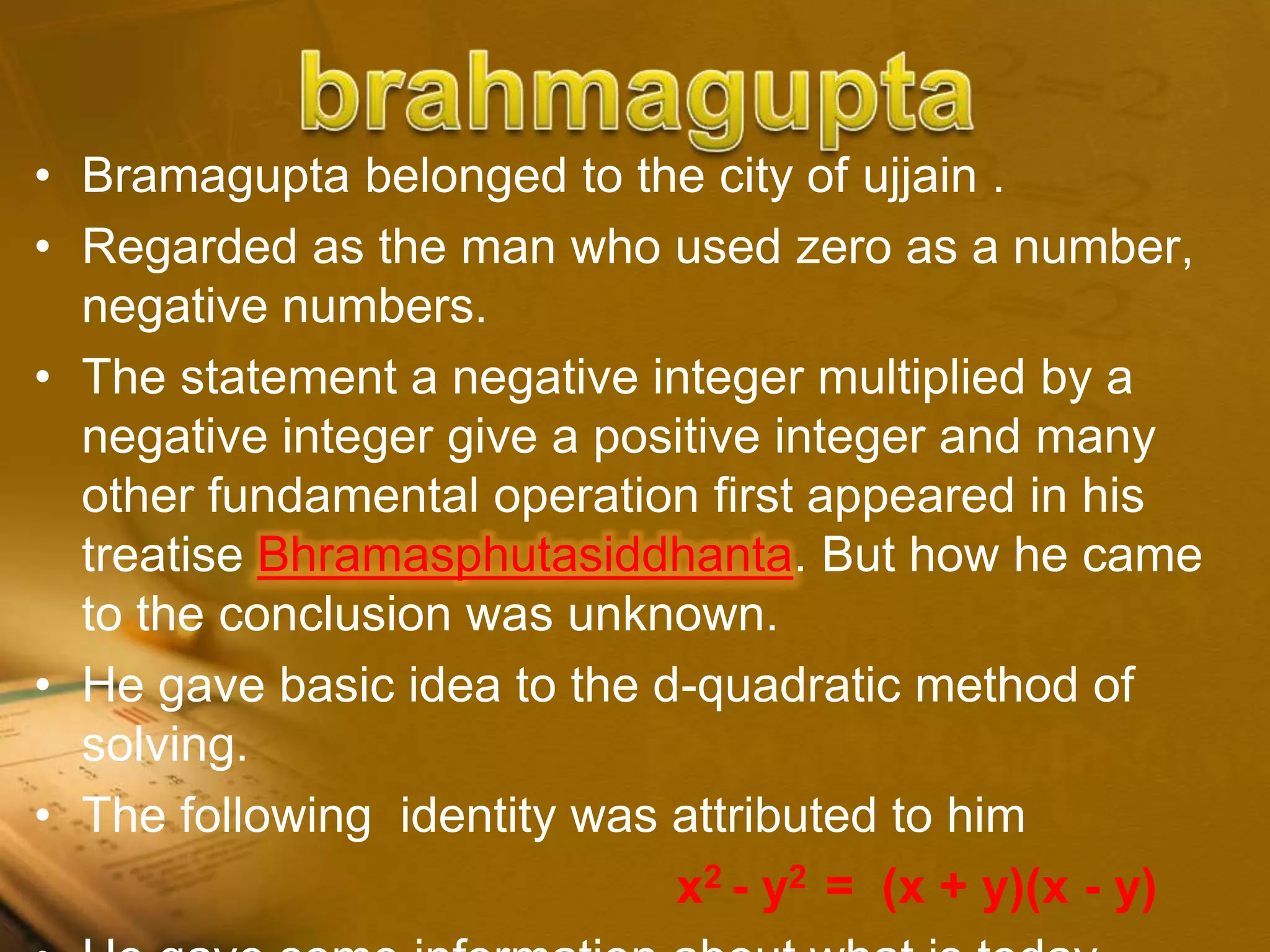
• Bramagupta belonged to the city of ujjain .
• Regarded as the man who used zero as a number,
negative numbers.
• The statement a negative integer multiplied by a
negative integer give a positive integer and many
other fundamental operation first appeared in his
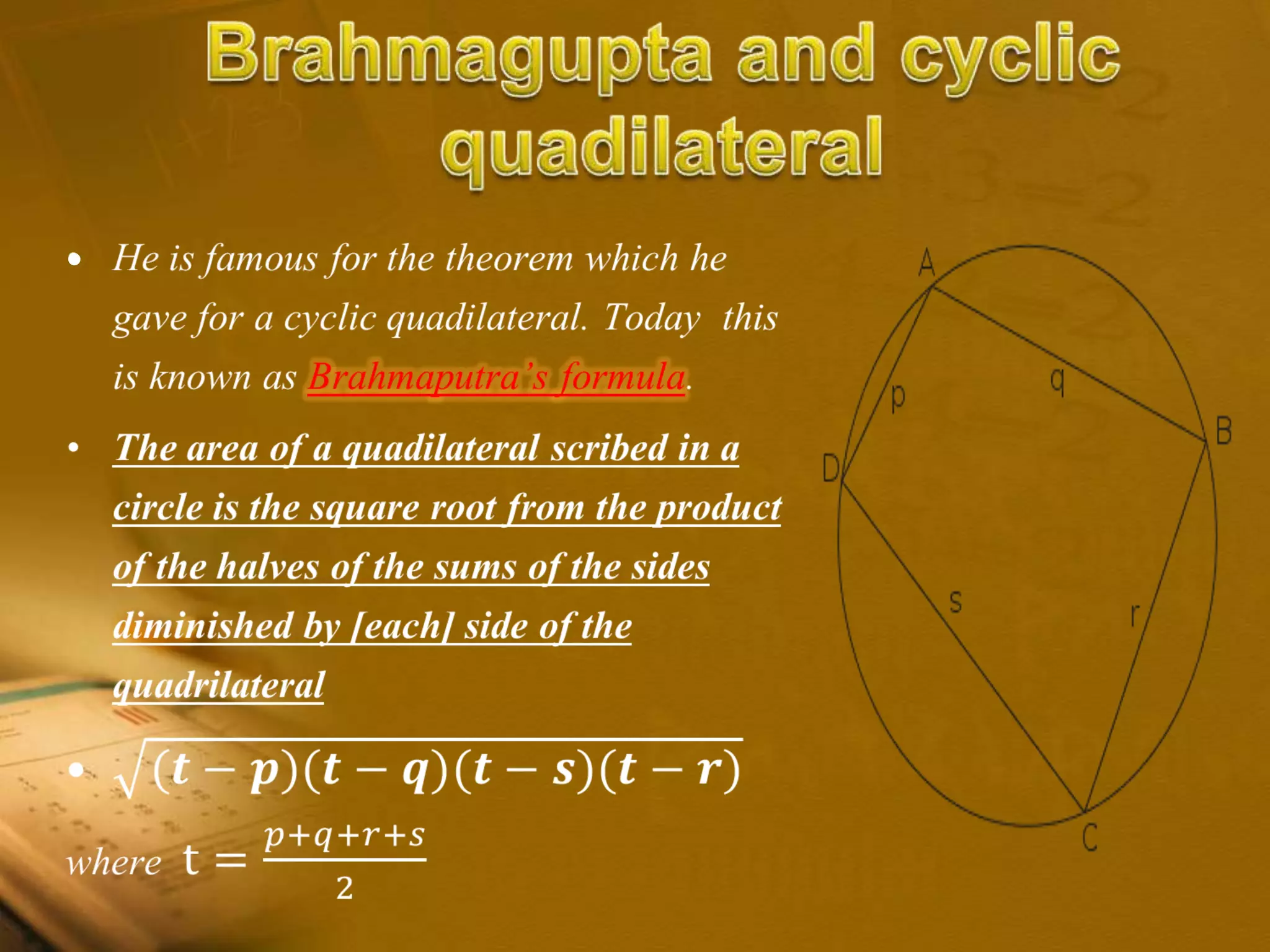
treatise Bhramasphutasiddhanta. But how he came
to the conclusion was unknown.
• He gave basic idea to the d-quadratic method of
solving.
• The following identity was attributed to him
x2 - y2 = (x + y)(x - y)
•
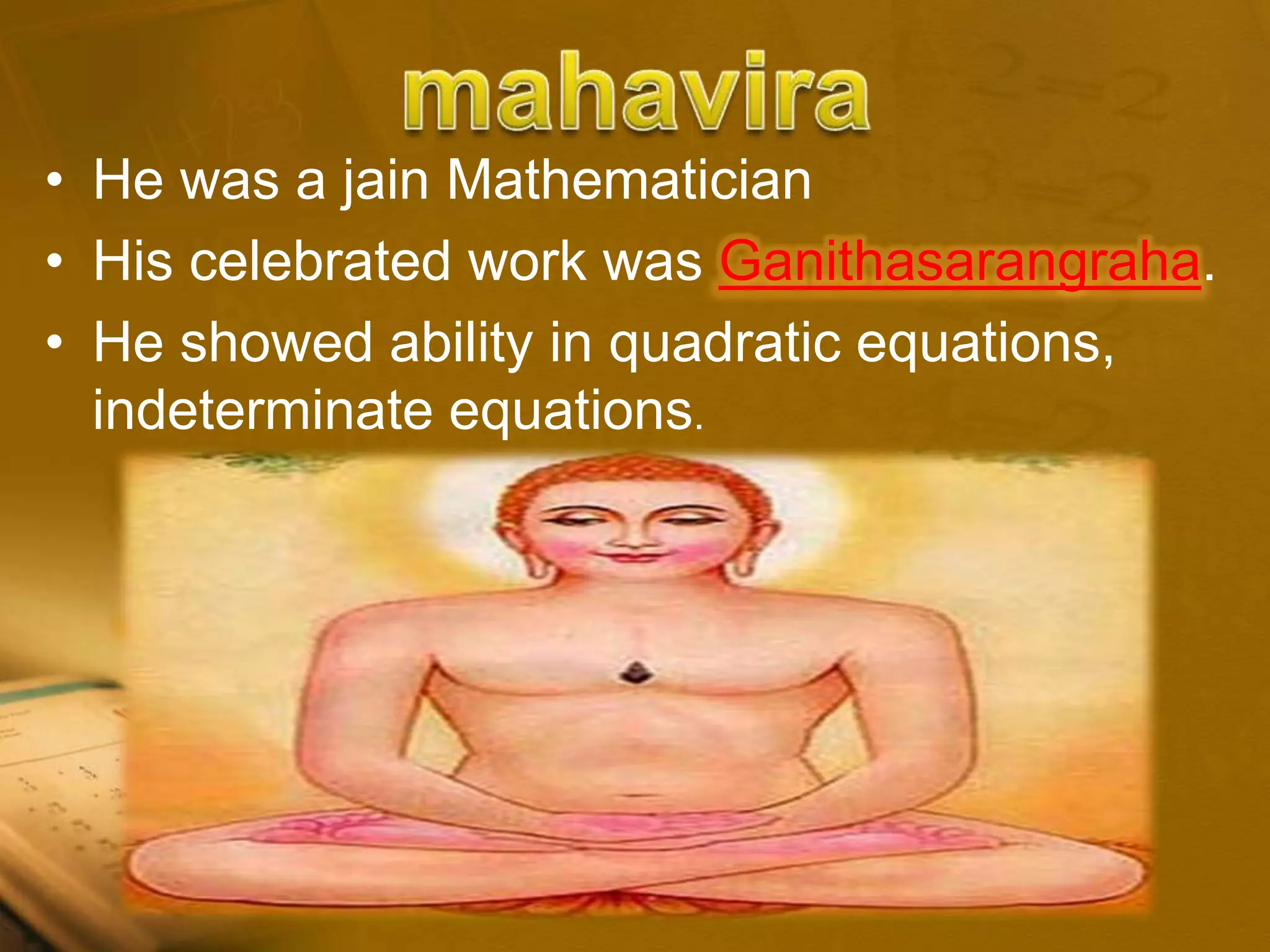
• He was a jain Mathematician
• His celebrated work was Ganithasarangraha.
• He showed ability in quadratic equations,
indeterminate equations.
Math project-Indian mathmetician.pdf

Math project-Indian mathmetician.pdf

  • 2.
    • India hada glorious past in every walks of knowledge. • However, the Indian contribution to the field of mathematics are not so well known. • Mathematics took its birth in India before 200 BC,ie the Shulba period. • The sulba sutras were developed during Indus valley civilization. • There were seven famous Sulbakars (mathematicians of indus valley civilization) among which Baudhyana was the most famous.
  • 4.
    • The PythagorasTheorem in Sulbha sutra. The Sutra Says: • “dirghasyaksanaya rajjuh parsvamani, tiryadam mani,Cha yatprthagbhuta Kurutastadubhayan karoti”. • A Rope stretched along the length of the diagonal (hypotenuse) produces an area which the vertical and horizontal sides make together. Here DB is the hypotenuse.
  • 6.
    • This periodis often known as the golden age of Indian Mathematics. This period saw mathematicians such as Aryabhata, Varahamihira, Brahmagupta, Bhas kara I, Mahavira, and Bhaskara II give broader and clearer shape to many branches of mathematics. Their contributions would spread to Asia, the Middle East, and eventually to Europe. • As explained earlier, the main texts were composed in Sanskrit verse, and were followed by prose commentaries.
  • 8.
    • The mostcelebrated mathematician during the classic period.Many honours have been placed on him and also he is the birthplace of many mathematical theorems functions etc. • He was born in 476 AD with many controversy over his birth place;some say he was born in Kodungallor,Kerala some atribute it to Taregna,Bihar. • He is known for his famous treatise Aryabhatiya written in 499 AD when he was 23 • Credits confered to him include value of pi, earth’s rotation time period,extraction of cube root of a
  • 10.
    • Aryabhata workedon the approximation for pi , and may have come to the conclusion that is irrational. • caturadhikam satamastagunam dvasastistathasahasranam ayutadvayaviskambhasyasanno vrttaparinahah. "Add four to 100, multiply by eight, and then add 62,000. By this rule the circumference of a circle with a diameter of 20,000 can be approached." [15] • This implies that the ratio of the circumference to the diameter is ((4 + 100) 8 + 62000)/20000 = 62832/20000 = 3.1416, which is accurate to five significant figures.
  • 11.
    • Aryabhata givesthe area of a triangle as tribhujasya phalashariram samadalakoti bhujardhasamvargahthat translates to: "for a triangle, the reult of a perpendicular with the half- side is the area”. • Aryabhata discussed the concept of sine in his work by the name of ardha-jya, which literally means "half-chord”. • Today known as diophantine equation; the indeterminate equation was always discussed in Aryabhatiya .
  • 13.
    • He wasborn at Bori, in Parbhani district of Maharashtra state in India in 7th century. • He was the first to write Hindu-Arabic numerals and with zero with a circle. • He was an exponent of Aryabhatta, named Aryabhatiyabhasya. • He gave importance to sine function in Aryabhatiyabhasya. • He represented number using nonliving and living thing For eg:- 1 was for moon , 2 was for eyes,wings etc, 5 was for the senses of humans.
  • 15.
    • He wasan astrologer manly but was also a mathematician. • He was born in 6th centuary in Ujjain and considered to be one of the nine jems of Vikramaditya II • The trigonometric formulas • His famous work is Panchasidanthika
  • 17.
    • Bramagupta belongedto the city of ujjain . • Regarded as the man who used zero as a number, negative numbers. • The statement a negative integer multiplied by a negative integer give a positive integer and many other fundamental operation first appeared in his treatise Bhramasphutasiddhanta. But how he came to the conclusion was unknown. • He gave basic idea to the d-quadratic method of solving. • The following identity was attributed to him x2 - y2 = (x + y)(x - y)
  • 18.
  • 20.
    • He wasa jain Mathematician • His celebrated work was Ganithasarangraha. • He showed ability in quadratic equations, indeterminate equations.