Question 1

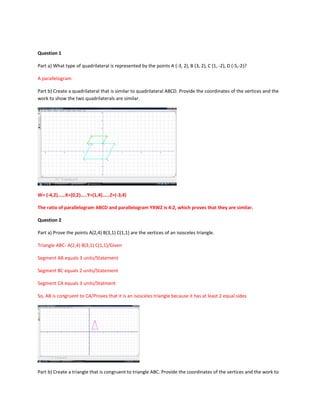
Part a) What type of quadrilateral is represented by the points A (-3, 2), B (3, 2), C (1, -2), D (-5,-2)?

A parallelogram

Part b) Create a quadrilateral that is similar to quadrilateral ABCD. Provide the coordinates of the vertices and the
work to show the two quadrilaterals are similar.


W= (-4,2)……X=(0,2)…..Y=(1,4)……Z=(-3,4)

The ratio of parallelogram ABCD and parallelogram YXWZ is 4:2, which proves that they are similar.

Question 2

Part a) Prove the points A(2,4) B(3,1) C(1,1) are the vertices of an isosceles triangle.

Triangle ABC- A(2,4) B(3,1) C(1,1)/Given

Segment AB equals 3 units/Statement

Segment BC equals 2 units/Statement

Segment CA equals 3 units/Statment

So, AB is congruent to CA/Proves that it is an isosceles triangle because it has at least 2 equal sides


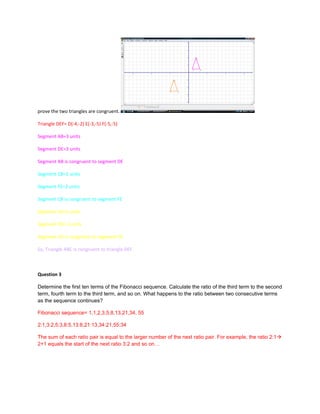
Part b) Create a triangle that is congruent to triangle ABC. Provide the coordinates of the vertices and the work to
prove the two triangles are congruent.

Triangle DEF= D(-4,-2) E(-3,-5) F(-5,-5)

Segment AB=3 units

Segment DE=3 units

Segment AB is congruent to segment DE

Segment CB=2 units

Segment FE=2 units

Segment CB is congruent to segment FE

Segment CA=3 units

Segment FD= 3 units

Segment CA is congruent to segment FD

So, Triangle ABC is congruent to triangle DEF


Question 3

Determine the first ten terms of the Fibonacci sequence. Calculate the ratio of the third term to the second
term, fourth term to the third term, and so on. What happens to the ratio between two consecutive terms
as the sequence continues?

Fibonacci sequence= 1,1,2,3,5,8,13,21,34, 55

2:1,3:2,5:3,8:5,13:8,21:13,34:21,55:34

The sum of each ratio pair is equal to the larger number of the next ratio pair. For example, the ratio 2:1à
2+1 equals the start of the next ratio 3:2 and so on…
Math honors part 1

Math honors part 1

  • 1.
    Question 1 Part a)What type of quadrilateral is represented by the points A (-3, 2), B (3, 2), C (1, -2), D (-5,-2)? A parallelogram Part b) Create a quadrilateral that is similar to quadrilateral ABCD. Provide the coordinates of the vertices and the work to show the two quadrilaterals are similar. W= (-4,2)……X=(0,2)…..Y=(1,4)……Z=(-3,4) The ratio of parallelogram ABCD and parallelogram YXWZ is 4:2, which proves that they are similar. Question 2 Part a) Prove the points A(2,4) B(3,1) C(1,1) are the vertices of an isosceles triangle. Triangle ABC- A(2,4) B(3,1) C(1,1)/Given Segment AB equals 3 units/Statement Segment BC equals 2 units/Statement Segment CA equals 3 units/Statment So, AB is congruent to CA/Proves that it is an isosceles triangle because it has at least 2 equal sides Part b) Create a triangle that is congruent to triangle ABC. Provide the coordinates of the vertices and the work to
  • 2.
    prove the twotriangles are congruent. Triangle DEF= D(-4,-2) E(-3,-5) F(-5,-5) Segment AB=3 units Segment DE=3 units Segment AB is congruent to segment DE Segment CB=2 units Segment FE=2 units Segment CB is congruent to segment FE Segment CA=3 units Segment FD= 3 units Segment CA is congruent to segment FD So, Triangle ABC is congruent to triangle DEF Question 3 Determine the first ten terms of the Fibonacci sequence. Calculate the ratio of the third term to the second term, fourth term to the third term, and so on. What happens to the ratio between two consecutive terms as the sequence continues? Fibonacci sequence= 1,1,2,3,5,8,13,21,34, 55 2:1,3:2,5:3,8:5,13:8,21:13,34:21,55:34 The sum of each ratio pair is equal to the larger number of the next ratio pair. For example, the ratio 2:1à 2+1 equals the start of the next ratio 3:2 and so on…