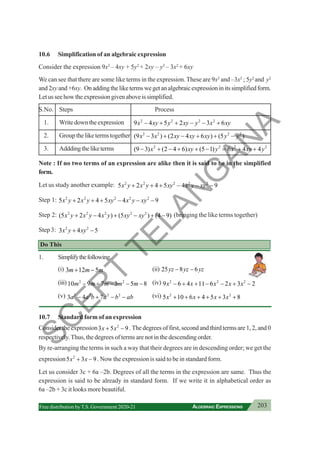
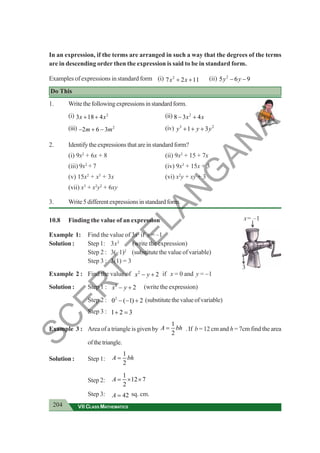
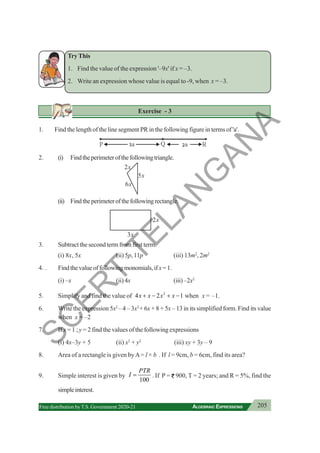
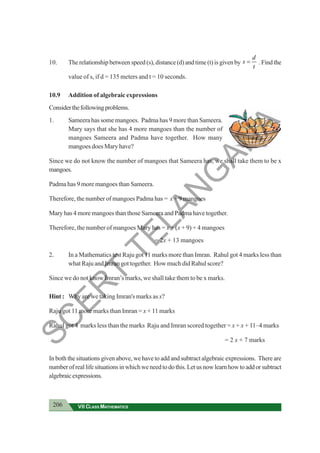
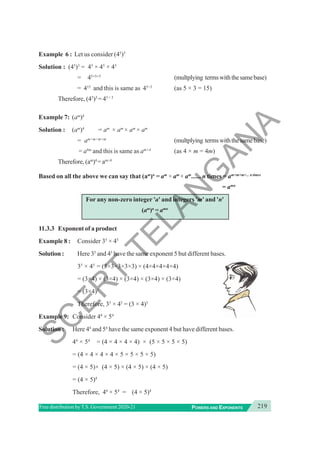
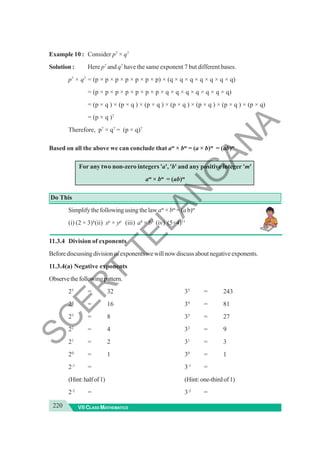
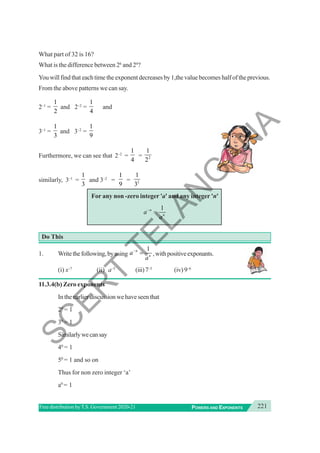
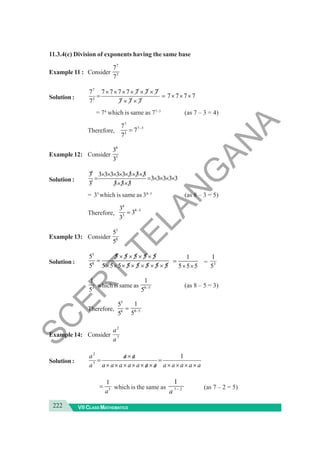
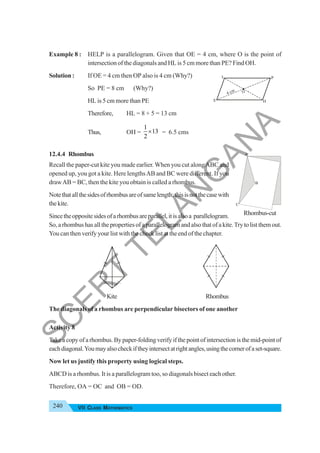
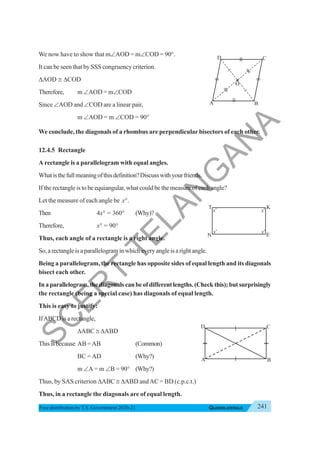
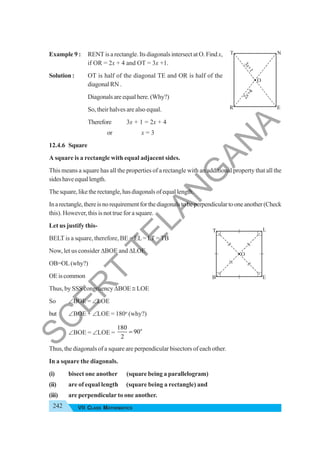
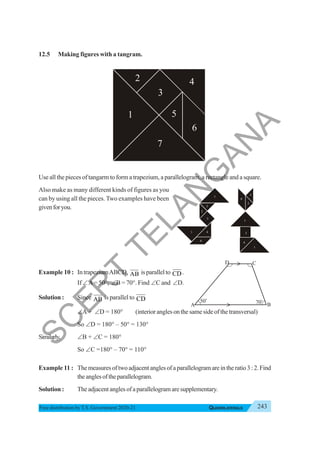
C
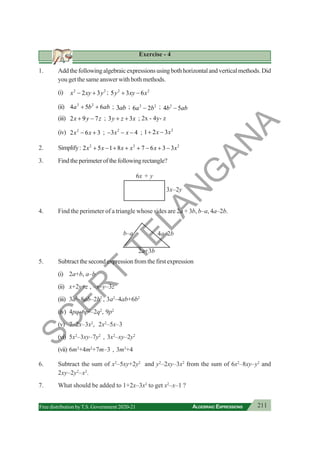
E
R
T
T
E
L
A
N
G
A
N
A
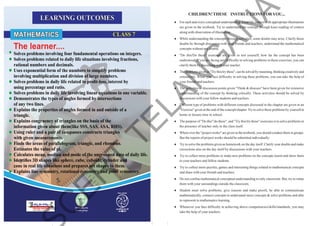
CHILDREN!THESE DI
INSTRUCTIONS FORYOU...
♦ For each and every conceptual understanding, a real life context with appropriate illustrations
are given in the textbook. Try to understand the concept through keen reading of context
along with observation of illustration.
♦ While understanding the concepts through activities, some doubts may arise. Clarify those
doubts by through discussion with your friends and teachers, understand the mathematical
concepts without any doubts.
♦ ''Do this/Do these" exercises are given to test yourself, how far the concept has been
understood. If you are facing any difficulty in solving problems in these exercises, you can
clarify them by discussing with your teacher.
♦ The problems given in "Try this/try these", can be solved by reasoning, thinking creatively and
extensively. When you face difficulty in solving these problems, you can take the help of
your friends and teachers.
♦ The activities or discussion points given "Think & disicuss" have been given for extensive
understanding of the concept by thinking critically. These activities should be solved by
discussions with your fellow students and teachers.
♦ Different typs of problems with different concepts discussed in the chapter are given in an
"Exercise" given at the end of the concept/chapter. Try to solve these problems by yourself at
home or leisure time in school.
♦ The purpose of "Do this"/do these", and "Try this/try these" exercises is to solve problems in
the presence of teacher only in the class itself.
♦ Where ever the "project works" are given in the textbook, you should conduct them in groups.
But the reports of project works should be submitted indivedually.
♦ Try to solve the problems given as homework on the day itself. Clarify your doubts and make
corrections also on the day itself by discussions with your teachers.
♦ Try to collect more problems or make new problems on the concepts learnt and show them
to your teachers and fellow students.
♦ Try to collect more puzzles, games and interesting things related to mathematical concepts
and share with your friends and teachers.
♦ Do not confine mathematical conceptual understanding to only classroom. But, try to relate
them with your suroundings outside the classroom.
♦ Student must solve problems, give reasons and make proofs, be able to communicate
mathematically, connect concepts to understand more concepts & solve problems and able
to represent in mathematics learning.
♦ Whenever you face difficulty in achieving above competencies/skills/standards, you may
take the help of your teachers.
C
E
R
T
T
E
L
A
N
G
A
N
A
Mathematics
VII class
TEXTBOOK DEVELOPMENT & PUBLISHING COMMITTEE
Chief ProductionOfficer : Smt.B. Seshu Kumari
Director, SCERT, Hyderabad.
ExecutiveChiefOrganiser : Sri. B. Sudhakar,
Director, Govt. Text Book Press, Hyderabad.
OrganisingIncharge : Dr. Nannuru UpenderReddy
Prof.Curriculum&TextBookDepartment,
SCERT, Hyderabad.
Asst.OrganisingIncharge : Sri.K.Yadagiri
Lecturer, SCERT, Hyderabad.
Publishedby:
The Government of Telangana, Hyderabad
Respect the Law Grow by Education
Get the Rights Behave Humbly
( i ) Free distribution by Government of T.S. 2020-21
S
C
E
R
T
T
E
L
A
N
G
A
N
A
© Government of Telangana, Hyderabad.
First Published 2012
New Impressions 2013, 2014, 2015, 2016, 2017, 2018, 2019, 2020
Allrightsreserved.
Nopartofthispublicationmaybereproduced,
stored in a retrieval system, or transmitted, in
any form or by any means without the prior
permission in writing of the publisher, nor be
otherwisecirculatedinanyformofbindingor
cover other than that in which it is published
and without a similar condition including this
condition being imposed on the subsequent
purchaser.
The copy right holder of this book is the
Director of School Education, Hyderabad,
Telangana.
This Book has been printed on 70 G.S.M. Maplitho
Title Page 200 G.S.M.WhiteArt Card
Printed in India
at the Telangana Govt.Text Book Press,
Mint Compound, Hyderabad,
Telangana.
–– o ––
Free distribution by T.S. Government 2020-21
( ii )
S
C
E
R
T
T
E
L
A
N
G
A
N
A
Textbook Development Committee
Members
Dr. P. Ramesh, Lecturer, Govt. IASE, Nellore
Sri. M. Ramanjaneyulu,Lecturer, DIET,Vikarabad, Ranga Reddy
Sri.T.V. Rama Kumar,HM, ZPPHS, Mulumudi, Nellore
Sri. P.Ashok, HM, ZPHS, Kumari,Adilabad
Sri. P.Anthony Reddy, HM, St. Peter’s High School, R.N.Peta, Nellore
Sri. S. Prasada Babu,PGT,APTWR School, Chandrashekarapuram, Nellore
Sri. Kakulavaram RajenderReddy,SA, UPSThimmapur, Chandampet, Nalgonda
Sri. G.V. B. Suryanarayana Raju,SA, Municipal High School, Kaspa,Vizianagaram
Sri. S. Narasimha Murthy,SA, ZPHS, Mudivarthipalem, Nellore
Sri. P. Suresh Kumar, SA, GHS,Vijayanagar Colony, Hyderabad
Sri. K.V. SunderReddy, SA, ZPHS,Thakkasila,Alampur Mdl., Mababoobnagar
Sri. G. Venkateshwarlu, SA, ZPHS, Vemulakota, Prakasham
Sri. Ch. Ramesh, SA, UPS, Nagaram (M), Guntur.
Sri. P.D.L. Ganapathi Sharma, SA, GHS, Jamisthanpur, Manikeshwar Nagar, Hyderabad
Co-ordinators
Sri. K. Bramhaiah, Professor, SCERT, Hyderabad
Sri. Kakulavaram RajenderReddy,SA, UPSThimmapur, Chandampet, Nalgonda
Editors
Smt.B. Seshu Kumari,Director, SCERT, Hyderabad.
Sri. K. Bramhaiah, Professor, SCERT, Hyderabad
Sri. P.Adinarayana, Retd., Lecturer, New Science College,Ameerpet, Hyderabad
Chairperson for Position Paper and
Mathematics Curriculum and Textbook Development
Professor V. Kannan, Dept. of Mathematics and Statistics, University of Hyderabad
ChiefAdvisor
Dr. H. K. Dewan ,EducationAdvisor,Vidya Bhavan Society, Udaipur, Rajasthan.
Academic Support Group Members
Smt. Namrita Batra,Vidyabhavan Society Resource Centre, Udaipur, Rajasthan
Sri. InderMohan Singh,Vidyabhavan Society Resource Centre, Udaipur, Rajasthan
Sri.Yashwanth KumarDave,Vidyabhavan Society Resource Centre, Udaipur, Rajasthan
Smt. Padma Priya Sherali,Community Mathematics Centre, RishiVally School, Chittoor
Kumari. M.Archana, Dept. of Mathematics & Statistics, University of Hyderabad
Sri. Sharan Gopal, Dept. of Mathematics & Statistics, University of Hyderabad
Sri. P. Chiranjeevi,Dept. of Mathematics & Statistics, University of Hyderabad
Sri.Abbaraju Kishore,Teacher, MPUPS, Chemallamudi, Guntur
Illustration & Design Team
Sri. Prashanth Soni,Artist, Vidyabhavan Society Resource Centre, Udaipur, Rajasthan
Sri.ShakirAhammed,Operator,Vidyabhavan Society Resource Centre, Udaipur, Rajasthan
Sri. R. Madhusudhana Rao, Computer Operator, SCERT,A.P., Hyderabad
COVER PAGE DESIGNING
Sri. K. Sudhakara Chary, HM, UPS Neelikurthy, Mdl.Maripeda, Dist. Warangal
( iii ) Free distribution by Government of T.S. 2020-21
S
C
E
R
T
T
E
L
A
N
G
A
N
A
FOREWORD
State Curriculum Frame Work (SCF-2011) recommends that childrens’ life at schools must be linked to
their life outside the school. The Right To EducationAct (RTE-2009) perceives that every child who enters the
school should acquire the necessary skills prescribed at each level upto the age of 14 years.Academic standards
were developed in each subject area accordingly to maintain the quality in education. The syllabi and text
books developed on the basis of National Curriculum Frame work 2005 and SCF-2011 signify an attempt to
implement this basic idea.
Children after completion of Primary Education enter into the Upper Primary stage. This stage is a crucial
link for the children to continue their secondary education. We recognise that, given space, time and freedom,
children generate new knowledge by exploring the information passed on to them by the adults. Inculcating
creativity and initiating enquiry is possible if we perceive and treat children as participants in learning and not
as passive receivers. The children at this stage possess characteristics like curiosity, interest, questioning,
reasoning, insisting proof, accepting the challenges etc., Therefore the need for conceptualizing mathematics
teaching that allows children to explore concepts as well as develop their own ways of solving problems in a
joyful way.
We have begun the process of developing a programme which helps children understand the abstract
nature of mathematics while developing in them the ability to construct own concepts. The concepts from the
major areas of Mathematics like Number System,Arithmetic,Algebra, Geometry, Mensuration and Statistics are
provided at the upper primary stage. Teaching of the topics related to these areas will develop the skills
prescribed in academic standards such as problem solving, logical thinking, expressing the facts in mathematical
language, representing data in various forms, using mathematics in daily life situations.
The textbooks attempt to enhance this endeavor by giving higher priority and space to opportunities for
contemplation and wondering, discussion in small groups and activities required for hands on experience in the
form of ‘Do This’ , ‘Try This’ and ‘Projects’. Teachers support is needed in setting of the situations in the
classroom. We also tried to include a variety of examples and opportunities for children to set problems. The
book attempts to engage the mind of a child actively and provides opportunities to use concepts and develop
their own structures rather than struggling with unnecessarily complicated terms and numbers. The chapters are
arranged in such a way that they help the Teachers to evaluate every area of learning to comperehend the
learning progress of children and in accordance with Continuous Comprehensive Evaluation (CCE).
The team associated in developing the textbooks consists of many teachers who are experienced and
brought with them view points of the child and the school. We also had people who have done research in
learning mathematics and those who have been writing textbooks for many years. The team tried to make an
effort to remove fear of mathematics from the minds of children through their presentation of topics.
I wish to thank the national experts, university teachers, research scholars, NGOs, academicians, writers,
graphic designers and printers who are instrumental to bring out this textbook in present form.
I hope the teachers will make earnest effort to implement the syllabus in its true spirit and to achieve academic
standards at the stage.
The process of developing materials is a continuous one and we hope to make this book better. As an
organization committed to systematic reform and continuous improvement in quality of its products, SCERT,
welcomes comments and suggestions which will enable us to undertake further revision and refinement.
Place: Hyderabad DIRECTOR
Date: 28 January 2012 SCERT, Hyderabad
B. Seshu kumari
( vi )
S
C
E
R
T
T
E
L
A
N
G
A
N
A
Mathematics
VII class
S. No. Contents
Syllabus to be
Page No
covered during
1. Integers June 1 - 25
2. Fractions, Decimals and July 26 - 60
Rational Numbers
3. Simple Equations July 61- 70
4. Lines andAngles August 71- 89
5. Triangle and Its Properties August 90- 111
6. Ratio -Applications September 112- 143
7. DataHandling September 144 - 164
8. Congruency of Triangles October 165 - 183
9. Construction of Triangles November 184 - 193
10. Algebraic Expressions November 194 - 212
11. Powers and Exponents December 213 - 228
12. Quadrilaterals December 229 - 246
13. Area and Perimeter January 247 - 266
14. Understanding 3D and 2D Shapes February 267 - 278
15. Symmetry February 279 - 291
Revision March
( v ) Free distribution by Government of T.S. 2020-21
S
C
E
R
T
T
E
L
A
N
G
A
N
A
( vi )
OUR NATIONAL ANTHEM
-Rabindranath Tagore
Jana-gana-mana-adhinayaka,jayahe
Bharata-bhagya-vidhata.
Punjab-Sindh-Gujarat-Maratha
Dravida-Utkala-Banga
Vindhya-Himachala-Yamuna-Ganga
Uchchhala-jaladhi-taranga.
Tavashubhanamejage,
Tavashubhaasisamage,
Gahetavajayagatha,
Jana-gana-mangala-dayakajayahe
Bharata-bhagya-vidhata.
Jaya he! jaya he! jaya he!
Jaya jaya jaya, jaya he!!
PLEDGE
- Pydimarri Venkata Subba Rao
“Indiaismycountry.AllIndiansaremybrothersandsisters.
I love my country, and I am proud of its rich and varied heritage.
I shall always strive to be worthy of it.
I shall give my parents, teachers and all elders respect,
and treat everyone with courtesy. I shall be kind to animals
To my country and my people, I pledge my devotion.
Intheirwell-beingandprosperityaloneliesmyhappiness.”
S
C
E
R
T
T
E
L
A
N
G
A
N
A
1
INTEGERS
Free distribution byT.S. Government 2020-21
INTEGERS 1
1.0 Introduction
We start learning numbers like 1,2,3,4.... for counting objects
aroundus.Thesenumbersarecalledcountingnumbersornatu-
ral numbers. Let us think about these.
(i) Whichisthesmallestnaturalnumber?
(ii) Write five natural numbers between 100 and 10000.
(iii) Can you find where the sequence of natural numbers
ends?
(iv) What is the difference between any two consecutive
naturalnumbers?
By including ‘0’ to the collection of natural numbers, we get a new collection of numbers called
whole numbers i.e., 0, 1, 2, 3, 4, ......
InclassVIwealsolearntaboutnegativenumbers.Ifweputwholenumberandnegativenumbers
togetherwegetabiggercollectionofnumberscalledintegers.Inthischapter,wewilllearnmore
about integers, their operations and properties.
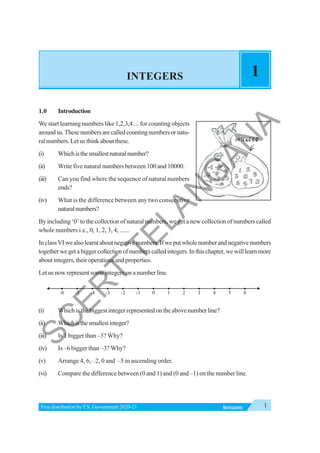
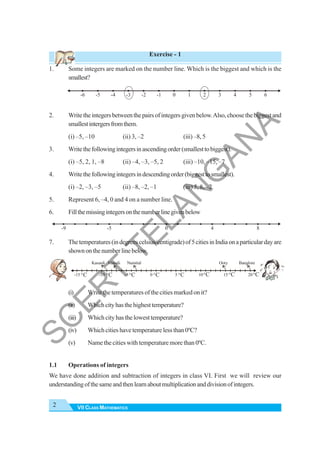
Let us now represent some integers on a number line.
(i) Whichisthebiggestintegerrepresentedontheabovenumberline?
(ii) Whichisthesmallestinteger?
(iii) Is 1 bigger than –3? Why?
(iv) Is –6 bigger than –3? Why?
(v) Arrange 4, 6, –2, 0 and –5 in ascending order.
(vi) Compare the difference between (0 and 1) and (0 and –1) on the number line.
0 1 2 3 4 5 6
-1
-2
-3
-4
-5
-6
S
C
E
R
T
T
E
L
A
N
G
A
N
A
VII CLASS MATHEMATICS
2
Exercise - 1
1. Some integers are marked on the number line. Which is the biggest and which is the
smallest?
2. Writetheintegersbetweenthepairsofintegersgivenbelow.Also,choosethebiggestand
smallestintergersfromthem.
(i) –5, –10 (ii) 3, –2 (iii) –8, 5
3. Writethefollowingintegersinascendingorder(smallesttobiggest).
(i) –5, 2, 1, –8 (ii) –4, –3, –5, 2 (iii) –10, –15, –7
4. Writethefollowingintegersindescendingorder(biggesttosmallest).
(i) –2, –3, –5 (ii) –8, –2, –1 (iii) 5, 8, –2
5. Represent 6, –4, 0 and 4 on a number line.
6. Fillthemissingintegersonthenumberlinegivenbelow
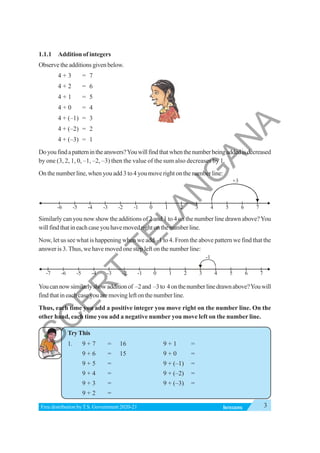
7. Thetemperatures(indegreescelsius/centigrade)of5citiesinIndiaonaparticulardayare
shownonthenumberlinebelow.
(i) Write the temperatures of the cities marked on it?
(ii) Whichcityhasthehighesttemperature?
(iii) Whichcityhasthelowesttemperature?
(iv) Which cities have temperature less than 0ºC?
(v) Name the cities with temperature more than 0ºC.
1.1 Operations of integers
We have done addition and subtraction of integers in class VI. First we will review our
understandingofthesameandthenlearnaboutmultiplicationanddivisionofintegers.
0 1 2 3 4 5 6
-1
-2
-3
-4
-5
-6
0 4 8
-5
-9
-15 -10 -5 0 5 10 15 20
Kasauli Manali Nainital Ooty Banglore
o
C o
C o
C o
C
o
C
o
C o
C o
C
S
C
E
R
T
T
E
L
A
N
G
A
N
A
3
INTEGERS
Free distribution byT.S. Government 2020-21
1.1.1 Addition of integers
Observetheadditionsgivenbelow.
4 + 3 = 7
4 + 2 = 6
4 + 1 = 5
4 + 0 = 4
4 + (–1) = 3
4 + (–2) = 2
4 + (–3) = 1
Doyoufindapatternintheanswers?Youwillfindthatwhenthenumberbeingaddedisdecreased
by one (3, 2, 1, 0, –1, –2, –3) then the value of the sum also decreases by 1.
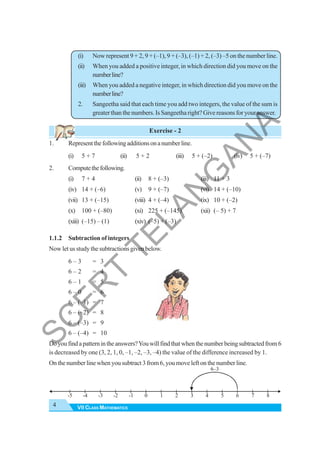
On the number line, when you add 3 to 4 you move right on the number line:
Similarly can you now show the additions of 2 and 1 to 4 on the number line drawn above?You
willfindthatineachcaseyouhavemovedrightonthenumberline.
Now, let us see what is happening when we add –1 to 4. From the above pattern we find that the
answer is 3. Thus, we have moved one step left on the number line:
Youcannowsimilarlyshowadditionof –2and –3to 4onthenumberlinedrawnabove?Youwill
findthatineachcaseyouaremovingleftonthenumberline.
Thus, each time you add a positive integer you move right on the number line. On the
other hand, each time you add a negative number you move left on the number line.
TryThis
1. 1. 9 + 7 = 16 9 + 1 =
9 + 6 = 15 9 + 0 =
9 + 5 = 9 + (–1) =
9 + 4 = 9 + (–2) =
9 + 3 = 9 + (–3) =
9 + 2 =
0 1 2 3 4 5 6 7
-1
-2
-3
-4
-5
-6
+3
0 1 2 3 4 5 6 7
-1
-2
-3
-4
-5
-6
-7
-1
S
C
E
R
T
T
E
L
A
N
G
A
N
A
VII CLASS MATHEMATICS
4
(i) Now represent 9 + 2, 9 + (–1), 9 + (–3), (–1) + 2, (–3) –5 on the number line.
(ii) When you added a positive integer, in which direction did you move on the
numberline?
(iii) When you added a negative integer, in which direction did you move on the
numberline?
2. Sangeetha said that each time you add two integers, the value of the sum is
greater than the numbers. Is Sangeetha right? Give reasons for your answer.
Exercise - 2
1. Representthefollowingadditionsonanumberline.
(i) 5 + 7 (ii) 5 + 2 (iii) 5 + (–2) (iv) 5 + (–7)
2. Computethefollowing.
(i) 7 + 4 (ii) 8 + (–3) (iii) 11 + 3
(iv) 14 + (–6) (v) 9 + (–7) (vi) 14 + (–10)
(vii) 13 + (–15) (viii) 4 + (–4) (ix) 10 + (–2)
(x) 100 + (–80) (xi) 225 + (–145) (xii) (– 5) + 7
(xiii) (–15) – (1) (xiv) (–5) + (–3)
1.1.2 Subtraction of integers
Now let us study the subtractions given below.
6 – 3 = 3
6 – 2 = 4
6 – 1 = 5
6 – 0 = 6
6 – (–1) = 7
6 – (–2) = 8
6 – (–3) = 9
6 – (–4) = 10
Doyoufindapatternintheanswers?Youwillfindthatwhenthenumberbeingsubtractedfrom6
is decreased by one (3, 2, 1, 0, –1, –2, –3, –4) the value of the difference increased by 1.
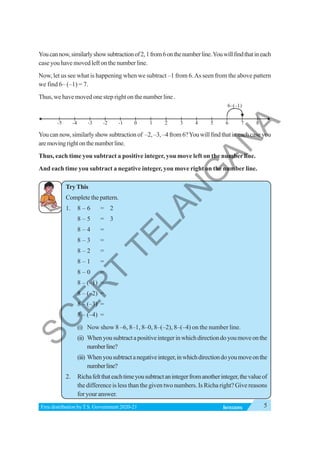
On the number line when you subtract 3 from 6, you move left on the number line.
0 1 2 3 4 5 6 7 8
-1
-2
-3
-4
-5
6–3
S
C
E
R
T
T
E
L
A
N
G
A
N
A
5
INTEGERS
Free distribution byT.S. Government 2020-21
Youcannow,similarlyshowsubtractionof2,1from6onthenumberline.Youwillfindthatineach
caseyouhavemovedleftonthenumberline.
Now, let us see what is happening when we subtract –1 from 6.As seen from the above pattern
we find 6– (–1) = 7.
Thus, we have moved one step right on the number line .
Youcannow,similarlyshowsubtractionof –2,–3,–4from6?Youwillfindthatineachcaseyou
aremovingrightonthenumberline.
Thus, each time you subtract a positive integer, you move left on the number line.
And each time you subtract a negative integer, you move right on the number line.
TryThis
Complete the pattern.
1. 8 – 6 = 2
8 – 5 = 3
8 – 4 =
8 – 3 =
8 – 2 =
8 – 1 =
8 – 0 =
8 – (–1) =
8 – (–2) =
8 – (–3) =
8 – (–4) =
(i) Now show 8 –6, 8–1, 8–0, 8–(–2), 8–(–4) on the number line.
(ii) Whenyousubtractapositiveintegerinwhichdirectiondoyoumoveonthe
numberline?
(iii) Whenyousubtractanegativeinteger,inwhichdirectiondoyoumoveonthe
numberline?
2. Richafeltthateachtimeyousubtractanintegerfromanotherinteger,thevalueof
the difference is less than the given two numbers. Is Richa right? Give reasons
for your answer.
0 1 2 3 4 5 6 7 8
-1
-2
-3
-4
-5
6 (–1)
–
S
C
E
R
T
T
E
L
A
N
G
A
N
A
VII CLASS MATHEMATICS
6
Exercise - 3
1. Representthefollowingsubtractionsonthenumberline.
(i) 7 – 2 (ii) 8 – (– 7) (iii) 3 – 7
(iv) 15 – 14 (v) 5 – (– 8) (vi) (–2) - (–1)
2. Computethefollowing.
(i) 17 – (–14) (ii) 13 – (– 8) (iii) 19 – (– 5)
(iv) 15 – 28 (v) 25 – 33 (vi) 80 – (– 50)
(vii) 150 – 75 (viii) 32 – (– 18) (ix) (–30) – (–25)
3. Express ‘–6’as the sum of a negative integer and a whole number.
1.1.3 Multiplication of integers
Now,letusmultiplyintegers.
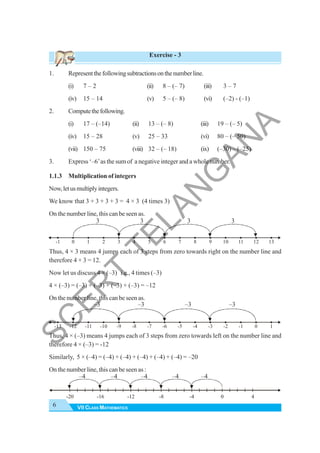
We know that 3 + 3 + 3 + 3 = 4 × 3 (4 times 3)
On the number line, this can be seen as.
Thus, 4 × 3 means 4 jumps each of 3 steps from zero towards right on the number line and
therefore 4 × 3 = 12.
Now let us discuss 4 × (–3) i.e., 4 times (–3)
4 × (–3) = (–3) + (–3) + (–3) + (–3) = –12
On the number line, this can be seen as.
Thus, 4 × (–3) means 4 jumps each of 3 steps from zero towards left on the number line and
therefore 4 × (–3) = -12
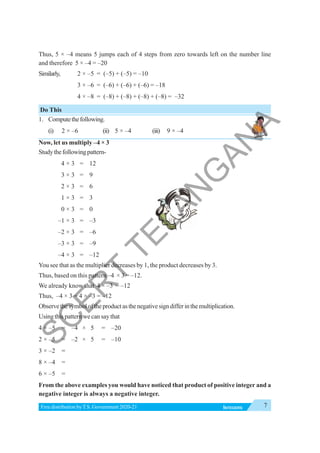
Similarly, 5 × (–4) = (–4) + (–4) + (–4) + (–4) + (–4) = –20
On the number line, this can be seen as :
-6 -5 -4 -3 -2 -1 0 1
-7
-8
-9
-10
-11
-12
-13
–3 –3 –3 –3
6 7 8 9 10 11 12 13
5
4
3
2
1
0
-1
3 3 3 3
4
0
-4
-8
-12
-16
-20
–4 –4 –4 –4 –4
S
C
E
R
T
T
E
L
A
N
G
A
N
A
7
INTEGERS
Free distribution byT.S. Government 2020-21
Thus, 5 × –4 means 5 jumps each of 4 steps from zero towards left on the number line
and therefore 5 × –4 = –20
Similarly, 2 × –5 = (–5) + (–5) = –10
3 × –6 = (–6) + (–6) + (–6) = –18
4 × –8 = (–8) + (–8) + (–8) + (–8) = –32
Do This
1. Computethefollowing.
(i) 2 × –6 (ii) 5 × –4 (iii) 9 × –4
Now, let us multiply –4 × 3
Studythefollowingpattern-
4 × 3 = 12
3 × 3 = 9
2 × 3 = 6
1 × 3 = 3
0 × 3 = 0
–1 × 3 = –3
–2 × 3 = –6
–3 × 3 = –9
–4 × 3 = –12
You see that as the multiplier decreases by 1, the product decreases by 3.
Thus, based on this pattern –4 × 3 = –12.
We already know that 4 × –3 = –12
Thus, –4 × 3 = 4 × –3 = –12
Observethesymboloftheproductasthenegativesigndifferinthemultiplication.
Using this pattern we can say that
4 × –5 = –4 × 5 = –20
2 × –5 = –2 × 5 = –10
3 × –2 =
8 × –4 =
6 × –5 =
From the above examples you would have noticed that product of positive integer and a
negative integer is always a negative integer.
S
C
E
R
T
T
E
L
A
N
G
A
N
A
VII CLASS MATHEMATICS
8
1.1.3(a) Multiplication of two negative integers
Now, what if we were to multiply –3 and –4.
Studythefollowingpattern.
–3 × 4 = –12
–3 × 3 = –9
–3 × 2 = –6
–3 × 1 = –3
–3 × 0 = 0
–3 × –1 = 3
–3 × –2 = 6
–3 × –3 = 9
–3 × –4 = 12
Do you observe any a pattern? You will see that as we multiply –3 by 4, 3, 2, 1, 0, –1, –2,
–3, –4 the product increases by 3.
Now let us multiply –4 and –3. Study the following products and fill the blanks.
–4 × 4 = –16
–4 × 3 = –12
–4 × 2 = –8
–4 × 1 = –4
–4 × 0 = 0
–4 × –1 = ——
–4 × –2 = ——
–4 × –3 = ——
You will see that as we multiply –4 by 4, 3, 2, 1, 0, –1, –2, –3, the product increases by 4.
According to the two patterns given above, –3 × –4 = –4 × –3 = 12
S
C
E
R
T
T
E
L
A
N
G
A
N
A
9
INTEGERS
Free distribution byT.S. Government 2020-21
You have also observed that.
–3 × –1 = 3 –4 × –1 = 4
–3 × –2 = 6 –4 × –2 = 8
–3 × –3 = 9 –4 × –3 = 12
Thus,everytimeifwemultiplytwonegativeintegers,theproductisalwaysapositiveinteger.
Activity 1
Fillthegridbymultiplyingeachnumberinthefirstcolumnwitheachnumberinthefirstrow.
× 3 2 1 0 –1 –2 –3
3 9 6 3 0 –3 –6 –9
2 6 4 2 0
1
0
–1 –3 –2 –1 0 1 2 3
–2
–3
(i) Is the product of two positive integers always a positive integer?
(ii) Is the product of two negative integers always a positive integer?
(iii) Is the product of a negative and positive integer always a negative integer?
1.1.3(b) Multiplication of more than two negative integers
We observed that the product of two negative integers is a positive integer. What will be the
product of three negative integers? Four negative integers? and so on .....
Letusstudythefollowingexamples.
(i) (–2) × (–3) = 6
(ii) (–2) × (–3) × (–4) = [(–2) × (–3)] × (–4) = 6 × (–4) = – 24
(iii) (–2) × (–3) × (–4) × (–5) = [(–2) × (–3) × (–4)] × (–5) = (–24) × (–5) = 120
(iv) [(–2) × (–3) × (–4) × (–5) × (–6)] = 120 × (–6) = –720
S
C
E
R
T
T
E
L
A
N
G
A
N
A
VII CLASS MATHEMATICS
10
From the above products we can infer that.
(i) Theproductoftwonegativeintegersisapositiveinteger.
(ii) Theproductofthreenegativeintegersisnegativeinteger.
(iii) Theproductoffournegativeintegersisapositiveinteger.
(iv) Theproductoffivenegativeintegersisanegativeinteger.
Will the product of six negative integers be positive or negative? State reasons.
Try This
(a) (–1) × (–1) = ——
(b) (–1) × (–1) × (–1) = ——
(c) (–1) × (–1) × (–1) × (–1) = ——
(d) (–1) × (–1) × (–1) × (–1) × (–1) = ——
We further see that in (a) and (c) above, the number of negative integers that are multiplied are
even (two and four respectively) and the products are positive integers. The number of negative
integers that are multiplied in (b) and (d) are odd and the products are negative integers.
Thus, we find that if the number of negative integers being multiplied is even, then the
product is a positive integer.And if the number of negative integers being multiplied is
odd, the product is a negative integer.
Exercise - 4
1. Fillintheblanks.
(i) (–100) × ( –6) = .....................
(ii) (–3) × .......... = 3
(iii) 100 × (–6) = .....................
(iv) (–20) × (–10) = .....................
(v) 15 × (–3) = .....................
S
C
E
R
T
T
E
L
A
N
G
A
N
A
11
INTEGERS
Free distribution byT.S. Government 2020-21
2. Findeachofthefollowingproducts.
(i) 3 × (–1) (ii) (–1) × 225
(iii) (–21) × (–30) (iv) (–316) × (–1)
(v) (–15) × 0 × (–18) (vi) (–12) × (–11) × (10)
(vii) 9 × (–3) × (–6) (viii) (–18) × (–5) × (–4)
(ix) (–1) × (–2) × (–3) × 4 (x) (–3) × (–6) × (–2) × (–1)
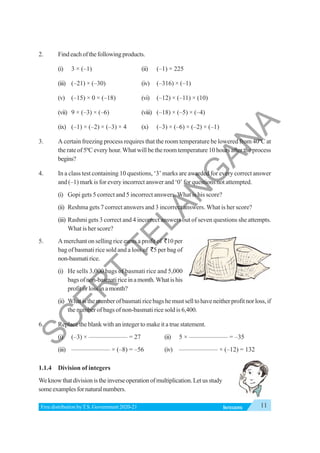
3. A certain freezing process requires that the room temperature be lowered from 40ºC at
the rate of 5ºC every hour.What will be the room temperature 10 hours after the process
begins?
4. In a class test containing 10 questions, ‘3’ marks are awarded for every correct answer
and (–1) mark is for every incorrect answer and ‘0’ for questions not attempted.
(i) Gopi gets 5 correct and 5 incorrect answers. What is his score?
(ii) Reshma gets 7 correct answers and 3 incorrect answers. What is her score?
(iii) Rashmi gets 3 correct and 4 incorrect answers out of seven questions she attempts.
What is her score?
5. A merchant on selling rice earns a profit of `10 per
bag of basmati rice sold and a loss of `5 per bag of
non-basmatirice.
(i) He sells 3,000 bags of basmati rice and 5,000
bagsofnon-basmatiriceinamonth.Whatishis
profit or loss in a month?
(ii) Whatisthenumberofbasmatiricebagshemustselltohaveneitherprofitnorloss,if
the number of bags of non-basmati rice sold is 6,400.
6. Replace the blank with an integer to make it a true statement.
(i) (–3) × —————— = 27 (ii) 5 × —————— = –35
(iii) —————— × (–8) = –56 (iv) —————— × (–12) = 132
1.1.4 Division of integers
Weknowthatdivisionistheinverseoperationofmultiplication.Letusstudy
someexamplesfornaturalnumbers.
S
C
E
R
T
T
E
L
A
N
G
A
N
A
VII CLASS MATHEMATICS
12
We know that 3 × 5 = 15
Therefore, 15 ÷ 5 = 3 or 15 ÷ 3 = 5
Similarly, 4 × 3 = 12
Therefore, 12 ÷ 4 = 3 or 12 ÷ 3 = 4
Thus, we can say that for each multiplication statement of natural numbers there are two
correspondingdivisionstatements.
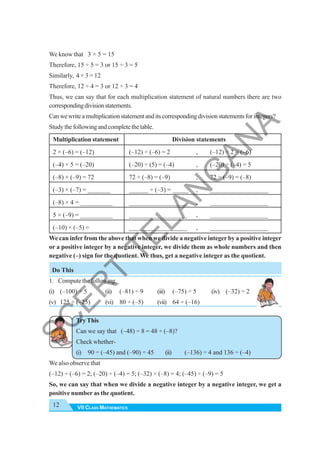
Canwewriteamultiplicationstatementanditscorrespondingdivisionstatementsforintegers?
Studythefollowingandcompletethetable.
Multiplication statement Division statements
2 × (–6) = (–12) (–12) ÷ (–6) = 2 , (–12) ÷ 2 = (–6)
(–4) × 5 = (–20) (–20) ÷ (5) = (–4) , (–20) ÷ (–4) = 5
(–8) × (–9) = 72 72 ÷ (–8) = (–9) , 72 ÷ (–9) = (–8)
(–3) × (–7) = _______ ______ ÷ (–3) = _____ , __________________
(–8) × 4 = __________ __________________ , __________________
5 × (–9) = __________ __________________ , __________________
(–10) × (–5) = __________________ , __________________
We can infer from the above that when we divide a negative integer by a positive integer
or a positive integer by a negative integer, we divide them as whole numbers and then
negative (–) sign for the quotient. We thus, get a negative integer as the quotient.
Do This
1. Compute the following.
(i) (–100) ÷ 5 (ii) (–81) ÷ 9 (iii) (–75) ÷ 5 (iv) (–32) ÷ 2
(v) 125 ÷ (–25) (vi) 80 ÷ (–5) (vii) 64 ÷ (–16)
Try This
Can we say that (–48) ÷ 8 = 48 ÷ (–8)?
Check whether-
(i) 90 ÷ (–45) and (–90) ÷ 45 (ii) (–136) ÷ 4 and 136 ÷ (–4)
We also observe that
(–12) ÷ (–6) = 2; (–20) ÷ (–4) = 5; (–32) ÷ (–8) = 4; (–45) ÷ (–9) = 5
So, we can say that when we divide a negative integer by a negative integer, we get a
positive number as the quotient.
S
C
E
R
T
T
E
L
A
N
G
A
N
A
13
INTEGERS
Free distribution byT.S. Government 2020-21
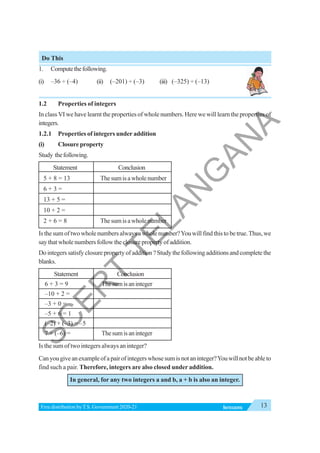
Do This
1. Computethefollowing.
(i) –36 ÷ (–4) (ii) (–201) ÷ (–3) (iii) (–325) ÷ (–13)
1.2 Properties of integers
In class VI we have learnt the properties of whole numbers. Here we will learn the properties of
integers.
1.2.1 Properties of integers under addition
(i) Closure property
Study thefollowing.
Statement Conclusion
5 + 8 = 13 Thesumisawholenumber
6 + 3 =
13 + 5 =
10 + 2 =
2 + 6 = 8 Thesumisawholenumber
Is the sum of two whole numbers always a whole number?You will find this to be true.Thus, we
saythatwholenumbersfollowtheclosurepropertyofaddition.
Dointegerssatisfyclosurepropertyofaddition?Studythefollowingadditionsandcompletethe
blanks.
Statement Conclusion
6 + 3 = 9 Thesumisaninteger
–10 + 2 =
–3 + 0 =
–5 + 6 = 1
(–2) + (–3) = –5
7 + (–6) = Thesumisaninteger
Is the sum of two integers always an integer?
Canyougiveanexampleofapairofintegerswhosesumisnotaninteger?Youwillnotbeableto
find such a pair. Therefore, integers are also closed under addition.
In general, for any two integers a and b, a + b is also an integer.
S
C
E
R
T
T
E
L
A
N
G
A
N
A
VII CLASS MATHEMATICS
14
(ii) Commutativeproperty
Studythefollowingandfillintheblanks.
Statement 1 Statement 2 Conclusion
4 + 3 = 7 3 + 4 = 7 4 + 3 = 3 + 4 = 7
3 + 5 = 5 + 3 =
3 + 1 = 1 + 3 =
Similarly, add as many pairs of whole numbers, as you wish. Did you find any pair of whole
numbers for which the sum is different, when the order is changed.You will not find such a pair.
Thus,wesaythattheadditionofwholenumbersiscommutative.
Isadditionofintegerscommutative?Studythefollowingandfillintheblanks.
Statement 1 Statement 2 Conclusion
5 + (–6) = –1 (–6) + 5 = –1 5 + (–6) = (–6) + 5 = –1
–9 + 2 = 2 + (–9) =
–4 + (–5) = (–5) + (–4) =
Did you find any pair of integers for which the sum is different when the order is changed?You
would have not. Therefore, addition is commutative for integers.
In general, for any two integers a and b, a + b = b + a
(iii) Associative property
Letusstudythefollowingexamples-
(i) (2 + 3) + 4 2 + (3 + 4)
= 5 + 4 = 2 + 7
= 9 = 9
(ii) (–2 + 3) + 5 –2 + (3 + 5)
= 1 + 5 = –2 + 8
= 6 = 6
(iii) (–2 + 3) + (–5) (- 2) + [3 + (–5)]
= 1 + (–5) = (- 2) + (-2)
= –4 = –4
(iv) [(–2) + (–3)] + (-5) –2 + [(–3) + (–5)]
= –5 + (–5) = –2 + (–8)
= –10 = –10
S
C
E
R
T
T
E
L
A
N
G
A
N
A
15
INTEGERS
Free distribution byT.S. Government 2020-21
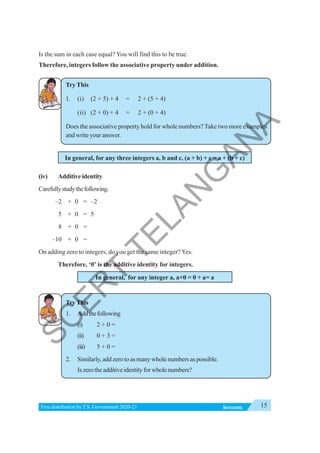
Is the sum in each case equal? You will find this to be true.
Therefore, integers follow the associative property under addition.
Try This
1. (i) (2 + 5) + 4 = 2 + (5 + 4)
(ii) (2 + 0) + 4 = 2 + (0 + 4)
Does the associative property hold for whole numbers? Take two more examples
and write your answer.
In general, for any three integers a, b and c, (a + b) + c = a + (b + c)
(iv) Additive identity
Carefullystudythefollowing.
–2 + 0 = –2
5 + 0 = 5
8 + 0 =
–10 + 0 =
On adding zero to integers, do you get the same integer? Yes.
Therefore, ‘0’ is the additive identity for integers.
In general, for any integer a, a+0 = 0 + a= a
TryThis
1. Addthefollowing
(i) 2 + 0 =
(ii) 0 + 3 =
(iii) 5 + 0 =
2. Similarly, add zero to as many whole numbers as possible.
Iszerotheadditiveidentityforwholenumbers?
S
C
E
R
T
T
E
L
A
N
G
A
N
A
VII CLASS MATHEMATICS
16
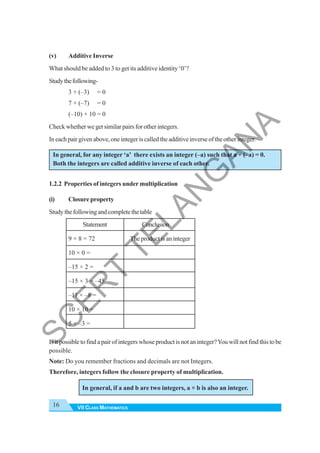
(v) Additive Inverse
What should be added to 3 to get its additive identity ‘0’?
Studythefollowing-
3 + (–3) = 0
7 + (–7) = 0
(–10) + 10 = 0
Check whether we get similar pairs for other integers.
In each pair given above, one integer is called the additive inverse of the other integer.
In general, for any integer ‘a’ there exists an integer (–a) such that a + (–a) = 0.
Both the integers are called additive inverse of each other.
1.2.2 Properties of integers under multiplication
(i) Closure property
Studythefollowingandcompletethetable
Statement Conclusion
9 × 8 = 72 The product is an integer
10 × 0 =
–15 × 2 =
–15 × 3 = –45
–11 × –8 =
10 × 10 =
5 × –3 =
Is it possible to find a pair of integers whose product is not an integer?You will not find this to be
possible.
Note: Do you remember fractions and decimals are not Integers.
Therefore, integers follow the closure property of multiplication.
In general, if a and b are two integers, a × b is also an integer.
S
C
E
R
T
T
E
L
A
N
G
A
N
A
17
INTEGERS
Free distribution byT.S. Government 2020-21
TryThis
1. Multiplythefollowing
(i) 2 × 3 = _______
(ii) 5 × 4 = _______
(iii) 3 × 6 = _______
2. Similarly,multiplyanytwowholenumbersofyourchoice.
Is the product of two whole numbers always a whole number?
(ii) Commutativeproperty
We know that multiplication is commutative for whole numbers. Is it also commutative
for integers?
Statement 1 Statement 2 Conclusion
5 × (–2) = –10; (–2) × 5 = –10 5 × (–2) = (–2) × 5 = –10
(–3) × 6 = 6 × (–3) =
–20 × 10 = 10 × (–20) =
Therefore, multiplication of integers follows the commutative property.
In general, for any two integers a and b, a × b = b × a
(iii) Associative property
Consider the multiplication of 2, –3, –4 grouped as follows.
[2 × (–3)] × (–4) and 2 × [(–3) × (–4)]
We see that-
[2 × (–3)] × (–4) and 2 × [(–3) × (–4)]
= (–6) × (–4) = 2 × 12
= 24 = 24
In first case 2, –3 are grouped together and in the second –3, –4 are grouped together. In both
cases the product is the same.
Thus, [2 × (–3)] × [(–4)] = 2 × [(–3) × (–4)]
Does the grouping of integers affect the product of integers? No, it does not.
The product of three integers does not depend upon the grouping of integers. Therefore, the
multiplication of integers is associative.
In general, for any integers, a, b and c, (a × b) × c = a × (b × c)
S
C
E
R
T
T
E
L
A
N
G
A
N
A
VII CLASS MATHEMATICS
18
Do This
1. Is [(–5) × 2)] × 3 = (–5) × [(2 × 3)]?
2. Is [(–2) × 6] × 4 = (–2) × [(6 × 4)]?
Try This
(5 × 2) × 3= 5 × (2 × 3)
Is the associative property true for whole numbers?Take many more examples and
verify.
(iv) Distributive property
We know that, 9 × (10 + 2) = (9 × 10) + (9 × 2)
Thus,multiplicationdistributesoveradditionistrueforwholenumbers.
Let us see, is this true for integers-
(i) –2 × (1 + 3) = [(–2) x 1] + [(–2) × 3]
–2 × 4 = –2 + (–6)
–8 = –8
(ii) –1 × [3 + (–5)]= [(–1) × 3] + [(–1) × (–5)]
–1 × (–2) = –3 + (+5)
2 = 2
Verify –3 × (–4+2) = [(–3) × (–4)] + [–3 × (2)]
You will find that in each case, the left hand side is equal to the right hand side.
Thus,multiplicationdistributesoveradditionofintegerstoo.
In general, for any integers a, b and c, a × (b + c) = a × b + a × c
S
C
E
R
T
T
E
L
A
N
G
A
N
A
19
INTEGERS
Free distribution byT.S. Government 2020-21
(v) Multiplicative identity
2 × 1 = 2
–5 × 1 = –5
–3 × 1 = _____
–8 × 1 = _____
1 × –5 = _____
You will find that multiplying an integer by 1 does not change the integer. Thus, 1 is called the
multiplicativeidentityforintegers.
In general, for any integer ‘a’, a × 1 = 1 × a = a
(vi) Multiplication by zero
We know that any whole number when multiplied by zero gives zero.What happens in case of
integers?Study thefollowing-
(–3) × 0 = 0
0 × (–8) = ——
9 × 0 = ——
This shows that the product of an integer and zero is zero.
In general for any integer a, a × 0 = 0 × a = 0
Exercise - 5
1. Verifythefollowing.
(i) 18 × [7 + (–3)] = [18 × 7] + [18 × (–3)]
(ii) (–21) × [(–4) + (–6)] = [(–21) × (–4)] + [(–21) × (–6)]
2. (i) For any integer a, what is (–1) × a equal to?
(ii) Determine the integer whose product with (–1) is 5
3. Findtheproduct,usingsuitableproperties.
(i) 26 × (–48) + (–48) × (–36) (ii) 8 × 53 × (–125)
(iii) 15 × (–25) × (–4) × (–10) (iv) (–41) × 102
(v) 625 × (–35) + (–625) × 65 (vi) 7 × (50 – 2)
(vii) (–17) × (–29) (viii) (–57) × (–19) + 57
1 is the multiplicative identity of
integers
S
C
E
R
T
T
E
L
A
N
G
A
N
A
VII CLASS MATHEMATICS
20
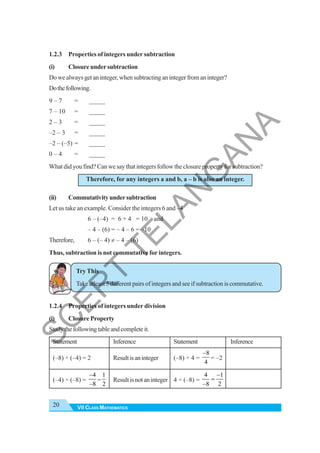
1.2.3 Properties of integers under subtraction
(i) Closure under subtraction
Dowealwaysgetaninteger,whensubtractinganintegerfromaninteger?
Dothefollowing.
9 – 7 = _____
7 – 10 = _____
2 – 3 = _____
–2 – 3 = _____
–2 – (–5) = _____
0 – 4 = _____
What did you find? Can we say that integers follow the closure property for subtraction?
Therefore, for any integers a and b, a – b is also an integer.
(ii) Commutativityundersubtraction
Let us take an example. Consider the integers 6 and –4
6 – (–4) = 6 + 4 = 10 and
– 4 – (6) = – 4 – 6 = –10
Therefore, 6 – (– 4) ≠ – 4 – (6)
Thus, subtraction is not commutative for integers.
Try This
Takeatleast5differentpairsofintegersandseeifsubtractioniscommutative.
1.2.4 Properties of integers under division
(i) Closure Property
Studythefollowingtableandcompleteit.
Statement Inference Statement Inference
(–8) ÷ (–4) = 2 Resultisaninteger (–8) ÷ 4 =
8
4
−
= –2
(–4) ÷ (–8) =
4
8
−
−
=
1
2
Resultisnotaninteger 4 ÷ (–8) =
4 1
8 2
−
=
−
S
C
E
R
T
T
E
L
A
N
G
A
N
A
21
INTEGERS
Free distribution byT.S. Government 2020-21
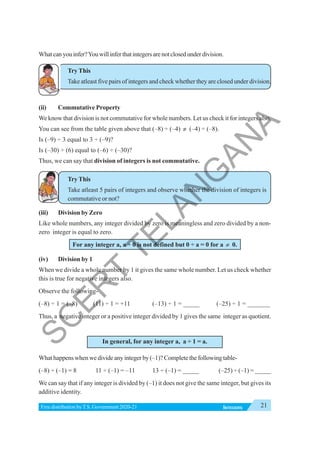
Whatcanyouinfer?Youwillinferthatintegersarenotclosedunderdivision.
Try This
Take atleast five pairs of integers and check whether they are closed under division.
(ii) Commutative Property
We know that division is not commutative for whole numbers. Let us check it for integers also.
You can see from the table given above that (–8) ÷ (–4) ≠ (–4) ÷ (–8).
Is (–9) ÷ 3 equal to 3 ÷ (–9)?
Is (–30) ÷ (6) equal to (–6) ÷ (–30)?
Thus, we can say that division of integers is not commutative.
Try This
Take atleast 5 pairs of integers and observe whether the division of integers is
commutative or not?
(iii) Division by Zero
Like whole numbers, any integer divided by zero is meaningless and zero divided by a non-
zero integer is equal to zero.
For any integer a, a ÷ 0 is not defined but 0 ÷ a = 0 for a ≠ 0.
(iv) Division by 1
When we divide a whole number by 1 it gives the same whole number. Let us check whether
this is true for negative integers also.
Observe the following-
(–8) ÷ 1 = (–8) (11) ÷ 1 = +11 (–13) ÷ 1 = _____ (–25) ÷ 1 = _______
Thus, a negative integer or a positive integer divided by 1 gives the same integer as quotient.
In general, for any integer a, a ÷ 1 = a.
What happens when we divide any integer by (–1)? Complete the following table-
(–8) ÷ (–1) = 8 11 ÷ (–1) = –11 13 ÷ (–1) = _____ (–25) ÷ (–1) = _____
We can say that if any integer is divided by (–1) it does not give the same integer, but gives its
additive identity.
S
C
E
R
T
T
E
L
A
N
G
A
N
A
VII CLASS MATHEMATICS
22
Try This
1. For any integer a, is
(i) a ÷ 1 = 1?
(ii) a ÷ (–1) = –a?
Take different values of ‘a’and check.
(iii) Associative property
Is [(–16) ÷ 4] ÷ (–2) = (–16) ÷ [4 ÷ (–2)]?
[(–16) ÷ 4] ÷ (–2) = (–4) ÷ (–2) = 2
(–16) ÷ [4 ÷ (–2)] = (–16) ÷ (–2) = 8
Therefore,[(–16) ÷ 4] ÷ (–2) ≠ (–16) ÷ [4 ÷ (–2)]
Thus,divisionofintegersisnotassociative.
Try This
Takeatleastfivemoreexamplesandcheckwhetherdivisionisassociativeforintegers.
Exercise - 6
1. Fillthefollowingblanks.
(i) –25 ÷ ........ = 25
(ii) ........ ÷ 1 = –49
(iii) 50 ÷ 0 = .....................
(iv) 0 ÷ 1 = .....................
1.3 Some practical problems using negative numbers
Example 1 : In a test (+5) marks are given for every correct answer and (–2) marks are given
for every incorrect answer. (i) Radhika answered all the questions and scored 30
marks through 10 correct answers. (ii) Jaya also answered all the questions and
scored(–12)marksthrough4correctanswers.Howmanyincorrectanswershad
both Radhika and Jaya attempted?
Solution: (i) Marks given for one correct answer = 5
So marks given for 10 correct answers = 5 × 10 = 50
Radhika’s score = 30
Marks obtained for incorrect answers = 30 – 50 = –20
Marks given for one incorrect answer = (–2)
Therefore,numberofincorrectanswers = (–20) ÷ (–2) = 10
S
C
E
R
T
T
E
L
A
N
G
A
N
A
23
INTEGERS
Free distribution byT.S. Government 2020-21
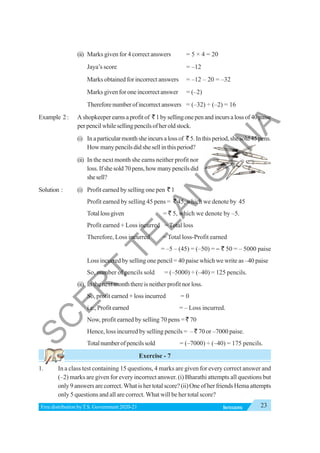
(ii) Marks given for 4 correct answers = 5 × 4 = 20
Jaya’s score = –12
Marks obtained for incorrect answers = –12 – 20 = –32
Marks given for one incorrect answer = (–2)
Thereforenumberofincorrectanswers = (–32) ÷ (–2) = 16
Example 2: Ashopkeeperearnsaprofitof `1bysellingonepenandincursalossof40paise
perpencilwhilesellingpencilsofheroldstock.
(i) Inaparticularmonthsheincursalossof `5.Inthisperiod,shesold45pens.
Howmanypencilsdidshesellinthisperiod?
(ii) In the next month she earns neither profit nor
loss.Ifshesold70pens,howmanypencilsdid
shesell?
Solution : (i) Profit earned by selling one pen ` 1
Profit earned by selling 45 pens = ` 45, which we denote by 45
Totallossgiven = ` 5, which we denote by –5.
Profit earned + Loss incurred = Total loss
Therefore, Loss incurred = Total loss-Profit earned
= –5 – (45) = (–50) = – ` 50 = – 5000 paise
Loss incurred by selling one pencil = 40 paise which we write as –40 paise
So, number of pencils sold = (–5000) ÷ (–40) = 125 pencils.
(ii) Inthenextmonththereisneitherprofitnorloss.
So, profit earned + loss incurred = 0
i.e., Profit earned = – Loss incurred.
Now, profit earned by selling 70 pens = ` 70
Hence, loss incurred by selling pencils = – ` 70 or –7000 paise.
Totalnumberofpencilssold = (–7000) ÷ (–40) = 175 pencils.
Exercise - 7
1. In a class test containing 15 questions, 4 marks are given for every correct answer and
(–2) marks are given for every incorrect answer. (i) Bharathi attempts all questions but
only9answersarecorrect.Whatishertotalscore?(ii)OneofherfriendsHemaattempts
only 5 questions and all are correct. What will be her total score?
S
C
E
R
T
T
E
L
A
N
G
A
N
A
VII CLASS MATHEMATICS
24
2. A cement company earns a profit of ` 9 per bag of white cement sold and a loss of
` 5 per bag of grey cement sold.
(i) Thecompanysells7000bagsofwhitecementand6000bagsofgreycementina
month. What is its profit or loss?
(ii) What is the number of white cement bags it must sell to have neither profit nor
loss, if the number of grey bags sold is 5400.
3. The temperature at 12 noon was 10o
C above zero. If it decreases at the rate of 2o
C per
houruntilmidnight,atwhattimewouldthetemperaturebe8o
Cbelowzero?Whatwould
bethetemperatureatmidnight?
4. In a class test (+3) marks are given for every correct answer and (–2) marks are given for
everyincorrectanswerandnomarksfornotattemptinganyquestion.(i)Radhikascored
20 marks. If she has got 12 correct answers, how many questions has she attempted
incorrectly?(ii)Mohiniscores(–5)marksinthistest,thoughshehasgot7correctanswers.
Howmanyquestionshassheattemptedincorrectly?
5. An elevator descends into a mine shaft at the rate of 6 meters per minute. If the descent
starts from 10 m above the ground level, how long will it take to reach – 350 m.
Looking Back
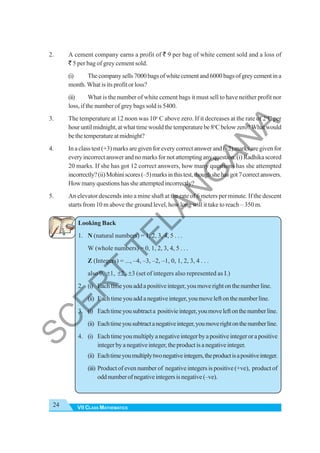
1. N (natural numbers) = 1, 2, 3, 4, 5 . . .
W (whole numbers) = 0, 1, 2, 3, 4, 5 . . .
Z (Integers) = ..., –4, –3, –2, –1, 0, 1, 2, 3, 4 . . .
also 0, ±1, ±2, ±3 (set of integers also represented as I.)
2. (i) Eachtimeyouaddapositiveinteger,youmoverightonthenumberline.
(ii) Eachtimeyouaddanegativeinteger,youmoveleftonthenumberline.
3. (i) Eachtimeyousubtracta positivieinteger,youmoveleftonthenumberline.
(ii) Eachtimeyousubtractanegativeinteger,youmoverightonthenumberline.
4. (i) Eachtimeyoumultiplyanegativeintegerbyapositiveintegerorapositive
integerbyanegativeinteger,theproductisanegativeinteger.
(ii) Eachtimeyoumultiplytwonegativeintegers,theproductisapositiveinteger.
(iii) Product of even number of negative integers is positive (+ve), product of
oddnumberofnegativeintegersisnegative(–ve).
S
C
E
R
T
T
E
L
A
N
G
A
N
A
25
INTEGERS
Free distribution byT.S. Government 2020-21
5. (i) Eachtimeyoudivideanegativeintegerbyapositiveintegerorapositiveintegerby
anegativeintegerthequotientisnegativeinteger.
(ii) Each time you divide negative integer by a negative integer the quotient is positive
integer.
(iii) Whenyoumultiplyordividetwointegersofsamesigntheresultisalwayspositive;
iftheyareofoppositesignstheresultisnegative.
6. Thefollowingarethepropetiessatisfiedbyadditionandsubtractionofintegers-
(i) Integersareclosedforadditionandsubtractionboth.i.e.,a+banda–bareintegers,
where a and b are any integers.
(ii) Additioniscommutativeforintegers,i.e.,a+b=b+a,forallintegersaandb.
(iii) Addition is associative for integers, i.e., (a+b) + c = a + (b + c), for all integers a, b,
and c.
(iv) Integer 0 is the identity under addition, i.e., a + 0 = 0 + a = a, for every integer a.
7. Integersshowsomepropertiesundermultiplication.
(i) Integersareclosedundermultiplication.i.e.,a×bisanintegerforanytwointegers
a and b.
(ii) Multiplicationiscommutativeforintegers.i.e.,a×b=b×aforanyintegersaandb.
(iii) Theinteger1istheidentityundermultiplication,i.e.,1×a=a×1=a,foranyintegera.
(iv) Multiplication is associative for integers, i.e., (a×b) × c = a × (b×c) for any three
integers a, b, and c.
8. In integers multiplication distributes over addition. i.e., a × (b+c) = a ×b + a × c for any
three integers a, b and c.This is called distributive property.
9. Thepropertiesofcommutativityandassociativityunderadditionandmultiplicationand
thedistributivepropertyhelpus makeourcalculationseasier.
10. For any integer a, we have
(i) a ÷ 0 is not defined or meaningless
(ii) 0 ÷ a = 0 (for a ≠ 0)
(iii) a ÷ 1 = a
S
C
E
R
T
T
E
L
A
N
G
A
N
A
26 VII CLASS MATHEMATICS
FRACTIONS, DECIMALS
AND RATIONAL NUMBERS 2
2.0 Introduction
We come across many examples in our day-to-day life where we use fractions. Just try to recall
them. We have learnt how to represent proper and improper fractions and their addition and
subtractioninthepreviousclass.Letusreviewwhatwehavealreadylearntandthengofurtherto
multiplicationanddivisionoffractionalnumbersaswellasofdecimalfractions.Wewillconclude
byanintroductiontoabiggersetofnumberscalledrationalnumbers.
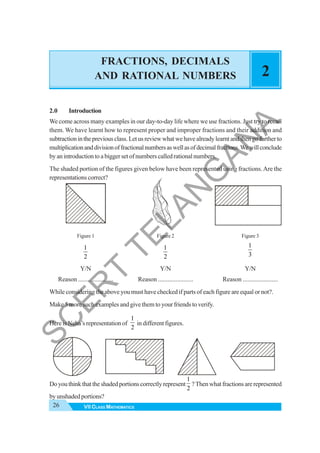
The shaded portion of the figures given below have been represented using fractions.Are the
representations correct?
Figure 1 Figure 2 Figure 3
1
2
1
2
1
3
Y/N Y/N Y/N
Reason ...................... Reason ...................... Reason ......................
While considering the above you must have checked if parts of each figure are equal or not?.
Make 5 more such examples and give them to your friends to verify.
Here is Neha’s representation of
1
2
in different figures.
Doyouthinkthattheshadedportionscorrectlyrepresent
1
2
?Thenwhatfractionsarerepresented
by unshaded portions?
S
C
E
R
T
T
E
L
A
N
G
A
N
A
27
FRACTIONS, DECIMALS AND RATIONAL NUMBERS
Free distribution byT.S. Government 2020-21
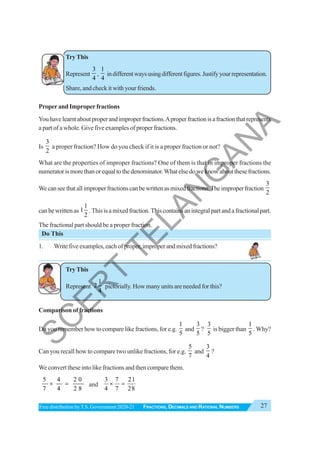
TryThis
Represent
3
4
,
1
4
indifferentwaysusingdifferentfigures.Justifyyourrepresentation.
Share, and check it with your friends.
ProperandImproperfractions
Youhavelearntaboutproperandimproperfractions.Aproperfractionisafractionthatrepresents
a part of a whole. Give five examples of proper fractions.
Is
3
2
a proper fraction? How do you check if it is a proper fraction or not?
What are the properties of improper fractions? One of them is that in improper fractions the
numeratorismorethanorequaltothedenominator.Whatelsedoweknowaboutthesefractions.
Wecanseethatallimproperfractionscanbewrittenasmixedfractions.Theimproperfraction
3
2
canbewrittenas
1
1
2
.Thisisamixedfraction.Thiscontainsanintegralpartandafractionalpart.
The fractional part should be a proper fraction.
Do This
1. Writefiveexamples,eachofproper,improperandmixedfractions?
TryThis
Represent
1
2
4
pictorially. How many units are needed for this?
Comparison of fractions
Do you remember how to compare like fractions, for e.g.
1
5
and
3
5
?
3
5
is bigger than
1
5
. Why?
Can you recall how to compare two unlike fractions, for e.g.
5
7
and
3
4
?
We convert these into like fractions and then compare them.
5 4 2 0
7 4 2 8
× = and
3 7 21
4 7 28
× =
S
C
E
R
T
T
E
L
A
N
G
A
N
A
28 VII CLASS MATHEMATICS
Since
5 20
7 28
= and
3 21
4 28
=
Thus,
5 3
7 4
<
Do These
1. Writefiveequivalentfractionsfor (i)
3
5
(ii)
4
7
.
2. Which is bigger
5
8
or
3
5
?
3. Determineifthefollowingpairsareequalbywritingeachintheirsimplestform.
(i)
3
8
and
375
1000
(ii)
18
54
and
23
69
(iii)
6
10
and
600
1000
(iv)
17
27
and
25
45
You have already learnt about addition and subtraction of fractions in class VI. Let us
solve some problems now.
Example 1 : Razia completes
3
7
part of her homework while Rekha completed
4
9
of it. Who
has completed the least part?
Solution : To find this we have to compare
3
7
and
4
9
.
Convertingthemtolikefractionswehave
3 27 4 28
,
7 63 9 63
= =
27 28
63 63
<
Thus,
27 28
63 63
〈 and so
3 4
7 9
<
Razia has completed a least part of her homework than Rekha.
Example 2 : Shankar’s family consumed
1
3
2
kg sugar in the first 15 days of a month. For the
next15daystheyconsumed
3
3
4
kgsugar.Howmuchsugardidtheyconsumefor
thewholemonth?
S
C
E
R
T
T
E
L
A
N
G
A
N
A
29
FRACTIONS, DECIMALS AND RATIONAL NUMBERS
Free distribution byT.S. Government 2020-21
Solution : Thetotalweightofthesugarforthewholemonth
=
1 3
3 3
2 4
⎛ ⎞
+
⎜ ⎟
⎝ ⎠
kg
=
7 15
2 4
⎛ ⎞
+
⎜ ⎟
⎝ ⎠
kg =
7 2 15
2 2 4
×
⎛ ⎞
+
⎜ ⎟
×
⎝ ⎠
kg =
14 15
4 4
⎛ ⎞
+
⎜ ⎟
⎝ ⎠
kg
29
4
= kg =
1
7
4
kg.
Example 3 : AtAhmed’s birthday party,
5
7
part of the total cake was distributed. Find how
muchcakeisleft?
Solution : Total cake is one = 1 or
1
1
Cake distributed =
5
7
The cake left =
5
1
7
− =
1 7 5
1 7 7
×
−
×
=
7 5 2
7 7 7
− =
Thus,
2
7
part of the total cake is left now.
Exercise - 1
1. Compute and express the result as a mixed fraction?
(i)
3
2
4
+ (ii)
7 1
9 3
+ (iii)
4
1
7
−
(iv)
2 1
2
3 2
+ (v)
5 1
8 6
− (vi)
2 1
2 3
3 2
+
2. Arrangethefollowinginascendingorder.
(i)
5 5 1
, ,
8 6 2
(ii)
2 1 3
, ,
5 3 10
S
C
E
R
T
T
E
L
A
N
G
A
N
A
30 VII CLASS MATHEMATICS
3. Checkinthefollowingsquare,whetherinthissquarethesumofthenumbersineachrow
andineachcolumnandalongthediagonalsisthesame.
6
13
13
13
2
13
3
13
7
13
11
13
12
13
1
13
8
13
4. Arectangular sheet of paper is
2
5
3
cm long and
1
3
5
cm wide. Find its perimeter.
5. The recipe requires
1
3
4
cups of flour. Radha has
3
1
8
cups of flour. How many more cups
of flour does she need?
6. Abdul is preparing for his final exam. He has completed
5
12
part of his course content.
Find out how much course content is left?
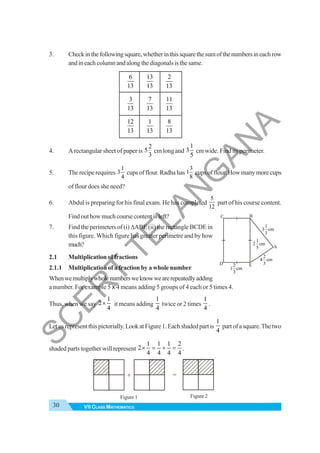
7. Find the perimeters of (i) ΔABE (ii) the rectangle BCDE in
this figure. Which figure has greater perimetre and by how
much?
2.1 Multiplication of fractions
2.1.1 Multiplication of a fraction by a whole number
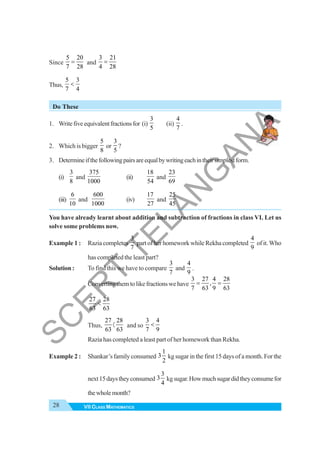
Whenwemultiplywholenumbersweknowwearerepeatedlyadding
a number. For example 5 x 4 means adding 5 groups of 4 each or 5 times 4.
Thus, when we say
1
2
4
× it means adding
1
4
twice or 2 times
1
4
.
Letusrepresentthispictorially.LookatFigure1.Eachshadedpartis
1
4
partofasquare.Thetwo
shaded parts together will represent
1 1 1 2
2
4 4 4 4
× = + = .
1
3 cm
3
2
4 cm
3
1
2 cm
5
2
1 cm
3
A
B
C
D E
Figure 1 Figure 2
=
+
S
C
E
R
T
T
E
L
A
N
G
A
N
A
31
FRACTIONS, DECIMALS AND RATIONAL NUMBERS
Free distribution byT.S. Government 2020-21
Let us now find
1
3
2
× . This means three times
1
2
or three halves.
We have
1 1 1 1 3
3
2 2 2 2 2
× = + + =
Do This
1. Find (i)
2
4
7
× (ii)
3
4
5
× (iii)
1
7
3
×
The fractions that we have considered till now, i.e.,
1 2 2
, ,
2 3 7
and
3
5
are proper fractions.
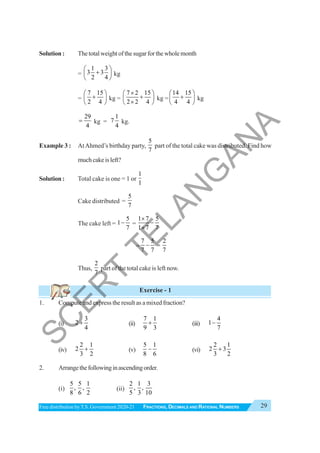
Let us consider some improper fractions like
5
3
.and how to multiply
5
2
3
×
5 5 5 10 1
2 3
3 3 3 3 3
× = + = =
Pictorially
+ =
5
3
+
5
3
=
10
3
=
1
3
3
Do This
1. Find (i)
3
5
2
× (ii)
7
4
5
× (iii)
8
7
3
×
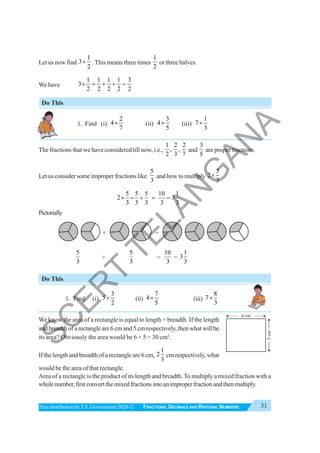
We know the area of a rectangle is equal to length × breadth. If the length
andbreadthofarectangleare6cmand5cmrespectively,thenwhatwillbe
its area? Obviously the area would be 6 × 5 = 30 cm2
.
If the length and breadth of a rectangle are 6 cm,
1
2
3
cm respectively, what
would be the area of that rectangle.
Area of a rectangle is the product of its length and breadth.To multiply a mixed fraction with a
wholenumber,firstconvertthemixedfractionsintoanimproperfractionandthenmultiply.
6 cm
5
cm
S
C
E
R
T
T
E
L
A
N
G
A
N
A
32 VII CLASS MATHEMATICS
Therefore, area of a rectangle =
1
6 2
3
×
=
7 42
6
3 3
× = cm2
= 14cm2
You might have realised by now that to multiply a whole number with a proper or an
improperfraction,wemultiplythewholenumberwiththenumeratorofthefraction,keeping
the denominator the same.
Do These
1. Findthefollowing.
(i)
2
3 2
7
× (ii)
1
5 2
3
× (iii)
1
8 4
7
× (iv)
2
4 1
9
× (v)
1
5 1
3
×
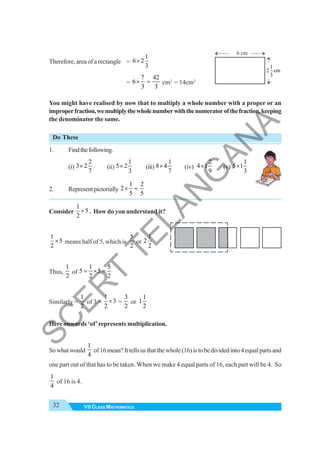
2. Representpictorially
1 2
2
5 5
× =
Consider
1
5
2
× . How do you understand it?
1
5
2
× means half of 5, which is
5
2
or
1
2
2
Thus,
1
2
of
1 5
5 5
2 2
= × =
Similarly =
1
2
of 3 =
1
3
2
× =
3
2
or
1
1
2
Here onwards ‘of’represents multiplication.
Sowhatwould
1
4
of16mean?Ittellsusthatthewhole(16)istobedividedinto4equalpartsand
one part out of that has to be taken. When we make 4 equal parts of 16, each part will be 4. So
1
4
of 16 is 4.
6 cm
1
2 cm
3
S
C
E
R
T
T
E
L
A
N
G
A
N
A
33
FRACTIONS, DECIMALS AND RATIONAL NUMBERS
Free distribution byT.S. Government 2020-21
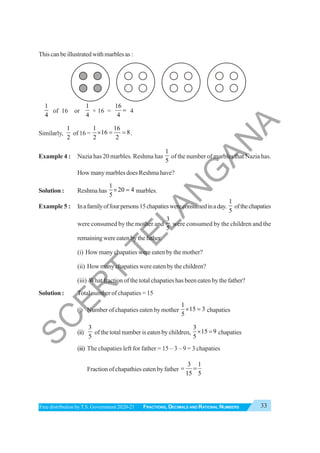
Thiscanbeillustratedwithmarblesas:
1
4
of 16 or
1
4
× 16 =
16
4
= 4
Similarly,
1
2
of 16 =
1 16
16 8
2 2
× = = .
Example 4 : Nazia has 20 marbles. Reshma has
1
5
of the number of marbles that Nazia has.
How many marbles does Reshma have?
Solution : Reshma has
1
20 4
5
× = marbles.
Example 5 : Inafamilyoffourpersons15chapatieswereconsumedinaday.
1
5
ofthechapaties
were consumed by the mother and
3
5
were consumed by the children and the
remainingwereeatenbythefather.
(i) How many chapaties were eaten by the mother?
(ii) How many chapaties were eaten by the children?
(iii) What fraction of the total chapaties has been eaten by the father?
Solution : Total number of chapaties = 15
(i) Number of chapaties eaten by mother
1
15 3
5
× = chapaties
(ii)
3
5
of the total number is eaten by children,
3
15 9
5
× = chapaties
(iii) The chapaties left for father = 15 – 3 – 9 = 3 chapaties
Fraction of chapathies eaten by father
3 1
15 5
= =
S
C
E
R
T
T
E
L
A
N
G
A
N
A
34 VII CLASS MATHEMATICS
Exercise - 2
1. Multiplythefollowing.Writetheanswerasamixedfraction.
(i)
3
10
6
× (ii)
1
4
3
× (iii)
6
2
7
× (iv)
2
5
9
× (v)
2
15
5
×
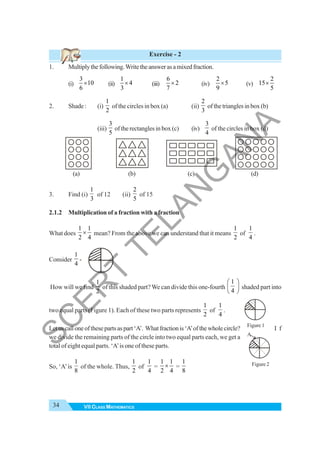
2. Shade : (i)
1
2
of the circles in box (a) (ii)
2
3
of the triangles in box (b)
(iii)
3
5
of the rectangles in box (c) (iv)
3
4
of the circles in box (d)
(a) (b) (c) (d)
3. Find (i)
1
3
of 12 (ii)
2
5
of 15
2.1.2 Multiplication of a fraction with a fraction
What does
1 1
2 4
× mean? From the above we can understand that it means
1
2
of
1
4
.
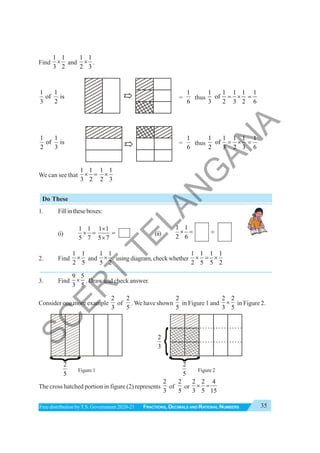
Consider
1
4
-
How will we find
1
2
of this shaded part? We can divide this one-fourth
1
4
⎛ ⎞
⎜ ⎟
⎝ ⎠
shaded part into
two equal parts (Figure 1). Each of these two parts represents
1
2
of
1
4
.
Letuscalloneofthesepartsaspart‘A’. Whatfractionis‘A’ofthewholecircle? I f
we divide the remaining parts of the circle into two equal parts each, we get a
total of eight equal parts. ‘A’is one of these parts.
So, ‘A’is
1
8
of the whole. Thus,
1
2
of
1
4
=
1 1
2 4
× =
1
8
Figure 1
A
Figure 2
S
C
E
R
T
T
E
L
A
N
G
A
N
A
35
FRACTIONS, DECIMALS AND RATIONAL NUMBERS
Free distribution byT.S. Government 2020-21
Find
1 1
3 2
× and
1 1
2 3
× .
1 1
of is
3 2
=
1
6
thus
1 1 1 1 1
of
3 2 3 2 6
= × =
1 1
of is
2 3
=
1
6
thus
1 1 1 1 1
of
2 3 2 3 6
= × =
We can see that
1 1 1 1
3 2 2 3
× = ×
Do These
1. Fillintheseboxes:
(i)
1 1 1 1
5 7 5 7
×
× = =
×
(ii)
1 1
2 6
× = =
2. Find
1 1
2 5
× and
1 1
5 2
× usingdiagram,checkwhether
1 1 1 1
2 5 5 2
× = ×
3. Find
9 5
3 5
× . Draw and check answer.
Consider one more example
2
3
of
2
5
. We have shown
2
5
in Figure 1 and
2 2
3 5
× in Figure 2.
Figure 1 Figure 2
The cross hatched portion in figure (2) represents
2
3
of
2
5
or
2 2 4
3 5 15
× =
2
5
2
5
2
3
S
C
E
R
T
T
E
L
A
N
G
A
N
A
36 VII CLASS MATHEMATICS
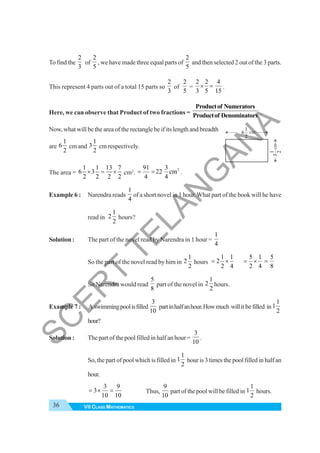
To find the
2
3
of
2
5
, we have made three equal parts of
2
5
and then selected 2 out of the 3 parts.
This represent 4 parts out of a total 15 parts so
2
3
of
2
5
=
2 2 4
3 5 15
× = .
Here, we can observe that Product of two fractions =
Productof Numerators
Productof Denominators .
Now, what will be the area of the rectangle be if its length and breadth
are
1
6
2
cm and
1
3
2
cm respectively.
The area =
1 1 13 7
6 3
2 2 2 2
× = × cm2
.
2
91 3
22 cm
4 4
= = .
Example 6 : Narendra reads
1
4
of a short novel in 1 hour.What part of the book will he have
read in
1
2
2
hours?
Solution : The part of the novel read by Narendra in 1 hour =
1
4
So the part of the novel read by him in
1
2
2
hours
1 1
2
2 4
= ×
5 1 5
2 4 8
= × =
So Narendra would read
5
8
part of the novel in
1
2
2
hours.
Example 7 : A swimmingpoolisfilled
3
10
partinhalfanhour.Howmuch willit be filled in
1
1
2
hour?
Solution : The part of the pool filled in half an hour =
3
10
.
So, the part of pool which is filled in
1
1
2
hour is 3 times the pool filled in half an
hour.
3 9
3
10 10
= × = Thus,
9
10
part of the pool will be filled in
1
1
2
hours.
cm
cm
1
6
2
1
3
2
S
C
E
R
T
T
E
L
A
N
G
A
N
A
37
FRACTIONS, DECIMALS AND RATIONAL NUMBERS
Free distribution byT.S. Government 2020-21
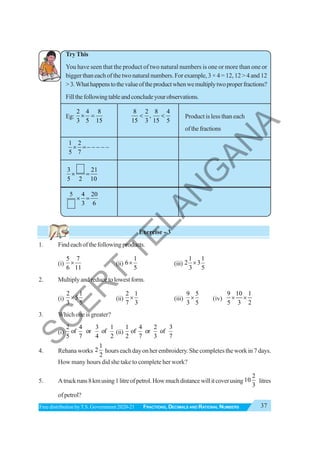
TryThis
You have seen that the product of two natural numbers is one or more than one or
bigger than each of the two natural numbers. For example, 3 × 4 = 12, 12 > 4 and 12
>3.Whathappenstothevalueoftheproductwhenwemultiplytwoproperfractions?
Fillthefollowingtableandconcludeyourobservations.
Eg:
2 4 8
3 5 15
× =
8 2 8 4
,
15 3 15 5
< < Product is less than each
ofthefractions
1 2
5 7
× =− − − − −
3 21
5 2 10
× =
5 4 20
3 6
× =
Exercise - 3
1. Findeachofthefollowingproducts.
(i)
5 7
6 11
× (ii)
1
6
5
× (iii)
1 1
2 3
3 5
×
2. Multiplyandreducetolowestform.
(i)
2 1
5
3 5
× (ii)
2 1
7 3
× (iii)
9 5
3 5
× (iv)
9 10 1
5 3 2
× ×
3. Which one is greater?
(i)
2 4 3 1
of or of
5 7 4 2
(ii)
1 4 2 3
of or of
2 7 3 7
4. Rehanaworks
1
2
2
hourseachdayonherembroidery.Shecompletestheworkin7days.
How many hours did she take to complete her work?
5. Atruckruns8kmusing1litreofpetrol.Howmuchdistancewillitcoverusing
2
10
3
litres
ofpetrol?
S
C
E
R
T
T
E
L
A
N
G
A
N
A
38 VII CLASS MATHEMATICS
6. Raja walks
1
1
2
meters in 1 second. How much distance will he walk in 15 minutes?
7. Provide the number in the box to make the statement true.
(i)
2
3
× =
20
21
. (ii)
5 3
7 5
× =
2.2 Division of fractions
1. Imagine you have 15 meters length of cloth and you want to make pieces of
1
1
2
metres
length each from it. How many
1
1
2
meter pieces will you get? Here we will successively
subtract
1
1
2
meters from 15 meters and see how many times we can do this, till we have
noclothleft.
2. Lookatonemoreexample.Apaperstripoflength
21
2
cmhastobecutintosmallerstrips
of length
3
2
cm each. How many pieces would we get? Clearly, we can cut
3
2
cm each
time or divide
21
2
by
3
2
i.e.,
21 3
2 2
÷ .
3. Letusrecalldivisionwithwholenumbers.In15 3
÷ ,wefindouthowmany3’s arethere
in15.Theanswertothisis5.Similarly,tofindthenumberof2’sin18,wedivide18by2
or 18 ÷ 2 . The answer to this is 9.
Nowcorrelatethesameprocessindividingwholenumbersbyfractionsandfractionsby
fractions.
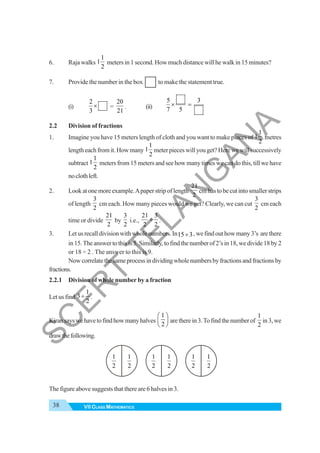
2.2.1 Division of whole number by a fraction
Let us find
1
3
2
÷ .
Kiransayswehavetofindhowmanyhalves
1
2
⎛ ⎞
⎜ ⎟
⎝ ⎠
aretherein3.Tofindthenumberof
1
2
in3,we
drawthefollowing.
The figure above suggests that there are 6 halves in 3.
1
2
1
2
1
2
1
2
1
2
1
2
S
C
E
R
T
T
E
L
A
N
G
A
N
A
39
FRACTIONS, DECIMALS AND RATIONAL NUMBERS
Free distribution byT.S. Government 2020-21
We can therefore say
1
3 6
2
÷ =
Thinkabout
1
2
3
÷
Thismeansfindinghowmanyone-thirds
1
3
⎛ ⎞
⎜ ⎟
⎝ ⎠
aretheretwowholes.Howwouldyoufindthese?
We can see that there are 6 one-thirds in two wholes or
1
2 6
3
÷ =
Do This
Find (i)
1
2
4
÷ (ii)
1
7
2
÷ (iii)
1
3
5
÷
2.2.1a) Reciprocal of a fraction
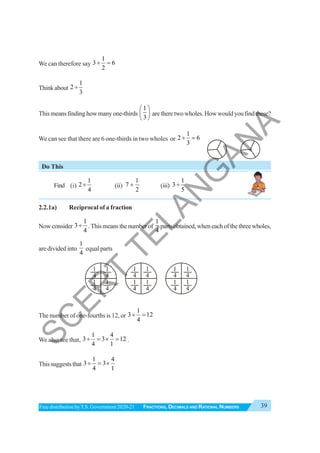
Nowconsider
1
3
4
÷ .Thismeansthenumberof
1
4
partsobtained,wheneachofthethreewholes,
are divided into
1
4
equal parts
The number of one-fourths is 12, or
1
3 12
4
÷ =
We also see that,
1 4
3 3 12
4 1
÷ = × = .
Thissuggeststhat
1 4
3 3
4 1
÷ = ×
1
4
1
4
1
4
1
4
1
4
1
4
1
4
1
4
1
4
1
4
1
4
1
4
S
C
E
R
T
T
E
L
A
N
G
A
N
A
40 VII CLASS MATHEMATICS
Alsoexamine
1
2
3
÷ .
We already found that
1
2
3
÷ = 6
As inthe above example
1 3
2 2 6
3 1
÷ = × =
Similarly,
1
4 16
4
÷ = and
4
4 16
1
× = .
The number
3
1
can be obtained by interchanging the numerator and denominator of
1
3
or by
inverting
1
3
.Similarly,
4
1
isobtainedbyinverting
1
4
.
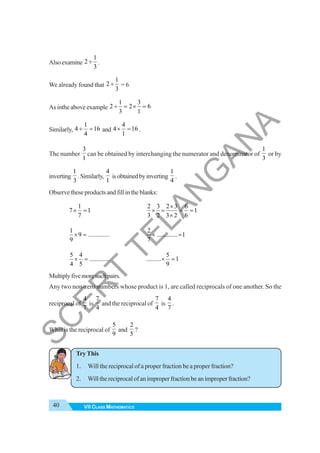
Observe these products and fill in the blanks:
1
7 1
7
× =
2 3 2 3 6
1
3 2 3 2 6
×
× = = =
×
1
9 .............
9
× =
2
............. 1
7
× =
5 4
.............
4 5
× =
5
......... 1
9
× =
Multiplyfivemoresuchpairs.
Any two non-zero numbers whose product is 1, are called reciprocals of one another. So the
reciprocal of
4
7
is
7
4
and the reciprocal of
7
4
is
4
7
.
What is the reciprocal of
5
9
and
2
5
?
Try This
1. Will the reciprocal of a proper fraction be a proper fraction?
2. Willthereciprocalofanimproperfractionbeanimproperfraction?
S
C
E
R
T
T
E
L
A
N
G
A
N
A
41
FRACTIONS, DECIMALS AND RATIONAL NUMBERS
Free distribution byT.S. Government 2020-21
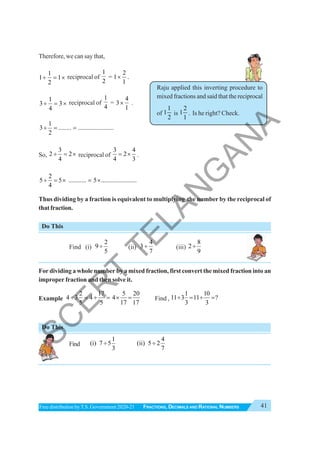
Raju applied this inverting procedure to
mixed fractions and said that the reciprocal
of
1
1
2
is
2
1
1
. Is he right? Check.
Therefore, we can say that,
1
1 1
2
÷ = × reciprocal of
1
2
=
2
1
1
× .
1
3 3
4
÷ = × reciprocal of
1
4
=
4
3
1
× .
1
3 ........ ......................
2
÷ = =
So,
3
2 2
4
÷ = × reciprocal of
3 4
2
4 3
= × .
2
5 5 ........... 5 ......................
4
÷ = × = ×
Thus dividing by a fraction is equivalent to multiplying the number by the reciprocal of
that fraction.
Do This
Find (i)
2
9
5
÷ (ii)
4
3
7
÷ (iii)
8
2
9
÷
For dividing a whole number by a mixed fraction, first convert the mixed fraction into an
improper fraction and then solve it.
Example
2 17 5 20
4 3 4 4
5 5 17 17
÷ = ÷ = × = Find ,
1 10
11 3 11 ?
3 3
÷ = ÷ =
Do This
Find
1
(i) 7 5
3
÷
4
(ii) 5 2
7
÷
S
C
E
R
T
T
E
L
A
N
G
A
N
A
42 VII CLASS MATHEMATICS
2.2.2 Division of a fraction by a whole number
What will
3
3
4
÷ be equal to?
Based on our earlier observations we have :
3 3 3 3 1 3 1
3
4 4 1 4 3 12 4
÷ = ÷ = × = =
So,
2 2 1
5 ?
3 3 5
÷ = × = What is
5 2
6 and 8?
7 7
÷ ÷
For dividing mixed fractions by whole numbers, we convert the mixed fractions into improper
fractions.Forexample
1 7 7 1 7
2 5 5
3 3 3 5 5
÷ = ÷ = × = . Find
2
4 3 .......... ........;
5
÷ = =
3
2 2 .......... ........
5
÷ = =
2.2.3 Division of a fraction by another fraction
We can now find
1 5
4 6
÷ .
1 5 1 5 1 6 6 3
reciprocal of
4 6 4 6 4 5 20 10
÷ = × = × = = .
Similarly,
8 2 8 2
reciprocal of ......... ........
5 3 5 3
÷ = × = =
Do This
Find (i)
3 1
5 2
÷ (ii)
1 3
2 5
÷ (iii)
1 3
2
2 5
÷ (iv)
1 9
5
6 2
÷
Example8:Anemptyswimmingpoolistobefilledupto
9
10
ofitscapacity.Apumptakeshalfan
hour to fill
3
10
of the pool, how long will it take to fill
9
10
of the pool?
Solution :We need to find how many
3
10
’s are there in
9
10
, solve the division problem
9 3
10 10
÷ .
3
3
10
10
9
=
× Thus, it would take 3 half an hours, or
1
1
2
hours to fill the pool to its
9
10
.
1 3
and ............ .........
2 4
÷ = =
S
C
E
R
T
T
E
L
A
N
G
A
N
A
43
FRACTIONS, DECIMALS AND RATIONAL NUMBERS
Free distribution byT.S. Government 2020-21
Exercise 4
1. Findthereciprocalofeachofthefollowingfractions.
(i)
5
8
(ii)
8
7
(iii)
13
7
(iv)
3
4
2. Find
(i)
3
18
4
÷ (ii)
7
8
3
÷ (iii)
1
3 2
3
÷ (iv)
4
5 3
7
÷
3. Find
(i)
2
3
5
÷ (ii)
7
5
8
÷ (iii)
4 4
9 5
÷
4. Form 5 problems each similar to question 1, 2 and 3 and solve.
5. Deepakcanpaint
2
5
ofahouseinoneday.Ifhecontinuesworkingatthisrate,howmany
days will he take to paint the whole house?
2.3 Decimal numbers or Fractional decimals
InclassVIwehavelearntaboutdecimalnumbersandtheiradditionandsubtraction.Letusreview
ourunderstandingandthenlearnaboutmultiplicationanddivision.
Let us write 12714 in its expanded form:
12714 = 1× 10000 + 2 ×1000 + 7 × ......+ 1 × ...... + 4 × 1
What will the expended form of 12714.2 be?
Youwillfindthatonmovingfromrighttoleft,thevalueincreaseinmultiplesof10.
Now,whathappenswhenwemovefromlefttoright?Youwillfindthatthevaluegets,dividedby
10. Now think, if the unit is divided by 10, what will happen? Remember you have learnt that
1
1 10 0.1
10
÷ = =
so on
10 thousands
=
10 thousand
10 hundreds
=
1thousand
10 tens =
1 hundred
10 units
=
1 ten
1 unit
×10
×10 ×10 ×10 ×10
1 unit
10
÷ 10
÷ 1
1000
or 0.001
10
÷ 10
÷ so on
1
10
or 0.1
10 part
th
1
100
or 0.01
100 part
th
1000 part
th
or or or
10,000 1,000 100 10
S
C
E
R
T
T
E
L
A
N
G
A
N
A
44 VII CLASS MATHEMATICS
Thus, the expanded form of 12714.2 is-
12714.2 = 1× 10000 + 2 ×1000 + 7 × ......+ 1 × ...... + 4 × 1 + 2 ×
1
10
Now find the place value of all the digits of 3.42. You might have noticed that a dot ( . ) or a
decimalpointseparateswholepartofthenumberfromthefractionalpart.Thepartrightsideofthe
decimal point is called the decimal part of the number as it represents a part of 1. The part left to
thedecimalpointiscalledtheintegralpartofthenumber.
In the number 3.42-
3 is at units 4 is at the first 2 is at the second
place place after the place after the
decimalpoint decimalpoint
Placevalue 3 × 1 = 3
1 4
4
10 10
× = or 0.4
1 2
2
100 100
× = or 0.02
Try This
1. Look at the following table and fill up the blank spaces.
Hundreds Tens Units Tenth Hundredths Thousandths Number
(100) (10) (1)
1
10
⎛ ⎞
⎜ ⎟
⎝ ⎠
1
100
⎛ ⎞
⎜ ⎟
⎝ ⎠
1
1000
⎛ ⎞
⎜ ⎟
⎝ ⎠
5 4 7 8 2 9 547.829
0 7 2 1 7 7 _______
3 2 __ __ 5 4 327.154
6 __ 4 __ 2 __ 614.326
2 __ 6 5 __ 2 236.512
2.Writethefollowing numbersintheirexpandedform.
(i) 30.807 (ii) 968.038 (iii) 8370.705
Toconvertmoney,length,weight,etcfromoneunittotheotherweoftenusedecimals.Fore.g.5
paise = `
5
100
= `0.05; 220 g =
220
1000
kg = 0.220 kg ; 5 cm =
5
100
m = 0.05 m
Do This
Find (i) 50 paise = ` _____ (ii) 22 g = _____ kg (iii) 80 cm = m
S
C
E
R
T
T
E
L
A
N
G
A
N
A
45
FRACTIONS, DECIMALS AND RATIONAL NUMBERS
Free distribution byT.S. Government 2020-21
2.3.1 Comparison of decimal numbers
Who has more money?
Abhishek and Neha have ` 375.50 and `375.75 respectively in their kiddy bank. To find who
hasmoremoney,wefirstcomparethedigitsontheleftofthedecimalpoint.Sinceboththechildren
have`375wecomparethedigitstotherightofthedecimalpointstartingfromthetenthplace.We
findthatAbhishekhas7tenthsandNehahas5tenths,7tenths>5tenths,therefore,Abhishekhas
more money than Neha, i.e., 375.75 > 375.50.
Nowcomparequickly,whichofthefollowingpairofnumbersisgreater?
(i) 37.65 and 37.60 (ii) 1.775 with 19.780 (iii) 364.10 and 363.10
Make 15 more pairs and compare greater and smaller.
Let us see how to add or subtract decimals.
(i) 221.85 + 37.10 (ii) 39.70 - 6.85
221.85 39.70
+37.10 - 06.85
258.95 32.85
Do This
Find (i) 0.25 + 5.30 (ii) 29.75 - 25.97.
Example9: The equal sides of an isosceles triangle are 3.5 cm each and the other side is 2.5
cm.Whatistheperimeterofthetriangle?
Solution: The sides of isosceles triangle are 3.5 cm, 3.5 cm and 2.5 cm. Therefore, the
perimeterofthegiventriangleis=sumoflengthsofthreesides=3.5cm+3.5cm
+ 2.5 cm = 9.5 cm
Exercise - 5
1. Which one is greater? 1 cm = 10 mm
(i) 0.7 or 0.07 (ii) 7 or 8.5 1 m = 100cm
(iii) 1.47 or 1.51 (iv) 6 or 0.66 1 km = 1000m
2. Expressthefollowingasrupeesusingdecimals. 1 kg = 1000gm
(i) 9 paise (ii) 77 rupees 7 paise (iii) 235 paise
3. (i) Express 10 cm in metre and kilometre.
(ii) Express45mmincentimeter,meterandkilometer.
While adding or subtracting
decimal numbers, the digits in
the same places must be added
or subtracted, i.e., while
writing numbers one below the
other, see that decimal points
must come one below the other.
Decimal places may be made
equal by placing zeroes on the
right side of the decimal
number.
S
C
E
R
T
T
E
L
A
N
G
A
N
A
46 VII CLASS MATHEMATICS
4. Expressthefollowinginkilograms.
(i) 190 g (ii) 247 g (iii) 44 kg 80 gm
5. Writethefollowingdecimalnumbersinexpandedform.
(i) 55.5 (ii) 5.55 (iii) 303.03
(iv) 30.303 (v) 1234.56
6. Writetheplacevalueof 3 inthefollowingdecimalnumbers.
(i) 3.46 (ii) 32.46 (iii) 7.43
(iv) 90.30 (v) 794.037
7. Aruna and Radha start their journey from two different
places.Aand E.Aruna chose the path fromAto B then to
C, while Radha chose the path from E to D then to C.
Find who travelled more and by how much?
8. Upendra went to the market to buy vegetables. He brought 2 kg 250 gm tomatoes,
2kg500gmpotatoes,750gmladyfingersand125gmgreenchillies.Howmuchweight
did Upendra carry back to his house?
2.4 Multiplication of decimal numbers
Rajendraofclass7wentwithhismothertothebazartobuyvegetables.Theretheypurchased2.5
kg potatoes at the rate of ` 8.50 per kg. How much money do they need to pay?
Wecomeacrossvarioussituationsinday-to-daylifewhereweneedtoknowhowtomultiplytwo
decimals.Letusnowlearnthemultiplicationoftwodecimalnumbers.
Let us first multiply- 0.1 × 0.1
0.1 means one part of 10 parts. This is represented as
1
10
using fractions
andpictoriallyinFig.1.
Thus, 0.1 × 0.1 =
1 1
10 10
× which means
1
10
of
1
10
. So here we are
finding the 10th part of
1
10
. Thus, we divide
1
10
into 10 equal parts and
take one part. This is represented by one square in Figure 2. How many
squares are there in Figure 2? There are 100 squares. So one square
represents one out of 100 or 0.01. So we can conclude that
9.50 km
8.25 km
E
A B
D
C
7 km
3
.
7
5
k
m
2
.
1
0
k
m
4
Figure 1
Figure 1
S
C
E
R
T
T
E
L
A
N
G
A
N
A
47
FRACTIONS, DECIMALS AND RATIONAL NUMBERS
Free distribution byT.S. Government 2020-21
1 1 1
0.1 0.1
10 10 100
× = × = = 0.01
Let us now find 0.4 × 0.2
0.4 × 0.2 =
4 2
10 10
× or
4 2
of
10 10
Pictorially
2
10
4
10
of =
8
100
=
Since there are 8 double shaded squares out of 100, they represent 0.08.
While finding 0.1 × 0.1 and 0.4 × 0.2, you might have noticed that we first multiplied them as
Whole numbers ignoring the decimal point. In 0.1 × 0.1, we found 01× 01 or 1× 1.Similarlyin
0.4 × 0.2 we found 04 × 02 or 4 × 2. The products obtained are 1 and 8 respectively.
We then counted the total number of digits to the right of the decimal point in the numbers being
multiplied.Inboth0.1×0.1and0.4×0.2,thetotalnumberofdigitstotherightofthedecimalpoint
inthenumbersbeingmultipliedis2each.Thus,ineachoftheirproductsweputthedecimalpoint
bycountingtwoplacesfromrighttoleft.
Thus, 0.1 × 0.1 = .01 or 0.01
0.4 × 0.2 = .08 or 0.08
If we had multiplied 0.5 × 0.05 then we would have put the decimal point in the product by
counting three places from right to left i.e. 0.5 × 0.05 = 0.025.
Let us now find 1.2 × 2.5
Multiply 12 and 25. We get 300. In both 1.2 and 2.5, there is 1 digit to the right of the decimal
point. So, count 1 + 1 = 2 digits. From the rightmost digit (i.e., 0) in 300, move two places
towards left. We get 3.00 or 3. Thus, 1.2 × 2.5 = 3
While multiplying 2.5 and 1.25 you will first multiply 25 and 125. For placing the decimal in the
product obtained, we will count 1 + 2 = 3 (Why?). Thus, 2.5 × 1.25 = 3.225.
For any decimal number which has no
integral number part, we generally place a
zero on the left side of decimal point to give
prominance to decimal point.
S
C
E
R
T
T
E
L
A
N
G
A
N
A
48 VII CLASS MATHEMATICS
Do These
1. Find (i) 1.7 × 3 (ii) 2.0 × 1.5 (iii) 2.3 × 4.35
2. Arrange the products obtained in (1) in descending order.
Example 10 : The length of a rectangle is 7.1 cm and its breadth is 2.5 cm. What is the area of
therectangle?
Solution : Lengthoftherectangle = 7.1 cm
Breadthoftherectangle = 2.5 cm
Therefore, area of the rectangle = 7.1 × 2.5 = 17.75 cm2
2.4.1 Multiplication of decimal number by 10, 100, 1000 etc.,
Reshma observed that 3.2 =
32
10
whereas 2.35 =
235
100
. Thus, she found that depending on the
positionofthedecimalpoint,thedecimalnumbercanbeconvertedtoafractionwithdenominator
10 or 100etc., She wondered what would happen if a decimal number is multiplied by 10, 100 or
1000 etc.,
Let us see if we can find a pattern in multiplying numbers by 10 or 100 or 1000.
Have a look at the table given below and fill in the blanks :
1.76 × 10 =
176
100
× 10 = 17.6 2.35 × 10 = ......... 12.356 × 10 = .........
1.76 × 100 =
176
100
× 100 = 176 or 176.0 2.35 × 100 = ......... 12.356 × 100 = .........
1.76 × 1000=
176
100
× 1000 = 1760 or 2.35 ×1000 = ......... 12.356 × 1000 = .........
1760.0
0.5 × 10 =
5
10
× 10 = 5 ; 0.5 ×100 = ......... ; 0.5 × 1000 = .........
Lookatyouranswers.Couldyoufindanypattern?Thedecimalpointintheproductsshiftstothe
right by as many zeroes as in 10, 100, 1000 etc,.
S
C
E
R
T
T
E
L
A
N
G
A
N
A
49
FRACTIONS, DECIMALS AND RATIONAL NUMBERS
Free distribution byT.S. Government 2020-21
2.4.2 Division of decimal numbers
Gopal was preparing a design to decorate his classroom. He needed a few coloured strips of
paperoflength1.6cmeach.Hehadastripofcolouredpaperoflength9.6cm.Howmanypieces
of the required length will he get out of this strip? He thought it would be
9.6
1.6
cm. Is he correct?
Both9.6and1.6aredecimalnumbers.Soweneedtoknowthedivisionofdecimalnumberstoo!
2.4.2 (a) Division by numbers like 10, 100, 1000 etc.,
Let us now divide a decimal number by 10, 100 and 1000.
Consider 31.5 ÷10.
315 315 1 315
31.5 10 10 3.15
10 10 10 100
÷ = ÷ = × = =
Similarly,
315 315 1 315
31.5 100 100 0.315
10 10 100 1000
÷ = ÷ = × = =
Is there a pattern while dividing numbers by 10, 100 or 1000? This may help us in dividing
numbers by 10, 100 or 1000 in a shorter way.
Observe the pattern in the table, given bellow and complete it.
29.5 ÷ 10 = 2.95 132.7 ÷ 10 = .......... 1.5 ÷ 10 = .......... 17.36 ÷ 10 = ..........
29.5 ÷ 100 = 0.295 132.7 ÷ 10 = .......... 1.5 ÷ 100 = .......... 17.36 ÷ 100 = ..........
29.5 ÷ 1000 = 0.0295 132.7 ÷ 1000 = .......... 1.5 ÷ 1000 = ......... 17.36 ÷ 1000 = ..........
2.4.2 (b) Division of a decimal number by a whole number
Let us find
6.4
2
. Remember we also write it as 6.4 ÷ 2.
So,
64 64 1
6.4 2 2
10 10 2
÷ = ÷ = × (as learnt in fractions)
64 1 1 64 1 64 1 32
32 3.2
10 2 10 2 10 2 10 10
× ×
= = = × = × = =
× ×
S
C
E
R
T
T
E
L
A
N
G
A
N
A
50 VII CLASS MATHEMATICS
Now, let us calculate
1296 1296 1 1 1296 1
12.96 4 4 324 3.24
100 100 4 100 4 100
÷ = ÷ = × = × = × =
Do This
1. Find (i) 35.7 ÷ 3 (ii) 25.5 ÷ 3
Example 11 : Find the average of 4.2, 3.8 and 7.6.
Solution : The average of 4.2, 3.8 and 7.6 is
4.2 3.8 7.6 15.6
5.2
3 3
+ +
= =
2.4.2 (c) Division of a decimal number by another decimal number
Letusfindhowwedivideadecimalnumberbyanotherdecimalnumber,Forexample35.5÷0.5.
=
355 5 355 10
71
10 10 10 5
÷ = × =
Thus 35.5 ÷ 0.5 = 71.
Example12:Atruckcoversadistanceof92.5kmin2.5hours.Ifthetruckistravellingatthesame
speed through out the journey what is the distance covered by it in 1 hour?
Solution : Distance travelled by the truck = 92.5 km.
Timerequiredtotravelthisdistance = 2.5 hours.
So distance travelled by it in 1 hour
92.5 925
37
2.5 25
= = = km.
Exercise - 6
1. Solvethefollowing.
(i) 0.3 × 6 (ii) 7 × 2.7 (iii) 2.71 × 5
(iv) 19.7 × 4 (v) 0.05 × 7 (vi) 210.01 × 5
(vii) 2 × 0.86
2. Find the area of a rectangle whose length is 6.2 cm and breadth is 4 cm.
S
C
E
R
T
T
E
L
A
N
G
A
N
A
51
FRACTIONS, DECIMALS AND RATIONAL NUMBERS
Free distribution byT.S. Government 2020-21
3. Solvethefollowing.
(i) 21.3 × 10 (ii) 36.8 × 10 (iii) 53.7 × 10
(iv) 168.07 × 10 (v) 131.1 ×100 (vi) 156.1 × 100
(vii) 3.62 × 100 (viii) 43.07 × 100 (ix) 0.5 × 10
(x) 0.08 × 10 (xi) 0.9 × 100 (xii) 0.03 × 1000
4. A motor bike covers a distance of 62.5 km.consuming one litre of petrol. How much
distance does it cover for 10 litres of petrol?
5. Solvethefollowing.
(i) 1.5 × 0.3 (ii) 0.1 × 47.5 (iii) 0.2 × 210.8
(iv) 4.3 × 3.4 (v) 0.5 × 0.05 (vi) 11.2 × 0.10
(vii) 1.07 × 0.02 (viii) 10.05 × 1.05 (ix) 101.01 × 0.01
(x) 70.01 × 1.1
6. Solvethefollowing.
(i) 2.3 ÷ 100 (ii) 0.45 ÷ 5 (iii) 44.3 ÷ 10
(iv) 127.1 ÷ 1000 (v) 7 ÷ 3.5 (vi) 88.5 ÷ 0.15
(vii) 0.4 ÷ 20
7. A side of a regular polygon is 3.5 cm in length. The perimeter of the polygon is 17.5 cm.
How many sides does the polygon have?
8. Arainfallof 0.896cm.wasrecordedin7hours,whatwastheaverageamountofrainper
hour?
2.5 Introduction to Rational numbers
2.5.1 Positive fractional numbers:
We have learnt about integers and fractions. Let us see how the number line looks when both are
marked on it.
Wehave
1 2 3
, ,
4 4 4
.....between0and1onthenumberline.Allthesearenumbersthatarelessthan
one. We call them as proper fractions and say that all proper fractions lie between 0 and 1.
Similarly, we know
4
3
and
5
3
would lie between 1 and 2. We can recall them as improper
fractions. Allthesearecalledpositivefractionalnumbers.
0 1
–1 2
–2 3
–3 4
–4 1
4
2
4
3
4
4
3
5
3
S
C
E
R
T
T
E
L
A
N
G
A
N
A
52 VII CLASS MATHEMATICS
Do These
1. Write 5 more fractions between (i) 0 and 1 and (ii) 1 and 2.
2. Where does
3
4
5
lie on the number line?
On the left side of 0 we have integers –1, –2, –3 .......
Do the numbers increase or decrease as we move further left on the number line?
Youknowthatnumberdecreasesaswemovefurtherleft.Thefartherthenumberisfrom0onthe
leftthesmalleritis.
Do These
1. Findthegreatestandthesmallestnumbersamongthefollwinggroups?
(i) 2, –2, –3, 4, 0, –5
(ii) –3, –7, –8, 0, –5, –2
2. Writethefollowingnumbersinascendingorder.
(i) –5, –75, 3 – 2, 4,
3
2
(ii)
2
3
,
3
2
, 0, –1, –2, 5
2.5.2 Negative fractional numbers
Consider the pointAshown on the line.
It lies on the number line between 0 and –1. Is it more than 0 or less than 0?
Is it
1
2
? We cannot say it is
1
2
as it is less than zero.
We write A as
1
2
− since it is
1
2
less than zero.
Similarly, B the mid point of –1 and –2 is.
3
2
−
Youcanseethatnegativefractionalnumberslike
1 3 9
, ,
2 2 4
− − − giveuspointsinbetweenanytwo
negativeintegersorbetweenzeroandanegativeinteger.
0 1
–1
B A 2
–2 3
–3
Neha found an easy way to represent
9
4
−
.Shefirstwroteitinamixedfraction
9 1
2
4 4
−
= − and then represented it
between –2 and –3.
S
C
E
R
T
T
E
L
A
N
G
A
N
A
53
FRACTIONS, DECIMALS AND RATIONAL NUMBERS
Free distribution byT.S. Government 2020-21
Do These
1. Onthenumberlinegivenbelowrepresentthefollowingnumbers.
(i)
5
4
−
(ii)
3
2
(iii)
7
4
(iv)
7
4
−
(v)
1
4
−
(vi)
1
4
Make a longer number line and represnet more positive and negative numbers on it.
2. Considerthefollowingnumbersonanumberline.
7
27, ,
8
−
11
,
943
54
,
17
–68, –3,
9
,
6
−
7
2
(i) Which of these are to the left of
(a) 0 (b) –2 (c) 4 (d) 2
(ii) Which of these would be to the right of
(a) 0 (b) –5 (c)
1
3
2
(d)
5
2
−
2.5.3 Rational Numbers
We know 0, 1, 2, 3, 4, 5 are whole numbers. We also know that –7, –6, –5, –4, –3, –2, –1, 0,
1, 2, 3, 4, 5 is a bigger collection of numbers called integers.
Rani says “All whole numbers are integers but the converse is not true.” Do you agree with her?
Rani is right as negative numbers like –6, –5, –4, –3, –2, –1 etc are integers but not whole
numbers.Thus,allwholenumbersareintegersandallintegersarenotwholenumbers.
Wefurtherknowthatpositivefractionalnumberslike
1 1 1 5 11 8
, , , , ,
2 3 4 6 5 8
areratiosofwholenum-
bers.All fractional numbers can in general be written as
1
2
w
w with the condition w1
and w2
are
whole numbers and that w2
is not equal to zero.
TryThis
Write 5 fractional numbers and identify w1
and w2
in each of these.
0
–1
–2 1 2
1
2
−
S
C
E
R
T
T
E
L
A
N
G
A
N
A
54 VII CLASS MATHEMATICS
Rational numbers are a bigger collection of numbers, which includes all integers, all
positive fractional numbers and all negative fractional numbers.
The numbers
7 5 7 2 1 4 17 6
, , , ,0, , , ,
3 2 7 7 4 4 5 1
− − − −
etc. are all rational numbers.
In all these we have a ratio of two integers, thus the numbers in the form of
p
q
, where p
and q are integers except that q is not equal to zero are called as rational numbers.
The set of rational numbers is denoted by Q
Try These
(i) Takeany5integersandmakeallpossiblerationalnumberswiththem.
(ii) Considerany5rationalnumbers.Findoutwhichintegersconstitutethem?
2.5.4 Comparingrationalnumbers
We know that
3
4
and
9
12
are equivalent fractional numbers. We also know that when we com-
parefractionalnumbersweconverteachofthemtoequivalentfractionalnumbersandthencom-
pare the ones with a common denominator.
For example, to compare
3
4
and
5
7
.
Wewriteequivalentfractionalnumbersforboth
3 6 9 12 15 18 21
, , , , ,
4 8 12 16 20 24 28
= and
5 10 15 20
, , .... ...
7 14 21 28
=
We can compare
21
28
with
20
28
as they have same denominators.
21
28
is bigger than
20
28
Therefore,
3 5
4 7
>
S
C
E
R
T
T
E
L
A
N
G
A
N
A
55
FRACTIONS, DECIMALS AND RATIONAL NUMBERS
Free distribution byT.S. Government 2020-21
Try These
1. Write three more equivalent fractions of
3
4
andmarkthemonthenumberline.
What do you observe?
2. Do all equivalent fractions of
6
7
representthesamepointonthenumberline?
Now compare
1
2
−
and
2
3
−
Wewriteequivalentfractionsforboth
1 2 3 4
, ,
2 4 6 8
− − − −
= ..... .....
2 4 6
,
3 6 9
− − −
= ..... .....
We can compare
3
6
−
and
4
6
−
as they have same denominators.
4 3
6 6
− −
<
2 1
3 2
− −
∴ <
Try These
1. Are
1
2
−
and
3
6
−
represent same point on the number line?
2. Are
2
3
−
and
4
6
−
equivalent
Eg:When we place them on the number line we find that they occupy the same point. ThusWe
can say that
1
2
−
and
2
4
−
are equivalent rationals.
S
C
E
R
T
T
E
L
A
N
G
A
N
A
56 VII CLASS MATHEMATICS
Do These
1. Write 5 equivalent rational numbers to (i)
5
2
(ii)
7
9
−
(iii)
3
7
−
2. Identifytheequivalentrationalnumbersineachquestion:
(i)
1 3 2 4
, , ,
2 4 4 8
− − − −
(ii)
1 3 5 10 2 20
, , , , ,
4 4 3 6 4 12
Wecansaythattogetequivalentrationalnumberswemultiplyordividetheintegerinthenumera-
tor and in the denominator by the same number.
Forexample,
For
1
5
we would have
1 2 2
5 2 10
×
=
×
as one equivalent number another is
1 3 3
5 3 15
×
=
×
.
For
2
7
−
we would have
2 2 4
7 2 14
− × −
=
×
as one and
2 3 6
7 3 21
× −
− =
×
as another.
We can go on to build more such equivalent rational numbers, just by multiplying with
1 2 3 4
1 2 3 4
= = = . . .
Exercise - 7
1. Writeanythreeequivalentrationalnumberstoeachofthefollowing
(i)
2
3
(ii)
3
8
−
2. Whatistheequivalentrationalnumberfor
15
36
−
with(i)denominator12 (ii)numerator-75?
3. Markthefollowingrationalnumbersonthenumberline.
(i)
1
2
(ii)
3
4
(iii)
3
2
(iv)
10
3
S
C
E
R
T
T
E
L
A
N
G
A
N
A
57
FRACTIONS, DECIMALS AND RATIONAL NUMBERS
Free distribution byT.S. Government 2020-21
4. Findwhetherthefollowingstatementsaretrueorfalse.
(i)Everyintegerisarationalnumberandviceversa ( )
(ii) In a rational number of the form
p
q
, q must be a non zero integer. ( )
(iii)
5 6 7
, ,
7 7 7
areequivalentrationalnumbers. ( )
(iv)Equivalentrationalnumbersofapositiverationalnumbersareallpositive ( )
2.5.5 Addition and Subtraction of Rational Numbers
Youhavelearnttheadditionandsubtractionoffractionalnumbers.Wecanperformthese
operationsonrationalnumbersalsoinasimilarmanner.
Addition of Rational Numbers
Consider two rational numbers
5
6
and
3
8
.
What is the sum of these two rational numbers?
Let us add them
5 3
6 8
+
To add, we have to take the LCM of the denominators as we do for fractional numbers.
Here LCM of 6, 8 is = 24
First divide the LCM with each of the denominators seperately i.e.
24 ÷ 6 = 4
24 ÷ 8 = 3
Now,wewillmultiplythecorrespondingdenominatorsnumeratorswithappropriatequotients.
than, so we get
5 3
6 8
+ =
5 4 3 3
6 4 8 3
× ×
+
× ×
=
20 9
24 24
+
=
20 9
24
+
=
29
24
Now, let us add
5
6
and
3
8
−
5 3
6 8
⎛ ⎞
+ −
⎜ ⎟
⎝ ⎠
=
5 4 3 3
6 4 8 3
× − ×
⎛ ⎞ ⎛ ⎞
+
⎜ ⎟ ⎜ ⎟
× ×
⎝ ⎠ ⎝ ⎠
=
20 9
24 24
−
⎛ ⎞
+ ⎜ ⎟
⎝ ⎠
=
20 ( 9)
24
+ −
=
11
24
S
C
E
R
T
T
E
L
A
N
G
A
N
A
58 VII CLASS MATHEMATICS
We can do like this way also
5 3
6 8
−
⎛ ⎞
+ ⎜ ⎟
⎝ ⎠
=
(5 4) ( 3 3)
24
× + − ×
=
20 ( 9)
24
+ −
=
11
24
Do This
(i)
4 5
9 12
−
⎛ ⎞
+ ⎜ ⎟
⎝ ⎠
(ii) Add
3
5
−
and
7
15
−
(iii)
10 7
11 10
−
+ (iv)
8 7
15 20
− −
⎛ ⎞
+ ⎜ ⎟
⎝ ⎠
ThinkAnd Discuss
1. Isthesumoftwonaturalnumbersalwaysmorethantheindividualnumbers.
2. If your answer is yes then is this statement true for integers also.
3. Isthistrueforrationalnumbers?
2.5.6 Subtracting Rational Numbers
Let us take the same rational numbers i.e.
5
6
and
3
8
Now, subtract
3
8
from
5
6
5 3
6 8
− =
(5 4) (3 3)
24
× − ×
LCM of 6, 8 is 24
=
20 9
24
−
=
11
24
Let us consider more examples.
(i) Subtract
3
8
−
⎛ ⎞
⎜ ⎟
⎝ ⎠
from
5
6
5 3
6 8
−
⎛ ⎞
−⎜ ⎟
⎝ ⎠
=
(5 4) ( 3 3)
24
× − − ×
=
20 ( 9)
24
− −
=
20 (9)
24
+
=
29
24
S
C
E
R
T
T
E
L
A
N
G
A
N
A
59
FRACTIONS, DECIMALS AND RATIONAL NUMBERS
Free distribution byT.S. Government 2020-21
Do This
(i)
7 5
?
16 12
−
⎛ ⎞
− =
⎜ ⎟
⎝ ⎠
(ii) Subtract
12
7
−
from
15
4
(iii)
8 6
?
15 21
− ⎛ ⎞
− =
⎜ ⎟
⎝ ⎠
ThinkAnd Discuss
(i) Isthedifferenceoftwonaturalnumbersalwaysnumberssmallerthanthegivennumbers?
(ii) Is this true for integers also?
(iii) Isthistrueforrationalnumbers?
Looking back
1. We have learnt that for addition and subtraction of fractions; the fractions
shouldbelikefractions.
2. We have also learnt how to multiply fractions i.e,
Pr oduct of numerators
Product of denominators
3. “of” can be used to represent multiplication. For example,
1
3
of 6 =
1
3
6
×
2
2
= .
4. The product of two proper fractions is less than each of the fractions that are
multiplied.Theproductofaproperandimproperfractionislessthantheimproper
fractionandgreaterthantheproperfraction.Theproductoftwoimproperfractions
is greater than each of the fractions.
5. A reciprocalofafractionisobtainedbyinvertingthe numeratoranddenominator.
6. We have seen how to divide two fractions.
(i) Whiledividingawholenumberwithafraction,wemultiplythewholenumber
withthereciprocalofthatfraction.
(ii) Whiledividingafractionbyawholenumberwemultiplythefractionwiththe
reciprocalofthewholenumber.
(iii) Whiledividingonefractionbyanotherfraction,wemultuiplythefirstfraction
with the reciprocal of the second. So
3 5 3 7 21
4 7 4 5 20
÷ = × = .
S
C
E
R
T
T
E
L
A
N
G
A
N
A
60 VII CLASS MATHEMATICS
7. We also learnt how to multiply two decimal numbers.While multiplying two
decimal numbers, we first multiply them as whole numbers.We then count the
totalnumberofdigitstotherightofthedecimalpointinboththedecimalnumbers
beingmultiplied.Lastly,weputthedecimalpointintheproductbycountingthe
digitsfromitsrightmostplace.
8. To multiply a decimal number by 10, 100, 1000 ... etc., we move the decimal
point in the number to the right by as many places as there are zeros in the
numbers 10, 100, 1000 . . .
9. Wehavelearnthowtodividedecimalnumbers.
(i) To divide a decimal number by a whole number, we first divide them as
whole numbers. We then place the decimal point in the quotient as in the
decimalnumber.
Notethathereweareconsideringonlythosedivisionsinwhichtheremainder
iszero.
(ii) To divide a decimal number by 10, 100, 1000 or any other multiple of 10,
weshiftthedecimalpointinthedecimalnumbertotheleftbyasmanyplaces
as there are zeros in 10, 100, 1000 etc.,
(iii) Whiledividingtwodecimalnumbers,firstshiftthedecimalpointtotheright
byequalnumberofplacesinboth,toconvertthedivisortoawholenumber.
10. Rationalnumbersareabiggercollectionofnumbers,whichincludesallintegers,
allpositivefractionalnumbersandallnegativefractionalnumbers.Inallthesewe
have a ratio of two integers, thus
p
q
represents a rational number.
Inthis i) p, q are integers and
ii) q ≠ 0
The set of rational numbers is denoted by Q
John Napier (Scotland)
1550-1617 AD
Found logarithms.
Introduced napier rods for multiplictions.
Also introduced System of decimal fractions.
S
C
E
R
T
T
E
L
A
N
G
A
N
A
61
SIMPLE EQUATIONS
Free distribution byT.S. Government 2020-21
SIMPLE EQUATIONS
3.0 Introduction
You have already come across simple equations like
4x = 44, 2m = 10 and their solutions in ClassVI. You have
seenhowtheseequationshelpusinsolvingpuzzlesanddaily
life problems. Let us review what we have already learnt
about simple equations and their solutions through the
followingexercise.
Exercise - 1
1. Write L.H.S and R.H.S of the following simple equations.
(i) 2x = 10 (ii) 2x–3 = 9
(iii) 4z + 1 = 8 (iv) 5p + 3 = 2p + 9
(v) 14 = 27 – y (vi) 2a – 3 = 5
(vii) 7m = 14 (viii) 8 = q + 5
2. Solve the following equations by trial and error method.
(i) 2 + y = 7 (ii) a – 2 = 6
(iii) 5m = 15 (iv) 2n = 14
3.1 Equation -Weighing balance
You have seen in class VI that an equation is compared with a
weighingbalancewithequalweightsonbothsides.
What will happen if the left pan of a weighing balance holds 5
kg and the right pan holds 2 kg?
What will happen if the left pan of a weighing balance holds 3
kg and the right pan holds 7 kg?
What will happen if the left pan of a weighing balance holds 3 kg and the right pan holds 3 kg?
A weighing balance needs to have equal weights on both sides to be perfectly balanced.
3
S
C
E
R
T
T
E
L
A
N
G
A
N
A
62 VII CLASS MATHEMATICS
Thesameprinciplewillholdinanequality.
Consider the equality 12–2 = 6 + 4
Here-
LHS = 12 – 2 = 10 and
RHS = 6 + 4 = 10
Since both sides are equal, the equality holds.
What will happen if we add 3 on both sides of an equation?Will the values of both sides remain
equal?Will the values be equal if 10 is added?Try with some other number of your choice.
What will happen if we subtract 5 from both sides of the equation?Will both sides remain equal?
Will the values be equal if 7 is subtracted?Try with some other numbers of your choice.
Whatwillhappenifwemultiplybothsidesby6?Willbothsidesremainequal?Willtheybeequal
if8multipliedby8?Trywithsomeothernumbersofyourchoice.
Whatwillhappenifwedividebothsidesoftheequationby5?Willbothsidesremainequal?Will
they be equal if both sides are divided by 2?
You will find that answer is ‘yes’in all cases. If the same number is added or subtracted on both
sidesorif bothsidesoftheequalityareeithermultipliedordividedbysamenumber;theequality
remainsunchanged.Thisprincipleofequalityisgoingtohelpinsolvingequationsahead.
3.2 Solving equations
Youhavealreadylearnthowtosolveequationsusingthetrialanderrormethod.Nowwewilluse
theaboveprinciplesofequalitytosolveequationsinamuchlessertime.
To solve equations we first need to separate the numerical terms from the terms containing
variables/unknowns by taking them on the two different sides of the equality and then use the
principlesofequality.
Letusstudytheexamplesgivenbelow.
Example 1 : Solve x + 3 = 7
Solution : Givenequationis
x + 3 = 7 ..................... (1)
The L.H.S of the equation is x + 3 .
Total value of L.H.S. is 3 more than x
To find the value of 'x' we have to remove 3 from the LHS. Thus, we need to
subtract 3 from the LHS. If 3 is subtracted from LHS it should also be subtracted
from RHS, to balance the equality.
S
C
E
R
T
T
E
L
A
N
G
A
N
A
63
SIMPLE EQUATIONS
Free distribution byT.S. Government 2020-21
We have, x + 3 = 7
x + 3 – 3 = 7 – 3
x = 7 – 3 ........................ (2)
x = 4
Thus, x = 4.
Check: let us substitute 4 for x in the given equation and find whether LHS = RHS.
LHS = x + 3
= 4 + 3 (substituting x=4)
= 7
RHS = 7
LHS = RHS.
Letusalsounderstandtheabovesolutionwithaweighingbalance:
Example 2 : Solve y – 7 = 9
Solution : y – 7 = 9 ..................... (1)
Here the L.H.S of the equation is y – 7
So to get the value of ‘y’ we have to add 7 on both sides of the equation.
Therefore, y – 7 + 7 = 9 + 7
y = 9 + 7 ..................... (2)
y = 16
Thus, y = 16.
Check : Substitute '16' for ‘y’ and check whether LHS = RHS.
From (1) and (2) it is clear that removing ‘+3’from
LHS is equivalent to 'subtracting 3' from the RHS.
That means '+3' on LHS transposes as '–3' to RHS.
From (1) and (2) it is clear that '–7'on
LHS transposing to RHS as '+7'.
7–3
x+3–3
x+3 7 x 4
S
C
E
R
T
T
E
L
A
N
G
A
N
A
64 VII CLASS MATHEMATICS
Example 3 : Solve 5x = –30
Solution : 5x = –30 ..................... (1)
5 30
5 5
−
=
x
(dividingbothsidesby5)
30
5
−
=
x ..................... (2)
∴x = –6
Check: Substitute x = – 6 and check whether LHS = RHS.
Example 4 : Solve 3
6
z
= −
Solution : 3
6
= −
z
..................... (1)
6 6 ( 3)
6
⎛ ⎞
= × −
⎜ ⎟
⎝ ⎠
z
(multiplyingbothsidesby6)
6 ( 3)
= × −
z ..................... (2)
∴ z = –18
Check : Substitute z = –18 and check whether LHS = RHS.
Example 5 : Solve 3x + 5 = 5x – 11
Solution : 3x + 5 = 5x – 11
3x + 5 –5x = 5x – 11 – 5 x (subtracting5xfrombothsides)
–2x + 5 = –11
–2x + 5 –5 = –11 – 5 (subtracting '5' from both sides)
–2x = –16
2 16
2 2
x
− −
=
− −
(Dividing both sides by '–2')
∴ x = 8
Check:Substitutingx=8 inthegivenequation:
LHS = 3x + 5 = 3 (8) + 5 = 24 + 5 = 29
RHS = 5x – 11 = 5 (8) – 11 = 40 – 11 = 29
∴ LHS = RHS
From (1) and (2) it is clear that
divison ‘6’on LHS transposed to
RHS as ‘multipier 6’.
From (1) and (2) it is clear that
multiplier ‘5’on LHS transposed
to RHS as ‘divisor’.
S
C
E
R
T
T
E
L
A
N
G
A
N
A
65
SIMPLE EQUATIONS
Free distribution byT.S. Government 2020-21
Thus, in transposing terms from L.H.S. to R.H.S.
‘+ quantity’ becomes ‘– quantity’
‘– quantity’ becomes ‘+ quantity’
‘× quantity’ becomes ÷ quantity
‘÷ quantity’ becomes ‘ × quantity’
Example 6 : Solve 12 = x + 3
Hereif12ismovedfromLHStoRHSitbecomes–12 andif x+3 ismovedfrom
RHS to LHS it becomes –x – 3.
i.e –x –3 = –12
Multiplyingbothsidesby –1
–1 (–x –3) = –1 (–12)
x + 3 =12
x = 12 –3
∴ x = 9
Therefore, if both LHS and RHS of an equation are moved (transposed) from one side to
another side, the values of terms remain same.
Exercise - 2
1. Solvethefollowingequationswithouttransposingandcheckyourresult.
(i) x + 5 = 9 (ii) y – 12 = –5
(iii) 3x + 4 = 19 (iv) 9z = 81
(v) 3x + 8 = 5x + 2 (vi) 5y + 10 = 4y – 10
2. Solvethefollowingequationsbytransposingthetermsandcheckyourresult.
(i) 2 + y = 7 (ii) 2a – 3 = 5
(iii) 10 - q = 6 (iv) 2t – 5 = 3
(v) 14 = 27 – x (vi) 5 (x+4) = 35
(vii) –3x = 15 (viii) 5x –3 = 3x – 5
(ix) 3y + 4 = 5y – 4 (x) 3 (x – 3) = 5 (2x + 1)
S
C
E
R
T
T
E
L
A
N
G
A
N
A
66 VII CLASS MATHEMATICS
3.3 Using equations for solving day to day problems.
Letuslookatthefollowingexamples:
(i) The total number of boys and girls in a class is 52. If the number of girls is 10 more than
boys, find the number of boys?
(ii) The present age of Ramu's father is three times that of Ramu. After five years the sum of
their ages will be 70 years. Find their present ages.
(iii) A purse contains ` 250 in the denomination of `10 and ` 50. If the number of `10 notes
is one more than that of `50 notes find the number of notes of each denomination.
(iv) Lengthofarectangleis8mlessthantwiceitsbreadth.Theperimeteroftherectangleis56m.
Finditslengthandbreadth.
Likes in all the problems given above, we can use simple equations to solve various problems of
day to day life. The following steps can be followed in doing so
Step 1: Readtheproblemcarefully.
Step 2 : Denotetheunknownorthequantitytobefoundwithsomeletterssuchasx,y,z,u,v,w,p,t.
Step 3:Write the problem in the form of an algebraic equation by making a relation among the
quantities.
Step 4: Solvetheequation.
Step 5: Checkthesolution.
Example 7: Totalnumberoftheboysandgirlsinaclassis52. Ifthenumberofgirlsis10more
than that of boys, find the number of boys?
Solution : Let us assume the number of boys to be x.
The number of girls will be x + 10.
The total number of boys and girls = x + (x + 10)
= x + x + 10
= 2x + 10
According to the question, the total number of boys and girls is 52.
Therefore, 2x + 10 = 52
Solving this equation, 2x + 10 = 52
2x = 52 – 10 (transposing 10 from LHS to RHS)
2x = 42
42
2
x = (transposing 2 from LHS to RHS)
∴ x = 21
S
C
E
R
T
T
E
L
A
N
G
A
N
A
67
SIMPLE EQUATIONS
Free distribution byT.S. Government 2020-21
Thus, the number of boys = 21
and the number of girls = 21 + 10 = 31
Check : 21 + 31 = 52 i.e. the total number of boys and girls is 52.
And 31 – 21=10 i.e. the number of girls is 10 more than the number of boys.
Example 8: The present age of Ramu's father is three times that of Ramu.After five years the
sum of their ages would be 70 years. Find their present ages.
Solution : Let Ramu's present age = x years.
Then the present age of his father = 3x years.
After 5 years Ramu's age = x+5 years.
Hisfather'sage = 3x + 5 years.
Sum of their ages after 5 years is = (x + 5) + (3x + 5) = 4x + 10 years.
According to the problem
Sum of their ages 4x + 10 = 70
4x = 70 – 10
4x = 60
60
15
4
x = =
Thus, Ramu's present age = 15 years.
So, present age of his father = 3 × 15 years = 45 years.
Check : 45 is three times of 15 i.e., at present Ramu's father is 3 times that of Ramu,
After 5 years Ramu's age = 15 + 5 = 20 years and his father's age = 45 + 5 = 50 years.
Sum of their ages 20 + 50 = 70 years.
Example 9 : A purse contains `250 in the denomination of `10 and ` 50. If the number of
`10 notes is one more than that of `50 notes, find the number of notes of each
denomination.
Solution : Let the number of `50 notes = x
Then the total value of `50 notes = 50x
Number of ` 10 notes = x + 1
S
C
E
R
T
T
E
L
A
N
G
A
N
A
68 VII CLASS MATHEMATICS
Then the total value of ` 10 notes = 10 (x+1)
∴ Total value of money = 50x + 10 (x+1)
= 50x + 10x + 10
=60x + 10
Given, total value of the money that the purse contains is 250
Therefore, 60x + 10 = 250
60x = 250 – 10
60x = 240
240
60
x =
∴x = 4
Thus, the number of `50 notes = 4
Number of `10 notes = 4 + 1 = 5
Check :`10 notes (5) are one more than `50 notes (4).
Valueofthemoney = (50×4) + (10×5)
= 200 + 50
= 250
Example 10: Length of a rectangle is 8 m less than twice its breadth. If the perimeter of the
rectangle is 56 m, find its length and breadth.
Solution : Let the breadth of the rectangle = x m.
Twice the breadth = 2x m.
Therefore,itslength = (2x – 8) m. (by problem)
Perimeteroftherectangle = 2 (length + breadth)
Thus,perimeter = 2 (2x – 8 + x) m.
= 2 (3x – 8) m.
= (6x – 16) m.
Given, the perimeter of the rectangle is 56 m.
Therefore, 6x – 16 = 56
S
C
E
R
T
T
E
L
A
N
G
A
N
A
69
SIMPLE EQUATIONS
Free distribution byT.S. Government 2020-21
6x = 56 + 16
6x = 72
72
6
x =
∴ x = 12
Breadth of the rectangle = 12 m.
Length of the rectangle = 2 × 12 – 8 = 16 m.
Check : Perimeter = 2 (16 + 12) = 2 × 28 = 56 m.
Exercise 3
1 Write the information given in the picture in the form of an equation.Also, find 'x' in the
followingfigure.
2. Write the information given in the picture in the form of an equation.Also, find 'y' in the
followingfigure.
3. If we add 7 to twice a number, we get 49. Find the number.
4. If we subtract 22 from three times a number, we get 68. Find the number.
5. Find the number when multiplied by 7 and then reduced by 3 is equal to 53.
6. Sum of two numbers is 95. If one exceeds the other by 3, find the numbers.
7. Sum of three consecutive integers is 24. Find the integers.
8. Find the length and breadth of the rectangle given below if its perimeter is 72m.
5x + 4
x – 4
9. Lengthofarectangleexceedsitsbreadthby4m.Iftheperimeteroftherectangleis84m,
finditslengthandbreadth.
11 cm
x cm
15 cm
13 cm
8 cm
‘y’cm
S
C
E
R
T
T
E
L
A
N
G
A
N
A
70 VII CLASS MATHEMATICS
10. After 15 years, Hema's age will become four times that of her present age. Find her
present age.
11. Asumof 3000 is to be given in the form of 63 prizes. If the prize money is either 100
or 25. Find the number of prizes of each type.
12. Anumber is divided into two parts such that one part is 10 more than the other. If the two
parts are in the ratio 5:3, find the number and the two parts.
13 . Suhana said, “multiplying my number by 5 and adding 8 to it gives the
sameanswerassubtractingmynumberfrom20”.
FindSuhana'snumbers.
14. The teacher tells the class that the highest marks obtained by a student in
her class is twice the lowest marks plus 7. The highest mark is 87. What is the lowest
mark?
15. In adjacent figure, find the magnitude of each of the
threeanglesformed?
(Hint: Sum of all angles at a point on a line is 180o
)
16. Solvethefollowingriddle:
I am a number
Tellmyidentity.
Take me two times over
And add a thirty six.
To reach a century
Youstillneedfour.
Looking Back
• Simpleequationshelpinsolvingvariousproblemsindailylife.
• Forbalancinganequationwe
(i) add the same number on both the sides or
(ii) subtract the same number form both the sides or
(iii)multiplybothsideswiththesamenumberor
(iv) divides both the sides by the same number, so that the equality remains
undisturbed.
• An equation remains same if the LHS and the RHS are interchanged.
S
C
E
R
T
T
E
L
A
N
G
A
N
A
71
LINES AND ANGLES
Free distribution byT.S. Government 2020-21
LINES AND ANGLES 4
4.0 Introduction
Youhavelearntsomegeometricalideasinpreviousclasses.Letushavefuntryingsomethingwe
have already done.
Exercise - 1
1. Name the figures drawn below.
(i) (ii) (iii) (iv)
2. Drawthefiguresforthefollowing.
(i) OP
JJJ
G
(ii)Point X (iii) RS
HJJ
G
(iv) CD
3. Nameallthepossiblelinesegmentsinthefigure.
4. Write any five examples of angles that you have observed arround.
Example : The angle formed when a scissor is opened.
5. Identifythefollowinggivenanglesasacute,rightorobtuse.
(i) (ii) (iii)
(iv) (v)
P
D
C
A B
A
B
D
C
Y
X
S
C
E
R
T
T
E
L
A
N
G
A
N
A
72 VII CLASS MATHEMATICS
6. Nameallthepossibleanglesyoucanfindinthefollowingfigure.Whichareacute,right,
obtuseandstraightangles?
7. Which of the following pairs of lines are parallel? Why?
(i) (ii) (iii) (iv)
8. Which of the following lines are intersecting?
(i) (ii) (iii) (iv)
4.1 Learning about Pairs of Angles
We have learnt how to identify some angles in the previous chapter. Now we will learn about
some more angles as well as various pairs of angles.
4.1.1 ComplementaryAngles
When the sum of two angles is equal to 90o
, the angles are called complementary angles.
These are complementary angles, as their sum is 300
+ 600
= 900
.
We can also say that the complement of 300
is 600
and the complement of 600
is 30
o
.
A B
C
D
E
F
O
30
o
60o
S
C
E
R
T
T
E
L
A
N
G
A
N
A
73
LINES AND ANGLES
Free distribution byT.S. Government 2020-21
Intheabovefigures,thesumofthetwoanglesis700
+400
≠ 900
.Thus,theseanglesarenotapair
ofcomplementaryangles.
TryThis
Drawfivepairsofcomplementaryanglesofyourchoice.
Do This
Draw an angle ∠AOB = 400
. With the same vertex ‘O’ draw
∠BOC = 500
, taking OB
JJJ
G
as initial ray as shown in the figure.
Since the sum of these angles is 90o
, they together form a right angle.
Take another pair 600
and 500
and join in the same way. Do they form
complementaryangles?Why?Whynot?
Exercise - 2
1. Whichofthefollowingpairsofanglesarecomplementary?
(i) (ii) (iii)
2. Findthecomplementaryanglesofthefollowing.
(i) 250
(ii) 400
(iii) 890
(iv) 550
3. Two angles are complement to each other and are also equal. Find them.
4. Manasasays,“Eachangleinanypairofcomplementaryanglesisalwaysacute”.Doyou
agree? Give reason.
70o
40
o
40o
50o
A
B
C
O
110o
30o
90
o
90o
80
o
10o
S
C
E
R
T
T
E
L
A
N
G
A
N
A
74 VII CLASS MATHEMATICS
4.1.2 SupplementaryAngles
When the sum of two angles are equal to 1800
, then the angles are called supplementary angles.
These are a pair of supplementary angles as their sum is 1200
+ 600
= 1800
.
We say that the supplement of 1200
is 600
and the supplement of 600
is 1200
.
1300
and 1000
angles are not a pair of supplementary angles. Why?
Do This
Draw an angle ∠AOB = 1000
. With the same vertex O, draw∠BOC = 800
such that OB
JJJ
G
is common to two angles.
You will observe that the above angles form a straight angle that is 1800
.
Thus, the angles 1000
and 800
are supplementary to each other.
Are 1300
and 700
supplementary angles? Why? Why not?
Try This
Writeanyfivepairsofsupplementaryanglesofyourchoice.
120o
60o
130o
100
o
100o
80o
A
C O
B
S
C
E
R
T
T
E
L
A
N
G
A
N
A
75
LINES AND ANGLES
Free distribution byT.S. Government 2020-21
Exercise - 3
1. Whichofthefollowingpairsofanglesaresupplementary?
(i) (ii) (iii)
2. Findthesupplementaryanglesofthegivenangles.
(i) 1050
(ii) 950
(iii)1500
(iv) 200
3. Twoacuteanglescannotformapairofsupplementaryangles. Justify.
4. Two angles are equal and supplementary to each other. Find them.
4.1.3 AdjacentAngles
The angles having a common arm and a common ‘vertex’ are called as adjacent angles.
(i) (ii)
The angles ∠AOB and ∠BOC in Figure (i) are adjacent angles, as they have a common vertex
‘O’ and common arm OB
JJJ
G
.
Are the angles in Figure (ii) adjacent angles? Which is the common vertex and which is the
commonarm?
70
o
110
o
90
o
90
o
50
o
140
o
A
O
B
C
1
2
Z
O
X
Y
R
O
P
Q
S
Now,lookatfigure(iii).
Are ∠QOP and ∠SOR adjacent angles. Why? Why not?
Which angles are adjacent to each other in the adjacent figure?
Why do you think they are adjacent angles?
(iii).
S
C
E
R
T
T
E
L
A
N
G
A
N
A
76 VII CLASS MATHEMATICS
Exercise - 4
1. Whichofthefollowingareadjacentangles?
(i) (ii) (iii)
2. Name all pairs of adjacent angles in the figure. How many pairs of adjacent angles are
formed? Why these angles are called adjacent angles?
3. Can two adjacent angles be supplementary? Draw figure.
4. Can two adjacent angles be complementary? Draw figure.
5. Givefourexamplesofadjacentanglesindailylife.
Example : Angles between the spokes at the centre of a cycle wheel.
(i) ___________________ (ii) ___________________
(iii) __________________ (iv) ___________________
4.1.3 (a) Linear Pair
(i) (ii)
Look at Figure (i). ∠COA and ∠BOC are adjacent angles. What is the sum of these angles?
These angles together form a straight angle. Similarly, look at Figure (ii). Do∠POQ and∠QOR
togetherformastraightangle?
Apair of adjacent angles whose sum is a straight angle (or 1800
) is called a Linear Pair.
b
a d
c
e
f
B
A
C
D
O
O
C
A B
O
Q
R
P
S
C
E
R
T
T
E
L
A
N
G
A
N
A
77
LINES AND ANGLES
Free distribution byT.S. Government 2020-21
Do This
Two adjacent angles are 40o
and 140o
. Do they from a linear pair?
Draw a picture and check. Renu drew the picture like this.
Has she drawn correctly? Do these adjacent angles form a linear pair?
Exercise - 5
1. Drawthefollowingpairsofanglesasadjacentangles.Checkwhethertheyformlinearpair.
(i) (ii) (iii)
2. Niharika took two angles- 1300
and 500
and tried to check whether they form a linear
pair. Shemadethefollowingpicture.
Can we say that these two angles do not form a linear pair? If not, what is Niharika’s mistake?
4.1.4 Vertically OppositeAngles
When two lines intersect, the angles that are formed opposite to each other at the point of inter-
section(vertex)arecalledverticallyoppositeangles.
In above figure two lines ‘l’and ‘m’ intersect each other at ‘O’.
Angle ∠1isopposite toangle ∠3andtheotherpairofopposite
angles is ∠2 and ∠4. Thus, ∠1, ∠3 and ∠2, ∠4 are the two
pairsofverticallyoppositeangles.
O
140o
40o
135o
45
o
90
o
90
o
140
o
55
o
50o
130
o
m
l
O
1
2
3
4
S
C
E
R
T
T
E
L
A
N
G
A
N
A
78 VII CLASS MATHEMATICS
Whicharetheverticallyoppositeanglesintheadjacentfigure.
Do This
Draw two lines AB
HJJ
G
and CD
HJJ
G
such that they intersect at point ‘O’.
Trace the figure given below on a tracing paper. Place the traced figure
over the figure given below and rotate it such that ∠DOB coincides ∠COA.
Observe the angles ∠AOD and ∠BOC also ∠COA and ∠DOB.
You will notice that ∠AOD = ∠BOC and ∠COA= ∠DOB.
We can conclude that vertically opposite angles are equal.
Note :Take two straws. Fix them at a point ‘O’with a pin. Place them such that the straw on top
covers the one below. Rotate the straws.You will find that they make vertically opposite angles.
Exercise - 6
1. Nametwopairsofverticallyoppositeanglesinthefigure.
C
O 1
2
3
4
A D
B
O
D
B
C
A
E
F O
a b
c
d
e
f
E
C
A B
D
S
C
E
R
T
T
E
L
A
N
G
A
N
A
79
LINES AND ANGLES
Free distribution byT.S. Government 2020-21
2. Find the measure ofx,y and zwithout actually measuring them.
3. Givesomeexamplesofverticallyoppositeanglesinyoursurroundings.
4.2 Transversal
Youmighthaveseenrailwaytrack.Onarailwaytrackthetworailsareintersectedbyatransversal
blocks.We can represent it diagrammatically as
A line which intersects two or more lines at distinct points is called a transversal.
Figure (i) Figure (ii) Figure(iii)
InFig(i) two lines ‘l’ and ‘m’ are intersected by a line ‘n’, at two distinct points.
Therefore, ‘n’ is a transversal to ‘l’ and m”.
InFig(ii) three lines ‘p’, ‘q’and ‘r’are intersected by a line ‘s’, at three distinct points.
So, ‘s’is a transversal to ‘p’‘q’and ‘r’.
InFig(iii) twolines‘a’and‘b’areintersectedbyaline‘c’.Thepointofintersectionof‘c’isthe
sameasthatof ‘a’and‘b’.Thethreelinesarethusintersectinglinesandnoneofthem
is a transversal to the other.
TryThis
How many transversals can be drawn for two distinct lines?
x
160o
y
z
l
m
n
p
q
r
s
a
b
c
S
C
E
R
T
T
E
L
A
N
G
A
N
A
80 VII CLASS MATHEMATICS
4.2.1 Angles made by a transversal
Whenatransversalcutstwolines,8anglesareformed.Thisisbecauseat
each intersection 4 angles are formed. Observe the figure.
Here ‘l’ and ‘m’ are two lines intersected by the transversal ‘p’. Eight
angles ∠1, ∠2, ∠3, ∠4, ∠5, ∠6, ∠7 and ∠8 are formed.
Angles ∠3, ∠4, ∠5 and ∠6, are lying inside ‘l’ and ‘m’.
Theyarethuscalledinteriorangles.Theangles∠1,∠2,∠7and∠8areontheoutsideofthelines
‘l’ and ‘m’. They are thus called exterior angles.
Look at adjacent figure.
∠1, ∠2, ∠7 and ∠8 are exterior angles.
∠3, ∠4, ∠5 and ∠6 are interior angles.
We have learnt about vertically opposite angles and noted the fact that they are equal.
Renu looked at figure for vertically opposite angles, and said ∠1 = ∠3 and ∠2 = ∠4.
Which are the other two pairs of vertically opposite angles?
Shesaidthateachexteriorangleispairedwithanverticallyoppositeanglewhichisintheinterior.
The angles in these pairs are equal. Do you agree with Renu?
Do This
1. IdentifythetransversalinFigure(i)and(ii).
Identifytheexteriorandinterioranglesandfillthetablegivenbelow:
Figure (i) Figure (ii)
Figure Transversal Exteriorangles Interiorangles
(i)
(ii)
m
p
l
2
1
5
3
8
6
4
7
m
l
a
b
c
d
e
f
g
h
p q
r
B
1 2 3 4
5
6
7
8
O
A
S
C
E
R
T
T
E
L
A
N
G
A
N
A
81
LINES AND ANGLES
Free distribution byT.S. Government 2020-21
2. Consider the following lines. Which line is a transversal? Number and list all the angles
formed.Whicharetheexterioranglesandwhicharetheinteriorangles?
4.2.1 (a) CorrespondingAngles
Lookatfigures(i),(ii),(iii)and(iv)below-
(i) (ii) (iii) (iv)
Consider the pairs of angles (∠1, ∠5), (∠2, ∠6), (∠4, ∠8), (∠3, ∠7). Is there something
commonamongthesepairsofangles?Theseangleslieondifferentvertices.Theyareonthesame
side of the transversal and in each pair one is an interior angle and the other is an exterior angle.
Each of the above pair of angles is called corresponding angles.
What happens when a line is transversal to three lines? Which are
the corrosponding angles in this case? What is the number
ofexteriorandinterioranglesinthiscase?
What would happen if number of lines intersected by the transversal becomes 4,5 and more?
Can you predict the number of exterior and the interior angles that are corrosponding to each
other.
4.2.1 (b) Interior and ExteriorAlternateAngles
Lookattheadjacentfigure.Findtheangleswhichhavethefollowingthreeproperties:
(i) Havedifferentvertices.
(ii) Are on the either side of the transversal
(iii) Lie‘between’thetwolines(i.eareinteriorangles).
Such pairs of angles are called interior alternate angles.
1
5
2
6
4
8
3
7
l
m
n
p
a
b c
d
1
3
4
5 6
2
7
8
S
C
E
R
T
T
E
L
A
N
G
A
N
A
82 VII CLASS MATHEMATICS
The pairs of angles (∠3, ∠5) and (∠4, ∠6) are the two pairs of interior alternate angles.
Similarly,youmayfindtwopairsof exterioralternateangles.
The pairs of angles (∠2, ∠8) and (∠1, ∠7) are called alternate exterior angles.
4.2.1 (c) InteriorAngles on the same side of the transversal
Interior angles can be on the same side of the transversal too.
Angles∠4,∠5and∠3,∠6arethetwopairsofinterioranglesonthesamesideofthetransversal.
Do This
1. Name the pairs of angles in each figure by their property.
(i) (ii) (iii) (iv) (v)
2
8
1
7
4
5
3
6
1
2 3
4
5
6 7 8
3
5
4
6
S
C
E
R
T
T
E
L
A
N
G
A
N
A
83
LINES AND ANGLES
Free distribution byT.S. Government 2020-21
4.2.2 Transversal on parallel lines
You know that two coplanar lines which do not intersect are called parallel lines. Let us look at
transversalsonparallellinesandthepropertiesofanglesonthem.
Look at the pictures of a window and a graph paper.
Thesegiveexamplesforparallellineswithatransversal.
Do This
Take a ruled sheet of paper. Draw two lines ‘l’and ‘m’parallel to each other.
Draw a transversal ‘p’ on these lines.
LabelthepairsofcorrespondinganglesasshowninFigures(i),(ii),(iii)and(iv).
Figure (i) Figure (ii)
Figure(iii) Figure (iv)
Place the tracing paper over Figure (i). Trace the lines ‘l’, ‘m’and ‘p’. Slide the tracing paper
along‘p’,untiltheline‘l’coincideswithline‘m’. Youfindthat∠1onthetracedfigurecoincides
with∠2oftheoriginalfigure.
Thus ∠1 = ∠2
Aretheremainingpairsofcorrospondinganglesequal?Checkbytracingandsliding.
1
2
l
m
P
3
4
l
m
P
5
6
l
m
P
7
8
l
m
P
S
C
E
R
T
T
E
L
A
N
G
A
N
A
84 VII CLASS MATHEMATICS
You will find that if a pairof parallel lines are intersected by a transversal then the angles
in each pair of corresponding angles are equal.
We can use this ‘corresponding angles’property to get another result.
In the adjacent figure ‘l’ and ‘m’ are a pair of parallel lines and ‘p’ is a transversal.
As all pairs of corresponding angles are equal,
∠1 = ∠5
But∠1= ∠3 (vertically opposite angles)
Thus, ∠3 = ∠5
Similarly, you can show that ∠4 = ∠6 .
Therefore, if a pair of parallel lines are intersected by a trans-
versal then the angles in each pair of alternate interior angles
are equal.
Doyoufindthesameresultforexterioralternateangles?Try.
Now, we find one more interesting result about interior angles on
the same side of the transversal.
In the adjacent figure ‘l’and‘m’ a pair of parallel lines intersected
by a transversal ‘p’.
∠ 3 = ∠ 5 ( alternate interior angles)
But ∠ 3 + ∠ 4 = 1800
(Why?)
Thus, ∠ 4 + ∠ 5 = 1800
Similarly ∠ 3 + ∠ 6 = 1800
(Give reason)
Thus, if a pair of parallel lines are intersected by a transversal then the angles in each
pair of interior angles on the same side of the transversal are supplementary.
Example 1 : In the figure given below, ‘l’and ‘m’are a pair of parallel lines.
‘p’ is a transversal. Find ‘x’.
Solution : Given l || m, p is a transversal.
∠ x and 200
are a pair of exterior
alternate angles, therefore are
equal.
Thus, ∠ x = 200
.
1
5
l
m
2
3
4
6
7
8
P
1
5
l
m
2
3
4
6
7
8
P
l
m
20
o
x
S
C
E
R
T
T
E
L
A
N
G
A
N
A
85
LINES AND ANGLES
Free distribution byT.S. Government 2020-21
Do This
Figure (i) Figure (ii)
Trace the copy of figures (i) and (ii) in your note book. Measure the angles using a protractor and
fillthefollowingtables.
Table 1 : Fill the table with the measures of the corresponding angles.
Figure Pairsofcorrespondingangles
1
st
pair 2
nd
pair 3
rd
pair 4
th
pair
(i) ∠1= ......... ∠2 = ......... ∠3 = ......... ∠4 = .........
∠5 = ......... ∠6 = ......... ∠7 = ......... ∠8 = .........
(ii) ∠1 = ......... ∠2 = ......... ∠3 = ......... ∠4 = .........
∠5 = ......... ∠6 = ......... ∠7 = ......... ∠8 = .........
Findoutinwhichfigurethepairsofcorrespondinganglesareequal?
What can you say about the lines ‘l’ and ‘m’ ?
What can you say about the lines ‘p’ and ‘q’ ?
Whichpairoflinesisparallel?
l
m
n
p
q
r
1
3
4
5 6
2
7
8
1
3
4
5 6
2
7
8
S
C
E
R
T
T
E
L
A
N
G
A
N
A
86 VII CLASS MATHEMATICS
Thus, when a transversal intersects two lines and the pair of corresponding angles are
equal then the lines are parallel.
Table 2 : Fill the table with the measures of the interior alternate angles.
Figure Pairsofinterioralternateangles
1
st
pair 2
nd
pair
(i) ∠3 = ......... ∠4 = ........
∠5 = ......... ∠6 = ........
(ii) ∠3 = ......... ∠4 = ........
∠5 = ......... ∠6 = ........
Findoutinwhichfigurethepairsofinterioralternateanglesareequal?
What can you say about the lines ‘l’ and ‘m’ ?
What can you say about the lines ‘p’ and ‘q’?
Thus, if a pair of lines are intersected by a transversal and the alternate interior angles
are equal then the lines are parallel.
Table 3 : Fill the table with the measures of interior angles on the same side of the transversal
Figure Pairs of interior angles on the same side of the transversal.
1
st
pair 2
nd
pair
(i) ∠3= ......... ∠3+∠6 = ......... ∠4= ......... ∠4+∠5= .........
∠6= ......... ∠5= .........
(ii) ∠3= ......... ∠3+∠6 = ......... ∠4= ......... ∠4+∠5= .........
∠6= ......... ∠5= .........
In which figure the pairs of interior angles on the same side of the transversal are supplementary
(i.e sum is 1800
)?
What can you say about the lines ‘l’ and ‘m’ ?
What can you say about the lines ‘p’ and ‘q’ ?
S
C
E
R
T
T
E
L
A
N
G
A
N
A
87
LINES AND ANGLES
Free distribution byT.S. Government 2020-21
Thus, if a pair of lines are intersected by a transversal and the interior angles on the
same side of the transversal are supplementary then the lines are parallel.
Example 2 : In the figure given below, two angles are marked as 300
each.
IsAB || CD? How?
Solution : Thegivenanglesformapairofinterioralternateangleswithtransversal BC .
As the angles are equal, AB || CD.
Exercise - 7
1. Filluptheblanks-
(i) Thelinewhichintersectstwoormorelinesatdistinctpointsiscalled_________
(ii) Ifthepairofalternateinterioranglesareequalthenthelinesare_____________
(iii) The sum of interior angles on the same side of the transversal are supplementary
then the lines are ___________
(iv) If two lines intersect each other then the number of common points they have
_____________.
2. In the adjacent figure, the lines ‘l’ and ‘m’ are parallel and ‘n’ is a transversal.
Fillintheblanks forallthesituationsgivenbelow-
(i) If ∠ 1 = 800
then ∠ 2 = ______________
(ii) If ∠ 3 = 450
then ∠ 7 = ______________
(iii) If ∠ 2 = 900
then ∠ 8 = ______________
(iv) If ∠ 4 = 1000
then ∠ 8 = ______________
1
5
l
m
2
3
4
6
7
8
n
30
o
30
o
A B
C D
S
C
E
R
T
T
E
L
A
N
G
A
N
A
88 VII CLASS MATHEMATICS
3. Find the measures of x,y and z in the figure, where l ll BC
4. ABCD is a quadrilateral in whichAB ll DC andAD ll BC. Find ∠ b, ∠ c and ∠ d.
5. In a given figure, ‘l’ and ‘m’ are intersected by a transversal ‘n’. Is l || m?
6. Find ∠a, ∠b, ∠c, ∠d and ∠e in the figure? Give reasons.
Note: Twoarrowmarkspointinginthesamedirectionrepresentparallellines.
Looking Back
1.(i) If the sum of two angles is equal to 90o
, then the angles are called
complementaryangles.
(ii)Eachangleinapairofcomplementaryanglesisacute.
2.(i) If the sum of two angles is equal to 180o
, then the angles are called
supplementaryangles.
(ii)Each angle in a pair of supplementary angles may be either acute or right or
obtuse.
(iii)Tworightanglesalwayssupplementtoeachother.
A
50o
B
C
D
b
c
d
x
o
A
y
o
z
o
75o
45o
B C
l
100o
80o
l
m
n
B
Q
D
S
P
A
C
R
50
o
a
50
o
b
c
d
e
S
C
E
R
T
T
E
L
A
N
G
A
N
A
89
LINES AND ANGLES
Free distribution byT.S. Government 2020-21
3. The angles formed on both sides of a common arm and a common vertex are
adjacent angles.
4. A pair of complementary angles or a pair of supplementary angles need not be
adjacentangles.
5. Apair of angles that are adjacent and supplementary form a linear pair.
6.(i) When two lines intersect each other at a point (vertex), the angles formed
opposite to each other are called vertically opposite angles.
(ii)Apairofverticallyoppositeanglesarealwaysequalinmeasure
7.(i) Alinewhichintersectstwoormorelinesatdistinctpointsiscalledatransversal
tothelines.
(ii) Atransversalmakeseightangleswithtwolinesasshownintheadjacentfigure.
S.No. Types of angles No.of Angles
Pairs
1. Interiorangles —- ∠3, ∠4, ∠5, ∠6
2. Exteriorangles —- ∠1, ∠2, ∠7, ∠8
3. Verticallyoppositeangles 4 pairs (∠1, ∠3) ; (∠4, ∠2 ); (∠5, ∠7) ; (∠8, ∠6)
4. Correspondingangles 4 pairs (∠1, ∠5) ; (∠2, ∠6 ); (∠4, ∠8) ; (∠3, ∠7)
5. Alternateinteriorangles 2 pairs (∠3, ∠5); (∠4, ∠6)
6. Alternateexteriorangles 2 pairs (∠1, ∠7) ; (∠2, ∠8)
7. Interioranglesonthe 2 pairs (∠3, ∠6) ; (∠4, ∠5)
same side of transversal
8. Whenatransversalintersectsapairofparallellines,theanglesin
(i) Each pair of corresponding angles are equal.
(ii) Eachpairofalternateinterioranglesareequal.
(iii) Each pair of alternate exterior angles are equal.
(iv) Eachpairofinterioranglesonthesamesideofthetransversalaresupplementary.
1
5
2
3
4
6
7
8
S
C
E
R
T
T
E
L
A
N
G
A
N
A
90 VII CLASS MATHEMATICS
TRIANGLE AND ITS PROPERTIES 5
5.0 Introduction
You have been introduced to triangles in your previous class. Look at the figures given below.
Whichofthesearetriangles?
(i) (ii) (iii) (iv)
Discusswithyourfriendswhyyouconsideronlysomeoftheseastriangles.
Atriangleisaclosedfiguremadeupofthreelinesegments.
In ΔPQR, the:
(i) Three sides are PQ,QR,RP
(ii) Three angles are ∠RQP, ∠QPR, ∠PRQ
(iii) Three vertices are P, Q, R
ThesideoppositetovertexPis QR CanyounamethesideswhichareoppositetoverticesQandR?
Likewise, the side opposite to∠QPRis QR . Can you name the side which is opposite to∠RQP
Try This
Umafeltthatatrianglecanbeformedwiththreecollinearpoints.Doyouagree?Why?
Drawdiagramstojustifyyouranswer.
[If three or more points lie on the same line, then they are called collinear points]
Note: LM = Length of Line segment of LM ; LM = Line segment LM
LM
JJJG
= Ray LM ; LM
HJJG
= Line LM
P
Q R
S
C
E
R
T
T
E
L
A
N
G
A
N
A
Triangle and Its Properties 91
TRIANGLE AND ITS PROPERTIES
Free distribution byT.S. Government 2020-21
5.1 Classification of triangles
Triangles can be classified according to properties of their sides and angles.
Based on the sides, triangles are of three types:
• AtrianglehavingallthreesidesofequallengthiscalledanEquilateralTriangle.
• AtrianglehavingtwosidesofequallengthiscalledanIsoscelesTriangle.
• Ifallthethreesidesofatriangleareofdifferentlength,thetriangleiscalledaScaleneTriangle.
Based on the angles, triangles are again of three types:
• Atrianglewhoseallanglesareacuteiscalledanacute-angledtriangle.
• Atrianglewhoseanyoneofanglesisobtuseiscalledanobtuse-angledtriangle.
• Atrianglewhoseanyoneofanglesisarightangleiscalledaright-angledtriangle.
Do This
1. Classifythefollowingtrianglesaccordingtotheir(i)sides and(ii)angles.
8 cm
8 cm
5
c
m
A
B C
5cm
3
c
m
3
c
m
5cm
4
c
m
3cm
3cm
3
c
m
3
c
m
30
o
90
o
60
o
70o
60
o
50
o
30
o
110o
40o
Triangles
Based on sides
Equilateral
triangle
Isosceles
triangle
Scalene triangle Acute-angled
triangle
Right-angled
triangle
Obtuse-angled
triangle
Based on angles
6 cm
8
cm
1
0
c
m
N E
T
7 cm
7
cm
M N
L
S
C
E
R
T
T
E
L
A
N
G
A
N
A
92 VII CLASS MATHEMATICS
(2) Write the six elements (i.e. the 3 sides and 3 angles) of ΔABC.
(3) Write the side opposite to vertex Q in ΔPQR.
(4) Write the angle opposite to side LM in Δ LMN.
(5) Write the vertex opposite to side RT in ΔRST.
If we consider triangles in terms of both sides and angles we can have the following types of
triangles:
Type ofTriangle Equilaterial Isosceles Scalene
Acute-angled
Right-angled
Obtuse-angled
Try This
1. Make paper-cut models of the various types of triangles discussed above.
Compare your models with those of your friends.
2. Rashmiclaimsthatnotrianglecanhavemorethanonerightangle.Doyouagree
withher.Why?
3. Kamal claims that no triangle can have more than two acute angles. Do you
agreewithhim.Why?
F
G H
5.2 cm
5
.
2
c
m
5
.
2
c
m
R
S T
5
c
m
5 cm
7 cm
6 cm R
Q
P
6
c
m
6
cm
S
C
E
R
T
T
E
L
A
N
G
A
N
A
Triangle and Its Properties 93
TRIANGLE AND ITS PROPERTIES
Free distribution byT.S. Government 2020-21
5.2 Relationship between the sides of a triangle
5.2.1 Sum of the lengths of two sides of a triangle
Draw any three triangles say ΔABC, ΔPQR and ΔXYZ as given below:
Useyourrulertofindthelengthsoftheirsidesandtabulateyourresultsasfollows:
Name of Δ Sides of Δ Sum of two sides Is this true? Yes/No
ΔABC AB = AB+BC = AB + BC > CA
BC = BC+CA = BC + CA > AB
CA= CA+AB = CA + AB > BC
ΔPQR PQ = PQ+QR = PQ + QR > RP
QR = QR+RP = QR + RP > PQ
RP = RP+PQ = RP + PQ > QR
ΔXYZ XY= XY+YZ = XY+YZ > ZX
YZ= YZ+ZX = YZ + ZX > XY
ZX ZX+XY = ZX + XY>YZ
We can see that in all the above examples, the sum of the lengths of any two sides of a triangle is
greaterthanthelengthofthethirdside.
For eg. In ΔABC, AB + BC > CA
BC + CA > AB
CA + AB > BC
A
B C
P
Q R X Y
Z
S
C
E
R
T
T
E
L
A
N
G
A
N
A
94 VII CLASS MATHEMATICS
5.2.2 Difference between the lengths of two sides of a triangle
Take the same triangles as in the above example and tabulate your results as follows:
Name of Δ Lengthofsides Difference between two sides Is this true? Yes/No
ΔABC AB = BC–CA = BC – AB <AC
BC = CA–AB = CA–AB <BC
CA= AB–BC = AB – BC <CA
ΔPQR PQ = QR–RP = QR – RP <PQ
QR = RP–PQ = RP – PQ <QR
RP = PQ–QR = PQ – QR <RP
ΔXYZ XY= YZ–ZX = YZ – ZX <XY
YZ = ZX–XY= ZX – XY <YZ
ZX = XY–YZ = XY–YZ <ZX
Fromtheseobservationswecanconcludethatthedifferencebetweenthelengthsofanytwosides
ofatriangleislessthanthelengthofthethirdside.
For eg. In ΔABC, AB – BC < CA ; BC – AB < CA
BC – CA < AB ; CA – BC < AB
CA – AB < BC ; AB – CA < BC
Try This
Thelengthsoftwosidesofatriangleare6cmand9cm.Writeallthepossiblelengths
of the third side.
Example1: Can a triangle have sides with lengths 6 cm, 5 cm and 8 cm?
Solution: Let the sides of the triangle be AB = 6 cm
BC = 5 cm
CA = 8 cm
Sum of any two sides i.e, AB + BC = 6 + 5 = 11 > 8
BC + CA = 5 + 8 = 13 > 6
CA + AB = 8 + 6 = 14 > 5
Since, the sum of the lengths of any two sides is greater than the lenght of the
thirdside.Thetriangleispossible.
S
C
E
R
T
T
E
L
A
N
G
A
N
A
Triangle and Its Properties 95
TRIANGLE AND ITS PROPERTIES
Free distribution byT.S. Government 2020-21
Exerciese - 1
1. Isitpossibletohaveatrianglewiththefollowingsides?
(i) 3 cm, 4 cm and 5 cm. (ii) 6 cm, 6 cm and 6 cm.
(iii) 4 cm, 4 cm and 8 cm. (iv) 3 cm, 5 cm and 7 cm.
5.3 Altitudes of a triangle
Inyourdailylifeyoumighthavecomeacrosstheword'height'indifferentsituations.Howwillyou
measuretheheightofdifferentfiguresgivenbelow:
You will measure it from the top point of the object to its base as shown in the figures. Let us use
thiscreteriatomeasuretheheightforatriangle.
In a given Δ ABC, the height is the distance from vertex A to the
base BC . However, you can think of many line segments fromA
toBC .Whichamongthemwillrepresenttheheight?
The height is given by lenght of the line segment that starts fromAand is perpendicular to BC .
Thus,thelinesegment AD isthealtitudeofthetriangleanditslengthisheight.Analtitudecanbe
drawn from each vertex.
TryThis
1. (i) Draw altitudes from Pto QR for the following triangles.Also, draw altitudes
from the other two vertices.( you can use a set squares if needed)
Obtuse-angled Right-angled Acute-angled
(ii) Willanaltitudealwayslieintheinteriorofatriangle?
(iii) Can you think of a triangle in which the two altitudes of a triangle are two of its
sides?
Q R
P P
Q R
B C
D
A
h h h h
R
P
Q
S
C
E
R
T
T
E
L
A
N
G
A
N
A
96 VII CLASS MATHEMATICS
5.4 Medians of a triangle
Make a paper cut out of ΔABC.
Now fold the triangle in such a way that the vertex B falls on
vertexC.Thelinealongwhichthetrianglehasbeenfoldedwill
intersect side BC as shown in Figure 1. The point of intersection is the mid-point of side BC
which we call D. Draw a line joining vertexAto this mid-point D (as can be seen in Figure 2).
Figure 1 Figure 2
Similarly,foldthetriangleinsuchawaythatthevertexAfallsonvertexC.Thelinealongwhichthe
trianglehasbeenfoldedwillintersectside AC.Thepointofintersectionisthe mid-pointofside
AC.DrawalinejoiningvertexBtothismid-point,whichwecallE.
Lastly,foldthetriangleinsuchawaythatthevertexAfallsonvertexB.Thelinealongwhichthe
trianglehasbeenfoldedwillintersectside AB.Thepointofintersectionisthe mid-pointofside
AB.DrawalinejoiningvertexCtothismid-point,whichwecallF.
Linesegments AD , BE and CF jointheverticesofthetriangle
to the mid-points of the opposite sides. They are called the me-
diansofthetriangle.
Youwillobservethatthethreemediansintersecteachotheratapointintheinteriorofthetriangle.
This point of concurrent is called the Centroid.
Thus, line segments which join the vertex of the triangle to the mid-point of the opposite side are
calledmediansofthetriangle.TheirpointofconcurrentiscalledtheCentroid.
Try This
Take paper cut outs of right-angled triangles and obtuse-angled triangles and find
theircentroid.
Exercise - 2
1. In ΔABC, D is the midpoint of BC .
(i) AD is the ____________________
(ii) AE is the ____________________
A
B C
A
B C
A
B C
D
A
B C
E D
Centroid
A
B C
D
E
F G
S
C
E
R
T
T
E
L
A
N
G
A
N
A
Triangle and Its Properties 97
TRIANGLE AND ITS PROPERTIES
Free distribution byT.S. Government 2020-21
A B
C
2. Name the triangle in which the two altitudes of the triangle are two of its sides.
3. Doesamedianalwayslieintheinteriorofthetriangle?
4. Doesanaltitudealwayslieintheinteriorofatriangle?
5. (i) Write the side opposite to vertexYin ΔXYZ.
(ii) Write the angle opposite to side PQ in ΔPQR.
(iii) Write the vertex opposite to side AC in ΔABC.
5.5 Properties of triangles
5.5.1 Angle-sum property of a triangle
Letuslearnaboutthispropertythroughthefollowingfouractivities
Activity 1
1. On a white sheet of paper, draw a triangle ABC. Using colour pencils mark its angles as
shown.
2. Using a scissors, cut out the three angular regions.
3. Draw a line XY and mark a point 'O' on it.
X O Y
4. Pastethethreeangularcutoutsadjacenttoeachothertoformoneangleat'O'asshowninthe
figurebelow.
You will find that three angles now constitute a straight angle.Thus, the sum of the measures of
angles of a triangle is equal to 180o
.
Activity 2
Take a piece of paper and cut out a triangle, sayABC.
Make the altitude AM by folding ΔABC.
Now, fold the three corners such that all the vertices A,B and C touch at M as shown in the
followingfigures.
(i) (ii) (iii)
You will see that all the three angles A, B and C form a straight line and thus
∠A + ∠B + ∠C = 180o
.
X Y
O
S
C
E
R
T
T
E
L
A
N
G
A
N
A
98 VII CLASS MATHEMATICS
Activity 3
Take three copies of any triangle, sayABC. Mark its angles as 1,2 and 3 as shown below:
Arrangethetriangularcut-outsasshownintheaboveandinthefollowingfigures.
What do you observe about ∠1+ ∠2 + ∠3 at the point ‘O’?
You will observe that three angles form a straight line and so measure 180o
.
Activity 4
Draw any three triangles, say ΔABC, ΔPQR and ΔXYZ in your note book. Use your protractor
and measure each of the angles of these triangles.
Name of the Measureofangles Sumofthemeasuresofthethreeangles
Triangle (In NaturalNumbers)
ΔABC ∠A =....., ∠B =....., ∠C =....., ∠A + ∠B + ∠C =
ΔPQR ∠P =....., ∠Q =....., ∠R =....., ∠P + ∠Q + ∠R =
ΔXYZ ∠X =....., ∠Y =....., ∠Z =....., ∠X + ∠Y + ∠Z =
Allowingmarginalerrorsinmeasurements,youwillfindthatthesumofthethreeanglesofatriangle
is 180o
.
You are now ready to give a formal justification of your assertion that the sum of the angles of a
triangleisequalto180o
throughlogicalargumentation.
Proof of angle-sum property of a triangle
Statement : The sum of the angles of a triangle is 180o
Given : AtriangleABC
To prove : ∠A + ∠B + ∠C = 180o
Construction : ThroughAdraw a line segment PQ
HJJ
G
parallel to BC.
1
2 3
5 4
P Q
A
B C
S
C
E
R
T
T
E
L
A
N
G
A
N
A
Triangle and Its Properties 99
TRIANGLE AND ITS PROPERTIES
Free distribution byT.S. Government 2020-21
Proof:
Marktheanglesasindicatedinthefigure:
∠2 = ∠5 (alternateinteriorangles)
∠3 = ∠4 (alternateinteriorangles)
∠2 + ∠3 = ∠5 + ∠4 (adding (1) and (2))
∠1 + ∠2 + ∠3 = ∠1 + ∠5 + ∠4 (adding ∠1 to both sides)
But ∠1 + ∠5 + ∠4 = 180o
(anglesformingastraightline)
Therefore, ∠1 + ∠2 + ∠3 = 180o
∴
∠A + ∠B + ∠C = 180o
.
Thus, the sum of the angles of a triangle is 180o
.
Example 1: In ΔABC, ∠A = 30o
, ∠B = 45o
, find ∠C.
Solution : In ΔABC, ∠A + ∠B + ∠C = 180o
(angle-sumpropertyofatriangle)
30o
+ 45o
+ ∠C = 180o
(substitutinggivenvaluesinquestion)
75o
+ ∠C = 180o
∠C = 180o
– 75o
Therefore, ∠C = 105o
Example 2 : In ΔABC, if ∠A = 3 ∠B and ∠C = 2 ∠B. Find all the three angles of ΔABC.
Solution : ∠A + ∠B + ∠C = 180o
[angle-sumpropertyofatriangle]
3 ∠B + ∠B + 2 ∠B = 180o
[∠A = 3 ∠B, ∠C = 2 ∠B]
6 ∠B = 180o
Therefore, ∠B = 30o
Thus, ∠A = 3 ∠B = 3 × 30o
= 90o
∠C = 2 ∠B = 2 × 30o
= 60o
Example 3 : ΔABC is right angled at C and CD⊥AB, ∠A = 55o
Find (i)∠DCA (ii) ∠BCD (iii) ∠ABC
Solution : In ΔACD,
∠CAD + ∠ADC + ∠DCA = 180o
(angle-sum property of a triangle)
55o
+ 90o
+ ∠DCA = 180o
(substituingvaluesgiveninquestion)
A
B
C
55o
D
S
C
E
R
T
T
E
L
A
N
G
A
N
A
100 VII CLASS MATHEMATICS
145o
+ ∠DCA = 180o
∠DCA = 180o
– 145o
= 35o
Therefore, ∠DCA = 35o
(ii) In ΔABC,
∠BCA = 90o
Therefore, ∠DCA + ∠BCD = 90o
(from the figure ∠ACB = ∠ACD + ∠BCD)
35o
+ ∠BCD = 90o
(from (i), ∠ACD = 35o
)
∠BCD = 90o
– 35o
= 55o
(iii) In ΔABC,
∠ABC + ∠BCA + ∠CAB = 180o
(angle-sumpropertyofatriangle)
∠ABC + 90o
+ 55o
= 180o
(given)
∠ABC + 145o
= 180o
∠ABC = 180o
– 145o
Therefore, ∠ABC = 35o
Example 4 : The angles of a triangle are in the ratio 2 : 3 : 4. Find the angles.
Solution : The given ratio between the angles of the triangle = 2 : 3 : 4
Sum of the terms of the ratio = 2 + 3 + 4 = 9
Sum of the angles of a triangle = 180o
Therefore, 1st
angle =
2
9
× 180o
= 40o
2nd
angle =
3
9
× 180o
= 60o
3rd
angle =
4
9
× 180o
= 80o
Thus, the angles of the triangle are 40o
, 60o
and 80o
.
S
C
E
R
T
T
E
L
A
N
G
A
N
A
Triangle and Its Properties 101
TRIANGLE AND ITS PROPERTIES
Free distribution byT.S. Government 2020-21
Example 5 : Findthevalueofangle‘x’inthefigure.
Solution : ∠ECD = ∠CBA = 73o
(SinceAB ⎜⎜CD these two are alternate angles)
In ΔECD,
∠DEC + ∠CDE + ∠ECD = 180o
(angle-sumpropertyofatriangle)
xo
+ 40o
+ 73o
= 180o
(substituing given values in the question)
xo
+ 113o
= 180o
xo
= 180o
– 113o
xo
= 67o
Example 6 : One angle of ΔABC is 40o
and the other two angles are equal. Find the measure
(value)ofeachequalangle.
Solution : Let ∠C= 40o
and ∠A = ∠B = xo
∠A + ∠B + ∠C = 180o
(angle-sumpropertyofatriangle)
xo
+ xo
+ 40o
= 180o
(substituingvaluesgiveninthequestion)
2xo
+ 40o
= 180o
2x = 180o
– 40o
2x = 140o
xo
= 70o
Thus, each angle is 70o
Example 7 : In the figure, D and E are the points on sides AB andAC of ΔABC such that
DE ⎜⎜BC. If ∠B= 30o
and ∠A = 40o
, find (i) x (ii) y (iii) z
Solution : (i) ∠EDA = ∠CBA (corresponding angles as DE ⎜⎜BC)
Therefore, xo
= 30o
(ii) In ΔABC,
∠A + ∠B + ∠C = 180o
(anglesumpropertyofatriangle)
40o
+ 30o
+ yo
= 180o
(substitutingvaluesgiveninthequestion)
70o
+ yo
= 180o
Therefore, yo
= 180o
– 70o
= 110o
40o
xo
xo
A B
C
A
B
C
D
73
o
40
o
x
o
E
xo
yo
zo
40o
A B
C
E
D
30o
S
C
E
R
T
T
E
L
A
N
G
A
N
A
102 VII CLASS MATHEMATICS
(iii) y
o
= z
o
= 110
o
(corresponding angles since DE || BC)
1. Findthevalueoftheunknown‘x’inthefollowingtriangles.
(i) (ii) (iii)
2. Findthevaluesoftheunknowns‘x’and‘y’inthefollowingdiagrams.
(i) (ii) (iii)
(iv) (v) (vi)
3. Findthemeasureofthethirdangleoftriangleswhosetwoanglesaregivenbelow:
(i) 38o
, 102o
(ii) 116o
, 30o
(iii) 40o
, 80o
4. In a right-angled triangle, one acute angle is 30o
. Find the other acute angle.
x
o
50
o
60o
A
B C
30o
P Q
R
xo
30o
110
o
xo
X
Y
Z
xo
50o
yo
P
Q R
120o
xo
50
o
y
o
R
S T
80
o
xo
50
o
y
o
M
N A
60o
xo
yo
A
B C 60o
30o
F
xo
xo
yo
90o
E
G
E
xo
L
T
xo
x
o
Exercise - 3
S
C
E
R
T
T
E
L
A
N
G
A
N
A
Triangle and Its Properties 103
TRIANGLE AND ITS PROPERTIES
Free distribution byT.S. Government 2020-21
5. State true or false for each of the following statements.
(i) Atrianglecanhavetworightangles.
(ii) Atrianglecanhavetwoacuteangles.
(iii) Atrianglecanhavetwoobtuseangles.
(iv) Each angle of a triangle can be less than 60o
.
6. Theanglesofatriangleareintheratio1:2:3.Findtheangles.
7. In the figure, DE || BC , ∠A = 30o
and ∠B = 50o
. Find the
values of x, y and z.
8. In the figure, ∠ABD = 3 ∠DAB and ∠CDB = 96o
. Find ∠ABD.
9. In ΔPQR ∠P= 2 ∠Q and 2 ∠R = 3 ∠Q , calculate the angles of ΔPQR.
10. If the angles of a triangle are in the ratio 1 : 4 : 5, find the angles.
11. The acute angles of a right triangle are in the ratio 2 : 3. Find the angles of the triangle.
12. In the figure, ΔPQR is right angled at Q, ML ||RQ and
∠LMR = 130o
. Find ∠MPL, ∠LMP and ∠QRP.
13. In FigureABCDE, find ∠1 + ∠2 + ∠3 + ∠4 + ∠5.
B
30o
A
C
50o
yo
xo
zo
D E
A
B
C D
E
1
2
3 4
5
A C
B
D
96
o
3
x
R Q
130
o
M
P
L
S
C
E
R
T
T
E
L
A
N
G
A
N
A
104 VII CLASS MATHEMATICS
5.5.2 Exterior angle of a triangle
Draw ΔABC and produce one of its sides say BC as shown
in the Figure 1. Observe the ∠ACD formed at point C. This
angleliesintheexteriorof ΔABC.Wecallittheexteriorangle
of ΔABC formed at vertex C.
Clearly ∠BCA is an adjacent angle to ∠ACD.Theremainingtwoanglesofthetrianglenamely
∠BAC or ∠A and ∠CBA or ∠B are called the two interior
opposite angles of ∠ACD. Now cut out (or make trace cop-
ies of) ∠A and ∠B and place them adjacent to each other as
shownintheFigure2.
Do these two pieces together entirely cover ∠ACD?
Can you say that ∠DCA = ∠A + ∠B ?
From the above activity, we can say that an exterior angle of a triangle is equal to the sum of two
interioroppositeangles.
Do This
Draw ΔABC and form an exterior ∠ACD. Now take a protractor
and measure ∠ACD, ∠A and ∠B.
Find the sum ∠A + ∠B and compare it with the measure ∠ACD.
Do you observe that ∠ACD is equal (or nearly equal) to ∠A + ∠B?
Alogicalstep-by-stepargumentcanfurtherconfirmthattheexteriorangleofatriangleisequalto
thesumoftheinterioroppositeangles.
Statement : Anexteriorangleoftriangleisequaltothesumofitsinterioroppositeangles.
Given : ΔABC with ∠ACD as exterior angle
To prove : ∠ACD = ∠A + ∠B
Construction : Through C draw CE parallel to BA
Justification
∠1 = ∠x (BA CE
& and AC is transversal therefore, alternate angles are equal)
∠2 = ∠y (BA CE
& and BD is transversal therefore, corresponding angles are equal)
∠1 + ∠2 = ∠x + ∠y
Therefore , ∠ACD = ∠1 + ∠2 (from the figure ∠x + ∠y = ∠ACD)
B D
A
C
B D
A
C
x
o
B D
A
C
y
o
E
1
2
Figure1
Figure2
S
C
E
R
T
T
E
L
A
N
G
A
N
A
Triangle and Its Properties 105
TRIANGLE AND ITS PROPERTIES
Free distribution byT.S. Government 2020-21
Thus, the exterior angle of a triangle is equal to the sum of the interior opposite angles. This
property is called the exterior-angle property of a triangle.
Do This
Copyeachofthefollowingtriangles.Ineachcaseverifythatanexterior
angle of a triangle is equal to the sum of the two interior opposite angles.
Example 8 : In the figure, find the values of x and y.
Solution : ∠DCA = ∠CBA + ∠BAC
( exterior angle property)
135o
= 65o
+ xo
135o
– 65o
= xo
Therefore, xo
= 70o
∠CBA + ∠ACB + ∠BAC = 180o
(angle-sumpropertyofatriangle)
65o
+ yo
+ 70o
= 180o
135o
+ yo
= 180o
yo
= 180o
– 135o
Therefore, yo
= 45o
Example 9 : Oneoftheexterioranglesofatriangleis120o
andtheinterioroppositeanglesare
in the ratio 1 : 5. Find the angles of the triangle.
Solution : ∠DCA = 120o
(from the question)
∠DCA = ∠A + ∠B (exteriorangleproperty)
∠A + ∠B = 120o
B
A
C R
P
Q
S O
Y
Z X
B
A
C D
120
o
B
A
C D
65o 135
o
x
o
y
S
C
E
R
T
T
E
L
A
N
G
A
N
A
106 VII CLASS MATHEMATICS
∠B:∠A = 1 : 5
∠B =
1
6
× 120o
= 20o
∠A =
5
6
× 120o
= 100o
∠A + ∠B + ∠C = 180o
(angle-sumpropertyofatriangle)
100o
+ 20o
+ ∠C = 180o
Therefore, ∠C = 180o
– 120o
= 60o
Example 10 : Intheadjacentfigure,find
(i) ∠SRP (ii) ∠STP (iii) ∠RTS (iv) ∠PRQ
Solution : (i) In ΔPQR, ∠PRS is the exterior angle
and ∠RQP and ∠QPR are the interior opposite angles.
∴ ∠PRS = ∠RQP + ∠QPR (exteriorangleproperty)
∠PRS = 50o
+ 35o
= 85o
(ii) In ΔRST, ∠PTS is the exterior angle and ∠SRT and ∠RST are the
interioroppositeangles.
Therefore, ∠PTS = ∠SRT + ∠TSR
∠PTS = 85o
+ 45o
(∠SRT = ∠PRS = 85o
)
∠PTS = 130o
(iii) In Δ RST we have
∠RTS + ∠TSR + ∠SRT = 180o
(angle-sum property of a triangle)
∠RTS + 45o
+ 85o
= 180o
∠RTS + 130o
= 180o
Therefore, ∠RTS = 180o
– 130o
= 50o
(iv) ∠PRQ + ∠SRP = 180o
(linerpairproperty)
∠PRQ + 85o
= 180o
∠PRQ = 180o
– 85o
∠PRQ = 95o
Q
P
R S
45
o
50o
35
o
T
S
C
E
R
T
T
E
L
A
N
G
A
N
A
Triangle and Its Properties 107
TRIANGLE AND ITS PROPERTIES
Free distribution byT.S. Government 2020-21
Example 11 : Show that the sum of the exterior angles of ΔABC is 360o
.
Solution : ∠2 + ∠4 = 180o
(linear pair)
∠3 + ∠5 = 180o
(linear pair)
∠6 + ∠1 = 180o
(linear pair)
Adding the angles on both sides, we get-
∠2 + ∠4 + ∠3 + ∠5 + ∠6 + ∠1 = 180o
+ 180o
+ 180o
(∠4 + ∠5 + ∠6) + (∠1 + ∠2 + ∠3) = 540o
We know that, ∠4 + ∠5 + ∠6 = 180o
(angle-sumpropertyofatriangle)
Therefore, 180o
+ ∠1 + ∠2 + ∠3 = 540o
∠1 + ∠2 + ∠3 = 540o
– 180o
∠1 + ∠2 + ∠3 = 360o
Thus, the sum of the exterior angles of a triangle is 360o
.
Example 12 : Findtheanglesxandyinthefollowingfigures.
(i) (ii)
Solution : (i) ∠ΒAC + ∠CBA = ∠ACD(exteriorangleproperty)
xo
+ 50o
= 120o
xo
= 120o
– 50o
= 70o
∠ACB + ∠ACD = 180o
(linearpair)
yo
+ 120o
= 180o
yo
= 180o
- 120o
= 60o
(ii) ∠ACB = ∠FCE = 92o
(verticallyoppositeangles)
∠BAC = ∠CBA (opposite angles of equal sides)
In ΔABC , ∠BAC + ∠CBA + ∠ACB = 180o
(angle-sumproperty)
xo
+ xo
+ 92o
= 180o
2x = 180o
– 92o
= 88o
B
A
D
C
E
F
2
4
5 6 1
3
A
C
D
B
x
o y
o
E F
92o
xo
50o
yo
P
Q R
120o
A
B C D
S
C
E
R
T
T
E
L
A
N
G
A
N
A
108 VII CLASS MATHEMATICS
Therefore, xo
=
88
2
= 44o
Also ∠CBA + yo
= 180o
(linearpair)
yo
= 180o
– xo
Therefore., yo
= 180o
– 44o
= 136o
Example 13 : Find the value of ∠A + ∠B + ∠C + ∠D + ∠E of the following figure.
Solution : Nametheanglesasshowninthefigure.
In ΔGHC ∠3 + ∠6 + ∠7 = 180o
.......(1)
(angle-sumpropertyoftriangle)
In ΔEHB, ∠6 = ∠5 + ∠2 .......(2)
In ΔAGD, ∠7 = ∠1 + ∠4 .......(3)
(exterioranglepropertyofatriangle)
Substituting (2) and (3) in (1)
⇒ ∠3 + ∠5 + ∠1 + ∠2 + ∠4 = 180o
⇒ ∠1 + ∠2 + ∠3 + ∠4 + ∠5 = 180o
Therefore, ∠A + ∠B + ∠C + ∠D + ∠E = 180o
Exercise - 4
1. In ΔABC, name all the interior and exterior angles of the triangle.
2. For ΔABC, find the measure of ∠ACD.
D C
E B
A
D
C
E
B
A
J F
H
G
I
3
6
7
4
5
1
2
B
A
C
X
Z
Y
45o
B
A
C D
66o
S
C
E
R
T
T
E
L
A
N
G
A
N
A
Triangle and Its Properties 109
TRIANGLE AND ITS PROPERTIES
Free distribution byT.S. Government 2020-21
3. Find the measure of angles x and y.
4. Inthefollowingfigures,findthevaluesofxandy.
5. In the figure ∠BAD = 3∠DBA, find ∠CDB, ∠DBC and ∠ABC.
6. Findthevaluesofxandyinthefollowingfigures.
(i) (ii) (iii)
(iv) (v) (vi)
yo
C
D
30o
65o
A
B
x
o
C
107o
57o
A
B
xo
C
65
o
40o
A B
x
o
D
E
y
o
107
o
80o
yo
xo
30o
xo
o
70
o
x y
o 0
50
o
x
y
o
o
y
x
o
o
110
o
C
104
o
65
o
A
B
3x
x
D
yo
30o
xo
S
C
E
R
T
T
E
L
A
N
G
A
N
A
110 VII CLASS MATHEMATICS
7. One of the exterior angles of a triangle is 125o
and the interior opposite angles are in the
ratio 2 : 3. Find the angles of the triangle.
8. The exterior ∠PRS of ΔPQR is 105o
. If Q = 70o
, find ∠P. Is ∠PRS >∠P ?
9. If an exterior angle of a triangle is 130o
and one of the interior opposite angle is 60o
. Find
theotherinterioroppositeangle.
10. One of the exterior angle of a triangle is 105o
and the interior opposite angles are in the
ratio 2 : 5. Find the angles of the triangle.
11. Inthefigurefindthevaluesofxandy.
Looking Back
1 (i) Atriangleisasimpleclosedfiguremadeupofthreelinesegments.
(ii) Based on the sides, triangles are of three types
• A triangle having all three sides of same length is called an Equilateral
Triangle.
• A triangle having at least two sides of equal length is called an Isosceles
Triangle.
• Ifallthethreesidesofatriangleareofdifferentlength,thetriangleiscalleda
ScaleneTriangle.
(iii) Based on the angles, triangles are of three types
• Atrianglewhoseallanglesareacuteiscalledanacute-angledtriangle.
• Atrianglewhoseoneangleisobtuseiscalledanobtuse-angledtriangle.
• Atrianglewhoseoneangleisarightangleiscalledaright-angledtriangle.
2. The six elements of a triangle are its three angles and the three sides.
3. Propertiesofthelengthsofthesidesofatriangle:
30
o
y
o
55
o
50o
x
o
C
A B D
S
C
E
R
T
T
E
L
A
N
G
A
N
A
Triangle and Its Properties 111
TRIANGLE AND ITS PROPERTIES
Free distribution byT.S. Government 2020-21
(i) Thesumofthelengthsofanytwosidesofatriangleisgreaterthanthelength
of the third side.
(ii) The difference between the lengths of any two sides of a triangle is smaller
thanthelengthofthethirdside.
4. The line segment joining a vertex of a triangle to the mid-point of its
opposite side is called a median of the triangle.Atriangle has 3 medians.
5. The perpendicular line segment from a vertex of a triangle to its opposite
sideiscalledthealtitudeofthetriangle.
6. The total measure of the three angles of a triangle is 180o
. This is called the
anglesumpropertyofatriangle.
7. The measure of any exterior angle of a triangle is equal to the sum of its
interior opposite angles. This is called the exterior angle property of the
triangle.
8. Representation of line, line segment and ray
LM = Lenght of Line segment of LM ; LM = Line segment LM
LM
JJJG
= Ray LM ; LM
HJJG
= Line LM
Fun with Card board shapes
Take square card board sheet.
Mark the mid points of sides and
draw lines as shown in the figure.
Cut the square into four parts and
rearrange them to get a triangle
S
C
E
R
T
T
E
L
A
N
G
A
N
A
112 VII CLASS MATHEMATICS
RATIO - APPLICATIONS 6
6.0 Introduction
In your previous class, you have learnt how to use ratio and proportion to compare quantities. In
thisclass,wewillfirstreviewourunderstandingofthesameandthenlearnaboutratiosexpressed
intheformofpercentages.
6.1 Ratio
• Madhuri'sweightis50kgandherdaughter'sweightis10kg.WesaythatMadhuri'sweightis
5 times her daughter's weight.We can also say that the daughter's weight is one-fifth of her
mother's weight. Thus, the ratio of Madhuri's weight and her daughter's weight is 50 : 10 or
5 : 1. Inversely, the ratio of the daughter's weight and the mother's weight is 1 : 5.
• In a class there are 60 boys and 40 girls. The number of boys is
3
2
times the number of girls.
wecanalsosaythatthenumberofgirlsistwo-thirdsoftheboys.Thus,theratioofthenumber
of boys and the number of girls is 60 : 40 or 3 : 2. Inversely, the ratio of number of girls and
number of boys is 2 : 3.
Anand has a wire of length 100 cm and Rashmi has a wire of length 5 m.Anand said to Rashmi,
“the wire with me is 20 times longer than yours.”You know that this is not true as 5 m is much
longerthan100cm.Thelengthof Rashmi'swirehasbeenexpressedinmetersandthatofAnand
has been expressed in centimeters. Both have to be expressed in the same units before they are
compared.
We know that 1 m = 100 cm. So the length of the wire with Rashmi is 5 m = 5 × 100 = 500 cm.
Thus, the ratio of Rashmi andAnand's wire is 500 : 100 or 5 : 1. We can also say that the length
of Rashmi's wire is 5 times that ofAnand.
In all the above examples quantities have been comapred in the form
of ratios. Thus, a ratio is an ordered comparison of quantities of the
same units. We use the symbol ':' to represent a ratio. The ratio of
two quantities a and b is a: b and we read this as "a is to b". The two
quantities 'a' and 'b' are called terms of the ratio. The first quantity 'a'
is called first term or antecedent and the second quantity 'b' is called
second term or consequent.
S
C
E
R
T
T
E
L
A
N
G
A
N
A
113
RATIO - APPLICATIONS
Free distribution by T.S. Government 2020-21
A B
X
TryThis
Thinkofsomereallifesituationsinwhichyouhavetocomparequantitiesintheform
of a ratio.
Exercise 1
1. What is the ratio of ` 100 and `10 ? Express your answer in the simplest form.
2. Sudha has ` 5. Money with Radha is 3 times the money with Sudha. How much money
does Radha have?
(i) What is the ratio of Radha's money and Sudha's money?
(ii) What is the ratio of Sudha's money and Radha's money?
3. Arectanglemeasures40cmatitslengthand20cmatitswidth.Findtheratioofthelength
to the width.
4. The speed of a Garden-Snail is 50 meters per hour and that of the Cheetah is 120 kilome-
ters per hour. Find the ratio of the speeds.
5. Divide 96 chocolates between Raju and Ravi in the ratio 5 : 7
6. ThelengthofalinesegmentABis38cm.ApointXonitdividesitintheratio9:10.Find
the lengths of the line segmentsAX and XB.
7. A sum of ` 1,60,000 is divided in the ratio of 3 : 5. What is the smaller share?
8. To make green paint, a painter mixes yellow paint and blue paint in the ratio of 3 : 2. If he
usedtwelvelitersofyellowpaint,howmuchbluepaintdidheuse?
9. Find (i) The ratio of boys and girls in your class.
(ii) Theratioofnumberofdoorsandnumberofwindowsofyourclassroom.
(iii) The ratio of number of text books and number of note books with you
Classroom Project
1. Takeatapeandwiththehelpofyourfriendmeasurethelengthandbreadth
of your classroom Find the ratio of length and breadth.
2. Take a ` 10 note. Find its length and breadth. Roundoff the answers to the
nearest whole number, with the help of your teacher, find the ratio of the
lengthandbreadth.
Repeatthisactivitywith `20and `50notesandrecordthelengthsinyour
note book.
S
C
E
R
T
T
E
L
A
N
G
A
N
A
114 VII CLASS MATHEMATICS
6.2 Proportion
Srilekha’smotherpreparesteabyusing2spoonsofteapowderfor1cupoftea.Oneday3guests
visited their home. How many spoons of tea powder must she use to prepare 3 cups of tea?Yes,
you are right. She uses 6 spoons of tea powder to prepare 3 cups of tea. Here, Srilekha's mother
used the ‘law of proportion’ to solve the problem.
Let us see one more example:
4 cm
12 cm
4 cm
6 cm
Ravi took a photo. He got the picture developed in a photo lab
in a size 4 cm × 6 cm .
He wanted to get the photo enlarged so he went to the photo lab again.
The lab-man gave him this photo. In turn Ravi said, “there seems to be
somethingwrongwiththispicture”.
Doyouthink,isRavi right?
Can you say what is wrong with this picture?
Ravi decided to measure the length and breadth of the photo. He knew
thattheratiooflengthandbreadthoftheoriginalphotoshouldbeequalto
the ratio of length and breadth of the enlarged photo.
Ratio of length and breadth of the original photo = 4 : 6 = 2 : 3
Ratio of length and breadth of the enlarged photo = 4 : 12 = 1 : 3
Are the two ratios equal? Ravi also realised that the ratio of length and breadth of the enlarged
photo was not equal to that of the original photo. He understood that the second picture was not
proportionate to the first.
He asked the lab-man to develop another enlarged photo.
This time the photo was good. He again measured the length
and breadth and calculated the ratio.
Ratio of length and breadth = 8 : 12 = 2 : 3
Now, Ravi understood that the original photo and the new
enlarged photo looked fine to him because the ratios of their
length and breadth were equal i.e., they were in proportion.
Thus,tworatiosaresaidtobeinproportionwhentheyareequal.Thesymbolweuseforpropotion
is ‘: :’ (is as). If two ratios a : b and c : d are equal, we write a : b = c : d or a : b : : c : d.We read
this as ‘a is to b is proportionate to c is to d’. This can also be read as ‘a is to b is as c is to d’.
8 cm
12 cm
S
C
E
R
T
T
E
L
A
N
G
A
N
A
115
RATIO - APPLICATIONS
Free distribution by T.S. Government 2020-21
The four quantities a, b, c and d are called first, second, third and fourth terms respectively.The
first and fourth terms are known as extreme terms or extremes. The second and third terms are
known as middle terms or means.
In a proportion, a : b = c : d
i.e.
a c
b d
=
Therefore, ad = bc
Thus, The product of the means is equal to the product of the extremes.
i.e., Means
a : b = c : d
Extremes
Here ‘d’ is called the fourth proportional and d =
.
bc
a
Let us consider some examples
Example 1 : Find to complete the proportion.
(i) 2 : 5 = 6 :
Solution: The product of the means is equal to the product of the extremes,
i.e. 2 : 5 = 6 :
Therefore, 2 × = 5 × 6
=
30
2
= 15
(ii) 16 : 20 = : 35
The product of the means is equal to the product of the extremes,
i.e. 16 : 20 = : 35
Therefore, 20 × = 16 × 35
=
560
20
= 28
∴ 6 : 20 = 28 : 35
S
C
E
R
T
T
E
L
A
N
G
A
N
A
116 VII CLASS MATHEMATICS
Exercise 2
1. Findthemissingnumbersin thefollowingproportionsinthetablegivenbelow.
S.No. Proportion Product of extremes Product of means
(i) 1 : 2 : : 4 : 8
(ii) 5 : 6 : : 75 : 90
(iii) 3 : 4 : : 24 : 32
(iv) 2 : 5 : : : 15 30
(v) 3 : 6 : : 12 : 72
2. Write true or false.
(i) 15 : 30 : : 30 : 40
(ii) 22 : 11 : : 12 : 6
(iii) 90 : 30 : : 36 : 12
(iv) 32 : 64 : : 6 : 12
(v) 25 : 1 : : 40 : 160
3 Madhu buys 5 kg of potatoes at the market. If the cost of 2 kg is . 36, how much will
Madhu pay?
4. Amanwhoseweightis90kgsweighs15kgonthemoon,whatwillbetheweightofaman
whose weight is 60 kg?
5. A disaster relief team consists of engineers and doctors in the ratio of 2 : 5.
(i) If there are 18 engineers, find the number of doctors.
(ii) If there are 65 doctors, find the number of engineers.
6. The ratio of two angles is 3 : 1. Find the
(i)largerangleifthesmalleris180o
(ii)smallerangleifthelargeris63o
.
S
C
E
R
T
T
E
L
A
N
G
A
N
A
117
RATIO - APPLICATIONS
Free distribution by T.S. Government 2020-21
Do This
Enlarge the square and rectangle such that the enlarged square and rectangle
remainproportionaltotheoriginalsquareandrectangle.
6.3 Rate
Sometimes ratios appear as rates. Some examples are given below :
i) My father drives the vehicle with a speed of 60 km per hour.
ii) I bought apples at the rate of 120 per kg.
iii) My heart rate is 72 beats per minute.
iv) The cost of eggs is 60 per dozen.
v) The birth rate of India is 21 (approximately). (Birth rate is the number of live births
per thousand people in a given time - Refer: http://www.indexmundi.com/g/
g.aspx?c=in&v=25)
In the first example the distance travelled by the vehicle is compared with the time taken. In the
second example cost of apples is compared to the quantity of apples. In the third example the
number of heart beats is compared to the time taken. In the fourth example, the cost of eggs is
compared to the quantity of eggs. In the fifth example, the number of live births is compared to
1000 poeple.
Thewordpercanbereplacedwiththesymbol'/'andtheaboveexamplescanbewrittenas60km/
hour, 120/kg, 72 beats/ minute, 60/dozen and 21 births per1000 people.
6.4 Unitary Method
Themethodinwhichwefirstfindthevalueofoneunitandthenthevalueoftherequirednumberof
unitsisknownasunitarymethod.
S
C
E
R
T
T
E
L
A
N
G
A
N
A
118 VII CLASS MATHEMATICS
Example 2 : A shopkeeper sells 5 tumblers for 30. What would be the cost of 10 such
tumblers?
Solution Cost of 5 tumblers = 30
Therefore, Cost of 1 tumbler =
30
5
= 6
Thus, cost of 10 tumblers = 6 × 10 = 60.
Example 3 : What is the cost of 9 bananas, if the cost of a dozen bananas is ` 20?
Solution 1 dozen = 12 units.
Cost of 12 bananas = 20
Therefore, cost of 1 banana =
20
12
Thus, cost of 9 bananas =
20
9
12
× = 15
Do This
1. 40 benches are required to seat 160 students. How many benches
will be required to seat 240 students at the same rate?
2. When a Robin bird flies, it flaps wings 23 times in ten seconds.
Howmanytimeswillitflapitswingsintwominutes?"
3. The average human heart beats at 72 times per minute. How many times does it beat in
15 seconds? How many in an hour? How many in a day?
6.5 DirectProportion
Therearevarioussituationsinday-to-daylife,whenachangeinonequantityleadstoachangein
theotherquantity.
Forexample:
• Ifthenumberofthingspurchasedincreases,thecostincurredalsoincreases.Alternately,ifthe
number of things purchased decreases, the cost incurred also decreases.
• If the money deposited with a bank increases, the interest earned on that sum also increases.
Alternately, if the money in the bank decreases, the interest also decreases.
• At a constant speed, if the distance travelled increases, the time taken for it also increases.
Alternately, if the distance travelled decreases, time also decreases.
In the above examples, when one quantity increases the other also increases and vice-versa. Let
us understandsuchsituationswiththehelpofanexample.
A tap takes 1 hour to fill 300 litres of a tank. How many litres will be filled up in 2 hours?
The tank will filled up by 600 litres. How many in 4 hours, how many in 8 hours? How do you
makethiscalculation?
S
C
E
R
T
T
E
L
A
N
G
A
N
A
119
RATIO - APPLICATIONS
Free distribution by T.S. Government 2020-21
Look at the table given below :
Timetakentofilltank(hours) 1 2 4 8
Capacityfilled(lts) 300 600 1200 2400
You will find that in each case above, if the time taken increases the quantity of water filled also
increases such that the ratio of the time taken and the ratio of the quantity filled is same. Thus,
whenthetimetakendoubles,thequantityfilledwillalsodoubled;whenthetimetakenis4times,
the quantity filled is also four times the original.And when the time taken is 8 times, the quantity
filled is also 8 times. The ratio of the time taken is 1 : 2 and the ratio of quantity filled is also 1 : 2.
Thus, we can say that time taken to fill the tank and quantity filled are in direct proportion.
Example 4 : A shopkeeper sells 6 eggs for 30. What would be the cost of 10 eggs?
Solution : Let the cost of 10 eggs be x.
We know that as the number of eggs increases, the cost will also increases such
that the ratio of the number of eggs and the ratio of their costs will remain the
same. In other words, the ratio of the number of eggs and the ratio of the cost of
eggsisinproportion.
Thus, 6 : 10 = 30 : x
Since the product of the means is equal to the product of the extremes :
6 × x = 10 × 30
6x = 10 × 30
10 30
50
6
x
×
= =
x = 50
Thus, the cost of 10 eggs is equal to 50.
This problem can be solved by using unitary method too i.e. finding the cost of
oneeggandthenmultiplyingtheunitcostwiththenumberofeggsrequired.
Cost of 6 eggs is 30
Therefore, cost of 1 egg =
30
6
= 5
Cost of 10 eggs = 5 × 10 = 50
×2
×4 ×8
×2
×4 ×8
S
C
E
R
T
T
E
L
A
N
G
A
N
A
120 VII CLASS MATHEMATICS
Example 5: 20 kgs of rice is needed for a family of 4 members. How many kgs of rice will be
required if the number of members in the house increases to 10?
Method 1 : Girija said as the number of members increases, the amount of rice required will
alsoincreasesuchthattheratioofnumberofmembersandtheratiooftheamount
ofriceisthesame.Thus,thenumberofmembersandamountofriceareindirect
proportion.
Solution : Let x be the amount of rice required for 10 members
Then x : 20 = 10 : 4
Since the product of the means is equal to the product of the extremes:
4x = 20 × 10
20 10
50
4
x
×
= =
x = 50 kgs
∴ Amount of Rice required for 10 members = 50 Kgs.
Method 2 : Sarala used the unitary method to solve this problem:
Amount of Rice required for 4 members = 20 kgs.
Thus, amount of Rice required for one member =
20
4
= 5 kgs.
∴ Amount of Rice required for 10 members = 10 × 5 = 50 kgs.
Example 6 : A jeep travels 90 km in 3 hours at a constant speed. In how many hours will the
jeep covers 150 kms?
Weknowthatasthedistancetravelledincreasesthetimetakenwillalsoincreases
suchthattheratioofthenumberofkmandtheratioofthetimestakenisthesame.
Thus, the number of kms and the time taken is directly proportional.
Solution : Let x be the number of hours for the jeep to cover 150 kms.
Thus, x : 3 = 150 : 90
Since the product of the means is equal to the product of the extremes
90 x = 150 × 3
150 3
5
90
x
×
= =
x = 5
∴Time taken to cover 150 Km = 5 hours.
S
C
E
R
T
T
E
L
A
N
G
A
N
A
121
RATIO - APPLICATIONS
Free distribution by T.S. Government 2020-21
Example 7 : The scale of a map is given as 1:30000. Two cities are 4 cm apart on the map.
Find the actual distance between them.
Solution : Let the actual distance be x cm. Since the distance on the map is directly propor-
tionaltotheactualdistance,
1:30000 = 4 : x
Since the product of the means is equal to the product of the extremes
x = 4 × 30, 000
=1,20,000 cm
=1.2 kms (1 km = 1,00,000 cm)
Thus, two cities, which are 4 cm apart on the map, are actually 1.2 kms away
from each other.
TryThis
1. Place a 1litre empty bottle under a tap from which water is falling drop by drop
duetoleakage. Howmuchtimedidittaketofillthebottle?Calculatehowmuch
water would be wasted in a year?
2. Take a clock and fix its minutes hand at 12.
Notetheanglesmadebyminuteshandinthegivenintervalsoftime:
TimePassed (T1
) (T2
) (T3
) (T4
)
(inminutes) 15 30 45 60
Angleturned (A1
) (A2
) (A3
) (A4
)
(indegree) 90 .... .... ....
Is the angle turned through by the minute hand directly proportional to the time that
has passed?Yes!
From the above table, you can also see
T1
: T2
=A1
:A2
, because
T1
: T2
= 15 : 30 = 1 : 2
A1
: A2
= 90 : 180 = 1 : 2
Check if T2
: T3
=A2
: A3
and T3
: T4
=A3
:A4
Youcanrepeatthisactivitybychoosingyourowntimeinterval.
S
C
E
R
T
T
E
L
A
N
G
A
N
A
122 VII CLASS MATHEMATICS
Exercise - 3
1. Alengthofabacteriaenlarged50,000timesattainsalengthof
5 cm. What is the actual length of the bacteria? If the length is
enlarged20,000timesonly,whatwouldbeitsenlargedlength?
2. Observethefollowingtablesandfindifxisdirectlyproportional.
(i) x 20 17 14 11 8 5 2
y 40 34 28 22 16 10 4
(ii) x 6 10 14 18 22 26 30
y 4 8 12 16 20 24 28
(iii) x 5 8 12 15 18 20
y 15 24 36 60 72 100
3. Sushma hasaroadmapwithascaleof1cmrepresenting18km.Shedrivesonaroadfor
72 km. What would be her distance covered in the map?
4. OnaGridpaper,drawfivesquaresofdifferentsizes.Writethefollowinginformationina
tabularform.
Square 1 Square 2 Square 3 Square 4 Square 5
Length of a side (L)
Perimeter(P)
Area (A)
Find whether the length of a side is in direct proportion to:
(i) the perimeter of the square.
(ii) the area of the square.
Ratios also appear in the form of percentages. We will learn about
percentages and the various ways in which we use them in day-to-day life.
6.6 Percentages
• Soumya got 65% marks in Mathematics and Ranjeet got 59% marks.
• A cloth seller in whole-sale market makes a profit of 25% on silk sarees in the retail-market
makes a profit of 10%.
25
125
S
C
E
R
T
T
E
L
A
N
G
A
N
A
123
RATIO - APPLICATIONS
Free distribution by T.S. Government 2020-21
• Anita borrowed a loan of ` 10000 from the bank for one year. She has to pay a 10% interest
at the end of the year.
• DuringfestivalseasonaT.V.sellerwasofferingadiscountof10%andanotherwasoffeninga
discount of 15%.
The word ‘percent’ means ‘per every hundred’ or ‘for a hundred’. The symbol ‘%’ is used to
represent percentage. Thus, 1% (one percent) means 1 out of a 100; 27% (27 percent) means 27
out of 100 and 93% (ninty three percent) means 93 out of a 100.
1% can also be written as
1
100
or 0.01
27% can also be written as
27
100
or 0.27
93% can also be written as
93
100
or 0.93
Do This
1. Given below are various grids of 100 squares.
Each has a different number of squares coloured.
In each case, write the coloured and white part in the
form of a (1) Percentage, (2) Fraction and (3) Decimal.
S
C
E
R
T
T
E
L
A
N
G
A
N
A
124 VII CLASS MATHEMATICS
2. Look at the grid paper given below. It is shaded in various designs.
Find the percentage of each design
What percent represents ?
3. The strength particular of a school are given below. Express the strength of each class as
a fraction, percentage of total strength of the school.
Class No.ofchildren Asafraction As a percentage
VI 17
VII 15
VIII 20
IX 30
X 18
Total 100
In all the above examples the total number is 100. How do we find percentages when the total is
nothundred?
Example. 8 : In a class there are 35 girls and 15 boys. What is the percentages
of boys and what is the percentage of girls?
Sudhirsolveditlikethis;
Table - 1
Solution: Student Number Fraction Converting denominator into As a percentage
hundred
Girls 35
35
50
35 100 70
50 100 100
× = 70%
Boys 15
15
50
15 100 30
50 100 100
× = 30%
Total 50
S
C
E
R
T
T
E
L
A
N
G
A
N
A
125
RATIO - APPLICATIONS
Free distribution by T.S. Government 2020-21
Table - 2 Table - 3
Anwar found the percentage of girls and boys likethis. Reenasolveditlikethis
Total students 35 + 15 = 50
35 2
50 2
× =
70
70%
100
=
Out of 50 students there are 35 girls
Thus, out of 100 students there will be
35
100
50
× = 70 girls
We see that there are three methods that can be used to find percentage when the
total does not add up to 100. In the first table, we multiply the fraction by
100
100
.
Thisdoesnotchangethevalueofthefraction.Subsequently,only100remainsin
the denominator. Reena has multiplied by it
2
2
to get 100 in the denominator.
Anwar has used the unitary method. You can choose any of the methods or you
can also find your own method.
DoesAnwar's method work for all ratios? Does the method be used by Reena
also work for all ratios?
Anwar says Reena's method can be used only if you can find a natural number
whichonmultiplicationwiththedenominatorgives100.Sincedenominatorwas
50,shecouldmultiplyitby2toget100.Ifthedenominatorwas60,shewouldnot
have been able to use this method. Do you agree?
Example 9 : Shirt "A" has
3
5
cotton where as shirt "B" has
3
4
cotton.
(i) What is the percentage of cotton in each shirt?
(ii) Which shirt has more percentage of cotton?
Solution : The percentage of cotton in shirt "A" =
3
5
× 100 = 60%
The percentage of cotton in shirt "B" =
3
4
× 100 = 75%
shirt “B ”has more percentage of cotton.
S
C
E
R
T
T
E
L
A
N
G
A
N
A
126 VII CLASS MATHEMATICS
Example 10 : Ganga went to a tailor with 1 mt. cloth. She asked
him to make a blouse to her. The tailor used 0.75
mts of cloth to make the blouse and returned the
remainingclothtoGanga.
What percentage of the cloth (i) is used in making
the blouse (ii) is given back to Ganga?
Solution : The tailor used 0.75 mts of cloth.
The percentage of cloth used = 0.75 × 100%
=
75
100%
100
×
= 75%
The tailor returned 1 – 0.75 = 0.25 mts of cloth.
The percentage of cloth returned = 0.25 × 100%
=
25
100
100
× %
= 25 %
Example 11 : Last year the cost of a commodity was ` 40. This year, the cost of the comodity
increased to ` 50. What is the percentage change in its price?
Solution : Percentage increase in price =
amount changed
100 %
originalamount
×
=
50 40
100
40
−
× %
=
10
40
× 100% =
1000
40
% = 25 %
Example 12 : Shyam’s monthly income is ` 10,000. He spends 60% of it on family expenses,
10%onmedicalexpenses,5%ondonationsandsavesby25%. Findtheamount
he spends on each item?
S
C
E
R
T
T
E
L
A
N
G
A
N
A
127
RATIO - APPLICATIONS
Free distribution by T.S. Government 2020-21
Solution : Amountspentonfamilyexpenses = 60% of total income
= 60% of 10000
=
60
100
× 10000 = 6000
Similarly,amountspentonmedicalexpenses =
10
100
× 10000 = 1000
Amountspentondonations =
5
100
× 10000 = 500
Amountsaved =
25
10000
100
× = 2500
Exercise 4
1. In a school X, 48 students appeared for 10th class exam out of which 36 students passed.
In another school Y, 30 students appeared and 24 students passed. If the District
Educational Officer wants to give an award on the basis of pass percentage. To which
schoolwillhegive theaward?
2. Last year the cost of 1000 articles was 5000. This year it goes down to 4000.
What is the percentage of decrease in price?
3. 64% + 20% + .....?....... = 100%
4. Sri Jyothi has a basket full of bananas, oranges and mangoes. If 50% are bananas, 15%
are oranges, then what percent are mangoes?
5. On a rainy day, out of 150 students in a school 25 were absent. Find the percentage of
students absent from the school? What percentage of students are present?
6. Outof12000votersinaconstituency,60%voted.Findthenumberofpeoplevotedinthe
constituency?
7. Alocalcricketteamplayed20matchesinoneseason.Ifitwon25%ofthemandlostrest.
How many matches did it loose?
8. In every gram of gold, a goldsmith mixes 0.25 grams of silver and 0.05 grams of copper.
What is the percentage of gold, silver and copper in every gram of gold?
9. 40% of a number is 800 then find the number?
S
C
E
R
T
T
E
L
A
N
G
A
N
A
128 VII CLASS MATHEMATICS
Try This
1. Population of our country as per 2011 census is about 12 × 108
(120,00,00,000)
If the population of our country increases by 3% every year what will be the
population by 2012?
2. (i) Can you eat 75% of a dosa?
(ii) Can the price of an item go up by 90%?
(iii) Can the price of an item go up by 100%?
ProjectWork
Fillupthefollowingtableshowingtheamountoftimeyouspendonvariousactivities
in a day and calculate the percentage of time on each activity.
Activity No. of hours % of a day
Forbrushingbathingandgettingreadyforschool
Inschool
For reading and doing home work
Forplaying/watchingTV/helpingparents
Forsleeping
6.7 Some situations in which we use percentages
We use percentages to express profit and loss, discount and interest. Expressing these in percent-
ages makes comparisons easy.
6.7.1 Profit and Loss
• A potter makes pots on the wheel, then bakes them in a kiln
and decorates them with paint. He spends 3 on material,
2 on baking and 1 on painting the each pot. He sells each
pot for ` 10. Does the potter make profit or loss?
• A toy maker makes a toy for 50 and sells it for 75. Does he make profit or loss?
• Atraderbuysshirtsat 540each.Theshirtsremainunsoldtilltheendoftheyear.Thetrader
sells them at 500 each at year end. Did the trader make a profit or a loss?
S
C
E
R
T
T
E
L
A
N
G
A
N
A
129
RATIO - APPLICATIONS
Free distribution by T.S. Government 2020-21
• Amar is a gold merchant. He bought 10 gms of gold worth 15000 in the last year. Now its
rate has gone up to 20000.WillAmar make a profit or a loss on selling the gold?
For each of the above situations you can calculate the amount of profit or loss. However, many a
times percentages are used in expressing the profit or loss made in a transaction.
Example 13 : Ramayya bought pens for 200 and he sold them for 240 whereas Somayya
bought pens for 500 and he sold them for 575. Who made more profit?
Solution : To find the profit we compare selling price to the cost price.
Profit = selling price – cost price or P = SP – CP
Ramayya’s Profit = 240 – 200 = 40
Somayya’s Profit = 575 – 500 = 75
It appears like Somayya made more profit as he made a profit of 75 where as
Ramayya made a profit of 40 only. Is this correct?
Ramayya made a profit of 40 when he invested an amount of 200 where as
Somayya made a profit of 75 when he invested an amount of 500.
Thus, Ramayya’s ratio of profit and cost =
40
200
and
Somayya’s ratio of profit and cost is =
75
500
To compare profit, cost ratios we convert them in to percentages.
Thus,Ramayya’sprofitpercentage
=
40
100 %
200
×
= 20 %
Somayya’sprofitpercentage =
70
100 %
500
×
= 15%
We write percentage of profit =
Profit
100
CP
×
Ramayya earn a profit of 20% or 20 on investment of 100 and Somayya
earns a profit of 15% or 15 on investment of 100. Thus, Ramaya earns more
profitpercentthanSomayya.
S
C
E
R
T
T
E
L
A
N
G
A
N
A
130 VII CLASS MATHEMATICS
Example 14 : A shop keeper bought a TV for ` 9000 and he sold it for ` 10,000. Find the
profit or loss? calculate percentage.
Solution : Gopal solved the problem in the following way:
Cost price (CP) of the TV = ` 9000
Selling price (SP) of the TV = ` 10,000
As SPis greater than CP, the shopkeeper makes a profit:
Profit (P) = 10000 – 9000 = 1000
Thus, when the CP is 9000, the shopkeeper makes a profit of 1000
The ratio of profit and cost is
1000
9000
Tofindtheprofitpercentagewemultiplythisratiowith100%
i.e.
1000 100 1
100% % 11 %
9000 9 9
× = =
Madhu solved this problem using proportion.
When the CP is 9000, the profit is 1000.
Now, when CP is 100, let the profit be x.
We know that the CP and profit are directly proportional thus, ratio of profit
and the ratio of cost price (CP) will be same in both cases.
Therefore, x : 1000 = 100 : 9000
100
1000 9000
x
=
9000 × x = 1000 × 100
x =
1000 100
9000
×
=
1
11
9
.
Thus, the profit % =
1
11
9
%
Try This
Thecostpriceof5mangoesisequaltothesellingpriceof2mangoes.Findtheprofit
percent?
S
C
E
R
T
T
E
L
A
N
G
A
N
A
131
RATIO - APPLICATIONS
Free distribution by T.S. Government 2020-21
Example 15 : Suppose a person buys an article for 650/- and gains 6% on selling it. Find the
sellingprice?
Solution : Ravisolveditlikethis:
CP = 650
Gain % = 6%
So, if the CP is 100 then gain is 6 and SP is 100 + 6 = 106
Now, when the CP is 650 let the SP be x.
The CP and SP are directly proportional
Therefore, The ratio of CP = ratio of SP
100 : 650 = 106 : x
100 106
650 x
=
Therefore, 100 x = 106 × 650
Therefore,
106 650
689
100
x
×
= =
Thus, the SP = 689
Arunsolveditlikethis:
CP = 650
Profit % = 6%
Thus, profit = 6% of 650
6
650 39
100
× =
We know that SP= CP+ Profit
= 650 + 39 = 689
Thus, the SP = 689
S
C
E
R
T
T
E
L
A
N
G
A
N
A
132 VII CLASS MATHEMATICS
Example 16 : Ramesh sold a D.V.D player for ` 2800 at a gain of 12%. For how much did he
buyit?
Solution : Naik uses proportion:
Gain % = 12%
SP = 2800
So, If CP is 100, then SP is 112
When SP = 2800, let its CP be x.
CP and SP are directly proportional
Thus, ratio of CP = ratio of SP
x : 100 = 2800 : 112
2800
100 112
x
=
Therefore, 112 × x = 100 × 2800
Therefore, x =
100 2800
112
×
= 2500
Thus, CP = 2500
Meenausestheunitarymethod:
S.P = 2800
Gain = 12%
If CP is 100, then profit is 12
SP= 100+12=112
So, when SP in 112 then CP is 100
Therefore, when SP is 1 then CP is
100
112
Thus, when SP is 2800 then CP is
100
2800
112
× = 2500
CP = 2500
S
C
E
R
T
T
E
L
A
N
G
A
N
A
133
RATIO - APPLICATIONS
Free distribution by T.S. Government 2020-21
Example 17 : A man sold two cycles for 3000 each, gaining 20% on one and losing 20% on
the other. Find his gain or loss percentage on the whole transaction?
Solution: SP = 3000
Gain% on first cycle = 20%
Loss% on second cycle = 20%
Method (i) : Usingtheunitarymethod:
For first cycle
If CP is 100, then the profit is 20 and SP = 100 + 20 = 120
Thus, if SP is 120 then CP is 100
Now, if SP is 1 then CP is =
100
120
Now, if SP is 3000 then CP =
100
3000
120
× = 2500
For second cycle
If CP is 100 then the loss is 20 and since Loss = Cost price – Selling price
Here SP will be = 100 – 20 = 80
Thus, if SP is 80 then CP is = 100
Now, if SP is Rs. 1 then CP is =
100
80
Now, if SP is 3000 then CP is =
100
3000
80
× = 3750
Total CP = 2500 + 3750 = 6250
Total SP = 3000 + 3000 = 6000
Since SP is less than CP, loss = 6250 – 6000 = 250
Loss % = 100
loss
CP
× =
250
100 4%
6250
× =
Method (ii): Usingproportion:
Onthefirstcycle:
When CP increases SP will increase, thus CP and SP are in direct proportion.
CP SP
100 120
x 3000
Thus, the ratio of CP = ratio of SP
S
C
E
R
T
T
E
L
A
N
G
A
N
A
134 VII CLASS MATHEMATICS
100 : x = 120 : 3000
100 120
3000
x
=
100 × 3000 = 120 x
100 3000
120
x
×
=
x = 2500
Thus, CP of first cycle = 2500
On the second cycle:
CP SP
100 80
x 3000
100 : x = 80 : 3000
100 80
3000
x
=
100 3000
80
x
×
= = 3750
Therefore, total CP of two cycles = 2500 + 3750
= 6250
Total SP of cycles = 6000
Since SPis less than CP, he has a loss
Loss = 6250 – 6000 = 250
Therefore, loss percentage =
.
Loss
C P
× 100 =
250
100
6250
× = 4%
Method(iii): SP of first cycle = 3000
Gain% = 20%
Let the CP be x
Then, the profit =
20 20
100 100
x x
× =
S
C
E
R
T
T
E
L
A
N
G
A
N
A
135
RATIO - APPLICATIONS
Free distribution by T.S. Government 2020-21
We know that SP= CP + profit
Thus,
20
3000
100
x x
+ =
100 20
3000
100
x x
+
=
120
3000
100
x
=
3000 100
120
x
×
= = ` 2500
Thus, CP of the first cycle = ` 2500
SP of second cycle = ` 3000
Loss % = 20%
Let the CP be ` x
Then, the loss
20 20
100 100
x x
× =
We know that SP = CP – loss
Thus,
20
3000
100
x x
− =
80
3000
100
x =
80 x = 3000 ×100
3000 100
80
x
×
= = ` 3750
Thus, CP of the second cycle = ` 3750
Therefore, total CP of two cycles = ` 2500 + ` 3750 = ` 6250
Total SPof cycles = ` 6000
Since SPis less than CP, he has a loss
Loss = ` 6250 – ` 6000 = ` 250
Therefore, loss =
.
Loss
C P
× 100 =
250
100
6250
× = 4%
S
C
E
R
T
T
E
L
A
N
G
A
N
A
136 VII CLASS MATHEMATICS
Example 18 : Thecostofanarticlegoesdowneveryyearby20%ofitspreviousvalue.Findits
original cost if the cost of it after 2 years is 19,200?
Solution : Cost of an article at the end of 2nd year = 19,200
The cost decreases every year by 20%
Let cost at the beginning of 1st year be 100.At the begining of 2nd year it will be
` 80 (i.e. 100–20% of 100)
At the begning of the 3rd year = 64 (80 – 20% of 80)
Thus, an article that costs 100 will cost 64 at the begining of third year.
The cost of an article is 19200 after 2 years
Let the original cost be x.
Thus, ratio of the original cost = ratio of cost after 2 years
x : 100 = 19200 : 64
19200
100 64
x
=
64 x = 19200 × 100
19200 100
64
x
×
= = 30000
Thus, the original cost of an article was ` 30000.
6.7.2 Discount
Situation 1 : Complete the table of rates and discounts
givenbelow:
Item C.P. Discount % Discount S.P.
Sari 1000 10% 100 ........
Trousers 2000 20% 400 ........
Shirt ........ ........ 97.50 552.50
T-Shirt 500 25% ........ 375
S
C
E
R
T
T
E
L
A
N
G
A
N
A
137
RATIO - APPLICATIONS
Free distribution by T.S. Government 2020-21
Situation 2 : Complete the table as per the discounts offered.
Item C.P. Discount Discount S.P.
% Amount
TV 5000 15% ........ ........
Fridge 10,000 ........ 1000 11,000
Almirah 4,000 20% ........ ........
Situation 3 : Some times to clear their old stock or out dated
stock, businessmen offer clearance sales in the
form of discounts in the following way. What is
thediscountpercentage?
Example 19 : A shopkeeper marks his goods 25% above the cost price and allows a discount
of 12% on them. What percent does he gain?
Solution: Let the cost price be 100.
Then marked price (MP) = 100 + 25 = 125.
Discount percent on marked price = 12%
Discount =
12
125
100
× = 15
SP = MP – Discount
= 125 – 15 = 110
Gain = SP – CP
=110 – 100
= 10
Gain% =
10
100 10%
100
× =
Thus, the shopkeeper gains 10% after discount.
S
C
E
R
T
T
E
L
A
N
G
A
N
A
138 VII CLASS MATHEMATICS
Exercise - 5
1. A shopkeeper bought a suit case for 480 and sold it for 540. Find his gain percent?
2. Ajay bought a TV for 15000 and sold it for 14100. Find the loss percent?
3. Ramu sold a plot of land for 2,40,000 gaining 20%. For how much did he purchase the
plot?
4. Onsellingamobilefor 750,ashopkeeperlooses10%.Forwhatamountshouldhesell
it to gain 5%?
5. A farmer sold 2 bullocks for 24000 each. On one bullock he gained 25% and on the
other he lost 20%. Find his total profit or loss percent?
6. Sravya bought a watch for 480. She sold it to Ridhi at a gain of 6
1
4
%. Ridhi sold
it to Divya at a gain of 10%. How much did Divya pay for it?
7. The marked price of a book is 225.The publisher allows a discount of 10% on it.
Find the selling price of it?
8. A carpenter allows 15% discount on his goods. Find the marked price of a chair
which is sold by him for 680?
9. A dealer allows a discount of 10% and still gains by 10%. What should be the
marked price if the cost price is 900?
6.7.3 Simple Interest
Ramayya has 10,000. He requires 15,000 for agriculture. He approaches an agricultural bank
manager.Theconversationwiththebankmanagerisasfollows:
Ramayya: Sir, I needsome money for agricultural purposes.
Bankmanager:Howmuchmoneydoyourequire?
Ramayya: 5000
Bankmanager:Howlongwillyoutaketorepay?
Ramayya: One year.
Bank manager :Youhavetopayaninterestof6%ontheloanalongwiththelentamountafteroneyear.
Ramayya: Yes sir, I will repay after one year the whole amount.
Bank manager :Do you know how much you have to pay after one year.
Ramayya: Yes, On 100 I have to pay 6.
S
C
E
R
T
T
E
L
A
N
G
A
N
A
139
RATIO - APPLICATIONS
Free distribution by T.S. Government 2020-21
So, on 1, I have to pay
6
100
and on 5000, I have to pay
6
100
× 5000
that is 300.Thus, I have to pay a total amount of 5300.
ThemoneyborrowedorlentoutforacertainperiodiscalledthePrinciple.Thismoneywouldbe
usedbytheborrowerforsometimebeforeitisreturned.Forkeepingthismoneyforsometimethe
borrower has to pay some extra money to the bank. This is known asInterest.
The amount that is to be repayed back is equal to the sum of the borrowed principle and the
interest.That is, Amount = Principle + Interest.
Interest is generally expressed as percent of the principle for a period of one year. It is written as
say 10% per year or per anmum or in short as 10% p.a.
10% p.a. means on every 100 borrowed, 10 is the interest you have to pay for one year.
Let us take an example and see how this works.
Example 20 : Sunita takes a loan of 5000 at 12% rate of interest. Find the interest she has to
pay at the end of one year.
Solution : Principle = 5000, Rate of interest = 12 % per year
If 100 is borrowed, sunita has to pay 20 interest for one year. Since the
amount borrowed is 5000 the interest she has to pay for one year
=
12
5000
100
× = 600
So, at the end of the year she has to pay an amount of 5000 + 600 = 5600
In general, when P is principle, R% is rate of interest per annum and I is the interest, the
amount to be received at the end of the year is:
100
P R
A P
×
= +
If Ramayya, due to unavoidable circumstances, can not pay the total amount as requested by the
manager in one year then the loan can be extended for one more year,The interest for next year
will also be 300. Thus, Ramayya will pay 600 interest for 2 years.
For 100 borrowed for 3 years at 18%, the interest be paid at the end of 3 years will be 18 + 18
+ 18 = 3 ×18 = 54
Asthenumberofyearincreasetheinterestalsoincreases.Thisinterestbeingchargedunformlyfor
eachyeariscalledsimpleinterest.
S
C
E
R
T
T
E
L
A
N
G
A
N
A
140 VII CLASS MATHEMATICS
In general, for Principle = P, Rate of Interest = R andTime = T years.
Interest to be paid (I) = P×R%×T or
100 100 100
R PRT PTR
P T
× × = =
Do This
1. Find the interest on a sum of 8250 for 3 years at the rate of 8% per annum.
2. 3000 is lent out at 9% rate of interest. Find the interest which will be recieved
at the end of 2½ years.
Example 21 : Inwhattimewill 6880amountto 7224,ifsimpleinterestiscalculatedat10%
perannum?
Solution : Amount = 7224
Principle = 6880
S.I = Amount - Principle = 7224 – 6880 = 344
R% = 10%
Now I
100
R
P T
= × ×
10
344 6880
100
T
= × ×
344 × 100 = 6880 × 10 × T
Therefore, T =
344 100
6880 10
×
×
=
1
2
year = 6 months
Example 22 : What sum will yield an interest of 3927 in 2 years and 4 months at 8% per
annum?
Solution : S.I = 3927,
R% = 8 %
T = 2 year + 4 months
4
2 Yrs.
12
1 7
2 Yrs. Yrs.
3 3
⎛ ⎞
+
⎜ ⎟
⎝ ⎠
⎛ ⎞
+ =
⎜ ⎟
⎝ ⎠
S
C
E
R
T
T
E
L
A
N
G
A
N
A
141
RATIO - APPLICATIONS
Free distribution by T.S. Government 2020-21
Substitutingin
R
I = P
100
T
× ×
3927 =
8 7
100 3
P× ×
3927 × 100 × 3 = P × 8 × 7
Therefore, P =
3927 100 3
8 7
× ×
×
Thus, P = 21037.50
Therefore, Principle = 21037.50
Example 23 : At what rate per annum will 6360 yield an interest of 1378 in 2
1
2
years?
Solution : Principle (P) = 6360
Time (T) = 2
1
2
years =
5
2
years
Simple interest(S.I) = 1378
Substitutingin
R
I = P× ×T
100
1378 =
R 5
6360
100 2
× ×
1378 100 2
× × = 6360 5 R
× ×
Therefore, R =
1378 100 2
6360 5
× ×
×
=
26
3
= 8
2
3
%
Example 24 : Atwhatrateperannumwilltheprincipletriplesin16years?
Solution : Let the principle be x
Amount after 16 years = 3x
Amount–Principle=Interest
Therefore, 3x – x = 2 x
For P = x, T = 16, I = 2x
S
C
E
R
T
T
E
L
A
N
G
A
N
A
142 VII CLASS MATHEMATICS
R
I = P× ×T
100
2 16
100
R
x x
= × ×
2 x × 100= x × 16 × R
Therefore, R =
2 100
16
x
x
×
×
=
25
2
=
1
12
2
%
Exercise - 6
1. How long will it take for a sum of 12600 invested at 9% per annum become to
15624?
2. At what rate a sum doubles itself in 8 year 4 months?
3. Achildfriendlybankannouncesasavingsschemeforschoolchildren.Theywillgivekiddy
banks to children. Children have to keep their savings in it and the bank collects all the
moneyonceinayear.Toencouragechildrensavings,theygive6%interestiftheamount
exceeds by 10000, and other wise 5%. Find the interest received by a school if they
deposit is 9000 for one year.
4. A sum of money invested at 8% per annum for simple interest amounts to 12122 in
2 years. What will it amounts to in 2 year 8 months at 9% rate of interest?
5. In 4 years, 6500 amounts to 8840 at a certain rate of interest. In what time will 1600
amounts to 1816 at the same rate?
Lets earn Interest
Children! Let us play a game on simple interest.
5 members can play this game.
1. Take 3 bowls each labelled as P, R and T. Drop
5 pieces of paper in each bowl such that every
paper is marked with a number.
(Hint:AllthenumbersinbowlPmustbemultiples
of 100 or 1000.
2. Pick out 3 pieces of papers, one from each of the bowls, one after another.
3. The number on the paper picked from bowl P relates to principle, number on the paper
picked from bowl T relates to time, number on the paper picked from bowl R relates to
rate of interest.
S
C
E
R
T
T
E
L
A
N
G
A
N
A
143
RATIO - APPLICATIONS
Free distribution by T.S. Government 2020-21
4. Now calculate interest and tell I, P,T and R to every one.
5. If you say the right answer enter the interest amount in your account other wise put a 0 in
youraccount.
Note : Repeat two or three rounds as per your wish and note down the values in the table given
below:
Interest amount
Name 1st
round 2nd
round 3rd
round Total
Looking Back
• Many times in day-to-day life we compare quantities using ratios. For e.g., my
income is 10000 and my friend’s is 20000. Thus, my income is half of
my friend’s income or we can say that my friend’s income is twice my
income. The ratio of my income and my friends income is 1 : 2. and the ratio
of my friend’s income and my income is 2 : 1.
• When two ratio’s are equal they are said to be in a proportion. The idea of
proportionhelpsussolvevariousproblemsinourdailylife.
• If some increase (decrease) in one quantity leads increase (decrease) in other
quantity, the quantities are said to be in direct proportion.
• Ratio’s can be expressed in the form of percentages.The word ‘percent’means
per hundred or out of every hundred. The symbol for percentage is ‘%’. 13%
means 13 out of 100.
13
13% 0.13
100
= =
• Percentages are used in various situations like profit and loss, discount and
simple interest etc.,
Fun with Fascinating Ratios
The digits 1,2,3,...9 can be arranged to form two numbers whose
ratio is 1:2, as 2
:
1
2
1
14658
7329
=
= . This is interesting itself.
But even more fascinating is the fact that the nine digits can also
be arranged to form numbers whose ratio is 1:3, 1:4, 1:5, 1:6, 1:7,
1:8 and 1:9. Enjoy by finding them.
S
C
E
R
T
T
E
L
A
N
G
A
N
A
144 VII CLASS MATHEMATICS
DATA HANDLING
7.0 Introduction
Ravi is reading the sports section of a newspaper.There are two tables on the sports page of the
newspaper.
Top 5 Batsmen in World Cup 2011 Top 5 Bowlers in World Cup 2011
NameoftheBatsman Runs NameoftheBowler Wickets
scored Taken
T Dilshan (Sri Lanka) 500 ShahidAffridi (Pakistan) 21
Sachin Tendulkar (India) 482 Zahir Khan (India) 21
K. Sangakkara (Sri Lanka) 465 TG Southee (New Zealand) 18
Jonadhan Trott (England) 422 Robin Peterson ( South Africa) 15
U Tharanga (Sri Lanka) 395 M. Muralitharan (Sri Lanka) 15
Table - 1 Table - 2
What do the two tables tell us?
Table1tellsusthenamesofbatsmenwhoscoredthemostrunsintheWorld
Cup, 2011 as well as the number of runs they scored. This information can
help in taking decisions or in drawing conclusions. For e.g. it can help the
organisersoftheWorldCupindecidingwhomtoawardtheprizeforthebest
batsman.
Table-2tellsusthenamesofbowlerswhotookthemostwicketsintheWorld
Cup, 2011 as well as the number of wickets they took.This information can
alsohelpintakingdecisionsorindrawingconclusions.Fore.g.itcanhelpthe
organisersoftheWorldCupindecidingwhomtoawardtheprizeforthebest
bowler.
Informationwhichisintheformofnumbersorwordsandhelpsintakingdecisions
or drawing conclusions is called data. The names of batsmen and the runs they scored as
well as the names of bowlers and the number of wickets they took is data. Tables and
graphs are the ways in which data is presented.
The numerical entries in the data are called ‘Observations’.
TryThis
Look at your school information board. Do you find any data tables there? Find out
who uses this data.
7
S
C
E
R
T
T
E
L
A
N
G
A
N
A
145
DATA HANDLING
Free distribution byT.S. Government 2020-21
7.1 Organising data
Details of seven students of class VII in a school are collected under the Javahar BalaArogya
Raksha Scheme.
Krishnanotedtheheightsofthefollowingstudentsinhisnotebookas
Amala-125cm,Lekhya-133cm,Thabasum-121cm,Sudha-140cm,Vanaja-117cm,Lenin-129cm
and Rajesh-132cm.
Another student Kumar wrote the same data in the form of a table and arranged the heights in
ascendingorder.
Name of the Student Height (in cms)
Vanaja 117
Thabassum 121
Amala 125
Lenin 129
Rajesh 132
Lekhya 133
Sudha 140
Now, let us answer these questions.
(i) Whoisthetallestamongstthestudents?
(ii) Who is the shortest amongst the students?
(iii)Whose height is between that ofAmala and Rajesh?
Did you use the data written by Krishna? or by Kumar? to answer the question.You must have
used Kumar’s data as it is organised and thus easier to read and understand.
Do This
In a unit testAmar secured 20, 18, 23, 21, 24 and 22 marks in Telugu, Hindi,
English, Mathematics, Science and Social Science respectively. Peter got 23, 21,
20, 19, 24 and 17 marks in the above subjects respectively. Interpret the data in
anorganizedmanner.
Classroom Project
Usetheweighingmachinetofindtheweightsofallyourclassmates.Organise
thisdataintheformatable.Makesuretoarrangetheweightsineitherascending
ordescendingorder.Thenanswerthefollowingquestions:
a. Whoisthelighteststudentinyourclass?
b. How many students weigh more than 25 kg?
c. How many students weigh between 20 and 30 kg?
S
C
E
R
T
T
E
L
A
N
G
A
N
A
146 VII CLASS MATHEMATICS
7.2 Representative Values
In a hostel
• Average consumption of rice per child per day is 150 g.
• Average age of children is 13 years.
• Averageheightofchildrenis135cm.
On studying this data, can we say that every child consumes
exactly 150 gms of rice per day? Can we say that the age of
eachchildintheclassis13years?Canwesaythattheheight
ofeachchildinclassis135cm?Obviouslynot,weknowthat
somechildrenmaytakemorethan150gmsofricesomemaytakelessandsomemaytakeexactly
150gms.Asimilarsituationwillholdforchildren’sweightandheight.
At the same time, 150 gms gives us an idea of the amount of rice consumed by each child in the
hostel.Itisarepresentativevalueoftheamountofriceconsumedbyeachchild.Similarly,13years
givesusanideaoftheageofeachchildinthehostel.Itisarepresentativevalueoftheageofeach
child.Thesameholdsfortheheight.Alltheaboveexamplesareofaparticularrepresentativevalue
calledarithmeticmean.Inthesectionahead,weshalllearnabout‘arithmeticmean’andalsotwo
other types of representative values called ‘median’ and ‘mode’.
7.3.1Arithmetic Mean
The physical education teacher in a school instructed his students to practice regularly Rajender
had his practice sessions for a week as follows.
Day Mon Tue Wed Thu Fri Sat Sun
Minutes 20 35 40 30 25 45 15
Can we compute the time spent by Rajender for practice in terms of time spent per day? Let us
observe.
What is the total time Rajender spent during the week on practice?
Total time = 20 + 35 + 40 + 30 + 25 + 45 + 15 = 210 minutes
Now to find the time spent on practice, per day, we divide the total time spent by the number of
days.
i.e.
20 35 40 30 25 45 15 210
7 7
+ + + + + +
= = 30 minutes
This is the average time spent on practice per day or the average practice session per day.
S
C
E
R
T
T
E
L
A
N
G
A
N
A
147
DATA HANDLING
Free distribution byT.S. Government 2020-21
Example 1 : Earnings (in rupees) of a vegetable vendor in a week are ` 200, `150, `180,
`300, `160, `170 and `170. Find his average earning, per day.
Solution : Totalearnings(inrupees) = 200+150+180+300+160+170+170
= `1330
Number of days = 7
Average earning or mean earning =
1330
7
= ` 190
The average of a data is also called Arithmetic Mean or Mean.
Average or Mean orArithmetic Mean (A.M) =
Sum of all observations
Number of observations
TryThis
1. The ages (in years) of players are in a team of 16, 16, 16, 14, 17, 18. Then find
thefollowing:
(i) Age of the youngest and the oldest player.
(ii) Mean age of the players.
What is the average number of glasses of water that you drink per day? in a
week. How did you find the average?
7.3.2 Where does the mean lie?
The marks obtained byAnil,Amar,Anthony and Inder in Telugu, Hindi and English are given
below.
Telugu Hindi English
Anil 15 8 10
Amar 10 10 12
Antony 11 6 11
Inder 12 12 13
S
C
E
R
T
T
E
L
A
N
G
A
N
A
148 VII CLASS MATHEMATICS
Now let us calculate the average marks obtained by the students in each subject.
Telugu Hindi English
AM = AM = AM =………
= = = ………
= 12 = …….. = ………
Highest marks = 15 Highest marks = ……. Highest marks = …….
Least marks = 10 Least marks = ……. Least marks = …….
Mean = 12 Mean = ……. Mean = …….
Doesthemeanliebetweentheminimumandmaximumvalueineachcase?
Youwillfindthistobetrue.
The arithmetic mean always lies between the highest and lowest observations of the
data.
7.3.3 A property of mean
Example 2 : In a family, ages (in years) of members; Krishna, Radhika, Niharika and Nikhil
are 44, 39, 17 and 12. (i) Find the arithmetic mean of their ages. (ii) What were
their ages 5 years before? Find their mean age. (iii) Can you see a relationship
between the change in mean and the number of years.
Solution : Presentagesoffamilymembersare = 44, 39, 17, 12 years
Numberoffamilymembers = 4
Therefore,ArithmeticMeanoftheirages=
44 39 17 12
4
+ + +
=
112
4
=28years
Ages of family members, 5 years ago = 44 – 5, 39 – 5, 17 – 5, 12 – 5
= 39, 34, 12, 7
∴ mean of their ages 5 years ago =
39 34 12 7 92
4 4
+ + +
= = 23 years
Thus, on reducing the age of each family member by 5 years, we find that the mean age of the
family also decreases by 5 years from the present mean age.
Now calculate the mean age of the family,3 years from now.What do you think will be the mean
age of the family 10 years from now?
15 10 11 12
4
+ + + 8 10 6 12
4
+ + +
48
4
36
4
S
C
E
R
T
T
E
L
A
N
G
A
N
A
149
DATA HANDLING
Free distribution byT.S. Government 2020-21
You will find that when all the values of data set are increased or decreased by a certain
number, the mean also increases or decreases by the same number.
TryThis
1. A data of 10 observations has a minimum value 15 and maximum value 25.
What is the mean of the data?
(i) 12 (ii)15 (iii)21 (iv)27
2. Observations of a data are 23, 45, 33, 21, 48, 30, 34, 36 and 35.Without actual
calculation choose the mean of the data.
(i) 20 (ii)35 (iii)48 (iv)50
Exercise - 1
1. Maximum day time temperatures of Hyderabad in a week (from 26th
February to 4th
March, 2011) are recorded as 26 o
C, 27o
C, 30o
C, 30o
C, 32o
C, 33o
C and 32o
C.
(i) Whatisthemaximumtemperatureoftheweek?
(ii) What is the average temperatures of the week?
2. Riceconsumedinaschoolunderthemid-daymealprogramfor5
consecutive days is 15.750 kg, 14.850 kg, 16.500 kg, 14.700
kg, and 17.700 kg. Find the average rice consumption for the 5
days.
3. In a village three different crops are cultivated in four successive years. The profit
(in rupees) on the crops, per acre is shown in the table below-
Crop
year 2005 2006 2007 2008
Groundnuts 7000 8000 7500 7500
Jawar 6000 1000 8000 1000
Millets 9000 5000 3000 4000
(i) Calculate the mean profit for each crop over the 4 years.
(ii) Based on your answers, which crop should be cultivated in the next year?
S
C
E
R
T
T
E
L
A
N
G
A
N
A
150 VII CLASS MATHEMATICS
4. ThenumberofpassengerswhotravelledinTSSRTC
busfromAdilabadtoNirmalin4tripsinadayare39,
30, 45 and 54. What is the occupancy ratio (average
number of passengers travelling per trip) of the bus
for the day?
5. ThefollowingtableshowsthemarksscoredbyAnju,
NeeleshandLekhyainfourunittestsofEnglish.
Name of the Student Unit Test I Unit Test II Unit Test III Unit Test IV
Anju Absent 19 23 21
Neelesh 0 20 22 24
Lekhya 20 24 24 24
(i) Find the average marks obtained by Lekhya.
(ii) Find the average marks secured byAnju.Will you divide the total marks by 3 or
4? Why?
(iii) Neeleshhasgivenallfourtests.Findtheaveragemarkssecuredbyhim.Willyou
divide the total marks by 3 or 4? Why?
(iv) WhoperformedbestintheEnglish?
6. Three friends went to a hotel and had breakfast to their taste, paying ` 16, ` 17 and ` 21
respectively(i)Findtheirmeanexpenditure.(ii)Iftheyhavespent3timestheamountthat
theyhavealreadyspent,whatwouldtheirmeanexpenditurebe?(iii)Ifthehotelmanager
offers 50% discount, what would their mean expenditure be? (iv) Do you notice any
relationshipbetweenthechangeinexpenditureandthechangeinmeanexpenditure.
7. Findthemeanofthefirsttennaturalnumbers.
8. Findthemeanofthefirstfiveprimenumbers.
9. Inasetoffourintegers,theaverageofthetwosmallestintegersis102,theaverageofthe
threesmallestintegersis103,theaverageofallfouris104.Whichisthegreatestofthese
integers?
10. Writeatleasttwoquestionstofindthemean,givingsuitabledata.
ProjectWork
Find out the number of family members in the houses on your street. Calculate the
averagefamilysizeofyourstreet.
S
C
E
R
T
T
E
L
A
N
G
A
N
A
151
DATA HANDLING
Free distribution byT.S. Government 2020-21
7.4 Mode
The second type of representative value that we will learn about is mode.
Let us read the example given below-
Example 3 : Ashopkeeperwantstofindoutwhichcookingoilheshouldstockinmorenumber.
For this, he maintains a record of cooking oil sale for the week in the form of the
tablegivenbelow.
Day Packets of oil sold
Mon GGGSSSSPP
Tue GGGSSSSSPP
Wed GGSSSSSP
Thu GGGSSSP
Fri GGGSSPP
Sat GSSSSSSSS
Sun GGGSSSP
G = Ground nut oil packet, S = Sunflower oil packet, and P= Palmolein oil packet.
Insuchasituationwillcalculatingthemeannumberofoilpacketssoldhelptheshopkeepertotake
adecision?
Solution : The shopkeeper first calculates the average number of packets that he can order.
Average number of packets =
18 30 9 57
3 3
+ +
= = 19.
Should the shopkeeper stock 19 packets for each type of oil? The shopkeeper looked at his sales
figuresagain.Hefindssunfloweroiltobethemostfrequentlydemandedoilandpalmolein oiltobe
the least demanded oil. If he was to order 19 packets of each he would fall short of sunflower oil
andpalmoleinoilwouldbeinsurplus.Theshopkeeperdecidestostockmorepacketsofsunflower
oilandlessernumberofpacketsofpalmoleinoil.Thus,the numberofpacketsofsunfloweroili.e.
30istherepresentativevaluefortheshopkeeper’sdataasittellshimthemostfrequentlypurchased
oil.
The most frequently occurring value for a set of observations is called the mode.
The longest bar in a bar graph represents the mode, as can be seen in the bar graph given in the
nextpage.
S
C
E
R
T
T
E
L
A
N
G
A
N
A
152 VII CLASS MATHEMATICS
Example 4 : Find the mode of the given set of numbers- 2,3,5,3,4,7,3,2,1,7,3
Solution : Arranging the numbers with same value together, we get 1,2,2,3,3,3,3,4,5,7,7
3 occurs more frequently than the other observations. Thus, Mode = 3
Example 5 : Find the mode of the data 3, 5, 9, 6, 5, 9, 2, 9, 3, 5.
Solution : Arranging the numbers with the same value together we get 2, 3, 3, 5, 5, 5, 6, 9,
9, 9.
Here both 5 and 9 occurs more and equal number of times i.e., 3 times.
Thus, the given data contains two modes, i.e., 5 and 9
This kind of data is called Bimodal Data.
Note : If each observation in a data set is repeated an equal number of times then the data set has
no mode.
Try This
1. Find the modes of the following data.
(i) 5, 6, 3, 5, 4, 9, 5, 6, 4, 9, 5
(ii) 25, 14, 18, 15, 17, 16, 19, 13, 12, 24
(iii) 10, 15, 20, 15, 20, 10, 15, 20, 10
Groundnut Palmolein
Sunflower
0
Type of Oil
10
15
20
35
30
25
5
x
y
Number
of
Packets
S
C
E
R
T
T
E
L
A
N
G
A
N
A
153
DATA HANDLING
Free distribution byT.S. Government 2020-21
Example 6 : Followingarethemarksobtainedby50studentsinaunittest,whichisadministered
for 10 marks. Find the mode of the data.
Marks obtained No of students
00 2
1 1
2 2
3 1
4 -
5 4
6 10
7 15
8 9
9 5
10 1
Total 50
Solution: In the data marks are observations. From the data table it is clear that 7 marks are
obtainedbymanystudents.
Mode of the data is 7
Note: The observation 7 that repeats fifteen times is the mode and number of times i.e.15 should
not be confused as the mode.
Example 7:Inwhichofthefollowingsituations,isthemodeanappropriaterepresentativevalue?
(a) A shopkeeper selling shirts, needs to decide which size of shirts to order more.
(b) For purchasing rice for a party of 20 people.
(c) Forfindingtheheightofthedoorinyourhouse.
Solution: (a)Letuslookatthefirstsituation.Supposingtheshopkeeperisselling4sizesofshirts
and his sale for the month of February is-
ShirtSize Number
M 15
L 18
XL 40
XXL 22
Total 92
S
C
E
R
T
T
E
L
A
N
G
A
N
A
154 VII CLASS MATHEMATICS
The average number of shirts sold by the shopkeeper is
12 18 40 22
4
+ + +
= 23 shirts.
In such a situation does it make sense for the shopkeeper to order 23 shirts of each size? The
shopkeeper looks at his data again. He finds that the most frequently purchased size is XL, If he
orders 23 shirts of each size, he will fall short of size XL shirts. He thus finds it more sensible to
order more shirts of this size and lesser of the rest.
Thus, the shopkeeper uses mode or the most frequently occurring value to take his decision.
(b)Neitherweknowhowmanytakemaximumandhowmuchnorhowmanytakeminimumand
howmuch.Ifwepurchase20timesof maximum,itwouldbewaste,orifwepurchase20timesof
munimum,itisnotsufficient.Somodecann’tbesuggestedhere.
(c) If there are 5 members in the house, and whose heights are 134cm, 125cm, 100cm, 125cm
and144cm,asmodeofthedatais125cm,wemaysuggesttheheightofthedoormustbe125cm.
Butitisdifficultforthepersonofheight144cm.Evenifwetakemeanoftheirheights,itisdifficult
for tall persons. So neither the mode nor the mean can be used here.
Try This
1. One situation where mean would be an appropriate representative value.
2. One situation where mode would be an appropriate representative value.
Exercise - 2
1. Long jumps by 7 students of a team are 98cm, 125cm, 140cm, 155cm, 174cm, 140cm
and 155cm. Find the mode of the data.
2. Ages of players in a cricket team are 25, 26, 25, 27, 28, 30, 31, 27, 33, 27, 29.
(i) Find the mean and mode of the data.(ii) Find the minimum number of players to be
added to the above team so that mode of the data changes and what must be their ages.
3. Find the mode of the following data. 12, 24, 36, 46, 25, 38, 72, 36, 25, 38, 12, 24, 46,
25, 12, 24, 46, 25, 72, 12, 24, 36,25, 38 and 36.
4. Decide whether mean or mode is a better representative value
inthefollowingsituations.
(i) Ashop keeper, who sells tooth paste tubes of different
sizes, wants to decide which size is to be ordered more.
S
C
E
R
T
T
E
L
A
N
G
A
N
A
155
DATA HANDLING
Free distribution byT.S. Government 2020-21
(ii) Aninvigilatorwantstobringsufficientnumberofadditionalpaperstotheexamination
hall.
(iii) Preparation of the number of laddus for a marriage.
(iv) Forfindingthefavoritecricketerinaclass.
7.5 Median
Wehavelookedatsituationswheremeanandmodearerepresentativevaluesofthedata.Nowlet
us look at another situation. The following are the salaries (in rupees) earned by the manager and
the workers in a production unit.
Manager - ` 40,000
Worker 1 - ` 3,300
Worker 2 - ` 5,000
Worker 3 - ` 4,000
Worker 4 - ` 4,200
Worker 5 - ` 3,500
Worker 6 - ` 4,500
Worker 7 - ` 4,200
Worker 8 - ` 4,300
Worker 9 - ` 3,500
Worker 10 - ` 3,500
Will the mean salary or the mode of salaries be a representative value for this data?
Letuscalculatethemeansalaryintheproductionunit.
Mean salary =
Totalsalary
Number of employees
=
3300 5000 4000 4200 3500 4500 4200 4300 3500 3500 40000
11
+ + + + + + + + + +
= `.7272.72
Is this salary a representative of the salaries of either the manager or the workers? No it is not. It
is much lesser than the manager’s salary and more than the salary of all the workers.
S
C
E
R
T
T
E
L
A
N
G
A
N
A
156 VII CLASS MATHEMATICS
Now let us consider the mode. 3500 is the most frequently occurring value in the data. However,
it occurs only thrice thus, cannot be a representative of the data.
Now, let us use another way of calculating the representative value.
Let us arrange the numbers in ascending order-
3300, 3500, 3500, 3500, 4000, 4200, 4200, 4300, 4500, 5000, 40000
The middle value of this data is 4200 as it divides employees into 2 equal groups – 5 are earning
morethan4200and5areearningless.ThisvalueiscalledMedianandasyoucanseeitprovides
arepresentativepictureforall.
In the above example, the number of observations is 11 i.e. an odd number, thus the median
divides the data into 2 equal groups.
Now what if the number of observations were even?
Let us the take the example of the production unit again. What if a new worker earning ` 4000
joinedtheproductionunit?
Arrangingthenumberinascendingorderweget-
3300, 3500, 3500, 3500, 4000, 4000, 4200, 4200, 4300, 4500, 5000, 40000
Here both 4000 and 4200 lie in the middle of the data. Here the median will be calculated by
finding the average of these two values. Thus, the median salary =
4000 4200
2
+
=`.4100.
Example 8 : The monthly incomes of 7 graduates is ` 8000, ` 9000, ` 8200, ` 7900, ` 8500,
` 8600 and ` 60000. Find the median income.
Solution : Arranging the incomes in ascending order we get : 7900, 8000, 8200, 8500,
8600, 9000, 60000
Numberofobservations = 7
Middle term, i.e., 4th
term in the data = 8500
Thus,themedianincome = ` 8500
Example 9 : Find the median of 49, 48, 15, 20, 28, 17, 14 and 110.
Solution : Ascendingorderofobservations = 14, 15, 17, 20, 28, 48, 49, 110
Numberofobservations = 8
Middle terms, i.e. the 4th
and 5th
values are 20 and 28.
S
C
E
R
T
T
E
L
A
N
G
A
N
A
157
DATA HANDLING
Free distribution byT.S. Government 2020-21
Median = average of 4th
and 5th
values =
20 28
2
+
= 24
Thus, median of the given data is 24
Exercise - 3
1. Say true or false and why?
(i) Thedifferencebetweenthelargestandsmallestobservationsinadatasetiscalledthe
mean.
(ii) In a bar graph, the bar which has greater length may contains mode.
(iii)Valueofeveryobservationinthedatasetistakenintoaccountwhenmedianiscalculated.
(iv) The median of a set of numbers is always one of the numbers
2. Themonthlyincome(inrupees)of7householdsinavillageare1200,1500,1400,1000,
1000, 1600, 10000. (i) Find the median income of the house holds. (ii) If one more
household with monthly income of `1500 is added, what will the median income be?
3. Observations of a data are16, 72, 0, 55, 65, 55, 10, and 41. Chaitanya calculated the
mode and median without taking the zero into consideration. Did Chaitanya do the right
thing?
4. Howmanydistinctsetsofthreepositiveintegershaveameanof 6,amedianof 7,andno
mode?
5. Four integers are added to a group of integers 3, 4, 5, 5 and 8 and the mean, median, and
mode of the data increases by 1 each. What is the greatest integer in the new group of
integers?
Play the Game
Take a dice numbered 1, 2, 3, 4, 5 and 6 on its faces. Make a group of three
students. Ask each student to roll the dice and record the number, turn by turn.
Repeat the process for 10 rounds. Now each student will have 10 numbers each.
Find the mean, median and mode of data of each student.
7.6 Presentation of data
We have already learnt how to present data in bar graphs and pictographs in class 6. Pictographs
represent data using pictures of objects. However, presenting data by a pictograph is often time
consuminganddifficult.Bargraphshelpinpresentingdatawithmuchmoreease.
S
C
E
R
T
T
E
L
A
N
G
A
N
A
158 VII CLASS MATHEMATICS
7.6.1 BarGraph
In this section we will learn a little more about bar graphs.We know that bar graphs are made up
ofbarsofuniformwidthwhichcanbedrawnhorizontallyorverticallywithequalspacingbetween
them.The length of each bar tells us the frequency of the particular item.We also know that the
length of the bar graph is as per scale.
Example 10 : The bar graph shows the one day sales of various items in a shop.
(i) Whataretakenonx-axisandyaxis?
(ii) What is the scale selected on the y-
axis?
(iii) Whichoftheseprovisionshasmost
sale?Howmuch?
(iv) Is the sale of onions more than red
gram?
(v) What is the ratio between the sale of jowar
and the sale of red gram?
Example 11 : Observe another bar graph.
(i) Whatinformationdoesthegraphgiveus?
(ii) What are taken on x-axis and y-axis?
(iii)Whichoftheseliquidshashighestboilingpoint?
(iv)Whichoftheseliquidshasthelowestboiling
point?
(v) What is the approximate ratio between the
boilingpointofmercuryandtheboilingpoint
ofether?
5
10
15
20
25
30
x
0
Sale of Items
Weight
(kg)
1 cm = 5 kgs Item
Wheat Onions
y
Sugar
Red gram
Jowar
Rice
Water
0
Mercury
Ether
Chlorofrm
Bromine
100 150 200 350 400
300
250
50
1 cm = 50 C
o
Boilling points ( )
o
C
Alchohol
Temperature
S
C
E
R
T
T
E
L
A
N
G
A
N
A
159
DATA HANDLING
Free distribution byT.S. Government 2020-21
7.6.2 Double Bar Graph
Now let us learn about another type of bar graph
Example 12: StudythefollowinggraphrepresentingthetotalenrolmentofboysandgirlsinZPP
HighSchoolandanswerthefollowingquestions.
Did you notice that there are two bars for each year? What does the first bar tell you? What does
the second bar tell you? This kind of bar graph is called Double bar graph. It presents two
observations side by side.
(i) Inwhichyearistheenrolmentofgirlsmorethantheboys?
(ii) In which year is the enrolment of boys and girls the same?
(iii)Inwhichyearistheenrolmentofgirlsminimum?
(iv) What is the total enrolment in the year 2007-08?
Example 13 : The following are the marks in Maths and Science of five students in class VII.
Present this data in the form of a double bar graph.
2006-07 2007-08 2008-09
Academic Year
Enrollment in ZPP High School
Enrolment
2009-10 2010-11
40
60
80
140
160
180
120
100
Boys Girls 1 cm = 20 students
x
y
Name of Student Maths Science
Saravan 70 75
Raman 35 30
Mani 65 75
Renuka 90 100
Girija 22 35
Sharmila 50 50
S
C
E
R
T
T
E
L
A
N
G
A
N
A
160 VII CLASS MATHEMATICS
Solution : Steps in drawing a double bar graph.
1. Draw x-axis (horizontal line) and y-axis (vertical line) on the graph paper and mark their
intersection as O.
2. Take names of students on x-axis.
3. Take Maths and Science marks on y-axis,
4. Take an appropriate scale on y-axis so that maximum marks of both the subjects fit on the
graph sheet. Here the maximum value to be plotted on Y- axis is 100, so the scale 1 cm = 10
marks, is appropriate.
5. Find the length of each bar by dividing the value by 10 (Scale is 1 cm = 10 marks).
6. Draw bars representing ‘Maths marks ’ and ‘Science marks’ side by side of every student.
7.6.3 Pie Charts
Another way in which data can be presented is through pie charts.
Themonthlybudgetofafamilyisgiveninthetableontheleft.Thisdatahasbeenpresentedinapie
chart on the right. The higher the share of expenditure of perticular item of the total income, the
more the area occupied by the item in the pie chart.
Maths Marks Science Marks
Name of Students
Marks in Maths and Science
1 cm = 10 marks
0
Saravan Raman Mani Renuka Girija Sharmila
20
30
40
70
80
90
60
50
10
Marks
y
x
S
C
E
R
T
T
E
L
A
N
G
A
N
A
161
DATA HANDLING
Free distribution byT.S. Government 2020-21
Budget head Amount (`)
(`)
(`)
(`)
(`)
Food 1500
Education 750
Others 2250
Savings 4500
Totalincome 9000
Lookingatthepiechartanswerthefollowingquestions.
(i) What is the shape of the pie chart?
(ii) What is the name of each shape used to present different items in the pie chart?
(iii) Say true or false (a) The largest part of the income is saved.
(b) Least amount of money is spent on education.
7.6.4 Drawing a pie chart
Now, let us learn about how data is presented on a pie chart.
Thepiechartrepresentseachitemasaportionofthecircle,ashowmuchpartofthetotalincomeis
issharedbytheparticularitem.
We know that the total angle at the centre of a circle is 360º.We can assume that it represents the
total of all observations i.e. ` 9000.
Eachitemofexpenditureisapartofthetotalincomethus,theangleofthesectorortheareaofthe
sector will depend on the ratio between the item of expenditure and total income.
Thus, the angle of each sector =
Amount of Expenditure
360
Total Income
×
We make a table to find the angle of the sectors. The table is shown below.
Budget Amountof Ratiobetween Angle of sector or
head expenditure expenditureandtotalincome area of the sector
Food 1500
1500 1
9000 6
=
1
360 60
6
× =
o o
Education 750
750 1
9000 12
= o o
1
360 30
12
× =
Others 2250
2250 1
9000 4
= o o
1
360 90
4
× =
Savings 4500
4500 1
9000 2
= o o
1
360 180
2
× =
Note: Check whether the sum of all the angles of the sectors equal to 360 º ?
S
C
E
R
T
T
E
L
A
N
G
A
N
A
162 VII CLASS MATHEMATICS
Steps of construction
1. Draw a circle with any convenient radius and mark its centre ‘O’.
2. Mark a pointA, somewhere on the circumference and join OA.
3. Construct angle of the sector for food = 60º. Draw ∠AOB = 60º.
4. Construct angle of the sector for education = 30º. Draw ∠BOC = 30º.
5. Construct angle of the sector for other = 90º. Draw ∠COD = 90º.
6. Now ∠DOA = 180º represents the angle sector for savings.
Exercise - 4
1. Draw a bar graph for the following data.
PopulationofIndiainsuccessivecensusyears-
Year 1941 1951 1961 1971 1981 1991 2001
Population 320 360 440 550 680 850 1000
(inmillions)(approx)
Source : Data from census of India 1991 and 2001.
2. Draw a pie chart for the following data.
Itemofexpenditure Food Health Clothing Education Savings
Amountspentinrupees 3750 1875 1875 1200 7500
1 2 3 4 5
S
C
E
R
T
T
E
L
A
N
G
A
N
A
163
DATA HANDLING
Free distribution byT.S. Government 2020-21
90o
120o
90
o
60o
Savings Education Food
Rent
3. Draw a double bar graph for the following data.
Birth and Death rates of different states in 1999.
State Birth Rate (Per 1000) Death Rate (Per 1000)
Andhra Pradesh 22 8
Karnataka 22 8
TamilNadu 19 8
Kerala 18 6
Maharashtra 21 8
Orissa 24 11
Source : The table is taken from vittal statistics SRS 1999.
4. Draw a pie chart for the following data.
Time spent by a child during a day-
Timespentfor Sleep School Play Others
Timespent 8 hrs 6 hrs 2 hrs 8 hrs
5. Theadjoiningpiechartgivestheexpenditureonvariousitemsduringamonthforafamily.
(The numbers written around the pie chart tell us the angles made by each sector at the
centre.)
Answerthefollowing-
(i) Onwhichitemistheexpenditureminimum?
(ii) Onwhichitemistheexpendituremaximum?
(iii) Ifthemonthlyincomeofthefamilyis `9000,
what is the expenditure on rent?
(iv) If the expenditure on food is ` 3000, what is
theexpenditureoneducationofchildren?
S
C
E
R
T
T
E
L
A
N
G
A
N
A
164 VII CLASS MATHEMATICS
ProjectWork
1. Gather information of the number of different kinds of houses in your locality
(ward/colony/village).Thenfindmode.
2. Collecttheitem-wiseexpenditureofyourfamilyinamonthandrepresentitasa
pie chart.
3. Collect different data presented in the form of bar graphs and pie charts in
magazines, newspapers etc. and present them on your school bulletin board.
Looking back
• Mean, mode and median are representative values for a data set.
• Arithmeticmeanormeanisequaltosumofalltheobservationsofadataset
dividedbythenumberofobservations.Itliesbetweenthelowestandhighest
values of the data.
• Anobservationofdatathatoccursmostfrequentlyiscalledthemodeofthe
data.Adata set may have one or more modes and sometimes none.
• Medianissimplythemiddleobservation,whenallobservationsarearranged
in ascending or descending order. (In case of even number of observations
meadianistheaverageofmiddletwoobservations.)
• A pie chart is a circular chart /graph divided into sectors, and is used to
present data.
• Thecentralangleofeachsector(andconsequentlyitsarea)inapiechart,is
proportional to the quantity that it represents.
Dr.C.R.Rao (India)
1920 AD
A well known Statistician, famous for his
“Theory of Estimation” (1945).
He worked on Cramer-Rao Inequality and
Fisher-Rao theorm.
S
C
E
R
T
T
E
L
A
N
G
A
N
A
165
CONGRUENCY OF TRIANGLES
Free distribution byT.S. Government 2020-21
CONGRUENCY OF TRIANGLES 8
8.0 Introduction
If we take a pile of one rupee coins and place them one on top of the
other, they would match perfectly. Do you know why this happens?
This is because all the coins have the same size and shape. In the same
way papers of a blank note book have the same size and shape.
Lookaroundyouandfindsomeexamplesofobjectsthatsharethiskindofsimilarityi.e.theyare
identical in shape and size. Think of at least 5 such examples.
When we talk about objects of the same size and shape we say that the objects are congruent. A
practical test of congruence is to place one object over the other and see if they superimpose
exactly.
Activity:
Are all ten rupee notes congruent? How will you check?
Similarly,checkifthefiverupeenoteyoufindarecongruent.
We see many examples of congruent objects all around us. Now, think of some shapes that are
congruent.
S
C
E
R
T
T
E
L
A
N
G
A
N
A
166 VII CLASS MATHEMATICS
Do This
1. Here are some shapes. See whether all the shapes given in a row
are congruent to each other or not.You can trace the figures and check.
(i)
(ii)
(iii)
2. Whichofthefollowingpairsoffiguresarecongruent?
(i) (ii)
(iii) (iv)
(v) (vi)
S
C
E
R
T
T
E
L
A
N
G
A
N
A
167
CONGRUENCY OF TRIANGLES
Free distribution byT.S. Government 2020-21
8.1 Congruency of line segments
Observe the two pairs of line segments given below.
Figure 1 Figure 2
Copy the line segmentAB on a tracing paper. Place it on CD.You will find thatAB covers CD.
Hence the line segments are congruent.We write AB CD
≅ .
Repeat this activity for the pair of line segments in Figure 2. What do you find? Are they
congruent?
YouwillnoticethatthepairoflinesegmentsinFigure1matchwitheachotherbecausetheyhave
same length and this is not the case in Figure 2.
Thelinesegmenthasonlyonedimensioni.e.,length.Soiftwolinesegmentshavethesamelength,
theyarecongruent. Conversely,iftwolinesegmentsarecongruent,theyhavethesamelength.
When we writeAB = CD, what we actually mean is AB CD
≅ .
8.2 Congruency of triangles
Welearntthattwolinesegmentsarecongruentwhentheirlengthsareequal.Weextendthisideato
triangles.Two triangles are congruent if they are copies of one another and when superimposed,
they cover each other exactly.
ΔABC and ΔEFG cover each other exactly i.e. they are of the same size and shape. They are
congruent triangles.We express congruency of the two triangles as ΔABC ≅ ΔEFG .
If two triangles are congruent then all the corresponding six elements of the two triangles i.e. the
three angles and three sides are congruent. We also say that if the corresponding parts of two
trianglesarecongruent,thenthetrianglesarecongruent.Thismeansthat,whenyouplaceΔABC
on ΔEFG, their corresponding corners coincides with each other.Alies on E, B lies on F and C
lies on G.Also ∠Acoincides with ∠E, ∠B coincides with ∠F and ∠C coincides with ∠G and
lastlyAB coincides with EF, BC coincides with FG andAC coincides with EG.
A B
C D
P Q
R S
A
B
C
F
E G
S
C
E
R
T
T
E
L
A
N
G
A
N
A
168 VII CLASS MATHEMATICS
E
F G
N
L
M
R
J K
E
B C
I
S
U A
T
Thus,fortwotrianglesthatarecongruent,theircorrespondingpartsi.e.vertices,anglesandsides
match one another or are equal.
In ΔABC and ΔEFG
A → E B → F C → G (correspondingvertices)
∠A ≅ ∠E ∠B ≅ ∠F ∠C ≅ ∠G (correspondingangles)
AB ≅ EF BC FG
≅ AC EG
≅ (correspondingsides)
So, when we say that ΔABC ≅ ΔEFG. The order of the alphabet in the names of congruent
trianglesdisplaysthecorrespondingrelationships.
Do This
1. ΔEFG ≅ ΔLMN
Write the corresponding vertices, angles and sides of the two triangles.
2. If ΔABC ≅ ΔDEF write the parts of ΔABC that correspond to-
(i)DE (ii) ∠E (iii)DF (iv)EF (v) ∠F
3. Namethecongruenttrianglesineachofthefollowingpairs.Writethestatementusing‘≅’.
4 . Name the congruent angles and sides for each pair of congruent triangles.
1. ΔTUV ≅ ΔXYZ 2. ΔCDG ≅ ΔRSW
S
C
E
R
T
T
E
L
A
N
G
A
N
A
169
CONGRUENCY OF TRIANGLES
Free distribution byT.S. Government 2020-21
8.3 Criterion for congruency of triangles
Is it necessary for congruency to check whether all the corresponding parts of two triangles are
congruent? How can we check if the given triangles are congruent using a minimum number of
measurements.Letusexploreandfindout.
8.3.1 Side-Side-Side congruency (SSS)
Willallofyoudrawthesametriangleifyouonlyknewthatthemeasureofonesideofthetriangle
is 5 cm? Kamal, Namrita and Susana have drawn them like this.
Kamal Namrita Susana
As you can see all the triangles are different. Kamal drew an equilateral triangle, Namrita drew a
right-angledtriangleandSusanadrewanobtuse-angledtriangle.
Nowcanallofyoudrawthesametriangle,ifyouknewthemeasuresofonlytwosidesofatriangle
say, 4 cm and 5 cm.Again Kamal, Namrita and Susana drew different triangles.
Kamal Namrita Susana
What if you know all the sides of the triangle? Kamal, Namrita and Susana all drew the same
triangle with the three sides- 4 cm, 5cm and 6 cm.
S
C
E
R
T
T
E
L
A
N
G
A
N
A
170 VII CLASS MATHEMATICS
Thus, if we want to make a copy of ABC or a triangle congruent to ABC, we need the lengths of
the three sides. This is referred to as the Side-Side-Side(SSS) criterion for congruency of
triangles.
Iftwotrianglesarecongruentbecausethelengthsoftheircorrespondingsidesareequal,thenwill
theiranglesalsobeequal?
Side-Side-Side (SSS) criterion for congruence of triangles: If three sides of a triangle are
equal to the corresponding three sides of another triangle, then the triangles are
congruent.
Try This
Measure the lengths of ΔLMN. Now, construct a
triangle with these measurements on a sheet of
paper. Place this triangle over ΔLMN. Are the
triangles congruent? What criterion of congruency
applies over here?
Example 1 : Is ΔPQR ≅ ΔXYZ?Also, write the corresponding angles of the two triangles.
Solution : According to the given figure of ΔPQR and ΔXYZ, we have
PQ = XY = 2.9 cm
QR = YZ = 6 cm
RP = ZX = 5.3 cm
Therefore, by Side-Side-Side congruence criterion, Δ PQR ≅ ΔXYZ
Clearly, the point Pcorresponds to point X, point Q corresponds to pointYand
the point R corresponds to point Z.
So, ∠P, ∠X ; ∠Q, ∠Y; ∠R, ∠Z are pairs of corresponding angles.
L
M N
X
Y Z
5.3 cm
2
.
9
c
m
6 cm
P
Q
R
5.3 cm
2
.
9
c
m
6 cm
S
C
E
R
T
T
E
L
A
N
G
A
N
A
171
CONGRUENCY OF TRIANGLES
Free distribution byT.S. Government 2020-21
Exercise - 1
1. DecidewhethertheSSScongruenceistruewiththefollowingfigures.Givereasons
(i) (ii)
2. Forthefollowingcongruenttriangles,findthepairsofcorrespondingangles.
(i) (ii)
3. In adjacent figure, choose the correct answer!
(i) ΔPQR ≅ ΔPQS
(ii) ΔPQR ≅ ΔQPS
(iii) ΔPQR ≅ ΔSQP
(iv) ΔPQR ≅ ΔSPQ
4. In the figure given below,AB = DC andAC = DB. Is ΔABC ≅ ΔDCB.
8.3.2 Side-Angle-Side Congruence
We have seen that it is not possible to draw congruent triangles, if we are given only the
measurementsofoneside.Now,whatifyouweregivenoneangleandoneside?Kamal,Namrita
and Susana were told to draw triangles with one side equal to 5 cm and one angle equal to 65o
.
Theydrewthefollowingdissimilartriangles.
A C
R
A
B C
D
S
A
L
D
2
.
5
4
4
3
N
B E
P
T S
R
Q
S
P
R
Q
O
5 cm
5 cm
4 cm
3
c
m
4
c
m
4
c
m
5 cm
3
.
5
c
m
5 cm
3
.
5
c
m
P Q
S
R
4
S
C
E
R
T
T
E
L
A
N
G
A
N
A
172 VII CLASS MATHEMATICS
Kamal Namrita Susana
Now, what if the three of them knew the two sides of the triangle and the angle included between
these sides. The three children decided to draw triangles with sides 5 cm and 4.5 cm and the
includedangleof∠65.
Kamal drew ΔABC. He drew BC as the base= 5 cm. He then made ∠C= 65o
using a protractor
and then marked pointAat a length of 4.5 cm on the angular line. He then joined pointsAand B.
Can you draw the 65o
angle at point B with sideAB = 4.5 cm.Will the triangle that is formed be
congruent to Kamal's triangle? Can you take the base to be 4.5 cm, side = 5 cm and included
angle=65o
?WillthetrianglethatisformedbecongruenttoKamal'striangle?Youwillfindthatthe
trianglesformedinallthesesituationsarecongruenttriangles.
Therefore, if we want to make a copy of ΔABC or a triangle congruent to ΔABC, we need the
lengths of the two sides and the measure of the angle between the two sides. This is referred to as
theSide-Angle-Side(SAS)criterionforcongruenceoftriangles.
Side-Angle-Side(SAS) criterion for congruence of triangles: If two sides and the angle in-
cluded between the two sides of a triangle are congruent to the corresponding two sides and the
includedangleofanothertriangle,thenthetrianglesarecongruent.
Try This
In ΔPQR measure the lengths PQ and QR as well as
∠Q. Now, construct a triangle with these three
measurementsonasheetofpaper.Placethistriangleover
ΔPQR.Are the triangles congruent? What criterion of
congruencyappliesoverhere?
65o
A B
5 cm
65o
A B
5 cm
R
P
Q
65o
A B
5 cm
B C
5 cm
65o
B C
5 cm
65o
B C
5 cm
A
4
.
5
c
m
S
C
E
R
T
T
E
L
A
N
G
A
N
A
173
CONGRUENCY OF TRIANGLES
Free distribution byT.S. Government 2020-21
Example 2 : See the measurements of the triangles given below.Are the triangles congruent?
Whicharethecorrespondingverticesandangles?
Solution : In ΔABC and ΔPQR AC = QR and BC = PR and included angle ∠C ≅ ∠R
So, ΔABC ≅ ΔQPR.
Thecorrespondenceisasfollows:
A ↔ Q, B ↔ P and C ↔ R
Therefore, ∠A ≅ ∠Q, ∠B ≅ ∠P and ∠C ≅ ∠R
Example 3 : In ΔPQR, PQ = PR and PS is angle bisector of ∠P.
Are ΔPQS and ΔPRS congruent? If yes, give reason.
Solution : In ΔPQS and ΔPRS
PQ = PR ( given)
PS = PS (common side in both the triangles)
and included angle ∠QPS ≅ ∠RPS (PS is the angle bisector)
Therefore, ΔPQS ≅ ΔPRS (by SAS rule)
Exercise - 2
1. What additional information do you need to conclude that the two triangles given here
underarecongruentusingSASrule?
S
P
Q R
40
o
A
B
5 cm
C
4
c
m
40
o
P
Q
R
5 cm
4
c
m
G
H
J
R
S
T
S
C
E
R
T
T
E
L
A
N
G
A
N
A
174 VII CLASS MATHEMATICS
2. Themapgivenbelowshowsfivedifferentvillages.VillageMliesexactlyhalfwaybetween
the two pairs of villagesAand B as well as and P and Q. What is the distance between
villageAand village P. (Hint: check ifΔPAM≅ΔQBM)
3. Look at the pairs of triangles given below.Are they congruent? If congruent write the
corresponding parts.
(i) (ii)
(iii) (iv)
4. Which corresponding sides do we need to know to prove that the triangles are congruent
usingtheSAScriterion?
(i) (ii)
3 km
6 km
4
k
m
Q
M
P
A
B
40
o
5 cm
A
B C
40
o
5 cm
P
R
Q
35
o
35
o
A
B
C
D
130
o
6
c
m
4
c
m
130o
6
c
m
4
c
m
A
B
C
R
S
T
4 cm
4 cm
3
c
m
3
c
m
P
Q
R
S
O
30o
30
o
4 cm
7 cm
A B
C
D
4.5 cm
3.7
cm
4.5 cm
3.7
cm
W D
O R
S
S
C
E
R
T
T
E
L
A
N
G
A
N
A
175
CONGRUENCY OF TRIANGLES
Free distribution byT.S. Government 2020-21
8.3.3 Angle-Side-Angle congruency (ASA)
Canthechildrenconstructatriangleiftheyknowonlyoneangleofthetriangle?Whatiftheyknow
two angles?Will children be able to draw congruent triangles if they know all the angles of the
triangle?
Kamal, Namrita and Susana drew the following triangles of angles 40o
, 60o
and 80o
.
Kamal Namrita Susana
Therefore,thoughtheanglesofallthetrianglesarecongruent,thelengthsoftheirsidesisnotand
they are not congruent.
Thus, we need to know the length of
the sides, to draw congruent triangles.
What if we have two angles and one
side? Kamal and Namrita drew the
followingtriangleswithangles60o
and
40o
and side 5 cm. When both the
childrenconstructedtheirtrianglesthey madethegivenside,theincludedside.
We can conclude that if we want to make a copy of a triangle or a triangle congruent to another
triangle, then we need to know two angles and the length of the side included between the two
angles.ThisisreferredtoastheAngle-Side-Anglecriterionofcongruence.
Angle-Side-Anglecriterionofcongruence:Iftwoanglesandtheincludedsideofatriangleare
congruenttothetwocorrespondinganglesand includedsideofanothertrianglethenthetriangles
arecongruent.
TryThis
Teacherhasaskedthechildrentoconstructatrianglewithangles60°,40°andwitha
side5cm. Sushmacalculatedthethirdangleofthetriangleas80°usingangle-sum
property of triangle. Then Kamal, Sushma and Namratha
constructedtrianglesdifferentlyusingthefollowingmeasurements.
Kamal: 60°, 40° and 5cm side (as teacher said)
Sushma: 80°, 40°, and 5 cm side
Namratha: 60°, 80° and 5 cm side.
They cut these triangles and place them one upon the other. Are all of them
congruent?Youalsotrythis.
40
o
80o
60
o
40o
80o
60o
40
o
80
o
60
o
Kamal Susana
40o
60o
5 cm
40o
60
o
5 cm
S
C
E
R
T
T
E
L
A
N
G
A
N
A
176 VII CLASS MATHEMATICS
Example 4 : Two triangles ΔCAB and ΔRPQ are given below. Check whether the two are
congruent? If they are congruent, what can you say about the measures of the
remainingelementsofthetriangles.
Solution : In ΔCAB and ΔRPQ,
BC = QR = 4 cm
∠B = ∠Q = 120°
AB = PQ = 3 cm
Thus,twosidesandincludedangleofΔCABareequaltothecorrespondingsides
and included angle of ΔRPQ.
Therefore, by Side-Angle-side criterion of congruency ΔCAB ≅ ΔRPQ
Thus,inthetwotriangles
AC ≅ PR
∠C ≅ ∠R and ∠A ≅ ∠P
Example-5 : In the following picture, the equal angles in the two triangles are shown.Are the
trianglescongruent?
Solution : In ΔABD and ΔACD
∠BAD≅ ∠CAD (given in the question)
∠ADB ≅ ∠ADC (given in the question)
AD ≅AD (common side, seen in the figure)
Thus, byAngle-side-Angle congruence criterion ΔABD ≅ ΔACD
Try This
Isthefollowingpairoftrianglescongruent?Givereasontosupportyouranswer.
3 cm
4
c
m
120o
A B
C
3 cm
4
c
m
120o
P Q
R
D
A
B C
30o
70o
5 cm
M
K
L
5
cm
70
o
30
o
T
W
V
S
C
E
R
T
T
E
L
A
N
G
A
N
A
177
CONGRUENCY OF TRIANGLES
Free distribution byT.S. Government 2020-21
Exerciese - 3
1. Infollowingpairsoftriangles,findthepairswhicharecongruent?Also,writethecriterion
ofcongruence.
(i) (ii)
(iii) (iv)
2. Intheadjacentfigure.
(i) Are ΔABC and ΔDCB congruent?
(ii) Are ΔAOB congruent to ΔDOC?
Alsoidentifytherelationbetweencorrespondingelementsand
give reason for your answer.
8.3.4 Right-Angle Hypotenuse Side congruence
Inright-angledtriangleswealreadyknowthatoneoftheanglesisarightangle.Sowhatelsedowe
need to prove that the two triangles are congruent?
Letustaketheexampleof ΔABCwith ∠B=90.Canwedrawatrianglecongruenttothistriangle,if,
(i) onlyBCisknown
(ii) only∠Cisknown
(iii) ∠A and ∠C are known
(iv) AB and BC are known
(v) ∠C and BC are known
(vi) BC and the hypotenuseAC are known
70o
A
B C
60o
6
.
5
c
m
P Q
R
6
.
5
c
m
70o
60o
30o
30
o
20
o
20o
A B
C
D
5
.
5
c
m
60o
5
.
5
c
m
60o
A
B
C
D
O
50o
70o
A
B C
D
E F
50o
70o
D
C
B
50o
30o
A
50
o
30o
O
A
B C
S
C
E
R
T
T
E
L
A
N
G
A
N
A
178 VII CLASS MATHEMATICS
When you try to draw the rough sketches of these triangles, you will find it is possible only
in cases (iv), (v) and (vi).
The last of the situations is new to us and it is called the Right-Angle Hypotenuse Congruence
Criterion.
Right-Angle Hypotenuse Congruence Criterion: If the hypotenuse and one side of a
right angled triangle are equal to the corresponding hypotenuse and side of the other
right angled triangle, then the triangles are congruent.
Example 6 : Givenbelowaremeasurementsofsomepartsoftwotriangles.Examinewhether
the two triangles are congruent or not, using RHS congurence rule. In case of
congruenttriangles,writetheresultinsymbolicform:
ΔABC ΔPQR
(i) ∠B = 90o
, AC = 8 cm, AB = 3 cm ∠P = 90o
, PR = 3 cm, QR = 8 cm
(ii) ∠A = 90o
, AC = 5 cm, BC= 9 cm ∠Q = 90o
, PR = 8 cm, PQ = 5 cm
Solution :
(i) Here, ∠B = ∠P = 90o
hypotenuse, AC = hypot-
enuse, RQ (= 8 cm) and
sideAB=sideRP(=3cm)
So, ΔABC ≅ ΔRPQ (By RHS Congruence rule).
(ii) Here, ∠A = ∠Q = 90o
and
side AC = side PQ (= 5 cm).
hypotenuse, BC ≠ hypotenuse, PR
So, the triangles are not congruent.
3
cm
P
R
Q
8 cm
B
A
C
8 cm
5
cm
B
A
C
9 cm
5 cm P
Q
R
8 cm
S
C
E
R
T
T
E
L
A
N
G
A
N
A
179
CONGRUENCY OF TRIANGLES
Free distribution byT.S. Government 2020-21
Example 7 : In the adjacent figure, DA ⊥ AB , CB ⊥ AB and
AC = BD.
State the three pairs of equal parts in ΔABC and
ΔDAB.
Whichofthefollowingstatementsismeaningful?
(i) ΔABC ≅ ΔBAD (ii) ΔABC ≅ ΔABD
Solution : The three pairs of equal parts are :
∠ABC = ∠BAD (= 90o
)
AC = BD (Given)
AB = BA (Common side)
ΔABC ≅ ΔBAD (By RHS congruence rule).
From the above,
statement(i)istrue;
statement (ii) is not meaningful, in the sense that the correspondence among the
verticesisnotstaisfied.
TryThis
1. In the figures given below, measures of some parts of triangles are given. By
applying RHS congruence rule, state which pairs of triangles are congruent. In
caseofcongruenttriangles,writetheresultinsymbolicform.
(i) (ii)
(iii) (iv)
2. It is to be established by RHS congruence rule that ΔABC ≅ ΔRPQ. What
additionalinformationisneeded,ifitisgiventhat∠B=∠P=90o
andAB=RP?
A
D
B
C
3
cm
P
6 cm
Q R
90o
2.5
cm
D
6 cm
F E
90
o
2
c
m
D
3.5 cm
A B
90o
C
2
c
m
90o
D
3.6 cm
A
B
90
o
C
90
o
3.6 cm
3
c
m
90
o
3
c
m
Q R
P
S
C
E
R
T
T
E
L
A
N
G
A
N
A
180 VII CLASS MATHEMATICS
3. Intheadjacentfigure,BDandCEarealtitudesofΔABC
such that BD = CE.
(i) State the three pairs of equal parts in ΔCBD and
ΔBCE.
(ii) Is ΔCBD ≅ ΔBCE? Why or why not?
(iii) Is ∠DBC = ∠EBC? Why or why not?
4. ABCisanisoscelestrianglewithAB=ACand ADisone
ofitsaltitudes(fig...).
(i) State the three pairs of equal parts in ΔADB and
ΔADC.
(ii) Is ΔADB ≅ ΔADC? Why or why not?
(iii) Is ∠B ≅ ∠C? Why or why not?
(iv) Is BD ≅ CD? Why or why not?
Exercise - 4
1. Whichcongruencecriteriondoyouuseinthefollowing?
(i) Given :AC = DF
AB = DE
BC = EF
So, ΔABC ≅ ΔDEF
(ii) Given : ZX = RP
RQ = ZY
∠PRQ ≅ ∠XZY
So, ΔPQR ≅ ΔXYZ
(iii) Given : ∠MLN ≅ ∠FGH
∠NML ≅ ∠GFH
ML = FG
So, ΔLMN ≅ ΔGFH
E D
A
B C
D
A
B C
A
B C
D
E F
R
P Q
Z
X Y
L
M
N
F
G
H
S
C
E
R
T
T
E
L
A
N
G
A
N
A
181
CONGRUENCY OF TRIANGLES
Free distribution byT.S. Government 2020-21
(iv) Given:EB=DB
AE = BC
∠A = ∠C = 90o
So, ΔABE ≅ ΔCDB
2. You want to show that ΔART ≅ ΔPEN,
(i) If you have to use SSS criterion, then you need to show
(a)AR = (b) RT = (c)AT =
(ii) If it is given that ∠T = ∠N and you are to use SAS
criterion, you need to have
(a) RT = and (ii) PN =
(iii) If it is given thatAT= PN and you are to useASAcriterion, you need to have
(a) ? (b) ?
3. You have to show that ΔAMP ≅ ΔAMQ.
Inthefollowingproof,supplythemissingreasons.
Steps Reasons
(i) PM = QM (i) .........
(ii) ∠PMA ≅ ∠QMA (ii) .........
(iii) AM =AM (iii) .........
(iv) ΔAMP ≅ ΔAMQ (iv) .........
4. In ΔABC, ∠A = 30o
, ∠B = 40o
and ∠C = 110o
In ΔPQR, ∠P = 30o
, ∠Q = 40o
and ∠R = 110o
AstudentsaysthatΔABC≅ ΔPQRbyAAAcongruencecriterion.Ishejustified?Whyor
whynot?
5. In the figure, the two triangles are congruent. The
corresponding parts are marked. We can write
ΔRAT ≅ ?
E
A B
D
C
A
R T
P
E N
A
P Q
M
R
A T
N O
W
S
C
E
R
T
T
E
L
A
N
G
A
N
A
182 VII CLASS MATHEMATICS
6. Completethecongruencestatement.
ΔABC ≅ ? ΔQRS ≅?
7. In a squared sheet, draw two triangles of equal areas such that
(i) thetrianglesarecongruent.
(ii) thetrianglesarenotcongruent.
What can you say about their perimeters?
8. If ΔABC and ΔPQR are to be congruent,
name one additional pair of corresponding
parts. What criterion did you use?
9. Explain,why
ΔABC ≅ ΔFED.
Looking Back
1. Congruent objects are objects having the same shape and size.
2. Themethodofsuperimpositionexaminesthecongruenceofplanefigures.
3. Twolinesegmentssay,ABandCDarecongruentiftheyhaveequallengths. We
write this asAB ≅ CD. However, it is common to write it asAB = CD.
4. If all the parts of one triangle are equal to the corresponding parts of other
triangle,thenthetrianglesarecongruent.
B
T
A
C
B
A
C P
R
Q
D E
F
C
A
B
P Q R
T
S
S
C
E
R
T
T
E
L
A
N
G
A
N
A
183
CONGRUENCY OF TRIANGLES
Free distribution byT.S. Government 2020-21
5. Thenecessaryandsufficientconditionsfortwotrianglestobecongruentareas
follows:
(i) Side-Side-Side (SSS) criterion for congruence: If three sides of a triangle
are equal to the corresponding three sides of another triangle, then the
trianglesarecongruent.
(ii) Side-Angle-Side(SAS)criterionforcongruence:Iftwosidesandtheangle
includedbetweenthetwosidesofatriangleareequaltothecorresponding
two sides and the included angle of another triangle, then the triangles are
congruent.
(iii) Angle-Side-Anglecriterionofcongruence:Iftwoanglesandtheincluded
side of a triangle are equal to the corresponding two angles and included
sideofanothertrianglethenthetrianglesarecongruent.
(iv) Right-Angle Hypotenuse criterion of congruence: If the hypotenuse and
one side of a right-angled triangle are equal to the corresponding
hypotenuseandsideoftheotherright-angledtriangle,thenthetrianglesare
congruent.
S
C
E
R
T
T
E
L
A
N
G
A
N
A
184 VII CLASS MATHEMATICS
CONSTRUCTION OF TRIANGLES 9
9.0 Introduction
Youwilllearnhowtoconstructtrianglesinthischapter.Youdonotneedallthesixelementsi.e.the
three angles and three sides of a triangle to construct a triangle.Atriangle can be drawn if you
know the elements that are required for two triangles to be congurent. Thus, a triangle can be
drawn in any of the situations given below i.e., if we know the-
(i) Threesidesofthetriangle.
(ii) Two sides and the angle included between them.
(iii) Two angles and the side included between them.
(iv) Hypotenuse and one adjacent side of a right-angled triangle.
Atriangle can also be drawn if two of its sides and a non-included angle are given. However, it is
importanttorememberthatthisconditionisnotsuffiecienttomaketwotriangles,congruent.
Let us learn to construct triangles in each of the above cases.
9.1 Construction of a triangle when measurements of the three sides are given.
Intheconstructionofanygeometricalfigure,drawingaroughsketch first,helpsinindentifyingthe
sides.Soweshouldfirstdrawaroughsketchofthetrianglewewanttoconstruct andlabelitwith
thegivenmeasurements.
Example 1: Construct a Δ PQR with sides PQ = 4 cm, QR = 5 cm and RP = 7 cm.
STEP 1 : Drawaroughsketchofthetriangleand
labelit withthegivenmeasurements.
STEP 2 : Draw a line segment QR of length 5 cm.
Q R
5 cm
1 2 3 4 5
S
C
E
R
T
T
E
L
A
N
G
A
N
A
185
CONSTRUCTION OF TRIANGLES
Free distribution byT.S. Government 2020-21
STEP 3 : With centre Q, draw an arc of
radius 4 cm.
STEP 4 : SincePisatadistanceof 7cmfrom
R, draw another arc from R with
radius7cmsuchthatitintersectsfirst
arc at P.
STEP 5 : Join Q,Pand P,R. The required Δ PQR
isconstructed.
TryThis
1. Constructatrianglewiththesamemeasurementsgiveninaboveexample,taking
PQ as base.Are the triangles congurent?
2. Construct a Δ PET, PE = 4.5 cm, ET = 5.4 cm and TP = 6.5 cm in your
notebook.Nowconstruct Δ ABC, AB=5.4cm, BC=4.5cmandCA=6.5cm
on a piece of paper. Cutitoutandplaceitonthefigureyouhaveconstructed
in your note book. Are the triangles congruent? Write your answer using
mathematicalnotation.
S
C
E
R
T
T
E
L
A
N
G
A
N
A
186 VII CLASS MATHEMATICS
Exercise - 1
1. Construct Δ ABC in whichAB = 5.5 cm, BC = 6.5 cm and CA= 7.5 cm.
2. Construct Δ NIB in which NI = 5.6 cm, IB = 6 cm and BN = 6 cm. What type of triangle
isthis?
3. Construct an equilateral Δ APE with side 6.5 cm.
4. Construct a Δ XYZ in which XY= 6 cm,YZ = 8 cm and ZX = 10 cm. Using protractor
findtheangleatX.Whattypeoftriangleisthis?
5. Construct Δ ABC in which AB = 4 cm, BC = 7 cm and CA= 3 cm. Which type of
triangleisthis?
6. Construct Δ PENwithPE=4cm, EN=5cmandNP=3cm.Ifyoudrawcirclesinstead
of arcs how many points of intersection do you get? How many triangles with given
measurements are possible? Is this true in case of every triangle?
Try This
Sushanth prepared a problem: Construct Δ XYZ in which XY= 2 cm,YZ = 8 cm
and XZ = 4 cm.
He also drew the rough sketch as shown in
Figure1.
Reading the problem, Srija told Sushanth that it would not be possible to draw a
trianglewiththegivenmeasurements.
However, Sushanth started to draw the diagram as shown in Figure 2.
CheckwhetherSushanthcandrawthetriangle.Ifnotwhy?Discusswithyourfriends.
What property of triangles supports Srija’s idea?
S
C
E
R
T
T
E
L
A
N
G
A
N
A
187
CONSTRUCTION OF TRIANGLES
Free distribution byT.S. Government 2020-21
9.2 Construction of a triangle with two given sides and the included angle.
Example 2 : Construct Δ ABC in whichAB = 4 cm, BC = 5cm and ∠ B = 50°.
STEP 1 : Drawaroughsketchofatriangleandlabelitwith
thegivenmeasurements.
STEP 2 : DrawalinesegmentABoflength4cm.
STEP 3 : Draw a rayBX
JJJ
G
making an angle 50° withAB.
STEP 4 : Draw an arc of radius 5 cm from B, which cuts BX
JJJ
G
atC.
STEP 5 : Join C,Ato get the required Δ ABC.
X
S
C
E
R
T
T
E
L
A
N
G
A
N
A
188 VII CLASS MATHEMATICS
Exercise - 2
1. Draw Δ CAR in which CA= 8 cm, ∠ A= 60° andAR = 8 cm. Measure CR, ∠ R and
∠ C. What kind of triangle is this?
2. Construct Δ ABC in whichAB = 5 cm, ∠ B = 45° and BC = 6 cm.
3. Construct Δ PQR such that ∠ R=100°, QR = RP = 5.4 cm.
4. Construct Δ TEN such that TE = 3 cm, ∠ E = 90° and NE = 4 cm.
9.3 Constructionofatrianglewhentwoanglesandthesidebetweentheanglesis given
Example 3 : Construct Δ MAN with MA = 4 cm, ∠ M = 45° and ∠ A = 100°.
STEP 1 : Draw rough sketch of a triangle and label it with
thegivenmeasurements.
STEP 2 : DrawlinesegmentMAoflength 4cm.
STEP 3 : Draw a ray MX
JJJJ
G
, making an angle 45° at M.
M A
X
45o
4 cm.
4 cm.
S
C
E
R
T
T
E
L
A
N
G
A
N
A
189
CONSTRUCTION OF TRIANGLES
Free distribution byT.S. Government 2020-21
STEP 4 : Draw a ray AY
JJJG
, making an angle 100°
atA.
Extend the ray MX
JJJJ
G
if necessary to
intersect ray AY
JJJG
.
STEP 5 : Marktheintersectingpointofthetworays
as N. You have the required Δ MAN
TryThis
Construct a triangle with angles 105° and 95° and a side of length of your choice.
Couldyouconstructthetriangle?Discussandjustify.
Exercise - 3
1. Construct Δ NET with measurement NE = 6.4 cm, ∠ N = 50° and ∠ E = 100°.
2. Construct Δ PQR such that QR = 6 cm, ∠ Q =∠ R = 60°. Measure the other two sides
ofthetriangleandnamethetriangle.
3. Construct Δ RUN in which RN = 5cm, ∠ R =∠ N = 45°. Measure the other angle and
other sides. Name the triangle.
4 cm
4 cm
S
C
E
R
T
T
E
L
A
N
G
A
N
A
190 VII CLASS MATHEMATICS
9.4 Construction of right-angled triangle when the hypotenuse and a side are given.
Example 4 : Construct Δ ABC, right-angled atA, and BC = 6 cm; AB = 5 cm.
STEP 1 : Drawaroughsketchofright-angledtriangleand
labelitwithgiveninformation.
Note: side opposite to the right angle is called
hypotenuse.
STEP 2 : DrawalinesegmentABoflength5cm.
STEP 3 : Construct a ray AX
JJJG
perpendicular toAB atA.
STEP 4 : Draw an arc from B with radius 6cm to intersect
AX
JJJG
at ‘C’.
STEP 5 : Join B,C to get the required Δ ABC.
5cm
C
S
C
E
R
T
T
E
L
A
N
G
A
N
A
191
CONSTRUCTION OF TRIANGLES
Free distribution byT.S. Government 2020-21
Exercise - 4
1. Construct a right-angled Δ ABC such that ∠ B = 90°, AB = 8 cm andAC = 10 cm.
2. Construct a Δ PQR, right-angled at R, hypotenuse is 5 cm and one of its adjacent sides is
4 cm.
3. Construct an isosceles right-angled Δ XYZ in which ∠ Y = 90° and the two sides are
5 cm each.
9.5 Construction of triangle when two sides and the non-included angle are given
Example 5 : Construct Δ ABC such thatAB = 5 cm,AC = 4 cm, ∠ B = 40°.
STEP 1 : Draw rough sketch of Δ ABC and label it with
thegivenmeasurements.
STEP 2 : Draw a line segmentAB of length 5 cm.
STEP 3 : Draw a ray BX
JJJ
G
making an angle 40° at B.
X
A
B
400
5cm
A
B
5cm
S
C
E
R
T
T
E
L
A
N
G
A
N
A
192 VII CLASS MATHEMATICS
STEP 4 : WithAas centre and radius 4 cm, draw an arc to
cut ray BX
JJJ
G
.
STEP 5 : Mark the intersecting point as C and join
C,Ato get the required Δ ABC.
Can you cut the ray BX
JJJ
G
at any other point?
You will see that as ∠ B is acute, the arc from
A of radius 4 cm cuts the ray BX
JJJ
G
twice.
So we may have two triangles as given below:
A
B
C
C’
X
400
5cm
4
cm
A
B
C
C’
X
400
5cm
4cm
A
B
C
X
400
5cm
A
B
C
X
400
5cm
A
B
C
C’
X
400
5cm
S
C
E
R
T
T
E
L
A
N
G
A
N
A
193
CONSTRUCTION OF TRIANGLES
Free distribution byT.S. Government 2020-21
TryThis
Construct a triangle with two sides of length of your choice and the non-included
angle as an obtuse angle. Can you draw two triangles in this solution?
Exercise - 5
1. Construct Δ ABC in whichAB = 4.5 cm,AC = 4.5 cm and ∠ B = 50°. Check whether
yougettwotriangles.
2. Construct Δ XYZ such that XY = 4.5 cm, XZ = 3.5 cm and ∠Y = 70°. Check whether
yougettwotriangles.
3. Construct Δ ANR with the sidesAN andAR of lengths 5 cm and 6 cm respectively and
∠ N is 100°. Check whether you get two triangles.
4. Construct Δ PQR in which QR = 5.5 cm, QP = 5.5 cm and ∠ Q = 60°. Measure RP.
Whatkindoftriangleisthis?
5. Constructthetriangleswiththemeasurementgiveninthefollowingtable.
Triangle Measurements
Δ ABC BC = 6.5 cm, CA = 6.3 cm, AB = 4.8 cm.
Δ PQR PQ = 8 cm, QR = 7.5 cm, ∠ PQR = 85°
ΔXYZ XY = 6.2 cm, ∠ Y = 130°, ∠ Z = 70°
Δ ABC AB = 4.8 cm, AC = 4.8 cm, ∠ B = 35°
Δ MNP ∠ N = 90°, MP = 11.4 cm., MN = 7.3 cm.
Δ RKS RK = KS = SR = 6.6 cm.
Δ PTR ∠ P = 65°, PT = PR = 5.7 cm.
Looking Back
• A triangle can be constructed when.
(i) Thethreesidesofthetrianglearegiven.
(ii) Twosidesandtheangleincludedbetweenthemisgiven.
(iii) Twoanglesandtheirincludedsideisgiven.
(iv) The hypotenuse and one adjacent side of a right angle triangle are given.
(v) Two sides and the not included angle are given.
S
C
E
R
T
T
E
L
A
N
G
A
N
A
194 VII CLASS MATHEMATICS
ALGEBRAIC EXPRESSIONS 10
10.0 Introduction
In class VI you had already learnt that variables can take on different values and the value of
constantsisfixed.Youhadalsolearnthowtorepresentvariablesandconstantsusingletterslikex,
y, z, a, b , p, m etc.You also came across simple algebraic expressions like 2x –3 and so on.You
hadalsoseenhowtheseexpressionsareusefullinformulatingandsolvingproblems.
Inthischapter,youwilllearnmoreaboutalgebraicexpressionsandtheiradditionandsubtraction.
However, before doing this we will get acquainted to words like ‘terms’, ‘like terms’,‘unlike
terms’and‘coefficients’.
Let us first review what you had learnt in class VI.
Exercise - 1
1. Find the rule which gives the number of matchsticks required to make the following
patterns-
(i)Apattern of letter 'H' (ii)Apattern of letter 'V'
2. Given below is a pattern made from coloured tiles and white tiles.
Figure 1 Figure 2 Figure 3
(i) Draw the next two figures in the pattern above.
(ii) Fill the table given below and express the pattern in the form of an algebraic
expression.
FigureNumber 1 2 3 4 5
Numberofcolouredtiles 4
12345
12345
12345
12345
12345
12345
12345
12345
12345
12345
12345
12345
1234
1234
1234
1234
1234
1234
1234
1234
1234
1234
1234
1234
1234
1234
1234
1234
1234
1234
1234
1234
1234
1234
1234
1234
1234
1234
1234
1234
1234
1234
1234
1234
1234
1234
1234
1234
1234
1234
1234
1234
1234
1234
1234
1234
1234
1234
1234
1234
1234
1234
1234
1234
1234
1234
1234
1234
1234
1234
1234
1234
1234
1234
1234
1234
1234
1234
1234
12345
12345
12345
12345
12345
1234
1234
1234
1234
1234
1234
1234
1234
1234
1234
1234
1234
1234
1234
1234
1234
1234
1234
S
C
E
R
T
T
E
L
A
N
G
A
N
A
195
ALGEBRAIC EXPRESSIONS
Free distribution byT.S. Government 2020-21
(iii) Fill the table given below and express the pattern in the form of an algebraic
expression.
FigureNumber 1 2 3 4 5
Number of total tiles 5
3. Writethefollowingstatementsusingvariables,constantsandarithmeticoperations.
(i) 6 more than p
(ii) 'x' is reduced by 4
(iii) 8 subtracted from y
(iv) qmultipliedby'-5'
(v) y divided by 4
(vi) One-fourth of the product of 'p' and 'q'
(vii) 5 added to the three times of 'z'
(viii) x multiplied by 5 and added to '10'
(ix) 5 subtracted from two times of 'y'
(x) y multiplied by 10 and added to 13
4. Writethefollowingexpressionsinstatements.
(i) x + 3 (ii) y – 7 (iii)10l
(iv)
5
x
(v) 3m + 11 (vi) 2y – 5
5. Somesituationsaregivenbelow. Statethenumberinsituationsisavariableorconstant?
Example : Our age - its value keeps on changing so it is an example of a variable quantity.
(i) ThenumberofdaysinthemonthofJanuary
(ii) The temperature of a day
(iii) Lengthofyourclassroom
(iv) Heightofthegrowingplant
S
C
E
R
T
T
E
L
A
N
G
A
N
A
196 VII CLASS MATHEMATICS
10.1 Algebraic Term and Numeric term
Consider the expression 2x + 9.
Here 'x' is multiplied by 2 and then 9 is added to it. Both ‘2x’ and ‘9’ are terms in the expres-
sion 2x + 9. Moreover 2x is called algebraic term and 9 is called numeric term.
Consider another expression 3x2
– 11y.
3x2
isformedbymultiplying3,xandx. 11yistheproductof11andy.11yisthensubtractedfrom
3x2
to get the expression 3x2
– 11y. In the expression 3x2
–11y, 3x2
is one term and 11y is the
other term.
When we multiply x with x we can write this as x2
. This is
similartowriting4multipliedby4as42
.
Similarly when we multiply x three times i.e.,x ×
×
×
×
×x ×
×
×
×
×x we
can write this as x3
. This is similar to writing 6×
×
×
×
×6 ×
×
×
×
×6 as 63
.
Do This
Intheexpressionsgivenbelowidentifyalltheterms.
(i) 5x2
+ 3y + 7 (ii) 5x2
y + 3 (iii)3x2
y
(iv) 5x – 7 (v) 5x + 8 –2(– y) (vi) 7x2
– 2x
10.1.1 Like and unlike terms
Letusobservethefollowingexamples.
(i) 5x and 8x (ii) 7a2
and 14a2
(iii) 3xy and 4xy (iv) 3xy2
and 4x2
y
Inthefirstexample,bothtermscontainthesamevariablei.e.x andtheexponentofthevariableis
also the same i.e. 1
Inthesecondexample,bothtermscontainthesamevariablei.e.aandtheexponentofthevariable
is also the same i.e. 2
In the third example, both terms contain the same variables i.e. x and y and the exponent of
variable x is 1 and the exponent of variable y is 1.
In the fourth example, both terms contain the same variables x and y. However, their exponents
are not the same. In the first term, the exponent of x is 1 and in the second it is 2. Similarly, in the
first term the exponent of y is 2 and in the second term it is 1.
Thefirstthreepairsoftermsareexamplesof‘liketerms’whilethefourthisapairof‘unliketerms’.
Like terms are terms which contain the same variables with the same exponents.
S
C
E
R
T
T
E
L
A
N
G
A
N
A
197
ALGEBRAIC EXPRESSIONS
Free distribution byT.S. Government 2020-21
Do This
1. Group the like terms together.
12x, 12, 25x, –25, 25y, 1, x, 12y, y, 25xy, 5x2
y, 7xy2
, 2xy, 3xy2
, 4x2
y
2. State true or false and give reasons for your answer.
(i) 7x2
and 2x are unlike terms
(ii) pq2
and –4pq2
are like terms
(iii) xy, –12x2
y and 5xy2
are like terms
10.2 Co-efficient
In 9 xy ; '9' is the co-efficient of 'xy' as 9 (xy) = 9xy
'x' is the co-efficient of '9y' as x (9y) = 9xy
‘y’ is the co-efficient of ‘9x’ as y (9x) = 9xy
'9x' is the co-efficient of 'y' as 9x (y) = 9xy
9y is the co-efficient of ‘x’ as 9y (x) = 9xy
xy is the co-efficient of ‘9’ as xy (9) = 9xy
Since9hasanumericalvalueitiscalledanumericalcoefficient. x,yandxyareliteralcoefficients
because they are variables.
Similarlyin'-5x', ‘–5’isthenumericalcoefficientand‘x’ istheliteralcoefficient.
TryThis
(i) What is the numerical coefficient of 'x'?
(ii) What is the numerical coefficient of '–y’?
(iii)What is the literal coefficient of ‘–3z’ ?
(iv)Isanumericalcoefficientaconstant?
(v) Isaliteralcoefficientalwaysavariable?
10.3 Expressions
An expression is a single term or a combination of terms connected by the symbols ‘+’
(plus) or ‘–’ (minus).
For example : 6x + 3y, 3x2
+ 2x+y, 10y3
+ 7y + 3, 9a + 5, 5a + 7b, 9xy, 5 + 7 – 2x, 9+ 3– 2
Note: multiplication'×'and division ‘÷’ donotseparateterms.Forexample
2
2 3
3
x
x y and
y
×
aresingleterms.
S
C
E
R
T
T
E
L
A
N
G
A
N
A
198 VII CLASS MATHEMATICS
Do This
1. Howmanytermsarethereineachofthefollowingexpressions?
(i) x + y (ii) 11x – 3y – 5 (iii) 6x2
+ 5x – 4
(iv) x2
z + 3 (v) 5x2
y (vi) x + 3 + y
(vii)
11
3
x − (viii)
3
7
x
y
(ix) 2z – y (x) 3x + 5
10.3.1 Numerical expressions and algebraic expressions
Considerthefollowingexamples.
(i) 1 + 2 –9 (ii) –3 – 5 (iii)
11
3
x − (iv) 4y
(v) 9 + (6–5) (vi) 3x + 5 (vii) (17–5) +4 (viii) 2x – y
Doyoufindanyalgebraictermsintheexamples(i),(ii),(v)and(vii)?
If every term of an expression is a constant term, then the expression is called numerical
expression. If an expression has at least one algebraic term, then the expression is called
an algebraic expression.
Which are the algebraic expressions in the above examples?
Try This
Write 3 algebraic expressions with 3 terms each.
Aryabhata (India)
475 - 550 AD
He wrote an astronomical treatise, Aryabhatiyam (499AD).
He was the first Indian mathematician who used algebraic
expressions. India’s first satellite was named Aryabhata.
S
C
E
R
T
T
E
L
A
N
G
A
N
A
199
ALGEBRAIC EXPRESSIONS
Free distribution byT.S. Government 2020-21
10.3.2 Types of algebraic expressions
Algebraic expressions are named according to the number of terms present in them.
No. of terms Name of the Expression Examples
One term Monomial (a) x (b) 7xyz
(c) 3x2
y (d) qz2
Twounliketerms Binomial (a) a + 4x
(b) x2
+ 2y
(c) 3x2
– y2
Threeunliketerms Trinomial (a) ax2
+ 4x + 2
(b) 7x2
+ 9y2
+ 10z3
More than one Multinomial (a) 4x2
+ 2xy + cx + d
unliketerms (b) 9p2
–11q + 19r + t
Note:Binomial,trinomialsarealsomultinomialalgebraicexpressions.
Do This
1. Give two examples for each type of algebraic expression.
2. Identifytheexpressionsgivenbelowasmonomial,binomial,trinomial
andmultinomial.
(i) 5x2
+ y + 6 (ii) 3xy
(iii) 5x2
y + 6x (iv) a + 4x – xy + xyz
10.4 Degree of algebraic expressions
Before discussing the degree of algebraic expressions let us understand what we mean by the
degreeofamonomial.
10.4.1 Degree of a monomial
Consider the term 9x2
y2
1. What is the exponent of 'x' in the above term?
2. What is the exponent of 'y' in the above term?
3. What is the sum of these two exponents?
The sum of all exponents of the variables present in a monomial is called the degree of
the term or degree of the monomial.
S
C
E
R
T
T
E
L
A
N
G
A
N
A
200 VII CLASS MATHEMATICS
Studythefollowingtable.
S. No. Monomial Exponents Degreeofthemonomial
x y z
1 x 1 - - 1
2 7x2
2 - - 2
3 -3xyz 1 1 1 1 + 1 + 1 = 3
4 8y2
z2
- 2 2 2 + 2 = 4
10.4.2 Degree of constant terms
Let us discuss the degree of the constant term 5.
Since xo
= 1, we can write 5 as 5xo
. Therefore, the degree of 5 is '0'.
Degree of constant term is zero.
10.4.3 Degree of algebraic expressions
Studythefollowingtable.
S. No. AlgebraicExpression Degree of each term HighestDegree
First Second Third Fourth
term term term term
1. 7xy2
3 - - - 3
2 3y – x2
y2
1 4 - - 4
3 4x2
+ 3xyz + y 2 3 1 - 3
4 pq – 6p2
q2
– p2
q + 9 2 4 3 0 4
In the second example the highest degree of one of the terms is 4. Therefore, the degree of the
expression is 4. Similarly, the degree of the third expression is 3 and the degree of the fourth
expression is 4.
The highest of the degrees of all the terms of an expression is called the degree of the
expression.
S
C
E
R
T
T
E
L
A
N
G
A
N
A
201
ALGEBRAIC EXPRESSIONS
Free distribution byT.S. Government 2020-21
Exercise 2
1. Identifyandwritetheliketermsineachofthefollowinggroups.
(i) a2
, b2
, –2a2
, c2
, 4a (ii) 3a, 4xy, –yz, 2zy
(iii) –2xy2
, x2
y, 5y2
x, x2
z (iv) 7p, 8pq, –5pq, –2p, 3p
2. State whether the expression is a numerical expression or an algebraic expression.
(i) x + 1 (ii) 3m2
(iii) –30 + 16
(iv) 4p2
–5q2
(v) 96 (vi) x2
–5yz
(vii) 215x2
yz (viii) 95 ÷ 5 × 2 (ix) 2 + m + n
(x) 310 + 15 + 62 (xi) 11a2
+6b2
–5
3. Whichofthefollowingmultinomialsismonomial,binomialortrinomial?
(i) y2
(ii) 4y – 7z (iii) 1 + x + x2
(iv) 7mn (v) a2
+ b2
(vi) 100xyz
(vii) ax + 9 (viii) p2
– 3pq + r (ix) 3y2
– x2
y2
+ 4x
(x) 7x2
– 2xy + 9y2
– 11
4. What is the degree of each of the monomials.
(i) 7y (ii) –xy2
(iii) xy2
z2
(iv) –11y2
z2
(v) 3mn (vi) –5pq2
5. Find the degree of each algebraic expression.
(i) 3x–15 (ii) xy + yz (iii) 2y2
z + 9yz –7z – 11x2
y2
(iv) 2y2
z + 10yz (v) pq + p2
q – p2
q2
(vi) ax2
+ bx + c
6. Write any twoAlgebraic expressions with the same degree.
10.5 Addition and subtraction of like terms
Considerthefollowingproblems.
1. NumberofpencilswithVinayisequalto4timesthe
pencilswithSiddu.Whatisthetotalnumberofpencils
both have together?
2. Tony and Basha went to a store. Tony bought 7 books
and Basha bought 2 books.All the books are of same
cost. How much money didTony spend more than Basha?
S
C
E
R
T
T
E
L
A
N
G
A
N
A
202 VII CLASS MATHEMATICS
To find answers to such questions we have to know how to add and subtract like terms. Let us
learnhow.
1. NumberofpencilswithSiddhuisnotgivenintheproblem,weshalltakethenumberas'x'.
Vinay has 4 times of Siddu i.e., 4 × x = 4x
To find the total number of pencils, we have to add x and 4x
Therefore, the total number of pencils = x + 4x = (1 + 4) x = 5x (distributive law)
2. Since the cost of each book is not given, we shall take it as 'y'.
Therefore, Tony spends 7 × y = 7y
Basha spends 2 × y = 2y
To find how much moreTony spends,we have to subtract 2y from 7y
Therefore, the amount spent more = 7y– 2y = (7–2)y = 5y (distributive law)
Thus, we can conclude that.
The sum of two or more like terms is a like term with a numerical coefficient equal to the
sum of the numerical coefficients of all the like terms in addition.
The difference between two like terms is a like term with a numerical coefficient equal to
the difference between the numerical coefficients of the two like terms.
Do This
1. Findthesumoftheliketerms.
(i) 5x,7x (ii) 7x2
y, –6x2
y (iii) 2m, 11m
(iv) 18ab,5ab, 12ab (v) 3x2
, –7x2
, 8x2
(vi) 4m2
, 3m2
, –6m2
, m2
(vii) 18pq, –15pq, 3pq
2. Subtract the first term from the second term.
(i) 2xy, 7xy (ii) 5a2
, 10a2
(iii)12y,3y
(iv) 6x2
y, 4x2
y (v) 6xy, –12xy
10.5.1 Addition and subtraction of unlike terms
3x and 4y are unlike terms. Their sum can be wirtten as 3x + 4y.
However, 'x' and 'y' are different variables so we can not apply distributive law and thus cannot
add them.
S
C
E
R
T
T
E
L
A
N
G
A
N
A
203
ALGEBRAIC EXPRESSIONS
Free distribution byT.S. Government 2020-21
10.6 Simplification of an algebraic expression
Consider the expression 9x2
– 4xy + 5y2
+ 2xy – y2
– 3x2
+ 6xy
We can see that there are some like terms in the expression. These are 9x2
and –3x2
; 5y2
and y2
and2xyand+6xy. Onaddingtheliketermswegetanalgebraicexpressioninitssimplifiedform.
Letusseehowtheexpressiongivenaboveissimplified.
S.No. Steps Process
1. Writedowntheexpression 2 2 2 2
9 4 5 2 3 6
x xy y xy y x xy
− + + − − +
2. Group the like terms together 2 2 2 2
(9 3 ) (2 4 6 ) (5 )
x x xy xy xy y y
− + − + + −
3. Adddingtheliketerms 2 2
(9 3) (2 4 6) (5 1)
x xy y
− + − + + − 2 2
6 4 4
x xy y
= + +
Note : If no two terms of an expression are alike then it is said to be in the simplified
form.
Let us study another example: 2 2 2 2 2
5 2 4 5 4 9
x y x y xy x y xy
+ + + − − −
Step 1: 2 2 2 2 2
5 2 4 5 4 9
x y x y xy x y xy
+ + + − − −
Step 2: 2 2 2 2 2
(5 2 4 ) (5 ) (4 9)
x y x y x y xy xy
+ − + − + − (bringing the like terms together)
Step 3: 2 2
3 4 5
x y xy
+ −
Do This
1. Simplifythefollowing.
(i) 3 12 5
m m m
+ − (ii) 25 8 6
yz yz yz
− −
(iii) 2 2
10 9 7 3 5 8
m m m m m
− + − − − (iv) 2 2 2
9 6 4 11 6 2 3 2
x x x x x
− + + − − + −
(v) 2 2 2 2
3 4 7
a a b a b ab
− + − − (vi) 2 2
5 10 6 4 5 3 8
x x x x
+ + + + + +
10.7 Standard form of an expression
Consider the expression 2
3 5 9
x x
+ − . The degrees of first, second and third terms are 1, 2, and 0
respectively.Thus, the degrees of terms are not in the descending order.
By re-arranging the terms in such a way that their degrees are in descending order; we get the
expression 2
5 3 9
x x
+ − . Now the expression is said to be in standard form.
Let us consider 3c + 6a –2b. Degrees of all the terms in the expression are same. Thus the
expression is said to be already in standard form. If we write it in alphabetical order as
6a –2b + 3c it looks more beautiful.
S
C
E
R
T
T
E
L
A
N
G
A
N
A
204 VII CLASS MATHEMATICS
x= –1
3x2
3
In an expression, if the terms are arranged in such a way that the degrees of the terms
are in descending order then the expression is said to be in standard form.
Examples of expressions in standard form (i) 2
7 2 11
x x
+ + (ii) 2
5 6 9
y y
− −
Do This
1. Writethefollowingexpressionsinstandardform.
(i) 2
3 18 4
x x
+ + (ii) 2
8 3 4
x x
− +
(iii) 2
2 6 3
m m
− + − (iv) 3 2
1 3
y y y
+ + +
2. Identifytheexpressionsthatareinstandardform?
(i) 9x2
+ 6x + 8 (ii) 9x2
+ 15 + 7x
(iii) 9x2
+ 7 (iv) 9x3
+ 15x + 3
(v) 15x2
+ x3
+ 3x (vi) x2
y + xy + 3
(vii) x3
+ x2
y2
+ 6xy
3. Write5differentexpressionsinstandardform.
10.8 Finding the value of an expression
Example 1: Find the value of 3x2
if x = –1
Solution : Step 1: 3x2
(write the expression)
Step 2 : 3(–1)2
(substitute the value of variable)
Step 3 : 3(1) = 3
Example 2 : Find the value of 2
2
x y
− + if x = 0 and y = −1
Solution : Step 1 : 2
2
x y
− + (write the expression)
Step 2 : 2
0 ( 1) 2
− − + (substitutethevalueofvariable)
Step 3 : 1 2 3
+ =
Example 3 : Area of a triangle is given by
1
2
A bh
= . If b = 12 cm and h = 7cm find the area
ofthetriangle.
Solution : Step 1:
1
2
A bh
=
Step 2:
1
12 7
2
A = × ×
Step 3: 42
A = sq. cm.
S
C
E
R
T
T
E
L
A
N
G
A
N
A
205
ALGEBRAIC EXPRESSIONS
Free distribution byT.S. Government 2020-21
TryThis
1. Find the value of the expression '–9x' if x = –3.
2. Write an expression whose value is equal to -9, when x = –3.
Exercise - 3
1. Find the length of the line segment PR in the following figure in terms of 'a'.
2. (i) Findtheperimeterofthefollowingtriangle.
(ii) Findtheperimeterofthefollowingrectangle.
3. Subtract the second term from first term.
(i) 8x, 5x (ii) 5p, 11p (iii) 13m2
, 2m2
4. . Findthevalueoffollowingmonomials,ifx=1.
(i) –x (ii) 4x (iii)–2x2
5. Simplify and find the value of 2
4 2 1
x x x x
+ − + − when x = –1.
6. Write the expression 5x2
– 4 – 3x2
+ 6x + 8 + 5x – 13 in its simplified form. Find its value
when x = –2
7. If x = 1 ; y = 2 find the values of the following expressions
(i) 4x–3y + 5 (ii) x2
+ y2
(iii) xy + 3y – 9
8. Area of a rectangle is given byA= l × b . If l = 9cm, b = 6cm, find its area?
9. Simple interest is given by
100
PTR
I = . If P = 900, T = 2 years; and R = 5%, find the
simpleinterest.
2x
5x
6x
2x
3x
S
C
E
R
T
T
E
L
A
N
G
A
N
A
206 VII CLASS MATHEMATICS
10. The relationship between speed (s), distance (d) and time (t) is given by
d
s
t
= . Find the
value of s, if d = 135 meters and t = 10 seconds.
10.9 Addition of algebraic expressions
Considerthefollowingproblems.
1. Sameera has some mangoes. Padma has 9 more than Sameera.
Mary says that she has 4 more mangoes than the number of
mangoes Sameera and Padma have together. How many
mangoes does Mary have?
Since we do not know the number of mangoes that Sameera has, we shall take them to be x
mangoes.
Padma has 9 more mangoes than Sameera.
Therefore, the number of mangoes Padma has = x + 9 mangoes
Mary has 4 more mangoes than those Sameera and Padma have together.
Therefore, the number of mangoes Mary has = x + (x + 9) + 4 mangoes
= 2x + 13 mangoes
2. In a Mathematics test Raju got 11 marks more than Imran. Rahul got 4 marks less than
what Raju and Imran got together. How much did Rahul score?
Since we do not know Imran’s marks, we shall take them to be x marks.
Hint: Why are we taking Imran's marks as x?
Raju got 11 more marks than Imran = x + 11 marks
Rahul got 4 marks less than the marks Raju and Imran scored together = x + x + 11–4 marks
= 2 x + 7 marks
In both the situations given above, we have to add and subtract algebraic expressions. There are
numberofreallifesituationsinwhichweneedtodothis.Letusnowlearnhowtoaddorsubtract
algebraicexpressions.
S
C
E
R
T
T
E
L
A
N
G
A
N
A
207
ALGEBRAIC EXPRESSIONS
Free distribution byT.S. Government 2020-21
10.9.1 Addition of Expressions
The sum of expressions can be obtained by adding like terms.This can be done in two ways.
(i) ColumnorVerticalMethod
(ii) Row or Horizontal Method
(i) Column orVertical Method
Example 4 : Add 2
3 5 4
x x
+ − and 2
6 6x
+
Solution:
S. No. Steps Process
1 Writetheexpressionsinstandardform (i) 3x2
+ 5x – 4 = 3x2
+ 5x – 4
ifnecessary (ii) 6 + 6x2
= 6x2
+ 6
2 Write one expression below the other such that 3x2
+ 5x – 4
theliketermscomeinthesamecolumn 6x2
+ 6
3. Add the like terms column wise and write the 3x2
+ 5x – 4
resultjustbelowtheconcernedcolumn 6x2
+ 6
9x2
+ 5x + 2
Example 5 : Add 2 2
5 9 6,4 3 8
x x x x
+ + + − and 5 6x
−
Solution: Step 1 : 2 2
5 9 6 5 9 6
x x x x
+ + = + +
2 2
4 3 8 3 4 8
x x x x
+ − = + −
5 6 6 5
x x
− = − +
Step 2 : 2
2
5 9 6
3 4 8
6 5
x x
x x
x
+ +
+ −
− +
Step 3 : 2
2
5 9 6
3 4 8
6 5
x x
x x
x
+ +
+ −
− +
8x2
+ 7x + 3
S
C
E
R
T
T
E
L
A
N
G
A
N
A
208 VII CLASS MATHEMATICS
(ii) Row or Horizontal Method
Example 6 : Add 3x2
+ 5x – 4 and 6 + 6x2
S. No. Steps Process
1 Writeallexpressionswithaddition 3x2
+ 5x – 4 + 6 + 6x2
symbolinbetweenthem.
2 Re-arrangethetermbygrouping (3x2
+ 6x2
) + (5x) + (–4 + 6)
theliketermstogether.
3 Simplifythecoefficients (3+6) x2
+ 5x + 2
4 Writetheresultantexpressionin 9x2
+ 5x + 2
standardform.
Do This
1. Addthefollowingexpressions.
(i) 2 , 3 4
x y x y
− +
(ii) 4m2
– 7n2
+ 5mn, 3n2
+ 5m2
– 2mn
(iii) 3a – 4b, 5c – 7a + 2b
10.9.2 Subtraction of algebraic expressions
10.9.2(a)Additive inverse of an expression
If we take a positive number '9' then there exists '–9' such that 9 + (–9) = 0.
Here we say that ‘–9’ is the additive inverse of ‘9’ and ‘9’ is the additive inverse of ‘–9’.
Thus, for every positive number, there exists a negative number such that their sum is
zero. These two numbers are called the additive inverse of the each other.
Is this true for algebraic expressions also? Does every algebraic expression have an additive
inverse?
If so, what is the additive inverse of ‘3x’?
For ‘3x’ there also exists ‘–3x’ such that 3x + (–3x ) = 0
Therefore, ‘–3x’ is the additive inverse of ‘3x’ and ‘3x’ is the additive inverse of ‘–3x’.
Thus, for every algebraic expression there exists another algebraic expression such that
their sum is zero. These two expressions are called the additive inverse of the each other.
S
C
E
R
T
T
E
L
A
N
G
A
N
A
209
ALGEBRAIC EXPRESSIONS
Free distribution byT.S. Government 2020-21
Example 6 : Find the additive inverse of the expression ( 6x2
–4x + 5).
Solution: Additive inverse of 6x2
– 4x + 5 = – (6x2
– 4x + 5) = –6x2
+ 4x – 5
10.9.2(b) Subtraction
LetAad B be two expressions, thenA– B =A+ (–B)
i.e. to subtract the expression B fromA, we can add the additive inverse of B toA.
Now, let us subtract algebraic expressions using both column and row methods-
(i) Column orVertical Method
Example 7 : Subtract 3a + 4b–2c from 3c + 6a – 2b
Solution:
S. No. Steps Process
1 Writebothexpressionsinstandardform 3 6 2 6 2 3
c a b a b c
+ − = − +
ifnecessary 3 4 2 3 4 2
a b c a b c
+ − = + −
2 Write the expressions one below the other such that 6 2 3
a b c
− +
the expression to be subtracted comes in the second 3 4 2
a b c
+ −
row and the like terms come one below the other.
3 Change the sign of every term of the expression in the 6 2 3
a b c
− +
second row to get the additive inverse of the expression. 3 4 2
a b c
+ −
4 Addtheliketerms,column-wiseandwritetheresult 6 2 3
a b c
− +
belowtheconcernedcolumn. 3 4 2
a b c
+ −
3 6 5
a b c
− +
Example 8 : Subtract 2
4 3m
+ from 2
4 7 3
m m
+ −
Solution: Step 1: 2 2
4 7 3 4 7 3
m m m m
+ − = + −
2
4 3m
+ = 2
3 4
m +
Step 2: 2
2
4 7 3
3 4
m m
m
+ −
+
(–) (–) (+)
(–) (–) (+)
S
C
E
R
T
T
E
L
A
N
G
A
N
A
210 VII CLASS MATHEMATICS
Step 3: 4m2
+ 7m – 3
3m2
+ 4
– –
Step 4: 4m2
+ 7m – 3
3m2
+ 4
– –
m2
+ 7m – 7
(ii) Row or Horizontal Method
Example 9 : Subtract 3a + 4b – 2c from 3c + 6a – 2b
Solution:
S. No. Steps Process
1 Write the expressions in one row with the 3 6 2 (3 4 2 )
c a b a b c
+ − − + −
expression to be subtracted in a bracket with
assigningnegativesigntoit.
2 Add the additive inverse of the second 3 6 2 3 4 2
c a b a b c
+ − − − +
expressiontothefirstexpression
3 Group the like terms and add or subtract (3 2 ) (6 3 ) ( 2 4 )
c c a a b b
+ + − + − −
(as the case may be) 5 3 6
c a b
= + −
4 Writeinstandardform. 3 6 5
a b c
− +
Example 10 : Subtract 3
3 4
m + from
3 2
6 4 7 3
m m m
+ + −
Solution: Step 1: 3 2 3
6 4 7 3 (3 4)
m m m m
+ + − − +
Step 2: 3 2 3
6 4 7 3 3 4
m m m m
+ + − − −
Step 3: 3 3 2
(6 3 ) 4 7 3 4
m m m m
− + + − −
3 2
3 4 7 7
m m m
= + + −
Step 4: 3 2
3 4 7 7
m m m
+ + −
S
C
E
R
T
T
E
L
A
N
G
A
N
A
211
ALGEBRAIC EXPRESSIONS
Free distribution byT.S. Government 2020-21
Exercise - 4
1. Addthefollowingalgebraicexpressionsusingbothhorizontalandverticalmethods.Did
you get the same answer with both methods.
(i) 2 2
2 3
x xy y
− + ; 2 2
5 3 6
y xy x
+ −
(ii) 2 2
4 5 6
a b ab
+ + ; 3ab ; 2 2
6 2
a b
− ; 2
4 5
b ab
−
(iii) 2 9 7
x y z
+ − ; 3 3
y z x
+ + ; 2x - 4y- z
(iv) 2
2 6 3
x x
− + ; 2
3 4
x x
− − − ; 2
1 2 3
x x
+ −
2. Simplify: 2 2 2
2 5 1 8 7 6 3 3
x x x x x x
+ − + + + − + −
3. Findtheperimeterofthefollowingrectangle?
4. Find the perimeter of a triangle whose sides are 2a + 3b, b–a, 4a–2b.
5. Subtract the second expression from the first expression
(i) 2a+b, a–b
(ii) x+2y+z , –x–y–3z
(iii) 3a2
–8ab–2b2
, 3a2
–4ab+6b2
(iv) 4pq–6p2
–2q2
, 9p2
(v) 7–2x–3x2
, 2x2
–5x–3
(vi) 5x2
–3xy–7y2
, 3x2
–xy–2y2
(vii) 6m3
+4m2
+7m–3 , 3m3
+4
6. Subtract the sum of x2
–5xy+2y2
and y2
–2xy–3x2
from the sum of 6x2
–8xy–y2
and
2xy–2y2
–x2
.
7. What should be added to 1+2x–3x2
to get x2
–x–1 ?
b–a 4a–2b
2a+3b
3x–2y
6x + y
S
C
E
R
T
T
E
L
A
N
G
A
N
A
212 VII CLASS MATHEMATICS
8. What should be taken away from 3x2
– 4y2
+ 5xy + 20 to get –x2
– y2
+ 6xy + 20.
9. The sum of 3 expressions is 8 + 13a + 7a2
. Two of them are 2a2
+ 3a + 2 and 3a2
–4a + 1.
Findthethirdexpression.
10. If A = 4x2
+ y2
– 6xy;
B = 3y2
+ 12x2
+ 8xy;
C = 6x2
+ 8y2
+ 6xy
Find (i) A + B + C (ii) (A – B) –C (iii) 2A+B (iv) A-3B
Looking Back
• An algebraic expression is a single term or a combination of terms connected by
thesymbols‘+’(plus)or‘–’(minus).
• If every term of an expression is a constant term, then the expression is called a
numerical expression. If an expression has at least one algebraic term, then the
expressioniscalledanalgebraicexpression.
• An algebraic expression contaning one term is called a monomial.An algebraic
expression contaning two unlike terms is called a binomial. An algebraic
expression contaning three unlike terms is called a trinomial. An algebraic
expressioncontaningmorethanthreeunliketermsiscalledamultinomial.
• Thesumofalltheexponentsofthevariablesinamonomialiscalledthedegreeof
thetermordegreeofmonomial.
• The degree of any constant term is zero.
• Thehighestofthedegreesofallthetermsoftheexpressioniscalledthedegreeof
theexpression.
• If no two terms of an expression are alike then the expression is said to be in its
simplifiedform.
• Inanexpression,ifthetermsarearrangedinamannersuchthatthedegreesofthe
terms are in descending order then the expression is said to be in standard form.
• Thesumoftwoormoreliketermsisaliketermwithanumericalcoefficientequal
tothesumofthenumericalcoefficientsofalltheliketerms.
• Thedifferencebetweentwoliketermsisaliketermwithanumericalcoefficient
equaltothedifferencebetweenthenumericalcoefficientsofthetwoliketerms.
S
C
E
R
T
T
E
L
A
N
G
A
N
A
213
POWERS AND EXPONENTS
Free distribution byT.S. Government 2020-21
POWERS AND EXPONENTS 11
11.0 Introduction
The population of India according to 2011 census is about 120,00,00,000
The approximate distance between the sun and the earth is 15,00,00,000 km.
The speed of the light in vacuum is about 30,00,00,000 m/sec. Light travell a distance
of 30,00,00,000 mts., approximately in 1 sec.,
The population ofAndhra Pradesh according to 2011 census is about 8,50,00,000.
These are all very large numbers. Do you find it easy to read, write and understand such large
numbers?No,certainlynot.
Thus, we need a way in which we can represent such larger numbers in a simpler manner. Expo-
nents help us in doing so. In this chapter you will learn more about exponents and the laws of
exponents.
11.1 ExponentialForm
Letusconsiderthefollowingrepeatedadditions:
4 + 4 + 4 + 4 + 4
5 + 5 + 5 + 5 + 5 + 5
7 + 7 + 7 + 7 + 7 + 7 + 7 + 7
Weusemultiplicationtoshortentherepresentationofrepeatedadditionsbywriting5×4,6×5and
8×7respectively.
Now can we express repeated multiplication of a number by itself in a simpler way?
Letusconsiderthefollowingillustrations.
The population of Bihar as per the 2011 Census is about 10,00,00,000.
Here 10 is multiplied by itself for 8 times i.e. 10×10×10×10×10×10×10×10.
So we can write the population of Bihar as 108
. Here 10 is called the base and 8 is called the
exponent. 108
is said to be in exponential form and it is read as 10 raised to the power of 8.
The speed of light in vacuum is 30,00,00,000 m/sec. This is expressed as 3×10⁸
m/sec in
exponential form. In 3×10⁸
, 108
is read as ‘10 raised to the power of 8’. 10 is the base and 8 is
theexponent.
S
C
E
R
T
T
E
L
A
N
G
A
N
A
214 VII CLASS MATHEMATICS
Theapproximatedistancebetweenthesunandtheearthis15,00,00,000km.Thisisexpressedas
15×107
km in exponential form. In 107
, 10 is the base and 7 is the exponent.
The population of Andhra Pradesh according to 2011 census is about 8,50,00,000. This is
expressed as 85×106
in exponential form. 106
is read as ‘10 raised to the power of 6’. Here 10
is the base and 6 is the exponent.
We can also use exponents in writing the expanded form of a given number for example the
expanded form of 36584 = (3×10000) + (6×1000) + (5×100) + (8×10) + (4×1)
= (3×10⁴
) + (6×10³
) + (5×10²
) + (8×101
) + (4×1)
Do This
1. Writethefollowinginexponentialform.(valuesareroundedoff)
(i) Total surface area of the Earth is 510,000,000 square kilometers.
(ii) Population of Rajasthan is approximately 7,00,00,000
(iii) TheapproximateageoftheEarthis4550millionyears.
(iv) 1000 km in meters
2. Express (i) 48951 (ii) 89325 in expanded form using exponents.
11.1.1 Exponents with other bases
So far we have seen numbers whose base is 10. However, the base can be any number.
Forexample 81 = 3 × 3 × 3 × 3 = 34
Here 3 is the base and 4 is the exponent.
Similarly, 125 = 5 × 5 × 5 = 53
Here 5 is the base and 3 is the exponent.
Example 1: Which is greater 34
or 43
?
34
= 3 × 3 × 3 × 3 = 81
43
= 4 × 4 × 4 = 64
81 > 64
Therefore, 34
> 43
S
C
E
R
T
T
E
L
A
N
G
A
N
A
215
POWERS AND EXPONENTS
Free distribution byT.S. Government 2020-21
Do This
1. Is 32
equal to 23
? Justity.
2. Writethefollowingnumbersinexponentialform.Alsostatethe
(a) base (b)exponent and (c) how it is read.
(i) 32 (ii)64 (iii)256 (iv)243 (v) 49
Squared and cubed
When any base is raised to the power 2 or 3, it has a special name.
102
= 10 × 10 and is read as '10 raised to the power 2' or '10 squared'.
Similarly, 42
= 4 × 4 and can be read as '4 raised to the power of 2' or '4 squared'.
10 × 10 × 10 = 103
is read as '10 raised to the power 3' or '10 cubed '.
Similarly, 6 × 6 × 6 = 63
and can be read as '6 raised to the power 3' or '6 cubed'.
In general, we can take any positive number 'a' as the base and write.
a × a = a2
(this is read as 'a raised to the power of 2' or 'a squared')
a × a × a = a3
(this is read as 'a raised to the power of 3' or 'a cubed')
a × a × a × a = a4
(this is read as 'a raised to the power of 4')
___________ = a5
( ____________________________________ )
___________ = a6
( _____________________________________ ) and so on.
Thus, we can say that a × a × a × a × a × a ×..................... 'm' times = am
where 'a' is the
base and 'm' is the exponent.
Do This
1. Writetheexpandedformofthefollowing.
(i) p7
(ii) l4
(iii) s9
(iv) d6
(v) z5
2. Writethefollowinginexponentialform.
(i) a × a × a × ................. 'l' times
(ii) 5 ×5 ×5 × 5.................... 'n' times
(iii) q × q × q × q × q .................. 15 times
(iv) r × r × r × .................. 'b' times
S
C
E
R
T
T
E
L
A
N
G
A
N
A
216 VII CLASS MATHEMATICS
11.2 Writing a number in exponential form through prime factorization.
Letusexpressthefollowingnumbersintheexponentialformusingprimefactorization.
(i) 432 (ii)450
Solution (i): 432 = 2 × 216
= 2 × 2 × 108
= 2 × 2 × 2 × 54
= 2 × 2 × 2 × 2 × 27
= 2 × 2 × 2 × 2 × 3 × 9
= 2 × 2 × 2 × 2 × 3 × 3 × 3
= (2 × 2 × 2 × 2) × (3 × 3 × 3)
= 24
× 33
Therefore, 432 = 24
× 33
(ii) 450 = 2 × 225
= 2 × 3 × 75
= 2 × 3 × 3 × 25
= 2 × 3 × 3 × 5 × 5
= 2 × 32
× 52
Therefore, 450 = 2 × 32
× 52
Do This
Writethefollowinginexponentialformusingprimefactorization.
(i) 2500 (ii)1296 (iii)8000 (iv) 6300
Exercise - 1
1. Writethebaseandtheexponentineachcase.Also,writethetermintheexpandedform.
(i) 34
(ii) (7x)2
(iii)(5ab)3
(iv) (4y)5
2. Writetheexponentialformofeachexpression.
(i) 7 × 7 × 7 × 7 × 7
(ii) 3 × 3 × 3 × 5 × 5 × 5 × 5
(iii) 2 × 2 × 2 × 3 × 3 × 3 × 3 × 5 × 5 × 5
2 432
2 216
2 108
2 54
3 27
3 9
3 3
1
2 450
3 225
3 75
5 25
5 5
1
S
C
E
R
T
T
E
L
A
N
G
A
N
A
217
POWERS AND EXPONENTS
Free distribution byT.S. Government 2020-21
3. Expressthefollowingastheproductofexponentsthroughprimefactorization.
(i) 288 (ii)1250 (iii)2250 (iv) 3600 (v) 2400
4. Identifythegreaternumberineachofthefollowingpairs.
(i) 23
or 32
(ii) 53
or 35
(iii) 28
or 82
5. If a = 3, b = 2 find the value of (i) ab
+ ba
(ii) aa
+ bb
(iii) (a + b)b
(iv)(a–b)a
11.3 Laws of exponents
Whenwemultiplytermswithexponentsweusesomerulestofindtheproducteasily.Theserules
have been discussed here.
11.3.1 Multiplying terms with the same base
Example 2 : 24
× 23
Solution : 24
× 23
= (2 × 2 × 2 × 2) × (2 ×2 × 2)
4 times 3 times
= 2 × 2 × 2 × 2 × 2 × 2 × 2
= 27
and this is same as 24+3
(as 4 + 3 = 7)
Therefore, 24
× 23
= 24+3
Example 3:52
× 53
Solution : 52
× 53
= (5 × 5) × (5× 5 × 5)
2 times 3 times
= 5 × 5 × 5 × 5 × 5
= 55
and this is same as 52+3
(as 2 + 3 = 5)
Therefore, 52
× 53
=52+3
Do This
Find the values of 24
, 23
and 27
verify whether 24
× 23
= 27
Find the values of 52
, 53
and 55
and verify whether 52
× 53
= 55
S
C
E
R
T
T
E
L
A
N
G
A
N
A
218 VII CLASS MATHEMATICS
Example 4 : a4
× a5
Solution: a4
× a5
= (a × a × a × a) × (a × a × a × a × a)
= (a × a × a × a × a × a × a × a × a)
= a9
and this is same as a4+5
(as 4 + 5 = 9)
Therefore, a4
×a5
= a4+5
Based on the above observations we can say that.
am
× an
= ( a × a × a …………..'m' times) × ( a × a × a × ………'n' times)= am+n
For any non-zero integer 'a', and integers 'm' and 'n'
am
× an
= am+n
Do This
1. Simplifythefollowingusingtheformulaam
×an
=am+n
(i) 311
× 39
(ii) p5
× p8
2. Findtheappropriatenumberinplaceofthesymbol'?'inthefollowing.
Let 'k' be any non zero integer
(i) k3
× k4
= k?
(ii) k15
× k?
= k31
11.3.2 Exponent of exponent
Example 5 : Consider (32
)3
Solution : Here ' 32
' is the base and' 3' is the exponent
(32
)3
= 32
× 32
× 32
= 32+2+2
(multplying termswiththesamebase)
= 36
and this is the same as 32×3
(as 2 × 3 = 6)
Therefore, (32
)3
= 32×3
Do This
Compute 36
, cube of 32
and verify whether (32
)3
= 36
?
S
C
E
R
T
T
E
L
A
N
G
A
N
A
219
POWERS AND EXPONENTS
Free distribution byT.S. Government 2020-21
Example 6 : Let us consider (45
)3
Solution : (45
)3
= 45
× 45
× 45
= 45+5+5
(multplying termswiththesamebase)
= 415
and this is same as 45×3
(as 5 × 3 = 15)
Therefore, (45
)3
= 45 × 3
Example 7: (am
)4
Solution : (am
)4
= am
× am
× am
× am
= am+m+m+m
(multplying termswiththesamebase)
= a4m
and this is same as am×4
(as 4 × m = 4m)
Therefore, (am
)4
= am×4
Based on all the above we can say that (am
)n
= am
× am
× am
...... n times = am+m+m+... n times
= amn
For any non-zero integer 'a' and integers 'm' and 'n'
(am
)n
= amn
11.3.3 Exponent of a product
Example 8 : Consider 35
× 45
Solution : Here 35
and 45
have the same exponent 5 but different bases.
35
× 45
= (3×3×3×3×3) × (4×4×4×4×4)
= (3×4) × (3×4) × (3×4) × (3×4) × (3×4)
= (3×4)5
Therefore, 35
× 45
= (3 × 4)5
Example 9: Consider 44
× 54
Solution : Here 44
and 54
have the same exponent 4 but have different bases.
44
× 54
= (4 × 4 × 4 × 4) × (5 × 5 × 5 × 5)
= (4 × 4 × 4 × 4 × 5 × 5 × 5 × 5)
= (4 × 5)× (4 × 5) × (4 × 5) × (4 × 5)
= (4 × 5)4
Therefore, 44
× 54
= (4 × 5)4
S
C
E
R
T
T
E
L
A
N
G
A
N
A
220 VII CLASS MATHEMATICS
Example 10 : Consider p7
× q7
Solution : Here p7
and q7
have the same exponent 7 but different bases.
p7
× q7
= (p × p × p × p × p × p × p) × (q × q × q × q × q × q × q)
= (p × p × p × p × p × p × p × q × q × q × q × q × q × q)
= (p × q ) × (p × q ) × (p × q ) × (p × q ) × (p × q ) × (p × q ) × (p × q)
= (p × q )7
Therefore, p7
× q7
= (p × q)7
Based on all the above we can conclude that am
× bm
= (a × b)m
= (ab)m
For any two non-zero integers 'a', 'b' and any positive integer 'm'
am
× bm
= (ab)m
Do This
Simplify the following using the lawam
×bm
=(ab)m
(i) (2 × 3)4
(ii) xp
× yp
(iii) a8
× b8
(iv) (5×4)11
11.3.4 Division of exponents
Beforediscussingdivisionofexponentswewillnowdiscussaboutnegativeexponents.
11.3.4(a) Negative exponents
Observethefollowingpattern.
25
= 32 35
= 243
24
= 16 34
= 81
23
= 8 33
= 27
22
= 4 32
= 9
21
= 2 31
= 3
20
= 1 30
= 1
2-1
= 3-1
=
(Hint:halfof1) (Hint:one-thirdof1)
2-2
= 3-2
=
S
C
E
R
T
T
E
L
A
N
G
A
N
A
221
POWERS AND EXPONENTS
Free distribution byT.S. Government 2020-21
What part of 32 is 16?
What is the difference between 26
and 24
?
You will find that each time the exponent decreases by 1,the value becomes half of the previous.
From the above patterns we can say.
2–1
=
1
2
and 2–2
=
1
4
and
3–1
=
1
3
and 3–2
=
1
9
Furthermore, we can see that 2–2
=
1
4
= 2
1
2
similarly, 3–1
=
1
3
and 3–2
=
1
9
= 2
1
3
For any non -zero integer 'a' and any integer 'n'
1
n
n
a
a
−
=
Do This
1. Writethefollowing,byusing
1
n
n
a
a
−
= ,withpositiveexponants.
(i) x–7
(ii) a–5
(iii)7–5
(iv) 9–6
11.3.4(b) Zero exponents
In the earlier discussion we have seen that
20
= 1
30
= 1
Similarlywecansay
40
= 1
50
= 1 and so on
Thus for non zero integer ‘a’
a0
= 1
S
C
E
R
T
T
E
L
A
N
G
A
N
A
222 VII CLASS MATHEMATICS
11.3.4(c) Division of exponents having the same base
Example 11 : Consider
7
3
7
7
Solution :
7
3
7 7 7 7 7 7 7 7
7 7 7 7
7 7 7 7
× × × × × ×
= = × × ×
× ×
= 74
which is same as 77–3
(as 7 – 3 = 4)
Therefore,
7
7 3
3
7
7
7
−
=
Example 12: Consider
8
3
3
3
Solution :
8
3
3 3 3 3 3 3 3 3 3
3 3 3 3 3
3 3 3 3
× × × × × × ×
= = × × × ×
× ×
= 35
which is same as 38–3
(as 8 – 3 = 5)
Therefore,
8
8 3
3
3
3
3
−
=
Example 13: Consider
5
8
5
5
Solution :
5
8
5 5 5 5 5 5
5 5 5 5 5 5 5 5 5
× × × ×
=
× × × × × × ×
1
5 5 5
=
× ×
= 3
5
1
3
1
5
which is same as 8 5
1
5 − (as 8 – 5 = 3)
Therefore,
5
8
5
5
= 8 5
1
5 −
Example 14: Consider 7
2
a
a
Solution :
a
a
a
a
a
a
a
a
a
a
a
a
a
a
a
a
×
×
×
×
=
/
×
/
×
×
×
×
×
/
×
/
=
1
7
2
5
1
a
= which is the same as 7 2
1
a − (as 7 – 2 = 5)
S
C
E
R
T
T
E
L
A
N
G
A
N
A
223
POWERS AND EXPONENTS
Free distribution byT.S. Government 2020-21
Therefore,
2
7
a
a
= 7 2
1
a −
Based on all the above examples we can say that-
m
m n
n
a
a
a
−
= if m > n and
1
m
n n m
a
a a −
= if m<n
For 'd' a non-zero integer ‘a’ and integers 'm' and 'n'
m
m n
n
a
a
a
−
= if m > n and m
n
n
m
a
a
a
−
=
1
if n > m
What happens when m = n? Give your answer.
Example 15 : Consider
3
3
4
4
Solution :
3
3
4 4 4 4 1
1
4 4 4 4 1
× ×
= = =
× ×
. . . . . (1)
Also we know that
m
m n
n
a
a
a
−
=
3
3 3 0
3
4
4 4 1 from (1)
4
−
∴ = = =
Similarlyfind
4
4
7
7
=?
What do you observe from above?
Also consider
4
4
1
a a a a a
a a a a a
× × ×
= =
× × ×
Butfrom
m
m n
n
a
a
a
−
=
We have
4
4 4 0
4
1
a
a a
a
−
= = =
For any non zero number ‘a’ we have a0
= 1.
Observe here m, n (m = n)
Thusif m = n 1
m
n
a
a
=
S
C
E
R
T
T
E
L
A
N
G
A
N
A
224 VII CLASS MATHEMATICS
Do This
1. Simplify and write in the form ofam-n
or
1
n m
a − .
(i)
8
5
13
13
(ii)
4
14
3
3
2. Filltheappropriatenumberinthebox.
Ex :
8
8 3 5
3
8
8 8
8
−
= =
(i)
12
7
12
12 12
12
= = (ii)
18
10
a
a a
a
= =
11.3.4(c) Dividing terms with the same exponents
Example 16: Consider
5
7
4
⎛ ⎞
⎜ ⎟
⎝ ⎠
Solution :
5
7 7 7 7 7 7
4 4 4 4 4 4
⎛ ⎞
= × × × ×
⎜ ⎟
⎝ ⎠
7 7 7 7 7
4 4 4 4 4
× × × ×
=
× × × ×
5
5
7
4
= (bythedefinitionofexponent)
Therefore,
5 5
5
7 7
4 4
⎛ ⎞
=
⎜ ⎟
⎝ ⎠
Example 17: Consider
6
p
q
⎛ ⎞
⎜ ⎟
⎝ ⎠
Solution :
6
p p p p p p p
q q q q q q q
⎛ ⎞ ⎛ ⎞ ⎛ ⎞ ⎛ ⎞ ⎛ ⎞ ⎛ ⎞ ⎛ ⎞
= × × × × ×
⎜ ⎟ ⎜ ⎟ ⎜ ⎟ ⎜ ⎟ ⎜ ⎟ ⎜ ⎟ ⎜ ⎟
⎝ ⎠ ⎝ ⎠ ⎝ ⎠ ⎝ ⎠ ⎝ ⎠ ⎝ ⎠ ⎝ ⎠
p p p p p p
q q q q q q
× × × × ×
=
× × × × ×
S
C
E
R
T
T
E
L
A
N
G
A
N
A
225
POWERS AND EXPONENTS
Free distribution byT.S. Government 2020-21
6
6
p
q
= (Bythedefinitionofexponent)
Therefore,
6 6
6
p p
q q
⎛ ⎞
=
⎜ ⎟
⎝ ⎠
Based on the above observations we can say that.
m
a
b
⎛ ⎞
=
⎜ ⎟
⎝ ⎠
................ ' '
................ ' '
a a a a a m times
b b b b b m times
× × × × ×
× × × × ×
m
m
a
b
=
For any non-zero integers a, b and integer 'm'
m m
m
a a
b b
⎛ ⎞
=
⎜ ⎟
⎝ ⎠
Do This
1. Completethefollowing
(i)
3 3
5 5
7
⎛ ⎞
=
⎜ ⎟
⎝ ⎠
(ii)
5
5
3 3
2 2
⎛ ⎞
=
⎜ ⎟
⎝ ⎠
(iii)
4
8
3
⎛ ⎞
=
⎜ ⎟
⎝ ⎠
(iv)
11
11
x
y y
⎛ ⎞
=
⎜ ⎟
⎝ ⎠
11.3.5 Terms with negative base
Example 18 : Evaluate (1)4
, (1)5
,(1)7
, (–1)2
, (–1)3
, (–1)4
, (–1)5
Solution : (1)4
= 1 × 1 × 1 × 1= 1
(1)5
= 1 × 1 × 1 × 1 × 1= 1
(1)7
= 1 × 1 ×1 × 1 × 1 × 1 × 1 = 1
(–1)2
= (–1) × (–1) = 1
(–1)3
= (–1) × (–1) × (–1) = –1
(–1)4
= (–1) × (–1) × (–1) × (–1) = 1
(–1)5
= (–1) × (–1) × (–1) × (–1) × (–1) = –1
S
C
E
R
T
T
E
L
A
N
G
A
N
A
226 VII CLASS MATHEMATICS
Fromtheaboveillustrationsweobservethat:
(i) 1 raised to any power is 1.
(ii) (–1) raised to odd power is (–1) and (–1) raised to even power is (+1).
Thus (–a)m
= –am
If ‘m’ is odd
(–a)m
= am
If ‘m’ is even
Now, let us look at some more examples.
(–3)4
= (–3) (–3) (–3) (–3) = 81
(–a)4
= (–a) (–a) (–a) (–a) = a4
(–a)–3
= 3 3
1 1 1 1 1
( ) ( ) ( )
a a a a a
−
× × = =
− − − −
Example19: Express
27
125
−
in exponential form
Solution: –27 = (–3) (–3) (–3) = (–3)3
125 = 5 × 5 × 5 = (5)3
Therefore,
3
3
27 ( 3)
125 (5)
− −
= as
m
m
m
a a
b b
⎛ ⎞
= ⎜ ⎟
⎝ ⎠
Thus,
3
27 3
125 5
− −
⎛ ⎞
= ⎜ ⎟
⎝ ⎠
Do This
1. Writeinexpandedform.
(i) (a)–5
(ii)(–a)4
(iii)(–7)–5
(iv) (–a)m
2. Writeinexponentialform
(i) (–3) × (–3) × (–3) (ii) (–b) × (–b) × (–b) × (–b)
(iii)
1 1 1
......
( 2) ( 2) ( 2)
× ×
− − −
'm'times
S
C
E
R
T
T
E
L
A
N
G
A
N
A
227
POWERS AND EXPONENTS
Free distribution byT.S. Government 2020-21
Exercise 2
1. Simplifythefollowingusinglawsofexponents.
(i) 210
× 24
(ii) (32
) × (32
)4
(iii)
7
2
5
5
(iv) 92
× 918
× 910
(v)
4 3 8
3 3 3
5 5 5
⎛ ⎞ ⎛ ⎞ ⎛ ⎞
× ×
⎜ ⎟ ⎜ ⎟ ⎜ ⎟
⎝ ⎠ ⎝ ⎠ ⎝ ⎠
(vi) (–3)3
× (–3)10
× (–3)7
(vii)(32
)2
(viii) 24
× 34
(ix) 24a
× 25a
(x) (102
)3
(xi)
5
2
5
6
⎡ ⎤
−
⎛ ⎞
⎢ ⎥
⎜ ⎟
⎝ ⎠
⎢ ⎥
⎣ ⎦
(xii) 23a+7
× 27a+3
(xiii)
5
2
3
⎛ ⎞
⎜ ⎟
⎝ ⎠
(xiv) (–3)3
× (–5)3
(xv)
6
3
( 4)
( 4)
−
−
(xvi)
7
15
9
9
(xvii)
5
9
( 6)
( 6)
−
−
(xviii) (–7)7
× (–7)8
(xix) (–64
)4
(xx) ax
× ay
× az
2. By what number should 3–4
be multiplied so that the product is 729?
3. If 56
× 52x
= 510
, then find x.
4. Evaluate 20
+ 30
5. Simplify
a a b
a b a
b a a
x x x
x x x
⎛ ⎞ ⎛ ⎞ ⎛ ⎞
× ×
⎜ ⎟ ⎜ ⎟ ⎜ ⎟
⎝ ⎠ ⎝ ⎠ ⎝ ⎠
6. State true or false and justify your answer.
(i) 100×1011
= 1013
(ii) 32
× 43
= 125
(iii)) 50
= (100000)0
(iv) 43
= 82
(v) 23
> 32
(vi) (–2)4
> (–3)4
(vii) (–2)5
> (–3)5
Classroom Project
Collect the annual income particulars of any ten families in your locality and
roundittothenearestthousands/lakhsandexpresstheincomeofeachfamilyin
the exponential form.
S
C
E
R
T
T
E
L
A
N
G
A
N
A
228 VII CLASS MATHEMATICS
11.3.6 Expressing large numbers in standard form
The mass of the Earth is about 5976 x 1021
kg.
The width of the MilkyWay Galaxy from one edge to the other edge is about 946 ×105
km.
These numbers are still not very easy to comprehend. Thus, they are often expressed in standard
form.Instandardformthe:
Mass of the Earth is about 5.976 × 1024
kg
Width of the MilkyWay Galaxy from one edge to the other edge is about 9.46 ×10⁷
km.
Thus, in standard form (Scientific notation) a number is expressed as the product of
largest integer exponent of 10 and a decimal number between 1 and 10.
Exercise 3
Expressthenumberappearinginthefollowingstatementsinstandardform.
(i) The distance between the Earth and the Moon is approximately 384,000,000m.
(ii) The universe is estimated to be about 12,000,000,000 years old.
(iii) The distance of the sun from the center of the Milky Way Galaxy is estimated to be
300,000,000,000,000,000,000 m.
(iv) The earth has approximately 1,353,000,000 cubic km of sea water.
Looking Back
• Very large numbers are easier to read, write and understand when expressed in
exponentialform.
• 10,000 = 104
(10 raised to the power of 4); 243 = 35
(3 raised to the power of 5);
64 = 26
(2 raised to the power of 6). In these examples 10, 3, 2 are the respective
bases and 4, 5, 6 are the respective exponents.
• Laws of Exponents: For any non-zero integers 'a' and 'b' and integers 'm' and 'n'
(i) am
× an
= am+n
(ii) (am
)n
=amn
(iii) am
× bm
= (ab)m
(iv)
1
n
n
a
a
−
= (v)
m
m n
n
a
a
a
−
= if m > n
(vi)
1
m
n n m
a
b a −
= if n > m (vii)
m
m
m
a a
b b
⎛ ⎞
= ⎜ ⎟
⎝ ⎠
(viii) a0
= 1 (where a ≠ 0)
S
C
E
R
T
T
E
L
A
N
G
A
N
A
229
QUADRILATERALS
Free distribution byT.S. Government 2020-21
QUADRILATERALS 12
InClassVI,wehavebeenintroducedtoquadrilaterals.Inthisunityouwilllearnaboutthedifferent
typesofquadrilateralsandtheirpropertiesindetail.
12.0 Quadrilateral
Whatiscommonamongallthesepictures?
(Hints: Number of sides, angles, vertices. Is it an open or closed figure?)
Thus, a quadrilateral is a closed figure with four sides, four angles and four vertices.
QuadrilateralABCDhas
(i) Four sides, namely , ,
AB BC CD and DA
(ii) Four vertices, namelyA, B, C and D.
(iii) Fourangles,namely∠ABC, ∠BCD, ∠CDAand ∠DAB.
(iv) The line segments joining the opposite vertices of a quadri-
lateralarecalledthediagonalsofthequadrilateral. AC and
BD are the diagonals of quadrilateralABCD.
(v) The two sides of a quadrilateral which have a common vertex are called the 'adjacent
sides' of the quadrilateral. In quadrilateralABCD, AB is adjacent to BC and B is their
commonvertex.
(vi) The two angles of a quadrilateral having a common side are called the pair of 'adjacent
angles' of the quadrilateral. Thus, ∠ABC and ∠BCD are a pair of adjacent angles and
BC is one of the common side.
Do This :
1.Find the other adjacent sides and common vertices.
2. Find the other pairs of adjacent angles and sides.
A
D
B
C
S
C
E
R
T
T
E
L
A
N
G
A
N
A
230 VII CLASS MATHEMATICS
(vii) The two sides of a quadrilateral, which do not have a common vertex, are called a pair of
'opposite sides' of the quadrilateral. Thus AB , CD and AD , BC are the two pairs of
'opposite sides' of the quadrilateral.
(viii) The two angles of a quadrilateral which do not have a common side are known as a pair
of 'opposite angles' of the quadrilateral. Thus ∠DAB, ∠BCD and ∠CDA, ∠ABC are
the two pairs of opposite angles of the quadrilateral.
Try This
Howmanydifferentquadrilateralscanbeobtained
fromtheadjacentfigure?Namethem.
12.1 Interior-Exteriorof a quadrilateral
InquadrilateralABCDwhichpointslieinsidethequadrilateral?
Whichpointslieoutsidethequadrilateral?
Whichpointslieonthequadrilateral?
Points P and M lie in the interior of the quadrilateral. Points L, O and Q lie in the exterior of the
quadrilateral. Points N,A, B, C and D lie on the quadrilateral.
Mark as many points as you can in the interior of the quadrilateral.
Mark as many points as you can in the exterior of the quadrilateral.
Howmanypoints,doyouthinkwillbethereintheinteriorofthequadrilateral?
12.2 Convex and Concave quadrilateral
Mark any two points Land M in the interior of quadrilateralABCD and join them with a line
segment.
Doesthelinesegmentorapartofitjoiningthesepointslieintheexterior
of the quadrilateral? Can you find any two points in the interior of the
quadrilateralABCDforwhichthelinesegmentjoiningthemfallsinthe
exteriorofthequadrilateral?
Youwillseethatthisisnotpossible.
Now let us do similar work in quadrilateral PQRS.
A
D
E
F
G H
B
C
L
M
A B
C
D
A B
Q
O
C
L
D
N
M
P
Figure1
S
C
E
R
T
T
E
L
A
N
G
A
N
A
231
QUADRILATERALS
Free distribution byT.S. Government 2020-21
Mark any two points U and V in the interior of quadrilateral PQRS and join
them.Doesthelinesegmentjoiningthesetwopointsfallintheexteriorofthe
quadrilateral? Can you make more line segments like these in quadrilateral
PQRS.
Canyoualsomakelinesegments,joiningtwopoints,whichlieintheinterior
ofthequadrilateral.Youwillfindthatthisispossibletoo.
QuadrilateralABCD is said to be a convex quadrilateral if all line segments joining points
in the interior of the quadrilateral also lie in interior of the quadrilateral.
Quadrilateral PQRS is said to be a concave quadrilateral if all line segment joining points
in the interior of the quadrilateral do not necessarily lie in the interior of the
quadrilateral.
TryThis
1.
(i) IsquadrilateralEFGH (ii) IsquadrilateralTUVW
aconvexquadrilateral? aconcavequadrilateral?
(iii) DrawboththediagonalsforquadrilateralEFGH.Dotheyintersecteachother?
(iv) Draw both the diagonals for quadrilateralTUVW. Do they intersect each other?
You will find that the digonals of a convex quadrilateral intersect each other in the
interiorofthequadrilateralandthediagonalsofaconcavequadrialteralintersecteach
otherintheexteriorofthequadrilateral.
12.3 Angle-sum property of a quadrilateral
Activity 1
Take a piece of cardboard. Draw a quadrilateral ABCD on it. Make a cut of it. Then cut
quadrilateral into four pieces (Figure 1) and arrange them as shown in the Figure 2, so that all
angles ∠1, ∠2, ∠3, ∠4 meet at a point.
S
P
R
Q
U V
E F
H
G
T
V
W
U
Figure 2
Figure 1
S
C
E
R
T
T
E
L
A
N
G
A
N
A
232 VII CLASS MATHEMATICS
Is the sum of the angles ∠1, ∠2, ∠3 and ∠4 equal to 360o
? (sumofanglesatapoint)
The sum of the four angles of a quadrilateral is 360°.
[Note: We can denote the angles by ∠1, ∠2, ∠3, etc., as their respective measures i.e. m∠1,
m∠2, m∠3, etc.]
You may arrive at this result in several other ways also.
1. Let Pbe any point in the interior of quadrilateralABCD. Join Pto verticesA, B, C and D.
In the figure, consider ΔPAD.
m∠2 + m∠3= 180° – x ................ (1)
Similarly, in ΔPDC, m∠4 + m∠5 = 180° – y ....... (2)
in ΔPCB, m∠6 + m∠7 = 180º – z and ............ (3)
in ΔPBA, m∠8 + m∠1 = 180º – w. ................. (4)
(angle-sumpropertyofatriangle)
Adding (1), (2), (3) and (4) we get
m∠1 + m∠2 + m∠3 + m∠4 + m∠5 + m∠6 + m∠7 + m∠8
= 180° – x + 180° – y + 180° – z + 180° – w
= 720° – (x + y + z + w)
(x + y + z + w = 360o
; sum of angles at a point)
=720° – 360° = 360°
Thus, the sum of the angles of the quadrilateral is 360o
.
2. Take any quadrilateral, sayABCD. Divide it into two tri-
angles, by drawing a diagonal.You get six angles 1, 2, 3, 4,
5 and 6.
Using the angle-sum property of a triangle and you can easily find how the sum of the
measures of ∠A, ∠B, ∠C and ∠D amounts to 360°.
Try This
What would happen if the quadrilateral is not convex? Consider
quadrilateralABCD.Splititintotwotrianglesandfindthesumof
theinteriorangles.Whatisthesumofinterioranglesofaconcave
quadrilateral?
A
D
B
C
A
C
B
D
1
2
8
7
5
6
4
3
y
x
w
z
P
A
C
B
D
3
2
4
1 6
5
S
C
E
R
T
T
E
L
A
N
G
A
N
A
233
QUADRILATERALS
Free distribution byT.S. Government 2020-21
Example 1 : The three angles of a quadrilateral are 55°, 65° and 105°. What is the fourth
angle?
Solution : The sum of the four angles of a quadrilateral = 360°.
Thesumofthegiventhreeangles = 55° + 65° + 105° = 225°
Therefore,thefourthangle = 360° – 225° = 135°
Example 2 : In a quadrilateral, two angles are 80° and 120°. The remaining two angles are
equal. What is the measure of each of these angles?
Solution : The sum of the four angles of the quadrilateral = 360°.
Sum of the given two angles = 80° + 120° = 200°
Therefore,thesumoftheremainingtwoangles = 360° – 200° = 160°
Both these angles are equal.
Therefore, each angle = 160° ÷ 2 = 80°
Example 3 : The angles of a quadrilateral are x°, (x – 10)°, (x + 30)° and 2x°. Find the angles.
Solution: Thesumofthefouranglesofaquadrilateral = 360°
Therefore, x + (x – 10) + (x + 30) + 2x = 360°
Solving, 5x + 20 = 360°
x = 68°
Thus, the four angles are = 68° ; (68–10)° ; (68+30)° ; (2×68)°
= 68°, 58°, 98° and 136°.
Example 4 : The angles of a quadrilateral are in the ratio 3 : 4 : 5 : 6. Find the angles.
Solution : The sum of four angles of a quadrilateral = 360°
The ratio of the angles is 3 : 4 : 5 : 6
Thus, the angles are 3x, 4x, 5x and 6x.
3x + 4x + 5x + 6x = 360
18x = 360
x =
3 6 0
2 0
1 8
=
Thus, the angles are = 3 × 20; 4 × 20; 5 × 20; 6 × 20
= 60°, 80°, 100° and 120°
S
C
E
R
T
T
E
L
A
N
G
A
N
A
234 VII CLASS MATHEMATICS
Exercise - 1
1. InquadrilateralPQRS
(i) Name the sides, angles, vertices and diagonals.
(ii) Also name all the pairs of adjacent sides, adjacent angles,
opposite sides and opposite angles.
2. Thethreeanglesofaquadrilateralare60°,80°and120°.Findthe
fourthangle?
3. The angles of a quadrilateral are in the ratio 2 : 3 : 4 : 6. Find the measure of each of the
fourangles.
4. The four angles of a quadrilateral are equal. Draw this quadrilateral in your notebook.
Find each of them.
5. In a quadrilateral, the angles are x°, (x + 10)°, (x + 20)°, (x + 30)°. Find the angles.
6. The angles of a quadrilateral cannot be in the ratio 1 : 2 : 3 : 6. Why? Give reasons.
(Hint:Trytodrawaroughdiagramofthisquadrilateral)
12.4 Types of quadrilaterals
Based on the nature of the sides and angles, quadrilaterals have different names.
12.4.1 Trapezium
Trapezium is a quadrilateral with one pairof parallel sides.
Thesearetrapeziums Thesearenottrapeziums
(Note:Thearrowmarksindicateparallellines).
Whythesecondsetoffiguresnottrapeziums?
P
R
S
Q
80
o
120
o
60o
S
C
E
R
T
T
E
L
A
N
G
A
N
A
235
QUADRILATERALS
Free distribution byT.S. Government 2020-21
A
B D
C
12.4.2 Kite
AKiteisaspecialtypeofquadrilateral.Thesideswiththesamemarkingsineachfigureareequal
in length. For exampleAB =AD and BC = CD.
These are kites These are not kites
Why the second set of figures are not kites?
Observethat:
(i) A kite has 4 sides (It is a convex quadrilateral).
(ii) There are exactly two distinct, consecutive pairs of sides of equal length.
Activity 2
Take a thick sheet of paper. Fold the paper at the
centre. Draw two line segments of different lengths
as shown in Figure 1. Cut along the line segments
and open up the piece of paper as shown in Figure 2.
You have the shape of a kite.
Does the kite have line symmetry?
Fold both the diagonals of the kite. Use the set-square to check if they cut at right angles.
Are the diagonals of the kite equal in length? Verify (by paper-folding or measurement) if the
diagonals bisect each other.
TryThis
Prove that in a kiteABCD, ΔABC and ΔADC are congruent.
Figure1 Figure2
S
C
E
R
T
T
E
L
A
N
G
A
N
A
236 VII CLASS MATHEMATICS
12.4.3 Parallelogram
Activity 3
Take two identical cut-outs of a triangle of sides 3 cm, 4 cm, 5 cm.
Arrangethemasshowninthefiguregivenbelow:
You get a parallelogram.Which are the parallel sides here?Are the parallel sides equal?You can
gettwomoreparallelogramsusingthesamesetoftriangles.Findthemout.
A parallelogram is a quadrilateral with two pairs of opposite sides arallel.
Activity 4
Take a ruler. Place it on a paper and draw two lines along its two sides as shown in Figure1.Then
place the ruler over the lines as shown in Figure2 and draw two more lines along its edges again.
Figure 1 Figure 2 Figure 3
These four lines enclose a quadrilateral which is made up of two pairs of parallel lines. It is a
parallelogram.
12.4.3(a) Properties of a parallelogram
Sides of parallelogram
Activity 5
Take cut-outs of two identical parallelograms, sayABCD andA1
B1
C1
D1
.
5cm
4cm
3
c
m
5cm
3
c
m
5cm
3
c
m
4cm
5cm
3
c
m
4cm
A
D
B
C
1
0
2
3
4
5
6
7
1
0 2 3 4 5 6 7
A B
D C
O
1 1
1
A B
D C
O
1
S
C
E
R
T
T
E
L
A
N
G
A
N
A
237
QUADRILATERALS
Free distribution byT.S. Government 2020-21
Here AB issameas A'B' exceptforthename.Similarly, theothercorrespondingsidesareequal
too. Place A'B' over DC. Do they coincide?Are the lengths A'B' and DC equal?
Similarlyexaminethelengths AD and B'C' .Whatdoyoufind?
You will find that the sides are equal in both cases.Thus,the opposite sides of a parallelogram
are of equal length.
Youwillalsofindthesameresultsbymeasuringthesideoftheparallelogramwithascale.
TryThis
Take two identical set squares with angles 30° –
60° – 90° and place them adjacently as shown in
theadjacentfigure.Doesthishelpyoutoverifythe
above property? Can we say every rectangle is a
parallelogram?
Example 5 : Find the perimeter of the parallelogram PQRS.
Solution : In a parallelogram, the opposite sides have same length.
According to the question, PQ= SR = 12 cm and QR = PS = 7 cm
Thus, Perimeter = PQ + QR + RS + SP
= 12 cm + 7 cm + 12 cm + 7 cm = 38 cm
Angles of a parallelogram
Activity 6
LetABCD be a parallelogram. Copy it on a tracing sheet. Name this copy asA′, B′, C′,D′. Place
A′, B′, C′, D′ onABCD as shown in Figure 1. Pin them together at the point where the diagonals
meet. Rotate the transparent sheet by 90o
as shown in Figure 2. Then rotate the parallelogram
againby90o
inthesamedirection.YouwillfindthattheparallelogramscoincideasshowninFigure
3.YounowfindA′lyingexactlyonCandC′lyingonA.SimilarlyB′liesonDandD′liesonBas
showninFigure3.
Figure 1 Figure 2 Figure 3
A B
D
C
A
'
B
'
C
'
D
'
A B
D C
A
'
B'
C
'
D'
A
B
D
C
A
'
B'
C'
D'
2 3 4 5 6 7 8 9 10 11 12 13
1
2
3
4
5
6
7
8
9
2
3
4
5
6
7
8
9
10
11
12
13 1
2
3
4
5
6
7
8
9
S
C
E
R
T
T
E
L
A
N
G
A
N
A
238 VII CLASS MATHEMATICS
DoesthistellyouanythingaboutthemeasuresoftheanglesAandC?Examinethesameforangles
B and D. State your findings.
You will conclude that the opposite angles of a parallelogram are of equal measure.
Try This
Take two identical 30° – 60° – 90° set squares and form a parallelogram as before.
Does the figure obtained help you confirm the above property?
You can justify this idea through logical arguments-
If AC and BD are the diagonals of the parallelogramABCD
youfindthat∠1=∠2and∠3= ∠4(alternateanglesproperty)
ΔABC and ΔCDA are congruent ΔABC≅ ΔCDA (ASA con-
gruency).
Therefore, m∠B = m ∠D (c.p.c.t.).
Similarly, ΔABD ≅ ΔCDB, therefore, m ∠A= m ∠C. (c.p.c.t.).
Thus, the opposite angles of a parallelogram are of equal measure.
We now turn our attention to adjacent angles of a parallelogram.
In parallelogramABCD, DC || AB and DA is the transversal.
Therefore, ∠A and ∠D are the interior angles on the same side of
thetransversal.thusaresupplementary.
∠Aand ∠B are also supplementary. Can you say 'why'?
AD & BC and BA is a transversal, making ∠A and ∠B interior angles.
Do This
Identifytwomorepairsofsupplementaryanglesfromthe
parallelogramABCDgivenabove.
Example 6 : BEST is a parallelogram. Find the values x, y and z.
Solution : ∠S is opposite to ∠B.
So, x = 100° (opposite angles property)
y = 100° (corresponding angles)
z = 80° (since ∠y, ∠z is a linear pair)
The adjacent angles in a parallelogram are supplementary. You have observed the same
resultin thepreviousexample.
A B
C
D
1
3
2
4
A B
C
D
B
y
x
E
S
T
100o
z
S
C
E
R
T
T
E
L
A
N
G
A
N
A
239
QUADRILATERALS
Free distribution byT.S. Government 2020-21
Example 7 : In parallelogram RING if m∠R = 70°, find all the other angles.
Solution : Accordingtothequestion, m∠R = 70°
Then m∠N = 70°
(oppositeanglesofaparallelogram)
Since ∠R and ∠I are supplementary angles,
m∠I = 180° – 70° = 110°
Also, m∠G = 110° since ∠G and ∠I are opposite angles of a parallelogram.
Thus, m∠R = m∠N = 70° and m∠I = m∠G = 110°
Try this
For the above example, can you find m ∠I and m ∠G by any other method?
Hint:angle-sumpropertyofaquadrilateral
12.4.3 (b) Diagonals of parallelogarm
Activity 7
Take a cut-out of a parallelogram, say, ABCD. Let its
diagonals AC and DB meet at O.
Find the mid-point of AC by folding and placing C onA. Is the mid-point same as O?
Find the mid-point of DB by folding and placing D on B. Is the mid-point same as O?
Does this show that diagonal DB bisects the diagonalAC at the point O? Discuss it with your
friends.Repeattheactivitytofindwherethemidpointof
DBcouldlie.
The diagonals of a parallelogram bisect each other
It is not very difficult to justify this property using
ASAcongurency:
ΔAOB ≅ ΔCOD (How isASAused here?)
This givesAO = CO and BO = DO
G N
I
R
70
o
A B
D C
O
A B
O
D C
4 2
3
1
S
C
E
R
T
T
E
L
A
N
G
A
N
A
240 VII CLASS MATHEMATICS
Example 8 : HELP is a parallelogram. Given that OE = 4 cm, where O is the point of
intersection of the diagonals and HL is 5 cm more than PE? Find OH.
Solution : If OE = 4 cm then OP also is 4 cm (Why?)
So PE = 8 cm (Why?)
HL is 5 cm more than PE
Therefore, HL = 8 + 5 = 13 cm
Thus, OH =
1
13
2
× = 6.5 cms
12.4.4 Rhombus
Recall the paper-cut kite you made earlier. When you cut alongABC and
opened up, you got a kite. Here lengthsAB and BC were different. If you
drawAB = BC, then the kite you obtain is called a rhombus.
Notethatallthesidesofrhombusareofsamelength;thisisnotthecasewith
thekite.
Sincetheoppositesidesofarhombusareparallel,itisalsoa parallelogram.
So,arhombushasallthepropertiesofaparallelogramandalsothatofakite.Trytolistthemout.
You can then verify your list with the check list at the end of the chapter.
Kite Rhombus
The diagonals of a rhombus are perpendicular bisectors of one another
Activity 8
Take a copy of a rhombus. By paper-folding verify if the point of intersection is the mid-point of
eachdiagonal.Youmayalsocheckiftheyintersectatrightangles,usingthecornerofaset-square.
Now let us justify this property using logical steps.
ABCD is a rhombus. It is a parallelogram too, so diagonals bisect each other.
Therefore, OA = OC and OB = OD.
H
E
O
P
L
4 cm
A
B
C
Rhombus-cut
S
C
E
R
T
T
E
L
A
N
G
A
N
A
241
QUADRILATERALS
Free distribution byT.S. Government 2020-21
We now have to show that m∠AOD = m∠COD = 90°.
It can be seen that by SSS congruency criterion.
ΔAOD ≅ ΔCOD
Therefore, m ∠AOD = m∠COD
Since ∠AOD and ∠COD are a linear pair,
m ∠AOD = m ∠COD = 90°
We conclude, the diagonals of a rhombus are perpendicular bisectors of each other.
12.4.5 Rectangle
A rectangle is a parallelogram with equal angles.
Whatisthefullmeaningofthisdefinition?Discusswithyourfriends.
If the rectangle is to be equiangular, what could be the measure of each angle?
Let the measure of each angle be x°.
Then 4x° = 360° (Why)?
Therefore, x° = 90°
Thus, each angle of a rectangle is a right angle.
So,arectangleisaparallelograminwhicheveryangleisarightangle.
Being a parallelogram, the rectangle has opposite sides of equal length and its diagonals
bisect each other.
Inaparallelogram,thediagonalscanbeofdifferentlengths.(Checkthis);butsurprisingly
the rectangle (being a special case) has diagonals of equal length.
This is easy to justify:
IfABCD is a rectangle,
ΔABC ≅ ΔABD
Thisisbecause AB =AB (Common)
BC = AD (Why?)
m ∠A = m ∠B = 90° (Why?)
Thus, by SAS criterion ΔABC ≅ ΔABD andAC = BD (c.p.c.t.)
Thus, in a rectangle the diagonals are of equal length.
B
C
D
O
A
x
o
x
o
x
o
x
o
T K
N E
A B
D C
S
C
E
R
T
T
E
L
A
N
G
A
N
A
242 VII CLASS MATHEMATICS
Example 9 : RENT is a rectangle. Its diagonals intersect at O. Findx,
if OR = 2x + 4 and OT = 3x +1.
Solution : OT is half of the diagonal TE and OR is half of the
diagonal RN .
Diagonalsareequalhere.(Why?)
So, their halves are also equal.
Therefore 3x + 1 = 2x + 4
or x = 3
12.4.6 Square
A square is a rectangle with equal adjacent sides.
This means a square has all the properties of a rectangle with an additional property that all the
sideshaveequallength.
Thesquare,liketherectangle,hasdiagonalsofequallength.
Inarectangle,thereisnorequirementforthediagonalstobeperpendiculartooneanother(Check
this). However, this is not true for a square.
Let us justify this-
BELT is a square, therefore, BE = EL= LT = TB
Now, let us consider ΔBOE and ΔLOE
OB=OL(why?)
OEiscommon
Thus, by SSS congruency ΔBOE ≅ LOE
So ∠BOE = ∠LOE
but ∠BOE + ∠LOE = 180o
(why?)
∠BOE = ∠LOE =
o
180
90
2
=
Thus, the diagonals of a square are perpendicular bisectors of each other.
In a square the diagonals.
(i) bisect one another (square being a parallelogram)
(ii) are of equal length (square being a rectangle) and
(iii) are perpendicular to one another.
T N
R E
O
3
+
1
x
2
+
4
x
T L
B E
O
S
C
E
R
T
T
E
L
A
N
G
A
N
A
243
QUADRILATERALS
Free distribution byT.S. Government 2020-21
12.5 Making figures with a tangram.
Use all the pieces of tangarm to form a trapezium, a parallelogram, a rectangle and a square.
Also make as many different kinds of figures as you
can by using all the pieces. Two examples have been
givenforyou.
Example 10 : IntrapeziumABCD, AB is parallel to CD.
If ∠A= 50°, ∠B = 70°. Find ∠C and ∠D.
Solution : Since AB is parallel to CD
∠A + ∠D = 180° (interioranglesonthesamesideofthetransversal)
So ∠D = 180° – 50° = 130°
Similarly, ∠B + ∠C = 180°
So ∠C =180° – 70° = 110°
Example 11 : Themeasuresoftwoadjacentanglesofaparallelogramareintheratio3:2.Find
theanglesoftheparallelogram.
Solution : Theadjacentanglesofaparallelogramaresupplementary.
2
1
4
3
5
6
7
A
50o
70o
B
C
D
2
2
5
3
4
1
6
7
2
7
5
3
4
1
6
S
C
E
R
T
T
E
L
A
N
G
A
N
A
244 VII CLASS MATHEMATICS
i.e. their sum = 180°
Ratio of adjacent angles = 3:2
So, each of the angles is
o
3
180 108
5
× = and
o
2
180 72
5
× =
Example 12 : RICE is a rhombus. Find OE and OR. Justify your findings.
Solution : Diagonals of a rhombus bisect each other
i.e., OE = OI and OR = OC
Therefore, OE = 5 and OR = 12
Exercise - 2
1. State whether true or false-
(i) Allrectanglesaresquares ( )
(ii) Allrhombusesareparallelogram ( )
(iii) All squares are rhombuses and also rectangles ( )
(iv) Allsquaresarenotparallelograms ( )
(v) Allkitesarerhombuses ( )
(vi) Allrhombusesarekites ( )
(vii) Allparallelogramsaretrapeziums ( )
(viii) Allsquaresaretrapeziums ( )
2. Explain how a square is a-
(i)quadrilateral (ii)parallelogram
(iii)rhombus (iv)rectangle.
3. In a rhombusABCD, ∠ΑBC = 40°.
Find the other angles.
R
E O
C
I
12
5
A
40o
B
C
D
S
C
E
R
T
T
E
L
A
N
G
A
N
A
245
QUADRILATERALS
Free distribution byT.S. Government 2020-21
4. The adjacent angels of a parallelogram arex°and(2x+30)°.
Findalltheanglesof theparallelogram.
5. ExplainhowDEARisatrapezium.Whichofitstwosidesare
parallel?
6. BASE is a rectangle. Its diagonals intersect at O. Find x, if OB = 5x+1 and OE = 2x + 4.
7. Is quadrilateralABCD a parallelogram, if ∠A= 70° and ∠C = 65°? Give reason.
8. Two adjacent sides of a parallelogram are in the ratio 5:3 the perimeter of the
parallelogramis48cm.Findthelengthofeachofitssides.
9. The diagonals of the quadrilateral are perpendicular to each other. Is such a quadrilateral
alwaysarhombus?Drawaroughfiguretojustifyyouranswer.
10. ABCD is a trapezium in which AB & DC. If ∠A = ∠B = 30o
, what are the measures of
the other two angles?
11. Fillintheblanks.
(i) A parallelogram in which two adjacent sides are equal is a ____________.
(ii) A parallelogram in which one angle is 90° and two adjacent sides are equal is a
_____________.
(iii) In trapeziumABCD, AB & DC. If ∠D = x° then ∠A= __________.
(iv) Everydiagonalinaparallelogramdividesitinto ________triangles.
(v) In parallelogramABCD, its diagonals AC and BD intersect at O. IfAO = 5cm
thenAC = ________cm.
(vi) In a rhombusABCD, its diagonals intersect at 'O'. Then ∠AOB = ________
degrees.
(vii) ABCD is a parallelogram then ∠A – ∠ C = ________ degrees.
(viii) InarectangleABCD,thediagonalAC=10cmthenthediagonalBD=_______cm.
(ix) In a square ABCD, the diagonal AC is drawn. Then ∠BAC = __________
degrees.
D
E A
R
70o
100
o
8
B
A S
E
3 +1
x
2x+4
O
5
S
C
E
R
T
T
E
L
A
N
G
A
N
A
246 VII CLASS MATHEMATICS
Looking back
1. Asimpleclosedfigureboundedbyfourlinesegmentsiscalledaquadrilateral.
2. Every quadrilateral divides a plane into three parts interior, exterior and
thequadrilateral.
3. Everyquadrilateralhasapairofdiagonals.
4. If the diagonals lie in the interior of the quadrilateral it is called convex
quadrilateral.Ifanyoneofthediagonalsisnotintheinteriorofthequadrilateral
it is called a concave Quadrilateral.
5. The sum of interior angles of a quadrilateral is equal to 360°.
6. PropertiesofQuadrilateral
Quadrilateral Properties
Parallelogram:Aquadrilateral (1) Opposite sides are equal.
with both pair, of opposite sides (2) Opposite angles are equal.
parallel (3) Diagonalsbisectoneanother.
Rhombus:Aparallelogramwith (1) Allthepropertiesofaparallelogram.
allsidesofequallength. (2) Diagonals are perpendicular to each
other.
Rectangle:Aparallelogramwith (1) Allthepropertiesofaparallelogram.
allrightangles. (2) Eachoftheanglesisarightangle.
(3) Diagonalsareequal.
Square:Arectanglewithsides Allthepropertiesofaparallelogram,
ofequallength. rhombusandarectangle
Kite:Aquadrilateralwithexactly (1) The diagonals are perpendicular to one
two pairs of equalconsecutive another.
sides. (2) Thediagonalsarenotofequallength.
(3) One of the diagonals bisects the other.
Trapezium:Aquadrilateralwith 1) One pair of opposite sides are parallel
onepairsidesparallel.
S
C
E
R
T
T
E
L
A
N
G
A
N
A
247
AREA AND PERIMETER
Free distribution byT.S. Government 2020-21
AREA AND PERIMETER 13
13.0 Introduction
Ira wants to find the area of her agricultural land, which is irregular in shape (Figure 1). So she
dividedherlandintosomeregularshapes-triangles,rectangle,parallelogram,rhombusandsquare
(Figure 2). She thought, ‘if I know the area of all these parts, I will know the area of my land.’
Figure 1 Figure 2
We have learnt how to find the area of a rectangle and square in earlier classes. In this chapter we
will learn how to find the area of a parallelogram, triangle, rhombus. First let us review what we
have learnt about the area and perimeter of a square and rectangle in earlier classes.
Exercise - 1
1. Completethetablegivenbelow.
Diagram Shape Area Perimeter
Rectangle l×b = lb _____________
Square _____________ 4a
l
a
a
a
a
b
S
C
E
R
T
T
E
L
A
N
G
A
N
A
248 VII CLASS MATHEMATICS
2. The measurements of some squares are given in the table below. However, they are
incomplete.Findthemissinginformation.
Side of a square Area Perimeter
15 cm 225 cm2
88 cm
3. The measurements of some rectangles are given in the table below. However, they are
incomplete.Findthemissinginformation.
Length Breadth Area Perimeter
20 cm 14 cm
12 cm 60 cm
15 cm 150 cm
13.1 Area of a parallelogram
Look at the shape in Figure 1. It is a parallelogram. Now let us learn
how to find its area-
Activity 1
• Draw a parallelogram on a sheet of paper.
• Cutouttheparallelogram.
• Now cut the parallelogram along the dotted line as shown in
Figure 2 and separate the triangular shaped piece of paper.
• Keep the triangle on the other side as shown in Figure 3 and see if
both the pieces together form a rectangle.
Can we say that the area of the parallelogram in Figure 2 equal to the area of the rectangle in
Figure3?Youwillfindthistobetrue.
Figure 1
Figure 2
Figure 3
S
C
E
R
T
T
E
L
A
N
G
A
N
A
249
AREA AND PERIMETER
Free distribution byT.S. Government 2020-21
As you can see from the above activity the area of the parallelogram is equal to the area of the
rectangle.
We know that the area of the rectangle is equal to length × breadth.
We also know that the length of the rectangle is equal to the base of
theparallelogramandthebreadthoftherectangleisequaltoitsheight.
Therefore,Area of parallelogram = Area of rectangle
= length × breadth
= base × height (length = base ; breadth = height)
Thus, the area of the parallelogram is equal to the product of its
base (b) and corresponding height (h) i.e., A= bh
Example 1 : Find the area of each parallelogram.
(i) Solution :
Base (b) of a parallelogram = 4 units
Height(h)ofaparallelogram=3units
Area (A) of a parallelogram = bh
Therefore,A=4 × 3 = 12 sq. units
Thus, area of the parallelogram is 12 sq. units.
(ii) Solution :
Base of a parallelogram (b) = 6 m.
Height of a parallelogram (h) = 13 m.
Area of a parallelogram (A) = bh
Therefore,A= 6×13 = 78 m2
Thus, area of parallelogramABCD is 78 m2
base (b)
height (h)
length (base)
breadth
(height)
A
C
D
B
3
4
S
C
E
R
T
T
E
L
A
N
G
A
N
A
250 VII CLASS MATHEMATICS
10 cm
E
F
A B
C
D
4 cm
Try This
ABCD is a parallelogram with sides 8 cm and 6 cm. In Figure 1, what is the base of
theparallelogram?Whatistheheight?Whatistheareaoftheparallelogram?
In Figure 2, what is the base of the parallelogram? What is the height? What is the
area of the parallelogram? Is the area of Figure 1 and Figure 2 the same?
Figure 1 Figure 2
Any side of a parallelogram can be chosen as base of the parallelogram. In Figure 1,
DEistheperpendicularfallingonAB.HenceABisthe
base and DE is the height of the parallelogram. In Fig-
ure2,BFistheperpendicularfallingonsideAD.Hence,
AD is the base and BF is the height.
Do This
1. In parallelogramABCD,AB = 10 cm
and DE = 4 cm
Find (i) The area ofABCD.
(ii)The length of BF, ifAD = 6 cm
2. Carefullystudythefollowingparallelograms.
8 cm
6 cm
A B
C
D
3 cm
E 8 cm
4 cm
6 cm
A B
C
D
F
(i) (ii) (iii) (iv)
(v) (vi) (vii)
A B
C
D
F
E
S
C
E
R
T
T
E
L
A
N
G
A
N
A
251
AREA AND PERIMETER
Free distribution byT.S. Government 2020-21
(i) Find the area of each parallelogram by counting the squares enclosed in it. For counting
incomplete squares check whether two incomplete squares make a complete square in
eachparallelogram.
Completethefollowingtableaccordingly-
Parallelogram Base Height Area
Area by counting squares
No.offull No. of Total
squares incomplete squares(full)
squares
(i) 5units 3units 5 × 3 = 15 sq. units 12 6 15
(ii)
(iii)
(iv)
(v)
(vi)
(vii)
(ii) Do parallelograms with equal bases and equal heights have the same area?
TryThis
(i) Why is the formula for finding the area of a rectangle related to the formula for
findingtheareaofaparallelogram?
(ii) Explain why a rectangle is a parallelogram but a parallelogram may not be a
rectangle.
Exercise - 2
1. Findtheareaoftheeachofthefollowingparallelograms.
4 cm
6
cm
(i) (ii)
(iv)
(iii)
7 cm
4
cm
5 cm
3
cm
7.6 cm
5
.
1
c
m
S
C
E
R
T
T
E
L
A
N
G
A
N
A
252 VII CLASS MATHEMATICS
2. PQRS is a parallelogram. PM is the
height from P to SR and PN is the
heightfromPto QR .IfSR=12cm
and PM = 7.6 cm.
(i) Find the area of the paral-
lelogramPQRS
(ii) Find PN, if QR = 8 cm.
3. DFandBEaretheheightonsidesABandADrespectivelyinparallelogramABCD.Ifthe
areaoftheparallelogramis1470cm2
,AB=35cmandAD=49cm,findthelengthofBE
and DF.
4. The height of a parallelogram is one third of its base. If the area of the parallelogram is
192cm2
, find its height and base.
5. In a parallelogram the base and height are in the ratio of 5:2. If the area of the
parallelogramis360m2
,finditsbaseandheight.
6. A square and a parallelogram have the same area. If a side of the square is 40m and the
heightoftheparallelogramis20m,findthebaseoftheparallelogram.
13.2 Area of triangle
13.2.1 Triangles are parts of rectangles
Draw a rectangle Cut the rectangle along its
diagonaltogettwotriangles.
Superimposeonetriangleovertheother.Arethey
exactly the same in area? Can we say that the
trianglesarecongruent?
S M
7.6
cm
R
N
P Q
12 cm
C
F
D
E
B
A 35 cm
4
9
c
m
C
D
B
A
S
C
E
R
T
T
E
L
A
N
G
A
N
A
253
AREA AND PERIMETER
Free distribution byT.S. Government 2020-21
You will find that both the triangles are congruent.Thus, the area of the rectangle is equal to the
sum of the area of the two triangles.
Therefore, the area of each triangle =
1
2
× (area of rectangle)
=
1
2
× (l × b) =
1
2
lb
13.2.2 Triangles are parts of parallelograms
MakeaparallelogramasshownintheFigure.Cutthe
parallelogram along its diagonal. You will get two
triangles. Place the triangles one on top of each other.
Are they exactly the same size (area)?
Youwillfindthattheareaoftheparallelogramisequal
to the area of both the triangles.
We know that area of parallelogram is equal to prod-
uct of its base and height. Therefore,
Areaofeachtriangle =
1
2
× (area of parallelogram)
Areaoftriangle =
1
2
× (base × height)
=
1
2
× b × h =
1
2
bh
Thus, the area of a triangle is equal to half the product of its base (b) and height (h) i.e.,
A =
1
2
bh
Example 2 : Find the area of the triangle.
Solution :
Base of triangle (b) = 13 cm
Heightoftriangle(h)=6cm
Area of a triangle (A) =
1
2
(base × height) or
1
2
bh
Therefore, A =
1
2
× 13 × 6
= 13 × 3 = 39 cm2
Thus the area of the triangle is 39 cm2
13 cm
6
cm
S
C
E
R
T
T
E
L
A
N
G
A
N
A
254 VII CLASS MATHEMATICS
Example 3 : Find the area of ΔABC.
Solution: Base of the triangle (b) = 8 cm
Height of the triangle (h) = 6 cm
Area of the triangle (A) =
1
2
bh
Therefore, A =
1
2
× 8 × 6 = 24 cm2
Thus, the area of ΔABC = 24 cm2
Notice that in a right angle triangle two of its sides can be the height.
Try This
In Figure all the triangles
are on the baseAB = 25
cm. Is the height of each
of the triangles drawn on
baseAB, the same?
Will all the triangles have
equal area? Give reasons
to support your answer.
Arethetrianglescongruentalso?
Exercise - 3
1. Findtheareaofeachofthefollowingtriangles.
8 cm
6
cm
C
B
A
5 cm
8
cm
6 cm
4
cm
6 cm
4
cm
5
.
4
c
m
7.5 cm
( i ) (ii) (iii)
( iv )
A 25 cm B
C D E F
S
C
E
R
T
T
E
L
A
N
G
A
N
A
255
AREA AND PERIMETER
Free distribution byT.S. Government 2020-21
2. In ΔPQR,PQ=4cm,PR=8cmandRT=6cm.Find(i)theareaofΔPQR (ii) the length
of QS.
3. ΔABC is right-angled at A. AD is perpendicular to BC, AB = 5 cm, BC = 13 cm and
AC = 12 cm. Find the area of ΔABC.Also, find the length ofAD.
4. ΔPQR is isosceles with PQ = PR = 7.5 cm and QR = 9 cm. The height PS from P to QR,
is 6 cm. Find the area of ΔPQR.What will be the height from R to PQ i.e. RT?
5. ABCD rectangle withAB = 8 cm, BC = 16 cm andAE=4 cm. Find the area of ΔBCE. Is
the area of ΔBEC equal to the sum of the area of ΔBAE and ΔCDE. Why?
B C
A
13 cm
12 cm
5
c
m
D
Q
P
R
9 cm
7
.
5
c
m
S
6
cm
T
B
A
C
16 cm
D
E
8
cm
4 cm
Q R
P
S
T
6 cm
7 cm
4
c
m
8
S
C
E
R
T
T
E
L
A
N
G
A
N
A
256 VII CLASS MATHEMATICS
6. Ramu says that the area of ΔPQR is, A=
1
2
× 7 × 5 cm2
Gopi says that it is, A=
1
2
× 8 × 5 cm2
. Who is correct? Why?
7. Find the base of a triangle whose area is 220 cm2
and height is 11cm.
8. In a triangle the height is double the base and the area is 400 cm2
. Find the length of the
baseandheight.
9. Theareaoftriangleisequaltotheareaofarectanglewhoselengthandbreadthare20cm
and 15 cm respectively. Calculate the height of the triangle if its base measures 30 cm.
10. In FigureABCD find the area of the shaded region.
11. In FigureABCD, find the area of the shaded region.
Q
P
R
7
c
m
8 cm
6
c
m
5 cm
A B
C
D
40 cm
40 cm
A B
F
C
D
10 cm
20 cm
10 cm
E
8cm
S
S
C
E
R
T
T
E
L
A
N
G
A
N
A
257
AREA AND PERIMETER
Free distribution byT.S. Government 2020-21
12. Find the area of a parallelogram PQRS, if PR = 24 cm and QU = ST = 8 cm.
13. Thebaseandheightofthetriangleareintheratio3:2anditsareais108cm2
.Finditsbase
andheight.
13.3 Area of a rhombus
Santosh andAkhila are good friends.They are fond
ofplayingwithpapercut-outs.Oneday,Santoshgave
differenttriangleshapestoAkhila.Fromtheseshemade
different shapes of parallelograms. These
parellelogramsaregiven below-
SantoshaskedAkhila,'whichparallelogramshas4equalsides?"
Akhila said, 'the last two have equal sides."
Santhosh said, ‘If all the sides of a parallelogram are equal, it is called a Rhombus.’
Now let us learn how to calculate the area of a Rhombus.
Likeinthecaseofaparallelogramandtriangle,wecanusethemethodofsplittingintocongruent
triangles to find the area of a rhombus.
Q
P
R
9 cm
S
8 cm U
T
8 cm
24 cm
S
C
E
R
T
T
E
L
A
N
G
A
N
A
258 VII CLASS MATHEMATICS
ABCD is a rhombus.
Area of rhombusABCD = (area of ΔACD) + (area of ΔACB)
=
1 1
AC OD AC OB
2 2
⎛ ⎞ ⎛ ⎞
× × + × ×
⎜ ⎟ ⎜ ⎟
⎝ ⎠ ⎝ ⎠
diagonalsbisectperpendicularly
=
1
AC (OD OB)
2
× +
=
1
AC BD
2
×
= 1 2
1
d d
2
× (as AC = d1
and BD = d2
)
In other words, the area of a rhombus is equal to half the product of its diagonals i.e.,
A =
1
2
d1
d2
Example 4 : Find the area of rhombusABCD
Solution : Lengthofthediagonal(d1
) = 7.5 cm
Length of the other diagonal (d2
) = 5.6 cm
Area of the rhombus (A) =
1
2
d1
d2
Therefore, A =
1
2
× 7.5 × 5.6 = 21 cm2
Thus, area of rhombusABCD = 21 cm2
Example 5 : The area of a rhombus is 60 cm2
and one of its diagonals is 8 cm. Find the other
diagonal.
Solution : Lengthofonediagonal(d1
) = 8 cm
Lengthoftheotherdiagonal = d2
Areaofrhombus =
1
2
× d1
× d2
Therefore, 60 =
1
2
× 8 × d2
d2
= 15 cm.
Thus,lengthoftheotherdiagonalis15cm.
d1
d2
O
A
B
C
D
3 cm
3 cm
3
c
m
3
c
m
5
.
6
c
m
7.5 cm
A B
D C
S
C
E
R
T
T
E
L
A
N
G
A
N
A
259
AREA AND PERIMETER
Free distribution byT.S. Government 2020-21
Exercise 4
1. Findtheareaofthefollowingrhombuses.
2. Findthemissingvalues.
Diagonal-1(d1
) Diagonal-2(d2
) Areaofrhombus
12 cm 16 cm
27mm 2025 mm2
24 m 57.6 m
3. If length of diagonal of a rhombus whose area 216 sq. cm. is 24 cm. Then find the length
ofseconddiagonal.
4. Thefloorofabuildingconsistsof3000tileswhicharerhombusshaped.Thediagonalsof
each of the tiles are 45 cm and 30 cm. Find the total cost of polishing the floor, if cost per
m2
is ` 2.50.
13.4 Circumference of a circle
Naziaisplayingwithacycletyre.Sheisrotatingthetyrewithastick
andrunningalongwithit.
What is the distance covered by tyre in one rotation?
Thedistancecoveredbythetyreinonerotationisequaltothelength
around the wheel. The length around the tyre is also called the
circumferenceofthetyre.
What is the relation between the total distance covered by the tyre
andnumberofrotations?
Total distance covered by the tyre = number of rotations × length around the tyre.
2 cm
5 cm
5 cm
2 cm
3 cm
4
cm
5
c
m
5
c
m
5
c
m
5
c
m
3 cm
4
cm
S
C
E
R
T
T
E
L
A
N
G
A
N
A
260 VII CLASS MATHEMATICS
Activity 2
Jaya cut a circular shape from a cardboard. She wants to stick lace around
the card to decorate it. Thus, the length of the lace required by her is equal to
thecircumferenceofthecard.Canshemeasurethecircumferenceofthecard
withthehelpofaruler?
Let us see what Jaya did?
Jaya drew a line on the table and marked its starting
point A. She then made a point on the edge of the
card. She placed the circular card on the line, such
thatthepointonthecardcoincidedwithpointA.She
thenrolledthecardalongtheline,tillthepointonthe
cardtouchedthelineagain.ShemarkedthispointB.ThelengthoflineABisthecircumferenceof
the circular card.The length of the lace required around the circular card is the distanceAB.
Try This
Take a bottle cap, a bangle or any other circular object and find its circumference
usingastring.
Itisnoteasytofindthecircumferenceofeverycircularshapeusingtheabovemethod.Soweneed
another way for doing this. Let us see if there is any relationship between the diameter and the
circumferenceofcircles.
A man made six circles of different radii with cardboard and found their circumference using a
string. He also found the ratio between the circumference and diameter of each circle.
Herecordedhisobservationsinthefollowingtable-
Circle Radius Diameter Circumference Ratioofcircumferenceanddiameter
1. 3.5 cm 7.0 cm 22.0 cm
22
3.14
7
=
2. 7.0 cm 14.0 cm 44.0 cm
44
3.14
14
=
3. 10.5 cm 21.0 cm 66.0 cm
4. 21.0 cm 42.0 cm 132.0 cm
5. 5.0 cm 10.0 cm 32.0 cm
6. 15.0cm 30.0 cm 94.0 cm
B
A
S
C
E
R
T
T
E
L
A
N
G
A
N
A
261
AREA AND PERIMETER
Free distribution byT.S. Government 2020-21
Whatcanyouinferfromtheabovetable?Istheratiobetweenthecircumferenceandthediameter
of each circle approximately the same? Can we say that the circumference of a circle is always
aboutthreetimesitsdiameter?
The approximate value of the ratio of the circumference to the diameter of a circle is
22
7
or 3.14.
Thus it is a constant and is denoted by π (pi).
Therefore,
c
d
π
= where 'c' is the circumference of the circle and 'd' its diameter.
Since,
c
d
π
=
c = π d
Since, diameter of a circle is twice the radius i.e. d = 2r
c = π × 2 r or c = 2 π r
Thus, circumference of a circle = π
π
π
π
πd or 2π
π
π
π
πr
Example 6 : Find the circumference of a circle with diameter 10 cm. (Take π = 3.14)
Solution : Diameterofthecircle(d) = 10 cm.
Circumferenceofcircle(c) = π d
= 3.14 × 10
c = 31.4 cm
Thus, the circumference of the circle is 31.4 cm.
Example 7 : Find the circumference of a circle with radius 14 cm. (Take
22
7
π = )
Radiusofthecircle(r) = 14 cm
Circumferenceofacircle(c) = 2 π r
Therefore, c = 2 ×
22
7
× 14
c = 88 cm
Thus, the circumference of the circle is 88 cm.
S
C
E
R
T
T
E
L
A
N
G
A
N
A
262 VII CLASS MATHEMATICS
Exercise - 5
1. Find the circumference of a circle whose radius is-
(i) 35 cm (ii) 4.2 cm (iii) 15.4 cm
2. Findthecircumferenceofcirclewhosediameteris-
(i) 17.5 cm (ii) 5.6 cm (iii) 4.9 cm
Note : take
22
7
π = in the above two questions.
3. (i) Taking π = 3.14, find the circumference of a circle whose radius is
(a) 8 cm (b) 15 cm (c) 20 cm
(ii) Calculate the radius of a circle whose circumference is 44cm?
4. If the circumference of a circle is 264 cm, find its radius.Take
22
7
π = .
5. If the circumference of a circle is 33 cm, find its diameter.
6. How many times will a wheel of radius 35cm be rotated to travel 660 cm?
( Take
22
7
π = ).
7. The ratio of the diameters of two circles is 3 : 4. Find the ratio of their circumferences.
8. A road roller makes 200 rotations in covering 2200 m.
Find the radius of the roller.
9. The minute hand of a circular clock is 15 cm.
Howfardoesthetipoftheminutehandmovein1hour?
(Take π = 3.14)
10. A wire is bent in the form of a circle with radius 25 cm. It is
straightenedandmadeintoasquare.Whatisthelengthoftheside
of the square?
S
C
E
R
T
T
E
L
A
N
G
A
N
A
263
AREA AND PERIMETER
Free distribution byT.S. Government 2020-21
13.5 Rectangular Paths
Weoftencomeacrosssuchwalkingpathsingardenareas.Nowweshalllearnhowtomeasurethe
areasofsuchpathsasthisoftenusefulincalculatingtheircostsofconstruction.
Example 8 : Aplotis60mlongand40mwide.Apath3mwideistobeconstructedaroundthe
plot. Find the area of the path.
Solution : LetABCD be the given plot.A3m wide path is running all around it.To find the
areaofthispathwehavetosubtracttheareaofthesmallerrectangleABCDfrom
the area of the bigger rectangle EFGH.
Lengthofinnerrectangle = 60m
Breadthofinnerrectangle = 40m
Area of the plotABCD = (60 x 40) m2
= 2400 m2
Width of the path = 3m
Lengthofouterrectangle = 60 m + (3+3) m
= 66 m
Breadthofouterrectangle = 40 m + (3+3) m
= 46 m
A
H
F
E
D C
B
3 m
3 m
3 m 3 m
G
S
C
E
R
T
T
E
L
A
N
G
A
N
A
264 VII CLASS MATHEMATICS
Area of the outer rectangle = 66 x 46 m2
= 3036 m2
Therefore, area of the path = (3036 - 2400) m2
= 636 m2
Example 9 : The dimensions of a rectangular field are 90 m and 60 m. Two roads are
constructed such that they cut each other at the centre of the field and are parallel
to its sides. If the width of each road is 3 m, find-
(i) The area covered by the roads.
(ii) The cost of constructing the roads at the rate of 110 per m2
.
Solution : LetABCD be the rectangular field. PQRS and EFGH are the 3m roads.
(i) Area of the crossroads is the area of the rectangle PQRS and the area of the
rectangle EFGH.As is clear from the picture, the area of the square KLMN
will be taken twice in this calculation thus needs to be subtracted once.
From the question we know that,
PQ = 3 m, and PS = 60 m
EH = 3 m, and EF = 90 m
KL = 3 m KN = 3 m
Area of the roads =Area of the rectangle PQRS + area of the rectangle EFGH
–Area of the square KLMN
= (PS × PQ) + (EF × EH) – (KL × KN)
= (60 × 3) + (90 × 3) – (3 × 3)
= (180 + 270 – 9) m2
= 441 m2
A P Q B
E
K L F
H
N M
G
D S R C
90 m
60 m
3 m
3 m
S
C
E
R
T
T
E
L
A
N
G
A
N
A
265
AREA AND PERIMETER
Free distribution byT.S. Government 2020-21
(ii) Cost of construction = 110 × m2
Cost of constructing the roads = 110 × 441
= 48,510
Example 10 : A path of 5m wide runs around a square park of side 100m. Find the area of the
path.Also find the cost of cementing it at the rate of 250 per 10m2
Solution : Let PQRS be the square park of the side 100 m. The shaded region represents
the 5m wide path.
LengthofAB = 100 + (5 + 5) = 110 m
Area of the square PQRS = (side)2
= (100 m)2
= 10000 m2
Area of the squareABCD = (side)2
= (110 m)2
= 12100 m2
Therefore, area of the path = (12100 - 10000) = 2100 m2
Cost of the cementing per 10 m2
= 250
Therefore, cost of the cementing 1 m2
=
250
10
Thus, cost of cementing 2100 m2
=
250
2100
10
×
= 52,500
Exercise - 6
1. Apath2.5mwideisrunningaroundasquarefieldwhosesideis45m.Determinethearea
of the path.
2. Thecentralhallofaschoolis18mlongand12.5mwide.Acarpetistobelaidonthefloor
leaving a strip 50 cm wide near the walls, uncovered. Find the area of the carpet and also
theuncoveredportion?
A B
P Q
D C
R S
S R
S
C
E
R
T
T
E
L
A
N
G
A
N
A
266 VII CLASS MATHEMATICS
3. The length of the side of a grassy square plot is 80 m.Two walking paths each 4 m wide
are constructed parallel to the sides of the plot such that they cut each other at the centre
of the plot. Determine the area of the paths.
4. A verandah 2 m wide is constructed all around a room of dimensions 8 m × 5 m. Find the
area of the verandah
5. The length of a rectangular park is 700 m and its breadth is 300 m.Two crossroads, each
of width 10 m, cut the centre of a rectangular park and are parallel to its sides. Find the
area of the roads.Also, find the area of the park excluding the area of the crossroads.
Looking Back
• The area of the parallelogram is equal to the product of its base (b) and
correspondingheight(h)i.e., A=bh.Anysideoftheparallelogramcanbetaken
as the base.
• The area of a triangle is equal to half the product of its base (b) and height (h)
i.e., A=
1
2
bh.
• The area of a rhombus is equal to half the product of its diagonals
i.e., A =
1
2
d1
d2
.
• The circumference of a circle = 2 π r where r is the radius of the circle and
π =
22
7
or 3.14.
Archimedes (Greece)
287 - 212 BC
He calculated the value of π first time.
He also evolved the mathematical formulae for finding
out the circumference and area of a circle.
S
C
E
R
T
T
E
L
A
N
G
A
N
A
267
UNDERSTANDING 3D AND 2D SHAPES
Free distribution byT.S. Government 2020-21
UNDERSTANDING 3D
AND 2D SHAPES 14
14.0 Introduction
Wehavebeenintroducedtovariousthree-dimensionalshapesinclassVI.Wehavealsoidentified
their faces, edges and vertices. Let us first review what we have learnt in class VI.
Exerciese - 1
1. Givenbelowarethepicturesofsomeobjects.Categoriseandfillwritetheirnamesaccording
totheirshapeandfillthetablewithnameofit.
Sphere Cylinder Pyramid Cuboid Cone Cube
S
C
E
R
T
T
E
L
A
N
G
A
N
A
268 VII CLASS MATHEMATICS
2. Write names of at least 2 objects from day-to-day life, which are in the shape of the basic
3Dshapesgivenbelow:
(i) Cone ----------- ----------- ----------- -----------
(ii) Cube ----------- ----------- ----------- -----------
(iii) Cuboid ----------- ----------- ----------- -----------
(iv) Sphere ----------- ----------- ----------- -----------
(v) Cylinder ----------- ----------- ----------- -----------
3. Identify and state the number of faces, edges and vertices of the figures given below:
Cube Cuboid Pyramid
Faces
Edges
Vertices
14.1 Nets of 3-D shapes
We now visualise 3-D shapes on 2-D surfaces, that is on a plain paper. This can be done by
drawingthe‘nets’ofthevarious3-Dfigures.
Take a cardboard box (cartoon of tooth paste or shoes etc.,). Cut the edges to lay the box flat.
Youhavenowanetforthatbox.Anetisasortofskeleton-outlinein2-D(Figure1),which,when
folded (Figure 2), results in a 3-D shape (Figure 3).
Figure 1 Figure 2 Figure 3
Face
Edge
Vertex Vertex
Face
Edge
Face
Vertex
Edge
S
C
E
R
T
T
E
L
A
N
G
A
N
A
269
UNDERSTANDING 3D AND 2D SHAPES
Free distribution byT.S. Government 2020-21
Here is a net pattern for a box.Trace it and paste it on
athickpaperandtrytomaketheboxbysuitablyfolding
and gluing together.What is the shape of the box?
Similarly,takeacover
of an ice-cream cone
or any like shape. Cut it along it’s slant surface
as shown in Figure 1.You will get the net for the
cone (Figure 2).
TryThis
Takeobjectshavingdifferentshapes(cylinder,cube,cuboidandcone)andcutthem
to get their nets with help of your teachers or friends.
Youwillcometoknowbytheaboveactivitythatyouhavedifferentnetsfordifferent
shapes.Also, each shape can also have more than one net according to the way we
cutit.
Exercise - 2
1. Somenetsaregivenbelow.Tracethemandpastethemonathickpaper.Trytomake3-D
shapesbysuitablyfoldingthemandgluingtogether.Matchthenetwithit’s3-Dshape.
Nets 3D shapes
3
6
3
8 3
8 3
6 6
8
8
8
8
3
3
6
Figure 1 Figure 2
S
C
E
R
T
T
E
L
A
N
G
A
N
A
270 VII CLASS MATHEMATICS
2. Three nets for each shape are given here. Match the net with its 3D-shape.
(i)
(a) (b) (c)
(ii)
(a) (b) (c)
3. A dice is a cube with dots on each face. The opposite faces of a dice always
have a total of seven dots on them.
Here are two nets to make dice. Insert the suitable number of dots in blanks.
S
C
E
R
T
T
E
L
A
N
G
A
N
A
271
UNDERSTANDING 3D AND 2D SHAPES
Free distribution byT.S. Government 2020-21
Play This
You and your friend sit back to back. One of you read out a net to make a 3-D shape, while the
other copies it and sketches or builds the described object.
14.2 Drawing solids on a flat surface
Our drawing surface is a paper, which is a flat surface.When you draw a solid shape, the images
aresomewhatdistorted.Itisavisualillusion.Youwillfindheretwotechniquestohelpyoutodraw
the 3-D shapes on a plane surface.
14.2.1 Oblique Sketches
Here is a picture of a cube. It gives a clear idea of how the cube looks, when seen
fromthefront.Youdonotseeallthefacesasweseeinreality.Inthepicture,allthe
lengthsarenotequal,astheyareinarealcube.Still,youareabletorecogniseitas
a cube. Such a sketch of a solid is called an oblique sketch.
How can you draw such sketches? Let us attempt to learn the technique. You need a squared
(lines or dots) paper. Initially practice to draw on these sheets and later on a plain sheet (without
the aid of squared lines or dots!) Let us attempt to draw an oblique sketch of a 3 × 3 × 3 cube
(each edge is 3 units).
Step 1 Step 2
Draw the front face. Draw the opposite face. Sizes of the
faces have to be same, but the sketch is
somewhat off-set from step 1.
Step 3 Step 4
Join the corresponding corners Redraw using doted lines for hidden edges.
(It is a convention) The sketch is ready now.
Intheaboveobliquesketchdidyounoticethefollowing?
S
C
E
R
T
T
E
L
A
N
G
A
N
A
272 VII CLASS MATHEMATICS
(i) The sizes of the front face and its opposite face are same.
(ii) The edges, which are all equal in a cube, appear so in the sketch, though the actual measures
of edges are not taken so.
You could now try to make an oblique sketch of a cuboid (remember the faces in this case are
rectangles).
You can draw sketches in which measurements also agree with those of a given solid.To do this
we need what is known as an isometric sheet.
Let us try to make a cuboid with dimensions 7 cm length, 3 cm breadth and 4 cm height on an
isometricsheet.
14.2.2 Isometric Sketches
To draw sketches in which measurements also agree with those of the given solid, we can use
isometricdotsheets.Insuchasheetthepaperisdividedintosmallequilateraltrianglesmadeupof
dots or lines.
Let us attempt to draw an isometric sketch of a cuboid of dimensions 7 × 3 × 4 (which means the
edges forming length, breadth and height are 7, 3, 4 units respectively).
Step 1 Step 2
Draw a rectangle to show the front face Drawfourparallellinesegmentsoflength3units
startingfromthefourcornersoftherectangle.
Step 3 Step 4
Connectthematchingcorners Thisisanisometricsketch
withappropriatelinesegments. of a cuboid.
S
C
E
R
T
T
E
L
A
N
G
A
N
A
273
UNDERSTANDING 3D AND 2D SHAPES
Free distribution byT.S. Government 2020-21
Note that the measurements of the solid are of exact size in an isometric sketch; this is not so
in the case of an oblique sketch.
Example 1 : Here is an oblique sketch of a cuboid. Draw an isometric
sketchthatmatchesthisdrawing.
Solution : The length, breadth and height are 3, 3 and 6 units respectively
Exercise - 3
1. Useanisometricdotpaperandmakeanisometricsketchforeachoneofthegivenshapes.
6
6
1
1 1
1
1
3
2
7 7
3
3
3
3
3
(i)
(iii)
(ii)
(iv)
4
4
4
4
4
4 4
4
4
S
C
E
R
T
T
E
L
A
N
G
A
N
A
274 VII CLASS MATHEMATICS
2. The dimensions of a cuboid are 5 cm, 3 cm and 2 cm. Draw three different isometric
sketches of this cuboid.
3. Three cubes each with 2 cm edge are placed side by side to form a cuboid. Draw an
obliqueorisometricsketchofthiscuboid.
4. Make an oblique sketch for each of the given isometric shapes.
5. Give(i)anobliquesketchand(ii)anisometricsketchforeachofthefollowing:
(a) A cuboid of dimensions 5 cm, 3 cm and 2 cm. (Is your sketch unique?)
(b) A cube with an edge 4 cm long.
14.3 Visualising solid objects
Sometimes when you look at combined shapes, some of
themmaybehiddenfromyourview.
(i) (ii)
(iii) (iv)
S
C
E
R
T
T
E
L
A
N
G
A
N
A
275
UNDERSTANDING 3D AND 2D SHAPES
Free distribution byT.S. Government 2020-21
Here are some activities to help you visualise some solid objects and how they look.Take some
cubes and arrange them as shown below.
Now ask your friend to guess the total number of cubes in the following arrangements.
TryThis
Estimatethenumberofcubesinthefollowingarrangements.
Suchvisualisationsareveryhelpful.
Supposeyouformacuboidbyjoiningcubes.Youwillbeabletoestimatewhatthelength,breadth
and height of the cuboid would be.
Example 2 : If two cubes of dimensions 2 cm by 2cm by 2cm are placed side by side, what
wouldthedimensionsoftheresultingcuboidbe?
Solution : As you can see when kept side by side, the
lengthistheonlymeasurementwhichincreases,
it becomes 2 + 2 = 4 cm.
The breadth = 2 cm and the height = 2 cm.
2 cm = H
2 cm
2 cm
2 cm = B
L
S
C
E
R
T
T
E
L
A
N
G
A
N
A
276 VII CLASS MATHEMATICS
Try This
1. Two dice are placed side by side as shown. Can you
say what the total would be on the faces opposite to
them? (i) 5 + 6 (ii) 4 + 3
(Remember that in a dice the sum of numbers on opposite faces is 7)
2. Three cubes each with 2 cm edge are placed side by side to form a cuboid.Try
to make an oblique sketch and say what could be its length, breadth and height.
14.3.1 Viewing different sections of a solid
Now let us see how an object which is in 3-D can be viewed in different ways.
14.3.1a) One way to view an object is by cutting or slicing the object
Slicing game
Here is a loaf of bread. It is like a cuboid with a square faces.You ‘slice’it with a knife.
Whenyougivea‘horizontal’cut,yougetseveralpieces,
asshowninthefigure.Eachfaceofthepieceisasquare!
We call this face a ‘cross-section’of the whole bread.
The cross section is nearly a square in this case.
Beware!Ifyourcutis‘vertical’youmaygetadifferentcrosssection!Thinkaboutit.Theboundary
of the cross-section you obtain is a plane curve. Do you notice it?
A kitchen play
Haveyounoticedcross-sectionsofsomevegetableswhentheyarecutforthepurposesofcooking
in the kitchen? Observe the various slices and get aware of the shapes that results as
cross-sections.
Do This
1. Makeclay(orplasticine)modelsofthefollowingsolidsandmake
vertical or horizontal cuts. Draw rough sketches of the cross-sections
youobtain.Namethemifpossible.
S
C
E
R
T
T
E
L
A
N
G
A
N
A
277
UNDERSTANDING 3D AND 2D SHAPES
Free distribution byT.S. Government 2020-21
2. What cross-sections do you get when you give a (i) vertical cut (ii) horizontal cut to the
followingsolids?
(a)Abrick (b)Around apple (c)Adie (d)Acircular pipe (e)An ice cream cone
14.3.1b)AnotherWay is by Shadow Play
A shadow play
Shadows are a good way to illustrate
how three-dimensional objects can be
viewedintwodimensions.Haveyouseen
a shadow play? It is a form of
entertainment using solid articulated
figures in front of an illuminated
backdroptocreatetheillusionofmoving
images. It makes some indirect use of
ideasofMathematics.
You will need a source of light and a few solid shapes for this activity. If you have an overhead
projector, place the solid under the lamp and do these investigations.
Keepatorchlight,rightinfrontofacone.Whattypeofshadowdoesitcastonthescreen?(Figure1).
Thesolidisthree-dimensional;whatabouttheshadow?
If, instead of a cone, you place a cube in the above game, what type of shadow will you get?
Experimentwithdifferentpositionsofthesourceoflightandwithdifferentpositionsofthesolid
object. Study their effects on the shapes and sizes of the shadows you get.
Hereisanotherfunnyexperimentthatyoumighthavetriedalready:
Placeacirculartumblerintheopenwhenthesunatthenoontimeisjustrightaboveitasshownin
the figure below.What is the shadow that you obtain?
Will it be same during (a) afternoon? (b) evening?
Study the shadows in relation to the position of the sun and the time of observation.
Figure 1
S
C
E
R
T
T
E
L
A
N
G
A
N
A
278 VII CLASS MATHEMATICS
Exerciese - 4
1. Abulbiskeptburningjustrightabovethefollowingsolids.Nametheshapeoftheshadows
obtained in each case.Attempt to give a rough sketch of the shadow. (You may try to
experimentfirstandthenanswerthesequestions).
Aball Acylindricalpipe A book
2. Here are the shadows of some 3D objects, when seen under the lamp of an overhead
projector. Identify the solid(s) that match each shadow. (There may be many answers for
these!)
Acircle Asquare Atriangle Arectangle
(i) (ii) (iii) (iv)
Looking Back
3D shapes can be visualised on 2D surfaces, that is on paper by drawing their nets.
Oblique sketches and isometric sketches help in visualising 3D shapes on a
planesurface.
Fun with a cube
A unit cube can fitted together with 7 other
identical cubes to make a larger cube with an
edge of 2 units as shown in figure.
How many unit cubes are needed to make a
cube with an edge of 3 units?
S
C
E
R
T
T
E
L
A
N
G
A
N
A
279
SYMMETRY
Free distribution byT.S. Government 2020-21
SYMMETRY 15
15.0 Introduction
Lookaroundyou.Youwillfindthatmanyobjectsaroundyouaresymmetrical.Soaretheobjects
that are drawn below.
Alltheseobjectsaresymmetricalastheycanbedividedinsuchawaythattheirtwopartscoincide
witheachother.
15.1 Line Symmetry
Letustakesomemoreexamplesandunderstandwhatwemean.Tracethefollowingfiguresona
tracingpaper.
Figure 1 Figure 2 Figure 3 Figure 4
Fold Figure 1 along the dotted line. What do you observe?
You will find that the two parts coincide with each other. Is this true in Figure 2 and 3?
YouwillobservethatinFigure2,thisistruealongtwolinesandinFigure3alongmanylines.Can
Figure 4 be divided in the same manner?
Figure1,2and3havelinesymmetryastheycanbedividedinsuchamannerthattwopartsofthe
figure coincide with each other when they are folded along the line of symmetry.The dotted line
whichdividesthefiguresintotwoequalpartsisthelineofsymmetryoraxisofsymmetry.Asyou
have seen, an object can have one or more than one lines of symmetry or axes of symmetry.
S
C
E
R
T
T
E
L
A
N
G
A
N
A
280 VII CLASS MATHEMATICS
Try This
1. Nameafewthingsinnature,thataresymmetric.
2. Name 5 man-made things that are symmetric.
Exercise - 1
1. Givenbelowaresomefiugres.Whichofthemaresymmetric?Drawtheaxesofsymmetry
forthesymmetricfigures.
(i) (ii) (iii) (iv) (v)
(vi) (vii) (viii)
(ix) (x) (xi)
(xii) (xiii) (xiv)
S
C
E
R
T
T
E
L
A
N
G
A
N
A
281
SYMMETRY
Free distribution byT.S. Government 2020-21
(xv) (xvi) (xvii)
(xviii) (xix) (xx)
(xxi) (xxii) (xxiii)
15.1.1 Lines of symmetry for regular polygons
Lookatthefollowingclosedfigures.
Aclosedfiguremadefromseverallinesegmentsiscalleda'Polygon'.Whichoftheabovefigures
arepolygons?
TryThis
1. Can we make a polygon with less than three line segments?
2. Whatistheminimumnumberofsidesofapolygon?
S
C
E
R
T
T
E
L
A
N
G
A
N
A
282 VII CLASS MATHEMATICS
Observethedifferenttrianglesbelow.
Figure 1 Figure 2 Figure 3
In Figure 3, the triangle has equal sides and congruent angles. It is thus called a regular polygon.
A polygon, with all sides and all angles equal is called a 'Regular Polygon'.
Whichofthefollowingpolygonsareregularpolygons?
Parallelogram Square Trapezium Equilateral Rectangle
triangle
Nowdrawaxesofsymmetryforthefollowingregularpolygons.
EquilateralTriangle Square RegularPentagon RegularHexagon
Writedownyourconclusionsinthetablebelow.
Regular Polygon No. of sides No. of axes of symmetry
Equilateral Traingle 3 3
Square
Pentagon
Hexagon
S
C
E
R
T
T
E
L
A
N
G
A
N
A
283
SYMMETRY
Free distribution byT.S. Government 2020-21
Did you find any relationship between the number of sides of a regular polygon and number of
axes symmetry?You will find that the number of sides is equal to number of axes of symmetry.
You can verify your results by tracing out all the four figures on a paper, cuting them out and
actuallyfoldingeachfiguretofindtheaxesofsymmetry.
Try This
1. Given below are three types of triangles. Do all the triangles have the same
numberoflinesofsymmetry?Whichtrianglehasmore?
2. Given below are different types of quadrilaterals. Do all of them have the same
numberoflinesofsymmetry?Whichquadrilateralhasthemost?
Rhombus Square Rectangle
Hint:You can trace the triangles and quadrilaterals on a tracing paper and actu-
allyfoldeachfiguretofindtheaxesofsymmetry.
On the basis of (i) and (ii) can we say that a regular polygon has the maximum
numberofaxesofsymmetry.
Exercise - 2
1. Inthefiguresgivenbelowfindtheaxesofsymmetrysuchthatonfoldingalongtheaxisthe
two dots fall on each other.
(i) (ii) (iii)
S
C
E
R
T
T
E
L
A
N
G
A
N
A
284 VII CLASS MATHEMATICS
(iv) (v) (iv)
(vii) (viii) (ix)
2. Giventhelineofsymmetry,findtheotherdot.
(i) (ii) (iii) (iv)
3. Inthefollowingincompletefigures,themirrorline(i.e.thelineofsymmetry)isgivenasa
dotted line. Complete each figure, performing reflection on the dotted (mirror) line and
draw in your notebook (You might perhaps place a mirror along the dotted line and look
intothemirrorfortheimage).Areyouabletorecallthenameofthefigureyoucomplete?
(i) (ii) (iii) (iv) (v) (vi)
4. State whether the following statements are true or false.
(i) Everyclosedfigurehasanaxisofsymmetry. ( )
(ii) Afigurewithatleastoneaxisofsymmetryiscalledasymmetricfigure. ( )
(iii) Aregular polygon of 10 sides will have 12 axes of symmetry. ( )
5. Draw a square and construct all its axes of symmetry. Measure the angles between each
pair of successive axes of symmetry. What do you notice? Does the same rule apply for
other regular polygons?
S
C
E
R
T
T
E
L
A
N
G
A
N
A
285
SYMMETRY
Free distribution byT.S. Government 2020-21
15.2 Rotational Symmetry
Activity 1 :Trace the following diagram onto a tracing paper.
Try to fold the diagram so that its two parts coincide. Is this diagram symmetric?
Now, let us try to match the different positions of the diagram in another way. Draw the above
diagram on a piece of paper. Mark a point 'o'at the centre and name the four edges of the paper
A,B,C,D as shown in Figure 1.
Figure 1
Rotate the paper around the marked point for 180o
.
Figure 2
What do you notice? Does this diagram look different from the previous one?
Due to the rotation, the pointsA,B,C,D have changed position however the diagram seems to be
unchanged.Thisisbecausethediagramhasrotationalsymmetry.
Activity 2 : Lets make a wind wheel
• Take a paper and cut it into the shape of a square.
• Folditalongthediagonals.
• Starting from one corner, cut the paper along the diagonals towards the centre, up to one
fourthofthelengthofthediagonal.Dothesamefromtheremainingcorners.
• Fold the alternate corners towards the centre.
• Fix the mid point to a stick with a pin so that the paper rotates freely.
S
C
E
R
T
T
E
L
A
N
G
A
N
A
286 VII CLASS MATHEMATICS
• Face it in the opposite direction of the wind.You will find it rotates
Now, let us rotate the wind-wheel by 90º.After each rotation you will see that the wind-wheel
looksexactlythesame.Thewind-wheelhasrotationalsymmetry.
Thus, if we rotate a figure, about a fixed point by a certain angle and the figure
looks exactly the same as before, we say that the figure has rotational symmetry.
15.2.1 Angle of Rotational Symmetry
We know that the square has line symmetry and 4 axes of symmetry. Now, let us see if the square
hasrotationalsymmetry.
Consider a square as in Figure (i) with P as one of its corners.
Figure 1 Figure 2 Figure 3 Figure 4 Figure 5
Figure1representtheinitialpositionofsquare.
Rotate the square by 90 degrees about the centre. This quarter turn will lead to Figure 2. Note the
position of P. In this way, rotate the square again through 90 degrees and you get Figure 3.When
wecompletefourquarterturns,thesquarereachesitsoriginalposition.Aftereachturn,thesquare
looks exactly like it did in its original position. This can also be seen with the help of the position
taken by P.
In the above activity all the positions in figure 2, figure 3, figure 4 and figure 5 obtained by the
rotation of the first figure through 900
, 1800
, 2700
and 3600
look exactly like the original
figure1.Minimumofthesei.e.,900
iscalledtheangleofrotationalsymmetry.
The minimum angle rotation of a figure to get exactly the same figure as original is
called the “angle of rotational symmetry” or “angle of rotation”.
S
C
E
R
T
T
E
L
A
N
G
A
N
A
287
SYMMETRY
Free distribution byT.S. Government 2020-21
Do This
1. What is the angle of rotational symmetry of a square?
2. Whatistheangleofrotationalsymmetryofaparallelogram?
3. Whatistheangleofrotationalsymmetryofacircle?
15.2.2 Order of rotational symmetry
In the above activity, the angle of rotational symmetry of square is 900
and the figure is
turnedthroughtheangleofrotationalsymmetryfor4timesbeforeitcomestooriginalposition.
Now we say that the square has rotational symmetry of order 4.
Consider an equilateral triangle. Its angle of rotational symmetry is 1200
.Thatmeansit
has to be rotated about its centre for 3 times to get exactly the same position as the original one.
So the order of rotational symmetry of a equilateral triangle is 3.
By these examples we conclude that the number of times a figure, rotated through its
angle of rotational symmetry before it comes to original postion is called order of rotational
symmetry.
Let us conclude from the above examples
• Thecentreofrotationalsymmetryofasquareisitsintersectionpointofitsdiagonals.
• The angle of rotational symmetry for a square is 900
.
• The order of rotational symmetry for a sqaure is 4.
TryThis
1. (i) Canyounowtelltheorderofrotationalsymmetryforanequilateraltriangle.
(i) (ii) (iii) (iv)
(ii) Howmanylinesofsemetry?
(iii) What is the angle between every adjacent axes?
2. Look around you. Which objects have rotational symmetry (i.e. rotational
symmetry of order more than 1).
Note: It is important to understand that all figures have rotational symmetry of order 1,
as can be rotated completely through 360º to come back to its original position. So
we say that an object has rotational symmetry, only when the order of symmetry
is more than 1.
S
C
E
R
T
T
E
L
A
N
G
A
N
A
288 VII CLASS MATHEMATICS
Exercise - 3
1. Whichofthefollowingfigureshaverotationalsymmetryofordermorethan1?
(i) (ii) (iii) (iv) (v)
2. Givetheorderofrotationalsymmetryforeachfigure.
(i) (ii) (iii) (iv)
(v) (vi) (vii) (viii)
3. Draw each of the shapes given below and fill in the blanks.
Shape Centre of Rotation Angle of Rotation Order of Rota
(intersection of diagonals/ -tion
Intersection of axes
of symmetry)
Square
Rectangle
Rhombus
EquilateralTriangle
RegularHexagon
Circle
Semi-circle
S
C
E
R
T
T
E
L
A
N
G
A
N
A
289
SYMMETRY
Free distribution byT.S. Government 2020-21
15.3 Line symmetry and rotational symmetry
By now you must have realised that some shapes only have line symmetry and some have only
rotationalsymmetry(ofordermorethan1)andsomehaveboth.Squaresandequilateraltriangles
havebothlineandrotationalsymmetry.Thecircleisthemostperfectsymmetricalfigure,because
it can be rotated about its centre through any angle and it will look the same.Acircle also has
unlimitedlinesofsymmetry.
Example 1 : Which of the following shapes have line symmetry? Which have rotational
symmetry?
(i) (ii) (iii) (iv)
Figure Linesymmetry Rotationalsymmetry
1. Yes No
2. No Yes
3. Yes Yes
4. No Yes
Activity 3 :
• Take a square shaped paper.
• Folditverticallyfirst,thenhorizontally.
• Then fold along a diagnal such that the paper takes a triangular shape (Figure 4).
• Cut the folded edges as shown in the figure or as you wish (Figure 5).
• Now open the piece of paper.
Figure 1 Figure 2 Figure 3 Figure 4 Figure 5
S
C
E
R
T
T
E
L
A
N
G
A
N
A
290 VII CLASS MATHEMATICS
(i) Does the paper have line symmetry?
(ii) Does the paper have rotational symmetry?
Exercise - 4
1. Some english alphabets have fascinating symmetrical structures. Which capital let-
ters have only one line of symmetry (like E))? Which capital letters have rotational
symmetry of order 2 (like I)?
Fill the following table, thinking along such lines.
Alphabets Line Number of lines Rotational Order of
symmetry symmetry symmetry rotational
symmetry
Z No 0 Yes 2
S
H
O
E Yes 1 No -
N
C
Home Project
Collect pictures of symmetrical figures from newspapers, magazines and ad-
vertisement pamphlets. Draw the axes of symmetry over them. Classify them.
S
C
E
R
T
T
E
L
A
N
G
A
N
A
291
SYMMETRY
Free distribution byT.S. Government 2020-21
Looking Back
• The line which divides a figure into two identical parts is called the line of
symmetryoraxisofsymmetry.
• An object can have one or more than one lines of symmetry or axes of
symmetry.
• If we rotate a figure, about a fixed point by a certain angle and the figure looks
exactly the same as before, we say that the figure has rotational symmetry.
• Theangleofturningduringrotationiscalledtheangleofrotation.
• All figures have rotational symmetry of order 1, as can be rotated completely
through 360º to come back to their original position. So we say that an object
hasrotationalsymmetryonlywhentheorderofsymmetryismorethan1.
• Someshapesonlyhavelinesymmetryandsomehaveonlyrotationalsymmetry
and some have both. Squares, equilateral triangles and circles have both line
androtationalsymmetry.
S
C
E
R
T
T
E
L
A
N
G
A
N
A
292
ANSWERS
01- Integers
Exercise - 1 (page - 2)
(1)Biggestnumber=2,smallestnumber=-3
(2) (i) −9, −8, −7, −6 ; biggest number = −6 ; smallest number = −9
(ii) −1, 0 +1, +2, ; biggest number = +2 ; smallest number = −1
(iii) −7, −6, −5, −4, −3, −2, −1, 0, 1, 2, 3, 4
biggest number = +4 ; smallest number = −7
(3) (i) −8, −5, 1, 2 (ii) −5, −4, −3, 2 (iii) −15, −10, −7
(4) (i) −2, −3, −5 (ii) −1, −2, −8 (iii) 8, 5, −2
(5)
−6 −5 −4 −3 −2 −1 0 +1 +2 +3 +4 +5 +6
6. −8, −7, −6, −4, −3, −2, −1, 1, 2, 3, 5, 6, 7, 9
(7) i) No. Name of the City Temperature
1 Bangalore 20°C
2 Ooty 15°C
3 Nainital −3°C
4 Manali −7°C
5 Kasauli −9°C
(ii) Bangalore (20°C) (iii)Kasauli(−9°C)
(iv) Nainital (−3°C) Manali (−7°C) Kasauli (−9°C) (v) Ooty (15°C) Bangalore (20°C)
Exercise - 2 (page - 4)
(1) (iv) 5+(−7) −7
−2 −1 0 1 2 3 4 5
(2) (i) 11 (ii)5 (iii)14 (iv)8 (v) 2 (vi)4 (vii)−2 (viii) 0
(ix)8 (x) 20 (xi)80 (xii)2 (xiii)–16 (xiv)–8
Exercise - 3 (page - 6)
(1) (i)5 (ii)15 (iii)-4 (iv)1 (v) 13 (vi) -1
(2) (i) 31 (ii)21 (iii)24 (iv) −13 (v) −8
(vi)130 (vii)75 (viii)50 (ix)–5
S
C
E
R
T
T
E
L
A
N
G
A
N
A
293
Key
(3) Sl.No Negative integer + Whole No. = −6
1 (−6) + 0 = −6
2 (−7) + 1 = −6
3 (−8) + 2 = −6
4 (−9) + 3 = −6 etc.,
Exercise - 4 (page - 11)
(1) (i) +600 (ii)−1 (iii)−600 (iv) +200 (v) −45
(2) (i) −3 (ii) −225 (iii)630 (iv)316 (v) 0
(vi) 1320 (vii)162 (viii)−360 (ix) −24 (x) 36
(3) −10° (4) (i) 10 (ii)18 (iii) 5 (5) (i) ` 5,000 profit (ii) 3200
(6) (i) −9 (ii)−7 (iii)+7 (iv) −11
Exercise - 5 (page - 19)
(1) (i) True (72 = 126 − 54 = 72) (ii) True (210 = 84 + 126 = 210) (2) (i) −a (ii) −5
(3) (i) 480 (ii) −53,000 (iii)−15000 (iv) −4182
(v) −62500 (vi)336 (vii)493 (viii)1140
Exercise - 6 (page - 22)
(1) (i) −1 (ii)−49 (iii)notdefined (iv)0
Exercise - 7 (page - 23 & 24)
(1) (i) 24 (ii)20 (2) (i) Profit 33,000 (ii)3000
(3) 9 PM ; Temperature at Midnight = −14°C
(4) (i) 8questions (ii)13question (5) 1 hour
02- Fractions, Decimals and Rational Numbers
Exercise - 1 (page - 29)
(1) (i)
3
2
4
(ii)
1
1
9
(iii)
3
7
(iv)
1
3
6
(v)
11
24
(vi)
1
6
6
(2) (i)
1 5 5
, ,
2 8 6
(ii)
3 1 2
, ,
10 3 5
(3) Suminrow=
21
13
, Sum in column =
21
13
, Sum in diagonal =
21
13
All the sums are equal.
(4)
11
17
15
cm (5)
7
1
8
(6)
7
12
S
C
E
R
T
T
E
L
A
N
G
A
N
A
294
(7) Perimeter of Δ ABE =
1
10
5
cm; BCDE perimeter =
11
7
15
cm ;
Δ ABE is greater ; difference =
7
2
15
Exercise - 2 (page - 34)
(1) (i)
0
5 or 5
6
(ii)
1
1
3
(iii) (iv)
1
1
9
(v)
0
6 or 6
5
(2) (i) 6 (ii)6 (iii)9 (iv)15
(3) (i) 4 (ii)6
Exercise - 3 (page - 37)
(1) (i)
35
66
(ii)
1
1
5
(iii)
7
7
15
(2) (i)
7
3
15
(ii)
2
21
(iii) 3 (iv) 3
(3) (i)
3 3 1
of
8 4 2
= (ii) Both are euqal (4)
1
17
2
hrs. (5)
1
85
3
km. (6) 1350 m.
(7) (i)
10
7
(ii)
3
, 35 or 3,7
5
Exercise - 4 (page - 43)
(1) (i)
8
5
(ii)
7
8
(iii)
7
13
(iv)
4
3
(2) (i) 24 (ii)
3
3
7
(iii)
2
1
7
(iv)
7
5
(3) (i)
2
15
(ii)
7
40
(iii)
5
9
(5)
1
2
2
days
Exercise - 5 (pages- 45 & 46)
(1) (i) 0.7 (ii) 8.5 (iii) 1.51 (iv) 6 (2) (i) . 0-09 (ii) . 77-07 (iii) . 2-35
(3) (i) 0.1 m, 0.0001 km (ii) 4.5 cm, 0.045 m, 0.000045 km.
(4) (i) 0.19 kg (ii) 0.247 kg (iii) 44.08 kg
(5) (i)
5
50 5
10
+ + (ii)
5 5
5
10 100
+ + (iii)
3
300 3
100
+ +
(iv)
3 3
30
10 1000
+ + (v) 1000 + 200 + 30 + 4 +
5 6
10 100
+
(6) (i) 3 (ii)30 (iii)
3
100
(iv)
3
10
(v)
3
100
(7) Radha walked 100 m. more thanAruna (8) 5.625 kg.
5
7
1
S
C
E
R
T
T
E
L
A
N
G
A
N
A
295
Key
Exercise -6 (page- 50 & 51)
(1) (i) 1.8 (ii) 18.9 (iii) 13.55 (iv) 78.8 (v) 0.35
(vi) 1050.05 (vii)1.72 (2) 24.8 cm2
(3) (i) 213 (ii)368 (iii)537 (iv) 1680.7 (v) 13110
(vi) 15610 (vii)362 (viii)4307 (ix)5 (x) 0.8
(xi)90 (xii)30
(4) 625 Km (5) (i) 0.45 (ii) 4.75 (iii)42.16 (iv) 14.62 (v) 0.025
(vi) 1.12 (vii) 0.0214 (viii)10.5525 (ix) 1.0101 (x) 77.011
(6) (i) 0.023 (ii) 0.09 (iii) 4.43 (iv) 0.1271 (v) 2 (vi)590 (vii)0.02
(7) 5 (8) 0.128 cm
Exercise -7 (page- 56)
(2) (i) (ii)
(3)
-3 -2 -1 0 1 2 3 4
(4) (i) false (ii) true (iii) false (iv) true
03 - Simple Equations
Exercise - 1 (page - 59 )
(1) (i) L.H.S = 2x (ii) L.H.S = 2x−3 (iii) L.H.S = 4z+1 (iv) L.H.S = 5p+3
R.H.S = 10 R.H.S = 9 R.H.S = 8 R.H.S = 2p+9
(v) L.H.S = 14 (vi) L.H.S = 2a−3 (vii) L.H.S = 7m (viii) L.H.S = 8
R.H.S = 27−y R.H.S = 5 R.H.S = 14 R.H.S = q+5
(2) (i) y = 5 (ii) a = 8 (iii)m=3 (iv) n = 7
Exercise - 2 (page - 63 )
(1) (i) x = 4 (ii) y = 7 (iii) x = 5 (iv) z = 9 (v) x = 3 (vi) y = −20
(2) (i) y = 5 (ii) a = 4 (iii) q = 4 (iv) t = 4 (v) x = 13
(vi) x = 3 (vii) x = −5 (viii)x=−1 (ix) y = 4 (x) x = −2
Exercise - 3 (page - 67 )
(1) 4 cm (2) 5 cm (3) 21 (4) 30 (5) 8 (6) 46, 49 (7) 7, 8, 9
(8) l = 34m, b = 2m (9) l=23m, b=19m (10) 5 years (11) 19, 44
(12) 40; 25, 15 (13) 2 (14) 40 (15) 30°, 60°, 90° (16) 30
1
2
3
4
3
2
10
3
−5
12
−75
180
S
C
E
R
T
T
E
L
A
N
G
A
N
A
296
04 - Lines and Angles
Exercise - 1 (page - 69 )
(1) (i) LinesegmentAB (ii)RayCD (iii)LineXY (iv)Point‘P’
(2) (i) O P (ii) X (iii) R S (iv) C D
(3) AB, AC, AD, BC, BD, CD
(5) (i)acute (ii)obtuse (iii)Right (iv) acute (v) obtuse
(6) ∠FOA, ∠EOF, ∠DOE, ∠COD, ∠BOC, ∠DOF, ∠EOF, ∠BOD -Acute angles.
∠AOE, ∠BOE, ∠COF - Right angles ; ∠DOA, ∠COA, ∠BOF - Obtuse angles.
∠BOA-Straightangle (7) (i) and (iv) are parallel ; (ii) and (iii) non parallel
(8) (i),(ii)and(iv)areintersectinglinesand(iii)non-intersectinglines.
Exercise - 2 (page - 71 )
(1) iii (2) (i) 65° (ii) 50° (iii) 1° (iv) 35° (3) 45°, 45°
(4) Yes. Because the sum of the angles must be 90°
Exercise - 3 (page - 73 )
(1) (i),(ii) (2) (i) 75° (ii) 85° (iii) 30° (iv) 160°
(3) The sum of two acute angles is always less than 180° (4) 90°, 90°
Exercise - 4 (page - 74 )
(1) (i) a, b (ii) c, d (2) (i) ∠AOD, ∠DOB (ii) ∠DOB, ∠BOC
(iii) ∠BOC, ∠COA (iv) ∠COA, ∠AOD
(3) Yes. because ∠AOC + ∠BOC = 180°
(4) Yes . . because ∠BOA + ∠COB = 90°
Exercise - 5 (page - 75 )
(1) i, ii (2) No. Because there is no common arm.
Exercise - 6 (page - 76 )
(1) (i) ∠AOD, ∠BOC (ii) ∠AOD, ∠DOB
(2) y = 160° (Vertically opposite angles) x + 160° = 180° ∴ x = 20°
∠x = ∠z Vertically opposite angles ∴ z = 20°
S
C
E
R
T
T
E
L
A
N
G
A
N
A
297
Key
Exercise - 7 (page - 85 )
(1) (i) Transversal (ii)Parallel (iii)Parallel (iv)one
(2) (i) 100° (ii) 45° (iii)90° (iv) 100°
(3) ∠x = 180 − (75+45) = 60° ; ∠y = 75° ; z = 45°
(4) b + 50° = 180° ∴ b = 130°
b + c = 180° ⇒ 130°+ c = 180° ⇒ c = 50°
d + 50° = 180° ⇒ d = 130°
(5) l || m
(6) ∠a = 50° (Alternate angles)
∠b = 50° (Alternate angles)
∠c = ∠d = ∠e = 50°
(allareAlternateangles)
05 - Triangle and its Properties
Exercise - 1 (page - 93 )
(1) (i) Possible (ii)Possible (iii) Not possible (iv) Possible
Exercise - 2 (page - 94 )
(1) (i) Median (ii)Altitude(Height) (2)Rightangletriangle (3) Yes
(4) No, in some cases it lies in the exterior of the triangel (5) (i) XZ (ii) ∠R (iii) B
Exercise - 3 (page - 100)
(1) (i) 70° (ii) 60° (iii) 40° (2) (i) x = 70° ; y = 60° (ii) x = 80° ; y = 50°
(iii) x = 110° ; y = 70° (iv) x = 60° ; y = 90° (v) x = 45° ; y = 90° (iv) x = 60°
(3) (i) 40° (ii) 34° (iii) 60° (4) 60° (5) (i) False (ii) True (iii) False (iv) False
(6) (i) 30° ; 60° ; 90° (7) x = 100° ; y = 50° ; z = 100° (8) 72°
(9) ∠P = 80°; ∠Q = 40° ; ∠R = 60° (10) 18° ; 72° ; 90° (11) 36°, 54°
(12) ∠LPM = 40° ; ∠LMP = 50° ; ∠QRP = 50° (13) 540°
S
C
E
R
T
T
E
L
A
N
G
A
N
A
298
Exercise - 4 (page - 107)
(1) Interior angles : ∠CBA, ∠ACB, ∠BAC ; Exterior angles : ∠CBX , ∠ACZ , ∠BAY
(2) ∠ACD = 111° (3) x = 115° ; y = 35° (4) (i) x = 50° (ii) x = 33° ; y = 82°
(5) ∠CDB = 76° ; ∠CBD = 39° ; ∠CBA = 58°
(6) (i) x=55°, y=55° (ii) x=100°, y =50° (iii) x=120°, y=30° (iv) x=40°, y=70°
(v) x = 60° ; y = 150° ; (vi) x = 50° ; y = 130°
(7) 50° ; 75° ; 55° (8) ∠P=35°,yes (9) 70°
(10) 30° ; 75° ; 75° (11) x = 135° ; y = 80°
06 - Ratio - Applications
Exercise - 1 (page - 111)
(1) 100 : 10 , 10 : 1
(2) 15 (i) 15 : 5 or 3 : 1 (Radha : Sudha) (ii) 5 : 15 or 1 : 3 (Sudha : Radha)
(3) 40 : 20 or 2: 1 (4) 1 : 2400
(5) Raju’s share = 40 ; Ravi’s share = 56 (6) AX = 18 cm ; XB = 20 cm.
(7) 60,000 (8) 8 liters
(9)(i) Countno.of boysandgirlsinyourclassandwriteintheformofratio. Ifboysorgirlswillbe
zero,canyouwriteitintheformof ratio?Wecannotcomparesuchratios.
(ii) Countofdoorsandnumberofwindowsofyourclassroomandnumberwriteintheform
ofratios.
(iii) Count all textbooks and note books with you and write in ratio form.
Exercise - 2 (page - 114)
(1) (i) 8, 8 (ii) 450, 450 (iii) 96, 96 (iv) 6, 30 (v) 24, 72
(2) (i) False (ii)True (iii)True (iv)True (v)False
(3) .90 (4) 10 kg (5) a) 45 b) 26 (6) i) 540° ii) 21°
Exercise - 3 (page - 120)
(1) 0.0001 cm ; 2cm (2) (i)Yes (ii)No (iii)No. (3) 4 cm
(4) • Draw 5 different squares, measure their lengths and fill the table.
• 4 times of side will be perimeter of square find and fill the table.
• Square the side of each and fill the table.
(i) Yes, lenght of side is in direct proportion to perimeters of the squares.
(ii) No, length of side is not indirect proportion to area of the square.
S
C
E
R
T
T
E
L
A
N
G
A
N
A
299
Key
Exercise - 4 (page - 125)
(1) School Y (2) 20% decrease (3) Mangoes = 35% (4)16%
(5) Abscent =
2
16 %
3
or 16.66% Present =
1
83 %
3
or 83.33% (6) 7200
(7) 15 (8) gold 70% ; silver 25% ; Copper 5% (9) 2000
Exercise - 5 (page - 136)
(1)
1
12 %
2
or 12.5% (2) 6% (3) . 2,00,000 (4) . 875
(5) loss = 1200 (2.44%) (6) 561 (7) 202.5 (8) 800 (9) 1100
Exercise - 6 (page - 140)
(1) 2 years 8 months or
8
3
years or
2
2
3
years (2) 12%
(3) . 450 (4) . 12958 (5)
1
1
2
years
07 - Data Handling
Exercise 1 (page - 147 )
(1) (i) 33 0
C (ii)30 0
C (2) 15.9 kg
(3) (i) Ground nuts `:7500 ; Jawar `:4000 ; Millets `:5250 (ii) Ground nuts
(4) 42 (5) (i) 23 (ii) 21, by 3 (iii) 16.5, by 4 (iv) Lekhya
(6) (i) ` 18 (ii) ` 54 (iii) ` 9 (iv) Proportional (7) 5.5 (8) 5.6 (9) 107
Exercise 2 (page - 152 )
(1) 155 cm, 140cm (2) (i) Mean = 28, Mode = 27 (ii) 2 players of age 25 years each.
(3) 25 (4) (i) Mode (ii)Mean (iii)Mean (iv) Mode
Exercise 3 (page - 155 )
(1) (i) F (not mean, it is range) (ii) T (iii)F(notmode,itismean)
(iv) F (if the numbers are even it is not)
(2) (i) ` 1400 (ii) ` 1450 (3) Mode is correct, but median is wrong.
(4) three 1, 7, 10; 2, 7, 9; 3, 7, 8 (5) 11
Exercise 4 (page - 160 )
(5) (i) Education (ii)Food (iii) ` 2250 (iv) ` 1500
S
C
E
R
T
T
E
L
A
N
G
A
N
A
300
08 - Congurencey of Triangles
Exercise - 1 (Page. 169)
(1) (i) True (ii) False, LS ≠AD
(2) (i) ∠P = ∠R (ii) ∠ROS = ∠QOP
∠TQP = ∠RQS ∠R = ∠Q or ∠R = ∠P
∠T = ∠S ∠S = ∠P or ∠S = ∠Q
(3) (ii) Correct (4) Yes (S.S.S. Congruency)
Exercise - 2 (Page. 171)
(1) It is to be given that GH = TR and HJ = TS (2) AP = 4 km (∴ AP = BQ c.p.c.t.)
(3) (i) Δ ABC ≅ Δ STR (ii) Δ POQ ≅ Δ ROS
AB = ST also BC = TR PO = RO also PQ = RS
∠A = ∠S ∠B = ∠T OQ = OS ∠P = ∠R
AC = SR ∠C = ∠R ∠POQ = ∠RΟS ∠Q = ∠S
(iii) Δ DRO ≅ Δ OWD, DR = OW also DO = OD
RO = WD ∠ODR = ∠DOW
∠R = ∠W ∠ROD = ∠WOD
in the fig WORD
∠R = 90°
WD = OR and WO = DR
∴ WORD is a rectangle
∴ ΔWSD ≅ ΔRSO
ΔWSO ≅ ΔRSD
also ΔORW ≅ ΔDWR
(iv) ΔABC and ΔCDA not congruent
(4) (i) In ΔABC and ΔRQPwe need to know thatAB = RQ.
(ii) In ΔABC and ΔADC we need to know that AB =AD.
Exercise - 3 (Page. 175)
(1) (i) ByA.A.S. ΔABC ≅ ΔRPQ (ii) By A.A.S. or ASA ΔABD ≅ ΔCDB
(iii) ByA.A.S. orA.S.A. ΔAOB ≅ ΔDOC (iv) notcongruent
(2) (i) ΔABC ≅ ΔDCB (A.A.S)
(ii) Because ΔABC ≅ Δ DCB (A.A.S.), therefore AB = CD (c.p.c.t.) (Corresponding
PartsofCongruentTriangles)
∴ ΔAOB ≅ ΔDOC
otherwise ΔAOB and ΔDOC are similar byA.A.A.
incongruenttrianglescorrespondingpartsareequal.
S
C
E
R
T
T
E
L
A
N
G
A
N
A
301
Key
Exercise - 4 (Page. 178)
(1) (i) S.S.S. (ii) S.A.S. (iii)A.S.A. (iv) R.H.S. (2) (i) a)AR = PE b) RT = EN
c) AT = PN (ii) a) RT = EN b) PN = AT (iii) a) ∠ A = ∠ P b) ∠ T = ∠ N
(3) (i) Side (ii)Angle (iii)Commonside (iv) S.A.S.
(4) We can’t say ΔABC ≅ ΔPQR when the corresponding angles are equal, but can say that
the triangles are simlar.
(5) ΔRAT ≅ ΔWON (6) ΔABC ≅ ΔABT and ΔQRS ≅ ΔTPQ
(7) (i) Drawtwotriangleswithsamemeasures. (ii)Drawtwotrianglesofdifferentmeasures.
(8) BC = QR (A.S.A.) or AB = PQ (A.A.S.) or AC = PR (A.A.S.)
(9) ∠ B = ∠ E ; ∠ A = ∠ F by A.A.S. ΔABC ≅ ΔFED are congruent ; BC = ED
10- Algebraic Expressions
Exercise - 1 (page - 192)
(1) (i) 3n (ii) 2n
(2) (i) • In fig. 4 number of coloured tiles will be 4 on each side.
• In fig. 5 number of coloured tiles will be 5 on each side.
(ii) Algebraic expression for the pattern = 4n ; 4, 8, 12, 16, 20 . . . . . expression = 4n
(iii) Algebraic expression for the pattern = 4n + 1 ; 9, 13, 17, 21 . . .. expression = 4n + 1
(3) (i) p + 6 (ii) x −4 (iii)y−8 (iv) −5q (v) 4 or
4
y
y ÷
(vi)
1
of or
4 4
pq
pq (vii) 3z+5 (viii) 10+5x (ix) 2y −5 (x) 10 y + 13
(4) (i) ‘ 3 more than x’ or 3 is added to x (ii) 7 is substracted from‘y’
(iii) lismultipliedby10. (iv) x is divided by 5
(v) m is multiplied by 3 and added to 11
(vi) y is multiplied by 2 and subtracted 5 or 5 is subtracted from 2 times of y.
(5) (i) Constant (ii)Variable (iii)Constant (iv)Variable
Exercise - 2 (page -199)
(1) (i) (a2
, − 2a2
) (ii) (− yz , 2zy) (iii) (−2xy2
, 5y2
x) (iv) (7p, −2p, 3p) and (8pq, −5pq)
(2) Algebaricexpression : ProblemNumbers:i, ii, iv,vi,vii,ix,xi
Numericalexpression: ProblemNumbers:iii,v,viii,x
(3) Monomial i, iv, vi ; binomial : ii, v, vii ; trinomial: iii,viii,ix, multinomial:x
(4) (i) 1 (ii)3 (iii)5 (iv)4 (v) 2 (vi)3 (5) (i) 1 (ii)2 (iii)4 (iv)3
(v) 4 (vi)2 (6) xy + yz 2x2
+ 3x + 5
S
C
E
R
T
T
E
L
A
N
G
A
N
A
302
Exercise - 3 (page - 204)
(1) 3a + 2a = 5a (2) (i) 13x (ii)10x (3) (i) 3x (ii) − 6p (iii) 11m2
(4)(i)−1 (ii) 4 (iii) −2 (5) −9 (6) 2x2
+ 11x −9, −23 (7) (i) 3 (ii) 5 (iii) −1
(8) 54 cm × cm = 54 cm2
(9) . 90
(10)
135 27 1
./ ., or13 ./ ., or13.5 ./ .,
10sec 2 2
d mt
s mt Sec mt Sec mt Sec
t
= = =
Exercise - 4 (page - 209)
(1) (i) −5x2
+ xy + 8y2
(ii) 10a2
+ 7b2
+ 4ab (iii) 7x + 8y −7z (iv) −4x2
− 5x
(2) 7x + 9 (3) 18x−2y (4) 5a + 2b
(5) (i) a+2b (ii) (2x+3y+4z) (iii) (−4ab −8b2
) (iv) 4 pq −15 p2
− 2q2
(v) −5x2
+3x+10 (vi) 2x2
− 2xy − 5y2
(vii) 3m3
+ 4m2
+ 7m −7
(6) 7x2
+ xy − 6y2
(7) 4x2
−3x−2 (8) 4x2
− 3y2
− xy (9) 2a2
+ 14a + 5
(10) (i) 22x2
+ 12y2
+ 8xy (ii) − 14x2
− 10y2
− 20xy or − (14x2
+ 10y2
+ 20 xy)
(iii) 20x2
+ 5y2
− 4xy (iv) -8y2
- 32x2
− 30xy
11 - Exponents
Exercise - 1 (page - 214)
1. (i) Base = 3, exponent = 4, 3 × 3 × 3 × 3 (ii) Base = 7x, exponent=2, 7 × x × 7 × x
(iii) Base = 5ab, exponent = 3, 5 ×5 × 5 × a × a × a × b × b × b
(iv) Base = 4y, exponent = 5, 4 × 4 × 4 × 4 × 4 × y × y × y × y × y
2. (i) 75
(ii) 33
× 54
(iii) 23
× 34
× 53
3. (i) 25
× 32
(ii) 2× 54
(iii) 2× 32
× 53
(iv) 24
× 32
× 52
(v) 25
× 3× 52
4. (i) 32
(ii) 35
(iii)28
5. (1) 17 (ii) 31 (iii) 25 (iv)1
Exercise - 2 (page - 225)
(1) (i) 214
(ii) 310
(iii)55
(iv) 930
(v)
15
3
5
⎛ ⎞
⎜ ⎟
⎝ ⎠
(vi) 320
(vii) 34
(viii) 64
(ix) 29a
(x) 106
(xi)
( )
10
10 10
10 10
5
5 5
6 6 6
−
−
⎛ ⎞
= =
⎜ ⎟
⎝ ⎠
(xii) 210a + 10
(xiii)
5
5
2
3
(xiv) 153
(xv) -43
(xvi) 8
1
9
(xvii) 4
1
6
(xviii) -715
(xix) 616
(xix) ax+y+z
(2) 310
(3) 2 (4) 2 (5) 1
(6) (i) true (2+11=13) (ii) false (iii) true (iv) true (v) false (vi) fasle (vii) true
Exercise - 3 (page - 226)
(i) 3.84×10⁸
m (ii) 1.2×10¹⁰
(iii) 3×10²⁰
m (iv) 1.353×10⁹
km3
S
C
E
R
T
T
E
L
A
N
G
A
N
A
303
Key
12 - Quadrilaterlals
Exercise - 1 (page - 232 )
(1) (i) Sides: PQ , QR , RS, SP Angles: ∠ SPQ, ∠ PQR, ∠ QRS, ∠ RSP
Vertices: P, Q, R, S diagnals: PR , QS
(ii) Pairs of adjacent sides PQ, QR; QR,RS; RS,SP and SP,PQ
Pairs of adjacent angles: ∠ SPR, ∠ RSP; ∠ RSP, ∠ QRS; ∠ QRS, ∠ PQR
and ∠ PQR, ∠ SPQ
Pairs of opposite sides : PS, QR and QP, RS
Pairs of opposite angles: ∠ SPQ, ∠ QRS and ∠ RSP, ∠ PQR
(2) 100° (3) 48°, 72°, 96°, 144° (4) 90°, 90°, 90°, 90°
(5) 75°, 85°, 95°, 105°
(6) Angle of the quadrilateral cannot be 180°
Exercise - 2 (page - 242 )
(1) (i)false (ii)true (iii) true (iv) false (v) false (vi) true (vii) true (viii)true
(2) (i) Since it has 4 sides (ii) Since opposite sides in a square are parallel
(iii) Since diagonals of a square are perpendicular bisectors
(iv) Since opposite sides of a square are of equal length.
(3) ∠ DAB = 140°, ∠ BCD = 140°, ∠ CDA = 40° (4) 50°, 130°, 50°, 130°
(5) It has 4 sides and one pair of parallel sides; EA, DR (6) 1
(7) Opposite angles are not equal. (8) 15 cm, 9cm, 15cm, 9cm
(9) No, Rhombus should have equal length of sides (10) 150 , 150
C D
∠ = ∠ =
o o
(11) (i)Rhombus (ii)Squrare (iii) 180° - x°
(iv)equal/congruent (v) 10 (vi) 90°
(vii)0 (viii)10 (ix)45
90° 90°
90° 90°
A B
C D
S
C
E
R
T
T
E
L
A
N
G
A
N
A
304
13 - Area and Perimeter
Exercise - 1 (page - 245)
(1) 2(l+b); a2
(2) 60 cm; 22cm; 484 cm2
(3) 280cm2
; 68cm; 18cm; 216cm2
; 10cm; 50cm
Exercise - 2 (page - 249)
(1) (i)28cm2
(ii) 15cm2
(iii) 38.76cm2
(iv) 24cm2
(2) (i) 91.2cm2
(ii)11.4cm
(3) 42cm ; 30cm (4) 8cm ; 24cm (5) 30m, 12m (6) 80m
Exercise - 3 (page - 252)
(1) (i)20cm2
(ii) 12cm2
(iii)20.25cm2
(iv)12cm2
(2) (i) 12cm2
(ii) 3cm
(3) 30cm2
; 4.62 cm (4) 27cm2
;7.2 cm
(5) 64cm2
;Yes ; ΔBEC, ΔBAE and ΔCDE are three triangles drawn between the two parallel
lines BC andAD, BC =AE+ED
(6) Ramu in ΔPQR, PR is the base, because QS⊥PR. (7) 40 cm (8) 20 cm ; 40cm
(9) 20 cm (10) 800cm2
(11) 160cm2
(12) 192cm2
(13) 18 cm ; 12cm
Exercise - 4 (page - 257)
(1) (i)20cm2
(ii) 24cm2
(2) 96cm2
; 150 mm : 691.2m2
(3) 18cm (4) `506.25
Exercise - 5 (page - 260)
(1) (i)220cm (ii) 26.4cm (iii)96.8cm (2) (i) 55m (ii) 17.6 m (iii)15.4m
(3) (i) (a) 50.24 cm (b) 94.2 cm (c) 125.6 cm (ii)7cm (4) 42 cm
(5) 10.5 cm (6) 3 times (7) 3 : 4 (8) 1.75cm (9) 94.20 cm (10) 39.25 cm
Exercise - 6 (page - 263)
(1) 475m2
(2) 195.5m2
; 29.5m2
(3) 624 m2
(4) 68 m2
(5) 9900 m2
; 200100m2
14 - Understanding 3D and 2D Shapes
Exercise - 1 (Page - 265)
(1) Sphere: Foot ball, Cricket ball, Laddu
Cylinder: Drum, Biscuit pack, Log, Candle
Pyramid: Pyramid ; Cuboid: Match box, Brick, Biscuit pack
Cone : Ice-cream, Joker Cap ; Cube: Dice, Carton
(2) (i) Cone: Ice-cream, upper part of a funnel (ii) Cube: Dice, Carton
(iii) Cuboid: Duster, Brick (iv) Sphere: Ball, Marble (v) Cylinder: Pencil, Pype.
S
C
E
R
T
T
E
L
A
N
G
A
N
A
305
Key
(3) Cube Cuboid Pyramid
Faces 6 6 5
Edges 12 12 8
Vertices 8 8 5
Exercise - 2 (Page - 267)
(1) Do activity (2) i) C ii) a (3)
Exercise - 4 (Page - 276)
(1) A ball : a circle.
ACylindrical pipe : a rectangle.
A book : a rectangle.
(2) (i) Spherical / Circular objects
(ii) Cube / Square sheets
(iii) TriangularshapesorRightprismwithtriangularbase.
(iv) Cylinder/Rectanglesheets.
15 - Symmetry
Exercise 1 (page - 278 )
(i) (ii) (iii) (iv) (v) (vi) (vii)
(viii) (ix) (x) (xii) (xiii) (xiv) (xv)
(xvi) (xvii) (xviii) (xix) (xx) (xxi) (xxiii)
- - - - - - - - - - -- - - - -
S
C
E
R
T
T
E
L
A
N
G
A
N
A
306
Exercise 2 (page - 281)
(i) (ii) (iii) (iv) (v) (vi) (vii)
(viii) (ix)
(2)
(i) (ii) (iii) (ix)
(3)
(i) (ii) (iii) (iv) (v) (vi)
(4) (i)False (ii)True (iii)False
(5) Angle between successive axes = 360/2n =360/2x4 = 360/8 = 450
Thisistrueforallregularpolygons
Exercise 3 (page - 286)
1. Figuresi,ii,ivandvhaverotationalsymmetry.
2. (i) 2 (ii)4 (iii)3 (iv)4 (v) 4 (vi)5 (vii)6 (viii)3
3. Square yes 900
4
Rectangle yes 1800
2
Rhombus yes 1800
2
EquilateralTriangle yes 1200
3
RegularHexagon yes 600
6
Circle yes infinity infinity
Semi-circle No - -
Exercise 4 (page - 288 )
1. S No 0 Yes 2
H Yes 2 Yes 2
O Yes 2 Yes 2
N No 0 Yes 2
C Yes 1 No 1
S
C
E
R
T
T
E
L
A
N
G
A
N
A
307
INSTRUCTIONS TOTEACHERS
Dear Teachers!!
Greetings and a hearty welcome to the newly developed textbook Mathematics
for class VII.
• The present textbook is developed as per the syllabus andAcademic standards
conceived by the mathematics position paper prepared based on SCF – 2011 and
RTE – 2009 for Upper Primary stage of education.
• The new textbook constitutes 15 chapters with concepts from the main branches
of mathematics like Arithemetics, Algebra, Geometry, Mensuration and
Statistics.
• These chapters emphasize the prescribed academic standards in achieving the
skills like Problem Solving, Reasoning-proof, Communication, Connectivity
and representation. The staratagies in building a chapter are observation of
patterns,makinggeneralizationthroughdeductive,inductiveandlogicalthinking,
exploring different methods for problem solving, questioning, interaction and
the utilization of the same in daily life.
• The situations, examples and activities given in the textbook are based on the
competencies acquired by the child at Primary Stage. So the child participates
actively in all the classroom interactions and enjoys learning of Mathematics.
• Primaryobjectiveofateacheristoachievethe“Academicstandards”byinvolving
students in the discussions and activities suggested in the textbook and making
them to learn the concepts.
• Mere completion of a chapter by the teacher doesn’t make any sense. The
exhibition of prescribed academic standards by the student only ensures the
completion of the chapter.
• Students are to be encouraged to answer the questions given in the chapters.
These questions help to improve logical, inductive and deductive thinking of the
child.
• Understanding and generalization of properties are essential. Student first finds
the need and then proceeds to understand, followed by solving similar problems
on his own and then generalises the facts. The strategy in the presentation of
concepts followed.
S
C
E
R
T
T
E
L
A
N
G
A
N
A
308
• Clear illustrations and suitable pictures are given wherever it was found
connection and corrects the misconnection necessary.
• Exercises of ‘Do This’ and ‘Try This’ are given extensively after completion
of each concept. Exercises given under ‘Do This’ are based on the concept
taught. After teaching of two or three concepts some exercises are given
based on them. Questions given under ‘Try This’are intended to test the skills
of generalization of facts, ensuring correctness of statements, questioning etc.,
‘Do This’ exercise and other exercises given are supposed to be done by students
on their own. This process helps the teacher to know how far the students can
fare with the concepts they have learnt. Teacher may assist in solving problem
given in ‘TryThis’sections.
• Students should be made to digest the concepts given in “looking back”
completely. The next chapter is to be taken up by the teacher only after
satisfactory performance by the students in accordance with the academic
standards designated for them (given at the end).
• Teacher may prepare his own problems related to the concepts besides solving
the problems given in the exercises. Moreover students should be encouraged
to identify problems from day- to-day life or create their own.
• Above all the teacher should first study the textbook completely thoroughly
and critically. All the given problems should be solved by the teacher well
before the classroom teaching.
• Teaching learning strategies and the expected learning outcomes, have been
developed class wise and subject-wise based on the syllabus and compiled in
the form of a Hand book to guide the teachers and were supplied to all the
schools. With the help of this Hand book the teachers are expected to conduct
effective teaching learning processes and ensure that all the students attain the
expected learning outcomes.
Happy Teaching.
Happy Teaching.
Happy Teaching.
Happy Teaching.
Happy Teaching.
S
C
E
R
T
T
E
L
A
N
G
A
N
A
309
Syllabus
Number System: (i) Integers
(50 hrs) • Multiplication and division of integers (through patterns).
1. Integers • Properties of integers (including identities for addition & multiplication,
2. Fractions, (closure, commutative, associative, inverse, distributive) (through
Decimals & patterns). (examples from whole numbers as well). Expressing properties
Rational in a general form. Construction of counter examples, (eg. subtraction is
Numbers not commutative).
• Word problems involvingintegers (all operations)
(ii) Fractions, Decimals and rationalnumbers:
• Multiplication of fractions
• Fraction as an operator “of”
• Reciprocal of a fraction and its use
• Division of fractions
• Word problems involving mixed fractions ( related to daily life)
• Introduction to rational numbers (with representation on number line)
• Difference between fraction and rational numbers.
• Representation of rationalnumber as a decimal.
• Word problems on rationalnumbers (all operations)
• Multiplication and division of decimal fractions
• Conversion of units (length & mass)
• Word problems (including all operations)
Algebra Exponents and powersIntroduction Meaning of x in ax
where a Ý Z
(20 hrs) • Laws of exponents (throughobserving patterns to arrive at5
11. Exponents generalization.)whereM, n ∈N(i) am
an
= am?+n
(ii)? (am
)?n
= amn
(iii) am
/an
=
10. Algebraic am-n
, where (m-n)∈ N(iv) am
.bm
= (ab)m
(v) number with exponent
Expressions zerovi)Decimal number in exponential notation vii) Expressing large
3. Simple number in standard form (Scientific Notation)
Equations ALGEBRAIC EXPRESSIONSIntroduction Generate algebraic
expressions(simple) involving one or two variables
• Identifying constants, coefficient, powers
• Like and unlike terms, degree of expressions e.g., x2
y etc.(exponentd”?3,
number of variables d”?2)
• Addition, subtraction of algebraic expressions (coefficients should be
integers).
Simple equations
• Simple linear equations in one variable (in contextual problems) with two
operations (integers as coefficients)
6. Ratio - • Ratio and proportion (revision)
Applications • Unitary method continued,consolidation, generalexpression.
(20 hrs) • Compound ratio : simple word problems
• Percentage- an introduction
• Understanding percentage as a fraction with denominator 100
• Converting fractions anddecimals into percentage andvice-versa.
•Application to profit and loss (single transaction only)
• Application to simple interest (time period in complete years).
S
C
E
R
T
T
E
L
A
N
G
A
N
A
310
Understanding (i) Lines andAngles:
shapes / •Pairsofangles(linear,supplementary,complementary,adjacent,vertically
Geometry opposite)(verificationandsimpleproofofverticallyoppositeangles)
• Properties of parallel lines withtransversal (alternate,corresponding,
4. Lines and interior,exteriorangles)
Angles (ii) Triangles:
5. Triangle and • Definitionoftriangle.
Its Properties • Types of triangles acc. To sides and angles
8.Congurencey • Propertiesoftriangles
of Triangles • Sum of the sides, difference of two sides.
9.Construction • Anglesumproperty(withnotionofproofandverificationthroughpaper
of Triangles folding, proofs , using property of parallel lines , difference between
12.Quadrilaterals proofandverification
15. Symmetry • Exterioranglepropertyoftriangle
14.Understand- (iii) Congruence:
ing 3D and • congruence through superposition ex. Blades, stamps etc..
2D Shapes • Extendcongruencetosimplegeometricalshapesex.Triange,circles,
• criteriaofcongruence(byverificationonly)
• property of congruencies of triangles SAS, SSS,ASA, RHS
Propertieswithfigures•
(iv) Construction of triangles (all models)
• Constructingatriangleswhenthelengthsofits3sidesareknown
(SSScriterion)
• Constructingatrianglewhenthelengthsof2sidesandthemeasureof
the angle between them are known (SAS criterion)
• Constructingatrianglewhenthemeasuresof2ofitsanglesandlength
ofthesideincludedbetweenthemisgiven(ASAcriterion)
• Constructingarightangledtrianglewhenthelengthofonelegandits
hypotenusearegiven(RHScriterion)
(v) QuadrilateralsQuadrilateral-definition.
• Quadrilateral,sides,angles,diagonals.
• Interior,exteriorofquadrilateral
• Convex,concavequadrilateraldifferenceswithdiagrams
• Sumanglesproperty(Byverification),problems
• Typesofquadrilaterals
• Propertiesofparallelogram,trapezium,rhombus,rectangle,square
and kite.
(vi) Symmetry
•Recallingreflectionsymmetry
•Ideaofrotationalsymmetry,observationsofrotationalsymmetryof2-D
objects. (900,1200, 1800)
• Operation of rotation through900 and 1800 of simple figures.
•Examplesoffigureswithbothrotationandreflectionsymmetry(bothoperations)
•Examplesoffiguresthathavereflectionandrotationsymmetryandviceversa
S
C
E
R
T
T
E
L
A
N
G
A
N
A
311
(vii) Understanding 3-D and 2-D Shapes:
• Drawing3-Dfiguresin2-Dshowinghiddenfaces.
• Identificationandcountingofvertices,edges,faces,nets(forcubes
cuboids,andcylinders,cones).
• Matchingpictureswithobjects(Identifyingnames)
Mensuration Area and Perimeter
(15 hrs) • Revision of perimeter andArea of Rectangle, Square.
13.Area and • Idea of Circumference of Circle.
Perimeter • Areaofatriangle,parallelogram,rhombusandrectangularpaths.
7. Data Data Handling
Handling • Collectionandorganisationofdata
(15 hrs) • Mean, median and mode ofungrouped data – understandingwhat they
represent.Readingbar-graphs
• Constructing double bar graphs
• Simplepiechartswithreasonabledatanumbers
S
C
E
R
T
T
E
L
A
N
G
A
N
A
312
Academic Standards
CONTENT ACADEMIC STANDARDS
Number Problem • Solvestheproblemsinvolvingfourfundamentaloperations
system Solving: ofintegers
1. Integers • Solvesthewordproblemsinvolvingtheintegers.
• Used brackets for solving problems to simplify numerical
statements.
Reasoning • Explains why the division by zero is meaning less.
Proof: • Differentiates and compares the set of Natural numbers
withintegers.
• Gives examples and counter examples to the number
propertiessuchasclosure,Commutative,Associativeetc.
Communication:• Expressing the number properties of integers in general
form.
• Usesthenegativesymbolindifferentcontexts.
Connections: • Finds the usage of integers from their daily
lifesituations
• Understands the relation among N, W and Z.
Representation:• Representstheintegersonnumberline.
• Performstheoperationsofintegersonthenumberline.
2. Fractions, Problem • Solves the problems in all operation of fractions.
Decimals Solving: • Solves the word problems of all operations of rational
and Rational numbers.
numbers • Solvestheproblemsofalloperationsofdecimalfractions
• Convertsthesmallunitsintolargeunitsandviceversa.
Reasoning : • Differentiatesrationalnumberswithfractions.
andProof • Justifiesdensitypropertyinrationalnumbers
Communication:• Expresses the need of set of rational numbers
• Expresses the properties of rational numbers in general
form
Connections: • Finds the usage of / inter relation among fractions,
rationalnumbers,anddecimalnumbers.
Representation:• Representsrationalnumbersonthenumberline.
• Representstherationalnumbersindecimalform.
Algebra: Problem • Writes the large numbers in exponential form by using
11. Exponents Solving: primefactorization
and powers Reasoning : • Generalizestheexponentiallawsthroughthe
andProof observationofpatterns
Communication:• Understands the meaning of x in ax
where a € z.
• Usesofexponentialformwhenusinglargenumbers
S
C
E
R
T
T
E
L
A
N
G
A
N
A
313
Connections: • Usesprimefactorizationinexpressionoflargenumbers
inexponentialform
Representation:• Expressesthelargenumbersinstandardform
Algebra: Problem • Finds the degree of algebraic expressions
10.Algebraic Solving • Doing addition, subtraction of algebraic expressions
Expression (Co-efficientshouldbeintegers)
3. Simple • Solvesthewordproblemsinvolvingtwooperations(Which
Equations can be expressed as simple equation and single variable)
Reasoning • Generates algebraic expressions involving one or two
andProof variablesbyusingthepatters
Communication:• Writes the standard form of first, second, third order
expressions in one or two variables
• Converts the daily life problems into simple equations.
(Containsonevariableonly)
Connections: • Uses closure, commutative etc. properties in addition
andsubtractionofalgebraicexpressions.
• Usessolvingsimpleequationsindailylifesituations.
Representation:• Representsalgebraicexpressionsinstandardforms
6. Ratio - Problem • Finds the compound, inverse ratio of 2 ratios
Applications Solving • Solveswordproblemsinvolvingunitarymethods
• Solveswordproblemsinvolvingpercentageconcept
• Solves word problems to find simple interest (Time
period in complete years)
Reasoning • Compares the decimals, converting into percentages and
andProof viceversa.
• Formulates the general principles of ratios and
proportions
Communication:• Expresses the fractions into percentages and decimal
formsandtheirusage.
Connections: • Uses profit and loss concepts in daily life situations
(Singletransactionsonly)
• Understands and uses the solutions for percentage
problemsindailylife.
Representation:• Converts fractions and decimals into percentage form
and vice versa.
S
C
E
R
T
T
E
L
A
N
G
A
N
A
314
Understanding
Shapes /
Geometry
4.
4.
4.
4.
4. Lines
and
Angles
Problem • Solvesproblemsonanglesmadebytransversalintersecting
Solving parallelline
Reasoning • Differentiatesthetypesofpairofanglesfromgivenangles
andproof • Verifies the parallel ness of the given lines with the use of
propertiesofparallellines.
• Proofs and verifies the angle sum property through paper
foldingandusingpropertyofparallellines.
Communication: • Givesexamplesofpairsofangles.
Connections: • Observestheparallelnessinsurroundings.
Representation:• Representsthenotationofangle.
5. Triangle
and Its
Properties
Problem • Determineswhetherthegivenlengthsofsidesareshapes
Solving suitabletomaketriangle.
• Finds the angle which is not given from exterior and
otheranglesoftriangle.
Reasoning • Makes relationship between exterior angle to its opposite.
andproof • Classifiesthegiventrianglesonthebasisofsidesandangles.
• Estimatesthekindoftrianglebyobservingthegiventriangle.
Communication: • Explains the different types of triangles according to sides
andangles.
• Explainsthepropertyofexteriorangleoftriangle.
Connections: • Uses the concept of triangle.
Representation:• ______________________
8.Conguren-
cey of
Triangles
Problem • Identifies the congruent triangles from given triangles
Solving suitabletomaketriangle.
Reasoning • _________________________
andproof
Communication: • Appreciatesthecongruencyin2-Dfigures.
Connections: • ______________________
Representation:• Representsthecongruenttrianglesusingsymbols,notation.
S
C
E
R
T
T
E
L
A
N
G
A
N
A
315
9
9
9
9
9.
.
.
.
. Construc-
tion of
Triangles
Problem • Constructtrianglesusinggivenmeasurements.
Solving
Reasoning • _________________________________
andproof
Communication: • _________________________________
Connections: • _________________________________
Representation:• _________________________________
1
1
1
1
12
2
2
2
2.
.
.
.
.Quardila-
teral
Problem • _________________________________
Solving
Reasoning • Differentiatestheconvex,concavequadrilaterals.
andproof • Verifiesandjustifiesthesumanglepropertyofquadrilaterals.
Communication: • Explains the inter relationship between triangle and
quadrilateral.
• Explains the different types quadrilaterals based on their
properties.
Connections: • Triestodefinethequadrilateral.
• Classifiesthegivenquadrilateralsusingtheirpropertiesand
theirinterrelationship.
Representation:• _________________________________
1
1
1
1
15
5
5
5
5.
.
.
.
.Symmetry Problem • Rotatethefigureandfinditsangularsymmetry.
Solving
Reasoning • Can differentiate linear and reflection symmetry using
andproof objectivesorfigures.
Communication: • Givesexamplesthathavereflectionsymmetry.
Connections: • _________________________________
Representation:• _________________________________
S
C
E
R
T
T
E
L
A
N
G
A
N
A
316
Mensuration Problem • Solves the problem of Area and perimeter for square,
13.Area and Solving rectangle, parallelogram, triangle and Rhombus shapes of
Perimeter things.
Reasoning • Understands the relationship between square, Rectangle,
andProof Parallelogram with triangle shapes for finding the area of
triangle.
• UnderstandstheAreaofRhombusbyusingareaoftriangles.
Communication:• ExplainstheconceptofMeasurementusingabasicunit.
Connections: • Applies the concept ofArea perimeter to find the daily life
situation problems (Square, Rectangle, Parallelogram,
Triangle,RhombusandCircle)
• Applies the concept of area of Rectangle, Circle.
• Finds the area of the rectangular paths, Circular paths.
Representation:• Represent word problems as figures.
7. Data Problem • Organizationofrawdataintoclassifieddata.
Handling Solving • Solves the problems for finding the Mean, Medium, Mode
of ungrouped data
Reasoning • Understands the Mean, Mode and Medium of ungrouped
data and what they represent.
Communication:• ExplainstheMean,ModeandMediumforungroupeddata.
Connections: • UnderstandstheusageofMean,ModeandMediumindaily
lifesituationproblems.
• Understands the usage of double graphs and pie graphs in
dailylifesituation(Yearwisepopulation,Budget,Production
of crops etc.)
Representation:• RepresentationofMean,MediumandModeforungrouped
data.
• Representation of the data in to double bar graphs and pie
graphs.
1
1
1
1
14
4
4
4
4.
.
.
.
.Unders-
tanding
3-D and
2-D
shapes
Problem • Identifyingandcountingoffaces,Edges,Vertices,nets
Solving for 3D Fig (Cube, Cuboid, Cone, Cylender).
Reasoning • Matchespicturewith3-DobjectsandvisualizefellstheFaces,
andproof Edges,Vertices etc.
Communication: • _________________________________
Connections: • _________________________________
Representation:• Can draw simple 3-D shapes in to 2-D figures.
S
C
E
R
T
T
E
L
A
N
G
A
N
A
317
Graph
S
C
E
R
T
T
E
L
A
N
G
A
N
A
318
S
C
E
R
T
T
E
L
A
N
G
A
N
A

Mathematics 7th class English medium text book

  • 1.
  • 2.
    CHILDREN!THESE DI INSTRUCTIONS FORYOU... ♦For each and every conceptual understanding, a real life context with appropriate illustrations are given in the textbook. Try to understand the concept through keen reading of context along with observation of illustration. ♦ While understanding the concepts through activities, some doubts may arise. Clarify those doubts by through discussion with your friends and teachers, understand the mathematical concepts without any doubts. ♦ ''Do this/Do these" exercises are given to test yourself, how far the concept has been understood. If you are facing any difficulty in solving problems in these exercises, you can clarify them by discussing with your teacher. ♦ The problems given in "Try this/try these", can be solved by reasoning, thinking creatively and extensively. When you face difficulty in solving these problems, you can take the help of your friends and teachers. ♦ The activities or discussion points given "Think & disicuss" have been given for extensive understanding of the concept by thinking critically. These activities should be solved by discussions with your fellow students and teachers. ♦ Different typs of problems with different concepts discussed in the chapter are given in an "Exercise" given at the end of the concept/chapter. Try to solve these problems by yourself at home or leisure time in school. ♦ The purpose of "Do this"/do these", and "Try this/try these" exercises is to solve problems in the presence of teacher only in the class itself. ♦ Where ever the "project works" are given in the textbook, you should conduct them in groups. But the reports of project works should be submitted indivedually. ♦ Try to solve the problems given as homework on the day itself. Clarify your doubts and make corrections also on the day itself by discussions with your teachers. ♦ Try to collect more problems or make new problems on the concepts learnt and show them to your teachers and fellow students. ♦ Try to collect more puzzles, games and interesting things related to mathematical concepts and share with your friends and teachers. ♦ Do not confine mathematical conceptual understanding to only classroom. But, try to relate them with your suroundings outside the classroom. ♦ Student must solve problems, give reasons and make proofs, be able to communicate mathematically, connect concepts to understand more concepts & solve problems and able to represent in mathematics learning. ♦ Whenever you face difficulty in achieving above competencies/skills/standards, you may take the help of your teachers. C E R T T E L A N G A N A
  • 3.
    Mathematics VII class TEXTBOOK DEVELOPMENT& PUBLISHING COMMITTEE Chief ProductionOfficer : Smt.B. Seshu Kumari Director, SCERT, Hyderabad. ExecutiveChiefOrganiser : Sri. B. Sudhakar, Director, Govt. Text Book Press, Hyderabad. OrganisingIncharge : Dr. Nannuru UpenderReddy Prof.Curriculum&TextBookDepartment, SCERT, Hyderabad. Asst.OrganisingIncharge : Sri.K.Yadagiri Lecturer, SCERT, Hyderabad. Publishedby: The Government of Telangana, Hyderabad Respect the Law Grow by Education Get the Rights Behave Humbly ( i ) Free distribution by Government of T.S. 2020-21 S C E R T T E L A N G A N A
  • 4.
    © Government ofTelangana, Hyderabad. First Published 2012 New Impressions 2013, 2014, 2015, 2016, 2017, 2018, 2019, 2020 Allrightsreserved. Nopartofthispublicationmaybereproduced, stored in a retrieval system, or transmitted, in any form or by any means without the prior permission in writing of the publisher, nor be otherwisecirculatedinanyformofbindingor cover other than that in which it is published and without a similar condition including this condition being imposed on the subsequent purchaser. The copy right holder of this book is the Director of School Education, Hyderabad, Telangana. This Book has been printed on 70 G.S.M. Maplitho Title Page 200 G.S.M.WhiteArt Card Printed in India at the Telangana Govt.Text Book Press, Mint Compound, Hyderabad, Telangana. –– o –– Free distribution by T.S. Government 2020-21 ( ii ) S C E R T T E L A N G A N A
  • 5.
    Textbook Development Committee Members Dr.P. Ramesh, Lecturer, Govt. IASE, Nellore Sri. M. Ramanjaneyulu,Lecturer, DIET,Vikarabad, Ranga Reddy Sri.T.V. Rama Kumar,HM, ZPPHS, Mulumudi, Nellore Sri. P.Ashok, HM, ZPHS, Kumari,Adilabad Sri. P.Anthony Reddy, HM, St. Peter’s High School, R.N.Peta, Nellore Sri. S. Prasada Babu,PGT,APTWR School, Chandrashekarapuram, Nellore Sri. Kakulavaram RajenderReddy,SA, UPSThimmapur, Chandampet, Nalgonda Sri. G.V. B. Suryanarayana Raju,SA, Municipal High School, Kaspa,Vizianagaram Sri. S. Narasimha Murthy,SA, ZPHS, Mudivarthipalem, Nellore Sri. P. Suresh Kumar, SA, GHS,Vijayanagar Colony, Hyderabad Sri. K.V. SunderReddy, SA, ZPHS,Thakkasila,Alampur Mdl., Mababoobnagar Sri. G. Venkateshwarlu, SA, ZPHS, Vemulakota, Prakasham Sri. Ch. Ramesh, SA, UPS, Nagaram (M), Guntur. Sri. P.D.L. Ganapathi Sharma, SA, GHS, Jamisthanpur, Manikeshwar Nagar, Hyderabad Co-ordinators Sri. K. Bramhaiah, Professor, SCERT, Hyderabad Sri. Kakulavaram RajenderReddy,SA, UPSThimmapur, Chandampet, Nalgonda Editors Smt.B. Seshu Kumari,Director, SCERT, Hyderabad. Sri. K. Bramhaiah, Professor, SCERT, Hyderabad Sri. P.Adinarayana, Retd., Lecturer, New Science College,Ameerpet, Hyderabad Chairperson for Position Paper and Mathematics Curriculum and Textbook Development Professor V. Kannan, Dept. of Mathematics and Statistics, University of Hyderabad ChiefAdvisor Dr. H. K. Dewan ,EducationAdvisor,Vidya Bhavan Society, Udaipur, Rajasthan. Academic Support Group Members Smt. Namrita Batra,Vidyabhavan Society Resource Centre, Udaipur, Rajasthan Sri. InderMohan Singh,Vidyabhavan Society Resource Centre, Udaipur, Rajasthan Sri.Yashwanth KumarDave,Vidyabhavan Society Resource Centre, Udaipur, Rajasthan Smt. Padma Priya Sherali,Community Mathematics Centre, RishiVally School, Chittoor Kumari. M.Archana, Dept. of Mathematics & Statistics, University of Hyderabad Sri. Sharan Gopal, Dept. of Mathematics & Statistics, University of Hyderabad Sri. P. Chiranjeevi,Dept. of Mathematics & Statistics, University of Hyderabad Sri.Abbaraju Kishore,Teacher, MPUPS, Chemallamudi, Guntur Illustration & Design Team Sri. Prashanth Soni,Artist, Vidyabhavan Society Resource Centre, Udaipur, Rajasthan Sri.ShakirAhammed,Operator,Vidyabhavan Society Resource Centre, Udaipur, Rajasthan Sri. R. Madhusudhana Rao, Computer Operator, SCERT,A.P., Hyderabad COVER PAGE DESIGNING Sri. K. Sudhakara Chary, HM, UPS Neelikurthy, Mdl.Maripeda, Dist. Warangal ( iii ) Free distribution by Government of T.S. 2020-21 S C E R T T E L A N G A N A
  • 6.
    FOREWORD State Curriculum FrameWork (SCF-2011) recommends that childrens’ life at schools must be linked to their life outside the school. The Right To EducationAct (RTE-2009) perceives that every child who enters the school should acquire the necessary skills prescribed at each level upto the age of 14 years.Academic standards were developed in each subject area accordingly to maintain the quality in education. The syllabi and text books developed on the basis of National Curriculum Frame work 2005 and SCF-2011 signify an attempt to implement this basic idea. Children after completion of Primary Education enter into the Upper Primary stage. This stage is a crucial link for the children to continue their secondary education. We recognise that, given space, time and freedom, children generate new knowledge by exploring the information passed on to them by the adults. Inculcating creativity and initiating enquiry is possible if we perceive and treat children as participants in learning and not as passive receivers. The children at this stage possess characteristics like curiosity, interest, questioning, reasoning, insisting proof, accepting the challenges etc., Therefore the need for conceptualizing mathematics teaching that allows children to explore concepts as well as develop their own ways of solving problems in a joyful way. We have begun the process of developing a programme which helps children understand the abstract nature of mathematics while developing in them the ability to construct own concepts. The concepts from the major areas of Mathematics like Number System,Arithmetic,Algebra, Geometry, Mensuration and Statistics are provided at the upper primary stage. Teaching of the topics related to these areas will develop the skills prescribed in academic standards such as problem solving, logical thinking, expressing the facts in mathematical language, representing data in various forms, using mathematics in daily life situations. The textbooks attempt to enhance this endeavor by giving higher priority and space to opportunities for contemplation and wondering, discussion in small groups and activities required for hands on experience in the form of ‘Do This’ , ‘Try This’ and ‘Projects’. Teachers support is needed in setting of the situations in the classroom. We also tried to include a variety of examples and opportunities for children to set problems. The book attempts to engage the mind of a child actively and provides opportunities to use concepts and develop their own structures rather than struggling with unnecessarily complicated terms and numbers. The chapters are arranged in such a way that they help the Teachers to evaluate every area of learning to comperehend the learning progress of children and in accordance with Continuous Comprehensive Evaluation (CCE). The team associated in developing the textbooks consists of many teachers who are experienced and brought with them view points of the child and the school. We also had people who have done research in learning mathematics and those who have been writing textbooks for many years. The team tried to make an effort to remove fear of mathematics from the minds of children through their presentation of topics. I wish to thank the national experts, university teachers, research scholars, NGOs, academicians, writers, graphic designers and printers who are instrumental to bring out this textbook in present form. I hope the teachers will make earnest effort to implement the syllabus in its true spirit and to achieve academic standards at the stage. The process of developing materials is a continuous one and we hope to make this book better. As an organization committed to systematic reform and continuous improvement in quality of its products, SCERT, welcomes comments and suggestions which will enable us to undertake further revision and refinement. Place: Hyderabad DIRECTOR Date: 28 January 2012 SCERT, Hyderabad B. Seshu kumari ( vi ) S C E R T T E L A N G A N A
  • 7.
    Mathematics VII class S. No.Contents Syllabus to be Page No covered during 1. Integers June 1 - 25 2. Fractions, Decimals and July 26 - 60 Rational Numbers 3. Simple Equations July 61- 70 4. Lines andAngles August 71- 89 5. Triangle and Its Properties August 90- 111 6. Ratio -Applications September 112- 143 7. DataHandling September 144 - 164 8. Congruency of Triangles October 165 - 183 9. Construction of Triangles November 184 - 193 10. Algebraic Expressions November 194 - 212 11. Powers and Exponents December 213 - 228 12. Quadrilaterals December 229 - 246 13. Area and Perimeter January 247 - 266 14. Understanding 3D and 2D Shapes February 267 - 278 15. Symmetry February 279 - 291 Revision March ( v ) Free distribution by Government of T.S. 2020-21 S C E R T T E L A N G A N A
  • 8.
    ( vi ) OURNATIONAL ANTHEM -Rabindranath Tagore Jana-gana-mana-adhinayaka,jayahe Bharata-bhagya-vidhata. Punjab-Sindh-Gujarat-Maratha Dravida-Utkala-Banga Vindhya-Himachala-Yamuna-Ganga Uchchhala-jaladhi-taranga. Tavashubhanamejage, Tavashubhaasisamage, Gahetavajayagatha, Jana-gana-mangala-dayakajayahe Bharata-bhagya-vidhata. Jaya he! jaya he! jaya he! Jaya jaya jaya, jaya he!! PLEDGE - Pydimarri Venkata Subba Rao “Indiaismycountry.AllIndiansaremybrothersandsisters. I love my country, and I am proud of its rich and varied heritage. I shall always strive to be worthy of it. I shall give my parents, teachers and all elders respect, and treat everyone with courtesy. I shall be kind to animals To my country and my people, I pledge my devotion. Intheirwell-beingandprosperityaloneliesmyhappiness.” S C E R T T E L A N G A N A
  • 9.
    1 INTEGERS Free distribution byT.S.Government 2020-21 INTEGERS 1 1.0 Introduction We start learning numbers like 1,2,3,4.... for counting objects aroundus.Thesenumbersarecalledcountingnumbersornatu- ral numbers. Let us think about these. (i) Whichisthesmallestnaturalnumber? (ii) Write five natural numbers between 100 and 10000. (iii) Can you find where the sequence of natural numbers ends? (iv) What is the difference between any two consecutive naturalnumbers? By including ‘0’ to the collection of natural numbers, we get a new collection of numbers called whole numbers i.e., 0, 1, 2, 3, 4, ...... InclassVIwealsolearntaboutnegativenumbers.Ifweputwholenumberandnegativenumbers togetherwegetabiggercollectionofnumberscalledintegers.Inthischapter,wewilllearnmore about integers, their operations and properties. Let us now represent some integers on a number line. (i) Whichisthebiggestintegerrepresentedontheabovenumberline? (ii) Whichisthesmallestinteger? (iii) Is 1 bigger than –3? Why? (iv) Is –6 bigger than –3? Why? (v) Arrange 4, 6, –2, 0 and –5 in ascending order. (vi) Compare the difference between (0 and 1) and (0 and –1) on the number line. 0 1 2 3 4 5 6 -1 -2 -3 -4 -5 -6 S C E R T T E L A N G A N A
  • 10.
    VII CLASS MATHEMATICS 2 Exercise- 1 1. Some integers are marked on the number line. Which is the biggest and which is the smallest? 2. Writetheintegersbetweenthepairsofintegersgivenbelow.Also,choosethebiggestand smallestintergersfromthem. (i) –5, –10 (ii) 3, –2 (iii) –8, 5 3. Writethefollowingintegersinascendingorder(smallesttobiggest). (i) –5, 2, 1, –8 (ii) –4, –3, –5, 2 (iii) –10, –15, –7 4. Writethefollowingintegersindescendingorder(biggesttosmallest). (i) –2, –3, –5 (ii) –8, –2, –1 (iii) 5, 8, –2 5. Represent 6, –4, 0 and 4 on a number line. 6. Fillthemissingintegersonthenumberlinegivenbelow 7. Thetemperatures(indegreescelsius/centigrade)of5citiesinIndiaonaparticulardayare shownonthenumberlinebelow. (i) Write the temperatures of the cities marked on it? (ii) Whichcityhasthehighesttemperature? (iii) Whichcityhasthelowesttemperature? (iv) Which cities have temperature less than 0ºC? (v) Name the cities with temperature more than 0ºC. 1.1 Operations of integers We have done addition and subtraction of integers in class VI. First we will review our understandingofthesameandthenlearnaboutmultiplicationanddivisionofintegers. 0 1 2 3 4 5 6 -1 -2 -3 -4 -5 -6 0 4 8 -5 -9 -15 -10 -5 0 5 10 15 20 Kasauli Manali Nainital Ooty Banglore o C o C o C o C o C o C o C o C S C E R T T E L A N G A N A
  • 11.
    3 INTEGERS Free distribution byT.S.Government 2020-21 1.1.1 Addition of integers Observetheadditionsgivenbelow. 4 + 3 = 7 4 + 2 = 6 4 + 1 = 5 4 + 0 = 4 4 + (–1) = 3 4 + (–2) = 2 4 + (–3) = 1 Doyoufindapatternintheanswers?Youwillfindthatwhenthenumberbeingaddedisdecreased by one (3, 2, 1, 0, –1, –2, –3) then the value of the sum also decreases by 1. On the number line, when you add 3 to 4 you move right on the number line: Similarly can you now show the additions of 2 and 1 to 4 on the number line drawn above?You willfindthatineachcaseyouhavemovedrightonthenumberline. Now, let us see what is happening when we add –1 to 4. From the above pattern we find that the answer is 3. Thus, we have moved one step left on the number line: Youcannowsimilarlyshowadditionof –2and –3to 4onthenumberlinedrawnabove?Youwill findthatineachcaseyouaremovingleftonthenumberline. Thus, each time you add a positive integer you move right on the number line. On the other hand, each time you add a negative number you move left on the number line. TryThis 1. 1. 9 + 7 = 16 9 + 1 = 9 + 6 = 15 9 + 0 = 9 + 5 = 9 + (–1) = 9 + 4 = 9 + (–2) = 9 + 3 = 9 + (–3) = 9 + 2 = 0 1 2 3 4 5 6 7 -1 -2 -3 -4 -5 -6 +3 0 1 2 3 4 5 6 7 -1 -2 -3 -4 -5 -6 -7 -1 S C E R T T E L A N G A N A
  • 12.
    VII CLASS MATHEMATICS 4 (i)Now represent 9 + 2, 9 + (–1), 9 + (–3), (–1) + 2, (–3) –5 on the number line. (ii) When you added a positive integer, in which direction did you move on the numberline? (iii) When you added a negative integer, in which direction did you move on the numberline? 2. Sangeetha said that each time you add two integers, the value of the sum is greater than the numbers. Is Sangeetha right? Give reasons for your answer. Exercise - 2 1. Representthefollowingadditionsonanumberline. (i) 5 + 7 (ii) 5 + 2 (iii) 5 + (–2) (iv) 5 + (–7) 2. Computethefollowing. (i) 7 + 4 (ii) 8 + (–3) (iii) 11 + 3 (iv) 14 + (–6) (v) 9 + (–7) (vi) 14 + (–10) (vii) 13 + (–15) (viii) 4 + (–4) (ix) 10 + (–2) (x) 100 + (–80) (xi) 225 + (–145) (xii) (– 5) + 7 (xiii) (–15) – (1) (xiv) (–5) + (–3) 1.1.2 Subtraction of integers Now let us study the subtractions given below. 6 – 3 = 3 6 – 2 = 4 6 – 1 = 5 6 – 0 = 6 6 – (–1) = 7 6 – (–2) = 8 6 – (–3) = 9 6 – (–4) = 10 Doyoufindapatternintheanswers?Youwillfindthatwhenthenumberbeingsubtractedfrom6 is decreased by one (3, 2, 1, 0, –1, –2, –3, –4) the value of the difference increased by 1. On the number line when you subtract 3 from 6, you move left on the number line. 0 1 2 3 4 5 6 7 8 -1 -2 -3 -4 -5 6–3 S C E R T T E L A N G A N A
  • 13.
    5 INTEGERS Free distribution byT.S.Government 2020-21 Youcannow,similarlyshowsubtractionof2,1from6onthenumberline.Youwillfindthatineach caseyouhavemovedleftonthenumberline. Now, let us see what is happening when we subtract –1 from 6.As seen from the above pattern we find 6– (–1) = 7. Thus, we have moved one step right on the number line . Youcannow,similarlyshowsubtractionof –2,–3,–4from6?Youwillfindthatineachcaseyou aremovingrightonthenumberline. Thus, each time you subtract a positive integer, you move left on the number line. And each time you subtract a negative integer, you move right on the number line. TryThis Complete the pattern. 1. 8 – 6 = 2 8 – 5 = 3 8 – 4 = 8 – 3 = 8 – 2 = 8 – 1 = 8 – 0 = 8 – (–1) = 8 – (–2) = 8 – (–3) = 8 – (–4) = (i) Now show 8 –6, 8–1, 8–0, 8–(–2), 8–(–4) on the number line. (ii) Whenyousubtractapositiveintegerinwhichdirectiondoyoumoveonthe numberline? (iii) Whenyousubtractanegativeinteger,inwhichdirectiondoyoumoveonthe numberline? 2. Richafeltthateachtimeyousubtractanintegerfromanotherinteger,thevalueof the difference is less than the given two numbers. Is Richa right? Give reasons for your answer. 0 1 2 3 4 5 6 7 8 -1 -2 -3 -4 -5 6 (–1) – S C E R T T E L A N G A N A
  • 14.
    VII CLASS MATHEMATICS 6 Exercise- 3 1. Representthefollowingsubtractionsonthenumberline. (i) 7 – 2 (ii) 8 – (– 7) (iii) 3 – 7 (iv) 15 – 14 (v) 5 – (– 8) (vi) (–2) - (–1) 2. Computethefollowing. (i) 17 – (–14) (ii) 13 – (– 8) (iii) 19 – (– 5) (iv) 15 – 28 (v) 25 – 33 (vi) 80 – (– 50) (vii) 150 – 75 (viii) 32 – (– 18) (ix) (–30) – (–25) 3. Express ‘–6’as the sum of a negative integer and a whole number. 1.1.3 Multiplication of integers Now,letusmultiplyintegers. We know that 3 + 3 + 3 + 3 = 4 × 3 (4 times 3) On the number line, this can be seen as. Thus, 4 × 3 means 4 jumps each of 3 steps from zero towards right on the number line and therefore 4 × 3 = 12. Now let us discuss 4 × (–3) i.e., 4 times (–3) 4 × (–3) = (–3) + (–3) + (–3) + (–3) = –12 On the number line, this can be seen as. Thus, 4 × (–3) means 4 jumps each of 3 steps from zero towards left on the number line and therefore 4 × (–3) = -12 Similarly, 5 × (–4) = (–4) + (–4) + (–4) + (–4) + (–4) = –20 On the number line, this can be seen as : -6 -5 -4 -3 -2 -1 0 1 -7 -8 -9 -10 -11 -12 -13 –3 –3 –3 –3 6 7 8 9 10 11 12 13 5 4 3 2 1 0 -1 3 3 3 3 4 0 -4 -8 -12 -16 -20 –4 –4 –4 –4 –4 S C E R T T E L A N G A N A
  • 15.
    7 INTEGERS Free distribution byT.S.Government 2020-21 Thus, 5 × –4 means 5 jumps each of 4 steps from zero towards left on the number line and therefore 5 × –4 = –20 Similarly, 2 × –5 = (–5) + (–5) = –10 3 × –6 = (–6) + (–6) + (–6) = –18 4 × –8 = (–8) + (–8) + (–8) + (–8) = –32 Do This 1. Computethefollowing. (i) 2 × –6 (ii) 5 × –4 (iii) 9 × –4 Now, let us multiply –4 × 3 Studythefollowingpattern- 4 × 3 = 12 3 × 3 = 9 2 × 3 = 6 1 × 3 = 3 0 × 3 = 0 –1 × 3 = –3 –2 × 3 = –6 –3 × 3 = –9 –4 × 3 = –12 You see that as the multiplier decreases by 1, the product decreases by 3. Thus, based on this pattern –4 × 3 = –12. We already know that 4 × –3 = –12 Thus, –4 × 3 = 4 × –3 = –12 Observethesymboloftheproductasthenegativesigndifferinthemultiplication. Using this pattern we can say that 4 × –5 = –4 × 5 = –20 2 × –5 = –2 × 5 = –10 3 × –2 = 8 × –4 = 6 × –5 = From the above examples you would have noticed that product of positive integer and a negative integer is always a negative integer. S C E R T T E L A N G A N A
  • 16.
    VII CLASS MATHEMATICS 8 1.1.3(a)Multiplication of two negative integers Now, what if we were to multiply –3 and –4. Studythefollowingpattern. –3 × 4 = –12 –3 × 3 = –9 –3 × 2 = –6 –3 × 1 = –3 –3 × 0 = 0 –3 × –1 = 3 –3 × –2 = 6 –3 × –3 = 9 –3 × –4 = 12 Do you observe any a pattern? You will see that as we multiply –3 by 4, 3, 2, 1, 0, –1, –2, –3, –4 the product increases by 3. Now let us multiply –4 and –3. Study the following products and fill the blanks. –4 × 4 = –16 –4 × 3 = –12 –4 × 2 = –8 –4 × 1 = –4 –4 × 0 = 0 –4 × –1 = —— –4 × –2 = —— –4 × –3 = —— You will see that as we multiply –4 by 4, 3, 2, 1, 0, –1, –2, –3, the product increases by 4. According to the two patterns given above, –3 × –4 = –4 × –3 = 12 S C E R T T E L A N G A N A
  • 17.
    9 INTEGERS Free distribution byT.S.Government 2020-21 You have also observed that. –3 × –1 = 3 –4 × –1 = 4 –3 × –2 = 6 –4 × –2 = 8 –3 × –3 = 9 –4 × –3 = 12 Thus,everytimeifwemultiplytwonegativeintegers,theproductisalwaysapositiveinteger. Activity 1 Fillthegridbymultiplyingeachnumberinthefirstcolumnwitheachnumberinthefirstrow. × 3 2 1 0 –1 –2 –3 3 9 6 3 0 –3 –6 –9 2 6 4 2 0 1 0 –1 –3 –2 –1 0 1 2 3 –2 –3 (i) Is the product of two positive integers always a positive integer? (ii) Is the product of two negative integers always a positive integer? (iii) Is the product of a negative and positive integer always a negative integer? 1.1.3(b) Multiplication of more than two negative integers We observed that the product of two negative integers is a positive integer. What will be the product of three negative integers? Four negative integers? and so on ..... Letusstudythefollowingexamples. (i) (–2) × (–3) = 6 (ii) (–2) × (–3) × (–4) = [(–2) × (–3)] × (–4) = 6 × (–4) = – 24 (iii) (–2) × (–3) × (–4) × (–5) = [(–2) × (–3) × (–4)] × (–5) = (–24) × (–5) = 120 (iv) [(–2) × (–3) × (–4) × (–5) × (–6)] = 120 × (–6) = –720 S C E R T T E L A N G A N A
  • 18.
    VII CLASS MATHEMATICS 10 Fromthe above products we can infer that. (i) Theproductoftwonegativeintegersisapositiveinteger. (ii) Theproductofthreenegativeintegersisnegativeinteger. (iii) Theproductoffournegativeintegersisapositiveinteger. (iv) Theproductoffivenegativeintegersisanegativeinteger. Will the product of six negative integers be positive or negative? State reasons. Try This (a) (–1) × (–1) = —— (b) (–1) × (–1) × (–1) = —— (c) (–1) × (–1) × (–1) × (–1) = —— (d) (–1) × (–1) × (–1) × (–1) × (–1) = —— We further see that in (a) and (c) above, the number of negative integers that are multiplied are even (two and four respectively) and the products are positive integers. The number of negative integers that are multiplied in (b) and (d) are odd and the products are negative integers. Thus, we find that if the number of negative integers being multiplied is even, then the product is a positive integer.And if the number of negative integers being multiplied is odd, the product is a negative integer. Exercise - 4 1. Fillintheblanks. (i) (–100) × ( –6) = ..................... (ii) (–3) × .......... = 3 (iii) 100 × (–6) = ..................... (iv) (–20) × (–10) = ..................... (v) 15 × (–3) = ..................... S C E R T T E L A N G A N A
  • 19.
    11 INTEGERS Free distribution byT.S.Government 2020-21 2. Findeachofthefollowingproducts. (i) 3 × (–1) (ii) (–1) × 225 (iii) (–21) × (–30) (iv) (–316) × (–1) (v) (–15) × 0 × (–18) (vi) (–12) × (–11) × (10) (vii) 9 × (–3) × (–6) (viii) (–18) × (–5) × (–4) (ix) (–1) × (–2) × (–3) × 4 (x) (–3) × (–6) × (–2) × (–1) 3. A certain freezing process requires that the room temperature be lowered from 40ºC at the rate of 5ºC every hour.What will be the room temperature 10 hours after the process begins? 4. In a class test containing 10 questions, ‘3’ marks are awarded for every correct answer and (–1) mark is for every incorrect answer and ‘0’ for questions not attempted. (i) Gopi gets 5 correct and 5 incorrect answers. What is his score? (ii) Reshma gets 7 correct answers and 3 incorrect answers. What is her score? (iii) Rashmi gets 3 correct and 4 incorrect answers out of seven questions she attempts. What is her score? 5. A merchant on selling rice earns a profit of `10 per bag of basmati rice sold and a loss of `5 per bag of non-basmatirice. (i) He sells 3,000 bags of basmati rice and 5,000 bagsofnon-basmatiriceinamonth.Whatishis profit or loss in a month? (ii) Whatisthenumberofbasmatiricebagshemustselltohaveneitherprofitnorloss,if the number of bags of non-basmati rice sold is 6,400. 6. Replace the blank with an integer to make it a true statement. (i) (–3) × —————— = 27 (ii) 5 × —————— = –35 (iii) —————— × (–8) = –56 (iv) —————— × (–12) = 132 1.1.4 Division of integers Weknowthatdivisionistheinverseoperationofmultiplication.Letusstudy someexamplesfornaturalnumbers. S C E R T T E L A N G A N A
  • 20.
    VII CLASS MATHEMATICS 12 Weknow that 3 × 5 = 15 Therefore, 15 ÷ 5 = 3 or 15 ÷ 3 = 5 Similarly, 4 × 3 = 12 Therefore, 12 ÷ 4 = 3 or 12 ÷ 3 = 4 Thus, we can say that for each multiplication statement of natural numbers there are two correspondingdivisionstatements. Canwewriteamultiplicationstatementanditscorrespondingdivisionstatementsforintegers? Studythefollowingandcompletethetable. Multiplication statement Division statements 2 × (–6) = (–12) (–12) ÷ (–6) = 2 , (–12) ÷ 2 = (–6) (–4) × 5 = (–20) (–20) ÷ (5) = (–4) , (–20) ÷ (–4) = 5 (–8) × (–9) = 72 72 ÷ (–8) = (–9) , 72 ÷ (–9) = (–8) (–3) × (–7) = _______ ______ ÷ (–3) = _____ , __________________ (–8) × 4 = __________ __________________ , __________________ 5 × (–9) = __________ __________________ , __________________ (–10) × (–5) = __________________ , __________________ We can infer from the above that when we divide a negative integer by a positive integer or a positive integer by a negative integer, we divide them as whole numbers and then negative (–) sign for the quotient. We thus, get a negative integer as the quotient. Do This 1. Compute the following. (i) (–100) ÷ 5 (ii) (–81) ÷ 9 (iii) (–75) ÷ 5 (iv) (–32) ÷ 2 (v) 125 ÷ (–25) (vi) 80 ÷ (–5) (vii) 64 ÷ (–16) Try This Can we say that (–48) ÷ 8 = 48 ÷ (–8)? Check whether- (i) 90 ÷ (–45) and (–90) ÷ 45 (ii) (–136) ÷ 4 and 136 ÷ (–4) We also observe that (–12) ÷ (–6) = 2; (–20) ÷ (–4) = 5; (–32) ÷ (–8) = 4; (–45) ÷ (–9) = 5 So, we can say that when we divide a negative integer by a negative integer, we get a positive number as the quotient. S C E R T T E L A N G A N A
  • 21.
    13 INTEGERS Free distribution byT.S.Government 2020-21 Do This 1. Computethefollowing. (i) –36 ÷ (–4) (ii) (–201) ÷ (–3) (iii) (–325) ÷ (–13) 1.2 Properties of integers In class VI we have learnt the properties of whole numbers. Here we will learn the properties of integers. 1.2.1 Properties of integers under addition (i) Closure property Study thefollowing. Statement Conclusion 5 + 8 = 13 Thesumisawholenumber 6 + 3 = 13 + 5 = 10 + 2 = 2 + 6 = 8 Thesumisawholenumber Is the sum of two whole numbers always a whole number?You will find this to be true.Thus, we saythatwholenumbersfollowtheclosurepropertyofaddition. Dointegerssatisfyclosurepropertyofaddition?Studythefollowingadditionsandcompletethe blanks. Statement Conclusion 6 + 3 = 9 Thesumisaninteger –10 + 2 = –3 + 0 = –5 + 6 = 1 (–2) + (–3) = –5 7 + (–6) = Thesumisaninteger Is the sum of two integers always an integer? Canyougiveanexampleofapairofintegerswhosesumisnotaninteger?Youwillnotbeableto find such a pair. Therefore, integers are also closed under addition. In general, for any two integers a and b, a + b is also an integer. S C E R T T E L A N G A N A
  • 22.
    VII CLASS MATHEMATICS 14 (ii)Commutativeproperty Studythefollowingandfillintheblanks. Statement 1 Statement 2 Conclusion 4 + 3 = 7 3 + 4 = 7 4 + 3 = 3 + 4 = 7 3 + 5 = 5 + 3 = 3 + 1 = 1 + 3 = Similarly, add as many pairs of whole numbers, as you wish. Did you find any pair of whole numbers for which the sum is different, when the order is changed.You will not find such a pair. Thus,wesaythattheadditionofwholenumbersiscommutative. Isadditionofintegerscommutative?Studythefollowingandfillintheblanks. Statement 1 Statement 2 Conclusion 5 + (–6) = –1 (–6) + 5 = –1 5 + (–6) = (–6) + 5 = –1 –9 + 2 = 2 + (–9) = –4 + (–5) = (–5) + (–4) = Did you find any pair of integers for which the sum is different when the order is changed?You would have not. Therefore, addition is commutative for integers. In general, for any two integers a and b, a + b = b + a (iii) Associative property Letusstudythefollowingexamples- (i) (2 + 3) + 4 2 + (3 + 4) = 5 + 4 = 2 + 7 = 9 = 9 (ii) (–2 + 3) + 5 –2 + (3 + 5) = 1 + 5 = –2 + 8 = 6 = 6 (iii) (–2 + 3) + (–5) (- 2) + [3 + (–5)] = 1 + (–5) = (- 2) + (-2) = –4 = –4 (iv) [(–2) + (–3)] + (-5) –2 + [(–3) + (–5)] = –5 + (–5) = –2 + (–8) = –10 = –10 S C E R T T E L A N G A N A
  • 23.
    15 INTEGERS Free distribution byT.S.Government 2020-21 Is the sum in each case equal? You will find this to be true. Therefore, integers follow the associative property under addition. Try This 1. (i) (2 + 5) + 4 = 2 + (5 + 4) (ii) (2 + 0) + 4 = 2 + (0 + 4) Does the associative property hold for whole numbers? Take two more examples and write your answer. In general, for any three integers a, b and c, (a + b) + c = a + (b + c) (iv) Additive identity Carefullystudythefollowing. –2 + 0 = –2 5 + 0 = 5 8 + 0 = –10 + 0 = On adding zero to integers, do you get the same integer? Yes. Therefore, ‘0’ is the additive identity for integers. In general, for any integer a, a+0 = 0 + a= a TryThis 1. Addthefollowing (i) 2 + 0 = (ii) 0 + 3 = (iii) 5 + 0 = 2. Similarly, add zero to as many whole numbers as possible. Iszerotheadditiveidentityforwholenumbers? S C E R T T E L A N G A N A
  • 24.
    VII CLASS MATHEMATICS 16 (v)Additive Inverse What should be added to 3 to get its additive identity ‘0’? Studythefollowing- 3 + (–3) = 0 7 + (–7) = 0 (–10) + 10 = 0 Check whether we get similar pairs for other integers. In each pair given above, one integer is called the additive inverse of the other integer. In general, for any integer ‘a’ there exists an integer (–a) such that a + (–a) = 0. Both the integers are called additive inverse of each other. 1.2.2 Properties of integers under multiplication (i) Closure property Studythefollowingandcompletethetable Statement Conclusion 9 × 8 = 72 The product is an integer 10 × 0 = –15 × 2 = –15 × 3 = –45 –11 × –8 = 10 × 10 = 5 × –3 = Is it possible to find a pair of integers whose product is not an integer?You will not find this to be possible. Note: Do you remember fractions and decimals are not Integers. Therefore, integers follow the closure property of multiplication. In general, if a and b are two integers, a × b is also an integer. S C E R T T E L A N G A N A
  • 25.
    17 INTEGERS Free distribution byT.S.Government 2020-21 TryThis 1. Multiplythefollowing (i) 2 × 3 = _______ (ii) 5 × 4 = _______ (iii) 3 × 6 = _______ 2. Similarly,multiplyanytwowholenumbersofyourchoice. Is the product of two whole numbers always a whole number? (ii) Commutativeproperty We know that multiplication is commutative for whole numbers. Is it also commutative for integers? Statement 1 Statement 2 Conclusion 5 × (–2) = –10; (–2) × 5 = –10 5 × (–2) = (–2) × 5 = –10 (–3) × 6 = 6 × (–3) = –20 × 10 = 10 × (–20) = Therefore, multiplication of integers follows the commutative property. In general, for any two integers a and b, a × b = b × a (iii) Associative property Consider the multiplication of 2, –3, –4 grouped as follows. [2 × (–3)] × (–4) and 2 × [(–3) × (–4)] We see that- [2 × (–3)] × (–4) and 2 × [(–3) × (–4)] = (–6) × (–4) = 2 × 12 = 24 = 24 In first case 2, –3 are grouped together and in the second –3, –4 are grouped together. In both cases the product is the same. Thus, [2 × (–3)] × [(–4)] = 2 × [(–3) × (–4)] Does the grouping of integers affect the product of integers? No, it does not. The product of three integers does not depend upon the grouping of integers. Therefore, the multiplication of integers is associative. In general, for any integers, a, b and c, (a × b) × c = a × (b × c) S C E R T T E L A N G A N A
  • 26.
    VII CLASS MATHEMATICS 18 DoThis 1. Is [(–5) × 2)] × 3 = (–5) × [(2 × 3)]? 2. Is [(–2) × 6] × 4 = (–2) × [(6 × 4)]? Try This (5 × 2) × 3= 5 × (2 × 3) Is the associative property true for whole numbers?Take many more examples and verify. (iv) Distributive property We know that, 9 × (10 + 2) = (9 × 10) + (9 × 2) Thus,multiplicationdistributesoveradditionistrueforwholenumbers. Let us see, is this true for integers- (i) –2 × (1 + 3) = [(–2) x 1] + [(–2) × 3] –2 × 4 = –2 + (–6) –8 = –8 (ii) –1 × [3 + (–5)]= [(–1) × 3] + [(–1) × (–5)] –1 × (–2) = –3 + (+5) 2 = 2 Verify –3 × (–4+2) = [(–3) × (–4)] + [–3 × (2)] You will find that in each case, the left hand side is equal to the right hand side. Thus,multiplicationdistributesoveradditionofintegerstoo. In general, for any integers a, b and c, a × (b + c) = a × b + a × c S C E R T T E L A N G A N A
  • 27.
    19 INTEGERS Free distribution byT.S.Government 2020-21 (v) Multiplicative identity 2 × 1 = 2 –5 × 1 = –5 –3 × 1 = _____ –8 × 1 = _____ 1 × –5 = _____ You will find that multiplying an integer by 1 does not change the integer. Thus, 1 is called the multiplicativeidentityforintegers. In general, for any integer ‘a’, a × 1 = 1 × a = a (vi) Multiplication by zero We know that any whole number when multiplied by zero gives zero.What happens in case of integers?Study thefollowing- (–3) × 0 = 0 0 × (–8) = —— 9 × 0 = —— This shows that the product of an integer and zero is zero. In general for any integer a, a × 0 = 0 × a = 0 Exercise - 5 1. Verifythefollowing. (i) 18 × [7 + (–3)] = [18 × 7] + [18 × (–3)] (ii) (–21) × [(–4) + (–6)] = [(–21) × (–4)] + [(–21) × (–6)] 2. (i) For any integer a, what is (–1) × a equal to? (ii) Determine the integer whose product with (–1) is 5 3. Findtheproduct,usingsuitableproperties. (i) 26 × (–48) + (–48) × (–36) (ii) 8 × 53 × (–125) (iii) 15 × (–25) × (–4) × (–10) (iv) (–41) × 102 (v) 625 × (–35) + (–625) × 65 (vi) 7 × (50 – 2) (vii) (–17) × (–29) (viii) (–57) × (–19) + 57 1 is the multiplicative identity of integers S C E R T T E L A N G A N A
  • 28.
    VII CLASS MATHEMATICS 20 1.2.3Properties of integers under subtraction (i) Closure under subtraction Dowealwaysgetaninteger,whensubtractinganintegerfromaninteger? Dothefollowing. 9 – 7 = _____ 7 – 10 = _____ 2 – 3 = _____ –2 – 3 = _____ –2 – (–5) = _____ 0 – 4 = _____ What did you find? Can we say that integers follow the closure property for subtraction? Therefore, for any integers a and b, a – b is also an integer. (ii) Commutativityundersubtraction Let us take an example. Consider the integers 6 and –4 6 – (–4) = 6 + 4 = 10 and – 4 – (6) = – 4 – 6 = –10 Therefore, 6 – (– 4) ≠ – 4 – (6) Thus, subtraction is not commutative for integers. Try This Takeatleast5differentpairsofintegersandseeifsubtractioniscommutative. 1.2.4 Properties of integers under division (i) Closure Property Studythefollowingtableandcompleteit. Statement Inference Statement Inference (–8) ÷ (–4) = 2 Resultisaninteger (–8) ÷ 4 = 8 4 − = –2 (–4) ÷ (–8) = 4 8 − − = 1 2 Resultisnotaninteger 4 ÷ (–8) = 4 1 8 2 − = − S C E R T T E L A N G A N A
  • 29.
    21 INTEGERS Free distribution byT.S.Government 2020-21 Whatcanyouinfer?Youwillinferthatintegersarenotclosedunderdivision. Try This Take atleast five pairs of integers and check whether they are closed under division. (ii) Commutative Property We know that division is not commutative for whole numbers. Let us check it for integers also. You can see from the table given above that (–8) ÷ (–4) ≠ (–4) ÷ (–8). Is (–9) ÷ 3 equal to 3 ÷ (–9)? Is (–30) ÷ (6) equal to (–6) ÷ (–30)? Thus, we can say that division of integers is not commutative. Try This Take atleast 5 pairs of integers and observe whether the division of integers is commutative or not? (iii) Division by Zero Like whole numbers, any integer divided by zero is meaningless and zero divided by a non- zero integer is equal to zero. For any integer a, a ÷ 0 is not defined but 0 ÷ a = 0 for a ≠ 0. (iv) Division by 1 When we divide a whole number by 1 it gives the same whole number. Let us check whether this is true for negative integers also. Observe the following- (–8) ÷ 1 = (–8) (11) ÷ 1 = +11 (–13) ÷ 1 = _____ (–25) ÷ 1 = _______ Thus, a negative integer or a positive integer divided by 1 gives the same integer as quotient. In general, for any integer a, a ÷ 1 = a. What happens when we divide any integer by (–1)? Complete the following table- (–8) ÷ (–1) = 8 11 ÷ (–1) = –11 13 ÷ (–1) = _____ (–25) ÷ (–1) = _____ We can say that if any integer is divided by (–1) it does not give the same integer, but gives its additive identity. S C E R T T E L A N G A N A
  • 30.
    VII CLASS MATHEMATICS 22 TryThis 1. For any integer a, is (i) a ÷ 1 = 1? (ii) a ÷ (–1) = –a? Take different values of ‘a’and check. (iii) Associative property Is [(–16) ÷ 4] ÷ (–2) = (–16) ÷ [4 ÷ (–2)]? [(–16) ÷ 4] ÷ (–2) = (–4) ÷ (–2) = 2 (–16) ÷ [4 ÷ (–2)] = (–16) ÷ (–2) = 8 Therefore,[(–16) ÷ 4] ÷ (–2) ≠ (–16) ÷ [4 ÷ (–2)] Thus,divisionofintegersisnotassociative. Try This Takeatleastfivemoreexamplesandcheckwhetherdivisionisassociativeforintegers. Exercise - 6 1. Fillthefollowingblanks. (i) –25 ÷ ........ = 25 (ii) ........ ÷ 1 = –49 (iii) 50 ÷ 0 = ..................... (iv) 0 ÷ 1 = ..................... 1.3 Some practical problems using negative numbers Example 1 : In a test (+5) marks are given for every correct answer and (–2) marks are given for every incorrect answer. (i) Radhika answered all the questions and scored 30 marks through 10 correct answers. (ii) Jaya also answered all the questions and scored(–12)marksthrough4correctanswers.Howmanyincorrectanswershad both Radhika and Jaya attempted? Solution: (i) Marks given for one correct answer = 5 So marks given for 10 correct answers = 5 × 10 = 50 Radhika’s score = 30 Marks obtained for incorrect answers = 30 – 50 = –20 Marks given for one incorrect answer = (–2) Therefore,numberofincorrectanswers = (–20) ÷ (–2) = 10 S C E R T T E L A N G A N A
  • 31.
    23 INTEGERS Free distribution byT.S.Government 2020-21 (ii) Marks given for 4 correct answers = 5 × 4 = 20 Jaya’s score = –12 Marks obtained for incorrect answers = –12 – 20 = –32 Marks given for one incorrect answer = (–2) Thereforenumberofincorrectanswers = (–32) ÷ (–2) = 16 Example 2: Ashopkeeperearnsaprofitof `1bysellingonepenandincursalossof40paise perpencilwhilesellingpencilsofheroldstock. (i) Inaparticularmonthsheincursalossof `5.Inthisperiod,shesold45pens. Howmanypencilsdidshesellinthisperiod? (ii) In the next month she earns neither profit nor loss.Ifshesold70pens,howmanypencilsdid shesell? Solution : (i) Profit earned by selling one pen ` 1 Profit earned by selling 45 pens = ` 45, which we denote by 45 Totallossgiven = ` 5, which we denote by –5. Profit earned + Loss incurred = Total loss Therefore, Loss incurred = Total loss-Profit earned = –5 – (45) = (–50) = – ` 50 = – 5000 paise Loss incurred by selling one pencil = 40 paise which we write as –40 paise So, number of pencils sold = (–5000) ÷ (–40) = 125 pencils. (ii) Inthenextmonththereisneitherprofitnorloss. So, profit earned + loss incurred = 0 i.e., Profit earned = – Loss incurred. Now, profit earned by selling 70 pens = ` 70 Hence, loss incurred by selling pencils = – ` 70 or –7000 paise. Totalnumberofpencilssold = (–7000) ÷ (–40) = 175 pencils. Exercise - 7 1. In a class test containing 15 questions, 4 marks are given for every correct answer and (–2) marks are given for every incorrect answer. (i) Bharathi attempts all questions but only9answersarecorrect.Whatishertotalscore?(ii)OneofherfriendsHemaattempts only 5 questions and all are correct. What will be her total score? S C E R T T E L A N G A N A
  • 32.
    VII CLASS MATHEMATICS 24 2.A cement company earns a profit of ` 9 per bag of white cement sold and a loss of ` 5 per bag of grey cement sold. (i) Thecompanysells7000bagsofwhitecementand6000bagsofgreycementina month. What is its profit or loss? (ii) What is the number of white cement bags it must sell to have neither profit nor loss, if the number of grey bags sold is 5400. 3. The temperature at 12 noon was 10o C above zero. If it decreases at the rate of 2o C per houruntilmidnight,atwhattimewouldthetemperaturebe8o Cbelowzero?Whatwould bethetemperatureatmidnight? 4. In a class test (+3) marks are given for every correct answer and (–2) marks are given for everyincorrectanswerandnomarksfornotattemptinganyquestion.(i)Radhikascored 20 marks. If she has got 12 correct answers, how many questions has she attempted incorrectly?(ii)Mohiniscores(–5)marksinthistest,thoughshehasgot7correctanswers. Howmanyquestionshassheattemptedincorrectly? 5. An elevator descends into a mine shaft at the rate of 6 meters per minute. If the descent starts from 10 m above the ground level, how long will it take to reach – 350 m. Looking Back 1. N (natural numbers) = 1, 2, 3, 4, 5 . . . W (whole numbers) = 0, 1, 2, 3, 4, 5 . . . Z (Integers) = ..., –4, –3, –2, –1, 0, 1, 2, 3, 4 . . . also 0, ±1, ±2, ±3 (set of integers also represented as I.) 2. (i) Eachtimeyouaddapositiveinteger,youmoverightonthenumberline. (ii) Eachtimeyouaddanegativeinteger,youmoveleftonthenumberline. 3. (i) Eachtimeyousubtracta positivieinteger,youmoveleftonthenumberline. (ii) Eachtimeyousubtractanegativeinteger,youmoverightonthenumberline. 4. (i) Eachtimeyoumultiplyanegativeintegerbyapositiveintegerorapositive integerbyanegativeinteger,theproductisanegativeinteger. (ii) Eachtimeyoumultiplytwonegativeintegers,theproductisapositiveinteger. (iii) Product of even number of negative integers is positive (+ve), product of oddnumberofnegativeintegersisnegative(–ve). S C E R T T E L A N G A N A
  • 33.
    25 INTEGERS Free distribution byT.S.Government 2020-21 5. (i) Eachtimeyoudivideanegativeintegerbyapositiveintegerorapositiveintegerby anegativeintegerthequotientisnegativeinteger. (ii) Each time you divide negative integer by a negative integer the quotient is positive integer. (iii) Whenyoumultiplyordividetwointegersofsamesigntheresultisalwayspositive; iftheyareofoppositesignstheresultisnegative. 6. Thefollowingarethepropetiessatisfiedbyadditionandsubtractionofintegers- (i) Integersareclosedforadditionandsubtractionboth.i.e.,a+banda–bareintegers, where a and b are any integers. (ii) Additioniscommutativeforintegers,i.e.,a+b=b+a,forallintegersaandb. (iii) Addition is associative for integers, i.e., (a+b) + c = a + (b + c), for all integers a, b, and c. (iv) Integer 0 is the identity under addition, i.e., a + 0 = 0 + a = a, for every integer a. 7. Integersshowsomepropertiesundermultiplication. (i) Integersareclosedundermultiplication.i.e.,a×bisanintegerforanytwointegers a and b. (ii) Multiplicationiscommutativeforintegers.i.e.,a×b=b×aforanyintegersaandb. (iii) Theinteger1istheidentityundermultiplication,i.e.,1×a=a×1=a,foranyintegera. (iv) Multiplication is associative for integers, i.e., (a×b) × c = a × (b×c) for any three integers a, b, and c. 8. In integers multiplication distributes over addition. i.e., a × (b+c) = a ×b + a × c for any three integers a, b and c.This is called distributive property. 9. Thepropertiesofcommutativityandassociativityunderadditionandmultiplicationand thedistributivepropertyhelpus makeourcalculationseasier. 10. For any integer a, we have (i) a ÷ 0 is not defined or meaningless (ii) 0 ÷ a = 0 (for a ≠ 0) (iii) a ÷ 1 = a S C E R T T E L A N G A N A
  • 34.
    26 VII CLASSMATHEMATICS FRACTIONS, DECIMALS AND RATIONAL NUMBERS 2 2.0 Introduction We come across many examples in our day-to-day life where we use fractions. Just try to recall them. We have learnt how to represent proper and improper fractions and their addition and subtractioninthepreviousclass.Letusreviewwhatwehavealreadylearntandthengofurtherto multiplicationanddivisionoffractionalnumbersaswellasofdecimalfractions.Wewillconclude byanintroductiontoabiggersetofnumberscalledrationalnumbers. The shaded portion of the figures given below have been represented using fractions.Are the representations correct? Figure 1 Figure 2 Figure 3 1 2 1 2 1 3 Y/N Y/N Y/N Reason ...................... Reason ...................... Reason ...................... While considering the above you must have checked if parts of each figure are equal or not?. Make 5 more such examples and give them to your friends to verify. Here is Neha’s representation of 1 2 in different figures. Doyouthinkthattheshadedportionscorrectlyrepresent 1 2 ?Thenwhatfractionsarerepresented by unshaded portions? S C E R T T E L A N G A N A
  • 35.
    27 FRACTIONS, DECIMALS ANDRATIONAL NUMBERS Free distribution byT.S. Government 2020-21 TryThis Represent 3 4 , 1 4 indifferentwaysusingdifferentfigures.Justifyyourrepresentation. Share, and check it with your friends. ProperandImproperfractions Youhavelearntaboutproperandimproperfractions.Aproperfractionisafractionthatrepresents a part of a whole. Give five examples of proper fractions. Is 3 2 a proper fraction? How do you check if it is a proper fraction or not? What are the properties of improper fractions? One of them is that in improper fractions the numeratorismorethanorequaltothedenominator.Whatelsedoweknowaboutthesefractions. Wecanseethatallimproperfractionscanbewrittenasmixedfractions.Theimproperfraction 3 2 canbewrittenas 1 1 2 .Thisisamixedfraction.Thiscontainsanintegralpartandafractionalpart. The fractional part should be a proper fraction. Do This 1. Writefiveexamples,eachofproper,improperandmixedfractions? TryThis Represent 1 2 4 pictorially. How many units are needed for this? Comparison of fractions Do you remember how to compare like fractions, for e.g. 1 5 and 3 5 ? 3 5 is bigger than 1 5 . Why? Can you recall how to compare two unlike fractions, for e.g. 5 7 and 3 4 ? We convert these into like fractions and then compare them. 5 4 2 0 7 4 2 8 × = and 3 7 21 4 7 28 × = S C E R T T E L A N G A N A
  • 36.
    28 VII CLASSMATHEMATICS Since 5 20 7 28 = and 3 21 4 28 = Thus, 5 3 7 4 < Do These 1. Writefiveequivalentfractionsfor (i) 3 5 (ii) 4 7 . 2. Which is bigger 5 8 or 3 5 ? 3. Determineifthefollowingpairsareequalbywritingeachintheirsimplestform. (i) 3 8 and 375 1000 (ii) 18 54 and 23 69 (iii) 6 10 and 600 1000 (iv) 17 27 and 25 45 You have already learnt about addition and subtraction of fractions in class VI. Let us solve some problems now. Example 1 : Razia completes 3 7 part of her homework while Rekha completed 4 9 of it. Who has completed the least part? Solution : To find this we have to compare 3 7 and 4 9 . Convertingthemtolikefractionswehave 3 27 4 28 , 7 63 9 63 = = 27 28 63 63 < Thus, 27 28 63 63 〈 and so 3 4 7 9 < Razia has completed a least part of her homework than Rekha. Example 2 : Shankar’s family consumed 1 3 2 kg sugar in the first 15 days of a month. For the next15daystheyconsumed 3 3 4 kgsugar.Howmuchsugardidtheyconsumefor thewholemonth? S C E R T T E L A N G A N A
  • 37.
    29 FRACTIONS, DECIMALS ANDRATIONAL NUMBERS Free distribution byT.S. Government 2020-21 Solution : Thetotalweightofthesugarforthewholemonth = 1 3 3 3 2 4 ⎛ ⎞ + ⎜ ⎟ ⎝ ⎠ kg = 7 15 2 4 ⎛ ⎞ + ⎜ ⎟ ⎝ ⎠ kg = 7 2 15 2 2 4 × ⎛ ⎞ + ⎜ ⎟ × ⎝ ⎠ kg = 14 15 4 4 ⎛ ⎞ + ⎜ ⎟ ⎝ ⎠ kg 29 4 = kg = 1 7 4 kg. Example 3 : AtAhmed’s birthday party, 5 7 part of the total cake was distributed. Find how muchcakeisleft? Solution : Total cake is one = 1 or 1 1 Cake distributed = 5 7 The cake left = 5 1 7 − = 1 7 5 1 7 7 × − × = 7 5 2 7 7 7 − = Thus, 2 7 part of the total cake is left now. Exercise - 1 1. Compute and express the result as a mixed fraction? (i) 3 2 4 + (ii) 7 1 9 3 + (iii) 4 1 7 − (iv) 2 1 2 3 2 + (v) 5 1 8 6 − (vi) 2 1 2 3 3 2 + 2. Arrangethefollowinginascendingorder. (i) 5 5 1 , , 8 6 2 (ii) 2 1 3 , , 5 3 10 S C E R T T E L A N G A N A
  • 38.
    30 VII CLASSMATHEMATICS 3. Checkinthefollowingsquare,whetherinthissquarethesumofthenumbersineachrow andineachcolumnandalongthediagonalsisthesame. 6 13 13 13 2 13 3 13 7 13 11 13 12 13 1 13 8 13 4. Arectangular sheet of paper is 2 5 3 cm long and 1 3 5 cm wide. Find its perimeter. 5. The recipe requires 1 3 4 cups of flour. Radha has 3 1 8 cups of flour. How many more cups of flour does she need? 6. Abdul is preparing for his final exam. He has completed 5 12 part of his course content. Find out how much course content is left? 7. Find the perimeters of (i) ΔABE (ii) the rectangle BCDE in this figure. Which figure has greater perimetre and by how much? 2.1 Multiplication of fractions 2.1.1 Multiplication of a fraction by a whole number Whenwemultiplywholenumbersweknowwearerepeatedlyadding a number. For example 5 x 4 means adding 5 groups of 4 each or 5 times 4. Thus, when we say 1 2 4 × it means adding 1 4 twice or 2 times 1 4 . Letusrepresentthispictorially.LookatFigure1.Eachshadedpartis 1 4 partofasquare.Thetwo shaded parts together will represent 1 1 1 2 2 4 4 4 4 × = + = . 1 3 cm 3 2 4 cm 3 1 2 cm 5 2 1 cm 3 A B C D E Figure 1 Figure 2 = + S C E R T T E L A N G A N A
  • 39.
    31 FRACTIONS, DECIMALS ANDRATIONAL NUMBERS Free distribution byT.S. Government 2020-21 Let us now find 1 3 2 × . This means three times 1 2 or three halves. We have 1 1 1 1 3 3 2 2 2 2 2 × = + + = Do This 1. Find (i) 2 4 7 × (ii) 3 4 5 × (iii) 1 7 3 × The fractions that we have considered till now, i.e., 1 2 2 , , 2 3 7 and 3 5 are proper fractions. Let us consider some improper fractions like 5 3 .and how to multiply 5 2 3 × 5 5 5 10 1 2 3 3 3 3 3 3 × = + = = Pictorially + = 5 3 + 5 3 = 10 3 = 1 3 3 Do This 1. Find (i) 3 5 2 × (ii) 7 4 5 × (iii) 8 7 3 × We know the area of a rectangle is equal to length × breadth. If the length andbreadthofarectangleare6cmand5cmrespectively,thenwhatwillbe its area? Obviously the area would be 6 × 5 = 30 cm2 . If the length and breadth of a rectangle are 6 cm, 1 2 3 cm respectively, what would be the area of that rectangle. Area of a rectangle is the product of its length and breadth.To multiply a mixed fraction with a wholenumber,firstconvertthemixedfractionsintoanimproperfractionandthenmultiply. 6 cm 5 cm S C E R T T E L A N G A N A
  • 40.
    32 VII CLASSMATHEMATICS Therefore, area of a rectangle = 1 6 2 3 × = 7 42 6 3 3 × = cm2 = 14cm2 You might have realised by now that to multiply a whole number with a proper or an improperfraction,wemultiplythewholenumberwiththenumeratorofthefraction,keeping the denominator the same. Do These 1. Findthefollowing. (i) 2 3 2 7 × (ii) 1 5 2 3 × (iii) 1 8 4 7 × (iv) 2 4 1 9 × (v) 1 5 1 3 × 2. Representpictorially 1 2 2 5 5 × = Consider 1 5 2 × . How do you understand it? 1 5 2 × means half of 5, which is 5 2 or 1 2 2 Thus, 1 2 of 1 5 5 5 2 2 = × = Similarly = 1 2 of 3 = 1 3 2 × = 3 2 or 1 1 2 Here onwards ‘of’represents multiplication. Sowhatwould 1 4 of16mean?Ittellsusthatthewhole(16)istobedividedinto4equalpartsand one part out of that has to be taken. When we make 4 equal parts of 16, each part will be 4. So 1 4 of 16 is 4. 6 cm 1 2 cm 3 S C E R T T E L A N G A N A
  • 41.
    33 FRACTIONS, DECIMALS ANDRATIONAL NUMBERS Free distribution byT.S. Government 2020-21 Thiscanbeillustratedwithmarblesas: 1 4 of 16 or 1 4 × 16 = 16 4 = 4 Similarly, 1 2 of 16 = 1 16 16 8 2 2 × = = . Example 4 : Nazia has 20 marbles. Reshma has 1 5 of the number of marbles that Nazia has. How many marbles does Reshma have? Solution : Reshma has 1 20 4 5 × = marbles. Example 5 : Inafamilyoffourpersons15chapatieswereconsumedinaday. 1 5 ofthechapaties were consumed by the mother and 3 5 were consumed by the children and the remainingwereeatenbythefather. (i) How many chapaties were eaten by the mother? (ii) How many chapaties were eaten by the children? (iii) What fraction of the total chapaties has been eaten by the father? Solution : Total number of chapaties = 15 (i) Number of chapaties eaten by mother 1 15 3 5 × = chapaties (ii) 3 5 of the total number is eaten by children, 3 15 9 5 × = chapaties (iii) The chapaties left for father = 15 – 3 – 9 = 3 chapaties Fraction of chapathies eaten by father 3 1 15 5 = = S C E R T T E L A N G A N A
  • 42.
    34 VII CLASSMATHEMATICS Exercise - 2 1. Multiplythefollowing.Writetheanswerasamixedfraction. (i) 3 10 6 × (ii) 1 4 3 × (iii) 6 2 7 × (iv) 2 5 9 × (v) 2 15 5 × 2. Shade : (i) 1 2 of the circles in box (a) (ii) 2 3 of the triangles in box (b) (iii) 3 5 of the rectangles in box (c) (iv) 3 4 of the circles in box (d) (a) (b) (c) (d) 3. Find (i) 1 3 of 12 (ii) 2 5 of 15 2.1.2 Multiplication of a fraction with a fraction What does 1 1 2 4 × mean? From the above we can understand that it means 1 2 of 1 4 . Consider 1 4 - How will we find 1 2 of this shaded part? We can divide this one-fourth 1 4 ⎛ ⎞ ⎜ ⎟ ⎝ ⎠ shaded part into two equal parts (Figure 1). Each of these two parts represents 1 2 of 1 4 . Letuscalloneofthesepartsaspart‘A’. Whatfractionis‘A’ofthewholecircle? I f we divide the remaining parts of the circle into two equal parts each, we get a total of eight equal parts. ‘A’is one of these parts. So, ‘A’is 1 8 of the whole. Thus, 1 2 of 1 4 = 1 1 2 4 × = 1 8 Figure 1 A Figure 2 S C E R T T E L A N G A N A
  • 43.
    35 FRACTIONS, DECIMALS ANDRATIONAL NUMBERS Free distribution byT.S. Government 2020-21 Find 1 1 3 2 × and 1 1 2 3 × . 1 1 of is 3 2 = 1 6 thus 1 1 1 1 1 of 3 2 3 2 6 = × = 1 1 of is 2 3 = 1 6 thus 1 1 1 1 1 of 2 3 2 3 6 = × = We can see that 1 1 1 1 3 2 2 3 × = × Do These 1. Fillintheseboxes: (i) 1 1 1 1 5 7 5 7 × × = = × (ii) 1 1 2 6 × = = 2. Find 1 1 2 5 × and 1 1 5 2 × usingdiagram,checkwhether 1 1 1 1 2 5 5 2 × = × 3. Find 9 5 3 5 × . Draw and check answer. Consider one more example 2 3 of 2 5 . We have shown 2 5 in Figure 1 and 2 2 3 5 × in Figure 2. Figure 1 Figure 2 The cross hatched portion in figure (2) represents 2 3 of 2 5 or 2 2 4 3 5 15 × = 2 5 2 5 2 3 S C E R T T E L A N G A N A
  • 44.
    36 VII CLASSMATHEMATICS To find the 2 3 of 2 5 , we have made three equal parts of 2 5 and then selected 2 out of the 3 parts. This represent 4 parts out of a total 15 parts so 2 3 of 2 5 = 2 2 4 3 5 15 × = . Here, we can observe that Product of two fractions = Productof Numerators Productof Denominators . Now, what will be the area of the rectangle be if its length and breadth are 1 6 2 cm and 1 3 2 cm respectively. The area = 1 1 13 7 6 3 2 2 2 2 × = × cm2 . 2 91 3 22 cm 4 4 = = . Example 6 : Narendra reads 1 4 of a short novel in 1 hour.What part of the book will he have read in 1 2 2 hours? Solution : The part of the novel read by Narendra in 1 hour = 1 4 So the part of the novel read by him in 1 2 2 hours 1 1 2 2 4 = × 5 1 5 2 4 8 = × = So Narendra would read 5 8 part of the novel in 1 2 2 hours. Example 7 : A swimmingpoolisfilled 3 10 partinhalfanhour.Howmuch willit be filled in 1 1 2 hour? Solution : The part of the pool filled in half an hour = 3 10 . So, the part of pool which is filled in 1 1 2 hour is 3 times the pool filled in half an hour. 3 9 3 10 10 = × = Thus, 9 10 part of the pool will be filled in 1 1 2 hours. cm cm 1 6 2 1 3 2 S C E R T T E L A N G A N A
  • 45.
    37 FRACTIONS, DECIMALS ANDRATIONAL NUMBERS Free distribution byT.S. Government 2020-21 TryThis You have seen that the product of two natural numbers is one or more than one or bigger than each of the two natural numbers. For example, 3 × 4 = 12, 12 > 4 and 12 >3.Whathappenstothevalueoftheproductwhenwemultiplytwoproperfractions? Fillthefollowingtableandconcludeyourobservations. Eg: 2 4 8 3 5 15 × = 8 2 8 4 , 15 3 15 5 < < Product is less than each ofthefractions 1 2 5 7 × =− − − − − 3 21 5 2 10 × = 5 4 20 3 6 × = Exercise - 3 1. Findeachofthefollowingproducts. (i) 5 7 6 11 × (ii) 1 6 5 × (iii) 1 1 2 3 3 5 × 2. Multiplyandreducetolowestform. (i) 2 1 5 3 5 × (ii) 2 1 7 3 × (iii) 9 5 3 5 × (iv) 9 10 1 5 3 2 × × 3. Which one is greater? (i) 2 4 3 1 of or of 5 7 4 2 (ii) 1 4 2 3 of or of 2 7 3 7 4. Rehanaworks 1 2 2 hourseachdayonherembroidery.Shecompletestheworkin7days. How many hours did she take to complete her work? 5. Atruckruns8kmusing1litreofpetrol.Howmuchdistancewillitcoverusing 2 10 3 litres ofpetrol? S C E R T T E L A N G A N A
  • 46.
    38 VII CLASSMATHEMATICS 6. Raja walks 1 1 2 meters in 1 second. How much distance will he walk in 15 minutes? 7. Provide the number in the box to make the statement true. (i) 2 3 × = 20 21 . (ii) 5 3 7 5 × = 2.2 Division of fractions 1. Imagine you have 15 meters length of cloth and you want to make pieces of 1 1 2 metres length each from it. How many 1 1 2 meter pieces will you get? Here we will successively subtract 1 1 2 meters from 15 meters and see how many times we can do this, till we have noclothleft. 2. Lookatonemoreexample.Apaperstripoflength 21 2 cmhastobecutintosmallerstrips of length 3 2 cm each. How many pieces would we get? Clearly, we can cut 3 2 cm each time or divide 21 2 by 3 2 i.e., 21 3 2 2 ÷ . 3. Letusrecalldivisionwithwholenumbers.In15 3 ÷ ,wefindouthowmany3’s arethere in15.Theanswertothisis5.Similarly,tofindthenumberof2’sin18,wedivide18by2 or 18 ÷ 2 . The answer to this is 9. Nowcorrelatethesameprocessindividingwholenumbersbyfractionsandfractionsby fractions. 2.2.1 Division of whole number by a fraction Let us find 1 3 2 ÷ . Kiransayswehavetofindhowmanyhalves 1 2 ⎛ ⎞ ⎜ ⎟ ⎝ ⎠ aretherein3.Tofindthenumberof 1 2 in3,we drawthefollowing. The figure above suggests that there are 6 halves in 3. 1 2 1 2 1 2 1 2 1 2 1 2 S C E R T T E L A N G A N A
  • 47.
    39 FRACTIONS, DECIMALS ANDRATIONAL NUMBERS Free distribution byT.S. Government 2020-21 We can therefore say 1 3 6 2 ÷ = Thinkabout 1 2 3 ÷ Thismeansfindinghowmanyone-thirds 1 3 ⎛ ⎞ ⎜ ⎟ ⎝ ⎠ aretheretwowholes.Howwouldyoufindthese? We can see that there are 6 one-thirds in two wholes or 1 2 6 3 ÷ = Do This Find (i) 1 2 4 ÷ (ii) 1 7 2 ÷ (iii) 1 3 5 ÷ 2.2.1a) Reciprocal of a fraction Nowconsider 1 3 4 ÷ .Thismeansthenumberof 1 4 partsobtained,wheneachofthethreewholes, are divided into 1 4 equal parts The number of one-fourths is 12, or 1 3 12 4 ÷ = We also see that, 1 4 3 3 12 4 1 ÷ = × = . Thissuggeststhat 1 4 3 3 4 1 ÷ = × 1 4 1 4 1 4 1 4 1 4 1 4 1 4 1 4 1 4 1 4 1 4 1 4 S C E R T T E L A N G A N A
  • 48.
    40 VII CLASSMATHEMATICS Alsoexamine 1 2 3 ÷ . We already found that 1 2 3 ÷ = 6 As inthe above example 1 3 2 2 6 3 1 ÷ = × = Similarly, 1 4 16 4 ÷ = and 4 4 16 1 × = . The number 3 1 can be obtained by interchanging the numerator and denominator of 1 3 or by inverting 1 3 .Similarly, 4 1 isobtainedbyinverting 1 4 . Observe these products and fill in the blanks: 1 7 1 7 × = 2 3 2 3 6 1 3 2 3 2 6 × × = = = × 1 9 ............. 9 × = 2 ............. 1 7 × = 5 4 ............. 4 5 × = 5 ......... 1 9 × = Multiplyfivemoresuchpairs. Any two non-zero numbers whose product is 1, are called reciprocals of one another. So the reciprocal of 4 7 is 7 4 and the reciprocal of 7 4 is 4 7 . What is the reciprocal of 5 9 and 2 5 ? Try This 1. Will the reciprocal of a proper fraction be a proper fraction? 2. Willthereciprocalofanimproperfractionbeanimproperfraction? S C E R T T E L A N G A N A
  • 49.
    41 FRACTIONS, DECIMALS ANDRATIONAL NUMBERS Free distribution byT.S. Government 2020-21 Raju applied this inverting procedure to mixed fractions and said that the reciprocal of 1 1 2 is 2 1 1 . Is he right? Check. Therefore, we can say that, 1 1 1 2 ÷ = × reciprocal of 1 2 = 2 1 1 × . 1 3 3 4 ÷ = × reciprocal of 1 4 = 4 3 1 × . 1 3 ........ ...................... 2 ÷ = = So, 3 2 2 4 ÷ = × reciprocal of 3 4 2 4 3 = × . 2 5 5 ........... 5 ...................... 4 ÷ = × = × Thus dividing by a fraction is equivalent to multiplying the number by the reciprocal of that fraction. Do This Find (i) 2 9 5 ÷ (ii) 4 3 7 ÷ (iii) 8 2 9 ÷ For dividing a whole number by a mixed fraction, first convert the mixed fraction into an improper fraction and then solve it. Example 2 17 5 20 4 3 4 4 5 5 17 17 ÷ = ÷ = × = Find , 1 10 11 3 11 ? 3 3 ÷ = ÷ = Do This Find 1 (i) 7 5 3 ÷ 4 (ii) 5 2 7 ÷ S C E R T T E L A N G A N A
  • 50.
    42 VII CLASSMATHEMATICS 2.2.2 Division of a fraction by a whole number What will 3 3 4 ÷ be equal to? Based on our earlier observations we have : 3 3 3 3 1 3 1 3 4 4 1 4 3 12 4 ÷ = ÷ = × = = So, 2 2 1 5 ? 3 3 5 ÷ = × = What is 5 2 6 and 8? 7 7 ÷ ÷ For dividing mixed fractions by whole numbers, we convert the mixed fractions into improper fractions.Forexample 1 7 7 1 7 2 5 5 3 3 3 5 5 ÷ = ÷ = × = . Find 2 4 3 .......... ........; 5 ÷ = = 3 2 2 .......... ........ 5 ÷ = = 2.2.3 Division of a fraction by another fraction We can now find 1 5 4 6 ÷ . 1 5 1 5 1 6 6 3 reciprocal of 4 6 4 6 4 5 20 10 ÷ = × = × = = . Similarly, 8 2 8 2 reciprocal of ......... ........ 5 3 5 3 ÷ = × = = Do This Find (i) 3 1 5 2 ÷ (ii) 1 3 2 5 ÷ (iii) 1 3 2 2 5 ÷ (iv) 1 9 5 6 2 ÷ Example8:Anemptyswimmingpoolistobefilledupto 9 10 ofitscapacity.Apumptakeshalfan hour to fill 3 10 of the pool, how long will it take to fill 9 10 of the pool? Solution :We need to find how many 3 10 ’s are there in 9 10 , solve the division problem 9 3 10 10 ÷ . 3 3 10 10 9 = × Thus, it would take 3 half an hours, or 1 1 2 hours to fill the pool to its 9 10 . 1 3 and ............ ......... 2 4 ÷ = = S C E R T T E L A N G A N A
  • 51.
    43 FRACTIONS, DECIMALS ANDRATIONAL NUMBERS Free distribution byT.S. Government 2020-21 Exercise 4 1. Findthereciprocalofeachofthefollowingfractions. (i) 5 8 (ii) 8 7 (iii) 13 7 (iv) 3 4 2. Find (i) 3 18 4 ÷ (ii) 7 8 3 ÷ (iii) 1 3 2 3 ÷ (iv) 4 5 3 7 ÷ 3. Find (i) 2 3 5 ÷ (ii) 7 5 8 ÷ (iii) 4 4 9 5 ÷ 4. Form 5 problems each similar to question 1, 2 and 3 and solve. 5. Deepakcanpaint 2 5 ofahouseinoneday.Ifhecontinuesworkingatthisrate,howmany days will he take to paint the whole house? 2.3 Decimal numbers or Fractional decimals InclassVIwehavelearntaboutdecimalnumbersandtheiradditionandsubtraction.Letusreview ourunderstandingandthenlearnaboutmultiplicationanddivision. Let us write 12714 in its expanded form: 12714 = 1× 10000 + 2 ×1000 + 7 × ......+ 1 × ...... + 4 × 1 What will the expended form of 12714.2 be? Youwillfindthatonmovingfromrighttoleft,thevalueincreaseinmultiplesof10. Now,whathappenswhenwemovefromlefttoright?Youwillfindthatthevaluegets,dividedby 10. Now think, if the unit is divided by 10, what will happen? Remember you have learnt that 1 1 10 0.1 10 ÷ = = so on 10 thousands = 10 thousand 10 hundreds = 1thousand 10 tens = 1 hundred 10 units = 1 ten 1 unit ×10 ×10 ×10 ×10 ×10 1 unit 10 ÷ 10 ÷ 1 1000 or 0.001 10 ÷ 10 ÷ so on 1 10 or 0.1 10 part th 1 100 or 0.01 100 part th 1000 part th or or or 10,000 1,000 100 10 S C E R T T E L A N G A N A
  • 52.
    44 VII CLASSMATHEMATICS Thus, the expanded form of 12714.2 is- 12714.2 = 1× 10000 + 2 ×1000 + 7 × ......+ 1 × ...... + 4 × 1 + 2 × 1 10 Now find the place value of all the digits of 3.42. You might have noticed that a dot ( . ) or a decimalpointseparateswholepartofthenumberfromthefractionalpart.Thepartrightsideofthe decimal point is called the decimal part of the number as it represents a part of 1. The part left to thedecimalpointiscalledtheintegralpartofthenumber. In the number 3.42- 3 is at units 4 is at the first 2 is at the second place place after the place after the decimalpoint decimalpoint Placevalue 3 × 1 = 3 1 4 4 10 10 × = or 0.4 1 2 2 100 100 × = or 0.02 Try This 1. Look at the following table and fill up the blank spaces. Hundreds Tens Units Tenth Hundredths Thousandths Number (100) (10) (1) 1 10 ⎛ ⎞ ⎜ ⎟ ⎝ ⎠ 1 100 ⎛ ⎞ ⎜ ⎟ ⎝ ⎠ 1 1000 ⎛ ⎞ ⎜ ⎟ ⎝ ⎠ 5 4 7 8 2 9 547.829 0 7 2 1 7 7 _______ 3 2 __ __ 5 4 327.154 6 __ 4 __ 2 __ 614.326 2 __ 6 5 __ 2 236.512 2.Writethefollowing numbersintheirexpandedform. (i) 30.807 (ii) 968.038 (iii) 8370.705 Toconvertmoney,length,weight,etcfromoneunittotheotherweoftenusedecimals.Fore.g.5 paise = ` 5 100 = `0.05; 220 g = 220 1000 kg = 0.220 kg ; 5 cm = 5 100 m = 0.05 m Do This Find (i) 50 paise = ` _____ (ii) 22 g = _____ kg (iii) 80 cm = m S C E R T T E L A N G A N A
  • 53.
    45 FRACTIONS, DECIMALS ANDRATIONAL NUMBERS Free distribution byT.S. Government 2020-21 2.3.1 Comparison of decimal numbers Who has more money? Abhishek and Neha have ` 375.50 and `375.75 respectively in their kiddy bank. To find who hasmoremoney,wefirstcomparethedigitsontheleftofthedecimalpoint.Sinceboththechildren have`375wecomparethedigitstotherightofthedecimalpointstartingfromthetenthplace.We findthatAbhishekhas7tenthsandNehahas5tenths,7tenths>5tenths,therefore,Abhishekhas more money than Neha, i.e., 375.75 > 375.50. Nowcomparequickly,whichofthefollowingpairofnumbersisgreater? (i) 37.65 and 37.60 (ii) 1.775 with 19.780 (iii) 364.10 and 363.10 Make 15 more pairs and compare greater and smaller. Let us see how to add or subtract decimals. (i) 221.85 + 37.10 (ii) 39.70 - 6.85 221.85 39.70 +37.10 - 06.85 258.95 32.85 Do This Find (i) 0.25 + 5.30 (ii) 29.75 - 25.97. Example9: The equal sides of an isosceles triangle are 3.5 cm each and the other side is 2.5 cm.Whatistheperimeterofthetriangle? Solution: The sides of isosceles triangle are 3.5 cm, 3.5 cm and 2.5 cm. Therefore, the perimeterofthegiventriangleis=sumoflengthsofthreesides=3.5cm+3.5cm + 2.5 cm = 9.5 cm Exercise - 5 1. Which one is greater? 1 cm = 10 mm (i) 0.7 or 0.07 (ii) 7 or 8.5 1 m = 100cm (iii) 1.47 or 1.51 (iv) 6 or 0.66 1 km = 1000m 2. Expressthefollowingasrupeesusingdecimals. 1 kg = 1000gm (i) 9 paise (ii) 77 rupees 7 paise (iii) 235 paise 3. (i) Express 10 cm in metre and kilometre. (ii) Express45mmincentimeter,meterandkilometer. While adding or subtracting decimal numbers, the digits in the same places must be added or subtracted, i.e., while writing numbers one below the other, see that decimal points must come one below the other. Decimal places may be made equal by placing zeroes on the right side of the decimal number. S C E R T T E L A N G A N A
  • 54.
    46 VII CLASSMATHEMATICS 4. Expressthefollowinginkilograms. (i) 190 g (ii) 247 g (iii) 44 kg 80 gm 5. Writethefollowingdecimalnumbersinexpandedform. (i) 55.5 (ii) 5.55 (iii) 303.03 (iv) 30.303 (v) 1234.56 6. Writetheplacevalueof 3 inthefollowingdecimalnumbers. (i) 3.46 (ii) 32.46 (iii) 7.43 (iv) 90.30 (v) 794.037 7. Aruna and Radha start their journey from two different places.Aand E.Aruna chose the path fromAto B then to C, while Radha chose the path from E to D then to C. Find who travelled more and by how much? 8. Upendra went to the market to buy vegetables. He brought 2 kg 250 gm tomatoes, 2kg500gmpotatoes,750gmladyfingersand125gmgreenchillies.Howmuchweight did Upendra carry back to his house? 2.4 Multiplication of decimal numbers Rajendraofclass7wentwithhismothertothebazartobuyvegetables.Theretheypurchased2.5 kg potatoes at the rate of ` 8.50 per kg. How much money do they need to pay? Wecomeacrossvarioussituationsinday-to-daylifewhereweneedtoknowhowtomultiplytwo decimals.Letusnowlearnthemultiplicationoftwodecimalnumbers. Let us first multiply- 0.1 × 0.1 0.1 means one part of 10 parts. This is represented as 1 10 using fractions andpictoriallyinFig.1. Thus, 0.1 × 0.1 = 1 1 10 10 × which means 1 10 of 1 10 . So here we are finding the 10th part of 1 10 . Thus, we divide 1 10 into 10 equal parts and take one part. This is represented by one square in Figure 2. How many squares are there in Figure 2? There are 100 squares. So one square represents one out of 100 or 0.01. So we can conclude that 9.50 km 8.25 km E A B D C 7 km 3 . 7 5 k m 2 . 1 0 k m 4 Figure 1 Figure 1 S C E R T T E L A N G A N A
  • 55.
    47 FRACTIONS, DECIMALS ANDRATIONAL NUMBERS Free distribution byT.S. Government 2020-21 1 1 1 0.1 0.1 10 10 100 × = × = = 0.01 Let us now find 0.4 × 0.2 0.4 × 0.2 = 4 2 10 10 × or 4 2 of 10 10 Pictorially 2 10 4 10 of = 8 100 = Since there are 8 double shaded squares out of 100, they represent 0.08. While finding 0.1 × 0.1 and 0.4 × 0.2, you might have noticed that we first multiplied them as Whole numbers ignoring the decimal point. In 0.1 × 0.1, we found 01× 01 or 1× 1.Similarlyin 0.4 × 0.2 we found 04 × 02 or 4 × 2. The products obtained are 1 and 8 respectively. We then counted the total number of digits to the right of the decimal point in the numbers being multiplied.Inboth0.1×0.1and0.4×0.2,thetotalnumberofdigitstotherightofthedecimalpoint inthenumbersbeingmultipliedis2each.Thus,ineachoftheirproductsweputthedecimalpoint bycountingtwoplacesfromrighttoleft. Thus, 0.1 × 0.1 = .01 or 0.01 0.4 × 0.2 = .08 or 0.08 If we had multiplied 0.5 × 0.05 then we would have put the decimal point in the product by counting three places from right to left i.e. 0.5 × 0.05 = 0.025. Let us now find 1.2 × 2.5 Multiply 12 and 25. We get 300. In both 1.2 and 2.5, there is 1 digit to the right of the decimal point. So, count 1 + 1 = 2 digits. From the rightmost digit (i.e., 0) in 300, move two places towards left. We get 3.00 or 3. Thus, 1.2 × 2.5 = 3 While multiplying 2.5 and 1.25 you will first multiply 25 and 125. For placing the decimal in the product obtained, we will count 1 + 2 = 3 (Why?). Thus, 2.5 × 1.25 = 3.225. For any decimal number which has no integral number part, we generally place a zero on the left side of decimal point to give prominance to decimal point. S C E R T T E L A N G A N A
  • 56.
    48 VII CLASSMATHEMATICS Do These 1. Find (i) 1.7 × 3 (ii) 2.0 × 1.5 (iii) 2.3 × 4.35 2. Arrange the products obtained in (1) in descending order. Example 10 : The length of a rectangle is 7.1 cm and its breadth is 2.5 cm. What is the area of therectangle? Solution : Lengthoftherectangle = 7.1 cm Breadthoftherectangle = 2.5 cm Therefore, area of the rectangle = 7.1 × 2.5 = 17.75 cm2 2.4.1 Multiplication of decimal number by 10, 100, 1000 etc., Reshma observed that 3.2 = 32 10 whereas 2.35 = 235 100 . Thus, she found that depending on the positionofthedecimalpoint,thedecimalnumbercanbeconvertedtoafractionwithdenominator 10 or 100etc., She wondered what would happen if a decimal number is multiplied by 10, 100 or 1000 etc., Let us see if we can find a pattern in multiplying numbers by 10 or 100 or 1000. Have a look at the table given below and fill in the blanks : 1.76 × 10 = 176 100 × 10 = 17.6 2.35 × 10 = ......... 12.356 × 10 = ......... 1.76 × 100 = 176 100 × 100 = 176 or 176.0 2.35 × 100 = ......... 12.356 × 100 = ......... 1.76 × 1000= 176 100 × 1000 = 1760 or 2.35 ×1000 = ......... 12.356 × 1000 = ......... 1760.0 0.5 × 10 = 5 10 × 10 = 5 ; 0.5 ×100 = ......... ; 0.5 × 1000 = ......... Lookatyouranswers.Couldyoufindanypattern?Thedecimalpointintheproductsshiftstothe right by as many zeroes as in 10, 100, 1000 etc,. S C E R T T E L A N G A N A
  • 57.
    49 FRACTIONS, DECIMALS ANDRATIONAL NUMBERS Free distribution byT.S. Government 2020-21 2.4.2 Division of decimal numbers Gopal was preparing a design to decorate his classroom. He needed a few coloured strips of paperoflength1.6cmeach.Hehadastripofcolouredpaperoflength9.6cm.Howmanypieces of the required length will he get out of this strip? He thought it would be 9.6 1.6 cm. Is he correct? Both9.6and1.6aredecimalnumbers.Soweneedtoknowthedivisionofdecimalnumberstoo! 2.4.2 (a) Division by numbers like 10, 100, 1000 etc., Let us now divide a decimal number by 10, 100 and 1000. Consider 31.5 ÷10. 315 315 1 315 31.5 10 10 3.15 10 10 10 100 ÷ = ÷ = × = = Similarly, 315 315 1 315 31.5 100 100 0.315 10 10 100 1000 ÷ = ÷ = × = = Is there a pattern while dividing numbers by 10, 100 or 1000? This may help us in dividing numbers by 10, 100 or 1000 in a shorter way. Observe the pattern in the table, given bellow and complete it. 29.5 ÷ 10 = 2.95 132.7 ÷ 10 = .......... 1.5 ÷ 10 = .......... 17.36 ÷ 10 = .......... 29.5 ÷ 100 = 0.295 132.7 ÷ 10 = .......... 1.5 ÷ 100 = .......... 17.36 ÷ 100 = .......... 29.5 ÷ 1000 = 0.0295 132.7 ÷ 1000 = .......... 1.5 ÷ 1000 = ......... 17.36 ÷ 1000 = .......... 2.4.2 (b) Division of a decimal number by a whole number Let us find 6.4 2 . Remember we also write it as 6.4 ÷ 2. So, 64 64 1 6.4 2 2 10 10 2 ÷ = ÷ = × (as learnt in fractions) 64 1 1 64 1 64 1 32 32 3.2 10 2 10 2 10 2 10 10 × × = = = × = × = = × × S C E R T T E L A N G A N A
  • 58.
    50 VII CLASSMATHEMATICS Now, let us calculate 1296 1296 1 1 1296 1 12.96 4 4 324 3.24 100 100 4 100 4 100 ÷ = ÷ = × = × = × = Do This 1. Find (i) 35.7 ÷ 3 (ii) 25.5 ÷ 3 Example 11 : Find the average of 4.2, 3.8 and 7.6. Solution : The average of 4.2, 3.8 and 7.6 is 4.2 3.8 7.6 15.6 5.2 3 3 + + = = 2.4.2 (c) Division of a decimal number by another decimal number Letusfindhowwedivideadecimalnumberbyanotherdecimalnumber,Forexample35.5÷0.5. = 355 5 355 10 71 10 10 10 5 ÷ = × = Thus 35.5 ÷ 0.5 = 71. Example12:Atruckcoversadistanceof92.5kmin2.5hours.Ifthetruckistravellingatthesame speed through out the journey what is the distance covered by it in 1 hour? Solution : Distance travelled by the truck = 92.5 km. Timerequiredtotravelthisdistance = 2.5 hours. So distance travelled by it in 1 hour 92.5 925 37 2.5 25 = = = km. Exercise - 6 1. Solvethefollowing. (i) 0.3 × 6 (ii) 7 × 2.7 (iii) 2.71 × 5 (iv) 19.7 × 4 (v) 0.05 × 7 (vi) 210.01 × 5 (vii) 2 × 0.86 2. Find the area of a rectangle whose length is 6.2 cm and breadth is 4 cm. S C E R T T E L A N G A N A
  • 59.
    51 FRACTIONS, DECIMALS ANDRATIONAL NUMBERS Free distribution byT.S. Government 2020-21 3. Solvethefollowing. (i) 21.3 × 10 (ii) 36.8 × 10 (iii) 53.7 × 10 (iv) 168.07 × 10 (v) 131.1 ×100 (vi) 156.1 × 100 (vii) 3.62 × 100 (viii) 43.07 × 100 (ix) 0.5 × 10 (x) 0.08 × 10 (xi) 0.9 × 100 (xii) 0.03 × 1000 4. A motor bike covers a distance of 62.5 km.consuming one litre of petrol. How much distance does it cover for 10 litres of petrol? 5. Solvethefollowing. (i) 1.5 × 0.3 (ii) 0.1 × 47.5 (iii) 0.2 × 210.8 (iv) 4.3 × 3.4 (v) 0.5 × 0.05 (vi) 11.2 × 0.10 (vii) 1.07 × 0.02 (viii) 10.05 × 1.05 (ix) 101.01 × 0.01 (x) 70.01 × 1.1 6. Solvethefollowing. (i) 2.3 ÷ 100 (ii) 0.45 ÷ 5 (iii) 44.3 ÷ 10 (iv) 127.1 ÷ 1000 (v) 7 ÷ 3.5 (vi) 88.5 ÷ 0.15 (vii) 0.4 ÷ 20 7. A side of a regular polygon is 3.5 cm in length. The perimeter of the polygon is 17.5 cm. How many sides does the polygon have? 8. Arainfallof 0.896cm.wasrecordedin7hours,whatwastheaverageamountofrainper hour? 2.5 Introduction to Rational numbers 2.5.1 Positive fractional numbers: We have learnt about integers and fractions. Let us see how the number line looks when both are marked on it. Wehave 1 2 3 , , 4 4 4 .....between0and1onthenumberline.Allthesearenumbersthatarelessthan one. We call them as proper fractions and say that all proper fractions lie between 0 and 1. Similarly, we know 4 3 and 5 3 would lie between 1 and 2. We can recall them as improper fractions. Allthesearecalledpositivefractionalnumbers. 0 1 –1 2 –2 3 –3 4 –4 1 4 2 4 3 4 4 3 5 3 S C E R T T E L A N G A N A
  • 60.
    52 VII CLASSMATHEMATICS Do These 1. Write 5 more fractions between (i) 0 and 1 and (ii) 1 and 2. 2. Where does 3 4 5 lie on the number line? On the left side of 0 we have integers –1, –2, –3 ....... Do the numbers increase or decrease as we move further left on the number line? Youknowthatnumberdecreasesaswemovefurtherleft.Thefartherthenumberisfrom0onthe leftthesmalleritis. Do These 1. Findthegreatestandthesmallestnumbersamongthefollwinggroups? (i) 2, –2, –3, 4, 0, –5 (ii) –3, –7, –8, 0, –5, –2 2. Writethefollowingnumbersinascendingorder. (i) –5, –75, 3 – 2, 4, 3 2 (ii) 2 3 , 3 2 , 0, –1, –2, 5 2.5.2 Negative fractional numbers Consider the pointAshown on the line. It lies on the number line between 0 and –1. Is it more than 0 or less than 0? Is it 1 2 ? We cannot say it is 1 2 as it is less than zero. We write A as 1 2 − since it is 1 2 less than zero. Similarly, B the mid point of –1 and –2 is. 3 2 − Youcanseethatnegativefractionalnumberslike 1 3 9 , , 2 2 4 − − − giveuspointsinbetweenanytwo negativeintegersorbetweenzeroandanegativeinteger. 0 1 –1 B A 2 –2 3 –3 Neha found an easy way to represent 9 4 − .Shefirstwroteitinamixedfraction 9 1 2 4 4 − = − and then represented it between –2 and –3. S C E R T T E L A N G A N A
  • 61.
    53 FRACTIONS, DECIMALS ANDRATIONAL NUMBERS Free distribution byT.S. Government 2020-21 Do These 1. Onthenumberlinegivenbelowrepresentthefollowingnumbers. (i) 5 4 − (ii) 3 2 (iii) 7 4 (iv) 7 4 − (v) 1 4 − (vi) 1 4 Make a longer number line and represnet more positive and negative numbers on it. 2. Considerthefollowingnumbersonanumberline. 7 27, , 8 − 11 , 943 54 , 17 –68, –3, 9 , 6 − 7 2 (i) Which of these are to the left of (a) 0 (b) –2 (c) 4 (d) 2 (ii) Which of these would be to the right of (a) 0 (b) –5 (c) 1 3 2 (d) 5 2 − 2.5.3 Rational Numbers We know 0, 1, 2, 3, 4, 5 are whole numbers. We also know that –7, –6, –5, –4, –3, –2, –1, 0, 1, 2, 3, 4, 5 is a bigger collection of numbers called integers. Rani says “All whole numbers are integers but the converse is not true.” Do you agree with her? Rani is right as negative numbers like –6, –5, –4, –3, –2, –1 etc are integers but not whole numbers.Thus,allwholenumbersareintegersandallintegersarenotwholenumbers. Wefurtherknowthatpositivefractionalnumberslike 1 1 1 5 11 8 , , , , , 2 3 4 6 5 8 areratiosofwholenum- bers.All fractional numbers can in general be written as 1 2 w w with the condition w1 and w2 are whole numbers and that w2 is not equal to zero. TryThis Write 5 fractional numbers and identify w1 and w2 in each of these. 0 –1 –2 1 2 1 2 − S C E R T T E L A N G A N A
  • 62.
    54 VII CLASSMATHEMATICS Rational numbers are a bigger collection of numbers, which includes all integers, all positive fractional numbers and all negative fractional numbers. The numbers 7 5 7 2 1 4 17 6 , , , ,0, , , , 3 2 7 7 4 4 5 1 − − − − etc. are all rational numbers. In all these we have a ratio of two integers, thus the numbers in the form of p q , where p and q are integers except that q is not equal to zero are called as rational numbers. The set of rational numbers is denoted by Q Try These (i) Takeany5integersandmakeallpossiblerationalnumberswiththem. (ii) Considerany5rationalnumbers.Findoutwhichintegersconstitutethem? 2.5.4 Comparingrationalnumbers We know that 3 4 and 9 12 are equivalent fractional numbers. We also know that when we com- parefractionalnumbersweconverteachofthemtoequivalentfractionalnumbersandthencom- pare the ones with a common denominator. For example, to compare 3 4 and 5 7 . Wewriteequivalentfractionalnumbersforboth 3 6 9 12 15 18 21 , , , , , 4 8 12 16 20 24 28 = and 5 10 15 20 , , .... ... 7 14 21 28 = We can compare 21 28 with 20 28 as they have same denominators. 21 28 is bigger than 20 28 Therefore, 3 5 4 7 > S C E R T T E L A N G A N A
  • 63.
    55 FRACTIONS, DECIMALS ANDRATIONAL NUMBERS Free distribution byT.S. Government 2020-21 Try These 1. Write three more equivalent fractions of 3 4 andmarkthemonthenumberline. What do you observe? 2. Do all equivalent fractions of 6 7 representthesamepointonthenumberline? Now compare 1 2 − and 2 3 − Wewriteequivalentfractionsforboth 1 2 3 4 , , 2 4 6 8 − − − − = ..... ..... 2 4 6 , 3 6 9 − − − = ..... ..... We can compare 3 6 − and 4 6 − as they have same denominators. 4 3 6 6 − − < 2 1 3 2 − − ∴ < Try These 1. Are 1 2 − and 3 6 − represent same point on the number line? 2. Are 2 3 − and 4 6 − equivalent Eg:When we place them on the number line we find that they occupy the same point. ThusWe can say that 1 2 − and 2 4 − are equivalent rationals. S C E R T T E L A N G A N A
  • 64.
    56 VII CLASSMATHEMATICS Do These 1. Write 5 equivalent rational numbers to (i) 5 2 (ii) 7 9 − (iii) 3 7 − 2. Identifytheequivalentrationalnumbersineachquestion: (i) 1 3 2 4 , , , 2 4 4 8 − − − − (ii) 1 3 5 10 2 20 , , , , , 4 4 3 6 4 12 Wecansaythattogetequivalentrationalnumberswemultiplyordividetheintegerinthenumera- tor and in the denominator by the same number. Forexample, For 1 5 we would have 1 2 2 5 2 10 × = × as one equivalent number another is 1 3 3 5 3 15 × = × . For 2 7 − we would have 2 2 4 7 2 14 − × − = × as one and 2 3 6 7 3 21 × − − = × as another. We can go on to build more such equivalent rational numbers, just by multiplying with 1 2 3 4 1 2 3 4 = = = . . . Exercise - 7 1. Writeanythreeequivalentrationalnumberstoeachofthefollowing (i) 2 3 (ii) 3 8 − 2. Whatistheequivalentrationalnumberfor 15 36 − with(i)denominator12 (ii)numerator-75? 3. Markthefollowingrationalnumbersonthenumberline. (i) 1 2 (ii) 3 4 (iii) 3 2 (iv) 10 3 S C E R T T E L A N G A N A
  • 65.
    57 FRACTIONS, DECIMALS ANDRATIONAL NUMBERS Free distribution byT.S. Government 2020-21 4. Findwhetherthefollowingstatementsaretrueorfalse. (i)Everyintegerisarationalnumberandviceversa ( ) (ii) In a rational number of the form p q , q must be a non zero integer. ( ) (iii) 5 6 7 , , 7 7 7 areequivalentrationalnumbers. ( ) (iv)Equivalentrationalnumbersofapositiverationalnumbersareallpositive ( ) 2.5.5 Addition and Subtraction of Rational Numbers Youhavelearnttheadditionandsubtractionoffractionalnumbers.Wecanperformthese operationsonrationalnumbersalsoinasimilarmanner. Addition of Rational Numbers Consider two rational numbers 5 6 and 3 8 . What is the sum of these two rational numbers? Let us add them 5 3 6 8 + To add, we have to take the LCM of the denominators as we do for fractional numbers. Here LCM of 6, 8 is = 24 First divide the LCM with each of the denominators seperately i.e. 24 ÷ 6 = 4 24 ÷ 8 = 3 Now,wewillmultiplythecorrespondingdenominatorsnumeratorswithappropriatequotients. than, so we get 5 3 6 8 + = 5 4 3 3 6 4 8 3 × × + × × = 20 9 24 24 + = 20 9 24 + = 29 24 Now, let us add 5 6 and 3 8 − 5 3 6 8 ⎛ ⎞ + − ⎜ ⎟ ⎝ ⎠ = 5 4 3 3 6 4 8 3 × − × ⎛ ⎞ ⎛ ⎞ + ⎜ ⎟ ⎜ ⎟ × × ⎝ ⎠ ⎝ ⎠ = 20 9 24 24 − ⎛ ⎞ + ⎜ ⎟ ⎝ ⎠ = 20 ( 9) 24 + − = 11 24 S C E R T T E L A N G A N A
  • 66.
    58 VII CLASSMATHEMATICS We can do like this way also 5 3 6 8 − ⎛ ⎞ + ⎜ ⎟ ⎝ ⎠ = (5 4) ( 3 3) 24 × + − × = 20 ( 9) 24 + − = 11 24 Do This (i) 4 5 9 12 − ⎛ ⎞ + ⎜ ⎟ ⎝ ⎠ (ii) Add 3 5 − and 7 15 − (iii) 10 7 11 10 − + (iv) 8 7 15 20 − − ⎛ ⎞ + ⎜ ⎟ ⎝ ⎠ ThinkAnd Discuss 1. Isthesumoftwonaturalnumbersalwaysmorethantheindividualnumbers. 2. If your answer is yes then is this statement true for integers also. 3. Isthistrueforrationalnumbers? 2.5.6 Subtracting Rational Numbers Let us take the same rational numbers i.e. 5 6 and 3 8 Now, subtract 3 8 from 5 6 5 3 6 8 − = (5 4) (3 3) 24 × − × LCM of 6, 8 is 24 = 20 9 24 − = 11 24 Let us consider more examples. (i) Subtract 3 8 − ⎛ ⎞ ⎜ ⎟ ⎝ ⎠ from 5 6 5 3 6 8 − ⎛ ⎞ −⎜ ⎟ ⎝ ⎠ = (5 4) ( 3 3) 24 × − − × = 20 ( 9) 24 − − = 20 (9) 24 + = 29 24 S C E R T T E L A N G A N A
  • 67.
    59 FRACTIONS, DECIMALS ANDRATIONAL NUMBERS Free distribution byT.S. Government 2020-21 Do This (i) 7 5 ? 16 12 − ⎛ ⎞ − = ⎜ ⎟ ⎝ ⎠ (ii) Subtract 12 7 − from 15 4 (iii) 8 6 ? 15 21 − ⎛ ⎞ − = ⎜ ⎟ ⎝ ⎠ ThinkAnd Discuss (i) Isthedifferenceoftwonaturalnumbersalwaysnumberssmallerthanthegivennumbers? (ii) Is this true for integers also? (iii) Isthistrueforrationalnumbers? Looking back 1. We have learnt that for addition and subtraction of fractions; the fractions shouldbelikefractions. 2. We have also learnt how to multiply fractions i.e, Pr oduct of numerators Product of denominators 3. “of” can be used to represent multiplication. For example, 1 3 of 6 = 1 3 6 × 2 2 = . 4. The product of two proper fractions is less than each of the fractions that are multiplied.Theproductofaproperandimproperfractionislessthantheimproper fractionandgreaterthantheproperfraction.Theproductoftwoimproperfractions is greater than each of the fractions. 5. A reciprocalofafractionisobtainedbyinvertingthe numeratoranddenominator. 6. We have seen how to divide two fractions. (i) Whiledividingawholenumberwithafraction,wemultiplythewholenumber withthereciprocalofthatfraction. (ii) Whiledividingafractionbyawholenumberwemultiplythefractionwiththe reciprocalofthewholenumber. (iii) Whiledividingonefractionbyanotherfraction,wemultuiplythefirstfraction with the reciprocal of the second. So 3 5 3 7 21 4 7 4 5 20 ÷ = × = . S C E R T T E L A N G A N A
  • 68.
    60 VII CLASSMATHEMATICS 7. We also learnt how to multiply two decimal numbers.While multiplying two decimal numbers, we first multiply them as whole numbers.We then count the totalnumberofdigitstotherightofthedecimalpointinboththedecimalnumbers beingmultiplied.Lastly,weputthedecimalpointintheproductbycountingthe digitsfromitsrightmostplace. 8. To multiply a decimal number by 10, 100, 1000 ... etc., we move the decimal point in the number to the right by as many places as there are zeros in the numbers 10, 100, 1000 . . . 9. Wehavelearnthowtodividedecimalnumbers. (i) To divide a decimal number by a whole number, we first divide them as whole numbers. We then place the decimal point in the quotient as in the decimalnumber. Notethathereweareconsideringonlythosedivisionsinwhichtheremainder iszero. (ii) To divide a decimal number by 10, 100, 1000 or any other multiple of 10, weshiftthedecimalpointinthedecimalnumbertotheleftbyasmanyplaces as there are zeros in 10, 100, 1000 etc., (iii) Whiledividingtwodecimalnumbers,firstshiftthedecimalpointtotheright byequalnumberofplacesinboth,toconvertthedivisortoawholenumber. 10. Rationalnumbersareabiggercollectionofnumbers,whichincludesallintegers, allpositivefractionalnumbersandallnegativefractionalnumbers.Inallthesewe have a ratio of two integers, thus p q represents a rational number. Inthis i) p, q are integers and ii) q ≠ 0 The set of rational numbers is denoted by Q John Napier (Scotland) 1550-1617 AD Found logarithms. Introduced napier rods for multiplictions. Also introduced System of decimal fractions. S C E R T T E L A N G A N A
  • 69.
    61 SIMPLE EQUATIONS Free distributionbyT.S. Government 2020-21 SIMPLE EQUATIONS 3.0 Introduction You have already come across simple equations like 4x = 44, 2m = 10 and their solutions in ClassVI. You have seenhowtheseequationshelpusinsolvingpuzzlesanddaily life problems. Let us review what we have already learnt about simple equations and their solutions through the followingexercise. Exercise - 1 1. Write L.H.S and R.H.S of the following simple equations. (i) 2x = 10 (ii) 2x–3 = 9 (iii) 4z + 1 = 8 (iv) 5p + 3 = 2p + 9 (v) 14 = 27 – y (vi) 2a – 3 = 5 (vii) 7m = 14 (viii) 8 = q + 5 2. Solve the following equations by trial and error method. (i) 2 + y = 7 (ii) a – 2 = 6 (iii) 5m = 15 (iv) 2n = 14 3.1 Equation -Weighing balance You have seen in class VI that an equation is compared with a weighingbalancewithequalweightsonbothsides. What will happen if the left pan of a weighing balance holds 5 kg and the right pan holds 2 kg? What will happen if the left pan of a weighing balance holds 3 kg and the right pan holds 7 kg? What will happen if the left pan of a weighing balance holds 3 kg and the right pan holds 3 kg? A weighing balance needs to have equal weights on both sides to be perfectly balanced. 3 S C E R T T E L A N G A N A
  • 70.
    62 VII CLASSMATHEMATICS Thesameprinciplewillholdinanequality. Consider the equality 12–2 = 6 + 4 Here- LHS = 12 – 2 = 10 and RHS = 6 + 4 = 10 Since both sides are equal, the equality holds. What will happen if we add 3 on both sides of an equation?Will the values of both sides remain equal?Will the values be equal if 10 is added?Try with some other number of your choice. What will happen if we subtract 5 from both sides of the equation?Will both sides remain equal? Will the values be equal if 7 is subtracted?Try with some other numbers of your choice. Whatwillhappenifwemultiplybothsidesby6?Willbothsidesremainequal?Willtheybeequal if8multipliedby8?Trywithsomeothernumbersofyourchoice. Whatwillhappenifwedividebothsidesoftheequationby5?Willbothsidesremainequal?Will they be equal if both sides are divided by 2? You will find that answer is ‘yes’in all cases. If the same number is added or subtracted on both sidesorif bothsidesoftheequalityareeithermultipliedordividedbysamenumber;theequality remainsunchanged.Thisprincipleofequalityisgoingtohelpinsolvingequationsahead. 3.2 Solving equations Youhavealreadylearnthowtosolveequationsusingthetrialanderrormethod.Nowwewilluse theaboveprinciplesofequalitytosolveequationsinamuchlessertime. To solve equations we first need to separate the numerical terms from the terms containing variables/unknowns by taking them on the two different sides of the equality and then use the principlesofequality. Letusstudytheexamplesgivenbelow. Example 1 : Solve x + 3 = 7 Solution : Givenequationis x + 3 = 7 ..................... (1) The L.H.S of the equation is x + 3 . Total value of L.H.S. is 3 more than x To find the value of 'x' we have to remove 3 from the LHS. Thus, we need to subtract 3 from the LHS. If 3 is subtracted from LHS it should also be subtracted from RHS, to balance the equality. S C E R T T E L A N G A N A
  • 71.
    63 SIMPLE EQUATIONS Free distributionbyT.S. Government 2020-21 We have, x + 3 = 7 x + 3 – 3 = 7 – 3 x = 7 – 3 ........................ (2) x = 4 Thus, x = 4. Check: let us substitute 4 for x in the given equation and find whether LHS = RHS. LHS = x + 3 = 4 + 3 (substituting x=4) = 7 RHS = 7 LHS = RHS. Letusalsounderstandtheabovesolutionwithaweighingbalance: Example 2 : Solve y – 7 = 9 Solution : y – 7 = 9 ..................... (1) Here the L.H.S of the equation is y – 7 So to get the value of ‘y’ we have to add 7 on both sides of the equation. Therefore, y – 7 + 7 = 9 + 7 y = 9 + 7 ..................... (2) y = 16 Thus, y = 16. Check : Substitute '16' for ‘y’ and check whether LHS = RHS. From (1) and (2) it is clear that removing ‘+3’from LHS is equivalent to 'subtracting 3' from the RHS. That means '+3' on LHS transposes as '–3' to RHS. From (1) and (2) it is clear that '–7'on LHS transposing to RHS as '+7'. 7–3 x+3–3 x+3 7 x 4 S C E R T T E L A N G A N A
  • 72.
    64 VII CLASSMATHEMATICS Example 3 : Solve 5x = –30 Solution : 5x = –30 ..................... (1) 5 30 5 5 − = x (dividingbothsidesby5) 30 5 − = x ..................... (2) ∴x = –6 Check: Substitute x = – 6 and check whether LHS = RHS. Example 4 : Solve 3 6 z = − Solution : 3 6 = − z ..................... (1) 6 6 ( 3) 6 ⎛ ⎞ = × − ⎜ ⎟ ⎝ ⎠ z (multiplyingbothsidesby6) 6 ( 3) = × − z ..................... (2) ∴ z = –18 Check : Substitute z = –18 and check whether LHS = RHS. Example 5 : Solve 3x + 5 = 5x – 11 Solution : 3x + 5 = 5x – 11 3x + 5 –5x = 5x – 11 – 5 x (subtracting5xfrombothsides) –2x + 5 = –11 –2x + 5 –5 = –11 – 5 (subtracting '5' from both sides) –2x = –16 2 16 2 2 x − − = − − (Dividing both sides by '–2') ∴ x = 8 Check:Substitutingx=8 inthegivenequation: LHS = 3x + 5 = 3 (8) + 5 = 24 + 5 = 29 RHS = 5x – 11 = 5 (8) – 11 = 40 – 11 = 29 ∴ LHS = RHS From (1) and (2) it is clear that divison ‘6’on LHS transposed to RHS as ‘multipier 6’. From (1) and (2) it is clear that multiplier ‘5’on LHS transposed to RHS as ‘divisor’. S C E R T T E L A N G A N A
  • 73.
    65 SIMPLE EQUATIONS Free distributionbyT.S. Government 2020-21 Thus, in transposing terms from L.H.S. to R.H.S. ‘+ quantity’ becomes ‘– quantity’ ‘– quantity’ becomes ‘+ quantity’ ‘× quantity’ becomes ÷ quantity ‘÷ quantity’ becomes ‘ × quantity’ Example 6 : Solve 12 = x + 3 Hereif12ismovedfromLHStoRHSitbecomes–12 andif x+3 ismovedfrom RHS to LHS it becomes –x – 3. i.e –x –3 = –12 Multiplyingbothsidesby –1 –1 (–x –3) = –1 (–12) x + 3 =12 x = 12 –3 ∴ x = 9 Therefore, if both LHS and RHS of an equation are moved (transposed) from one side to another side, the values of terms remain same. Exercise - 2 1. Solvethefollowingequationswithouttransposingandcheckyourresult. (i) x + 5 = 9 (ii) y – 12 = –5 (iii) 3x + 4 = 19 (iv) 9z = 81 (v) 3x + 8 = 5x + 2 (vi) 5y + 10 = 4y – 10 2. Solvethefollowingequationsbytransposingthetermsandcheckyourresult. (i) 2 + y = 7 (ii) 2a – 3 = 5 (iii) 10 - q = 6 (iv) 2t – 5 = 3 (v) 14 = 27 – x (vi) 5 (x+4) = 35 (vii) –3x = 15 (viii) 5x –3 = 3x – 5 (ix) 3y + 4 = 5y – 4 (x) 3 (x – 3) = 5 (2x + 1) S C E R T T E L A N G A N A
  • 74.
    66 VII CLASSMATHEMATICS 3.3 Using equations for solving day to day problems. Letuslookatthefollowingexamples: (i) The total number of boys and girls in a class is 52. If the number of girls is 10 more than boys, find the number of boys? (ii) The present age of Ramu's father is three times that of Ramu. After five years the sum of their ages will be 70 years. Find their present ages. (iii) A purse contains ` 250 in the denomination of `10 and ` 50. If the number of `10 notes is one more than that of `50 notes find the number of notes of each denomination. (iv) Lengthofarectangleis8mlessthantwiceitsbreadth.Theperimeteroftherectangleis56m. Finditslengthandbreadth. Likes in all the problems given above, we can use simple equations to solve various problems of day to day life. The following steps can be followed in doing so Step 1: Readtheproblemcarefully. Step 2 : Denotetheunknownorthequantitytobefoundwithsomeletterssuchasx,y,z,u,v,w,p,t. Step 3:Write the problem in the form of an algebraic equation by making a relation among the quantities. Step 4: Solvetheequation. Step 5: Checkthesolution. Example 7: Totalnumberoftheboysandgirlsinaclassis52. Ifthenumberofgirlsis10more than that of boys, find the number of boys? Solution : Let us assume the number of boys to be x. The number of girls will be x + 10. The total number of boys and girls = x + (x + 10) = x + x + 10 = 2x + 10 According to the question, the total number of boys and girls is 52. Therefore, 2x + 10 = 52 Solving this equation, 2x + 10 = 52 2x = 52 – 10 (transposing 10 from LHS to RHS) 2x = 42 42 2 x = (transposing 2 from LHS to RHS) ∴ x = 21 S C E R T T E L A N G A N A
  • 75.
    67 SIMPLE EQUATIONS Free distributionbyT.S. Government 2020-21 Thus, the number of boys = 21 and the number of girls = 21 + 10 = 31 Check : 21 + 31 = 52 i.e. the total number of boys and girls is 52. And 31 – 21=10 i.e. the number of girls is 10 more than the number of boys. Example 8: The present age of Ramu's father is three times that of Ramu.After five years the sum of their ages would be 70 years. Find their present ages. Solution : Let Ramu's present age = x years. Then the present age of his father = 3x years. After 5 years Ramu's age = x+5 years. Hisfather'sage = 3x + 5 years. Sum of their ages after 5 years is = (x + 5) + (3x + 5) = 4x + 10 years. According to the problem Sum of their ages 4x + 10 = 70 4x = 70 – 10 4x = 60 60 15 4 x = = Thus, Ramu's present age = 15 years. So, present age of his father = 3 × 15 years = 45 years. Check : 45 is three times of 15 i.e., at present Ramu's father is 3 times that of Ramu, After 5 years Ramu's age = 15 + 5 = 20 years and his father's age = 45 + 5 = 50 years. Sum of their ages 20 + 50 = 70 years. Example 9 : A purse contains `250 in the denomination of `10 and ` 50. If the number of `10 notes is one more than that of `50 notes, find the number of notes of each denomination. Solution : Let the number of `50 notes = x Then the total value of `50 notes = 50x Number of ` 10 notes = x + 1 S C E R T T E L A N G A N A
  • 76.
    68 VII CLASSMATHEMATICS Then the total value of ` 10 notes = 10 (x+1) ∴ Total value of money = 50x + 10 (x+1) = 50x + 10x + 10 =60x + 10 Given, total value of the money that the purse contains is 250 Therefore, 60x + 10 = 250 60x = 250 – 10 60x = 240 240 60 x = ∴x = 4 Thus, the number of `50 notes = 4 Number of `10 notes = 4 + 1 = 5 Check :`10 notes (5) are one more than `50 notes (4). Valueofthemoney = (50×4) + (10×5) = 200 + 50 = 250 Example 10: Length of a rectangle is 8 m less than twice its breadth. If the perimeter of the rectangle is 56 m, find its length and breadth. Solution : Let the breadth of the rectangle = x m. Twice the breadth = 2x m. Therefore,itslength = (2x – 8) m. (by problem) Perimeteroftherectangle = 2 (length + breadth) Thus,perimeter = 2 (2x – 8 + x) m. = 2 (3x – 8) m. = (6x – 16) m. Given, the perimeter of the rectangle is 56 m. Therefore, 6x – 16 = 56 S C E R T T E L A N G A N A
  • 77.
    69 SIMPLE EQUATIONS Free distributionbyT.S. Government 2020-21 6x = 56 + 16 6x = 72 72 6 x = ∴ x = 12 Breadth of the rectangle = 12 m. Length of the rectangle = 2 × 12 – 8 = 16 m. Check : Perimeter = 2 (16 + 12) = 2 × 28 = 56 m. Exercise 3 1 Write the information given in the picture in the form of an equation.Also, find 'x' in the followingfigure. 2. Write the information given in the picture in the form of an equation.Also, find 'y' in the followingfigure. 3. If we add 7 to twice a number, we get 49. Find the number. 4. If we subtract 22 from three times a number, we get 68. Find the number. 5. Find the number when multiplied by 7 and then reduced by 3 is equal to 53. 6. Sum of two numbers is 95. If one exceeds the other by 3, find the numbers. 7. Sum of three consecutive integers is 24. Find the integers. 8. Find the length and breadth of the rectangle given below if its perimeter is 72m. 5x + 4 x – 4 9. Lengthofarectangleexceedsitsbreadthby4m.Iftheperimeteroftherectangleis84m, finditslengthandbreadth. 11 cm x cm 15 cm 13 cm 8 cm ‘y’cm S C E R T T E L A N G A N A
  • 78.
    70 VII CLASSMATHEMATICS 10. After 15 years, Hema's age will become four times that of her present age. Find her present age. 11. Asumof 3000 is to be given in the form of 63 prizes. If the prize money is either 100 or 25. Find the number of prizes of each type. 12. Anumber is divided into two parts such that one part is 10 more than the other. If the two parts are in the ratio 5:3, find the number and the two parts. 13 . Suhana said, “multiplying my number by 5 and adding 8 to it gives the sameanswerassubtractingmynumberfrom20”. FindSuhana'snumbers. 14. The teacher tells the class that the highest marks obtained by a student in her class is twice the lowest marks plus 7. The highest mark is 87. What is the lowest mark? 15. In adjacent figure, find the magnitude of each of the threeanglesformed? (Hint: Sum of all angles at a point on a line is 180o ) 16. Solvethefollowingriddle: I am a number Tellmyidentity. Take me two times over And add a thirty six. To reach a century Youstillneedfour. Looking Back • Simpleequationshelpinsolvingvariousproblemsindailylife. • Forbalancinganequationwe (i) add the same number on both the sides or (ii) subtract the same number form both the sides or (iii)multiplybothsideswiththesamenumberor (iv) divides both the sides by the same number, so that the equality remains undisturbed. • An equation remains same if the LHS and the RHS are interchanged. S C E R T T E L A N G A N A
  • 79.
    71 LINES AND ANGLES Freedistribution byT.S. Government 2020-21 LINES AND ANGLES 4 4.0 Introduction Youhavelearntsomegeometricalideasinpreviousclasses.Letushavefuntryingsomethingwe have already done. Exercise - 1 1. Name the figures drawn below. (i) (ii) (iii) (iv) 2. Drawthefiguresforthefollowing. (i) OP JJJ G (ii)Point X (iii) RS HJJ G (iv) CD 3. Nameallthepossiblelinesegmentsinthefigure. 4. Write any five examples of angles that you have observed arround. Example : The angle formed when a scissor is opened. 5. Identifythefollowinggivenanglesasacute,rightorobtuse. (i) (ii) (iii) (iv) (v) P D C A B A B D C Y X S C E R T T E L A N G A N A
  • 80.
    72 VII CLASSMATHEMATICS 6. Nameallthepossibleanglesyoucanfindinthefollowingfigure.Whichareacute,right, obtuseandstraightangles? 7. Which of the following pairs of lines are parallel? Why? (i) (ii) (iii) (iv) 8. Which of the following lines are intersecting? (i) (ii) (iii) (iv) 4.1 Learning about Pairs of Angles We have learnt how to identify some angles in the previous chapter. Now we will learn about some more angles as well as various pairs of angles. 4.1.1 ComplementaryAngles When the sum of two angles is equal to 90o , the angles are called complementary angles. These are complementary angles, as their sum is 300 + 600 = 900 . We can also say that the complement of 300 is 600 and the complement of 600 is 30 o . A B C D E F O 30 o 60o S C E R T T E L A N G A N A
  • 81.
    73 LINES AND ANGLES Freedistribution byT.S. Government 2020-21 Intheabovefigures,thesumofthetwoanglesis700 +400 ≠ 900 .Thus,theseanglesarenotapair ofcomplementaryangles. TryThis Drawfivepairsofcomplementaryanglesofyourchoice. Do This Draw an angle ∠AOB = 400 . With the same vertex ‘O’ draw ∠BOC = 500 , taking OB JJJ G as initial ray as shown in the figure. Since the sum of these angles is 90o , they together form a right angle. Take another pair 600 and 500 and join in the same way. Do they form complementaryangles?Why?Whynot? Exercise - 2 1. Whichofthefollowingpairsofanglesarecomplementary? (i) (ii) (iii) 2. Findthecomplementaryanglesofthefollowing. (i) 250 (ii) 400 (iii) 890 (iv) 550 3. Two angles are complement to each other and are also equal. Find them. 4. Manasasays,“Eachangleinanypairofcomplementaryanglesisalwaysacute”.Doyou agree? Give reason. 70o 40 o 40o 50o A B C O 110o 30o 90 o 90o 80 o 10o S C E R T T E L A N G A N A
  • 82.
    74 VII CLASSMATHEMATICS 4.1.2 SupplementaryAngles When the sum of two angles are equal to 1800 , then the angles are called supplementary angles. These are a pair of supplementary angles as their sum is 1200 + 600 = 1800 . We say that the supplement of 1200 is 600 and the supplement of 600 is 1200 . 1300 and 1000 angles are not a pair of supplementary angles. Why? Do This Draw an angle ∠AOB = 1000 . With the same vertex O, draw∠BOC = 800 such that OB JJJ G is common to two angles. You will observe that the above angles form a straight angle that is 1800 . Thus, the angles 1000 and 800 are supplementary to each other. Are 1300 and 700 supplementary angles? Why? Why not? Try This Writeanyfivepairsofsupplementaryanglesofyourchoice. 120o 60o 130o 100 o 100o 80o A C O B S C E R T T E L A N G A N A
  • 83.
    75 LINES AND ANGLES Freedistribution byT.S. Government 2020-21 Exercise - 3 1. Whichofthefollowingpairsofanglesaresupplementary? (i) (ii) (iii) 2. Findthesupplementaryanglesofthegivenangles. (i) 1050 (ii) 950 (iii)1500 (iv) 200 3. Twoacuteanglescannotformapairofsupplementaryangles. Justify. 4. Two angles are equal and supplementary to each other. Find them. 4.1.3 AdjacentAngles The angles having a common arm and a common ‘vertex’ are called as adjacent angles. (i) (ii) The angles ∠AOB and ∠BOC in Figure (i) are adjacent angles, as they have a common vertex ‘O’ and common arm OB JJJ G . Are the angles in Figure (ii) adjacent angles? Which is the common vertex and which is the commonarm? 70 o 110 o 90 o 90 o 50 o 140 o A O B C 1 2 Z O X Y R O P Q S Now,lookatfigure(iii). Are ∠QOP and ∠SOR adjacent angles. Why? Why not? Which angles are adjacent to each other in the adjacent figure? Why do you think they are adjacent angles? (iii). S C E R T T E L A N G A N A
  • 84.
    76 VII CLASSMATHEMATICS Exercise - 4 1. Whichofthefollowingareadjacentangles? (i) (ii) (iii) 2. Name all pairs of adjacent angles in the figure. How many pairs of adjacent angles are formed? Why these angles are called adjacent angles? 3. Can two adjacent angles be supplementary? Draw figure. 4. Can two adjacent angles be complementary? Draw figure. 5. Givefourexamplesofadjacentanglesindailylife. Example : Angles between the spokes at the centre of a cycle wheel. (i) ___________________ (ii) ___________________ (iii) __________________ (iv) ___________________ 4.1.3 (a) Linear Pair (i) (ii) Look at Figure (i). ∠COA and ∠BOC are adjacent angles. What is the sum of these angles? These angles together form a straight angle. Similarly, look at Figure (ii). Do∠POQ and∠QOR togetherformastraightangle? Apair of adjacent angles whose sum is a straight angle (or 1800 ) is called a Linear Pair. b a d c e f B A C D O O C A B O Q R P S C E R T T E L A N G A N A
  • 85.
    77 LINES AND ANGLES Freedistribution byT.S. Government 2020-21 Do This Two adjacent angles are 40o and 140o . Do they from a linear pair? Draw a picture and check. Renu drew the picture like this. Has she drawn correctly? Do these adjacent angles form a linear pair? Exercise - 5 1. Drawthefollowingpairsofanglesasadjacentangles.Checkwhethertheyformlinearpair. (i) (ii) (iii) 2. Niharika took two angles- 1300 and 500 and tried to check whether they form a linear pair. Shemadethefollowingpicture. Can we say that these two angles do not form a linear pair? If not, what is Niharika’s mistake? 4.1.4 Vertically OppositeAngles When two lines intersect, the angles that are formed opposite to each other at the point of inter- section(vertex)arecalledverticallyoppositeangles. In above figure two lines ‘l’and ‘m’ intersect each other at ‘O’. Angle ∠1isopposite toangle ∠3andtheotherpairofopposite angles is ∠2 and ∠4. Thus, ∠1, ∠3 and ∠2, ∠4 are the two pairsofverticallyoppositeangles. O 140o 40o 135o 45 o 90 o 90 o 140 o 55 o 50o 130 o m l O 1 2 3 4 S C E R T T E L A N G A N A
  • 86.
    78 VII CLASSMATHEMATICS Whicharetheverticallyoppositeanglesintheadjacentfigure. Do This Draw two lines AB HJJ G and CD HJJ G such that they intersect at point ‘O’. Trace the figure given below on a tracing paper. Place the traced figure over the figure given below and rotate it such that ∠DOB coincides ∠COA. Observe the angles ∠AOD and ∠BOC also ∠COA and ∠DOB. You will notice that ∠AOD = ∠BOC and ∠COA= ∠DOB. We can conclude that vertically opposite angles are equal. Note :Take two straws. Fix them at a point ‘O’with a pin. Place them such that the straw on top covers the one below. Rotate the straws.You will find that they make vertically opposite angles. Exercise - 6 1. Nametwopairsofverticallyoppositeanglesinthefigure. C O 1 2 3 4 A D B O D B C A E F O a b c d e f E C A B D S C E R T T E L A N G A N A
  • 87.
    79 LINES AND ANGLES Freedistribution byT.S. Government 2020-21 2. Find the measure ofx,y and zwithout actually measuring them. 3. Givesomeexamplesofverticallyoppositeanglesinyoursurroundings. 4.2 Transversal Youmighthaveseenrailwaytrack.Onarailwaytrackthetworailsareintersectedbyatransversal blocks.We can represent it diagrammatically as A line which intersects two or more lines at distinct points is called a transversal. Figure (i) Figure (ii) Figure(iii) InFig(i) two lines ‘l’ and ‘m’ are intersected by a line ‘n’, at two distinct points. Therefore, ‘n’ is a transversal to ‘l’ and m”. InFig(ii) three lines ‘p’, ‘q’and ‘r’are intersected by a line ‘s’, at three distinct points. So, ‘s’is a transversal to ‘p’‘q’and ‘r’. InFig(iii) twolines‘a’and‘b’areintersectedbyaline‘c’.Thepointofintersectionof‘c’isthe sameasthatof ‘a’and‘b’.Thethreelinesarethusintersectinglinesandnoneofthem is a transversal to the other. TryThis How many transversals can be drawn for two distinct lines? x 160o y z l m n p q r s a b c S C E R T T E L A N G A N A
  • 88.
    80 VII CLASSMATHEMATICS 4.2.1 Angles made by a transversal Whenatransversalcutstwolines,8anglesareformed.Thisisbecauseat each intersection 4 angles are formed. Observe the figure. Here ‘l’ and ‘m’ are two lines intersected by the transversal ‘p’. Eight angles ∠1, ∠2, ∠3, ∠4, ∠5, ∠6, ∠7 and ∠8 are formed. Angles ∠3, ∠4, ∠5 and ∠6, are lying inside ‘l’ and ‘m’. Theyarethuscalledinteriorangles.Theangles∠1,∠2,∠7and∠8areontheoutsideofthelines ‘l’ and ‘m’. They are thus called exterior angles. Look at adjacent figure. ∠1, ∠2, ∠7 and ∠8 are exterior angles. ∠3, ∠4, ∠5 and ∠6 are interior angles. We have learnt about vertically opposite angles and noted the fact that they are equal. Renu looked at figure for vertically opposite angles, and said ∠1 = ∠3 and ∠2 = ∠4. Which are the other two pairs of vertically opposite angles? Shesaidthateachexteriorangleispairedwithanverticallyoppositeanglewhichisintheinterior. The angles in these pairs are equal. Do you agree with Renu? Do This 1. IdentifythetransversalinFigure(i)and(ii). Identifytheexteriorandinterioranglesandfillthetablegivenbelow: Figure (i) Figure (ii) Figure Transversal Exteriorangles Interiorangles (i) (ii) m p l 2 1 5 3 8 6 4 7 m l a b c d e f g h p q r B 1 2 3 4 5 6 7 8 O A S C E R T T E L A N G A N A
  • 89.
    81 LINES AND ANGLES Freedistribution byT.S. Government 2020-21 2. Consider the following lines. Which line is a transversal? Number and list all the angles formed.Whicharetheexterioranglesandwhicharetheinteriorangles? 4.2.1 (a) CorrespondingAngles Lookatfigures(i),(ii),(iii)and(iv)below- (i) (ii) (iii) (iv) Consider the pairs of angles (∠1, ∠5), (∠2, ∠6), (∠4, ∠8), (∠3, ∠7). Is there something commonamongthesepairsofangles?Theseangleslieondifferentvertices.Theyareonthesame side of the transversal and in each pair one is an interior angle and the other is an exterior angle. Each of the above pair of angles is called corresponding angles. What happens when a line is transversal to three lines? Which are the corrosponding angles in this case? What is the number ofexteriorandinterioranglesinthiscase? What would happen if number of lines intersected by the transversal becomes 4,5 and more? Can you predict the number of exterior and the interior angles that are corrosponding to each other. 4.2.1 (b) Interior and ExteriorAlternateAngles Lookattheadjacentfigure.Findtheangleswhichhavethefollowingthreeproperties: (i) Havedifferentvertices. (ii) Are on the either side of the transversal (iii) Lie‘between’thetwolines(i.eareinteriorangles). Such pairs of angles are called interior alternate angles. 1 5 2 6 4 8 3 7 l m n p a b c d 1 3 4 5 6 2 7 8 S C E R T T E L A N G A N A
  • 90.
    82 VII CLASSMATHEMATICS The pairs of angles (∠3, ∠5) and (∠4, ∠6) are the two pairs of interior alternate angles. Similarly,youmayfindtwopairsof exterioralternateangles. The pairs of angles (∠2, ∠8) and (∠1, ∠7) are called alternate exterior angles. 4.2.1 (c) InteriorAngles on the same side of the transversal Interior angles can be on the same side of the transversal too. Angles∠4,∠5and∠3,∠6arethetwopairsofinterioranglesonthesamesideofthetransversal. Do This 1. Name the pairs of angles in each figure by their property. (i) (ii) (iii) (iv) (v) 2 8 1 7 4 5 3 6 1 2 3 4 5 6 7 8 3 5 4 6 S C E R T T E L A N G A N A
  • 91.
    83 LINES AND ANGLES Freedistribution byT.S. Government 2020-21 4.2.2 Transversal on parallel lines You know that two coplanar lines which do not intersect are called parallel lines. Let us look at transversalsonparallellinesandthepropertiesofanglesonthem. Look at the pictures of a window and a graph paper. Thesegiveexamplesforparallellineswithatransversal. Do This Take a ruled sheet of paper. Draw two lines ‘l’and ‘m’parallel to each other. Draw a transversal ‘p’ on these lines. LabelthepairsofcorrespondinganglesasshowninFigures(i),(ii),(iii)and(iv). Figure (i) Figure (ii) Figure(iii) Figure (iv) Place the tracing paper over Figure (i). Trace the lines ‘l’, ‘m’and ‘p’. Slide the tracing paper along‘p’,untiltheline‘l’coincideswithline‘m’. Youfindthat∠1onthetracedfigurecoincides with∠2oftheoriginalfigure. Thus ∠1 = ∠2 Aretheremainingpairsofcorrospondinganglesequal?Checkbytracingandsliding. 1 2 l m P 3 4 l m P 5 6 l m P 7 8 l m P S C E R T T E L A N G A N A
  • 92.
    84 VII CLASSMATHEMATICS You will find that if a pairof parallel lines are intersected by a transversal then the angles in each pair of corresponding angles are equal. We can use this ‘corresponding angles’property to get another result. In the adjacent figure ‘l’ and ‘m’ are a pair of parallel lines and ‘p’ is a transversal. As all pairs of corresponding angles are equal, ∠1 = ∠5 But∠1= ∠3 (vertically opposite angles) Thus, ∠3 = ∠5 Similarly, you can show that ∠4 = ∠6 . Therefore, if a pair of parallel lines are intersected by a trans- versal then the angles in each pair of alternate interior angles are equal. Doyoufindthesameresultforexterioralternateangles?Try. Now, we find one more interesting result about interior angles on the same side of the transversal. In the adjacent figure ‘l’and‘m’ a pair of parallel lines intersected by a transversal ‘p’. ∠ 3 = ∠ 5 ( alternate interior angles) But ∠ 3 + ∠ 4 = 1800 (Why?) Thus, ∠ 4 + ∠ 5 = 1800 Similarly ∠ 3 + ∠ 6 = 1800 (Give reason) Thus, if a pair of parallel lines are intersected by a transversal then the angles in each pair of interior angles on the same side of the transversal are supplementary. Example 1 : In the figure given below, ‘l’and ‘m’are a pair of parallel lines. ‘p’ is a transversal. Find ‘x’. Solution : Given l || m, p is a transversal. ∠ x and 200 are a pair of exterior alternate angles, therefore are equal. Thus, ∠ x = 200 . 1 5 l m 2 3 4 6 7 8 P 1 5 l m 2 3 4 6 7 8 P l m 20 o x S C E R T T E L A N G A N A
  • 93.
    85 LINES AND ANGLES Freedistribution byT.S. Government 2020-21 Do This Figure (i) Figure (ii) Trace the copy of figures (i) and (ii) in your note book. Measure the angles using a protractor and fillthefollowingtables. Table 1 : Fill the table with the measures of the corresponding angles. Figure Pairsofcorrespondingangles 1 st pair 2 nd pair 3 rd pair 4 th pair (i) ∠1= ......... ∠2 = ......... ∠3 = ......... ∠4 = ......... ∠5 = ......... ∠6 = ......... ∠7 = ......... ∠8 = ......... (ii) ∠1 = ......... ∠2 = ......... ∠3 = ......... ∠4 = ......... ∠5 = ......... ∠6 = ......... ∠7 = ......... ∠8 = ......... Findoutinwhichfigurethepairsofcorrespondinganglesareequal? What can you say about the lines ‘l’ and ‘m’ ? What can you say about the lines ‘p’ and ‘q’ ? Whichpairoflinesisparallel? l m n p q r 1 3 4 5 6 2 7 8 1 3 4 5 6 2 7 8 S C E R T T E L A N G A N A
  • 94.
    86 VII CLASSMATHEMATICS Thus, when a transversal intersects two lines and the pair of corresponding angles are equal then the lines are parallel. Table 2 : Fill the table with the measures of the interior alternate angles. Figure Pairsofinterioralternateangles 1 st pair 2 nd pair (i) ∠3 = ......... ∠4 = ........ ∠5 = ......... ∠6 = ........ (ii) ∠3 = ......... ∠4 = ........ ∠5 = ......... ∠6 = ........ Findoutinwhichfigurethepairsofinterioralternateanglesareequal? What can you say about the lines ‘l’ and ‘m’ ? What can you say about the lines ‘p’ and ‘q’? Thus, if a pair of lines are intersected by a transversal and the alternate interior angles are equal then the lines are parallel. Table 3 : Fill the table with the measures of interior angles on the same side of the transversal Figure Pairs of interior angles on the same side of the transversal. 1 st pair 2 nd pair (i) ∠3= ......... ∠3+∠6 = ......... ∠4= ......... ∠4+∠5= ......... ∠6= ......... ∠5= ......... (ii) ∠3= ......... ∠3+∠6 = ......... ∠4= ......... ∠4+∠5= ......... ∠6= ......... ∠5= ......... In which figure the pairs of interior angles on the same side of the transversal are supplementary (i.e sum is 1800 )? What can you say about the lines ‘l’ and ‘m’ ? What can you say about the lines ‘p’ and ‘q’ ? S C E R T T E L A N G A N A
  • 95.
    87 LINES AND ANGLES Freedistribution byT.S. Government 2020-21 Thus, if a pair of lines are intersected by a transversal and the interior angles on the same side of the transversal are supplementary then the lines are parallel. Example 2 : In the figure given below, two angles are marked as 300 each. IsAB || CD? How? Solution : Thegivenanglesformapairofinterioralternateangleswithtransversal BC . As the angles are equal, AB || CD. Exercise - 7 1. Filluptheblanks- (i) Thelinewhichintersectstwoormorelinesatdistinctpointsiscalled_________ (ii) Ifthepairofalternateinterioranglesareequalthenthelinesare_____________ (iii) The sum of interior angles on the same side of the transversal are supplementary then the lines are ___________ (iv) If two lines intersect each other then the number of common points they have _____________. 2. In the adjacent figure, the lines ‘l’ and ‘m’ are parallel and ‘n’ is a transversal. Fillintheblanks forallthesituationsgivenbelow- (i) If ∠ 1 = 800 then ∠ 2 = ______________ (ii) If ∠ 3 = 450 then ∠ 7 = ______________ (iii) If ∠ 2 = 900 then ∠ 8 = ______________ (iv) If ∠ 4 = 1000 then ∠ 8 = ______________ 1 5 l m 2 3 4 6 7 8 n 30 o 30 o A B C D S C E R T T E L A N G A N A
  • 96.
    88 VII CLASSMATHEMATICS 3. Find the measures of x,y and z in the figure, where l ll BC 4. ABCD is a quadrilateral in whichAB ll DC andAD ll BC. Find ∠ b, ∠ c and ∠ d. 5. In a given figure, ‘l’ and ‘m’ are intersected by a transversal ‘n’. Is l || m? 6. Find ∠a, ∠b, ∠c, ∠d and ∠e in the figure? Give reasons. Note: Twoarrowmarkspointinginthesamedirectionrepresentparallellines. Looking Back 1.(i) If the sum of two angles is equal to 90o , then the angles are called complementaryangles. (ii)Eachangleinapairofcomplementaryanglesisacute. 2.(i) If the sum of two angles is equal to 180o , then the angles are called supplementaryangles. (ii)Each angle in a pair of supplementary angles may be either acute or right or obtuse. (iii)Tworightanglesalwayssupplementtoeachother. A 50o B C D b c d x o A y o z o 75o 45o B C l 100o 80o l m n B Q D S P A C R 50 o a 50 o b c d e S C E R T T E L A N G A N A
  • 97.
    89 LINES AND ANGLES Freedistribution byT.S. Government 2020-21 3. The angles formed on both sides of a common arm and a common vertex are adjacent angles. 4. A pair of complementary angles or a pair of supplementary angles need not be adjacentangles. 5. Apair of angles that are adjacent and supplementary form a linear pair. 6.(i) When two lines intersect each other at a point (vertex), the angles formed opposite to each other are called vertically opposite angles. (ii)Apairofverticallyoppositeanglesarealwaysequalinmeasure 7.(i) Alinewhichintersectstwoormorelinesatdistinctpointsiscalledatransversal tothelines. (ii) Atransversalmakeseightangleswithtwolinesasshownintheadjacentfigure. S.No. Types of angles No.of Angles Pairs 1. Interiorangles —- ∠3, ∠4, ∠5, ∠6 2. Exteriorangles —- ∠1, ∠2, ∠7, ∠8 3. Verticallyoppositeangles 4 pairs (∠1, ∠3) ; (∠4, ∠2 ); (∠5, ∠7) ; (∠8, ∠6) 4. Correspondingangles 4 pairs (∠1, ∠5) ; (∠2, ∠6 ); (∠4, ∠8) ; (∠3, ∠7) 5. Alternateinteriorangles 2 pairs (∠3, ∠5); (∠4, ∠6) 6. Alternateexteriorangles 2 pairs (∠1, ∠7) ; (∠2, ∠8) 7. Interioranglesonthe 2 pairs (∠3, ∠6) ; (∠4, ∠5) same side of transversal 8. Whenatransversalintersectsapairofparallellines,theanglesin (i) Each pair of corresponding angles are equal. (ii) Eachpairofalternateinterioranglesareequal. (iii) Each pair of alternate exterior angles are equal. (iv) Eachpairofinterioranglesonthesamesideofthetransversalaresupplementary. 1 5 2 3 4 6 7 8 S C E R T T E L A N G A N A
  • 98.
    90 VII CLASSMATHEMATICS TRIANGLE AND ITS PROPERTIES 5 5.0 Introduction You have been introduced to triangles in your previous class. Look at the figures given below. Whichofthesearetriangles? (i) (ii) (iii) (iv) Discusswithyourfriendswhyyouconsideronlysomeoftheseastriangles. Atriangleisaclosedfiguremadeupofthreelinesegments. In ΔPQR, the: (i) Three sides are PQ,QR,RP (ii) Three angles are ∠RQP, ∠QPR, ∠PRQ (iii) Three vertices are P, Q, R ThesideoppositetovertexPis QR CanyounamethesideswhichareoppositetoverticesQandR? Likewise, the side opposite to∠QPRis QR . Can you name the side which is opposite to∠RQP Try This Umafeltthatatrianglecanbeformedwiththreecollinearpoints.Doyouagree?Why? Drawdiagramstojustifyyouranswer. [If three or more points lie on the same line, then they are called collinear points] Note: LM = Length of Line segment of LM ; LM = Line segment LM LM JJJG = Ray LM ; LM HJJG = Line LM P Q R S C E R T T E L A N G A N A
  • 99.
    Triangle and ItsProperties 91 TRIANGLE AND ITS PROPERTIES Free distribution byT.S. Government 2020-21 5.1 Classification of triangles Triangles can be classified according to properties of their sides and angles. Based on the sides, triangles are of three types: • AtrianglehavingallthreesidesofequallengthiscalledanEquilateralTriangle. • AtrianglehavingtwosidesofequallengthiscalledanIsoscelesTriangle. • Ifallthethreesidesofatriangleareofdifferentlength,thetriangleiscalledaScaleneTriangle. Based on the angles, triangles are again of three types: • Atrianglewhoseallanglesareacuteiscalledanacute-angledtriangle. • Atrianglewhoseanyoneofanglesisobtuseiscalledanobtuse-angledtriangle. • Atrianglewhoseanyoneofanglesisarightangleiscalledaright-angledtriangle. Do This 1. Classifythefollowingtrianglesaccordingtotheir(i)sides and(ii)angles. 8 cm 8 cm 5 c m A B C 5cm 3 c m 3 c m 5cm 4 c m 3cm 3cm 3 c m 3 c m 30 o 90 o 60 o 70o 60 o 50 o 30 o 110o 40o Triangles Based on sides Equilateral triangle Isosceles triangle Scalene triangle Acute-angled triangle Right-angled triangle Obtuse-angled triangle Based on angles 6 cm 8 cm 1 0 c m N E T 7 cm 7 cm M N L S C E R T T E L A N G A N A
  • 100.
    92 VII CLASSMATHEMATICS (2) Write the six elements (i.e. the 3 sides and 3 angles) of ΔABC. (3) Write the side opposite to vertex Q in ΔPQR. (4) Write the angle opposite to side LM in Δ LMN. (5) Write the vertex opposite to side RT in ΔRST. If we consider triangles in terms of both sides and angles we can have the following types of triangles: Type ofTriangle Equilaterial Isosceles Scalene Acute-angled Right-angled Obtuse-angled Try This 1. Make paper-cut models of the various types of triangles discussed above. Compare your models with those of your friends. 2. Rashmiclaimsthatnotrianglecanhavemorethanonerightangle.Doyouagree withher.Why? 3. Kamal claims that no triangle can have more than two acute angles. Do you agreewithhim.Why? F G H 5.2 cm 5 . 2 c m 5 . 2 c m R S T 5 c m 5 cm 7 cm 6 cm R Q P 6 c m 6 cm S C E R T T E L A N G A N A
  • 101.
    Triangle and ItsProperties 93 TRIANGLE AND ITS PROPERTIES Free distribution byT.S. Government 2020-21 5.2 Relationship between the sides of a triangle 5.2.1 Sum of the lengths of two sides of a triangle Draw any three triangles say ΔABC, ΔPQR and ΔXYZ as given below: Useyourrulertofindthelengthsoftheirsidesandtabulateyourresultsasfollows: Name of Δ Sides of Δ Sum of two sides Is this true? Yes/No ΔABC AB = AB+BC = AB + BC > CA BC = BC+CA = BC + CA > AB CA= CA+AB = CA + AB > BC ΔPQR PQ = PQ+QR = PQ + QR > RP QR = QR+RP = QR + RP > PQ RP = RP+PQ = RP + PQ > QR ΔXYZ XY= XY+YZ = XY+YZ > ZX YZ= YZ+ZX = YZ + ZX > XY ZX ZX+XY = ZX + XY>YZ We can see that in all the above examples, the sum of the lengths of any two sides of a triangle is greaterthanthelengthofthethirdside. For eg. In ΔABC, AB + BC > CA BC + CA > AB CA + AB > BC A B C P Q R X Y Z S C E R T T E L A N G A N A
  • 102.
    94 VII CLASSMATHEMATICS 5.2.2 Difference between the lengths of two sides of a triangle Take the same triangles as in the above example and tabulate your results as follows: Name of Δ Lengthofsides Difference between two sides Is this true? Yes/No ΔABC AB = BC–CA = BC – AB <AC BC = CA–AB = CA–AB <BC CA= AB–BC = AB – BC <CA ΔPQR PQ = QR–RP = QR – RP <PQ QR = RP–PQ = RP – PQ <QR RP = PQ–QR = PQ – QR <RP ΔXYZ XY= YZ–ZX = YZ – ZX <XY YZ = ZX–XY= ZX – XY <YZ ZX = XY–YZ = XY–YZ <ZX Fromtheseobservationswecanconcludethatthedifferencebetweenthelengthsofanytwosides ofatriangleislessthanthelengthofthethirdside. For eg. In ΔABC, AB – BC < CA ; BC – AB < CA BC – CA < AB ; CA – BC < AB CA – AB < BC ; AB – CA < BC Try This Thelengthsoftwosidesofatriangleare6cmand9cm.Writeallthepossiblelengths of the third side. Example1: Can a triangle have sides with lengths 6 cm, 5 cm and 8 cm? Solution: Let the sides of the triangle be AB = 6 cm BC = 5 cm CA = 8 cm Sum of any two sides i.e, AB + BC = 6 + 5 = 11 > 8 BC + CA = 5 + 8 = 13 > 6 CA + AB = 8 + 6 = 14 > 5 Since, the sum of the lengths of any two sides is greater than the lenght of the thirdside.Thetriangleispossible. S C E R T T E L A N G A N A
  • 103.
    Triangle and ItsProperties 95 TRIANGLE AND ITS PROPERTIES Free distribution byT.S. Government 2020-21 Exerciese - 1 1. Isitpossibletohaveatrianglewiththefollowingsides? (i) 3 cm, 4 cm and 5 cm. (ii) 6 cm, 6 cm and 6 cm. (iii) 4 cm, 4 cm and 8 cm. (iv) 3 cm, 5 cm and 7 cm. 5.3 Altitudes of a triangle Inyourdailylifeyoumighthavecomeacrosstheword'height'indifferentsituations.Howwillyou measuretheheightofdifferentfiguresgivenbelow: You will measure it from the top point of the object to its base as shown in the figures. Let us use thiscreteriatomeasuretheheightforatriangle. In a given Δ ABC, the height is the distance from vertex A to the base BC . However, you can think of many line segments fromA toBC .Whichamongthemwillrepresenttheheight? The height is given by lenght of the line segment that starts fromAand is perpendicular to BC . Thus,thelinesegment AD isthealtitudeofthetriangleanditslengthisheight.Analtitudecanbe drawn from each vertex. TryThis 1. (i) Draw altitudes from Pto QR for the following triangles.Also, draw altitudes from the other two vertices.( you can use a set squares if needed) Obtuse-angled Right-angled Acute-angled (ii) Willanaltitudealwayslieintheinteriorofatriangle? (iii) Can you think of a triangle in which the two altitudes of a triangle are two of its sides? Q R P P Q R B C D A h h h h R P Q S C E R T T E L A N G A N A
  • 104.
    96 VII CLASSMATHEMATICS 5.4 Medians of a triangle Make a paper cut out of ΔABC. Now fold the triangle in such a way that the vertex B falls on vertexC.Thelinealongwhichthetrianglehasbeenfoldedwill intersect side BC as shown in Figure 1. The point of intersection is the mid-point of side BC which we call D. Draw a line joining vertexAto this mid-point D (as can be seen in Figure 2). Figure 1 Figure 2 Similarly,foldthetriangleinsuchawaythatthevertexAfallsonvertexC.Thelinealongwhichthe trianglehasbeenfoldedwillintersectside AC.Thepointofintersectionisthe mid-pointofside AC.DrawalinejoiningvertexBtothismid-point,whichwecallE. Lastly,foldthetriangleinsuchawaythatthevertexAfallsonvertexB.Thelinealongwhichthe trianglehasbeenfoldedwillintersectside AB.Thepointofintersectionisthe mid-pointofside AB.DrawalinejoiningvertexCtothismid-point,whichwecallF. Linesegments AD , BE and CF jointheverticesofthetriangle to the mid-points of the opposite sides. They are called the me- diansofthetriangle. Youwillobservethatthethreemediansintersecteachotheratapointintheinteriorofthetriangle. This point of concurrent is called the Centroid. Thus, line segments which join the vertex of the triangle to the mid-point of the opposite side are calledmediansofthetriangle.TheirpointofconcurrentiscalledtheCentroid. Try This Take paper cut outs of right-angled triangles and obtuse-angled triangles and find theircentroid. Exercise - 2 1. In ΔABC, D is the midpoint of BC . (i) AD is the ____________________ (ii) AE is the ____________________ A B C A B C A B C D A B C E D Centroid A B C D E F G S C E R T T E L A N G A N A
  • 105.
    Triangle and ItsProperties 97 TRIANGLE AND ITS PROPERTIES Free distribution byT.S. Government 2020-21 A B C 2. Name the triangle in which the two altitudes of the triangle are two of its sides. 3. Doesamedianalwayslieintheinteriorofthetriangle? 4. Doesanaltitudealwayslieintheinteriorofatriangle? 5. (i) Write the side opposite to vertexYin ΔXYZ. (ii) Write the angle opposite to side PQ in ΔPQR. (iii) Write the vertex opposite to side AC in ΔABC. 5.5 Properties of triangles 5.5.1 Angle-sum property of a triangle Letuslearnaboutthispropertythroughthefollowingfouractivities Activity 1 1. On a white sheet of paper, draw a triangle ABC. Using colour pencils mark its angles as shown. 2. Using a scissors, cut out the three angular regions. 3. Draw a line XY and mark a point 'O' on it. X O Y 4. Pastethethreeangularcutoutsadjacenttoeachothertoformoneangleat'O'asshowninthe figurebelow. You will find that three angles now constitute a straight angle.Thus, the sum of the measures of angles of a triangle is equal to 180o . Activity 2 Take a piece of paper and cut out a triangle, sayABC. Make the altitude AM by folding ΔABC. Now, fold the three corners such that all the vertices A,B and C touch at M as shown in the followingfigures. (i) (ii) (iii) You will see that all the three angles A, B and C form a straight line and thus ∠A + ∠B + ∠C = 180o . X Y O S C E R T T E L A N G A N A
  • 106.
    98 VII CLASSMATHEMATICS Activity 3 Take three copies of any triangle, sayABC. Mark its angles as 1,2 and 3 as shown below: Arrangethetriangularcut-outsasshownintheaboveandinthefollowingfigures. What do you observe about ∠1+ ∠2 + ∠3 at the point ‘O’? You will observe that three angles form a straight line and so measure 180o . Activity 4 Draw any three triangles, say ΔABC, ΔPQR and ΔXYZ in your note book. Use your protractor and measure each of the angles of these triangles. Name of the Measureofangles Sumofthemeasuresofthethreeangles Triangle (In NaturalNumbers) ΔABC ∠A =....., ∠B =....., ∠C =....., ∠A + ∠B + ∠C = ΔPQR ∠P =....., ∠Q =....., ∠R =....., ∠P + ∠Q + ∠R = ΔXYZ ∠X =....., ∠Y =....., ∠Z =....., ∠X + ∠Y + ∠Z = Allowingmarginalerrorsinmeasurements,youwillfindthatthesumofthethreeanglesofatriangle is 180o . You are now ready to give a formal justification of your assertion that the sum of the angles of a triangleisequalto180o throughlogicalargumentation. Proof of angle-sum property of a triangle Statement : The sum of the angles of a triangle is 180o Given : AtriangleABC To prove : ∠A + ∠B + ∠C = 180o Construction : ThroughAdraw a line segment PQ HJJ G parallel to BC. 1 2 3 5 4 P Q A B C S C E R T T E L A N G A N A
  • 107.
    Triangle and ItsProperties 99 TRIANGLE AND ITS PROPERTIES Free distribution byT.S. Government 2020-21 Proof: Marktheanglesasindicatedinthefigure: ∠2 = ∠5 (alternateinteriorangles) ∠3 = ∠4 (alternateinteriorangles) ∠2 + ∠3 = ∠5 + ∠4 (adding (1) and (2)) ∠1 + ∠2 + ∠3 = ∠1 + ∠5 + ∠4 (adding ∠1 to both sides) But ∠1 + ∠5 + ∠4 = 180o (anglesformingastraightline) Therefore, ∠1 + ∠2 + ∠3 = 180o ∴ ∠A + ∠B + ∠C = 180o . Thus, the sum of the angles of a triangle is 180o . Example 1: In ΔABC, ∠A = 30o , ∠B = 45o , find ∠C. Solution : In ΔABC, ∠A + ∠B + ∠C = 180o (angle-sumpropertyofatriangle) 30o + 45o + ∠C = 180o (substitutinggivenvaluesinquestion) 75o + ∠C = 180o ∠C = 180o – 75o Therefore, ∠C = 105o Example 2 : In ΔABC, if ∠A = 3 ∠B and ∠C = 2 ∠B. Find all the three angles of ΔABC. Solution : ∠A + ∠B + ∠C = 180o [angle-sumpropertyofatriangle] 3 ∠B + ∠B + 2 ∠B = 180o [∠A = 3 ∠B, ∠C = 2 ∠B] 6 ∠B = 180o Therefore, ∠B = 30o Thus, ∠A = 3 ∠B = 3 × 30o = 90o ∠C = 2 ∠B = 2 × 30o = 60o Example 3 : ΔABC is right angled at C and CD⊥AB, ∠A = 55o Find (i)∠DCA (ii) ∠BCD (iii) ∠ABC Solution : In ΔACD, ∠CAD + ∠ADC + ∠DCA = 180o (angle-sum property of a triangle) 55o + 90o + ∠DCA = 180o (substituingvaluesgiveninquestion) A B C 55o D S C E R T T E L A N G A N A
  • 108.
    100 VII CLASSMATHEMATICS 145o + ∠DCA = 180o ∠DCA = 180o – 145o = 35o Therefore, ∠DCA = 35o (ii) In ΔABC, ∠BCA = 90o Therefore, ∠DCA + ∠BCD = 90o (from the figure ∠ACB = ∠ACD + ∠BCD) 35o + ∠BCD = 90o (from (i), ∠ACD = 35o ) ∠BCD = 90o – 35o = 55o (iii) In ΔABC, ∠ABC + ∠BCA + ∠CAB = 180o (angle-sumpropertyofatriangle) ∠ABC + 90o + 55o = 180o (given) ∠ABC + 145o = 180o ∠ABC = 180o – 145o Therefore, ∠ABC = 35o Example 4 : The angles of a triangle are in the ratio 2 : 3 : 4. Find the angles. Solution : The given ratio between the angles of the triangle = 2 : 3 : 4 Sum of the terms of the ratio = 2 + 3 + 4 = 9 Sum of the angles of a triangle = 180o Therefore, 1st angle = 2 9 × 180o = 40o 2nd angle = 3 9 × 180o = 60o 3rd angle = 4 9 × 180o = 80o Thus, the angles of the triangle are 40o , 60o and 80o . S C E R T T E L A N G A N A
  • 109.
    Triangle and ItsProperties 101 TRIANGLE AND ITS PROPERTIES Free distribution byT.S. Government 2020-21 Example 5 : Findthevalueofangle‘x’inthefigure. Solution : ∠ECD = ∠CBA = 73o (SinceAB ⎜⎜CD these two are alternate angles) In ΔECD, ∠DEC + ∠CDE + ∠ECD = 180o (angle-sumpropertyofatriangle) xo + 40o + 73o = 180o (substituing given values in the question) xo + 113o = 180o xo = 180o – 113o xo = 67o Example 6 : One angle of ΔABC is 40o and the other two angles are equal. Find the measure (value)ofeachequalangle. Solution : Let ∠C= 40o and ∠A = ∠B = xo ∠A + ∠B + ∠C = 180o (angle-sumpropertyofatriangle) xo + xo + 40o = 180o (substituingvaluesgiveninthequestion) 2xo + 40o = 180o 2x = 180o – 40o 2x = 140o xo = 70o Thus, each angle is 70o Example 7 : In the figure, D and E are the points on sides AB andAC of ΔABC such that DE ⎜⎜BC. If ∠B= 30o and ∠A = 40o , find (i) x (ii) y (iii) z Solution : (i) ∠EDA = ∠CBA (corresponding angles as DE ⎜⎜BC) Therefore, xo = 30o (ii) In ΔABC, ∠A + ∠B + ∠C = 180o (anglesumpropertyofatriangle) 40o + 30o + yo = 180o (substitutingvaluesgiveninthequestion) 70o + yo = 180o Therefore, yo = 180o – 70o = 110o 40o xo xo A B C A B C D 73 o 40 o x o E xo yo zo 40o A B C E D 30o S C E R T T E L A N G A N A
  • 110.
    102 VII CLASSMATHEMATICS (iii) y o = z o = 110 o (corresponding angles since DE || BC) 1. Findthevalueoftheunknown‘x’inthefollowingtriangles. (i) (ii) (iii) 2. Findthevaluesoftheunknowns‘x’and‘y’inthefollowingdiagrams. (i) (ii) (iii) (iv) (v) (vi) 3. Findthemeasureofthethirdangleoftriangleswhosetwoanglesaregivenbelow: (i) 38o , 102o (ii) 116o , 30o (iii) 40o , 80o 4. In a right-angled triangle, one acute angle is 30o . Find the other acute angle. x o 50 o 60o A B C 30o P Q R xo 30o 110 o xo X Y Z xo 50o yo P Q R 120o xo 50 o y o R S T 80 o xo 50 o y o M N A 60o xo yo A B C 60o 30o F xo xo yo 90o E G E xo L T xo x o Exercise - 3 S C E R T T E L A N G A N A
  • 111.
    Triangle and ItsProperties 103 TRIANGLE AND ITS PROPERTIES Free distribution byT.S. Government 2020-21 5. State true or false for each of the following statements. (i) Atrianglecanhavetworightangles. (ii) Atrianglecanhavetwoacuteangles. (iii) Atrianglecanhavetwoobtuseangles. (iv) Each angle of a triangle can be less than 60o . 6. Theanglesofatriangleareintheratio1:2:3.Findtheangles. 7. In the figure, DE || BC , ∠A = 30o and ∠B = 50o . Find the values of x, y and z. 8. In the figure, ∠ABD = 3 ∠DAB and ∠CDB = 96o . Find ∠ABD. 9. In ΔPQR ∠P= 2 ∠Q and 2 ∠R = 3 ∠Q , calculate the angles of ΔPQR. 10. If the angles of a triangle are in the ratio 1 : 4 : 5, find the angles. 11. The acute angles of a right triangle are in the ratio 2 : 3. Find the angles of the triangle. 12. In the figure, ΔPQR is right angled at Q, ML ||RQ and ∠LMR = 130o . Find ∠MPL, ∠LMP and ∠QRP. 13. In FigureABCDE, find ∠1 + ∠2 + ∠3 + ∠4 + ∠5. B 30o A C 50o yo xo zo D E A B C D E 1 2 3 4 5 A C B D 96 o 3 x R Q 130 o M P L S C E R T T E L A N G A N A
  • 112.
    104 VII CLASSMATHEMATICS 5.5.2 Exterior angle of a triangle Draw ΔABC and produce one of its sides say BC as shown in the Figure 1. Observe the ∠ACD formed at point C. This angleliesintheexteriorof ΔABC.Wecallittheexteriorangle of ΔABC formed at vertex C. Clearly ∠BCA is an adjacent angle to ∠ACD.Theremainingtwoanglesofthetrianglenamely ∠BAC or ∠A and ∠CBA or ∠B are called the two interior opposite angles of ∠ACD. Now cut out (or make trace cop- ies of) ∠A and ∠B and place them adjacent to each other as shownintheFigure2. Do these two pieces together entirely cover ∠ACD? Can you say that ∠DCA = ∠A + ∠B ? From the above activity, we can say that an exterior angle of a triangle is equal to the sum of two interioroppositeangles. Do This Draw ΔABC and form an exterior ∠ACD. Now take a protractor and measure ∠ACD, ∠A and ∠B. Find the sum ∠A + ∠B and compare it with the measure ∠ACD. Do you observe that ∠ACD is equal (or nearly equal) to ∠A + ∠B? Alogicalstep-by-stepargumentcanfurtherconfirmthattheexteriorangleofatriangleisequalto thesumoftheinterioroppositeangles. Statement : Anexteriorangleoftriangleisequaltothesumofitsinterioroppositeangles. Given : ΔABC with ∠ACD as exterior angle To prove : ∠ACD = ∠A + ∠B Construction : Through C draw CE parallel to BA Justification ∠1 = ∠x (BA CE & and AC is transversal therefore, alternate angles are equal) ∠2 = ∠y (BA CE & and BD is transversal therefore, corresponding angles are equal) ∠1 + ∠2 = ∠x + ∠y Therefore , ∠ACD = ∠1 + ∠2 (from the figure ∠x + ∠y = ∠ACD) B D A C B D A C x o B D A C y o E 1 2 Figure1 Figure2 S C E R T T E L A N G A N A
  • 113.
    Triangle and ItsProperties 105 TRIANGLE AND ITS PROPERTIES Free distribution byT.S. Government 2020-21 Thus, the exterior angle of a triangle is equal to the sum of the interior opposite angles. This property is called the exterior-angle property of a triangle. Do This Copyeachofthefollowingtriangles.Ineachcaseverifythatanexterior angle of a triangle is equal to the sum of the two interior opposite angles. Example 8 : In the figure, find the values of x and y. Solution : ∠DCA = ∠CBA + ∠BAC ( exterior angle property) 135o = 65o + xo 135o – 65o = xo Therefore, xo = 70o ∠CBA + ∠ACB + ∠BAC = 180o (angle-sumpropertyofatriangle) 65o + yo + 70o = 180o 135o + yo = 180o yo = 180o – 135o Therefore, yo = 45o Example 9 : Oneoftheexterioranglesofatriangleis120o andtheinterioroppositeanglesare in the ratio 1 : 5. Find the angles of the triangle. Solution : ∠DCA = 120o (from the question) ∠DCA = ∠A + ∠B (exteriorangleproperty) ∠A + ∠B = 120o B A C R P Q S O Y Z X B A C D 120 o B A C D 65o 135 o x o y S C E R T T E L A N G A N A
  • 114.
    106 VII CLASSMATHEMATICS ∠B:∠A = 1 : 5 ∠B = 1 6 × 120o = 20o ∠A = 5 6 × 120o = 100o ∠A + ∠B + ∠C = 180o (angle-sumpropertyofatriangle) 100o + 20o + ∠C = 180o Therefore, ∠C = 180o – 120o = 60o Example 10 : Intheadjacentfigure,find (i) ∠SRP (ii) ∠STP (iii) ∠RTS (iv) ∠PRQ Solution : (i) In ΔPQR, ∠PRS is the exterior angle and ∠RQP and ∠QPR are the interior opposite angles. ∴ ∠PRS = ∠RQP + ∠QPR (exteriorangleproperty) ∠PRS = 50o + 35o = 85o (ii) In ΔRST, ∠PTS is the exterior angle and ∠SRT and ∠RST are the interioroppositeangles. Therefore, ∠PTS = ∠SRT + ∠TSR ∠PTS = 85o + 45o (∠SRT = ∠PRS = 85o ) ∠PTS = 130o (iii) In Δ RST we have ∠RTS + ∠TSR + ∠SRT = 180o (angle-sum property of a triangle) ∠RTS + 45o + 85o = 180o ∠RTS + 130o = 180o Therefore, ∠RTS = 180o – 130o = 50o (iv) ∠PRQ + ∠SRP = 180o (linerpairproperty) ∠PRQ + 85o = 180o ∠PRQ = 180o – 85o ∠PRQ = 95o Q P R S 45 o 50o 35 o T S C E R T T E L A N G A N A
  • 115.
    Triangle and ItsProperties 107 TRIANGLE AND ITS PROPERTIES Free distribution byT.S. Government 2020-21 Example 11 : Show that the sum of the exterior angles of ΔABC is 360o . Solution : ∠2 + ∠4 = 180o (linear pair) ∠3 + ∠5 = 180o (linear pair) ∠6 + ∠1 = 180o (linear pair) Adding the angles on both sides, we get- ∠2 + ∠4 + ∠3 + ∠5 + ∠6 + ∠1 = 180o + 180o + 180o (∠4 + ∠5 + ∠6) + (∠1 + ∠2 + ∠3) = 540o We know that, ∠4 + ∠5 + ∠6 = 180o (angle-sumpropertyofatriangle) Therefore, 180o + ∠1 + ∠2 + ∠3 = 540o ∠1 + ∠2 + ∠3 = 540o – 180o ∠1 + ∠2 + ∠3 = 360o Thus, the sum of the exterior angles of a triangle is 360o . Example 12 : Findtheanglesxandyinthefollowingfigures. (i) (ii) Solution : (i) ∠ΒAC + ∠CBA = ∠ACD(exteriorangleproperty) xo + 50o = 120o xo = 120o – 50o = 70o ∠ACB + ∠ACD = 180o (linearpair) yo + 120o = 180o yo = 180o - 120o = 60o (ii) ∠ACB = ∠FCE = 92o (verticallyoppositeangles) ∠BAC = ∠CBA (opposite angles of equal sides) In ΔABC , ∠BAC + ∠CBA + ∠ACB = 180o (angle-sumproperty) xo + xo + 92o = 180o 2x = 180o – 92o = 88o B A D C E F 2 4 5 6 1 3 A C D B x o y o E F 92o xo 50o yo P Q R 120o A B C D S C E R T T E L A N G A N A
  • 116.
    108 VII CLASSMATHEMATICS Therefore, xo = 88 2 = 44o Also ∠CBA + yo = 180o (linearpair) yo = 180o – xo Therefore., yo = 180o – 44o = 136o Example 13 : Find the value of ∠A + ∠B + ∠C + ∠D + ∠E of the following figure. Solution : Nametheanglesasshowninthefigure. In ΔGHC ∠3 + ∠6 + ∠7 = 180o .......(1) (angle-sumpropertyoftriangle) In ΔEHB, ∠6 = ∠5 + ∠2 .......(2) In ΔAGD, ∠7 = ∠1 + ∠4 .......(3) (exterioranglepropertyofatriangle) Substituting (2) and (3) in (1) ⇒ ∠3 + ∠5 + ∠1 + ∠2 + ∠4 = 180o ⇒ ∠1 + ∠2 + ∠3 + ∠4 + ∠5 = 180o Therefore, ∠A + ∠B + ∠C + ∠D + ∠E = 180o Exercise - 4 1. In ΔABC, name all the interior and exterior angles of the triangle. 2. For ΔABC, find the measure of ∠ACD. D C E B A D C E B A J F H G I 3 6 7 4 5 1 2 B A C X Z Y 45o B A C D 66o S C E R T T E L A N G A N A
  • 117.
    Triangle and ItsProperties 109 TRIANGLE AND ITS PROPERTIES Free distribution byT.S. Government 2020-21 3. Find the measure of angles x and y. 4. Inthefollowingfigures,findthevaluesofxandy. 5. In the figure ∠BAD = 3∠DBA, find ∠CDB, ∠DBC and ∠ABC. 6. Findthevaluesofxandyinthefollowingfigures. (i) (ii) (iii) (iv) (v) (vi) yo C D 30o 65o A B x o C 107o 57o A B xo C 65 o 40o A B x o D E y o 107 o 80o yo xo 30o xo o 70 o x y o 0 50 o x y o o y x o o 110 o C 104 o 65 o A B 3x x D yo 30o xo S C E R T T E L A N G A N A
  • 118.
    110 VII CLASSMATHEMATICS 7. One of the exterior angles of a triangle is 125o and the interior opposite angles are in the ratio 2 : 3. Find the angles of the triangle. 8. The exterior ∠PRS of ΔPQR is 105o . If Q = 70o , find ∠P. Is ∠PRS >∠P ? 9. If an exterior angle of a triangle is 130o and one of the interior opposite angle is 60o . Find theotherinterioroppositeangle. 10. One of the exterior angle of a triangle is 105o and the interior opposite angles are in the ratio 2 : 5. Find the angles of the triangle. 11. Inthefigurefindthevaluesofxandy. Looking Back 1 (i) Atriangleisasimpleclosedfiguremadeupofthreelinesegments. (ii) Based on the sides, triangles are of three types • A triangle having all three sides of same length is called an Equilateral Triangle. • A triangle having at least two sides of equal length is called an Isosceles Triangle. • Ifallthethreesidesofatriangleareofdifferentlength,thetriangleiscalleda ScaleneTriangle. (iii) Based on the angles, triangles are of three types • Atrianglewhoseallanglesareacuteiscalledanacute-angledtriangle. • Atrianglewhoseoneangleisobtuseiscalledanobtuse-angledtriangle. • Atrianglewhoseoneangleisarightangleiscalledaright-angledtriangle. 2. The six elements of a triangle are its three angles and the three sides. 3. Propertiesofthelengthsofthesidesofatriangle: 30 o y o 55 o 50o x o C A B D S C E R T T E L A N G A N A
  • 119.
    Triangle and ItsProperties 111 TRIANGLE AND ITS PROPERTIES Free distribution byT.S. Government 2020-21 (i) Thesumofthelengthsofanytwosidesofatriangleisgreaterthanthelength of the third side. (ii) The difference between the lengths of any two sides of a triangle is smaller thanthelengthofthethirdside. 4. The line segment joining a vertex of a triangle to the mid-point of its opposite side is called a median of the triangle.Atriangle has 3 medians. 5. The perpendicular line segment from a vertex of a triangle to its opposite sideiscalledthealtitudeofthetriangle. 6. The total measure of the three angles of a triangle is 180o . This is called the anglesumpropertyofatriangle. 7. The measure of any exterior angle of a triangle is equal to the sum of its interior opposite angles. This is called the exterior angle property of the triangle. 8. Representation of line, line segment and ray LM = Lenght of Line segment of LM ; LM = Line segment LM LM JJJG = Ray LM ; LM HJJG = Line LM Fun with Card board shapes Take square card board sheet. Mark the mid points of sides and draw lines as shown in the figure. Cut the square into four parts and rearrange them to get a triangle S C E R T T E L A N G A N A
  • 120.
    112 VII CLASSMATHEMATICS RATIO - APPLICATIONS 6 6.0 Introduction In your previous class, you have learnt how to use ratio and proportion to compare quantities. In thisclass,wewillfirstreviewourunderstandingofthesameandthenlearnaboutratiosexpressed intheformofpercentages. 6.1 Ratio • Madhuri'sweightis50kgandherdaughter'sweightis10kg.WesaythatMadhuri'sweightis 5 times her daughter's weight.We can also say that the daughter's weight is one-fifth of her mother's weight. Thus, the ratio of Madhuri's weight and her daughter's weight is 50 : 10 or 5 : 1. Inversely, the ratio of the daughter's weight and the mother's weight is 1 : 5. • In a class there are 60 boys and 40 girls. The number of boys is 3 2 times the number of girls. wecanalsosaythatthenumberofgirlsistwo-thirdsoftheboys.Thus,theratioofthenumber of boys and the number of girls is 60 : 40 or 3 : 2. Inversely, the ratio of number of girls and number of boys is 2 : 3. Anand has a wire of length 100 cm and Rashmi has a wire of length 5 m.Anand said to Rashmi, “the wire with me is 20 times longer than yours.”You know that this is not true as 5 m is much longerthan100cm.Thelengthof Rashmi'swirehasbeenexpressedinmetersandthatofAnand has been expressed in centimeters. Both have to be expressed in the same units before they are compared. We know that 1 m = 100 cm. So the length of the wire with Rashmi is 5 m = 5 × 100 = 500 cm. Thus, the ratio of Rashmi andAnand's wire is 500 : 100 or 5 : 1. We can also say that the length of Rashmi's wire is 5 times that ofAnand. In all the above examples quantities have been comapred in the form of ratios. Thus, a ratio is an ordered comparison of quantities of the same units. We use the symbol ':' to represent a ratio. The ratio of two quantities a and b is a: b and we read this as "a is to b". The two quantities 'a' and 'b' are called terms of the ratio. The first quantity 'a' is called first term or antecedent and the second quantity 'b' is called second term or consequent. S C E R T T E L A N G A N A
  • 121.
    113 RATIO - APPLICATIONS Freedistribution by T.S. Government 2020-21 A B X TryThis Thinkofsomereallifesituationsinwhichyouhavetocomparequantitiesintheform of a ratio. Exercise 1 1. What is the ratio of ` 100 and `10 ? Express your answer in the simplest form. 2. Sudha has ` 5. Money with Radha is 3 times the money with Sudha. How much money does Radha have? (i) What is the ratio of Radha's money and Sudha's money? (ii) What is the ratio of Sudha's money and Radha's money? 3. Arectanglemeasures40cmatitslengthand20cmatitswidth.Findtheratioofthelength to the width. 4. The speed of a Garden-Snail is 50 meters per hour and that of the Cheetah is 120 kilome- ters per hour. Find the ratio of the speeds. 5. Divide 96 chocolates between Raju and Ravi in the ratio 5 : 7 6. ThelengthofalinesegmentABis38cm.ApointXonitdividesitintheratio9:10.Find the lengths of the line segmentsAX and XB. 7. A sum of ` 1,60,000 is divided in the ratio of 3 : 5. What is the smaller share? 8. To make green paint, a painter mixes yellow paint and blue paint in the ratio of 3 : 2. If he usedtwelvelitersofyellowpaint,howmuchbluepaintdidheuse? 9. Find (i) The ratio of boys and girls in your class. (ii) Theratioofnumberofdoorsandnumberofwindowsofyourclassroom. (iii) The ratio of number of text books and number of note books with you Classroom Project 1. Takeatapeandwiththehelpofyourfriendmeasurethelengthandbreadth of your classroom Find the ratio of length and breadth. 2. Take a ` 10 note. Find its length and breadth. Roundoff the answers to the nearest whole number, with the help of your teacher, find the ratio of the lengthandbreadth. Repeatthisactivitywith `20and `50notesandrecordthelengthsinyour note book. S C E R T T E L A N G A N A
  • 122.
    114 VII CLASSMATHEMATICS 6.2 Proportion Srilekha’smotherpreparesteabyusing2spoonsofteapowderfor1cupoftea.Oneday3guests visited their home. How many spoons of tea powder must she use to prepare 3 cups of tea?Yes, you are right. She uses 6 spoons of tea powder to prepare 3 cups of tea. Here, Srilekha's mother used the ‘law of proportion’ to solve the problem. Let us see one more example: 4 cm 12 cm 4 cm 6 cm Ravi took a photo. He got the picture developed in a photo lab in a size 4 cm × 6 cm . He wanted to get the photo enlarged so he went to the photo lab again. The lab-man gave him this photo. In turn Ravi said, “there seems to be somethingwrongwiththispicture”. Doyouthink,isRavi right? Can you say what is wrong with this picture? Ravi decided to measure the length and breadth of the photo. He knew thattheratiooflengthandbreadthoftheoriginalphotoshouldbeequalto the ratio of length and breadth of the enlarged photo. Ratio of length and breadth of the original photo = 4 : 6 = 2 : 3 Ratio of length and breadth of the enlarged photo = 4 : 12 = 1 : 3 Are the two ratios equal? Ravi also realised that the ratio of length and breadth of the enlarged photo was not equal to that of the original photo. He understood that the second picture was not proportionate to the first. He asked the lab-man to develop another enlarged photo. This time the photo was good. He again measured the length and breadth and calculated the ratio. Ratio of length and breadth = 8 : 12 = 2 : 3 Now, Ravi understood that the original photo and the new enlarged photo looked fine to him because the ratios of their length and breadth were equal i.e., they were in proportion. Thus,tworatiosaresaidtobeinproportionwhentheyareequal.Thesymbolweuseforpropotion is ‘: :’ (is as). If two ratios a : b and c : d are equal, we write a : b = c : d or a : b : : c : d.We read this as ‘a is to b is proportionate to c is to d’. This can also be read as ‘a is to b is as c is to d’. 8 cm 12 cm S C E R T T E L A N G A N A
  • 123.
    115 RATIO - APPLICATIONS Freedistribution by T.S. Government 2020-21 The four quantities a, b, c and d are called first, second, third and fourth terms respectively.The first and fourth terms are known as extreme terms or extremes. The second and third terms are known as middle terms or means. In a proportion, a : b = c : d i.e. a c b d = Therefore, ad = bc Thus, The product of the means is equal to the product of the extremes. i.e., Means a : b = c : d Extremes Here ‘d’ is called the fourth proportional and d = . bc a Let us consider some examples Example 1 : Find to complete the proportion. (i) 2 : 5 = 6 : Solution: The product of the means is equal to the product of the extremes, i.e. 2 : 5 = 6 : Therefore, 2 × = 5 × 6 = 30 2 = 15 (ii) 16 : 20 = : 35 The product of the means is equal to the product of the extremes, i.e. 16 : 20 = : 35 Therefore, 20 × = 16 × 35 = 560 20 = 28 ∴ 6 : 20 = 28 : 35 S C E R T T E L A N G A N A
  • 124.
    116 VII CLASSMATHEMATICS Exercise 2 1. Findthemissingnumbersin thefollowingproportionsinthetablegivenbelow. S.No. Proportion Product of extremes Product of means (i) 1 : 2 : : 4 : 8 (ii) 5 : 6 : : 75 : 90 (iii) 3 : 4 : : 24 : 32 (iv) 2 : 5 : : : 15 30 (v) 3 : 6 : : 12 : 72 2. Write true or false. (i) 15 : 30 : : 30 : 40 (ii) 22 : 11 : : 12 : 6 (iii) 90 : 30 : : 36 : 12 (iv) 32 : 64 : : 6 : 12 (v) 25 : 1 : : 40 : 160 3 Madhu buys 5 kg of potatoes at the market. If the cost of 2 kg is . 36, how much will Madhu pay? 4. Amanwhoseweightis90kgsweighs15kgonthemoon,whatwillbetheweightofaman whose weight is 60 kg? 5. A disaster relief team consists of engineers and doctors in the ratio of 2 : 5. (i) If there are 18 engineers, find the number of doctors. (ii) If there are 65 doctors, find the number of engineers. 6. The ratio of two angles is 3 : 1. Find the (i)largerangleifthesmalleris180o (ii)smallerangleifthelargeris63o . S C E R T T E L A N G A N A
  • 125.
    117 RATIO - APPLICATIONS Freedistribution by T.S. Government 2020-21 Do This Enlarge the square and rectangle such that the enlarged square and rectangle remainproportionaltotheoriginalsquareandrectangle. 6.3 Rate Sometimes ratios appear as rates. Some examples are given below : i) My father drives the vehicle with a speed of 60 km per hour. ii) I bought apples at the rate of 120 per kg. iii) My heart rate is 72 beats per minute. iv) The cost of eggs is 60 per dozen. v) The birth rate of India is 21 (approximately). (Birth rate is the number of live births per thousand people in a given time - Refer: http://www.indexmundi.com/g/ g.aspx?c=in&v=25) In the first example the distance travelled by the vehicle is compared with the time taken. In the second example cost of apples is compared to the quantity of apples. In the third example the number of heart beats is compared to the time taken. In the fourth example, the cost of eggs is compared to the quantity of eggs. In the fifth example, the number of live births is compared to 1000 poeple. Thewordpercanbereplacedwiththesymbol'/'andtheaboveexamplescanbewrittenas60km/ hour, 120/kg, 72 beats/ minute, 60/dozen and 21 births per1000 people. 6.4 Unitary Method Themethodinwhichwefirstfindthevalueofoneunitandthenthevalueoftherequirednumberof unitsisknownasunitarymethod. S C E R T T E L A N G A N A
  • 126.
    118 VII CLASSMATHEMATICS Example 2 : A shopkeeper sells 5 tumblers for 30. What would be the cost of 10 such tumblers? Solution Cost of 5 tumblers = 30 Therefore, Cost of 1 tumbler = 30 5 = 6 Thus, cost of 10 tumblers = 6 × 10 = 60. Example 3 : What is the cost of 9 bananas, if the cost of a dozen bananas is ` 20? Solution 1 dozen = 12 units. Cost of 12 bananas = 20 Therefore, cost of 1 banana = 20 12 Thus, cost of 9 bananas = 20 9 12 × = 15 Do This 1. 40 benches are required to seat 160 students. How many benches will be required to seat 240 students at the same rate? 2. When a Robin bird flies, it flaps wings 23 times in ten seconds. Howmanytimeswillitflapitswingsintwominutes?" 3. The average human heart beats at 72 times per minute. How many times does it beat in 15 seconds? How many in an hour? How many in a day? 6.5 DirectProportion Therearevarioussituationsinday-to-daylife,whenachangeinonequantityleadstoachangein theotherquantity. Forexample: • Ifthenumberofthingspurchasedincreases,thecostincurredalsoincreases.Alternately,ifthe number of things purchased decreases, the cost incurred also decreases. • If the money deposited with a bank increases, the interest earned on that sum also increases. Alternately, if the money in the bank decreases, the interest also decreases. • At a constant speed, if the distance travelled increases, the time taken for it also increases. Alternately, if the distance travelled decreases, time also decreases. In the above examples, when one quantity increases the other also increases and vice-versa. Let us understandsuchsituationswiththehelpofanexample. A tap takes 1 hour to fill 300 litres of a tank. How many litres will be filled up in 2 hours? The tank will filled up by 600 litres. How many in 4 hours, how many in 8 hours? How do you makethiscalculation? S C E R T T E L A N G A N A
  • 127.
    119 RATIO - APPLICATIONS Freedistribution by T.S. Government 2020-21 Look at the table given below : Timetakentofilltank(hours) 1 2 4 8 Capacityfilled(lts) 300 600 1200 2400 You will find that in each case above, if the time taken increases the quantity of water filled also increases such that the ratio of the time taken and the ratio of the quantity filled is same. Thus, whenthetimetakendoubles,thequantityfilledwillalsodoubled;whenthetimetakenis4times, the quantity filled is also four times the original.And when the time taken is 8 times, the quantity filled is also 8 times. The ratio of the time taken is 1 : 2 and the ratio of quantity filled is also 1 : 2. Thus, we can say that time taken to fill the tank and quantity filled are in direct proportion. Example 4 : A shopkeeper sells 6 eggs for 30. What would be the cost of 10 eggs? Solution : Let the cost of 10 eggs be x. We know that as the number of eggs increases, the cost will also increases such that the ratio of the number of eggs and the ratio of their costs will remain the same. In other words, the ratio of the number of eggs and the ratio of the cost of eggsisinproportion. Thus, 6 : 10 = 30 : x Since the product of the means is equal to the product of the extremes : 6 × x = 10 × 30 6x = 10 × 30 10 30 50 6 x × = = x = 50 Thus, the cost of 10 eggs is equal to 50. This problem can be solved by using unitary method too i.e. finding the cost of oneeggandthenmultiplyingtheunitcostwiththenumberofeggsrequired. Cost of 6 eggs is 30 Therefore, cost of 1 egg = 30 6 = 5 Cost of 10 eggs = 5 × 10 = 50 ×2 ×4 ×8 ×2 ×4 ×8 S C E R T T E L A N G A N A
  • 128.
    120 VII CLASSMATHEMATICS Example 5: 20 kgs of rice is needed for a family of 4 members. How many kgs of rice will be required if the number of members in the house increases to 10? Method 1 : Girija said as the number of members increases, the amount of rice required will alsoincreasesuchthattheratioofnumberofmembersandtheratiooftheamount ofriceisthesame.Thus,thenumberofmembersandamountofriceareindirect proportion. Solution : Let x be the amount of rice required for 10 members Then x : 20 = 10 : 4 Since the product of the means is equal to the product of the extremes: 4x = 20 × 10 20 10 50 4 x × = = x = 50 kgs ∴ Amount of Rice required for 10 members = 50 Kgs. Method 2 : Sarala used the unitary method to solve this problem: Amount of Rice required for 4 members = 20 kgs. Thus, amount of Rice required for one member = 20 4 = 5 kgs. ∴ Amount of Rice required for 10 members = 10 × 5 = 50 kgs. Example 6 : A jeep travels 90 km in 3 hours at a constant speed. In how many hours will the jeep covers 150 kms? Weknowthatasthedistancetravelledincreasesthetimetakenwillalsoincreases suchthattheratioofthenumberofkmandtheratioofthetimestakenisthesame. Thus, the number of kms and the time taken is directly proportional. Solution : Let x be the number of hours for the jeep to cover 150 kms. Thus, x : 3 = 150 : 90 Since the product of the means is equal to the product of the extremes 90 x = 150 × 3 150 3 5 90 x × = = x = 5 ∴Time taken to cover 150 Km = 5 hours. S C E R T T E L A N G A N A
  • 129.
    121 RATIO - APPLICATIONS Freedistribution by T.S. Government 2020-21 Example 7 : The scale of a map is given as 1:30000. Two cities are 4 cm apart on the map. Find the actual distance between them. Solution : Let the actual distance be x cm. Since the distance on the map is directly propor- tionaltotheactualdistance, 1:30000 = 4 : x Since the product of the means is equal to the product of the extremes x = 4 × 30, 000 =1,20,000 cm =1.2 kms (1 km = 1,00,000 cm) Thus, two cities, which are 4 cm apart on the map, are actually 1.2 kms away from each other. TryThis 1. Place a 1litre empty bottle under a tap from which water is falling drop by drop duetoleakage. Howmuchtimedidittaketofillthebottle?Calculatehowmuch water would be wasted in a year? 2. Take a clock and fix its minutes hand at 12. Notetheanglesmadebyminuteshandinthegivenintervalsoftime: TimePassed (T1 ) (T2 ) (T3 ) (T4 ) (inminutes) 15 30 45 60 Angleturned (A1 ) (A2 ) (A3 ) (A4 ) (indegree) 90 .... .... .... Is the angle turned through by the minute hand directly proportional to the time that has passed?Yes! From the above table, you can also see T1 : T2 =A1 :A2 , because T1 : T2 = 15 : 30 = 1 : 2 A1 : A2 = 90 : 180 = 1 : 2 Check if T2 : T3 =A2 : A3 and T3 : T4 =A3 :A4 Youcanrepeatthisactivitybychoosingyourowntimeinterval. S C E R T T E L A N G A N A
  • 130.
    122 VII CLASSMATHEMATICS Exercise - 3 1. Alengthofabacteriaenlarged50,000timesattainsalengthof 5 cm. What is the actual length of the bacteria? If the length is enlarged20,000timesonly,whatwouldbeitsenlargedlength? 2. Observethefollowingtablesandfindifxisdirectlyproportional. (i) x 20 17 14 11 8 5 2 y 40 34 28 22 16 10 4 (ii) x 6 10 14 18 22 26 30 y 4 8 12 16 20 24 28 (iii) x 5 8 12 15 18 20 y 15 24 36 60 72 100 3. Sushma hasaroadmapwithascaleof1cmrepresenting18km.Shedrivesonaroadfor 72 km. What would be her distance covered in the map? 4. OnaGridpaper,drawfivesquaresofdifferentsizes.Writethefollowinginformationina tabularform. Square 1 Square 2 Square 3 Square 4 Square 5 Length of a side (L) Perimeter(P) Area (A) Find whether the length of a side is in direct proportion to: (i) the perimeter of the square. (ii) the area of the square. Ratios also appear in the form of percentages. We will learn about percentages and the various ways in which we use them in day-to-day life. 6.6 Percentages • Soumya got 65% marks in Mathematics and Ranjeet got 59% marks. • A cloth seller in whole-sale market makes a profit of 25% on silk sarees in the retail-market makes a profit of 10%. 25 125 S C E R T T E L A N G A N A
  • 131.
    123 RATIO - APPLICATIONS Freedistribution by T.S. Government 2020-21 • Anita borrowed a loan of ` 10000 from the bank for one year. She has to pay a 10% interest at the end of the year. • DuringfestivalseasonaT.V.sellerwasofferingadiscountof10%andanotherwasoffeninga discount of 15%. The word ‘percent’ means ‘per every hundred’ or ‘for a hundred’. The symbol ‘%’ is used to represent percentage. Thus, 1% (one percent) means 1 out of a 100; 27% (27 percent) means 27 out of 100 and 93% (ninty three percent) means 93 out of a 100. 1% can also be written as 1 100 or 0.01 27% can also be written as 27 100 or 0.27 93% can also be written as 93 100 or 0.93 Do This 1. Given below are various grids of 100 squares. Each has a different number of squares coloured. In each case, write the coloured and white part in the form of a (1) Percentage, (2) Fraction and (3) Decimal. S C E R T T E L A N G A N A
  • 132.
    124 VII CLASSMATHEMATICS 2. Look at the grid paper given below. It is shaded in various designs. Find the percentage of each design What percent represents ? What percent represents ? What percent represents ? What percent represents ? 3. The strength particular of a school are given below. Express the strength of each class as a fraction, percentage of total strength of the school. Class No.ofchildren Asafraction As a percentage VI 17 VII 15 VIII 20 IX 30 X 18 Total 100 In all the above examples the total number is 100. How do we find percentages when the total is nothundred? Example. 8 : In a class there are 35 girls and 15 boys. What is the percentages of boys and what is the percentage of girls? Sudhirsolveditlikethis; Table - 1 Solution: Student Number Fraction Converting denominator into As a percentage hundred Girls 35 35 50 35 100 70 50 100 100 × = 70% Boys 15 15 50 15 100 30 50 100 100 × = 30% Total 50 S C E R T T E L A N G A N A
  • 133.
    125 RATIO - APPLICATIONS Freedistribution by T.S. Government 2020-21 Table - 2 Table - 3 Anwar found the percentage of girls and boys likethis. Reenasolveditlikethis Total students 35 + 15 = 50 35 2 50 2 × = 70 70% 100 = Out of 50 students there are 35 girls Thus, out of 100 students there will be 35 100 50 × = 70 girls We see that there are three methods that can be used to find percentage when the total does not add up to 100. In the first table, we multiply the fraction by 100 100 . Thisdoesnotchangethevalueofthefraction.Subsequently,only100remainsin the denominator. Reena has multiplied by it 2 2 to get 100 in the denominator. Anwar has used the unitary method. You can choose any of the methods or you can also find your own method. DoesAnwar's method work for all ratios? Does the method be used by Reena also work for all ratios? Anwar says Reena's method can be used only if you can find a natural number whichonmultiplicationwiththedenominatorgives100.Sincedenominatorwas 50,shecouldmultiplyitby2toget100.Ifthedenominatorwas60,shewouldnot have been able to use this method. Do you agree? Example 9 : Shirt "A" has 3 5 cotton where as shirt "B" has 3 4 cotton. (i) What is the percentage of cotton in each shirt? (ii) Which shirt has more percentage of cotton? Solution : The percentage of cotton in shirt "A" = 3 5 × 100 = 60% The percentage of cotton in shirt "B" = 3 4 × 100 = 75% shirt “B ”has more percentage of cotton. S C E R T T E L A N G A N A
  • 134.
    126 VII CLASSMATHEMATICS Example 10 : Ganga went to a tailor with 1 mt. cloth. She asked him to make a blouse to her. The tailor used 0.75 mts of cloth to make the blouse and returned the remainingclothtoGanga. What percentage of the cloth (i) is used in making the blouse (ii) is given back to Ganga? Solution : The tailor used 0.75 mts of cloth. The percentage of cloth used = 0.75 × 100% = 75 100% 100 × = 75% The tailor returned 1 – 0.75 = 0.25 mts of cloth. The percentage of cloth returned = 0.25 × 100% = 25 100 100 × % = 25 % Example 11 : Last year the cost of a commodity was ` 40. This year, the cost of the comodity increased to ` 50. What is the percentage change in its price? Solution : Percentage increase in price = amount changed 100 % originalamount × = 50 40 100 40 − × % = 10 40 × 100% = 1000 40 % = 25 % Example 12 : Shyam’s monthly income is ` 10,000. He spends 60% of it on family expenses, 10%onmedicalexpenses,5%ondonationsandsavesby25%. Findtheamount he spends on each item? S C E R T T E L A N G A N A
  • 135.
    127 RATIO - APPLICATIONS Freedistribution by T.S. Government 2020-21 Solution : Amountspentonfamilyexpenses = 60% of total income = 60% of 10000 = 60 100 × 10000 = 6000 Similarly,amountspentonmedicalexpenses = 10 100 × 10000 = 1000 Amountspentondonations = 5 100 × 10000 = 500 Amountsaved = 25 10000 100 × = 2500 Exercise 4 1. In a school X, 48 students appeared for 10th class exam out of which 36 students passed. In another school Y, 30 students appeared and 24 students passed. If the District Educational Officer wants to give an award on the basis of pass percentage. To which schoolwillhegive theaward? 2. Last year the cost of 1000 articles was 5000. This year it goes down to 4000. What is the percentage of decrease in price? 3. 64% + 20% + .....?....... = 100% 4. Sri Jyothi has a basket full of bananas, oranges and mangoes. If 50% are bananas, 15% are oranges, then what percent are mangoes? 5. On a rainy day, out of 150 students in a school 25 were absent. Find the percentage of students absent from the school? What percentage of students are present? 6. Outof12000votersinaconstituency,60%voted.Findthenumberofpeoplevotedinthe constituency? 7. Alocalcricketteamplayed20matchesinoneseason.Ifitwon25%ofthemandlostrest. How many matches did it loose? 8. In every gram of gold, a goldsmith mixes 0.25 grams of silver and 0.05 grams of copper. What is the percentage of gold, silver and copper in every gram of gold? 9. 40% of a number is 800 then find the number? S C E R T T E L A N G A N A
  • 136.
    128 VII CLASSMATHEMATICS Try This 1. Population of our country as per 2011 census is about 12 × 108 (120,00,00,000) If the population of our country increases by 3% every year what will be the population by 2012? 2. (i) Can you eat 75% of a dosa? (ii) Can the price of an item go up by 90%? (iii) Can the price of an item go up by 100%? ProjectWork Fillupthefollowingtableshowingtheamountoftimeyouspendonvariousactivities in a day and calculate the percentage of time on each activity. Activity No. of hours % of a day Forbrushingbathingandgettingreadyforschool Inschool For reading and doing home work Forplaying/watchingTV/helpingparents Forsleeping 6.7 Some situations in which we use percentages We use percentages to express profit and loss, discount and interest. Expressing these in percent- ages makes comparisons easy. 6.7.1 Profit and Loss • A potter makes pots on the wheel, then bakes them in a kiln and decorates them with paint. He spends 3 on material, 2 on baking and 1 on painting the each pot. He sells each pot for ` 10. Does the potter make profit or loss? • A toy maker makes a toy for 50 and sells it for 75. Does he make profit or loss? • Atraderbuysshirtsat 540each.Theshirtsremainunsoldtilltheendoftheyear.Thetrader sells them at 500 each at year end. Did the trader make a profit or a loss? S C E R T T E L A N G A N A
  • 137.
    129 RATIO - APPLICATIONS Freedistribution by T.S. Government 2020-21 • Amar is a gold merchant. He bought 10 gms of gold worth 15000 in the last year. Now its rate has gone up to 20000.WillAmar make a profit or a loss on selling the gold? For each of the above situations you can calculate the amount of profit or loss. However, many a times percentages are used in expressing the profit or loss made in a transaction. Example 13 : Ramayya bought pens for 200 and he sold them for 240 whereas Somayya bought pens for 500 and he sold them for 575. Who made more profit? Solution : To find the profit we compare selling price to the cost price. Profit = selling price – cost price or P = SP – CP Ramayya’s Profit = 240 – 200 = 40 Somayya’s Profit = 575 – 500 = 75 It appears like Somayya made more profit as he made a profit of 75 where as Ramayya made a profit of 40 only. Is this correct? Ramayya made a profit of 40 when he invested an amount of 200 where as Somayya made a profit of 75 when he invested an amount of 500. Thus, Ramayya’s ratio of profit and cost = 40 200 and Somayya’s ratio of profit and cost is = 75 500 To compare profit, cost ratios we convert them in to percentages. Thus,Ramayya’sprofitpercentage = 40 100 % 200 × = 20 % Somayya’sprofitpercentage = 70 100 % 500 × = 15% We write percentage of profit = Profit 100 CP × Ramayya earn a profit of 20% or 20 on investment of 100 and Somayya earns a profit of 15% or 15 on investment of 100. Thus, Ramaya earns more profitpercentthanSomayya. S C E R T T E L A N G A N A
  • 138.
    130 VII CLASSMATHEMATICS Example 14 : A shop keeper bought a TV for ` 9000 and he sold it for ` 10,000. Find the profit or loss? calculate percentage. Solution : Gopal solved the problem in the following way: Cost price (CP) of the TV = ` 9000 Selling price (SP) of the TV = ` 10,000 As SPis greater than CP, the shopkeeper makes a profit: Profit (P) = 10000 – 9000 = 1000 Thus, when the CP is 9000, the shopkeeper makes a profit of 1000 The ratio of profit and cost is 1000 9000 Tofindtheprofitpercentagewemultiplythisratiowith100% i.e. 1000 100 1 100% % 11 % 9000 9 9 × = = Madhu solved this problem using proportion. When the CP is 9000, the profit is 1000. Now, when CP is 100, let the profit be x. We know that the CP and profit are directly proportional thus, ratio of profit and the ratio of cost price (CP) will be same in both cases. Therefore, x : 1000 = 100 : 9000 100 1000 9000 x = 9000 × x = 1000 × 100 x = 1000 100 9000 × = 1 11 9 . Thus, the profit % = 1 11 9 % Try This Thecostpriceof5mangoesisequaltothesellingpriceof2mangoes.Findtheprofit percent? S C E R T T E L A N G A N A
  • 139.
    131 RATIO - APPLICATIONS Freedistribution by T.S. Government 2020-21 Example 15 : Suppose a person buys an article for 650/- and gains 6% on selling it. Find the sellingprice? Solution : Ravisolveditlikethis: CP = 650 Gain % = 6% So, if the CP is 100 then gain is 6 and SP is 100 + 6 = 106 Now, when the CP is 650 let the SP be x. The CP and SP are directly proportional Therefore, The ratio of CP = ratio of SP 100 : 650 = 106 : x 100 106 650 x = Therefore, 100 x = 106 × 650 Therefore, 106 650 689 100 x × = = Thus, the SP = 689 Arunsolveditlikethis: CP = 650 Profit % = 6% Thus, profit = 6% of 650 6 650 39 100 × = We know that SP= CP+ Profit = 650 + 39 = 689 Thus, the SP = 689 S C E R T T E L A N G A N A
  • 140.
    132 VII CLASSMATHEMATICS Example 16 : Ramesh sold a D.V.D player for ` 2800 at a gain of 12%. For how much did he buyit? Solution : Naik uses proportion: Gain % = 12% SP = 2800 So, If CP is 100, then SP is 112 When SP = 2800, let its CP be x. CP and SP are directly proportional Thus, ratio of CP = ratio of SP x : 100 = 2800 : 112 2800 100 112 x = Therefore, 112 × x = 100 × 2800 Therefore, x = 100 2800 112 × = 2500 Thus, CP = 2500 Meenausestheunitarymethod: S.P = 2800 Gain = 12% If CP is 100, then profit is 12 SP= 100+12=112 So, when SP in 112 then CP is 100 Therefore, when SP is 1 then CP is 100 112 Thus, when SP is 2800 then CP is 100 2800 112 × = 2500 CP = 2500 S C E R T T E L A N G A N A
  • 141.
    133 RATIO - APPLICATIONS Freedistribution by T.S. Government 2020-21 Example 17 : A man sold two cycles for 3000 each, gaining 20% on one and losing 20% on the other. Find his gain or loss percentage on the whole transaction? Solution: SP = 3000 Gain% on first cycle = 20% Loss% on second cycle = 20% Method (i) : Usingtheunitarymethod: For first cycle If CP is 100, then the profit is 20 and SP = 100 + 20 = 120 Thus, if SP is 120 then CP is 100 Now, if SP is 1 then CP is = 100 120 Now, if SP is 3000 then CP = 100 3000 120 × = 2500 For second cycle If CP is 100 then the loss is 20 and since Loss = Cost price – Selling price Here SP will be = 100 – 20 = 80 Thus, if SP is 80 then CP is = 100 Now, if SP is Rs. 1 then CP is = 100 80 Now, if SP is 3000 then CP is = 100 3000 80 × = 3750 Total CP = 2500 + 3750 = 6250 Total SP = 3000 + 3000 = 6000 Since SP is less than CP, loss = 6250 – 6000 = 250 Loss % = 100 loss CP × = 250 100 4% 6250 × = Method (ii): Usingproportion: Onthefirstcycle: When CP increases SP will increase, thus CP and SP are in direct proportion. CP SP 100 120 x 3000 Thus, the ratio of CP = ratio of SP S C E R T T E L A N G A N A
  • 142.
    134 VII CLASSMATHEMATICS 100 : x = 120 : 3000 100 120 3000 x = 100 × 3000 = 120 x 100 3000 120 x × = x = 2500 Thus, CP of first cycle = 2500 On the second cycle: CP SP 100 80 x 3000 100 : x = 80 : 3000 100 80 3000 x = 100 3000 80 x × = = 3750 Therefore, total CP of two cycles = 2500 + 3750 = 6250 Total SP of cycles = 6000 Since SPis less than CP, he has a loss Loss = 6250 – 6000 = 250 Therefore, loss percentage = . Loss C P × 100 = 250 100 6250 × = 4% Method(iii): SP of first cycle = 3000 Gain% = 20% Let the CP be x Then, the profit = 20 20 100 100 x x × = S C E R T T E L A N G A N A
  • 143.
    135 RATIO - APPLICATIONS Freedistribution by T.S. Government 2020-21 We know that SP= CP + profit Thus, 20 3000 100 x x + = 100 20 3000 100 x x + = 120 3000 100 x = 3000 100 120 x × = = ` 2500 Thus, CP of the first cycle = ` 2500 SP of second cycle = ` 3000 Loss % = 20% Let the CP be ` x Then, the loss 20 20 100 100 x x × = We know that SP = CP – loss Thus, 20 3000 100 x x − = 80 3000 100 x = 80 x = 3000 ×100 3000 100 80 x × = = ` 3750 Thus, CP of the second cycle = ` 3750 Therefore, total CP of two cycles = ` 2500 + ` 3750 = ` 6250 Total SPof cycles = ` 6000 Since SPis less than CP, he has a loss Loss = ` 6250 – ` 6000 = ` 250 Therefore, loss = . Loss C P × 100 = 250 100 6250 × = 4% S C E R T T E L A N G A N A
  • 144.
    136 VII CLASSMATHEMATICS Example 18 : Thecostofanarticlegoesdowneveryyearby20%ofitspreviousvalue.Findits original cost if the cost of it after 2 years is 19,200? Solution : Cost of an article at the end of 2nd year = 19,200 The cost decreases every year by 20% Let cost at the beginning of 1st year be 100.At the begining of 2nd year it will be ` 80 (i.e. 100–20% of 100) At the begning of the 3rd year = 64 (80 – 20% of 80) Thus, an article that costs 100 will cost 64 at the begining of third year. The cost of an article is 19200 after 2 years Let the original cost be x. Thus, ratio of the original cost = ratio of cost after 2 years x : 100 = 19200 : 64 19200 100 64 x = 64 x = 19200 × 100 19200 100 64 x × = = 30000 Thus, the original cost of an article was ` 30000. 6.7.2 Discount Situation 1 : Complete the table of rates and discounts givenbelow: Item C.P. Discount % Discount S.P. Sari 1000 10% 100 ........ Trousers 2000 20% 400 ........ Shirt ........ ........ 97.50 552.50 T-Shirt 500 25% ........ 375 S C E R T T E L A N G A N A
  • 145.
    137 RATIO - APPLICATIONS Freedistribution by T.S. Government 2020-21 Situation 2 : Complete the table as per the discounts offered. Item C.P. Discount Discount S.P. % Amount TV 5000 15% ........ ........ Fridge 10,000 ........ 1000 11,000 Almirah 4,000 20% ........ ........ Situation 3 : Some times to clear their old stock or out dated stock, businessmen offer clearance sales in the form of discounts in the following way. What is thediscountpercentage? Example 19 : A shopkeeper marks his goods 25% above the cost price and allows a discount of 12% on them. What percent does he gain? Solution: Let the cost price be 100. Then marked price (MP) = 100 + 25 = 125. Discount percent on marked price = 12% Discount = 12 125 100 × = 15 SP = MP – Discount = 125 – 15 = 110 Gain = SP – CP =110 – 100 = 10 Gain% = 10 100 10% 100 × = Thus, the shopkeeper gains 10% after discount. S C E R T T E L A N G A N A
  • 146.
    138 VII CLASSMATHEMATICS Exercise - 5 1. A shopkeeper bought a suit case for 480 and sold it for 540. Find his gain percent? 2. Ajay bought a TV for 15000 and sold it for 14100. Find the loss percent? 3. Ramu sold a plot of land for 2,40,000 gaining 20%. For how much did he purchase the plot? 4. Onsellingamobilefor 750,ashopkeeperlooses10%.Forwhatamountshouldhesell it to gain 5%? 5. A farmer sold 2 bullocks for 24000 each. On one bullock he gained 25% and on the other he lost 20%. Find his total profit or loss percent? 6. Sravya bought a watch for 480. She sold it to Ridhi at a gain of 6 1 4 %. Ridhi sold it to Divya at a gain of 10%. How much did Divya pay for it? 7. The marked price of a book is 225.The publisher allows a discount of 10% on it. Find the selling price of it? 8. A carpenter allows 15% discount on his goods. Find the marked price of a chair which is sold by him for 680? 9. A dealer allows a discount of 10% and still gains by 10%. What should be the marked price if the cost price is 900? 6.7.3 Simple Interest Ramayya has 10,000. He requires 15,000 for agriculture. He approaches an agricultural bank manager.Theconversationwiththebankmanagerisasfollows: Ramayya: Sir, I needsome money for agricultural purposes. Bankmanager:Howmuchmoneydoyourequire? Ramayya: 5000 Bankmanager:Howlongwillyoutaketorepay? Ramayya: One year. Bank manager :Youhavetopayaninterestof6%ontheloanalongwiththelentamountafteroneyear. Ramayya: Yes sir, I will repay after one year the whole amount. Bank manager :Do you know how much you have to pay after one year. Ramayya: Yes, On 100 I have to pay 6. S C E R T T E L A N G A N A
  • 147.
    139 RATIO - APPLICATIONS Freedistribution by T.S. Government 2020-21 So, on 1, I have to pay 6 100 and on 5000, I have to pay 6 100 × 5000 that is 300.Thus, I have to pay a total amount of 5300. ThemoneyborrowedorlentoutforacertainperiodiscalledthePrinciple.Thismoneywouldbe usedbytheborrowerforsometimebeforeitisreturned.Forkeepingthismoneyforsometimethe borrower has to pay some extra money to the bank. This is known asInterest. The amount that is to be repayed back is equal to the sum of the borrowed principle and the interest.That is, Amount = Principle + Interest. Interest is generally expressed as percent of the principle for a period of one year. It is written as say 10% per year or per anmum or in short as 10% p.a. 10% p.a. means on every 100 borrowed, 10 is the interest you have to pay for one year. Let us take an example and see how this works. Example 20 : Sunita takes a loan of 5000 at 12% rate of interest. Find the interest she has to pay at the end of one year. Solution : Principle = 5000, Rate of interest = 12 % per year If 100 is borrowed, sunita has to pay 20 interest for one year. Since the amount borrowed is 5000 the interest she has to pay for one year = 12 5000 100 × = 600 So, at the end of the year she has to pay an amount of 5000 + 600 = 5600 In general, when P is principle, R% is rate of interest per annum and I is the interest, the amount to be received at the end of the year is: 100 P R A P × = + If Ramayya, due to unavoidable circumstances, can not pay the total amount as requested by the manager in one year then the loan can be extended for one more year,The interest for next year will also be 300. Thus, Ramayya will pay 600 interest for 2 years. For 100 borrowed for 3 years at 18%, the interest be paid at the end of 3 years will be 18 + 18 + 18 = 3 ×18 = 54 Asthenumberofyearincreasetheinterestalsoincreases.Thisinterestbeingchargedunformlyfor eachyeariscalledsimpleinterest. S C E R T T E L A N G A N A
  • 148.
    140 VII CLASSMATHEMATICS In general, for Principle = P, Rate of Interest = R andTime = T years. Interest to be paid (I) = P×R%×T or 100 100 100 R PRT PTR P T × × = = Do This 1. Find the interest on a sum of 8250 for 3 years at the rate of 8% per annum. 2. 3000 is lent out at 9% rate of interest. Find the interest which will be recieved at the end of 2½ years. Example 21 : Inwhattimewill 6880amountto 7224,ifsimpleinterestiscalculatedat10% perannum? Solution : Amount = 7224 Principle = 6880 S.I = Amount - Principle = 7224 – 6880 = 344 R% = 10% Now I 100 R P T = × × 10 344 6880 100 T = × × 344 × 100 = 6880 × 10 × T Therefore, T = 344 100 6880 10 × × = 1 2 year = 6 months Example 22 : What sum will yield an interest of 3927 in 2 years and 4 months at 8% per annum? Solution : S.I = 3927, R% = 8 % T = 2 year + 4 months 4 2 Yrs. 12 1 7 2 Yrs. Yrs. 3 3 ⎛ ⎞ + ⎜ ⎟ ⎝ ⎠ ⎛ ⎞ + = ⎜ ⎟ ⎝ ⎠ S C E R T T E L A N G A N A
  • 149.
    141 RATIO - APPLICATIONS Freedistribution by T.S. Government 2020-21 Substitutingin R I = P 100 T × × 3927 = 8 7 100 3 P× × 3927 × 100 × 3 = P × 8 × 7 Therefore, P = 3927 100 3 8 7 × × × Thus, P = 21037.50 Therefore, Principle = 21037.50 Example 23 : At what rate per annum will 6360 yield an interest of 1378 in 2 1 2 years? Solution : Principle (P) = 6360 Time (T) = 2 1 2 years = 5 2 years Simple interest(S.I) = 1378 Substitutingin R I = P× ×T 100 1378 = R 5 6360 100 2 × × 1378 100 2 × × = 6360 5 R × × Therefore, R = 1378 100 2 6360 5 × × × = 26 3 = 8 2 3 % Example 24 : Atwhatrateperannumwilltheprincipletriplesin16years? Solution : Let the principle be x Amount after 16 years = 3x Amount–Principle=Interest Therefore, 3x – x = 2 x For P = x, T = 16, I = 2x S C E R T T E L A N G A N A
  • 150.
    142 VII CLASSMATHEMATICS R I = P× ×T 100 2 16 100 R x x = × × 2 x × 100= x × 16 × R Therefore, R = 2 100 16 x x × × = 25 2 = 1 12 2 % Exercise - 6 1. How long will it take for a sum of 12600 invested at 9% per annum become to 15624? 2. At what rate a sum doubles itself in 8 year 4 months? 3. Achildfriendlybankannouncesasavingsschemeforschoolchildren.Theywillgivekiddy banks to children. Children have to keep their savings in it and the bank collects all the moneyonceinayear.Toencouragechildrensavings,theygive6%interestiftheamount exceeds by 10000, and other wise 5%. Find the interest received by a school if they deposit is 9000 for one year. 4. A sum of money invested at 8% per annum for simple interest amounts to 12122 in 2 years. What will it amounts to in 2 year 8 months at 9% rate of interest? 5. In 4 years, 6500 amounts to 8840 at a certain rate of interest. In what time will 1600 amounts to 1816 at the same rate? Lets earn Interest Children! Let us play a game on simple interest. 5 members can play this game. 1. Take 3 bowls each labelled as P, R and T. Drop 5 pieces of paper in each bowl such that every paper is marked with a number. (Hint:AllthenumbersinbowlPmustbemultiples of 100 or 1000. 2. Pick out 3 pieces of papers, one from each of the bowls, one after another. 3. The number on the paper picked from bowl P relates to principle, number on the paper picked from bowl T relates to time, number on the paper picked from bowl R relates to rate of interest. S C E R T T E L A N G A N A
  • 151.
    143 RATIO - APPLICATIONS Freedistribution by T.S. Government 2020-21 4. Now calculate interest and tell I, P,T and R to every one. 5. If you say the right answer enter the interest amount in your account other wise put a 0 in youraccount. Note : Repeat two or three rounds as per your wish and note down the values in the table given below: Interest amount Name 1st round 2nd round 3rd round Total Looking Back • Many times in day-to-day life we compare quantities using ratios. For e.g., my income is 10000 and my friend’s is 20000. Thus, my income is half of my friend’s income or we can say that my friend’s income is twice my income. The ratio of my income and my friends income is 1 : 2. and the ratio of my friend’s income and my income is 2 : 1. • When two ratio’s are equal they are said to be in a proportion. The idea of proportionhelpsussolvevariousproblemsinourdailylife. • If some increase (decrease) in one quantity leads increase (decrease) in other quantity, the quantities are said to be in direct proportion. • Ratio’s can be expressed in the form of percentages.The word ‘percent’means per hundred or out of every hundred. The symbol for percentage is ‘%’. 13% means 13 out of 100. 13 13% 0.13 100 = = • Percentages are used in various situations like profit and loss, discount and simple interest etc., Fun with Fascinating Ratios The digits 1,2,3,...9 can be arranged to form two numbers whose ratio is 1:2, as 2 : 1 2 1 14658 7329 = = . This is interesting itself. But even more fascinating is the fact that the nine digits can also be arranged to form numbers whose ratio is 1:3, 1:4, 1:5, 1:6, 1:7, 1:8 and 1:9. Enjoy by finding them. S C E R T T E L A N G A N A
  • 152.
    144 VII CLASSMATHEMATICS DATA HANDLING 7.0 Introduction Ravi is reading the sports section of a newspaper.There are two tables on the sports page of the newspaper. Top 5 Batsmen in World Cup 2011 Top 5 Bowlers in World Cup 2011 NameoftheBatsman Runs NameoftheBowler Wickets scored Taken T Dilshan (Sri Lanka) 500 ShahidAffridi (Pakistan) 21 Sachin Tendulkar (India) 482 Zahir Khan (India) 21 K. Sangakkara (Sri Lanka) 465 TG Southee (New Zealand) 18 Jonadhan Trott (England) 422 Robin Peterson ( South Africa) 15 U Tharanga (Sri Lanka) 395 M. Muralitharan (Sri Lanka) 15 Table - 1 Table - 2 What do the two tables tell us? Table1tellsusthenamesofbatsmenwhoscoredthemostrunsintheWorld Cup, 2011 as well as the number of runs they scored. This information can help in taking decisions or in drawing conclusions. For e.g. it can help the organisersoftheWorldCupindecidingwhomtoawardtheprizeforthebest batsman. Table-2tellsusthenamesofbowlerswhotookthemostwicketsintheWorld Cup, 2011 as well as the number of wickets they took.This information can alsohelpintakingdecisionsorindrawingconclusions.Fore.g.itcanhelpthe organisersoftheWorldCupindecidingwhomtoawardtheprizeforthebest bowler. Informationwhichisintheformofnumbersorwordsandhelpsintakingdecisions or drawing conclusions is called data. The names of batsmen and the runs they scored as well as the names of bowlers and the number of wickets they took is data. Tables and graphs are the ways in which data is presented. The numerical entries in the data are called ‘Observations’. TryThis Look at your school information board. Do you find any data tables there? Find out who uses this data. 7 S C E R T T E L A N G A N A
  • 153.
    145 DATA HANDLING Free distributionbyT.S. Government 2020-21 7.1 Organising data Details of seven students of class VII in a school are collected under the Javahar BalaArogya Raksha Scheme. Krishnanotedtheheightsofthefollowingstudentsinhisnotebookas Amala-125cm,Lekhya-133cm,Thabasum-121cm,Sudha-140cm,Vanaja-117cm,Lenin-129cm and Rajesh-132cm. Another student Kumar wrote the same data in the form of a table and arranged the heights in ascendingorder. Name of the Student Height (in cms) Vanaja 117 Thabassum 121 Amala 125 Lenin 129 Rajesh 132 Lekhya 133 Sudha 140 Now, let us answer these questions. (i) Whoisthetallestamongstthestudents? (ii) Who is the shortest amongst the students? (iii)Whose height is between that ofAmala and Rajesh? Did you use the data written by Krishna? or by Kumar? to answer the question.You must have used Kumar’s data as it is organised and thus easier to read and understand. Do This In a unit testAmar secured 20, 18, 23, 21, 24 and 22 marks in Telugu, Hindi, English, Mathematics, Science and Social Science respectively. Peter got 23, 21, 20, 19, 24 and 17 marks in the above subjects respectively. Interpret the data in anorganizedmanner. Classroom Project Usetheweighingmachinetofindtheweightsofallyourclassmates.Organise thisdataintheformatable.Makesuretoarrangetheweightsineitherascending ordescendingorder.Thenanswerthefollowingquestions: a. Whoisthelighteststudentinyourclass? b. How many students weigh more than 25 kg? c. How many students weigh between 20 and 30 kg? S C E R T T E L A N G A N A
  • 154.
    146 VII CLASSMATHEMATICS 7.2 Representative Values In a hostel • Average consumption of rice per child per day is 150 g. • Average age of children is 13 years. • Averageheightofchildrenis135cm. On studying this data, can we say that every child consumes exactly 150 gms of rice per day? Can we say that the age of eachchildintheclassis13years?Canwesaythattheheight ofeachchildinclassis135cm?Obviouslynot,weknowthat somechildrenmaytakemorethan150gmsofricesomemaytakelessandsomemaytakeexactly 150gms.Asimilarsituationwillholdforchildren’sweightandheight. At the same time, 150 gms gives us an idea of the amount of rice consumed by each child in the hostel.Itisarepresentativevalueoftheamountofriceconsumedbyeachchild.Similarly,13years givesusanideaoftheageofeachchildinthehostel.Itisarepresentativevalueoftheageofeach child.Thesameholdsfortheheight.Alltheaboveexamplesareofaparticularrepresentativevalue calledarithmeticmean.Inthesectionahead,weshalllearnabout‘arithmeticmean’andalsotwo other types of representative values called ‘median’ and ‘mode’. 7.3.1Arithmetic Mean The physical education teacher in a school instructed his students to practice regularly Rajender had his practice sessions for a week as follows. Day Mon Tue Wed Thu Fri Sat Sun Minutes 20 35 40 30 25 45 15 Can we compute the time spent by Rajender for practice in terms of time spent per day? Let us observe. What is the total time Rajender spent during the week on practice? Total time = 20 + 35 + 40 + 30 + 25 + 45 + 15 = 210 minutes Now to find the time spent on practice, per day, we divide the total time spent by the number of days. i.e. 20 35 40 30 25 45 15 210 7 7 + + + + + + = = 30 minutes This is the average time spent on practice per day or the average practice session per day. S C E R T T E L A N G A N A
  • 155.
    147 DATA HANDLING Free distributionbyT.S. Government 2020-21 Example 1 : Earnings (in rupees) of a vegetable vendor in a week are ` 200, `150, `180, `300, `160, `170 and `170. Find his average earning, per day. Solution : Totalearnings(inrupees) = 200+150+180+300+160+170+170 = `1330 Number of days = 7 Average earning or mean earning = 1330 7 = ` 190 The average of a data is also called Arithmetic Mean or Mean. Average or Mean orArithmetic Mean (A.M) = Sum of all observations Number of observations TryThis 1. The ages (in years) of players are in a team of 16, 16, 16, 14, 17, 18. Then find thefollowing: (i) Age of the youngest and the oldest player. (ii) Mean age of the players. What is the average number of glasses of water that you drink per day? in a week. How did you find the average? 7.3.2 Where does the mean lie? The marks obtained byAnil,Amar,Anthony and Inder in Telugu, Hindi and English are given below. Telugu Hindi English Anil 15 8 10 Amar 10 10 12 Antony 11 6 11 Inder 12 12 13 S C E R T T E L A N G A N A
  • 156.
    148 VII CLASSMATHEMATICS Now let us calculate the average marks obtained by the students in each subject. Telugu Hindi English AM = AM = AM =……… = = = ……… = 12 = …….. = ……… Highest marks = 15 Highest marks = ……. Highest marks = ……. Least marks = 10 Least marks = ……. Least marks = ……. Mean = 12 Mean = ……. Mean = ……. Doesthemeanliebetweentheminimumandmaximumvalueineachcase? Youwillfindthistobetrue. The arithmetic mean always lies between the highest and lowest observations of the data. 7.3.3 A property of mean Example 2 : In a family, ages (in years) of members; Krishna, Radhika, Niharika and Nikhil are 44, 39, 17 and 12. (i) Find the arithmetic mean of their ages. (ii) What were their ages 5 years before? Find their mean age. (iii) Can you see a relationship between the change in mean and the number of years. Solution : Presentagesoffamilymembersare = 44, 39, 17, 12 years Numberoffamilymembers = 4 Therefore,ArithmeticMeanoftheirages= 44 39 17 12 4 + + + = 112 4 =28years Ages of family members, 5 years ago = 44 – 5, 39 – 5, 17 – 5, 12 – 5 = 39, 34, 12, 7 ∴ mean of their ages 5 years ago = 39 34 12 7 92 4 4 + + + = = 23 years Thus, on reducing the age of each family member by 5 years, we find that the mean age of the family also decreases by 5 years from the present mean age. Now calculate the mean age of the family,3 years from now.What do you think will be the mean age of the family 10 years from now? 15 10 11 12 4 + + + 8 10 6 12 4 + + + 48 4 36 4 S C E R T T E L A N G A N A
  • 157.
    149 DATA HANDLING Free distributionbyT.S. Government 2020-21 You will find that when all the values of data set are increased or decreased by a certain number, the mean also increases or decreases by the same number. TryThis 1. A data of 10 observations has a minimum value 15 and maximum value 25. What is the mean of the data? (i) 12 (ii)15 (iii)21 (iv)27 2. Observations of a data are 23, 45, 33, 21, 48, 30, 34, 36 and 35.Without actual calculation choose the mean of the data. (i) 20 (ii)35 (iii)48 (iv)50 Exercise - 1 1. Maximum day time temperatures of Hyderabad in a week (from 26th February to 4th March, 2011) are recorded as 26 o C, 27o C, 30o C, 30o C, 32o C, 33o C and 32o C. (i) Whatisthemaximumtemperatureoftheweek? (ii) What is the average temperatures of the week? 2. Riceconsumedinaschoolunderthemid-daymealprogramfor5 consecutive days is 15.750 kg, 14.850 kg, 16.500 kg, 14.700 kg, and 17.700 kg. Find the average rice consumption for the 5 days. 3. In a village three different crops are cultivated in four successive years. The profit (in rupees) on the crops, per acre is shown in the table below- Crop year 2005 2006 2007 2008 Groundnuts 7000 8000 7500 7500 Jawar 6000 1000 8000 1000 Millets 9000 5000 3000 4000 (i) Calculate the mean profit for each crop over the 4 years. (ii) Based on your answers, which crop should be cultivated in the next year? S C E R T T E L A N G A N A
  • 158.
    150 VII CLASSMATHEMATICS 4. ThenumberofpassengerswhotravelledinTSSRTC busfromAdilabadtoNirmalin4tripsinadayare39, 30, 45 and 54. What is the occupancy ratio (average number of passengers travelling per trip) of the bus for the day? 5. ThefollowingtableshowsthemarksscoredbyAnju, NeeleshandLekhyainfourunittestsofEnglish. Name of the Student Unit Test I Unit Test II Unit Test III Unit Test IV Anju Absent 19 23 21 Neelesh 0 20 22 24 Lekhya 20 24 24 24 (i) Find the average marks obtained by Lekhya. (ii) Find the average marks secured byAnju.Will you divide the total marks by 3 or 4? Why? (iii) Neeleshhasgivenallfourtests.Findtheaveragemarkssecuredbyhim.Willyou divide the total marks by 3 or 4? Why? (iv) WhoperformedbestintheEnglish? 6. Three friends went to a hotel and had breakfast to their taste, paying ` 16, ` 17 and ` 21 respectively(i)Findtheirmeanexpenditure.(ii)Iftheyhavespent3timestheamountthat theyhavealreadyspent,whatwouldtheirmeanexpenditurebe?(iii)Ifthehotelmanager offers 50% discount, what would their mean expenditure be? (iv) Do you notice any relationshipbetweenthechangeinexpenditureandthechangeinmeanexpenditure. 7. Findthemeanofthefirsttennaturalnumbers. 8. Findthemeanofthefirstfiveprimenumbers. 9. Inasetoffourintegers,theaverageofthetwosmallestintegersis102,theaverageofthe threesmallestintegersis103,theaverageofallfouris104.Whichisthegreatestofthese integers? 10. Writeatleasttwoquestionstofindthemean,givingsuitabledata. ProjectWork Find out the number of family members in the houses on your street. Calculate the averagefamilysizeofyourstreet. S C E R T T E L A N G A N A
  • 159.
    151 DATA HANDLING Free distributionbyT.S. Government 2020-21 7.4 Mode The second type of representative value that we will learn about is mode. Let us read the example given below- Example 3 : Ashopkeeperwantstofindoutwhichcookingoilheshouldstockinmorenumber. For this, he maintains a record of cooking oil sale for the week in the form of the tablegivenbelow. Day Packets of oil sold Mon GGGSSSSPP Tue GGGSSSSSPP Wed GGSSSSSP Thu GGGSSSP Fri GGGSSPP Sat GSSSSSSSS Sun GGGSSSP G = Ground nut oil packet, S = Sunflower oil packet, and P= Palmolein oil packet. Insuchasituationwillcalculatingthemeannumberofoilpacketssoldhelptheshopkeepertotake adecision? Solution : The shopkeeper first calculates the average number of packets that he can order. Average number of packets = 18 30 9 57 3 3 + + = = 19. Should the shopkeeper stock 19 packets for each type of oil? The shopkeeper looked at his sales figuresagain.Hefindssunfloweroiltobethemostfrequentlydemandedoilandpalmolein oiltobe the least demanded oil. If he was to order 19 packets of each he would fall short of sunflower oil andpalmoleinoilwouldbeinsurplus.Theshopkeeperdecidestostockmorepacketsofsunflower oilandlessernumberofpacketsofpalmoleinoil.Thus,the numberofpacketsofsunfloweroili.e. 30istherepresentativevaluefortheshopkeeper’sdataasittellshimthemostfrequentlypurchased oil. The most frequently occurring value for a set of observations is called the mode. The longest bar in a bar graph represents the mode, as can be seen in the bar graph given in the nextpage. S C E R T T E L A N G A N A
  • 160.
    152 VII CLASSMATHEMATICS Example 4 : Find the mode of the given set of numbers- 2,3,5,3,4,7,3,2,1,7,3 Solution : Arranging the numbers with same value together, we get 1,2,2,3,3,3,3,4,5,7,7 3 occurs more frequently than the other observations. Thus, Mode = 3 Example 5 : Find the mode of the data 3, 5, 9, 6, 5, 9, 2, 9, 3, 5. Solution : Arranging the numbers with the same value together we get 2, 3, 3, 5, 5, 5, 6, 9, 9, 9. Here both 5 and 9 occurs more and equal number of times i.e., 3 times. Thus, the given data contains two modes, i.e., 5 and 9 This kind of data is called Bimodal Data. Note : If each observation in a data set is repeated an equal number of times then the data set has no mode. Try This 1. Find the modes of the following data. (i) 5, 6, 3, 5, 4, 9, 5, 6, 4, 9, 5 (ii) 25, 14, 18, 15, 17, 16, 19, 13, 12, 24 (iii) 10, 15, 20, 15, 20, 10, 15, 20, 10 Groundnut Palmolein Sunflower 0 Type of Oil 10 15 20 35 30 25 5 x y Number of Packets S C E R T T E L A N G A N A
  • 161.
    153 DATA HANDLING Free distributionbyT.S. Government 2020-21 Example 6 : Followingarethemarksobtainedby50studentsinaunittest,whichisadministered for 10 marks. Find the mode of the data. Marks obtained No of students 00 2 1 1 2 2 3 1 4 - 5 4 6 10 7 15 8 9 9 5 10 1 Total 50 Solution: In the data marks are observations. From the data table it is clear that 7 marks are obtainedbymanystudents. Mode of the data is 7 Note: The observation 7 that repeats fifteen times is the mode and number of times i.e.15 should not be confused as the mode. Example 7:Inwhichofthefollowingsituations,isthemodeanappropriaterepresentativevalue? (a) A shopkeeper selling shirts, needs to decide which size of shirts to order more. (b) For purchasing rice for a party of 20 people. (c) Forfindingtheheightofthedoorinyourhouse. Solution: (a)Letuslookatthefirstsituation.Supposingtheshopkeeperisselling4sizesofshirts and his sale for the month of February is- ShirtSize Number M 15 L 18 XL 40 XXL 22 Total 92 S C E R T T E L A N G A N A
  • 162.
    154 VII CLASSMATHEMATICS The average number of shirts sold by the shopkeeper is 12 18 40 22 4 + + + = 23 shirts. In such a situation does it make sense for the shopkeeper to order 23 shirts of each size? The shopkeeper looks at his data again. He finds that the most frequently purchased size is XL, If he orders 23 shirts of each size, he will fall short of size XL shirts. He thus finds it more sensible to order more shirts of this size and lesser of the rest. Thus, the shopkeeper uses mode or the most frequently occurring value to take his decision. (b)Neitherweknowhowmanytakemaximumandhowmuchnorhowmanytakeminimumand howmuch.Ifwepurchase20timesof maximum,itwouldbewaste,orifwepurchase20timesof munimum,itisnotsufficient.Somodecann’tbesuggestedhere. (c) If there are 5 members in the house, and whose heights are 134cm, 125cm, 100cm, 125cm and144cm,asmodeofthedatais125cm,wemaysuggesttheheightofthedoormustbe125cm. Butitisdifficultforthepersonofheight144cm.Evenifwetakemeanoftheirheights,itisdifficult for tall persons. So neither the mode nor the mean can be used here. Try This 1. One situation where mean would be an appropriate representative value. 2. One situation where mode would be an appropriate representative value. Exercise - 2 1. Long jumps by 7 students of a team are 98cm, 125cm, 140cm, 155cm, 174cm, 140cm and 155cm. Find the mode of the data. 2. Ages of players in a cricket team are 25, 26, 25, 27, 28, 30, 31, 27, 33, 27, 29. (i) Find the mean and mode of the data.(ii) Find the minimum number of players to be added to the above team so that mode of the data changes and what must be their ages. 3. Find the mode of the following data. 12, 24, 36, 46, 25, 38, 72, 36, 25, 38, 12, 24, 46, 25, 12, 24, 46, 25, 72, 12, 24, 36,25, 38 and 36. 4. Decide whether mean or mode is a better representative value inthefollowingsituations. (i) Ashop keeper, who sells tooth paste tubes of different sizes, wants to decide which size is to be ordered more. S C E R T T E L A N G A N A
  • 163.
    155 DATA HANDLING Free distributionbyT.S. Government 2020-21 (ii) Aninvigilatorwantstobringsufficientnumberofadditionalpaperstotheexamination hall. (iii) Preparation of the number of laddus for a marriage. (iv) Forfindingthefavoritecricketerinaclass. 7.5 Median Wehavelookedatsituationswheremeanandmodearerepresentativevaluesofthedata.Nowlet us look at another situation. The following are the salaries (in rupees) earned by the manager and the workers in a production unit. Manager - ` 40,000 Worker 1 - ` 3,300 Worker 2 - ` 5,000 Worker 3 - ` 4,000 Worker 4 - ` 4,200 Worker 5 - ` 3,500 Worker 6 - ` 4,500 Worker 7 - ` 4,200 Worker 8 - ` 4,300 Worker 9 - ` 3,500 Worker 10 - ` 3,500 Will the mean salary or the mode of salaries be a representative value for this data? Letuscalculatethemeansalaryintheproductionunit. Mean salary = Totalsalary Number of employees = 3300 5000 4000 4200 3500 4500 4200 4300 3500 3500 40000 11 + + + + + + + + + + = `.7272.72 Is this salary a representative of the salaries of either the manager or the workers? No it is not. It is much lesser than the manager’s salary and more than the salary of all the workers. S C E R T T E L A N G A N A
  • 164.
    156 VII CLASSMATHEMATICS Now let us consider the mode. 3500 is the most frequently occurring value in the data. However, it occurs only thrice thus, cannot be a representative of the data. Now, let us use another way of calculating the representative value. Let us arrange the numbers in ascending order- 3300, 3500, 3500, 3500, 4000, 4200, 4200, 4300, 4500, 5000, 40000 The middle value of this data is 4200 as it divides employees into 2 equal groups – 5 are earning morethan4200and5areearningless.ThisvalueiscalledMedianandasyoucanseeitprovides arepresentativepictureforall. In the above example, the number of observations is 11 i.e. an odd number, thus the median divides the data into 2 equal groups. Now what if the number of observations were even? Let us the take the example of the production unit again. What if a new worker earning ` 4000 joinedtheproductionunit? Arrangingthenumberinascendingorderweget- 3300, 3500, 3500, 3500, 4000, 4000, 4200, 4200, 4300, 4500, 5000, 40000 Here both 4000 and 4200 lie in the middle of the data. Here the median will be calculated by finding the average of these two values. Thus, the median salary = 4000 4200 2 + =`.4100. Example 8 : The monthly incomes of 7 graduates is ` 8000, ` 9000, ` 8200, ` 7900, ` 8500, ` 8600 and ` 60000. Find the median income. Solution : Arranging the incomes in ascending order we get : 7900, 8000, 8200, 8500, 8600, 9000, 60000 Numberofobservations = 7 Middle term, i.e., 4th term in the data = 8500 Thus,themedianincome = ` 8500 Example 9 : Find the median of 49, 48, 15, 20, 28, 17, 14 and 110. Solution : Ascendingorderofobservations = 14, 15, 17, 20, 28, 48, 49, 110 Numberofobservations = 8 Middle terms, i.e. the 4th and 5th values are 20 and 28. S C E R T T E L A N G A N A
  • 165.
    157 DATA HANDLING Free distributionbyT.S. Government 2020-21 Median = average of 4th and 5th values = 20 28 2 + = 24 Thus, median of the given data is 24 Exercise - 3 1. Say true or false and why? (i) Thedifferencebetweenthelargestandsmallestobservationsinadatasetiscalledthe mean. (ii) In a bar graph, the bar which has greater length may contains mode. (iii)Valueofeveryobservationinthedatasetistakenintoaccountwhenmedianiscalculated. (iv) The median of a set of numbers is always one of the numbers 2. Themonthlyincome(inrupees)of7householdsinavillageare1200,1500,1400,1000, 1000, 1600, 10000. (i) Find the median income of the house holds. (ii) If one more household with monthly income of `1500 is added, what will the median income be? 3. Observations of a data are16, 72, 0, 55, 65, 55, 10, and 41. Chaitanya calculated the mode and median without taking the zero into consideration. Did Chaitanya do the right thing? 4. Howmanydistinctsetsofthreepositiveintegershaveameanof 6,amedianof 7,andno mode? 5. Four integers are added to a group of integers 3, 4, 5, 5 and 8 and the mean, median, and mode of the data increases by 1 each. What is the greatest integer in the new group of integers? Play the Game Take a dice numbered 1, 2, 3, 4, 5 and 6 on its faces. Make a group of three students. Ask each student to roll the dice and record the number, turn by turn. Repeat the process for 10 rounds. Now each student will have 10 numbers each. Find the mean, median and mode of data of each student. 7.6 Presentation of data We have already learnt how to present data in bar graphs and pictographs in class 6. Pictographs represent data using pictures of objects. However, presenting data by a pictograph is often time consuminganddifficult.Bargraphshelpinpresentingdatawithmuchmoreease. S C E R T T E L A N G A N A
  • 166.
    158 VII CLASSMATHEMATICS 7.6.1 BarGraph In this section we will learn a little more about bar graphs.We know that bar graphs are made up ofbarsofuniformwidthwhichcanbedrawnhorizontallyorverticallywithequalspacingbetween them.The length of each bar tells us the frequency of the particular item.We also know that the length of the bar graph is as per scale. Example 10 : The bar graph shows the one day sales of various items in a shop. (i) Whataretakenonx-axisandyaxis? (ii) What is the scale selected on the y- axis? (iii) Whichoftheseprovisionshasmost sale?Howmuch? (iv) Is the sale of onions more than red gram? (v) What is the ratio between the sale of jowar and the sale of red gram? Example 11 : Observe another bar graph. (i) Whatinformationdoesthegraphgiveus? (ii) What are taken on x-axis and y-axis? (iii)Whichoftheseliquidshashighestboilingpoint? (iv)Whichoftheseliquidshasthelowestboiling point? (v) What is the approximate ratio between the boilingpointofmercuryandtheboilingpoint ofether? 5 10 15 20 25 30 x 0 Sale of Items Weight (kg) 1 cm = 5 kgs Item Wheat Onions y Sugar Red gram Jowar Rice Water 0 Mercury Ether Chlorofrm Bromine 100 150 200 350 400 300 250 50 1 cm = 50 C o Boilling points ( ) o C Alchohol Temperature S C E R T T E L A N G A N A
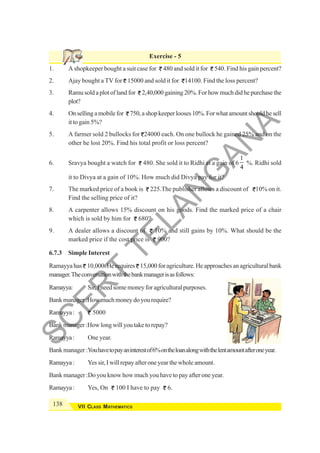
  • 167.
    159 DATA HANDLING Free distributionbyT.S. Government 2020-21 7.6.2 Double Bar Graph Now let us learn about another type of bar graph Example 12: StudythefollowinggraphrepresentingthetotalenrolmentofboysandgirlsinZPP HighSchoolandanswerthefollowingquestions. Did you notice that there are two bars for each year? What does the first bar tell you? What does the second bar tell you? This kind of bar graph is called Double bar graph. It presents two observations side by side. (i) Inwhichyearistheenrolmentofgirlsmorethantheboys? (ii) In which year is the enrolment of boys and girls the same? (iii)Inwhichyearistheenrolmentofgirlsminimum? (iv) What is the total enrolment in the year 2007-08? Example 13 : The following are the marks in Maths and Science of five students in class VII. Present this data in the form of a double bar graph. 2006-07 2007-08 2008-09 Academic Year Enrollment in ZPP High School Enrolment 2009-10 2010-11 40 60 80 140 160 180 120 100 Boys Girls 1 cm = 20 students x y Name of Student Maths Science Saravan 70 75 Raman 35 30 Mani 65 75 Renuka 90 100 Girija 22 35 Sharmila 50 50 S C E R T T E L A N G A N A
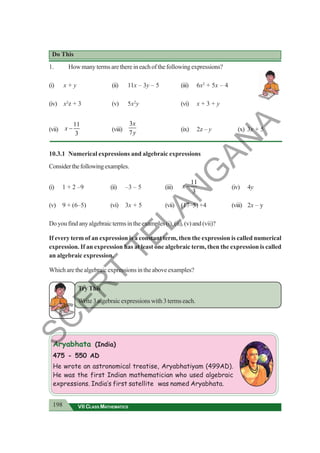
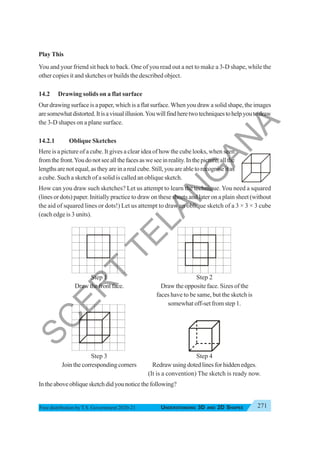
  • 168.
    160 VII CLASSMATHEMATICS Solution : Steps in drawing a double bar graph. 1. Draw x-axis (horizontal line) and y-axis (vertical line) on the graph paper and mark their intersection as O. 2. Take names of students on x-axis. 3. Take Maths and Science marks on y-axis, 4. Take an appropriate scale on y-axis so that maximum marks of both the subjects fit on the graph sheet. Here the maximum value to be plotted on Y- axis is 100, so the scale 1 cm = 10 marks, is appropriate. 5. Find the length of each bar by dividing the value by 10 (Scale is 1 cm = 10 marks). 6. Draw bars representing ‘Maths marks ’ and ‘Science marks’ side by side of every student. 7.6.3 Pie Charts Another way in which data can be presented is through pie charts. Themonthlybudgetofafamilyisgiveninthetableontheleft.Thisdatahasbeenpresentedinapie chart on the right. The higher the share of expenditure of perticular item of the total income, the more the area occupied by the item in the pie chart. Maths Marks Science Marks Name of Students Marks in Maths and Science 1 cm = 10 marks 0 Saravan Raman Mani Renuka Girija Sharmila 20 30 40 70 80 90 60 50 10 Marks y x S C E R T T E L A N G A N A
  • 169.
    161 DATA HANDLING Free distributionbyT.S. Government 2020-21 Budget head Amount (`) (`) (`) (`) (`) Food 1500 Education 750 Others 2250 Savings 4500 Totalincome 9000 Lookingatthepiechartanswerthefollowingquestions. (i) What is the shape of the pie chart? (ii) What is the name of each shape used to present different items in the pie chart? (iii) Say true or false (a) The largest part of the income is saved. (b) Least amount of money is spent on education. 7.6.4 Drawing a pie chart Now, let us learn about how data is presented on a pie chart. Thepiechartrepresentseachitemasaportionofthecircle,ashowmuchpartofthetotalincomeis issharedbytheparticularitem. We know that the total angle at the centre of a circle is 360º.We can assume that it represents the total of all observations i.e. ` 9000. Eachitemofexpenditureisapartofthetotalincomethus,theangleofthesectorortheareaofthe sector will depend on the ratio between the item of expenditure and total income. Thus, the angle of each sector = Amount of Expenditure 360 Total Income × We make a table to find the angle of the sectors. The table is shown below. Budget Amountof Ratiobetween Angle of sector or head expenditure expenditureandtotalincome area of the sector Food 1500 1500 1 9000 6 = 1 360 60 6 × = o o Education 750 750 1 9000 12 = o o 1 360 30 12 × = Others 2250 2250 1 9000 4 = o o 1 360 90 4 × = Savings 4500 4500 1 9000 2 = o o 1 360 180 2 × = Note: Check whether the sum of all the angles of the sectors equal to 360 º ? S C E R T T E L A N G A N A
  • 170.
    162 VII CLASSMATHEMATICS Steps of construction 1. Draw a circle with any convenient radius and mark its centre ‘O’. 2. Mark a pointA, somewhere on the circumference and join OA. 3. Construct angle of the sector for food = 60º. Draw ∠AOB = 60º. 4. Construct angle of the sector for education = 30º. Draw ∠BOC = 30º. 5. Construct angle of the sector for other = 90º. Draw ∠COD = 90º. 6. Now ∠DOA = 180º represents the angle sector for savings. Exercise - 4 1. Draw a bar graph for the following data. PopulationofIndiainsuccessivecensusyears- Year 1941 1951 1961 1971 1981 1991 2001 Population 320 360 440 550 680 850 1000 (inmillions)(approx) Source : Data from census of India 1991 and 2001. 2. Draw a pie chart for the following data. Itemofexpenditure Food Health Clothing Education Savings Amountspentinrupees 3750 1875 1875 1200 7500 1 2 3 4 5 S C E R T T E L A N G A N A
  • 171.
    163 DATA HANDLING Free distributionbyT.S. Government 2020-21 90o 120o 90 o 60o Savings Education Food Rent 3. Draw a double bar graph for the following data. Birth and Death rates of different states in 1999. State Birth Rate (Per 1000) Death Rate (Per 1000) Andhra Pradesh 22 8 Karnataka 22 8 TamilNadu 19 8 Kerala 18 6 Maharashtra 21 8 Orissa 24 11 Source : The table is taken from vittal statistics SRS 1999. 4. Draw a pie chart for the following data. Time spent by a child during a day- Timespentfor Sleep School Play Others Timespent 8 hrs 6 hrs 2 hrs 8 hrs 5. Theadjoiningpiechartgivestheexpenditureonvariousitemsduringamonthforafamily. (The numbers written around the pie chart tell us the angles made by each sector at the centre.) Answerthefollowing- (i) Onwhichitemistheexpenditureminimum? (ii) Onwhichitemistheexpendituremaximum? (iii) Ifthemonthlyincomeofthefamilyis `9000, what is the expenditure on rent? (iv) If the expenditure on food is ` 3000, what is theexpenditureoneducationofchildren? S C E R T T E L A N G A N A
  • 172.
    164 VII CLASSMATHEMATICS ProjectWork 1. Gather information of the number of different kinds of houses in your locality (ward/colony/village).Thenfindmode. 2. Collecttheitem-wiseexpenditureofyourfamilyinamonthandrepresentitasa pie chart. 3. Collect different data presented in the form of bar graphs and pie charts in magazines, newspapers etc. and present them on your school bulletin board. Looking back • Mean, mode and median are representative values for a data set. • Arithmeticmeanormeanisequaltosumofalltheobservationsofadataset dividedbythenumberofobservations.Itliesbetweenthelowestandhighest values of the data. • Anobservationofdatathatoccursmostfrequentlyiscalledthemodeofthe data.Adata set may have one or more modes and sometimes none. • Medianissimplythemiddleobservation,whenallobservationsarearranged in ascending or descending order. (In case of even number of observations meadianistheaverageofmiddletwoobservations.) • A pie chart is a circular chart /graph divided into sectors, and is used to present data. • Thecentralangleofeachsector(andconsequentlyitsarea)inapiechart,is proportional to the quantity that it represents. Dr.C.R.Rao (India) 1920 AD A well known Statistician, famous for his “Theory of Estimation” (1945). He worked on Cramer-Rao Inequality and Fisher-Rao theorm. S C E R T T E L A N G A N A
  • 173.
    165 CONGRUENCY OF TRIANGLES Freedistribution byT.S. Government 2020-21 CONGRUENCY OF TRIANGLES 8 8.0 Introduction If we take a pile of one rupee coins and place them one on top of the other, they would match perfectly. Do you know why this happens? This is because all the coins have the same size and shape. In the same way papers of a blank note book have the same size and shape. Lookaroundyouandfindsomeexamplesofobjectsthatsharethiskindofsimilarityi.e.theyare identical in shape and size. Think of at least 5 such examples. When we talk about objects of the same size and shape we say that the objects are congruent. A practical test of congruence is to place one object over the other and see if they superimpose exactly. Activity: Are all ten rupee notes congruent? How will you check? Similarly,checkifthefiverupeenoteyoufindarecongruent. We see many examples of congruent objects all around us. Now, think of some shapes that are congruent. S C E R T T E L A N G A N A
  • 174.
    166 VII CLASSMATHEMATICS Do This 1. Here are some shapes. See whether all the shapes given in a row are congruent to each other or not.You can trace the figures and check. (i) (ii) (iii) 2. Whichofthefollowingpairsoffiguresarecongruent? (i) (ii) (iii) (iv) (v) (vi) S C E R T T E L A N G A N A
  • 175.
    167 CONGRUENCY OF TRIANGLES Freedistribution byT.S. Government 2020-21 8.1 Congruency of line segments Observe the two pairs of line segments given below. Figure 1 Figure 2 Copy the line segmentAB on a tracing paper. Place it on CD.You will find thatAB covers CD. Hence the line segments are congruent.We write AB CD ≅ . Repeat this activity for the pair of line segments in Figure 2. What do you find? Are they congruent? YouwillnoticethatthepairoflinesegmentsinFigure1matchwitheachotherbecausetheyhave same length and this is not the case in Figure 2. Thelinesegmenthasonlyonedimensioni.e.,length.Soiftwolinesegmentshavethesamelength, theyarecongruent. Conversely,iftwolinesegmentsarecongruent,theyhavethesamelength. When we writeAB = CD, what we actually mean is AB CD ≅ . 8.2 Congruency of triangles Welearntthattwolinesegmentsarecongruentwhentheirlengthsareequal.Weextendthisideato triangles.Two triangles are congruent if they are copies of one another and when superimposed, they cover each other exactly. ΔABC and ΔEFG cover each other exactly i.e. they are of the same size and shape. They are congruent triangles.We express congruency of the two triangles as ΔABC ≅ ΔEFG . If two triangles are congruent then all the corresponding six elements of the two triangles i.e. the three angles and three sides are congruent. We also say that if the corresponding parts of two trianglesarecongruent,thenthetrianglesarecongruent.Thismeansthat,whenyouplaceΔABC on ΔEFG, their corresponding corners coincides with each other.Alies on E, B lies on F and C lies on G.Also ∠Acoincides with ∠E, ∠B coincides with ∠F and ∠C coincides with ∠G and lastlyAB coincides with EF, BC coincides with FG andAC coincides with EG. A B C D P Q R S A B C F E G S C E R T T E L A N G A N A
  • 176.
    168 VII CLASSMATHEMATICS E F G N L M R J K E B C I S U A T Thus,fortwotrianglesthatarecongruent,theircorrespondingpartsi.e.vertices,anglesandsides match one another or are equal. In ΔABC and ΔEFG A → E B → F C → G (correspondingvertices) ∠A ≅ ∠E ∠B ≅ ∠F ∠C ≅ ∠G (correspondingangles) AB ≅ EF BC FG ≅ AC EG ≅ (correspondingsides) So, when we say that ΔABC ≅ ΔEFG. The order of the alphabet in the names of congruent trianglesdisplaysthecorrespondingrelationships. Do This 1. ΔEFG ≅ ΔLMN Write the corresponding vertices, angles and sides of the two triangles. 2. If ΔABC ≅ ΔDEF write the parts of ΔABC that correspond to- (i)DE (ii) ∠E (iii)DF (iv)EF (v) ∠F 3. Namethecongruenttrianglesineachofthefollowingpairs.Writethestatementusing‘≅’. 4 . Name the congruent angles and sides for each pair of congruent triangles. 1. ΔTUV ≅ ΔXYZ 2. ΔCDG ≅ ΔRSW S C E R T T E L A N G A N A
  • 177.
    169 CONGRUENCY OF TRIANGLES Freedistribution byT.S. Government 2020-21 8.3 Criterion for congruency of triangles Is it necessary for congruency to check whether all the corresponding parts of two triangles are congruent? How can we check if the given triangles are congruent using a minimum number of measurements.Letusexploreandfindout. 8.3.1 Side-Side-Side congruency (SSS) Willallofyoudrawthesametriangleifyouonlyknewthatthemeasureofonesideofthetriangle is 5 cm? Kamal, Namrita and Susana have drawn them like this. Kamal Namrita Susana As you can see all the triangles are different. Kamal drew an equilateral triangle, Namrita drew a right-angledtriangleandSusanadrewanobtuse-angledtriangle. Nowcanallofyoudrawthesametriangle,ifyouknewthemeasuresofonlytwosidesofatriangle say, 4 cm and 5 cm.Again Kamal, Namrita and Susana drew different triangles. Kamal Namrita Susana What if you know all the sides of the triangle? Kamal, Namrita and Susana all drew the same triangle with the three sides- 4 cm, 5cm and 6 cm. S C E R T T E L A N G A N A
  • 178.
    170 VII CLASSMATHEMATICS Thus, if we want to make a copy of ABC or a triangle congruent to ABC, we need the lengths of the three sides. This is referred to as the Side-Side-Side(SSS) criterion for congruency of triangles. Iftwotrianglesarecongruentbecausethelengthsoftheircorrespondingsidesareequal,thenwill theiranglesalsobeequal? Side-Side-Side (SSS) criterion for congruence of triangles: If three sides of a triangle are equal to the corresponding three sides of another triangle, then the triangles are congruent. Try This Measure the lengths of ΔLMN. Now, construct a triangle with these measurements on a sheet of paper. Place this triangle over ΔLMN. Are the triangles congruent? What criterion of congruency applies over here? Example 1 : Is ΔPQR ≅ ΔXYZ?Also, write the corresponding angles of the two triangles. Solution : According to the given figure of ΔPQR and ΔXYZ, we have PQ = XY = 2.9 cm QR = YZ = 6 cm RP = ZX = 5.3 cm Therefore, by Side-Side-Side congruence criterion, Δ PQR ≅ ΔXYZ Clearly, the point Pcorresponds to point X, point Q corresponds to pointYand the point R corresponds to point Z. So, ∠P, ∠X ; ∠Q, ∠Y; ∠R, ∠Z are pairs of corresponding angles. L M N X Y Z 5.3 cm 2 . 9 c m 6 cm P Q R 5.3 cm 2 . 9 c m 6 cm S C E R T T E L A N G A N A
  • 179.
    171 CONGRUENCY OF TRIANGLES Freedistribution byT.S. Government 2020-21 Exercise - 1 1. DecidewhethertheSSScongruenceistruewiththefollowingfigures.Givereasons (i) (ii) 2. Forthefollowingcongruenttriangles,findthepairsofcorrespondingangles. (i) (ii) 3. In adjacent figure, choose the correct answer! (i) ΔPQR ≅ ΔPQS (ii) ΔPQR ≅ ΔQPS (iii) ΔPQR ≅ ΔSQP (iv) ΔPQR ≅ ΔSPQ 4. In the figure given below,AB = DC andAC = DB. Is ΔABC ≅ ΔDCB. 8.3.2 Side-Angle-Side Congruence We have seen that it is not possible to draw congruent triangles, if we are given only the measurementsofoneside.Now,whatifyouweregivenoneangleandoneside?Kamal,Namrita and Susana were told to draw triangles with one side equal to 5 cm and one angle equal to 65o . Theydrewthefollowingdissimilartriangles. A C R A B C D S A L D 2 . 5 4 4 3 N B E P T S R Q S P R Q O 5 cm 5 cm 4 cm 3 c m 4 c m 4 c m 5 cm 3 . 5 c m 5 cm 3 . 5 c m P Q S R 4 S C E R T T E L A N G A N A
  • 180.
    172 VII CLASSMATHEMATICS Kamal Namrita Susana Now, what if the three of them knew the two sides of the triangle and the angle included between these sides. The three children decided to draw triangles with sides 5 cm and 4.5 cm and the includedangleof∠65. Kamal drew ΔABC. He drew BC as the base= 5 cm. He then made ∠C= 65o using a protractor and then marked pointAat a length of 4.5 cm on the angular line. He then joined pointsAand B. Can you draw the 65o angle at point B with sideAB = 4.5 cm.Will the triangle that is formed be congruent to Kamal's triangle? Can you take the base to be 4.5 cm, side = 5 cm and included angle=65o ?WillthetrianglethatisformedbecongruenttoKamal'striangle?Youwillfindthatthe trianglesformedinallthesesituationsarecongruenttriangles. Therefore, if we want to make a copy of ΔABC or a triangle congruent to ΔABC, we need the lengths of the two sides and the measure of the angle between the two sides. This is referred to as theSide-Angle-Side(SAS)criterionforcongruenceoftriangles. Side-Angle-Side(SAS) criterion for congruence of triangles: If two sides and the angle in- cluded between the two sides of a triangle are congruent to the corresponding two sides and the includedangleofanothertriangle,thenthetrianglesarecongruent. Try This In ΔPQR measure the lengths PQ and QR as well as ∠Q. Now, construct a triangle with these three measurementsonasheetofpaper.Placethistriangleover ΔPQR.Are the triangles congruent? What criterion of congruencyappliesoverhere? 65o A B 5 cm 65o A B 5 cm R P Q 65o A B 5 cm B C 5 cm 65o B C 5 cm 65o B C 5 cm A 4 . 5 c m S C E R T T E L A N G A N A
  • 181.
    173 CONGRUENCY OF TRIANGLES Freedistribution byT.S. Government 2020-21 Example 2 : See the measurements of the triangles given below.Are the triangles congruent? Whicharethecorrespondingverticesandangles? Solution : In ΔABC and ΔPQR AC = QR and BC = PR and included angle ∠C ≅ ∠R So, ΔABC ≅ ΔQPR. Thecorrespondenceisasfollows: A ↔ Q, B ↔ P and C ↔ R Therefore, ∠A ≅ ∠Q, ∠B ≅ ∠P and ∠C ≅ ∠R Example 3 : In ΔPQR, PQ = PR and PS is angle bisector of ∠P. Are ΔPQS and ΔPRS congruent? If yes, give reason. Solution : In ΔPQS and ΔPRS PQ = PR ( given) PS = PS (common side in both the triangles) and included angle ∠QPS ≅ ∠RPS (PS is the angle bisector) Therefore, ΔPQS ≅ ΔPRS (by SAS rule) Exercise - 2 1. What additional information do you need to conclude that the two triangles given here underarecongruentusingSASrule? S P Q R 40 o A B 5 cm C 4 c m 40 o P Q R 5 cm 4 c m G H J R S T S C E R T T E L A N G A N A
  • 182.
    174 VII CLASSMATHEMATICS 2. Themapgivenbelowshowsfivedifferentvillages.VillageMliesexactlyhalfwaybetween the two pairs of villagesAand B as well as and P and Q. What is the distance between villageAand village P. (Hint: check ifΔPAM≅ΔQBM) 3. Look at the pairs of triangles given below.Are they congruent? If congruent write the corresponding parts. (i) (ii) (iii) (iv) 4. Which corresponding sides do we need to know to prove that the triangles are congruent usingtheSAScriterion? (i) (ii) 3 km 6 km 4 k m Q M P A B 40 o 5 cm A B C 40 o 5 cm P R Q 35 o 35 o A B C D 130 o 6 c m 4 c m 130o 6 c m 4 c m A B C R S T 4 cm 4 cm 3 c m 3 c m P Q R S O 30o 30 o 4 cm 7 cm A B C D 4.5 cm 3.7 cm 4.5 cm 3.7 cm W D O R S S C E R T T E L A N G A N A
  • 183.
    175 CONGRUENCY OF TRIANGLES Freedistribution byT.S. Government 2020-21 8.3.3 Angle-Side-Angle congruency (ASA) Canthechildrenconstructatriangleiftheyknowonlyoneangleofthetriangle?Whatiftheyknow two angles?Will children be able to draw congruent triangles if they know all the angles of the triangle? Kamal, Namrita and Susana drew the following triangles of angles 40o , 60o and 80o . Kamal Namrita Susana Therefore,thoughtheanglesofallthetrianglesarecongruent,thelengthsoftheirsidesisnotand they are not congruent. Thus, we need to know the length of the sides, to draw congruent triangles. What if we have two angles and one side? Kamal and Namrita drew the followingtriangleswithangles60o and 40o and side 5 cm. When both the childrenconstructedtheirtrianglesthey madethegivenside,theincludedside. We can conclude that if we want to make a copy of a triangle or a triangle congruent to another triangle, then we need to know two angles and the length of the side included between the two angles.ThisisreferredtoastheAngle-Side-Anglecriterionofcongruence. Angle-Side-Anglecriterionofcongruence:Iftwoanglesandtheincludedsideofatriangleare congruenttothetwocorrespondinganglesand includedsideofanothertrianglethenthetriangles arecongruent. TryThis Teacherhasaskedthechildrentoconstructatrianglewithangles60°,40°andwitha side5cm. Sushmacalculatedthethirdangleofthetriangleas80°usingangle-sum property of triangle. Then Kamal, Sushma and Namratha constructedtrianglesdifferentlyusingthefollowingmeasurements. Kamal: 60°, 40° and 5cm side (as teacher said) Sushma: 80°, 40°, and 5 cm side Namratha: 60°, 80° and 5 cm side. They cut these triangles and place them one upon the other. Are all of them congruent?Youalsotrythis. 40 o 80o 60 o 40o 80o 60o 40 o 80 o 60 o Kamal Susana 40o 60o 5 cm 40o 60 o 5 cm S C E R T T E L A N G A N A
  • 184.
    176 VII CLASSMATHEMATICS Example 4 : Two triangles ΔCAB and ΔRPQ are given below. Check whether the two are congruent? If they are congruent, what can you say about the measures of the remainingelementsofthetriangles. Solution : In ΔCAB and ΔRPQ, BC = QR = 4 cm ∠B = ∠Q = 120° AB = PQ = 3 cm Thus,twosidesandincludedangleofΔCABareequaltothecorrespondingsides and included angle of ΔRPQ. Therefore, by Side-Angle-side criterion of congruency ΔCAB ≅ ΔRPQ Thus,inthetwotriangles AC ≅ PR ∠C ≅ ∠R and ∠A ≅ ∠P Example-5 : In the following picture, the equal angles in the two triangles are shown.Are the trianglescongruent? Solution : In ΔABD and ΔACD ∠BAD≅ ∠CAD (given in the question) ∠ADB ≅ ∠ADC (given in the question) AD ≅AD (common side, seen in the figure) Thus, byAngle-side-Angle congruence criterion ΔABD ≅ ΔACD Try This Isthefollowingpairoftrianglescongruent?Givereasontosupportyouranswer. 3 cm 4 c m 120o A B C 3 cm 4 c m 120o P Q R D A B C 30o 70o 5 cm M K L 5 cm 70 o 30 o T W V S C E R T T E L A N G A N A
  • 185.
    177 CONGRUENCY OF TRIANGLES Freedistribution byT.S. Government 2020-21 Exerciese - 3 1. Infollowingpairsoftriangles,findthepairswhicharecongruent?Also,writethecriterion ofcongruence. (i) (ii) (iii) (iv) 2. Intheadjacentfigure. (i) Are ΔABC and ΔDCB congruent? (ii) Are ΔAOB congruent to ΔDOC? Alsoidentifytherelationbetweencorrespondingelementsand give reason for your answer. 8.3.4 Right-Angle Hypotenuse Side congruence Inright-angledtriangleswealreadyknowthatoneoftheanglesisarightangle.Sowhatelsedowe need to prove that the two triangles are congruent? Letustaketheexampleof ΔABCwith ∠B=90.Canwedrawatrianglecongruenttothistriangle,if, (i) onlyBCisknown (ii) only∠Cisknown (iii) ∠A and ∠C are known (iv) AB and BC are known (v) ∠C and BC are known (vi) BC and the hypotenuseAC are known 70o A B C 60o 6 . 5 c m P Q R 6 . 5 c m 70o 60o 30o 30 o 20 o 20o A B C D 5 . 5 c m 60o 5 . 5 c m 60o A B C D O 50o 70o A B C D E F 50o 70o D C B 50o 30o A 50 o 30o O A B C S C E R T T E L A N G A N A
  • 186.
    178 VII CLASSMATHEMATICS When you try to draw the rough sketches of these triangles, you will find it is possible only in cases (iv), (v) and (vi). The last of the situations is new to us and it is called the Right-Angle Hypotenuse Congruence Criterion. Right-Angle Hypotenuse Congruence Criterion: If the hypotenuse and one side of a right angled triangle are equal to the corresponding hypotenuse and side of the other right angled triangle, then the triangles are congruent. Example 6 : Givenbelowaremeasurementsofsomepartsoftwotriangles.Examinewhether the two triangles are congruent or not, using RHS congurence rule. In case of congruenttriangles,writetheresultinsymbolicform: ΔABC ΔPQR (i) ∠B = 90o , AC = 8 cm, AB = 3 cm ∠P = 90o , PR = 3 cm, QR = 8 cm (ii) ∠A = 90o , AC = 5 cm, BC= 9 cm ∠Q = 90o , PR = 8 cm, PQ = 5 cm Solution : (i) Here, ∠B = ∠P = 90o hypotenuse, AC = hypot- enuse, RQ (= 8 cm) and sideAB=sideRP(=3cm) So, ΔABC ≅ ΔRPQ (By RHS Congruence rule). (ii) Here, ∠A = ∠Q = 90o and side AC = side PQ (= 5 cm). hypotenuse, BC ≠ hypotenuse, PR So, the triangles are not congruent. 3 cm P R Q 8 cm B A C 8 cm 5 cm B A C 9 cm 5 cm P Q R 8 cm S C E R T T E L A N G A N A
  • 187.
    179 CONGRUENCY OF TRIANGLES Freedistribution byT.S. Government 2020-21 Example 7 : In the adjacent figure, DA ⊥ AB , CB ⊥ AB and AC = BD. State the three pairs of equal parts in ΔABC and ΔDAB. Whichofthefollowingstatementsismeaningful? (i) ΔABC ≅ ΔBAD (ii) ΔABC ≅ ΔABD Solution : The three pairs of equal parts are : ∠ABC = ∠BAD (= 90o ) AC = BD (Given) AB = BA (Common side) ΔABC ≅ ΔBAD (By RHS congruence rule). From the above, statement(i)istrue; statement (ii) is not meaningful, in the sense that the correspondence among the verticesisnotstaisfied. TryThis 1. In the figures given below, measures of some parts of triangles are given. By applying RHS congruence rule, state which pairs of triangles are congruent. In caseofcongruenttriangles,writetheresultinsymbolicform. (i) (ii) (iii) (iv) 2. It is to be established by RHS congruence rule that ΔABC ≅ ΔRPQ. What additionalinformationisneeded,ifitisgiventhat∠B=∠P=90o andAB=RP? A D B C 3 cm P 6 cm Q R 90o 2.5 cm D 6 cm F E 90 o 2 c m D 3.5 cm A B 90o C 2 c m 90o D 3.6 cm A B 90 o C 90 o 3.6 cm 3 c m 90 o 3 c m Q R P S C E R T T E L A N G A N A
  • 188.
    180 VII CLASSMATHEMATICS 3. Intheadjacentfigure,BDandCEarealtitudesofΔABC such that BD = CE. (i) State the three pairs of equal parts in ΔCBD and ΔBCE. (ii) Is ΔCBD ≅ ΔBCE? Why or why not? (iii) Is ∠DBC = ∠EBC? Why or why not? 4. ABCisanisoscelestrianglewithAB=ACand ADisone ofitsaltitudes(fig...). (i) State the three pairs of equal parts in ΔADB and ΔADC. (ii) Is ΔADB ≅ ΔADC? Why or why not? (iii) Is ∠B ≅ ∠C? Why or why not? (iv) Is BD ≅ CD? Why or why not? Exercise - 4 1. Whichcongruencecriteriondoyouuseinthefollowing? (i) Given :AC = DF AB = DE BC = EF So, ΔABC ≅ ΔDEF (ii) Given : ZX = RP RQ = ZY ∠PRQ ≅ ∠XZY So, ΔPQR ≅ ΔXYZ (iii) Given : ∠MLN ≅ ∠FGH ∠NML ≅ ∠GFH ML = FG So, ΔLMN ≅ ΔGFH E D A B C D A B C A B C D E F R P Q Z X Y L M N F G H S C E R T T E L A N G A N A
  • 189.
    181 CONGRUENCY OF TRIANGLES Freedistribution byT.S. Government 2020-21 (iv) Given:EB=DB AE = BC ∠A = ∠C = 90o So, ΔABE ≅ ΔCDB 2. You want to show that ΔART ≅ ΔPEN, (i) If you have to use SSS criterion, then you need to show (a)AR = (b) RT = (c)AT = (ii) If it is given that ∠T = ∠N and you are to use SAS criterion, you need to have (a) RT = and (ii) PN = (iii) If it is given thatAT= PN and you are to useASAcriterion, you need to have (a) ? (b) ? 3. You have to show that ΔAMP ≅ ΔAMQ. Inthefollowingproof,supplythemissingreasons. Steps Reasons (i) PM = QM (i) ......... (ii) ∠PMA ≅ ∠QMA (ii) ......... (iii) AM =AM (iii) ......... (iv) ΔAMP ≅ ΔAMQ (iv) ......... 4. In ΔABC, ∠A = 30o , ∠B = 40o and ∠C = 110o In ΔPQR, ∠P = 30o , ∠Q = 40o and ∠R = 110o AstudentsaysthatΔABC≅ ΔPQRbyAAAcongruencecriterion.Ishejustified?Whyor whynot? 5. In the figure, the two triangles are congruent. The corresponding parts are marked. We can write ΔRAT ≅ ? E A B D C A R T P E N A P Q M R A T N O W S C E R T T E L A N G A N A
  • 190.
    182 VII CLASSMATHEMATICS 6. Completethecongruencestatement. ΔABC ≅ ? ΔQRS ≅? 7. In a squared sheet, draw two triangles of equal areas such that (i) thetrianglesarecongruent. (ii) thetrianglesarenotcongruent. What can you say about their perimeters? 8. If ΔABC and ΔPQR are to be congruent, name one additional pair of corresponding parts. What criterion did you use? 9. Explain,why ΔABC ≅ ΔFED. Looking Back 1. Congruent objects are objects having the same shape and size. 2. Themethodofsuperimpositionexaminesthecongruenceofplanefigures. 3. Twolinesegmentssay,ABandCDarecongruentiftheyhaveequallengths. We write this asAB ≅ CD. However, it is common to write it asAB = CD. 4. If all the parts of one triangle are equal to the corresponding parts of other triangle,thenthetrianglesarecongruent. B T A C B A C P R Q D E F C A B P Q R T S S C E R T T E L A N G A N A
  • 191.
    183 CONGRUENCY OF TRIANGLES Freedistribution byT.S. Government 2020-21 5. Thenecessaryandsufficientconditionsfortwotrianglestobecongruentareas follows: (i) Side-Side-Side (SSS) criterion for congruence: If three sides of a triangle are equal to the corresponding three sides of another triangle, then the trianglesarecongruent. (ii) Side-Angle-Side(SAS)criterionforcongruence:Iftwosidesandtheangle includedbetweenthetwosidesofatriangleareequaltothecorresponding two sides and the included angle of another triangle, then the triangles are congruent. (iii) Angle-Side-Anglecriterionofcongruence:Iftwoanglesandtheincluded side of a triangle are equal to the corresponding two angles and included sideofanothertrianglethenthetrianglesarecongruent. (iv) Right-Angle Hypotenuse criterion of congruence: If the hypotenuse and one side of a right-angled triangle are equal to the corresponding hypotenuseandsideoftheotherright-angledtriangle,thenthetrianglesare congruent. S C E R T T E L A N G A N A
  • 192.
    184 VII CLASSMATHEMATICS CONSTRUCTION OF TRIANGLES 9 9.0 Introduction Youwilllearnhowtoconstructtrianglesinthischapter.Youdonotneedallthesixelementsi.e.the three angles and three sides of a triangle to construct a triangle.Atriangle can be drawn if you know the elements that are required for two triangles to be congurent. Thus, a triangle can be drawn in any of the situations given below i.e., if we know the- (i) Threesidesofthetriangle. (ii) Two sides and the angle included between them. (iii) Two angles and the side included between them. (iv) Hypotenuse and one adjacent side of a right-angled triangle. Atriangle can also be drawn if two of its sides and a non-included angle are given. However, it is importanttorememberthatthisconditionisnotsuffiecienttomaketwotriangles,congruent. Let us learn to construct triangles in each of the above cases. 9.1 Construction of a triangle when measurements of the three sides are given. Intheconstructionofanygeometricalfigure,drawingaroughsketch first,helpsinindentifyingthe sides.Soweshouldfirstdrawaroughsketchofthetrianglewewanttoconstruct andlabelitwith thegivenmeasurements. Example 1: Construct a Δ PQR with sides PQ = 4 cm, QR = 5 cm and RP = 7 cm. STEP 1 : Drawaroughsketchofthetriangleand labelit withthegivenmeasurements. STEP 2 : Draw a line segment QR of length 5 cm. Q R 5 cm 1 2 3 4 5 S C E R T T E L A N G A N A
  • 193.
    185 CONSTRUCTION OF TRIANGLES Freedistribution byT.S. Government 2020-21 STEP 3 : With centre Q, draw an arc of radius 4 cm. STEP 4 : SincePisatadistanceof 7cmfrom R, draw another arc from R with radius7cmsuchthatitintersectsfirst arc at P. STEP 5 : Join Q,Pand P,R. The required Δ PQR isconstructed. TryThis 1. Constructatrianglewiththesamemeasurementsgiveninaboveexample,taking PQ as base.Are the triangles congurent? 2. Construct a Δ PET, PE = 4.5 cm, ET = 5.4 cm and TP = 6.5 cm in your notebook.Nowconstruct Δ ABC, AB=5.4cm, BC=4.5cmandCA=6.5cm on a piece of paper. Cutitoutandplaceitonthefigureyouhaveconstructed in your note book. Are the triangles congruent? Write your answer using mathematicalnotation. S C E R T T E L A N G A N A
  • 194.
    186 VII CLASSMATHEMATICS Exercise - 1 1. Construct Δ ABC in whichAB = 5.5 cm, BC = 6.5 cm and CA= 7.5 cm. 2. Construct Δ NIB in which NI = 5.6 cm, IB = 6 cm and BN = 6 cm. What type of triangle isthis? 3. Construct an equilateral Δ APE with side 6.5 cm. 4. Construct a Δ XYZ in which XY= 6 cm,YZ = 8 cm and ZX = 10 cm. Using protractor findtheangleatX.Whattypeoftriangleisthis? 5. Construct Δ ABC in which AB = 4 cm, BC = 7 cm and CA= 3 cm. Which type of triangleisthis? 6. Construct Δ PENwithPE=4cm, EN=5cmandNP=3cm.Ifyoudrawcirclesinstead of arcs how many points of intersection do you get? How many triangles with given measurements are possible? Is this true in case of every triangle? Try This Sushanth prepared a problem: Construct Δ XYZ in which XY= 2 cm,YZ = 8 cm and XZ = 4 cm. He also drew the rough sketch as shown in Figure1. Reading the problem, Srija told Sushanth that it would not be possible to draw a trianglewiththegivenmeasurements. However, Sushanth started to draw the diagram as shown in Figure 2. CheckwhetherSushanthcandrawthetriangle.Ifnotwhy?Discusswithyourfriends. What property of triangles supports Srija’s idea? S C E R T T E L A N G A N A
  • 195.
    187 CONSTRUCTION OF TRIANGLES Freedistribution byT.S. Government 2020-21 9.2 Construction of a triangle with two given sides and the included angle. Example 2 : Construct Δ ABC in whichAB = 4 cm, BC = 5cm and ∠ B = 50°. STEP 1 : Drawaroughsketchofatriangleandlabelitwith thegivenmeasurements. STEP 2 : DrawalinesegmentABoflength4cm. STEP 3 : Draw a rayBX JJJ G making an angle 50° withAB. STEP 4 : Draw an arc of radius 5 cm from B, which cuts BX JJJ G atC. STEP 5 : Join C,Ato get the required Δ ABC. X S C E R T T E L A N G A N A
  • 196.
    188 VII CLASSMATHEMATICS Exercise - 2 1. Draw Δ CAR in which CA= 8 cm, ∠ A= 60° andAR = 8 cm. Measure CR, ∠ R and ∠ C. What kind of triangle is this? 2. Construct Δ ABC in whichAB = 5 cm, ∠ B = 45° and BC = 6 cm. 3. Construct Δ PQR such that ∠ R=100°, QR = RP = 5.4 cm. 4. Construct Δ TEN such that TE = 3 cm, ∠ E = 90° and NE = 4 cm. 9.3 Constructionofatrianglewhentwoanglesandthesidebetweentheanglesis given Example 3 : Construct Δ MAN with MA = 4 cm, ∠ M = 45° and ∠ A = 100°. STEP 1 : Draw rough sketch of a triangle and label it with thegivenmeasurements. STEP 2 : DrawlinesegmentMAoflength 4cm. STEP 3 : Draw a ray MX JJJJ G , making an angle 45° at M. M A X 45o 4 cm. 4 cm. S C E R T T E L A N G A N A
  • 197.
    189 CONSTRUCTION OF TRIANGLES Freedistribution byT.S. Government 2020-21 STEP 4 : Draw a ray AY JJJG , making an angle 100° atA. Extend the ray MX JJJJ G if necessary to intersect ray AY JJJG . STEP 5 : Marktheintersectingpointofthetworays as N. You have the required Δ MAN TryThis Construct a triangle with angles 105° and 95° and a side of length of your choice. Couldyouconstructthetriangle?Discussandjustify. Exercise - 3 1. Construct Δ NET with measurement NE = 6.4 cm, ∠ N = 50° and ∠ E = 100°. 2. Construct Δ PQR such that QR = 6 cm, ∠ Q =∠ R = 60°. Measure the other two sides ofthetriangleandnamethetriangle. 3. Construct Δ RUN in which RN = 5cm, ∠ R =∠ N = 45°. Measure the other angle and other sides. Name the triangle. 4 cm 4 cm S C E R T T E L A N G A N A
  • 198.
    190 VII CLASSMATHEMATICS 9.4 Construction of right-angled triangle when the hypotenuse and a side are given. Example 4 : Construct Δ ABC, right-angled atA, and BC = 6 cm; AB = 5 cm. STEP 1 : Drawaroughsketchofright-angledtriangleand labelitwithgiveninformation. Note: side opposite to the right angle is called hypotenuse. STEP 2 : DrawalinesegmentABoflength5cm. STEP 3 : Construct a ray AX JJJG perpendicular toAB atA. STEP 4 : Draw an arc from B with radius 6cm to intersect AX JJJG at ‘C’. STEP 5 : Join B,C to get the required Δ ABC. 5cm C S C E R T T E L A N G A N A
  • 199.
    191 CONSTRUCTION OF TRIANGLES Freedistribution byT.S. Government 2020-21 Exercise - 4 1. Construct a right-angled Δ ABC such that ∠ B = 90°, AB = 8 cm andAC = 10 cm. 2. Construct a Δ PQR, right-angled at R, hypotenuse is 5 cm and one of its adjacent sides is 4 cm. 3. Construct an isosceles right-angled Δ XYZ in which ∠ Y = 90° and the two sides are 5 cm each. 9.5 Construction of triangle when two sides and the non-included angle are given Example 5 : Construct Δ ABC such thatAB = 5 cm,AC = 4 cm, ∠ B = 40°. STEP 1 : Draw rough sketch of Δ ABC and label it with thegivenmeasurements. STEP 2 : Draw a line segmentAB of length 5 cm. STEP 3 : Draw a ray BX JJJ G making an angle 40° at B. X A B 400 5cm A B 5cm S C E R T T E L A N G A N A
  • 200.
    192 VII CLASSMATHEMATICS STEP 4 : WithAas centre and radius 4 cm, draw an arc to cut ray BX JJJ G . STEP 5 : Mark the intersecting point as C and join C,Ato get the required Δ ABC. Can you cut the ray BX JJJ G at any other point? You will see that as ∠ B is acute, the arc from A of radius 4 cm cuts the ray BX JJJ G twice. So we may have two triangles as given below: A B C C’ X 400 5cm 4 cm A B C C’ X 400 5cm 4cm A B C X 400 5cm A B C X 400 5cm A B C C’ X 400 5cm S C E R T T E L A N G A N A
  • 201.
    193 CONSTRUCTION OF TRIANGLES Freedistribution byT.S. Government 2020-21 TryThis Construct a triangle with two sides of length of your choice and the non-included angle as an obtuse angle. Can you draw two triangles in this solution? Exercise - 5 1. Construct Δ ABC in whichAB = 4.5 cm,AC = 4.5 cm and ∠ B = 50°. Check whether yougettwotriangles. 2. Construct Δ XYZ such that XY = 4.5 cm, XZ = 3.5 cm and ∠Y = 70°. Check whether yougettwotriangles. 3. Construct Δ ANR with the sidesAN andAR of lengths 5 cm and 6 cm respectively and ∠ N is 100°. Check whether you get two triangles. 4. Construct Δ PQR in which QR = 5.5 cm, QP = 5.5 cm and ∠ Q = 60°. Measure RP. Whatkindoftriangleisthis? 5. Constructthetriangleswiththemeasurementgiveninthefollowingtable. Triangle Measurements Δ ABC BC = 6.5 cm, CA = 6.3 cm, AB = 4.8 cm. Δ PQR PQ = 8 cm, QR = 7.5 cm, ∠ PQR = 85° ΔXYZ XY = 6.2 cm, ∠ Y = 130°, ∠ Z = 70° Δ ABC AB = 4.8 cm, AC = 4.8 cm, ∠ B = 35° Δ MNP ∠ N = 90°, MP = 11.4 cm., MN = 7.3 cm. Δ RKS RK = KS = SR = 6.6 cm. Δ PTR ∠ P = 65°, PT = PR = 5.7 cm. Looking Back • A triangle can be constructed when. (i) Thethreesidesofthetrianglearegiven. (ii) Twosidesandtheangleincludedbetweenthemisgiven. (iii) Twoanglesandtheirincludedsideisgiven. (iv) The hypotenuse and one adjacent side of a right angle triangle are given. (v) Two sides and the not included angle are given. S C E R T T E L A N G A N A
  • 202.
    194 VII CLASSMATHEMATICS ALGEBRAIC EXPRESSIONS 10 10.0 Introduction In class VI you had already learnt that variables can take on different values and the value of constantsisfixed.Youhadalsolearnthowtorepresentvariablesandconstantsusingletterslikex, y, z, a, b , p, m etc.You also came across simple algebraic expressions like 2x –3 and so on.You hadalsoseenhowtheseexpressionsareusefullinformulatingandsolvingproblems. Inthischapter,youwilllearnmoreaboutalgebraicexpressionsandtheiradditionandsubtraction. However, before doing this we will get acquainted to words like ‘terms’, ‘like terms’,‘unlike terms’and‘coefficients’. Let us first review what you had learnt in class VI. Exercise - 1 1. Find the rule which gives the number of matchsticks required to make the following patterns- (i)Apattern of letter 'H' (ii)Apattern of letter 'V' 2. Given below is a pattern made from coloured tiles and white tiles. Figure 1 Figure 2 Figure 3 (i) Draw the next two figures in the pattern above. (ii) Fill the table given below and express the pattern in the form of an algebraic expression. FigureNumber 1 2 3 4 5 Numberofcolouredtiles 4 12345 12345 12345 12345 12345 12345 12345 12345 12345 12345 12345 12345 1234 1234 1234 1234 1234 1234 1234 1234 1234 1234 1234 1234 1234 1234 1234 1234 1234 1234 1234 1234 1234 1234 1234 1234 1234 1234 1234 1234 1234 1234 1234 1234 1234 1234 1234 1234 1234 1234 1234 1234 1234 1234 1234 1234 1234 1234 1234 1234 1234 1234 1234 1234 1234 1234 1234 1234 1234 1234 1234 1234 1234 1234 1234 1234 1234 1234 1234 12345 12345 12345 12345 12345 1234 1234 1234 1234 1234 1234 1234 1234 1234 1234 1234 1234 1234 1234 1234 1234 1234 1234 S C E R T T E L A N G A N A
  • 203.
    195 ALGEBRAIC EXPRESSIONS Free distributionbyT.S. Government 2020-21 (iii) Fill the table given below and express the pattern in the form of an algebraic expression. FigureNumber 1 2 3 4 5 Number of total tiles 5 3. Writethefollowingstatementsusingvariables,constantsandarithmeticoperations. (i) 6 more than p (ii) 'x' is reduced by 4 (iii) 8 subtracted from y (iv) qmultipliedby'-5' (v) y divided by 4 (vi) One-fourth of the product of 'p' and 'q' (vii) 5 added to the three times of 'z' (viii) x multiplied by 5 and added to '10' (ix) 5 subtracted from two times of 'y' (x) y multiplied by 10 and added to 13 4. Writethefollowingexpressionsinstatements. (i) x + 3 (ii) y – 7 (iii)10l (iv) 5 x (v) 3m + 11 (vi) 2y – 5 5. Somesituationsaregivenbelow. Statethenumberinsituationsisavariableorconstant? Example : Our age - its value keeps on changing so it is an example of a variable quantity. (i) ThenumberofdaysinthemonthofJanuary (ii) The temperature of a day (iii) Lengthofyourclassroom (iv) Heightofthegrowingplant S C E R T T E L A N G A N A
  • 204.
    196 VII CLASSMATHEMATICS 10.1 Algebraic Term and Numeric term Consider the expression 2x + 9. Here 'x' is multiplied by 2 and then 9 is added to it. Both ‘2x’ and ‘9’ are terms in the expres- sion 2x + 9. Moreover 2x is called algebraic term and 9 is called numeric term. Consider another expression 3x2 – 11y. 3x2 isformedbymultiplying3,xandx. 11yistheproductof11andy.11yisthensubtractedfrom 3x2 to get the expression 3x2 – 11y. In the expression 3x2 –11y, 3x2 is one term and 11y is the other term. When we multiply x with x we can write this as x2 . This is similartowriting4multipliedby4as42 . Similarly when we multiply x three times i.e.,x × × × × ×x × × × × ×x we can write this as x3 . This is similar to writing 6× × × × ×6 × × × × ×6 as 63 . Do This Intheexpressionsgivenbelowidentifyalltheterms. (i) 5x2 + 3y + 7 (ii) 5x2 y + 3 (iii)3x2 y (iv) 5x – 7 (v) 5x + 8 –2(– y) (vi) 7x2 – 2x 10.1.1 Like and unlike terms Letusobservethefollowingexamples. (i) 5x and 8x (ii) 7a2 and 14a2 (iii) 3xy and 4xy (iv) 3xy2 and 4x2 y Inthefirstexample,bothtermscontainthesamevariablei.e.x andtheexponentofthevariableis also the same i.e. 1 Inthesecondexample,bothtermscontainthesamevariablei.e.aandtheexponentofthevariable is also the same i.e. 2 In the third example, both terms contain the same variables i.e. x and y and the exponent of variable x is 1 and the exponent of variable y is 1. In the fourth example, both terms contain the same variables x and y. However, their exponents are not the same. In the first term, the exponent of x is 1 and in the second it is 2. Similarly, in the first term the exponent of y is 2 and in the second term it is 1. Thefirstthreepairsoftermsareexamplesof‘liketerms’whilethefourthisapairof‘unliketerms’. Like terms are terms which contain the same variables with the same exponents. S C E R T T E L A N G A N A
  • 205.
    197 ALGEBRAIC EXPRESSIONS Free distributionbyT.S. Government 2020-21 Do This 1. Group the like terms together. 12x, 12, 25x, –25, 25y, 1, x, 12y, y, 25xy, 5x2 y, 7xy2 , 2xy, 3xy2 , 4x2 y 2. State true or false and give reasons for your answer. (i) 7x2 and 2x are unlike terms (ii) pq2 and –4pq2 are like terms (iii) xy, –12x2 y and 5xy2 are like terms 10.2 Co-efficient In 9 xy ; '9' is the co-efficient of 'xy' as 9 (xy) = 9xy 'x' is the co-efficient of '9y' as x (9y) = 9xy ‘y’ is the co-efficient of ‘9x’ as y (9x) = 9xy '9x' is the co-efficient of 'y' as 9x (y) = 9xy 9y is the co-efficient of ‘x’ as 9y (x) = 9xy xy is the co-efficient of ‘9’ as xy (9) = 9xy Since9hasanumericalvalueitiscalledanumericalcoefficient. x,yandxyareliteralcoefficients because they are variables. Similarlyin'-5x', ‘–5’isthenumericalcoefficientand‘x’ istheliteralcoefficient. TryThis (i) What is the numerical coefficient of 'x'? (ii) What is the numerical coefficient of '–y’? (iii)What is the literal coefficient of ‘–3z’ ? (iv)Isanumericalcoefficientaconstant? (v) Isaliteralcoefficientalwaysavariable? 10.3 Expressions An expression is a single term or a combination of terms connected by the symbols ‘+’ (plus) or ‘–’ (minus). For example : 6x + 3y, 3x2 + 2x+y, 10y3 + 7y + 3, 9a + 5, 5a + 7b, 9xy, 5 + 7 – 2x, 9+ 3– 2 Note: multiplication'×'and division ‘÷’ donotseparateterms.Forexample 2 2 3 3 x x y and y × aresingleterms. S C E R T T E L A N G A N A
  • 206.
    198 VII CLASSMATHEMATICS Do This 1. Howmanytermsarethereineachofthefollowingexpressions? (i) x + y (ii) 11x – 3y – 5 (iii) 6x2 + 5x – 4 (iv) x2 z + 3 (v) 5x2 y (vi) x + 3 + y (vii) 11 3 x − (viii) 3 7 x y (ix) 2z – y (x) 3x + 5 10.3.1 Numerical expressions and algebraic expressions Considerthefollowingexamples. (i) 1 + 2 –9 (ii) –3 – 5 (iii) 11 3 x − (iv) 4y (v) 9 + (6–5) (vi) 3x + 5 (vii) (17–5) +4 (viii) 2x – y Doyoufindanyalgebraictermsintheexamples(i),(ii),(v)and(vii)? If every term of an expression is a constant term, then the expression is called numerical expression. If an expression has at least one algebraic term, then the expression is called an algebraic expression. Which are the algebraic expressions in the above examples? Try This Write 3 algebraic expressions with 3 terms each. Aryabhata (India) 475 - 550 AD He wrote an astronomical treatise, Aryabhatiyam (499AD). He was the first Indian mathematician who used algebraic expressions. India’s first satellite was named Aryabhata. S C E R T T E L A N G A N A
  • 207.
    199 ALGEBRAIC EXPRESSIONS Free distributionbyT.S. Government 2020-21 10.3.2 Types of algebraic expressions Algebraic expressions are named according to the number of terms present in them. No. of terms Name of the Expression Examples One term Monomial (a) x (b) 7xyz (c) 3x2 y (d) qz2 Twounliketerms Binomial (a) a + 4x (b) x2 + 2y (c) 3x2 – y2 Threeunliketerms Trinomial (a) ax2 + 4x + 2 (b) 7x2 + 9y2 + 10z3 More than one Multinomial (a) 4x2 + 2xy + cx + d unliketerms (b) 9p2 –11q + 19r + t Note:Binomial,trinomialsarealsomultinomialalgebraicexpressions. Do This 1. Give two examples for each type of algebraic expression. 2. Identifytheexpressionsgivenbelowasmonomial,binomial,trinomial andmultinomial. (i) 5x2 + y + 6 (ii) 3xy (iii) 5x2 y + 6x (iv) a + 4x – xy + xyz 10.4 Degree of algebraic expressions Before discussing the degree of algebraic expressions let us understand what we mean by the degreeofamonomial. 10.4.1 Degree of a monomial Consider the term 9x2 y2 1. What is the exponent of 'x' in the above term? 2. What is the exponent of 'y' in the above term? 3. What is the sum of these two exponents? The sum of all exponents of the variables present in a monomial is called the degree of the term or degree of the monomial. S C E R T T E L A N G A N A
  • 208.
    200 VII CLASSMATHEMATICS Studythefollowingtable. S. No. Monomial Exponents Degreeofthemonomial x y z 1 x 1 - - 1 2 7x2 2 - - 2 3 -3xyz 1 1 1 1 + 1 + 1 = 3 4 8y2 z2 - 2 2 2 + 2 = 4 10.4.2 Degree of constant terms Let us discuss the degree of the constant term 5. Since xo = 1, we can write 5 as 5xo . Therefore, the degree of 5 is '0'. Degree of constant term is zero. 10.4.3 Degree of algebraic expressions Studythefollowingtable. S. No. AlgebraicExpression Degree of each term HighestDegree First Second Third Fourth term term term term 1. 7xy2 3 - - - 3 2 3y – x2 y2 1 4 - - 4 3 4x2 + 3xyz + y 2 3 1 - 3 4 pq – 6p2 q2 – p2 q + 9 2 4 3 0 4 In the second example the highest degree of one of the terms is 4. Therefore, the degree of the expression is 4. Similarly, the degree of the third expression is 3 and the degree of the fourth expression is 4. The highest of the degrees of all the terms of an expression is called the degree of the expression. S C E R T T E L A N G A N A
  • 209.
    201 ALGEBRAIC EXPRESSIONS Free distributionbyT.S. Government 2020-21 Exercise 2 1. Identifyandwritetheliketermsineachofthefollowinggroups. (i) a2 , b2 , –2a2 , c2 , 4a (ii) 3a, 4xy, –yz, 2zy (iii) –2xy2 , x2 y, 5y2 x, x2 z (iv) 7p, 8pq, –5pq, –2p, 3p 2. State whether the expression is a numerical expression or an algebraic expression. (i) x + 1 (ii) 3m2 (iii) –30 + 16 (iv) 4p2 –5q2 (v) 96 (vi) x2 –5yz (vii) 215x2 yz (viii) 95 ÷ 5 × 2 (ix) 2 + m + n (x) 310 + 15 + 62 (xi) 11a2 +6b2 –5 3. Whichofthefollowingmultinomialsismonomial,binomialortrinomial? (i) y2 (ii) 4y – 7z (iii) 1 + x + x2 (iv) 7mn (v) a2 + b2 (vi) 100xyz (vii) ax + 9 (viii) p2 – 3pq + r (ix) 3y2 – x2 y2 + 4x (x) 7x2 – 2xy + 9y2 – 11 4. What is the degree of each of the monomials. (i) 7y (ii) –xy2 (iii) xy2 z2 (iv) –11y2 z2 (v) 3mn (vi) –5pq2 5. Find the degree of each algebraic expression. (i) 3x–15 (ii) xy + yz (iii) 2y2 z + 9yz –7z – 11x2 y2 (iv) 2y2 z + 10yz (v) pq + p2 q – p2 q2 (vi) ax2 + bx + c 6. Write any twoAlgebraic expressions with the same degree. 10.5 Addition and subtraction of like terms Considerthefollowingproblems. 1. NumberofpencilswithVinayisequalto4timesthe pencilswithSiddu.Whatisthetotalnumberofpencils both have together? 2. Tony and Basha went to a store. Tony bought 7 books and Basha bought 2 books.All the books are of same cost. How much money didTony spend more than Basha? S C E R T T E L A N G A N A
  • 210.
    202 VII CLASSMATHEMATICS To find answers to such questions we have to know how to add and subtract like terms. Let us learnhow. 1. NumberofpencilswithSiddhuisnotgivenintheproblem,weshalltakethenumberas'x'. Vinay has 4 times of Siddu i.e., 4 × x = 4x To find the total number of pencils, we have to add x and 4x Therefore, the total number of pencils = x + 4x = (1 + 4) x = 5x (distributive law) 2. Since the cost of each book is not given, we shall take it as 'y'. Therefore, Tony spends 7 × y = 7y Basha spends 2 × y = 2y To find how much moreTony spends,we have to subtract 2y from 7y Therefore, the amount spent more = 7y– 2y = (7–2)y = 5y (distributive law) Thus, we can conclude that. The sum of two or more like terms is a like term with a numerical coefficient equal to the sum of the numerical coefficients of all the like terms in addition. The difference between two like terms is a like term with a numerical coefficient equal to the difference between the numerical coefficients of the two like terms. Do This 1. Findthesumoftheliketerms. (i) 5x,7x (ii) 7x2 y, –6x2 y (iii) 2m, 11m (iv) 18ab,5ab, 12ab (v) 3x2 , –7x2 , 8x2 (vi) 4m2 , 3m2 , –6m2 , m2 (vii) 18pq, –15pq, 3pq 2. Subtract the first term from the second term. (i) 2xy, 7xy (ii) 5a2 , 10a2 (iii)12y,3y (iv) 6x2 y, 4x2 y (v) 6xy, –12xy 10.5.1 Addition and subtraction of unlike terms 3x and 4y are unlike terms. Their sum can be wirtten as 3x + 4y. However, 'x' and 'y' are different variables so we can not apply distributive law and thus cannot add them. S C E R T T E L A N G A N A
  • 211.
    203 ALGEBRAIC EXPRESSIONS Free distributionbyT.S. Government 2020-21 10.6 Simplification of an algebraic expression Consider the expression 9x2 – 4xy + 5y2 + 2xy – y2 – 3x2 + 6xy We can see that there are some like terms in the expression. These are 9x2 and –3x2 ; 5y2 and y2 and2xyand+6xy. Onaddingtheliketermswegetanalgebraicexpressioninitssimplifiedform. Letusseehowtheexpressiongivenaboveissimplified. S.No. Steps Process 1. Writedowntheexpression 2 2 2 2 9 4 5 2 3 6 x xy y xy y x xy − + + − − + 2. Group the like terms together 2 2 2 2 (9 3 ) (2 4 6 ) (5 ) x x xy xy xy y y − + − + + − 3. Adddingtheliketerms 2 2 (9 3) (2 4 6) (5 1) x xy y − + − + + − 2 2 6 4 4 x xy y = + + Note : If no two terms of an expression are alike then it is said to be in the simplified form. Let us study another example: 2 2 2 2 2 5 2 4 5 4 9 x y x y xy x y xy + + + − − − Step 1: 2 2 2 2 2 5 2 4 5 4 9 x y x y xy x y xy + + + − − − Step 2: 2 2 2 2 2 (5 2 4 ) (5 ) (4 9) x y x y x y xy xy + − + − + − (bringing the like terms together) Step 3: 2 2 3 4 5 x y xy + − Do This 1. Simplifythefollowing. (i) 3 12 5 m m m + − (ii) 25 8 6 yz yz yz − − (iii) 2 2 10 9 7 3 5 8 m m m m m − + − − − (iv) 2 2 2 9 6 4 11 6 2 3 2 x x x x x − + + − − + − (v) 2 2 2 2 3 4 7 a a b a b ab − + − − (vi) 2 2 5 10 6 4 5 3 8 x x x x + + + + + + 10.7 Standard form of an expression Consider the expression 2 3 5 9 x x + − . The degrees of first, second and third terms are 1, 2, and 0 respectively.Thus, the degrees of terms are not in the descending order. By re-arranging the terms in such a way that their degrees are in descending order; we get the expression 2 5 3 9 x x + − . Now the expression is said to be in standard form. Let us consider 3c + 6a –2b. Degrees of all the terms in the expression are same. Thus the expression is said to be already in standard form. If we write it in alphabetical order as 6a –2b + 3c it looks more beautiful. S C E R T T E L A N G A N A
  • 212.
    204 VII CLASSMATHEMATICS x= –1 3x2 3 In an expression, if the terms are arranged in such a way that the degrees of the terms are in descending order then the expression is said to be in standard form. Examples of expressions in standard form (i) 2 7 2 11 x x + + (ii) 2 5 6 9 y y − − Do This 1. Writethefollowingexpressionsinstandardform. (i) 2 3 18 4 x x + + (ii) 2 8 3 4 x x − + (iii) 2 2 6 3 m m − + − (iv) 3 2 1 3 y y y + + + 2. Identifytheexpressionsthatareinstandardform? (i) 9x2 + 6x + 8 (ii) 9x2 + 15 + 7x (iii) 9x2 + 7 (iv) 9x3 + 15x + 3 (v) 15x2 + x3 + 3x (vi) x2 y + xy + 3 (vii) x3 + x2 y2 + 6xy 3. Write5differentexpressionsinstandardform. 10.8 Finding the value of an expression Example 1: Find the value of 3x2 if x = –1 Solution : Step 1: 3x2 (write the expression) Step 2 : 3(–1)2 (substitute the value of variable) Step 3 : 3(1) = 3 Example 2 : Find the value of 2 2 x y − + if x = 0 and y = −1 Solution : Step 1 : 2 2 x y − + (write the expression) Step 2 : 2 0 ( 1) 2 − − + (substitutethevalueofvariable) Step 3 : 1 2 3 + = Example 3 : Area of a triangle is given by 1 2 A bh = . If b = 12 cm and h = 7cm find the area ofthetriangle. Solution : Step 1: 1 2 A bh = Step 2: 1 12 7 2 A = × × Step 3: 42 A = sq. cm. S C E R T T E L A N G A N A
  • 213.
    205 ALGEBRAIC EXPRESSIONS Free distributionbyT.S. Government 2020-21 TryThis 1. Find the value of the expression '–9x' if x = –3. 2. Write an expression whose value is equal to -9, when x = –3. Exercise - 3 1. Find the length of the line segment PR in the following figure in terms of 'a'. 2. (i) Findtheperimeterofthefollowingtriangle. (ii) Findtheperimeterofthefollowingrectangle. 3. Subtract the second term from first term. (i) 8x, 5x (ii) 5p, 11p (iii) 13m2 , 2m2 4. . Findthevalueoffollowingmonomials,ifx=1. (i) –x (ii) 4x (iii)–2x2 5. Simplify and find the value of 2 4 2 1 x x x x + − + − when x = –1. 6. Write the expression 5x2 – 4 – 3x2 + 6x + 8 + 5x – 13 in its simplified form. Find its value when x = –2 7. If x = 1 ; y = 2 find the values of the following expressions (i) 4x–3y + 5 (ii) x2 + y2 (iii) xy + 3y – 9 8. Area of a rectangle is given byA= l × b . If l = 9cm, b = 6cm, find its area? 9. Simple interest is given by 100 PTR I = . If P = 900, T = 2 years; and R = 5%, find the simpleinterest. 2x 5x 6x 2x 3x S C E R T T E L A N G A N A
  • 214.
    206 VII CLASSMATHEMATICS 10. The relationship between speed (s), distance (d) and time (t) is given by d s t = . Find the value of s, if d = 135 meters and t = 10 seconds. 10.9 Addition of algebraic expressions Considerthefollowingproblems. 1. Sameera has some mangoes. Padma has 9 more than Sameera. Mary says that she has 4 more mangoes than the number of mangoes Sameera and Padma have together. How many mangoes does Mary have? Since we do not know the number of mangoes that Sameera has, we shall take them to be x mangoes. Padma has 9 more mangoes than Sameera. Therefore, the number of mangoes Padma has = x + 9 mangoes Mary has 4 more mangoes than those Sameera and Padma have together. Therefore, the number of mangoes Mary has = x + (x + 9) + 4 mangoes = 2x + 13 mangoes 2. In a Mathematics test Raju got 11 marks more than Imran. Rahul got 4 marks less than what Raju and Imran got together. How much did Rahul score? Since we do not know Imran’s marks, we shall take them to be x marks. Hint: Why are we taking Imran's marks as x? Raju got 11 more marks than Imran = x + 11 marks Rahul got 4 marks less than the marks Raju and Imran scored together = x + x + 11–4 marks = 2 x + 7 marks In both the situations given above, we have to add and subtract algebraic expressions. There are numberofreallifesituationsinwhichweneedtodothis.Letusnowlearnhowtoaddorsubtract algebraicexpressions. S C E R T T E L A N G A N A
  • 215.
    207 ALGEBRAIC EXPRESSIONS Free distributionbyT.S. Government 2020-21 10.9.1 Addition of Expressions The sum of expressions can be obtained by adding like terms.This can be done in two ways. (i) ColumnorVerticalMethod (ii) Row or Horizontal Method (i) Column orVertical Method Example 4 : Add 2 3 5 4 x x + − and 2 6 6x + Solution: S. No. Steps Process 1 Writetheexpressionsinstandardform (i) 3x2 + 5x – 4 = 3x2 + 5x – 4 ifnecessary (ii) 6 + 6x2 = 6x2 + 6 2 Write one expression below the other such that 3x2 + 5x – 4 theliketermscomeinthesamecolumn 6x2 + 6 3. Add the like terms column wise and write the 3x2 + 5x – 4 resultjustbelowtheconcernedcolumn 6x2 + 6 9x2 + 5x + 2 Example 5 : Add 2 2 5 9 6,4 3 8 x x x x + + + − and 5 6x − Solution: Step 1 : 2 2 5 9 6 5 9 6 x x x x + + = + + 2 2 4 3 8 3 4 8 x x x x + − = + − 5 6 6 5 x x − = − + Step 2 : 2 2 5 9 6 3 4 8 6 5 x x x x x + + + − − + Step 3 : 2 2 5 9 6 3 4 8 6 5 x x x x x + + + − − + 8x2 + 7x + 3 S C E R T T E L A N G A N A
  • 216.
    208 VII CLASSMATHEMATICS (ii) Row or Horizontal Method Example 6 : Add 3x2 + 5x – 4 and 6 + 6x2 S. No. Steps Process 1 Writeallexpressionswithaddition 3x2 + 5x – 4 + 6 + 6x2 symbolinbetweenthem. 2 Re-arrangethetermbygrouping (3x2 + 6x2 ) + (5x) + (–4 + 6) theliketermstogether. 3 Simplifythecoefficients (3+6) x2 + 5x + 2 4 Writetheresultantexpressionin 9x2 + 5x + 2 standardform. Do This 1. Addthefollowingexpressions. (i) 2 , 3 4 x y x y − + (ii) 4m2 – 7n2 + 5mn, 3n2 + 5m2 – 2mn (iii) 3a – 4b, 5c – 7a + 2b 10.9.2 Subtraction of algebraic expressions 10.9.2(a)Additive inverse of an expression If we take a positive number '9' then there exists '–9' such that 9 + (–9) = 0. Here we say that ‘–9’ is the additive inverse of ‘9’ and ‘9’ is the additive inverse of ‘–9’. Thus, for every positive number, there exists a negative number such that their sum is zero. These two numbers are called the additive inverse of the each other. Is this true for algebraic expressions also? Does every algebraic expression have an additive inverse? If so, what is the additive inverse of ‘3x’? For ‘3x’ there also exists ‘–3x’ such that 3x + (–3x ) = 0 Therefore, ‘–3x’ is the additive inverse of ‘3x’ and ‘3x’ is the additive inverse of ‘–3x’. Thus, for every algebraic expression there exists another algebraic expression such that their sum is zero. These two expressions are called the additive inverse of the each other. S C E R T T E L A N G A N A
  • 217.
    209 ALGEBRAIC EXPRESSIONS Free distributionbyT.S. Government 2020-21 Example 6 : Find the additive inverse of the expression ( 6x2 –4x + 5). Solution: Additive inverse of 6x2 – 4x + 5 = – (6x2 – 4x + 5) = –6x2 + 4x – 5 10.9.2(b) Subtraction LetAad B be two expressions, thenA– B =A+ (–B) i.e. to subtract the expression B fromA, we can add the additive inverse of B toA. Now, let us subtract algebraic expressions using both column and row methods- (i) Column orVertical Method Example 7 : Subtract 3a + 4b–2c from 3c + 6a – 2b Solution: S. No. Steps Process 1 Writebothexpressionsinstandardform 3 6 2 6 2 3 c a b a b c + − = − + ifnecessary 3 4 2 3 4 2 a b c a b c + − = + − 2 Write the expressions one below the other such that 6 2 3 a b c − + the expression to be subtracted comes in the second 3 4 2 a b c + − row and the like terms come one below the other. 3 Change the sign of every term of the expression in the 6 2 3 a b c − + second row to get the additive inverse of the expression. 3 4 2 a b c + − 4 Addtheliketerms,column-wiseandwritetheresult 6 2 3 a b c − + belowtheconcernedcolumn. 3 4 2 a b c + − 3 6 5 a b c − + Example 8 : Subtract 2 4 3m + from 2 4 7 3 m m + − Solution: Step 1: 2 2 4 7 3 4 7 3 m m m m + − = + − 2 4 3m + = 2 3 4 m + Step 2: 2 2 4 7 3 3 4 m m m + − + (–) (–) (+) (–) (–) (+) S C E R T T E L A N G A N A
  • 218.
    210 VII CLASSMATHEMATICS Step 3: 4m2 + 7m – 3 3m2 + 4 – – Step 4: 4m2 + 7m – 3 3m2 + 4 – – m2 + 7m – 7 (ii) Row or Horizontal Method Example 9 : Subtract 3a + 4b – 2c from 3c + 6a – 2b Solution: S. No. Steps Process 1 Write the expressions in one row with the 3 6 2 (3 4 2 ) c a b a b c + − − + − expression to be subtracted in a bracket with assigningnegativesigntoit. 2 Add the additive inverse of the second 3 6 2 3 4 2 c a b a b c + − − − + expressiontothefirstexpression 3 Group the like terms and add or subtract (3 2 ) (6 3 ) ( 2 4 ) c c a a b b + + − + − − (as the case may be) 5 3 6 c a b = + − 4 Writeinstandardform. 3 6 5 a b c − + Example 10 : Subtract 3 3 4 m + from 3 2 6 4 7 3 m m m + + − Solution: Step 1: 3 2 3 6 4 7 3 (3 4) m m m m + + − − + Step 2: 3 2 3 6 4 7 3 3 4 m m m m + + − − − Step 3: 3 3 2 (6 3 ) 4 7 3 4 m m m m − + + − − 3 2 3 4 7 7 m m m = + + − Step 4: 3 2 3 4 7 7 m m m + + − S C E R T T E L A N G A N A
  • 219.
    211 ALGEBRAIC EXPRESSIONS Free distributionbyT.S. Government 2020-21 Exercise - 4 1. Addthefollowingalgebraicexpressionsusingbothhorizontalandverticalmethods.Did you get the same answer with both methods. (i) 2 2 2 3 x xy y − + ; 2 2 5 3 6 y xy x + − (ii) 2 2 4 5 6 a b ab + + ; 3ab ; 2 2 6 2 a b − ; 2 4 5 b ab − (iii) 2 9 7 x y z + − ; 3 3 y z x + + ; 2x - 4y- z (iv) 2 2 6 3 x x − + ; 2 3 4 x x − − − ; 2 1 2 3 x x + − 2. Simplify: 2 2 2 2 5 1 8 7 6 3 3 x x x x x x + − + + + − + − 3. Findtheperimeterofthefollowingrectangle? 4. Find the perimeter of a triangle whose sides are 2a + 3b, b–a, 4a–2b. 5. Subtract the second expression from the first expression (i) 2a+b, a–b (ii) x+2y+z , –x–y–3z (iii) 3a2 –8ab–2b2 , 3a2 –4ab+6b2 (iv) 4pq–6p2 –2q2 , 9p2 (v) 7–2x–3x2 , 2x2 –5x–3 (vi) 5x2 –3xy–7y2 , 3x2 –xy–2y2 (vii) 6m3 +4m2 +7m–3 , 3m3 +4 6. Subtract the sum of x2 –5xy+2y2 and y2 –2xy–3x2 from the sum of 6x2 –8xy–y2 and 2xy–2y2 –x2 . 7. What should be added to 1+2x–3x2 to get x2 –x–1 ? b–a 4a–2b 2a+3b 3x–2y 6x + y S C E R T T E L A N G A N A
  • 220.
    212 VII CLASSMATHEMATICS 8. What should be taken away from 3x2 – 4y2 + 5xy + 20 to get –x2 – y2 + 6xy + 20. 9. The sum of 3 expressions is 8 + 13a + 7a2 . Two of them are 2a2 + 3a + 2 and 3a2 –4a + 1. Findthethirdexpression. 10. If A = 4x2 + y2 – 6xy; B = 3y2 + 12x2 + 8xy; C = 6x2 + 8y2 + 6xy Find (i) A + B + C (ii) (A – B) –C (iii) 2A+B (iv) A-3B Looking Back • An algebraic expression is a single term or a combination of terms connected by thesymbols‘+’(plus)or‘–’(minus). • If every term of an expression is a constant term, then the expression is called a numerical expression. If an expression has at least one algebraic term, then the expressioniscalledanalgebraicexpression. • An algebraic expression contaning one term is called a monomial.An algebraic expression contaning two unlike terms is called a binomial. An algebraic expression contaning three unlike terms is called a trinomial. An algebraic expressioncontaningmorethanthreeunliketermsiscalledamultinomial. • Thesumofalltheexponentsofthevariablesinamonomialiscalledthedegreeof thetermordegreeofmonomial. • The degree of any constant term is zero. • Thehighestofthedegreesofallthetermsoftheexpressioniscalledthedegreeof theexpression. • If no two terms of an expression are alike then the expression is said to be in its simplifiedform. • Inanexpression,ifthetermsarearrangedinamannersuchthatthedegreesofthe terms are in descending order then the expression is said to be in standard form. • Thesumoftwoormoreliketermsisaliketermwithanumericalcoefficientequal tothesumofthenumericalcoefficientsofalltheliketerms. • Thedifferencebetweentwoliketermsisaliketermwithanumericalcoefficient equaltothedifferencebetweenthenumericalcoefficientsofthetwoliketerms. S C E R T T E L A N G A N A
  • 221.
    213 POWERS AND EXPONENTS Freedistribution byT.S. Government 2020-21 POWERS AND EXPONENTS 11 11.0 Introduction The population of India according to 2011 census is about 120,00,00,000 The approximate distance between the sun and the earth is 15,00,00,000 km. The speed of the light in vacuum is about 30,00,00,000 m/sec. Light travell a distance of 30,00,00,000 mts., approximately in 1 sec., The population ofAndhra Pradesh according to 2011 census is about 8,50,00,000. These are all very large numbers. Do you find it easy to read, write and understand such large numbers?No,certainlynot. Thus, we need a way in which we can represent such larger numbers in a simpler manner. Expo- nents help us in doing so. In this chapter you will learn more about exponents and the laws of exponents. 11.1 ExponentialForm Letusconsiderthefollowingrepeatedadditions: 4 + 4 + 4 + 4 + 4 5 + 5 + 5 + 5 + 5 + 5 7 + 7 + 7 + 7 + 7 + 7 + 7 + 7 Weusemultiplicationtoshortentherepresentationofrepeatedadditionsbywriting5×4,6×5and 8×7respectively. Now can we express repeated multiplication of a number by itself in a simpler way? Letusconsiderthefollowingillustrations. The population of Bihar as per the 2011 Census is about 10,00,00,000. Here 10 is multiplied by itself for 8 times i.e. 10×10×10×10×10×10×10×10. So we can write the population of Bihar as 108 . Here 10 is called the base and 8 is called the exponent. 108 is said to be in exponential form and it is read as 10 raised to the power of 8. The speed of light in vacuum is 30,00,00,000 m/sec. This is expressed as 3×10⁸ m/sec in exponential form. In 3×10⁸ , 108 is read as ‘10 raised to the power of 8’. 10 is the base and 8 is theexponent. S C E R T T E L A N G A N A
  • 222.
    214 VII CLASSMATHEMATICS Theapproximatedistancebetweenthesunandtheearthis15,00,00,000km.Thisisexpressedas 15×107 km in exponential form. In 107 , 10 is the base and 7 is the exponent. The population of Andhra Pradesh according to 2011 census is about 8,50,00,000. This is expressed as 85×106 in exponential form. 106 is read as ‘10 raised to the power of 6’. Here 10 is the base and 6 is the exponent. We can also use exponents in writing the expanded form of a given number for example the expanded form of 36584 = (3×10000) + (6×1000) + (5×100) + (8×10) + (4×1) = (3×10⁴ ) + (6×10³ ) + (5×10² ) + (8×101 ) + (4×1) Do This 1. Writethefollowinginexponentialform.(valuesareroundedoff) (i) Total surface area of the Earth is 510,000,000 square kilometers. (ii) Population of Rajasthan is approximately 7,00,00,000 (iii) TheapproximateageoftheEarthis4550millionyears. (iv) 1000 km in meters 2. Express (i) 48951 (ii) 89325 in expanded form using exponents. 11.1.1 Exponents with other bases So far we have seen numbers whose base is 10. However, the base can be any number. Forexample 81 = 3 × 3 × 3 × 3 = 34 Here 3 is the base and 4 is the exponent. Similarly, 125 = 5 × 5 × 5 = 53 Here 5 is the base and 3 is the exponent. Example 1: Which is greater 34 or 43 ? 34 = 3 × 3 × 3 × 3 = 81 43 = 4 × 4 × 4 = 64 81 > 64 Therefore, 34 > 43 S C E R T T E L A N G A N A
  • 223.
    215 POWERS AND EXPONENTS Freedistribution byT.S. Government 2020-21 Do This 1. Is 32 equal to 23 ? Justity. 2. Writethefollowingnumbersinexponentialform.Alsostatethe (a) base (b)exponent and (c) how it is read. (i) 32 (ii)64 (iii)256 (iv)243 (v) 49 Squared and cubed When any base is raised to the power 2 or 3, it has a special name. 102 = 10 × 10 and is read as '10 raised to the power 2' or '10 squared'. Similarly, 42 = 4 × 4 and can be read as '4 raised to the power of 2' or '4 squared'. 10 × 10 × 10 = 103 is read as '10 raised to the power 3' or '10 cubed '. Similarly, 6 × 6 × 6 = 63 and can be read as '6 raised to the power 3' or '6 cubed'. In general, we can take any positive number 'a' as the base and write. a × a = a2 (this is read as 'a raised to the power of 2' or 'a squared') a × a × a = a3 (this is read as 'a raised to the power of 3' or 'a cubed') a × a × a × a = a4 (this is read as 'a raised to the power of 4') ___________ = a5 ( ____________________________________ ) ___________ = a6 ( _____________________________________ ) and so on. Thus, we can say that a × a × a × a × a × a ×..................... 'm' times = am where 'a' is the base and 'm' is the exponent. Do This 1. Writetheexpandedformofthefollowing. (i) p7 (ii) l4 (iii) s9 (iv) d6 (v) z5 2. Writethefollowinginexponentialform. (i) a × a × a × ................. 'l' times (ii) 5 ×5 ×5 × 5.................... 'n' times (iii) q × q × q × q × q .................. 15 times (iv) r × r × r × .................. 'b' times S C E R T T E L A N G A N A
  • 224.
    216 VII CLASSMATHEMATICS 11.2 Writing a number in exponential form through prime factorization. Letusexpressthefollowingnumbersintheexponentialformusingprimefactorization. (i) 432 (ii)450 Solution (i): 432 = 2 × 216 = 2 × 2 × 108 = 2 × 2 × 2 × 54 = 2 × 2 × 2 × 2 × 27 = 2 × 2 × 2 × 2 × 3 × 9 = 2 × 2 × 2 × 2 × 3 × 3 × 3 = (2 × 2 × 2 × 2) × (3 × 3 × 3) = 24 × 33 Therefore, 432 = 24 × 33 (ii) 450 = 2 × 225 = 2 × 3 × 75 = 2 × 3 × 3 × 25 = 2 × 3 × 3 × 5 × 5 = 2 × 32 × 52 Therefore, 450 = 2 × 32 × 52 Do This Writethefollowinginexponentialformusingprimefactorization. (i) 2500 (ii)1296 (iii)8000 (iv) 6300 Exercise - 1 1. Writethebaseandtheexponentineachcase.Also,writethetermintheexpandedform. (i) 34 (ii) (7x)2 (iii)(5ab)3 (iv) (4y)5 2. Writetheexponentialformofeachexpression. (i) 7 × 7 × 7 × 7 × 7 (ii) 3 × 3 × 3 × 5 × 5 × 5 × 5 (iii) 2 × 2 × 2 × 3 × 3 × 3 × 3 × 5 × 5 × 5 2 432 2 216 2 108 2 54 3 27 3 9 3 3 1 2 450 3 225 3 75 5 25 5 5 1 S C E R T T E L A N G A N A
  • 225.
    217 POWERS AND EXPONENTS Freedistribution byT.S. Government 2020-21 3. Expressthefollowingastheproductofexponentsthroughprimefactorization. (i) 288 (ii)1250 (iii)2250 (iv) 3600 (v) 2400 4. Identifythegreaternumberineachofthefollowingpairs. (i) 23 or 32 (ii) 53 or 35 (iii) 28 or 82 5. If a = 3, b = 2 find the value of (i) ab + ba (ii) aa + bb (iii) (a + b)b (iv)(a–b)a 11.3 Laws of exponents Whenwemultiplytermswithexponentsweusesomerulestofindtheproducteasily.Theserules have been discussed here. 11.3.1 Multiplying terms with the same base Example 2 : 24 × 23 Solution : 24 × 23 = (2 × 2 × 2 × 2) × (2 ×2 × 2) 4 times 3 times = 2 × 2 × 2 × 2 × 2 × 2 × 2 = 27 and this is same as 24+3 (as 4 + 3 = 7) Therefore, 24 × 23 = 24+3 Example 3:52 × 53 Solution : 52 × 53 = (5 × 5) × (5× 5 × 5) 2 times 3 times = 5 × 5 × 5 × 5 × 5 = 55 and this is same as 52+3 (as 2 + 3 = 5) Therefore, 52 × 53 =52+3 Do This Find the values of 24 , 23 and 27 verify whether 24 × 23 = 27 Find the values of 52 , 53 and 55 and verify whether 52 × 53 = 55 S C E R T T E L A N G A N A
  • 226.
    218 VII CLASSMATHEMATICS Example 4 : a4 × a5 Solution: a4 × a5 = (a × a × a × a) × (a × a × a × a × a) = (a × a × a × a × a × a × a × a × a) = a9 and this is same as a4+5 (as 4 + 5 = 9) Therefore, a4 ×a5 = a4+5 Based on the above observations we can say that. am × an = ( a × a × a …………..'m' times) × ( a × a × a × ………'n' times)= am+n For any non-zero integer 'a', and integers 'm' and 'n' am × an = am+n Do This 1. Simplifythefollowingusingtheformulaam ×an =am+n (i) 311 × 39 (ii) p5 × p8 2. Findtheappropriatenumberinplaceofthesymbol'?'inthefollowing. Let 'k' be any non zero integer (i) k3 × k4 = k? (ii) k15 × k? = k31 11.3.2 Exponent of exponent Example 5 : Consider (32 )3 Solution : Here ' 32 ' is the base and' 3' is the exponent (32 )3 = 32 × 32 × 32 = 32+2+2 (multplying termswiththesamebase) = 36 and this is the same as 32×3 (as 2 × 3 = 6) Therefore, (32 )3 = 32×3 Do This Compute 36 , cube of 32 and verify whether (32 )3 = 36 ? S C E R T T E L A N G A N A
  • 227.
    219 POWERS AND EXPONENTS Freedistribution byT.S. Government 2020-21 Example 6 : Let us consider (45 )3 Solution : (45 )3 = 45 × 45 × 45 = 45+5+5 (multplying termswiththesamebase) = 415 and this is same as 45×3 (as 5 × 3 = 15) Therefore, (45 )3 = 45 × 3 Example 7: (am )4 Solution : (am )4 = am × am × am × am = am+m+m+m (multplying termswiththesamebase) = a4m and this is same as am×4 (as 4 × m = 4m) Therefore, (am )4 = am×4 Based on all the above we can say that (am )n = am × am × am ...... n times = am+m+m+... n times = amn For any non-zero integer 'a' and integers 'm' and 'n' (am )n = amn 11.3.3 Exponent of a product Example 8 : Consider 35 × 45 Solution : Here 35 and 45 have the same exponent 5 but different bases. 35 × 45 = (3×3×3×3×3) × (4×4×4×4×4) = (3×4) × (3×4) × (3×4) × (3×4) × (3×4) = (3×4)5 Therefore, 35 × 45 = (3 × 4)5 Example 9: Consider 44 × 54 Solution : Here 44 and 54 have the same exponent 4 but have different bases. 44 × 54 = (4 × 4 × 4 × 4) × (5 × 5 × 5 × 5) = (4 × 4 × 4 × 4 × 5 × 5 × 5 × 5) = (4 × 5)× (4 × 5) × (4 × 5) × (4 × 5) = (4 × 5)4 Therefore, 44 × 54 = (4 × 5)4 S C E R T T E L A N G A N A
  • 228.
    220 VII CLASSMATHEMATICS Example 10 : Consider p7 × q7 Solution : Here p7 and q7 have the same exponent 7 but different bases. p7 × q7 = (p × p × p × p × p × p × p) × (q × q × q × q × q × q × q) = (p × p × p × p × p × p × p × q × q × q × q × q × q × q) = (p × q ) × (p × q ) × (p × q ) × (p × q ) × (p × q ) × (p × q ) × (p × q) = (p × q )7 Therefore, p7 × q7 = (p × q)7 Based on all the above we can conclude that am × bm = (a × b)m = (ab)m For any two non-zero integers 'a', 'b' and any positive integer 'm' am × bm = (ab)m Do This Simplify the following using the lawam ×bm =(ab)m (i) (2 × 3)4 (ii) xp × yp (iii) a8 × b8 (iv) (5×4)11 11.3.4 Division of exponents Beforediscussingdivisionofexponentswewillnowdiscussaboutnegativeexponents. 11.3.4(a) Negative exponents Observethefollowingpattern. 25 = 32 35 = 243 24 = 16 34 = 81 23 = 8 33 = 27 22 = 4 32 = 9 21 = 2 31 = 3 20 = 1 30 = 1 2-1 = 3-1 = (Hint:halfof1) (Hint:one-thirdof1) 2-2 = 3-2 = S C E R T T E L A N G A N A
  • 229.
    221 POWERS AND EXPONENTS Freedistribution byT.S. Government 2020-21 What part of 32 is 16? What is the difference between 26 and 24 ? You will find that each time the exponent decreases by 1,the value becomes half of the previous. From the above patterns we can say. 2–1 = 1 2 and 2–2 = 1 4 and 3–1 = 1 3 and 3–2 = 1 9 Furthermore, we can see that 2–2 = 1 4 = 2 1 2 similarly, 3–1 = 1 3 and 3–2 = 1 9 = 2 1 3 For any non -zero integer 'a' and any integer 'n' 1 n n a a − = Do This 1. Writethefollowing,byusing 1 n n a a − = ,withpositiveexponants. (i) x–7 (ii) a–5 (iii)7–5 (iv) 9–6 11.3.4(b) Zero exponents In the earlier discussion we have seen that 20 = 1 30 = 1 Similarlywecansay 40 = 1 50 = 1 and so on Thus for non zero integer ‘a’ a0 = 1 S C E R T T E L A N G A N A
  • 230.
    222 VII CLASSMATHEMATICS 11.3.4(c) Division of exponents having the same base Example 11 : Consider 7 3 7 7 Solution : 7 3 7 7 7 7 7 7 7 7 7 7 7 7 7 7 7 7 × × × × × × = = × × × × × = 74 which is same as 77–3 (as 7 – 3 = 4) Therefore, 7 7 3 3 7 7 7 − = Example 12: Consider 8 3 3 3 Solution : 8 3 3 3 3 3 3 3 3 3 3 3 3 3 3 3 3 3 3 3 × × × × × × × = = × × × × × × = 35 which is same as 38–3 (as 8 – 3 = 5) Therefore, 8 8 3 3 3 3 3 − = Example 13: Consider 5 8 5 5 Solution : 5 8 5 5 5 5 5 5 5 5 5 5 5 5 5 5 5 × × × × = × × × × × × × 1 5 5 5 = × × = 3 5 1 3 1 5 which is same as 8 5 1 5 − (as 8 – 5 = 3) Therefore, 5 8 5 5 = 8 5 1 5 − Example 14: Consider 7 2 a a Solution : a a a a a a a a a a a a a a a a × × × × = / × / × × × × × / × / = 1 7 2 5 1 a = which is the same as 7 2 1 a − (as 7 – 2 = 5) S C E R T T E L A N G A N A
  • 231.
    223 POWERS AND EXPONENTS Freedistribution byT.S. Government 2020-21 Therefore, 2 7 a a = 7 2 1 a − Based on all the above examples we can say that- m m n n a a a − = if m > n and 1 m n n m a a a − = if m<n For 'd' a non-zero integer ‘a’ and integers 'm' and 'n' m m n n a a a − = if m > n and m n n m a a a − = 1 if n > m What happens when m = n? Give your answer. Example 15 : Consider 3 3 4 4 Solution : 3 3 4 4 4 4 1 1 4 4 4 4 1 × × = = = × × . . . . . (1) Also we know that m m n n a a a − = 3 3 3 0 3 4 4 4 1 from (1) 4 − ∴ = = = Similarlyfind 4 4 7 7 =? What do you observe from above? Also consider 4 4 1 a a a a a a a a a a × × × = = × × × Butfrom m m n n a a a − = We have 4 4 4 0 4 1 a a a a − = = = For any non zero number ‘a’ we have a0 = 1. Observe here m, n (m = n) Thusif m = n 1 m n a a = S C E R T T E L A N G A N A
  • 232.
    224 VII CLASSMATHEMATICS Do This 1. Simplify and write in the form ofam-n or 1 n m a − . (i) 8 5 13 13 (ii) 4 14 3 3 2. Filltheappropriatenumberinthebox. Ex : 8 8 3 5 3 8 8 8 8 − = = (i) 12 7 12 12 12 12 = = (ii) 18 10 a a a a = = 11.3.4(c) Dividing terms with the same exponents Example 16: Consider 5 7 4 ⎛ ⎞ ⎜ ⎟ ⎝ ⎠ Solution : 5 7 7 7 7 7 7 4 4 4 4 4 4 ⎛ ⎞ = × × × × ⎜ ⎟ ⎝ ⎠ 7 7 7 7 7 4 4 4 4 4 × × × × = × × × × 5 5 7 4 = (bythedefinitionofexponent) Therefore, 5 5 5 7 7 4 4 ⎛ ⎞ = ⎜ ⎟ ⎝ ⎠ Example 17: Consider 6 p q ⎛ ⎞ ⎜ ⎟ ⎝ ⎠ Solution : 6 p p p p p p p q q q q q q q ⎛ ⎞ ⎛ ⎞ ⎛ ⎞ ⎛ ⎞ ⎛ ⎞ ⎛ ⎞ ⎛ ⎞ = × × × × × ⎜ ⎟ ⎜ ⎟ ⎜ ⎟ ⎜ ⎟ ⎜ ⎟ ⎜ ⎟ ⎜ ⎟ ⎝ ⎠ ⎝ ⎠ ⎝ ⎠ ⎝ ⎠ ⎝ ⎠ ⎝ ⎠ ⎝ ⎠ p p p p p p q q q q q q × × × × × = × × × × × S C E R T T E L A N G A N A
  • 233.
    225 POWERS AND EXPONENTS Freedistribution byT.S. Government 2020-21 6 6 p q = (Bythedefinitionofexponent) Therefore, 6 6 6 p p q q ⎛ ⎞ = ⎜ ⎟ ⎝ ⎠ Based on the above observations we can say that. m a b ⎛ ⎞ = ⎜ ⎟ ⎝ ⎠ ................ ' ' ................ ' ' a a a a a m times b b b b b m times × × × × × × × × × × m m a b = For any non-zero integers a, b and integer 'm' m m m a a b b ⎛ ⎞ = ⎜ ⎟ ⎝ ⎠ Do This 1. Completethefollowing (i) 3 3 5 5 7 ⎛ ⎞ = ⎜ ⎟ ⎝ ⎠ (ii) 5 5 3 3 2 2 ⎛ ⎞ = ⎜ ⎟ ⎝ ⎠ (iii) 4 8 3 ⎛ ⎞ = ⎜ ⎟ ⎝ ⎠ (iv) 11 11 x y y ⎛ ⎞ = ⎜ ⎟ ⎝ ⎠ 11.3.5 Terms with negative base Example 18 : Evaluate (1)4 , (1)5 ,(1)7 , (–1)2 , (–1)3 , (–1)4 , (–1)5 Solution : (1)4 = 1 × 1 × 1 × 1= 1 (1)5 = 1 × 1 × 1 × 1 × 1= 1 (1)7 = 1 × 1 ×1 × 1 × 1 × 1 × 1 = 1 (–1)2 = (–1) × (–1) = 1 (–1)3 = (–1) × (–1) × (–1) = –1 (–1)4 = (–1) × (–1) × (–1) × (–1) = 1 (–1)5 = (–1) × (–1) × (–1) × (–1) × (–1) = –1 S C E R T T E L A N G A N A
  • 234.
    226 VII CLASSMATHEMATICS Fromtheaboveillustrationsweobservethat: (i) 1 raised to any power is 1. (ii) (–1) raised to odd power is (–1) and (–1) raised to even power is (+1). Thus (–a)m = –am If ‘m’ is odd (–a)m = am If ‘m’ is even Now, let us look at some more examples. (–3)4 = (–3) (–3) (–3) (–3) = 81 (–a)4 = (–a) (–a) (–a) (–a) = a4 (–a)–3 = 3 3 1 1 1 1 1 ( ) ( ) ( ) a a a a a − × × = = − − − − Example19: Express 27 125 − in exponential form Solution: –27 = (–3) (–3) (–3) = (–3)3 125 = 5 × 5 × 5 = (5)3 Therefore, 3 3 27 ( 3) 125 (5) − − = as m m m a a b b ⎛ ⎞ = ⎜ ⎟ ⎝ ⎠ Thus, 3 27 3 125 5 − − ⎛ ⎞ = ⎜ ⎟ ⎝ ⎠ Do This 1. Writeinexpandedform. (i) (a)–5 (ii)(–a)4 (iii)(–7)–5 (iv) (–a)m 2. Writeinexponentialform (i) (–3) × (–3) × (–3) (ii) (–b) × (–b) × (–b) × (–b) (iii) 1 1 1 ...... ( 2) ( 2) ( 2) × × − − − 'm'times S C E R T T E L A N G A N A
  • 235.
    227 POWERS AND EXPONENTS Freedistribution byT.S. Government 2020-21 Exercise 2 1. Simplifythefollowingusinglawsofexponents. (i) 210 × 24 (ii) (32 ) × (32 )4 (iii) 7 2 5 5 (iv) 92 × 918 × 910 (v) 4 3 8 3 3 3 5 5 5 ⎛ ⎞ ⎛ ⎞ ⎛ ⎞ × × ⎜ ⎟ ⎜ ⎟ ⎜ ⎟ ⎝ ⎠ ⎝ ⎠ ⎝ ⎠ (vi) (–3)3 × (–3)10 × (–3)7 (vii)(32 )2 (viii) 24 × 34 (ix) 24a × 25a (x) (102 )3 (xi) 5 2 5 6 ⎡ ⎤ − ⎛ ⎞ ⎢ ⎥ ⎜ ⎟ ⎝ ⎠ ⎢ ⎥ ⎣ ⎦ (xii) 23a+7 × 27a+3 (xiii) 5 2 3 ⎛ ⎞ ⎜ ⎟ ⎝ ⎠ (xiv) (–3)3 × (–5)3 (xv) 6 3 ( 4) ( 4) − − (xvi) 7 15 9 9 (xvii) 5 9 ( 6) ( 6) − − (xviii) (–7)7 × (–7)8 (xix) (–64 )4 (xx) ax × ay × az 2. By what number should 3–4 be multiplied so that the product is 729? 3. If 56 × 52x = 510 , then find x. 4. Evaluate 20 + 30 5. Simplify a a b a b a b a a x x x x x x ⎛ ⎞ ⎛ ⎞ ⎛ ⎞ × × ⎜ ⎟ ⎜ ⎟ ⎜ ⎟ ⎝ ⎠ ⎝ ⎠ ⎝ ⎠ 6. State true or false and justify your answer. (i) 100×1011 = 1013 (ii) 32 × 43 = 125 (iii)) 50 = (100000)0 (iv) 43 = 82 (v) 23 > 32 (vi) (–2)4 > (–3)4 (vii) (–2)5 > (–3)5 Classroom Project Collect the annual income particulars of any ten families in your locality and roundittothenearestthousands/lakhsandexpresstheincomeofeachfamilyin the exponential form. S C E R T T E L A N G A N A
  • 236.
    228 VII CLASSMATHEMATICS 11.3.6 Expressing large numbers in standard form The mass of the Earth is about 5976 x 1021 kg. The width of the MilkyWay Galaxy from one edge to the other edge is about 946 ×105 km. These numbers are still not very easy to comprehend. Thus, they are often expressed in standard form.Instandardformthe: Mass of the Earth is about 5.976 × 1024 kg Width of the MilkyWay Galaxy from one edge to the other edge is about 9.46 ×10⁷ km. Thus, in standard form (Scientific notation) a number is expressed as the product of largest integer exponent of 10 and a decimal number between 1 and 10. Exercise 3 Expressthenumberappearinginthefollowingstatementsinstandardform. (i) The distance between the Earth and the Moon is approximately 384,000,000m. (ii) The universe is estimated to be about 12,000,000,000 years old. (iii) The distance of the sun from the center of the Milky Way Galaxy is estimated to be 300,000,000,000,000,000,000 m. (iv) The earth has approximately 1,353,000,000 cubic km of sea water. Looking Back • Very large numbers are easier to read, write and understand when expressed in exponentialform. • 10,000 = 104 (10 raised to the power of 4); 243 = 35 (3 raised to the power of 5); 64 = 26 (2 raised to the power of 6). In these examples 10, 3, 2 are the respective bases and 4, 5, 6 are the respective exponents. • Laws of Exponents: For any non-zero integers 'a' and 'b' and integers 'm' and 'n' (i) am × an = am+n (ii) (am )n =amn (iii) am × bm = (ab)m (iv) 1 n n a a − = (v) m m n n a a a − = if m > n (vi) 1 m n n m a b a − = if n > m (vii) m m m a a b b ⎛ ⎞ = ⎜ ⎟ ⎝ ⎠ (viii) a0 = 1 (where a ≠ 0) S C E R T T E L A N G A N A
  • 237.
    229 QUADRILATERALS Free distribution byT.S.Government 2020-21 QUADRILATERALS 12 InClassVI,wehavebeenintroducedtoquadrilaterals.Inthisunityouwilllearnaboutthedifferent typesofquadrilateralsandtheirpropertiesindetail. 12.0 Quadrilateral Whatiscommonamongallthesepictures? (Hints: Number of sides, angles, vertices. Is it an open or closed figure?) Thus, a quadrilateral is a closed figure with four sides, four angles and four vertices. QuadrilateralABCDhas (i) Four sides, namely , , AB BC CD and DA (ii) Four vertices, namelyA, B, C and D. (iii) Fourangles,namely∠ABC, ∠BCD, ∠CDAand ∠DAB. (iv) The line segments joining the opposite vertices of a quadri- lateralarecalledthediagonalsofthequadrilateral. AC and BD are the diagonals of quadrilateralABCD. (v) The two sides of a quadrilateral which have a common vertex are called the 'adjacent sides' of the quadrilateral. In quadrilateralABCD, AB is adjacent to BC and B is their commonvertex. (vi) The two angles of a quadrilateral having a common side are called the pair of 'adjacent angles' of the quadrilateral. Thus, ∠ABC and ∠BCD are a pair of adjacent angles and BC is one of the common side. Do This : 1.Find the other adjacent sides and common vertices. 2. Find the other pairs of adjacent angles and sides. A D B C S C E R T T E L A N G A N A
  • 238.
    230 VII CLASSMATHEMATICS (vii) The two sides of a quadrilateral, which do not have a common vertex, are called a pair of 'opposite sides' of the quadrilateral. Thus AB , CD and AD , BC are the two pairs of 'opposite sides' of the quadrilateral. (viii) The two angles of a quadrilateral which do not have a common side are known as a pair of 'opposite angles' of the quadrilateral. Thus ∠DAB, ∠BCD and ∠CDA, ∠ABC are the two pairs of opposite angles of the quadrilateral. Try This Howmanydifferentquadrilateralscanbeobtained fromtheadjacentfigure?Namethem. 12.1 Interior-Exteriorof a quadrilateral InquadrilateralABCDwhichpointslieinsidethequadrilateral? Whichpointslieoutsidethequadrilateral? Whichpointslieonthequadrilateral? Points P and M lie in the interior of the quadrilateral. Points L, O and Q lie in the exterior of the quadrilateral. Points N,A, B, C and D lie on the quadrilateral. Mark as many points as you can in the interior of the quadrilateral. Mark as many points as you can in the exterior of the quadrilateral. Howmanypoints,doyouthinkwillbethereintheinteriorofthequadrilateral? 12.2 Convex and Concave quadrilateral Mark any two points Land M in the interior of quadrilateralABCD and join them with a line segment. Doesthelinesegmentorapartofitjoiningthesepointslieintheexterior of the quadrilateral? Can you find any two points in the interior of the quadrilateralABCDforwhichthelinesegmentjoiningthemfallsinthe exteriorofthequadrilateral? Youwillseethatthisisnotpossible. Now let us do similar work in quadrilateral PQRS. A D E F G H B C L M A B C D A B Q O C L D N M P Figure1 S C E R T T E L A N G A N A
  • 239.
    231 QUADRILATERALS Free distribution byT.S.Government 2020-21 Mark any two points U and V in the interior of quadrilateral PQRS and join them.Doesthelinesegmentjoiningthesetwopointsfallintheexteriorofthe quadrilateral? Can you make more line segments like these in quadrilateral PQRS. Canyoualsomakelinesegments,joiningtwopoints,whichlieintheinterior ofthequadrilateral.Youwillfindthatthisispossibletoo. QuadrilateralABCD is said to be a convex quadrilateral if all line segments joining points in the interior of the quadrilateral also lie in interior of the quadrilateral. Quadrilateral PQRS is said to be a concave quadrilateral if all line segment joining points in the interior of the quadrilateral do not necessarily lie in the interior of the quadrilateral. TryThis 1. (i) IsquadrilateralEFGH (ii) IsquadrilateralTUVW aconvexquadrilateral? aconcavequadrilateral? (iii) DrawboththediagonalsforquadrilateralEFGH.Dotheyintersecteachother? (iv) Draw both the diagonals for quadrilateralTUVW. Do they intersect each other? You will find that the digonals of a convex quadrilateral intersect each other in the interiorofthequadrilateralandthediagonalsofaconcavequadrialteralintersecteach otherintheexteriorofthequadrilateral. 12.3 Angle-sum property of a quadrilateral Activity 1 Take a piece of cardboard. Draw a quadrilateral ABCD on it. Make a cut of it. Then cut quadrilateral into four pieces (Figure 1) and arrange them as shown in the Figure 2, so that all angles ∠1, ∠2, ∠3, ∠4 meet at a point. S P R Q U V E F H G T V W U Figure 2 Figure 1 S C E R T T E L A N G A N A
  • 240.
    232 VII CLASSMATHEMATICS Is the sum of the angles ∠1, ∠2, ∠3 and ∠4 equal to 360o ? (sumofanglesatapoint) The sum of the four angles of a quadrilateral is 360°. [Note: We can denote the angles by ∠1, ∠2, ∠3, etc., as their respective measures i.e. m∠1, m∠2, m∠3, etc.] You may arrive at this result in several other ways also. 1. Let Pbe any point in the interior of quadrilateralABCD. Join Pto verticesA, B, C and D. In the figure, consider ΔPAD. m∠2 + m∠3= 180° – x ................ (1) Similarly, in ΔPDC, m∠4 + m∠5 = 180° – y ....... (2) in ΔPCB, m∠6 + m∠7 = 180º – z and ............ (3) in ΔPBA, m∠8 + m∠1 = 180º – w. ................. (4) (angle-sumpropertyofatriangle) Adding (1), (2), (3) and (4) we get m∠1 + m∠2 + m∠3 + m∠4 + m∠5 + m∠6 + m∠7 + m∠8 = 180° – x + 180° – y + 180° – z + 180° – w = 720° – (x + y + z + w) (x + y + z + w = 360o ; sum of angles at a point) =720° – 360° = 360° Thus, the sum of the angles of the quadrilateral is 360o . 2. Take any quadrilateral, sayABCD. Divide it into two tri- angles, by drawing a diagonal.You get six angles 1, 2, 3, 4, 5 and 6. Using the angle-sum property of a triangle and you can easily find how the sum of the measures of ∠A, ∠B, ∠C and ∠D amounts to 360°. Try This What would happen if the quadrilateral is not convex? Consider quadrilateralABCD.Splititintotwotrianglesandfindthesumof theinteriorangles.Whatisthesumofinterioranglesofaconcave quadrilateral? A D B C A C B D 1 2 8 7 5 6 4 3 y x w z P A C B D 3 2 4 1 6 5 S C E R T T E L A N G A N A
  • 241.
    233 QUADRILATERALS Free distribution byT.S.Government 2020-21 Example 1 : The three angles of a quadrilateral are 55°, 65° and 105°. What is the fourth angle? Solution : The sum of the four angles of a quadrilateral = 360°. Thesumofthegiventhreeangles = 55° + 65° + 105° = 225° Therefore,thefourthangle = 360° – 225° = 135° Example 2 : In a quadrilateral, two angles are 80° and 120°. The remaining two angles are equal. What is the measure of each of these angles? Solution : The sum of the four angles of the quadrilateral = 360°. Sum of the given two angles = 80° + 120° = 200° Therefore,thesumoftheremainingtwoangles = 360° – 200° = 160° Both these angles are equal. Therefore, each angle = 160° ÷ 2 = 80° Example 3 : The angles of a quadrilateral are x°, (x – 10)°, (x + 30)° and 2x°. Find the angles. Solution: Thesumofthefouranglesofaquadrilateral = 360° Therefore, x + (x – 10) + (x + 30) + 2x = 360° Solving, 5x + 20 = 360° x = 68° Thus, the four angles are = 68° ; (68–10)° ; (68+30)° ; (2×68)° = 68°, 58°, 98° and 136°. Example 4 : The angles of a quadrilateral are in the ratio 3 : 4 : 5 : 6. Find the angles. Solution : The sum of four angles of a quadrilateral = 360° The ratio of the angles is 3 : 4 : 5 : 6 Thus, the angles are 3x, 4x, 5x and 6x. 3x + 4x + 5x + 6x = 360 18x = 360 x = 3 6 0 2 0 1 8 = Thus, the angles are = 3 × 20; 4 × 20; 5 × 20; 6 × 20 = 60°, 80°, 100° and 120° S C E R T T E L A N G A N A
  • 242.
    234 VII CLASSMATHEMATICS Exercise - 1 1. InquadrilateralPQRS (i) Name the sides, angles, vertices and diagonals. (ii) Also name all the pairs of adjacent sides, adjacent angles, opposite sides and opposite angles. 2. Thethreeanglesofaquadrilateralare60°,80°and120°.Findthe fourthangle? 3. The angles of a quadrilateral are in the ratio 2 : 3 : 4 : 6. Find the measure of each of the fourangles. 4. The four angles of a quadrilateral are equal. Draw this quadrilateral in your notebook. Find each of them. 5. In a quadrilateral, the angles are x°, (x + 10)°, (x + 20)°, (x + 30)°. Find the angles. 6. The angles of a quadrilateral cannot be in the ratio 1 : 2 : 3 : 6. Why? Give reasons. (Hint:Trytodrawaroughdiagramofthisquadrilateral) 12.4 Types of quadrilaterals Based on the nature of the sides and angles, quadrilaterals have different names. 12.4.1 Trapezium Trapezium is a quadrilateral with one pairof parallel sides. Thesearetrapeziums Thesearenottrapeziums (Note:Thearrowmarksindicateparallellines). Whythesecondsetoffiguresnottrapeziums? P R S Q 80 o 120 o 60o S C E R T T E L A N G A N A
  • 243.
    235 QUADRILATERALS Free distribution byT.S.Government 2020-21 A B D C 12.4.2 Kite AKiteisaspecialtypeofquadrilateral.Thesideswiththesamemarkingsineachfigureareequal in length. For exampleAB =AD and BC = CD. These are kites These are not kites Why the second set of figures are not kites? Observethat: (i) A kite has 4 sides (It is a convex quadrilateral). (ii) There are exactly two distinct, consecutive pairs of sides of equal length. Activity 2 Take a thick sheet of paper. Fold the paper at the centre. Draw two line segments of different lengths as shown in Figure 1. Cut along the line segments and open up the piece of paper as shown in Figure 2. You have the shape of a kite. Does the kite have line symmetry? Fold both the diagonals of the kite. Use the set-square to check if they cut at right angles. Are the diagonals of the kite equal in length? Verify (by paper-folding or measurement) if the diagonals bisect each other. TryThis Prove that in a kiteABCD, ΔABC and ΔADC are congruent. Figure1 Figure2 S C E R T T E L A N G A N A
  • 244.
    236 VII CLASSMATHEMATICS 12.4.3 Parallelogram Activity 3 Take two identical cut-outs of a triangle of sides 3 cm, 4 cm, 5 cm. Arrangethemasshowninthefiguregivenbelow: You get a parallelogram.Which are the parallel sides here?Are the parallel sides equal?You can gettwomoreparallelogramsusingthesamesetoftriangles.Findthemout. A parallelogram is a quadrilateral with two pairs of opposite sides arallel. Activity 4 Take a ruler. Place it on a paper and draw two lines along its two sides as shown in Figure1.Then place the ruler over the lines as shown in Figure2 and draw two more lines along its edges again. Figure 1 Figure 2 Figure 3 These four lines enclose a quadrilateral which is made up of two pairs of parallel lines. It is a parallelogram. 12.4.3(a) Properties of a parallelogram Sides of parallelogram Activity 5 Take cut-outs of two identical parallelograms, sayABCD andA1 B1 C1 D1 . 5cm 4cm 3 c m 5cm 3 c m 5cm 3 c m 4cm 5cm 3 c m 4cm A D B C 1 0 2 3 4 5 6 7 1 0 2 3 4 5 6 7 A B D C O 1 1 1 A B D C O 1 S C E R T T E L A N G A N A
  • 245.
    237 QUADRILATERALS Free distribution byT.S.Government 2020-21 Here AB issameas A'B' exceptforthename.Similarly, theothercorrespondingsidesareequal too. Place A'B' over DC. Do they coincide?Are the lengths A'B' and DC equal? Similarlyexaminethelengths AD and B'C' .Whatdoyoufind? You will find that the sides are equal in both cases.Thus,the opposite sides of a parallelogram are of equal length. Youwillalsofindthesameresultsbymeasuringthesideoftheparallelogramwithascale. TryThis Take two identical set squares with angles 30° – 60° – 90° and place them adjacently as shown in theadjacentfigure.Doesthishelpyoutoverifythe above property? Can we say every rectangle is a parallelogram? Example 5 : Find the perimeter of the parallelogram PQRS. Solution : In a parallelogram, the opposite sides have same length. According to the question, PQ= SR = 12 cm and QR = PS = 7 cm Thus, Perimeter = PQ + QR + RS + SP = 12 cm + 7 cm + 12 cm + 7 cm = 38 cm Angles of a parallelogram Activity 6 LetABCD be a parallelogram. Copy it on a tracing sheet. Name this copy asA′, B′, C′,D′. Place A′, B′, C′, D′ onABCD as shown in Figure 1. Pin them together at the point where the diagonals meet. Rotate the transparent sheet by 90o as shown in Figure 2. Then rotate the parallelogram againby90o inthesamedirection.YouwillfindthattheparallelogramscoincideasshowninFigure 3.YounowfindA′lyingexactlyonCandC′lyingonA.SimilarlyB′liesonDandD′liesonBas showninFigure3. Figure 1 Figure 2 Figure 3 A B D C A ' B ' C ' D ' A B D C A ' B' C ' D' A B D C A ' B' C' D' 2 3 4 5 6 7 8 9 10 11 12 13 1 2 3 4 5 6 7 8 9 2 3 4 5 6 7 8 9 10 11 12 13 1 2 3 4 5 6 7 8 9 S C E R T T E L A N G A N A
  • 246.
    238 VII CLASSMATHEMATICS DoesthistellyouanythingaboutthemeasuresoftheanglesAandC?Examinethesameforangles B and D. State your findings. You will conclude that the opposite angles of a parallelogram are of equal measure. Try This Take two identical 30° – 60° – 90° set squares and form a parallelogram as before. Does the figure obtained help you confirm the above property? You can justify this idea through logical arguments- If AC and BD are the diagonals of the parallelogramABCD youfindthat∠1=∠2and∠3= ∠4(alternateanglesproperty) ΔABC and ΔCDA are congruent ΔABC≅ ΔCDA (ASA con- gruency). Therefore, m∠B = m ∠D (c.p.c.t.). Similarly, ΔABD ≅ ΔCDB, therefore, m ∠A= m ∠C. (c.p.c.t.). Thus, the opposite angles of a parallelogram are of equal measure. We now turn our attention to adjacent angles of a parallelogram. In parallelogramABCD, DC || AB and DA is the transversal. Therefore, ∠A and ∠D are the interior angles on the same side of thetransversal.thusaresupplementary. ∠Aand ∠B are also supplementary. Can you say 'why'? AD & BC and BA is a transversal, making ∠A and ∠B interior angles. Do This Identifytwomorepairsofsupplementaryanglesfromthe parallelogramABCDgivenabove. Example 6 : BEST is a parallelogram. Find the values x, y and z. Solution : ∠S is opposite to ∠B. So, x = 100° (opposite angles property) y = 100° (corresponding angles) z = 80° (since ∠y, ∠z is a linear pair) The adjacent angles in a parallelogram are supplementary. You have observed the same resultin thepreviousexample. A B C D 1 3 2 4 A B C D B y x E S T 100o z S C E R T T E L A N G A N A
  • 247.
    239 QUADRILATERALS Free distribution byT.S.Government 2020-21 Example 7 : In parallelogram RING if m∠R = 70°, find all the other angles. Solution : Accordingtothequestion, m∠R = 70° Then m∠N = 70° (oppositeanglesofaparallelogram) Since ∠R and ∠I are supplementary angles, m∠I = 180° – 70° = 110° Also, m∠G = 110° since ∠G and ∠I are opposite angles of a parallelogram. Thus, m∠R = m∠N = 70° and m∠I = m∠G = 110° Try this For the above example, can you find m ∠I and m ∠G by any other method? Hint:angle-sumpropertyofaquadrilateral 12.4.3 (b) Diagonals of parallelogarm Activity 7 Take a cut-out of a parallelogram, say, ABCD. Let its diagonals AC and DB meet at O. Find the mid-point of AC by folding and placing C onA. Is the mid-point same as O? Find the mid-point of DB by folding and placing D on B. Is the mid-point same as O? Does this show that diagonal DB bisects the diagonalAC at the point O? Discuss it with your friends.Repeattheactivitytofindwherethemidpointof DBcouldlie. The diagonals of a parallelogram bisect each other It is not very difficult to justify this property using ASAcongurency: ΔAOB ≅ ΔCOD (How isASAused here?) This givesAO = CO and BO = DO G N I R 70 o A B D C O A B O D C 4 2 3 1 S C E R T T E L A N G A N A
  • 248.
    240 VII CLASSMATHEMATICS Example 8 : HELP is a parallelogram. Given that OE = 4 cm, where O is the point of intersection of the diagonals and HL is 5 cm more than PE? Find OH. Solution : If OE = 4 cm then OP also is 4 cm (Why?) So PE = 8 cm (Why?) HL is 5 cm more than PE Therefore, HL = 8 + 5 = 13 cm Thus, OH = 1 13 2 × = 6.5 cms 12.4.4 Rhombus Recall the paper-cut kite you made earlier. When you cut alongABC and opened up, you got a kite. Here lengthsAB and BC were different. If you drawAB = BC, then the kite you obtain is called a rhombus. Notethatallthesidesofrhombusareofsamelength;thisisnotthecasewith thekite. Sincetheoppositesidesofarhombusareparallel,itisalsoa parallelogram. So,arhombushasallthepropertiesofaparallelogramandalsothatofakite.Trytolistthemout. You can then verify your list with the check list at the end of the chapter. Kite Rhombus The diagonals of a rhombus are perpendicular bisectors of one another Activity 8 Take a copy of a rhombus. By paper-folding verify if the point of intersection is the mid-point of eachdiagonal.Youmayalsocheckiftheyintersectatrightangles,usingthecornerofaset-square. Now let us justify this property using logical steps. ABCD is a rhombus. It is a parallelogram too, so diagonals bisect each other. Therefore, OA = OC and OB = OD. H E O P L 4 cm A B C Rhombus-cut S C E R T T E L A N G A N A
  • 249.
    241 QUADRILATERALS Free distribution byT.S.Government 2020-21 We now have to show that m∠AOD = m∠COD = 90°. It can be seen that by SSS congruency criterion. ΔAOD ≅ ΔCOD Therefore, m ∠AOD = m∠COD Since ∠AOD and ∠COD are a linear pair, m ∠AOD = m ∠COD = 90° We conclude, the diagonals of a rhombus are perpendicular bisectors of each other. 12.4.5 Rectangle A rectangle is a parallelogram with equal angles. Whatisthefullmeaningofthisdefinition?Discusswithyourfriends. If the rectangle is to be equiangular, what could be the measure of each angle? Let the measure of each angle be x°. Then 4x° = 360° (Why)? Therefore, x° = 90° Thus, each angle of a rectangle is a right angle. So,arectangleisaparallelograminwhicheveryangleisarightangle. Being a parallelogram, the rectangle has opposite sides of equal length and its diagonals bisect each other. Inaparallelogram,thediagonalscanbeofdifferentlengths.(Checkthis);butsurprisingly the rectangle (being a special case) has diagonals of equal length. This is easy to justify: IfABCD is a rectangle, ΔABC ≅ ΔABD Thisisbecause AB =AB (Common) BC = AD (Why?) m ∠A = m ∠B = 90° (Why?) Thus, by SAS criterion ΔABC ≅ ΔABD andAC = BD (c.p.c.t.) Thus, in a rectangle the diagonals are of equal length. B C D O A x o x o x o x o T K N E A B D C S C E R T T E L A N G A N A
  • 250.
    242 VII CLASSMATHEMATICS Example 9 : RENT is a rectangle. Its diagonals intersect at O. Findx, if OR = 2x + 4 and OT = 3x +1. Solution : OT is half of the diagonal TE and OR is half of the diagonal RN . Diagonalsareequalhere.(Why?) So, their halves are also equal. Therefore 3x + 1 = 2x + 4 or x = 3 12.4.6 Square A square is a rectangle with equal adjacent sides. This means a square has all the properties of a rectangle with an additional property that all the sideshaveequallength. Thesquare,liketherectangle,hasdiagonalsofequallength. Inarectangle,thereisnorequirementforthediagonalstobeperpendiculartooneanother(Check this). However, this is not true for a square. Let us justify this- BELT is a square, therefore, BE = EL= LT = TB Now, let us consider ΔBOE and ΔLOE OB=OL(why?) OEiscommon Thus, by SSS congruency ΔBOE ≅ LOE So ∠BOE = ∠LOE but ∠BOE + ∠LOE = 180o (why?) ∠BOE = ∠LOE = o 180 90 2 = Thus, the diagonals of a square are perpendicular bisectors of each other. In a square the diagonals. (i) bisect one another (square being a parallelogram) (ii) are of equal length (square being a rectangle) and (iii) are perpendicular to one another. T N R E O 3 + 1 x 2 + 4 x T L B E O S C E R T T E L A N G A N A
  • 251.
    243 QUADRILATERALS Free distribution byT.S.Government 2020-21 12.5 Making figures with a tangram. Use all the pieces of tangarm to form a trapezium, a parallelogram, a rectangle and a square. Also make as many different kinds of figures as you can by using all the pieces. Two examples have been givenforyou. Example 10 : IntrapeziumABCD, AB is parallel to CD. If ∠A= 50°, ∠B = 70°. Find ∠C and ∠D. Solution : Since AB is parallel to CD ∠A + ∠D = 180° (interioranglesonthesamesideofthetransversal) So ∠D = 180° – 50° = 130° Similarly, ∠B + ∠C = 180° So ∠C =180° – 70° = 110° Example 11 : Themeasuresoftwoadjacentanglesofaparallelogramareintheratio3:2.Find theanglesoftheparallelogram. Solution : Theadjacentanglesofaparallelogramaresupplementary. 2 1 4 3 5 6 7 A 50o 70o B C D 2 2 5 3 4 1 6 7 2 7 5 3 4 1 6 S C E R T T E L A N G A N A
  • 252.
    244 VII CLASSMATHEMATICS i.e. their sum = 180° Ratio of adjacent angles = 3:2 So, each of the angles is o 3 180 108 5 × = and o 2 180 72 5 × = Example 12 : RICE is a rhombus. Find OE and OR. Justify your findings. Solution : Diagonals of a rhombus bisect each other i.e., OE = OI and OR = OC Therefore, OE = 5 and OR = 12 Exercise - 2 1. State whether true or false- (i) Allrectanglesaresquares ( ) (ii) Allrhombusesareparallelogram ( ) (iii) All squares are rhombuses and also rectangles ( ) (iv) Allsquaresarenotparallelograms ( ) (v) Allkitesarerhombuses ( ) (vi) Allrhombusesarekites ( ) (vii) Allparallelogramsaretrapeziums ( ) (viii) Allsquaresaretrapeziums ( ) 2. Explain how a square is a- (i)quadrilateral (ii)parallelogram (iii)rhombus (iv)rectangle. 3. In a rhombusABCD, ∠ΑBC = 40°. Find the other angles. R E O C I 12 5 A 40o B C D S C E R T T E L A N G A N A
  • 253.
    245 QUADRILATERALS Free distribution byT.S.Government 2020-21 4. The adjacent angels of a parallelogram arex°and(2x+30)°. Findalltheanglesof theparallelogram. 5. ExplainhowDEARisatrapezium.Whichofitstwosidesare parallel? 6. BASE is a rectangle. Its diagonals intersect at O. Find x, if OB = 5x+1 and OE = 2x + 4. 7. Is quadrilateralABCD a parallelogram, if ∠A= 70° and ∠C = 65°? Give reason. 8. Two adjacent sides of a parallelogram are in the ratio 5:3 the perimeter of the parallelogramis48cm.Findthelengthofeachofitssides. 9. The diagonals of the quadrilateral are perpendicular to each other. Is such a quadrilateral alwaysarhombus?Drawaroughfiguretojustifyyouranswer. 10. ABCD is a trapezium in which AB & DC. If ∠A = ∠B = 30o , what are the measures of the other two angles? 11. Fillintheblanks. (i) A parallelogram in which two adjacent sides are equal is a ____________. (ii) A parallelogram in which one angle is 90° and two adjacent sides are equal is a _____________. (iii) In trapeziumABCD, AB & DC. If ∠D = x° then ∠A= __________. (iv) Everydiagonalinaparallelogramdividesitinto ________triangles. (v) In parallelogramABCD, its diagonals AC and BD intersect at O. IfAO = 5cm thenAC = ________cm. (vi) In a rhombusABCD, its diagonals intersect at 'O'. Then ∠AOB = ________ degrees. (vii) ABCD is a parallelogram then ∠A – ∠ C = ________ degrees. (viii) InarectangleABCD,thediagonalAC=10cmthenthediagonalBD=_______cm. (ix) In a square ABCD, the diagonal AC is drawn. Then ∠BAC = __________ degrees. D E A R 70o 100 o 8 B A S E 3 +1 x 2x+4 O 5 S C E R T T E L A N G A N A
  • 254.
    246 VII CLASSMATHEMATICS Looking back 1. Asimpleclosedfigureboundedbyfourlinesegmentsiscalledaquadrilateral. 2. Every quadrilateral divides a plane into three parts interior, exterior and thequadrilateral. 3. Everyquadrilateralhasapairofdiagonals. 4. If the diagonals lie in the interior of the quadrilateral it is called convex quadrilateral.Ifanyoneofthediagonalsisnotintheinteriorofthequadrilateral it is called a concave Quadrilateral. 5. The sum of interior angles of a quadrilateral is equal to 360°. 6. PropertiesofQuadrilateral Quadrilateral Properties Parallelogram:Aquadrilateral (1) Opposite sides are equal. with both pair, of opposite sides (2) Opposite angles are equal. parallel (3) Diagonalsbisectoneanother. Rhombus:Aparallelogramwith (1) Allthepropertiesofaparallelogram. allsidesofequallength. (2) Diagonals are perpendicular to each other. Rectangle:Aparallelogramwith (1) Allthepropertiesofaparallelogram. allrightangles. (2) Eachoftheanglesisarightangle. (3) Diagonalsareequal. Square:Arectanglewithsides Allthepropertiesofaparallelogram, ofequallength. rhombusandarectangle Kite:Aquadrilateralwithexactly (1) The diagonals are perpendicular to one two pairs of equalconsecutive another. sides. (2) Thediagonalsarenotofequallength. (3) One of the diagonals bisects the other. Trapezium:Aquadrilateralwith 1) One pair of opposite sides are parallel onepairsidesparallel. S C E R T T E L A N G A N A
  • 255.
    247 AREA AND PERIMETER Freedistribution byT.S. Government 2020-21 AREA AND PERIMETER 13 13.0 Introduction Ira wants to find the area of her agricultural land, which is irregular in shape (Figure 1). So she dividedherlandintosomeregularshapes-triangles,rectangle,parallelogram,rhombusandsquare (Figure 2). She thought, ‘if I know the area of all these parts, I will know the area of my land.’ Figure 1 Figure 2 We have learnt how to find the area of a rectangle and square in earlier classes. In this chapter we will learn how to find the area of a parallelogram, triangle, rhombus. First let us review what we have learnt about the area and perimeter of a square and rectangle in earlier classes. Exercise - 1 1. Completethetablegivenbelow. Diagram Shape Area Perimeter Rectangle l×b = lb _____________ Square _____________ 4a l a a a a b S C E R T T E L A N G A N A
  • 256.
    248 VII CLASSMATHEMATICS 2. The measurements of some squares are given in the table below. However, they are incomplete.Findthemissinginformation. Side of a square Area Perimeter 15 cm 225 cm2 88 cm 3. The measurements of some rectangles are given in the table below. However, they are incomplete.Findthemissinginformation. Length Breadth Area Perimeter 20 cm 14 cm 12 cm 60 cm 15 cm 150 cm 13.1 Area of a parallelogram Look at the shape in Figure 1. It is a parallelogram. Now let us learn how to find its area- Activity 1 • Draw a parallelogram on a sheet of paper. • Cutouttheparallelogram. • Now cut the parallelogram along the dotted line as shown in Figure 2 and separate the triangular shaped piece of paper. • Keep the triangle on the other side as shown in Figure 3 and see if both the pieces together form a rectangle. Can we say that the area of the parallelogram in Figure 2 equal to the area of the rectangle in Figure3?Youwillfindthistobetrue. Figure 1 Figure 2 Figure 3 S C E R T T E L A N G A N A
  • 257.
    249 AREA AND PERIMETER Freedistribution byT.S. Government 2020-21 As you can see from the above activity the area of the parallelogram is equal to the area of the rectangle. We know that the area of the rectangle is equal to length × breadth. We also know that the length of the rectangle is equal to the base of theparallelogramandthebreadthoftherectangleisequaltoitsheight. Therefore,Area of parallelogram = Area of rectangle = length × breadth = base × height (length = base ; breadth = height) Thus, the area of the parallelogram is equal to the product of its base (b) and corresponding height (h) i.e., A= bh Example 1 : Find the area of each parallelogram. (i) Solution : Base (b) of a parallelogram = 4 units Height(h)ofaparallelogram=3units Area (A) of a parallelogram = bh Therefore,A=4 × 3 = 12 sq. units Thus, area of the parallelogram is 12 sq. units. (ii) Solution : Base of a parallelogram (b) = 6 m. Height of a parallelogram (h) = 13 m. Area of a parallelogram (A) = bh Therefore,A= 6×13 = 78 m2 Thus, area of parallelogramABCD is 78 m2 base (b) height (h) length (base) breadth (height) A C D B 3 4 S C E R T T E L A N G A N A
  • 258.
    250 VII CLASSMATHEMATICS 10 cm E F A B C D 4 cm Try This ABCD is a parallelogram with sides 8 cm and 6 cm. In Figure 1, what is the base of theparallelogram?Whatistheheight?Whatistheareaoftheparallelogram? In Figure 2, what is the base of the parallelogram? What is the height? What is the area of the parallelogram? Is the area of Figure 1 and Figure 2 the same? Figure 1 Figure 2 Any side of a parallelogram can be chosen as base of the parallelogram. In Figure 1, DEistheperpendicularfallingonAB.HenceABisthe base and DE is the height of the parallelogram. In Fig- ure2,BFistheperpendicularfallingonsideAD.Hence, AD is the base and BF is the height. Do This 1. In parallelogramABCD,AB = 10 cm and DE = 4 cm Find (i) The area ofABCD. (ii)The length of BF, ifAD = 6 cm 2. Carefullystudythefollowingparallelograms. 8 cm 6 cm A B C D 3 cm E 8 cm 4 cm 6 cm A B C D F (i) (ii) (iii) (iv) (v) (vi) (vii) A B C D F E S C E R T T E L A N G A N A
  • 259.
    251 AREA AND PERIMETER Freedistribution byT.S. Government 2020-21 (i) Find the area of each parallelogram by counting the squares enclosed in it. For counting incomplete squares check whether two incomplete squares make a complete square in eachparallelogram. Completethefollowingtableaccordingly- Parallelogram Base Height Area Area by counting squares No.offull No. of Total squares incomplete squares(full) squares (i) 5units 3units 5 × 3 = 15 sq. units 12 6 15 (ii) (iii) (iv) (v) (vi) (vii) (ii) Do parallelograms with equal bases and equal heights have the same area? TryThis (i) Why is the formula for finding the area of a rectangle related to the formula for findingtheareaofaparallelogram? (ii) Explain why a rectangle is a parallelogram but a parallelogram may not be a rectangle. Exercise - 2 1. Findtheareaoftheeachofthefollowingparallelograms. 4 cm 6 cm (i) (ii) (iv) (iii) 7 cm 4 cm 5 cm 3 cm 7.6 cm 5 . 1 c m S C E R T T E L A N G A N A
  • 260.
    252 VII CLASSMATHEMATICS 2. PQRS is a parallelogram. PM is the height from P to SR and PN is the heightfromPto QR .IfSR=12cm and PM = 7.6 cm. (i) Find the area of the paral- lelogramPQRS (ii) Find PN, if QR = 8 cm. 3. DFandBEaretheheightonsidesABandADrespectivelyinparallelogramABCD.Ifthe areaoftheparallelogramis1470cm2 ,AB=35cmandAD=49cm,findthelengthofBE and DF. 4. The height of a parallelogram is one third of its base. If the area of the parallelogram is 192cm2 , find its height and base. 5. In a parallelogram the base and height are in the ratio of 5:2. If the area of the parallelogramis360m2 ,finditsbaseandheight. 6. A square and a parallelogram have the same area. If a side of the square is 40m and the heightoftheparallelogramis20m,findthebaseoftheparallelogram. 13.2 Area of triangle 13.2.1 Triangles are parts of rectangles Draw a rectangle Cut the rectangle along its diagonaltogettwotriangles. Superimposeonetriangleovertheother.Arethey exactly the same in area? Can we say that the trianglesarecongruent? S M 7.6 cm R N P Q 12 cm C F D E B A 35 cm 4 9 c m C D B A S C E R T T E L A N G A N A
  • 261.
    253 AREA AND PERIMETER Freedistribution byT.S. Government 2020-21 You will find that both the triangles are congruent.Thus, the area of the rectangle is equal to the sum of the area of the two triangles. Therefore, the area of each triangle = 1 2 × (area of rectangle) = 1 2 × (l × b) = 1 2 lb 13.2.2 Triangles are parts of parallelograms MakeaparallelogramasshownintheFigure.Cutthe parallelogram along its diagonal. You will get two triangles. Place the triangles one on top of each other. Are they exactly the same size (area)? Youwillfindthattheareaoftheparallelogramisequal to the area of both the triangles. We know that area of parallelogram is equal to prod- uct of its base and height. Therefore, Areaofeachtriangle = 1 2 × (area of parallelogram) Areaoftriangle = 1 2 × (base × height) = 1 2 × b × h = 1 2 bh Thus, the area of a triangle is equal to half the product of its base (b) and height (h) i.e., A = 1 2 bh Example 2 : Find the area of the triangle. Solution : Base of triangle (b) = 13 cm Heightoftriangle(h)=6cm Area of a triangle (A) = 1 2 (base × height) or 1 2 bh Therefore, A = 1 2 × 13 × 6 = 13 × 3 = 39 cm2 Thus the area of the triangle is 39 cm2 13 cm 6 cm S C E R T T E L A N G A N A
  • 262.
    254 VII CLASSMATHEMATICS Example 3 : Find the area of ΔABC. Solution: Base of the triangle (b) = 8 cm Height of the triangle (h) = 6 cm Area of the triangle (A) = 1 2 bh Therefore, A = 1 2 × 8 × 6 = 24 cm2 Thus, the area of ΔABC = 24 cm2 Notice that in a right angle triangle two of its sides can be the height. Try This In Figure all the triangles are on the baseAB = 25 cm. Is the height of each of the triangles drawn on baseAB, the same? Will all the triangles have equal area? Give reasons to support your answer. Arethetrianglescongruentalso? Exercise - 3 1. Findtheareaofeachofthefollowingtriangles. 8 cm 6 cm C B A 5 cm 8 cm 6 cm 4 cm 6 cm 4 cm 5 . 4 c m 7.5 cm ( i ) (ii) (iii) ( iv ) A 25 cm B C D E F S C E R T T E L A N G A N A
  • 263.
    255 AREA AND PERIMETER Freedistribution byT.S. Government 2020-21 2. In ΔPQR,PQ=4cm,PR=8cmandRT=6cm.Find(i)theareaofΔPQR (ii) the length of QS. 3. ΔABC is right-angled at A. AD is perpendicular to BC, AB = 5 cm, BC = 13 cm and AC = 12 cm. Find the area of ΔABC.Also, find the length ofAD. 4. ΔPQR is isosceles with PQ = PR = 7.5 cm and QR = 9 cm. The height PS from P to QR, is 6 cm. Find the area of ΔPQR.What will be the height from R to PQ i.e. RT? 5. ABCD rectangle withAB = 8 cm, BC = 16 cm andAE=4 cm. Find the area of ΔBCE. Is the area of ΔBEC equal to the sum of the area of ΔBAE and ΔCDE. Why? B C A 13 cm 12 cm 5 c m D Q P R 9 cm 7 . 5 c m S 6 cm T B A C 16 cm D E 8 cm 4 cm Q R P S T 6 cm 7 cm 4 c m 8 S C E R T T E L A N G A N A
  • 264.
    256 VII CLASSMATHEMATICS 6. Ramu says that the area of ΔPQR is, A= 1 2 × 7 × 5 cm2 Gopi says that it is, A= 1 2 × 8 × 5 cm2 . Who is correct? Why? 7. Find the base of a triangle whose area is 220 cm2 and height is 11cm. 8. In a triangle the height is double the base and the area is 400 cm2 . Find the length of the baseandheight. 9. Theareaoftriangleisequaltotheareaofarectanglewhoselengthandbreadthare20cm and 15 cm respectively. Calculate the height of the triangle if its base measures 30 cm. 10. In FigureABCD find the area of the shaded region. 11. In FigureABCD, find the area of the shaded region. Q P R 7 c m 8 cm 6 c m 5 cm A B C D 40 cm 40 cm A B F C D 10 cm 20 cm 10 cm E 8cm S S C E R T T E L A N G A N A
  • 265.
    257 AREA AND PERIMETER Freedistribution byT.S. Government 2020-21 12. Find the area of a parallelogram PQRS, if PR = 24 cm and QU = ST = 8 cm. 13. Thebaseandheightofthetriangleareintheratio3:2anditsareais108cm2 .Finditsbase andheight. 13.3 Area of a rhombus Santosh andAkhila are good friends.They are fond ofplayingwithpapercut-outs.Oneday,Santoshgave differenttriangleshapestoAkhila.Fromtheseshemade different shapes of parallelograms. These parellelogramsaregiven below- SantoshaskedAkhila,'whichparallelogramshas4equalsides?" Akhila said, 'the last two have equal sides." Santhosh said, ‘If all the sides of a parallelogram are equal, it is called a Rhombus.’ Now let us learn how to calculate the area of a Rhombus. Likeinthecaseofaparallelogramandtriangle,wecanusethemethodofsplittingintocongruent triangles to find the area of a rhombus. Q P R 9 cm S 8 cm U T 8 cm 24 cm S C E R T T E L A N G A N A
  • 266.
    258 VII CLASSMATHEMATICS ABCD is a rhombus. Area of rhombusABCD = (area of ΔACD) + (area of ΔACB) = 1 1 AC OD AC OB 2 2 ⎛ ⎞ ⎛ ⎞ × × + × × ⎜ ⎟ ⎜ ⎟ ⎝ ⎠ ⎝ ⎠ diagonalsbisectperpendicularly = 1 AC (OD OB) 2 × + = 1 AC BD 2 × = 1 2 1 d d 2 × (as AC = d1 and BD = d2 ) In other words, the area of a rhombus is equal to half the product of its diagonals i.e., A = 1 2 d1 d2 Example 4 : Find the area of rhombusABCD Solution : Lengthofthediagonal(d1 ) = 7.5 cm Length of the other diagonal (d2 ) = 5.6 cm Area of the rhombus (A) = 1 2 d1 d2 Therefore, A = 1 2 × 7.5 × 5.6 = 21 cm2 Thus, area of rhombusABCD = 21 cm2 Example 5 : The area of a rhombus is 60 cm2 and one of its diagonals is 8 cm. Find the other diagonal. Solution : Lengthofonediagonal(d1 ) = 8 cm Lengthoftheotherdiagonal = d2 Areaofrhombus = 1 2 × d1 × d2 Therefore, 60 = 1 2 × 8 × d2 d2 = 15 cm. Thus,lengthoftheotherdiagonalis15cm. d1 d2 O A B C D 3 cm 3 cm 3 c m 3 c m 5 . 6 c m 7.5 cm A B D C S C E R T T E L A N G A N A
  • 267.
    259 AREA AND PERIMETER Freedistribution byT.S. Government 2020-21 Exercise 4 1. Findtheareaofthefollowingrhombuses. 2. Findthemissingvalues. Diagonal-1(d1 ) Diagonal-2(d2 ) Areaofrhombus 12 cm 16 cm 27mm 2025 mm2 24 m 57.6 m 3. If length of diagonal of a rhombus whose area 216 sq. cm. is 24 cm. Then find the length ofseconddiagonal. 4. Thefloorofabuildingconsistsof3000tileswhicharerhombusshaped.Thediagonalsof each of the tiles are 45 cm and 30 cm. Find the total cost of polishing the floor, if cost per m2 is ` 2.50. 13.4 Circumference of a circle Naziaisplayingwithacycletyre.Sheisrotatingthetyrewithastick andrunningalongwithit. What is the distance covered by tyre in one rotation? Thedistancecoveredbythetyreinonerotationisequaltothelength around the wheel. The length around the tyre is also called the circumferenceofthetyre. What is the relation between the total distance covered by the tyre andnumberofrotations? Total distance covered by the tyre = number of rotations × length around the tyre. 2 cm 5 cm 5 cm 2 cm 3 cm 4 cm 5 c m 5 c m 5 c m 5 c m 3 cm 4 cm S C E R T T E L A N G A N A
  • 268.
    260 VII CLASSMATHEMATICS Activity 2 Jaya cut a circular shape from a cardboard. She wants to stick lace around the card to decorate it. Thus, the length of the lace required by her is equal to thecircumferenceofthecard.Canshemeasurethecircumferenceofthecard withthehelpofaruler? Let us see what Jaya did? Jaya drew a line on the table and marked its starting point A. She then made a point on the edge of the card. She placed the circular card on the line, such thatthepointonthecardcoincidedwithpointA.She thenrolledthecardalongtheline,tillthepointonthe cardtouchedthelineagain.ShemarkedthispointB.ThelengthoflineABisthecircumferenceof the circular card.The length of the lace required around the circular card is the distanceAB. Try This Take a bottle cap, a bangle or any other circular object and find its circumference usingastring. Itisnoteasytofindthecircumferenceofeverycircularshapeusingtheabovemethod.Soweneed another way for doing this. Let us see if there is any relationship between the diameter and the circumferenceofcircles. A man made six circles of different radii with cardboard and found their circumference using a string. He also found the ratio between the circumference and diameter of each circle. Herecordedhisobservationsinthefollowingtable- Circle Radius Diameter Circumference Ratioofcircumferenceanddiameter 1. 3.5 cm 7.0 cm 22.0 cm 22 3.14 7 = 2. 7.0 cm 14.0 cm 44.0 cm 44 3.14 14 = 3. 10.5 cm 21.0 cm 66.0 cm 4. 21.0 cm 42.0 cm 132.0 cm 5. 5.0 cm 10.0 cm 32.0 cm 6. 15.0cm 30.0 cm 94.0 cm B A S C E R T T E L A N G A N A
  • 269.
    261 AREA AND PERIMETER Freedistribution byT.S. Government 2020-21 Whatcanyouinferfromtheabovetable?Istheratiobetweenthecircumferenceandthediameter of each circle approximately the same? Can we say that the circumference of a circle is always aboutthreetimesitsdiameter? The approximate value of the ratio of the circumference to the diameter of a circle is 22 7 or 3.14. Thus it is a constant and is denoted by π (pi). Therefore, c d π = where 'c' is the circumference of the circle and 'd' its diameter. Since, c d π = c = π d Since, diameter of a circle is twice the radius i.e. d = 2r c = π × 2 r or c = 2 π r Thus, circumference of a circle = π π π π πd or 2π π π π πr Example 6 : Find the circumference of a circle with diameter 10 cm. (Take π = 3.14) Solution : Diameterofthecircle(d) = 10 cm. Circumferenceofcircle(c) = π d = 3.14 × 10 c = 31.4 cm Thus, the circumference of the circle is 31.4 cm. Example 7 : Find the circumference of a circle with radius 14 cm. (Take 22 7 π = ) Radiusofthecircle(r) = 14 cm Circumferenceofacircle(c) = 2 π r Therefore, c = 2 × 22 7 × 14 c = 88 cm Thus, the circumference of the circle is 88 cm. S C E R T T E L A N G A N A
  • 270.
    262 VII CLASSMATHEMATICS Exercise - 5 1. Find the circumference of a circle whose radius is- (i) 35 cm (ii) 4.2 cm (iii) 15.4 cm 2. Findthecircumferenceofcirclewhosediameteris- (i) 17.5 cm (ii) 5.6 cm (iii) 4.9 cm Note : take 22 7 π = in the above two questions. 3. (i) Taking π = 3.14, find the circumference of a circle whose radius is (a) 8 cm (b) 15 cm (c) 20 cm (ii) Calculate the radius of a circle whose circumference is 44cm? 4. If the circumference of a circle is 264 cm, find its radius.Take 22 7 π = . 5. If the circumference of a circle is 33 cm, find its diameter. 6. How many times will a wheel of radius 35cm be rotated to travel 660 cm? ( Take 22 7 π = ). 7. The ratio of the diameters of two circles is 3 : 4. Find the ratio of their circumferences. 8. A road roller makes 200 rotations in covering 2200 m. Find the radius of the roller. 9. The minute hand of a circular clock is 15 cm. Howfardoesthetipoftheminutehandmovein1hour? (Take π = 3.14) 10. A wire is bent in the form of a circle with radius 25 cm. It is straightenedandmadeintoasquare.Whatisthelengthoftheside of the square? S C E R T T E L A N G A N A
  • 271.
    263 AREA AND PERIMETER Freedistribution byT.S. Government 2020-21 13.5 Rectangular Paths Weoftencomeacrosssuchwalkingpathsingardenareas.Nowweshalllearnhowtomeasurethe areasofsuchpathsasthisoftenusefulincalculatingtheircostsofconstruction. Example 8 : Aplotis60mlongand40mwide.Apath3mwideistobeconstructedaroundthe plot. Find the area of the path. Solution : LetABCD be the given plot.A3m wide path is running all around it.To find the areaofthispathwehavetosubtracttheareaofthesmallerrectangleABCDfrom the area of the bigger rectangle EFGH. Lengthofinnerrectangle = 60m Breadthofinnerrectangle = 40m Area of the plotABCD = (60 x 40) m2 = 2400 m2 Width of the path = 3m Lengthofouterrectangle = 60 m + (3+3) m = 66 m Breadthofouterrectangle = 40 m + (3+3) m = 46 m A H F E D C B 3 m 3 m 3 m 3 m G S C E R T T E L A N G A N A
  • 272.
    264 VII CLASSMATHEMATICS Area of the outer rectangle = 66 x 46 m2 = 3036 m2 Therefore, area of the path = (3036 - 2400) m2 = 636 m2 Example 9 : The dimensions of a rectangular field are 90 m and 60 m. Two roads are constructed such that they cut each other at the centre of the field and are parallel to its sides. If the width of each road is 3 m, find- (i) The area covered by the roads. (ii) The cost of constructing the roads at the rate of 110 per m2 . Solution : LetABCD be the rectangular field. PQRS and EFGH are the 3m roads. (i) Area of the crossroads is the area of the rectangle PQRS and the area of the rectangle EFGH.As is clear from the picture, the area of the square KLMN will be taken twice in this calculation thus needs to be subtracted once. From the question we know that, PQ = 3 m, and PS = 60 m EH = 3 m, and EF = 90 m KL = 3 m KN = 3 m Area of the roads =Area of the rectangle PQRS + area of the rectangle EFGH –Area of the square KLMN = (PS × PQ) + (EF × EH) – (KL × KN) = (60 × 3) + (90 × 3) – (3 × 3) = (180 + 270 – 9) m2 = 441 m2 A P Q B E K L F H N M G D S R C 90 m 60 m 3 m 3 m S C E R T T E L A N G A N A
  • 273.
    265 AREA AND PERIMETER Freedistribution byT.S. Government 2020-21 (ii) Cost of construction = 110 × m2 Cost of constructing the roads = 110 × 441 = 48,510 Example 10 : A path of 5m wide runs around a square park of side 100m. Find the area of the path.Also find the cost of cementing it at the rate of 250 per 10m2 Solution : Let PQRS be the square park of the side 100 m. The shaded region represents the 5m wide path. LengthofAB = 100 + (5 + 5) = 110 m Area of the square PQRS = (side)2 = (100 m)2 = 10000 m2 Area of the squareABCD = (side)2 = (110 m)2 = 12100 m2 Therefore, area of the path = (12100 - 10000) = 2100 m2 Cost of the cementing per 10 m2 = 250 Therefore, cost of the cementing 1 m2 = 250 10 Thus, cost of cementing 2100 m2 = 250 2100 10 × = 52,500 Exercise - 6 1. Apath2.5mwideisrunningaroundasquarefieldwhosesideis45m.Determinethearea of the path. 2. Thecentralhallofaschoolis18mlongand12.5mwide.Acarpetistobelaidonthefloor leaving a strip 50 cm wide near the walls, uncovered. Find the area of the carpet and also theuncoveredportion? A B P Q D C R S S R S C E R T T E L A N G A N A
  • 274.
    266 VII CLASSMATHEMATICS 3. The length of the side of a grassy square plot is 80 m.Two walking paths each 4 m wide are constructed parallel to the sides of the plot such that they cut each other at the centre of the plot. Determine the area of the paths. 4. A verandah 2 m wide is constructed all around a room of dimensions 8 m × 5 m. Find the area of the verandah 5. The length of a rectangular park is 700 m and its breadth is 300 m.Two crossroads, each of width 10 m, cut the centre of a rectangular park and are parallel to its sides. Find the area of the roads.Also, find the area of the park excluding the area of the crossroads. Looking Back • The area of the parallelogram is equal to the product of its base (b) and correspondingheight(h)i.e., A=bh.Anysideoftheparallelogramcanbetaken as the base. • The area of a triangle is equal to half the product of its base (b) and height (h) i.e., A= 1 2 bh. • The area of a rhombus is equal to half the product of its diagonals i.e., A = 1 2 d1 d2 . • The circumference of a circle = 2 π r where r is the radius of the circle and π = 22 7 or 3.14. Archimedes (Greece) 287 - 212 BC He calculated the value of π first time. He also evolved the mathematical formulae for finding out the circumference and area of a circle. S C E R T T E L A N G A N A
  • 275.
    267 UNDERSTANDING 3D AND2D SHAPES Free distribution byT.S. Government 2020-21 UNDERSTANDING 3D AND 2D SHAPES 14 14.0 Introduction Wehavebeenintroducedtovariousthree-dimensionalshapesinclassVI.Wehavealsoidentified their faces, edges and vertices. Let us first review what we have learnt in class VI. Exerciese - 1 1. Givenbelowarethepicturesofsomeobjects.Categoriseandfillwritetheirnamesaccording totheirshapeandfillthetablewithnameofit. Sphere Cylinder Pyramid Cuboid Cone Cube S C E R T T E L A N G A N A
  • 276.
    268 VII CLASSMATHEMATICS 2. Write names of at least 2 objects from day-to-day life, which are in the shape of the basic 3Dshapesgivenbelow: (i) Cone ----------- ----------- ----------- ----------- (ii) Cube ----------- ----------- ----------- ----------- (iii) Cuboid ----------- ----------- ----------- ----------- (iv) Sphere ----------- ----------- ----------- ----------- (v) Cylinder ----------- ----------- ----------- ----------- 3. Identify and state the number of faces, edges and vertices of the figures given below: Cube Cuboid Pyramid Faces Edges Vertices 14.1 Nets of 3-D shapes We now visualise 3-D shapes on 2-D surfaces, that is on a plain paper. This can be done by drawingthe‘nets’ofthevarious3-Dfigures. Take a cardboard box (cartoon of tooth paste or shoes etc.,). Cut the edges to lay the box flat. Youhavenowanetforthatbox.Anetisasortofskeleton-outlinein2-D(Figure1),which,when folded (Figure 2), results in a 3-D shape (Figure 3). Figure 1 Figure 2 Figure 3 Face Edge Vertex Vertex Face Edge Face Vertex Edge S C E R T T E L A N G A N A
  • 277.
    269 UNDERSTANDING 3D AND2D SHAPES Free distribution byT.S. Government 2020-21 Here is a net pattern for a box.Trace it and paste it on athickpaperandtrytomaketheboxbysuitablyfolding and gluing together.What is the shape of the box? Similarly,takeacover of an ice-cream cone or any like shape. Cut it along it’s slant surface as shown in Figure 1.You will get the net for the cone (Figure 2). TryThis Takeobjectshavingdifferentshapes(cylinder,cube,cuboidandcone)andcutthem to get their nets with help of your teachers or friends. Youwillcometoknowbytheaboveactivitythatyouhavedifferentnetsfordifferent shapes.Also, each shape can also have more than one net according to the way we cutit. Exercise - 2 1. Somenetsaregivenbelow.Tracethemandpastethemonathickpaper.Trytomake3-D shapesbysuitablyfoldingthemandgluingtogether.Matchthenetwithit’s3-Dshape. Nets 3D shapes 3 6 3 8 3 8 3 6 6 8 8 8 8 3 3 6 Figure 1 Figure 2 S C E R T T E L A N G A N A
  • 278.
    270 VII CLASSMATHEMATICS 2. Three nets for each shape are given here. Match the net with its 3D-shape. (i) (a) (b) (c) (ii) (a) (b) (c) 3. A dice is a cube with dots on each face. The opposite faces of a dice always have a total of seven dots on them. Here are two nets to make dice. Insert the suitable number of dots in blanks. S C E R T T E L A N G A N A
  • 279.
    271 UNDERSTANDING 3D AND2D SHAPES Free distribution byT.S. Government 2020-21 Play This You and your friend sit back to back. One of you read out a net to make a 3-D shape, while the other copies it and sketches or builds the described object. 14.2 Drawing solids on a flat surface Our drawing surface is a paper, which is a flat surface.When you draw a solid shape, the images aresomewhatdistorted.Itisavisualillusion.Youwillfindheretwotechniquestohelpyoutodraw the 3-D shapes on a plane surface. 14.2.1 Oblique Sketches Here is a picture of a cube. It gives a clear idea of how the cube looks, when seen fromthefront.Youdonotseeallthefacesasweseeinreality.Inthepicture,allthe lengthsarenotequal,astheyareinarealcube.Still,youareabletorecogniseitas a cube. Such a sketch of a solid is called an oblique sketch. How can you draw such sketches? Let us attempt to learn the technique. You need a squared (lines or dots) paper. Initially practice to draw on these sheets and later on a plain sheet (without the aid of squared lines or dots!) Let us attempt to draw an oblique sketch of a 3 × 3 × 3 cube (each edge is 3 units). Step 1 Step 2 Draw the front face. Draw the opposite face. Sizes of the faces have to be same, but the sketch is somewhat off-set from step 1. Step 3 Step 4 Join the corresponding corners Redraw using doted lines for hidden edges. (It is a convention) The sketch is ready now. Intheaboveobliquesketchdidyounoticethefollowing? S C E R T T E L A N G A N A
  • 280.
    272 VII CLASSMATHEMATICS (i) The sizes of the front face and its opposite face are same. (ii) The edges, which are all equal in a cube, appear so in the sketch, though the actual measures of edges are not taken so. You could now try to make an oblique sketch of a cuboid (remember the faces in this case are rectangles). You can draw sketches in which measurements also agree with those of a given solid.To do this we need what is known as an isometric sheet. Let us try to make a cuboid with dimensions 7 cm length, 3 cm breadth and 4 cm height on an isometricsheet. 14.2.2 Isometric Sketches To draw sketches in which measurements also agree with those of the given solid, we can use isometricdotsheets.Insuchasheetthepaperisdividedintosmallequilateraltrianglesmadeupof dots or lines. Let us attempt to draw an isometric sketch of a cuboid of dimensions 7 × 3 × 4 (which means the edges forming length, breadth and height are 7, 3, 4 units respectively). Step 1 Step 2 Draw a rectangle to show the front face Drawfourparallellinesegmentsoflength3units startingfromthefourcornersoftherectangle. Step 3 Step 4 Connectthematchingcorners Thisisanisometricsketch withappropriatelinesegments. of a cuboid. S C E R T T E L A N G A N A
  • 281.
    273 UNDERSTANDING 3D AND2D SHAPES Free distribution byT.S. Government 2020-21 Note that the measurements of the solid are of exact size in an isometric sketch; this is not so in the case of an oblique sketch. Example 1 : Here is an oblique sketch of a cuboid. Draw an isometric sketchthatmatchesthisdrawing. Solution : The length, breadth and height are 3, 3 and 6 units respectively Exercise - 3 1. Useanisometricdotpaperandmakeanisometricsketchforeachoneofthegivenshapes. 6 6 1 1 1 1 1 3 2 7 7 3 3 3 3 3 (i) (iii) (ii) (iv) 4 4 4 4 4 4 4 4 4 S C E R T T E L A N G A N A
  • 282.
    274 VII CLASSMATHEMATICS 2. The dimensions of a cuboid are 5 cm, 3 cm and 2 cm. Draw three different isometric sketches of this cuboid. 3. Three cubes each with 2 cm edge are placed side by side to form a cuboid. Draw an obliqueorisometricsketchofthiscuboid. 4. Make an oblique sketch for each of the given isometric shapes. 5. Give(i)anobliquesketchand(ii)anisometricsketchforeachofthefollowing: (a) A cuboid of dimensions 5 cm, 3 cm and 2 cm. (Is your sketch unique?) (b) A cube with an edge 4 cm long. 14.3 Visualising solid objects Sometimes when you look at combined shapes, some of themmaybehiddenfromyourview. (i) (ii) (iii) (iv) S C E R T T E L A N G A N A
  • 283.
    275 UNDERSTANDING 3D AND2D SHAPES Free distribution byT.S. Government 2020-21 Here are some activities to help you visualise some solid objects and how they look.Take some cubes and arrange them as shown below. Now ask your friend to guess the total number of cubes in the following arrangements. TryThis Estimatethenumberofcubesinthefollowingarrangements. Suchvisualisationsareveryhelpful. Supposeyouformacuboidbyjoiningcubes.Youwillbeabletoestimatewhatthelength,breadth and height of the cuboid would be. Example 2 : If two cubes of dimensions 2 cm by 2cm by 2cm are placed side by side, what wouldthedimensionsoftheresultingcuboidbe? Solution : As you can see when kept side by side, the lengthistheonlymeasurementwhichincreases, it becomes 2 + 2 = 4 cm. The breadth = 2 cm and the height = 2 cm. 2 cm = H 2 cm 2 cm 2 cm = B L S C E R T T E L A N G A N A
  • 284.
    276 VII CLASSMATHEMATICS Try This 1. Two dice are placed side by side as shown. Can you say what the total would be on the faces opposite to them? (i) 5 + 6 (ii) 4 + 3 (Remember that in a dice the sum of numbers on opposite faces is 7) 2. Three cubes each with 2 cm edge are placed side by side to form a cuboid.Try to make an oblique sketch and say what could be its length, breadth and height. 14.3.1 Viewing different sections of a solid Now let us see how an object which is in 3-D can be viewed in different ways. 14.3.1a) One way to view an object is by cutting or slicing the object Slicing game Here is a loaf of bread. It is like a cuboid with a square faces.You ‘slice’it with a knife. Whenyougivea‘horizontal’cut,yougetseveralpieces, asshowninthefigure.Eachfaceofthepieceisasquare! We call this face a ‘cross-section’of the whole bread. The cross section is nearly a square in this case. Beware!Ifyourcutis‘vertical’youmaygetadifferentcrosssection!Thinkaboutit.Theboundary of the cross-section you obtain is a plane curve. Do you notice it? A kitchen play Haveyounoticedcross-sectionsofsomevegetableswhentheyarecutforthepurposesofcooking in the kitchen? Observe the various slices and get aware of the shapes that results as cross-sections. Do This 1. Makeclay(orplasticine)modelsofthefollowingsolidsandmake vertical or horizontal cuts. Draw rough sketches of the cross-sections youobtain.Namethemifpossible. S C E R T T E L A N G A N A
  • 285.
    277 UNDERSTANDING 3D AND2D SHAPES Free distribution byT.S. Government 2020-21 2. What cross-sections do you get when you give a (i) vertical cut (ii) horizontal cut to the followingsolids? (a)Abrick (b)Around apple (c)Adie (d)Acircular pipe (e)An ice cream cone 14.3.1b)AnotherWay is by Shadow Play A shadow play Shadows are a good way to illustrate how three-dimensional objects can be viewedintwodimensions.Haveyouseen a shadow play? It is a form of entertainment using solid articulated figures in front of an illuminated backdroptocreatetheillusionofmoving images. It makes some indirect use of ideasofMathematics. You will need a source of light and a few solid shapes for this activity. If you have an overhead projector, place the solid under the lamp and do these investigations. Keepatorchlight,rightinfrontofacone.Whattypeofshadowdoesitcastonthescreen?(Figure1). Thesolidisthree-dimensional;whatabouttheshadow? If, instead of a cone, you place a cube in the above game, what type of shadow will you get? Experimentwithdifferentpositionsofthesourceoflightandwithdifferentpositionsofthesolid object. Study their effects on the shapes and sizes of the shadows you get. Hereisanotherfunnyexperimentthatyoumighthavetriedalready: Placeacirculartumblerintheopenwhenthesunatthenoontimeisjustrightaboveitasshownin the figure below.What is the shadow that you obtain? Will it be same during (a) afternoon? (b) evening? Study the shadows in relation to the position of the sun and the time of observation. Figure 1 S C E R T T E L A N G A N A
  • 286.
    278 VII CLASSMATHEMATICS Exerciese - 4 1. Abulbiskeptburningjustrightabovethefollowingsolids.Nametheshapeoftheshadows obtained in each case.Attempt to give a rough sketch of the shadow. (You may try to experimentfirstandthenanswerthesequestions). Aball Acylindricalpipe A book 2. Here are the shadows of some 3D objects, when seen under the lamp of an overhead projector. Identify the solid(s) that match each shadow. (There may be many answers for these!) Acircle Asquare Atriangle Arectangle (i) (ii) (iii) (iv) Looking Back 3D shapes can be visualised on 2D surfaces, that is on paper by drawing their nets. Oblique sketches and isometric sketches help in visualising 3D shapes on a planesurface. Fun with a cube A unit cube can fitted together with 7 other identical cubes to make a larger cube with an edge of 2 units as shown in figure. How many unit cubes are needed to make a cube with an edge of 3 units? S C E R T T E L A N G A N A
  • 287.
    279 SYMMETRY Free distribution byT.S.Government 2020-21 SYMMETRY 15 15.0 Introduction Lookaroundyou.Youwillfindthatmanyobjectsaroundyouaresymmetrical.Soaretheobjects that are drawn below. Alltheseobjectsaresymmetricalastheycanbedividedinsuchawaythattheirtwopartscoincide witheachother. 15.1 Line Symmetry Letustakesomemoreexamplesandunderstandwhatwemean.Tracethefollowingfiguresona tracingpaper. Figure 1 Figure 2 Figure 3 Figure 4 Fold Figure 1 along the dotted line. What do you observe? You will find that the two parts coincide with each other. Is this true in Figure 2 and 3? YouwillobservethatinFigure2,thisistruealongtwolinesandinFigure3alongmanylines.Can Figure 4 be divided in the same manner? Figure1,2and3havelinesymmetryastheycanbedividedinsuchamannerthattwopartsofthe figure coincide with each other when they are folded along the line of symmetry.The dotted line whichdividesthefiguresintotwoequalpartsisthelineofsymmetryoraxisofsymmetry.Asyou have seen, an object can have one or more than one lines of symmetry or axes of symmetry. S C E R T T E L A N G A N A
  • 288.
    280 VII CLASSMATHEMATICS Try This 1. Nameafewthingsinnature,thataresymmetric. 2. Name 5 man-made things that are symmetric. Exercise - 1 1. Givenbelowaresomefiugres.Whichofthemaresymmetric?Drawtheaxesofsymmetry forthesymmetricfigures. (i) (ii) (iii) (iv) (v) (vi) (vii) (viii) (ix) (x) (xi) (xii) (xiii) (xiv) S C E R T T E L A N G A N A
  • 289.
    281 SYMMETRY Free distribution byT.S.Government 2020-21 (xv) (xvi) (xvii) (xviii) (xix) (xx) (xxi) (xxii) (xxiii) 15.1.1 Lines of symmetry for regular polygons Lookatthefollowingclosedfigures. Aclosedfiguremadefromseverallinesegmentsiscalleda'Polygon'.Whichoftheabovefigures arepolygons? TryThis 1. Can we make a polygon with less than three line segments? 2. Whatistheminimumnumberofsidesofapolygon? S C E R T T E L A N G A N A
  • 290.
    282 VII CLASSMATHEMATICS Observethedifferenttrianglesbelow. Figure 1 Figure 2 Figure 3 In Figure 3, the triangle has equal sides and congruent angles. It is thus called a regular polygon. A polygon, with all sides and all angles equal is called a 'Regular Polygon'. Whichofthefollowingpolygonsareregularpolygons? Parallelogram Square Trapezium Equilateral Rectangle triangle Nowdrawaxesofsymmetryforthefollowingregularpolygons. EquilateralTriangle Square RegularPentagon RegularHexagon Writedownyourconclusionsinthetablebelow. Regular Polygon No. of sides No. of axes of symmetry Equilateral Traingle 3 3 Square Pentagon Hexagon S C E R T T E L A N G A N A
  • 291.
    283 SYMMETRY Free distribution byT.S.Government 2020-21 Did you find any relationship between the number of sides of a regular polygon and number of axes symmetry?You will find that the number of sides is equal to number of axes of symmetry. You can verify your results by tracing out all the four figures on a paper, cuting them out and actuallyfoldingeachfiguretofindtheaxesofsymmetry. Try This 1. Given below are three types of triangles. Do all the triangles have the same numberoflinesofsymmetry?Whichtrianglehasmore? 2. Given below are different types of quadrilaterals. Do all of them have the same numberoflinesofsymmetry?Whichquadrilateralhasthemost? Rhombus Square Rectangle Hint:You can trace the triangles and quadrilaterals on a tracing paper and actu- allyfoldeachfiguretofindtheaxesofsymmetry. On the basis of (i) and (ii) can we say that a regular polygon has the maximum numberofaxesofsymmetry. Exercise - 2 1. Inthefiguresgivenbelowfindtheaxesofsymmetrysuchthatonfoldingalongtheaxisthe two dots fall on each other. (i) (ii) (iii) S C E R T T E L A N G A N A
  • 292.
    284 VII CLASSMATHEMATICS (iv) (v) (iv) (vii) (viii) (ix) 2. Giventhelineofsymmetry,findtheotherdot. (i) (ii) (iii) (iv) 3. Inthefollowingincompletefigures,themirrorline(i.e.thelineofsymmetry)isgivenasa dotted line. Complete each figure, performing reflection on the dotted (mirror) line and draw in your notebook (You might perhaps place a mirror along the dotted line and look intothemirrorfortheimage).Areyouabletorecallthenameofthefigureyoucomplete? (i) (ii) (iii) (iv) (v) (vi) 4. State whether the following statements are true or false. (i) Everyclosedfigurehasanaxisofsymmetry. ( ) (ii) Afigurewithatleastoneaxisofsymmetryiscalledasymmetricfigure. ( ) (iii) Aregular polygon of 10 sides will have 12 axes of symmetry. ( ) 5. Draw a square and construct all its axes of symmetry. Measure the angles between each pair of successive axes of symmetry. What do you notice? Does the same rule apply for other regular polygons? S C E R T T E L A N G A N A
  • 293.
    285 SYMMETRY Free distribution byT.S.Government 2020-21 15.2 Rotational Symmetry Activity 1 :Trace the following diagram onto a tracing paper. Try to fold the diagram so that its two parts coincide. Is this diagram symmetric? Now, let us try to match the different positions of the diagram in another way. Draw the above diagram on a piece of paper. Mark a point 'o'at the centre and name the four edges of the paper A,B,C,D as shown in Figure 1. Figure 1 Rotate the paper around the marked point for 180o . Figure 2 What do you notice? Does this diagram look different from the previous one? Due to the rotation, the pointsA,B,C,D have changed position however the diagram seems to be unchanged.Thisisbecausethediagramhasrotationalsymmetry. Activity 2 : Lets make a wind wheel • Take a paper and cut it into the shape of a square. • Folditalongthediagonals. • Starting from one corner, cut the paper along the diagonals towards the centre, up to one fourthofthelengthofthediagonal.Dothesamefromtheremainingcorners. • Fold the alternate corners towards the centre. • Fix the mid point to a stick with a pin so that the paper rotates freely. S C E R T T E L A N G A N A
  • 294.
    286 VII CLASSMATHEMATICS • Face it in the opposite direction of the wind.You will find it rotates Now, let us rotate the wind-wheel by 90º.After each rotation you will see that the wind-wheel looksexactlythesame.Thewind-wheelhasrotationalsymmetry. Thus, if we rotate a figure, about a fixed point by a certain angle and the figure looks exactly the same as before, we say that the figure has rotational symmetry. 15.2.1 Angle of Rotational Symmetry We know that the square has line symmetry and 4 axes of symmetry. Now, let us see if the square hasrotationalsymmetry. Consider a square as in Figure (i) with P as one of its corners. Figure 1 Figure 2 Figure 3 Figure 4 Figure 5 Figure1representtheinitialpositionofsquare. Rotate the square by 90 degrees about the centre. This quarter turn will lead to Figure 2. Note the position of P. In this way, rotate the square again through 90 degrees and you get Figure 3.When wecompletefourquarterturns,thesquarereachesitsoriginalposition.Aftereachturn,thesquare looks exactly like it did in its original position. This can also be seen with the help of the position taken by P. In the above activity all the positions in figure 2, figure 3, figure 4 and figure 5 obtained by the rotation of the first figure through 900 , 1800 , 2700 and 3600 look exactly like the original figure1.Minimumofthesei.e.,900 iscalledtheangleofrotationalsymmetry. The minimum angle rotation of a figure to get exactly the same figure as original is called the “angle of rotational symmetry” or “angle of rotation”. S C E R T T E L A N G A N A
  • 295.
    287 SYMMETRY Free distribution byT.S.Government 2020-21 Do This 1. What is the angle of rotational symmetry of a square? 2. Whatistheangleofrotationalsymmetryofaparallelogram? 3. Whatistheangleofrotationalsymmetryofacircle? 15.2.2 Order of rotational symmetry In the above activity, the angle of rotational symmetry of square is 900 and the figure is turnedthroughtheangleofrotationalsymmetryfor4timesbeforeitcomestooriginalposition. Now we say that the square has rotational symmetry of order 4. Consider an equilateral triangle. Its angle of rotational symmetry is 1200 .Thatmeansit has to be rotated about its centre for 3 times to get exactly the same position as the original one. So the order of rotational symmetry of a equilateral triangle is 3. By these examples we conclude that the number of times a figure, rotated through its angle of rotational symmetry before it comes to original postion is called order of rotational symmetry. Let us conclude from the above examples • Thecentreofrotationalsymmetryofasquareisitsintersectionpointofitsdiagonals. • The angle of rotational symmetry for a square is 900 . • The order of rotational symmetry for a sqaure is 4. TryThis 1. (i) Canyounowtelltheorderofrotationalsymmetryforanequilateraltriangle. (i) (ii) (iii) (iv) (ii) Howmanylinesofsemetry? (iii) What is the angle between every adjacent axes? 2. Look around you. Which objects have rotational symmetry (i.e. rotational symmetry of order more than 1). Note: It is important to understand that all figures have rotational symmetry of order 1, as can be rotated completely through 360º to come back to its original position. So we say that an object has rotational symmetry, only when the order of symmetry is more than 1. S C E R T T E L A N G A N A
  • 296.
    288 VII CLASSMATHEMATICS Exercise - 3 1. Whichofthefollowingfigureshaverotationalsymmetryofordermorethan1? (i) (ii) (iii) (iv) (v) 2. Givetheorderofrotationalsymmetryforeachfigure. (i) (ii) (iii) (iv) (v) (vi) (vii) (viii) 3. Draw each of the shapes given below and fill in the blanks. Shape Centre of Rotation Angle of Rotation Order of Rota (intersection of diagonals/ -tion Intersection of axes of symmetry) Square Rectangle Rhombus EquilateralTriangle RegularHexagon Circle Semi-circle S C E R T T E L A N G A N A
  • 297.
    289 SYMMETRY Free distribution byT.S.Government 2020-21 15.3 Line symmetry and rotational symmetry By now you must have realised that some shapes only have line symmetry and some have only rotationalsymmetry(ofordermorethan1)andsomehaveboth.Squaresandequilateraltriangles havebothlineandrotationalsymmetry.Thecircleisthemostperfectsymmetricalfigure,because it can be rotated about its centre through any angle and it will look the same.Acircle also has unlimitedlinesofsymmetry. Example 1 : Which of the following shapes have line symmetry? Which have rotational symmetry? (i) (ii) (iii) (iv) Figure Linesymmetry Rotationalsymmetry 1. Yes No 2. No Yes 3. Yes Yes 4. No Yes Activity 3 : • Take a square shaped paper. • Folditverticallyfirst,thenhorizontally. • Then fold along a diagnal such that the paper takes a triangular shape (Figure 4). • Cut the folded edges as shown in the figure or as you wish (Figure 5). • Now open the piece of paper. Figure 1 Figure 2 Figure 3 Figure 4 Figure 5 S C E R T T E L A N G A N A
  • 298.
    290 VII CLASSMATHEMATICS (i) Does the paper have line symmetry? (ii) Does the paper have rotational symmetry? Exercise - 4 1. Some english alphabets have fascinating symmetrical structures. Which capital let- ters have only one line of symmetry (like E))? Which capital letters have rotational symmetry of order 2 (like I)? Fill the following table, thinking along such lines. Alphabets Line Number of lines Rotational Order of symmetry symmetry symmetry rotational symmetry Z No 0 Yes 2 S H O E Yes 1 No - N C Home Project Collect pictures of symmetrical figures from newspapers, magazines and ad- vertisement pamphlets. Draw the axes of symmetry over them. Classify them. S C E R T T E L A N G A N A
  • 299.
    291 SYMMETRY Free distribution byT.S.Government 2020-21 Looking Back • The line which divides a figure into two identical parts is called the line of symmetryoraxisofsymmetry. • An object can have one or more than one lines of symmetry or axes of symmetry. • If we rotate a figure, about a fixed point by a certain angle and the figure looks exactly the same as before, we say that the figure has rotational symmetry. • Theangleofturningduringrotationiscalledtheangleofrotation. • All figures have rotational symmetry of order 1, as can be rotated completely through 360º to come back to their original position. So we say that an object hasrotationalsymmetryonlywhentheorderofsymmetryismorethan1. • Someshapesonlyhavelinesymmetryandsomehaveonlyrotationalsymmetry and some have both. Squares, equilateral triangles and circles have both line androtationalsymmetry. S C E R T T E L A N G A N A
  • 300.
    292 ANSWERS 01- Integers Exercise -1 (page - 2) (1)Biggestnumber=2,smallestnumber=-3 (2) (i) −9, −8, −7, −6 ; biggest number = −6 ; smallest number = −9 (ii) −1, 0 +1, +2, ; biggest number = +2 ; smallest number = −1 (iii) −7, −6, −5, −4, −3, −2, −1, 0, 1, 2, 3, 4 biggest number = +4 ; smallest number = −7 (3) (i) −8, −5, 1, 2 (ii) −5, −4, −3, 2 (iii) −15, −10, −7 (4) (i) −2, −3, −5 (ii) −1, −2, −8 (iii) 8, 5, −2 (5) −6 −5 −4 −3 −2 −1 0 +1 +2 +3 +4 +5 +6 6. −8, −7, −6, −4, −3, −2, −1, 1, 2, 3, 5, 6, 7, 9 (7) i) No. Name of the City Temperature 1 Bangalore 20°C 2 Ooty 15°C 3 Nainital −3°C 4 Manali −7°C 5 Kasauli −9°C (ii) Bangalore (20°C) (iii)Kasauli(−9°C) (iv) Nainital (−3°C) Manali (−7°C) Kasauli (−9°C) (v) Ooty (15°C) Bangalore (20°C) Exercise - 2 (page - 4) (1) (iv) 5+(−7) −7 −2 −1 0 1 2 3 4 5 (2) (i) 11 (ii)5 (iii)14 (iv)8 (v) 2 (vi)4 (vii)−2 (viii) 0 (ix)8 (x) 20 (xi)80 (xii)2 (xiii)–16 (xiv)–8 Exercise - 3 (page - 6) (1) (i)5 (ii)15 (iii)-4 (iv)1 (v) 13 (vi) -1 (2) (i) 31 (ii)21 (iii)24 (iv) −13 (v) −8 (vi)130 (vii)75 (viii)50 (ix)–5 S C E R T T E L A N G A N A
  • 301.
    293 Key (3) Sl.No Negativeinteger + Whole No. = −6 1 (−6) + 0 = −6 2 (−7) + 1 = −6 3 (−8) + 2 = −6 4 (−9) + 3 = −6 etc., Exercise - 4 (page - 11) (1) (i) +600 (ii)−1 (iii)−600 (iv) +200 (v) −45 (2) (i) −3 (ii) −225 (iii)630 (iv)316 (v) 0 (vi) 1320 (vii)162 (viii)−360 (ix) −24 (x) 36 (3) −10° (4) (i) 10 (ii)18 (iii) 5 (5) (i) ` 5,000 profit (ii) 3200 (6) (i) −9 (ii)−7 (iii)+7 (iv) −11 Exercise - 5 (page - 19) (1) (i) True (72 = 126 − 54 = 72) (ii) True (210 = 84 + 126 = 210) (2) (i) −a (ii) −5 (3) (i) 480 (ii) −53,000 (iii)−15000 (iv) −4182 (v) −62500 (vi)336 (vii)493 (viii)1140 Exercise - 6 (page - 22) (1) (i) −1 (ii)−49 (iii)notdefined (iv)0 Exercise - 7 (page - 23 & 24) (1) (i) 24 (ii)20 (2) (i) Profit 33,000 (ii)3000 (3) 9 PM ; Temperature at Midnight = −14°C (4) (i) 8questions (ii)13question (5) 1 hour 02- Fractions, Decimals and Rational Numbers Exercise - 1 (page - 29) (1) (i) 3 2 4 (ii) 1 1 9 (iii) 3 7 (iv) 1 3 6 (v) 11 24 (vi) 1 6 6 (2) (i) 1 5 5 , , 2 8 6 (ii) 3 1 2 , , 10 3 5 (3) Suminrow= 21 13 , Sum in column = 21 13 , Sum in diagonal = 21 13 All the sums are equal. (4) 11 17 15 cm (5) 7 1 8 (6) 7 12 S C E R T T E L A N G A N A
  • 302.
    294 (7) Perimeter ofΔ ABE = 1 10 5 cm; BCDE perimeter = 11 7 15 cm ; Δ ABE is greater ; difference = 7 2 15 Exercise - 2 (page - 34) (1) (i) 0 5 or 5 6 (ii) 1 1 3 (iii) (iv) 1 1 9 (v) 0 6 or 6 5 (2) (i) 6 (ii)6 (iii)9 (iv)15 (3) (i) 4 (ii)6 Exercise - 3 (page - 37) (1) (i) 35 66 (ii) 1 1 5 (iii) 7 7 15 (2) (i) 7 3 15 (ii) 2 21 (iii) 3 (iv) 3 (3) (i) 3 3 1 of 8 4 2 = (ii) Both are euqal (4) 1 17 2 hrs. (5) 1 85 3 km. (6) 1350 m. (7) (i) 10 7 (ii) 3 , 35 or 3,7 5 Exercise - 4 (page - 43) (1) (i) 8 5 (ii) 7 8 (iii) 7 13 (iv) 4 3 (2) (i) 24 (ii) 3 3 7 (iii) 2 1 7 (iv) 7 5 (3) (i) 2 15 (ii) 7 40 (iii) 5 9 (5) 1 2 2 days Exercise - 5 (pages- 45 & 46) (1) (i) 0.7 (ii) 8.5 (iii) 1.51 (iv) 6 (2) (i) . 0-09 (ii) . 77-07 (iii) . 2-35 (3) (i) 0.1 m, 0.0001 km (ii) 4.5 cm, 0.045 m, 0.000045 km. (4) (i) 0.19 kg (ii) 0.247 kg (iii) 44.08 kg (5) (i) 5 50 5 10 + + (ii) 5 5 5 10 100 + + (iii) 3 300 3 100 + + (iv) 3 3 30 10 1000 + + (v) 1000 + 200 + 30 + 4 + 5 6 10 100 + (6) (i) 3 (ii)30 (iii) 3 100 (iv) 3 10 (v) 3 100 (7) Radha walked 100 m. more thanAruna (8) 5.625 kg. 5 7 1 S C E R T T E L A N G A N A
  • 303.
    295 Key Exercise -6 (page-50 & 51) (1) (i) 1.8 (ii) 18.9 (iii) 13.55 (iv) 78.8 (v) 0.35 (vi) 1050.05 (vii)1.72 (2) 24.8 cm2 (3) (i) 213 (ii)368 (iii)537 (iv) 1680.7 (v) 13110 (vi) 15610 (vii)362 (viii)4307 (ix)5 (x) 0.8 (xi)90 (xii)30 (4) 625 Km (5) (i) 0.45 (ii) 4.75 (iii)42.16 (iv) 14.62 (v) 0.025 (vi) 1.12 (vii) 0.0214 (viii)10.5525 (ix) 1.0101 (x) 77.011 (6) (i) 0.023 (ii) 0.09 (iii) 4.43 (iv) 0.1271 (v) 2 (vi)590 (vii)0.02 (7) 5 (8) 0.128 cm Exercise -7 (page- 56) (2) (i) (ii) (3) -3 -2 -1 0 1 2 3 4 (4) (i) false (ii) true (iii) false (iv) true 03 - Simple Equations Exercise - 1 (page - 59 ) (1) (i) L.H.S = 2x (ii) L.H.S = 2x−3 (iii) L.H.S = 4z+1 (iv) L.H.S = 5p+3 R.H.S = 10 R.H.S = 9 R.H.S = 8 R.H.S = 2p+9 (v) L.H.S = 14 (vi) L.H.S = 2a−3 (vii) L.H.S = 7m (viii) L.H.S = 8 R.H.S = 27−y R.H.S = 5 R.H.S = 14 R.H.S = q+5 (2) (i) y = 5 (ii) a = 8 (iii)m=3 (iv) n = 7 Exercise - 2 (page - 63 ) (1) (i) x = 4 (ii) y = 7 (iii) x = 5 (iv) z = 9 (v) x = 3 (vi) y = −20 (2) (i) y = 5 (ii) a = 4 (iii) q = 4 (iv) t = 4 (v) x = 13 (vi) x = 3 (vii) x = −5 (viii)x=−1 (ix) y = 4 (x) x = −2 Exercise - 3 (page - 67 ) (1) 4 cm (2) 5 cm (3) 21 (4) 30 (5) 8 (6) 46, 49 (7) 7, 8, 9 (8) l = 34m, b = 2m (9) l=23m, b=19m (10) 5 years (11) 19, 44 (12) 40; 25, 15 (13) 2 (14) 40 (15) 30°, 60°, 90° (16) 30 1 2 3 4 3 2 10 3 −5 12 −75 180 S C E R T T E L A N G A N A
  • 304.
    296 04 - Linesand Angles Exercise - 1 (page - 69 ) (1) (i) LinesegmentAB (ii)RayCD (iii)LineXY (iv)Point‘P’ (2) (i) O P (ii) X (iii) R S (iv) C D (3) AB, AC, AD, BC, BD, CD (5) (i)acute (ii)obtuse (iii)Right (iv) acute (v) obtuse (6) ∠FOA, ∠EOF, ∠DOE, ∠COD, ∠BOC, ∠DOF, ∠EOF, ∠BOD -Acute angles. ∠AOE, ∠BOE, ∠COF - Right angles ; ∠DOA, ∠COA, ∠BOF - Obtuse angles. ∠BOA-Straightangle (7) (i) and (iv) are parallel ; (ii) and (iii) non parallel (8) (i),(ii)and(iv)areintersectinglinesand(iii)non-intersectinglines. Exercise - 2 (page - 71 ) (1) iii (2) (i) 65° (ii) 50° (iii) 1° (iv) 35° (3) 45°, 45° (4) Yes. Because the sum of the angles must be 90° Exercise - 3 (page - 73 ) (1) (i),(ii) (2) (i) 75° (ii) 85° (iii) 30° (iv) 160° (3) The sum of two acute angles is always less than 180° (4) 90°, 90° Exercise - 4 (page - 74 ) (1) (i) a, b (ii) c, d (2) (i) ∠AOD, ∠DOB (ii) ∠DOB, ∠BOC (iii) ∠BOC, ∠COA (iv) ∠COA, ∠AOD (3) Yes. because ∠AOC + ∠BOC = 180° (4) Yes . . because ∠BOA + ∠COB = 90° Exercise - 5 (page - 75 ) (1) i, ii (2) No. Because there is no common arm. Exercise - 6 (page - 76 ) (1) (i) ∠AOD, ∠BOC (ii) ∠AOD, ∠DOB (2) y = 160° (Vertically opposite angles) x + 160° = 180° ∴ x = 20° ∠x = ∠z Vertically opposite angles ∴ z = 20° S C E R T T E L A N G A N A
  • 305.
    297 Key Exercise - 7(page - 85 ) (1) (i) Transversal (ii)Parallel (iii)Parallel (iv)one (2) (i) 100° (ii) 45° (iii)90° (iv) 100° (3) ∠x = 180 − (75+45) = 60° ; ∠y = 75° ; z = 45° (4) b + 50° = 180° ∴ b = 130° b + c = 180° ⇒ 130°+ c = 180° ⇒ c = 50° d + 50° = 180° ⇒ d = 130° (5) l || m (6) ∠a = 50° (Alternate angles) ∠b = 50° (Alternate angles) ∠c = ∠d = ∠e = 50° (allareAlternateangles) 05 - Triangle and its Properties Exercise - 1 (page - 93 ) (1) (i) Possible (ii)Possible (iii) Not possible (iv) Possible Exercise - 2 (page - 94 ) (1) (i) Median (ii)Altitude(Height) (2)Rightangletriangle (3) Yes (4) No, in some cases it lies in the exterior of the triangel (5) (i) XZ (ii) ∠R (iii) B Exercise - 3 (page - 100) (1) (i) 70° (ii) 60° (iii) 40° (2) (i) x = 70° ; y = 60° (ii) x = 80° ; y = 50° (iii) x = 110° ; y = 70° (iv) x = 60° ; y = 90° (v) x = 45° ; y = 90° (iv) x = 60° (3) (i) 40° (ii) 34° (iii) 60° (4) 60° (5) (i) False (ii) True (iii) False (iv) False (6) (i) 30° ; 60° ; 90° (7) x = 100° ; y = 50° ; z = 100° (8) 72° (9) ∠P = 80°; ∠Q = 40° ; ∠R = 60° (10) 18° ; 72° ; 90° (11) 36°, 54° (12) ∠LPM = 40° ; ∠LMP = 50° ; ∠QRP = 50° (13) 540° S C E R T T E L A N G A N A
  • 306.
    298 Exercise - 4(page - 107) (1) Interior angles : ∠CBA, ∠ACB, ∠BAC ; Exterior angles : ∠CBX , ∠ACZ , ∠BAY (2) ∠ACD = 111° (3) x = 115° ; y = 35° (4) (i) x = 50° (ii) x = 33° ; y = 82° (5) ∠CDB = 76° ; ∠CBD = 39° ; ∠CBA = 58° (6) (i) x=55°, y=55° (ii) x=100°, y =50° (iii) x=120°, y=30° (iv) x=40°, y=70° (v) x = 60° ; y = 150° ; (vi) x = 50° ; y = 130° (7) 50° ; 75° ; 55° (8) ∠P=35°,yes (9) 70° (10) 30° ; 75° ; 75° (11) x = 135° ; y = 80° 06 - Ratio - Applications Exercise - 1 (page - 111) (1) 100 : 10 , 10 : 1 (2) 15 (i) 15 : 5 or 3 : 1 (Radha : Sudha) (ii) 5 : 15 or 1 : 3 (Sudha : Radha) (3) 40 : 20 or 2: 1 (4) 1 : 2400 (5) Raju’s share = 40 ; Ravi’s share = 56 (6) AX = 18 cm ; XB = 20 cm. (7) 60,000 (8) 8 liters (9)(i) Countno.of boysandgirlsinyourclassandwriteintheformofratio. Ifboysorgirlswillbe zero,canyouwriteitintheformof ratio?Wecannotcomparesuchratios. (ii) Countofdoorsandnumberofwindowsofyourclassroomandnumberwriteintheform ofratios. (iii) Count all textbooks and note books with you and write in ratio form. Exercise - 2 (page - 114) (1) (i) 8, 8 (ii) 450, 450 (iii) 96, 96 (iv) 6, 30 (v) 24, 72 (2) (i) False (ii)True (iii)True (iv)True (v)False (3) .90 (4) 10 kg (5) a) 45 b) 26 (6) i) 540° ii) 21° Exercise - 3 (page - 120) (1) 0.0001 cm ; 2cm (2) (i)Yes (ii)No (iii)No. (3) 4 cm (4) • Draw 5 different squares, measure their lengths and fill the table. • 4 times of side will be perimeter of square find and fill the table. • Square the side of each and fill the table. (i) Yes, lenght of side is in direct proportion to perimeters of the squares. (ii) No, length of side is not indirect proportion to area of the square. S C E R T T E L A N G A N A
  • 307.
    299 Key Exercise - 4(page - 125) (1) School Y (2) 20% decrease (3) Mangoes = 35% (4)16% (5) Abscent = 2 16 % 3 or 16.66% Present = 1 83 % 3 or 83.33% (6) 7200 (7) 15 (8) gold 70% ; silver 25% ; Copper 5% (9) 2000 Exercise - 5 (page - 136) (1) 1 12 % 2 or 12.5% (2) 6% (3) . 2,00,000 (4) . 875 (5) loss = 1200 (2.44%) (6) 561 (7) 202.5 (8) 800 (9) 1100 Exercise - 6 (page - 140) (1) 2 years 8 months or 8 3 years or 2 2 3 years (2) 12% (3) . 450 (4) . 12958 (5) 1 1 2 years 07 - Data Handling Exercise 1 (page - 147 ) (1) (i) 33 0 C (ii)30 0 C (2) 15.9 kg (3) (i) Ground nuts `:7500 ; Jawar `:4000 ; Millets `:5250 (ii) Ground nuts (4) 42 (5) (i) 23 (ii) 21, by 3 (iii) 16.5, by 4 (iv) Lekhya (6) (i) ` 18 (ii) ` 54 (iii) ` 9 (iv) Proportional (7) 5.5 (8) 5.6 (9) 107 Exercise 2 (page - 152 ) (1) 155 cm, 140cm (2) (i) Mean = 28, Mode = 27 (ii) 2 players of age 25 years each. (3) 25 (4) (i) Mode (ii)Mean (iii)Mean (iv) Mode Exercise 3 (page - 155 ) (1) (i) F (not mean, it is range) (ii) T (iii)F(notmode,itismean) (iv) F (if the numbers are even it is not) (2) (i) ` 1400 (ii) ` 1450 (3) Mode is correct, but median is wrong. (4) three 1, 7, 10; 2, 7, 9; 3, 7, 8 (5) 11 Exercise 4 (page - 160 ) (5) (i) Education (ii)Food (iii) ` 2250 (iv) ` 1500 S C E R T T E L A N G A N A
  • 308.
    300 08 - Congurenceyof Triangles Exercise - 1 (Page. 169) (1) (i) True (ii) False, LS ≠AD (2) (i) ∠P = ∠R (ii) ∠ROS = ∠QOP ∠TQP = ∠RQS ∠R = ∠Q or ∠R = ∠P ∠T = ∠S ∠S = ∠P or ∠S = ∠Q (3) (ii) Correct (4) Yes (S.S.S. Congruency) Exercise - 2 (Page. 171) (1) It is to be given that GH = TR and HJ = TS (2) AP = 4 km (∴ AP = BQ c.p.c.t.) (3) (i) Δ ABC ≅ Δ STR (ii) Δ POQ ≅ Δ ROS AB = ST also BC = TR PO = RO also PQ = RS ∠A = ∠S ∠B = ∠T OQ = OS ∠P = ∠R AC = SR ∠C = ∠R ∠POQ = ∠RΟS ∠Q = ∠S (iii) Δ DRO ≅ Δ OWD, DR = OW also DO = OD RO = WD ∠ODR = ∠DOW ∠R = ∠W ∠ROD = ∠WOD in the fig WORD ∠R = 90° WD = OR and WO = DR ∴ WORD is a rectangle ∴ ΔWSD ≅ ΔRSO ΔWSO ≅ ΔRSD also ΔORW ≅ ΔDWR (iv) ΔABC and ΔCDA not congruent (4) (i) In ΔABC and ΔRQPwe need to know thatAB = RQ. (ii) In ΔABC and ΔADC we need to know that AB =AD. Exercise - 3 (Page. 175) (1) (i) ByA.A.S. ΔABC ≅ ΔRPQ (ii) By A.A.S. or ASA ΔABD ≅ ΔCDB (iii) ByA.A.S. orA.S.A. ΔAOB ≅ ΔDOC (iv) notcongruent (2) (i) ΔABC ≅ ΔDCB (A.A.S) (ii) Because ΔABC ≅ Δ DCB (A.A.S.), therefore AB = CD (c.p.c.t.) (Corresponding PartsofCongruentTriangles) ∴ ΔAOB ≅ ΔDOC otherwise ΔAOB and ΔDOC are similar byA.A.A. incongruenttrianglescorrespondingpartsareequal. S C E R T T E L A N G A N A
  • 309.
    301 Key Exercise - 4(Page. 178) (1) (i) S.S.S. (ii) S.A.S. (iii)A.S.A. (iv) R.H.S. (2) (i) a)AR = PE b) RT = EN c) AT = PN (ii) a) RT = EN b) PN = AT (iii) a) ∠ A = ∠ P b) ∠ T = ∠ N (3) (i) Side (ii)Angle (iii)Commonside (iv) S.A.S. (4) We can’t say ΔABC ≅ ΔPQR when the corresponding angles are equal, but can say that the triangles are simlar. (5) ΔRAT ≅ ΔWON (6) ΔABC ≅ ΔABT and ΔQRS ≅ ΔTPQ (7) (i) Drawtwotriangleswithsamemeasures. (ii)Drawtwotrianglesofdifferentmeasures. (8) BC = QR (A.S.A.) or AB = PQ (A.A.S.) or AC = PR (A.A.S.) (9) ∠ B = ∠ E ; ∠ A = ∠ F by A.A.S. ΔABC ≅ ΔFED are congruent ; BC = ED 10- Algebraic Expressions Exercise - 1 (page - 192) (1) (i) 3n (ii) 2n (2) (i) • In fig. 4 number of coloured tiles will be 4 on each side. • In fig. 5 number of coloured tiles will be 5 on each side. (ii) Algebraic expression for the pattern = 4n ; 4, 8, 12, 16, 20 . . . . . expression = 4n (iii) Algebraic expression for the pattern = 4n + 1 ; 9, 13, 17, 21 . . .. expression = 4n + 1 (3) (i) p + 6 (ii) x −4 (iii)y−8 (iv) −5q (v) 4 or 4 y y ÷ (vi) 1 of or 4 4 pq pq (vii) 3z+5 (viii) 10+5x (ix) 2y −5 (x) 10 y + 13 (4) (i) ‘ 3 more than x’ or 3 is added to x (ii) 7 is substracted from‘y’ (iii) lismultipliedby10. (iv) x is divided by 5 (v) m is multiplied by 3 and added to 11 (vi) y is multiplied by 2 and subtracted 5 or 5 is subtracted from 2 times of y. (5) (i) Constant (ii)Variable (iii)Constant (iv)Variable Exercise - 2 (page -199) (1) (i) (a2 , − 2a2 ) (ii) (− yz , 2zy) (iii) (−2xy2 , 5y2 x) (iv) (7p, −2p, 3p) and (8pq, −5pq) (2) Algebaricexpression : ProblemNumbers:i, ii, iv,vi,vii,ix,xi Numericalexpression: ProblemNumbers:iii,v,viii,x (3) Monomial i, iv, vi ; binomial : ii, v, vii ; trinomial: iii,viii,ix, multinomial:x (4) (i) 1 (ii)3 (iii)5 (iv)4 (v) 2 (vi)3 (5) (i) 1 (ii)2 (iii)4 (iv)3 (v) 4 (vi)2 (6) xy + yz 2x2 + 3x + 5 S C E R T T E L A N G A N A
  • 310.
    302 Exercise - 3(page - 204) (1) 3a + 2a = 5a (2) (i) 13x (ii)10x (3) (i) 3x (ii) − 6p (iii) 11m2 (4)(i)−1 (ii) 4 (iii) −2 (5) −9 (6) 2x2 + 11x −9, −23 (7) (i) 3 (ii) 5 (iii) −1 (8) 54 cm × cm = 54 cm2 (9) . 90 (10) 135 27 1 ./ ., or13 ./ ., or13.5 ./ ., 10sec 2 2 d mt s mt Sec mt Sec mt Sec t = = = Exercise - 4 (page - 209) (1) (i) −5x2 + xy + 8y2 (ii) 10a2 + 7b2 + 4ab (iii) 7x + 8y −7z (iv) −4x2 − 5x (2) 7x + 9 (3) 18x−2y (4) 5a + 2b (5) (i) a+2b (ii) (2x+3y+4z) (iii) (−4ab −8b2 ) (iv) 4 pq −15 p2 − 2q2 (v) −5x2 +3x+10 (vi) 2x2 − 2xy − 5y2 (vii) 3m3 + 4m2 + 7m −7 (6) 7x2 + xy − 6y2 (7) 4x2 −3x−2 (8) 4x2 − 3y2 − xy (9) 2a2 + 14a + 5 (10) (i) 22x2 + 12y2 + 8xy (ii) − 14x2 − 10y2 − 20xy or − (14x2 + 10y2 + 20 xy) (iii) 20x2 + 5y2 − 4xy (iv) -8y2 - 32x2 − 30xy 11 - Exponents Exercise - 1 (page - 214) 1. (i) Base = 3, exponent = 4, 3 × 3 × 3 × 3 (ii) Base = 7x, exponent=2, 7 × x × 7 × x (iii) Base = 5ab, exponent = 3, 5 ×5 × 5 × a × a × a × b × b × b (iv) Base = 4y, exponent = 5, 4 × 4 × 4 × 4 × 4 × y × y × y × y × y 2. (i) 75 (ii) 33 × 54 (iii) 23 × 34 × 53 3. (i) 25 × 32 (ii) 2× 54 (iii) 2× 32 × 53 (iv) 24 × 32 × 52 (v) 25 × 3× 52 4. (i) 32 (ii) 35 (iii)28 5. (1) 17 (ii) 31 (iii) 25 (iv)1 Exercise - 2 (page - 225) (1) (i) 214 (ii) 310 (iii)55 (iv) 930 (v) 15 3 5 ⎛ ⎞ ⎜ ⎟ ⎝ ⎠ (vi) 320 (vii) 34 (viii) 64 (ix) 29a (x) 106 (xi) ( ) 10 10 10 10 10 5 5 5 6 6 6 − − ⎛ ⎞ = = ⎜ ⎟ ⎝ ⎠ (xii) 210a + 10 (xiii) 5 5 2 3 (xiv) 153 (xv) -43 (xvi) 8 1 9 (xvii) 4 1 6 (xviii) -715 (xix) 616 (xix) ax+y+z (2) 310 (3) 2 (4) 2 (5) 1 (6) (i) true (2+11=13) (ii) false (iii) true (iv) true (v) false (vi) fasle (vii) true Exercise - 3 (page - 226) (i) 3.84×10⁸ m (ii) 1.2×10¹⁰ (iii) 3×10²⁰ m (iv) 1.353×10⁹ km3 S C E R T T E L A N G A N A
  • 311.
    303 Key 12 - Quadrilaterlals Exercise- 1 (page - 232 ) (1) (i) Sides: PQ , QR , RS, SP Angles: ∠ SPQ, ∠ PQR, ∠ QRS, ∠ RSP Vertices: P, Q, R, S diagnals: PR , QS (ii) Pairs of adjacent sides PQ, QR; QR,RS; RS,SP and SP,PQ Pairs of adjacent angles: ∠ SPR, ∠ RSP; ∠ RSP, ∠ QRS; ∠ QRS, ∠ PQR and ∠ PQR, ∠ SPQ Pairs of opposite sides : PS, QR and QP, RS Pairs of opposite angles: ∠ SPQ, ∠ QRS and ∠ RSP, ∠ PQR (2) 100° (3) 48°, 72°, 96°, 144° (4) 90°, 90°, 90°, 90° (5) 75°, 85°, 95°, 105° (6) Angle of the quadrilateral cannot be 180° Exercise - 2 (page - 242 ) (1) (i)false (ii)true (iii) true (iv) false (v) false (vi) true (vii) true (viii)true (2) (i) Since it has 4 sides (ii) Since opposite sides in a square are parallel (iii) Since diagonals of a square are perpendicular bisectors (iv) Since opposite sides of a square are of equal length. (3) ∠ DAB = 140°, ∠ BCD = 140°, ∠ CDA = 40° (4) 50°, 130°, 50°, 130° (5) It has 4 sides and one pair of parallel sides; EA, DR (6) 1 (7) Opposite angles are not equal. (8) 15 cm, 9cm, 15cm, 9cm (9) No, Rhombus should have equal length of sides (10) 150 , 150 C D ∠ = ∠ = o o (11) (i)Rhombus (ii)Squrare (iii) 180° - x° (iv)equal/congruent (v) 10 (vi) 90° (vii)0 (viii)10 (ix)45 90° 90° 90° 90° A B C D S C E R T T E L A N G A N A
  • 312.
    304 13 - Areaand Perimeter Exercise - 1 (page - 245) (1) 2(l+b); a2 (2) 60 cm; 22cm; 484 cm2 (3) 280cm2 ; 68cm; 18cm; 216cm2 ; 10cm; 50cm Exercise - 2 (page - 249) (1) (i)28cm2 (ii) 15cm2 (iii) 38.76cm2 (iv) 24cm2 (2) (i) 91.2cm2 (ii)11.4cm (3) 42cm ; 30cm (4) 8cm ; 24cm (5) 30m, 12m (6) 80m Exercise - 3 (page - 252) (1) (i)20cm2 (ii) 12cm2 (iii)20.25cm2 (iv)12cm2 (2) (i) 12cm2 (ii) 3cm (3) 30cm2 ; 4.62 cm (4) 27cm2 ;7.2 cm (5) 64cm2 ;Yes ; ΔBEC, ΔBAE and ΔCDE are three triangles drawn between the two parallel lines BC andAD, BC =AE+ED (6) Ramu in ΔPQR, PR is the base, because QS⊥PR. (7) 40 cm (8) 20 cm ; 40cm (9) 20 cm (10) 800cm2 (11) 160cm2 (12) 192cm2 (13) 18 cm ; 12cm Exercise - 4 (page - 257) (1) (i)20cm2 (ii) 24cm2 (2) 96cm2 ; 150 mm : 691.2m2 (3) 18cm (4) `506.25 Exercise - 5 (page - 260) (1) (i)220cm (ii) 26.4cm (iii)96.8cm (2) (i) 55m (ii) 17.6 m (iii)15.4m (3) (i) (a) 50.24 cm (b) 94.2 cm (c) 125.6 cm (ii)7cm (4) 42 cm (5) 10.5 cm (6) 3 times (7) 3 : 4 (8) 1.75cm (9) 94.20 cm (10) 39.25 cm Exercise - 6 (page - 263) (1) 475m2 (2) 195.5m2 ; 29.5m2 (3) 624 m2 (4) 68 m2 (5) 9900 m2 ; 200100m2 14 - Understanding 3D and 2D Shapes Exercise - 1 (Page - 265) (1) Sphere: Foot ball, Cricket ball, Laddu Cylinder: Drum, Biscuit pack, Log, Candle Pyramid: Pyramid ; Cuboid: Match box, Brick, Biscuit pack Cone : Ice-cream, Joker Cap ; Cube: Dice, Carton (2) (i) Cone: Ice-cream, upper part of a funnel (ii) Cube: Dice, Carton (iii) Cuboid: Duster, Brick (iv) Sphere: Ball, Marble (v) Cylinder: Pencil, Pype. S C E R T T E L A N G A N A
  • 313.
    305 Key (3) Cube CuboidPyramid Faces 6 6 5 Edges 12 12 8 Vertices 8 8 5 Exercise - 2 (Page - 267) (1) Do activity (2) i) C ii) a (3) Exercise - 4 (Page - 276) (1) A ball : a circle. ACylindrical pipe : a rectangle. A book : a rectangle. (2) (i) Spherical / Circular objects (ii) Cube / Square sheets (iii) TriangularshapesorRightprismwithtriangularbase. (iv) Cylinder/Rectanglesheets. 15 - Symmetry Exercise 1 (page - 278 ) (i) (ii) (iii) (iv) (v) (vi) (vii) (viii) (ix) (x) (xii) (xiii) (xiv) (xv) (xvi) (xvii) (xviii) (xix) (xx) (xxi) (xxiii) - - - - - - - - - - -- - - - - S C E R T T E L A N G A N A
  • 314.
    306 Exercise 2 (page- 281) (i) (ii) (iii) (iv) (v) (vi) (vii) (viii) (ix) (2) (i) (ii) (iii) (ix) (3) (i) (ii) (iii) (iv) (v) (vi) (4) (i)False (ii)True (iii)False (5) Angle between successive axes = 360/2n =360/2x4 = 360/8 = 450 Thisistrueforallregularpolygons Exercise 3 (page - 286) 1. Figuresi,ii,ivandvhaverotationalsymmetry. 2. (i) 2 (ii)4 (iii)3 (iv)4 (v) 4 (vi)5 (vii)6 (viii)3 3. Square yes 900 4 Rectangle yes 1800 2 Rhombus yes 1800 2 EquilateralTriangle yes 1200 3 RegularHexagon yes 600 6 Circle yes infinity infinity Semi-circle No - - Exercise 4 (page - 288 ) 1. S No 0 Yes 2 H Yes 2 Yes 2 O Yes 2 Yes 2 N No 0 Yes 2 C Yes 1 No 1 S C E R T T E L A N G A N A
  • 315.
    307 INSTRUCTIONS TOTEACHERS Dear Teachers!! Greetingsand a hearty welcome to the newly developed textbook Mathematics for class VII. • The present textbook is developed as per the syllabus andAcademic standards conceived by the mathematics position paper prepared based on SCF – 2011 and RTE – 2009 for Upper Primary stage of education. • The new textbook constitutes 15 chapters with concepts from the main branches of mathematics like Arithemetics, Algebra, Geometry, Mensuration and Statistics. • These chapters emphasize the prescribed academic standards in achieving the skills like Problem Solving, Reasoning-proof, Communication, Connectivity and representation. The staratagies in building a chapter are observation of patterns,makinggeneralizationthroughdeductive,inductiveandlogicalthinking, exploring different methods for problem solving, questioning, interaction and the utilization of the same in daily life. • The situations, examples and activities given in the textbook are based on the competencies acquired by the child at Primary Stage. So the child participates actively in all the classroom interactions and enjoys learning of Mathematics. • Primaryobjectiveofateacheristoachievethe“Academicstandards”byinvolving students in the discussions and activities suggested in the textbook and making them to learn the concepts. • Mere completion of a chapter by the teacher doesn’t make any sense. The exhibition of prescribed academic standards by the student only ensures the completion of the chapter. • Students are to be encouraged to answer the questions given in the chapters. These questions help to improve logical, inductive and deductive thinking of the child. • Understanding and generalization of properties are essential. Student first finds the need and then proceeds to understand, followed by solving similar problems on his own and then generalises the facts. The strategy in the presentation of concepts followed. S C E R T T E L A N G A N A
  • 316.
    308 • Clear illustrationsand suitable pictures are given wherever it was found connection and corrects the misconnection necessary. • Exercises of ‘Do This’ and ‘Try This’ are given extensively after completion of each concept. Exercises given under ‘Do This’ are based on the concept taught. After teaching of two or three concepts some exercises are given based on them. Questions given under ‘Try This’are intended to test the skills of generalization of facts, ensuring correctness of statements, questioning etc., ‘Do This’ exercise and other exercises given are supposed to be done by students on their own. This process helps the teacher to know how far the students can fare with the concepts they have learnt. Teacher may assist in solving problem given in ‘TryThis’sections. • Students should be made to digest the concepts given in “looking back” completely. The next chapter is to be taken up by the teacher only after satisfactory performance by the students in accordance with the academic standards designated for them (given at the end). • Teacher may prepare his own problems related to the concepts besides solving the problems given in the exercises. Moreover students should be encouraged to identify problems from day- to-day life or create their own. • Above all the teacher should first study the textbook completely thoroughly and critically. All the given problems should be solved by the teacher well before the classroom teaching. • Teaching learning strategies and the expected learning outcomes, have been developed class wise and subject-wise based on the syllabus and compiled in the form of a Hand book to guide the teachers and were supplied to all the schools. With the help of this Hand book the teachers are expected to conduct effective teaching learning processes and ensure that all the students attain the expected learning outcomes. Happy Teaching. Happy Teaching. Happy Teaching. Happy Teaching. Happy Teaching. S C E R T T E L A N G A N A
  • 317.
    309 Syllabus Number System: (i)Integers (50 hrs) • Multiplication and division of integers (through patterns). 1. Integers • Properties of integers (including identities for addition & multiplication, 2. Fractions, (closure, commutative, associative, inverse, distributive) (through Decimals & patterns). (examples from whole numbers as well). Expressing properties Rational in a general form. Construction of counter examples, (eg. subtraction is Numbers not commutative). • Word problems involvingintegers (all operations) (ii) Fractions, Decimals and rationalnumbers: • Multiplication of fractions • Fraction as an operator “of” • Reciprocal of a fraction and its use • Division of fractions • Word problems involving mixed fractions ( related to daily life) • Introduction to rational numbers (with representation on number line) • Difference between fraction and rational numbers. • Representation of rationalnumber as a decimal. • Word problems on rationalnumbers (all operations) • Multiplication and division of decimal fractions • Conversion of units (length & mass) • Word problems (including all operations) Algebra Exponents and powersIntroduction Meaning of x in ax where a Ý Z (20 hrs) • Laws of exponents (throughobserving patterns to arrive at5 11. Exponents generalization.)whereM, n ∈N(i) am an = am?+n (ii)? (am )?n = amn (iii) am /an = 10. Algebraic am-n , where (m-n)∈ N(iv) am .bm = (ab)m (v) number with exponent Expressions zerovi)Decimal number in exponential notation vii) Expressing large 3. Simple number in standard form (Scientific Notation) Equations ALGEBRAIC EXPRESSIONSIntroduction Generate algebraic expressions(simple) involving one or two variables • Identifying constants, coefficient, powers • Like and unlike terms, degree of expressions e.g., x2 y etc.(exponentd”?3, number of variables d”?2) • Addition, subtraction of algebraic expressions (coefficients should be integers). Simple equations • Simple linear equations in one variable (in contextual problems) with two operations (integers as coefficients) 6. Ratio - • Ratio and proportion (revision) Applications • Unitary method continued,consolidation, generalexpression. (20 hrs) • Compound ratio : simple word problems • Percentage- an introduction • Understanding percentage as a fraction with denominator 100 • Converting fractions anddecimals into percentage andvice-versa. •Application to profit and loss (single transaction only) • Application to simple interest (time period in complete years). S C E R T T E L A N G A N A
  • 318.
    310 Understanding (i) LinesandAngles: shapes / •Pairsofangles(linear,supplementary,complementary,adjacent,vertically Geometry opposite)(verificationandsimpleproofofverticallyoppositeangles) • Properties of parallel lines withtransversal (alternate,corresponding, 4. Lines and interior,exteriorangles) Angles (ii) Triangles: 5. Triangle and • Definitionoftriangle. Its Properties • Types of triangles acc. To sides and angles 8.Congurencey • Propertiesoftriangles of Triangles • Sum of the sides, difference of two sides. 9.Construction • Anglesumproperty(withnotionofproofandverificationthroughpaper of Triangles folding, proofs , using property of parallel lines , difference between 12.Quadrilaterals proofandverification 15. Symmetry • Exterioranglepropertyoftriangle 14.Understand- (iii) Congruence: ing 3D and • congruence through superposition ex. Blades, stamps etc.. 2D Shapes • Extendcongruencetosimplegeometricalshapesex.Triange,circles, • criteriaofcongruence(byverificationonly) • property of congruencies of triangles SAS, SSS,ASA, RHS Propertieswithfigures• (iv) Construction of triangles (all models) • Constructingatriangleswhenthelengthsofits3sidesareknown (SSScriterion) • Constructingatrianglewhenthelengthsof2sidesandthemeasureof the angle between them are known (SAS criterion) • Constructingatrianglewhenthemeasuresof2ofitsanglesandlength ofthesideincludedbetweenthemisgiven(ASAcriterion) • Constructingarightangledtrianglewhenthelengthofonelegandits hypotenusearegiven(RHScriterion) (v) QuadrilateralsQuadrilateral-definition. • Quadrilateral,sides,angles,diagonals. • Interior,exteriorofquadrilateral • Convex,concavequadrilateraldifferenceswithdiagrams • Sumanglesproperty(Byverification),problems • Typesofquadrilaterals • Propertiesofparallelogram,trapezium,rhombus,rectangle,square and kite. (vi) Symmetry •Recallingreflectionsymmetry •Ideaofrotationalsymmetry,observationsofrotationalsymmetryof2-D objects. (900,1200, 1800) • Operation of rotation through900 and 1800 of simple figures. •Examplesoffigureswithbothrotationandreflectionsymmetry(bothoperations) •Examplesoffiguresthathavereflectionandrotationsymmetryandviceversa S C E R T T E L A N G A N A
  • 319.
    311 (vii) Understanding 3-Dand 2-D Shapes: • Drawing3-Dfiguresin2-Dshowinghiddenfaces. • Identificationandcountingofvertices,edges,faces,nets(forcubes cuboids,andcylinders,cones). • Matchingpictureswithobjects(Identifyingnames) Mensuration Area and Perimeter (15 hrs) • Revision of perimeter andArea of Rectangle, Square. 13.Area and • Idea of Circumference of Circle. Perimeter • Areaofatriangle,parallelogram,rhombusandrectangularpaths. 7. Data Data Handling Handling • Collectionandorganisationofdata (15 hrs) • Mean, median and mode ofungrouped data – understandingwhat they represent.Readingbar-graphs • Constructing double bar graphs • Simplepiechartswithreasonabledatanumbers S C E R T T E L A N G A N A
  • 320.
    312 Academic Standards CONTENT ACADEMICSTANDARDS Number Problem • Solvestheproblemsinvolvingfourfundamentaloperations system Solving: ofintegers 1. Integers • Solvesthewordproblemsinvolvingtheintegers. • Used brackets for solving problems to simplify numerical statements. Reasoning • Explains why the division by zero is meaning less. Proof: • Differentiates and compares the set of Natural numbers withintegers. • Gives examples and counter examples to the number propertiessuchasclosure,Commutative,Associativeetc. Communication:• Expressing the number properties of integers in general form. • Usesthenegativesymbolindifferentcontexts. Connections: • Finds the usage of integers from their daily lifesituations • Understands the relation among N, W and Z. Representation:• Representstheintegersonnumberline. • Performstheoperationsofintegersonthenumberline. 2. Fractions, Problem • Solves the problems in all operation of fractions. Decimals Solving: • Solves the word problems of all operations of rational and Rational numbers. numbers • Solvestheproblemsofalloperationsofdecimalfractions • Convertsthesmallunitsintolargeunitsandviceversa. Reasoning : • Differentiatesrationalnumberswithfractions. andProof • Justifiesdensitypropertyinrationalnumbers Communication:• Expresses the need of set of rational numbers • Expresses the properties of rational numbers in general form Connections: • Finds the usage of / inter relation among fractions, rationalnumbers,anddecimalnumbers. Representation:• Representsrationalnumbersonthenumberline. • Representstherationalnumbersindecimalform. Algebra: Problem • Writes the large numbers in exponential form by using 11. Exponents Solving: primefactorization and powers Reasoning : • Generalizestheexponentiallawsthroughthe andProof observationofpatterns Communication:• Understands the meaning of x in ax where a € z. • Usesofexponentialformwhenusinglargenumbers S C E R T T E L A N G A N A
  • 321.
    313 Connections: • Usesprimefactorizationinexpressionoflargenumbers inexponentialform Representation:•Expressesthelargenumbersinstandardform Algebra: Problem • Finds the degree of algebraic expressions 10.Algebraic Solving • Doing addition, subtraction of algebraic expressions Expression (Co-efficientshouldbeintegers) 3. Simple • Solvesthewordproblemsinvolvingtwooperations(Which Equations can be expressed as simple equation and single variable) Reasoning • Generates algebraic expressions involving one or two andProof variablesbyusingthepatters Communication:• Writes the standard form of first, second, third order expressions in one or two variables • Converts the daily life problems into simple equations. (Containsonevariableonly) Connections: • Uses closure, commutative etc. properties in addition andsubtractionofalgebraicexpressions. • Usessolvingsimpleequationsindailylifesituations. Representation:• Representsalgebraicexpressionsinstandardforms 6. Ratio - Problem • Finds the compound, inverse ratio of 2 ratios Applications Solving • Solveswordproblemsinvolvingunitarymethods • Solveswordproblemsinvolvingpercentageconcept • Solves word problems to find simple interest (Time period in complete years) Reasoning • Compares the decimals, converting into percentages and andProof viceversa. • Formulates the general principles of ratios and proportions Communication:• Expresses the fractions into percentages and decimal formsandtheirusage. Connections: • Uses profit and loss concepts in daily life situations (Singletransactionsonly) • Understands and uses the solutions for percentage problemsindailylife. Representation:• Converts fractions and decimals into percentage form and vice versa. S C E R T T E L A N G A N A
  • 322.
    314 Understanding Shapes / Geometry 4. 4. 4. 4. 4. Lines and Angles Problem• Solvesproblemsonanglesmadebytransversalintersecting Solving parallelline Reasoning • Differentiatesthetypesofpairofanglesfromgivenangles andproof • Verifies the parallel ness of the given lines with the use of propertiesofparallellines. • Proofs and verifies the angle sum property through paper foldingandusingpropertyofparallellines. Communication: • Givesexamplesofpairsofangles. Connections: • Observestheparallelnessinsurroundings. Representation:• Representsthenotationofangle. 5. Triangle and Its Properties Problem • Determineswhetherthegivenlengthsofsidesareshapes Solving suitabletomaketriangle. • Finds the angle which is not given from exterior and otheranglesoftriangle. Reasoning • Makes relationship between exterior angle to its opposite. andproof • Classifiesthegiventrianglesonthebasisofsidesandangles. • Estimatesthekindoftrianglebyobservingthegiventriangle. Communication: • Explains the different types of triangles according to sides andangles. • Explainsthepropertyofexteriorangleoftriangle. Connections: • Uses the concept of triangle. Representation:• ______________________ 8.Conguren- cey of Triangles Problem • Identifies the congruent triangles from given triangles Solving suitabletomaketriangle. Reasoning • _________________________ andproof Communication: • Appreciatesthecongruencyin2-Dfigures. Connections: • ______________________ Representation:• Representsthecongruenttrianglesusingsymbols,notation. S C E R T T E L A N G A N A
  • 323.
    315 9 9 9 9 9. . . . . Construc- tion of Triangles Problem• Constructtrianglesusinggivenmeasurements. Solving Reasoning • _________________________________ andproof Communication: • _________________________________ Connections: • _________________________________ Representation:• _________________________________ 1 1 1 1 12 2 2 2 2. . . . .Quardila- teral Problem • _________________________________ Solving Reasoning • Differentiatestheconvex,concavequadrilaterals. andproof • Verifiesandjustifiesthesumanglepropertyofquadrilaterals. Communication: • Explains the inter relationship between triangle and quadrilateral. • Explains the different types quadrilaterals based on their properties. Connections: • Triestodefinethequadrilateral. • Classifiesthegivenquadrilateralsusingtheirpropertiesand theirinterrelationship. Representation:• _________________________________ 1 1 1 1 15 5 5 5 5. . . . .Symmetry Problem • Rotatethefigureandfinditsangularsymmetry. Solving Reasoning • Can differentiate linear and reflection symmetry using andproof objectivesorfigures. Communication: • Givesexamplesthathavereflectionsymmetry. Connections: • _________________________________ Representation:• _________________________________ S C E R T T E L A N G A N A
  • 324.
    316 Mensuration Problem •Solves the problem of Area and perimeter for square, 13.Area and Solving rectangle, parallelogram, triangle and Rhombus shapes of Perimeter things. Reasoning • Understands the relationship between square, Rectangle, andProof Parallelogram with triangle shapes for finding the area of triangle. • UnderstandstheAreaofRhombusbyusingareaoftriangles. Communication:• ExplainstheconceptofMeasurementusingabasicunit. Connections: • Applies the concept ofArea perimeter to find the daily life situation problems (Square, Rectangle, Parallelogram, Triangle,RhombusandCircle) • Applies the concept of area of Rectangle, Circle. • Finds the area of the rectangular paths, Circular paths. Representation:• Represent word problems as figures. 7. Data Problem • Organizationofrawdataintoclassifieddata. Handling Solving • Solves the problems for finding the Mean, Medium, Mode of ungrouped data Reasoning • Understands the Mean, Mode and Medium of ungrouped data and what they represent. Communication:• ExplainstheMean,ModeandMediumforungroupeddata. Connections: • UnderstandstheusageofMean,ModeandMediumindaily lifesituationproblems. • Understands the usage of double graphs and pie graphs in dailylifesituation(Yearwisepopulation,Budget,Production of crops etc.) Representation:• RepresentationofMean,MediumandModeforungrouped data. • Representation of the data in to double bar graphs and pie graphs. 1 1 1 1 14 4 4 4 4. . . . .Unders- tanding 3-D and 2-D shapes Problem • Identifyingandcountingoffaces,Edges,Vertices,nets Solving for 3D Fig (Cube, Cuboid, Cone, Cylender). Reasoning • Matchespicturewith3-DobjectsandvisualizefellstheFaces, andproof Edges,Vertices etc. Communication: • _________________________________ Connections: • _________________________________ Representation:• Can draw simple 3-D shapes in to 2-D figures. S C E R T T E L A N G A N A
  • 325.
  • 326.