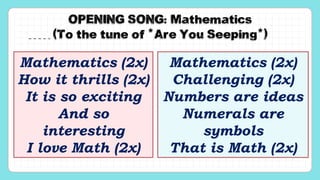
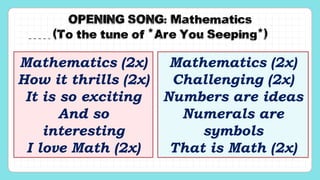
OPENING SONG: Mathematics
(To the tune of “Are You Seeping”)
Mathematics (2x)
How it thrills (2x)
It is so exciting
And so
interesting
I love Math (2x)
Mathematics (2x)
Challenging (2x)
Numbers are ideas
Numerals are
symbols
That is Math (2x)
Solving Routine Problems
Involving Addition and/or
Subtraction of Fractions Using
Appropriate Problem-solving
Strategies and Tools.
1
Solves routine problems involving
addition and/or subtraction of
fractions using appropriate problem-
solving strategies and tools
1
How do you change
dissimilar fractions to
similar fractions?
KING BACK
L
How do you spend
your Saturday and
Sunday?
Let’s talk about Lito and find out
what he does. Listen carefully
and find the good trait of Lito. Do
you possess the same trait? Give
some activities that you do at
home.
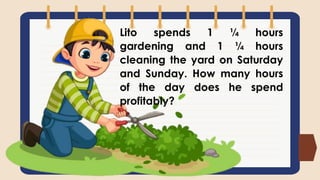
Lito spends 1 ¼ hours
gardening and 1 ¼ hours
cleaning the yard on Saturday
and Sunday. How many hours
of the day does he spend
profitably?
1.) What are the things you must look for in
a problem before solving it?
2.) What is asked in the problem?
3.) What facts are given?
4.) What operation are we going to use to
solve the problem?
5.) Solve the problem. Show your solution.
SOLVING ROUTINE
PROBLEMS INVOLVING
ADDITION and/or
SUBTRACTION OF
FRACTIONS
STEPS:
1. Understand the problem
a. Know what is being asked
b. Know the given facts
STEPS:
2. Plan
a. determine the operation/s
needed
3. Solve (Show the solution to the
problem)
STEPS:
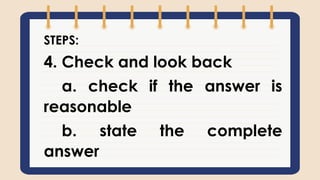
4. Check and look back
a. check if the answer is
reasonable
b. state the complete
answer
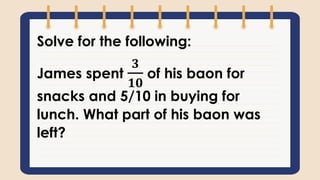
Solve for the following:
James spent
𝟑
𝟏𝟎
of his baon for
snacks and 5/10 in buying for
lunch. What part of his baon was
left?
Solve for the following:
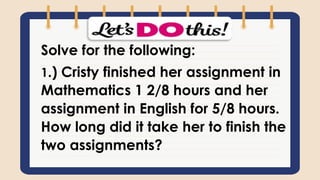
1.) Cristy finished her assignment in
Mathematics 1 2/8 hours and her
assignment in English for 5/8 hours.
How long did it take her to finish the
two assignments?
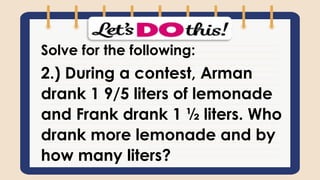
Solve for the following:
2.) During a contest, Arman
drank 1 9/5 liters of lemonade
and Frank drank 1 ½ liters. Who
drank more lemonade and by
how many liters?
Solve for the following:
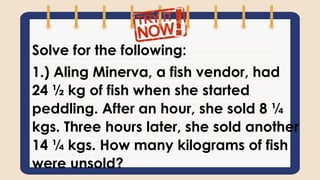
1.) Aling Minerva, a fish vendor, had
24 ½ kg of fish when she started
peddling. After an hour, she sold 8 ¼
kgs. Three hours later, she sold another
14 ¼ kgs. How many kilograms of fish
were unsold?
Solve for the following:
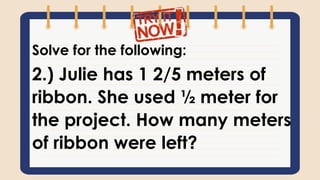
2.) Julie has 1 2/5 meters of
ribbon. She used ½ meter for
the project. How many meters
of ribbon were left?
Solve for the following:
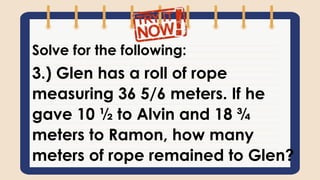
3.) Glen has a roll of rope
measuring 36 5/6 meters. If he
gave 10 ½ to Alvin and 18 ¾
meters to Ramon, how many
meters of rope remained to Glen?
Solve for the following:
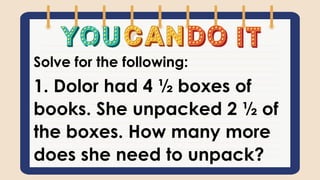
1. Dolor had 4 ½ boxes of
books. She unpacked 2 ½ of
the boxes. How many more
does she need to unpack?
Solve for the following:
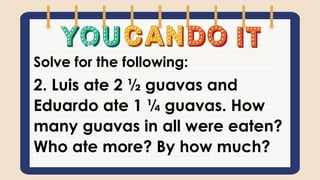
2. Luis ate 2 ½ guavas and
Eduardo ate 1 ¼ guavas. How
many guavas in all were eaten?
Who ate more? By how much?
What have you learned?
How do you solve
routine problems
involving addition
and/or subtraction
of fractions?
What have you learned?
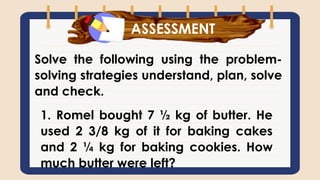
Solve the following using the problem-
solving strategies understand, plan, solve
and check.
ASSESSMENT
1. Romel bought 7 ½ kg of butter. He
used 2 3/8 kg of it for baking cakes
and 2 ¼ kg for baking cookies. How
much butter were left?
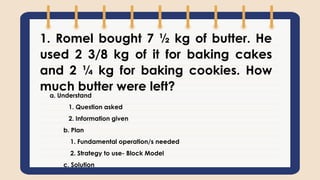
1. Romel bought 7 ½ kg of butter. He
used 2 3/8 kg of it for baking cakes
and 2 ¼ kg for baking cookies. How
much butter were left?
a. Understand
1. Question asked
2. Information given
b. Plan
1. Fundamental operation/s needed
2. Strategy to use- Block Model
c. Solution
Solve the following using the problem-
solving strategies understand, plan, solve
and check.
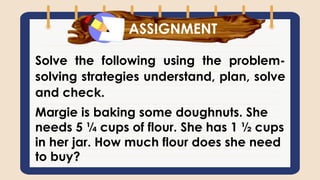
Margie is baking some doughnuts. She
needs 5 ¼ cups of flour. She has 1 ½ cups
in her jar. How much flour does she need
to buy?
ASSIGNMENT
OPENING SONG: Mathematics
(To the tune of “Are You Seeping”)
Mathematics (2x)
How it thrills (2x)
It is so exciting
And so
interesting
I love Math (2x)
Mathematics (2x)
Challenging (2x)
Numbers are ideas
Numerals are
symbols
That is Math (2x)
Solving Non-Routine Problems
Involving Addition and/or
Subtraction of Fractions Using
Appropriate Problem-solving
Strategies and Tools.
2
Solves non-routine problems
involving addition and/or subtraction
of fractions using appropriate
problem-solving strategies and tools
2
What are the steps in solving
routine problems involving
addition/subtraction of
fractions?
KING BACK
L
What do you usually do
during your free time? (Wait
for some responses). I have
here some story problems
about how some children
spend their free time.
Norma spends her free time playing the
piano. Each day she spends ¾ hour.
When a visitor came in, she has already
played for ¼ hour. To complete her
schedule, how much longer does she
need to play?
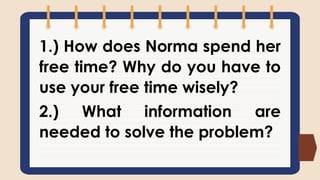
1.) How does Norma spend her
free time? Why do you have to
use your free time wisely?
2.) What information are
needed to solve the problem?
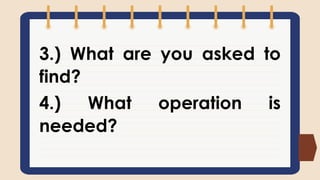
3.) What are you asked to
find?
4.) What operation is
needed?
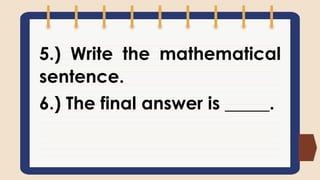
5.) Write the mathematical
sentence.
6.) The final answer is _____.
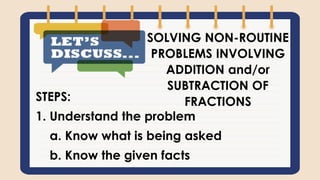
STEPS:
1. Understand the problem
a. Know what is being asked
b. Know the given facts
SOLVING NON-ROUTINE
PROBLEMS INVOLVING
ADDITION and/or
SUBTRACTION OF
FRACTIONS
STEPS:
2. Plan
a. determine the operation/s
needed
3. Solve (Show the solution to the
problem)
STEPS:
4. Check and look back
a. check if the answer is
reasonable
b. state the complete
answer
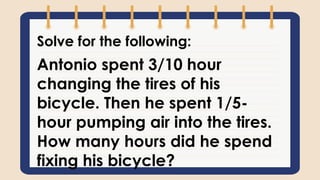
Solve for the following:
Antonio spent 3/10 hour
changing the tires of his
bicycle. Then he spent 1/5-
hour pumping air into the tires.
How many hours did he spend
fixing his bicycle?
Solve for the following:
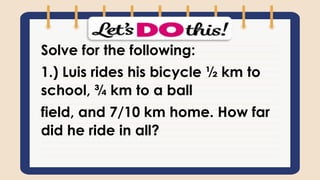
1.) Luis rides his bicycle ½ km to
school, ¾ km to a ball
field, and 7/10 km home. How far
did he ride in all?
Solve for the following:
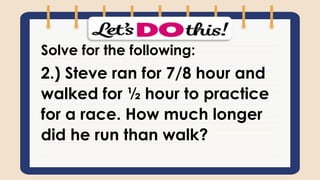
2.) Steve ran for 7/8 hour and
walked for ½ hour to practice
for a race. How much longer
did he run than walk?
Solve for the following:
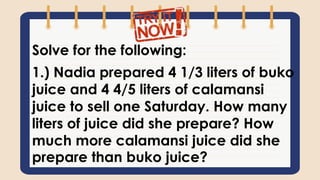
1.) Nadia prepared 4 1/3 liters of buko
juice and 4 4/5 liters of calamansi
juice to sell one Saturday. How many
liters of juice did she prepare? How
much more calamansi juice did she
prepare than buko juice?
Solve for the following:
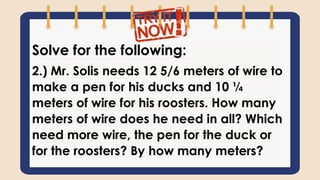
2.) Mr. Solis needs 12 5/6 meters of wire to
make a pen for his ducks and 10 ¼
meters of wire for his roosters. How many
meters of wire does he need in all? Which
need more wire, the pen for the duck or
for the roosters? By how many meters?
Solve for the following:
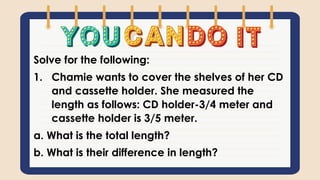
1. Chamie wants to cover the shelves of her CD
and cassette holder. She measured the
length as follows: CD holder-3/4 meter and
cassette holder is 3/5 meter.
a. What is the total length?
b. What is their difference in length?
What have you learned?
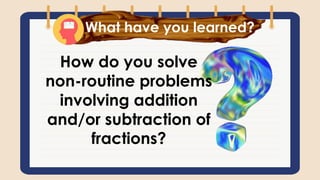
How do you solve
non-routine problems
involving addition
and/or subtraction of
fractions?
What have you learned?
Solve the following using the problem-
solving strategies understand, plan, solve
and check.
ASSESSMENT
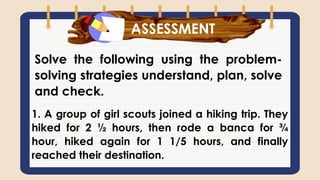
1. A group of girl scouts joined a hiking trip. They
hiked for 2 ½ hours, then rode a banca for ¾
hour, hiked again for 1 1/5 hours, and finally
reached their destination.
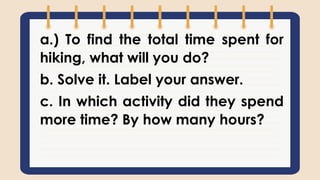
a.) To find the total time spent for
hiking, what will you do?
b. Solve it. Label your answer.
c. In which activity did they spend
more time? By how many hours?
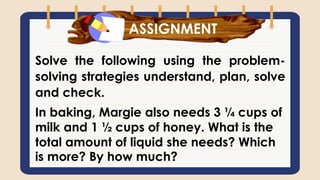
Solve the following using the problem-
solving strategies understand, plan, solve
and check.
In baking, Margie also needs 3 ¼ cups of
milk and 1 ½ cups of honey. What is the
total amount of liquid she needs? Which
is more? By how much?
ASSIGNMENT
OPENING SONG: Mathematics
(To the tune of “Are You Seeping”)
Mathematics (2x)
How it thrills (2x)
It is so exciting
And so
interesting
I love Math (2x)
Mathematics (2x)
Challenging (2x)
Numbers are ideas
Numerals are
symbols
That is Math (2x)
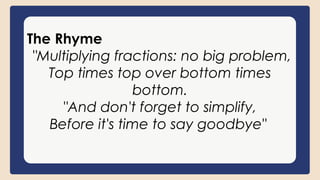
The Rhyme
"Multiplying fractions: no big problem,
Top times top over bottom times
bottom.
"And don't forget to simplify,
Before it's time to say goodbye"
Multiplying
Simple Fractions
3
Multiplies simple fractions.
3
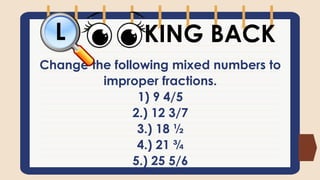
Change the following mixed numbers to
improper fractions.
1) 9 4/5
2.) 12 3/7
3.) 18 ½
4.) 21 ¾
5.) 25 5/6
KING BACK
L
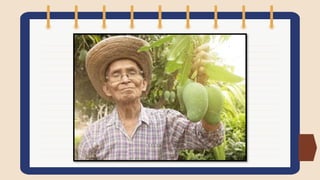
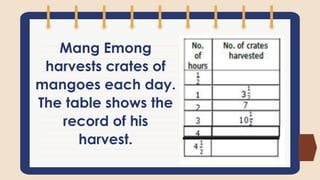
Mang Emong
harvests crates of
mangoes each day.
The table shows the
record of his
harvest.
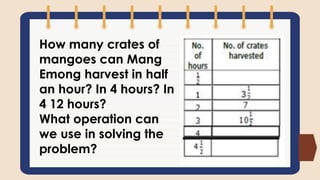
How many crates of
mangoes can Mang
Emong harvest in half
an hour? In 4 hours? In
4 12 hours?
What operation can
we use in solving the
problem?
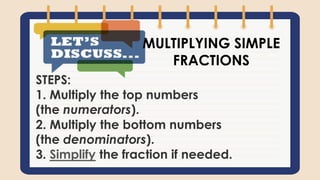
STEPS:
1. Multiply the top numbers
(the numerators).
2. Multiply the bottom numbers
(the denominators).
3. Simplify the fraction if needed.
MULTIPLYING SIMPLE
FRACTIONS
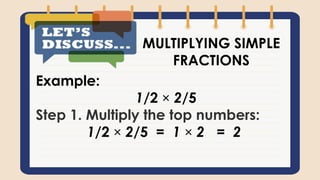
Example:
1/2 × 2/5
Step 1. Multiply the top numbers:
1/2 × 2/5 = 1 × 2 = 2
MULTIPLYING SIMPLE
FRACTIONS
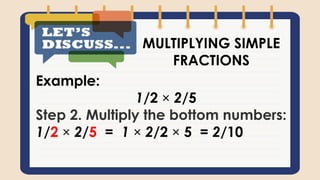
Example:
1/2 × 2/5
Step 2. Multiply the bottom numbers:
1/2 × 2/5 = 1 × 2/2 × 5 = 2/10
MULTIPLYING SIMPLE
FRACTIONS
Fractions and Whole Numbers
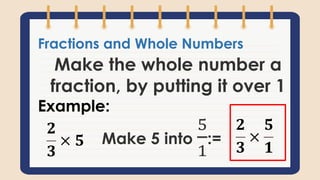
Make the whole number a
fraction, by putting it over 1
Example:
Make 5 into
5
1
:=
𝟐
𝟑
× 𝟓
𝟐
𝟑
×
𝟓
𝟏
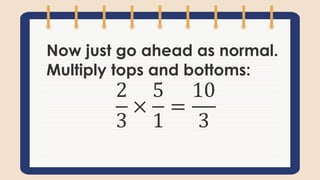
Now just go ahead as normal.
Multiply tops and bottoms:
2
3
×
5
1
=
10
3
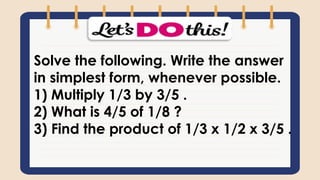
Solve the following. Write the answer
in simplest form, whenever possible.
1) Multiply 1/3 by 3/5 .
2) What is 4/5 of 1/8 ?
3) Find the product of 1/3 x 1/2 x 3/5 .
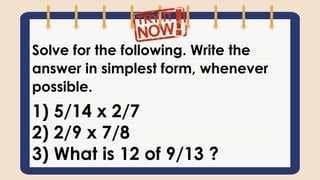
Solve for the following. Write the
answer in simplest form, whenever
possible.
1) 5/14 x 2/7
2) 2/9 x 7/8
3) What is 12 of 9/13 ?
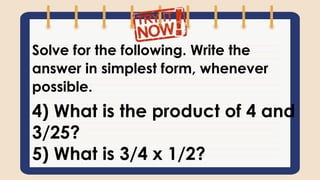
Solve for the following. Write the
answer in simplest form, whenever
possible.
4) What is the product of 4 and
3/25?
5) What is 3/4 x 1/2?
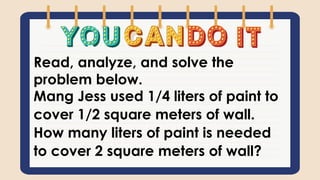
Read, analyze, and solve the
problem below.
Mang Jess used 1/4 liters of paint to
cover 1/2 square meters of wall.
How many liters of paint is needed
to cover 2 square meters of wall?
What have you learned?
How do we
multiply simple
fractions?
What have you learned?
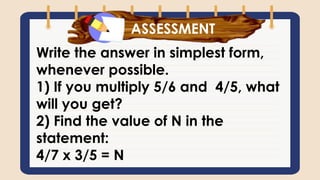
Write the answer in simplest form,
whenever possible.
1) If you multiply 5/6 and 4/5, what
will you get?
2) Find the value of N in the
statement:
4/7 x 3/5 = N
ASSESSMENT
What have you learned?
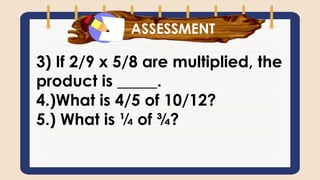
3) If 2/9 x 5/8 are multiplied, the
product is _____.
4.)What is 4/5 of 10/12?
5.) What is ¼ of ¾?
ASSESSMENT
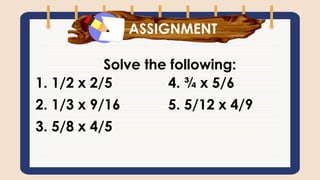
Solve the following:
1. 1/2 x 2/5 4. ¾ x 5/6
2. 1/3 x 9/16 5. 5/12 x 4/9
3. 5/8 x 4/5
ASSIGNMENT
OPENING SONG: Mathematics
(To the tune of “Are You Seeping”)
Mathematics (2x)
How it thrills (2x)
It is so exciting
And so
interesting
I love Math (2x)
Mathematics (2x)
Challenging (2x)
Numbers are ideas
Numerals are
symbols
That is Math (2x)
The Rhyme
"Multiplying fractions: no big problem,
Top times top over bottom times
bottom.
"And don't forget to simplify,
Before it's time to say goodbye"
Multiplying
Mixed Fractions
4
Multiplies mixed fractions.
4
What are the steps in multiplying
simple fractions?
How do you change a whole
number to fraction?
KING BACK
L
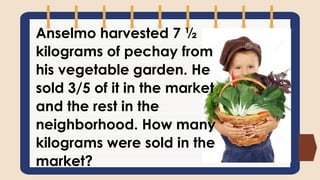
Anselmo harvested 7 ½
kilograms of pechay from
his vegetable garden. He
sold 3/5 of it in the market
and the rest in the
neighborhood. How many
kilograms were sold in the
market?
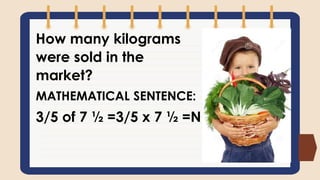
How many kilograms
were sold in the
market?
MATHEMATICAL SENTENCE:
3/5 of 7 ½ =3/5 x 7 ½ =N
MULTIPLYING MIXED
NUMBERS
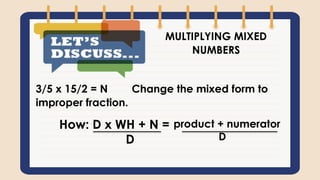
3/5 x 15/2 = N Change the mixed form to
improper fraction.
How: D x WH + N =
D
product + numerator
D
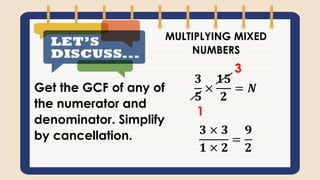
MULTIPLYING MIXED
NUMBERS
𝟑
𝟓
×
𝟏𝟓
𝟐
= 𝑵
𝟑 × 𝟑
𝟏 × 𝟐
=
𝟗
𝟐
1
3
Get the GCF of any of
the numerator and
denominator. Simplify
by cancellation.
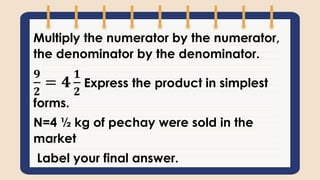
Multiply the numerator by the numerator,
the denominator by the denominator.
𝟗
𝟐
= 𝟒
𝟏
𝟐
Express the product in simplest
forms.
N=4 ½ kg of pechay were sold in the
market
Label your final answer.
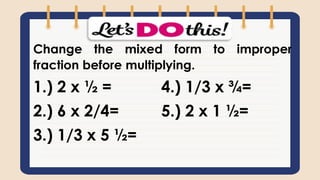
Change the mixed form to improper
fraction before multiplying.
1.) 2 x ½ = 4.) 1/3 x ¾=
2.) 6 x 2/4= 5.) 2 x 1 ½=
3.) 1/3 x 5 ½=
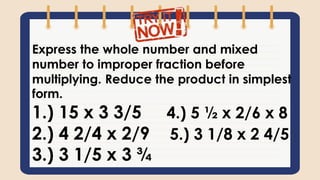
Express the whole number and mixed
number to improper fraction before
multiplying. Reduce the product in simplest
form.
1.) 15 x 3 3/5 4.) 5 ½ x 2/6 x 8
2.) 4 2/4 x 2/9 5.) 3 1/8 x 2 4/5
3.) 3 1/5 x 3 ¾
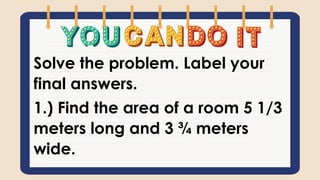
Solve the problem. Label your
final answers.
1.) Find the area of a room 5 1/3
meters long and 3 ¾ meters
wide.
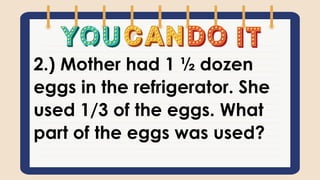
2.) Mother had 1 ½ dozen
eggs in the refrigerator. She
used 1/3 of the eggs. What
part of the eggs was used?
What have you learned?
How do we multiply
mixed
numbers/fractions?
Whole numbers by
mixed numbers?
What have you learned?
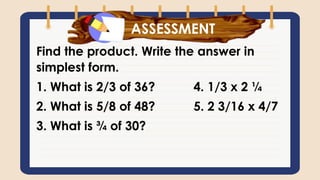
Find the product. Write the answer in
simplest form.
1. What is 2/3 of 36? 4. 1/3 x 2 ¼
2. What is 5/8 of 48? 5. 2 3/16 x 4/7
3. What is ¾ of 30?
ASSESSMENT
Answer Part B=Give the
value of N on page 10 of
your Module.
ASSIGNMENT

MATH 6-Q1- Week_2.pptx

  • 2.
    OPENING SONG: Mathematics (Tothe tune of “Are You Seeping”) Mathematics (2x) How it thrills (2x) It is so exciting And so interesting I love Math (2x) Mathematics (2x) Challenging (2x) Numbers are ideas Numerals are symbols That is Math (2x)
  • 3.
    Solving Routine Problems InvolvingAddition and/or Subtraction of Fractions Using Appropriate Problem-solving Strategies and Tools. 1
  • 4.
    Solves routine problemsinvolving addition and/or subtraction of fractions using appropriate problem- solving strategies and tools 1
  • 5.
    How do youchange dissimilar fractions to similar fractions? KING BACK L
  • 6.
    How do youspend your Saturday and Sunday?
  • 7.
    Let’s talk aboutLito and find out what he does. Listen carefully and find the good trait of Lito. Do you possess the same trait? Give some activities that you do at home.
  • 8.
    Lito spends 1¼ hours gardening and 1 ¼ hours cleaning the yard on Saturday and Sunday. How many hours of the day does he spend profitably?
  • 9.
    1.) What arethe things you must look for in a problem before solving it? 2.) What is asked in the problem? 3.) What facts are given? 4.) What operation are we going to use to solve the problem? 5.) Solve the problem. Show your solution.
  • 10.
    SOLVING ROUTINE PROBLEMS INVOLVING ADDITIONand/or SUBTRACTION OF FRACTIONS STEPS: 1. Understand the problem a. Know what is being asked b. Know the given facts
  • 11.
    STEPS: 2. Plan a. determinethe operation/s needed 3. Solve (Show the solution to the problem)
  • 12.
    STEPS: 4. Check andlook back a. check if the answer is reasonable b. state the complete answer
  • 13.
    Solve for thefollowing: James spent 𝟑 𝟏𝟎 of his baon for snacks and 5/10 in buying for lunch. What part of his baon was left?
  • 14.
    Solve for thefollowing: 1.) Cristy finished her assignment in Mathematics 1 2/8 hours and her assignment in English for 5/8 hours. How long did it take her to finish the two assignments?
  • 15.
    Solve for thefollowing: 2.) During a contest, Arman drank 1 9/5 liters of lemonade and Frank drank 1 ½ liters. Who drank more lemonade and by how many liters?
  • 16.
    Solve for thefollowing: 1.) Aling Minerva, a fish vendor, had 24 ½ kg of fish when she started peddling. After an hour, she sold 8 ¼ kgs. Three hours later, she sold another 14 ¼ kgs. How many kilograms of fish were unsold?
  • 17.
    Solve for thefollowing: 2.) Julie has 1 2/5 meters of ribbon. She used ½ meter for the project. How many meters of ribbon were left?
  • 18.
    Solve for thefollowing: 3.) Glen has a roll of rope measuring 36 5/6 meters. If he gave 10 ½ to Alvin and 18 ¾ meters to Ramon, how many meters of rope remained to Glen?
  • 19.
    Solve for thefollowing: 1. Dolor had 4 ½ boxes of books. She unpacked 2 ½ of the boxes. How many more does she need to unpack?
  • 20.
    Solve for thefollowing: 2. Luis ate 2 ½ guavas and Eduardo ate 1 ¼ guavas. How many guavas in all were eaten? Who ate more? By how much?
  • 21.
    What have youlearned? How do you solve routine problems involving addition and/or subtraction of fractions?
  • 22.
    What have youlearned? Solve the following using the problem- solving strategies understand, plan, solve and check. ASSESSMENT 1. Romel bought 7 ½ kg of butter. He used 2 3/8 kg of it for baking cakes and 2 ¼ kg for baking cookies. How much butter were left?
  • 23.
    1. Romel bought7 ½ kg of butter. He used 2 3/8 kg of it for baking cakes and 2 ¼ kg for baking cookies. How much butter were left? a. Understand 1. Question asked 2. Information given b. Plan 1. Fundamental operation/s needed 2. Strategy to use- Block Model c. Solution
  • 24.
    Solve the followingusing the problem- solving strategies understand, plan, solve and check. Margie is baking some doughnuts. She needs 5 ¼ cups of flour. She has 1 ½ cups in her jar. How much flour does she need to buy? ASSIGNMENT
  • 26.
    OPENING SONG: Mathematics (Tothe tune of “Are You Seeping”) Mathematics (2x) How it thrills (2x) It is so exciting And so interesting I love Math (2x) Mathematics (2x) Challenging (2x) Numbers are ideas Numerals are symbols That is Math (2x)
  • 27.
    Solving Non-Routine Problems InvolvingAddition and/or Subtraction of Fractions Using Appropriate Problem-solving Strategies and Tools. 2
  • 28.
    Solves non-routine problems involvingaddition and/or subtraction of fractions using appropriate problem-solving strategies and tools 2
  • 29.
    What are thesteps in solving routine problems involving addition/subtraction of fractions? KING BACK L
  • 30.
    What do youusually do during your free time? (Wait for some responses). I have here some story problems about how some children spend their free time.
  • 31.
    Norma spends herfree time playing the piano. Each day she spends ¾ hour. When a visitor came in, she has already played for ¼ hour. To complete her schedule, how much longer does she need to play?
  • 32.
    1.) How doesNorma spend her free time? Why do you have to use your free time wisely? 2.) What information are needed to solve the problem?
  • 33.
    3.) What areyou asked to find? 4.) What operation is needed?
  • 34.
    5.) Write themathematical sentence. 6.) The final answer is _____.
  • 35.
    STEPS: 1. Understand theproblem a. Know what is being asked b. Know the given facts SOLVING NON-ROUTINE PROBLEMS INVOLVING ADDITION and/or SUBTRACTION OF FRACTIONS
  • 36.
    STEPS: 2. Plan a. determinethe operation/s needed 3. Solve (Show the solution to the problem)
  • 37.
    STEPS: 4. Check andlook back a. check if the answer is reasonable b. state the complete answer
  • 38.
    Solve for thefollowing: Antonio spent 3/10 hour changing the tires of his bicycle. Then he spent 1/5- hour pumping air into the tires. How many hours did he spend fixing his bicycle?
  • 39.
    Solve for thefollowing: 1.) Luis rides his bicycle ½ km to school, ¾ km to a ball field, and 7/10 km home. How far did he ride in all?
  • 40.
    Solve for thefollowing: 2.) Steve ran for 7/8 hour and walked for ½ hour to practice for a race. How much longer did he run than walk?
  • 41.
    Solve for thefollowing: 1.) Nadia prepared 4 1/3 liters of buko juice and 4 4/5 liters of calamansi juice to sell one Saturday. How many liters of juice did she prepare? How much more calamansi juice did she prepare than buko juice?
  • 42.
    Solve for thefollowing: 2.) Mr. Solis needs 12 5/6 meters of wire to make a pen for his ducks and 10 ¼ meters of wire for his roosters. How many meters of wire does he need in all? Which need more wire, the pen for the duck or for the roosters? By how many meters?
  • 43.
    Solve for thefollowing: 1. Chamie wants to cover the shelves of her CD and cassette holder. She measured the length as follows: CD holder-3/4 meter and cassette holder is 3/5 meter. a. What is the total length? b. What is their difference in length?
  • 44.
    What have youlearned? How do you solve non-routine problems involving addition and/or subtraction of fractions?
  • 45.
    What have youlearned? Solve the following using the problem- solving strategies understand, plan, solve and check. ASSESSMENT 1. A group of girl scouts joined a hiking trip. They hiked for 2 ½ hours, then rode a banca for ¾ hour, hiked again for 1 1/5 hours, and finally reached their destination.
  • 46.
    a.) To findthe total time spent for hiking, what will you do? b. Solve it. Label your answer. c. In which activity did they spend more time? By how many hours?
  • 47.
    Solve the followingusing the problem- solving strategies understand, plan, solve and check. In baking, Margie also needs 3 ¼ cups of milk and 1 ½ cups of honey. What is the total amount of liquid she needs? Which is more? By how much? ASSIGNMENT
  • 49.
    OPENING SONG: Mathematics (Tothe tune of “Are You Seeping”) Mathematics (2x) How it thrills (2x) It is so exciting And so interesting I love Math (2x) Mathematics (2x) Challenging (2x) Numbers are ideas Numerals are symbols That is Math (2x)
  • 50.
    The Rhyme "Multiplying fractions:no big problem, Top times top over bottom times bottom. "And don't forget to simplify, Before it's time to say goodbye"
  • 51.
  • 52.
  • 53.
    Change the followingmixed numbers to improper fractions. 1) 9 4/5 2.) 12 3/7 3.) 18 ½ 4.) 21 ¾ 5.) 25 5/6 KING BACK L
  • 55.
    Mang Emong harvests cratesof mangoes each day. The table shows the record of his harvest.
  • 56.
    How many cratesof mangoes can Mang Emong harvest in half an hour? In 4 hours? In 4 12 hours? What operation can we use in solving the problem?
  • 57.
    STEPS: 1. Multiply thetop numbers (the numerators). 2. Multiply the bottom numbers (the denominators). 3. Simplify the fraction if needed. MULTIPLYING SIMPLE FRACTIONS
  • 58.
    Example: 1/2 × 2/5 Step1. Multiply the top numbers: 1/2 × 2/5 = 1 × 2 = 2 MULTIPLYING SIMPLE FRACTIONS
  • 59.
    Example: 1/2 × 2/5 Step2. Multiply the bottom numbers: 1/2 × 2/5 = 1 × 2/2 × 5 = 2/10 MULTIPLYING SIMPLE FRACTIONS
  • 60.
    Fractions and WholeNumbers Make the whole number a fraction, by putting it over 1 Example: Make 5 into 5 1 := 𝟐 𝟑 × 𝟓 𝟐 𝟑 × 𝟓 𝟏
  • 61.
    Now just goahead as normal. Multiply tops and bottoms: 2 3 × 5 1 = 10 3
  • 62.
    Solve the following.Write the answer in simplest form, whenever possible. 1) Multiply 1/3 by 3/5 . 2) What is 4/5 of 1/8 ? 3) Find the product of 1/3 x 1/2 x 3/5 .
  • 63.
    Solve for thefollowing. Write the answer in simplest form, whenever possible. 1) 5/14 x 2/7 2) 2/9 x 7/8 3) What is 12 of 9/13 ?
  • 64.
    Solve for thefollowing. Write the answer in simplest form, whenever possible. 4) What is the product of 4 and 3/25? 5) What is 3/4 x 1/2?
  • 65.
    Read, analyze, andsolve the problem below. Mang Jess used 1/4 liters of paint to cover 1/2 square meters of wall. How many liters of paint is needed to cover 2 square meters of wall?
  • 66.
    What have youlearned? How do we multiply simple fractions?
  • 67.
    What have youlearned? Write the answer in simplest form, whenever possible. 1) If you multiply 5/6 and 4/5, what will you get? 2) Find the value of N in the statement: 4/7 x 3/5 = N ASSESSMENT
  • 68.
    What have youlearned? 3) If 2/9 x 5/8 are multiplied, the product is _____. 4.)What is 4/5 of 10/12? 5.) What is ¼ of ¾? ASSESSMENT
  • 69.
    Solve the following: 1.1/2 x 2/5 4. ¾ x 5/6 2. 1/3 x 9/16 5. 5/12 x 4/9 3. 5/8 x 4/5 ASSIGNMENT
  • 71.
    OPENING SONG: Mathematics (Tothe tune of “Are You Seeping”) Mathematics (2x) How it thrills (2x) It is so exciting And so interesting I love Math (2x) Mathematics (2x) Challenging (2x) Numbers are ideas Numerals are symbols That is Math (2x)
  • 72.
    The Rhyme "Multiplying fractions:no big problem, Top times top over bottom times bottom. "And don't forget to simplify, Before it's time to say goodbye"
  • 73.
  • 74.
  • 75.
    What are thesteps in multiplying simple fractions? How do you change a whole number to fraction? KING BACK L
  • 76.
    Anselmo harvested 7½ kilograms of pechay from his vegetable garden. He sold 3/5 of it in the market and the rest in the neighborhood. How many kilograms were sold in the market?
  • 77.
    How many kilograms weresold in the market? MATHEMATICAL SENTENCE: 3/5 of 7 ½ =3/5 x 7 ½ =N
  • 78.
    MULTIPLYING MIXED NUMBERS 3/5 x15/2 = N Change the mixed form to improper fraction. How: D x WH + N = D product + numerator D
  • 79.
    MULTIPLYING MIXED NUMBERS 𝟑 𝟓 × 𝟏𝟓 𝟐 = 𝑵 𝟑× 𝟑 𝟏 × 𝟐 = 𝟗 𝟐 1 3 Get the GCF of any of the numerator and denominator. Simplify by cancellation.
  • 80.
    Multiply the numeratorby the numerator, the denominator by the denominator. 𝟗 𝟐 = 𝟒 𝟏 𝟐 Express the product in simplest forms. N=4 ½ kg of pechay were sold in the market Label your final answer.
  • 81.
    Change the mixedform to improper fraction before multiplying. 1.) 2 x ½ = 4.) 1/3 x ¾= 2.) 6 x 2/4= 5.) 2 x 1 ½= 3.) 1/3 x 5 ½=
  • 82.
    Express the wholenumber and mixed number to improper fraction before multiplying. Reduce the product in simplest form. 1.) 15 x 3 3/5 4.) 5 ½ x 2/6 x 8 2.) 4 2/4 x 2/9 5.) 3 1/8 x 2 4/5 3.) 3 1/5 x 3 ¾
  • 83.
    Solve the problem.Label your final answers. 1.) Find the area of a room 5 1/3 meters long and 3 ¾ meters wide.
  • 84.
    2.) Mother had1 ½ dozen eggs in the refrigerator. She used 1/3 of the eggs. What part of the eggs was used?
  • 85.
    What have youlearned? How do we multiply mixed numbers/fractions? Whole numbers by mixed numbers?
  • 86.
    What have youlearned? Find the product. Write the answer in simplest form. 1. What is 2/3 of 36? 4. 1/3 x 2 ¼ 2. What is 5/8 of 48? 5. 2 3/16 x 4/7 3. What is ¾ of 30? ASSESSMENT
  • 87.
    Answer Part B=Givethe value of N on page 10 of your Module. ASSIGNMENT