INTERNATIONAL JOURNAL OF MECHANICAL ENGINEERING 
International Journal of Mechanical Engineering and Technology (IJMET), ISSN 0976 – 6340(Print), 
ISSN 0976 – 6359(Online), Volume 5, Issue 8, August (2014), pp. 34-40 © IAEME 
AND TECHNOLOGY (IJMET) 
ISSN 0976 – 6340 (Print) 
ISSN 0976 – 6359 (Online) 
Volume 5, Issue 8, August (2014), pp. 34-40 
© IAEME: www.iaeme.com/IJMET.asp 
Journal Impact Factor (2014): 7.5377 (Calculated by GISI) 
www.jifactor.com 
34 
 
IJMET 
© I A E M E 
MATERIAL SELECTION FOR UNMANNED AERIAL VEHICLE 
AKSHAY BALACHANDRAN1, DIVYESH KARELIA2, Dr. JAYARAMULU CHALLA3 
1,2UG Students, Department of Production Engineering, 
3Professor, Department of Production Engineering, 
Fr. Conceicao Rodrigues College of Engineering, FrAgnel Ashram, Bandstand, Bandra (W), 
Mumbai, Maharashtra, India, Pin Code: 400 050 
ABSTRACT 
This paper explains and details about a brief study and comparison of the various available 
engineering and structural materials which is the key requirement for the optimum functioning of 
Unmanned Aerial Vehicles (UAVs) known as drone and referred to as Remotely Piloted Aircraft 
(RPA) of 'Advanced class' of this competition. The major requirements that these materials on UAVs 
with respect to physical and mechanical properties must fulfill are: resistance to buckling, high 
ultimate tensile strength, less inflammable, high strength to weight ratio, low thermal gradient, 
resistance to noise and vibration, resistance against deteriorative fuels and chemicals, low corrosion 
and oxidation, ease of shape ability, fastening and joining, high fatigue and endurance limit. In order 
to fulfill these requirements, our system comprised of these engineering materials: carbon fiber, fiber 
plastic, Balsa, Thermocol, rubber, Aluminium alloy, alloy steel, thin plywood. The system performed 
well and stood true on all its expectations. There are off-the-shelf materials available for their 
respective tasks but they lack on one parameter or other.Additionally, their cost is prohibitive at 
times. The material selection, explained in this paper, is comprehensive, inexpensive and rugged and 
can be implemented on any kind of UAV vehicle. 
Keywords: Aero, High Strength to Weight Ratio, Balsa, Carbon Fiber, Fiber Plastics. 
I. INTRODUCTION 
SAE International is a global association of more than 138,000 engineers and related 
technical experts in the aerospace, automotive and commercial-vehicle industries. SAE 
International's core competencies are life-long learning and voluntary consensus standards 
development. To nurture and encourage talent in the field of aviation, SAE International conducts
International Journal of Mechanical Engineering and Technology (IJMET), ISSN 0976 – 6340(Print), 
ISSN 0976 – 6359(Online), Volume 5, Issue 8, August (2014), pp. 34-40 © IAEME 
‘Aero Design Series’ competition annually in the USA. The competition involves student teams from 
all over the world designing and fabricating UAVs. Depending on the design and event objectives, 
there are three classes in this competition: Micro, Regular and Advanced Class. 
35 
 
The objective of the Advanced Class, of the 2013 edition of SAE Aero Design Series, was to 
design the most efficient aircraft capable of accurately dropping a three pound (3 lb) humanitarian 
aid package from a minimum of 100ft off the ground. Though the class was mostly focused on 
mission success, students were needed to perform trade studies to optimize empty weight and 
anticipate repair build-up weight while meeting several aircraft design requirements. 
The Advanced Class also involved an array oftasks to be accomplished to win high flight 
points, primary of which was dropping a three pound (3 lb) humanitarian aid package from a 
minimum of 100ft off the ground. The objectives were: 
1. Team must be able to provide high strength and stability to the UAV at high altitudes and 
speeds. 
2. Team must be able to resist and balance the forces acting dynamically on the body of the UAV. 
3. Team should be able to select the right materials at the right place with the right properties. 
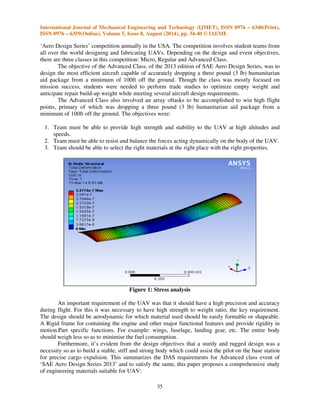
Figure 1: Stress analysis 
An important requirement of the UAV was that it should have a high precision and accuracy 
during flight. For this it was necessary to have high strength to weight ratio, the key requirement. 
The design should be aerodynamic for which material used should be easily formable or shapeable. 
A Rigid frame for containing the engine and other major functional features and provide rigidity in 
motion.Part specific functions. For example: wings, fuselage, landing gear, etc. The entire body 
should weigh less so as to minimise the fuel consumption. 
Furthermore, it’s evident from the design objectives that a sturdy and rugged design was a 
necessity so as to build a stable, stiff and strong body which could assist the pilot on the base station 
for precise cargo expulsion. This summarizes the DAS requirements for Advanced class event of 
‘SAE Aero Design Series 2013’ and to satisfy the same, this paper proposes a comprehensive study 
of engineering materials suitable for UAV:
International Journal of Mechanical Engineering and Technology (IJMET), ISSN 0976 – 6340(Print), 
ISSN 0976 – 6359(Online), Volume 5, Issue 8, August (2014), pp. 34-40 © IAEME 
Parameters Balsa Wood Carbon Fiber Rohacell 
Weight 5 5 5 
2 4.5 5 
Availability 5 5 1 
Cost 4 4 0.5 
Machinability 5 4 3 
Total 21 22.5 14.5 
36 
II. MATERIAL SELECTION 
 
Figure 2: Material study 
Strength to weight 
ratio 
1. Wood (Balsa) 
A light weight and strong material, but splinters and requires a lot of maintenance and less 
durability. It is stronger for its weight than any other material except for certain alloy steels.Timber is 
readily worked by hand, using simple tools and is therefore far cheaper to use than metal. Timber 
from deciduous trees is said to be 'hardwood'. It can be seen, therefore, that the term 'softwood' 
and 'hardwood' apply to the family or type of tree and do not necessarily indicate the density of the 
wood. That is why balsa, the lightest and most fragile of woods, is classed as a hardwood. BALSA, 
although very soft and low in strength properties, is a hardwood, which grows in CentralAmerica. It 
is the lightest timber in general use and is pinkish white to pale brown in colour. Dueto its porosity, 
if it is badly stored or inadequately protected in use, it very readily deteriorates ifexposed to 
moisture. Its principal uses in aircraft construction are the making of fairings, filletsand light, low 
density contour blocks. 
2. Carbon fiber 
Carbon fiber (also commonly called graphite) has special properties making it ideal for 
applications ranging from aerospace to automobiles. When combined with resin to form a 
composite, it produces parts that are extremely light and rigid. Carbon parts are lighter and stronger 
than their metal counterparts. For that reason, carbon fiber is being used extensively in the aerospace 
industry. High-end vehicles are incorporating carbon to make one piece vehicle frames. Perhaps the 
biggest user of carbon fiber is the aircraft industry, both commercial and military. Here are the 
biggest users of carbon fiber. Carbon fibre is awesome. It's light, incredibly strong and you can make 
almost anything out of it, including planes like the fancy new 787 Dreamliner. What it's not great at, 
though, is taking lightning strikes, and apparently planes get hit by lightning all the time. Scarily, 
carbon fibre is literally shredded by the strike.Carbon fiber construction offers exceptional strength 
and stiffness at a lower density than traditional metal materials. The high temperature epoxy resins 
with which the fibers are cured are highly resistant to water, fuel, anti-freeze, and solvents which 
might cause wear or deterioration and they can be protected from ultraviolet radiation using the same 
paint finishes used on metal airplane components. 
3. Thermocol (Polystyrene) 
Polystyrene (PS) is a synthetic aromatic polymer made from the monomer styrene, a liquid 
petrochemical.It is a very inexpensive resin per unit weight. It is a rather poor barrier to oxygen and 
water vapor and has a relatively low melting point.[4] Polystyrene is one of the most widely used 
plastics, the scale of its production being several billion kilograms per year.Expanded polystyrene 
(EPS) is a rigid and tough, closed-cell foam. It is usually white and made of pre-expanded 
polystyrene beads.Due to its technical properties such as low weight, rigidity, and formability, EPS 
can be used in a wide range of different applications.
International Journal of Mechanical Engineering and Technology (IJMET), ISSN 0976 – 6340(Print), 
ISSN 0976 – 6359(Online), Volume 5, Issue 8, August (2014), pp. 34-40 © IAEME 
37 
4. Rubber (For landing gear) 
 
For aircraft, the landing gear supports the craft when it is not flying, allowing it to take off, 
land and usually to taxi without damage. Wheels are typically used but skids, skis, floats or a 
combination of these and other elements can be deployed depending both on the surface and on 
whether the craft only operates vertically (VTOL) or is able to taxi along the surface. 
Aircraft tires are designed to withstand extremely heavy loads for short durations. The 
number of tires required for aircraft increases with the weight of the plane (because the weight of the 
airplane has to be distributed better). Aircraft tire tread patterns are designed to facilitate stability in 
high crosswind conditions, to channel water away to prevent hydroplaning, and for braking 
effect.Aircraft tires are usually inflated with nitrogen or helium to minimize expansion and 
contraction from extreme changes in ambient temperature and pressure experienced during flight. 
Dry nitrogen expands at the same rate as other dry atmospheric gases, but common compressed air 
sources may contain moisture, which increases the expansion rate with temperature.The use of an 
inert gas for tire inflation will eliminate the possibility of a tire explosion. 
5. Aluminium Alloys 
Alloys composed mostly of aluminium have been very important in aerospace manufacturing 
since the introduction of metal skinned aircraft. Aluminium-magnesium alloys are both lighter than 
other aluminium alloys and much less flammable than alloys that contain a very high percentage of 
magnesium. 
The following aluminium alloys are commonly used in aircraft and other aerospace structures. 
7068 aluminium 
7075 aluminium 
6061 aluminium 
6063 aluminium 
2024 aluminium 
5052 aluminium 
The addition of scandium to aluminium creates nanoscale Al3Sc precipitates which limit the 
excessive grain growth that occurs in the heat-affected zone of welded aluminium components. This 
has two beneficial effects: the precipitated Al3Sc forms smaller crystals than are formed in other 
aluminium alloys and the width of precipitate-free zones that normally exist at the grain boundaries 
of age-hardenable aluminium alloys is reduced. However, titanium alloys, which are stronger but 
heavier, are cheaper and much more widely used. The main application of metallic scandium by 
weight is in aluminium-scandium alloys for minor aerospace industry components. These alloys 
contain between 0.1% and 0.5% (by weight) of scandium. The advantages of aluminium alloys (2219 
etc.) also include their high performance under cryogen temperatures in contact with liquid oxygen, 
hydrogen, and helium. The so-called cryogen reinforcement happens in these alloys, i.e. the strength 
and flexibility increase parallel to the decreasing temperature. They are used for manufacturing 
various components of spaceship equipment: brackets, fixtures, chassis, covers and casing for many 
tools and devices. 
6. Steel 
To facilitate the discussion of steels, some familiaritywith their nomenclature is desirable. A 
numericalindex, sponsored by the Society of Automotive Engineers (SAE) and the American Iron 
and Steel Institute(AISI), is used to identify the chemical compositionsof the structural steels.The 
various nickel steels are produced by combiningnickel with carbon steel. Steels containing from3 to 
3.75 percent nickel are commonly used. The corrosion resistant steel mostoften used in aircraft
International Journal of Mechanical Engineering and Technology (IJMET), ISSN 0976 – 6340(Print), 
ISSN 0976 – 6359(Online), Volume 5, Issue 8, August (2014), pp. 34-40 © IAEME 
construction is known as 18-8 steel because of its content of 18 percent chromiumand 8 percent 
nickel. Stainless steel can be used for almost any part ofan aircraft. Some of its common applications 
are in thefabrication of exhaust collectors, stacks and manifolds,structural and machined parts, 
springs, castings, tierods, and control cables.Molybdenum in small percentages is used in 
combinationwith chromium to form chrome-molybdenumsteel, which has various uses in aircraft.A 
series of chrome-molybdenum steel most used in aircraftconstruction is that series containing 0.25 to 
0.55percent carbon, 0.15 to 0.25 percent molybdenum, and 0.50 to 1.10 percent chromium. These 
steels, when suitablyheat treated, are deep hardening, easily machined,readily welded by either gas 
or electric methods, andare especially adapted to high temperature service 
38 
7. Titanium Alloys 
 
Due to their high tensile strength to density ratio,high corrosion resistance,fatigue resistance, 
high crack resistance, and ability to withstand moderately high temperatures without creeping, 
titanium alloys are used in aircraft, armor plating, naval ships, spacecraft, and missiles. For these 
applications titanium alloyed with aluminium, zirconium, nickel, vanadium, and other elements is 
used for a variety of components including critical structural parts, fire walls, landing gear, exhaust 
ducts (helicopters), and hydraulic systems. In engine applications, titanium is used for rotors, 
compressor blades, hydraulic system components, and nacelles 
8. Aircraft Plywood 
High-strength plywood also known as aircraft plywood, is made from mahogany and/or 
birch, and uses adhesives with increased resistance to heat and humidity.Structural aircraft-grade 
plywood is more commonly manufactured from African mahogany or American birch veneers that 
are bonded together in a hot press over hardwood cores of basswood or poplar. Basswood is another 
type of aviation-grade plywood that is lighter and more flexible than mahogany and birch plywood 
but has slightly lessstructural strength. All aviation-grade plywood is manufactured to specifications 
outlined in MIL-P-607, which calls for shear testing after immersion in boiling water for three hours 
to verify the adhesive qualities between the plies and meets specifications. 
9. Carbon fiber reinforced plastic (CFRP) 
There has been a push for innovation in the aviation industry. Since the early 1900's, 
aluminum has been the primary material used in aircraft construction, and accounts for anywhere 
between 65 and 75 percent of the total weight of a passenger aircraft. Recently, a new material has 
made its way to the aviation scene. This strong and lightweight material is known as carbon fiber. 
With the release of the Boeing 787, which is about 50 percent advanced composites, namely carbon 
fiber, discussion has ensued around the changes it will bring in the aviation industry. This new 
technology is said to allow for greater fuel efficiency, lower maintenance, longer flights, and an 
overall lighter aircraft.Although the initial cost of the mainly carbon fiber plane is greater than a 
mainly aluminum plane, in time, the cost will be lower because of the fuel efficiency and lower 
maintenance costs. This technology is revolutionary to the aviation industry, especially because of 
the energy saving properties. Energy continues to be an issue in today's world, and the use of carbon 
fiber will impact energy consumption drastically. A change from aluminum to advanced composites 
opens the aviation industry to great changes.Relative to its size, this material is very strong in its 
fibrous state, and it is made even stronger after being woven together with several other strands. A 
study done by Vaupell Northwest Molding and Tooling and SABIC Innovative Plastics shows that 
carbon fiber has a tensile strength of about 38.3 pounds per square inch while aluminum, depending 
on the type, has a tensile strength roughly between 27 and 33.1 pounds per square inch. A stronger 
material will increase the longevity of the aircraft because it is not as prone to damage. This proves 
its ability to have lower maintenance costs. An aluminum plane with corrosion must be taken out of
International Journal of Mechanical Engineering and Technology (IJMET), ISSN 0976 
ISSN 0976 – 6359(Online), Volume 5, Issue 8, August (2014), pp. 
service and completely repaired. Avoiding corrosion with carbon fiber removes that repair cost and 
time. It is arguable that repairing carbon fiber takes long periods of time 
have to mold and cure. However, this is not the case. In Boeing's article about the new 787 aircraft, 
they state that it has been designed from the start with the capability to be repaired in exactly the 
same manner that airlines would repair an airplane today 
aircraft can be repaired in the exact same way that a traditional aluminum plane would be 
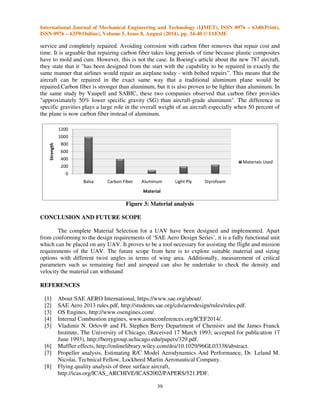
repaired.Carbon fiber is stronger than aluminum, but it is also proven to be lighter tha 
the same study by Vaupell and SABIC, these two companies observed that carbon fiber provides 
approximately 50% lower specific gravity (SG) than aircraft 
specific gravities plays a large role in the overall 
the plane is now carbon fiber instead of aluminum.
Figure 3 


CONCLUSION AND FUTURE SCOPE 
The complete Material Selection 
	
	
 ! 
from conforming to the design requirements of ‘SAE Aero Design Series’, it is a fully functional unit 
which can be placed on any UAV. It proves to be a 
requirements of the UAV. The future scope 
options with different twist angles in terms of 
parameters such as remaining fuel and 
velocity the material can withstand 
REFERENCES 
[1] About SAE AERO International, 
[2] SAE Aero 2013 rules.pdf, http://students.sae.org/cds/aerodesign/rules/rules.pdf 
[3] OS Engines, http://www.osengines.com/ 
[4] Internal Combustion engines, 
[5] Vladimir N. Orlov@ and FL Stephen Berry 
Institute, The University of Chicago, 
June 1993), http://berrygroup.uchicago.edu/papers/329.pdf 
[6] Muffler effects, http://onlinelibrary.wiley.com/doi/10.1029/96GL03338/ 
[7] Propeller analysis, Estimating R/ 
Nicolai, Technical Fellow, Lockheed Martin Aeronautical Company. 
[8] Flying quality analysis of three surface aircraft, 
http://icas.org/ICAS_ARCHIVE/ICAS2002/PAPERS/521.PDF 
 
34-40 © IAEME 
39 
because plastic composites 
es - with bolted repairs”. This means that the 
aircraft-grade aluminum. The difference in 
weight of an aircraft especially when 50 percent of 
3: Material analysis 
for a UAV have been designed and implemented. Apart 
V. tool necessary for assisting the flight and mission 
from here is to explore suitable material and sizing 
wing area. Additionally, measurement of critical 
airspeed can also be undertake to check the density and 
https://www.sae.org/about/. 
com/. 
www.asmeconferences.org/ICEF2014/. 
Department of Chemistv and the James Franck 
(Received 17 March 1993; accepted for publication 17 
pdf. 
abstract 
C Model Aerodynamics And Performance 
PDF. 
	
	 
– 6340(Print), 
than aluminum. In 
pdf. 
abstract. 
nd Performance, Dr. Leland M.

Material selection for unmanned aerial vehicle

  • 1.
    INTERNATIONAL JOURNAL OFMECHANICAL ENGINEERING International Journal of Mechanical Engineering and Technology (IJMET), ISSN 0976 – 6340(Print), ISSN 0976 – 6359(Online), Volume 5, Issue 8, August (2014), pp. 34-40 © IAEME AND TECHNOLOGY (IJMET) ISSN 0976 – 6340 (Print) ISSN 0976 – 6359 (Online) Volume 5, Issue 8, August (2014), pp. 34-40 © IAEME: www.iaeme.com/IJMET.asp Journal Impact Factor (2014): 7.5377 (Calculated by GISI) www.jifactor.com 34 IJMET © I A E M E MATERIAL SELECTION FOR UNMANNED AERIAL VEHICLE AKSHAY BALACHANDRAN1, DIVYESH KARELIA2, Dr. JAYARAMULU CHALLA3 1,2UG Students, Department of Production Engineering, 3Professor, Department of Production Engineering, Fr. Conceicao Rodrigues College of Engineering, FrAgnel Ashram, Bandstand, Bandra (W), Mumbai, Maharashtra, India, Pin Code: 400 050 ABSTRACT This paper explains and details about a brief study and comparison of the various available engineering and structural materials which is the key requirement for the optimum functioning of Unmanned Aerial Vehicles (UAVs) known as drone and referred to as Remotely Piloted Aircraft (RPA) of 'Advanced class' of this competition. The major requirements that these materials on UAVs with respect to physical and mechanical properties must fulfill are: resistance to buckling, high ultimate tensile strength, less inflammable, high strength to weight ratio, low thermal gradient, resistance to noise and vibration, resistance against deteriorative fuels and chemicals, low corrosion and oxidation, ease of shape ability, fastening and joining, high fatigue and endurance limit. In order to fulfill these requirements, our system comprised of these engineering materials: carbon fiber, fiber plastic, Balsa, Thermocol, rubber, Aluminium alloy, alloy steel, thin plywood. The system performed well and stood true on all its expectations. There are off-the-shelf materials available for their respective tasks but they lack on one parameter or other.Additionally, their cost is prohibitive at times. The material selection, explained in this paper, is comprehensive, inexpensive and rugged and can be implemented on any kind of UAV vehicle. Keywords: Aero, High Strength to Weight Ratio, Balsa, Carbon Fiber, Fiber Plastics. I. INTRODUCTION SAE International is a global association of more than 138,000 engineers and related technical experts in the aerospace, automotive and commercial-vehicle industries. SAE International's core competencies are life-long learning and voluntary consensus standards development. To nurture and encourage talent in the field of aviation, SAE International conducts
  • 2.
    International Journal ofMechanical Engineering and Technology (IJMET), ISSN 0976 – 6340(Print), ISSN 0976 – 6359(Online), Volume 5, Issue 8, August (2014), pp. 34-40 © IAEME ‘Aero Design Series’ competition annually in the USA. The competition involves student teams from all over the world designing and fabricating UAVs. Depending on the design and event objectives, there are three classes in this competition: Micro, Regular and Advanced Class. 35 The objective of the Advanced Class, of the 2013 edition of SAE Aero Design Series, was to design the most efficient aircraft capable of accurately dropping a three pound (3 lb) humanitarian aid package from a minimum of 100ft off the ground. Though the class was mostly focused on mission success, students were needed to perform trade studies to optimize empty weight and anticipate repair build-up weight while meeting several aircraft design requirements. The Advanced Class also involved an array oftasks to be accomplished to win high flight points, primary of which was dropping a three pound (3 lb) humanitarian aid package from a minimum of 100ft off the ground. The objectives were: 1. Team must be able to provide high strength and stability to the UAV at high altitudes and speeds. 2. Team must be able to resist and balance the forces acting dynamically on the body of the UAV. 3. Team should be able to select the right materials at the right place with the right properties. Figure 1: Stress analysis An important requirement of the UAV was that it should have a high precision and accuracy during flight. For this it was necessary to have high strength to weight ratio, the key requirement. The design should be aerodynamic for which material used should be easily formable or shapeable. A Rigid frame for containing the engine and other major functional features and provide rigidity in motion.Part specific functions. For example: wings, fuselage, landing gear, etc. The entire body should weigh less so as to minimise the fuel consumption. Furthermore, it’s evident from the design objectives that a sturdy and rugged design was a necessity so as to build a stable, stiff and strong body which could assist the pilot on the base station for precise cargo expulsion. This summarizes the DAS requirements for Advanced class event of ‘SAE Aero Design Series 2013’ and to satisfy the same, this paper proposes a comprehensive study of engineering materials suitable for UAV:
  • 3.
    International Journal ofMechanical Engineering and Technology (IJMET), ISSN 0976 – 6340(Print), ISSN 0976 – 6359(Online), Volume 5, Issue 8, August (2014), pp. 34-40 © IAEME Parameters Balsa Wood Carbon Fiber Rohacell Weight 5 5 5 2 4.5 5 Availability 5 5 1 Cost 4 4 0.5 Machinability 5 4 3 Total 21 22.5 14.5 36 II. MATERIAL SELECTION Figure 2: Material study Strength to weight ratio 1. Wood (Balsa) A light weight and strong material, but splinters and requires a lot of maintenance and less durability. It is stronger for its weight than any other material except for certain alloy steels.Timber is readily worked by hand, using simple tools and is therefore far cheaper to use than metal. Timber from deciduous trees is said to be 'hardwood'. It can be seen, therefore, that the term 'softwood' and 'hardwood' apply to the family or type of tree and do not necessarily indicate the density of the wood. That is why balsa, the lightest and most fragile of woods, is classed as a hardwood. BALSA, although very soft and low in strength properties, is a hardwood, which grows in CentralAmerica. It is the lightest timber in general use and is pinkish white to pale brown in colour. Dueto its porosity, if it is badly stored or inadequately protected in use, it very readily deteriorates ifexposed to moisture. Its principal uses in aircraft construction are the making of fairings, filletsand light, low density contour blocks. 2. Carbon fiber Carbon fiber (also commonly called graphite) has special properties making it ideal for applications ranging from aerospace to automobiles. When combined with resin to form a composite, it produces parts that are extremely light and rigid. Carbon parts are lighter and stronger than their metal counterparts. For that reason, carbon fiber is being used extensively in the aerospace industry. High-end vehicles are incorporating carbon to make one piece vehicle frames. Perhaps the biggest user of carbon fiber is the aircraft industry, both commercial and military. Here are the biggest users of carbon fiber. Carbon fibre is awesome. It's light, incredibly strong and you can make almost anything out of it, including planes like the fancy new 787 Dreamliner. What it's not great at, though, is taking lightning strikes, and apparently planes get hit by lightning all the time. Scarily, carbon fibre is literally shredded by the strike.Carbon fiber construction offers exceptional strength and stiffness at a lower density than traditional metal materials. The high temperature epoxy resins with which the fibers are cured are highly resistant to water, fuel, anti-freeze, and solvents which might cause wear or deterioration and they can be protected from ultraviolet radiation using the same paint finishes used on metal airplane components. 3. Thermocol (Polystyrene) Polystyrene (PS) is a synthetic aromatic polymer made from the monomer styrene, a liquid petrochemical.It is a very inexpensive resin per unit weight. It is a rather poor barrier to oxygen and water vapor and has a relatively low melting point.[4] Polystyrene is one of the most widely used plastics, the scale of its production being several billion kilograms per year.Expanded polystyrene (EPS) is a rigid and tough, closed-cell foam. It is usually white and made of pre-expanded polystyrene beads.Due to its technical properties such as low weight, rigidity, and formability, EPS can be used in a wide range of different applications.
  • 4.
    International Journal ofMechanical Engineering and Technology (IJMET), ISSN 0976 – 6340(Print), ISSN 0976 – 6359(Online), Volume 5, Issue 8, August (2014), pp. 34-40 © IAEME 37 4. Rubber (For landing gear) For aircraft, the landing gear supports the craft when it is not flying, allowing it to take off, land and usually to taxi without damage. Wheels are typically used but skids, skis, floats or a combination of these and other elements can be deployed depending both on the surface and on whether the craft only operates vertically (VTOL) or is able to taxi along the surface. Aircraft tires are designed to withstand extremely heavy loads for short durations. The number of tires required for aircraft increases with the weight of the plane (because the weight of the airplane has to be distributed better). Aircraft tire tread patterns are designed to facilitate stability in high crosswind conditions, to channel water away to prevent hydroplaning, and for braking effect.Aircraft tires are usually inflated with nitrogen or helium to minimize expansion and contraction from extreme changes in ambient temperature and pressure experienced during flight. Dry nitrogen expands at the same rate as other dry atmospheric gases, but common compressed air sources may contain moisture, which increases the expansion rate with temperature.The use of an inert gas for tire inflation will eliminate the possibility of a tire explosion. 5. Aluminium Alloys Alloys composed mostly of aluminium have been very important in aerospace manufacturing since the introduction of metal skinned aircraft. Aluminium-magnesium alloys are both lighter than other aluminium alloys and much less flammable than alloys that contain a very high percentage of magnesium. The following aluminium alloys are commonly used in aircraft and other aerospace structures. 7068 aluminium 7075 aluminium 6061 aluminium 6063 aluminium 2024 aluminium 5052 aluminium The addition of scandium to aluminium creates nanoscale Al3Sc precipitates which limit the excessive grain growth that occurs in the heat-affected zone of welded aluminium components. This has two beneficial effects: the precipitated Al3Sc forms smaller crystals than are formed in other aluminium alloys and the width of precipitate-free zones that normally exist at the grain boundaries of age-hardenable aluminium alloys is reduced. However, titanium alloys, which are stronger but heavier, are cheaper and much more widely used. The main application of metallic scandium by weight is in aluminium-scandium alloys for minor aerospace industry components. These alloys contain between 0.1% and 0.5% (by weight) of scandium. The advantages of aluminium alloys (2219 etc.) also include their high performance under cryogen temperatures in contact with liquid oxygen, hydrogen, and helium. The so-called cryogen reinforcement happens in these alloys, i.e. the strength and flexibility increase parallel to the decreasing temperature. They are used for manufacturing various components of spaceship equipment: brackets, fixtures, chassis, covers and casing for many tools and devices. 6. Steel To facilitate the discussion of steels, some familiaritywith their nomenclature is desirable. A numericalindex, sponsored by the Society of Automotive Engineers (SAE) and the American Iron and Steel Institute(AISI), is used to identify the chemical compositionsof the structural steels.The various nickel steels are produced by combiningnickel with carbon steel. Steels containing from3 to 3.75 percent nickel are commonly used. The corrosion resistant steel mostoften used in aircraft
  • 5.
    International Journal ofMechanical Engineering and Technology (IJMET), ISSN 0976 – 6340(Print), ISSN 0976 – 6359(Online), Volume 5, Issue 8, August (2014), pp. 34-40 © IAEME construction is known as 18-8 steel because of its content of 18 percent chromiumand 8 percent nickel. Stainless steel can be used for almost any part ofan aircraft. Some of its common applications are in thefabrication of exhaust collectors, stacks and manifolds,structural and machined parts, springs, castings, tierods, and control cables.Molybdenum in small percentages is used in combinationwith chromium to form chrome-molybdenumsteel, which has various uses in aircraft.A series of chrome-molybdenum steel most used in aircraftconstruction is that series containing 0.25 to 0.55percent carbon, 0.15 to 0.25 percent molybdenum, and 0.50 to 1.10 percent chromium. These steels, when suitablyheat treated, are deep hardening, easily machined,readily welded by either gas or electric methods, andare especially adapted to high temperature service 38 7. Titanium Alloys Due to their high tensile strength to density ratio,high corrosion resistance,fatigue resistance, high crack resistance, and ability to withstand moderately high temperatures without creeping, titanium alloys are used in aircraft, armor plating, naval ships, spacecraft, and missiles. For these applications titanium alloyed with aluminium, zirconium, nickel, vanadium, and other elements is used for a variety of components including critical structural parts, fire walls, landing gear, exhaust ducts (helicopters), and hydraulic systems. In engine applications, titanium is used for rotors, compressor blades, hydraulic system components, and nacelles 8. Aircraft Plywood High-strength plywood also known as aircraft plywood, is made from mahogany and/or birch, and uses adhesives with increased resistance to heat and humidity.Structural aircraft-grade plywood is more commonly manufactured from African mahogany or American birch veneers that are bonded together in a hot press over hardwood cores of basswood or poplar. Basswood is another type of aviation-grade plywood that is lighter and more flexible than mahogany and birch plywood but has slightly lessstructural strength. All aviation-grade plywood is manufactured to specifications outlined in MIL-P-607, which calls for shear testing after immersion in boiling water for three hours to verify the adhesive qualities between the plies and meets specifications. 9. Carbon fiber reinforced plastic (CFRP) There has been a push for innovation in the aviation industry. Since the early 1900's, aluminum has been the primary material used in aircraft construction, and accounts for anywhere between 65 and 75 percent of the total weight of a passenger aircraft. Recently, a new material has made its way to the aviation scene. This strong and lightweight material is known as carbon fiber. With the release of the Boeing 787, which is about 50 percent advanced composites, namely carbon fiber, discussion has ensued around the changes it will bring in the aviation industry. This new technology is said to allow for greater fuel efficiency, lower maintenance, longer flights, and an overall lighter aircraft.Although the initial cost of the mainly carbon fiber plane is greater than a mainly aluminum plane, in time, the cost will be lower because of the fuel efficiency and lower maintenance costs. This technology is revolutionary to the aviation industry, especially because of the energy saving properties. Energy continues to be an issue in today's world, and the use of carbon fiber will impact energy consumption drastically. A change from aluminum to advanced composites opens the aviation industry to great changes.Relative to its size, this material is very strong in its fibrous state, and it is made even stronger after being woven together with several other strands. A study done by Vaupell Northwest Molding and Tooling and SABIC Innovative Plastics shows that carbon fiber has a tensile strength of about 38.3 pounds per square inch while aluminum, depending on the type, has a tensile strength roughly between 27 and 33.1 pounds per square inch. A stronger material will increase the longevity of the aircraft because it is not as prone to damage. This proves its ability to have lower maintenance costs. An aluminum plane with corrosion must be taken out of
  • 6.
    International Journal ofMechanical Engineering and Technology (IJMET), ISSN 0976 ISSN 0976 – 6359(Online), Volume 5, Issue 8, August (2014), pp. service and completely repaired. Avoiding corrosion with carbon fiber removes that repair cost and time. It is arguable that repairing carbon fiber takes long periods of time have to mold and cure. However, this is not the case. In Boeing's article about the new 787 aircraft, they state that it has been designed from the start with the capability to be repaired in exactly the same manner that airlines would repair an airplane today aircraft can be repaired in the exact same way that a traditional aluminum plane would be repaired.Carbon fiber is stronger than aluminum, but it is also proven to be lighter tha the same study by Vaupell and SABIC, these two companies observed that carbon fiber provides approximately 50% lower specific gravity (SG) than aircraft specific gravities plays a large role in the overall the plane is now carbon fiber instead of aluminum.
  • 7.
    Figure 3 CONCLUSION AND FUTURE SCOPE The complete Material Selection ! from conforming to the design requirements of ‘SAE Aero Design Series’, it is a fully functional unit which can be placed on any UAV. It proves to be a requirements of the UAV. The future scope options with different twist angles in terms of parameters such as remaining fuel and velocity the material can withstand REFERENCES [1] About SAE AERO International, [2] SAE Aero 2013 rules.pdf, http://students.sae.org/cds/aerodesign/rules/rules.pdf [3] OS Engines, http://www.osengines.com/ [4] Internal Combustion engines, [5] Vladimir N. Orlov@ and FL Stephen Berry Institute, The University of Chicago, June 1993), http://berrygroup.uchicago.edu/papers/329.pdf [6] Muffler effects, http://onlinelibrary.wiley.com/doi/10.1029/96GL03338/ [7] Propeller analysis, Estimating R/ Nicolai, Technical Fellow, Lockheed Martin Aeronautical Company. [8] Flying quality analysis of three surface aircraft, http://icas.org/ICAS_ARCHIVE/ICAS2002/PAPERS/521.PDF 34-40 © IAEME 39 because plastic composites es - with bolted repairs”. This means that the aircraft-grade aluminum. The difference in weight of an aircraft especially when 50 percent of 3: Material analysis for a UAV have been designed and implemented. Apart V. tool necessary for assisting the flight and mission from here is to explore suitable material and sizing wing area. Additionally, measurement of critical airspeed can also be undertake to check the density and https://www.sae.org/about/. com/. www.asmeconferences.org/ICEF2014/. Department of Chemistv and the James Franck (Received 17 March 1993; accepted for publication 17 pdf. abstract C Model Aerodynamics And Performance PDF. – 6340(Print), than aluminum. In pdf. abstract. nd Performance, Dr. Leland M.