Material Handling
Material handling includes the
transportation, safeguarding,
storing, and managing of
products and materials during
production, distribution,
warehousing, use, and disposal.
It entails the effective movement
and management of goods, from
raw materials to completed
products, employing a variety of
tools and methods.
Assisant Professor Pasare Viraj I. , DYPCET
Material Handling
Definition : Any activity involving the movement and
management of materials, such as loading, unloading,
transporting, storing, and safeguarding items, is referred to
as material handling.
Scope: Material handling is used across various industries,
including manufacturing, warehousing, logistics, and
distribution.
Assisant Professor Pasare Viraj I. , DYPCET
Material Handling : Objectives
The primary objectives of material handling are to reduce costs, improve efficiency, enhance productivity,
ensure safety, and optimize space utilization while ensuring smooth material flow and preventing damage.
1. Cost Reduction:
• Material handling costs can be a significant portion of overall production costs, so efficient handling is
crucial for reducing expenses.
• Optimizing material flow, reducing handling times, and minimizing damage can lead to significant cost
savings.
2. Improved Efficiency and Productivity:
• Efficient material handling systems streamline operations, reducing bottlenecks and delays.
• By optimizing workflows and processes, material handling contributes to increased productivity and
output.
3. Enhanced Safety:
• Material handling often involves physically demanding tasks, so ensuring worker safety is paramount.
• Implementing proper procedures, using appropriate equipment, and providing adequate training can
minimize risks of accidents and injuries.
Assisant Professor Pasare Viraj I. , DYPCET
Material Handling
4. Space Optimization:
• Effective material handling systems help maximize the utilization of
available space, whether in warehouses, factories, or other facilities.
• Optimizing storage and retrieval processes allows for efficient use of space
and reduces the need for larger facilities.
5. Improved Material Flow:
• Smooth and efficient material flow is essential for meeting production
schedules and customer demands.
• Material handling systems should facilitate the timely and accurate
movement of materials throughout the entire process.
Assisant Professor Pasare Viraj I. , DYPCET
Material Handling
6. Prevention of Damage:
• Damage to materials during handling can lead to wasted resources and increased
costs.
• Implementing proper handling procedures, using appropriate equipment, and
providing adequate training can help prevent damage.
7. Standardization:
• Standardization of material handling processes and equipment can lead to greater
efficiency and consistency.
• This allows for easier training, maintenance, and troubleshooting.
8. Automation:
• Automation of material handling tasks can improve efficiency, reduce labor costs,
and enhance safety.
• Automated systems can handle repetitive tasks, freeing up human workers for
more strategic activities.
Assisant Professor Pasare Viraj I. , DYPCET
Material Handling : Principles
1. Planning: All material handling operations should be the result of a
deliberate plan, defining performance objectives, operational needs, and
functional specifications from the outset.
2. Standardization: Standardize material handling methods, equipment,
control systems, and software to perform a variety of tasks under various
operating conditions.
3. Automation: Strategically use automated systems and technologies to
manage the movement, storage, control, and protection of materials
throughout manufacturing and distribution processes.
Assisant Professor Pasare Viraj I. , DYPCET
Material Handling : Principles
4. Ergonomics: Consider the physical demands of material handling
tasks and design equipment and processes to minimize physical strain
and risk of injury.
5. Gravity: Utilize gravity to facilitate material movement and storage
whenever possible.
6. Simplification: Streamline material handling processes by eliminating
unnecessary complexity, reducing the number of materials, or
simplifying specifications.
7. Safety: Prioritize safety in all material handling operations, ensuring
compliance with safety protocols and guidelines.
Assisant Professor Pasare Viraj I. , DYPCET
Material Handling : Principles
8. Flexibility: Design material handling systems that can adapt to
changing needs and conditions, allowing for a variety of tasks and
operations.
9. Space Utilization: Maximize the use of available space for handling
and storage activities, optimizing warehouse layout and equipment
placement.
10. Material Flow: Ensure efficient and smooth material flow
throughout the entire process, minimizing bottlenecks and delays.
Assisant Professor Pasare Viraj I. , DYPCET
Material Handling : Classification
Assisant Professor Pasare Viraj I. , DYPCET
Material Handling : Classification
Assisant Professor Pasare Viraj I. , DYPCET
Material Handling : Classification
Assisant Professor Pasare Viraj I. , DYPCET
Material Handling : Classification
Assisant Professor Pasare Viraj I. , DYPCET
Material Handling : Classification
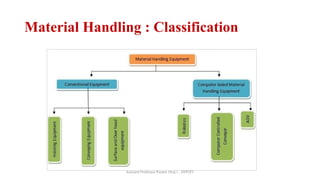
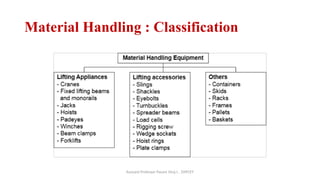
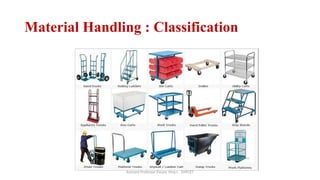
Manual Systems:
These systems rely on human labor to move and manage materials.
• Examples include:
• Hand Trucks: Used for carrying smaller loads.
• Pallet Jacks/Trucks: Designed for lifting and moving pallets.
• Manual Hoists: Used for lifting heavy loads.
• Platform Trucks: Used for transporting larger and heavier items.
Assisant Professor Pasare Viraj I. , DYPCET
Material Handling : Classification
2. Semi-Automated Systems:
These systems combine human input with some degree of automation.
Examples include:
Industrial Trucks: Forklifts, reach trucks, and pallet jacks are common
examples.
Order Pickers: Specialized trucks for picking items from shelves or racks.
Assisant Professor Pasare Viraj I. , DYPCET
Material Handling : Classification
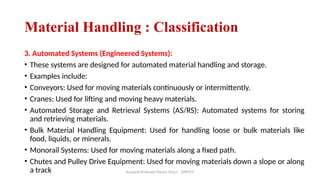
3. Automated Systems (Engineered Systems):
• These systems are designed for automated material handling and storage.
• Examples include:
• Conveyors: Used for moving materials continuously or intermittently.
• Cranes: Used for lifting and moving heavy materials.
• Automated Storage and Retrieval Systems (AS/RS): Automated systems for storing
and retrieving materials.
• Bulk Material Handling Equipment: Used for handling loose or bulk materials like
food, liquids, or minerals.
• Monorail Systems: Used for moving materials along a fixed path.
• Chutes and Pulley Drive Equipment: Used for moving materials down a slope or along
a track
Assisant Professor Pasare Viraj I. , DYPCET
Material Handling : Classification
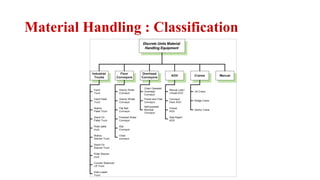
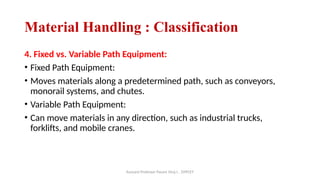
4. Fixed vs. Variable Path Equipment:
• Fixed Path Equipment:
• Moves materials along a predetermined path, such as conveyors,
monorail systems, and chutes.
• Variable Path Equipment:
• Can move materials in any direction, such as industrial trucks,
forklifts, and mobile cranes.
Assisant Professor Pasare Viraj I. , DYPCET
Material Handling : Selection
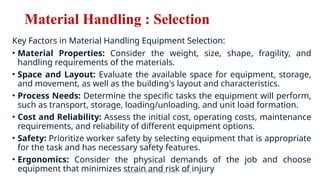
Key Factors in Material Handling Equipment Selection:
• Material Properties: Consider the weight, size, shape, fragility, and
handling requirements of the materials.
• Space and Layout: Evaluate the available space for equipment, storage,
and movement, as well as the building's layout and characteristics.
• Process Needs: Determine the specific tasks the equipment will perform,
such as transport, storage, loading/unloading, and unit load formation.
• Cost and Reliability: Assess the initial cost, operating costs, maintenance
requirements, and reliability of different equipment options.
• Safety: Prioritize worker safety by selecting equipment that is appropriate
for the task and has necessary safety features.
• Ergonomics: Consider the physical demands of the job and choose
equipment that minimizes strain and risk of injury
Assisant Professor Pasare Viraj I. , DYPCET
Material Handling : Selection
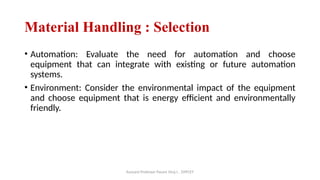
• Automation: Evaluate the need for automation and choose
equipment that can integrate with existing or future automation
systems.
• Environment: Consider the environmental impact of the equipment
and choose equipment that is energy efficient and environmentally
friendly.
Assisant Professor Pasare Viraj I. , DYPCET
THANK YOU

Material Handling : Scope , Importance, Objectives, Principles, Classification and Selection .pptx

  • 1.
    Material Handling Material handlingincludes the transportation, safeguarding, storing, and managing of products and materials during production, distribution, warehousing, use, and disposal. It entails the effective movement and management of goods, from raw materials to completed products, employing a variety of tools and methods. Assisant Professor Pasare Viraj I. , DYPCET
  • 2.
    Assisant Professor PasareViraj I. , DYPCET
  • 3.
    Assisant Professor PasareViraj I. , DYPCET Material Handling Definition : Any activity involving the movement and management of materials, such as loading, unloading, transporting, storing, and safeguarding items, is referred to as material handling. Scope: Material handling is used across various industries, including manufacturing, warehousing, logistics, and distribution.
  • 4.
    Assisant Professor PasareViraj I. , DYPCET Material Handling : Objectives The primary objectives of material handling are to reduce costs, improve efficiency, enhance productivity, ensure safety, and optimize space utilization while ensuring smooth material flow and preventing damage. 1. Cost Reduction: • Material handling costs can be a significant portion of overall production costs, so efficient handling is crucial for reducing expenses. • Optimizing material flow, reducing handling times, and minimizing damage can lead to significant cost savings. 2. Improved Efficiency and Productivity: • Efficient material handling systems streamline operations, reducing bottlenecks and delays. • By optimizing workflows and processes, material handling contributes to increased productivity and output. 3. Enhanced Safety: • Material handling often involves physically demanding tasks, so ensuring worker safety is paramount. • Implementing proper procedures, using appropriate equipment, and providing adequate training can minimize risks of accidents and injuries.
  • 5.
    Assisant Professor PasareViraj I. , DYPCET Material Handling 4. Space Optimization: • Effective material handling systems help maximize the utilization of available space, whether in warehouses, factories, or other facilities. • Optimizing storage and retrieval processes allows for efficient use of space and reduces the need for larger facilities. 5. Improved Material Flow: • Smooth and efficient material flow is essential for meeting production schedules and customer demands. • Material handling systems should facilitate the timely and accurate movement of materials throughout the entire process.
  • 6.
    Assisant Professor PasareViraj I. , DYPCET Material Handling 6. Prevention of Damage: • Damage to materials during handling can lead to wasted resources and increased costs. • Implementing proper handling procedures, using appropriate equipment, and providing adequate training can help prevent damage. 7. Standardization: • Standardization of material handling processes and equipment can lead to greater efficiency and consistency. • This allows for easier training, maintenance, and troubleshooting. 8. Automation: • Automation of material handling tasks can improve efficiency, reduce labor costs, and enhance safety. • Automated systems can handle repetitive tasks, freeing up human workers for more strategic activities.
  • 7.
    Assisant Professor PasareViraj I. , DYPCET Material Handling : Principles 1. Planning: All material handling operations should be the result of a deliberate plan, defining performance objectives, operational needs, and functional specifications from the outset. 2. Standardization: Standardize material handling methods, equipment, control systems, and software to perform a variety of tasks under various operating conditions. 3. Automation: Strategically use automated systems and technologies to manage the movement, storage, control, and protection of materials throughout manufacturing and distribution processes.
  • 8.
    Assisant Professor PasareViraj I. , DYPCET Material Handling : Principles 4. Ergonomics: Consider the physical demands of material handling tasks and design equipment and processes to minimize physical strain and risk of injury. 5. Gravity: Utilize gravity to facilitate material movement and storage whenever possible. 6. Simplification: Streamline material handling processes by eliminating unnecessary complexity, reducing the number of materials, or simplifying specifications. 7. Safety: Prioritize safety in all material handling operations, ensuring compliance with safety protocols and guidelines.
  • 9.
    Assisant Professor PasareViraj I. , DYPCET Material Handling : Principles 8. Flexibility: Design material handling systems that can adapt to changing needs and conditions, allowing for a variety of tasks and operations. 9. Space Utilization: Maximize the use of available space for handling and storage activities, optimizing warehouse layout and equipment placement. 10. Material Flow: Ensure efficient and smooth material flow throughout the entire process, minimizing bottlenecks and delays.
  • 10.
    Assisant Professor PasareViraj I. , DYPCET Material Handling : Classification
  • 11.
    Assisant Professor PasareViraj I. , DYPCET Material Handling : Classification
  • 12.
    Assisant Professor PasareViraj I. , DYPCET Material Handling : Classification
  • 13.
    Assisant Professor PasareViraj I. , DYPCET Material Handling : Classification
  • 14.
    Assisant Professor PasareViraj I. , DYPCET Material Handling : Classification Manual Systems: These systems rely on human labor to move and manage materials. • Examples include: • Hand Trucks: Used for carrying smaller loads. • Pallet Jacks/Trucks: Designed for lifting and moving pallets. • Manual Hoists: Used for lifting heavy loads. • Platform Trucks: Used for transporting larger and heavier items.
  • 15.
    Assisant Professor PasareViraj I. , DYPCET Material Handling : Classification 2. Semi-Automated Systems: These systems combine human input with some degree of automation. Examples include: Industrial Trucks: Forklifts, reach trucks, and pallet jacks are common examples. Order Pickers: Specialized trucks for picking items from shelves or racks.
  • 16.
    Assisant Professor PasareViraj I. , DYPCET Material Handling : Classification 3. Automated Systems (Engineered Systems): • These systems are designed for automated material handling and storage. • Examples include: • Conveyors: Used for moving materials continuously or intermittently. • Cranes: Used for lifting and moving heavy materials. • Automated Storage and Retrieval Systems (AS/RS): Automated systems for storing and retrieving materials. • Bulk Material Handling Equipment: Used for handling loose or bulk materials like food, liquids, or minerals. • Monorail Systems: Used for moving materials along a fixed path. • Chutes and Pulley Drive Equipment: Used for moving materials down a slope or along a track
  • 17.
    Assisant Professor PasareViraj I. , DYPCET Material Handling : Classification 4. Fixed vs. Variable Path Equipment: • Fixed Path Equipment: • Moves materials along a predetermined path, such as conveyors, monorail systems, and chutes. • Variable Path Equipment: • Can move materials in any direction, such as industrial trucks, forklifts, and mobile cranes.
  • 18.
    Assisant Professor PasareViraj I. , DYPCET Material Handling : Selection Key Factors in Material Handling Equipment Selection: • Material Properties: Consider the weight, size, shape, fragility, and handling requirements of the materials. • Space and Layout: Evaluate the available space for equipment, storage, and movement, as well as the building's layout and characteristics. • Process Needs: Determine the specific tasks the equipment will perform, such as transport, storage, loading/unloading, and unit load formation. • Cost and Reliability: Assess the initial cost, operating costs, maintenance requirements, and reliability of different equipment options. • Safety: Prioritize worker safety by selecting equipment that is appropriate for the task and has necessary safety features. • Ergonomics: Consider the physical demands of the job and choose equipment that minimizes strain and risk of injury
  • 19.
    Assisant Professor PasareViraj I. , DYPCET Material Handling : Selection • Automation: Evaluate the need for automation and choose equipment that can integrate with existing or future automation systems. • Environment: Consider the environmental impact of the equipment and choose equipment that is energy efficient and environmentally friendly.
  • 20.
    Assisant Professor PasareViraj I. , DYPCET THANK YOU