BATTERY CHARGING ALGORITHM
Thebattery charger controls the voltage that is applied to the battery, the amount
of charge current that is supplied to the battery, and depending on the level of
sophistication in the charger technology, the timing associated with what may be
multiple voltage and current levels.
Basically, a charge algorithm is a collection of all of the software controls over
electrical parameters and timing that are applied sequentially to the charging
system hardware for the express purpose of recharging a discharged battery
Ref : Deltran Corporation, 801 U.S. Hwy 92 East, DeLand, FL 32724
2.
BATTERY CHARGING ALGORITHM
Bulk
1.Thebattery is charged at maximum charge current until the voltage increases
to the configured absorption voltage.
2.The bulk stage duration is dependent on the battery’s level of discharge, the
battery capacity and the charge current.
3.Once the bulk stage is complete, the battery will be approximately 80%
charged (or >95% for Li-ion batteries) and may be returned into service if
required.
Ref : Deltran Corporation, 801 U.S. Hwy 92 East, DeLand, FL 32724
3.
BATTERY CHARGING ALGORITHM
Absorption
1.The battery is charged at the configured absorption voltage, with the
charge current slowly decreasing as the battery approaches full
charge.
2. The default absorption stage duration is adaptive and intelligently
varied depending on the battery’s level of discharge (determined
from the duration of the bulk charge stage).
3. Adaptive absorption stage duration can vary between a minimum of
30 minutes, up to a maximum limit of 8 hours (or as configured)
for a deeply discharged battery.
Ref : Deltran Corporation, 801 U.S. Hwy 92 East, DeLand, FL 32724
4.
BATTERY CHARGING ALGORITHM
Float
1.Thebattery voltage is maintained at the configured float voltage to prevent
discharge.
2.Once float stage is commenced the battery is fully charged and ready for use.
3.The float stage duration is also adaptive and varied between 4 to 8 hours
depending on the duration of the absorption charge stage, at which point
the charger determines the battery to be in storage stage.
Ref : Deltran Corporation, 801 U.S. Hwy 92 East, DeLand, FL 32724
5.
BATTERY CHARGING ALGORITHM
Storage: The battery voltage is maintained at the configured storage voltage,
which is slightly reduced compared to the float voltage to minimize gassing and
extend battery life whilst the battery is unused and on continuous charge.
Mode ABS V Float V Storage V
Normal 14.4 13.8 13.2
High 14.7 13.8 13.2
LI-ION 14.2 13.5 13.5
6.
BATTERY CHARGING ALGORITHM
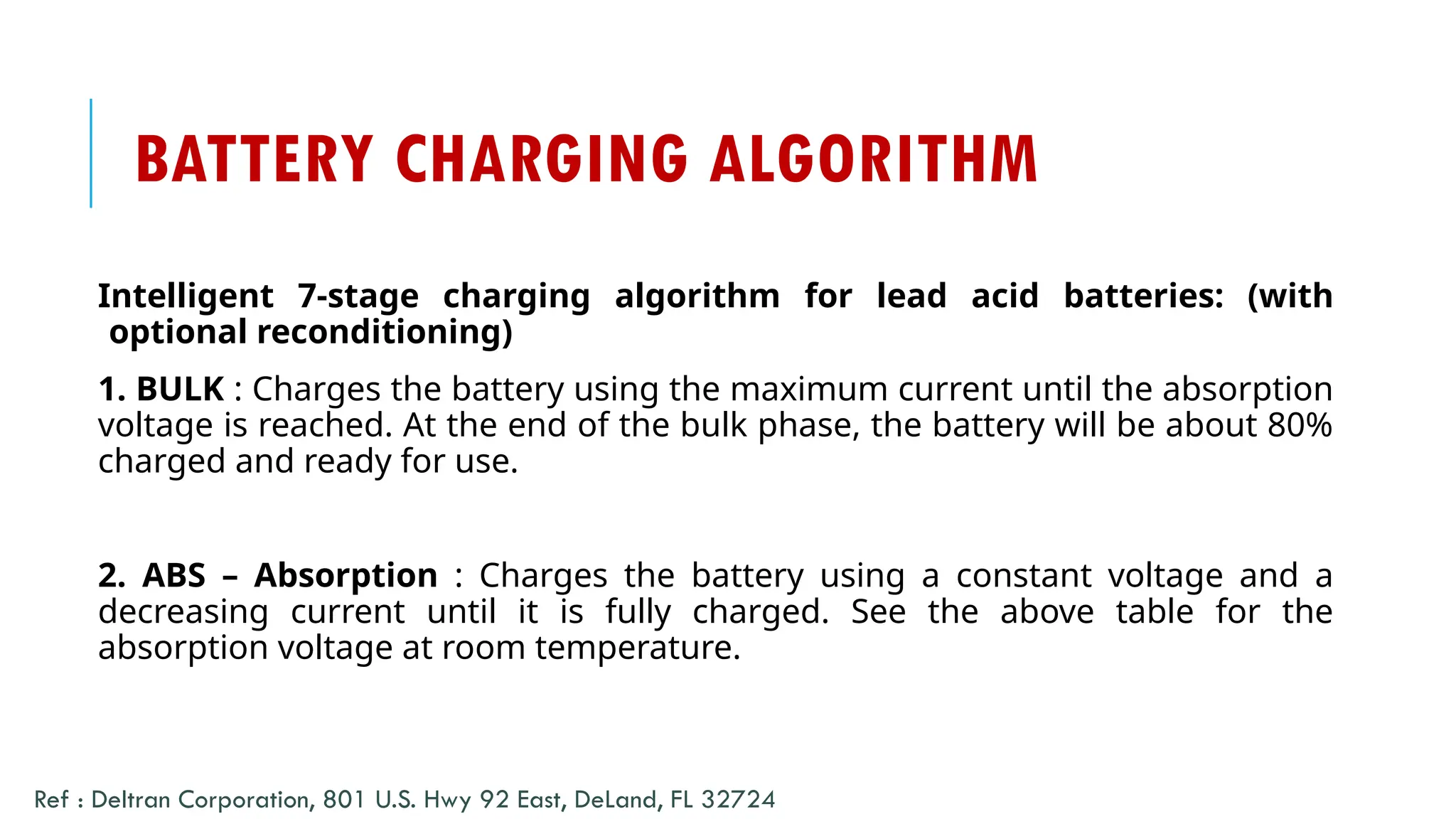
Intelligent7-stage charging algorithm for lead acid batteries: (with
optional reconditioning)
1. BULK : Charges the battery using the maximum current until the absorption
voltage is reached. At the end of the bulk phase, the battery will be about 80%
charged and ready for use.
2. ABS – Absorption : Charges the battery using a constant voltage and a
decreasing current until it is fully charged. See the above table for the
absorption voltage at room temperature.
Ref : Deltran Corporation, 801 U.S. Hwy 92 East, DeLand, FL 32724
7.
BATTERY CHARGING ALGORITHM
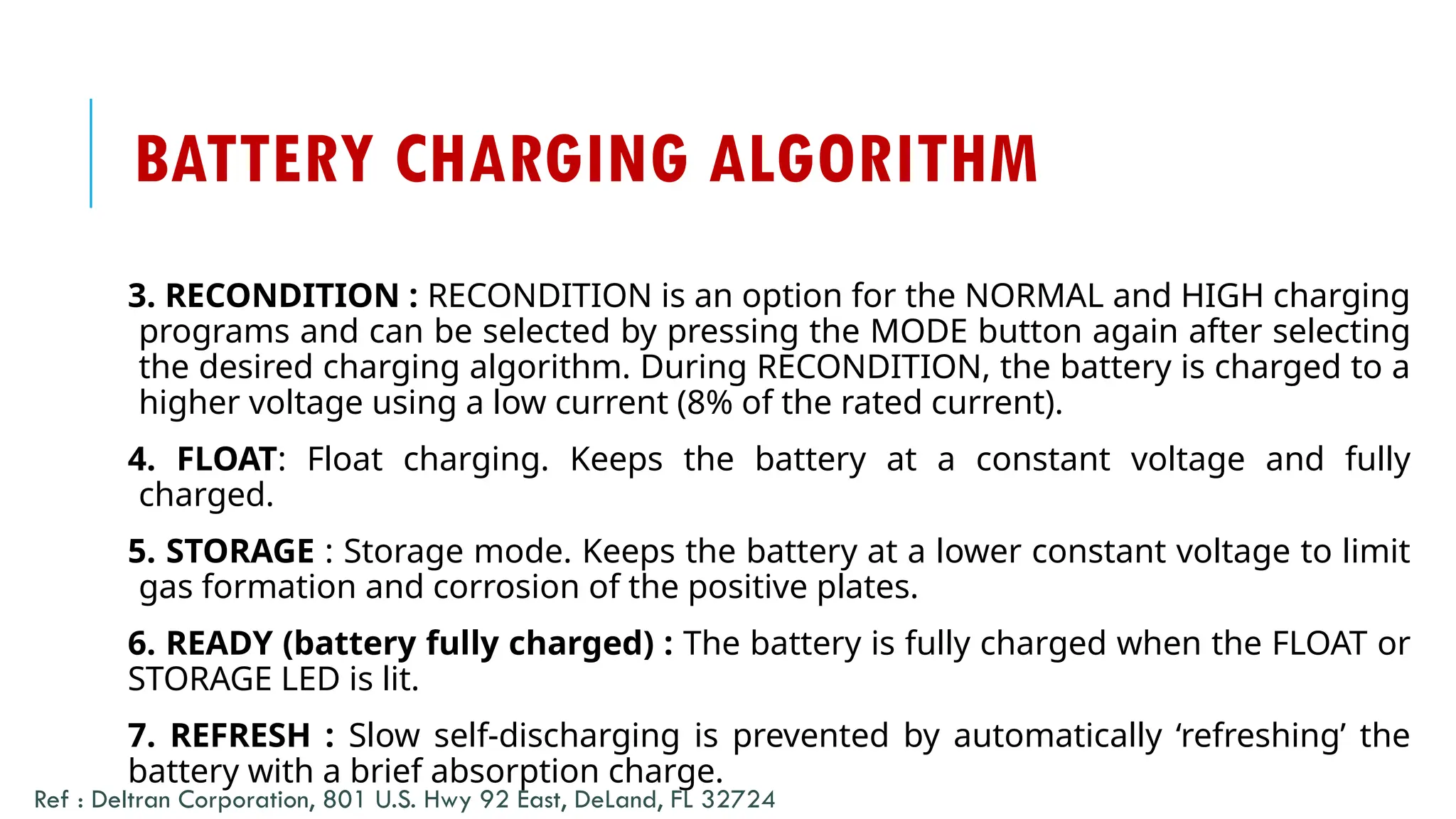
3.RECONDITION : RECONDITION is an option for the NORMAL and HIGH charging
programs and can be selected by pressing the MODE button again after selecting
the desired charging algorithm. During RECONDITION, the battery is charged to a
higher voltage using a low current (8% of the rated current).
4. FLOAT: Float charging. Keeps the battery at a constant voltage and fully
charged.
5. STORAGE : Storage mode. Keeps the battery at a lower constant voltage to limit
gas formation and corrosion of the positive plates.
6. READY (battery fully charged) : The battery is fully charged when the FLOAT or
STORAGE LED is lit.
7. REFRESH : Slow self-discharging is prevented by automatically ‘refreshing’ the
battery with a brief absorption charge.
Ref : Deltran Corporation, 801 U.S. Hwy 92 East, DeLand, FL 32724
8.
BATTERY CHARGING ALGORITHMFUNDAMENTALS
There are 4 distinct charging
modes, or stages, within a
battery charging cycle. Not all
of these modes are essential in
every battery application. The
software that controls the
charge cycle modes is often
referred to as an algorithm.
Ref : Deltran Corporation, 801 U.S. Hwy 92 East, DeLand, FL 32724
9.
BATTERY CHARGING ALGORITHMFUNDAMENTALS
For the voltages:
“A” is the voltage value held constant by the charger during the Absorption stage.
“B” is the voltage value held constant by the charger during the Equalization stage.
“C” is the voltage value held constant by the charger during the Storage or Float stage.
For the currents:
“D” is the regulated current limit or the current value held constant by the charger during the Bulk
Charge stage.
“E” is the regulated current limit or the current value held constant by the charger during the
Equalization stage.
“F” is the maintenance current value provided by the charger during the Storage of Float stage.
10.
BATTERY CHARGING ALGORITHMFUNDAMENTALS
For timing:
“W” is the elapsed time for the Bulk Charge stage and is the starting time for the
Absorption stage.
“X” is the total elapsed time for both the Bulk Charge and Absorption stages.
“Y” is the total elapsed time from the start to the end of the current limit phase of the
equalization stage.
“Z” is the total elapsed time from the start to the beginning of the Storage or Float,
Maintenance stage.
Ref : Deltran Corporation, 801 U.S. Hwy 92 East, DeLand, FL 32724
BATTERY CHARGING ALGORITHMFUNDAMENTALS
For the voltages:
1. “A” is the voltage value held constant by the charger during the Absorption stage.
2. “C” is the voltage value held constant by the charger during the Storage or Float stage.
For the currents:
1. “D” is the regulated current limit or the current value held constant by the charger during the
Bulk Charge stage.
2. “F” is the maintenance current value provided by the charger during the Storage or Float,
Maintenance stage.
For timing:
1. “W” is the elapsed time for the Bulk Charge stage and is the starting time for the Absorption
stage.
2. “Z” is the total elapsed time for both the Bulk Charge and Absorption stages.




![[TEKNOFEST 2024] BMS Issues in Electric-Powered Application[1].pptx](https://cdn.slidesharecdn.com/ss_thumbnails/teknofest2024bmsissuesinelectric-poweredapplication1-240228164128-092ceadf-thumbnail.jpg?width=640&height=640&fit=bounds)


![Intelligent_Battery_Management_System[1] Automobile_IR111.pptx](https://cdn.slidesharecdn.com/ss_thumbnails/intelligentbatterymanagementsystem1automobileir111-230605074054-e78f70f3-thumbnail.jpg?width=640&height=640&fit=bounds)


