Legitimizing Corporate Sustainability Reporting: Impacts of Content and Standardization on Firm ReputationBen PuhlJuly 22, 2010
BackgroundEmpirical Environment and ApproachContent Analysis of Sustainability ReportsResults and DiscussionConclusionOverview
Compliance vs. Voluntary ReportingDevelopment of Voluntary Standards around SustainabilityMotivations for Sustainability ReportingEfficacy of ReportingCSR and Institutional TheoryBackground
Corporate reporting started in U.S. within financial fieldSpread to encompass environmental aspects Mandatory reporting in many countries including the UK, Canada, and JapanEnvironmental reporting in U.S. required under Regulation S-K, as well as TRI and EPCRACompliance vs. Voluntary Reporting
Move towards CSR – avenue to place emission dataGRI – standardize reporting for comparison. Development of Voluntary Standards around Sustainability
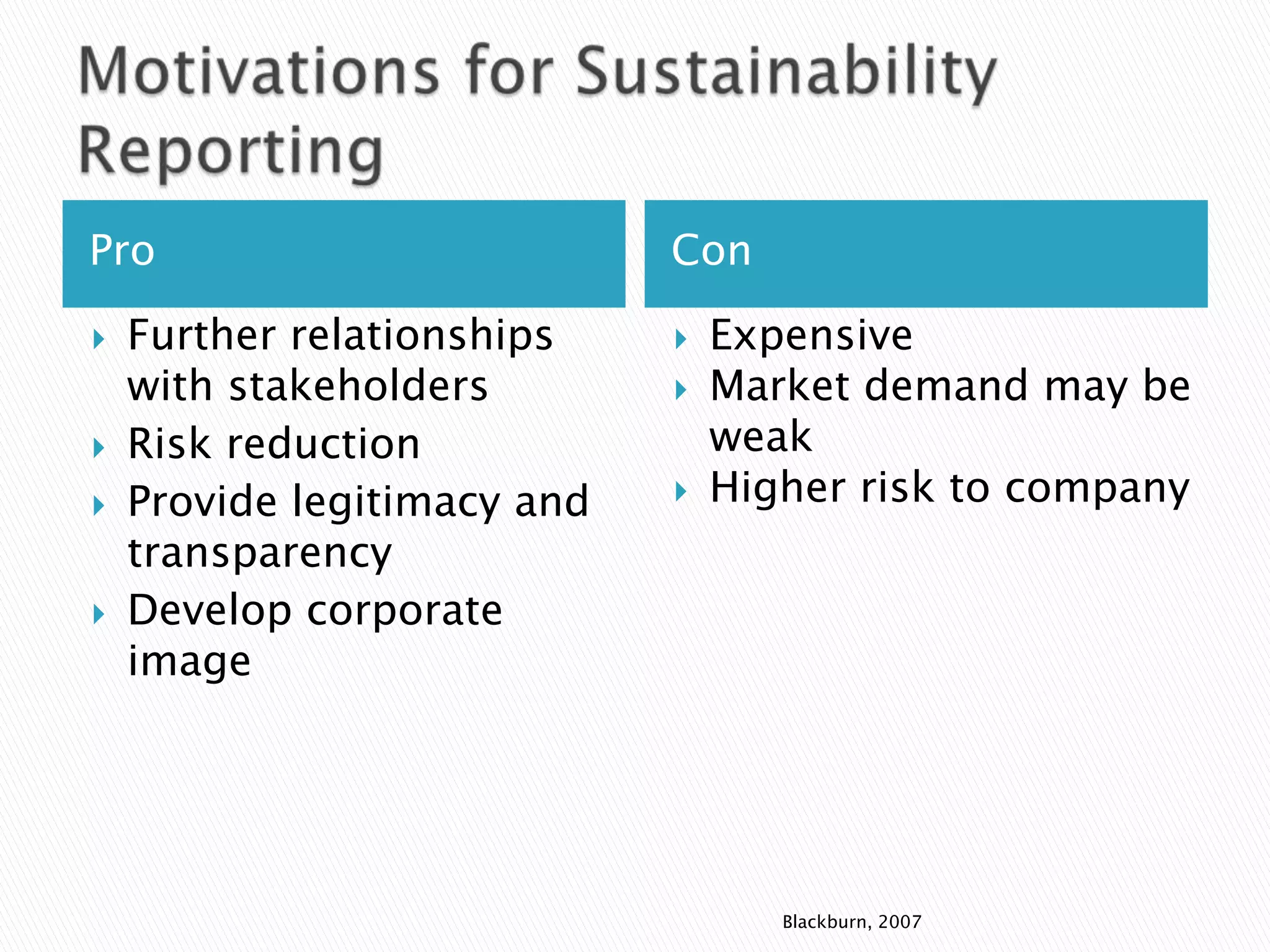
Motivations for Sustainability ReportingProConFurther relationships with stakeholdersRisk reductionProvide legitimacy and transparencyDevelop corporate imageExpensiveMarket demand may be weakHigher risk to companyBlackburn, 2007
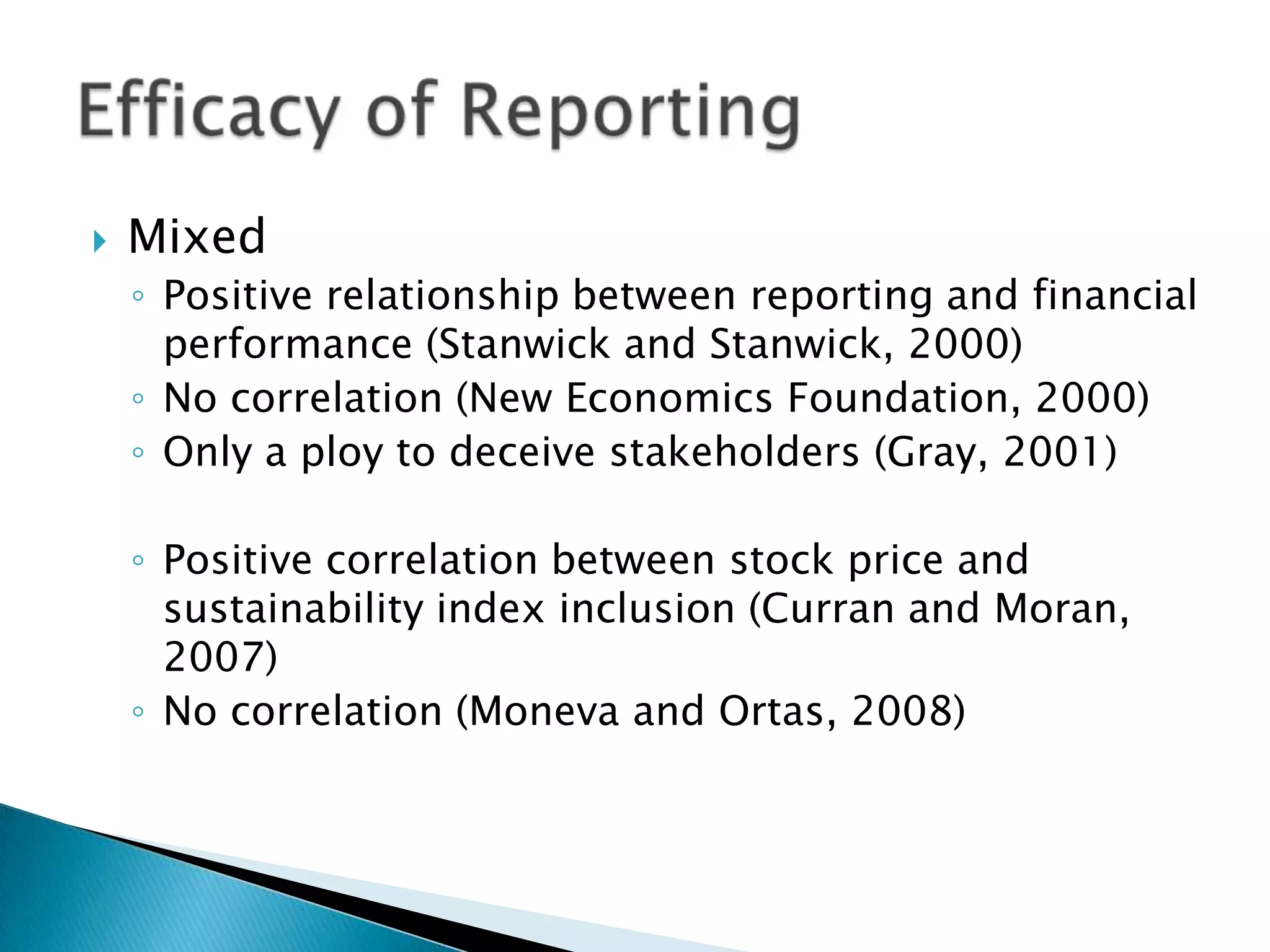
MixedPositive relationship between reporting and financial performance (Stanwick and Stanwick, 2000)No correlation (New Economics Foundation, 2000)Only a ploy to deceive stakeholders (Gray, 2001)Positive correlation between stock price and sustainability index inclusion (Curran and Moran, 2007)No correlation (Moneva and Ortas, 2008)Efficacy of Reporting
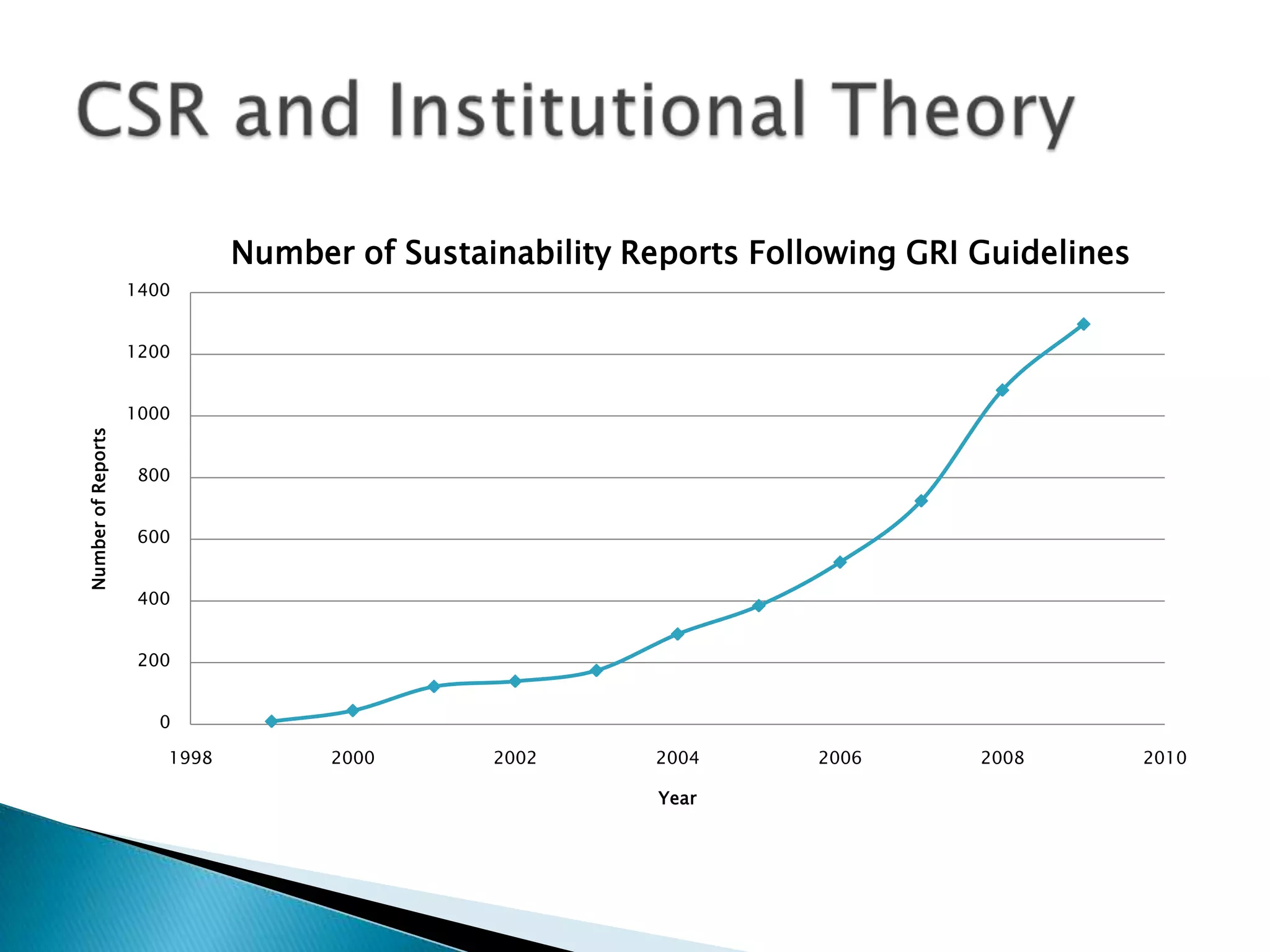
Firms offering voluntary environmental reports has increased since the 1990’s (Kolk, 2005)Growth of CSR is concurrent with growth of rating/ranking schemes (Porter and Kramer, 2006)Too many schemes for cross-comparison (Brown et al., 2009)GRI created to provide unification (Willis, 2003)CSR and Institutional Theory
CSR and Institutional Theory
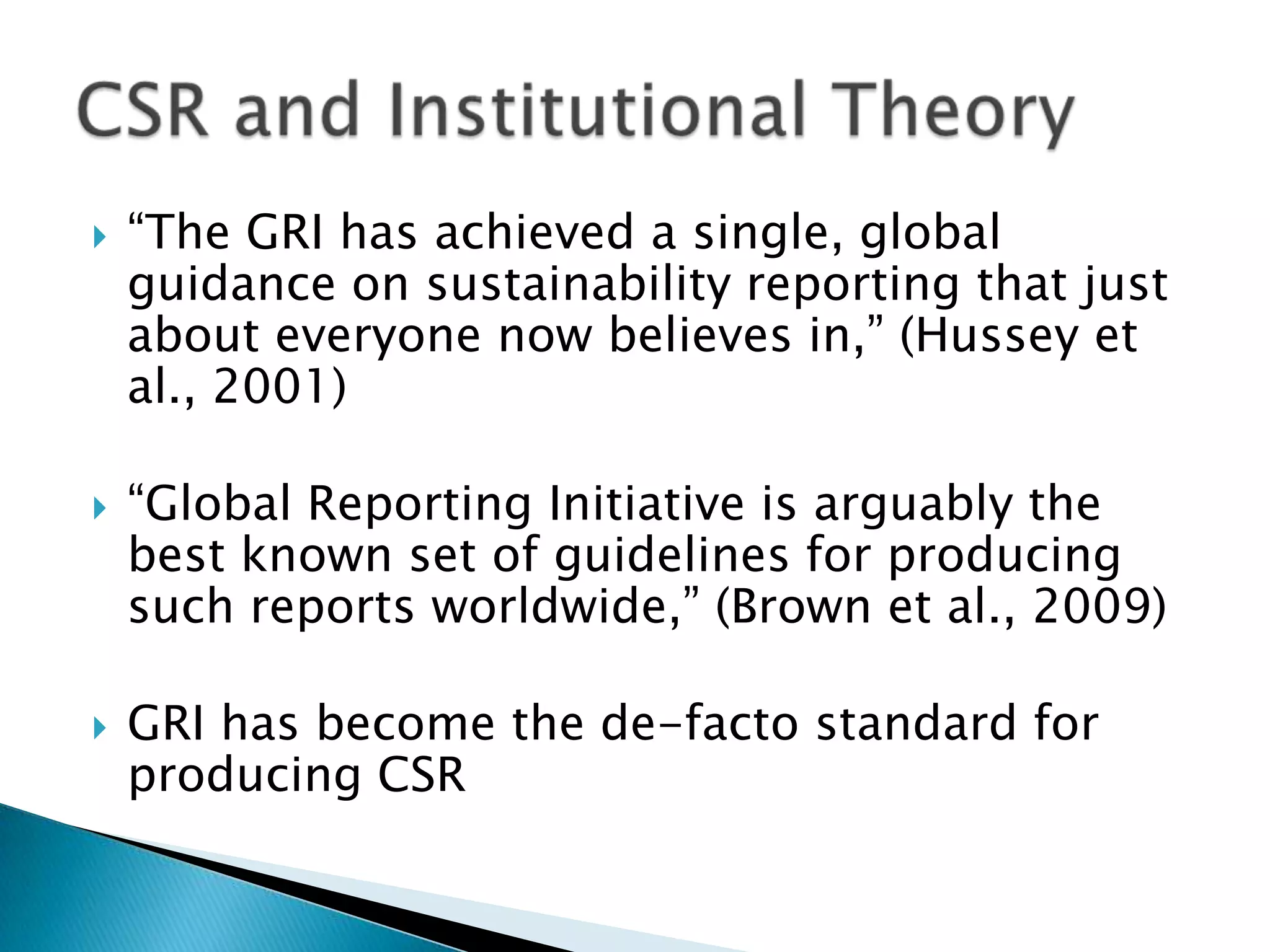
“The GRI has achieved a single, global guidance on sustainability reporting that just about everyone now believes in,” (Hussey et al., 2001)“Global Reporting Initiative is arguably the best known set of guidelines for producing such reports worldwide,” (Brown et al., 2009)GRI has become the de-facto standard for producing CSRCSR and Institutional Theory
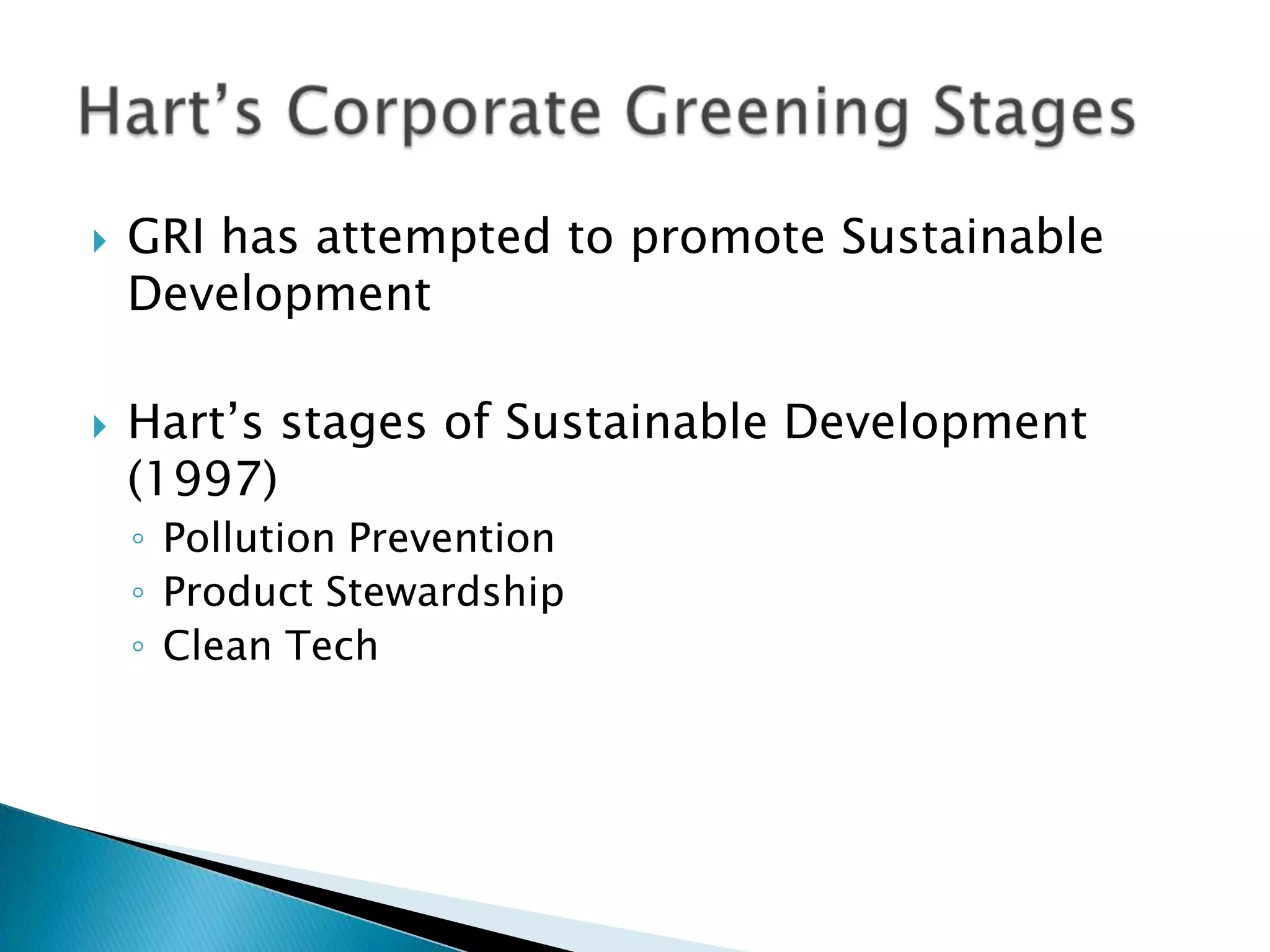
GRI has attempted to promote Sustainable DevelopmentHart’s stages of Sustainable Development (1997)Pollution PreventionProduct StewardshipClean TechHart’s Corporate Greening Stages
GRI, DJSI, and NGR as Legitimacy and Reputational SignalsSampling SchemeEmpirical Environment and Approach
GRI – standardization and institutionalization provide legitimacy – still lacks comparisonsDJSI and NGR – provide relative standing outwardly to stakeholders via rankings/ratingsFavorable position can be a reputational benefitGRI, DJSI, and NGR as Legitimacy and Reputational Signals
H1: Firms reporting more sustainability activities are more reputableH2: Firms reporting more aggressive sustainability activities are more reputableH3: Firms conforming to legitimate CSR guidelines are more reputableHypotheses
41 publically available CSR documents analyzedHierarchicalFortune 500 companiesSectors: Electronics, Retail, PetroChemicalDJSI inclusionPublished sustainability reportMatched control group of non-DJSI firms based on descending firm sizeSampling Scheme
Code Book DevelopmentData Environment for Quantitative AnalysisContent Analysis of Sustainability Reports
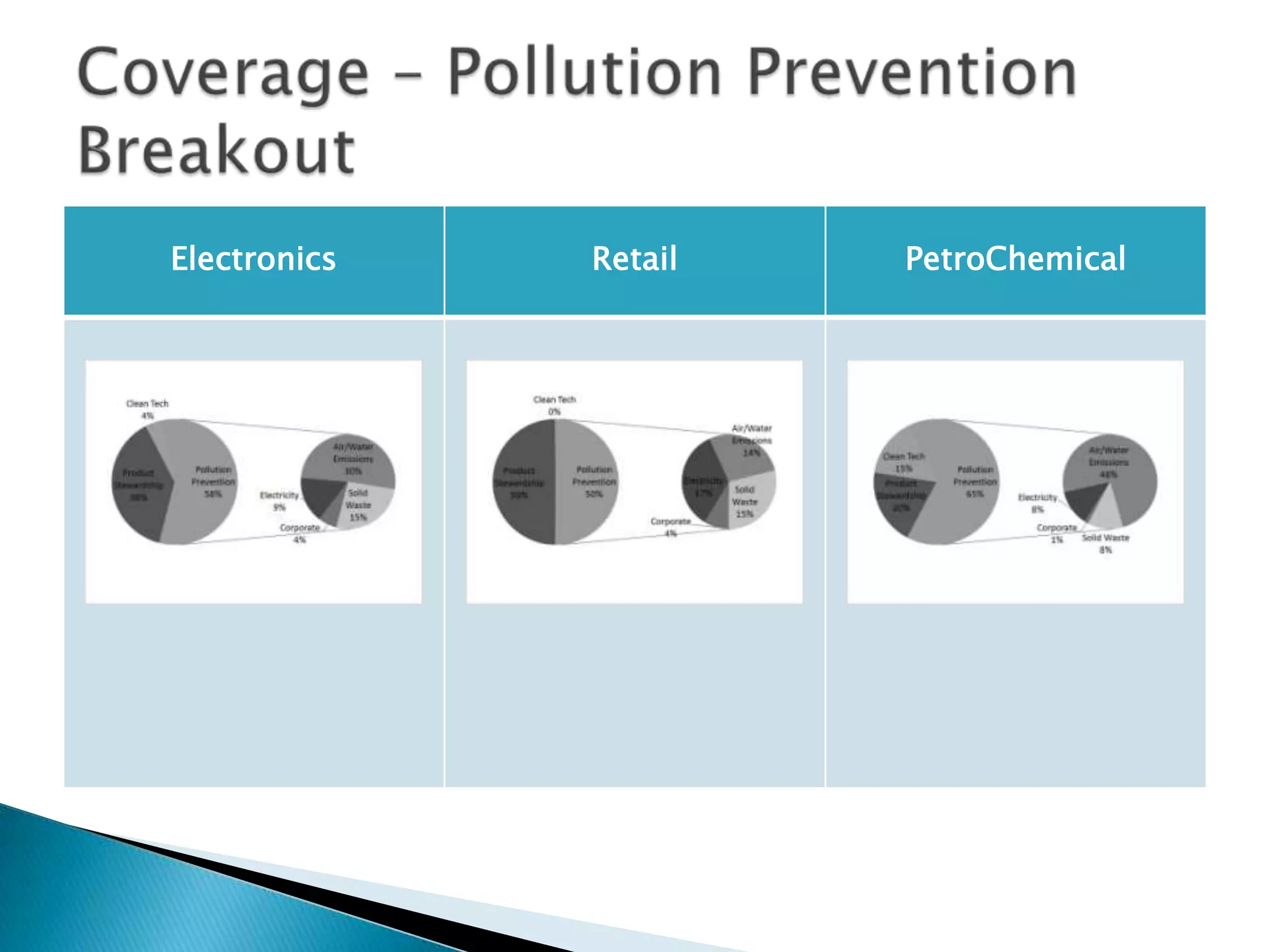
Content analysis good at finding themes in text (Bowman, 1978)Grounded Theory (Glaser and Strauss, 1967)Coding based on Hart’s Corporate Greening StagesPollution PreventionProduct StewardshipClean TechnologyCode Book Development
NVIVO 8 – transformed qualitative data (text) to quantitative data (coverage statistics)Coverage statistics aggregated in Excel and exported to SPSSAlso included firm-level and document statistics in SPSSFortune rank, DJSI inclusion, NGR rank, GRI use, page length, report year, etc.Data Environment for Quantitative Analysis
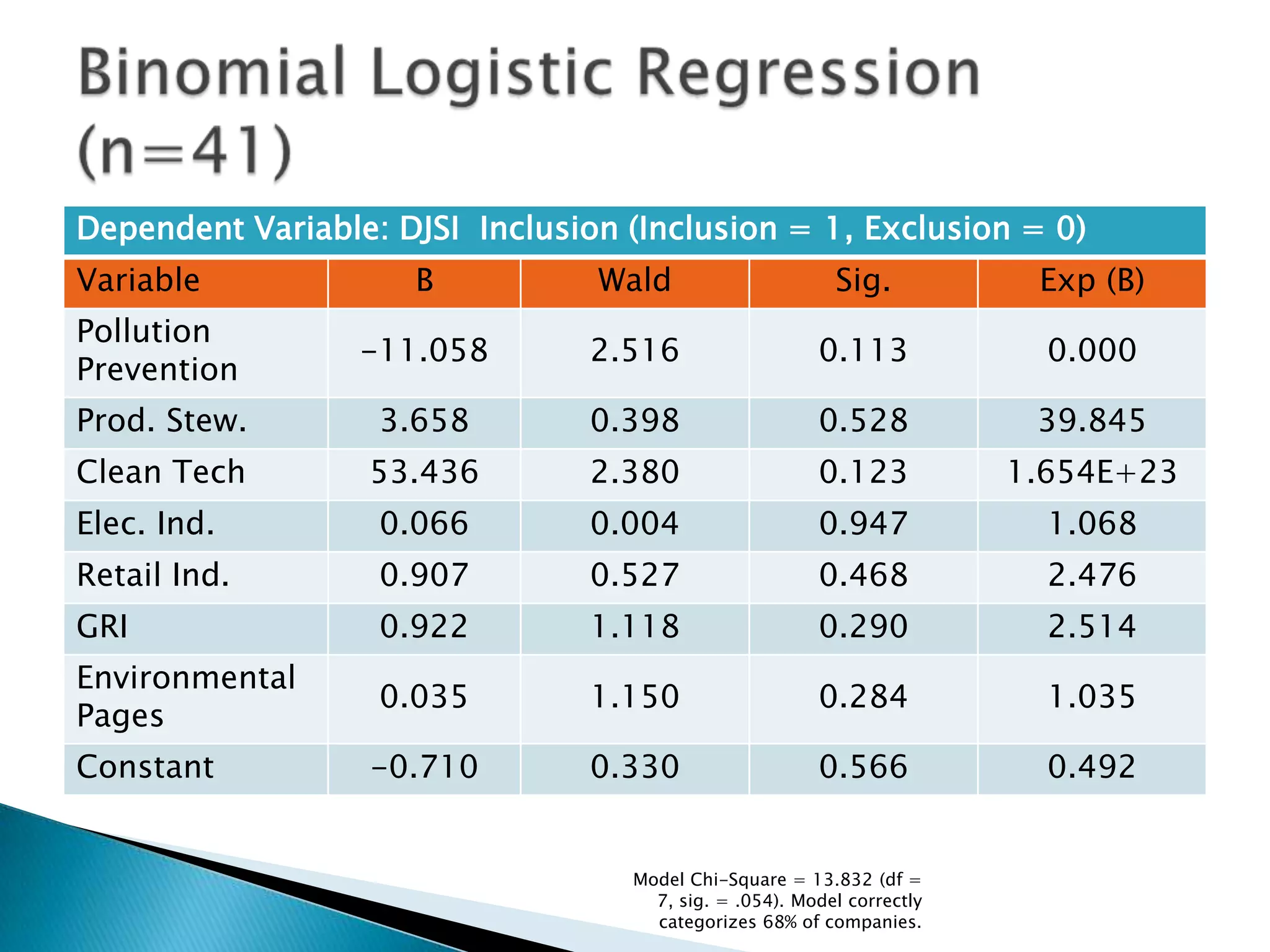
General statistics – mean, std. dev.Binomial Logistic Regression - DJSILinear Regression - NGRAnalytical Methods
Descriptive statisticsBinomial Logistic RegressionLinear RegressionResults and Discussion
Coverage – Pollution Prevention Breakout
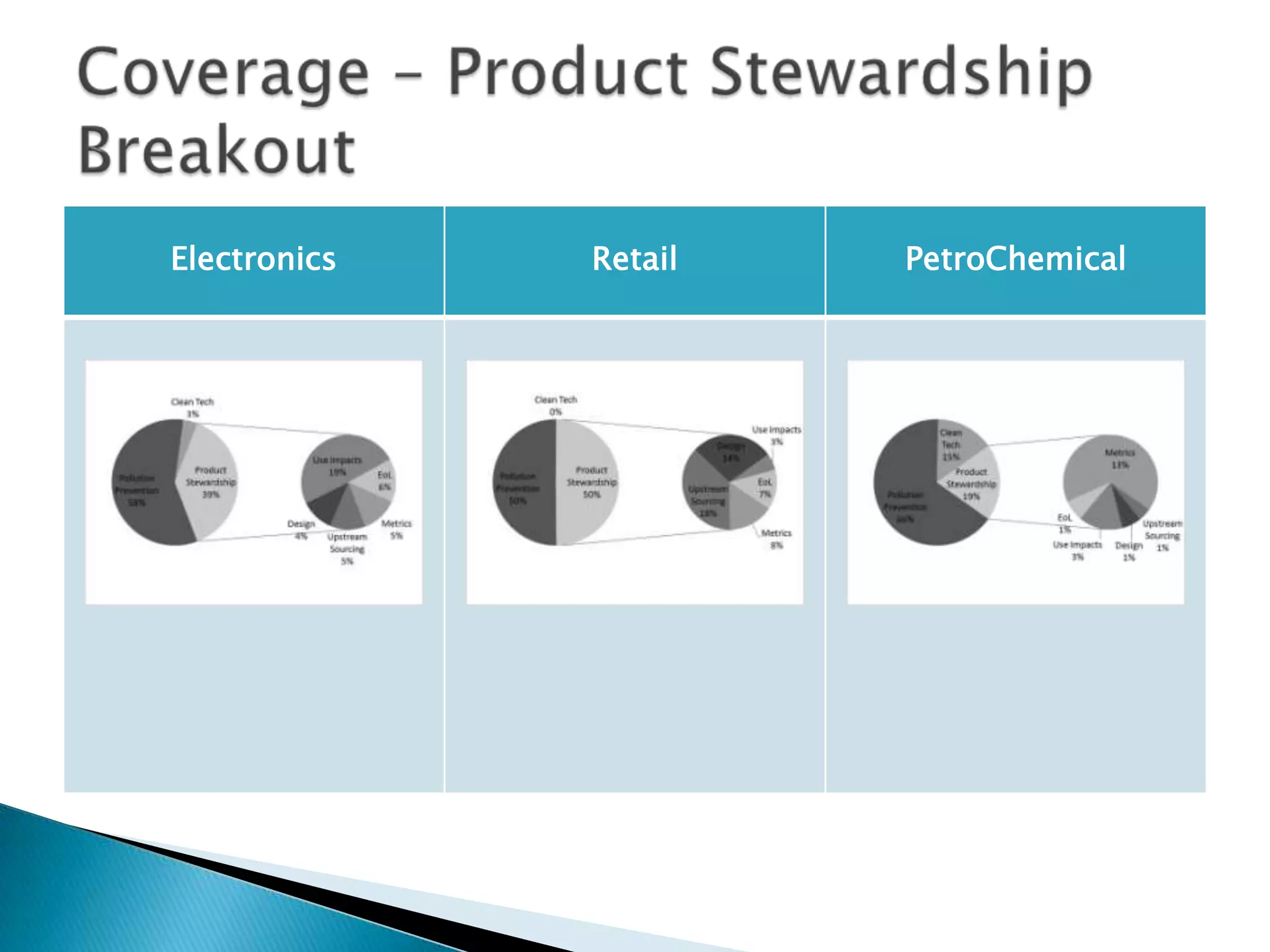
Coverage – Product Stewardship Breakout
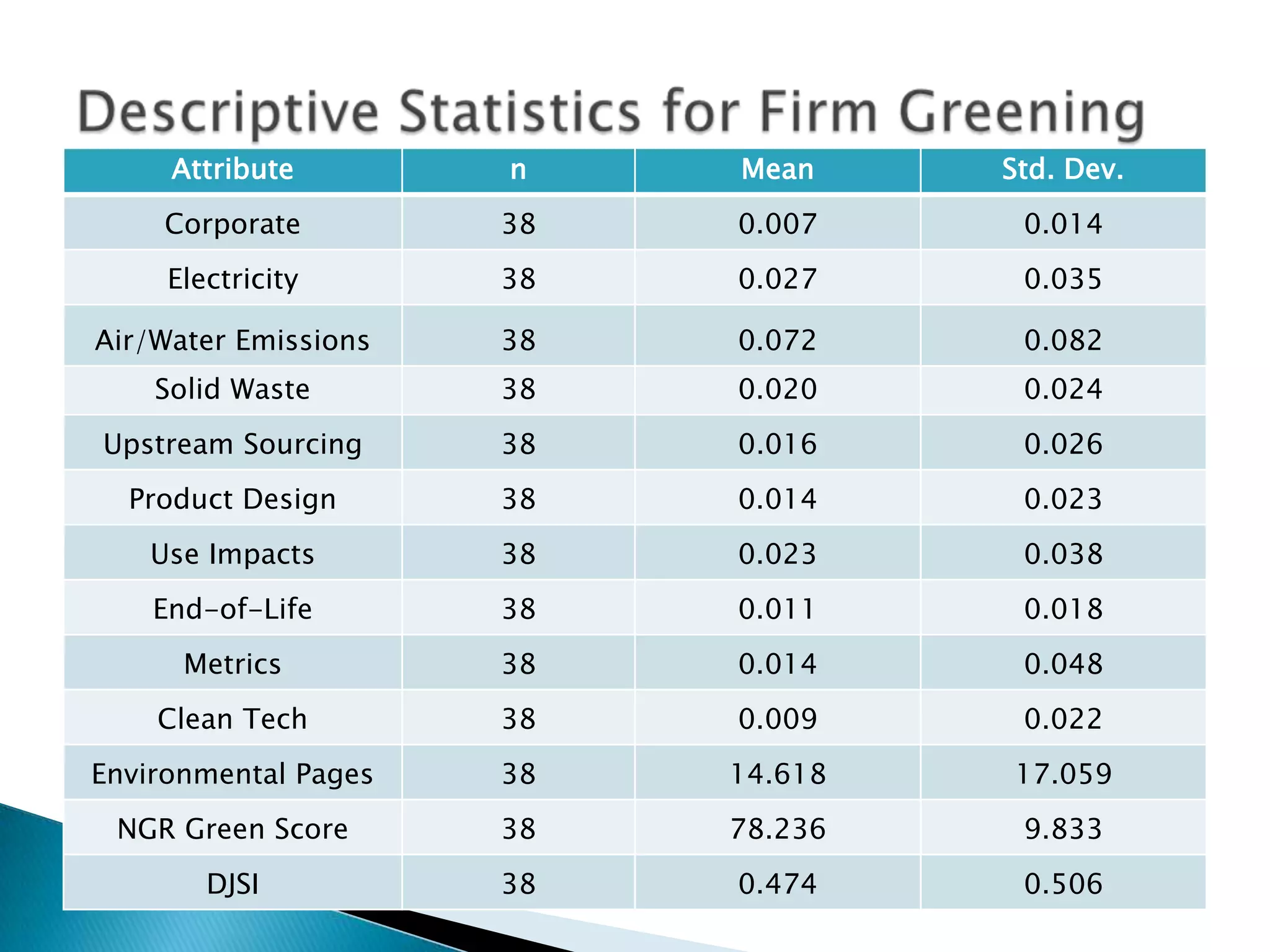
Descriptive Statistics for Firm Greening
Binomial Logistic Regression (n=41)Model Chi-Square = 13.832 (df = 7, sig. = .054). Model correctly categorizes 68% of companies.
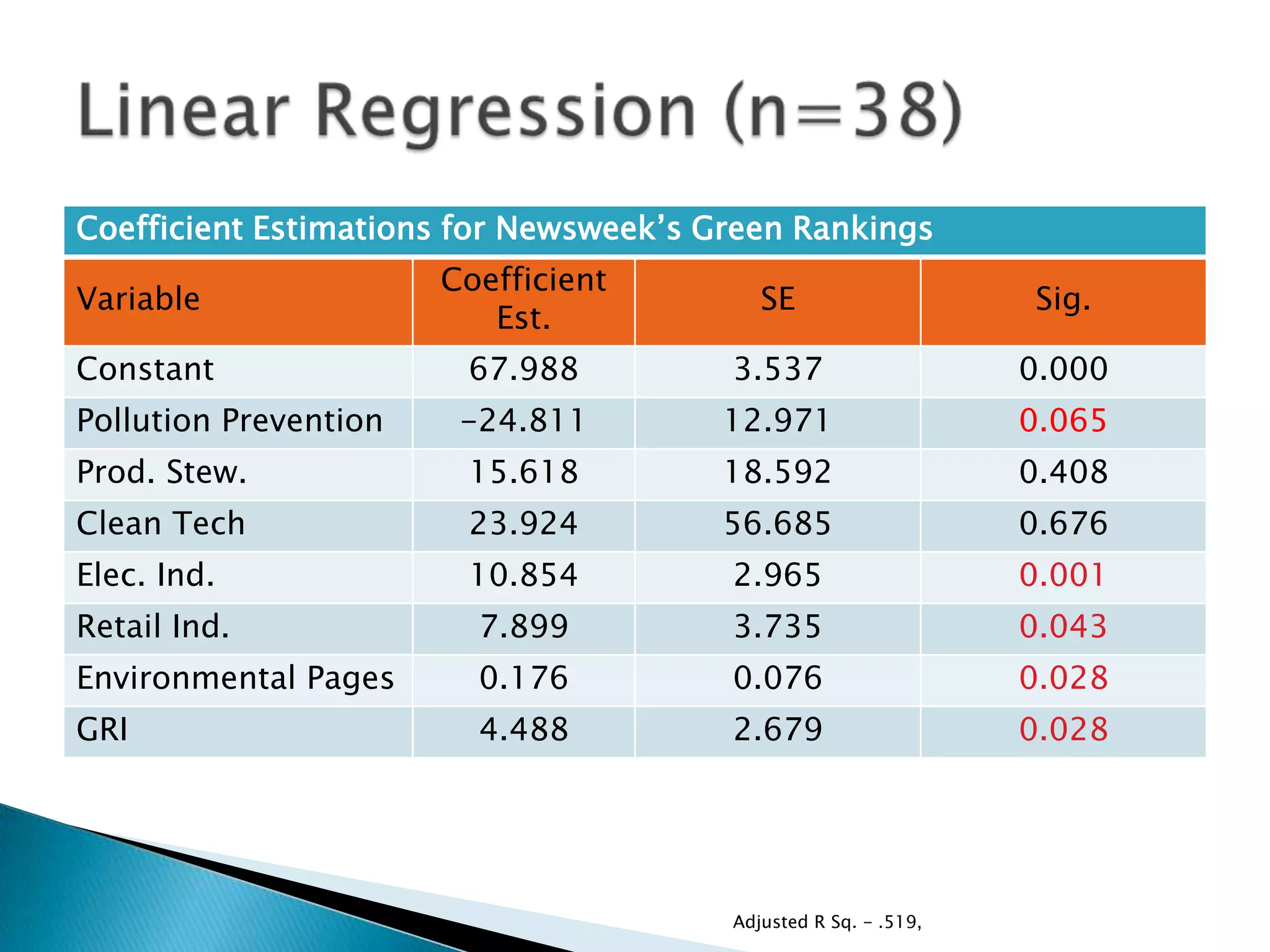
Linear Regression (n=38)Adjusted R Sq. - .519,
Most discussions surround lowest-tier Pollution PreventionDJSI is a weak measure of reputationCSR content is related to third-party rankingAmount of env. info positively related to reputationUse of GRI guidelines can improve NGR rankingConclusions
Mixed results of hypothesesIndicates that reputation and legitimacy are not yet institutionalizedFuture research could expand to more recent CSR and broaden breadth of companies.Provide longitudinal example of changes and make more robust sampleTesting across different theoretical frameworksConclusions Cont.
BackgroundEmpirical Environment and ApproachContent Analysis of Sustainability ReportsResults and DiscussionConclusionReview
Thanks!Questions?

Masters Presentation

  • 1.
    Legitimizing Corporate SustainabilityReporting: Impacts of Content and Standardization on Firm ReputationBen PuhlJuly 22, 2010
  • 2.
    BackgroundEmpirical Environment andApproachContent Analysis of Sustainability ReportsResults and DiscussionConclusionOverview
  • 3.
    Compliance vs. VoluntaryReportingDevelopment of Voluntary Standards around SustainabilityMotivations for Sustainability ReportingEfficacy of ReportingCSR and Institutional TheoryBackground
  • 4.
    Corporate reporting startedin U.S. within financial fieldSpread to encompass environmental aspects Mandatory reporting in many countries including the UK, Canada, and JapanEnvironmental reporting in U.S. required under Regulation S-K, as well as TRI and EPCRACompliance vs. Voluntary Reporting
  • 5.
    Move towards CSR– avenue to place emission dataGRI – standardize reporting for comparison. Development of Voluntary Standards around Sustainability
  • 6.
    Motivations for SustainabilityReportingProConFurther relationships with stakeholdersRisk reductionProvide legitimacy and transparencyDevelop corporate imageExpensiveMarket demand may be weakHigher risk to companyBlackburn, 2007
  • 7.
    MixedPositive relationship betweenreporting and financial performance (Stanwick and Stanwick, 2000)No correlation (New Economics Foundation, 2000)Only a ploy to deceive stakeholders (Gray, 2001)Positive correlation between stock price and sustainability index inclusion (Curran and Moran, 2007)No correlation (Moneva and Ortas, 2008)Efficacy of Reporting
  • 8.
    Firms offering voluntaryenvironmental reports has increased since the 1990’s (Kolk, 2005)Growth of CSR is concurrent with growth of rating/ranking schemes (Porter and Kramer, 2006)Too many schemes for cross-comparison (Brown et al., 2009)GRI created to provide unification (Willis, 2003)CSR and Institutional Theory
  • 9.
  • 10.
    “The GRI hasachieved a single, global guidance on sustainability reporting that just about everyone now believes in,” (Hussey et al., 2001)“Global Reporting Initiative is arguably the best known set of guidelines for producing such reports worldwide,” (Brown et al., 2009)GRI has become the de-facto standard for producing CSRCSR and Institutional Theory
  • 11.
    GRI has attemptedto promote Sustainable DevelopmentHart’s stages of Sustainable Development (1997)Pollution PreventionProduct StewardshipClean TechHart’s Corporate Greening Stages
  • 12.
    GRI, DJSI, andNGR as Legitimacy and Reputational SignalsSampling SchemeEmpirical Environment and Approach
  • 13.
    GRI – standardizationand institutionalization provide legitimacy – still lacks comparisonsDJSI and NGR – provide relative standing outwardly to stakeholders via rankings/ratingsFavorable position can be a reputational benefitGRI, DJSI, and NGR as Legitimacy and Reputational Signals
  • 14.
    H1: Firms reportingmore sustainability activities are more reputableH2: Firms reporting more aggressive sustainability activities are more reputableH3: Firms conforming to legitimate CSR guidelines are more reputableHypotheses
  • 15.
    41 publically availableCSR documents analyzedHierarchicalFortune 500 companiesSectors: Electronics, Retail, PetroChemicalDJSI inclusionPublished sustainability reportMatched control group of non-DJSI firms based on descending firm sizeSampling Scheme
  • 16.
    Code Book DevelopmentDataEnvironment for Quantitative AnalysisContent Analysis of Sustainability Reports
  • 17.
    Content analysis goodat finding themes in text (Bowman, 1978)Grounded Theory (Glaser and Strauss, 1967)Coding based on Hart’s Corporate Greening StagesPollution PreventionProduct StewardshipClean TechnologyCode Book Development
  • 18.
    NVIVO 8 –transformed qualitative data (text) to quantitative data (coverage statistics)Coverage statistics aggregated in Excel and exported to SPSSAlso included firm-level and document statistics in SPSSFortune rank, DJSI inclusion, NGR rank, GRI use, page length, report year, etc.Data Environment for Quantitative Analysis
  • 19.
    General statistics –mean, std. dev.Binomial Logistic Regression - DJSILinear Regression - NGRAnalytical Methods
  • 20.
    Descriptive statisticsBinomial LogisticRegressionLinear RegressionResults and Discussion
  • 21.
    Coverage – PollutionPrevention Breakout
  • 22.
    Coverage – ProductStewardship Breakout
  • 23.
  • 24.
    Binomial Logistic Regression(n=41)Model Chi-Square = 13.832 (df = 7, sig. = .054). Model correctly categorizes 68% of companies.
  • 25.
  • 26.
    Most discussions surroundlowest-tier Pollution PreventionDJSI is a weak measure of reputationCSR content is related to third-party rankingAmount of env. info positively related to reputationUse of GRI guidelines can improve NGR rankingConclusions
  • 27.
    Mixed results ofhypothesesIndicates that reputation and legitimacy are not yet institutionalizedFuture research could expand to more recent CSR and broaden breadth of companies.Provide longitudinal example of changes and make more robust sampleTesting across different theoretical frameworksConclusions Cont.
  • 28.
    BackgroundEmpirical Environment andApproachContent Analysis of Sustainability ReportsResults and DiscussionConclusionReview
  • 29.