Facoltà dell'Informazione, Informatica e Statistica
Corso di Laurea Magistrale in Ingegneria Informatica
Integrating multiple independent legacy
indoor localization systems through a
RESTful API
Candidate:
Jacopo Carlini
Thesis Advisors:
Prof. Massimo Mecella
PhD Francesco Leotta
Academic Year: 2017/2018
18/01/2019Master Thesis Pagina 2
Context
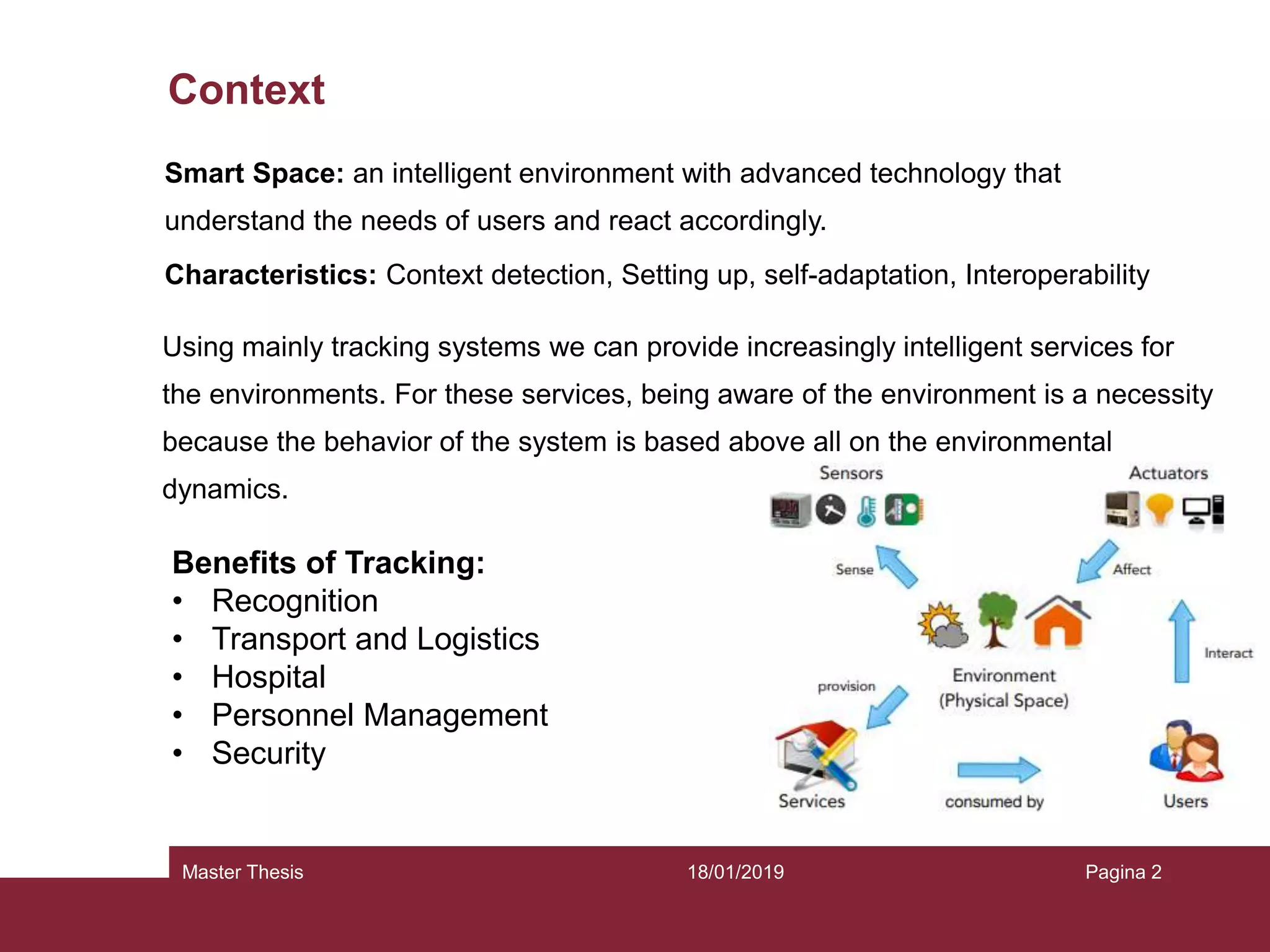
Smart Space: an intelligent environment with advanced technology that
understand the needs of users and react accordingly.
Characteristics: Context detection, Setting up, self-adaptation, Interoperability
Benefits of Tracking:
• Recognition
• Transport and Logistics
• Hospital
• Personnel Management
• Security
Using mainly tracking systems we can provide increasingly intelligent services for
the environments. For these services, being aware of the environment is a necessity
because the behavior of the system is based above all on the environmental
dynamics.
18/01/2019Master Thesis Pagina 3
PLaTHEA
People Localization and Tracking for Home Automation
PLaTHEA is a system of environmental intelligence (AMI). It is a vision-based
indoor location system of people for Home Automation that allows you to
capture a stereo video stream through two cameras connected to the
network.
In addition to the traditional features of indoor location systems, PLaTHEA
includes identity recognition features.
PLaTHEA is a monolithic system with a GUI designed for the tracking in a
single room without marker.
18/01/2019Master Thesis Pagina 4
Objectives
The project consists of creating Web services accessible through REST API
GOAL: a Web service accessible through REST API, for indoor
multi-room localization and tracking.
1. Study and analysis of the code of PLaTHEA project for
integration in the system and use it for tracking facilities.
2. Design the architecture of the server and the REST API.
3. Realization of Java server and of a JNI and transformation of
PLaTHEA in a dynamic-link library (DLL) and adaptation for
multi-room tracking.
4. Realization of a Web Application.
5. Validation of the multi-room tracking.
18/01/2019Master Thesis Pagina 5
PLaTHEA: Technical Aspects
Description of the modules
Phases of the system:
1. The internal calibration is used at runtime for rectification and stereo
calibration of the cameras. The external calibration describes the
relationship between the coordinates system centered in the left camera and
the scene coordinates system.
2. The Synchronization algorithm which selects the frames to be discarded in
each of the sequences so as to modulate and maintain the state of synchrony
and provides a sequence of pairs to be used for stereo vision.
3. The Foreground extraction activity consists in keeping track of the agents
within a space through the operation of separating the pixels belonging to
them.
4. The Tracking and posture algorithm project to the ground all the pixels
belonging to the first floor after the stereo calibration procedure and the
foreground mask extracted.
5. The Extracting the frame containing faces, using, as a rule, a Viola-Jones
classifier.
6. For each face detected, perform the recognition using the comparison of the
SIFT features with each of the faces in the database.
7. Re-project the face on the ground, obtaining the corresponding trace subject.
18/01/2019Master Thesis Pagina 6
Hardware Architecture
Each room can have one or more technologies inside that will be connected
to the main computer.
18/01/2019Master Thesis Pagina 7
Software Architecture
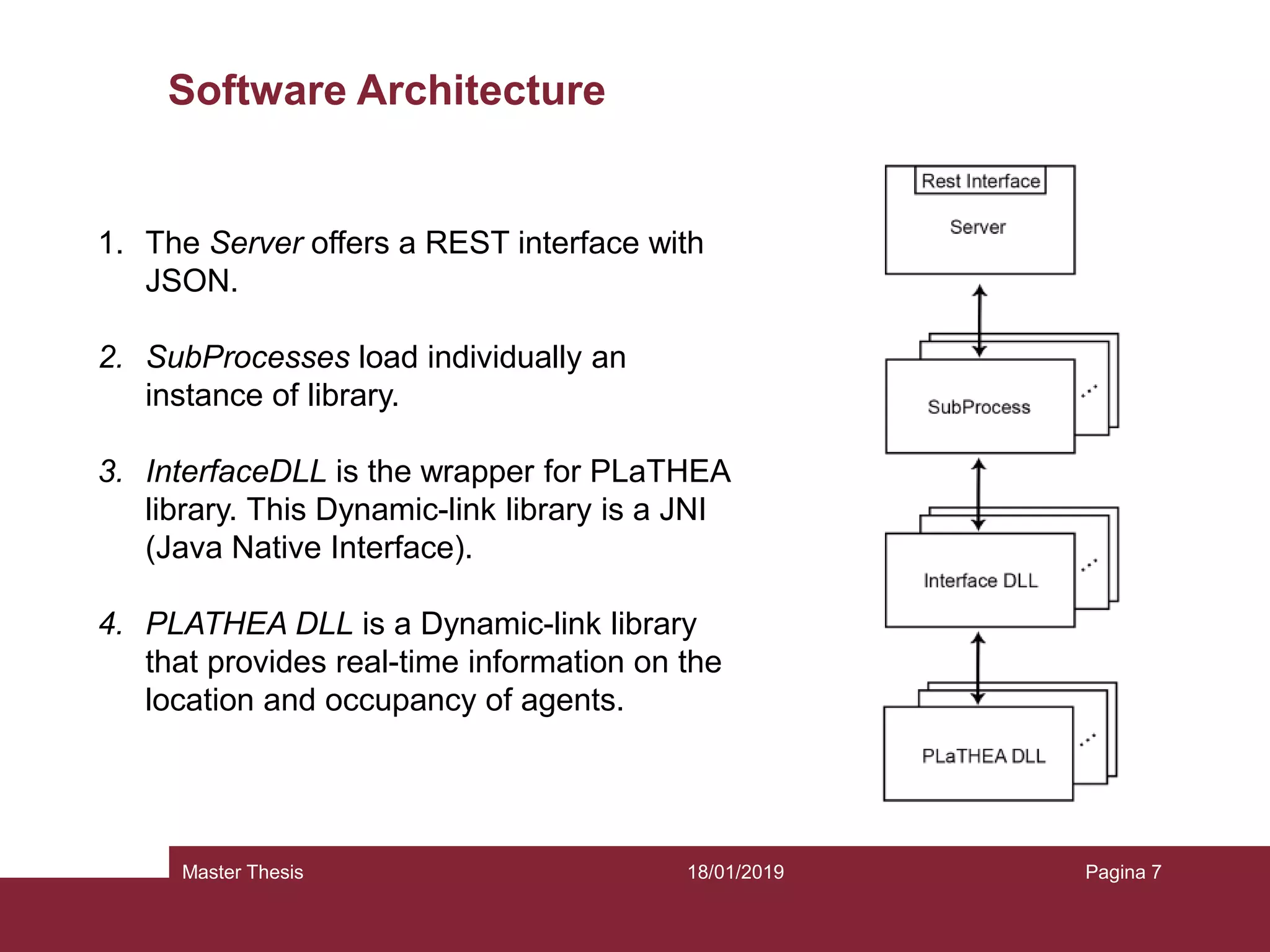
1. The Server offers a REST interface with
JSON.
2. SubProcesses load individually an
instance of library.
3. InterfaceDLL is the wrapper for PLaTHEA
library. This Dynamic-link library is a JNI
(Java Native Interface).
4. PLATHEA DLL is a Dynamic-link library
that provides real-time information on the
location and occupancy of agents.
18/01/2019Master Thesis Pagina 8
WebApp
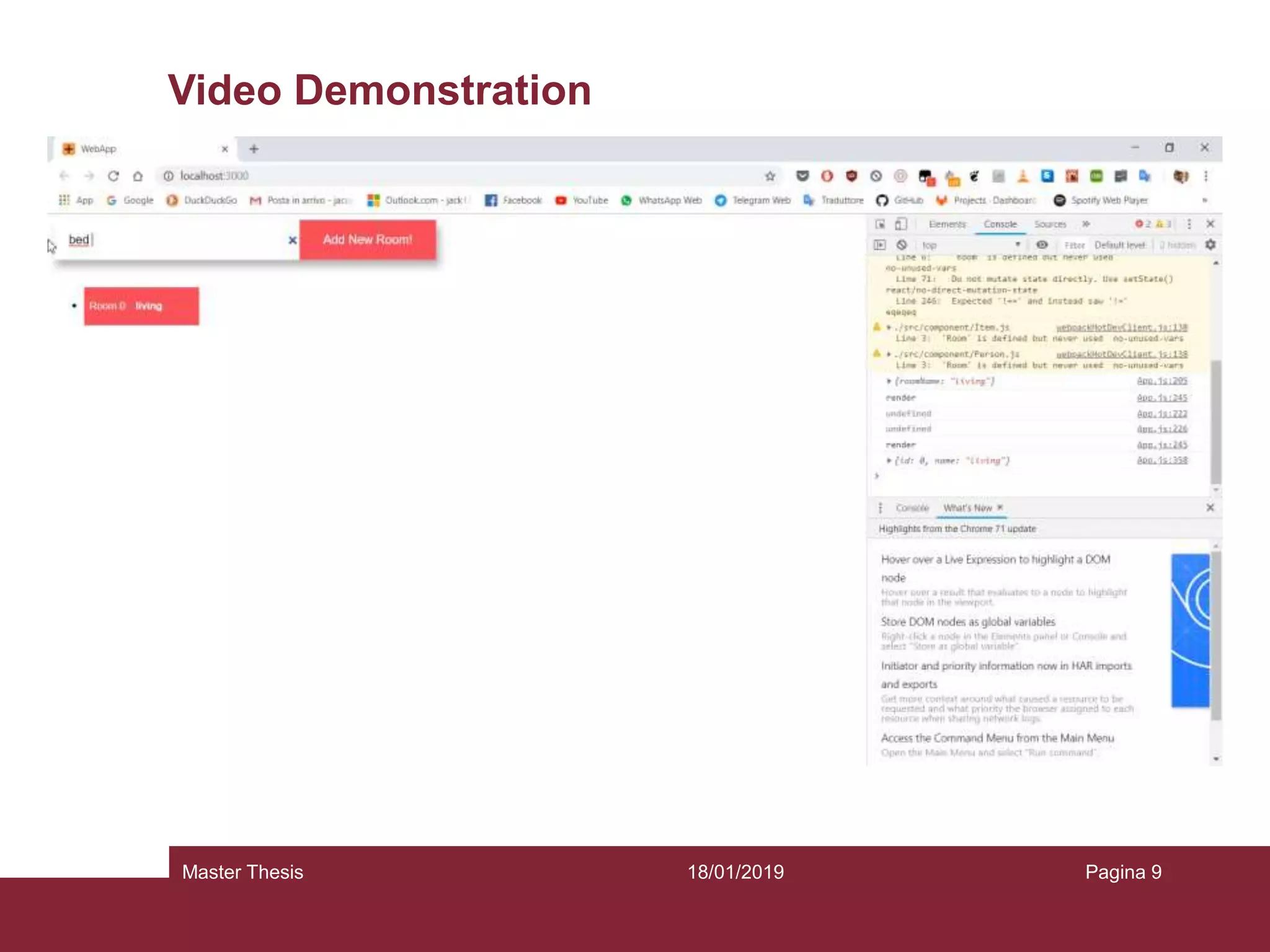
The web application was written with React.
Through the web app it is possible to:
• Add a new room to monitor by the system.
• Configure the room, sending the files and setting the parameters
necessary for the operation of PLaTHEA DLL.
• Start tracking and identification in a room.
• View the video stream from PLaTHEA DLL.
• Display information of people inside the room.
18/01/2019Master Thesis Pagina 9
Video Demonstration
18/01/2019Master Thesis Pagina 10
A Running Example 1/2
Trajectory in the rooms of the person.
Verify the ability to track people moving from one
room to another.
18/01/2019Master Thesis Pagina 11
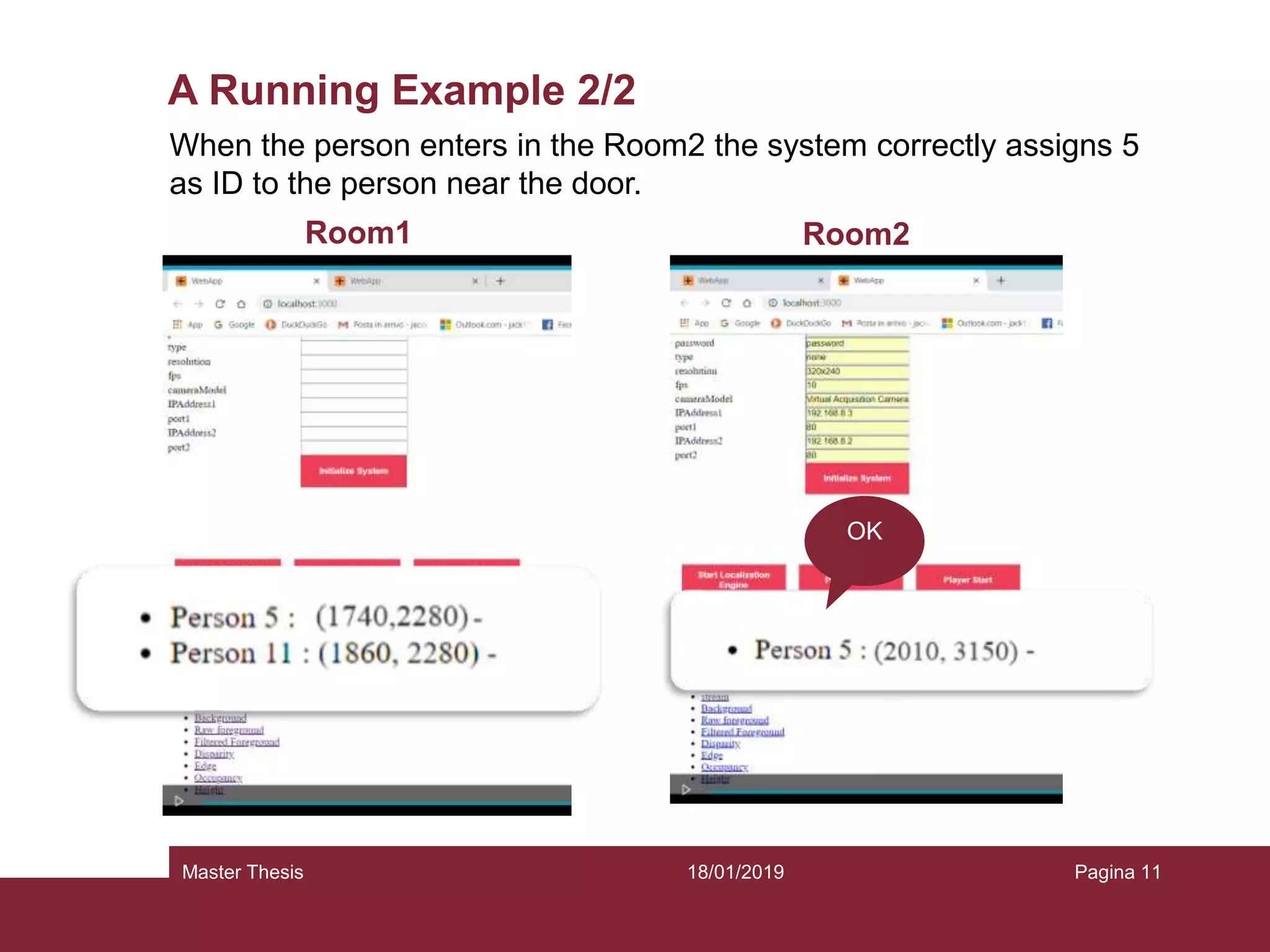
A Running Example 2/2
When the person enters in the Room2 the system correctly assigns 5
as ID to the person near the door.
OK
Room1 Room2
18/01/2019Master Thesis Pagina 12
Conclusions
With this work a web interface has been created to make accessible, through REST
API, the functionalities of a system of localization, identification and monitoring of
users that are present not only in a single room but also in multiple rooms of an
smart space.
The Web interface can be applied to any type of user location and tracking system
but in this specific project PLaTHEA and its vision based functionalities have been
used.
Future Works:
By combining different technologies, for each rooms different levels of tracking
precision can be obtained according to specific needs. Therefore, future developments
are represented by the possibility of integrating other technologies to exploit the
advantages of each of them.
Other future work is the implementation of alarm systems. We can set the system to
send notifications if unauthorized persons access in certain areas.

Master Thesis

  • 1.
    Facoltà dell'Informazione, Informaticae Statistica Corso di Laurea Magistrale in Ingegneria Informatica Integrating multiple independent legacy indoor localization systems through a RESTful API Candidate: Jacopo Carlini Thesis Advisors: Prof. Massimo Mecella PhD Francesco Leotta Academic Year: 2017/2018
  • 2.
    18/01/2019Master Thesis Pagina2 Context Smart Space: an intelligent environment with advanced technology that understand the needs of users and react accordingly. Characteristics: Context detection, Setting up, self-adaptation, Interoperability Benefits of Tracking: • Recognition • Transport and Logistics • Hospital • Personnel Management • Security Using mainly tracking systems we can provide increasingly intelligent services for the environments. For these services, being aware of the environment is a necessity because the behavior of the system is based above all on the environmental dynamics.
  • 3.
    18/01/2019Master Thesis Pagina3 PLaTHEA People Localization and Tracking for Home Automation PLaTHEA is a system of environmental intelligence (AMI). It is a vision-based indoor location system of people for Home Automation that allows you to capture a stereo video stream through two cameras connected to the network. In addition to the traditional features of indoor location systems, PLaTHEA includes identity recognition features. PLaTHEA is a monolithic system with a GUI designed for the tracking in a single room without marker.
  • 4.
    18/01/2019Master Thesis Pagina4 Objectives The project consists of creating Web services accessible through REST API The project consists of creating Web services accessible through REST API GOAL: a Web service accessible through REST API, for indoor multi-room localization and tracking. 1. Study and analysis of the code of PLaTHEA project for integration in the system and use it for tracking facilities. 2. Design the architecture of the server and the REST API. 3. Realization of Java server and of a JNI and transformation of PLaTHEA in a dynamic-link library (DLL) and adaptation for multi-room tracking. 4. Realization of a Web Application. 5. Validation of the multi-room tracking.
  • 5.
    18/01/2019Master Thesis Pagina5 PLaTHEA: Technical Aspects Description of the modules Phases of the system: 1. The internal calibration is used at runtime for rectification and stereo calibration of the cameras. The external calibration describes the relationship between the coordinates system centered in the left camera and the scene coordinates system. 2. The Synchronization algorithm which selects the frames to be discarded in each of the sequences so as to modulate and maintain the state of synchrony and provides a sequence of pairs to be used for stereo vision. 3. The Foreground extraction activity consists in keeping track of the agents within a space through the operation of separating the pixels belonging to them. 4. The Tracking and posture algorithm project to the ground all the pixels belonging to the first floor after the stereo calibration procedure and the foreground mask extracted. 5. The Extracting the frame containing faces, using, as a rule, a Viola-Jones classifier. 6. For each face detected, perform the recognition using the comparison of the SIFT features with each of the faces in the database. 7. Re-project the face on the ground, obtaining the corresponding trace subject.
  • 6.
    18/01/2019Master Thesis Pagina6 Hardware Architecture Each room can have one or more technologies inside that will be connected to the main computer.
  • 7.
    18/01/2019Master Thesis Pagina7 Software Architecture 1. The Server offers a REST interface with JSON. 2. SubProcesses load individually an instance of library. 3. InterfaceDLL is the wrapper for PLaTHEA library. This Dynamic-link library is a JNI (Java Native Interface). 4. PLATHEA DLL is a Dynamic-link library that provides real-time information on the location and occupancy of agents.
  • 8.
    18/01/2019Master Thesis Pagina8 WebApp The web application was written with React. Through the web app it is possible to: • Add a new room to monitor by the system. • Configure the room, sending the files and setting the parameters necessary for the operation of PLaTHEA DLL. • Start tracking and identification in a room. • View the video stream from PLaTHEA DLL. • Display information of people inside the room.
  • 9.
    18/01/2019Master Thesis Pagina9 Video Demonstration
  • 10.
    18/01/2019Master Thesis Pagina10 A Running Example 1/2 Trajectory in the rooms of the person. Verify the ability to track people moving from one room to another.
  • 11.
    18/01/2019Master Thesis Pagina11 A Running Example 2/2 When the person enters in the Room2 the system correctly assigns 5 as ID to the person near the door. OK Room1 Room2
  • 12.
    18/01/2019Master Thesis Pagina12 Conclusions With this work a web interface has been created to make accessible, through REST API, the functionalities of a system of localization, identification and monitoring of users that are present not only in a single room but also in multiple rooms of an smart space. The Web interface can be applied to any type of user location and tracking system but in this specific project PLaTHEA and its vision based functionalities have been used. Future Works: By combining different technologies, for each rooms different levels of tracking precision can be obtained according to specific needs. Therefore, future developments are represented by the possibility of integrating other technologies to exploit the advantages of each of them. Other future work is the implementation of alarm systems. We can set the system to send notifications if unauthorized persons access in certain areas.