


Mass Communication and Social
Problems: Terrorism
Meaning
• Terrorism is commonly defined as violent acts (or
the threat of violent acts) intended to create fear,
perpetrated for an economic, religious, political,
or ideological goal, and which deliberately target
or disregard the safety of non-combatants.
• Another common definition sees terrorism as
political, ideological or religious violence by non-
state actors.
• Some definitions now include acts of unlawful
violence and war.
Introduction
• Former British Prime Minister Margaret
Thatcher, in an often mentioned quote, called
media publicity the “oxygen” of terrorism.
• After the Second World War, the period in
which terrorist organizations have started
using mass media extensively.
Terrorists Using the Media
• The media are very well suited for the purposes
of terrorists.
• As some remarkable terrorist attacks in history
indicate, whether it is in the United States (US),
Europe, or the Middle East, it is by and large the
case that the architects of terrorism exploit the
media for the benefit of their operational
efficiency, information gathering, recruitment,
fund raising, and propaganda schemes (Nacos
2006).
Terrorists Using the Media
• Terrorist groups have three purposes to interact
with the media, namely attention, recognition
and legitimacy.
• Also demoralizing enemies such as governments,
demonstrating strength, gaining sympathy and
creating fear and chaos are the main interests of
terrorists for which they can utilize the media.
• For each terrorist organization the objectives in
using the media may be different.
Gaining Attention and Awareness;
Spreading Fear
• Terrorists are trying to be in the media as
often and as long as possible, in order to
become well known to the public.
• In fact terrorists are thus carrying out
propaganda by proxy.
Case study
• For example is the terrorist attack in Munich.
• In 1972, when people throughout the world were watching
the Olympic Games in that city and large numbers of
newspaper and broadcast journalists had gathered, the
Palestinian terrorist organization Black September carried
out the infamous attack on Israeli athletes present in the
Olympic camp.
• What followed was a hostage situation and a rescue
attempt that was closely covered by all of those media, and
watched by millions of people throughout the world.
• The terrorists were able to “monopolize the attention of a
global television audience who had tuned in expecting to
watch the Games.”
Recognition of Motives
• Not only do terrorists want to be known to the
audience, they also want to try to get their
message across through the media.
• Sometimes terrorist groups actually force
media to publish their motivations, so that
people throughout the world read about it.
• Terrorists do not force-feed their motivations
to the media outlets. Instead, the media
voluntarily decide to report on these issues.
Gaining Respect and Sympathy
• For instance, after 9/11 and other attacks, Bin
Laden has become more popular among
groups in the Muslim world
Gaining Legitimacy
• By regularly appearing in the media, terrorists
are trying to become a legitimate
representative of their own cause.
• This is mainly achieved by getting personal
airtime through interviews and recorded
videos or messages.
How and Why the Media Covers Terrorism
• Terrorism is an attractive boon for media
coverage, mainly because terrorist attacks
make viewer ratings surge and profits
increase.
• To be more specific, terrorism has many
aspects that make it a very attractive subject
for the media, as it has the elements of
drama, danger, blood, human tragedy, miracle
stories, heroes, shocking footage, and action.
Conti..
• The media has always been interested in
reporting terrorism; however, the recent
proliferation of television and radio channels,
and the emergence of mega-media
organizations have resulted in greater
competition and insatiable appetites for
shocking, sensational “infotainment” that is
believed to keep audiences captivated, boost
ratings and circulation, and increase profits.
List of terrorism films
in India
• Aaniver (1981)
• Roja (1992)
• Drohkaal (1994)
• Maachis (1996)
• Dil Se.. (1998)
• Swasthik (1999)
• The Terrorist (1999)
• Vaastav: The Reality (1999)
• Azad (2000)
• Badal (2000)
• Fiza (2000)
• Mission Kashmir (2000)
• Khadgam (2003)
• Black Friday (2005)
• Fanaa (2006)
• Keerthi Chakra (2006)
• Dhokha (2007)
• Shootout at Lokhandwala (2007)
• Mukhbir (2008)
• Aamir (2008)
• Mission 90 Days (2008)
• Mumbai Meri Jaan (2008)
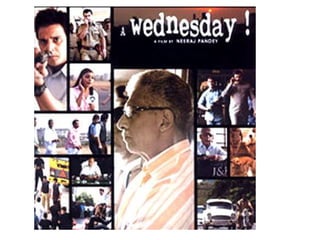
• A Wednesday! (2009)
• Kurbaan (2009)
• Mission Istanbul (2009)
• Unnai Pol Oruvan (2009)
• Sikandar (2009)
• Kandahar (2010)
• Once Upon a Time in Mumbaai (2010)
• Velayudham (2011)
• Agent Vinod (2012)
• Thuppakki (2012)
• My Name Is Khan (2013)
• Once Upon ay Time in Mumbai Dobaara!
(2013)
• Shootout at Wadala (2013)
• The Attacks of 26/11 (2013)
• Vishwaroopam (2013)
• Phantom (2015)
• Neerja" (2016)
New Developments: Terrorists are the
Media
• The first is when the media report on terrorist
activity.
• In that case, terrorists merely carry out an
attack and must wait to see how the media
report on it.
• They can try to influence the report by
choosing location, time, and target, but they
are not involved in writing the contents of the
news.
Conti..
• A second level is when terrorists send in their
messages straight to the media outlets.
• They can thus decide on what exactly to say,
and how to frame their message.
• Newspapers have been published by terrorist
organizations for a long time.
• This can be seen for example, in the small San
Francisco anarchist paper Truth that was
published over a century ago:
'Banning movies will not end terrorism',
Bollywood supports Karan Johar
• Amid the riling controversy over ban on Pakistani
artists and movies in the country, various
Bollywood actors have come out in the open to
voice their opinion on the imposition.
• After the Uri terror attack, objections over
Pakistani artists working in Hindi film industry
have led to many differing points of view and
debates in and outside the film industry.
Terrorist TV
• Another way to directly run the media, is to create it
yourself.
• Again, this can be a newspaper, a journal, or a radio
station, but in some cases terrorists have created their
own television channel as well, even broadcasting it
over satellite to millions of homes throughout the
world.
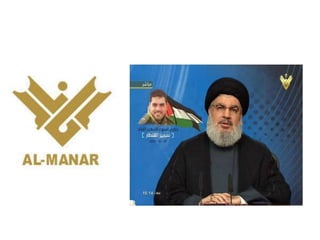
• The best example is the Lebanese Hezbollah’s al-Manar
television channel. Al-Manar directly broadcasts
Hezbollah’s point of view, and does so very successfully.
• In fact it is said to be in the top 5 of best watched
television channels in the Middle East, and
internationally it has reported approximately 10 million
viewers per day.
Censoring Al-Manar TV: Banned from
U.S. Television
• Al-Manar was designated as a “Specially
Designated Global Terrorist” entity," and banned
by the United States on 17 December 2004.
• It has also been banned by France, Spain and
Germany and has run into some service and
license problems outside Lebanon, making it
unavailable in the Natherlands, Canada and
Australia while it has not officially been banned in
any of these regions.
Al-Manar,
Hezbollah's Voice on the Air
• Hezbollah broadcasts news and messages on a
television station it operates in Lebanon called Al-
Manar.
• Hezbollah leader Sayed Hassan Nasrallah has
pledged to take the war deeper into Israel. He has
suggested hitting towns south of Haifa.
• And joining us now to talk about the fighting is
Ibrahim Moussaoui, the foreign editor for
Hezbollah's Al-Manar television network.
Al Jazeera banned in India for 5 days;
channel condemns Indian govt.
• Al Jazeera, owned by the government of Qatar, is currently one of
the largest news organizations in the world, with 80 bureaus around
the globe, which produce extensive news coverage online and via TV
channels in a number of languages, including Arabic and English.
• International news channel Al Jazeera was today forced to go off
air in the country for five days as the government penalised it for
repeatedly showing wrong maps of India.
• The SGI had observed that in some of the maps displayed by Al
Jazeera, “a portion of Indian territory of Jammu and Kashmir (i.e.
PoK and Aksai Chin) has not been shown as a part of Indian
territory.”
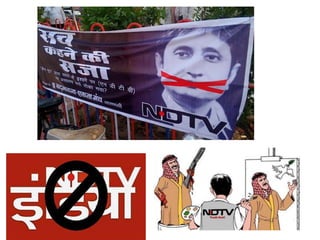
NDTV India ban: First time a news
channel barred over national security
• Sources in the Information &Broadcasting ministry say
action was taken against the channel because it had
revealed sensitive details, such as the location of the
ammunition depot, school and residential areas in its
coverage of the Pathankot attack.
• It also appeared to disclose the location of the
attackers.
• This crucial information could have been readily picked
up by the terrorists’ handlers and jeopardised national
security as well as the lives of civilians and defence
personnel.
The Internet
• “[Al-Qaida] made its name in blood and pixels,
with deadly attacks and an avalanche of
electronic news media.” (Kimmage 2008).
• Daniel Kimmage writes this in an oped in the New
York Times.
• And indeed, the Internet can be and has been
used for many purposes by terrorists.
• Examples are cyber-terrorism, coordination of
plans of attack, communication with cells, or
propaganda and information.
Thank you

Mass communication and social problems - terrorism

  • 1.
    Mass Communication andSocial Problems: Terrorism
  • 2.
    Meaning • Terrorism iscommonly defined as violent acts (or the threat of violent acts) intended to create fear, perpetrated for an economic, religious, political, or ideological goal, and which deliberately target or disregard the safety of non-combatants. • Another common definition sees terrorism as political, ideological or religious violence by non- state actors. • Some definitions now include acts of unlawful violence and war.
  • 3.
    Introduction • Former BritishPrime Minister Margaret Thatcher, in an often mentioned quote, called media publicity the “oxygen” of terrorism. • After the Second World War, the period in which terrorist organizations have started using mass media extensively.
  • 4.
    Terrorists Using theMedia • The media are very well suited for the purposes of terrorists. • As some remarkable terrorist attacks in history indicate, whether it is in the United States (US), Europe, or the Middle East, it is by and large the case that the architects of terrorism exploit the media for the benefit of their operational efficiency, information gathering, recruitment, fund raising, and propaganda schemes (Nacos 2006).
  • 5.
    Terrorists Using theMedia • Terrorist groups have three purposes to interact with the media, namely attention, recognition and legitimacy. • Also demoralizing enemies such as governments, demonstrating strength, gaining sympathy and creating fear and chaos are the main interests of terrorists for which they can utilize the media. • For each terrorist organization the objectives in using the media may be different.
  • 6.
    Gaining Attention andAwareness; Spreading Fear • Terrorists are trying to be in the media as often and as long as possible, in order to become well known to the public. • In fact terrorists are thus carrying out propaganda by proxy.
  • 7.
    Case study • Forexample is the terrorist attack in Munich. • In 1972, when people throughout the world were watching the Olympic Games in that city and large numbers of newspaper and broadcast journalists had gathered, the Palestinian terrorist organization Black September carried out the infamous attack on Israeli athletes present in the Olympic camp. • What followed was a hostage situation and a rescue attempt that was closely covered by all of those media, and watched by millions of people throughout the world. • The terrorists were able to “monopolize the attention of a global television audience who had tuned in expecting to watch the Games.”
  • 8.
    Recognition of Motives •Not only do terrorists want to be known to the audience, they also want to try to get their message across through the media. • Sometimes terrorist groups actually force media to publish their motivations, so that people throughout the world read about it. • Terrorists do not force-feed their motivations to the media outlets. Instead, the media voluntarily decide to report on these issues.
  • 9.
    Gaining Respect andSympathy • For instance, after 9/11 and other attacks, Bin Laden has become more popular among groups in the Muslim world
  • 12.
    Gaining Legitimacy • Byregularly appearing in the media, terrorists are trying to become a legitimate representative of their own cause. • This is mainly achieved by getting personal airtime through interviews and recorded videos or messages.
  • 13.
    How and Whythe Media Covers Terrorism • Terrorism is an attractive boon for media coverage, mainly because terrorist attacks make viewer ratings surge and profits increase. • To be more specific, terrorism has many aspects that make it a very attractive subject for the media, as it has the elements of drama, danger, blood, human tragedy, miracle stories, heroes, shocking footage, and action.
  • 14.
    Conti.. • The mediahas always been interested in reporting terrorism; however, the recent proliferation of television and radio channels, and the emergence of mega-media organizations have resulted in greater competition and insatiable appetites for shocking, sensational “infotainment” that is believed to keep audiences captivated, boost ratings and circulation, and increase profits.
  • 16.
    List of terrorismfilms in India • Aaniver (1981) • Roja (1992) • Drohkaal (1994) • Maachis (1996) • Dil Se.. (1998) • Swasthik (1999) • The Terrorist (1999) • Vaastav: The Reality (1999) • Azad (2000) • Badal (2000) • Fiza (2000) • Mission Kashmir (2000) • Khadgam (2003) • Black Friday (2005) • Fanaa (2006) • Keerthi Chakra (2006) • Dhokha (2007) • Shootout at Lokhandwala (2007) • Mukhbir (2008) • Aamir (2008) • Mission 90 Days (2008) • Mumbai Meri Jaan (2008) • A Wednesday! (2009) • Kurbaan (2009) • Mission Istanbul (2009) • Unnai Pol Oruvan (2009) • Sikandar (2009) • Kandahar (2010) • Once Upon a Time in Mumbaai (2010) • Velayudham (2011) • Agent Vinod (2012) • Thuppakki (2012) • My Name Is Khan (2013) • Once Upon ay Time in Mumbai Dobaara! (2013) • Shootout at Wadala (2013) • The Attacks of 26/11 (2013) • Vishwaroopam (2013) • Phantom (2015) • Neerja" (2016)
  • 17.
    New Developments: Terroristsare the Media • The first is when the media report on terrorist activity. • In that case, terrorists merely carry out an attack and must wait to see how the media report on it. • They can try to influence the report by choosing location, time, and target, but they are not involved in writing the contents of the news.
  • 18.
    Conti.. • A secondlevel is when terrorists send in their messages straight to the media outlets. • They can thus decide on what exactly to say, and how to frame their message. • Newspapers have been published by terrorist organizations for a long time. • This can be seen for example, in the small San Francisco anarchist paper Truth that was published over a century ago:
  • 19.
    'Banning movies willnot end terrorism', Bollywood supports Karan Johar • Amid the riling controversy over ban on Pakistani artists and movies in the country, various Bollywood actors have come out in the open to voice their opinion on the imposition. • After the Uri terror attack, objections over Pakistani artists working in Hindi film industry have led to many differing points of view and debates in and outside the film industry.
  • 20.
    Terrorist TV • Anotherway to directly run the media, is to create it yourself. • Again, this can be a newspaper, a journal, or a radio station, but in some cases terrorists have created their own television channel as well, even broadcasting it over satellite to millions of homes throughout the world. • The best example is the Lebanese Hezbollah’s al-Manar television channel. Al-Manar directly broadcasts Hezbollah’s point of view, and does so very successfully. • In fact it is said to be in the top 5 of best watched television channels in the Middle East, and internationally it has reported approximately 10 million viewers per day.
  • 21.
    Censoring Al-Manar TV:Banned from U.S. Television • Al-Manar was designated as a “Specially Designated Global Terrorist” entity," and banned by the United States on 17 December 2004. • It has also been banned by France, Spain and Germany and has run into some service and license problems outside Lebanon, making it unavailable in the Natherlands, Canada and Australia while it has not officially been banned in any of these regions.
  • 22.
    Al-Manar, Hezbollah's Voice onthe Air • Hezbollah broadcasts news and messages on a television station it operates in Lebanon called Al- Manar. • Hezbollah leader Sayed Hassan Nasrallah has pledged to take the war deeper into Israel. He has suggested hitting towns south of Haifa. • And joining us now to talk about the fighting is Ibrahim Moussaoui, the foreign editor for Hezbollah's Al-Manar television network.
  • 24.
    Al Jazeera bannedin India for 5 days; channel condemns Indian govt. • Al Jazeera, owned by the government of Qatar, is currently one of the largest news organizations in the world, with 80 bureaus around the globe, which produce extensive news coverage online and via TV channels in a number of languages, including Arabic and English. • International news channel Al Jazeera was today forced to go off air in the country for five days as the government penalised it for repeatedly showing wrong maps of India. • The SGI had observed that in some of the maps displayed by Al Jazeera, “a portion of Indian territory of Jammu and Kashmir (i.e. PoK and Aksai Chin) has not been shown as a part of Indian territory.”
  • 26.
    NDTV India ban:First time a news channel barred over national security • Sources in the Information &Broadcasting ministry say action was taken against the channel because it had revealed sensitive details, such as the location of the ammunition depot, school and residential areas in its coverage of the Pathankot attack. • It also appeared to disclose the location of the attackers. • This crucial information could have been readily picked up by the terrorists’ handlers and jeopardised national security as well as the lives of civilians and defence personnel.
  • 28.
    The Internet • “[Al-Qaida]made its name in blood and pixels, with deadly attacks and an avalanche of electronic news media.” (Kimmage 2008). • Daniel Kimmage writes this in an oped in the New York Times. • And indeed, the Internet can be and has been used for many purposes by terrorists. • Examples are cyber-terrorism, coordination of plans of attack, communication with cells, or propaganda and information.
  • 29.